Cambridge A Level Thinking Skills 9694 — 2020 Oct/Nov Paper 2 · Variant 3
9694/23/O/N/20 · 50 marks · ≈56 min
The question paper and its mark scheme, free to read here and free to download. This is Cambridge’s own paper, exactly as it was sat.
Question paper8 pages



Mark scheme11 pages
Answers below. Sit the paper first if you are practising.
Paper as text
Question paper, page 1
Cambridge International AS & A Level DC (JC/JG) 185798/1 © UCLES 2020 [Turn over This document has 8 pages. Blank pages are indicated. * 8 4 0 8 2 3 8 1 4 3 * THINKING SKILLS 9694/23 Paper 2 Critical Thinking October/November 2020 1 hour 45 minutes You must answer on the enclosed answer booklet. You will need: Answer booklet (enclosed) INSTRUCTIONS ● Answer all questions. ● Follow the instructions on the front cover of the answer booklet. If you need additional answer paper, ask the invigilator for a continuation booklet. INFORMATION ● The total mark for this paper is 50. ● The number of marks for each question or part question is shown in brackets [ ].
Question paper, page 2
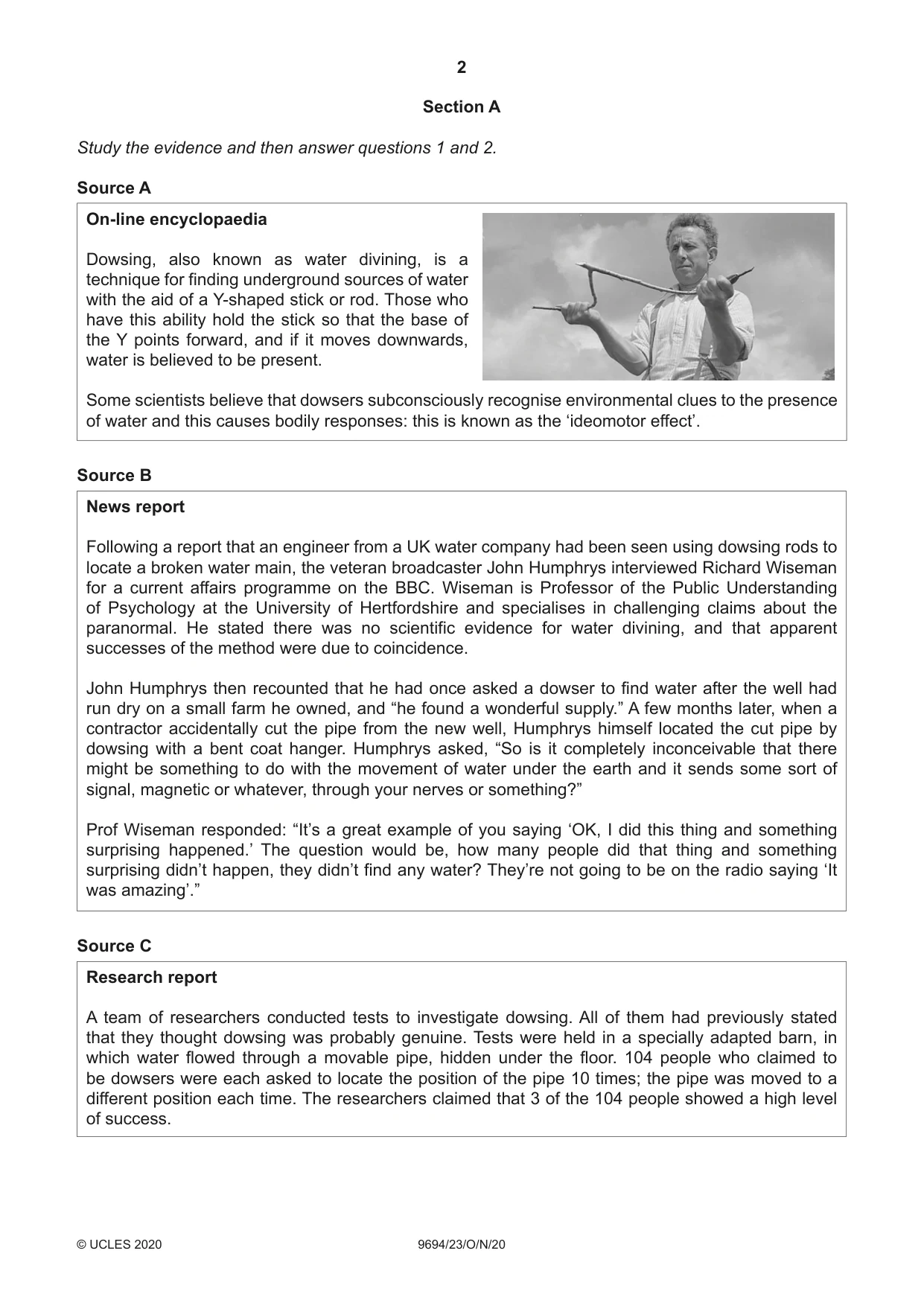
2 9694/23/O/N/20 © UCLES 2020 Section A Study the evidence and then answer questions 1 and 2. Source A On-line encyclopaedia Dowsing, also known as water divining, is a technique for finding underground sources of water with the aid of a Y-shaped stick or rod. Those who have this ability hold the stick so that the base of the Y points forward, and if it moves downwards, water is believed to be present. Some scientists believe that dowsers subconsciously recognise environmental clues to the presence of water and this causes bodily responses: this is known as the ‘ideomotor effect’. Source B News report Following a report that an engineer from a UK water company had been seen using dowsing rods to locate a broken water main, the veteran broadcaster John Humphrys interviewed Richard Wiseman for a current affairs programme on the BBC. Wiseman is Professor of the Public Understanding of Psychology at the University of Hertfordshire and specialises in challenging claims about the paranormal. He stated there was no scientific evidence for water divining, and that apparent successes of the method were due to coincidence. John Humphrys then recounted that he had once asked a dowser to find water after the well had run dry on a small farm he owned, and “he found a wonderful supply.” A few months later, when a contractor accidentally cut the pipe from the new well, Humphrys himself located the cut pipe by dowsing with a bent coat hanger. Humphrys asked, “So is it completely inconceivable that there might be something to do with the movement of water under the earth and it sends some sort of signal, magnetic or whatever, through your nerves or something?” Prof Wiseman responded: “It’s a great example of you saying ‘OK, I did this thing and something surprising happened.’ The question would be, how many people did that thing and something surprising didn’t happen, they didn’t find any water? They’re not going to be on the radio saying ‘It was amazing’.” Source C Research report A team of researchers conducted tests to investigate dowsing. All of them had previously stated that they thought dowsing was probably genuine. Tests were held in a specially adapted barn, in which water flowed through a movable pipe, hidden under the floor. 104 people who claimed to be dowsers were each asked to locate the position of the pipe 10 times; the pipe was moved to a different position each time. The researchers claimed that 3 of the 104 people showed a high level of success.
Question paper, page 3
3 9694/23/O/N/20 © UCLES 2020 [Turn over Source D Website of national geological institute Water dowsers operate mostly in rural locations, where residents need to find the best and cheapest supply of groundwater. Drilling and developing a well can cost over a thousand dollars, so homeowners are understandably reluctant to run the risk of drilling a well which turns out to be dry. They therefore often ask dowsers for help. There is a simple natural explanation for what appears to be successful water dowsing. In many areas, water is so widespread and close to the surface of the land that it would be hard to drill a well without finding some water. However, accurately locating a usable supply of water requires specialist knowledge of hydrology, geology and geophysics, in order to discover the depth and extent of the different water-bearing strata and the quantity and quality of water found in each. 1 (a) Is Source A an argument? Justify your answer. [2] (b) With reference to Source B, identify one factor that increases and one factor that reduces the reliability of (i) John Humphrys. [2] (ii) Professor Richard Wiseman. [2] (c) The researchers in Source C claimed their results showed that some people do have the ability to locate water by dowsing. (i) Suggest an alternative explanation for the results. [2] (ii) Suggest a piece of further evidence which would strengthen the researchers’ claim. [2] (d) How useful is Source D? [4] 2 You are advised to spend some time planning your answer before you begin to write it. ‘Dowsing is a genuine skill.’ To what extent do you agree with this claim? Write a short, reasoned argument to support your conclusion, using and evaluating the evidence provided. [8]
Question paper, page 4
4 9694/23/O/N/20 © UCLES 2020 Section B Read the following passage and then answer questions 3, 4 and 5. 1 There are various opinions about the age at which young people should become eligible to vote to choose a government, but everyone agrees that there should be such an age. There should also be a maximum age for voting. Many people towards the end of their life lose their memory and their ability to think clearly. Since they are evidently incapable of voting in a rational manner, they should not be allowed to vote. Voting should be restricted to those who are capable of thinking through issues clearly and responsibly. 2 The moral basis for democracy is that the people who are going to be affected by the policies followed by a government should be the ones who choose that government. The younger generation will have to live with the consequences of the decisions that are made today, and so they alone should make those decisions. These consequences could include higher or lower taxes, and an enhanced or reduced standard of living. 3 Anyone who has spent much time with their grandparents knows that old people enjoy talking about the past. Rapid social change has made them less confident about life in the present and the future. Yet elections are all about choosing between alternative futures. People who have chosen to live in the past should play no part in making such choices. 4 The slogan ‘No taxation without representation’ means that the people who contribute to the cost of running a country deserve to have a voice in deciding how their money will be spent. Pensioners may have made such contributions in the past, but they are doing so no longer. They are now dependent on the efforts and kindness of others and therefore no longer deserve to be involved in political decision-making. 5 Old people are more rigid in their thinking than young people. Typically, they formed their political convictions long ago and are unlikely to change them in response to new conditions and ideas. So their votes will be based on prejudice rather than on engagement with current issues and debates.
Question paper, page 5
5 9694/23/O/N/20 © UCLES 2020 3 (a) Using the exact words from the passage as far as possible, identify the main conclusion. [2] (b) Using the exact words from the passage as far as possible, identify three intermediate conclusions. [6] (c) Identify the argument element and explain the function of the following words from paragraph 2: ‘higher or lower taxes’ [2] (d) Identify an unstated assumption required by the argument in paragraph 5. [2] 4 (a) Explain why the reasoning in paragraph 1 gives only limited support to the argument as a whole. [2] (b) Identify two flaws of conflation in paragraph 3 and explain to what extent each weakens the reasoning. [4] (c) Identify and explain one flaw or weakness in the reasoning in paragraph 4. [2] 5 You are advised to spend some time planning your answer before you begin to write it. ‘Elderly people are an important part of society.’ Write your own short argument to support or challenge this claim. The conclusion of your argument must be stated. Credit will not be given for repeating ideas from the passage. [8]
Question paper, page 6
6 9694/23/O/N/20 © UCLES 2020 BLANK PAGE
Question paper, page 7
7 9694/23/O/N/20 © UCLES 2020 BLANK PAGE
Question paper, page 8
8 9694/23/O/N/20 © UCLES 2020 Permission to reproduce items where third-party owned material protected by copyright is included has been sought and cleared where possible. Every reasonable effort has been made by the publisher (UCLES) to trace copyright holders, but if any items requiring clearance have unwittingly been included, the publisher will be pleased to make amends at the earliest possible opportunity. To avoid the issue of disclosure of answer-related information to candidates, all copyright acknowledgements are reproduced online in the Cambridge Assessment International Education Copyright Acknowledgements Booklet. This is produced for each series of examinations and is freely available to download at www.cambridgeinternational.org after the live examination series. Cambridge Assessment International Education is part of the Cambridge Assessment Group. Cambridge Assessment is the brand name of the University of Cambridge Local Examinations Syndicate (UCLES), which itself is a department of the University of Cambridge. BLANK PAGE
Mark scheme, page 1
This document consists of 11 printed pages. © UCLES 2020 [Turn over Cambridge International AS & A Level THINKING SKILLS 9694/23 Paper 2 Critical Thinking October/November 2020 MARK SCHEME Maximum Mark: 50 Published This mark scheme is published as an aid to teachers and candidates, to indicate the requirements of the examination. It shows the basis on which Examiners were instructed to award marks. It does not indicate the details of the discussions that took place at an Examiners’ meeting before marking began, which would have considered the acceptability of alternative answers. Mark schemes should be read in conjunction with the question paper and the Principal Examiner Report for Teachers. Cambridge International will not enter into discussions about these mark schemes. Cambridge International is publishing the mark schemes for the October/November 2020 series for most Cambridge IGCSE™, Cambridge International A and AS Level and Cambridge Pre-U components, and some Cambridge O Level components.
Mark scheme, page 2
9694/23 Cambridge International AS & A Level – Mark Scheme PUBLISHED October/November 2020 © UCLES 2020 Page 2 of 11 Generic Marking Principles These general marking principles must be applied by all examiners when marking candidate answers. They should be applied alongside the specific content of the mark scheme or generic level descriptors for a question. Each question paper and mark scheme will also comply with these marking principles. GENERIC MARKING PRINCIPLE 1: Marks must be awarded in line with: • the specific content of the mark scheme or the generic level descriptors for the question • the specific skills defined in the mark scheme or in the generic level descriptors for the question • the standard of response required by a candidate as exemplified by the standardisation scripts. GENERIC MARKING PRINCIPLE 2: Marks awarded are always whole marks (not half marks, or other fractions). GENERIC MARKING PRINCIPLE 3: Marks must be awarded positively: • marks are awarded for correct/valid answers, as defined in the mark scheme. However, credit is given for valid answers which go beyond the scope of the syllabus and mark scheme, referring to your Team Leader as appropriate • marks are awarded when candidates clearly demonstrate what they know and can do • marks are not deducted for errors • marks are not deducted for omissions • answers should only be judged on the quality of spelling, punctuation and grammar when these features are specifically assessed by the question as indicated by the mark scheme. The meaning, however, should be unambiguous. GENERIC MARKING PRINCIPLE 4: Rules must be applied consistently, e.g. in situations where candidates have not followed instructions or in the application of generic level descriptors. GENERIC MARKING PRINCIPLE 5: Marks should be awarded using the full range of marks defined in the mark scheme for the question (however; the use of the full mark range may be limited according to the quality of the candidate responses seen). GENERIC MARKING PRINCIPLE 6: Marks awarded are based solely on the requirements as defined in the mark scheme. Marks should not be awarded with grade thresholds or grade descriptors in mind.
Mark scheme, page 3
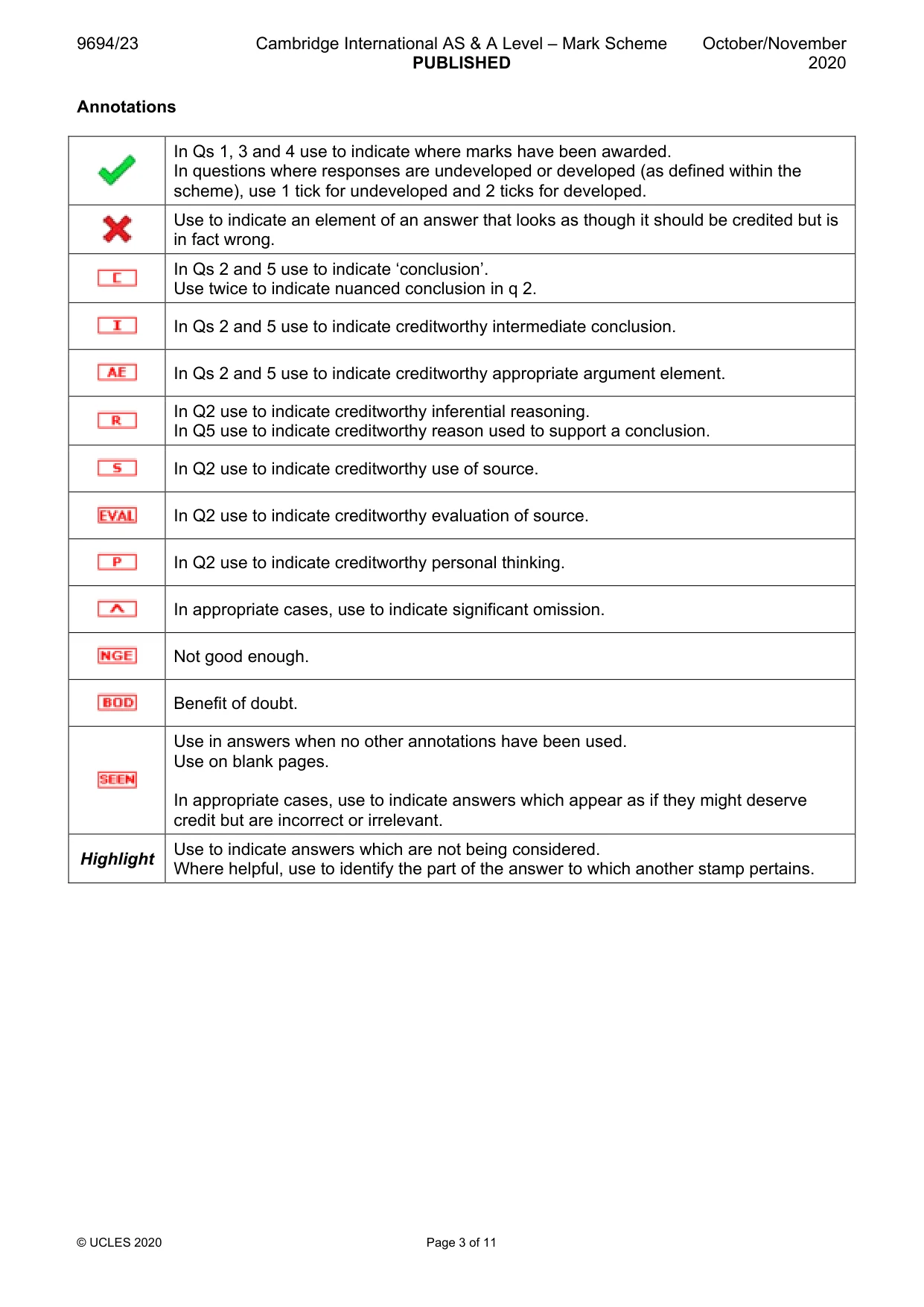
9694/23 Cambridge International AS & A Level – Mark Scheme PUBLISHED October/November 2020 © UCLES 2020 Page 3 of 11 Annotations In Qs 1, 3 and 4 use to indicate where marks have been awarded. In questions where responses are undeveloped or developed (as defined within the scheme), use 1 tick for undeveloped and 2 ticks for developed. Use to indicate an element of an answer that looks as though it should be credited but is in fact wrong. In Qs 2 and 5 use to indicate ‘conclusion’. Use twice to indicate nuanced conclusion in q 2. In Qs 2 and 5 use to indicate creditworthy intermediate conclusion. In Qs 2 and 5 use to indicate creditworthy appropriate argument element. In Q2 use to indicate creditworthy inferential reasoning. In Q5 use to indicate creditworthy reason used to support a conclusion. In Q2 use to indicate creditworthy use of source. In Q2 use to indicate creditworthy evaluation of source. In Q2 use to indicate creditworthy personal thinking. In appropriate cases, use to indicate significant omission. Not good enough. Benefit of doubt. Use in answers when no other annotations have been used. Use on blank pages. In appropriate cases, use to indicate answers which appear as if they might deserve credit but are incorrect or irrelevant. Highlight Use to indicate answers which are not being considered. Where helpful, use to identify the part of the answer to which another stamp pertains.
Mark scheme, page 4
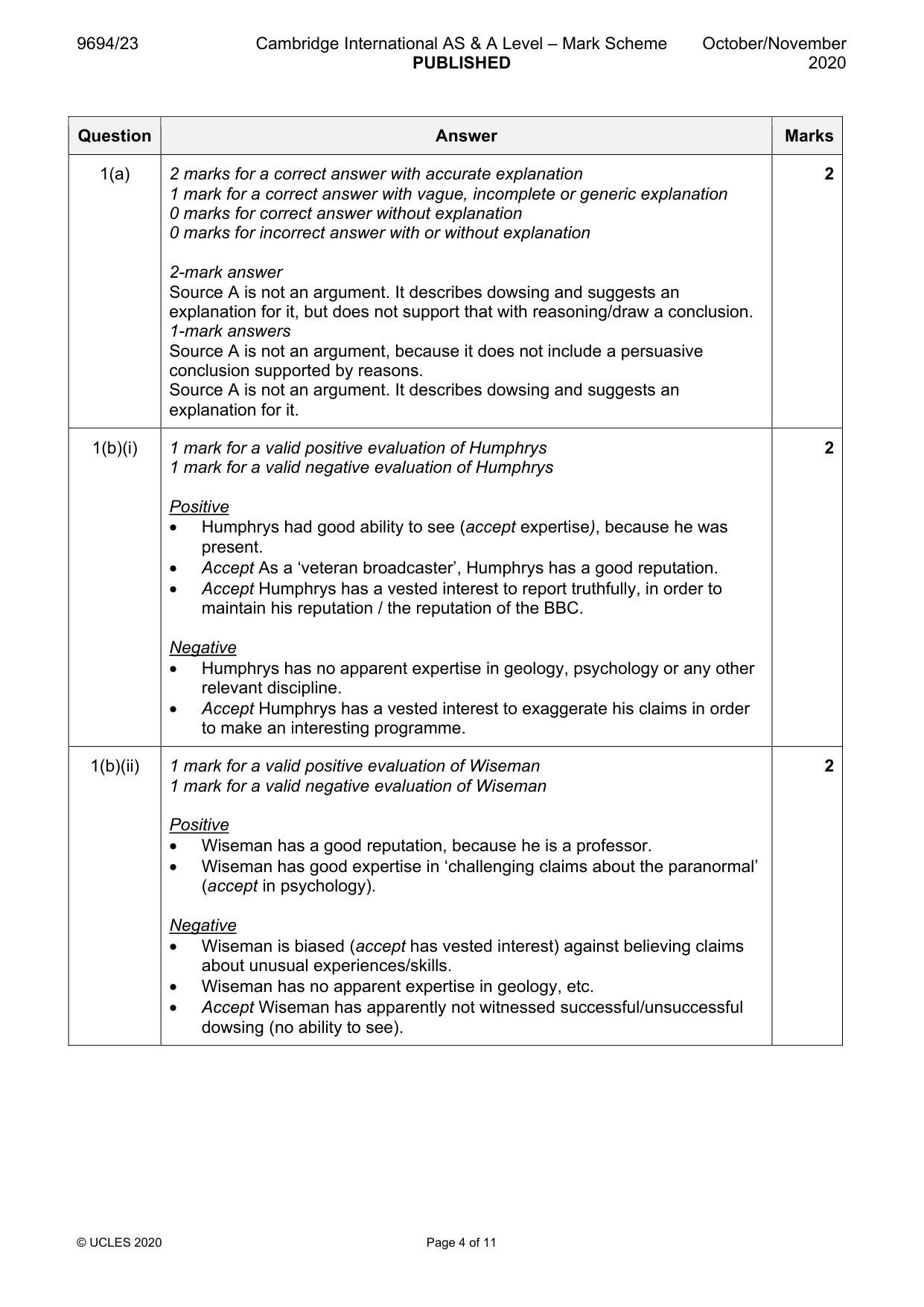
9694/23 Cambridge International AS & A Level – Mark Scheme PUBLISHED October/November 2020 © UCLES 2020 Page 4 of 11 Question Answer Marks 1(a) 2 marks for a correct answer with accurate explanation 1 mark for a correct answer with vague, incomplete or generic explanation 0 marks for correct answer without explanation 0 marks for incorrect answer with or without explanation 2-mark answer Source A is not an argument. It describes dowsing and suggests an explanation for it, but does not support that with reasoning/draw a conclusion. 1-mark answers Source A is not an argument, because it does not include a persuasive conclusion supported by reasons. Source A is not an argument. It describes dowsing and suggests an explanation for it. 2 1(b)(i) 1 mark for a valid positive evaluation of Humphrys 1 mark for a valid negative evaluation of Humphrys Positive • Humphrys had good ability to see (accept expertise), because he was present. • Accept As a ‘veteran broadcaster’, Humphrys has a good reputation. • Accept Humphrys has a vested interest to report truthfully, in order to maintain his reputation / the reputation of the BBC. Negative • Humphrys has no apparent expertise in geology, psychology or any other relevant discipline. • Accept Humphrys has a vested interest to exaggerate his claims in order to make an interesting programme. 2 1(b)(ii) 1 mark for a valid positive evaluation of Wiseman 1 mark for a valid negative evaluation of Wiseman Positive • Wiseman has a good reputation, because he is a professor. • Wiseman has good expertise in ‘challenging claims about the paranormal’ (accept in psychology). Negative • Wiseman is biased (accept has vested interest) against believing claims about unusual experiences/skills. • Wiseman has no apparent expertise in geology, etc. • Accept Wiseman has apparently not witnessed successful/unsuccessful dowsing (no ability to see). 2
Mark scheme, page 5
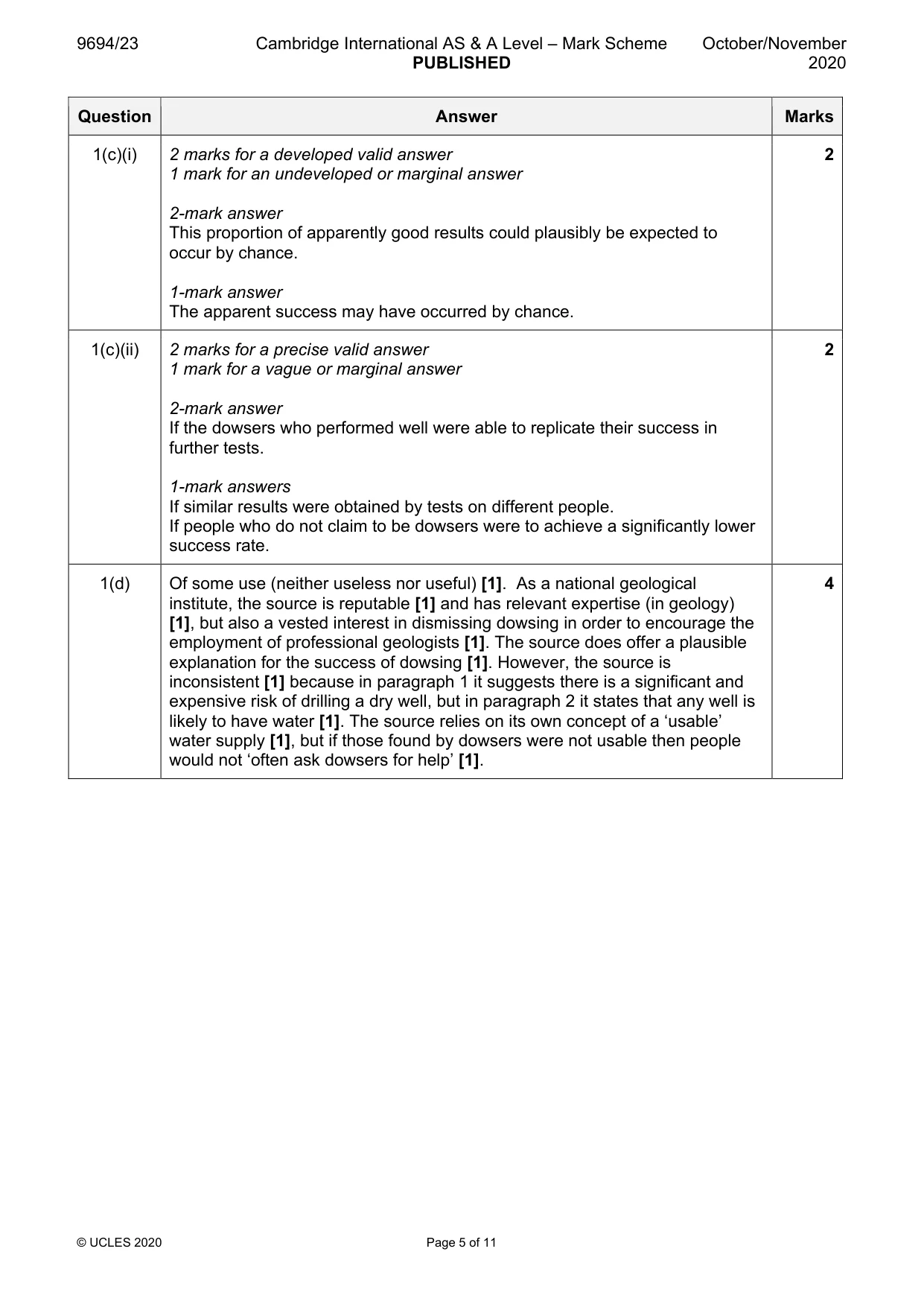
9694/23 Cambridge International AS & A Level – Mark Scheme PUBLISHED October/November 2020 © UCLES 2020 Page 5 of 11 Question Answer Marks 1(c)(i) 2 marks for a developed valid answer 1 mark for an undeveloped or marginal answer 2-mark answer This proportion of apparently good results could plausibly be expected to occur by chance. 1-mark answer The apparent success may have occurred by chance. 2 1(c)(ii) 2 marks for a precise valid answer 1 mark for a vague or marginal answer 2-mark answer If the dowsers who performed well were able to replicate their success in further tests. 1-mark answers If similar results were obtained by tests on different people. If people who do not claim to be dowsers were to achieve a significantly lower success rate. 2 1(d) Of some use (neither useless nor useful) [1]. As a national geological institute, the source is reputable [1] and has relevant expertise (in geology) [1], but also a vested interest in dismissing dowsing in order to encourage the employment of professional geologists [1]. The source does offer a plausible explanation for the success of dowsing [1]. However, the source is inconsistent [1] because in paragraph 1 it suggests there is a significant and expensive risk of drilling a dry well, but in paragraph 2 it states that any well is likely to have water [1]. The source relies on its own concept of a ‘usable’ water supply [1], but if those found by dowsers were not usable then people would not ‘often ask dowsers for help’ [1]. 4
Mark scheme, page 6
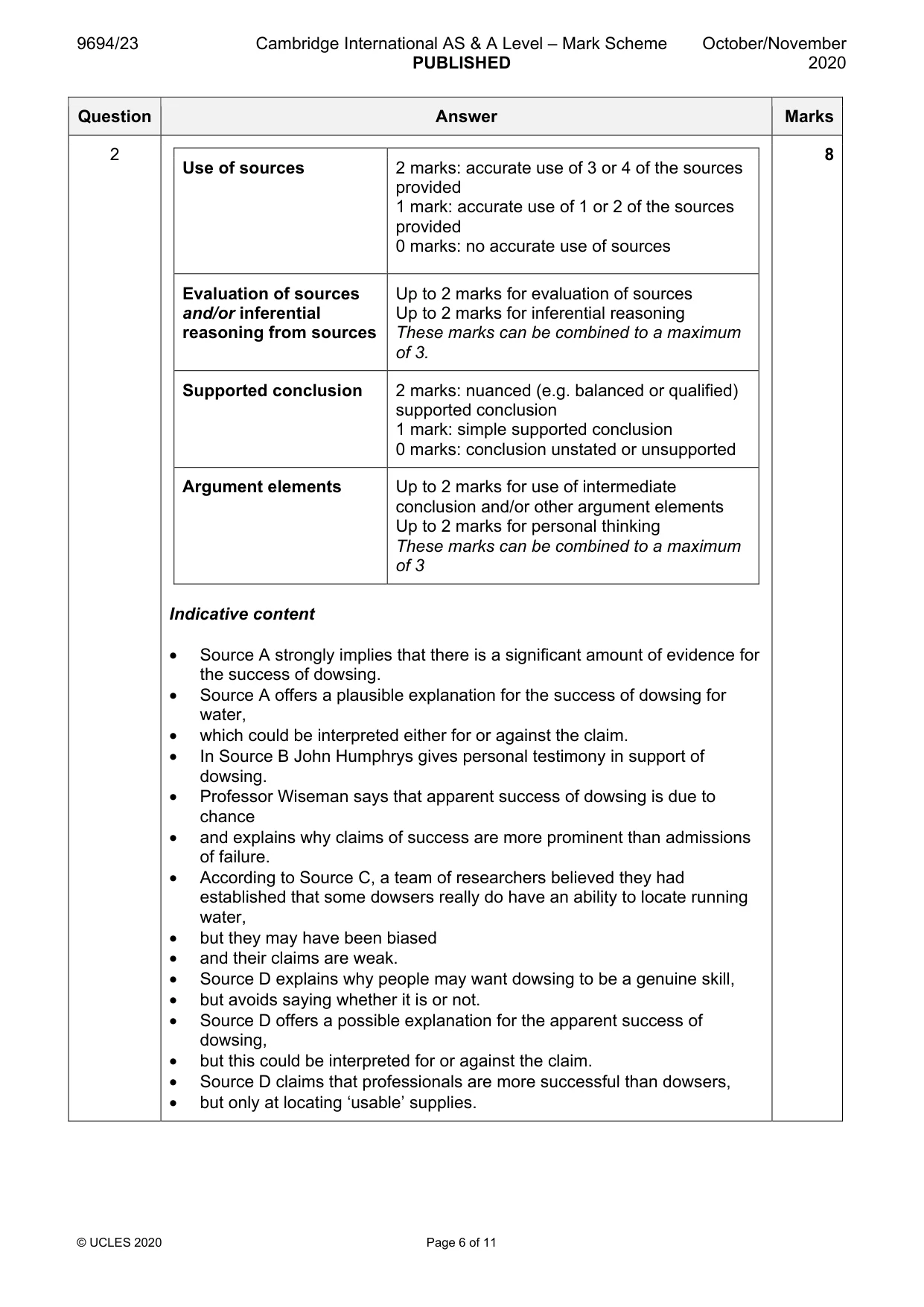
9694/23 Cambridge International AS & A Level – Mark Scheme PUBLISHED October/November 2020 © UCLES 2020 Page 6 of 11 Question Answer Marks 2 Use of sources 2 marks: accurate use of 3 or 4 of the sources provided 1 mark: accurate use of 1 or 2 of the sources provided 0 marks: no accurate use of sources Evaluation of sources and/or inferential reasoning from sources Up to 2 marks for evaluation of sources Up to 2 marks for inferential reasoning These marks can be combined to a maximum of 3. Supported conclusion 2 marks: nuanced (e.g. balanced or qualified) supported conclusion 1 mark: simple supported conclusion 0 marks: conclusion unstated or unsupported Argument elements Up to 2 marks for use of intermediate conclusion and/or other argument elements Up to 2 marks for personal thinking These marks can be combined to a maximum of 3 Indicative content • Source A strongly implies that there is a significant amount of evidence for the success of dowsing. • Source A offers a plausible explanation for the success of dowsing for water, • which could be interpreted either for or against the claim. • In Source B John Humphrys gives personal testimony in support of dowsing. • Professor Wiseman says that apparent success of dowsing is due to chance • and explains why claims of success are more prominent than admissions of failure. • According to Source C, a team of researchers believed they had established that some dowsers really do have an ability to locate running water, • but they may have been biased • and their claims are weak. • Source D explains why people may want dowsing to be a genuine skill, • but avoids saying whether it is or not. • Source D offers a possible explanation for the apparent success of dowsing, • but this could be interpreted for or against the claim. • Source D claims that professionals are more successful than dowsers, • but only at locating ‘usable’ supplies. 8
Mark scheme, page 7
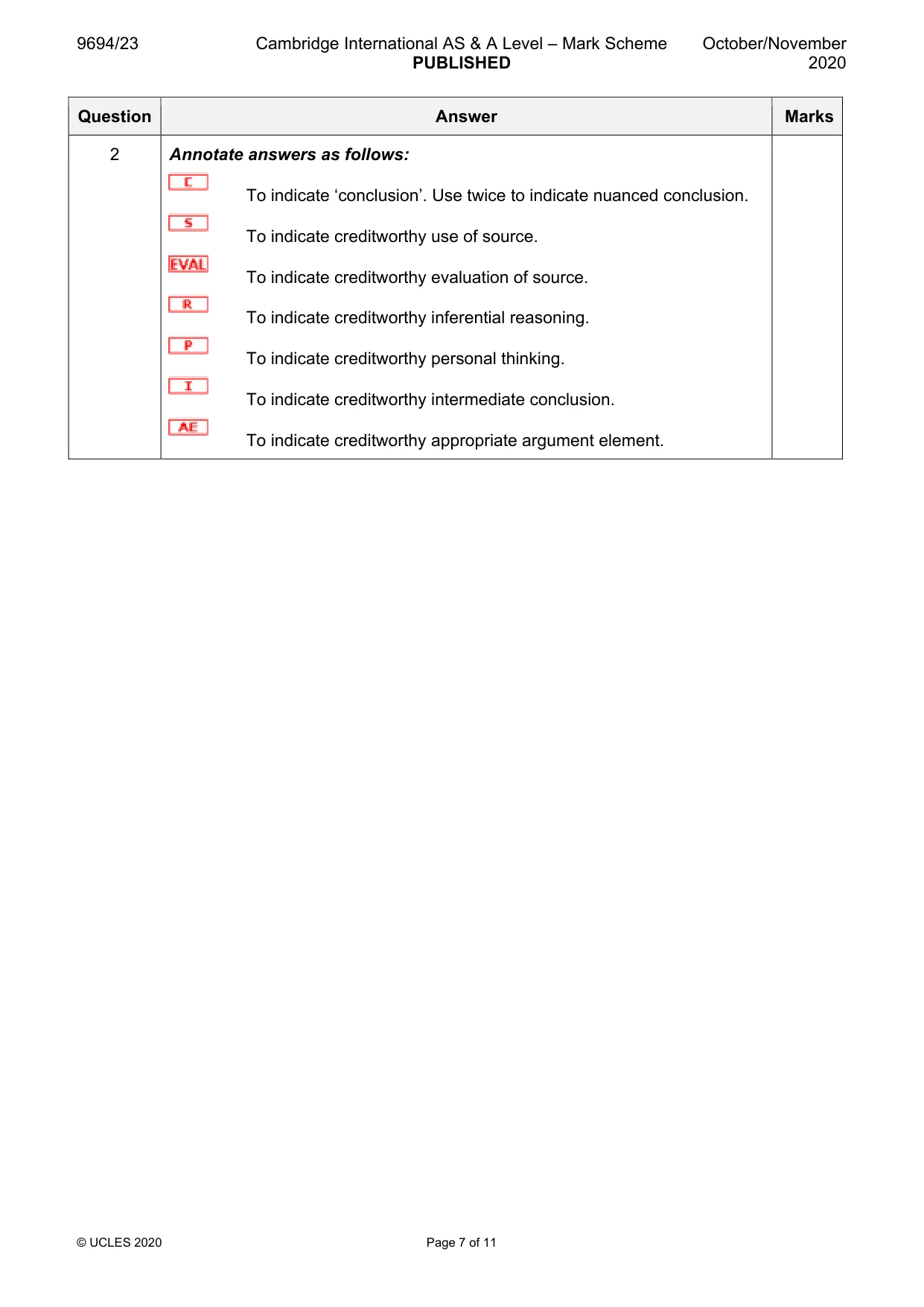
9694/23 Cambridge International AS & A Level – Mark Scheme PUBLISHED October/November 2020 © UCLES 2020 Page 7 of 11 Question Answer Marks 2 Annotate answers as follows: To indicate ‘conclusion’. Use twice to indicate nuanced conclusion. To indicate creditworthy use of source. To indicate creditworthy evaluation of source. To indicate creditworthy inferential reasoning. To indicate creditworthy personal thinking. To indicate creditworthy intermediate conclusion. To indicate creditworthy appropriate argument element.
Mark scheme, page 8
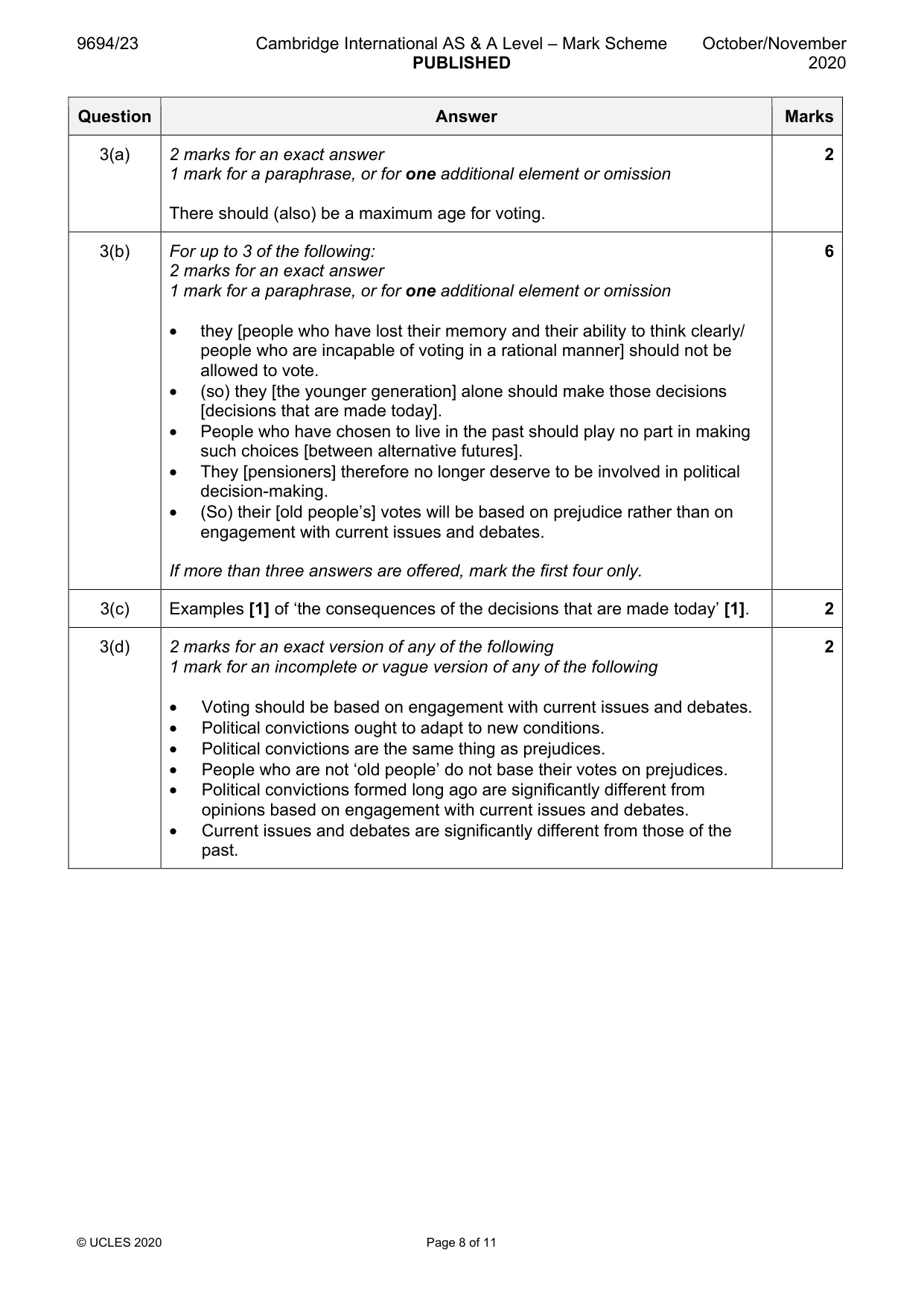
9694/23 Cambridge International AS & A Level – Mark Scheme PUBLISHED October/November 2020 © UCLES 2020 Page 8 of 11 Question Answer Marks 3(a) 2 marks for an exact answer 1 mark for a paraphrase, or for one additional element or omission There should (also) be a maximum age for voting. 2 3(b) For up to 3 of the following: 2 marks for an exact answer 1 mark for a paraphrase, or for one additional element or omission • they [people who have lost their memory and their ability to think clearly/ people who are incapable of voting in a rational manner] should not be allowed to vote. • (so) they [the younger generation] alone should make those decisions [decisions that are made today]. • People who have chosen to live in the past should play no part in making such choices [between alternative futures]. • They [pensioners] therefore no longer deserve to be involved in political decision-making. • (So) their [old people’s] votes will be based on prejudice rather than on engagement with current issues and debates. If more than three answers are offered, mark the first four only. 6 3(c) Examples [1] of ‘the consequences of the decisions that are made today’ [1]. 2 3(d) 2 marks for an exact version of any of the following 1 mark for an incomplete or vague version of any of the following • Voting should be based on engagement with current issues and debates. • Political convictions ought to adapt to new conditions. • Political convictions are the same thing as prejudices. • People who are not ‘old people’ do not base their votes on prejudices. • Political convictions formed long ago are significantly different from opinions based on engagement with current issues and debates. • Current issues and debates are significantly different from those of the past. 2
Mark scheme, page 9
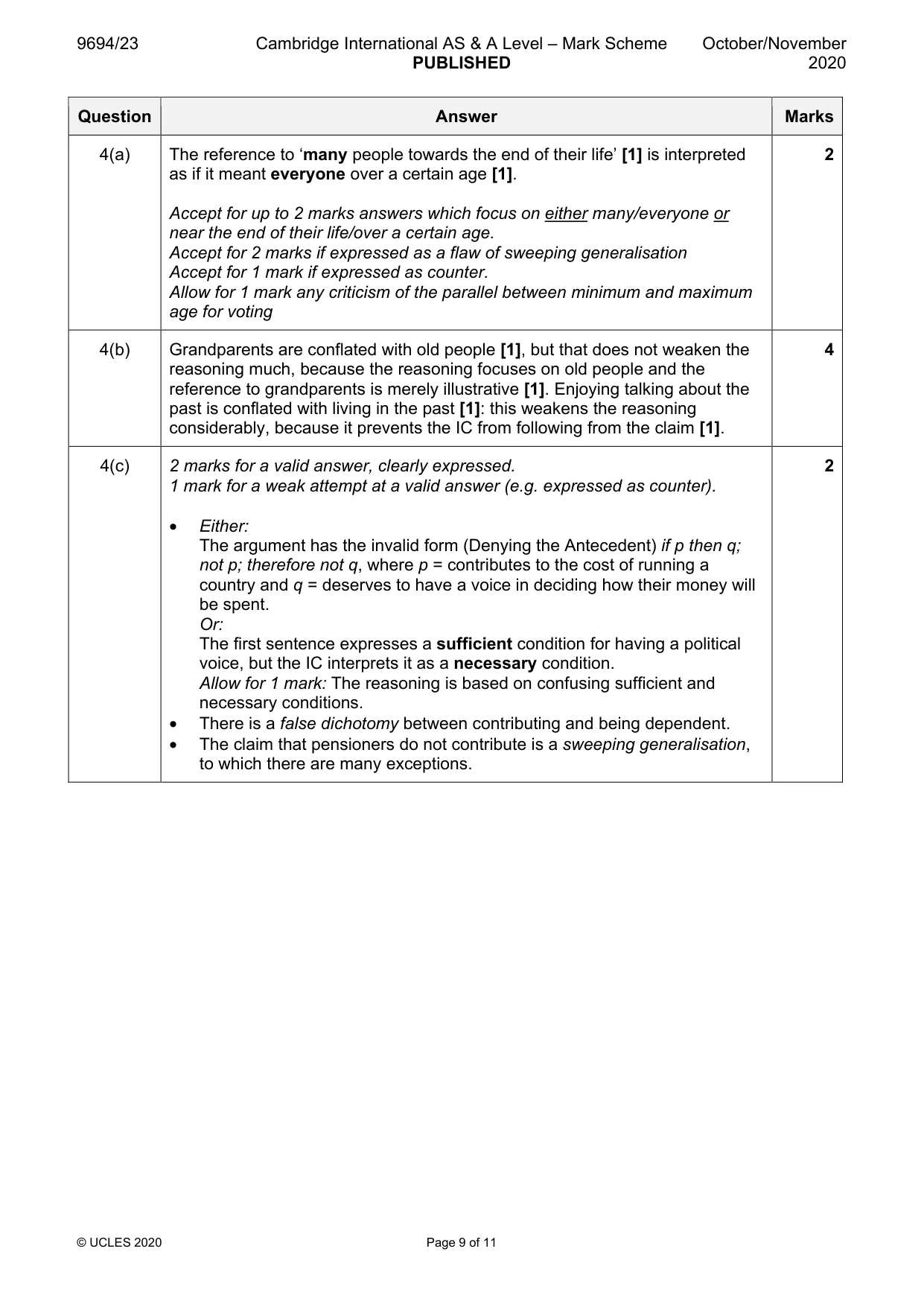
9694/23 Cambridge International AS & A Level – Mark Scheme PUBLISHED October/November 2020 © UCLES 2020 Page 9 of 11 Question Answer Marks 4(a) The reference to ‘many people towards the end of their life’ [1] is interpreted as if it meant everyone over a certain age [1]. Accept for up to 2 marks answers which focus on either many/everyone or near the end of their life/over a certain age. Accept for 2 marks if expressed as a flaw of sweeping generalisation Accept for 1 mark if expressed as counter. Allow for 1 mark any criticism of the parallel between minimum and maximum age for voting 2 4(b) Grandparents are conflated with old people [1], but that does not weaken the reasoning much, because the reasoning focuses on old people and the reference to grandparents is merely illustrative [1]. Enjoying talking about the past is conflated with living in the past [1]: this weakens the reasoning considerably, because it prevents the IC from following from the claim [1]. 4 4(c) 2 marks for a valid answer, clearly expressed. 1 mark for a weak attempt at a valid answer (e.g. expressed as counter). • Either: The argument has the invalid form (Denying the Antecedent) if p then q; not p; therefore not q, where p = contributes to the cost of running a country and q = deserves to have a voice in deciding how their money will be spent. Or: The first sentence expresses a sufficient condition for having a political voice, but the IC interprets it as a necessary condition. Allow for 1 mark: The reasoning is based on confusing sufficient and necessary conditions. • There is a false dichotomy between contributing and being dependent. • The claim that pensioners do not contribute is a sweeping generalisation, to which there are many exceptions. 2
Mark scheme, page 10
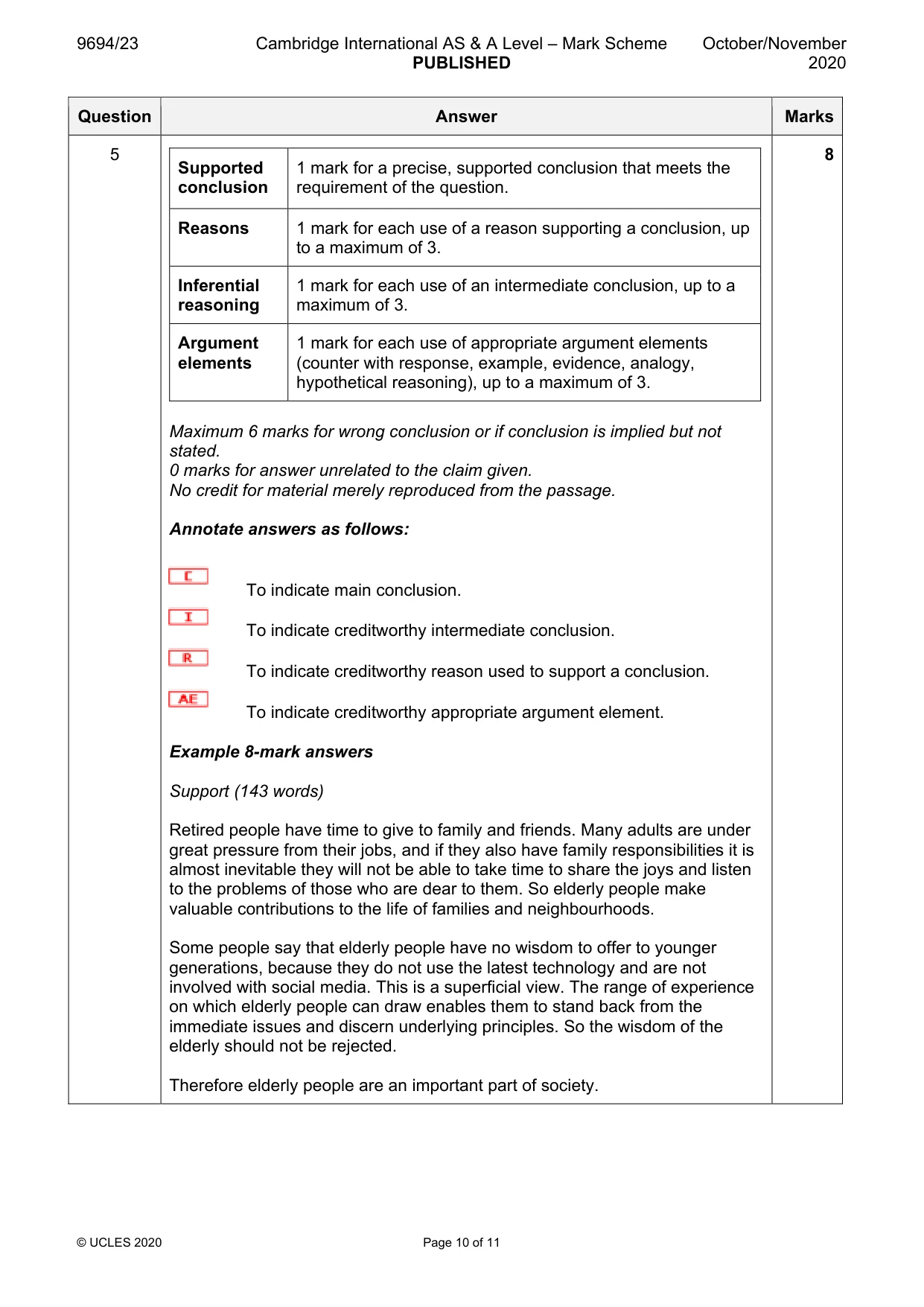
9694/23 Cambridge International AS & A Level – Mark Scheme PUBLISHED October/November 2020 © UCLES 2020 Page 10 of 11 Question Answer Marks 5 Supported conclusion 1 mark for a precise, supported conclusion that meets the requirement of the question. Reasons 1 mark for each use of a reason supporting a conclusion, up to a maximum of 3. Inferential reasoning 1 mark for each use of an intermediate conclusion, up to a maximum of 3. Argument elements 1 mark for each use of appropriate argument elements (counter with response, example, evidence, analogy, hypothetical reasoning), up to a maximum of 3. Maximum 6 marks for wrong conclusion or if conclusion is implied but not stated. 0 marks for answer unrelated to the claim given. No credit for material merely reproduced from the passage. Annotate answers as follows: To indicate main conclusion. To indicate creditworthy intermediate conclusion. To indicate creditworthy reason used to support a conclusion. To indicate creditworthy appropriate argument element. Example 8-mark answers Support (143 words) Retired people have time to give to family and friends. Many adults are under great pressure from their jobs, and if they also have family responsibilities it is almost inevitable they will not be able to take time to share the joys and listen to the problems of those who are dear to them. So elderly people make valuable contributions to the life of families and neighbourhoods. Some people say that elderly people have no wisdom to offer to younger generations, because they do not use the latest technology and are not involved with social media. This is a superficial view. The range of experience on which elderly people can draw enables them to stand back from the immediate issues and discern underlying principles. So the wisdom of the elderly should not be rejected. Therefore elderly people are an important part of society. 8
Mark scheme, page 11
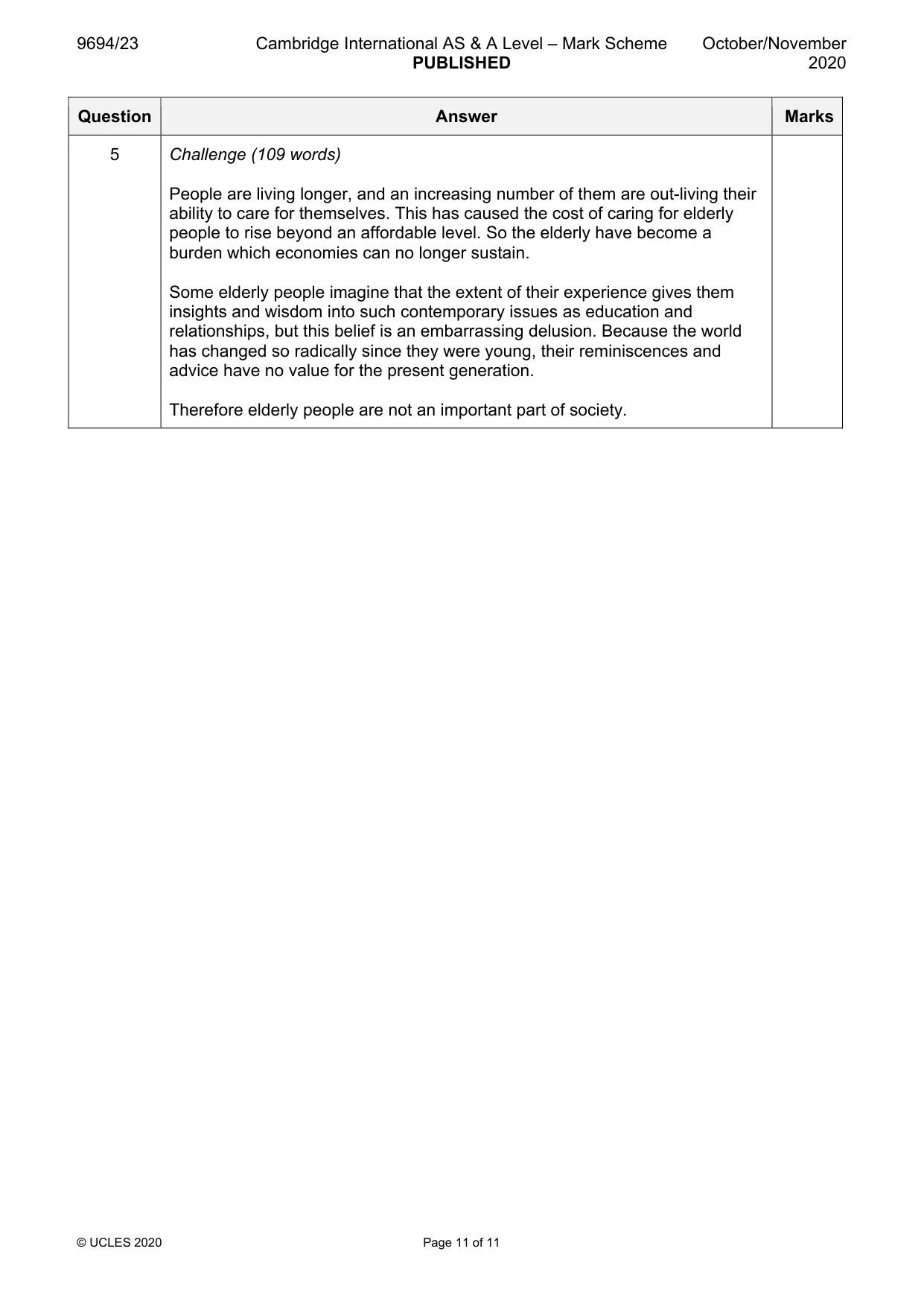
9694/23 Cambridge International AS & A Level – Mark Scheme PUBLISHED October/November 2020 © UCLES 2020 Page 11 of 11 Question Answer Marks 5 Challenge (109 words) People are living longer, and an increasing number of them are out-living their ability to care for themselves. This has caused the cost of caring for elderly people to rise beyond an affordable level. So the elderly have become a burden which economies can no longer sustain. Some elderly people imagine that the extent of their experience gives them insights and wisdom into such contemporary issues as education and relationships, but this belief is an embarrassing delusion. Because the world has changed so radically since they were young, their reminiscences and advice have no value for the present generation. Therefore elderly people are not an important part of society.
What you needed in this session
Cambridge’s own grade thresholds for 2020 Oct/Nov, Paper 2 · Variant 3. A higher threshold means an easier paper — the bar moves with how the cohort did.