Cambridge A Level Thinking Skills 9694 — 2020 Oct/Nov Paper 2 · Variant 2
9694/22/O/N/20 · 50 marks · ≈56 min
The question paper and its mark scheme, free to read here and free to download. This is Cambridge’s own paper, exactly as it was sat.
Question paper8 pages



Mark scheme10 pages
Answers below. Sit the paper first if you are practising.
Paper as text
Question paper, page 1
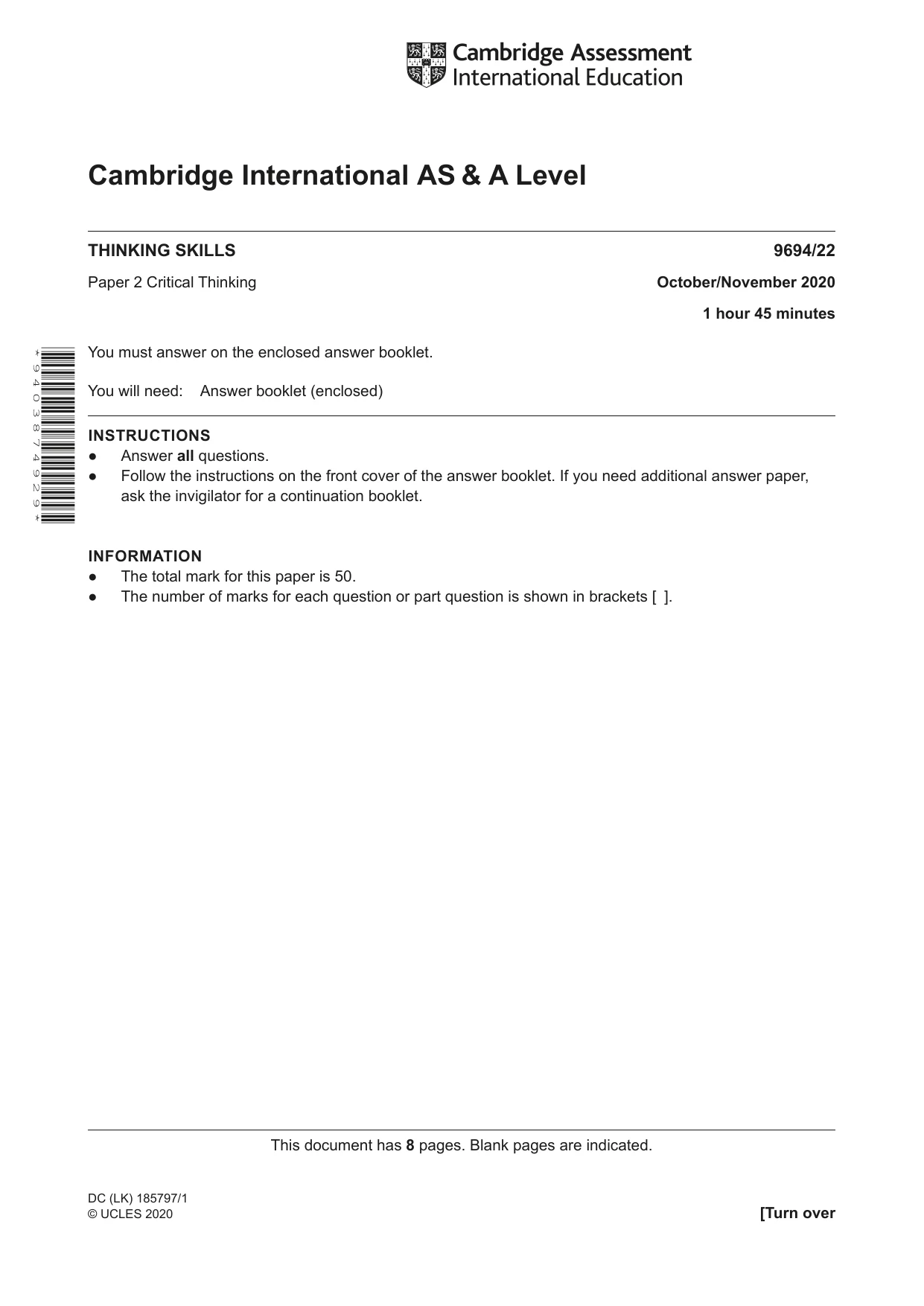
Cambridge International AS & A Level THINKING SKILLS 9694/22 Paper 2 Critical Thinking October/November 2020 1 hour 45 minutes You must answer on the enclosed answer booklet. You will need: Answer booklet (enclosed) INSTRUCTIONS ● Answer all questions. ● Follow the instructions on the front cover of the answer booklet. If you need additional answer paper, ask the invigilator for a continuation booklet. INFORMATION ● The total mark for this paper is 50. ● The number of marks for each question or part question is shown in brackets [ ]. * 9 4 0 3 8 7 4 9 2 9 * DC (LK) 185797/1 © UCLES 2020 [Turn over This document has 8 pages. Blank pages are indicated.
Question paper, page 2
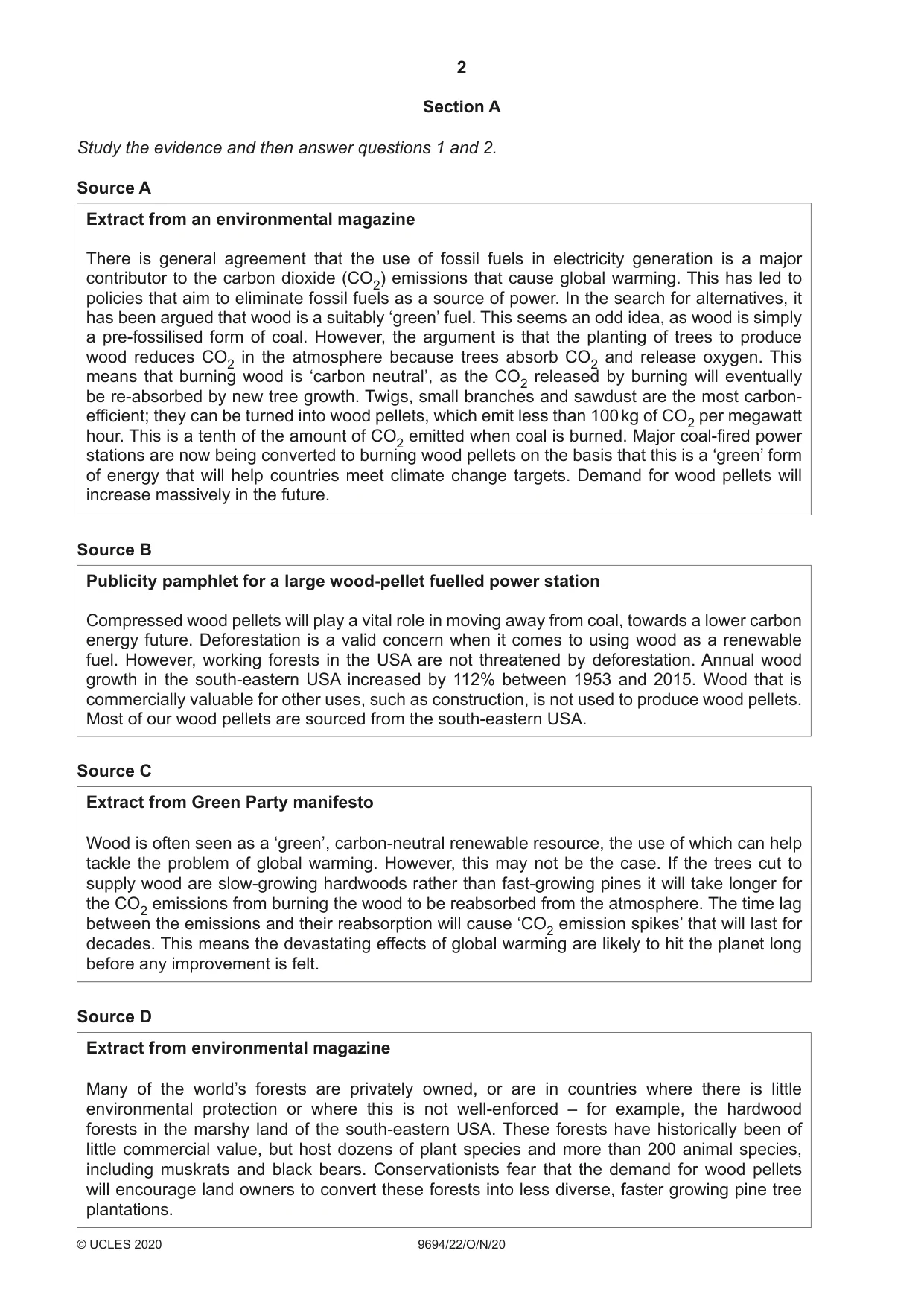
2 9694/22/O/N/20 © UCLES 2020 Section A Study the evidence and then answer questions 1 and 2. Source A Extract from an environmental magazine There is general agreement that the use of fossil fuels in electricity generation is a major contributor to the carbon dioxide (CO2) emissions that cause global warming. This has led to policies that aim to eliminate fossil fuels as a source of power. In the search for alternatives, it has been argued that wood is a suitably ‘green’ fuel. This seems an odd idea, as wood is simply a pre-fossilised form of coal. However, the argument is that the planting of trees to produce wood reduces CO2 in the atmosphere because trees absorb CO2 and release oxygen. This means that burning wood is ‘carbon neutral’, as the CO2 released by burning will eventually be re-absorbed by new tree growth. Twigs, small branches and sawdust are the most carbon- efficient; they can be turned into wood pellets, which emit less than 100 kg of CO2 per megawatt hour. This is a tenth of the amount of CO2 emitted when coal is burned. Major coal-fired power stations are now being converted to burning wood pellets on the basis that this is a ‘green’ form of energy that will help countries meet climate change targets. Demand for wood pellets will increase massively in the future. Source B Publicity pamphlet for a large wood-pellet fuelled power station Compressed wood pellets will play a vital role in moving away from coal, towards a lower carbon energy future. Deforestation is a valid concern when it comes to using wood as a renewable fuel. However, working forests in the USA are not threatened by deforestation. Annual wood growth in the south-eastern USA increased by 112% between 1953 and 2015. Wood that is commercially valuable for other uses, such as construction, is not used to produce wood pellets. Most of our wood pellets are sourced from the south-eastern USA. Source C Extract from Green Party manifesto Wood is often seen as a ‘green’, carbon-neutral renewable resource, the use of which can help tackle the problem of global warming. However, this may not be the case. If the trees cut to supply wood are slow-growing hardwoods rather than fast-growing pines it will take longer for the CO2 emissions from burning the wood to be reabsorbed from the atmosphere. The time lag between the emissions and their reabsorption will cause ‘CO2 emission spikes’ that will last for decades. This means the devastating effects of global warming are likely to hit the planet long before any improvement is felt. Source D Extract from environmental magazine Many of the world’s forests are privately owned, or are in countries where there is little environmental protection or where this is not well-enforced – for example, the hardwood forests in the marshy land of the south-eastern USA. These forests have historically been of little commercial value, but host dozens of plant species and more than 200 animal species, including muskrats and black bears. Conservationists fear that the demand for wood pellets will encourage land owners to convert these forests into less diverse, faster growing pine tree plantations.
Question paper, page 3
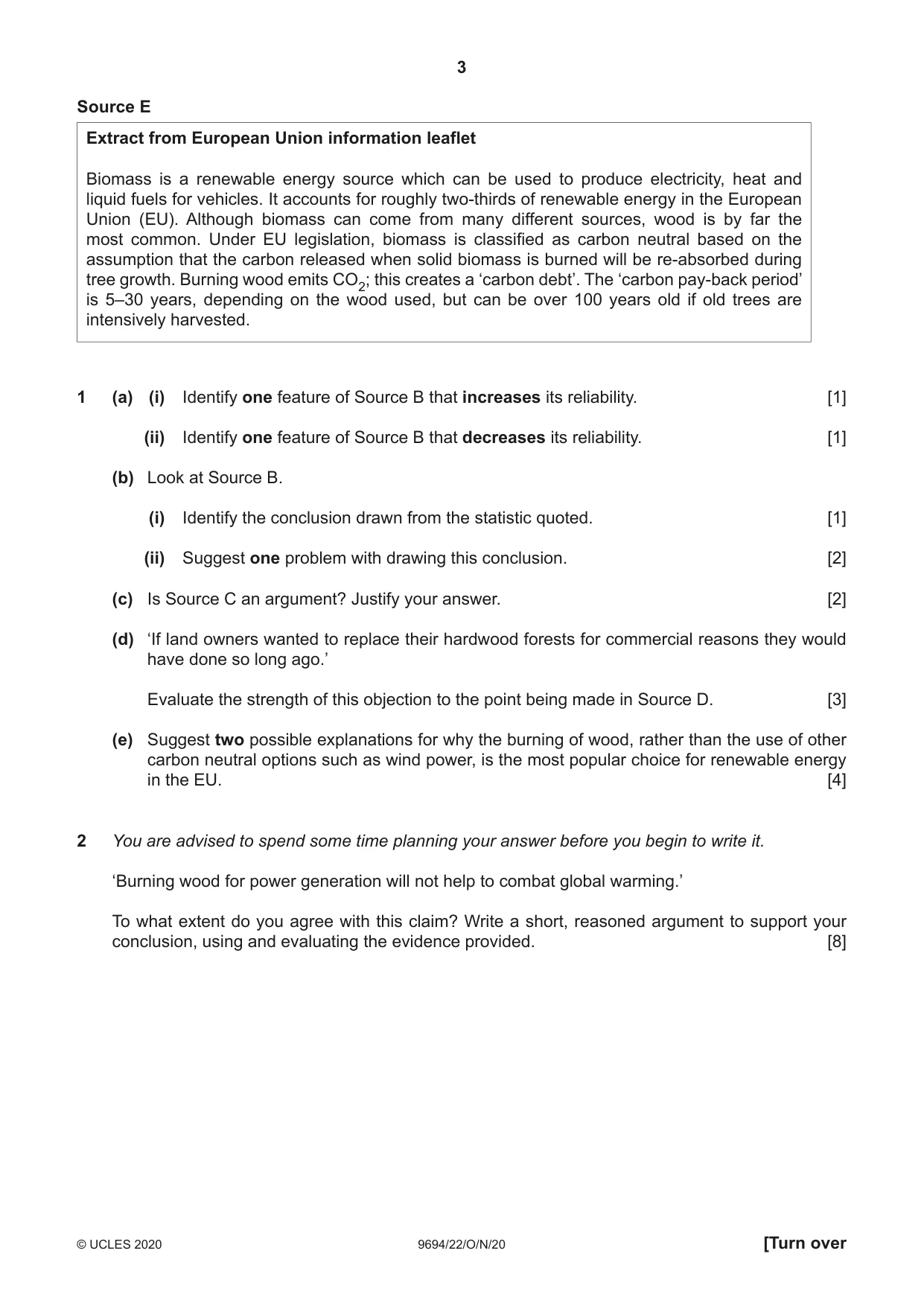
3 9694/22/O/N/20 © UCLES 2020 [Turn over Source E Extract from European Union information leaflet Biomass is a renewable energy source which can be used to produce electricity, heat and liquid fuels for vehicles. It accounts for roughly two-thirds of renewable energy in the European Union (EU). Although biomass can come from many different sources, wood is by far the most common. Under EU legislation, biomass is classified as carbon neutral based on the assumption that the carbon released when solid biomass is burned will be re-absorbed during tree growth. Burning wood emits CO2; this creates a ‘carbon debt’. The ‘carbon pay-back period’ is 5–30 years, depending on the wood used, but can be over 100 years old if old trees are intensively harvested. 1 (a) (i) Identify one feature of Source B that increases its reliability. [1] (ii) Identify one feature of Source B that decreases its reliability. [1] (b) Look at Source B. (i) Identify the conclusion drawn from the statistic quoted. [1] (ii) Suggest one problem with drawing this conclusion. [2] (c) Is Source C an argument? Justify your answer. [2] (d) ‘If land owners wanted to replace their hardwood forests for commercial reasons they would have done so long ago.’ Evaluate the strength of this objection to the point being made in Source D. [3] (e) Suggest two possible explanations for why the burning of wood, rather than the use of other carbon neutral options such as wind power, is the most popular choice for renewable energy in the EU. [4] 2 You are advised to spend some time planning your answer before you begin to write it. ‘Burning wood for power generation will not help to combat global warming.’ To what extent do you agree with this claim? Write a short, reasoned argument to support your conclusion, using and evaluating the evidence provided. [8]
Question paper, page 4
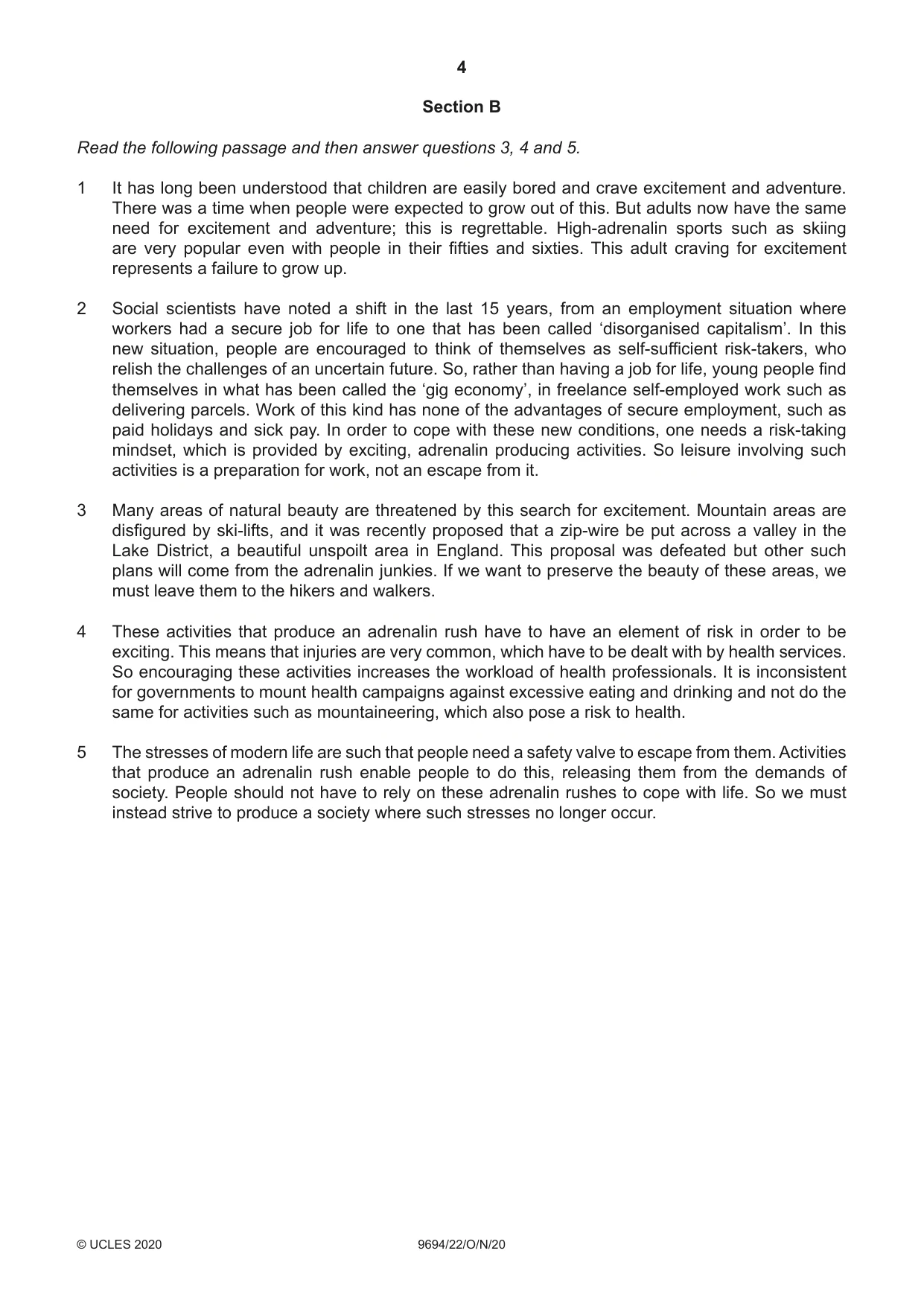
4 9694/22/O/N/20 © UCLES 2020 Section B Read the following passage and then answer questions 3, 4 and 5. 1 It has long been understood that children are easily bored and crave excitement and adventure. There was a time when people were expected to grow out of this. But adults now have the same need for excitement and adventure; this is regrettable. High-adrenalin sports such as skiing are very popular even with people in their fifties and sixties. This adult craving for excitement represents a failure to grow up. 2 Social scientists have noted a shift in the last 15 years, from an employment situation where workers had a secure job for life to one that has been called ‘disorganised capitalism’. In this new situation, people are encouraged to think of themselves as self-sufficient risk-takers, who relish the challenges of an uncertain future. So, rather than having a job for life, young people find themselves in what has been called the ‘gig economy’, in freelance self-employed work such as delivering parcels. Work of this kind has none of the advantages of secure employment, such as paid holidays and sick pay. In order to cope with these new conditions, one needs a risk-taking mindset, which is provided by exciting, adrenalin producing activities. So leisure involving such activities is a preparation for work, not an escape from it. 3 Many areas of natural beauty are threatened by this search for excitement. Mountain areas are disfigured by ski-lifts, and it was recently proposed that a zip-wire be put across a valley in the Lake District, a beautiful unspoilt area in England. This proposal was defeated but other such plans will come from the adrenalin junkies. If we want to preserve the beauty of these areas, we must leave them to the hikers and walkers. 4 These activities that produce an adrenalin rush have to have an element of risk in order to be exciting. This means that injuries are very common, which have to be dealt with by health services. So encouraging these activities increases the workload of health professionals. It is inconsistent for governments to mount health campaigns against excessive eating and drinking and not do the same for activities such as mountaineering, which also pose a risk to health. 5 The stresses of modern life are such that people need a safety valve to escape from them. Activities that produce an adrenalin rush enable people to do this, releasing them from the demands of society. People should not have to rely on these adrenalin rushes to cope with life. So we must instead strive to produce a society where such stresses no longer occur.
Question paper, page 5
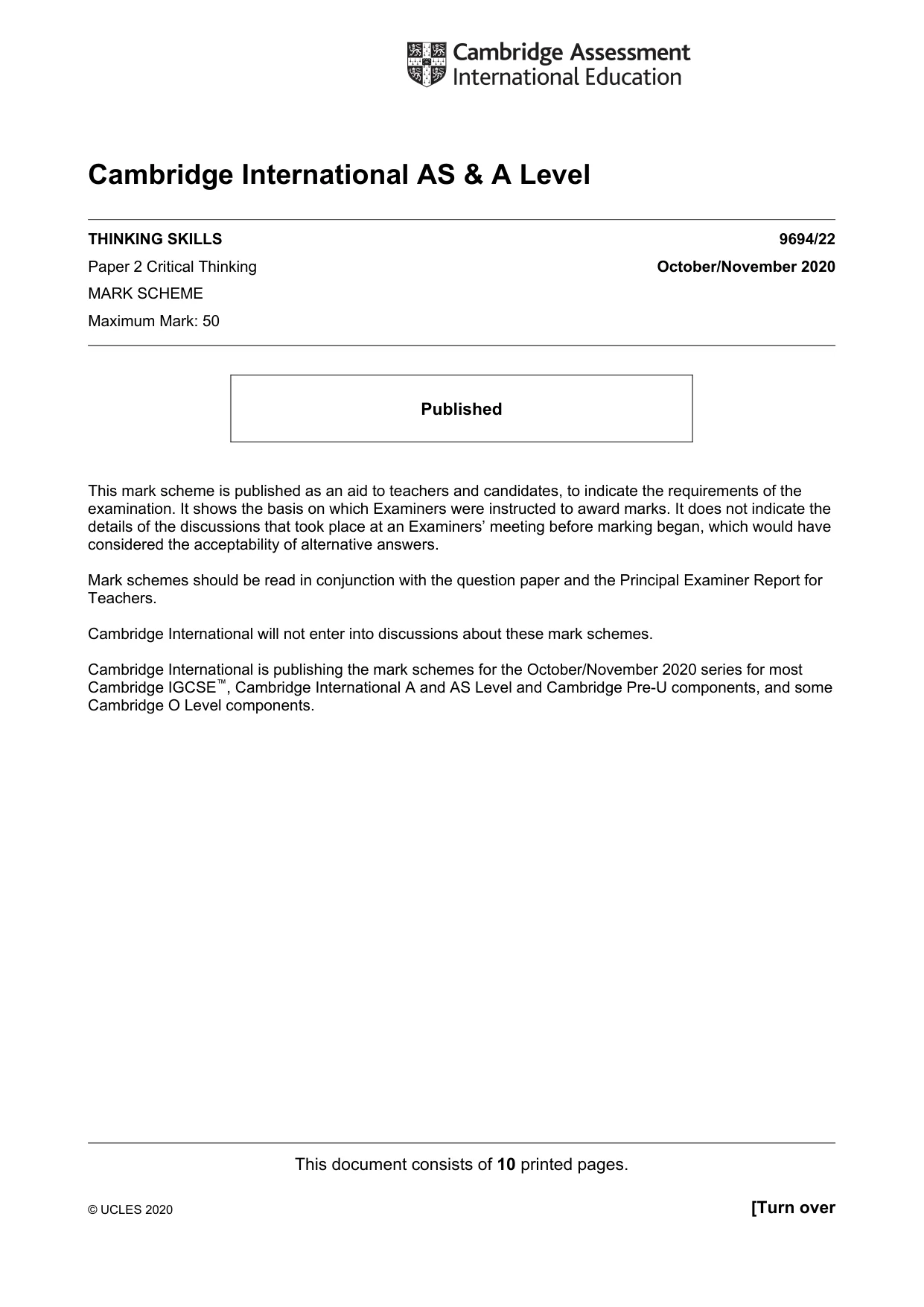
5 9694/22/O/N/20 © UCLES 2020 3 (a) Using the exact words from the passage as far as possible, identify the main conclusion. [2] (b) Using the exact words from the passage as far as possible, identify three intermediate conclusions. [6] (c) Identify an unstated assumption required by the reasoning in paragraph 3. [2] (d) Identify the argument element and explain the function of the following words from paragraph 3: ‘a zip wire be put across a valley in the Lake District’ [2] 4 (a) Identify an inconsistency between the reasoning in paragraph 1 and that in paragraph 2. [2] (b) Identify and explain one flaw or weakness in paragraph 4. [2] (c) (i) Identify and explain the flaw of restricting the options in paragraph 5. [2] (ii) To what extent does this flaw weaken the argument as a whole? [2] 5 You are advised to spend some time planning your answer before you begin to write it. ‘School should be an exciting experience for pupils.’ Write your own short argument to support or challenge this claim. The conclusion of your argument must be stated. Credit will not be given for repeating ideas from the passage. [8]
Question paper, page 6
6 9694/22/O/N/20 © UCLES 2020 BLANK PAGE
Question paper, page 7
7 9694/22/O/N/20 © UCLES 2020 BLANK PAGE
Question paper, page 8
8 9694/22/O/N/20 © UCLES 2020 Permission to reproduce items where third-party owned material protected by copyright is included has been sought and cleared where possible. Every reasonable effort has been made by the publisher (UCLES) to trace copyright holders, but if any items requiring clearance have unwittingly been included, the publisher will be pleased to make amends at the earliest possible opportunity. To avoid the issue of disclosure of answer-related information to candidates, all copyright acknowledgements are reproduced online in the Cambridge Assessment International Education Copyright Acknowledgements Booklet. This is produced for each series of examinations and is freely available to download at www.cambridgeinternational.org after the live examination series. Cambridge Assessment International Education is part of the Cambridge Assessment Group. Cambridge Assessment is the brand name of the University of Cambridge Local Examinations Syndicate (UCLES), which itself is a department of the University of Cambridge. BLANK PAGE
Mark scheme, page 1
This document consists of 10 printed pages. © UCLES 2020 [Turn over Cambridge International AS & A Level THINKING SKILLS 9694/22 Paper 2 Critical Thinking October/November 2020 MARK SCHEME Maximum Mark: 50 Published This mark scheme is published as an aid to teachers and candidates, to indicate the requirements of the examination. It shows the basis on which Examiners were instructed to award marks. It does not indicate the details of the discussions that took place at an Examiners’ meeting before marking began, which would have considered the acceptability of alternative answers. Mark schemes should be read in conjunction with the question paper and the Principal Examiner Report for Teachers. Cambridge International will not enter into discussions about these mark schemes. Cambridge International is publishing the mark schemes for the October/November 2020 series for most Cambridge IGCSE™, Cambridge International A and AS Level and Cambridge Pre-U components, and some Cambridge O Level components.
Mark scheme, page 2
9694/22 Cambridge International AS & A Level – Mark Scheme PUBLISHED October/November 2020 © UCLES 2020 Page 2 of 10 Generic Marking Principles These general marking principles must be applied by all examiners when marking candidate answers. They should be applied alongside the specific content of the mark scheme or generic level descriptors for a question. Each question paper and mark scheme will also comply with these marking principles. GENERIC MARKING PRINCIPLE 1: Marks must be awarded in line with: • the specific content of the mark scheme or the generic level descriptors for the question • the specific skills defined in the mark scheme or in the generic level descriptors for the question • the standard of response required by a candidate as exemplified by the standardisation scripts. GENERIC MARKING PRINCIPLE 2: Marks awarded are always whole marks (not half marks, or other fractions). GENERIC MARKING PRINCIPLE 3: Marks must be awarded positively: • marks are awarded for correct/valid answers, as defined in the mark scheme. However, credit is given for valid answers which go beyond the scope of the syllabus and mark scheme, referring to your Team Leader as appropriate • marks are awarded when candidates clearly demonstrate what they know and can do • marks are not deducted for errors • marks are not deducted for omissions • answers should only be judged on the quality of spelling, punctuation and grammar when these features are specifically assessed by the question as indicated by the mark scheme. The meaning, however, should be unambiguous. GENERIC MARKING PRINCIPLE 4: Rules must be applied consistently, e.g. in situations where candidates have not followed instructions or in the application of generic level descriptors. GENERIC MARKING PRINCIPLE 5: Marks should be awarded using the full range of marks defined in the mark scheme for the question (however; the use of the full mark range may be limited according to the quality of the candidate responses seen). GENERIC MARKING PRINCIPLE 6: Marks awarded are based solely on the requirements as defined in the mark scheme. Marks should not be awarded with grade thresholds or grade descriptors in mind.
Mark scheme, page 3
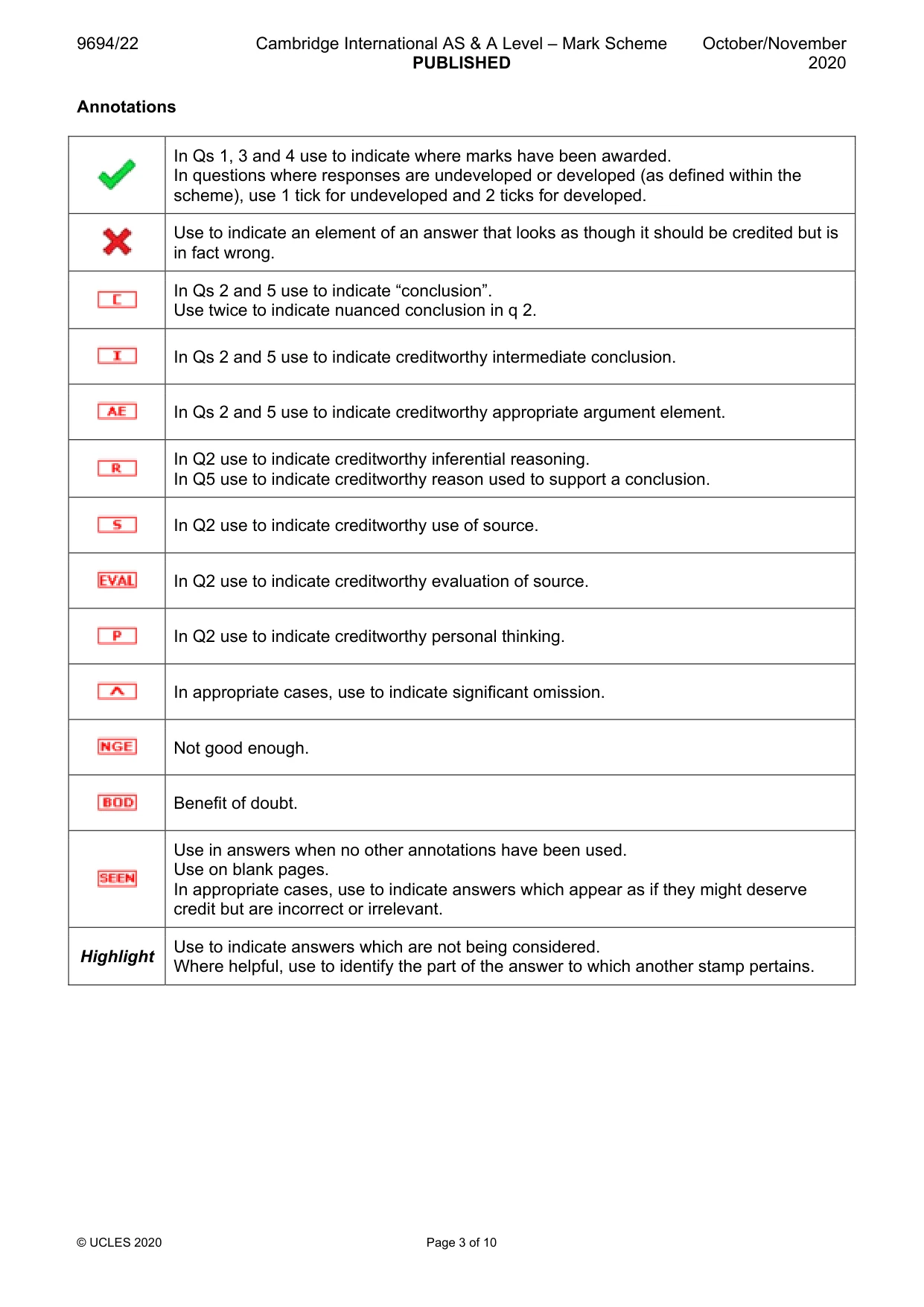
9694/22 Cambridge International AS & A Level – Mark Scheme PUBLISHED October/November 2020 © UCLES 2020 Page 3 of 10 Annotations In Qs 1, 3 and 4 use to indicate where marks have been awarded. In questions where responses are undeveloped or developed (as defined within the scheme), use 1 tick for undeveloped and 2 ticks for developed. Use to indicate an element of an answer that looks as though it should be credited but is in fact wrong. In Qs 2 and 5 use to indicate “conclusion”. Use twice to indicate nuanced conclusion in q 2. In Qs 2 and 5 use to indicate creditworthy intermediate conclusion. In Qs 2 and 5 use to indicate creditworthy appropriate argument element. In Q2 use to indicate creditworthy inferential reasoning. In Q5 use to indicate creditworthy reason used to support a conclusion. In Q2 use to indicate creditworthy use of source. In Q2 use to indicate creditworthy evaluation of source. In Q2 use to indicate creditworthy personal thinking. In appropriate cases, use to indicate significant omission. Not good enough. Benefit of doubt. Use in answers when no other annotations have been used. Use on blank pages. In appropriate cases, use to indicate answers which appear as if they might deserve credit but are incorrect or irrelevant. Highlight Use to indicate answers which are not being considered. Where helpful, use to identify the part of the answer to which another stamp pertains.
Mark scheme, page 4
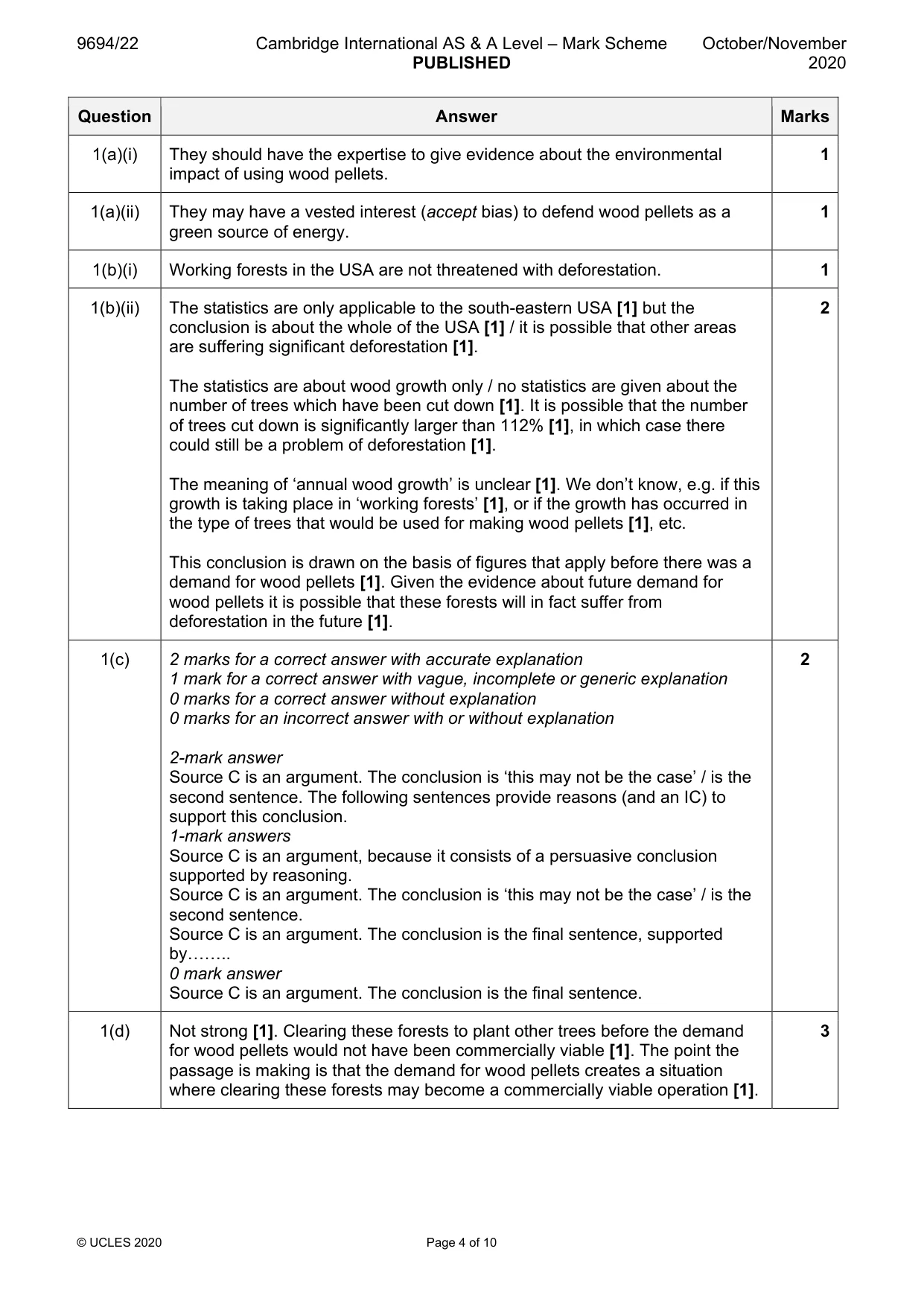
9694/22 Cambridge International AS & A Level – Mark Scheme PUBLISHED October/November 2020 © UCLES 2020 Page 4 of 10 Question Answer Marks 1(a)(i) They should have the expertise to give evidence about the environmental impact of using wood pellets. 1 1(a)(ii) They may have a vested interest (accept bias) to defend wood pellets as a green source of energy. 1 1(b)(i) Working forests in the USA are not threatened with deforestation. 1 1(b)(ii) The statistics are only applicable to the south-eastern USA [1] but the conclusion is about the whole of the USA [1] / it is possible that other areas are suffering significant deforestation [1]. The statistics are about wood growth only / no statistics are given about the number of trees which have been cut down [1]. It is possible that the number of trees cut down is significantly larger than 112% [1], in which case there could still be a problem of deforestation [1]. The meaning of ‘annual wood growth’ is unclear [1]. We don’t know, e.g. if this growth is taking place in ‘working forests’ [1], or if the growth has occurred in the type of trees that would be used for making wood pellets [1], etc. This conclusion is drawn on the basis of figures that apply before there was a demand for wood pellets [1]. Given the evidence about future demand for wood pellets it is possible that these forests will in fact suffer from deforestation in the future [1]. 2 1(c) 2 marks for a correct answer with accurate explanation 1 mark for a correct answer with vague, incomplete or generic explanation 0 marks for a correct answer without explanation 0 marks for an incorrect answer with or without explanation 2-mark answer Source C is an argument. The conclusion is ‘this may not be the case’ / is the second sentence. The following sentences provide reasons (and an IC) to support this conclusion. 1-mark answers Source C is an argument, because it consists of a persuasive conclusion supported by reasoning. Source C is an argument. The conclusion is ‘this may not be the case’ / is the second sentence. Source C is an argument. The conclusion is the final sentence, supported by…….. 0 mark answer Source C is an argument. The conclusion is the final sentence. 2 1(d) Not strong [1]. Clearing these forests to plant other trees before the demand for wood pellets would not have been commercially viable [1]. The point the passage is making is that the demand for wood pellets creates a situation where clearing these forests may become a commercially viable operation [1]. 3
Mark scheme, page 5
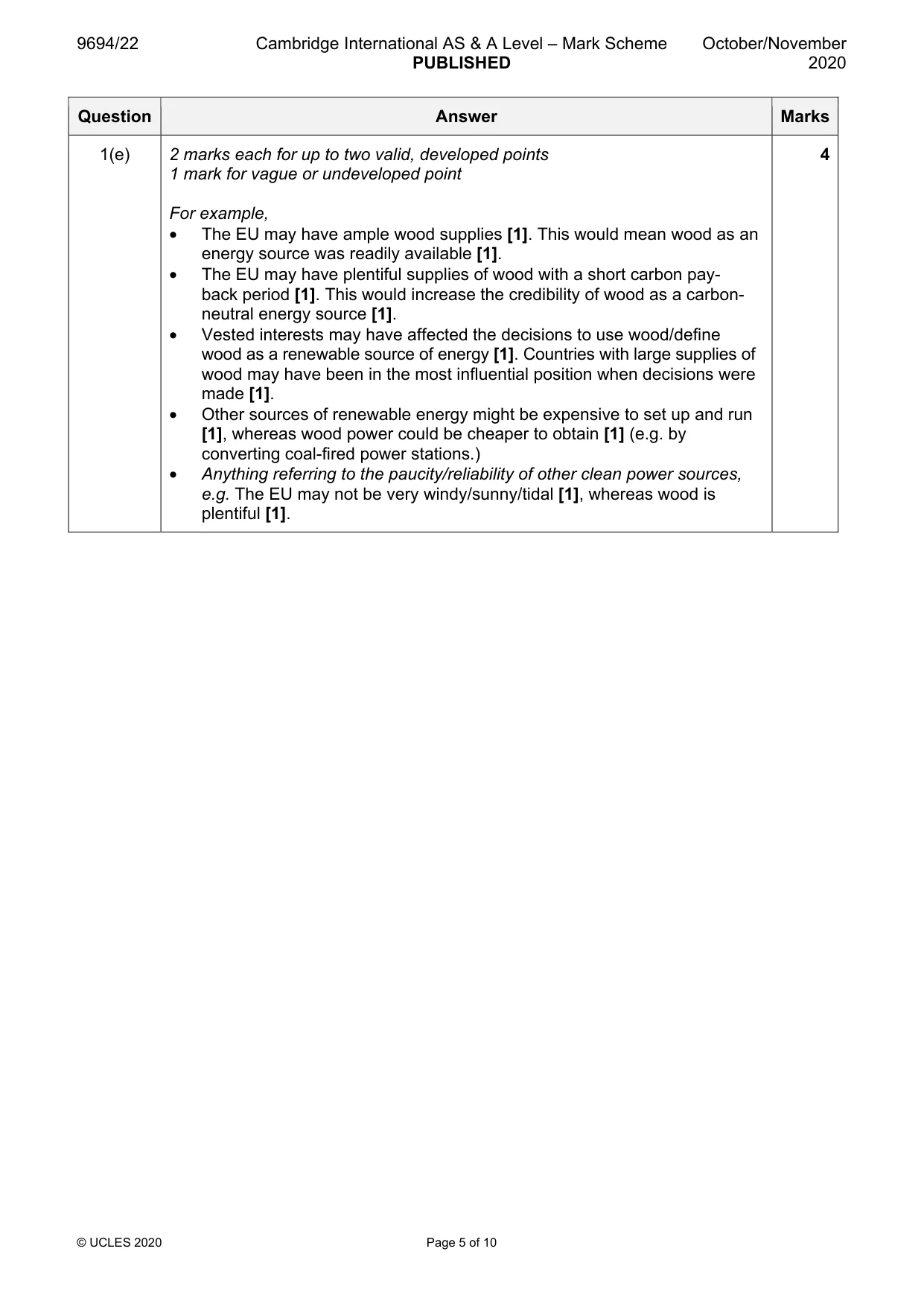
9694/22 Cambridge International AS & A Level – Mark Scheme PUBLISHED October/November 2020 © UCLES 2020 Page 5 of 10 Question Answer Marks 1(e) 2 marks each for up to two valid, developed points 1 mark for vague or undeveloped point For example, • The EU may have ample wood supplies [1]. This would mean wood as an energy source was readily available [1]. • The EU may have plentiful supplies of wood with a short carbon pay- back period [1]. This would increase the credibility of wood as a carbon- neutral energy source [1]. • Vested interests may have affected the decisions to use wood/define wood as a renewable source of energy [1]. Countries with large supplies of wood may have been in the most influential position when decisions were made [1]. • Other sources of renewable energy might be expensive to set up and run [1], whereas wood power could be cheaper to obtain [1] (e.g. by converting coal-fired power stations.) • Anything referring to the paucity/reliability of other clean power sources, e.g. The EU may not be very windy/sunny/tidal [1], whereas wood is plentiful [1]. 4
Mark scheme, page 6
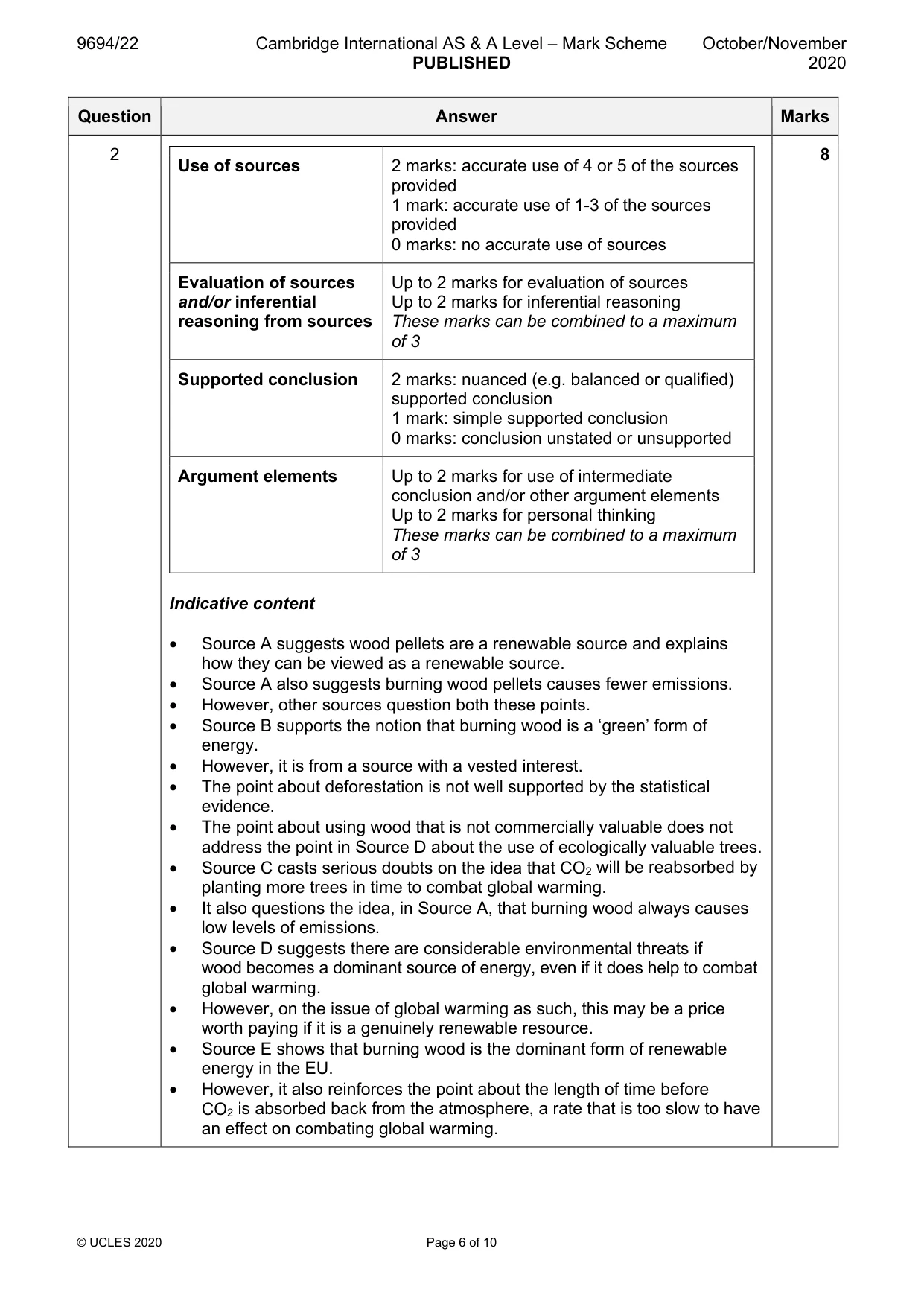
9694/22 Cambridge International AS & A Level – Mark Scheme PUBLISHED October/November 2020 © UCLES 2020 Page 6 of 10 Question Answer Marks 2 Use of sources 2 marks: accurate use of 4 or 5 of the sources provided 1 mark: accurate use of 1-3 of the sources provided 0 marks: no accurate use of sources Evaluation of sources and/or inferential reasoning from sources Up to 2 marks for evaluation of sources Up to 2 marks for inferential reasoning These marks can be combined to a maximum of 3 Supported conclusion 2 marks: nuanced (e.g. balanced or qualified) supported conclusion 1 mark: simple supported conclusion 0 marks: conclusion unstated or unsupported Argument elements Up to 2 marks for use of intermediate conclusion and/or other argument elements Up to 2 marks for personal thinking These marks can be combined to a maximum of 3 Indicative content • Source A suggests wood pellets are a renewable source and explains how they can be viewed as a renewable source. • Source A also suggests burning wood pellets causes fewer emissions. • However, other sources question both these points. • Source B supports the notion that burning wood is a ‘green’ form of energy. • However, it is from a source with a vested interest. • The point about deforestation is not well supported by the statistical evidence. • The point about using wood that is not commercially valuable does not address the point in Source D about the use of ecologically valuable trees. • Source C casts serious doubts on the idea that CO2 will be reabsorbed by planting more trees in time to combat global warming. • It also questions the idea, in Source A, that burning wood always causes low levels of emissions. • Source D suggests there are considerable environmental threats if wood becomes a dominant source of energy, even if it does help to combat global warming. • However, on the issue of global warming as such, this may be a price worth paying if it is a genuinely renewable resource. • Source E shows that burning wood is the dominant form of renewable energy in the EU. • However, it also reinforces the point about the length of time before CO2 is absorbed back from the atmosphere, a rate that is too slow to have an effect on combating global warming. 8
Mark scheme, page 7
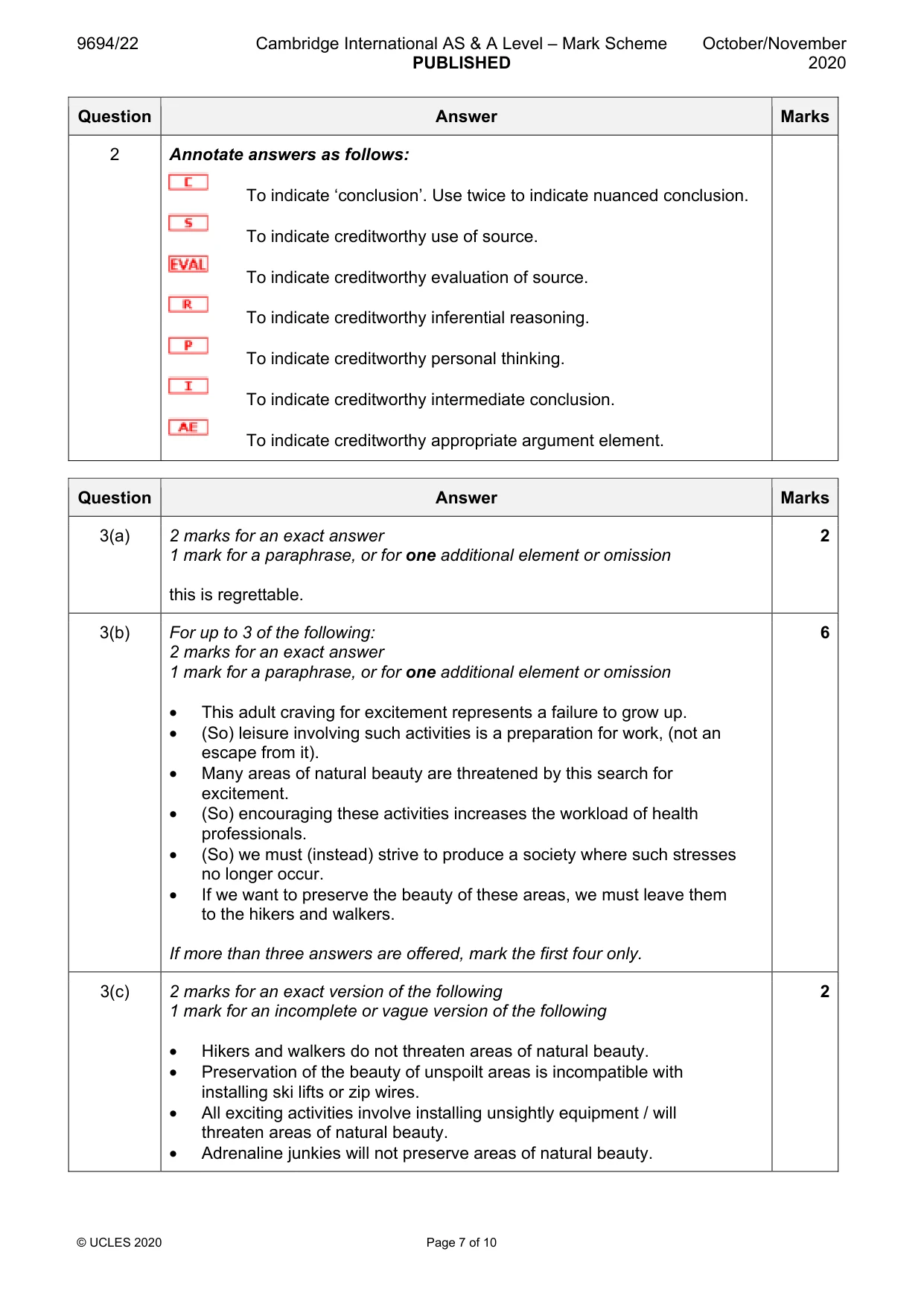
9694/22 Cambridge International AS & A Level – Mark Scheme PUBLISHED October/November 2020 © UCLES 2020 Page 7 of 10 Question Answer Marks 2 Annotate answers as follows: To indicate ‘conclusion’. Use twice to indicate nuanced conclusion. To indicate creditworthy use of source. To indicate creditworthy evaluation of source. To indicate creditworthy inferential reasoning. To indicate creditworthy personal thinking. To indicate creditworthy intermediate conclusion. To indicate creditworthy appropriate argument element. Question Answer Marks 3(a) 2 marks for an exact answer 1 mark for a paraphrase, or for one additional element or omission this is regrettable. 2 3(b) For up to 3 of the following: 2 marks for an exact answer 1 mark for a paraphrase, or for one additional element or omission • This adult craving for excitement represents a failure to grow up. • (So) leisure involving such activities is a preparation for work, (not an escape from it). • Many areas of natural beauty are threatened by this search for excitement. • (So) encouraging these activities increases the workload of health professionals. • (So) we must (instead) strive to produce a society where such stresses no longer occur. • If we want to preserve the beauty of these areas, we must leave them to the hikers and walkers. If more than three answers are offered, mark the first four only. 6 3(c) 2 marks for an exact version of the following 1 mark for an incomplete or vague version of the following • Hikers and walkers do not threaten areas of natural beauty. • Preservation of the beauty of unspoilt areas is incompatible with installing ski lifts or zip wires. • All exciting activities involve installing unsightly equipment / will threaten areas of natural beauty. • Adrenaline junkies will not preserve areas of natural beauty. 2
Mark scheme, page 8
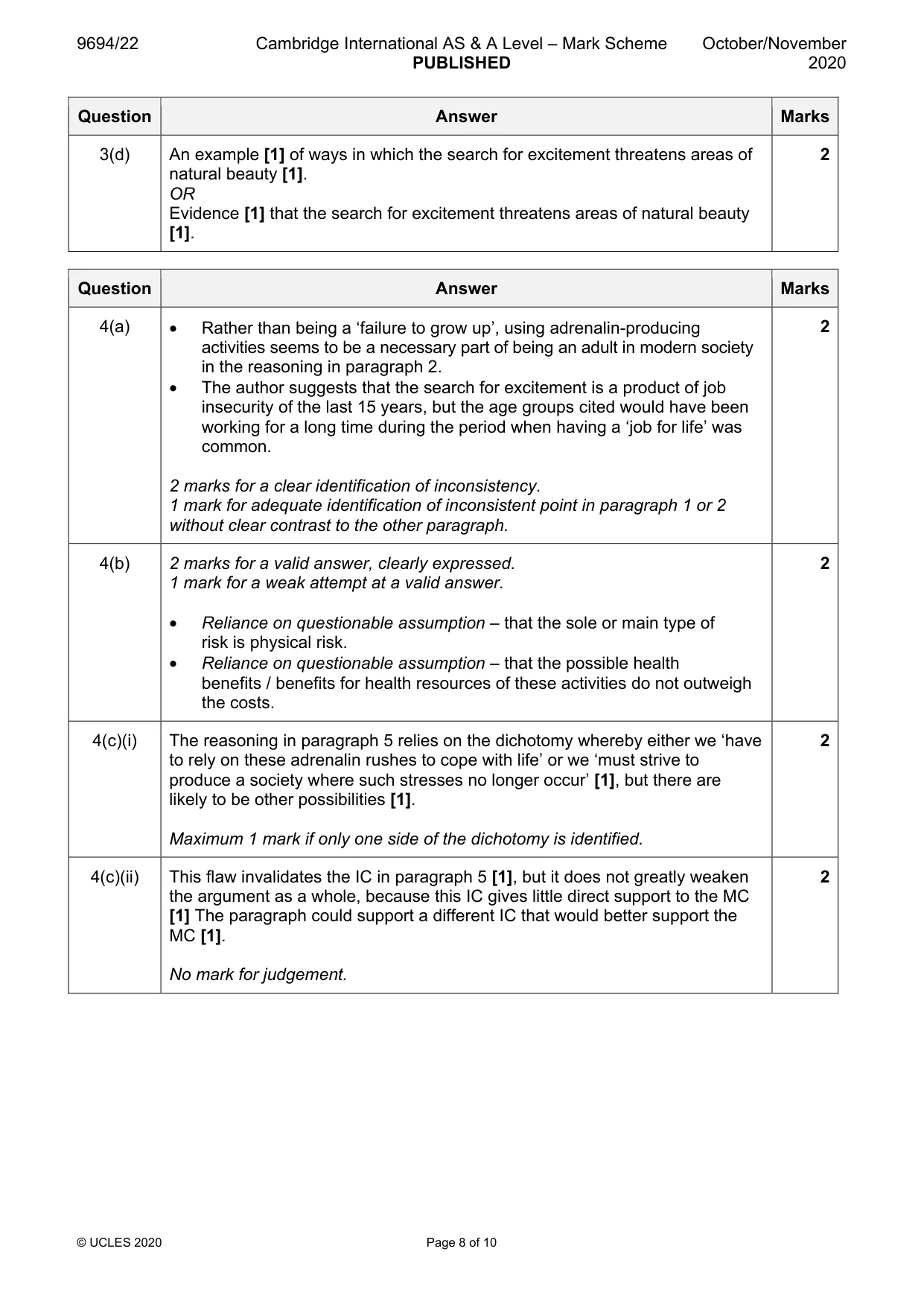
9694/22 Cambridge International AS & A Level – Mark Scheme PUBLISHED October/November 2020 © UCLES 2020 Page 8 of 10 Question Answer Marks 3(d) An example [1] of ways in which the search for excitement threatens areas of natural beauty [1]. OR Evidence [1] that the search for excitement threatens areas of natural beauty [1]. 2 Question Answer Marks 4(a) • Rather than being a ‘failure to grow up’, using adrenalin-producing activities seems to be a necessary part of being an adult in modern society in the reasoning in paragraph 2. • The author suggests that the search for excitement is a product of job insecurity of the last 15 years, but the age groups cited would have been working for a long time during the period when having a ‘job for life’ was common. 2 marks for a clear identification of inconsistency. 1 mark for adequate identification of inconsistent point in paragraph 1 or 2 without clear contrast to the other paragraph. 2 4(b) 2 marks for a valid answer, clearly expressed. 1 mark for a weak attempt at a valid answer. • Reliance on questionable assumption – that the sole or main type of risk is physical risk. • Reliance on questionable assumption – that the possible health benefits / benefits for health resources of these activities do not outweigh the costs. 2 4(c)(i) The reasoning in paragraph 5 relies on the dichotomy whereby either we ‘have to rely on these adrenalin rushes to cope with life’ or we ‘must strive to produce a society where such stresses no longer occur’ [1], but there are likely to be other possibilities [1]. Maximum 1 mark if only one side of the dichotomy is identified. 2 4(c)(ii) This flaw invalidates the IC in paragraph 5 [1], but it does not greatly weaken the argument as a whole, because this IC gives little direct support to the MC [1] The paragraph could support a different IC that would better support the MC [1]. No mark for judgement. 2
Mark scheme, page 9
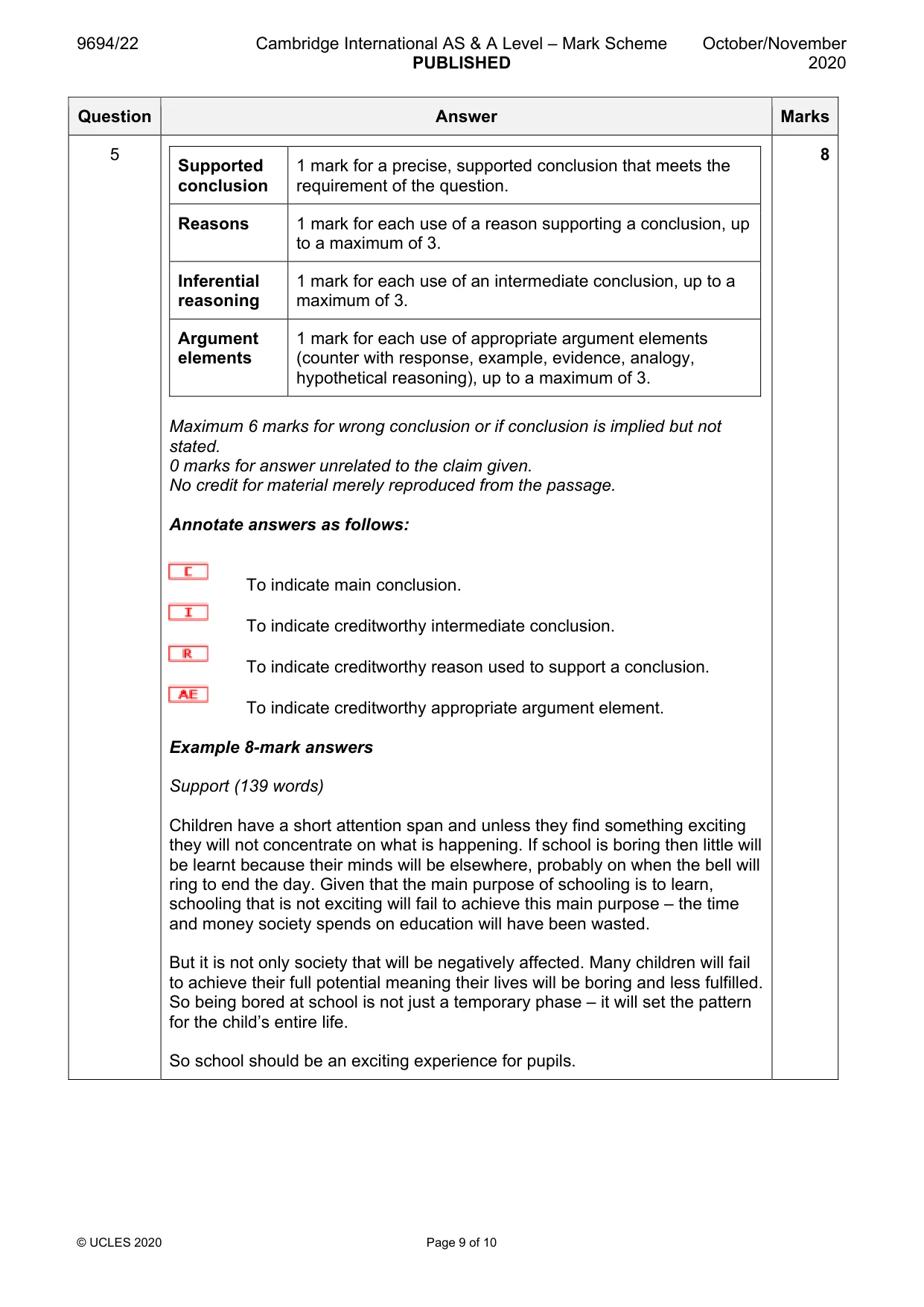
9694/22 Cambridge International AS & A Level – Mark Scheme PUBLISHED October/November 2020 © UCLES 2020 Page 9 of 10 Question Answer Marks 5 Supported conclusion 1 mark for a precise, supported conclusion that meets the requirement of the question. Reasons 1 mark for each use of a reason supporting a conclusion, up to a maximum of 3. Inferential reasoning 1 mark for each use of an intermediate conclusion, up to a maximum of 3. Argument elements 1 mark for each use of appropriate argument elements (counter with response, example, evidence, analogy, hypothetical reasoning), up to a maximum of 3. Maximum 6 marks for wrong conclusion or if conclusion is implied but not stated. 0 marks for answer unrelated to the claim given. No credit for material merely reproduced from the passage. Annotate answers as follows: To indicate main conclusion. To indicate creditworthy intermediate conclusion. To indicate creditworthy reason used to support a conclusion. To indicate creditworthy appropriate argument element. Example 8-mark answers Support (139 words) Children have a short attention span and unless they find something exciting they will not concentrate on what is happening. If school is boring then little will be learnt because their minds will be elsewhere, probably on when the bell will ring to end the day. Given that the main purpose of schooling is to learn, schooling that is not exciting will fail to achieve this main purpose – the time and money society spends on education will have been wasted. But it is not only society that will be negatively affected. Many children will fail to achieve their full potential meaning their lives will be boring and less fulfilled. So being bored at school is not just a temporary phase – it will set the pattern for the child’s entire life. So school should be an exciting experience for pupils. 8
Mark scheme, page 10
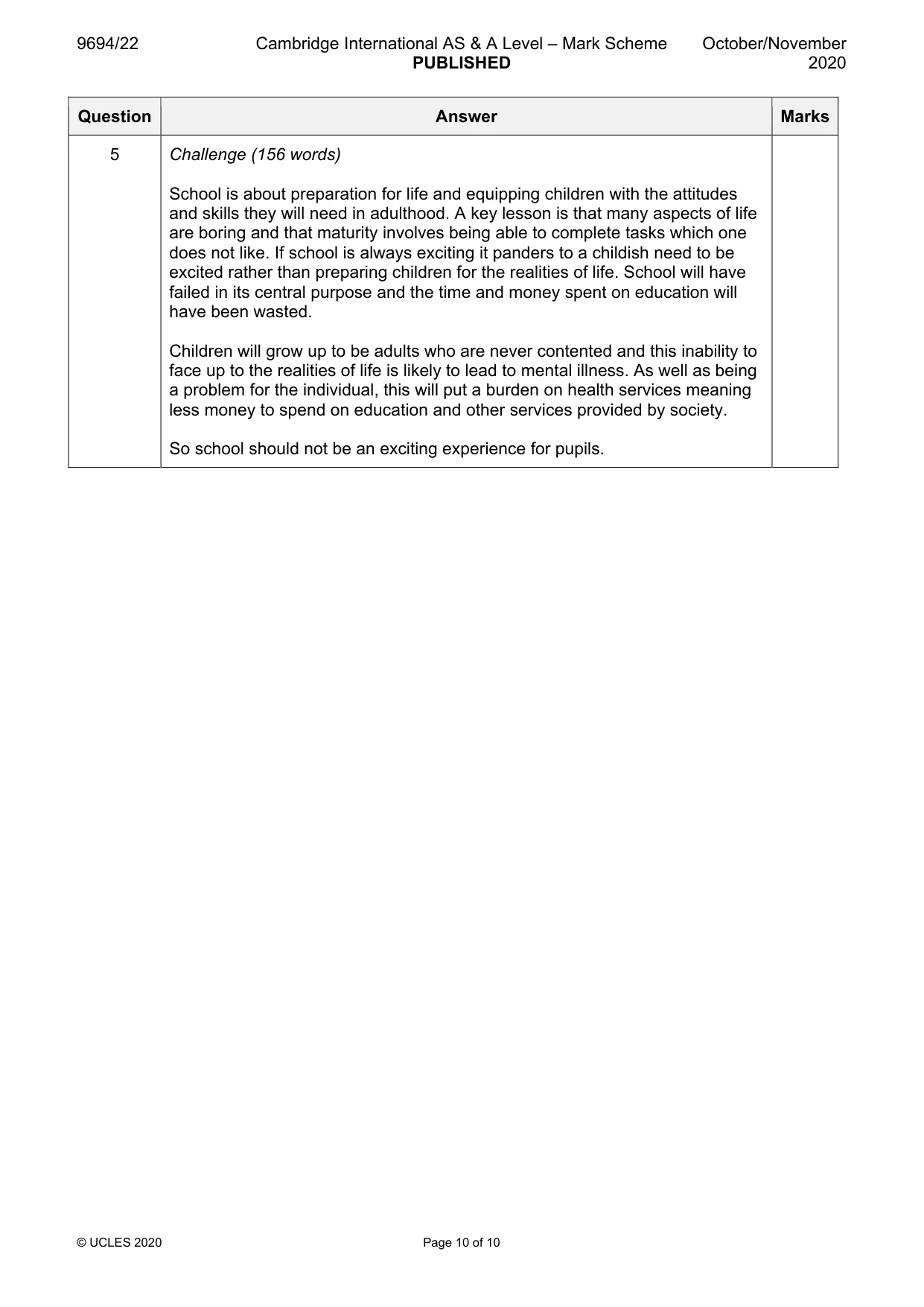
9694/22 Cambridge International AS & A Level – Mark Scheme PUBLISHED October/November 2020 © UCLES 2020 Page 10 of 10 Question Answer Marks 5 Challenge (156 words) School is about preparation for life and equipping children with the attitudes and skills they will need in adulthood. A key lesson is that many aspects of life are boring and that maturity involves being able to complete tasks which one does not like. If school is always exciting it panders to a childish need to be excited rather than preparing children for the realities of life. School will have failed in its central purpose and the time and money spent on education will have been wasted. Children will grow up to be adults who are never contented and this inability to face up to the realities of life is likely to lead to mental illness. As well as being a problem for the individual, this will put a burden on health services meaning less money to spend on education and other services provided by society. So school should not be an exciting experience for pupils.
What you needed in this session
Cambridge’s own grade thresholds for 2020 Oct/Nov, Paper 2 · Variant 2. A higher threshold means an easier paper — the bar moves with how the cohort did.