Cambridge A Level Thinking Skills 9694 — 2020 May/June Paper 2 · Variant 1
9694/21/M/J/20
The question paper and its mark scheme, free to read here and free to download. This is Cambridge’s own paper, exactly as it was sat.
Question paper8 pages



Mark scheme9 pages
Answers below. Sit the paper first if you are practising.
Paper as text
Question paper, page 1
Cambridge International AS & A Level * 7 2 1 1 8 0 0 9 4 8 * DC (PQ) 180300/1 © UCLES 2020 [Turn over This document has 8 pages. Blank pages are indicated. THINKING SKILLS 9694/21 Paper 2 Critical Thinking May/June 2020 1 hour 45 minutes You must answer on the enclosed answer booklet. You will need: Answer booklet (enclosed) INSTRUCTIONS ● Answer all questions. ● Follow the instructions on the front cover of the answer booklet. If you need additional answer paper, ask the invigilator for a continuation booklet. INFORMATION ● The total mark for this paper is 50. ● The number of marks for each question or part question is shown in brackets [ ].
Question paper, page 2
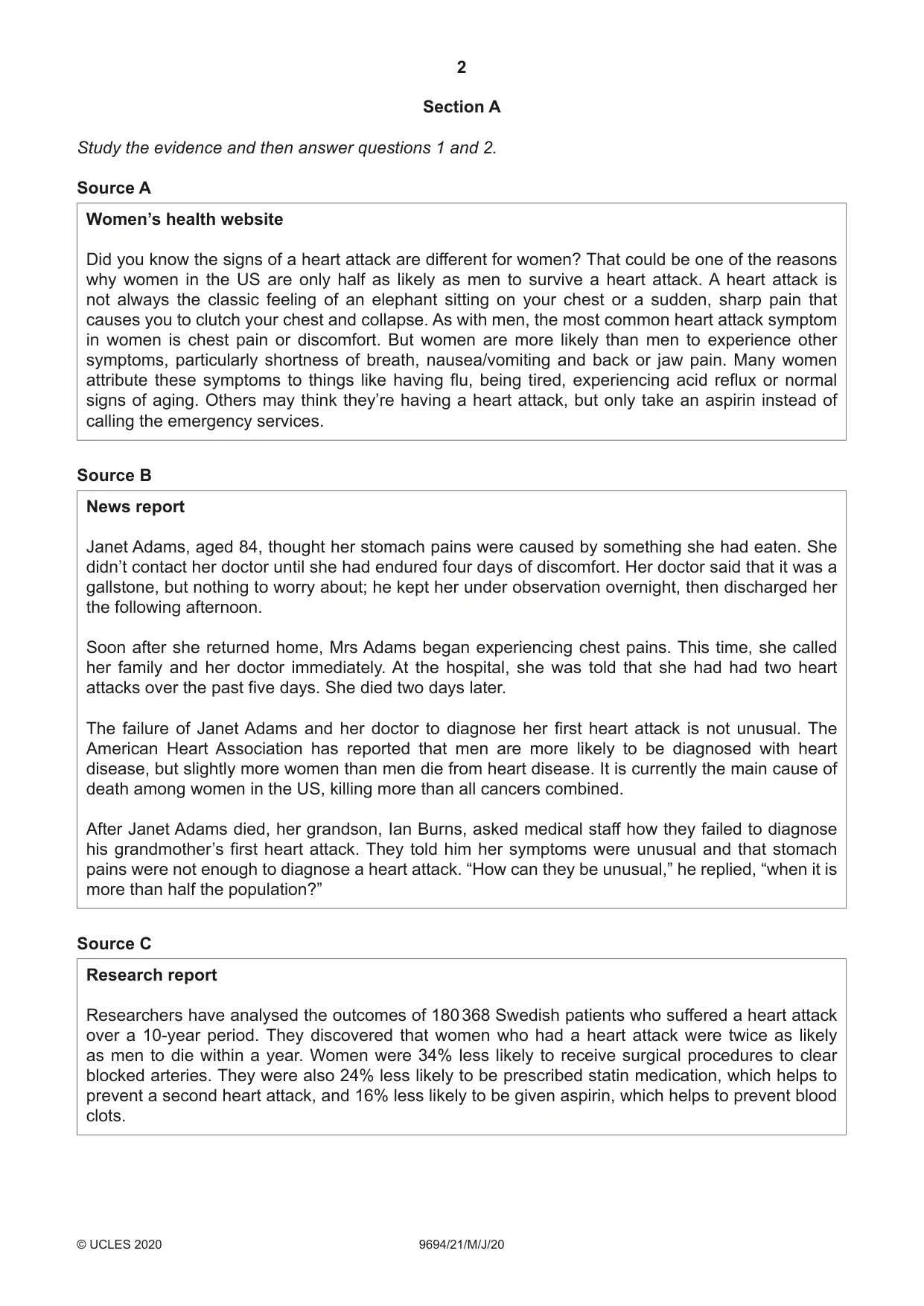
2 9694/21/M/J/20 © UCLES 2020 Section A Study the evidence and then answer questions 1 and 2. Source A Women’s health website Did you know the signs of a heart attack are different for women? That could be one of the reasons why women in the US are only half as likely as men to survive a heart attack. A heart attack is not always the classic feeling of an elephant sitting on your chest or a sudden, sharp pain that causes you to clutch your chest and collapse. As with men, the most common heart attack symptom in women is chest pain or discomfort. But women are more likely than men to experience other symptoms, particularly shortness of breath, nausea/vomiting and back or jaw pain. Many women attribute these symptoms to things like having flu, being tired, experiencing acid reflux or normal signs of aging. Others may think they’re having a heart attack, but only take an aspirin instead of calling the emergency services. Source B News report Janet Adams, aged 84, thought her stomach pains were caused by something she had eaten. She didn’t contact her doctor until she had endured four days of discomfort. Her doctor said that it was a gallstone, but nothing to worry about; he kept her under observation overnight, then discharged her the following afternoon. Soon after she returned home, Mrs Adams began experiencing chest pains. This time, she called her family and her doctor immediately. At the hospital, she was told that she had had two heart attacks over the past five days. She died two days later. The failure of Janet Adams and her doctor to diagnose her first heart attack is not unusual. The American Heart Association has reported that men are more likely to be diagnosed with heart disease, but slightly more women than men die from heart disease. It is currently the main cause of death among women in the US, killing more than all cancers combined. After Janet Adams died, her grandson, Ian Burns, asked medical staff how they failed to diagnose his grandmother’s first heart attack. They told him her symptoms were unusual and that stomach pains were not enough to diagnose a heart attack. “How can they be unusual,” he replied, “when it is more than half the population?” Source C Research report Researchers have analysed the outcomes of 180 368 Swedish patients who suffered a heart attack over a 10-year period. They discovered that women who had a heart attack were twice as likely as men to die within a year. Women were 34% less likely to receive surgical procedures to clear blocked arteries. They were also 24% less likely to be prescribed statin medication, which helps to prevent a second heart attack, and 16% less likely to be given aspirin, which helps to prevent blood clots.
Question paper, page 3
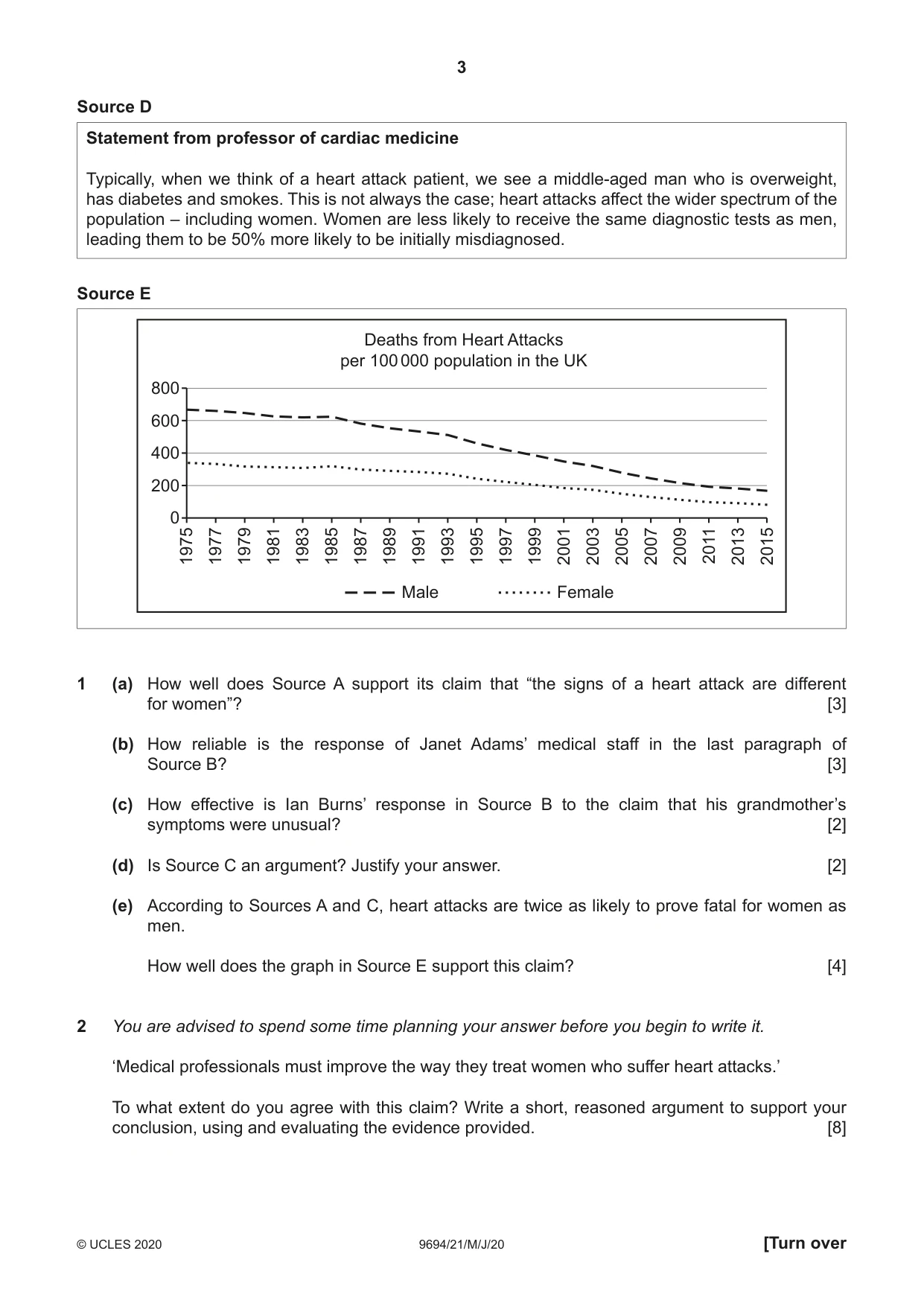
3 9694/21/M/J/20 © UCLES 2020 [Turn over Source D Statement from professor of cardiac medicine Typically, when we think of a heart attack patient, we see a middle-aged man who is overweight, has diabetes and smokes. This is not always the case; heart attacks affect the wider spectrum of the population – including women. Women are less likely to receive the same diagnostic tests as men, leading them to be 50% more likely to be initially misdiagnosed. Source E 1975 0 200 400 Deaths from Heart Attacks per 100 000 population in the UK 600 800 1977 1979 1981 1983 1985 1987 1989 1991 1993 1995 1997 1999 2001 2003 2005 2007 2009 2011 2013 2015 Male Female 1 (a) How well does Source A support its claim that “the signs of a heart attack are different for women”? [3] (b) How reliable is the response of Janet Adams’ medical staff in the last paragraph of Source B? [3] (c) How effective is Ian Burns’ response in Source B to the claim that his grandmother’s symptoms were unusual? [2] (d) Is Source C an argument? Justify your answer. [2] (e) According to Sources A and C, heart attacks are twice as likely to prove fatal for women as men. How well does the graph in Source E support this claim? [4] 2 You are advised to spend some time planning your answer before you begin to write it. ‘Medical professionals must improve the way they treat women who suffer heart attacks.’ To what extent do you agree with this claim? Write a short, reasoned argument to support your conclusion, using and evaluating the evidence provided. [8]
Question paper, page 4
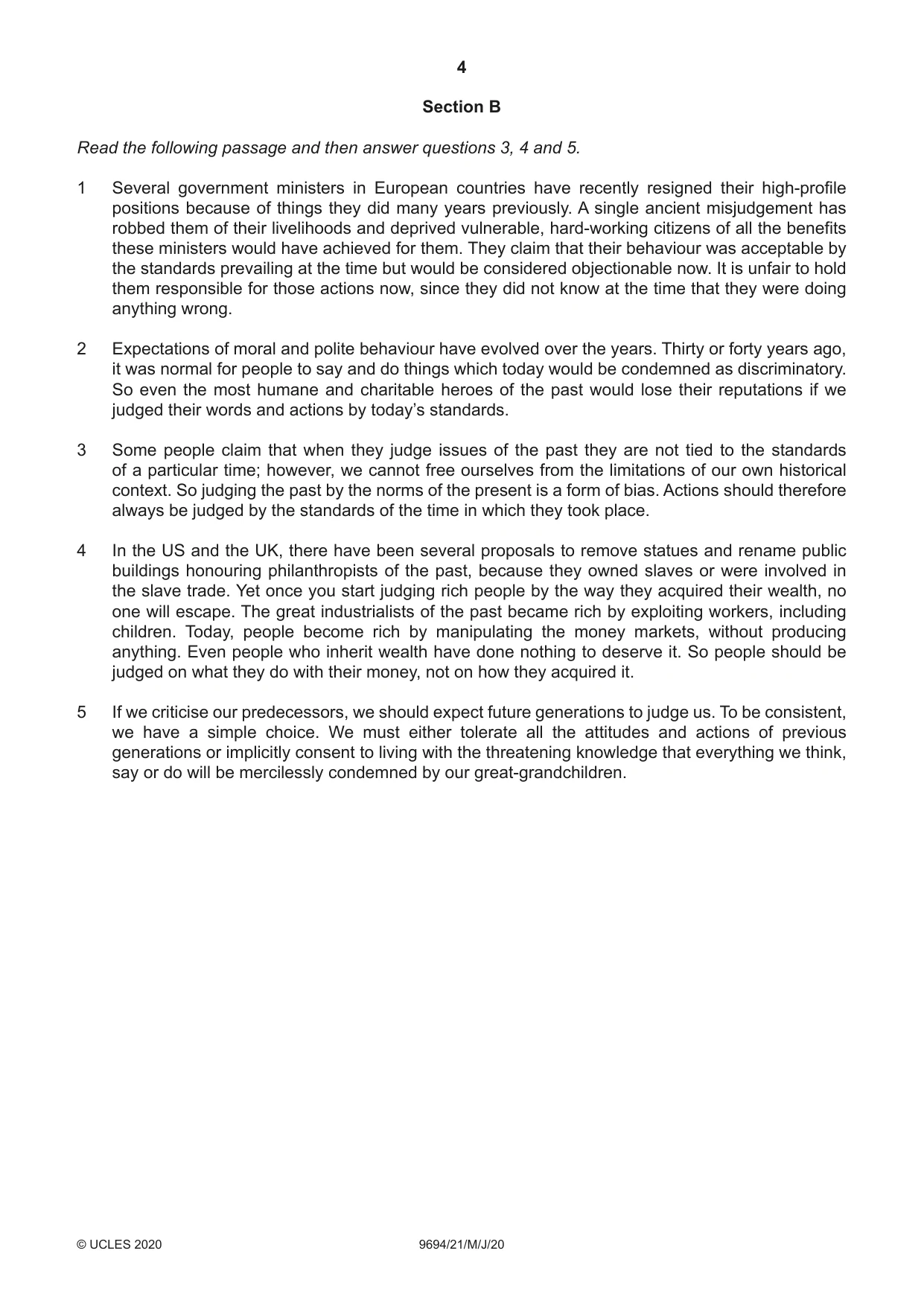
4 9694/21/M/J/20 © UCLES 2020 Section B Read the following passage and then answer questions 3, 4 and 5. 1 Several government ministers in European countries have recently resigned their high-profile positions because of things they did many years previously. A single ancient misjudgement has robbed them of their livelihoods and deprived vulnerable, hard-working citizens of all the benefits these ministers would have achieved for them. They claim that their behaviour was acceptable by the standards prevailing at the time but would be considered objectionable now. It is unfair to hold them responsible for those actions now, since they did not know at the time that they were doing anything wrong. 2 Expectations of moral and polite behaviour have evolved over the years. Thirty or forty years ago, it was normal for people to say and do things which today would be condemned as discriminatory. So even the most humane and charitable heroes of the past would lose their reputations if we judged their words and actions by today’s standards. 3 Some people claim that when they judge issues of the past they are not tied to the standards of a particular time; however, we cannot free ourselves from the limitations of our own historical context. So judging the past by the norms of the present is a form of bias. Actions should therefore always be judged by the standards of the time in which they took place. 4 In the US and the UK, there have been several proposals to remove statues and rename public buildings honouring philanthropists of the past, because they owned slaves or were involved in the slave trade. Yet once you start judging rich people by the way they acquired their wealth, no one will escape. The great industrialists of the past became rich by exploiting workers, including children. Today, people become rich by manipulating the money markets, without producing anything. Even people who inherit wealth have done nothing to deserve it. So people should be judged on what they do with their money, not on how they acquired it. 5 If we criticise our predecessors, we should expect future generations to judge us. To be consistent, we have a simple choice. We must either tolerate all the attitudes and actions of previous generations or implicitly consent to living with the threatening knowledge that everything we think, say or do will be mercilessly condemned by our great-grandchildren.
Question paper, page 5
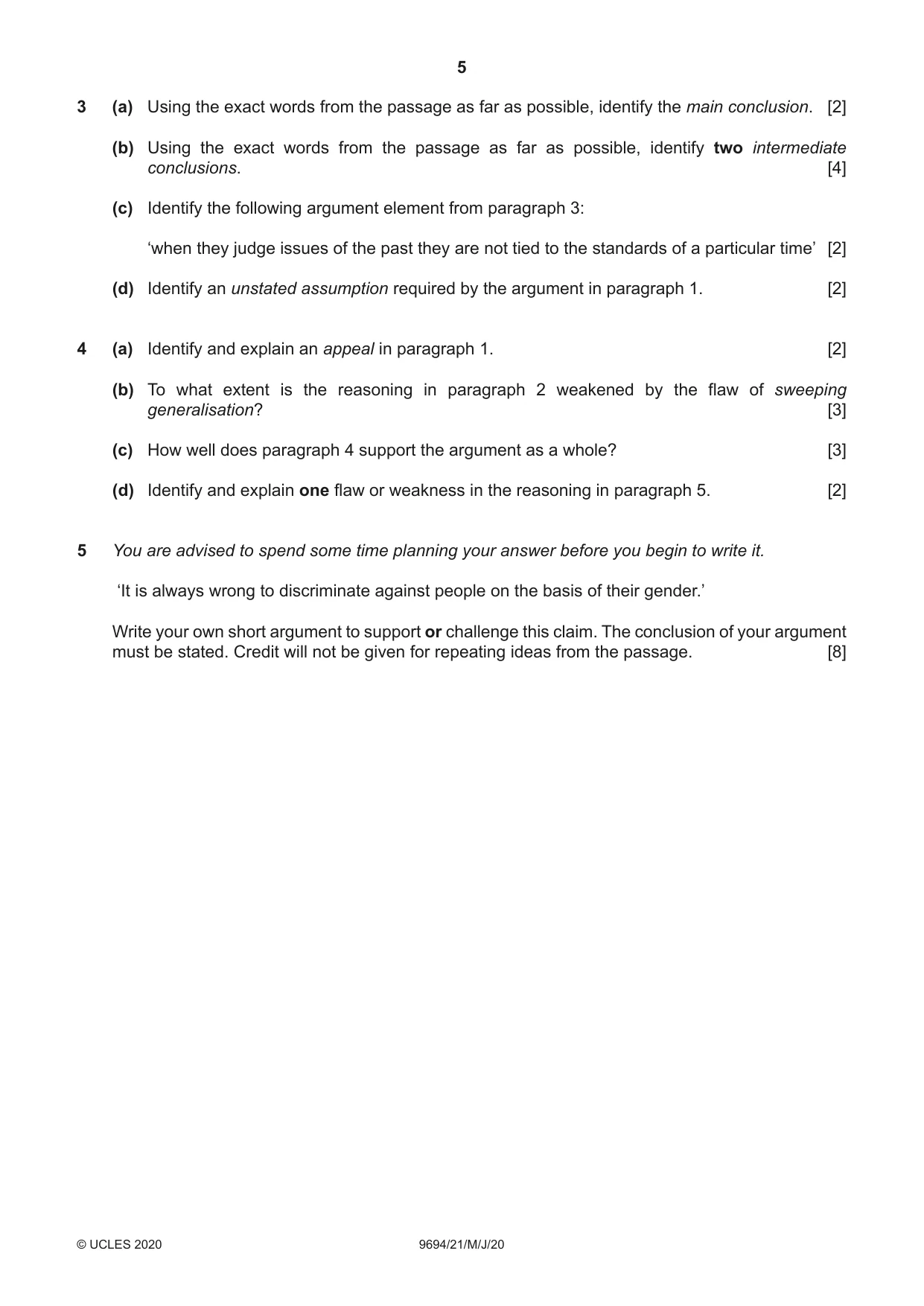
5 9694/21/M/J/20 © UCLES 2020 3 (a) Using the exact words from the passage as far as possible, identify the main conclusion. [2] (b) Using the exact words from the passage as far as possible, identify two intermediate conclusions. [4] (c) Identify the following argument element from paragraph 3: ‘when they judge issues of the past they are not tied to the standards of a particular time’ [2] (d) Identify an unstated assumption required by the argument in paragraph 1. [2] 4 (a) Identify and explain an appeal in paragraph 1. [2] (b) To what extent is the reasoning in paragraph 2 weakened by the flaw of sweeping generalisation? [3] (c) How well does paragraph 4 support the argument as a whole? [3] (d) Identify and explain one flaw or weakness in the reasoning in paragraph 5. [2] 5 You are advised to spend some time planning your answer before you begin to write it. ‘It is always wrong to discriminate against people on the basis of their gender.’ Write your own short argument to support or challenge this claim. The conclusion of your argument must be stated. Credit will not be given for repeating ideas from the passage. [8]
Question paper, page 6
6 9694/21/M/J/20 © UCLES 2020 BLANK PAGE
Question paper, page 7
7 9694/21/M/J/20 © UCLES 2020 BLANK PAGE
Question paper, page 8
8 9694/21/M/J/20 © UCLES 2020 Permission to reproduce items where third-party owned material protected by copyright is included has been sought and cleared where possible. Every reasonable effort has been made by the publisher (UCLES) to trace copyright holders, but if any items requiring clearance have unwittingly been included, the publisher will be pleased to make amends at the earliest possible opportunity. To avoid the issue of disclosure of answer-related information to candidates, all copyright acknowledgements are reproduced online in the Cambridge Assessment International Education Copyright Acknowledgements Booklet. This is produced for each series of examinations and is freely available to download at www.cambridgeinternational.org after the live examination series. Cambridge Assessment International Education is part of the Cambridge Assessment Group. Cambridge Assessment is the brand name of the University of Cambridge Local Examinations Syndicate (UCLES), which itself is a department of the University of Cambridge. BLANK PAGE
Mark scheme, page 1
This document consists of 9 printed pages. © UCLES 2020 [Turn over Cambridge International AS & A Level THINKING SKILLS 9694/21 Paper 2 Critical Thinking May/June 2020 MARK SCHEME Maximum Mark: 50 Published Students did not sit exam papers in the June 2020 series due to the Covid-19 global pandemic. This mark scheme is published to support teachers and students and should be read together with the question paper. It shows the requirements of the exam. The answer column of the mark scheme shows the proposed basis on which Examiners would award marks for this exam. Where appropriate, this column also provides the most likely acceptable alternative responses expected from students. Examiners usually review the mark scheme after they have seen student responses and update the mark scheme if appropriate. In the June series, Examiners were unable to consider the acceptability of alternative responses, as there were no student responses to consider. Mark schemes should usually be read together with the Principal Examiner Report for Teachers. However, because students did not sit exam papers, there is no Principal Examiner Report for Teachers for the June 2020 series. Cambridge International will not enter into discussions about these mark schemes. Cambridge International is publishing the mark schemes for the June 2020 series for most Cambridge IGCSE™ and Cambridge International A & AS Level components, and some Cambridge O Level components.
Mark scheme, page 2
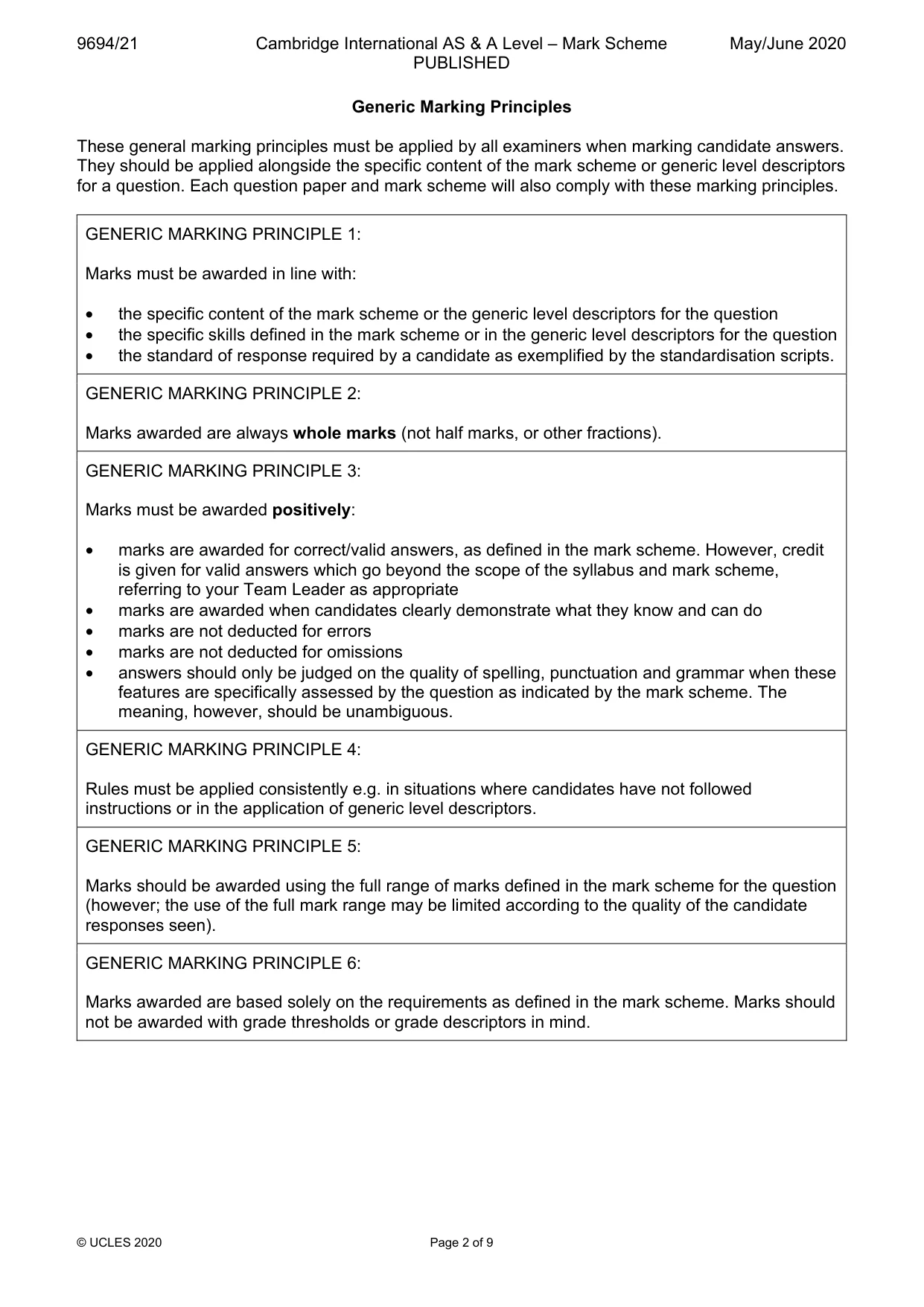
9694/21 Cambridge International AS & A Level – Mark Scheme PUBLISHED May/June 2020 © UCLES 2020 Page 2 of 9 Generic Marking Principles These general marking principles must be applied by all examiners when marking candidate answers. They should be applied alongside the specific content of the mark scheme or generic level descriptors for a question. Each question paper and mark scheme will also comply with these marking principles. GENERIC MARKING PRINCIPLE 1: Marks must be awarded in line with: • the specific content of the mark scheme or the generic level descriptors for the question • the specific skills defined in the mark scheme or in the generic level descriptors for the question • the standard of response required by a candidate as exemplified by the standardisation scripts. GENERIC MARKING PRINCIPLE 2: Marks awarded are always whole marks (not half marks, or other fractions). GENERIC MARKING PRINCIPLE 3: Marks must be awarded positively: • marks are awarded for correct/valid answers, as defined in the mark scheme. However, credit is given for valid answers which go beyond the scope of the syllabus and mark scheme, referring to your Team Leader as appropriate • marks are awarded when candidates clearly demonstrate what they know and can do • marks are not deducted for errors • marks are not deducted for omissions • answers should only be judged on the quality of spelling, punctuation and grammar when these features are specifically assessed by the question as indicated by the mark scheme. The meaning, however, should be unambiguous. GENERIC MARKING PRINCIPLE 4: Rules must be applied consistently e.g. in situations where candidates have not followed instructions or in the application of generic level descriptors. GENERIC MARKING PRINCIPLE 5: Marks should be awarded using the full range of marks defined in the mark scheme for the question (however; the use of the full mark range may be limited according to the quality of the candidate responses seen). GENERIC MARKING PRINCIPLE 6: Marks awarded are based solely on the requirements as defined in the mark scheme. Marks should not be awarded with grade thresholds or grade descriptors in mind.
Mark scheme, page 3
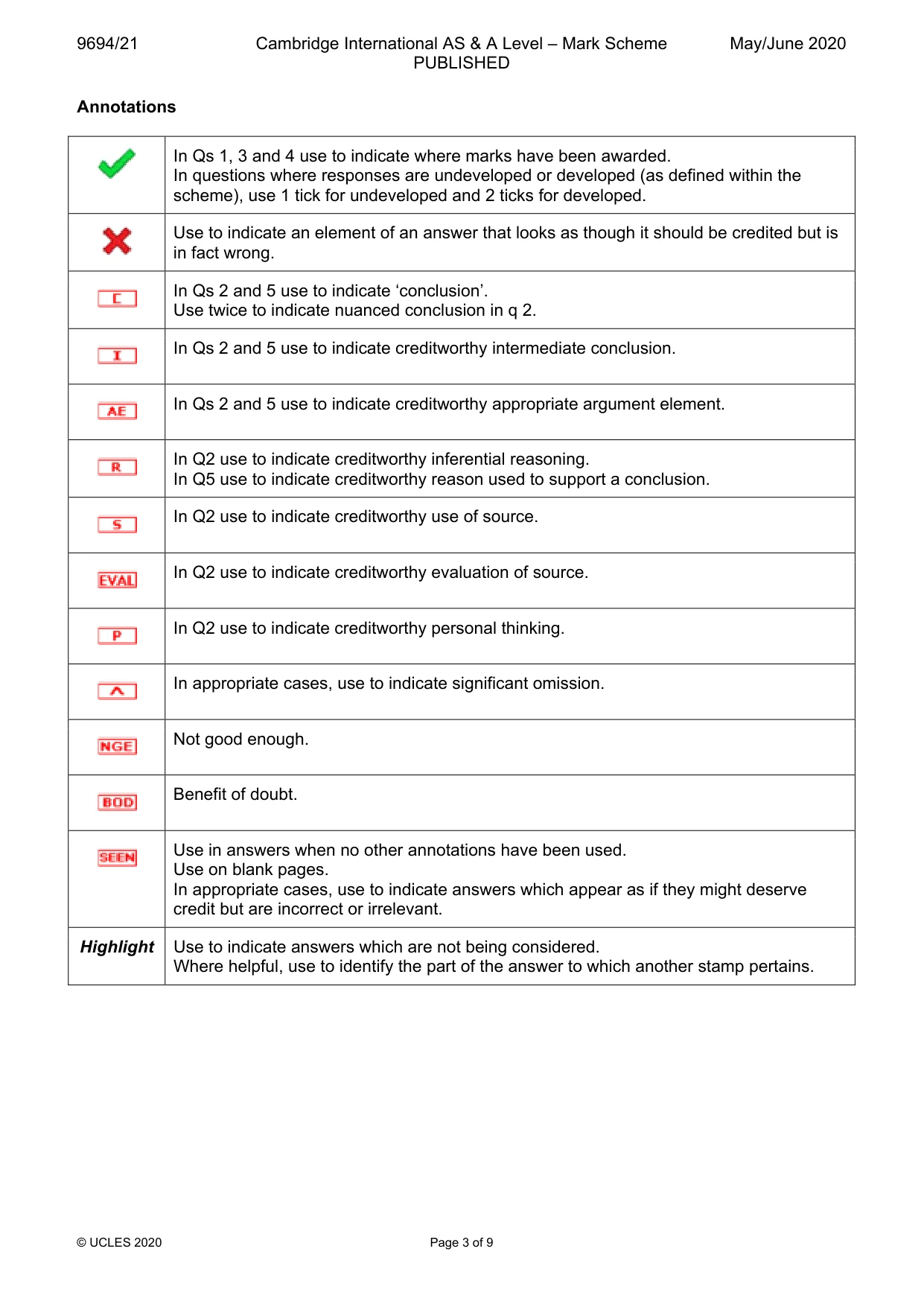
9694/21 Cambridge International AS & A Level – Mark Scheme PUBLISHED May/June 2020 © UCLES 2020 Page 3 of 9 Annotations In Qs 1, 3 and 4 use to indicate where marks have been awarded. In questions where responses are undeveloped or developed (as defined within the scheme), use 1 tick for undeveloped and 2 ticks for developed. Use to indicate an element of an answer that looks as though it should be credited but is in fact wrong. In Qs 2 and 5 use to indicate ‘conclusion’. Use twice to indicate nuanced conclusion in q 2. In Qs 2 and 5 use to indicate creditworthy intermediate conclusion. In Qs 2 and 5 use to indicate creditworthy appropriate argument element. In Q2 use to indicate creditworthy inferential reasoning. In Q5 use to indicate creditworthy reason used to support a conclusion. In Q2 use to indicate creditworthy use of source. In Q2 use to indicate creditworthy evaluation of source. In Q2 use to indicate creditworthy personal thinking. In appropriate cases, use to indicate significant omission. Not good enough. Benefit of doubt. Use in answers when no other annotations have been used. Use on blank pages. In appropriate cases, use to indicate answers which appear as if they might deserve credit but are incorrect or irrelevant. Highlight Use to indicate answers which are not being considered. Where helpful, use to identify the part of the answer to which another stamp pertains.
Mark scheme, page 4
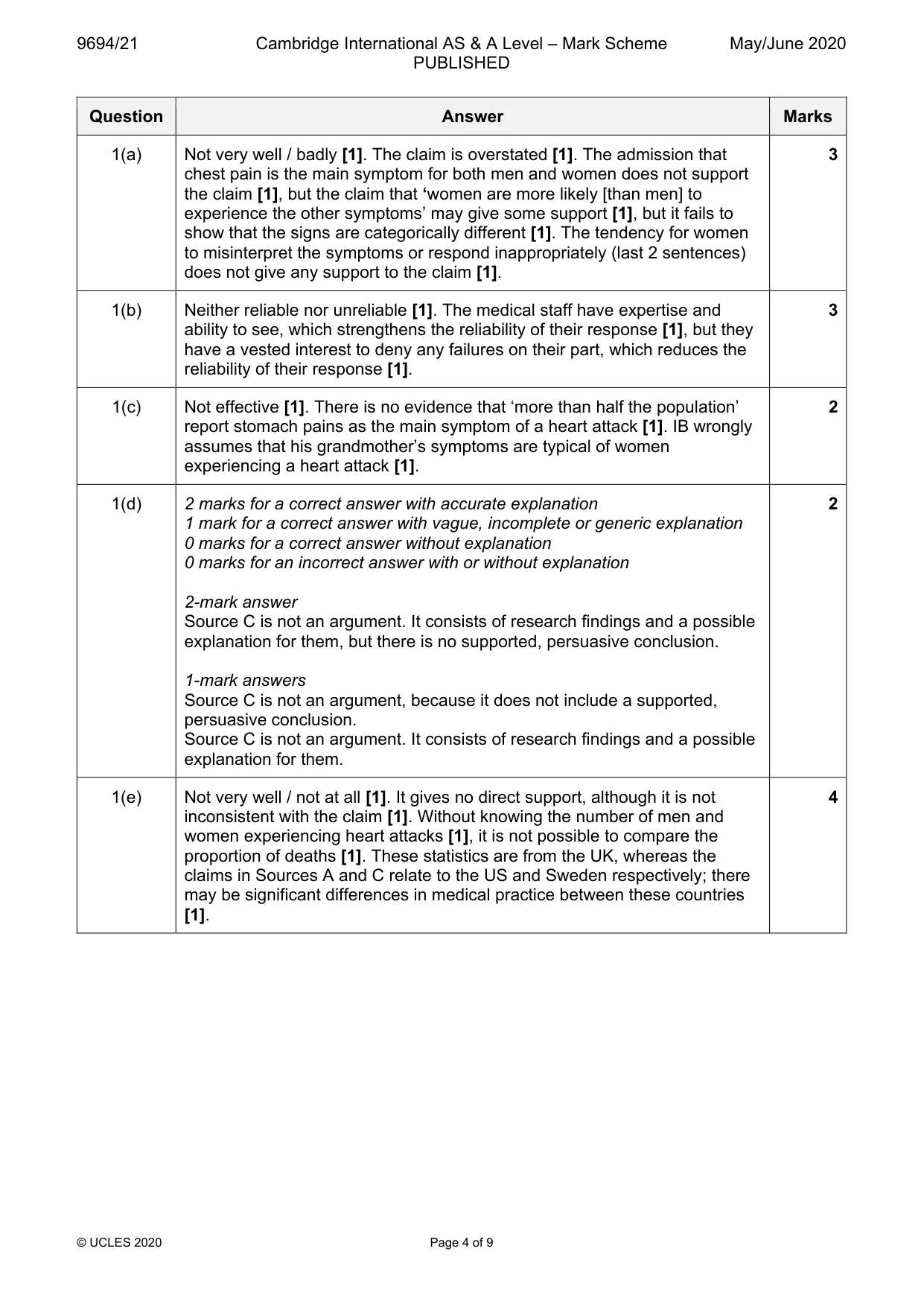
9694/21 Cambridge International AS & A Level – Mark Scheme PUBLISHED May/June 2020 © UCLES 2020 Page 4 of 9 Question Answer Marks 1(a) Not very well / badly [1]. The claim is overstated [1]. The admission that chest pain is the main symptom for both men and women does not support the claim [1], but the claim that ‘women are more likely [than men] to experience the other symptoms’ may give some support [1], but it fails to show that the signs are categorically different [1]. The tendency for women to misinterpret the symptoms or respond inappropriately (last 2 sentences) does not give any support to the claim [1]. 3 1(b) Neither reliable nor unreliable [1]. The medical staff have expertise and ability to see, which strengthens the reliability of their response [1], but they have a vested interest to deny any failures on their part, which reduces the reliability of their response [1]. 3 1(c) Not effective [1]. There is no evidence that ‘more than half the population’ report stomach pains as the main symptom of a heart attack [1]. IB wrongly assumes that his grandmother’s symptoms are typical of women experiencing a heart attack [1]. 2 1(d) 2 marks for a correct answer with accurate explanation 1 mark for a correct answer with vague, incomplete or generic explanation 0 marks for a correct answer without explanation 0 marks for an incorrect answer with or without explanation 2-mark answer Source C is not an argument. It consists of research findings and a possible explanation for them, but there is no supported, persuasive conclusion. 1-mark answers Source C is not an argument, because it does not include a supported, persuasive conclusion. Source C is not an argument. It consists of research findings and a possible explanation for them. 2 1(e) Not very well / not at all [1]. It gives no direct support, although it is not inconsistent with the claim [1]. Without knowing the number of men and women experiencing heart attacks [1], it is not possible to compare the proportion of deaths [1]. These statistics are from the UK, whereas the claims in Sources A and C relate to the US and Sweden respectively; there may be significant differences in medical practice between these countries [1]. 4
Mark scheme, page 5
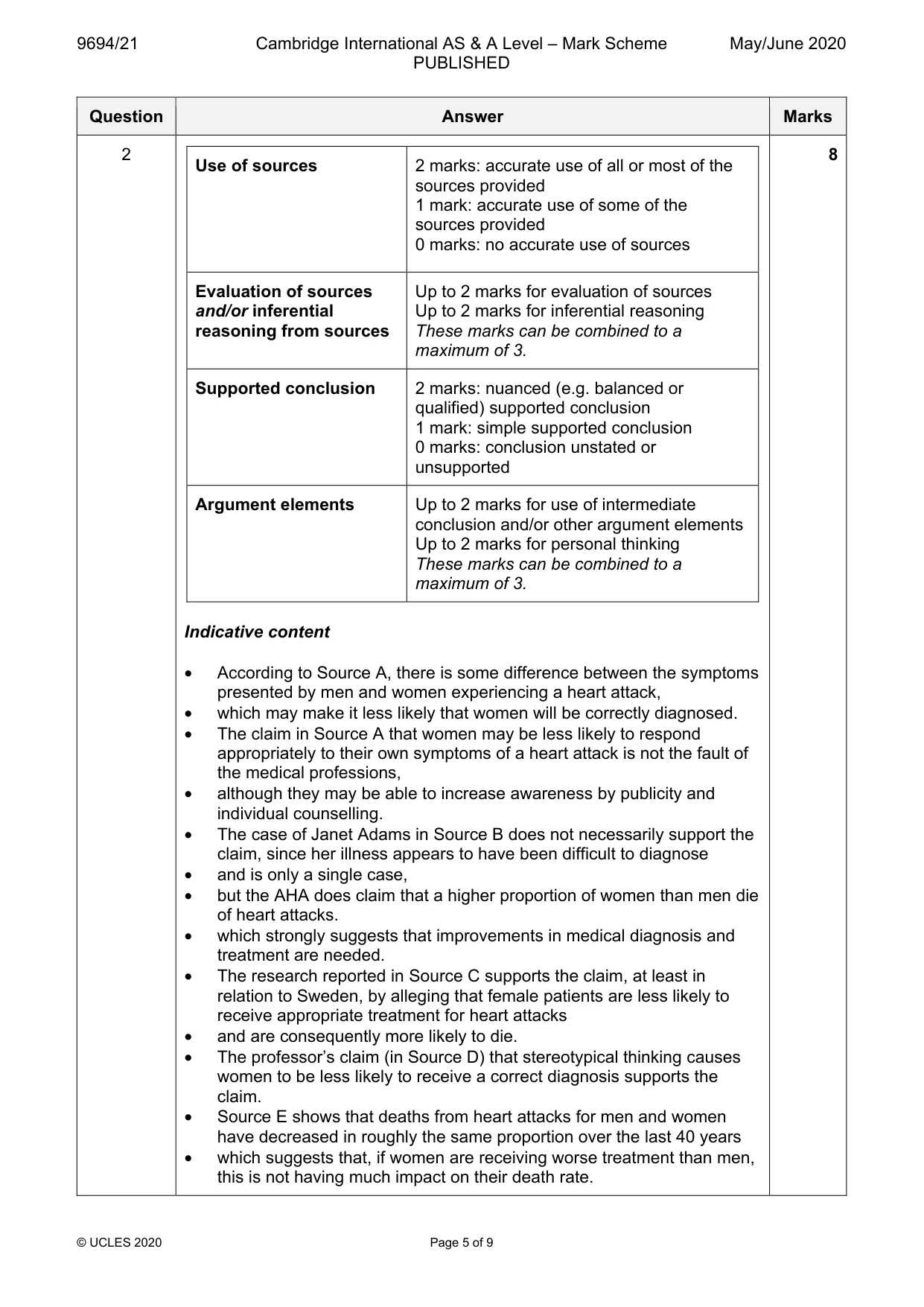
9694/21 Cambridge International AS & A Level – Mark Scheme PUBLISHED May/June 2020 © UCLES 2020 Page 5 of 9 Question Answer Marks 2 Use of sources 2 marks: accurate use of all or most of the sources provided 1 mark: accurate use of some of the sources provided 0 marks: no accurate use of sources Evaluation of sources and/or inferential reasoning from sources Up to 2 marks for evaluation of sources Up to 2 marks for inferential reasoning These marks can be combined to a maximum of 3. Supported conclusion 2 marks: nuanced (e.g. balanced or qualified) supported conclusion 1 mark: simple supported conclusion 0 marks: conclusion unstated or unsupported Argument elements Up to 2 marks for use of intermediate conclusion and/or other argument elements Up to 2 marks for personal thinking These marks can be combined to a maximum of 3. Indicative content • According to Source A, there is some difference between the symptoms presented by men and women experiencing a heart attack, • which may make it less likely that women will be correctly diagnosed. • The claim in Source A that women may be less likely to respond appropriately to their own symptoms of a heart attack is not the fault of the medical professions, • although they may be able to increase awareness by publicity and individual counselling. • The case of Janet Adams in Source B does not necessarily support the claim, since her illness appears to have been difficult to diagnose • and is only a single case, • but the AHA does claim that a higher proportion of women than men die of heart attacks. • which strongly suggests that improvements in medical diagnosis and treatment are needed. • The research reported in Source C supports the claim, at least in relation to Sweden, by alleging that female patients are less likely to receive appropriate treatment for heart attacks • and are consequently more likely to die. • The professor’s claim (in Source D) that stereotypical thinking causes women to be less likely to receive a correct diagnosis supports the claim. • Source E shows that deaths from heart attacks for men and women have decreased in roughly the same proportion over the last 40 years • which suggests that, if women are receiving worse treatment than men, this is not having much impact on their death rate. 8
Mark scheme, page 6
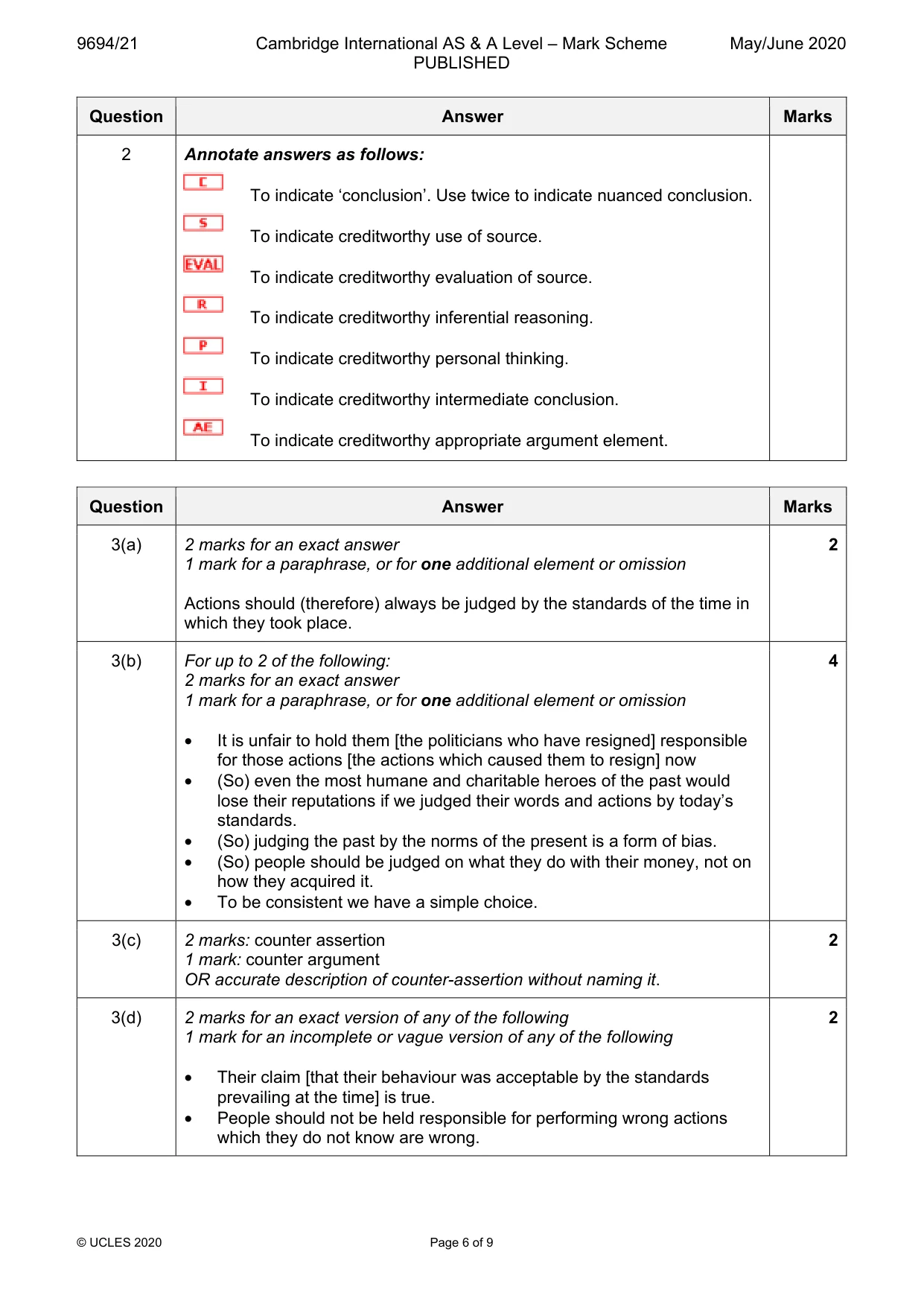
9694/21 Cambridge International AS & A Level – Mark Scheme PUBLISHED May/June 2020 © UCLES 2020 Page 6 of 9 Question Answer Marks 2 Annotate answers as follows: To indicate ‘conclusion’. Use twice to indicate nuanced conclusion. To indicate creditworthy use of source. To indicate creditworthy evaluation of source. To indicate creditworthy inferential reasoning. To indicate creditworthy personal thinking. To indicate creditworthy intermediate conclusion. To indicate creditworthy appropriate argument element. Question Answer Marks 3(a) 2 marks for an exact answer 1 mark for a paraphrase, or for one additional element or omission Actions should (therefore) always be judged by the standards of the time in which they took place. 2 3(b) For up to 2 of the following: 2 marks for an exact answer 1 mark for a paraphrase, or for one additional element or omission • It is unfair to hold them [the politicians who have resigned] responsible for those actions [the actions which caused them to resign] now • (So) even the most humane and charitable heroes of the past would lose their reputations if we judged their words and actions by today’s standards. • (So) judging the past by the norms of the present is a form of bias. • (So) people should be judged on what they do with their money, not on how they acquired it. • To be consistent we have a simple choice. 4 3(c) 2 marks: counter assertion 1 mark: counter argument OR accurate description of counter-assertion without naming it. 2 3(d) 2 marks for an exact version of any of the following 1 mark for an incomplete or vague version of any of the following • Their claim [that their behaviour was acceptable by the standards prevailing at the time] is true. • People should not be held responsible for performing wrong actions which they do not know are wrong. 2
Mark scheme, page 7
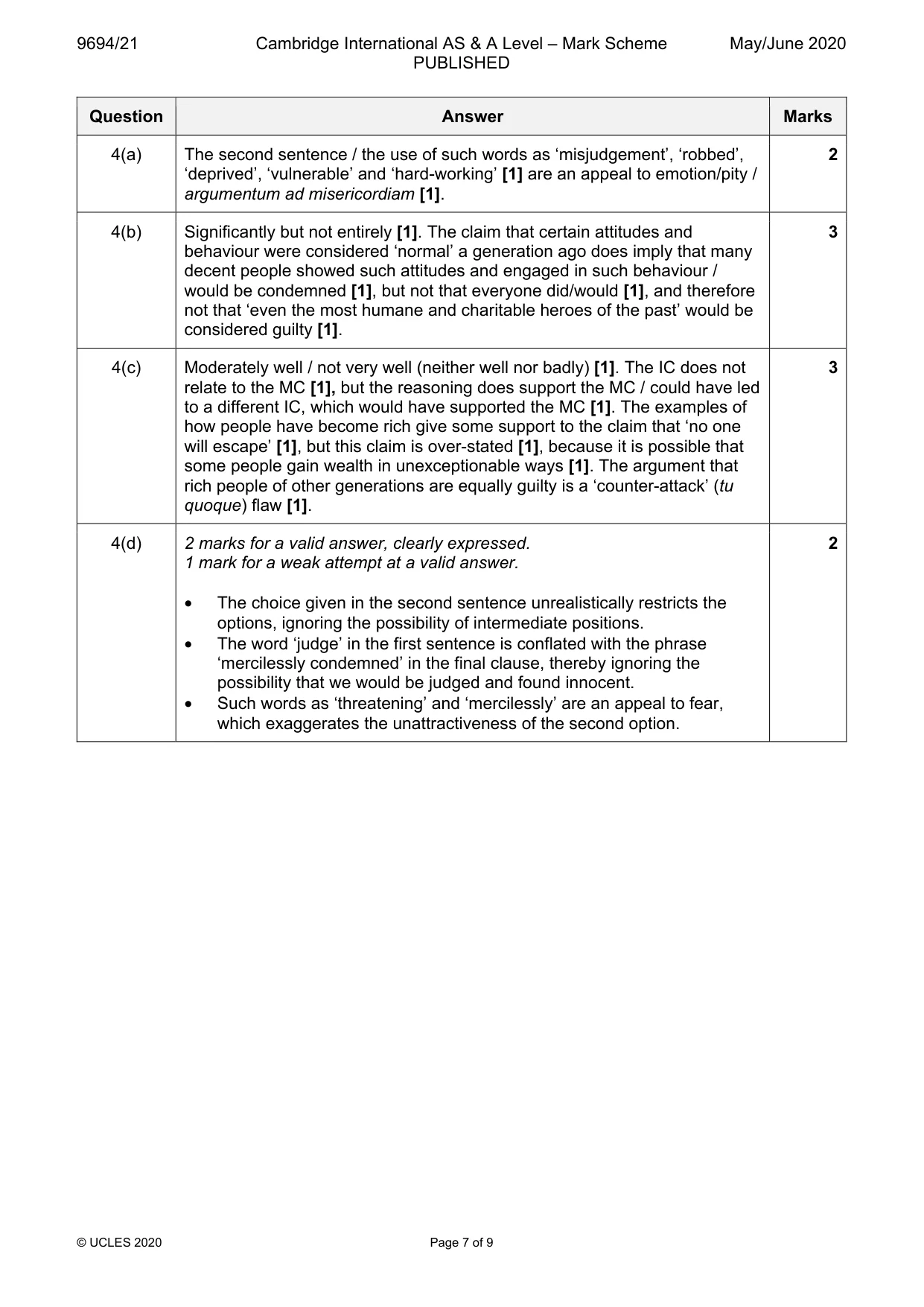
9694/21 Cambridge International AS & A Level – Mark Scheme PUBLISHED May/June 2020 © UCLES 2020 Page 7 of 9 Question Answer Marks 4(a) The second sentence / the use of such words as ‘misjudgement’, ‘robbed’, ‘deprived’, ‘vulnerable’ and ‘hard-working’ [1] are an appeal to emotion/pity / argumentum ad misericordiam [1]. 2 4(b) Significantly but not entirely [1]. The claim that certain attitudes and behaviour were considered ‘normal’ a generation ago does imply that many decent people showed such attitudes and engaged in such behaviour / would be condemned [1], but not that everyone did/would [1], and therefore not that ‘even the most humane and charitable heroes of the past’ would be considered guilty [1]. 3 4(c) Moderately well / not very well (neither well nor badly) [1]. The IC does not relate to the MC [1], but the reasoning does support the MC / could have led to a different IC, which would have supported the MC [1]. The examples of how people have become rich give some support to the claim that ‘no one will escape’ [1], but this claim is over-stated [1], because it is possible that some people gain wealth in unexceptionable ways [1]. The argument that rich people of other generations are equally guilty is a ‘counter-attack’ (tu quoque) flaw [1]. 3 4(d) 2 marks for a valid answer, clearly expressed. 1 mark for a weak attempt at a valid answer. • The choice given in the second sentence unrealistically restricts the options, ignoring the possibility of intermediate positions. • The word ‘judge’ in the first sentence is conflated with the phrase ‘mercilessly condemned’ in the final clause, thereby ignoring the possibility that we would be judged and found innocent. • Such words as ‘threatening’ and ‘mercilessly’ are an appeal to fear, which exaggerates the unattractiveness of the second option. 2
Mark scheme, page 8
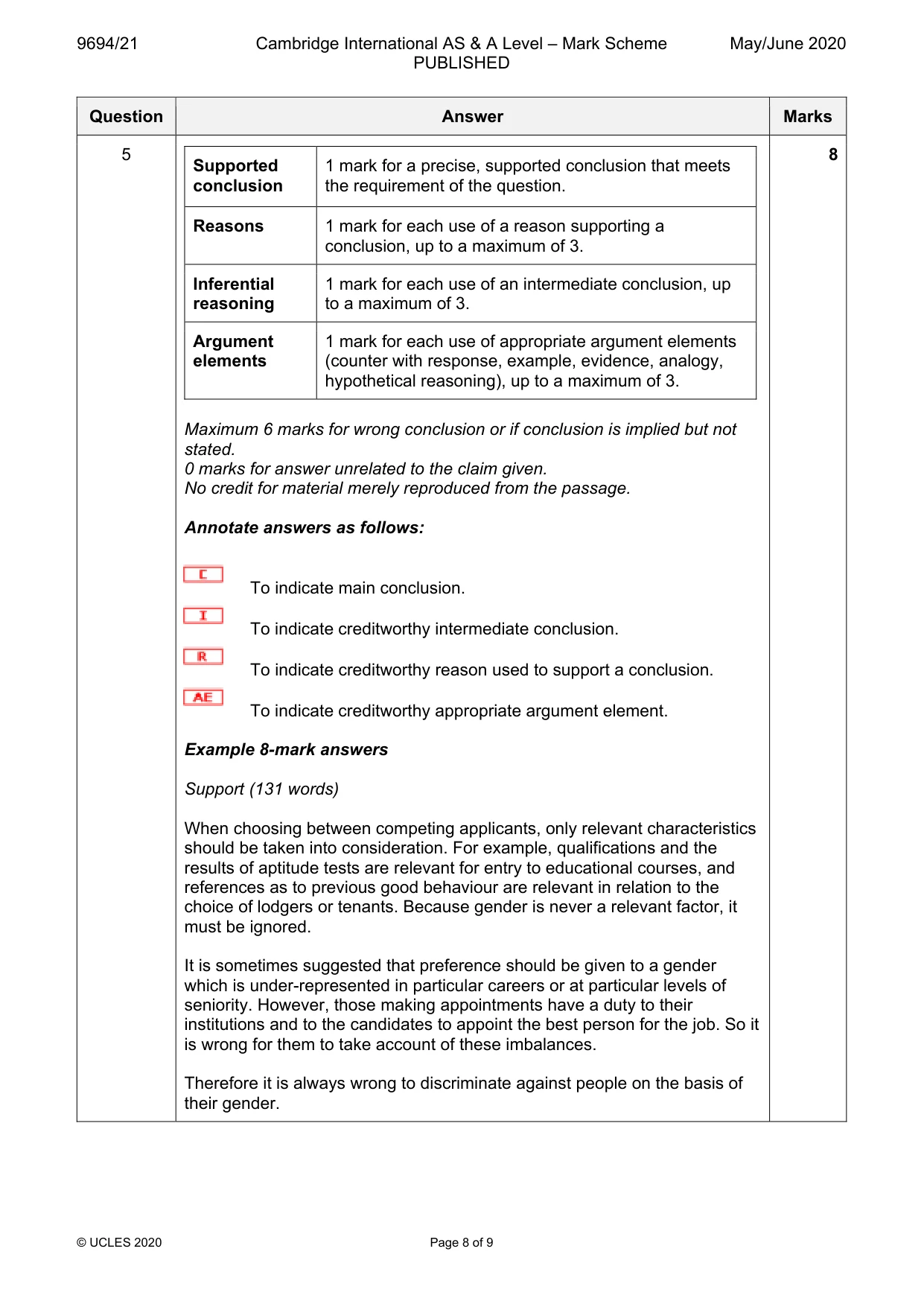
9694/21 Cambridge International AS & A Level – Mark Scheme PUBLISHED May/June 2020 © UCLES 2020 Page 8 of 9 Question Answer Marks 5 Supported conclusion 1 mark for a precise, supported conclusion that meets the requirement of the question. Reasons 1 mark for each use of a reason supporting a conclusion, up to a maximum of 3. Inferential reasoning 1 mark for each use of an intermediate conclusion, up to a maximum of 3. Argument elements 1 mark for each use of appropriate argument elements (counter with response, example, evidence, analogy, hypothetical reasoning), up to a maximum of 3. Maximum 6 marks for wrong conclusion or if conclusion is implied but not stated. 0 marks for answer unrelated to the claim given. No credit for material merely reproduced from the passage. Annotate answers as follows: To indicate main conclusion. To indicate creditworthy intermediate conclusion. To indicate creditworthy reason used to support a conclusion. To indicate creditworthy appropriate argument element. Example 8-mark answers Support (131 words) When choosing between competing applicants, only relevant characteristics should be taken into consideration. For example, qualifications and the results of aptitude tests are relevant for entry to educational courses, and references as to previous good behaviour are relevant in relation to the choice of lodgers or tenants. Because gender is never a relevant factor, it must be ignored. It is sometimes suggested that preference should be given to a gender which is under-represented in particular careers or at particular levels of seniority. However, those making appointments have a duty to their institutions and to the candidates to appoint the best person for the job. So it is wrong for them to take account of these imbalances. Therefore it is always wrong to discriminate against people on the basis of their gender. 8
Mark scheme, page 9
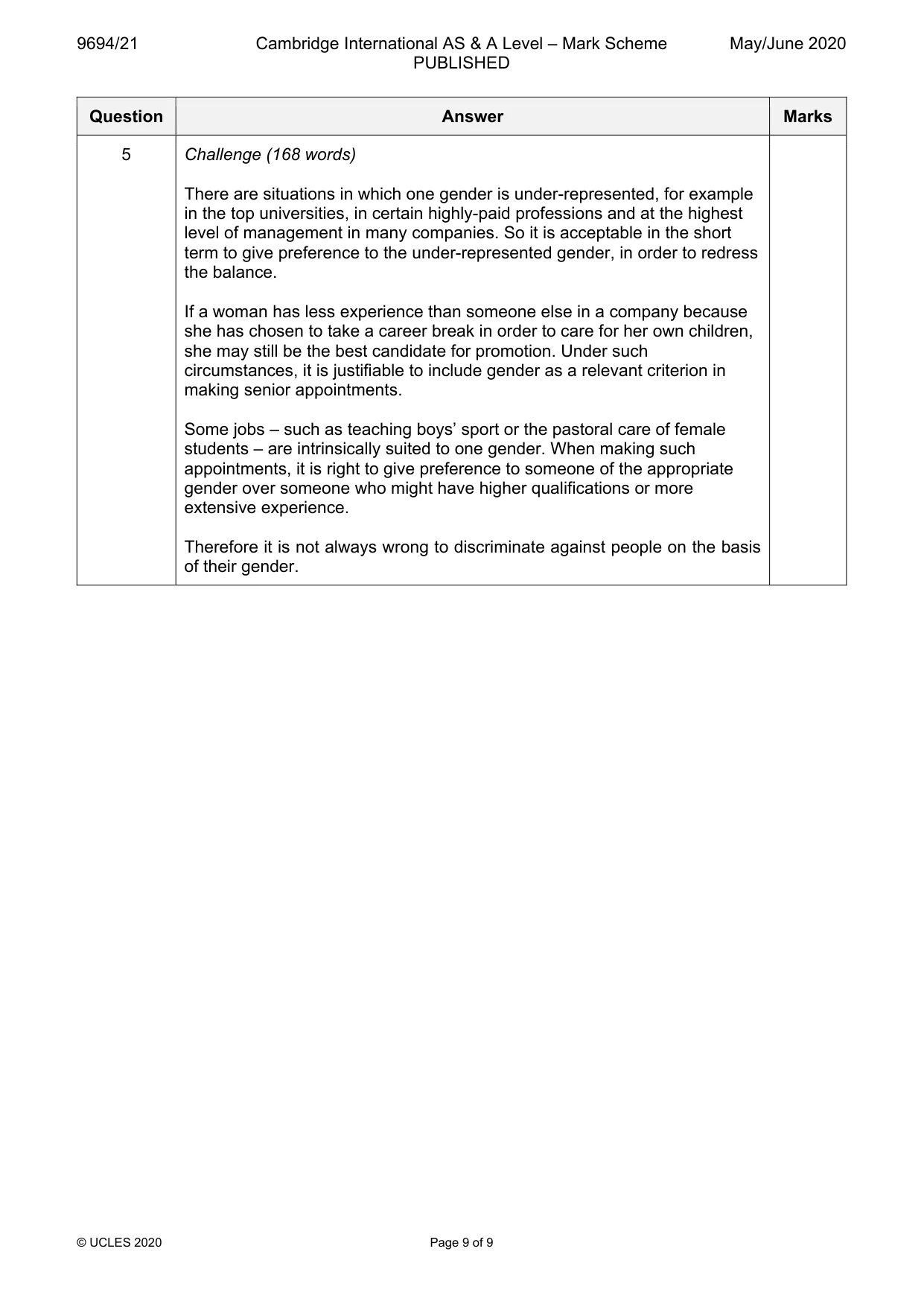
9694/21 Cambridge International AS & A Level – Mark Scheme PUBLISHED May/June 2020 © UCLES 2020 Page 9 of 9 Question Answer Marks 5 Challenge (168 words) There are situations in which one gender is under-represented, for example in the top universities, in certain highly-paid professions and at the highest level of management in many companies. So it is acceptable in the short term to give preference to the under-represented gender, in order to redress the balance. If a woman has less experience than someone else in a company because she has chosen to take a career break in order to care for her own children, she may still be the best candidate for promotion. Under such circumstances, it is justifiable to include gender as a relevant criterion in making senior appointments. Some jobs – such as teaching boys’ sport or the pastoral care of female students – are intrinsically suited to one gender. When making such appointments, it is right to give preference to someone of the appropriate gender over someone who might have higher qualifications or more extensive experience. Therefore it is not always wrong to discriminate against people on the basis of their gender.