Cambridge A Level Thinking Skills 9694 — 2020 May/June Paper 2 · Variant 3
9694/23/M/J/20
The question paper and its mark scheme, free to read here and free to download. This is Cambridge’s own paper, exactly as it was sat.
Question paper8 pages



Mark scheme9 pages
Answers below. Sit the paper first if you are practising.
Paper as text
Question paper, page 1
This document has 8 pages. Blank pages are indicated. DC (RW) 180299/3 © UCLES 2020 [Turn over Cambridge International AS & A Level THINKING SKILLS 9694/23 Paper 2 Critical Thinking May/June 2020 1 hour 45 minutes You must answer on the enclosed answer booklet. You will need: Answer booklet (enclosed) INSTRUCTIONS ● Answer all questions. ● Follow the instructions on the front cover of the answer booklet. If you need additional answer paper, ask the invigilator for a continuation booklet. INFORMATION ● The total mark for this paper is 50. ● The number of marks for each question or part question is shown in brackets [ ]. * 2 4 5 9 4 3 2 7 1 2 *
Question paper, page 2
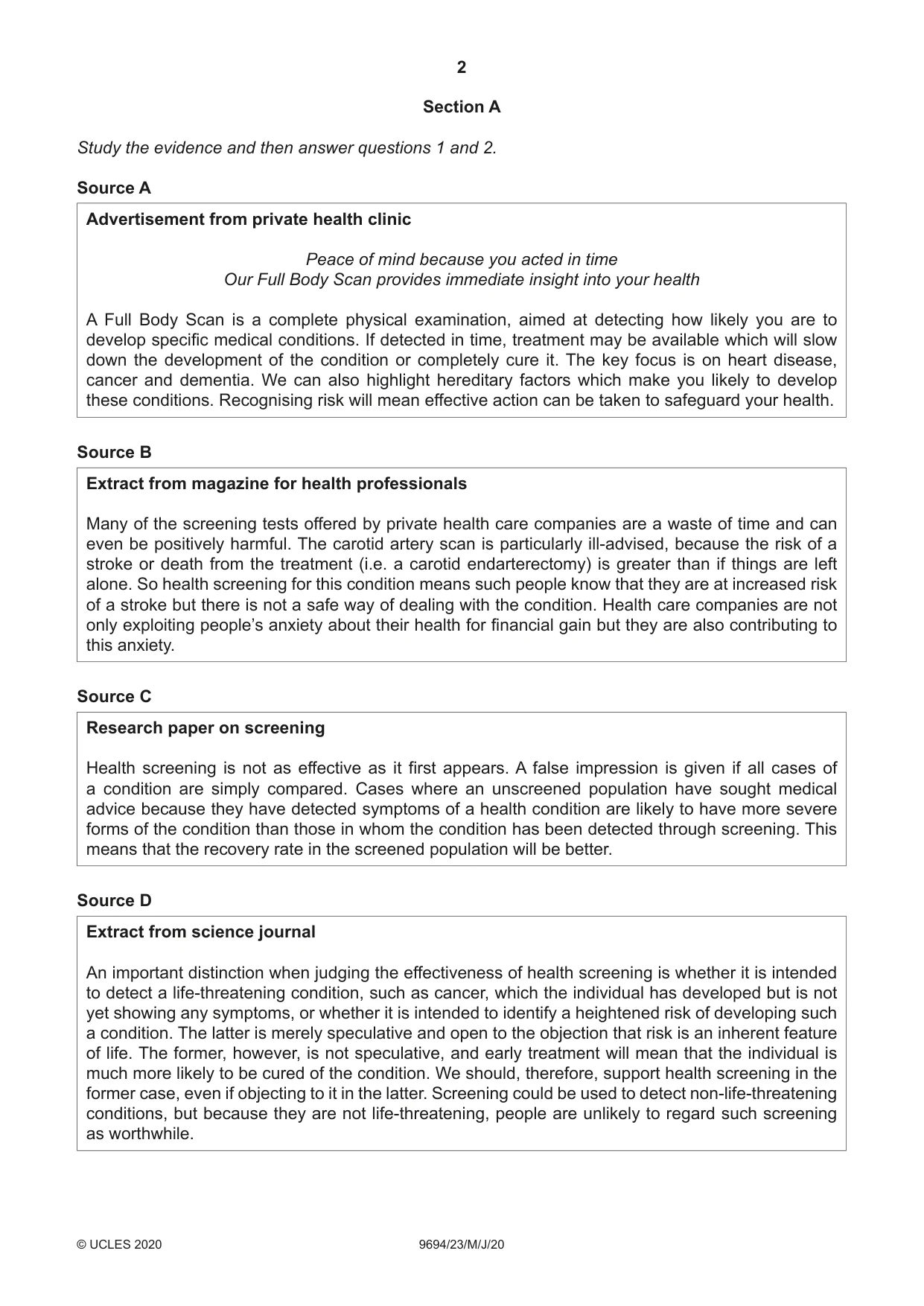
2 9694/23/M/J/20 © UCLES 2020 Section A Study the evidence and then answer questions 1 and 2. Source A Advertisement from private health clinic Peace of mind because you acted in time Our Full Body Scan provides immediate insight into your health A Full Body Scan is a complete physical examination, aimed at detecting how likely you are to develop specific medical conditions. If detected in time, treatment may be available which will slow down the development of the condition or completely cure it. The key focus is on heart disease, cancer and dementia. We can also highlight hereditary factors which make you likely to develop these conditions. Recognising risk will mean effective action can be taken to safeguard your health. Source B Extract from magazine for health professionals Many of the screening tests offered by private health care companies are a waste of time and can even be positively harmful. The carotid artery scan is particularly ill‑advised, because the risk of a stroke or death from the treatment (i.e. a carotid endarterectomy) is greater than if things are left alone. So health screening for this condition means such people know that they are at increased risk of a stroke but there is not a safe way of dealing with the condition. Health care companies are not only exploiting people’s anxiety about their health for financial gain but they are also contributing to this anxiety. Source C Research paper on screening Health screening is not as effective as it first appears. A false impression is given if all cases of a condition are simply compared. Cases where an unscreened population have sought medical advice because they have detected symptoms of a health condition are likely to have more severe forms of the condition than those in whom the condition has been detected through screening. This means that the recovery rate in the screened population will be better. Source D Extract from science journal An important distinction when judging the effectiveness of health screening is whether it is intended to detect a life‑threatening condition, such as cancer, which the individual has developed but is not yet showing any symptoms, or whether it is intended to identify a heightened risk of developing such a condition. The latter is merely speculative and open to the objection that risk is an inherent feature of life. The former, however, is not speculative, and early treatment will mean that the individual is much more likely to be cured of the condition. We should, therefore, support health screening in the former case, even if objecting to it in the latter. Screening could be used to detect non‑life‑threatening conditions, but because they are not life‑threatening, people are unlikely to regard such screening as worthwhile.
Question paper, page 3
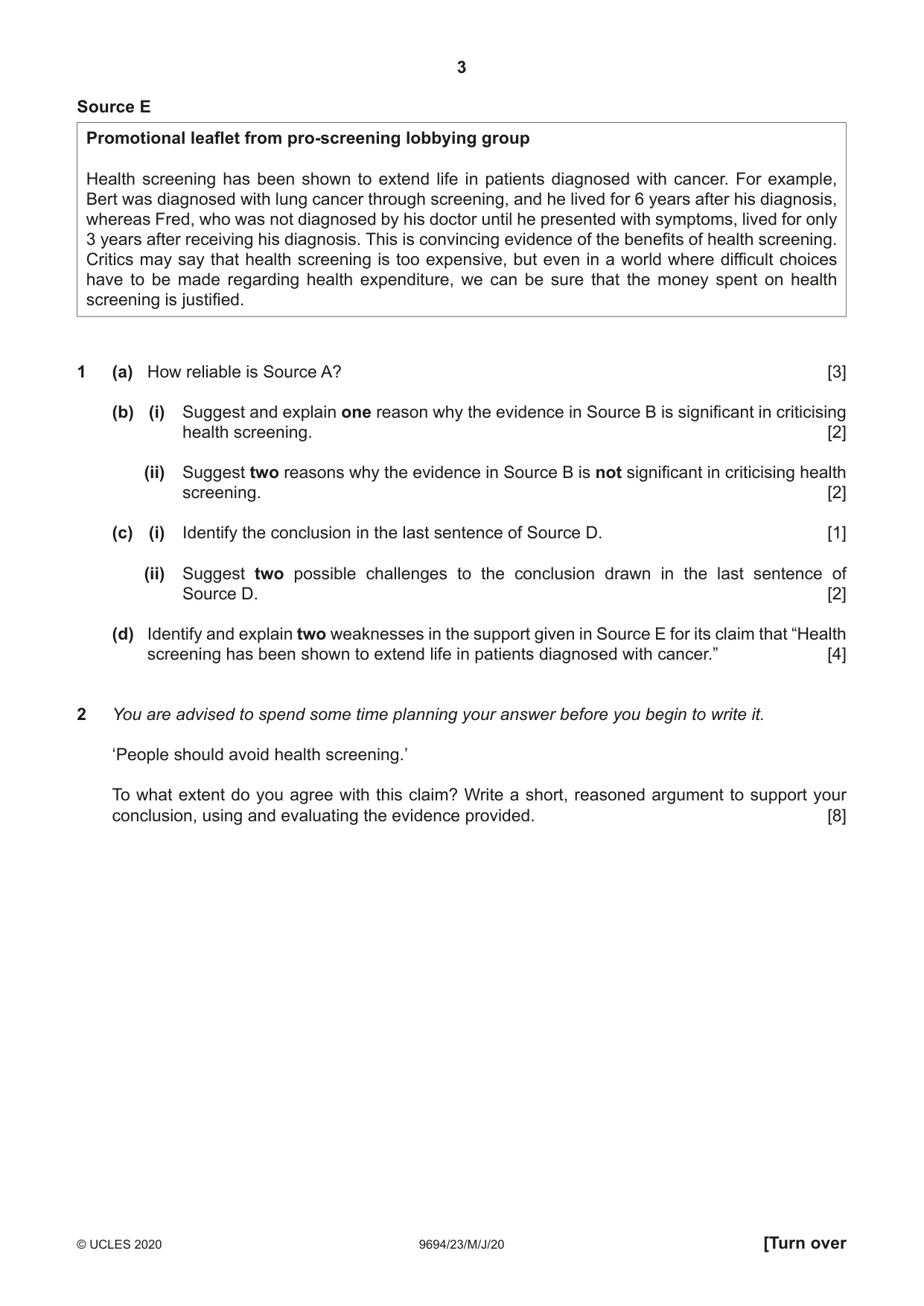
3 9694/23/M/J/20 © UCLES 2020 [Turn over Source E Promotional leaflet from pro‑screening lobbying group Health screening has been shown to extend life in patients diagnosed with cancer. For example, Bert was diagnosed with lung cancer through screening, and he lived for 6 years after his diagnosis, whereas Fred, who was not diagnosed by his doctor until he presented with symptoms, lived for only 3 years after receiving his diagnosis. This is convincing evidence of the benefits of health screening. Critics may say that health screening is too expensive, but even in a world where difficult choices have to be made regarding health expenditure, we can be sure that the money spent on health screening is justified. 1 (a) How reliable is Source A? [3] (b) (i) Suggest and explain one reason why the evidence in Source B is significant in criticising health screening. [2] (ii) Suggest two reasons why the evidence in Source B is not significant in criticising health screening. [2] (c) (i) Identify the conclusion in the last sentence of Source D. [1] (ii) Suggest two possible challenges to the conclusion drawn in the last sentence of Source D. [2] (d) Identify and explain two weaknesses in the support given in Source E for its claim that “Health screening has been shown to extend life in patients diagnosed with cancer.” [4] 2 You are advised to spend some time planning your answer before you begin to write it. ‘People should avoid health screening.’ To what extent do you agree with this claim? Write a short, reasoned argument to support your conclusion, using and evaluating the evidence provided. [8]
Question paper, page 4
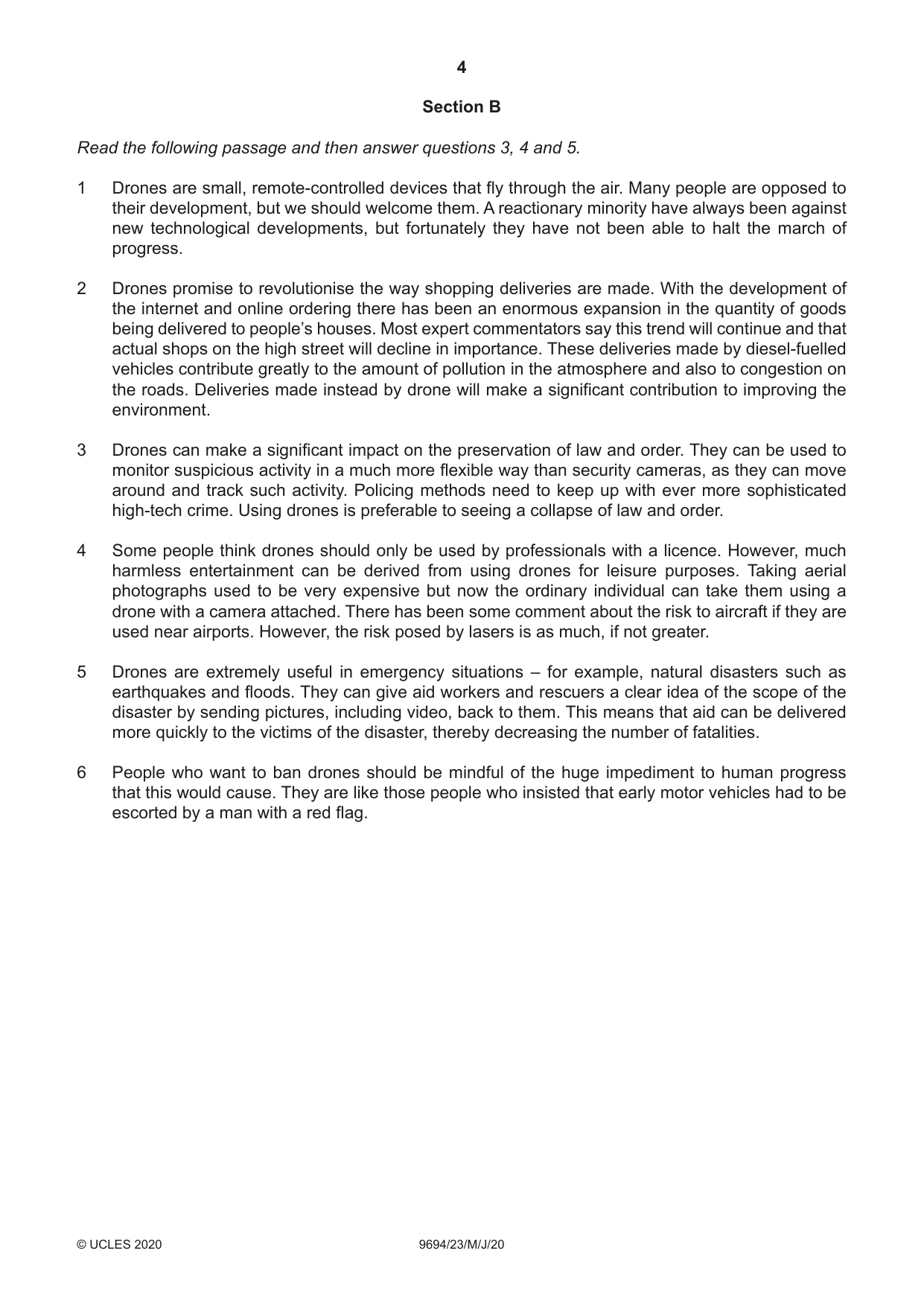
4 9694/23/M/J/20 © UCLES 2020 Section B Read the following passage and then answer questions 3, 4 and 5. 1 Drones are small, remote‑controlled devices that fly through the air. Many people are opposed to their development, but we should welcome them. A reactionary minority have always been against new technological developments, but fortunately they have not been able to halt the march of progress. 2 Drones promise to revolutionise the way shopping deliveries are made. With the development of the internet and online ordering there has been an enormous expansion in the quantity of goods being delivered to people’s houses. Most expert commentators say this trend will continue and that actual shops on the high street will decline in importance. These deliveries made by diesel‑fuelled vehicles contribute greatly to the amount of pollution in the atmosphere and also to congestion on the roads. Deliveries made instead by drone will make a significant contribution to improving the environment. 3 Drones can make a significant impact on the preservation of law and order. They can be used to monitor suspicious activity in a much more flexible way than security cameras, as they can move around and track such activity. Policing methods need to keep up with ever more sophisticated high‑tech crime. Using drones is preferable to seeing a collapse of law and order. 4 Some people think drones should only be used by professionals with a licence. However, much harmless entertainment can be derived from using drones for leisure purposes. Taking aerial photographs used to be very expensive but now the ordinary individual can take them using a drone with a camera attached. There has been some comment about the risk to aircraft if they are used near airports. However, the risk posed by lasers is as much, if not greater. 5 Drones are extremely useful in emergency situations – for example, natural disasters such as earthquakes and floods. They can give aid workers and rescuers a clear idea of the scope of the disaster by sending pictures, including video, back to them. This means that aid can be delivered more quickly to the victims of the disaster, thereby decreasing the number of fatalities. 6 People who want to ban drones should be mindful of the huge impediment to human progress that this would cause. They are like those people who insisted that early motor vehicles had to be escorted by a man with a red flag.
Question paper, page 5
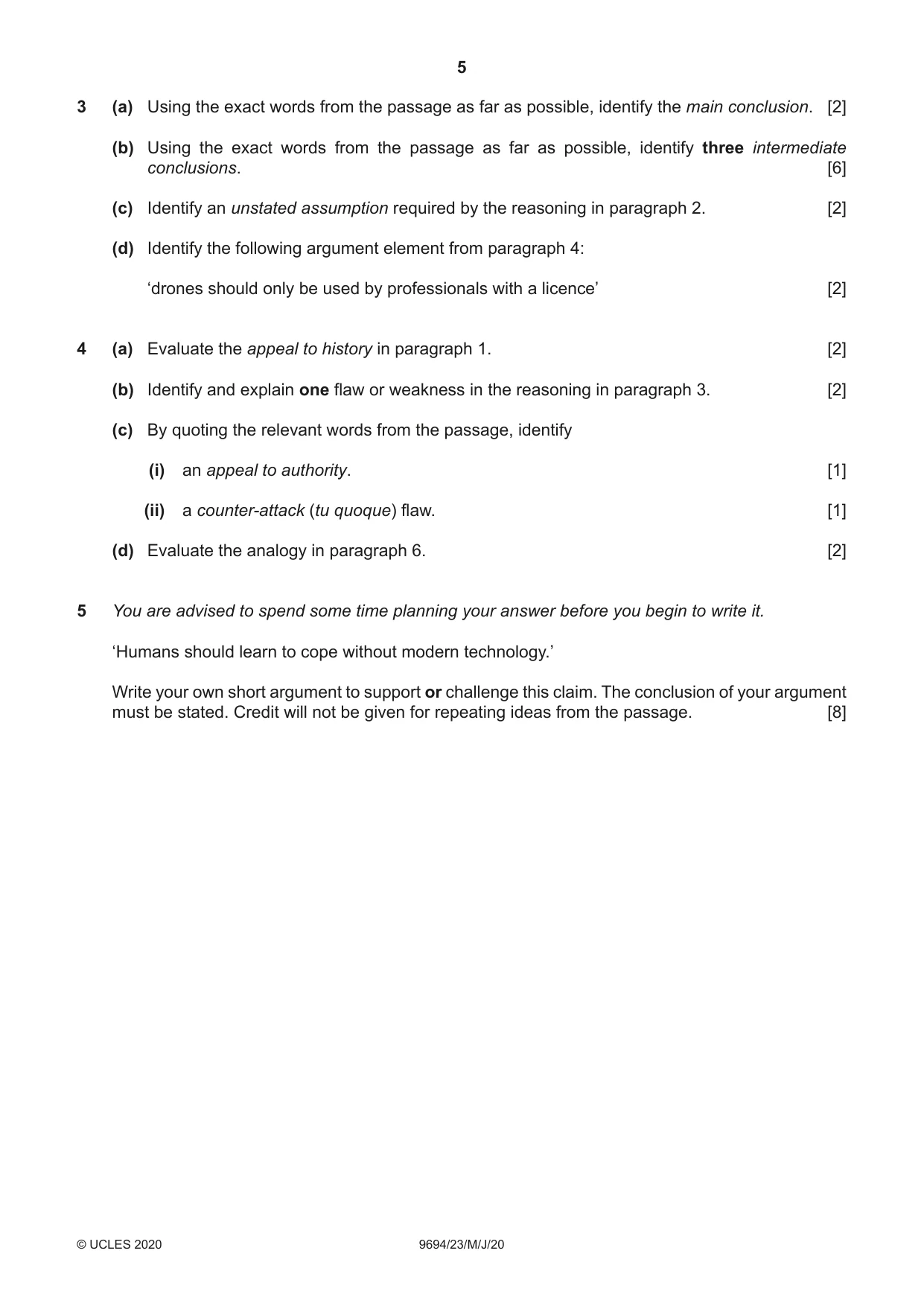
5 9694/23/M/J/20 © UCLES 2020 3 (a) Using the exact words from the passage as far as possible, identify the main conclusion. [2] (b) Using the exact words from the passage as far as possible, identify three intermediate conclusions. [6] (c) Identify an unstated assumption required by the reasoning in paragraph 2. [2] (d) Identify the following argument element from paragraph 4: ‘drones should only be used by professionals with a licence’ [2] 4 (a) Evaluate the appeal to history in paragraph 1. [2] (b) Identify and explain one flaw or weakness in the reasoning in paragraph 3. [2] (c) By quoting the relevant words from the passage, identify (i) an appeal to authority. [1] (ii) a counter‑attack (tu quoque) flaw. [1] (d) Evaluate the analogy in paragraph 6. [2] 5 You are advised to spend some time planning your answer before you begin to write it. ‘Humans should learn to cope without modern technology.’ Write your own short argument to support or challenge this claim. The conclusion of your argument must be stated. Credit will not be given for repeating ideas from the passage. [8]
Question paper, page 6
6 9694/23/M/J/20 © UCLES 2020 BLANK PAGE
Question paper, page 7
7 9694/23/M/J/20 © UCLES 2020 BLANK PAGE
Question paper, page 8
8 9694/23/M/J/20 © UCLES 2020 Permission to reproduce items where third‑party owned material protected by copyright is included has been sought and cleared where possible. Every reasonable effort has been made by the publisher (UCLES) to trace copyright holders, but if any items requiring clearance have unwittingly been included, the publisher will be pleased to make amends at the earliest possible opportunity. To avoid the issue of disclosure of answer‑related information to candidates, all copyright acknowledgements are reproduced online in the Cambridge Assessment International Education Copyright Acknowledgements Booklet. This is produced for each series of examinations and is freely available to download at www.cambridgeinternational.org after the live examination series. Cambridge Assessment International Education is part of the Cambridge Assessment Group. Cambridge Assessment is the brand name of the University of Cambridge Local Examinations Syndicate (UCLES), which itself is a department of the University of Cambridge. BLANK PAGE
Mark scheme, page 1
This document consists of 9 printed pages. © UCLES 2020 [Turn over Cambridge International AS & A Level SUBJECT 9694/23 Paper 2 Critical Thinking May/June 2020 MARK SCHEME Maximum Mark: 50 Published Students did not sit exam papers in the June 2020 series due to the Covid-19 global pandemic. This mark scheme is published to support teachers and students and should be read together with the question paper. It shows the requirements of the exam. The answer column of the mark scheme shows the proposed basis on which Examiners would award marks for this exam. Where appropriate, this column also provides the most likely acceptable alternative responses expected from students. Examiners usually review the mark scheme after they have seen student responses and update the mark scheme if appropriate. In the June series, Examiners were unable to consider the acceptability of alternative responses, as there were no student responses to consider. Mark schemes should usually be read together with the Principal Examiner Report for Teachers. However, because students did not sit exam papers, there is no Principal Examiner Report for Teachers for the June 2020 series. Cambridge International will not enter into discussions about these mark schemes. Cambridge International is publishing the mark schemes for the June 2020 series for most Cambridge IGCSE™ and Cambridge International A & AS Level components, and some Cambridge O Level components.
Mark scheme, page 2
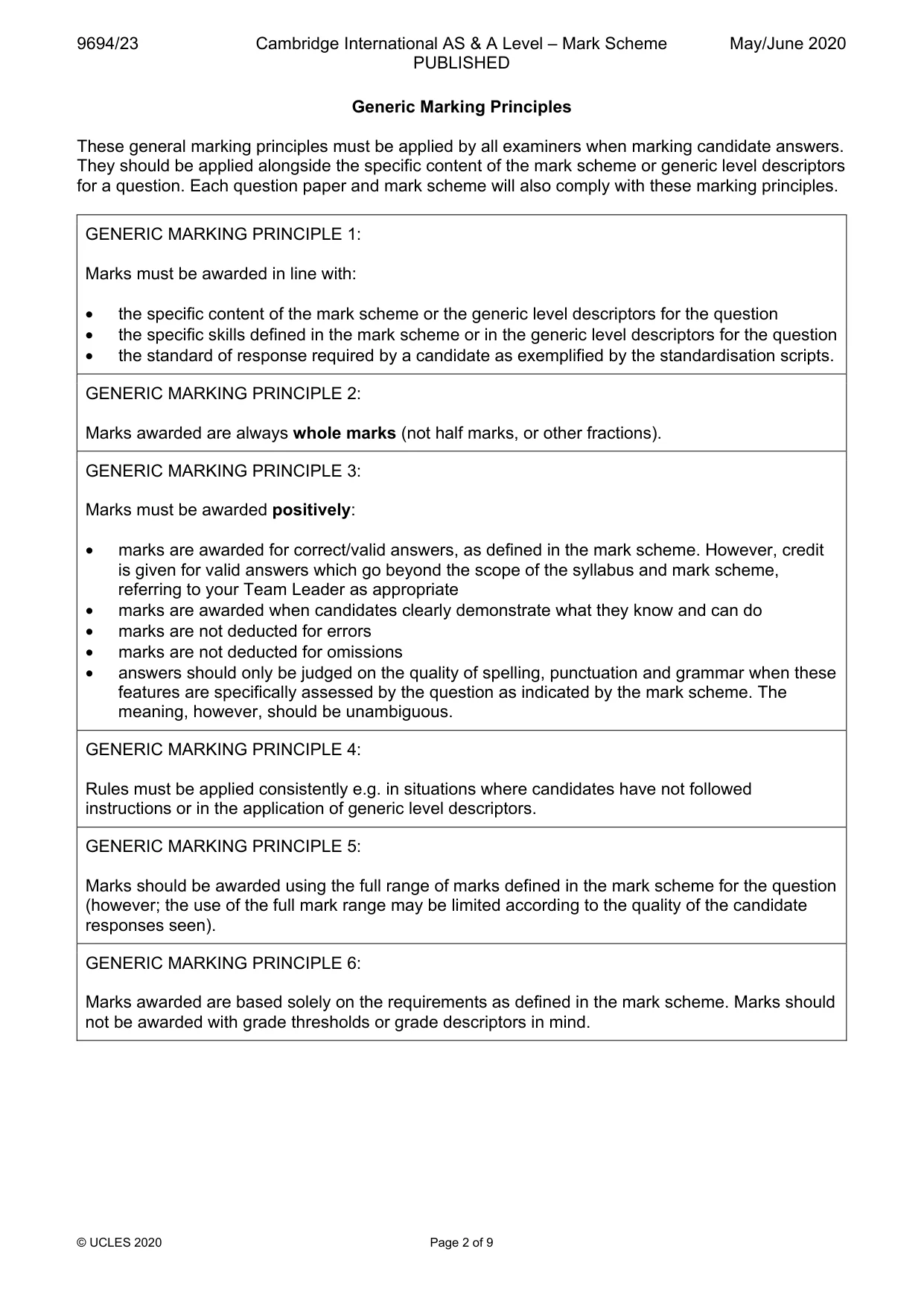
9694/23 Cambridge International AS & A Level – Mark Scheme PUBLISHED May/June 2020 © UCLES 2020 Page 2 of 9 Generic Marking Principles These general marking principles must be applied by all examiners when marking candidate answers. They should be applied alongside the specific content of the mark scheme or generic level descriptors for a question. Each question paper and mark scheme will also comply with these marking principles. GENERIC MARKING PRINCIPLE 1: Marks must be awarded in line with: • the specific content of the mark scheme or the generic level descriptors for the question • the specific skills defined in the mark scheme or in the generic level descriptors for the question • the standard of response required by a candidate as exemplified by the standardisation scripts. GENERIC MARKING PRINCIPLE 2: Marks awarded are always whole marks (not half marks, or other fractions). GENERIC MARKING PRINCIPLE 3: Marks must be awarded positively: • marks are awarded for correct/valid answers, as defined in the mark scheme. However, credit is given for valid answers which go beyond the scope of the syllabus and mark scheme, referring to your Team Leader as appropriate • marks are awarded when candidates clearly demonstrate what they know and can do • marks are not deducted for errors • marks are not deducted for omissions • answers should only be judged on the quality of spelling, punctuation and grammar when these features are specifically assessed by the question as indicated by the mark scheme. The meaning, however, should be unambiguous. GENERIC MARKING PRINCIPLE 4: Rules must be applied consistently e.g. in situations where candidates have not followed instructions or in the application of generic level descriptors. GENERIC MARKING PRINCIPLE 5: Marks should be awarded using the full range of marks defined in the mark scheme for the question (however; the use of the full mark range may be limited according to the quality of the candidate responses seen). GENERIC MARKING PRINCIPLE 6: Marks awarded are based solely on the requirements as defined in the mark scheme. Marks should not be awarded with grade thresholds or grade descriptors in mind.
Mark scheme, page 3
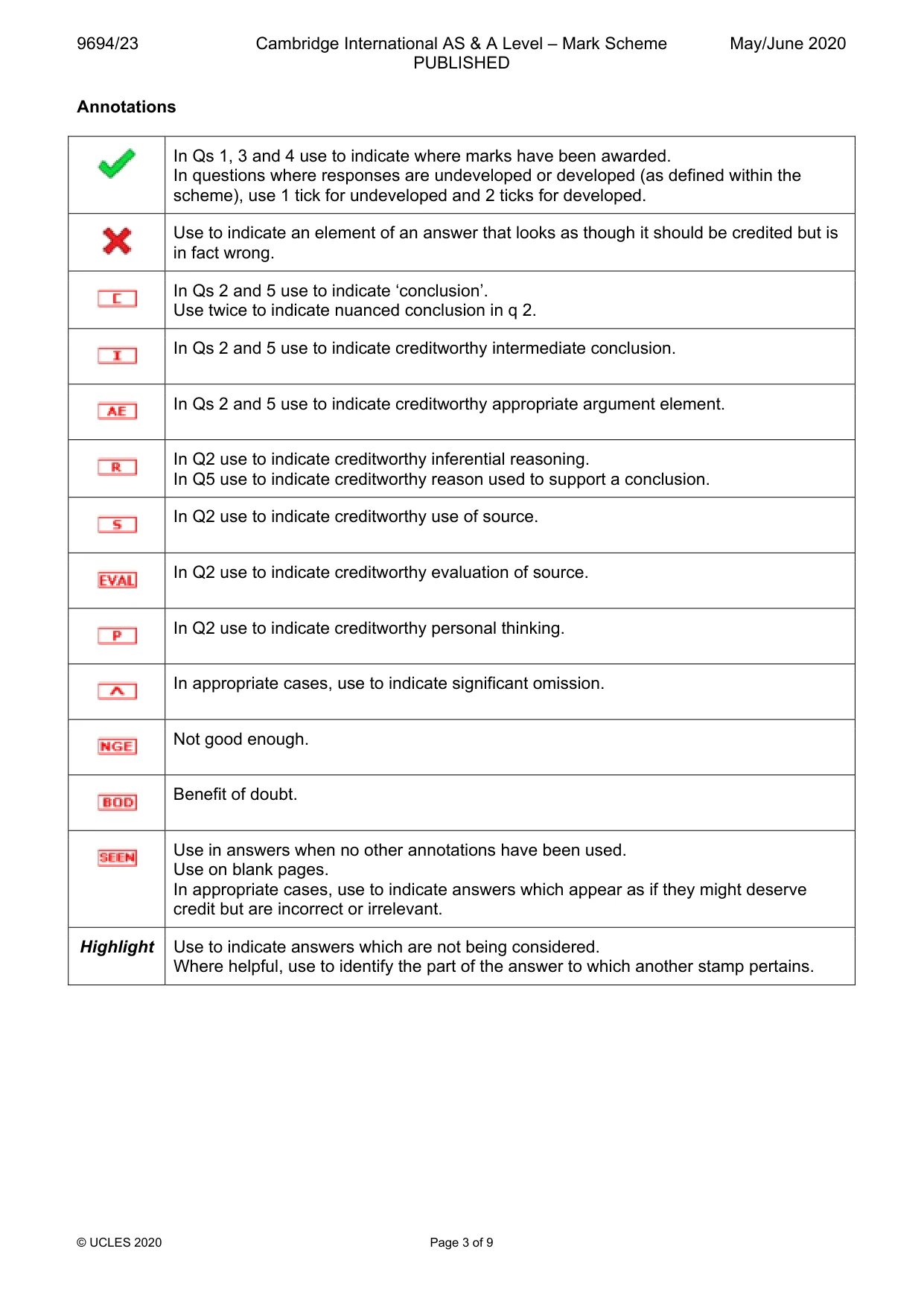
9694/23 Cambridge International AS & A Level – Mark Scheme PUBLISHED May/June 2020 © UCLES 2020 Page 3 of 9 Annotations In Qs 1, 3 and 4 use to indicate where marks have been awarded. In questions where responses are undeveloped or developed (as defined within the scheme), use 1 tick for undeveloped and 2 ticks for developed. Use to indicate an element of an answer that looks as though it should be credited but is in fact wrong. In Qs 2 and 5 use to indicate ‘conclusion’. Use twice to indicate nuanced conclusion in q 2. In Qs 2 and 5 use to indicate creditworthy intermediate conclusion. In Qs 2 and 5 use to indicate creditworthy appropriate argument element. In Q2 use to indicate creditworthy inferential reasoning. In Q5 use to indicate creditworthy reason used to support a conclusion. In Q2 use to indicate creditworthy use of source. In Q2 use to indicate creditworthy evaluation of source. In Q2 use to indicate creditworthy personal thinking. In appropriate cases, use to indicate significant omission. Not good enough. Benefit of doubt. Use in answers when no other annotations have been used. Use on blank pages. In appropriate cases, use to indicate answers which appear as if they might deserve credit but are incorrect or irrelevant. Highlight Use to indicate answers which are not being considered. Where helpful, use to identify the part of the answer to which another stamp pertains.
Mark scheme, page 4
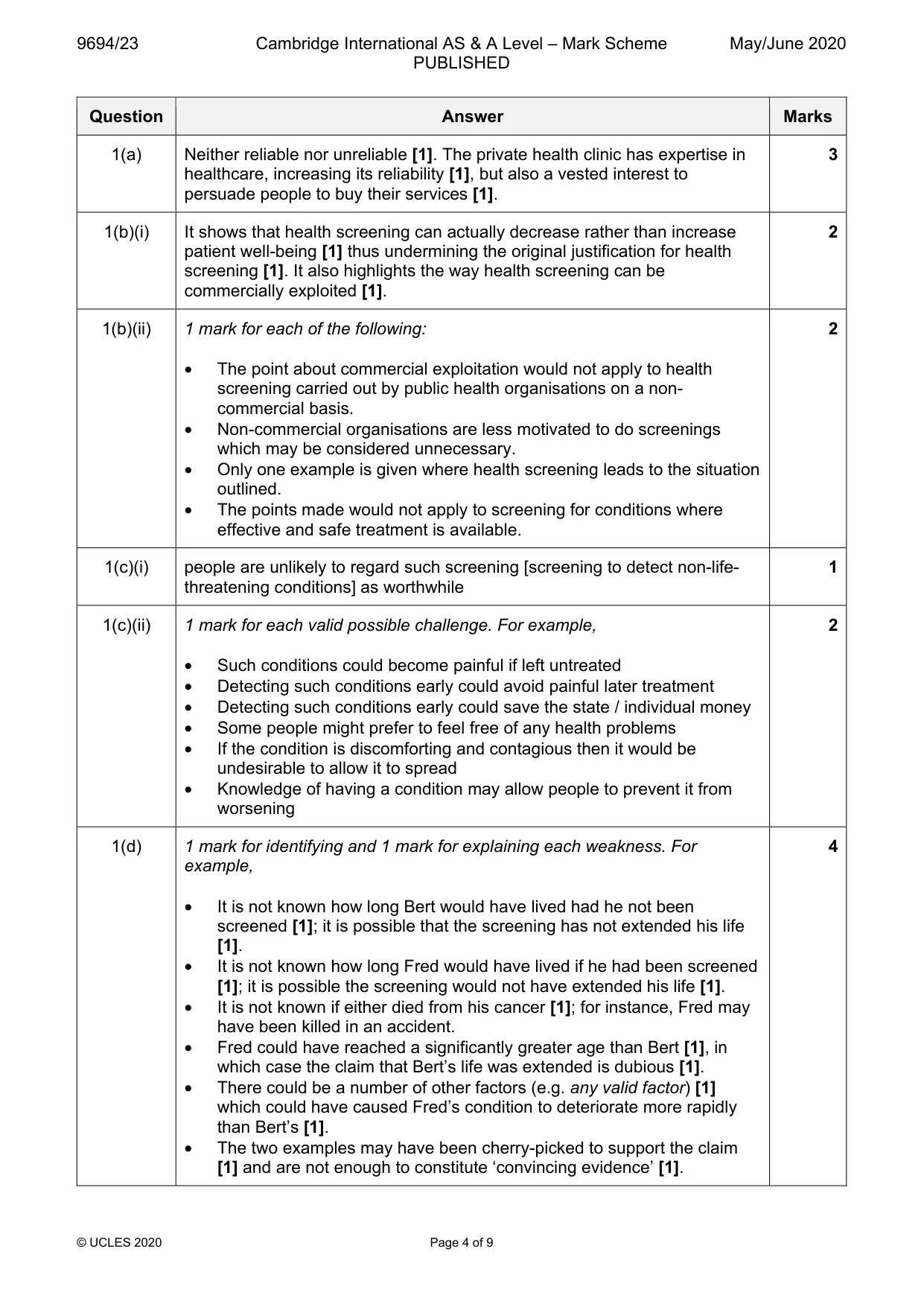
9694/23 Cambridge International AS & A Level – Mark Scheme PUBLISHED May/June 2020 © UCLES 2020 Page 4 of 9 Question Answer Marks 1(a) Neither reliable nor unreliable [1]. The private health clinic has expertise in healthcare, increasing its reliability [1], but also a vested interest to persuade people to buy their services [1]. 3 1(b)(i) It shows that health screening can actually decrease rather than increase patient well-being [1] thus undermining the original justification for health screening [1]. It also highlights the way health screening can be commercially exploited [1]. 2 1(b)(ii) 1 mark for each of the following: • The point about commercial exploitation would not apply to health screening carried out by public health organisations on a non- commercial basis. • Non-commercial organisations are less motivated to do screenings which may be considered unnecessary. • Only one example is given where health screening leads to the situation outlined. • The points made would not apply to screening for conditions where effective and safe treatment is available. 2 1(c)(i) people are unlikely to regard such screening [screening to detect non-life- threatening conditions] as worthwhile 1 1(c)(ii) 1 mark for each valid possible challenge. For example, • Such conditions could become painful if left untreated • Detecting such conditions early could avoid painful later treatment • Detecting such conditions early could save the state / individual money • Some people might prefer to feel free of any health problems • If the condition is discomforting and contagious then it would be undesirable to allow it to spread • Knowledge of having a condition may allow people to prevent it from worsening 2 1(d) 1 mark for identifying and 1 mark for explaining each weakness. For example, • It is not known how long Bert would have lived had he not been screened [1]; it is possible that the screening has not extended his life [1]. • It is not known how long Fred would have lived if he had been screened [1]; it is possible the screening would not have extended his life [1]. • It is not known if either died from his cancer [1]; for instance, Fred may have been killed in an accident. • Fred could have reached a significantly greater age than Bert [1], in which case the claim that Bert’s life was extended is dubious [1]. • There could be a number of other factors (e.g. any valid factor) [1] which could have caused Fred’s condition to deteriorate more rapidly than Bert’s [1]. • The two examples may have been cherry-picked to support the claim [1] and are not enough to constitute ‘convincing evidence’ [1]. 4
Mark scheme, page 5
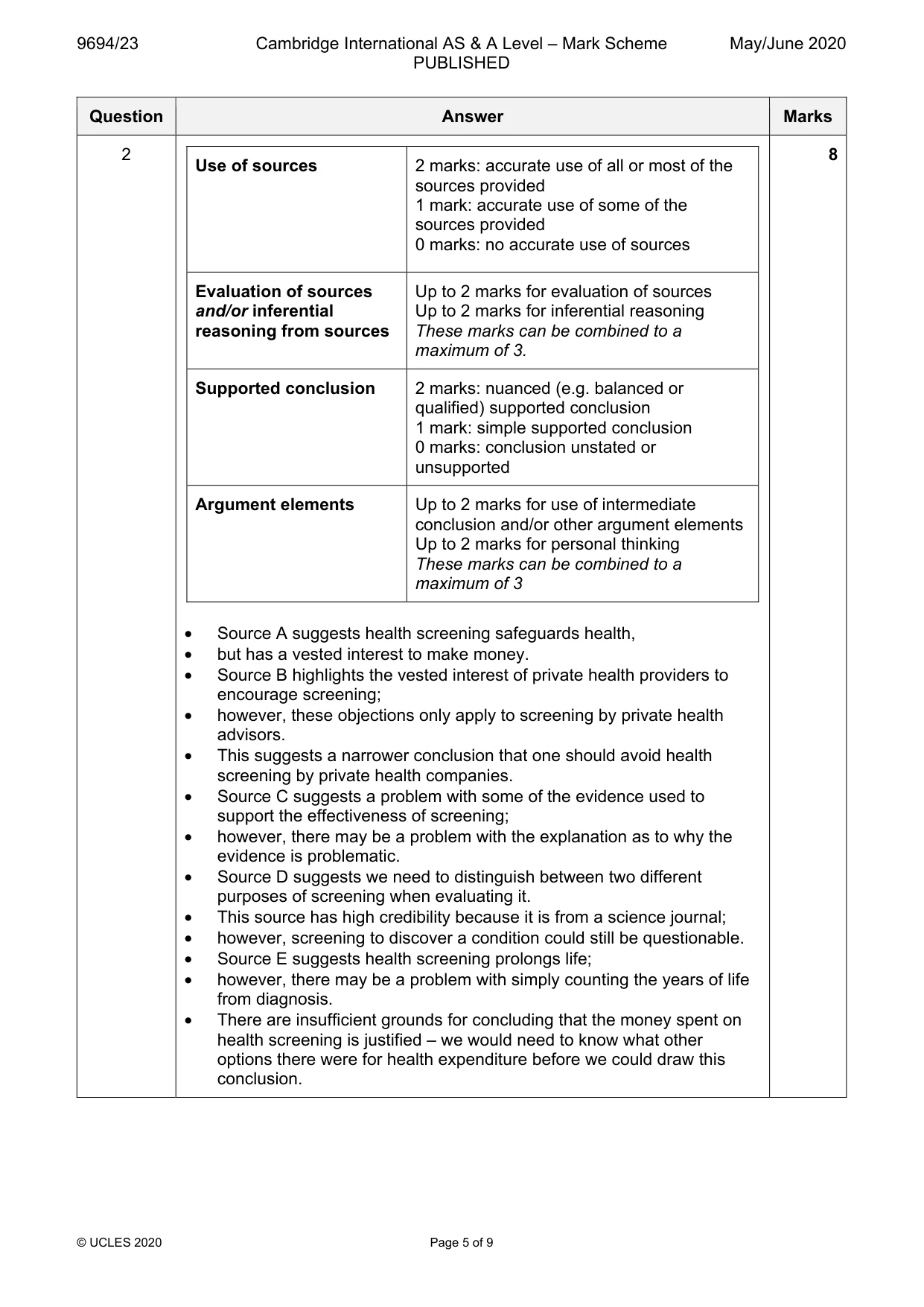
9694/23 Cambridge International AS & A Level – Mark Scheme PUBLISHED May/June 2020 © UCLES 2020 Page 5 of 9 Question Answer Marks 2 Use of sources 2 marks: accurate use of all or most of the sources provided 1 mark: accurate use of some of the sources provided 0 marks: no accurate use of sources Evaluation of sources and/or inferential reasoning from sources Up to 2 marks for evaluation of sources Up to 2 marks for inferential reasoning These marks can be combined to a maximum of 3. Supported conclusion 2 marks: nuanced (e.g. balanced or qualified) supported conclusion 1 mark: simple supported conclusion 0 marks: conclusion unstated or unsupported Argument elements Up to 2 marks for use of intermediate conclusion and/or other argument elements Up to 2 marks for personal thinking These marks can be combined to a maximum of 3 • Source A suggests health screening safeguards health, • but has a vested interest to make money. • Source B highlights the vested interest of private health providers to encourage screening; • however, these objections only apply to screening by private health advisors. • This suggests a narrower conclusion that one should avoid health screening by private health companies. • Source C suggests a problem with some of the evidence used to support the effectiveness of screening; • however, there may be a problem with the explanation as to why the evidence is problematic. • Source D suggests we need to distinguish between two different purposes of screening when evaluating it. • This source has high credibility because it is from a science journal; • however, screening to discover a condition could still be questionable. • Source E suggests health screening prolongs life; • however, there may be a problem with simply counting the years of life from diagnosis. • There are insufficient grounds for concluding that the money spent on health screening is justified – we would need to know what other options there were for health expenditure before we could draw this conclusion. 8
Mark scheme, page 6
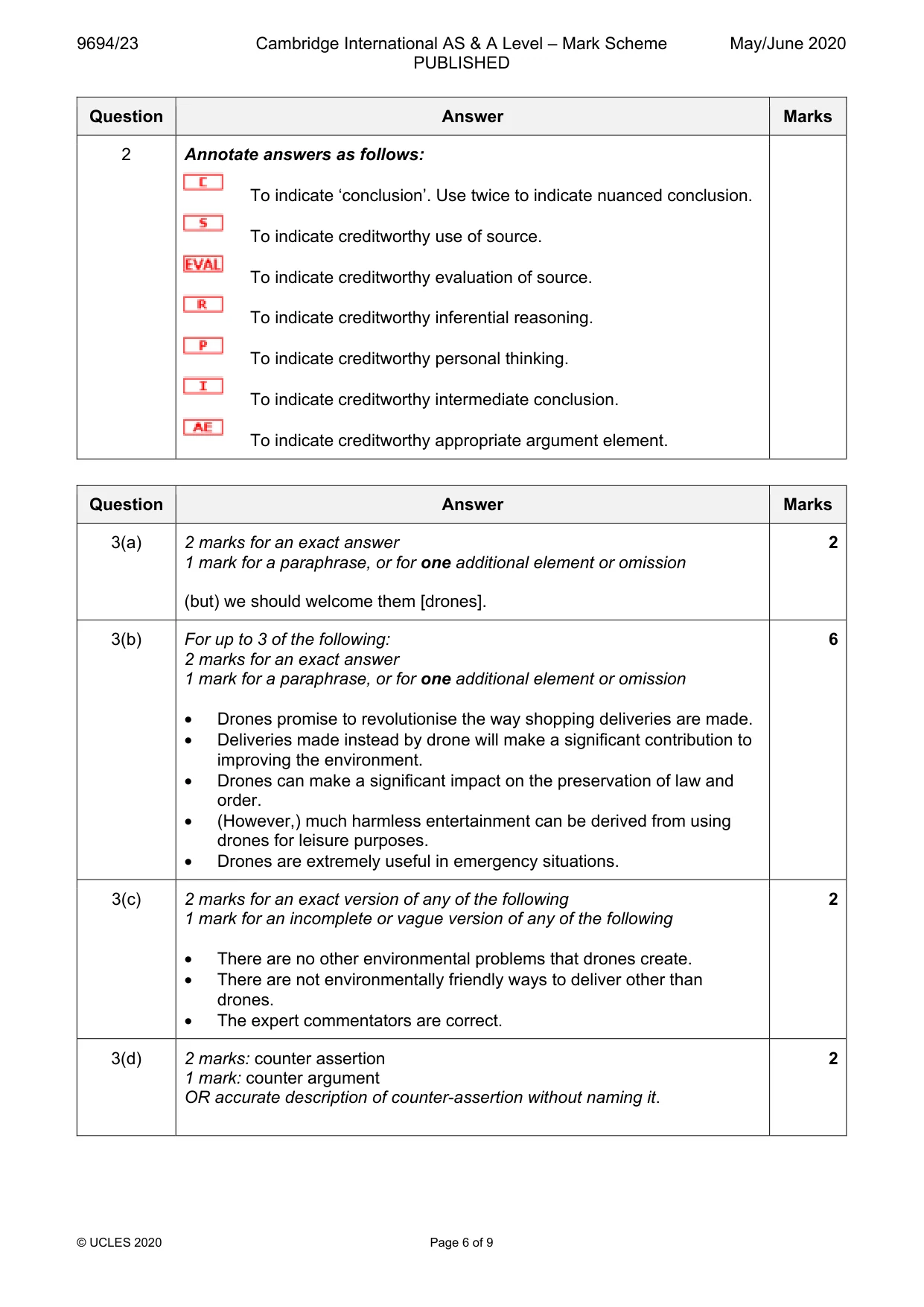
9694/23 Cambridge International AS & A Level – Mark Scheme PUBLISHED May/June 2020 © UCLES 2020 Page 6 of 9 Question Answer Marks 2 Annotate answers as follows: To indicate ‘conclusion’. Use twice to indicate nuanced conclusion. To indicate creditworthy use of source. To indicate creditworthy evaluation of source. To indicate creditworthy inferential reasoning. To indicate creditworthy personal thinking. To indicate creditworthy intermediate conclusion. To indicate creditworthy appropriate argument element. Question Answer Marks 3(a) 2 marks for an exact answer 1 mark for a paraphrase, or for one additional element or omission (but) we should welcome them [drones]. 2 3(b) For up to 3 of the following: 2 marks for an exact answer 1 mark for a paraphrase, or for one additional element or omission • Drones promise to revolutionise the way shopping deliveries are made. • Deliveries made instead by drone will make a significant contribution to improving the environment. • Drones can make a significant impact on the preservation of law and order. • (However,) much harmless entertainment can be derived from using drones for leisure purposes. • Drones are extremely useful in emergency situations. 6 3(c) 2 marks for an exact version of any of the following 1 mark for an incomplete or vague version of any of the following • There are no other environmental problems that drones create. • There are not environmentally friendly ways to deliver other than drones. • The expert commentators are correct. 2 3(d) 2 marks: counter assertion 1 mark: counter argument OR accurate description of counter-assertion without naming it. 2
Mark scheme, page 7
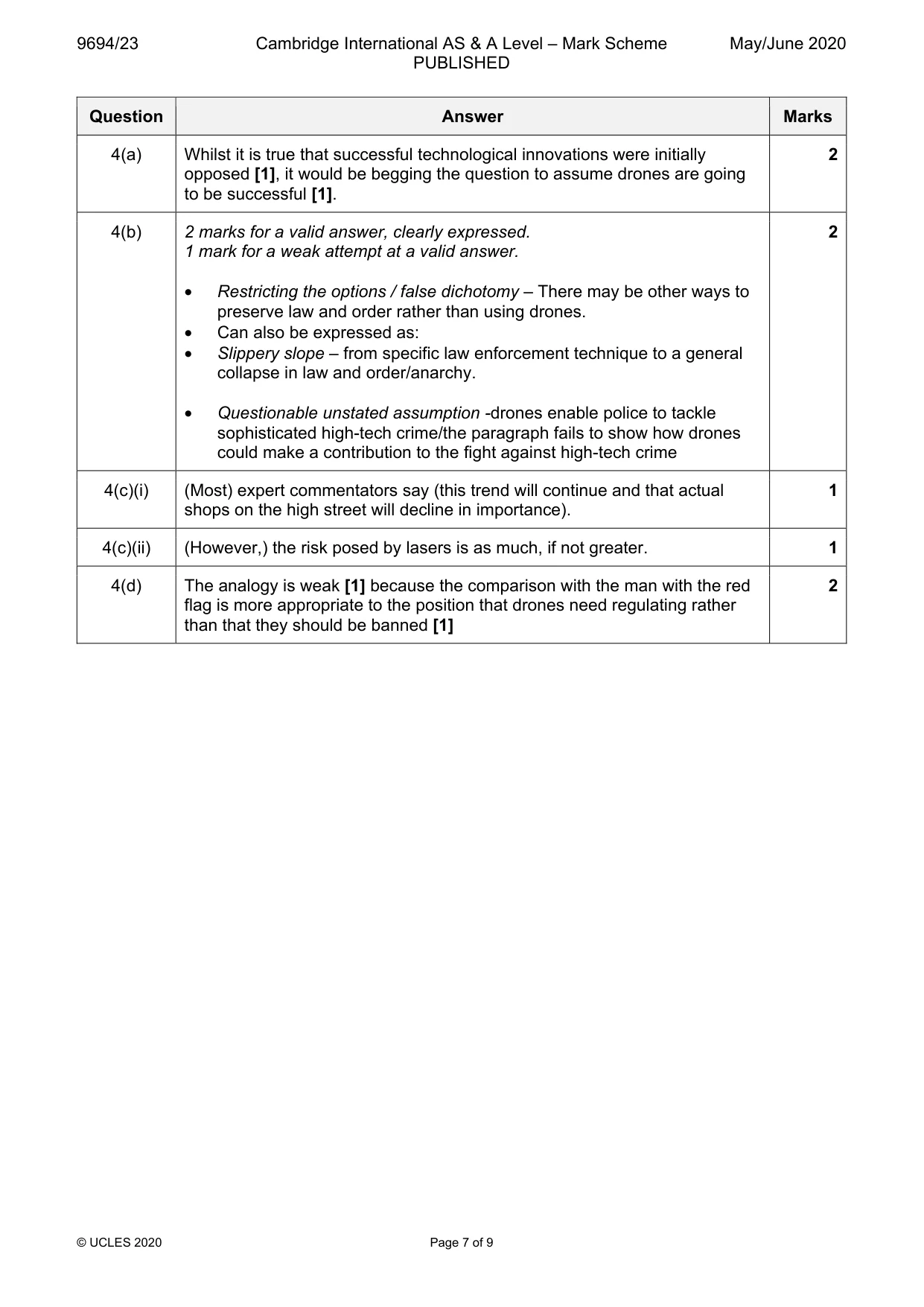
9694/23 Cambridge International AS & A Level – Mark Scheme PUBLISHED May/June 2020 © UCLES 2020 Page 7 of 9 Question Answer Marks 4(a) Whilst it is true that successful technological innovations were initially opposed [1], it would be begging the question to assume drones are going to be successful [1]. 2 4(b) 2 marks for a valid answer, clearly expressed. 1 mark for a weak attempt at a valid answer. • Restricting the options / false dichotomy – There may be other ways to preserve law and order rather than using drones. • Can also be expressed as: • Slippery slope – from specific law enforcement technique to a general collapse in law and order/anarchy. • Questionable unstated assumption -drones enable police to tackle sophisticated high-tech crime/the paragraph fails to show how drones could make a contribution to the fight against high-tech crime 2 4(c)(i) (Most) expert commentators say (this trend will continue and that actual shops on the high street will decline in importance). 1 4(c)(ii) (However,) the risk posed by lasers is as much, if not greater. 1 4(d) The analogy is weak [1] because the comparison with the man with the red flag is more appropriate to the position that drones need regulating rather than that they should be banned [1] 2
Mark scheme, page 8
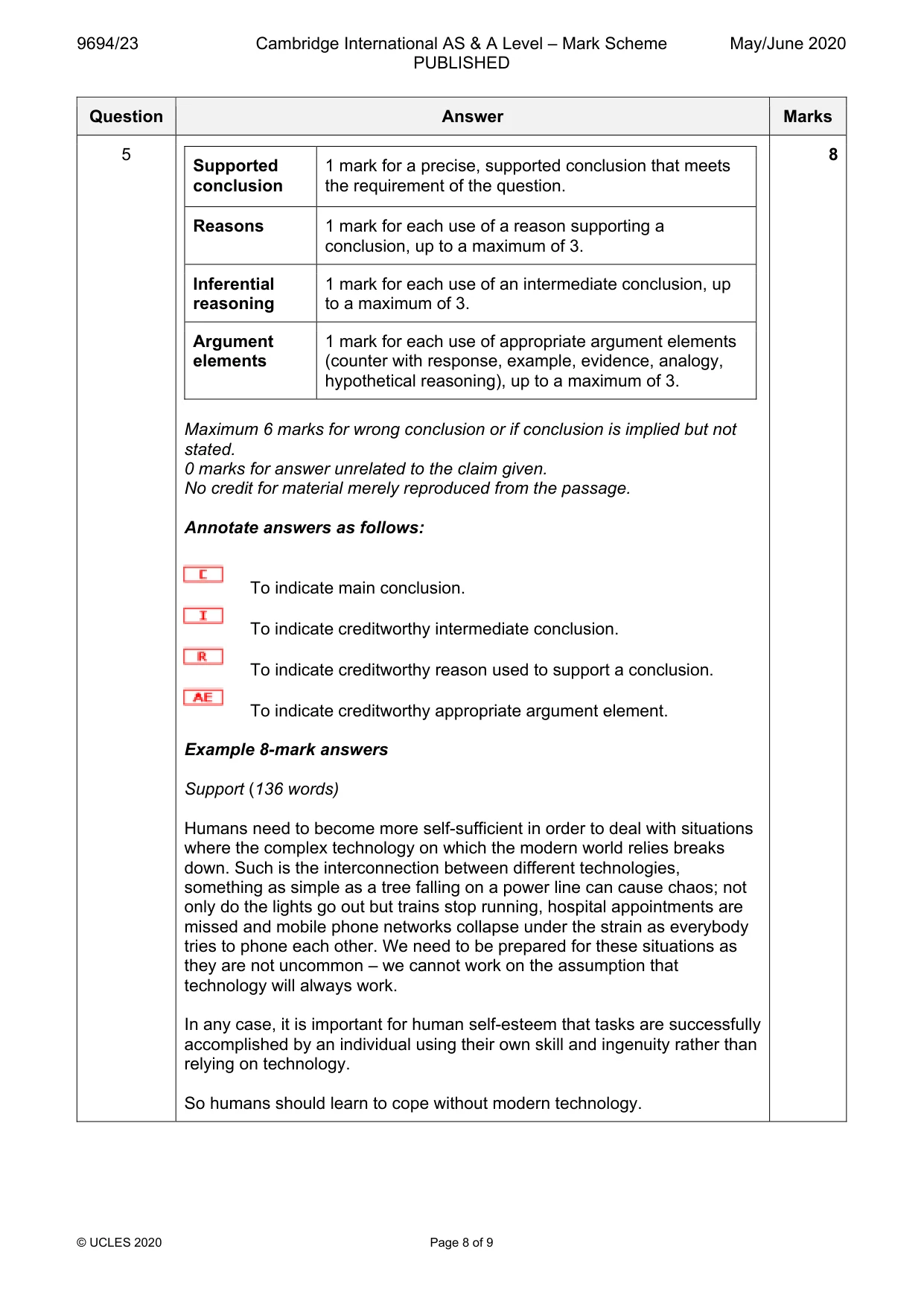
9694/23 Cambridge International AS & A Level – Mark Scheme PUBLISHED May/June 2020 © UCLES 2020 Page 8 of 9 Question Answer Marks 5 Supported conclusion 1 mark for a precise, supported conclusion that meets the requirement of the question. Reasons 1 mark for each use of a reason supporting a conclusion, up to a maximum of 3. Inferential reasoning 1 mark for each use of an intermediate conclusion, up to a maximum of 3. Argument elements 1 mark for each use of appropriate argument elements (counter with response, example, evidence, analogy, hypothetical reasoning), up to a maximum of 3. Maximum 6 marks for wrong conclusion or if conclusion is implied but not stated. 0 marks for answer unrelated to the claim given. No credit for material merely reproduced from the passage. Annotate answers as follows: To indicate main conclusion. To indicate creditworthy intermediate conclusion. To indicate creditworthy reason used to support a conclusion. To indicate creditworthy appropriate argument element. Example 8-mark answers Support (136 words) Humans need to become more self-sufficient in order to deal with situations where the complex technology on which the modern world relies breaks down. Such is the interconnection between different technologies, something as simple as a tree falling on a power line can cause chaos; not only do the lights go out but trains stop running, hospital appointments are missed and mobile phone networks collapse under the strain as everybody tries to phone each other. We need to be prepared for these situations as they are not uncommon – we cannot work on the assumption that technology will always work. In any case, it is important for human self-esteem that tasks are successfully accomplished by an individual using their own skill and ingenuity rather than relying on technology. So humans should learn to cope without modern technology. 8
Mark scheme, page 9
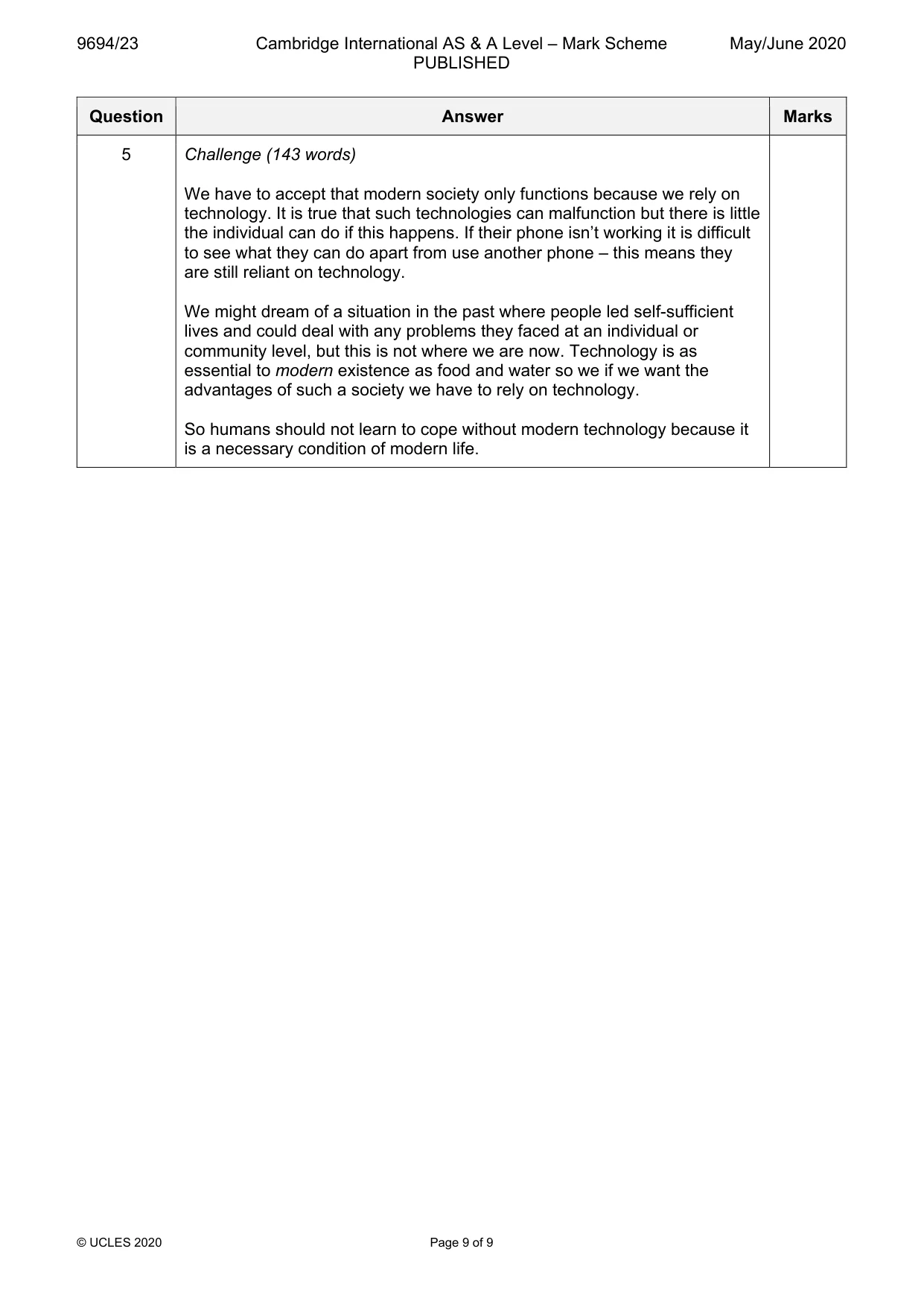
9694/23 Cambridge International AS & A Level – Mark Scheme PUBLISHED May/June 2020 © UCLES 2020 Page 9 of 9 Question Answer Marks 5 Challenge (143 words) We have to accept that modern society only functions because we rely on technology. It is true that such technologies can malfunction but there is little the individual can do if this happens. If their phone isn’t working it is difficult to see what they can do apart from use another phone – this means they are still reliant on technology. We might dream of a situation in the past where people led self-sufficient lives and could deal with any problems they faced at an individual or community level, but this is not where we are now. Technology is as essential to modern existence as food and water so we if we want the advantages of such a society we have to rely on technology. So humans should not learn to cope without modern technology because it is a necessary condition of modern life.