Cambridge A Level Thinking Skills 9694 — 2020 May/June Paper 2 · Variant 2
9694/22/M/J/20
The question paper and its mark scheme, free to read here and free to download. This is Cambridge’s own paper, exactly as it was sat.
Question paper8 pages



Mark scheme9 pages
Answers below. Sit the paper first if you are practising.
Paper as text
Question paper, page 1
Cambridge International AS & A Level This document has 8 pages. Blank pages are indicated. DC (LK) 180298/2 © UCLES 2020 [Turn over * 3 5 4 6 1 4 9 0 4 1 * THINKING SKILLS 9694/22 Paper 2 Critical Thinking May/June 2020 1 hour 45 minutes You must answer on the enclosed answer booklet. You will need: Answer booklet (enclosed) INSTRUCTIONS ● Answer all questions. ● Follow the instructions on the front cover of the answer booklet. If you need additional answer paper, ask the invigilator for a continuation booklet. INFORMATION ● The total mark for this paper is 50. ● The number of marks for each question or part question is shown in brackets [ ].
Question paper, page 2
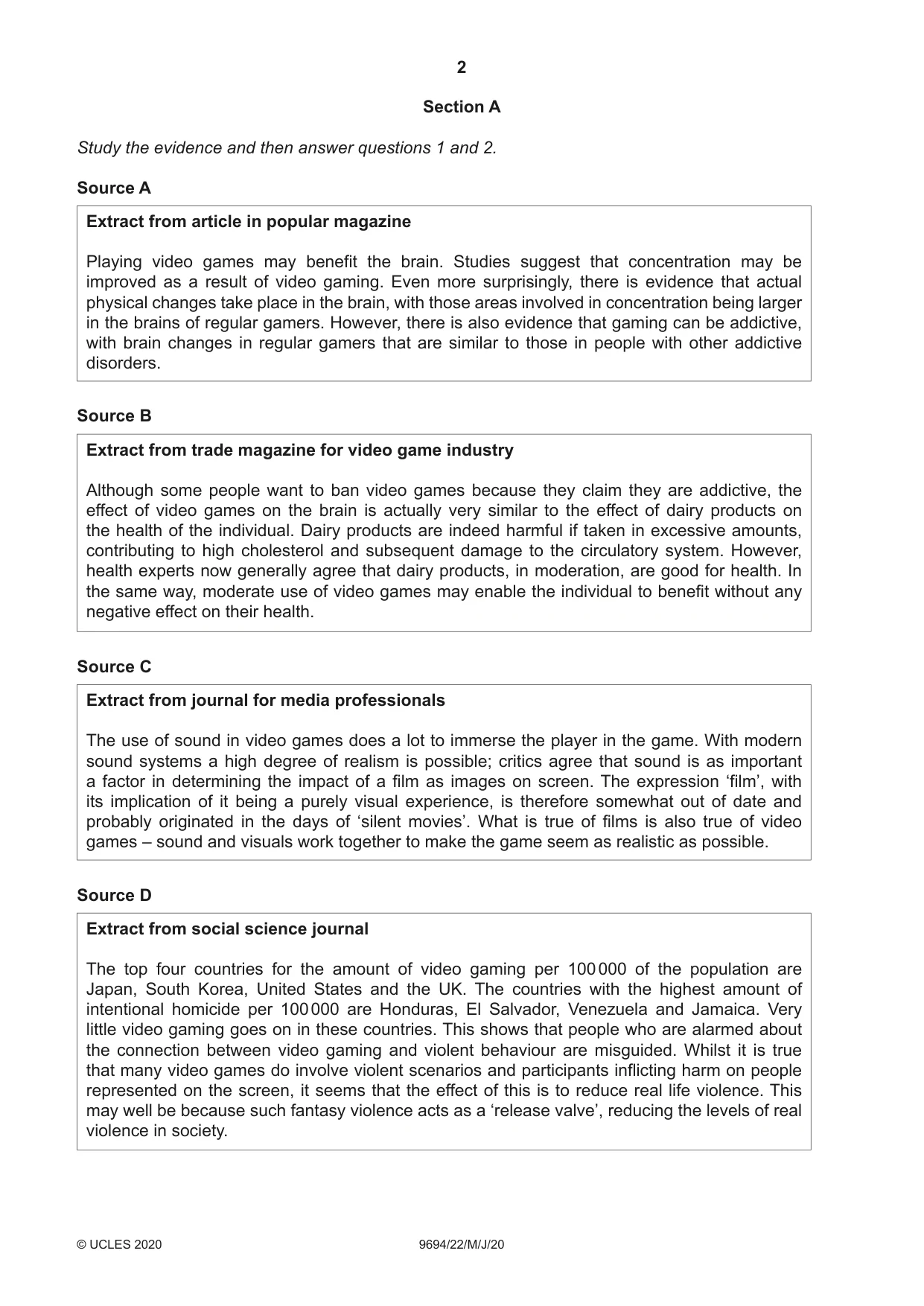
2 9694/22/M/J/20 © UCLES 2020 Section A Study the evidence and then answer questions 1 and 2. Source A Extract from article in popular magazine Playing video games may benefit the brain. Studies suggest that concentration may be improved as a result of video gaming. Even more surprisingly, there is evidence that actual physical changes take place in the brain, with those areas involved in concentration being larger in the brains of regular gamers. However, there is also evidence that gaming can be addictive, with brain changes in regular gamers that are similar to those in people with other addictive disorders. Source B Extract from trade magazine for video game industry Although some people want to ban video games because they claim they are addictive, the effect of video games on the brain is actually very similar to the effect of dairy products on the health of the individual. Dairy products are indeed harmful if taken in excessive amounts, contributing to high cholesterol and subsequent damage to the circulatory system. However, health experts now generally agree that dairy products, in moderation, are good for health. In the same way, moderate use of video games may enable the individual to benefit without any negative effect on their health. Source C Extract from journal for media professionals The use of sound in video games does a lot to immerse the player in the game. With modern sound systems a high degree of realism is possible; critics agree that sound is as important a factor in determining the impact of a film as images on screen. The expression ‘film’, with its implication of it being a purely visual experience, is therefore somewhat out of date and probably originated in the days of ‘silent movies’. What is true of films is also true of video games – sound and visuals work together to make the game seem as realistic as possible. Source D Extract from social science journal The top four countries for the amount of video gaming per 100 000 of the population are Japan, South Korea, United States and the UK. The countries with the highest amount of intentional homicide per 100 000 are Honduras, El Salvador, Venezuela and Jamaica. Very little video gaming goes on in these countries. This shows that people who are alarmed about the connection between video gaming and violent behaviour are misguided. Whilst it is true that many video games do involve violent scenarios and participants inflicting harm on people represented on the screen, it seems that the effect of this is to reduce real life violence. This may well be because such fantasy violence acts as a ‘release valve’, reducing the levels of real violence in society.
Question paper, page 3
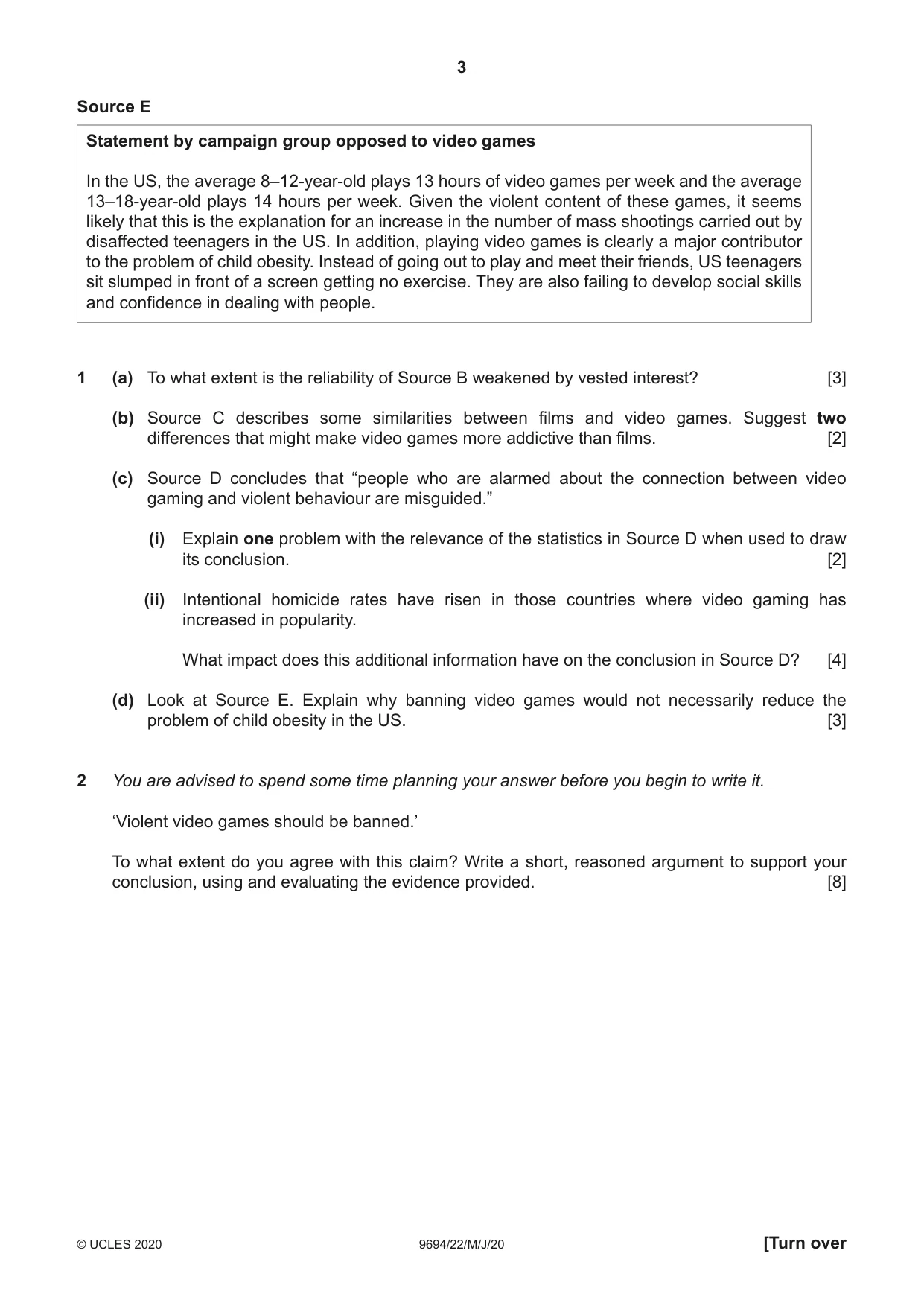
3 9694/22/M/J/20 © UCLES 2020 [Turn over Source E Statement by campaign group opposed to video games In the US, the average 8–12-year-old plays 13 hours of video games per week and the average 13–18-year-old plays 14 hours per week. Given the violent content of these games, it seems likely that this is the explanation for an increase in the number of mass shootings carried out by disaffected teenagers in the US. In addition, playing video games is clearly a major contributor to the problem of child obesity. Instead of going out to play and meet their friends, US teenagers sit slumped in front of a screen getting no exercise. They are also failing to develop social skills and confidence in dealing with people. 1 (a) To what extent is the reliability of Source B weakened by vested interest? [3] (b) Source C describes some similarities between films and video games. Suggest two differences that might make video games more addictive than films. [2] (c) Source D concludes that “people who are alarmed about the connection between video gaming and violent behaviour are misguided.” (i) Explain one problem with the relevance of the statistics in Source D when used to draw its conclusion. [2] (ii) Intentional homicide rates have risen in those countries where video gaming has increased in popularity. What impact does this additional information have on the conclusion in Source D? [4] (d) Look at Source E. Explain why banning video games would not necessarily reduce the problem of child obesity in the US. [3] 2 You are advised to spend some time planning your answer before you begin to write it. ‘Violent video games should be banned.’ To what extent do you agree with this claim? Write a short, reasoned argument to support your conclusion, using and evaluating the evidence provided. [8]
Question paper, page 4
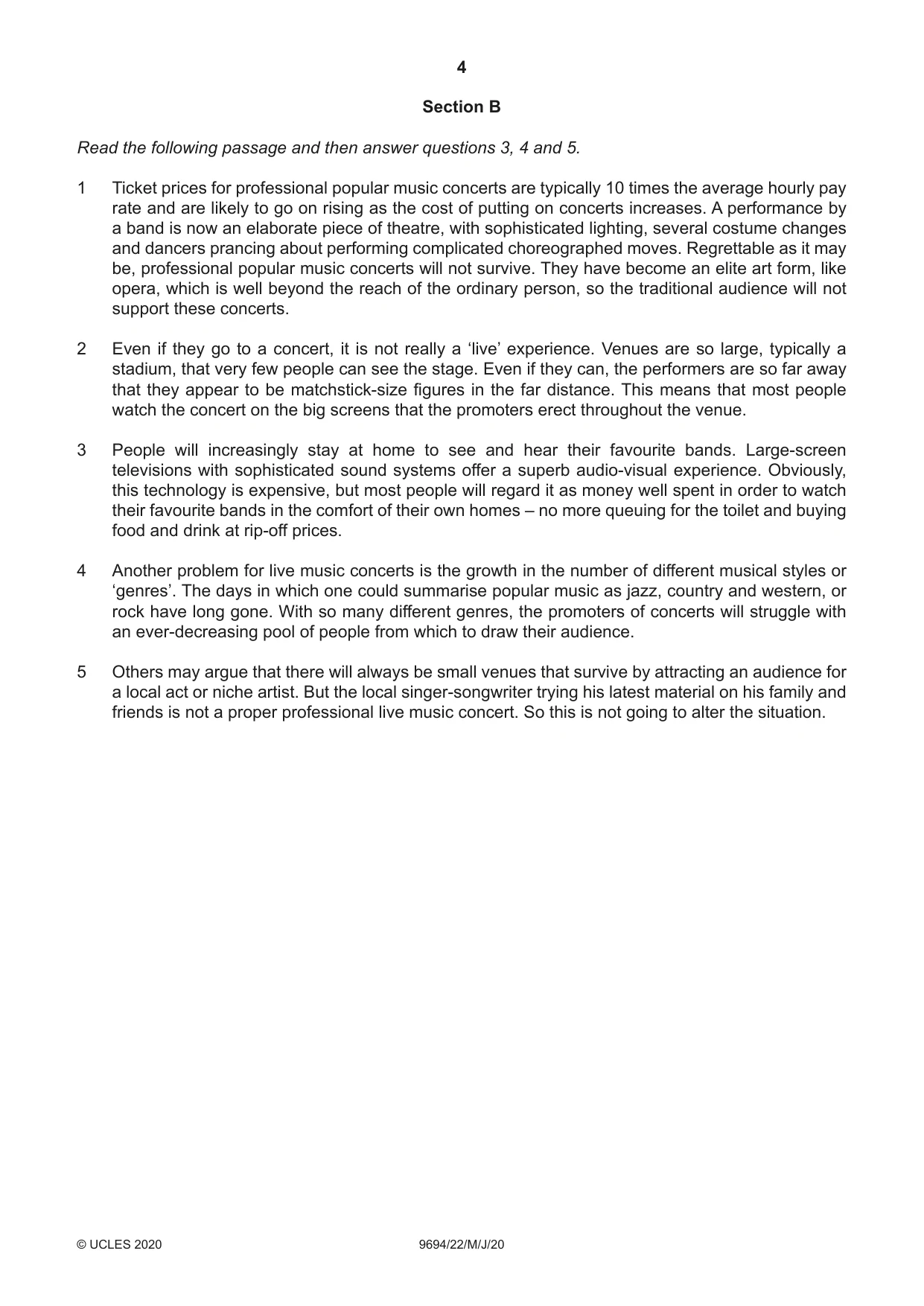
4 9694/22/M/J/20 © UCLES 2020 Section B Read the following passage and then answer questions 3, 4 and 5. 1 Ticket prices for professional popular music concerts are typically 10 times the average hourly pay rate and are likely to go on rising as the cost of putting on concerts increases. A performance by a band is now an elaborate piece of theatre, with sophisticated lighting, several costume changes and dancers prancing about performing complicated choreographed moves. Regrettable as it may be, professional popular music concerts will not survive. They have become an elite art form, like opera, which is well beyond the reach of the ordinary person, so the traditional audience will not support these concerts. 2 Even if they go to a concert, it is not really a ‘live’ experience. Venues are so large, typically a stadium, that very few people can see the stage. Even if they can, the performers are so far away that they appear to be matchstick-size figures in the far distance. This means that most people watch the concert on the big screens that the promoters erect throughout the venue. 3 People will increasingly stay at home to see and hear their favourite bands. Large-screen televisions with sophisticated sound systems offer a superb audio-visual experience. Obviously, this technology is expensive, but most people will regard it as money well spent in order to watch their favourite bands in the comfort of their own homes – no more queuing for the toilet and buying food and drink at rip-off prices. 4 Another problem for live music concerts is the growth in the number of different musical styles or ‘genres’. The days in which one could summarise popular music as jazz, country and western, or rock have long gone. With so many different genres, the promoters of concerts will struggle with an ever-decreasing pool of people from which to draw their audience. 5 Others may argue that there will always be small venues that survive by attracting an audience for a local act or niche artist. But the local singer-songwriter trying his latest material on his family and friends is not a proper professional live music concert. So this is not going to alter the situation.
Question paper, page 5
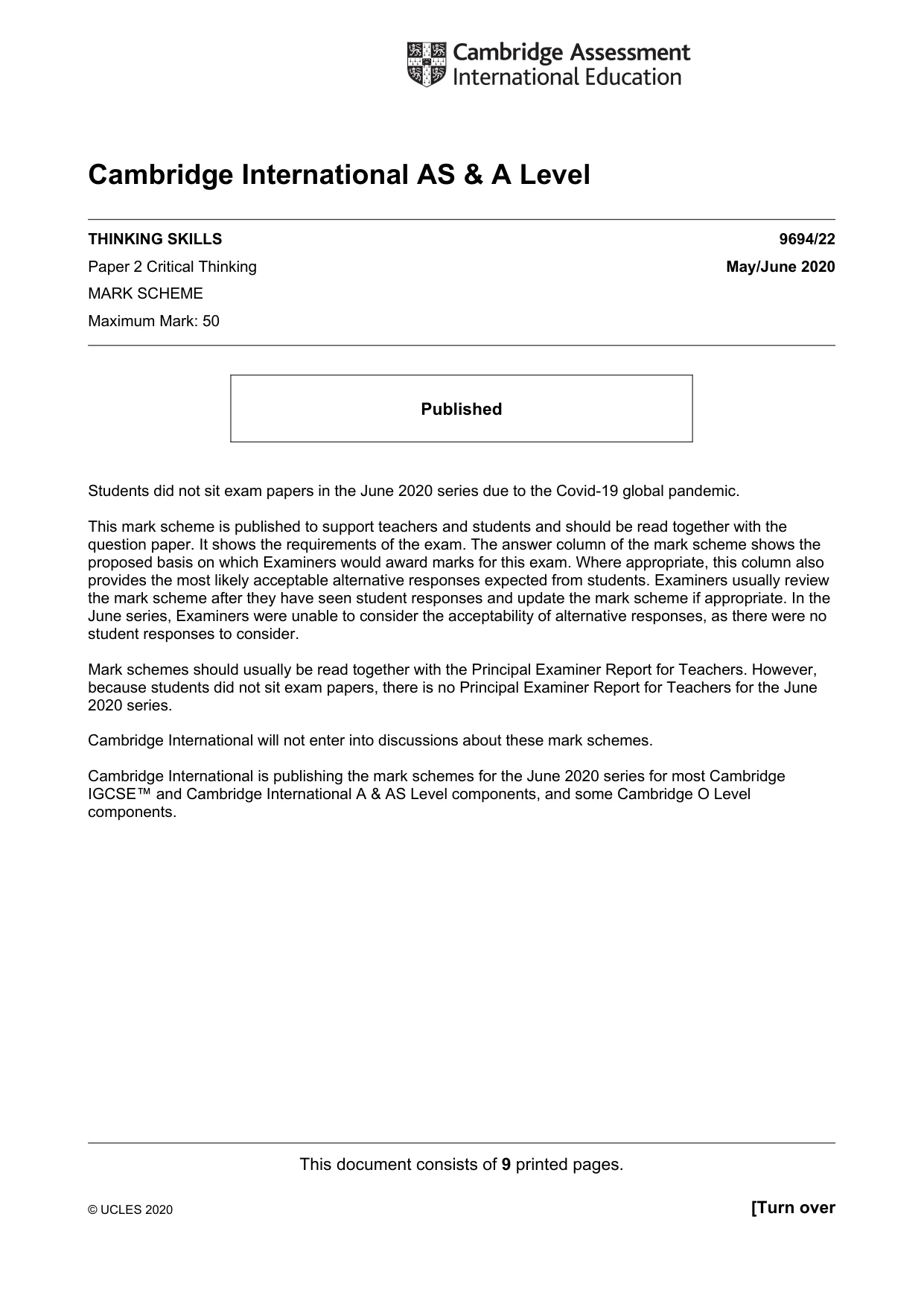
5 9694/22/M/J/20 © UCLES 2020 3 (a) Using the exact words from the passage as far as possible, identify the main conclusion. [2] (b) Using the exact words from the passage as far as possible, identify three intermediate conclusions. [6] (c) Using the exact words from the passage as far as possible, identify one counter-assertion. [2] (d) Identify one unstated assumption required by the argument in paragraph 1. [2] 4 (a) Identify an inconsistency between paragraphs 1 and 3 and explain the impact on the strength of the reasoning. [4] (b) Identify and explain one flaw or weakness in (i) paragraph 4. [2] (ii) paragraph 5. [2] 5 You are advised to spend some time planning your answer before you begin to write it. ‘Students should not be allowed to listen to music whilst studying.’ Write your own short argument to support or challenge this claim. The conclusion of your argument must be stated. Credit will not be given for repeating ideas from the passage. [8]
Question paper, page 6
6 9694/22/M/J/20 © UCLES 2020 BLANK PAGE
Question paper, page 7
7 9694/22/M/J/20 © UCLES 2020 BLANK PAGE
Question paper, page 8
8 9694/22/M/J/20 © UCLES 2020 Permission to reproduce items where third-party owned material protected by copyright is included has been sought and cleared where possible. Every reasonable effort has been made by the publisher (UCLES) to trace copyright holders, but if any items requiring clearance have unwittingly been included, the publisher will be pleased to make amends at the earliest possible opportunity. To avoid the issue of disclosure of answer-related information to candidates, all copyright acknowledgements are reproduced online in the Cambridge Assessment International Education Copyright Acknowledgements Booklet. This is produced for each series of examinations and is freely available to download at www.cambridgeinternational.org after the live examination series. Cambridge Assessment International Education is part of the Cambridge Assessment Group. Cambridge Assessment is the brand name of the University of Cambridge Local Examinations Syndicate (UCLES), which itself is a department of the University of Cambridge. BLANK PAGE
Mark scheme, page 1
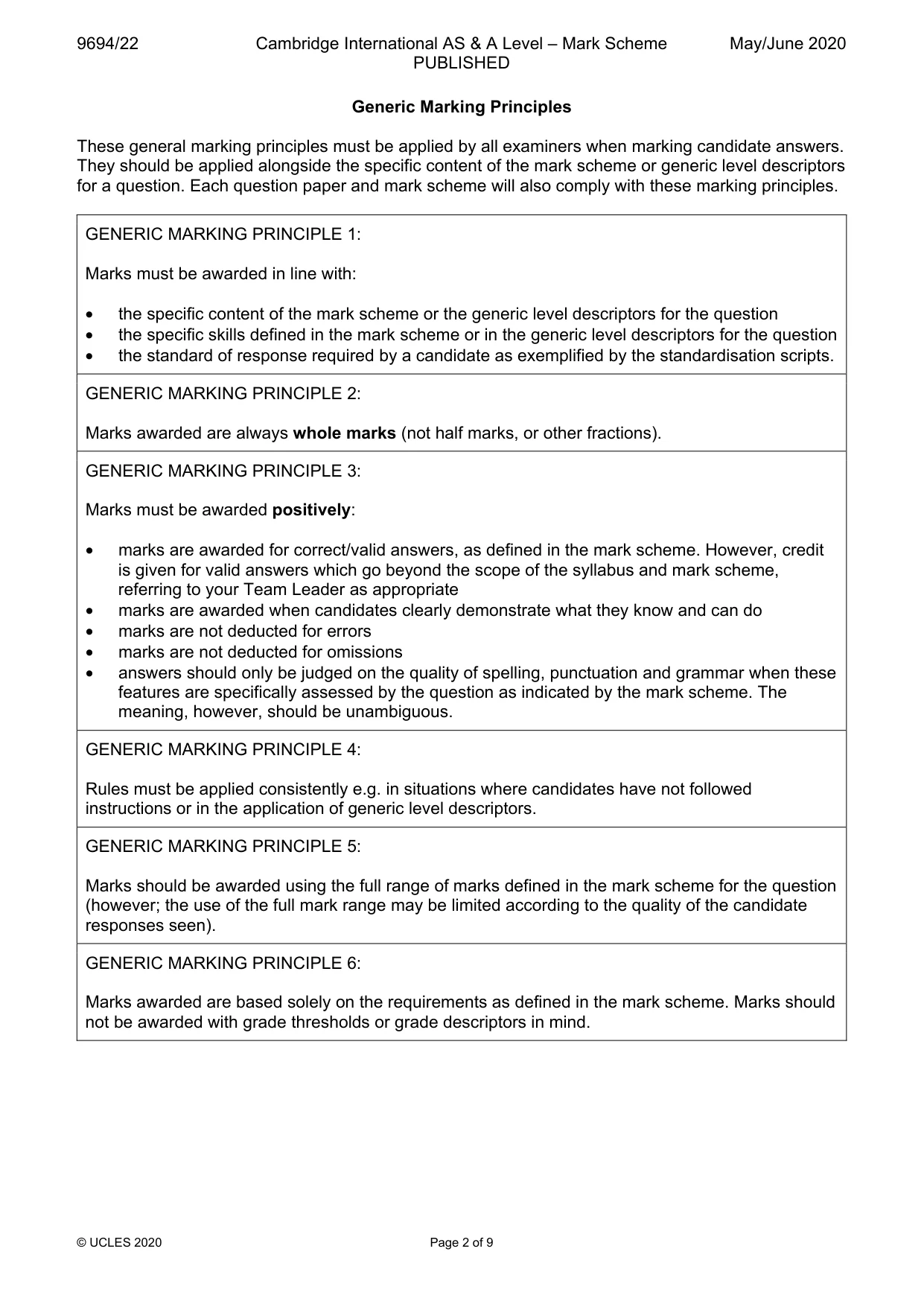
This document consists of 9 printed pages. © UCLES 2020 [Turn over Cambridge International AS & A Level THINKING SKILLS 9694/22 Paper 2 Critical Thinking May/June 2020 MARK SCHEME Maximum Mark: 50 Published Students did not sit exam papers in the June 2020 series due to the Covid-19 global pandemic. This mark scheme is published to support teachers and students and should be read together with the question paper. It shows the requirements of the exam. The answer column of the mark scheme shows the proposed basis on which Examiners would award marks for this exam. Where appropriate, this column also provides the most likely acceptable alternative responses expected from students. Examiners usually review the mark scheme after they have seen student responses and update the mark scheme if appropriate. In the June series, Examiners were unable to consider the acceptability of alternative responses, as there were no student responses to consider. Mark schemes should usually be read together with the Principal Examiner Report for Teachers. However, because students did not sit exam papers, there is no Principal Examiner Report for Teachers for the June 2020 series. Cambridge International will not enter into discussions about these mark schemes. Cambridge International is publishing the mark schemes for the June 2020 series for most Cambridge IGCSE™ and Cambridge International A & AS Level components, and some Cambridge O Level components.
Mark scheme, page 2
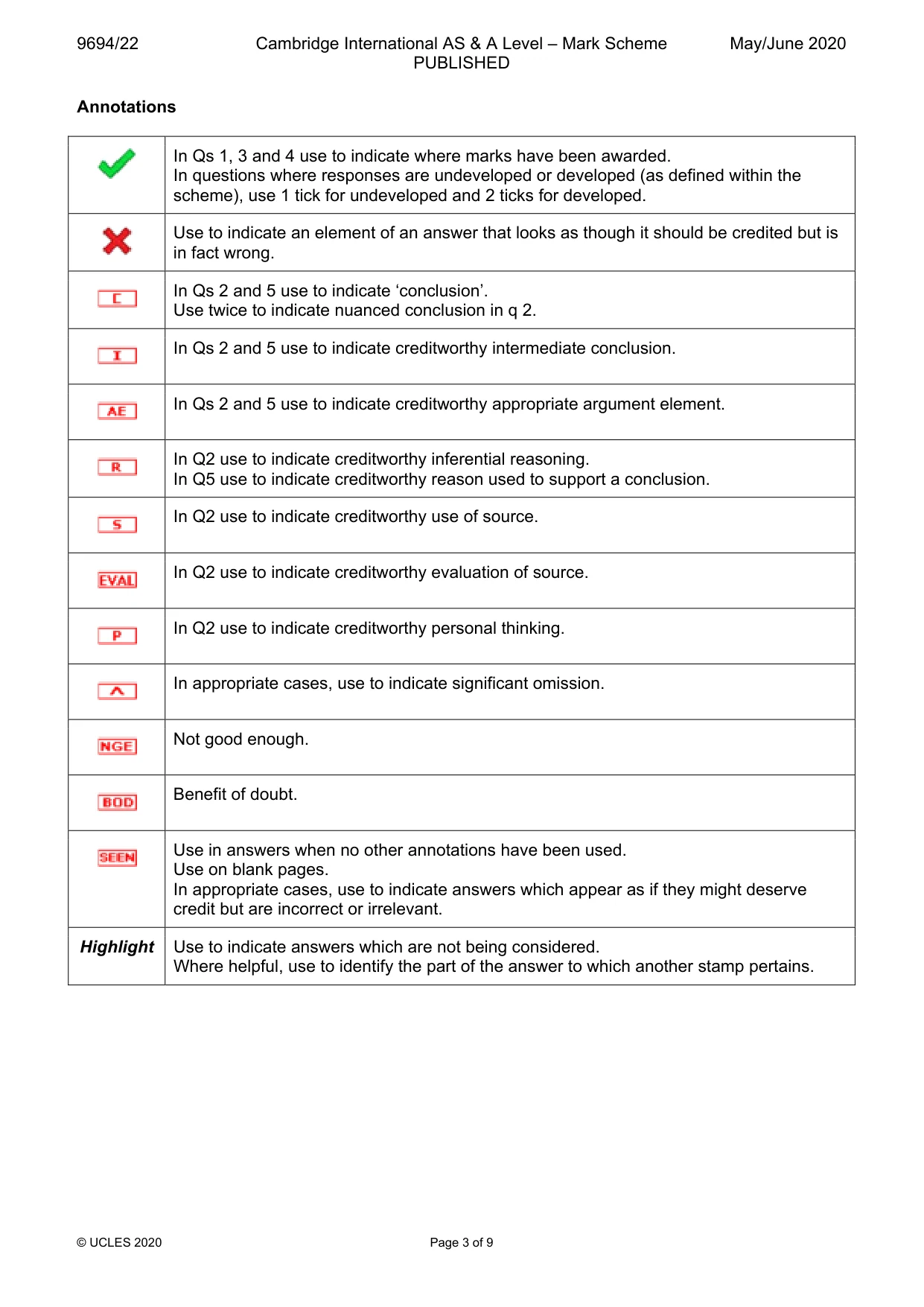
9694/22 Cambridge International AS & A Level – Mark Scheme PUBLISHED May/June 2020 © UCLES 2020 Page 2 of 9 Generic Marking Principles These general marking principles must be applied by all examiners when marking candidate answers. They should be applied alongside the specific content of the mark scheme or generic level descriptors for a question. Each question paper and mark scheme will also comply with these marking principles. GENERIC MARKING PRINCIPLE 1: Marks must be awarded in line with: • the specific content of the mark scheme or the generic level descriptors for the question • the specific skills defined in the mark scheme or in the generic level descriptors for the question • the standard of response required by a candidate as exemplified by the standardisation scripts. GENERIC MARKING PRINCIPLE 2: Marks awarded are always whole marks (not half marks, or other fractions). GENERIC MARKING PRINCIPLE 3: Marks must be awarded positively: • marks are awarded for correct/valid answers, as defined in the mark scheme. However, credit is given for valid answers which go beyond the scope of the syllabus and mark scheme, referring to your Team Leader as appropriate • marks are awarded when candidates clearly demonstrate what they know and can do • marks are not deducted for errors • marks are not deducted for omissions • answers should only be judged on the quality of spelling, punctuation and grammar when these features are specifically assessed by the question as indicated by the mark scheme. The meaning, however, should be unambiguous. GENERIC MARKING PRINCIPLE 4: Rules must be applied consistently e.g. in situations where candidates have not followed instructions or in the application of generic level descriptors. GENERIC MARKING PRINCIPLE 5: Marks should be awarded using the full range of marks defined in the mark scheme for the question (however; the use of the full mark range may be limited according to the quality of the candidate responses seen). GENERIC MARKING PRINCIPLE 6: Marks awarded are based solely on the requirements as defined in the mark scheme. Marks should not be awarded with grade thresholds or grade descriptors in mind.
Mark scheme, page 3
9694/22 Cambridge International AS & A Level – Mark Scheme PUBLISHED May/June 2020 © UCLES 2020 Page 3 of 9 Annotations In Qs 1, 3 and 4 use to indicate where marks have been awarded. In questions where responses are undeveloped or developed (as defined within the scheme), use 1 tick for undeveloped and 2 ticks for developed. Use to indicate an element of an answer that looks as though it should be credited but is in fact wrong. In Qs 2 and 5 use to indicate ‘conclusion’. Use twice to indicate nuanced conclusion in q 2. In Qs 2 and 5 use to indicate creditworthy intermediate conclusion. In Qs 2 and 5 use to indicate creditworthy appropriate argument element. In Q2 use to indicate creditworthy inferential reasoning. In Q5 use to indicate creditworthy reason used to support a conclusion. In Q2 use to indicate creditworthy use of source. In Q2 use to indicate creditworthy evaluation of source. In Q2 use to indicate creditworthy personal thinking. In appropriate cases, use to indicate significant omission. Not good enough. Benefit of doubt. Use in answers when no other annotations have been used. Use on blank pages. In appropriate cases, use to indicate answers which appear as if they might deserve credit but are incorrect or irrelevant. Highlight Use to indicate answers which are not being considered. Where helpful, use to identify the part of the answer to which another stamp pertains.
Mark scheme, page 4
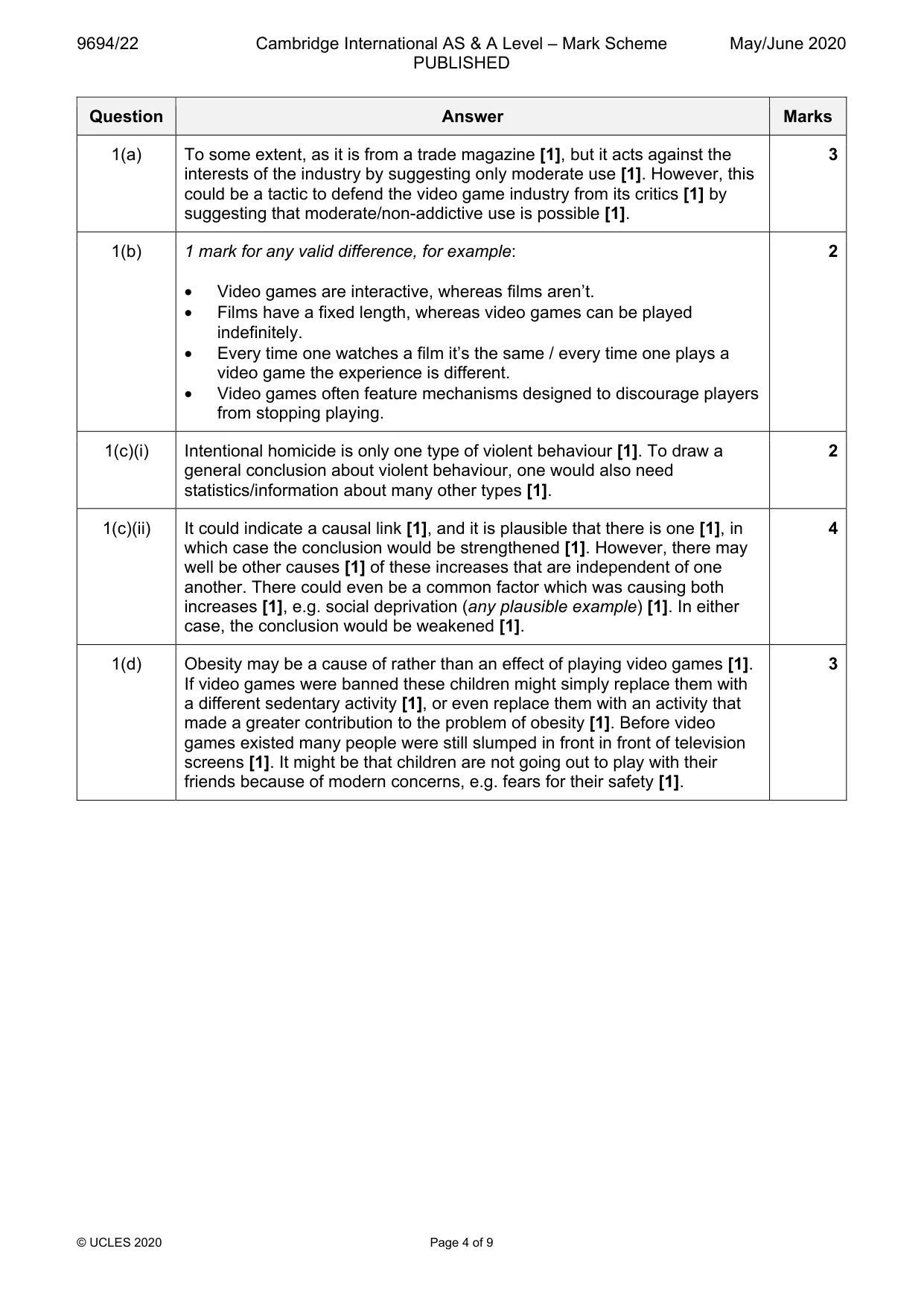
9694/22 Cambridge International AS & A Level – Mark Scheme PUBLISHED May/June 2020 © UCLES 2020 Page 4 of 9 Question Answer Marks 1(a) To some extent, as it is from a trade magazine [1], but it acts against the interests of the industry by suggesting only moderate use [1]. However, this could be a tactic to defend the video game industry from its critics [1] by suggesting that moderate/non-addictive use is possible [1]. 3 1(b) 1 mark for any valid difference, for example: • Video games are interactive, whereas films aren’t. • Films have a fixed length, whereas video games can be played indefinitely. • Every time one watches a film it’s the same / every time one plays a video game the experience is different. • Video games often feature mechanisms designed to discourage players from stopping playing. 2 1(c)(i) Intentional homicide is only one type of violent behaviour [1]. To draw a general conclusion about violent behaviour, one would also need statistics/information about many other types [1]. 2 1(c)(ii) It could indicate a causal link [1], and it is plausible that there is one [1], in which case the conclusion would be strengthened [1]. However, there may well be other causes [1] of these increases that are independent of one another. There could even be a common factor which was causing both increases [1], e.g. social deprivation (any plausible example) [1]. In either case, the conclusion would be weakened [1]. 4 1(d) Obesity may be a cause of rather than an effect of playing video games [1]. If video games were banned these children might simply replace them with a different sedentary activity [1], or even replace them with an activity that made a greater contribution to the problem of obesity [1]. Before video games existed many people were still slumped in front in front of television screens [1]. It might be that children are not going out to play with their friends because of modern concerns, e.g. fears for their safety [1]. 3
Mark scheme, page 5
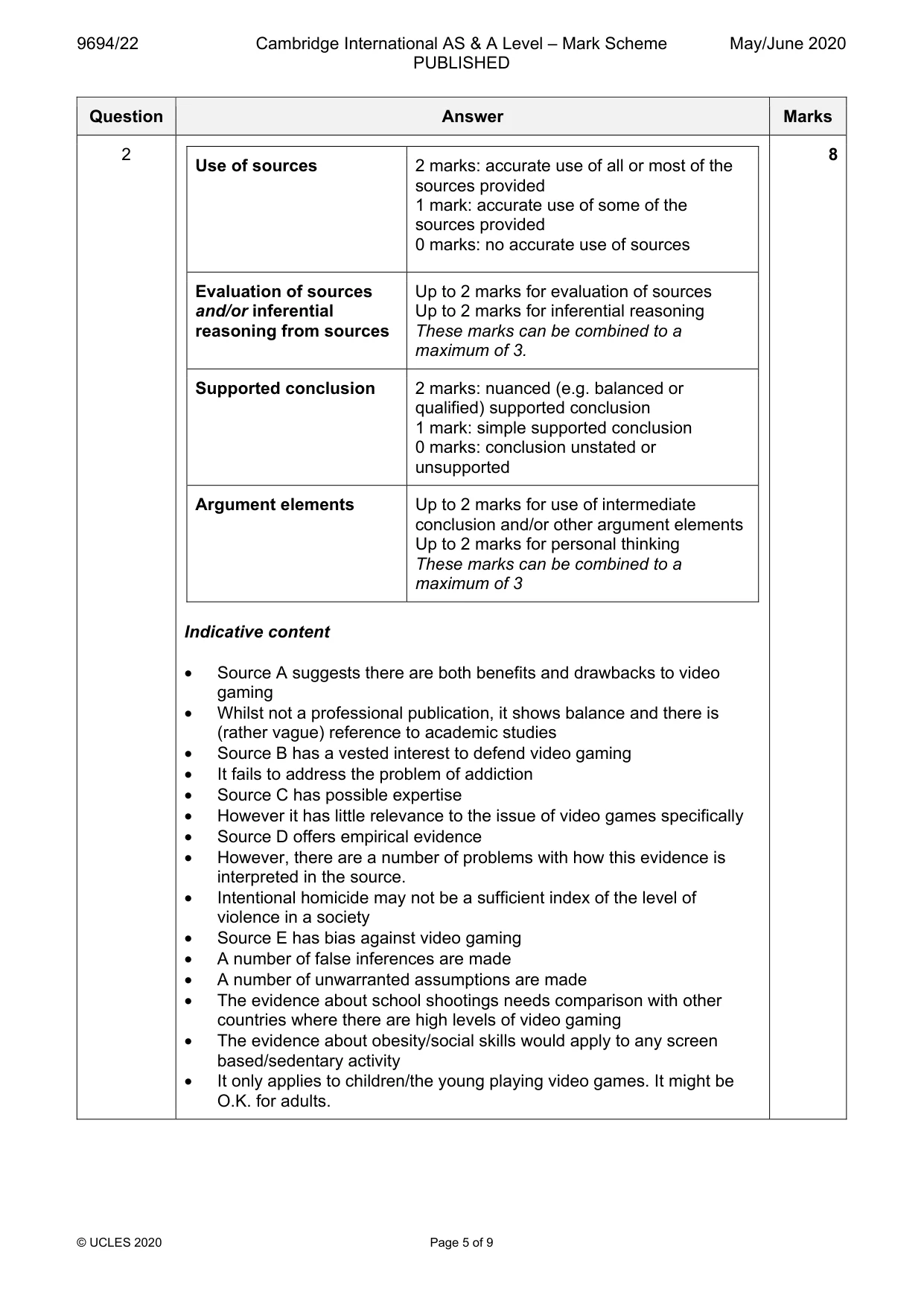
9694/22 Cambridge International AS & A Level – Mark Scheme PUBLISHED May/June 2020 © UCLES 2020 Page 5 of 9 Question Answer Marks 2 Use of sources 2 marks: accurate use of all or most of the sources provided 1 mark: accurate use of some of the sources provided 0 marks: no accurate use of sources Evaluation of sources and/or inferential reasoning from sources Up to 2 marks for evaluation of sources Up to 2 marks for inferential reasoning These marks can be combined to a maximum of 3. Supported conclusion 2 marks: nuanced (e.g. balanced or qualified) supported conclusion 1 mark: simple supported conclusion 0 marks: conclusion unstated or unsupported Argument elements Up to 2 marks for use of intermediate conclusion and/or other argument elements Up to 2 marks for personal thinking These marks can be combined to a maximum of 3 Indicative content • Source A suggests there are both benefits and drawbacks to video gaming • Whilst not a professional publication, it shows balance and there is (rather vague) reference to academic studies • Source B has a vested interest to defend video gaming • It fails to address the problem of addiction • Source C has possible expertise • However it has little relevance to the issue of video games specifically • Source D offers empirical evidence • However, there are a number of problems with how this evidence is interpreted in the source. • Intentional homicide may not be a sufficient index of the level of violence in a society • Source E has bias against video gaming • A number of false inferences are made • A number of unwarranted assumptions are made • The evidence about school shootings needs comparison with other countries where there are high levels of video gaming • The evidence about obesity/social skills would apply to any screen based/sedentary activity • It only applies to children/the young playing video games. It might be O.K. for adults. 8
Mark scheme, page 6
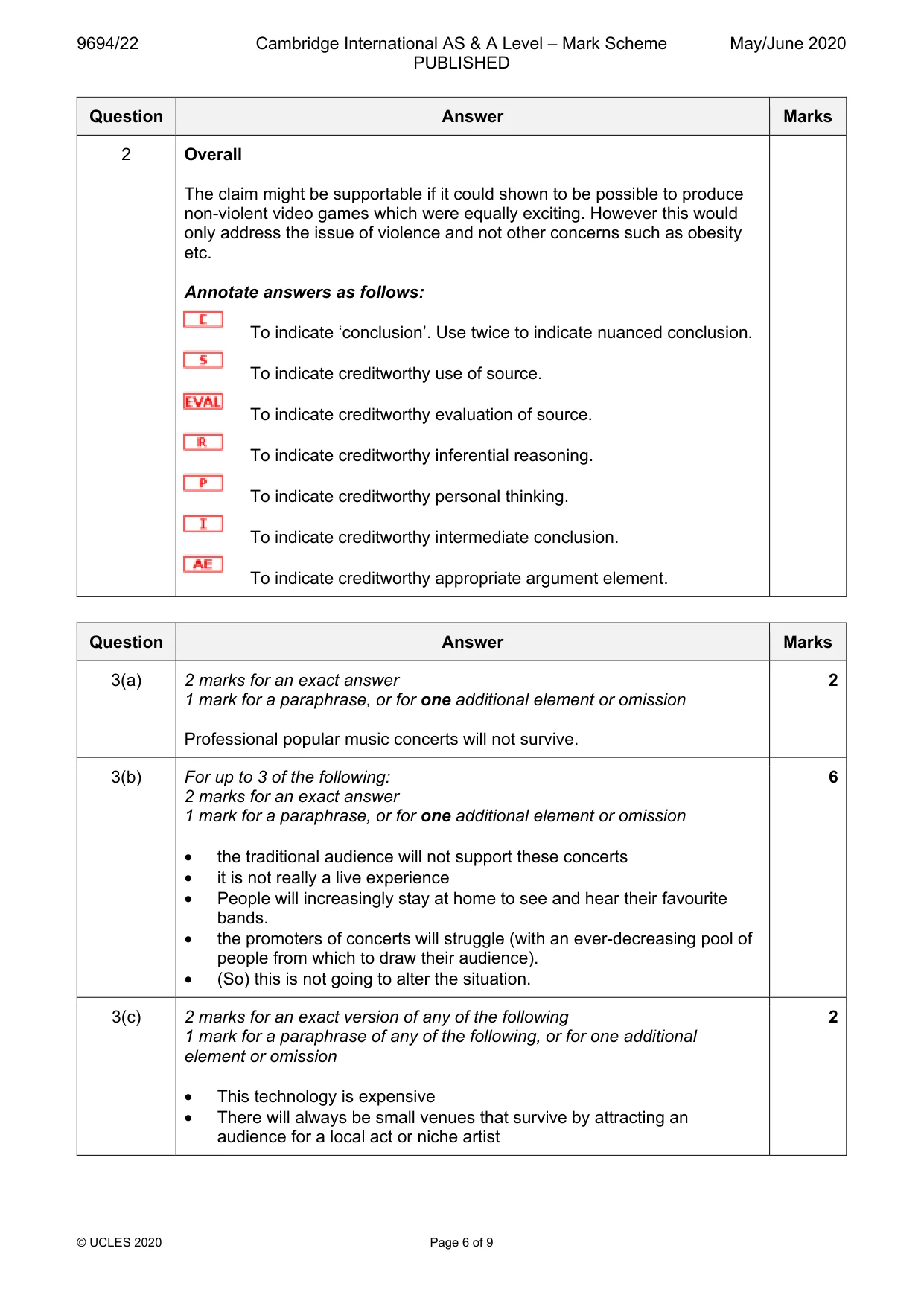
9694/22 Cambridge International AS & A Level – Mark Scheme PUBLISHED May/June 2020 © UCLES 2020 Page 6 of 9 Question Answer Marks 2 Overall The claim might be supportable if it could shown to be possible to produce non-violent video games which were equally exciting. However this would only address the issue of violence and not other concerns such as obesity etc. Annotate answers as follows: To indicate ‘conclusion’. Use twice to indicate nuanced conclusion. To indicate creditworthy use of source. To indicate creditworthy evaluation of source. To indicate creditworthy inferential reasoning. To indicate creditworthy personal thinking. To indicate creditworthy intermediate conclusion. To indicate creditworthy appropriate argument element. Question Answer Marks 3(a) 2 marks for an exact answer 1 mark for a paraphrase, or for one additional element or omission Professional popular music concerts will not survive. 2 3(b) For up to 3 of the following: 2 marks for an exact answer 1 mark for a paraphrase, or for one additional element or omission • the traditional audience will not support these concerts • it is not really a live experience • People will increasingly stay at home to see and hear their favourite bands. • the promoters of concerts will struggle (with an ever-decreasing pool of people from which to draw their audience). • (So) this is not going to alter the situation. 6 3(c) 2 marks for an exact version of any of the following 1 mark for a paraphrase of any of the following, or for one additional element or omission • This technology is expensive • There will always be small venues that survive by attracting an audience for a local act or niche artist 2
Mark scheme, page 7
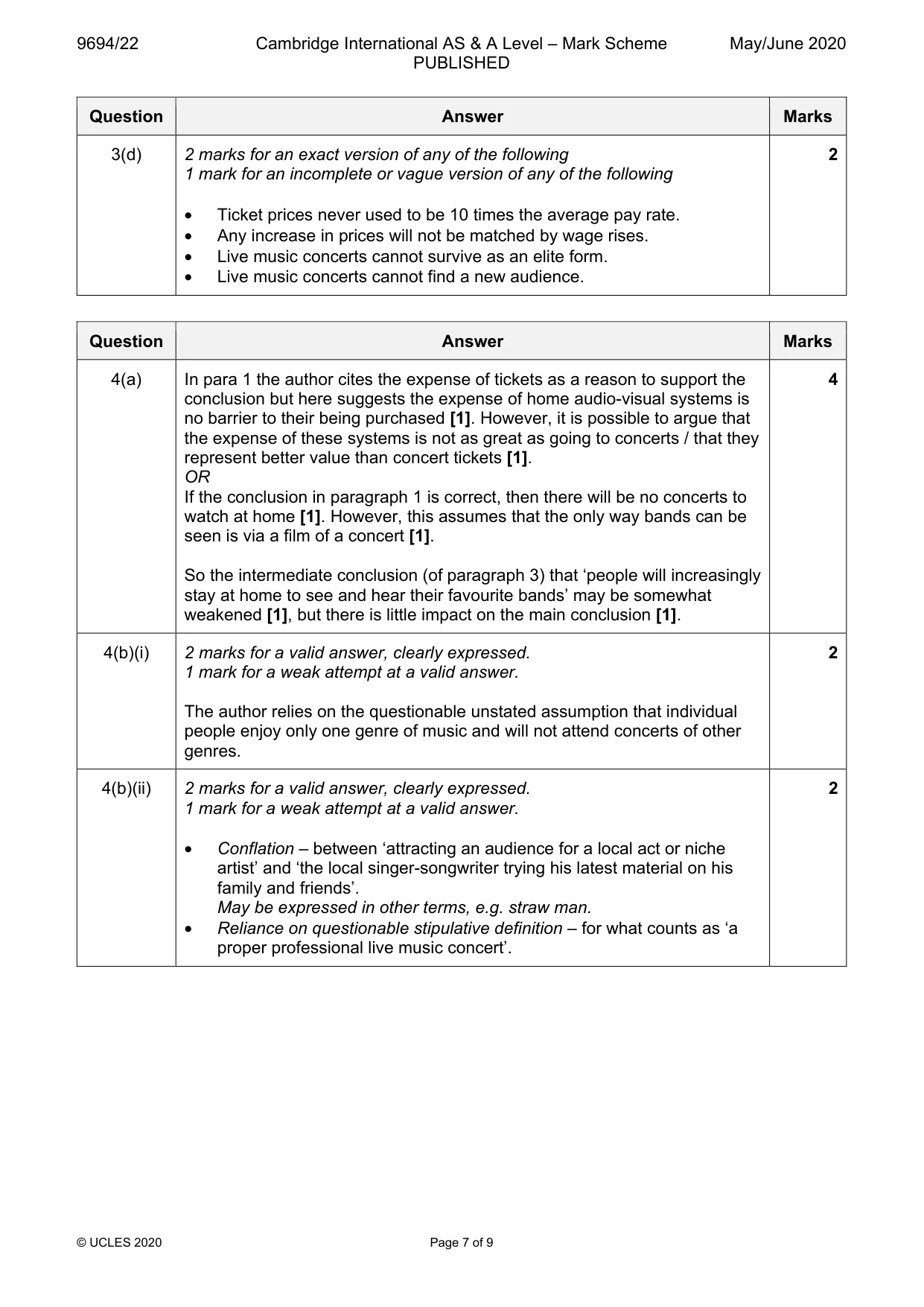
9694/22 Cambridge International AS & A Level – Mark Scheme PUBLISHED May/June 2020 © UCLES 2020 Page 7 of 9 Question Answer Marks 3(d) 2 marks for an exact version of any of the following 1 mark for an incomplete or vague version of any of the following • Ticket prices never used to be 10 times the average pay rate. • Any increase in prices will not be matched by wage rises. • Live music concerts cannot survive as an elite form. • Live music concerts cannot find a new audience. 2 Question Answer Marks 4(a) In para 1 the author cites the expense of tickets as a reason to support the conclusion but here suggests the expense of home audio-visual systems is no barrier to their being purchased [1]. However, it is possible to argue that the expense of these systems is not as great as going to concerts / that they represent better value than concert tickets [1]. OR If the conclusion in paragraph 1 is correct, then there will be no concerts to watch at home [1]. However, this assumes that the only way bands can be seen is via a film of a concert [1]. So the intermediate conclusion (of paragraph 3) that ‘people will increasingly stay at home to see and hear their favourite bands’ may be somewhat weakened [1], but there is little impact on the main conclusion [1]. 4 4(b)(i) 2 marks for a valid answer, clearly expressed. 1 mark for a weak attempt at a valid answer. The author relies on the questionable unstated assumption that individual people enjoy only one genre of music and will not attend concerts of other genres. 2 4(b)(ii) 2 marks for a valid answer, clearly expressed. 1 mark for a weak attempt at a valid answer. • Conflation – between ‘attracting an audience for a local act or niche artist’ and ‘the local singer-songwriter trying his latest material on his family and friends’. May be expressed in other terms, e.g. straw man. • Reliance on questionable stipulative definition – for what counts as ‘a proper professional live music concert’. 2
Mark scheme, page 8
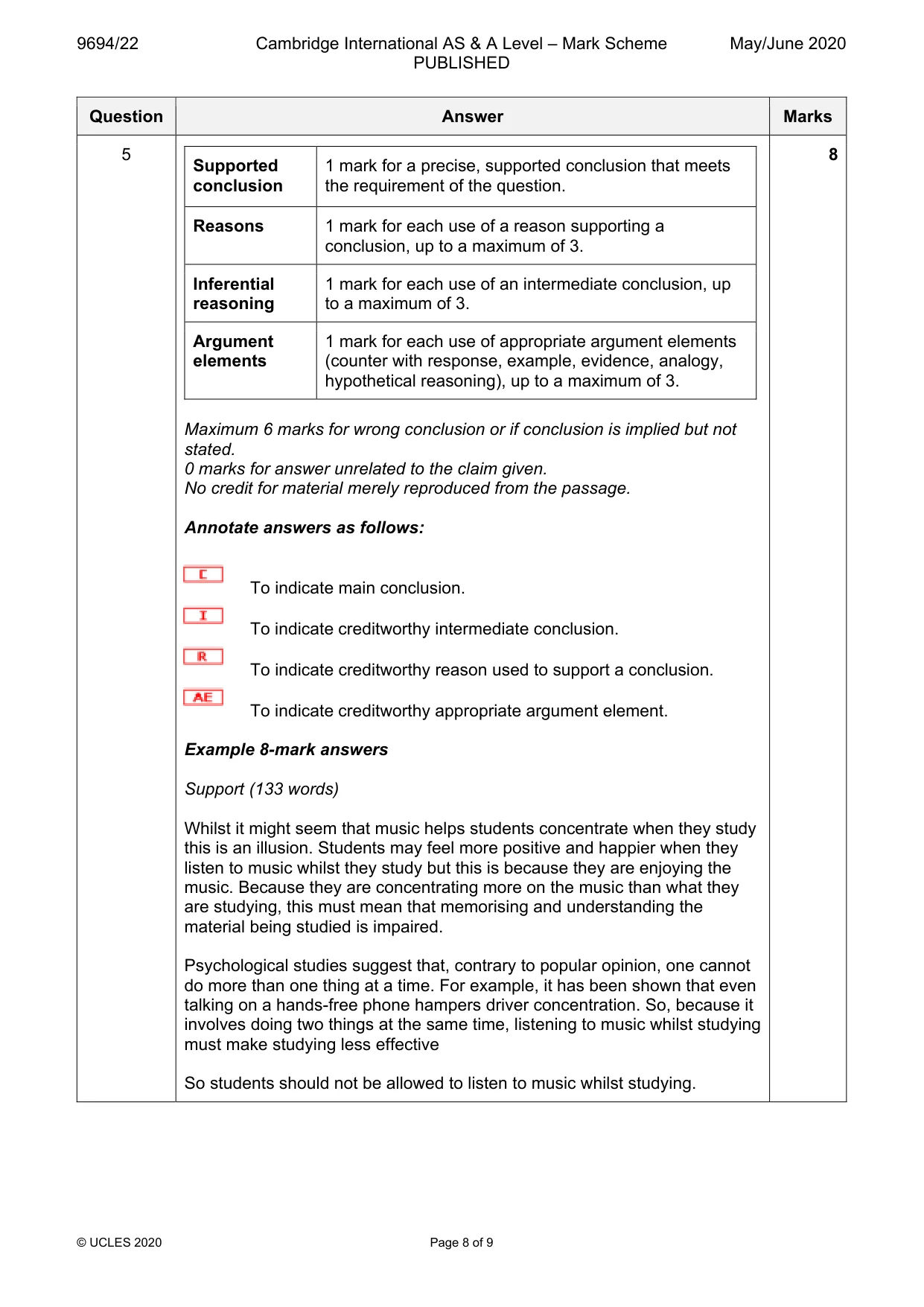
9694/22 Cambridge International AS & A Level – Mark Scheme PUBLISHED May/June 2020 © UCLES 2020 Page 8 of 9 Question Answer Marks 5 Supported conclusion 1 mark for a precise, supported conclusion that meets the requirement of the question. Reasons 1 mark for each use of a reason supporting a conclusion, up to a maximum of 3. Inferential reasoning 1 mark for each use of an intermediate conclusion, up to a maximum of 3. Argument elements 1 mark for each use of appropriate argument elements (counter with response, example, evidence, analogy, hypothetical reasoning), up to a maximum of 3. Maximum 6 marks for wrong conclusion or if conclusion is implied but not stated. 0 marks for answer unrelated to the claim given. No credit for material merely reproduced from the passage. Annotate answers as follows: To indicate main conclusion. To indicate creditworthy intermediate conclusion. To indicate creditworthy reason used to support a conclusion. To indicate creditworthy appropriate argument element. Example 8-mark answers Support (133 words) Whilst it might seem that music helps students concentrate when they study this is an illusion. Students may feel more positive and happier when they listen to music whilst they study but this is because they are enjoying the music. Because they are concentrating more on the music than what they are studying, this must mean that memorising and understanding the material being studied is impaired. Psychological studies suggest that, contrary to popular opinion, one cannot do more than one thing at a time. For example, it has been shown that even talking on a hands-free phone hampers driver concentration. So, because it involves doing two things at the same time, listening to music whilst studying must make studying less effective So students should not be allowed to listen to music whilst studying. 8
Mark scheme, page 9
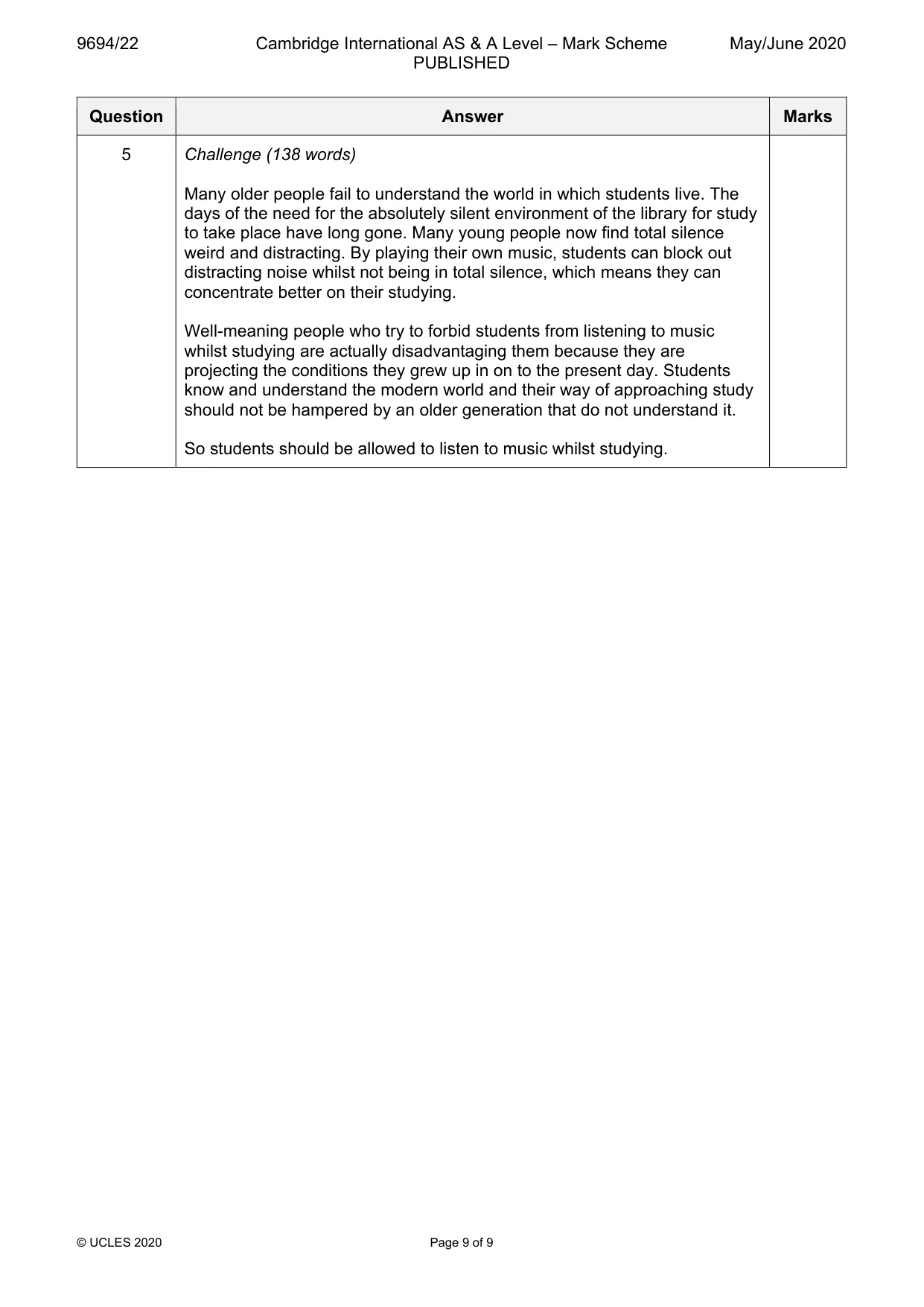
9694/22 Cambridge International AS & A Level – Mark Scheme PUBLISHED May/June 2020 © UCLES 2020 Page 9 of 9 Question Answer Marks 5 Challenge (138 words) Many older people fail to understand the world in which students live. The days of the need for the absolutely silent environment of the library for study to take place have long gone. Many young people now find total silence weird and distracting. By playing their own music, students can block out distracting noise whilst not being in total silence, which means they can concentrate better on their studying. Well-meaning people who try to forbid students from listening to music whilst studying are actually disadvantaging them because they are projecting the conditions they grew up in on to the present day. Students know and understand the modern world and their way of approaching study should not be hampered by an older generation that do not understand it. So students should be allowed to listen to music whilst studying.