Cambridge A Level Thinking Skills 9694 — 2019 Oct/Nov Paper 2 · Variant 1
9694/21/O/N/19 · 45 marks · ≈51 min
The question paper and its mark scheme, free to read here and free to download. This is Cambridge’s own paper, exactly as it was sat.
Question paper8 pages


Mark scheme9 pages
Answers below. Sit the paper first if you are practising.
Paper as text
Question paper, page 1
This document consists of 6 printed pages, 2 blank pages and 1 Insert. DC (NH/CB) 163088/2 © UCLES 2019 [Turn over Cambridge Assessment International Education Cambridge International Advanced Subsidiary and Advanced Level * 2 7 2 5 0 7 8 0 5 5 * THINKING SKILLS 9694/21 Paper 2 Critical Thinking October/November 2019 1 hour 45 minutes No Additional Materials are required. READ THESE INSTRUCTIONS FIRST An answer booklet is provided inside this question paper. You should follow the instructions on the front cover of the answer booklet. If you need additional answer paper ask the invigilator for a continuation booklet. Answer all the questions. The number of marks is given in brackets [ ] at the end of each question.
Question paper, page 2
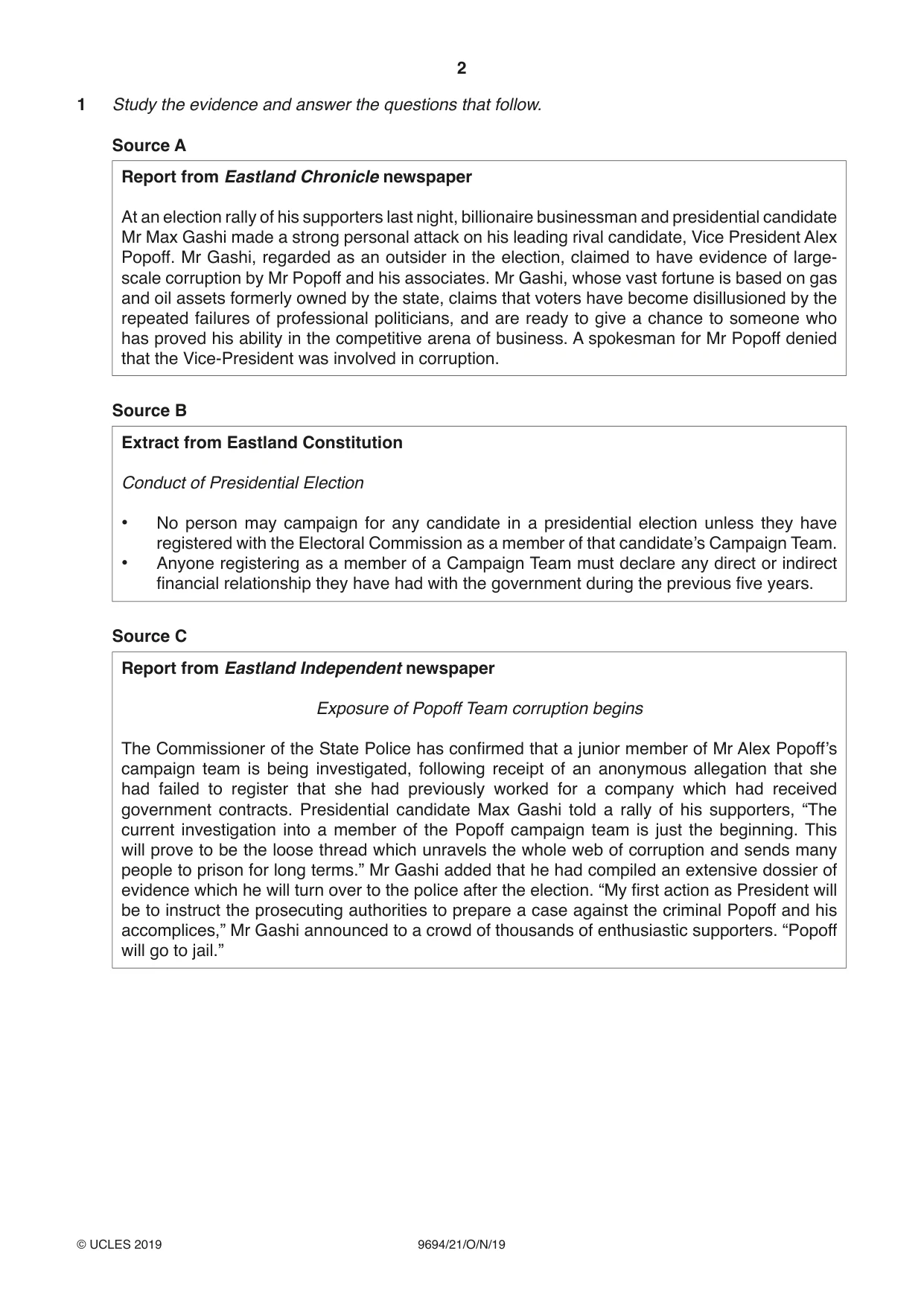
2 9694/21/O/N/19 © UCLES 2019 1 Study the evidence and answer the questions that follow. Source A Report from Eastland Chronicle newspaper At an election rally of his supporters last night, billionaire businessman and presidential candidate Mr Max Gashi made a strong personal attack on his leading rival candidate, Vice President Alex Popoff. Mr Gashi, regarded as an outsider in the election, claimed to have evidence of large- scale corruption by Mr Popoff and his associates. Mr Gashi, whose vast fortune is based on gas and oil assets formerly owned by the state, claims that voters have become disillusioned by the repeated failures of professional politicians, and are ready to give a chance to someone who has proved his ability in the competitive arena of business. A spokesman for Mr Popoff denied that the Vice-President was involved in corruption. Source B Extract from Eastland Constitution Conduct of Presidential Election • No person may campaign for any candidate in a presidential election unless they have registered with the Electoral Commission as a member of that candidate’s Campaign Team. • Anyone registering as a member of a Campaign Team must declare any direct or indirect financial relationship they have had with the government during the previous five years. Source C Report from Eastland Independent newspaper Exposure of Popoff Team corruption begins The Commissioner of the State Police has confirmed that a junior member of Mr Alex Popoff’s campaign team is being investigated, following receipt of an anonymous allegation that she had failed to register that she had previously worked for a company which had received government contracts. Presidential candidate Max Gashi told a rally of his supporters, “The current investigation into a member of the Popoff campaign team is just the beginning. This will prove to be the loose thread which unravels the whole web of corruption and sends many people to prison for long terms.” Mr Gashi added that he had compiled an extensive dossier of evidence which he will turn over to the police after the election. “My first action as President will be to instruct the prosecuting authorities to prepare a case against the criminal Popoff and his accomplices,” Mr Gashi announced to a crowd of thousands of enthusiastic supporters. “Popoff will go to jail.”
Question paper, page 3
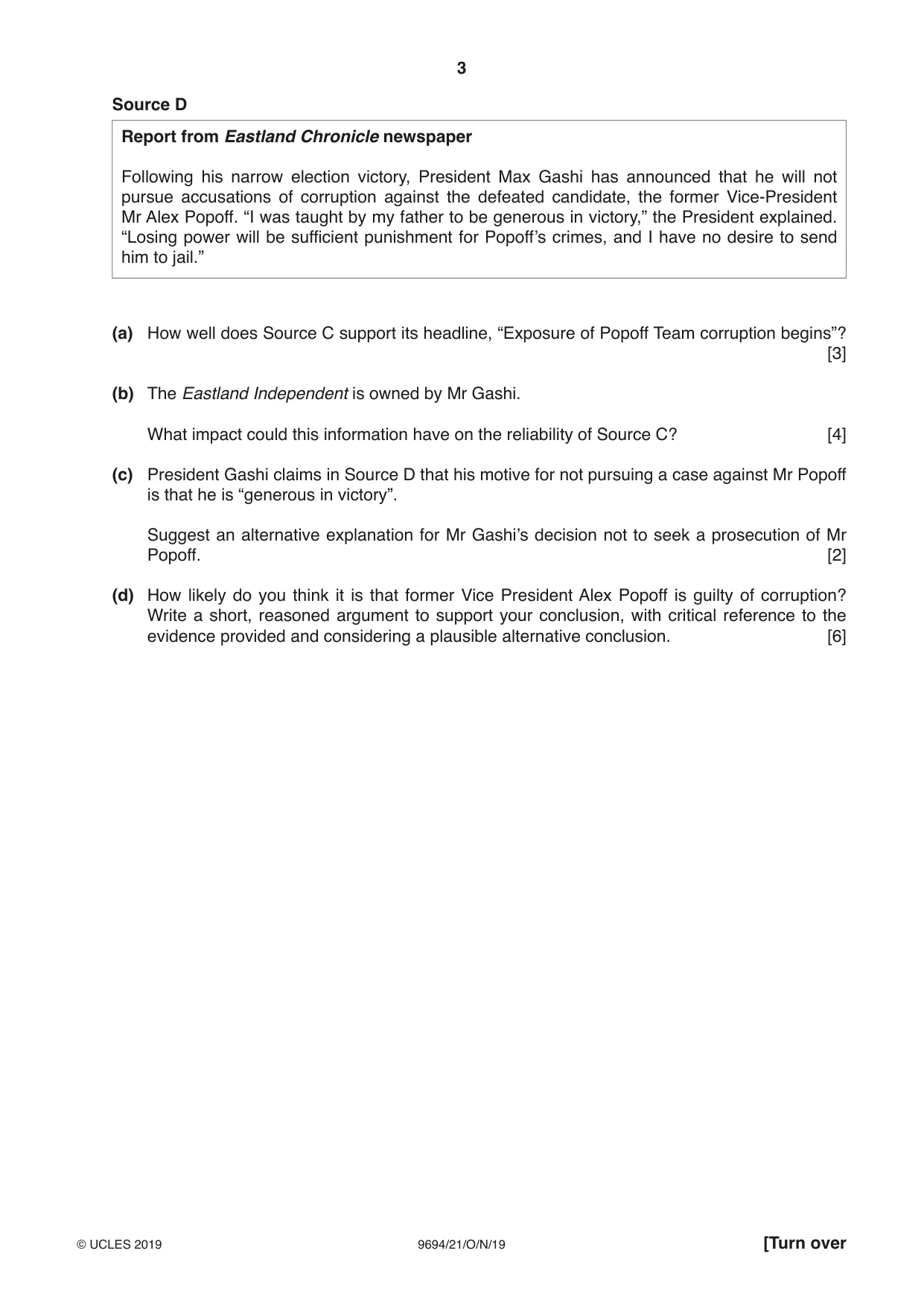
3 9694/21/O/N/19 © UCLES 2019 [Turn over Source D Report from Eastland Chronicle newspaper Following his narrow election victory, President Max Gashi has announced that he will not pursue accusations of corruption against the defeated candidate, the former Vice-President Mr Alex Popoff. “I was taught by my father to be generous in victory,” the President explained. “Losing power will be sufficient punishment for Popoff’s crimes, and I have no desire to send him to jail.” (a) How well does Source C support its headline, “Exposure of Popoff Team corruption begins”? [3] (b) The Eastland Independent is owned by Mr Gashi. What impact could this information have on the reliability of Source C? [4] (c) President Gashi claims in Source D that his motive for not pursuing a case against Mr Popoff is that he is “generous in victory”. Suggest an alternative explanation for Mr Gashi’s decision not to seek a prosecution of Mr Popoff. [2] (d) How likely do you think it is that former Vice President Alex Popoff is guilty of corruption? Write a short, reasoned argument to support your conclusion, with critical reference to the evidence provided and considering a plausible alternative conclusion. [6]
Question paper, page 4
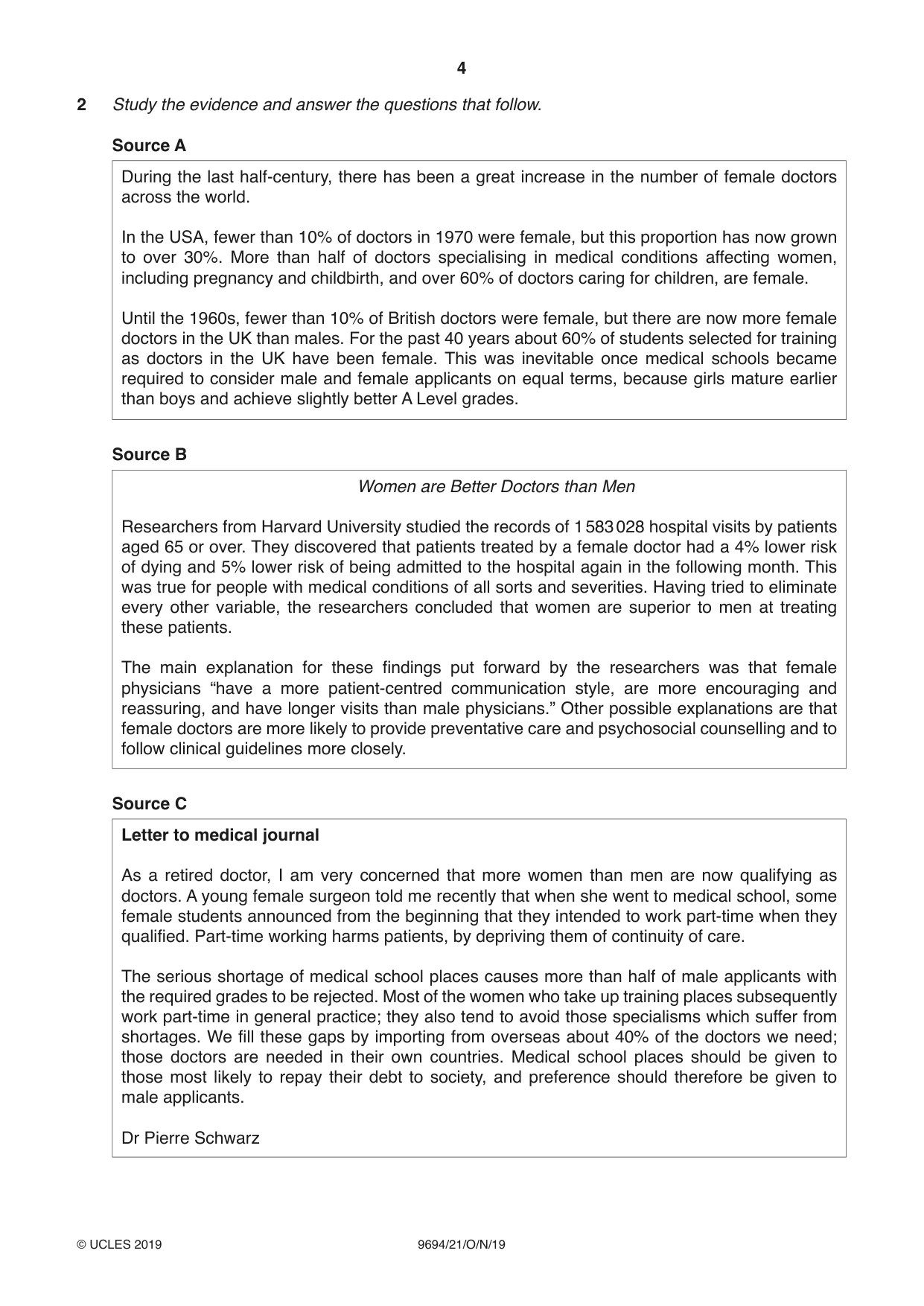
4 9694/21/O/N/19 © UCLES 2019 2 Study the evidence and answer the questions that follow. Source A During the last half-century, there has been a great increase in the number of female doctors across the world. In the USA, fewer than 10% of doctors in 1970 were female, but this proportion has now grown to over 30%. More than half of doctors specialising in medical conditions affecting women, including pregnancy and childbirth, and over 60% of doctors caring for children, are female. Until the 1960s, fewer than 10% of British doctors were female, but there are now more female doctors in the UK than males. For the past 40 years about 60% of students selected for training as doctors in the UK have been female. This was inevitable once medical schools became required to consider male and female applicants on equal terms, because girls mature earlier than boys and achieve slightly better A Level grades. Source B Women are Better Doctors than Men Researchers from Harvard University studied the records of 1 583 028 hospital visits by patients aged 65 or over. They discovered that patients treated by a female doctor had a 4% lower risk of dying and 5% lower risk of being admitted to the hospital again in the following month. This was true for people with medical conditions of all sorts and severities. Having tried to eliminate every other variable, the researchers concluded that women are superior to men at treating these patients. The main explanation for these findings put forward by the researchers was that female physicians “have a more patient-centred communication style, are more encouraging and reassuring, and have longer visits than male physicians.” Other possible explanations are that female doctors are more likely to provide preventative care and psychosocial counselling and to follow clinical guidelines more closely. Source C Letter to medical journal As a retired doctor, I am very concerned that more women than men are now qualifying as doctors. A young female surgeon told me recently that when she went to medical school, some female students announced from the beginning that they intended to work part-time when they qualified. Part-time working harms patients, by depriving them of continuity of care. The serious shortage of medical school places causes more than half of male applicants with the required grades to be rejected. Most of the women who take up training places subsequently work part-time in general practice; they also tend to avoid those specialisms which suffer from shortages. We fill these gaps by importing from overseas about 40% of the doctors we need; those doctors are needed in their own countries. Medical school places should be given to those most likely to repay their debt to society, and preference should therefore be given to male applicants. Dr Pierre Schwarz
Question paper, page 5
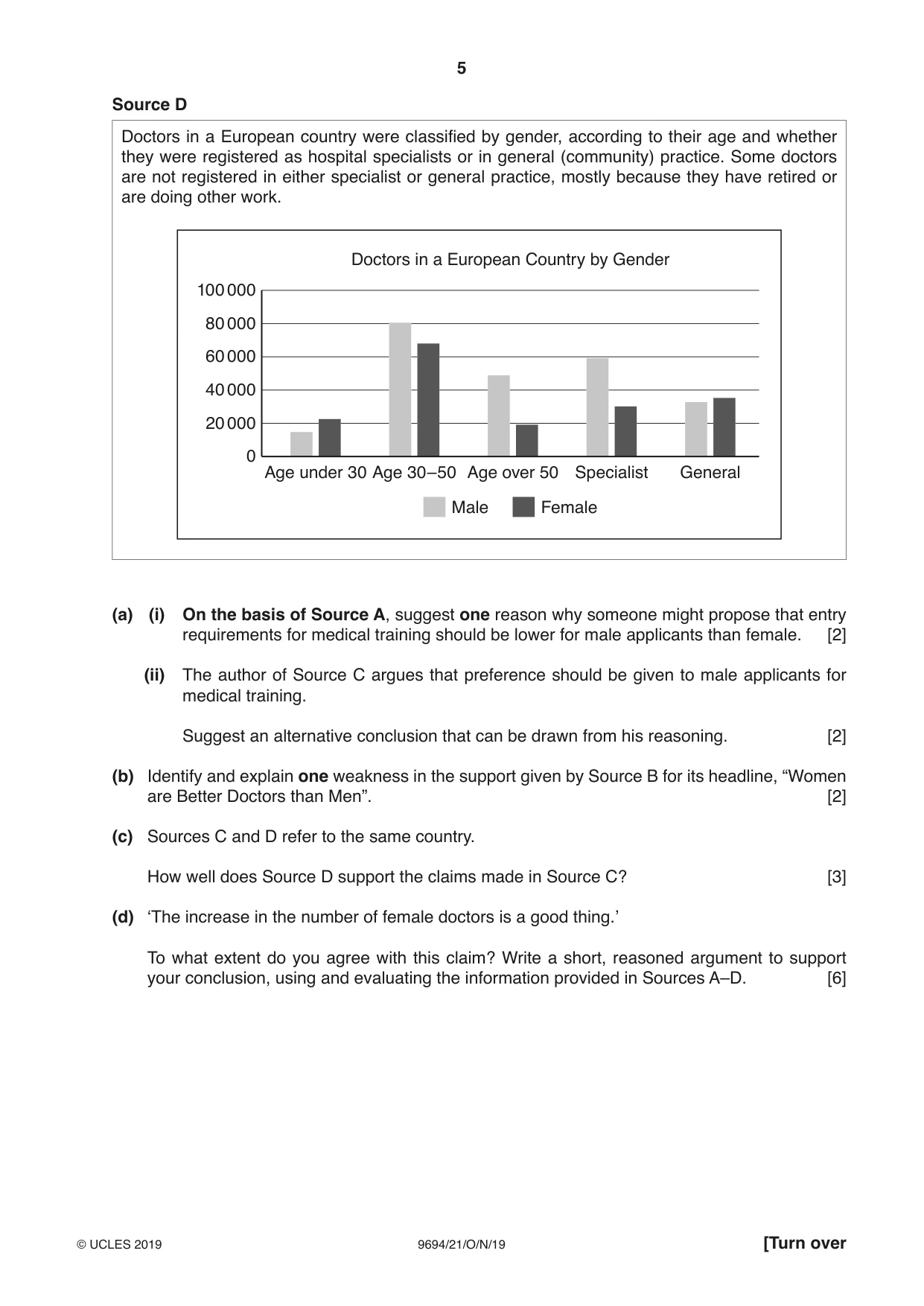
5 9694/21/O/N/19 © UCLES 2019 [Turn over Source D Doctors in a European country were classified by gender, according to their age and whether they were registered as hospital specialists or in general (community) practice. Some doctors are not registered in either specialist or general practice, mostly because they have retired or are doing other work. Doctors in a European Country by Gender Age under 30 0 20 000 40 000 60 000 80 000 100 000 Age 30–50 Age over 50 Specialist General Male Female (a) (i) On the basis of Source A, suggest one reason why someone might propose that entry requirements for medical training should be lower for male applicants than female. [2] (ii) The author of Source C argues that preference should be given to male applicants for medical training. Suggest an alternative conclusion that can be drawn from his reasoning. [2] (b) Identify and explain one weakness in the support given by Source B for its headline, “Women are Better Doctors than Men”. [2] (c) Sources C and D refer to the same country. How well does Source D support the claims made in Source C? [3] (d) ‘The increase in the number of female doctors is a good thing.’ To what extent do you agree with this claim? Write a short, reasoned argument to support your conclusion, using and evaluating the information provided in Sources A–D. [6]
Question paper, page 6
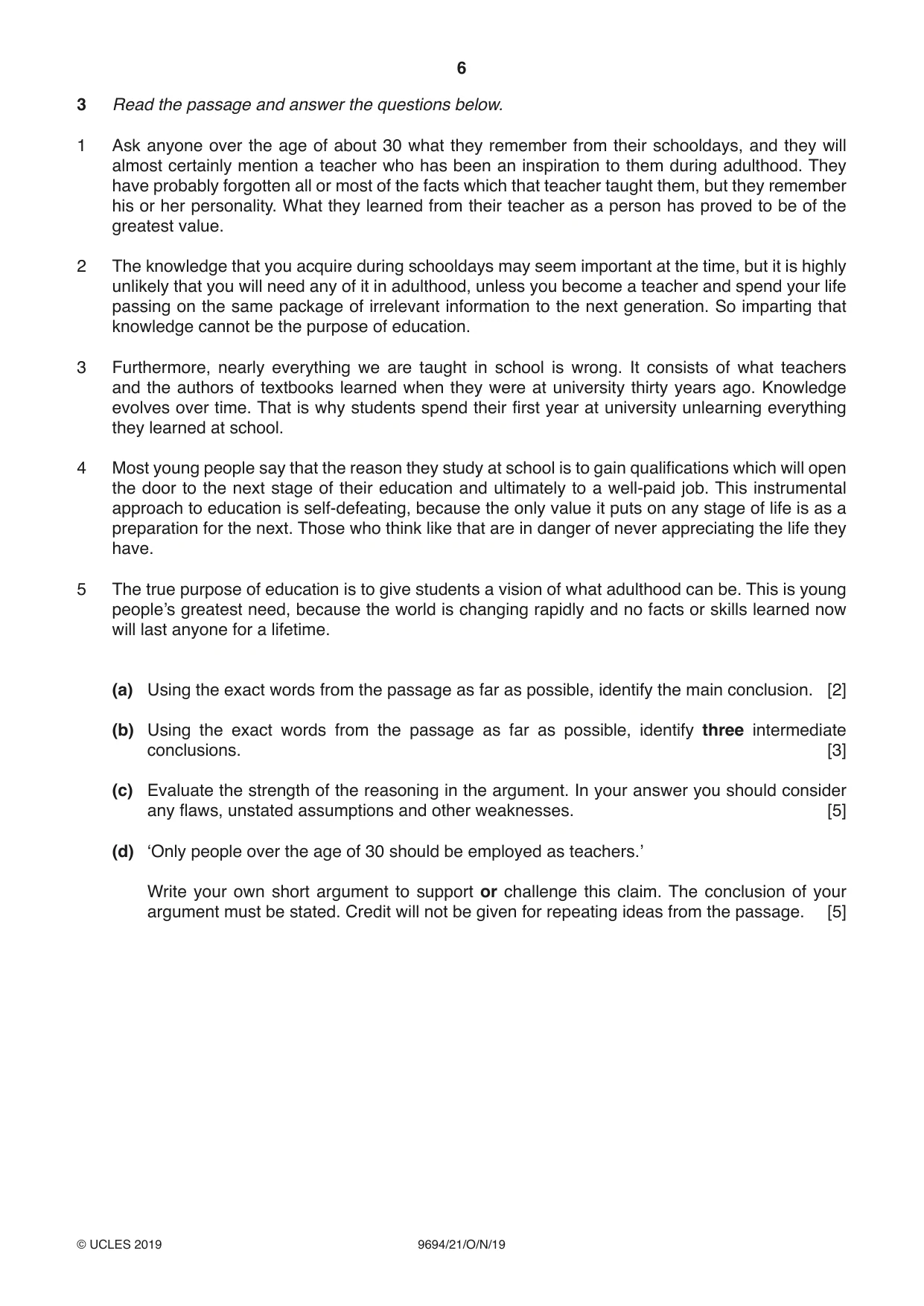
6 9694/21/O/N/19 © UCLES 2019 3 Read the passage and answer the questions below. 1 Ask anyone over the age of about 30 what they remember from their schooldays, and they will almost certainly mention a teacher who has been an inspiration to them during adulthood. They have probably forgotten all or most of the facts which that teacher taught them, but they remember his or her personality. What they learned from their teacher as a person has proved to be of the greatest value. 2 The knowledge that you acquire during schooldays may seem important at the time, but it is highly unlikely that you will need any of it in adulthood, unless you become a teacher and spend your life passing on the same package of irrelevant information to the next generation. So imparting that knowledge cannot be the purpose of education. 3 Furthermore, nearly everything we are taught in school is wrong. It consists of what teachers and the authors of textbooks learned when they were at university thirty years ago. Knowledge evolves over time. That is why students spend their first year at university unlearning everything they learned at school. 4 Most young people say that the reason they study at school is to gain qualifications which will open the door to the next stage of their education and ultimately to a well-paid job. This instrumental approach to education is self-defeating, because the only value it puts on any stage of life is as a preparation for the next. Those who think like that are in danger of never appreciating the life they have. 5 The true purpose of education is to give students a vision of what adulthood can be. This is young people’s greatest need, because the world is changing rapidly and no facts or skills learned now will last anyone for a lifetime. (a) Using the exact words from the passage as far as possible, identify the main conclusion. [2] (b) Using the exact words from the passage as far as possible, identify three intermediate conclusions. [3] (c) Evaluate the strength of the reasoning in the argument. In your answer you should consider any flaws, unstated assumptions and other weaknesses. [5] (d) ‘Only people over the age of 30 should be employed as teachers.’ Write your own short argument to support or challenge this claim. The conclusion of your argument must be stated. Credit will not be given for repeating ideas from the passage. [5]
Question paper, page 7
7 9694/21/O/N/19 © UCLES 2019 BLANK PAGE
Question paper, page 8
8 9694/21/O/N/19 © UCLES 2019 BLANK PAGE Permission to reproduce items where third-party owned material protected by copyright is included has been sought and cleared where possible. Every reasonable effort has been made by the publisher (UCLES) to trace copyright holders, but if any items requiring clearance have unwittingly been included, the publisher will be pleased to make amends at the earliest possible opportunity. To avoid the issue of disclosure of answer-related information to candidates, all copyright acknowledgements are reproduced online in the Cambridge Assessment International Education Copyright Acknowledgements Booklet. This is produced for each series of examinations and is freely available to download at www.cambridgeinternational.org after the live examination series. Cambridge Assessment International Education is part of the Cambridge Assessment Group. Cambridge Assessment is the brand name of the University of Cambridge Local Examinations Syndicate (UCLES), which itself is a department of the University of Cambridge.
Mark scheme, page 1
This document consists of 9 printed pages. © UCLES 2019 [Turn over Cambridge Assessment International Education Cambridge International Advanced Subsidiary and Advanced Level THINKING SKILLS 9694/21 Paper 2 Critical Thinking October/November 2019 MARK SCHEME Maximum Mark: 45 Published This mark scheme is published as an aid to teachers and candidates, to indicate the requirements of the examination. It shows the basis on which Examiners were instructed to award marks. It does not indicate the details of the discussions that took place at an Examiners’ meeting before marking began, which would have considered the acceptability of alternative answers. Mark schemes should be read in conjunction with the question paper and the Principal Examiner Report for Teachers. Cambridge International will not enter into discussions about these mark schemes. Cambridge International is publishing the mark schemes for the October/November 2019 series for most Cambridge IGCSE™, Cambridge International A and AS Level components and some Cambridge O Level components.
Mark scheme, page 2
9694/21 Cambridge International AS/A Level – Mark Scheme PUBLISHED October/November 2019 © UCLES 2019 Page 2 of 9 Generic Marking Principles These general marking principles must be applied by all examiners when marking candidate answers. They should be applied alongside the specific content of the mark scheme or generic level descriptors for a question. Each question paper and mark scheme will also comply with these marking principles. GENERIC MARKING PRINCIPLE 1: Marks must be awarded in line with: • the specific content of the mark scheme or the generic level descriptors for the question • the specific skills defined in the mark scheme or in the generic level descriptors for the question • the standard of response required by a candidate as exemplified by the standardisation scripts. GENERIC MARKING PRINCIPLE 2: Marks awarded are always whole marks (not half marks, or other fractions). GENERIC MARKING PRINCIPLE 3: Marks must be awarded positively: • marks are awarded for correct/valid answers, as defined in the mark scheme. However, credit is given for valid answers which go beyond the scope of the syllabus and mark scheme, referring to your Team Leader as appropriate • marks are awarded when candidates clearly demonstrate what they know and can do • marks are not deducted for errors • marks are not deducted for omissions • answers should only be judged on the quality of spelling, punctuation and grammar when these features are specifically assessed by the question as indicated by the mark scheme. The meaning, however, should be unambiguous. GENERIC MARKING PRINCIPLE 4: Rules must be applied consistently e.g. in situations where candidates have not followed instructions or in the application of generic level descriptors. GENERIC MARKING PRINCIPLE 5: Marks should be awarded using the full range of marks defined in the mark scheme for the question (however; the use of the full mark range may be limited according to the quality of the candidate responses seen). GENERIC MARKING PRINCIPLE 6: Marks awarded are based solely on the requirements as defined in the mark scheme. Marks should not be awarded with grade thresholds or grade descriptors in mind.
Mark scheme, page 3
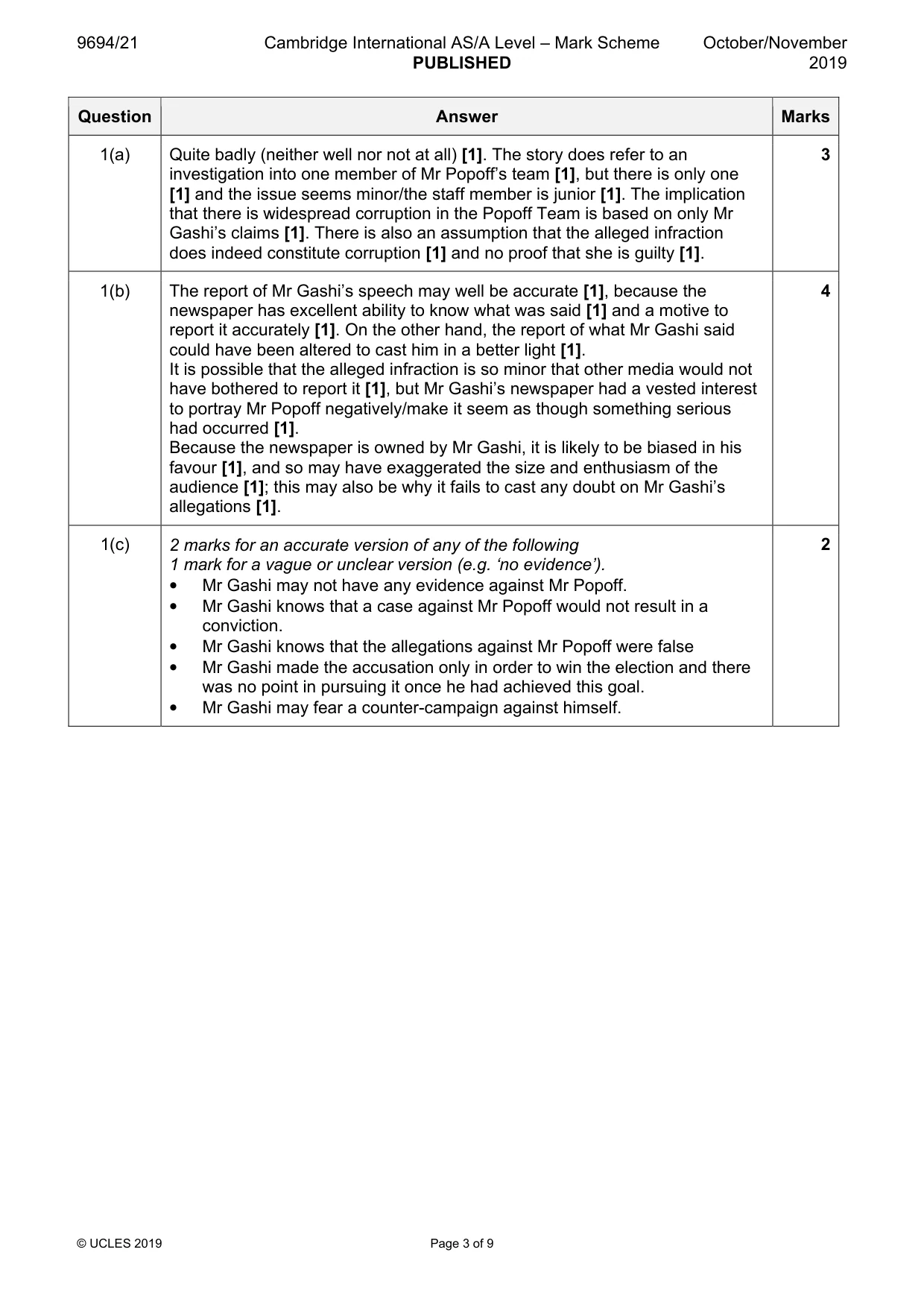
9694/21 Cambridge International AS/A Level – Mark Scheme PUBLISHED October/November 2019 © UCLES 2019 Page 3 of 9 Question Answer Marks 1(a) Quite badly (neither well nor not at all) [1]. The story does refer to an investigation into one member of Mr Popoff’s team [1], but there is only one [1] and the issue seems minor/the staff member is junior [1]. The implication that there is widespread corruption in the Popoff Team is based on only Mr Gashi’s claims [1]. There is also an assumption that the alleged infraction does indeed constitute corruption [1] and no proof that she is guilty [1]. 3 1(b) The report of Mr Gashi’s speech may well be accurate [1], because the newspaper has excellent ability to know what was said [1] and a motive to report it accurately [1]. On the other hand, the report of what Mr Gashi said could have been altered to cast him in a better light [1]. It is possible that the alleged infraction is so minor that other media would not have bothered to report it [1], but Mr Gashi’s newspaper had a vested interest to portray Mr Popoff negatively/make it seem as though something serious had occurred [1]. Because the newspaper is owned by Mr Gashi, it is likely to be biased in his favour [1], and so may have exaggerated the size and enthusiasm of the audience [1]; this may also be why it fails to cast any doubt on Mr Gashi’s allegations [1]. 4 1(c) 2 marks for an accurate version of any of the following 1 mark for a vague or unclear version (e.g. ‘no evidence’). • Mr Gashi may not have any evidence against Mr Popoff. • Mr Gashi knows that a case against Mr Popoff would not result in a conviction. • Mr Gashi knows that the allegations against Mr Popoff were false • Mr Gashi made the accusation only in order to win the election and there was no point in pursuing it once he had achieved this goal. • Mr Gashi may fear a counter-campaign against himself. 2
Mark scheme, page 4
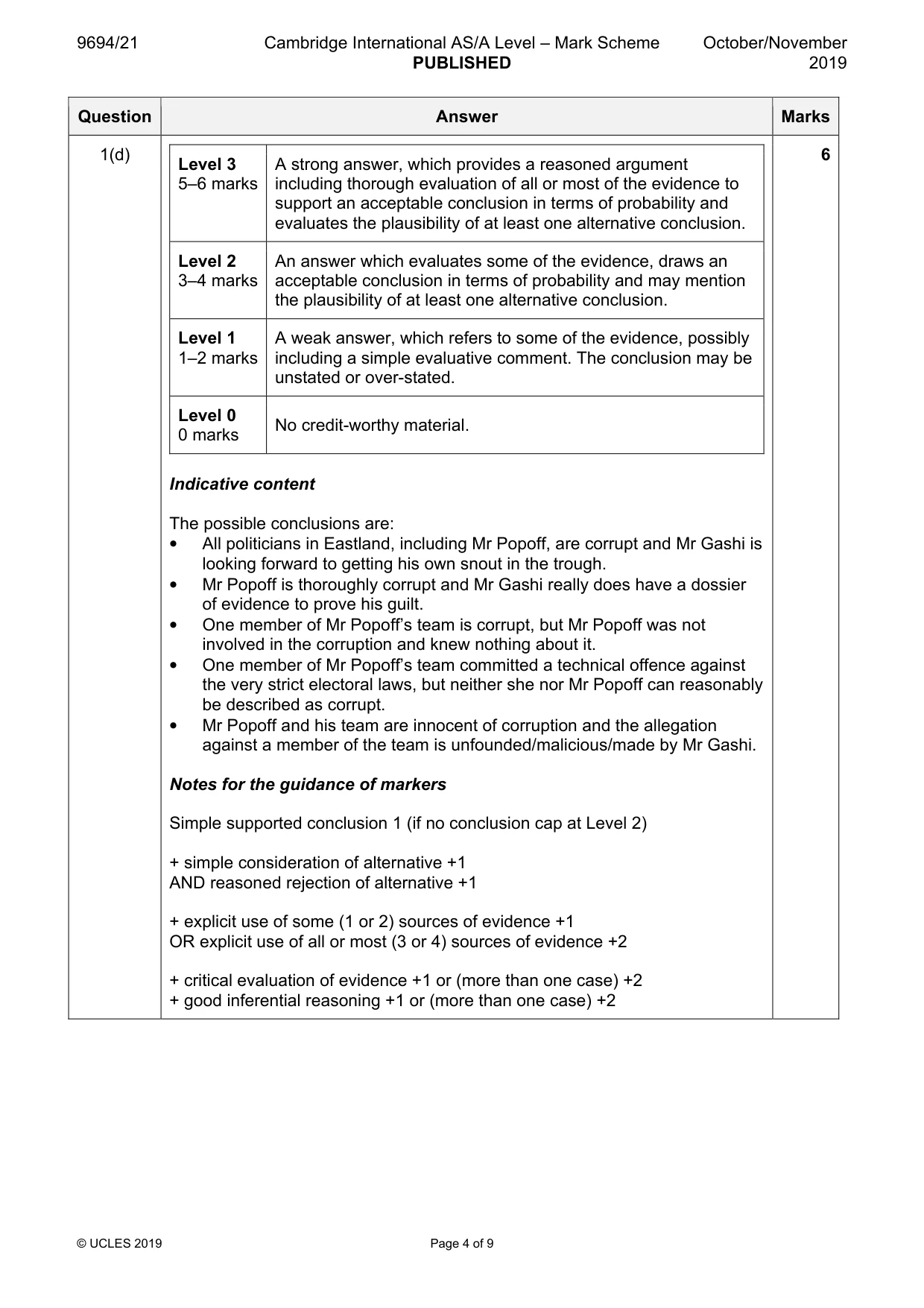
9694/21 Cambridge International AS/A Level – Mark Scheme PUBLISHED October/November 2019 © UCLES 2019 Page 4 of 9 Question Answer Marks 1(d) Level 3 5–6 marks A strong answer, which provides a reasoned argument including thorough evaluation of all or most of the evidence to support an acceptable conclusion in terms of probability and evaluates the plausibility of at least one alternative conclusion. Level 2 3–4 marks An answer which evaluates some of the evidence, draws an acceptable conclusion in terms of probability and may mention the plausibility of at least one alternative conclusion. Level 1 1–2 marks A weak answer, which refers to some of the evidence, possibly including a simple evaluative comment. The conclusion may be unstated or over-stated. Level 0 0 marks No credit-worthy material. Indicative content The possible conclusions are: • All politicians in Eastland, including Mr Popoff, are corrupt and Mr Gashi is looking forward to getting his own snout in the trough. • Mr Popoff is thoroughly corrupt and Mr Gashi really does have a dossier of evidence to prove his guilt. • One member of Mr Popoff’s team is corrupt, but Mr Popoff was not involved in the corruption and knew nothing about it. • One member of Mr Popoff’s team committed a technical offence against the very strict electoral laws, but neither she nor Mr Popoff can reasonably be described as corrupt. • Mr Popoff and his team are innocent of corruption and the allegation against a member of the team is unfounded/malicious/made by Mr Gashi. Notes for the guidance of markers Simple supported conclusion 1 (if no conclusion cap at Level 2) + simple consideration of alternative +1 AND reasoned rejection of alternative +1 + explicit use of some (1 or 2) sources of evidence +1 OR explicit use of all or most (3 or 4) sources of evidence +2 + critical evaluation of evidence +1 or (more than one case) +2 + good inferential reasoning +1 or (more than one case) +2 6
Mark scheme, page 5
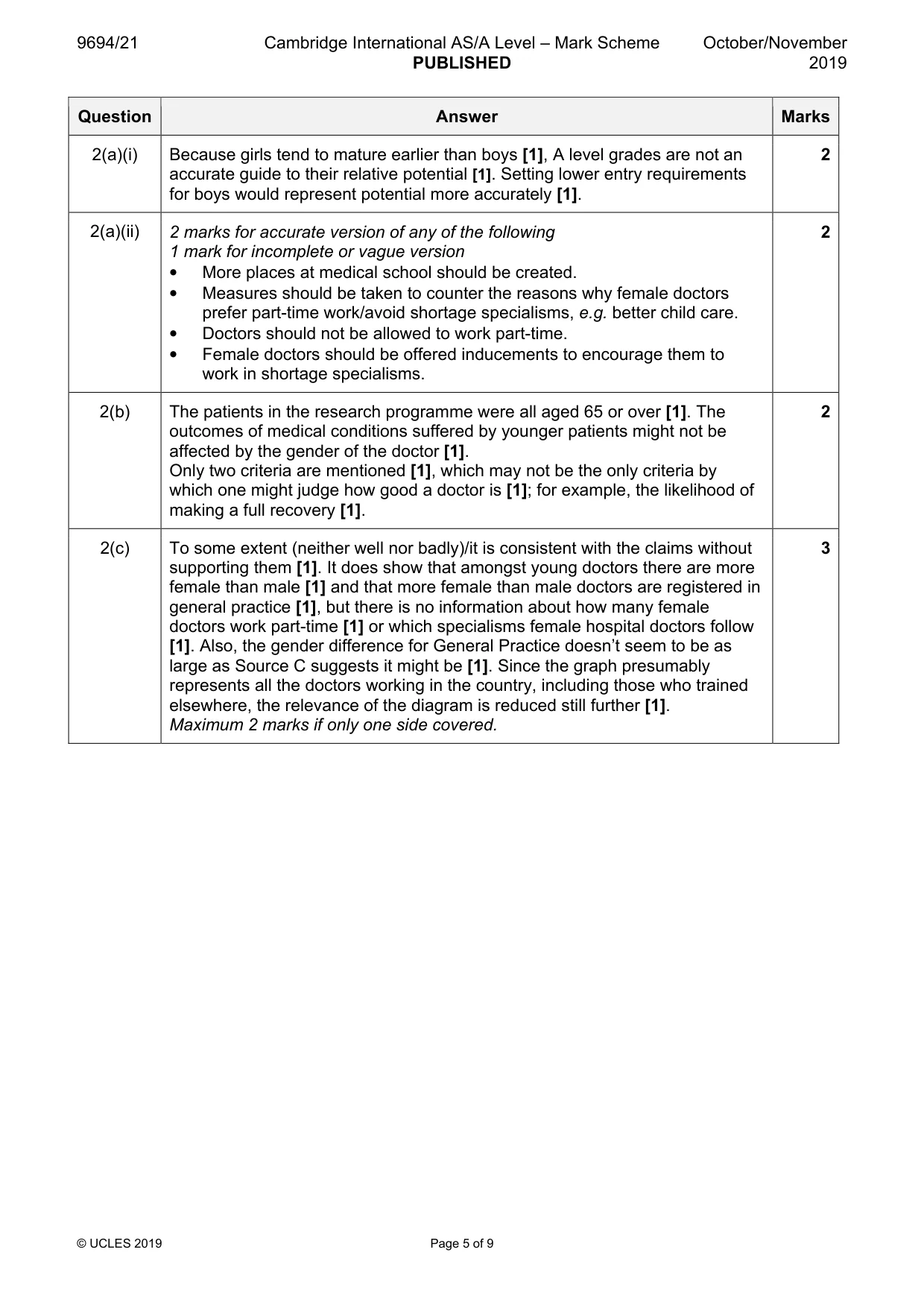
9694/21 Cambridge International AS/A Level – Mark Scheme PUBLISHED October/November 2019 © UCLES 2019 Page 5 of 9 Question Answer Marks 2(a)(i) Because girls tend to mature earlier than boys [1], A level grades are not an accurate guide to their relative potential [1]. Setting lower entry requirements for boys would represent potential more accurately [1]. 2 2(a)(ii) 2 marks for accurate version of any of the following 1 mark for incomplete or vague version • More places at medical school should be created. • Measures should be taken to counter the reasons why female doctors prefer part-time work/avoid shortage specialisms, e.g. better child care. • Doctors should not be allowed to work part-time. • Female doctors should be offered inducements to encourage them to work in shortage specialisms. 2 2(b) The patients in the research programme were all aged 65 or over [1]. The outcomes of medical conditions suffered by younger patients might not be affected by the gender of the doctor [1]. Only two criteria are mentioned [1], which may not be the only criteria by which one might judge how good a doctor is [1]; for example, the likelihood of making a full recovery [1]. 2 2(c) To some extent (neither well nor badly)/it is consistent with the claims without supporting them [1]. It does show that amongst young doctors there are more female than male [1] and that more female than male doctors are registered in general practice [1], but there is no information about how many female doctors work part-time [1] or which specialisms female hospital doctors follow [1]. Also, the gender difference for General Practice doesn’t seem to be as large as Source C suggests it might be [1]. Since the graph presumably represents all the doctors working in the country, including those who trained elsewhere, the relevance of the diagram is reduced still further [1]. Maximum 2 marks if only one side covered. 3
Mark scheme, page 6
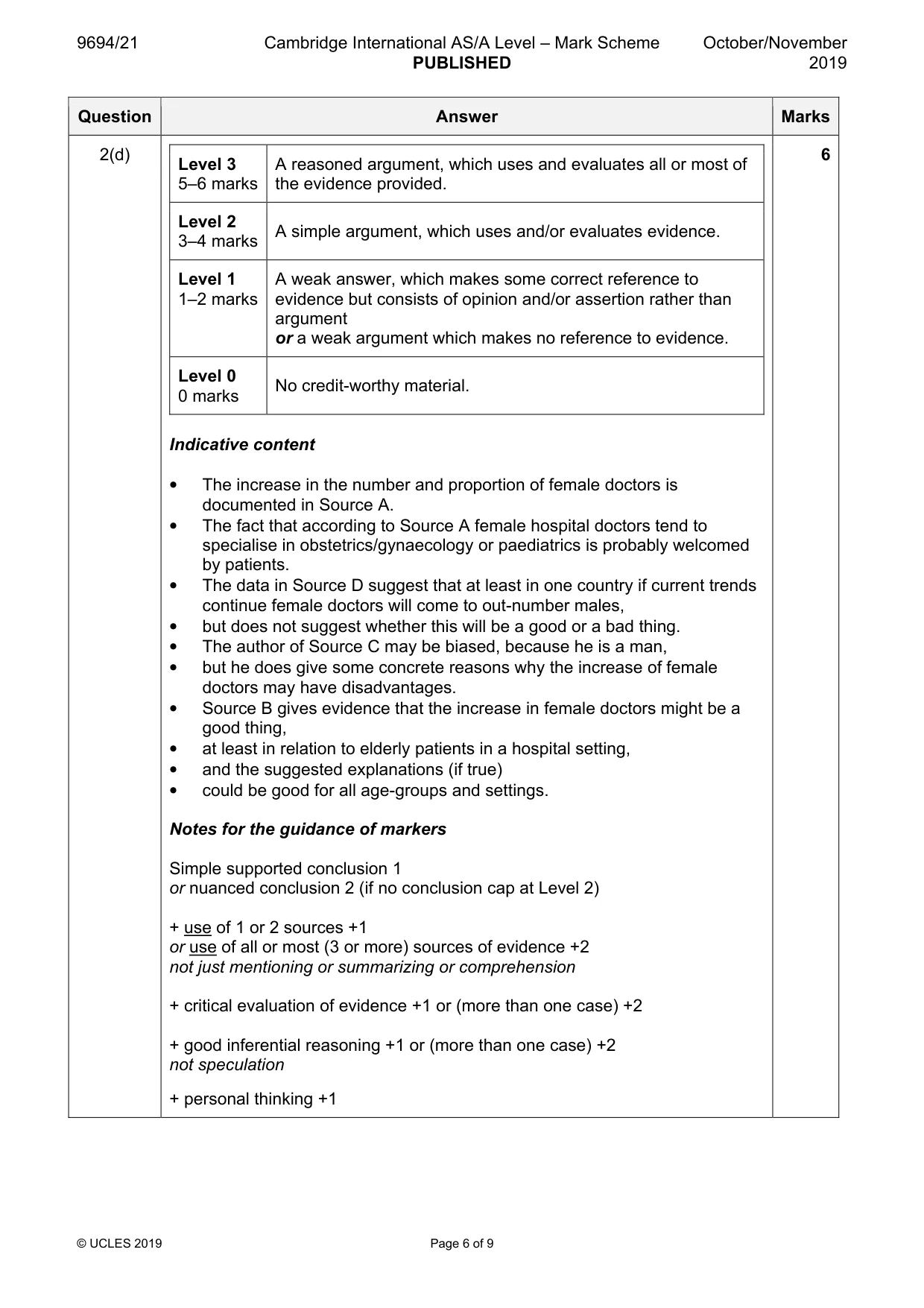
9694/21 Cambridge International AS/A Level – Mark Scheme PUBLISHED October/November 2019 © UCLES 2019 Page 6 of 9 Question Answer Marks 2(d) Level 3 5–6 marks A reasoned argument, which uses and evaluates all or most of the evidence provided. Level 2 3–4 marks A simple argument, which uses and/or evaluates evidence. Level 1 1–2 marks A weak answer, which makes some correct reference to evidence but consists of opinion and/or assertion rather than argument or a weak argument which makes no reference to evidence. Level 0 0 marks No credit-worthy material. Indicative content • The increase in the number and proportion of female doctors is documented in Source A. • The fact that according to Source A female hospital doctors tend to specialise in obstetrics/gynaecology or paediatrics is probably welcomed by patients. • The data in Source D suggest that at least in one country if current trends continue female doctors will come to out-number males, • but does not suggest whether this will be a good or a bad thing. • The author of Source C may be biased, because he is a man, • but he does give some concrete reasons why the increase of female doctors may have disadvantages. • Source B gives evidence that the increase in female doctors might be a good thing, • at least in relation to elderly patients in a hospital setting, • and the suggested explanations (if true) • could be good for all age-groups and settings. Notes for the guidance of markers Simple supported conclusion 1 or nuanced conclusion 2 (if no conclusion cap at Level 2) + use of 1 or 2 sources +1 or use of all or most (3 or more) sources of evidence +2 not just mentioning or summarizing or comprehension + critical evaluation of evidence +1 or (more than one case) +2 + good inferential reasoning +1 or (more than one case) +2 not speculation + personal thinking +1 6
Mark scheme, page 7
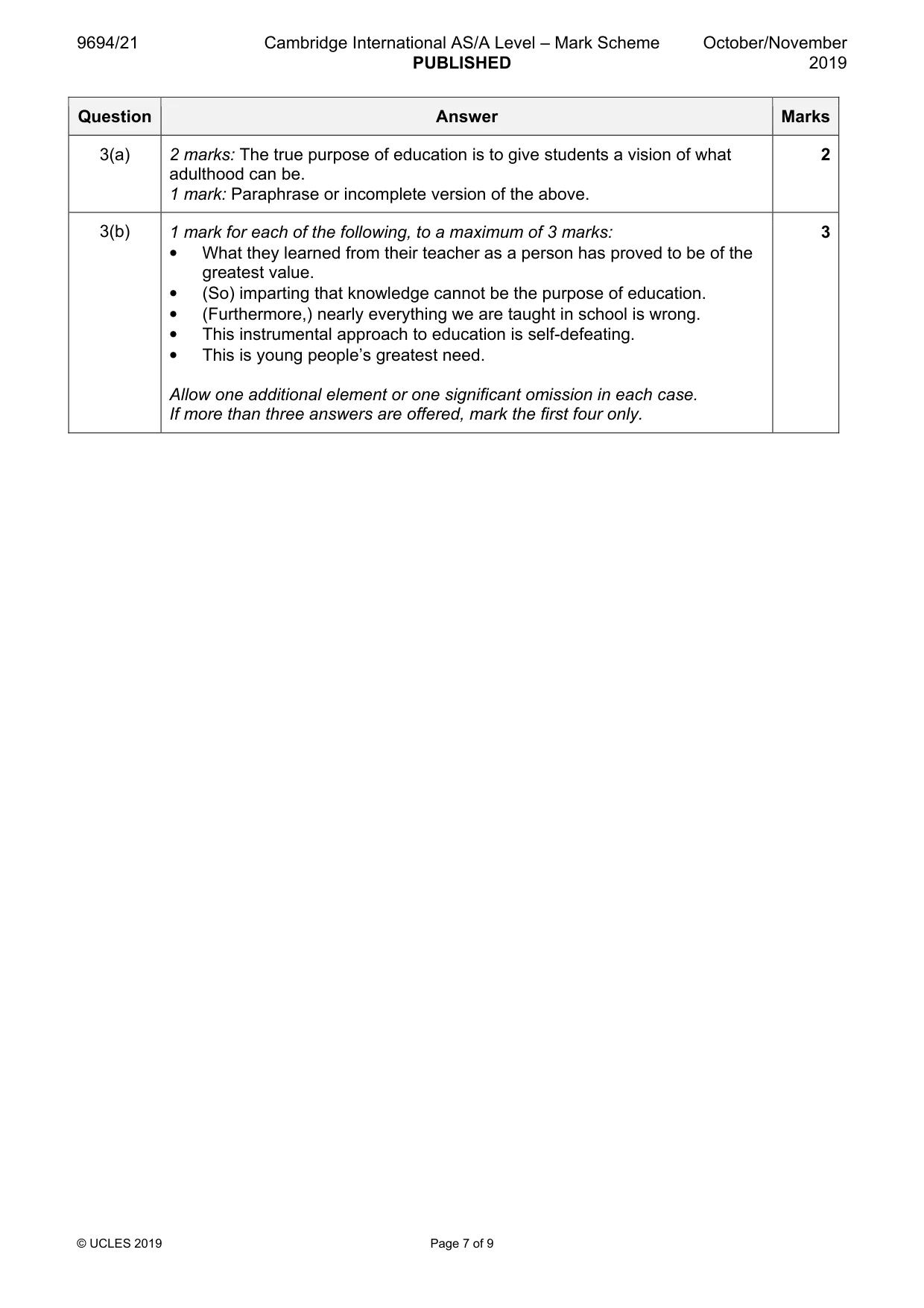
9694/21 Cambridge International AS/A Level – Mark Scheme PUBLISHED October/November 2019 © UCLES 2019 Page 7 of 9 Question Answer Marks 3(a) 2 marks: The true purpose of education is to give students a vision of what adulthood can be. 1 mark: Paraphrase or incomplete version of the above. 2 3(b) 1 mark for each of the following, to a maximum of 3 marks: • What they learned from their teacher as a person has proved to be of the greatest value. • (So) imparting that knowledge cannot be the purpose of education. • (Furthermore,) nearly everything we are taught in school is wrong. • This instrumental approach to education is self-defeating. • This is young people’s greatest need. Allow one additional element or one significant omission in each case. If more than three answers are offered, mark the first four only. 3
Mark scheme, page 8
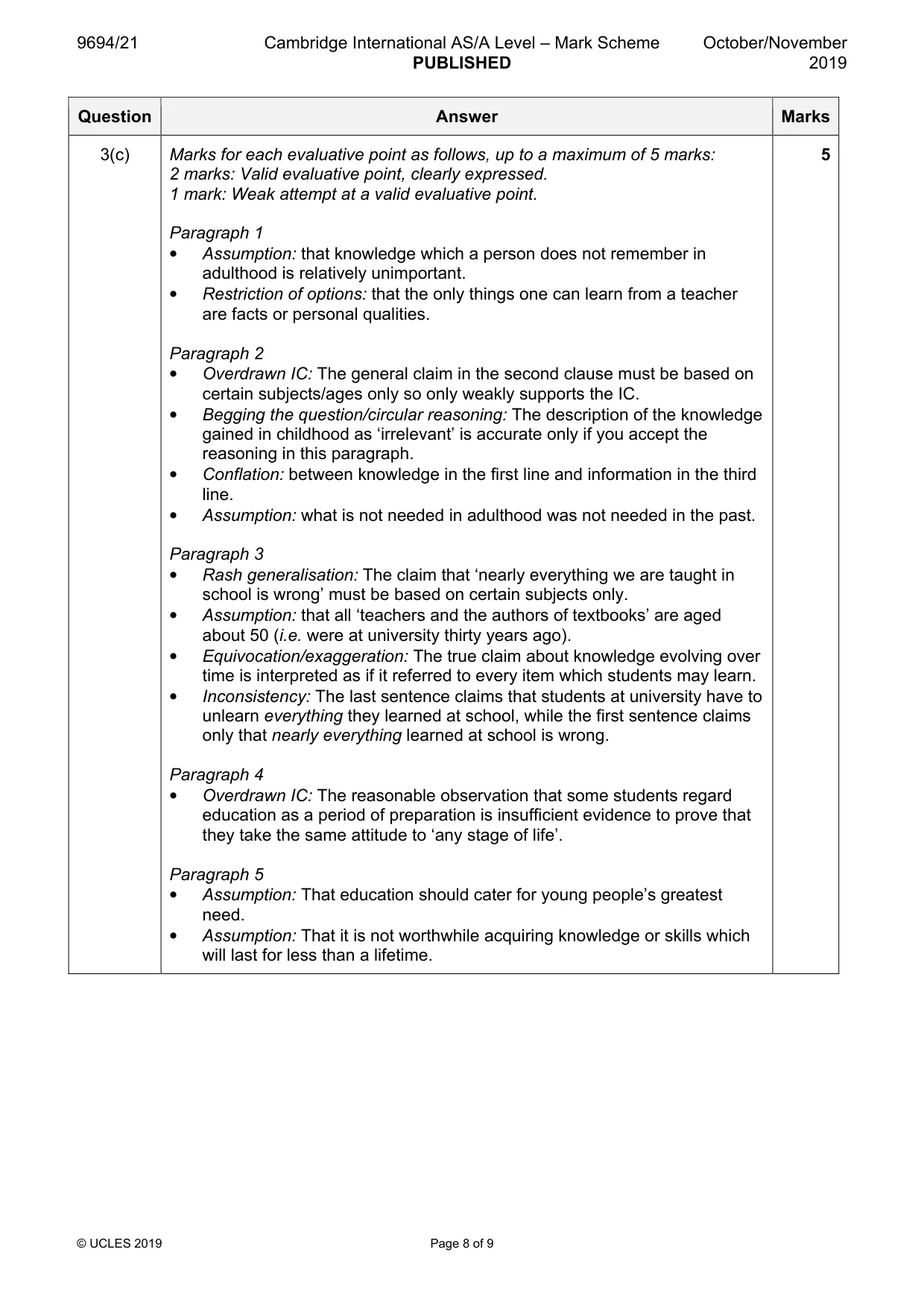
9694/21 Cambridge International AS/A Level – Mark Scheme PUBLISHED October/November 2019 © UCLES 2019 Page 8 of 9 Question Answer Marks 3(c) Marks for each evaluative point as follows, up to a maximum of 5 marks: 2 marks: Valid evaluative point, clearly expressed. 1 mark: Weak attempt at a valid evaluative point. Paragraph 1 • Assumption: that knowledge which a person does not remember in adulthood is relatively unimportant. • Restriction of options: that the only things one can learn from a teacher are facts or personal qualities. Paragraph 2 • Overdrawn IC: The general claim in the second clause must be based on certain subjects/ages only so only weakly supports the IC. • Begging the question/circular reasoning: The description of the knowledge gained in childhood as ‘irrelevant’ is accurate only if you accept the reasoning in this paragraph. • Conflation: between knowledge in the first line and information in the third line. • Assumption: what is not needed in adulthood was not needed in the past. Paragraph 3 • Rash generalisation: The claim that ‘nearly everything we are taught in school is wrong’ must be based on certain subjects only. • Assumption: that all ‘teachers and the authors of textbooks’ are aged about 50 (i.e. were at university thirty years ago). • Equivocation/exaggeration: The true claim about knowledge evolving over time is interpreted as if it referred to every item which students may learn. • Inconsistency: The last sentence claims that students at university have to unlearn everything they learned at school, while the first sentence claims only that nearly everything learned at school is wrong. Paragraph 4 • Overdrawn IC: The reasonable observation that some students regard education as a period of preparation is insufficient evidence to prove that they take the same attitude to ‘any stage of life’. Paragraph 5 • Assumption: That education should cater for young people’s greatest need. • Assumption: That it is not worthwhile acquiring knowledge or skills which will last for less than a lifetime. 5
Mark scheme, page 9
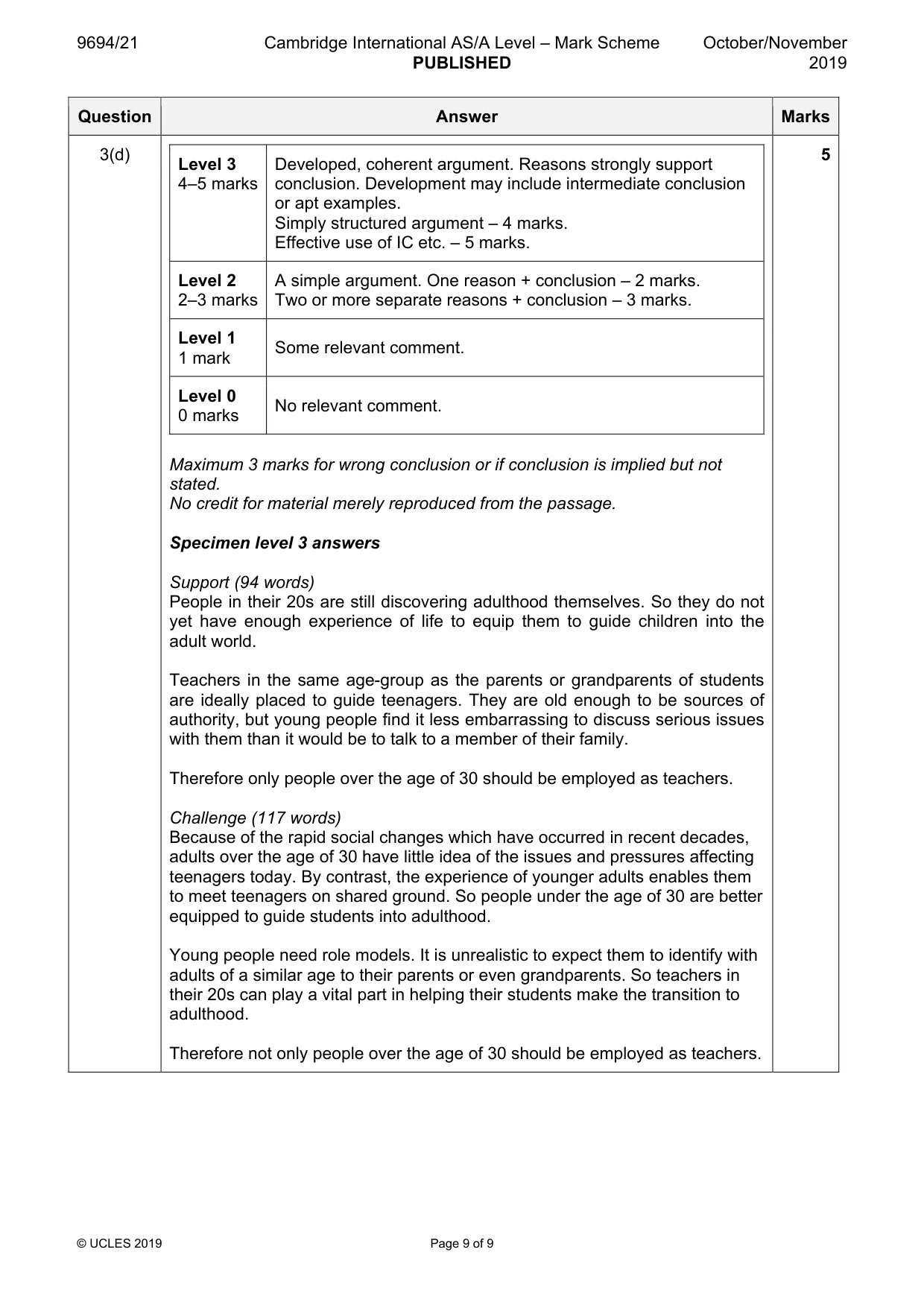
9694/21 Cambridge International AS/A Level – Mark Scheme PUBLISHED October/November 2019 © UCLES 2019 Page 9 of 9 Question Answer Marks 3(d) Level 3 4–5 marks Developed, coherent argument. Reasons strongly support conclusion. Development may include intermediate conclusion or apt examples. Simply structured argument – 4 marks. Effective use of IC etc. – 5 marks. Level 2 2–3 marks A simple argument. One reason + conclusion – 2 marks. Two or more separate reasons + conclusion – 3 marks. Level 1 1 mark Some relevant comment. Level 0 0 marks No relevant comment. Maximum 3 marks for wrong conclusion or if conclusion is implied but not stated. No credit for material merely reproduced from the passage. Specimen level 3 answers Support (94 words) People in their 20s are still discovering adulthood themselves. So they do not yet have enough experience of life to equip them to guide children into the adult world. Teachers in the same age-group as the parents or grandparents of students are ideally placed to guide teenagers. They are old enough to be sources of authority, but young people find it less embarrassing to discuss serious issues with them than it would be to talk to a member of their family. Therefore only people over the age of 30 should be employed as teachers. Challenge (117 words) Because of the rapid social changes which have occurred in recent decades, adults over the age of 30 have little idea of the issues and pressures affecting teenagers today. By contrast, the experience of younger adults enables them to meet teenagers on shared ground. So people under the age of 30 are better equipped to guide students into adulthood. Young people need role models. It is unrealistic to expect them to identify with adults of a similar age to their parents or even grandparents. So teachers in their 20s can play a vital part in helping their students make the transition to adulthood. Therefore not only people over the age of 30 should be employed as teachers. 5
What you needed in this session
Cambridge’s own grade thresholds for 2019 Oct/Nov, Paper 2 · Variant 1. A higher threshold means an easier paper — the bar moves with how the cohort did.