Cambridge A Level Thinking Skills 9694 — 2019 Oct/Nov Paper 2 · Variant 2
9694/22/O/N/19 · 45 marks · ≈51 min
The question paper and its mark scheme, free to read here and free to download. This is Cambridge’s own paper, exactly as it was sat.
Question paper8 pages

Mark scheme11 pages
Answers below. Sit the paper first if you are practising.
Paper as text
Question paper, page 1
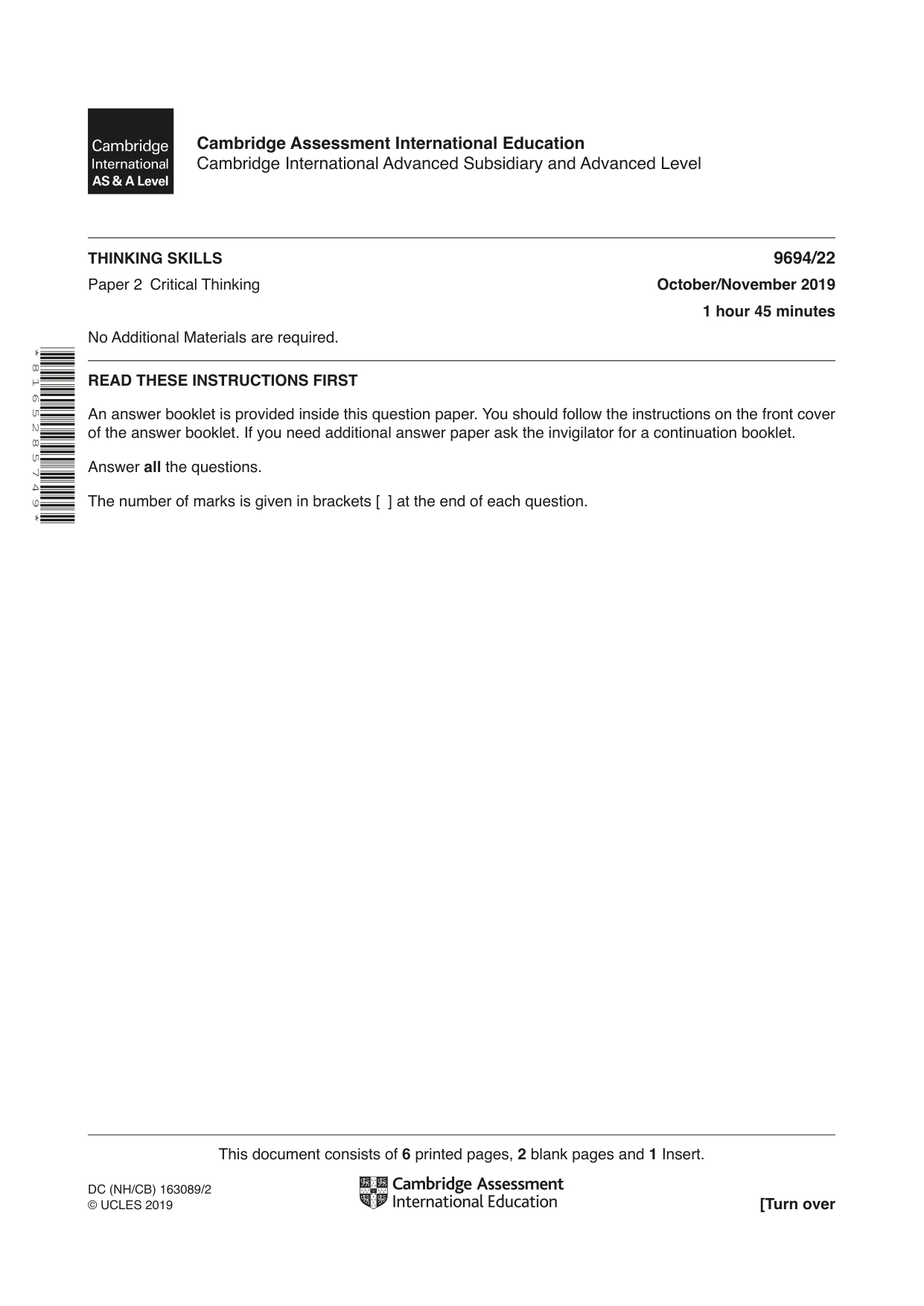
This document consists of 6 printed pages, 2 blank pages and 1 Insert. DC (NH/CB) 163089/2 © UCLES 2019 [Turn over Cambridge Assessment International Education Cambridge International Advanced Subsidiary and Advanced Level * 8 1 6 5 2 8 5 7 4 9 * THINKING SKILLS 9694/22 Paper 2 Critical Thinking October/November 2019 1 hour 45 minutes No Additional Materials are required. READ THESE INSTRUCTIONS FIRST An answer booklet is provided inside this question paper. You should follow the instructions on the front cover of the answer booklet. If you need additional answer paper ask the invigilator for a continuation booklet. Answer all the questions. The number of marks is given in brackets [ ] at the end of each question.
Question paper, page 2
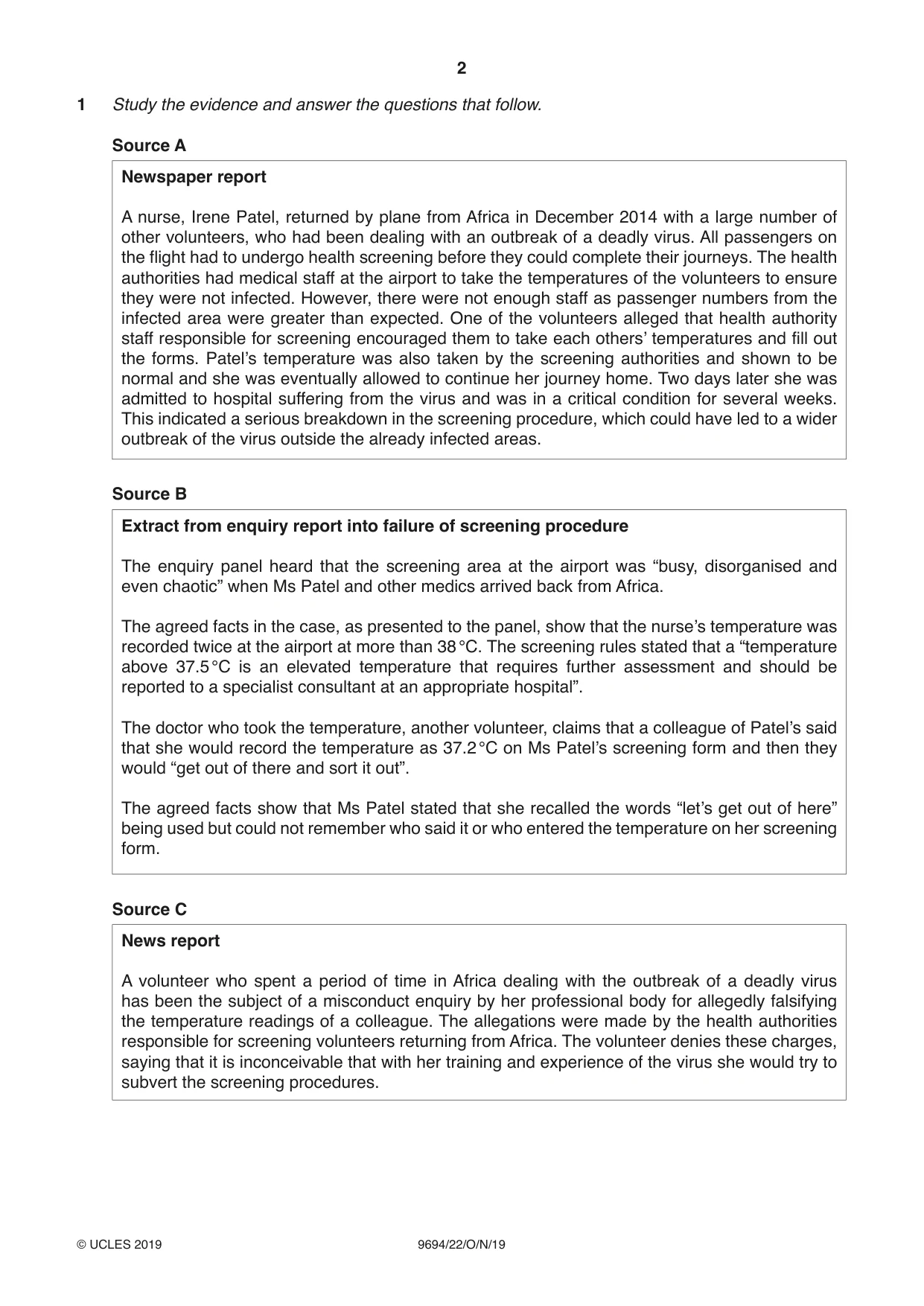
2 9694/22/O/N/19 © UCLES 2019 1 Study the evidence and answer the questions that follow. Source A Newspaper report A nurse, Irene Patel, returned by plane from Africa in December 2014 with a large number of other volunteers, who had been dealing with an outbreak of a deadly virus. All passengers on the flight had to undergo health screening before they could complete their journeys. The health authorities had medical staff at the airport to take the temperatures of the volunteers to ensure they were not infected. However, there were not enough staff as passenger numbers from the infected area were greater than expected. One of the volunteers alleged that health authority staff responsible for screening encouraged them to take each others’ temperatures and fill out the forms. Patel’s temperature was also taken by the screening authorities and shown to be normal and she was eventually allowed to continue her journey home. Two days later she was admitted to hospital suffering from the virus and was in a critical condition for several weeks. This indicated a serious breakdown in the screening procedure, which could have led to a wider outbreak of the virus outside the already infected areas. Source B Extract from enquiry report into failure of screening procedure The enquiry panel heard that the screening area at the airport was “busy, disorganised and even chaotic” when Ms Patel and other medics arrived back from Africa. The agreed facts in the case, as presented to the panel, show that the nurse’s temperature was recorded twice at the airport at more than 38 °C. The screening rules stated that a “temperature above 37.5 °C is an elevated temperature that requires further assessment and should be reported to a specialist consultant at an appropriate hospital”. The doctor who took the temperature, another volunteer, claims that a colleague of Patel’s said that she would record the temperature as 37.2 °C on Ms Patel’s screening form and then they would “get out of there and sort it out”. The agreed facts show that Ms Patel stated that she recalled the words “let’s get out of here” being used but could not remember who said it or who entered the temperature on her screening form. Source C News report A volunteer who spent a period of time in Africa dealing with the outbreak of a deadly virus has been the subject of a misconduct enquiry by her professional body for allegedly falsifying the temperature readings of a colleague. The allegations were made by the health authorities responsible for screening volunteers returning from Africa. The volunteer denies these charges, saying that it is inconceivable that with her training and experience of the virus she would try to subvert the screening procedures.
Question paper, page 3
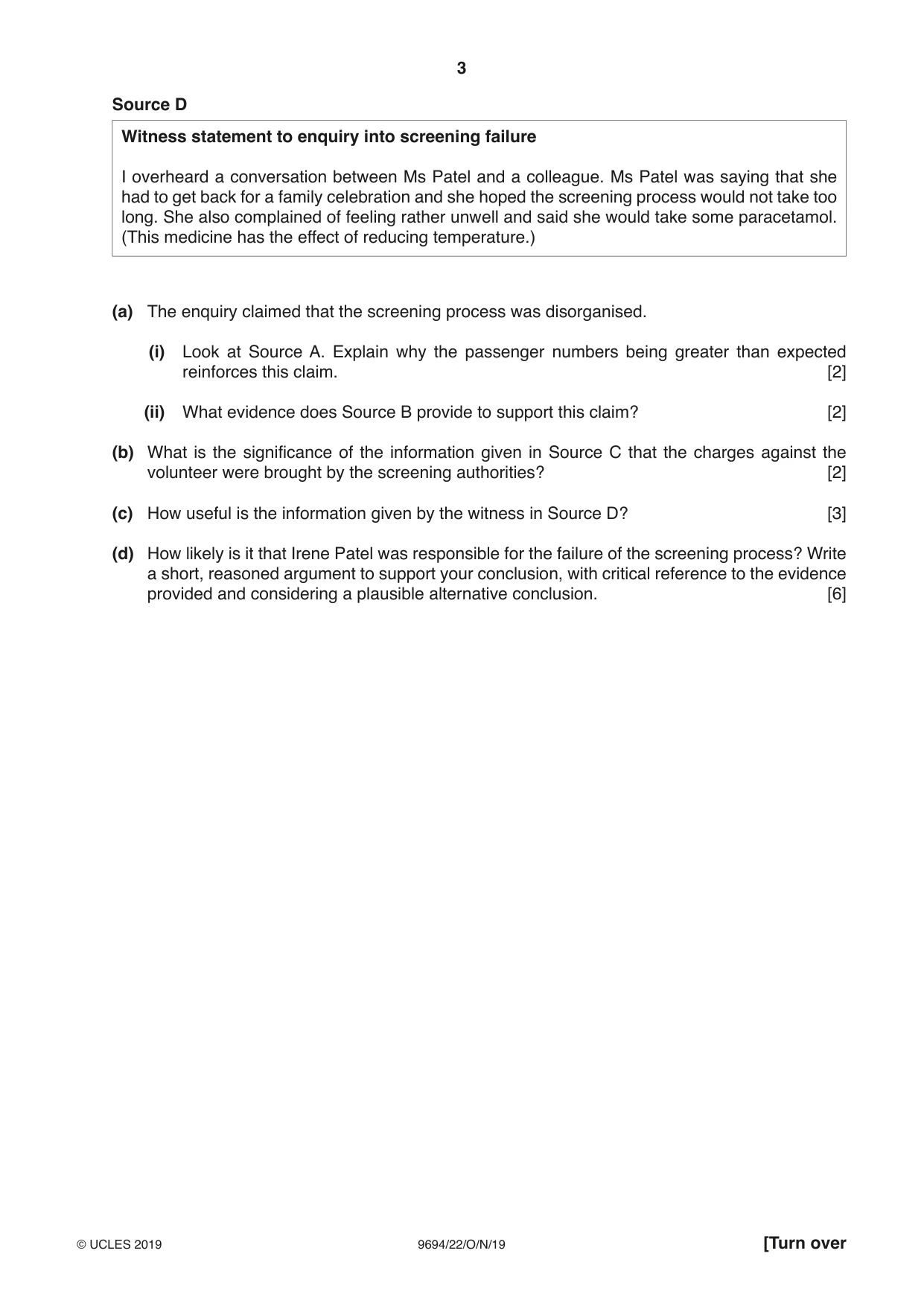
3 9694/22/O/N/19 © UCLES 2019 [Turn over Source D Witness statement to enquiry into screening failure I overheard a conversation between Ms Patel and a colleague. Ms Patel was saying that she had to get back for a family celebration and she hoped the screening process would not take too long. She also complained of feeling rather unwell and said she would take some paracetamol. (This medicine has the effect of reducing temperature.) (a) The enquiry claimed that the screening process was disorganised. (i) Look at Source A. Explain why the passenger numbers being greater than expected reinforces this claim. [2] (ii) What evidence does Source B provide to support this claim? [2] (b) What is the significance of the information given in Source C that the charges against the volunteer were brought by the screening authorities? [2] (c) How useful is the information given by the witness in Source D? [3] (d) How likely is it that Irene Patel was responsible for the failure of the screening process? Write a short, reasoned argument to support your conclusion, with critical reference to the evidence provided and considering a plausible alternative conclusion. [6]
Question paper, page 4
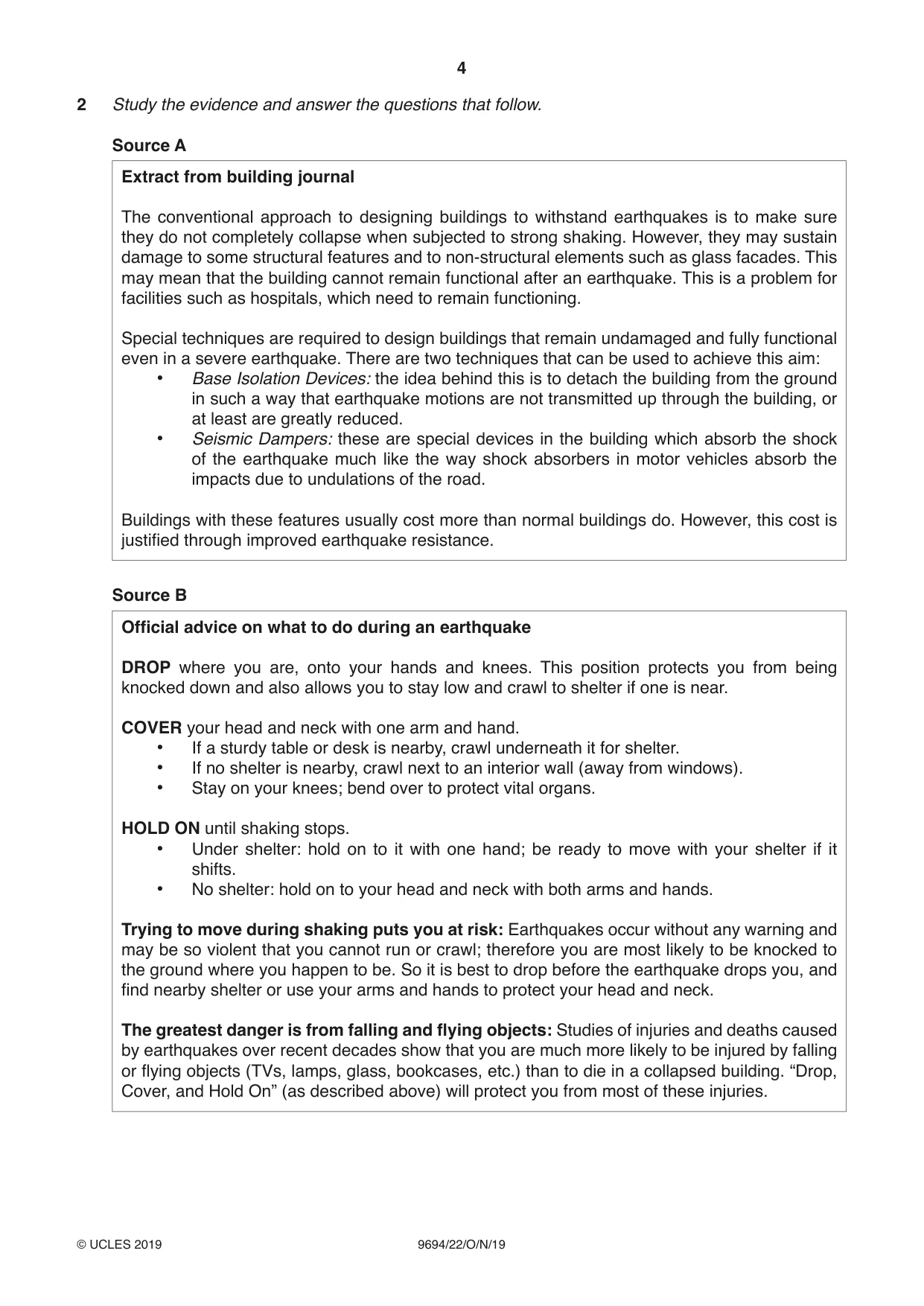
4 9694/22/O/N/19 © UCLES 2019 2 Study the evidence and answer the questions that follow. Source A Extract from building journal The conventional approach to designing buildings to withstand earthquakes is to make sure they do not completely collapse when subjected to strong shaking. However, they may sustain damage to some structural features and to non-structural elements such as glass facades. This may mean that the building cannot remain functional after an earthquake. This is a problem for facilities such as hospitals, which need to remain functioning. Special techniques are required to design buildings that remain undamaged and fully functional even in a severe earthquake. There are two techniques that can be used to achieve this aim: • Base Isolation Devices: the idea behind this is to detach the building from the ground in such a way that earthquake motions are not transmitted up through the building, or at least are greatly reduced. • Seismic Dampers: these are special devices in the building which absorb the shock of the earthquake much like the way shock absorbers in motor vehicles absorb the impacts due to undulations of the road. Buildings with these features usually cost more than normal buildings do. However, this cost is justified through improved earthquake resistance. Source B Official advice on what to do during an earthquake DROP where you are, onto your hands and knees. This position protects you from being knocked down and also allows you to stay low and crawl to shelter if one is near. COVER your head and neck with one arm and hand. • If a sturdy table or desk is nearby, crawl underneath it for shelter. • If no shelter is nearby, crawl next to an interior wall (away from windows). • Stay on your knees; bend over to protect vital organs. HOLD ON until shaking stops. • Under shelter: hold on to it with one hand; be ready to move with your shelter if it shifts. • No shelter: hold on to your head and neck with both arms and hands. Trying to move during shaking puts you at risk: Earthquakes occur without any warning and may be so violent that you cannot run or crawl; therefore you are most likely to be knocked to the ground where you happen to be. So it is best to drop before the earthquake drops you, and find nearby shelter or use your arms and hands to protect your head and neck. The greatest danger is from falling and flying objects: Studies of injuries and deaths caused by earthquakes over recent decades show that you are much more likely to be injured by falling or flying objects (TVs, lamps, glass, bookcases, etc.) than to die in a collapsed building. “Drop, Cover, and Hold On” (as described above) will protect you from most of these injuries.
Question paper, page 5
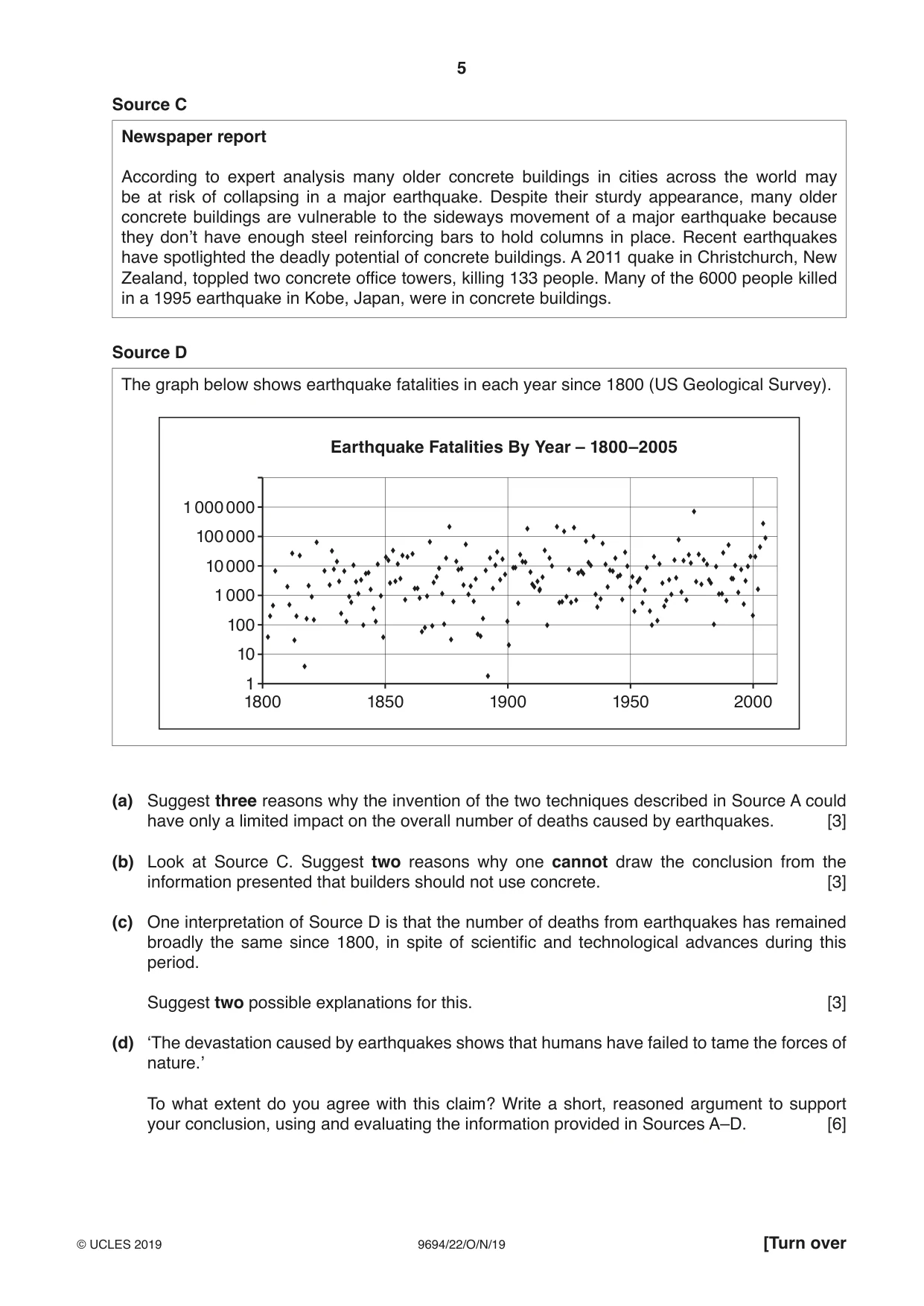
5 9694/22/O/N/19 © UCLES 2019 [Turn over Source C Newspaper report According to expert analysis many older concrete buildings in cities across the world may be at risk of collapsing in a major earthquake. Despite their sturdy appearance, many older concrete buildings are vulnerable to the sideways movement of a major earthquake because they don’t have enough steel reinforcing bars to hold columns in place. Recent earthquakes have spotlighted the deadly potential of concrete buildings. A 2011 quake in Christchurch, New Zealand, toppled two concrete office towers, killing 133 people. Many of the 6000 people killed in a 1995 earthquake in Kobe, Japan, were in concrete buildings. Source D The graph below shows earthquake fatalities in each year since 1800 (US Geological Survey). 1 10 1800 1850 1900 1950 2000 100 1 000 10 000 100 000 1 000 000 Earthquake Fatalities By Year – 1800–2005 (a) Suggest three reasons why the invention of the two techniques described in Source A could have only a limited impact on the overall number of deaths caused by earthquakes. [3] (b) Look at Source C. Suggest two reasons why one cannot draw the conclusion from the information presented that builders should not use concrete. [3] (c) One interpretation of Source D is that the number of deaths from earthquakes has remained broadly the same since 1800, in spite of scientific and technological advances during this period. Suggest two possible explanations for this. [3] (d) ‘The devastation caused by earthquakes shows that humans have failed to tame the forces of nature.’ To what extent do you agree with this claim? Write a short, reasoned argument to support your conclusion, using and evaluating the information provided in Sources A–D. [6]
Question paper, page 6
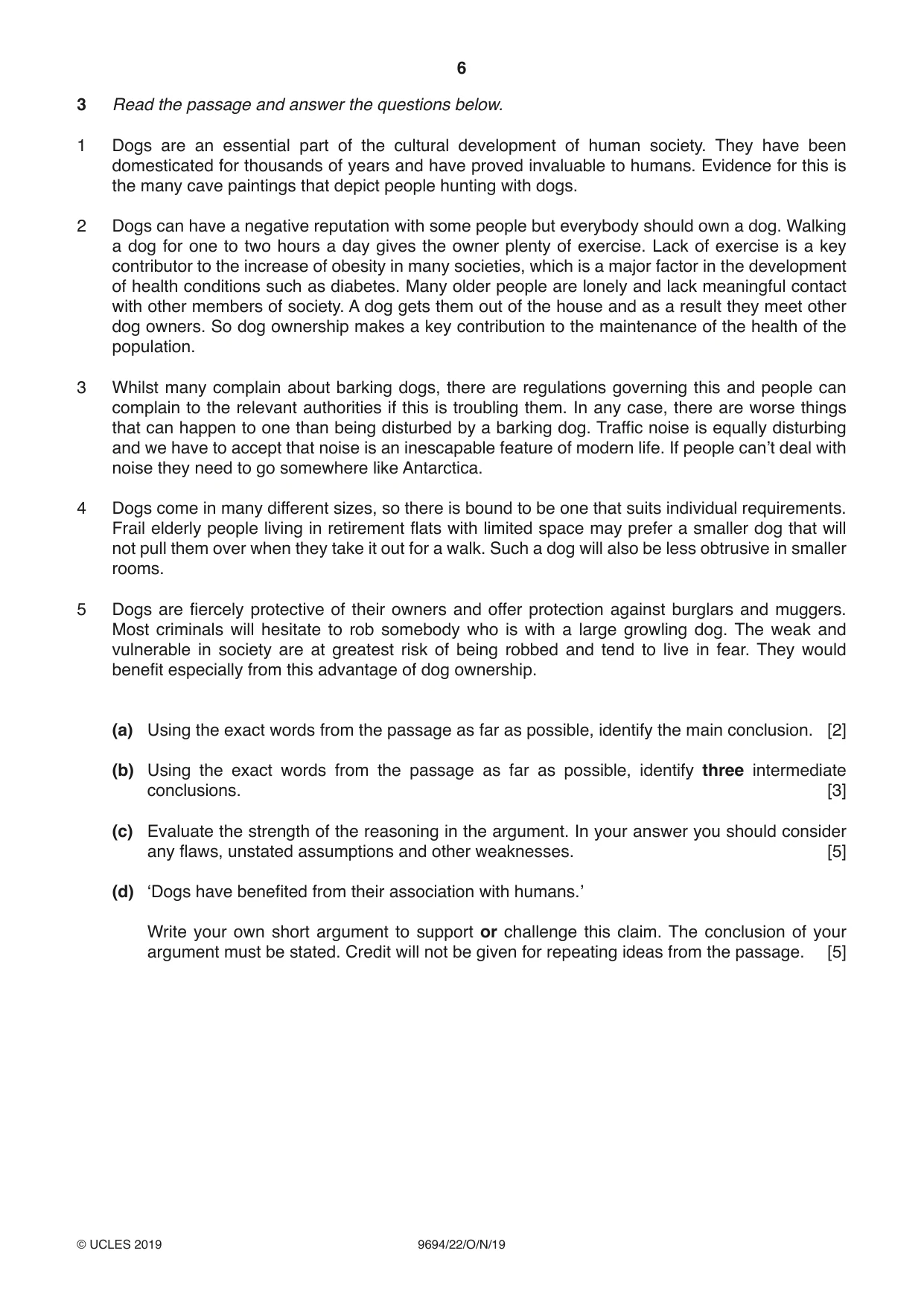
6 9694/22/O/N/19 © UCLES 2019 3 Read the passage and answer the questions below. 1 Dogs are an essential part of the cultural development of human society. They have been domesticated for thousands of years and have proved invaluable to humans. Evidence for this is the many cave paintings that depict people hunting with dogs. 2 Dogs can have a negative reputation with some people but everybody should own a dog. Walking a dog for one to two hours a day gives the owner plenty of exercise. Lack of exercise is a key contributor to the increase of obesity in many societies, which is a major factor in the development of health conditions such as diabetes. Many older people are lonely and lack meaningful contact with other members of society. A dog gets them out of the house and as a result they meet other dog owners. So dog ownership makes a key contribution to the maintenance of the health of the population. 3 Whilst many complain about barking dogs, there are regulations governing this and people can complain to the relevant authorities if this is troubling them. In any case, there are worse things that can happen to one than being disturbed by a barking dog. Traffic noise is equally disturbing and we have to accept that noise is an inescapable feature of modern life. If people can’t deal with noise they need to go somewhere like Antarctica. 4 Dogs come in many different sizes, so there is bound to be one that suits individual requirements. Frail elderly people living in retirement flats with limited space may prefer a smaller dog that will not pull them over when they take it out for a walk. Such a dog will also be less obtrusive in smaller rooms. 5 Dogs are fiercely protective of their owners and offer protection against burglars and muggers. Most criminals will hesitate to rob somebody who is with a large growling dog. The weak and vulnerable in society are at greatest risk of being robbed and tend to live in fear. They would benefit especially from this advantage of dog ownership. (a) Using the exact words from the passage as far as possible, identify the main conclusion. [2] (b) Using the exact words from the passage as far as possible, identify three intermediate conclusions. [3] (c) Evaluate the strength of the reasoning in the argument. In your answer you should consider any flaws, unstated assumptions and other weaknesses. [5] (d) ‘Dogs have benefited from their association with humans.’ Write your own short argument to support or challenge this claim. The conclusion of your argument must be stated. Credit will not be given for repeating ideas from the passage. [5]
Question paper, page 7
7 9694/22/O/N/19 © UCLES 2019 BLANK PAGE
Question paper, page 8
8 9694/22/O/N/19 © UCLES 2019 BLANK PAGE Permission to reproduce items where third-party owned material protected by copyright is included has been sought and cleared where possible. Every reasonable effort has been made by the publisher (UCLES) to trace copyright holders, but if any items requiring clearance have unwittingly been included, the publisher will be pleased to make amends at the earliest possible opportunity. To avoid the issue of disclosure of answer-related information to candidates, all copyright acknowledgements are reproduced online in the Cambridge Assessment International Education Copyright Acknowledgements Booklet. This is produced for each series of examinations and is freely available to download at www.cambridgeinternational.org after the live examination series. Cambridge Assessment International Education is part of the Cambridge Assessment Group. Cambridge Assessment is the brand name of the University of Cambridge Local Examinations Syndicate (UCLES), which itself is a department of the University of Cambridge.
Mark scheme, page 1
This document consists of 11 printed pages. © UCLES 2019 [Turn over Cambridge Assessment International Education Cambridge International Advanced Subsidiary and Advanced Level THINKING SKILLS 9694/22 Paper 2 Critical Thinking October/November 2019 MARK SCHEME Maximum Mark: 45 Published This mark scheme is published as an aid to teachers and candidates, to indicate the requirements of the examination. It shows the basis on which Examiners were instructed to award marks. It does not indicate the details of the discussions that took place at an Examiners’ meeting before marking began, which would have considered the acceptability of alternative answers. Mark schemes should be read in conjunction with the question paper and the Principal Examiner Report for Teachers. Cambridge International will not enter into discussions about these mark schemes. Cambridge International is publishing the mark schemes for the October/November 2019 series for most Cambridge IGCSE™, Cambridge International A and AS Level components and some Cambridge O Level components.
Mark scheme, page 2
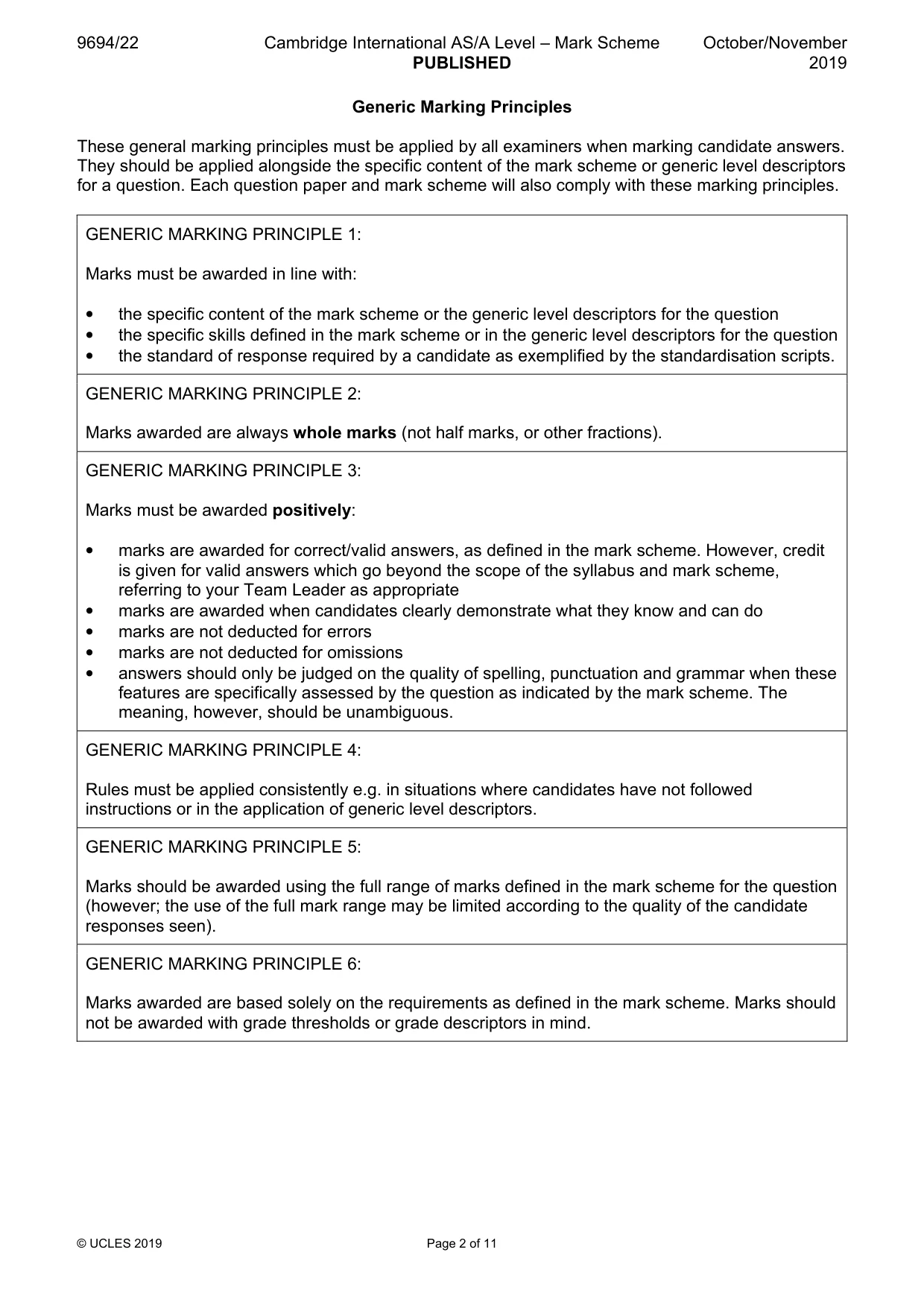
9694/22 Cambridge International AS/A Level – Mark Scheme PUBLISHED October/November 2019 © UCLES 2019 Page 2 of 11 Generic Marking Principles These general marking principles must be applied by all examiners when marking candidate answers. They should be applied alongside the specific content of the mark scheme or generic level descriptors for a question. Each question paper and mark scheme will also comply with these marking principles. GENERIC MARKING PRINCIPLE 1: Marks must be awarded in line with: • the specific content of the mark scheme or the generic level descriptors for the question • the specific skills defined in the mark scheme or in the generic level descriptors for the question • the standard of response required by a candidate as exemplified by the standardisation scripts. GENERIC MARKING PRINCIPLE 2: Marks awarded are always whole marks (not half marks, or other fractions). GENERIC MARKING PRINCIPLE 3: Marks must be awarded positively: • marks are awarded for correct/valid answers, as defined in the mark scheme. However, credit is given for valid answers which go beyond the scope of the syllabus and mark scheme, referring to your Team Leader as appropriate • marks are awarded when candidates clearly demonstrate what they know and can do • marks are not deducted for errors • marks are not deducted for omissions • answers should only be judged on the quality of spelling, punctuation and grammar when these features are specifically assessed by the question as indicated by the mark scheme. The meaning, however, should be unambiguous. GENERIC MARKING PRINCIPLE 4: Rules must be applied consistently e.g. in situations where candidates have not followed instructions or in the application of generic level descriptors. GENERIC MARKING PRINCIPLE 5: Marks should be awarded using the full range of marks defined in the mark scheme for the question (however; the use of the full mark range may be limited according to the quality of the candidate responses seen). GENERIC MARKING PRINCIPLE 6: Marks awarded are based solely on the requirements as defined in the mark scheme. Marks should not be awarded with grade thresholds or grade descriptors in mind.
Mark scheme, page 3
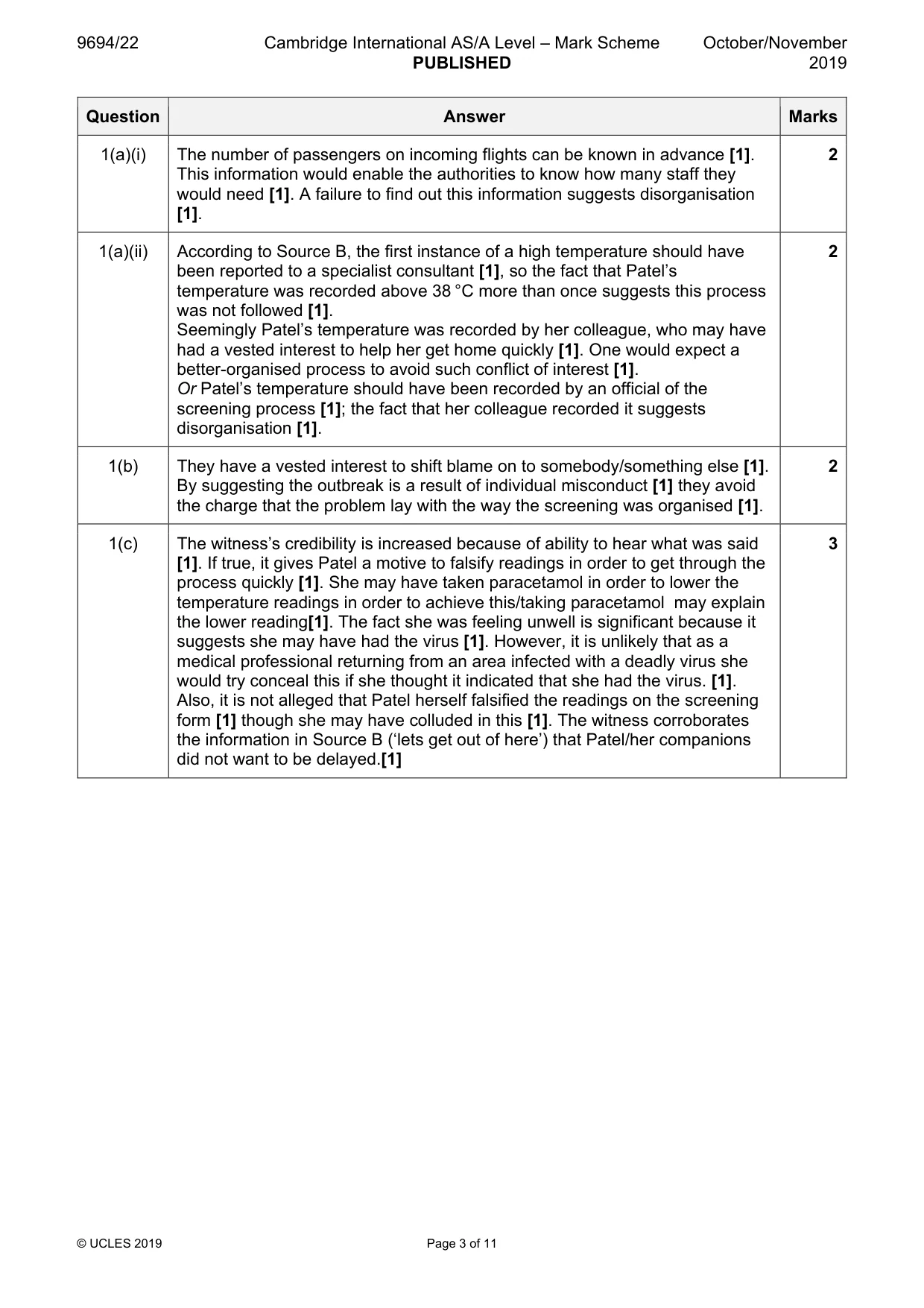
9694/22 Cambridge International AS/A Level – Mark Scheme PUBLISHED October/November 2019 © UCLES 2019 Page 3 of 11 Question Answer Marks 1(a)(i) The number of passengers on incoming flights can be known in advance [1]. This information would enable the authorities to know how many staff they would need [1]. A failure to find out this information suggests disorganisation [1]. 2 1(a)(ii) According to Source B, the first instance of a high temperature should have been reported to a specialist consultant [1], so the fact that Patel’s temperature was recorded above 38 °C more than once suggests this process was not followed [1]. Seemingly Patel’s temperature was recorded by her colleague, who may have had a vested interest to help her get home quickly [1]. One would expect a better-organised process to avoid such conflict of interest [1]. Or Patel’s temperature should have been recorded by an official of the screening process [1]; the fact that her colleague recorded it suggests disorganisation [1]. 2 1(b) They have a vested interest to shift blame on to somebody/something else [1]. By suggesting the outbreak is a result of individual misconduct [1] they avoid the charge that the problem lay with the way the screening was organised [1]. 2 1(c) The witness’s credibility is increased because of ability to hear what was said [1]. If true, it gives Patel a motive to falsify readings in order to get through the process quickly [1]. She may have taken paracetamol in order to lower the temperature readings in order to achieve this/taking paracetamol may explain the lower reading[1]. The fact she was feeling unwell is significant because it suggests she may have had the virus [1]. However, it is unlikely that as a medical professional returning from an area infected with a deadly virus she would try conceal this if she thought it indicated that she had the virus. [1]. Also, it is not alleged that Patel herself falsified the readings on the screening form [1] though she may have colluded in this [1]. The witness corroborates the information in Source B (‘lets get out of here’) that Patel/her companions did not want to be delayed.[1] 3
Mark scheme, page 4
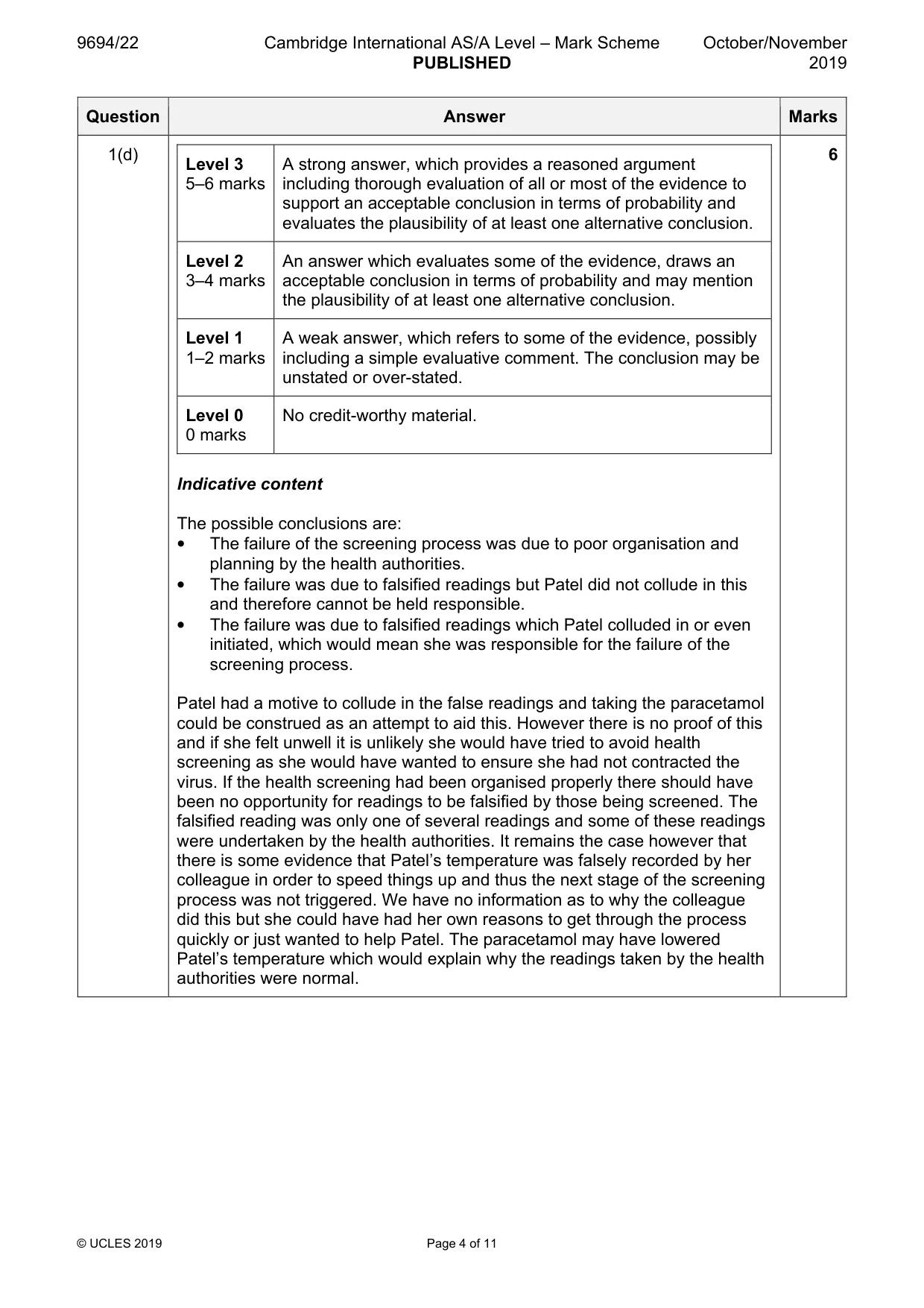
9694/22 Cambridge International AS/A Level – Mark Scheme PUBLISHED October/November 2019 © UCLES 2019 Page 4 of 11 Question Answer Marks 1(d) Level 3 5–6 marks A strong answer, which provides a reasoned argument including thorough evaluation of all or most of the evidence to support an acceptable conclusion in terms of probability and evaluates the plausibility of at least one alternative conclusion. Level 2 3–4 marks An answer which evaluates some of the evidence, draws an acceptable conclusion in terms of probability and may mention the plausibility of at least one alternative conclusion. Level 1 1–2 marks A weak answer, which refers to some of the evidence, possibly including a simple evaluative comment. The conclusion may be unstated or over-stated. Level 0 0 marks No credit-worthy material. Indicative content The possible conclusions are: • The failure of the screening process was due to poor organisation and planning by the health authorities. • The failure was due to falsified readings but Patel did not collude in this and therefore cannot be held responsible. • The failure was due to falsified readings which Patel colluded in or even initiated, which would mean she was responsible for the failure of the screening process. Patel had a motive to collude in the false readings and taking the paracetamol could be construed as an attempt to aid this. However there is no proof of this and if she felt unwell it is unlikely she would have tried to avoid health screening as she would have wanted to ensure she had not contracted the virus. If the health screening had been organised properly there should have been no opportunity for readings to be falsified by those being screened. The falsified reading was only one of several readings and some of these readings were undertaken by the health authorities. It remains the case however that there is some evidence that Patel’s temperature was falsely recorded by her colleague in order to speed things up and thus the next stage of the screening process was not triggered. We have no information as to why the colleague did this but she could have had her own reasons to get through the process quickly or just wanted to help Patel. The paracetamol may have lowered Patel’s temperature which would explain why the readings taken by the health authorities were normal. 6
Mark scheme, page 5
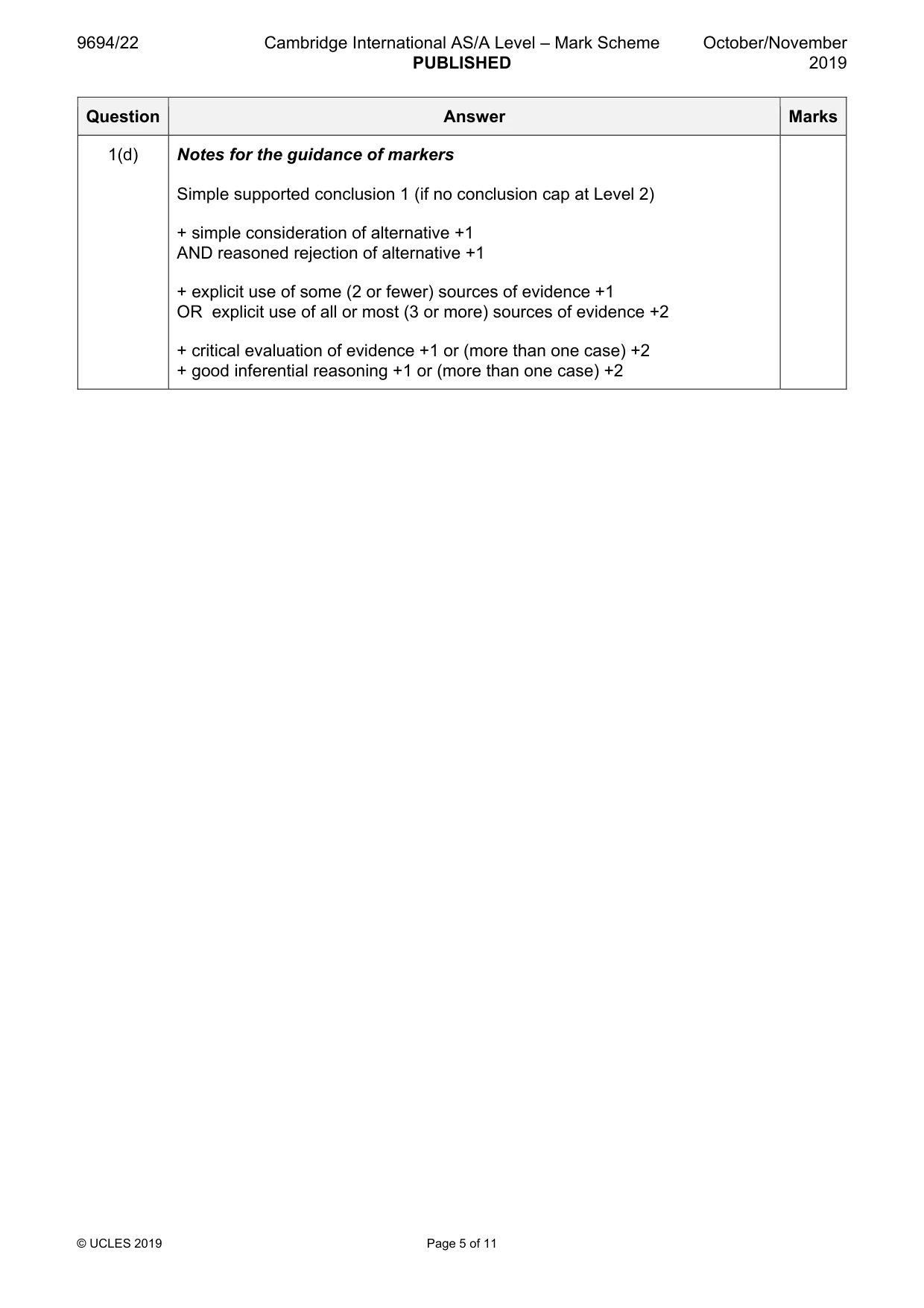
9694/22 Cambridge International AS/A Level – Mark Scheme PUBLISHED October/November 2019 © UCLES 2019 Page 5 of 11 Question Answer Marks 1(d) Notes for the guidance of markers Simple supported conclusion 1 (if no conclusion cap at Level 2) + simple consideration of alternative +1 AND reasoned rejection of alternative +1 + explicit use of some (2 or fewer) sources of evidence +1 OR explicit use of all or most (3 or more) sources of evidence +2 + critical evaluation of evidence +1 or (more than one case) +2 + good inferential reasoning +1 or (more than one case) +2
Mark scheme, page 6
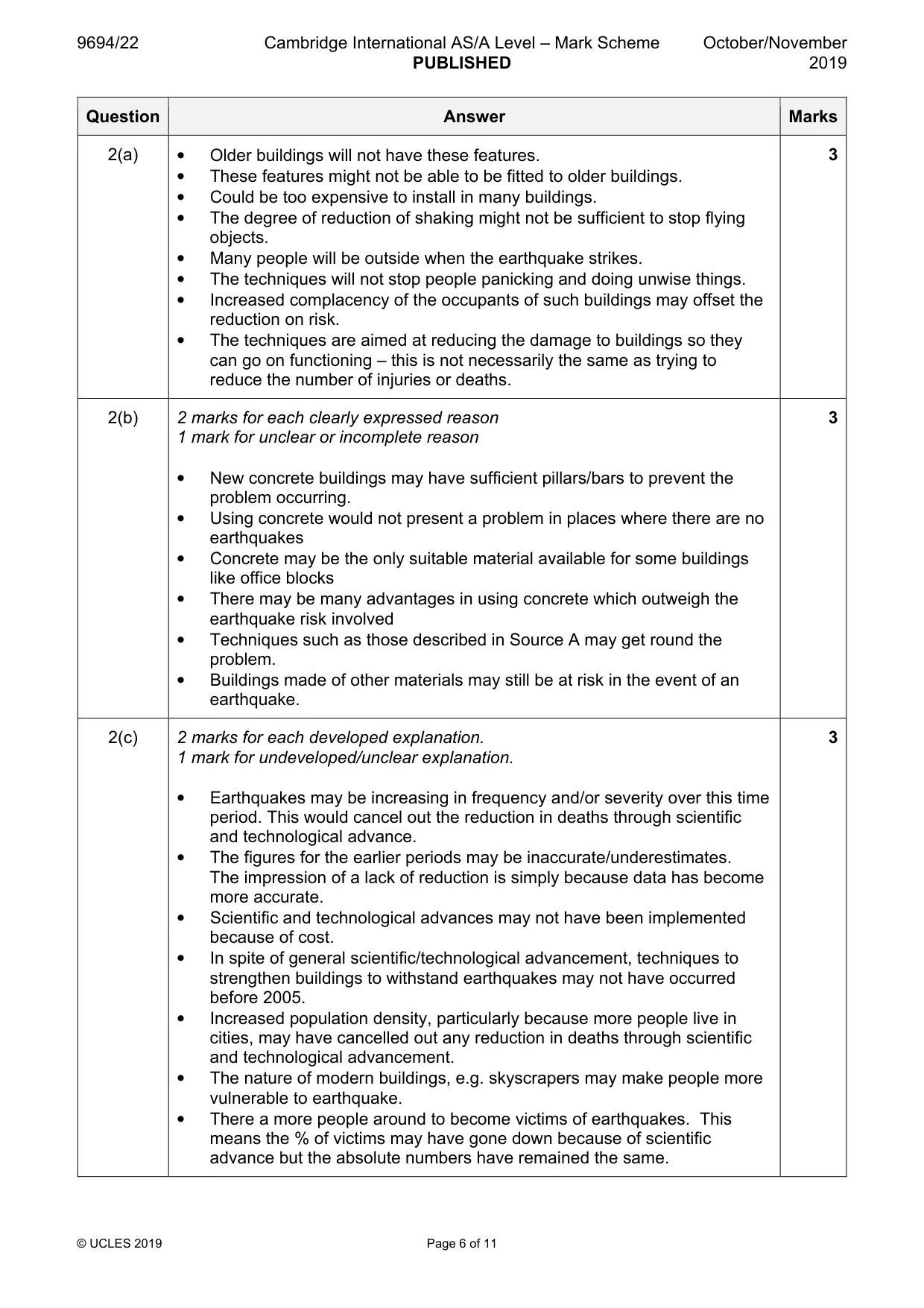
9694/22 Cambridge International AS/A Level – Mark Scheme PUBLISHED October/November 2019 © UCLES 2019 Page 6 of 11 Question Answer Marks 2(a) • Older buildings will not have these features. • These features might not be able to be fitted to older buildings. • Could be too expensive to install in many buildings. • The degree of reduction of shaking might not be sufficient to stop flying objects. • Many people will be outside when the earthquake strikes. • The techniques will not stop people panicking and doing unwise things. • Increased complacency of the occupants of such buildings may offset the reduction on risk. • The techniques are aimed at reducing the damage to buildings so they can go on functioning – this is not necessarily the same as trying to reduce the number of injuries or deaths. 3 2(b) 2 marks for each clearly expressed reason 1 mark for unclear or incomplete reason • New concrete buildings may have sufficient pillars/bars to prevent the problem occurring. • Using concrete would not present a problem in places where there are no earthquakes • Concrete may be the only suitable material available for some buildings like office blocks • There may be many advantages in using concrete which outweigh the earthquake risk involved • Techniques such as those described in Source A may get round the problem. • Buildings made of other materials may still be at risk in the event of an earthquake. 3 2(c) 2 marks for each developed explanation. 1 mark for undeveloped/unclear explanation. • Earthquakes may be increasing in frequency and/or severity over this time period. This would cancel out the reduction in deaths through scientific and technological advance. • The figures for the earlier periods may be inaccurate/underestimates. The impression of a lack of reduction is simply because data has become more accurate. • Scientific and technological advances may not have been implemented because of cost. • In spite of general scientific/technological advancement, techniques to strengthen buildings to withstand earthquakes may not have occurred before 2005. • Increased population density, particularly because more people live in cities, may have cancelled out any reduction in deaths through scientific and technological advancement. • The nature of modern buildings, e.g. skyscrapers may make people more vulnerable to earthquake. • There a more people around to become victims of earthquakes. This means the % of victims may have gone down because of scientific advance but the absolute numbers have remained the same. 3
Mark scheme, page 7
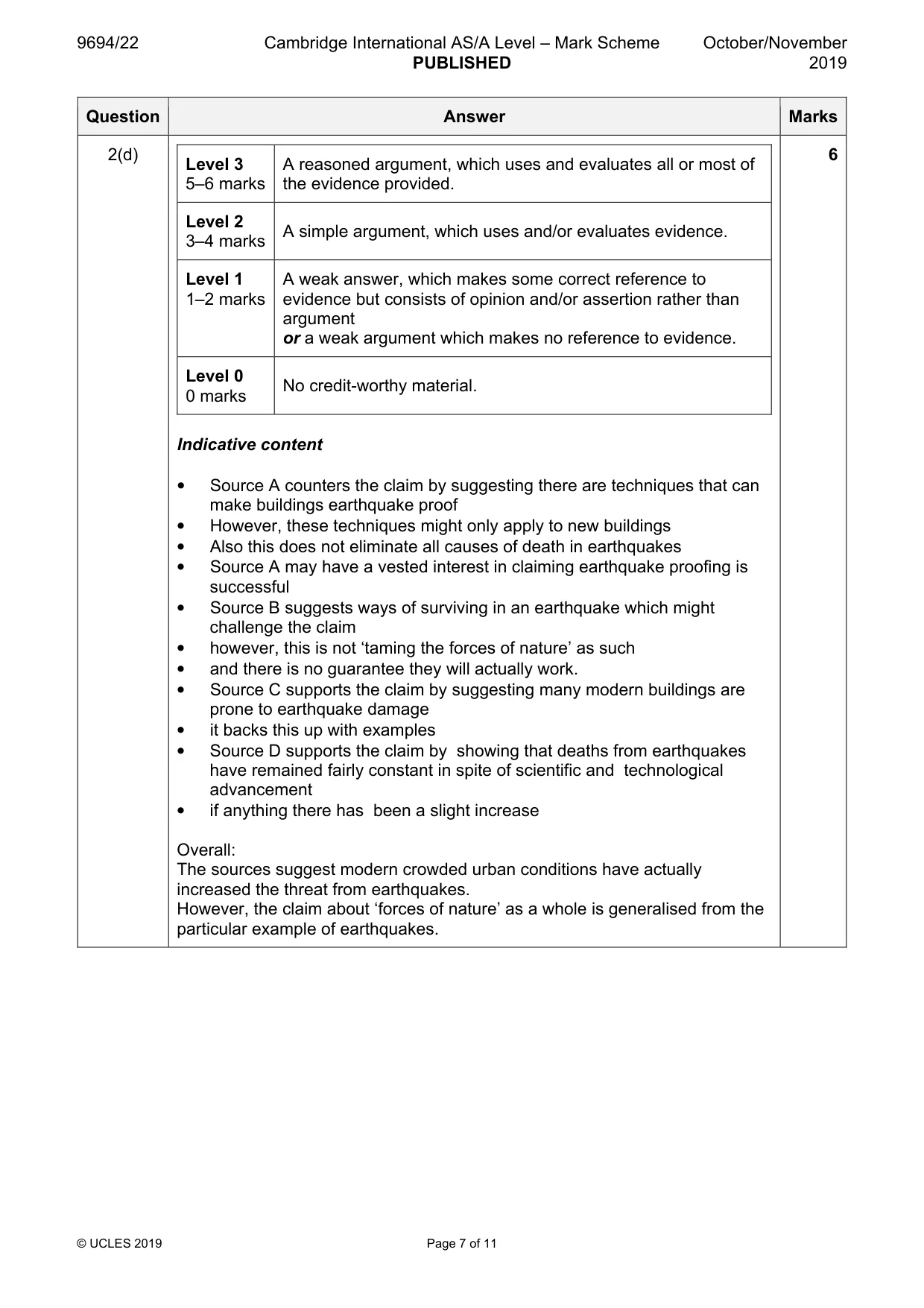
9694/22 Cambridge International AS/A Level – Mark Scheme PUBLISHED October/November 2019 © UCLES 2019 Page 7 of 11 Question Answer Marks 2(d) Level 3 5–6 marks A reasoned argument, which uses and evaluates all or most of the evidence provided. Level 2 3–4 marks A simple argument, which uses and/or evaluates evidence. Level 1 1–2 marks A weak answer, which makes some correct reference to evidence but consists of opinion and/or assertion rather than argument or a weak argument which makes no reference to evidence. Level 0 0 marks No credit-worthy material. Indicative content • Source A counters the claim by suggesting there are techniques that can make buildings earthquake proof • However, these techniques might only apply to new buildings • Also this does not eliminate all causes of death in earthquakes • Source A may have a vested interest in claiming earthquake proofing is successful • Source B suggests ways of surviving in an earthquake which might challenge the claim • however, this is not ‘taming the forces of nature’ as such • and there is no guarantee they will actually work. • Source C supports the claim by suggesting many modern buildings are prone to earthquake damage • it backs this up with examples • Source D supports the claim by showing that deaths from earthquakes have remained fairly constant in spite of scientific and technological advancement • if anything there has been a slight increase Overall: The sources suggest modern crowded urban conditions have actually increased the threat from earthquakes. However, the claim about ‘forces of nature’ as a whole is generalised from the particular example of earthquakes. 6
Mark scheme, page 8
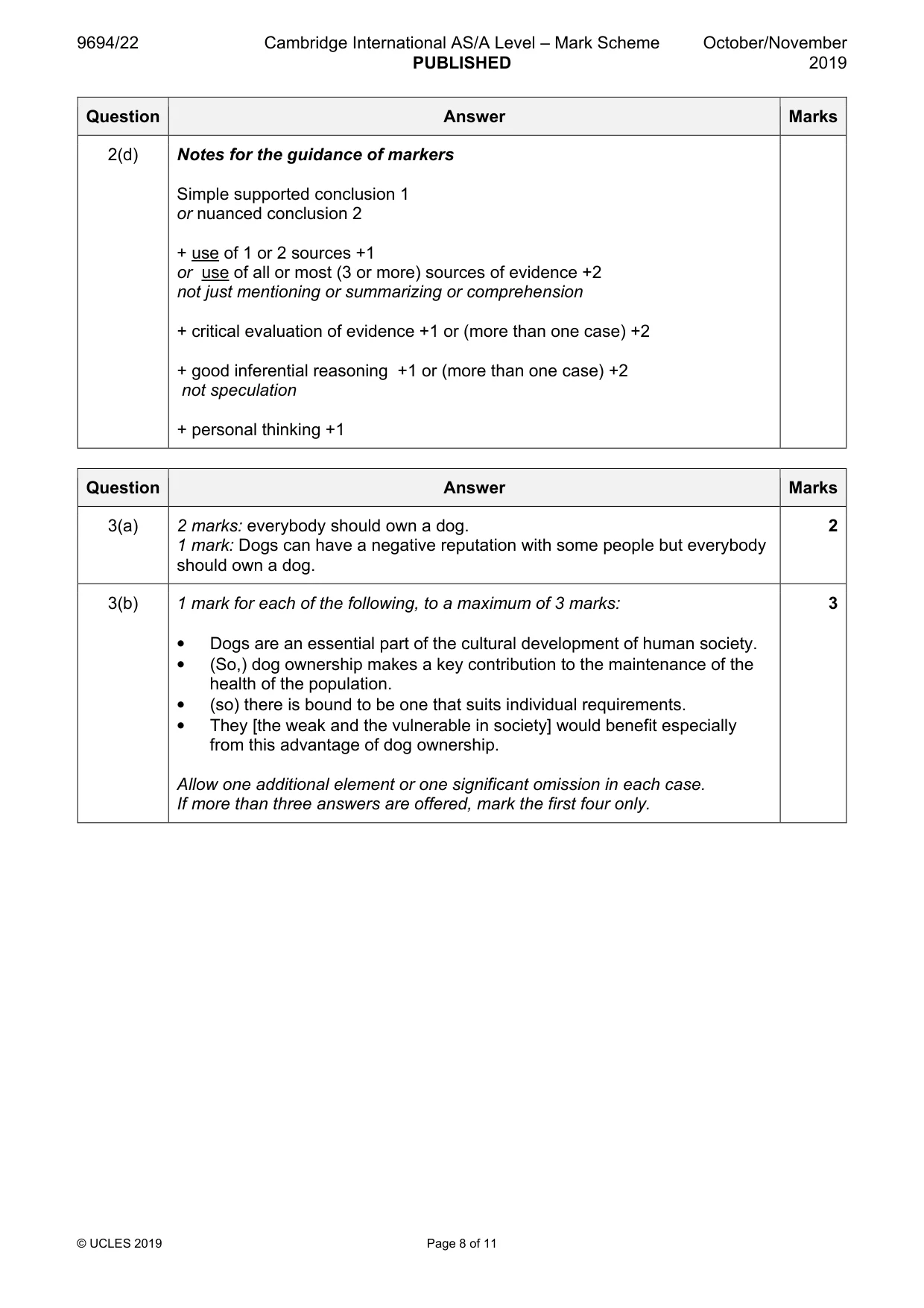
9694/22 Cambridge International AS/A Level – Mark Scheme PUBLISHED October/November 2019 © UCLES 2019 Page 8 of 11 Question Answer Marks 2(d) Notes for the guidance of markers Simple supported conclusion 1 or nuanced conclusion 2 + use of 1 or 2 sources +1 or use of all or most (3 or more) sources of evidence +2 not just mentioning or summarizing or comprehension + critical evaluation of evidence +1 or (more than one case) +2 + good inferential reasoning +1 or (more than one case) +2 not speculation + personal thinking +1 Question Answer Marks 3(a) 2 marks: everybody should own a dog. 1 mark: Dogs can have a negative reputation with some people but everybody should own a dog. 2 3(b) 1 mark for each of the following, to a maximum of 3 marks: • Dogs are an essential part of the cultural development of human society. • (So,) dog ownership makes a key contribution to the maintenance of the health of the population. • (so) there is bound to be one that suits individual requirements. • They [the weak and the vulnerable in society] would benefit especially from this advantage of dog ownership. Allow one additional element or one significant omission in each case. If more than three answers are offered, mark the first four only. 3
Mark scheme, page 9
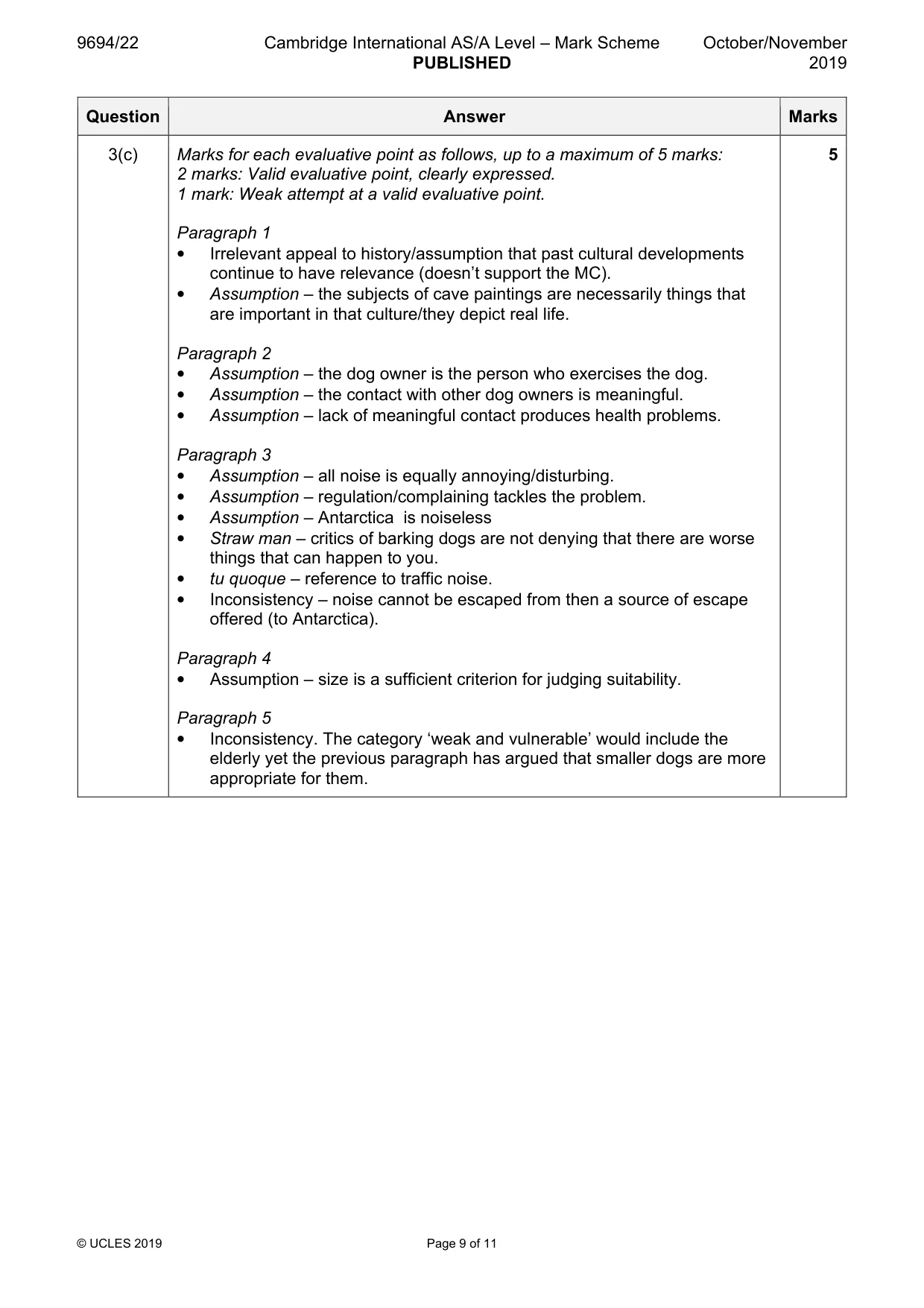
9694/22 Cambridge International AS/A Level – Mark Scheme PUBLISHED October/November 2019 © UCLES 2019 Page 9 of 11 Question Answer Marks 3(c) Marks for each evaluative point as follows, up to a maximum of 5 marks: 2 marks: Valid evaluative point, clearly expressed. 1 mark: Weak attempt at a valid evaluative point. Paragraph 1 • Irrelevant appeal to history/assumption that past cultural developments continue to have relevance (doesn’t support the MC). • Assumption – the subjects of cave paintings are necessarily things that are important in that culture/they depict real life. Paragraph 2 • Assumption – the dog owner is the person who exercises the dog. • Assumption – the contact with other dog owners is meaningful. • Assumption – lack of meaningful contact produces health problems. Paragraph 3 • Assumption – all noise is equally annoying/disturbing. • Assumption – regulation/complaining tackles the problem. • Assumption – Antarctica is noiseless • Straw man – critics of barking dogs are not denying that there are worse things that can happen to you. • tu quoque – reference to traffic noise. • Inconsistency – noise cannot be escaped from then a source of escape offered (to Antarctica). Paragraph 4 • Assumption – size is a sufficient criterion for judging suitability. Paragraph 5 • Inconsistency. The category ‘weak and vulnerable’ would include the elderly yet the previous paragraph has argued that smaller dogs are more appropriate for them. 5
Mark scheme, page 10
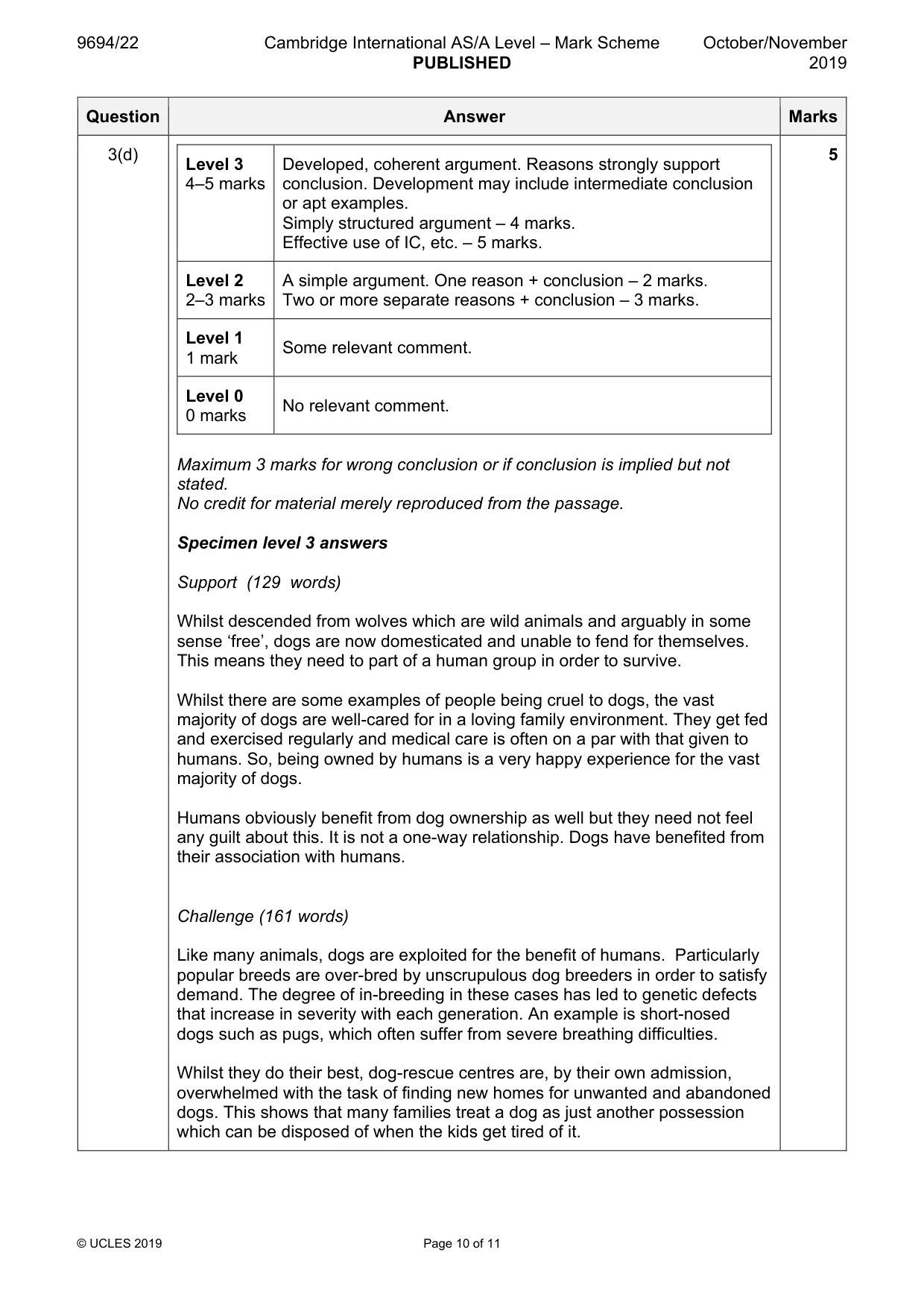
9694/22 Cambridge International AS/A Level – Mark Scheme PUBLISHED October/November 2019 © UCLES 2019 Page 10 of 11 Question Answer Marks 3(d) Level 3 4–5 marks Developed, coherent argument. Reasons strongly support conclusion. Development may include intermediate conclusion or apt examples. Simply structured argument – 4 marks. Effective use of IC, etc. – 5 marks. Level 2 2–3 marks A simple argument. One reason + conclusion – 2 marks. Two or more separate reasons + conclusion – 3 marks. Level 1 1 mark Some relevant comment. Level 0 0 marks No relevant comment. Maximum 3 marks for wrong conclusion or if conclusion is implied but not stated. No credit for material merely reproduced from the passage. Specimen level 3 answers Support (129 words) Whilst descended from wolves which are wild animals and arguably in some sense ‘free’, dogs are now domesticated and unable to fend for themselves. This means they need to part of a human group in order to survive. Whilst there are some examples of people being cruel to dogs, the vast majority of dogs are well-cared for in a loving family environment. They get fed and exercised regularly and medical care is often on a par with that given to humans. So, being owned by humans is a very happy experience for the vast majority of dogs. Humans obviously benefit from dog ownership as well but they need not feel any guilt about this. It is not a one-way relationship. Dogs have benefited from their association with humans. Challenge (161 words) Like many animals, dogs are exploited for the benefit of humans. Particularly popular breeds are over-bred by unscrupulous dog breeders in order to satisfy demand. The degree of in-breeding in these cases has led to genetic defects that increase in severity with each generation. An example is short-nosed dogs such as pugs, which often suffer from severe breathing difficulties. Whilst they do their best, dog-rescue centres are, by their own admission, overwhelmed with the task of finding new homes for unwanted and abandoned dogs. This shows that many families treat a dog as just another possession which can be disposed of when the kids get tired of it. 5
Mark scheme, page 11
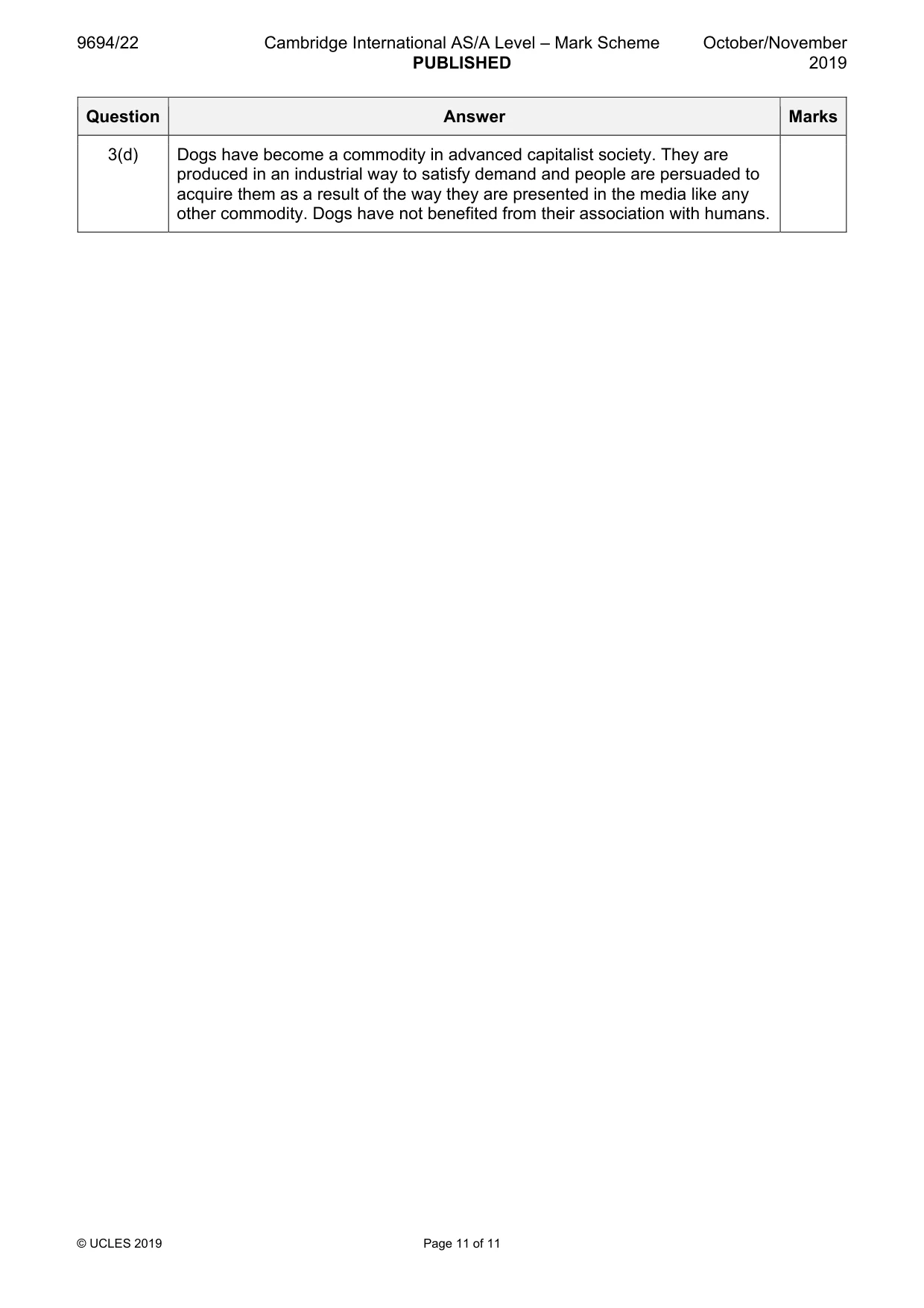
9694/22 Cambridge International AS/A Level – Mark Scheme PUBLISHED October/November 2019 © UCLES 2019 Page 11 of 11 Question Answer Marks 3(d) Dogs have become a commodity in advanced capitalist society. They are produced in an industrial way to satisfy demand and people are persuaded to acquire them as a result of the way they are presented in the media like any other commodity. Dogs have not benefited from their association with humans.
What you needed in this session
Cambridge’s own grade thresholds for 2019 Oct/Nov, Paper 2 · Variant 2. A higher threshold means an easier paper — the bar moves with how the cohort did.