Cambridge A Level Thinking Skills 9694 — 2019 Oct/Nov Paper 2 · Variant 3
9694/23/O/N/19 · 45 marks · ≈51 min
The question paper and its mark scheme, free to read here and free to download. This is Cambridge’s own paper, exactly as it was sat.
Question paper8 pages


Mark scheme9 pages
Answers below. Sit the paper first if you are practising.
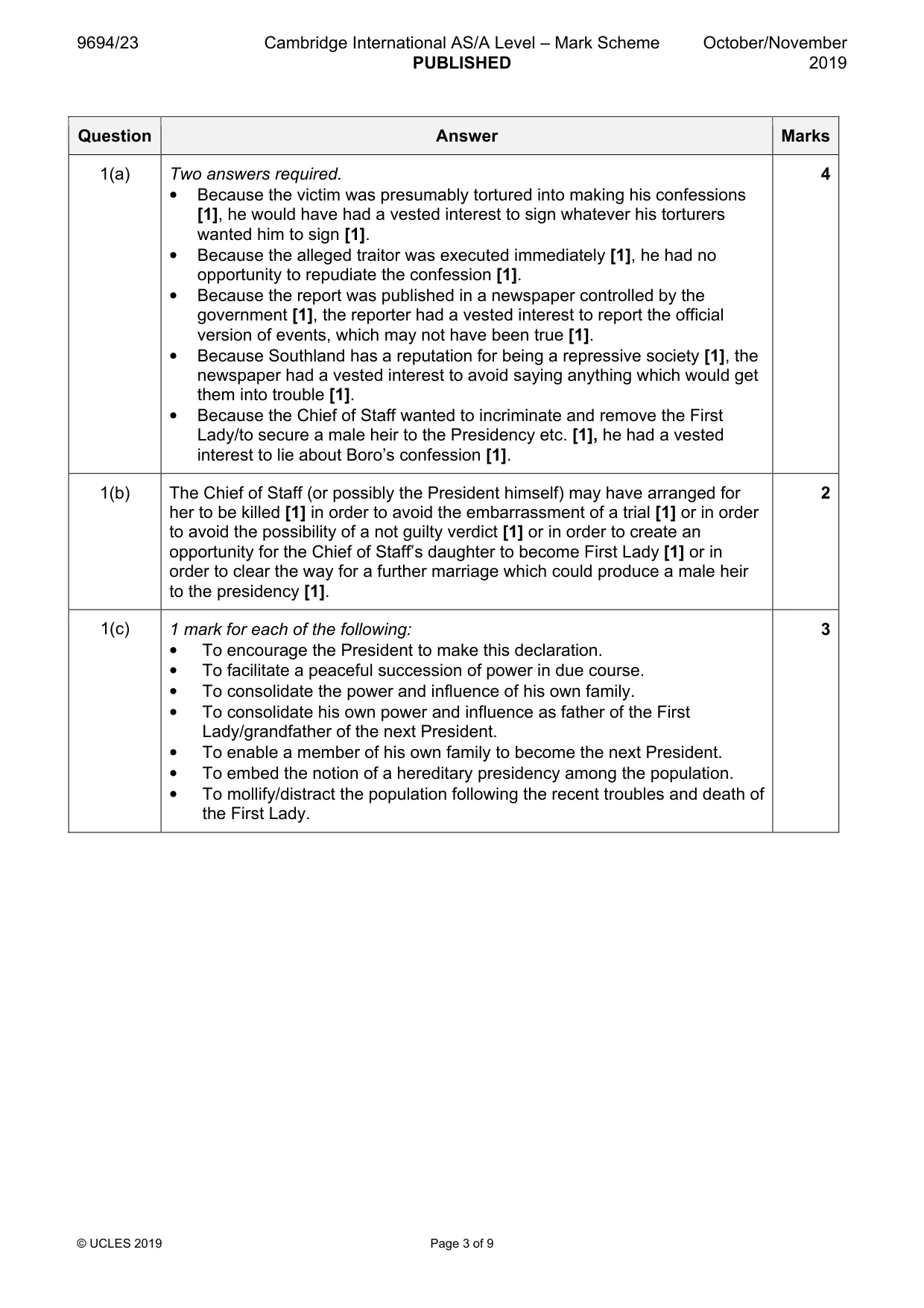
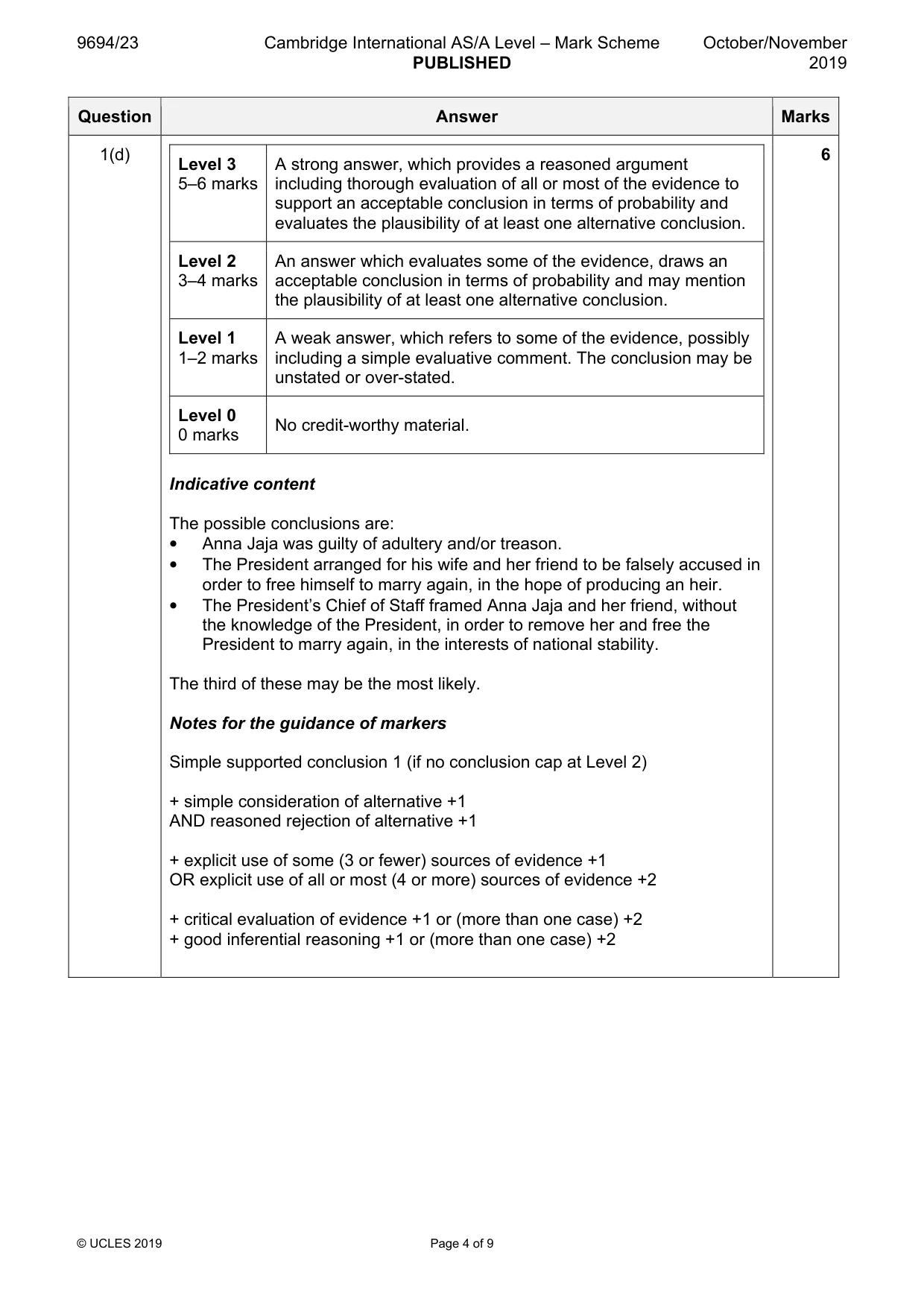
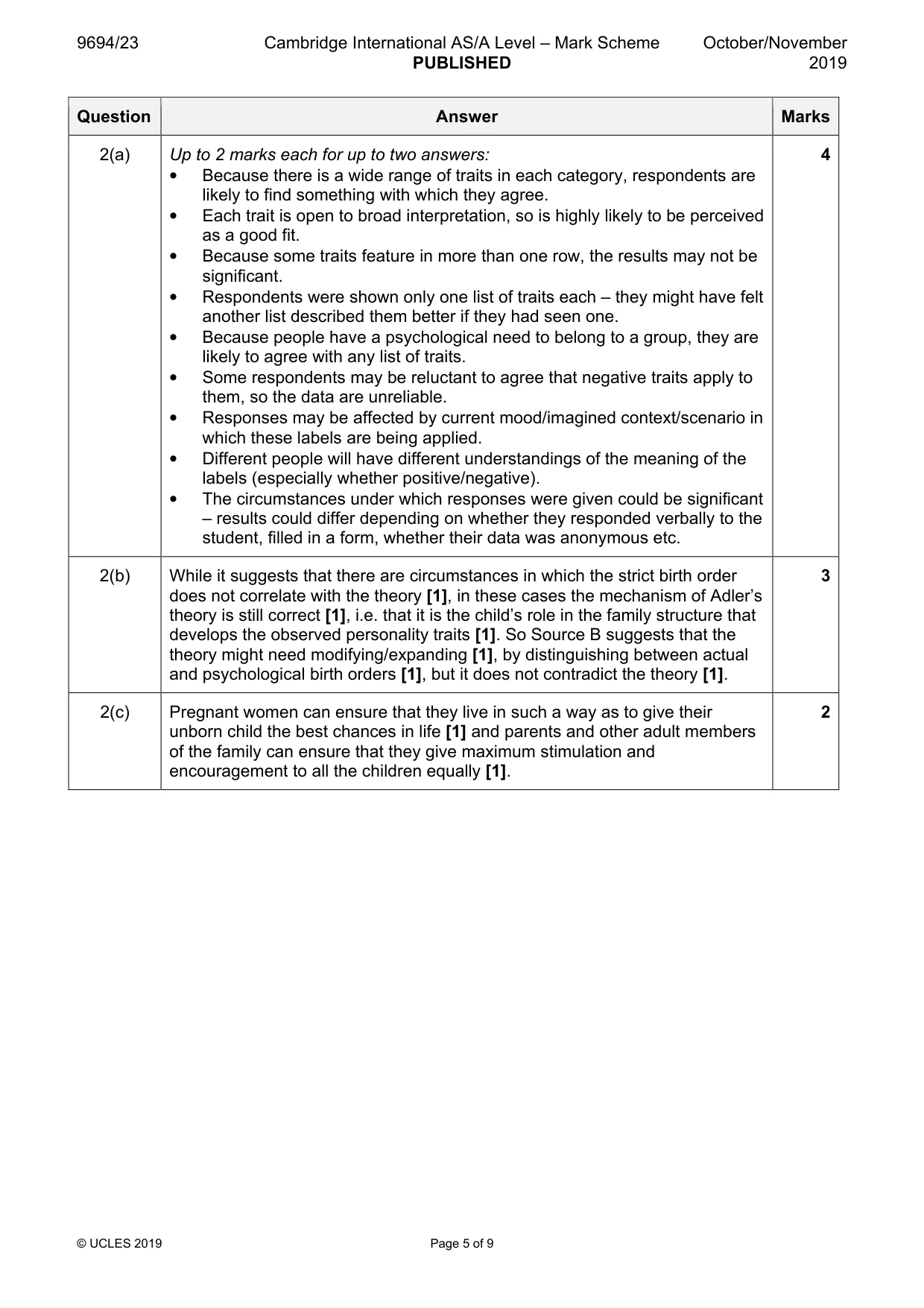
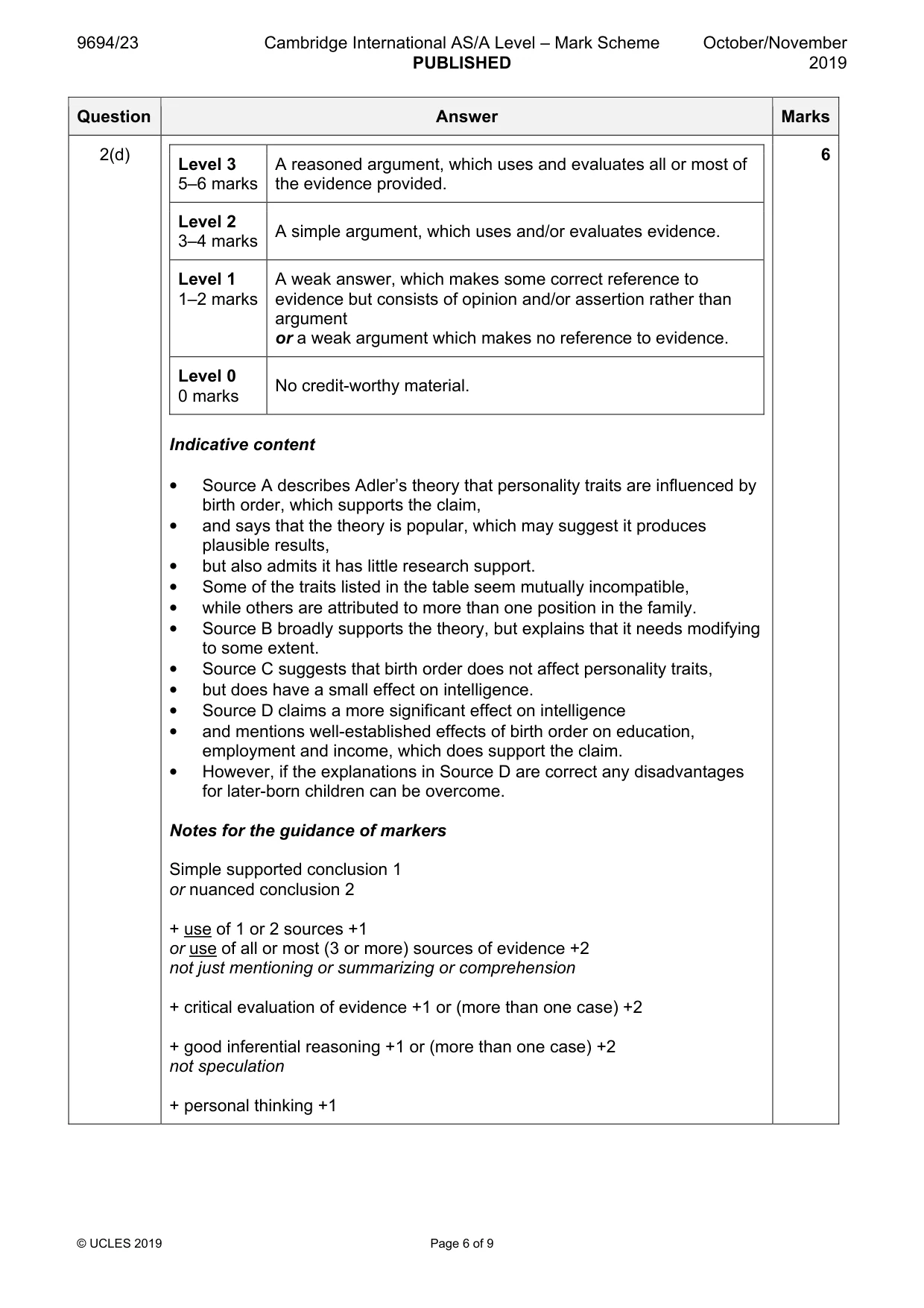
Paper as text
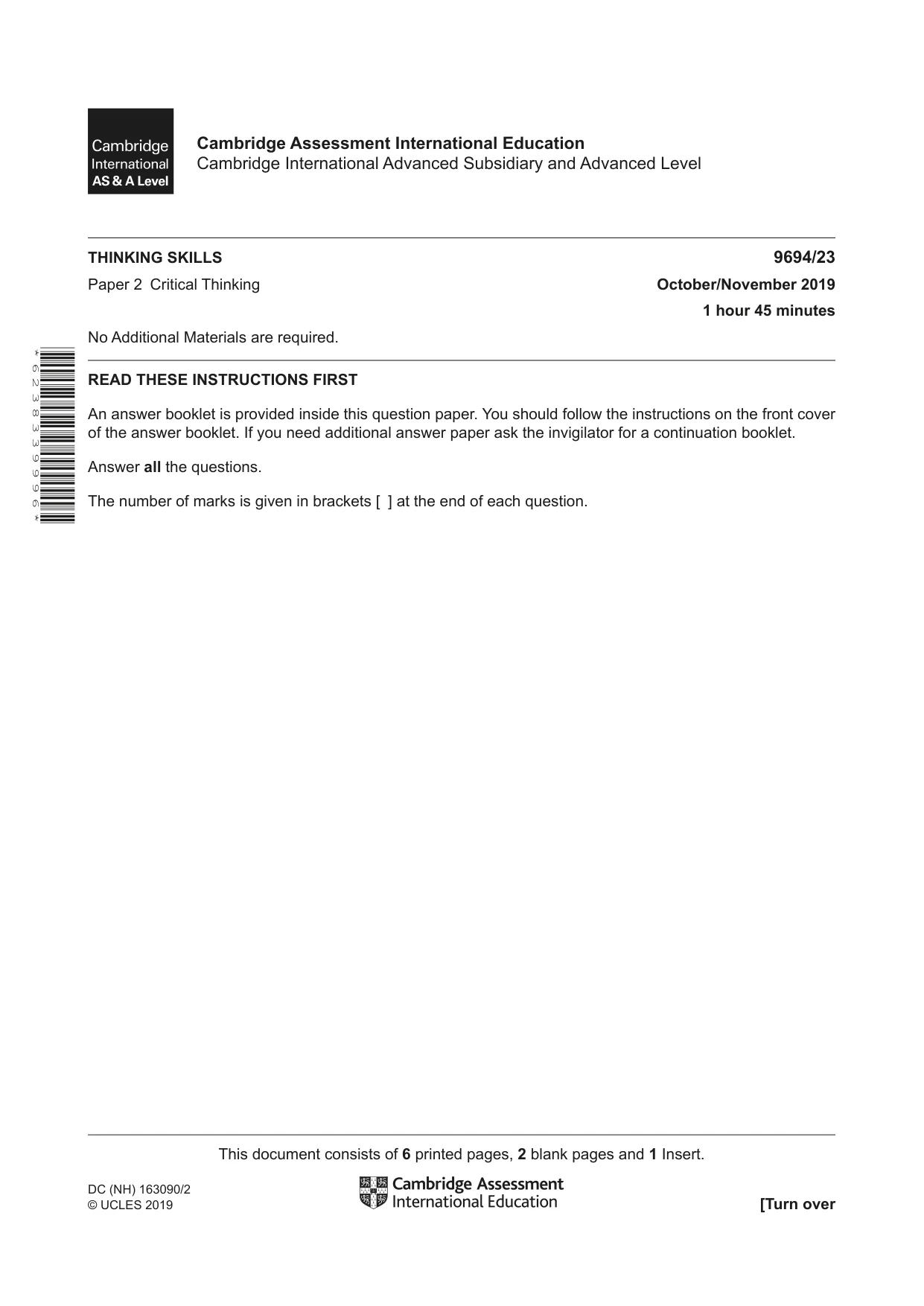
Question paper, page 1
This document consists of 6 printed pages, 2 blank pages and 1 Insert. DC (NH) 163090/2 © UCLES 2019 [Turn over * 6 2 3 8 3 3 9 9 9 6 * THINKING SKILLS 9694/23 Paper 2 Critical Thinking October/November 2019 1 hour 45 minutes No Additional Materials are required. READ THESE INSTRUCTIONS FIRST An answer booklet is provided inside this question paper. You should follow the instructions on the front cover of the answer booklet. If you need additional answer paper ask the invigilator for a continuation booklet. Answer all the questions. The number of marks is given in brackets [ ] at the end of each question. Cambridge Assessment International Education Cambridge International Advanced Subsidiary and Advanced Level
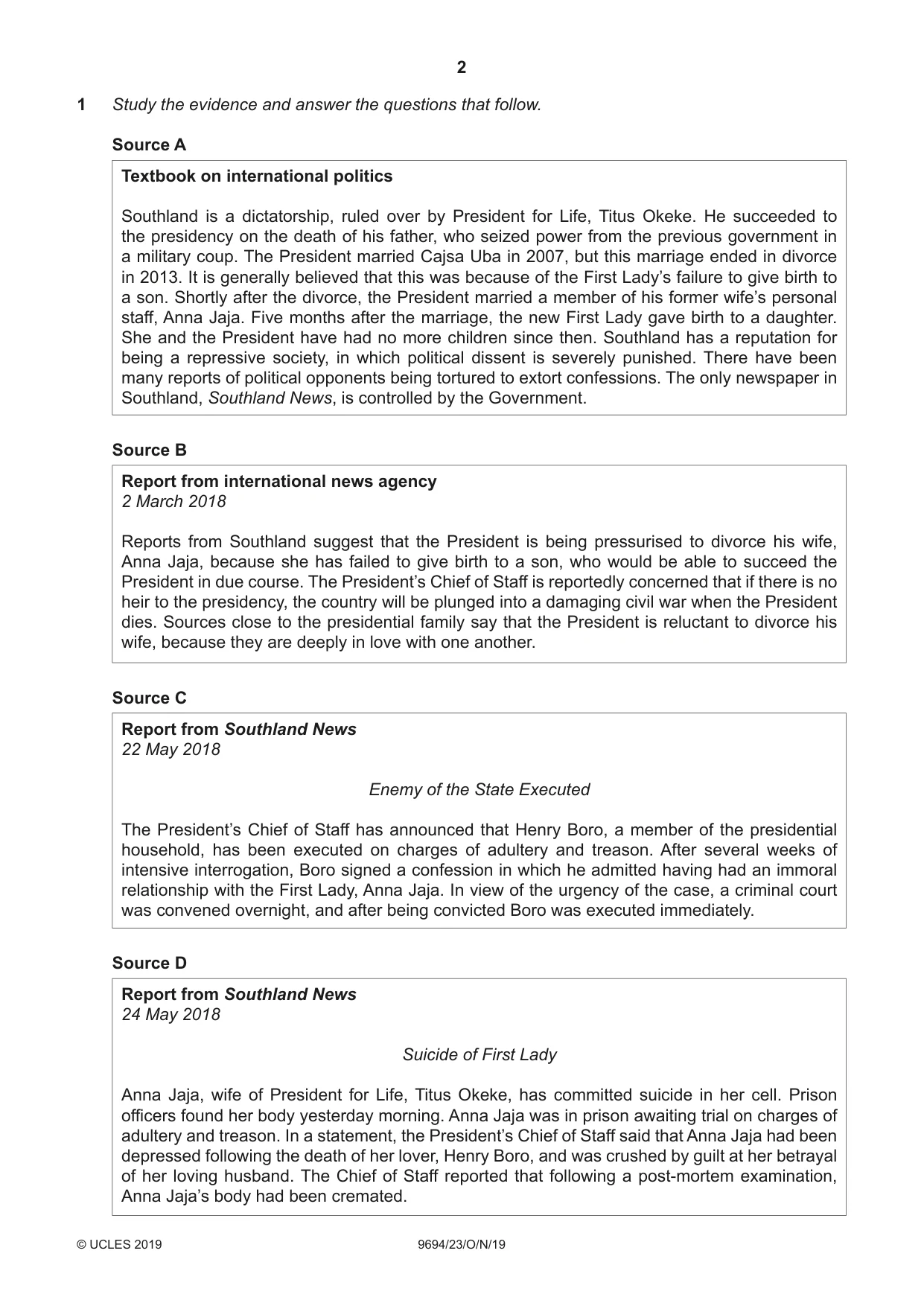
Question paper, page 2
2 9694/23/O/N/19 © UCLES 2019 1 Study the evidence and answer the questions that follow. Source A Textbook on international politics Southland is a dictatorship, ruled over by President for Life, Titus Okeke. He succeeded to the presidency on the death of his father, who seized power from the previous government in a military coup. The President married Cajsa Uba in 2007, but this marriage ended in divorce in 2013. It is generally believed that this was because of the First Lady’s failure to give birth to a son. Shortly after the divorce, the President married a member of his former wife’s personal staff, Anna Jaja. Five months after the marriage, the new First Lady gave birth to a daughter. She and the President have had no more children since then. Southland has a reputation for being a repressive society, in which political dissent is severely punished. There have been many reports of political opponents being tortured to extort confessions. The only newspaper in Southland, Southland News, is controlled by the Government. Source B Report from international news agency 2 March 2018 Reports from Southland suggest that the President is being pressurised to divorce his wife, Anna Jaja, because she has failed to give birth to a son, who would be able to succeed the President in due course. The President’s Chief of Staff is reportedly concerned that if there is no heir to the presidency, the country will be plunged into a damaging civil war when the President dies. Sources close to the presidential family say that the President is reluctant to divorce his wife, because they are deeply in love with one another. Source C Report from Southland News 22 May 2018 Enemy of the State Executed The President’s Chief of Staff has announced that Henry Boro, a member of the presidential household, has been executed on charges of adultery and treason. After several weeks of intensive interrogation, Boro signed a confession in which he admitted having had an immoral relationship with the First Lady, Anna Jaja. In view of the urgency of the case, a criminal court was convened overnight, and after being convicted Boro was executed immediately. Source D Report from Southland News 24 May 2018 Suicide of First Lady Anna Jaja, wife of President for Life, Titus Okeke, has committed suicide in her cell. Prison officers found her body yesterday morning. Anna Jaja was in prison awaiting trial on charges of adultery and treason. In a statement, the President’s Chief of Staff said that Anna Jaja had been depressed following the death of her lover, Henry Boro, and was crushed by guilt at her betrayal of her loving husband. The Chief of Staff reported that following a post-mortem examination, Anna Jaja’s body had been cremated.
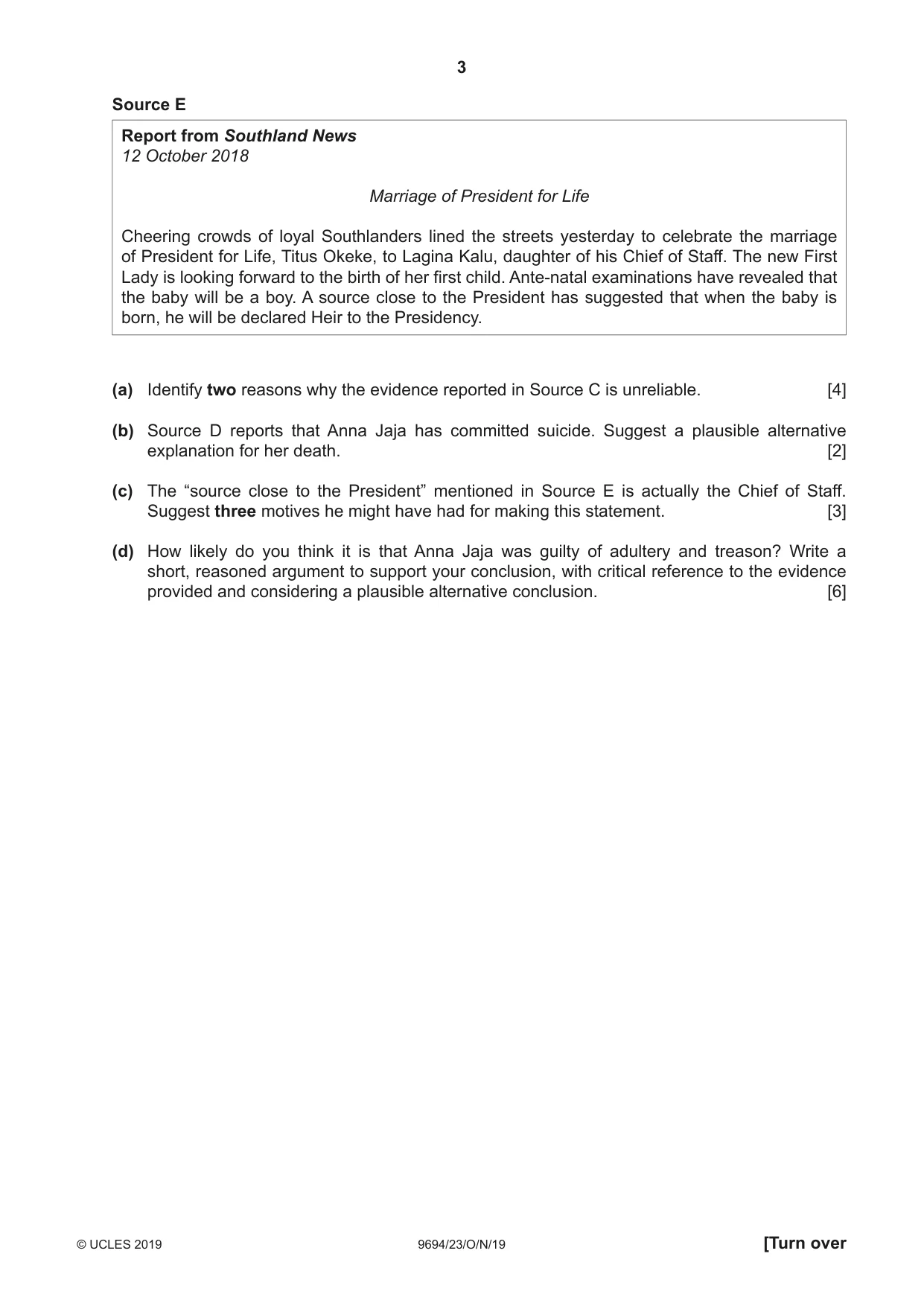
Question paper, page 3
3 9694/23/O/N/19 © UCLES 2019 [Turn over Source E Report from Southland News 12 October 2018 Marriage of President for Life Cheering crowds of loyal Southlanders lined the streets yesterday to celebrate the marriage of President for Life, Titus Okeke, to Lagina Kalu, daughter of his Chief of Staff. The new First Lady is looking forward to the birth of her first child. Ante-natal examinations have revealed that the baby will be a boy. A source close to the President has suggested that when the baby is born, he will be declared Heir to the Presidency. (a) Identify two reasons why the evidence reported in Source C is unreliable. [4] (b) Source D reports that Anna Jaja has committed suicide. Suggest a plausible alternative explanation for her death. [2] (c) The “source close to the President” mentioned in Source E is actually the Chief of Staff. Suggest three motives he might have had for making this statement. [3] (d) How likely do you think it is that Anna Jaja was guilty of adultery and treason? Write a short, reasoned argument to support your conclusion, with critical reference to the evidence provided and considering a plausible alternative conclusion. [6]
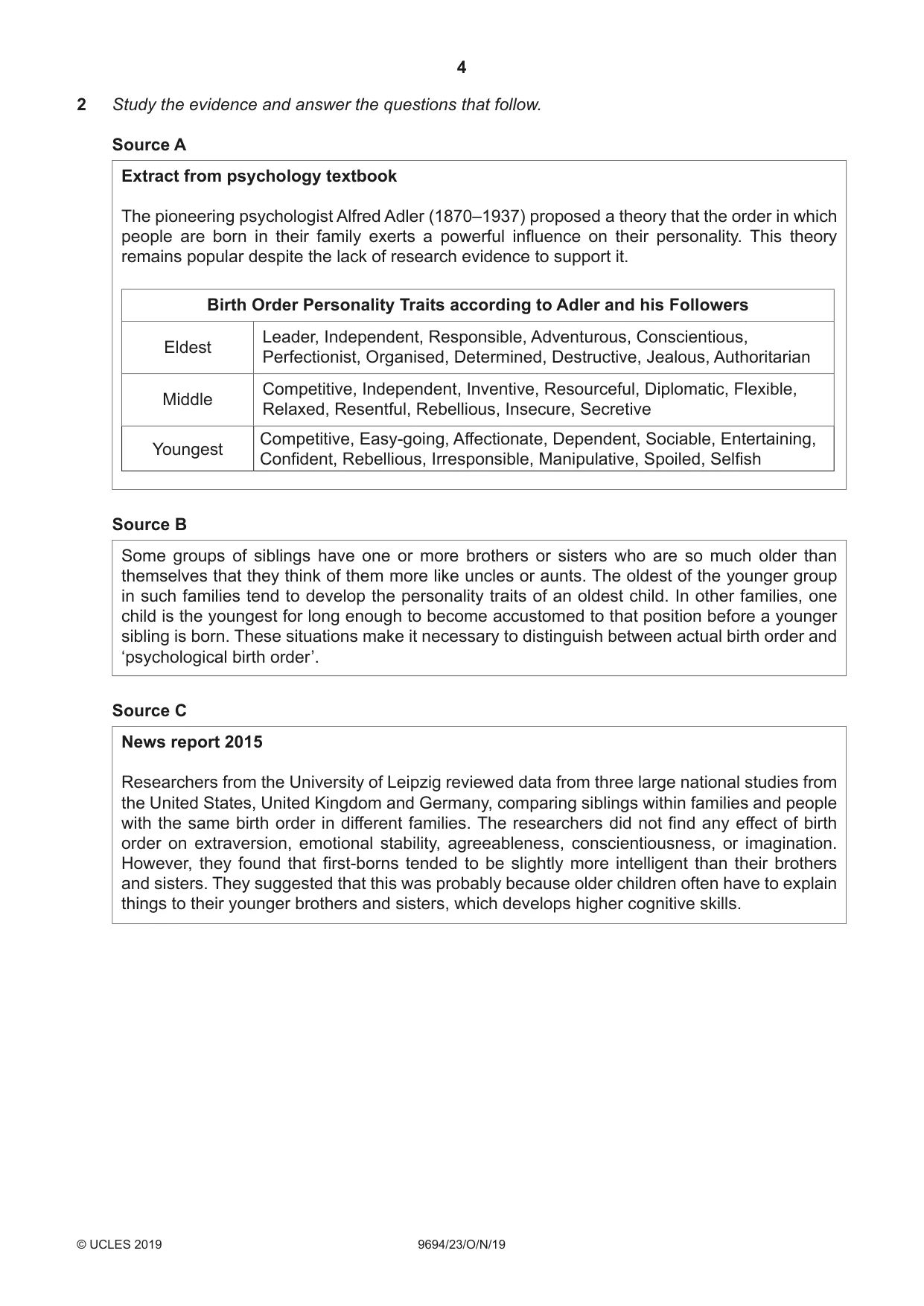
Question paper, page 4
4 9694/23/O/N/19 © UCLES 2019 2 Study the evidence and answer the questions that follow. Source A Extract from psychology textbook The pioneering psychologist Alfred Adler (1870–1937) proposed a theory that the order in which people are born in their family exerts a powerful influence on their personality. This theory remains popular despite the lack of research evidence to support it. Birth Order Personality Traits according to Adler and his Followers Eldest Leader, Independent, Responsible, Adventurous, Conscientious, Perfectionist, Organised, Determined, Destructive, Jealous, Authoritarian Middle Competitive, Independent, Inventive, Resourceful, Diplomatic, Flexible, Relaxed, Resentful, Rebellious, Insecure, Secretive Youngest Competitive, Easy-going, Affectionate, Dependent, Sociable, Entertaining, Confident, Rebellious, Irresponsible, Manipulative, Spoiled, Selfish Source B Some groups of siblings have one or more brothers or sisters who are so much older than themselves that they think of them more like uncles or aunts. The oldest of the younger group in such families tend to develop the personality traits of an oldest child. In other families, one child is the youngest for long enough to become accustomed to that position before a younger sibling is born. These situations make it necessary to distinguish between actual birth order and ‘psychological birth order’. Source C News report 2015 Researchers from the University of Leipzig reviewed data from three large national studies from the United States, United Kingdom and Germany, comparing siblings within families and people with the same birth order in different families. The researchers did not find any effect of birth order on extraversion, emotional stability, agreeableness, conscientiousness, or imagination. However, they found that first-borns tended to be slightly more intelligent than their brothers and sisters. They suggested that this was probably because older children often have to explain things to their younger brothers and sisters, which develops higher cognitive skills.
Question paper, page 5
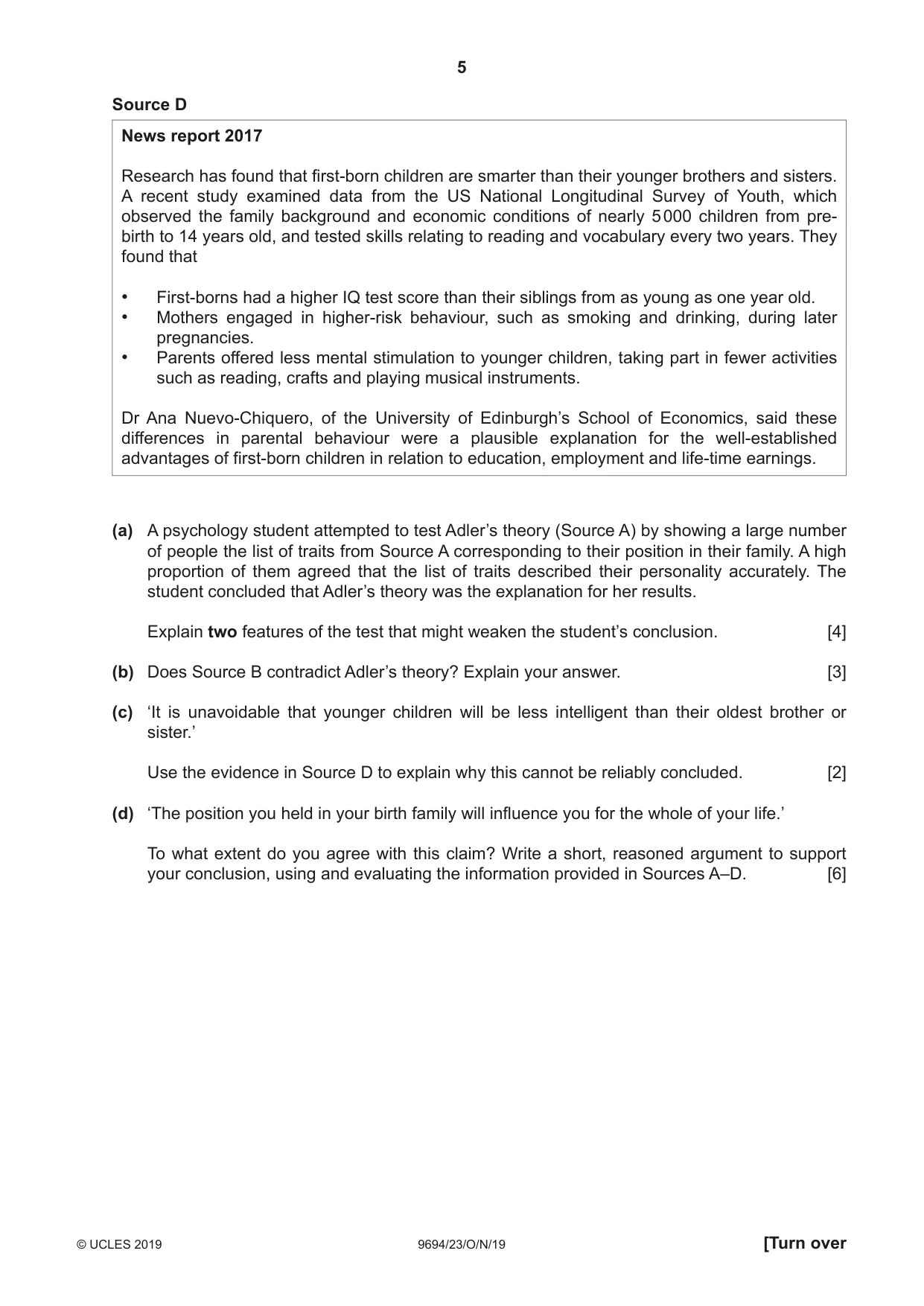
5 9694/23/O/N/19 © UCLES 2019 [Turn over Source D News report 2017 Research has found that first-born children are smarter than their younger brothers and sisters. A recent study examined data from the US National Longitudinal Survey of Youth, which observed the family background and economic conditions of nearly 5 000 children from pre- birth to 14 years old, and tested skills relating to reading and vocabulary every two years. They found that • First-borns had a higher IQ test score than their siblings from as young as one year old. • Mothers engaged in higher-risk behaviour, such as smoking and drinking, during later pregnancies. • Parents offered less mental stimulation to younger children, taking part in fewer activities such as reading, crafts and playing musical instruments. Dr Ana Nuevo-Chiquero, of the University of Edinburgh’s School of Economics, said these differences in parental behaviour were a plausible explanation for the well-established advantages of first-born children in relation to education, employment and life-time earnings. (a) A psychology student attempted to test Adler’s theory (Source A) by showing a large number of people the list of traits from Source A corresponding to their position in their family. A high proportion of them agreed that the list of traits described their personality accurately. The student concluded that Adler’s theory was the explanation for her results. Explain two features of the test that might weaken the student’s conclusion. [4] (b) Does Source B contradict Adler’s theory? Explain your answer. [3] (c) ‘It is unavoidable that younger children will be less intelligent than their oldest brother or sister.’ Use the evidence in Source D to explain why this cannot be reliably concluded. [2] (d) ‘The position you held in your birth family will influence you for the whole of your life.’ To what extent do you agree with this claim? Write a short, reasoned argument to support your conclusion, using and evaluating the information provided in Sources A–D. [6]
Question paper, page 6
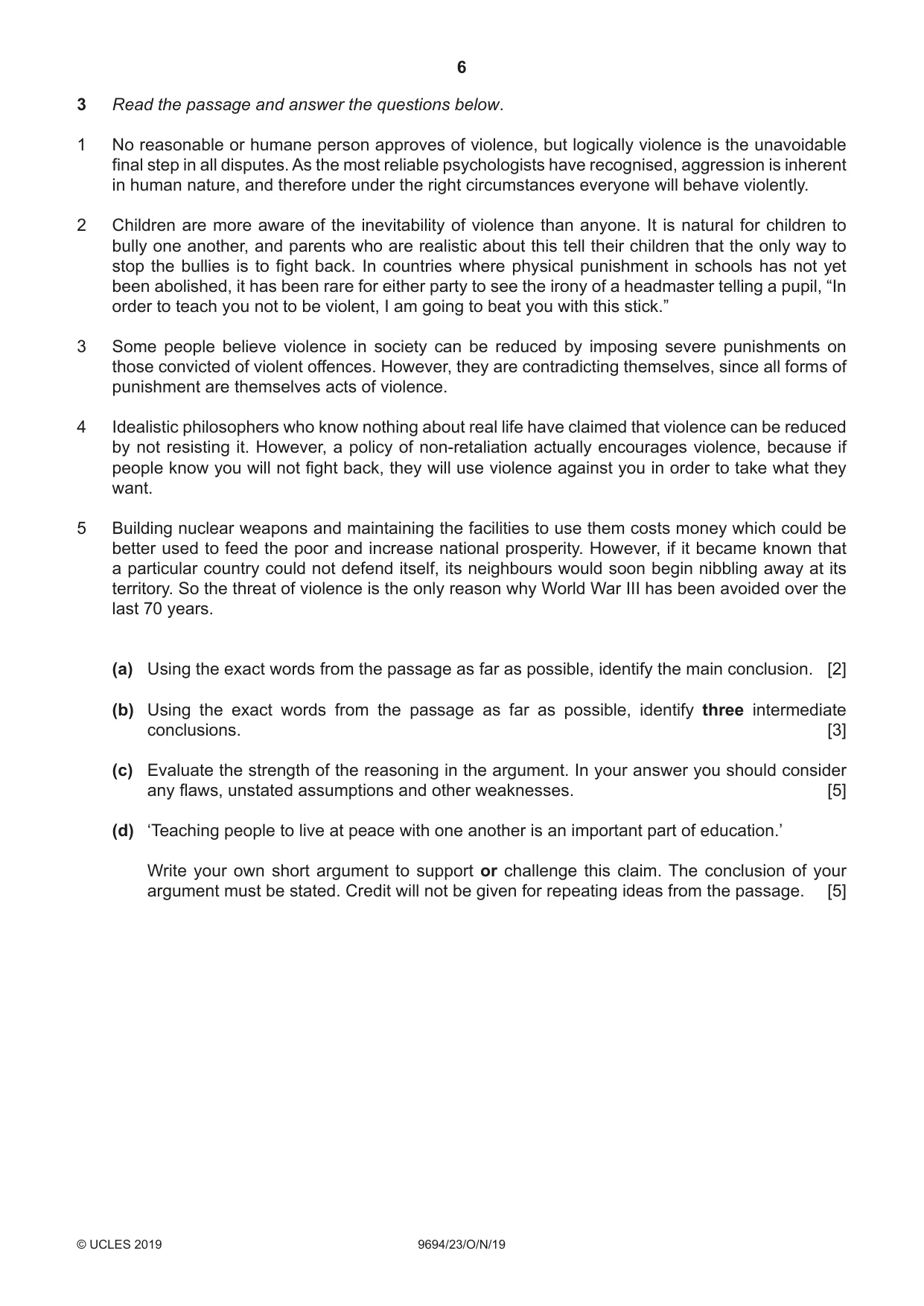
6 9694/23/O/N/19 © UCLES 2019 3 Read the passage and answer the questions below. 1 No reasonable or humane person approves of violence, but logically violence is the unavoidable final step in all disputes. As the most reliable psychologists have recognised, aggression is inherent in human nature, and therefore under the right circumstances everyone will behave violently. 2 Children are more aware of the inevitability of violence than anyone. It is natural for children to bully one another, and parents who are realistic about this tell their children that the only way to stop the bullies is to fight back. In countries where physical punishment in schools has not yet been abolished, it has been rare for either party to see the irony of a headmaster telling a pupil, “In order to teach you not to be violent, I am going to beat you with this stick.” 3 Some people believe violence in society can be reduced by imposing severe punishments on those convicted of violent offences. However, they are contradicting themselves, since all forms of punishment are themselves acts of violence. 4 Idealistic philosophers who know nothing about real life have claimed that violence can be reduced by not resisting it. However, a policy of non-retaliation actually encourages violence, because if people know you will not fight back, they will use violence against you in order to take what they want. 5 Building nuclear weapons and maintaining the facilities to use them costs money which could be better used to feed the poor and increase national prosperity. However, if it became known that a particular country could not defend itself, its neighbours would soon begin nibbling away at its territory. So the threat of violence is the only reason why World War III has been avoided over the last 70 years. (a) Using the exact words from the passage as far as possible, identify the main conclusion. [2] (b) Using the exact words from the passage as far as possible, identify three intermediate conclusions. [3] (c) Evaluate the strength of the reasoning in the argument. In your answer you should consider any flaws, unstated assumptions and other weaknesses. [5] (d) ‘Teaching people to live at peace with one another is an important part of education.’ Write your own short argument to support or challenge this claim. The conclusion of your argument must be stated. Credit will not be given for repeating ideas from the passage. [5]
Question paper, page 7
7 9694/23/O/N/19 © UCLES 2019 BLANK PAGE
Question paper, page 8
8 9694/23/O/N/19 © UCLES 2019 BLANK PAGE Permission to reproduce items where third-party owned material protected by copyright is included has been sought and cleared where possible. Every reasonable effort has been made by the publisher (UCLES) to trace copyright holders, but if any items requiring clearance have unwittingly been included, the publisher will be pleased to make amends at the earliest possible opportunity. To avoid the issue of disclosure of answer-related information to candidates, all copyright acknowledgements are reproduced online in the Cambridge Assessment International Education Copyright Acknowledgements Booklet. This is produced for each series of examinations and is freely available to download at www.cambridgeinternational.org after the live examination series. Cambridge Assessment International Education is part of the Cambridge Assessment Group. Cambridge Assessment is the brand name of the University of Cambridge Local Examinations Syndicate (UCLES), which itself is a department of the University of Cambridge.
Mark scheme, page 1
This document consists of 9 printed pages. © UCLES 2019 [Turn over Cambridge Assessment International Education Cambridge International Advanced Subsidiary and Advanced Level THINKING SKILLS 9694/23 Paper 2 Critical Thinking October/November 2019 MARK SCHEME Maximum Mark: 45 Published This mark scheme is published as an aid to teachers and candidates, to indicate the requirements of the examination. It shows the basis on which Examiners were instructed to award marks. It does not indicate the details of the discussions that took place at an Examiners’ meeting before marking began, which would have considered the acceptability of alternative answers. Mark schemes should be read in conjunction with the question paper and the Principal Examiner Report for Teachers. Cambridge International will not enter into discussions about these mark schemes. Cambridge International is publishing the mark schemes for the October/November 2019 series for most Cambridge IGCSE™, Cambridge International A and AS Level components and some Cambridge O Level components.
Mark scheme, page 2
9694/23 Cambridge International AS/A Level – Mark Scheme PUBLISHED October/November 2019 © UCLES 2019 Page 2 of 9 Generic Marking Principles These general marking principles must be applied by all examiners when marking candidate answers. They should be applied alongside the specific content of the mark scheme or generic level descriptors for a question. Each question paper and mark scheme will also comply with these marking principles. GENERIC MARKING PRINCIPLE 1: Marks must be awarded in line with: • the specific content of the mark scheme or the generic level descriptors for the question • the specific skills defined in the mark scheme or in the generic level descriptors for the question • the standard of response required by a candidate as exemplified by the standardisation scripts. GENERIC MARKING PRINCIPLE 2: Marks awarded are always whole marks (not half marks, or other fractions). GENERIC MARKING PRINCIPLE 3: Marks must be awarded positively: • marks are awarded for correct/valid answers, as defined in the mark scheme. However, credit is given for valid answers which go beyond the scope of the syllabus and mark scheme, referring to your Team Leader as appropriate • marks are awarded when candidates clearly demonstrate what they know and can do • marks are not deducted for errors • marks are not deducted for omissions • answers should only be judged on the quality of spelling, punctuation and grammar when these features are specifically assessed by the question as indicated by the mark scheme. The meaning, however, should be unambiguous. GENERIC MARKING PRINCIPLE 4: Rules must be applied consistently e.g. in situations where candidates have not followed instructions or in the application of generic level descriptors. GENERIC MARKING PRINCIPLE 5: Marks should be awarded using the full range of marks defined in the mark scheme for the question (however; the use of the full mark range may be limited according to the quality of the candidate responses seen). GENERIC MARKING PRINCIPLE 6: Marks awarded are based solely on the requirements as defined in the mark scheme. Marks should not be awarded with grade thresholds or grade descriptors in mind.
Mark scheme, page 3
9694/23 Cambridge International AS/A Level – Mark Scheme PUBLISHED October/November 2019 © UCLES 2019 Page 3 of 9 Question Answer Marks 1(a) Two answers required. • Because the victim was presumably tortured into making his confessions [1], he would have had a vested interest to sign whatever his torturers wanted him to sign [1]. • Because the alleged traitor was executed immediately [1], he had no opportunity to repudiate the confession [1]. • Because the report was published in a newspaper controlled by the government [1], the reporter had a vested interest to report the official version of events, which may not have been true [1]. • Because Southland has a reputation for being a repressive society [1], the newspaper had a vested interest to avoid saying anything which would get them into trouble [1]. • Because the Chief of Staff wanted to incriminate and remove the First Lady/to secure a male heir to the Presidency etc. [1], he had a vested interest to lie about Boro’s confession [1]. 4 1(b) The Chief of Staff (or possibly the President himself) may have arranged for her to be killed [1] in order to avoid the embarrassment of a trial [1] or in order to avoid the possibility of a not guilty verdict [1] or in order to create an opportunity for the Chief of Staff’s daughter to become First Lady [1] or in order to clear the way for a further marriage which could produce a male heir to the presidency [1]. 2 1(c) 1 mark for each of the following: • To encourage the President to make this declaration. • To facilitate a peaceful succession of power in due course. • To consolidate the power and influence of his own family. • To consolidate his own power and influence as father of the First Lady/grandfather of the next President. • To enable a member of his own family to become the next President. • To embed the notion of a hereditary presidency among the population. • To mollify/distract the population following the recent troubles and death of the First Lady. 3
Mark scheme, page 4
9694/23 Cambridge International AS/A Level – Mark Scheme PUBLISHED October/November 2019 © UCLES 2019 Page 4 of 9 Question Answer Marks 1(d) Level 3 5–6 marks A strong answer, which provides a reasoned argument including thorough evaluation of all or most of the evidence to support an acceptable conclusion in terms of probability and evaluates the plausibility of at least one alternative conclusion. Level 2 3–4 marks An answer which evaluates some of the evidence, draws an acceptable conclusion in terms of probability and may mention the plausibility of at least one alternative conclusion. Level 1 1–2 marks A weak answer, which refers to some of the evidence, possibly including a simple evaluative comment. The conclusion may be unstated or over-stated. Level 0 0 marks No credit-worthy material. Indicative content The possible conclusions are: • Anna Jaja was guilty of adultery and/or treason. • The President arranged for his wife and her friend to be falsely accused in order to free himself to marry again, in the hope of producing an heir. • The President’s Chief of Staff framed Anna Jaja and her friend, without the knowledge of the President, in order to remove her and free the President to marry again, in the interests of national stability. The third of these may be the most likely. Notes for the guidance of markers Simple supported conclusion 1 (if no conclusion cap at Level 2) + simple consideration of alternative +1 AND reasoned rejection of alternative +1 + explicit use of some (3 or fewer) sources of evidence +1 OR explicit use of all or most (4 or more) sources of evidence +2 + critical evaluation of evidence +1 or (more than one case) +2 + good inferential reasoning +1 or (more than one case) +2 6
Mark scheme, page 5
9694/23 Cambridge International AS/A Level – Mark Scheme PUBLISHED October/November 2019 © UCLES 2019 Page 5 of 9 Question Answer Marks 2(a) Up to 2 marks each for up to two answers: • Because there is a wide range of traits in each category, respondents are likely to find something with which they agree. • Each trait is open to broad interpretation, so is highly likely to be perceived as a good fit. • Because some traits feature in more than one row, the results may not be significant. • Respondents were shown only one list of traits each – they might have felt another list described them better if they had seen one. • Because people have a psychological need to belong to a group, they are likely to agree with any list of traits. • Some respondents may be reluctant to agree that negative traits apply to them, so the data are unreliable. • Responses may be affected by current mood/imagined context/scenario in which these labels are being applied. • Different people will have different understandings of the meaning of the labels (especially whether positive/negative). • The circumstances under which responses were given could be significant – results could differ depending on whether they responded verbally to the student, filled in a form, whether their data was anonymous etc. 4 2(b) While it suggests that there are circumstances in which the strict birth order does not correlate with the theory [1], in these cases the mechanism of Adler’s theory is still correct [1], i.e. that it is the child’s role in the family structure that develops the observed personality traits [1]. So Source B suggests that the theory might need modifying/expanding [1], by distinguishing between actual and psychological birth orders [1], but it does not contradict the theory [1]. 3 2(c) Pregnant women can ensure that they live in such a way as to give their unborn child the best chances in life [1] and parents and other adult members of the family can ensure that they give maximum stimulation and encouragement to all the children equally [1]. 2
Mark scheme, page 6
9694/23 Cambridge International AS/A Level – Mark Scheme PUBLISHED October/November 2019 © UCLES 2019 Page 6 of 9 Question Answer Marks 2(d) Level 3 5–6 marks A reasoned argument, which uses and evaluates all or most of the evidence provided. Level 2 3–4 marks A simple argument, which uses and/or evaluates evidence. Level 1 1–2 marks A weak answer, which makes some correct reference to evidence but consists of opinion and/or assertion rather than argument or a weak argument which makes no reference to evidence. Level 0 0 marks No credit-worthy material. Indicative content • Source A describes Adler’s theory that personality traits are influenced by birth order, which supports the claim, • and says that the theory is popular, which may suggest it produces plausible results, • but also admits it has little research support. • Some of the traits listed in the table seem mutually incompatible, • while others are attributed to more than one position in the family. • Source B broadly supports the theory, but explains that it needs modifying to some extent. • Source C suggests that birth order does not affect personality traits, • but does have a small effect on intelligence. • Source D claims a more significant effect on intelligence • and mentions well-established effects of birth order on education, employment and income, which does support the claim. • However, if the explanations in Source D are correct any disadvantages for later-born children can be overcome. Notes for the guidance of markers Simple supported conclusion 1 or nuanced conclusion 2 + use of 1 or 2 sources +1 or use of all or most (3 or more) sources of evidence +2 not just mentioning or summarizing or comprehension + critical evaluation of evidence +1 or (more than one case) +2 + good inferential reasoning +1 or (more than one case) +2 not speculation + personal thinking +1 6
Mark scheme, page 7
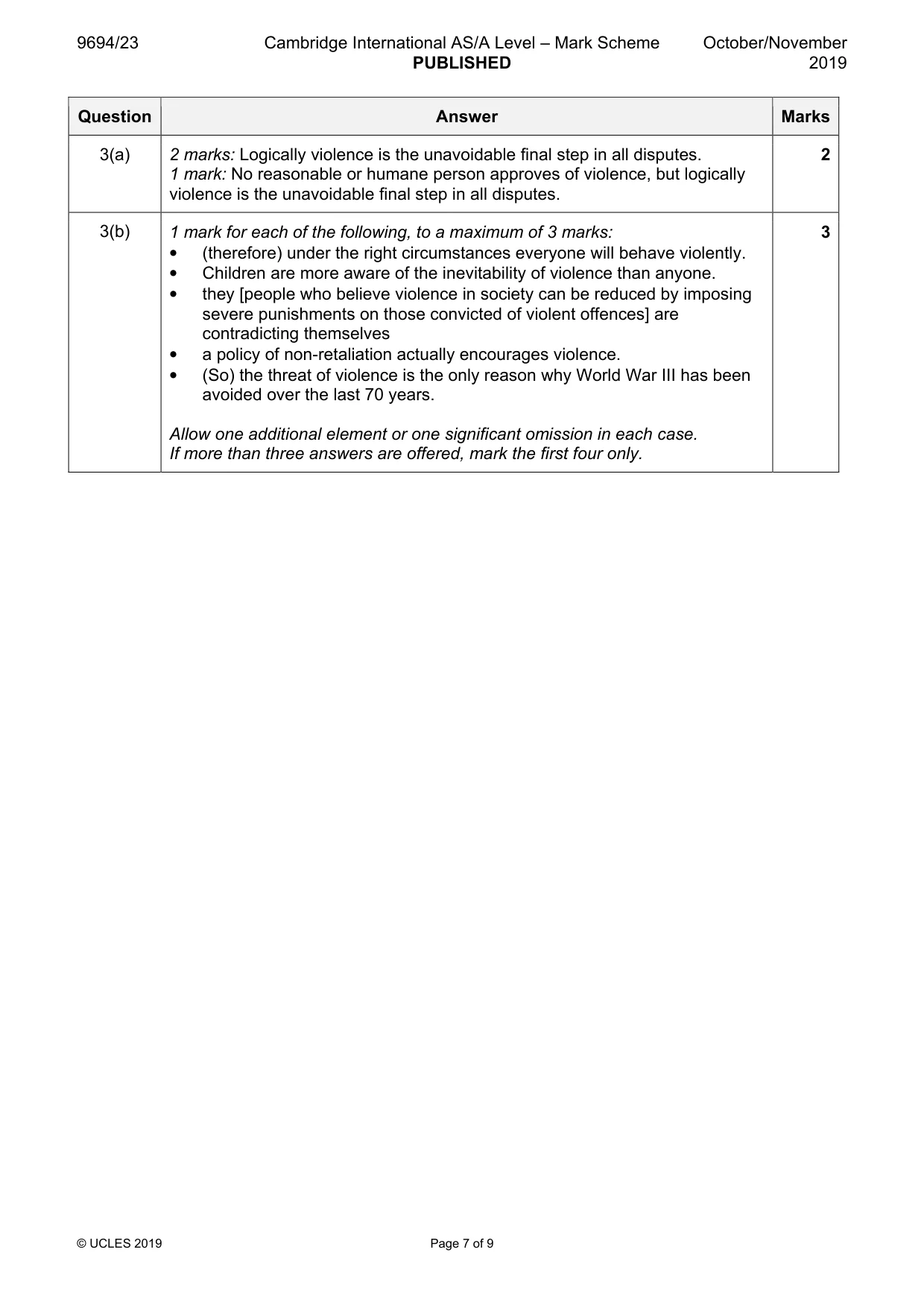
9694/23 Cambridge International AS/A Level – Mark Scheme PUBLISHED October/November 2019 © UCLES 2019 Page 7 of 9 Question Answer Marks 3(a) 2 marks: Logically violence is the unavoidable final step in all disputes. 1 mark: No reasonable or humane person approves of violence, but logically violence is the unavoidable final step in all disputes. 2 3(b) 1 mark for each of the following, to a maximum of 3 marks: • (therefore) under the right circumstances everyone will behave violently. • Children are more aware of the inevitability of violence than anyone. • they [people who believe violence in society can be reduced by imposing severe punishments on those convicted of violent offences] are contradicting themselves • a policy of non-retaliation actually encourages violence. • (So) the threat of violence is the only reason why World War III has been avoided over the last 70 years. Allow one additional element or one significant omission in each case. If more than three answers are offered, mark the first four only. 3
Mark scheme, page 8
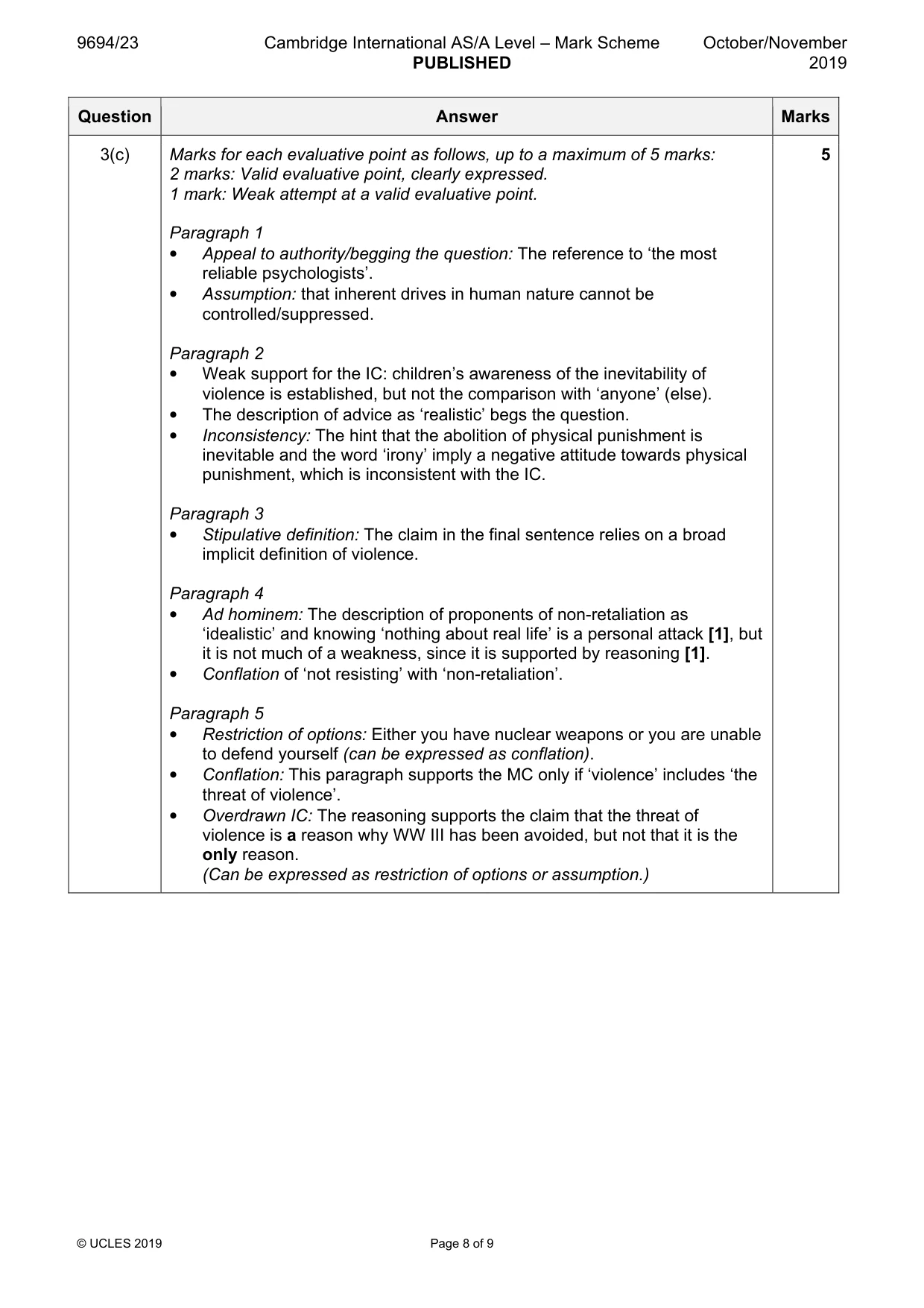
9694/23 Cambridge International AS/A Level – Mark Scheme PUBLISHED October/November 2019 © UCLES 2019 Page 8 of 9 Question Answer Marks 3(c) Marks for each evaluative point as follows, up to a maximum of 5 marks: 2 marks: Valid evaluative point, clearly expressed. 1 mark: Weak attempt at a valid evaluative point. Paragraph 1 • Appeal to authority/begging the question: The reference to ‘the most reliable psychologists’. • Assumption: that inherent drives in human nature cannot be controlled/suppressed. Paragraph 2 • Weak support for the IC: children’s awareness of the inevitability of violence is established, but not the comparison with ‘anyone’ (else). • The description of advice as ‘realistic’ begs the question. • Inconsistency: The hint that the abolition of physical punishment is inevitable and the word ‘irony’ imply a negative attitude towards physical punishment, which is inconsistent with the IC. Paragraph 3 • Stipulative definition: The claim in the final sentence relies on a broad implicit definition of violence. Paragraph 4 • Ad hominem: The description of proponents of non-retaliation as ‘idealistic’ and knowing ‘nothing about real life’ is a personal attack [1], but it is not much of a weakness, since it is supported by reasoning [1]. • Conflation of ‘not resisting’ with ‘non-retaliation’. Paragraph 5 • Restriction of options: Either you have nuclear weapons or you are unable to defend yourself (can be expressed as conflation). • Conflation: This paragraph supports the MC only if ‘violence’ includes ‘the threat of violence’. • Overdrawn IC: The reasoning supports the claim that the threat of violence is a reason why WW III has been avoided, but not that it is the only reason. (Can be expressed as restriction of options or assumption.) 5
Mark scheme, page 9
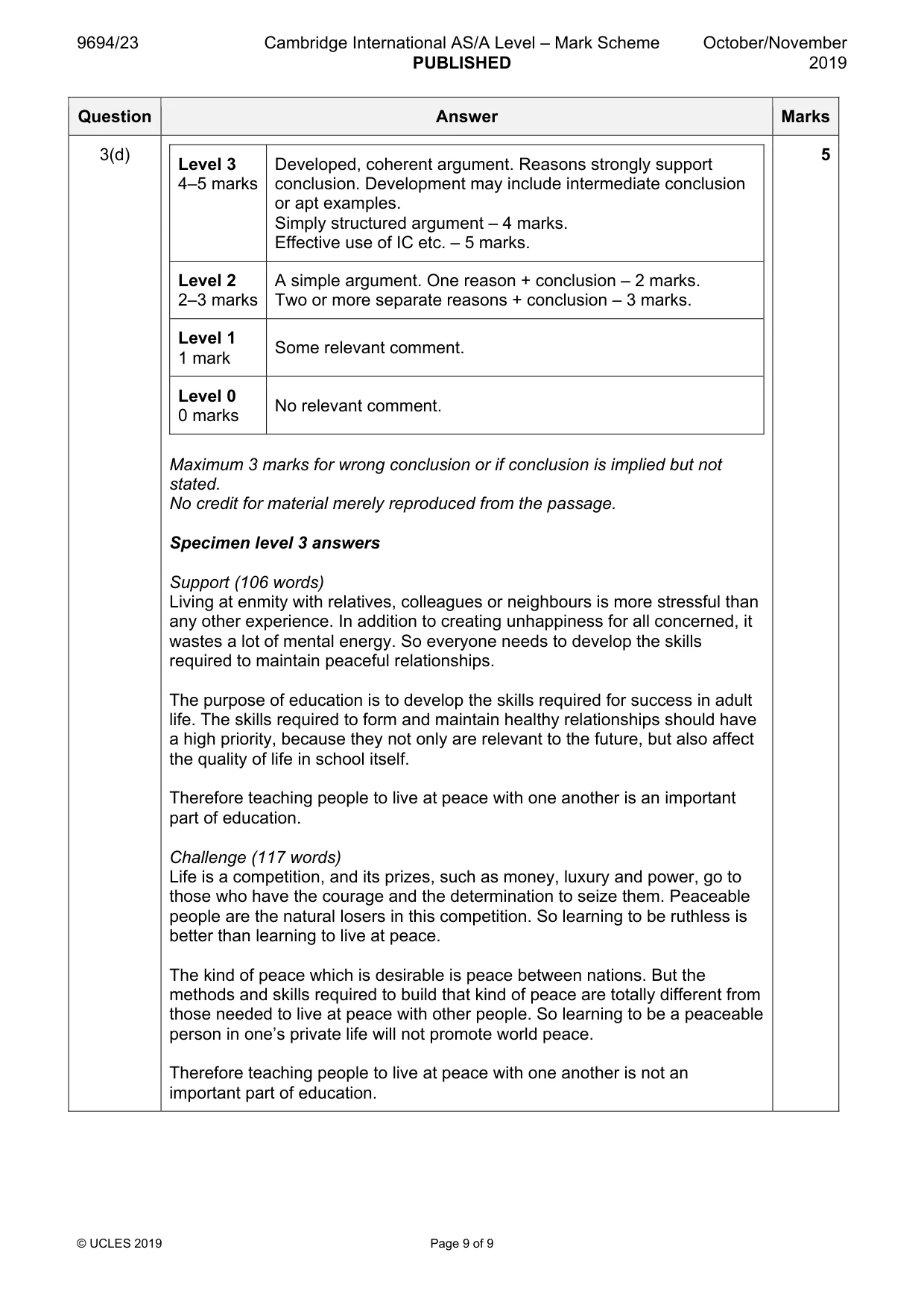
9694/23 Cambridge International AS/A Level – Mark Scheme PUBLISHED October/November 2019 © UCLES 2019 Page 9 of 9 Question Answer Marks 3(d) Level 3 4–5 marks Developed, coherent argument. Reasons strongly support conclusion. Development may include intermediate conclusion or apt examples. Simply structured argument – 4 marks. Effective use of IC etc. – 5 marks. Level 2 2–3 marks A simple argument. One reason + conclusion – 2 marks. Two or more separate reasons + conclusion – 3 marks. Level 1 1 mark Some relevant comment. Level 0 0 marks No relevant comment. Maximum 3 marks for wrong conclusion or if conclusion is implied but not stated. No credit for material merely reproduced from the passage. Specimen level 3 answers Support (106 words) Living at enmity with relatives, colleagues or neighbours is more stressful than any other experience. In addition to creating unhappiness for all concerned, it wastes a lot of mental energy. So everyone needs to develop the skills required to maintain peaceful relationships. The purpose of education is to develop the skills required for success in adult life. The skills required to form and maintain healthy relationships should have a high priority, because they not only are relevant to the future, but also affect the quality of life in school itself. Therefore teaching people to live at peace with one another is an important part of education. Challenge (117 words) Life is a competition, and its prizes, such as money, luxury and power, go to those who have the courage and the determination to seize them. Peaceable people are the natural losers in this competition. So learning to be ruthless is better than learning to live at peace. The kind of peace which is desirable is peace between nations. But the methods and skills required to build that kind of peace are totally different from those needed to live at peace with other people. So learning to be a peaceable person in one’s private life will not promote world peace. Therefore teaching people to live at peace with one another is not an important part of education. 5
What you needed in this session
Cambridge’s own grade thresholds for 2019 Oct/Nov, Paper 2 · Variant 3. A higher threshold means an easier paper — the bar moves with how the cohort did.