Cambridge A Level Thinking Skills 9694 — 2019 May/June Paper 2 · Variant 1
9694/21/M/J/19 · 45 marks · ≈51 min
The question paper and its mark scheme, free to read here and free to download. This is Cambridge’s own paper, exactly as it was sat.
Question paper8 pages


Mark scheme10 pages
Answers below. Sit the paper first if you are practising.
Paper as text
Question paper, page 1
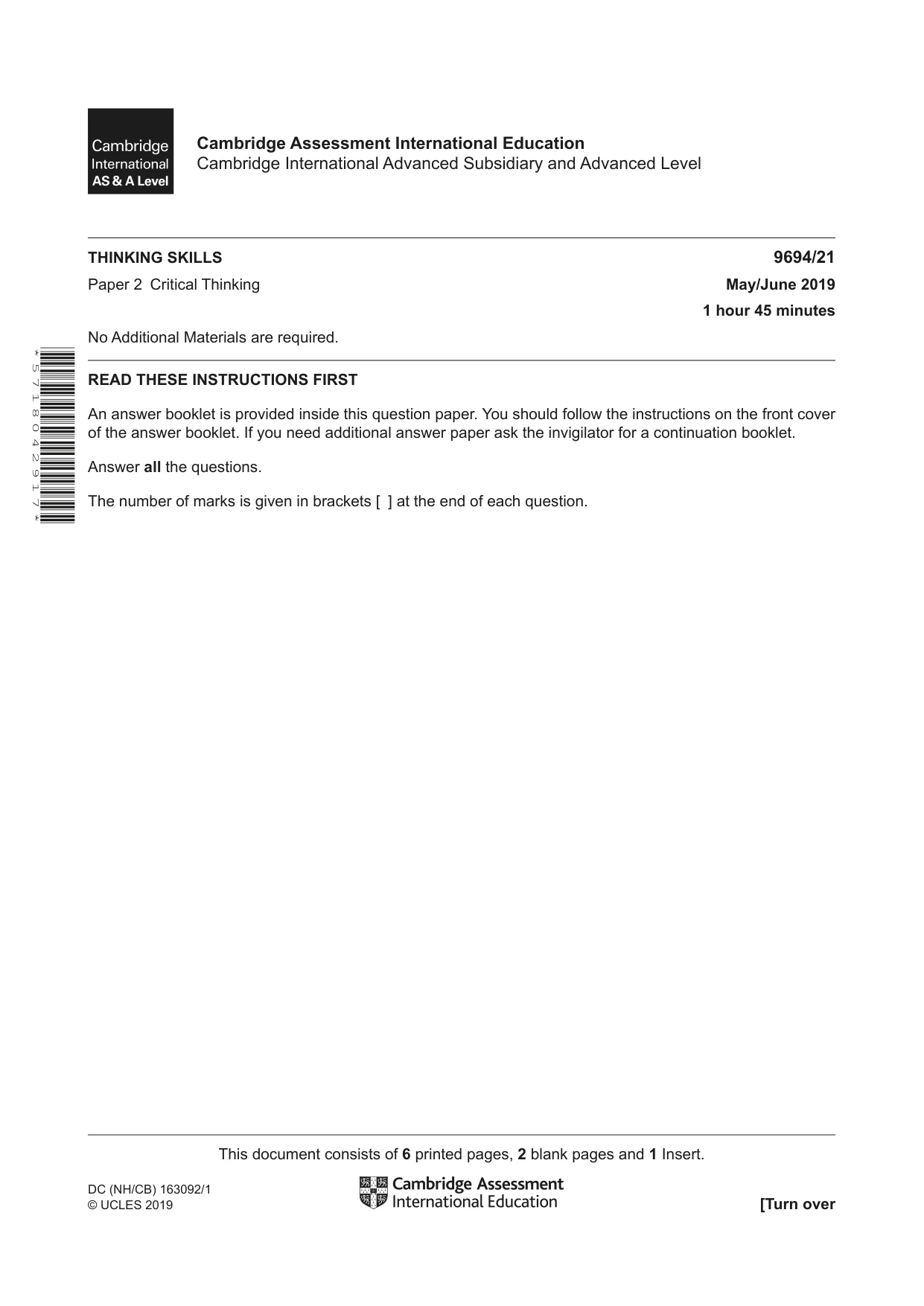
This document consists of 6 printed pages, 2 blank pages and 1 Insert. DC (NH/CB) 163092/1 © UCLES 2019 [Turn over * 5 7 1 8 0 4 2 9 1 7 * THINKING SKILLS 9694/21 Paper 2 Critical Thinking May/June 2019 1 hour 45 minutes No Additional Materials are required. READ THESE INSTRUCTIONS FIRST An answer booklet is provided inside this question paper. You should follow the instructions on the front cover of the answer booklet. If you need additional answer paper ask the invigilator for a continuation booklet. Answer all the questions. The number of marks is given in brackets [ ] at the end of each question. Cambridge Assessment International Education Cambridge International Advanced Subsidiary and Advanced Level
Question paper, page 2
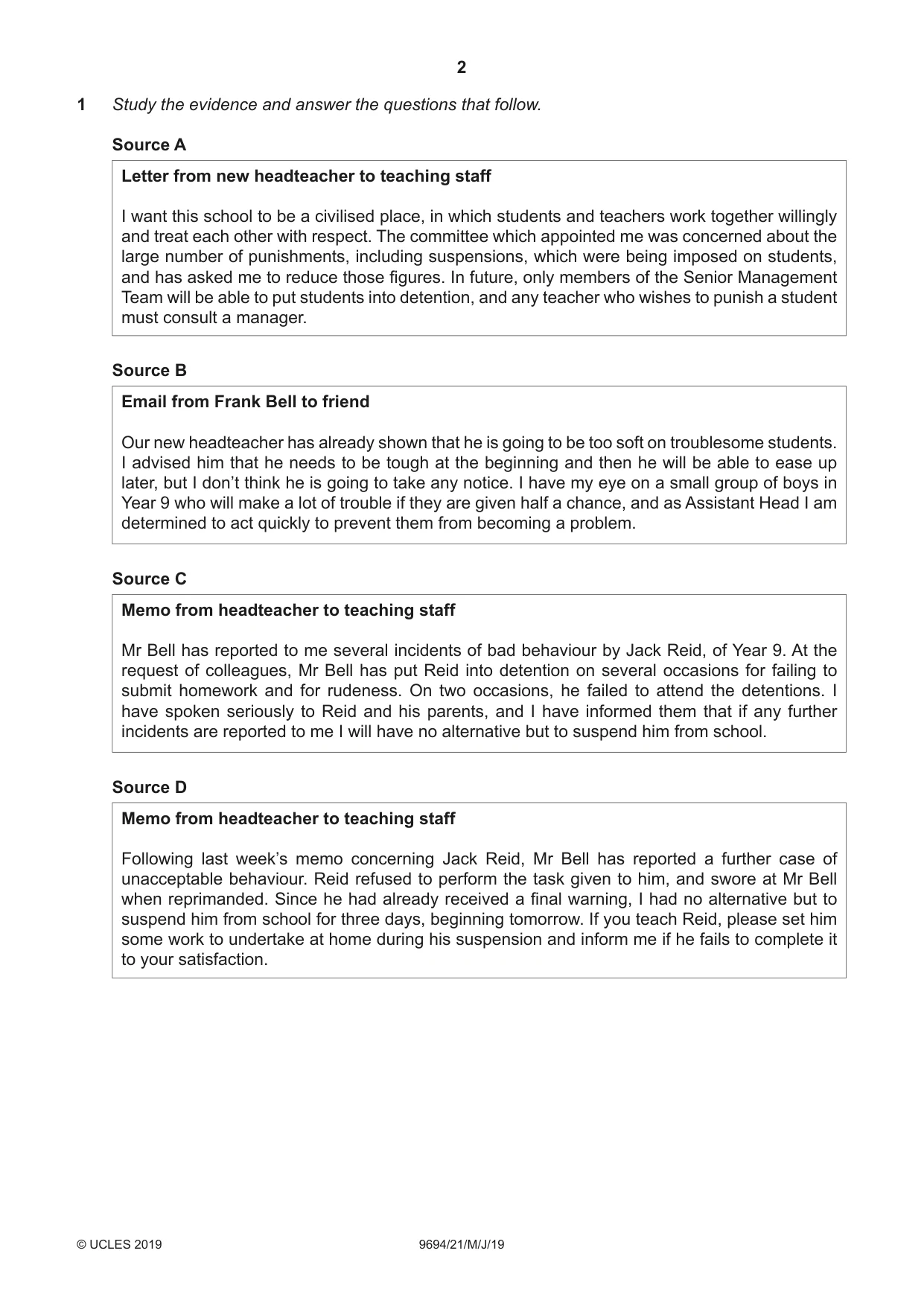
2 9694/21/M/J/19 © UCLES 2019 1 Study the evidence and answer the questions that follow. Source A Letter from new headteacher to teaching staff I want this school to be a civilised place, in which students and teachers work together willingly and treat each other with respect. The committee which appointed me was concerned about the large number of punishments, including suspensions, which were being imposed on students, and has asked me to reduce those figures. In future, only members of the Senior Management Team will be able to put students into detention, and any teacher who wishes to punish a student must consult a manager. Source B Email from Frank Bell to friend Our new headteacher has already shown that he is going to be too soft on troublesome students. I advised him that he needs to be tough at the beginning and then he will be able to ease up later, but I don’t think he is going to take any notice. I have my eye on a small group of boys in Year 9 who will make a lot of trouble if they are given half a chance, and as Assistant Head I am determined to act quickly to prevent them from becoming a problem. Source C Memo from headteacher to teaching staff Mr Bell has reported to me several incidents of bad behaviour by Jack Reid, of Year 9. At the request of colleagues, Mr Bell has put Reid into detention on several occasions for failing to submit homework and for rudeness. On two occasions, he failed to attend the detentions. I have spoken seriously to Reid and his parents, and I have informed them that if any further incidents are reported to me I will have no alternative but to suspend him from school. Source D Memo from headteacher to teaching staff Following last week’s memo concerning Jack Reid, Mr Bell has reported a further case of unacceptable behaviour. Reid refused to perform the task given to him, and swore at Mr Bell when reprimanded. Since he had already received a final warning, I had no alternative but to suspend him from school for three days, beginning tomorrow. If you teach Reid, please set him some work to undertake at home during his suspension and inform me if he fails to complete it to your satisfaction.
Question paper, page 3
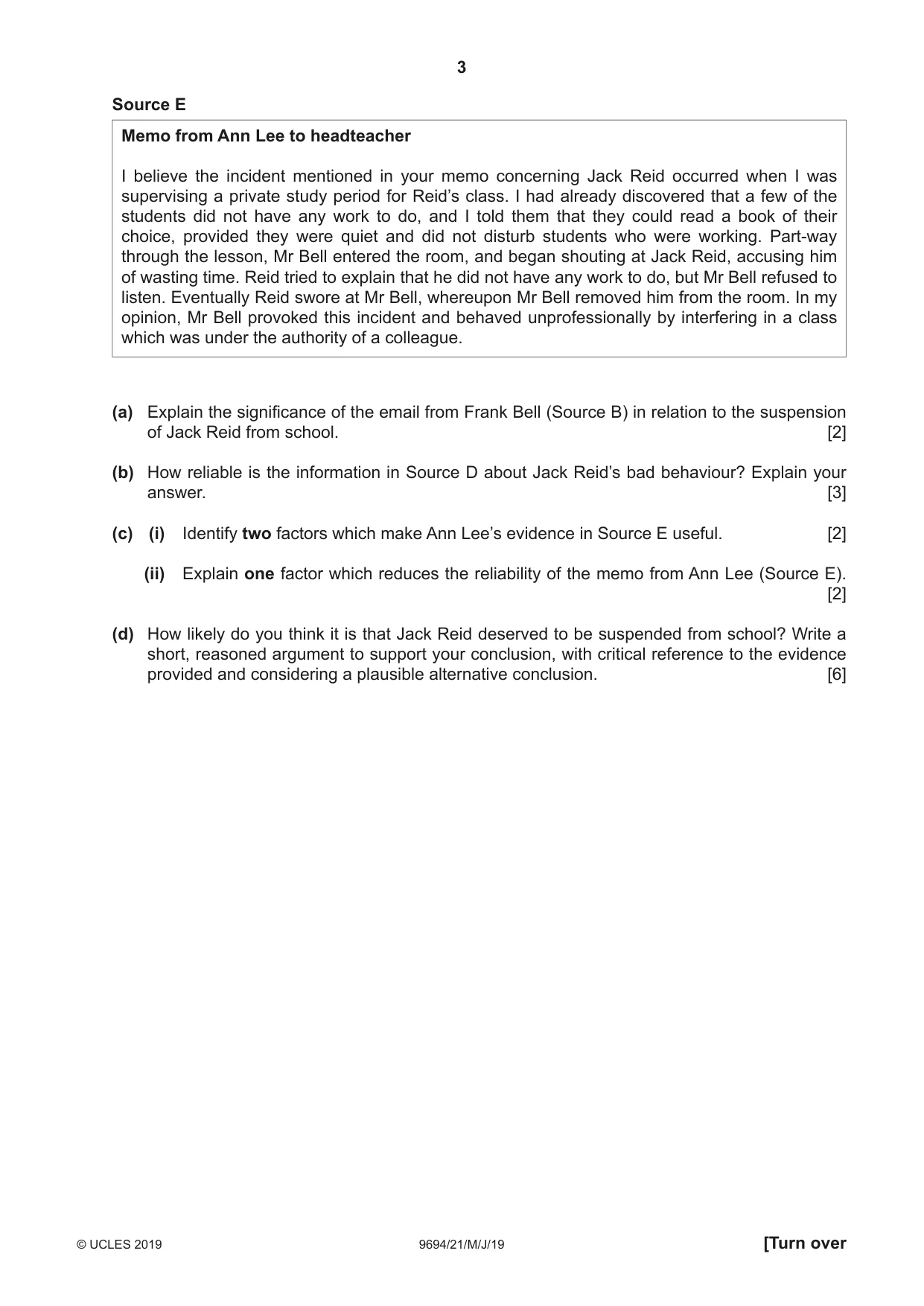
3 9694/21/M/J/19 © UCLES 2019 [Turn over Source E Memo from Ann Lee to headteacher I believe the incident mentioned in your memo concerning Jack Reid occurred when I was supervising a private study period for Reid’s class. I had already discovered that a few of the students did not have any work to do, and I told them that they could read a book of their choice, provided they were quiet and did not disturb students who were working. Part-way through the lesson, Mr Bell entered the room, and began shouting at Jack Reid, accusing him of wasting time. Reid tried to explain that he did not have any work to do, but Mr Bell refused to listen. Eventually Reid swore at Mr Bell, whereupon Mr Bell removed him from the room. In my opinion, Mr Bell provoked this incident and behaved unprofessionally by interfering in a class which was under the authority of a colleague. (a) Explain the significance of the email from Frank Bell (Source B) in relation to the suspension of Jack Reid from school. [2] (b) How reliable is the information in Source D about Jack Reid’s bad behaviour? Explain your answer. [3] (c) (i) Identify two factors which make Ann Lee’s evidence in Source E useful. [2] (ii) Explain one factor which reduces the reliability of the memo from Ann Lee (Source E). [2] (d) How likely do you think it is that Jack Reid deserved to be suspended from school? Write a short, reasoned argument to support your conclusion, with critical reference to the evidence provided and considering a plausible alternative conclusion. [6]
Question paper, page 4
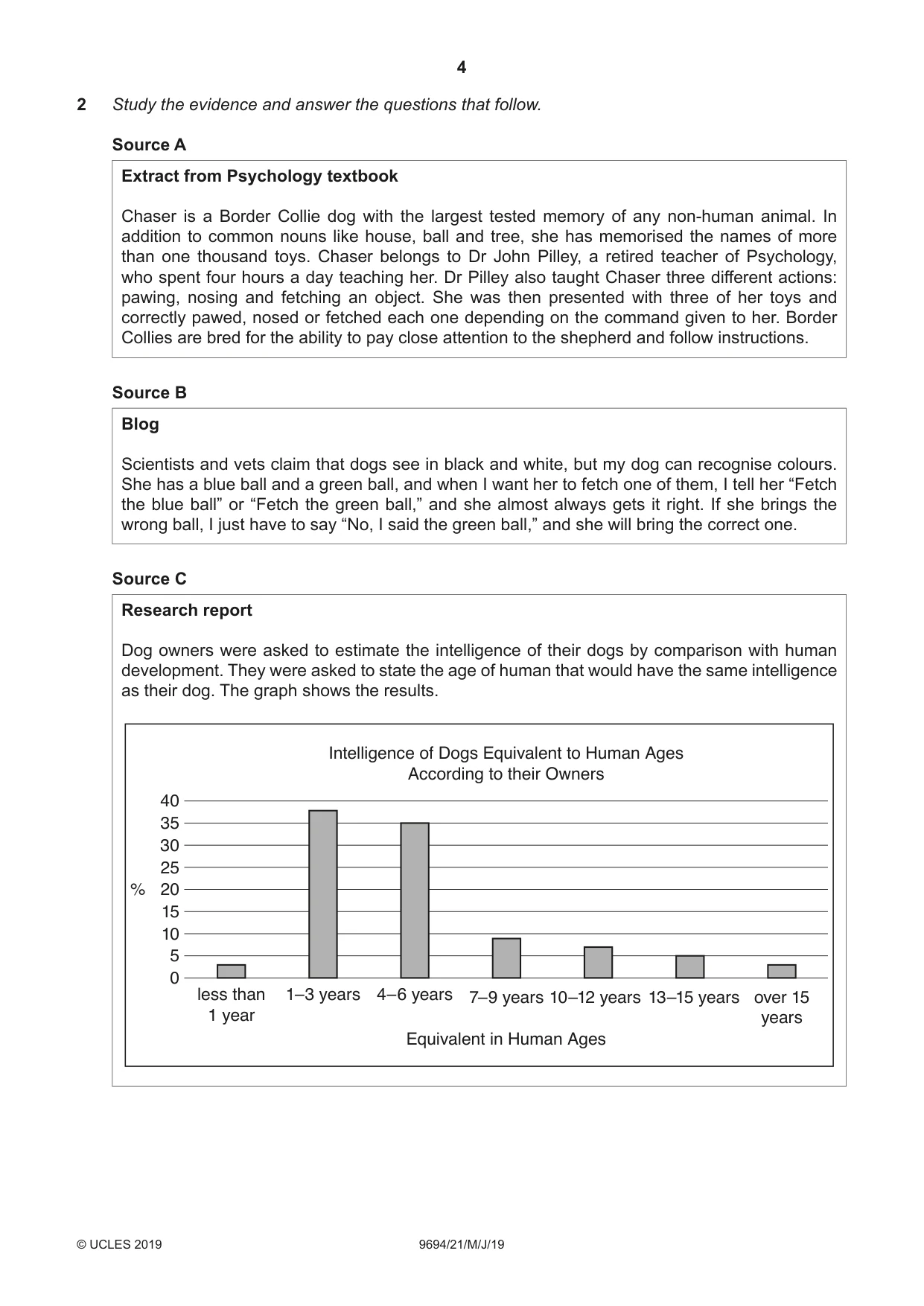
4 9694/21/M/J/19 © UCLES 2019 2 Study the evidence and answer the questions that follow. Source A Extract from Psychology textbook Chaser is a Border Collie dog with the largest tested memory of any non-human animal. In addition to common nouns like house, ball and tree, she has memorised the names of more than one thousand toys. Chaser belongs to Dr John Pilley, a retired teacher of Psychology, who spent four hours a day teaching her. Dr Pilley also taught Chaser three different actions: pawing, nosing and fetching an object. She was then presented with three of her toys and correctly pawed, nosed or fetched each one depending on the command given to her. Border Collies are bred for the ability to pay close attention to the shepherd and follow instructions. Source B Blog Scientists and vets claim that dogs see in black and white, but my dog can recognise colours. She has a blue ball and a green ball, and when I want her to fetch one of them, I tell her “Fetch the blue ball” or “Fetch the green ball,” and she almost always gets it right. If she brings the wrong ball, I just have to say “No, I said the green ball,” and she will bring the correct one. Source C Research report Dog owners were asked to estimate the intelligence of their dogs by comparison with human development. They were asked to state the age of human that would have the same intelligence as their dog. The graph shows the results. Intelligence of Dogs Equivalent to Human Ages According to their Owners Equivalent in Human Ages less than 1 year 40 35 30 25 20 % 15 10 5 0 1–3 years 4–6 years 7–9 years 10–12 years 13–15 years over 15 years
Question paper, page 5
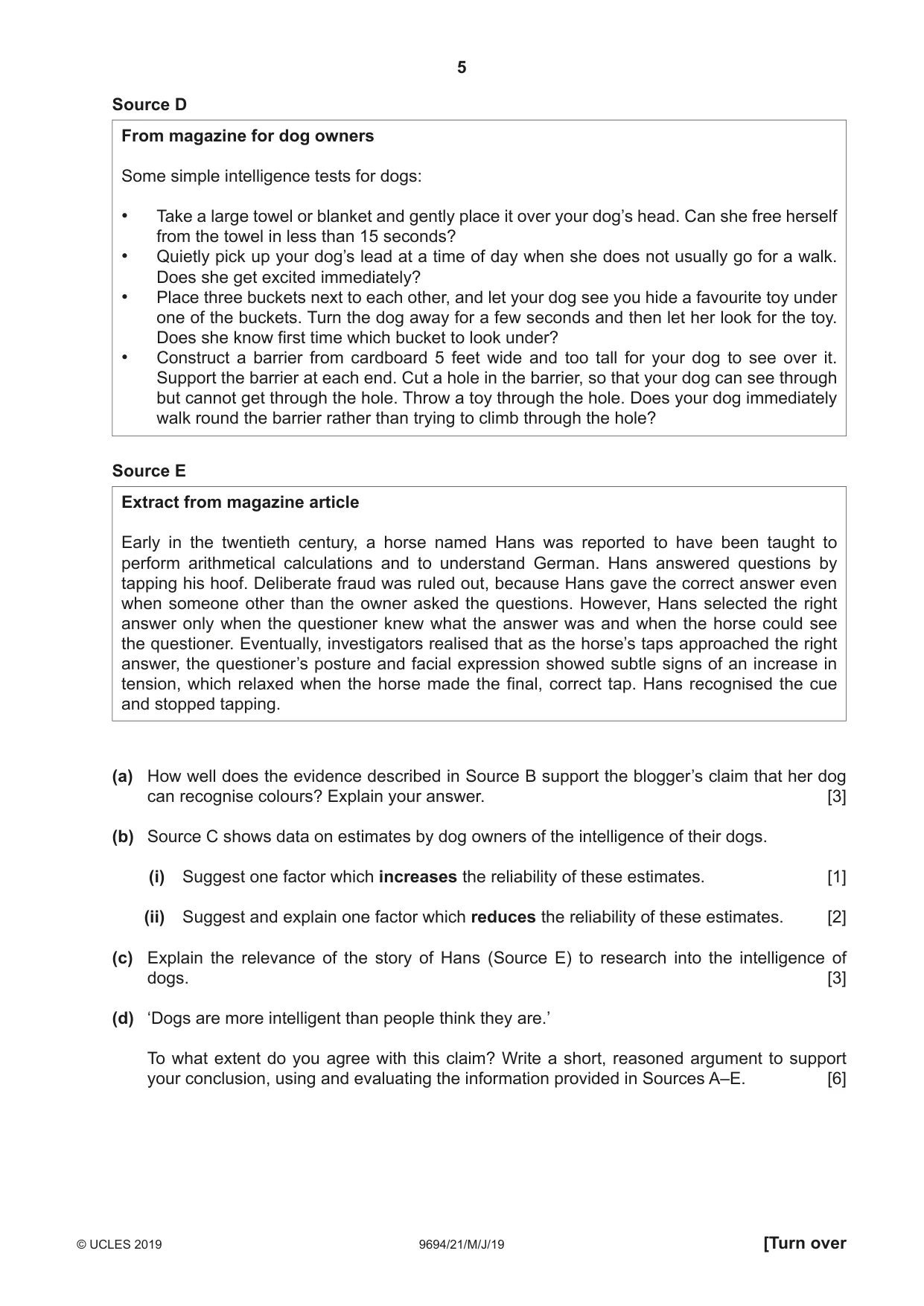
5 9694/21/M/J/19 © UCLES 2019 [Turn over Source D From magazine for dog owners Some simple intelligence tests for dogs: • Take a large towel or blanket and gently place it over your dog’s head. Can she free herself from the towel in less than 15 seconds? • Quietly pick up your dog’s lead at a time of day when she does not usually go for a walk. Does she get excited immediately? • Place three buckets next to each other, and let your dog see you hide a favourite toy under one of the buckets. Turn the dog away for a few seconds and then let her look for the toy. Does she know first time which bucket to look under? • Construct a barrier from cardboard 5 feet wide and too tall for your dog to see over it. Support the barrier at each end. Cut a hole in the barrier, so that your dog can see through but cannot get through the hole. Throw a toy through the hole. Does your dog immediately walk round the barrier rather than trying to climb through the hole? Source E Extract from magazine article Early in the twentieth century, a horse named Hans was reported to have been taught to perform arithmetical calculations and to understand German. Hans answered questions by tapping his hoof. Deliberate fraud was ruled out, because Hans gave the correct answer even when someone other than the owner asked the questions. However, Hans selected the right answer only when the questioner knew what the answer was and when the horse could see the questioner. Eventually, investigators realised that as the horse’s taps approached the right answer, the questioner’s posture and facial expression showed subtle signs of an increase in tension, which relaxed when the horse made the final, correct tap. Hans recognised the cue and stopped tapping. (a) How well does the evidence described in Source B support the blogger’s claim that her dog can recognise colours? Explain your answer. [3] (b) Source C shows data on estimates by dog owners of the intelligence of their dogs. (i) Suggest one factor which increases the reliability of these estimates. [1] (ii) Suggest and explain one factor which reduces the reliability of these estimates. [2] (c) Explain the relevance of the story of Hans (Source E) to research into the intelligence of dogs. [3] (d) ‘Dogs are more intelligent than people think they are.’ To what extent do you agree with this claim? Write a short, reasoned argument to support your conclusion, using and evaluating the information provided in Sources A–E. [6]
Question paper, page 6
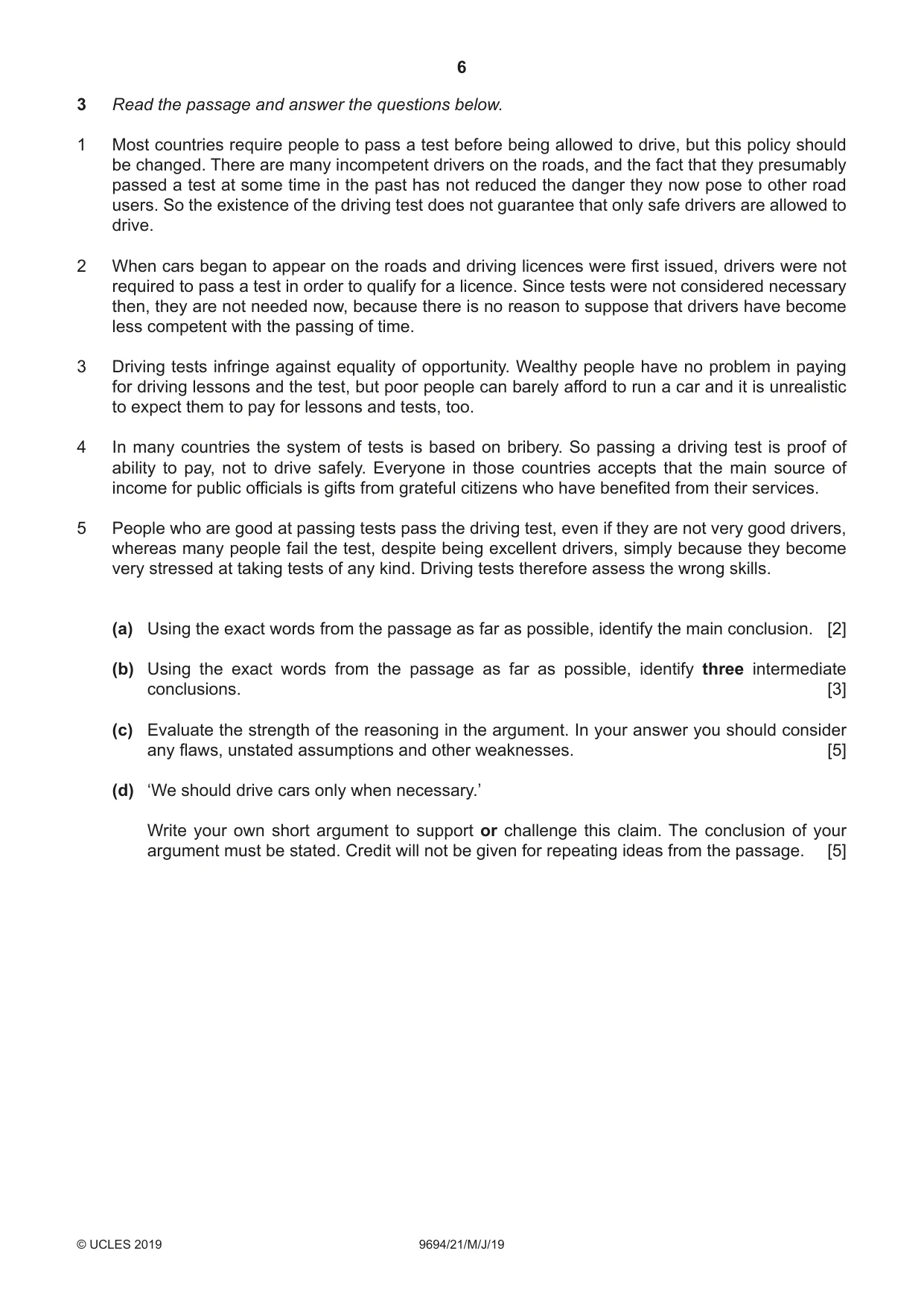
6 9694/21/M/J/19 © UCLES 2019 3 Read the passage and answer the questions below. 1 Most countries require people to pass a test before being allowed to drive, but this policy should be changed. There are many incompetent drivers on the roads, and the fact that they presumably passed a test at some time in the past has not reduced the danger they now pose to other road users. So the existence of the driving test does not guarantee that only safe drivers are allowed to drive. 2 When cars began to appear on the roads and driving licences were first issued, drivers were not required to pass a test in order to qualify for a licence. Since tests were not considered necessary then, they are not needed now, because there is no reason to suppose that drivers have become less competent with the passing of time. 3 Driving tests infringe against equality of opportunity. Wealthy people have no problem in paying for driving lessons and the test, but poor people can barely afford to run a car and it is unrealistic to expect them to pay for lessons and tests, too. 4 In many countries the system of tests is based on bribery. So passing a driving test is proof of ability to pay, not to drive safely. Everyone in those countries accepts that the main source of income for public officials is gifts from grateful citizens who have benefited from their services. 5 People who are good at passing tests pass the driving test, even if they are not very good drivers, whereas many people fail the test, despite being excellent drivers, simply because they become very stressed at taking tests of any kind. Driving tests therefore assess the wrong skills. (a) Using the exact words from the passage as far as possible, identify the main conclusion. [2] (b) Using the exact words from the passage as far as possible, identify three intermediate conclusions. [3] (c) Evaluate the strength of the reasoning in the argument. In your answer you should consider any flaws, unstated assumptions and other weaknesses. [5] (d) ‘We should drive cars only when necessary.’ Write your own short argument to support or challenge this claim. The conclusion of your argument must be stated. Credit will not be given for repeating ideas from the passage. [5]
Question paper, page 7
7 9694/21/M/J/19 © UCLES 2019 BLANK PAGE
Question paper, page 8
8 9694/21/M/J/19 © UCLES 2019 BLANK PAGE Permission to reproduce items where third-party owned material protected by copyright is included has been sought and cleared where possible. Every reasonable effort has been made by the publisher (UCLES) to trace copyright holders, but if any items requiring clearance have unwittingly been included, the publisher will be pleased to make amends at the earliest possible opportunity. To avoid the issue of disclosure of answer-related information to candidates, all copyright acknowledgements are reproduced online in the Cambridge Assessment International Education Copyright Acknowledgements Booklet. This is produced for each series of examinations and is freely available to download at www.cambridgeinternational.org after the live examination series. Cambridge Assessment International Education is part of the Cambridge Assessment Group. Cambridge Assessment is the brand name of the University of Cambridge Local Examinations Syndicate (UCLES), which itself is a department of the University of Cambridge.
Mark scheme, page 1
This document consists of 10 printed pages. © UCLES 2019 [Turn over Cambridge Assessment International Education Cambridge International Advanced Subsidiary and Advanced Level THINKING SKILLS 9694/21 Paper 2 Critical Thinking May/June 2019 MARK SCHEME Maximum Mark: 45 Published This mark scheme is published as an aid to teachers and candidates, to indicate the requirements of the examination. It shows the basis on which Examiners were instructed to award marks. It does not indicate the details of the discussions that took place at an Examiners’ meeting before marking began, which would have considered the acceptability of alternative answers. Mark schemes should be read in conjunction with the question paper and the Principal Examiner Report for Teachers. Cambridge International will not enter into discussions about these mark schemes. Cambridge International is publishing the mark schemes for the May/June 2019 series for most Cambridge IGCSE™, Cambridge International A and AS Level and Cambridge Pre-U components, and some Cambridge O Level components.
Mark scheme, page 2
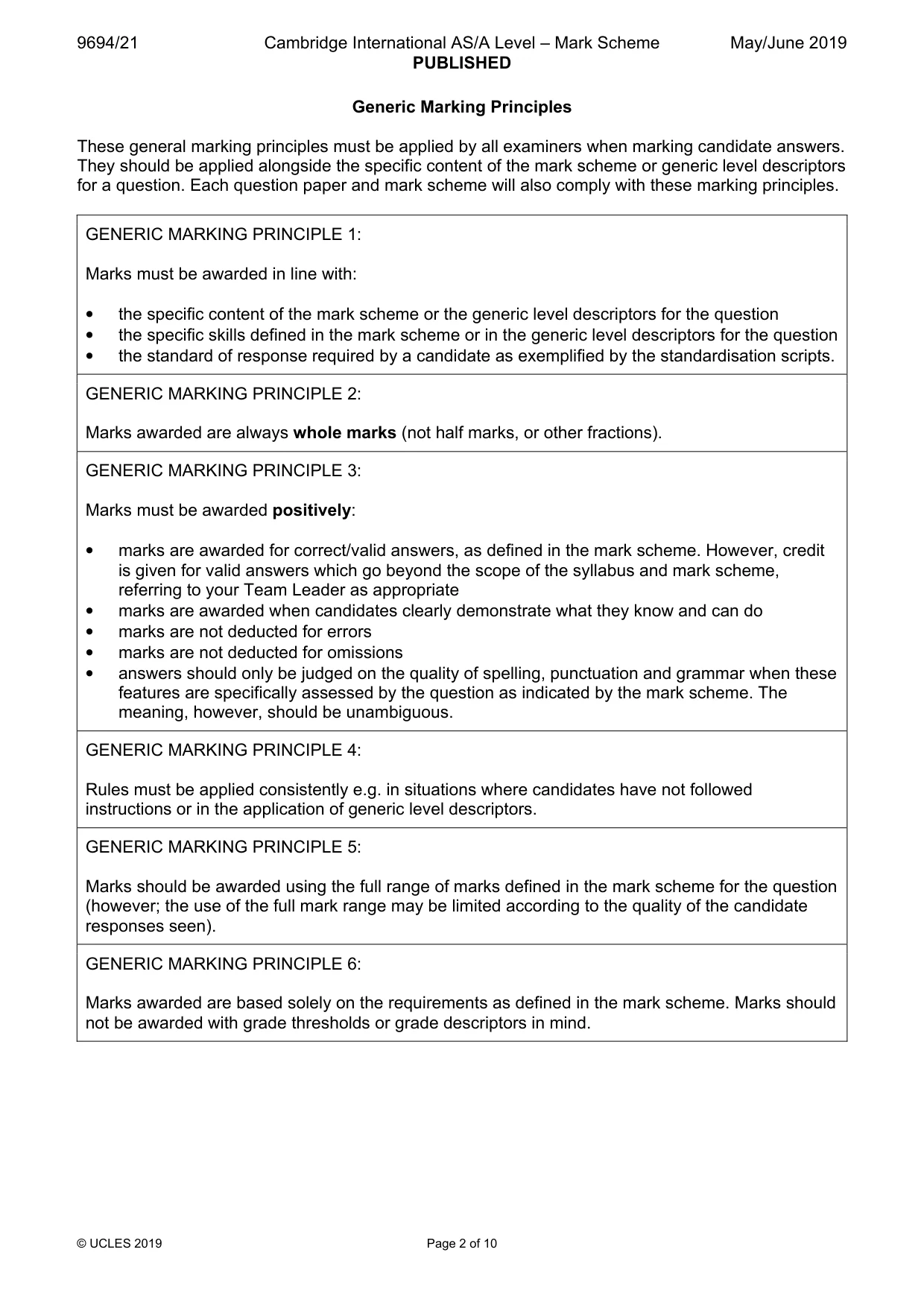
9694/21 Cambridge International AS/A Level – Mark Scheme PUBLISHED May/June 2019 © UCLES 2019 Page 2 of 10 Generic Marking Principles These general marking principles must be applied by all examiners when marking candidate answers. They should be applied alongside the specific content of the mark scheme or generic level descriptors for a question. Each question paper and mark scheme will also comply with these marking principles. GENERIC MARKING PRINCIPLE 1: Marks must be awarded in line with: • the specific content of the mark scheme or the generic level descriptors for the question • the specific skills defined in the mark scheme or in the generic level descriptors for the question • the standard of response required by a candidate as exemplified by the standardisation scripts. GENERIC MARKING PRINCIPLE 2: Marks awarded are always whole marks (not half marks, or other fractions). GENERIC MARKING PRINCIPLE 3: Marks must be awarded positively: • marks are awarded for correct/valid answers, as defined in the mark scheme. However, credit is given for valid answers which go beyond the scope of the syllabus and mark scheme, referring to your Team Leader as appropriate • marks are awarded when candidates clearly demonstrate what they know and can do • marks are not deducted for errors • marks are not deducted for omissions • answers should only be judged on the quality of spelling, punctuation and grammar when these features are specifically assessed by the question as indicated by the mark scheme. The meaning, however, should be unambiguous. GENERIC MARKING PRINCIPLE 4: Rules must be applied consistently e.g. in situations where candidates have not followed instructions or in the application of generic level descriptors. GENERIC MARKING PRINCIPLE 5: Marks should be awarded using the full range of marks defined in the mark scheme for the question (however; the use of the full mark range may be limited according to the quality of the candidate responses seen). GENERIC MARKING PRINCIPLE 6: Marks awarded are based solely on the requirements as defined in the mark scheme. Marks should not be awarded with grade thresholds or grade descriptors in mind.
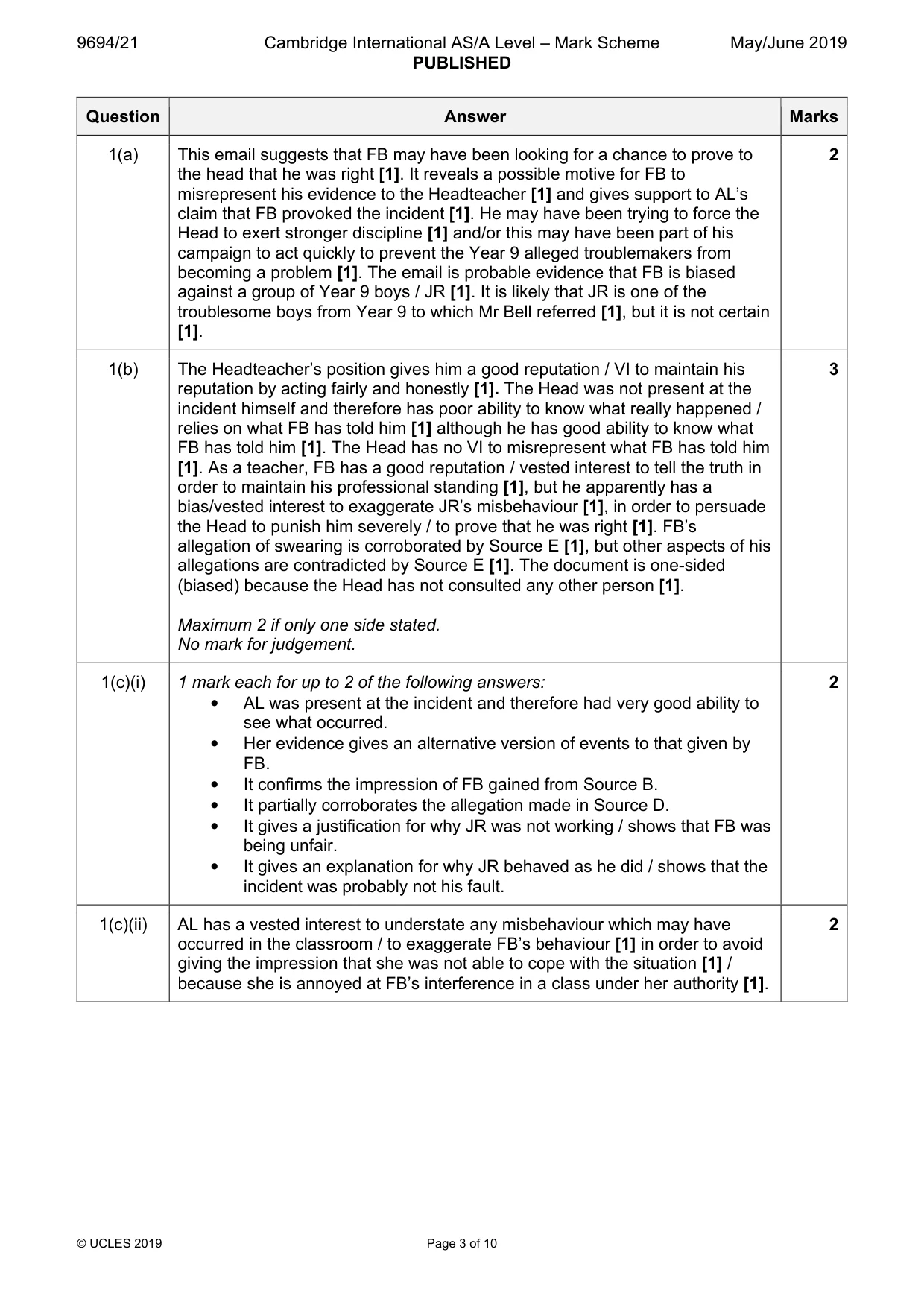
Mark scheme, page 3
9694/21 Cambridge International AS/A Level – Mark Scheme PUBLISHED May/June 2019 © UCLES 2019 Page 3 of 10 Question Answer Marks 1(a) This email suggests that FB may have been looking for a chance to prove to the head that he was right [1]. It reveals a possible motive for FB to misrepresent his evidence to the Headteacher [1] and gives support to AL’s claim that FB provoked the incident [1]. He may have been trying to force the Head to exert stronger discipline [1] and/or this may have been part of his campaign to act quickly to prevent the Year 9 alleged troublemakers from becoming a problem [1]. The email is probable evidence that FB is biased against a group of Year 9 boys / JR [1]. It is likely that JR is one of the troublesome boys from Year 9 to which Mr Bell referred [1], but it is not certain [1]. 2 1(b) The Headteacher’s position gives him a good reputation / VI to maintain his reputation by acting fairly and honestly [1]. The Head was not present at the incident himself and therefore has poor ability to know what really happened / relies on what FB has told him [1] although he has good ability to know what FB has told him [1]. The Head has no VI to misrepresent what FB has told him [1]. As a teacher, FB has a good reputation / vested interest to tell the truth in order to maintain his professional standing [1], but he apparently has a bias/vested interest to exaggerate JR’s misbehaviour [1], in order to persuade the Head to punish him severely / to prove that he was right [1]. FB’s allegation of swearing is corroborated by Source E [1], but other aspects of his allegations are contradicted by Source E [1]. The document is one-sided (biased) because the Head has not consulted any other person [1]. Maximum 2 if only one side stated. No mark for judgement. 3 1(c)(i) 1 mark each for up to 2 of the following answers: • AL was present at the incident and therefore had very good ability to see what occurred. • Her evidence gives an alternative version of events to that given by FB. • It confirms the impression of FB gained from Source B. • It partially corroborates the allegation made in Source D. • It gives a justification for why JR was not working / shows that FB was being unfair. • It gives an explanation for why JR behaved as he did / shows that the incident was probably not his fault. 2 1(c)(ii) AL has a vested interest to understate any misbehaviour which may have occurred in the classroom / to exaggerate FB’s behaviour [1] in order to avoid giving the impression that she was not able to cope with the situation [1] / because she is annoyed at FB’s interference in a class under her authority [1]. 2
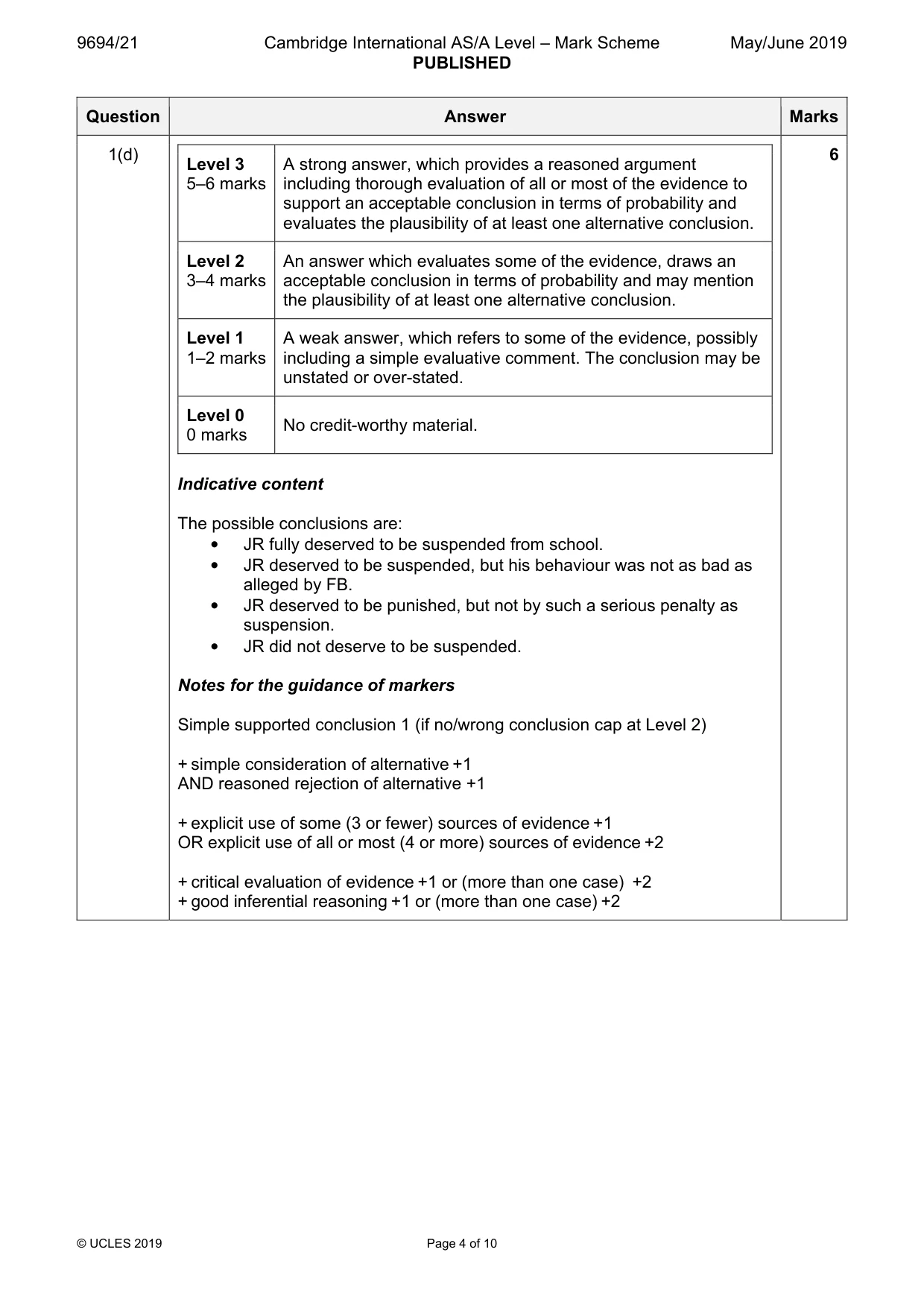
Mark scheme, page 4
9694/21 Cambridge International AS/A Level – Mark Scheme PUBLISHED May/June 2019 © UCLES 2019 Page 4 of 10 Question Answer Marks 1(d) Level 3 5–6 marks A strong answer, which provides a reasoned argument including thorough evaluation of all or most of the evidence to support an acceptable conclusion in terms of probability and evaluates the plausibility of at least one alternative conclusion. Level 2 3–4 marks An answer which evaluates some of the evidence, draws an acceptable conclusion in terms of probability and may mention the plausibility of at least one alternative conclusion. Level 1 1–2 marks A weak answer, which refers to some of the evidence, possibly including a simple evaluative comment. The conclusion may be unstated or over-stated. Level 0 0 marks No credit-worthy material. Indicative content The possible conclusions are: • JR fully deserved to be suspended from school. • JR deserved to be suspended, but his behaviour was not as bad as alleged by FB. • JR deserved to be punished, but not by such a serious penalty as suspension. • JR did not deserve to be suspended. Notes for the guidance of markers Simple supported conclusion 1 (if no/wrong conclusion cap at Level 2) + simple consideration of alternative +1 AND reasoned rejection of alternative +1 + explicit use of some (3 or fewer) sources of evidence +1 OR explicit use of all or most (4 or more) sources of evidence +2 + critical evaluation of evidence +1 or (more than one case) +2 + good inferential reasoning +1 or (more than one case) +2 6
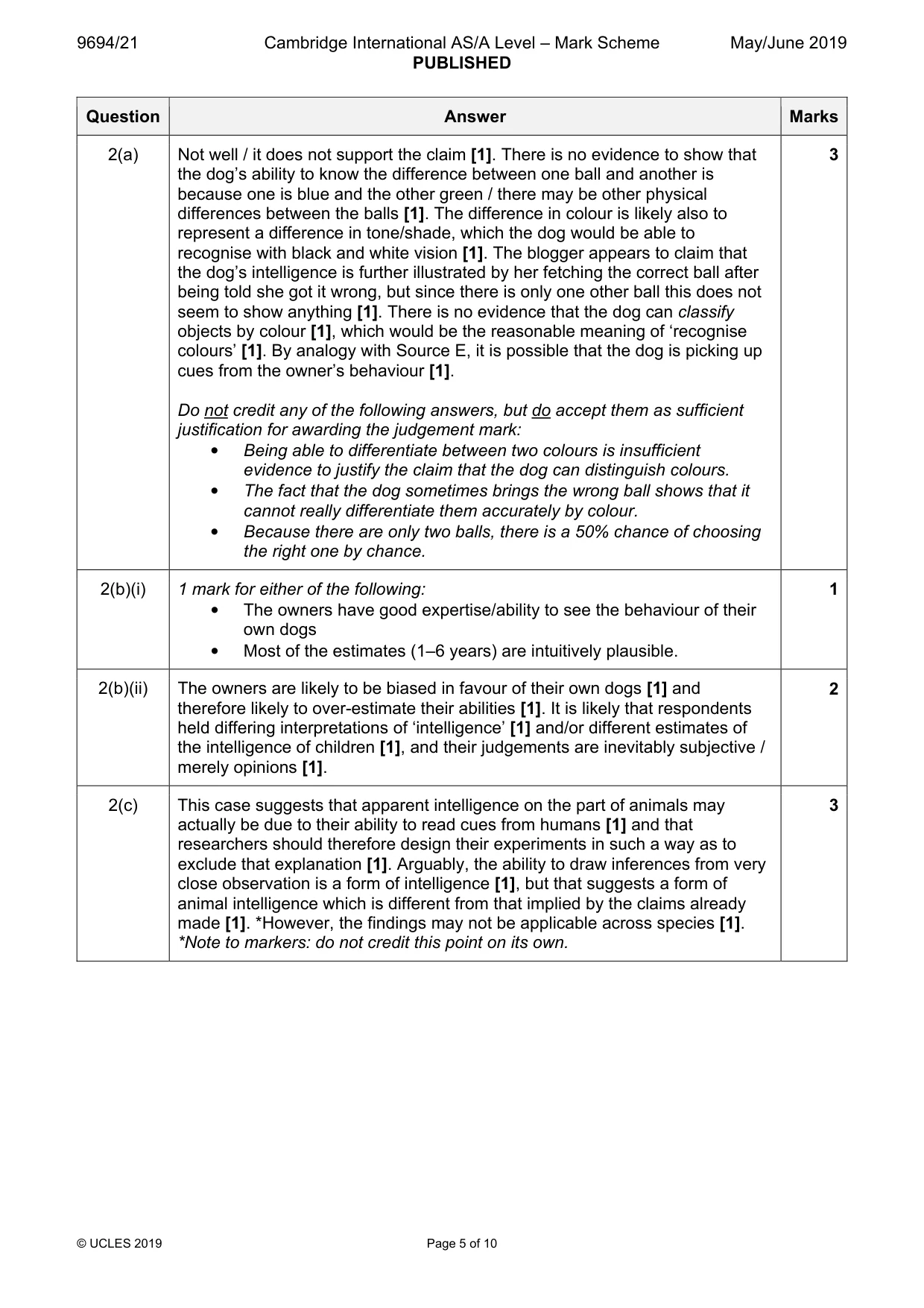
Mark scheme, page 5
9694/21 Cambridge International AS/A Level – Mark Scheme PUBLISHED May/June 2019 © UCLES 2019 Page 5 of 10 Question Answer Marks 2(a) Not well / it does not support the claim [1]. There is no evidence to show that the dog’s ability to know the difference between one ball and another is because one is blue and the other green / there may be other physical differences between the balls [1]. The difference in colour is likely also to represent a difference in tone/shade, which the dog would be able to recognise with black and white vision [1]. The blogger appears to claim that the dog’s intelligence is further illustrated by her fetching the correct ball after being told she got it wrong, but since there is only one other ball this does not seem to show anything [1]. There is no evidence that the dog can classify objects by colour [1], which would be the reasonable meaning of ‘recognise colours’ [1]. By analogy with Source E, it is possible that the dog is picking up cues from the owner’s behaviour [1]. Do not credit any of the following answers, but do accept them as sufficient justification for awarding the judgement mark: • Being able to differentiate between two colours is insufficient evidence to justify the claim that the dog can distinguish colours. • The fact that the dog sometimes brings the wrong ball shows that it cannot really differentiate them accurately by colour. • Because there are only two balls, there is a 50% chance of choosing the right one by chance. 3 2(b)(i) 1 mark for either of the following: • The owners have good expertise/ability to see the behaviour of their own dogs • Most of the estimates (1–6 years) are intuitively plausible. 1 2(b)(ii) The owners are likely to be biased in favour of their own dogs [1] and therefore likely to over-estimate their abilities [1]. It is likely that respondents held differing interpretations of ‘intelligence’ [1] and/or different estimates of the intelligence of children [1], and their judgements are inevitably subjective / merely opinions [1]. 2 2(c) This case suggests that apparent intelligence on the part of animals may actually be due to their ability to read cues from humans [1] and that researchers should therefore design their experiments in such a way as to exclude that explanation [1]. Arguably, the ability to draw inferences from very close observation is a form of intelligence [1], but that suggests a form of animal intelligence which is different from that implied by the claims already made [1]. *However, the findings may not be applicable across species [1]. *Note to markers: do not credit this point on its own. 3
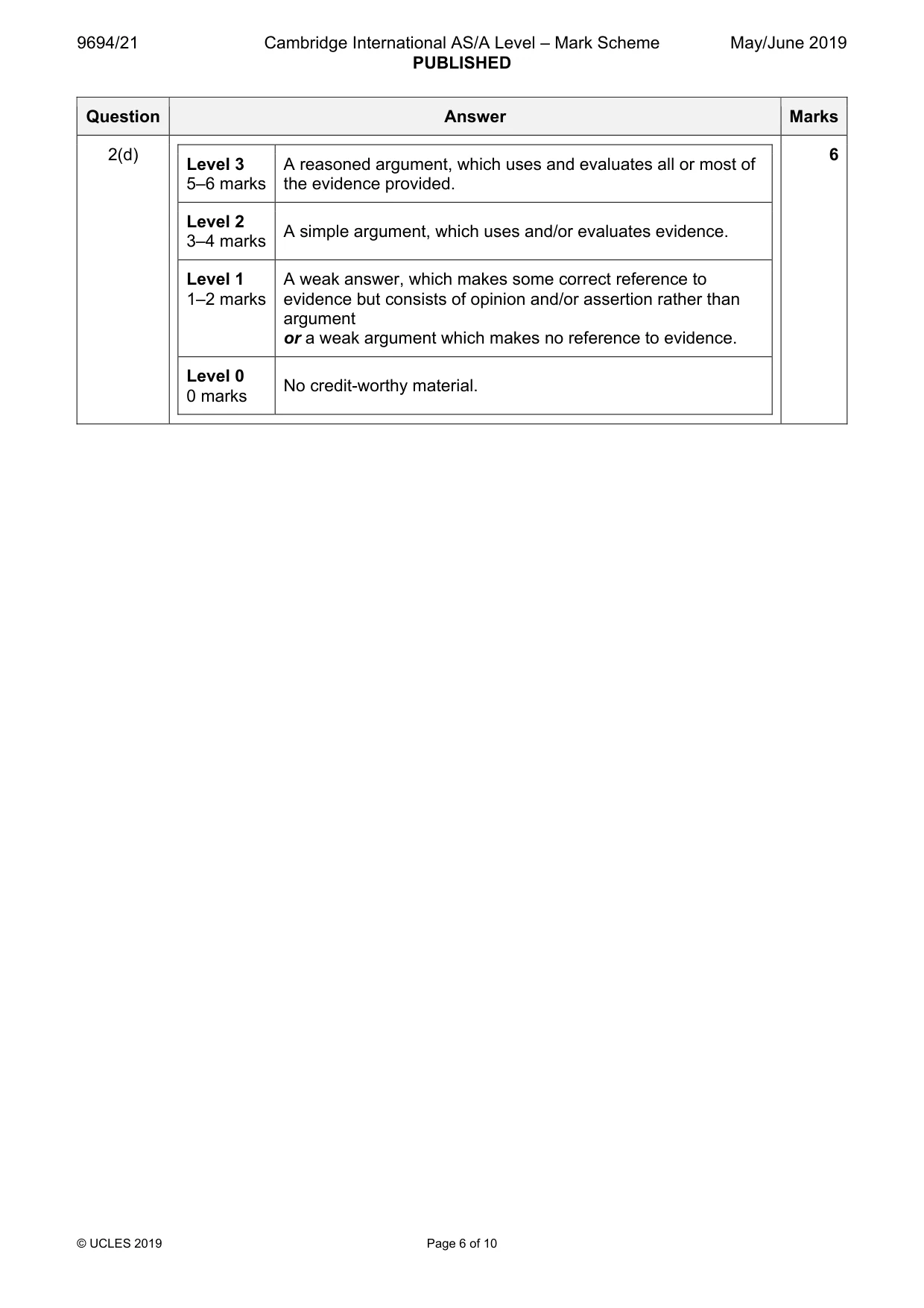
Mark scheme, page 6
9694/21 Cambridge International AS/A Level – Mark Scheme PUBLISHED May/June 2019 © UCLES 2019 Page 6 of 10 Question Answer Marks 2(d) Level 3 5–6 marks A reasoned argument, which uses and evaluates all or most of the evidence provided. Level 2 3–4 marks A simple argument, which uses and/or evaluates evidence. Level 1 1–2 marks A weak answer, which makes some correct reference to evidence but consists of opinion and/or assertion rather than argument or a weak argument which makes no reference to evidence. Level 0 0 marks No credit-worthy material. 6
Mark scheme, page 7
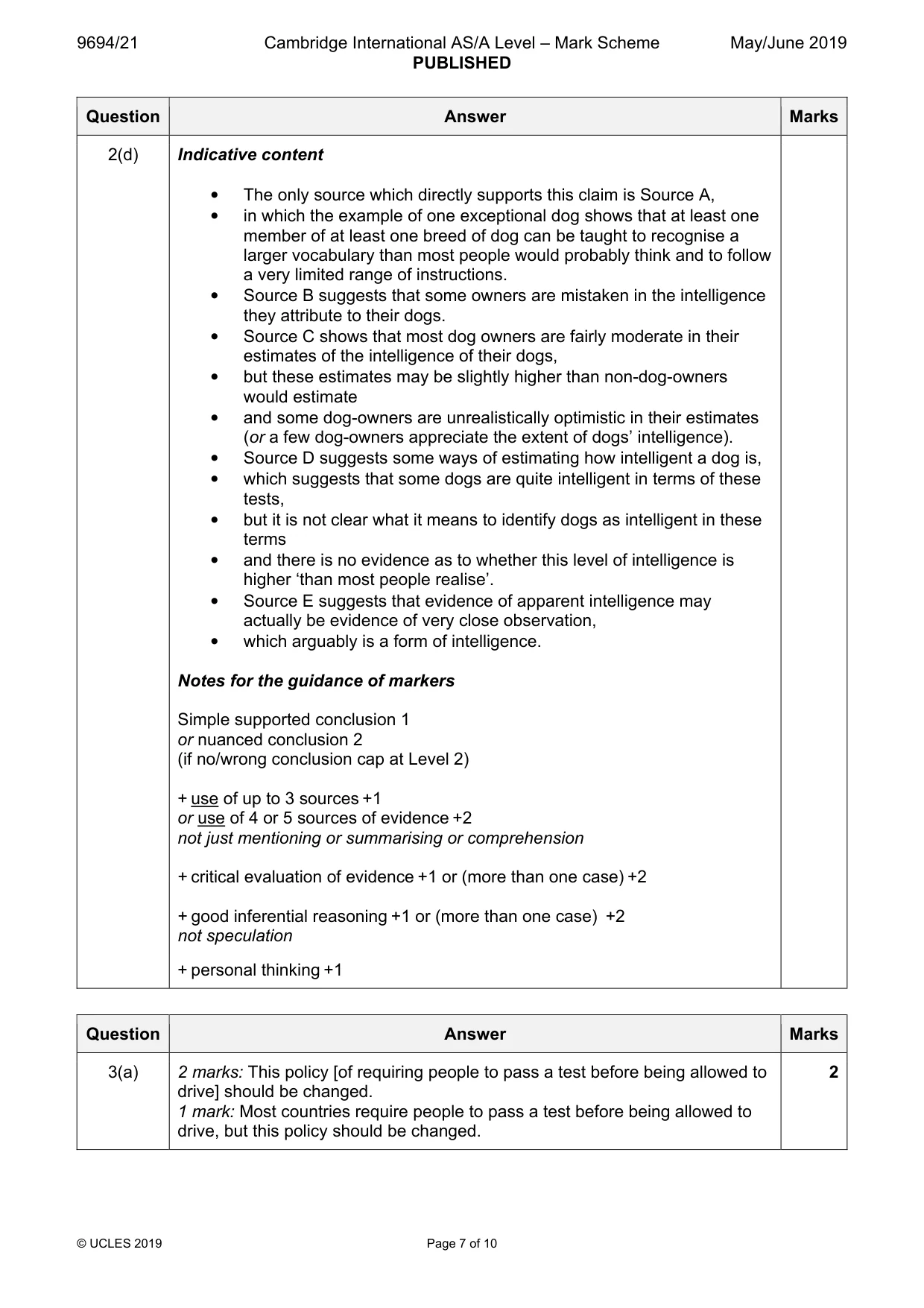
9694/21 Cambridge International AS/A Level – Mark Scheme PUBLISHED May/June 2019 © UCLES 2019 Page 7 of 10 Question Answer Marks 2(d) Indicative content • The only source which directly supports this claim is Source A, • in which the example of one exceptional dog shows that at least one member of at least one breed of dog can be taught to recognise a larger vocabulary than most people would probably think and to follow a very limited range of instructions. • Source B suggests that some owners are mistaken in the intelligence they attribute to their dogs. • Source C shows that most dog owners are fairly moderate in their estimates of the intelligence of their dogs, • but these estimates may be slightly higher than non-dog-owners would estimate • and some dog-owners are unrealistically optimistic in their estimates (or a few dog-owners appreciate the extent of dogs’ intelligence). • Source D suggests some ways of estimating how intelligent a dog is, • which suggests that some dogs are quite intelligent in terms of these tests, • but it is not clear what it means to identify dogs as intelligent in these terms • and there is no evidence as to whether this level of intelligence is higher ‘than most people realise’. • Source E suggests that evidence of apparent intelligence may actually be evidence of very close observation, • which arguably is a form of intelligence. Notes for the guidance of markers Simple supported conclusion 1 or nuanced conclusion 2 (if no/wrong conclusion cap at Level 2) + use of up to 3 sources +1 or use of 4 or 5 sources of evidence +2 not just mentioning or summarising or comprehension + critical evaluation of evidence +1 or (more than one case) +2 + good inferential reasoning +1 or (more than one case) +2 not speculation + personal thinking +1 Question Answer Marks 3(a) 2 marks: This policy [of requiring people to pass a test before being allowed to drive] should be changed. 1 mark: Most countries require people to pass a test before being allowed to drive, but this policy should be changed. 2
Mark scheme, page 8
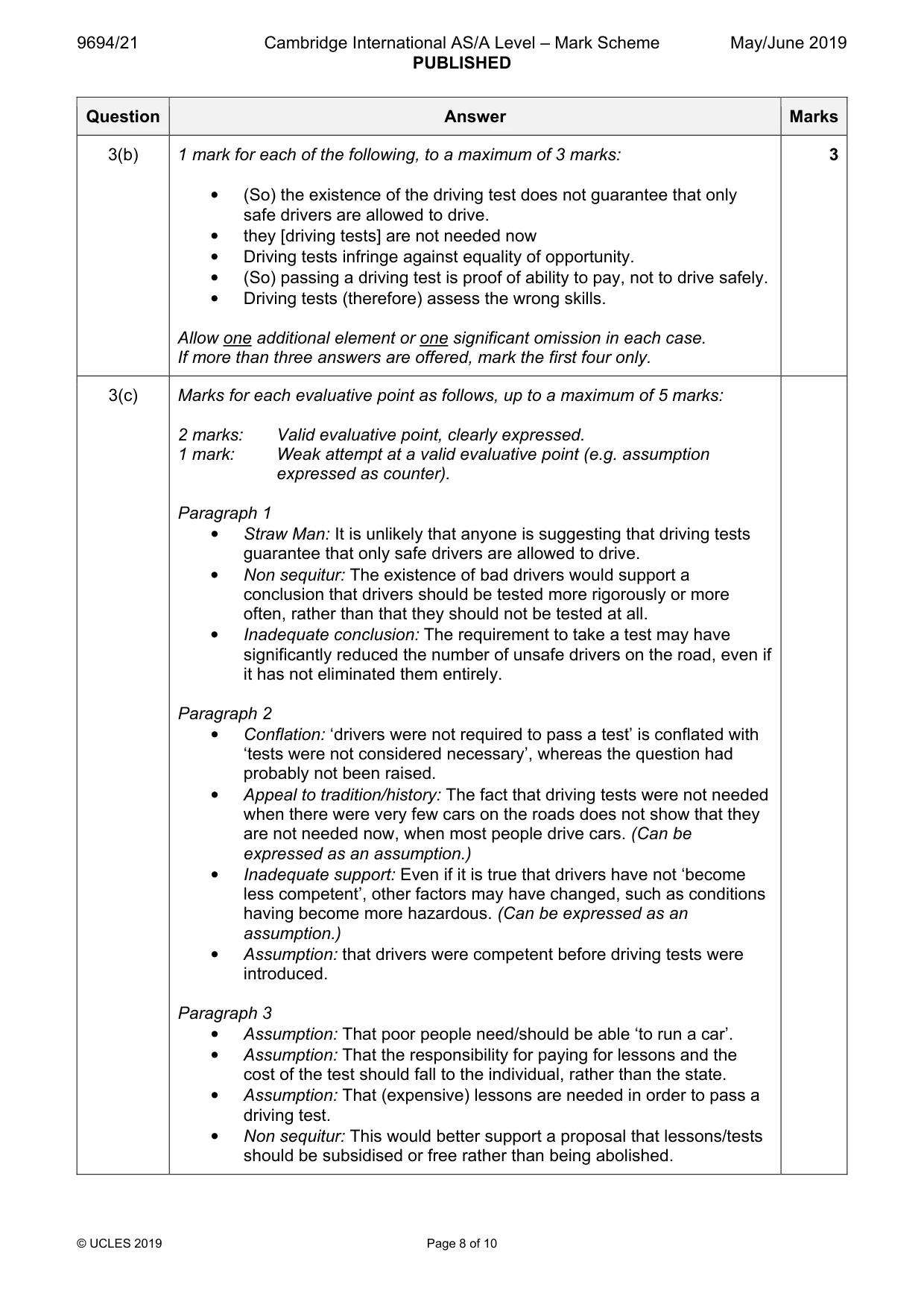
9694/21 Cambridge International AS/A Level – Mark Scheme PUBLISHED May/June 2019 © UCLES 2019 Page 8 of 10 Question Answer Marks 3(b) 1 mark for each of the following, to a maximum of 3 marks: • (So) the existence of the driving test does not guarantee that only safe drivers are allowed to drive. • they [driving tests] are not needed now • Driving tests infringe against equality of opportunity. • (So) passing a driving test is proof of ability to pay, not to drive safely. • Driving tests (therefore) assess the wrong skills. Allow one additional element or one significant omission in each case. If more than three answers are offered, mark the first four only. 3 3(c) Marks for each evaluative point as follows, up to a maximum of 5 marks: 2 marks: Valid evaluative point, clearly expressed. 1 mark: Weak attempt at a valid evaluative point (e.g. assumption expressed as counter). Paragraph 1 • Straw Man: It is unlikely that anyone is suggesting that driving tests guarantee that only safe drivers are allowed to drive. • Non sequitur: The existence of bad drivers would support a conclusion that drivers should be tested more rigorously or more often, rather than that they should not be tested at all. • Inadequate conclusion: The requirement to take a test may have significantly reduced the number of unsafe drivers on the road, even if it has not eliminated them entirely. Paragraph 2 • Conflation: ‘drivers were not required to pass a test’ is conflated with ‘tests were not considered necessary’, whereas the question had probably not been raised. • Appeal to tradition/history: The fact that driving tests were not needed when there were very few cars on the roads does not show that they are not needed now, when most people drive cars. (Can be expressed as an assumption.) • Inadequate support: Even if it is true that drivers have not ‘become less competent’, other factors may have changed, such as conditions having become more hazardous. (Can be expressed as an assumption.) • Assumption: that drivers were competent before driving tests were introduced. Paragraph 3 • Assumption: That poor people need/should be able ‘to run a car’. • Assumption: That the responsibility for paying for lessons and the cost of the test should fall to the individual, rather than the state. • Assumption: That (expensive) lessons are needed in order to pass a driving test. • Non sequitur: This would better support a proposal that lessons/tests should be subsidised or free rather than being abolished.
Mark scheme, page 9
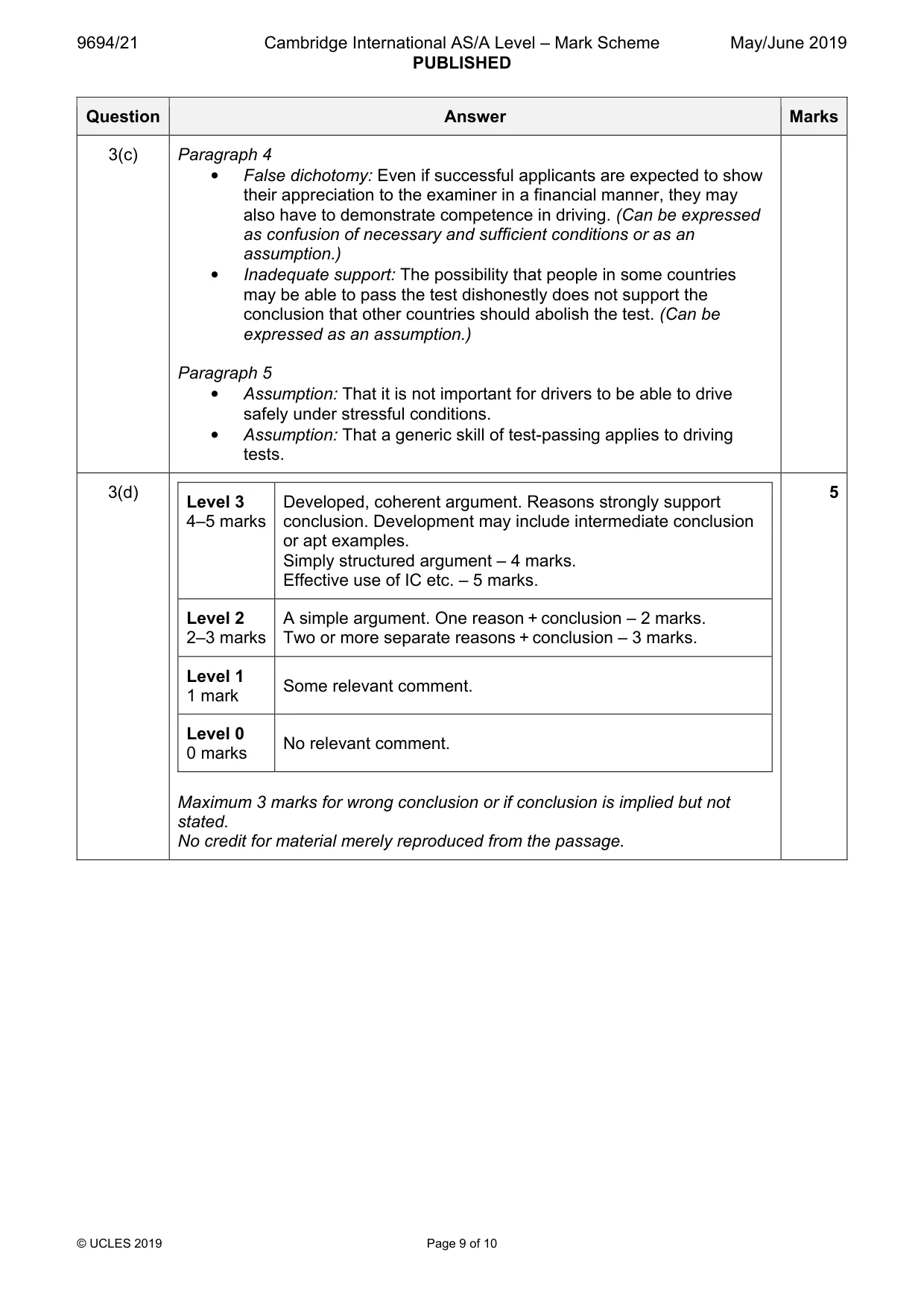
9694/21 Cambridge International AS/A Level – Mark Scheme PUBLISHED May/June 2019 © UCLES 2019 Page 9 of 10 Question Answer Marks 3(c) Paragraph 4 • False dichotomy: Even if successful applicants are expected to show their appreciation to the examiner in a financial manner, they may also have to demonstrate competence in driving. (Can be expressed as confusion of necessary and sufficient conditions or as an assumption.) • Inadequate support: The possibility that people in some countries may be able to pass the test dishonestly does not support the conclusion that other countries should abolish the test. (Can be expressed as an assumption.) Paragraph 5 • Assumption: That it is not important for drivers to be able to drive safely under stressful conditions. • Assumption: That a generic skill of test-passing applies to driving tests. 3(d) Level 3 4–5 marks Developed, coherent argument. Reasons strongly support conclusion. Development may include intermediate conclusion or apt examples. Simply structured argument – 4 marks. Effective use of IC etc. – 5 marks. Level 2 2–3 marks A simple argument. One reason + conclusion – 2 marks. Two or more separate reasons + conclusion – 3 marks. Level 1 1 mark Some relevant comment. Level 0 0 marks No relevant comment. Maximum 3 marks for wrong conclusion or if conclusion is implied but not stated. No credit for material merely reproduced from the passage. 5
Mark scheme, page 10
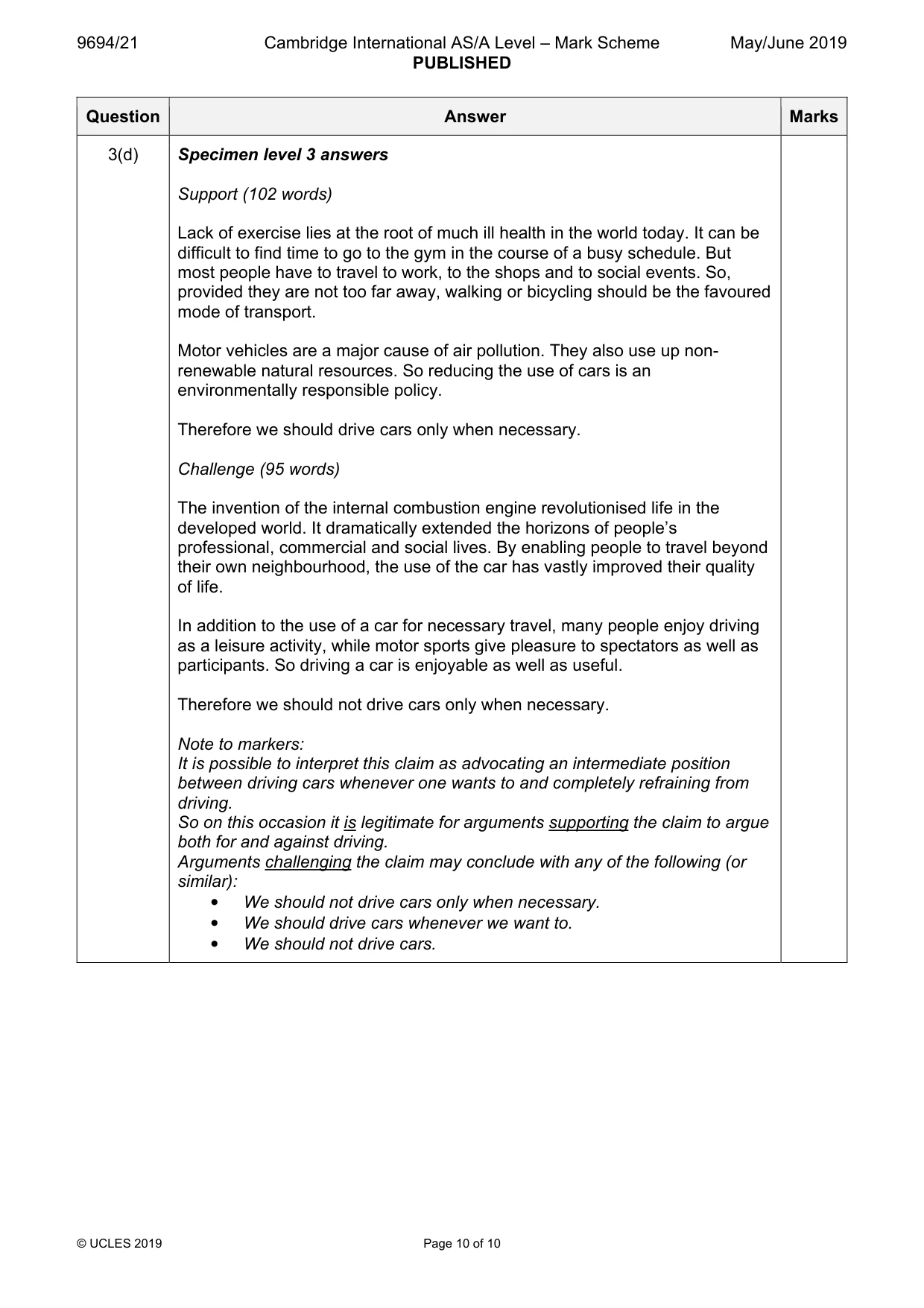
9694/21 Cambridge International AS/A Level – Mark Scheme PUBLISHED May/June 2019 © UCLES 2019 Page 10 of 10 Question Answer Marks 3(d) Specimen level 3 answers Support (102 words) Lack of exercise lies at the root of much ill health in the world today. It can be difficult to find time to go to the gym in the course of a busy schedule. But most people have to travel to work, to the shops and to social events. So, provided they are not too far away, walking or bicycling should be the favoured mode of transport. Motor vehicles are a major cause of air pollution. They also use up non- renewable natural resources. So reducing the use of cars is an environmentally responsible policy. Therefore we should drive cars only when necessary. Challenge (95 words) The invention of the internal combustion engine revolutionised life in the developed world. It dramatically extended the horizons of people’s professional, commercial and social lives. By enabling people to travel beyond their own neighbourhood, the use of the car has vastly improved their quality of life. In addition to the use of a car for necessary travel, many people enjoy driving as a leisure activity, while motor sports give pleasure to spectators as well as participants. So driving a car is enjoyable as well as useful. Therefore we should not drive cars only when necessary. Note to markers: It is possible to interpret this claim as advocating an intermediate position between driving cars whenever one wants to and completely refraining from driving. So on this occasion it is legitimate for arguments supporting the claim to argue both for and against driving. Arguments challenging the claim may conclude with any of the following (or similar): • We should not drive cars only when necessary. • We should drive cars whenever we want to. • We should not drive cars.
What you needed in this session
Cambridge’s own grade thresholds for 2019 May/June, Paper 2 · Variant 1. A higher threshold means an easier paper — the bar moves with how the cohort did.