Cambridge A Level Thinking Skills 9694 — 2019 May/June Paper 2 · Variant 2
9694/22/M/J/19 · 45 marks · ≈51 min
The question paper and its mark scheme, free to read here and free to download. This is Cambridge’s own paper, exactly as it was sat.
Question paper8 pages
Mark scheme10 pages
Answers below. Sit the paper first if you are practising.
Paper as text
Question paper, page 1
This document consists of 6 printed pages, 2 blank pages and 1 Insert. DC (NH) 163087/1 © UCLES 2019 [Turn over Cambridge Assessment International Education Cambridge International Advanced Subsidiary and Advanced Level * 5 5 4 1 4 8 9 1 8 6 * THINKING SKILLS 9694/22 Paper 2 Critical Thinking May/June 2019 1 hour 45 minutes No Additional Materials are required. READ THESE INSTRUCTIONS FIRST An answer booklet is provided inside this question paper. You should follow the instructions on the front cover of the answer booklet. If you need additional answer paper ask the invigilator for a continuation booklet. Answer all the questions. The number of marks is given in brackets [ ] at the end of each question.
Question paper, page 2
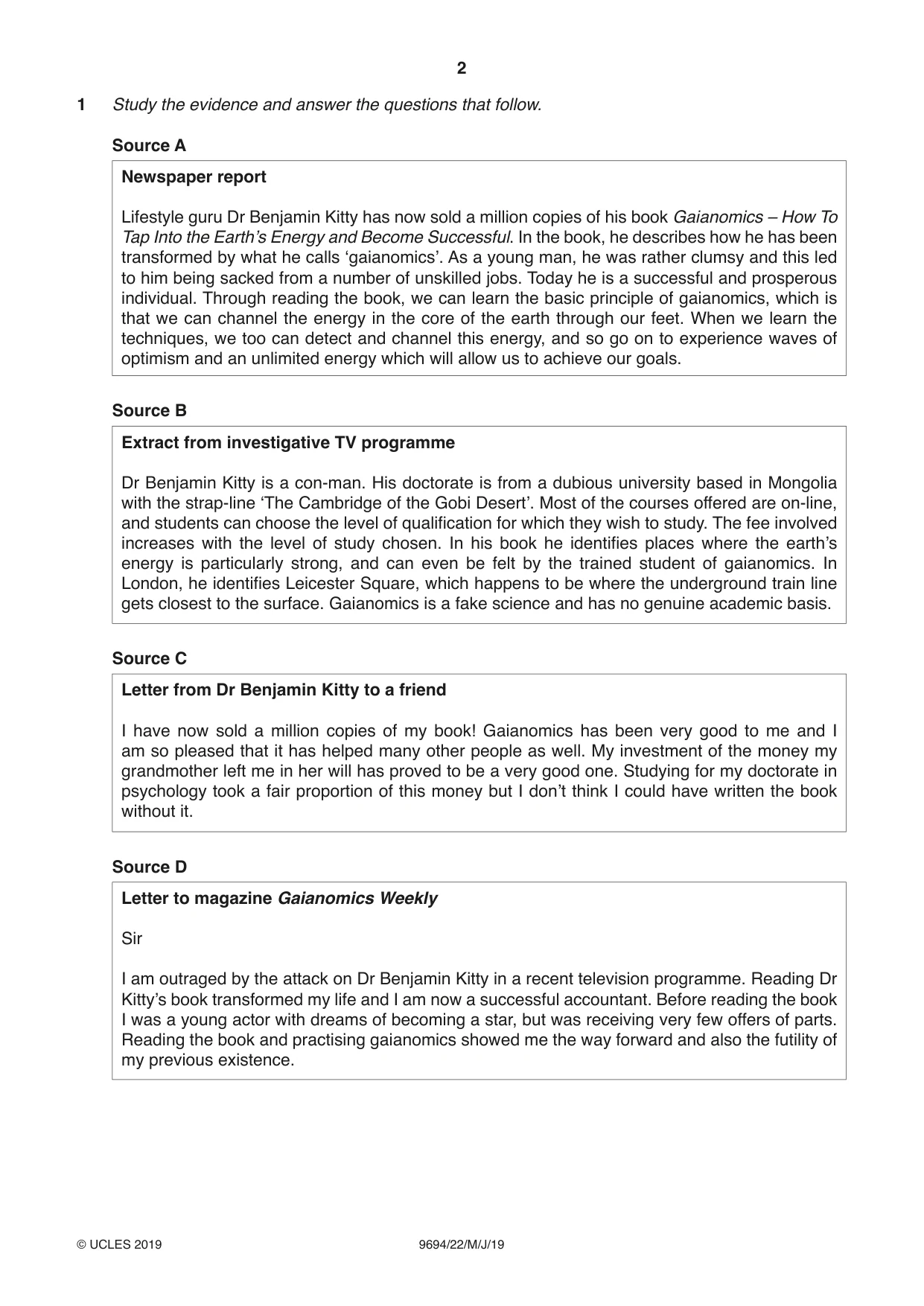
2 9694/22/M/J/19 © UCLES 2019 1 Study the evidence and answer the questions that follow. Source A Newspaper report Lifestyle guru Dr Benjamin Kitty has now sold a million copies of his book Gaianomics – How To Tap Into the Earth’s Energy and Become Successful. In the book, he describes how he has been transformed by what he calls ‘gaianomics’. As a young man, he was rather clumsy and this led to him being sacked from a number of unskilled jobs. Today he is a successful and prosperous individual. Through reading the book, we can learn the basic principle of gaianomics, which is that we can channel the energy in the core of the earth through our feet. When we learn the techniques, we too can detect and channel this energy, and so go on to experience waves of optimism and an unlimited energy which will allow us to achieve our goals. Source B Extract from investigative TV programme Dr Benjamin Kitty is a con-man. His doctorate is from a dubious university based in Mongolia with the strap-line ‘The Cambridge of the Gobi Desert’. Most of the courses offered are on-line, and students can choose the level of qualification for which they wish to study. The fee involved increases with the level of study chosen. In his book he identifies places where the earth’s energy is particularly strong, and can even be felt by the trained student of gaianomics. In London, he identifies Leicester Square, which happens to be where the underground train line gets closest to the surface. Gaianomics is a fake science and has no genuine academic basis. Source C Letter from Dr Benjamin Kitty to a friend I have now sold a million copies of my book! Gaianomics has been very good to me and I am so pleased that it has helped many other people as well. My investment of the money my grandmother left me in her will has proved to be a very good one. Studying for my doctorate in psychology took a fair proportion of this money but I don’t think I could have written the book without it. Source D Letter to magazine Gaianomics Weekly Sir I am outraged by the attack on Dr Benjamin Kitty in a recent television programme. Reading Dr Kitty’s book transformed my life and I am now a successful accountant. Before reading the book I was a young actor with dreams of becoming a star, but was receiving very few offers of parts. Reading the book and practising gaianomics showed me the way forward and also the futility of my previous existence.
Question paper, page 3
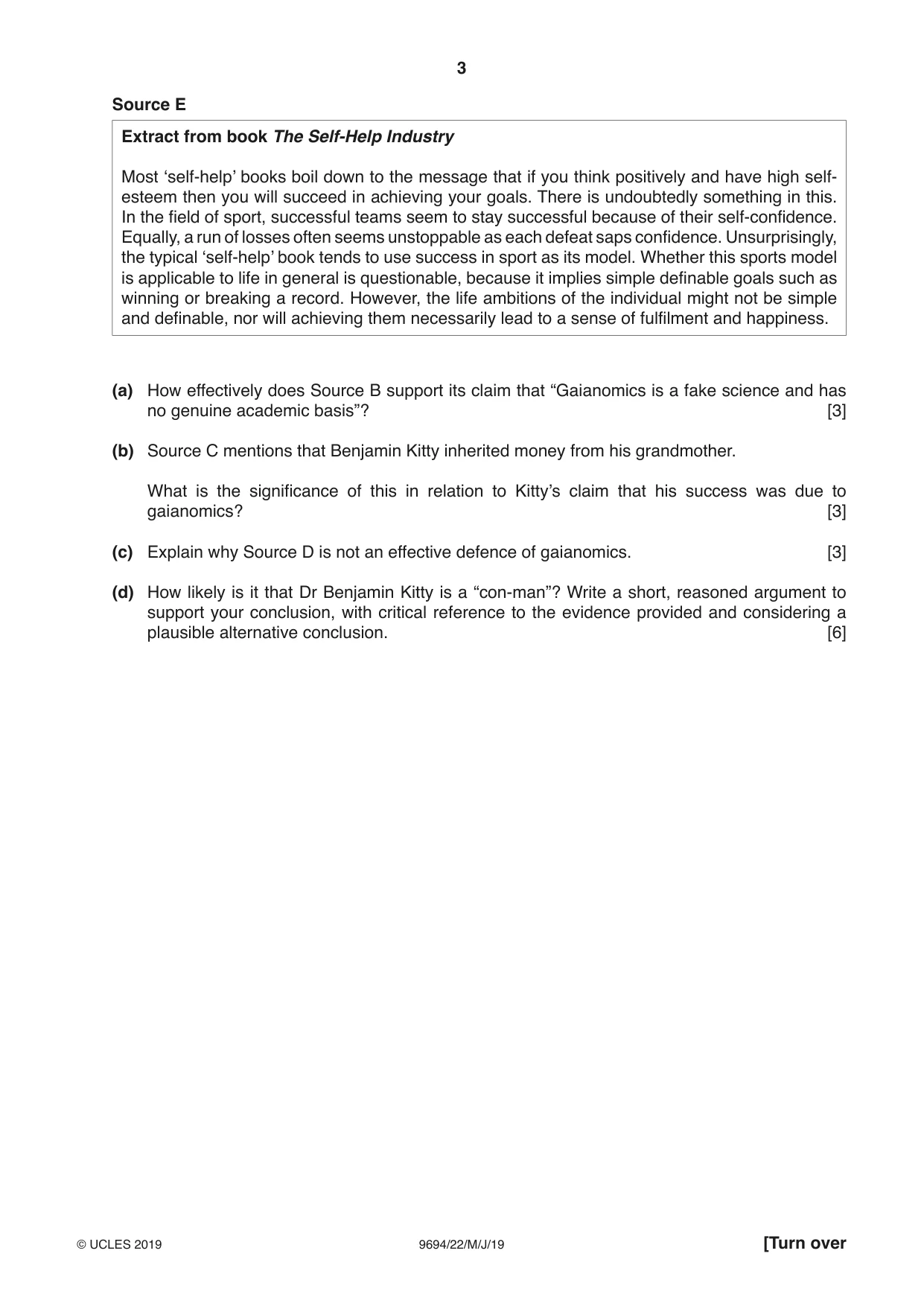
3 9694/22/M/J/19 © UCLES 2019 [Turn over Source E Extract from book The Self-Help Industry Most ‘self-help’ books boil down to the message that if you think positively and have high self- esteem then you will succeed in achieving your goals. There is undoubtedly something in this. In the field of sport, successful teams seem to stay successful because of their self-confidence. Equally, a run of losses often seems unstoppable as each defeat saps confidence. Unsurprisingly, the typical ‘self-help’ book tends to use success in sport as its model. Whether this sports model is applicable to life in general is questionable, because it implies simple definable goals such as winning or breaking a record. However, the life ambitions of the individual might not be simple and definable, nor will achieving them necessarily lead to a sense of fulfilment and happiness. (a) How effectively does Source B support its claim that “Gaianomics is a fake science and has no genuine academic basis”? [3] (b) Source C mentions that Benjamin Kitty inherited money from his grandmother. What is the significance of this in relation to Kitty’s claim that his success was due to gaianomics? [3] (c) Explain why Source D is not an effective defence of gaianomics. [3] (d) How likely is it that Dr Benjamin Kitty is a “con-man”? Write a short, reasoned argument to support your conclusion, with critical reference to the evidence provided and considering a plausible alternative conclusion. [6]
Question paper, page 4
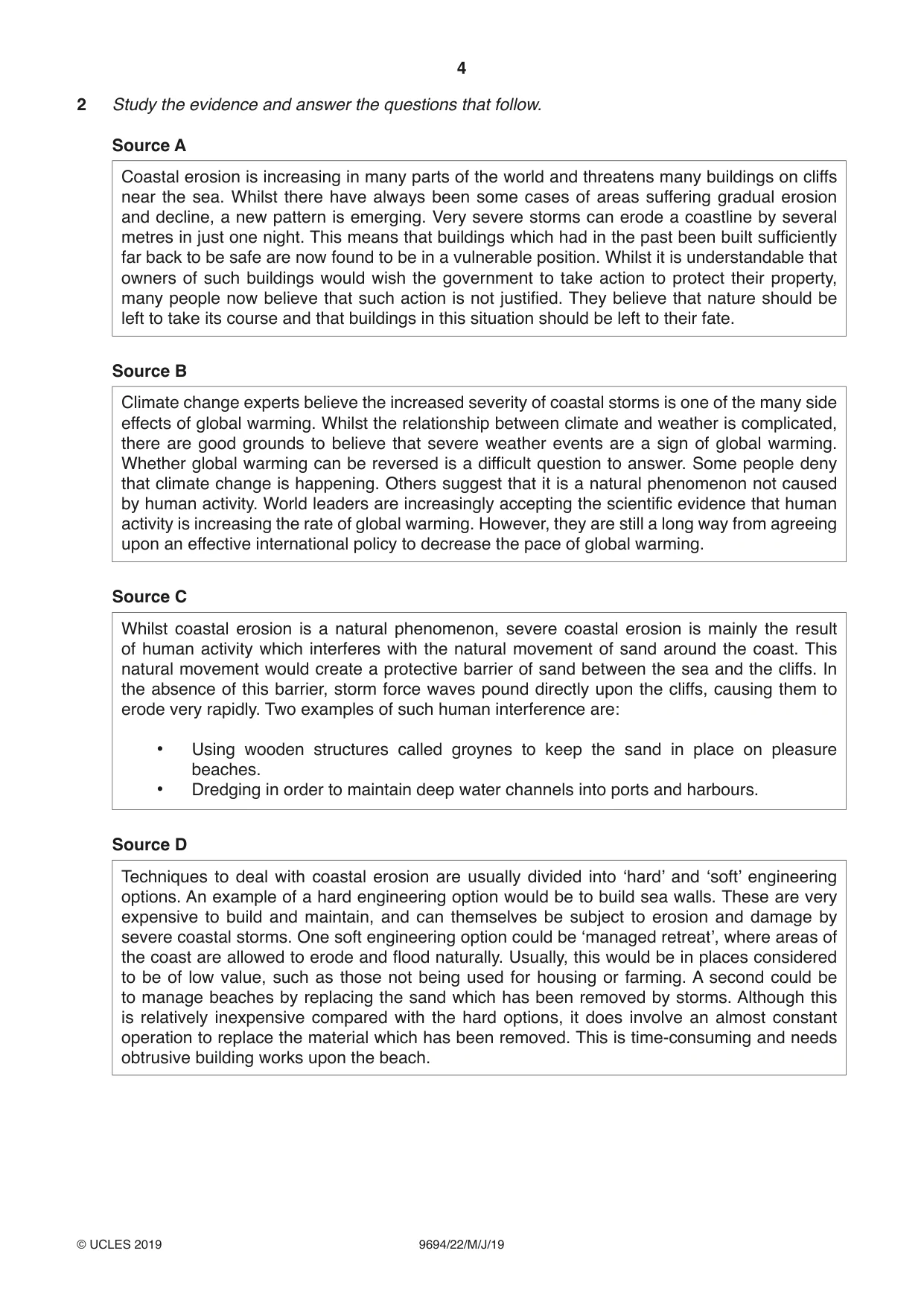
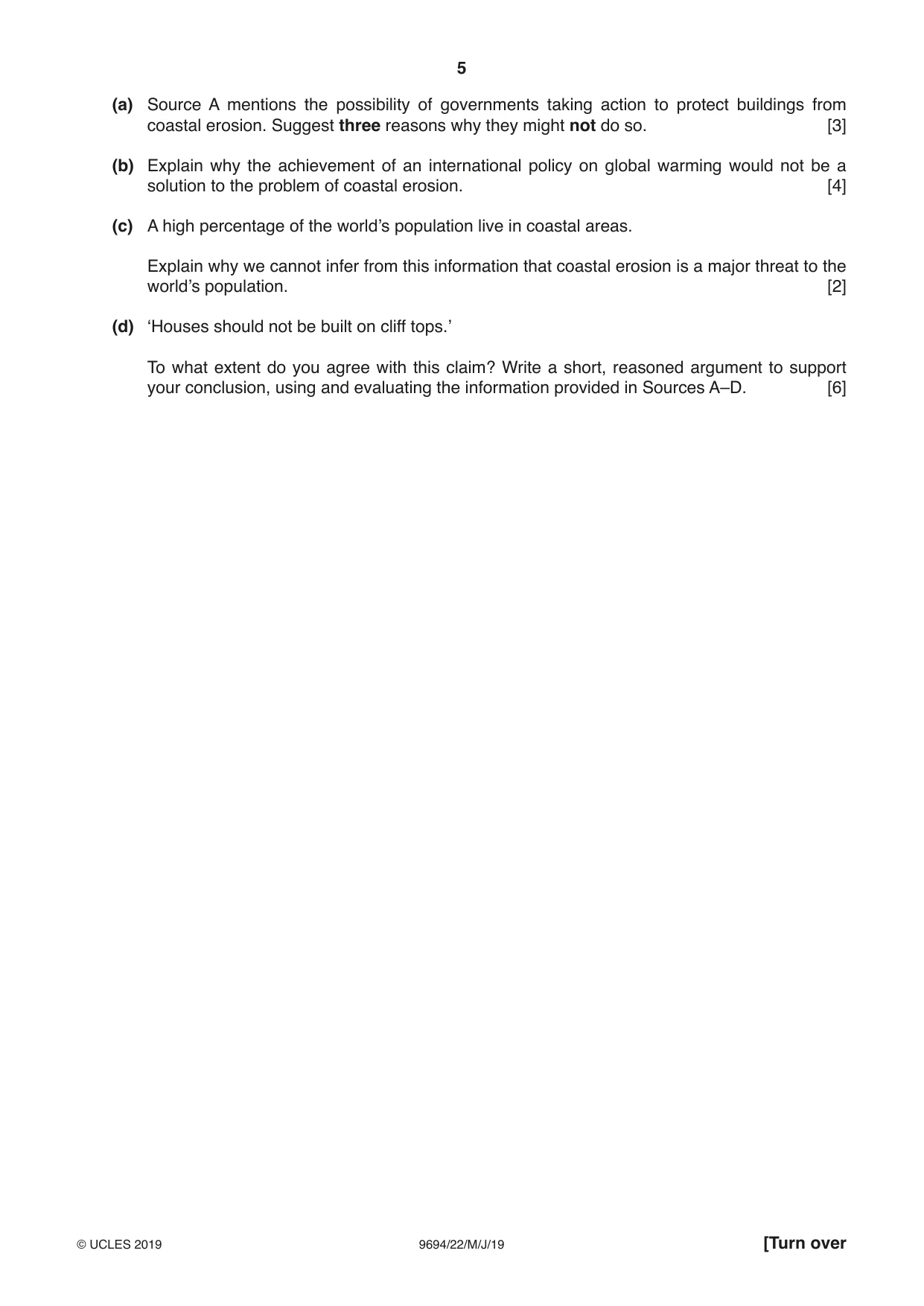
4 9694/22/M/J/19 © UCLES 2019 2 Study the evidence and answer the questions that follow. Source A Coastal erosion is increasing in many parts of the world and threatens many buildings on cliffs near the sea. Whilst there have always been some cases of areas suffering gradual erosion and decline, a new pattern is emerging. Very severe storms can erode a coastline by several metres in just one night. This means that buildings which had in the past been built sufficiently far back to be safe are now found to be in a vulnerable position. Whilst it is understandable that owners of such buildings would wish the government to take action to protect their property, many people now believe that such action is not justified. They believe that nature should be left to take its course and that buildings in this situation should be left to their fate. Source B Climate change experts believe the increased severity of coastal storms is one of the many side effects of global warming. Whilst the relationship between climate and weather is complicated, there are good grounds to believe that severe weather events are a sign of global warming. Whether global warming can be reversed is a difficult question to answer. Some people deny that climate change is happening. Others suggest that it is a natural phenomenon not caused by human activity. World leaders are increasingly accepting the scientific evidence that human activity is increasing the rate of global warming. However, they are still a long way from agreeing upon an effective international policy to decrease the pace of global warming. Source C Whilst coastal erosion is a natural phenomenon, severe coastal erosion is mainly the result of human activity which interferes with the natural movement of sand around the coast. This natural movement would create a protective barrier of sand between the sea and the cliffs. In the absence of this barrier, storm force waves pound directly upon the cliffs, causing them to erode very rapidly. Two examples of such human interference are: • Using wooden structures called groynes to keep the sand in place on pleasure beaches. • Dredging in order to maintain deep water channels into ports and harbours. Source D Techniques to deal with coastal erosion are usually divided into ‘hard’ and ‘soft’ engineering options. An example of a hard engineering option would be to build sea walls. These are very expensive to build and maintain, and can themselves be subject to erosion and damage by severe coastal storms. One soft engineering option could be ‘managed retreat’, where areas of the coast are allowed to erode and flood naturally. Usually, this would be in places considered to be of low value, such as those not being used for housing or farming. A second could be to manage beaches by replacing the sand which has been removed by storms. Although this is relatively inexpensive compared with the hard options, it does involve an almost constant operation to replace the material which has been removed. This is time-consuming and needs obtrusive building works upon the beach.
Question paper, page 5
5 9694/22/M/J/19 © UCLES 2019 [Turn over (a) Source A mentions the possibility of governments taking action to protect buildings from coastal erosion. Suggest three reasons why they might not do so. [3] (b) Explain why the achievement of an international policy on global warming would not be a solution to the problem of coastal erosion. [4] (c) A high percentage of the world’s population live in coastal areas. Explain why we cannot infer from this information that coastal erosion is a major threat to the world’s population. [2] (d) ‘Houses should not be built on cliff tops.’ To what extent do you agree with this claim? Write a short, reasoned argument to support your conclusion, using and evaluating the information provided in Sources A–D. [6]
Question paper, page 6
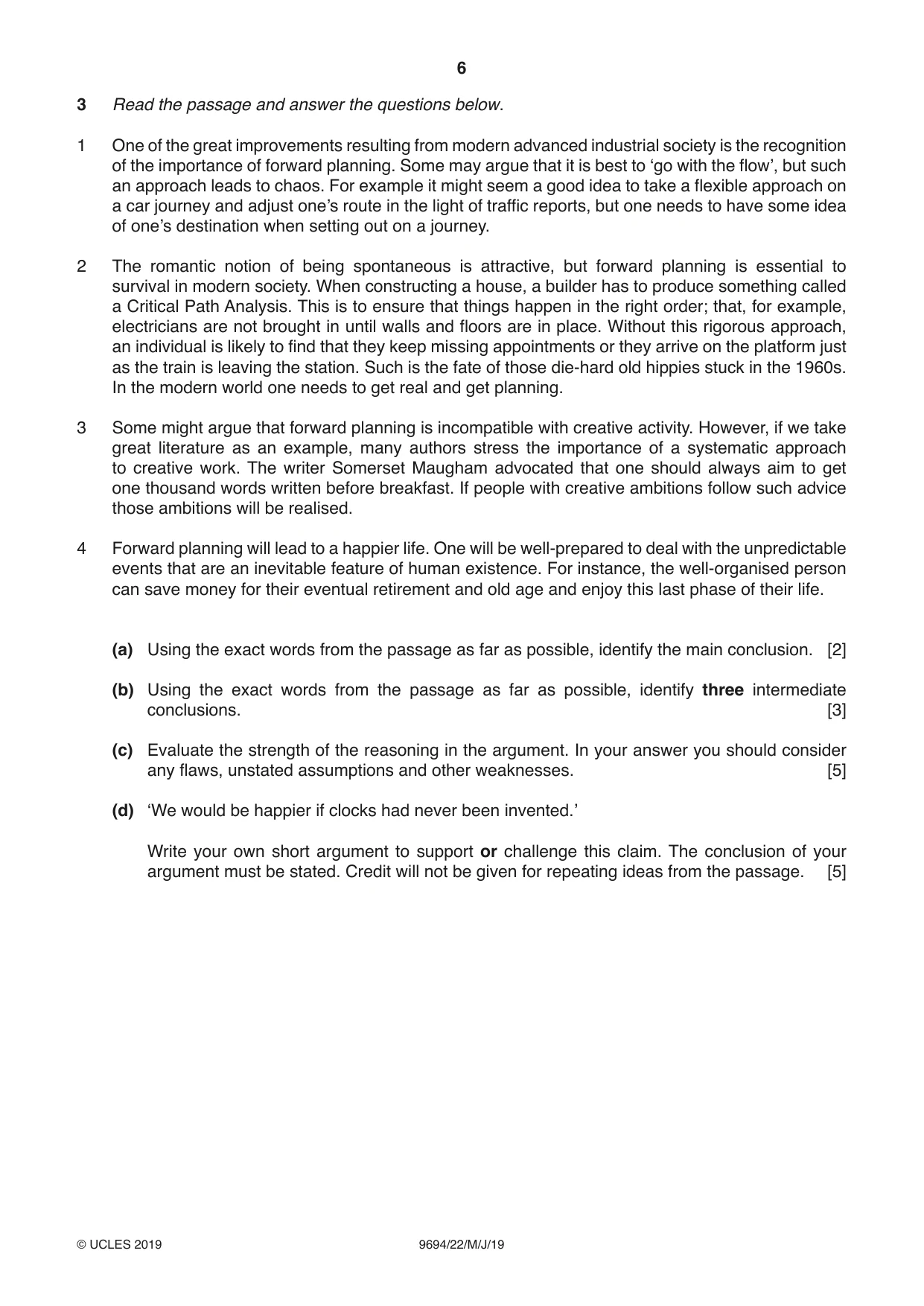
6 9694/22/M/J/19 © UCLES 2019 3 Read the passage and answer the questions below. 1 One of the great improvements resulting from modern advanced industrial society is the recognition of the importance of forward planning. Some may argue that it is best to ‘go with the flow’, but such an approach leads to chaos. For example it might seem a good idea to take a flexible approach on a car journey and adjust one’s route in the light of traffic reports, but one needs to have some idea of one’s destination when setting out on a journey. 2 The romantic notion of being spontaneous is attractive, but forward planning is essential to survival in modern society. When constructing a house, a builder has to produce something called a Critical Path Analysis. This is to ensure that things happen in the right order; that, for example, electricians are not brought in until walls and floors are in place. Without this rigorous approach, an individual is likely to find that they keep missing appointments or they arrive on the platform just as the train is leaving the station. Such is the fate of those die-hard old hippies stuck in the 1960s. In the modern world one needs to get real and get planning. 3 Some might argue that forward planning is incompatible with creative activity. However, if we take great literature as an example, many authors stress the importance of a systematic approach to creative work. The writer Somerset Maugham advocated that one should always aim to get one thousand words written before breakfast. If people with creative ambitions follow such advice those ambitions will be realised. 4 Forward planning will lead to a happier life. One will be well-prepared to deal with the unpredictable events that are an inevitable feature of human existence. For instance, the well-organised person can save money for their eventual retirement and old age and enjoy this last phase of their life. (a) Using the exact words from the passage as far as possible, identify the main conclusion. [2] (b) Using the exact words from the passage as far as possible, identify three intermediate conclusions. [3] (c) Evaluate the strength of the reasoning in the argument. In your answer you should consider any flaws, unstated assumptions and other weaknesses. [5] (d) ‘We would be happier if clocks had never been invented.’ Write your own short argument to support or challenge this claim. The conclusion of your argument must be stated. Credit will not be given for repeating ideas from the passage. [5]
Question paper, page 7
7 9694/22/M/J/19 © UCLES 2019 BLANK PAGE
Question paper, page 8
8 9694/22/M/J/19 © UCLES 2019 BLANK PAGE Permission to reproduce items where third-party owned material protected by copyright is included has been sought and cleared where possible. Every reasonable effort has been made by the publisher (UCLES) to trace copyright holders, but if any items requiring clearance have unwittingly been included, the publisher will be pleased to make amends at the earliest possible opportunity. To avoid the issue of disclosure of answer-related information to candidates, all copyright acknowledgements are reproduced online in the Cambridge Assessment International Education Copyright Acknowledgements Booklet. This is produced for each series of examinations and is freely available to download at www.cambridgeinternational.org after the live examination series. Cambridge Assessment International Education is part of the Cambridge Assessment Group. Cambridge Assessment is the brand name of the University of Cambridge Local Examinations Syndicate (UCLES), which itself is a department of the University of Cambridge.
Mark scheme, page 1
This document consists of 10 printed pages. © UCLES 2019 [Turn over Cambridge Assessment International Education Cambridge International Advanced Subsidiary and Advanced Level THINKING SKILLS 9694/22 Paper 2 Critical Thinking May/June 2019 MARK SCHEME Maximum Mark: 45 Published This mark scheme is published as an aid to teachers and candidates, to indicate the requirements of the examination. It shows the basis on which Examiners were instructed to award marks. It does not indicate the details of the discussions that took place at an Examiners’ meeting before marking began, which would have considered the acceptability of alternative answers. Mark schemes should be read in conjunction with the question paper and the Principal Examiner Report for Teachers. Cambridge International will not enter into discussions about these mark schemes. Cambridge International is publishing the mark schemes for the May/June 2019 series for most Cambridge IGCSE™, Cambridge International A and AS Level and Cambridge Pre-U components, and some Cambridge O Level components.
Mark scheme, page 2
9694/22 Cambridge International AS/A Level – Mark Scheme PUBLISHED May/June 2019 © UCLES 2019 Page 2 of 10 Generic Marking Principles These general marking principles must be applied by all examiners when marking candidate answers. They should be applied alongside the specific content of the mark scheme or generic level descriptors for a question. Each question paper and mark scheme will also comply with these marking principles. GENERIC MARKING PRINCIPLE 1: Marks must be awarded in line with: • the specific content of the mark scheme or the generic level descriptors for the question • the specific skills defined in the mark scheme or in the generic level descriptors for the question • the standard of response required by a candidate as exemplified by the standardisation scripts. GENERIC MARKING PRINCIPLE 2: Marks awarded are always whole marks (not half marks, or other fractions). GENERIC MARKING PRINCIPLE 3: Marks must be awarded positively: • marks are awarded for correct/valid answers, as defined in the mark scheme. However, credit is given for valid answers which go beyond the scope of the syllabus and mark scheme, referring to your Team Leader as appropriate • marks are awarded when candidates clearly demonstrate what they know and can do • marks are not deducted for errors • marks are not deducted for omissions • answers should only be judged on the quality of spelling, punctuation and grammar when these features are specifically assessed by the question as indicated by the mark scheme. The meaning, however, should be unambiguous. GENERIC MARKING PRINCIPLE 4: Rules must be applied consistently e.g. in situations where candidates have not followed instructions or in the application of generic level descriptors. GENERIC MARKING PRINCIPLE 5: Marks should be awarded using the full range of marks defined in the mark scheme for the question (however; the use of the full mark range may be limited according to the quality of the candidate responses seen). GENERIC MARKING PRINCIPLE 6: Marks awarded are based solely on the requirements as defined in the mark scheme. Marks should not be awarded with grade thresholds or grade descriptors in mind.
Mark scheme, page 3
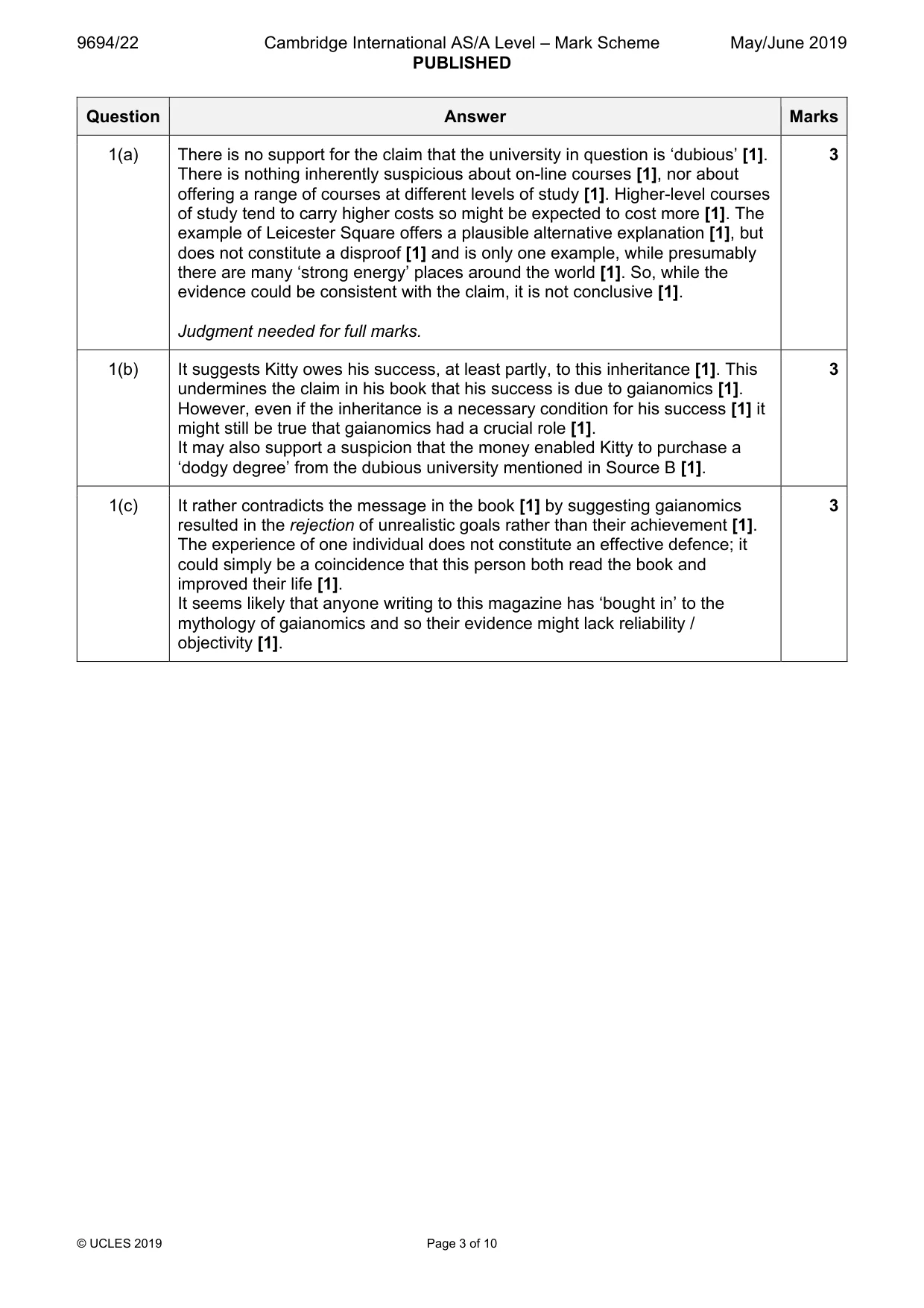
9694/22 Cambridge International AS/A Level – Mark Scheme PUBLISHED May/June 2019 © UCLES 2019 Page 3 of 10 Question Answer Marks 1(a) There is no support for the claim that the university in question is ‘dubious’ [1]. There is nothing inherently suspicious about on-line courses [1], nor about offering a range of courses at different levels of study [1]. Higher-level courses of study tend to carry higher costs so might be expected to cost more [1]. The example of Leicester Square offers a plausible alternative explanation [1], but does not constitute a disproof [1] and is only one example, while presumably there are many ‘strong energy’ places around the world [1]. So, while the evidence could be consistent with the claim, it is not conclusive [1]. Judgment needed for full marks. 3 1(b) It suggests Kitty owes his success, at least partly, to this inheritance [1]. This undermines the claim in his book that his success is due to gaianomics [1]. However, even if the inheritance is a necessary condition for his success [1] it might still be true that gaianomics had a crucial role [1]. It may also support a suspicion that the money enabled Kitty to purchase a ‘dodgy degree’ from the dubious university mentioned in Source B [1]. 3 1(c) It rather contradicts the message in the book [1] by suggesting gaianomics resulted in the rejection of unrealistic goals rather than their achievement [1]. The experience of one individual does not constitute an effective defence; it could simply be a coincidence that this person both read the book and improved their life [1]. It seems likely that anyone writing to this magazine has ‘bought in’ to the mythology of gaianomics and so their evidence might lack reliability / objectivity [1]. 3
Mark scheme, page 4
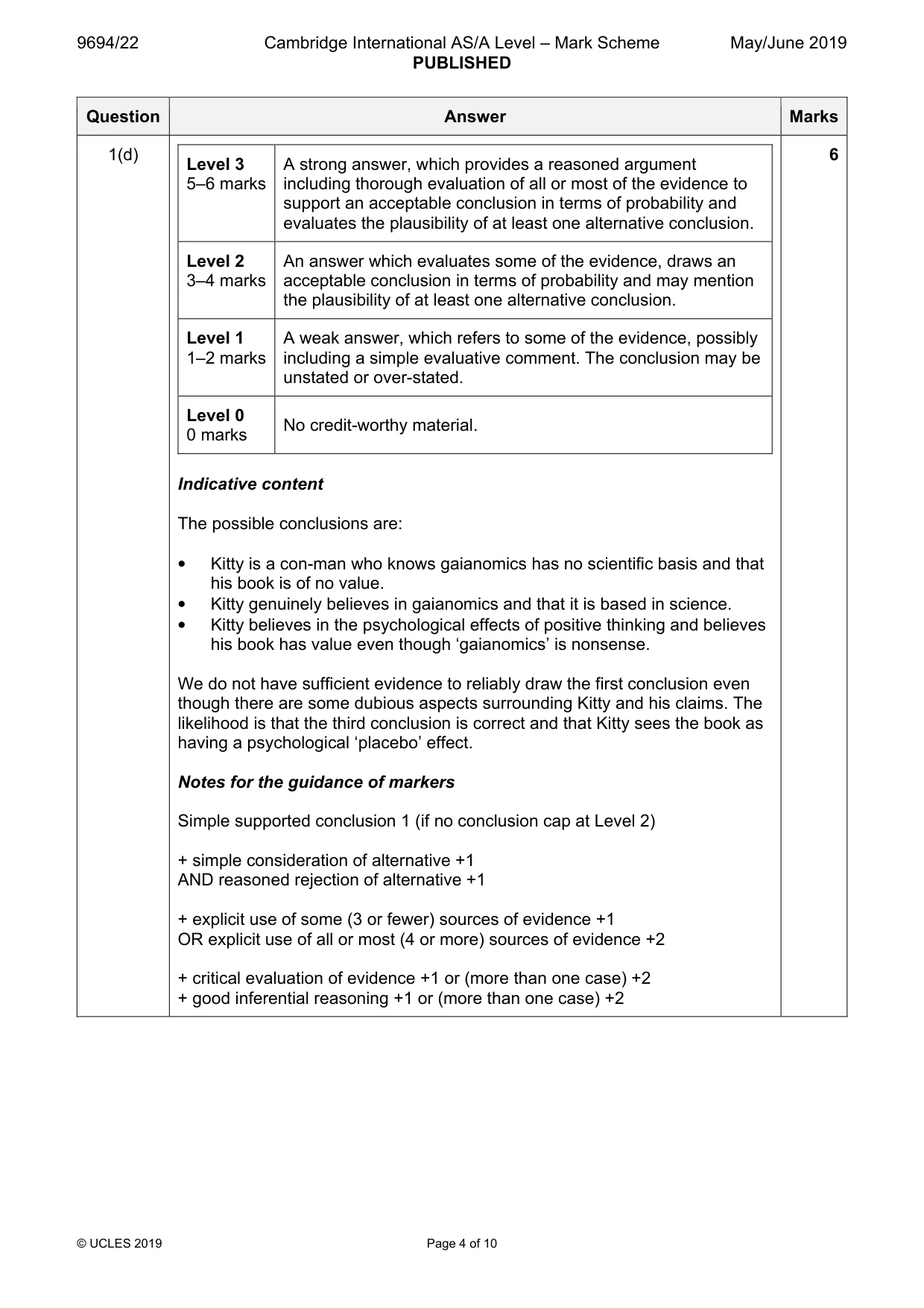
9694/22 Cambridge International AS/A Level – Mark Scheme PUBLISHED May/June 2019 © UCLES 2019 Page 4 of 10 Question Answer Marks 1(d) Level 3 5–6 marks A strong answer, which provides a reasoned argument including thorough evaluation of all or most of the evidence to support an acceptable conclusion in terms of probability and evaluates the plausibility of at least one alternative conclusion. Level 2 3–4 marks An answer which evaluates some of the evidence, draws an acceptable conclusion in terms of probability and may mention the plausibility of at least one alternative conclusion. Level 1 1–2 marks A weak answer, which refers to some of the evidence, possibly including a simple evaluative comment. The conclusion may be unstated or over-stated. Level 0 0 marks No credit-worthy material. Indicative content The possible conclusions are: • Kitty is a con-man who knows gaianomics has no scientific basis and that his book is of no value. • Kitty genuinely believes in gaianomics and that it is based in science. • Kitty believes in the psychological effects of positive thinking and believes his book has value even though ‘gaianomics’ is nonsense. We do not have sufficient evidence to reliably draw the first conclusion even though there are some dubious aspects surrounding Kitty and his claims. The likelihood is that the third conclusion is correct and that Kitty sees the book as having a psychological ‘placebo’ effect. Notes for the guidance of markers Simple supported conclusion 1 (if no conclusion cap at Level 2) + simple consideration of alternative +1 AND reasoned rejection of alternative +1 + explicit use of some (3 or fewer) sources of evidence +1 OR explicit use of all or most (4 or more) sources of evidence +2 + critical evaluation of evidence +1 or (more than one case) +2 + good inferential reasoning +1 or (more than one case) +2 6
Mark scheme, page 5
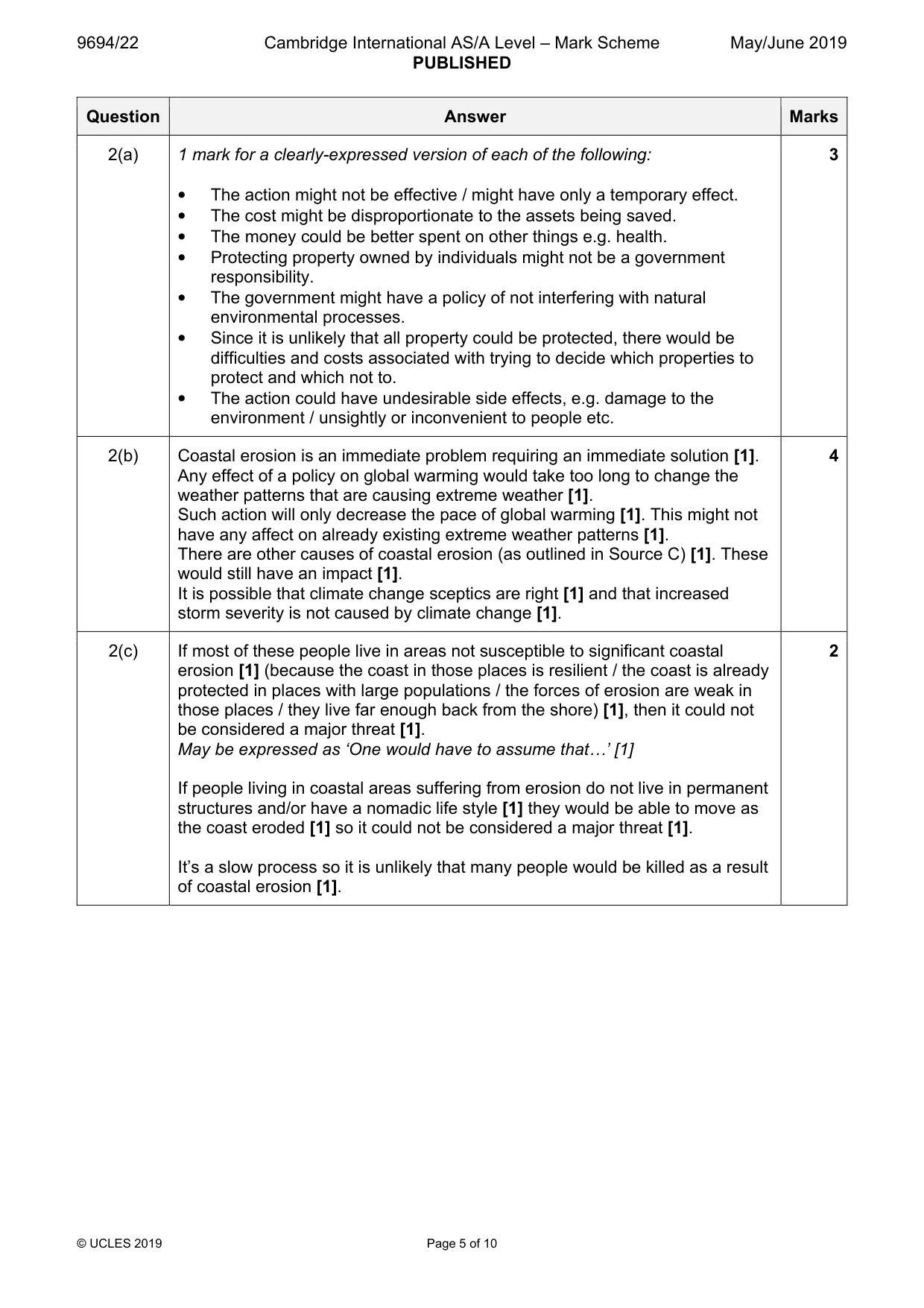
9694/22 Cambridge International AS/A Level – Mark Scheme PUBLISHED May/June 2019 © UCLES 2019 Page 5 of 10 Question Answer Marks 2(a) 1 mark for a clearly-expressed version of each of the following: • The action might not be effective / might have only a temporary effect. • The cost might be disproportionate to the assets being saved. • The money could be better spent on other things e.g. health. • Protecting property owned by individuals might not be a government responsibility. • The government might have a policy of not interfering with natural environmental processes. • Since it is unlikely that all property could be protected, there would be difficulties and costs associated with trying to decide which properties to protect and which not to. • The action could have undesirable side effects, e.g. damage to the environment / unsightly or inconvenient to people etc. 3 2(b) Coastal erosion is an immediate problem requiring an immediate solution [1]. Any effect of a policy on global warming would take too long to change the weather patterns that are causing extreme weather [1]. Such action will only decrease the pace of global warming [1]. This might not have any affect on already existing extreme weather patterns [1]. There are other causes of coastal erosion (as outlined in Source C) [1]. These would still have an impact [1]. It is possible that climate change sceptics are right [1] and that increased storm severity is not caused by climate change [1]. 4 2(c) If most of these people live in areas not susceptible to significant coastal erosion [1] (because the coast in those places is resilient / the coast is already protected in places with large populations / the forces of erosion are weak in those places / they live far enough back from the shore) [1], then it could not be considered a major threat [1]. May be expressed as ‘One would have to assume that«’ [1] If people living in coastal areas suffering from erosion do not live in permanent structures and/or have a nomadic life style [1] they would be able to move as the coast eroded [1] so it could not be considered a major threat [1]. It’s a slow process so it is unlikely that many people would be killed as a result of coastal erosion [1]. 2
Mark scheme, page 6
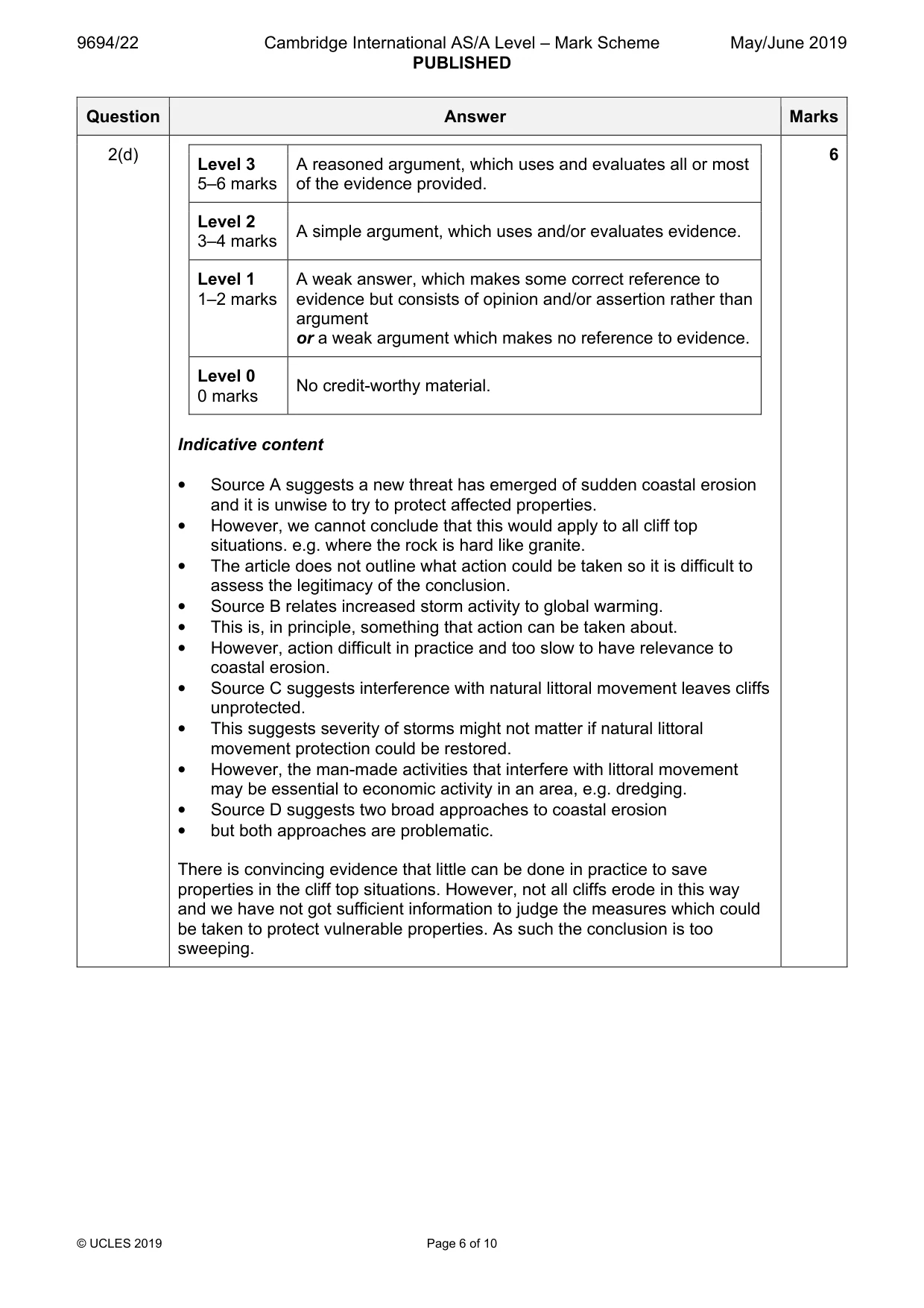
9694/22 Cambridge International AS/A Level – Mark Scheme PUBLISHED May/June 2019 © UCLES 2019 Page 6 of 10 Question Answer Marks 2(d) Level 3 5–6 marks A reasoned argument, which uses and evaluates all or most of the evidence provided. Level 2 3–4 marks A simple argument, which uses and/or evaluates evidence. Level 1 1–2 marks A weak answer, which makes some correct reference to evidence but consists of opinion and/or assertion rather than argument or a weak argument which makes no reference to evidence. Level 0 0 marks No credit-worthy material. Indicative content • Source A suggests a new threat has emerged of sudden coastal erosion and it is unwise to try to protect affected properties. • However, we cannot conclude that this would apply to all cliff top situations. e.g. where the rock is hard like granite. • The article does not outline what action could be taken so it is difficult to assess the legitimacy of the conclusion. • Source B relates increased storm activity to global warming. • This is, in principle, something that action can be taken about. • However, action difficult in practice and too slow to have relevance to coastal erosion. • Source C suggests interference with natural littoral movement leaves cliffs unprotected. • This suggests severity of storms might not matter if natural littoral movement protection could be restored. • However, the man-made activities that interfere with littoral movement may be essential to economic activity in an area, e.g. dredging. • Source D suggests two broad approaches to coastal erosion • but both approaches are problematic. There is convincing evidence that little can be done in practice to save properties in the cliff top situations. However, not all cliffs erode in this way and we have not got sufficient information to judge the measures which could be taken to protect vulnerable properties. As such the conclusion is too sweeping. 6
Mark scheme, page 7
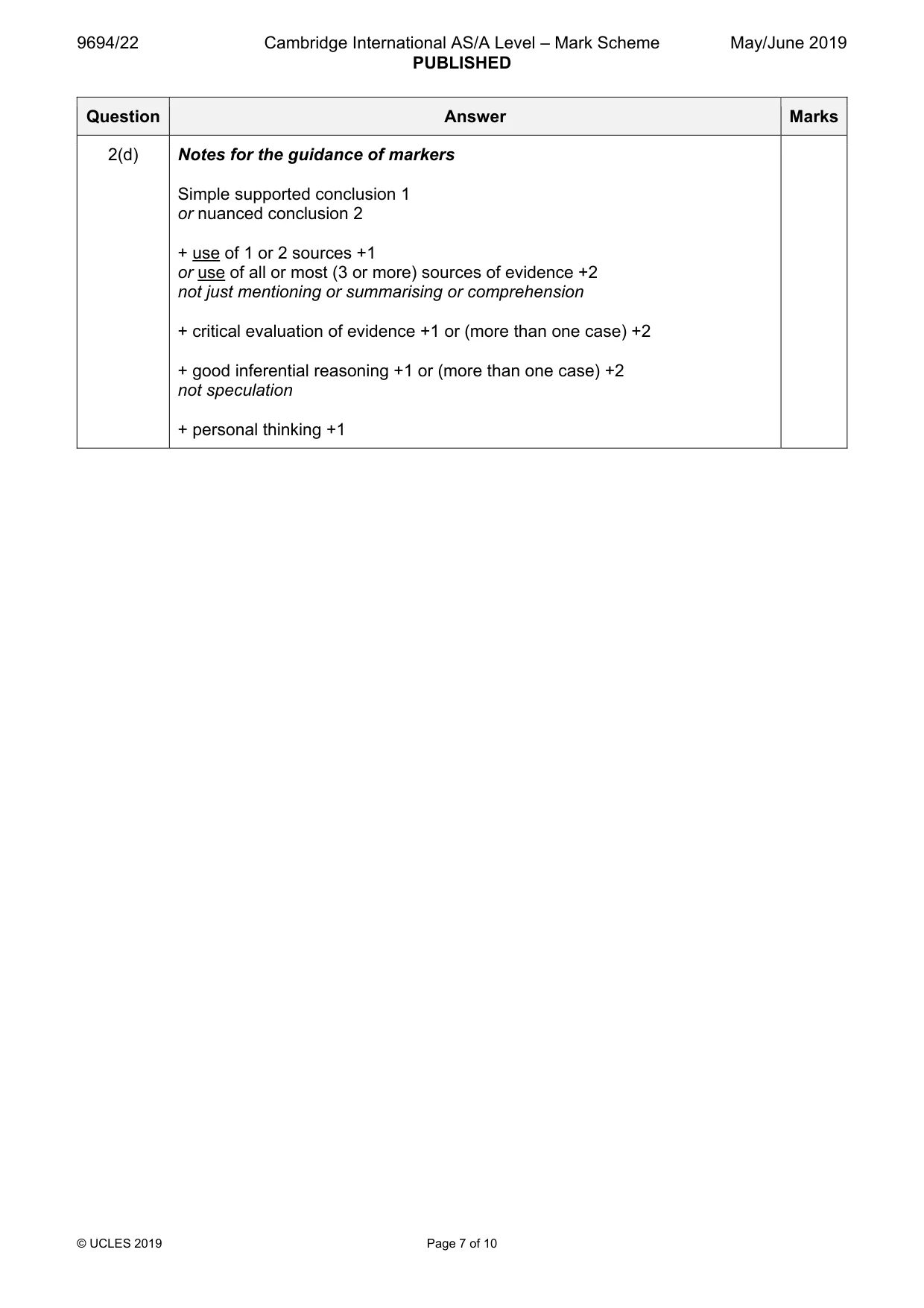
9694/22 Cambridge International AS/A Level – Mark Scheme PUBLISHED May/June 2019 © UCLES 2019 Page 7 of 10 Question Answer Marks 2(d) Notes for the guidance of markers Simple supported conclusion 1 or nuanced conclusion 2 + use of 1 or 2 sources +1 or use of all or most (3 or more) sources of evidence +2 not just mentioning or summarising or comprehension + critical evaluation of evidence +1 or (more than one case) +2 + good inferential reasoning +1 or (more than one case) +2 not speculation + personal thinking +1
Mark scheme, page 8
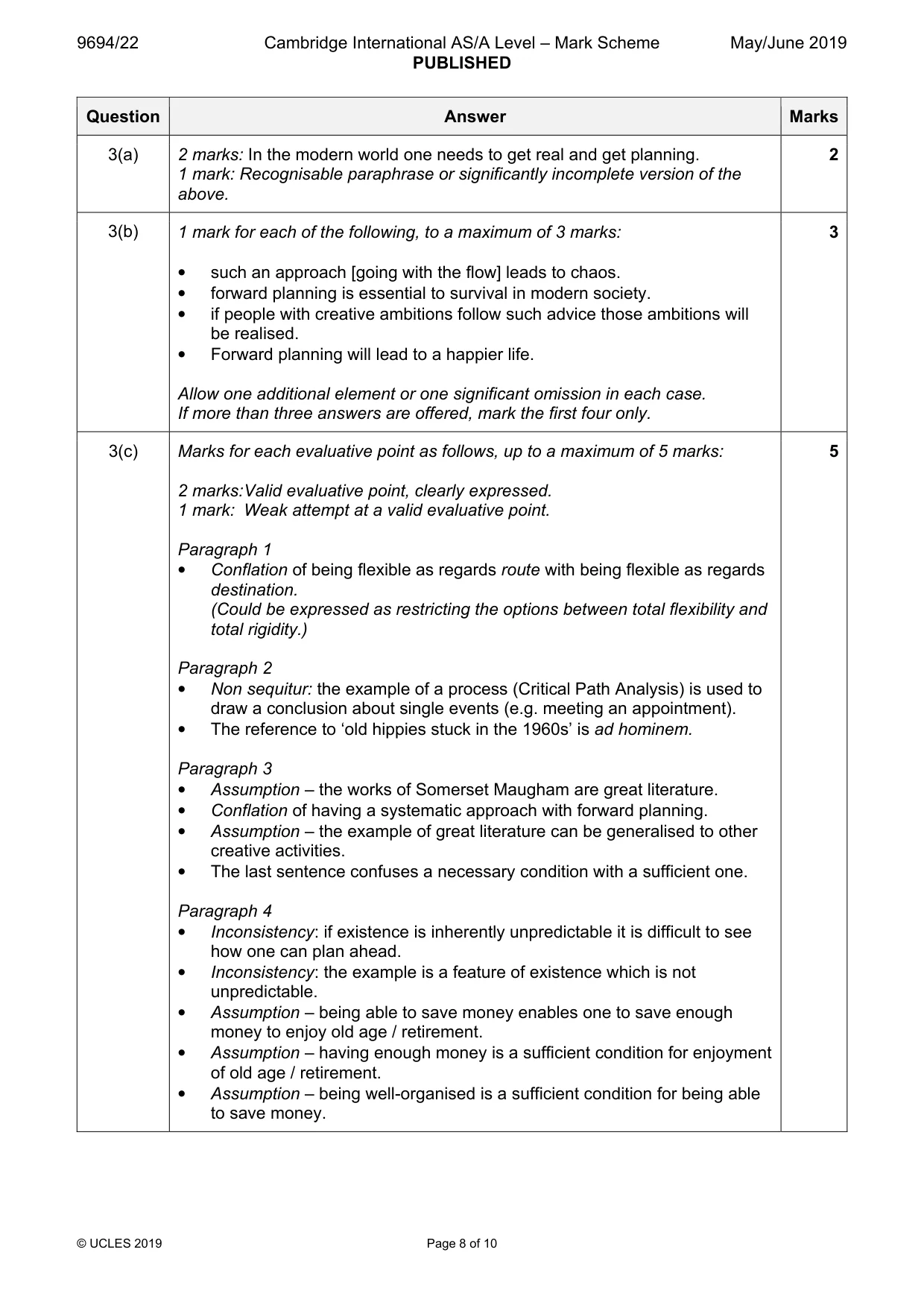
9694/22 Cambridge International AS/A Level – Mark Scheme PUBLISHED May/June 2019 © UCLES 2019 Page 8 of 10 Question Answer Marks 3(a) 2 marks: In the modern world one needs to get real and get planning. 1 mark: Recognisable paraphrase or significantly incomplete version of the above. 2 3(b) 1 mark for each of the following, to a maximum of 3 marks: • such an approach [going with the flow] leads to chaos. • forward planning is essential to survival in modern society. • if people with creative ambitions follow such advice those ambitions will be realised. • Forward planning will lead to a happier life. Allow one additional element or one significant omission in each case. If more than three answers are offered, mark the first four only. 3 3(c) Marks for each evaluative point as follows, up to a maximum of 5 marks: 2 marks: Valid evaluative point, clearly expressed. 1 mark: Weak attempt at a valid evaluative point. Paragraph 1 • Conflation of being flexible as regards route with being flexible as regards destination. (Could be expressed as restricting the options between total flexibility and total rigidity.) Paragraph 2 • Non sequitur: the example of a process (Critical Path Analysis) is used to draw a conclusion about single events (e.g. meeting an appointment). • The reference to ‘old hippies stuck in the 1960s’ is ad hominem. Paragraph 3 • Assumption – the works of Somerset Maugham are great literature. • Conflation of having a systematic approach with forward planning. • Assumption – the example of great literature can be generalised to other creative activities. • The last sentence confuses a necessary condition with a sufficient one. Paragraph 4 • Inconsistency: if existence is inherently unpredictable it is difficult to see how one can plan ahead. • Inconsistency: the example is a feature of existence which is not unpredictable. • Assumption – being able to save money enables one to save enough money to enjoy old age / retirement. • Assumption – having enough money is a sufficient condition for enjoyment of old age / retirement. • Assumption – being well-organised is a sufficient condition for being able to save money. 5
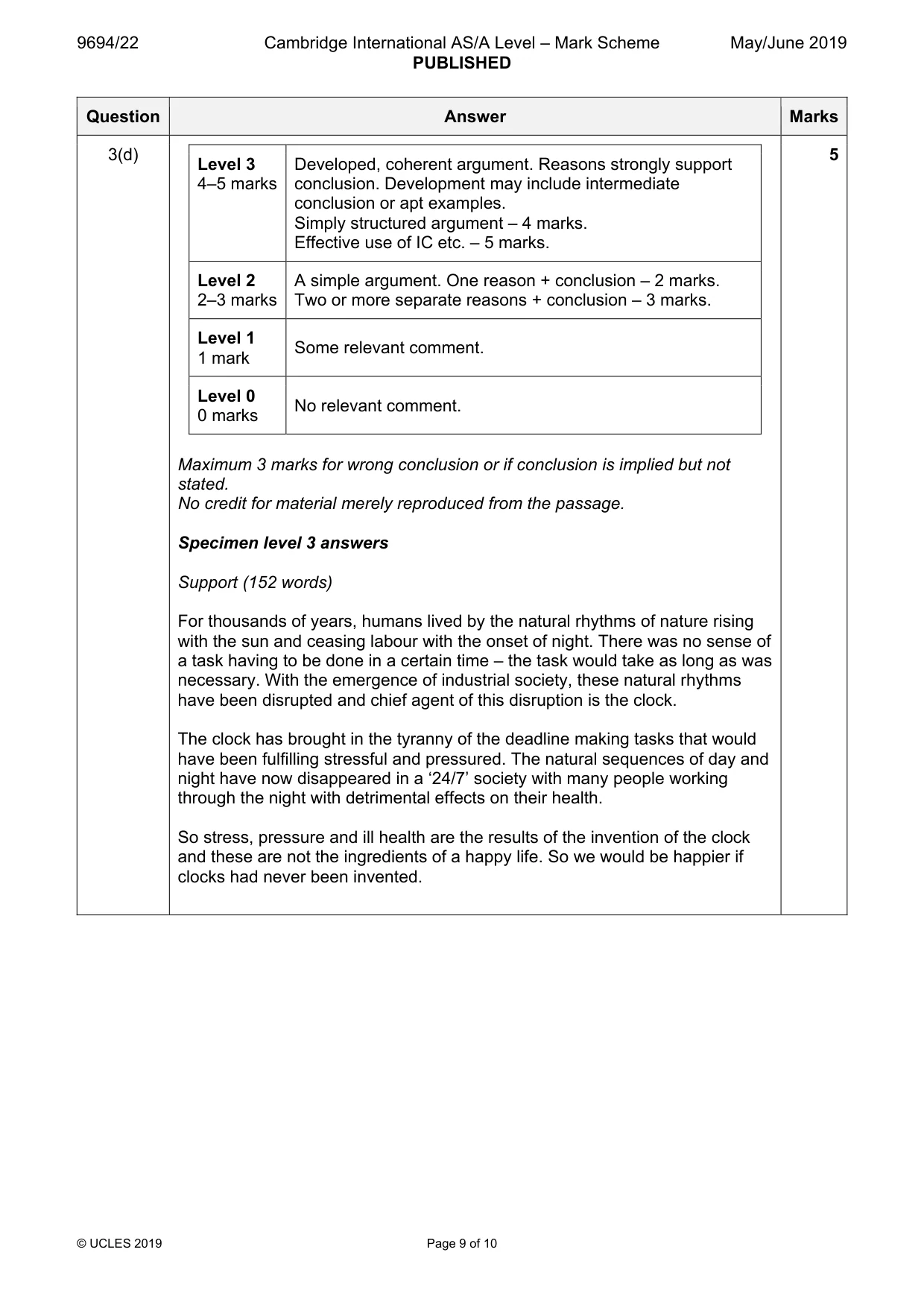
Mark scheme, page 9
9694/22 Cambridge International AS/A Level – Mark Scheme PUBLISHED May/June 2019 © UCLES 2019 Page 9 of 10 Question Answer Marks 3(d) Level 3 4–5 marks Developed, coherent argument. Reasons strongly support conclusion. Development may include intermediate conclusion or apt examples. Simply structured argument – 4 marks. Effective use of IC etc. – 5 marks. Level 2 2–3 marks A simple argument. One reason + conclusion – 2 marks. Two or more separate reasons + conclusion – 3 marks. Level 1 1 mark Some relevant comment. Level 0 0 marks No relevant comment. Maximum 3 marks for wrong conclusion or if conclusion is implied but not stated. No credit for material merely reproduced from the passage. Specimen level 3 answers Support (152 words) For thousands of years, humans lived by the natural rhythms of nature rising with the sun and ceasing labour with the onset of night. There was no sense of a task having to be done in a certain time – the task would take as long as was necessary. With the emergence of industrial society, these natural rhythms have been disrupted and chief agent of this disruption is the clock. The clock has brought in the tyranny of the deadline making tasks that would have been fulfilling stressful and pressured. The natural sequences of day and night have now disappeared in a ‘24/7’ society with many people working through the night with detrimental effects on their health. So stress, pressure and ill health are the results of the invention of the clock and these are not the ingredients of a happy life. So we would be happier if clocks had never been invented. 5
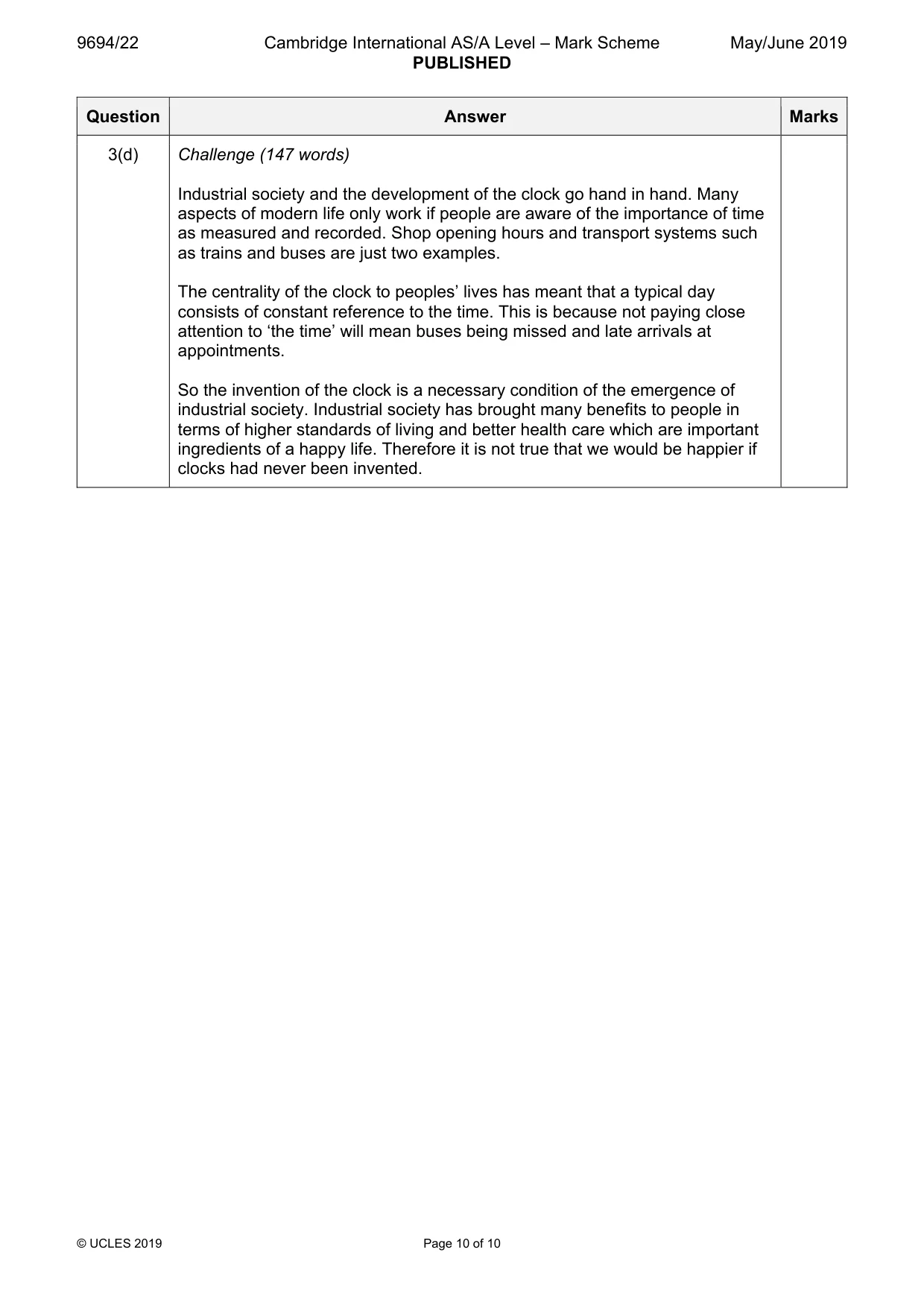
Mark scheme, page 10
9694/22 Cambridge International AS/A Level – Mark Scheme PUBLISHED May/June 2019 © UCLES 2019 Page 10 of 10 Question Answer Marks 3(d) Challenge (147 words) Industrial society and the development of the clock go hand in hand. Many aspects of modern life only work if people are aware of the importance of time as measured and recorded. Shop opening hours and transport systems such as trains and buses are just two examples. The centrality of the clock to peoples’ lives has meant that a typical day consists of constant reference to the time. This is because not paying close attention to ‘the time’ will mean buses being missed and late arrivals at appointments. So the invention of the clock is a necessary condition of the emergence of industrial society. Industrial society has brought many benefits to people in terms of higher standards of living and better health care which are important ingredients of a happy life. Therefore it is not true that we would be happier if clocks had never been invented.
What you needed in this session
Cambridge’s own grade thresholds for 2019 May/June, Paper 2 · Variant 2. A higher threshold means an easier paper — the bar moves with how the cohort did.