Cambridge A Level Thinking Skills 9694 — 2019 May/June Paper 2 · Variant 3
9694/23/M/J/19 · 45 marks · ≈51 min
The question paper and its mark scheme, free to read here and free to download. This is Cambridge’s own paper, exactly as it was sat.
Question paper8 pages


Mark scheme8 pages
Answers below. Sit the paper first if you are practising.
Paper as text
Question paper, page 1
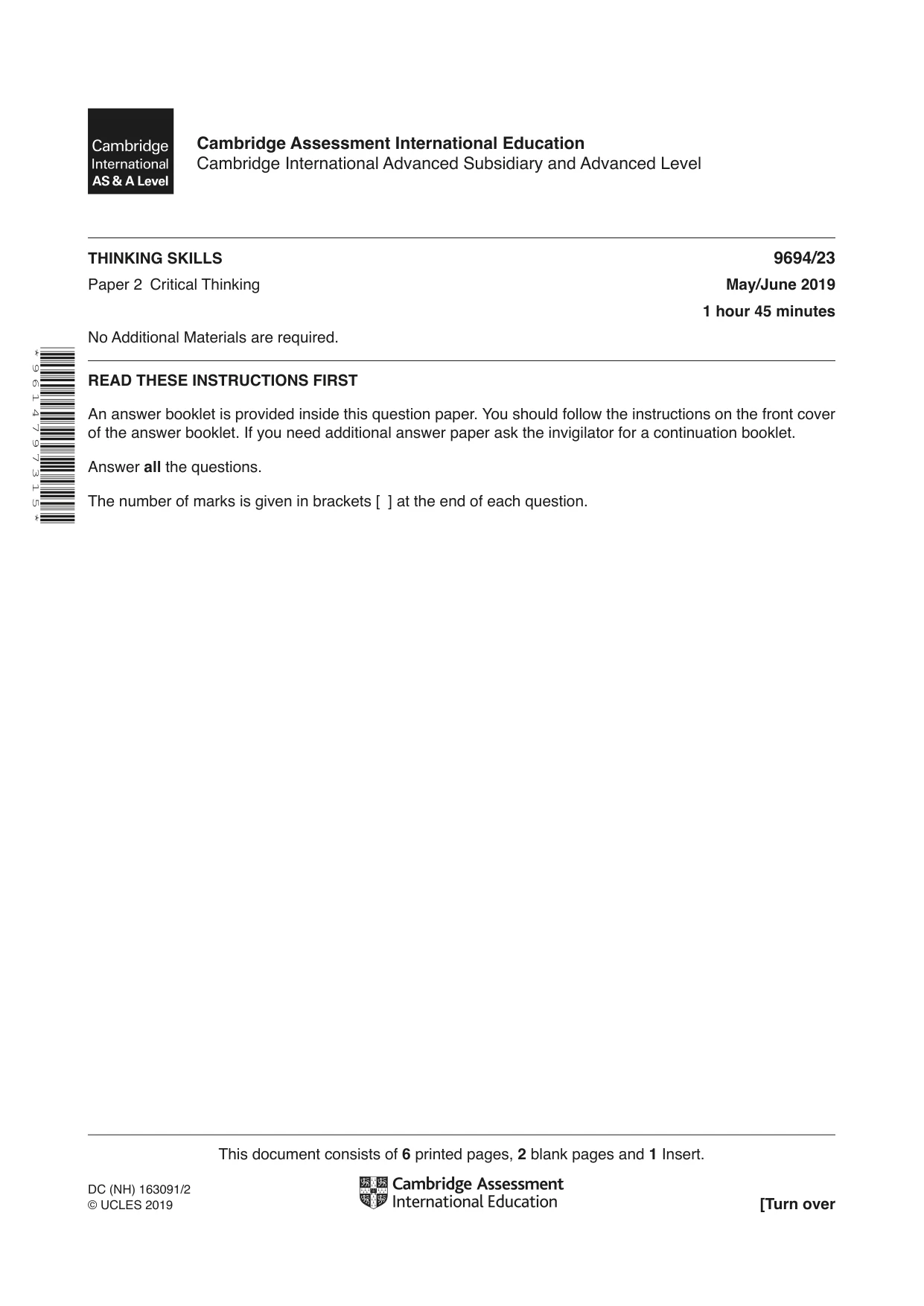
This document consists of 6 printed pages, 2 blank pages and 1 Insert. DC (NH) 163091/2 © UCLES 2019 [Turn over Cambridge Assessment International Education Cambridge International Advanced Subsidiary and Advanced Level * 9 6 1 4 7 9 7 3 1 5 * THINKING SKILLS 9694/23 Paper 2 Critical Thinking May/June 2019 1 hour 45 minutes No Additional Materials are required. READ THESE INSTRUCTIONS FIRST An answer booklet is provided inside this question paper. You should follow the instructions on the front cover of the answer booklet. If you need additional answer paper ask the invigilator for a continuation booklet. Answer all the questions. The number of marks is given in brackets [ ] at the end of each question.
Question paper, page 2
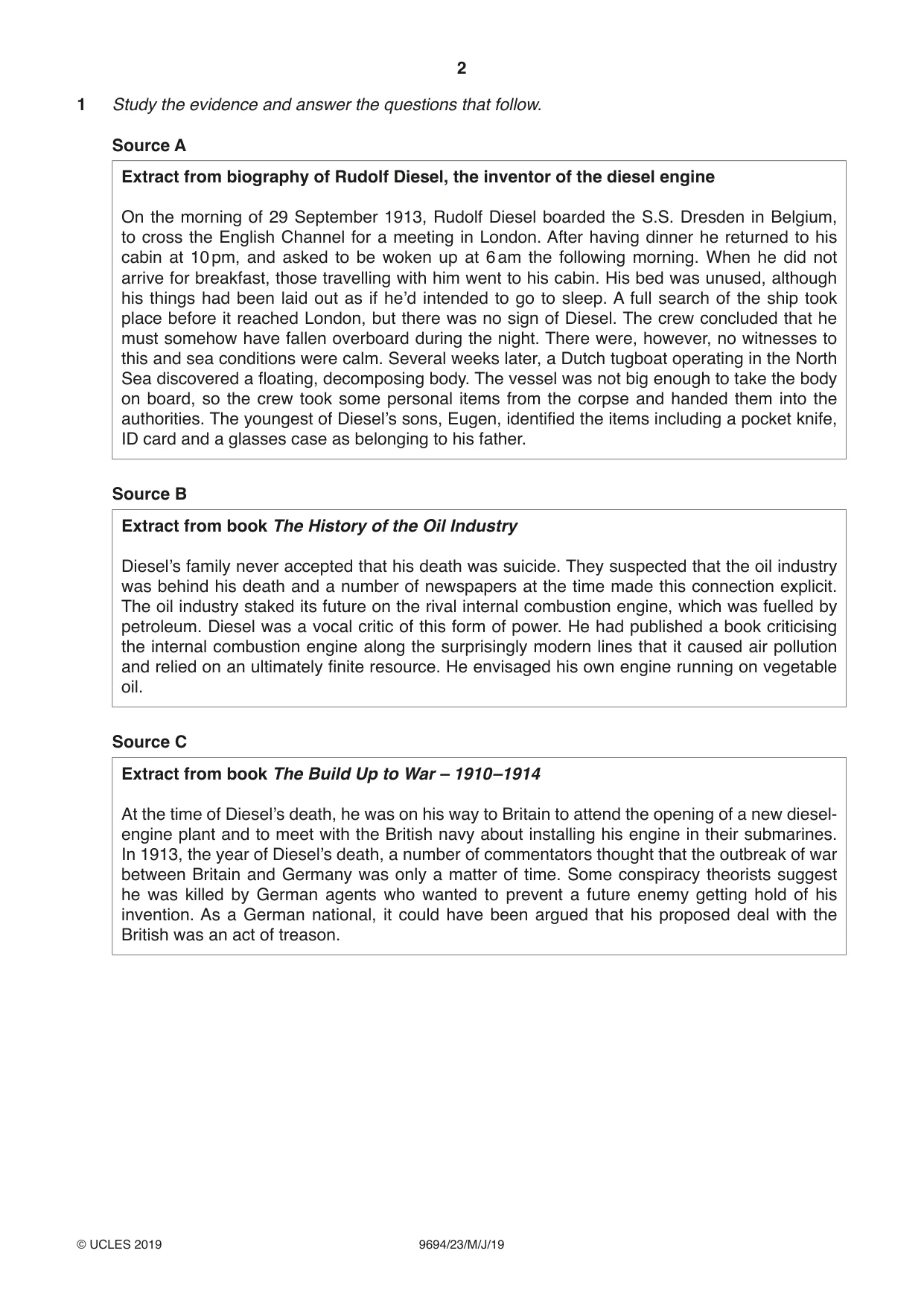
2 9694/23/M/J/19 © UCLES 2019 1 Study the evidence and answer the questions that follow. Source A Extract from biography of Rudolf Diesel, the inventor of the diesel engine On the morning of 29 September 1913, Rudolf Diesel boarded the S.S. Dresden in Belgium, to cross the English Channel for a meeting in London. After having dinner he returned to his cabin at 10 pm, and asked to be woken up at 6 am the following morning. When he did not arrive for breakfast, those travelling with him went to his cabin. His bed was unused, although his things had been laid out as if he’d intended to go to sleep. A full search of the ship took place before it reached London, but there was no sign of Diesel. The crew concluded that he must somehow have fallen overboard during the night. There were, however, no witnesses to this and sea conditions were calm. Several weeks later, a Dutch tugboat operating in the North Sea discovered a floating, decomposing body. The vessel was not big enough to take the body on board, so the crew took some personal items from the corpse and handed them into the authorities. The youngest of Diesel’s sons, Eugen, identified the items including a pocket knife, ID card and a glasses case as belonging to his father. Source B Extract from book The History of the Oil Industry Diesel’s family never accepted that his death was suicide. They suspected that the oil industry was behind his death and a number of newspapers at the time made this connection explicit. The oil industry staked its future on the rival internal combustion engine, which was fuelled by petroleum. Diesel was a vocal critic of this form of power. He had published a book criticising the internal combustion engine along the surprisingly modern lines that it caused air pollution and relied on an ultimately finite resource. He envisaged his own engine running on vegetable oil. Source C Extract from book The Build Up to War – 1910–1914 At the time of Diesel’s death, he was on his way to Britain to attend the opening of a new diesel- engine plant and to meet with the British navy about installing his engine in their submarines. In 1913, the year of Diesel’s death, a number of commentators thought that the outbreak of war between Britain and Germany was only a matter of time. Some conspiracy theorists suggest he was killed by German agents who wanted to prevent a future enemy getting hold of his invention. As a German national, it could have been argued that his proposed deal with the British was an act of treason.
Question paper, page 3
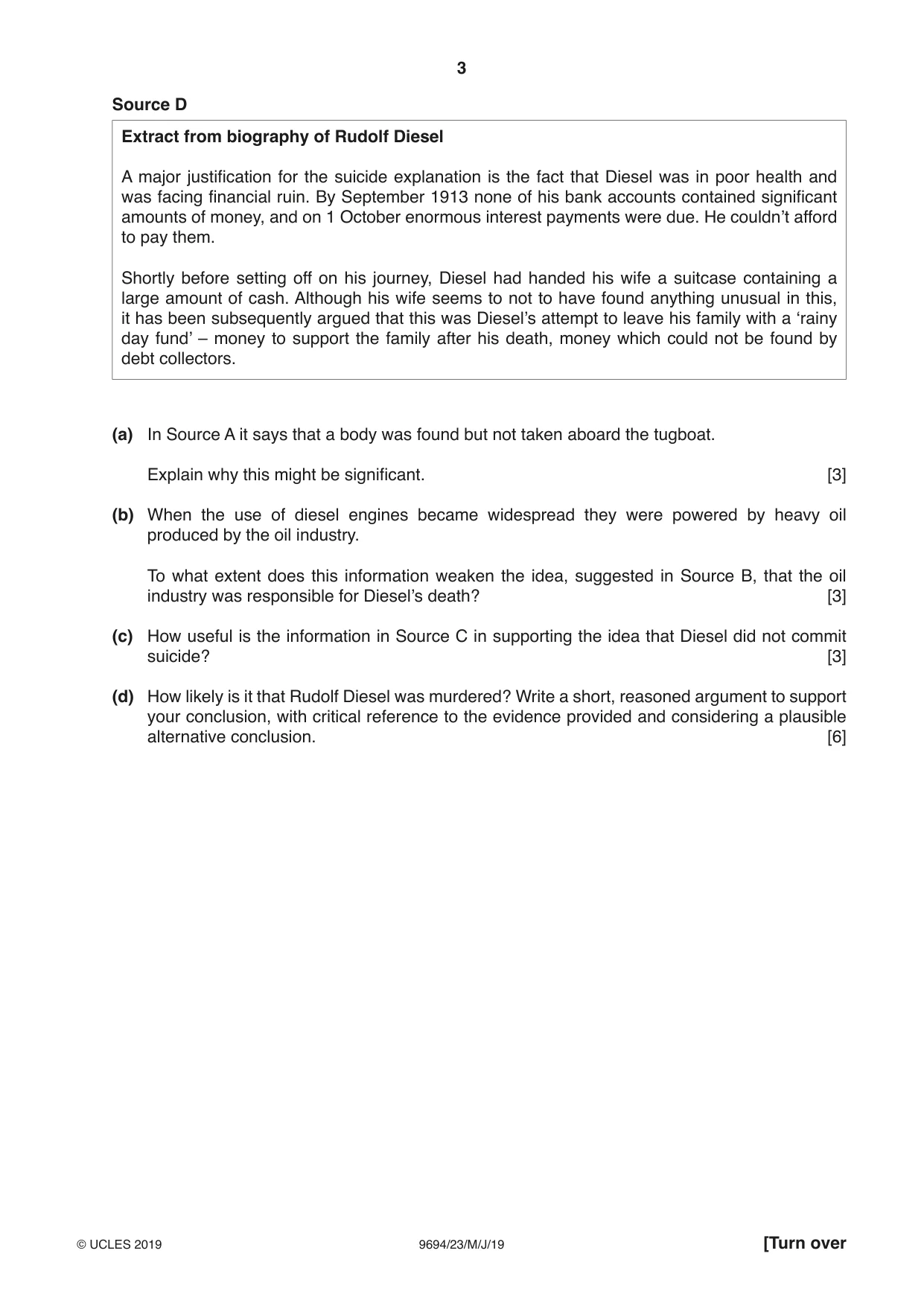
3 9694/23/M/J/19 © UCLES 2019 [Turn over Source D Extract from biography of Rudolf Diesel A major justification for the suicide explanation is the fact that Diesel was in poor health and was facing financial ruin. By September 1913 none of his bank accounts contained significant amounts of money, and on 1 October enormous interest payments were due. He couldn’t afford to pay them. Shortly before setting off on his journey, Diesel had handed his wife a suitcase containing a large amount of cash. Although his wife seems to not to have found anything unusual in this, it has been subsequently argued that this was Diesel’s attempt to leave his family with a ‘rainy day fund’ – money to support the family after his death, money which could not be found by debt collectors. (a) In Source A it says that a body was found but not taken aboard the tugboat. Explain why this might be significant. [3] (b) When the use of diesel engines became widespread they were powered by heavy oil produced by the oil industry. To what extent does this information weaken the idea, suggested in Source B, that the oil industry was responsible for Diesel’s death? [3] (c) How useful is the information in Source C in supporting the idea that Diesel did not commit suicide? [3] (d) How likely is it that Rudolf Diesel was murdered? Write a short, reasoned argument to support your conclusion, with critical reference to the evidence provided and considering a plausible alternative conclusion. [6]
Question paper, page 4
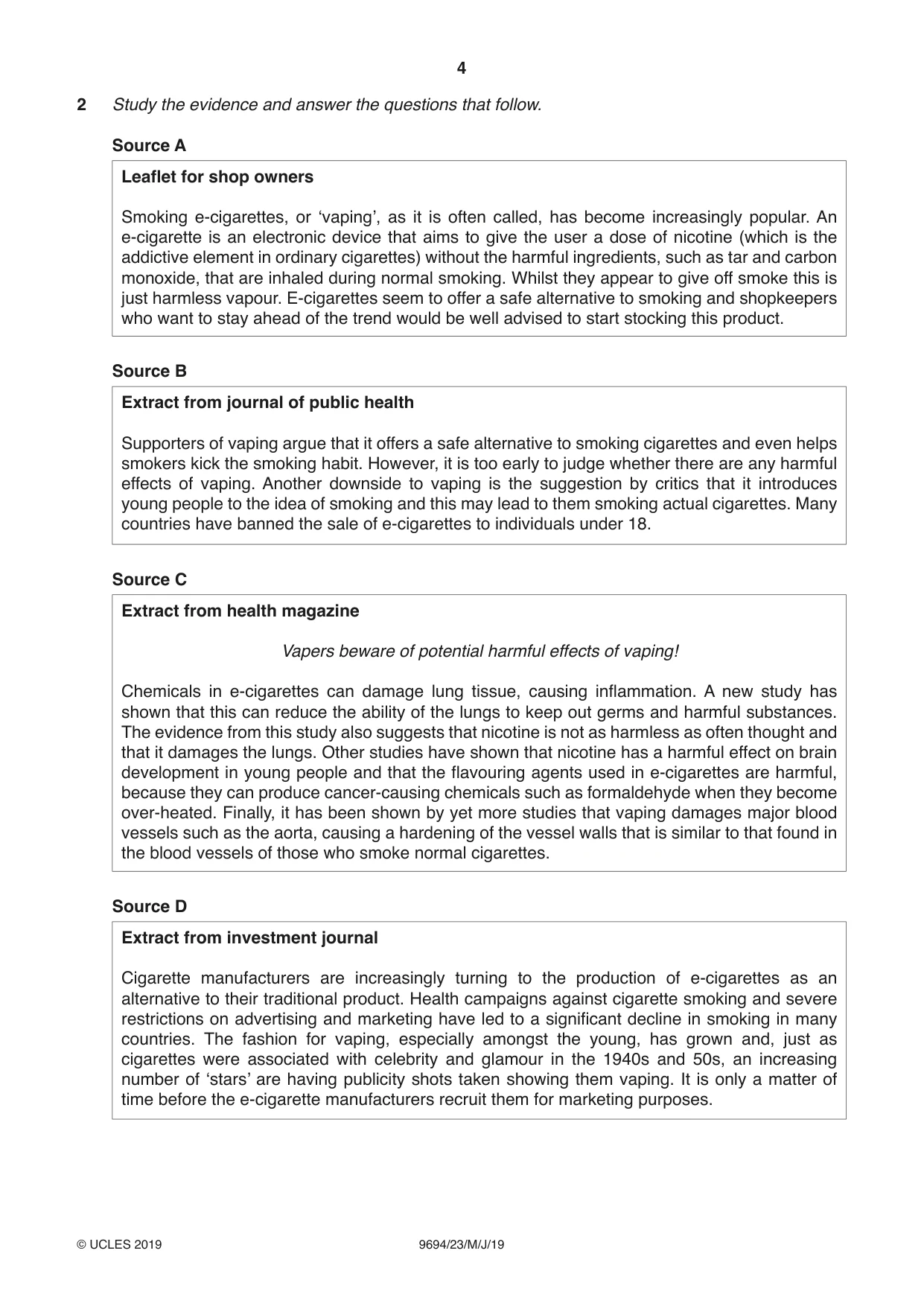
4 9694/23/M/J/19 © UCLES 2019 2 Study the evidence and answer the questions that follow. Source A Leaflet for shop owners Smoking e-cigarettes, or ‘vaping’, as it is often called, has become increasingly popular. An e-cigarette is an electronic device that aims to give the user a dose of nicotine (which is the addictive element in ordinary cigarettes) without the harmful ingredients, such as tar and carbon monoxide, that are inhaled during normal smoking. Whilst they appear to give off smoke this is just harmless vapour. E-cigarettes seem to offer a safe alternative to smoking and shopkeepers who want to stay ahead of the trend would be well advised to start stocking this product. Source B Extract from journal of public health Supporters of vaping argue that it offers a safe alternative to smoking cigarettes and even helps smokers kick the smoking habit. However, it is too early to judge whether there are any harmful effects of vaping. Another downside to vaping is the suggestion by critics that it introduces young people to the idea of smoking and this may lead to them smoking actual cigarettes. Many countries have banned the sale of e-cigarettes to individuals under 18. Source C Extract from health magazine Vapers beware of potential harmful effects of vaping! Chemicals in e-cigarettes can damage lung tissue, causing inflammation. A new study has shown that this can reduce the ability of the lungs to keep out germs and harmful substances. The evidence from this study also suggests that nicotine is not as harmless as often thought and that it damages the lungs. Other studies have shown that nicotine has a harmful effect on brain development in young people and that the flavouring agents used in e-cigarettes are harmful, because they can produce cancer-causing chemicals such as formaldehyde when they become over-heated. Finally, it has been shown by yet more studies that vaping damages major blood vessels such as the aorta, causing a hardening of the vessel walls that is similar to that found in the blood vessels of those who smoke normal cigarettes. Source D Extract from investment journal Cigarette manufacturers are increasingly turning to the production of e-cigarettes as an alternative to their traditional product. Health campaigns against cigarette smoking and severe restrictions on advertising and marketing have led to a significant decline in smoking in many countries. The fashion for vaping, especially amongst the young, has grown and, just as cigarettes were associated with celebrity and glamour in the 1940s and 50s, an increasing number of ‘stars’ are having publicity shots taken showing them vaping. It is only a matter of time before the e-cigarette manufacturers recruit them for marketing purposes.
Question paper, page 5
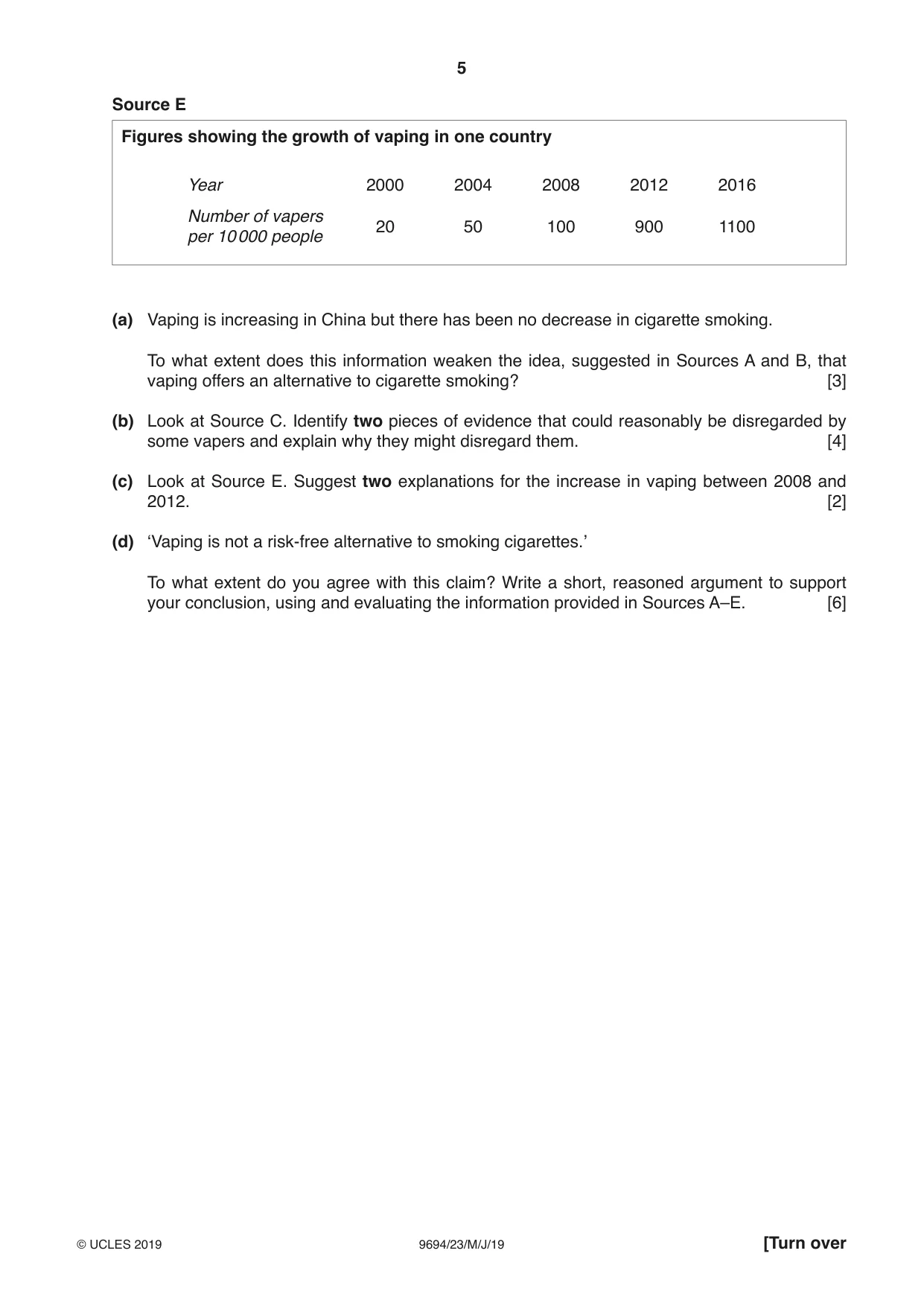
5 9694/23/M/J/19 © UCLES 2019 [Turn over Source E Figures showing the growth of vaping in one country Year 2000 2004 2008 2012 2016 Number of vapers per 10 000 people 20 50 100 900 1100 (a) Vaping is increasing in China but there has been no decrease in cigarette smoking. To what extent does this information weaken the idea, suggested in Sources A and B, that vaping offers an alternative to cigarette smoking? [3] (b) Look at Source C. Identify two pieces of evidence that could reasonably be disregarded by some vapers and explain why they might disregard them. [4] (c) Look at Source E. Suggest two explanations for the increase in vaping between 2008 and 2012. [2] (d) ‘Vaping is not a risk-free alternative to smoking cigarettes.’ To what extent do you agree with this claim? Write a short, reasoned argument to support your conclusion, using and evaluating the information provided in Sources A–E. [6]
Question paper, page 6
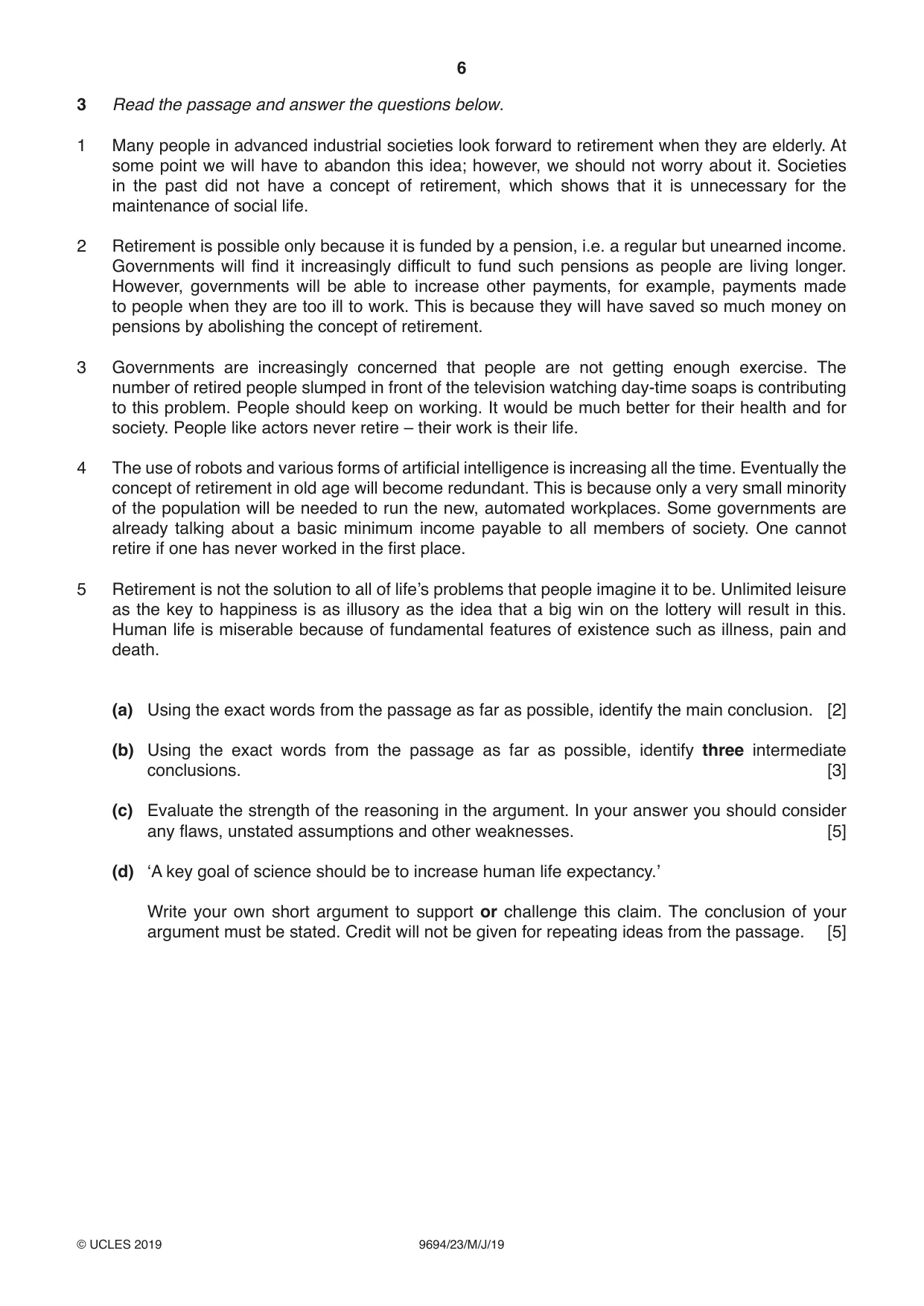
6 9694/23/M/J/19 © UCLES 2019 3 Read the passage and answer the questions below. 1 Many people in advanced industrial societies look forward to retirement when they are elderly. At some point we will have to abandon this idea; however, we should not worry about it. Societies in the past did not have a concept of retirement, which shows that it is unnecessary for the maintenance of social life. 2 Retirement is possible only because it is funded by a pension, i.e. a regular but unearned income. Governments will find it increasingly difficult to fund such pensions as people are living longer. However, governments will be able to increase other payments, for example, payments made to people when they are too ill to work. This is because they will have saved so much money on pensions by abolishing the concept of retirement. 3 Governments are increasingly concerned that people are not getting enough exercise. The number of retired people slumped in front of the television watching day-time soaps is contributing to this problem. People should keep on working. It would be much better for their health and for society. People like actors never retire – their work is their life. 4 The use of robots and various forms of artificial intelligence is increasing all the time. Eventually the concept of retirement in old age will become redundant. This is because only a very small minority of the population will be needed to run the new, automated workplaces. Some governments are already talking about a basic minimum income payable to all members of society. One cannot retire if one has never worked in the first place. 5 Retirement is not the solution to all of life’s problems that people imagine it to be. Unlimited leisure as the key to happiness is as illusory as the idea that a big win on the lottery will result in this. Human life is miserable because of fundamental features of existence such as illness, pain and death. (a) Using the exact words from the passage as far as possible, identify the main conclusion. [2] (b) Using the exact words from the passage as far as possible, identify three intermediate conclusions. [3] (c) Evaluate the strength of the reasoning in the argument. In your answer you should consider any flaws, unstated assumptions and other weaknesses. [5] (d) ‘A key goal of science should be to increase human life expectancy.’ Write your own short argument to support or challenge this claim. The conclusion of your argument must be stated. Credit will not be given for repeating ideas from the passage. [5]
Question paper, page 7
7 9694/23/M/J/19 © UCLES 2019 BLANK PAGE
Question paper, page 8
8 9694/23/M/J/19 © UCLES 2019 Permission to reproduce items where third-party owned material protected by copyright is included has been sought and cleared where possible. Every reasonable effort has been made by the publisher (UCLES) to trace copyright holders, but if any items requiring clearance have unwittingly been included, the publisher will be pleased to make amends at the earliest possible opportunity. To avoid the issue of disclosure of answer-related information to candidates, all copyright acknowledgements are reproduced online in the Cambridge Assessment International Education Copyright Acknowledgements Booklet. This is produced for each series of examinations and is freely available to download at www.cambridgeinternational.org after the live examination series. Cambridge Assessment International Education is part of the Cambridge Assessment Group. Cambridge Assessment is the brand name of the University of Cambridge Local Examinations Syndicate (UCLES), which itself is a department of the University of Cambridge. BLANK PAGE
Mark scheme, page 1
This document consists of 8 printed pages. © UCLES 2019 [Turn over Cambridge Assessment International Education Cambridge International Advanced Subsidiary and Advanced Level THINKING SKILLS 9694/23 Paper 2 Critical Thinking May/June 2019 MARK SCHEME Maximum Mark: 45 Published This mark scheme is published as an aid to teachers and candidates, to indicate the requirements of the examination. It shows the basis on which Examiners were instructed to award marks. It does not indicate the details of the discussions that took place at an Examiners’ meeting before marking began, which would have considered the acceptability of alternative answers. Mark schemes should be read in conjunction with the question paper and the Principal Examiner Report for Teachers. Cambridge International will not enter into discussions about these mark schemes. Cambridge International is publishing the mark schemes for the May/June 2019 series for most Cambridge IGCSE™, Cambridge International A and AS Level and Cambridge Pre-U components, and some Cambridge O Level components.
Mark scheme, page 2
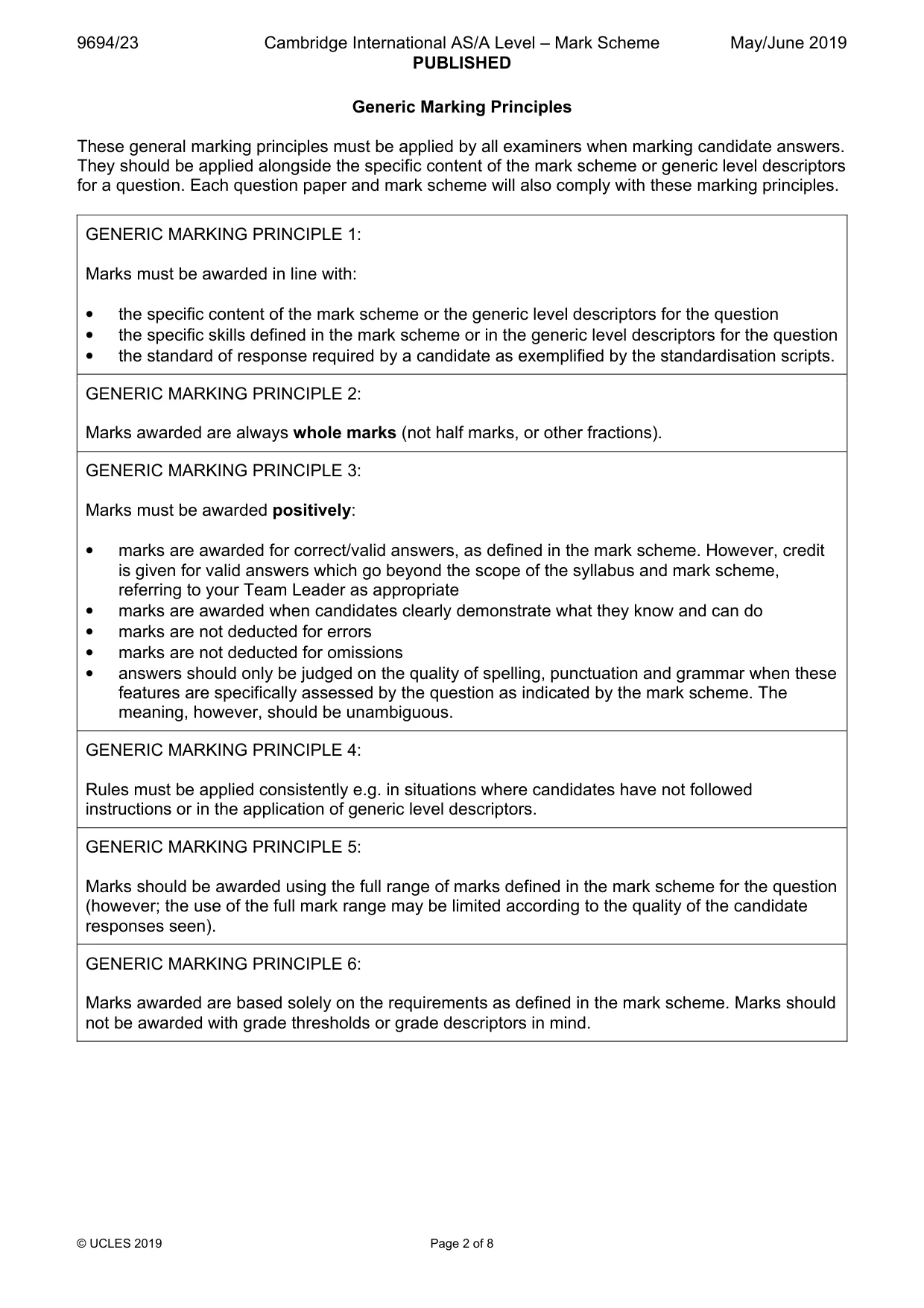
9694/23 Cambridge International AS/A Level – Mark Scheme PUBLISHED May/June 2019 © UCLES 2019 Page 2 of 8 Generic Marking Principles These general marking principles must be applied by all examiners when marking candidate answers. They should be applied alongside the specific content of the mark scheme or generic level descriptors for a question. Each question paper and mark scheme will also comply with these marking principles. GENERIC MARKING PRINCIPLE 1: Marks must be awarded in line with: • the specific content of the mark scheme or the generic level descriptors for the question • the specific skills defined in the mark scheme or in the generic level descriptors for the question • the standard of response required by a candidate as exemplified by the standardisation scripts. GENERIC MARKING PRINCIPLE 2: Marks awarded are always whole marks (not half marks, or other fractions). GENERIC MARKING PRINCIPLE 3: Marks must be awarded positively: • marks are awarded for correct/valid answers, as defined in the mark scheme. However, credit is given for valid answers which go beyond the scope of the syllabus and mark scheme, referring to your Team Leader as appropriate • marks are awarded when candidates clearly demonstrate what they know and can do • marks are not deducted for errors • marks are not deducted for omissions • answers should only be judged on the quality of spelling, punctuation and grammar when these features are specifically assessed by the question as indicated by the mark scheme. The meaning, however, should be unambiguous. GENERIC MARKING PRINCIPLE 4: Rules must be applied consistently e.g. in situations where candidates have not followed instructions or in the application of generic level descriptors. GENERIC MARKING PRINCIPLE 5: Marks should be awarded using the full range of marks defined in the mark scheme for the question (however; the use of the full mark range may be limited according to the quality of the candidate responses seen). GENERIC MARKING PRINCIPLE 6: Marks awarded are based solely on the requirements as defined in the mark scheme. Marks should not be awarded with grade thresholds or grade descriptors in mind.
Mark scheme, page 3
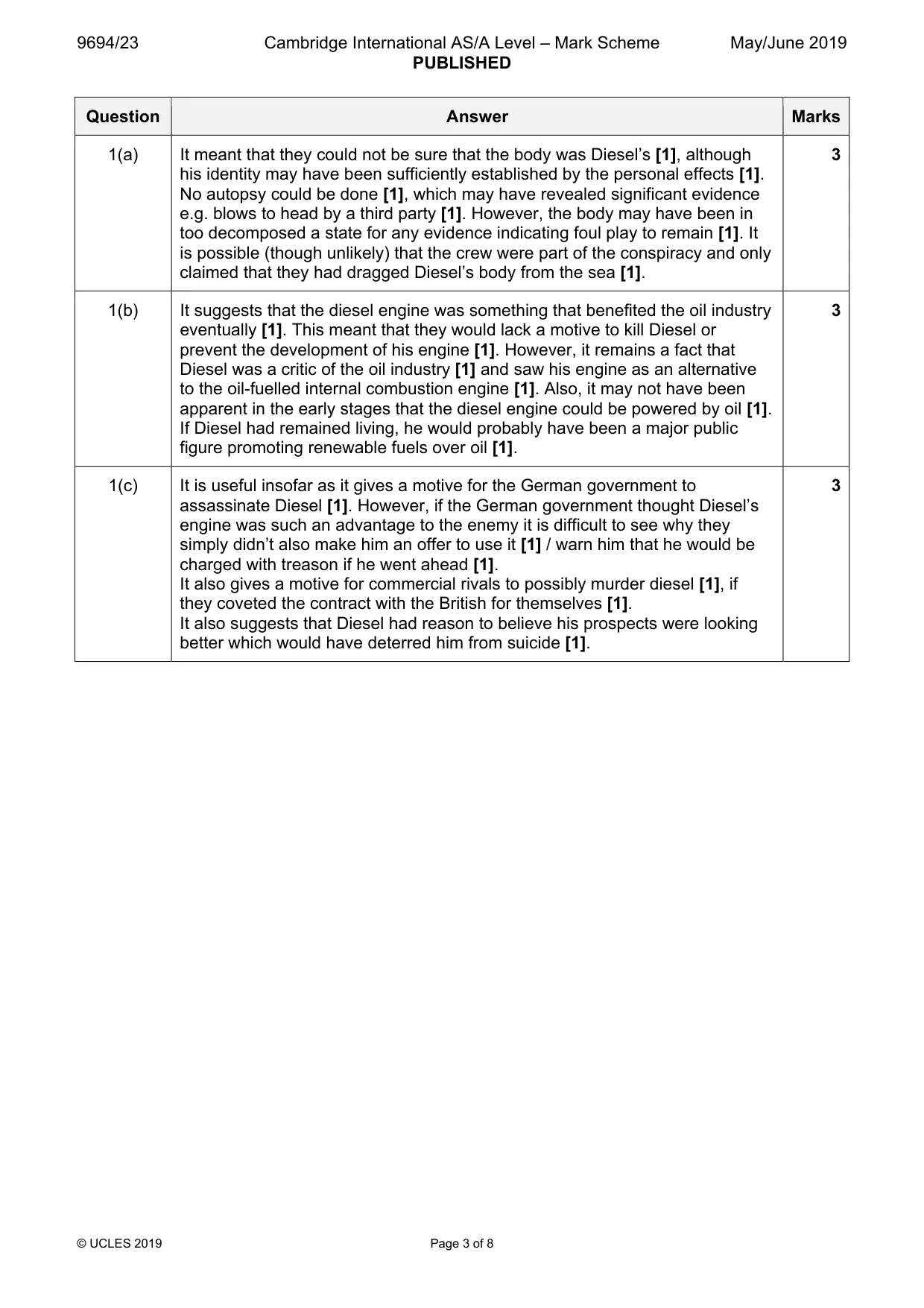
9694/23 Cambridge International AS/A Level – Mark Scheme PUBLISHED May/June 2019 © UCLES 2019 Page 3 of 8 Question Answer Marks 1(a) It meant that they could not be sure that the body was Diesel’s [1], although his identity may have been sufficiently established by the personal effects [1]. No autopsy could be done [1], which may have revealed significant evidence e.g. blows to head by a third party [1]. However, the body may have been in too decomposed a state for any evidence indicating foul play to remain [1]. It is possible (though unlikely) that the crew were part of the conspiracy and only claimed that they had dragged Diesel’s body from the sea [1]. 3 1(b) It suggests that the diesel engine was something that benefited the oil industry eventually [1]. This meant that they would lack a motive to kill Diesel or prevent the development of his engine [1]. However, it remains a fact that Diesel was a critic of the oil industry [1] and saw his engine as an alternative to the oil-fuelled internal combustion engine [1]. Also, it may not have been apparent in the early stages that the diesel engine could be powered by oil [1]. If Diesel had remained living, he would probably have been a major public figure promoting renewable fuels over oil [1]. 3 1(c) It is useful insofar as it gives a motive for the German government to assassinate Diesel [1]. However, if the German government thought Diesel’s engine was such an advantage to the enemy it is difficult to see why they simply didn’t also make him an offer to use it [1] / warn him that he would be charged with treason if he went ahead [1]. It also gives a motive for commercial rivals to possibly murder diesel [1], if they coveted the contract with the British for themselves [1]. It also suggests that Diesel had reason to believe his prospects were looking better which would have deterred him from suicide [1]. 3
Mark scheme, page 4
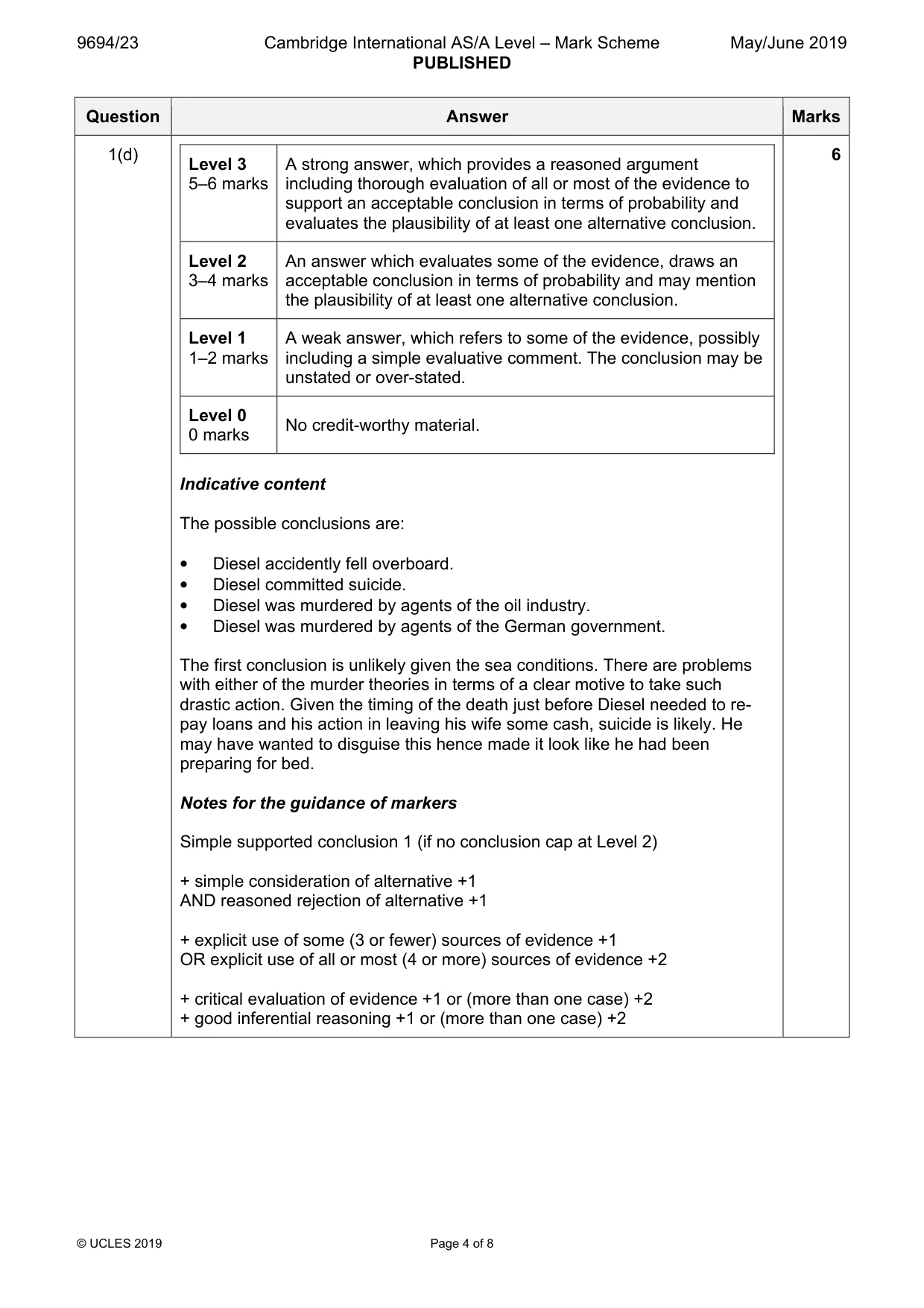
9694/23 Cambridge International AS/A Level – Mark Scheme PUBLISHED May/June 2019 © UCLES 2019 Page 4 of 8 Question Answer Marks 1(d) Level 3 5–6 marks A strong answer, which provides a reasoned argument including thorough evaluation of all or most of the evidence to support an acceptable conclusion in terms of probability and evaluates the plausibility of at least one alternative conclusion. Level 2 3–4 marks An answer which evaluates some of the evidence, draws an acceptable conclusion in terms of probability and may mention the plausibility of at least one alternative conclusion. Level 1 1–2 marks A weak answer, which refers to some of the evidence, possibly including a simple evaluative comment. The conclusion may be unstated or over-stated. Level 0 0 marks No credit-worthy material. Indicative content The possible conclusions are: • Diesel accidently fell overboard. • Diesel committed suicide. • Diesel was murdered by agents of the oil industry. • Diesel was murdered by agents of the German government. The first conclusion is unlikely given the sea conditions. There are problems with either of the murder theories in terms of a clear motive to take such drastic action. Given the timing of the death just before Diesel needed to re- pay loans and his action in leaving his wife some cash, suicide is likely. He may have wanted to disguise this hence made it look like he had been preparing for bed. Notes for the guidance of markers Simple supported conclusion 1 (if no conclusion cap at Level 2) + simple consideration of alternative +1 AND reasoned rejection of alternative +1 + explicit use of some (3 or fewer) sources of evidence +1 OR explicit use of all or most (4 or more) sources of evidence +2 + critical evaluation of evidence +1 or (more than one case) +2 + good inferential reasoning +1 or (more than one case) +2 6
Mark scheme, page 5
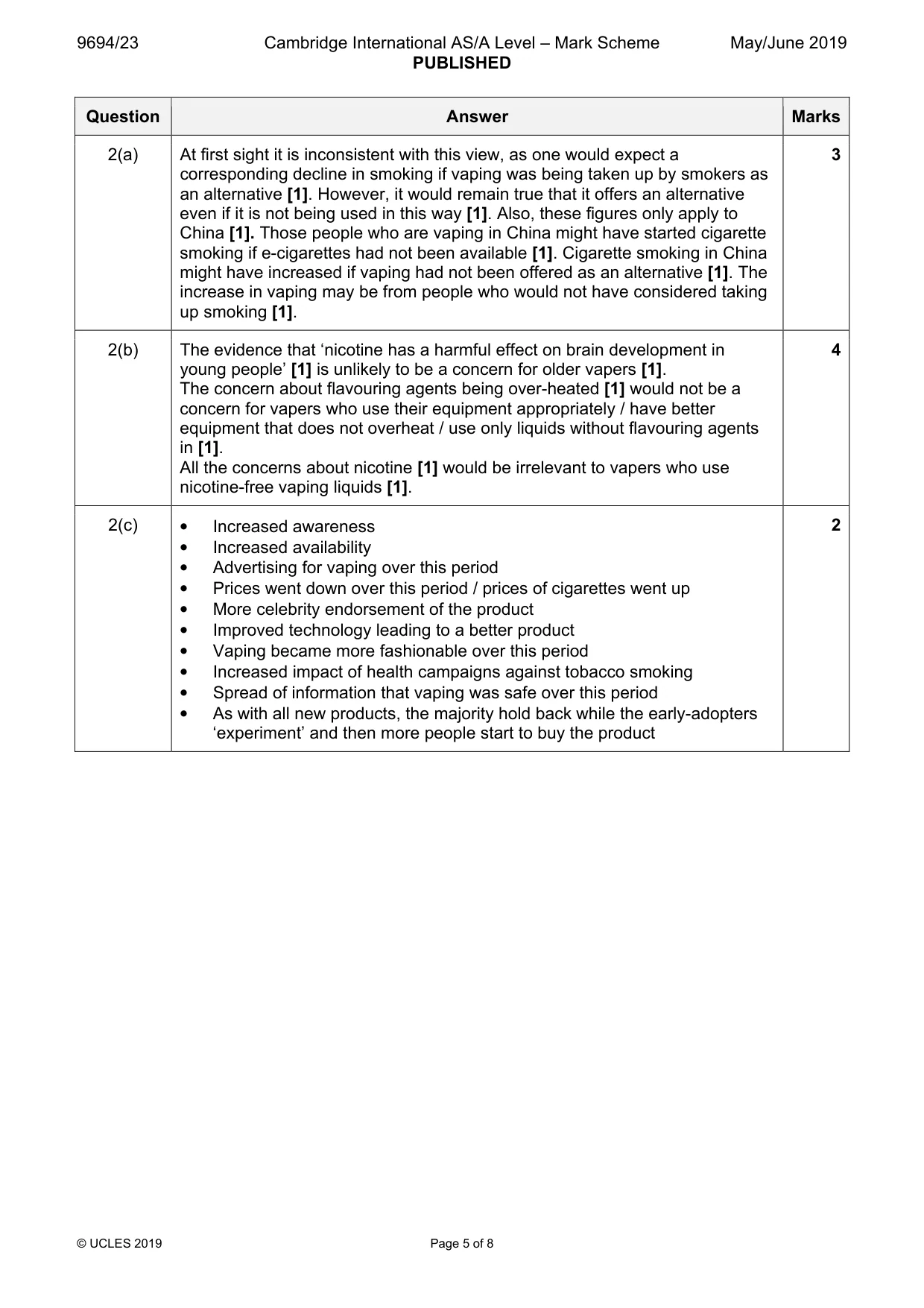
9694/23 Cambridge International AS/A Level – Mark Scheme PUBLISHED May/June 2019 © UCLES 2019 Page 5 of 8 Question Answer Marks 2(a) At first sight it is inconsistent with this view, as one would expect a corresponding decline in smoking if vaping was being taken up by smokers as an alternative [1]. However, it would remain true that it offers an alternative even if it is not being used in this way [1]. Also, these figures only apply to China [1]. Those people who are vaping in China might have started cigarette smoking if e-cigarettes had not been available [1]. Cigarette smoking in China might have increased if vaping had not been offered as an alternative [1]. The increase in vaping may be from people who would not have considered taking up smoking [1]. 3 2(b) The evidence that ‘nicotine has a harmful effect on brain development in young people’ [1] is unlikely to be a concern for older vapers [1]. The concern about flavouring agents being over-heated [1] would not be a concern for vapers who use their equipment appropriately / have better equipment that does not overheat / use only liquids without flavouring agents in [1]. All the concerns about nicotine [1] would be irrelevant to vapers who use nicotine-free vaping liquids [1]. 4 2(c) • Increased awareness • Increased availability • Advertising for vaping over this period • Prices went down over this period / prices of cigarettes went up • More celebrity endorsement of the product • Improved technology leading to a better product • Vaping became more fashionable over this period • Increased impact of health campaigns against tobacco smoking • Spread of information that vaping was safe over this period • As with all new products, the majority hold back while the early-adopters ‘experiment’ and then more people start to buy the product 2
Mark scheme, page 6
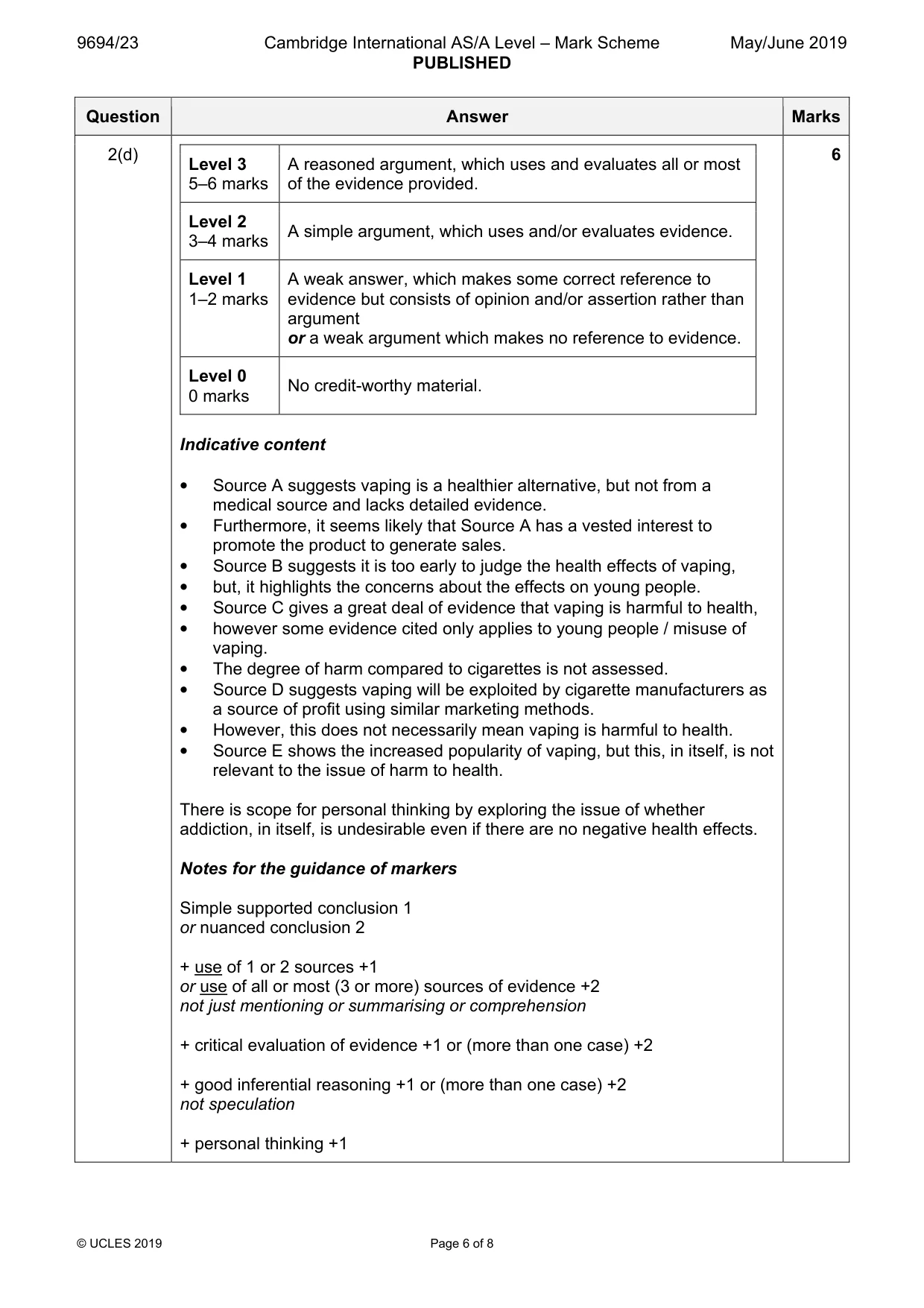
9694/23 Cambridge International AS/A Level – Mark Scheme PUBLISHED May/June 2019 © UCLES 2019 Page 6 of 8 Question Answer Marks 2(d) Level 3 5–6 marks A reasoned argument, which uses and evaluates all or most of the evidence provided. Level 2 3–4 marks A simple argument, which uses and/or evaluates evidence. Level 1 1–2 marks A weak answer, which makes some correct reference to evidence but consists of opinion and/or assertion rather than argument or a weak argument which makes no reference to evidence. Level 0 0 marks No credit-worthy material. Indicative content • Source A suggests vaping is a healthier alternative, but not from a medical source and lacks detailed evidence. • Furthermore, it seems likely that Source A has a vested interest to promote the product to generate sales. • Source B suggests it is too early to judge the health effects of vaping, • but, it highlights the concerns about the effects on young people. • Source C gives a great deal of evidence that vaping is harmful to health, • however some evidence cited only applies to young people / misuse of vaping. • The degree of harm compared to cigarettes is not assessed. • Source D suggests vaping will be exploited by cigarette manufacturers as a source of profit using similar marketing methods. • However, this does not necessarily mean vaping is harmful to health. • Source E shows the increased popularity of vaping, but this, in itself, is not relevant to the issue of harm to health. There is scope for personal thinking by exploring the issue of whether addiction, in itself, is undesirable even if there are no negative health effects. Notes for the guidance of markers Simple supported conclusion 1 or nuanced conclusion 2 + use of 1 or 2 sources +1 or use of all or most (3 or more) sources of evidence +2 not just mentioning or summarising or comprehension + critical evaluation of evidence +1 or (more than one case) +2 + good inferential reasoning +1 or (more than one case) +2 not speculation + personal thinking +1 6
Mark scheme, page 7
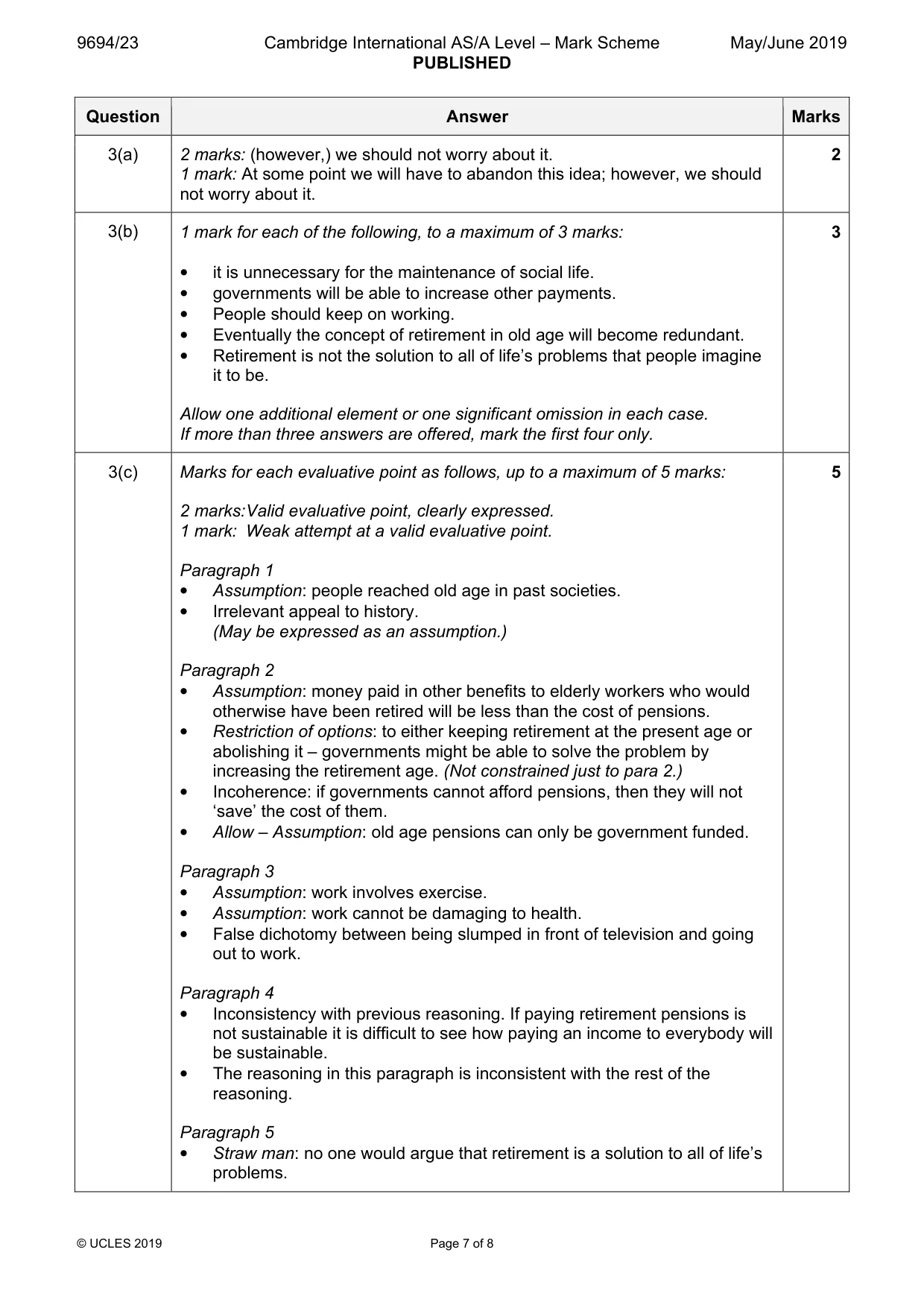
9694/23 Cambridge International AS/A Level – Mark Scheme PUBLISHED May/June 2019 © UCLES 2019 Page 7 of 8 Question Answer Marks 3(a) 2 marks: (however,) we should not worry about it. 1 mark: At some point we will have to abandon this idea; however, we should not worry about it. 2 3(b) 1 mark for each of the following, to a maximum of 3 marks: • it is unnecessary for the maintenance of social life. • governments will be able to increase other payments. • People should keep on working. • Eventually the concept of retirement in old age will become redundant. • Retirement is not the solution to all of life’s problems that people imagine it to be. Allow one additional element or one significant omission in each case. If more than three answers are offered, mark the first four only. 3 3(c) Marks for each evaluative point as follows, up to a maximum of 5 marks: 2 marks: Valid evaluative point, clearly expressed. 1 mark: Weak attempt at a valid evaluative point. Paragraph 1 • Assumption: people reached old age in past societies. • Irrelevant appeal to history. (May be expressed as an assumption.) Paragraph 2 • Assumption: money paid in other benefits to elderly workers who would otherwise have been retired will be less than the cost of pensions. • Restriction of options: to either keeping retirement at the present age or abolishing it – governments might be able to solve the problem by increasing the retirement age. (Not constrained just to para 2.) • Incoherence: if governments cannot afford pensions, then they will not ‘save’ the cost of them. • Allow – Assumption: old age pensions can only be government funded. Paragraph 3 • Assumption: work involves exercise. • Assumption: work cannot be damaging to health. • False dichotomy between being slumped in front of television and going out to work. Paragraph 4 • Inconsistency with previous reasoning. If paying retirement pensions is not sustainable it is difficult to see how paying an income to everybody will be sustainable. • The reasoning in this paragraph is inconsistent with the rest of the reasoning. Paragraph 5 • Straw man: no one would argue that retirement is a solution to all of life’s problems. 5
Mark scheme, page 8
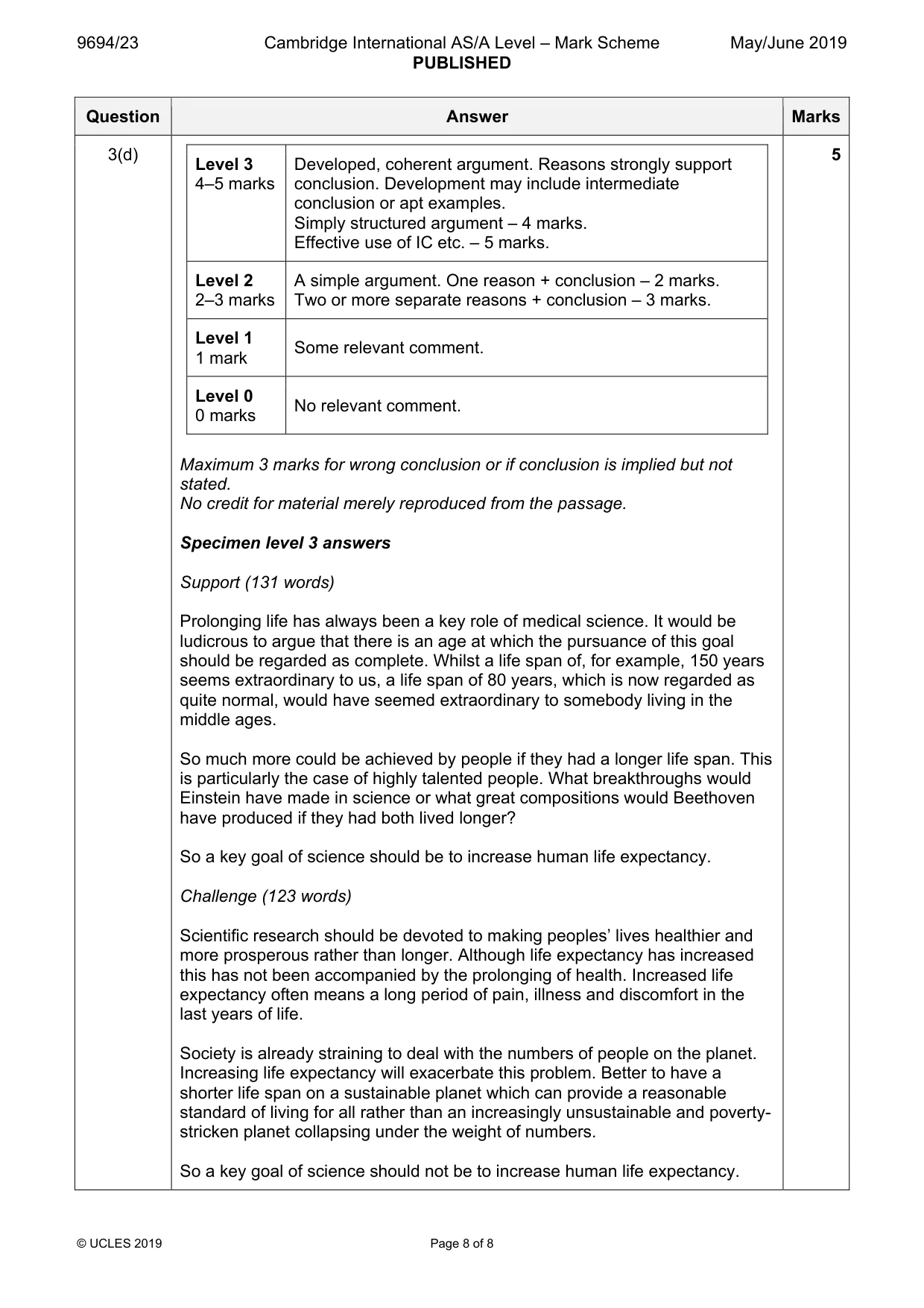
9694/23 Cambridge International AS/A Level – Mark Scheme PUBLISHED May/June 2019 © UCLES 2019 Page 8 of 8 Question Answer Marks 3(d) Level 3 4–5 marks Developed, coherent argument. Reasons strongly support conclusion. Development may include intermediate conclusion or apt examples. Simply structured argument – 4 marks. Effective use of IC etc. – 5 marks. Level 2 2–3 marks A simple argument. One reason + conclusion – 2 marks. Two or more separate reasons + conclusion – 3 marks. Level 1 1 mark Some relevant comment. Level 0 0 marks No relevant comment. Maximum 3 marks for wrong conclusion or if conclusion is implied but not stated. No credit for material merely reproduced from the passage. Specimen level 3 answers Support (131 words) Prolonging life has always been a key role of medical science. It would be ludicrous to argue that there is an age at which the pursuance of this goal should be regarded as complete. Whilst a life span of, for example, 150 years seems extraordinary to us, a life span of 80 years, which is now regarded as quite normal, would have seemed extraordinary to somebody living in the middle ages. So much more could be achieved by people if they had a longer life span. This is particularly the case of highly talented people. What breakthroughs would Einstein have made in science or what great compositions would Beethoven have produced if they had both lived longer? So a key goal of science should be to increase human life expectancy. Challenge (123 words) Scientific research should be devoted to making peoples’ lives healthier and more prosperous rather than longer. Although life expectancy has increased this has not been accompanied by the prolonging of health. Increased life expectancy often means a long period of pain, illness and discomfort in the last years of life. Society is already straining to deal with the numbers of people on the planet. Increasing life expectancy will exacerbate this problem. Better to have a shorter life span on a sustainable planet which can provide a reasonable standard of living for all rather than an increasingly unsustainable and poverty- stricken planet collapsing under the weight of numbers. So a key goal of science should not be to increase human life expectancy. 5
What you needed in this session
Cambridge’s own grade thresholds for 2019 May/June, Paper 2 · Variant 3. A higher threshold means an easier paper — the bar moves with how the cohort did.