Cambridge A Level Thinking Skills 9694 — 2018 Oct/Nov Paper 2 · Variant 1
9694/21/O/N/18 · 45 marks · ≈51 min
The question paper and its mark scheme, free to read here and free to download. This is Cambridge’s own paper, exactly as it was sat.
Question paper8 pages


Mark scheme9 pages
Answers below. Sit the paper first if you are practising.
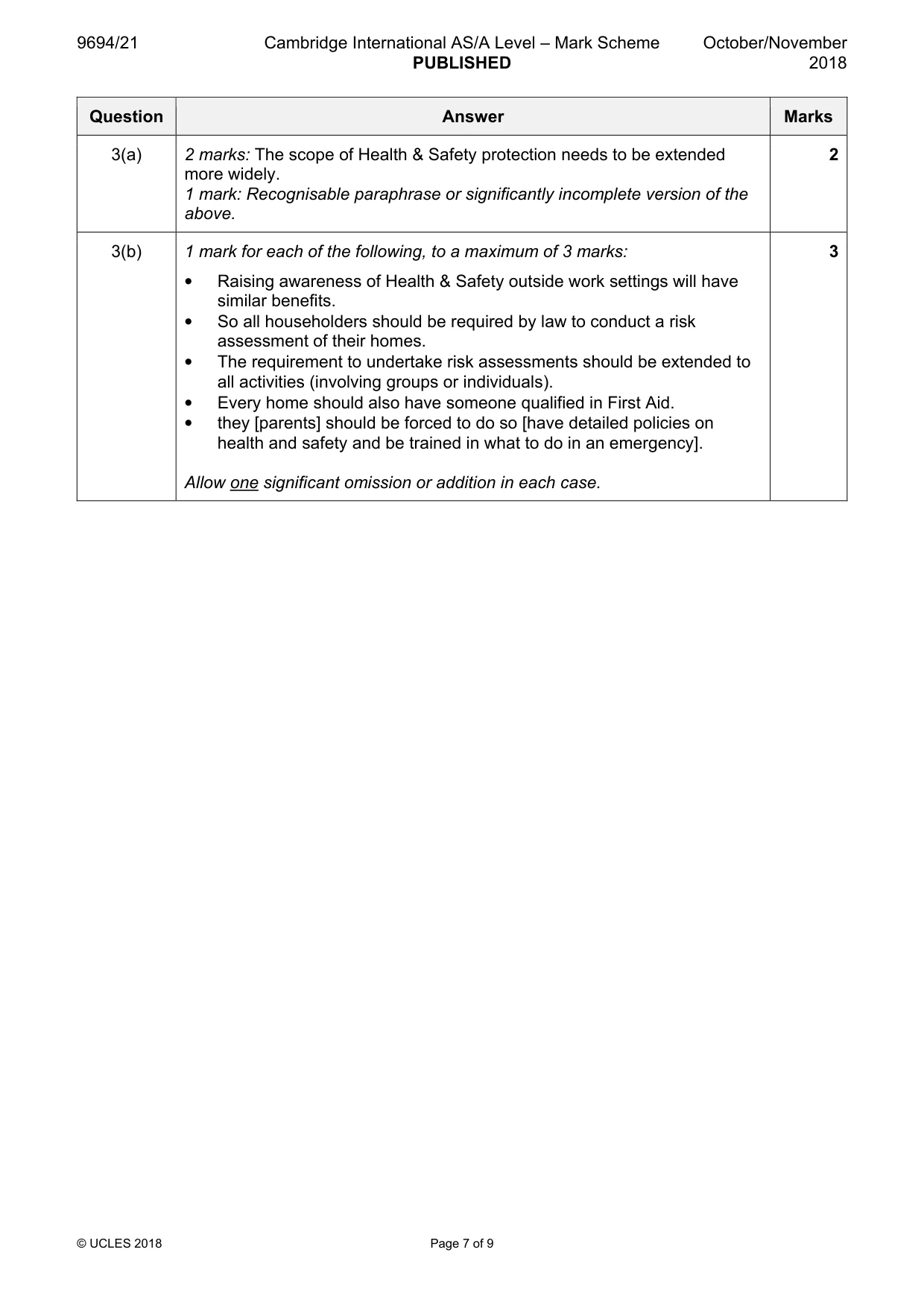
Paper as text
Question paper, page 1
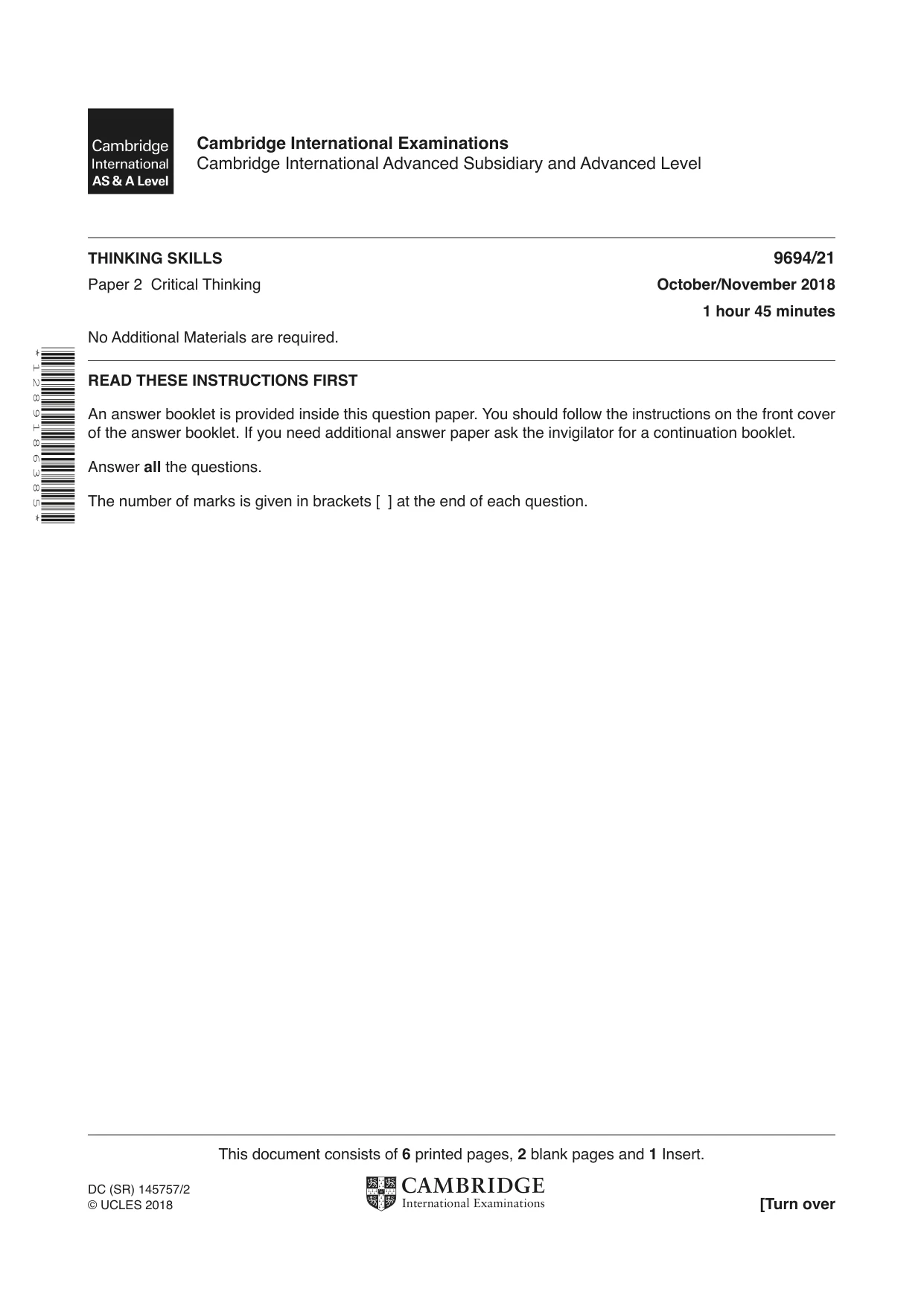
* 1 2 8 9 1 8 6 3 8 5 * This document consists of 6 printed pages, 2 blank pages and 1 Insert. DC (SR) 145757/2 © UCLES 2018 [Turn over Cambridge International Examinations Cambridge International Advanced Subsidiary and Advanced Level THINKING SKILLS 9694/21 Paper 2 Critical Thinking October/November 2018 1 hour 45 minutes No Additional Materials are required. READ THESE INSTRUCTIONS FIRST An answer booklet is provided inside this question paper. You should follow the instructions on the front cover of the answer booklet. If you need additional answer paper ask the invigilator for a continuation booklet. Answer all the questions. The number of marks is given in brackets [ ] at the end of each question.
Question paper, page 2
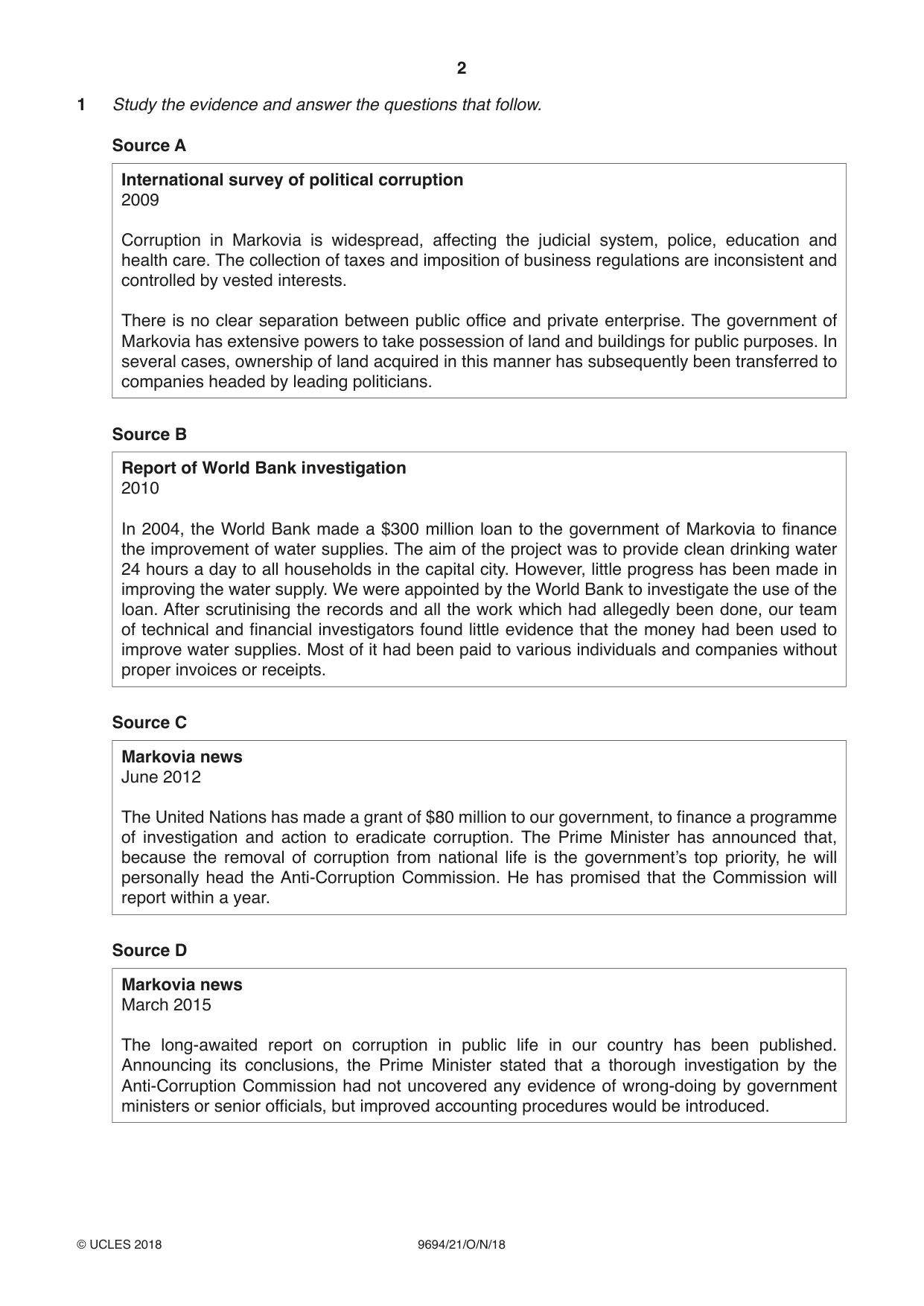
2 9694/21/O/N/18 © UCLES 2018 1 Study the evidence and answer the questions that follow. Source A International survey of political corruption 2009 Corruption in Markovia is widespread, affecting the judicial system, police, education and health care. The collection of taxes and imposition of business regulations are inconsistent and controlled by vested interests. There is no clear separation between public office and private enterprise. The government of Markovia has extensive powers to take possession of land and buildings for public purposes. In several cases, ownership of land acquired in this manner has subsequently been transferred to companies headed by leading politicians. Source B Report of World Bank investigation 2010 In 2004, the World Bank made a $300 million loan to the government of Markovia to finance the improvement of water supplies. The aim of the project was to provide clean drinking water 24 hours a day to all households in the capital city. However, little progress has been made in improving the water supply. We were appointed by the World Bank to investigate the use of the loan. After scrutinising the records and all the work which had allegedly been done, our team of technical and financial investigators found little evidence that the money had been used to improve water supplies. Most of it had been paid to various individuals and companies without proper invoices or receipts. Source C Markovia news June 2012 The United Nations has made a grant of $80 million to our government, to finance a programme of investigation and action to eradicate corruption. The Prime Minister has announced that, because the removal of corruption from national life is the government’s top priority, he will personally head the Anti-Corruption Commission. He has promised that the Commission will report within a year. Source D Markovia news March 2015 The long-awaited report on corruption in public life in our country has been published. Announcing its conclusions, the Prime Minister stated that a thorough investigation by the Anti-Corruption Commission had not uncovered any evidence of wrong-doing by government ministers or senior officials, but improved accounting procedures would be introduced.
Question paper, page 3
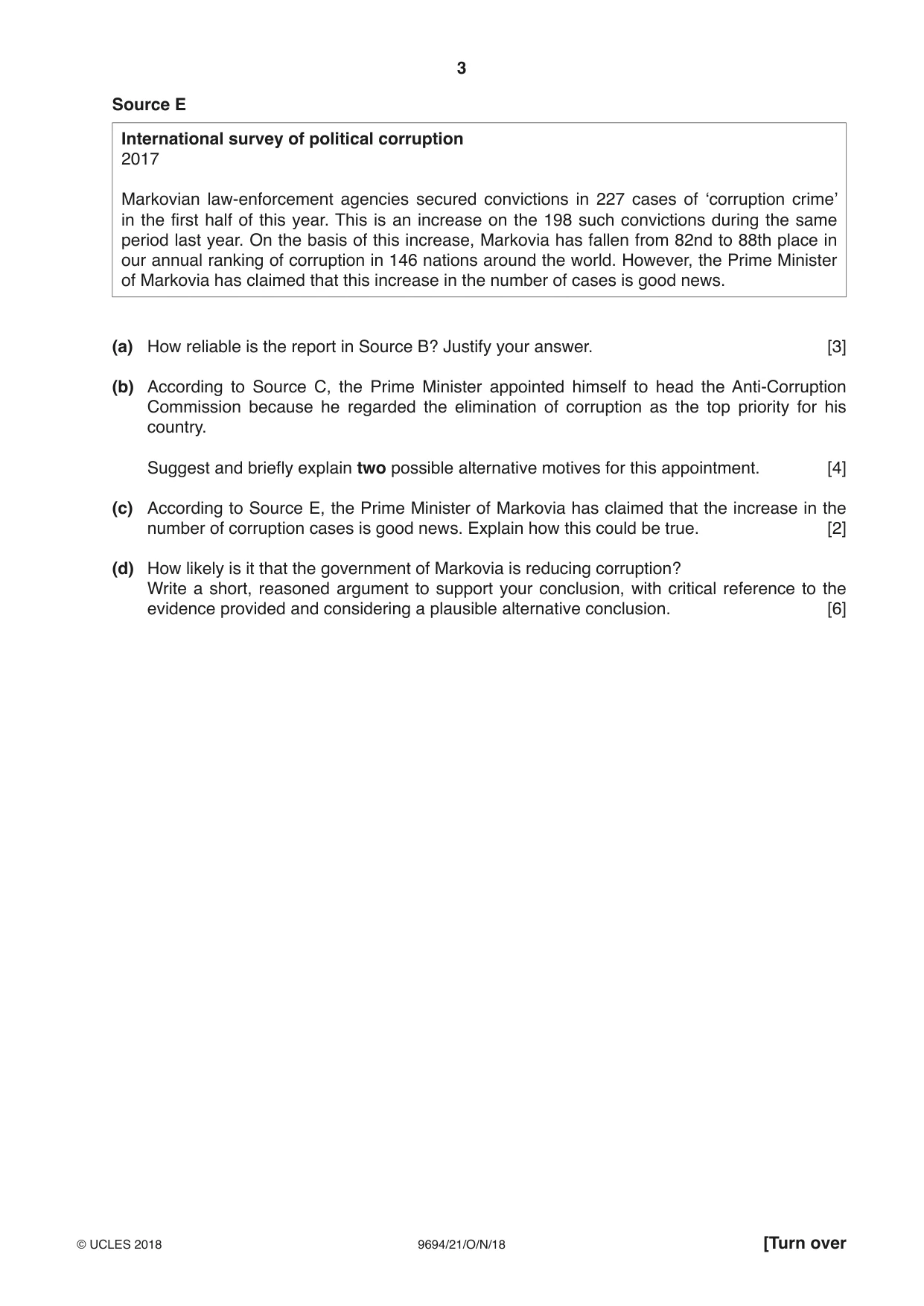
3 9694/21/O/N/18 © UCLES 2018 [Turn over Source E International survey of political corruption 2017 Markovian law-enforcement agencies secured convictions in 227 cases of ‘corruption crime’ in the first half of this year. This is an increase on the 198 such convictions during the same period last year. On the basis of this increase, Markovia has fallen from 82nd to 88th place in our annual ranking of corruption in 146 nations around the world. However, the Prime Minister of Markovia has claimed that this increase in the number of cases is good news. (a) How reliable is the report in Source B? Justify your answer. [3] (b) According to Source C, the Prime Minister appointed himself to head the Anti-Corruption Commission because he regarded the elimination of corruption as the top priority for his country. Suggest and briefly explain two possible alternative motives for this appointment. [4] (c) According to Source E, the Prime Minister of Markovia has claimed that the increase in the number of corruption cases is good news. Explain how this could be true. [2] (d) How likely is it that the government of Markovia is reducing corruption? Write a short, reasoned argument to support your conclusion, with critical reference to the evidence provided and considering a plausible alternative conclusion. [6]
Question paper, page 4
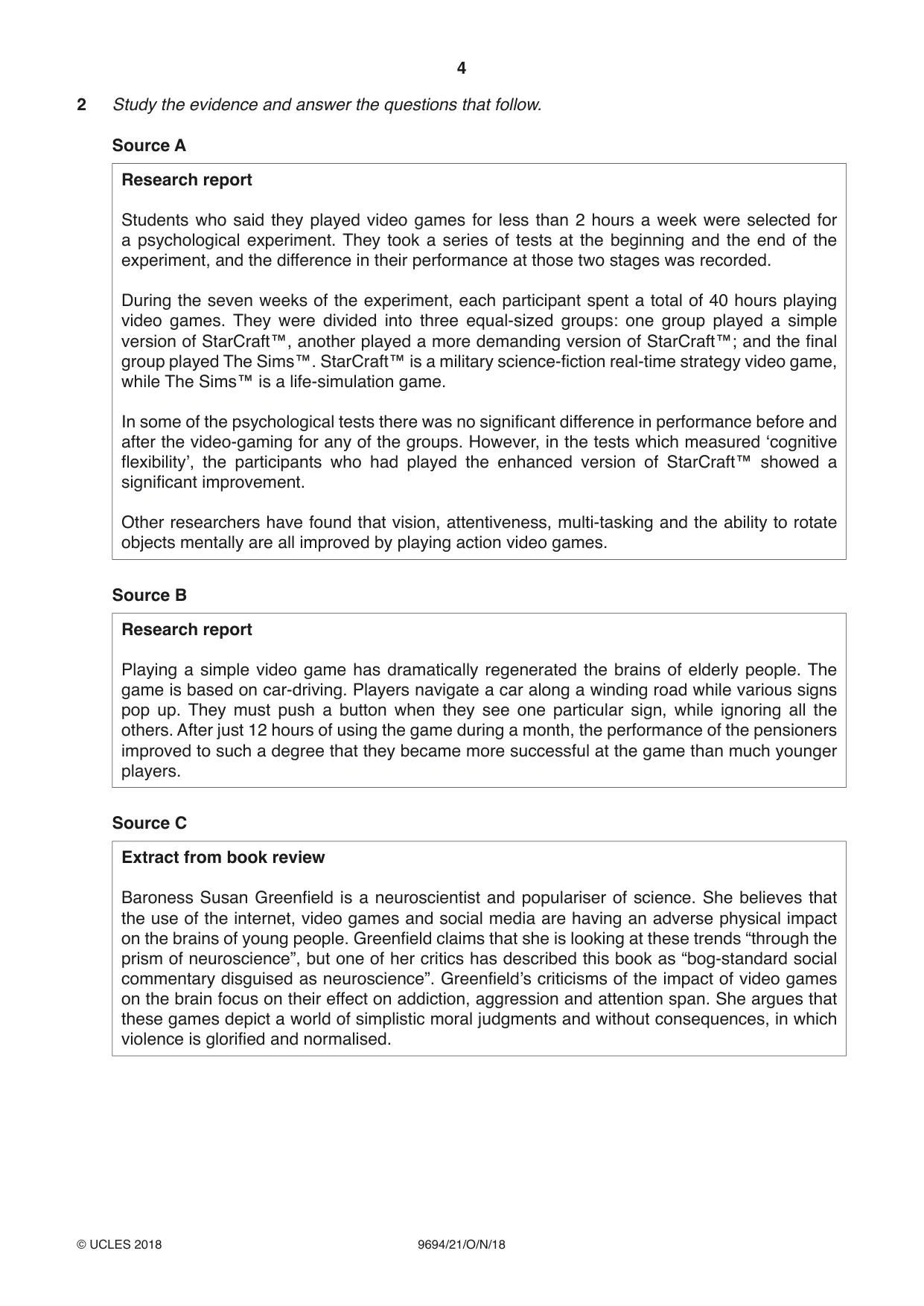
4 9694/21/O/N/18 © UCLES 2018 2 Study the evidence and answer the questions that follow. Source A Research report Students who said they played video games for less than 2 hours a week were selected for a psychological experiment. They took a series of tests at the beginning and the end of the experiment, and the difference in their performance at those two stages was recorded. During the seven weeks of the experiment, each participant spent a total of 40 hours playing video games. They were divided into three equal-sized groups: one group played a simple version of StarCraft™, another played a more demanding version of StarCraft™; and the final group played The Sims™. StarCraft™ is a military science-fiction real-time strategy video game, while The Sims™ is a life-simulation game. In some of the psychological tests there was no significant difference in performance before and after the video-gaming for any of the groups. However, in the tests which measured ‘cognitive flexibility’, the participants who had played the enhanced version of StarCraft™ showed a significant improvement. Other researchers have found that vision, attentiveness, multi-tasking and the ability to rotate objects mentally are all improved by playing action video games. Source B Research report Playing a simple video game has dramatically regenerated the brains of elderly people. The game is based on car-driving. Players navigate a car along a winding road while various signs pop up. They must push a button when they see one particular sign, while ignoring all the others. After just 12 hours of using the game during a month, the performance of the pensioners improved to such a degree that they became more successful at the game than much younger players. Source C Extract from book review Baroness Susan Greenfield is a neuroscientist and populariser of science. She believes that the use of the internet, video games and social media are having an adverse physical impact on the brains of young people. Greenfield claims that she is looking at these trends “through the prism of neuroscience”, but one of her critics has described this book as “bog-standard social commentary disguised as neuroscience”. Greenfield’s criticisms of the impact of video games on the brain focus on their effect on addiction, aggression and attention span. She argues that these games depict a world of simplistic moral judgments and without consequences, in which violence is glorified and normalised.
Question paper, page 5
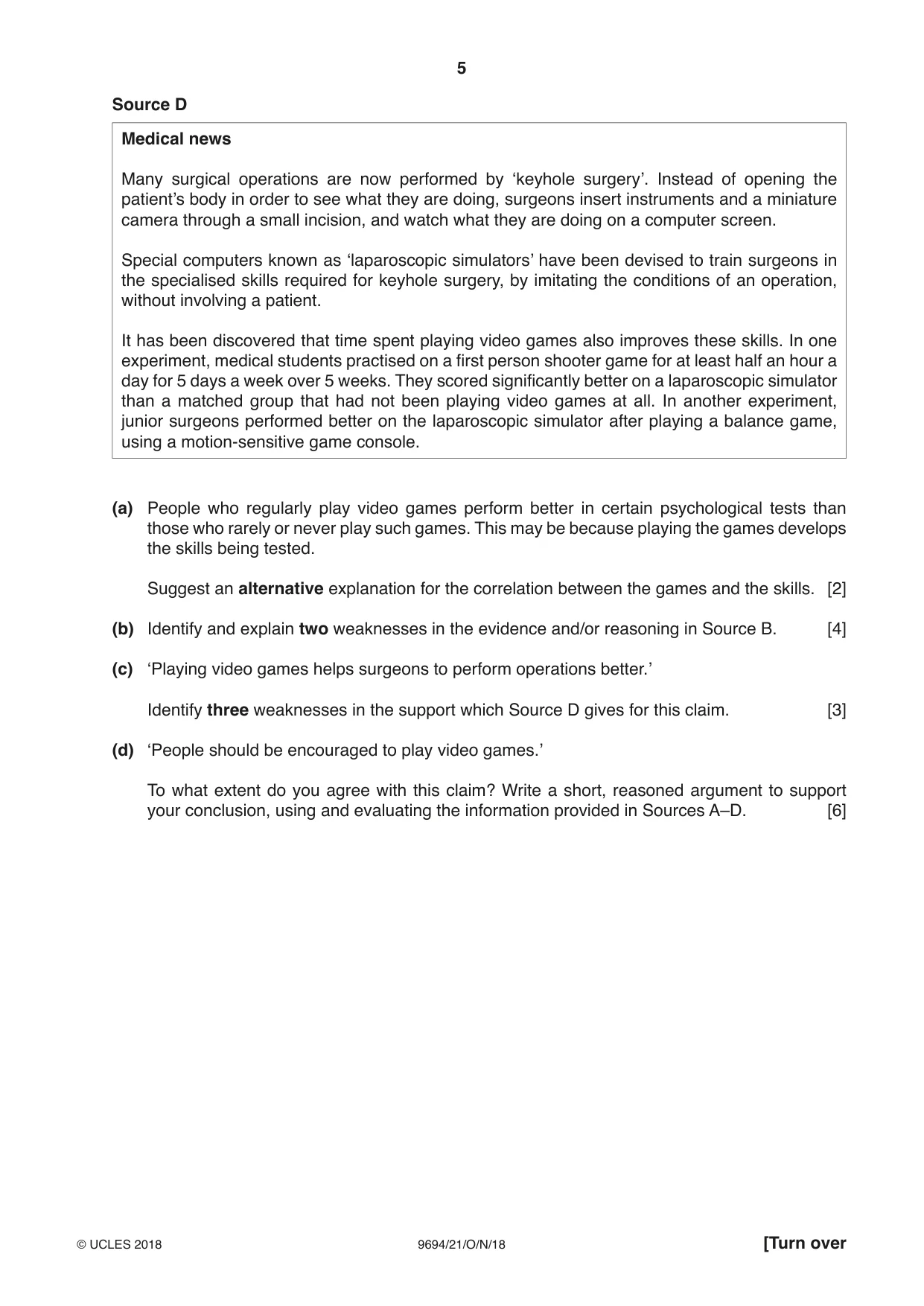
5 9694/21/O/N/18 © UCLES 2018 [Turn over Source D Medical news Many surgical operations are now performed by ‘keyhole surgery’. Instead of opening the patient’s body in order to see what they are doing, surgeons insert instruments and a miniature camera through a small incision, and watch what they are doing on a computer screen. Special computers known as ‘laparoscopic simulators’ have been devised to train surgeons in the specialised skills required for keyhole surgery, by imitating the conditions of an operation, without involving a patient. It has been discovered that time spent playing video games also improves these skills. In one experiment, medical students practised on a first person shooter game for at least half an hour a day for 5 days a week over 5 weeks. They scored significantly better on a laparoscopic simulator than a matched group that had not been playing video games at all. In another experiment, junior surgeons performed better on the laparoscopic simulator after playing a balance game, using a motion-sensitive game console. (a) People who regularly play video games perform better in certain psychological tests than those who rarely or never play such games. This may be because playing the games develops the skills being tested. Suggest an alternative explanation for the correlation between the games and the skills. [2] (b) Identify and explain two weaknesses in the evidence and/or reasoning in Source B. [4] (c) ‘Playing video games helps surgeons to perform operations better.’ Identify three weaknesses in the support which Source D gives for this claim. [3] (d) ‘People should be encouraged to play video games.’ To what extent do you agree with this claim? Write a short, reasoned argument to support your conclusion, using and evaluating the information provided in Sources A–D. [6]
Question paper, page 6
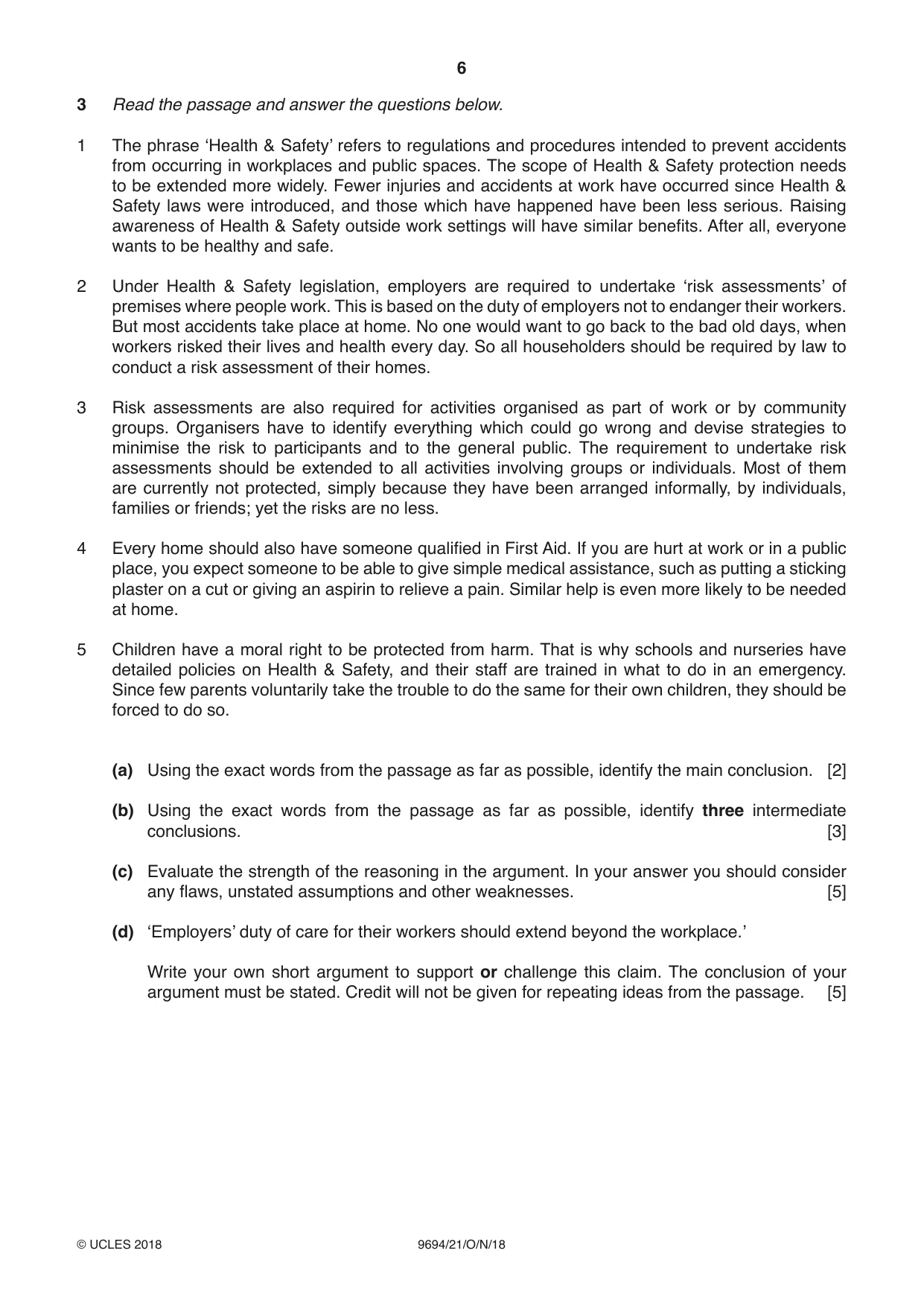
6 9694/21/O/N/18 © UCLES 2018 3 Read the passage and answer the questions below. 1 The phrase ‘Health & Safety’ refers to regulations and procedures intended to prevent accidents from occurring in workplaces and public spaces. The scope of Health & Safety protection needs to be extended more widely. Fewer injuries and accidents at work have occurred since Health & Safety laws were introduced, and those which have happened have been less serious. Raising awareness of Health & Safety outside work settings will have similar benefits. After all, everyone wants to be healthy and safe. 2 Under Health & Safety legislation, employers are required to undertake ‘risk assessments’ of premises where people work. This is based on the duty of employers not to endanger their workers. But most accidents take place at home. No one would want to go back to the bad old days, when workers risked their lives and health every day. So all householders should be required by law to conduct a risk assessment of their homes. 3 Risk assessments are also required for activities organised as part of work or by community groups. Organisers have to identify everything which could go wrong and devise strategies to minimise the risk to participants and to the general public. The requirement to undertake risk assessments should be extended to all activities involving groups or individuals. Most of them are currently not protected, simply because they have been arranged informally, by individuals, families or friends; yet the risks are no less. 4 Every home should also have someone qualified in First Aid. If you are hurt at work or in a public place, you expect someone to be able to give simple medical assistance, such as putting a sticking plaster on a cut or giving an aspirin to relieve a pain. Similar help is even more likely to be needed at home. 5 Children have a moral right to be protected from harm. That is why schools and nurseries have detailed policies on Health & Safety, and their staff are trained in what to do in an emergency. Since few parents voluntarily take the trouble to do the same for their own children, they should be forced to do so. (a) Using the exact words from the passage as far as possible, identify the main conclusion. [2] (b) Using the exact words from the passage as far as possible, identify three intermediate conclusions. [3] (c) Evaluate the strength of the reasoning in the argument. In your answer you should consider any flaws, unstated assumptions and other weaknesses. [5] (d) ‘Employers’ duty of care for their workers should extend beyond the workplace.’ Write your own short argument to support or challenge this claim. The conclusion of your argument must be stated. Credit will not be given for repeating ideas from the passage. [5]
Question paper, page 7
7 9694/21/O/N/18 © UCLES 2018 BLANK PAGE
Question paper, page 8
8 9694/21/O/N/18 © UCLES 2018 Permission to reproduce items where third-party owned material protected by copyright is included has been sought and cleared where possible. Every reasonable effort has been made by the publisher (UCLES) to trace copyright holders, but if any items requiring clearance have unwittingly been included, the publisher will be pleased to make amends at the earliest possible opportunity. To avoid the issue of disclosure of answer-related information to candidates, all copyright acknowledgements are reproduced online in the Cambridge International Examinations Copyright Acknowledgements Booklet. This is produced for each series of examinations and is freely available to download at www.cie.org.uk after the live examination series. Cambridge International Examinations is part of the Cambridge Assessment Group. Cambridge Assessment is the brand name of University of Cambridge Local Examinations Syndicate (UCLES), which is itself a department of the University of Cambridge. BLANK PAGE
Mark scheme, page 1
This document consists of 9 printed pages. © UCLES 2018 [Turn over Cambridge Assessment International Education Cambridge International Advanced Subsidiary and Advanced Level THINKING SKILLS 9694/21 Paper 2 Critical Thinking October/November 2018 MARK SCHEME Maximum Mark: 45 Published This mark scheme is published as an aid to teachers and candidates, to indicate the requirements of the examination. It shows the basis on which Examiners were instructed to award marks. It does not indicate the details of the discussions that took place at an Examiners’ meeting before marking began, which would have considered the acceptability of alternative answers. Mark schemes should be read in conjunction with the question paper and the Principal Examiner Report for Teachers. Cambridge International will not enter into discussions about these mark schemes. Cambridge International is publishing the mark schemes for the October/November 2018 series for most Cambridge IGCSE™, Cambridge International A and AS Level components and some Cambridge O Level components.
Mark scheme, page 2
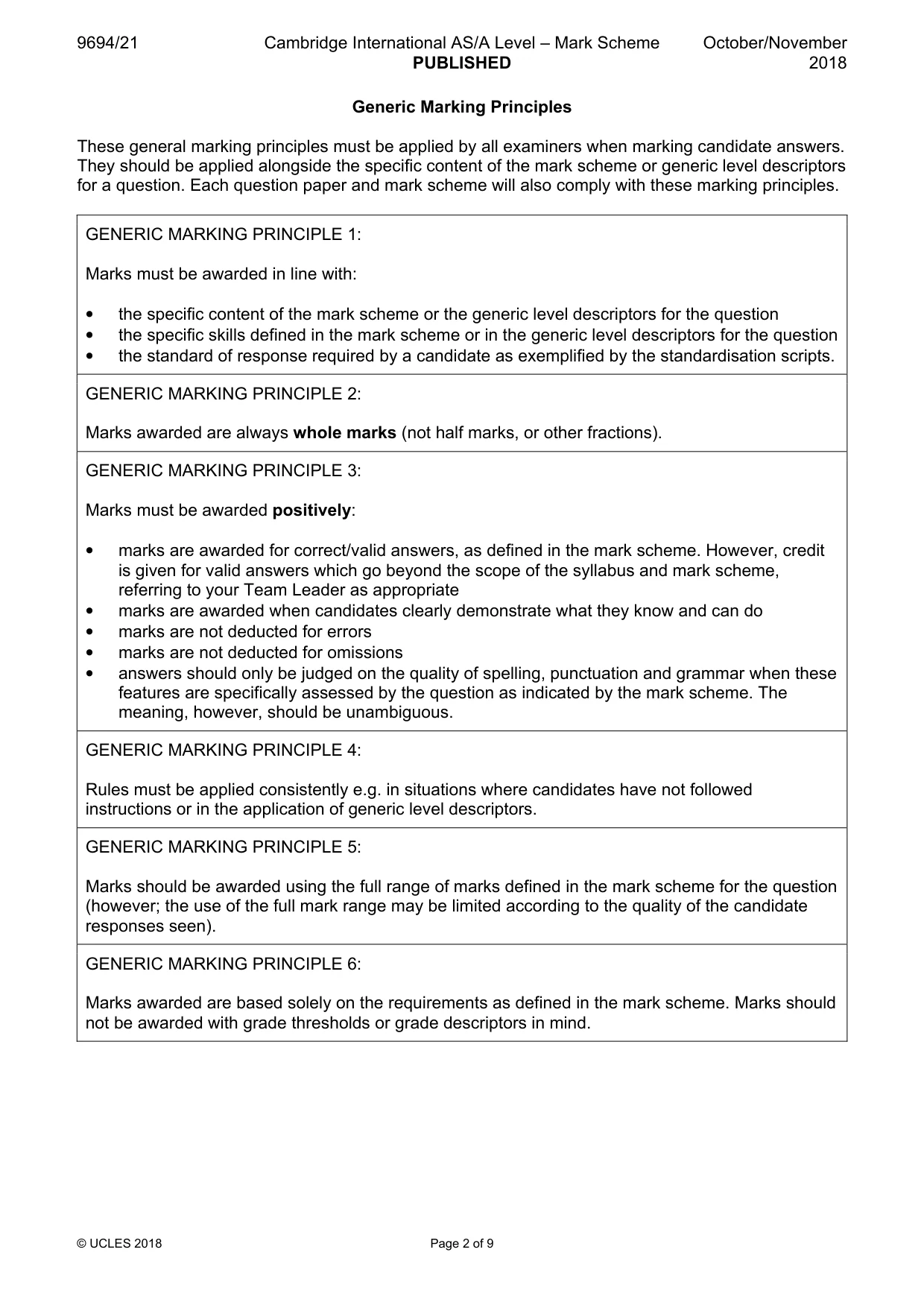
9694/21 Cambridge International AS/A Level – Mark Scheme PUBLISHED October/November 2018 © UCLES 2018 Page 2 of 9 Generic Marking Principles These general marking principles must be applied by all examiners when marking candidate answers. They should be applied alongside the specific content of the mark scheme or generic level descriptors for a question. Each question paper and mark scheme will also comply with these marking principles. GENERIC MARKING PRINCIPLE 1: Marks must be awarded in line with: • the specific content of the mark scheme or the generic level descriptors for the question • the specific skills defined in the mark scheme or in the generic level descriptors for the question • the standard of response required by a candidate as exemplified by the standardisation scripts. GENERIC MARKING PRINCIPLE 2: Marks awarded are always whole marks (not half marks, or other fractions). GENERIC MARKING PRINCIPLE 3: Marks must be awarded positively: • marks are awarded for correct/valid answers, as defined in the mark scheme. However, credit is given for valid answers which go beyond the scope of the syllabus and mark scheme, referring to your Team Leader as appropriate • marks are awarded when candidates clearly demonstrate what they know and can do • marks are not deducted for errors • marks are not deducted for omissions • answers should only be judged on the quality of spelling, punctuation and grammar when these features are specifically assessed by the question as indicated by the mark scheme. The meaning, however, should be unambiguous. GENERIC MARKING PRINCIPLE 4: Rules must be applied consistently e.g. in situations where candidates have not followed instructions or in the application of generic level descriptors. GENERIC MARKING PRINCIPLE 5: Marks should be awarded using the full range of marks defined in the mark scheme for the question (however; the use of the full mark range may be limited according to the quality of the candidate responses seen). GENERIC MARKING PRINCIPLE 6: Marks awarded are based solely on the requirements as defined in the mark scheme. Marks should not be awarded with grade thresholds or grade descriptors in mind.
Mark scheme, page 3
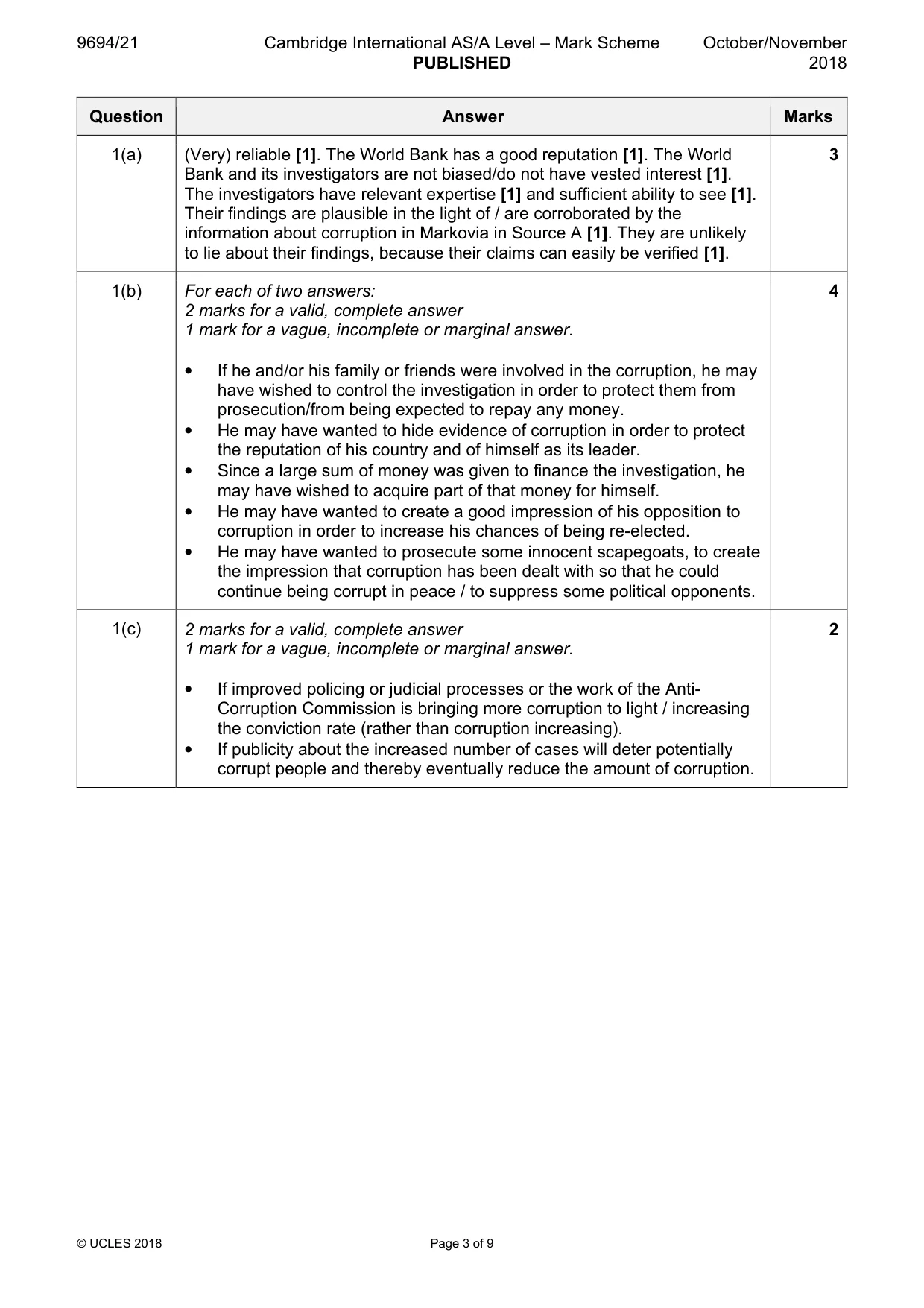
9694/21 Cambridge International AS/A Level – Mark Scheme PUBLISHED October/November 2018 © UCLES 2018 Page 3 of 9 Question Answer Marks 1(a) (Very) reliable [1]. The World Bank has a good reputation [1]. The World Bank and its investigators are not biased/do not have vested interest [1]. The investigators have relevant expertise [1] and sufficient ability to see [1]. Their findings are plausible in the light of / are corroborated by the information about corruption in Markovia in Source A [1]. They are unlikely to lie about their findings, because their claims can easily be verified [1]. 3 1(b) For each of two answers: 2 marks for a valid, complete answer 1 mark for a vague, incomplete or marginal answer. • If he and/or his family or friends were involved in the corruption, he may have wished to control the investigation in order to protect them from prosecution/from being expected to repay any money. • He may have wanted to hide evidence of corruption in order to protect the reputation of his country and of himself as its leader. • Since a large sum of money was given to finance the investigation, he may have wished to acquire part of that money for himself. • He may have wanted to create a good impression of his opposition to corruption in order to increase his chances of being re-elected. • He may have wanted to prosecute some innocent scapegoats, to create the impression that corruption has been dealt with so that he could continue being corrupt in peace / to suppress some political opponents. 4 1(c) 2 marks for a valid, complete answer 1 mark for a vague, incomplete or marginal answer. • If improved policing or judicial processes or the work of the Anti- Corruption Commission is bringing more corruption to light / increasing the conviction rate (rather than corruption increasing). • If publicity about the increased number of cases will deter potentially corrupt people and thereby eventually reduce the amount of corruption. 2
Mark scheme, page 4
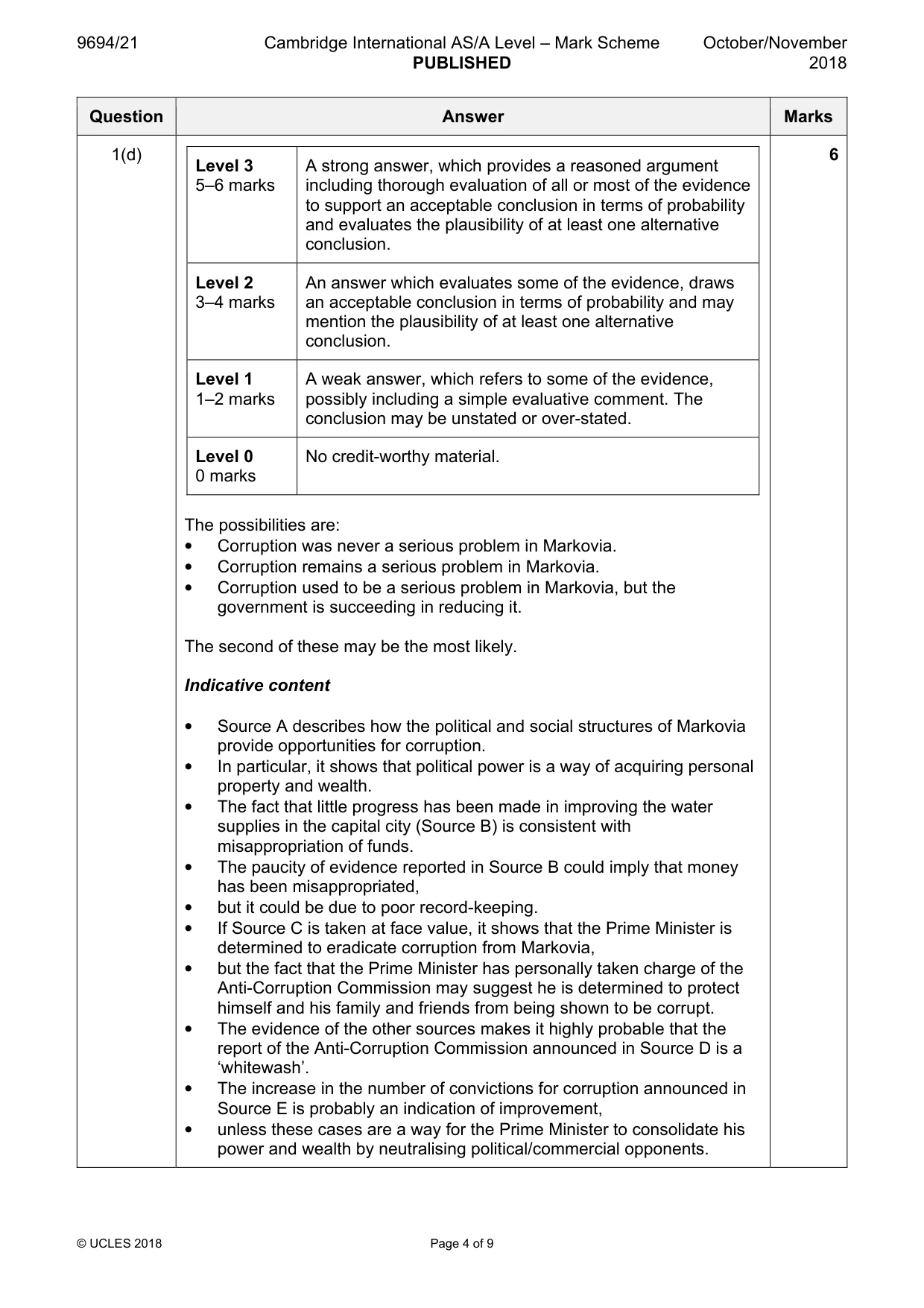
9694/21 Cambridge International AS/A Level – Mark Scheme PUBLISHED October/November 2018 © UCLES 2018 Page 4 of 9 Question Answer Marks 1(d) Level 3 5–6 marks A strong answer, which provides a reasoned argument including thorough evaluation of all or most of the evidence to support an acceptable conclusion in terms of probability and evaluates the plausibility of at least one alternative conclusion. Level 2 3–4 marks An answer which evaluates some of the evidence, draws an acceptable conclusion in terms of probability and may mention the plausibility of at least one alternative conclusion. Level 1 1–2 marks A weak answer, which refers to some of the evidence, possibly including a simple evaluative comment. The conclusion may be unstated or over-stated. Level 0 0 marks No credit-worthy material. The possibilities are: • Corruption was never a serious problem in Markovia. • Corruption remains a serious problem in Markovia. • Corruption used to be a serious problem in Markovia, but the government is succeeding in reducing it. The second of these may be the most likely. Indicative content • Source A describes how the political and social structures of Markovia provide opportunities for corruption. • In particular, it shows that political power is a way of acquiring personal property and wealth. • The fact that little progress has been made in improving the water supplies in the capital city (Source B) is consistent with misappropriation of funds. • The paucity of evidence reported in Source B could imply that money has been misappropriated, • but it could be due to poor record-keeping. • If Source C is taken at face value, it shows that the Prime Minister is determined to eradicate corruption from Markovia, • but the fact that the Prime Minister has personally taken charge of the Anti-Corruption Commission may suggest he is determined to protect himself and his family and friends from being shown to be corrupt. • The evidence of the other sources makes it highly probable that the report of the Anti-Corruption Commission announced in Source D is a ‘whitewash’. • The increase in the number of convictions for corruption announced in Source E is probably an indication of improvement, • unless these cases are a way for the Prime Minister to consolidate his power and wealth by neutralising political/commercial opponents. 6
Mark scheme, page 5
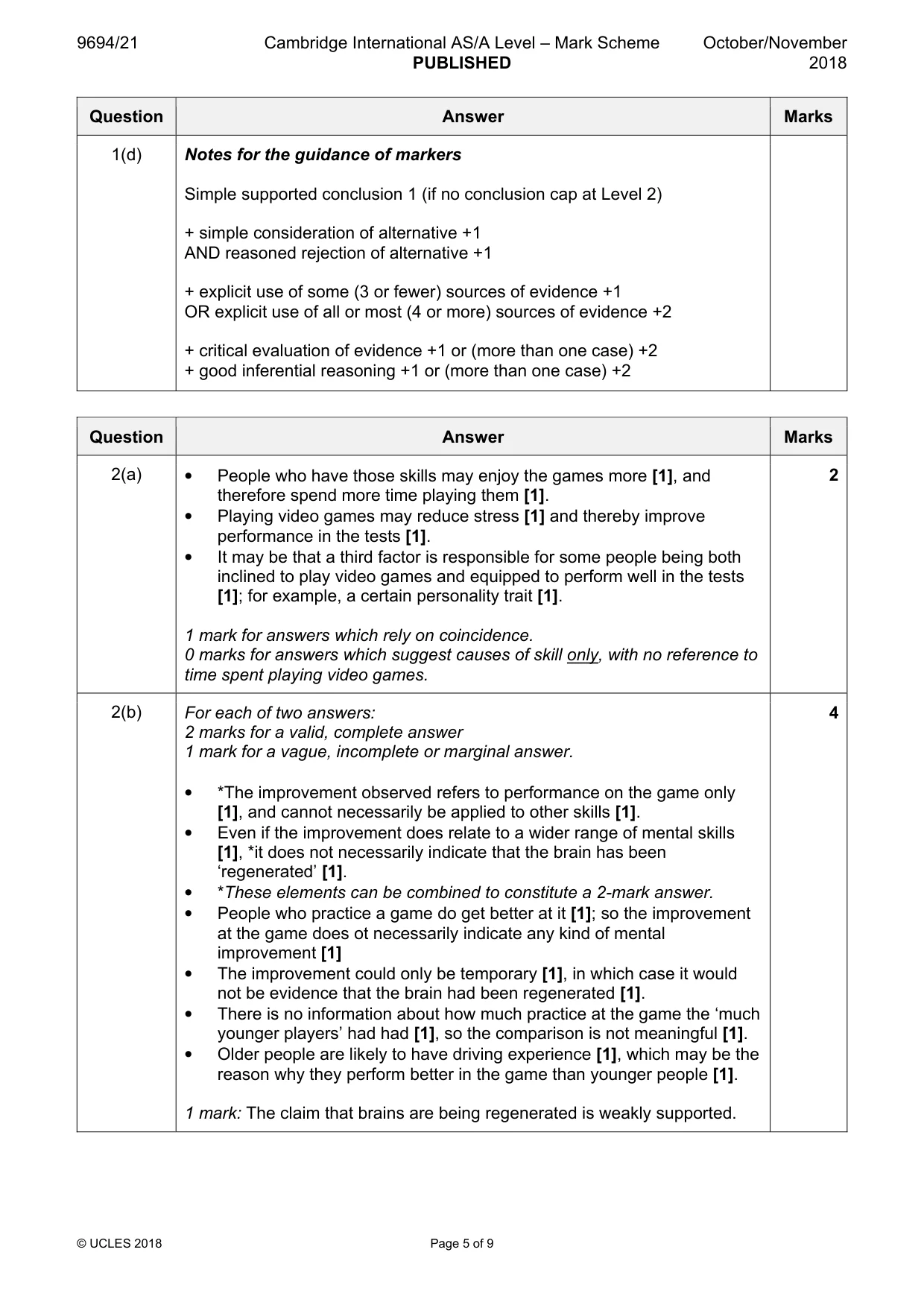
9694/21 Cambridge International AS/A Level – Mark Scheme PUBLISHED October/November 2018 © UCLES 2018 Page 5 of 9 Question Answer Marks 1(d) Notes for the guidance of markers Simple supported conclusion 1 (if no conclusion cap at Level 2) + simple consideration of alternative +1 AND reasoned rejection of alternative +1 + explicit use of some (3 or fewer) sources of evidence +1 OR explicit use of all or most (4 or more) sources of evidence +2 + critical evaluation of evidence +1 or (more than one case) +2 + good inferential reasoning +1 or (more than one case) +2 Question Answer Marks 2(a) • People who have those skills may enjoy the games more [1], and therefore spend more time playing them [1]. • Playing video games may reduce stress [1] and thereby improve performance in the tests [1]. • It may be that a third factor is responsible for some people being both inclined to play video games and equipped to perform well in the tests [1]; for example, a certain personality trait [1]. 1 mark for answers which rely on coincidence. 0 marks for answers which suggest causes of skill only, with no reference to time spent playing video games. 2 2(b) For each of two answers: 2 marks for a valid, complete answer 1 mark for a vague, incomplete or marginal answer. • *The improvement observed refers to performance on the game only [1], and cannot necessarily be applied to other skills [1]. • Even if the improvement does relate to a wider range of mental skills [1], *it does not necessarily indicate that the brain has been ‘regenerated’ [1]. • *These elements can be combined to constitute a 2-mark answer. • People who practice a game do get better at it [1]; so the improvement at the game does ot necessarily indicate any kind of mental improvement [1] • The improvement could only be temporary [1], in which case it would not be evidence that the brain had been regenerated [1]. • There is no information about how much practice at the game the ‘much younger players’ had had [1], so the comparison is not meaningful [1]. • Older people are likely to have driving experience [1], which may be the reason why they perform better in the game than younger people [1]. 1 mark: The claim that brains are being regenerated is weakly supported. 4
Mark scheme, page 6
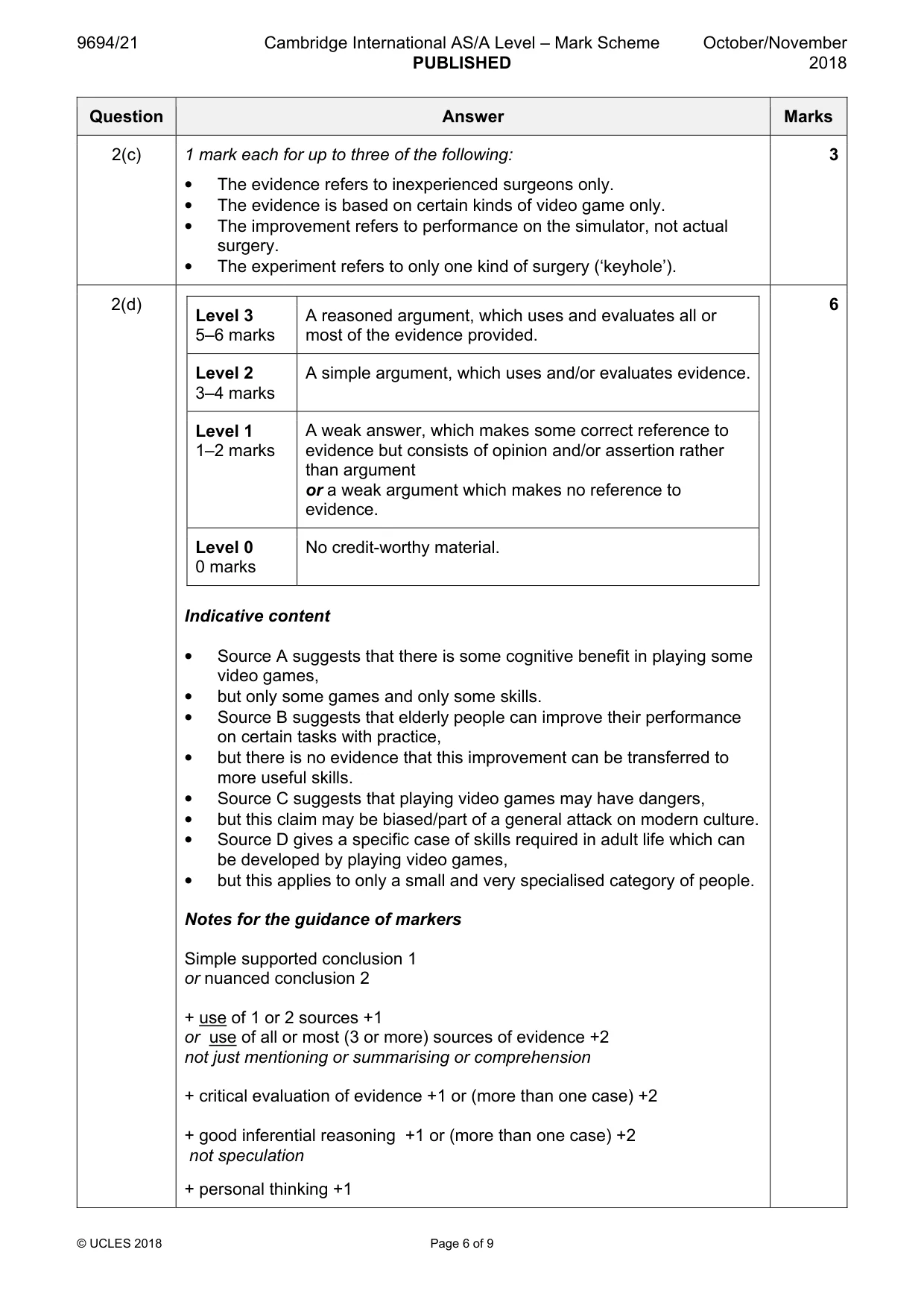
9694/21 Cambridge International AS/A Level – Mark Scheme PUBLISHED October/November 2018 © UCLES 2018 Page 6 of 9 Question Answer Marks 2(c) 1 mark each for up to three of the following: • The evidence refers to inexperienced surgeons only. • The evidence is based on certain kinds of video game only. • The improvement refers to performance on the simulator, not actual surgery. • The experiment refers to only one kind of surgery (‘keyhole’). 3 2(d) Level 3 5–6 marks A reasoned argument, which uses and evaluates all or most of the evidence provided. Level 2 3–4 marks A simple argument, which uses and/or evaluates evidence. Level 1 1–2 marks A weak answer, which makes some correct reference to evidence but consists of opinion and/or assertion rather than argument or a weak argument which makes no reference to evidence. Level 0 0 marks No credit-worthy material. Indicative content • Source A suggests that there is some cognitive benefit in playing some video games, • but only some games and only some skills. • Source B suggests that elderly people can improve their performance on certain tasks with practice, • but there is no evidence that this improvement can be transferred to more useful skills. • Source C suggests that playing video games may have dangers, • but this claim may be biased/part of a general attack on modern culture. • Source D gives a specific case of skills required in adult life which can be developed by playing video games, • but this applies to only a small and very specialised category of people. Notes for the guidance of markers Simple supported conclusion 1 or nuanced conclusion 2 + use of 1 or 2 sources +1 or use of all or most (3 or more) sources of evidence +2 not just mentioning or summarising or comprehension + critical evaluation of evidence +1 or (more than one case) +2 + good inferential reasoning +1 or (more than one case) +2 not speculation + personal thinking +1 6
Mark scheme, page 7
9694/21 Cambridge International AS/A Level – Mark Scheme PUBLISHED October/November 2018 © UCLES 2018 Page 7 of 9 Question Answer Marks 3(a) 2 marks: The scope of Health & Safety protection needs to be extended more widely. 1 mark: Recognisable paraphrase or significantly incomplete version of the above. 2 3(b) 1 mark for each of the following, to a maximum of 3 marks: • Raising awareness of Health & Safety outside work settings will have similar benefits. • So all householders should be required by law to conduct a risk assessment of their homes. • The requirement to undertake risk assessments should be extended to all activities (involving groups or individuals). • Every home should also have someone qualified in First Aid. • they [parents] should be forced to do so [have detailed policies on health and safety and be trained in what to do in an emergency]. Allow one significant omission or addition in each case. 3
Mark scheme, page 8
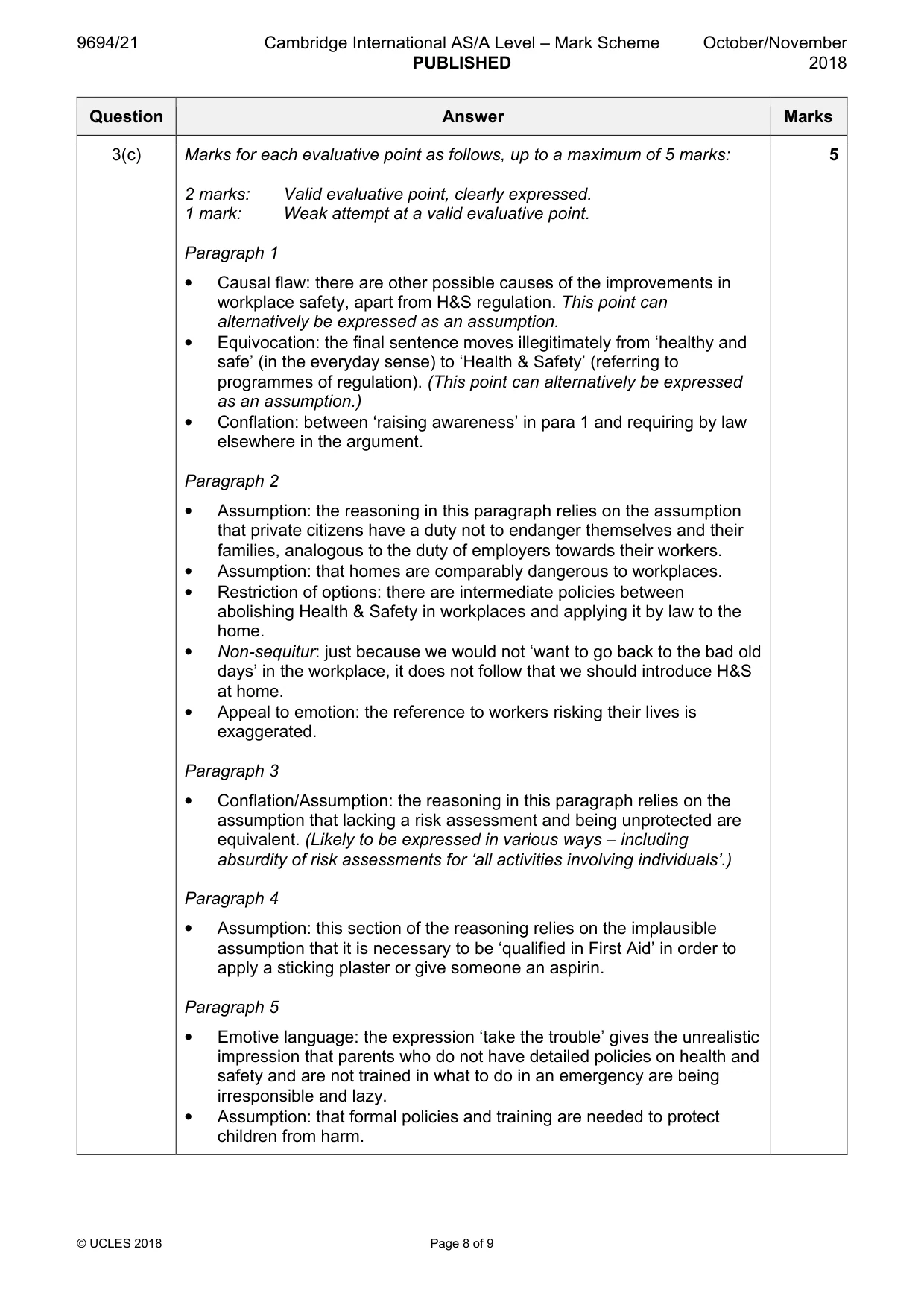
9694/21 Cambridge International AS/A Level – Mark Scheme PUBLISHED October/November 2018 © UCLES 2018 Page 8 of 9 Question Answer Marks 3(c) Marks for each evaluative point as follows, up to a maximum of 5 marks: 2 marks: Valid evaluative point, clearly expressed. 1 mark: Weak attempt at a valid evaluative point. Paragraph 1 • Causal flaw: there are other possible causes of the improvements in workplace safety, apart from H&S regulation. This point can alternatively be expressed as an assumption. • Equivocation: the final sentence moves illegitimately from ‘healthy and safe’ (in the everyday sense) to ‘Health & Safety’ (referring to programmes of regulation). (This point can alternatively be expressed as an assumption.) • Conflation: between ‘raising awareness’ in para 1 and requiring by law elsewhere in the argument. Paragraph 2 • Assumption: the reasoning in this paragraph relies on the assumption that private citizens have a duty not to endanger themselves and their families, analogous to the duty of employers towards their workers. • Assumption: that homes are comparably dangerous to workplaces. • Restriction of options: there are intermediate policies between abolishing Health & Safety in workplaces and applying it by law to the home. • Non-sequitur: just because we would not ‘want to go back to the bad old days’ in the workplace, it does not follow that we should introduce H&S at home. • Appeal to emotion: the reference to workers risking their lives is exaggerated. Paragraph 3 • Conflation/Assumption: the reasoning in this paragraph relies on the assumption that lacking a risk assessment and being unprotected are equivalent. (Likely to be expressed in various ways – including absurdity of risk assessments for ‘all activities involving individuals’.) Paragraph 4 • Assumption: this section of the reasoning relies on the implausible assumption that it is necessary to be ‘qualified in First Aid’ in order to apply a sticking plaster or give someone an aspirin. Paragraph 5 • Emotive language: the expression ‘take the trouble’ gives the unrealistic impression that parents who do not have detailed policies on health and safety and are not trained in what to do in an emergency are being irresponsible and lazy. • Assumption: that formal policies and training are needed to protect children from harm. 5
Mark scheme, page 9
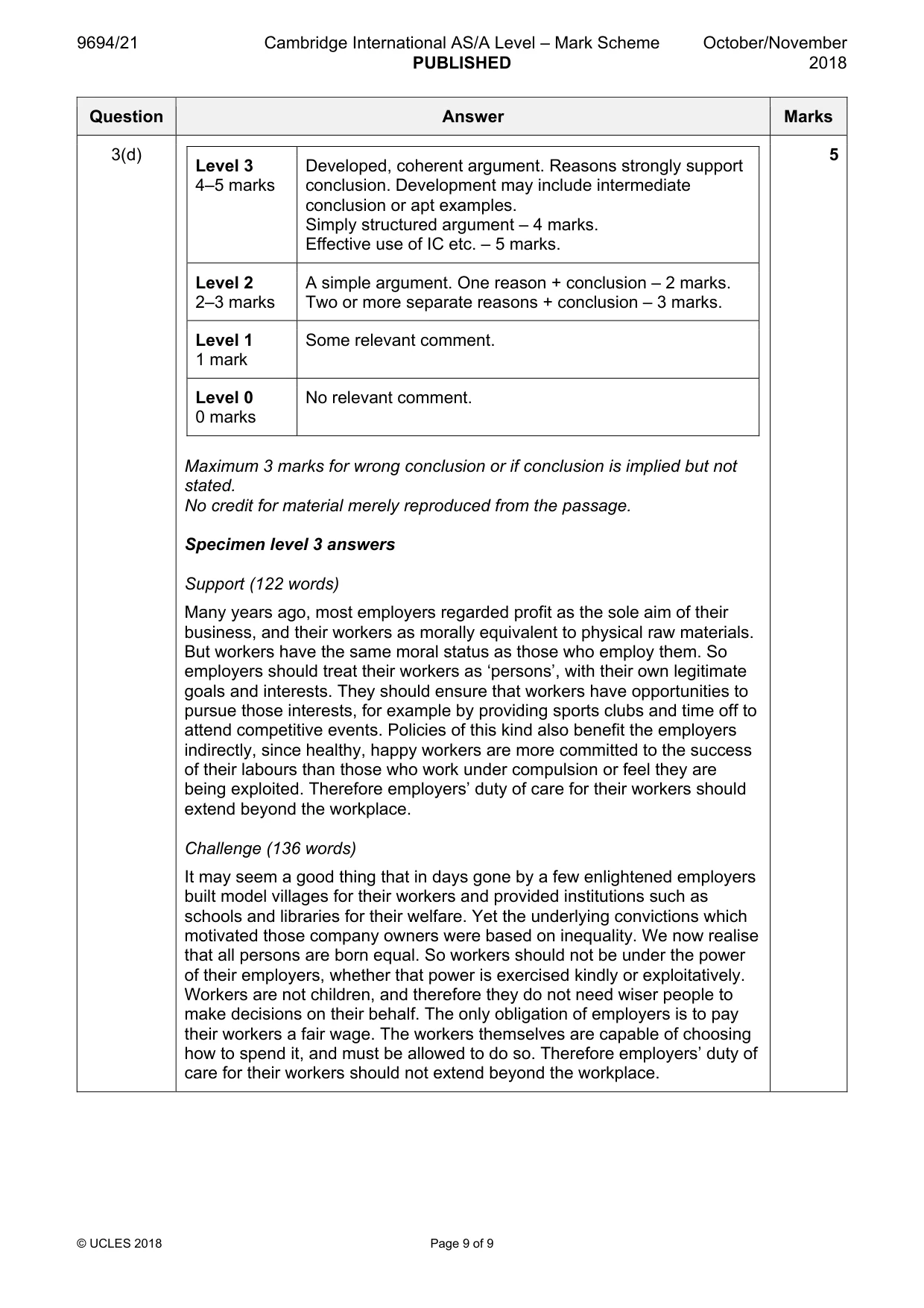
9694/21 Cambridge International AS/A Level – Mark Scheme PUBLISHED October/November 2018 © UCLES 2018 Page 9 of 9 Question Answer Marks 3(d) Level 3 4–5 marks Developed, coherent argument. Reasons strongly support conclusion. Development may include intermediate conclusion or apt examples. Simply structured argument – 4 marks. Effective use of IC etc. – 5 marks. Level 2 2–3 marks A simple argument. One reason + conclusion – 2 marks. Two or more separate reasons + conclusion – 3 marks. Level 1 1 mark Some relevant comment. Level 0 0 marks No relevant comment. Maximum 3 marks for wrong conclusion or if conclusion is implied but not stated. No credit for material merely reproduced from the passage. Specimen level 3 answers Support (122 words) Many years ago, most employers regarded profit as the sole aim of their business, and their workers as morally equivalent to physical raw materials. But workers have the same moral status as those who employ them. So employers should treat their workers as ‘persons’, with their own legitimate goals and interests. They should ensure that workers have opportunities to pursue those interests, for example by providing sports clubs and time off to attend competitive events. Policies of this kind also benefit the employers indirectly, since healthy, happy workers are more committed to the success of their labours than those who work under compulsion or feel they are being exploited. Therefore employers’ duty of care for their workers should extend beyond the workplace. Challenge (136 words) It may seem a good thing that in days gone by a few enlightened employers built model villages for their workers and provided institutions such as schools and libraries for their welfare. Yet the underlying convictions which motivated those company owners were based on inequality. We now realise that all persons are born equal. So workers should not be under the power of their employers, whether that power is exercised kindly or exploitatively. Workers are not children, and therefore they do not need wiser people to make decisions on their behalf. The only obligation of employers is to pay their workers a fair wage. The workers themselves are capable of choosing how to spend it, and must be allowed to do so. Therefore employers’ duty of care for their workers should not extend beyond the workplace. 5
What you needed in this session
Cambridge’s own grade thresholds for 2018 Oct/Nov, Paper 2 · Variant 1. A higher threshold means an easier paper — the bar moves with how the cohort did.