Cambridge A Level Thinking Skills 9694 — 2018 Oct/Nov Paper 2 · Variant 3
9694/23/O/N/18 · 45 marks · ≈51 min
The question paper and its mark scheme, free to read here and free to download. This is Cambridge’s own paper, exactly as it was sat.
Question paper8 pages


Mark scheme9 pages
Answers below. Sit the paper first if you are practising.
Paper as text
Question paper, page 1
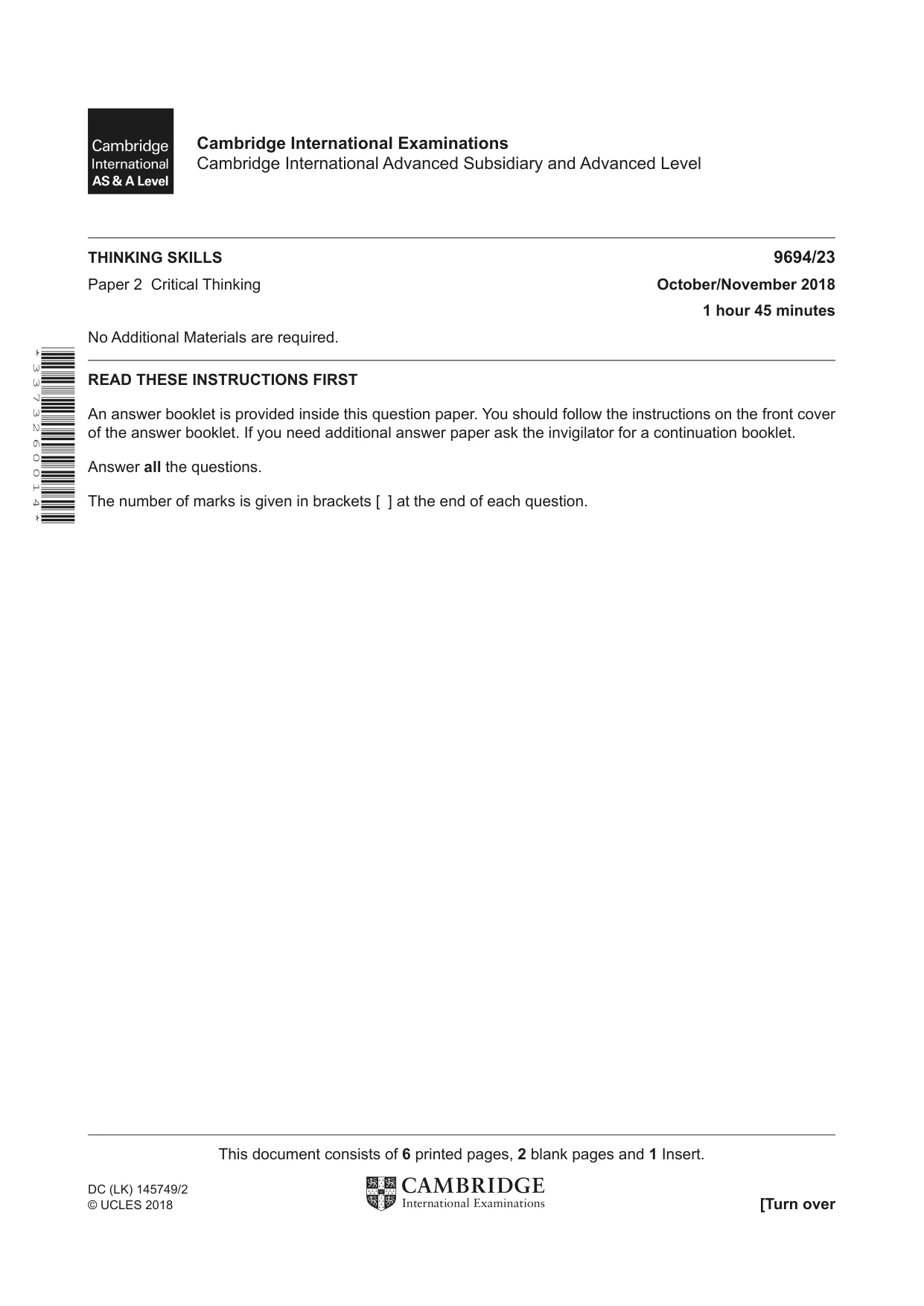
* 3 3 7 3 2 6 0 0 1 4 * This document consists of 6 printed pages, 2 blank pages and 1 Insert. DC (LK) 145749/2 © UCLES 2018 [Turn over Cambridge International Examinations Cambridge International Advanced Subsidiary and Advanced Level THINKING SKILLS 9694/23 Paper 2 Critical Thinking October/November 2018 1 hour 45 minutes No Additional Materials are required. READ THESE INSTRUCTIONS FIRST An answer booklet is provided inside this question paper. You should follow the instructions on the front cover of the answer booklet. If you need additional answer paper ask the invigilator for a continuation booklet. Answer all the questions. The number of marks is given in brackets [ ] at the end of each question.
Question paper, page 2
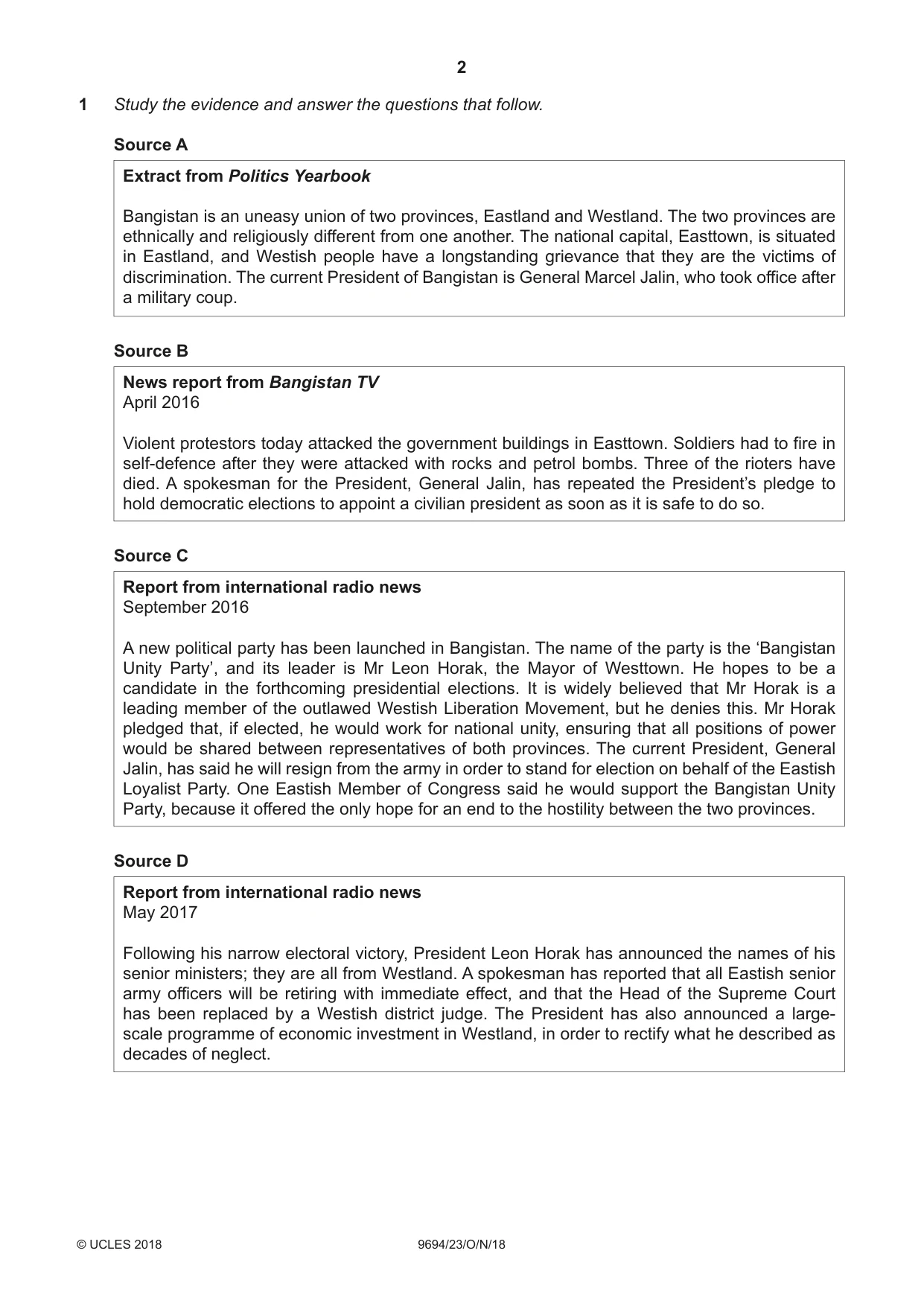
2 9694/23/O/N/18 © UCLES 2018 1 Study the evidence and answer the questions that follow. Source A Extract from Politics Yearbook Bangistan is an uneasy union of two provinces, Eastland and Westland. The two provinces are ethnically and religiously different from one another. The national capital, Easttown, is situated in Eastland, and Westish people have a longstanding grievance that they are the victims of discrimination. The current President of Bangistan is General Marcel Jalin, who took office after a military coup. Source B News report from Bangistan TV April 2016 Violent protestors today attacked the government buildings in Easttown. Soldiers had to fire in self-defence after they were attacked with rocks and petrol bombs. Three of the rioters have died. A spokesman for the President, General Jalin, has repeated the President’s pledge to hold democratic elections to appoint a civilian president as soon as it is safe to do so. Source C Report from international radio news September 2016 A new political party has been launched in Bangistan. The name of the party is the ‘Bangistan Unity Party’, and its leader is Mr Leon Horak, the Mayor of Westtown. He hopes to be a candidate in the forthcoming presidential elections. It is widely believed that Mr Horak is a leading member of the outlawed Westish Liberation Movement, but he denies this. Mr Horak pledged that, if elected, he would work for national unity, ensuring that all positions of power would be shared between representatives of both provinces. The current President, General Jalin, has said he will resign from the army in order to stand for election on behalf of the Eastish Loyalist Party. One Eastish Member of Congress said he would support the Bangistan Unity Party, because it offered the only hope for an end to the hostility between the two provinces. Source D Report from international radio news May 2017 Following his narrow electoral victory, President Leon Horak has announced the names of his senior ministers; they are all from Westland. A spokesman has reported that all Eastish senior army officers will be retiring with immediate effect, and that the Head of the Supreme Court has been replaced by a Westish district judge. The President has also announced a large- scale programme of economic investment in Westland, in order to rectify what he described as decades of neglect.
Question paper, page 3
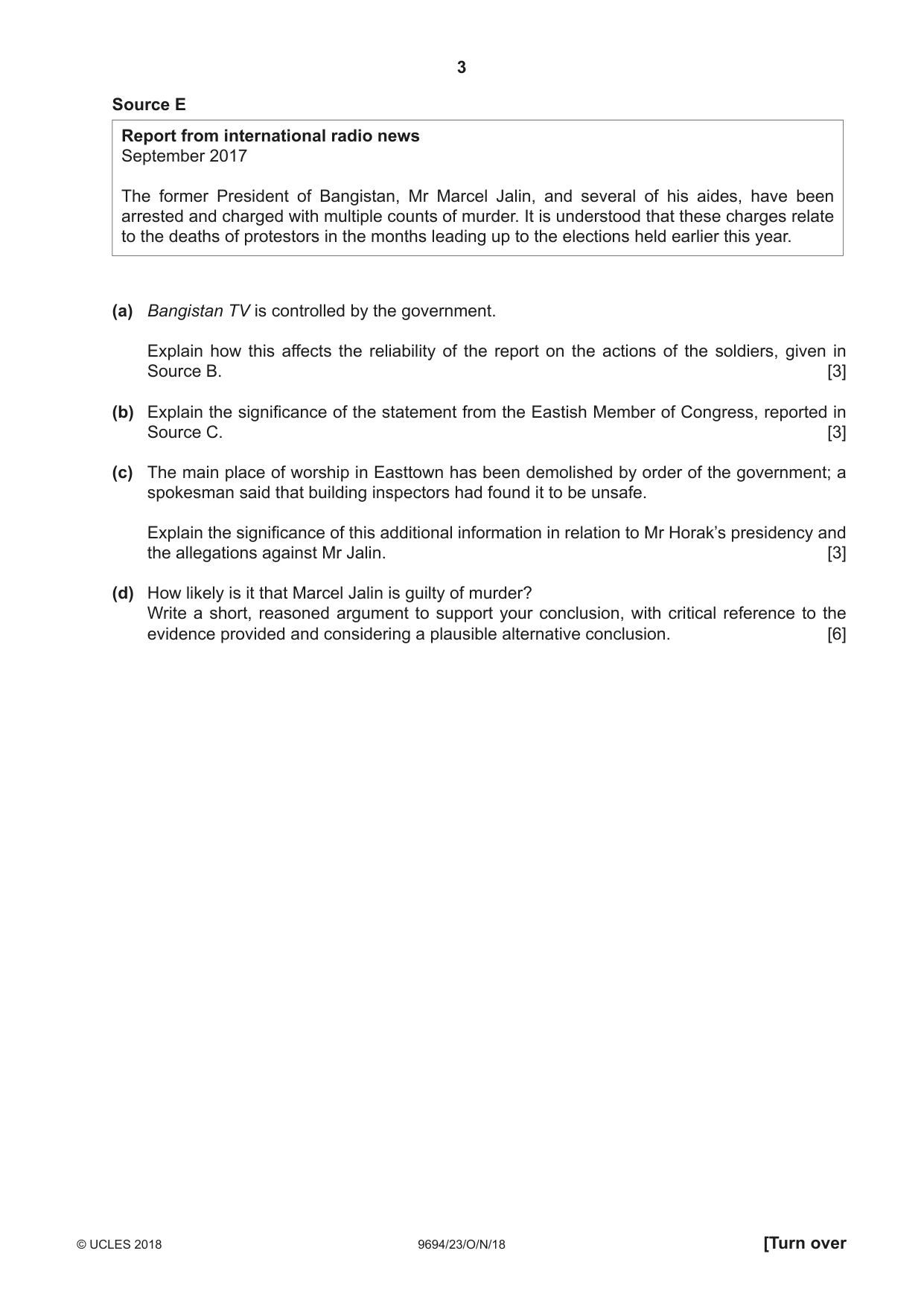
3 9694/23/O/N/18 © UCLES 2018 [Turn over Source E Report from international radio news September 2017 The former President of Bangistan, Mr Marcel Jalin, and several of his aides, have been arrested and charged with multiple counts of murder. It is understood that these charges relate to the deaths of protestors in the months leading up to the elections held earlier this year. (a) Bangistan TV is controlled by the government. Explain how this affects the reliability of the report on the actions of the soldiers, given in Source B. [3] (b) Explain the significance of the statement from the Eastish Member of Congress, reported in Source C. [3] (c) The main place of worship in Easttown has been demolished by order of the government; a spokesman said that building inspectors had found it to be unsafe. Explain the significance of this additional information in relation to Mr Horak’s presidency and the allegations against Mr Jalin. [3] (d) How likely is it that Marcel Jalin is guilty of murder? Write a short, reasoned argument to support your conclusion, with critical reference to the evidence provided and considering a plausible alternative conclusion. [6]
Question paper, page 4
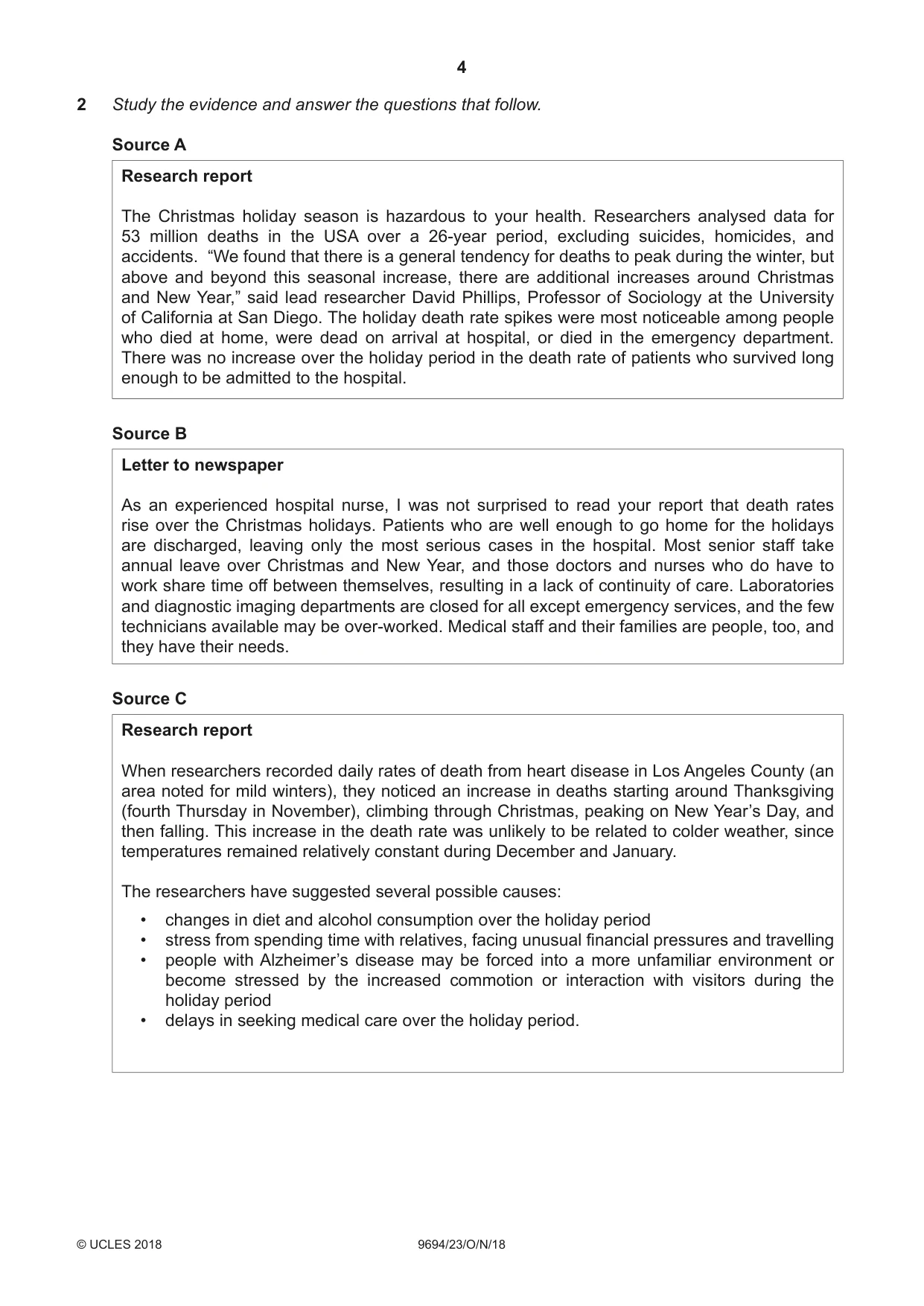
4 9694/23/O/N/18 © UCLES 2018 2 Study the evidence and answer the questions that follow. Source A Research report The Christmas holiday season is hazardous to your health. Researchers analysed data for 53 million deaths in the USA over a 26-year period, excluding suicides, homicides, and accidents. “We found that there is a general tendency for deaths to peak during the winter, but above and beyond this seasonal increase, there are additional increases around Christmas and New Year,” said lead researcher David Phillips, Professor of Sociology at the University of California at San Diego. The holiday death rate spikes were most noticeable among people who died at home, were dead on arrival at hospital, or died in the emergency department. There was no increase over the holiday period in the death rate of patients who survived long enough to be admitted to the hospital. Source B Letter to newspaper As an experienced hospital nurse, I was not surprised to read your report that death rates rise over the Christmas holidays. Patients who are well enough to go home for the holidays are discharged, leaving only the most serious cases in the hospital. Most senior staff take annual leave over Christmas and New Year, and those doctors and nurses who do have to work share time off between themselves, resulting in a lack of continuity of care. Laboratories and diagnostic imaging departments are closed for all except emergency services, and the few technicians available may be over-worked. Medical staff and their families are people, too, and they have their needs. Source C Research report When researchers recorded daily rates of death from heart disease in Los Angeles County (an area noted for mild winters), they noticed an increase in deaths starting around Thanksgiving (fourth Thursday in November), climbing through Christmas, peaking on New Year’s Day, and then falling. This increase in the death rate was unlikely to be related to colder weather, since temperatures remained relatively constant during December and January. The researchers have suggested several possible causes: • changes in diet and alcohol consumption over the holiday period • stress from spending time with relatives, facing unusual financial pressures and travelling • people with Alzheimer’s disease may be forced into a more unfamiliar environment or become stressed by the increased commotion or interaction with visitors during the holiday period • delays in seeking medical care over the holiday period.
Question paper, page 5
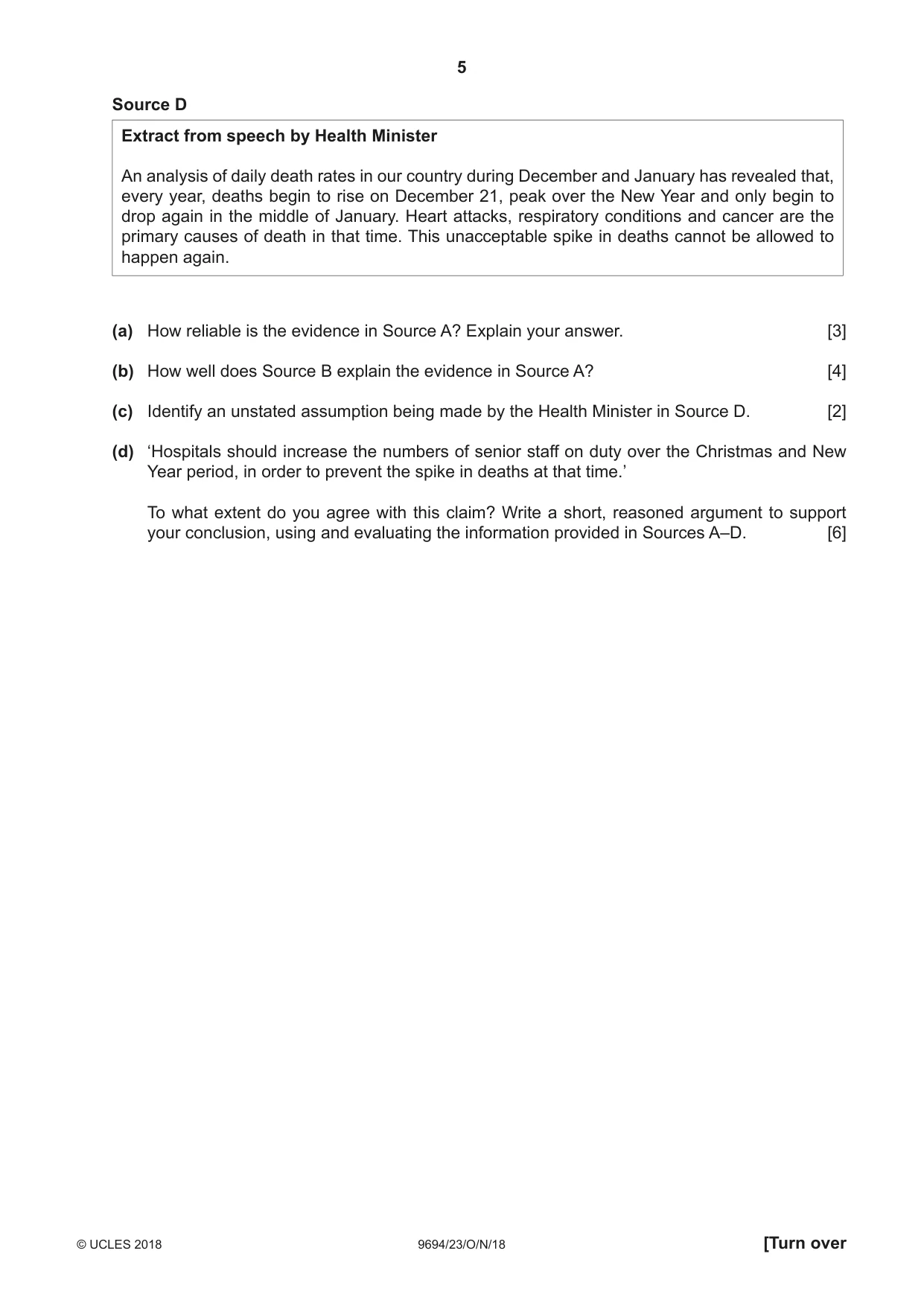
5 9694/23/O/N/18 © UCLES 2018 [Turn over Source D Extract from speech by Health Minister An analysis of daily death rates in our country during December and January has revealed that, every year, deaths begin to rise on December 21, peak over the New Year and only begin to drop again in the middle of January. Heart attacks, respiratory conditions and cancer are the primary causes of death in that time. This unacceptable spike in deaths cannot be allowed to happen again. (a) How reliable is the evidence in Source A? Explain your answer. [3] (b) How well does Source B explain the evidence in Source A? [4] (c) Identify an unstated assumption being made by the Health Minister in Source D. [2] (d) ‘Hospitals should increase the numbers of senior staff on duty over the Christmas and New Year period, in order to prevent the spike in deaths at that time.’ To what extent do you agree with this claim? Write a short, reasoned argument to support your conclusion, using and evaluating the information provided in Sources A–D. [6]
Question paper, page 6
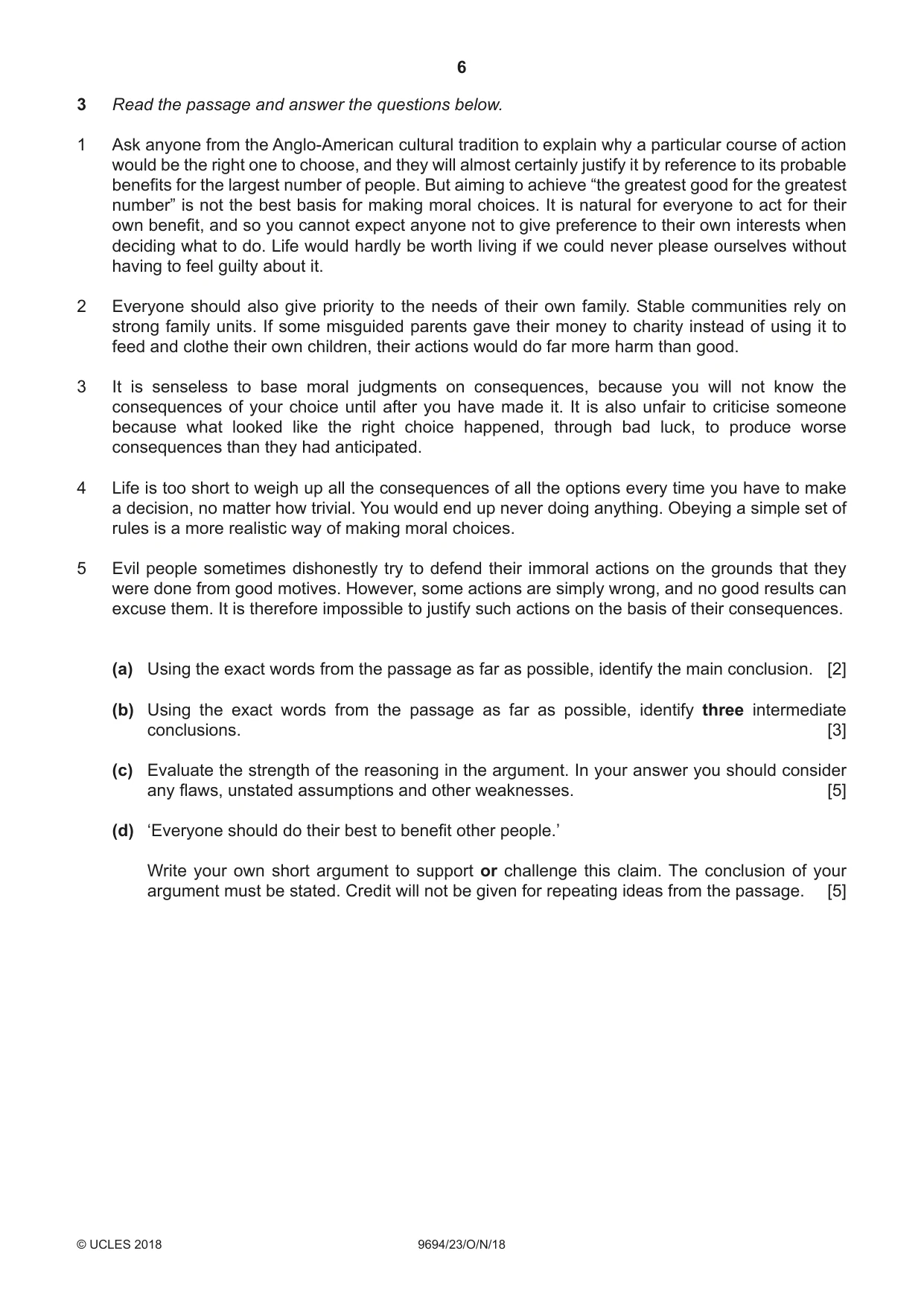
6 9694/23/O/N/18 © UCLES 2018 3 Read the passage and answer the questions below. 1 Ask anyone from the Anglo-American cultural tradition to explain why a particular course of action would be the right one to choose, and they will almost certainly justify it by reference to its probable benefits for the largest number of people. But aiming to achieve “the greatest good for the greatest number” is not the best basis for making moral choices. It is natural for everyone to act for their own benefit, and so you cannot expect anyone not to give preference to their own interests when deciding what to do. Life would hardly be worth living if we could never please ourselves without having to feel guilty about it. 2 Everyone should also give priority to the needs of their own family. Stable communities rely on strong family units. If some misguided parents gave their money to charity instead of using it to feed and clothe their own children, their actions would do far more harm than good. 3 It is senseless to base moral judgments on consequences, because you will not know the consequences of your choice until after you have made it. It is also unfair to criticise someone because what looked like the right choice happened, through bad luck, to produce worse consequences than they had anticipated. 4 Life is too short to weigh up all the consequences of all the options every time you have to make a decision, no matter how trivial. You would end up never doing anything. Obeying a simple set of rules is a more realistic way of making moral choices. 5 Evil people sometimes dishonestly try to defend their immoral actions on the grounds that they were done from good motives. However, some actions are simply wrong, and no good results can excuse them. It is therefore impossible to justify such actions on the basis of their consequences. (a) Using the exact words from the passage as far as possible, identify the main conclusion. [2] (b) Using the exact words from the passage as far as possible, identify three intermediate conclusions. [3] (c) Evaluate the strength of the reasoning in the argument. In your answer you should consider any flaws, unstated assumptions and other weaknesses. [5] (d) ‘Everyone should do their best to benefit other people.’ Write your own short argument to support or challenge this claim. The conclusion of your argument must be stated. Credit will not be given for repeating ideas from the passage. [5]
Question paper, page 7
7 9694/23/O/N/18 © UCLES 2018 BLANK PAGE
Question paper, page 8
8 9694/23/O/N/18 © UCLES 2018 Permission to reproduce items where third-party owned material protected by copyright is included has been sought and cleared where possible. Every reasonable effort has been made by the publisher (UCLES) to trace copyright holders, but if any items requiring clearance have unwittingly been included, the publisher will be pleased to make amends at the earliest possible opportunity. To avoid the issue of disclosure of answer-related information to candidates, all copyright acknowledgements are reproduced online in the Cambridge International Examinations Copyright Acknowledgements Booklet. This is produced for each series of examinations and is freely available to download at www.cie.org.uk after the live examination series. Cambridge International Examinations is part of the Cambridge Assessment Group. Cambridge Assessment is the brand name of University of Cambridge Local Examinations Syndicate (UCLES), which is itself a department of the University of Cambridge. BLANK PAGE
Mark scheme, page 1
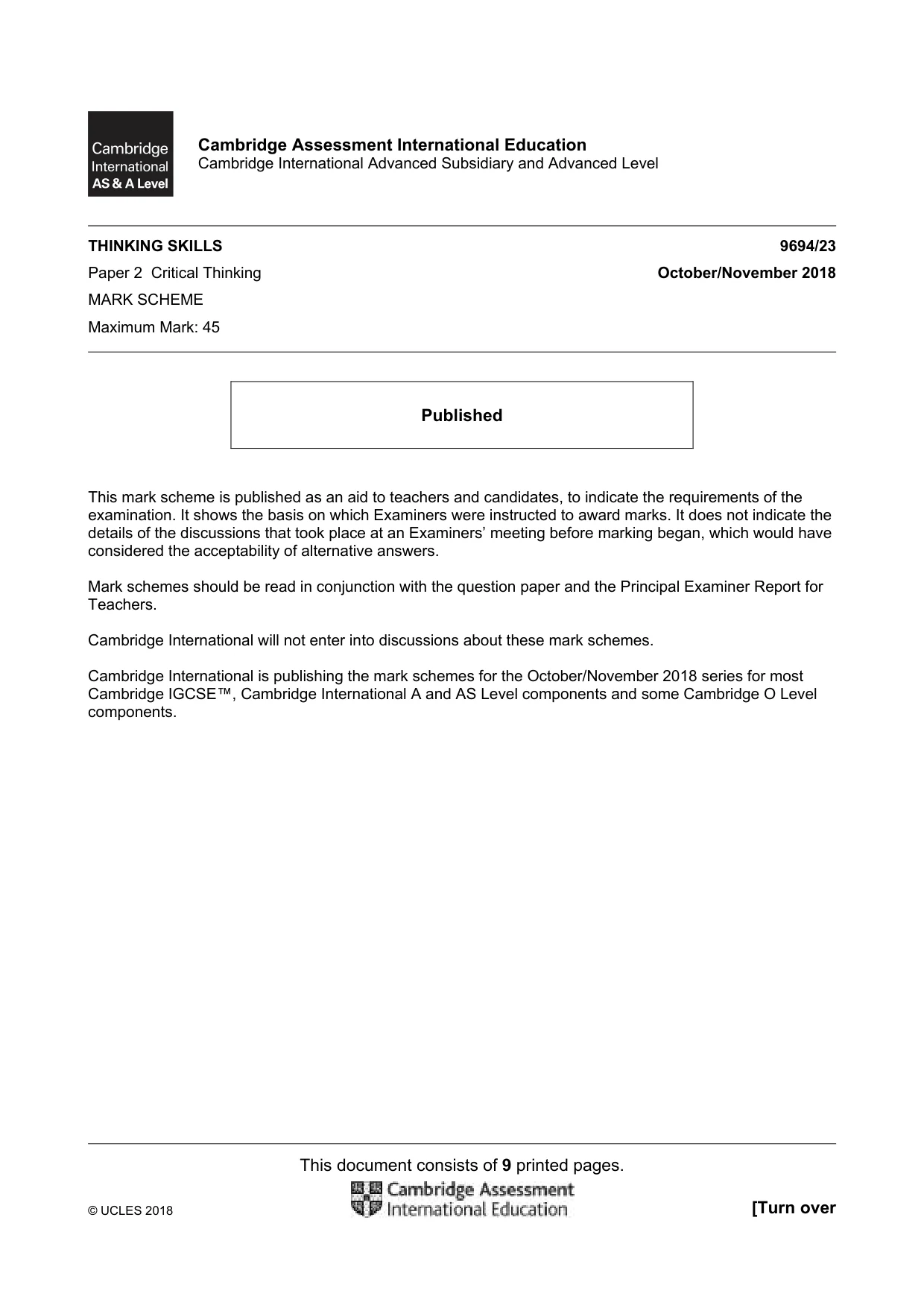
This document consists of 9 printed pages. © UCLES 2018 [Turn over Cambridge Assessment International Education Cambridge International Advanced Subsidiary and Advanced Level THINKING SKILLS 9694/23 Paper 2 Critical Thinking October/November 2018 MARK SCHEME Maximum Mark: 45 Published This mark scheme is published as an aid to teachers and candidates, to indicate the requirements of the examination. It shows the basis on which Examiners were instructed to award marks. It does not indicate the details of the discussions that took place at an Examiners’ meeting before marking began, which would have considered the acceptability of alternative answers. Mark schemes should be read in conjunction with the question paper and the Principal Examiner Report for Teachers. Cambridge International will not enter into discussions about these mark schemes. Cambridge International is publishing the mark schemes for the October/November 2018 series for most Cambridge IGCSE™, Cambridge International A and AS Level components and some Cambridge O Level components.
Mark scheme, page 2
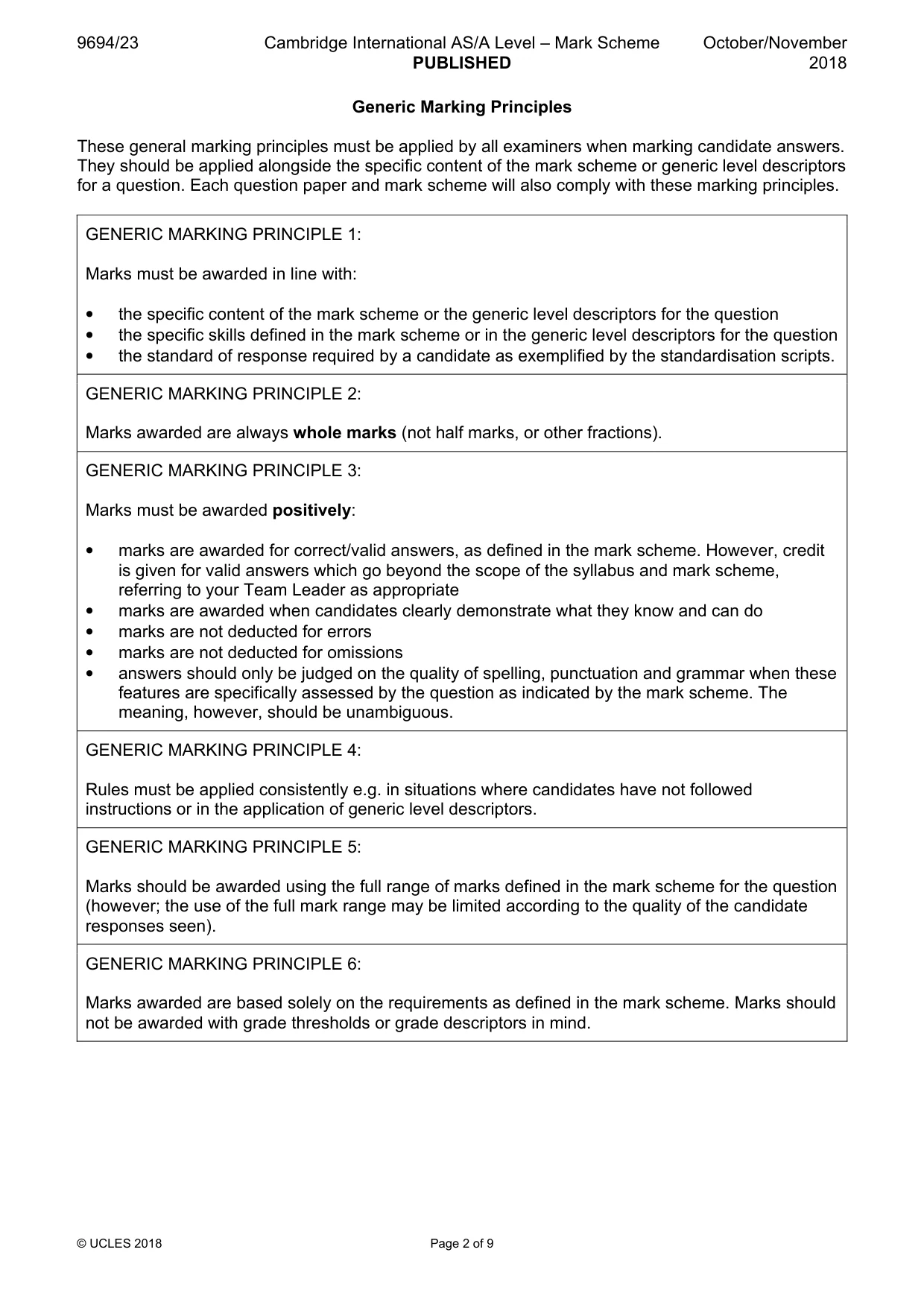
9694/23 Cambridge International AS/A Level – Mark Scheme PUBLISHED October/November 2018 © UCLES 2018 Page 2 of 9 Generic Marking Principles These general marking principles must be applied by all examiners when marking candidate answers. They should be applied alongside the specific content of the mark scheme or generic level descriptors for a question. Each question paper and mark scheme will also comply with these marking principles. GENERIC MARKING PRINCIPLE 1: Marks must be awarded in line with: • the specific content of the mark scheme or the generic level descriptors for the question • the specific skills defined in the mark scheme or in the generic level descriptors for the question • the standard of response required by a candidate as exemplified by the standardisation scripts. GENERIC MARKING PRINCIPLE 2: Marks awarded are always whole marks (not half marks, or other fractions). GENERIC MARKING PRINCIPLE 3: Marks must be awarded positively: • marks are awarded for correct/valid answers, as defined in the mark scheme. However, credit is given for valid answers which go beyond the scope of the syllabus and mark scheme, referring to your Team Leader as appropriate • marks are awarded when candidates clearly demonstrate what they know and can do • marks are not deducted for errors • marks are not deducted for omissions • answers should only be judged on the quality of spelling, punctuation and grammar when these features are specifically assessed by the question as indicated by the mark scheme. The meaning, however, should be unambiguous. GENERIC MARKING PRINCIPLE 4: Rules must be applied consistently e.g. in situations where candidates have not followed instructions or in the application of generic level descriptors. GENERIC MARKING PRINCIPLE 5: Marks should be awarded using the full range of marks defined in the mark scheme for the question (however; the use of the full mark range may be limited according to the quality of the candidate responses seen). GENERIC MARKING PRINCIPLE 6: Marks awarded are based solely on the requirements as defined in the mark scheme. Marks should not be awarded with grade thresholds or grade descriptors in mind.
Mark scheme, page 3
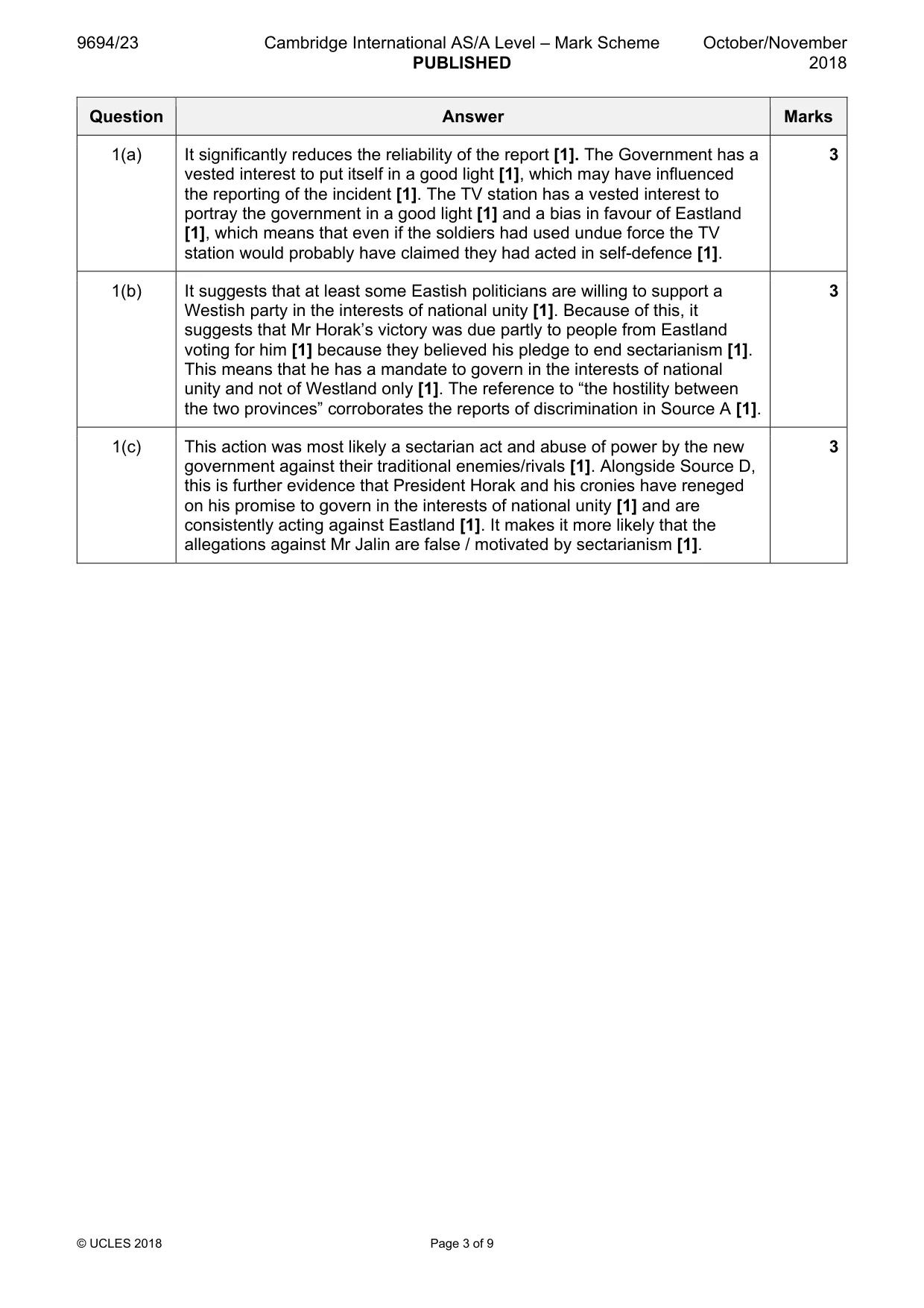
9694/23 Cambridge International AS/A Level – Mark Scheme PUBLISHED October/November 2018 © UCLES 2018 Page 3 of 9 Question Answer Marks 1(a) It significantly reduces the reliability of the report [1]. The Government has a vested interest to put itself in a good light [1], which may have influenced the reporting of the incident [1]. The TV station has a vested interest to portray the government in a good light [1] and a bias in favour of Eastland [1], which means that even if the soldiers had used undue force the TV station would probably have claimed they had acted in self-defence [1]. 3 1(b) It suggests that at least some Eastish politicians are willing to support a Westish party in the interests of national unity [1]. Because of this, it suggests that Mr Horak’s victory was due partly to people from Eastland voting for him [1] because they believed his pledge to end sectarianism [1]. This means that he has a mandate to govern in the interests of national unity and not of Westland only [1]. The reference to “the hostility between the two provinces” corroborates the reports of discrimination in Source A [1]. 3 1(c) This action was most likely a sectarian act and abuse of power by the new government against their traditional enemies/rivals [1]. Alongside Source D, this is further evidence that President Horak and his cronies have reneged on his promise to govern in the interests of national unity [1] and are consistently acting against Eastland [1]. It makes it more likely that the allegations against Mr Jalin are false / motivated by sectarianism [1]. 3
Mark scheme, page 4
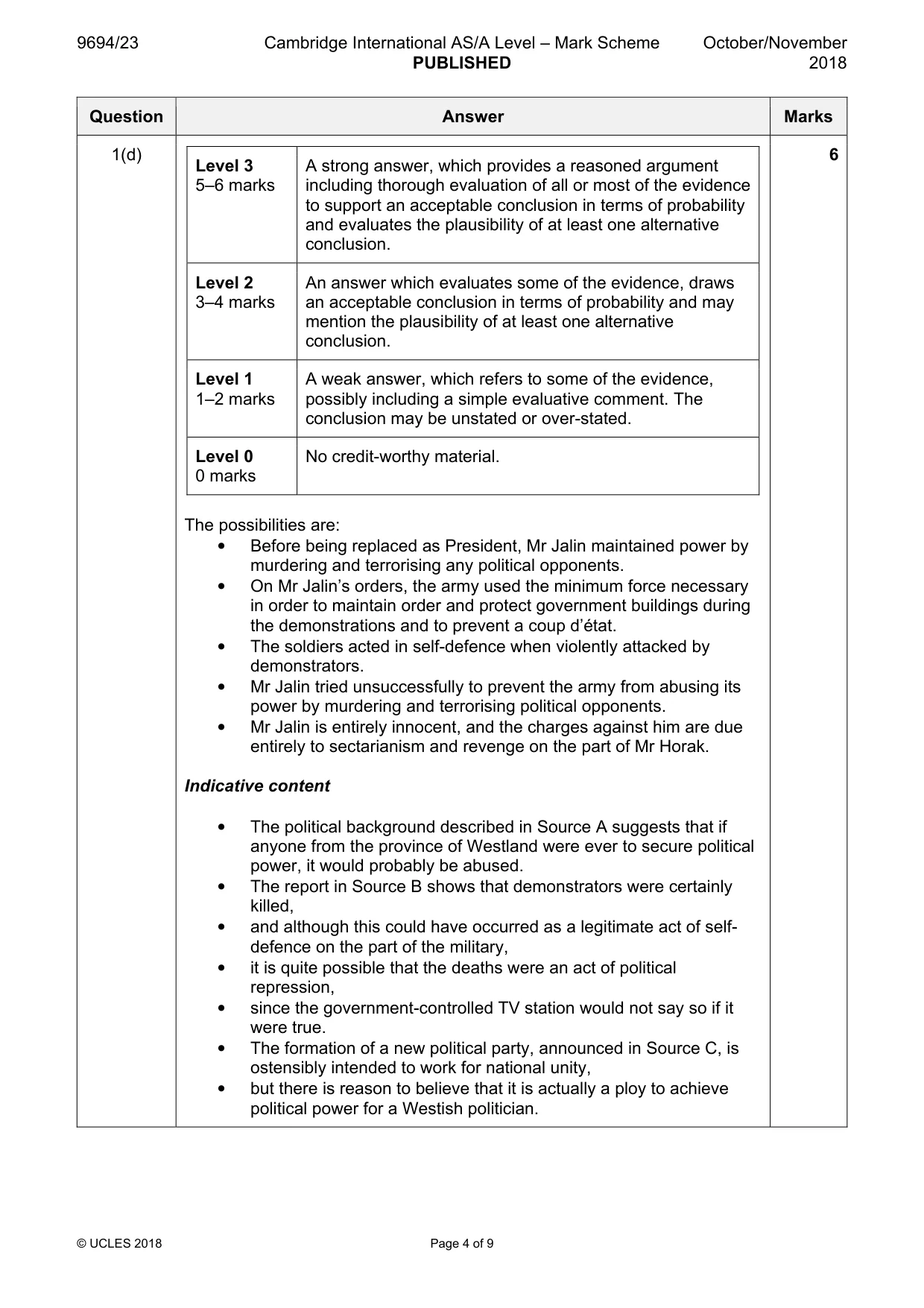
9694/23 Cambridge International AS/A Level – Mark Scheme PUBLISHED October/November 2018 © UCLES 2018 Page 4 of 9 Question Answer Marks 1(d) Level 3 5–6 marks A strong answer, which provides a reasoned argument including thorough evaluation of all or most of the evidence to support an acceptable conclusion in terms of probability and evaluates the plausibility of at least one alternative conclusion. Level 2 3–4 marks An answer which evaluates some of the evidence, draws an acceptable conclusion in terms of probability and may mention the plausibility of at least one alternative conclusion. Level 1 1–2 marks A weak answer, which refers to some of the evidence, possibly including a simple evaluative comment. The conclusion may be unstated or over-stated. Level 0 0 marks No credit-worthy material. The possibilities are: • Before being replaced as President, Mr Jalin maintained power by murdering and terrorising any political opponents. • On Mr Jalin’s orders, the army used the minimum force necessary in order to maintain order and protect government buildings during the demonstrations and to prevent a coup d’état. • The soldiers acted in self-defence when violently attacked by demonstrators. • Mr Jalin tried unsuccessfully to prevent the army from abusing its power by murdering and terrorising political opponents. • Mr Jalin is entirely innocent, and the charges against him are due entirely to sectarianism and revenge on the part of Mr Horak. Indicative content • The political background described in Source A suggests that if anyone from the province of Westland were ever to secure political power, it would probably be abused. • The report in Source B shows that demonstrators were certainly killed, • and although this could have occurred as a legitimate act of self- defence on the part of the military, • it is quite possible that the deaths were an act of political repression, • since the government-controlled TV station would not say so if it were true. • The formation of a new political party, announced in Source C, is ostensibly intended to work for national unity, • but there is reason to believe that it is actually a ploy to achieve political power for a Westish politician. 6
Mark scheme, page 5
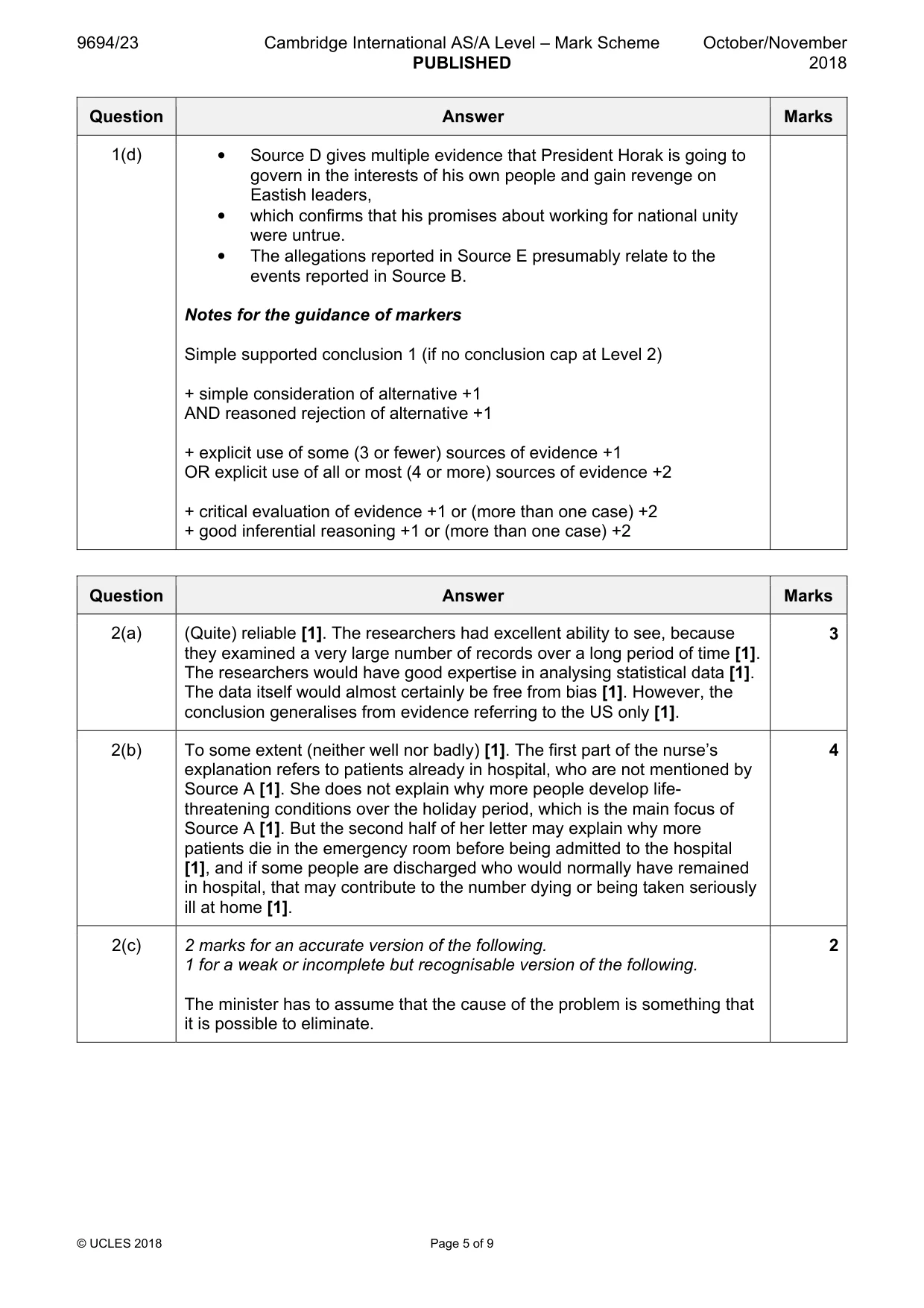
9694/23 Cambridge International AS/A Level – Mark Scheme PUBLISHED October/November 2018 © UCLES 2018 Page 5 of 9 Question Answer Marks 1(d) • Source D gives multiple evidence that President Horak is going to govern in the interests of his own people and gain revenge on Eastish leaders, • which confirms that his promises about working for national unity were untrue. • The allegations reported in Source E presumably relate to the events reported in Source B. Notes for the guidance of markers Simple supported conclusion 1 (if no conclusion cap at Level 2) + simple consideration of alternative +1 AND reasoned rejection of alternative +1 + explicit use of some (3 or fewer) sources of evidence +1 OR explicit use of all or most (4 or more) sources of evidence +2 + critical evaluation of evidence +1 or (more than one case) +2 + good inferential reasoning +1 or (more than one case) +2 Question Answer Marks 2(a) (Quite) reliable [1]. The researchers had excellent ability to see, because they examined a very large number of records over a long period of time [1]. The researchers would have good expertise in analysing statistical data [1]. The data itself would almost certainly be free from bias [1]. However, the conclusion generalises from evidence referring to the US only [1]. 3 2(b) To some extent (neither well nor badly) [1]. The first part of the nurse’s explanation refers to patients already in hospital, who are not mentioned by Source A [1]. She does not explain why more people develop life- threatening conditions over the holiday period, which is the main focus of Source A [1]. But the second half of her letter may explain why more patients die in the emergency room before being admitted to the hospital [1], and if some people are discharged who would normally have remained in hospital, that may contribute to the number dying or being taken seriously ill at home [1]. 4 2(c) 2 marks for an accurate version of the following. 1 for a weak or incomplete but recognisable version of the following. The minister has to assume that the cause of the problem is something that it is possible to eliminate. 2
Mark scheme, page 6
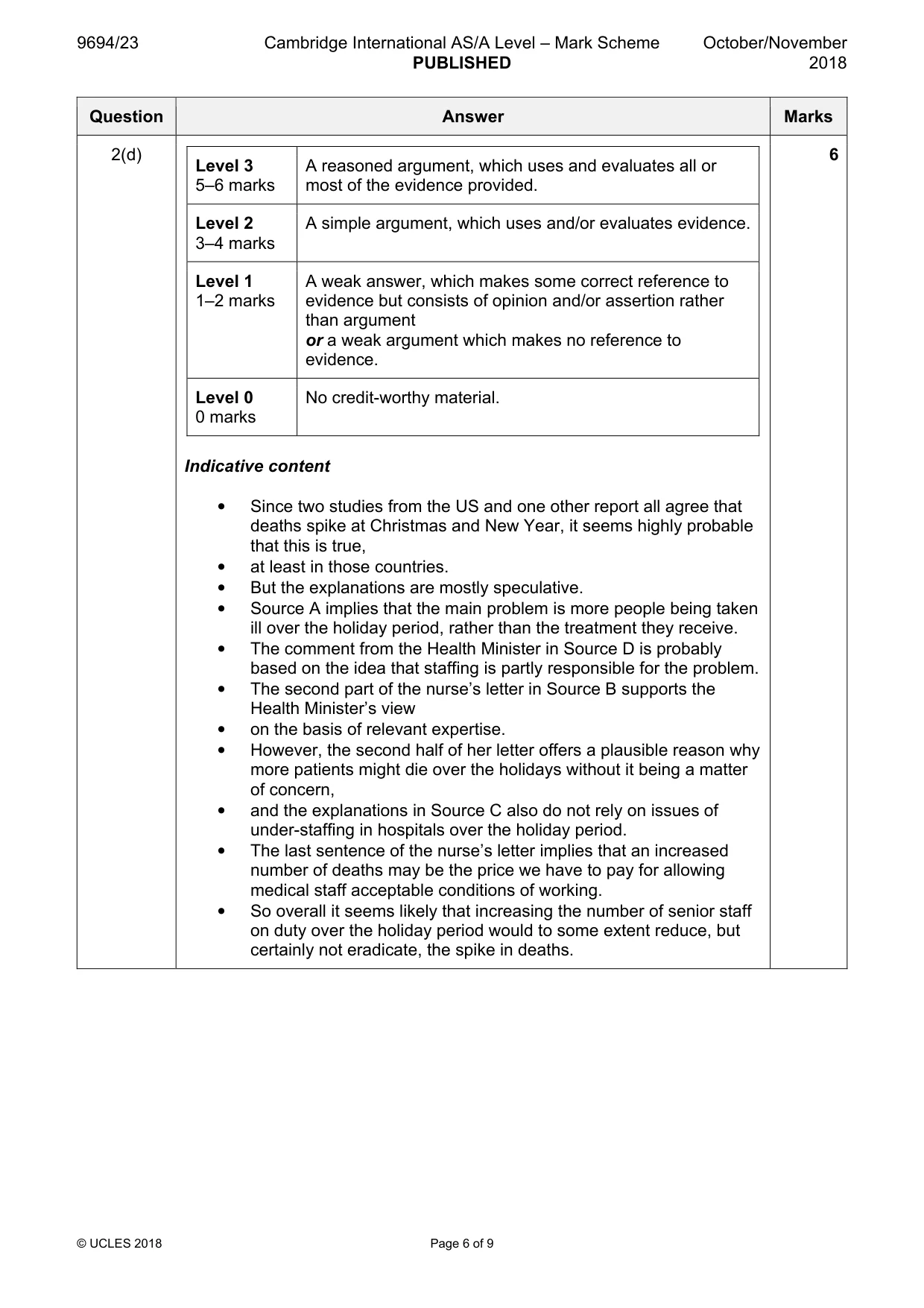
9694/23 Cambridge International AS/A Level – Mark Scheme PUBLISHED October/November 2018 © UCLES 2018 Page 6 of 9 Question Answer Marks 2(d) Level 3 5–6 marks A reasoned argument, which uses and evaluates all or most of the evidence provided. Level 2 3–4 marks A simple argument, which uses and/or evaluates evidence. Level 1 1–2 marks A weak answer, which makes some correct reference to evidence but consists of opinion and/or assertion rather than argument or a weak argument which makes no reference to evidence. Level 0 0 marks No credit-worthy material. Indicative content • Since two studies from the US and one other report all agree that deaths spike at Christmas and New Year, it seems highly probable that this is true, • at least in those countries. • But the explanations are mostly speculative. • Source A implies that the main problem is more people being taken ill over the holiday period, rather than the treatment they receive. • The comment from the Health Minister in Source D is probably based on the idea that staffing is partly responsible for the problem. • The second part of the nurse’s letter in Source B supports the Health Minister’s view • on the basis of relevant expertise. • However, the second half of her letter offers a plausible reason why more patients might die over the holidays without it being a matter of concern, • and the explanations in Source C also do not rely on issues of under-staffing in hospitals over the holiday period. • The last sentence of the nurse’s letter implies that an increased number of deaths may be the price we have to pay for allowing medical staff acceptable conditions of working. • So overall it seems likely that increasing the number of senior staff on duty over the holiday period would to some extent reduce, but certainly not eradicate, the spike in deaths. 6
Mark scheme, page 7
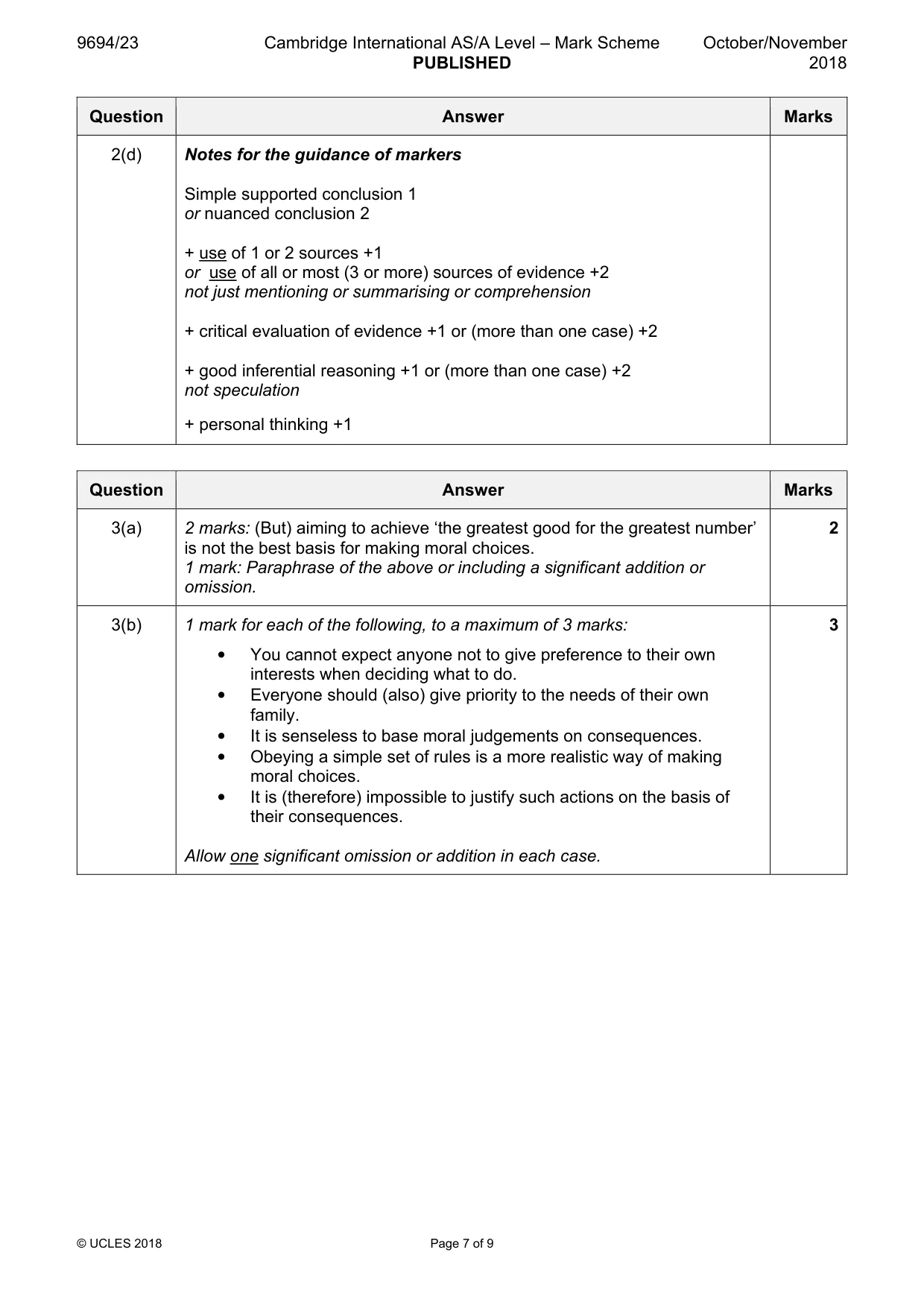
9694/23 Cambridge International AS/A Level – Mark Scheme PUBLISHED October/November 2018 © UCLES 2018 Page 7 of 9 Question Answer Marks 2(d) Notes for the guidance of markers Simple supported conclusion 1 or nuanced conclusion 2 + use of 1 or 2 sources +1 or use of all or most (3 or more) sources of evidence +2 not just mentioning or summarising or comprehension + critical evaluation of evidence +1 or (more than one case) +2 + good inferential reasoning +1 or (more than one case) +2 not speculation + personal thinking +1 Question Answer Marks 3(a) 2 marks: (But) aiming to achieve ‘the greatest good for the greatest number’ is not the best basis for making moral choices. 1 mark: Paraphrase of the above or including a significant addition or omission. 2 3(b) 1 mark for each of the following, to a maximum of 3 marks: • You cannot expect anyone not to give preference to their own interests when deciding what to do. • Everyone should (also) give priority to the needs of their own family. • It is senseless to base moral judgements on consequences. • Obeying a simple set of rules is a more realistic way of making moral choices. • It is (therefore) impossible to justify such actions on the basis of their consequences. Allow one significant omission or addition in each case. 3
Mark scheme, page 8
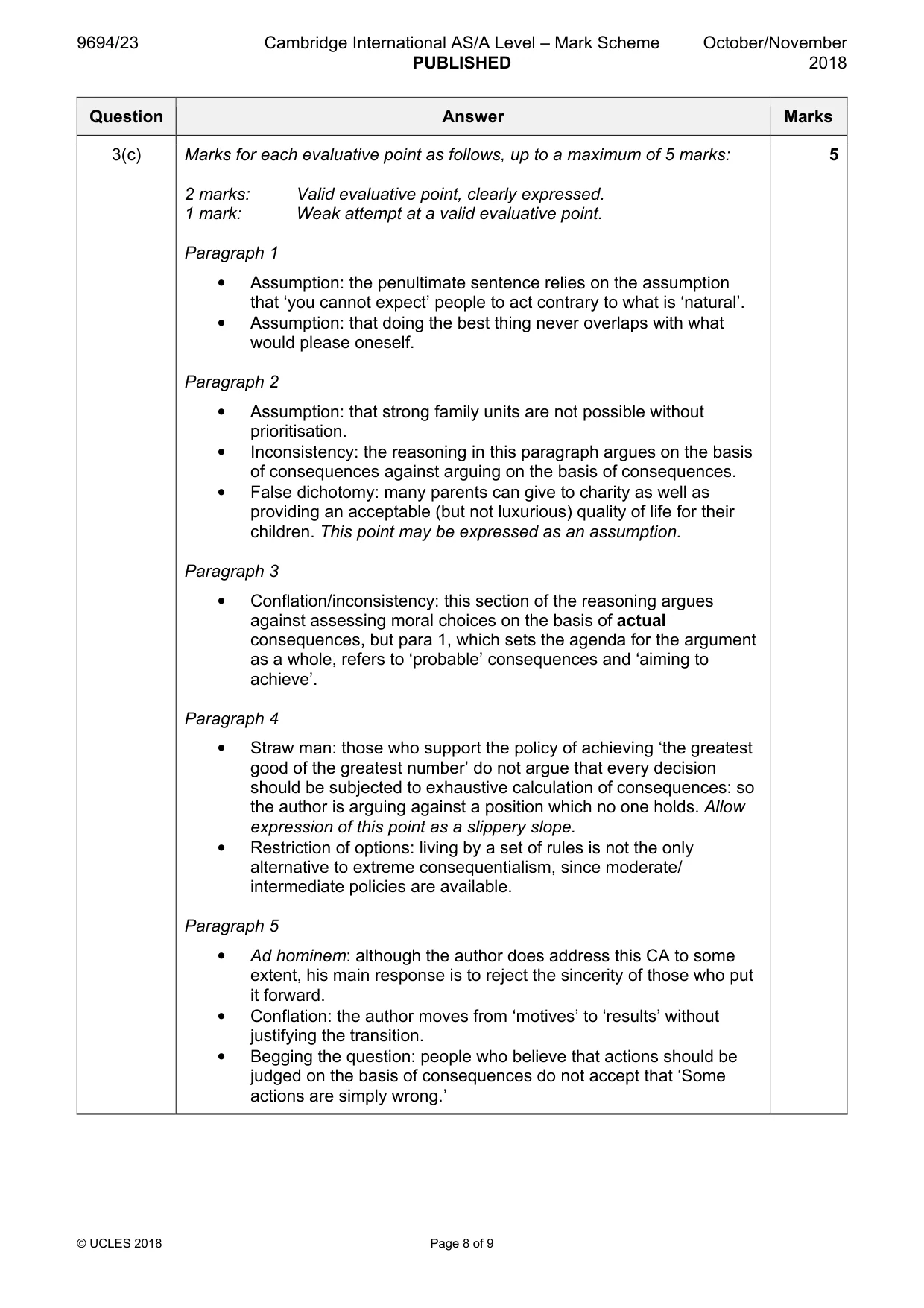
9694/23 Cambridge International AS/A Level – Mark Scheme PUBLISHED October/November 2018 © UCLES 2018 Page 8 of 9 Question Answer Marks 3(c) Marks for each evaluative point as follows, up to a maximum of 5 marks: 2 marks: Valid evaluative point, clearly expressed. 1 mark: Weak attempt at a valid evaluative point. Paragraph 1 • Assumption: the penultimate sentence relies on the assumption that ‘you cannot expect’ people to act contrary to what is ‘natural’. • Assumption: that doing the best thing never overlaps with what would please oneself. Paragraph 2 • Assumption: that strong family units are not possible without prioritisation. • Inconsistency: the reasoning in this paragraph argues on the basis of consequences against arguing on the basis of consequences. • False dichotomy: many parents can give to charity as well as providing an acceptable (but not luxurious) quality of life for their children. This point may be expressed as an assumption. Paragraph 3 • Conflation/inconsistency: this section of the reasoning argues against assessing moral choices on the basis of actual consequences, but para 1, which sets the agenda for the argument as a whole, refers to ‘probable’ consequences and ‘aiming to achieve’. Paragraph 4 • Straw man: those who support the policy of achieving ‘the greatest good of the greatest number’ do not argue that every decision should be subjected to exhaustive calculation of consequences: so the author is arguing against a position which no one holds. Allow expression of this point as a slippery slope. • Restriction of options: living by a set of rules is not the only alternative to extreme consequentialism, since moderate/ intermediate policies are available. Paragraph 5 • Ad hominem: although the author does address this CA to some extent, his main response is to reject the sincerity of those who put it forward. • Conflation: the author moves from ‘motives’ to ‘results’ without justifying the transition. • Begging the question: people who believe that actions should be judged on the basis of consequences do not accept that ‘Some actions are simply wrong.’ 5
Mark scheme, page 9
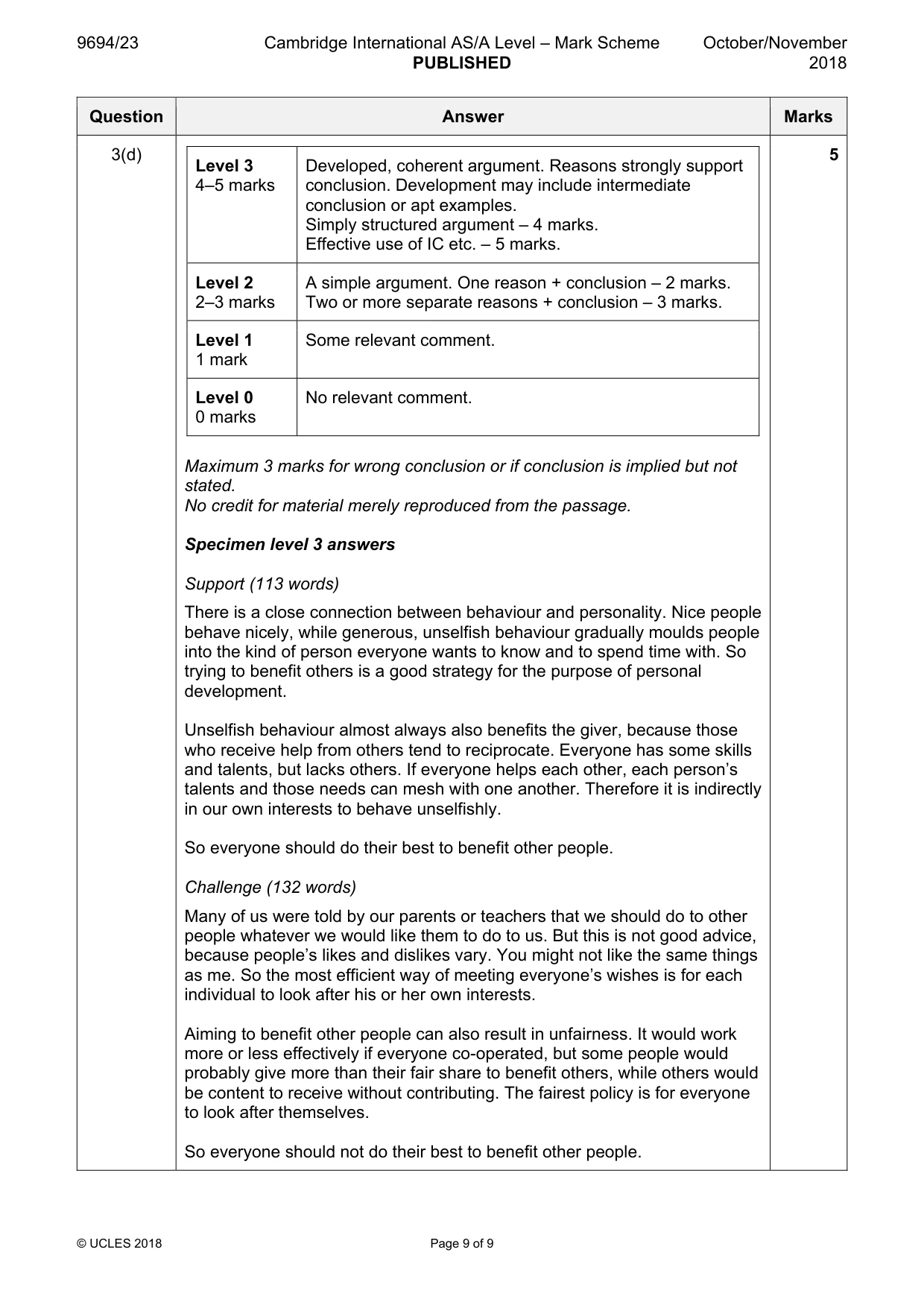
9694/23 Cambridge International AS/A Level – Mark Scheme PUBLISHED October/November 2018 © UCLES 2018 Page 9 of 9 Question Answer Marks 3(d) Level 3 4–5 marks Developed, coherent argument. Reasons strongly support conclusion. Development may include intermediate conclusion or apt examples. Simply structured argument – 4 marks. Effective use of IC etc. – 5 marks. Level 2 2–3 marks A simple argument. One reason + conclusion – 2 marks. Two or more separate reasons + conclusion – 3 marks. Level 1 1 mark Some relevant comment. Level 0 0 marks No relevant comment. Maximum 3 marks for wrong conclusion or if conclusion is implied but not stated. No credit for material merely reproduced from the passage. Specimen level 3 answers Support (113 words) There is a close connection between behaviour and personality. Nice people behave nicely, while generous, unselfish behaviour gradually moulds people into the kind of person everyone wants to know and to spend time with. So trying to benefit others is a good strategy for the purpose of personal development. Unselfish behaviour almost always also benefits the giver, because those who receive help from others tend to reciprocate. Everyone has some skills and talents, but lacks others. If everyone helps each other, each person’s talents and those needs can mesh with one another. Therefore it is indirectly in our own interests to behave unselfishly. So everyone should do their best to benefit other people. Challenge (132 words) Many of us were told by our parents or teachers that we should do to other people whatever we would like them to do to us. But this is not good advice, because people’s likes and dislikes vary. You might not like the same things as me. So the most efficient way of meeting everyone’s wishes is for each individual to look after his or her own interests. Aiming to benefit other people can also result in unfairness. It would work more or less effectively if everyone co-operated, but some people would probably give more than their fair share to benefit others, while others would be content to receive without contributing. The fairest policy is for everyone to look after themselves. So everyone should not do their best to benefit other people. 5
What you needed in this session
Cambridge’s own grade thresholds for 2018 Oct/Nov, Paper 2 · Variant 3. A higher threshold means an easier paper — the bar moves with how the cohort did.