Cambridge A Level Thinking Skills 9694 — 2018 Oct/Nov Paper 2 · Variant 2
9694/22/O/N/18 · 45 marks · ≈51 min
The question paper and its mark scheme, free to read here and free to download. This is Cambridge’s own paper, exactly as it was sat.
Question paper8 pages

Mark scheme9 pages
Answers below. Sit the paper first if you are practising.
Paper as text
Question paper, page 1
This document consists of 6 printed pages, 2 blank pages and 1 Insert. DC (LEG) 145750/1 © UCLES 2018 [Turn over Cambridge International Examinations Cambridge International Advanced Subsidiary and Advanced Level * 2 0 5 8 8 3 2 6 5 5 * THINKING SKILLS 9694/22 Paper 2 Critical Thinking October/November 2018 1 hour 45 minutes No Additional Materials are required. READ THESE INSTRUCTIONS FIRST An answer booklet is provided inside this question paper. You should follow the instructions on the front cover of the answer booklet. If you need additional answer paper ask the invigilator for a continuation booklet. Answer all the questions. The number of marks is given in brackets [ ] at the end of each question.
Question paper, page 2
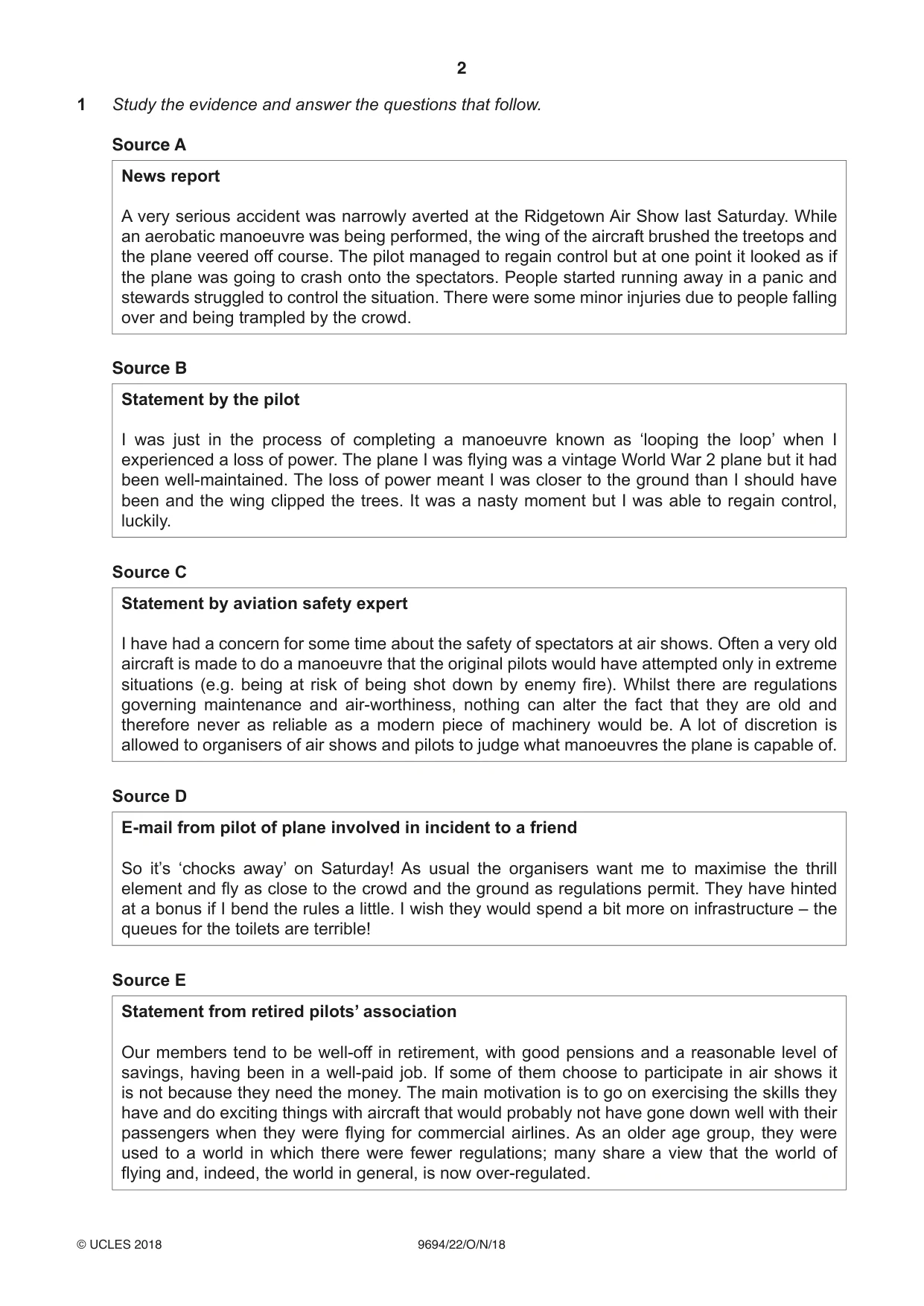
2 9694/22/O/N/18 © UCLES 2018 1 Study the evidence and answer the questions that follow. Source A News report A very serious accident was narrowly averted at the Ridgetown Air Show last Saturday. While an aerobatic manoeuvre was being performed, the wing of the aircraft brushed the treetops and the plane veered off course. The pilot managed to regain control but at one point it looked as if the plane was going to crash onto the spectators. People started running away in a panic and stewards struggled to control the situation. There were some minor injuries due to people falling over and being trampled by the crowd. Source B Statement by the pilot I was just in the process of completing a manoeuvre known as ‘looping the loop’ when I experienced a loss of power. The plane I was flying was a vintage World War 2 plane but it had been well-maintained. The loss of power meant I was closer to the ground than I should have been and the wing clipped the trees. It was a nasty moment but I was able to regain control, luckily. Source C Statement by aviation safety expert I have had a concern for some time about the safety of spectators at air shows. Often a very old aircraft is made to do a manoeuvre that the original pilots would have attempted only in extreme situations (e.g. being at risk of being shot down by enemy fire). Whilst there are regulations governing maintenance and air-worthiness, nothing can alter the fact that they are old and therefore never as reliable as a modern piece of machinery would be. A lot of discretion is allowed to organisers of air shows and pilots to judge what manoeuvres the plane is capable of. Source D E-mail from pilot of plane involved in incident to a friend So it’s ‘chocks away’ on Saturday! As usual the organisers want me to maximise the thrill element and fly as close to the crowd and the ground as regulations permit. They have hinted at a bonus if I bend the rules a little. I wish they would spend a bit more on infrastructure – the queues for the toilets are terrible! Source E Statement from retired pilots’ association Our members tend to be well-off in retirement, with good pensions and a reasonable level of savings, having been in a well-paid job. If some of them choose to participate in air shows it is not because they need the money. The main motivation is to go on exercising the skills they have and do exciting things with aircraft that would probably not have gone down well with their passengers when they were flying for commercial airlines. As an older age group, they were used to a world in which there were fewer regulations; many share a view that the world of flying and, indeed, the world in general, is now over-regulated.
Question paper, page 3
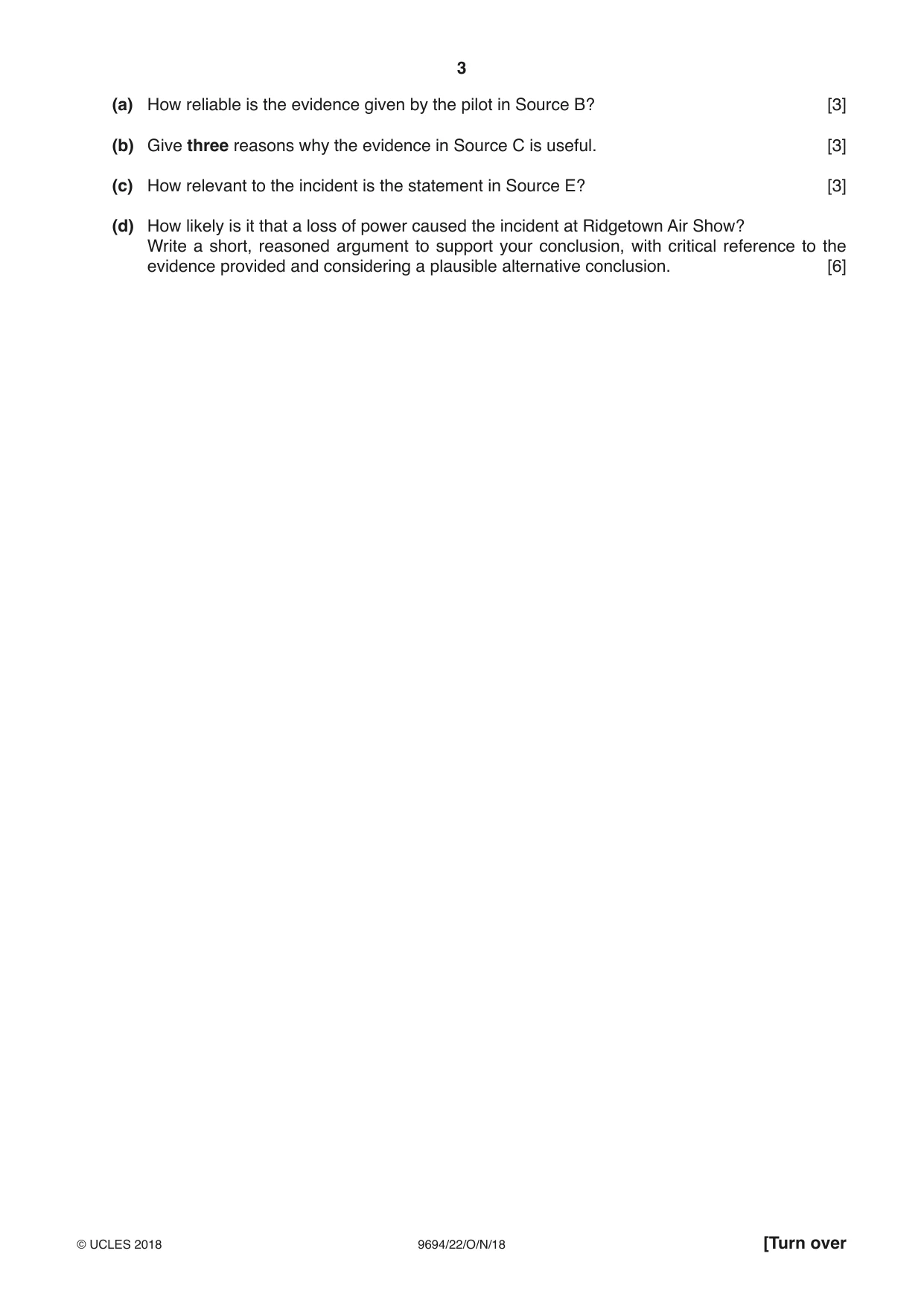
3 9694/22/O/N/18 © UCLES 2018 [Turn over (a) How reliable is the evidence given by the pilot in Source B? [3] (b) Give three reasons why the evidence in Source C is useful. [3] (c) How relevant to the incident is the statement in Source E? [3] (d) How likely is it that a loss of power caused the incident at Ridgetown Air Show? Write a short, reasoned argument to support your conclusion, with critical reference to the evidence provided and considering a plausible alternative conclusion. [6]
Question paper, page 4
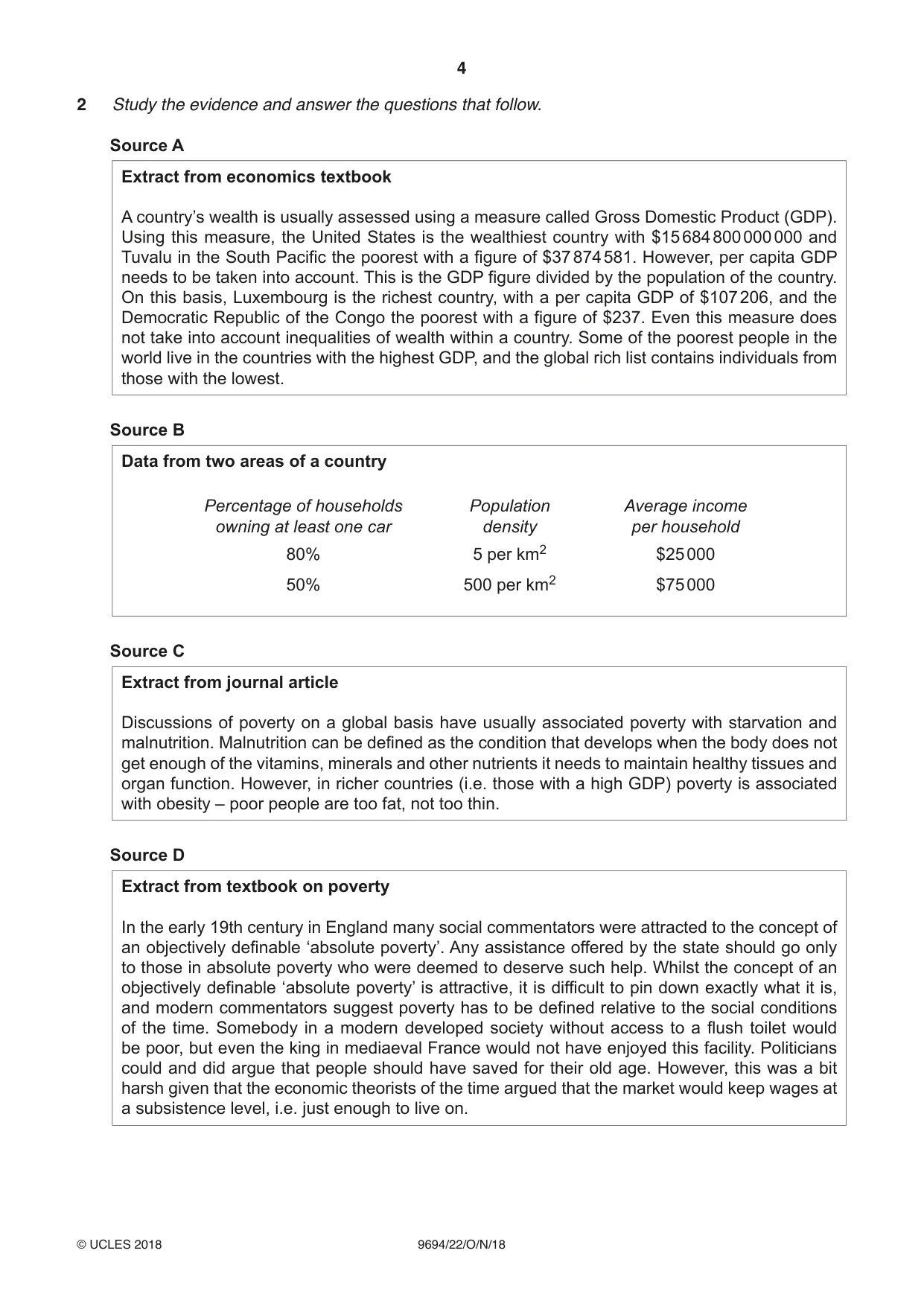
4 9694/22/O/N/18 © UCLES 2018 2 Study the evidence and answer the questions that follow. Source A Extract from economics textbook A country’s wealth is usually assessed using a measure called Gross Domestic Product (GDP). Using this measure, the United States is the wealthiest country with $15 684 800 000 000 and Tuvalu in the South Pacific the poorest with a figure of $37 874 581. However, per capita GDP needs to be taken into account. This is the GDP figure divided by the population of the country. On this basis, Luxembourg is the richest country, with a per capita GDP of $107 206, and the Democratic Republic of the Congo the poorest with a figure of $237. Even this measure does not take into account inequalities of wealth within a country. Some of the poorest people in the world live in the countries with the highest GDP, and the global rich list contains individuals from those with the lowest. Source B Data from two areas of a country Percentage of households owning at least one car Population density Average income per household 80% 5 per km2 $25 000 50% 500 per km2 $75 000 Source C Extract from journal article Discussions of poverty on a global basis have usually associated poverty with starvation and malnutrition. Malnutrition can be defined as the condition that develops when the body does not get enough of the vitamins, minerals and other nutrients it needs to maintain healthy tissues and organ function. However, in richer countries (i.e. those with a high GDP) poverty is associated with obesity – poor people are too fat, not too thin. Source D Extract from textbook on poverty In the early 19th century in England many social commentators were attracted to the concept of an objectively definable ‘absolute poverty’. Any assistance offered by the state should go only to those in absolute poverty who were deemed to deserve such help. Whilst the concept of an objectively definable ‘absolute poverty’ is attractive, it is difficult to pin down exactly what it is, and modern commentators suggest poverty has to be defined relative to the social conditions of the time. Somebody in a modern developed society without access to a flush toilet would be poor, but even the king in mediaeval France would not have enjoyed this facility. Politicians could and did argue that people should have saved for their old age. However, this was a bit harsh given that the economic theorists of the time argued that the market would keep wages at a subsistence level, i.e. just enough to live on.
Question paper, page 5
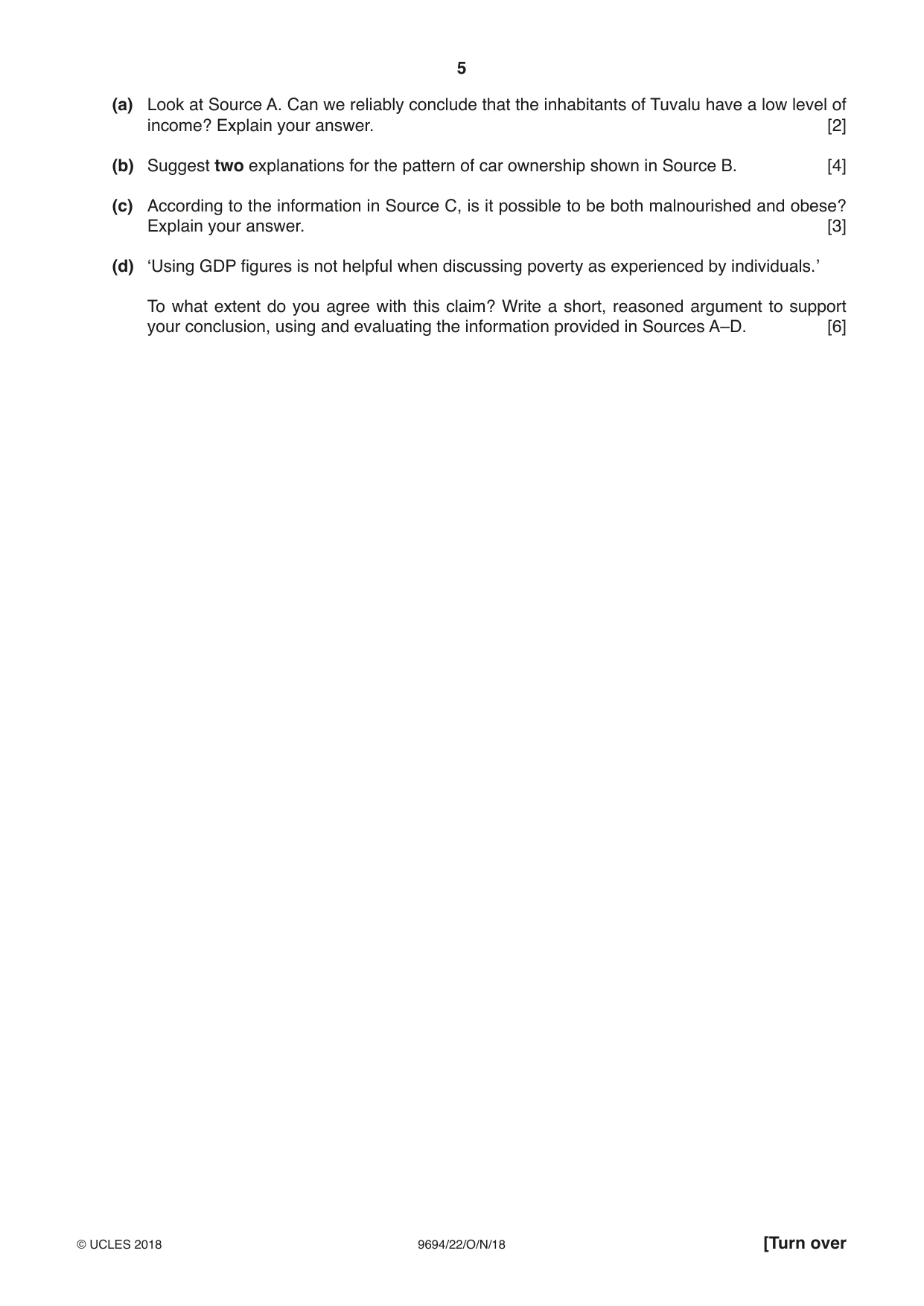
5 9694/22/O/N/18 © UCLES 2018 [Turn over (a) Look at Source A. Can we reliably conclude that the inhabitants of Tuvalu have a low level of income? Explain your answer. [2] (b) Suggest two explanations for the pattern of car ownership shown in Source B. [4] (c) According to the information in Source C, is it possible to be both malnourished and obese? Explain your answer. [3] (d) ‘Using GDP figures is not helpful when discussing poverty as experienced by individuals.’ To what extent do you agree with this claim? Write a short, reasoned argument to support your conclusion, using and evaluating the information provided in Sources A–D. [6]
Question paper, page 6
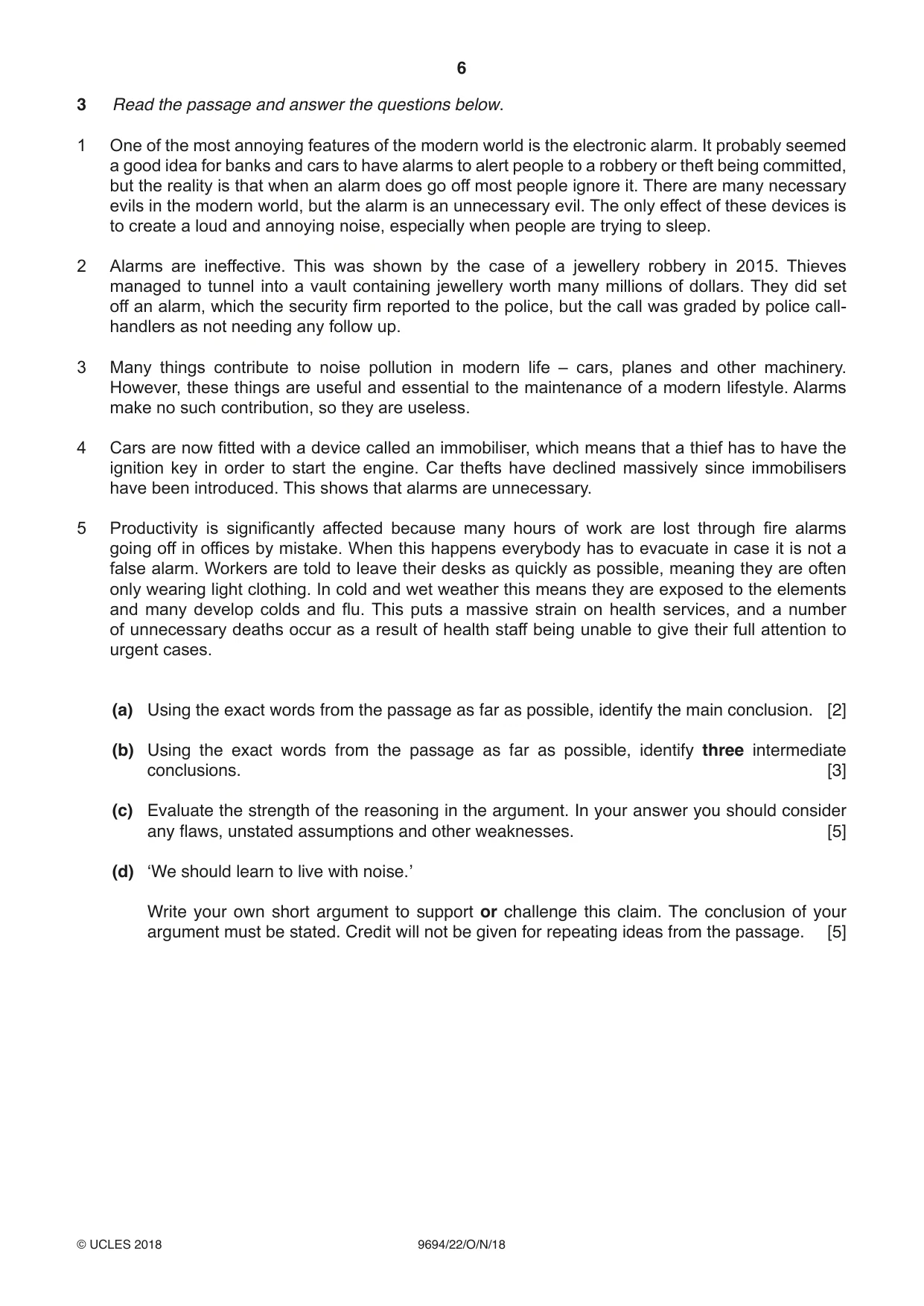
6 9694/22/O/N/18 © UCLES 2018 3 Read the passage and answer the questions below. 1 One of the most annoying features of the modern world is the electronic alarm. It probably seemed a good idea for banks and cars to have alarms to alert people to a robbery or theft being committed, but the reality is that when an alarm does go off most people ignore it. There are many necessary evils in the modern world, but the alarm is an unnecessary evil. The only effect of these devices is to create a loud and annoying noise, especially when people are trying to sleep. 2 Alarms are ineffective. This was shown by the case of a jewellery robbery in 2015. Thieves managed to tunnel into a vault containing jewellery worth many millions of dollars. They did set off an alarm, which the security firm reported to the police, but the call was graded by police call- handlers as not needing any follow up. 3 Many things contribute to noise pollution in modern life – cars, planes and other machinery. However, these things are useful and essential to the maintenance of a modern lifestyle. Alarms make no such contribution, so they are useless. 4 Cars are now fitted with a device called an immobiliser, which means that a thief has to have the ignition key in order to start the engine. Car thefts have declined massively since immobilisers have been introduced. This shows that alarms are unnecessary. 5 Productivity is significantly affected because many hours of work are lost through fire alarms going off in offices by mistake. When this happens everybody has to evacuate in case it is not a false alarm. Workers are told to leave their desks as quickly as possible, meaning they are often only wearing light clothing. In cold and wet weather this means they are exposed to the elements and many develop colds and flu. This puts a massive strain on health services, and a number of unnecessary deaths occur as a result of health staff being unable to give their full attention to urgent cases. (a) Using the exact words from the passage as far as possible, identify the main conclusion. [2] (b) Using the exact words from the passage as far as possible, identify three intermediate conclusions. [3] (c) Evaluate the strength of the reasoning in the argument. In your answer you should consider any flaws, unstated assumptions and other weaknesses. [5] (d) ‘We should learn to live with noise.’ Write your own short argument to support or challenge this claim. The conclusion of your argument must be stated. Credit will not be given for repeating ideas from the passage. [5]
Question paper, page 7
7 9694/22/O/N/18 © UCLES 2018 BLANK PAGE
Question paper, page 8
8 9694/22/O/N/18 © UCLES 2018 Permission to reproduce items where third-party owned material protected by copyright is included has been sought and cleared where possible. Every reasonable effort has been made by the publisher (UCLES) to trace copyright holders, but if any items requiring clearance have unwittingly been included, the publisher will be pleased to make amends at the earliest possible opportunity. To avoid the issue of disclosure of answer-related information to candidates, all copyright acknowledgements are reproduced online in the Cambridge International Examinations Copyright Acknowledgements Booklet. This is produced for each series of examinations and is freely available to download at www.cie.org.uk after the live examination series. Cambridge International Examinations is part of the Cambridge Assessment Group. Cambridge Assessment is the brand name of University of Cambridge Local Examinations Syndicate (UCLES), which is itself a department of the University of Cambridge. BLANK PAGE
Mark scheme, page 1
This document consists of 9 printed pages. © UCLES 2018 [Turn over Cambridge Assessment International Education Cambridge International Advanced Subsidiary and Advanced Level THINKING SKILLS 9694/22 Paper 2 Critical Thinking October/November 2018 MARK SCHEME Maximum Mark: 45 Published This mark scheme is published as an aid to teachers and candidates, to indicate the requirements of the examination. It shows the basis on which Examiners were instructed to award marks. It does not indicate the details of the discussions that took place at an Examiners’ meeting before marking began, which would have considered the acceptability of alternative answers. Mark schemes should be read in conjunction with the question paper and the Principal Examiner Report for Teachers. Cambridge International will not enter into discussions about these mark schemes. Cambridge International is publishing the mark schemes for the October/November 2018 series for most Cambridge IGCSE™, Cambridge International A and AS Level components and some Cambridge O Level components.
Mark scheme, page 2
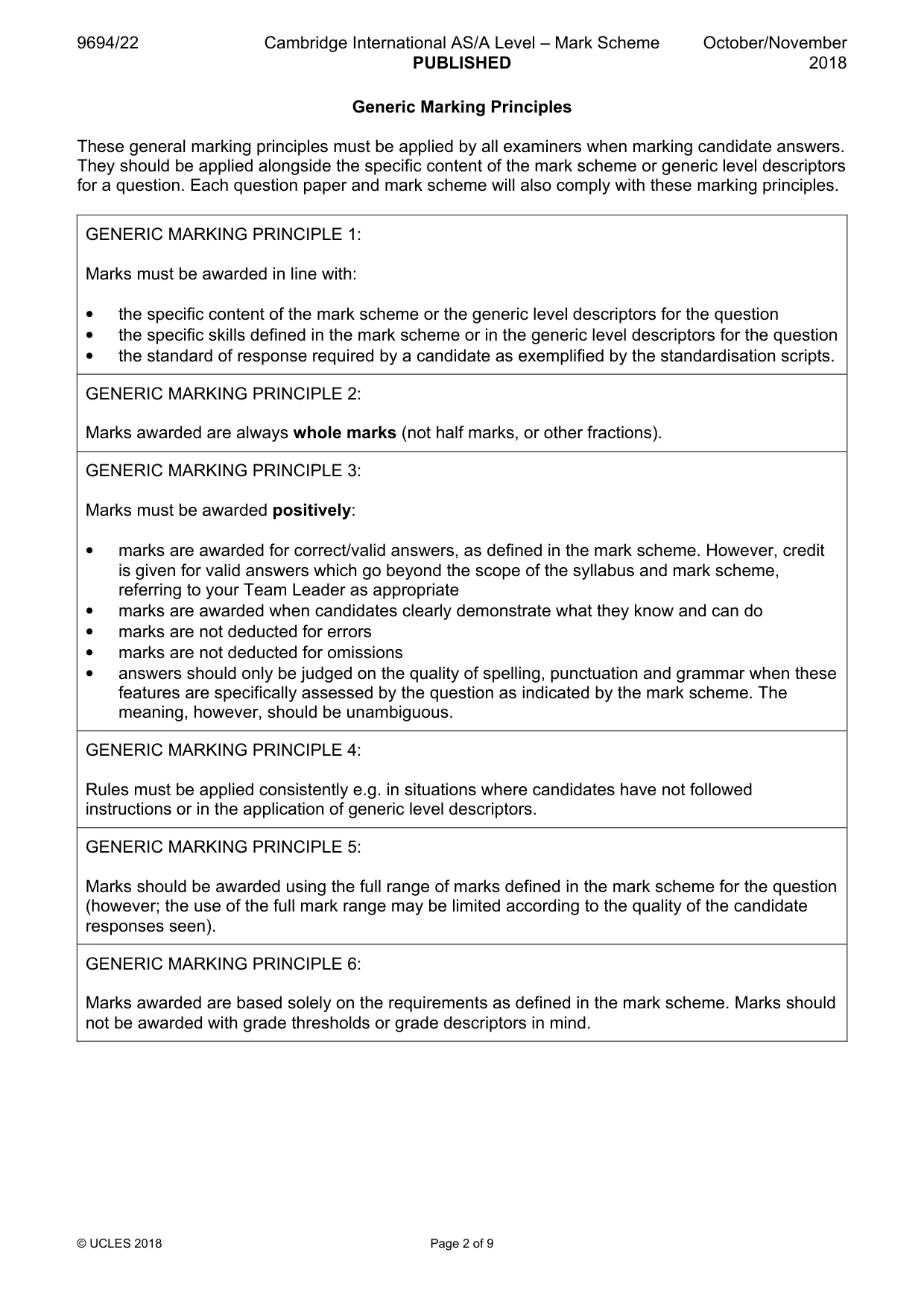
9694/22 Cambridge International AS/A Level – Mark Scheme PUBLISHED October/November 2018 © UCLES 2018 Page 2 of 9 Generic Marking Principles These general marking principles must be applied by all examiners when marking candidate answers. They should be applied alongside the specific content of the mark scheme or generic level descriptors for a question. Each question paper and mark scheme will also comply with these marking principles. GENERIC MARKING PRINCIPLE 1: Marks must be awarded in line with: • the specific content of the mark scheme or the generic level descriptors for the question • the specific skills defined in the mark scheme or in the generic level descriptors for the question • the standard of response required by a candidate as exemplified by the standardisation scripts. GENERIC MARKING PRINCIPLE 2: Marks awarded are always whole marks (not half marks, or other fractions). GENERIC MARKING PRINCIPLE 3: Marks must be awarded positively: • marks are awarded for correct/valid answers, as defined in the mark scheme. However, credit is given for valid answers which go beyond the scope of the syllabus and mark scheme, referring to your Team Leader as appropriate • marks are awarded when candidates clearly demonstrate what they know and can do • marks are not deducted for errors • marks are not deducted for omissions • answers should only be judged on the quality of spelling, punctuation and grammar when these features are specifically assessed by the question as indicated by the mark scheme. The meaning, however, should be unambiguous. GENERIC MARKING PRINCIPLE 4: Rules must be applied consistently e.g. in situations where candidates have not followed instructions or in the application of generic level descriptors. GENERIC MARKING PRINCIPLE 5: Marks should be awarded using the full range of marks defined in the mark scheme for the question (however; the use of the full mark range may be limited according to the quality of the candidate responses seen). GENERIC MARKING PRINCIPLE 6: Marks awarded are based solely on the requirements as defined in the mark scheme. Marks should not be awarded with grade thresholds or grade descriptors in mind.
Mark scheme, page 3
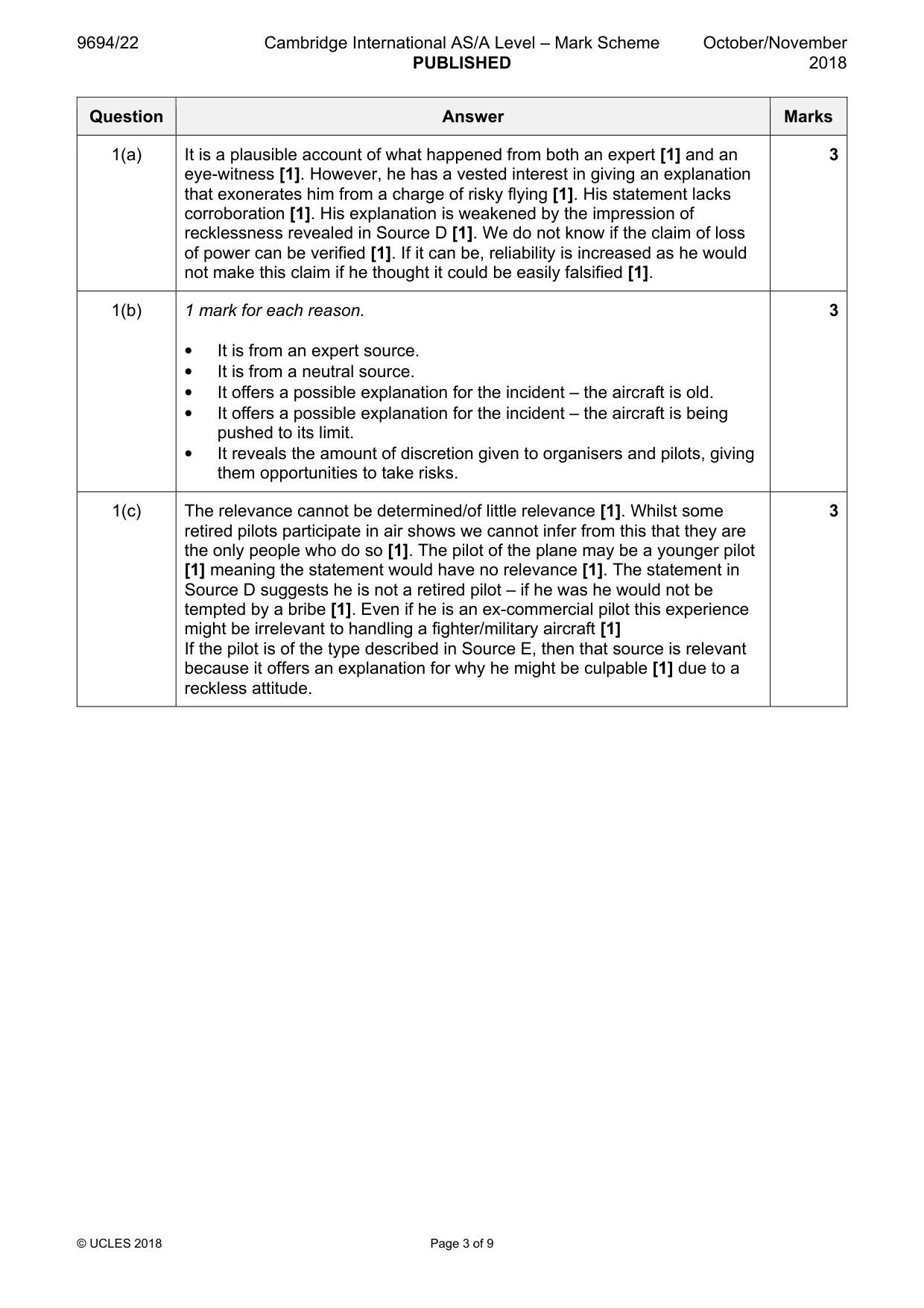
9694/22 Cambridge International AS/A Level – Mark Scheme PUBLISHED October/November 2018 © UCLES 2018 Page 3 of 9 Question Answer Marks 1(a) It is a plausible account of what happened from both an expert [1] and an eye-witness [1]. However, he has a vested interest in giving an explanation that exonerates him from a charge of risky flying [1]. His statement lacks corroboration [1]. His explanation is weakened by the impression of recklessness revealed in Source D [1]. We do not know if the claim of loss of power can be verified [1]. If it can be, reliability is increased as he would not make this claim if he thought it could be easily falsified [1]. 3 1(b) 1 mark for each reason. • It is from an expert source. • It is from a neutral source. • It offers a possible explanation for the incident – the aircraft is old. • It offers a possible explanation for the incident – the aircraft is being pushed to its limit. • It reveals the amount of discretion given to organisers and pilots, giving them opportunities to take risks. 3 1(c) The relevance cannot be determined/of little relevance [1]. Whilst some retired pilots participate in air shows we cannot infer from this that they are the only people who do so [1]. The pilot of the plane may be a younger pilot [1] meaning the statement would have no relevance [1]. The statement in Source D suggests he is not a retired pilot – if he was he would not be tempted by a bribe [1]. Even if he is an ex-commercial pilot this experience might be irrelevant to handling a fighter/military aircraft [1] If the pilot is of the type described in Source E, then that source is relevant because it offers an explanation for why he might be culpable [1] due to a reckless attitude. 3
Mark scheme, page 4
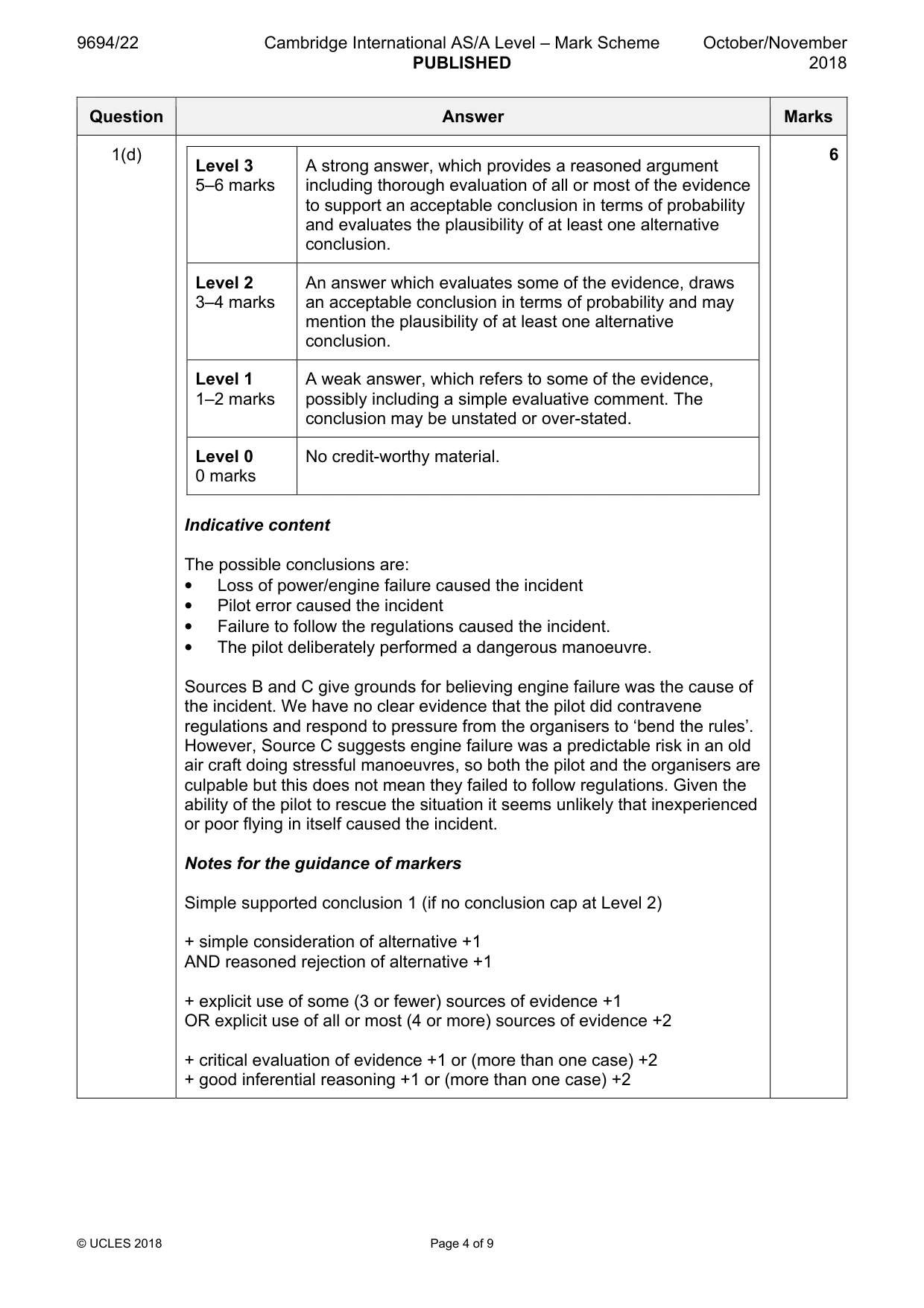
9694/22 Cambridge International AS/A Level – Mark Scheme PUBLISHED October/November 2018 © UCLES 2018 Page 4 of 9 Question Answer Marks 1(d) Level 3 5–6 marks A strong answer, which provides a reasoned argument including thorough evaluation of all or most of the evidence to support an acceptable conclusion in terms of probability and evaluates the plausibility of at least one alternative conclusion. Level 2 3–4 marks An answer which evaluates some of the evidence, draws an acceptable conclusion in terms of probability and may mention the plausibility of at least one alternative conclusion. Level 1 1–2 marks A weak answer, which refers to some of the evidence, possibly including a simple evaluative comment. The conclusion may be unstated or over-stated. Level 0 0 marks No credit-worthy material. Indicative content The possible conclusions are: • Loss of power/engine failure caused the incident • Pilot error caused the incident • Failure to follow the regulations caused the incident. • The pilot deliberately performed a dangerous manoeuvre. Sources B and C give grounds for believing engine failure was the cause of the incident. We have no clear evidence that the pilot did contravene regulations and respond to pressure from the organisers to ‘bend the rules’. However, Source C suggests engine failure was a predictable risk in an old air craft doing stressful manoeuvres, so both the pilot and the organisers are culpable but this does not mean they failed to follow regulations. Given the ability of the pilot to rescue the situation it seems unlikely that inexperienced or poor flying in itself caused the incident. Notes for the guidance of markers Simple supported conclusion 1 (if no conclusion cap at Level 2) + simple consideration of alternative +1 AND reasoned rejection of alternative +1 + explicit use of some (3 or fewer) sources of evidence +1 OR explicit use of all or most (4 or more) sources of evidence +2 + critical evaluation of evidence +1 or (more than one case) +2 + good inferential reasoning +1 or (more than one case) +2 6
Mark scheme, page 5
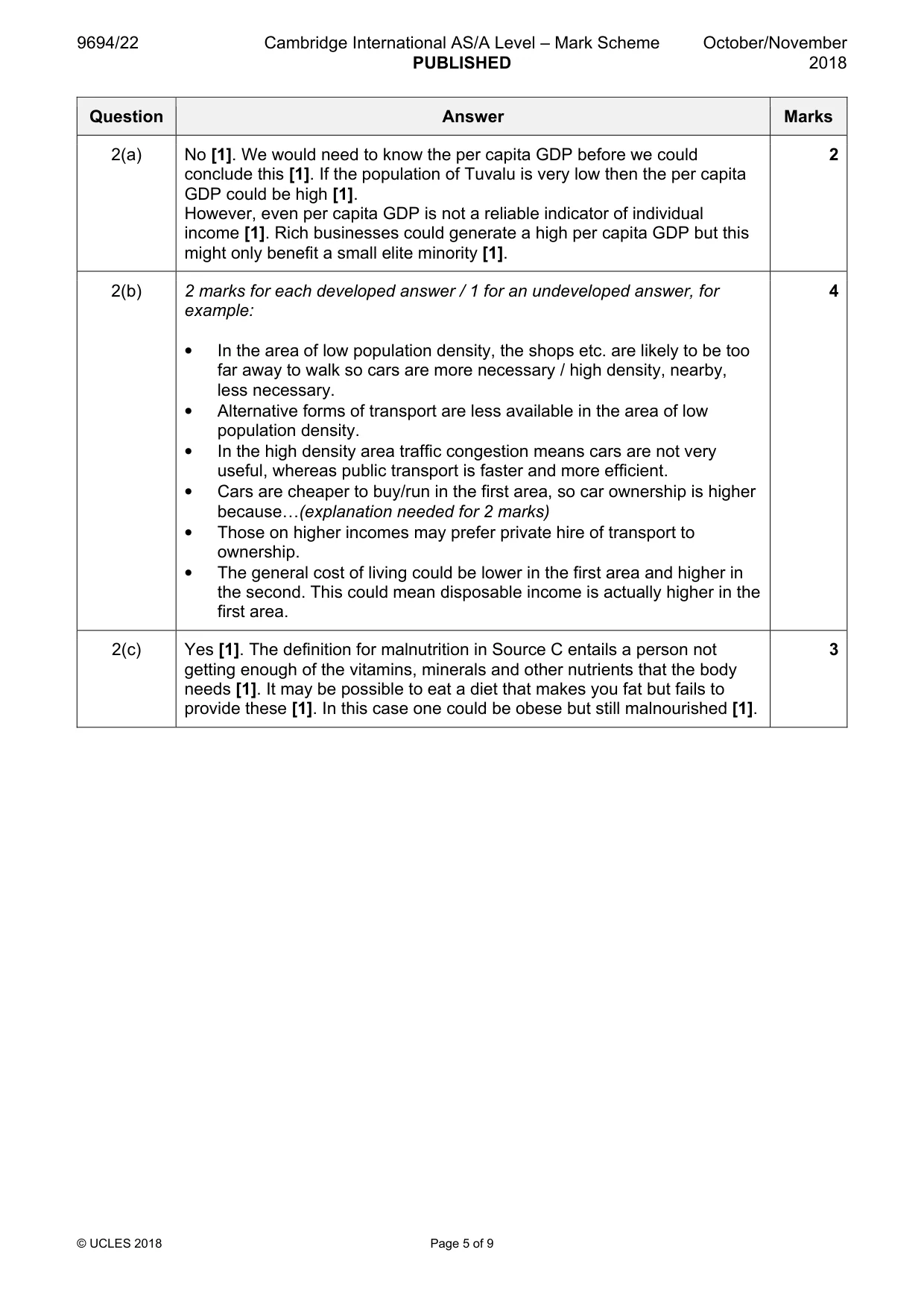
9694/22 Cambridge International AS/A Level – Mark Scheme PUBLISHED October/November 2018 © UCLES 2018 Page 5 of 9 Question Answer Marks 2(a) No [1]. We would need to know the per capita GDP before we could conclude this [1]. If the population of Tuvalu is very low then the per capita GDP could be high [1]. However, even per capita GDP is not a reliable indicator of individual income [1]. Rich businesses could generate a high per capita GDP but this might only benefit a small elite minority [1]. 2 2(b) 2 marks for each developed answer / 1 for an undeveloped answer, for example: • In the area of low population density, the shops etc. are likely to be too far away to walk so cars are more necessary / high density, nearby, less necessary. • Alternative forms of transport are less available in the area of low population density. • In the high density area traffic congestion means cars are not very useful, whereas public transport is faster and more efficient. • Cars are cheaper to buy/run in the first area, so car ownership is higher because«(explanation needed for 2 marks) • Those on higher incomes may prefer private hire of transport to ownership. • The general cost of living could be lower in the first area and higher in the second. This could mean disposable income is actually higher in the first area. 4 2(c) Yes [1]. The definition for malnutrition in Source C entails a person not getting enough of the vitamins, minerals and other nutrients that the body needs [1]. It may be possible to eat a diet that makes you fat but fails to provide these [1]. In this case one could be obese but still malnourished [1]. 3
Mark scheme, page 6
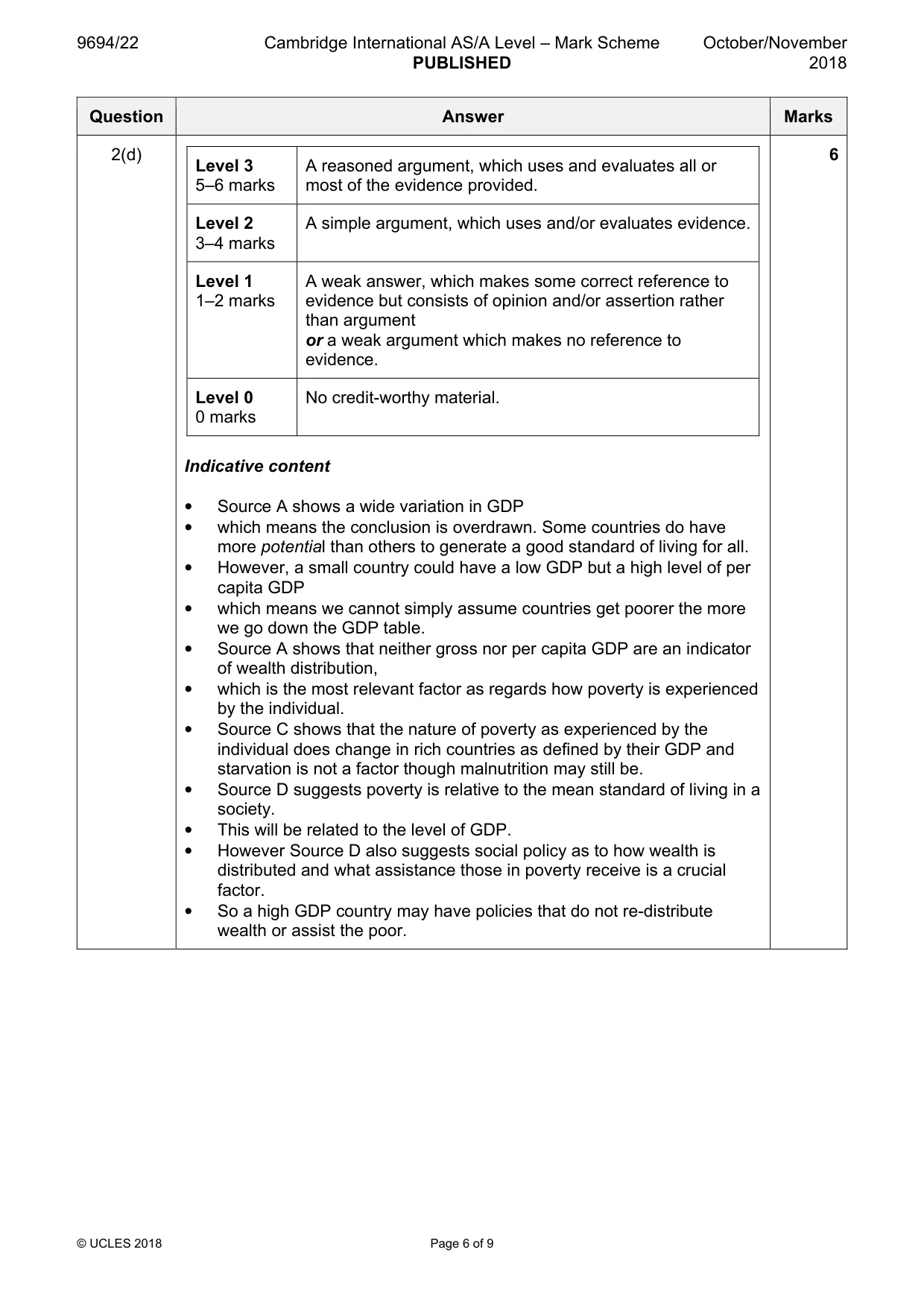
9694/22 Cambridge International AS/A Level – Mark Scheme PUBLISHED October/November 2018 © UCLES 2018 Page 6 of 9 Question Answer Marks 2(d) Level 3 5–6 marks A reasoned argument, which uses and evaluates all or most of the evidence provided. Level 2 3–4 marks A simple argument, which uses and/or evaluates evidence. Level 1 1–2 marks A weak answer, which makes some correct reference to evidence but consists of opinion and/or assertion rather than argument or a weak argument which makes no reference to evidence. Level 0 0 marks No credit-worthy material. Indicative content • Source A shows a wide variation in GDP • which means the conclusion is overdrawn. Some countries do have more potential than others to generate a good standard of living for all. • However, a small country could have a low GDP but a high level of per capita GDP • which means we cannot simply assume countries get poorer the more we go down the GDP table. • Source A shows that neither gross nor per capita GDP are an indicator of wealth distribution, • which is the most relevant factor as regards how poverty is experienced by the individual. • Source C shows that the nature of poverty as experienced by the individual does change in rich countries as defined by their GDP and starvation is not a factor though malnutrition may still be. • Source D suggests poverty is relative to the mean standard of living in a society. • This will be related to the level of GDP. • However Source D also suggests social policy as to how wealth is distributed and what assistance those in poverty receive is a crucial factor. • So a high GDP country may have policies that do not re-distribute wealth or assist the poor. 6
Mark scheme, page 7
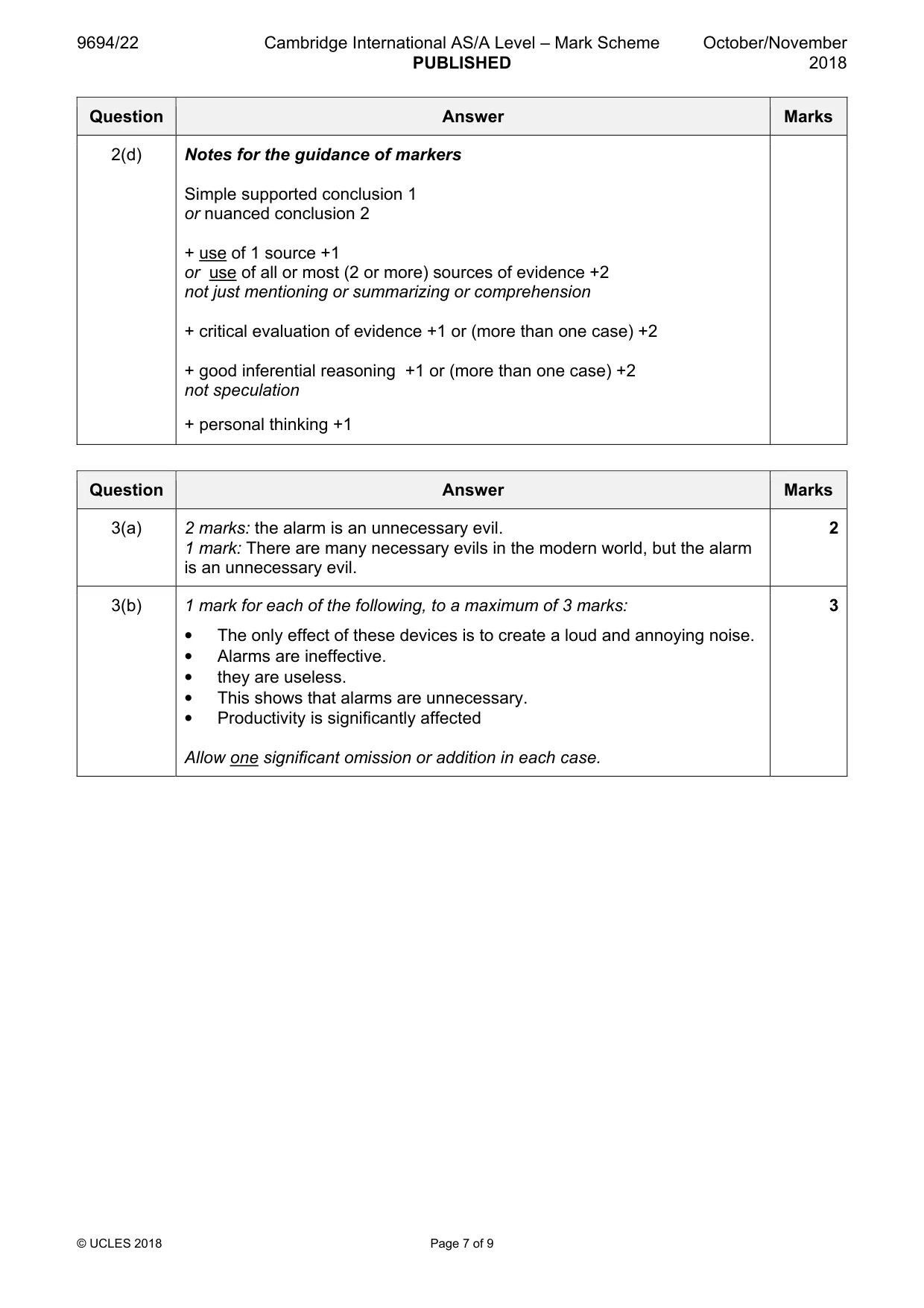
9694/22 Cambridge International AS/A Level – Mark Scheme PUBLISHED October/November 2018 © UCLES 2018 Page 7 of 9 Question Answer Marks 2(d) Notes for the guidance of markers Simple supported conclusion 1 or nuanced conclusion 2 + use of 1 source +1 or use of all or most (2 or more) sources of evidence +2 not just mentioning or summarizing or comprehension + critical evaluation of evidence +1 or (more than one case) +2 + good inferential reasoning +1 or (more than one case) +2 not speculation + personal thinking +1 Question Answer Marks 3(a) 2 marks: the alarm is an unnecessary evil. 1 mark: There are many necessary evils in the modern world, but the alarm is an unnecessary evil. 2 3(b) 1 mark for each of the following, to a maximum of 3 marks: • The only effect of these devices is to create a loud and annoying noise. • Alarms are ineffective. • they are useless. • This shows that alarms are unnecessary. • Productivity is significantly affected Allow one significant omission or addition in each case. 3
Mark scheme, page 8
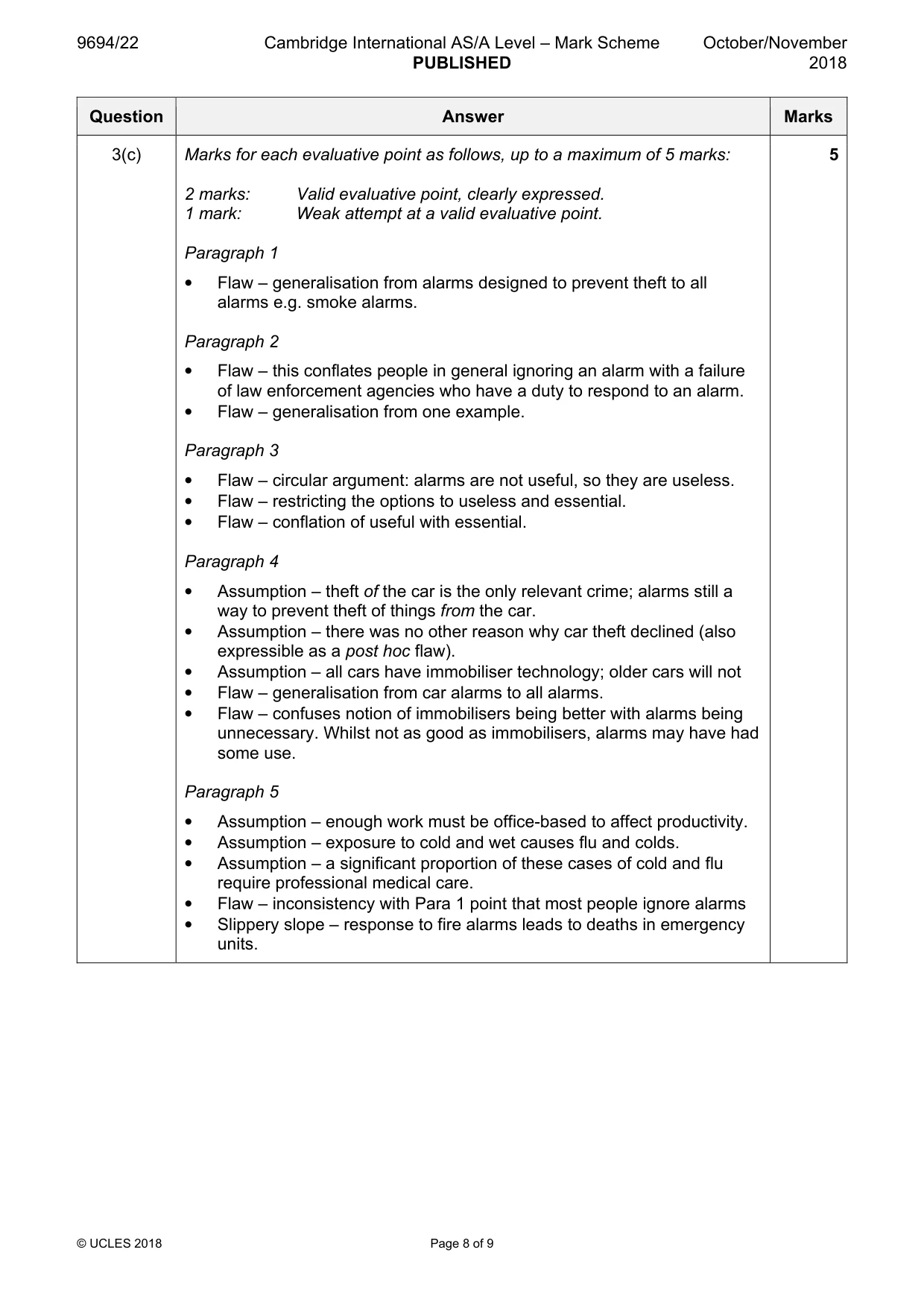
9694/22 Cambridge International AS/A Level – Mark Scheme PUBLISHED October/November 2018 © UCLES 2018 Page 8 of 9 Question Answer Marks 3(c) Marks for each evaluative point as follows, up to a maximum of 5 marks: 2 marks: Valid evaluative point, clearly expressed. 1 mark: Weak attempt at a valid evaluative point. Paragraph 1 • Flaw – generalisation from alarms designed to prevent theft to all alarms e.g. smoke alarms. Paragraph 2 • Flaw – this conflates people in general ignoring an alarm with a failure of law enforcement agencies who have a duty to respond to an alarm. • Flaw – generalisation from one example. Paragraph 3 • Flaw – circular argument: alarms are not useful, so they are useless. • Flaw – restricting the options to useless and essential. • Flaw – conflation of useful with essential. Paragraph 4 • Assumption – theft of the car is the only relevant crime; alarms still a way to prevent theft of things from the car. • Assumption – there was no other reason why car theft declined (also expressible as a post hoc flaw). • Assumption – all cars have immobiliser technology; older cars will not • Flaw – generalisation from car alarms to all alarms. • Flaw – confuses notion of immobilisers being better with alarms being unnecessary. Whilst not as good as immobilisers, alarms may have had some use. Paragraph 5 • Assumption – enough work must be office-based to affect productivity. • Assumption – exposure to cold and wet causes flu and colds. • Assumption – a significant proportion of these cases of cold and flu require professional medical care. • Flaw – inconsistency with Para 1 point that most people ignore alarms • Slippery slope – response to fire alarms leads to deaths in emergency units. 5
Mark scheme, page 9
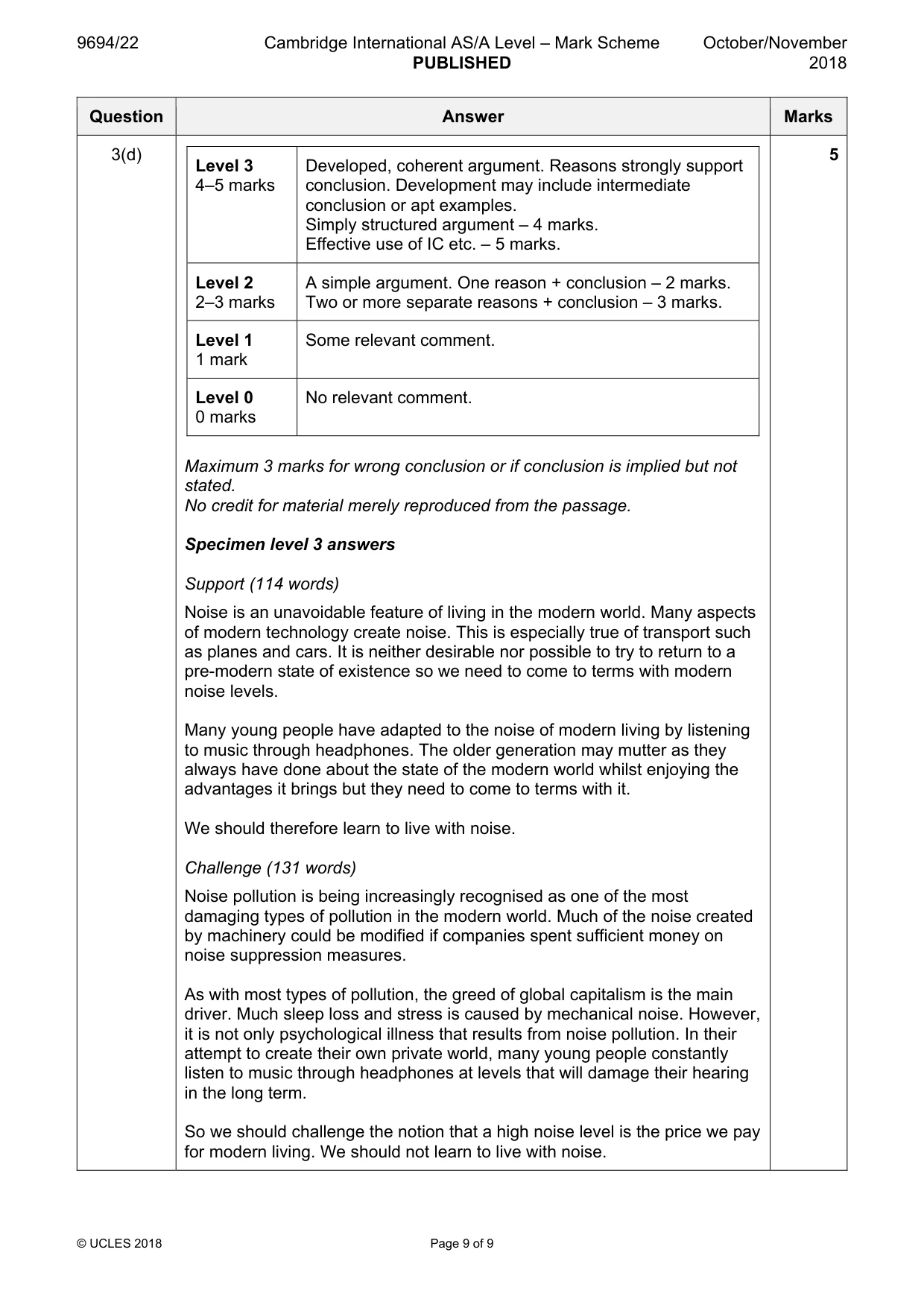
9694/22 Cambridge International AS/A Level – Mark Scheme PUBLISHED October/November 2018 © UCLES 2018 Page 9 of 9 Question Answer Marks 3(d) Level 3 4–5 marks Developed, coherent argument. Reasons strongly support conclusion. Development may include intermediate conclusion or apt examples. Simply structured argument – 4 marks. Effective use of IC etc. – 5 marks. Level 2 2–3 marks A simple argument. One reason + conclusion – 2 marks. Two or more separate reasons + conclusion – 3 marks. Level 1 1 mark Some relevant comment. Level 0 0 marks No relevant comment. Maximum 3 marks for wrong conclusion or if conclusion is implied but not stated. No credit for material merely reproduced from the passage. Specimen level 3 answers Support (114 words) Noise is an unavoidable feature of living in the modern world. Many aspects of modern technology create noise. This is especially true of transport such as planes and cars. It is neither desirable nor possible to try to return to a pre-modern state of existence so we need to come to terms with modern noise levels. Many young people have adapted to the noise of modern living by listening to music through headphones. The older generation may mutter as they always have done about the state of the modern world whilst enjoying the advantages it brings but they need to come to terms with it. We should therefore learn to live with noise. Challenge (131 words) Noise pollution is being increasingly recognised as one of the most damaging types of pollution in the modern world. Much of the noise created by machinery could be modified if companies spent sufficient money on noise suppression measures. As with most types of pollution, the greed of global capitalism is the main driver. Much sleep loss and stress is caused by mechanical noise. However, it is not only psychological illness that results from noise pollution. In their attempt to create their own private world, many young people constantly listen to music through headphones at levels that will damage their hearing in the long term. So we should challenge the notion that a high noise level is the price we pay for modern living. We should not learn to live with noise. 5
What you needed in this session
Cambridge’s own grade thresholds for 2018 Oct/Nov, Paper 2 · Variant 2. A higher threshold means an easier paper — the bar moves with how the cohort did.