Cambridge A Level Thinking Skills 9694 — 2018 May/June Paper 2 · Variant 1
9694/21/M/J/18 · 45 marks · ≈51 min
The question paper and its mark scheme, free to read here and free to download. This is Cambridge’s own paper, exactly as it was sat.
Question paper8 pages


Mark scheme12 pages
Answers below. Sit the paper first if you are practising.
Paper as text
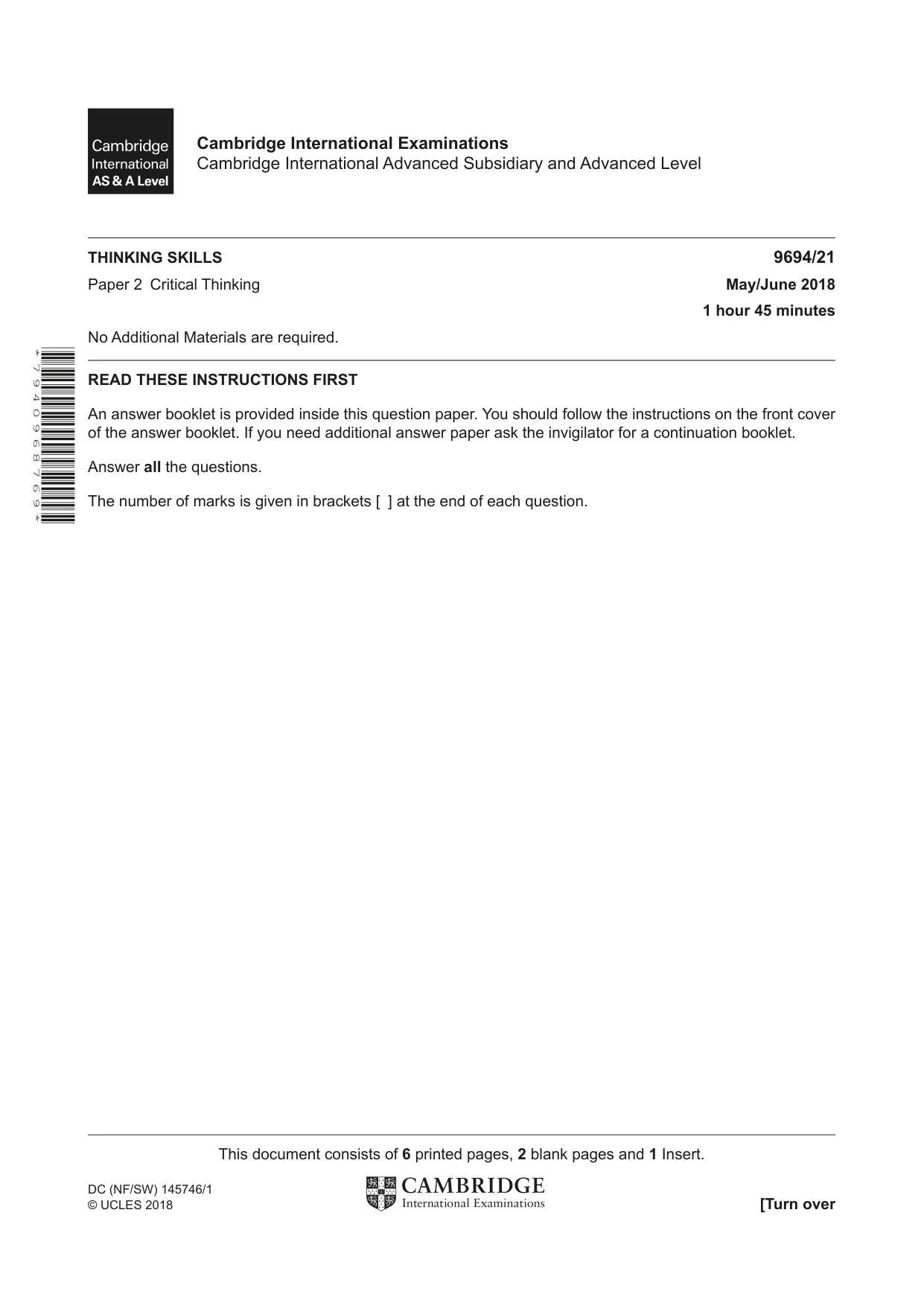
Question paper, page 1
* 7 9 4 0 9 6 8 7 6 9 * This document consists of 6 printed pages, 2 blank pages and 1 Insert. DC (NF/SW) 145746/1 © UCLES 2018 [Turn over Cambridge International Examinations Cambridge International Advanced Subsidiary and Advanced Level THINKING SKILLS 9694/21 Paper 2 Critical Thinking May/June 2018 1 hour 45 minutes No Additional Materials are required. READ THESE INSTRUCTIONS FIRST An answer booklet is provided inside this question paper. You should follow the instructions on the front cover of the answer booklet. If you need additional answer paper ask the invigilator for a continuation booklet. Answer all the questions. The number of marks is given in brackets [ ] at the end of each question.
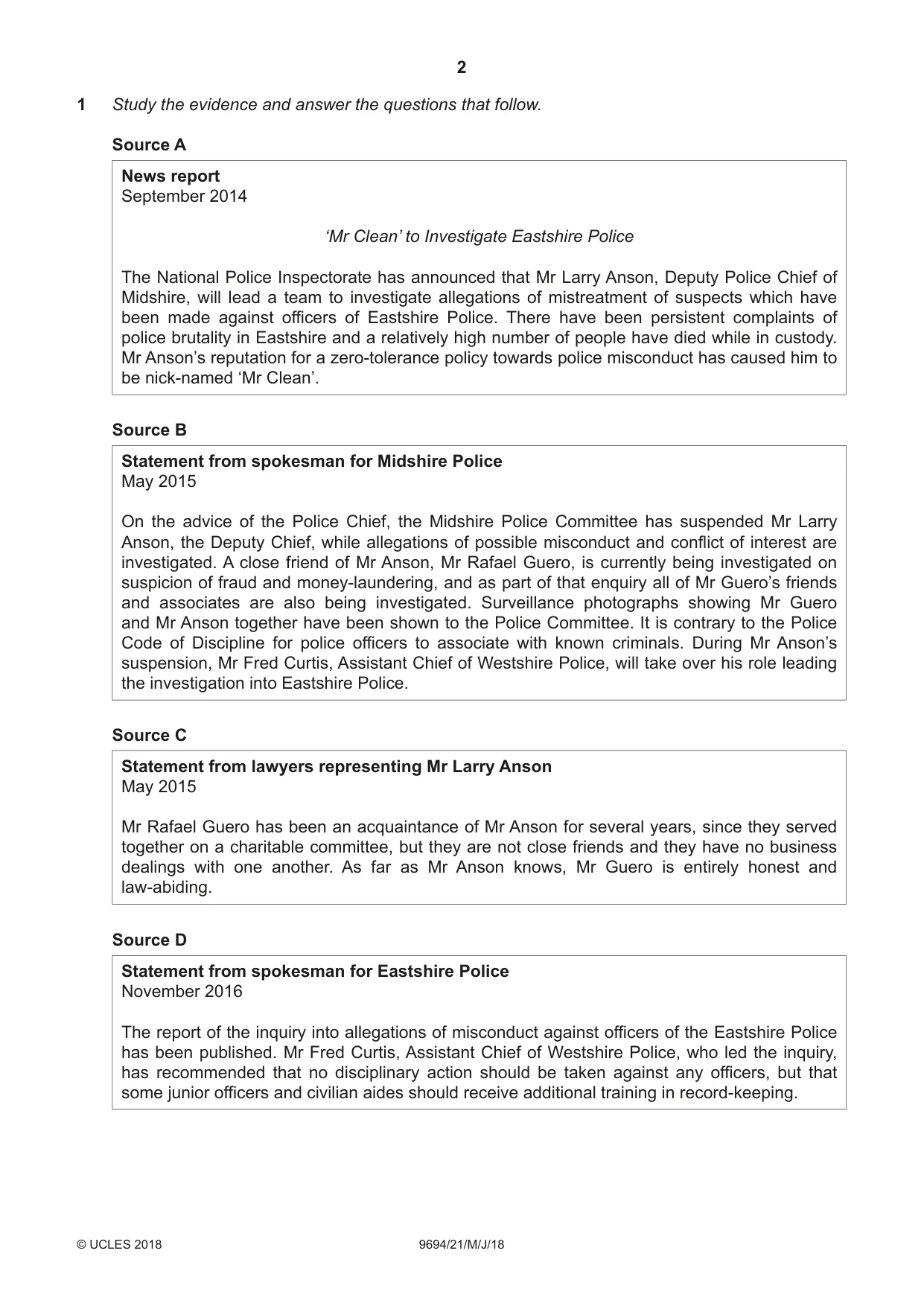
Question paper, page 2
2 9694/21/M/J/18 © UCLES 2018 1 Study the evidence and answer the questions that follow. Source A News report September 2014 ‘Mr Clean’ to Investigate Eastshire Police The National Police Inspectorate has announced that Mr Larry Anson, Deputy Police Chief of Midshire, will lead a team to investigate allegations of mistreatment of suspects which have been made against officers of Eastshire Police. There have been persistent complaints of police brutality in Eastshire and a relatively high number of people have died while in custody. Mr Anson’s reputation for a zero-tolerance policy towards police misconduct has caused him to be nick-named ‘Mr Clean’. Source B Statement from spokesman for Midshire Police May 2015 On the advice of the Police Chief, the Midshire Police Committee has suspended Mr Larry Anson, the Deputy Chief, while allegations of possible misconduct and conflict of interest are investigated. A close friend of Mr Anson, Mr Rafael Guero, is currently being investigated on suspicion of fraud and money-laundering, and as part of that enquiry all of Mr Guero’s friends and associates are also being investigated. Surveillance photographs showing Mr Guero and Mr Anson together have been shown to the Police Committee. It is contrary to the Police Code of Discipline for police officers to associate with known criminals. During Mr Anson’s suspension, Mr Fred Curtis, Assistant Chief of Westshire Police, will take over his role leading the investigation into Eastshire Police. Source C Statement from lawyers representing Mr Larry Anson May 2015 Mr Rafael Guero has been an acquaintance of Mr Anson for several years, since they served together on a charitable committee, but they are not close friends and they have no business dealings with one another. As far as Mr Anson knows, Mr Guero is entirely honest and law-abiding. Source D Statement from spokesman for Eastshire Police November 2016 The report of the inquiry into allegations of misconduct against officers of the Eastshire Police has been published. Mr Fred Curtis, Assistant Chief of Westshire Police, who led the inquiry, has recommended that no disciplinary action should be taken against any officers, but that some junior officers and civilian aides should receive additional training in record-keeping.
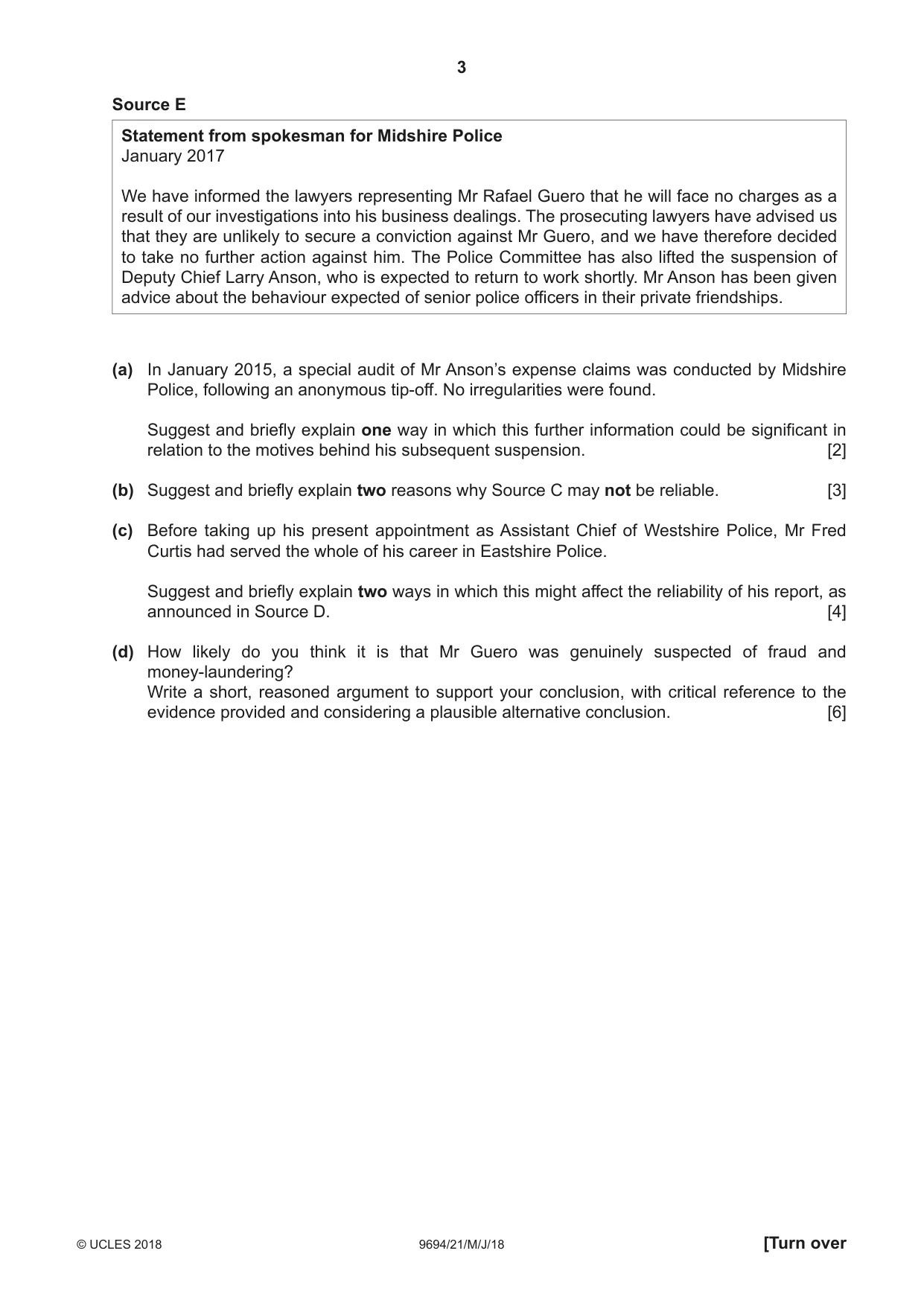
Question paper, page 3
3 9694/21/M/J/18 © UCLES 2018 [Turn over Source E Statement from spokesman for Midshire Police January 2017 We have informed the lawyers representing Mr Rafael Guero that he will face no charges as a result of our investigations into his business dealings. The prosecuting lawyers have advised us that they are unlikely to secure a conviction against Mr Guero, and we have therefore decided to take no further action against him. The Police Committee has also lifted the suspension of Deputy Chief Larry Anson, who is expected to return to work shortly. Mr Anson has been given advice about the behaviour expected of senior police officers in their private friendships. (a) In January 2015, a special audit of Mr Anson’s expense claims was conducted by Midshire Police, following an anonymous tip-off. No irregularities were found. Suggest and briefly explain one way in which this further information could be significant in relation to the motives behind his subsequent suspension. [2] (b) Suggest and briefly explain two reasons why Source C may not be reliable. [3] (c) Before taking up his present appointment as Assistant Chief of Westshire Police, Mr Fred Curtis had served the whole of his career in Eastshire Police. Suggest and briefly explain two ways in which this might affect the reliability of his report, as announced in Source D. [4] (d) How likely do you think it is that Mr Guero was genuinely suspected of fraud and money-laundering? Write a short, reasoned argument to support your conclusion, with critical reference to the evidence provided and considering a plausible alternative conclusion. [6]
Question paper, page 4
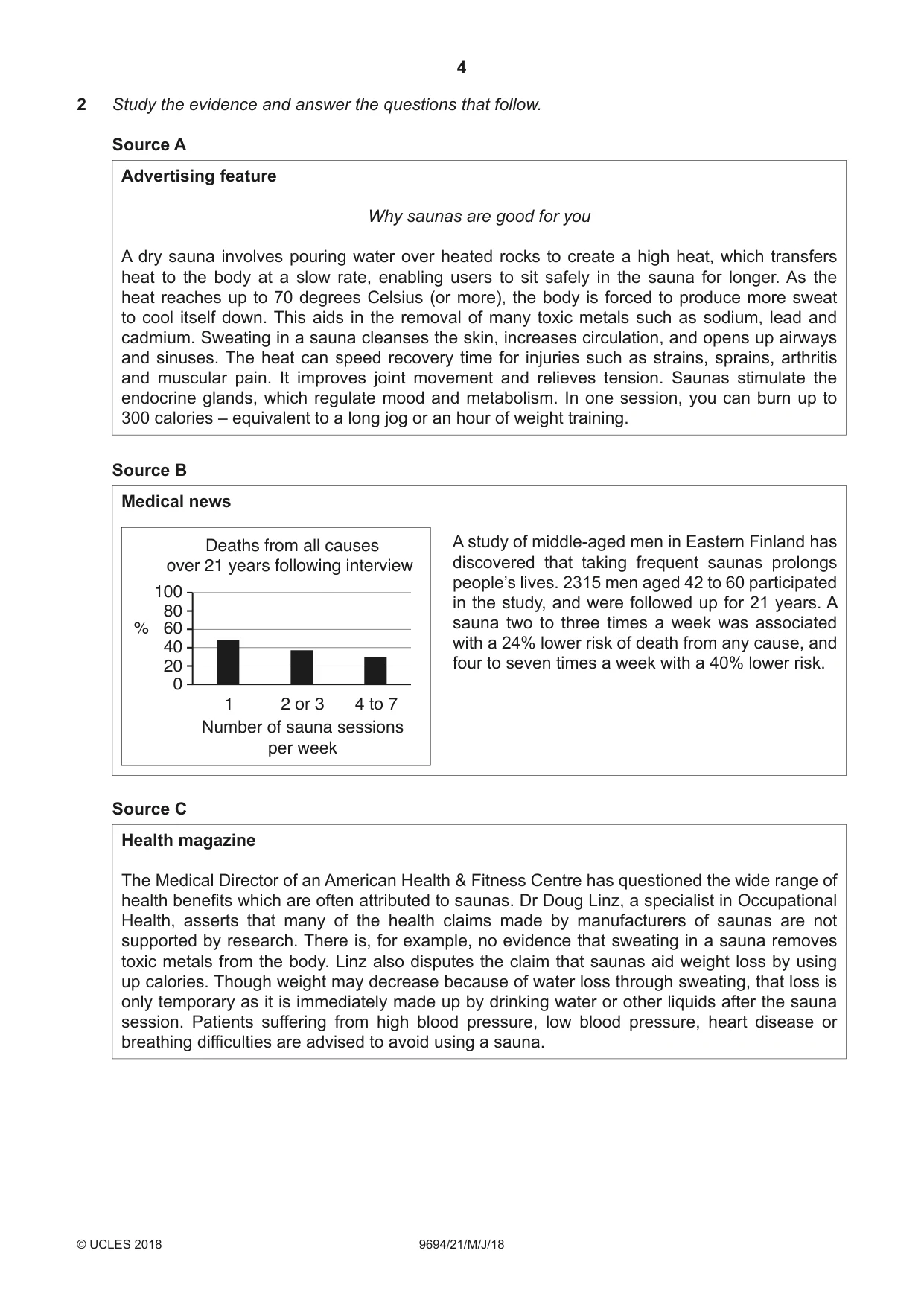
4 9694/21/M/J/18 © UCLES 2018 2 Study the evidence and answer the questions that follow. Source A Advertising feature Why saunas are good for you A dry sauna involves pouring water over heated rocks to create a high heat, which transfers heat to the body at a slow rate, enabling users to sit safely in the sauna for longer. As the heat reaches up to 70 degrees Celsius (or more), the body is forced to produce more sweat to cool itself down. This aids in the removal of many toxic metals such as sodium, lead and cadmium. Sweating in a sauna cleanses the skin, increases circulation, and opens up airways and sinuses. The heat can speed recovery time for injuries such as strains, sprains, arthritis and muscular pain. It improves joint movement and relieves tension. Saunas stimulate the endocrine glands, which regulate mood and metabolism. In one session, you can burn up to 300 calories – equivalent to a long jog or an hour of weight training. Source B Medical news 100 80 60 % 40 1 20 0 2 or 3 Number of sauna sessions per week Deaths from all causes over 21 years following interview 4 to 7 A study of middle-aged men in Eastern Finland has discovered that taking frequent saunas prolongs people’s lives. 2315 men aged 42 to 60 participated in the study, and were followed up for 21 years. A sauna two to three times a week was associated with a 24% lower risk of death from any cause, and four to seven times a week with a 40% lower risk. Source C Health magazine The Medical Director of an American Health & Fitness Centre has questioned the wide range of health benefits which are often attributed to saunas. Dr Doug Linz, a specialist in Occupational Health, asserts that many of the health claims made by manufacturers of saunas are not supported by research. There is, for example, no evidence that sweating in a sauna removes toxic metals from the body. Linz also disputes the claim that saunas aid weight loss by using up calories. Though weight may decrease because of water loss through sweating, that loss is only temporary as it is immediately made up by drinking water or other liquids after the sauna session. Patients suffering from high blood pressure, low blood pressure, heart disease or breathing difficulties are advised to avoid using a sauna.
Question paper, page 5
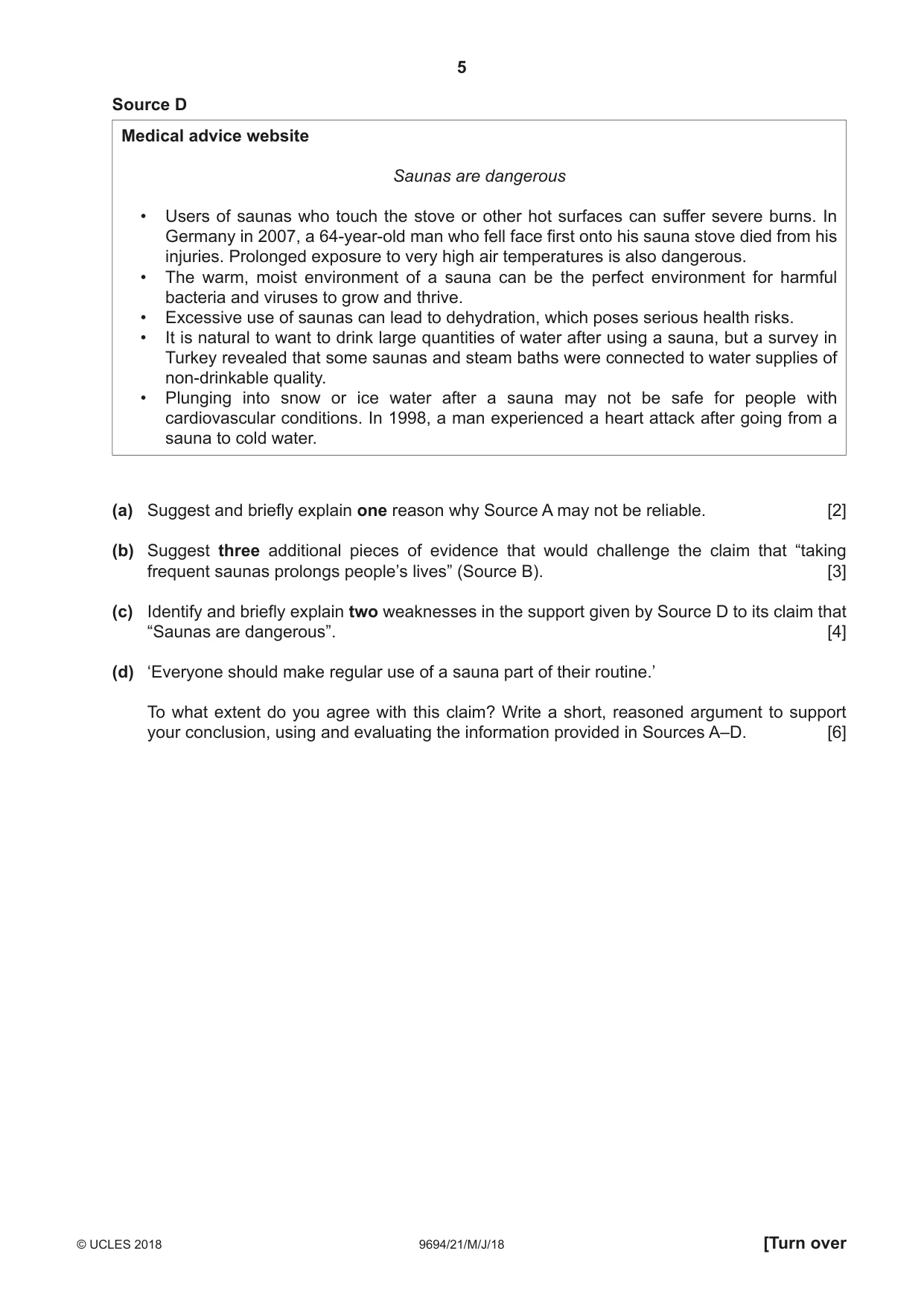
5 9694/21/M/J/18 © UCLES 2018 [Turn over Source D Medical advice website Saunas are dangerous • Users of saunas who touch the stove or other hot surfaces can suffer severe burns. In Germany in 2007, a 64-year-old man who fell face first onto his sauna stove died from his injuries. Prolonged exposure to very high air temperatures is also dangerous. • The warm, moist environment of a sauna can be the perfect environment for harmful bacteria and viruses to grow and thrive. • Excessive use of saunas can lead to dehydration, which poses serious health risks. • It is natural to want to drink large quantities of water after using a sauna, but a survey in Turkey revealed that some saunas and steam baths were connected to water supplies of non-drinkable quality. • Plunging into snow or ice water after a sauna may not be safe for people with cardiovascular conditions. In 1998, a man experienced a heart attack after going from a sauna to cold water. (a) Suggest and briefly explain one reason why Source A may not be reliable. [2] (b) Suggest three additional pieces of evidence that would challenge the claim that “taking frequent saunas prolongs people’s lives” (Source B). [3] (c) Identify and briefly explain two weaknesses in the support given by Source D to its claim that “Saunas are dangerous”. [4] (d) ‘Everyone should make regular use of a sauna part of their routine.’ To what extent do you agree with this claim? Write a short, reasoned argument to support your conclusion, using and evaluating the information provided in Sources A–D. [6]
Question paper, page 6
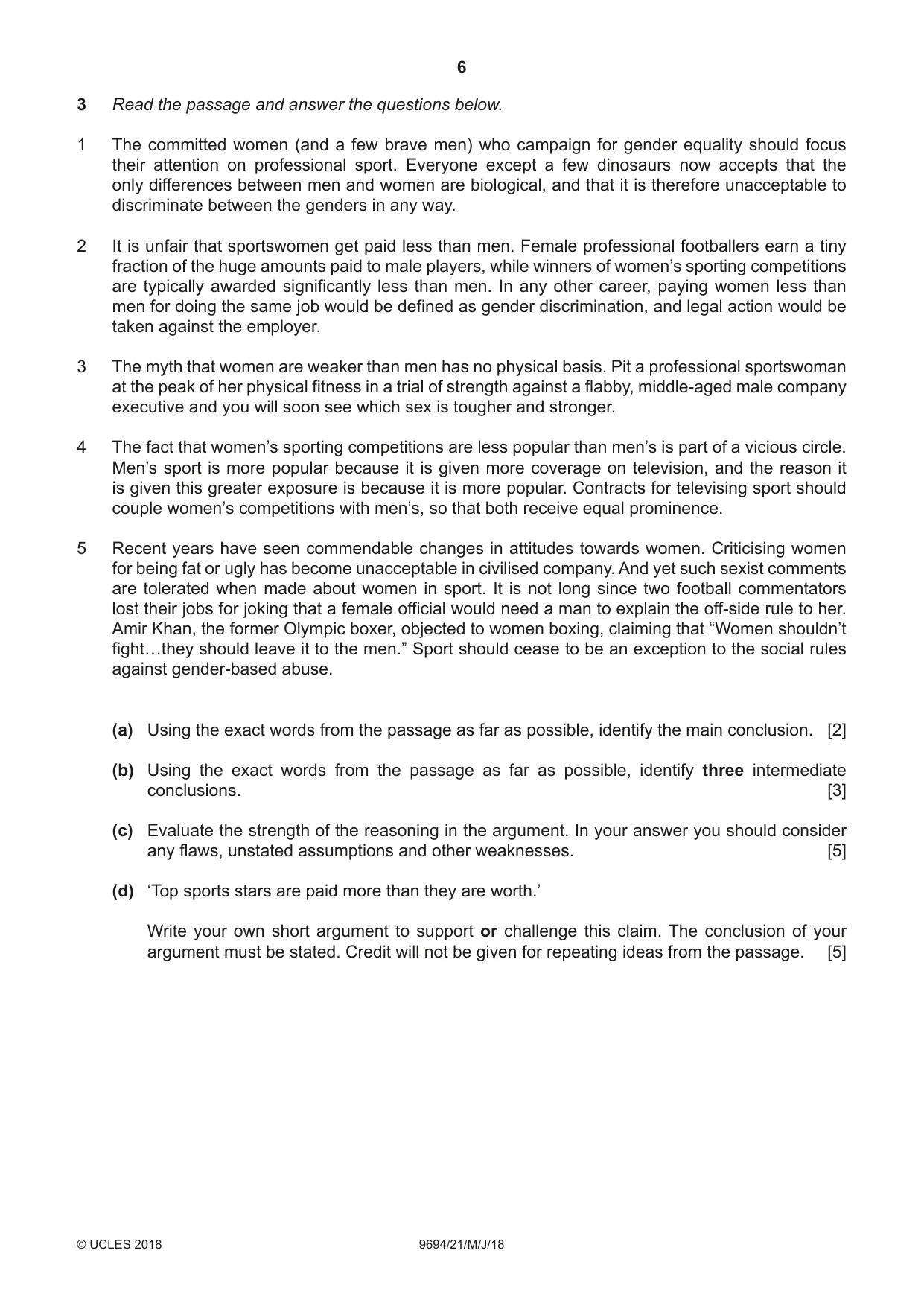
6 9694/21/M/J/18 © UCLES 2018 3 Read the passage and answer the questions below. 1 The committed women (and a few brave men) who campaign for gender equality should focus their attention on professional sport. Everyone except a few dinosaurs now accepts that the only differences between men and women are biological, and that it is therefore unacceptable to discriminate between the genders in any way. 2 It is unfair that sportswomen get paid less than men. Female professional footballers earn a tiny fraction of the huge amounts paid to male players, while winners of women’s sporting competitions are typically awarded significantly less than men. In any other career, paying women less than men for doing the same job would be defined as gender discrimination, and legal action would be taken against the employer. 3 The myth that women are weaker than men has no physical basis. Pit a professional sportswoman at the peak of her physical fitness in a trial of strength against a flabby, middle-aged male company executive and you will soon see which sex is tougher and stronger. 4 The fact that women’s sporting competitions are less popular than men’s is part of a vicious circle. Men’s sport is more popular because it is given more coverage on television, and the reason it is given this greater exposure is because it is more popular. Contracts for televising sport should couple women’s competitions with men’s, so that both receive equal prominence. 5 Recent years have seen commendable changes in attitudes towards women. Criticising women for being fat or ugly has become unacceptable in civilised company. And yet such sexist comments are tolerated when made about women in sport. It is not long since two football commentators lost their jobs for joking that a female official would need a man to explain the off-side rule to her. Amir Khan, the former Olympic boxer, objected to women boxing, claiming that “Women shouldn’t fight…they should leave it to the men.” Sport should cease to be an exception to the social rules against gender-based abuse. (a) Using the exact words from the passage as far as possible, identify the main conclusion. [2] (b) Using the exact words from the passage as far as possible, identify three intermediate conclusions. [3] (c) Evaluate the strength of the reasoning in the argument. In your answer you should consider any flaws, unstated assumptions and other weaknesses. [5] (d) ‘Top sports stars are paid more than they are worth.’ Write your own short argument to support or challenge this claim. The conclusion of your argument must be stated. Credit will not be given for repeating ideas from the passage. [5]
Question paper, page 7
7 9694/21/M/J/18 © UCLES 2018 BLANK PAGE
Question paper, page 8
8 9694/21/M/J/18 © UCLES 2018 BLANK PAGE Permission to reproduce items where third-party owned material protected by copyright is included has been sought and cleared where possible. Every reasonable effort has been made by the publisher (UCLES) to trace copyright holders, but if any items requiring clearance have unwittingly been included, the publisher will be pleased to make amends at the earliest possible opportunity. To avoid the issue of disclosure of answer-related information to candidates, all copyright acknowledgements are reproduced online in the Cambridge International Examinations Copyright Acknowledgements Booklet. This is produced for each series of examinations and is freely available to download at www.cie.org.uk after the live examination series. Cambridge International Examinations is part of the Cambridge Assessment Group. Cambridge Assessment is the brand name of University of Cambridge Local Examinations Syndicate (UCLES), which is itself a department of the University of Cambridge.
Mark scheme, page 1
IGCSE™ is a registered trademark. This document consists of 12 printed pages. © UCLES 2018 [Turn over Cambridge Assessment International Education Cambridge International Advanced Subsidiary and Advanced Level THINKING SKILLS 9694/21 Paper 2 Critical Thinking May/June 2018 MARK SCHEME Maximum Mark: 45 Published This mark scheme is published as an aid to teachers and candidates, to indicate the requirements of the examination. It shows the basis on which Examiners were instructed to award marks. It does not indicate the details of the discussions that took place at an Examiners’ meeting before marking began, which would have considered the acceptability of alternative answers. Mark schemes should be read in conjunction with the question paper and the Principal Examiner Report for Teachers. Cambridge International will not enter into discussions about these mark schemes. Cambridge International is publishing the mark schemes for the May/June 2018 series for most Cambridge IGCSE™, Cambridge International A and AS Level and Cambridge Pre-U components, and some Cambridge O Level components.
Mark scheme, page 2
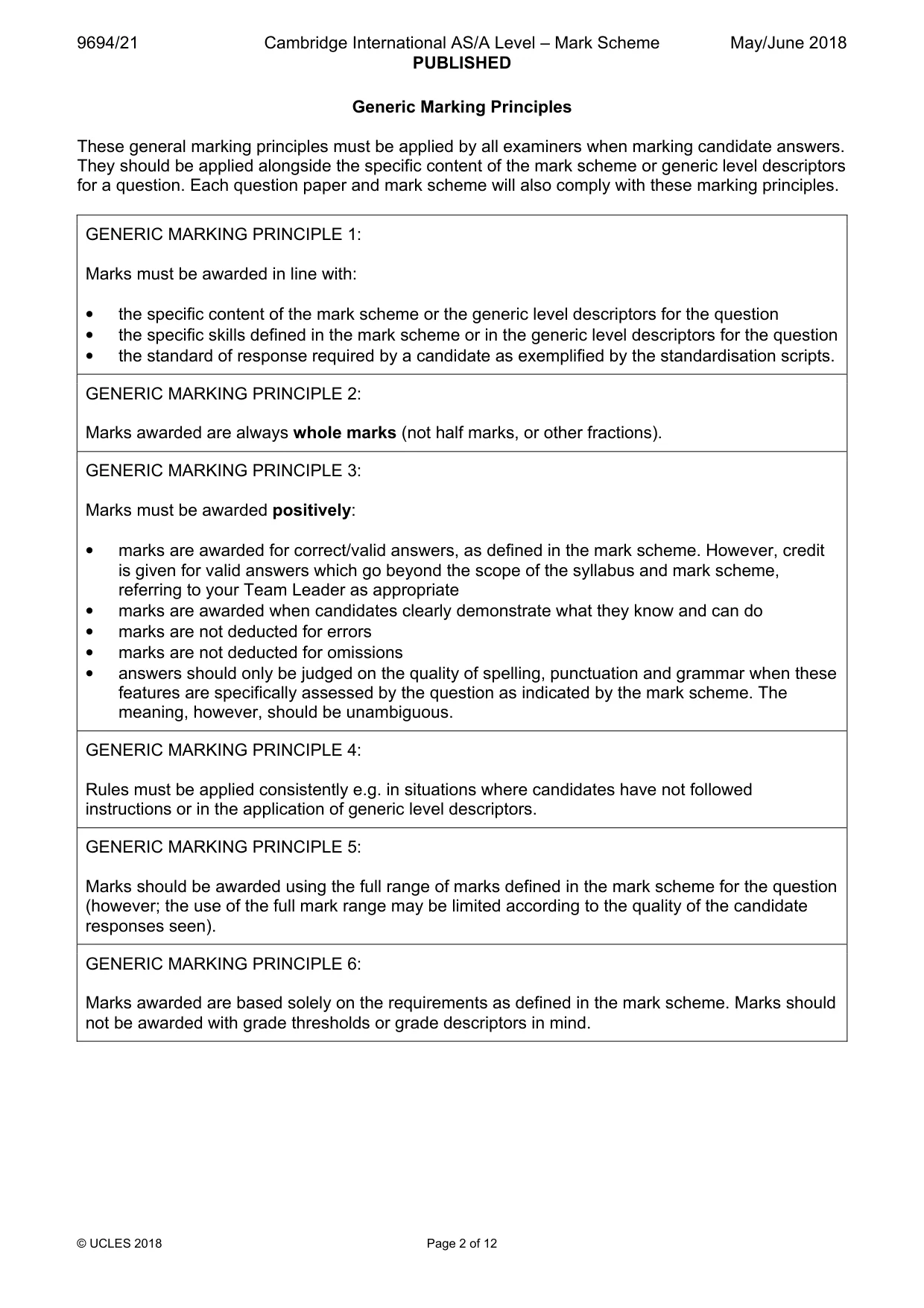
9694/21 Cambridge International AS/A Level – Mark Scheme PUBLISHED May/June 2018 © UCLES 2018 Page 2 of 12 Generic Marking Principles These general marking principles must be applied by all examiners when marking candidate answers. They should be applied alongside the specific content of the mark scheme or generic level descriptors for a question. Each question paper and mark scheme will also comply with these marking principles. GENERIC MARKING PRINCIPLE 1: Marks must be awarded in line with: • the specific content of the mark scheme or the generic level descriptors for the question • the specific skills defined in the mark scheme or in the generic level descriptors for the question • the standard of response required by a candidate as exemplified by the standardisation scripts. GENERIC MARKING PRINCIPLE 2: Marks awarded are always whole marks (not half marks, or other fractions). GENERIC MARKING PRINCIPLE 3: Marks must be awarded positively: • marks are awarded for correct/valid answers, as defined in the mark scheme. However, credit is given for valid answers which go beyond the scope of the syllabus and mark scheme, referring to your Team Leader as appropriate • marks are awarded when candidates clearly demonstrate what they know and can do • marks are not deducted for errors • marks are not deducted for omissions • answers should only be judged on the quality of spelling, punctuation and grammar when these features are specifically assessed by the question as indicated by the mark scheme. The meaning, however, should be unambiguous. GENERIC MARKING PRINCIPLE 4: Rules must be applied consistently e.g. in situations where candidates have not followed instructions or in the application of generic level descriptors. GENERIC MARKING PRINCIPLE 5: Marks should be awarded using the full range of marks defined in the mark scheme for the question (however; the use of the full mark range may be limited according to the quality of the candidate responses seen). GENERIC MARKING PRINCIPLE 6: Marks awarded are based solely on the requirements as defined in the mark scheme. Marks should not be awarded with grade thresholds or grade descriptors in mind.
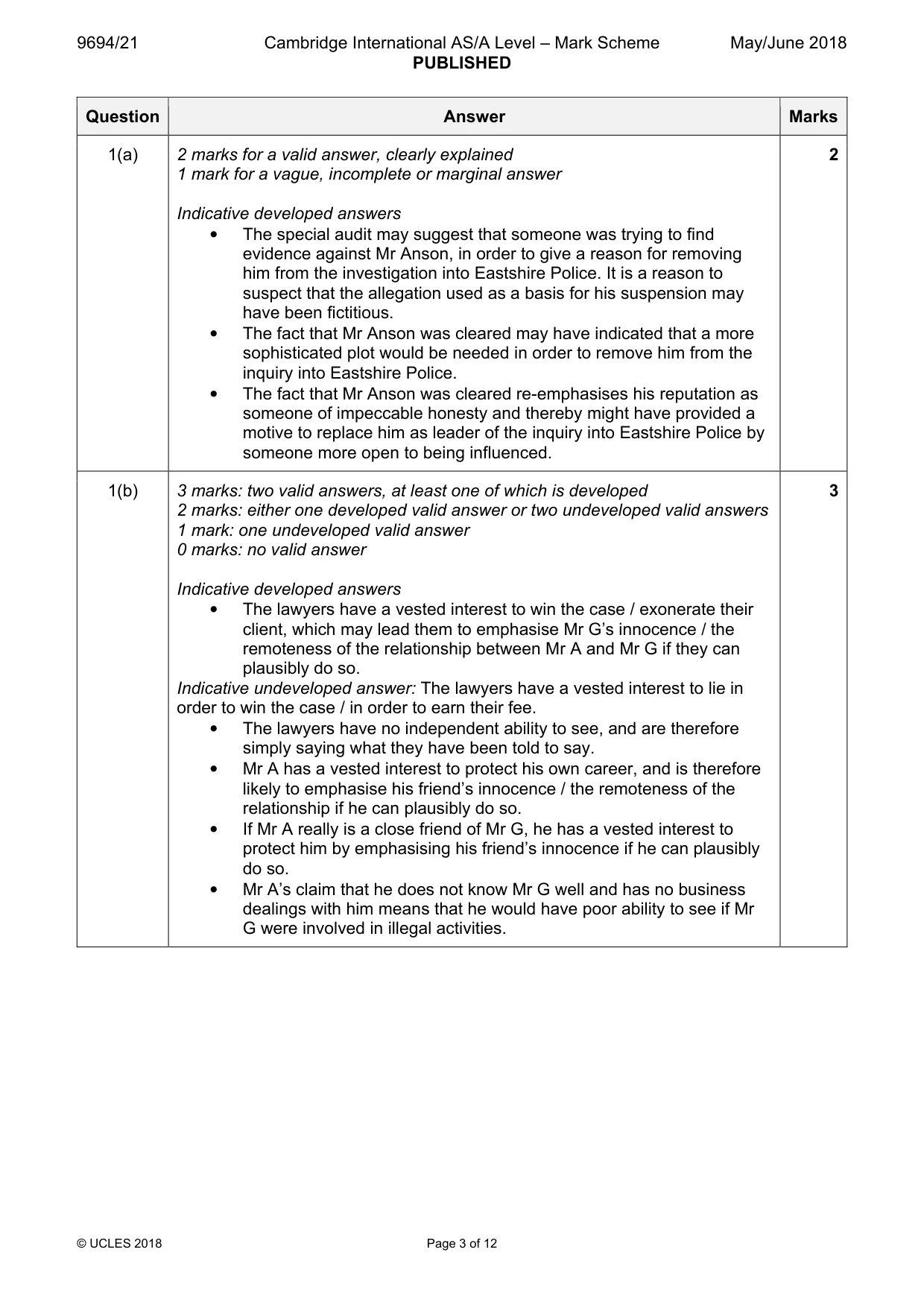
Mark scheme, page 3
9694/21 Cambridge International AS/A Level – Mark Scheme PUBLISHED May/June 2018 © UCLES 2018 Page 3 of 12 Question Answer Marks 1(a) 2 marks for a valid answer, clearly explained 1 mark for a vague, incomplete or marginal answer Indicative developed answers • The special audit may suggest that someone was trying to find evidence against Mr Anson, in order to give a reason for removing him from the investigation into Eastshire Police. It is a reason to suspect that the allegation used as a basis for his suspension may have been fictitious. • The fact that Mr Anson was cleared may have indicated that a more sophisticated plot would be needed in order to remove him from the inquiry into Eastshire Police. • The fact that Mr Anson was cleared re-emphasises his reputation as someone of impeccable honesty and thereby might have provided a motive to replace him as leader of the inquiry into Eastshire Police by someone more open to being influenced. 2 1(b) 3 marks: two valid answers, at least one of which is developed 2 marks: either one developed valid answer or two undeveloped valid answers 1 mark: one undeveloped valid answer 0 marks: no valid answer Indicative developed answers • The lawyers have a vested interest to win the case / exonerate their client, which may lead them to emphasise Mr G’s innocence / the remoteness of the relationship between Mr A and Mr G if they can plausibly do so. Indicative undeveloped answer: The lawyers have a vested interest to lie in order to win the case / in order to earn their fee. • The lawyers have no independent ability to see, and are therefore simply saying what they have been told to say. • Mr A has a vested interest to protect his own career, and is therefore likely to emphasise his friend’s innocence / the remoteness of the relationship if he can plausibly do so. • If Mr A really is a close friend of Mr G, he has a vested interest to protect him by emphasising his friend’s innocence if he can plausibly do so. • Mr A’s claim that he does not know Mr G well and has no business dealings with him means that he would have poor ability to see if Mr G were involved in illegal activities. 3
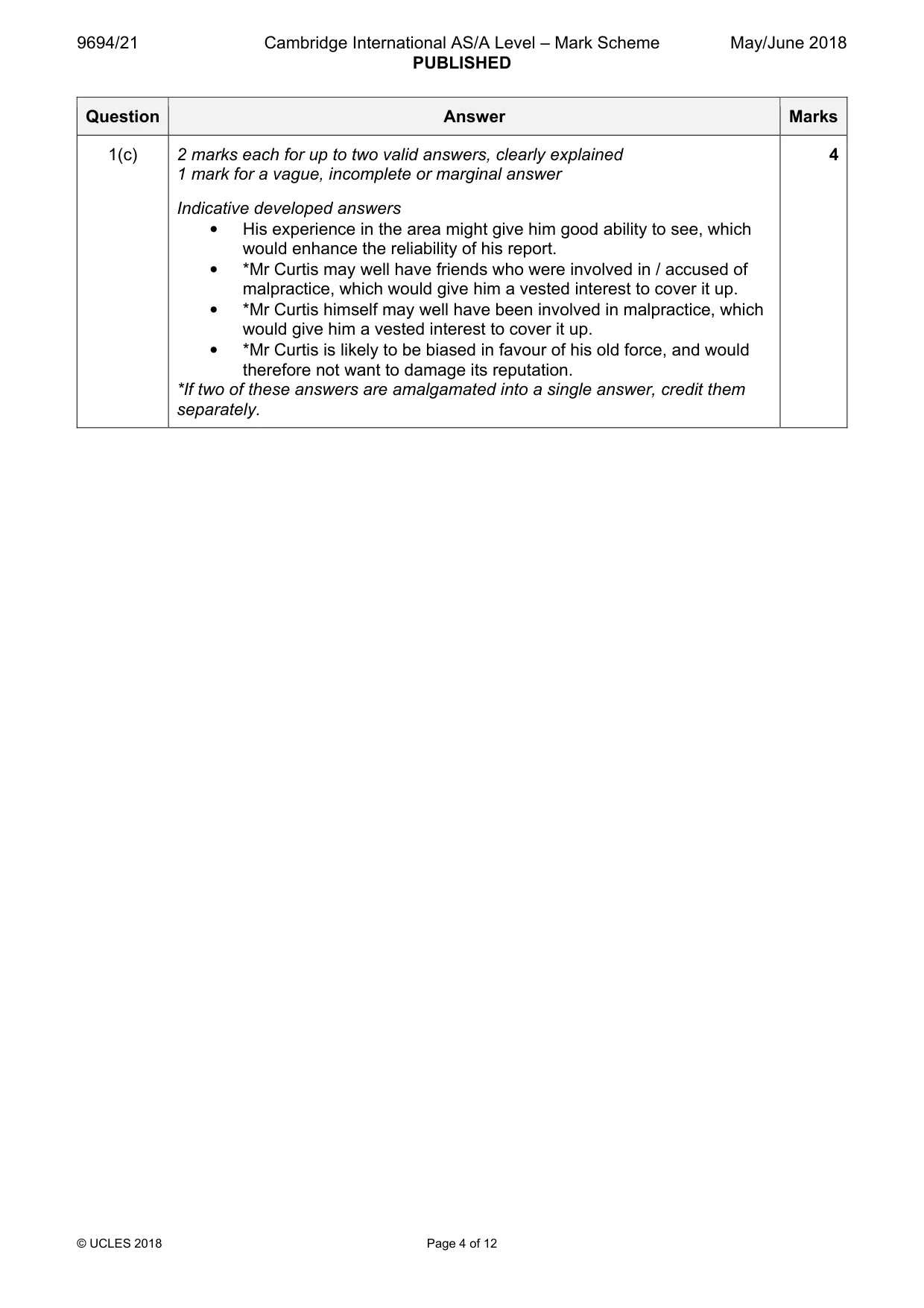
Mark scheme, page 4
9694/21 Cambridge International AS/A Level – Mark Scheme PUBLISHED May/June 2018 © UCLES 2018 Page 4 of 12 Question Answer Marks 1(c) 2 marks each for up to two valid answers, clearly explained 1 mark for a vague, incomplete or marginal answer Indicative developed answers • His experience in the area might give him good ability to see, which would enhance the reliability of his report. • *Mr Curtis may well have friends who were involved in / accused of malpractice, which would give him a vested interest to cover it up. • *Mr Curtis himself may well have been involved in malpractice, which would give him a vested interest to cover it up. • *Mr Curtis is likely to be biased in favour of his old force, and would therefore not want to damage its reputation. *If two of these answers are amalgamated into a single answer, credit them separately. 4
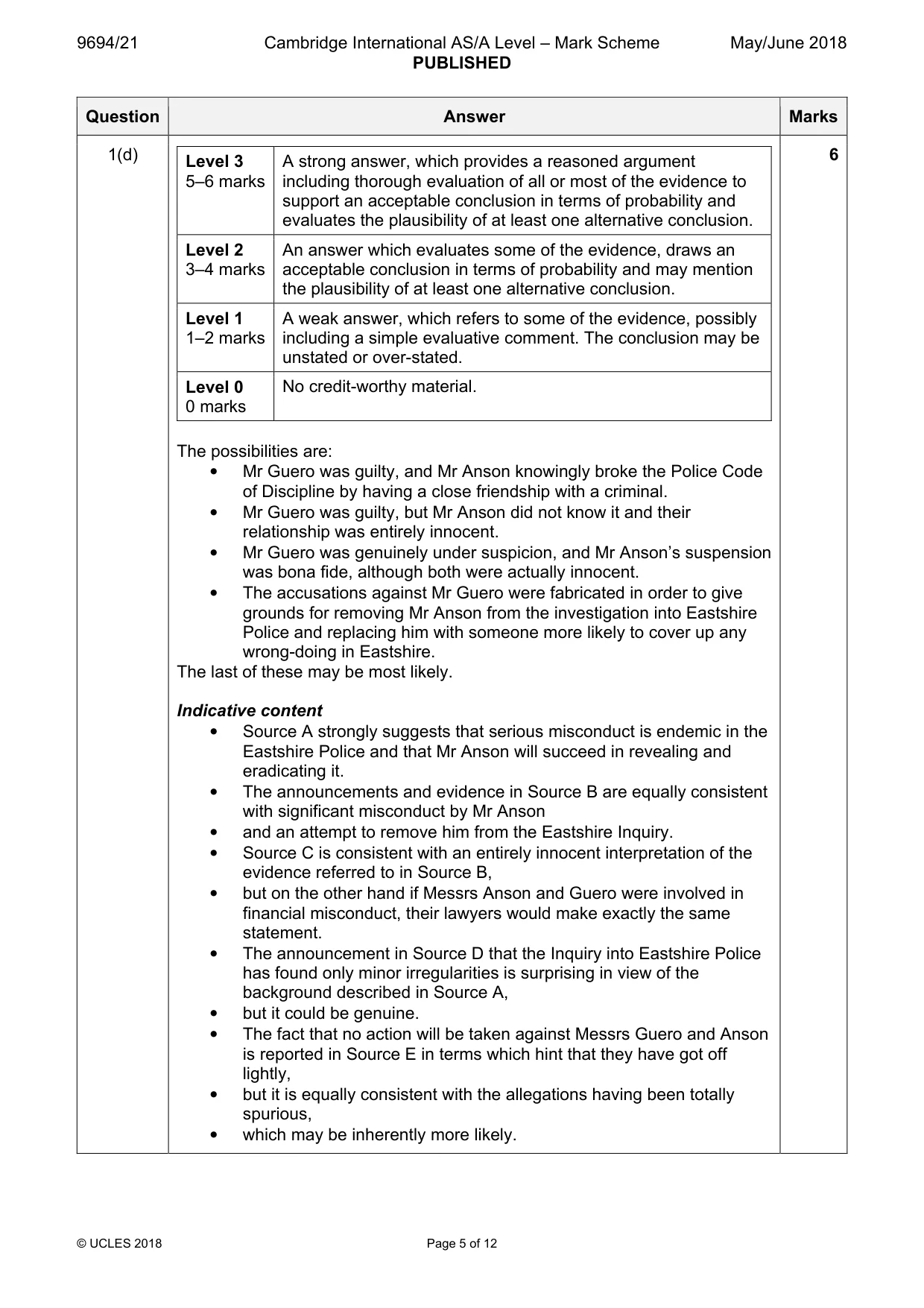
Mark scheme, page 5
9694/21 Cambridge International AS/A Level – Mark Scheme PUBLISHED May/June 2018 © UCLES 2018 Page 5 of 12 Question Answer Marks 1(d) Level 3 5–6 marks A strong answer, which provides a reasoned argument including thorough evaluation of all or most of the evidence to support an acceptable conclusion in terms of probability and evaluates the plausibility of at least one alternative conclusion. Level 2 3–4 marks An answer which evaluates some of the evidence, draws an acceptable conclusion in terms of probability and may mention the plausibility of at least one alternative conclusion. Level 1 1–2 marks A weak answer, which refers to some of the evidence, possibly including a simple evaluative comment. The conclusion may be unstated or over-stated. Level 0 0 marks No credit-worthy material. The possibilities are: • Mr Guero was guilty, and Mr Anson knowingly broke the Police Code of Discipline by having a close friendship with a criminal. • Mr Guero was guilty, but Mr Anson did not know it and their relationship was entirely innocent. • Mr Guero was genuinely under suspicion, and Mr Anson’s suspension was bona fide, although both were actually innocent. • The accusations against Mr Guero were fabricated in order to give grounds for removing Mr Anson from the investigation into Eastshire Police and replacing him with someone more likely to cover up any wrong-doing in Eastshire. The last of these may be most likely. Indicative content • Source A strongly suggests that serious misconduct is endemic in the Eastshire Police and that Mr Anson will succeed in revealing and eradicating it. • The announcements and evidence in Source B are equally consistent with significant misconduct by Mr Anson • and an attempt to remove him from the Eastshire Inquiry. • Source C is consistent with an entirely innocent interpretation of the evidence referred to in Source B, • but on the other hand if Messrs Anson and Guero were involved in financial misconduct, their lawyers would make exactly the same statement. • The announcement in Source D that the Inquiry into Eastshire Police has found only minor irregularities is surprising in view of the background described in Source A, • but it could be genuine. • The fact that no action will be taken against Messrs Guero and Anson is reported in Source E in terms which hint that they have got off lightly, • but it is equally consistent with the allegations having been totally spurious, • which may be inherently more likely. 6
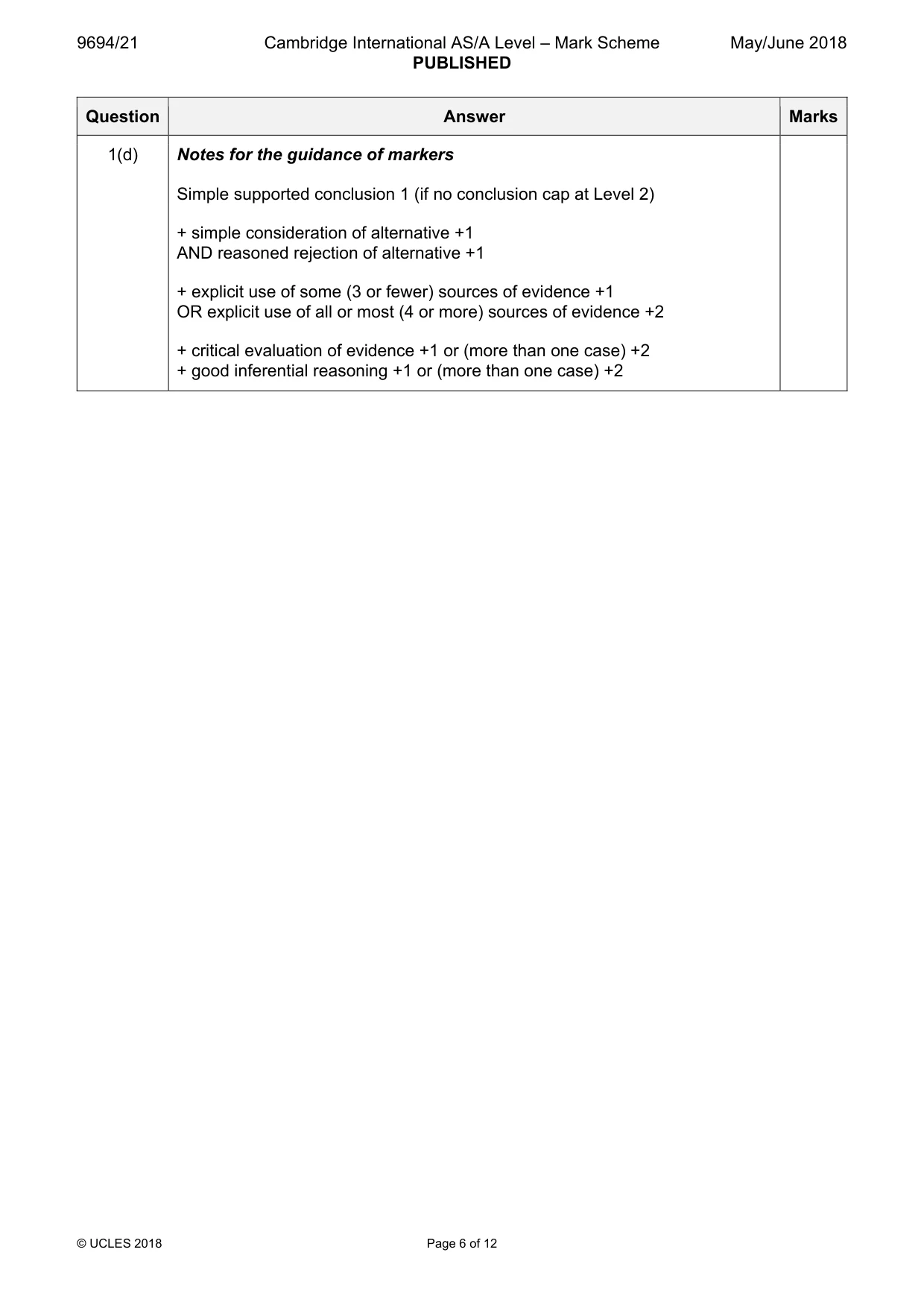
Mark scheme, page 6
9694/21 Cambridge International AS/A Level – Mark Scheme PUBLISHED May/June 2018 © UCLES 2018 Page 6 of 12 Question Answer Marks 1(d) Notes for the guidance of markers Simple supported conclusion 1 (if no conclusion cap at Level 2) + simple consideration of alternative +1 AND reasoned rejection of alternative +1 + explicit use of some (3 or fewer) sources of evidence +1 OR explicit use of all or most (4 or more) sources of evidence +2 + critical evaluation of evidence +1 or (more than one case) +2 + good inferential reasoning +1 or (more than one case) +2
Mark scheme, page 7
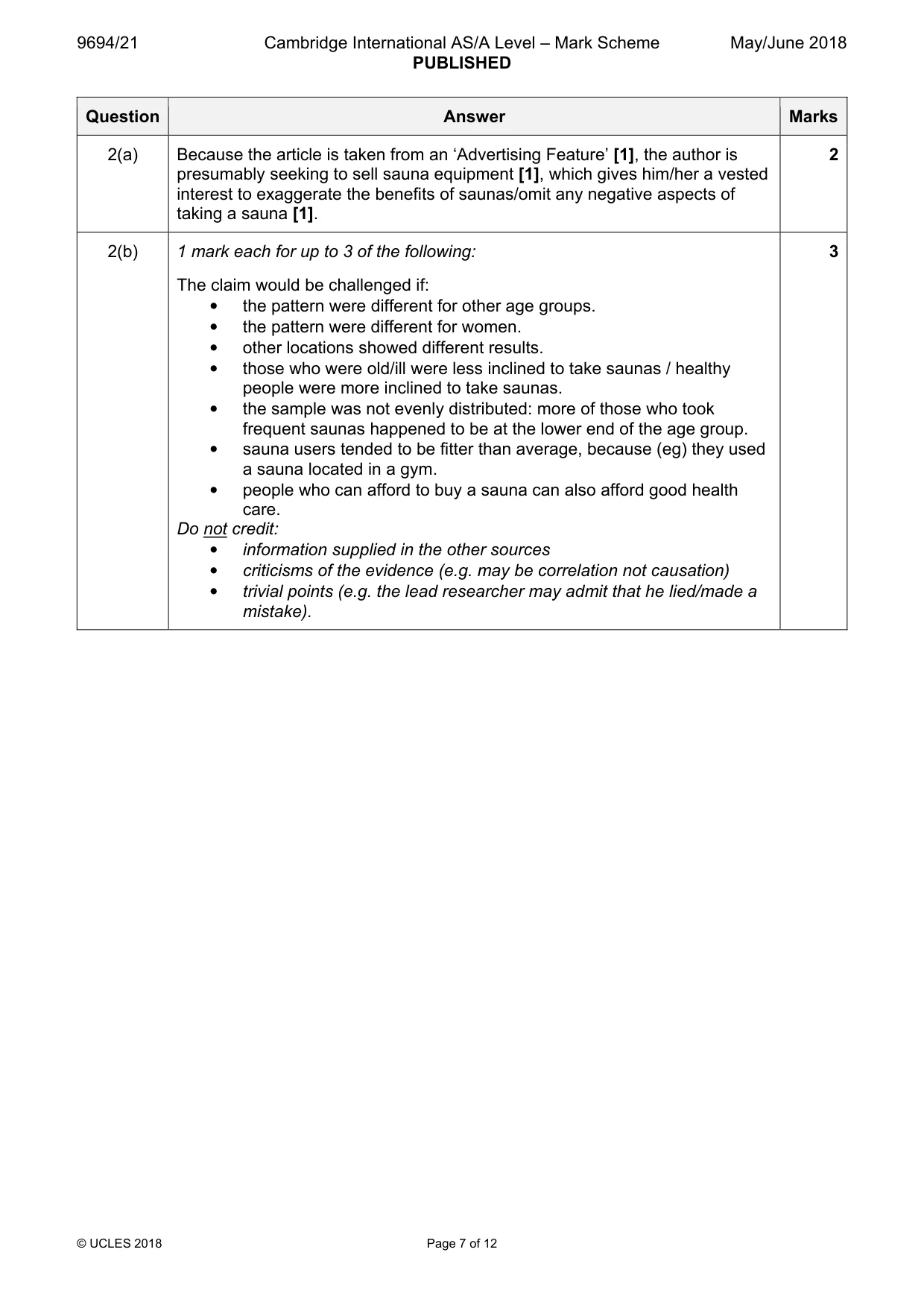
9694/21 Cambridge International AS/A Level – Mark Scheme PUBLISHED May/June 2018 © UCLES 2018 Page 7 of 12 Question Answer Marks 2(a) Because the article is taken from an ‘Advertising Feature’ [1], the author is presumably seeking to sell sauna equipment [1], which gives him/her a vested interest to exaggerate the benefits of saunas/omit any negative aspects of taking a sauna [1]. 2 2(b) 1 mark each for up to 3 of the following: The claim would be challenged if: • the pattern were different for other age groups. • the pattern were different for women. • other locations showed different results. • those who were old/ill were less inclined to take saunas / healthy people were more inclined to take saunas. • the sample was not evenly distributed: more of those who took frequent saunas happened to be at the lower end of the age group. • sauna users tended to be fitter than average, because (eg) they used a sauna located in a gym. • people who can afford to buy a sauna can also afford good health care. Do not credit: • information supplied in the other sources • criticisms of the evidence (e.g. may be correlation not causation) • trivial points (e.g. the lead researcher may admit that he lied/made a mistake). 3
Mark scheme, page 8
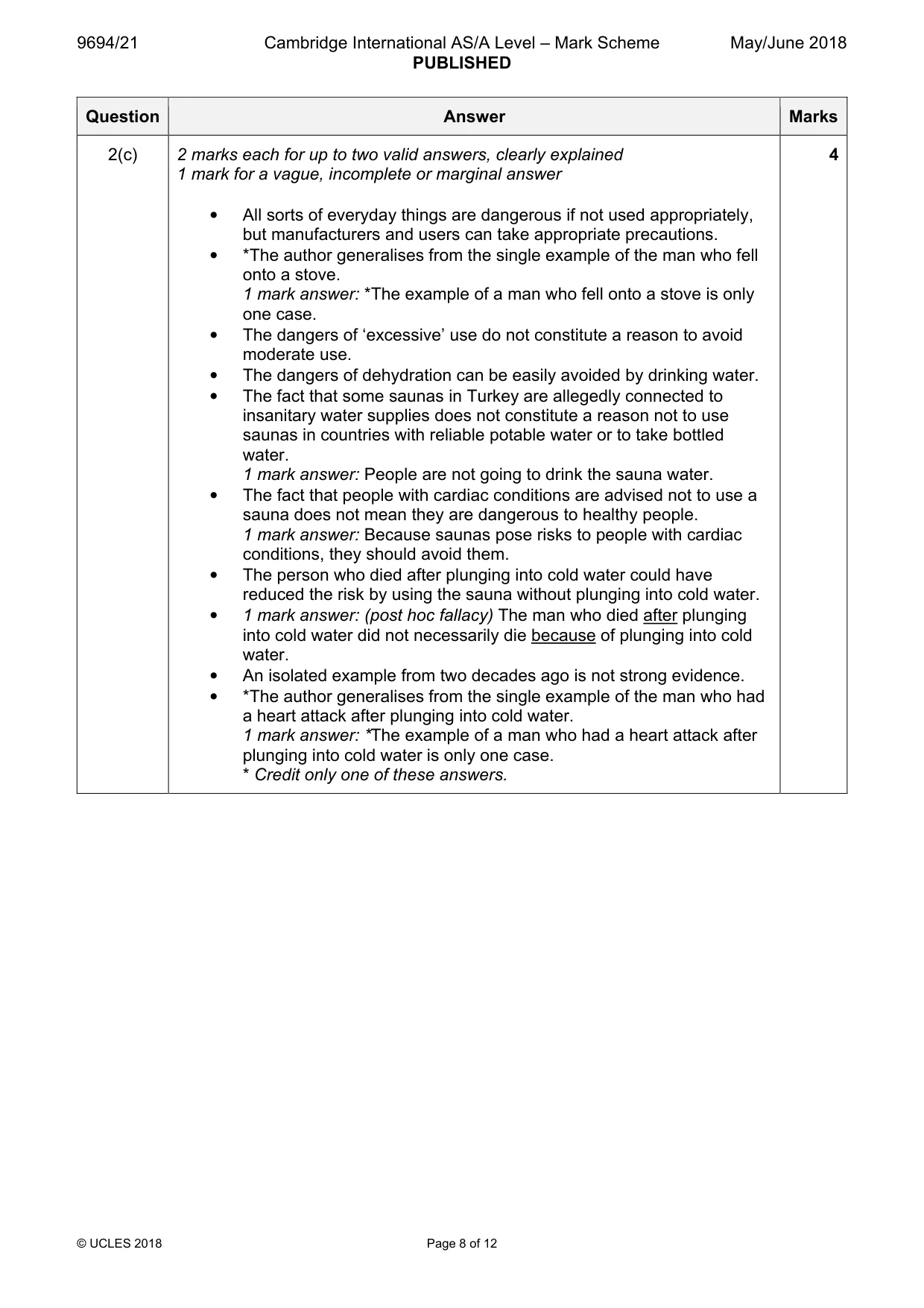
9694/21 Cambridge International AS/A Level – Mark Scheme PUBLISHED May/June 2018 © UCLES 2018 Page 8 of 12 Question Answer Marks 2(c) 2 marks each for up to two valid answers, clearly explained 1 mark for a vague, incomplete or marginal answer • All sorts of everyday things are dangerous if not used appropriately, but manufacturers and users can take appropriate precautions. • *The author generalises from the single example of the man who fell onto a stove. 1 mark answer: *The example of a man who fell onto a stove is only one case. • The dangers of ‘excessive’ use do not constitute a reason to avoid moderate use. • The dangers of dehydration can be easily avoided by drinking water. • The fact that some saunas in Turkey are allegedly connected to insanitary water supplies does not constitute a reason not to use saunas in countries with reliable potable water or to take bottled water. 1 mark answer: People are not going to drink the sauna water. • The fact that people with cardiac conditions are advised not to use a sauna does not mean they are dangerous to healthy people. 1 mark answer: Because saunas pose risks to people with cardiac conditions, they should avoid them. • The person who died after plunging into cold water could have reduced the risk by using the sauna without plunging into cold water. • 1 mark answer: (post hoc fallacy) The man who died after plunging into cold water did not necessarily die because of plunging into cold water. • An isolated example from two decades ago is not strong evidence. • *The author generalises from the single example of the man who had a heart attack after plunging into cold water. 1 mark answer: *The example of a man who had a heart attack after plunging into cold water is only one case. * Credit only one of these answers. 4
Mark scheme, page 9
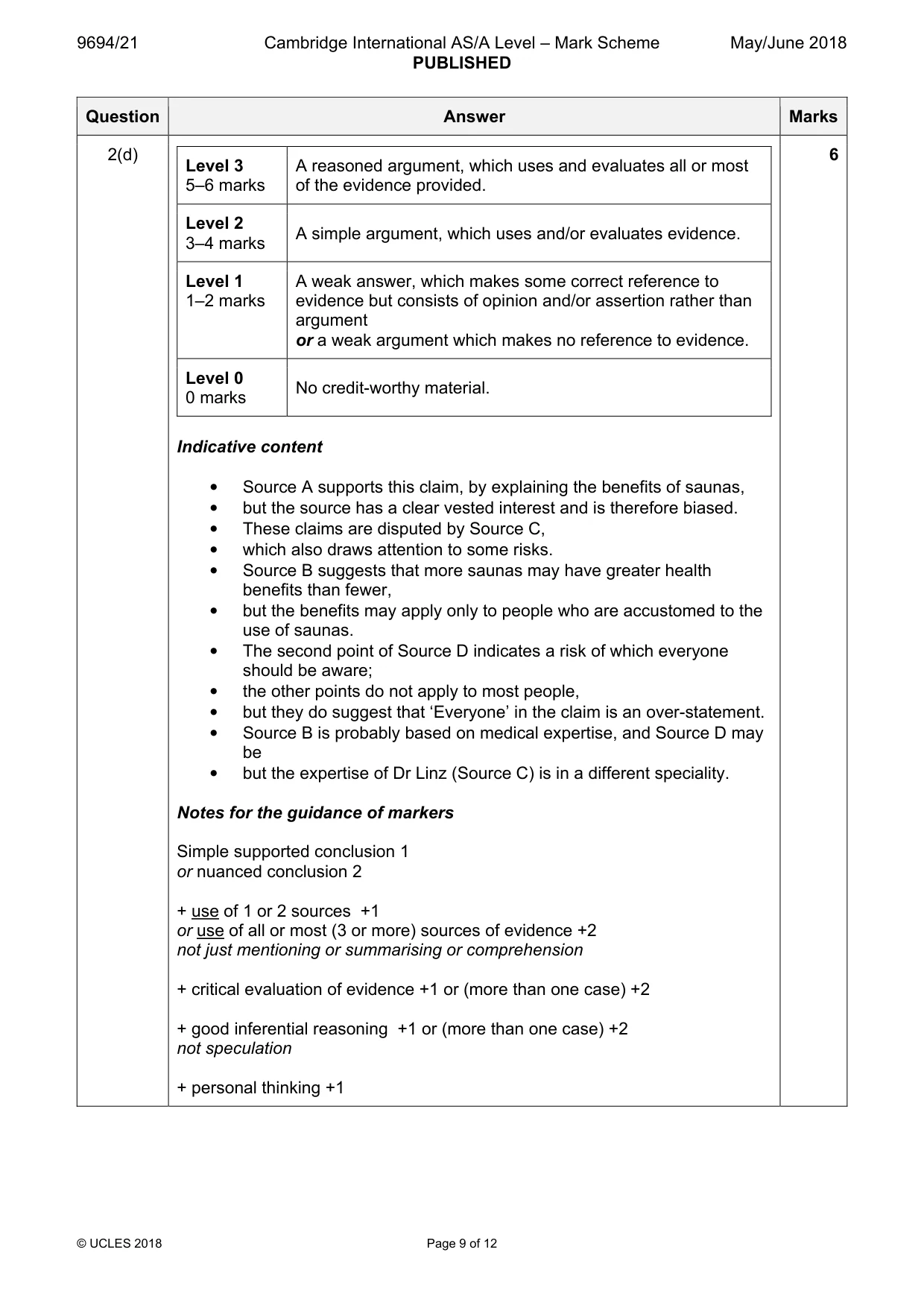
9694/21 Cambridge International AS/A Level – Mark Scheme PUBLISHED May/June 2018 © UCLES 2018 Page 9 of 12 Question Answer Marks 2(d) Level 3 5–6 marks A reasoned argument, which uses and evaluates all or most of the evidence provided. Level 2 3–4 marks A simple argument, which uses and/or evaluates evidence. Level 1 1–2 marks A weak answer, which makes some correct reference to evidence but consists of opinion and/or assertion rather than argument or a weak argument which makes no reference to evidence. Level 0 0 marks No credit-worthy material. Indicative content • Source A supports this claim, by explaining the benefits of saunas, • but the source has a clear vested interest and is therefore biased. • These claims are disputed by Source C, • which also draws attention to some risks. • Source B suggests that more saunas may have greater health benefits than fewer, • but the benefits may apply only to people who are accustomed to the use of saunas. • The second point of Source D indicates a risk of which everyone should be aware; • the other points do not apply to most people, • but they do suggest that ‘Everyone’ in the claim is an over-statement. • Source B is probably based on medical expertise, and Source D may be • but the expertise of Dr Linz (Source C) is in a different speciality. Notes for the guidance of markers Simple supported conclusion 1 or nuanced conclusion 2 + use of 1 or 2 sources +1 or use of all or most (3 or more) sources of evidence +2 not just mentioning or summarising or comprehension + critical evaluation of evidence +1 or (more than one case) +2 + good inferential reasoning +1 or (more than one case) +2 not speculation + personal thinking +1 6
Mark scheme, page 10
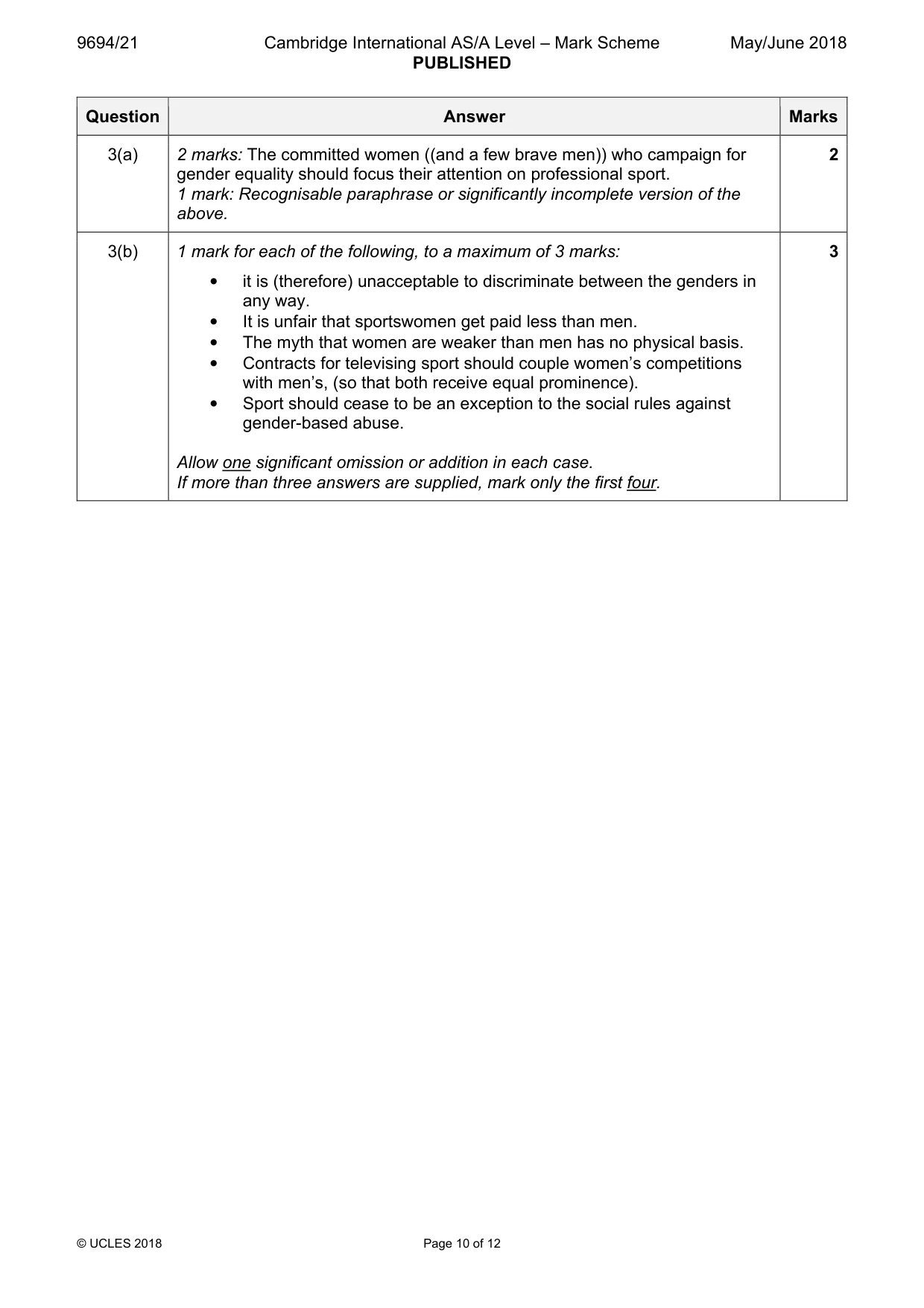
9694/21 Cambridge International AS/A Level – Mark Scheme PUBLISHED May/June 2018 © UCLES 2018 Page 10 of 12 Question Answer Marks 3(a) 2 marks: The committed women ((and a few brave men)) who campaign for gender equality should focus their attention on professional sport. 1 mark: Recognisable paraphrase or significantly incomplete version of the above. 2 3(b) 1 mark for each of the following, to a maximum of 3 marks: • it is (therefore) unacceptable to discriminate between the genders in any way. • It is unfair that sportswomen get paid less than men. • The myth that women are weaker than men has no physical basis. • Contracts for televising sport should couple women’s competitions with men’s, (so that both receive equal prominence). • Sport should cease to be an exception to the social rules against gender-based abuse. Allow one significant omission or addition in each case. If more than three answers are supplied, mark only the first four. 3
Mark scheme, page 11
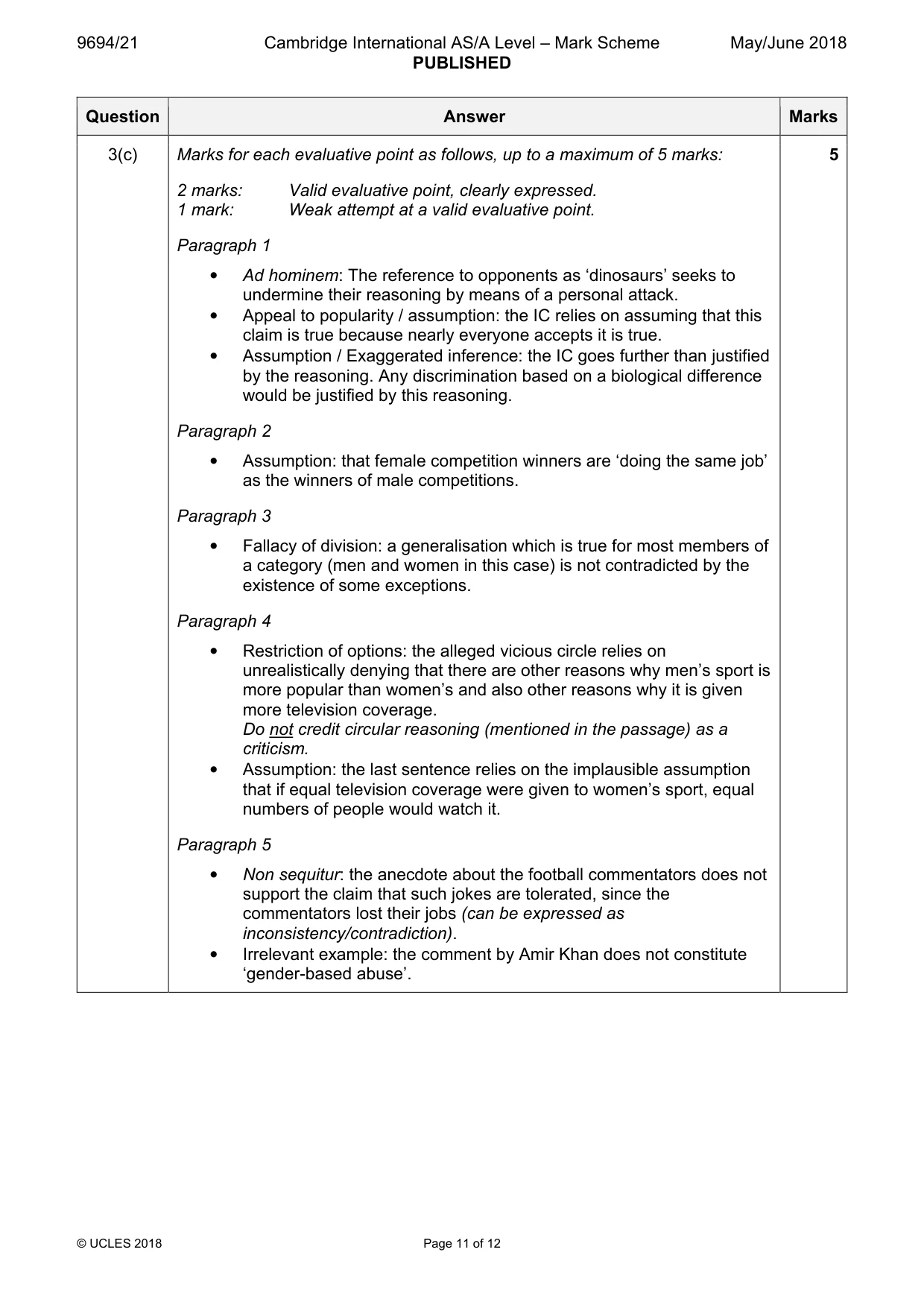
9694/21 Cambridge International AS/A Level – Mark Scheme PUBLISHED May/June 2018 © UCLES 2018 Page 11 of 12 Question Answer Marks 3(c) Marks for each evaluative point as follows, up to a maximum of 5 marks: 2 marks: Valid evaluative point, clearly expressed. 1 mark: Weak attempt at a valid evaluative point. Paragraph 1 • Ad hominem: The reference to opponents as ‘dinosaurs’ seeks to undermine their reasoning by means of a personal attack. • Appeal to popularity / assumption: the IC relies on assuming that this claim is true because nearly everyone accepts it is true. • Assumption / Exaggerated inference: the IC goes further than justified by the reasoning. Any discrimination based on a biological difference would be justified by this reasoning. Paragraph 2 • Assumption: that female competition winners are ‘doing the same job’ as the winners of male competitions. Paragraph 3 • Fallacy of division: a generalisation which is true for most members of a category (men and women in this case) is not contradicted by the existence of some exceptions. Paragraph 4 • Restriction of options: the alleged vicious circle relies on unrealistically denying that there are other reasons why men’s sport is more popular than women’s and also other reasons why it is given more television coverage. Do not credit circular reasoning (mentioned in the passage) as a criticism. • Assumption: the last sentence relies on the implausible assumption that if equal television coverage were given to women’s sport, equal numbers of people would watch it. Paragraph 5 • Non sequitur: the anecdote about the football commentators does not support the claim that such jokes are tolerated, since the commentators lost their jobs (can be expressed as inconsistency/contradiction). • Irrelevant example: the comment by Amir Khan does not constitute ‘gender-based abuse’. 5
Mark scheme, page 12
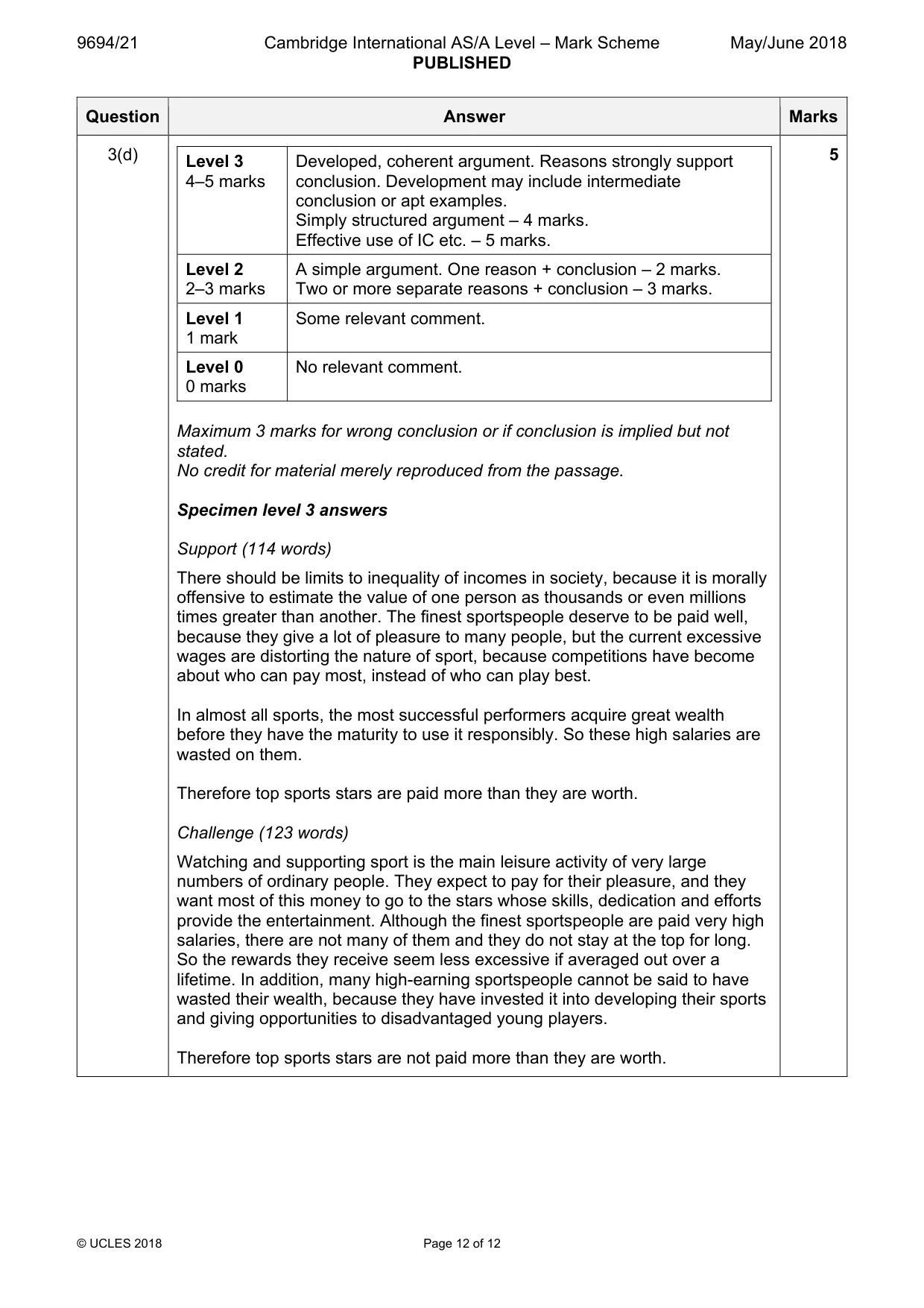
9694/21 Cambridge International AS/A Level – Mark Scheme PUBLISHED May/June 2018 © UCLES 2018 Page 12 of 12 Question Answer Marks 3(d) Level 3 4–5 marks Developed, coherent argument. Reasons strongly support conclusion. Development may include intermediate conclusion or apt examples. Simply structured argument – 4 marks. Effective use of IC etc. – 5 marks. Level 2 2–3 marks A simple argument. One reason + conclusion – 2 marks. Two or more separate reasons + conclusion – 3 marks. Level 1 1 mark Some relevant comment. Level 0 0 marks No relevant comment. Maximum 3 marks for wrong conclusion or if conclusion is implied but not stated. No credit for material merely reproduced from the passage. Specimen level 3 answers Support (114 words) There should be limits to inequality of incomes in society, because it is morally offensive to estimate the value of one person as thousands or even millions times greater than another. The finest sportspeople deserve to be paid well, because they give a lot of pleasure to many people, but the current excessive wages are distorting the nature of sport, because competitions have become about who can pay most, instead of who can play best. In almost all sports, the most successful performers acquire great wealth before they have the maturity to use it responsibly. So these high salaries are wasted on them. Therefore top sports stars are paid more than they are worth. Challenge (123 words) Watching and supporting sport is the main leisure activity of very large numbers of ordinary people. They expect to pay for their pleasure, and they want most of this money to go to the stars whose skills, dedication and efforts provide the entertainment. Although the finest sportspeople are paid very high salaries, there are not many of them and they do not stay at the top for long. So the rewards they receive seem less excessive if averaged out over a lifetime. In addition, many high-earning sportspeople cannot be said to have wasted their wealth, because they have invested it into developing their sports and giving opportunities to disadvantaged young players. Therefore top sports stars are not paid more than they are worth. 5
What you needed in this session
Cambridge’s own grade thresholds for 2018 May/June, Paper 2 · Variant 1. A higher threshold means an easier paper — the bar moves with how the cohort did.