Cambridge A Level Thinking Skills 9694 — 2018 May/June Paper 2 · Variant 3
9694/23/M/J/18 · 45 marks · ≈51 min
The question paper and its mark scheme, free to read here and free to download. This is Cambridge’s own paper, exactly as it was sat.
Question paper8 pages


Mark scheme9 pages
Answers below. Sit the paper first if you are practising.
Paper as text
Question paper, page 1
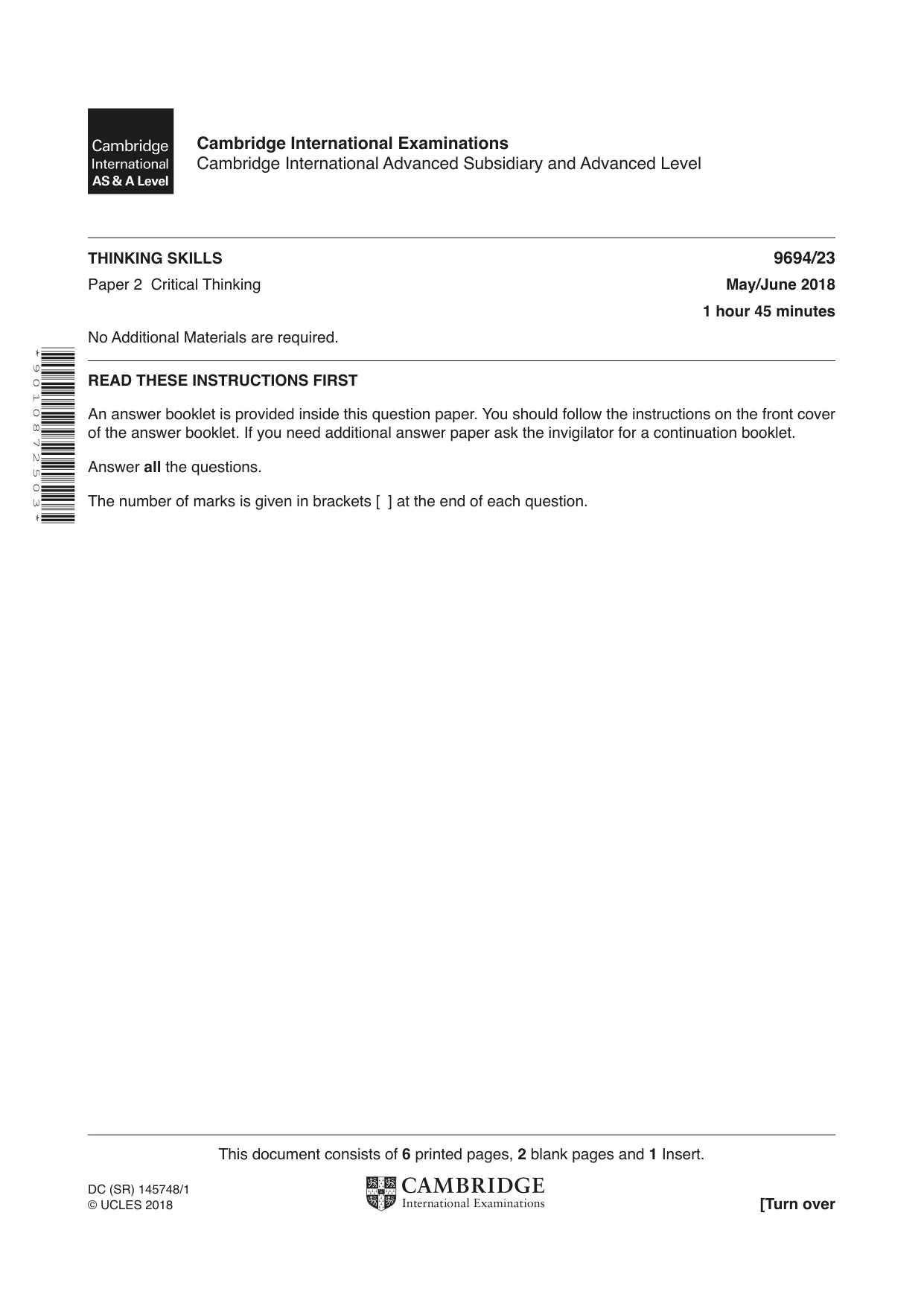
* 9 0 1 0 8 7 2 5 0 3 * This document consists of 6 printed pages, 2 blank pages and 1 Insert. DC (SR) 145748/1 © UCLES 2018 [Turn over Cambridge International Examinations Cambridge International Advanced Subsidiary and Advanced Level THINKING SKILLS 9694/23 Paper 2 Critical Thinking May/June 2018 1 hour 45 minutes No Additional Materials are required. READ THESE INSTRUCTIONS FIRST An answer booklet is provided inside this question paper. You should follow the instructions on the front cover of the answer booklet. If you need additional answer paper ask the invigilator for a continuation booklet. Answer all the questions. The number of marks is given in brackets [ ] at the end of each question.
Question paper, page 2
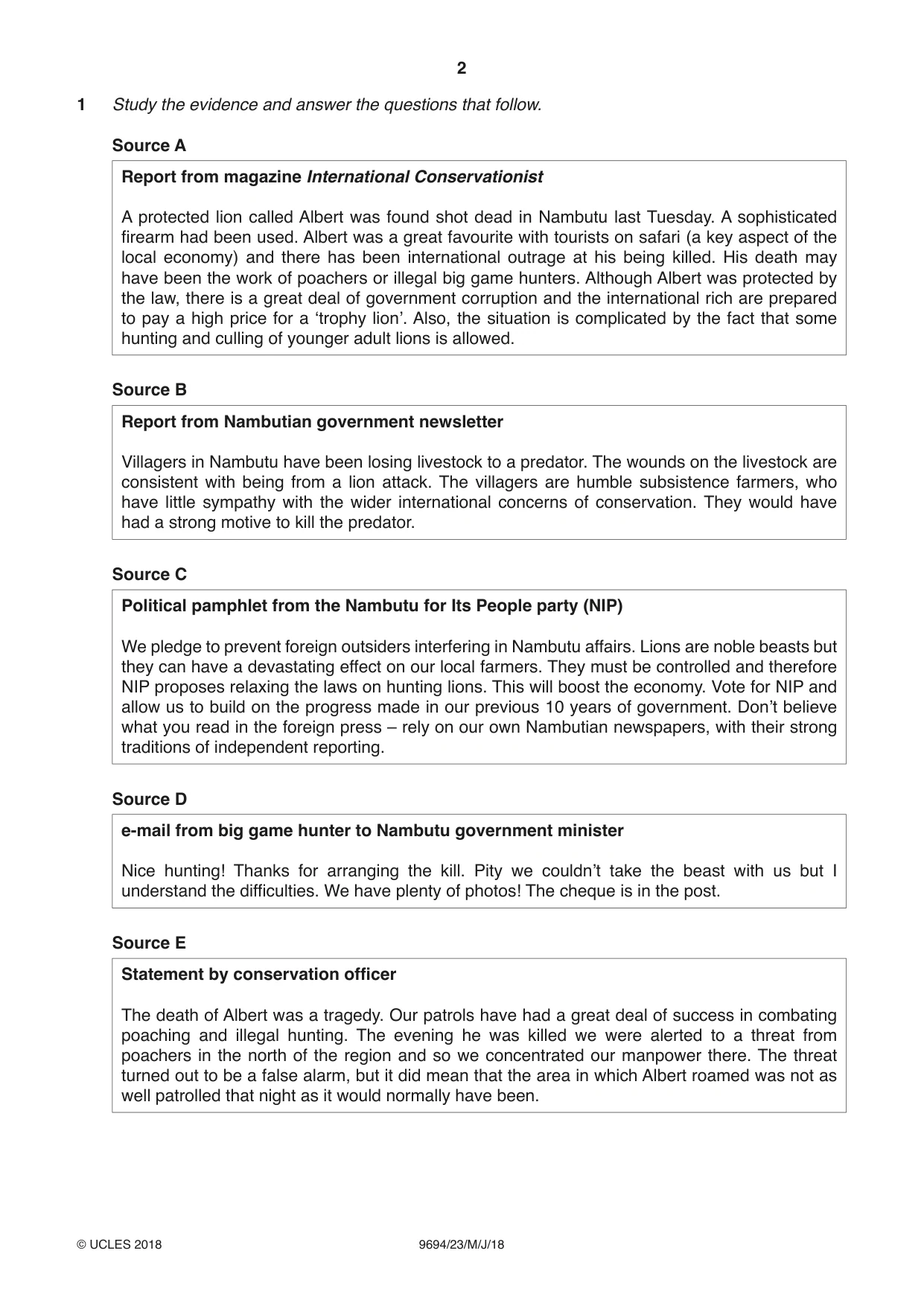
2 9694/23/M/J/18 © UCLES 2018 1 Study the evidence and answer the questions that follow. Source A Report from magazine International Conservationist A protected lion called Albert was found shot dead in Nambutu last Tuesday. A sophisticated firearm had been used. Albert was a great favourite with tourists on safari (a key aspect of the local economy) and there has been international outrage at his being killed. His death may have been the work of poachers or illegal big game hunters. Although Albert was protected by the law, there is a great deal of government corruption and the international rich are prepared to pay a high price for a ‘trophy lion’. Also, the situation is complicated by the fact that some hunting and culling of younger adult lions is allowed. Source B Report from Nambutian government newsletter Villagers in Nambutu have been losing livestock to a predator. The wounds on the livestock are consistent with being from a lion attack. The villagers are humble subsistence farmers, who have little sympathy with the wider international concerns of conservation. They would have had a strong motive to kill the predator. Source C Political pamphlet from the Nambutu for Its People party (NIP) We pledge to prevent foreign outsiders interfering in Nambutu affairs. Lions are noble beasts but they can have a devastating effect on our local farmers. They must be controlled and therefore NIP proposes relaxing the laws on hunting lions. This will boost the economy. Vote for NIP and allow us to build on the progress made in our previous 10 years of government. Don’t believe what you read in the foreign press – rely on our own Nambutian newspapers, with their strong traditions of independent reporting. Source D e-mail from big game hunter to Nambutu government minister Nice hunting! Thanks for arranging the kill. Pity we couldn’t take the beast with us but I understand the difficulties. We have plenty of photos! The cheque is in the post. Source E Statement by conservation officer The death of Albert was a tragedy. Our patrols have had a great deal of success in combating poaching and illegal hunting. The evening he was killed we were alerted to a threat from poachers in the north of the region and so we concentrated our manpower there. The threat turned out to be a false alarm, but it did mean that the area in which Albert roamed was not as well patrolled that night as it would normally have been.
Question paper, page 3
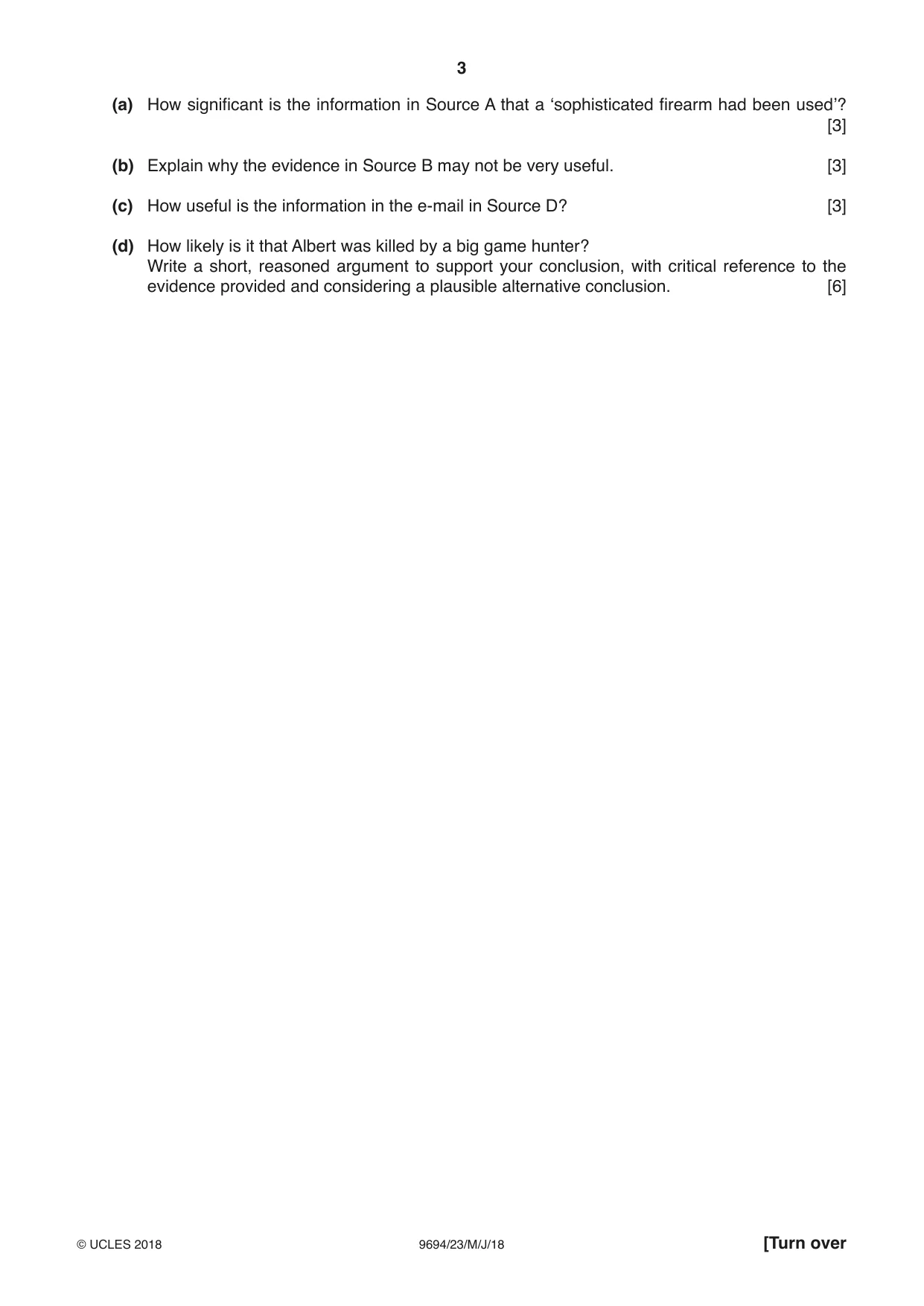
3 9694/23/M/J/18 © UCLES 2018 [Turn over (a) How significant is the information in Source A that a ‘sophisticated firearm had been used’? [3] (b) Explain why the evidence in Source B may not be very useful. [3] (c) How useful is the information in the e-mail in Source D? [3] (d) How likely is it that Albert was killed by a big game hunter? Write a short, reasoned argument to support your conclusion, with critical reference to the evidence provided and considering a plausible alternative conclusion. [6]
Question paper, page 4
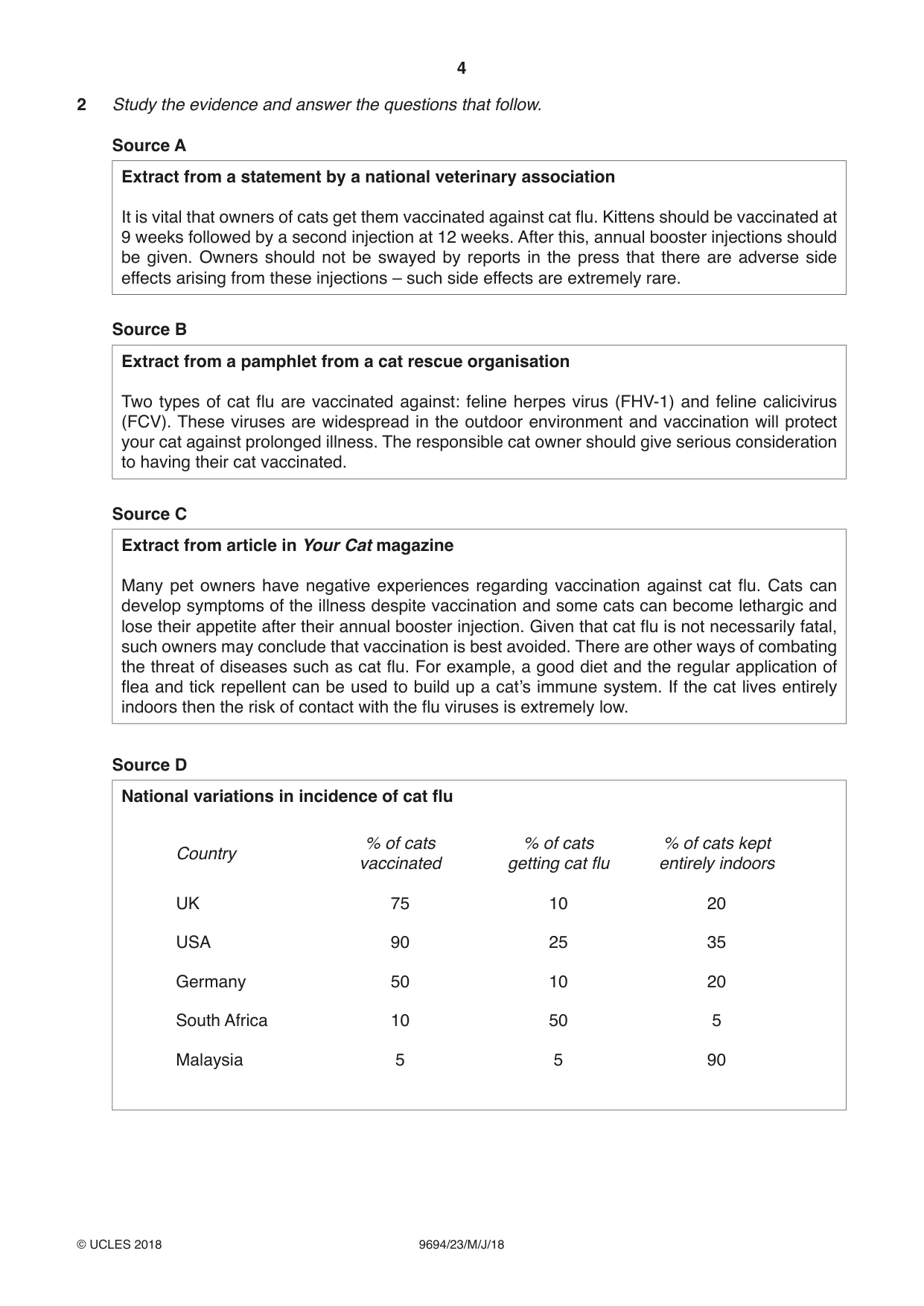
4 9694/23/M/J/18 © UCLES 2018 2 Study the evidence and answer the questions that follow. Source A Extract from a statement by a national veterinary association It is vital that owners of cats get them vaccinated against cat flu. Kittens should be vaccinated at 9 weeks followed by a second injection at 12 weeks. After this, annual booster injections should be given. Owners should not be swayed by reports in the press that there are adverse side effects arising from these injections – such side effects are extremely rare. Source B Extract from a pamphlet from a cat rescue organisation Two types of cat flu are vaccinated against: feline herpes virus (FHV-1) and feline calicivirus (FCV). These viruses are widespread in the outdoor environment and vaccination will protect your cat against prolonged illness. The responsible cat owner should give serious consideration to having their cat vaccinated. Source C Extract from article in Your Cat magazine Many pet owners have negative experiences regarding vaccination against cat flu. Cats can develop symptoms of the illness despite vaccination and some cats can become lethargic and lose their appetite after their annual booster injection. Given that cat flu is not necessarily fatal, such owners may conclude that vaccination is best avoided. There are other ways of combating the threat of diseases such as cat flu. For example, a good diet and the regular application of flea and tick repellent can be used to build up a cat’s immune system. If the cat lives entirely indoors then the risk of contact with the flu viruses is extremely low. Source D National variations in incidence of cat flu Country % of cats vaccinated % of cats getting cat flu % of cats kept entirely indoors UK 75 10 20 USA 90 25 35 Germany 50 10 20 South Africa 10 50 5 Malaysia 5 5 90
Question paper, page 5
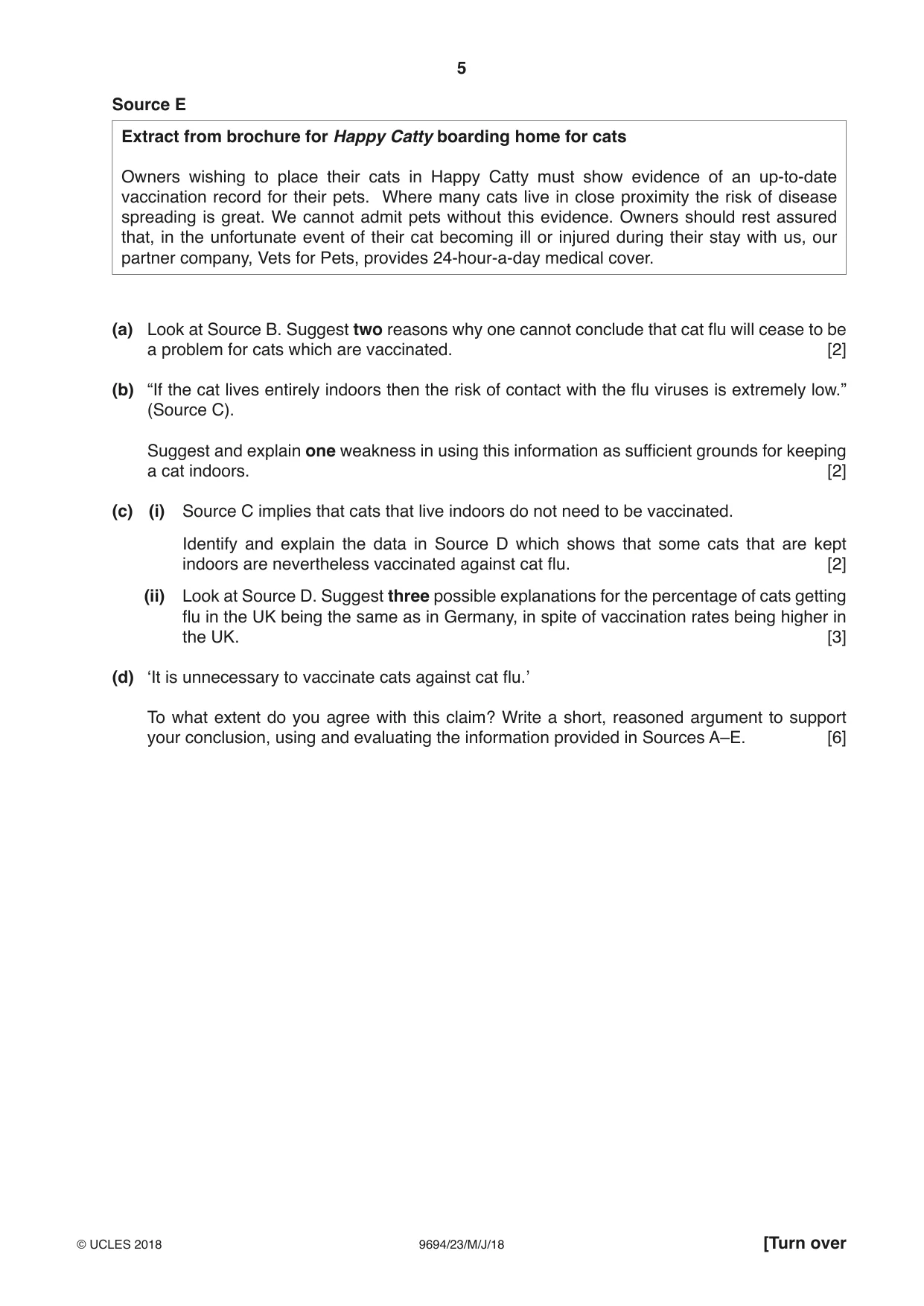
5 9694/23/M/J/18 © UCLES 2018 [Turn over Source E Extract from brochure for Happy Catty boarding home for cats Owners wishing to place their cats in Happy Catty must show evidence of an up-to-date vaccination record for their pets. Where many cats live in close proximity the risk of disease spreading is great. We cannot admit pets without this evidence. Owners should rest assured that, in the unfortunate event of their cat becoming ill or injured during their stay with us, our partner company, Vets for Pets, provides 24-hour-a-day medical cover. (a) Look at Source B. Suggest two reasons why one cannot conclude that cat flu will cease to be a problem for cats which are vaccinated. [2] (b) “If the cat lives entirely indoors then the risk of contact with the flu viruses is extremely low.” (Source C). Suggest and explain one weakness in using this information as sufficient grounds for keeping a cat indoors. [2] (c) (i) Source C implies that cats that live indoors do not need to be vaccinated. Identify and explain the data in Source D which shows that some cats that are kept indoors are nevertheless vaccinated against cat flu. [2] (ii) Look at Source D. Suggest three possible explanations for the percentage of cats getting flu in the UK being the same as in Germany, in spite of vaccination rates being higher in the UK. [3] (d) ‘It is unnecessary to vaccinate cats against cat flu.’ To what extent do you agree with this claim? Write a short, reasoned argument to support your conclusion, using and evaluating the information provided in Sources A–E. [6]
Question paper, page 6
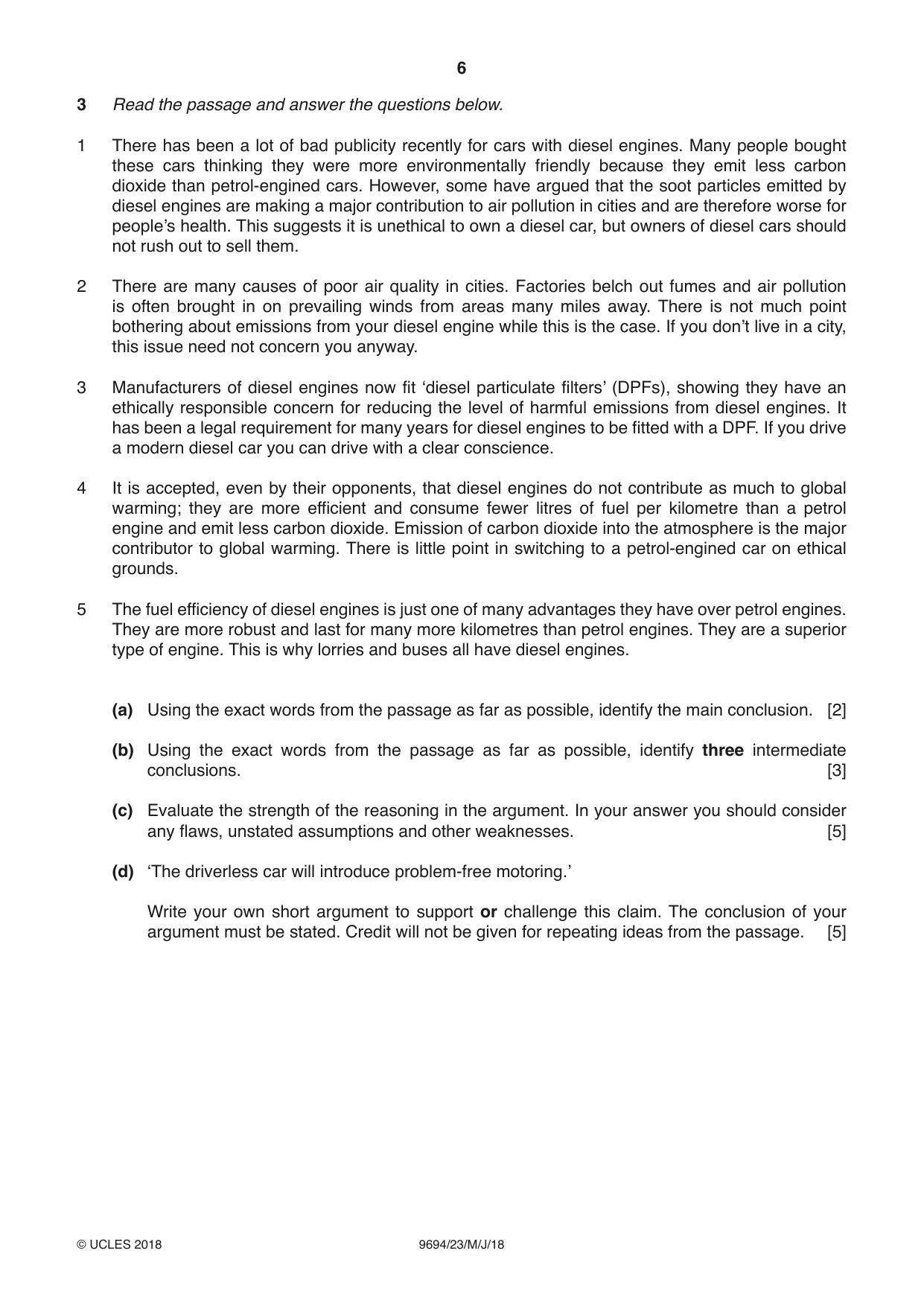
6 9694/23/M/J/18 © UCLES 2018 3 Read the passage and answer the questions below. 1 There has been a lot of bad publicity recently for cars with diesel engines. Many people bought these cars thinking they were more environmentally friendly because they emit less carbon dioxide than petrol-engined cars. However, some have argued that the soot particles emitted by diesel engines are making a major contribution to air pollution in cities and are therefore worse for people’s health. This suggests it is unethical to own a diesel car, but owners of diesel cars should not rush out to sell them. 2 There are many causes of poor air quality in cities. Factories belch out fumes and air pollution is often brought in on prevailing winds from areas many miles away. There is not much point bothering about emissions from your diesel engine while this is the case. If you don’t live in a city, this issue need not concern you anyway. 3 Manufacturers of diesel engines now fit ‘diesel particulate filters’ (DPFs), showing they have an ethically responsible concern for reducing the level of harmful emissions from diesel engines. It has been a legal requirement for many years for diesel engines to be fitted with a DPF. If you drive a modern diesel car you can drive with a clear conscience. 4 It is accepted, even by their opponents, that diesel engines do not contribute as much to global warming; they are more efficient and consume fewer litres of fuel per kilometre than a petrol engine and emit less carbon dioxide. Emission of carbon dioxide into the atmosphere is the major contributor to global warming. There is little point in switching to a petrol-engined car on ethical grounds. 5 The fuel efficiency of diesel engines is just one of many advantages they have over petrol engines. They are more robust and last for many more kilometres than petrol engines. They are a superior type of engine. This is why lorries and buses all have diesel engines. (a) Using the exact words from the passage as far as possible, identify the main conclusion. [2] (b) Using the exact words from the passage as far as possible, identify three intermediate conclusions. [3] (c) Evaluate the strength of the reasoning in the argument. In your answer you should consider any flaws, unstated assumptions and other weaknesses. [5] (d) ‘The driverless car will introduce problem-free motoring.’ Write your own short argument to support or challenge this claim. The conclusion of your argument must be stated. Credit will not be given for repeating ideas from the passage. [5]
Question paper, page 7
7 9694/23/M/J/18 © UCLES 2018 BLANK PAGE
Question paper, page 8
8 9694/23/M/J/18 © UCLES 2018 BLANK PAGE Permission to reproduce items where third-party owned material protected by copyright is included has been sought and cleared where possible. Every reasonable effort has been made by the publisher (UCLES) to trace copyright holders, but if any items requiring clearance have unwittingly been included, the publisher will be pleased to make amends at the earliest possible opportunity. To avoid the issue of disclosure of answer-related information to candidates, all copyright acknowledgements are reproduced online in the Cambridge International Examinations Copyright Acknowledgements Booklet. This is produced for each series of examinations and is freely available to download at www.cie.org.uk after the live examination series. Cambridge International Examinations is part of the Cambridge Assessment Group. Cambridge Assessment is the brand name of University of Cambridge Local Examinations Syndicate (UCLES), which is itself a department of the University of Cambridge.
Mark scheme, page 1
IGCSE™ is a registered trademark. This document consists of 9 printed pages. © UCLES 2018 [Turn over Cambridge Assessment International Education Cambridge International Advanced Subsidiary and Advanced Level THINKING SKILLS 9694/23 Paper 2 Critical Thinking May/June 2018 MARK SCHEME Maximum Mark: 45 Published This mark scheme is published as an aid to teachers and candidates, to indicate the requirements of the examination. It shows the basis on which Examiners were instructed to award marks. It does not indicate the details of the discussions that took place at an Examiners’ meeting before marking began, which would have considered the acceptability of alternative answers. Mark schemes should be read in conjunction with the question paper and the Principal Examiner Report for Teachers. Cambridge International will not enter into discussions about these mark schemes. Cambridge International is publishing the mark schemes for the May/June 2018 series for most Cambridge IGCSE™, Cambridge International A and AS Level and Cambridge Pre-U components, and some Cambridge O Level components.
Mark scheme, page 2
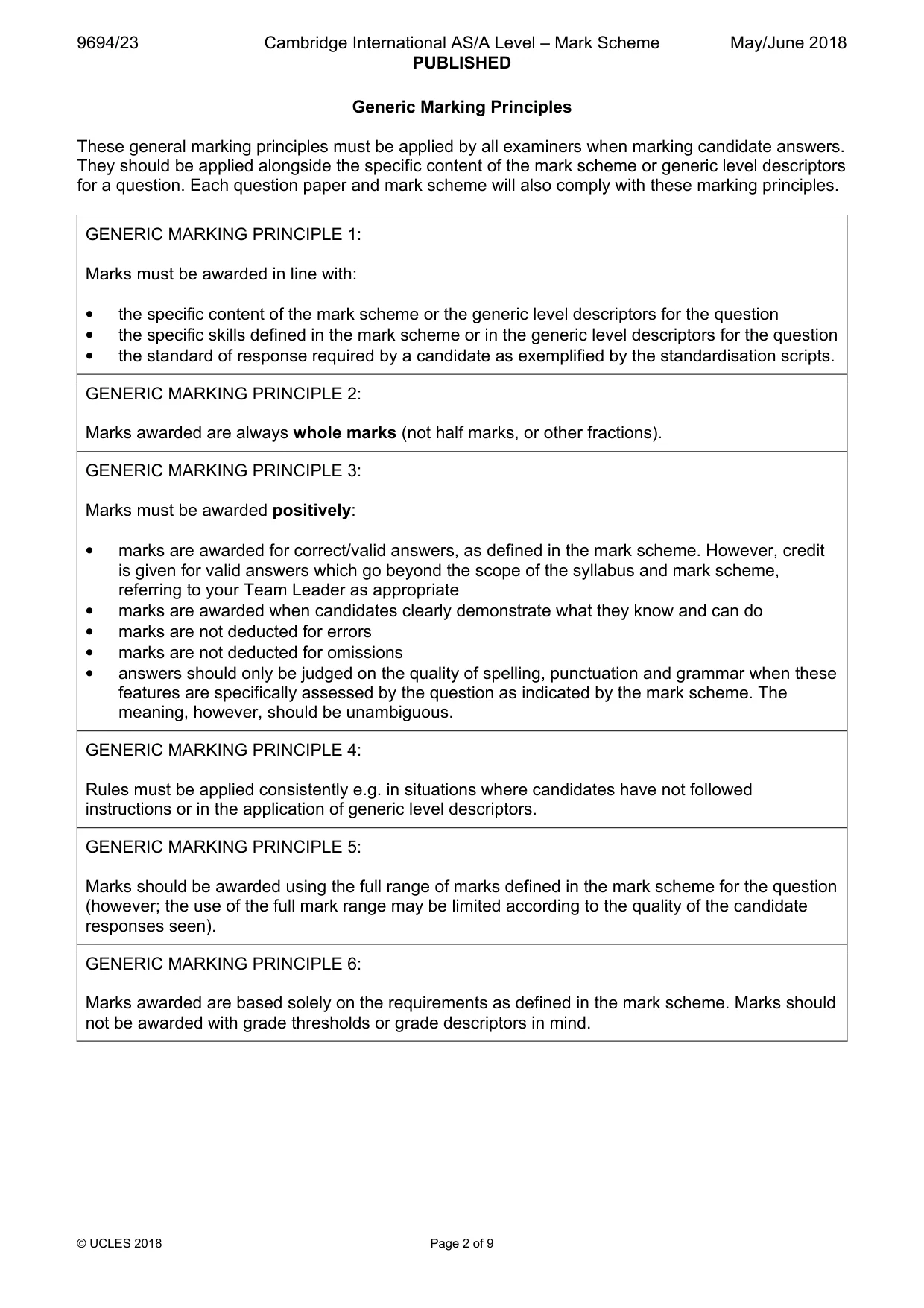
9694/23 Cambridge International AS/A Level – Mark Scheme PUBLISHED May/June 2018 © UCLES 2018 Page 2 of 9 Generic Marking Principles These general marking principles must be applied by all examiners when marking candidate answers. They should be applied alongside the specific content of the mark scheme or generic level descriptors for a question. Each question paper and mark scheme will also comply with these marking principles. GENERIC MARKING PRINCIPLE 1: Marks must be awarded in line with: • the specific content of the mark scheme or the generic level descriptors for the question • the specific skills defined in the mark scheme or in the generic level descriptors for the question • the standard of response required by a candidate as exemplified by the standardisation scripts. GENERIC MARKING PRINCIPLE 2: Marks awarded are always whole marks (not half marks, or other fractions). GENERIC MARKING PRINCIPLE 3: Marks must be awarded positively: • marks are awarded for correct/valid answers, as defined in the mark scheme. However, credit is given for valid answers which go beyond the scope of the syllabus and mark scheme, referring to your Team Leader as appropriate • marks are awarded when candidates clearly demonstrate what they know and can do • marks are not deducted for errors • marks are not deducted for omissions • answers should only be judged on the quality of spelling, punctuation and grammar when these features are specifically assessed by the question as indicated by the mark scheme. The meaning, however, should be unambiguous. GENERIC MARKING PRINCIPLE 4: Rules must be applied consistently e.g. in situations where candidates have not followed instructions or in the application of generic level descriptors. GENERIC MARKING PRINCIPLE 5: Marks should be awarded using the full range of marks defined in the mark scheme for the question (however; the use of the full mark range may be limited according to the quality of the candidate responses seen). GENERIC MARKING PRINCIPLE 6: Marks awarded are based solely on the requirements as defined in the mark scheme. Marks should not be awarded with grade thresholds or grade descriptors in mind.
Mark scheme, page 3
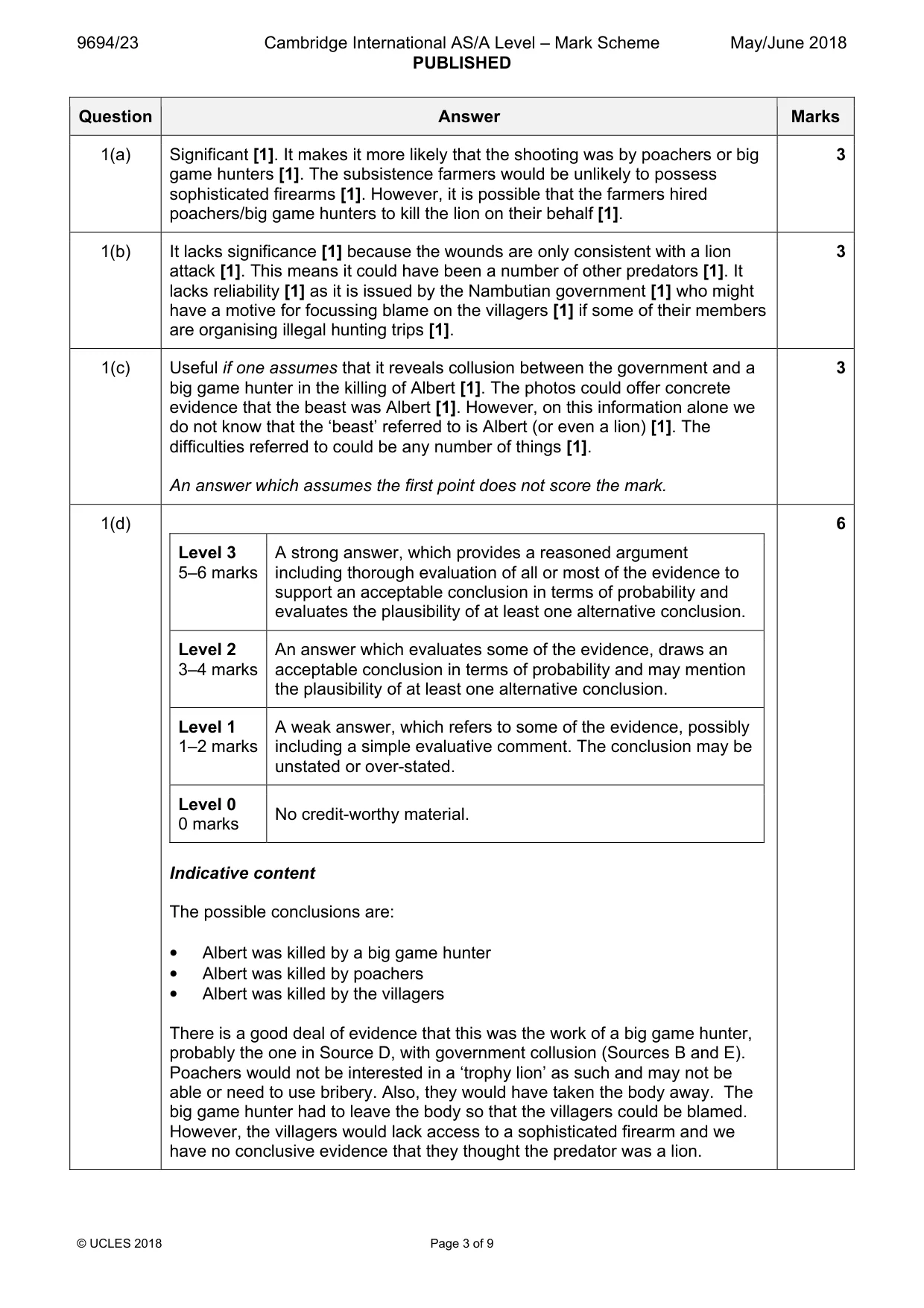
9694/23 Cambridge International AS/A Level – Mark Scheme PUBLISHED May/June 2018 © UCLES 2018 Page 3 of 9 Question Answer Marks 1(a) Significant [1]. It makes it more likely that the shooting was by poachers or big game hunters [1]. The subsistence farmers would be unlikely to possess sophisticated firearms [1]. However, it is possible that the farmers hired poachers/big game hunters to kill the lion on their behalf [1]. 3 1(b) It lacks significance [1] because the wounds are only consistent with a lion attack [1]. This means it could have been a number of other predators [1]. It lacks reliability [1] as it is issued by the Nambutian government [1] who might have a motive for focussing blame on the villagers [1] if some of their members are organising illegal hunting trips [1]. 3 1(c) Useful if one assumes that it reveals collusion between the government and a big game hunter in the killing of Albert [1]. The photos could offer concrete evidence that the beast was Albert [1]. However, on this information alone we do not know that the ‘beast’ referred to is Albert (or even a lion) [1]. The difficulties referred to could be any number of things [1]. An answer which assumes the first point does not score the mark. 3 1(d) Level 3 5–6 marks A strong answer, which provides a reasoned argument including thorough evaluation of all or most of the evidence to support an acceptable conclusion in terms of probability and evaluates the plausibility of at least one alternative conclusion. Level 2 3–4 marks An answer which evaluates some of the evidence, draws an acceptable conclusion in terms of probability and may mention the plausibility of at least one alternative conclusion. Level 1 1–2 marks A weak answer, which refers to some of the evidence, possibly including a simple evaluative comment. The conclusion may be unstated or over-stated. Level 0 0 marks No credit-worthy material. Indicative content The possible conclusions are: • Albert was killed by a big game hunter • Albert was killed by poachers • Albert was killed by the villagers There is a good deal of evidence that this was the work of a big game hunter, probably the one in Source D, with government collusion (Sources B and E). Poachers would not be interested in a ‘trophy lion’ as such and may not be able or need to use bribery. Also, they would have taken the body away. The big game hunter had to leave the body so that the villagers could be blamed. However, the villagers would lack access to a sophisticated firearm and we have no conclusive evidence that they thought the predator was a lion. 6
Mark scheme, page 4
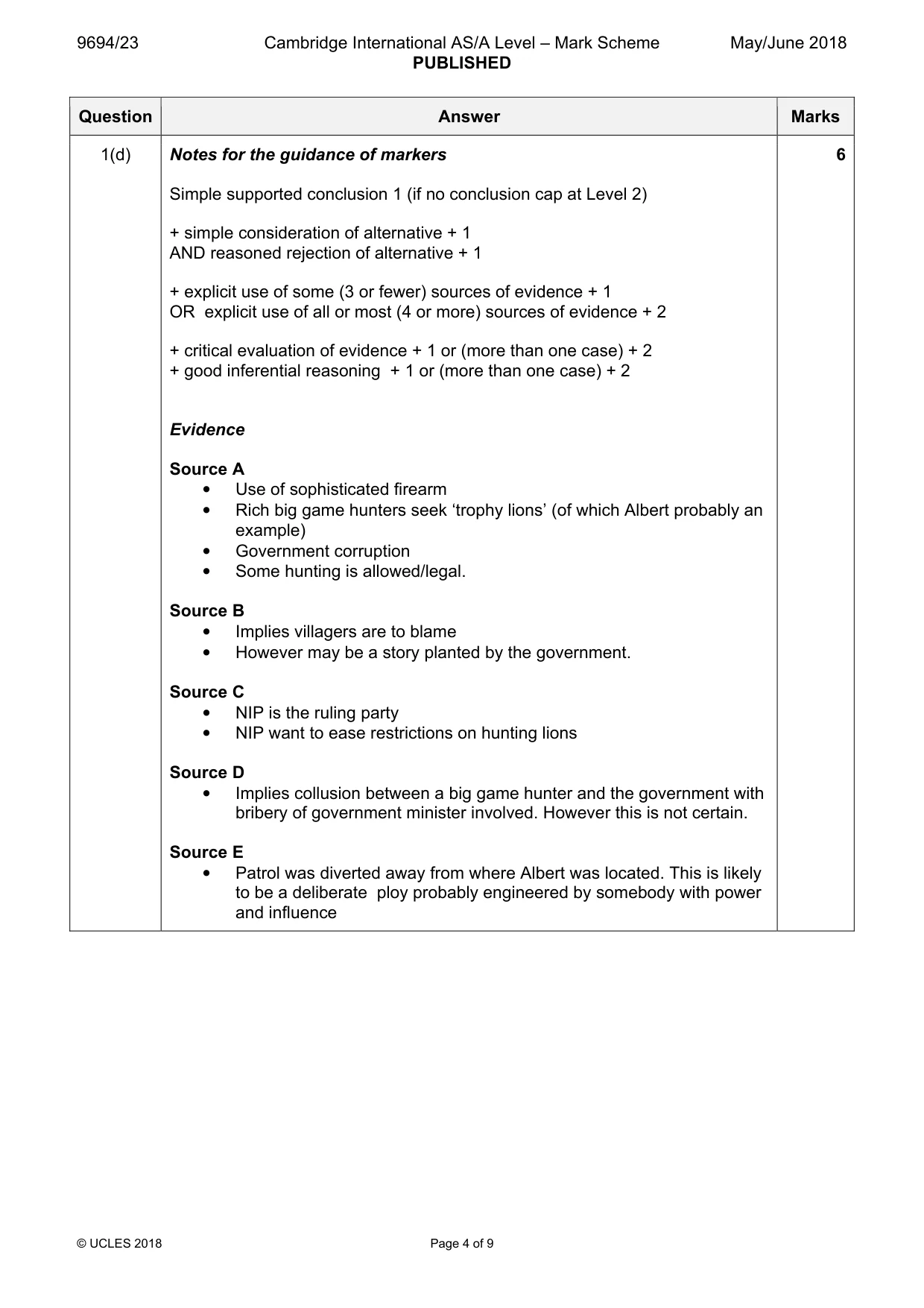
9694/23 Cambridge International AS/A Level – Mark Scheme PUBLISHED May/June 2018 © UCLES 2018 Page 4 of 9 Question Answer Marks 1(d) Notes for the guidance of markers Simple supported conclusion 1 (if no conclusion cap at Level 2) + simple consideration of alternative + 1 AND reasoned rejection of alternative + 1 + explicit use of some (3 or fewer) sources of evidence + 1 OR explicit use of all or most (4 or more) sources of evidence + 2 + critical evaluation of evidence + 1 or (more than one case) + 2 + good inferential reasoning + 1 or (more than one case) + 2 Evidence Source A • Use of sophisticated firearm • Rich big game hunters seek ‘trophy lions’ (of which Albert probably an example) • Government corruption • Some hunting is allowed/legal. Source B • Implies villagers are to blame • However may be a story planted by the government. Source C • NIP is the ruling party • NIP want to ease restrictions on hunting lions Source D • Implies collusion between a big game hunter and the government with bribery of government minister involved. However this is not certain. Source E • Patrol was diverted away from where Albert was located. This is likely to be a deliberate ploy probably engineered by somebody with power and influence 6
Mark scheme, page 5
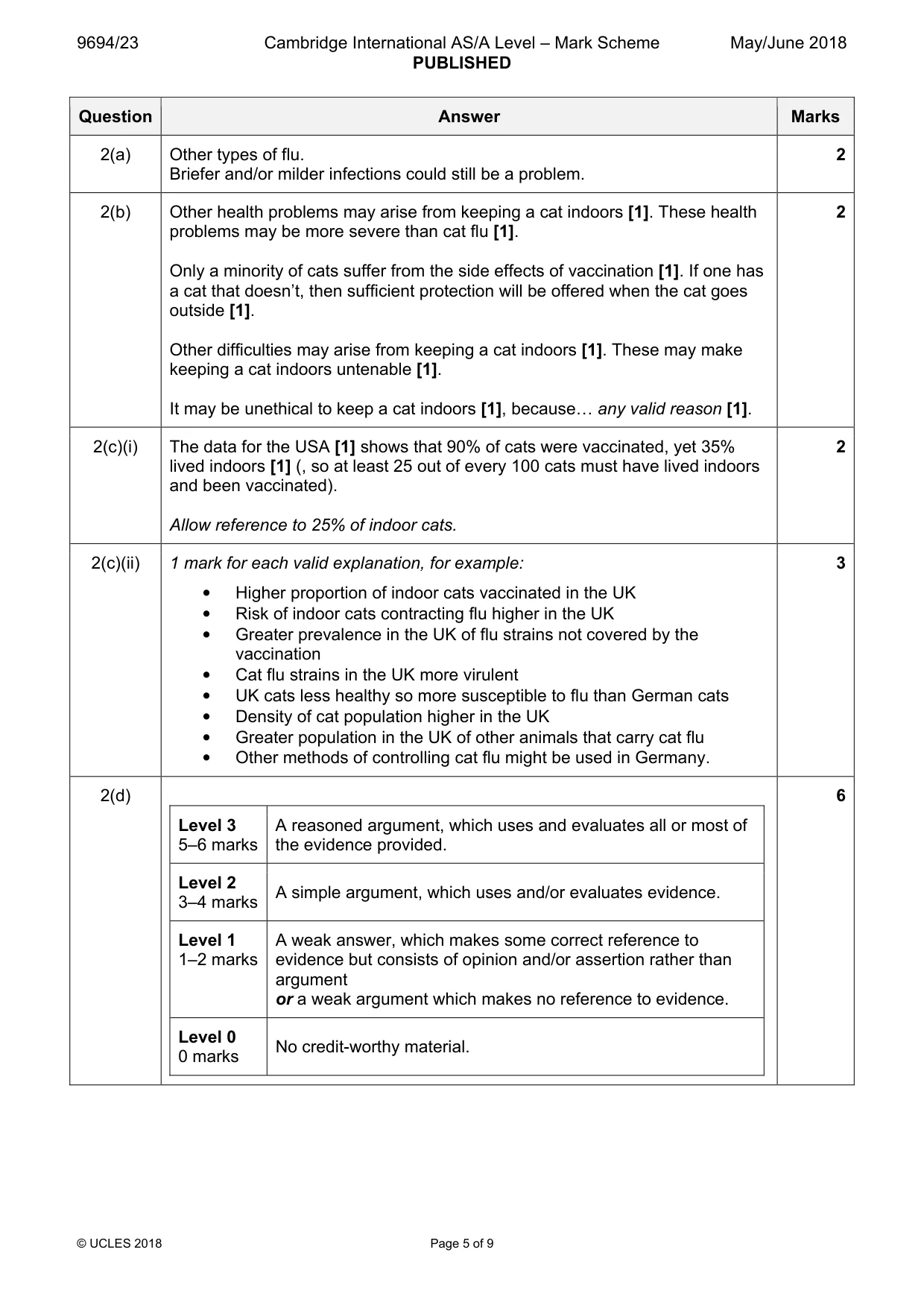
9694/23 Cambridge International AS/A Level – Mark Scheme PUBLISHED May/June 2018 © UCLES 2018 Page 5 of 9 Question Answer Marks 2(a) Other types of flu. Briefer and/or milder infections could still be a problem. 2 2(b) Other health problems may arise from keeping a cat indoors [1]. These health problems may be more severe than cat flu [1]. Only a minority of cats suffer from the side effects of vaccination [1]. If one has a cat that doesn’t, then sufficient protection will be offered when the cat goes outside [1]. Other difficulties may arise from keeping a cat indoors [1]. These may make keeping a cat indoors untenable [1]. It may be unethical to keep a cat indoors [1], because« any valid reason [1]. 2 2(c)(i) The data for the USA [1] shows that 90% of cats were vaccinated, yet 35% lived indoors [1] (, so at least 25 out of every 100 cats must have lived indoors and been vaccinated). Allow reference to 25% of indoor cats. 2 2(c)(ii) 1 mark for each valid explanation, for example: • Higher proportion of indoor cats vaccinated in the UK • Risk of indoor cats contracting flu higher in the UK • Greater prevalence in the UK of flu strains not covered by the vaccination • Cat flu strains in the UK more virulent • UK cats less healthy so more susceptible to flu than German cats • Density of cat population higher in the UK • Greater population in the UK of other animals that carry cat flu • Other methods of controlling cat flu might be used in Germany. 3 2(d) Level 3 5–6 marks A reasoned argument, which uses and evaluates all or most of the evidence provided. Level 2 3–4 marks A simple argument, which uses and/or evaluates evidence. Level 1 1–2 marks A weak answer, which makes some correct reference to evidence but consists of opinion and/or assertion rather than argument or a weak argument which makes no reference to evidence. Level 0 0 marks No credit-worthy material. 6
Mark scheme, page 6
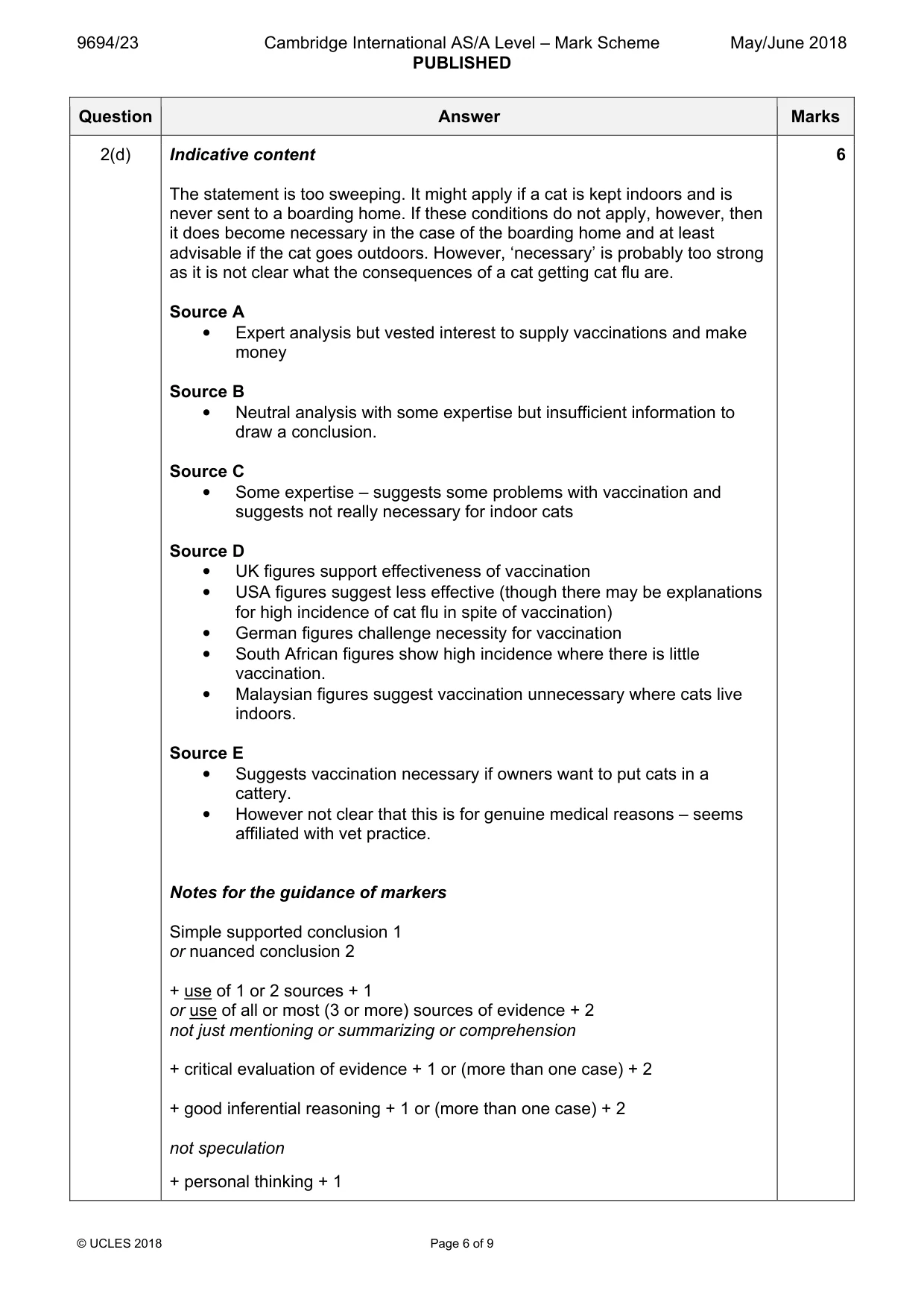
9694/23 Cambridge International AS/A Level – Mark Scheme PUBLISHED May/June 2018 © UCLES 2018 Page 6 of 9 Question Answer Marks 2(d) Indicative content The statement is too sweeping. It might apply if a cat is kept indoors and is never sent to a boarding home. If these conditions do not apply, however, then it does become necessary in the case of the boarding home and at least advisable if the cat goes outdoors. However, ‘necessary’ is probably too strong as it is not clear what the consequences of a cat getting cat flu are. Source A • Expert analysis but vested interest to supply vaccinations and make money Source B • Neutral analysis with some expertise but insufficient information to draw a conclusion. Source C • Some expertise – suggests some problems with vaccination and suggests not really necessary for indoor cats Source D • UK figures support effectiveness of vaccination • USA figures suggest less effective (though there may be explanations for high incidence of cat flu in spite of vaccination) • German figures challenge necessity for vaccination • South African figures show high incidence where there is little vaccination. • Malaysian figures suggest vaccination unnecessary where cats live indoors. Source E • Suggests vaccination necessary if owners want to put cats in a cattery. • However not clear that this is for genuine medical reasons – seems affiliated with vet practice. Notes for the guidance of markers Simple supported conclusion 1 or nuanced conclusion 2 + use of 1 or 2 sources + 1 or use of all or most (3 or more) sources of evidence + 2 not just mentioning or summarizing or comprehension + critical evaluation of evidence + 1 or (more than one case) + 2 + good inferential reasoning + 1 or (more than one case) + 2 not speculation + personal thinking + 1 6
Mark scheme, page 7
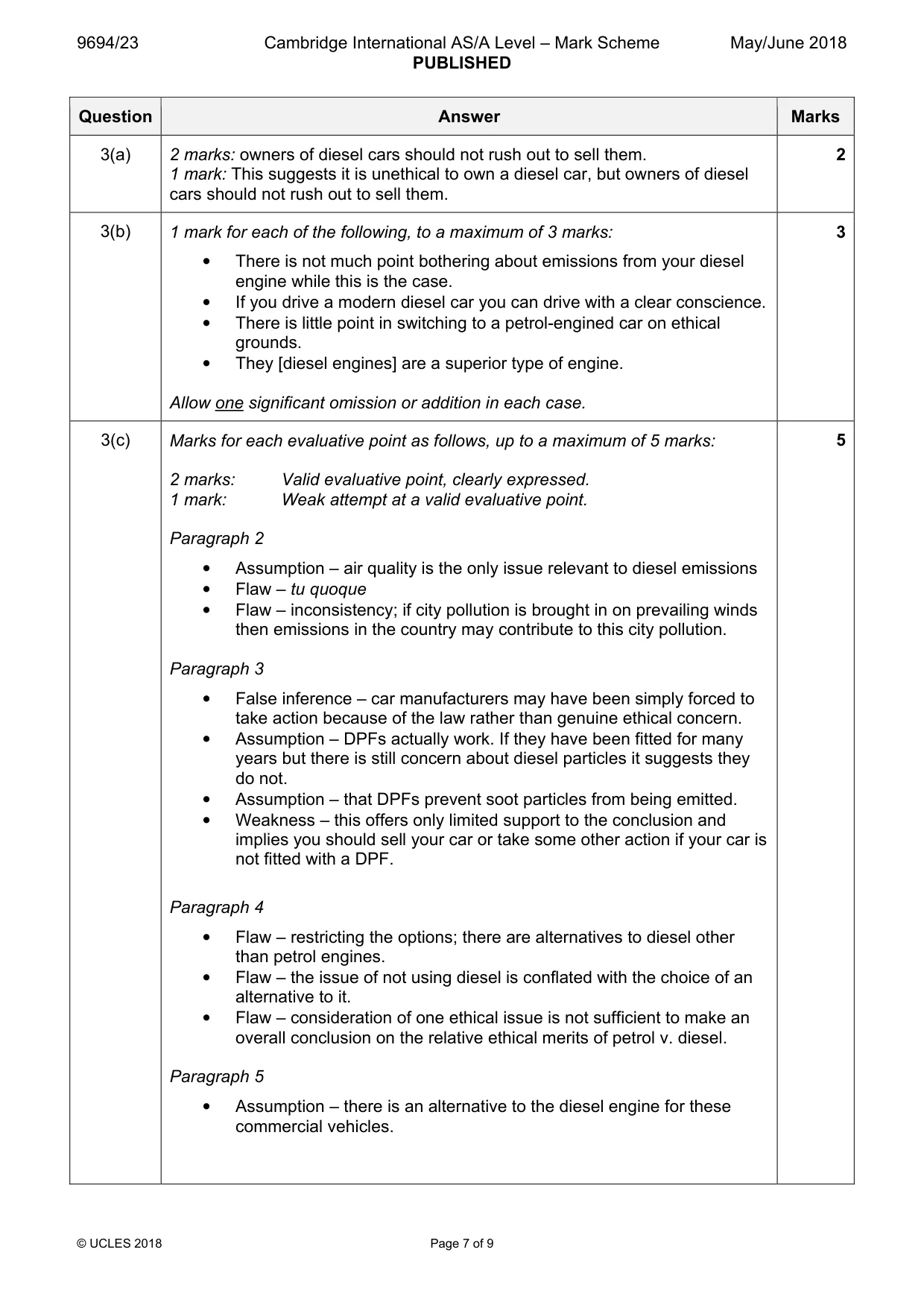
9694/23 Cambridge International AS/A Level – Mark Scheme PUBLISHED May/June 2018 © UCLES 2018 Page 7 of 9 Question Answer Marks 3(a) 2 marks: owners of diesel cars should not rush out to sell them. 1 mark: This suggests it is unethical to own a diesel car, but owners of diesel cars should not rush out to sell them. 2 3(b) 1 mark for each of the following, to a maximum of 3 marks: • There is not much point bothering about emissions from your diesel engine while this is the case. • If you drive a modern diesel car you can drive with a clear conscience. • There is little point in switching to a petrol-engined car on ethical grounds. • They [diesel engines] are a superior type of engine. Allow one significant omission or addition in each case. 3 3(c) Marks for each evaluative point as follows, up to a maximum of 5 marks: 2 marks: Valid evaluative point, clearly expressed. 1 mark: Weak attempt at a valid evaluative point. Paragraph 2 • Assumption – air quality is the only issue relevant to diesel emissions • Flaw – tu quoque • Flaw – inconsistency; if city pollution is brought in on prevailing winds then emissions in the country may contribute to this city pollution. Paragraph 3 • False inference – car manufacturers may have been simply forced to take action because of the law rather than genuine ethical concern. • Assumption – DPFs actually work. If they have been fitted for many years but there is still concern about diesel particles it suggests they do not. • Assumption – that DPFs prevent soot particles from being emitted. • Weakness – this offers only limited support to the conclusion and implies you should sell your car or take some other action if your car is not fitted with a DPF. Paragraph 4 • Flaw – restricting the options; there are alternatives to diesel other than petrol engines. • Flaw – the issue of not using diesel is conflated with the choice of an alternative to it. • Flaw – consideration of one ethical issue is not sufficient to make an overall conclusion on the relative ethical merits of petrol v. diesel. Paragraph 5 • Assumption – there is an alternative to the diesel engine for these commercial vehicles. 5
Mark scheme, page 8
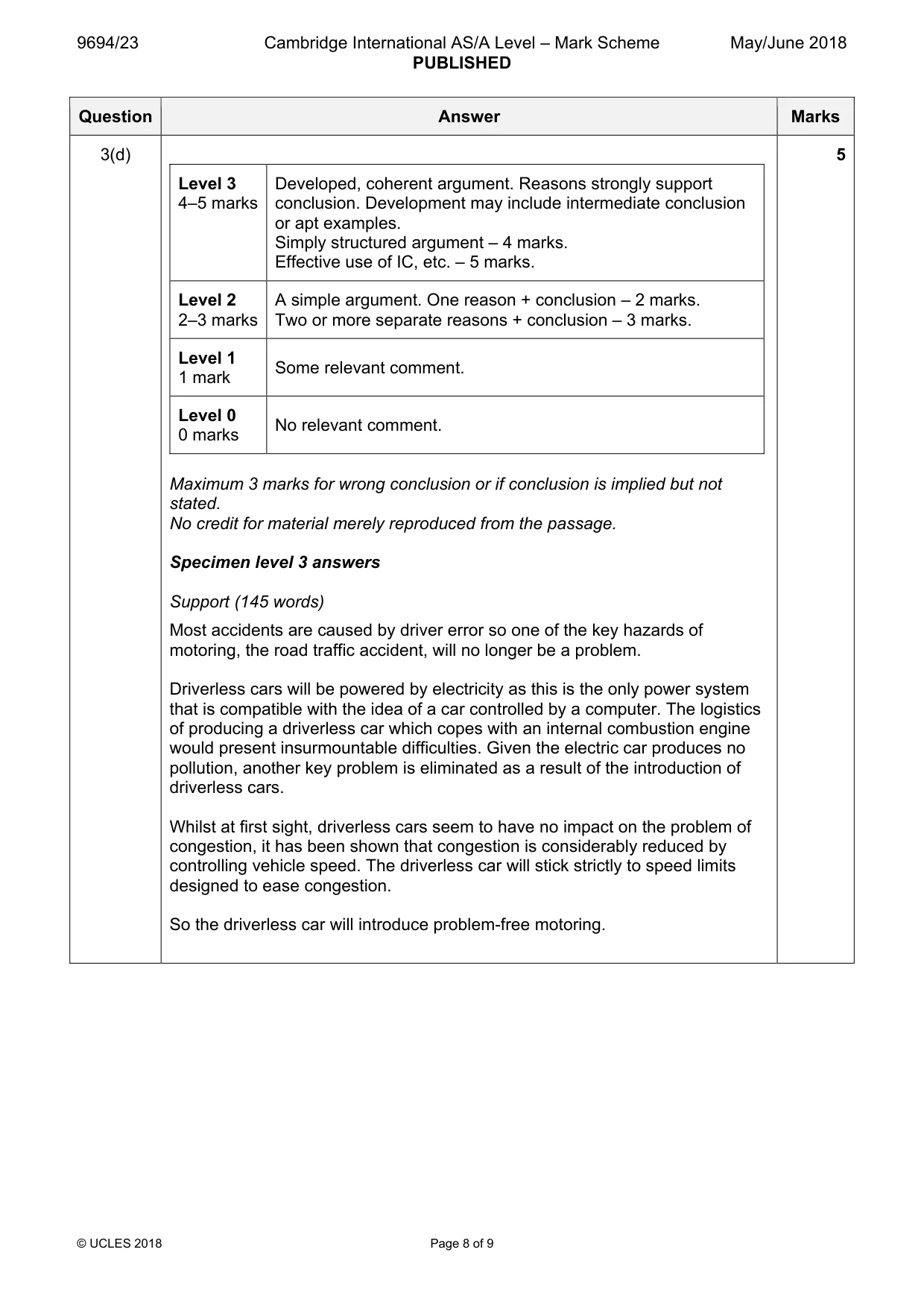
9694/23 Cambridge International AS/A Level – Mark Scheme PUBLISHED May/June 2018 © UCLES 2018 Page 8 of 9 Question Answer Marks 3(d) Level 3 4–5 marks Developed, coherent argument. Reasons strongly support conclusion. Development may include intermediate conclusion or apt examples. Simply structured argument – 4 marks. Effective use of IC, etc. – 5 marks. Level 2 2–3 marks A simple argument. One reason + conclusion – 2 marks. Two or more separate reasons + conclusion – 3 marks. Level 1 1 mark Some relevant comment. Level 0 0 marks No relevant comment. Maximum 3 marks for wrong conclusion or if conclusion is implied but not stated. No credit for material merely reproduced from the passage. Specimen level 3 answers Support (145 words) Most accidents are caused by driver error so one of the key hazards of motoring, the road traffic accident, will no longer be a problem. Driverless cars will be powered by electricity as this is the only power system that is compatible with the idea of a car controlled by a computer. The logistics of producing a driverless car which copes with an internal combustion engine would present insurmountable difficulties. Given the electric car produces no pollution, another key problem is eliminated as a result of the introduction of driverless cars. Whilst at first sight, driverless cars seem to have no impact on the problem of congestion, it has been shown that congestion is considerably reduced by controlling vehicle speed. The driverless car will stick strictly to speed limits designed to ease congestion. So the driverless car will introduce problem-free motoring. 5
Mark scheme, page 9
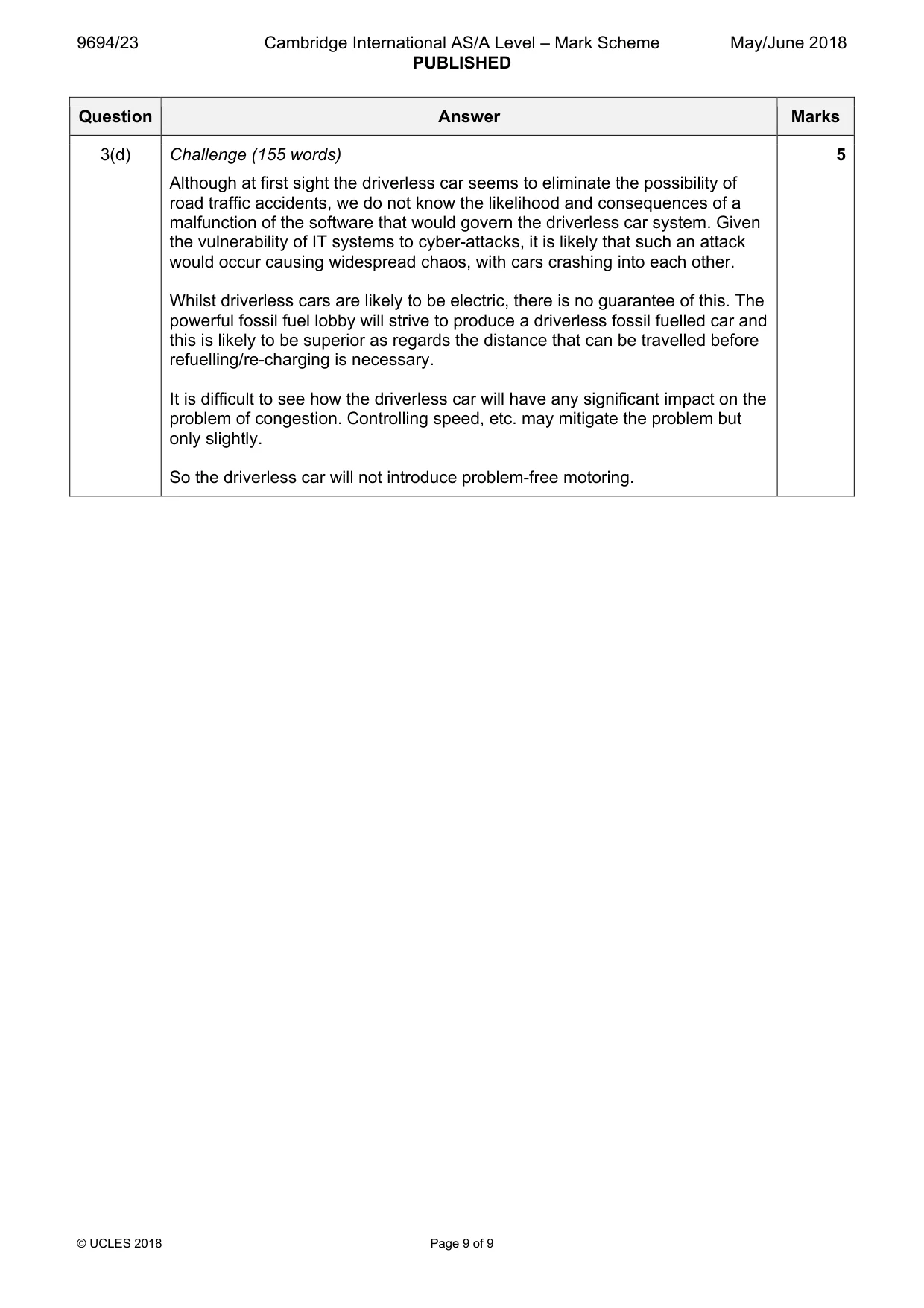
9694/23 Cambridge International AS/A Level – Mark Scheme PUBLISHED May/June 2018 © UCLES 2018 Page 9 of 9 Question Answer Marks 3(d) Challenge (155 words) Although at first sight the driverless car seems to eliminate the possibility of road traffic accidents, we do not know the likelihood and consequences of a malfunction of the software that would govern the driverless car system. Given the vulnerability of IT systems to cyber-attacks, it is likely that such an attack would occur causing widespread chaos, with cars crashing into each other. Whilst driverless cars are likely to be electric, there is no guarantee of this. The powerful fossil fuel lobby will strive to produce a driverless fossil fuelled car and this is likely to be superior as regards the distance that can be travelled before refuelling/re-charging is necessary. It is difficult to see how the driverless car will have any significant impact on the problem of congestion. Controlling speed, etc. may mitigate the problem but only slightly. So the driverless car will not introduce problem-free motoring. 5
What you needed in this session
Cambridge’s own grade thresholds for 2018 May/June, Paper 2 · Variant 3. A higher threshold means an easier paper — the bar moves with how the cohort did.