Cambridge A Level Thinking Skills 9694 — 2017 Oct/Nov Paper 2 · Variant 1
9694/21/O/N/17 · 45 marks · ≈51 min
The question paper and its mark scheme, free to read here and free to download. This is Cambridge’s own paper, exactly as it was sat.
Question paper8 pages


Mark scheme7 pages
Answers below. Sit the paper first if you are practising.
Paper as text
Question paper, page 1
This document consists of 6 printed pages, 2 blank pages and 1 insert. DC (ST/FD) 129876/3 © UCLES 2017 [Turn over Cambridge International Examinations Cambridge International Advanced Subsidiary and Advanced Level * 4 2 8 6 1 9 5 8 2 7 * THINKING SKILLS 9694/21 Paper 2 Critical Thinking October/November 2017 1 hour 45 minutes No Additional Materials are required. READ THESE INSTRUCTIONS FIRST An answer booklet is provided inside this question paper. You should follow the instructions on the front cover of the answer booklet. If you need additional answer paper ask the invigilator for a continuation booklet. Answer all the questions. The number of marks is given in brackets [ ] at the end of each question.
Question paper, page 2
2 9694/21/O/N/17 © UCLES 2017 1 Study the evidence and answer the questions that follow. Source A Email to friend 5th January I have just begun my new job, as Senior Care Worker at Ropewalk Care Home. Most of the residents require one-to-one care during the day-time and regular monitoring during the night. In addition to taking some shifts caring for residents myself, I am the Line Manager for the team of care workers. Staff have become very slack since the departure of my predecessor (or perhaps he tolerated it). Residents have become accustomed to living how they like, instead of following a healthy diet and lifestyle. Several residents have told me that they regard care workers as their closest friends, which suggests that staff have been failing to maintain proper boundaries. I intend to leave the care workers in no doubt that if they fail to meet my standards, there will be no place for them in this care home. Love, Jane Source B Anti-bullying policy of Ropewalk Care Home • Bullying is unwanted, aggressive behaviour that involves a real or perceived power imbalance. Bullying includes actions such as making threats, spreading rumours, attacking someone physically or verbally, and deliberately excluding someone from a group. • Bullying of residents or colleagues at Ropewalk Care Home is absolutely forbidden. Any allegations of bullying will be rigorously investigated, and any member of staff proved to have engaged in such behaviour will be summarily dismissed. • In cases where it is disputed whether particular behaviour constitutes bullying or not, the feelings of the complainant take priority. If someone feels that they have been bullied, then they have been. Source C Entries in confidential daily log 6th February When one of our residents, Charlie, discovered that I would be caring for him today, he became uncooperative and aggressive. The core of his complaint seemed to be that he did not want me to care for him, because I do not allow him to eat chips. When his behaviour became disruptive and was upsetting other residents, I called in a doctor, who prescribed a sedative to help calm Charlie down. I have warned Charlie that if he behaves in this way again, he may be moved to another home, so that he will lose touch with his friends at Ropewalk. Jane Kelly 7th February Today I was caring for Charlie. He seemed more withdrawn than usual; eventually he said the reason was that Jane had been unkind to him the day before. We watched television together, and by the afternoon he seemed happier. Alan Dale
Question paper, page 3
3 9694/21/O/N/17 © UCLES 2017 [Turn over Source D Extract from letter of resignation 17th April I wish to make it clear that my only reason for leaving my job at Ropewalk in order to work in another care home is the bullying behaviour of the Senior Care Worker towards residents and staff. I am aware that several of my colleagues have recently resigned stating the same reason for leaving, and I am disappointed that no action has been taken to investigate the allegations and to deal with this problem. Alan Dale Source E Response to Manager Thank you for showing me Alan Dale’s letter of resignation and for inviting my comments. I have to say that I am glad he is leaving. I came to the conclusion some time ago that if he did not leave voluntarily, I would have to begin disciplinary proceedings against him with a view to dismissal. Alan has shown himself to be a trouble-maker and has encouraged residents to reject my authority over their lives. Jane (a) (i) Suggest and briefly explain one factor that reduces the reliability of Jane’s report in the daily log (Source C). [2] (ii) Suggest and briefly explain one factor that reduces the reliability of Alan’s report in the daily log (Source C). [2] (b) Explain the significance of Source C in relation to the allegation that Jane has bullied residents and staff. [2] (c) How well does the Senior Care Worker’s memo (Source E) respond to Alan Dale’s allegation that she has been bullying staff and residents of the Ropewalk Care Home? [3] (d) How likely do you think it is that the Senior Care Worker is guilty of bullying residents and staff at Ropewalk Care Home? Write a short, reasoned argument to support your conclusion, with critical reference to the evidence provided and considering a plausible alternative conclusion. [6]
Question paper, page 4
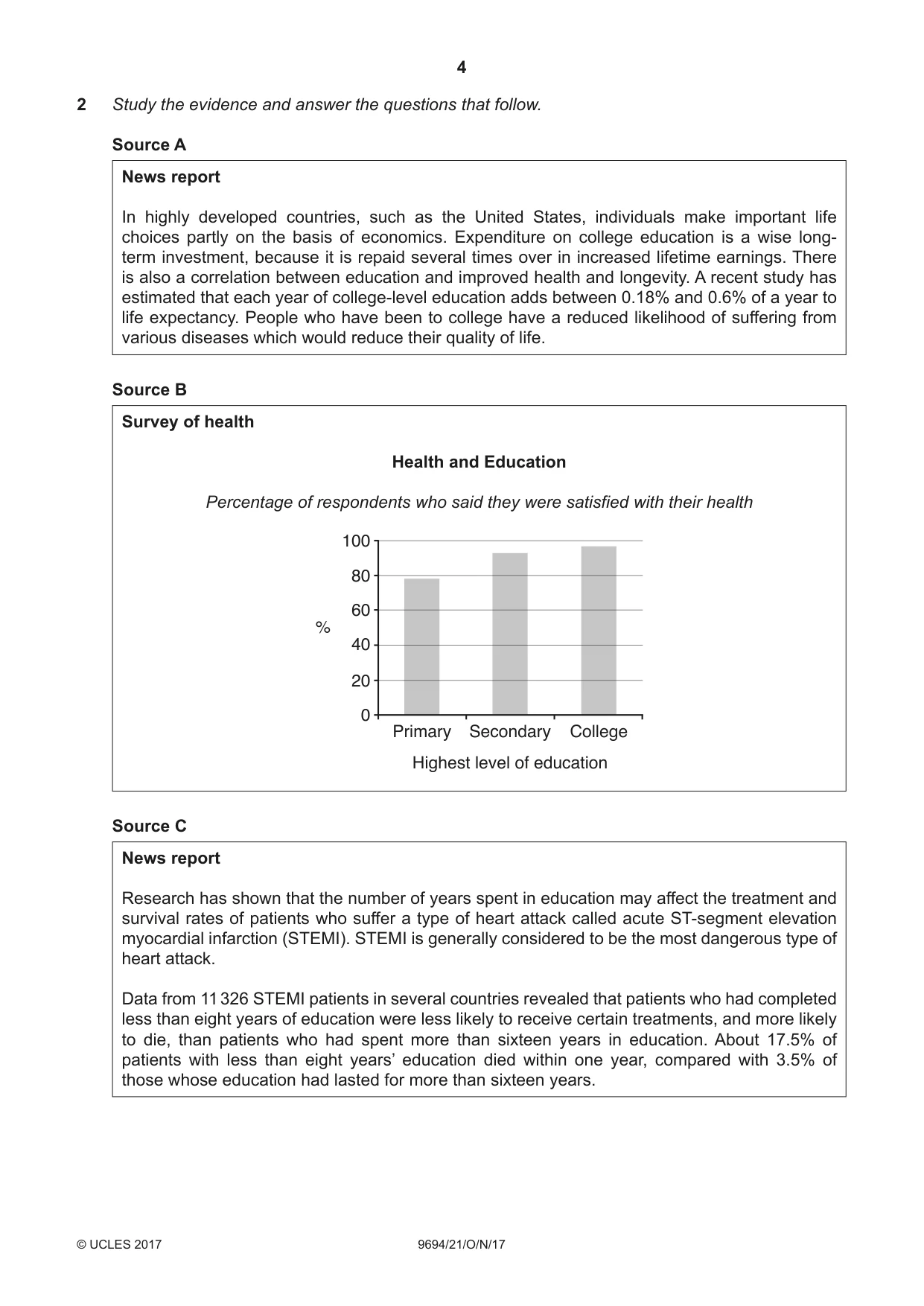
4 9694/21/O/N/17 © UCLES 2017 2 Study the evidence and answer the questions that follow. Source A News report In highly developed countries, such as the United States, individuals make important life choices partly on the basis of economics. Expenditure on college education is a wise long- term investment, because it is repaid several times over in increased lifetime earnings. There is also a correlation between education and improved health and longevity. A recent study has estimated that each year of college-level education adds between 0.18% and 0.6% of a year to life expectancy. People who have been to college have a reduced likelihood of suffering from various diseases which would reduce their quality of life. Source B Survey of health Health and Education Percentage of respondents who said they were satisfied with their health 0 Primary Secondary Highest level of education College 20 40 60 80 % 100 Source C News report Research has shown that the number of years spent in education may affect the treatment and survival rates of patients who suffer a type of heart attack called acute ST-segment elevation myocardial infarction (STEMI). STEMI is generally considered to be the most dangerous type of heart attack. Data from 11 326 STEMI patients in several countries revealed that patients who had completed less than eight years of education were less likely to receive certain treatments, and more likely to die, than patients who had spent more than sixteen years in education. About 17.5% of patients with less than eight years’ education died within one year, compared with 3.5% of those whose education had lasted for more than sixteen years.
Question paper, page 5
5 9694/21/O/N/17 © UCLES 2017 [Turn over Source D News report Researchers have reported that the more education people have had, the less likely they are to suffer from many health problems, including heart conditions, emphysema, diabetes, asthma and ulcers. People with greater education are less likely to have high blood pressure and high levels of cholesterol. Those who have been educated to a higher level tend to function better, both physically and mentally. They are less likely to report that they are in poor health, and to say that they experience anxiety or depression. These health differences are probably caused partly by differences in behaviour between groups of greater or less education. People who have had more years of schooling are less likely to smoke, to drink heavily, to be overweight or obese, and to use illegal drugs. They are also more likely to take care over household safety, preventative medical care, and treatment for hypertension and diabetes. (a) Is Source A an argument? Briefly justify your answer. [2] (b) How well does Source B support the claim in Source A that “There is also a correlation between education and improved health and longevity”? [3] (c) Source D suggests that one reason for the correlation between education and longevity is that people with more education are more likely to follow a healthy lifestyle. Suggest two other possible explanations for the correlation. [4] (d) ‘If you want to live a longer, healthier life, obtain as much education as you can.’ To what extent do you agree with this advice? Write a short, reasoned argument to support your conclusion, using and evaluating the information provided in Sources A–D. [6]
Question paper, page 6
6 9694/21/O/N/17 © UCLES 2017 3 Read the passage and answer the questions below. 1 There are many reasons why people should in principle not tell lies. Other people are likely to make embarrassing and perhaps costly mistakes if they are misled into believing something which is not true. Innocent people may suffer social isolation if their friends or colleagues believe lies which have been told about them. It is not surprising that habitual liars have no friends. 2 Even ‘white lies’, told for good motives, can do more harm than good. If you know that a friend, or even a teacher, always tries to encourage you and never says that anything you do is less than perfect, then you can never know when you have really achieved something good. If a man tells his wife or girlfriend that a new dress suits her, even though he actually thinks it is hideous, she is likely to make a fool of herself. She will never trust anyone again. 3 However, lying is not always wrong, because some people do not have a right to know the truth. So the principle we should follow is actually that we should tell the truth to anyone who has a right to it. The finest moral philosophers would agree with this principle, while those who reject it are either incapable of thinking clearly or unwilling to do so. 4 Privacy is a basic and universal human right. This right would be undermined if we had a duty to give truthful answers to anyone who pried into our private affairs. We are therefore entitled to refuse to answer such intrusive questions. 5 In some jurisdictions it is illegal in a job interview to ask a female applicant about possible plans for marriage or having children. But some interviewers still ask those questions. No applicant can admit that she hopes to be married or to have children, because a truthful answer may prevent her from being appointed. Yet a refusal to answer will be interpreted as meaning “yes” and will also identify her as a trouble-maker. So she should lie. Because the interviewer did not have a right to this truth, the lie has not harmed him. (a) Using the exact words from the passage as far as possible, identify the main conclusion. [2] (b) Using the exact words from the passage as far as possible, identify three intermediate conclusions. [3] (c) Evaluate the strength of the reasoning in the argument. In your answer you should consider any flaws, unstated assumptions and other weaknesses. [5] (d) ‘Moral principles should have no exceptions.’ Write your own short argument to support or challenge this claim. The conclusion of your argument must be stated. Credit will not be given for repeating ideas from the passage. [5]
Question paper, page 7
7 9694/21/O/N/17 © UCLES 2017 BLANK PAGE
Question paper, page 8
8 9694/21/O/N/17 © UCLES 2017 Permission to reproduce items where third-party owned material protected by copyright is included has been sought and cleared where possible. Every reasonable effort has been made by the publisher (UCLES) to trace copyright holders, but if any items requiring clearance have unwittingly been included, the publisher will be pleased to make amends at the earliest possible opportunity. To avoid the issue of disclosure of answer-related information to candidates, all copyright acknowledgements are reproduced online in the Cambridge International Examinations Copyright Acknowledgements Booklet. This is produced for each series of examinations and is freely available to download at www.cie.org.uk after the live examination series. Cambridge International Examinations is part of the Cambridge Assessment Group. Cambridge Assessment is the brand name of University of Cambridge Local Examinations Syndicate (UCLES), which is itself a department of the University of Cambridge. BLANK PAGE
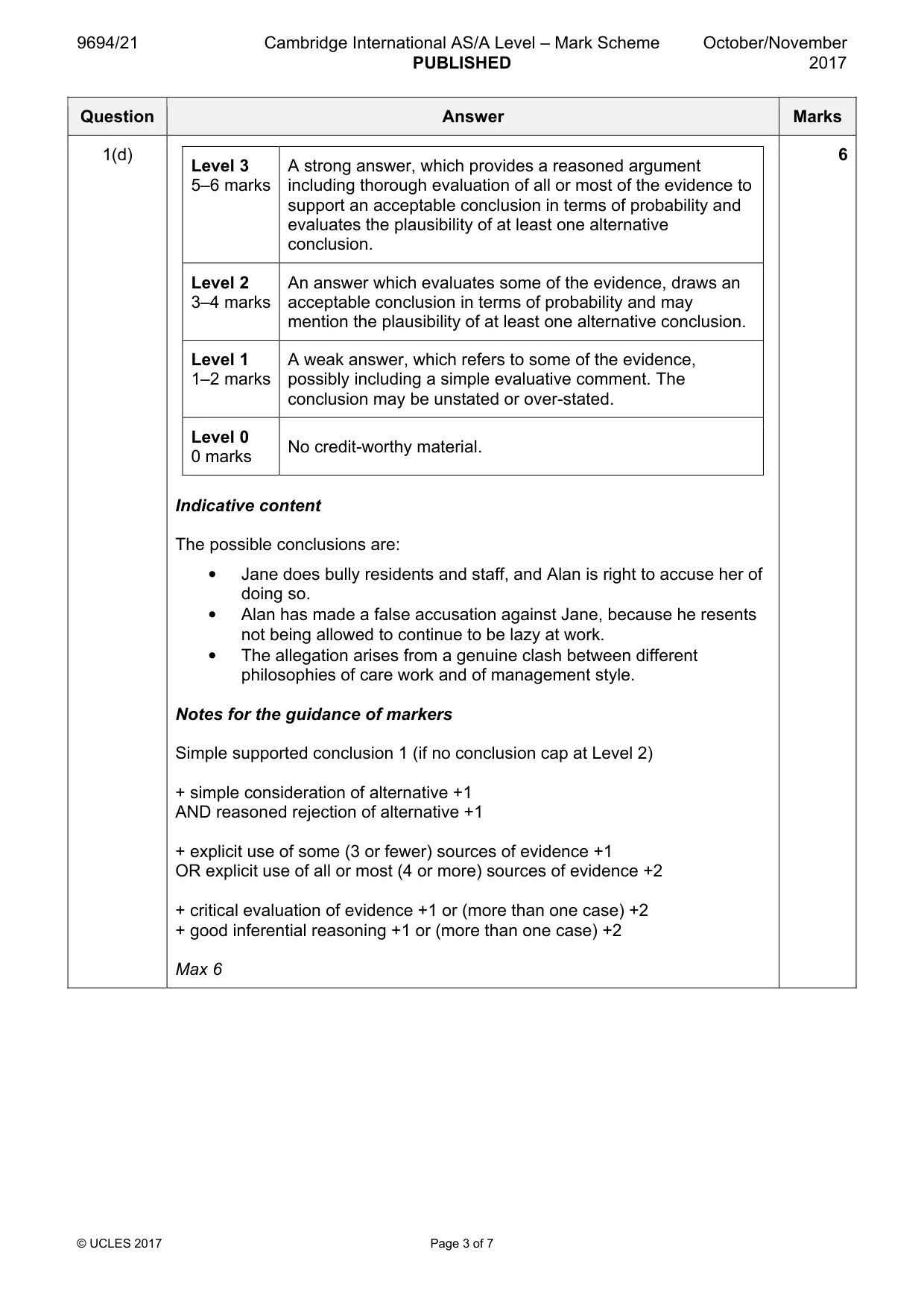
Mark scheme, page 1
® IGCSE is a registered trademark. This document consists of 7 printed pages. © UCLES 2017 [Turn over Cambridge Assessment International Education Cambridge International Advanced Subsidiary and Advanced Level THINKING SKILLS 9694/21 Paper 2 Critical Thinking October/November 2017 MARK SCHEME Maximum Mark: 45 Published This mark scheme is published as an aid to teachers and candidates, to indicate the requirements of the examination. It shows the basis on which Examiners were instructed to award marks. It does not indicate the details of the discussions that took place at an Examiners’ meeting before marking began, which would have considered the acceptability of alternative answers. Mark schemes should be read in conjunction with the question paper and the Principal Examiner Report for Teachers. Cambridge International will not enter into discussions about these mark schemes. Cambridge International is publishing the mark schemes for the October/November 2017 series for most Cambridge IGCSE®, Cambridge International A and AS Level components and some Cambridge O Level components.
Mark scheme, page 2
9694/21 Cambridge International AS/A Level – Mark Scheme PUBLISHED October/November 2017 © UCLES 2017 Page 2 of 7 Question Answer Marks 1(a)(i) • She has a vested interest to protect her job [1] by portraying herself in a good light / portraying Charlie negatively / making out that she has not contravened the bullying policy [1]. • Jane’s account of Charlie’s reason for objecting to her is second-hand [1]. 2 1(a)(ii) • He was not there at the time [1], so had no ability to see what happened [1]. • He may well be biased against Jane [1], since her email made clear that she would be coming in with a tough attitude towards the staff / since she describes him as a trouble-maker in Source E [1]. • If Jane’s comment in Source E is true [1], Alan has a reputation as a trouble-maker [1]. • Alan’s account of Charlie’s complaint about Jane is second-hand [1]. • Alan’s description of Charlie’s improved happiness is subjective [1]. 2 1(b) This is an example of Jane’s behaviour towards a resident [1]. The threat she admits making towards Charlie in the final sentence of her report [1] constitutes bullying according to Source B [1]. Alan’s report could be evidence of Jane’s bullying of a resident [1], if his account is true and if Charlie’s description of Jane’s behaviour is fair [1]. Source C is not relevant to bullying of staff [1]. 2 1(c) (Very) badly [1]. She does not attempt to answer the allegation [1], but instead attacks the person who made it/makes counter-allegations [1]. This is an ad hominem argument [1]. 3
Mark scheme, page 3
9694/21 Cambridge International AS/A Level – Mark Scheme PUBLISHED October/November 2017 © UCLES 2017 Page 3 of 7 Question Answer Marks 1(d) Level 3 5–6 marks A strong answer, which provides a reasoned argument including thorough evaluation of all or most of the evidence to support an acceptable conclusion in terms of probability and evaluates the plausibility of at least one alternative conclusion. Level 2 3–4 marks An answer which evaluates some of the evidence, draws an acceptable conclusion in terms of probability and may mention the plausibility of at least one alternative conclusion. Level 1 1–2 marks A weak answer, which refers to some of the evidence, possibly including a simple evaluative comment. The conclusion may be unstated or over-stated. Level 0 0 marks No credit-worthy material. Indicative content The possible conclusions are: • Jane does bully residents and staff, and Alan is right to accuse her of doing so. • Alan has made a false accusation against Jane, because he resents not being allowed to continue to be lazy at work. • The allegation arises from a genuine clash between different philosophies of care work and of management style. Notes for the guidance of markers Simple supported conclusion 1 (if no conclusion cap at Level 2) + simple consideration of alternative +1 AND reasoned rejection of alternative +1 + explicit use of some (3 or fewer) sources of evidence +1 OR explicit use of all or most (4 or more) sources of evidence +2 + critical evaluation of evidence +1 or (more than one case) +2 + good inferential reasoning +1 or (more than one case) +2 Max 6 6
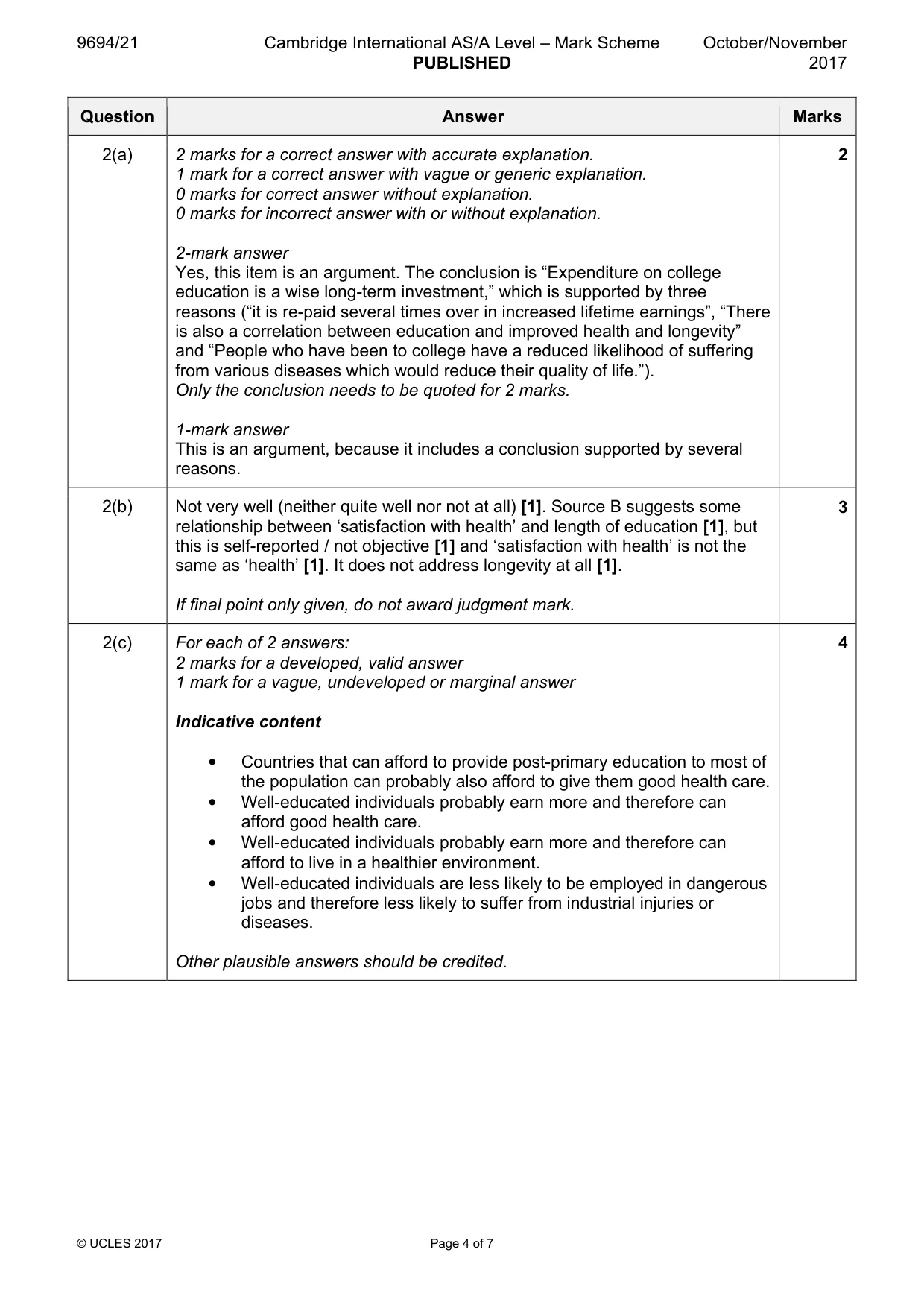
Mark scheme, page 4
9694/21 Cambridge International AS/A Level – Mark Scheme PUBLISHED October/November 2017 © UCLES 2017 Page 4 of 7 Question Answer Marks 2(a) 2 marks for a correct answer with accurate explanation. 1 mark for a correct answer with vague or generic explanation. 0 marks for correct answer without explanation. 0 marks for incorrect answer with or without explanation. 2-mark answer Yes, this item is an argument. The conclusion is “Expenditure on college education is a wise long-term investment,” which is supported by three reasons (“it is re-paid several times over in increased lifetime earnings”, “There is also a correlation between education and improved health and longevity” and “People who have been to college have a reduced likelihood of suffering from various diseases which would reduce their quality of life.”). Only the conclusion needs to be quoted for 2 marks. 1-mark answer This is an argument, because it includes a conclusion supported by several reasons. 2 2(b) Not very well (neither quite well nor not at all) [1]. Source B suggests some relationship between ‘satisfaction with health’ and length of education [1], but this is self-reported / not objective [1] and ‘satisfaction with health’ is not the same as ‘health’ [1]. It does not address longevity at all [1]. If final point only given, do not award judgment mark. 3 2(c) For each of 2 answers: 2 marks for a developed, valid answer 1 mark for a vague, undeveloped or marginal answer Indicative content • Countries that can afford to provide post-primary education to most of the population can probably also afford to give them good health care. • Well-educated individuals probably earn more and therefore can afford good health care. • Well-educated individuals probably earn more and therefore can afford to live in a healthier environment. • Well-educated individuals are less likely to be employed in dangerous jobs and therefore less likely to suffer from industrial injuries or diseases. Other plausible answers should be credited. 4
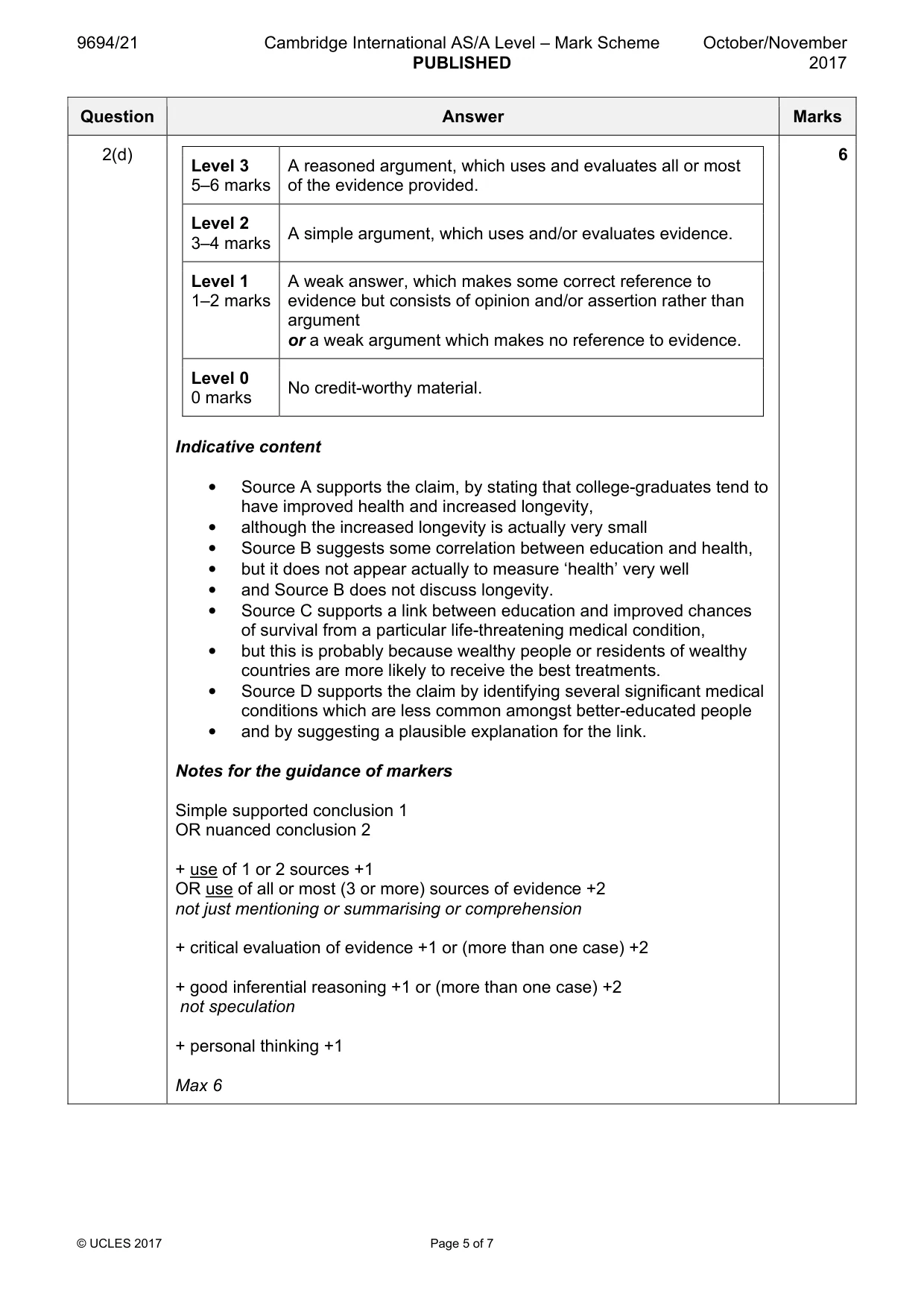
Mark scheme, page 5
9694/21 Cambridge International AS/A Level – Mark Scheme PUBLISHED October/November 2017 © UCLES 2017 Page 5 of 7 Question Answer Marks 2(d) Level 3 5–6 marks A reasoned argument, which uses and evaluates all or most of the evidence provided. Level 2 3–4 marks A simple argument, which uses and/or evaluates evidence. Level 1 1–2 marks A weak answer, which makes some correct reference to evidence but consists of opinion and/or assertion rather than argument or a weak argument which makes no reference to evidence. Level 0 0 marks No credit-worthy material. Indicative content • Source A supports the claim, by stating that college-graduates tend to have improved health and increased longevity, • although the increased longevity is actually very small • Source B suggests some correlation between education and health, • but it does not appear actually to measure ‘health’ very well • and Source B does not discuss longevity. • Source C supports a link between education and improved chances of survival from a particular life-threatening medical condition, • but this is probably because wealthy people or residents of wealthy countries are more likely to receive the best treatments. • Source D supports the claim by identifying several significant medical conditions which are less common amongst better-educated people • and by suggesting a plausible explanation for the link. Notes for the guidance of markers Simple supported conclusion 1 OR nuanced conclusion 2 + use of 1 or 2 sources +1 OR use of all or most (3 or more) sources of evidence +2 not just mentioning or summarising or comprehension + critical evaluation of evidence +1 or (more than one case) +2 + good inferential reasoning +1 or (more than one case) +2 not speculation + personal thinking +1 Max 6 6
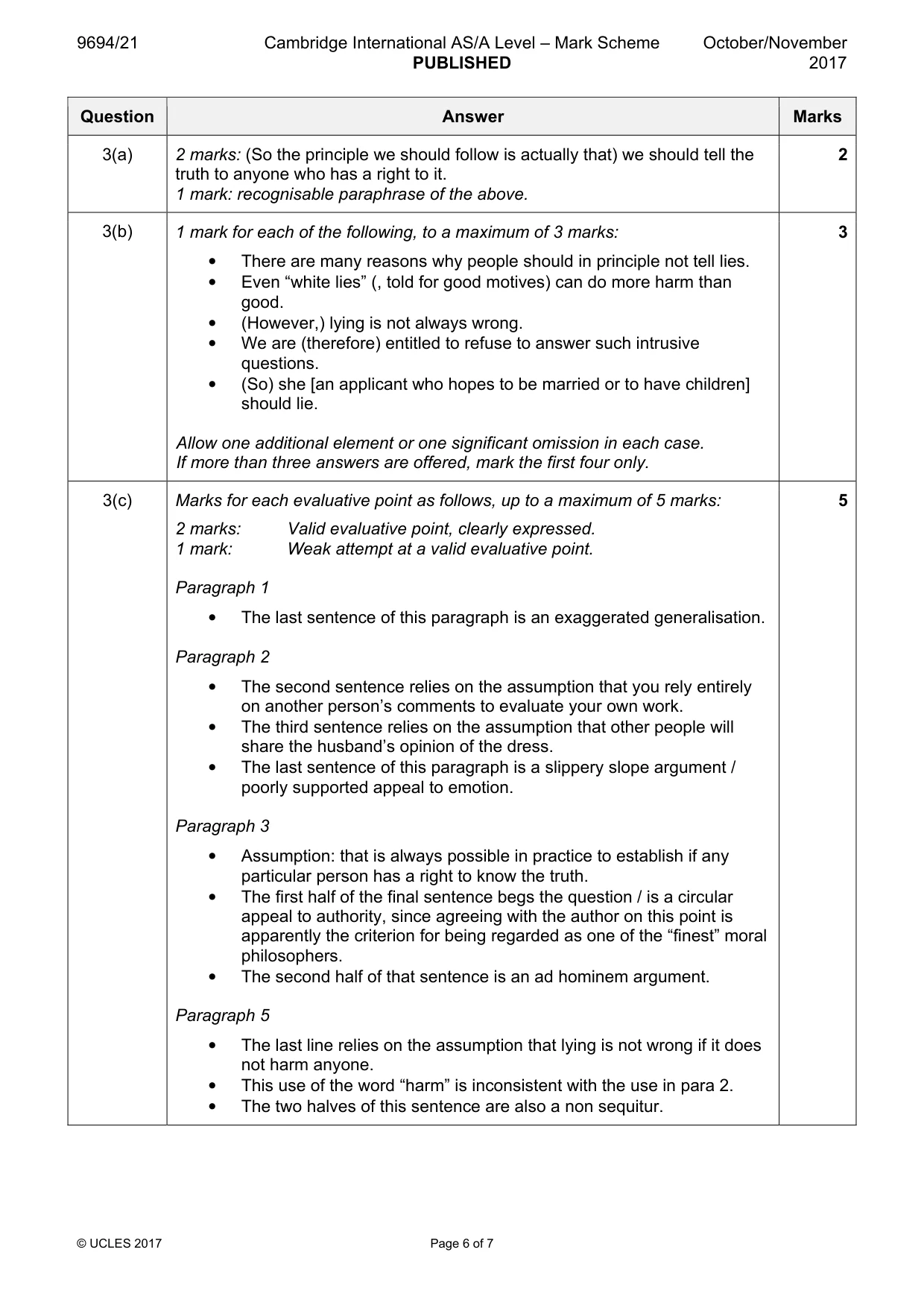
Mark scheme, page 6
9694/21 Cambridge International AS/A Level – Mark Scheme PUBLISHED October/November 2017 © UCLES 2017 Page 6 of 7 Question Answer Marks 3(a) 2 marks: (So the principle we should follow is actually that) we should tell the truth to anyone who has a right to it. 1 mark: recognisable paraphrase of the above. 2 3(b) 1 mark for each of the following, to a maximum of 3 marks: • There are many reasons why people should in principle not tell lies. • Even “white lies” (, told for good motives) can do more harm than good. • (However,) lying is not always wrong. • We are (therefore) entitled to refuse to answer such intrusive questions. • (So) she [an applicant who hopes to be married or to have children] should lie. Allow one additional element or one significant omission in each case. If more than three answers are offered, mark the first four only. 3 3(c) Marks for each evaluative point as follows, up to a maximum of 5 marks: 2 marks: Valid evaluative point, clearly expressed. 1 mark: Weak attempt at a valid evaluative point. Paragraph 1 • The last sentence of this paragraph is an exaggerated generalisation. Paragraph 2 • The second sentence relies on the assumption that you rely entirely on another person’s comments to evaluate your own work. • The third sentence relies on the assumption that other people will share the husband’s opinion of the dress. • The last sentence of this paragraph is a slippery slope argument / poorly supported appeal to emotion. Paragraph 3 • Assumption: that is always possible in practice to establish if any particular person has a right to know the truth. • The first half of the final sentence begs the question / is a circular appeal to authority, since agreeing with the author on this point is apparently the criterion for being regarded as one of the “finest” moral philosophers. • The second half of that sentence is an ad hominem argument. Paragraph 5 • The last line relies on the assumption that lying is not wrong if it does not harm anyone. • This use of the word “harm” is inconsistent with the use in para 2. • The two halves of this sentence are also a non sequitur. 5
Mark scheme, page 7
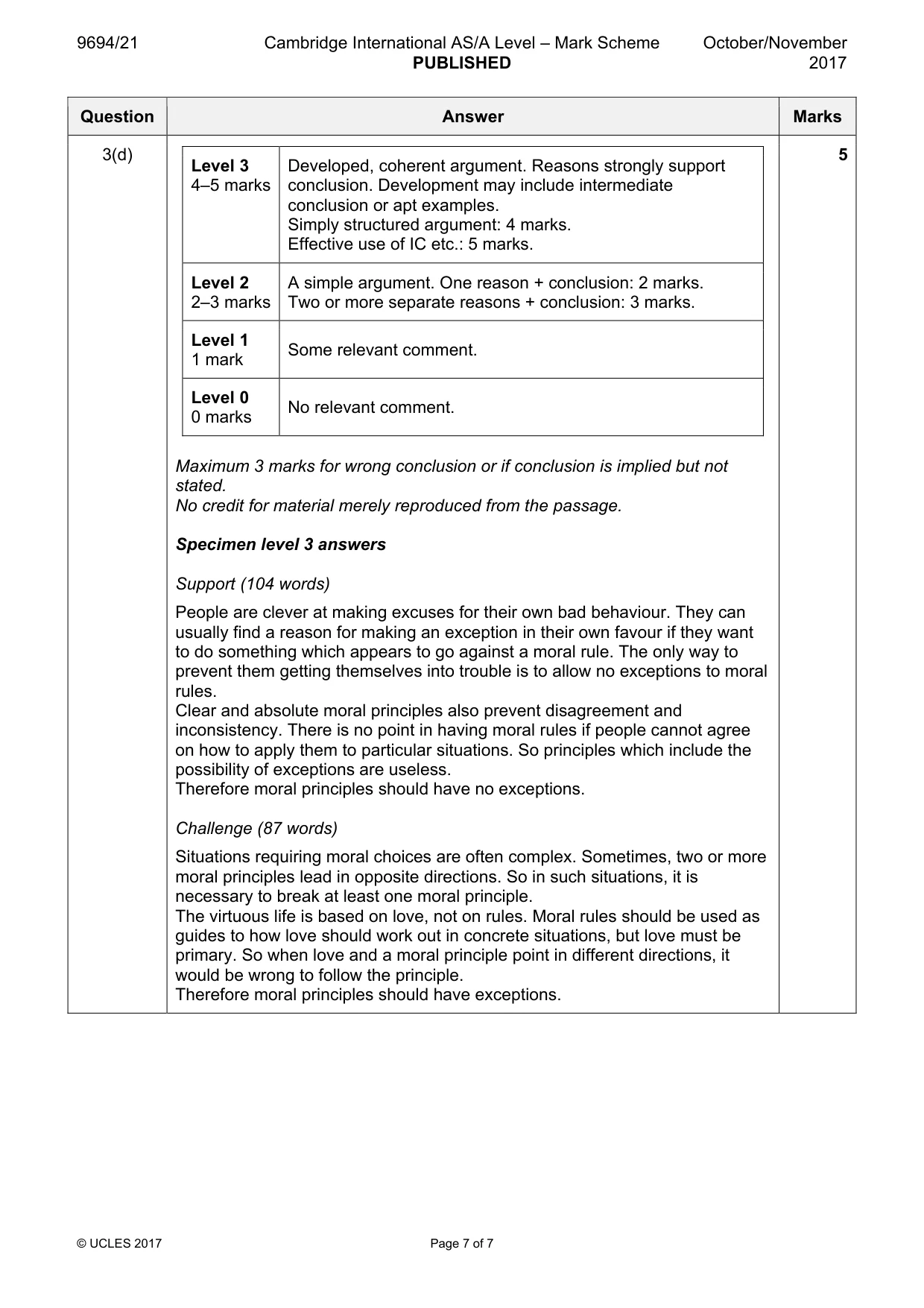
9694/21 Cambridge International AS/A Level – Mark Scheme PUBLISHED October/November 2017 © UCLES 2017 Page 7 of 7 Question Answer Marks 3(d) Level 3 4–5 marks Developed, coherent argument. Reasons strongly support conclusion. Development may include intermediate conclusion or apt examples. Simply structured argument: 4 marks. Effective use of IC etc.: 5 marks. Level 2 2–3 marks A simple argument. One reason + conclusion: 2 marks. Two or more separate reasons + conclusion: 3 marks. Level 1 1 mark Some relevant comment. Level 0 0 marks No relevant comment. Maximum 3 marks for wrong conclusion or if conclusion is implied but not stated. No credit for material merely reproduced from the passage. Specimen level 3 answers Support (104 words) People are clever at making excuses for their own bad behaviour. They can usually find a reason for making an exception in their own favour if they want to do something which appears to go against a moral rule. The only way to prevent them getting themselves into trouble is to allow no exceptions to moral rules. Clear and absolute moral principles also prevent disagreement and inconsistency. There is no point in having moral rules if people cannot agree on how to apply them to particular situations. So principles which include the possibility of exceptions are useless. Therefore moral principles should have no exceptions. Challenge (87 words) Situations requiring moral choices are often complex. Sometimes, two or more moral principles lead in opposite directions. So in such situations, it is necessary to break at least one moral principle. The virtuous life is based on love, not on rules. Moral rules should be used as guides to how love should work out in concrete situations, but love must be primary. So when love and a moral principle point in different directions, it would be wrong to follow the principle. Therefore moral principles should have exceptions. 5
What you needed in this session
Cambridge’s own grade thresholds for 2017 Oct/Nov, Paper 2 · Variant 1. A higher threshold means an easier paper — the bar moves with how the cohort did.