Cambridge A Level Thinking Skills 9694 — 2015 Oct/Nov Paper 2 · Variant 1
9694/21/O/N/15 · 45 marks · ≈51 min
The question paper and its mark scheme, free to read here and free to download. This is Cambridge’s own paper, exactly as it was sat.
Question paper8 pages

Mark scheme8 pages
Answers below. Sit the paper first if you are practising.
Paper as text
Question paper, page 1
This document consists of 6 printed pages, 2 blank pages and 1 insert. IB15 11_9694_21/2RP © UCLES 2015 [Turn over *7746687091* Cambridge International Examinations Cambridge International Advanced Subsidiary and Advanced Level THINKING SKILLS 9694/21 Paper 2 Critical Thinking October/November 2015 1 hour 45 minutes No Additional Materials are required. READ THESE INSTRUCTIONS FIRST An answer booklet is provided inside this question paper. You should follow the instructions on the front cover of the answer booklet. If you need additional answer paper ask the invigilator for a continuation booklet. Answer all the questions. The number of marks is given in brackets [ ] at the end of each question.
Question paper, page 2
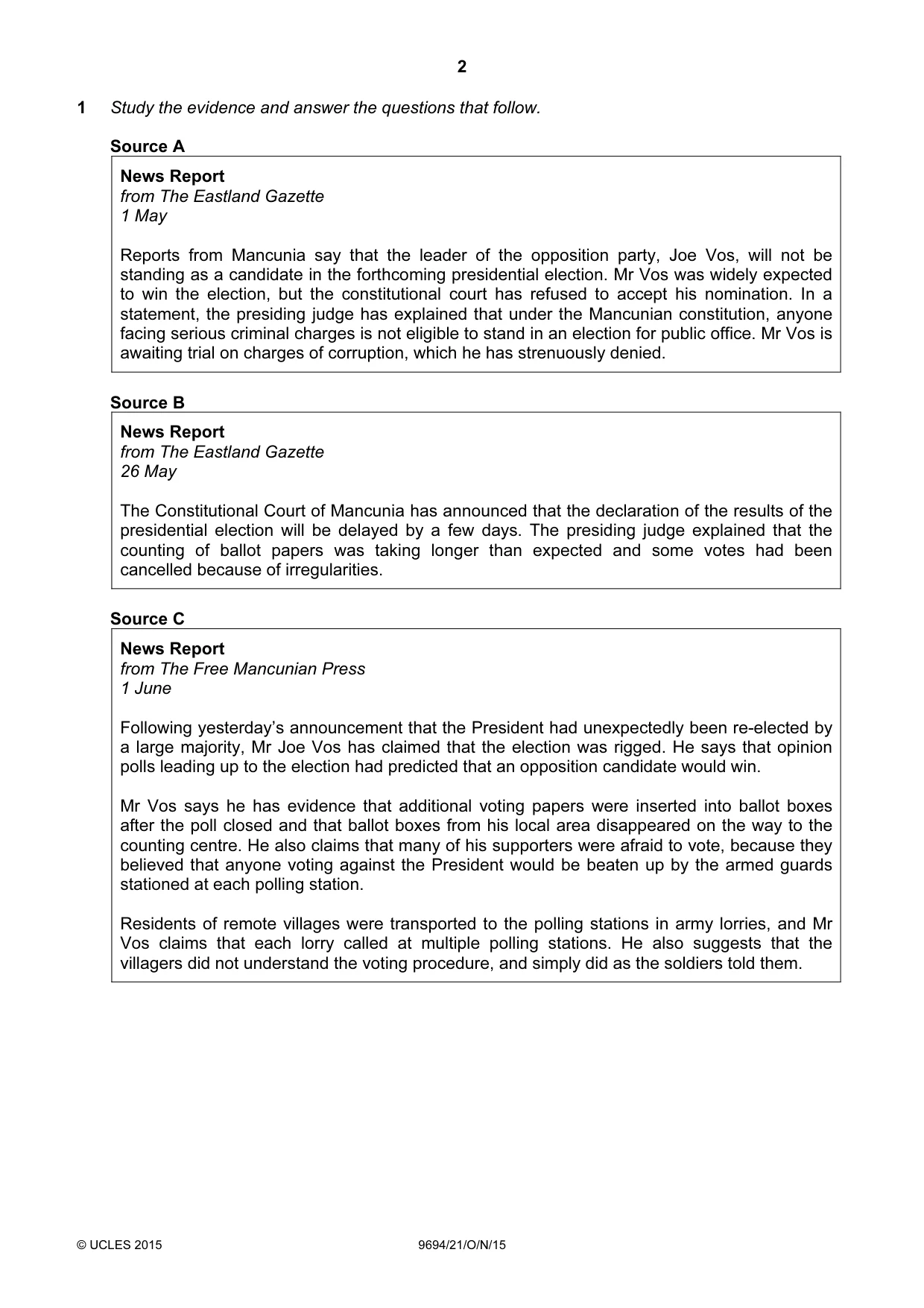
2 © UCLES 2015 9694/21/O/N/15 1 Study the evidence and answer the questions that follow. Source A News Report from The Eastland Gazette 1 May Reports from Mancunia say that the leader of the opposition party, Joe Vos, will not be standing as a candidate in the forthcoming presidential election. Mr Vos was widely expected to win the election, but the constitutional court has refused to accept his nomination. In a statement, the presiding judge has explained that under the Mancunian constitution, anyone facing serious criminal charges is not eligible to stand in an election for public office. Mr Vos is awaiting trial on charges of corruption, which he has strenuously denied. Source B News Report from The Eastland Gazette 26 May The Constitutional Court of Mancunia has announced that the declaration of the results of the presidential election will be delayed by a few days. The presiding judge explained that the counting of ballot papers was taking longer than expected and some votes had been cancelled because of irregularities. Source C News Report from The Free Mancunian Press 1 June Following yesterday’s announcement that the President had unexpectedly been re-elected by a large majority, Mr Joe Vos has claimed that the election was rigged. He says that opinion polls leading up to the election had predicted that an opposition candidate would win. Mr Vos says he has evidence that additional voting papers were inserted into ballot boxes after the poll closed and that ballot boxes from his local area disappeared on the way to the counting centre. He also claims that many of his supporters were afraid to vote, because they believed that anyone voting against the President would be beaten up by the armed guards stationed at each polling station. Residents of remote villages were transported to the polling stations in army lorries, and Mr Vos claims that each lorry called at multiple polling stations. He also suggests that the villagers did not understand the voting procedure, and simply did as the soldiers told them.
Question paper, page 3
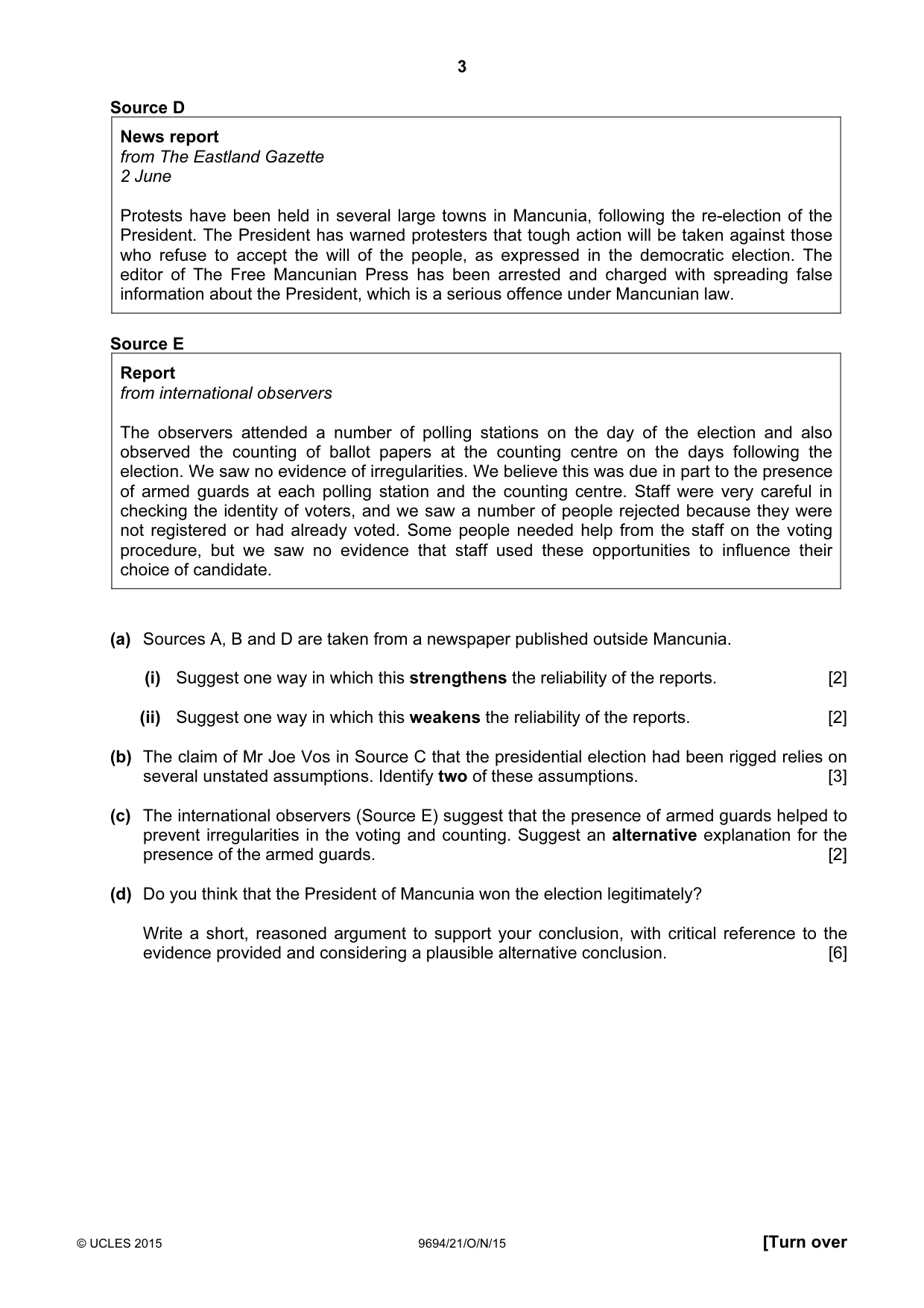
3 © UCLES 2015 9694/21/O/N/15 [Turn over Source D News report from The Eastland Gazette 2 June Protests have been held in several large towns in Mancunia, following the re-election of the President. The President has warned protesters that tough action will be taken against those who refuse to accept the will of the people, as expressed in the democratic election. The editor of The Free Mancunian Press has been arrested and charged with spreading false information about the President, which is a serious offence under Mancunian law. Source E Report from international observers The observers attended a number of polling stations on the day of the election and also observed the counting of ballot papers at the counting centre on the days following the election. We saw no evidence of irregularities. We believe this was due in part to the presence of armed guards at each polling station and the counting centre. Staff were very careful in checking the identity of voters, and we saw a number of people rejected because they were not registered or had already voted. Some people needed help from the staff on the voting procedure, but we saw no evidence that staff used these opportunities to influence their choice of candidate. (a) Sources A, B and D are taken from a newspaper published outside Mancunia. (i) Suggest one way in which this strengthens the reliability of the reports. [2] (ii) Suggest one way in which this weakens the reliability of the reports. [2] (b) The claim of Mr Joe Vos in Source C that the presidential election had been rigged relies on several unstated assumptions. Identify two of these assumptions. [3] (c) The international observers (Source E) suggest that the presence of armed guards helped to prevent irregularities in the voting and counting. Suggest an alternative explanation for the presence of the armed guards. [2] (d) Do you think that the President of Mancunia won the election legitimately? Write a short, reasoned argument to support your conclusion, with critical reference to the evidence provided and considering a plausible alternative conclusion. [6]
Question paper, page 4
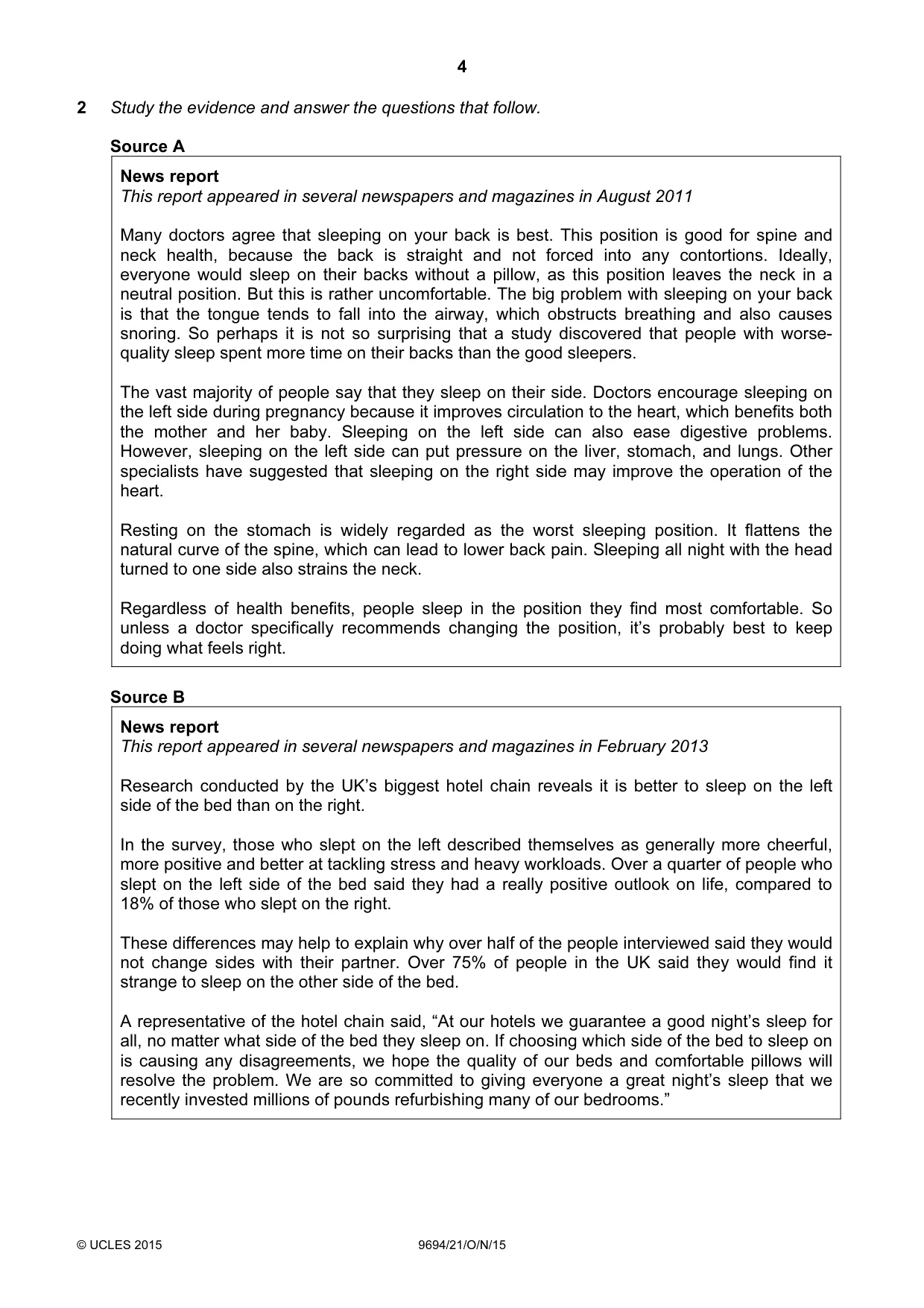
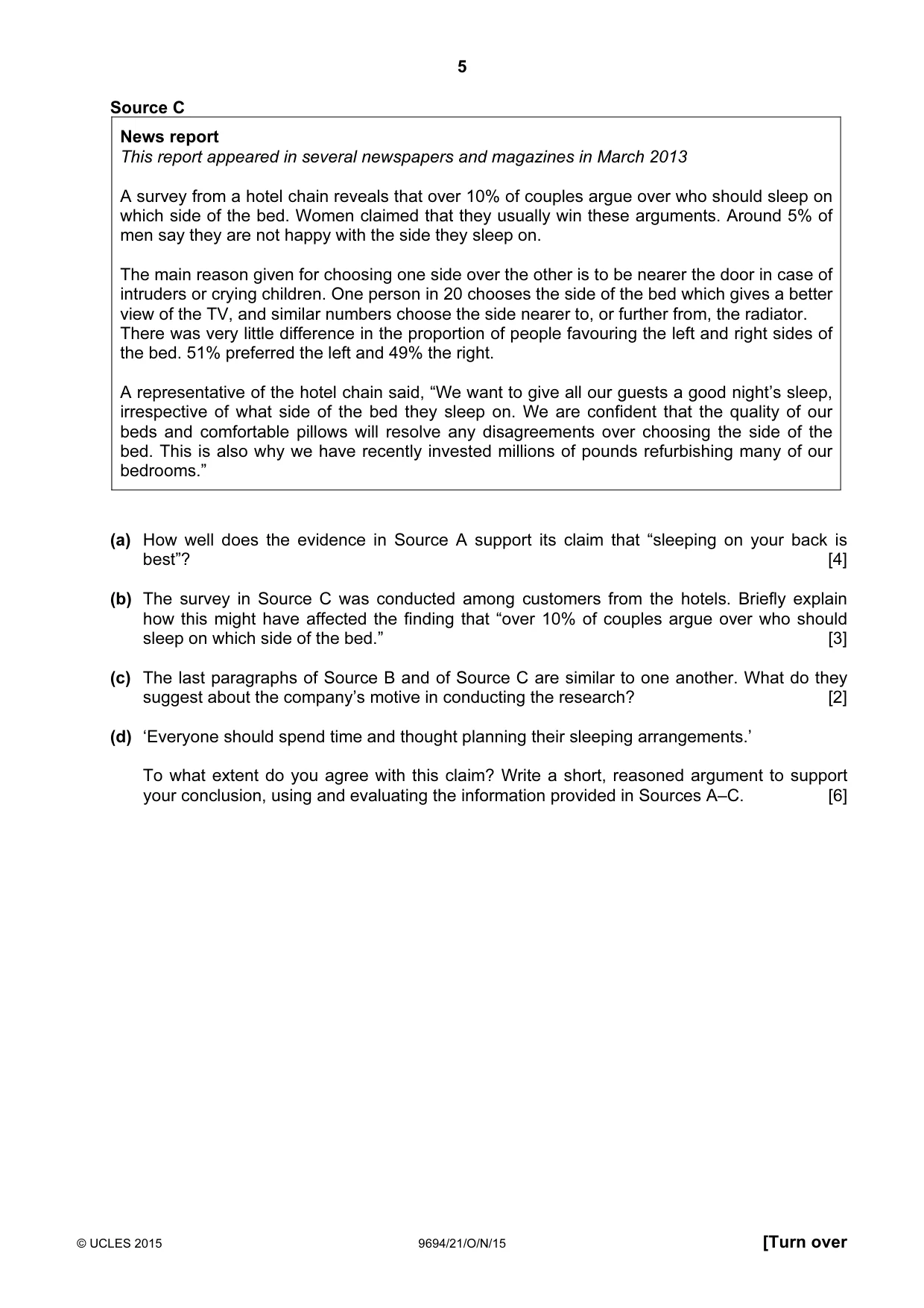
4 © UCLES 2015 9694/21/O/N/15 2 Study the evidence and answer the questions that follow. Source A News report This report appeared in several newspapers and magazines in August 2011 Many doctors agree that sleeping on your back is best. This position is good for spine and neck health, because the back is straight and not forced into any contortions. Ideally, everyone would sleep on their backs without a pillow, as this position leaves the neck in a neutral position. But this is rather uncomfortable. The big problem with sleeping on your back is that the tongue tends to fall into the airway, which obstructs breathing and also causes snoring. So perhaps it is not so surprising that a study discovered that people with worse- quality sleep spent more time on their backs than the good sleepers. The vast majority of people say that they sleep on their side. Doctors encourage sleeping on the left side during pregnancy because it improves circulation to the heart, which benefits both the mother and her baby. Sleeping on the left side can also ease digestive problems. However, sleeping on the left side can put pressure on the liver, stomach, and lungs. Other specialists have suggested that sleeping on the right side may improve the operation of the heart. Resting on the stomach is widely regarded as the worst sleeping position. It flattens the natural curve of the spine, which can lead to lower back pain. Sleeping all night with the head turned to one side also strains the neck. Regardless of health benefits, people sleep in the position they find most comfortable. So unless a doctor specifically recommends changing the position, it’s probably best to keep doing what feels right. Source B News report This report appeared in several newspapers and magazines in February 2013 Research conducted by the UK’s biggest hotel chain reveals it is better to sleep on the left side of the bed than on the right. In the survey, those who slept on the left described themselves as generally more cheerful, more positive and better at tackling stress and heavy workloads. Over a quarter of people who slept on the left side of the bed said they had a really positive outlook on life, compared to 18% of those who slept on the right. These differences may help to explain why over half of the people interviewed said they would not change sides with their partner. Over 75% of people in the UK said they would find it strange to sleep on the other side of the bed. A representative of the hotel chain said, “At our hotels we guarantee a good night’s sleep for all, no matter what side of the bed they sleep on. If choosing which side of the bed to sleep on is causing any disagreements, we hope the quality of our beds and comfortable pillows will resolve the problem. We are so committed to giving everyone a great night’s sleep that we recently invested millions of pounds refurbishing many of our bedrooms.”
Question paper, page 5
5 © UCLES 2015 9694/21/O/N/15 [Turn over Source C News report This report appeared in several newspapers and magazines in March 2013 A survey from a hotel chain reveals that over 10% of couples argue over who should sleep on which side of the bed. Women claimed that they usually win these arguments. Around 5% of men say they are not happy with the side they sleep on. The main reason given for choosing one side over the other is to be nearer the door in case of intruders or crying children. One person in 20 chooses the side of the bed which gives a better view of the TV, and similar numbers choose the side nearer to, or further from, the radiator. There was very little difference in the proportion of people favouring the left and right sides of the bed. 51% preferred the left and 49% the right. A representative of the hotel chain said, “We want to give all our guests a good night’s sleep, irrespective of what side of the bed they sleep on. We are confident that the quality of our beds and comfortable pillows will resolve any disagreements over choosing the side of the bed. This is also why we have recently invested millions of pounds refurbishing many of our bedrooms.” (a) How well does the evidence in Source A support its claim that “sleeping on your back is best”? [4] (b) The survey in Source C was conducted among customers from the hotels. Briefly explain how this might have affected the finding that “over 10% of couples argue over who should sleep on which side of the bed.” [3] (c) The last paragraphs of Source B and of Source C are similar to one another. What do they suggest about the company’s motive in conducting the research? [2] (d) ‘Everyone should spend time and thought planning their sleeping arrangements.’ To what extent do you agree with this claim? Write a short, reasoned argument to support your conclusion, using and evaluating the information provided in Sources A–C. [6]
Question paper, page 6
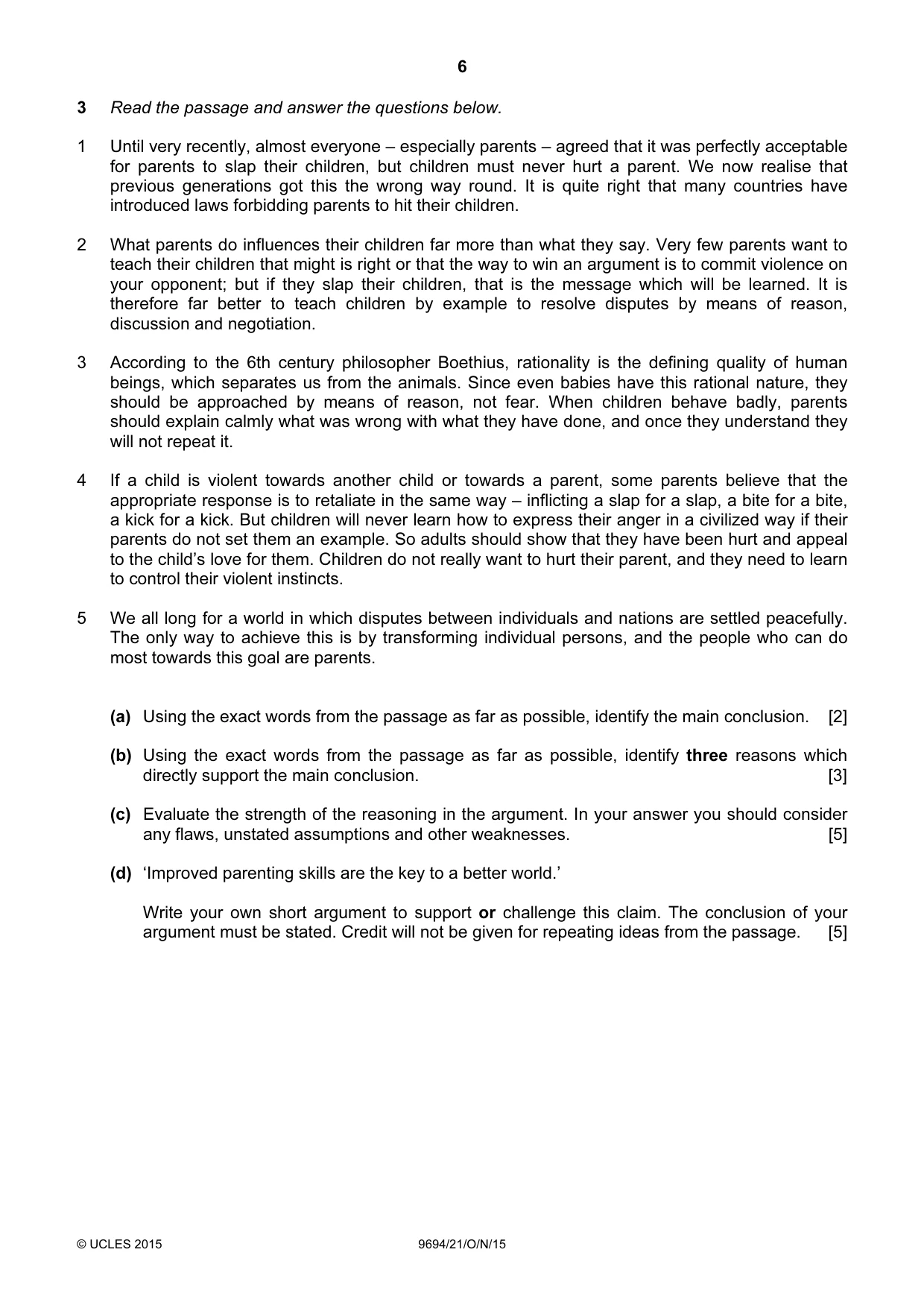
6 © UCLES 2015 9694/21/O/N/15 3 Read the passage and answer the questions below. 1 Until very recently, almost everyone – especially parents – agreed that it was perfectly acceptable for parents to slap their children, but children must never hurt a parent. We now realise that previous generations got this the wrong way round. It is quite right that many countries have introduced laws forbidding parents to hit their children. 2 What parents do influences their children far more than what they say. Very few parents want to teach their children that might is right or that the way to win an argument is to commit violence on your opponent; but if they slap their children, that is the message which will be learned. It is therefore far better to teach children by example to resolve disputes by means of reason, discussion and negotiation. 3 According to the 6th century philosopher Boethius, rationality is the defining quality of human beings, which separates us from the animals. Since even babies have this rational nature, they should be approached by means of reason, not fear. When children behave badly, parents should explain calmly what was wrong with what they have done, and once they understand they will not repeat it. 4 If a child is violent towards another child or towards a parent, some parents believe that the appropriate response is to retaliate in the same way – inflicting a slap for a slap, a bite for a bite, a kick for a kick. But children will never learn how to express their anger in a civilized way if their parents do not set them an example. So adults should show that they have been hurt and appeal to the child’s love for them. Children do not really want to hurt their parent, and they need to learn to control their violent instincts. 5 We all long for a world in which disputes between individuals and nations are settled peacefully. The only way to achieve this is by transforming individual persons, and the people who can do most towards this goal are parents. (a) Using the exact words from the passage as far as possible, identify the main conclusion. [2] (b) Using the exact words from the passage as far as possible, identify three reasons which directly support the main conclusion. [3] (c) Evaluate the strength of the reasoning in the argument. In your answer you should consider any flaws, unstated assumptions and other weaknesses. [5] (d) ‘Improved parenting skills are the key to a better world.’ Write your own short argument to support or challenge this claim. The conclusion of your argument must be stated. Credit will not be given for repeating ideas from the passage. [5]
Question paper, page 7
7 © UCLES 2015 9694/21/O/N/15 BLANK PAGE
Question paper, page 8
8 Permission to reproduce items where third-party owned material protected by copyright is included has been sought and cleared where possible. Every reasonable effort has been made by the publisher (UCLES) to trace copyright holders, but if any items requiring clearance have unwittingly been included, the publisher will be pleased to make amends at the earliest possible opportunity. To avoid the issue of disclosure of answer-related information to candidates, all copyright acknowledgements are reproduced online in the Cambridge International Examinations Copyright Acknowledgements Booklet. This is produced for each series of examinations and is freely available to download at www.cie.org.uk after the live examination series. Cambridge International Examinations is part of the Cambridge Assessment Group. Cambridge Assessment is the brand name of University of Cambridge Local Examinations Syndicate (UCLES), which is itself a department of the University of Cambridge. © UCLES 2015 9694/21/O/N/15 BLANK PAGE
Mark scheme, page 1
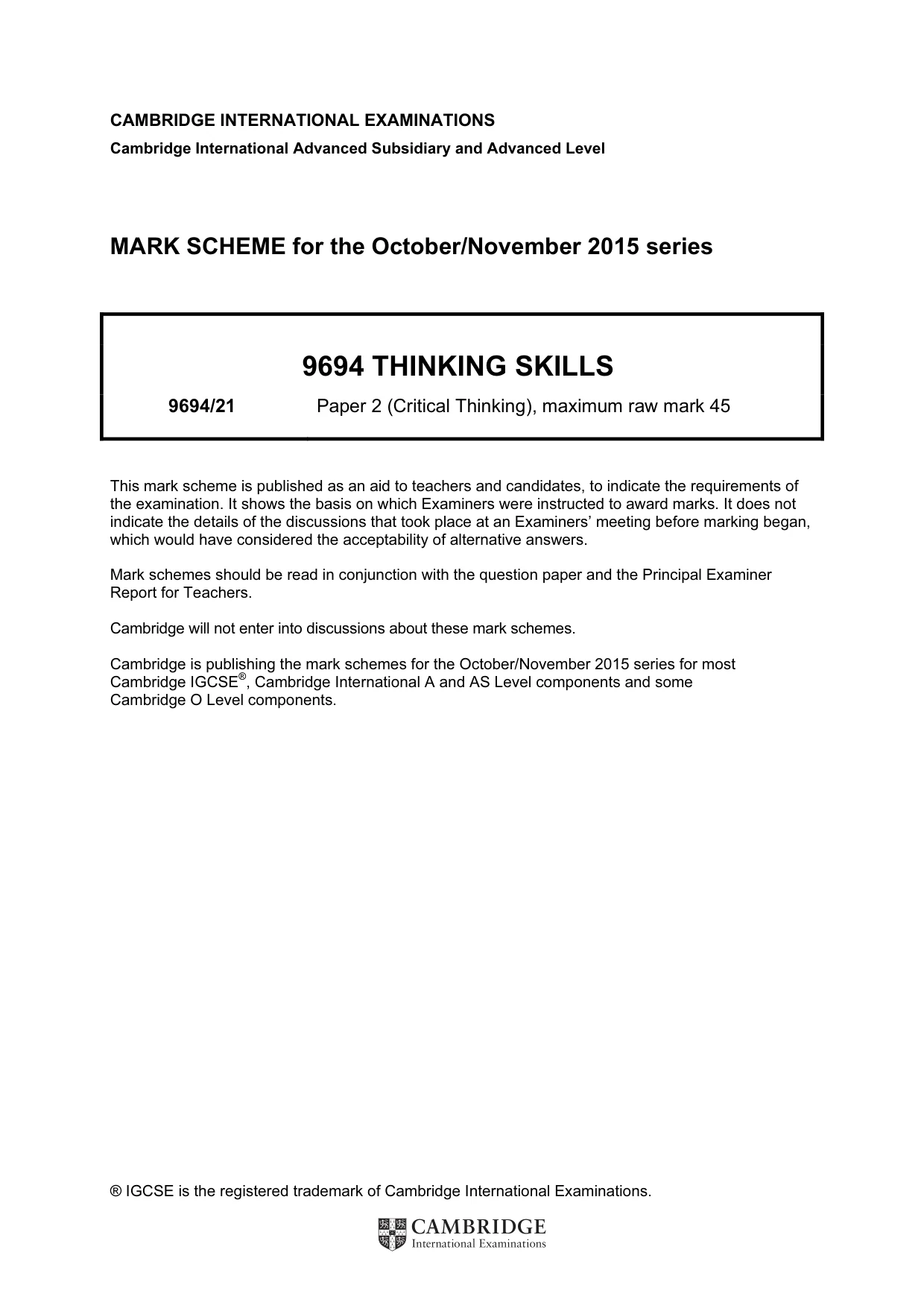
® IGCSE is the registered trademark of Cambridge International Examinations. CAMBRIDGE INTERNATIONAL EXAMINATIONS Cambridge International Advanced Subsidiary and Advanced Level MARK SCHEME for the October/November 2015 series 9694 THINKING SKILLS 9694/21 Paper 2 (Critical Thinking), maximum raw mark 45 This mark scheme is published as an aid to teachers and candidates, to indicate the requirements of the examination. It shows the basis on which Examiners were instructed to award marks. It does not indicate the details of the discussions that took place at an Examiners’ meeting before marking began, which would have considered the acceptability of alternative answers. Mark schemes should be read in conjunction with the question paper and the Principal Examiner Report for Teachers. Cambridge will not enter into discussions about these mark schemes. Cambridge is publishing the mark schemes for the October/November 2015 series for most Cambridge IGCSE®, Cambridge International A and AS Level components and some Cambridge O Level components.
Mark scheme, page 2
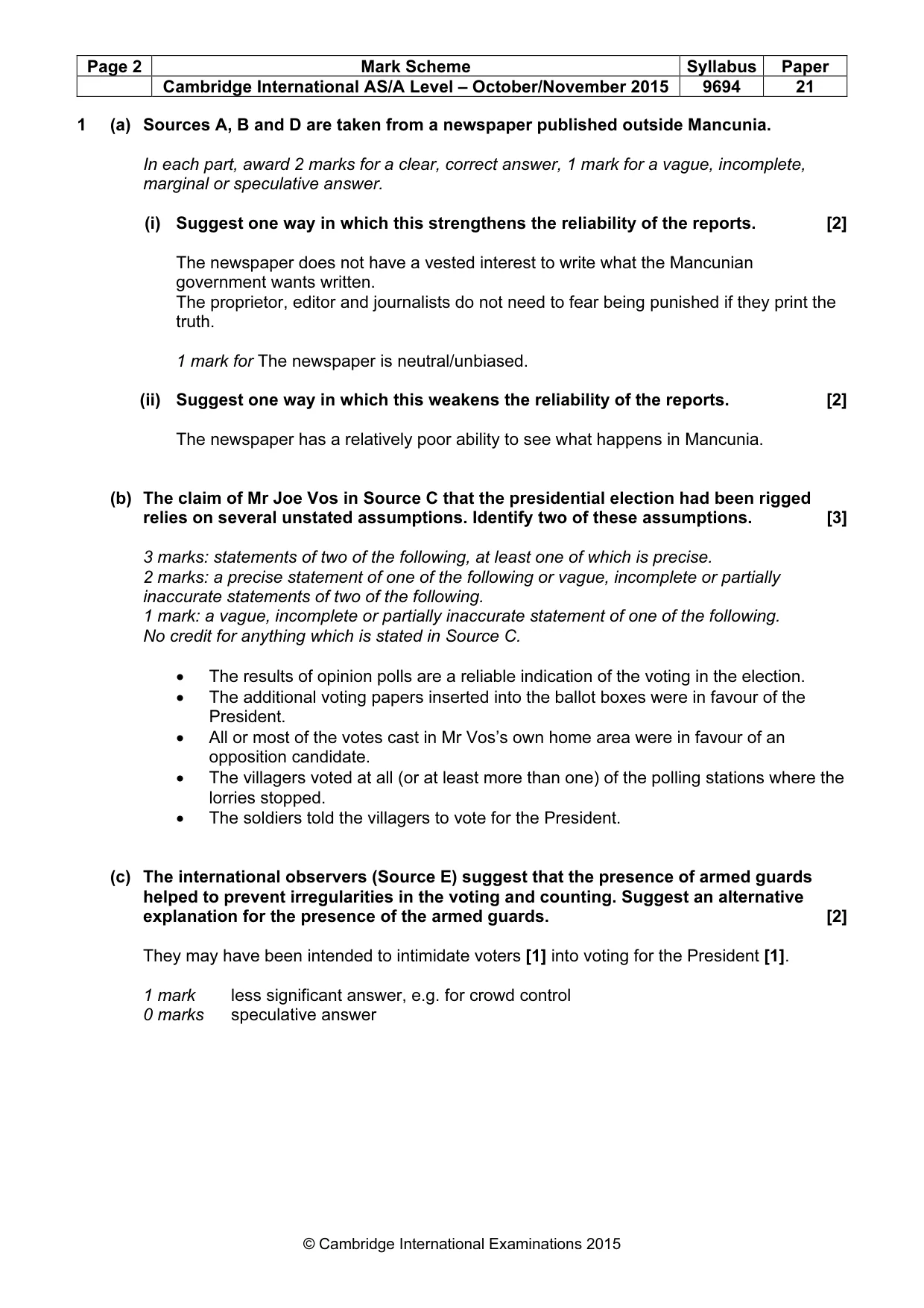
Page 2 Mark Scheme Syllabus Paper Cambridge International AS/A Level – October/November 2015 9694 21 © Cambridge International Examinations 2015 1 (a) Sources A, B and D are taken from a newspaper published outside Mancunia. In each part, award 2 marks for a clear, correct answer, 1 mark for a vague, incomplete, marginal or speculative answer. (i) Suggest one way in which this strengthens the reliability of the reports. [2] The newspaper does not have a vested interest to write what the Mancunian government wants written. The proprietor, editor and journalists do not need to fear being punished if they print the truth. 1 mark for The newspaper is neutral/unbiased. (ii) Suggest one way in which this weakens the reliability of the reports. [2] The newspaper has a relatively poor ability to see what happens in Mancunia. (b) The claim of Mr Joe Vos in Source C that the presidential election had been rigged relies on several unstated assumptions. Identify two of these assumptions. [3] 3 marks: statements of two of the following, at least one of which is precise. 2 marks: a precise statement of one of the following or vague, incomplete or partially inaccurate statements of two of the following. 1 mark: a vague, incomplete or partially inaccurate statement of one of the following. No credit for anything which is stated in Source C. • The results of opinion polls are a reliable indication of the voting in the election. • The additional voting papers inserted into the ballot boxes were in favour of the President. • All or most of the votes cast in Mr Vos’s own home area were in favour of an opposition candidate. • The villagers voted at all (or at least more than one) of the polling stations where the lorries stopped. • The soldiers told the villagers to vote for the President. (c) The international observers (Source E) suggest that the presence of armed guards helped to prevent irregularities in the voting and counting. Suggest an alternative explanation for the presence of the armed guards. [2] They may have been intended to intimidate voters [1] into voting for the President [1]. 1 mark less significant answer, e.g. for crowd control 0 marks speculative answer
Mark scheme, page 3
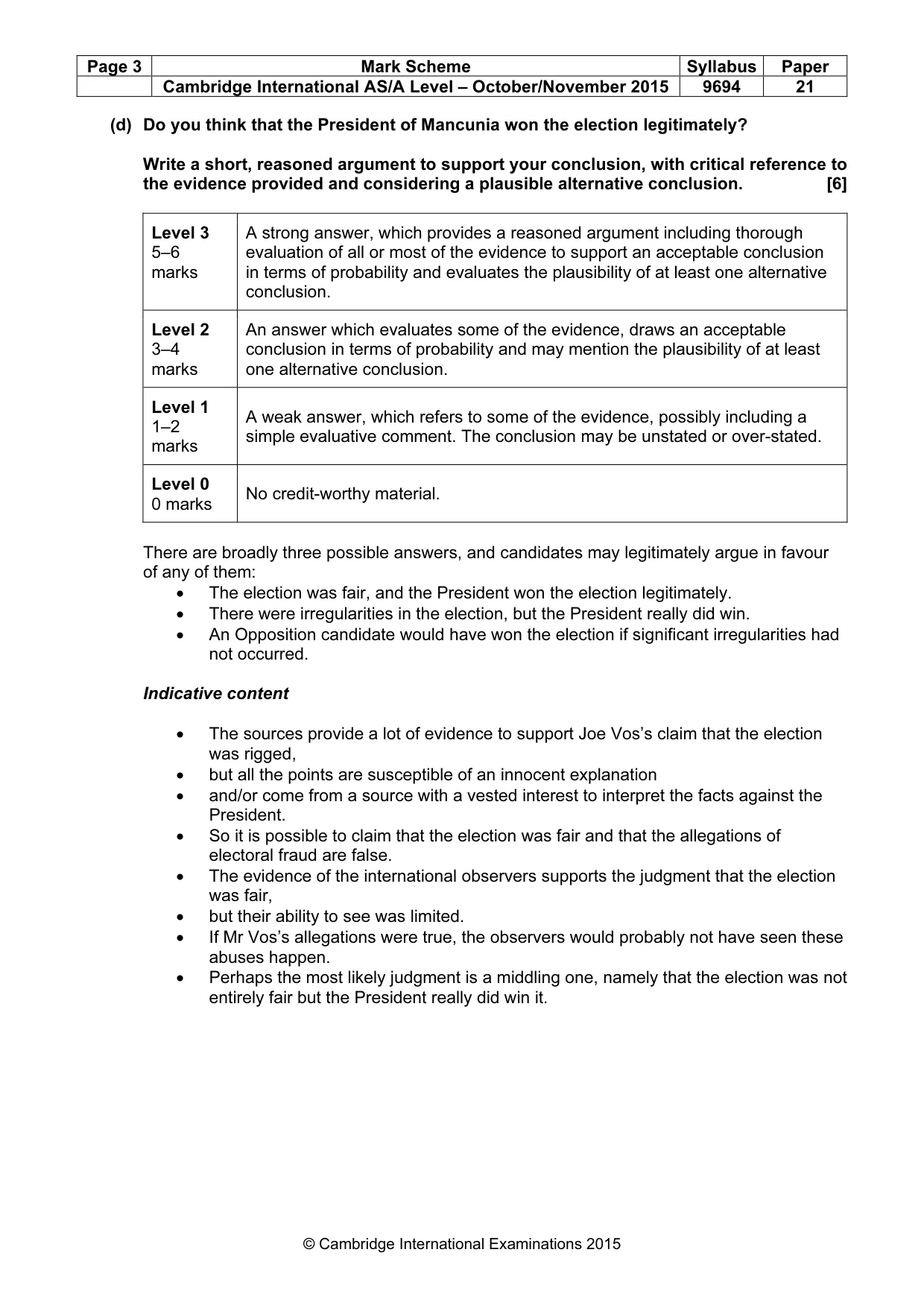
Page 3 Mark Scheme Syllabus Paper Cambridge International AS/A Level – October/November 2015 9694 21 © Cambridge International Examinations 2015 (d) Do you think that the President of Mancunia won the election legitimately? Write a short, reasoned argument to support your conclusion, with critical reference to the evidence provided and considering a plausible alternative conclusion. [6] Level 3 5–6 marks A strong answer, which provides a reasoned argument including thorough evaluation of all or most of the evidence to support an acceptable conclusion in terms of probability and evaluates the plausibility of at least one alternative conclusion. Level 2 3–4 marks An answer which evaluates some of the evidence, draws an acceptable conclusion in terms of probability and may mention the plausibility of at least one alternative conclusion. Level 1 1–2 marks A weak answer, which refers to some of the evidence, possibly including a simple evaluative comment. The conclusion may be unstated or over-stated. Level 0 0 marks No credit-worthy material. There are broadly three possible answers, and candidates may legitimately argue in favour of any of them: • The election was fair, and the President won the election legitimately. • There were irregularities in the election, but the President really did win. • An Opposition candidate would have won the election if significant irregularities had not occurred. Indicative content • The sources provide a lot of evidence to support Joe Vos’s claim that the election was rigged, • but all the points are susceptible of an innocent explanation • and/or come from a source with a vested interest to interpret the facts against the President. • So it is possible to claim that the election was fair and that the allegations of electoral fraud are false. • The evidence of the international observers supports the judgment that the election was fair, • but their ability to see was limited. • If Mr Vos’s allegations were true, the observers would probably not have seen these abuses happen. • Perhaps the most likely judgment is a middling one, namely that the election was not entirely fair but the President really did win it.
Mark scheme, page 4
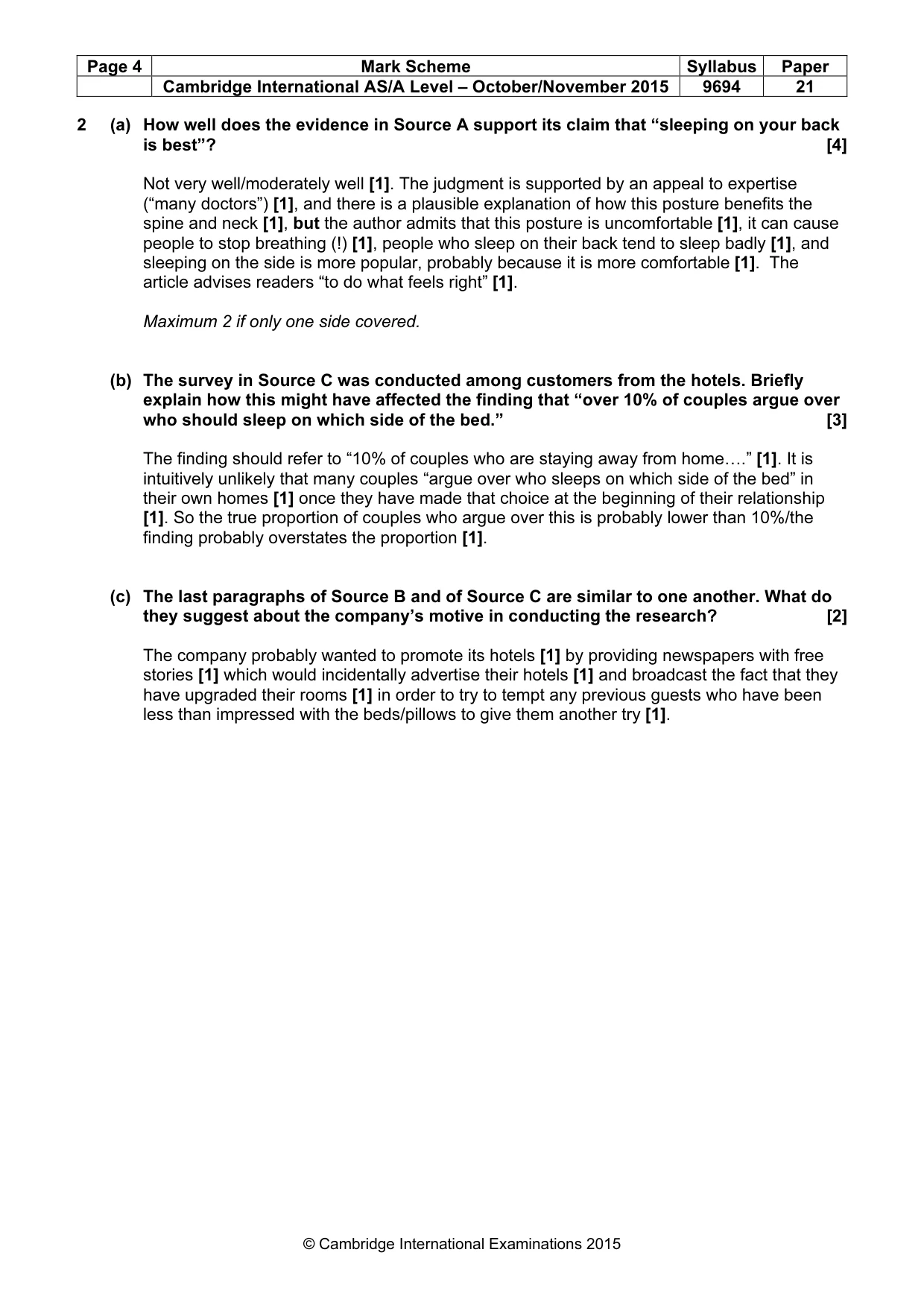
Page 4 Mark Scheme Syllabus Paper Cambridge International AS/A Level – October/November 2015 9694 21 © Cambridge International Examinations 2015 2 (a) How well does the evidence in Source A support its claim that “sleeping on your back is best”? [4] Not very well/moderately well [1]. The judgment is supported by an appeal to expertise (“many doctors”) [1], and there is a plausible explanation of how this posture benefits the spine and neck [1], but the author admits that this posture is uncomfortable [1], it can cause people to stop breathing (!) [1], people who sleep on their back tend to sleep badly [1], and sleeping on the side is more popular, probably because it is more comfortable [1]. The article advises readers “to do what feels right” [1]. Maximum 2 if only one side covered. (b) The survey in Source C was conducted among customers from the hotels. Briefly explain how this might have affected the finding that “over 10% of couples argue over who should sleep on which side of the bed.” [3] The finding should refer to “10% of couples who are staying away from home….” [1]. It is intuitively unlikely that many couples “argue over who sleeps on which side of the bed” in their own homes [1] once they have made that choice at the beginning of their relationship [1]. So the true proportion of couples who argue over this is probably lower than 10%/the finding probably overstates the proportion [1]. (c) The last paragraphs of Source B and of Source C are similar to one another. What do they suggest about the company’s motive in conducting the research? [2] The company probably wanted to promote its hotels [1] by providing newspapers with free stories [1] which would incidentally advertise their hotels [1] and broadcast the fact that they have upgraded their rooms [1] in order to try to tempt any previous guests who have been less than impressed with the beds/pillows to give them another try [1].
Mark scheme, page 5
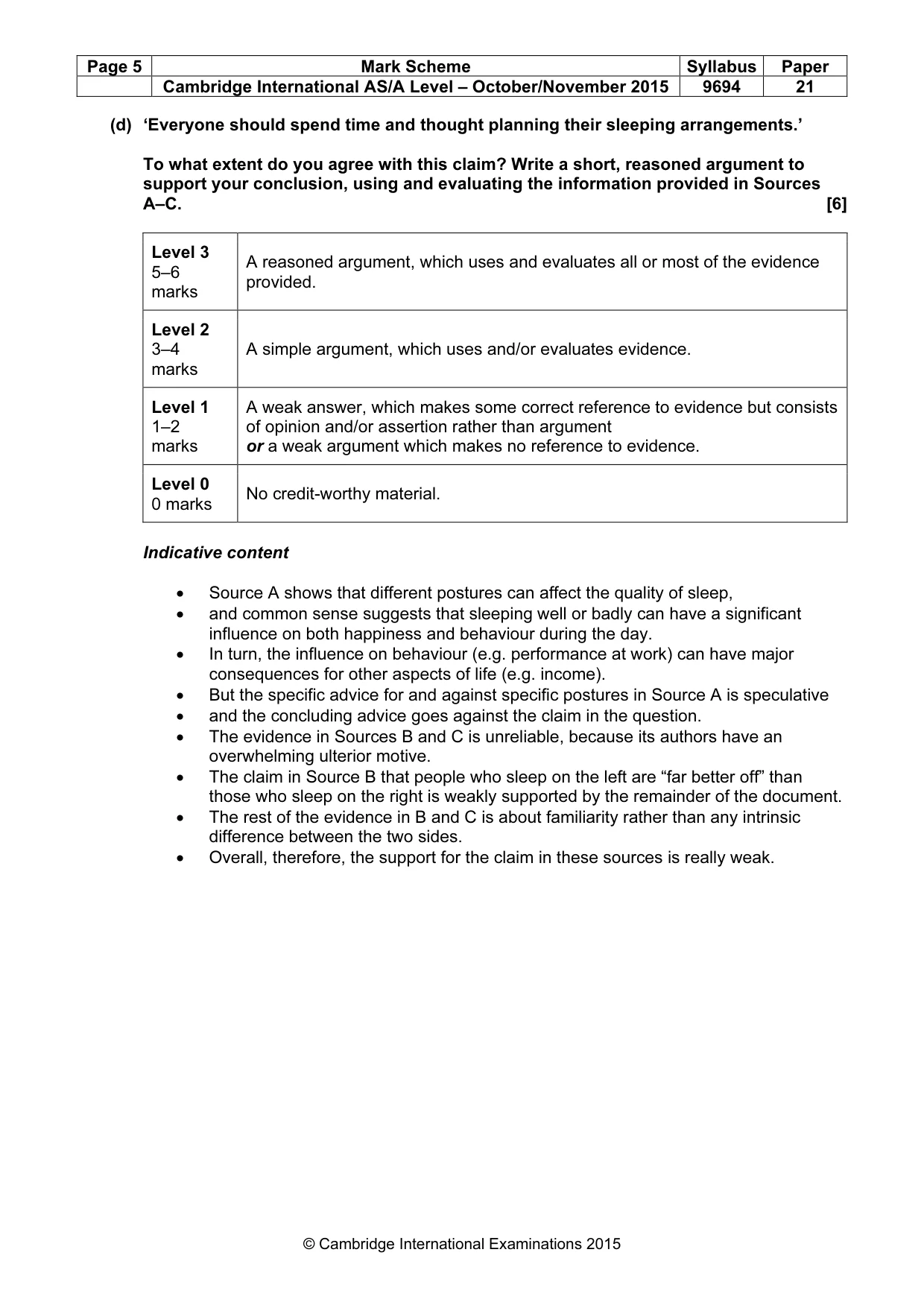
Page 5 Mark Scheme Syllabus Paper Cambridge International AS/A Level – October/November 2015 9694 21 © Cambridge International Examinations 2015 (d) ‘Everyone should spend time and thought planning their sleeping arrangements.’ To what extent do you agree with this claim? Write a short, reasoned argument to support your conclusion, using and evaluating the information provided in Sources A–C. [6] Level 3 5–6 marks A reasoned argument, which uses and evaluates all or most of the evidence provided. Level 2 3–4 marks A simple argument, which uses and/or evaluates evidence. Level 1 1–2 marks A weak answer, which makes some correct reference to evidence but consists of opinion and/or assertion rather than argument or a weak argument which makes no reference to evidence. Level 0 0 marks No credit-worthy material. Indicative content • Source A shows that different postures can affect the quality of sleep, • and common sense suggests that sleeping well or badly can have a significant influence on both happiness and behaviour during the day. • In turn, the influence on behaviour (e.g. performance at work) can have major consequences for other aspects of life (e.g. income). • But the specific advice for and against specific postures in Source A is speculative • and the concluding advice goes against the claim in the question. • The evidence in Sources B and C is unreliable, because its authors have an overwhelming ulterior motive. • The claim in Source B that people who sleep on the left are “far better off” than those who sleep on the right is weakly supported by the remainder of the document. • The rest of the evidence in B and C is about familiarity rather than any intrinsic difference between the two sides. • Overall, therefore, the support for the claim in these sources is really weak.
Mark scheme, page 6
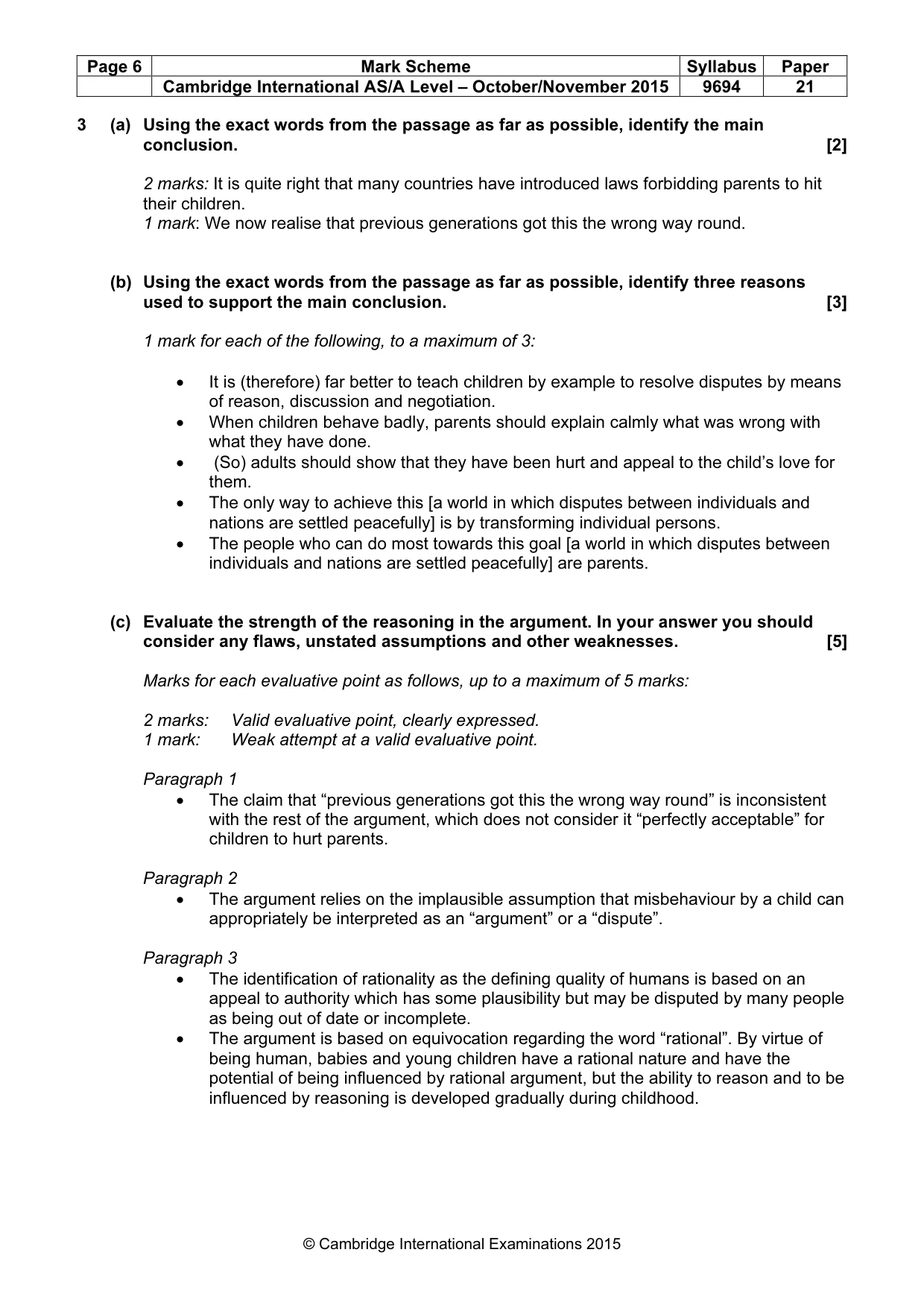
Page 6 Mark Scheme Syllabus Paper Cambridge International AS/A Level – October/November 2015 9694 21 © Cambridge International Examinations 2015 3 (a) Using the exact words from the passage as far as possible, identify the main conclusion. [2] 2 marks: It is quite right that many countries have introduced laws forbidding parents to hit their children. 1 mark: We now realise that previous generations got this the wrong way round. (b) Using the exact words from the passage as far as possible, identify three reasons used to support the main conclusion. [3] 1 mark for each of the following, to a maximum of 3: • It is (therefore) far better to teach children by example to resolve disputes by means of reason, discussion and negotiation. • When children behave badly, parents should explain calmly what was wrong with what they have done. • (So) adults should show that they have been hurt and appeal to the child’s love for them. • The only way to achieve this [a world in which disputes between individuals and nations are settled peacefully] is by transforming individual persons. • The people who can do most towards this goal [a world in which disputes between individuals and nations are settled peacefully] are parents. (c) Evaluate the strength of the reasoning in the argument. In your answer you should consider any flaws, unstated assumptions and other weaknesses. [5] Marks for each evaluative point as follows, up to a maximum of 5 marks: 2 marks: Valid evaluative point, clearly expressed. 1 mark: Weak attempt at a valid evaluative point. Paragraph 1 • The claim that “previous generations got this the wrong way round” is inconsistent with the rest of the argument, which does not consider it “perfectly acceptable” for children to hurt parents. Paragraph 2 • The argument relies on the implausible assumption that misbehaviour by a child can appropriately be interpreted as an “argument” or a “dispute”. Paragraph 3 • The identification of rationality as the defining quality of humans is based on an appeal to authority which has some plausibility but may be disputed by many people as being out of date or incomplete. • The argument is based on equivocation regarding the word “rational”. By virtue of being human, babies and young children have a rational nature and have the potential of being influenced by rational argument, but the ability to reason and to be influenced by reasoning is developed gradually during childhood.
Mark scheme, page 7
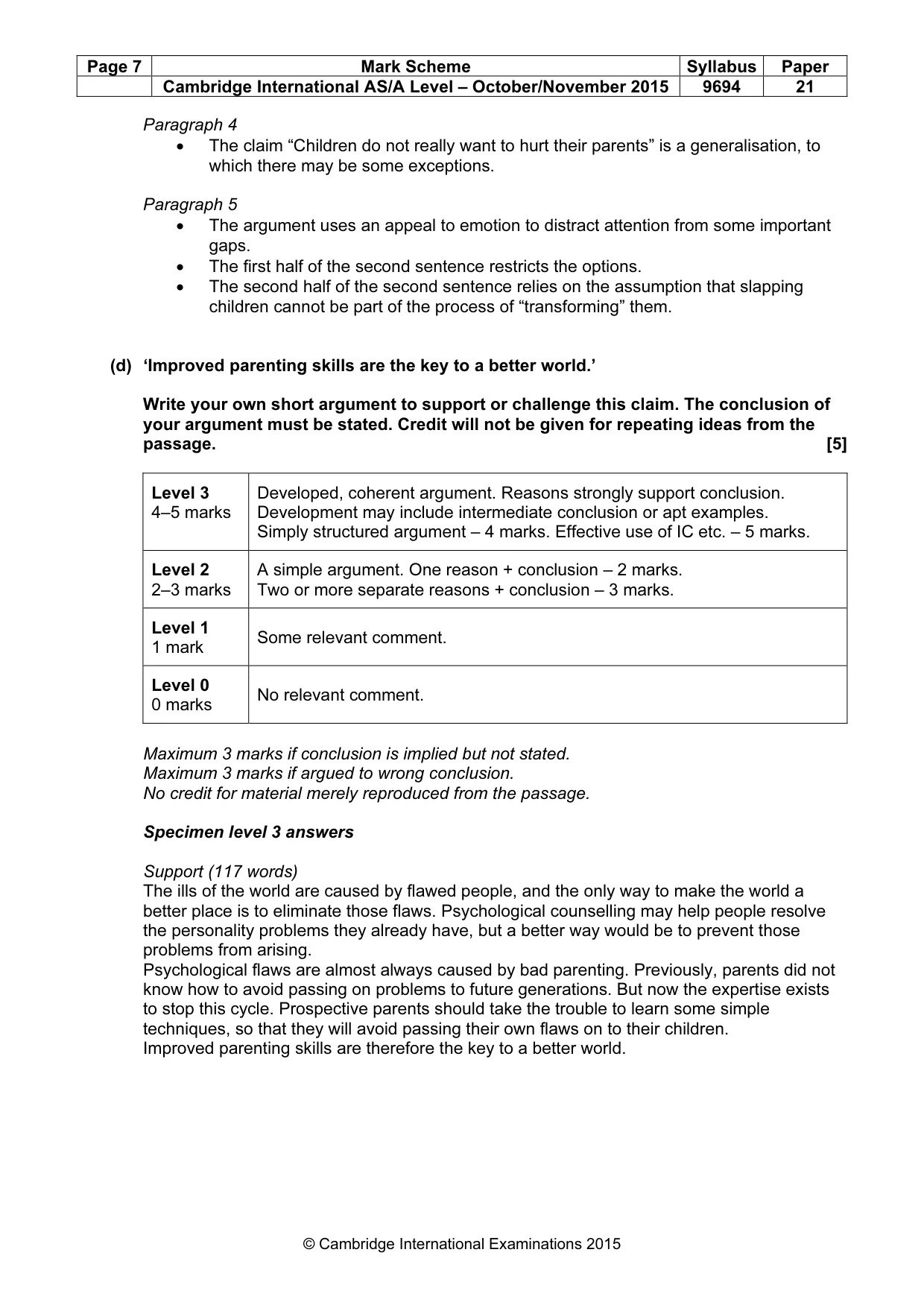
Page 7 Mark Scheme Syllabus Paper Cambridge International AS/A Level – October/November 2015 9694 21 © Cambridge International Examinations 2015 Paragraph 4 • The claim “Children do not really want to hurt their parents” is a generalisation, to which there may be some exceptions. Paragraph 5 • The argument uses an appeal to emotion to distract attention from some important gaps. • The first half of the second sentence restricts the options. • The second half of the second sentence relies on the assumption that slapping children cannot be part of the process of “transforming” them. (d) ‘Improved parenting skills are the key to a better world.’ Write your own short argument to support or challenge this claim. The conclusion of your argument must be stated. Credit will not be given for repeating ideas from the passage. [5] Level 3 4–5 marks Developed, coherent argument. Reasons strongly support conclusion. Development may include intermediate conclusion or apt examples. Simply structured argument – 4 marks. Effective use of IC etc. – 5 marks. Level 2 2–3 marks A simple argument. One reason + conclusion – 2 marks. Two or more separate reasons + conclusion – 3 marks. Level 1 1 mark Some relevant comment. Level 0 0 marks No relevant comment. Maximum 3 marks if conclusion is implied but not stated. Maximum 3 marks if argued to wrong conclusion. No credit for material merely reproduced from the passage. Specimen level 3 answers Support (117 words) The ills of the world are caused by flawed people, and the only way to make the world a better place is to eliminate those flaws. Psychological counselling may help people resolve the personality problems they already have, but a better way would be to prevent those problems from arising. Psychological flaws are almost always caused by bad parenting. Previously, parents did not know how to avoid passing on problems to future generations. But now the expertise exists to stop this cycle. Prospective parents should take the trouble to learn some simple techniques, so that they will avoid passing their own flaws on to their children. Improved parenting skills are therefore the key to a better world.
Mark scheme, page 8
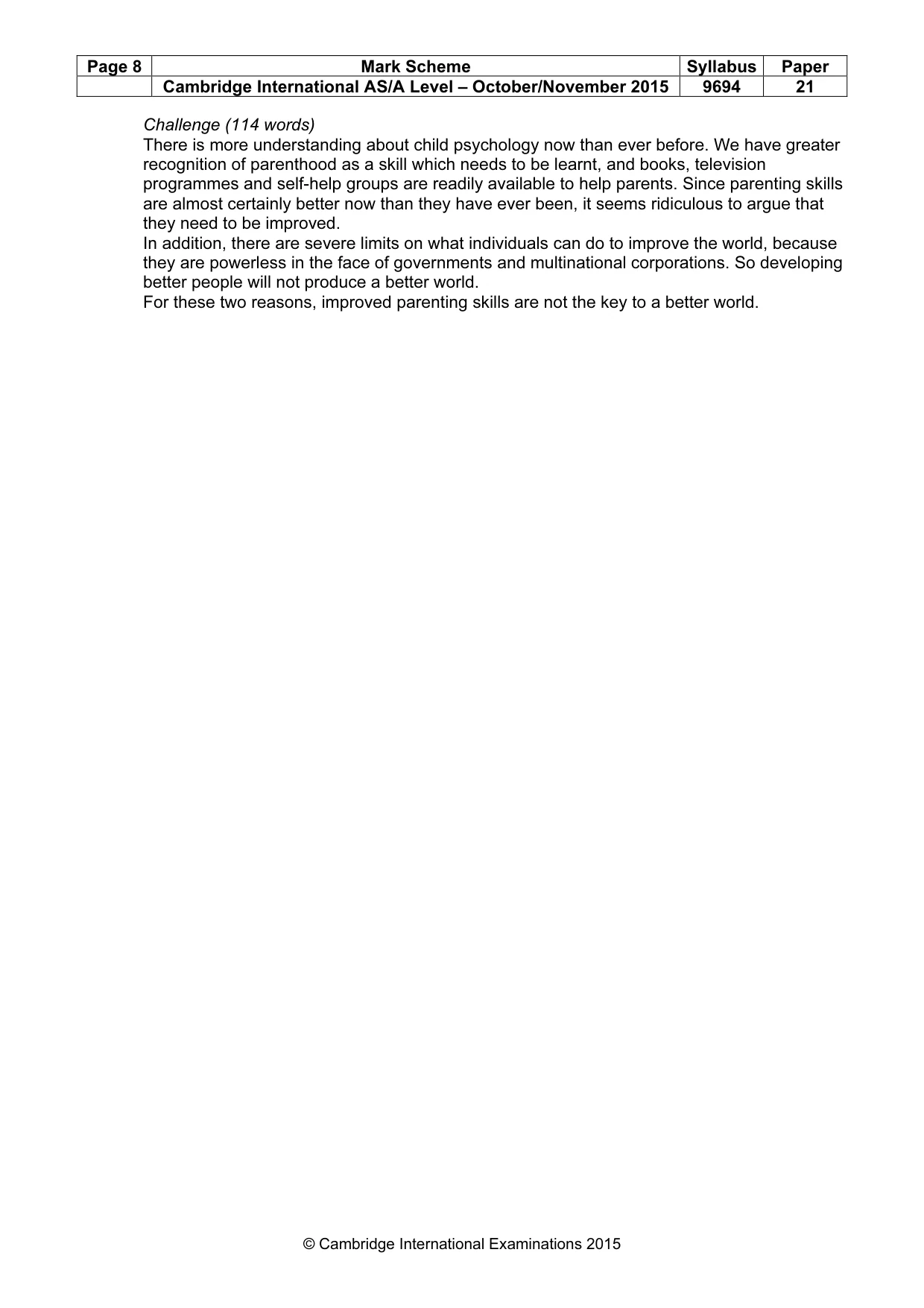
Page 8 Mark Scheme Syllabus Paper Cambridge International AS/A Level – October/November 2015 9694 21 © Cambridge International Examinations 2015 Challenge (114 words) There is more understanding about child psychology now than ever before. We have greater recognition of parenthood as a skill which needs to be learnt, and books, television programmes and self-help groups are readily available to help parents. Since parenting skills are almost certainly better now than they have ever been, it seems ridiculous to argue that they need to be improved. In addition, there are severe limits on what individuals can do to improve the world, because they are powerless in the face of governments and multinational corporations. So developing better people will not produce a better world. For these two reasons, improved parenting skills are not the key to a better world.
What you needed in this session
Cambridge’s own grade thresholds for 2015 Oct/Nov, Paper 2 · Variant 1. A higher threshold means an easier paper — the bar moves with how the cohort did.