Cambridge A Level Thinking Skills 9694 — 2015 Oct/Nov Paper 2 · Variant 3
9694/23/O/N/15 · 45 marks · ≈51 min
The question paper and its mark scheme, free to read here and free to download. This is Cambridge’s own paper, exactly as it was sat.
Question paper8 pages


Mark scheme8 pages
Answers below. Sit the paper first if you are practising.
Paper as text
Question paper, page 1
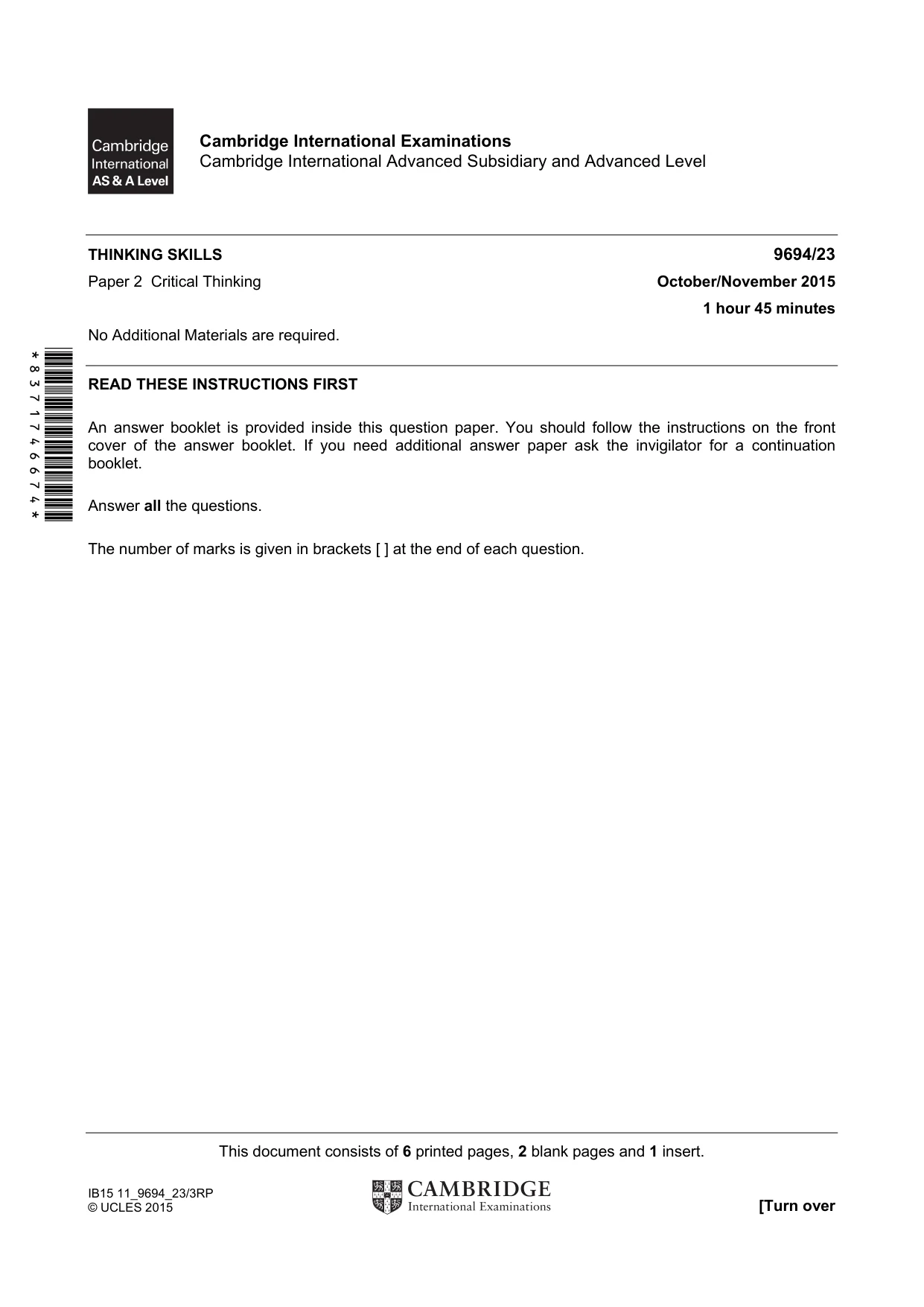
This document consists of 6 printed pages, 2 blank pages and 1 insert. IB15 11_9694_23/3RP © UCLES 2015 [Turn over *8371746674* Cambridge International Examinations Cambridge International Advanced Subsidiary and Advanced Level THINKING SKILLS 9694/23 Paper 2 Critical Thinking October/November 2015 1 hour 45 minutes No Additional Materials are required. READ THESE INSTRUCTIONS FIRST An answer booklet is provided inside this question paper. You should follow the instructions on the front cover of the answer booklet. If you need additional answer paper ask the invigilator for a continuation booklet. Answer all the questions. The number of marks is given in brackets [ ] at the end of each question.
Question paper, page 2
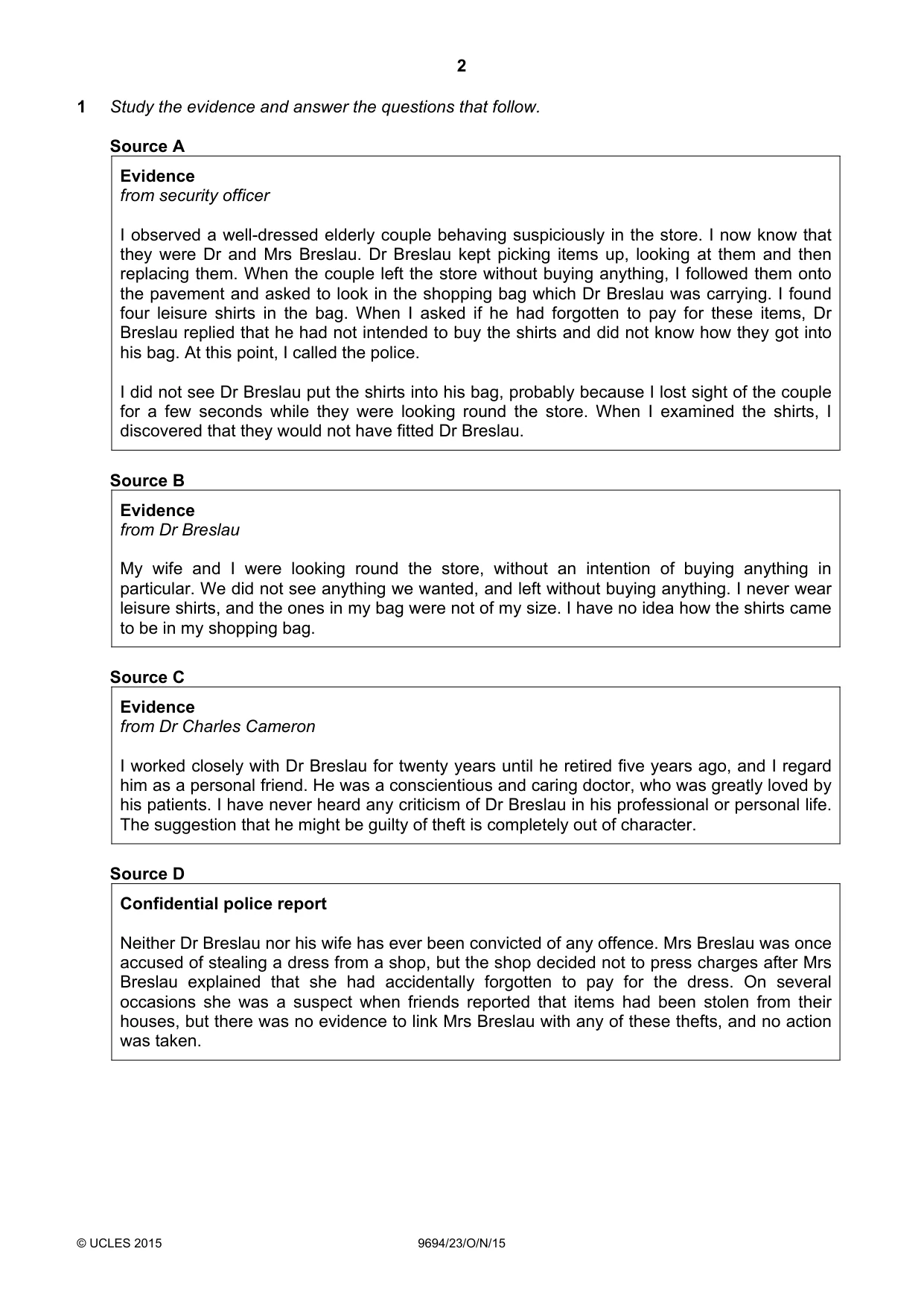
2 © UCLES 2015 9694/23/O/N/15 1 Study the evidence and answer the questions that follow. Source A Evidence from security officer I observed a well-dressed elderly couple behaving suspiciously in the store. I now know that they were Dr and Mrs Breslau. Dr Breslau kept picking items up, looking at them and then replacing them. When the couple left the store without buying anything, I followed them onto the pavement and asked to look in the shopping bag which Dr Breslau was carrying. I found four leisure shirts in the bag. When I asked if he had forgotten to pay for these items, Dr Breslau replied that he had not intended to buy the shirts and did not know how they got into his bag. At this point, I called the police. I did not see Dr Breslau put the shirts into his bag, probably because I lost sight of the couple for a few seconds while they were looking round the store. When I examined the shirts, I discovered that they would not have fitted Dr Breslau. Source B Evidence from Dr Breslau My wife and I were looking round the store, without an intention of buying anything in particular. We did not see anything we wanted, and left without buying anything. I never wear leisure shirts, and the ones in my bag were not of my size. I have no idea how the shirts came to be in my shopping bag. Source C Evidence from Dr Charles Cameron I worked closely with Dr Breslau for twenty years until he retired five years ago, and I regard him as a personal friend. He was a conscientious and caring doctor, who was greatly loved by his patients. I have never heard any criticism of Dr Breslau in his professional or personal life. The suggestion that he might be guilty of theft is completely out of character. Source D Confidential police report Neither Dr Breslau nor his wife has ever been convicted of any offence. Mrs Breslau was once accused of stealing a dress from a shop, but the shop decided not to press charges after Mrs Breslau explained that she had accidentally forgotten to pay for the dress. On several occasions she was a suspect when friends reported that items had been stolen from their houses, but there was no evidence to link Mrs Breslau with any of these thefts, and no action was taken.
Question paper, page 3
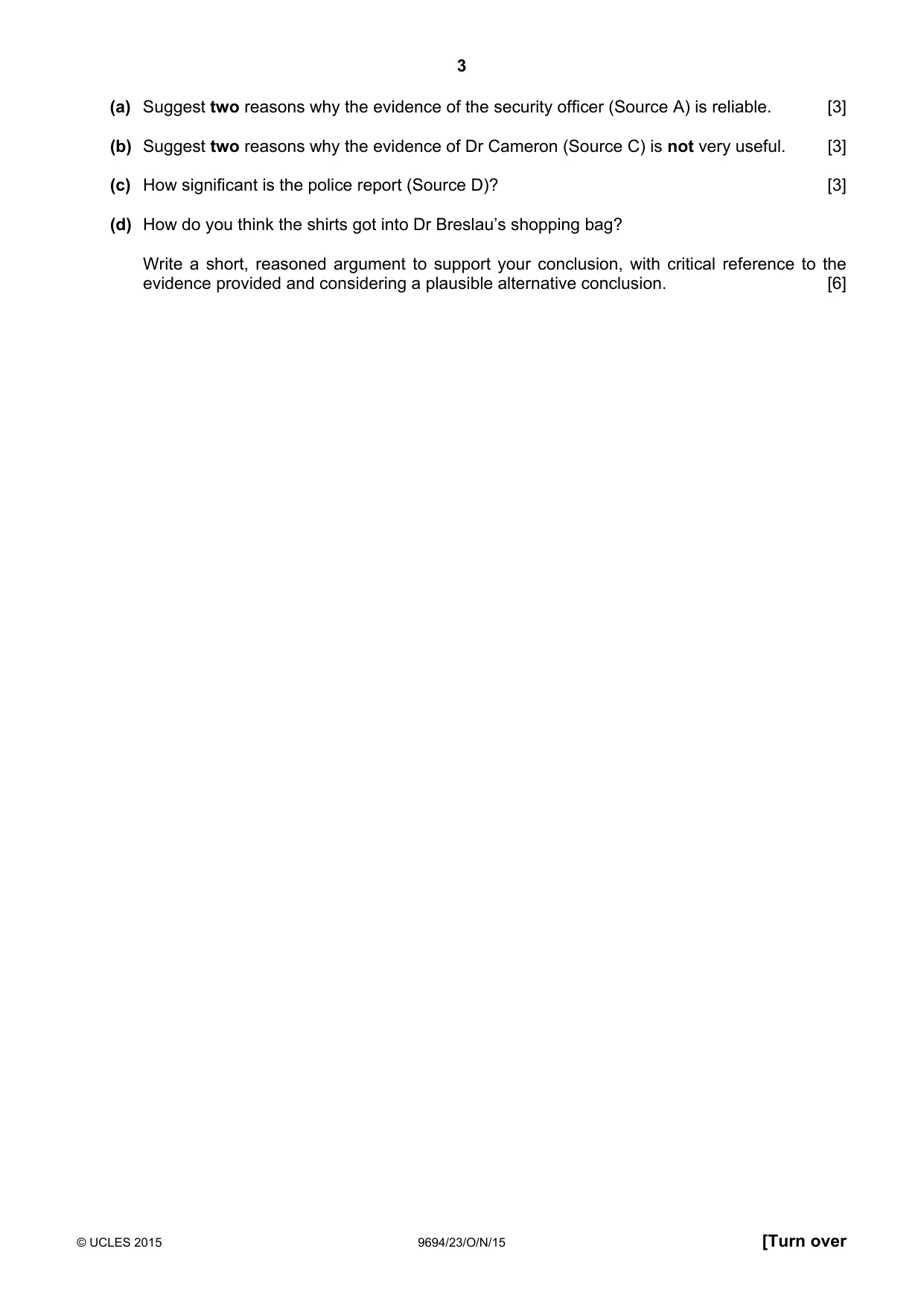
3 © UCLES 2015 9694/23/O/N/15 [Turn over (a) Suggest two reasons why the evidence of the security officer (Source A) is reliable. [3] (b) Suggest two reasons why the evidence of Dr Cameron (Source C) is not very useful. [3] (c) How significant is the police report (Source D)? [3] (d) How do you think the shirts got into Dr Breslau’s shopping bag? Write a short, reasoned argument to support your conclusion, with critical reference to the evidence provided and considering a plausible alternative conclusion. [6]
Question paper, page 4
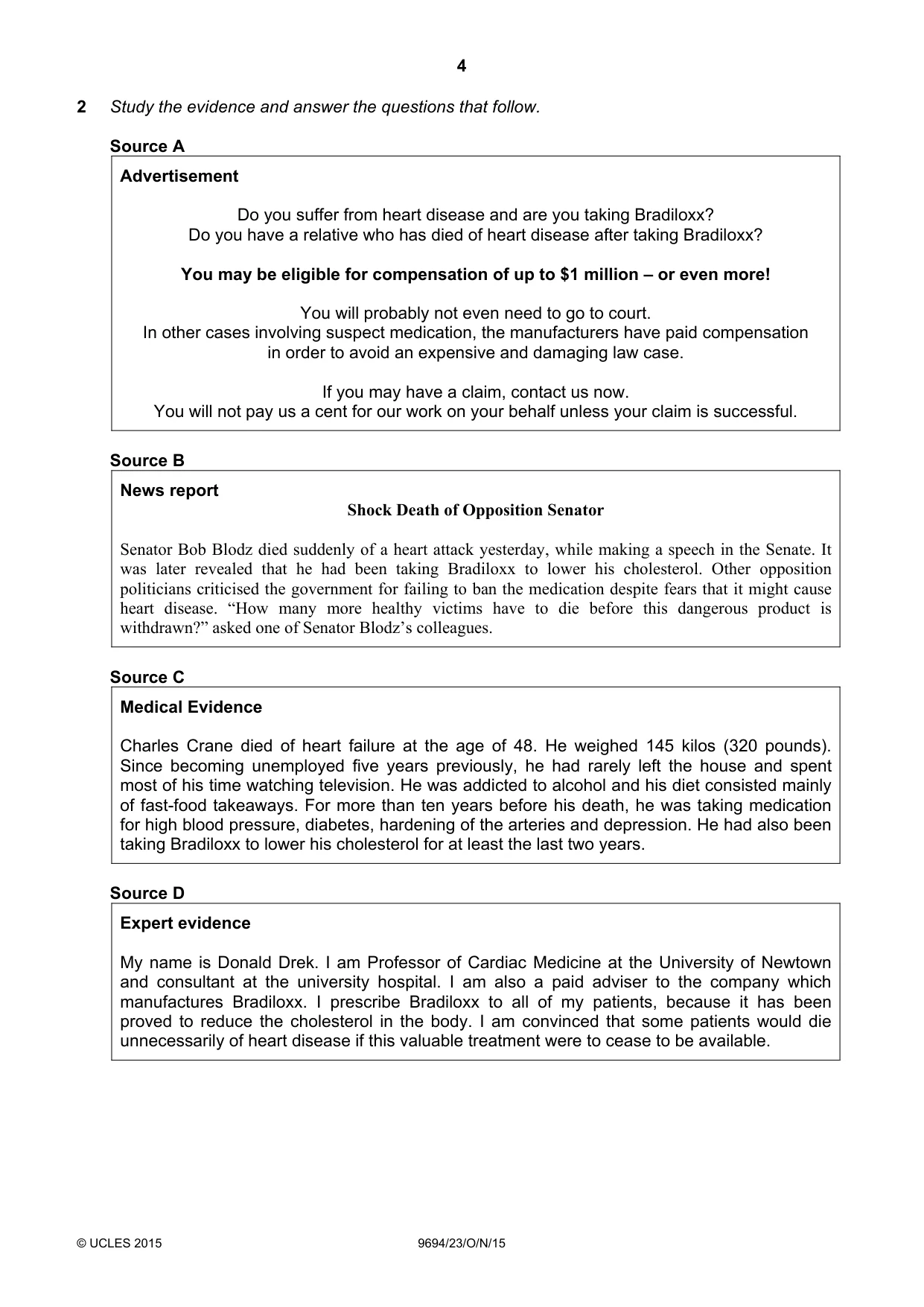
4 © UCLES 2015 9694/23/O/N/15 2 Study the evidence and answer the questions that follow. Source A Advertisement Do you suffer from heart disease and are you taking Bradiloxx? Do you have a relative who has died of heart disease after taking Bradiloxx? You may be eligible for compensation of up to $1 million – or even more! You will probably not even need to go to court. In other cases involving suspect medication, the manufacturers have paid compensation in order to avoid an expensive and damaging law case. If you may have a claim, contact us now. You will not pay us a cent for our work on your behalf unless your claim is successful. Source B News report Shock Death of Opposition Senator Senator Bob Blodz died suddenly of a heart attack yesterday, while making a speech in the Senate. It was later revealed that he had been taking Bradiloxx to lower his cholesterol. Other opposition politicians criticised the government for failing to ban the medication despite fears that it might cause heart disease. “How many more healthy victims have to die before this dangerous product is withdrawn?” asked one of Senator Blodz’s colleagues. Source C Medical Evidence Charles Crane died of heart failure at the age of 48. He weighed 145 kilos (320 pounds). Since becoming unemployed five years previously, he had rarely left the house and spent most of his time watching television. He was addicted to alcohol and his diet consisted mainly of fast-food takeaways. For more than ten years before his death, he was taking medication for high blood pressure, diabetes, hardening of the arteries and depression. He had also been taking Bradiloxx to lower his cholesterol for at least the last two years. Source D Expert evidence My name is Donald Drek. I am Professor of Cardiac Medicine at the University of Newtown and consultant at the university hospital. I am also a paid adviser to the company which manufactures Bradiloxx. I prescribe Bradiloxx to all of my patients, because it has been proved to reduce the cholesterol in the body. I am convinced that some patients would die unnecessarily of heart disease if this valuable treatment were to cease to be available.
Question paper, page 5
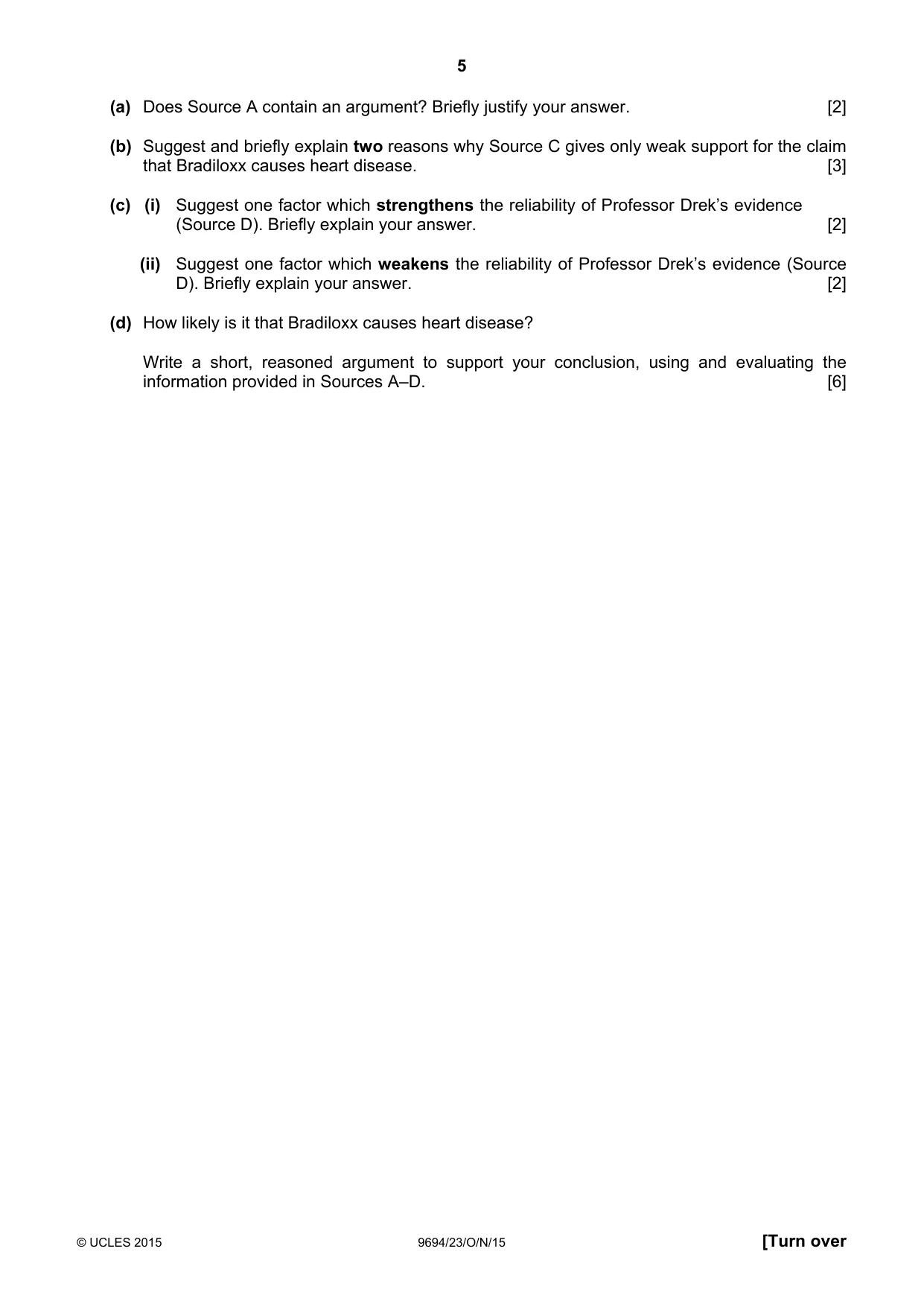
5 © UCLES 2015 9694/23/O/N/15 [Turn over (a) Does Source A contain an argument? Briefly justify your answer. [2] (b) Suggest and briefly explain two reasons why Source C gives only weak support for the claim that Bradiloxx causes heart disease. [3] (c) (i) Suggest one factor which strengthens the reliability of Professor Drek’s evidence (Source D). Briefly explain your answer. [2] (ii) Suggest one factor which weakens the reliability of Professor Drek’s evidence (Source D). Briefly explain your answer. [2] (d) How likely is it that Bradiloxx causes heart disease? Write a short, reasoned argument to support your conclusion, using and evaluating the information provided in Sources A–D. [6]
Question paper, page 6
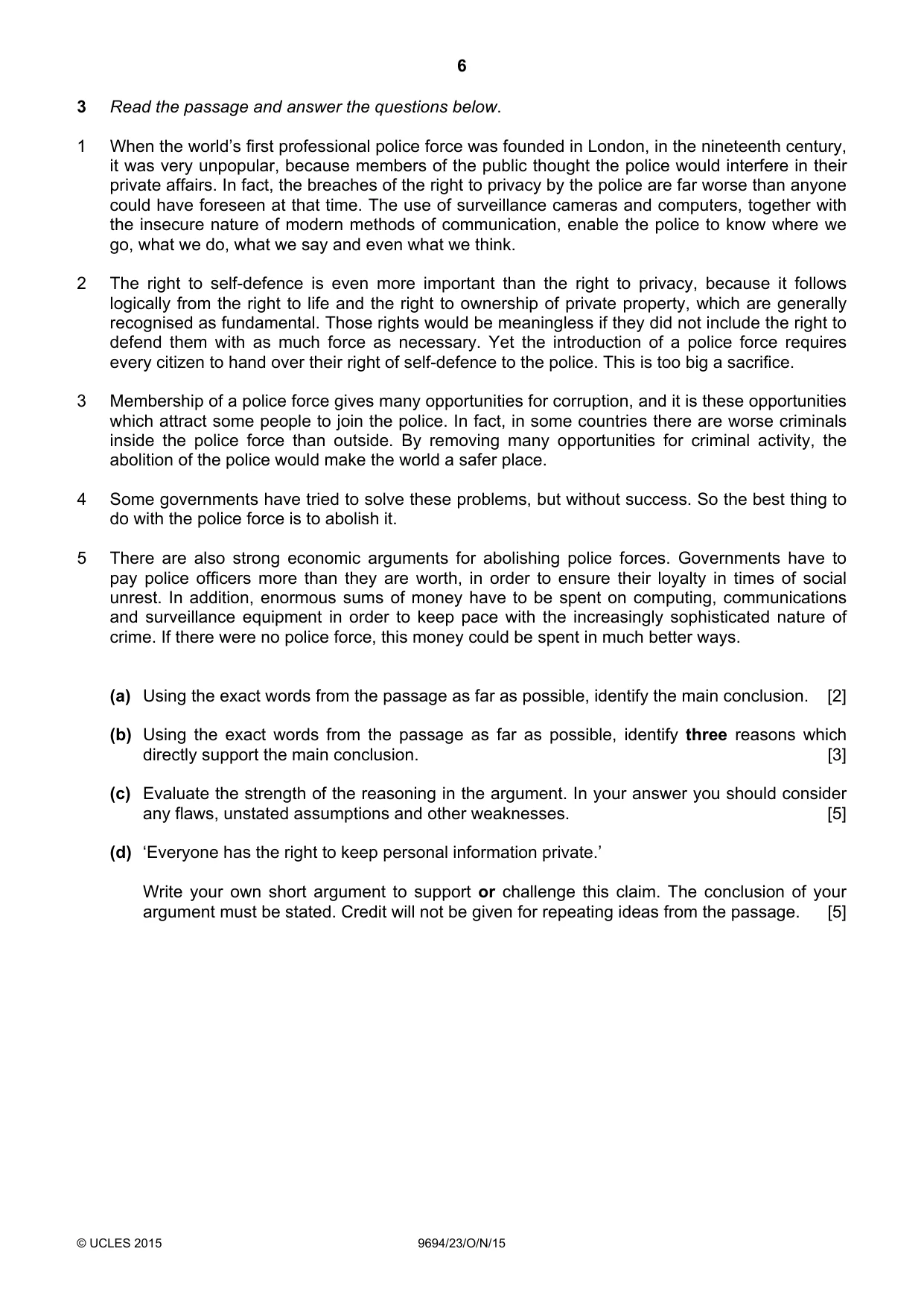
6 © UCLES 2015 9694/23/O/N/15 3 Read the passage and answer the questions below. 1 When the world’s first professional police force was founded in London, in the nineteenth century, it was very unpopular, because members of the public thought the police would interfere in their private affairs. In fact, the breaches of the right to privacy by the police are far worse than anyone could have foreseen at that time. The use of surveillance cameras and computers, together with the insecure nature of modern methods of communication, enable the police to know where we go, what we do, what we say and even what we think. 2 The right to self-defence is even more important than the right to privacy, because it follows logically from the right to life and the right to ownership of private property, which are generally recognised as fundamental. Those rights would be meaningless if they did not include the right to defend them with as much force as necessary. Yet the introduction of a police force requires every citizen to hand over their right of self-defence to the police. This is too big a sacrifice. 3 Membership of a police force gives many opportunities for corruption, and it is these opportunities which attract some people to join the police. In fact, in some countries there are worse criminals inside the police force than outside. By removing many opportunities for criminal activity, the abolition of the police would make the world a safer place. 4 Some governments have tried to solve these problems, but without success. So the best thing to do with the police force is to abolish it. 5 There are also strong economic arguments for abolishing police forces. Governments have to pay police officers more than they are worth, in order to ensure their loyalty in times of social unrest. In addition, enormous sums of money have to be spent on computing, communications and surveillance equipment in order to keep pace with the increasingly sophisticated nature of crime. If there were no police force, this money could be spent in much better ways. (a) Using the exact words from the passage as far as possible, identify the main conclusion. [2] (b) Using the exact words from the passage as far as possible, identify three reasons which directly support the main conclusion. [3] (c) Evaluate the strength of the reasoning in the argument. In your answer you should consider any flaws, unstated assumptions and other weaknesses. [5] (d) ‘Everyone has the right to keep personal information private.’ Write your own short argument to support or challenge this claim. The conclusion of your argument must be stated. Credit will not be given for repeating ideas from the passage. [5]
Question paper, page 7
7 © UCLES 2015 9694/23/O/N/15 BLANK PAGE
Question paper, page 8
8 Permission to reproduce items where third-party owned material protected by copyright is included has been sought and cleared where possible. Every reasonable effort has been made by the publisher (UCLES) to trace copyright holders, but if any items requiring clearance have unwittingly been included, the publisher will be pleased to make amends at the earliest possible opportunity. To avoid the issue of disclosure of answer-related information to candidates, all copyright acknowledgements are reproduced online in the Cambridge International Examinations Copyright Acknowledgements Booklet. This is produced for each series of examinations and is freely available to download at www.cie.org.uk after the live examination series. Cambridge International Examinations is part of the Cambridge Assessment Group. Cambridge Assessment is the brand name of University of Cambridge Local Examinations Syndicate (UCLES), which is itself a department of the University of Cambridge. © UCLES 2015 9694/23/O/N/15 BLANK PAGE
Mark scheme, page 1
® IGCSE is the registered trademark of Cambridge International Examinations. CAMBRIDGE INTERNATIONAL EXAMINATIONS Cambridge International Advanced Subsidiary and Advanced Level MARK SCHEME for the October/November 2015 series 9694 THINKING SKILLS 9694/23 Paper 2 (Critical Thinking), maximum raw mark 45 This mark scheme is published as an aid to teachers and candidates, to indicate the requirements of the examination. It shows the basis on which Examiners were instructed to award marks. It does not indicate the details of the discussions that took place at an Examiners’ meeting before marking began, which would have considered the acceptability of alternative answers. Mark schemes should be read in conjunction with the question paper and the Principal Examiner Report for Teachers. Cambridge will not enter into discussions about these mark schemes. Cambridge is publishing the mark schemes for the October/November 2015 series for most Cambridge IGCSE®, Cambridge International A and AS Level components and some Cambridge O Level components.
Mark scheme, page 2
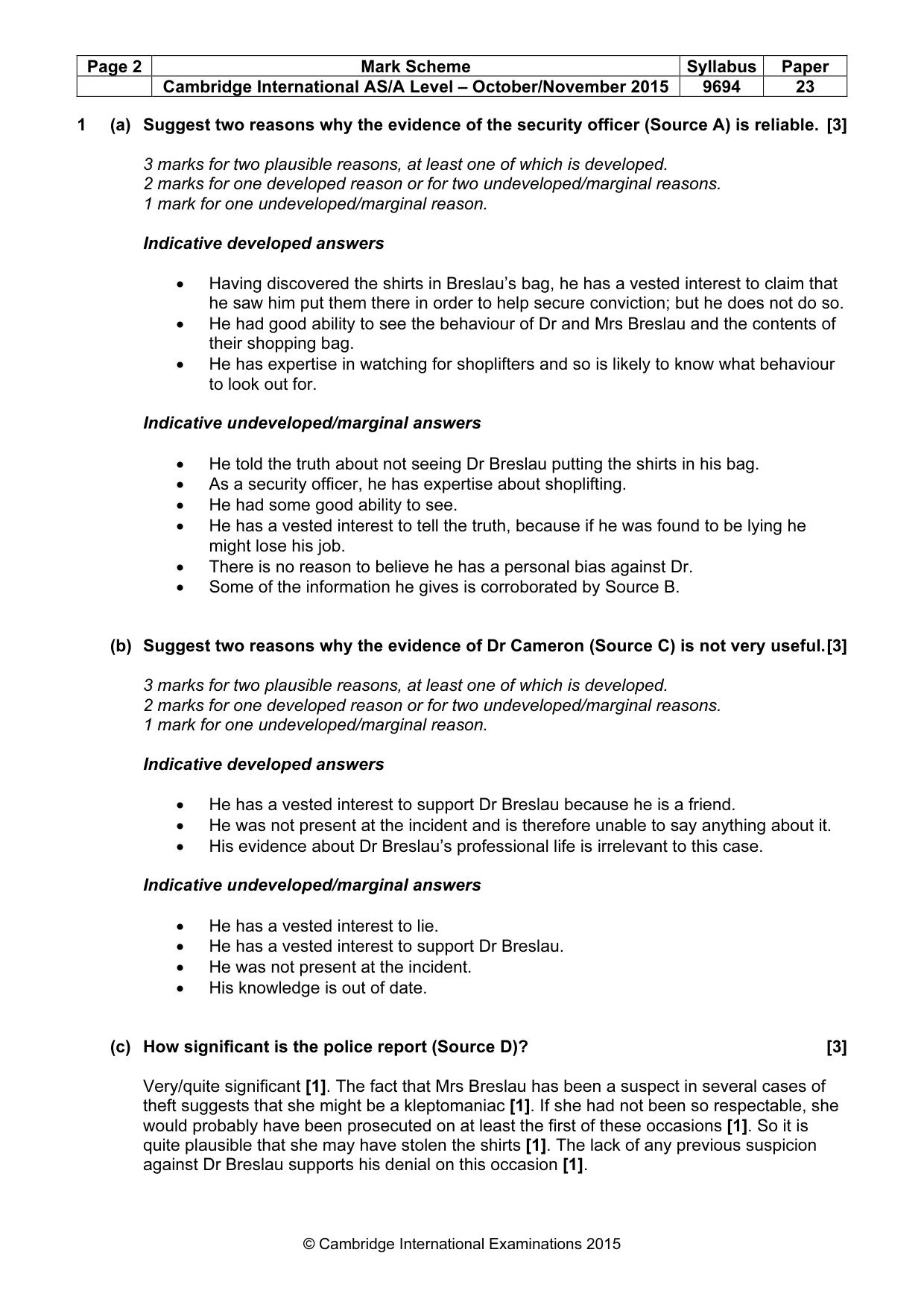
Page 2 Mark Scheme Syllabus Paper Cambridge International AS/A Level – October/November 2015 9694 23 © Cambridge International Examinations 2015 1 (a) Suggest two reasons why the evidence of the security officer (Source A) is reliable. [3] 3 marks for two plausible reasons, at least one of which is developed. 2 marks for one developed reason or for two undeveloped/marginal reasons. 1 mark for one undeveloped/marginal reason. Indicative developed answers • Having discovered the shirts in Breslau’s bag, he has a vested interest to claim that he saw him put them there in order to help secure conviction; but he does not do so. • He had good ability to see the behaviour of Dr and Mrs Breslau and the contents of their shopping bag. • He has expertise in watching for shoplifters and so is likely to know what behaviour to look out for. Indicative undeveloped/marginal answers • He told the truth about not seeing Dr Breslau putting the shirts in his bag. • As a security officer, he has expertise about shoplifting. • He had some good ability to see. • He has a vested interest to tell the truth, because if he was found to be lying he might lose his job. • There is no reason to believe he has a personal bias against Dr. • Some of the information he gives is corroborated by Source B. (b) Suggest two reasons why the evidence of Dr Cameron (Source C) is not very useful. [3] 3 marks for two plausible reasons, at least one of which is developed. 2 marks for one developed reason or for two undeveloped/marginal reasons. 1 mark for one undeveloped/marginal reason. Indicative developed answers • He has a vested interest to support Dr Breslau because he is a friend. • He was not present at the incident and is therefore unable to say anything about it. • His evidence about Dr Breslau’s professional life is irrelevant to this case. Indicative undeveloped/marginal answers • He has a vested interest to lie. • He has a vested interest to support Dr Breslau. • He was not present at the incident. • His knowledge is out of date. (c) How significant is the police report (Source D)? [3] Very/quite significant [1]. The fact that Mrs Breslau has been a suspect in several cases of theft suggests that she might be a kleptomaniac [1]. If she had not been so respectable, she would probably have been prosecuted on at least the first of these occasions [1]. So it is quite plausible that she may have stolen the shirts [1]. The lack of any previous suspicion against Dr Breslau supports his denial on this occasion [1].
Mark scheme, page 3
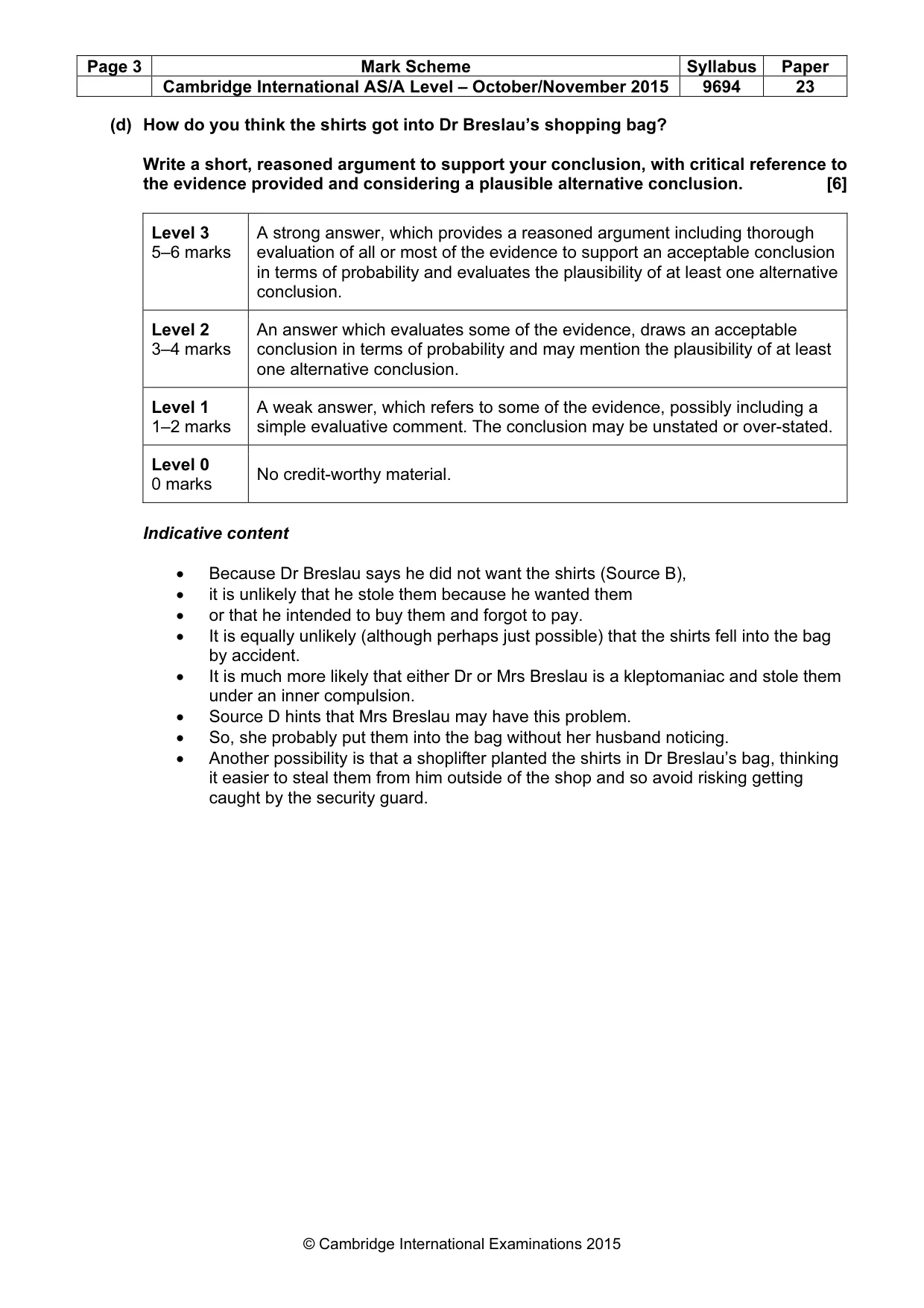
Page 3 Mark Scheme Syllabus Paper Cambridge International AS/A Level – October/November 2015 9694 23 © Cambridge International Examinations 2015 (d) How do you think the shirts got into Dr Breslau’s shopping bag? Write a short, reasoned argument to support your conclusion, with critical reference to the evidence provided and considering a plausible alternative conclusion. [6] Level 3 5–6 marks A strong answer, which provides a reasoned argument including thorough evaluation of all or most of the evidence to support an acceptable conclusion in terms of probability and evaluates the plausibility of at least one alternative conclusion. Level 2 3–4 marks An answer which evaluates some of the evidence, draws an acceptable conclusion in terms of probability and may mention the plausibility of at least one alternative conclusion. Level 1 1–2 marks A weak answer, which refers to some of the evidence, possibly including a simple evaluative comment. The conclusion may be unstated or over-stated. Level 0 0 marks No credit-worthy material. Indicative content • Because Dr Breslau says he did not want the shirts (Source B), • it is unlikely that he stole them because he wanted them • or that he intended to buy them and forgot to pay. • It is equally unlikely (although perhaps just possible) that the shirts fell into the bag by accident. • It is much more likely that either Dr or Mrs Breslau is a kleptomaniac and stole them under an inner compulsion. • Source D hints that Mrs Breslau may have this problem. • So, she probably put them into the bag without her husband noticing. • Another possibility is that a shoplifter planted the shirts in Dr Breslau’s bag, thinking it easier to steal them from him outside of the shop and so avoid risking getting caught by the security guard.
Mark scheme, page 4
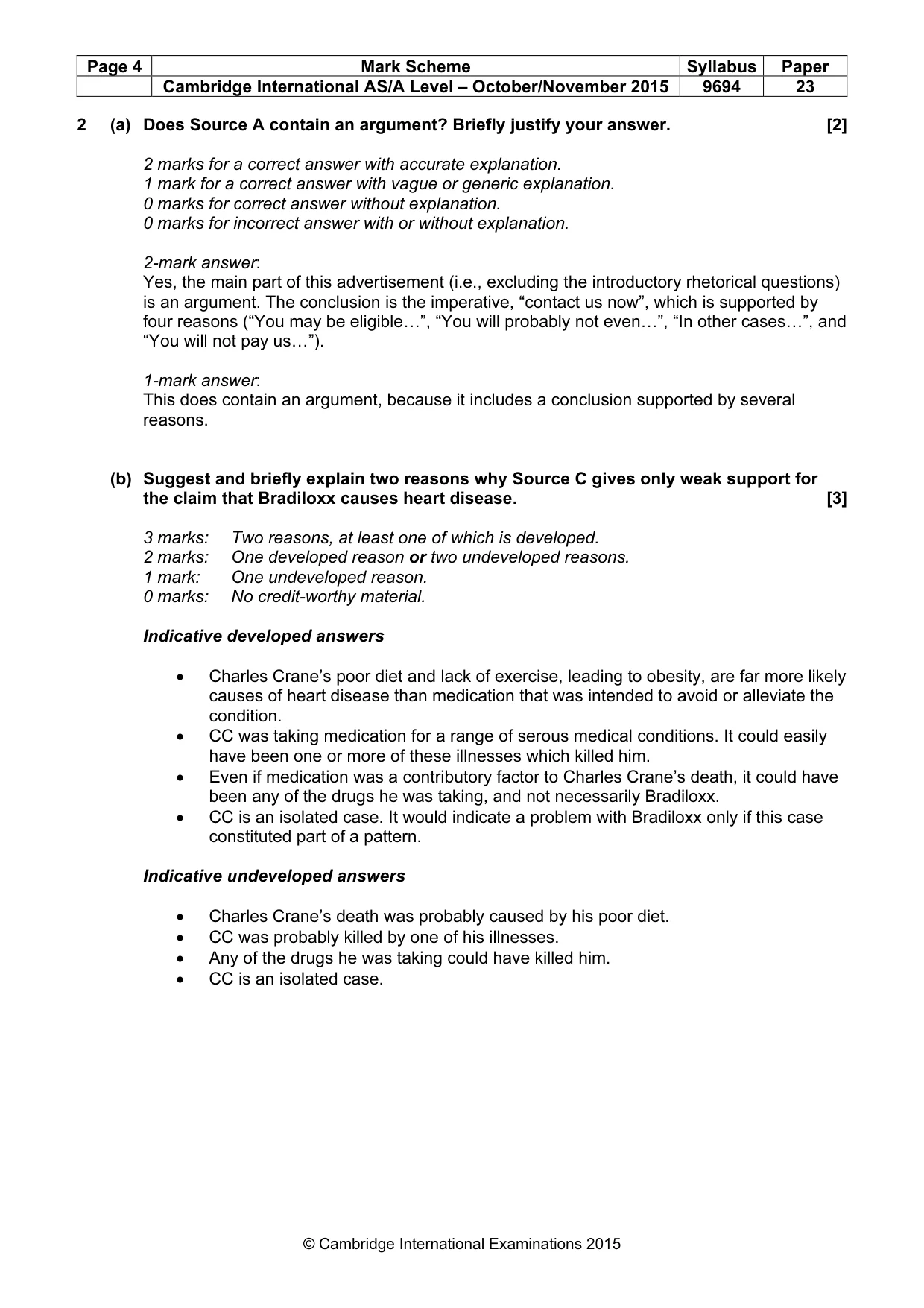
Page 4 Mark Scheme Syllabus Paper Cambridge International AS/A Level – October/November 2015 9694 23 © Cambridge International Examinations 2015 2 (a) Does Source A contain an argument? Briefly justify your answer. [2] 2 marks for a correct answer with accurate explanation. 1 mark for a correct answer with vague or generic explanation. 0 marks for correct answer without explanation. 0 marks for incorrect answer with or without explanation. 2-mark answer: Yes, the main part of this advertisement (i.e., excluding the introductory rhetorical questions) is an argument. The conclusion is the imperative, “contact us now”, which is supported by four reasons (“You may be eligible…”, “You will probably not even…”, “In other cases…”, and “You will not pay us…”). 1-mark answer: This does contain an argument, because it includes a conclusion supported by several reasons. (b) Suggest and briefly explain two reasons why Source C gives only weak support for the claim that Bradiloxx causes heart disease. [3] 3 marks: Two reasons, at least one of which is developed. 2 marks: One developed reason or two undeveloped reasons. 1 mark: One undeveloped reason. 0 marks: No credit-worthy material. Indicative developed answers • Charles Crane’s poor diet and lack of exercise, leading to obesity, are far more likely causes of heart disease than medication that was intended to avoid or alleviate the condition. • CC was taking medication for a range of serous medical conditions. It could easily have been one or more of these illnesses which killed him. • Even if medication was a contributory factor to Charles Crane’s death, it could have been any of the drugs he was taking, and not necessarily Bradiloxx. • CC is an isolated case. It would indicate a problem with Bradiloxx only if this case constituted part of a pattern. Indicative undeveloped answers • Charles Crane’s death was probably caused by his poor diet. • CC was probably killed by one of his illnesses. • Any of the drugs he was taking could have killed him. • CC is an isolated case.
Mark scheme, page 5
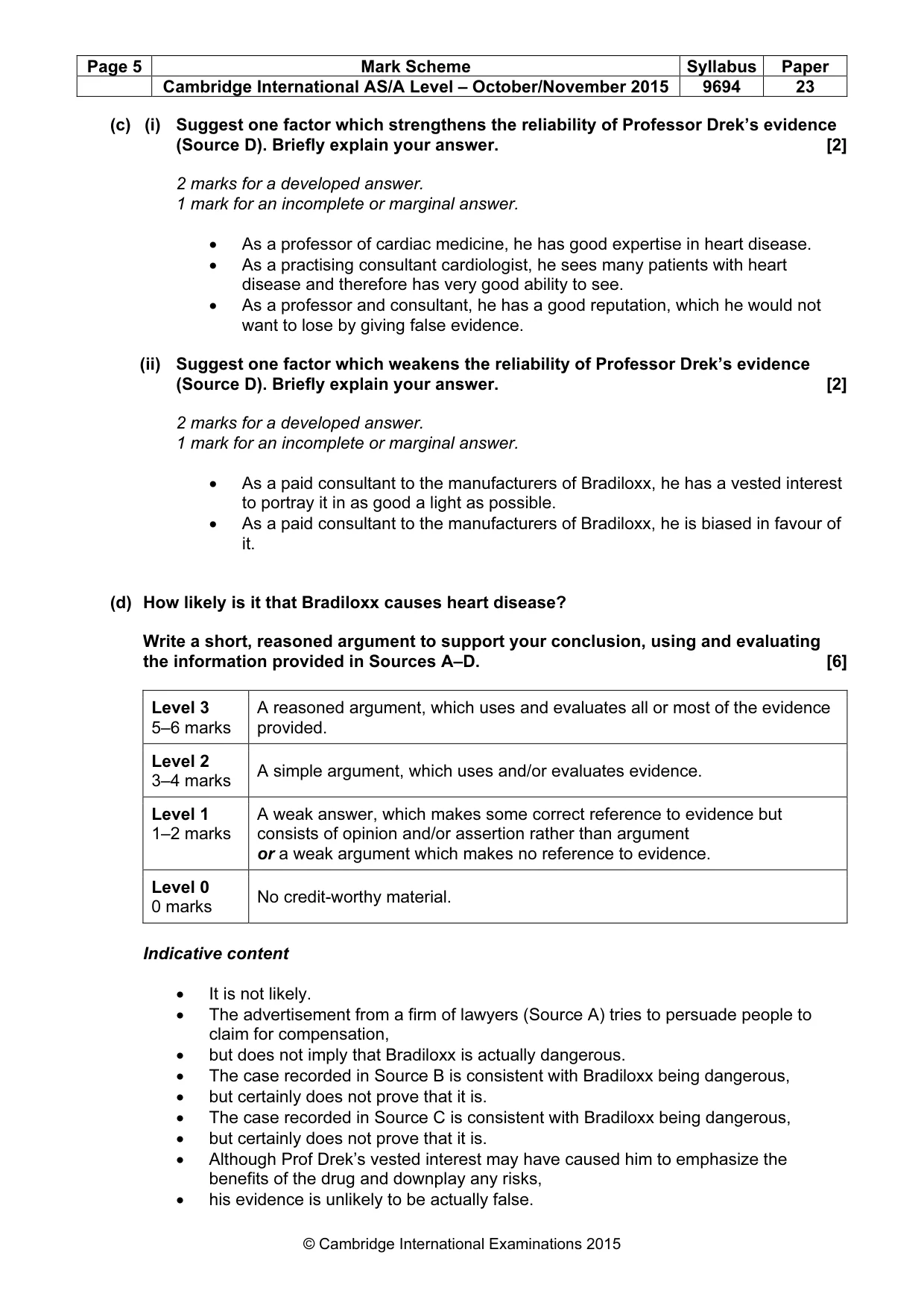
Page 5 Mark Scheme Syllabus Paper Cambridge International AS/A Level – October/November 2015 9694 23 © Cambridge International Examinations 2015 (c) (i) Suggest one factor which strengthens the reliability of Professor Drek’s evidence (Source D). Briefly explain your answer. [2] 2 marks for a developed answer. 1 mark for an incomplete or marginal answer. • As a professor of cardiac medicine, he has good expertise in heart disease. • As a practising consultant cardiologist, he sees many patients with heart disease and therefore has very good ability to see. • As a professor and consultant, he has a good reputation, which he would not want to lose by giving false evidence. (ii) Suggest one factor which weakens the reliability of Professor Drek’s evidence (Source D). Briefly explain your answer. [2] 2 marks for a developed answer. 1 mark for an incomplete or marginal answer. • As a paid consultant to the manufacturers of Bradiloxx, he has a vested interest to portray it in as good a light as possible. • As a paid consultant to the manufacturers of Bradiloxx, he is biased in favour of it. (d) How likely is it that Bradiloxx causes heart disease? Write a short, reasoned argument to support your conclusion, using and evaluating the information provided in Sources A–D. [6] Level 3 5–6 marks A reasoned argument, which uses and evaluates all or most of the evidence provided. Level 2 3–4 marks A simple argument, which uses and/or evaluates evidence. Level 1 1–2 marks A weak answer, which makes some correct reference to evidence but consists of opinion and/or assertion rather than argument or a weak argument which makes no reference to evidence. Level 0 0 marks No credit-worthy material. Indicative content • It is not likely. • The advertisement from a firm of lawyers (Source A) tries to persuade people to claim for compensation, • but does not imply that Bradiloxx is actually dangerous. • The case recorded in Source B is consistent with Bradiloxx being dangerous, • but certainly does not prove that it is. • The case recorded in Source C is consistent with Bradiloxx being dangerous, • but certainly does not prove that it is. • Although Prof Drek’s vested interest may have caused him to emphasize the benefits of the drug and downplay any risks, • his evidence is unlikely to be actually false.
Mark scheme, page 6
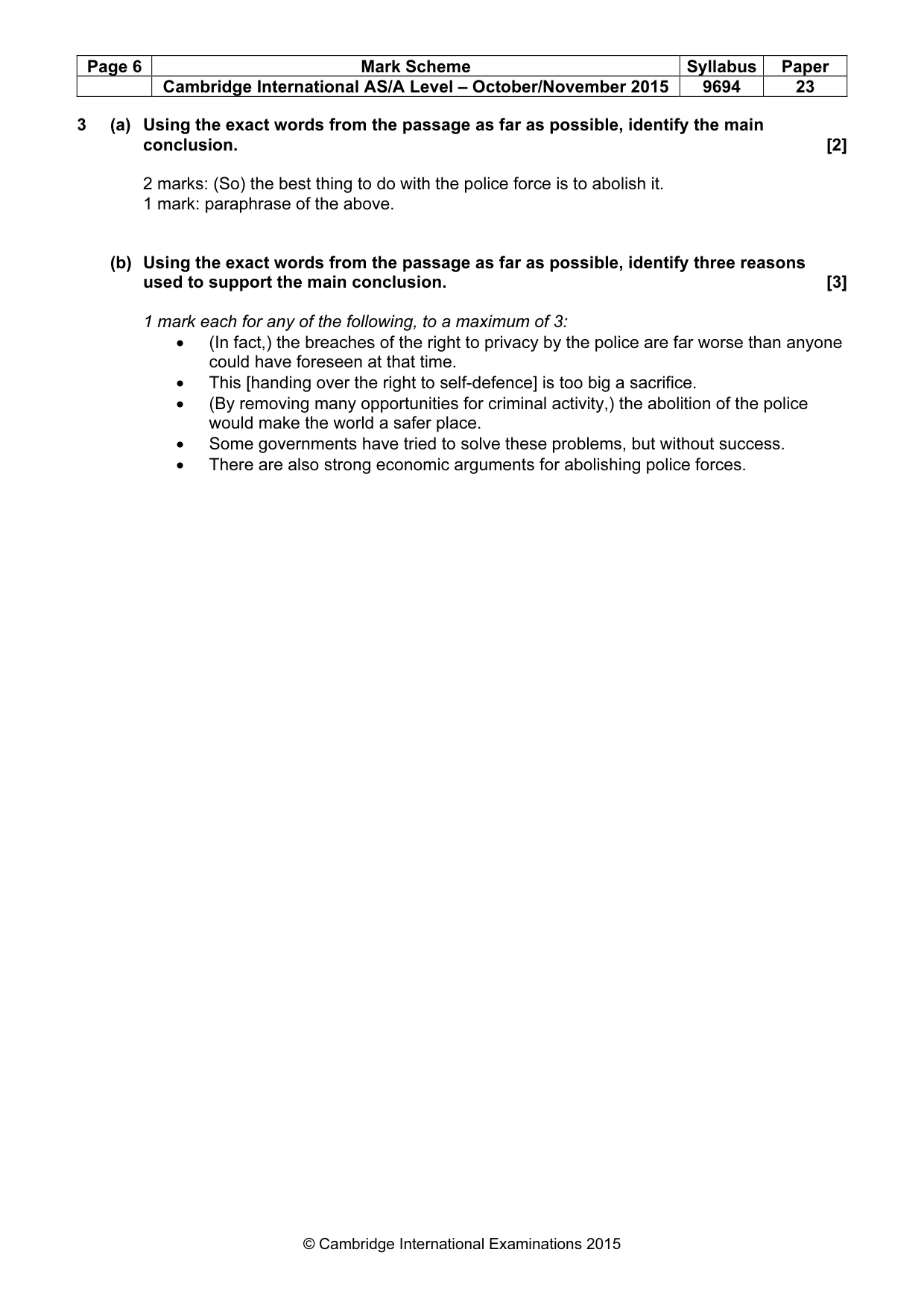
Page 6 Mark Scheme Syllabus Paper Cambridge International AS/A Level – October/November 2015 9694 23 © Cambridge International Examinations 2015 3 (a) Using the exact words from the passage as far as possible, identify the main conclusion. [2] 2 marks: (So) the best thing to do with the police force is to abolish it. 1 mark: paraphrase of the above. (b) Using the exact words from the passage as far as possible, identify three reasons used to support the main conclusion. [3] 1 mark each for any of the following, to a maximum of 3: • (In fact,) the breaches of the right to privacy by the police are far worse than anyone could have foreseen at that time. • This [handing over the right to self-defence] is too big a sacrifice. • (By removing many opportunities for criminal activity,) the abolition of the police would make the world a safer place. • Some governments have tried to solve these problems, but without success. • There are also strong economic arguments for abolishing police forces.
Mark scheme, page 7
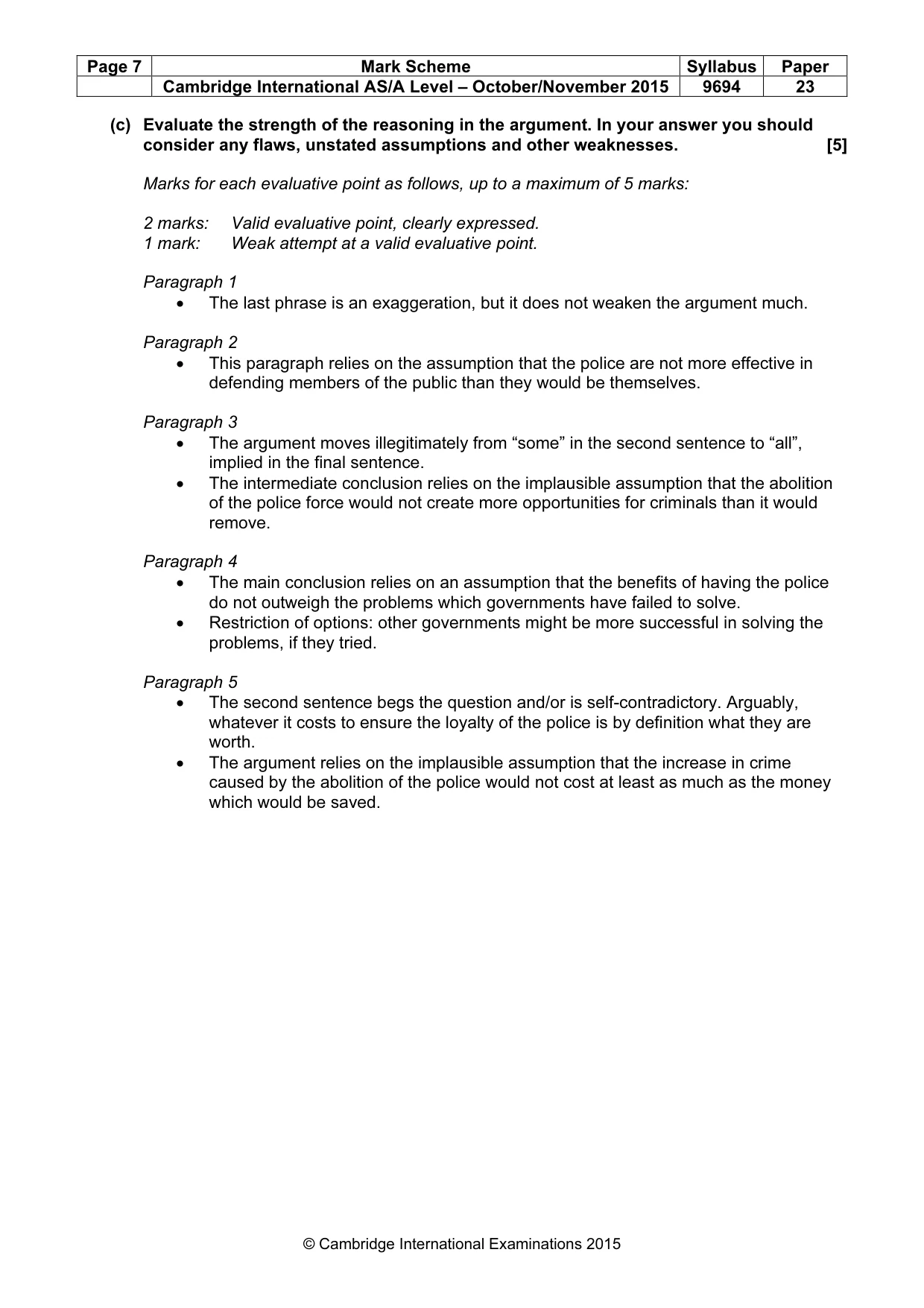
Page 7 Mark Scheme Syllabus Paper Cambridge International AS/A Level – October/November 2015 9694 23 © Cambridge International Examinations 2015 (c) Evaluate the strength of the reasoning in the argument. In your answer you should consider any flaws, unstated assumptions and other weaknesses. [5] Marks for each evaluative point as follows, up to a maximum of 5 marks: 2 marks: Valid evaluative point, clearly expressed. 1 mark: Weak attempt at a valid evaluative point. Paragraph 1 • The last phrase is an exaggeration, but it does not weaken the argument much. Paragraph 2 • This paragraph relies on the assumption that the police are not more effective in defending members of the public than they would be themselves. Paragraph 3 • The argument moves illegitimately from “some” in the second sentence to “all”, implied in the final sentence. • The intermediate conclusion relies on the implausible assumption that the abolition of the police force would not create more opportunities for criminals than it would remove. Paragraph 4 • The main conclusion relies on an assumption that the benefits of having the police do not outweigh the problems which governments have failed to solve. • Restriction of options: other governments might be more successful in solving the problems, if they tried. Paragraph 5 • The second sentence begs the question and/or is self-contradictory. Arguably, whatever it costs to ensure the loyalty of the police is by definition what they are worth. • The argument relies on the implausible assumption that the increase in crime caused by the abolition of the police would not cost at least as much as the money which would be saved.
Mark scheme, page 8
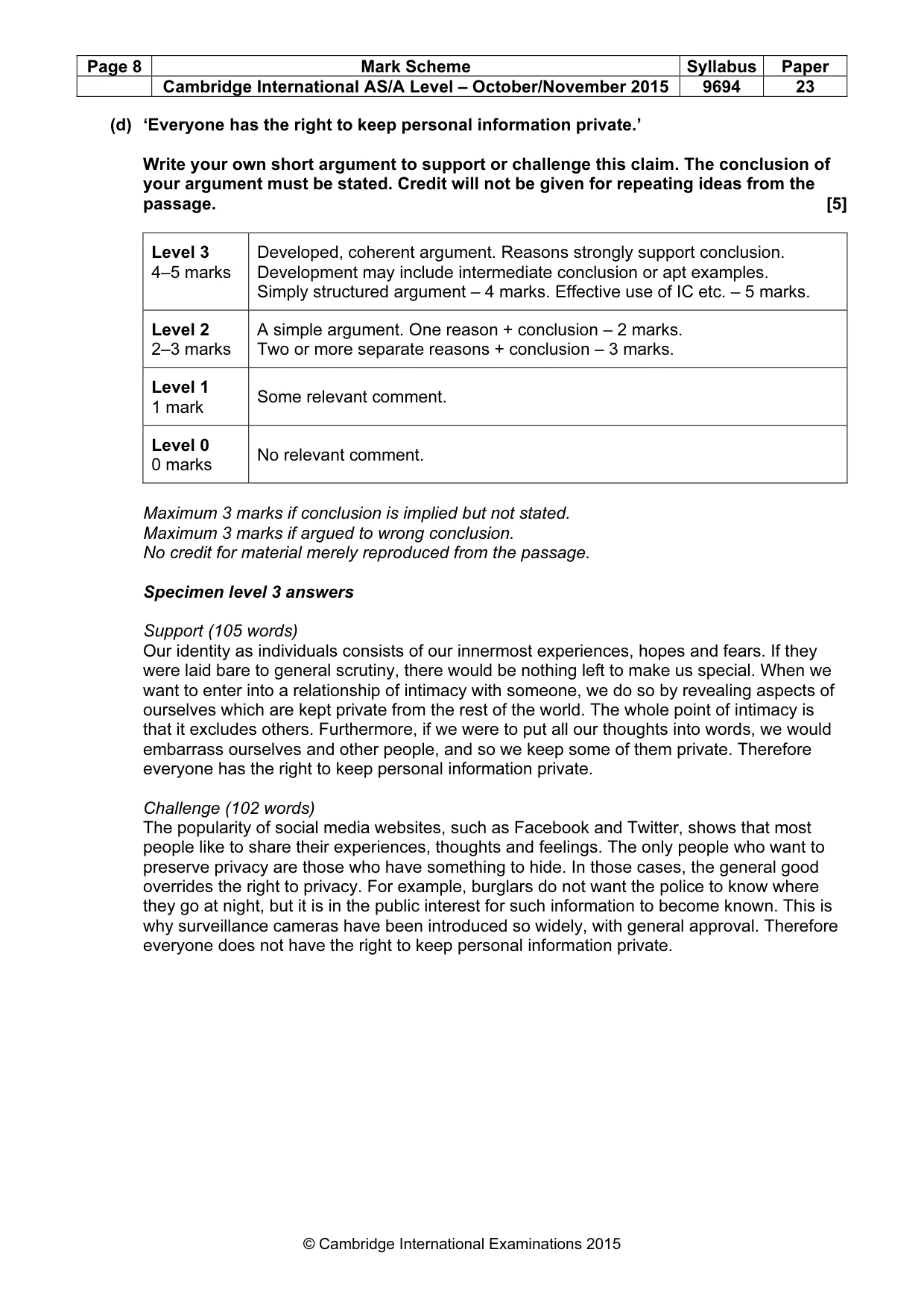
Page 8 Mark Scheme Syllabus Paper Cambridge International AS/A Level – October/November 2015 9694 23 © Cambridge International Examinations 2015 (d) ‘Everyone has the right to keep personal information private.’ Write your own short argument to support or challenge this claim. The conclusion of your argument must be stated. Credit will not be given for repeating ideas from the passage. [5] Level 3 4–5 marks Developed, coherent argument. Reasons strongly support conclusion. Development may include intermediate conclusion or apt examples. Simply structured argument – 4 marks. Effective use of IC etc. – 5 marks. Level 2 2–3 marks A simple argument. One reason + conclusion – 2 marks. Two or more separate reasons + conclusion – 3 marks. Level 1 1 mark Some relevant comment. Level 0 0 marks No relevant comment. Maximum 3 marks if conclusion is implied but not stated. Maximum 3 marks if argued to wrong conclusion. No credit for material merely reproduced from the passage. Specimen level 3 answers Support (105 words) Our identity as individuals consists of our innermost experiences, hopes and fears. If they were laid bare to general scrutiny, there would be nothing left to make us special. When we want to enter into a relationship of intimacy with someone, we do so by revealing aspects of ourselves which are kept private from the rest of the world. The whole point of intimacy is that it excludes others. Furthermore, if we were to put all our thoughts into words, we would embarrass ourselves and other people, and so we keep some of them private. Therefore everyone has the right to keep personal information private. Challenge (102 words) The popularity of social media websites, such as Facebook and Twitter, shows that most people like to share their experiences, thoughts and feelings. The only people who want to preserve privacy are those who have something to hide. In those cases, the general good overrides the right to privacy. For example, burglars do not want the police to know where they go at night, but it is in the public interest for such information to become known. This is why surveillance cameras have been introduced so widely, with general approval. Therefore everyone does not have the right to keep personal information private.
What you needed in this session
Cambridge’s own grade thresholds for 2015 Oct/Nov, Paper 2 · Variant 3. A higher threshold means an easier paper — the bar moves with how the cohort did.