Cambridge A Level Thinking Skills 9694 — 2015 Oct/Nov Paper 2 · Variant 2
9694/22/O/N/15 · 45 marks · ≈51 min
The question paper and its mark scheme, free to read here and free to download. This is Cambridge’s own paper, exactly as it was sat.
Question paper8 pages

Mark scheme7 pages
Answers below. Sit the paper first if you are practising.
Paper as text
Question paper, page 1
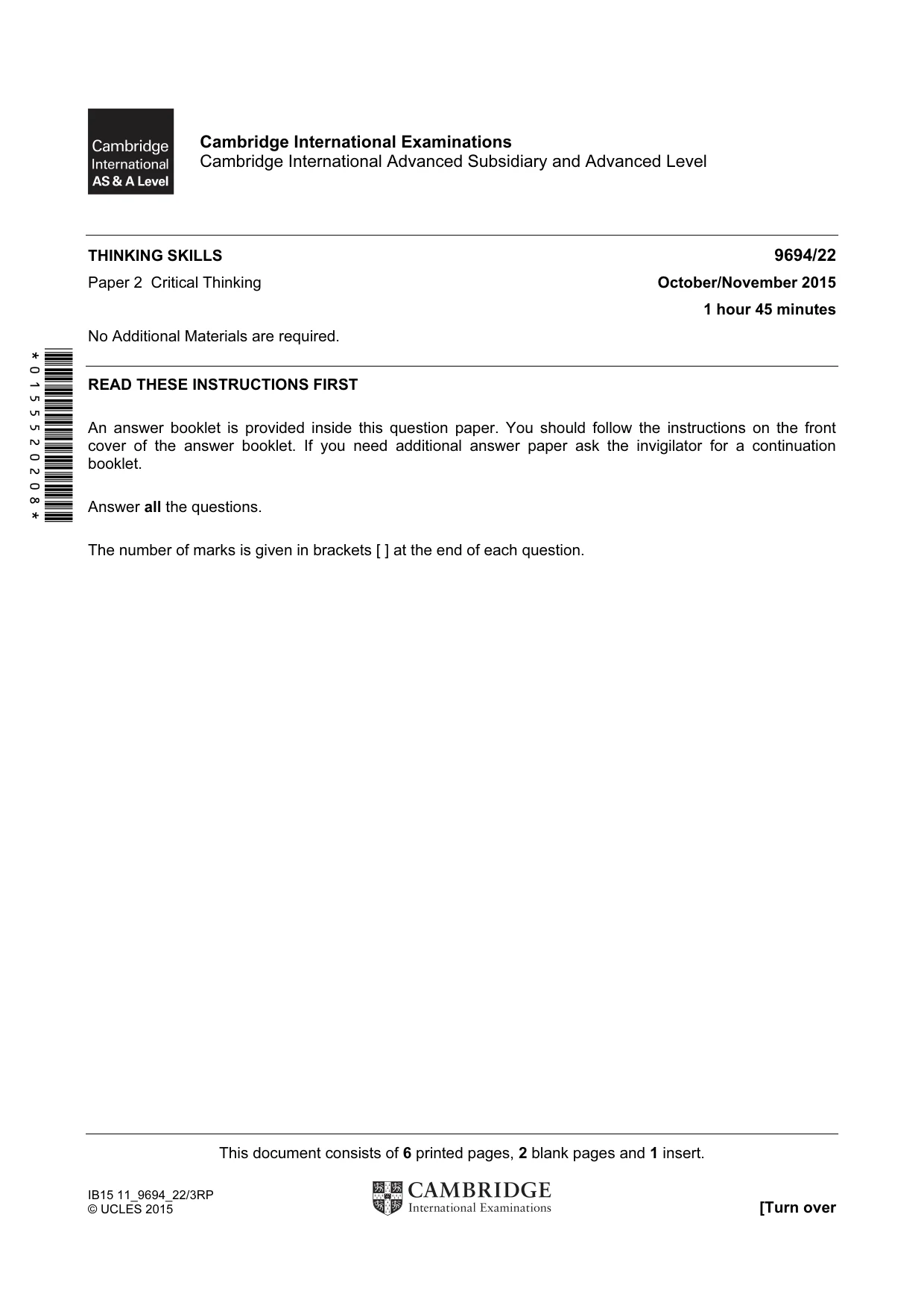
This document consists of 6 printed pages, 2 blank pages and 1 insert. IB15 11_9694_22/3RP © UCLES 2015 [Turn over *0155520208* Cambridge International Examinations Cambridge International Advanced Subsidiary and Advanced Level THINKING SKILLS 9694/22 Paper 2 Critical Thinking October/November 2015 1 hour 45 minutes No Additional Materials are required. READ THESE INSTRUCTIONS FIRST An answer booklet is provided inside this question paper. You should follow the instructions on the front cover of the answer booklet. If you need additional answer paper ask the invigilator for a continuation booklet. Answer all the questions. The number of marks is given in brackets [ ] at the end of each question.
Question paper, page 2
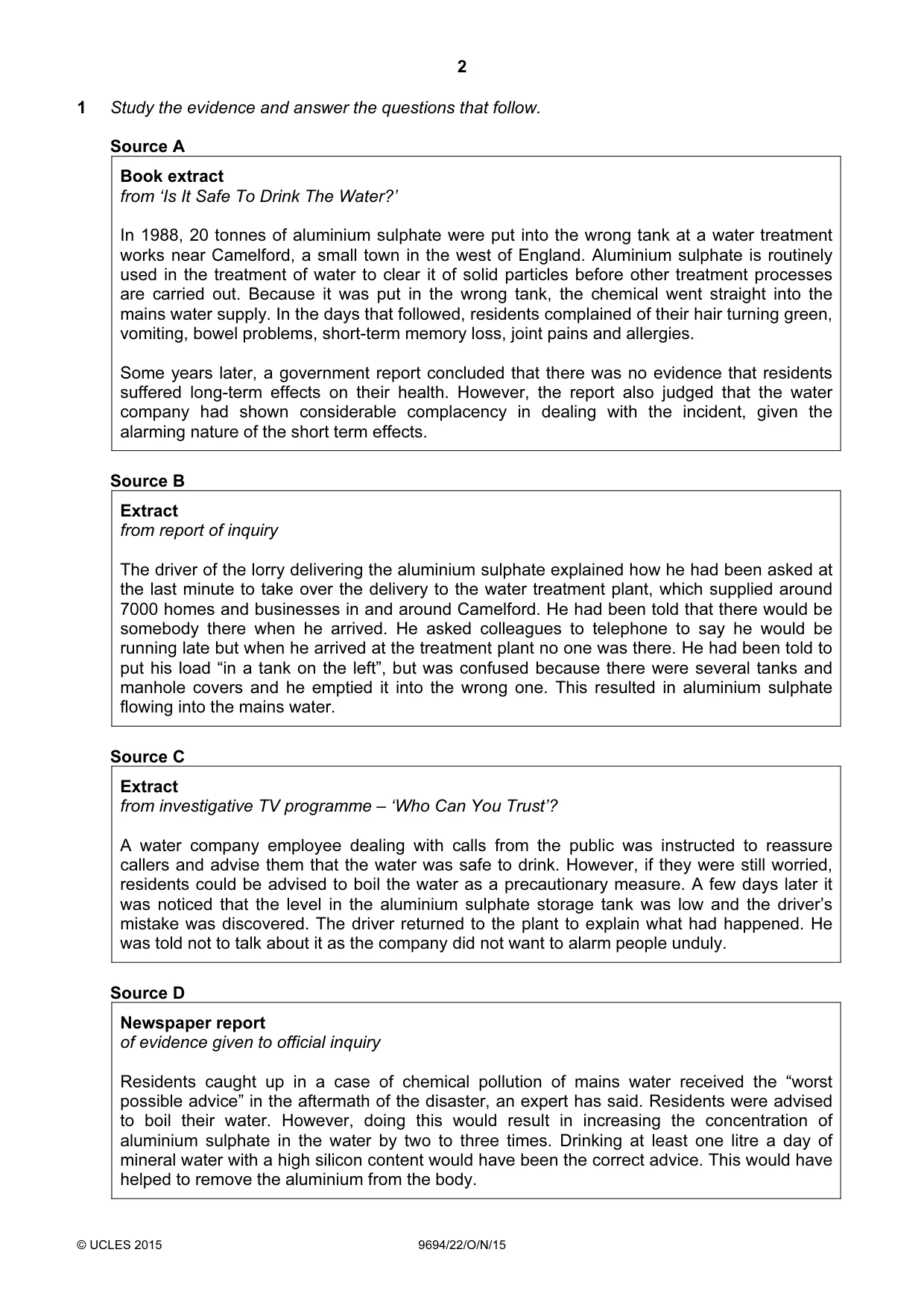
2 © UCLES 2015 9694/22/O/N/15 1 Study the evidence and answer the questions that follow. Source A Book extract from ‘Is It Safe To Drink The Water?’ In 1988, 20 tonnes of aluminium sulphate were put into the wrong tank at a water treatment works near Camelford, a small town in the west of England. Aluminium sulphate is routinely used in the treatment of water to clear it of solid particles before other treatment processes are carried out. Because it was put in the wrong tank, the chemical went straight into the mains water supply. In the days that followed, residents complained of their hair turning green, vomiting, bowel problems, short-term memory loss, joint pains and allergies. Some years later, a government report concluded that there was no evidence that residents suffered long-term effects on their health. However, the report also judged that the water company had shown considerable complacency in dealing with the incident, given the alarming nature of the short term effects. Source B Extract from report of inquiry The driver of the lorry delivering the aluminium sulphate explained how he had been asked at the last minute to take over the delivery to the water treatment plant, which supplied around 7000 homes and businesses in and around Camelford. He had been told that there would be somebody there when he arrived. He asked colleagues to telephone to say he would be running late but when he arrived at the treatment plant no one was there. He had been told to put his load “in a tank on the left”, but was confused because there were several tanks and manhole covers and he emptied it into the wrong one. This resulted in aluminium sulphate flowing into the mains water. Source C Extract from investigative TV programme – ‘Who Can You Trust’? A water company employee dealing with calls from the public was instructed to reassure callers and advise them that the water was safe to drink. However, if they were still worried, residents could be advised to boil the water as a precautionary measure. A few days later it was noticed that the level in the aluminium sulphate storage tank was low and the driver’s mistake was discovered. The driver returned to the plant to explain what had happened. He was told not to talk about it as the company did not want to alarm people unduly. Source D Newspaper report of evidence given to official inquiry Residents caught up in a case of chemical pollution of mains water received the “worst possible advice” in the aftermath of the disaster, an expert has said. Residents were advised to boil their water. However, doing this would result in increasing the concentration of aluminium sulphate in the water by two to three times. Drinking at least one litre a day of mineral water with a high silicon content would have been the correct advice. This would have helped to remove the aluminium from the body.
Question paper, page 3
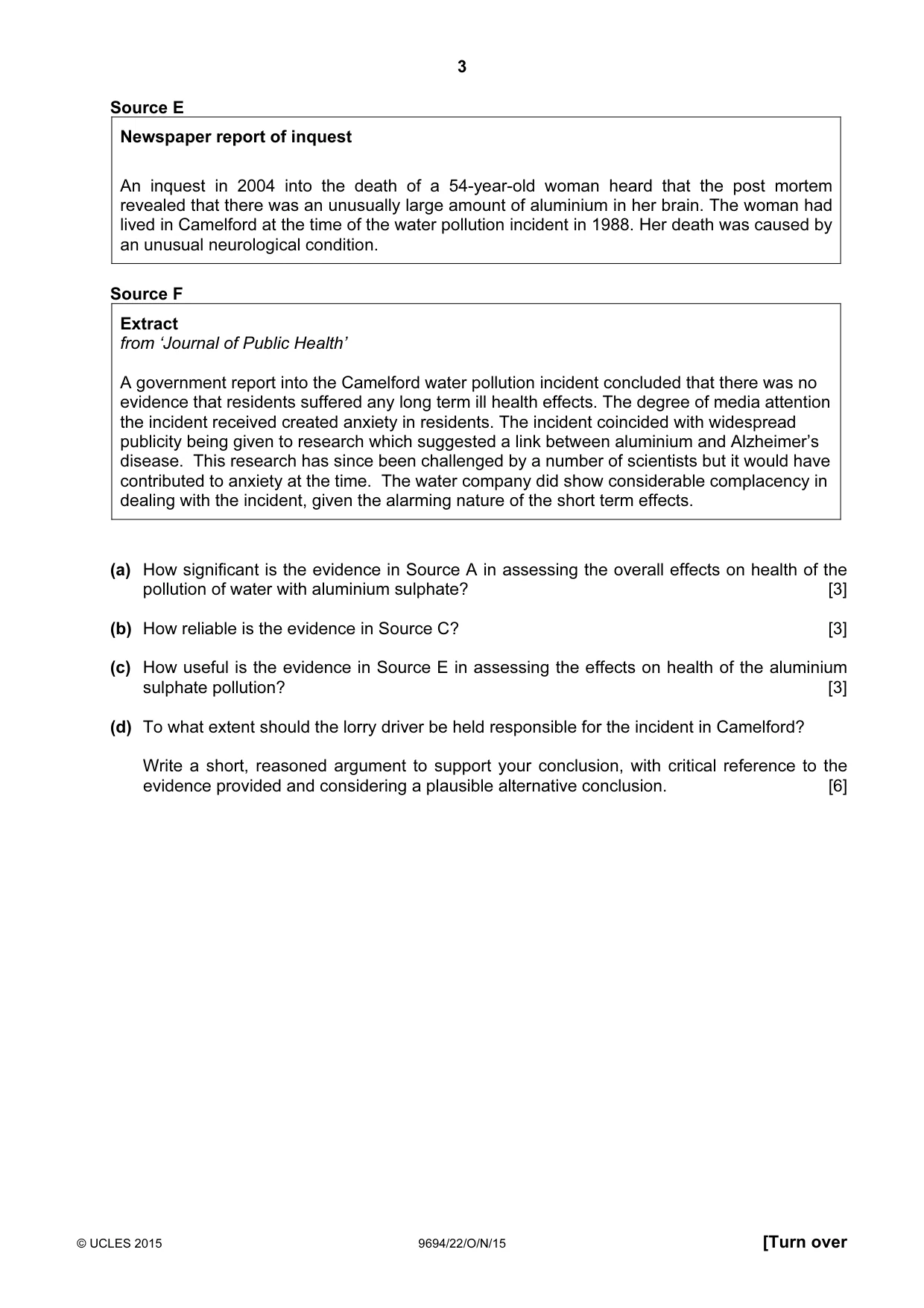
3 © UCLES 2015 9694/22/O/N/15 [Turn over Source E Newspaper report of inquest An inquest in 2004 into the death of a 54-year-old woman heard that the post mortem revealed that there was an unusually large amount of aluminium in her brain. The woman had lived in Camelford at the time of the water pollution incident in 1988. Her death was caused by an unusual neurological condition. Source F Extract from ‘Journal of Public Health’ A government report into the Camelford water pollution incident concluded that there was no evidence that residents suffered any long term ill health effects. The degree of media attention the incident received created anxiety in residents. The incident coincided with widespread publicity being given to research which suggested a link between aluminium and Alzheimer’s disease. This research has since been challenged by a number of scientists but it would have contributed to anxiety at the time. The water company did show considerable complacency in dealing with the incident, given the alarming nature of the short term effects. (a) How significant is the evidence in Source A in assessing the overall effects on health of the pollution of water with aluminium sulphate? [3] (b) How reliable is the evidence in Source C? [3] (c) How useful is the evidence in Source E in assessing the effects on health of the aluminium sulphate pollution? [3] (d) To what extent should the lorry driver be held responsible for the incident in Camelford? Write a short, reasoned argument to support your conclusion, with critical reference to the evidence provided and considering a plausible alternative conclusion. [6]
Question paper, page 4
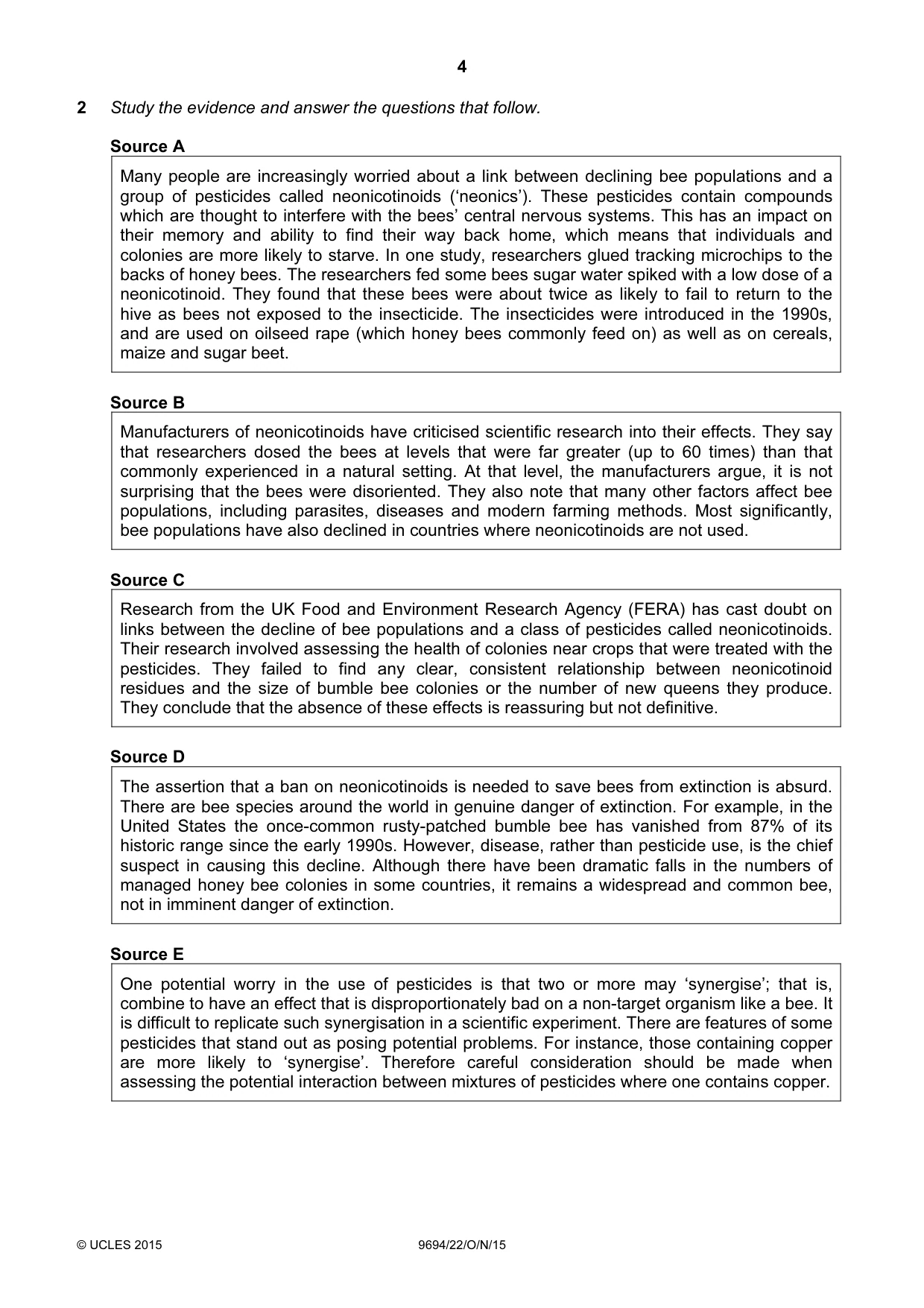
4 © UCLES 2015 9694/22/O/N/15 2 Study the evidence and answer the questions that follow. Source A Many people are increasingly worried about a link between declining bee populations and a group of pesticides called neonicotinoids (‘neonics’). These pesticides contain compounds which are thought to interfere with the bees’ central nervous systems. This has an impact on their memory and ability to find their way back home, which means that individuals and colonies are more likely to starve. In one study, researchers glued tracking microchips to the backs of honey bees. The researchers fed some bees sugar water spiked with a low dose of a neonicotinoid. They found that these bees were about twice as likely to fail to return to the hive as bees not exposed to the insecticide. The insecticides were introduced in the 1990s, and are used on oilseed rape (which honey bees commonly feed on) as well as on cereals, maize and sugar beet. Source B Manufacturers of neonicotinoids have criticised scientific research into their effects. They say that researchers dosed the bees at levels that were far greater (up to 60 times) than that commonly experienced in a natural setting. At that level, the manufacturers argue, it is not surprising that the bees were disoriented. They also note that many other factors affect bee populations, including parasites, diseases and modern farming methods. Most significantly, bee populations have also declined in countries where neonicotinoids are not used. Source C Research from the UK Food and Environment Research Agency (FERA) has cast doubt on links between the decline of bee populations and a class of pesticides called neonicotinoids. Their research involved assessing the health of colonies near crops that were treated with the pesticides. They failed to find any clear, consistent relationship between neonicotinoid residues and the size of bumble bee colonies or the number of new queens they produce. They conclude that the absence of these effects is reassuring but not definitive. Source D The assertion that a ban on neonicotinoids is needed to save bees from extinction is absurd. There are bee species around the world in genuine danger of extinction. For example, in the United States the once-common rusty-patched bumble bee has vanished from 87% of its historic range since the early 1990s. However, disease, rather than pesticide use, is the chief suspect in causing this decline. Although there have been dramatic falls in the numbers of managed honey bee colonies in some countries, it remains a widespread and common bee, not in imminent danger of extinction. Source E One potential worry in the use of pesticides is that two or more may ‘synergise’; that is, combine to have an effect that is disproportionately bad on a non-target organism like a bee. It is difficult to replicate such synergisation in a scientific experiment. There are features of some pesticides that stand out as posing potential problems. For instance, those containing copper are more likely to ‘synergise’. Therefore careful consideration should be made when assessing the potential interaction between mixtures of pesticides where one contains copper.
Question paper, page 5
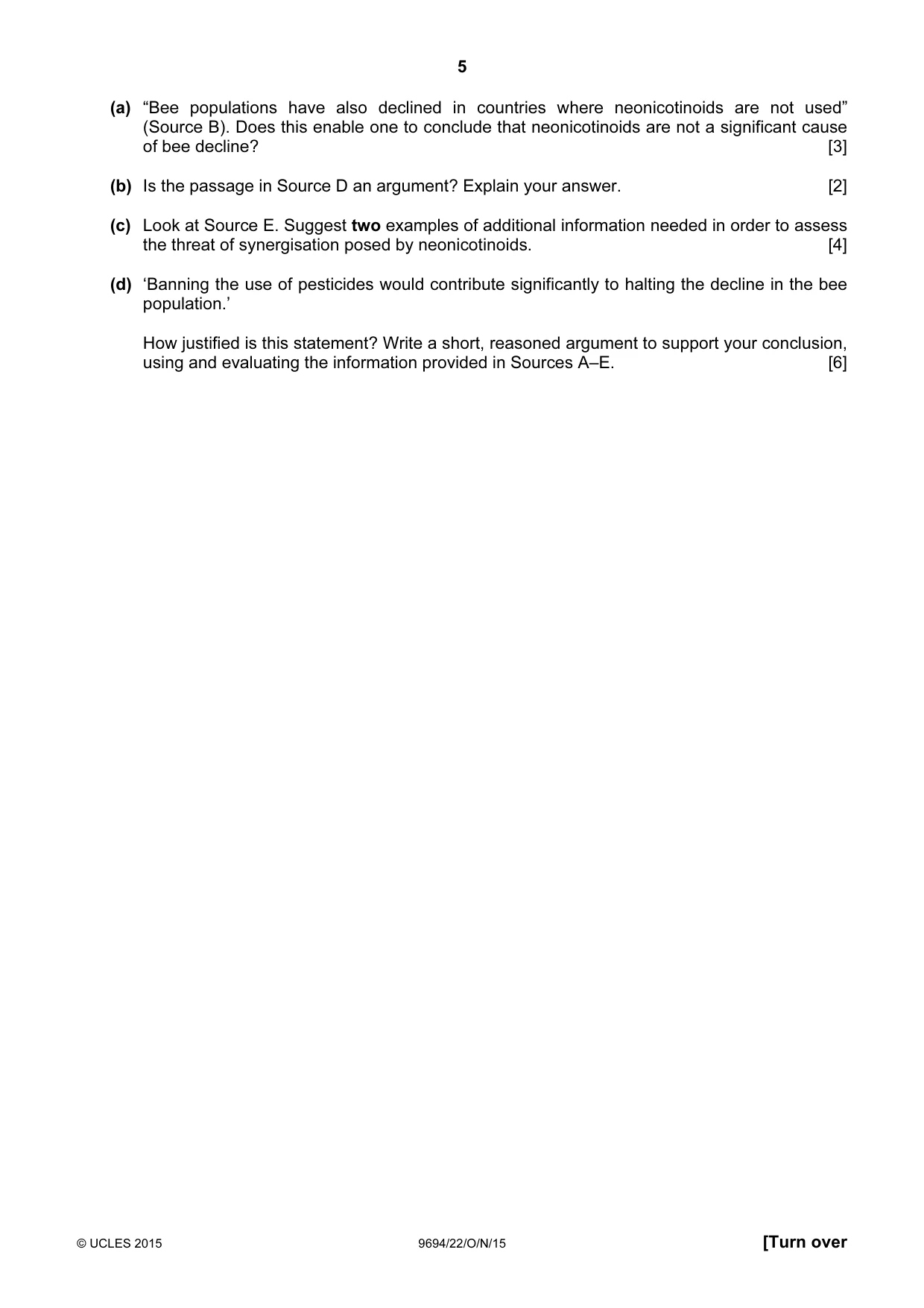
5 © UCLES 2015 9694/22/O/N/15 [Turn over (a) “Bee populations have also declined in countries where neonicotinoids are not used” (Source B). Does this enable one to conclude that neonicotinoids are not a significant cause of bee decline? [3] (b) Is the passage in Source D an argument? Explain your answer. [2] (c) Look at Source E. Suggest two examples of additional information needed in order to assess the threat of synergisation posed by neonicotinoids. [4] (d) ‘Banning the use of pesticides would contribute significantly to halting the decline in the bee population.’ How justified is this statement? Write a short, reasoned argument to support your conclusion, using and evaluating the information provided in Sources A–E. [6]
Question paper, page 6
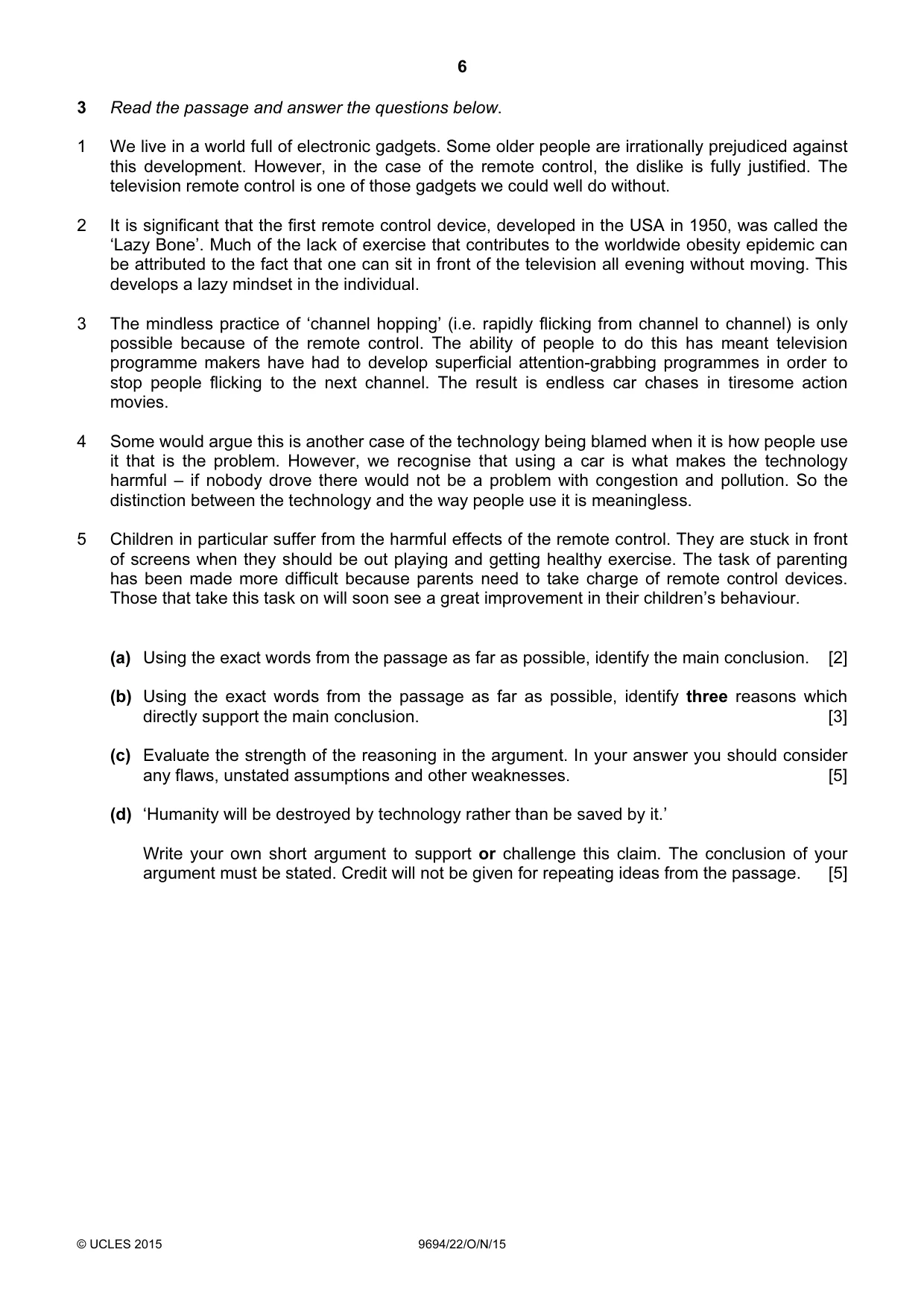
6 © UCLES 2015 9694/22/O/N/15 3 Read the passage and answer the questions below. 1 We live in a world full of electronic gadgets. Some older people are irrationally prejudiced against this development. However, in the case of the remote control, the dislike is fully justified. The television remote control is one of those gadgets we could well do without. 2 It is significant that the first remote control device, developed in the USA in 1950, was called the ‘Lazy Bone’. Much of the lack of exercise that contributes to the worldwide obesity epidemic can be attributed to the fact that one can sit in front of the television all evening without moving. This develops a lazy mindset in the individual. 3 The mindless practice of ‘channel hopping’ (i.e. rapidly flicking from channel to channel) is only possible because of the remote control. The ability of people to do this has meant television programme makers have had to develop superficial attention-grabbing programmes in order to stop people flicking to the next channel. The result is endless car chases in tiresome action movies. 4 Some would argue this is another case of the technology being blamed when it is how people use it that is the problem. However, we recognise that using a car is what makes the technology harmful – if nobody drove there would not be a problem with congestion and pollution. So the distinction between the technology and the way people use it is meaningless. 5 Children in particular suffer from the harmful effects of the remote control. They are stuck in front of screens when they should be out playing and getting healthy exercise. The task of parenting has been made more difficult because parents need to take charge of remote control devices. Those that take this task on will soon see a great improvement in their children’s behaviour. (a) Using the exact words from the passage as far as possible, identify the main conclusion. [2] (b) Using the exact words from the passage as far as possible, identify three reasons which directly support the main conclusion. [3] (c) Evaluate the strength of the reasoning in the argument. In your answer you should consider any flaws, unstated assumptions and other weaknesses. [5] (d) ‘Humanity will be destroyed by technology rather than be saved by it.’ Write your own short argument to support or challenge this claim. The conclusion of your argument must be stated. Credit will not be given for repeating ideas from the passage. [5]
Question paper, page 7
7 © UCLES 2015 9694/22/O/N/15 BLANK PAGE
Question paper, page 8
8 Permission to reproduce items where third-party owned material protected by copyright is included has been sought and cleared where possible. Every reasonable effort has been made by the publisher (UCLES) to trace copyright holders, but if any items requiring clearance have unwittingly been included, the publisher will be pleased to make amends at the earliest possible opportunity. To avoid the issue of disclosure of answer-related information to candidates, all copyright acknowledgements are reproduced online in the Cambridge International Examinations Copyright Acknowledgements Booklet. This is produced for each series of examinations and is freely available to download at www.cie.org.uk after the live examination series. Cambridge International Examinations is part of the Cambridge Assessment Group. Cambridge Assessment is the brand name of University of Cambridge Local Examinations Syndicate (UCLES), which is itself a department of the University of Cambridge. © UCLES 2015 9694/22/O/N/15 BLANK PAGE
Mark scheme, page 1
® IGCSE is the registered trademark of Cambridge International Examinations. CAMBRIDGE INTERNATIONAL EXAMINATIONS Cambridge International Advanced Subsidiary and Advanced Level MARK SCHEME for the October/November 2015 series 9694 THINKING SKILLS 9694/22 Paper 2 (Critical Thinking), maximum raw mark 45 This mark scheme is published as an aid to teachers and candidates, to indicate the requirements of the examination. It shows the basis on which Examiners were instructed to award marks. It does not indicate the details of the discussions that took place at an Examiners’ meeting before marking began, which would have considered the acceptability of alternative answers. Mark schemes should be read in conjunction with the question paper and the Principal Examiner Report for Teachers. Cambridge will not enter into discussions about these mark schemes. Cambridge is publishing the mark schemes for the October/November 2015 series for most Cambridge IGCSE®, Cambridge International A and AS Level components and some Cambridge O Level components.
Mark scheme, page 2
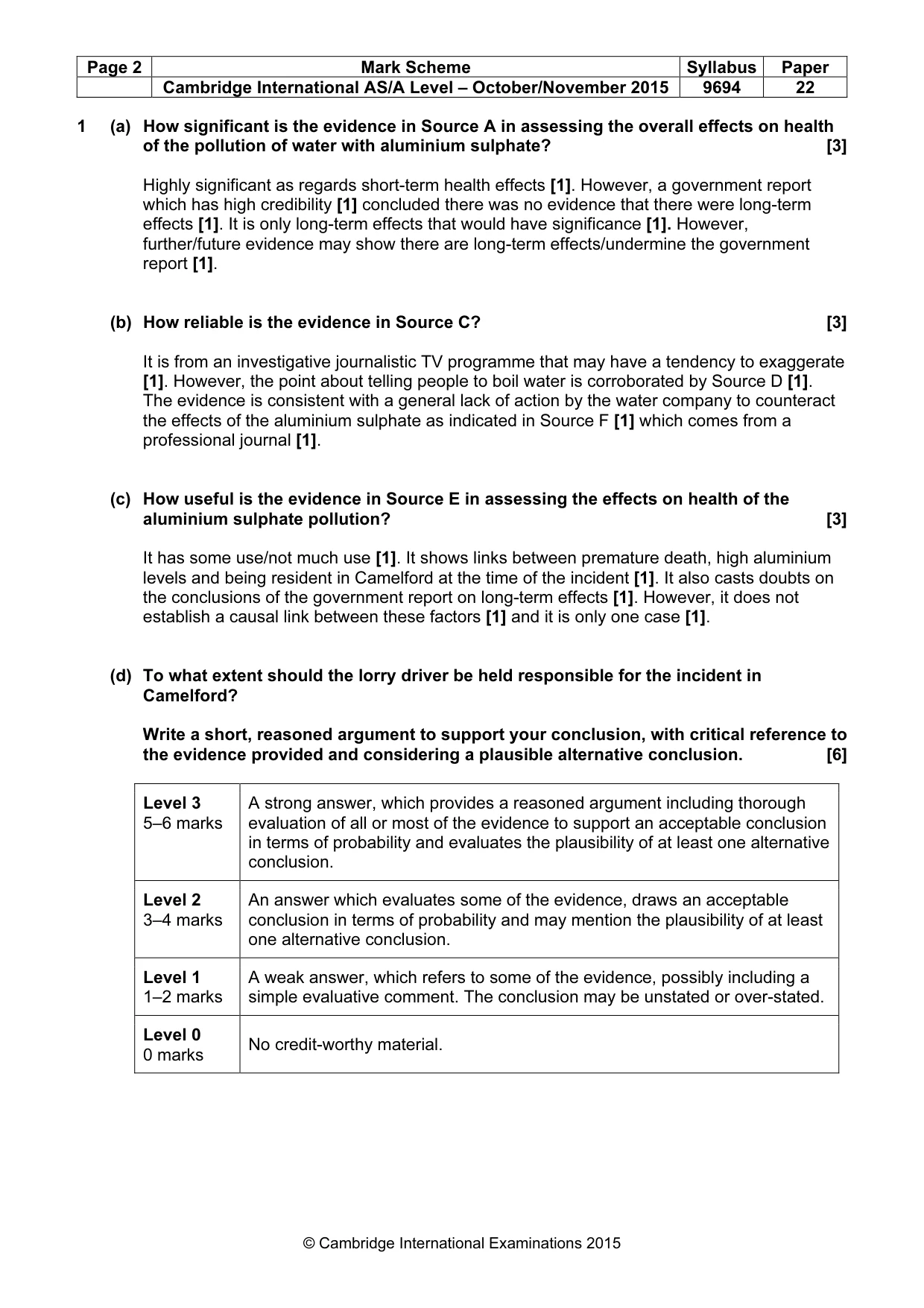
Page 2 Mark Scheme Syllabus Paper Cambridge International AS/A Level – October/November 2015 9694 22 © Cambridge International Examinations 2015 1 (a) How significant is the evidence in Source A in assessing the overall effects on health of the pollution of water with aluminium sulphate? [3] Highly significant as regards short-term health effects [1]. However, a government report which has high credibility [1] concluded there was no evidence that there were long-term effects [1]. It is only long-term effects that would have significance [1]. However, further/future evidence may show there are long-term effects/undermine the government report [1]. (b) How reliable is the evidence in Source C? [3] It is from an investigative journalistic TV programme that may have a tendency to exaggerate [1]. However, the point about telling people to boil water is corroborated by Source D [1]. The evidence is consistent with a general lack of action by the water company to counteract the effects of the aluminium sulphate as indicated in Source F [1] which comes from a professional journal [1]. (c) How useful is the evidence in Source E in assessing the effects on health of the aluminium sulphate pollution? [3] It has some use/not much use [1]. It shows links between premature death, high aluminium levels and being resident in Camelford at the time of the incident [1]. It also casts doubts on the conclusions of the government report on long-term effects [1]. However, it does not establish a causal link between these factors [1] and it is only one case [1]. (d) To what extent should the lorry driver be held responsible for the incident in Camelford? Write a short, reasoned argument to support your conclusion, with critical reference to the evidence provided and considering a plausible alternative conclusion. [6] Level 3 5–6 marks A strong answer, which provides a reasoned argument including thorough evaluation of all or most of the evidence to support an acceptable conclusion in terms of probability and evaluates the plausibility of at least one alternative conclusion. Level 2 3–4 marks An answer which evaluates some of the evidence, draws an acceptable conclusion in terms of probability and may mention the plausibility of at least one alternative conclusion. Level 1 1–2 marks A weak answer, which refers to some of the evidence, possibly including a simple evaluative comment. The conclusion may be unstated or over-stated. Level 0 0 marks No credit-worthy material.
Mark scheme, page 3
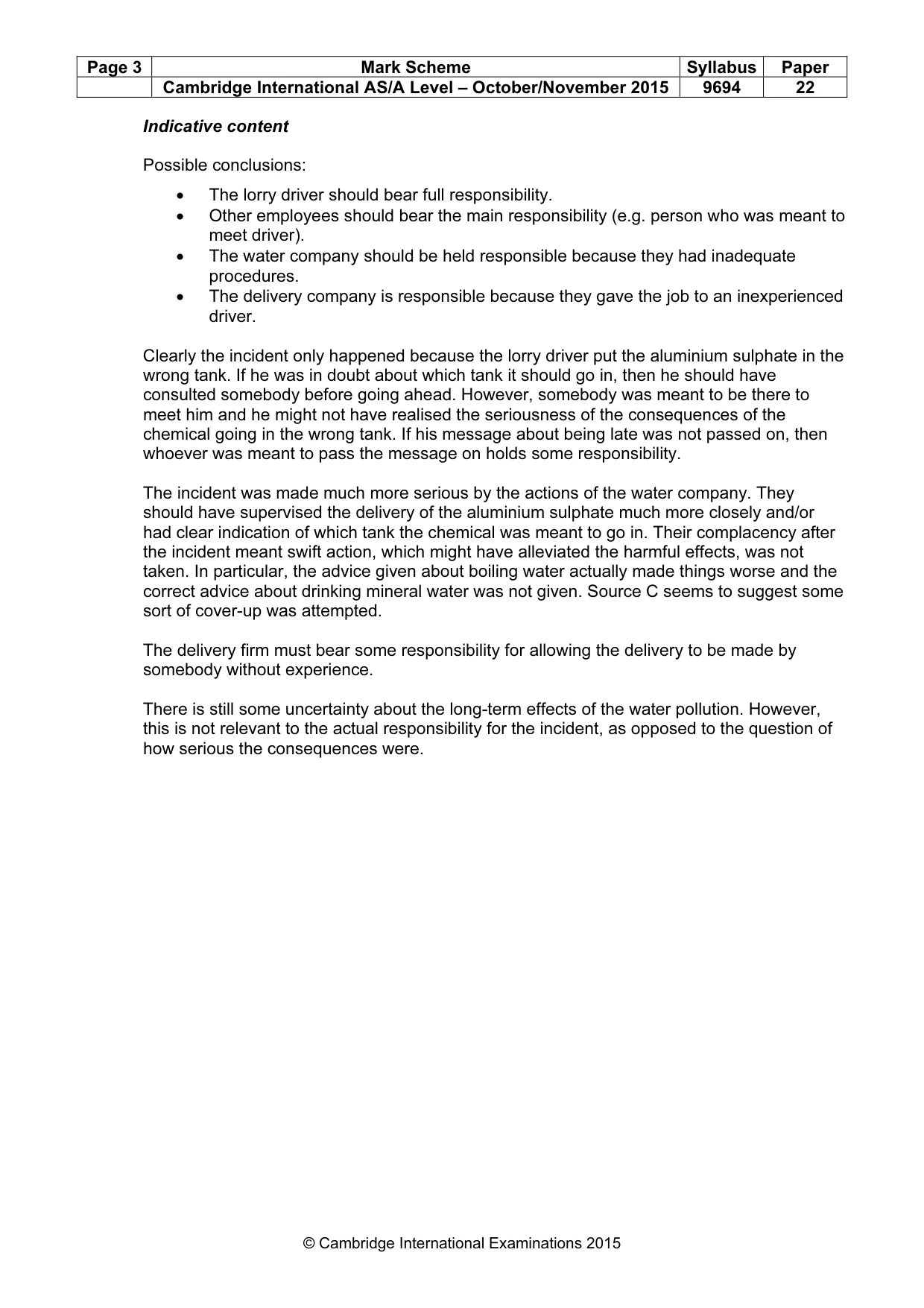
Page 3 Mark Scheme Syllabus Paper Cambridge International AS/A Level – October/November 2015 9694 22 © Cambridge International Examinations 2015 Indicative content Possible conclusions: • The lorry driver should bear full responsibility. • Other employees should bear the main responsibility (e.g. person who was meant to meet driver). • The water company should be held responsible because they had inadequate procedures. • The delivery company is responsible because they gave the job to an inexperienced driver. Clearly the incident only happened because the lorry driver put the aluminium sulphate in the wrong tank. If he was in doubt about which tank it should go in, then he should have consulted somebody before going ahead. However, somebody was meant to be there to meet him and he might not have realised the seriousness of the consequences of the chemical going in the wrong tank. If his message about being late was not passed on, then whoever was meant to pass the message on holds some responsibility. The incident was made much more serious by the actions of the water company. They should have supervised the delivery of the aluminium sulphate much more closely and/or had clear indication of which tank the chemical was meant to go in. Their complacency after the incident meant swift action, which might have alleviated the harmful effects, was not taken. In particular, the advice given about boiling water actually made things worse and the correct advice about drinking mineral water was not given. Source C seems to suggest some sort of cover-up was attempted. The delivery firm must bear some responsibility for allowing the delivery to be made by somebody without experience. There is still some uncertainty about the long-term effects of the water pollution. However, this is not relevant to the actual responsibility for the incident, as opposed to the question of how serious the consequences were.
Mark scheme, page 4
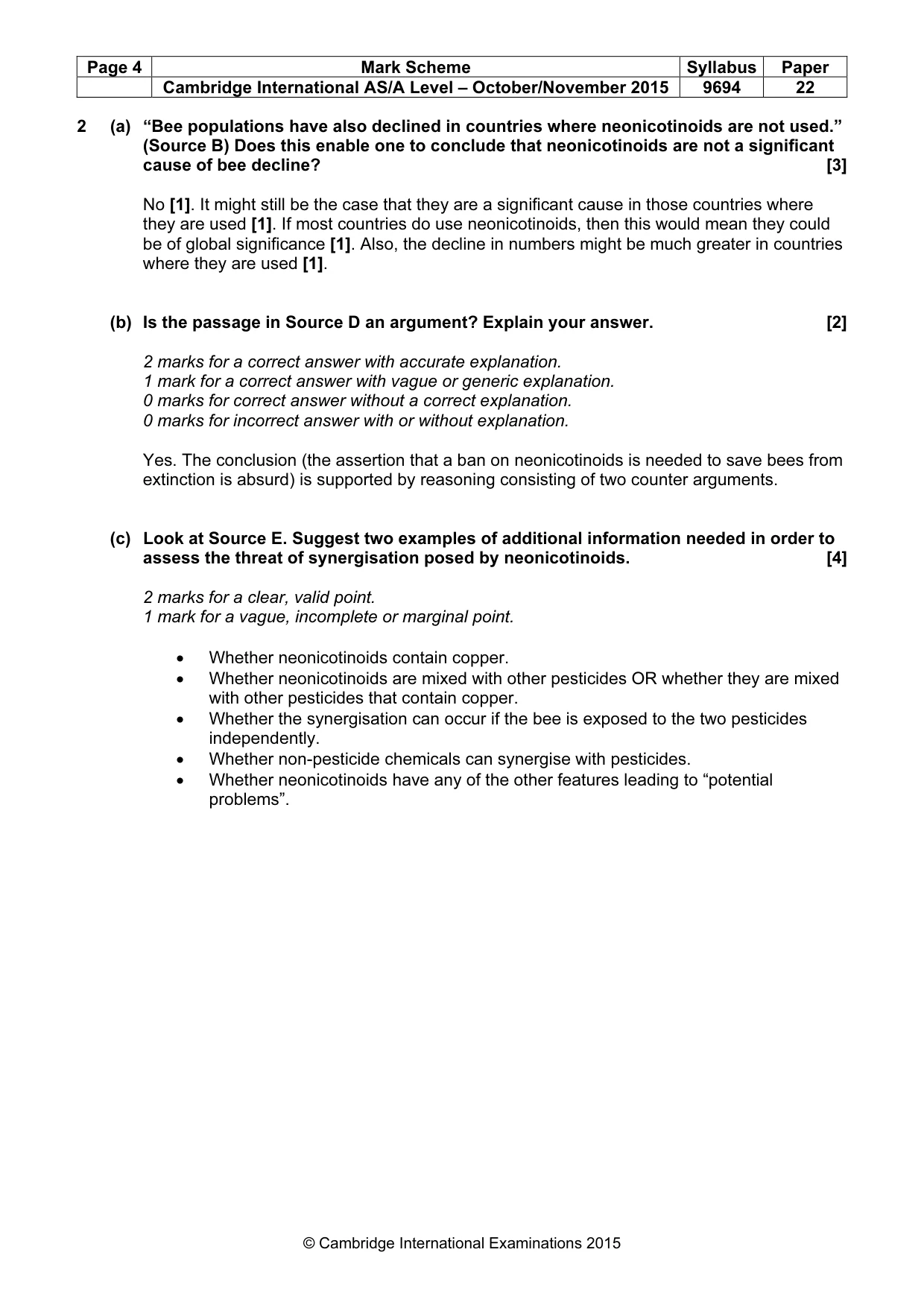
Page 4 Mark Scheme Syllabus Paper Cambridge International AS/A Level – October/November 2015 9694 22 © Cambridge International Examinations 2015 2 (a) “Bee populations have also declined in countries where neonicotinoids are not used.” (Source B) Does this enable one to conclude that neonicotinoids are not a significant cause of bee decline? [3] No [1]. It might still be the case that they are a significant cause in those countries where they are used [1]. If most countries do use neonicotinoids, then this would mean they could be of global significance [1]. Also, the decline in numbers might be much greater in countries where they are used [1]. (b) Is the passage in Source D an argument? Explain your answer. [2] 2 marks for a correct answer with accurate explanation. 1 mark for a correct answer with vague or generic explanation. 0 marks for correct answer without a correct explanation. 0 marks for incorrect answer with or without explanation. Yes. The conclusion (the assertion that a ban on neonicotinoids is needed to save bees from extinction is absurd) is supported by reasoning consisting of two counter arguments. (c) Look at Source E. Suggest two examples of additional information needed in order to assess the threat of synergisation posed by neonicotinoids. [4] 2 marks for a clear, valid point. 1 mark for a vague, incomplete or marginal point. • Whether neonicotinoids contain copper. • Whether neonicotinoids are mixed with other pesticides OR whether they are mixed with other pesticides that contain copper. • Whether the synergisation can occur if the bee is exposed to the two pesticides independently. • Whether non-pesticide chemicals can synergise with pesticides. • Whether neonicotinoids have any of the other features leading to “potential problems”.
Mark scheme, page 5
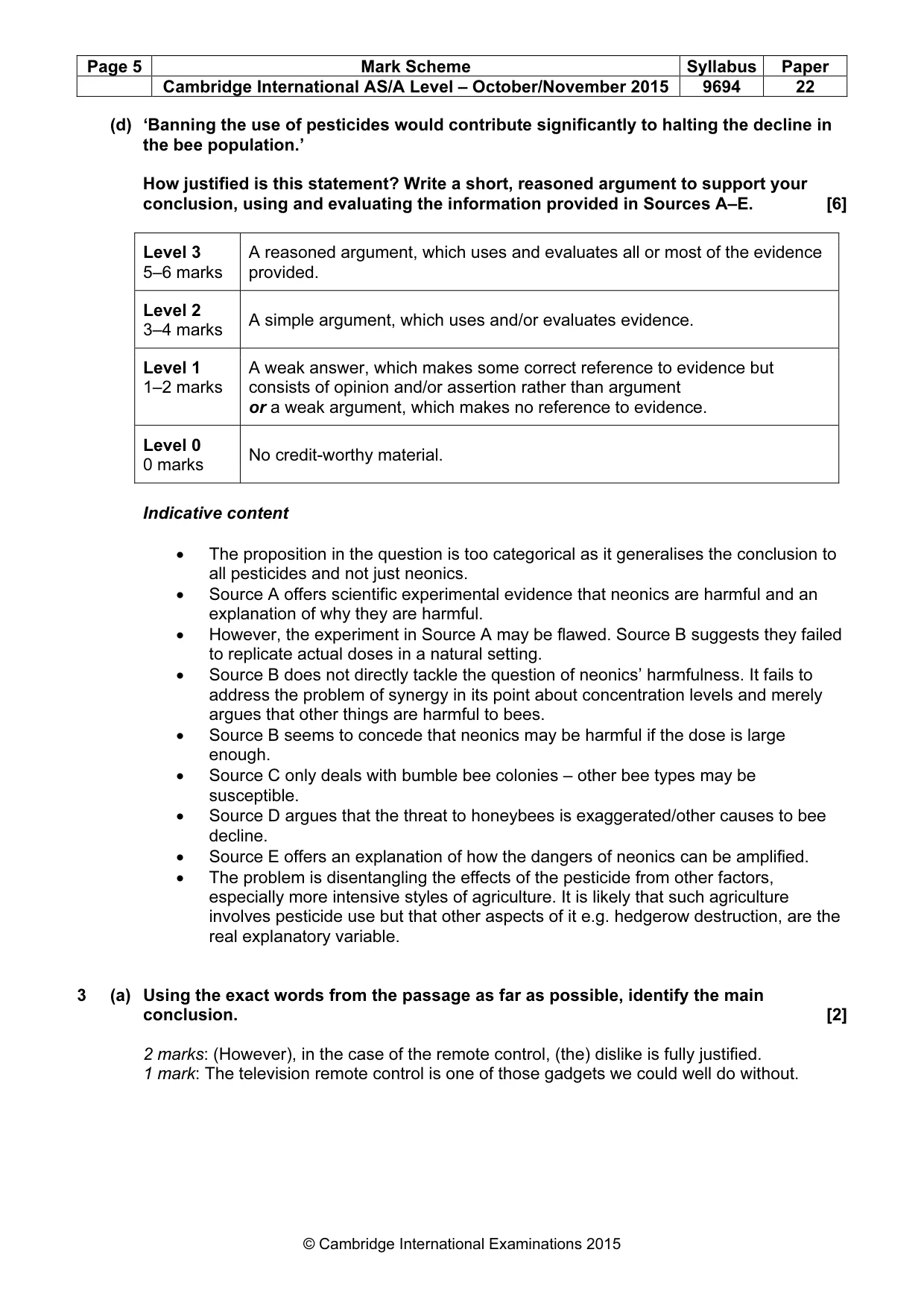
Page 5 Mark Scheme Syllabus Paper Cambridge International AS/A Level – October/November 2015 9694 22 © Cambridge International Examinations 2015 (d) ‘Banning the use of pesticides would contribute significantly to halting the decline in the bee population.’ How justified is this statement? Write a short, reasoned argument to support your conclusion, using and evaluating the information provided in Sources A–E. [6] Level 3 5–6 marks A reasoned argument, which uses and evaluates all or most of the evidence provided. Level 2 3–4 marks A simple argument, which uses and/or evaluates evidence. Level 1 1–2 marks A weak answer, which makes some correct reference to evidence but consists of opinion and/or assertion rather than argument or a weak argument, which makes no reference to evidence. Level 0 0 marks No credit-worthy material. Indicative content • The proposition in the question is too categorical as it generalises the conclusion to all pesticides and not just neonics. • Source A offers scientific experimental evidence that neonics are harmful and an explanation of why they are harmful. • However, the experiment in Source A may be flawed. Source B suggests they failed to replicate actual doses in a natural setting. • Source B does not directly tackle the question of neonics’ harmfulness. It fails to address the problem of synergy in its point about concentration levels and merely argues that other things are harmful to bees. • Source B seems to concede that neonics may be harmful if the dose is large enough. • Source C only deals with bumble bee colonies – other bee types may be susceptible. • Source D argues that the threat to honeybees is exaggerated/other causes to bee decline. • Source E offers an explanation of how the dangers of neonics can be amplified. • The problem is disentangling the effects of the pesticide from other factors, especially more intensive styles of agriculture. It is likely that such agriculture involves pesticide use but that other aspects of it e.g. hedgerow destruction, are the real explanatory variable. 3 (a) Using the exact words from the passage as far as possible, identify the main conclusion. [2] 2 marks: (However), in the case of the remote control, (the) dislike is fully justified. 1 mark: The television remote control is one of those gadgets we could well do without.
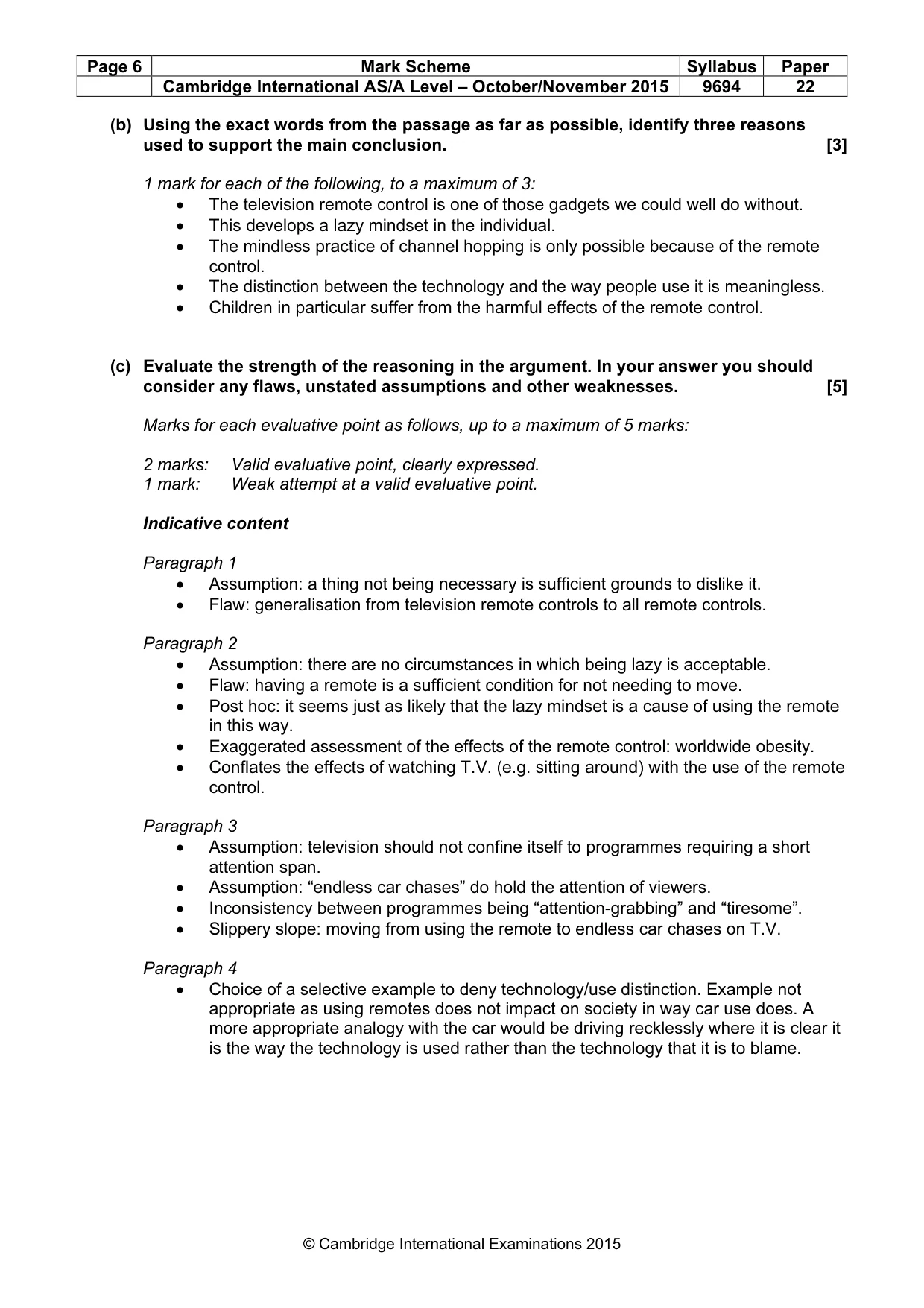
Mark scheme, page 6
Page 6 Mark Scheme Syllabus Paper Cambridge International AS/A Level – October/November 2015 9694 22 © Cambridge International Examinations 2015 (b) Using the exact words from the passage as far as possible, identify three reasons used to support the main conclusion. [3] 1 mark for each of the following, to a maximum of 3: • The television remote control is one of those gadgets we could well do without. • This develops a lazy mindset in the individual. • The mindless practice of channel hopping is only possible because of the remote control. • The distinction between the technology and the way people use it is meaningless. • Children in particular suffer from the harmful effects of the remote control. (c) Evaluate the strength of the reasoning in the argument. In your answer you should consider any flaws, unstated assumptions and other weaknesses. [5] Marks for each evaluative point as follows, up to a maximum of 5 marks: 2 marks: Valid evaluative point, clearly expressed. 1 mark: Weak attempt at a valid evaluative point. Indicative content Paragraph 1 • Assumption: a thing not being necessary is sufficient grounds to dislike it. • Flaw: generalisation from television remote controls to all remote controls. Paragraph 2 • Assumption: there are no circumstances in which being lazy is acceptable. • Flaw: having a remote is a sufficient condition for not needing to move. • Post hoc: it seems just as likely that the lazy mindset is a cause of using the remote in this way. • Exaggerated assessment of the effects of the remote control: worldwide obesity. • Conflates the effects of watching T.V. (e.g. sitting around) with the use of the remote control. Paragraph 3 • Assumption: television should not confine itself to programmes requiring a short attention span. • Assumption: “endless car chases” do hold the attention of viewers. • Inconsistency between programmes being “attention-grabbing” and “tiresome”. • Slippery slope: moving from using the remote to endless car chases on T.V. Paragraph 4 • Choice of a selective example to deny technology/use distinction. Example not appropriate as using remotes does not impact on society in way car use does. A more appropriate analogy with the car would be driving recklessly where it is clear it is the way the technology is used rather than the technology that it is to blame.
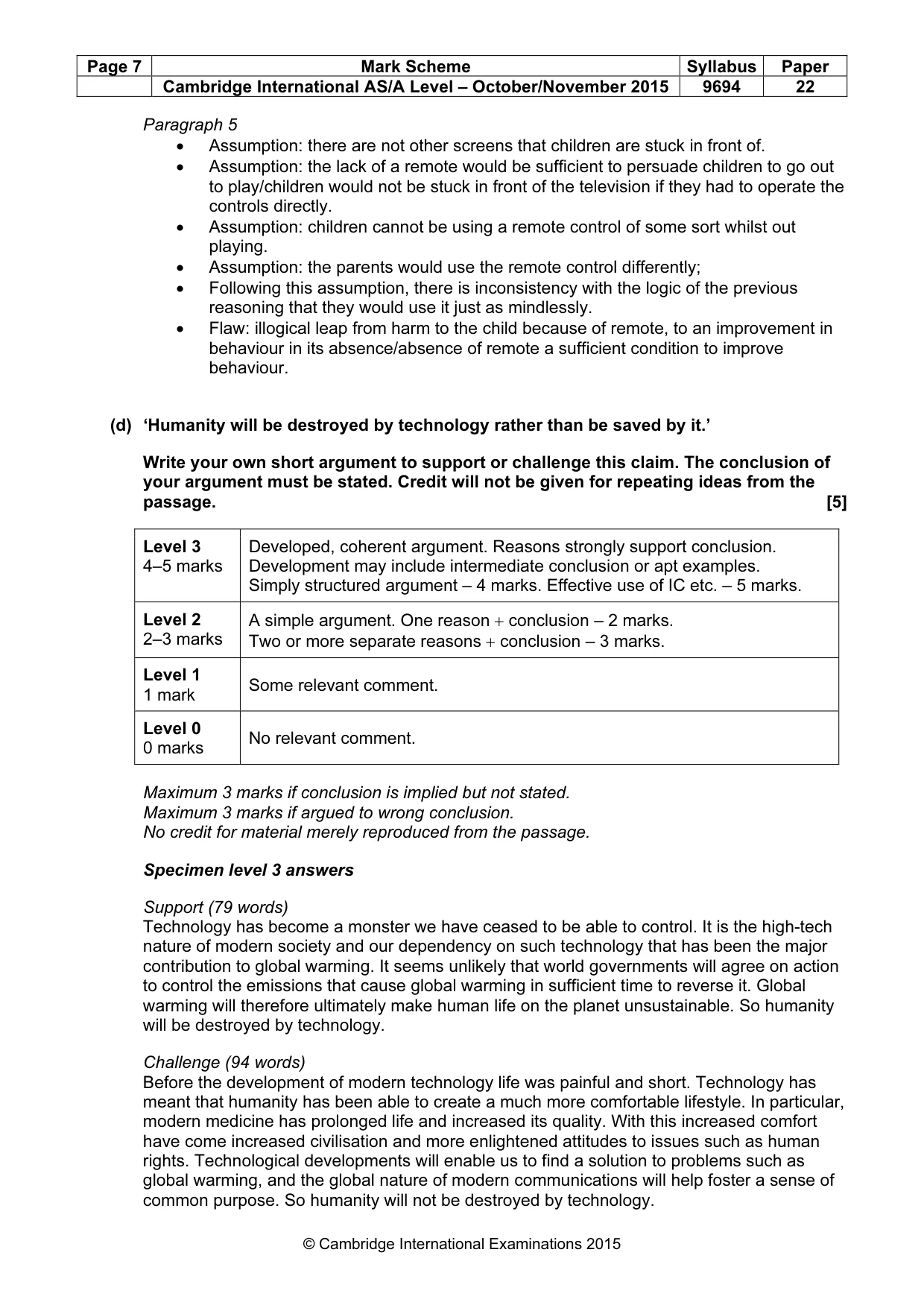
Mark scheme, page 7
Page 7 Mark Scheme Syllabus Paper Cambridge International AS/A Level – October/November 2015 9694 22 © Cambridge International Examinations 2015 Paragraph 5 • Assumption: there are not other screens that children are stuck in front of. • Assumption: the lack of a remote would be sufficient to persuade children to go out to play/children would not be stuck in front of the television if they had to operate the controls directly. • Assumption: children cannot be using a remote control of some sort whilst out playing. • Assumption: the parents would use the remote control differently; • Following this assumption, there is inconsistency with the logic of the previous reasoning that they would use it just as mindlessly. • Flaw: illogical leap from harm to the child because of remote, to an improvement in behaviour in its absence/absence of remote a sufficient condition to improve behaviour. (d) ‘Humanity will be destroyed by technology rather than be saved by it.’ Write your own short argument to support or challenge this claim. The conclusion of your argument must be stated. Credit will not be given for repeating ideas from the passage. [5] Level 3 4–5 marks Developed, coherent argument. Reasons strongly support conclusion. Development may include intermediate conclusion or apt examples. Simply structured argument – 4 marks. Effective use of IC etc. – 5 marks. Level 2 2–3 marks A simple argument. One reason + conclusion – 2 marks. Two or more separate reasons + conclusion – 3 marks. Level 1 1 mark Some relevant comment. Level 0 0 marks No relevant comment. Maximum 3 marks if conclusion is implied but not stated. Maximum 3 marks if argued to wrong conclusion. No credit for material merely reproduced from the passage. Specimen level 3 answers Support (79 words) Technology has become a monster we have ceased to be able to control. It is the high-tech nature of modern society and our dependency on such technology that has been the major contribution to global warming. It seems unlikely that world governments will agree on action to control the emissions that cause global warming in sufficient time to reverse it. Global warming will therefore ultimately make human life on the planet unsustainable. So humanity will be destroyed by technology. Challenge (94 words) Before the development of modern technology life was painful and short. Technology has meant that humanity has been able to create a much more comfortable lifestyle. In particular, modern medicine has prolonged life and increased its quality. With this increased comfort have come increased civilisation and more enlightened attitudes to issues such as human rights. Technological developments will enable us to find a solution to problems such as global warming, and the global nature of modern communications will help foster a sense of common purpose. So humanity will not be destroyed by technology.
What you needed in this session
Cambridge’s own grade thresholds for 2015 Oct/Nov, Paper 2 · Variant 2. A higher threshold means an easier paper — the bar moves with how the cohort did.