Cambridge A Level Thinking Skills 9694 — 2014 Oct/Nov Paper 2 · Variant 1
9694/21/O/N/14 · 45 marks · ≈51 min
The question paper and its mark scheme, free to read here and free to download. This is Cambridge’s own paper, exactly as it was sat.
Question paper8 pages

Mark scheme7 pages
Answers below. Sit the paper first if you are practising.
Paper as text
Question paper, page 1
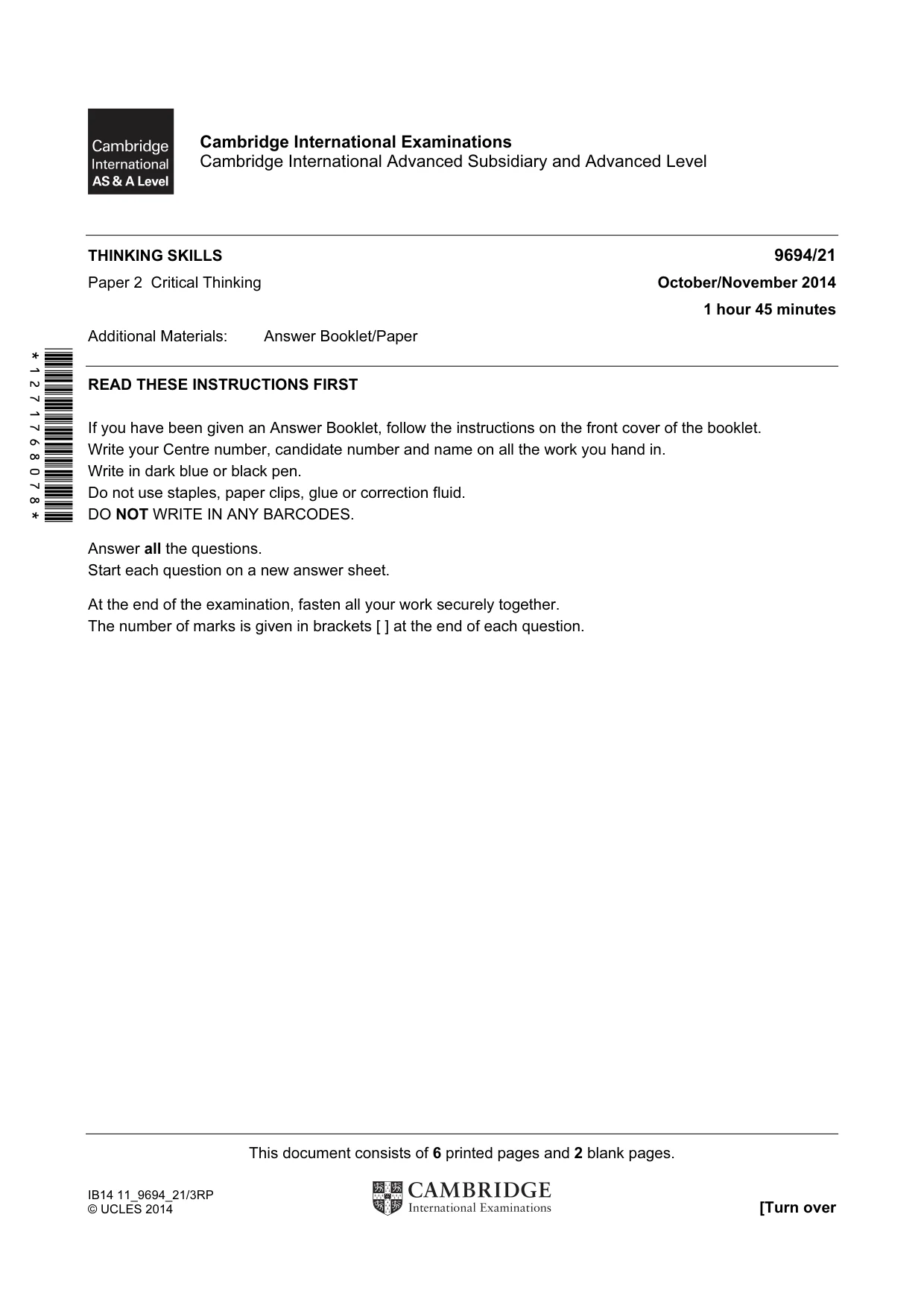
This document consists of 6 printed pages and 2 blank pages. IB14 11_9694_21/3RP © UCLES 2014 [Turn over *1271768078* Cambridge International Examinations Cambridge International Advanced Subsidiary and Advanced Level THINKING SKILLS 9694/21 Paper 2 Critical Thinking October/November 2014 1 hour 45 minutes Additional Materials: Answer Booklet/Paper READ THESE INSTRUCTIONS FIRST If you have been given an Answer Booklet, follow the instructions on the front cover of the booklet. Write your Centre number, candidate number and name on all the work you hand in. Write in dark blue or black pen. Do not use staples, paper clips, glue or correction fluid. DO NOT WRITE IN ANY BARCODES. Answer all the questions. Start each question on a new answer sheet. At the end of the examination, fasten all your work securely together. The number of marks is given in brackets [ ] at the end of each question.
Question paper, page 2
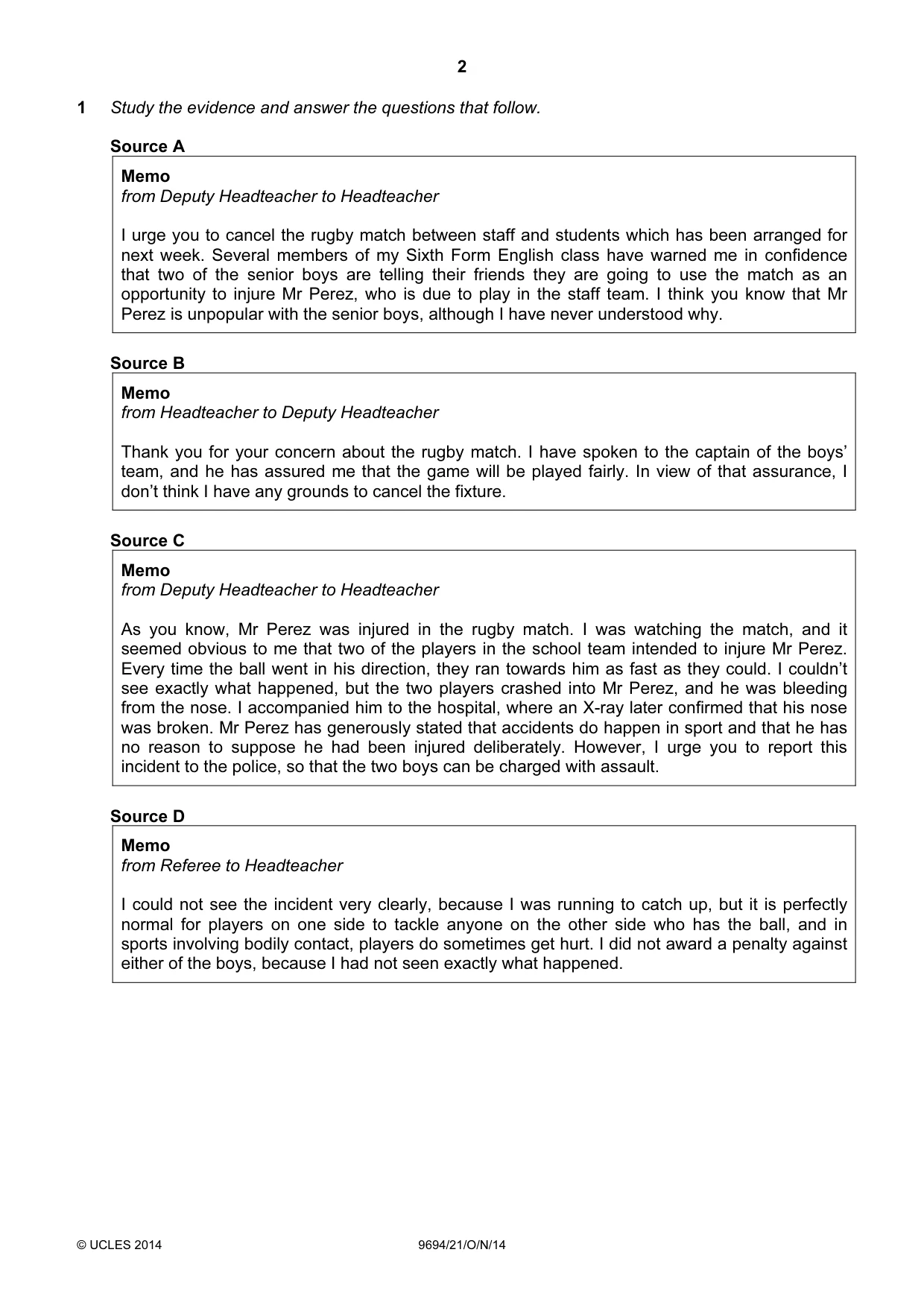
2 © UCLES 2014 9694/21/O/N/14 1 Study the evidence and answer the questions that follow. Source A Memo from Deputy Headteacher to Headteacher I urge you to cancel the rugby match between staff and students which has been arranged for next week. Several members of my Sixth Form English class have warned me in confidence that two of the senior boys are telling their friends they are going to use the match as an opportunity to injure Mr Perez, who is due to play in the staff team. I think you know that Mr Perez is unpopular with the senior boys, although I have never understood why. Source B Memo from Headteacher to Deputy Headteacher Thank you for your concern about the rugby match. I have spoken to the captain of the boys’ team, and he has assured me that the game will be played fairly. In view of that assurance, I don’t think I have any grounds to cancel the fixture. Source C Memo from Deputy Headteacher to Headteacher As you know, Mr Perez was injured in the rugby match. I was watching the match, and it seemed obvious to me that two of the players in the school team intended to injure Mr Perez. Every time the ball went in his direction, they ran towards him as fast as they could. I couldn’t see exactly what happened, but the two players crashed into Mr Perez, and he was bleeding from the nose. I accompanied him to the hospital, where an X-ray later confirmed that his nose was broken. Mr Perez has generously stated that accidents do happen in sport and that he has no reason to suppose he had been injured deliberately. However, I urge you to report this incident to the police, so that the two boys can be charged with assault. Source D Memo from Referee to Headteacher I could not see the incident very clearly, because I was running to catch up, but it is perfectly normal for players on one side to tackle anyone on the other side who has the ball, and in sports involving bodily contact, players do sometimes get hurt. I did not award a penalty against either of the boys, because I had not seen exactly what happened.
Question paper, page 3
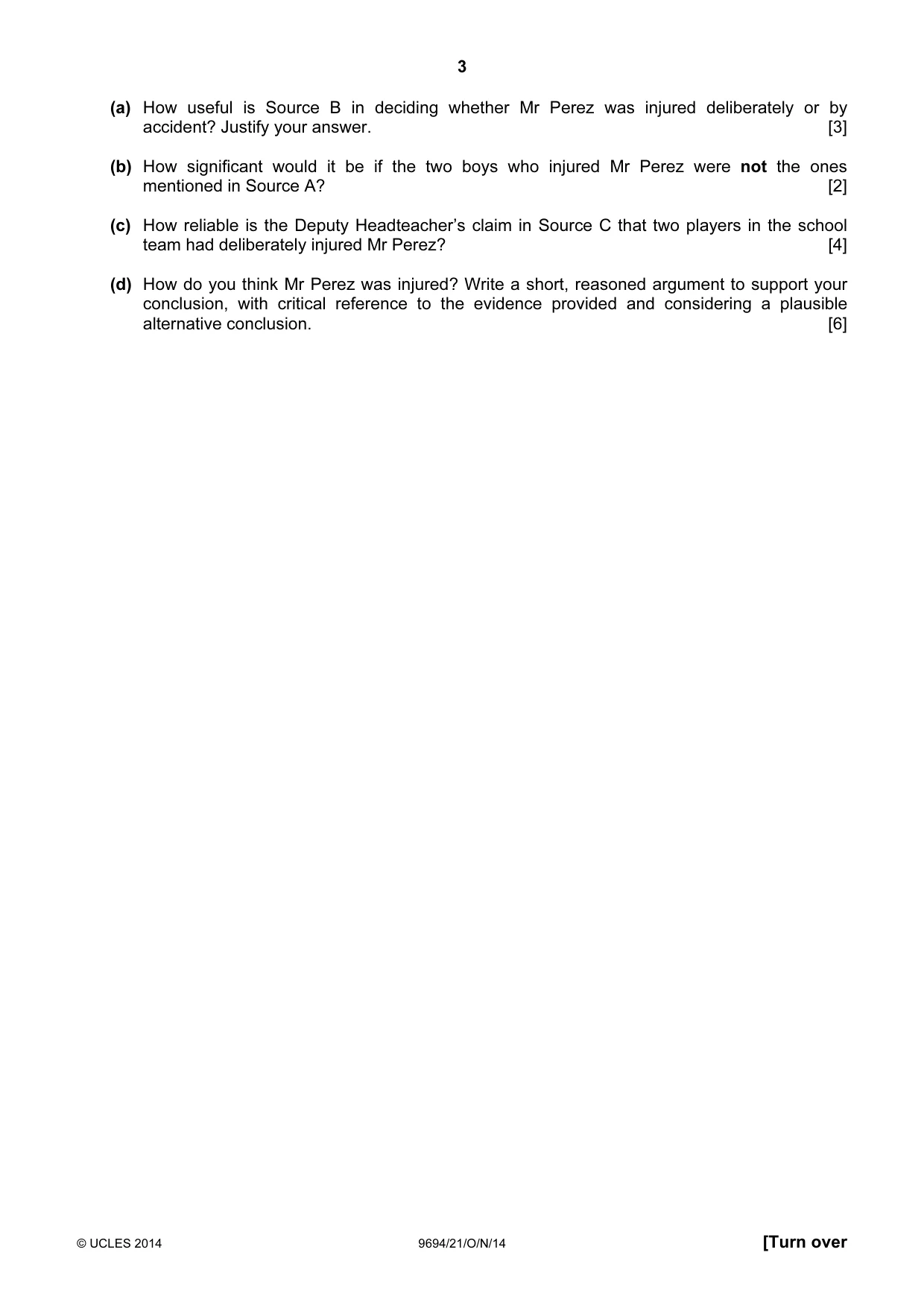
3 © UCLES 2014 9694/21/O/N/14 [Turn over (a) How useful is Source B in deciding whether Mr Perez was injured deliberately or by accident? Justify your answer. [3] (b) How significant would it be if the two boys who injured Mr Perez were not the ones mentioned in Source A? [2] (c) How reliable is the Deputy Headteacher’s claim in Source C that two players in the school team had deliberately injured Mr Perez? [4] (d) How do you think Mr Perez was injured? Write a short, reasoned argument to support your conclusion, with critical reference to the evidence provided and considering a plausible alternative conclusion. [6]
Question paper, page 4
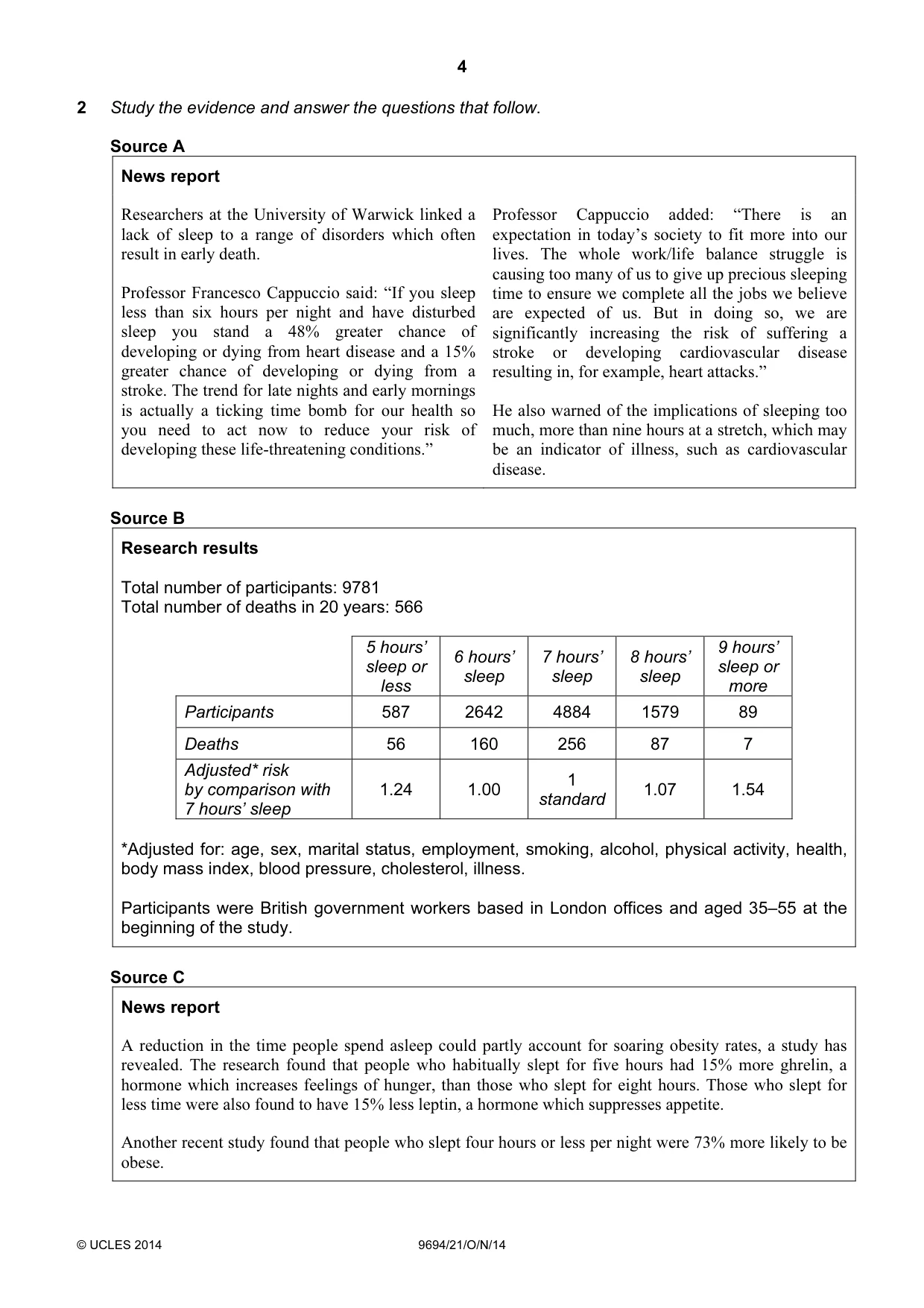
4 © UCLES 2014 9694/21/O/N/14 2 Study the evidence and answer the questions that follow. Source A News report Researchers at the University of Warwick linked a lack of sleep to a range of disorders which often result in early death. Professor Francesco Cappuccio said: “If you sleep less than six hours per night and have disturbed sleep you stand a 48% greater chance of developing or dying from heart disease and a 15% greater chance of developing or dying from a stroke. The trend for late nights and early mornings is actually a ticking time bomb for our health so you need to act now to reduce your risk of developing these life-threatening conditions.” Professor Cappuccio added: “There is an expectation in today’s society to fit more into our lives. The whole work/life balance struggle is causing too many of us to give up precious sleeping time to ensure we complete all the jobs we believe are expected of us. But in doing so, we are significantly increasing the risk of suffering a stroke or developing cardiovascular disease resulting in, for example, heart attacks.” He also warned of the implications of sleeping too much, more than nine hours at a stretch, which may be an indicator of illness, such as cardiovascular disease. Source B Research results Total number of participants: 9781 Total number of deaths in 20 years: 566 5 hours’ sleep or less 6 hours’ sleep 7 hours’ sleep 8 hours’ sleep 9 hours’ sleep or more Participants 587 2642 4884 1579 89 Deaths 56 160 256 87 7 Adjusted* risk by comparison with 7 hours’ sleep 1.24 1.00 1 standard 1.07 1.54 *Adjusted for: age, sex, marital status, employment, smoking, alcohol, physical activity, health, body mass index, blood pressure, cholesterol, illness. Participants were British government workers based in London offices and aged 35–55 at the beginning of the study. Source C News report A reduction in the time people spend asleep could partly account for soaring obesity rates, a study has revealed. The research found that people who habitually slept for five hours had 15% more ghrelin, a hormone which increases feelings of hunger, than those who slept for eight hours. Those who slept for less time were also found to have 15% less leptin, a hormone which suppresses appetite. Another recent study found that people who slept four hours or less per night were 73% more likely to be obese.
Question paper, page 5
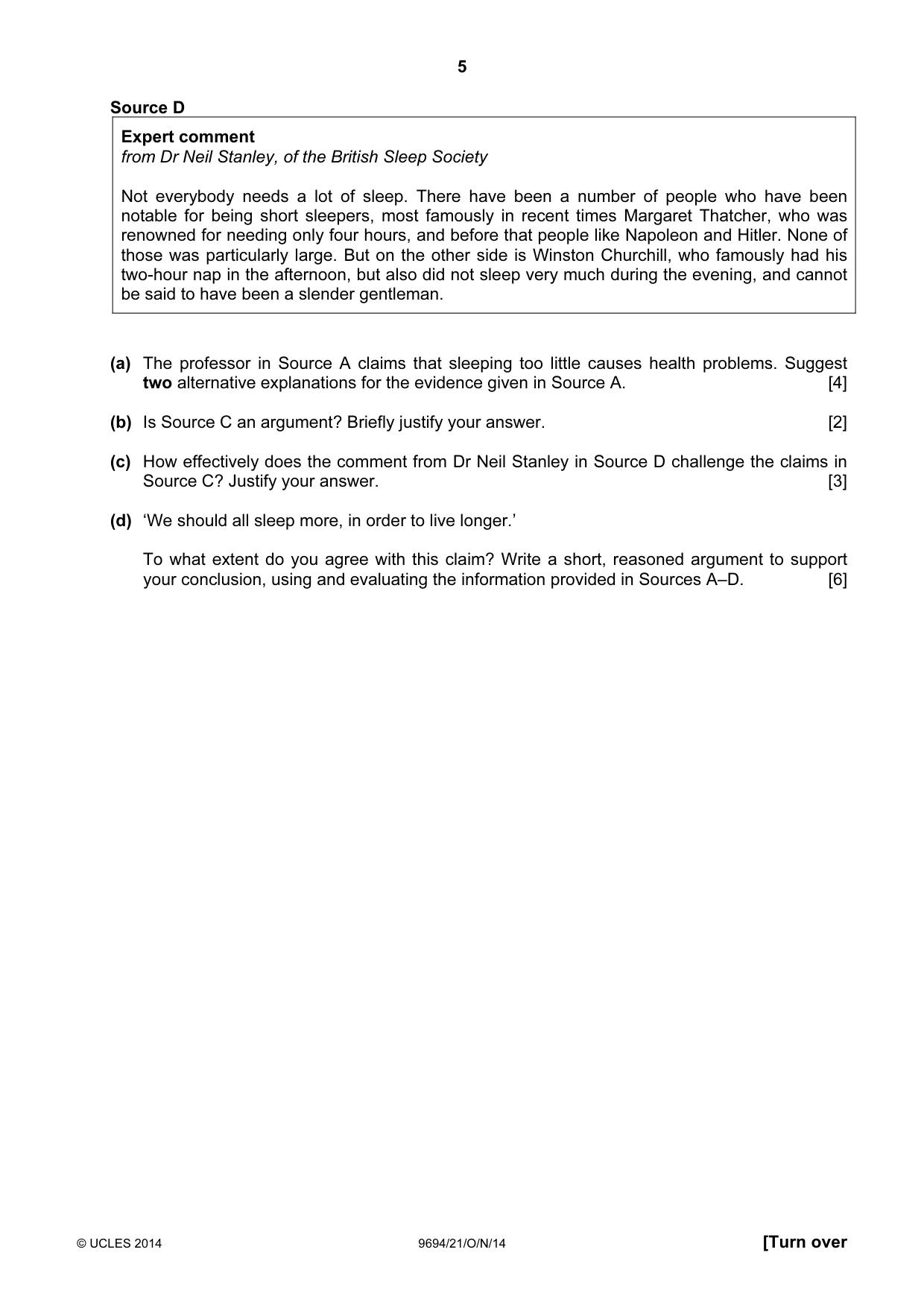
5 © UCLES 2014 9694/21/O/N/14 [Turn over Source D Expert comment from Dr Neil Stanley, of the British Sleep Society Not everybody needs a lot of sleep. There have been a number of people who have been notable for being short sleepers, most famously in recent times Margaret Thatcher, who was renowned for needing only four hours, and before that people like Napoleon and Hitler. None of those was particularly large. But on the other side is Winston Churchill, who famously had his two-hour nap in the afternoon, but also did not sleep very much during the evening, and cannot be said to have been a slender gentleman. (a) The professor in Source A claims that sleeping too little causes health problems. Suggest two alternative explanations for the evidence given in Source A. [4] (b) Is Source C an argument? Briefly justify your answer. [2] (c) How effectively does the comment from Dr Neil Stanley in Source D challenge the claims in Source C? Justify your answer. [3] (d) ‘We should all sleep more, in order to live longer.’ To what extent do you agree with this claim? Write a short, reasoned argument to support your conclusion, using and evaluating the information provided in Sources A–D. [6]
Question paper, page 6
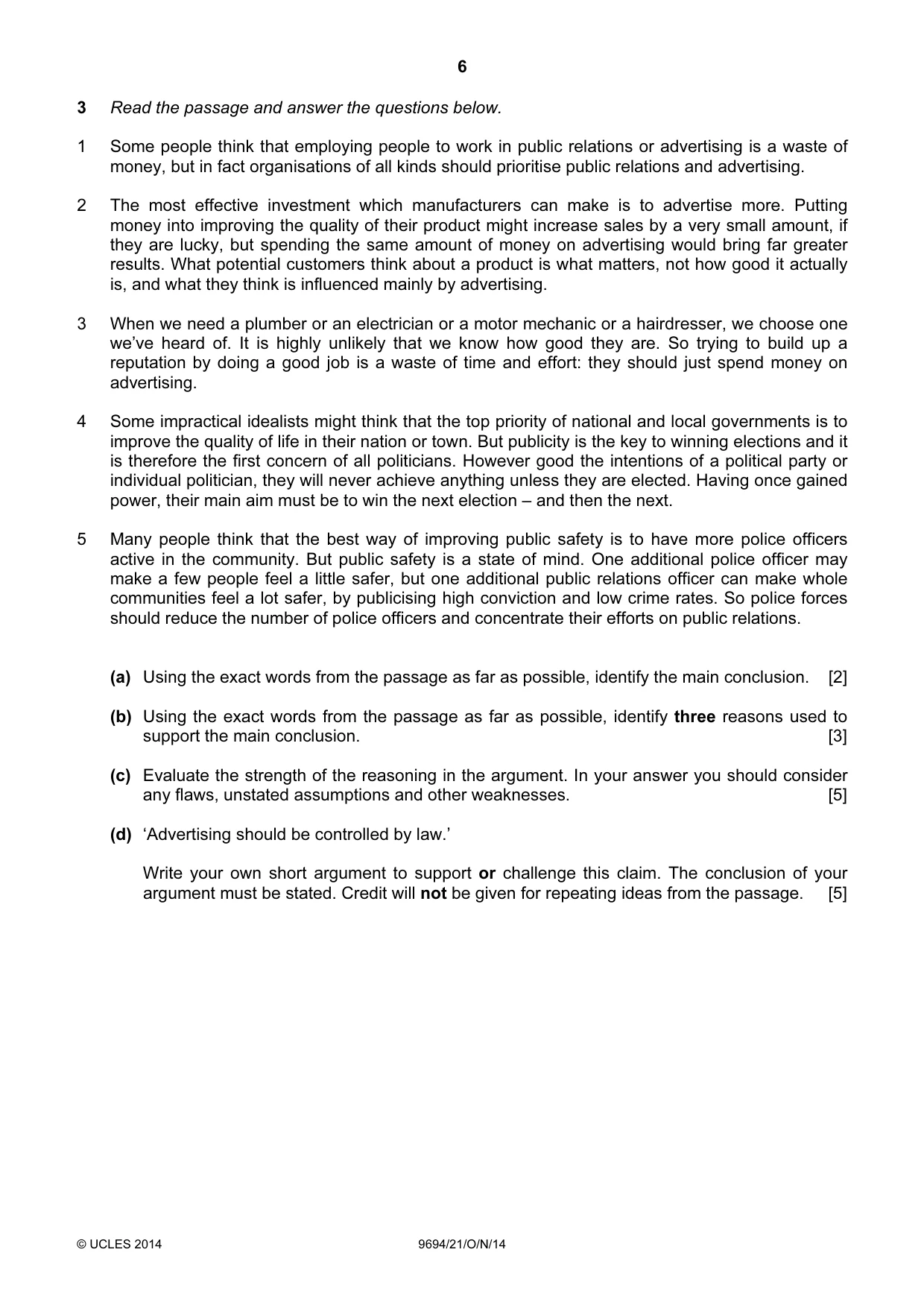
6 © UCLES 2014 9694/21/O/N/14 3 Read the passage and answer the questions below. 1 Some people think that employing people to work in public relations or advertising is a waste of money, but in fact organisations of all kinds should prioritise public relations and advertising. 2 The most effective investment which manufacturers can make is to advertise more. Putting money into improving the quality of their product might increase sales by a very small amount, if they are lucky, but spending the same amount of money on advertising would bring far greater results. What potential customers think about a product is what matters, not how good it actually is, and what they think is influenced mainly by advertising. 3 When we need a plumber or an electrician or a motor mechanic or a hairdresser, we choose one we’ve heard of. It is highly unlikely that we know how good they are. So trying to build up a reputation by doing a good job is a waste of time and effort: they should just spend money on advertising. 4 Some impractical idealists might think that the top priority of national and local governments is to improve the quality of life in their nation or town. But publicity is the key to winning elections and it is therefore the first concern of all politicians. However good the intentions of a political party or individual politician, they will never achieve anything unless they are elected. Having once gained power, their main aim must be to win the next election – and then the next. 5 Many people think that the best way of improving public safety is to have more police officers active in the community. But public safety is a state of mind. One additional police officer may make a few people feel a little safer, but one additional public relations officer can make whole communities feel a lot safer, by publicising high conviction and low crime rates. So police forces should reduce the number of police officers and concentrate their efforts on public relations. (a) Using the exact words from the passage as far as possible, identify the main conclusion. [2] (b) Using the exact words from the passage as far as possible, identify three reasons used to support the main conclusion. [3] (c) Evaluate the strength of the reasoning in the argument. In your answer you should consider any flaws, unstated assumptions and other weaknesses. [5] (d) ‘Advertising should be controlled by law.’ Write your own short argument to support or challenge this claim. The conclusion of your argument must be stated. Credit will not be given for repeating ideas from the passage. [5]
Question paper, page 7
7 © UCLES 2014 9694/21/O/N/14 BLANK PAGE
Question paper, page 8
8 Copyright Acknowledgements: Question 2 Source A © http://www.bbc.co.uk/news/uk-england-coventry-warwickshire-12398114. Permission to reproduce items where third-party owned material protected by copyright is included has been sought and cleared where possible. Every reasonable effort has been made by the publisher (UCLES) to trace copyright holders, but if any items requiring clearance have unwittingly been included, the publisher will be pleased to make amends at the earliest possible opportunity. Cambridge International Examinations is part of the Cambridge Assessment Group. Cambridge Assessment is the brand name of University of Cambridge Local Examinations Syndicate (UCLES), which is itself a department of the University of Cambridge. © UCLES 2014 9694/21/O/N/14 BLANK PAGE
Mark scheme, page 1
® IGCSE is the registered trademark of Cambridge International Examinations. CAMBRIDGE INTERNATIONAL EXAMINATIONS Cambridge International Advanced Subsidiary and Advanced Level MARK SCHEME for the October/November 2014 series 9694 THINKING SKILLS 9694/21 Paper 2 (Critical Thinking), maximum raw mark 45 This mark scheme is published as an aid to teachers and candidates, to indicate the requirements of the examination. It shows the basis on which Examiners were instructed to award marks. It does not indicate the details of the discussions that took place at an Examiners’ meeting before marking began, which would have considered the acceptability of alternative answers. Mark schemes should be read in conjunction with the question paper and the Principal Examiner Report for Teachers. Cambridge will not enter into discussions about these mark schemes. Cambridge is publishing the mark schemes for the October/November 2014 series for most Cambridge IGCSE®, Cambridge International A and AS Level components and some Cambridge O Level components.
Mark scheme, page 2
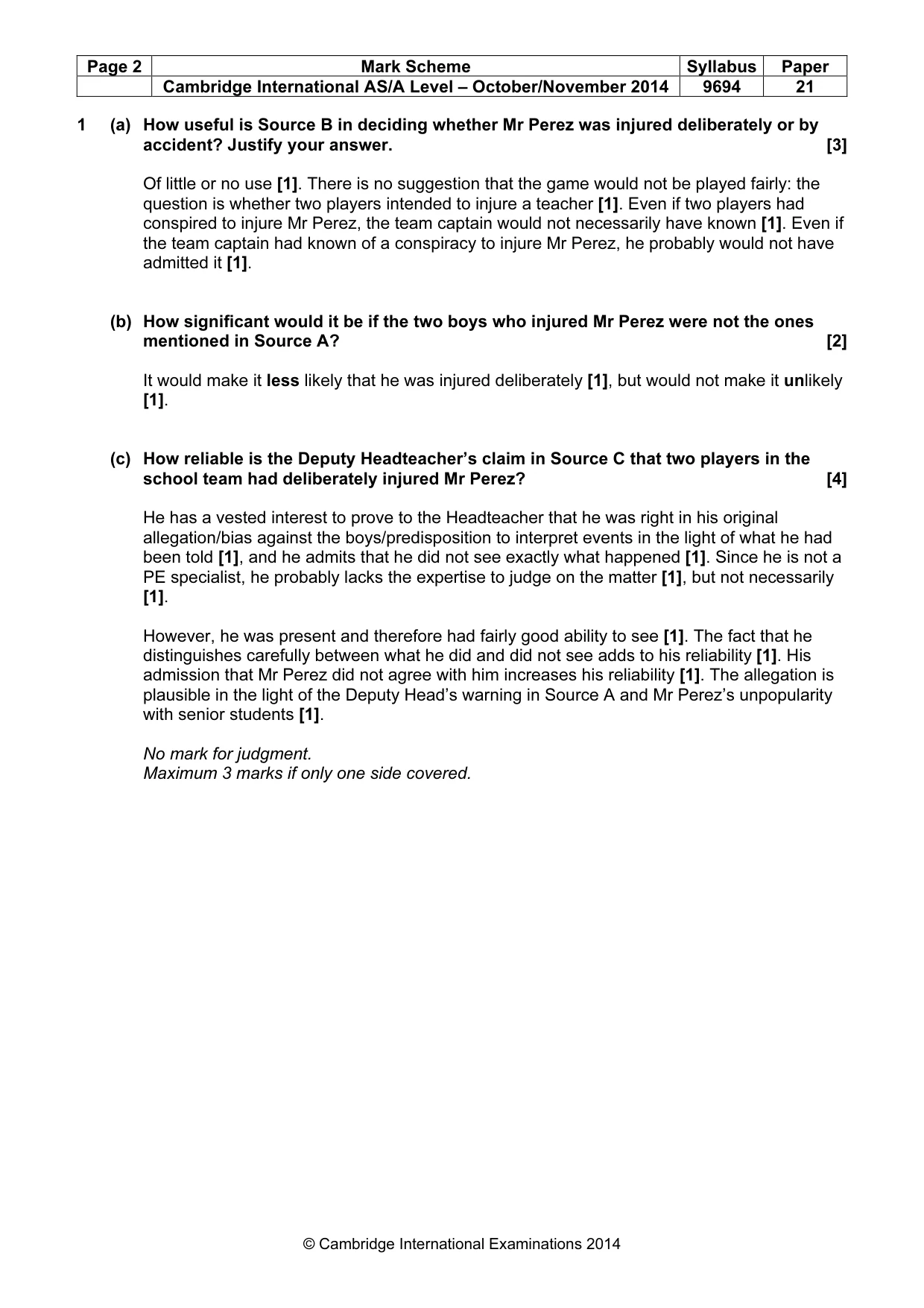
Page 2 Mark Scheme Syllabus Paper Cambridge International AS/A Level – October/November 2014 9694 21 © Cambridge International Examinations 2014 1 (a) How useful is Source B in deciding whether Mr Perez was injured deliberately or by accident? Justify your answer. [3] Of little or no use [1]. There is no suggestion that the game would not be played fairly: the question is whether two players intended to injure a teacher [1]. Even if two players had conspired to injure Mr Perez, the team captain would not necessarily have known [1]. Even if the team captain had known of a conspiracy to injure Mr Perez, he probably would not have admitted it [1]. (b) How significant would it be if the two boys who injured Mr Perez were not the ones mentioned in Source A? [2] It would make it less likely that he was injured deliberately [1], but would not make it unlikely [1]. (c) How reliable is the Deputy Headteacher’s claim in Source C that two players in the school team had deliberately injured Mr Perez? [4] He has a vested interest to prove to the Headteacher that he was right in his original allegation/bias against the boys/predisposition to interpret events in the light of what he had been told [1], and he admits that he did not see exactly what happened [1]. Since he is not a PE specialist, he probably lacks the expertise to judge on the matter [1], but not necessarily [1]. However, he was present and therefore had fairly good ability to see [1]. The fact that he distinguishes carefully between what he did and did not see adds to his reliability [1]. His admission that Mr Perez did not agree with him increases his reliability [1]. The allegation is plausible in the light of the Deputy Head’s warning in Source A and Mr Perez’s unpopularity with senior students [1]. No mark for judgment. Maximum 3 marks if only one side covered.
Mark scheme, page 3
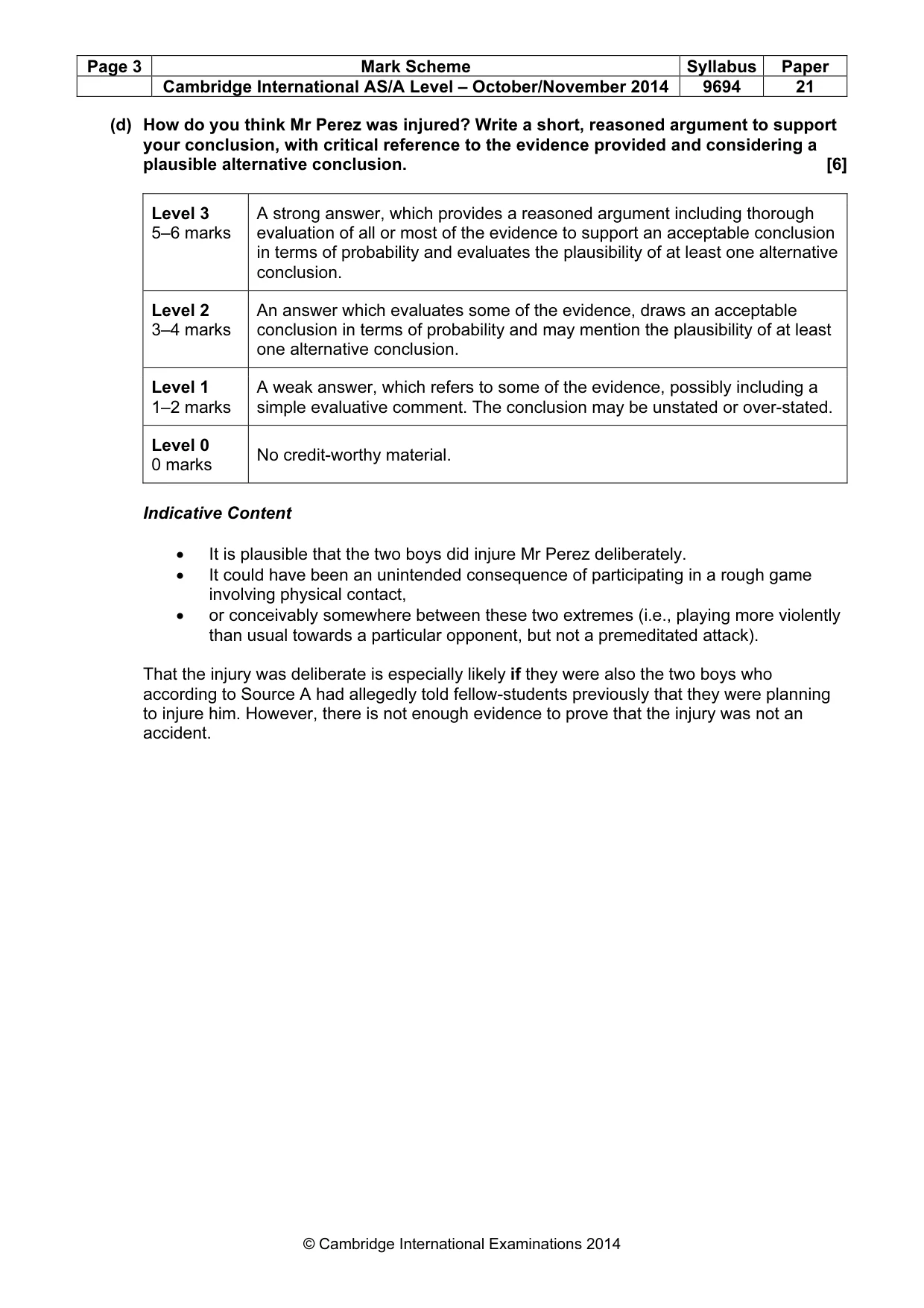
Page 3 Mark Scheme Syllabus Paper Cambridge International AS/A Level – October/November 2014 9694 21 © Cambridge International Examinations 2014 (d) How do you think Mr Perez was injured? Write a short, reasoned argument to support your conclusion, with critical reference to the evidence provided and considering a plausible alternative conclusion. [6] Level 3 5–6 marks A strong answer, which provides a reasoned argument including thorough evaluation of all or most of the evidence to support an acceptable conclusion in terms of probability and evaluates the plausibility of at least one alternative conclusion. Level 2 3–4 marks An answer which evaluates some of the evidence, draws an acceptable conclusion in terms of probability and may mention the plausibility of at least one alternative conclusion. Level 1 1–2 marks A weak answer, which refers to some of the evidence, possibly including a simple evaluative comment. The conclusion may be unstated or over-stated. Level 0 0 marks No credit-worthy material. Indicative Content • It is plausible that the two boys did injure Mr Perez deliberately. • It could have been an unintended consequence of participating in a rough game involving physical contact, • or conceivably somewhere between these two extremes (i.e., playing more violently than usual towards a particular opponent, but not a premeditated attack). That the injury was deliberate is especially likely if they were also the two boys who according to Source A had allegedly told fellow-students previously that they were planning to injure him. However, there is not enough evidence to prove that the injury was not an accident.
Mark scheme, page 4
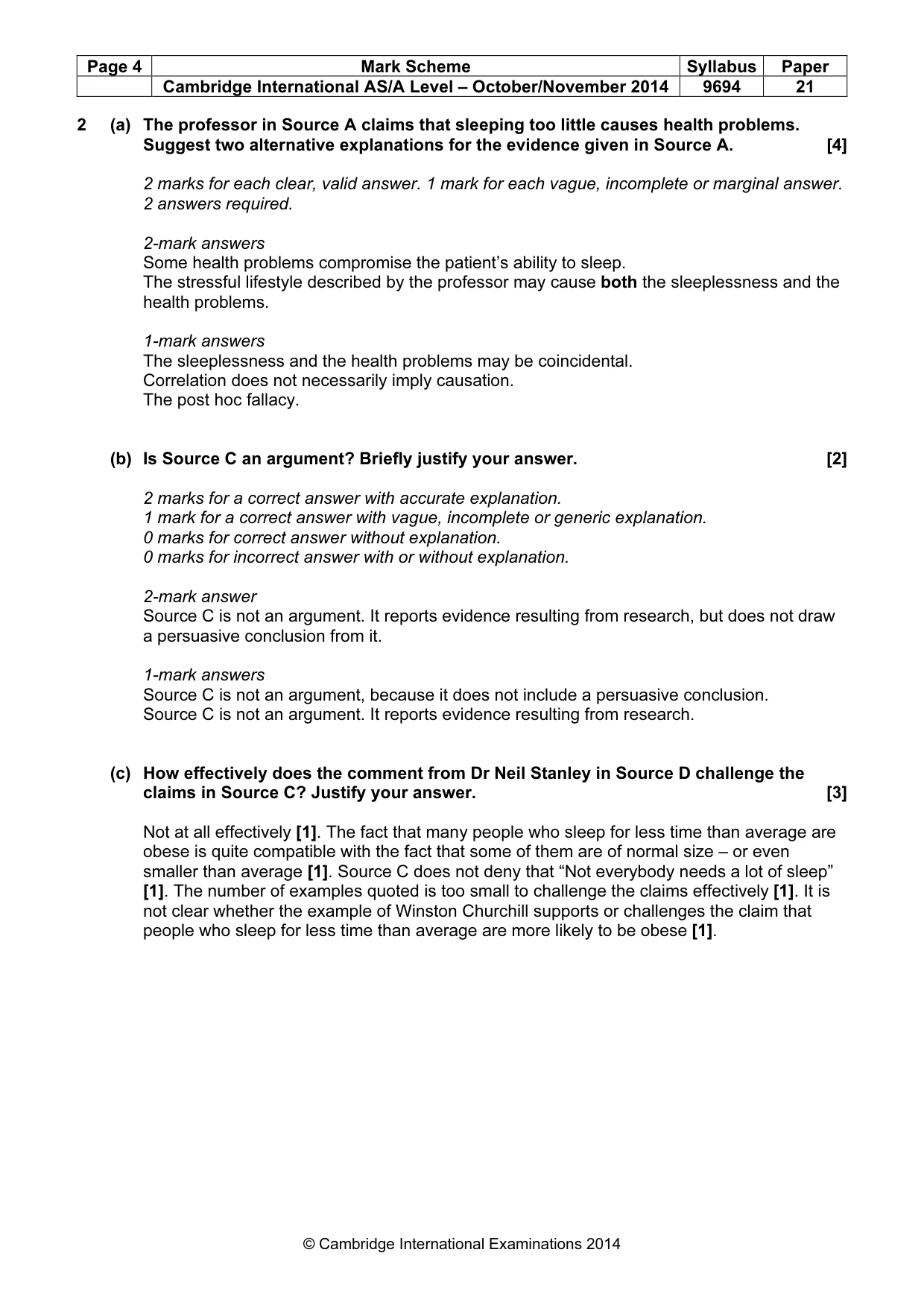
Page 4 Mark Scheme Syllabus Paper Cambridge International AS/A Level – October/November 2014 9694 21 © Cambridge International Examinations 2014 2 (a) The professor in Source A claims that sleeping too little causes health problems. Suggest two alternative explanations for the evidence given in Source A. [4] 2 marks for each clear, valid answer. 1 mark for each vague, incomplete or marginal answer. 2 answers required. 2-mark answers Some health problems compromise the patient’s ability to sleep. The stressful lifestyle described by the professor may cause both the sleeplessness and the health problems. 1-mark answers The sleeplessness and the health problems may be coincidental. Correlation does not necessarily imply causation. The post hoc fallacy. (b) Is Source C an argument? Briefly justify your answer. [2] 2 marks for a correct answer with accurate explanation. 1 mark for a correct answer with vague, incomplete or generic explanation. 0 marks for correct answer without explanation. 0 marks for incorrect answer with or without explanation. 2-mark answer Source C is not an argument. It reports evidence resulting from research, but does not draw a persuasive conclusion from it. 1-mark answers Source C is not an argument, because it does not include a persuasive conclusion. Source C is not an argument. It reports evidence resulting from research. (c) How effectively does the comment from Dr Neil Stanley in Source D challenge the claims in Source C? Justify your answer. [3] Not at all effectively [1]. The fact that many people who sleep for less time than average are obese is quite compatible with the fact that some of them are of normal size – or even smaller than average [1]. Source C does not deny that “Not everybody needs a lot of sleep” [1]. The number of examples quoted is too small to challenge the claims effectively [1]. It is not clear whether the example of Winston Churchill supports or challenges the claim that people who sleep for less time than average are more likely to be obese [1].
Mark scheme, page 5
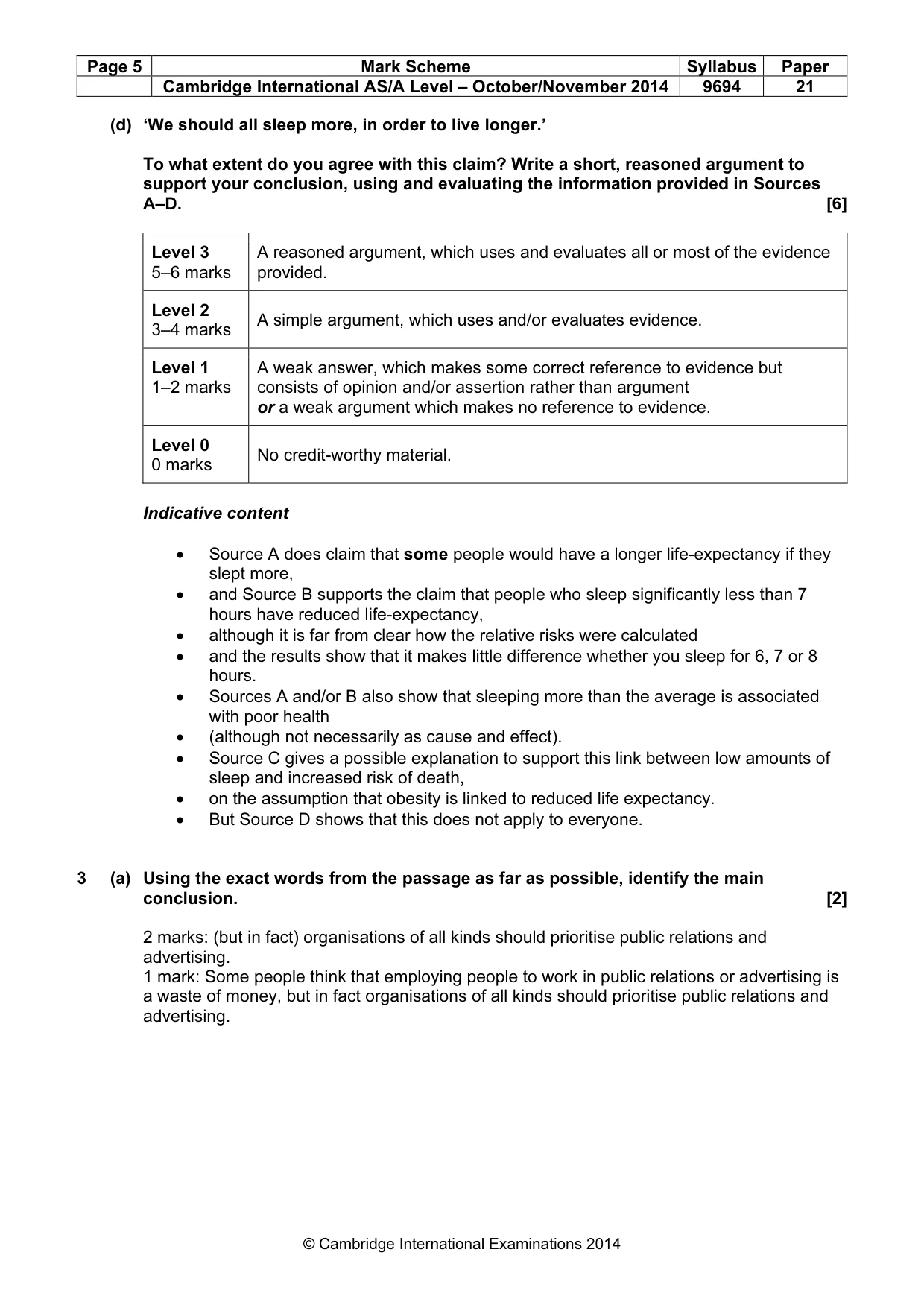
Page 5 Mark Scheme Syllabus Paper Cambridge International AS/A Level – October/November 2014 9694 21 © Cambridge International Examinations 2014 (d) ‘We should all sleep more, in order to live longer.’ To what extent do you agree with this claim? Write a short, reasoned argument to support your conclusion, using and evaluating the information provided in Sources A–D. [6] Level 3 5–6 marks A reasoned argument, which uses and evaluates all or most of the evidence provided. Level 2 3–4 marks A simple argument, which uses and/or evaluates evidence. Level 1 1–2 marks A weak answer, which makes some correct reference to evidence but consists of opinion and/or assertion rather than argument or a weak argument which makes no reference to evidence. Level 0 0 marks No credit-worthy material. Indicative content • Source A does claim that some people would have a longer life-expectancy if they slept more, • and Source B supports the claim that people who sleep significantly less than 7 hours have reduced life-expectancy, • although it is far from clear how the relative risks were calculated • and the results show that it makes little difference whether you sleep for 6, 7 or 8 hours. • Sources A and/or B also show that sleeping more than the average is associated with poor health • (although not necessarily as cause and effect). • Source C gives a possible explanation to support this link between low amounts of sleep and increased risk of death, • on the assumption that obesity is linked to reduced life expectancy. • But Source D shows that this does not apply to everyone. 3 (a) Using the exact words from the passage as far as possible, identify the main conclusion. [2] 2 marks: (but in fact) organisations of all kinds should prioritise public relations and advertising. 1 mark: Some people think that employing people to work in public relations or advertising is a waste of money, but in fact organisations of all kinds should prioritise public relations and advertising.
Mark scheme, page 6
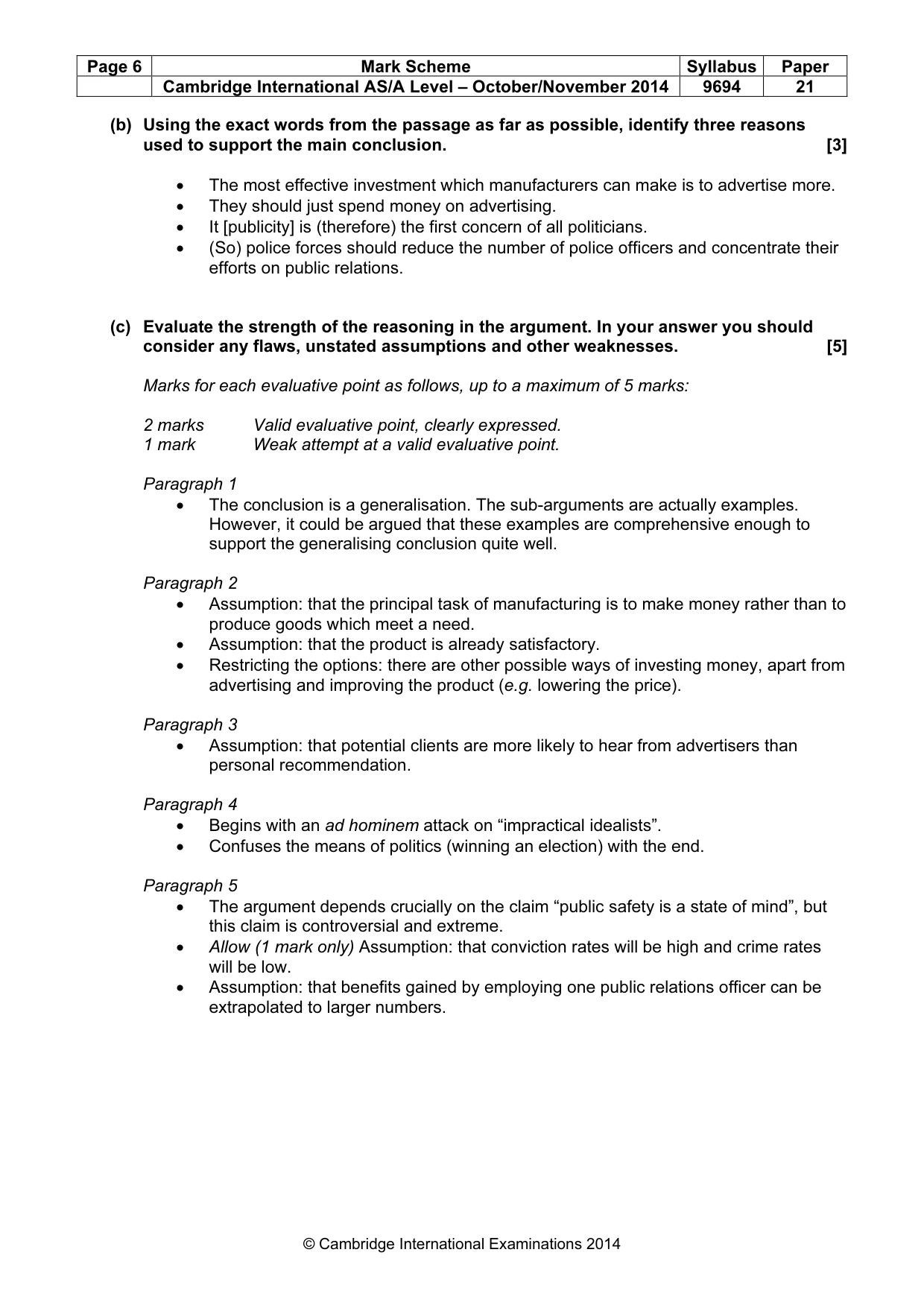
Page 6 Mark Scheme Syllabus Paper Cambridge International AS/A Level – October/November 2014 9694 21 © Cambridge International Examinations 2014 (b) Using the exact words from the passage as far as possible, identify three reasons used to support the main conclusion. [3] • The most effective investment which manufacturers can make is to advertise more. • They should just spend money on advertising. • It [publicity] is (therefore) the first concern of all politicians. • (So) police forces should reduce the number of police officers and concentrate their efforts on public relations. (c) Evaluate the strength of the reasoning in the argument. In your answer you should consider any flaws, unstated assumptions and other weaknesses. [5] Marks for each evaluative point as follows, up to a maximum of 5 marks: 2 marks Valid evaluative point, clearly expressed. 1 mark Weak attempt at a valid evaluative point. Paragraph 1 • The conclusion is a generalisation. The sub-arguments are actually examples. However, it could be argued that these examples are comprehensive enough to support the generalising conclusion quite well. Paragraph 2 • Assumption: that the principal task of manufacturing is to make money rather than to produce goods which meet a need. • Assumption: that the product is already satisfactory. • Restricting the options: there are other possible ways of investing money, apart from advertising and improving the product (e.g. lowering the price). Paragraph 3 • Assumption: that potential clients are more likely to hear from advertisers than personal recommendation. Paragraph 4 • Begins with an ad hominem attack on “impractical idealists”. • Confuses the means of politics (winning an election) with the end. Paragraph 5 • The argument depends crucially on the claim “public safety is a state of mind”, but this claim is controversial and extreme. • Allow (1 mark only) Assumption: that conviction rates will be high and crime rates will be low. • Assumption: that benefits gained by employing one public relations officer can be extrapolated to larger numbers.
Mark scheme, page 7
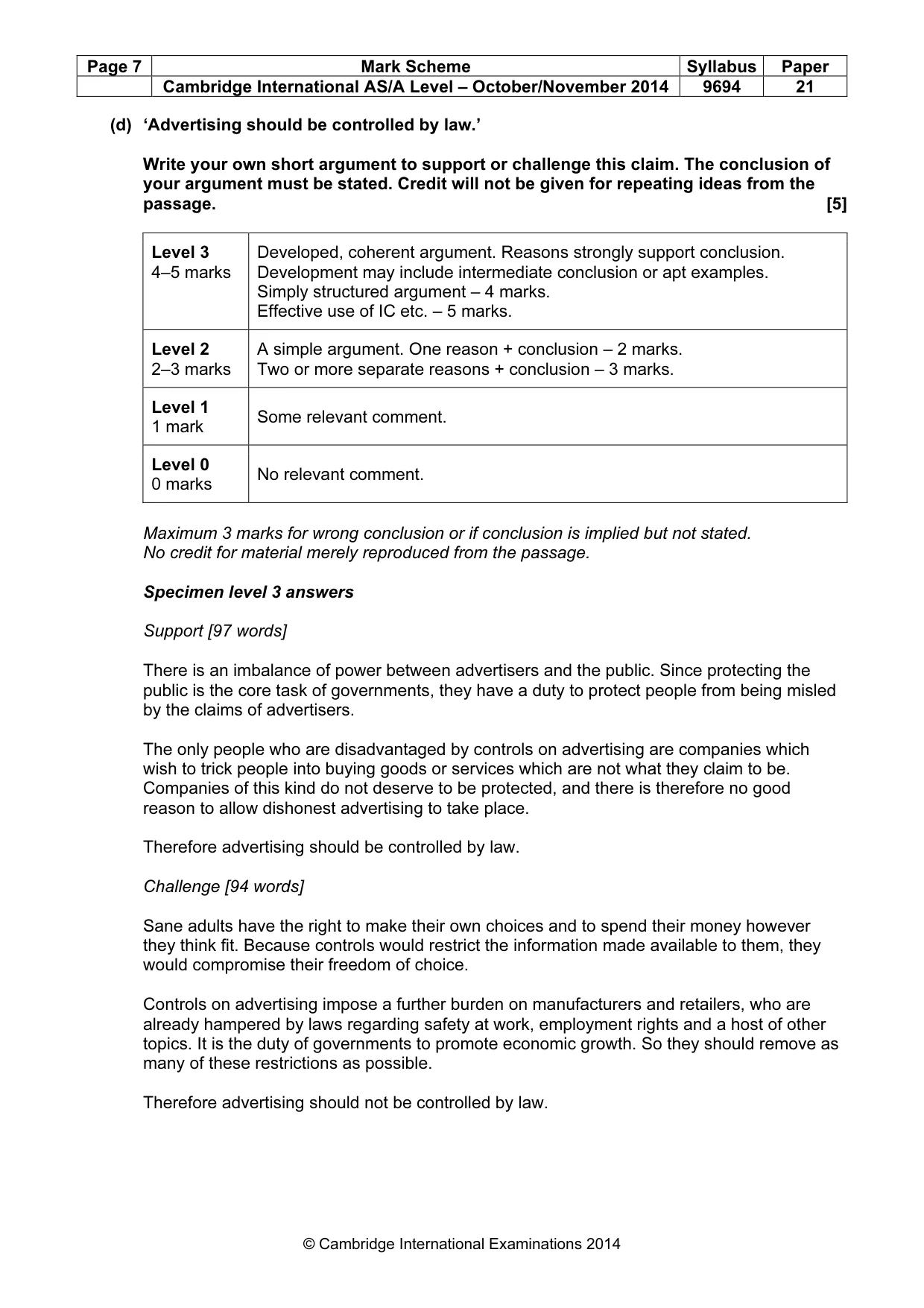
Page 7 Mark Scheme Syllabus Paper Cambridge International AS/A Level – October/November 2014 9694 21 © Cambridge International Examinations 2014 (d) ‘Advertising should be controlled by law.’ Write your own short argument to support or challenge this claim. The conclusion of your argument must be stated. Credit will not be given for repeating ideas from the passage. [5] Level 3 4–5 marks Developed, coherent argument. Reasons strongly support conclusion. Development may include intermediate conclusion or apt examples. Simply structured argument – 4 marks. Effective use of IC etc. – 5 marks. Level 2 2–3 marks A simple argument. One reason + conclusion – 2 marks. Two or more separate reasons + conclusion – 3 marks. Level 1 1 mark Some relevant comment. Level 0 0 marks No relevant comment. Maximum 3 marks for wrong conclusion or if conclusion is implied but not stated. No credit for material merely reproduced from the passage. Specimen level 3 answers Support [97 words] There is an imbalance of power between advertisers and the public. Since protecting the public is the core task of governments, they have a duty to protect people from being misled by the claims of advertisers. The only people who are disadvantaged by controls on advertising are companies which wish to trick people into buying goods or services which are not what they claim to be. Companies of this kind do not deserve to be protected, and there is therefore no good reason to allow dishonest advertising to take place. Therefore advertising should be controlled by law. Challenge [94 words] Sane adults have the right to make their own choices and to spend their money however they think fit. Because controls would restrict the information made available to them, they would compromise their freedom of choice. Controls on advertising impose a further burden on manufacturers and retailers, who are already hampered by laws regarding safety at work, employment rights and a host of other topics. It is the duty of governments to promote economic growth. So they should remove as many of these restrictions as possible. Therefore advertising should not be controlled by law.
What you needed in this session
Cambridge’s own grade thresholds for 2014 Oct/Nov, Paper 2 · Variant 1. A higher threshold means an easier paper — the bar moves with how the cohort did.