Cambridge A Level Thinking Skills 9694 — 2014 Oct/Nov Paper 2 · Variant 3
9694/23/O/N/14 · 45 marks · ≈51 min
The question paper and its mark scheme, free to read here and free to download. This is Cambridge’s own paper, exactly as it was sat.
Question paper8 pages


Mark scheme9 pages
Answers below. Sit the paper first if you are practising.
Paper as text
Question paper, page 1
This document consists of 6 printed pages and 2 blank pages. IB14 11_9694_23/3RP © UCLES 2014 [Turn over *2923052495* Cambridge International Examinations Cambridge International Advanced Subsidiary and Advanced Level THINKING SKILLS 9694/23 Paper 2 Critical Thinking October/November 2014 1 hour 45 minutes Additional Materials: Answer Booklet/Paper READ THESE INSTRUCTIONS FIRST If you have been given an Answer Booklet, follow the instructions on the front cover of the booklet. Write your Centre number, candidate number and name on all the work you hand in. Write in dark blue or black pen. Do not use staples, paper clips, glue or correction fluid. DO NOT WRITE IN ANY BARCODES. Answer all the questions. Start each question on a new answer sheet. At the end of the examination, fasten all your work securely together. The number of marks is given in brackets [ ] at the end of each question.
Question paper, page 2
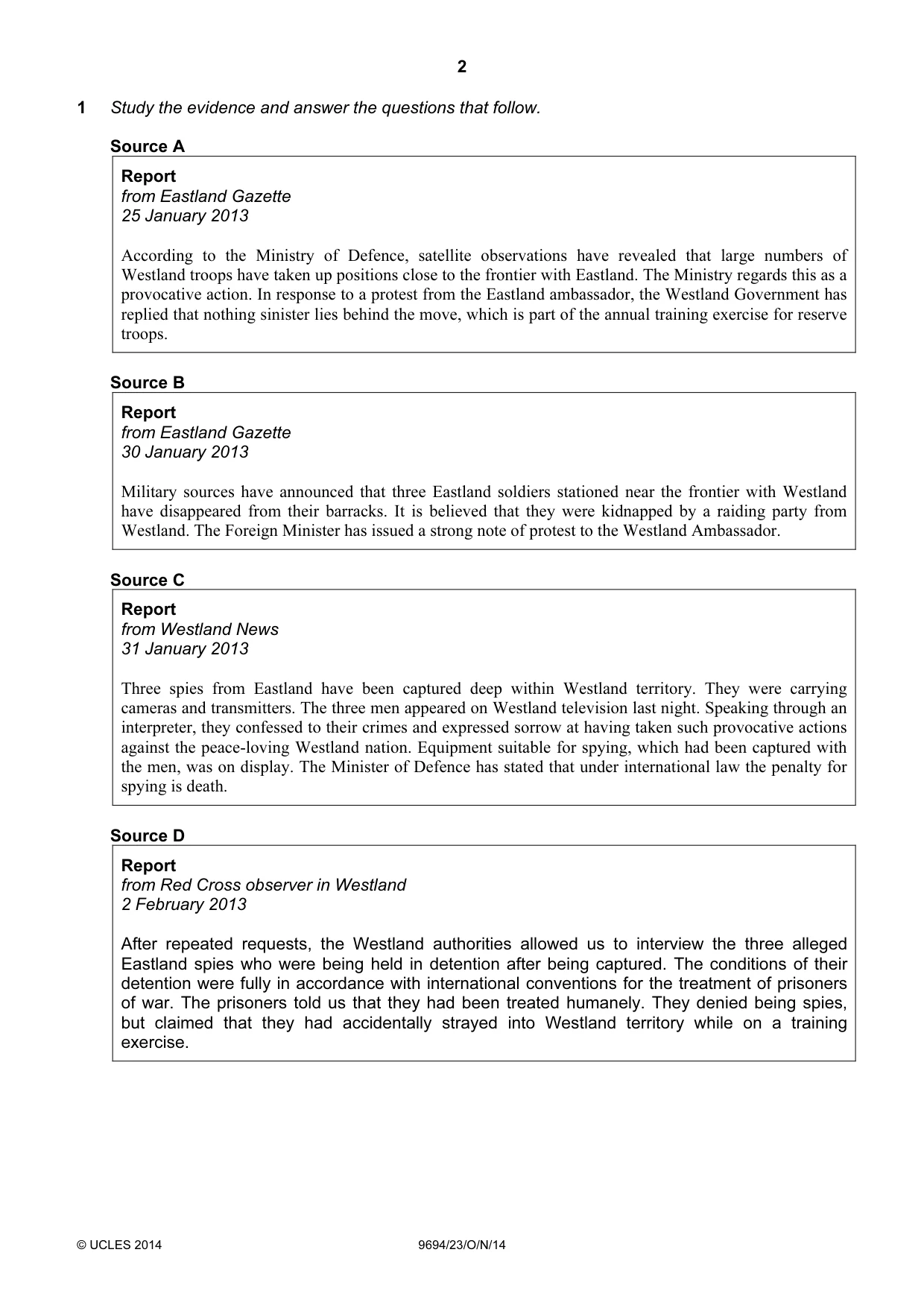
2 © UCLES 2014 9694/23/O/N/14 1 Study the evidence and answer the questions that follow. Source A Report from Eastland Gazette 25 January 2013 According to the Ministry of Defence, satellite observations have revealed that large numbers of Westland troops have taken up positions close to the frontier with Eastland. The Ministry regards this as a provocative action. In response to a protest from the Eastland ambassador, the Westland Government has replied that nothing sinister lies behind the move, which is part of the annual training exercise for reserve troops. Source B Report from Eastland Gazette 30 January 2013 Military sources have announced that three Eastland soldiers stationed near the frontier with Westland have disappeared from their barracks. It is believed that they were kidnapped by a raiding party from Westland. The Foreign Minister has issued a strong note of protest to the Westland Ambassador. Source C Report from Westland News 31 January 2013 Three spies from Eastland have been captured deep within Westland territory. They were carrying cameras and transmitters. The three men appeared on Westland television last night. Speaking through an interpreter, they confessed to their crimes and expressed sorrow at having taken such provocative actions against the peace-loving Westland nation. Equipment suitable for spying, which had been captured with the men, was on display. The Minister of Defence has stated that under international law the penalty for spying is death. Source D Report from Red Cross observer in Westland 2 February 2013 After repeated requests, the Westland authorities allowed us to interview the three alleged Eastland spies who were being held in detention after being captured. The conditions of their detention were fully in accordance with international conventions for the treatment of prisoners of war. The prisoners told us that they had been treated humanely. They denied being spies, but claimed that they had accidentally strayed into Westland territory while on a training exercise.
Question paper, page 3
3 © UCLES 2014 9694/23/O/N/14 [Turn over Source E Report from Eastland Gazette 4 February 2013 Following intensive diplomatic efforts, the three kidnapped Eastland soldiers have been released and welcomed home by their worried families. At a press conference, the three men said they had been forced to appear on Westland television, but they had not made any confession. They did not know how accurately their statements had been translated. The spying equipment which they were accused of carrying had been supplied by Westland soldiers. A statement from the Eastland government has again claimed that the soldiers were kidnapped from their barracks by Westland commandos in order to heighten tensions between the two nations. They described the raid as a flagrant and provocative breach of Eastland’s sovereignty. (a) Suggest two ways in which Source A could be relevant in deciding whether the three Eastland soldiers were guilty of spying in Westland territory. [4] (b) How reliable is Source B in deciding whether the Eastland soldiers were spies? [2] (c) How useful is the evidence in Source D in deciding whether the soldiers were spying? [3] (d) Do you think the Eastland soldiers were guilty of spying? Write a short, reasoned argument to support your conclusion, with critical reference to the evidence provided and considering a plausible alternative conclusion. [6]
Question paper, page 4
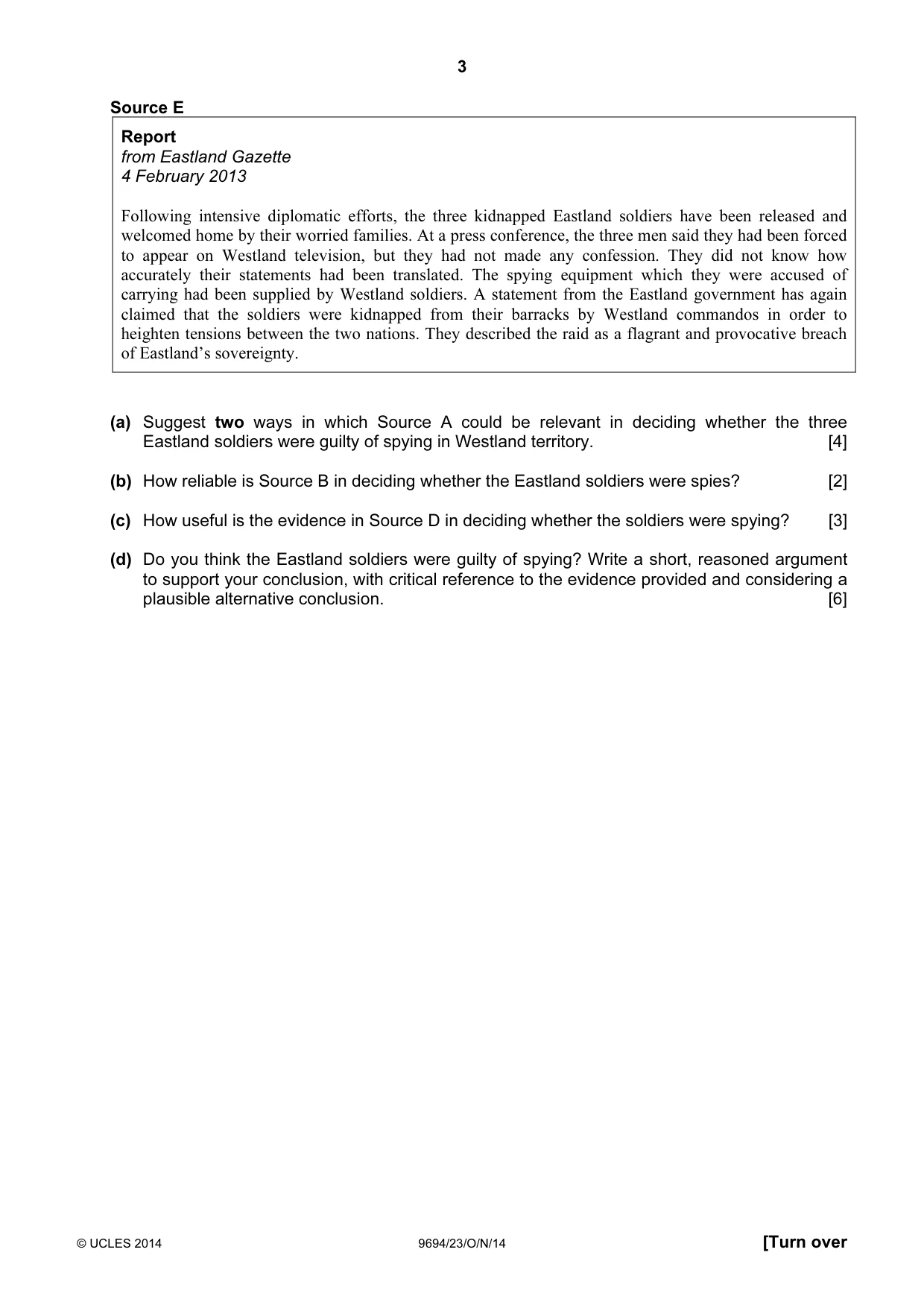
4 © UCLES 2014 9694/23/O/N/14 2 Study the evidence and answer the questions that follow. Source A Advertising leaflet The Dangers of Drinking Coffee Why would you drink something that is so hot that if you stuck your finger in it, it would cause a painful burn? If it burns your finger, what do you think it does to your tissues and cells throughout your body? Hot beverages destroy your cells, i.e. cancer! Coffee contains the stimulant caffeine. Caffeine is a central nervous system stimulant that is followed by a depressed phase resulting in exhaustion, nervousness, irritability, fatigue, and often headache. Caffeine constricts blood vessels of the brain and causes decreased flow of blood, which cuts the oxygen supply to the brain, resulting in gradual brain damage. It also increases your heartbeat 15% and makes your lungs work 13 times harder than normal. It greatly plays a role in fatigue as well. The volatile oil in caffeine called caffeol is an irritant to the lining of the stomach and causes poor digestion. Another chemical in this liquid drug is caffeo-tannic acid. This chemical is used in tanning leather. It is an irritating astringent to the cells lining the stomach and intestines and also destroys the pepsin in the gastric (stomach) juice needed to digest protein. A great alternative to drinking coffee is our herbal drink, made of roasted carob, barley, chicory root, figs, dates, orange peel and almonds. It is very delicious and tastes just like coffee if not better. Source B Illustration from magazine article Reduced risk of advanced prostate cancer 50 000 men (20 years) Reduced risk of Alzheimer’s Disease by 65% 1400 middle-aged Finns Reduced risk of stroke by 43% 83 000 nurses who had never smoked Reduced risk of gallstones by 20% 127 000 health professionals Reduced risk of suicide by 60% 86 000 women (10 years) Reduced risk of Type 2 diabetes by 7% Review of 18 studies Cups of coffee per day The Health Benefits of Drinking Coffee Sources: Information taken from professional medical journals. All comparisons are with those who drink no coffee.
Question paper, page 5
5 © UCLES 2014 9694/23/O/N/14 [Turn over Source C News report Coffee link in depression research Drinking several cups of coffee a day could help to prevent depression in women, a study has shown. Four or more cups of caffeinated coffee cut the risk of clinical depression by 20% when compared with drinking one cup per week or less. The US researchers say they cannot be sure of a causal link between coffee consumption and avoiding depression. However, they adjusted the results to take account of a multitude of other risk factors, such as medical conditions, marital status, smoking and activity levels. They also found no similar association with decaffeinated coffee or other sources of caffeine, including soft drinks, tea and chocolate. The research involved 50 739 women who participated in the Nurses’ Health Study, a major US investigation exploring links between health and lifestyle. None of the women, who had an average age of 63, had depression at the start of the 10-year study. Source D Background information The Nurses’ Health Study, established in 1976, and the Nurses’ Health Study II, established in 1989, are the most definitive long-term investigations into risk factors for major chronic diseases in women ever conducted. The study has followed 121 700 female registered nurses in the United States since the mid-1970s to assess risk factors for cancer and cardiovascular disease. Assessments of other factors, including diet and aspirin use, have subsequently been added to the original study. (a) Suggest two reasons why Source B is more reliable than Source A. [3] (b) Is Source C an argument? Briefly explain your answer. [2] (c) Suggest two ways in which the sample used for the research in Source C might not be representative. Briefly explain the significance of your answers. [4] (d) ‘Everyone should drink more coffee for the sake of their health.’ To what extent do you agree with this statement? Write a short, reasoned argument to support your conclusion, using and evaluating the information provided in Sources A–D. [6]
Question paper, page 6
6 © UCLES 2014 9694/23/O/N/14 3 Read the passage and answer the questions below. 1 Who would you prefer as your teacher? Someone who just managed to pass a degree examination thirty years ago and has never opened a book since, or someone who is fascinated by his subject and has read widely in it, but left university without taking a degree because the teaching and the course were boring? This shows that possession of a university degree is no guarantee that someone will be a good teacher. 2 The rapid changes in knowledge mean that a university education quickly becomes out of date. The only way a degree could be a reliable indication of competence in a subject would be if degrees had a time limit built in to them and needed to be updated every five years in order to remain valid. Under the present system, they mean nothing. 3 In addition, experts are often bad teachers, because they think that their task is to pass on their knowledge to their students. That approach to education belongs firmly in the past. Education is about learning, not teaching, and the knowledge required to pass an exam is more reliably available from textbooks specially written for the exam and from the Internet than from the memory of the teacher. 4 Some people may suggest that teachers need paper qualifications in order to show that they have been taught how to teach, but any teacher knows that is not true. If you can teach, you don’t need anyone to show you how to do it, and if you cannot, then no amount of guidance or instruction will turn you into an effective teacher. 5 The only qualification required to be a teacher should, therefore, be the ability to enable students to pass their exams. Such a change would be consistent with current trends, since most employers now want recruits to have relevant skills rather than academic qualifications. (a) Using the exact words from the passage as far as possible, identify the main conclusion. [2] (b) Using the exact words from the passage as far as possible, identify three reasons used to support the main conclusion. [3] (c) Evaluate the strength of the reasoning in the argument. In your answer you should consider any flaws, unstated assumptions and other weaknesses. [5] (d) ‘Gaining qualifications is the main purpose of education.’ Write your own short argument to support or challenge this claim. The conclusion of your argument must be stated. Credit will not be given for repeating ideas from the passage. [5]
Question paper, page 7
7 © UCLES 2014 9694/23/O/N/14 BLANK PAGE
Question paper, page 8
8 Copyright Acknowledgements: Question 2 Source C © http://www.bbc.co.uk/news/health-15059266. Permission to reproduce items where third-party owned material protected by copyright is included has been sought and cleared where possible. Every reasonable effort has been made by the publisher (UCLES) to trace copyright holders, but if any items requiring clearance have unwittingly been included, the publisher will be pleased to make amends at the earliest possible opportunity. Cambridge International Examinations is part of the Cambridge Assessment Group. Cambridge Assessment is the brand name of University of Cambridge Local Examinations Syndicate (UCLES), which is itself a department of the University of Cambridge. © UCLES 2014 9694/23/O/N/14 BLANK PAGE
Mark scheme, page 1
® IGCSE is the registered trademark of Cambridge International Examinations. CAMBRIDGE INTERNATIONAL EXAMINATIONS Cambridge International Advanced Subsidiary and Advanced Level MARK SCHEME for the October/November 2014 series 9694 THINKING SKILLS 9694/23 Paper 2 (Critical Thinking), maximum raw mark 45 This mark scheme is published as an aid to teachers and candidates, to indicate the requirements of the examination. It shows the basis on which Examiners were instructed to award marks. It does not indicate the details of the discussions that took place at an Examiners’ meeting before marking began, which would have considered the acceptability of alternative answers. Mark schemes should be read in conjunction with the question paper and the Principal Examiner Report for Teachers. Cambridge will not enter into discussions about these mark schemes. Cambridge is publishing the mark schemes for the October/November 2014 series for most Cambridge IGCSE®, Cambridge International A and AS Level components and some Cambridge O Level components.
Mark scheme, page 2
Page 2 Mark Scheme Syllabus Paper Cambridge International AS/A Level – October/November 2014 9694 23 © Cambridge International Examinations 2014 1 (a) Suggest two ways in which Source A could be relevant in deciding whether the three Eastland soldiers were guilty of spying in Westland territory. [4] 2 marks for each clear, valid answer. 1 mark for each vague or incomplete answer. 2 answers required. If Eastland believe that Westland are preparing to attack them, they have a motive for sending spies into Westland territory. If Westland are preparing to attack Eastland, they may have kidnapped the soldiers and accused them of spying in order to give them an excuse for military action. 1 mark for The use of spy satellites makes the use of human spies unnecessary/more likely. (b) How reliable is Source B in deciding whether the Eastland soldiers were spies? [2] Unreliable [1]. The Eastland authorities have a strong vested interest to promote an account of the incident in which their own soldiers are innocent [1], in order to reduce the likelihood of harm coming to the soldiers [1] and political damage to themselves [1]. The newspaper would know only what the authorities wanted it to know [1]. (c) How useful is the evidence in Source D in deciding whether the soldiers were spying? [3] The report is reliable, because the Red Cross has an excellent reputation for neutrality [1]. The captured soldiers’ denials are not very credible, because of their strong vested interest [1]. The fact that their explanation is inconsistent with the official explanation given by their own government [1] suggests that neither is true and that the soldiers therefore were spying [1]. Evidence about how well they are being treated is not relevant to the issue of whether they have been spying or not [1], except that if Westland authorities really believed they were spies, they might have been treated less well [1]. No mark for judgment.
Mark scheme, page 3
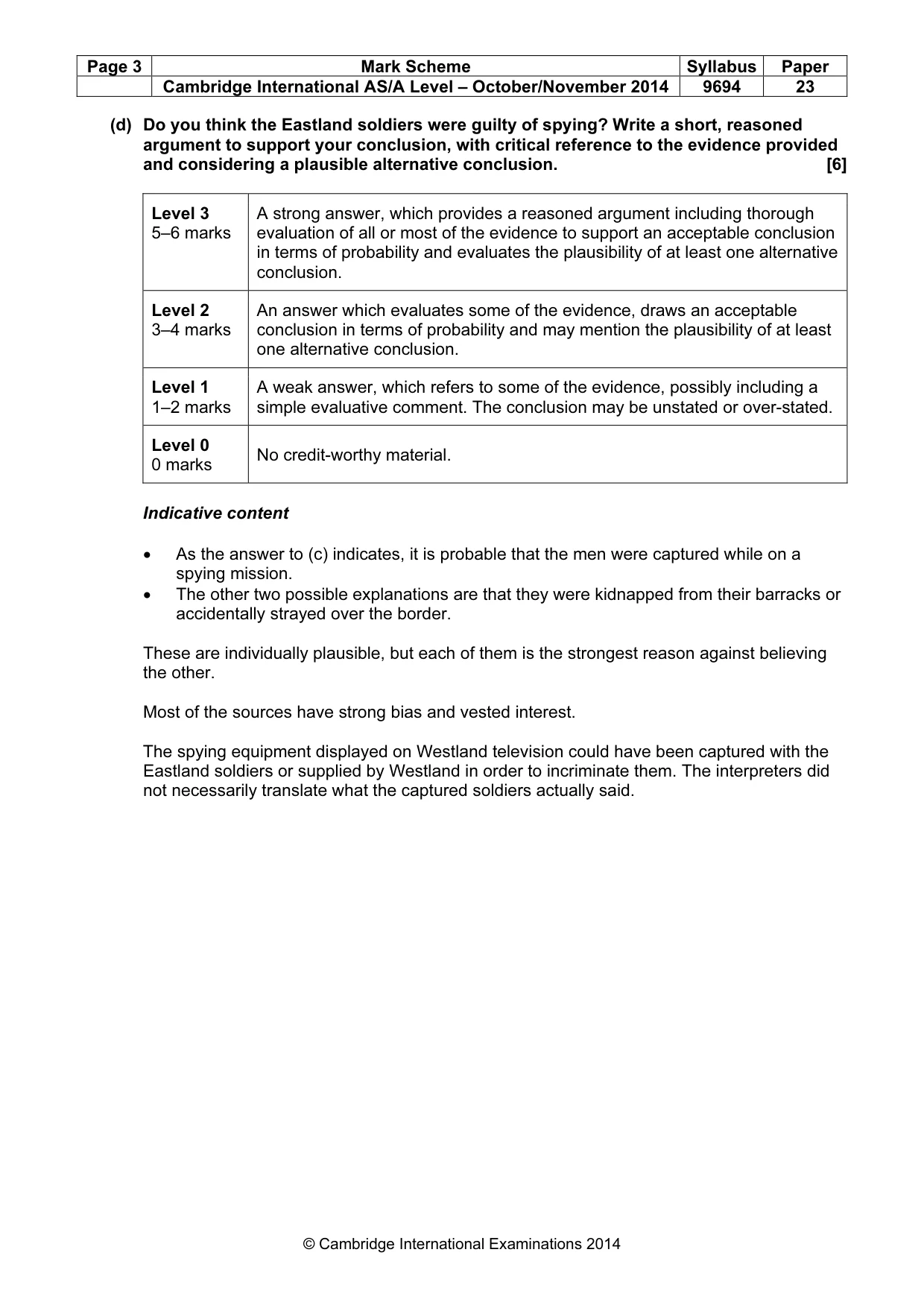
Page 3 Mark Scheme Syllabus Paper Cambridge International AS/A Level – October/November 2014 9694 23 © Cambridge International Examinations 2014 (d) Do you think the Eastland soldiers were guilty of spying? Write a short, reasoned argument to support your conclusion, with critical reference to the evidence provided and considering a plausible alternative conclusion. [6] Level 3 5–6 marks A strong answer, which provides a reasoned argument including thorough evaluation of all or most of the evidence to support an acceptable conclusion in terms of probability and evaluates the plausibility of at least one alternative conclusion. Level 2 3–4 marks An answer which evaluates some of the evidence, draws an acceptable conclusion in terms of probability and may mention the plausibility of at least one alternative conclusion. Level 1 1–2 marks A weak answer, which refers to some of the evidence, possibly including a simple evaluative comment. The conclusion may be unstated or over-stated. Level 0 0 marks No credit-worthy material. Indicative content • As the answer to (c) indicates, it is probable that the men were captured while on a spying mission. • The other two possible explanations are that they were kidnapped from their barracks or accidentally strayed over the border. These are individually plausible, but each of them is the strongest reason against believing the other. Most of the sources have strong bias and vested interest. The spying equipment displayed on Westland television could have been captured with the Eastland soldiers or supplied by Westland in order to incriminate them. The interpreters did not necessarily translate what the captured soldiers actually said.
Mark scheme, page 4
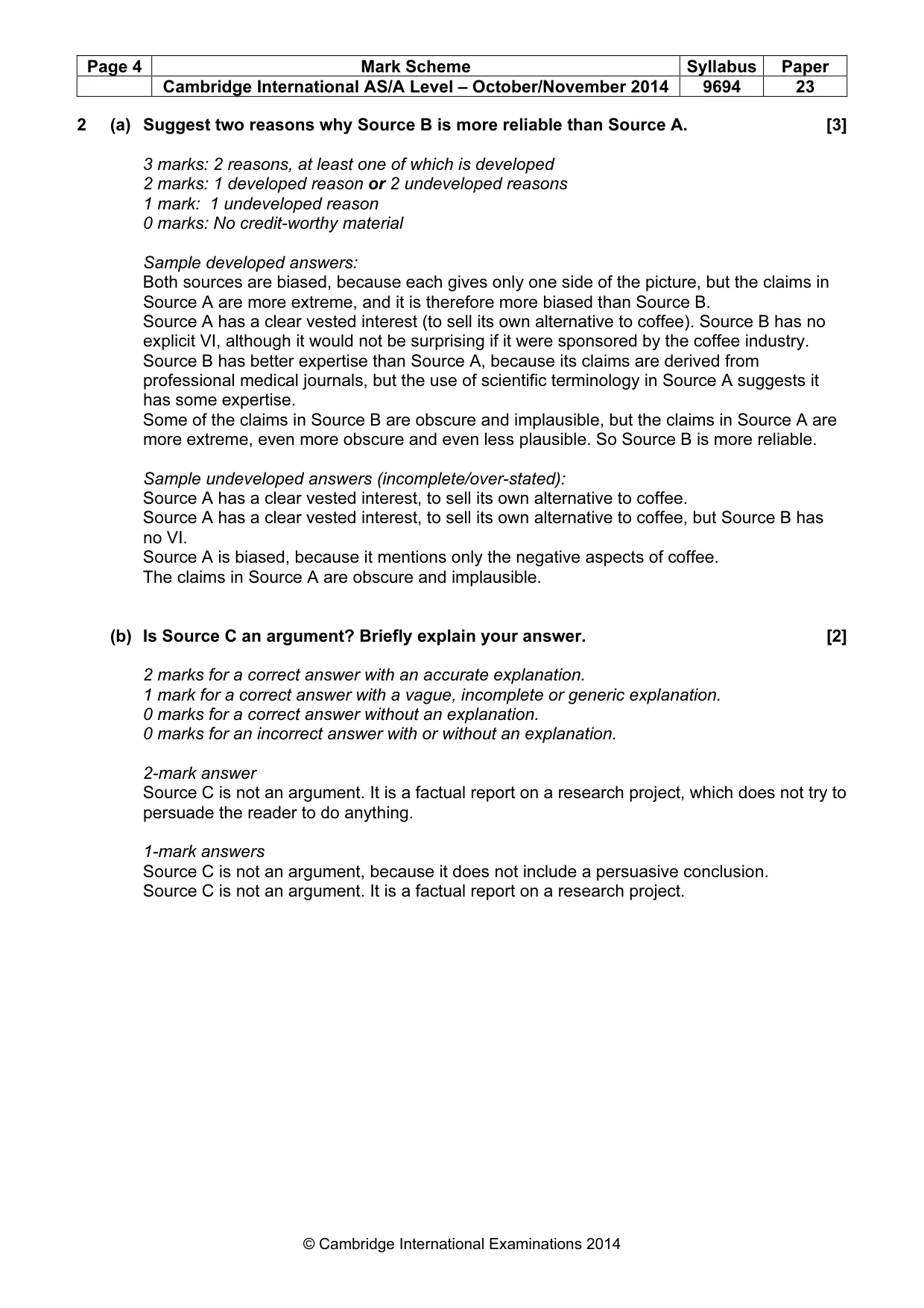
Page 4 Mark Scheme Syllabus Paper Cambridge International AS/A Level – October/November 2014 9694 23 © Cambridge International Examinations 2014 2 (a) Suggest two reasons why Source B is more reliable than Source A. [3] 3 marks: 2 reasons, at least one of which is developed 2 marks: 1 developed reason or 2 undeveloped reasons 1 mark: 1 undeveloped reason 0 marks: No credit-worthy material Sample developed answers: Both sources are biased, because each gives only one side of the picture, but the claims in Source A are more extreme, and it is therefore more biased than Source B. Source A has a clear vested interest (to sell its own alternative to coffee). Source B has no explicit VI, although it would not be surprising if it were sponsored by the coffee industry. Source B has better expertise than Source A, because its claims are derived from professional medical journals, but the use of scientific terminology in Source A suggests it has some expertise. Some of the claims in Source B are obscure and implausible, but the claims in Source A are more extreme, even more obscure and even less plausible. So Source B is more reliable. Sample undeveloped answers (incomplete/over-stated): Source A has a clear vested interest, to sell its own alternative to coffee. Source A has a clear vested interest, to sell its own alternative to coffee, but Source B has no VI. Source A is biased, because it mentions only the negative aspects of coffee. The claims in Source A are obscure and implausible. (b) Is Source C an argument? Briefly explain your answer. [2] 2 marks for a correct answer with an accurate explanation. 1 mark for a correct answer with a vague, incomplete or generic explanation. 0 marks for a correct answer without an explanation. 0 marks for an incorrect answer with or without an explanation. 2-mark answer Source C is not an argument. It is a factual report on a research project, which does not try to persuade the reader to do anything. 1-mark answers Source C is not an argument, because it does not include a persuasive conclusion. Source C is not an argument. It is a factual report on a research project.
Mark scheme, page 5
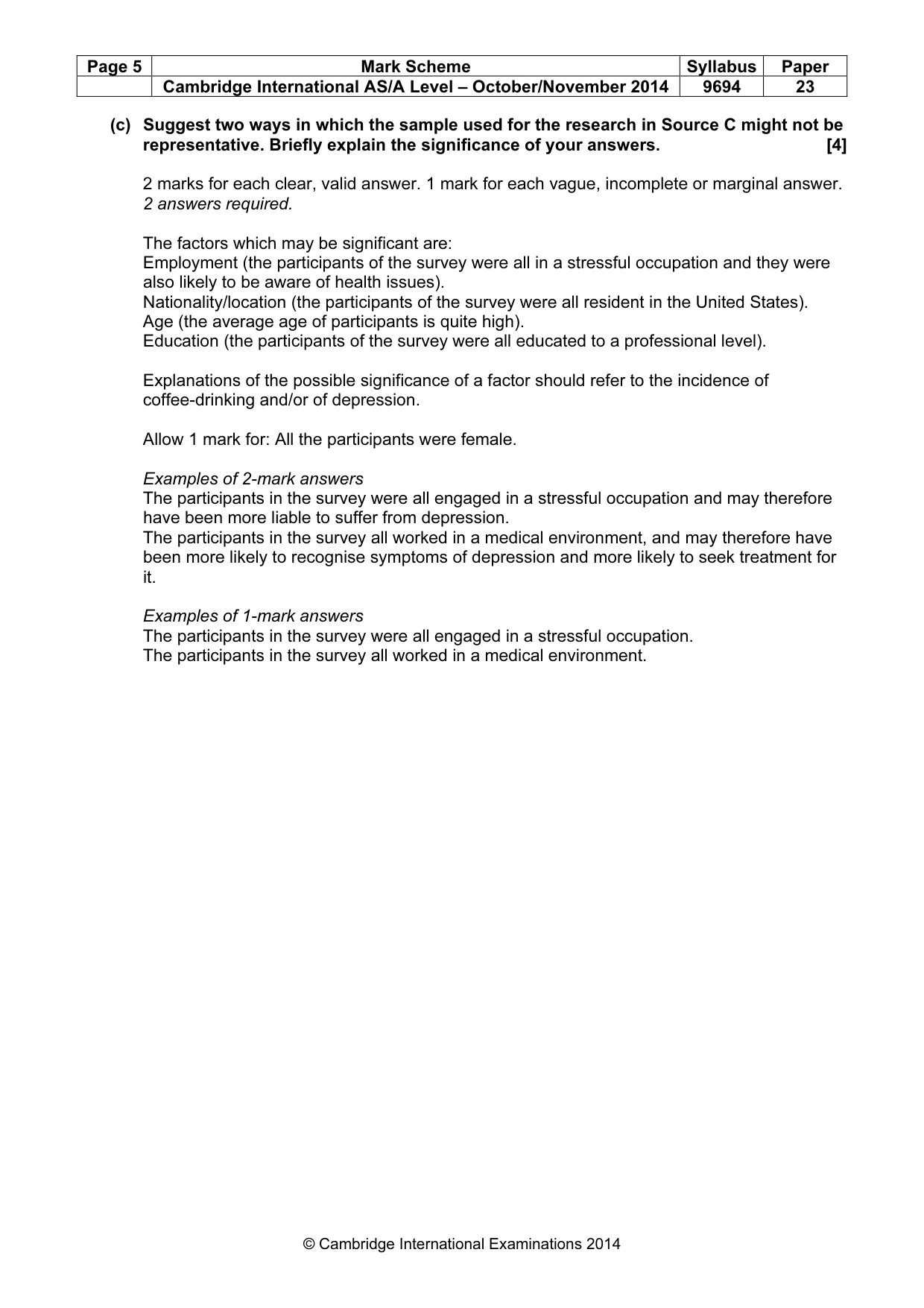
Page 5 Mark Scheme Syllabus Paper Cambridge International AS/A Level – October/November 2014 9694 23 © Cambridge International Examinations 2014 (c) Suggest two ways in which the sample used for the research in Source C might not be representative. Briefly explain the significance of your answers. [4] 2 marks for each clear, valid answer. 1 mark for each vague, incomplete or marginal answer. 2 answers required. The factors which may be significant are: Employment (the participants of the survey were all in a stressful occupation and they were also likely to be aware of health issues). Nationality/location (the participants of the survey were all resident in the United States). Age (the average age of participants is quite high). Education (the participants of the survey were all educated to a professional level). Explanations of the possible significance of a factor should refer to the incidence of coffee-drinking and/or of depression. Allow 1 mark for: All the participants were female. Examples of 2-mark answers The participants in the survey were all engaged in a stressful occupation and may therefore have been more liable to suffer from depression. The participants in the survey all worked in a medical environment, and may therefore have been more likely to recognise symptoms of depression and more likely to seek treatment for it. Examples of 1-mark answers The participants in the survey were all engaged in a stressful occupation. The participants in the survey all worked in a medical environment.
Mark scheme, page 6
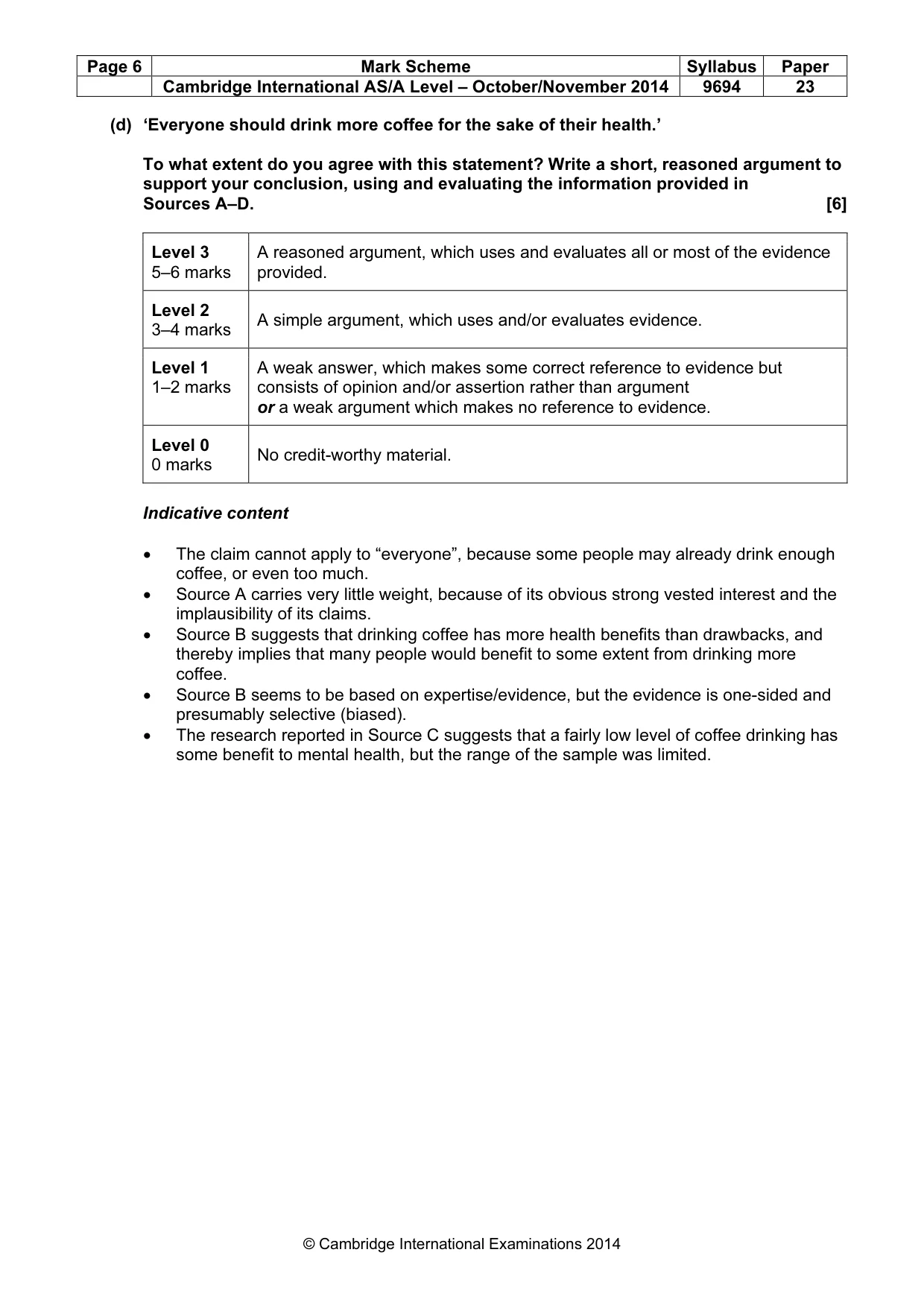
Page 6 Mark Scheme Syllabus Paper Cambridge International AS/A Level – October/November 2014 9694 23 © Cambridge International Examinations 2014 (d) ‘Everyone should drink more coffee for the sake of their health.’ To what extent do you agree with this statement? Write a short, reasoned argument to support your conclusion, using and evaluating the information provided in Sources A–D. [6] Level 3 5–6 marks A reasoned argument, which uses and evaluates all or most of the evidence provided. Level 2 3–4 marks A simple argument, which uses and/or evaluates evidence. Level 1 1–2 marks A weak answer, which makes some correct reference to evidence but consists of opinion and/or assertion rather than argument or a weak argument which makes no reference to evidence. Level 0 0 marks No credit-worthy material. Indicative content • The claim cannot apply to “everyone”, because some people may already drink enough coffee, or even too much. • Source A carries very little weight, because of its obvious strong vested interest and the implausibility of its claims. • Source B suggests that drinking coffee has more health benefits than drawbacks, and thereby implies that many people would benefit to some extent from drinking more coffee. • Source B seems to be based on expertise/evidence, but the evidence is one-sided and presumably selective (biased). • The research reported in Source C suggests that a fairly low level of coffee drinking has some benefit to mental health, but the range of the sample was limited.
Mark scheme, page 7
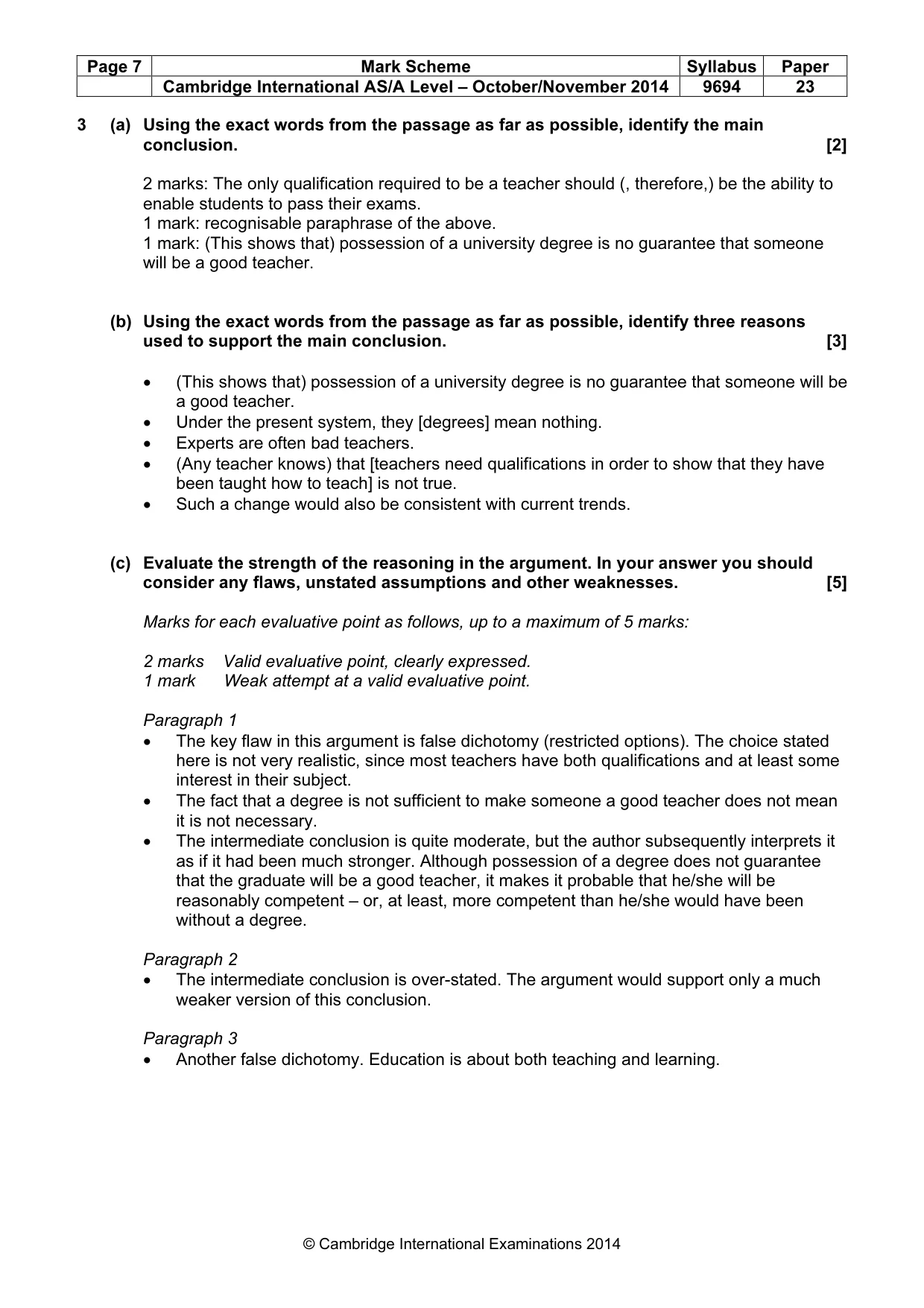
Page 7 Mark Scheme Syllabus Paper Cambridge International AS/A Level – October/November 2014 9694 23 © Cambridge International Examinations 2014 3 (a) Using the exact words from the passage as far as possible, identify the main conclusion. [2] 2 marks: The only qualification required to be a teacher should (, therefore,) be the ability to enable students to pass their exams. 1 mark: recognisable paraphrase of the above. 1 mark: (This shows that) possession of a university degree is no guarantee that someone will be a good teacher. (b) Using the exact words from the passage as far as possible, identify three reasons used to support the main conclusion. [3] • (This shows that) possession of a university degree is no guarantee that someone will be a good teacher. • Under the present system, they [degrees] mean nothing. • Experts are often bad teachers. • (Any teacher knows) that [teachers need qualifications in order to show that they have been taught how to teach] is not true. • Such a change would also be consistent with current trends. (c) Evaluate the strength of the reasoning in the argument. In your answer you should consider any flaws, unstated assumptions and other weaknesses. [5] Marks for each evaluative point as follows, up to a maximum of 5 marks: 2 marks Valid evaluative point, clearly expressed. 1 mark Weak attempt at a valid evaluative point. Paragraph 1 • The key flaw in this argument is false dichotomy (restricted options). The choice stated here is not very realistic, since most teachers have both qualifications and at least some interest in their subject. • The fact that a degree is not sufficient to make someone a good teacher does not mean it is not necessary. • The intermediate conclusion is quite moderate, but the author subsequently interprets it as if it had been much stronger. Although possession of a degree does not guarantee that the graduate will be a good teacher, it makes it probable that he/she will be reasonably competent – or, at least, more competent than he/she would have been without a degree. Paragraph 2 • The intermediate conclusion is over-stated. The argument would support only a much weaker version of this conclusion. Paragraph 3 • Another false dichotomy. Education is about both teaching and learning.
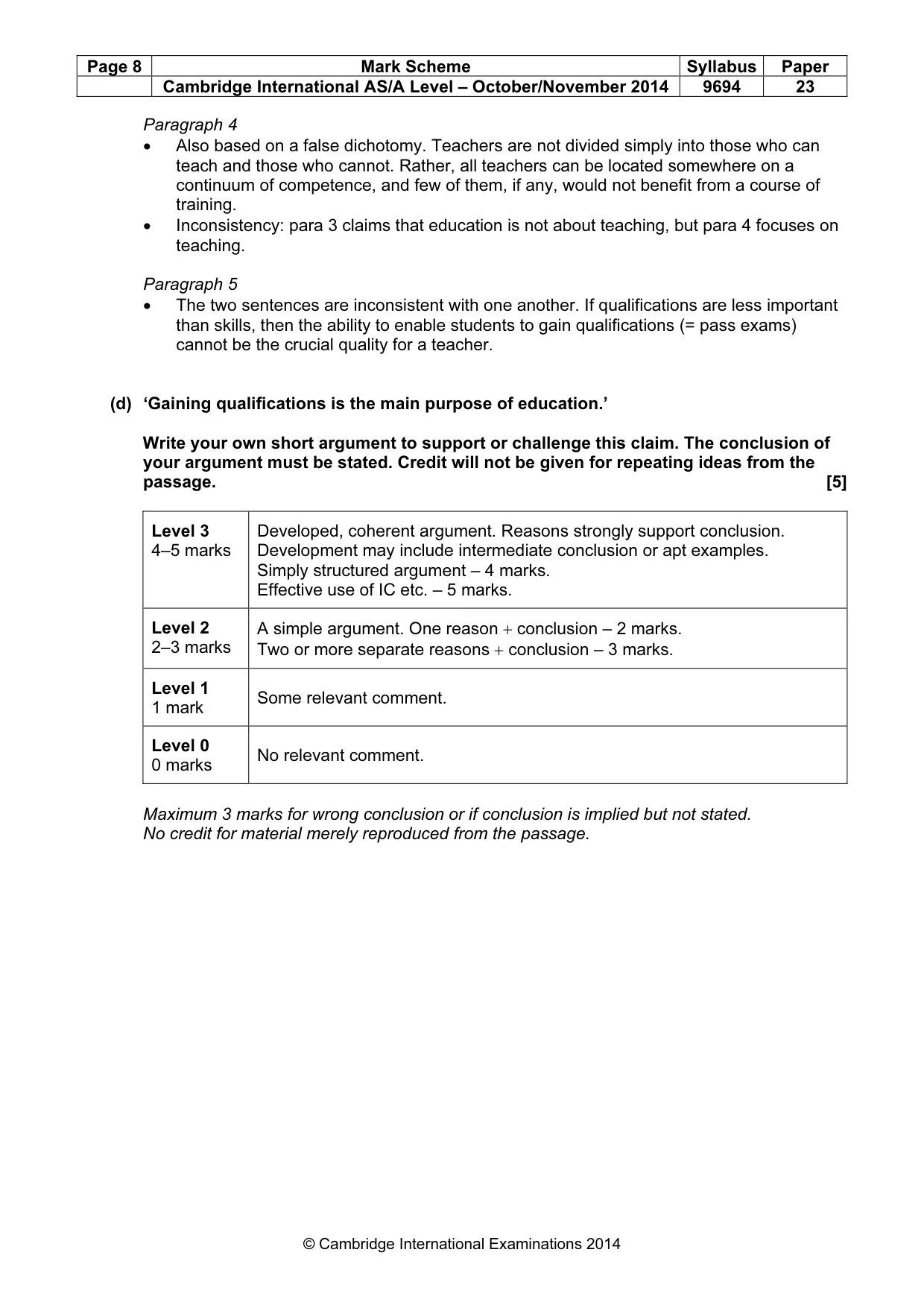
Mark scheme, page 8
Page 8 Mark Scheme Syllabus Paper Cambridge International AS/A Level – October/November 2014 9694 23 © Cambridge International Examinations 2014 Paragraph 4 • Also based on a false dichotomy. Teachers are not divided simply into those who can teach and those who cannot. Rather, all teachers can be located somewhere on a continuum of competence, and few of them, if any, would not benefit from a course of training. • Inconsistency: para 3 claims that education is not about teaching, but para 4 focuses on teaching. Paragraph 5 • The two sentences are inconsistent with one another. If qualifications are less important than skills, then the ability to enable students to gain qualifications (= pass exams) cannot be the crucial quality for a teacher. (d) ‘Gaining qualifications is the main purpose of education.’ Write your own short argument to support or challenge this claim. The conclusion of your argument must be stated. Credit will not be given for repeating ideas from the passage. [5] Level 3 4–5 marks Developed, coherent argument. Reasons strongly support conclusion. Development may include intermediate conclusion or apt examples. Simply structured argument – 4 marks. Effective use of IC etc. – 5 marks. Level 2 2–3 marks A simple argument. One reason + conclusion – 2 marks. Two or more separate reasons + conclusion – 3 marks. Level 1 1 mark Some relevant comment. Level 0 0 marks No relevant comment. Maximum 3 marks for wrong conclusion or if conclusion is implied but not stated. No credit for material merely reproduced from the passage.
Mark scheme, page 9
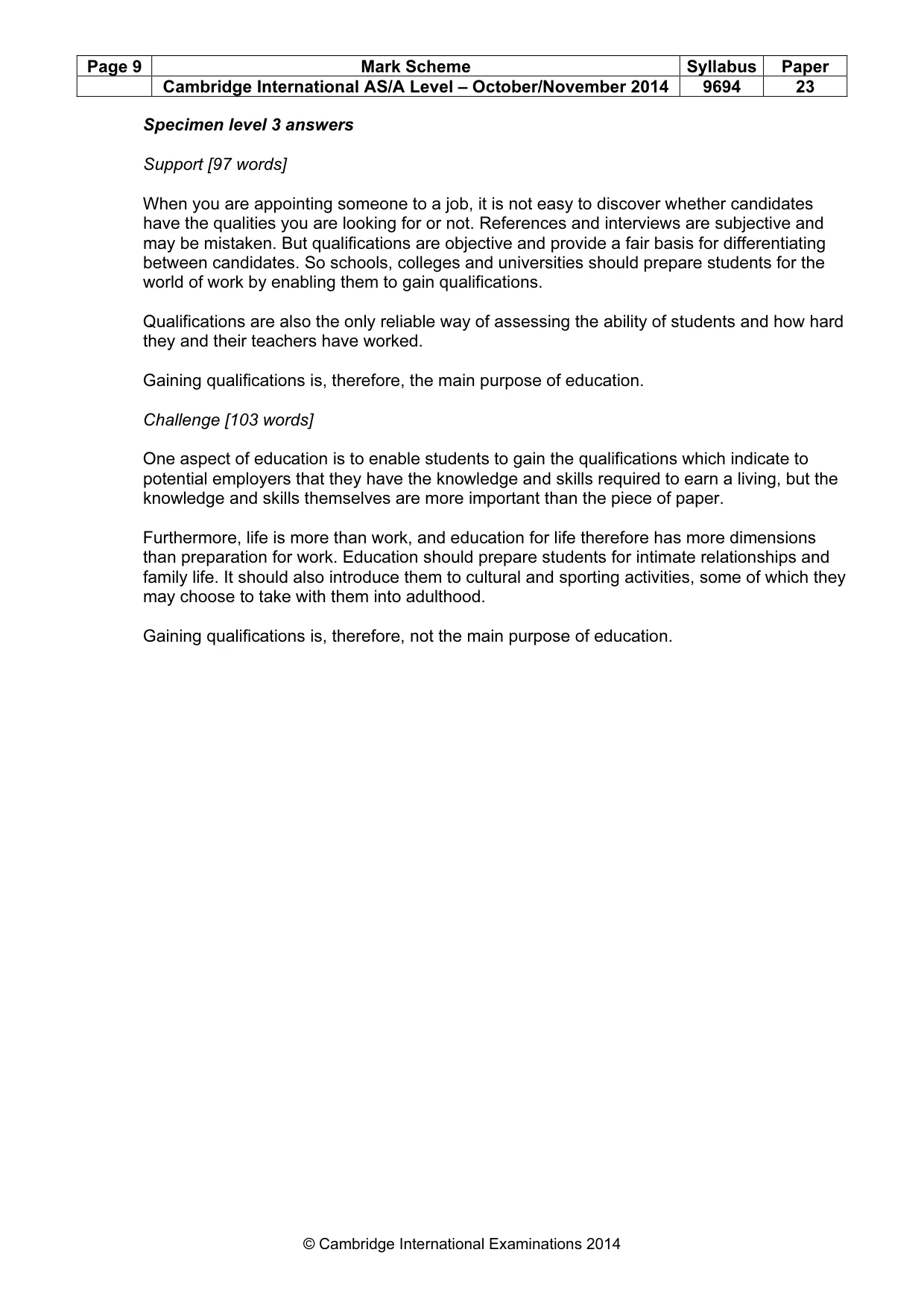
Page 9 Mark Scheme Syllabus Paper Cambridge International AS/A Level – October/November 2014 9694 23 © Cambridge International Examinations 2014 Specimen level 3 answers Support [97 words] When you are appointing someone to a job, it is not easy to discover whether candidates have the qualities you are looking for or not. References and interviews are subjective and may be mistaken. But qualifications are objective and provide a fair basis for differentiating between candidates. So schools, colleges and universities should prepare students for the world of work by enabling them to gain qualifications. Qualifications are also the only reliable way of assessing the ability of students and how hard they and their teachers have worked. Gaining qualifications is, therefore, the main purpose of education. Challenge [103 words] One aspect of education is to enable students to gain the qualifications which indicate to potential employers that they have the knowledge and skills required to earn a living, but the knowledge and skills themselves are more important than the piece of paper. Furthermore, life is more than work, and education for life therefore has more dimensions than preparation for work. Education should prepare students for intimate relationships and family life. It should also introduce them to cultural and sporting activities, some of which they may choose to take with them into adulthood. Gaining qualifications is, therefore, not the main purpose of education.
What you needed in this session
Cambridge’s own grade thresholds for 2014 Oct/Nov, Paper 2 · Variant 3. A higher threshold means an easier paper — the bar moves with how the cohort did.