Cambridge A Level Thinking Skills 9694 — 2013 Oct/Nov Paper 2 · Variant 1
9694/21/O/N/13 · 45 marks · ≈51 min
The question paper and its mark scheme, free to read here and free to download. This is Cambridge’s own paper, exactly as it was sat.
Question paper8 pages

Mark scheme8 pages
Answers below. Sit the paper first if you are practising.
Paper as text
Question paper, page 1
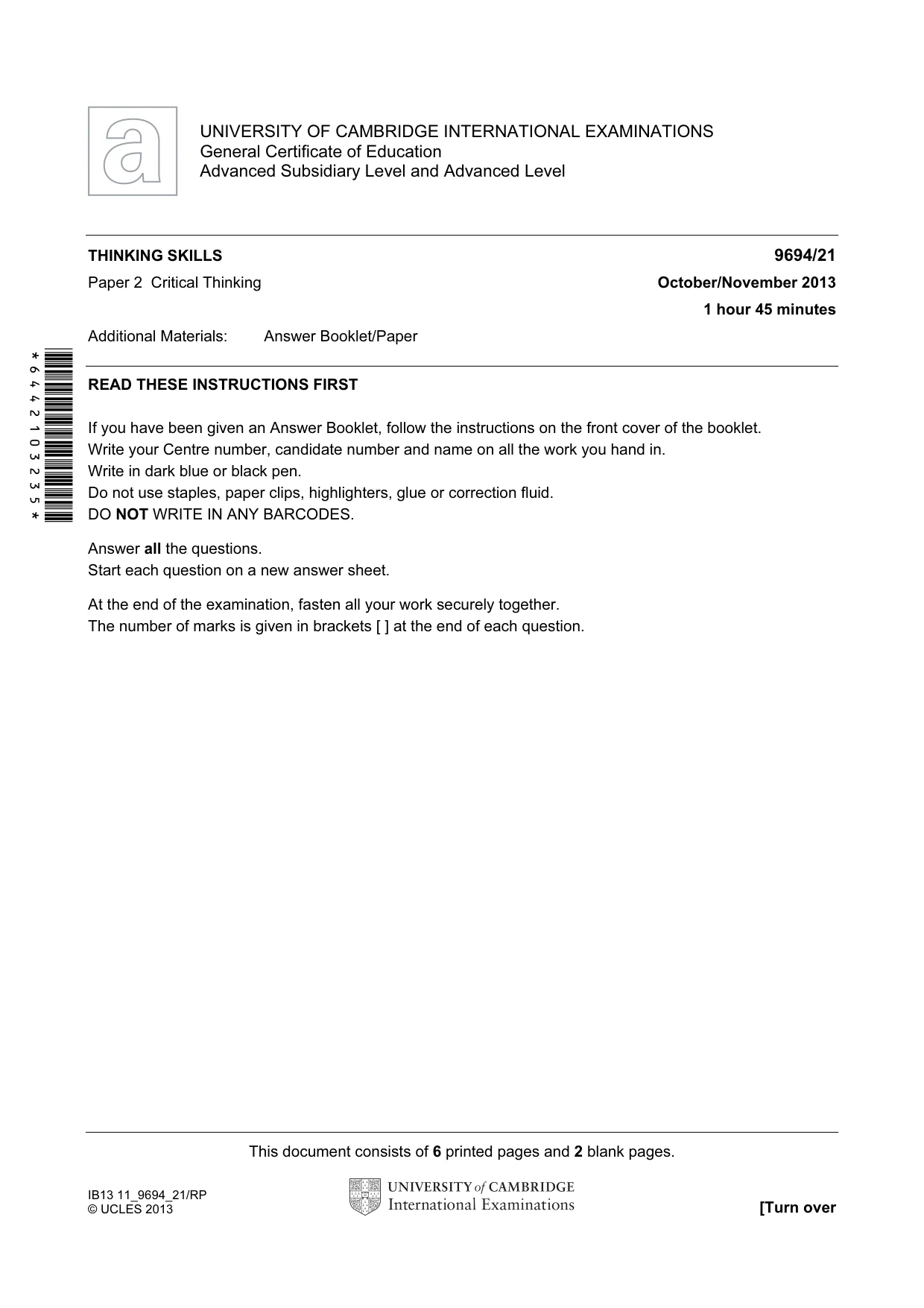
This document consists of 6 printed pages and 2 blank pages. IB13 11_9694_21/RP © UCLES 2013 [Turn over *6442103235* UNIVERSITY OF CAMBRIDGE INTERNATIONAL EXAMINATIONS General Certificate of Education Advanced Subsidiary Level and Advanced Level THINKING SKILLS 9694/21 Paper 2 Critical Thinking October/November 2013 1 hour 45 minutes Additional Materials: Answer Booklet/Paper READ THESE INSTRUCTIONS FIRST If you have been given an Answer Booklet, follow the instructions on the front cover of the booklet. Write your Centre number, candidate number and name on all the work you hand in. Write in dark blue or black pen. Do not use staples, paper clips, highlighters, glue or correction fluid. DO NOT WRITE IN ANY BARCODES. Answer all the questions. Start each question on a new answer sheet. At the end of the examination, fasten all your work securely together. The number of marks is given in brackets [ ] at the end of each question.
Question paper, page 2
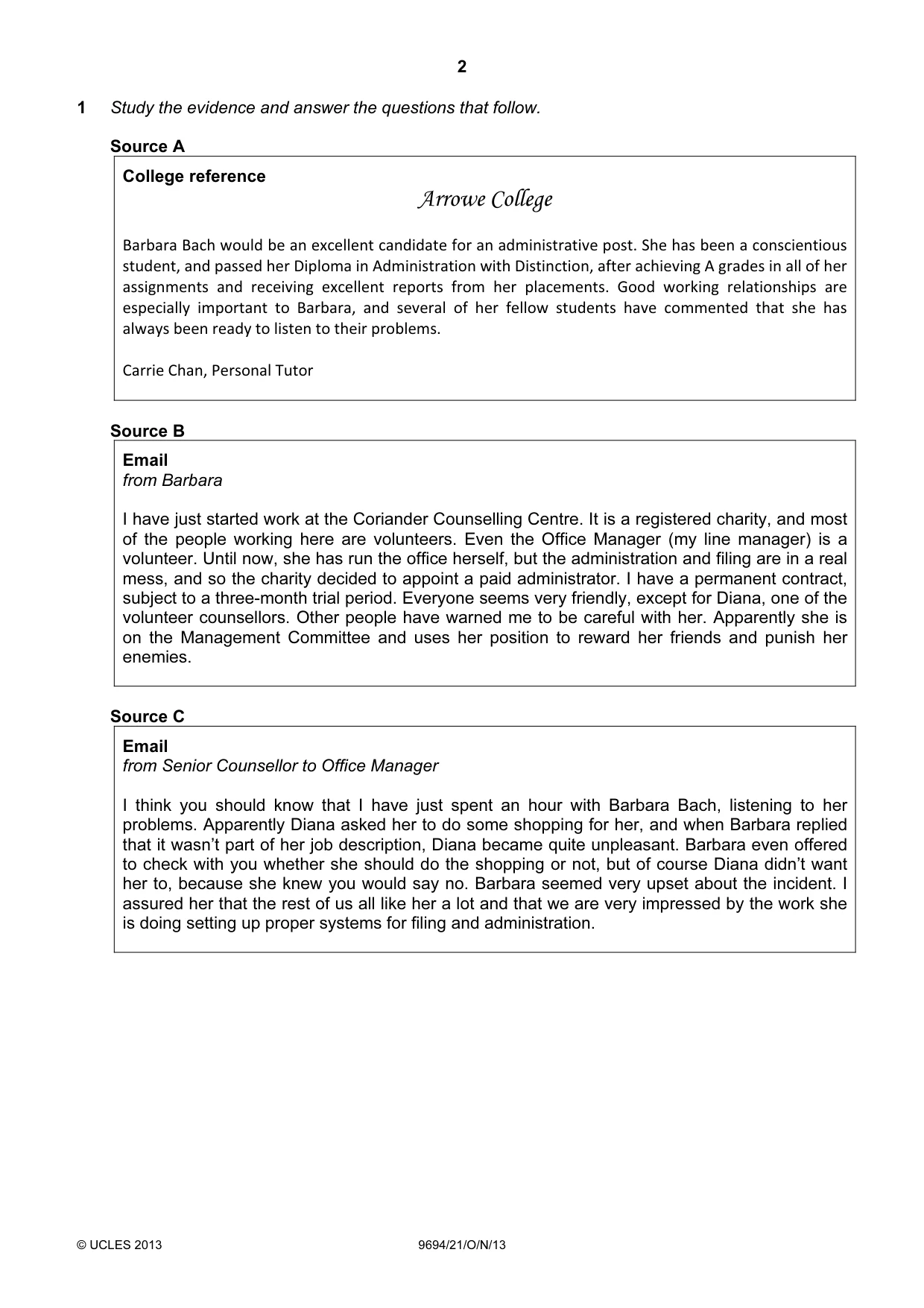
2 © UCLES 2013 9694/21/O/N/13 1 Study the evidence and answer the questions that follow. Source A College reference Arrowe College Barbara Bach would be an excellent candidate for an administrative post. She has been a conscientious student, and passed her Diploma in Administration with Distinction, after achieving A grades in all of her assignments and receiving excellent reports from her placements. Good working relationships are especially important to Barbara, and several of her fellow students have commented that she has always been ready to listen to their problems. Carrie Chan, Personal Tutor Source B Email from Barbara I have just started work at the Coriander Counselling Centre. It is a registered charity, and most of the people working here are volunteers. Even the Office Manager (my line manager) is a volunteer. Until now, she has run the office herself, but the administration and filing are in a real mess, and so the charity decided to appoint a paid administrator. I have a permanent contract, subject to a three-month trial period. Everyone seems very friendly, except for Diana, one of the volunteer counsellors. Other people have warned me to be careful with her. Apparently she is on the Management Committee and uses her position to reward her friends and punish her enemies. Source C Email from Senior Counsellor to Office Manager I think you should know that I have just spent an hour with Barbara Bach, listening to her problems. Apparently Diana asked her to do some shopping for her, and when Barbara replied that it wasn’t part of her job description, Diana became quite unpleasant. Barbara even offered to check with you whether she should do the shopping or not, but of course Diana didn’t want her to, because she knew you would say no. Barbara seemed very upset about the incident. I assured her that the rest of us all like her a lot and that we are very impressed by the work she is doing setting up proper systems for filing and administration.
Question paper, page 3
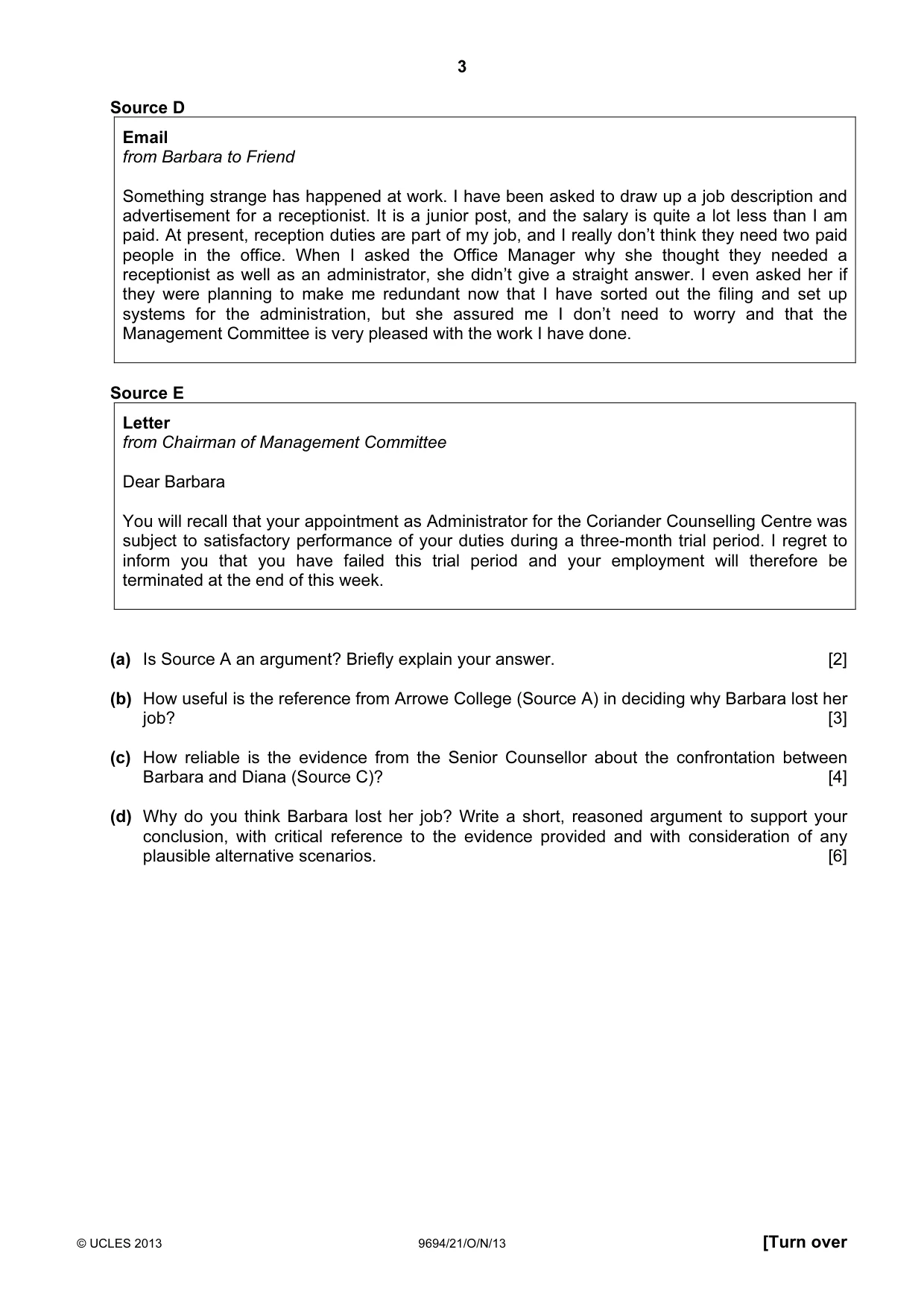
3 © UCLES 2013 9694/21/O/N/13 [Turn over Source D Email from Barbara to Friend Something strange has happened at work. I have been asked to draw up a job description and advertisement for a receptionist. It is a junior post, and the salary is quite a lot less than I am paid. At present, reception duties are part of my job, and I really don’t think they need two paid people in the office. When I asked the Office Manager why she thought they needed a receptionist as well as an administrator, she didn’t give a straight answer. I even asked her if they were planning to make me redundant now that I have sorted out the filing and set up systems for the administration, but she assured me I don’t need to worry and that the Management Committee is very pleased with the work I have done. Source E Letter from Chairman of Management Committee Dear Barbara You will recall that your appointment as Administrator for the Coriander Counselling Centre was subject to satisfactory performance of your duties during a three-month trial period. I regret to inform you that you have failed this trial period and your employment will therefore be terminated at the end of this week. (a) Is Source A an argument? Briefly explain your answer. [2] (b) How useful is the reference from Arrowe College (Source A) in deciding why Barbara lost her job? [3] (c) How reliable is the evidence from the Senior Counsellor about the confrontation between Barbara and Diana (Source C)? [4] (d) Why do you think Barbara lost her job? Write a short, reasoned argument to support your conclusion, with critical reference to the evidence provided and with consideration of any plausible alternative scenarios. [6]
Question paper, page 4
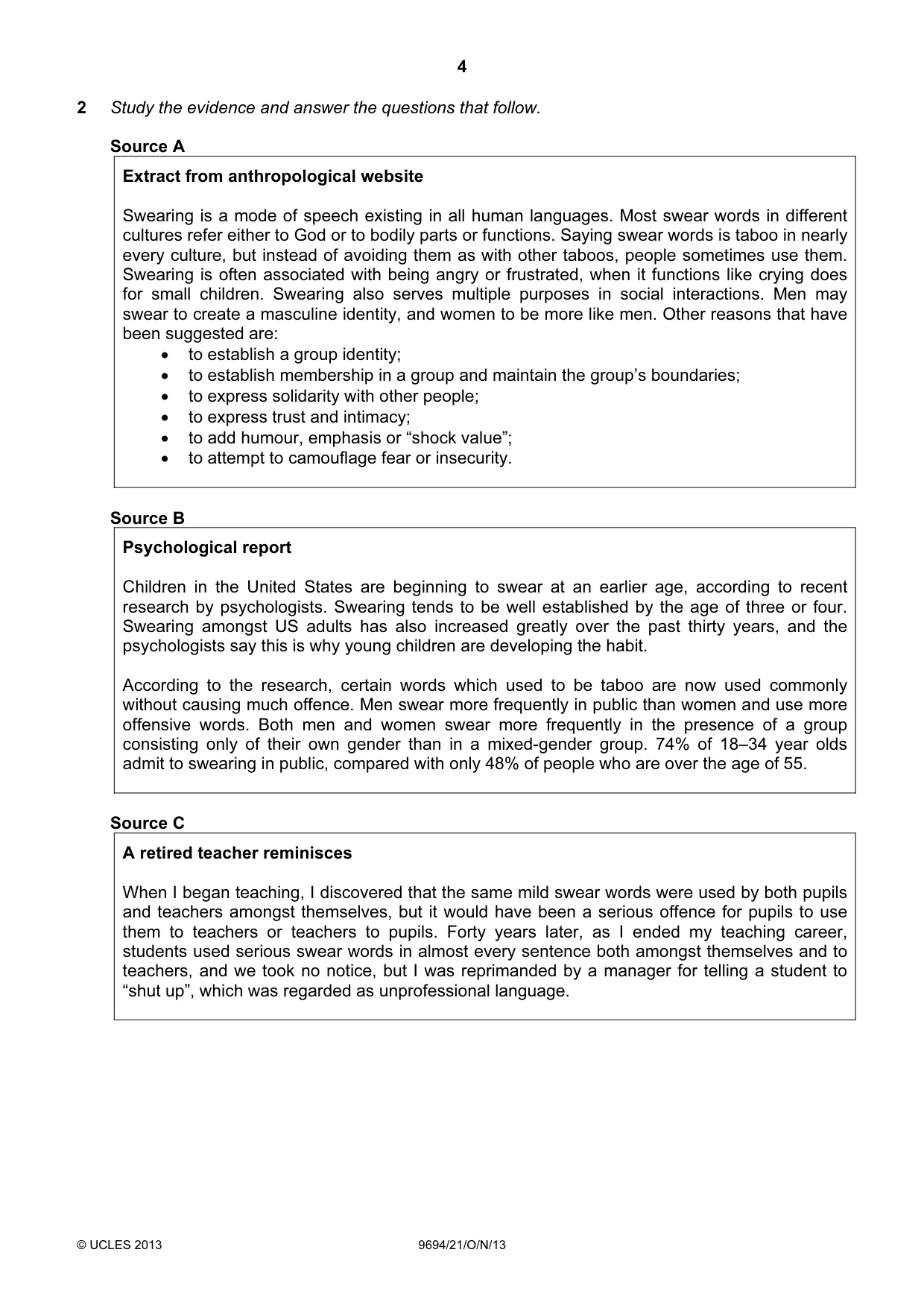
4 © UCLES 2013 9694/21/O/N/13 2 Study the evidence and answer the questions that follow. Source A Extract from anthropological website Swearing is a mode of speech existing in all human languages. Most swear words in different cultures refer either to God or to bodily parts or functions. Saying swear words is taboo in nearly every culture, but instead of avoiding them as with other taboos, people sometimes use them. Swearing is often associated with being angry or frustrated, when it functions like crying does for small children. Swearing also serves multiple purposes in social interactions. Men may swear to create a masculine identity, and women to be more like men. Other reasons that have been suggested are: • to establish a group identity; • to establish membership in a group and maintain the group’s boundaries; • to express solidarity with other people; • to express trust and intimacy; • to add humour, emphasis or “shock value”; • to attempt to camouflage fear or insecurity. Source B Psychological report Children in the United States are beginning to swear at an earlier age, according to recent research by psychologists. Swearing tends to be well established by the age of three or four. Swearing amongst US adults has also increased greatly over the past thirty years, and the psychologists say this is why young children are developing the habit. According to the research, certain words which used to be taboo are now used commonly without causing much offence. Men swear more frequently in public than women and use more offensive words. Both men and women swear more frequently in the presence of a group consisting only of their own gender than in a mixed-gender group. 74% of 18–34 year olds admit to swearing in public, compared with only 48% of people who are over the age of 55. Source C A retired teacher reminisces When I began teaching, I discovered that the same mild swear words were used by both pupils and teachers amongst themselves, but it would have been a serious offence for pupils to use them to teachers or teachers to pupils. Forty years later, as I ended my teaching career, students used serious swear words in almost every sentence both amongst themselves and to teachers, and we took no notice, but I was reprimanded by a manager for telling a student to “shut up”, which was regarded as unprofessional language.
Question paper, page 5
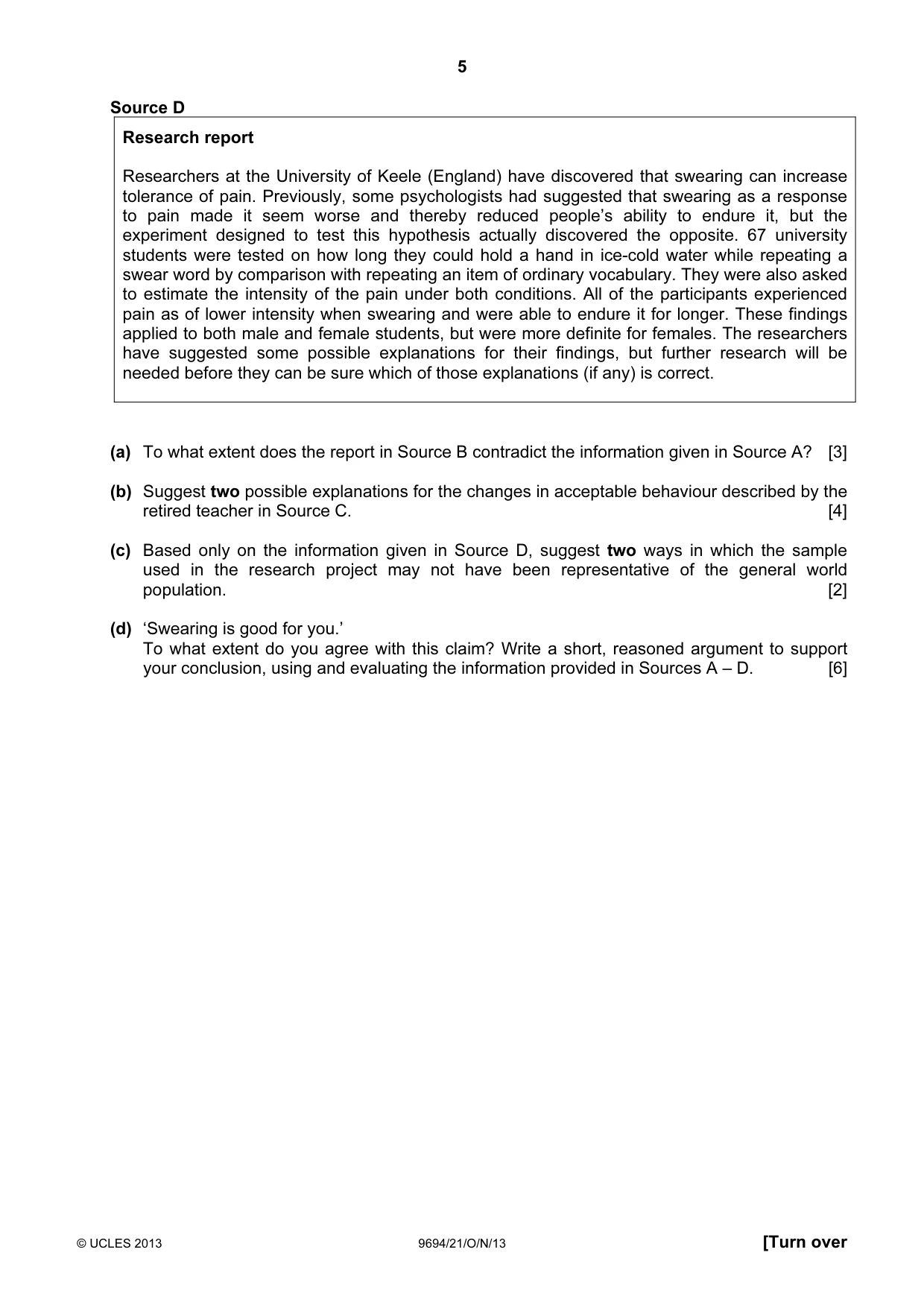
5 © UCLES 2013 9694/21/O/N/13 [Turn over Source D Research report Researchers at the University of Keele (England) have discovered that swearing can increase tolerance of pain. Previously, some psychologists had suggested that swearing as a response to pain made it seem worse and thereby reduced people’s ability to endure it, but the experiment designed to test this hypothesis actually discovered the opposite. 67 university students were tested on how long they could hold a hand in ice-cold water while repeating a swear word by comparison with repeating an item of ordinary vocabulary. They were also asked to estimate the intensity of the pain under both conditions. All of the participants experienced pain as of lower intensity when swearing and were able to endure it for longer. These findings applied to both male and female students, but were more definite for females. The researchers have suggested some possible explanations for their findings, but further research will be needed before they can be sure which of those explanations (if any) is correct. (a) To what extent does the report in Source B contradict the information given in Source A? [3] (b) Suggest two possible explanations for the changes in acceptable behaviour described by the retired teacher in Source C. [4] (c) Based only on the information given in Source D, suggest two ways in which the sample used in the research project may not have been representative of the general world population. [2] (d) ‘Swearing is good for you.’ To what extent do you agree with this claim? Write a short, reasoned argument to support your conclusion, using and evaluating the information provided in Sources A – D. [6]
Question paper, page 6
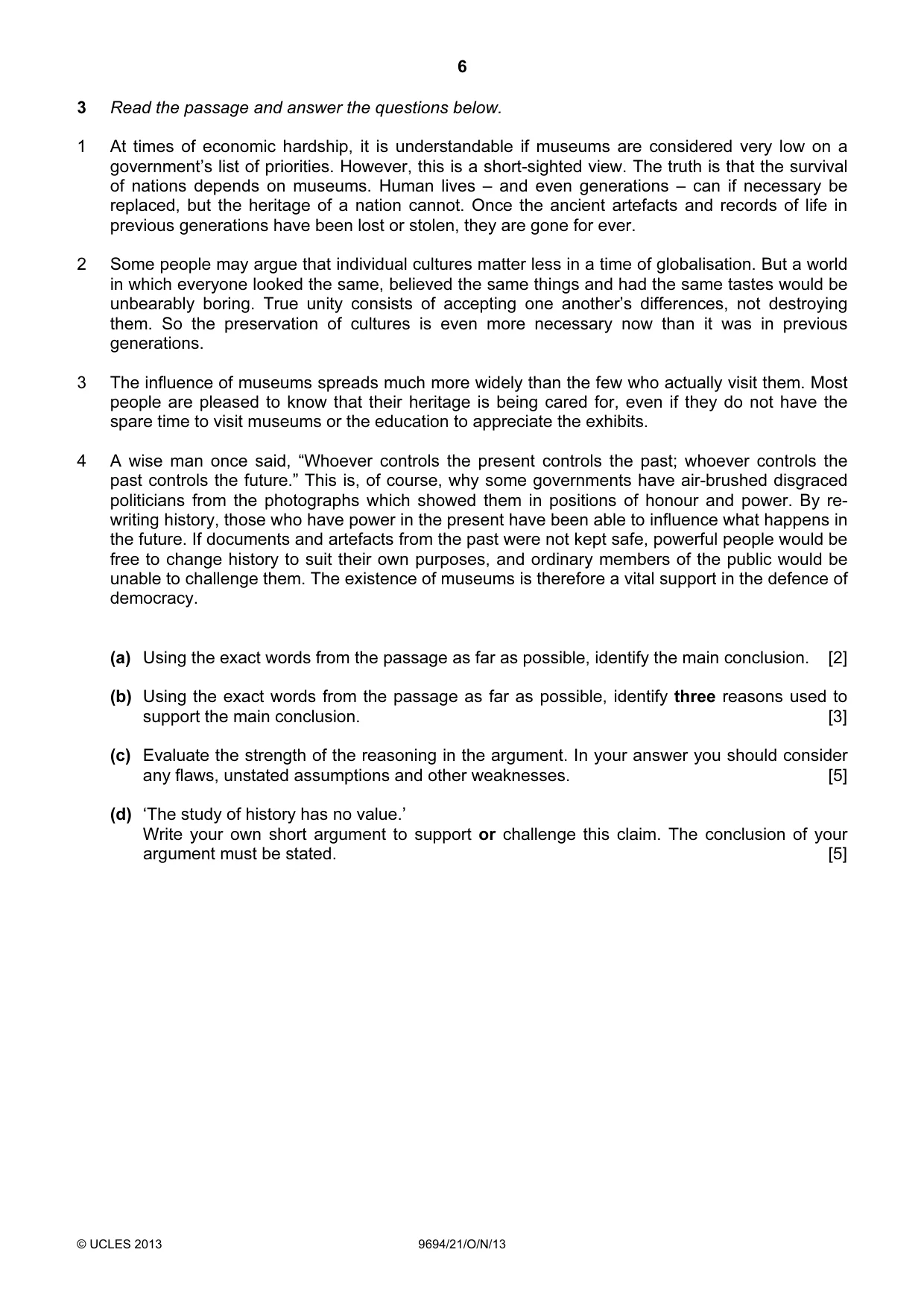
6 © UCLES 2013 9694/21/O/N/13 3 Read the passage and answer the questions below. 1 At times of economic hardship, it is understandable if museums are considered very low on a government’s list of priorities. However, this is a short-sighted view. The truth is that the survival of nations depends on museums. Human lives – and even generations – can if necessary be replaced, but the heritage of a nation cannot. Once the ancient artefacts and records of life in previous generations have been lost or stolen, they are gone for ever. 2 Some people may argue that individual cultures matter less in a time of globalisation. But a world in which everyone looked the same, believed the same things and had the same tastes would be unbearably boring. True unity consists of accepting one another’s differences, not destroying them. So the preservation of cultures is even more necessary now than it was in previous generations. 3 The influence of museums spreads much more widely than the few who actually visit them. Most people are pleased to know that their heritage is being cared for, even if they do not have the spare time to visit museums or the education to appreciate the exhibits. 4 A wise man once said, “Whoever controls the present controls the past; whoever controls the past controls the future.” This is, of course, why some governments have air-brushed disgraced politicians from the photographs which showed them in positions of honour and power. By re- writing history, those who have power in the present have been able to influence what happens in the future. If documents and artefacts from the past were not kept safe, powerful people would be free to change history to suit their own purposes, and ordinary members of the public would be unable to challenge them. The existence of museums is therefore a vital support in the defence of democracy. (a) Using the exact words from the passage as far as possible, identify the main conclusion. [2] (b) Using the exact words from the passage as far as possible, identify three reasons used to support the main conclusion. [3] (c) Evaluate the strength of the reasoning in the argument. In your answer you should consider any flaws, unstated assumptions and other weaknesses. [5] (d) ‘The study of history has no value.’ Write your own short argument to support or challenge this claim. The conclusion of your argument must be stated. [5]
Question paper, page 7
7 © UCLES 2013 9694/21/O/N/13 BLANK PAGE
Question paper, page 8
8 Permission to reproduce items where third-party owned material protected by copyright is included has been sought and cleared where possible. Every reasonable effort has been made by the publisher (UCLES) to trace copyright holders, but if any items requiring clearance have unwittingly been included, the publisher will be pleased to make amends at the earliest possible opportunity. University of Cambridge International Examinations is part of the Cambridge Assessment Group. Cambridge Assessment is the brand name of University of Cambridge Local Examinations Syndicate (UCLES), which is itself a department of the University of Cambridge. © UCLES 2013 9694/21/O/N/13 BLANK PAGE
Mark scheme, page 1
CAMBRIDGE INTERNATIONAL EXAMINATIONS GCE Advanced Subsidiary Level and GCE Advanced Level MARK SCHEME for the October/November 2013 series 9694 THINKING SKILLS 9694/21 Paper 2 (Critical Thinking), maximum raw mark 45 This mark scheme is published as an aid to teachers and candidates, to indicate the requirements of the examination. It shows the basis on which Examiners were instructed to award marks. It does not indicate the details of the discussions that took place at an Examiners’ meeting before marking began, which would have considered the acceptability of alternative answers. Mark schemes should be read in conjunction with the question paper and the Principal Examiner Report for Teachers. Cambridge will not enter into discussions about these mark schemes. Cambridge is publishing the mark schemes for the October/November 2013 series for most IGCSE, GCE Advanced Level and Advanced Subsidiary Level components and some Ordinary Level components.
Mark scheme, page 2
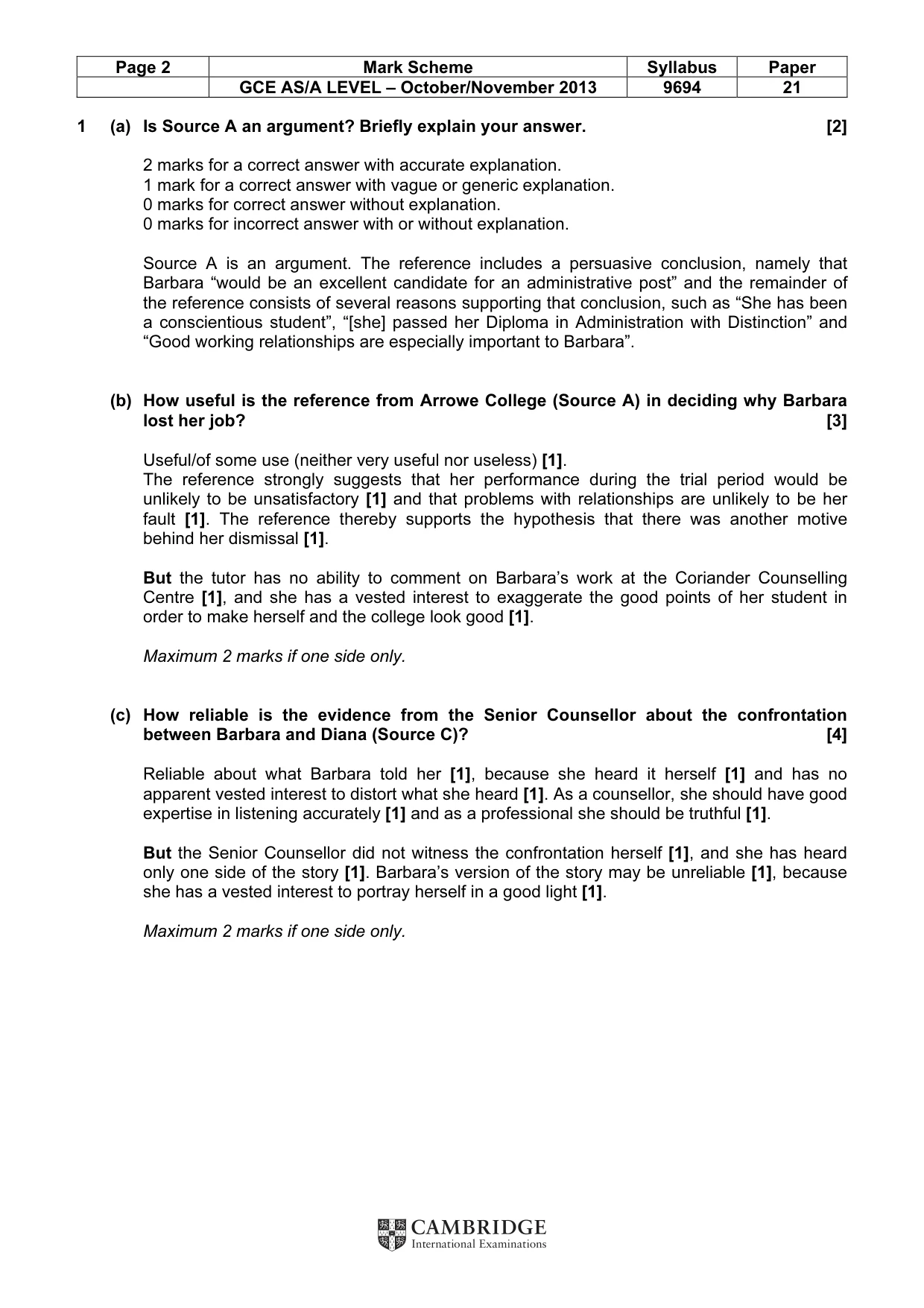
Page 2 Mark Scheme Syllabus Paper GCE AS/A LEVEL – October/November 2013 9694 21 1 (a) Is Source A an argument? Briefly explain your answer. [2] 2 marks for a correct answer with accurate explanation. 1 mark for a correct answer with vague or generic explanation. 0 marks for correct answer without explanation. 0 marks for incorrect answer with or without explanation. Source A is an argument. The reference includes a persuasive conclusion, namely that Barbara “would be an excellent candidate for an administrative post” and the remainder of the reference consists of several reasons supporting that conclusion, such as “She has been a conscientious student”, “[she] passed her Diploma in Administration with Distinction” and “Good working relationships are especially important to Barbara”. (b) How useful is the reference from Arrowe College (Source A) in deciding why Barbara lost her job? [3] Useful/of some use (neither very useful nor useless) [1]. The reference strongly suggests that her performance during the trial period would be unlikely to be unsatisfactory [1] and that problems with relationships are unlikely to be her fault [1]. The reference thereby supports the hypothesis that there was another motive behind her dismissal [1]. But the tutor has no ability to comment on Barbara’s work at the Coriander Counselling Centre [1], and she has a vested interest to exaggerate the good points of her student in order to make herself and the college look good [1]. Maximum 2 marks if one side only. (c) How reliable is the evidence from the Senior Counsellor about the confrontation between Barbara and Diana (Source C)? [4] Reliable about what Barbara told her [1], because she heard it herself [1] and has no apparent vested interest to distort what she heard [1]. As a counsellor, she should have good expertise in listening accurately [1] and as a professional she should be truthful [1]. But the Senior Counsellor did not witness the confrontation herself [1], and she has heard only one side of the story [1]. Barbara’s version of the story may be unreliable [1], because she has a vested interest to portray herself in a good light [1]. Maximum 2 marks if one side only.
Mark scheme, page 3
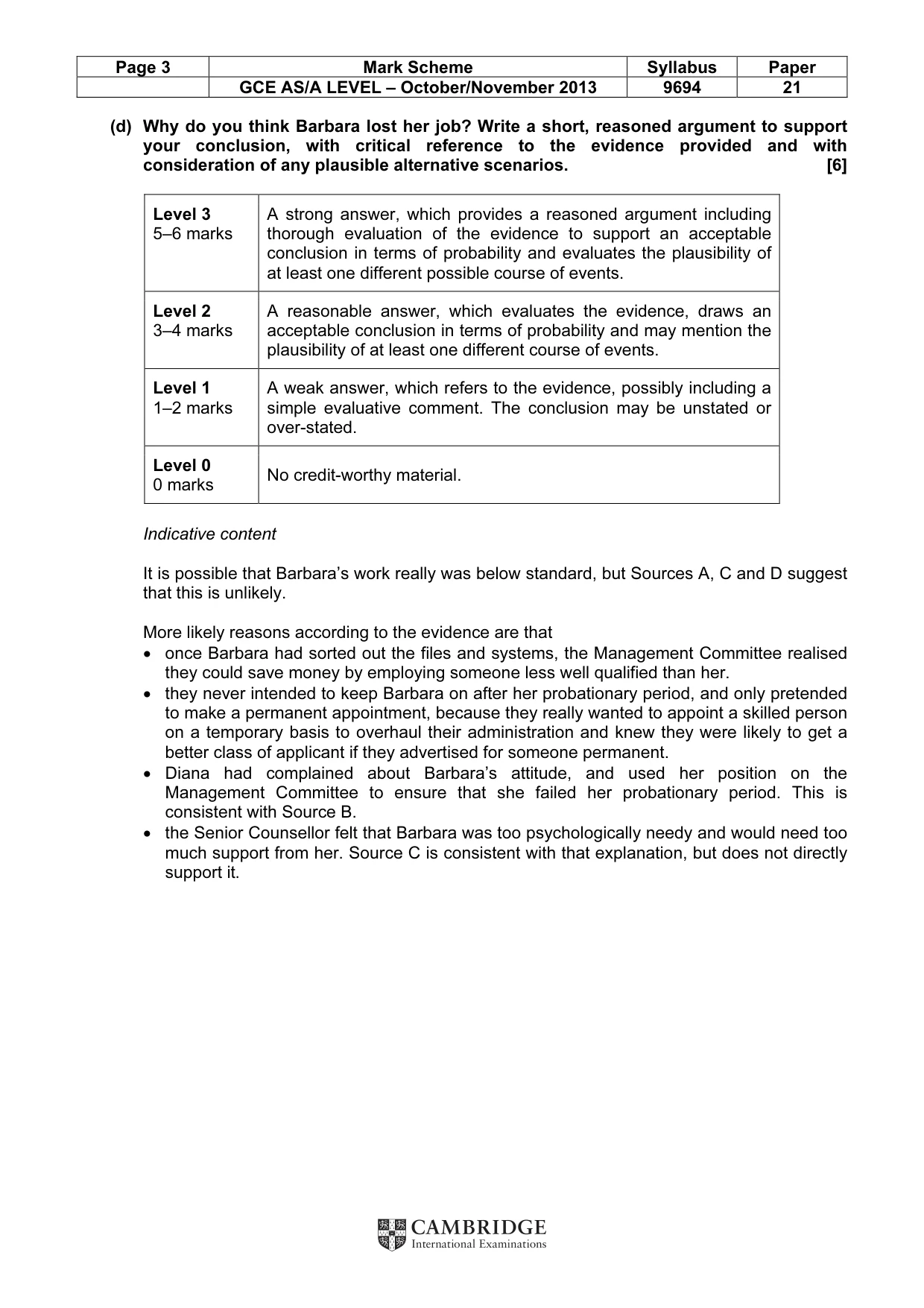
Page 3 Mark Scheme Syllabus Paper GCE AS/A LEVEL – October/November 2013 9694 21 (d) Why do you think Barbara lost her job? Write a short, reasoned argument to support your conclusion, with critical reference to the evidence provided and with consideration of any plausible alternative scenarios. [6] Level 3 5–6 marks A strong answer, which provides a reasoned argument including thorough evaluation of the evidence to support an acceptable conclusion in terms of probability and evaluates the plausibility of at least one different possible course of events. Level 2 3–4 marks A reasonable answer, which evaluates the evidence, draws an acceptable conclusion in terms of probability and may mention the plausibility of at least one different course of events. Level 1 1–2 marks A weak answer, which refers to the evidence, possibly including a simple evaluative comment. The conclusion may be unstated or over-stated. Level 0 0 marks No credit-worthy material. Indicative content It is possible that Barbara’s work really was below standard, but Sources A, C and D suggest that this is unlikely. More likely reasons according to the evidence are that • once Barbara had sorted out the files and systems, the Management Committee realised they could save money by employing someone less well qualified than her. • they never intended to keep Barbara on after her probationary period, and only pretended to make a permanent appointment, because they really wanted to appoint a skilled person on a temporary basis to overhaul their administration and knew they were likely to get a better class of applicant if they advertised for someone permanent. • Diana had complained about Barbara’s attitude, and used her position on the Management Committee to ensure that she failed her probationary period. This is consistent with Source B. • the Senior Counsellor felt that Barbara was too psychologically needy and would need too much support from her. Source C is consistent with that explanation, but does not directly support it.
Mark scheme, page 4
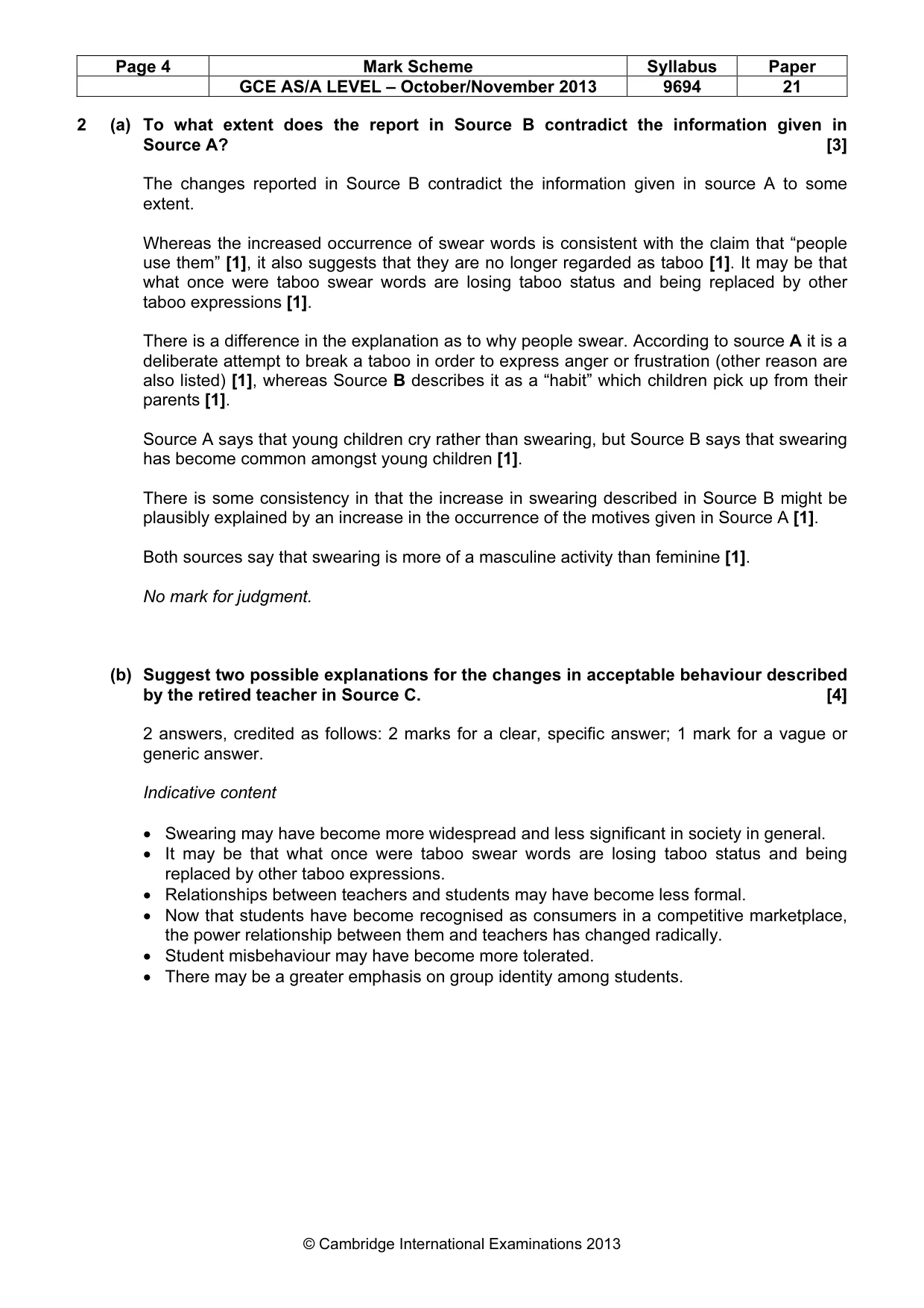
Page 4 Mark Scheme Syllabus Paper GCE AS/A LEVEL – October/November 2013 9694 21 © Cambridge International Examinations 2013 2 (a) To what extent does the report in Source B contradict the information given in Source A? [3] The changes reported in Source B contradict the information given in source A to some extent. Whereas the increased occurrence of swear words is consistent with the claim that “people use them” [1], it also suggests that they are no longer regarded as taboo [1]. It may be that what once were taboo swear words are losing taboo status and being replaced by other taboo expressions [1]. There is a difference in the explanation as to why people swear. According to source A it is a deliberate attempt to break a taboo in order to express anger or frustration (other reason are also listed) [1], whereas Source B describes it as a “habit” which children pick up from their parents [1]. Source A says that young children cry rather than swearing, but Source B says that swearing has become common amongst young children [1]. There is some consistency in that the increase in swearing described in Source B might be plausibly explained by an increase in the occurrence of the motives given in Source A [1]. Both sources say that swearing is more of a masculine activity than feminine [1]. No mark for judgment. (b) Suggest two possible explanations for the changes in acceptable behaviour described by the retired teacher in Source C. [4] 2 answers, credited as follows: 2 marks for a clear, specific answer; 1 mark for a vague or generic answer. Indicative content • Swearing may have become more widespread and less significant in society in general. • It may be that what once were taboo swear words are losing taboo status and being replaced by other taboo expressions. • Relationships between teachers and students may have become less formal. • Now that students have become recognised as consumers in a competitive marketplace, the power relationship between them and teachers has changed radically. • Student misbehaviour may have become more tolerated. • There may be a greater emphasis on group identity among students.
Mark scheme, page 5
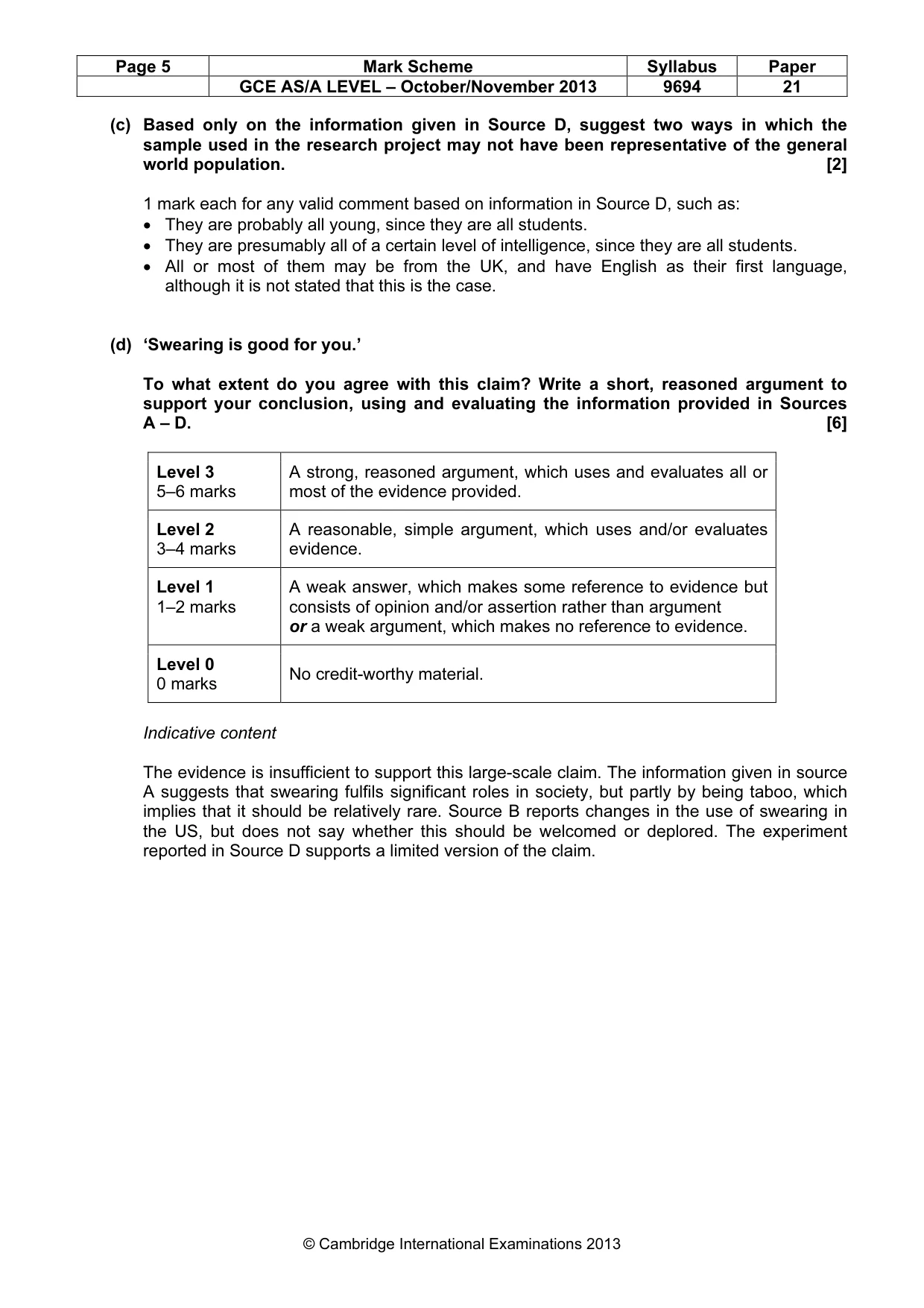
Page 5 Mark Scheme Syllabus Paper GCE AS/A LEVEL – October/November 2013 9694 21 © Cambridge International Examinations 2013 (c) Based only on the information given in Source D, suggest two ways in which the sample used in the research project may not have been representative of the general world population. [2] 1 mark each for any valid comment based on information in Source D, such as: • They are probably all young, since they are all students. • They are presumably all of a certain level of intelligence, since they are all students. • All or most of them may be from the UK, and have English as their first language, although it is not stated that this is the case. (d) ‘Swearing is good for you.’ To what extent do you agree with this claim? Write a short, reasoned argument to support your conclusion, using and evaluating the information provided in Sources A – D. [6] Level 3 5–6 marks A strong, reasoned argument, which uses and evaluates all or most of the evidence provided. Level 2 3–4 marks A reasonable, simple argument, which uses and/or evaluates evidence. Level 1 1–2 marks A weak answer, which makes some reference to evidence but consists of opinion and/or assertion rather than argument or a weak argument, which makes no reference to evidence. Level 0 0 marks No credit-worthy material. Indicative content The evidence is insufficient to support this large-scale claim. The information given in source A suggests that swearing fulfils significant roles in society, but partly by being taboo, which implies that it should be relatively rare. Source B reports changes in the use of swearing in the US, but does not say whether this should be welcomed or deplored. The experiment reported in Source D supports a limited version of the claim.
Mark scheme, page 6
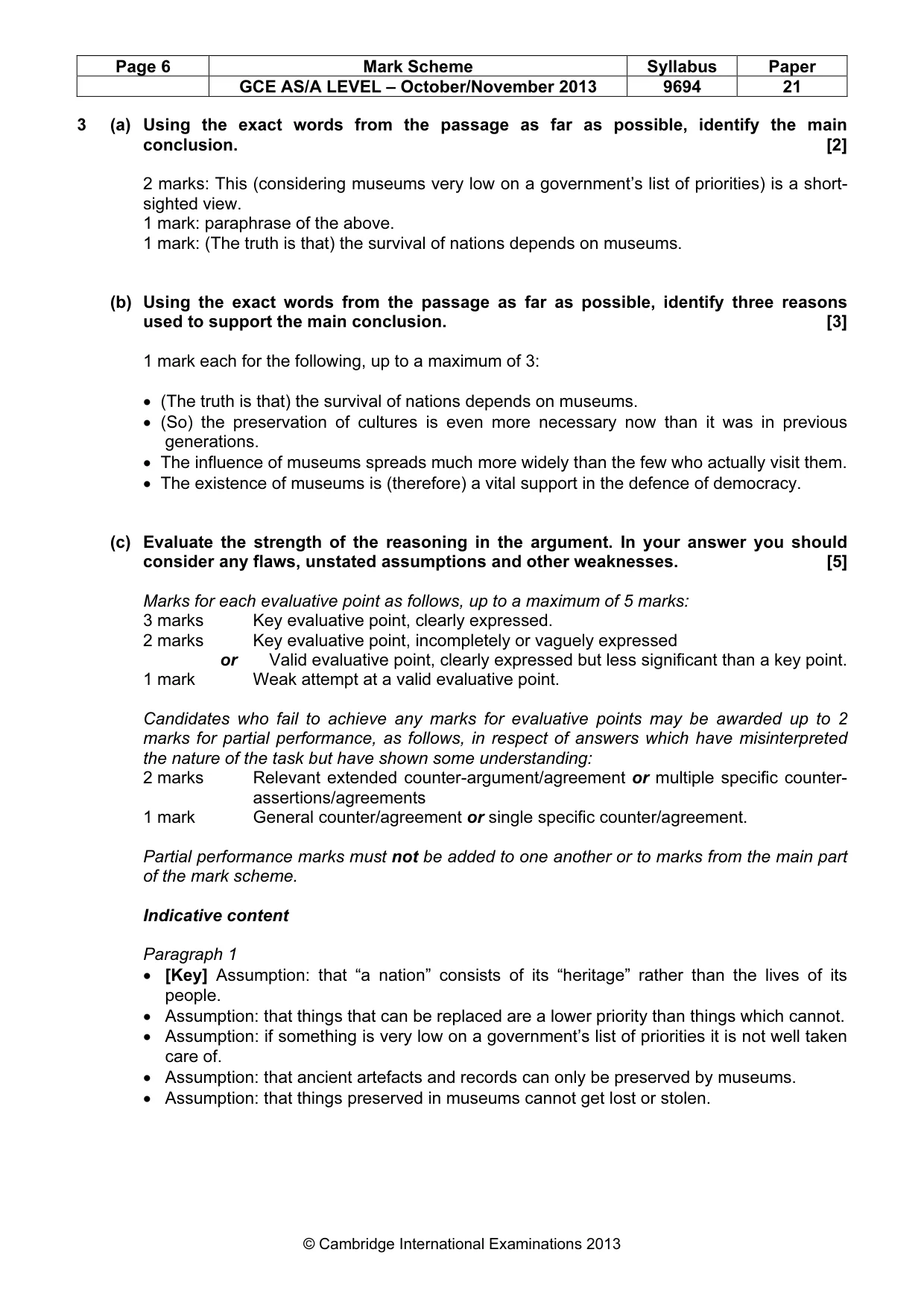
Page 6 Mark Scheme Syllabus Paper GCE AS/A LEVEL – October/November 2013 9694 21 © Cambridge International Examinations 2013 3 (a) Using the exact words from the passage as far as possible, identify the main conclusion. [2] 2 marks: This (considering museums very low on a government’s list of priorities) is a short- sighted view. 1 mark: paraphrase of the above. 1 mark: (The truth is that) the survival of nations depends on museums. (b) Using the exact words from the passage as far as possible, identify three reasons used to support the main conclusion. [3] 1 mark each for the following, up to a maximum of 3: • (The truth is that) the survival of nations depends on museums. • (So) the preservation of cultures is even more necessary now than it was in previous generations. • The influence of museums spreads much more widely than the few who actually visit them. • The existence of museums is (therefore) a vital support in the defence of democracy. (c) Evaluate the strength of the reasoning in the argument. In your answer you should consider any flaws, unstated assumptions and other weaknesses. [5] Marks for each evaluative point as follows, up to a maximum of 5 marks: 3 marks Key evaluative point, clearly expressed. 2 marks Key evaluative point, incompletely or vaguely expressed or Valid evaluative point, clearly expressed but less significant than a key point. 1 mark Weak attempt at a valid evaluative point. Candidates who fail to achieve any marks for evaluative points may be awarded up to 2 marks for partial performance, as follows, in respect of answers which have misinterpreted the nature of the task but have shown some understanding: 2 marks Relevant extended counter-argument/agreement or multiple specific counter- assertions/agreements 1 mark General counter/agreement or single specific counter/agreement. Partial performance marks must not be added to one another or to marks from the main part of the mark scheme. Indicative content Paragraph 1 • [Key] Assumption: that “a nation” consists of its “heritage” rather than the lives of its people. • Assumption: that things that can be replaced are a lower priority than things which cannot. • Assumption: if something is very low on a government’s list of priorities it is not well taken care of. • Assumption: that ancient artefacts and records can only be preserved by museums. • Assumption: that things preserved in museums cannot get lost or stolen.
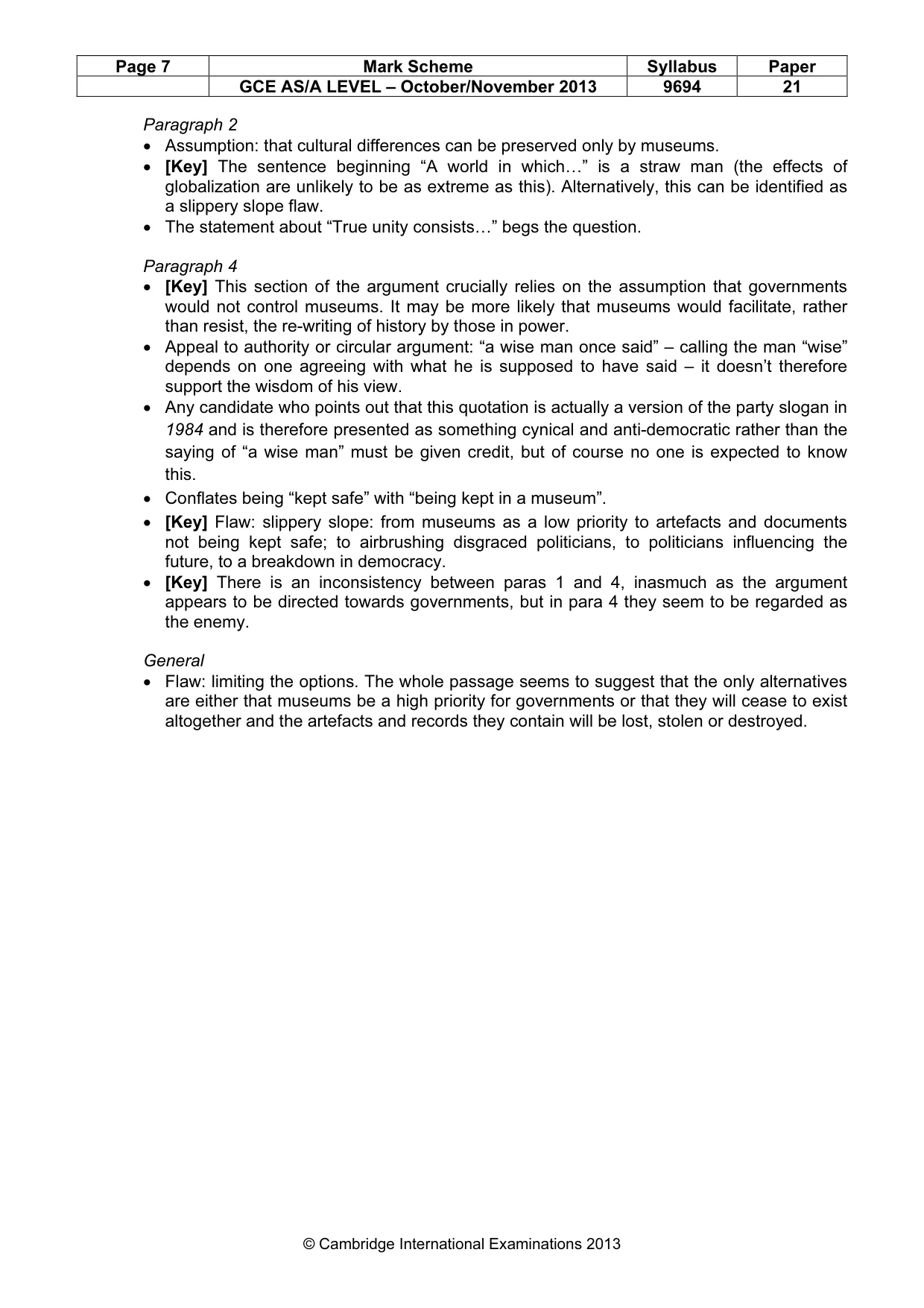
Mark scheme, page 7
Page 7 Mark Scheme Syllabus Paper GCE AS/A LEVEL – October/November 2013 9694 21 © Cambridge International Examinations 2013 Paragraph 2 • Assumption: that cultural differences can be preserved only by museums. • [Key] The sentence beginning “A world in which…” is a straw man (the effects of globalization are unlikely to be as extreme as this). Alternatively, this can be identified as a slippery slope flaw. • The statement about “True unity consists…” begs the question. Paragraph 4 • [Key] This section of the argument crucially relies on the assumption that governments would not control museums. It may be more likely that museums would facilitate, rather than resist, the re-writing of history by those in power. • Appeal to authority or circular argument: “a wise man once said” – calling the man “wise” depends on one agreeing with what he is supposed to have said – it doesn’t therefore support the wisdom of his view. • Any candidate who points out that this quotation is actually a version of the party slogan in 1984 and is therefore presented as something cynical and anti-democratic rather than the saying of “a wise man” must be given credit, but of course no one is expected to know this. • Conflates being “kept safe” with “being kept in a museum”. • [Key] Flaw: slippery slope: from museums as a low priority to artefacts and documents not being kept safe; to airbrushing disgraced politicians, to politicians influencing the future, to a breakdown in democracy. • [Key] There is an inconsistency between paras 1 and 4, inasmuch as the argument appears to be directed towards governments, but in para 4 they seem to be regarded as the enemy. General • Flaw: limiting the options. The whole passage seems to suggest that the only alternatives are either that museums be a high priority for governments or that they will cease to exist altogether and the artefacts and records they contain will be lost, stolen or destroyed.
Mark scheme, page 8
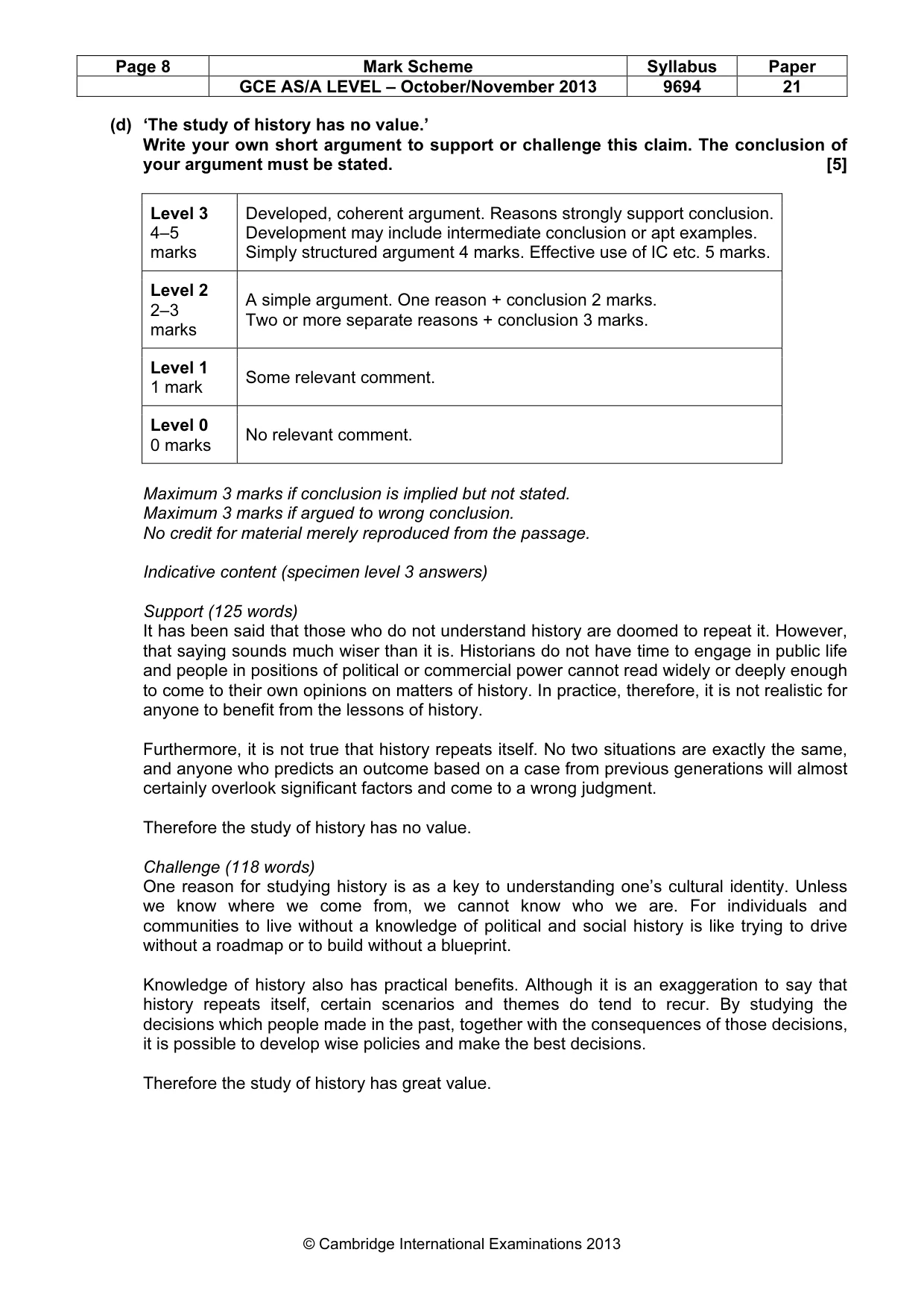
Page 8 Mark Scheme Syllabus Paper GCE AS/A LEVEL – October/November 2013 9694 21 © Cambridge International Examinations 2013 (d) ‘The study of history has no value.’ Write your own short argument to support or challenge this claim. The conclusion of your argument must be stated. [5] Level 3 4–5 marks Developed, coherent argument. Reasons strongly support conclusion. Development may include intermediate conclusion or apt examples. Simply structured argument 4 marks. Effective use of IC etc. 5 marks. Level 2 2–3 marks A simple argument. One reason + conclusion 2 marks. Two or more separate reasons + conclusion 3 marks. Level 1 1 mark Some relevant comment. Level 0 0 marks No relevant comment. Maximum 3 marks if conclusion is implied but not stated. Maximum 3 marks if argued to wrong conclusion. No credit for material merely reproduced from the passage. Indicative content (specimen level 3 answers) Support (125 words) It has been said that those who do not understand history are doomed to repeat it. However, that saying sounds much wiser than it is. Historians do not have time to engage in public life and people in positions of political or commercial power cannot read widely or deeply enough to come to their own opinions on matters of history. In practice, therefore, it is not realistic for anyone to benefit from the lessons of history. Furthermore, it is not true that history repeats itself. No two situations are exactly the same, and anyone who predicts an outcome based on a case from previous generations will almost certainly overlook significant factors and come to a wrong judgment. Therefore the study of history has no value. Challenge (118 words) One reason for studying history is as a key to understanding one’s cultural identity. Unless we know where we come from, we cannot know who we are. For individuals and communities to live without a knowledge of political and social history is like trying to drive without a roadmap or to build without a blueprint. Knowledge of history also has practical benefits. Although it is an exaggeration to say that history repeats itself, certain scenarios and themes do tend to recur. By studying the decisions which people made in the past, together with the consequences of those decisions, it is possible to develop wise policies and make the best decisions. Therefore the study of history has great value.
What you needed in this session
Cambridge’s own grade thresholds for 2013 Oct/Nov, Paper 2 · Variant 1. A higher threshold means an easier paper — the bar moves with how the cohort did.