Cambridge A Level Thinking Skills 9694 — 2013 Oct/Nov Paper 2 · Variant 2
9694/22/O/N/13 · 45 marks · ≈51 min
The question paper and its mark scheme, free to read here and free to download. This is Cambridge’s own paper, exactly as it was sat.
Question paper8 pages

Mark scheme8 pages
Answers below. Sit the paper first if you are practising.
Paper as text
Question paper, page 1
This document consists of 6 printed pages and 2 blank pages. IB13 11_9694_22/2RP © UCLES 2013 [Turn over *7637064999* UNIVERSITY OF CAMBRIDGE INTERNATIONAL EXAMINATIONS General Certificate of Education Advanced Subsidiary Level and Advanced Level THINKING SKILLS 9694/22 Paper 2 Critical Thinking October/November 2013 1 hour 45 minutes Additional Materials: Answer Booklet/Paper READ THESE INSTRUCTIONS FIRST If you have been given an Answer Booklet, follow the instructions on the front cover of the booklet. Write your Centre number, candidate number and name on all the work you hand in. Write in dark blue or black pen. Do not use staples, paper clips, highlighters, glue or correction fluid. DO NOT WRITE IN ANY BARCODES. Answer all the questions. Start each question on a new answer sheet. At the end of the examination, fasten all your work securely together. The number of marks is given in brackets [ ] at the end of each question.
Question paper, page 2
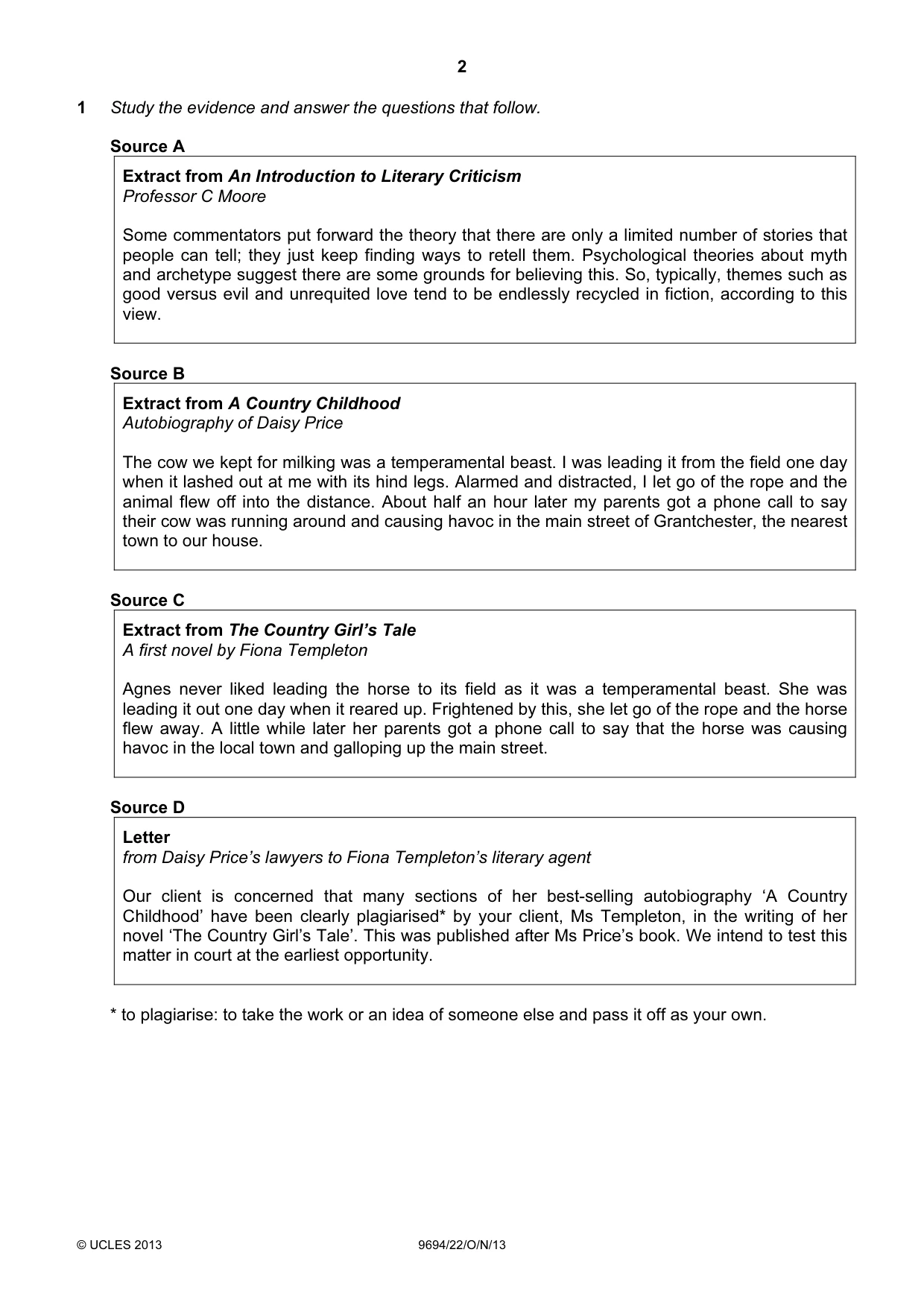
2 © UCLES 2013 9694/22/O/N/13 1 Study the evidence and answer the questions that follow. Source A Extract from An Introduction to Literary Criticism Professor C Moore Some commentators put forward the theory that there are only a limited number of stories that people can tell; they just keep finding ways to retell them. Psychological theories about myth and archetype suggest there are some grounds for believing this. So, typically, themes such as good versus evil and unrequited love tend to be endlessly recycled in fiction, according to this view. Source B Extract from A Country Childhood Autobiography of Daisy Price The cow we kept for milking was a temperamental beast. I was leading it from the field one day when it lashed out at me with its hind legs. Alarmed and distracted, I let go of the rope and the animal flew off into the distance. About half an hour later my parents got a phone call to say their cow was running around and causing havoc in the main street of Grantchester, the nearest town to our house. Source C Extract from The Country Girl’s Tale A first novel by Fiona Templeton Agnes never liked leading the horse to its field as it was a temperamental beast. She was leading it out one day when it reared up. Frightened by this, she let go of the rope and the horse flew away. A little while later her parents got a phone call to say that the horse was causing havoc in the local town and galloping up the main street. Source D Letter from Daisy Price’s lawyers to Fiona Templeton’s literary agent Our client is concerned that many sections of her best-selling autobiography ‘A Country Childhood’ have been clearly plagiarised* by your client, Ms Templeton, in the writing of her novel ‘The Country Girl’s Tale’. This was published after Ms Price’s book. We intend to test this matter in court at the earliest opportunity. * to plagiarise: to take the work or an idea of someone else and pass it off as your own.
Question paper, page 3
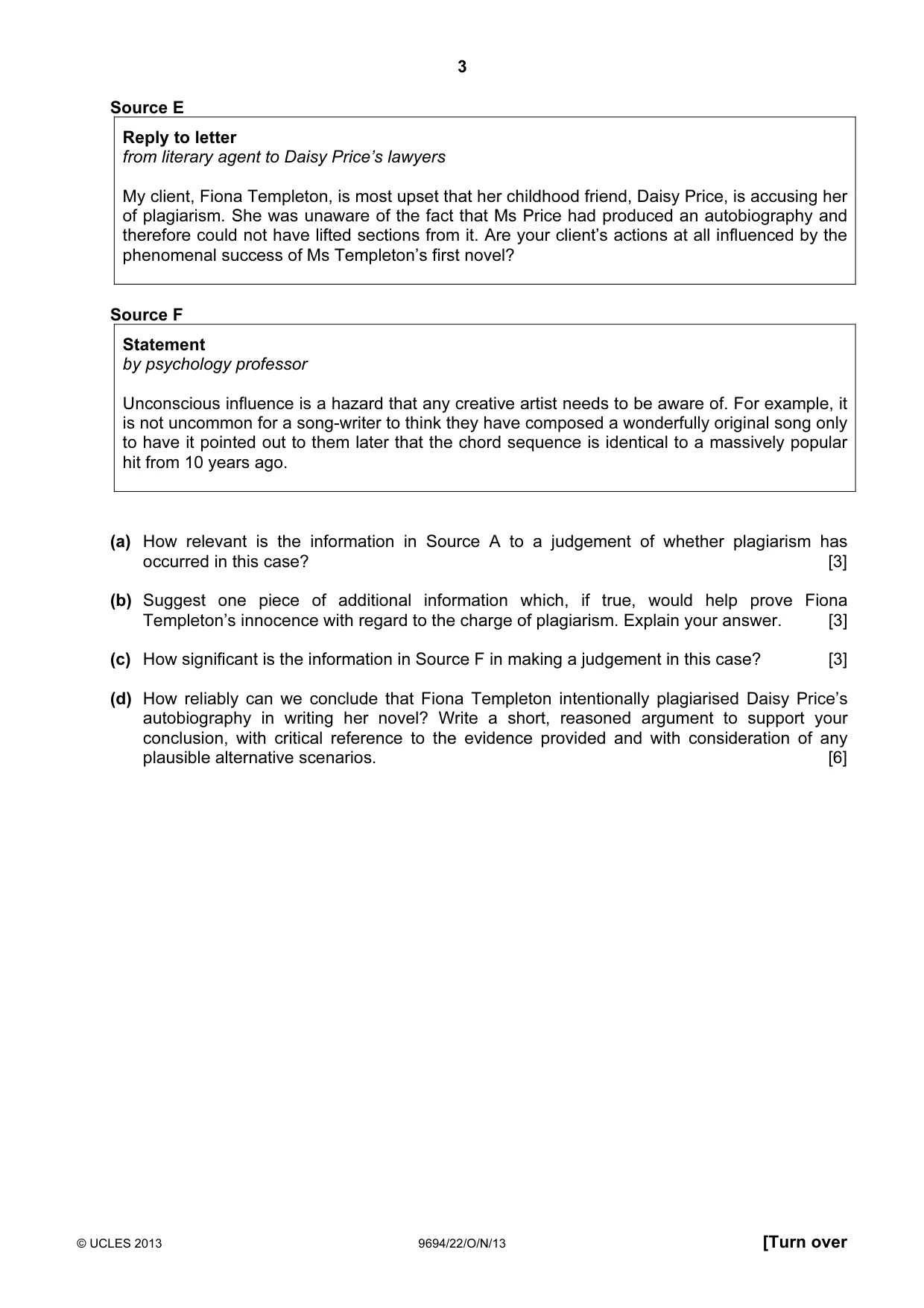
3 © UCLES 2013 9694/22/O/N/13 [Turn over Source E Reply to letter from literary agent to Daisy Price’s lawyers My client, Fiona Templeton, is most upset that her childhood friend, Daisy Price, is accusing her of plagiarism. She was unaware of the fact that Ms Price had produced an autobiography and therefore could not have lifted sections from it. Are your client’s actions at all influenced by the phenomenal success of Ms Templeton’s first novel? Source F Statement by psychology professor Unconscious influence is a hazard that any creative artist needs to be aware of. For example, it is not uncommon for a song-writer to think they have composed a wonderfully original song only to have it pointed out to them later that the chord sequence is identical to a massively popular hit from 10 years ago. (a) How relevant is the information in Source A to a judgement of whether plagiarism has occurred in this case? [3] (b) Suggest one piece of additional information which, if true, would help prove Fiona Templeton’s innocence with regard to the charge of plagiarism. Explain your answer. [3] (c) How significant is the information in Source F in making a judgement in this case? [3] (d) How reliably can we conclude that Fiona Templeton intentionally plagiarised Daisy Price’s autobiography in writing her novel? Write a short, reasoned argument to support your conclusion, with critical reference to the evidence provided and with consideration of any plausible alternative scenarios. [6]
Question paper, page 4
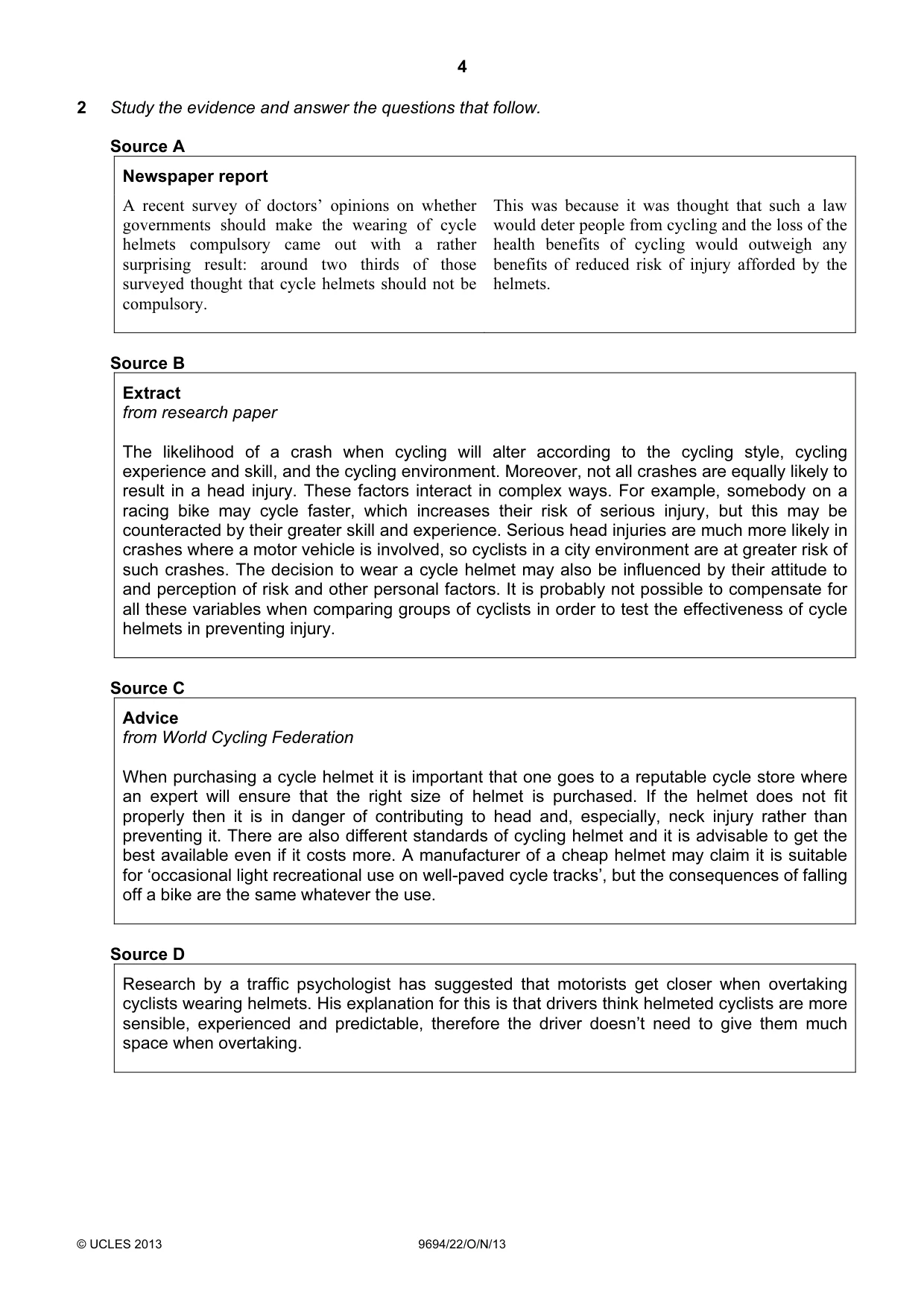
4 © UCLES 2013 9694/22/O/N/13 2 Study the evidence and answer the questions that follow. Source A Newspaper report A recent survey of doctors’ opinions on whether governments should make the wearing of cycle helmets compulsory came out with a rather surprising result: around two thirds of those surveyed thought that cycle helmets should not be compulsory. This was because it was thought that such a law would deter people from cycling and the loss of the health benefits of cycling would outweigh any benefits of reduced risk of injury afforded by the helmets. Source B Extract from research paper The likelihood of a crash when cycling will alter according to the cycling style, cycling experience and skill, and the cycling environment. Moreover, not all crashes are equally likely to result in a head injury. These factors interact in complex ways. For example, somebody on a racing bike may cycle faster, which increases their risk of serious injury, but this may be counteracted by their greater skill and experience. Serious head injuries are much more likely in crashes where a motor vehicle is involved, so cyclists in a city environment are at greater risk of such crashes. The decision to wear a cycle helmet may also be influenced by their attitude to and perception of risk and other personal factors. It is probably not possible to compensate for all these variables when comparing groups of cyclists in order to test the effectiveness of cycle helmets in preventing injury. Source C Advice from World Cycling Federation When purchasing a cycle helmet it is important that one goes to a reputable cycle store where an expert will ensure that the right size of helmet is purchased. If the helmet does not fit properly then it is in danger of contributing to head and, especially, neck injury rather than preventing it. There are also different standards of cycling helmet and it is advisable to get the best available even if it costs more. A manufacturer of a cheap helmet may claim it is suitable for ‘occasional light recreational use on well-paved cycle tracks’, but the consequences of falling off a bike are the same whatever the use. Source D Research by a traffic psychologist has suggested that motorists get closer when overtaking cyclists wearing helmets. His explanation for this is that drivers think helmeted cyclists are more sensible, experienced and predictable, therefore the driver doesn’t need to give them much space when overtaking.
Question paper, page 5
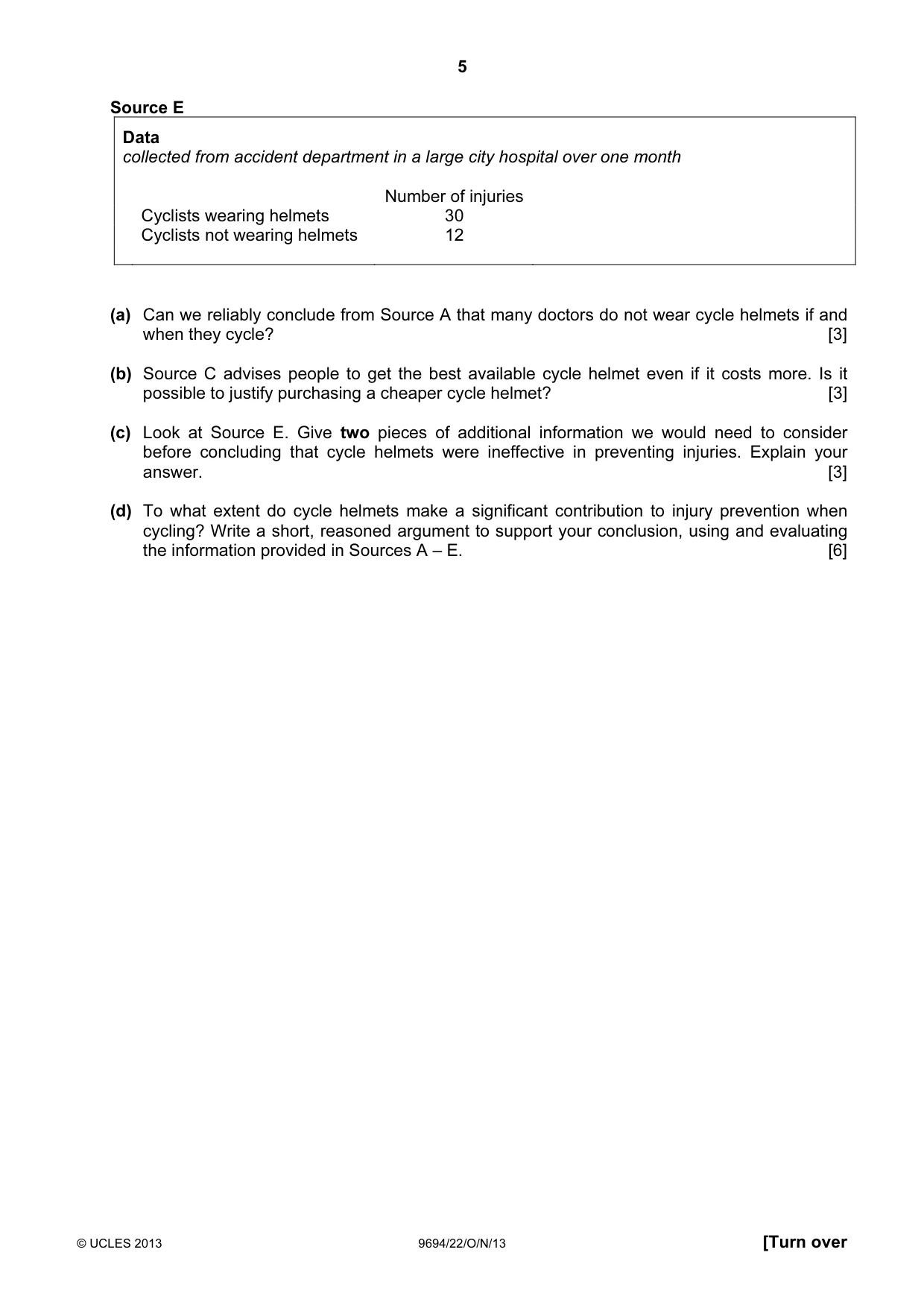
5 © UCLES 2013 9694/22/O/N/13 [Turn over Source E Data collected from accident department in a large city hospital over one month Number of injuries Cyclists wearing helmets 30 Cyclists not wearing helmets 12 (a) Can we reliably conclude from Source A that many doctors do not wear cycle helmets if and when they cycle? [3] (b) Source C advises people to get the best available cycle helmet even if it costs more. Is it possible to justify purchasing a cheaper cycle helmet? [3] (c) Look at Source E. Give two pieces of additional information we would need to consider before concluding that cycle helmets were ineffective in preventing injuries. Explain your answer. [3] (d) To what extent do cycle helmets make a significant contribution to injury prevention when cycling? Write a short, reasoned argument to support your conclusion, using and evaluating the information provided in Sources A – E. [6]
Question paper, page 6
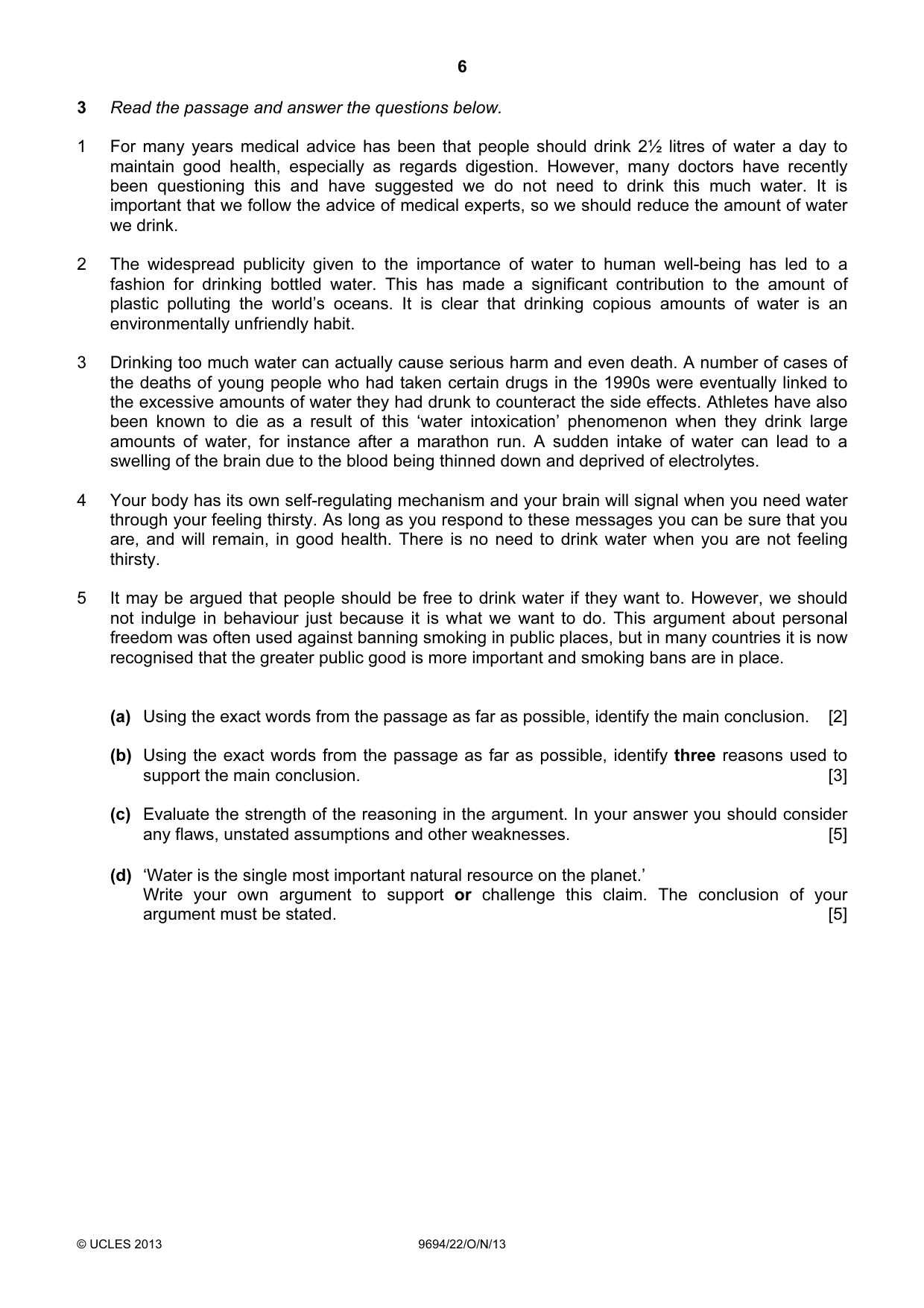
6 © UCLES 2013 9694/22/O/N/13 3 Read the passage and answer the questions below. 1 For many years medical advice has been that people should drink 2½ litres of water a day to maintain good health, especially as regards digestion. However, many doctors have recently been questioning this and have suggested we do not need to drink this much water. It is important that we follow the advice of medical experts, so we should reduce the amount of water we drink. 2 The widespread publicity given to the importance of water to human well-being has led to a fashion for drinking bottled water. This has made a significant contribution to the amount of plastic polluting the world’s oceans. It is clear that drinking copious amounts of water is an environmentally unfriendly habit. 3 Drinking too much water can actually cause serious harm and even death. A number of cases of the deaths of young people who had taken certain drugs in the 1990s were eventually linked to the excessive amounts of water they had drunk to counteract the side effects. Athletes have also been known to die as a result of this ‘water intoxication’ phenomenon when they drink large amounts of water, for instance after a marathon run. A sudden intake of water can lead to a swelling of the brain due to the blood being thinned down and deprived of electrolytes. 4 Your body has its own self-regulating mechanism and your brain will signal when you need water through your feeling thirsty. As long as you respond to these messages you can be sure that you are, and will remain, in good health. There is no need to drink water when you are not feeling thirsty. 5 It may be argued that people should be free to drink water if they want to. However, we should not indulge in behaviour just because it is what we want to do. This argument about personal freedom was often used against banning smoking in public places, but in many countries it is now recognised that the greater public good is more important and smoking bans are in place. (a) Using the exact words from the passage as far as possible, identify the main conclusion. [2] (b) Using the exact words from the passage as far as possible, identify three reasons used to support the main conclusion. [3] (c) Evaluate the strength of the reasoning in the argument. In your answer you should consider any flaws, unstated assumptions and other weaknesses. [5] (d) ‘Water is the single most important natural resource on the planet.’ Write your own argument to support or challenge this claim. The conclusion of your argument must be stated. [5]
Question paper, page 7
7 © UCLES 2013 9694/22/O/N/13 BLANK PAGE
Question paper, page 8
8 Permission to reproduce items where third-party owned material protected by copyright is included has been sought and cleared where possible. Every reasonable effort has been made by the publisher (UCLES) to trace copyright holders, but if any items requiring clearance have unwittingly been included, the publisher will be pleased to make amends at the earliest possible opportunity. University of Cambridge International Examinations is part of the Cambridge Assessment Group. Cambridge Assessment is the brand name of University of Cambridge Local Examinations Syndicate (UCLES), which is itself a department of the University of Cambridge. © UCLES 2013 9694/22/O/N/13 BLANK PAGE
Mark scheme, page 1
CAMBRIDGE INTERNATIONAL EXAMINATIONS GCE Advanced Subsidiary Level and GCE Advanced Level MARK SCHEME for the October/November 2013 series 9694 THINKING SKILLS 9694/22 Paper 2 (Critical Thinking), maximum raw mark 45 This mark scheme is published as an aid to teachers and candidates, to indicate the requirements of the examination. It shows the basis on which Examiners were instructed to award marks. It does not indicate the details of the discussions that took place at an Examiners’ meeting before marking began, which would have considered the acceptability of alternative answers. Mark schemes should be read in conjunction with the question paper and the Principal Examiner Report for Teachers. Cambridge will not enter into discussions about these mark schemes. Cambridge is publishing the mark schemes for the October/November 2013 series for most IGCSE, GCE Advanced Level and Advanced Subsidiary Level components and some Ordinary Level components.
Mark scheme, page 2
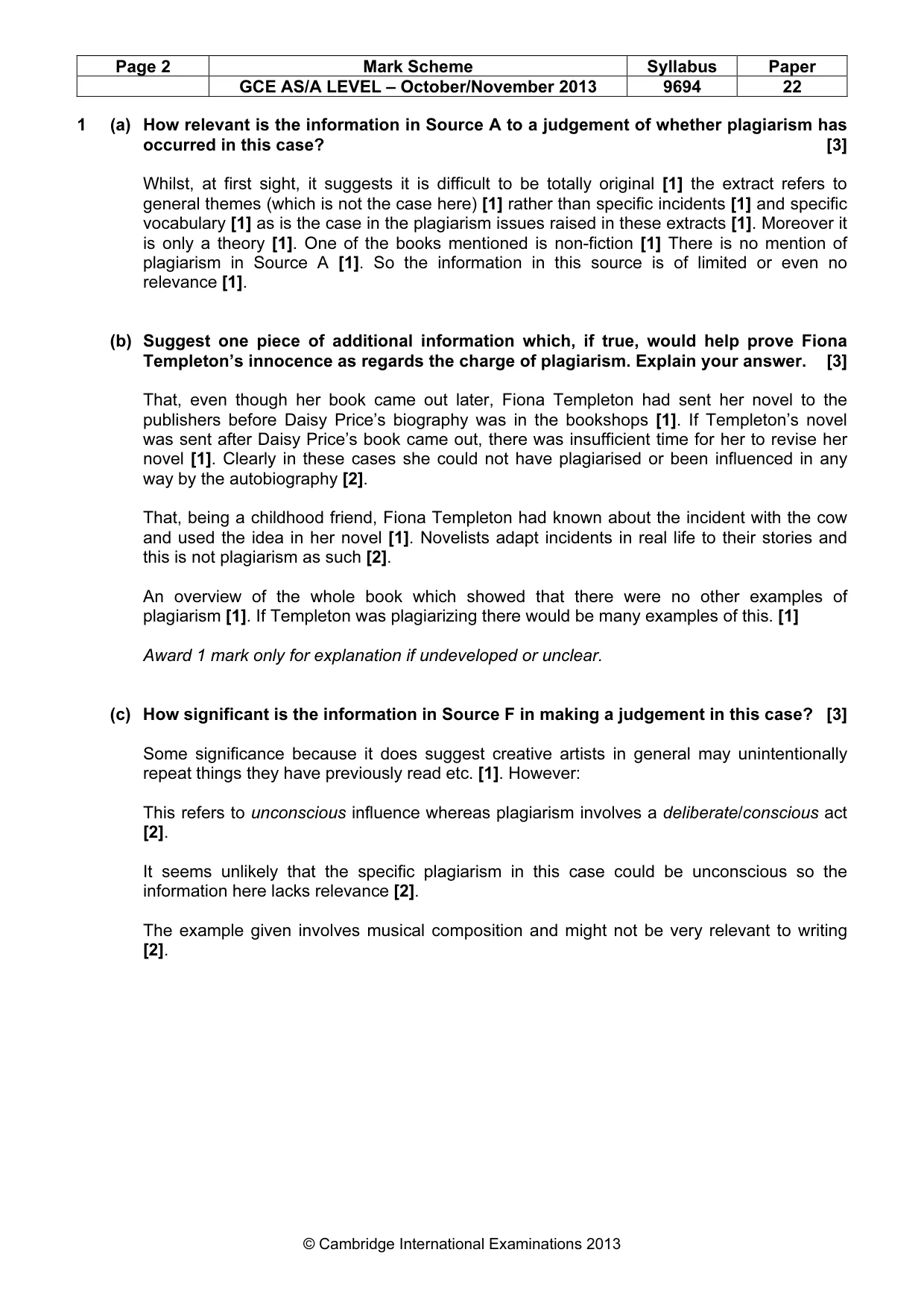
Page 2 Mark Scheme Syllabus Paper GCE AS/A LEVEL – October/November 2013 9694 22 © Cambridge International Examinations 2013 1 (a) How relevant is the information in Source A to a judgement of whether plagiarism has occurred in this case? [3] Whilst, at first sight, it suggests it is difficult to be totally original [1] the extract refers to general themes (which is not the case here) [1] rather than specific incidents [1] and specific vocabulary [1] as is the case in the plagiarism issues raised in these extracts [1]. Moreover it is only a theory [1]. One of the books mentioned is non-fiction [1] There is no mention of plagiarism in Source A [1]. So the information in this source is of limited or even no relevance [1]. (b) Suggest one piece of additional information which, if true, would help prove Fiona Templeton’s innocence as regards the charge of plagiarism. Explain your answer. [3] That, even though her book came out later, Fiona Templeton had sent her novel to the publishers before Daisy Price’s biography was in the bookshops [1]. If Templeton’s novel was sent after Daisy Price’s book came out, there was insufficient time for her to revise her novel [1]. Clearly in these cases she could not have plagiarised or been influenced in any way by the autobiography [2]. That, being a childhood friend, Fiona Templeton had known about the incident with the cow and used the idea in her novel [1]. Novelists adapt incidents in real life to their stories and this is not plagiarism as such [2]. An overview of the whole book which showed that there were no other examples of plagiarism [1]. If Templeton was plagiarizing there would be many examples of this. [1] Award 1 mark only for explanation if undeveloped or unclear. (c) How significant is the information in Source F in making a judgement in this case? [3] Some significance because it does suggest creative artists in general may unintentionally repeat things they have previously read etc. [1]. However: This refers to unconscious influence whereas plagiarism involves a deliberate/conscious act [2]. It seems unlikely that the specific plagiarism in this case could be unconscious so the information here lacks relevance [2]. The example given involves musical composition and might not be very relevant to writing [2].
Mark scheme, page 3
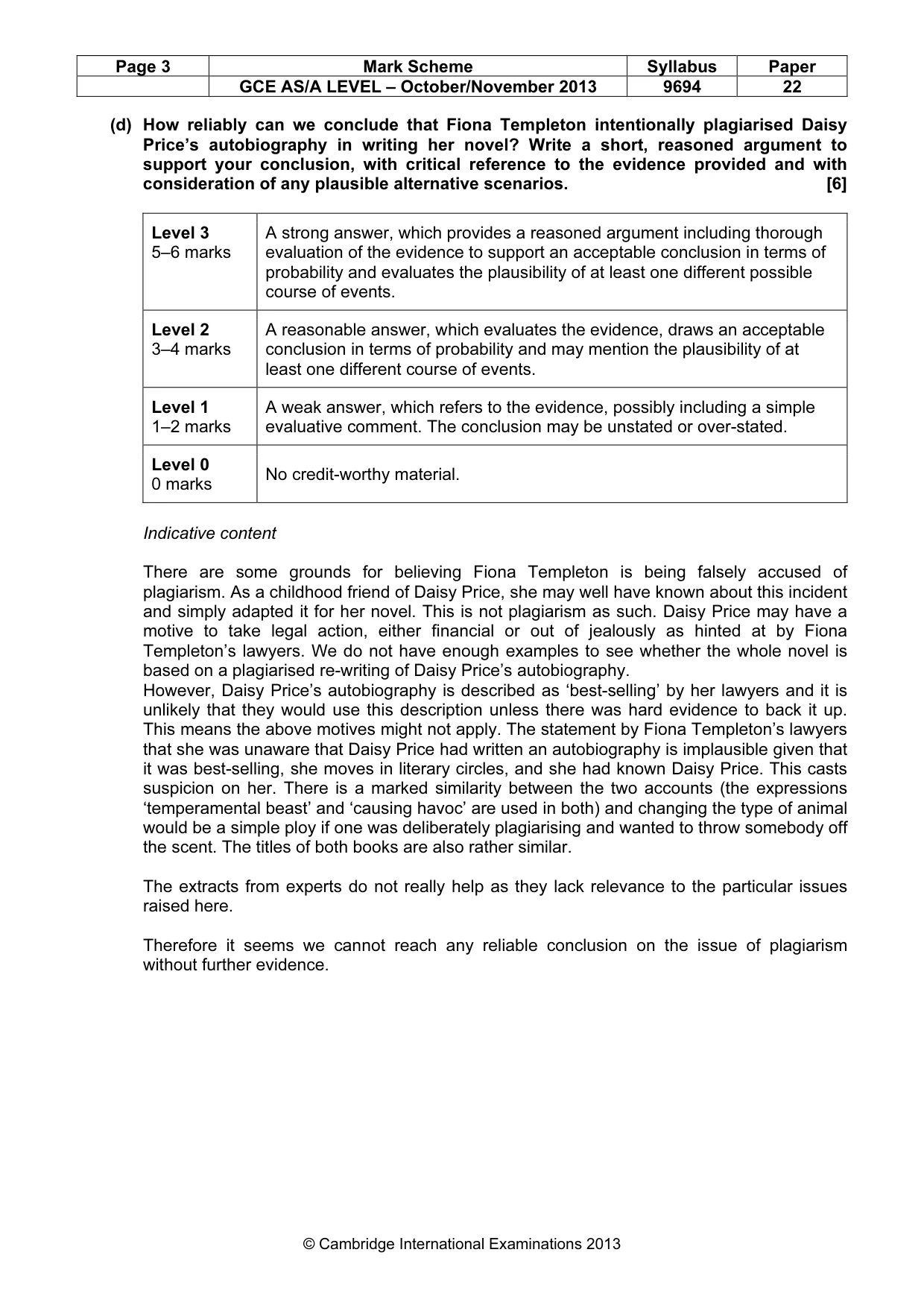
Page 3 Mark Scheme Syllabus Paper GCE AS/A LEVEL – October/November 2013 9694 22 © Cambridge International Examinations 2013 (d) How reliably can we conclude that Fiona Templeton intentionally plagiarised Daisy Price’s autobiography in writing her novel? Write a short, reasoned argument to support your conclusion, with critical reference to the evidence provided and with consideration of any plausible alternative scenarios. [6] Level 3 5–6 marks A strong answer, which provides a reasoned argument including thorough evaluation of the evidence to support an acceptable conclusion in terms of probability and evaluates the plausibility of at least one different possible course of events. Level 2 3–4 marks A reasonable answer, which evaluates the evidence, draws an acceptable conclusion in terms of probability and may mention the plausibility of at least one different course of events. Level 1 1–2 marks A weak answer, which refers to the evidence, possibly including a simple evaluative comment. The conclusion may be unstated or over-stated. Level 0 0 marks No credit-worthy material. Indicative content There are some grounds for believing Fiona Templeton is being falsely accused of plagiarism. As a childhood friend of Daisy Price, she may well have known about this incident and simply adapted it for her novel. This is not plagiarism as such. Daisy Price may have a motive to take legal action, either financial or out of jealously as hinted at by Fiona Templeton’s lawyers. We do not have enough examples to see whether the whole novel is based on a plagiarised re-writing of Daisy Price’s autobiography. However, Daisy Price’s autobiography is described as ‘best-selling’ by her lawyers and it is unlikely that they would use this description unless there was hard evidence to back it up. This means the above motives might not apply. The statement by Fiona Templeton’s lawyers that she was unaware that Daisy Price had written an autobiography is implausible given that it was best-selling, she moves in literary circles, and she had known Daisy Price. This casts suspicion on her. There is a marked similarity between the two accounts (the expressions ‘temperamental beast’ and ‘causing havoc’ are used in both) and changing the type of animal would be a simple ploy if one was deliberately plagiarising and wanted to throw somebody off the scent. The titles of both books are also rather similar. The extracts from experts do not really help as they lack relevance to the particular issues raised here. Therefore it seems we cannot reach any reliable conclusion on the issue of plagiarism without further evidence.
Mark scheme, page 4
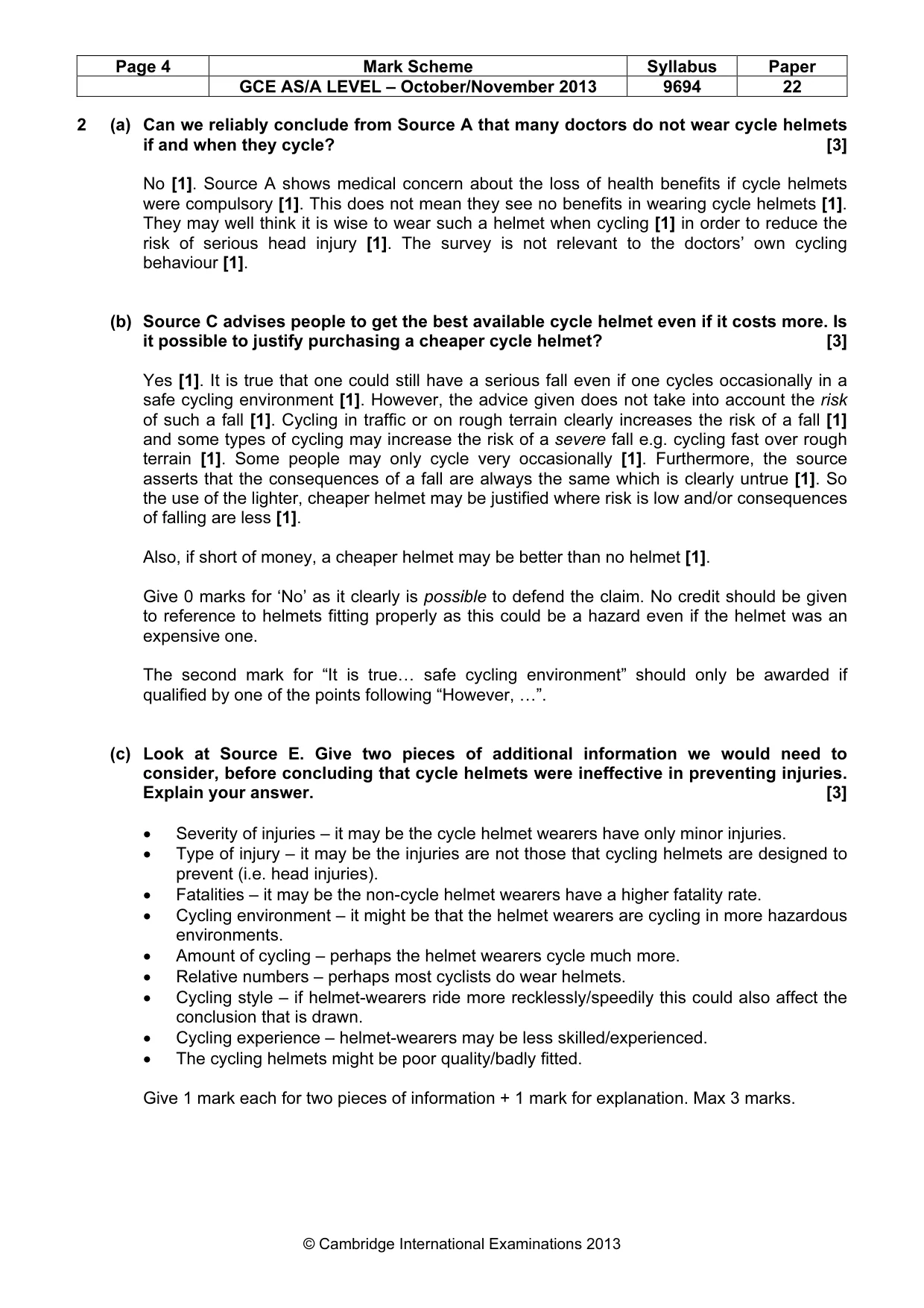
Page 4 Mark Scheme Syllabus Paper GCE AS/A LEVEL – October/November 2013 9694 22 © Cambridge International Examinations 2013 2 (a) Can we reliably conclude from Source A that many doctors do not wear cycle helmets if and when they cycle? [3] No [1]. Source A shows medical concern about the loss of health benefits if cycle helmets were compulsory [1]. This does not mean they see no benefits in wearing cycle helmets [1]. They may well think it is wise to wear such a helmet when cycling [1] in order to reduce the risk of serious head injury [1]. The survey is not relevant to the doctors’ own cycling behaviour [1]. (b) Source C advises people to get the best available cycle helmet even if it costs more. Is it possible to justify purchasing a cheaper cycle helmet? [3] Yes [1]. It is true that one could still have a serious fall even if one cycles occasionally in a safe cycling environment [1]. However, the advice given does not take into account the risk of such a fall [1]. Cycling in traffic or on rough terrain clearly increases the risk of a fall [1] and some types of cycling may increase the risk of a severe fall e.g. cycling fast over rough terrain [1]. Some people may only cycle very occasionally [1]. Furthermore, the source asserts that the consequences of a fall are always the same which is clearly untrue [1]. So the use of the lighter, cheaper helmet may be justified where risk is low and/or consequences of falling are less [1]. Also, if short of money, a cheaper helmet may be better than no helmet [1]. Give 0 marks for ‘No’ as it clearly is possible to defend the claim. No credit should be given to reference to helmets fitting properly as this could be a hazard even if the helmet was an expensive one. The second mark for “It is true… safe cycling environment” should only be awarded if qualified by one of the points following “However, …”. (c) Look at Source E. Give two pieces of additional information we would need to consider, before concluding that cycle helmets were ineffective in preventing injuries. Explain your answer. [3] • Severity of injuries – it may be the cycle helmet wearers have only minor injuries. • Type of injury – it may be the injuries are not those that cycling helmets are designed to prevent (i.e. head injuries). • Fatalities – it may be the non-cycle helmet wearers have a higher fatality rate. • Cycling environment – it might be that the helmet wearers are cycling in more hazardous environments. • Amount of cycling – perhaps the helmet wearers cycle much more. • Relative numbers – perhaps most cyclists do wear helmets. • Cycling style – if helmet-wearers ride more recklessly/speedily this could also affect the conclusion that is drawn. • Cycling experience – helmet-wearers may be less skilled/experienced. • The cycling helmets might be poor quality/badly fitted. Give 1 mark each for two pieces of information + 1 mark for explanation. Max 3 marks.
Mark scheme, page 5
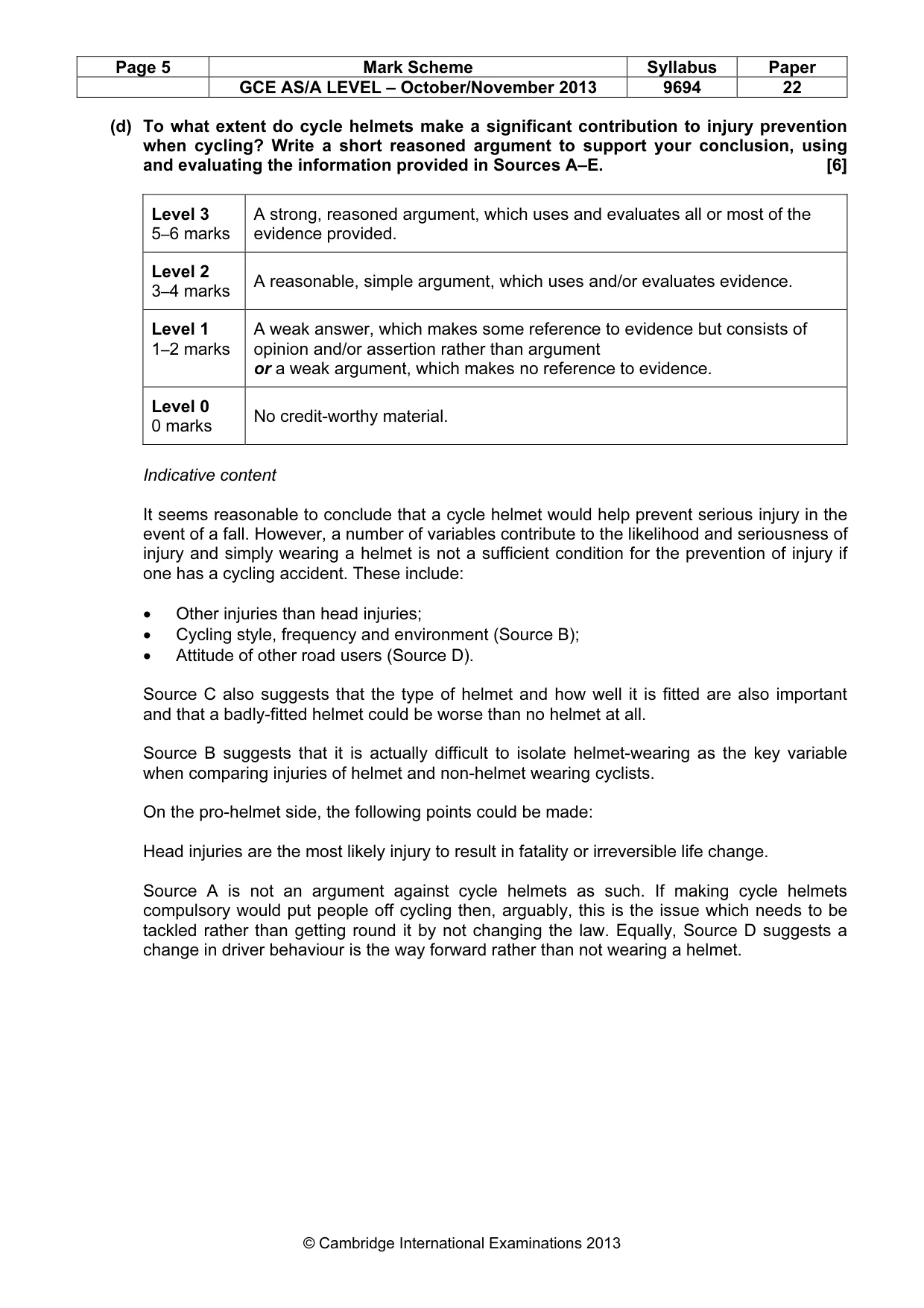
Page 5 Mark Scheme Syllabus Paper GCE AS/A LEVEL – October/November 2013 9694 22 © Cambridge International Examinations 2013 (d) To what extent do cycle helmets make a significant contribution to injury prevention when cycling? Write a short reasoned argument to support your conclusion, using and evaluating the information provided in Sources A–E. [6] Level 3 5–6 marks A strong, reasoned argument, which uses and evaluates all or most of the evidence provided. Level 2 3–4 marks A reasonable, simple argument, which uses and/or evaluates evidence. Level 1 1–2 marks A weak answer, which makes some reference to evidence but consists of opinion and/or assertion rather than argument or a weak argument, which makes no reference to evidence. Level 0 0 marks No credit-worthy material. Indicative content It seems reasonable to conclude that a cycle helmet would help prevent serious injury in the event of a fall. However, a number of variables contribute to the likelihood and seriousness of injury and simply wearing a helmet is not a sufficient condition for the prevention of injury if one has a cycling accident. These include: • Other injuries than head injuries; • Cycling style, frequency and environment (Source B); • Attitude of other road users (Source D). Source C also suggests that the type of helmet and how well it is fitted are also important and that a badly-fitted helmet could be worse than no helmet at all. Source B suggests that it is actually difficult to isolate helmet-wearing as the key variable when comparing injuries of helmet and non-helmet wearing cyclists. On the pro-helmet side, the following points could be made: Head injuries are the most likely injury to result in fatality or irreversible life change. Source A is not an argument against cycle helmets as such. If making cycle helmets compulsory would put people off cycling then, arguably, this is the issue which needs to be tackled rather than getting round it by not changing the law. Equally, Source D suggests a change in driver behaviour is the way forward rather than not wearing a helmet.
Mark scheme, page 6
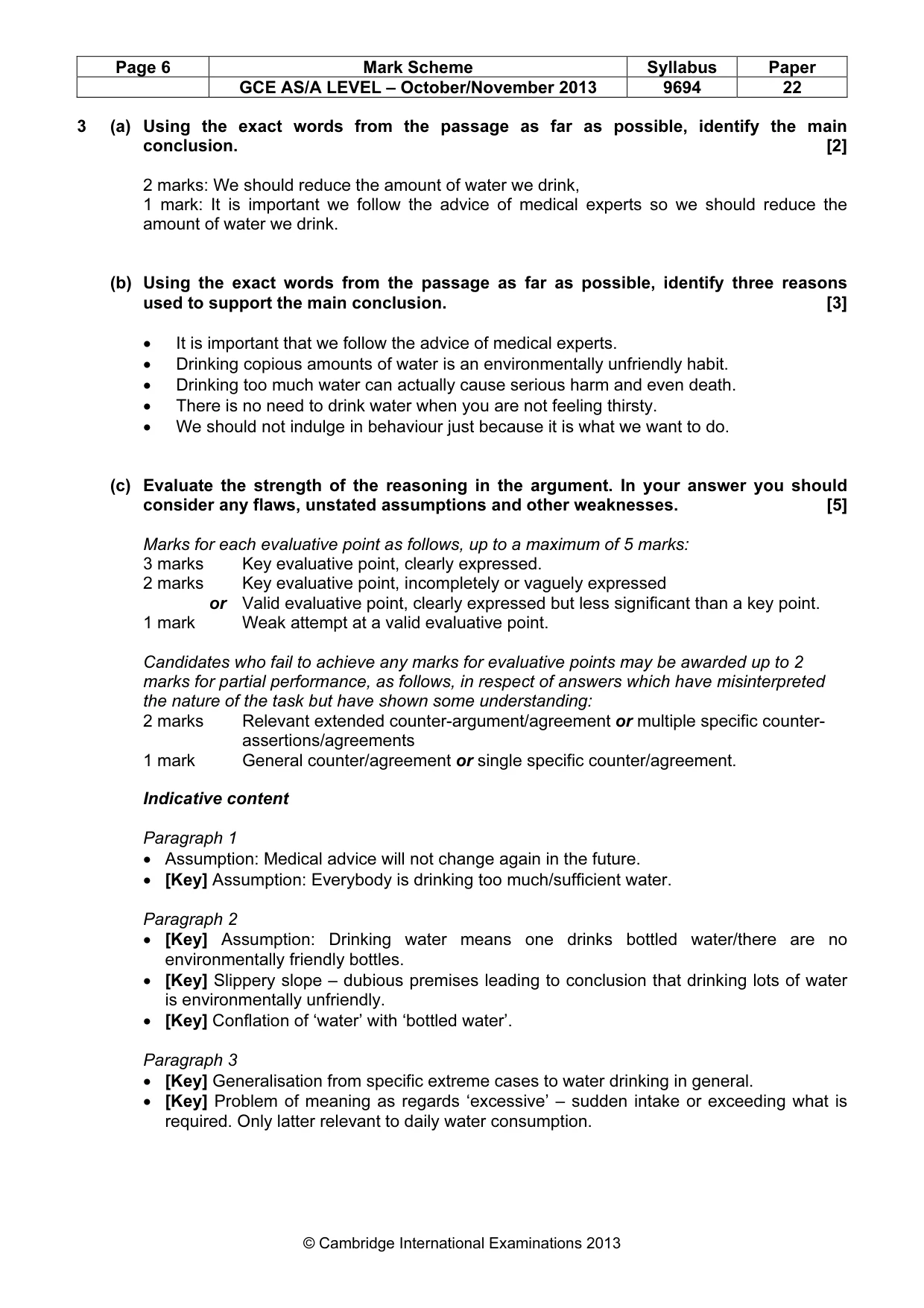
Page 6 Mark Scheme Syllabus Paper GCE AS/A LEVEL – October/November 2013 9694 22 © Cambridge International Examinations 2013 3 (a) Using the exact words from the passage as far as possible, identify the main conclusion. [2] 2 marks: We should reduce the amount of water we drink, 1 mark: It is important we follow the advice of medical experts so we should reduce the amount of water we drink. (b) Using the exact words from the passage as far as possible, identify three reasons used to support the main conclusion. [3] • It is important that we follow the advice of medical experts. • Drinking copious amounts of water is an environmentally unfriendly habit. • Drinking too much water can actually cause serious harm and even death. • There is no need to drink water when you are not feeling thirsty. • We should not indulge in behaviour just because it is what we want to do. (c) Evaluate the strength of the reasoning in the argument. In your answer you should consider any flaws, unstated assumptions and other weaknesses. [5] Marks for each evaluative point as follows, up to a maximum of 5 marks: 3 marks Key evaluative point, clearly expressed. 2 marks Key evaluative point, incompletely or vaguely expressed or Valid evaluative point, clearly expressed but less significant than a key point. 1 mark Weak attempt at a valid evaluative point. Candidates who fail to achieve any marks for evaluative points may be awarded up to 2 marks for partial performance, as follows, in respect of answers which have misinterpreted the nature of the task but have shown some understanding: 2 marks Relevant extended counter-argument/agreement or multiple specific counter- assertions/agreements 1 mark General counter/agreement or single specific counter/agreement. Indicative content Paragraph 1 • Assumption: Medical advice will not change again in the future. • [Key] Assumption: Everybody is drinking too much/sufficient water. Paragraph 2 • [Key] Assumption: Drinking water means one drinks bottled water/there are no environmentally friendly bottles. • [Key] Slippery slope – dubious premises leading to conclusion that drinking lots of water is environmentally unfriendly. • [Key] Conflation of ‘water’ with ‘bottled water’. Paragraph 3 • [Key] Generalisation from specific extreme cases to water drinking in general. • [Key] Problem of meaning as regards ‘excessive’ – sudden intake or exceeding what is required. Only latter relevant to daily water consumption.
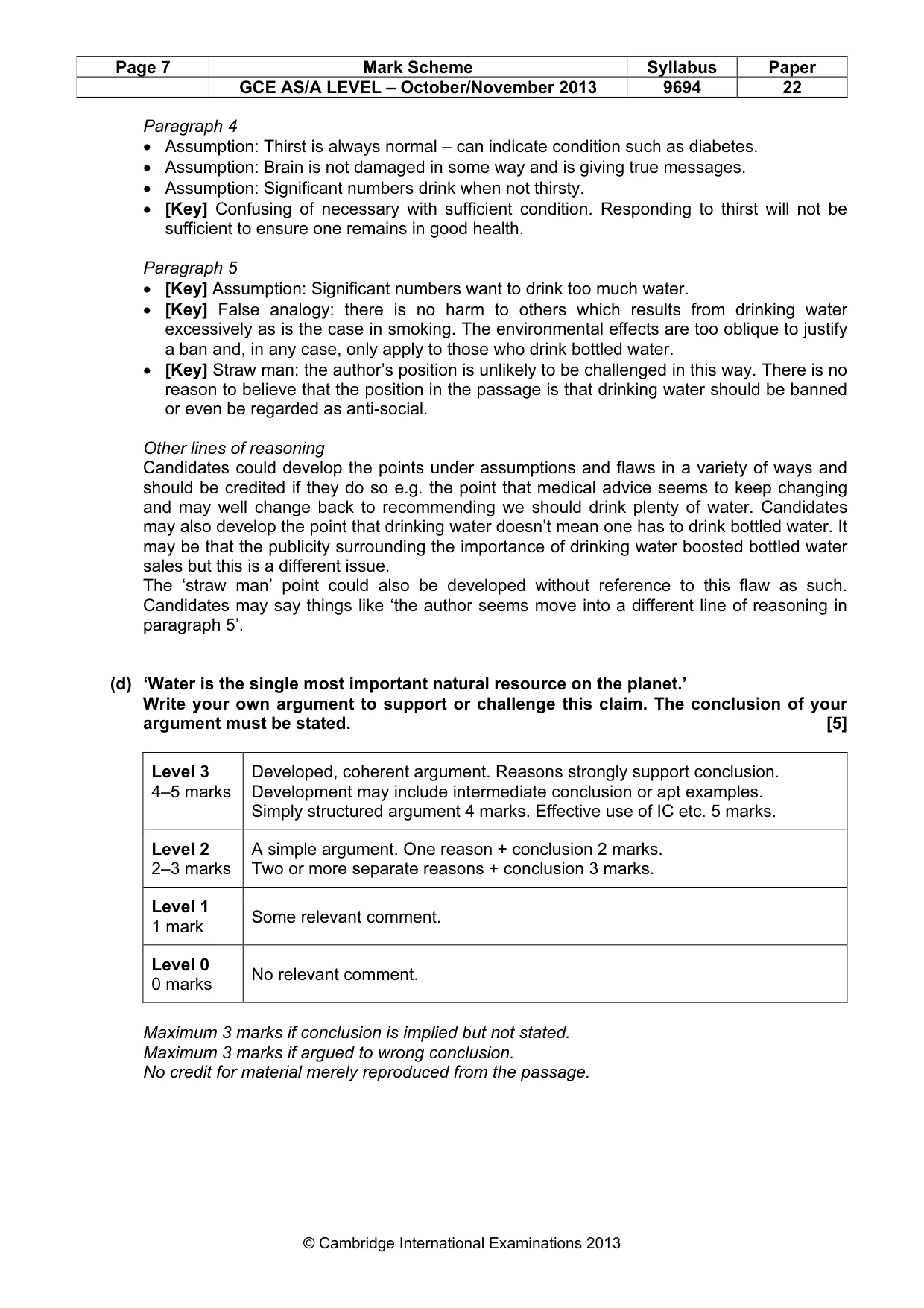
Mark scheme, page 7
Page 7 Mark Scheme Syllabus Paper GCE AS/A LEVEL – October/November 2013 9694 22 © Cambridge International Examinations 2013 Paragraph 4 • Assumption: Thirst is always normal – can indicate condition such as diabetes. • Assumption: Brain is not damaged in some way and is giving true messages. • Assumption: Significant numbers drink when not thirsty. • [Key] Confusing of necessary with sufficient condition. Responding to thirst will not be sufficient to ensure one remains in good health. Paragraph 5 • [Key] Assumption: Significant numbers want to drink too much water. • [Key] False analogy: there is no harm to others which results from drinking water excessively as is the case in smoking. The environmental effects are too oblique to justify a ban and, in any case, only apply to those who drink bottled water. • [Key] Straw man: the author’s position is unlikely to be challenged in this way. There is no reason to believe that the position in the passage is that drinking water should be banned or even be regarded as anti-social. Other lines of reasoning Candidates could develop the points under assumptions and flaws in a variety of ways and should be credited if they do so e.g. the point that medical advice seems to keep changing and may well change back to recommending we should drink plenty of water. Candidates may also develop the point that drinking water doesn’t mean one has to drink bottled water. It may be that the publicity surrounding the importance of drinking water boosted bottled water sales but this is a different issue. The ‘straw man’ point could also be developed without reference to this flaw as such. Candidates may say things like ‘the author seems move into a different line of reasoning in paragraph 5’. (d) ‘Water is the single most important natural resource on the planet.’ Write your own argument to support or challenge this claim. The conclusion of your argument must be stated. [5] Level 3 4–5 marks Developed, coherent argument. Reasons strongly support conclusion. Development may include intermediate conclusion or apt examples. Simply structured argument 4 marks. Effective use of IC etc. 5 marks. Level 2 2–3 marks A simple argument. One reason + conclusion 2 marks. Two or more separate reasons + conclusion 3 marks. Level 1 1 mark Some relevant comment. Level 0 0 marks No relevant comment. Maximum 3 marks if conclusion is implied but not stated. Maximum 3 marks if argued to wrong conclusion. No credit for material merely reproduced from the passage.
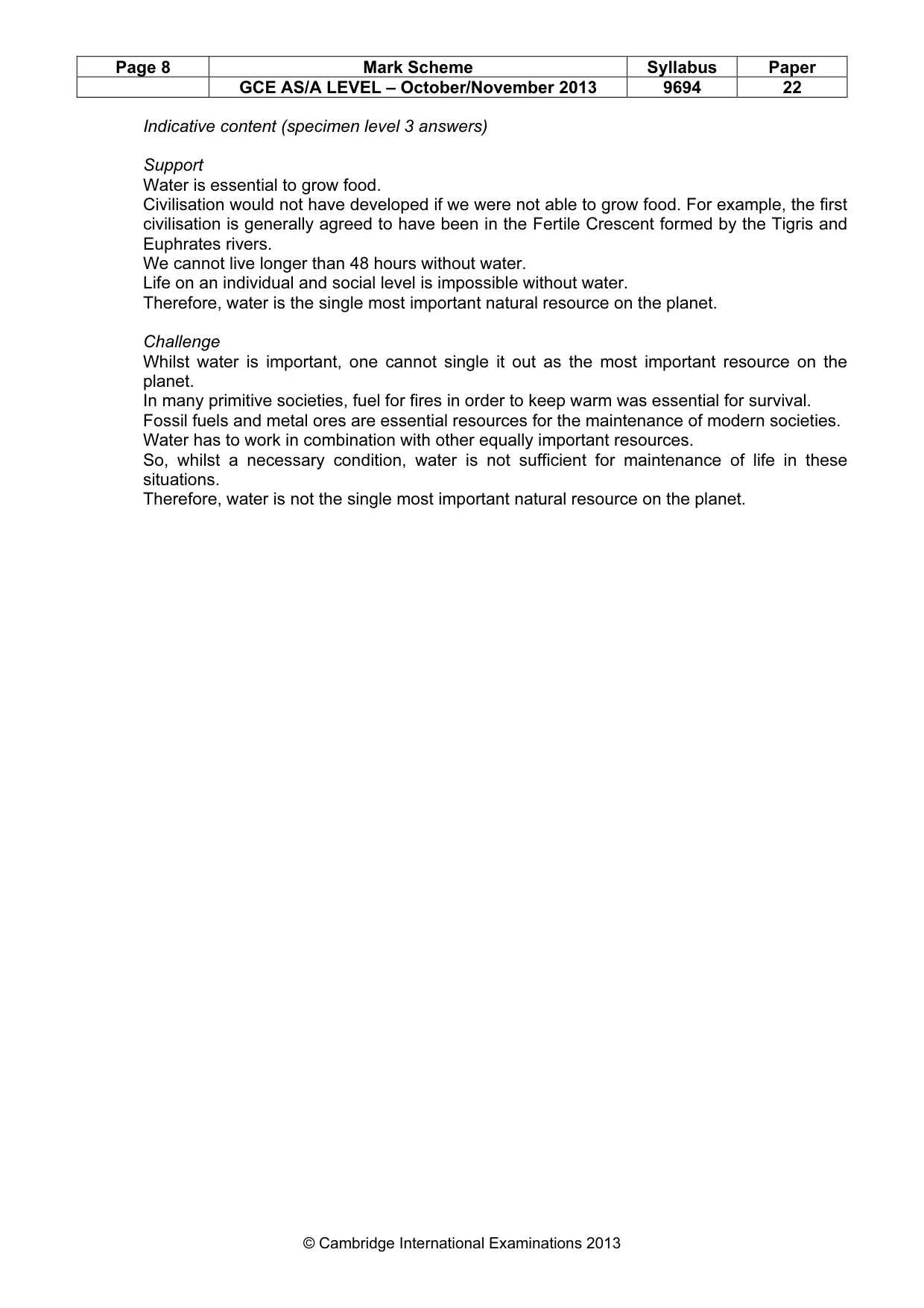
Mark scheme, page 8
Page 8 Mark Scheme Syllabus Paper GCE AS/A LEVEL – October/November 2013 9694 22 © Cambridge International Examinations 2013 Indicative content (specimen level 3 answers) Support Water is essential to grow food. Civilisation would not have developed if we were not able to grow food. For example, the first civilisation is generally agreed to have been in the Fertile Crescent formed by the Tigris and Euphrates rivers. We cannot live longer than 48 hours without water. Life on an individual and social level is impossible without water. Therefore, water is the single most important natural resource on the planet. Challenge Whilst water is important, one cannot single it out as the most important resource on the planet. In many primitive societies, fuel for fires in order to keep warm was essential for survival. Fossil fuels and metal ores are essential resources for the maintenance of modern societies. Water has to work in combination with other equally important resources. So, whilst a necessary condition, water is not sufficient for maintenance of life in these situations. Therefore, water is not the single most important natural resource on the planet.
What you needed in this session
Cambridge’s own grade thresholds for 2013 Oct/Nov, Paper 2 · Variant 2. A higher threshold means an easier paper — the bar moves with how the cohort did.