Cambridge A Level Thinking Skills 9694 — 2013 Oct/Nov Paper 2 · Variant 3
9694/23/O/N/13 · 45 marks · ≈51 min
The question paper and its mark scheme, free to read here and free to download. This is Cambridge’s own paper, exactly as it was sat.
Question paper8 pages
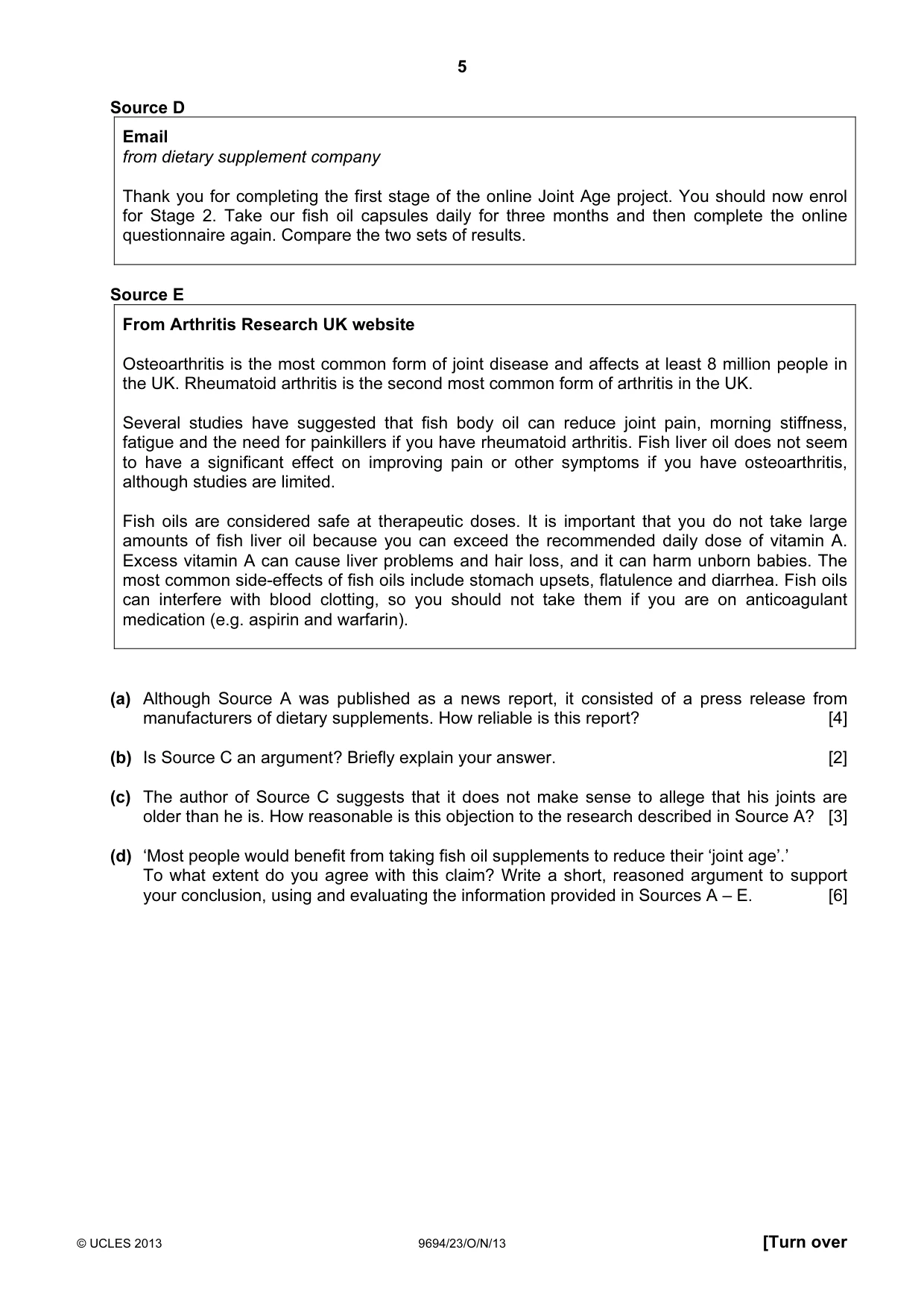
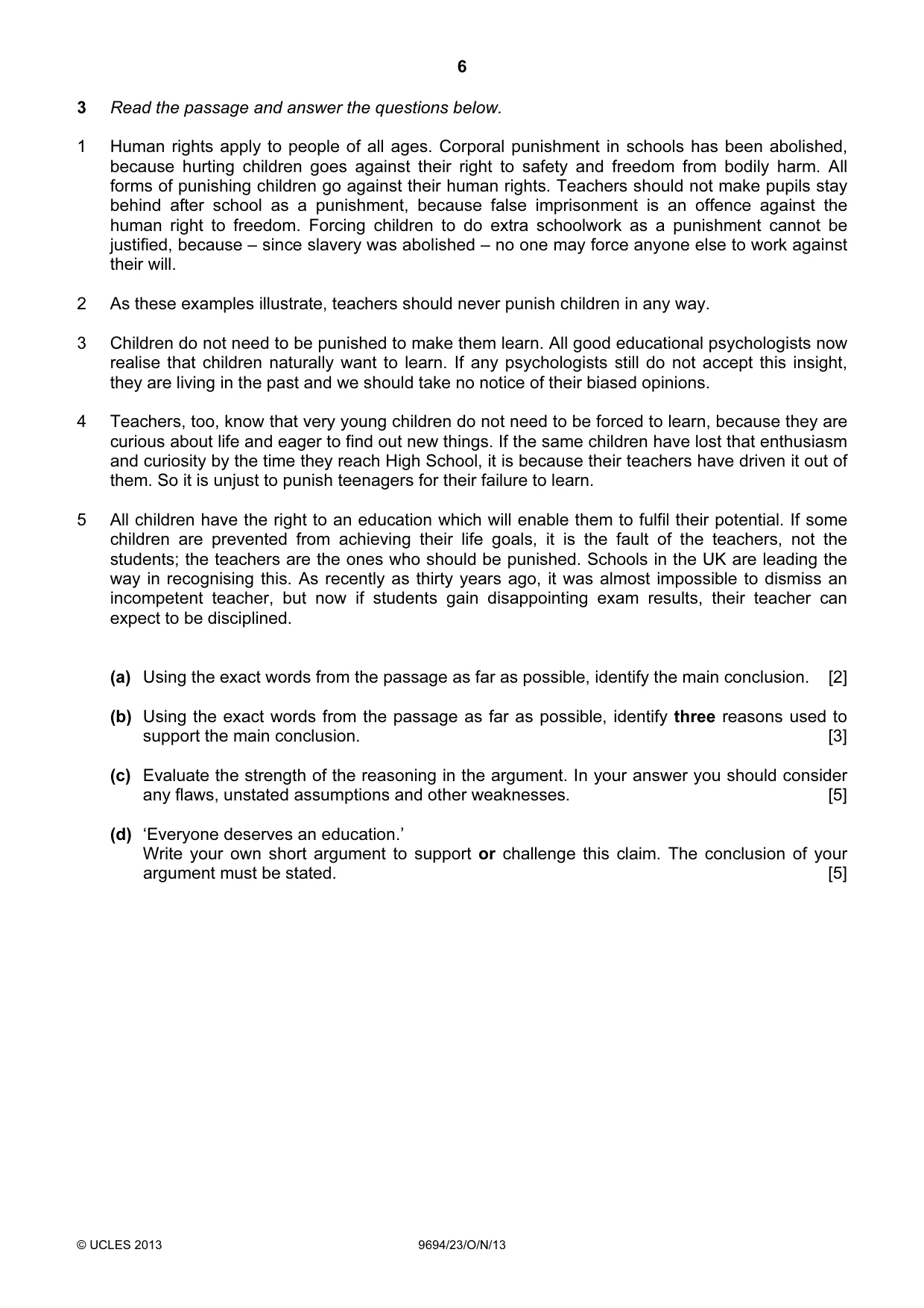


Mark scheme6 pages
Answers below. Sit the paper first if you are practising.
Paper as text
Question paper, page 1
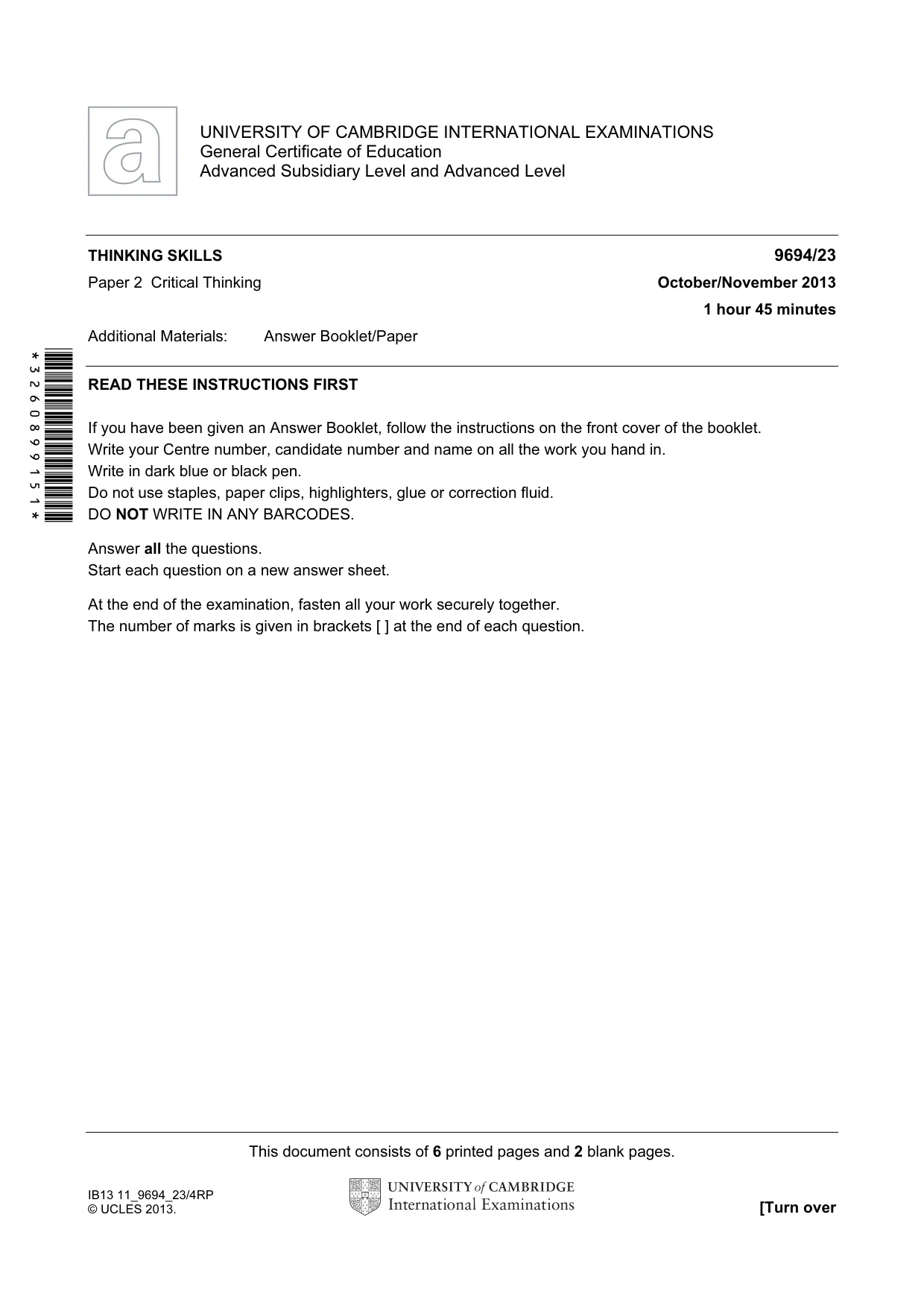
This document consists of 6 printed pages and 2 blank pages. IB13 11_9694_23/4RP © UCLES 2013. [Turn over *3260899151* UNIVERSITY OF CAMBRIDGE INTERNATIONAL EXAMINATIONS General Certificate of Education Advanced Subsidiary Level and Advanced Level THINKING SKILLS 9694/23 Paper 2 Critical Thinking October/November 2013 1 hour 45 minutes Additional Materials: Answer Booklet/Paper READ THESE INSTRUCTIONS FIRST If you have been given an Answer Booklet, follow the instructions on the front cover of the booklet. Write your Centre number, candidate number and name on all the work you hand in. Write in dark blue or black pen. Do not use staples, paper clips, highlighters, glue or correction fluid. DO NOT WRITE IN ANY BARCODES. Answer all the questions. Start each question on a new answer sheet. At the end of the examination, fasten all your work securely together. The number of marks is given in brackets [ ] at the end of each question.
Question paper, page 2
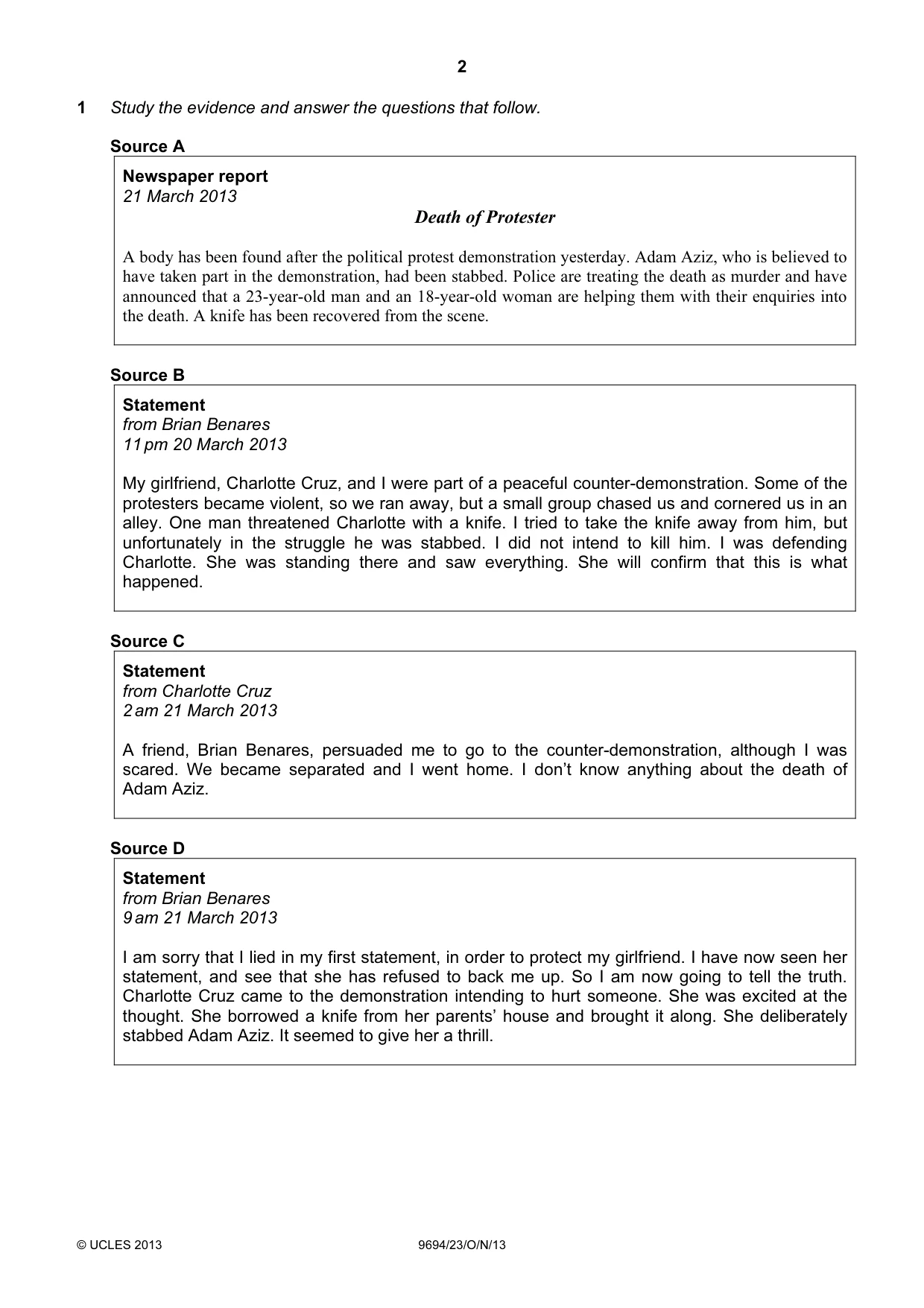
2 © UCLES 2013 9694/23/O/N/13 1 Study the evidence and answer the questions that follow. Source A Newspaper report 21 March 2013 Death of Protester A body has been found after the political protest demonstration yesterday. Adam Aziz, who is believed to have taken part in the demonstration, had been stabbed. Police are treating the death as murder and have announced that a 23-year-old man and an 18-year-old woman are helping them with their enquiries into the death. A knife has been recovered from the scene. Source B Statement from Brian Benares 11 pm 20 March 2013 My girlfriend, Charlotte Cruz, and I were part of a peaceful counter-demonstration. Some of the protesters became violent, so we ran away, but a small group chased us and cornered us in an alley. One man threatened Charlotte with a knife. I tried to take the knife away from him, but unfortunately in the struggle he was stabbed. I did not intend to kill him. I was defending Charlotte. She was standing there and saw everything. She will confirm that this is what happened. Source C Statement from Charlotte Cruz 2 am 21 March 2013 A friend, Brian Benares, persuaded me to go to the counter-demonstration, although I was scared. We became separated and I went home. I don’t know anything about the death of Adam Aziz. Source D Statement from Brian Benares 9 am 21 March 2013 I am sorry that I lied in my first statement, in order to protect my girlfriend. I have now seen her statement, and see that she has refused to back me up. So I am now going to tell the truth. Charlotte Cruz came to the demonstration intending to hurt someone. She was excited at the thought. She borrowed a knife from her parents’ house and brought it along. She deliberately stabbed Adam Aziz. It seemed to give her a thrill.
Question paper, page 3
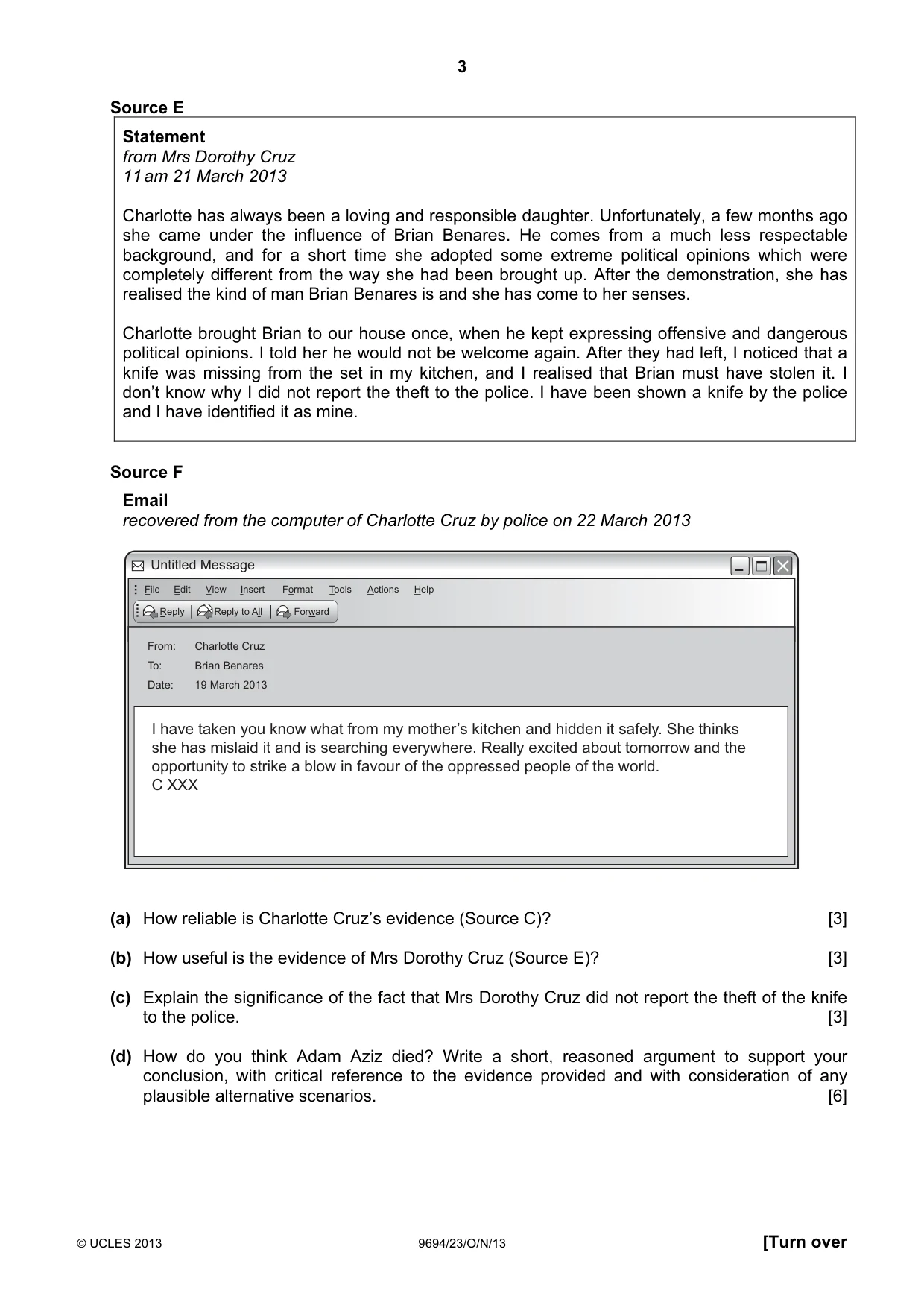
3 © UCLES 2013 9694/23/O/N/13 [Turn over Source E Statement from Mrs Dorothy Cruz 11 am 21 March 2013 Charlotte has always been a loving and responsible daughter. Unfortunately, a few months ago she came under the influence of Brian Benares. He comes from a much less respectable background, and for a short time she adopted some extreme political opinions which were completely different from the way she had been brought up. After the demonstration, she has realised the kind of man Brian Benares is and she has come to her senses. Charlotte brought Brian to our house once, when he kept expressing offensive and dangerous political opinions. I told her he would not be welcome again. After they had left, I noticed that a knife was missing from the set in my kitchen, and I realised that Brian must have stolen it. I don’t know why I did not report the theft to the police. I have been shown a knife by the police and I have identified it as mine. Source F Email recovered from the computer of Charlotte Cruz by police on 22 March 2013 File Edit View Insert Format Tools Actions Help Reply Forward Reply to All Untitled Message From: Charlotte Cruz To: Brian Benares Date: 19 March 2013 I have taken you know what from my mother’s kitchen and hidden it safely. She thinks she has mislaid it and is searching everywhere. Really excited about tomorrow and the opportunity to strike a blow in favour of the oppressed people of the world. C XXX (a) How reliable is Charlotte Cruz’s evidence (Source C)? [3] (b) How useful is the evidence of Mrs Dorothy Cruz (Source E)? [3] (c) Explain the significance of the fact that Mrs Dorothy Cruz did not report the theft of the knife to the police. [3] (d) How do you think Adam Aziz died? Write a short, reasoned argument to support your conclusion, with critical reference to the evidence provided and with consideration of any plausible alternative scenarios. [6]
Question paper, page 4
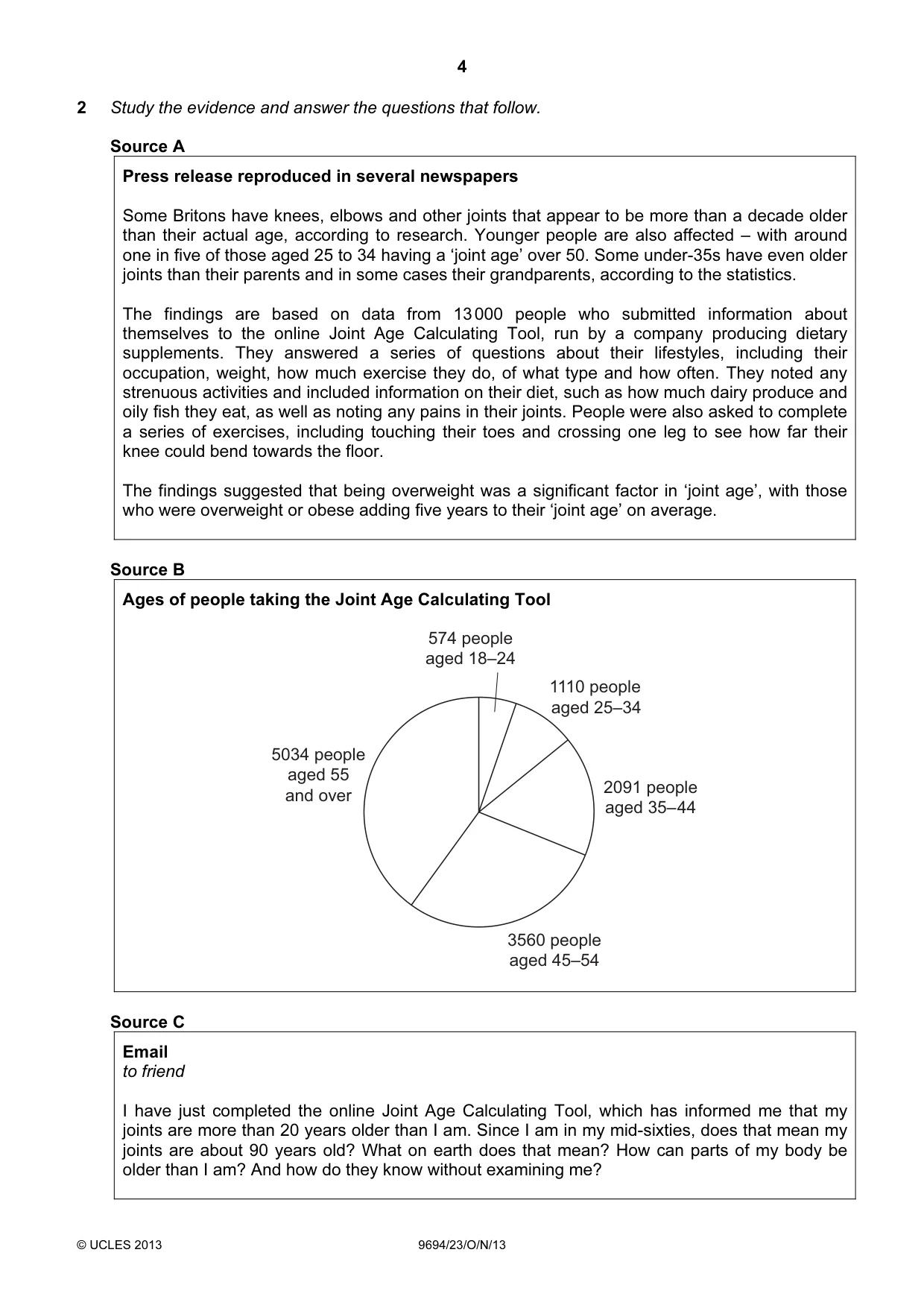
4 © UCLES 2013 9694/23/O/N/13 2 Study the evidence and answer the questions that follow. Source A Press release reproduced in several newspapers Some Britons have knees, elbows and other joints that appear to be more than a decade older than their actual age, according to research. Younger people are also affected – with around one in five of those aged 25 to 34 having a ‘joint age’ over 50. Some under-35s have even older joints than their parents and in some cases their grandparents, according to the statistics. The findings are based on data from 13 000 people who submitted information about themselves to the online Joint Age Calculating Tool, run by a company producing dietary supplements. They answered a series of questions about their lifestyles, including their occupation, weight, how much exercise they do, of what type and how often. They noted any strenuous activities and included information on their diet, such as how much dairy produce and oily fish they eat, as well as noting any pains in their joints. People were also asked to complete a series of exercises, including touching their toes and crossing one leg to see how far their knee could bend towards the floor. The findings suggested that being overweight was a significant factor in ‘joint age’, with those who were overweight or obese adding five years to their ‘joint age’ on average. Source B Ages of people taking the Joint Age Calculating Tool 574 people aged 18–24 1110 people aged 25–34 2091 people aged 35– 44 3560 people aged 45–54 5034 people aged 55 and over Source C Email to friend I have just completed the online Joint Age Calculating Tool, which has informed me that my joints are more than 20 years older than I am. Since I am in my mid-sixties, does that mean my joints are about 90 years old? What on earth does that mean? How can parts of my body be older than I am? And how do they know without examining me?
Question paper, page 5
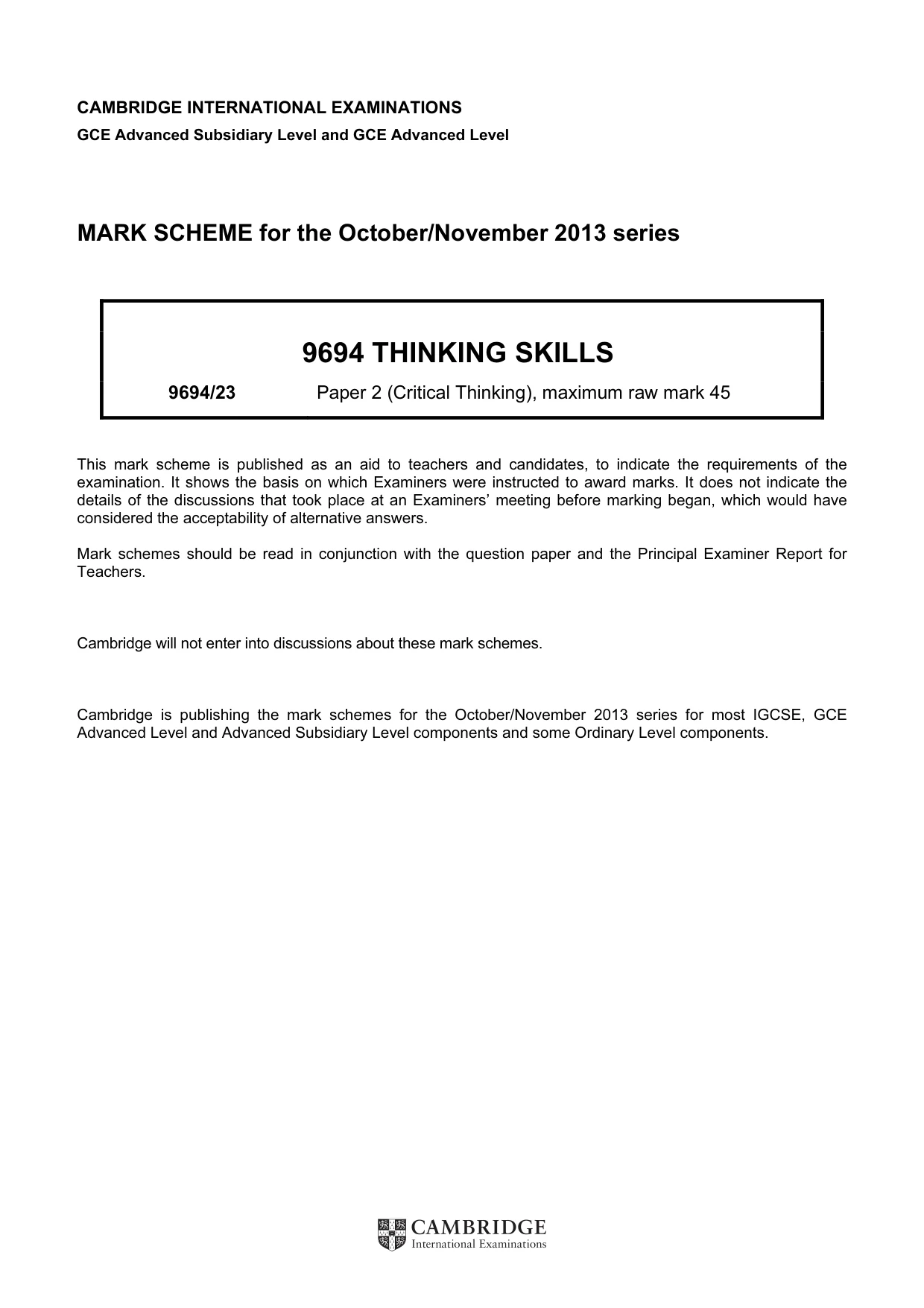
5 © UCLES 2013 9694/23/O/N/13 [Turn over Source D Email from dietary supplement company Thank you for completing the first stage of the online Joint Age project. You should now enrol for Stage 2. Take our fish oil capsules daily for three months and then complete the online questionnaire again. Compare the two sets of results. Source E From Arthritis Research UK website Osteoarthritis is the most common form of joint disease and affects at least 8 million people in the UK. Rheumatoid arthritis is the second most common form of arthritis in the UK. Several studies have suggested that fish body oil can reduce joint pain, morning stiffness, fatigue and the need for painkillers if you have rheumatoid arthritis. Fish liver oil does not seem to have a significant effect on improving pain or other symptoms if you have osteoarthritis, although studies are limited. Fish oils are considered safe at therapeutic doses. It is important that you do not take large amounts of fish liver oil because you can exceed the recommended daily dose of vitamin A. Excess vitamin A can cause liver problems and hair loss, and it can harm unborn babies. The most common side-effects of fish oils include stomach upsets, flatulence and diarrhea. Fish oils can interfere with blood clotting, so you should not take them if you are on anticoagulant medication (e.g. aspirin and warfarin). (a) Although Source A was published as a news report, it consisted of a press release from manufacturers of dietary supplements. How reliable is this report? [4] (b) Is Source C an argument? Briefly explain your answer. [2] (c) The author of Source C suggests that it does not make sense to allege that his joints are older than he is. How reasonable is this objection to the research described in Source A? [3] (d) ‘Most people would benefit from taking fish oil supplements to reduce their ‘joint age’.’ To what extent do you agree with this claim? Write a short, reasoned argument to support your conclusion, using and evaluating the information provided in Sources A – E. [6]
Question paper, page 6
6 © UCLES 2013 9694/23/O/N/13 3 Read the passage and answer the questions below. 1 Human rights apply to people of all ages. Corporal punishment in schools has been abolished, because hurting children goes against their right to safety and freedom from bodily harm. All forms of punishing children go against their human rights. Teachers should not make pupils stay behind after school as a punishment, because false imprisonment is an offence against the human right to freedom. Forcing children to do extra schoolwork as a punishment cannot be justified, because – since slavery was abolished – no one may force anyone else to work against their will. 2 As these examples illustrate, teachers should never punish children in any way. 3 Children do not need to be punished to make them learn. All good educational psychologists now realise that children naturally want to learn. If any psychologists still do not accept this insight, they are living in the past and we should take no notice of their biased opinions. 4 Teachers, too, know that very young children do not need to be forced to learn, because they are curious about life and eager to find out new things. If the same children have lost that enthusiasm and curiosity by the time they reach High School, it is because their teachers have driven it out of them. So it is unjust to punish teenagers for their failure to learn. 5 All children have the right to an education which will enable them to fulfil their potential. If some children are prevented from achieving their life goals, it is the fault of the teachers, not the students; the teachers are the ones who should be punished. Schools in the UK are leading the way in recognising this. As recently as thirty years ago, it was almost impossible to dismiss an incompetent teacher, but now if students gain disappointing exam results, their teacher can expect to be disciplined. (a) Using the exact words from the passage as far as possible, identify the main conclusion. [2] (b) Using the exact words from the passage as far as possible, identify three reasons used to support the main conclusion. [3] (c) Evaluate the strength of the reasoning in the argument. In your answer you should consider any flaws, unstated assumptions and other weaknesses. [5] (d) ‘Everyone deserves an education.’ Write your own short argument to support or challenge this claim. The conclusion of your argument must be stated. [5]
Question paper, page 7
7 © UCLES 2013 9694/23/O/N/13 BLANK PAGE
Question paper, page 8
8 Permission to reproduce items where third-party owned material protected by copyright is included has been sought and cleared where possible. Every reasonable effort has been made by the publisher (UCLES) to trace copyright holders, but if any items requiring clearance have unwittingly been included, the publisher will be pleased to make amends at the earliest possible opportunity. University of Cambridge International Examinations is part of the Cambridge Assessment Group. Cambridge Assessment is the brand name of University of Cambridge Local Examinations Syndicate (UCLES), which is itself a department of the University of Cambridge. © UCLES 2013 9694/23/O/N/13 BLANK PAGE
Mark scheme, page 1
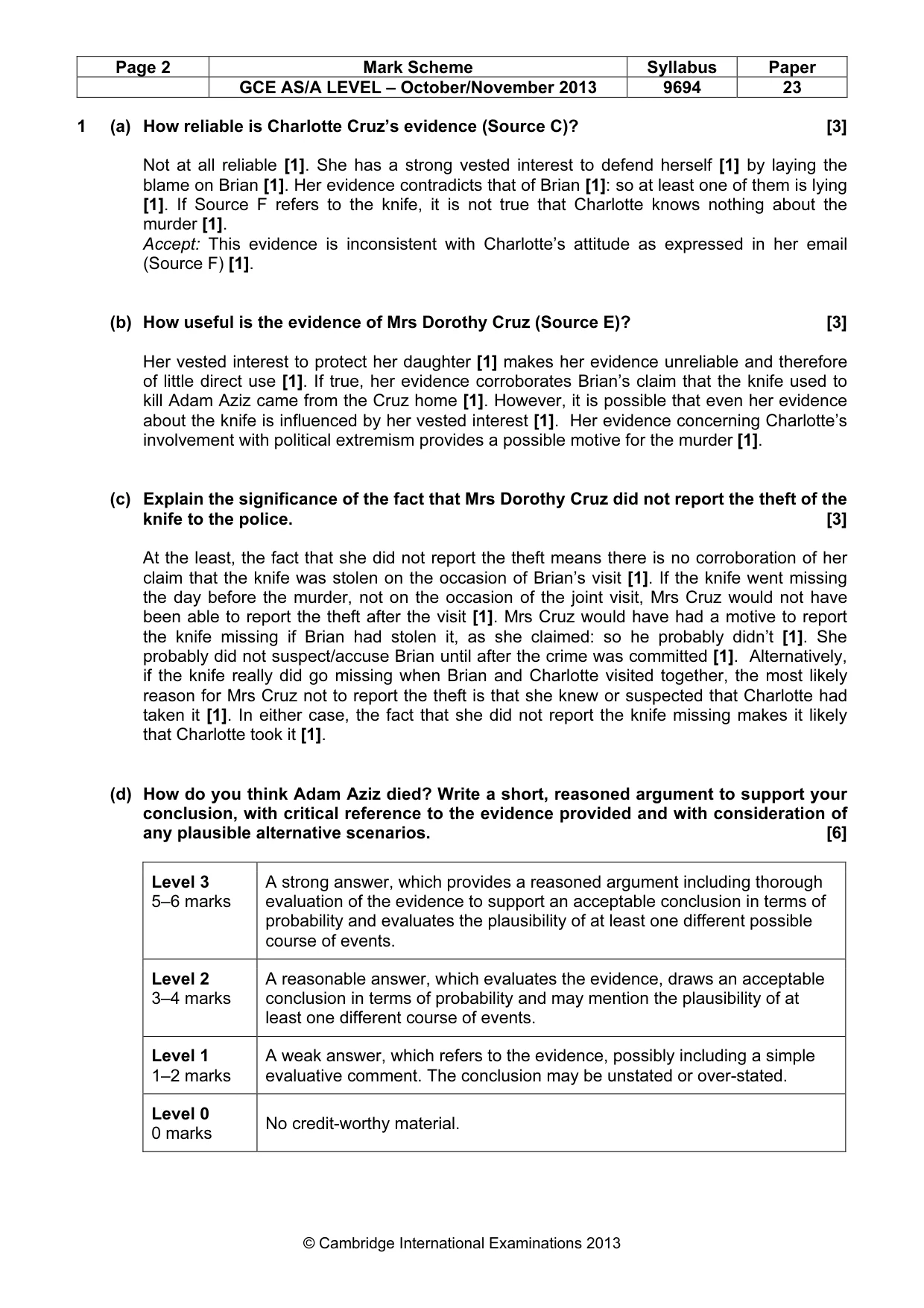
CAMBRIDGE INTERNATIONAL EXAMINATIONS GCE Advanced Subsidiary Level and GCE Advanced Level MARK SCHEME for the October/November 2013 series 9694 THINKING SKILLS 9694/23 Paper 2 (Critical Thinking), maximum raw mark 45 This mark scheme is published as an aid to teachers and candidates, to indicate the requirements of the examination. It shows the basis on which Examiners were instructed to award marks. It does not indicate the details of the discussions that took place at an Examiners’ meeting before marking began, which would have considered the acceptability of alternative answers. Mark schemes should be read in conjunction with the question paper and the Principal Examiner Report for Teachers. Cambridge will not enter into discussions about these mark schemes. Cambridge is publishing the mark schemes for the October/November 2013 series for most IGCSE, GCE Advanced Level and Advanced Subsidiary Level components and some Ordinary Level components.
Mark scheme, page 2
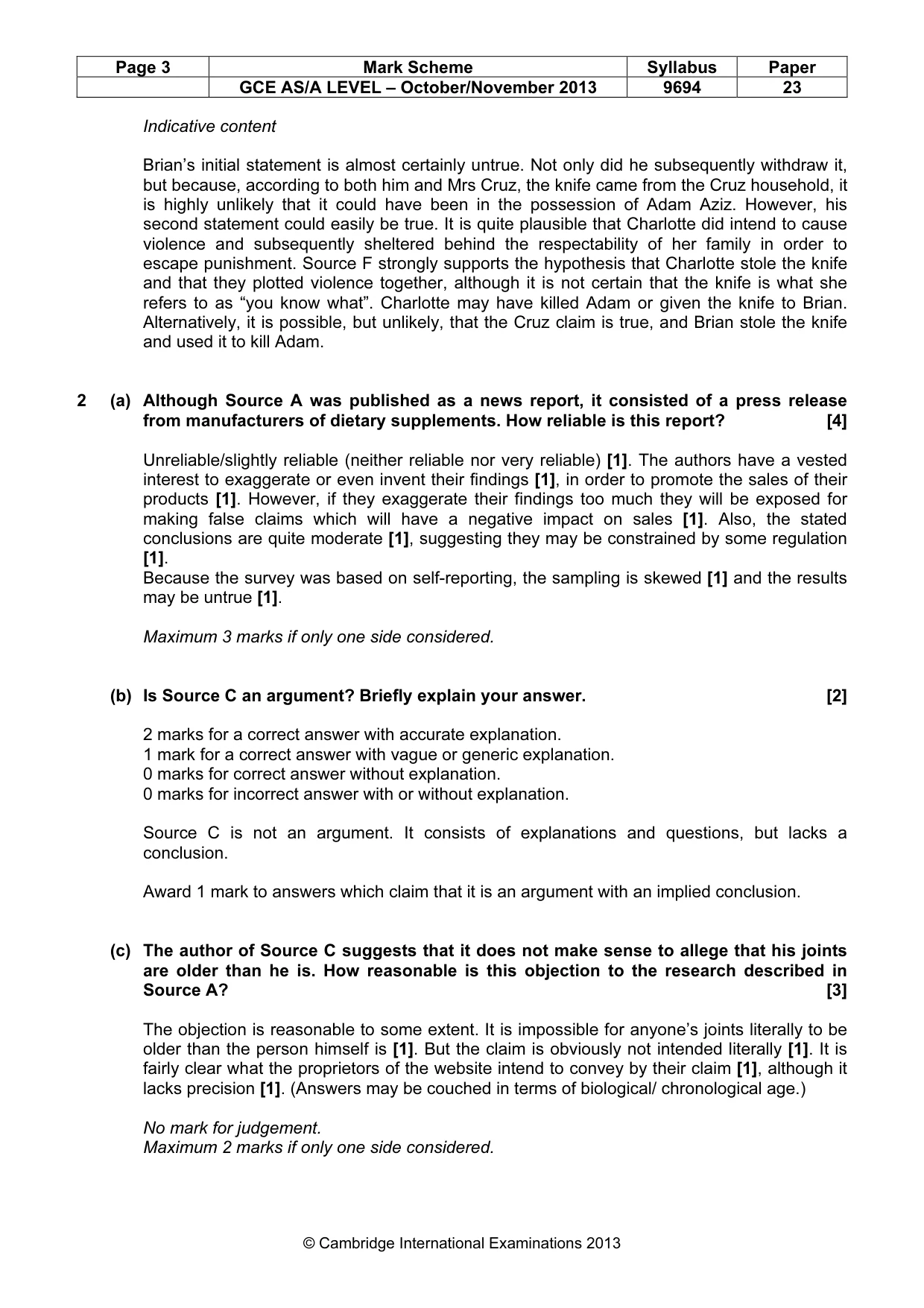
Page 2 Mark Scheme Syllabus Paper GCE AS/A LEVEL – October/November 2013 9694 23 © Cambridge International Examinations 2013 1 (a) How reliable is Charlotte Cruz’s evidence (Source C)? [3] Not at all reliable [1]. She has a strong vested interest to defend herself [1] by laying the blame on Brian [1]. Her evidence contradicts that of Brian [1]: so at least one of them is lying [1]. If Source F refers to the knife, it is not true that Charlotte knows nothing about the murder [1]. Accept: This evidence is inconsistent with Charlotte’s attitude as expressed in her email (Source F) [1]. (b) How useful is the evidence of Mrs Dorothy Cruz (Source E)? [3] Her vested interest to protect her daughter [1] makes her evidence unreliable and therefore of little direct use [1]. If true, her evidence corroborates Brian’s claim that the knife used to kill Adam Aziz came from the Cruz home [1]. However, it is possible that even her evidence about the knife is influenced by her vested interest [1]. Her evidence concerning Charlotte’s involvement with political extremism provides a possible motive for the murder [1]. (c) Explain the significance of the fact that Mrs Dorothy Cruz did not report the theft of the knife to the police. [3] At the least, the fact that she did not report the theft means there is no corroboration of her claim that the knife was stolen on the occasion of Brian’s visit [1]. If the knife went missing the day before the murder, not on the occasion of the joint visit, Mrs Cruz would not have been able to report the theft after the visit [1]. Mrs Cruz would have had a motive to report the knife missing if Brian had stolen it, as she claimed: so he probably didn’t [1]. She probably did not suspect/accuse Brian until after the crime was committed [1]. Alternatively, if the knife really did go missing when Brian and Charlotte visited together, the most likely reason for Mrs Cruz not to report the theft is that she knew or suspected that Charlotte had taken it [1]. In either case, the fact that she did not report the knife missing makes it likely that Charlotte took it [1]. (d) How do you think Adam Aziz died? Write a short, reasoned argument to support your conclusion, with critical reference to the evidence provided and with consideration of any plausible alternative scenarios. [6] Level 3 5–6 marks A strong answer, which provides a reasoned argument including thorough evaluation of the evidence to support an acceptable conclusion in terms of probability and evaluates the plausibility of at least one different possible course of events. Level 2 3–4 marks A reasonable answer, which evaluates the evidence, draws an acceptable conclusion in terms of probability and may mention the plausibility of at least one different course of events. Level 1 1–2 marks A weak answer, which refers to the evidence, possibly including a simple evaluative comment. The conclusion may be unstated or over-stated. Level 0 0 marks No credit-worthy material.
Mark scheme, page 3
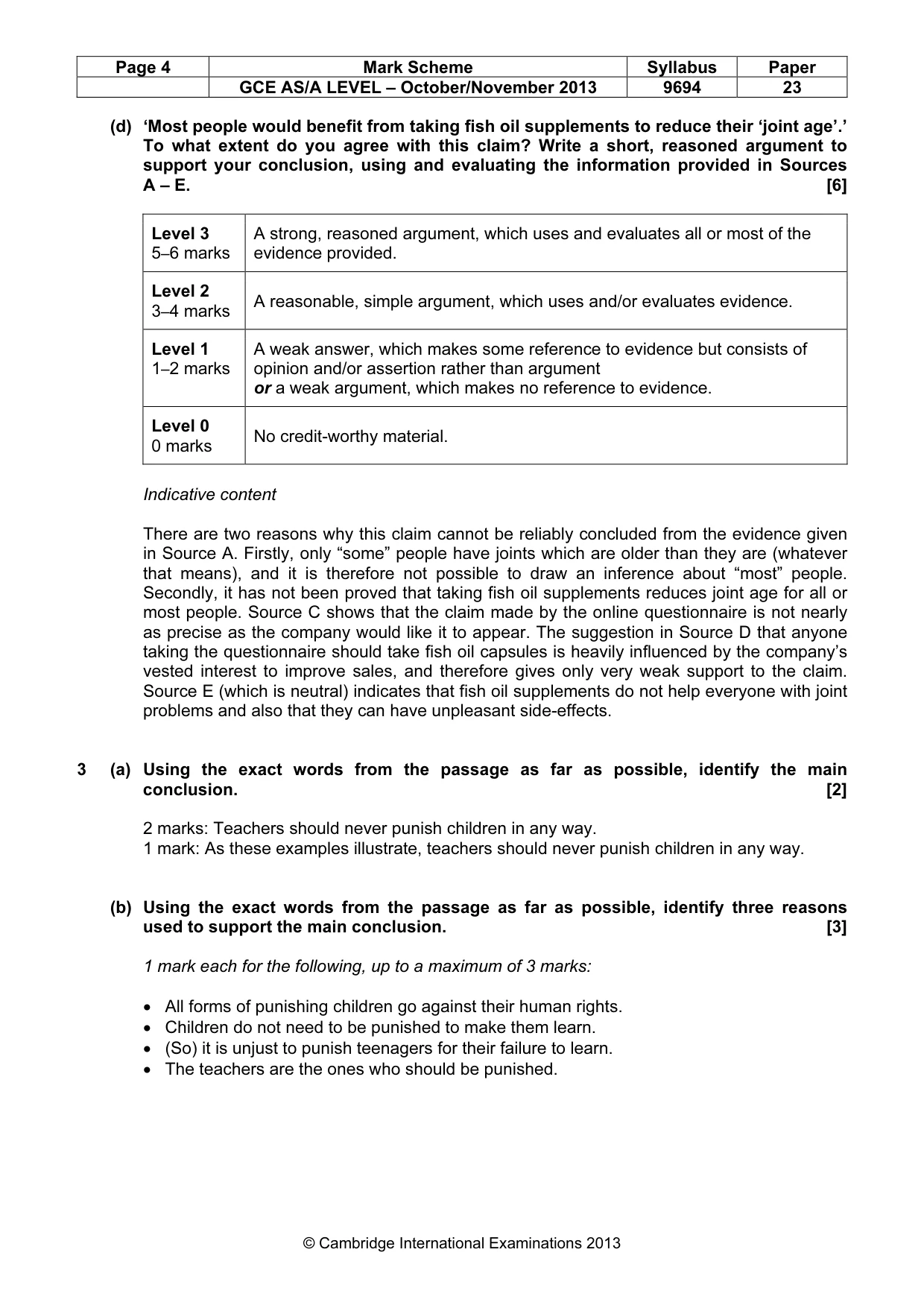
Page 3 Mark Scheme Syllabus Paper GCE AS/A LEVEL – October/November 2013 9694 23 © Cambridge International Examinations 2013 Indicative content Brian’s initial statement is almost certainly untrue. Not only did he subsequently withdraw it, but because, according to both him and Mrs Cruz, the knife came from the Cruz household, it is highly unlikely that it could have been in the possession of Adam Aziz. However, his second statement could easily be true. It is quite plausible that Charlotte did intend to cause violence and subsequently sheltered behind the respectability of her family in order to escape punishment. Source F strongly supports the hypothesis that Charlotte stole the knife and that they plotted violence together, although it is not certain that the knife is what she refers to as “you know what”. Charlotte may have killed Adam or given the knife to Brian. Alternatively, it is possible, but unlikely, that the Cruz claim is true, and Brian stole the knife and used it to kill Adam. 2 (a) Although Source A was published as a news report, it consisted of a press release from manufacturers of dietary supplements. How reliable is this report? [4] Unreliable/slightly reliable (neither reliable nor very reliable) [1]. The authors have a vested interest to exaggerate or even invent their findings [1], in order to promote the sales of their products [1]. However, if they exaggerate their findings too much they will be exposed for making false claims which will have a negative impact on sales [1]. Also, the stated conclusions are quite moderate [1], suggesting they may be constrained by some regulation [1]. Because the survey was based on self-reporting, the sampling is skewed [1] and the results may be untrue [1]. Maximum 3 marks if only one side considered. (b) Is Source C an argument? Briefly explain your answer. [2] 2 marks for a correct answer with accurate explanation. 1 mark for a correct answer with vague or generic explanation. 0 marks for correct answer without explanation. 0 marks for incorrect answer with or without explanation. Source C is not an argument. It consists of explanations and questions, but lacks a conclusion. Award 1 mark to answers which claim that it is an argument with an implied conclusion. (c) The author of Source C suggests that it does not make sense to allege that his joints are older than he is. How reasonable is this objection to the research described in Source A? [3] The objection is reasonable to some extent. It is impossible for anyone’s joints literally to be older than the person himself is [1]. But the claim is obviously not intended literally [1]. It is fairly clear what the proprietors of the website intend to convey by their claim [1], although it lacks precision [1]. (Answers may be couched in terms of biological/ chronological age.) No mark for judgement. Maximum 2 marks if only one side considered.
Mark scheme, page 4
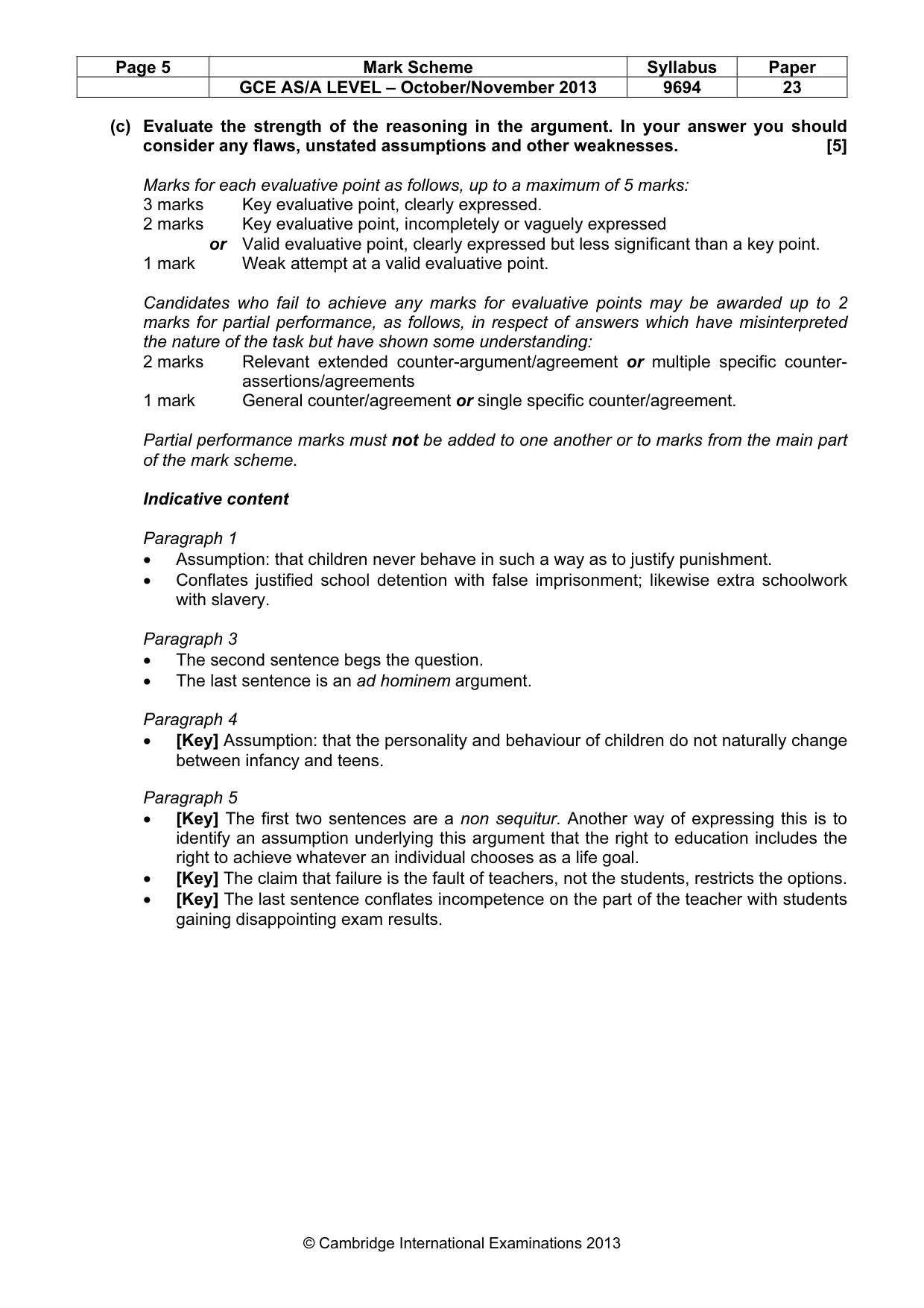
Page 4 Mark Scheme Syllabus Paper GCE AS/A LEVEL – October/November 2013 9694 23 © Cambridge International Examinations 2013 (d) ‘Most people would benefit from taking fish oil supplements to reduce their ‘joint age’.’ To what extent do you agree with this claim? Write a short, reasoned argument to support your conclusion, using and evaluating the information provided in Sources A – E. [6] Level 3 5–6 marks A strong, reasoned argument, which uses and evaluates all or most of the evidence provided. Level 2 3–4 marks A reasonable, simple argument, which uses and/or evaluates evidence. Level 1 1–2 marks A weak answer, which makes some reference to evidence but consists of opinion and/or assertion rather than argument or a weak argument, which makes no reference to evidence. Level 0 0 marks No credit-worthy material. Indicative content There are two reasons why this claim cannot be reliably concluded from the evidence given in Source A. Firstly, only “some” people have joints which are older than they are (whatever that means), and it is therefore not possible to draw an inference about “most” people. Secondly, it has not been proved that taking fish oil supplements reduces joint age for all or most people. Source C shows that the claim made by the online questionnaire is not nearly as precise as the company would like it to appear. The suggestion in Source D that anyone taking the questionnaire should take fish oil capsules is heavily influenced by the company’s vested interest to improve sales, and therefore gives only very weak support to the claim. Source E (which is neutral) indicates that fish oil supplements do not help everyone with joint problems and also that they can have unpleasant side-effects. 3 (a) Using the exact words from the passage as far as possible, identify the main conclusion. [2] 2 marks: Teachers should never punish children in any way. 1 mark: As these examples illustrate, teachers should never punish children in any way. (b) Using the exact words from the passage as far as possible, identify three reasons used to support the main conclusion. [3] 1 mark each for the following, up to a maximum of 3 marks: • All forms of punishing children go against their human rights. • Children do not need to be punished to make them learn. • (So) it is unjust to punish teenagers for their failure to learn. • The teachers are the ones who should be punished.
Mark scheme, page 5
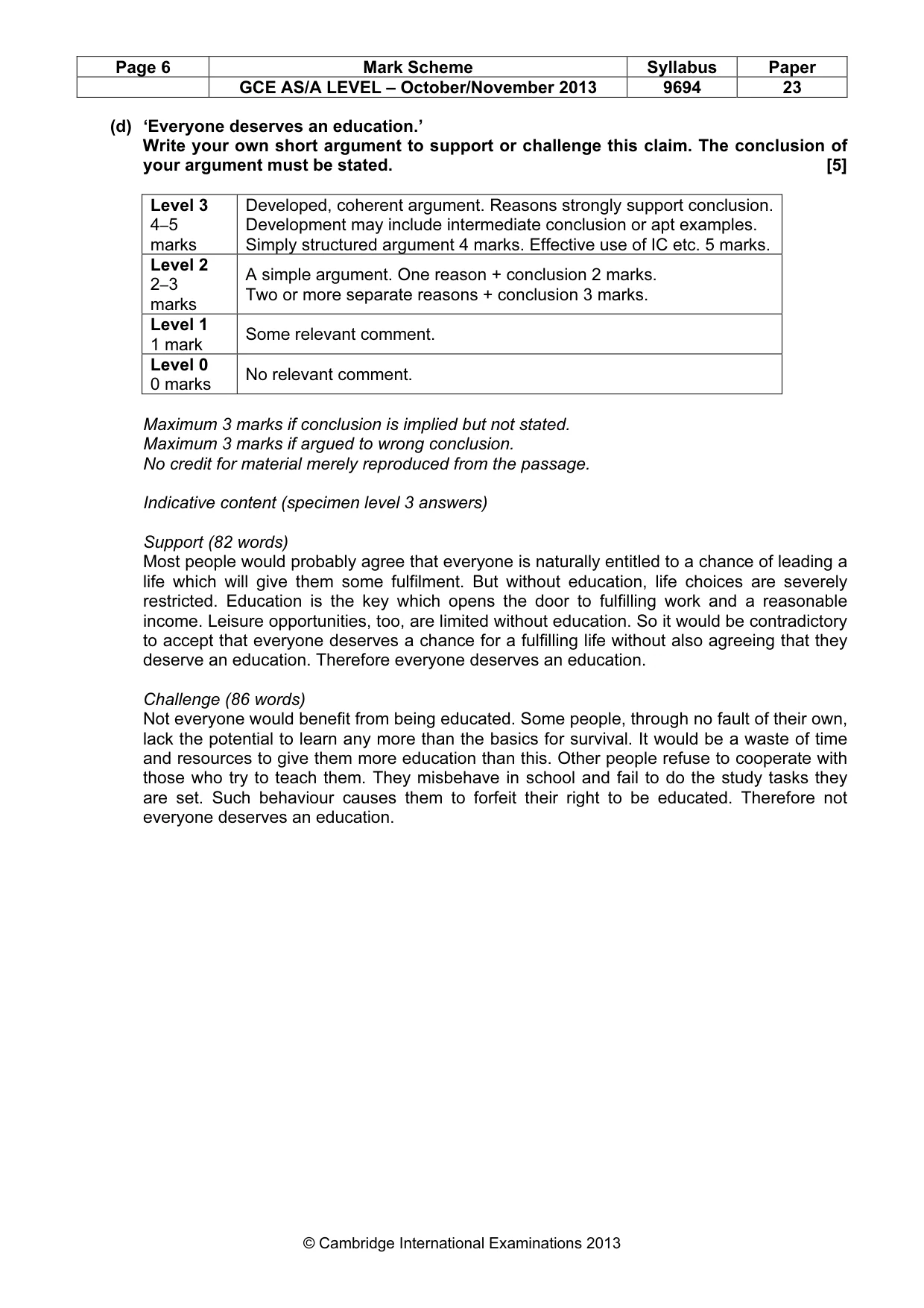
Page 5 Mark Scheme Syllabus Paper GCE AS/A LEVEL – October/November 2013 9694 23 © Cambridge International Examinations 2013 (c) Evaluate the strength of the reasoning in the argument. In your answer you should consider any flaws, unstated assumptions and other weaknesses. [5] Marks for each evaluative point as follows, up to a maximum of 5 marks: 3 marks Key evaluative point, clearly expressed. 2 marks Key evaluative point, incompletely or vaguely expressed or Valid evaluative point, clearly expressed but less significant than a key point. 1 mark Weak attempt at a valid evaluative point. Candidates who fail to achieve any marks for evaluative points may be awarded up to 2 marks for partial performance, as follows, in respect of answers which have misinterpreted the nature of the task but have shown some understanding: 2 marks Relevant extended counter-argument/agreement or multiple specific counter- assertions/agreements 1 mark General counter/agreement or single specific counter/agreement. Partial performance marks must not be added to one another or to marks from the main part of the mark scheme. Indicative content Paragraph 1 • Assumption: that children never behave in such a way as to justify punishment. • Conflates justified school detention with false imprisonment; likewise extra schoolwork with slavery. Paragraph 3 • The second sentence begs the question. • The last sentence is an ad hominem argument. Paragraph 4 • [Key] Assumption: that the personality and behaviour of children do not naturally change between infancy and teens. Paragraph 5 • [Key] The first two sentences are a non sequitur. Another way of expressing this is to identify an assumption underlying this argument that the right to education includes the right to achieve whatever an individual chooses as a life goal. • [Key] The claim that failure is the fault of teachers, not the students, restricts the options. • [Key] The last sentence conflates incompetence on the part of the teacher with students gaining disappointing exam results.
Mark scheme, page 6
Page 6 Mark Scheme Syllabus Paper GCE AS/A LEVEL – October/November 2013 9694 23 © Cambridge International Examinations 2013 (d) ‘Everyone deserves an education.’ Write your own short argument to support or challenge this claim. The conclusion of your argument must be stated. [5] Level 3 4–5 marks Developed, coherent argument. Reasons strongly support conclusion. Development may include intermediate conclusion or apt examples. Simply structured argument 4 marks. Effective use of IC etc. 5 marks. Level 2 2–3 marks A simple argument. One reason + conclusion 2 marks. Two or more separate reasons + conclusion 3 marks. Level 1 1 mark Some relevant comment. Level 0 0 marks No relevant comment. Maximum 3 marks if conclusion is implied but not stated. Maximum 3 marks if argued to wrong conclusion. No credit for material merely reproduced from the passage. Indicative content (specimen level 3 answers) Support (82 words) Most people would probably agree that everyone is naturally entitled to a chance of leading a life which will give them some fulfilment. But without education, life choices are severely restricted. Education is the key which opens the door to fulfilling work and a reasonable income. Leisure opportunities, too, are limited without education. So it would be contradictory to accept that everyone deserves a chance for a fulfilling life without also agreeing that they deserve an education. Therefore everyone deserves an education. Challenge (86 words) Not everyone would benefit from being educated. Some people, through no fault of their own, lack the potential to learn any more than the basics for survival. It would be a waste of time and resources to give them more education than this. Other people refuse to cooperate with those who try to teach them. They misbehave in school and fail to do the study tasks they are set. Such behaviour causes them to forfeit their right to be educated. Therefore not everyone deserves an education.
What you needed in this session
Cambridge’s own grade thresholds for 2013 Oct/Nov, Paper 2 · Variant 3. A higher threshold means an easier paper — the bar moves with how the cohort did.