Cambridge A Level Thinking Skills 9694 — 2013 May/June Paper 2 · Variant 1
9694/21/M/J/13 · 45 marks · ≈51 min
The question paper and its mark scheme, free to read here and free to download. This is Cambridge’s own paper, exactly as it was sat.
Question paper8 pages

Mark scheme8 pages
Answers below. Sit the paper first if you are practising.
Paper as text
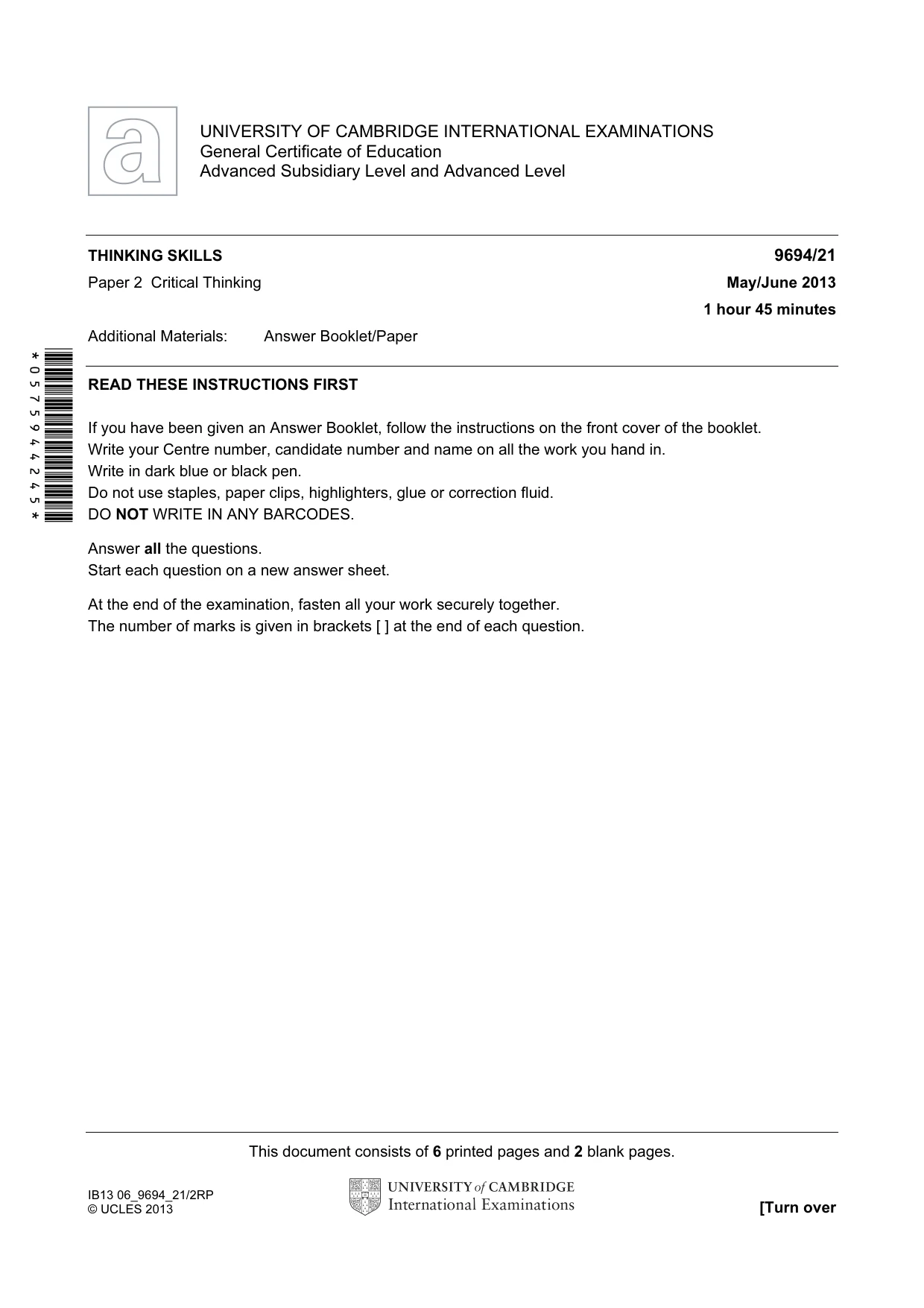
Question paper, page 1
This document consists of 6 printed pages and 2 blank pages. IB13 06_9694_21/2RP © UCLES 2013 [Turn over *0575944245* UNIVERSITY OF CAMBRIDGE INTERNATIONAL EXAMINATIONS General Certificate of Education Advanced Subsidiary Level and Advanced Level THINKING SKILLS 9694/21 Paper 2 Critical Thinking May/June 2013 1 hour 45 minutes Additional Materials: Answer Booklet/Paper READ THESE INSTRUCTIONS FIRST If you have been given an Answer Booklet, follow the instructions on the front cover of the booklet. Write your Centre number, candidate number and name on all the work you hand in. Write in dark blue or black pen. Do not use staples, paper clips, highlighters, glue or correction fluid. DO NOT WRITE IN ANY BARCODES. Answer all the questions. Start each question on a new answer sheet. At the end of the examination, fasten all your work securely together. The number of marks is given in brackets [ ] at the end of each question.
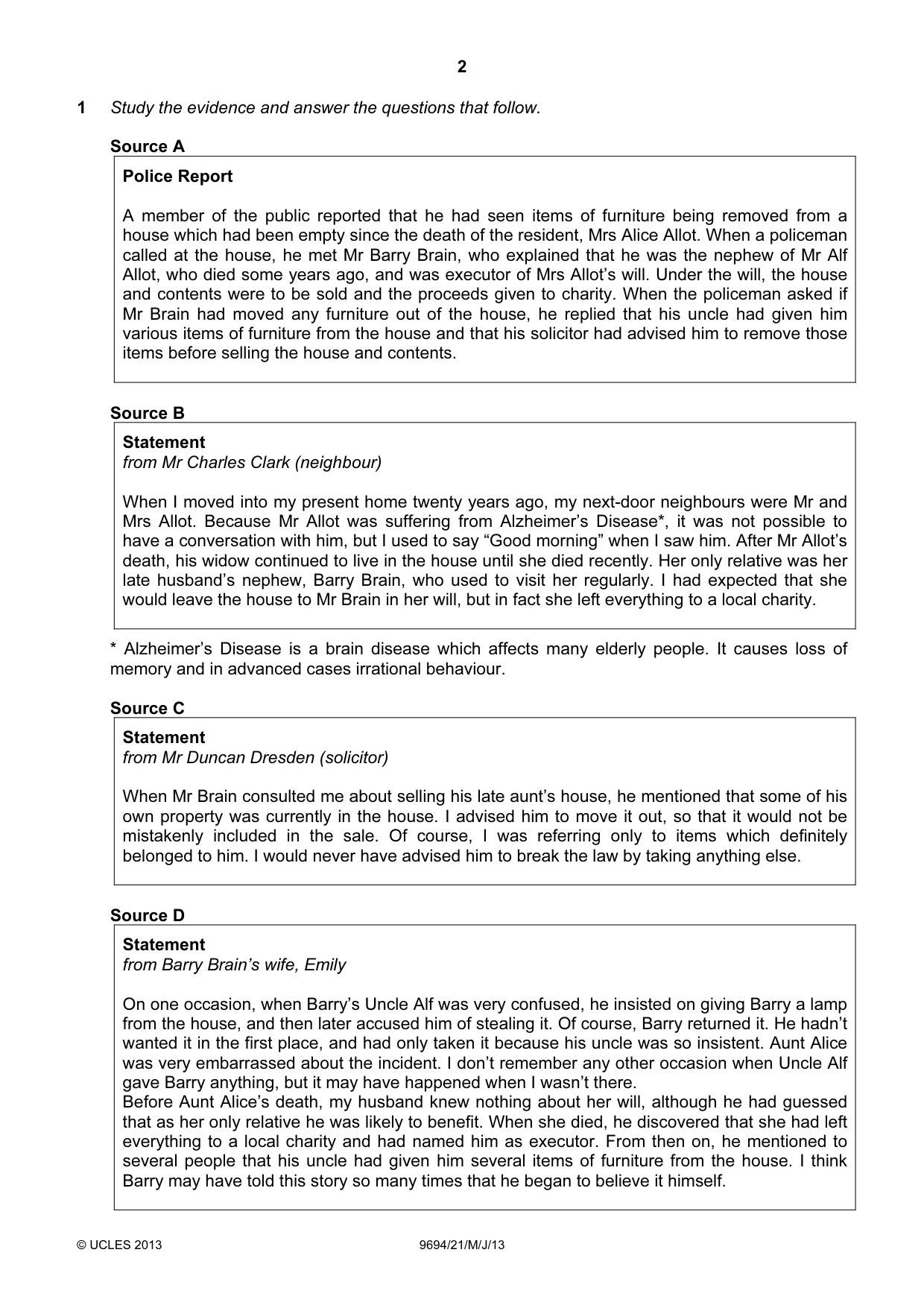
Question paper, page 2
2 © UCLES 2013 9694/21/M/J/13 1 Study the evidence and answer the questions that follow. Source A Police Report A member of the public reported that he had seen items of furniture being removed from a house which had been empty since the death of the resident, Mrs Alice Allot. When a policeman called at the house, he met Mr Barry Brain, who explained that he was the nephew of Mr Alf Allot, who died some years ago, and was executor of Mrs Allot’s will. Under the will, the house and contents were to be sold and the proceeds given to charity. When the policeman asked if Mr Brain had moved any furniture out of the house, he replied that his uncle had given him various items of furniture from the house and that his solicitor had advised him to remove those items before selling the house and contents. Source B Statement from Mr Charles Clark (neighbour) When I moved into my present home twenty years ago, my next-door neighbours were Mr and Mrs Allot. Because Mr Allot was suffering from Alzheimer’s Disease*, it was not possible to have a conversation with him, but I used to say “Good morning” when I saw him. After Mr Allot’s death, his widow continued to live in the house until she died recently. Her only relative was her late husband’s nephew, Barry Brain, who used to visit her regularly. I had expected that she would leave the house to Mr Brain in her will, but in fact she left everything to a local charity. * Alzheimer’s Disease is a brain disease which affects many elderly people. It causes loss of memory and in advanced cases irrational behaviour. Source C Statement from Mr Duncan Dresden (solicitor) When Mr Brain consulted me about selling his late aunt’s house, he mentioned that some of his own property was currently in the house. I advised him to move it out, so that it would not be mistakenly included in the sale. Of course, I was referring only to items which definitely belonged to him. I would never have advised him to break the law by taking anything else. Source D Statement from Barry Brain’s wife, Emily On one occasion, when Barry’s Uncle Alf was very confused, he insisted on giving Barry a lamp from the house, and then later accused him of stealing it. Of course, Barry returned it. He hadn’t wanted it in the first place, and had only taken it because his uncle was so insistent. Aunt Alice was very embarrassed about the incident. I don’t remember any other occasion when Uncle Alf gave Barry anything, but it may have happened when I wasn’t there. Before Aunt Alice’s death, my husband knew nothing about her will, although he had guessed that as her only relative he was likely to benefit. When she died, he discovered that she had left everything to a local charity and had named him as executor. From then on, he mentioned to several people that his uncle had given him several items of furniture from the house. I think Barry may have told this story so many times that he began to believe it himself.
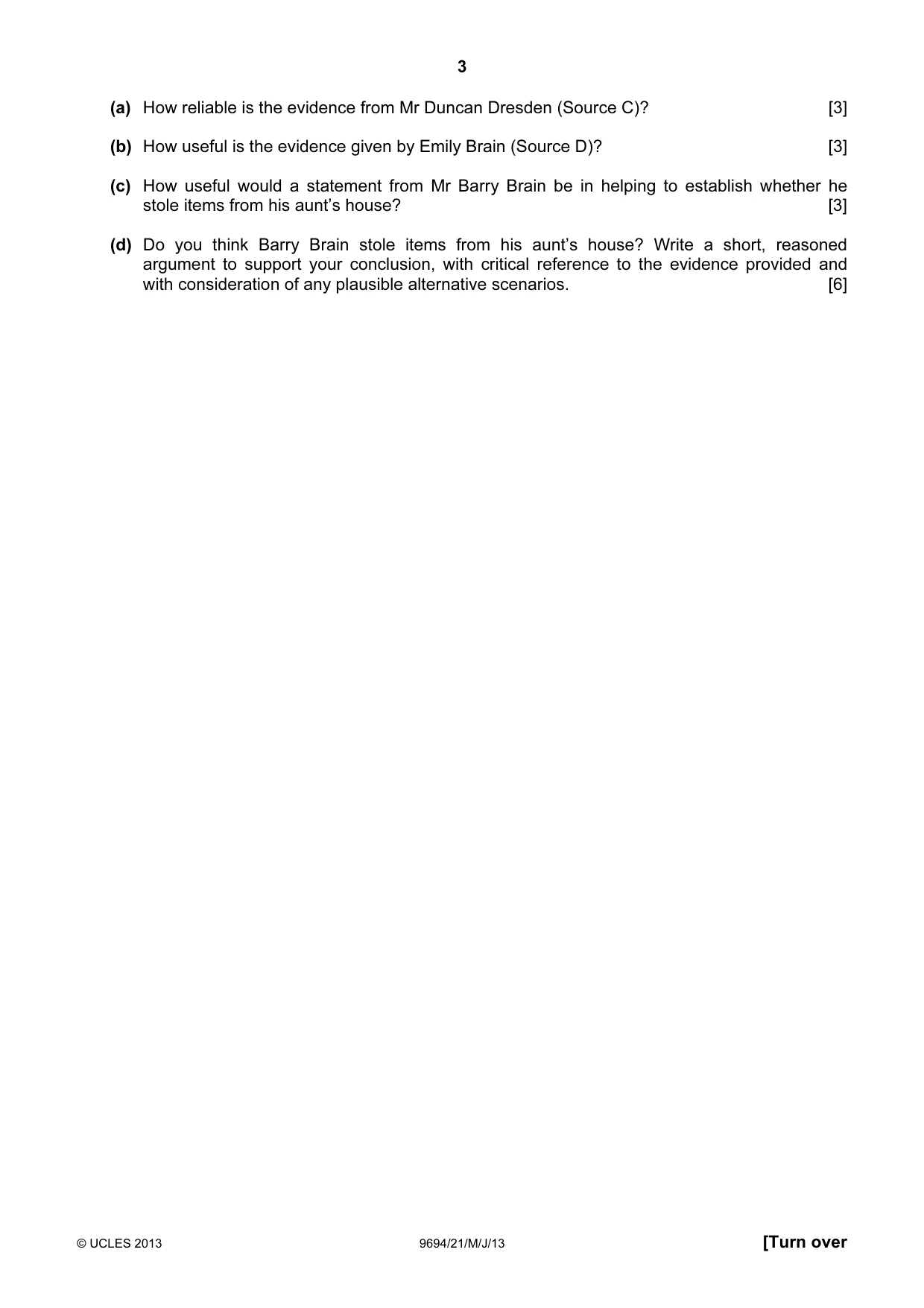
Question paper, page 3
3 © UCLES 2013 9694/21/M/J/13 [Turn over (a) How reliable is the evidence from Mr Duncan Dresden (Source C)? [3] (b) How useful is the evidence given by Emily Brain (Source D)? [3] (c) How useful would a statement from Mr Barry Brain be in helping to establish whether he stole items from his aunt’s house? [3] (d) Do you think Barry Brain stole items from his aunt’s house? Write a short, reasoned argument to support your conclusion, with critical reference to the evidence provided and with consideration of any plausible alternative scenarios. [6]
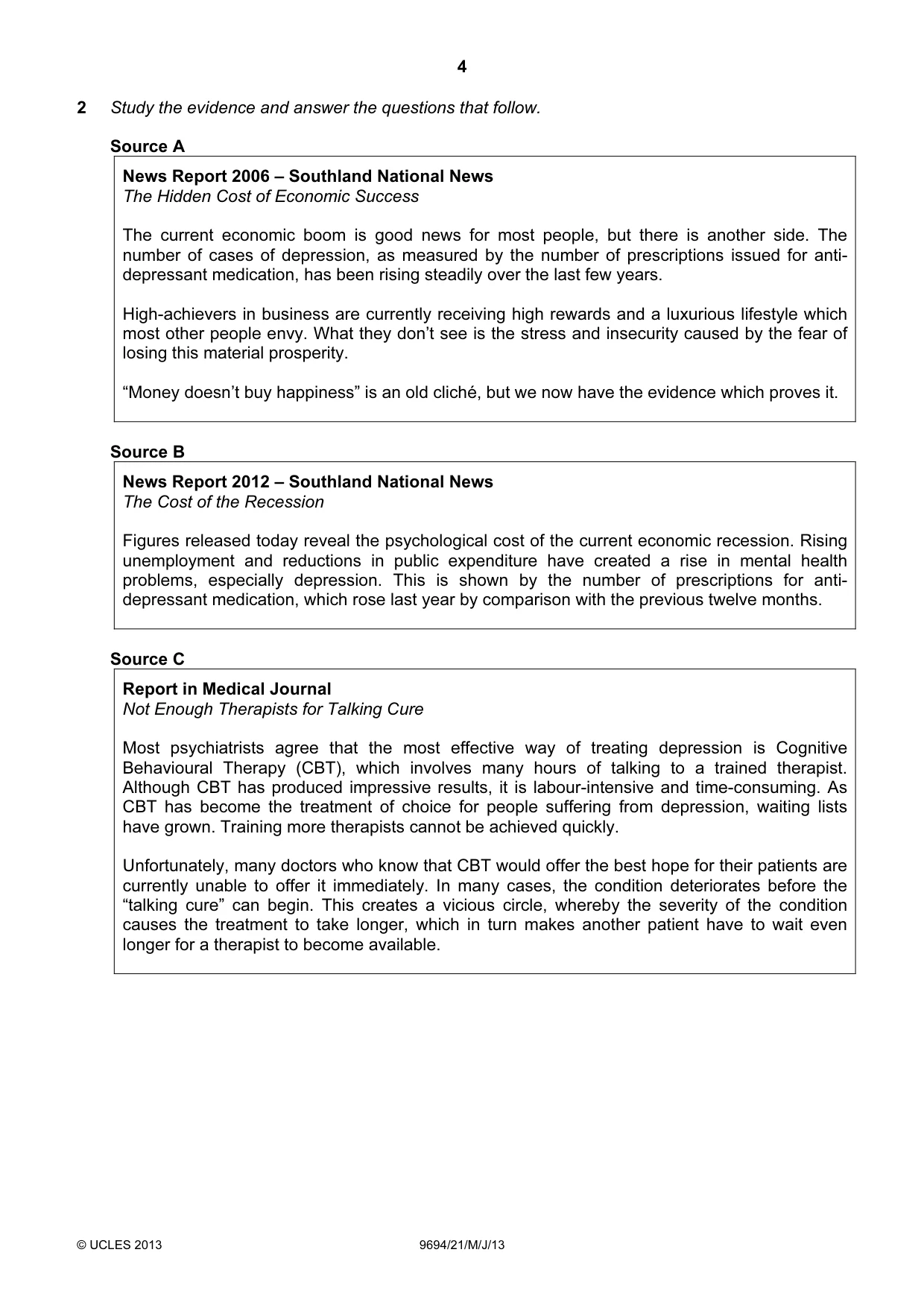
Question paper, page 4
4 © UCLES 2013 9694/21/M/J/13 2 Study the evidence and answer the questions that follow. Source A News Report 2006 – Southland National News The Hidden Cost of Economic Success The current economic boom is good news for most people, but there is another side. The number of cases of depression, as measured by the number of prescriptions issued for anti- depressant medication, has been rising steadily over the last few years. High-achievers in business are currently receiving high rewards and a luxurious lifestyle which most other people envy. What they don’t see is the stress and insecurity caused by the fear of losing this material prosperity. “Money doesn’t buy happiness” is an old cliché, but we now have the evidence which proves it. Source B News Report 2012 – Southland National News The Cost of the Recession Figures released today reveal the psychological cost of the current economic recession. Rising unemployment and reductions in public expenditure have created a rise in mental health problems, especially depression. This is shown by the number of prescriptions for anti- depressant medication, which rose last year by comparison with the previous twelve months. Source C Report in Medical Journal Not Enough Therapists for Talking Cure Most psychiatrists agree that the most effective way of treating depression is Cognitive Behavioural Therapy (CBT), which involves many hours of talking to a trained therapist. Although CBT has produced impressive results, it is labour-intensive and time-consuming. As CBT has become the treatment of choice for people suffering from depression, waiting lists have grown. Training more therapists cannot be achieved quickly. Unfortunately, many doctors who know that CBT would offer the best hope for their patients are currently unable to offer it immediately. In many cases, the condition deteriorates before the “talking cure” can begin. This creates a vicious circle, whereby the severity of the condition causes the treatment to take longer, which in turn makes another patient have to wait even longer for a therapist to become available.
Question paper, page 5
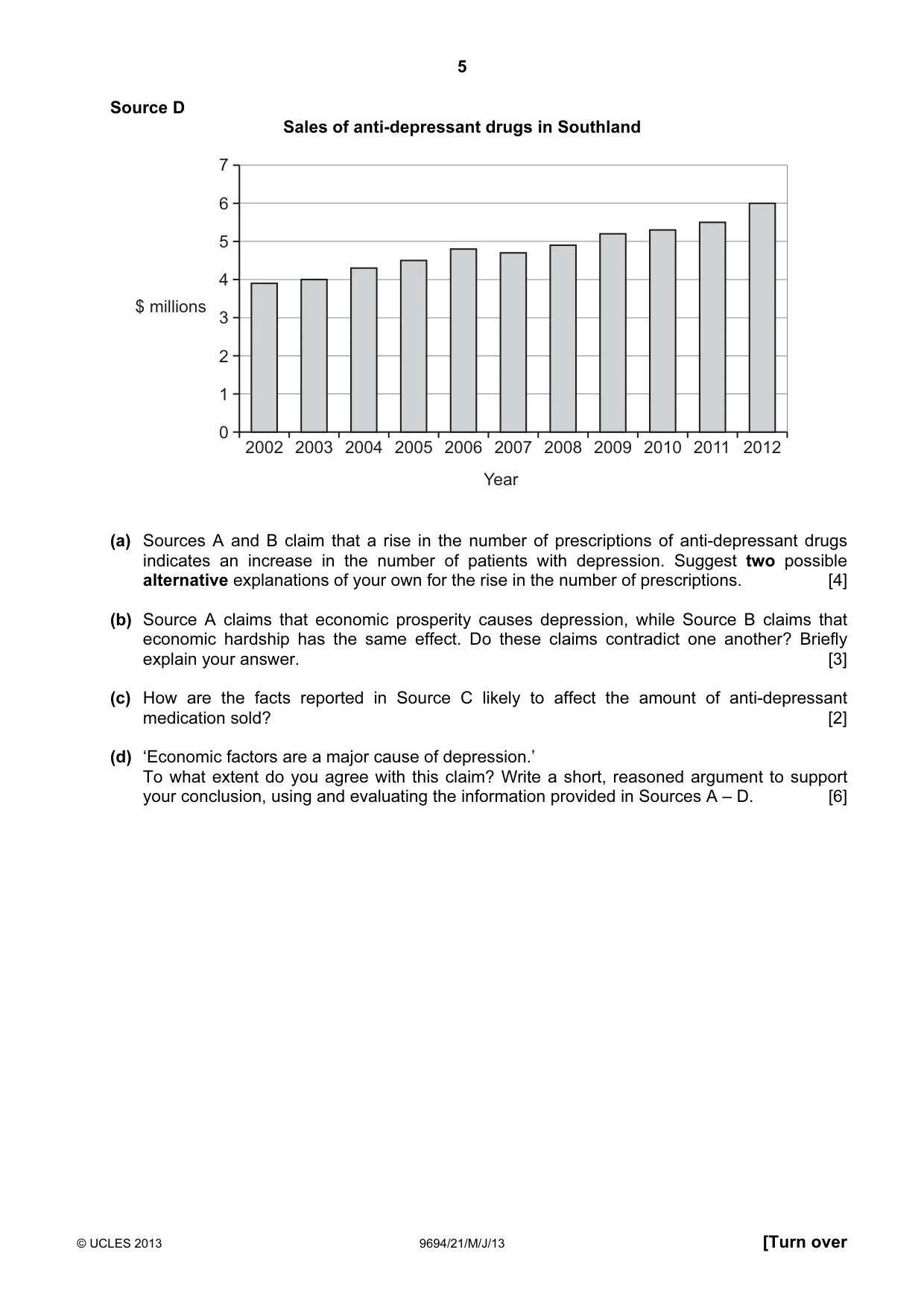
5 © UCLES 2013 9694/21/M/J/13 [Turn over Source D Sales of anti-depressant drugs in Southland 7 6 5 4 3 2 1 0 2002 2012 2011 2010 2009 2008 2007 2006 2005 2004 2003 Year $ millions (a) Sources A and B claim that a rise in the number of prescriptions of anti-depressant drugs indicates an increase in the number of patients with depression. Suggest two possible alternative explanations of your own for the rise in the number of prescriptions. [4] (b) Source A claims that economic prosperity causes depression, while Source B claims that economic hardship has the same effect. Do these claims contradict one another? Briefly explain your answer. [3] (c) How are the facts reported in Source C likely to affect the amount of anti-depressant medication sold? [2] (d) ‘Economic factors are a major cause of depression.’ To what extent do you agree with this claim? Write a short, reasoned argument to support your conclusion, using and evaluating the information provided in Sources A – D. [6]
Question paper, page 6
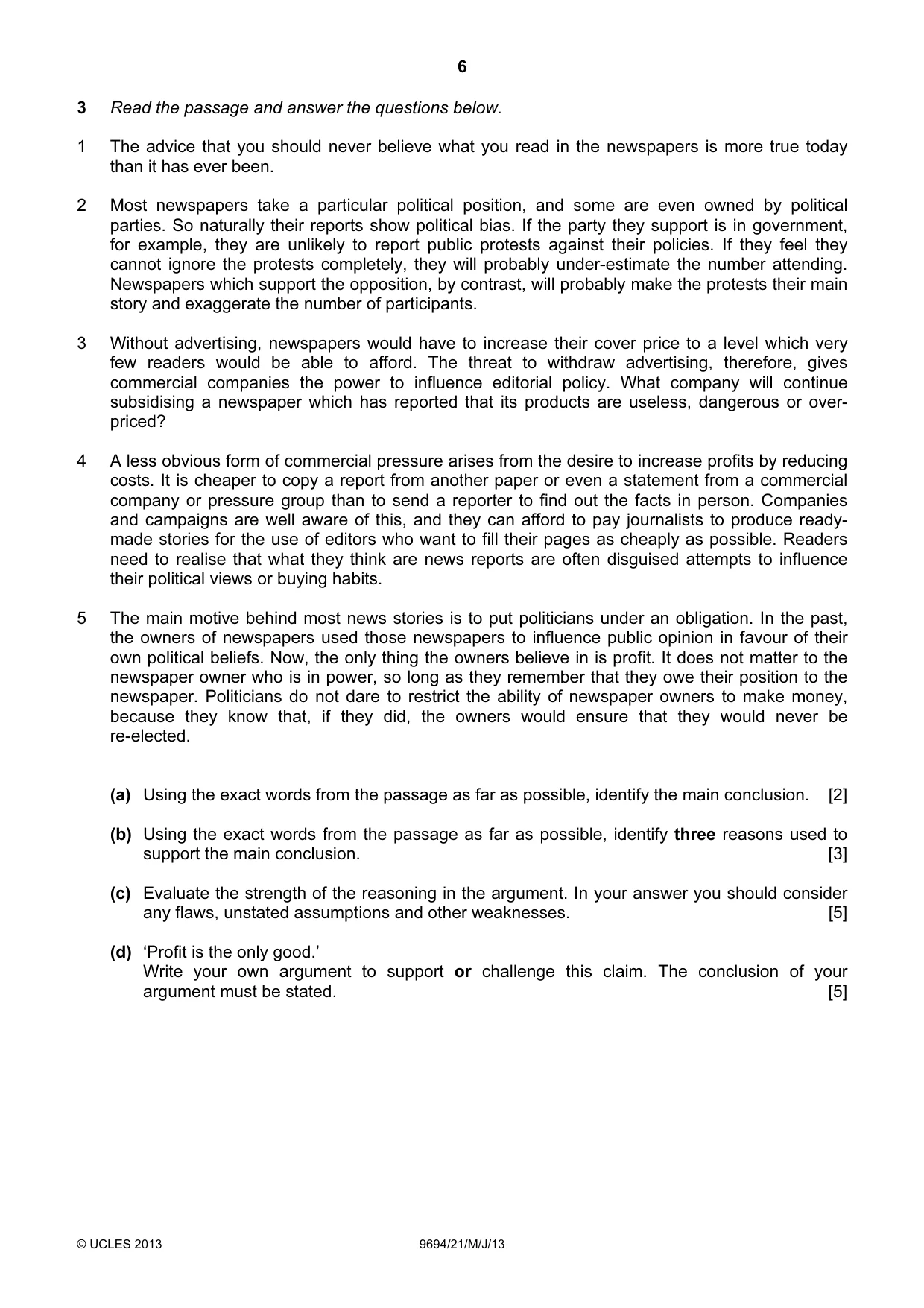
6 © UCLES 2013 9694/21/M/J/13 3 Read the passage and answer the questions below. 1 The advice that you should never believe what you read in the newspapers is more true today than it has ever been. 2 Most newspapers take a particular political position, and some are even owned by political parties. So naturally their reports show political bias. If the party they support is in government, for example, they are unlikely to report public protests against their policies. If they feel they cannot ignore the protests completely, they will probably under-estimate the number attending. Newspapers which support the opposition, by contrast, will probably make the protests their main story and exaggerate the number of participants. 3 Without advertising, newspapers would have to increase their cover price to a level which very few readers would be able to afford. The threat to withdraw advertising, therefore, gives commercial companies the power to influence editorial policy. What company will continue subsidising a newspaper which has reported that its products are useless, dangerous or over- priced? 4 A less obvious form of commercial pressure arises from the desire to increase profits by reducing costs. It is cheaper to copy a report from another paper or even a statement from a commercial company or pressure group than to send a reporter to find out the facts in person. Companies and campaigns are well aware of this, and they can afford to pay journalists to produce ready- made stories for the use of editors who want to fill their pages as cheaply as possible. Readers need to realise that what they think are news reports are often disguised attempts to influence their political views or buying habits. 5 The main motive behind most news stories is to put politicians under an obligation. In the past, the owners of newspapers used those newspapers to influence public opinion in favour of their own political beliefs. Now, the only thing the owners believe in is profit. It does not matter to the newspaper owner who is in power, so long as they remember that they owe their position to the newspaper. Politicians do not dare to restrict the ability of newspaper owners to make money, because they know that, if they did, the owners would ensure that they would never be re-elected. (a) Using the exact words from the passage as far as possible, identify the main conclusion. [2] (b) Using the exact words from the passage as far as possible, identify three reasons used to support the main conclusion. [3] (c) Evaluate the strength of the reasoning in the argument. In your answer you should consider any flaws, unstated assumptions and other weaknesses. [5] (d) ‘Profit is the only good.’ Write your own argument to support or challenge this claim. The conclusion of your argument must be stated. [5]
Question paper, page 7
7 © UCLES 2013 9694/21/M/J/13 BLANK PAGE
Question paper, page 8
8 Permission to reproduce items where third-party owned material protected by copyright is included has been sought and cleared where possible. Every reasonable effort has been made by the publisher (UCLES) to trace copyright holders, but if any items requiring clearance have unwittingly been included, the publisher will be pleased to make amends at the earliest possible opportunity. University of Cambridge International Examinations is part of the Cambridge Assessment Group. Cambridge Assessment is the brand name of University of Cambridge Local Examinations Syndicate (UCLES), which is itself a department of the University of Cambridge. © UCLES 2013 9694/21/M/J/13 BLANK PAGE
Mark scheme, page 1
CAMBRIDGE INTERNATIONAL EXAMINATIONS GCE Advanced Subsidiary Level and GCE Advanced Level MARK SCHEME for the May/June 2013 series 9694 THINKING SKILLS 9694/21 Paper 2 (Critical Thinking), maximum raw mark 45 This mark scheme is published as an aid to teachers and candidates, to indicate the requirements of the examination. It shows the basis on which Examiners were instructed to award marks. It does not indicate the details of the discussions that took place at an Examiners’ meeting before marking began, which would have considered the acceptability of alternative answers. Mark schemes should be read in conjunction with the question paper and the Principal Examiner Report for Teachers. Cambridge will not enter into discussions about these mark schemes. Cambridge is publishing the mark schemes for the May/June 2013 series for most IGCSE, GCE Advanced Level and Advanced Subsidiary Level components and some Ordinary Level components.
Mark scheme, page 2
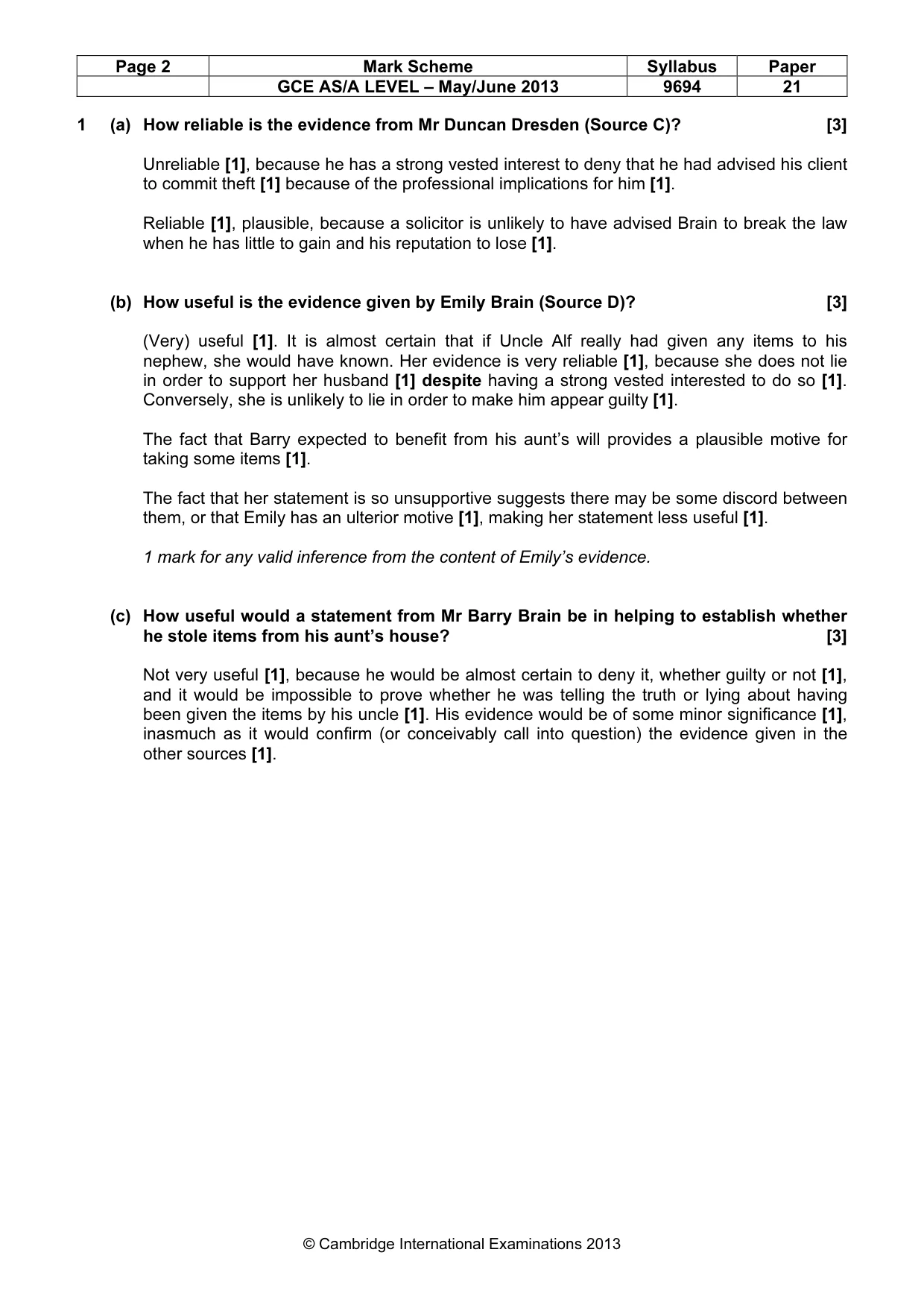
Page 2 Mark Scheme Syllabus Paper GCE AS/A LEVEL – May/June 2013 9694 21 © Cambridge International Examinations 2013 1 (a) How reliable is the evidence from Mr Duncan Dresden (Source C)? [3] Unreliable [1], because he has a strong vested interest to deny that he had advised his client to commit theft [1] because of the professional implications for him [1]. Reliable [1], plausible, because a solicitor is unlikely to have advised Brain to break the law when he has little to gain and his reputation to lose [1]. (b) How useful is the evidence given by Emily Brain (Source D)? [3] (Very) useful [1]. It is almost certain that if Uncle Alf really had given any items to his nephew, she would have known. Her evidence is very reliable [1], because she does not lie in order to support her husband [1] despite having a strong vested interested to do so [1]. Conversely, she is unlikely to lie in order to make him appear guilty [1]. The fact that Barry expected to benefit from his aunt’s will provides a plausible motive for taking some items [1]. The fact that her statement is so unsupportive suggests there may be some discord between them, or that Emily has an ulterior motive [1], making her statement less useful [1]. 1 mark for any valid inference from the content of Emily’s evidence. (c) How useful would a statement from Mr Barry Brain be in helping to establish whether he stole items from his aunt’s house? [3] Not very useful [1], because he would be almost certain to deny it, whether guilty or not [1], and it would be impossible to prove whether he was telling the truth or lying about having been given the items by his uncle [1]. His evidence would be of some minor significance [1], inasmuch as it would confirm (or conceivably call into question) the evidence given in the other sources [1].
Mark scheme, page 3
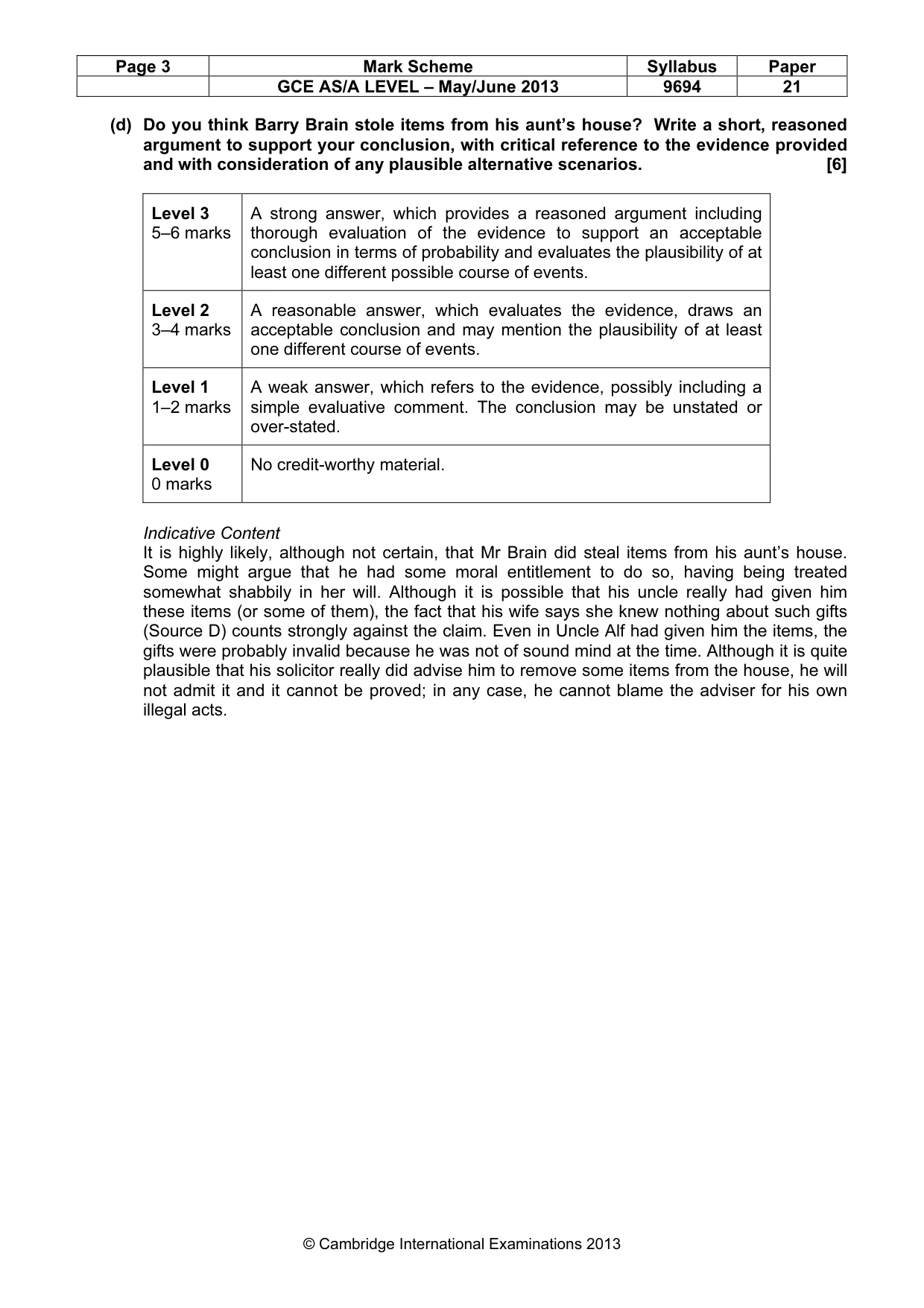
Page 3 Mark Scheme Syllabus Paper GCE AS/A LEVEL – May/June 2013 9694 21 © Cambridge International Examinations 2013 (d) Do you think Barry Brain stole items from his aunt’s house? Write a short, reasoned argument to support your conclusion, with critical reference to the evidence provided and with consideration of any plausible alternative scenarios. [6] Level 3 5–6 marks A strong answer, which provides a reasoned argument including thorough evaluation of the evidence to support an acceptable conclusion in terms of probability and evaluates the plausibility of at least one different possible course of events. Level 2 3–4 marks A reasonable answer, which evaluates the evidence, draws an acceptable conclusion and may mention the plausibility of at least one different course of events. Level 1 1–2 marks A weak answer, which refers to the evidence, possibly including a simple evaluative comment. The conclusion may be unstated or over-stated. Level 0 0 marks No credit-worthy material. Indicative Content It is highly likely, although not certain, that Mr Brain did steal items from his aunt’s house. Some might argue that he had some moral entitlement to do so, having being treated somewhat shabbily in her will. Although it is possible that his uncle really had given him these items (or some of them), the fact that his wife says she knew nothing about such gifts (Source D) counts strongly against the claim. Even in Uncle Alf had given him the items, the gifts were probably invalid because he was not of sound mind at the time. Although it is quite plausible that his solicitor really did advise him to remove some items from the house, he will not admit it and it cannot be proved; in any case, he cannot blame the adviser for his own illegal acts.
Mark scheme, page 4
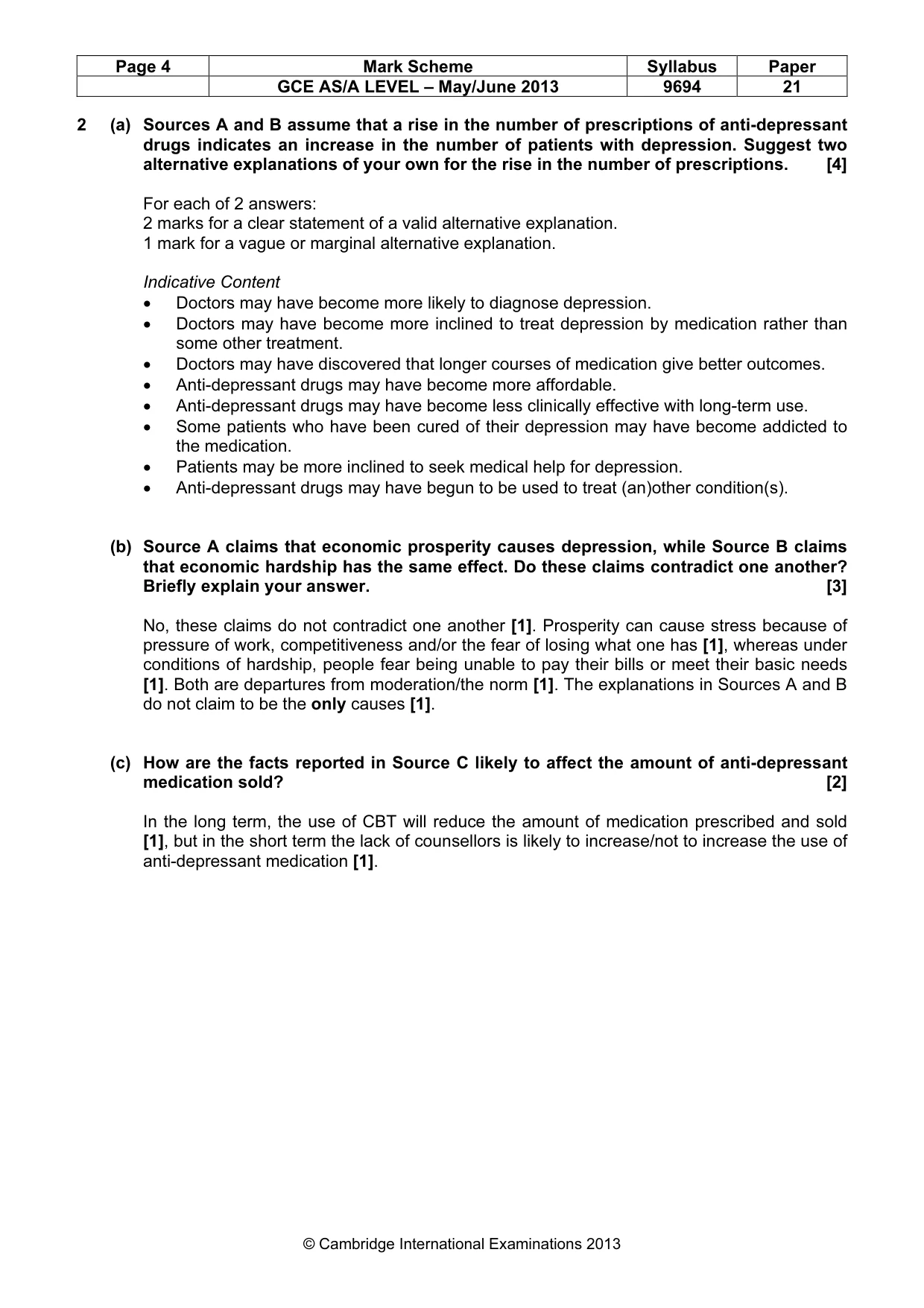
Page 4 Mark Scheme Syllabus Paper GCE AS/A LEVEL – May/June 2013 9694 21 © Cambridge International Examinations 2013 2 (a) Sources A and B assume that a rise in the number of prescriptions of anti-depressant drugs indicates an increase in the number of patients with depression. Suggest two alternative explanations of your own for the rise in the number of prescriptions. [4] For each of 2 answers: 2 marks for a clear statement of a valid alternative explanation. 1 mark for a vague or marginal alternative explanation. Indicative Content • Doctors may have become more likely to diagnose depression. • Doctors may have become more inclined to treat depression by medication rather than some other treatment. • Doctors may have discovered that longer courses of medication give better outcomes. • Anti-depressant drugs may have become more affordable. • Anti-depressant drugs may have become less clinically effective with long-term use. • Some patients who have been cured of their depression may have become addicted to the medication. • Patients may be more inclined to seek medical help for depression. • Anti-depressant drugs may have begun to be used to treat (an)other condition(s). (b) Source A claims that economic prosperity causes depression, while Source B claims that economic hardship has the same effect. Do these claims contradict one another? Briefly explain your answer. [3] No, these claims do not contradict one another [1]. Prosperity can cause stress because of pressure of work, competitiveness and/or the fear of losing what one has [1], whereas under conditions of hardship, people fear being unable to pay their bills or meet their basic needs [1]. Both are departures from moderation/the norm [1]. The explanations in Sources A and B do not claim to be the only causes [1]. (c) How are the facts reported in Source C likely to affect the amount of anti-depressant medication sold? [2] In the long term, the use of CBT will reduce the amount of medication prescribed and sold [1], but in the short term the lack of counsellors is likely to increase/not to increase the use of anti-depressant medication [1].
Mark scheme, page 5
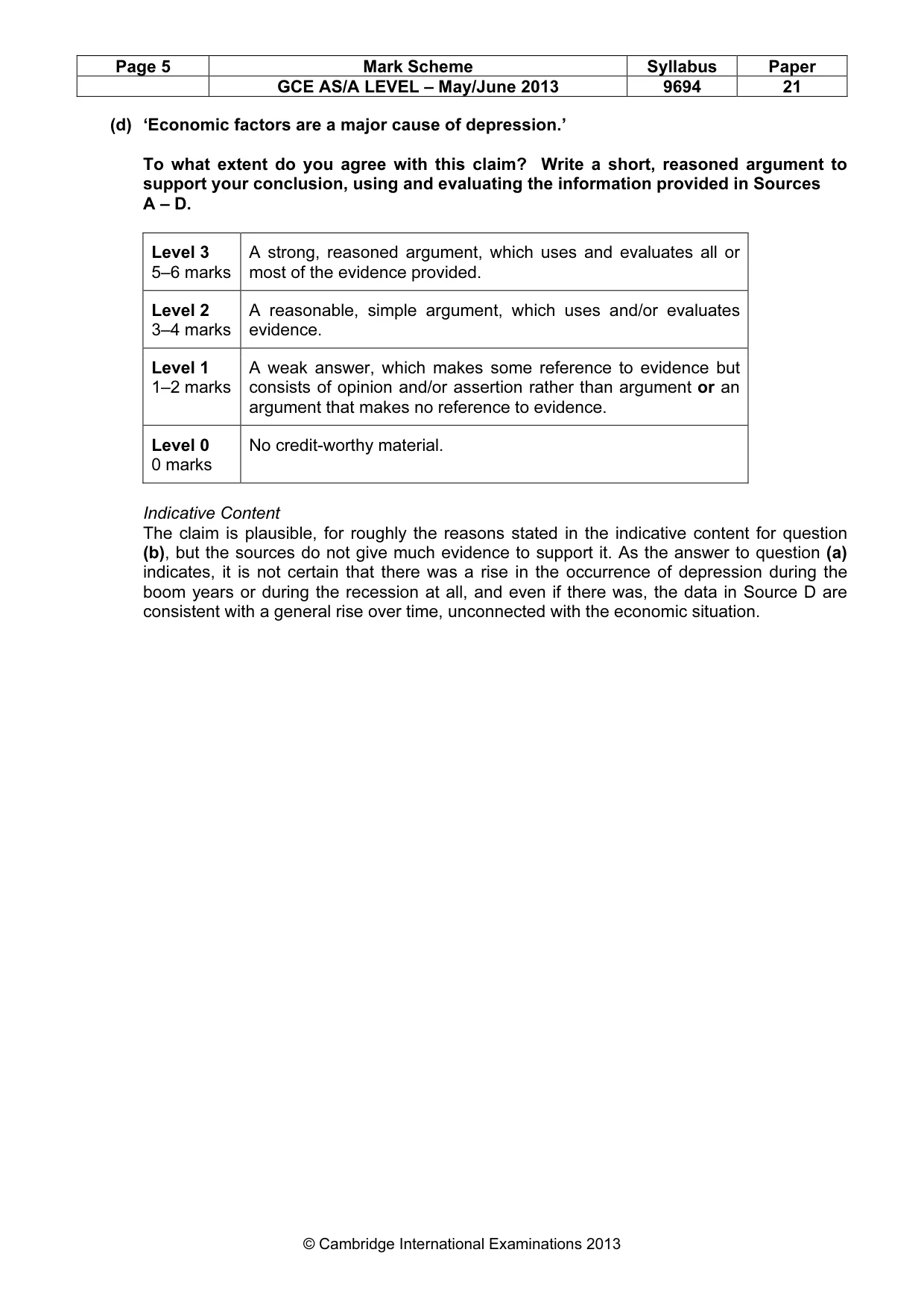
Page 5 Mark Scheme Syllabus Paper GCE AS/A LEVEL – May/June 2013 9694 21 © Cambridge International Examinations 2013 (d) ‘Economic factors are a major cause of depression.’ To what extent do you agree with this claim? Write a short, reasoned argument to support your conclusion, using and evaluating the information provided in Sources A – D. Level 3 5–6 marks A strong, reasoned argument, which uses and evaluates all or most of the evidence provided. Level 2 3–4 marks A reasonable, simple argument, which uses and/or evaluates evidence. Level 1 1–2 marks A weak answer, which makes some reference to evidence but consists of opinion and/or assertion rather than argument or an argument that makes no reference to evidence. Level 0 0 marks No credit-worthy material. Indicative Content The claim is plausible, for roughly the reasons stated in the indicative content for question (b), but the sources do not give much evidence to support it. As the answer to question (a) indicates, it is not certain that there was a rise in the occurrence of depression during the boom years or during the recession at all, and even if there was, the data in Source D are consistent with a general rise over time, unconnected with the economic situation.
Mark scheme, page 6
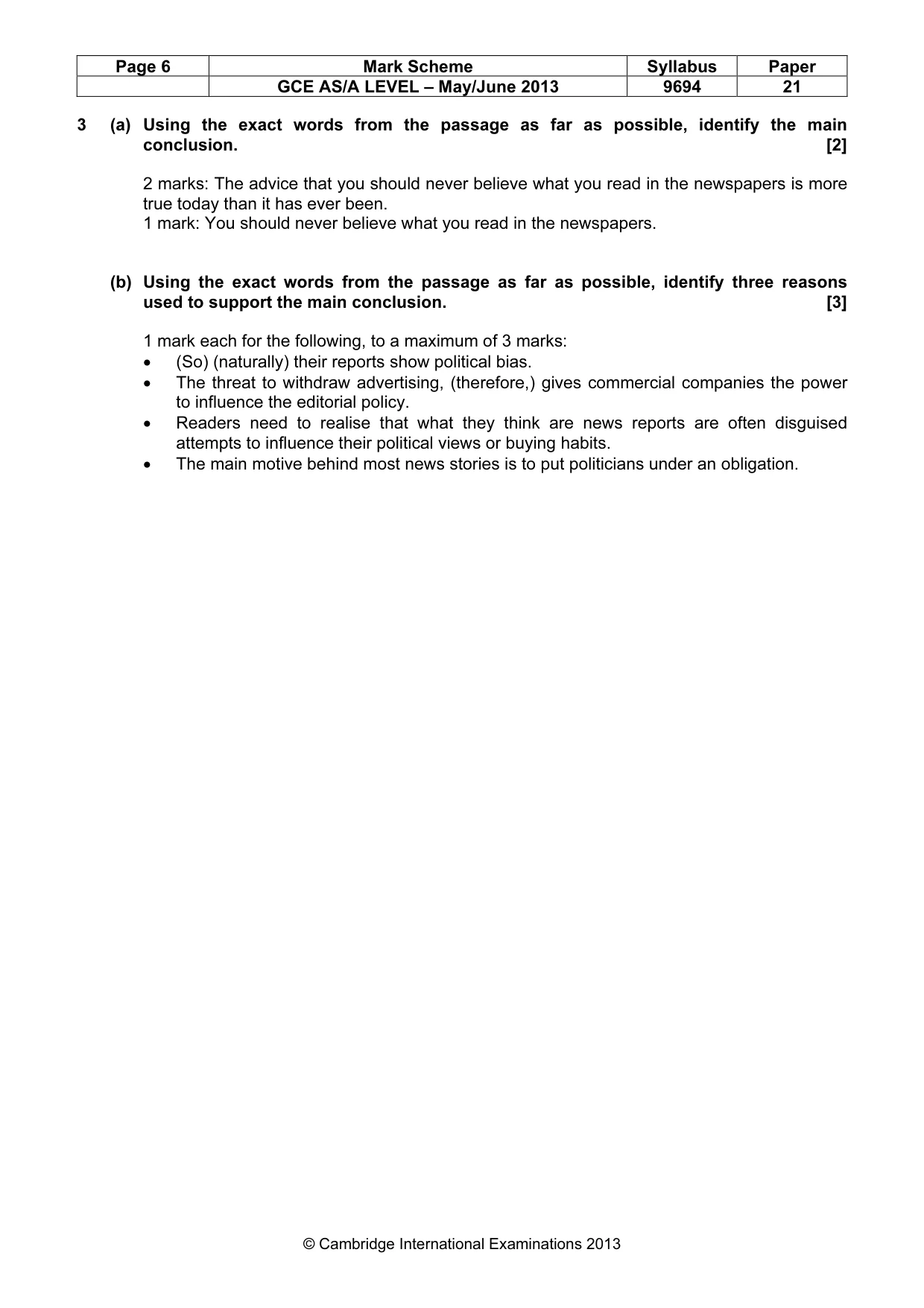
Page 6 Mark Scheme Syllabus Paper GCE AS/A LEVEL – May/June 2013 9694 21 © Cambridge International Examinations 2013 3 (a) Using the exact words from the passage as far as possible, identify the main conclusion. [2] 2 marks: The advice that you should never believe what you read in the newspapers is more true today than it has ever been. 1 mark: You should never believe what you read in the newspapers. (b) Using the exact words from the passage as far as possible, identify three reasons used to support the main conclusion. [3] 1 mark each for the following, to a maximum of 3 marks: • (So) (naturally) their reports show political bias. • The threat to withdraw advertising, (therefore,) gives commercial companies the power to influence the editorial policy. • Readers need to realise that what they think are news reports are often disguised attempts to influence their political views or buying habits. • The main motive behind most news stories is to put politicians under an obligation.
Mark scheme, page 7
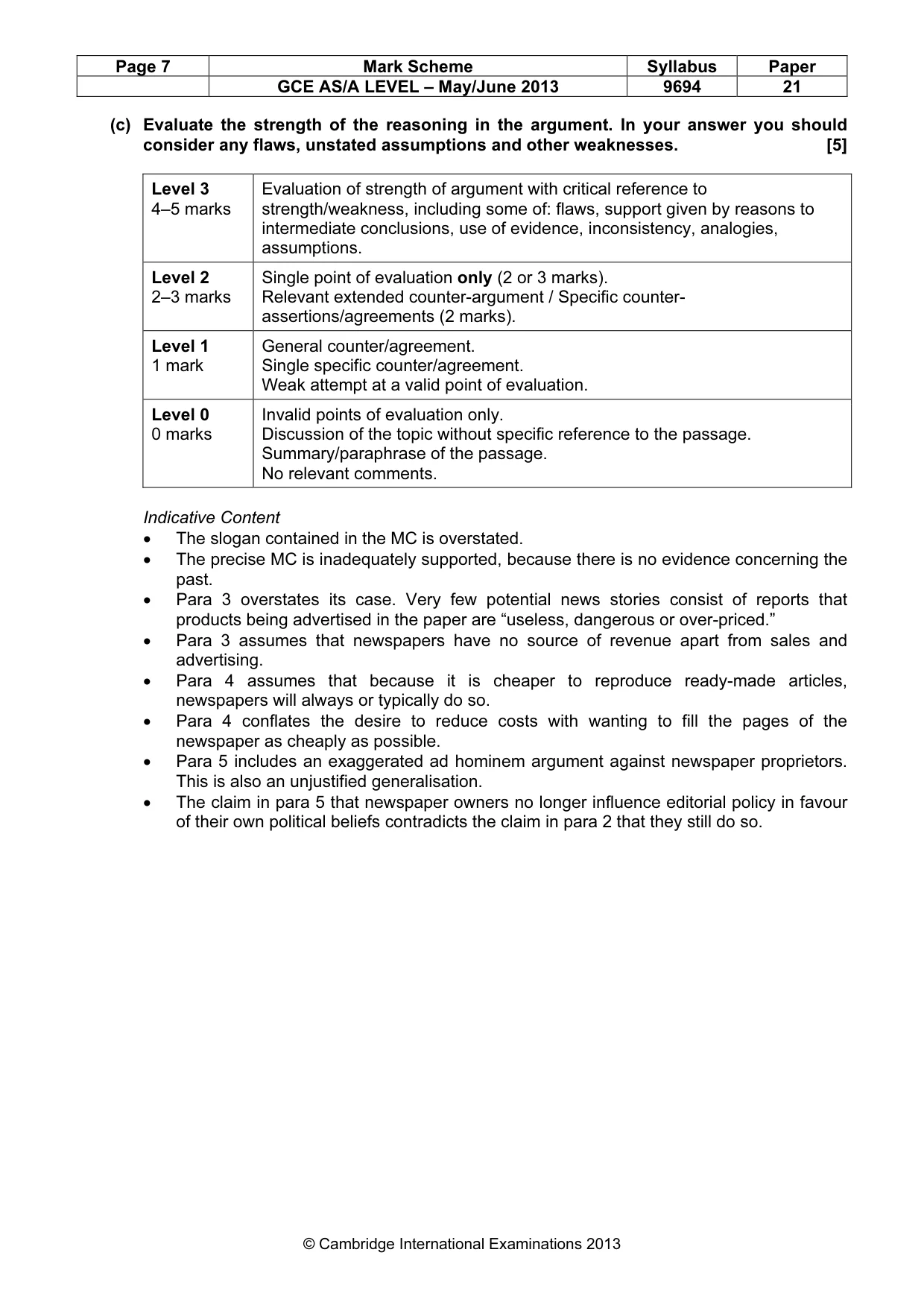
Page 7 Mark Scheme Syllabus Paper GCE AS/A LEVEL – May/June 2013 9694 21 © Cambridge International Examinations 2013 (c) Evaluate the strength of the reasoning in the argument. In your answer you should consider any flaws, unstated assumptions and other weaknesses. [5] Level 3 4–5 marks Evaluation of strength of argument with critical reference to strength/weakness, including some of: flaws, support given by reasons to intermediate conclusions, use of evidence, inconsistency, analogies, assumptions. Level 2 2–3 marks Single point of evaluation only (2 or 3 marks). Relevant extended counter-argument / Specific counter- assertions/agreements (2 marks). Level 1 1 mark General counter/agreement. Single specific counter/agreement. Weak attempt at a valid point of evaluation. Level 0 0 marks Invalid points of evaluation only. Discussion of the topic without specific reference to the passage. Summary/paraphrase of the passage. No relevant comments. Indicative Content • The slogan contained in the MC is overstated. • The precise MC is inadequately supported, because there is no evidence concerning the past. • Para 3 overstates its case. Very few potential news stories consist of reports that products being advertised in the paper are “useless, dangerous or over-priced.” • Para 3 assumes that newspapers have no source of revenue apart from sales and advertising. • Para 4 assumes that because it is cheaper to reproduce ready-made articles, newspapers will always or typically do so. • Para 4 conflates the desire to reduce costs with wanting to fill the pages of the newspaper as cheaply as possible. • Para 5 includes an exaggerated ad hominem argument against newspaper proprietors. This is also an unjustified generalisation. • The claim in para 5 that newspaper owners no longer influence editorial policy in favour of their own political beliefs contradicts the claim in para 2 that they still do so.
Mark scheme, page 8
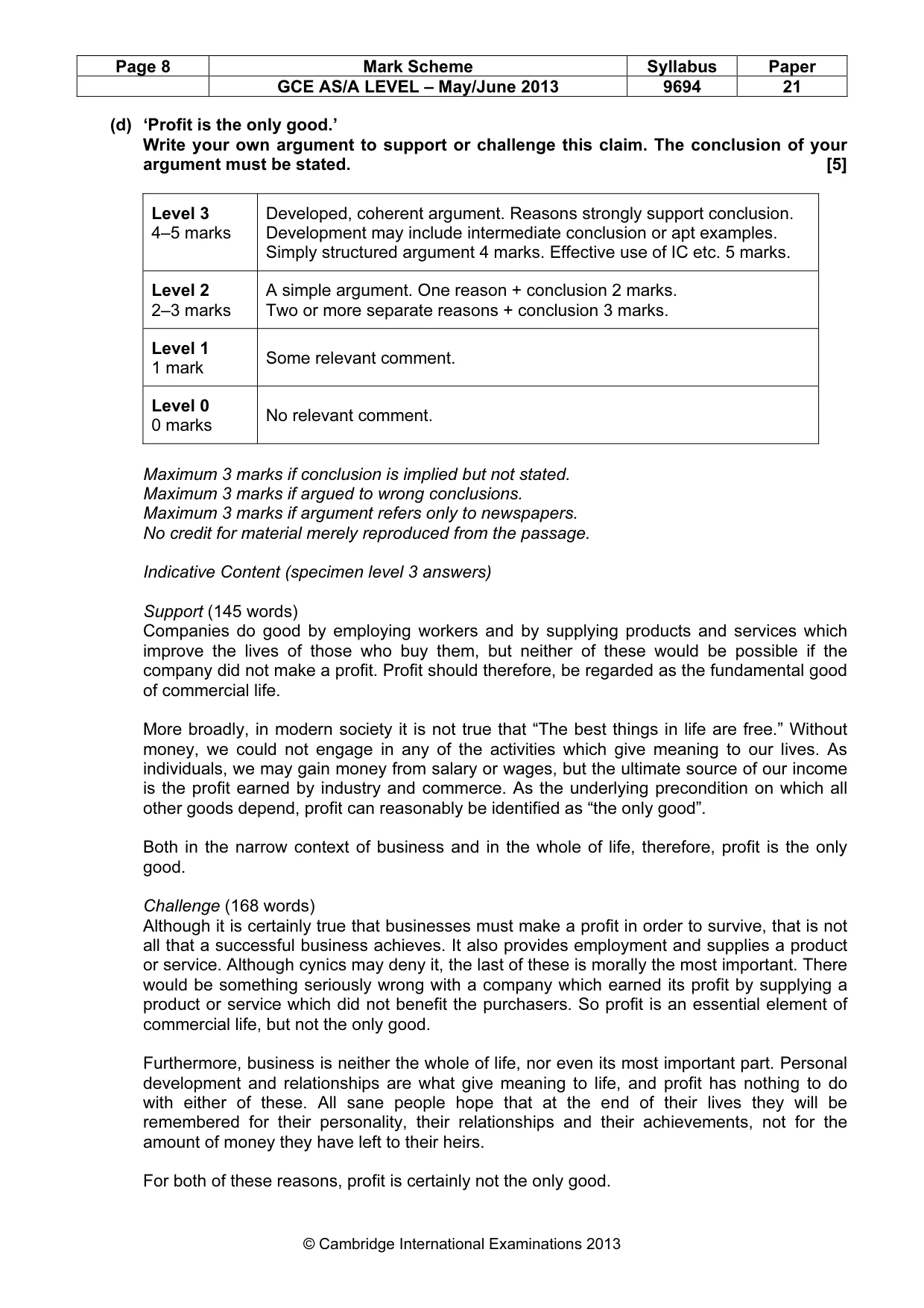
Page 8 Mark Scheme Syllabus Paper GCE AS/A LEVEL – May/June 2013 9694 21 © Cambridge International Examinations 2013 (d) ‘Profit is the only good.’ Write your own argument to support or challenge this claim. The conclusion of your argument must be stated. [5] Level 3 4–5 marks Developed, coherent argument. Reasons strongly support conclusion. Development may include intermediate conclusion or apt examples. Simply structured argument 4 marks. Effective use of IC etc. 5 marks. Level 2 2–3 marks A simple argument. One reason + conclusion 2 marks. Two or more separate reasons + conclusion 3 marks. Level 1 1 mark Some relevant comment. Level 0 0 marks No relevant comment. Maximum 3 marks if conclusion is implied but not stated. Maximum 3 marks if argued to wrong conclusions. Maximum 3 marks if argument refers only to newspapers. No credit for material merely reproduced from the passage. Indicative Content (specimen level 3 answers) Support (145 words) Companies do good by employing workers and by supplying products and services which improve the lives of those who buy them, but neither of these would be possible if the company did not make a profit. Profit should therefore, be regarded as the fundamental good of commercial life. More broadly, in modern society it is not true that “The best things in life are free.” Without money, we could not engage in any of the activities which give meaning to our lives. As individuals, we may gain money from salary or wages, but the ultimate source of our income is the profit earned by industry and commerce. As the underlying precondition on which all other goods depend, profit can reasonably be identified as “the only good”. Both in the narrow context of business and in the whole of life, therefore, profit is the only good. Challenge (168 words) Although it is certainly true that businesses must make a profit in order to survive, that is not all that a successful business achieves. It also provides employment and supplies a product or service. Although cynics may deny it, the last of these is morally the most important. There would be something seriously wrong with a company which earned its profit by supplying a product or service which did not benefit the purchasers. So profit is an essential element of commercial life, but not the only good. Furthermore, business is neither the whole of life, nor even its most important part. Personal development and relationships are what give meaning to life, and profit has nothing to do with either of these. All sane people hope that at the end of their lives they will be remembered for their personality, their relationships and their achievements, not for the amount of money they have left to their heirs. For both of these reasons, profit is certainly not the only good.
What you needed in this session
Cambridge’s own grade thresholds for 2013 May/June, Paper 2 · Variant 1. A higher threshold means an easier paper — the bar moves with how the cohort did.