Cambridge A Level Thinking Skills 9694 — 2013 May/June Paper 2 · Variant 2
9694/22/M/J/13 · 45 marks · ≈51 min
The question paper and its mark scheme, free to read here and free to download. This is Cambridge’s own paper, exactly as it was sat.
Question paper8 pages

Mark scheme7 pages
Answers below. Sit the paper first if you are practising.
Paper as text
Question paper, page 1
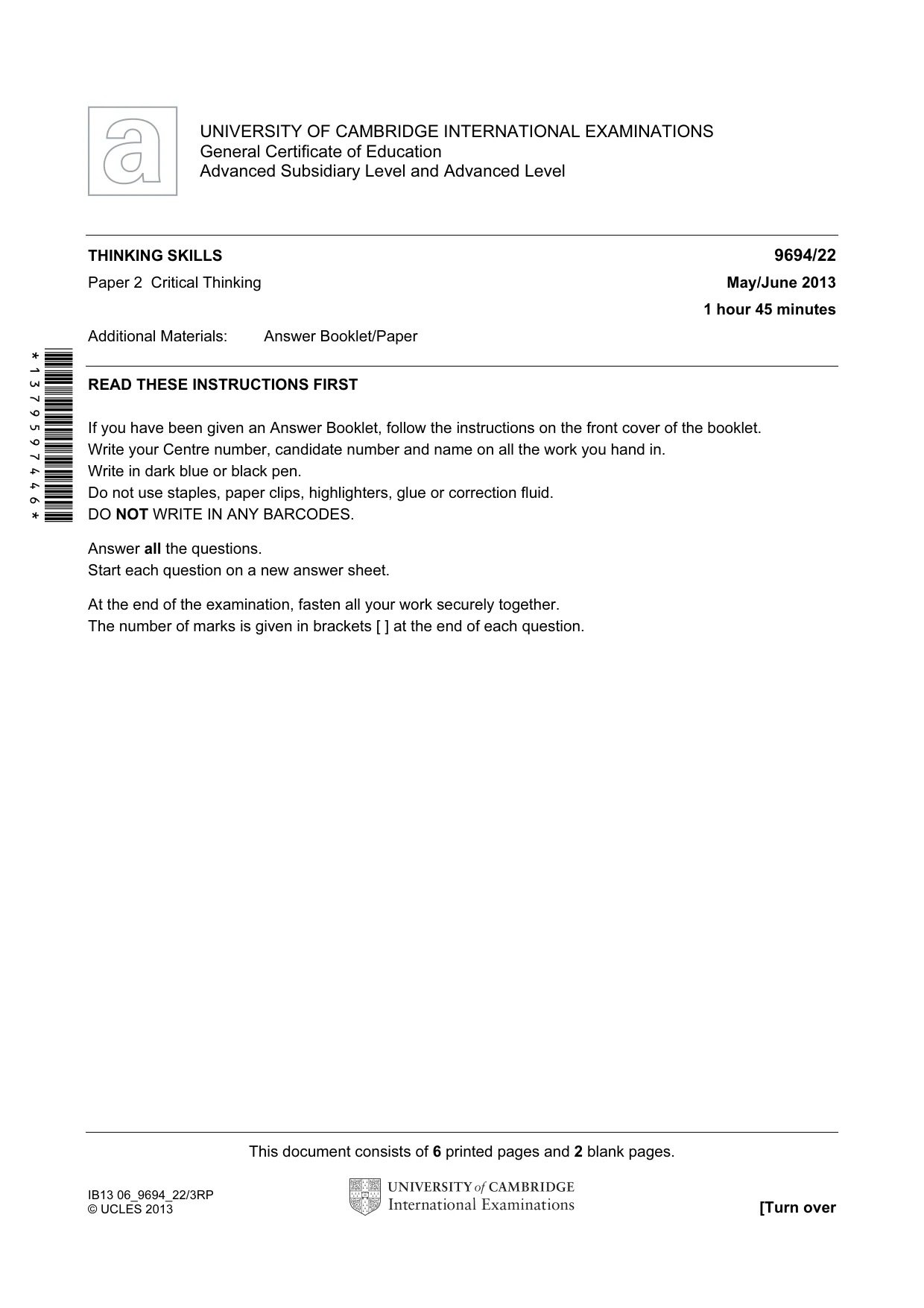
This document consists of 6 printed pages and 2 blank pages. IB13 06_9694_22/3RP © UCLES 2013 [Turn over *1379597446* UNIVERSITY OF CAMBRIDGE INTERNATIONAL EXAMINATIONS General Certificate of Education Advanced Subsidiary Level and Advanced Level THINKING SKILLS 9694/22 Paper 2 Critical Thinking May/June 2013 1 hour 45 minutes Additional Materials: Answer Booklet/Paper READ THESE INSTRUCTIONS FIRST If you have been given an Answer Booklet, follow the instructions on the front cover of the booklet. Write your Centre number, candidate number and name on all the work you hand in. Write in dark blue or black pen. Do not use staples, paper clips, highlighters, glue or correction fluid. DO NOT WRITE IN ANY BARCODES. Answer all the questions. Start each question on a new answer sheet. At the end of the examination, fasten all your work securely together. The number of marks is given in brackets [ ] at the end of each question.
Question paper, page 2
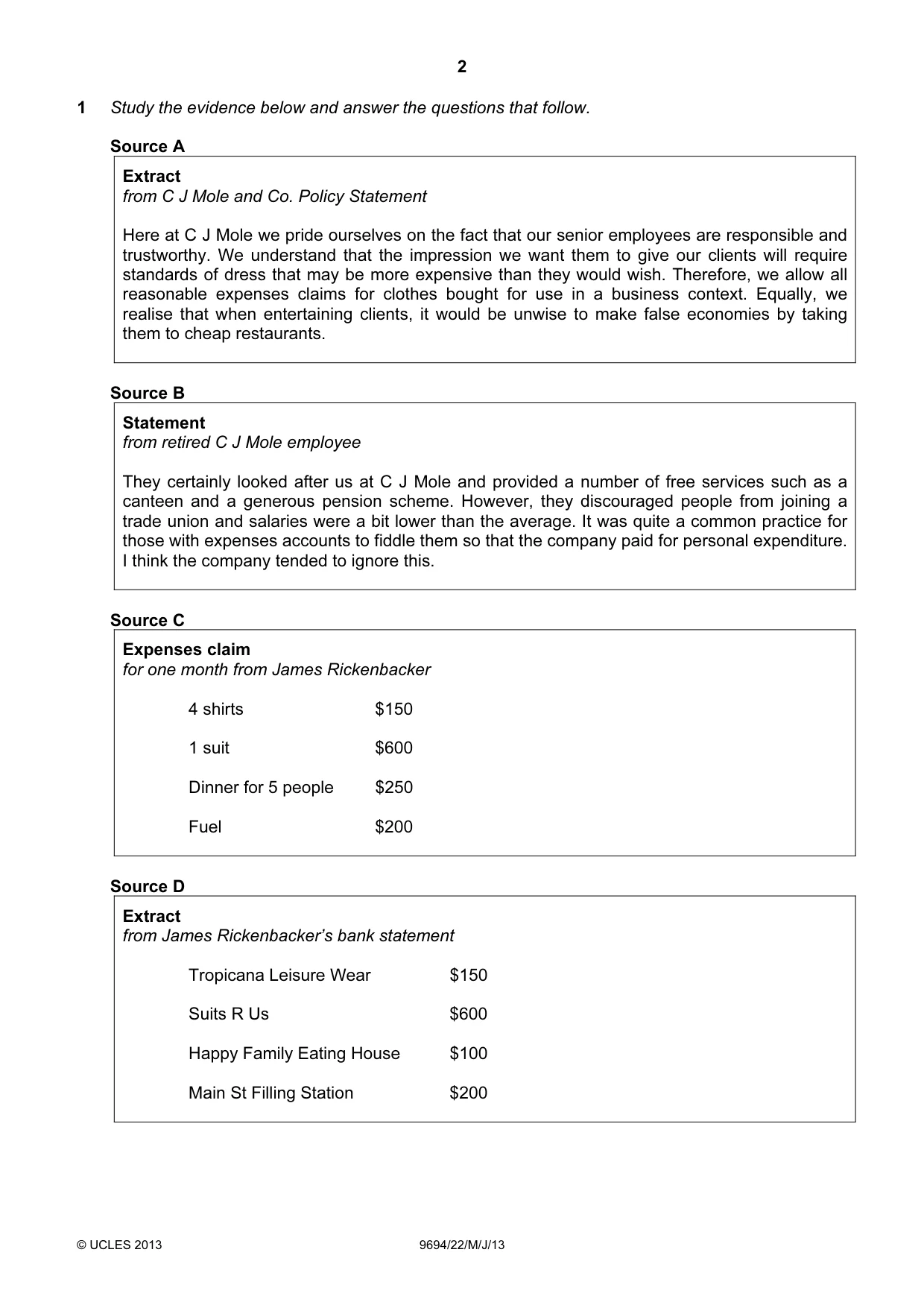
2 © UCLES 2013 9694/22/M/J/13 1 Study the evidence below and answer the questions that follow. Source A Extract from C J Mole and Co. Policy Statement Here at C J Mole we pride ourselves on the fact that our senior employees are responsible and trustworthy. We understand that the impression we want them to give our clients will require standards of dress that may be more expensive than they would wish. Therefore, we allow all reasonable expenses claims for clothes bought for use in a business context. Equally, we realise that when entertaining clients, it would be unwise to make false economies by taking them to cheap restaurants. Source B Statement from retired C J Mole employee They certainly looked after us at C J Mole and provided a number of free services such as a canteen and a generous pension scheme. However, they discouraged people from joining a trade union and salaries were a bit lower than the average. It was quite a common practice for those with expenses accounts to fiddle them so that the company paid for personal expenditure. I think the company tended to ignore this. Source C Expenses claim for one month from James Rickenbacker 4 shirts $150 1 suit $600 Dinner for 5 people $250 Fuel $200 Source D Extract from James Rickenbacker’s bank statement Tropicana Leisure Wear $150 Suits R Us $600 Happy Family Eating House $100 Main St Filling Station $200
Question paper, page 3
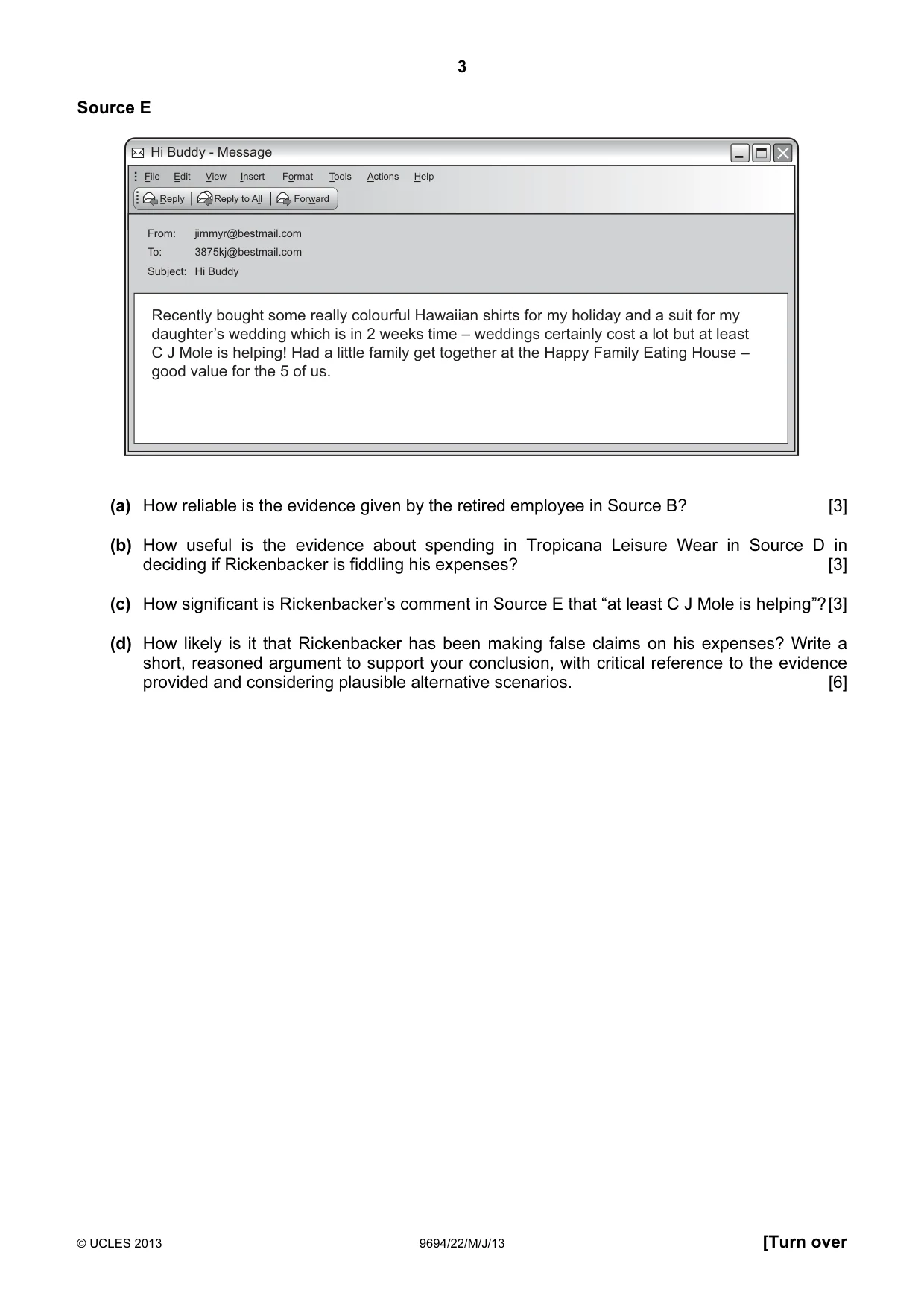
3 © UCLES 2013 9694/22/M/J/13 [Turn over Source E File Edit View Insert Format Tools Actions Help Reply Forward Reply to All Hi Buddy - Message From: jimmyr@bestmail.com To: 3875kj@bestmail.com Subject: Hi Buddy Recently bought some really colourful Hawaiian shirts for my holiday and a suit for my daughter’s wedding which is in 2 weeks time – weddings certainly cost a lot but at least C J Mole is helping! Had a little family get together at the Happy Family Eating House – good value for the 5 of us. (a) How reliable is the evidence given by the retired employee in Source B? [3] (b) How useful is the evidence about spending in Tropicana Leisure Wear in Source D in deciding if Rickenbacker is fiddling his expenses? [3] (c) How significant is Rickenbacker’s comment in Source E that “at least C J Mole is helping”? [3] (d) How likely is it that Rickenbacker has been making false claims on his expenses? Write a short, reasoned argument to support your conclusion, with critical reference to the evidence provided and considering plausible alternative scenarios. [6]
Question paper, page 4
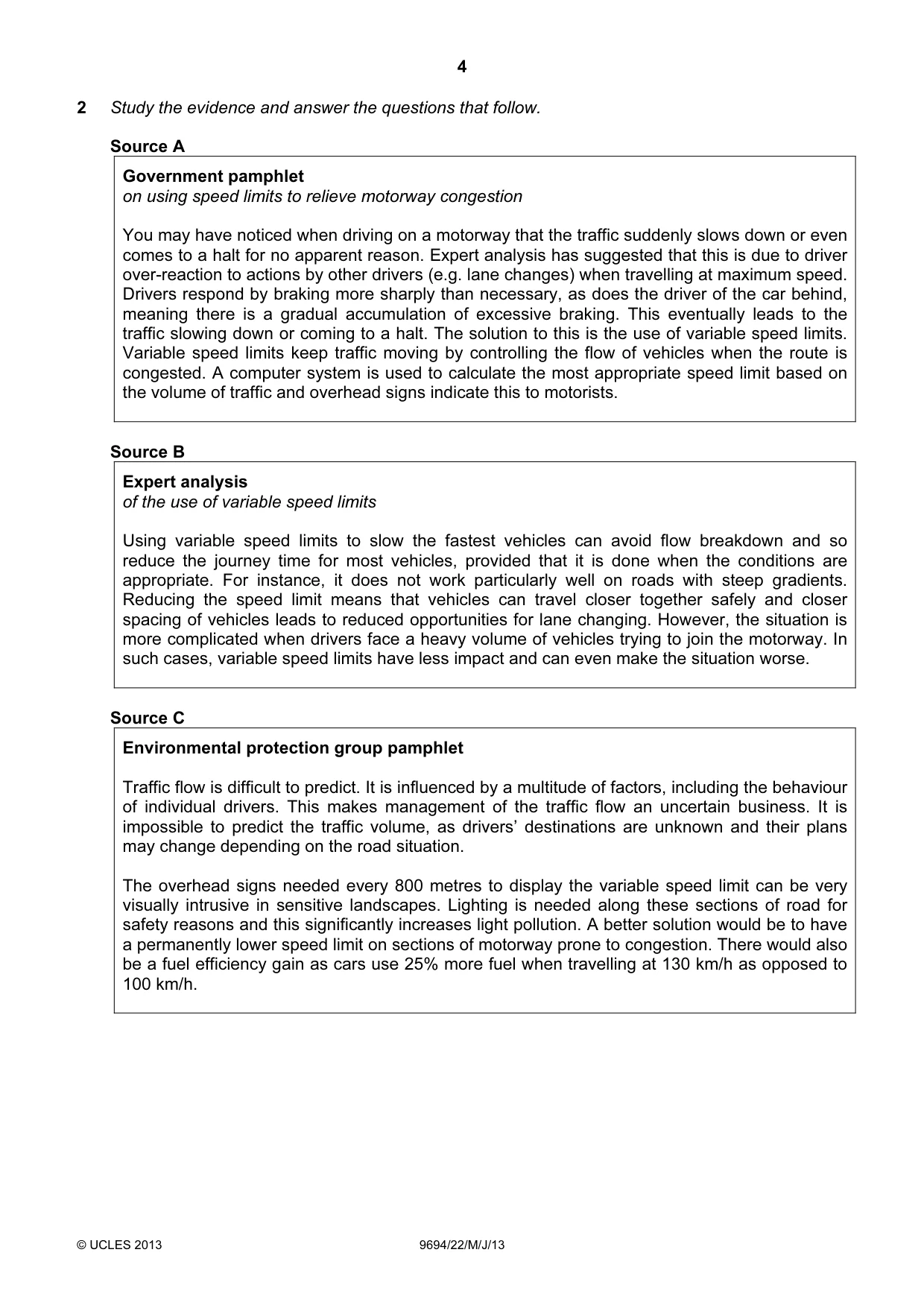
4 © UCLES 2013 9694/22/M/J/13 2 Study the evidence and answer the questions that follow. Source A Government pamphlet on using speed limits to relieve motorway congestion You may have noticed when driving on a motorway that the traffic suddenly slows down or even comes to a halt for no apparent reason. Expert analysis has suggested that this is due to driver over-reaction to actions by other drivers (e.g. lane changes) when travelling at maximum speed. Drivers respond by braking more sharply than necessary, as does the driver of the car behind, meaning there is a gradual accumulation of excessive braking. This eventually leads to the traffic slowing down or coming to a halt. The solution to this is the use of variable speed limits. Variable speed limits keep traffic moving by controlling the flow of vehicles when the route is congested. A computer system is used to calculate the most appropriate speed limit based on the volume of traffic and overhead signs indicate this to motorists. Source B Expert analysis of the use of variable speed limits Using variable speed limits to slow the fastest vehicles can avoid flow breakdown and so reduce the journey time for most vehicles, provided that it is done when the conditions are appropriate. For instance, it does not work particularly well on roads with steep gradients. Reducing the speed limit means that vehicles can travel closer together safely and closer spacing of vehicles leads to reduced opportunities for lane changing. However, the situation is more complicated when drivers face a heavy volume of vehicles trying to join the motorway. In such cases, variable speed limits have less impact and can even make the situation worse. Source C Environmental protection group pamphlet Traffic flow is difficult to predict. It is influenced by a multitude of factors, including the behaviour of individual drivers. This makes management of the traffic flow an uncertain business. It is impossible to predict the traffic volume, as drivers’ destinations are unknown and their plans may change depending on the road situation. The overhead signs needed every 800 metres to display the variable speed limit can be very visually intrusive in sensitive landscapes. Lighting is needed along these sections of road for safety reasons and this significantly increases light pollution. A better solution would be to have a permanently lower speed limit on sections of motorway prone to congestion. There would also be a fuel efficiency gain as cars use 25% more fuel when travelling at 130 km/h as opposed to 100 km/h.
Question paper, page 5
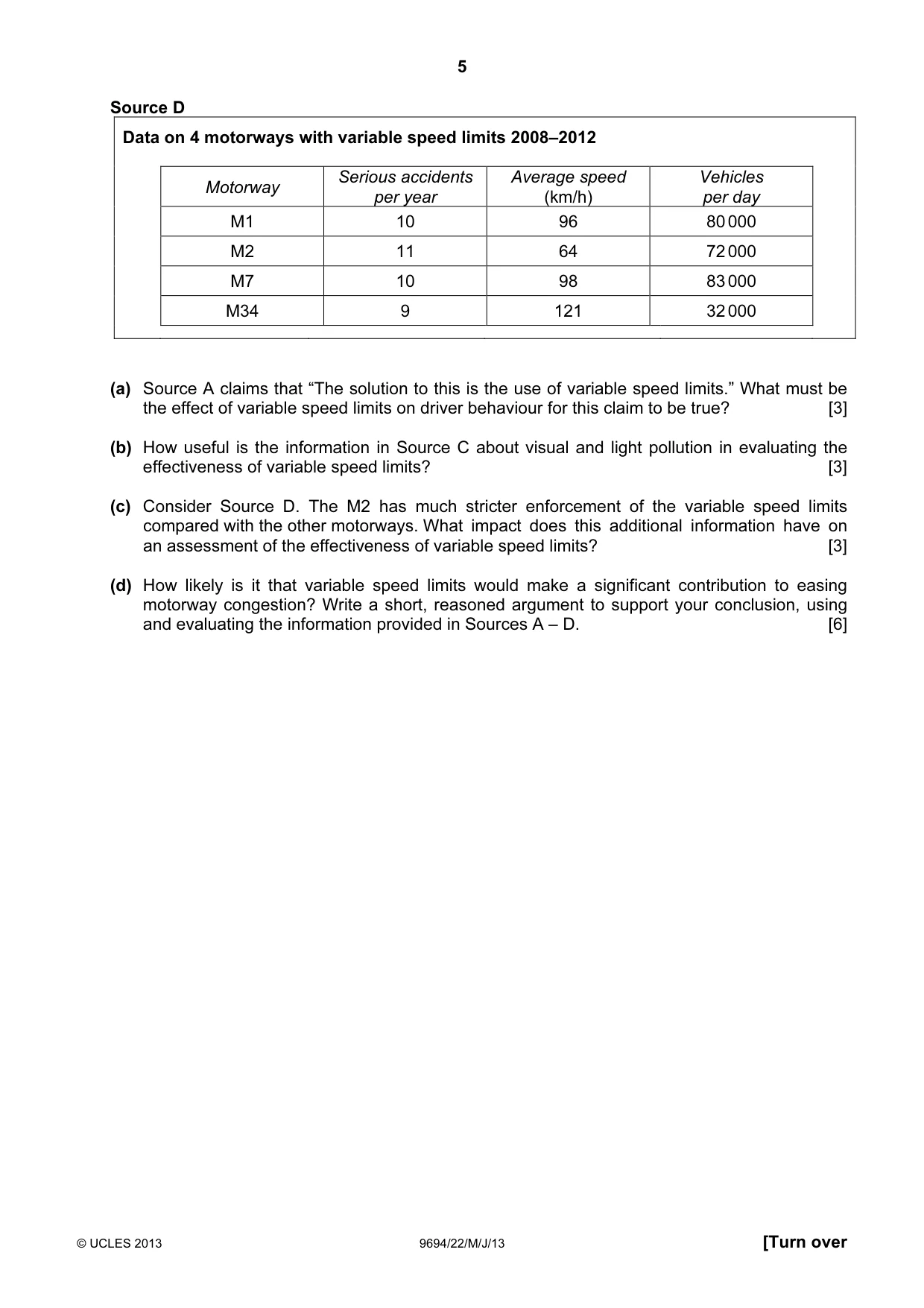
5 © UCLES 2013 9694/22/M/J/13 [Turn over Source D Data on 4 motorways with variable speed limits 2008–2012 Motorway Serious accidents per year Average speed (km/h) Vehicles per day M1 10 96 80 000 M2 11 64 72 000 M7 10 98 83 000 M34 9 121 32 000 (a) Source A claims that “The solution to this is the use of variable speed limits.” What must be the effect of variable speed limits on driver behaviour for this claim to be true? [3] (b) How useful is the information in Source C about visual and light pollution in evaluating the effectiveness of variable speed limits? [3] (c) Consider Source D. The M2 has much stricter enforcement of the variable speed limits compared with the other motorways. What impact does this additional information have on an assessment of the effectiveness of variable speed limits? [3] (d) How likely is it that variable speed limits would make a significant contribution to easing motorway congestion? Write a short, reasoned argument to support your conclusion, using and evaluating the information provided in Sources A – D. [6]
Question paper, page 6
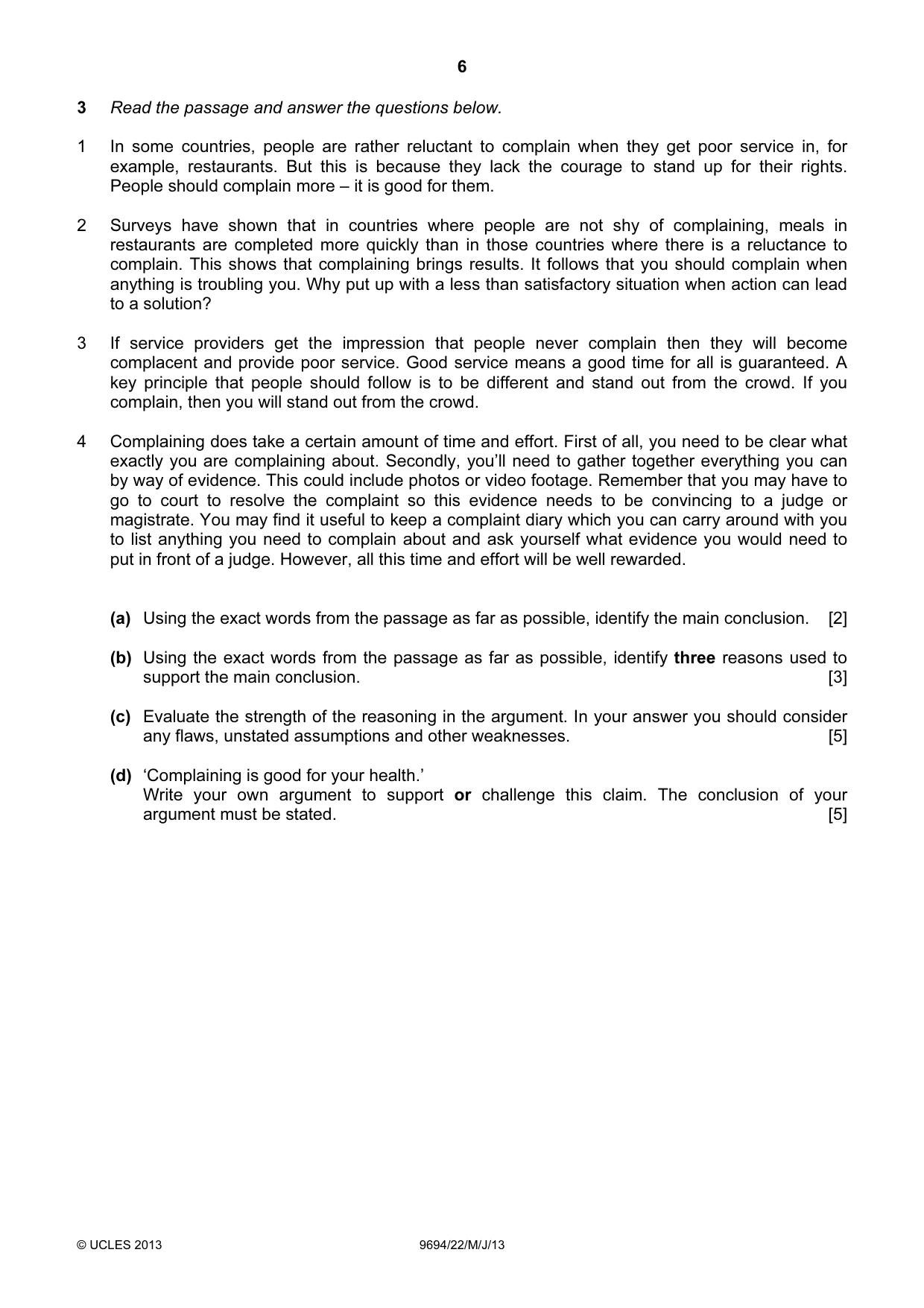
6 © UCLES 2013 9694/22/M/J/13 3 Read the passage and answer the questions below. 1 In some countries, people are rather reluctant to complain when they get poor service in, for example, restaurants. But this is because they lack the courage to stand up for their rights. People should complain more – it is good for them. 2 Surveys have shown that in countries where people are not shy of complaining, meals in restaurants are completed more quickly than in those countries where there is a reluctance to complain. This shows that complaining brings results. It follows that you should complain when anything is troubling you. Why put up with a less than satisfactory situation when action can lead to a solution? 3 If service providers get the impression that people never complain then they will become complacent and provide poor service. Good service means a good time for all is guaranteed. A key principle that people should follow is to be different and stand out from the crowd. If you complain, then you will stand out from the crowd. 4 Complaining does take a certain amount of time and effort. First of all, you need to be clear what exactly you are complaining about. Secondly, you’ll need to gather together everything you can by way of evidence. This could include photos or video footage. Remember that you may have to go to court to resolve the complaint so this evidence needs to be convincing to a judge or magistrate. You may find it useful to keep a complaint diary which you can carry around with you to list anything you need to complain about and ask yourself what evidence you would need to put in front of a judge. However, all this time and effort will be well rewarded. (a) Using the exact words from the passage as far as possible, identify the main conclusion. [2] (b) Using the exact words from the passage as far as possible, identify three reasons used to support the main conclusion. [3] (c) Evaluate the strength of the reasoning in the argument. In your answer you should consider any flaws, unstated assumptions and other weaknesses. [5] (d) ‘Complaining is good for your health.’ Write your own argument to support or challenge this claim. The conclusion of your argument must be stated. [5]
Question paper, page 7
7 © UCLES 2013 9694/22/M/J/13 BLANK PAGE
Question paper, page 8
8 Permission to reproduce items where third-party owned material protected by copyright is included has been sought and cleared where possible. Every reasonable effort has been made by the publisher (UCLES) to trace copyright holders, but if any items requiring clearance have unwittingly been included, the publisher will be pleased to make amends at the earliest possible opportunity. University of Cambridge International Examinations is part of the Cambridge Assessment Group. Cambridge Assessment is the brand name of University of Cambridge Local Examinations Syndicate (UCLES), which is itself a department of the University of Cambridge. © UCLES 2013 9694/22/M/J/13 BLANK PAGE
Mark scheme, page 1
CAMBRIDGE INTERNATIONAL EXAMINATIONS GCE Advanced Subsidiary Level and GCE Advanced Level MARK SCHEME for the May/June 2013 series 9694 THINKING SKILLS 9694/22 Paper 2 (Critical Thinking), maximum raw mark 45 This mark scheme is published as an aid to teachers and candidates, to indicate the requirements of the examination. It shows the basis on which Examiners were instructed to award marks. It does not indicate the details of the discussions that took place at an Examiners’ meeting before marking began, which would have considered the acceptability of alternative answers. Mark schemes should be read in conjunction with the question paper and the Principal Examiner Report for Teachers. Cambridge will not enter into discussions about these mark schemes. Cambridge is publishing the mark schemes for the May/June 2013 series for most IGCSE, GCE Advanced Level and Advanced Subsidiary Level components and some Ordinary Level components.
Mark scheme, page 2
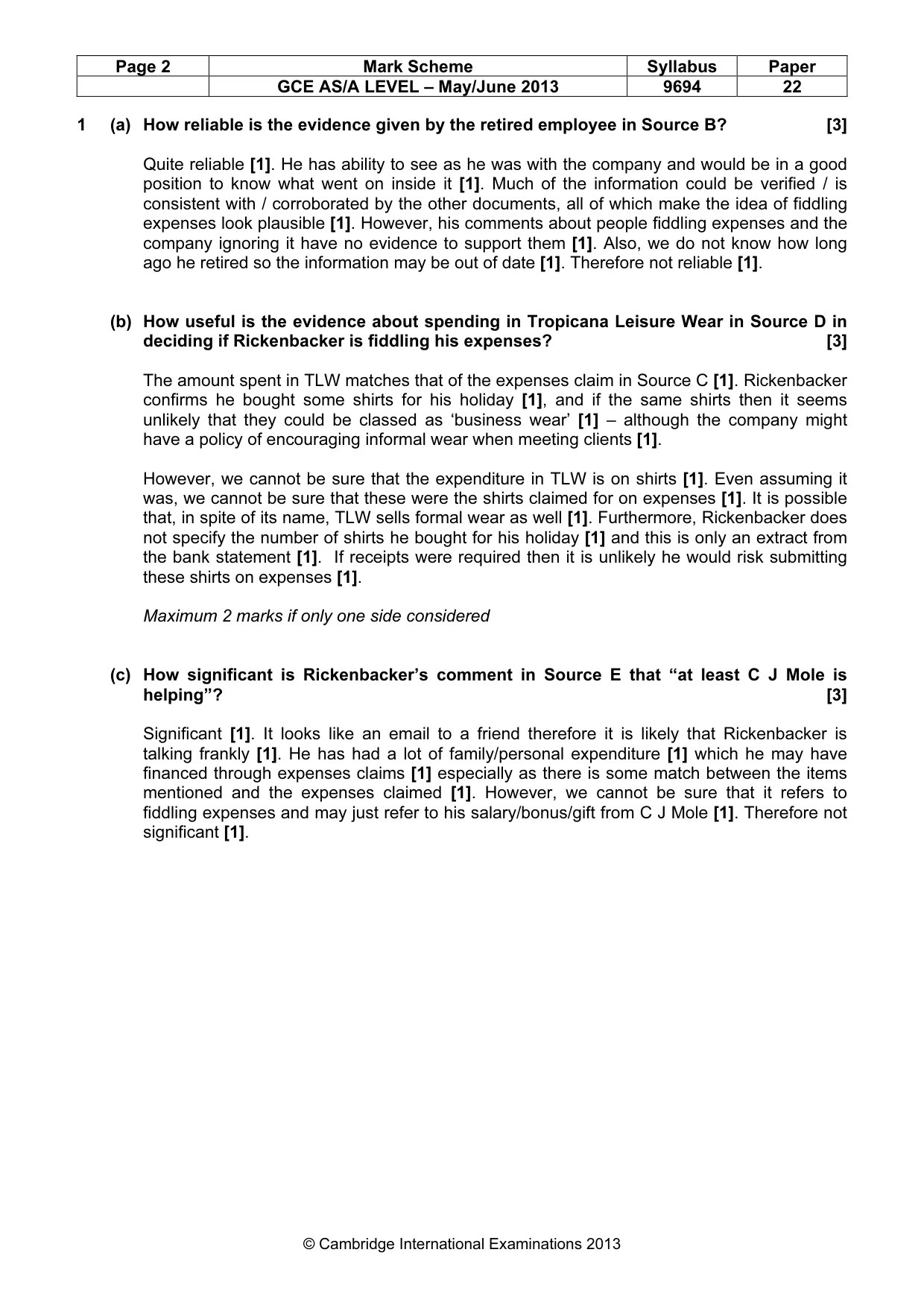
Page 2 Mark Scheme Syllabus Paper GCE AS/A LEVEL – May/June 2013 9694 22 © Cambridge International Examinations 2013 1 (a) How reliable is the evidence given by the retired employee in Source B? [3] Quite reliable [1]. He has ability to see as he was with the company and would be in a good position to know what went on inside it [1]. Much of the information could be verified / is consistent with / corroborated by the other documents, all of which make the idea of fiddling expenses look plausible [1]. However, his comments about people fiddling expenses and the company ignoring it have no evidence to support them [1]. Also, we do not know how long ago he retired so the information may be out of date [1]. Therefore not reliable [1]. (b) How useful is the evidence about spending in Tropicana Leisure Wear in Source D in deciding if Rickenbacker is fiddling his expenses? [3] The amount spent in TLW matches that of the expenses claim in Source C [1]. Rickenbacker confirms he bought some shirts for his holiday [1], and if the same shirts then it seems unlikely that they could be classed as ‘business wear’ [1] – although the company might have a policy of encouraging informal wear when meeting clients [1]. However, we cannot be sure that the expenditure in TLW is on shirts [1]. Even assuming it was, we cannot be sure that these were the shirts claimed for on expenses [1]. It is possible that, in spite of its name, TLW sells formal wear as well [1]. Furthermore, Rickenbacker does not specify the number of shirts he bought for his holiday [1] and this is only an extract from the bank statement [1]. If receipts were required then it is unlikely he would risk submitting these shirts on expenses [1]. Maximum 2 marks if only one side considered (c) How significant is Rickenbacker’s comment in Source E that “at least C J Mole is helping”? [3] Significant [1]. It looks like an email to a friend therefore it is likely that Rickenbacker is talking frankly [1]. He has had a lot of family/personal expenditure [1] which he may have financed through expenses claims [1] especially as there is some match between the items mentioned and the expenses claimed [1]. However, we cannot be sure that it refers to fiddling expenses and may just refer to his salary/bonus/gift from C J Mole [1]. Therefore not significant [1].
Mark scheme, page 3
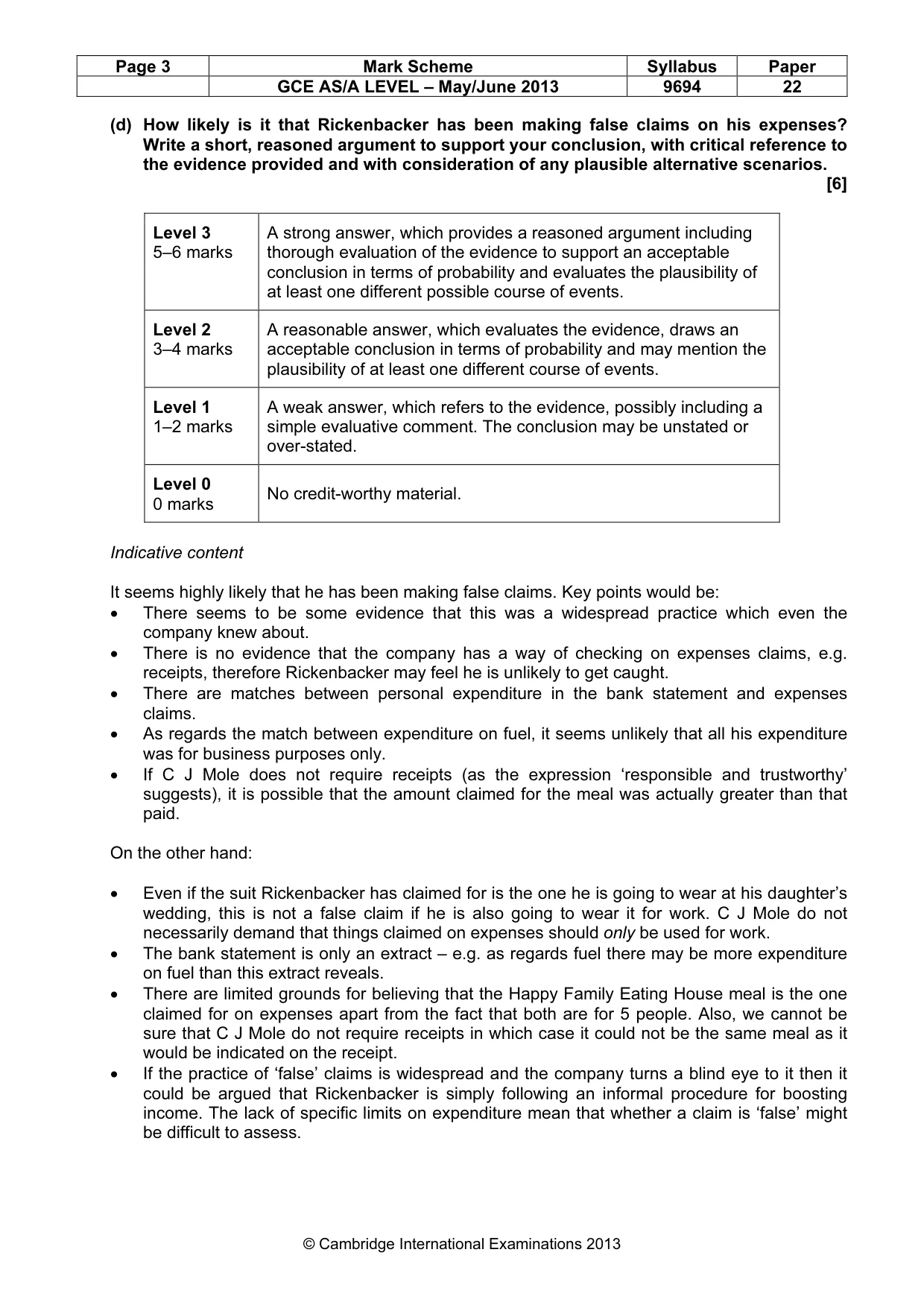
Page 3 Mark Scheme Syllabus Paper GCE AS/A LEVEL – May/June 2013 9694 22 © Cambridge International Examinations 2013 (d) How likely is it that Rickenbacker has been making false claims on his expenses? Write a short, reasoned argument to support your conclusion, with critical reference to the evidence provided and with consideration of any plausible alternative scenarios. [6] Level 3 5–6 marks A strong answer, which provides a reasoned argument including thorough evaluation of the evidence to support an acceptable conclusion in terms of probability and evaluates the plausibility of at least one different possible course of events. Level 2 3–4 marks A reasonable answer, which evaluates the evidence, draws an acceptable conclusion in terms of probability and may mention the plausibility of at least one different course of events. Level 1 1–2 marks A weak answer, which refers to the evidence, possibly including a simple evaluative comment. The conclusion may be unstated or over-stated. Level 0 0 marks No credit-worthy material. Indicative content It seems highly likely that he has been making false claims. Key points would be: • There seems to be some evidence that this was a widespread practice which even the company knew about. • There is no evidence that the company has a way of checking on expenses claims, e.g. receipts, therefore Rickenbacker may feel he is unlikely to get caught. • There are matches between personal expenditure in the bank statement and expenses claims. • As regards the match between expenditure on fuel, it seems unlikely that all his expenditure was for business purposes only. • If C J Mole does not require receipts (as the expression ‘responsible and trustworthy’ suggests), it is possible that the amount claimed for the meal was actually greater than that paid. On the other hand: • Even if the suit Rickenbacker has claimed for is the one he is going to wear at his daughter’s wedding, this is not a false claim if he is also going to wear it for work. C J Mole do not necessarily demand that things claimed on expenses should only be used for work. • The bank statement is only an extract – e.g. as regards fuel there may be more expenditure on fuel than this extract reveals. • There are limited grounds for believing that the Happy Family Eating House meal is the one claimed for on expenses apart from the fact that both are for 5 people. Also, we cannot be sure that C J Mole do not require receipts in which case it could not be the same meal as it would be indicated on the receipt. • If the practice of ‘false’ claims is widespread and the company turns a blind eye to it then it could be argued that Rickenbacker is simply following an informal procedure for boosting income. The lack of specific limits on expenditure mean that whether a claim is ‘false’ might be difficult to assess.
Mark scheme, page 4
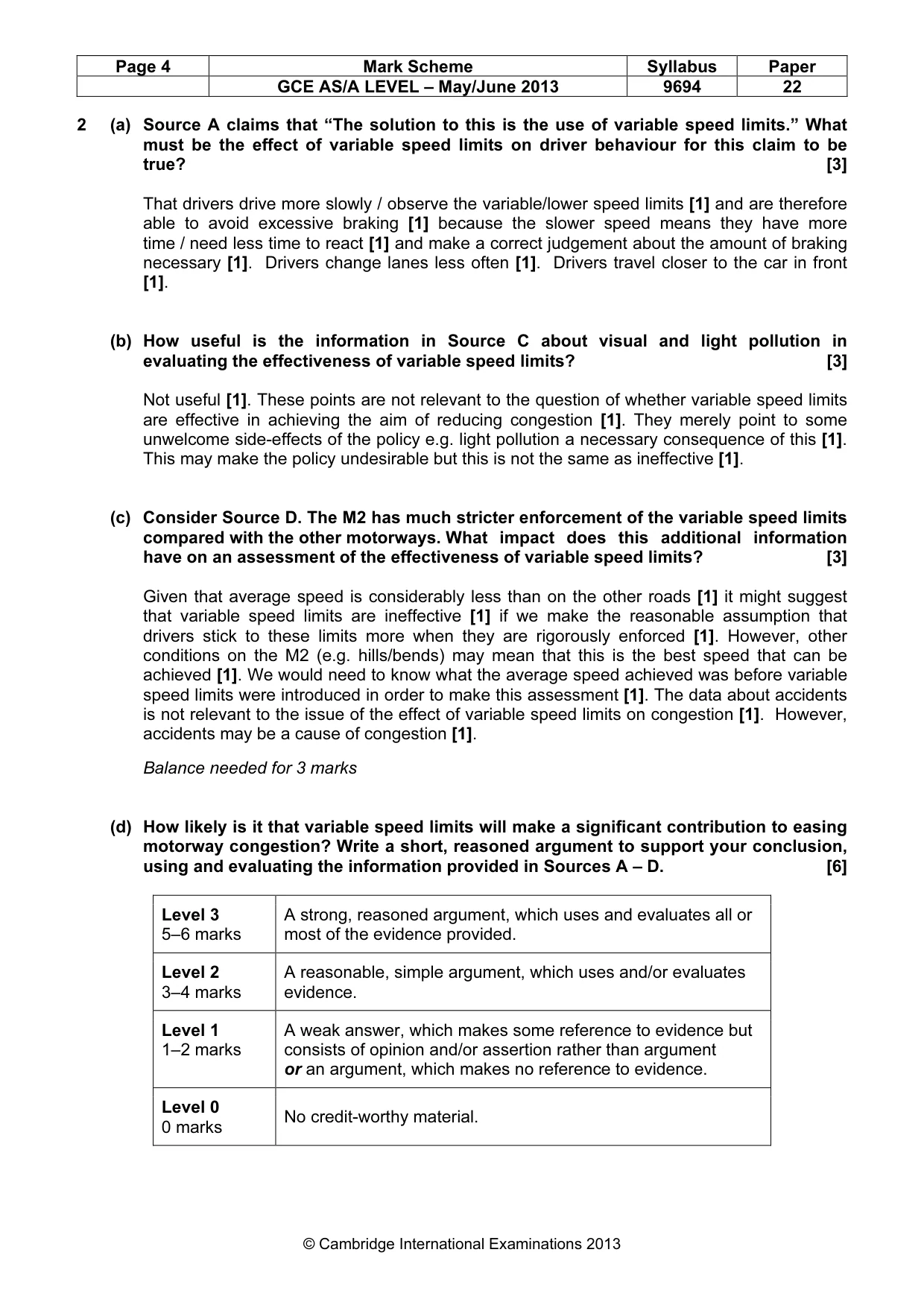
Page 4 Mark Scheme Syllabus Paper GCE AS/A LEVEL – May/June 2013 9694 22 © Cambridge International Examinations 2013 2 (a) Source A claims that “The solution to this is the use of variable speed limits.” What must be the effect of variable speed limits on driver behaviour for this claim to be true? [3] That drivers drive more slowly / observe the variable/lower speed limits [1] and are therefore able to avoid excessive braking [1] because the slower speed means they have more time / need less time to react [1] and make a correct judgement about the amount of braking necessary [1]. Drivers change lanes less often [1]. Drivers travel closer to the car in front [1]. (b) How useful is the information in Source C about visual and light pollution in evaluating the effectiveness of variable speed limits? [3] Not useful [1]. These points are not relevant to the question of whether variable speed limits are effective in achieving the aim of reducing congestion [1]. They merely point to some unwelcome side-effects of the policy e.g. light pollution a necessary consequence of this [1]. This may make the policy undesirable but this is not the same as ineffective [1]. (c) Consider Source D. The M2 has much stricter enforcement of the variable speed limits compared with the other motorways. What impact does this additional information have on an assessment of the effectiveness of variable speed limits? [3] Given that average speed is considerably less than on the other roads [1] it might suggest that variable speed limits are ineffective [1] if we make the reasonable assumption that drivers stick to these limits more when they are rigorously enforced [1]. However, other conditions on the M2 (e.g. hills/bends) may mean that this is the best speed that can be achieved [1]. We would need to know what the average speed achieved was before variable speed limits were introduced in order to make this assessment [1]. The data about accidents is not relevant to the issue of the effect of variable speed limits on congestion [1]. However, accidents may be a cause of congestion [1]. Balance needed for 3 marks (d) How likely is it that variable speed limits will make a significant contribution to easing motorway congestion? Write a short, reasoned argument to support your conclusion, using and evaluating the information provided in Sources A – D. [6] Level 3 5–6 marks A strong, reasoned argument, which uses and evaluates all or most of the evidence provided. Level 2 3–4 marks A reasonable, simple argument, which uses and/or evaluates evidence. Level 1 1–2 marks A weak answer, which makes some reference to evidence but consists of opinion and/or assertion rather than argument or an argument, which makes no reference to evidence. Level 0 0 marks No credit-worthy material.
Mark scheme, page 5
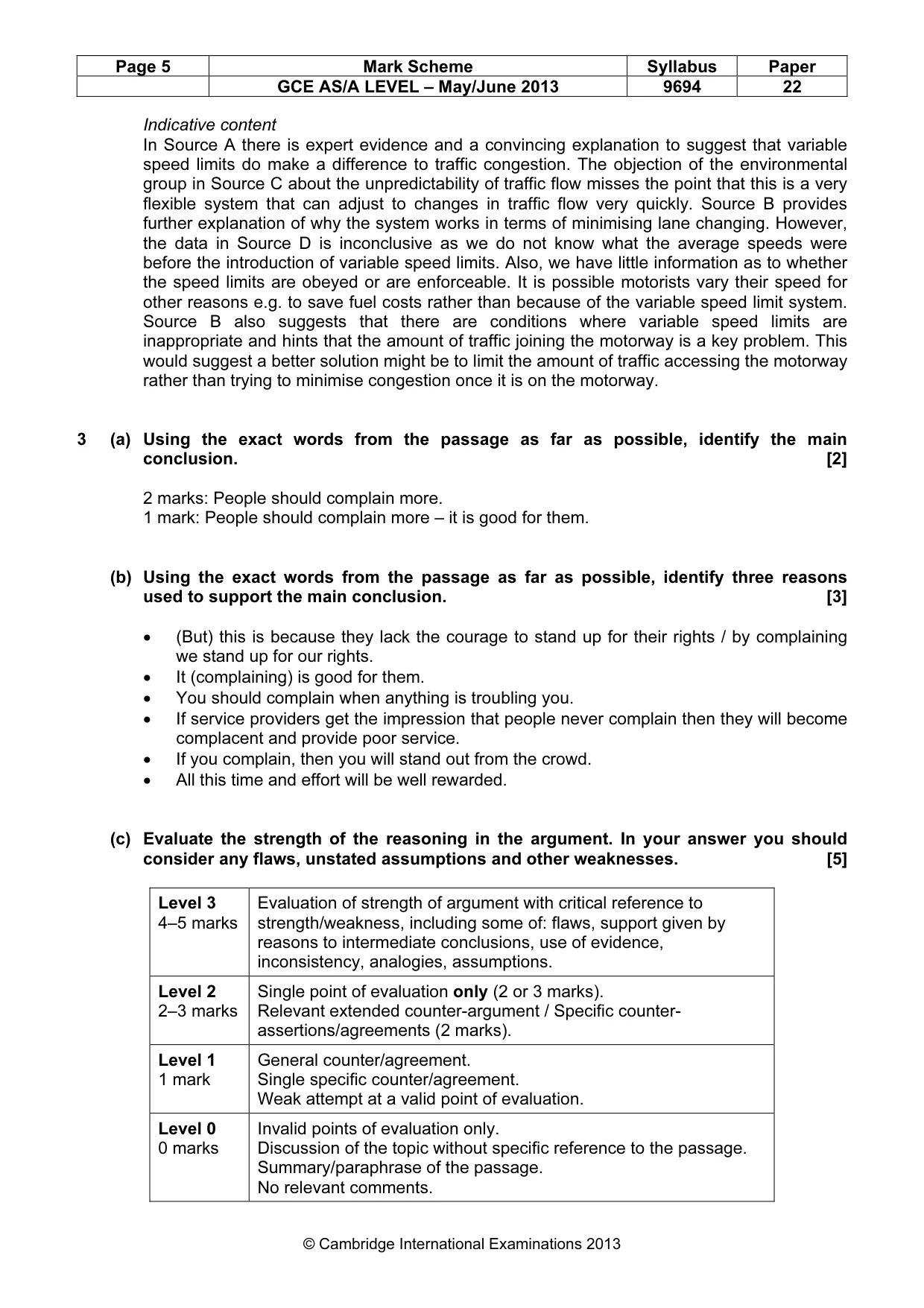
Page 5 Mark Scheme Syllabus Paper GCE AS/A LEVEL – May/June 2013 9694 22 © Cambridge International Examinations 2013 Indicative content In Source A there is expert evidence and a convincing explanation to suggest that variable speed limits do make a difference to traffic congestion. The objection of the environmental group in Source C about the unpredictability of traffic flow misses the point that this is a very flexible system that can adjust to changes in traffic flow very quickly. Source B provides further explanation of why the system works in terms of minimising lane changing. However, the data in Source D is inconclusive as we do not know what the average speeds were before the introduction of variable speed limits. Also, we have little information as to whether the speed limits are obeyed or are enforceable. It is possible motorists vary their speed for other reasons e.g. to save fuel costs rather than because of the variable speed limit system. Source B also suggests that there are conditions where variable speed limits are inappropriate and hints that the amount of traffic joining the motorway is a key problem. This would suggest a better solution might be to limit the amount of traffic accessing the motorway rather than trying to minimise congestion once it is on the motorway. 3 (a) Using the exact words from the passage as far as possible, identify the main conclusion. [2] 2 marks: People should complain more. 1 mark: People should complain more – it is good for them. (b) Using the exact words from the passage as far as possible, identify three reasons used to support the main conclusion. [3] • (But) this is because they lack the courage to stand up for their rights / by complaining we stand up for our rights. • It (complaining) is good for them. • You should complain when anything is troubling you. • If service providers get the impression that people never complain then they will become complacent and provide poor service. • If you complain, then you will stand out from the crowd. • All this time and effort will be well rewarded. (c) Evaluate the strength of the reasoning in the argument. In your answer you should consider any flaws, unstated assumptions and other weaknesses. [5] Level 3 4–5 marks Evaluation of strength of argument with critical reference to strength/weakness, including some of: flaws, support given by reasons to intermediate conclusions, use of evidence, inconsistency, analogies, assumptions. Level 2 2–3 marks Single point of evaluation only (2 or 3 marks). Relevant extended counter-argument / Specific counter- assertions/agreements (2 marks). Level 1 1 mark General counter/agreement. Single specific counter/agreement. Weak attempt at a valid point of evaluation. Level 0 0 marks Invalid points of evaluation only. Discussion of the topic without specific reference to the passage. Summary/paraphrase of the passage. No relevant comments.
Mark scheme, page 6
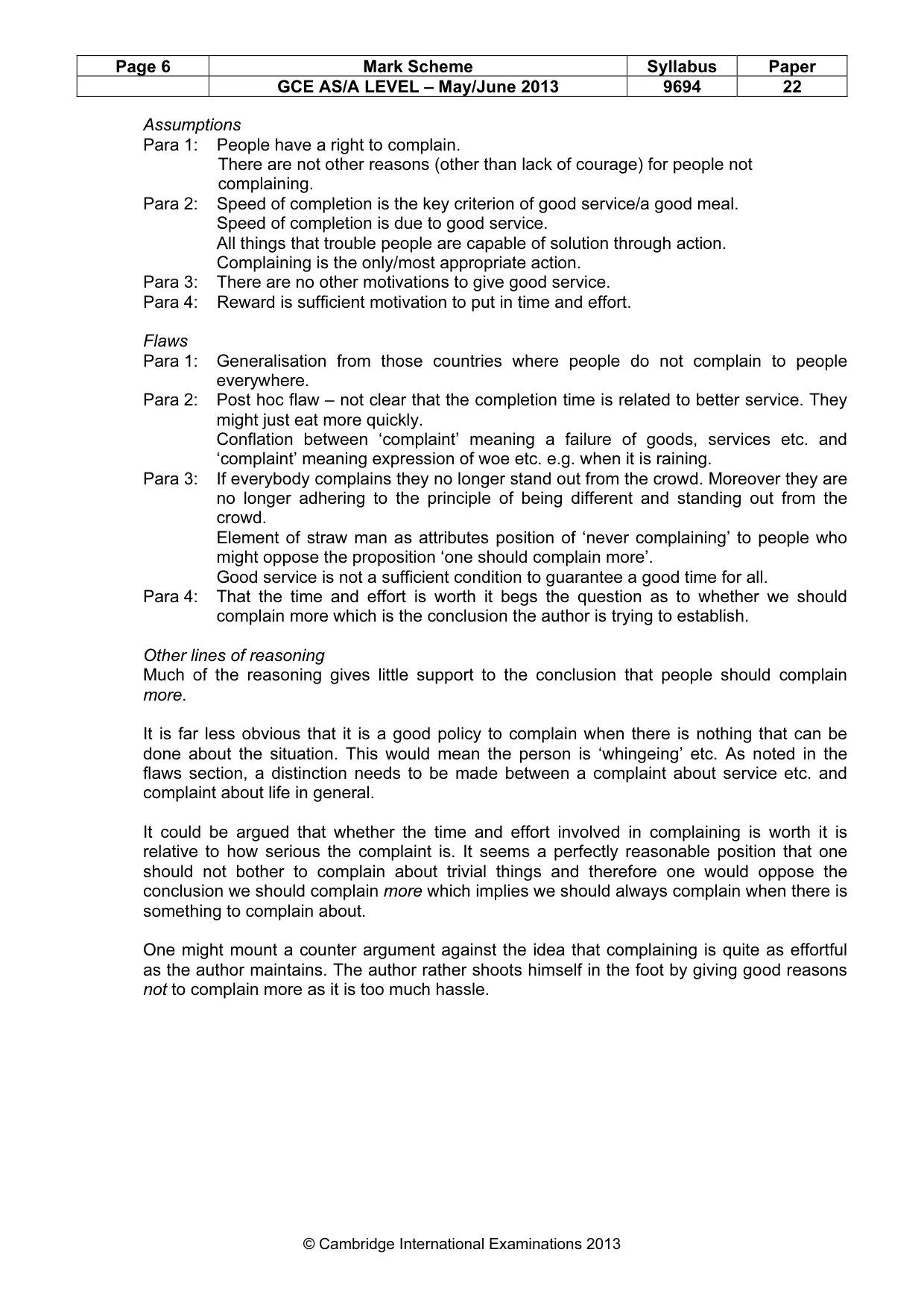
Page 6 Mark Scheme Syllabus Paper GCE AS/A LEVEL – May/June 2013 9694 22 © Cambridge International Examinations 2013 Assumptions Para 1: People have a right to complain. There are not other reasons (other than lack of courage) for people not complaining. Para 2: Speed of completion is the key criterion of good service/a good meal. Speed of completion is due to good service. All things that trouble people are capable of solution through action. Complaining is the only/most appropriate action. Para 3: There are no other motivations to give good service. Para 4: Reward is sufficient motivation to put in time and effort. Flaws Para 1: Generalisation from those countries where people do not complain to people everywhere. Para 2: Post hoc flaw – not clear that the completion time is related to better service. They might just eat more quickly. Conflation between ‘complaint’ meaning a failure of goods, services etc. and ‘complaint’ meaning expression of woe etc. e.g. when it is raining. Para 3: If everybody complains they no longer stand out from the crowd. Moreover they are no longer adhering to the principle of being different and standing out from the crowd. Element of straw man as attributes position of ‘never complaining’ to people who might oppose the proposition ‘one should complain more’. Good service is not a sufficient condition to guarantee a good time for all. Para 4: That the time and effort is worth it begs the question as to whether we should complain more which is the conclusion the author is trying to establish. Other lines of reasoning Much of the reasoning gives little support to the conclusion that people should complain more. It is far less obvious that it is a good policy to complain when there is nothing that can be done about the situation. This would mean the person is ‘whingeing’ etc. As noted in the flaws section, a distinction needs to be made between a complaint about service etc. and complaint about life in general. It could be argued that whether the time and effort involved in complaining is worth it is relative to how serious the complaint is. It seems a perfectly reasonable position that one should not bother to complain about trivial things and therefore one would oppose the conclusion we should complain more which implies we should always complain when there is something to complain about. One might mount a counter argument against the idea that complaining is quite as effortful as the author maintains. The author rather shoots himself in the foot by giving good reasons not to complain more as it is too much hassle.
Mark scheme, page 7
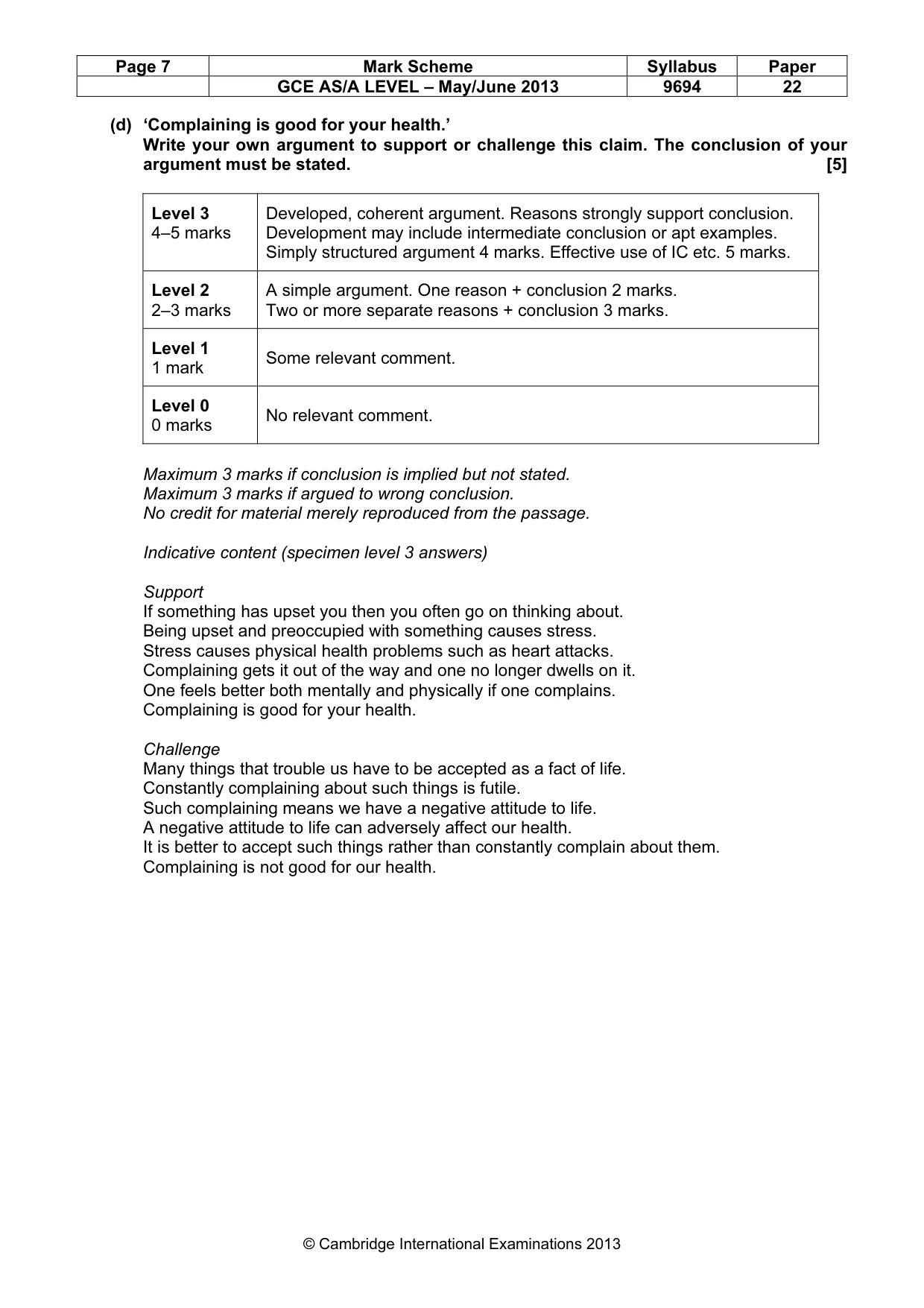
Page 7 Mark Scheme Syllabus Paper GCE AS/A LEVEL – May/June 2013 9694 22 © Cambridge International Examinations 2013 (d) ‘Complaining is good for your health.’ Write your own argument to support or challenge this claim. The conclusion of your argument must be stated. [5] Level 3 4–5 marks Developed, coherent argument. Reasons strongly support conclusion. Development may include intermediate conclusion or apt examples. Simply structured argument 4 marks. Effective use of IC etc. 5 marks. Level 2 2–3 marks A simple argument. One reason + conclusion 2 marks. Two or more separate reasons + conclusion 3 marks. Level 1 1 mark Some relevant comment. Level 0 0 marks No relevant comment. Maximum 3 marks if conclusion is implied but not stated. Maximum 3 marks if argued to wrong conclusion. No credit for material merely reproduced from the passage. Indicative content (specimen level 3 answers) Support If something has upset you then you often go on thinking about. Being upset and preoccupied with something causes stress. Stress causes physical health problems such as heart attacks. Complaining gets it out of the way and one no longer dwells on it. One feels better both mentally and physically if one complains. Complaining is good for your health. Challenge Many things that trouble us have to be accepted as a fact of life. Constantly complaining about such things is futile. Such complaining means we have a negative attitude to life. A negative attitude to life can adversely affect our health. It is better to accept such things rather than constantly complain about them. Complaining is not good for our health.
What you needed in this session
Cambridge’s own grade thresholds for 2013 May/June, Paper 2 · Variant 2. A higher threshold means an easier paper — the bar moves with how the cohort did.