Cambridge A Level Thinking Skills 9694 — 2013 May/June Paper 2 · Variant 3
9694/23/M/J/13 · 45 marks · ≈51 min
The question paper and its mark scheme, free to read here and free to download. This is Cambridge’s own paper, exactly as it was sat.
Question paper8 pages


Mark scheme8 pages
Answers below. Sit the paper first if you are practising.
Paper as text
Question paper, page 1
This document consists of 6 printed pages and 2 blank pages. IB13 06_9694_23/2RP © UCLES 2013 [Turn over *5076305576* UNIVERSITY OF CAMBRIDGE INTERNATIONAL EXAMINATIONS General Certificate of Education Advanced Subsidiary Level and Advanced Level THINKING SKILLS 9694/23 Paper 2 Critical Thinking May/June 2013 1 hour 45 minutes Additional Materials: Answer Booklet/Paper READ THESE INSTRUCTIONS FIRST If you have been given an Answer Booklet, follow the instructions on the front cover of the booklet. Write your Centre number, candidate number and name on all the work you hand in. Write in dark blue or black pen. Do not use staples, paper clips, highlighters, glue or correction fluid. DO NOT WRITE IN ANY BARCODES. Answer all the questions. Start each question on a new answer sheet. At the end of the examination, fasten all your work securely together. The number of marks is given in brackets [ ] at the end of each question.
Question paper, page 2
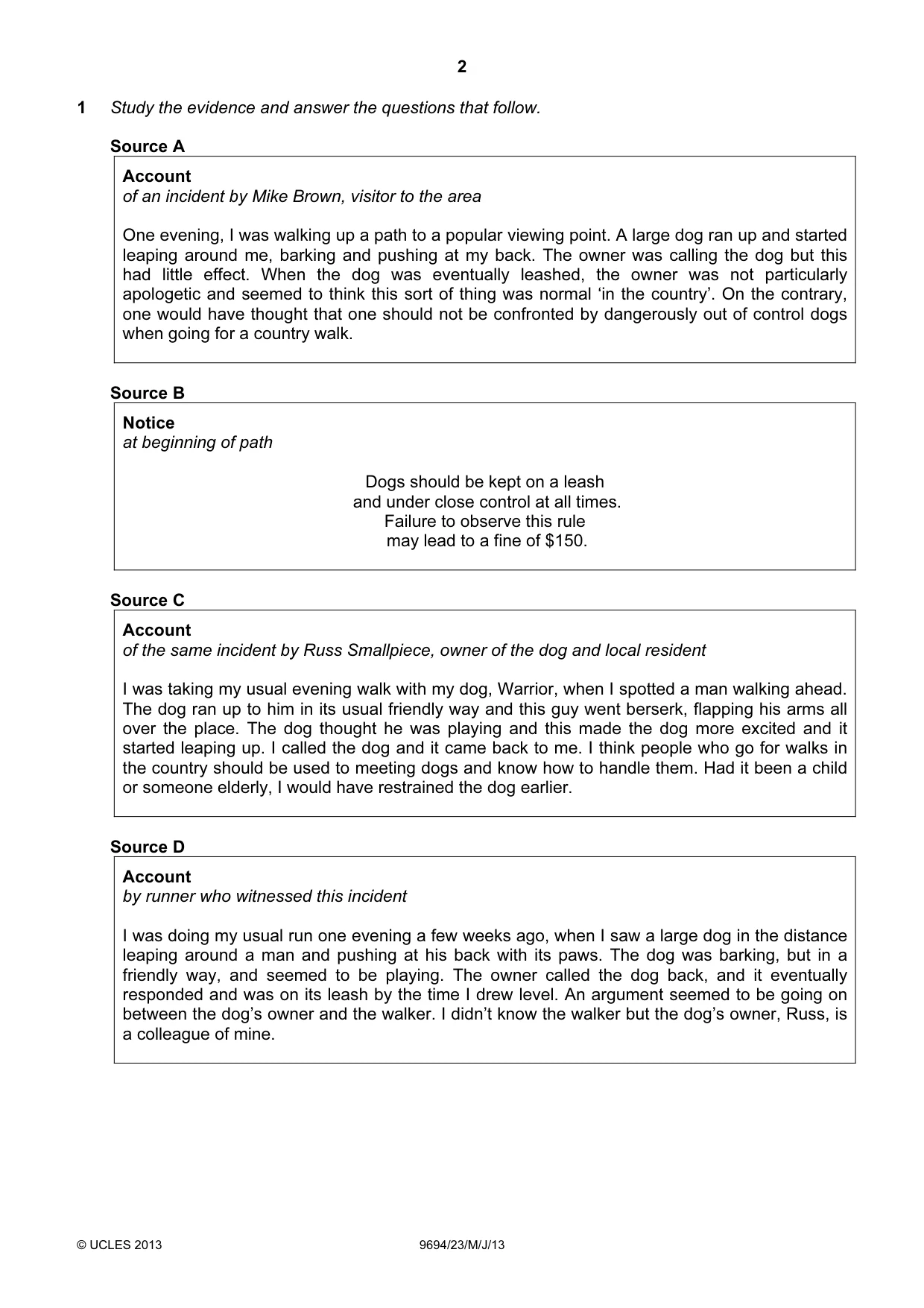
2 © UCLES 2013 9694/23/M/J/13 1 Study the evidence and answer the questions that follow. Source A Account of an incident by Mike Brown, visitor to the area One evening, I was walking up a path to a popular viewing point. A large dog ran up and started leaping around me, barking and pushing at my back. The owner was calling the dog but this had little effect. When the dog was eventually leashed, the owner was not particularly apologetic and seemed to think this sort of thing was normal ‘in the country’. On the contrary, one would have thought that one should not be confronted by dangerously out of control dogs when going for a country walk. Source B Notice at beginning of path Dogs should be kept on a leash and under close control at all times. Failure to observe this rule may lead to a fine of $150. Source C Account of the same incident by Russ Smallpiece, owner of the dog and local resident I was taking my usual evening walk with my dog, Warrior, when I spotted a man walking ahead. The dog ran up to him in its usual friendly way and this guy went berserk, flapping his arms all over the place. The dog thought he was playing and this made the dog more excited and it started leaping up. I called the dog and it came back to me. I think people who go for walks in the country should be used to meeting dogs and know how to handle them. Had it been a child or someone elderly, I would have restrained the dog earlier. Source D Account by runner who witnessed this incident I was doing my usual run one evening a few weeks ago, when I saw a large dog in the distance leaping around a man and pushing at his back with its paws. The dog was barking, but in a friendly way, and seemed to be playing. The owner called the dog back, and it eventually responded and was on its leash by the time I drew level. An argument seemed to be going on between the dog’s owner and the walker. I didn’t know the walker but the dog’s owner, Russ, is a colleague of mine.
Question paper, page 3
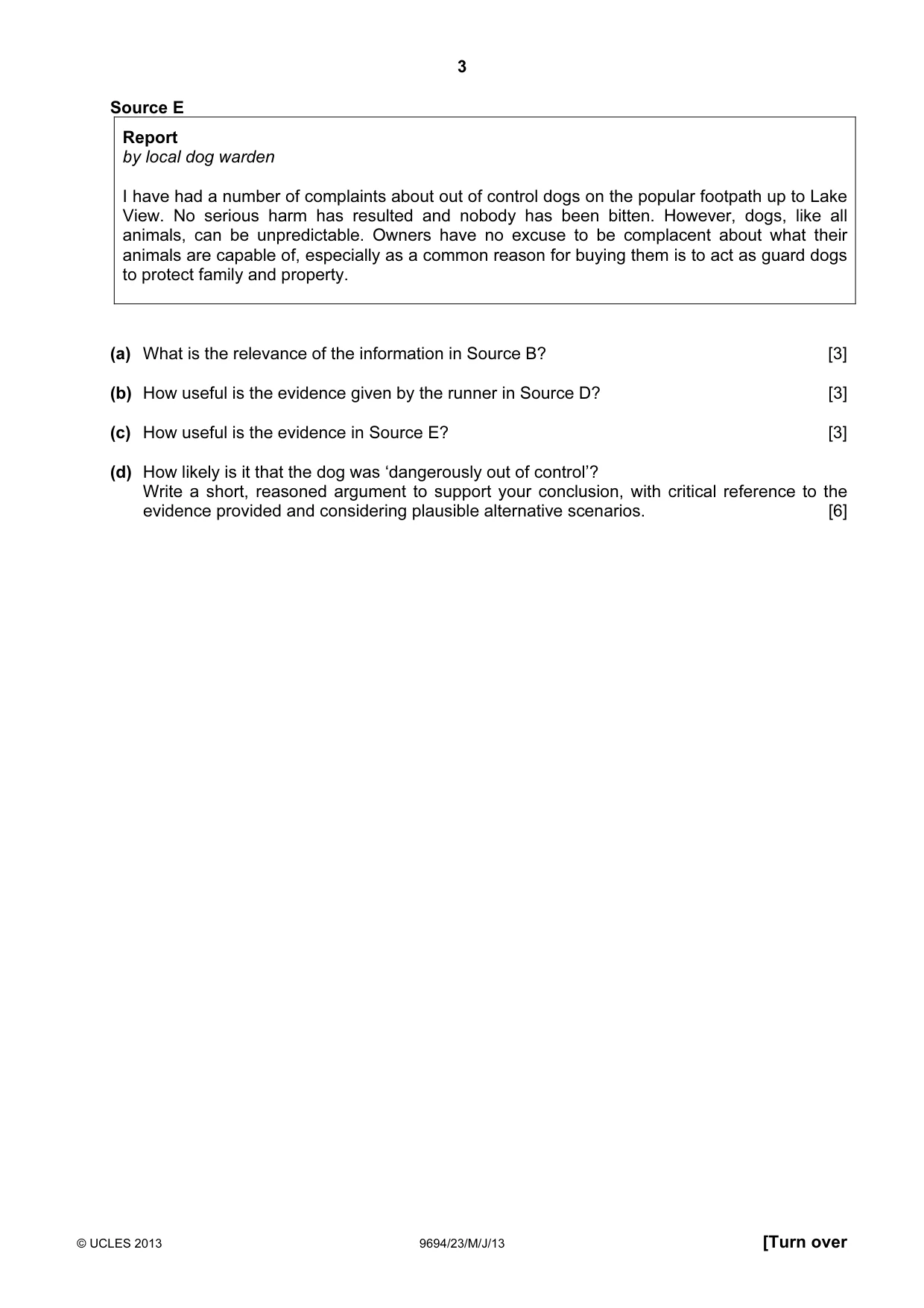
3 © UCLES 2013 9694/23/M/J/13 [Turn over Source E Report by local dog warden I have had a number of complaints about out of control dogs on the popular footpath up to Lake View. No serious harm has resulted and nobody has been bitten. However, dogs, like all animals, can be unpredictable. Owners have no excuse to be complacent about what their animals are capable of, especially as a common reason for buying them is to act as guard dogs to protect family and property. (a) What is the relevance of the information in Source B? [3] (b) How useful is the evidence given by the runner in Source D? [3] (c) How useful is the evidence in Source E? [3] (d) How likely is it that the dog was ‘dangerously out of control’? Write a short, reasoned argument to support your conclusion, with critical reference to the evidence provided and considering plausible alternative scenarios. [6]
Question paper, page 4
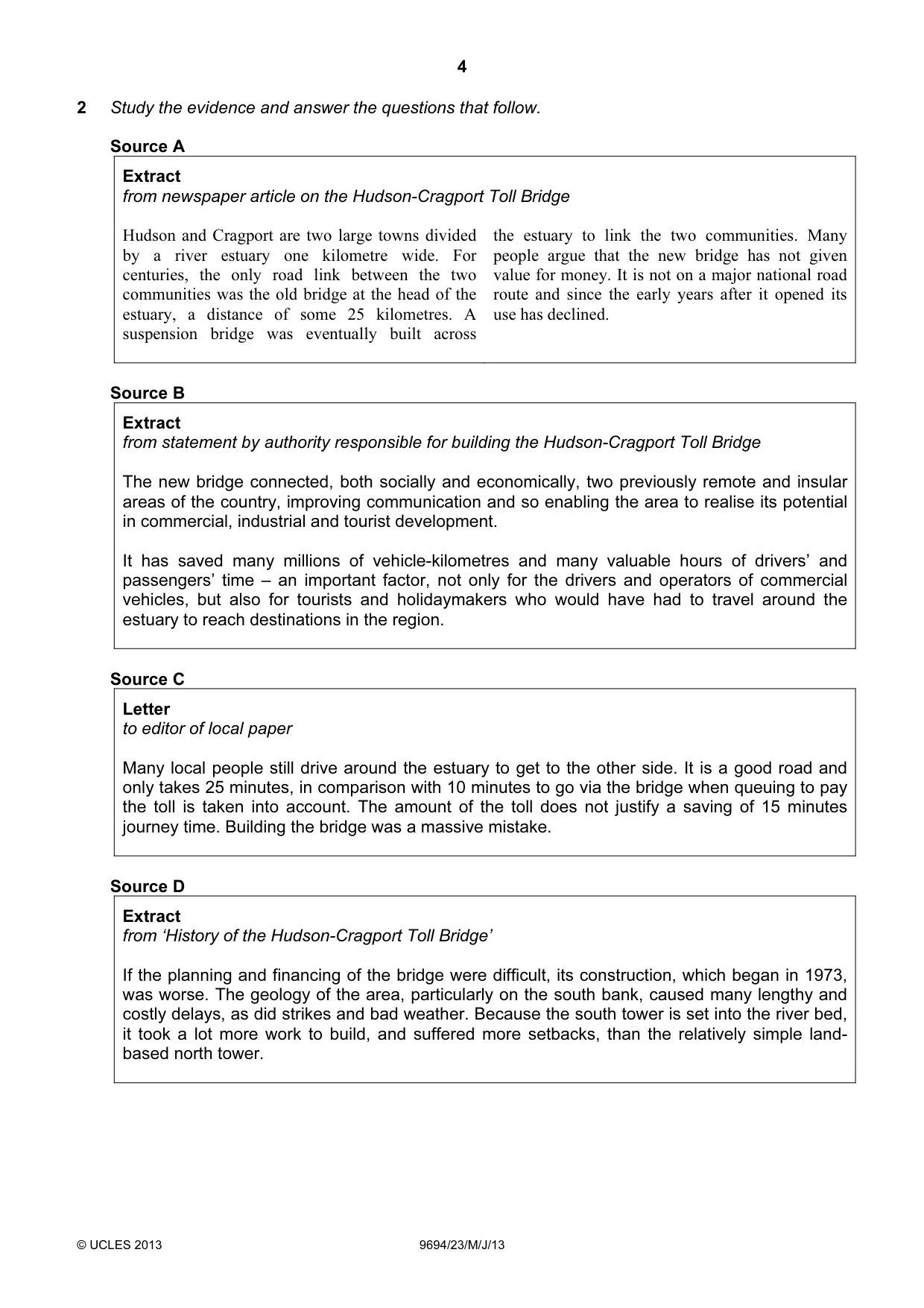
4 © UCLES 2013 9694/23/M/J/13 2 Study the evidence and answer the questions that follow. Source A Extract from newspaper article on the Hudson-Cragport Toll Bridge Hudson and Cragport are two large towns divided by a river estuary one kilometre wide. For centuries, the only road link between the two communities was the old bridge at the head of the estuary, a distance of some 25 kilometres. A suspension bridge was eventually built across the estuary to link the two communities. Many people argue that the new bridge has not given value for money. It is not on a major national road route and since the early years after it opened its use has declined. Source B Extract from statement by authority responsible for building the Hudson-Cragport Toll Bridge The new bridge connected, both socially and economically, two previously remote and insular areas of the country, improving communication and so enabling the area to realise its potential in commercial, industrial and tourist development. It has saved many millions of vehicle-kilometres and many valuable hours of drivers’ and passengers’ time – an important factor, not only for the drivers and operators of commercial vehicles, but also for tourists and holidaymakers who would have had to travel around the estuary to reach destinations in the region. Source C Letter to editor of local paper Many local people still drive around the estuary to get to the other side. It is a good road and only takes 25 minutes, in comparison with 10 minutes to go via the bridge when queuing to pay the toll is taken into account. The amount of the toll does not justify a saving of 15 minutes journey time. Building the bridge was a massive mistake. Source D Extract from ‘History of the Hudson-Cragport Toll Bridge’ If the planning and financing of the bridge were difficult, its construction, which began in 1973, was worse. The geology of the area, particularly on the south bank, caused many lengthy and costly delays, as did strikes and bad weather. Because the south tower is set into the river bed, it took a lot more work to build, and suffered more setbacks, than the relatively simple land- based north tower.
Question paper, page 5
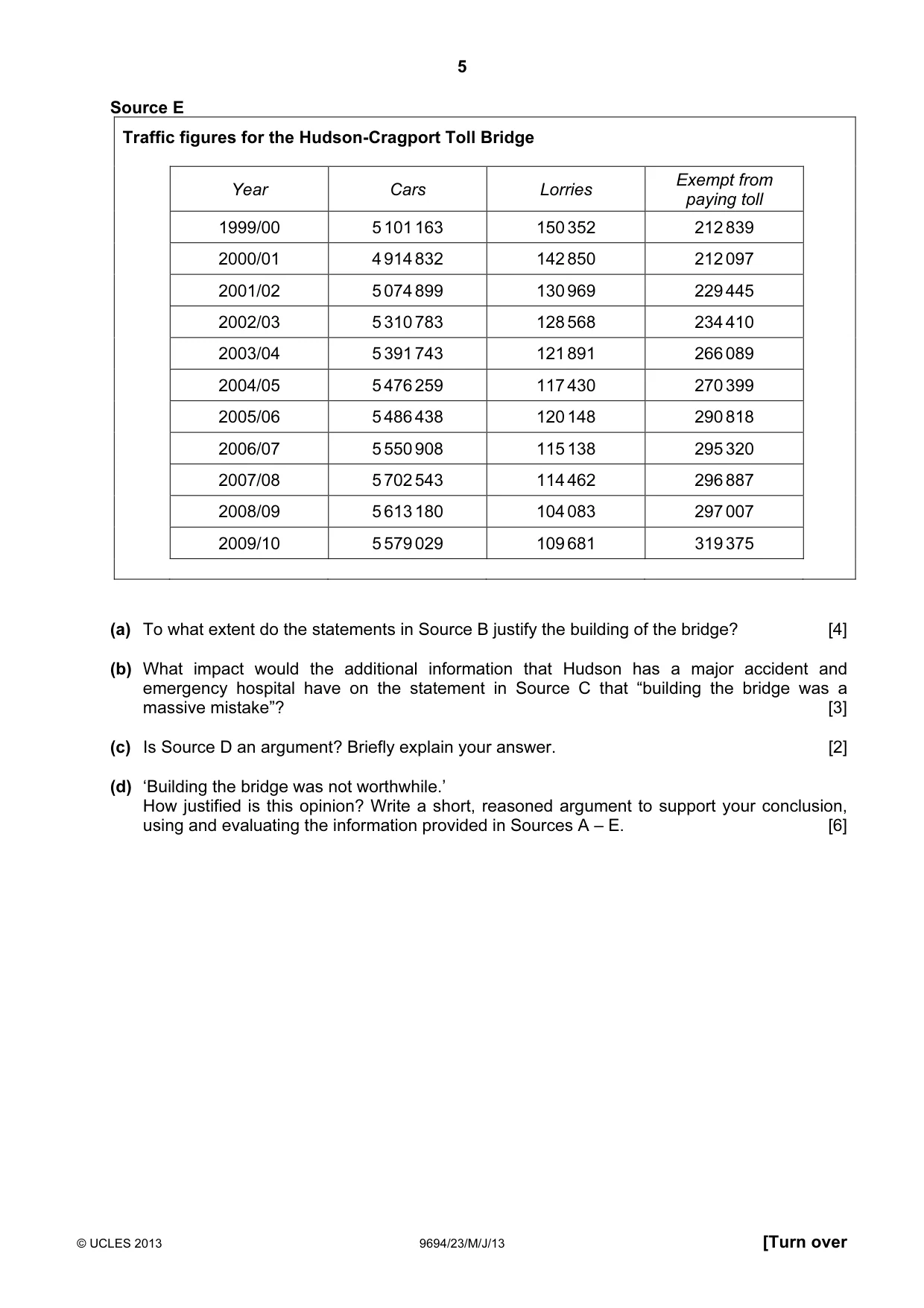
5 © UCLES 2013 9694/23/M/J/13 [Turn over Source E Traffic figures for the Hudson-Cragport Toll Bridge Year Cars Lorries Exempt from paying toll 1999/00 5 101 163 150 352 212 839 2000/01 4 914 832 142 850 212 097 2001/02 5 074 899 130 969 229 445 2002/03 5 310 783 128 568 234 410 2003/04 5 391 743 121 891 266 089 2004/05 5 476 259 117 430 270 399 2005/06 5 486 438 120 148 290 818 2006/07 5 550 908 115 138 295 320 2007/08 5 702 543 114 462 296 887 2008/09 5 613 180 104 083 297 007 2009/10 5 579 029 109 681 319 375 (a) To what extent do the statements in Source B justify the building of the bridge? [4] (b) What impact would the additional information that Hudson has a major accident and emergency hospital have on the statement in Source C that “building the bridge was a massive mistake”? [3] (c) Is Source D an argument? Briefly explain your answer. [2] (d) ‘Building the bridge was not worthwhile.’ How justified is this opinion? Write a short, reasoned argument to support your conclusion, using and evaluating the information provided in Sources A – E. [6]
Question paper, page 6
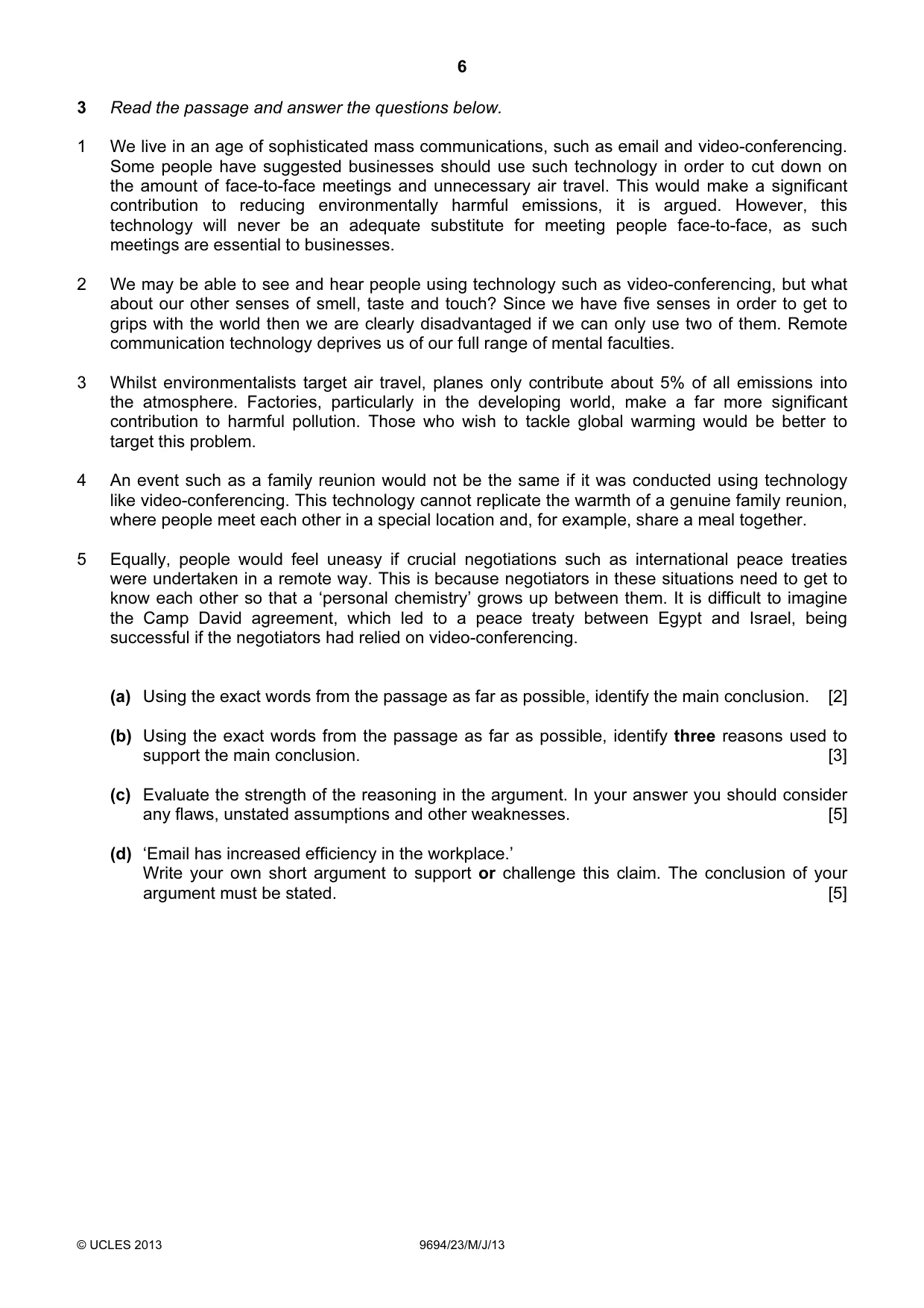
6 © UCLES 2013 9694/23/M/J/13 3 Read the passage and answer the questions below. 1 We live in an age of sophisticated mass communications, such as email and video-conferencing. Some people have suggested businesses should use such technology in order to cut down on the amount of face-to-face meetings and unnecessary air travel. This would make a significant contribution to reducing environmentally harmful emissions, it is argued. However, this technology will never be an adequate substitute for meeting people face-to-face, as such meetings are essential to businesses. 2 We may be able to see and hear people using technology such as video-conferencing, but what about our other senses of smell, taste and touch? Since we have five senses in order to get to grips with the world then we are clearly disadvantaged if we can only use two of them. Remote communication technology deprives us of our full range of mental faculties. 3 Whilst environmentalists target air travel, planes only contribute about 5% of all emissions into the atmosphere. Factories, particularly in the developing world, make a far more significant contribution to harmful pollution. Those who wish to tackle global warming would be better to target this problem. 4 An event such as a family reunion would not be the same if it was conducted using technology like video-conferencing. This technology cannot replicate the warmth of a genuine family reunion, where people meet each other in a special location and, for example, share a meal together. 5 Equally, people would feel uneasy if crucial negotiations such as international peace treaties were undertaken in a remote way. This is because negotiators in these situations need to get to know each other so that a ‘personal chemistry’ grows up between them. It is difficult to imagine the Camp David agreement, which led to a peace treaty between Egypt and Israel, being successful if the negotiators had relied on video-conferencing. (a) Using the exact words from the passage as far as possible, identify the main conclusion. [2] (b) Using the exact words from the passage as far as possible, identify three reasons used to support the main conclusion. [3] (c) Evaluate the strength of the reasoning in the argument. In your answer you should consider any flaws, unstated assumptions and other weaknesses. [5] (d) ‘Email has increased efficiency in the workplace.’ Write your own short argument to support or challenge this claim. The conclusion of your argument must be stated. [5]
Question paper, page 7
7 © UCLES 2013 9694/23/M/J/13 BLANK PAGE
Question paper, page 8
8 Permission to reproduce items where third-party owned material protected by copyright is included has been sought and cleared where possible. Every reasonable effort has been made by the publisher (UCLES) to trace copyright holders, but if any items requiring clearance have unwittingly been included, the publisher will be pleased to make amends at the earliest possible opportunity. University of Cambridge International Examinations is part of the Cambridge Assessment Group. Cambridge Assessment is the brand name of University of Cambridge Local Examinations Syndicate (UCLES), which is itself a department of the University of Cambridge. © UCLES 2013 9694/23/M/J/13 BLANK PAGE
Mark scheme, page 1
CAMBRIDGE INTERNATIONAL EXAMINATIONS GCE Advanced Subsidiary Level and GCE Advanced Level MARK SCHEME for the May/June 2013 series 9694 THINKING SKILLS 9694/23 Paper 2 (Critical Thinking), maximum raw mark 45 This mark scheme is published as an aid to teachers and candidates, to indicate the requirements of the examination. It shows the basis on which Examiners were instructed to award marks. It does not indicate the details of the discussions that took place at an Examiners’ meeting before marking began, which would have considered the acceptability of alternative answers. Mark schemes should be read in conjunction with the question paper and the Principal Examiner Report for Teachers. Cambridge will not enter into discussions about these mark schemes. Cambridge is publishing the mark schemes for the May/June 2013 series for most IGCSE, GCE Advanced Level and Advanced Subsidiary Level components and some Ordinary Level components.
Mark scheme, page 2
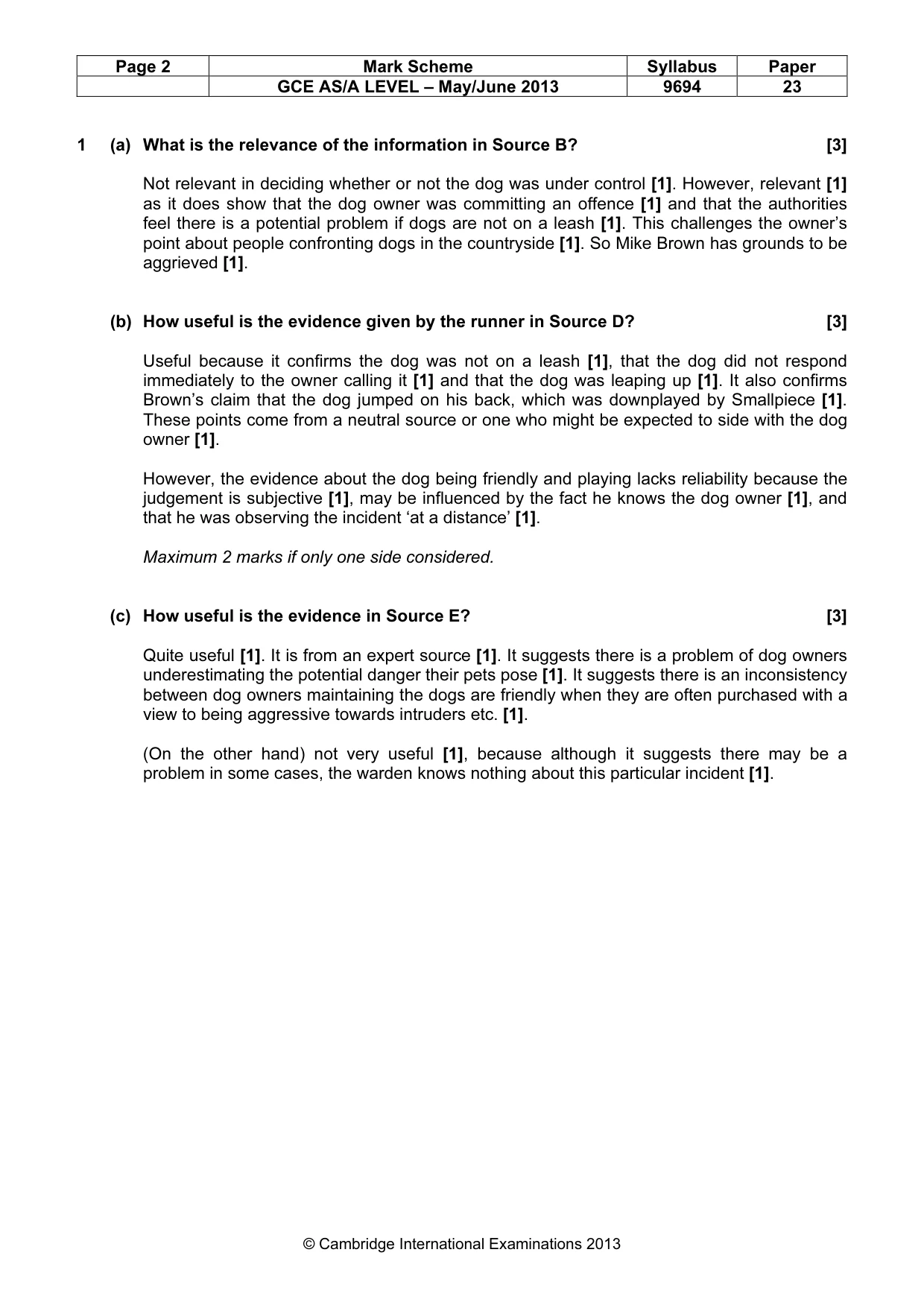
Page 2 Mark Scheme Syllabus Paper GCE AS/A LEVEL – May/June 2013 9694 23 © Cambridge International Examinations 2013 1 (a) What is the relevance of the information in Source B? [3] Not relevant in deciding whether or not the dog was under control [1]. However, relevant [1] as it does show that the dog owner was committing an offence [1] and that the authorities feel there is a potential problem if dogs are not on a leash [1]. This challenges the owner’s point about people confronting dogs in the countryside [1]. So Mike Brown has grounds to be aggrieved [1]. (b) How useful is the evidence given by the runner in Source D? [3] Useful because it confirms the dog was not on a leash [1], that the dog did not respond immediately to the owner calling it [1] and that the dog was leaping up [1]. It also confirms Brown’s claim that the dog jumped on his back, which was downplayed by Smallpiece [1]. These points come from a neutral source or one who might be expected to side with the dog owner [1]. However, the evidence about the dog being friendly and playing lacks reliability because the judgement is subjective [1], may be influenced by the fact he knows the dog owner [1], and that he was observing the incident ‘at a distance’ [1]. Maximum 2 marks if only one side considered. (c) How useful is the evidence in Source E? [3] Quite useful [1]. It is from an expert source [1]. It suggests there is a problem of dog owners underestimating the potential danger their pets pose [1]. It suggests there is an inconsistency between dog owners maintaining the dogs are friendly when they are often purchased with a view to being aggressive towards intruders etc. [1]. (On the other hand) not very useful [1], because although it suggests there may be a problem in some cases, the warden knows nothing about this particular incident [1].
Mark scheme, page 3
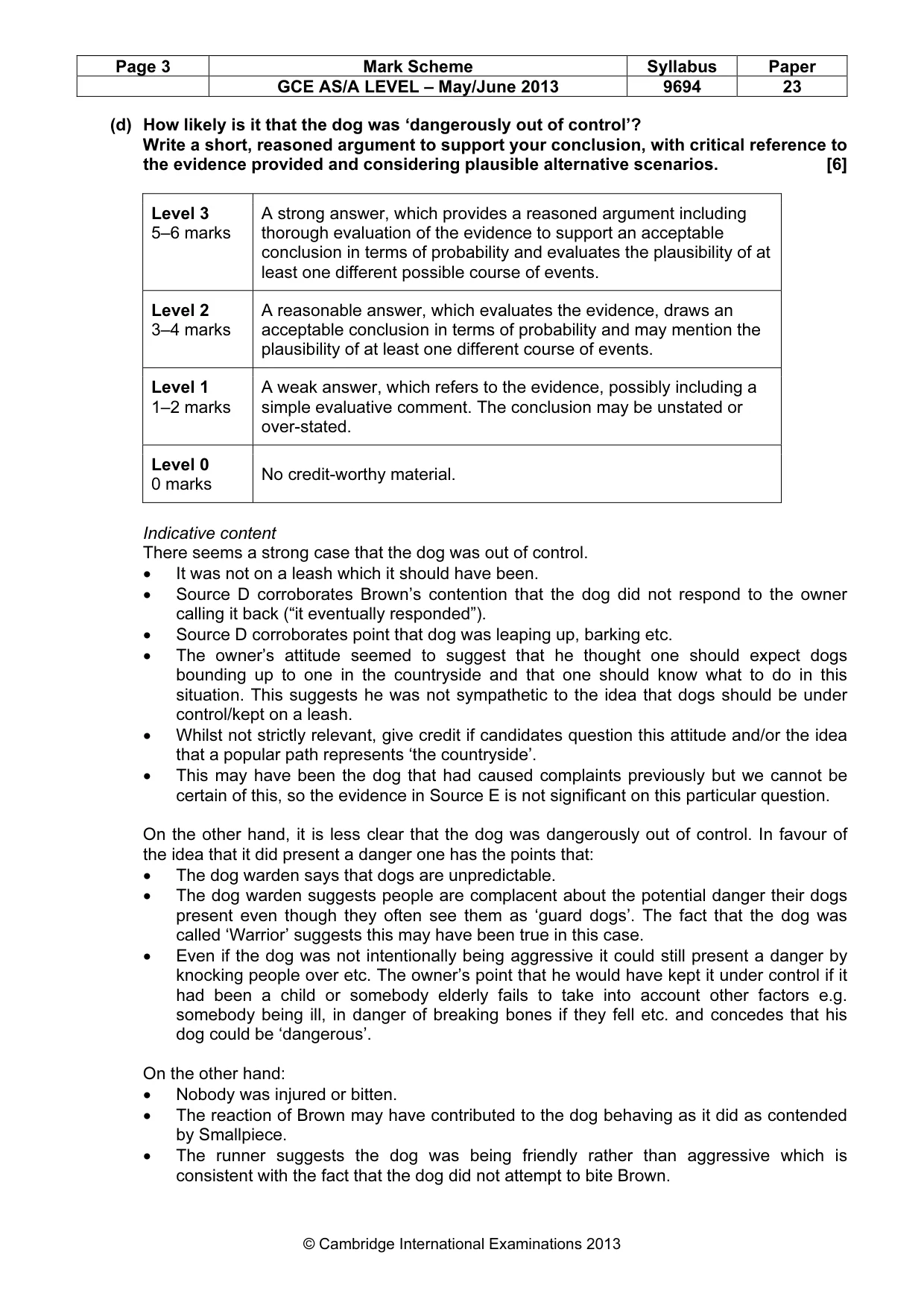
Page 3 Mark Scheme Syllabus Paper GCE AS/A LEVEL – May/June 2013 9694 23 © Cambridge International Examinations 2013 (d) How likely is it that the dog was ‘dangerously out of control’? Write a short, reasoned argument to support your conclusion, with critical reference to the evidence provided and considering plausible alternative scenarios. [6] Level 3 5–6 marks A strong answer, which provides a reasoned argument including thorough evaluation of the evidence to support an acceptable conclusion in terms of probability and evaluates the plausibility of at least one different possible course of events. Level 2 3–4 marks A reasonable answer, which evaluates the evidence, draws an acceptable conclusion in terms of probability and may mention the plausibility of at least one different course of events. Level 1 1–2 marks A weak answer, which refers to the evidence, possibly including a simple evaluative comment. The conclusion may be unstated or over-stated. Level 0 0 marks No credit-worthy material. Indicative content There seems a strong case that the dog was out of control. • It was not on a leash which it should have been. • Source D corroborates Brown’s contention that the dog did not respond to the owner calling it back (“it eventually responded”). • Source D corroborates point that dog was leaping up, barking etc. • The owner’s attitude seemed to suggest that he thought one should expect dogs bounding up to one in the countryside and that one should know what to do in this situation. This suggests he was not sympathetic to the idea that dogs should be under control/kept on a leash. • Whilst not strictly relevant, give credit if candidates question this attitude and/or the idea that a popular path represents ‘the countryside’. • This may have been the dog that had caused complaints previously but we cannot be certain of this, so the evidence in Source E is not significant on this particular question. On the other hand, it is less clear that the dog was dangerously out of control. In favour of the idea that it did present a danger one has the points that: • The dog warden says that dogs are unpredictable. • The dog warden suggests people are complacent about the potential danger their dogs present even though they often see them as ‘guard dogs’. The fact that the dog was called ‘Warrior’ suggests this may have been true in this case. • Even if the dog was not intentionally being aggressive it could still present a danger by knocking people over etc. The owner’s point that he would have kept it under control if it had been a child or somebody elderly fails to take into account other factors e.g. somebody being ill, in danger of breaking bones if they fell etc. and concedes that his dog could be ‘dangerous’. On the other hand: • Nobody was injured or bitten. • The reaction of Brown may have contributed to the dog behaving as it did as contended by Smallpiece. • The runner suggests the dog was being friendly rather than aggressive which is consistent with the fact that the dog did not attempt to bite Brown.
Mark scheme, page 4
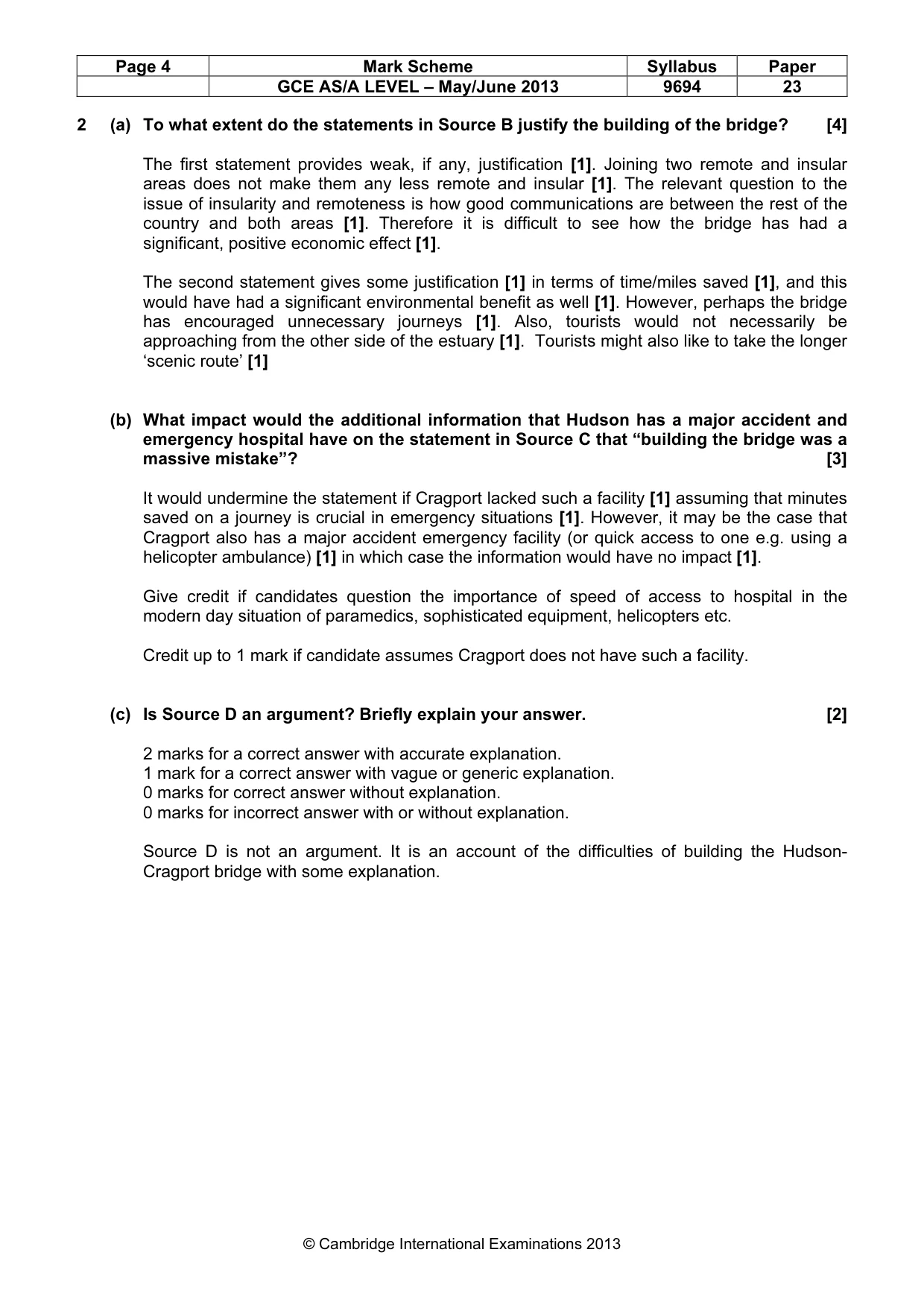
Page 4 Mark Scheme Syllabus Paper GCE AS/A LEVEL – May/June 2013 9694 23 © Cambridge International Examinations 2013 2 (a) To what extent do the statements in Source B justify the building of the bridge? [4] The first statement provides weak, if any, justification [1]. Joining two remote and insular areas does not make them any less remote and insular [1]. The relevant question to the issue of insularity and remoteness is how good communications are between the rest of the country and both areas [1]. Therefore it is difficult to see how the bridge has had a significant, positive economic effect [1]. The second statement gives some justification [1] in terms of time/miles saved [1], and this would have had a significant environmental benefit as well [1]. However, perhaps the bridge has encouraged unnecessary journeys [1]. Also, tourists would not necessarily be approaching from the other side of the estuary [1]. Tourists might also like to take the longer ‘scenic route’ [1] (b) What impact would the additional information that Hudson has a major accident and emergency hospital have on the statement in Source C that “building the bridge was a massive mistake”? [3] It would undermine the statement if Cragport lacked such a facility [1] assuming that minutes saved on a journey is crucial in emergency situations [1]. However, it may be the case that Cragport also has a major accident emergency facility (or quick access to one e.g. using a helicopter ambulance) [1] in which case the information would have no impact [1]. Give credit if candidates question the importance of speed of access to hospital in the modern day situation of paramedics, sophisticated equipment, helicopters etc. Credit up to 1 mark if candidate assumes Cragport does not have such a facility. (c) Is Source D an argument? Briefly explain your answer. [2] 2 marks for a correct answer with accurate explanation. 1 mark for a correct answer with vague or generic explanation. 0 marks for correct answer without explanation. 0 marks for incorrect answer with or without explanation. Source D is not an argument. It is an account of the difficulties of building the Hudson- Cragport bridge with some explanation.
Mark scheme, page 5
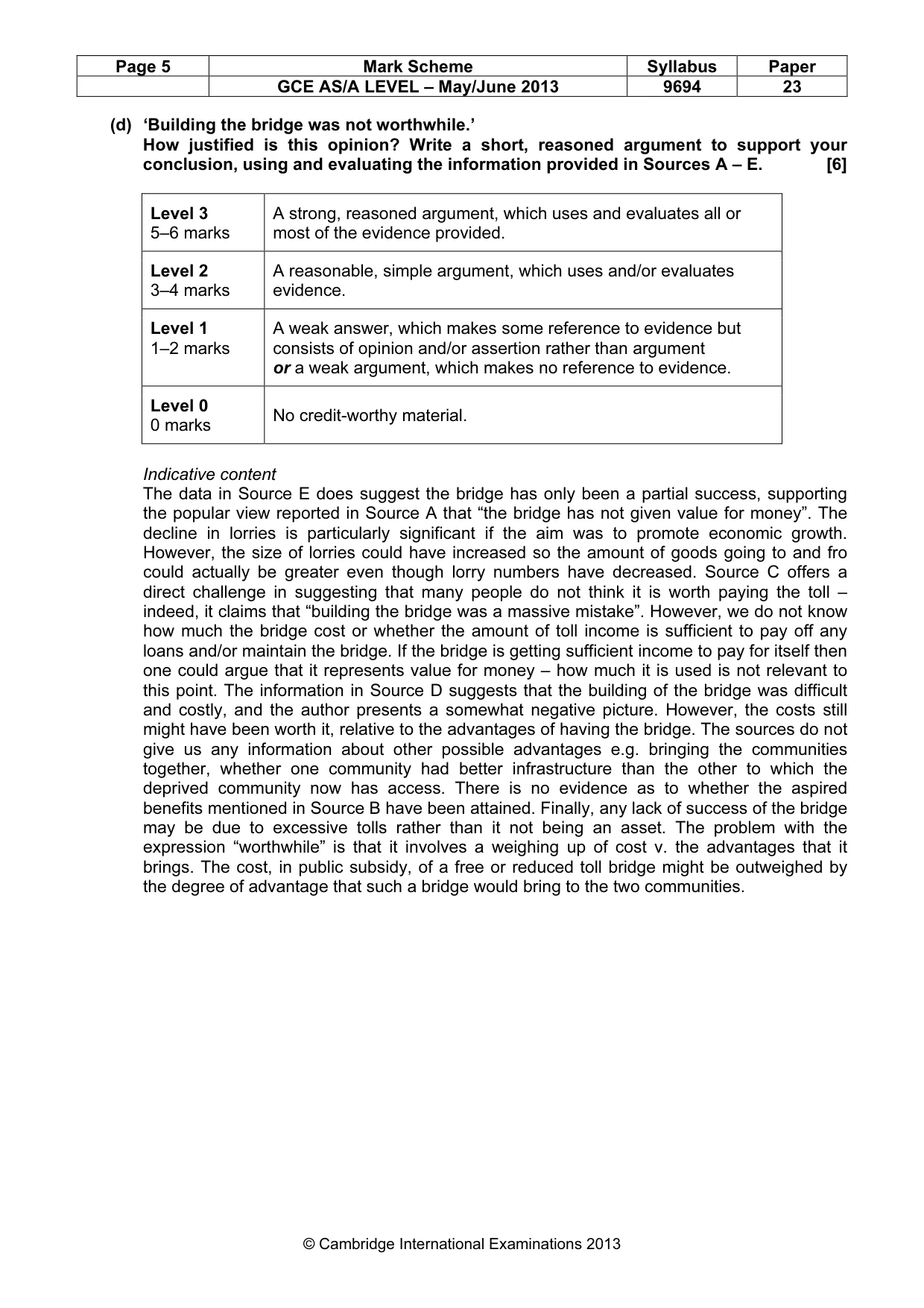
Page 5 Mark Scheme Syllabus Paper GCE AS/A LEVEL – May/June 2013 9694 23 © Cambridge International Examinations 2013 (d) ‘Building the bridge was not worthwhile.’ How justified is this opinion? Write a short, reasoned argument to support your conclusion, using and evaluating the information provided in Sources A – E. [6] Level 3 5–6 marks A strong, reasoned argument, which uses and evaluates all or most of the evidence provided. Level 2 3–4 marks A reasonable, simple argument, which uses and/or evaluates evidence. Level 1 1–2 marks A weak answer, which makes some reference to evidence but consists of opinion and/or assertion rather than argument or a weak argument, which makes no reference to evidence. Level 0 0 marks No credit-worthy material. Indicative content The data in Source E does suggest the bridge has only been a partial success, supporting the popular view reported in Source A that “the bridge has not given value for money”. The decline in lorries is particularly significant if the aim was to promote economic growth. However, the size of lorries could have increased so the amount of goods going to and fro could actually be greater even though lorry numbers have decreased. Source C offers a direct challenge in suggesting that many people do not think it is worth paying the toll – indeed, it claims that “building the bridge was a massive mistake”. However, we do not know how much the bridge cost or whether the amount of toll income is sufficient to pay off any loans and/or maintain the bridge. If the bridge is getting sufficient income to pay for itself then one could argue that it represents value for money – how much it is used is not relevant to this point. The information in Source D suggests that the building of the bridge was difficult and costly, and the author presents a somewhat negative picture. However, the costs still might have been worth it, relative to the advantages of having the bridge. The sources do not give us any information about other possible advantages e.g. bringing the communities together, whether one community had better infrastructure than the other to which the deprived community now has access. There is no evidence as to whether the aspired benefits mentioned in Source B have been attained. Finally, any lack of success of the bridge may be due to excessive tolls rather than it not being an asset. The problem with the expression “worthwhile” is that it involves a weighing up of cost v. the advantages that it brings. The cost, in public subsidy, of a free or reduced toll bridge might be outweighed by the degree of advantage that such a bridge would bring to the two communities.
Mark scheme, page 6
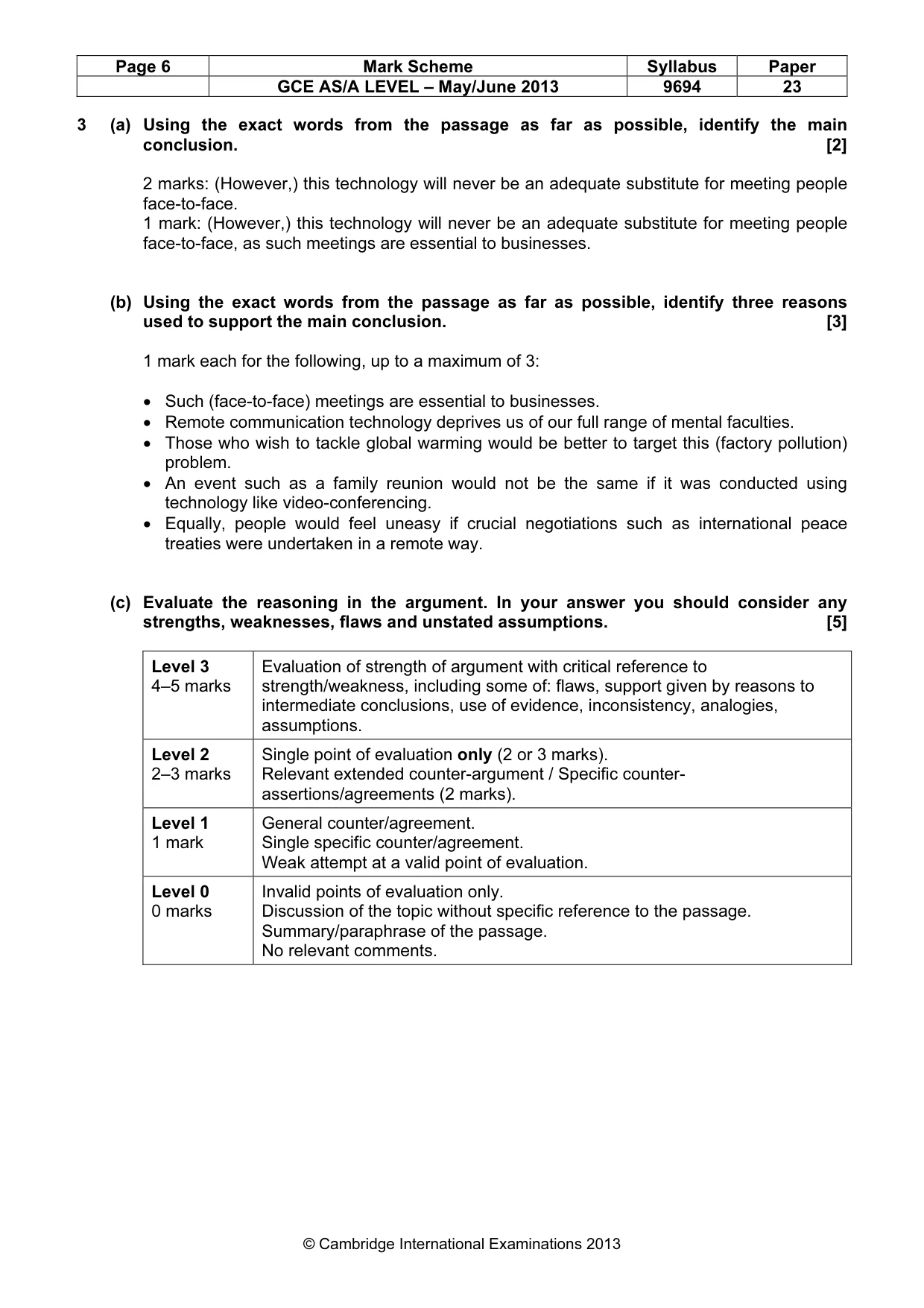
Page 6 Mark Scheme Syllabus Paper GCE AS/A LEVEL – May/June 2013 9694 23 © Cambridge International Examinations 2013 3 (a) Using the exact words from the passage as far as possible, identify the main conclusion. [2] 2 marks: (However,) this technology will never be an adequate substitute for meeting people face-to-face. 1 mark: (However,) this technology will never be an adequate substitute for meeting people face-to-face, as such meetings are essential to businesses. (b) Using the exact words from the passage as far as possible, identify three reasons used to support the main conclusion. [3] 1 mark each for the following, up to a maximum of 3: • Such (face-to-face) meetings are essential to businesses. • Remote communication technology deprives us of our full range of mental faculties. • Those who wish to tackle global warming would be better to target this (factory pollution) problem. • An event such as a family reunion would not be the same if it was conducted using technology like video-conferencing. • Equally, people would feel uneasy if crucial negotiations such as international peace treaties were undertaken in a remote way. (c) Evaluate the reasoning in the argument. In your answer you should consider any strengths, weaknesses, flaws and unstated assumptions. [5] Level 3 4–5 marks Evaluation of strength of argument with critical reference to strength/weakness, including some of: flaws, support given by reasons to intermediate conclusions, use of evidence, inconsistency, analogies, assumptions. Level 2 2–3 marks Single point of evaluation only (2 or 3 marks). Relevant extended counter-argument / Specific counter- assertions/agreements (2 marks). Level 1 1 mark General counter/agreement. Single specific counter/agreement. Weak attempt at a valid point of evaluation. Level 0 0 marks Invalid points of evaluation only. Discussion of the topic without specific reference to the passage. Summary/paraphrase of the passage. No relevant comments.
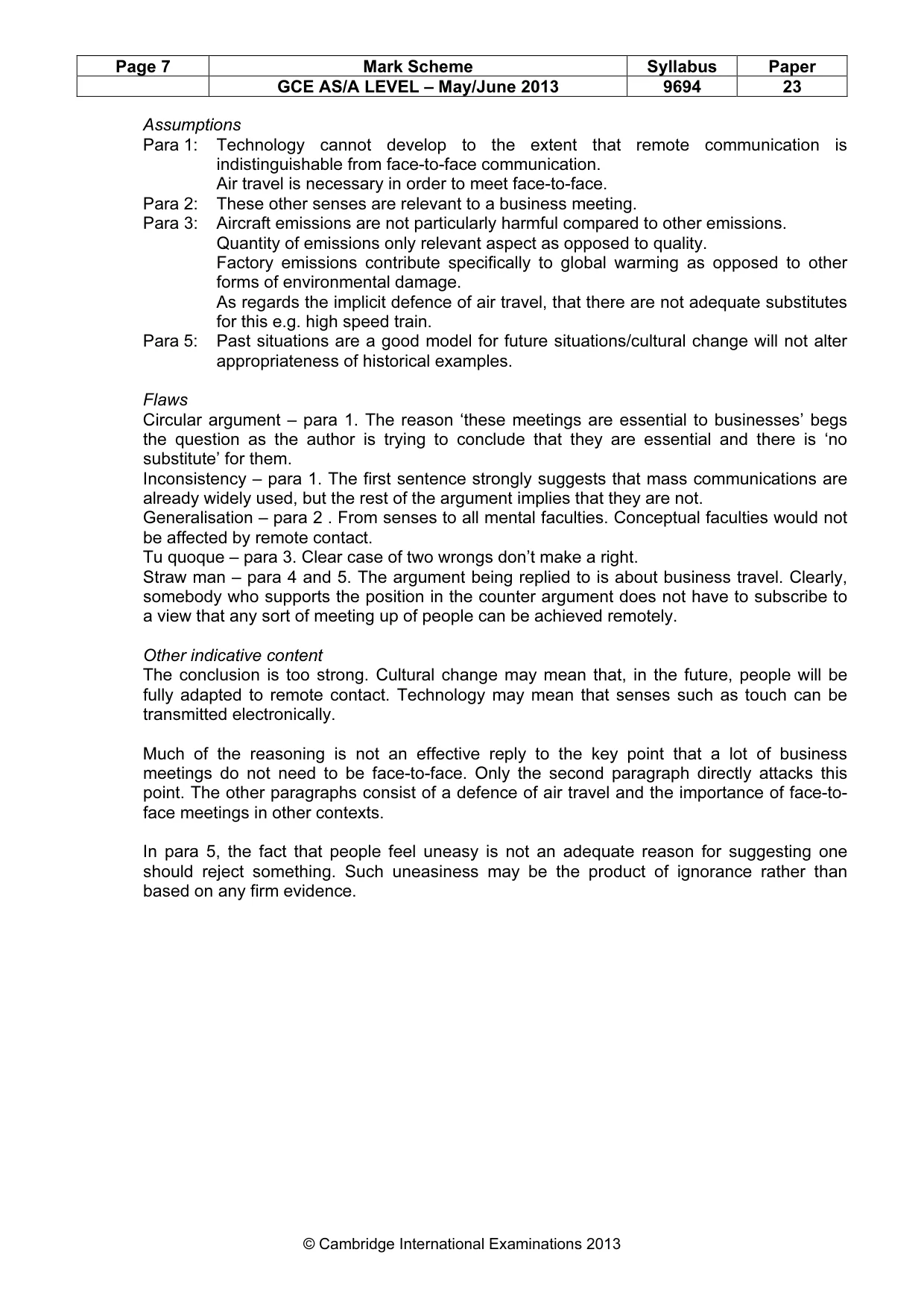
Mark scheme, page 7
Page 7 Mark Scheme Syllabus Paper GCE AS/A LEVEL – May/June 2013 9694 23 © Cambridge International Examinations 2013 Assumptions Para 1: Technology cannot develop to the extent that remote communication is indistinguishable from face-to-face communication. Air travel is necessary in order to meet face-to-face. Para 2: These other senses are relevant to a business meeting. Para 3: Aircraft emissions are not particularly harmful compared to other emissions. Quantity of emissions only relevant aspect as opposed to quality. Factory emissions contribute specifically to global warming as opposed to other forms of environmental damage. As regards the implicit defence of air travel, that there are not adequate substitutes for this e.g. high speed train. Para 5: Past situations are a good model for future situations/cultural change will not alter appropriateness of historical examples. Flaws Circular argument – para 1. The reason ‘these meetings are essential to businesses’ begs the question as the author is trying to conclude that they are essential and there is ‘no substitute’ for them. Inconsistency – para 1. The first sentence strongly suggests that mass communications are already widely used, but the rest of the argument implies that they are not. Generalisation – para 2 . From senses to all mental faculties. Conceptual faculties would not be affected by remote contact. Tu quoque – para 3. Clear case of two wrongs don’t make a right. Straw man – para 4 and 5. The argument being replied to is about business travel. Clearly, somebody who supports the position in the counter argument does not have to subscribe to a view that any sort of meeting up of people can be achieved remotely. Other indicative content The conclusion is too strong. Cultural change may mean that, in the future, people will be fully adapted to remote contact. Technology may mean that senses such as touch can be transmitted electronically. Much of the reasoning is not an effective reply to the key point that a lot of business meetings do not need to be face-to-face. Only the second paragraph directly attacks this point. The other paragraphs consist of a defence of air travel and the importance of face-to- face meetings in other contexts. In para 5, the fact that people feel uneasy is not an adequate reason for suggesting one should reject something. Such uneasiness may be the product of ignorance rather than based on any firm evidence.
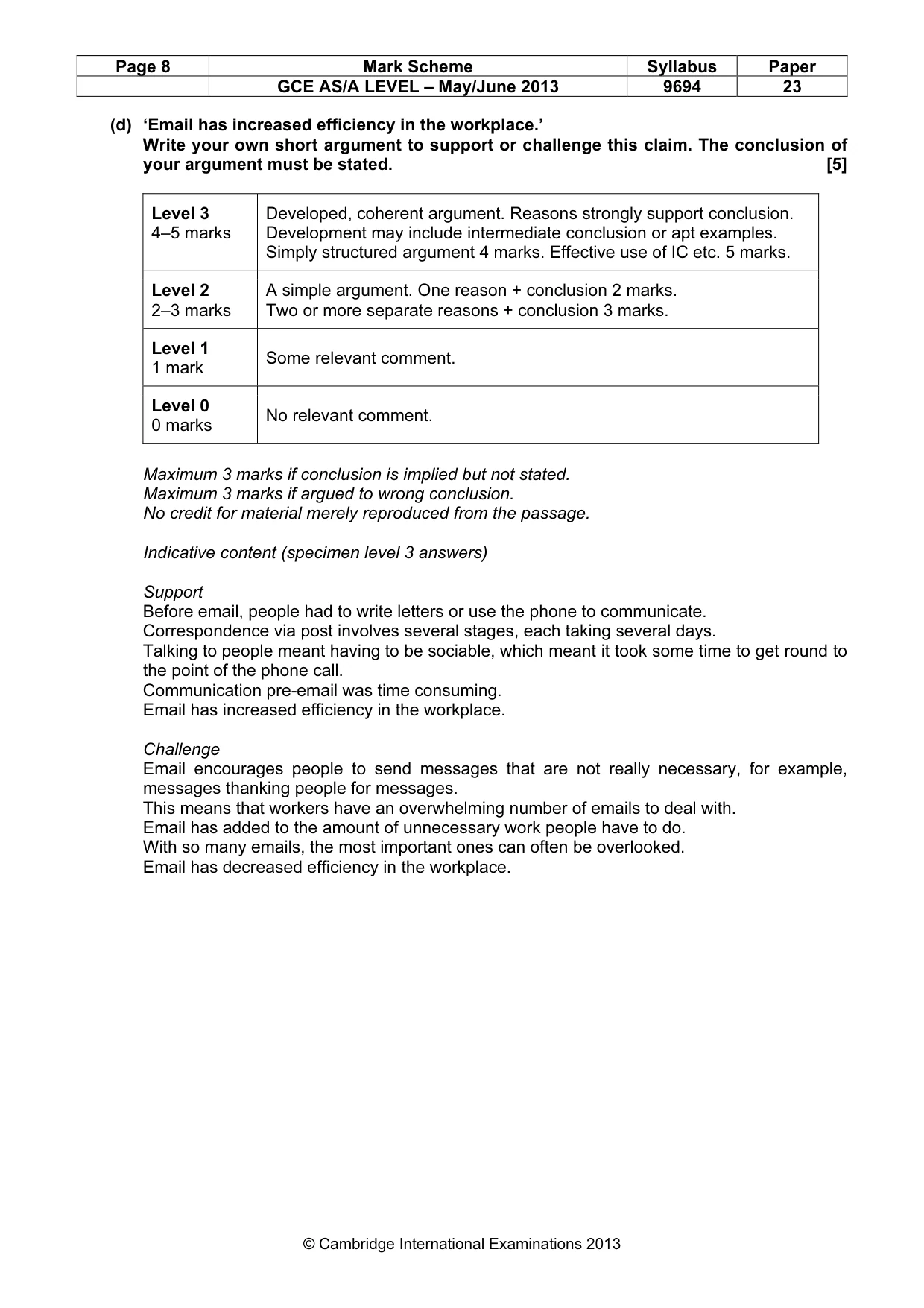
Mark scheme, page 8
Page 8 Mark Scheme Syllabus Paper GCE AS/A LEVEL – May/June 2013 9694 23 © Cambridge International Examinations 2013 (d) ‘Email has increased efficiency in the workplace.’ Write your own short argument to support or challenge this claim. The conclusion of your argument must be stated. [5] Level 3 4–5 marks Developed, coherent argument. Reasons strongly support conclusion. Development may include intermediate conclusion or apt examples. Simply structured argument 4 marks. Effective use of IC etc. 5 marks. Level 2 2–3 marks A simple argument. One reason + conclusion 2 marks. Two or more separate reasons + conclusion 3 marks. Level 1 1 mark Some relevant comment. Level 0 0 marks No relevant comment. Maximum 3 marks if conclusion is implied but not stated. Maximum 3 marks if argued to wrong conclusion. No credit for material merely reproduced from the passage. Indicative content (specimen level 3 answers) Support Before email, people had to write letters or use the phone to communicate. Correspondence via post involves several stages, each taking several days. Talking to people meant having to be sociable, which meant it took some time to get round to the point of the phone call. Communication pre-email was time consuming. Email has increased efficiency in the workplace. Challenge Email encourages people to send messages that are not really necessary, for example, messages thanking people for messages. This means that workers have an overwhelming number of emails to deal with. Email has added to the amount of unnecessary work people have to do. With so many emails, the most important ones can often be overlooked. Email has decreased efficiency in the workplace.
What you needed in this session
Cambridge’s own grade thresholds for 2013 May/June, Paper 2 · Variant 3. A higher threshold means an easier paper — the bar moves with how the cohort did.