Cambridge A Level Thinking Skills 9694 — 2012 Oct/Nov Paper 2 · Variant 1
9694/21/O/N/12 · 45 marks · ≈51 min
The question paper and its mark scheme, free to read here and free to download. This is Cambridge’s own paper, exactly as it was sat.
Question paper8 pages

Mark scheme6 pages
Answers below. Sit the paper first if you are practising.
Paper as text
Question paper, page 1
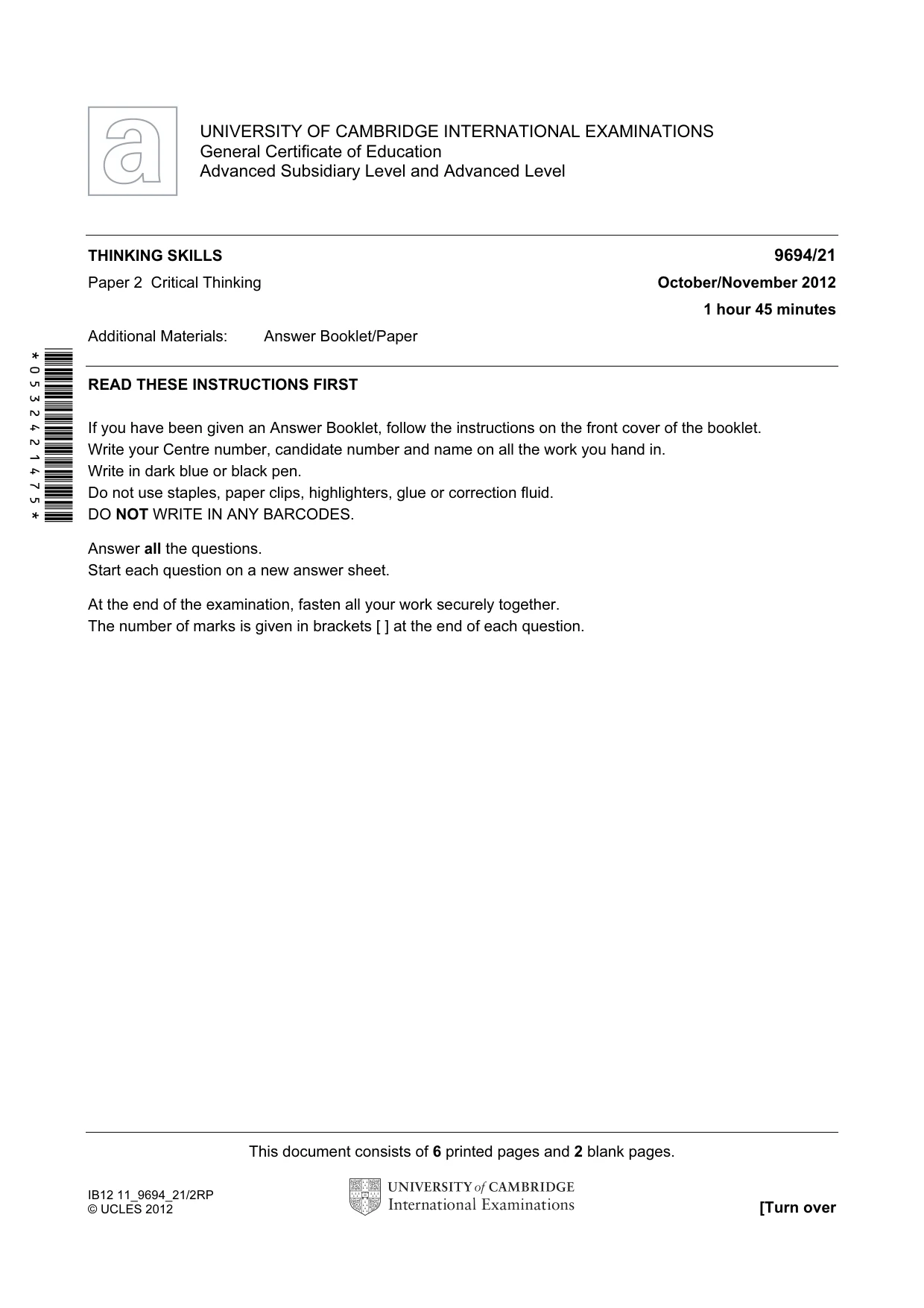
This document consists of 6 printed pages and 2 blank pages. IB12 11_9694_21/2RP © UCLES 2012 [Turn over *0532421475* UNIVERSITY OF CAMBRIDGE INTERNATIONAL EXAMINATIONS General Certificate of Education Advanced Subsidiary Level and Advanced Level THINKING SKILLS 9694/21 Paper 2 Critical Thinking October/November 2012 1 hour 45 minutes Additional Materials: Answer Booklet/Paper READ THESE INSTRUCTIONS FIRST If you have been given an Answer Booklet, follow the instructions on the front cover of the booklet. Write your Centre number, candidate number and name on all the work you hand in. Write in dark blue or black pen. Do not use staples, paper clips, highlighters, glue or correction fluid. DO NOT WRITE IN ANY BARCODES. Answer all the questions. Start each question on a new answer sheet. At the end of the examination, fasten all your work securely together. The number of marks is given in brackets [ ] at the end of each question.
Question paper, page 2
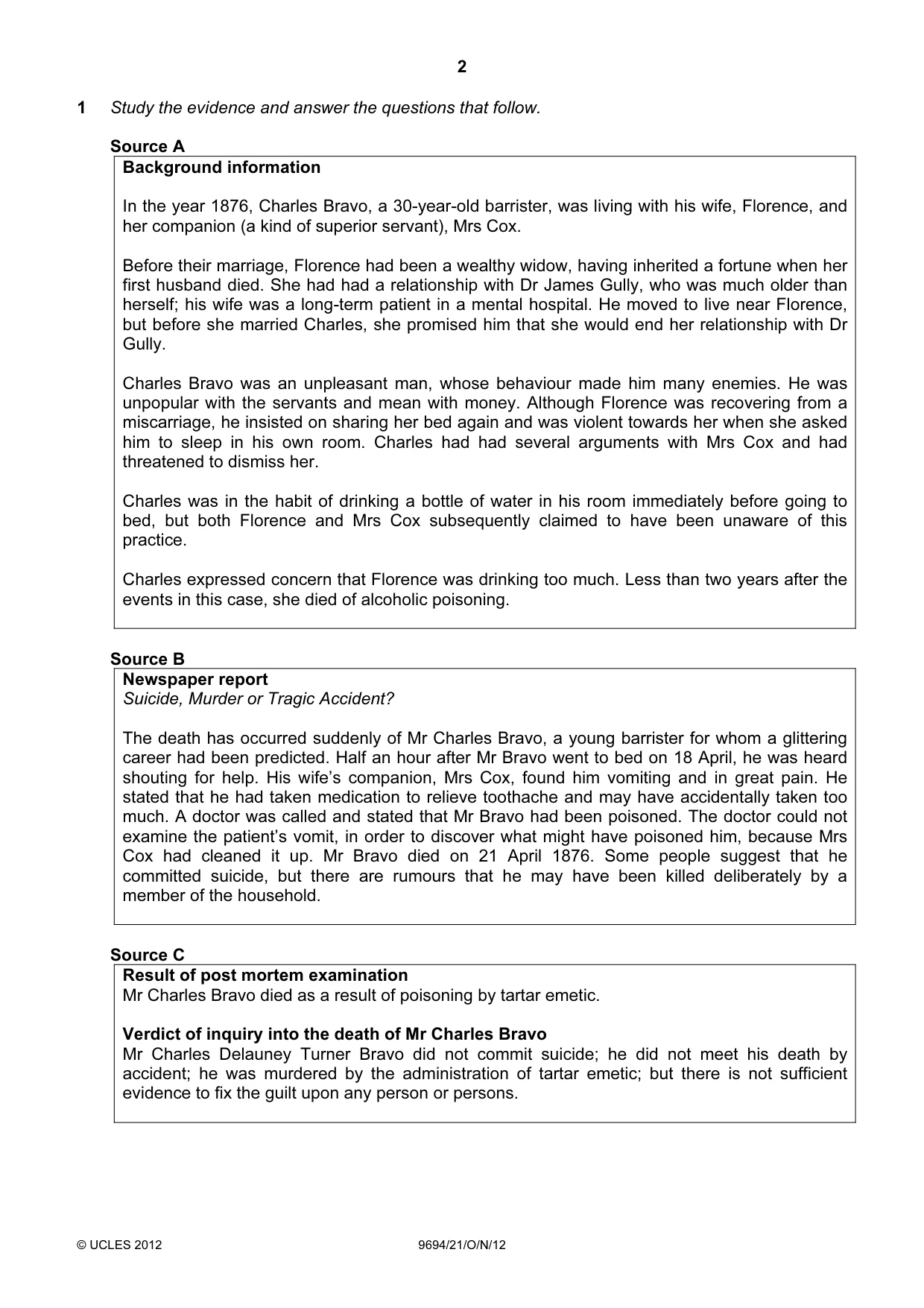
2 © UCLES 2012 9694/21/O/N/12 1 Study the evidence and answer the questions that follow. Source A Background information In the year 1876, Charles Bravo, a 30-year-old barrister, was living with his wife, Florence, and her companion (a kind of superior servant), Mrs Cox. Before their marriage, Florence had been a wealthy widow, having inherited a fortune when her first husband died. She had had a relationship with Dr James Gully, who was much older than herself; his wife was a long-term patient in a mental hospital. He moved to live near Florence, but before she married Charles, she promised him that she would end her relationship with Dr Gully. Charles Bravo was an unpleasant man, whose behaviour made him many enemies. He was unpopular with the servants and mean with money. Although Florence was recovering from a miscarriage, he insisted on sharing her bed again and was violent towards her when she asked him to sleep in his own room. Charles had had several arguments with Mrs Cox and had threatened to dismiss her. Charles was in the habit of drinking a bottle of water in his room immediately before going to bed, but both Florence and Mrs Cox subsequently claimed to have been unaware of this practice. Charles expressed concern that Florence was drinking too much. Less than two years after the events in this case, she died of alcoholic poisoning. Source B Newspaper report Suicide, Murder or Tragic Accident? The death has occurred suddenly of Mr Charles Bravo, a young barrister for whom a glittering career had been predicted. Half an hour after Mr Bravo went to bed on 18 April, he was heard shouting for help. His wife’s companion, Mrs Cox, found him vomiting and in great pain. He stated that he had taken medication to relieve toothache and may have accidentally taken too much. A doctor was called and stated that Mr Bravo had been poisoned. The doctor could not examine the patient’s vomit, in order to discover what might have poisoned him, because Mrs Cox had cleaned it up. Mr Bravo died on 21 April 1876. Some people suggest that he committed suicide, but there are rumours that he may have been killed deliberately by a member of the household. Source C Result of post mortem examination Mr Charles Bravo died as a result of poisoning by tartar emetic. Verdict of inquiry into the death of Mr Charles Bravo Mr Charles Delauney Turner Bravo did not commit suicide; he did not meet his death by accident; he was murdered by the administration of tartar emetic; but there is not sufficient evidence to fix the guilt upon any person or persons.
Question paper, page 3
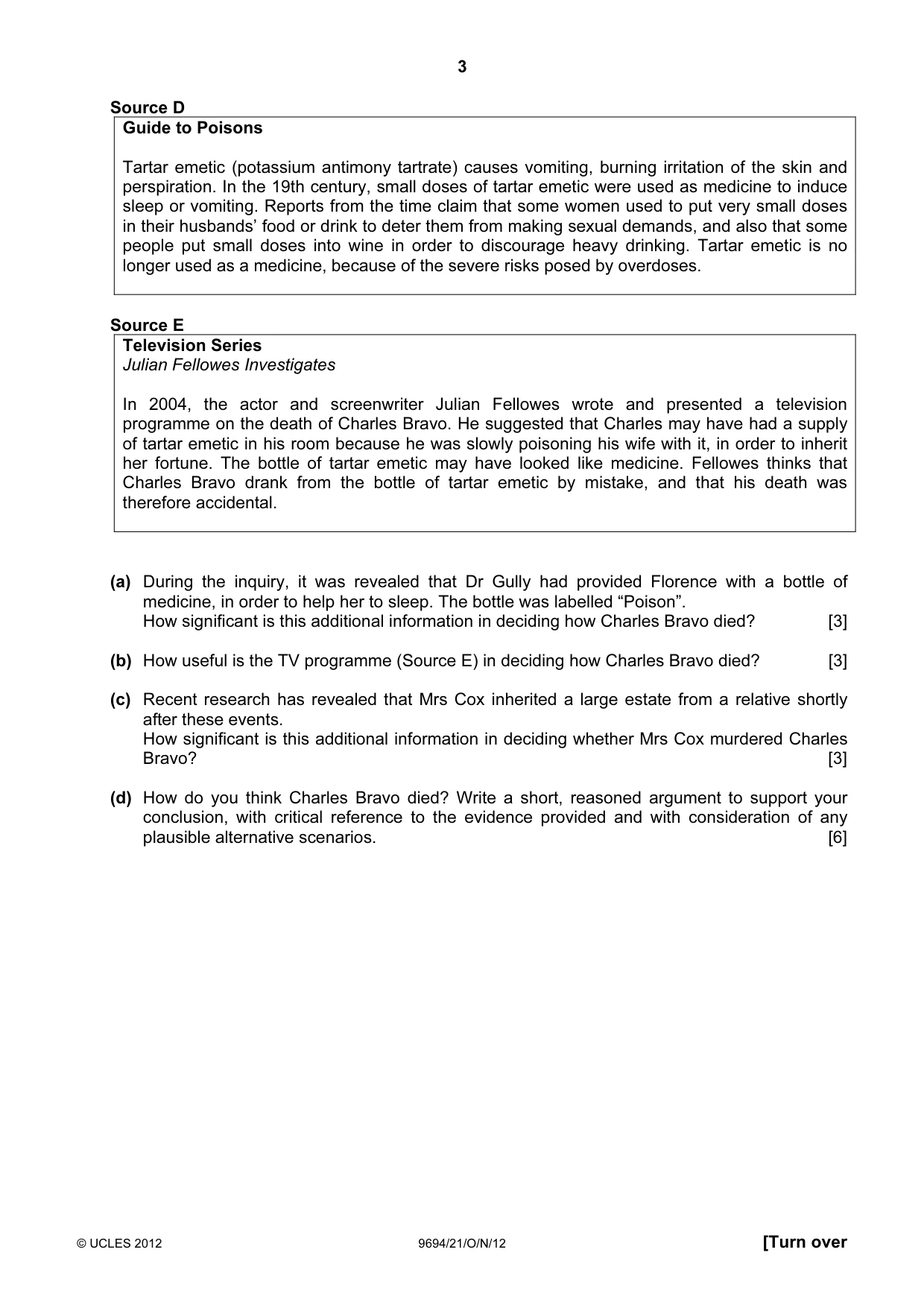
3 © UCLES 2012 9694/21/O/N/12 [Turn over Source D Guide to Poisons Tartar emetic (potassium antimony tartrate) causes vomiting, burning irritation of the skin and perspiration. In the 19th century, small doses of tartar emetic were used as medicine to induce sleep or vomiting. Reports from the time claim that some women used to put very small doses in their husbands’ food or drink to deter them from making sexual demands, and also that some people put small doses into wine in order to discourage heavy drinking. Tartar emetic is no longer used as a medicine, because of the severe risks posed by overdoses. Source E Television Series Julian Fellowes Investigates In 2004, the actor and screenwriter Julian Fellowes wrote and presented a television programme on the death of Charles Bravo. He suggested that Charles may have had a supply of tartar emetic in his room because he was slowly poisoning his wife with it, in order to inherit her fortune. The bottle of tartar emetic may have looked like medicine. Fellowes thinks that Charles Bravo drank from the bottle of tartar emetic by mistake, and that his death was therefore accidental. (a) During the inquiry, it was revealed that Dr Gully had provided Florence with a bottle of medicine, in order to help her to sleep. The bottle was labelled “Poison”. How significant is this additional information in deciding how Charles Bravo died? [3] (b) How useful is the TV programme (Source E) in deciding how Charles Bravo died? [3] (c) Recent research has revealed that Mrs Cox inherited a large estate from a relative shortly after these events. How significant is this additional information in deciding whether Mrs Cox murdered Charles Bravo? [3] (d) How do you think Charles Bravo died? Write a short, reasoned argument to support your conclusion, with critical reference to the evidence provided and with consideration of any plausible alternative scenarios. [6]
Question paper, page 4
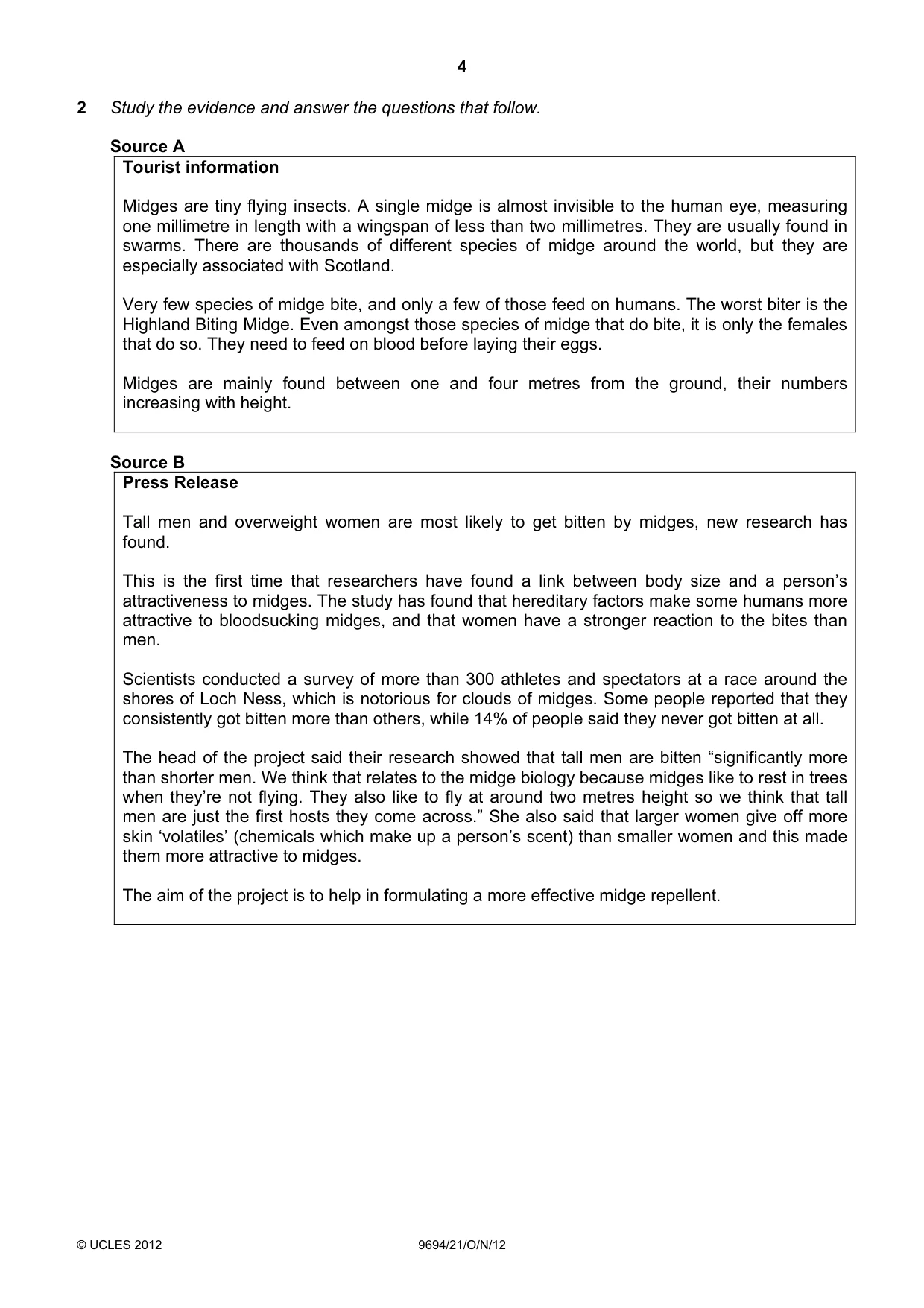
4 © UCLES 2012 9694/21/O/N/12 2 Study the evidence and answer the questions that follow. Source A Tourist information Midges are tiny flying insects. A single midge is almost invisible to the human eye, measuring one millimetre in length with a wingspan of less than two millimetres. They are usually found in swarms. There are thousands of different species of midge around the world, but they are especially associated with Scotland. Very few species of midge bite, and only a few of those feed on humans. The worst biter is the Highland Biting Midge. Even amongst those species of midge that do bite, it is only the females that do so. They need to feed on blood before laying their eggs. Midges are mainly found between one and four metres from the ground, their numbers increasing with height. Source B Press Release Tall men and overweight women are most likely to get bitten by midges, new research has found. This is the first time that researchers have found a link between body size and a person’s attractiveness to midges. The study has found that hereditary factors make some humans more attractive to bloodsucking midges, and that women have a stronger reaction to the bites than men. Scientists conducted a survey of more than 300 athletes and spectators at a race around the shores of Loch Ness, which is notorious for clouds of midges. Some people reported that they consistently got bitten more than others, while 14% of people said they never got bitten at all. The head of the project said their research showed that tall men are bitten “significantly more than shorter men. We think that relates to the midge biology because midges like to rest in trees when they’re not flying. They also like to fly at around two metres height so we think that tall men are just the first hosts they come across.” She also said that larger women give off more skin ‘volatiles’ (chemicals which make up a person’s scent) than smaller women and this made them more attractive to midges. The aim of the project is to help in formulating a more effective midge repellent.
Question paper, page 5
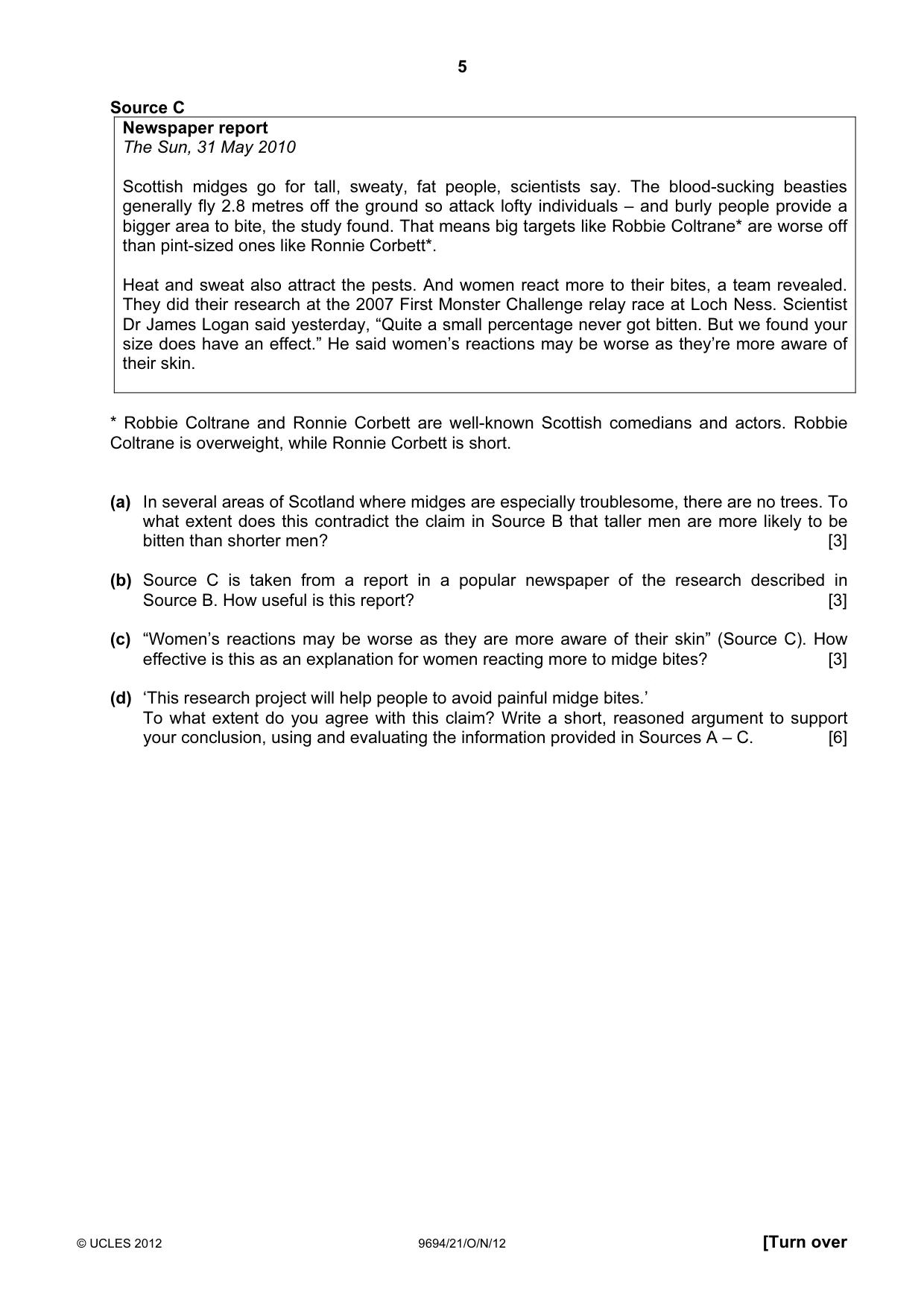
5 © UCLES 2012 9694/21/O/N/12 [Turn over Source C Newspaper report The Sun, 31 May 2010 Scottish midges go for tall, sweaty, fat people, scientists say. The blood-sucking beasties generally fly 2.8 metres off the ground so attack lofty individuals – and burly people provide a bigger area to bite, the study found. That means big targets like Robbie Coltrane* are worse off than pint-sized ones like Ronnie Corbett*. Heat and sweat also attract the pests. And women react more to their bites, a team revealed. They did their research at the 2007 First Monster Challenge relay race at Loch Ness. Scientist Dr James Logan said yesterday, “Quite a small percentage never got bitten. But we found your size does have an effect.” He said women’s reactions may be worse as they’re more aware of their skin. * Robbie Coltrane and Ronnie Corbett are well-known Scottish comedians and actors. Robbie Coltrane is overweight, while Ronnie Corbett is short. (a) In several areas of Scotland where midges are especially troublesome, there are no trees. To what extent does this contradict the claim in Source B that taller men are more likely to be bitten than shorter men? [3] (b) Source C is taken from a report in a popular newspaper of the research described in Source B. How useful is this report? [3] (c) “Women’s reactions may be worse as they are more aware of their skin” (Source C). How effective is this as an explanation for women reacting more to midge bites? [3] (d) ‘This research project will help people to avoid painful midge bites.’ To what extent do you agree with this claim? Write a short, reasoned argument to support your conclusion, using and evaluating the information provided in Sources A – C. [6]
Question paper, page 6
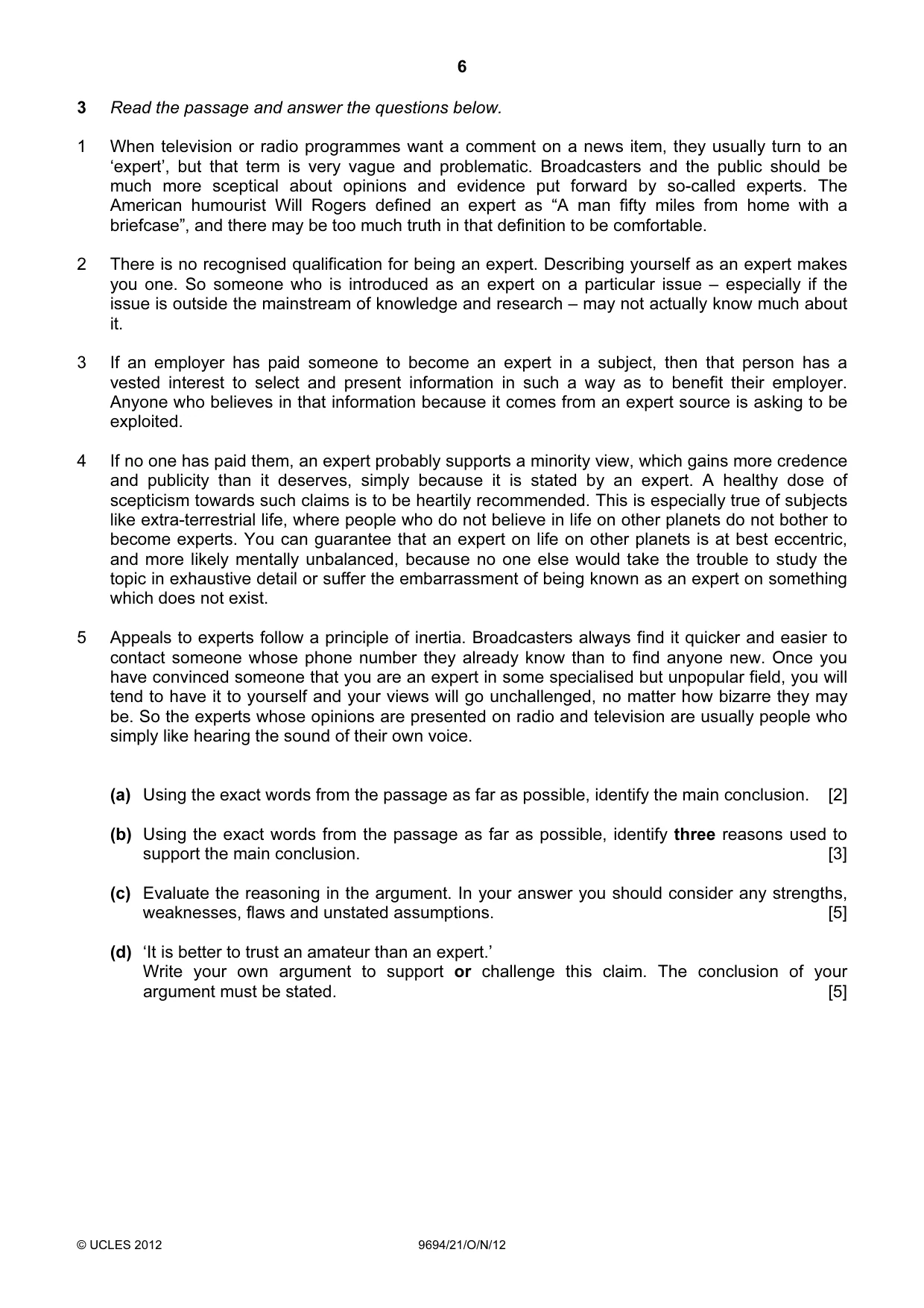
6 © UCLES 2012 9694/21/O/N/12 3 Read the passage and answer the questions below. 1 When television or radio programmes want a comment on a news item, they usually turn to an ‘expert’, but that term is very vague and problematic. Broadcasters and the public should be much more sceptical about opinions and evidence put forward by so-called experts. The American humourist Will Rogers defined an expert as “A man fifty miles from home with a briefcase”, and there may be too much truth in that definition to be comfortable. 2 There is no recognised qualification for being an expert. Describing yourself as an expert makes you one. So someone who is introduced as an expert on a particular issue – especially if the issue is outside the mainstream of knowledge and research – may not actually know much about it. 3 If an employer has paid someone to become an expert in a subject, then that person has a vested interest to select and present information in such a way as to benefit their employer. Anyone who believes in that information because it comes from an expert source is asking to be exploited. 4 If no one has paid them, an expert probably supports a minority view, which gains more credence and publicity than it deserves, simply because it is stated by an expert. A healthy dose of scepticism towards such claims is to be heartily recommended. This is especially true of subjects like extra-terrestrial life, where people who do not believe in life on other planets do not bother to become experts. You can guarantee that an expert on life on other planets is at best eccentric, and more likely mentally unbalanced, because no one else would take the trouble to study the topic in exhaustive detail or suffer the embarrassment of being known as an expert on something which does not exist. 5 Appeals to experts follow a principle of inertia. Broadcasters always find it quicker and easier to contact someone whose phone number they already know than to find anyone new. Once you have convinced someone that you are an expert in some specialised but unpopular field, you will tend to have it to yourself and your views will go unchallenged, no matter how bizarre they may be. So the experts whose opinions are presented on radio and television are usually people who simply like hearing the sound of their own voice. (a) Using the exact words from the passage as far as possible, identify the main conclusion. [2] (b) Using the exact words from the passage as far as possible, identify three reasons used to support the main conclusion. [3] (c) Evaluate the reasoning in the argument. In your answer you should consider any strengths, weaknesses, flaws and unstated assumptions. [5] (d) ‘It is better to trust an amateur than an expert.’ Write your own argument to support or challenge this claim. The conclusion of your argument must be stated. [5]
Question paper, page 7
7 © UCLES 2012 9694/21/O/N/12 BLANK PAGE
Question paper, page 8
8 Copyright Acknowledgements: Question 2 © Douglas Walker; Midges like tall, fat, sweaty folk; The Sun; 31 May 2010. Permission to reproduce items where third-party owned material protected by copyright is included has been sought and cleared where possible. Every reasonable effort has been made by the publisher (UCLES) to trace copyright holders, but if any items requiring clearance have unwittingly been included, the publisher will be pleased to make amends at the earliest possible opportunity. University of Cambridge International Examinations is part of the Cambridge Assessment Group. Cambridge Assessment is the brand name of University of Cambridge Local Examinations Syndicate (UCLES), which is itself a department of the University of Cambridge. © UCLES 2012 9694/21/O/N/12 BLANK PAGE
Mark scheme, page 1
CAMBRIDGE INTERNATIONAL EXAMINATIONS GCE Advanced Subsidiary Level and GCE Advanced Level MARK SCHEME for the October/November 2012 series 9694 THINKING SKILLS 9694/21 Paper 2 (Critical Thinking), maximum raw mark 45 This mark scheme is published as an aid to teachers and candidates, to indicate the requirements of the examination. It shows the basis on which Examiners were instructed to award marks. It does not indicate the details of the discussions that took place at an Examiners’ meeting before marking began, which would have considered the acceptability of alternative answers. Mark schemes should be read in conjunction with the question paper and the Principal Examiner Report for Teachers. Cambridge will not enter into discussions about these mark schemes. Cambridge is publishing the mark schemes for the October/November 2012 series for most IGCSE, GCE Advanced Level and Advanced Subsidiary Level components and some Ordinary Level components.
Mark scheme, page 2
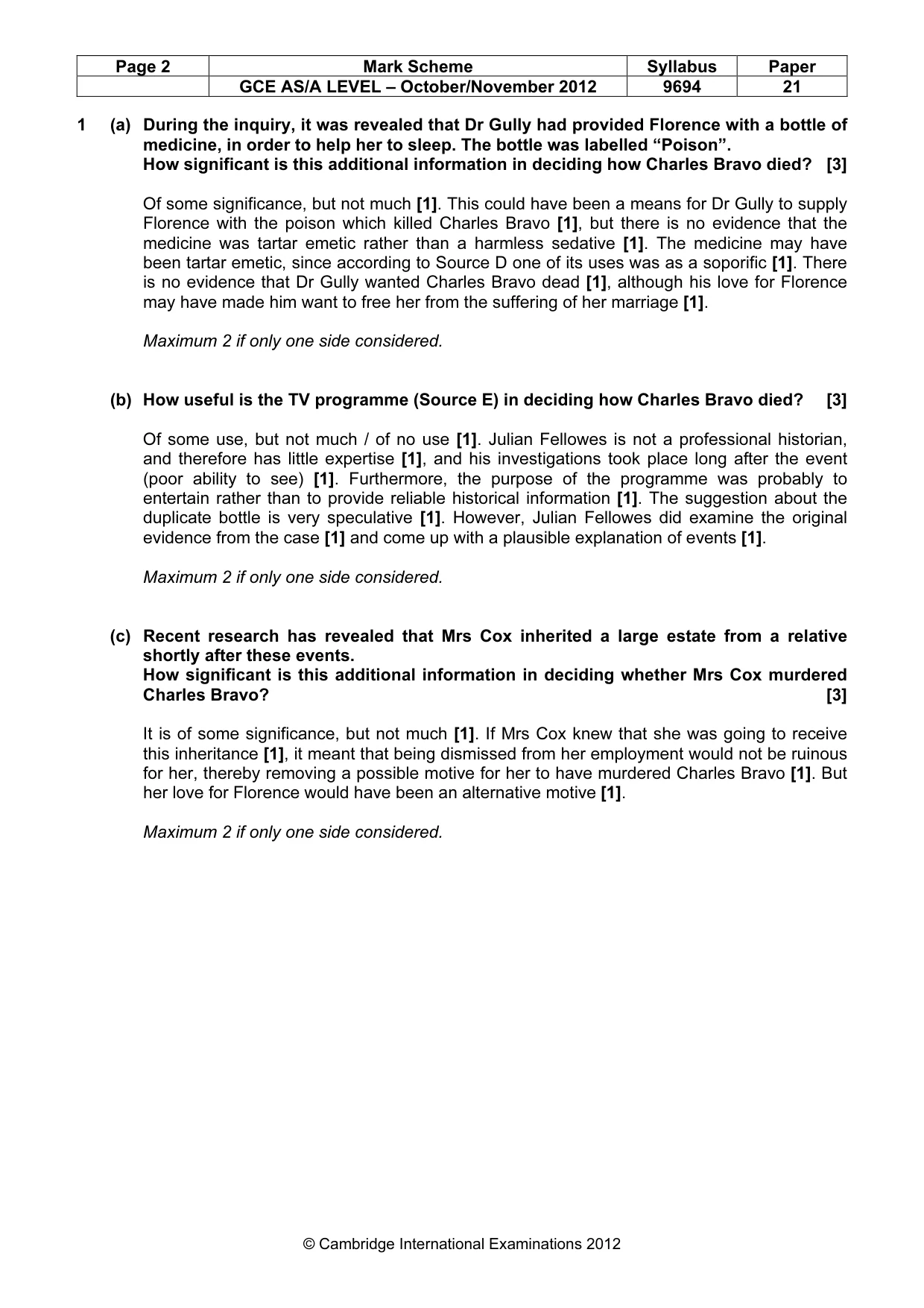
Page 2 Mark Scheme Syllabus Paper GCE AS/A LEVEL – October/November 2012 9694 21 © Cambridge International Examinations 2012 1 (a) During the inquiry, it was revealed that Dr Gully had provided Florence with a bottle of medicine, in order to help her to sleep. The bottle was labelled “Poison”. How significant is this additional information in deciding how Charles Bravo died? [3] Of some significance, but not much [1]. This could have been a means for Dr Gully to supply Florence with the poison which killed Charles Bravo [1], but there is no evidence that the medicine was tartar emetic rather than a harmless sedative [1]. The medicine may have been tartar emetic, since according to Source D one of its uses was as a soporific [1]. There is no evidence that Dr Gully wanted Charles Bravo dead [1], although his love for Florence may have made him want to free her from the suffering of her marriage [1]. Maximum 2 if only one side considered. (b) How useful is the TV programme (Source E) in deciding how Charles Bravo died? [3] Of some use, but not much / of no use [1]. Julian Fellowes is not a professional historian, and therefore has little expertise [1], and his investigations took place long after the event (poor ability to see) [1]. Furthermore, the purpose of the programme was probably to entertain rather than to provide reliable historical information [1]. The suggestion about the duplicate bottle is very speculative [1]. However, Julian Fellowes did examine the original evidence from the case [1] and come up with a plausible explanation of events [1]. Maximum 2 if only one side considered. (c) Recent research has revealed that Mrs Cox inherited a large estate from a relative shortly after these events. How significant is this additional information in deciding whether Mrs Cox murdered Charles Bravo? [3] It is of some significance, but not much [1]. If Mrs Cox knew that she was going to receive this inheritance [1], it meant that being dismissed from her employment would not be ruinous for her, thereby removing a possible motive for her to have murdered Charles Bravo [1]. But her love for Florence would have been an alternative motive [1]. Maximum 2 if only one side considered.
Mark scheme, page 3
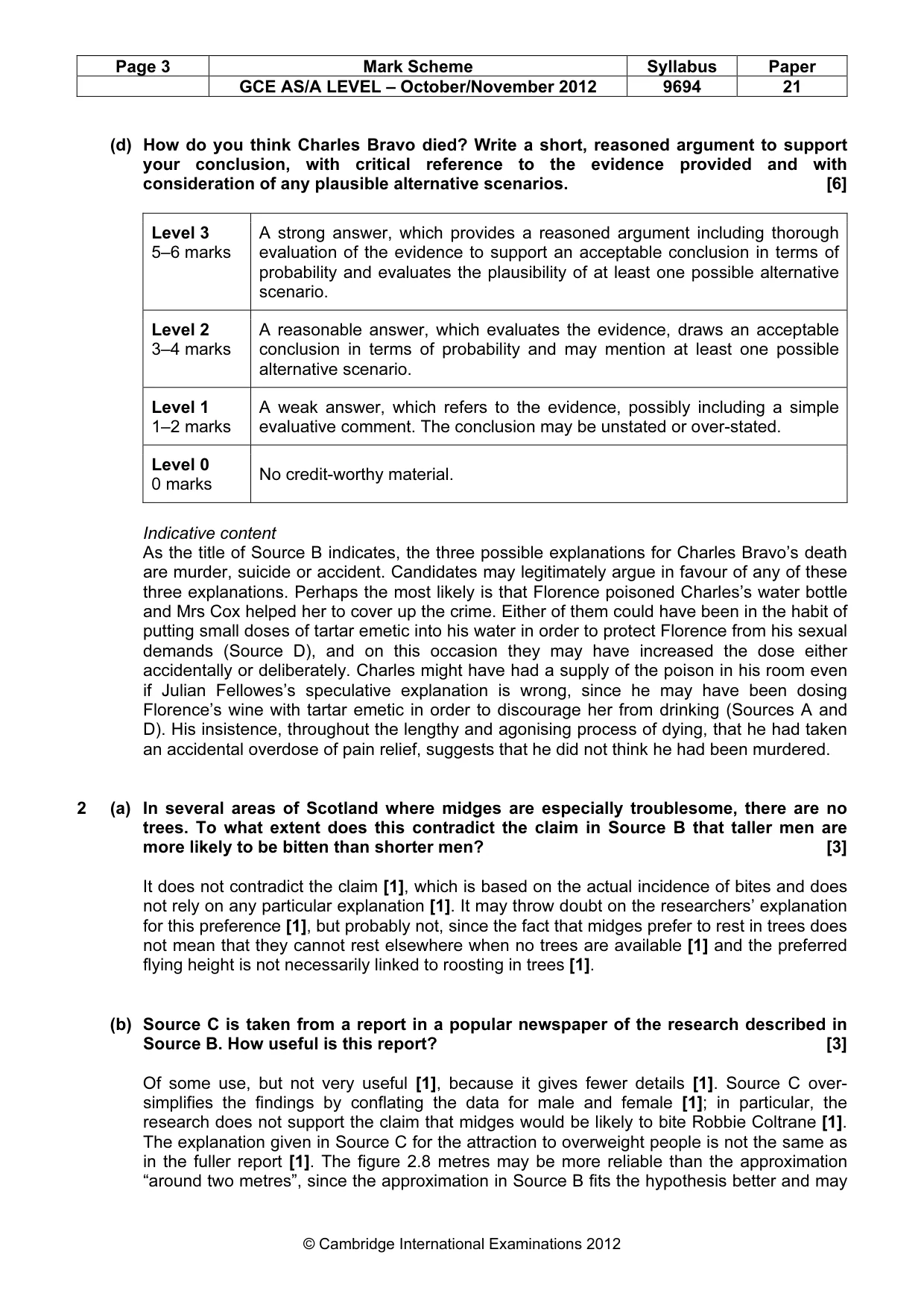
Page 3 Mark Scheme Syllabus Paper GCE AS/A LEVEL – October/November 2012 9694 21 © Cambridge International Examinations 2012 (d) How do you think Charles Bravo died? Write a short, reasoned argument to support your conclusion, with critical reference to the evidence provided and with consideration of any plausible alternative scenarios. [6] Level 3 5–6 marks A strong answer, which provides a reasoned argument including thorough evaluation of the evidence to support an acceptable conclusion in terms of probability and evaluates the plausibility of at least one possible alternative scenario. Level 2 3–4 marks A reasonable answer, which evaluates the evidence, draws an acceptable conclusion in terms of probability and may mention at least one possible alternative scenario. Level 1 1–2 marks A weak answer, which refers to the evidence, possibly including a simple evaluative comment. The conclusion may be unstated or over-stated. Level 0 0 marks No credit-worthy material. Indicative content As the title of Source B indicates, the three possible explanations for Charles Bravo’s death are murder, suicide or accident. Candidates may legitimately argue in favour of any of these three explanations. Perhaps the most likely is that Florence poisoned Charles’s water bottle and Mrs Cox helped her to cover up the crime. Either of them could have been in the habit of putting small doses of tartar emetic into his water in order to protect Florence from his sexual demands (Source D), and on this occasion they may have increased the dose either accidentally or deliberately. Charles might have had a supply of the poison in his room even if Julian Fellowes’s speculative explanation is wrong, since he may have been dosing Florence’s wine with tartar emetic in order to discourage her from drinking (Sources A and D). His insistence, throughout the lengthy and agonising process of dying, that he had taken an accidental overdose of pain relief, suggests that he did not think he had been murdered. 2 (a) In several areas of Scotland where midges are especially troublesome, there are no trees. To what extent does this contradict the claim in Source B that taller men are more likely to be bitten than shorter men? [3] It does not contradict the claim [1], which is based on the actual incidence of bites and does not rely on any particular explanation [1]. It may throw doubt on the researchers’ explanation for this preference [1], but probably not, since the fact that midges prefer to rest in trees does not mean that they cannot rest elsewhere when no trees are available [1] and the preferred flying height is not necessarily linked to roosting in trees [1]. (b) Source C is taken from a report in a popular newspaper of the research described in Source B. How useful is this report? [3] Of some use, but not very useful [1], because it gives fewer details [1]. Source C over- simplifies the findings by conflating the data for male and female [1]; in particular, the research does not support the claim that midges would be likely to bite Robbie Coltrane [1]. The explanation given in Source C for the attraction to overweight people is not the same as in the fuller report [1]. The figure 2.8 metres may be more reliable than the approximation “around two metres”, since the approximation in Source B fits the hypothesis better and may
Mark scheme, page 4
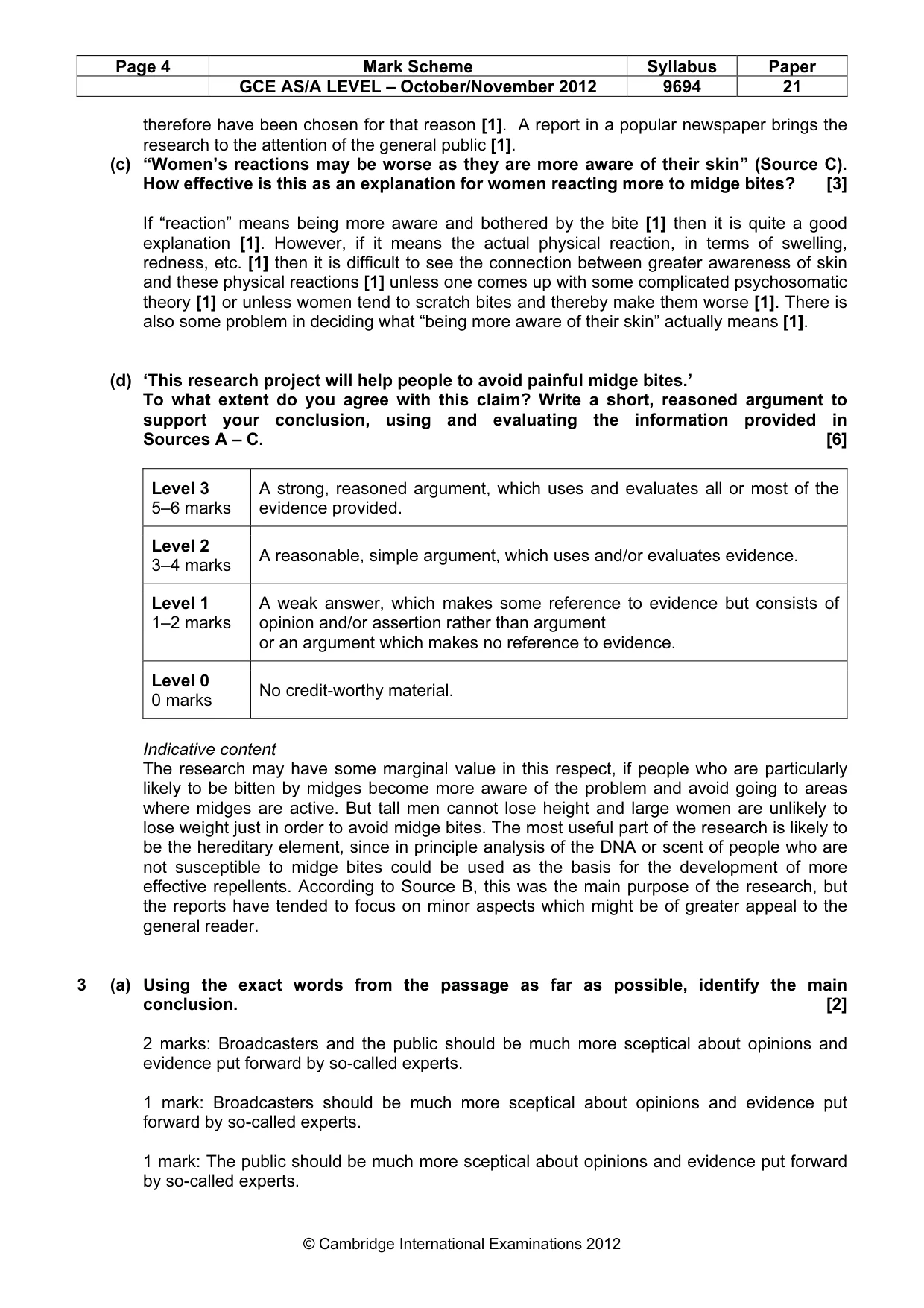
Page 4 Mark Scheme Syllabus Paper GCE AS/A LEVEL – October/November 2012 9694 21 © Cambridge International Examinations 2012 therefore have been chosen for that reason [1]. A report in a popular newspaper brings the research to the attention of the general public [1]. (c) “Women’s reactions may be worse as they are more aware of their skin” (Source C). How effective is this as an explanation for women reacting more to midge bites? [3] If “reaction” means being more aware and bothered by the bite [1] then it is quite a good explanation [1]. However, if it means the actual physical reaction, in terms of swelling, redness, etc. [1] then it is difficult to see the connection between greater awareness of skin and these physical reactions [1] unless one comes up with some complicated psychosomatic theory [1] or unless women tend to scratch bites and thereby make them worse [1]. There is also some problem in deciding what “being more aware of their skin” actually means [1]. (d) ‘This research project will help people to avoid painful midge bites.’ To what extent do you agree with this claim? Write a short, reasoned argument to support your conclusion, using and evaluating the information provided in Sources A – C. [6] Level 3 5–6 marks A strong, reasoned argument, which uses and evaluates all or most of the evidence provided. Level 2 3–4 marks A reasonable, simple argument, which uses and/or evaluates evidence. Level 1 1–2 marks A weak answer, which makes some reference to evidence but consists of opinion and/or assertion rather than argument or an argument which makes no reference to evidence. Level 0 0 marks No credit-worthy material. Indicative content The research may have some marginal value in this respect, if people who are particularly likely to be bitten by midges become more aware of the problem and avoid going to areas where midges are active. But tall men cannot lose height and large women are unlikely to lose weight just in order to avoid midge bites. The most useful part of the research is likely to be the hereditary element, since in principle analysis of the DNA or scent of people who are not susceptible to midge bites could be used as the basis for the development of more effective repellents. According to Source B, this was the main purpose of the research, but the reports have tended to focus on minor aspects which might be of greater appeal to the general reader. 3 (a) Using the exact words from the passage as far as possible, identify the main conclusion. [2] 2 marks: Broadcasters and the public should be much more sceptical about opinions and evidence put forward by so-called experts. 1 mark: Broadcasters should be much more sceptical about opinions and evidence put forward by so-called experts. 1 mark: The public should be much more sceptical about opinions and evidence put forward by so-called experts.
Mark scheme, page 5
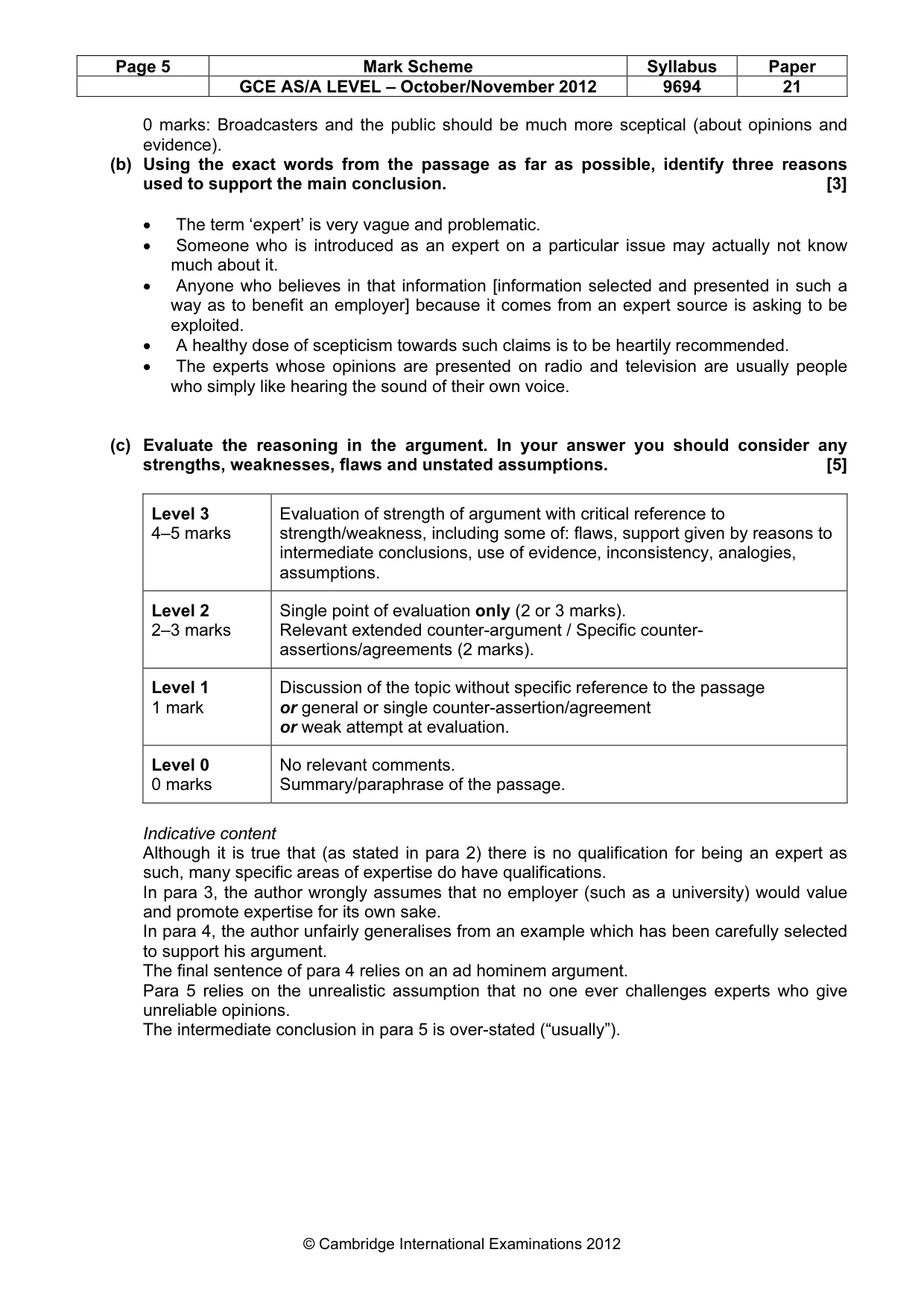
Page 5 Mark Scheme Syllabus Paper GCE AS/A LEVEL – October/November 2012 9694 21 © Cambridge International Examinations 2012 0 marks: Broadcasters and the public should be much more sceptical (about opinions and evidence). (b) Using the exact words from the passage as far as possible, identify three reasons used to support the main conclusion. [3] • The term ‘expert’ is very vague and problematic. • Someone who is introduced as an expert on a particular issue may actually not know much about it. • Anyone who believes in that information [information selected and presented in such a way as to benefit an employer] because it comes from an expert source is asking to be exploited. • A healthy dose of scepticism towards such claims is to be heartily recommended. • The experts whose opinions are presented on radio and television are usually people who simply like hearing the sound of their own voice. (c) Evaluate the reasoning in the argument. In your answer you should consider any strengths, weaknesses, flaws and unstated assumptions. [5] Level 3 4–5 marks Evaluation of strength of argument with critical reference to strength/weakness, including some of: flaws, support given by reasons to intermediate conclusions, use of evidence, inconsistency, analogies, assumptions. Level 2 2–3 marks Single point of evaluation only (2 or 3 marks). Relevant extended counter-argument / Specific counter- assertions/agreements (2 marks). Level 1 1 mark Discussion of the topic without specific reference to the passage or general or single counter-assertion/agreement or weak attempt at evaluation. Level 0 0 marks No relevant comments. Summary/paraphrase of the passage. Indicative content Although it is true that (as stated in para 2) there is no qualification for being an expert as such, many specific areas of expertise do have qualifications. In para 3, the author wrongly assumes that no employer (such as a university) would value and promote expertise for its own sake. In para 4, the author unfairly generalises from an example which has been carefully selected to support his argument. The final sentence of para 4 relies on an ad hominem argument. Para 5 relies on the unrealistic assumption that no one ever challenges experts who give unreliable opinions. The intermediate conclusion in para 5 is over-stated (“usually”).
Mark scheme, page 6
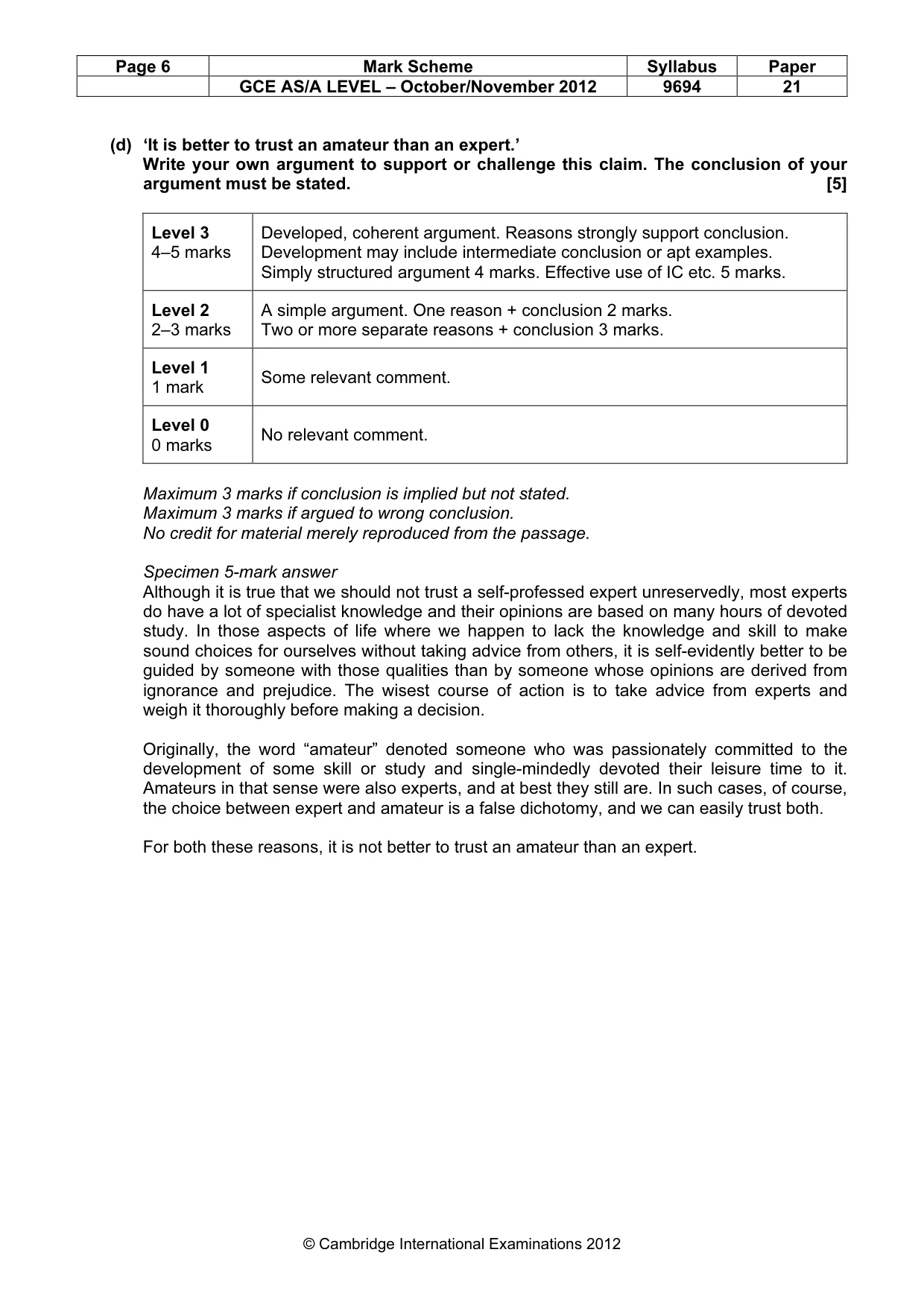
Page 6 Mark Scheme Syllabus Paper GCE AS/A LEVEL – October/November 2012 9694 21 © Cambridge International Examinations 2012 (d) ‘It is better to trust an amateur than an expert.’ Write your own argument to support or challenge this claim. The conclusion of your argument must be stated. [5] Level 3 4–5 marks Developed, coherent argument. Reasons strongly support conclusion. Development may include intermediate conclusion or apt examples. Simply structured argument 4 marks. Effective use of IC etc. 5 marks. Level 2 2–3 marks A simple argument. One reason + conclusion 2 marks. Two or more separate reasons + conclusion 3 marks. Level 1 1 mark Some relevant comment. Level 0 0 marks No relevant comment. Maximum 3 marks if conclusion is implied but not stated. Maximum 3 marks if argued to wrong conclusion. No credit for material merely reproduced from the passage. Specimen 5-mark answer Although it is true that we should not trust a self-professed expert unreservedly, most experts do have a lot of specialist knowledge and their opinions are based on many hours of devoted study. In those aspects of life where we happen to lack the knowledge and skill to make sound choices for ourselves without taking advice from others, it is self-evidently better to be guided by someone with those qualities than by someone whose opinions are derived from ignorance and prejudice. The wisest course of action is to take advice from experts and weigh it thoroughly before making a decision. Originally, the word “amateur” denoted someone who was passionately committed to the development of some skill or study and single-mindedly devoted their leisure time to it. Amateurs in that sense were also experts, and at best they still are. In such cases, of course, the choice between expert and amateur is a false dichotomy, and we can easily trust both. For both these reasons, it is not better to trust an amateur than an expert.
What you needed in this session
Cambridge’s own grade thresholds for 2012 Oct/Nov, Paper 2 · Variant 1. A higher threshold means an easier paper — the bar moves with how the cohort did.