Cambridge A Level Thinking Skills 9694 — 2012 Oct/Nov Paper 2 · Variant 2
9694/22/O/N/12 · 45 marks · ≈51 min
The question paper and its mark scheme, free to read here and free to download. This is Cambridge’s own paper, exactly as it was sat.
Question paper8 pages
Mark scheme7 pages
Answers below. Sit the paper first if you are practising.
Paper as text
Question paper, page 1
This document consists of 6 printed pages and 2 blank pages. IB12 11_9694_22/2RP © UCLES 2012 [Turn over *3258825216* UNIVERSITY OF CAMBRIDGE INTERNATIONAL EXAMINATIONS General Certificate of Education Advanced Subsidiary Level and Advanced Level THINKING SKILLS 9694/22 Paper 2 Critical Thinking October/November 2012 1 hour 45 minutes Additional Materials: Answer Booklet/Paper READ THESE INSTRUCTIONS FIRST If you have been given an Answer Booklet, follow the instructions on the front cover of the booklet. Write your Centre number, candidate number and name on all the work you hand in. Write in dark blue or black pen. Do not use staples, paper clips, highlighters, glue or correction fluid. DO NOT WRITE IN ANY BARCODES. Answer all the questions. Start each question on a new answer sheet. At the end of the examination, fasten all your work securely together. The number of marks is given in brackets [ ] at the end of each question.
Question paper, page 2
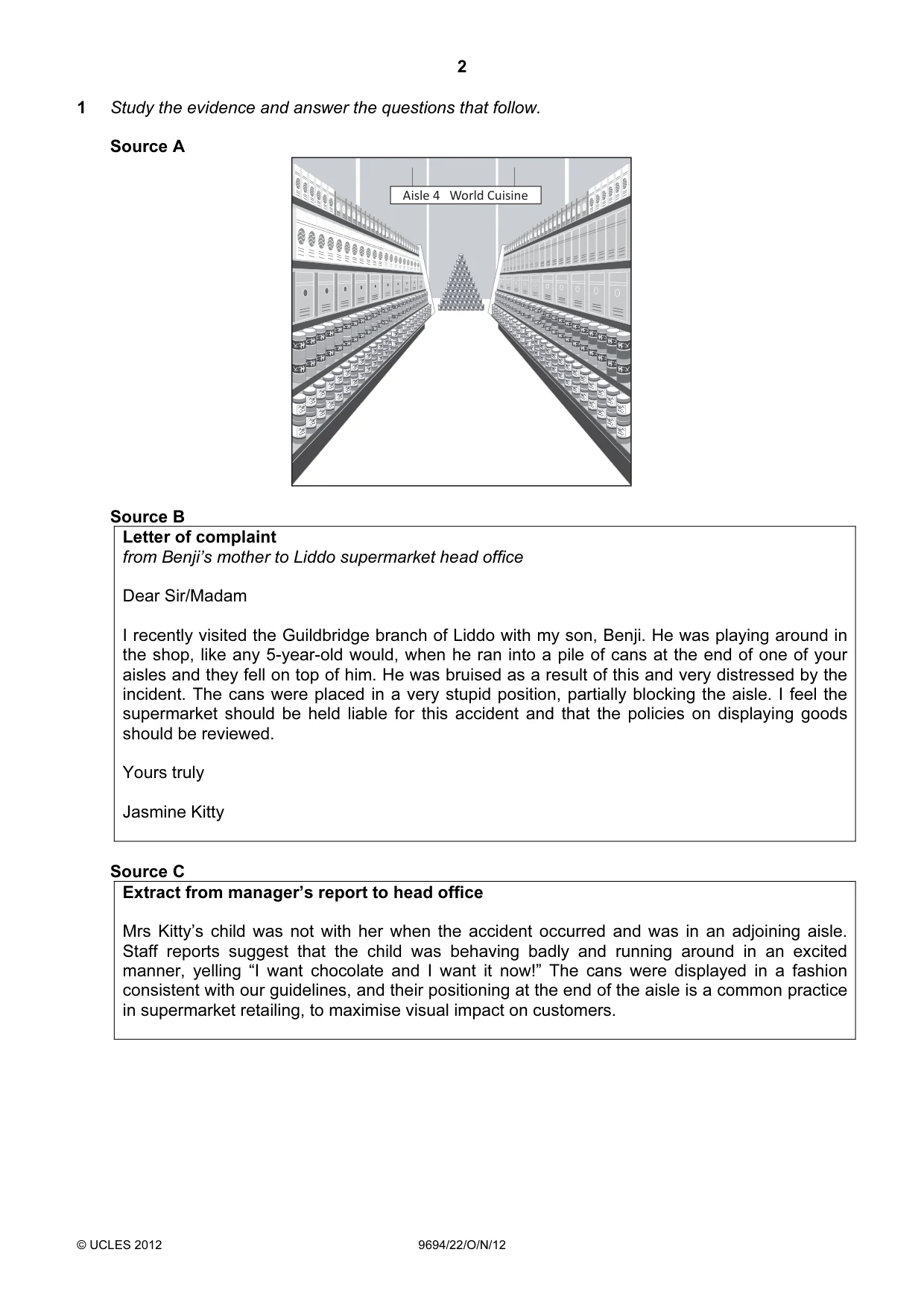
2 © UCLES 2012 9694/22/O/N/12 1 Study the evidence and answer the questions that follow. Source A Aisle 4 World Cuisine Source B Letter of complaint from Benji’s mother to Liddo supermarket head office Dear Sir/Madam I recently visited the Guildbridge branch of Liddo with my son, Benji. He was playing around in the shop, like any 5-year-old would, when he ran into a pile of cans at the end of one of your aisles and they fell on top of him. He was bruised as a result of this and very distressed by the incident. The cans were placed in a very stupid position, partially blocking the aisle. I feel the supermarket should be held liable for this accident and that the policies on displaying goods should be reviewed. Yours truly Jasmine Kitty Source C Extract from manager’s report to head office Mrs Kitty’s child was not with her when the accident occurred and was in an adjoining aisle. Staff reports suggest that the child was behaving badly and running around in an excited manner, yelling “I want chocolate and I want it now!” The cans were displayed in a fashion consistent with our guidelines, and their positioning at the end of the aisle is a common practice in supermarket retailing, to maximise visual impact on customers.
Question paper, page 3
3 © UCLES 2012 9694/22/O/N/12 [Turn over Source D Confidential report on Benji from his headteacher to the education department Benji has been diagnosed as hyperactive by a psychologist and also suffering from attention deficit disorder. He is badly behaved in the classroom and he may need moving to a special class for difficult children. His mother is rather in denial about the problem, claiming Benji is perfectly well-behaved when at home. Source E Extracts from ‘Grumpy Old People’ chatroom Geri Atric Kids in supermarkets, they really shouldn’t be allowed. I was in the Guildbridge Liddo the other day and saw this kid crash into a display of cans – mother nowhere to be seen. Silver Fox I know what you mean but it must be difficult to control kids when you are trying to shop – can’t the supermarkets provide crèches*? Lily the Pink The kids don’t seem very well-controlled these days – mind you I walked into one of those displays once when I had put the wrong glasses on to go shopping. * crèche: a facility provided by some organisations for temporary child care. (a) How reliable is the evidence given by the supermarket manager in Source C? [3] (b) How significant is the evidence in the confidential report in Source D? [3] (c) How useful is the evidence given in Source E? [3] (d) Should the supermarket be held liable for this accident? Write a short, reasoned argument to support your conclusion, with critical reference to the evidence provided and with consideration of any plausible alternative scenarios. [6]
Question paper, page 4
4 © UCLES 2012 9694/22/O/N/12 2 Study the evidence and answer the questions that follow. Source A Extract from magazine article Fruit growers are using new technologies to develop ever more exotic hybrids, i.e. combining different fruits to create a new fruit. Examples are: Plumcot – this is a plum/apricot hybrid Grapple – this is an apple/grape hybrid Jostaberry – this is a gooseberry/blackcurrant hybrid So if you like grapes and apples you should like the grapple! Source B Extract from a scientific journal Bananas may disappear in 10 years. All commercially-grown bananas are of a single variety, the Cavendish, which was artificially produced from a wild banana species. This variety is now highly vulnerable to a range of diseases such as black sigatoka fungus. Developing a new variety of banana will be difficult as the Cavendish is seedless. Moreover, wild banana species are rapidly becoming extinct due to deforestation and destruction of habitat. Other varieties have been grown by traditional farmers, but they too are fast disappearing. Source C Letter to editor of a food magazine There are a number of scare stories about the increasingly popular practice of developing hybrid fruits. However, this scare-mongering is not justified by the evidence. Critics of hybrid fruit make a lot of the fact that they are seedless, but there are plants in nature that are seedless and reproduce in different ways. Hybridization is a very old practice and many fruits we think of as traditional are in fact hybrids, such as the loganberry which is a blackberry/raspberry hybrid. Furthermore, hybridization does not involve any genetic modification. Source D Extract from magazine Radical Fruit Grower Because hybrid crops are seedless, farmers growing them can no longer use their existing plants to provide their own seed. So they are reliant on the big agricultural corporations who own the hybrids to provide them with new seed each year. It is possible to imagine a world in which there are no naturally seeding crops grown on farms. A consequence of this is that something which was once natural and free becomes a commodity, subject to the usual problems of price rises, shortages and market manipulation by speculators. Developing something ‘new’ and ‘different’ has always been a key way of maintaining profit margins and shifting product, but it is disturbing when this dynamic actually changes nature itself.
Question paper, page 5
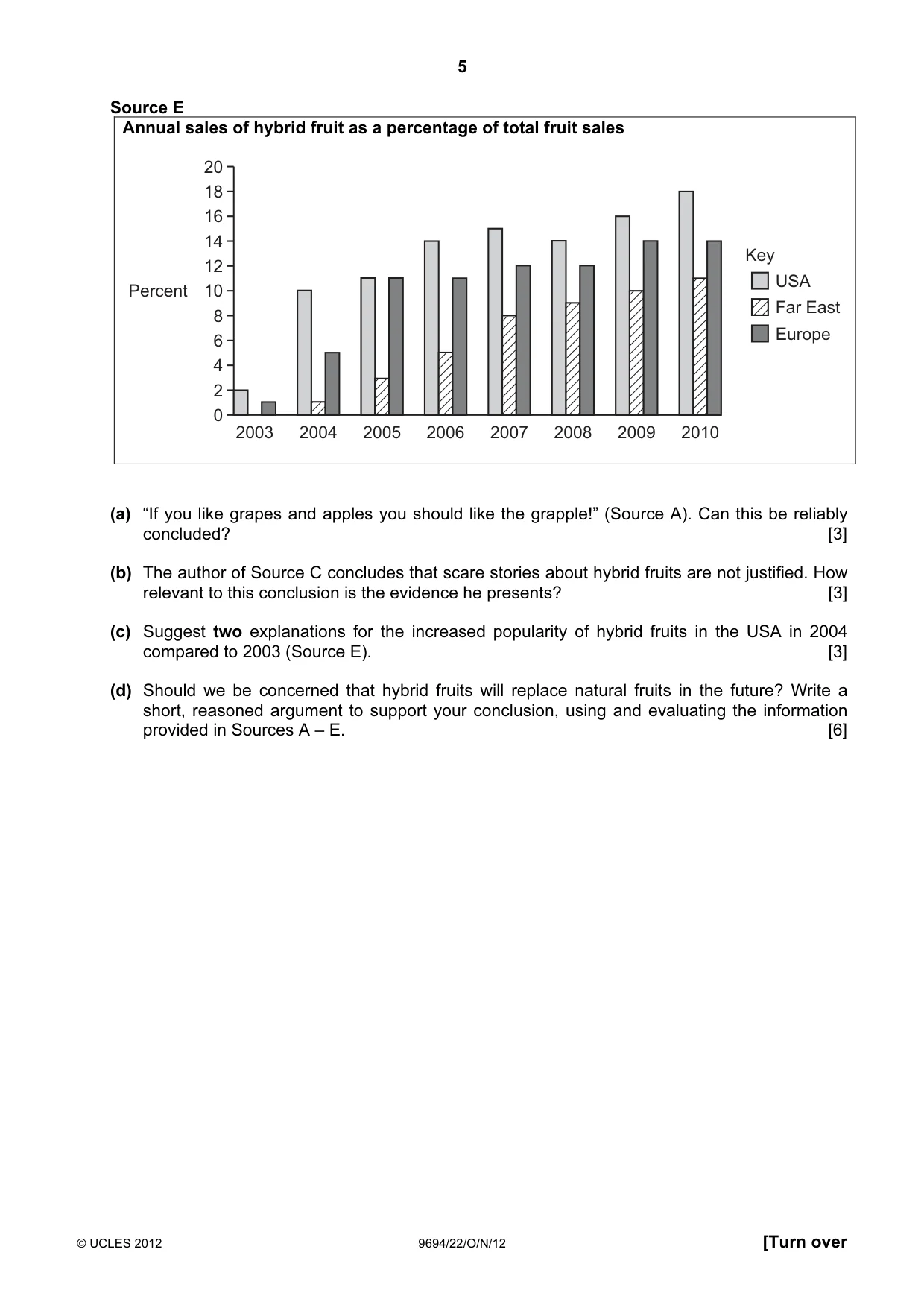
5 © UCLES 2012 9694/22/O/N/12 [Turn over Source E Annual sales of hybrid fruit as a percentage of total fruit sales 20 18 16 14 12 10 8 6 4 2 0 Percent 2003 2004 2005 2006 2007 2008 2009 2010 USA Far East Europe Key (a) “If you like grapes and apples you should like the grapple!” (Source A). Can this be reliably concluded? [3] (b) The author of Source C concludes that scare stories about hybrid fruits are not justified. How relevant to this conclusion is the evidence he presents? [3] (c) Suggest two explanations for the increased popularity of hybrid fruits in the USA in 2004 compared to 2003 (Source E). [3] (d) Should we be concerned that hybrid fruits will replace natural fruits in the future? Write a short, reasoned argument to support your conclusion, using and evaluating the information provided in Sources A – E. [6]
Question paper, page 6
6 © UCLES 2012 9694/22/O/N/12 3 Read the passage and answer the questions below. 1 During the 20th century, people in developed societies became accustomed to the idea that medical science would go on advancing and that they could rely on it to maintain their health. However, in the 21st century we should cease relying on medical science to do this. 2 Research in 2010 found that a new generation of ‘superbugs’ is emerging. NDM-1 is an enzyme that can exist in a wide range of infectious bacteria, making them resistant to all known antibiotics. No new antibiotics are being developed in the foreseeable future. Antibiotics are a crucial aspect of modern medicine, not just for the treatment of routine infections, but in helping patients recover from such operations as organ transplants. Future medicine will be without antibiotics, which is a bit like a car without wheels. 3 There will be an increasing gap between what is medically possible and what is affordable. With advancements in medical science, providing all treatments to all patients will prove impossible even if all of a country’s national income is devoted to it. There is no point in maintaining health if there are no schools, roads or houses. 4 People have excessive expectations of the medical profession – they expect doctors to cure them of everything. Doctors themselves realise their limitations but often have to give in to patient demands, for instance prescribing antibiotics unnecessarily to treat viral infections. 5 The assumption that the medical profession will be able to cure them means that people do not do enough to maintain their own health. If they did not have the medical profession to rely on they would eat less and exercise more. Prevention is better than cure. So we should concentrate on developing a healthier lifestyle. 6 Moreover, we have a range of other medical treatments, such as acupuncture and homoeopathy, which offer an alternative to conventional medicine. For example, there are natural herbs that strengthen resistance and tackle infection. (a) Using the exact words from the passage as far as possible, identify the main conclusion. [2] (b) Using the exact words from the passage as far as possible, identify three reasons used to support the main conclusion. [3] (c) Evaluate the reasoning in the argument. In your answer you should consider any strengths, weaknesses, flaws and unstated assumptions. [5] (d) ‘Prevention is always better than cure.’ Write your own argument to support or challenge this claim. The conclusion of your argument must be stated. [5]
Question paper, page 7
7 © UCLES 2012 9694/22/O/N/12 BLANK PAGE
Question paper, page 8
8 Permission to reproduce items where third-party owned material protected by copyright is included has been sought and cleared where possible. Every reasonable effort has been made by the publisher (UCLES) to trace copyright holders, but if any items requiring clearance have unwittingly been included, the publisher will be pleased to make amends at the earliest possible opportunity. University of Cambridge International Examinations is part of the Cambridge Assessment Group. Cambridge Assessment is the brand name of University of Cambridge Local Examinations Syndicate (UCLES), which is itself a department of the University of Cambridge. © UCLES 2012 9694/22/O/N/12 BLANK PAGE
Mark scheme, page 1
CAMBRIDGE INTERNATIONAL EXAMINATIONS GCE Advanced Subsidiary Level and GCE Advanced Level MARK SCHEME for the October/November 2012 series 9694 THINKING SKILLS 9694/22 Paper 2 (Critical Thinking), maximum raw mark 45 This mark scheme is published as an aid to teachers and candidates, to indicate the requirements of the examination. It shows the basis on which Examiners were instructed to award marks. It does not indicate the details of the discussions that took place at an Examiners’ meeting before marking began, which would have considered the acceptability of alternative answers. Mark schemes should be read in conjunction with the question paper and the Principal Examiner Report for Teachers. Cambridge will not enter into discussions about these mark schemes. Cambridge is publishing the mark schemes for the October/November 2012 series for most IGCSE, GCE Advanced Level and Advanced Subsidiary Level components and some Ordinary Level components.
Mark scheme, page 2
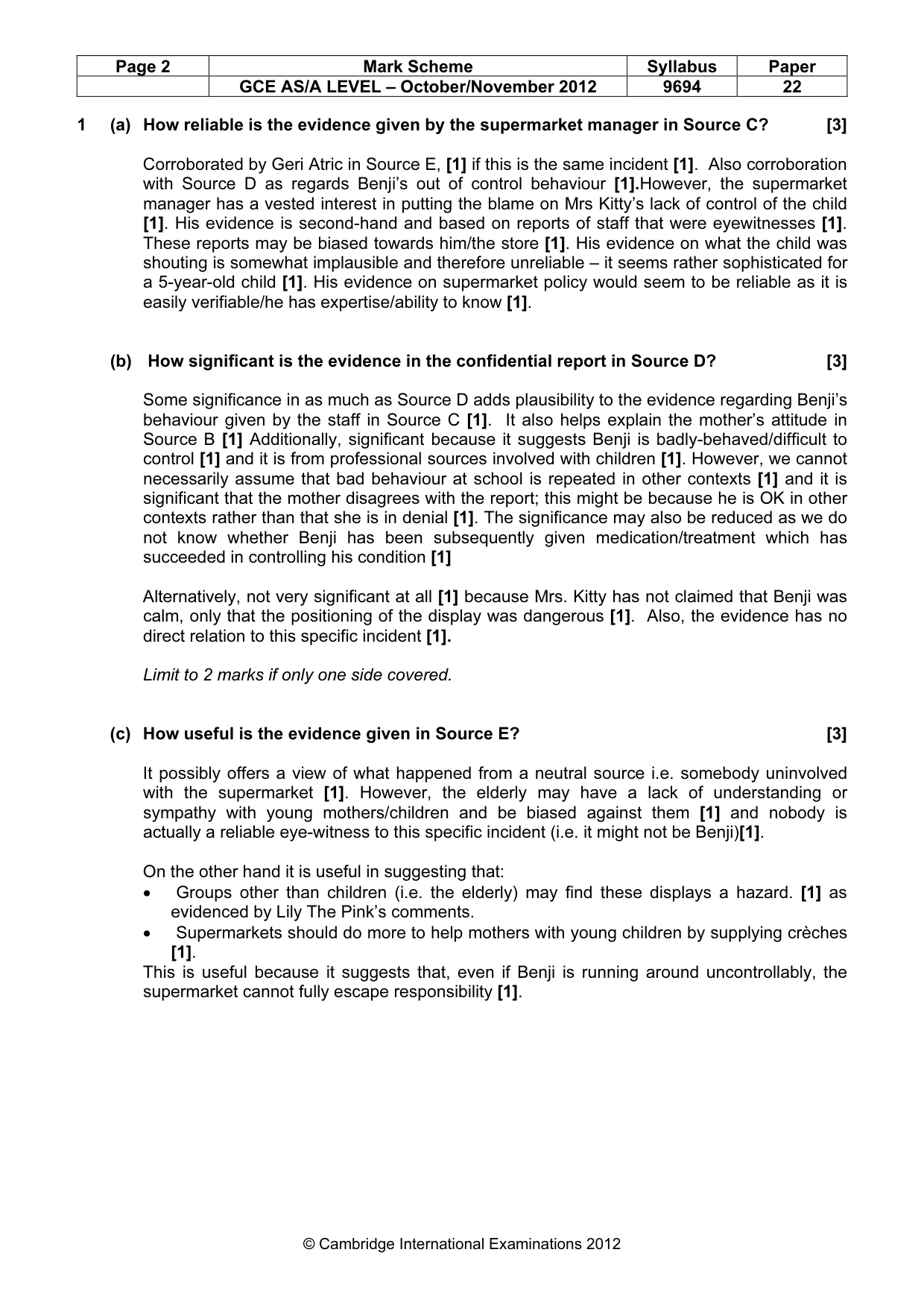
Page 2 Mark Scheme Syllabus Paper GCE AS/A LEVEL – October/November 2012 9694 22 © Cambridge International Examinations 2012 1 (a) How reliable is the evidence given by the supermarket manager in Source C? [3] Corroborated by Geri Atric in Source E, [1] if this is the same incident [1]. Also corroboration with Source D as regards Benji’s out of control behaviour [1].However, the supermarket manager has a vested interest in putting the blame on Mrs Kitty’s lack of control of the child [1]. His evidence is second-hand and based on reports of staff that were eyewitnesses [1]. These reports may be biased towards him/the store [1]. His evidence on what the child was shouting is somewhat implausible and therefore unreliable – it seems rather sophisticated for a 5-year-old child [1]. His evidence on supermarket policy would seem to be reliable as it is easily verifiable/he has expertise/ability to know [1]. (b) How significant is the evidence in the confidential report in Source D? [3] Some significance in as much as Source D adds plausibility to the evidence regarding Benji’s behaviour given by the staff in Source C [1]. It also helps explain the mother’s attitude in Source B [1] Additionally, significant because it suggests Benji is badly-behaved/difficult to control [1] and it is from professional sources involved with children [1]. However, we cannot necessarily assume that bad behaviour at school is repeated in other contexts [1] and it is significant that the mother disagrees with the report; this might be because he is OK in other contexts rather than that she is in denial [1]. The significance may also be reduced as we do not know whether Benji has been subsequently given medication/treatment which has succeeded in controlling his condition [1] Alternatively, not very significant at all [1] because Mrs. Kitty has not claimed that Benji was calm, only that the positioning of the display was dangerous [1]. Also, the evidence has no direct relation to this specific incident [1]. Limit to 2 marks if only one side covered. (c) How useful is the evidence given in Source E? [3] It possibly offers a view of what happened from a neutral source i.e. somebody uninvolved with the supermarket [1]. However, the elderly may have a lack of understanding or sympathy with young mothers/children and be biased against them [1] and nobody is actually a reliable eye-witness to this specific incident (i.e. it might not be Benji)[1]. On the other hand it is useful in suggesting that: • Groups other than children (i.e. the elderly) may find these displays a hazard. [1] as evidenced by Lily The Pink’s comments. • Supermarkets should do more to help mothers with young children by supplying crèches [1]. This is useful because it suggests that, even if Benji is running around uncontrollably, the supermarket cannot fully escape responsibility [1].
Mark scheme, page 3
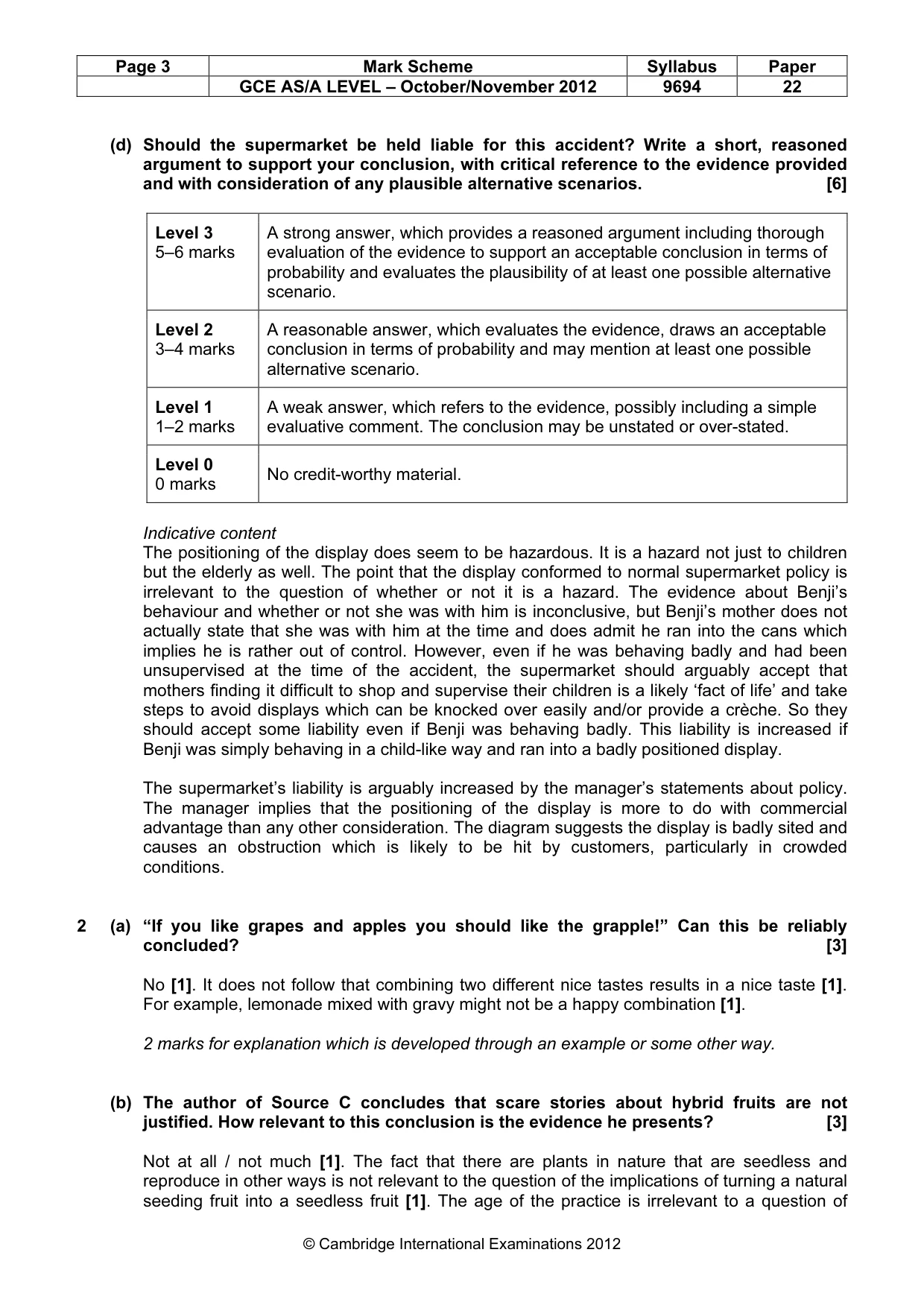
Page 3 Mark Scheme Syllabus Paper GCE AS/A LEVEL – October/November 2012 9694 22 © Cambridge International Examinations 2012 (d) Should the supermarket be held liable for this accident? Write a short, reasoned argument to support your conclusion, with critical reference to the evidence provided and with consideration of any plausible alternative scenarios. [6] Level 3 5–6 marks A strong answer, which provides a reasoned argument including thorough evaluation of the evidence to support an acceptable conclusion in terms of probability and evaluates the plausibility of at least one possible alternative scenario. Level 2 3–4 marks A reasonable answer, which evaluates the evidence, draws an acceptable conclusion in terms of probability and may mention at least one possible alternative scenario. Level 1 1–2 marks A weak answer, which refers to the evidence, possibly including a simple evaluative comment. The conclusion may be unstated or over-stated. Level 0 0 marks No credit-worthy material. Indicative content The positioning of the display does seem to be hazardous. It is a hazard not just to children but the elderly as well. The point that the display conformed to normal supermarket policy is irrelevant to the question of whether or not it is a hazard. The evidence about Benji’s behaviour and whether or not she was with him is inconclusive, but Benji’s mother does not actually state that she was with him at the time and does admit he ran into the cans which implies he is rather out of control. However, even if he was behaving badly and had been unsupervised at the time of the accident, the supermarket should arguably accept that mothers finding it difficult to shop and supervise their children is a likely ‘fact of life’ and take steps to avoid displays which can be knocked over easily and/or provide a crèche. So they should accept some liability even if Benji was behaving badly. This liability is increased if Benji was simply behaving in a child-like way and ran into a badly positioned display. The supermarket’s liability is arguably increased by the manager’s statements about policy. The manager implies that the positioning of the display is more to do with commercial advantage than any other consideration. The diagram suggests the display is badly sited and causes an obstruction which is likely to be hit by customers, particularly in crowded conditions. 2 (a) “If you like grapes and apples you should like the grapple!” Can this be reliably concluded? [3] No [1]. It does not follow that combining two different nice tastes results in a nice taste [1]. For example, lemonade mixed with gravy might not be a happy combination [1]. 2 marks for explanation which is developed through an example or some other way. (b) The author of Source C concludes that scare stories about hybrid fruits are not justified. How relevant to this conclusion is the evidence he presents? [3] Not at all / not much [1]. The fact that there are plants in nature that are seedless and reproduce in other ways is not relevant to the question of the implications of turning a natural seeding fruit into a seedless fruit [1]. The age of the practice is irrelevant to a question of
Mark scheme, page 4
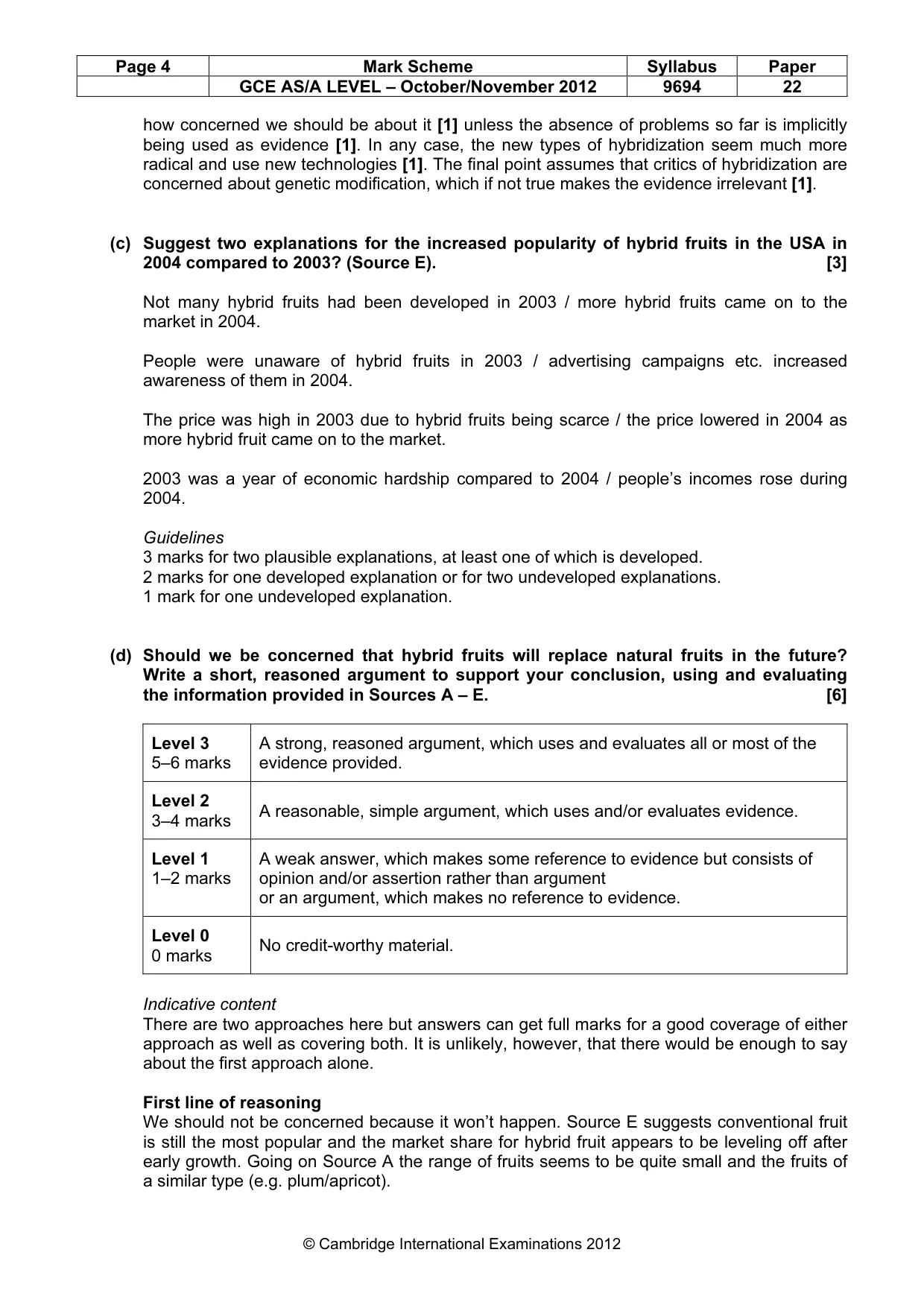
Page 4 Mark Scheme Syllabus Paper GCE AS/A LEVEL – October/November 2012 9694 22 © Cambridge International Examinations 2012 how concerned we should be about it [1] unless the absence of problems so far is implicitly being used as evidence [1]. In any case, the new types of hybridization seem much more radical and use new technologies [1]. The final point assumes that critics of hybridization are concerned about genetic modification, which if not true makes the evidence irrelevant [1]. (c) Suggest two explanations for the increased popularity of hybrid fruits in the USA in 2004 compared to 2003? (Source E). [3] Not many hybrid fruits had been developed in 2003 / more hybrid fruits came on to the market in 2004. People were unaware of hybrid fruits in 2003 / advertising campaigns etc. increased awareness of them in 2004. The price was high in 2003 due to hybrid fruits being scarce / the price lowered in 2004 as more hybrid fruit came on to the market. 2003 was a year of economic hardship compared to 2004 / people’s incomes rose during 2004. Guidelines 3 marks for two plausible explanations, at least one of which is developed. 2 marks for one developed explanation or for two undeveloped explanations. 1 mark for one undeveloped explanation. (d) Should we be concerned that hybrid fruits will replace natural fruits in the future? Write a short, reasoned argument to support your conclusion, using and evaluating the information provided in Sources A – E. [6] Level 3 5–6 marks A strong, reasoned argument, which uses and evaluates all or most of the evidence provided. Level 2 3–4 marks A reasonable, simple argument, which uses and/or evaluates evidence. Level 1 1–2 marks A weak answer, which makes some reference to evidence but consists of opinion and/or assertion rather than argument or an argument, which makes no reference to evidence. Level 0 0 marks No credit-worthy material. Indicative content There are two approaches here but answers can get full marks for a good coverage of either approach as well as covering both. It is unlikely, however, that there would be enough to say about the first approach alone. First line of reasoning We should not be concerned because it won’t happen. Source E suggests conventional fruit is still the most popular and the market share for hybrid fruit appears to be leveling off after early growth. Going on Source A the range of fruits seems to be quite small and the fruits of a similar type (e.g. plum/apricot).
Mark scheme, page 5
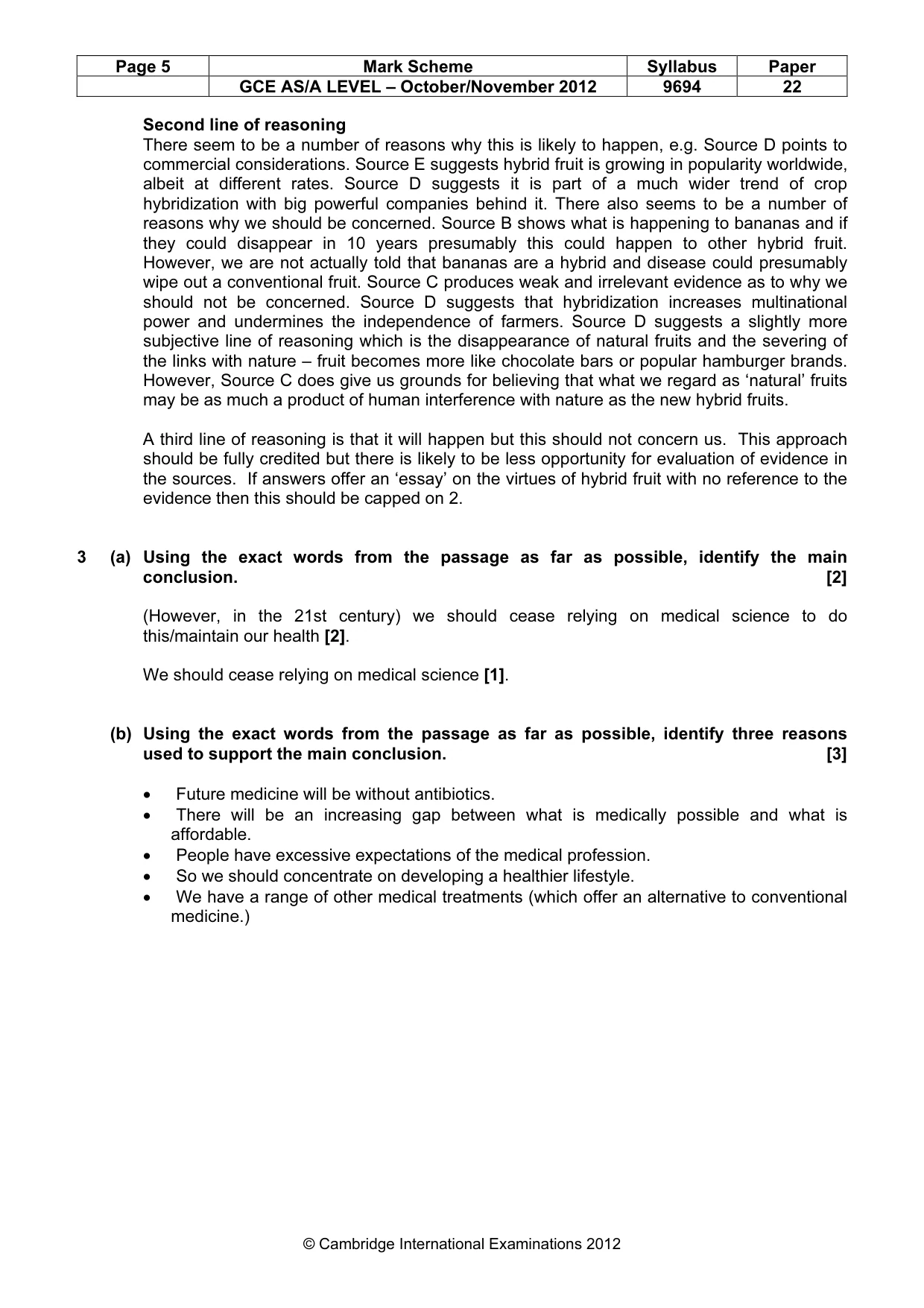
Page 5 Mark Scheme Syllabus Paper GCE AS/A LEVEL – October/November 2012 9694 22 © Cambridge International Examinations 2012 Second line of reasoning There seem to be a number of reasons why this is likely to happen, e.g. Source D points to commercial considerations. Source E suggests hybrid fruit is growing in popularity worldwide, albeit at different rates. Source D suggests it is part of a much wider trend of crop hybridization with big powerful companies behind it. There also seems to be a number of reasons why we should be concerned. Source B shows what is happening to bananas and if they could disappear in 10 years presumably this could happen to other hybrid fruit. However, we are not actually told that bananas are a hybrid and disease could presumably wipe out a conventional fruit. Source C produces weak and irrelevant evidence as to why we should not be concerned. Source D suggests that hybridization increases multinational power and undermines the independence of farmers. Source D suggests a slightly more subjective line of reasoning which is the disappearance of natural fruits and the severing of the links with nature – fruit becomes more like chocolate bars or popular hamburger brands. However, Source C does give us grounds for believing that what we regard as ‘natural’ fruits may be as much a product of human interference with nature as the new hybrid fruits. A third line of reasoning is that it will happen but this should not concern us. This approach should be fully credited but there is likely to be less opportunity for evaluation of evidence in the sources. If answers offer an ‘essay’ on the virtues of hybrid fruit with no reference to the evidence then this should be capped on 2. 3 (a) Using the exact words from the passage as far as possible, identify the main conclusion. [2] (However, in the 21st century) we should cease relying on medical science to do this/maintain our health [2]. We should cease relying on medical science [1]. (b) Using the exact words from the passage as far as possible, identify three reasons used to support the main conclusion. [3] • Future medicine will be without antibiotics. • There will be an increasing gap between what is medically possible and what is affordable. • People have excessive expectations of the medical profession. • So we should concentrate on developing a healthier lifestyle. • We have a range of other medical treatments (which offer an alternative to conventional medicine.)
Mark scheme, page 6
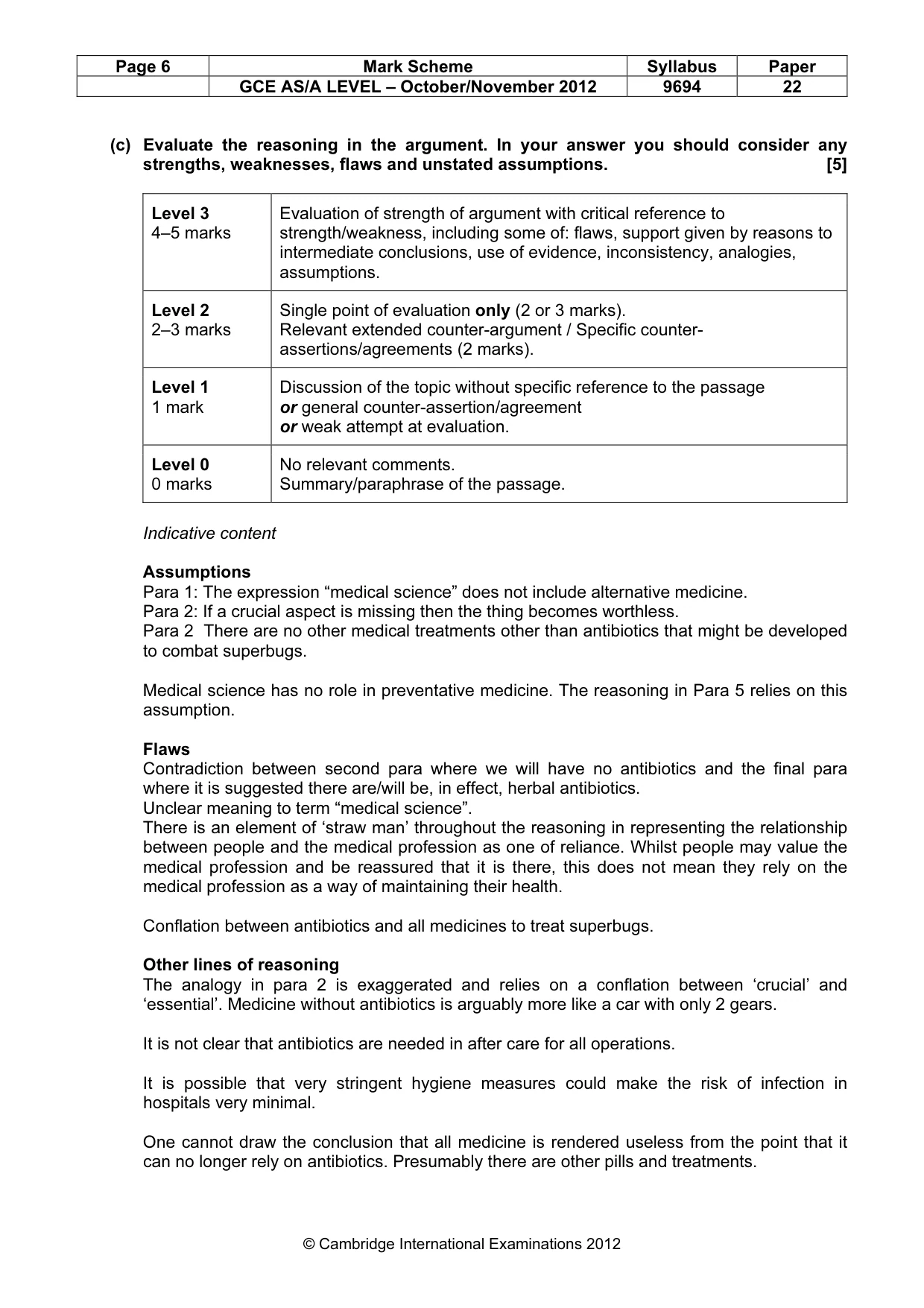
Page 6 Mark Scheme Syllabus Paper GCE AS/A LEVEL – October/November 2012 9694 22 © Cambridge International Examinations 2012 (c) Evaluate the reasoning in the argument. In your answer you should consider any strengths, weaknesses, flaws and unstated assumptions. [5] Level 3 4–5 marks Evaluation of strength of argument with critical reference to strength/weakness, including some of: flaws, support given by reasons to intermediate conclusions, use of evidence, inconsistency, analogies, assumptions. Level 2 2–3 marks Single point of evaluation only (2 or 3 marks). Relevant extended counter-argument / Specific counter- assertions/agreements (2 marks). Level 1 1 mark Discussion of the topic without specific reference to the passage or general counter-assertion/agreement or weak attempt at evaluation. Level 0 0 marks No relevant comments. Summary/paraphrase of the passage. Indicative content Assumptions Para 1: The expression “medical science” does not include alternative medicine. Para 2: If a crucial aspect is missing then the thing becomes worthless. Para 2 There are no other medical treatments other than antibiotics that might be developed to combat superbugs. Medical science has no role in preventative medicine. The reasoning in Para 5 relies on this assumption. Flaws Contradiction between second para where we will have no antibiotics and the final para where it is suggested there are/will be, in effect, herbal antibiotics. Unclear meaning to term “medical science”. There is an element of ‘straw man’ throughout the reasoning in representing the relationship between people and the medical profession as one of reliance. Whilst people may value the medical profession and be reassured that it is there, this does not mean they rely on the medical profession as a way of maintaining their health. Conflation between antibiotics and all medicines to treat superbugs. Other lines of reasoning The analogy in para 2 is exaggerated and relies on a conflation between ‘crucial’ and ‘essential’. Medicine without antibiotics is arguably more like a car with only 2 gears. It is not clear that antibiotics are needed in after care for all operations. It is possible that very stringent hygiene measures could make the risk of infection in hospitals very minimal. One cannot draw the conclusion that all medicine is rendered useless from the point that it can no longer rely on antibiotics. Presumably there are other pills and treatments.
Mark scheme, page 7
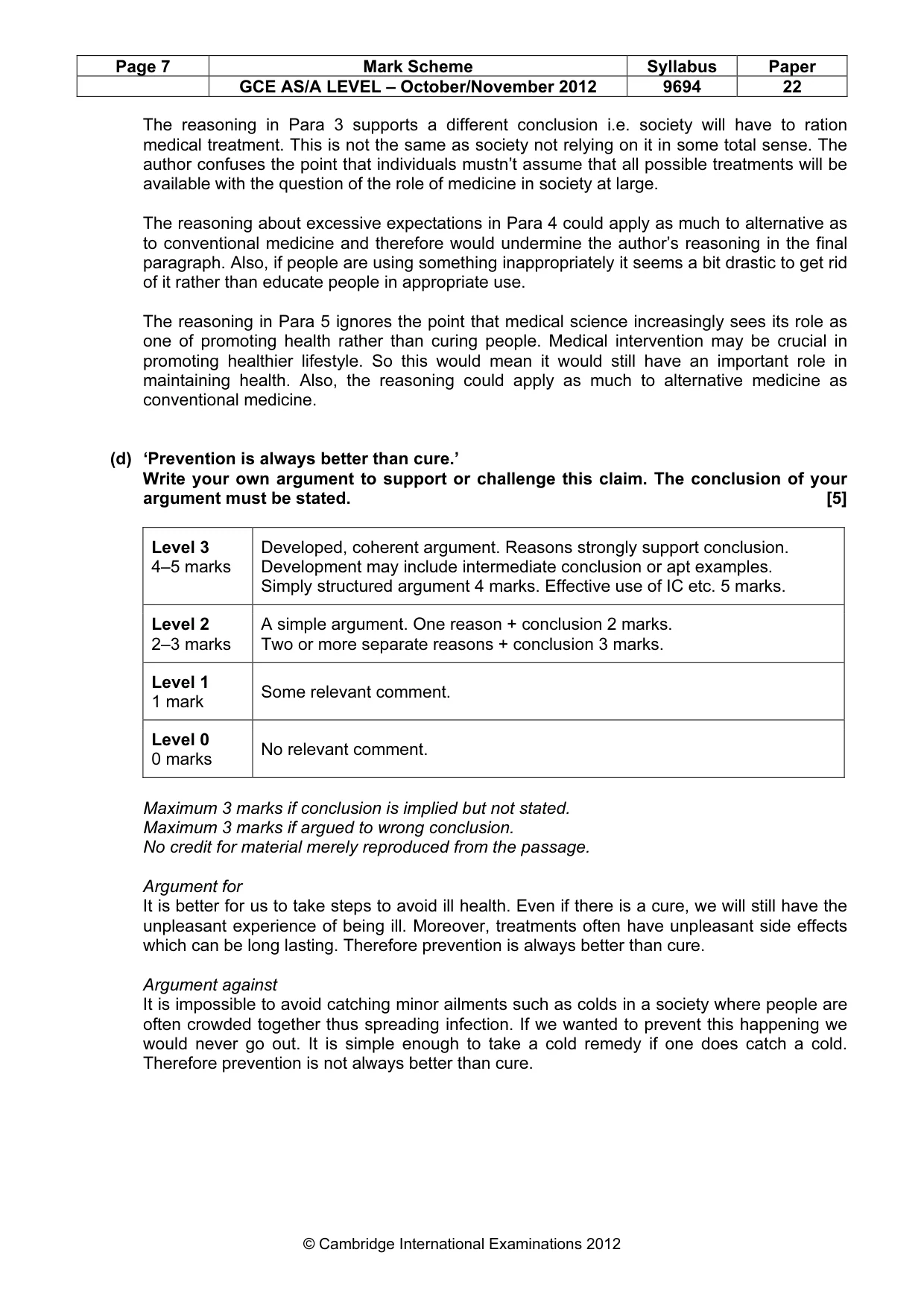
Page 7 Mark Scheme Syllabus Paper GCE AS/A LEVEL – October/November 2012 9694 22 © Cambridge International Examinations 2012 The reasoning in Para 3 supports a different conclusion i.e. society will have to ration medical treatment. This is not the same as society not relying on it in some total sense. The author confuses the point that individuals mustn’t assume that all possible treatments will be available with the question of the role of medicine in society at large. The reasoning about excessive expectations in Para 4 could apply as much to alternative as to conventional medicine and therefore would undermine the author’s reasoning in the final paragraph. Also, if people are using something inappropriately it seems a bit drastic to get rid of it rather than educate people in appropriate use. The reasoning in Para 5 ignores the point that medical science increasingly sees its role as one of promoting health rather than curing people. Medical intervention may be crucial in promoting healthier lifestyle. So this would mean it would still have an important role in maintaining health. Also, the reasoning could apply as much to alternative medicine as conventional medicine. (d) ‘Prevention is always better than cure.’ Write your own argument to support or challenge this claim. The conclusion of your argument must be stated. [5] Level 3 4–5 marks Developed, coherent argument. Reasons strongly support conclusion. Development may include intermediate conclusion or apt examples. Simply structured argument 4 marks. Effective use of IC etc. 5 marks. Level 2 2–3 marks A simple argument. One reason + conclusion 2 marks. Two or more separate reasons + conclusion 3 marks. Level 1 1 mark Some relevant comment. Level 0 0 marks No relevant comment. Maximum 3 marks if conclusion is implied but not stated. Maximum 3 marks if argued to wrong conclusion. No credit for material merely reproduced from the passage. Argument for It is better for us to take steps to avoid ill health. Even if there is a cure, we will still have the unpleasant experience of being ill. Moreover, treatments often have unpleasant side effects which can be long lasting. Therefore prevention is always better than cure. Argument against It is impossible to avoid catching minor ailments such as colds in a society where people are often crowded together thus spreading infection. If we wanted to prevent this happening we would never go out. It is simple enough to take a cold remedy if one does catch a cold. Therefore prevention is not always better than cure.
What you needed in this session
Cambridge’s own grade thresholds for 2012 Oct/Nov, Paper 2 · Variant 2. A higher threshold means an easier paper — the bar moves with how the cohort did.