Cambridge A Level Psychology (from 2018) 9990 — 2025 Oct/Nov Paper 2 · Variant 3
9990/23/O/N/25 · 10 questions · 60 marks · 90 min
The question paper and its mark scheme, free to read here and free to download. This is Cambridge’s own paper, exactly as it was sat.
Question paper12 pages



Mark scheme23 pages
Answers below. Sit the paper first if you are practising.
Questions as text
Q1 · Define what is meant by ‘counterbalancing’
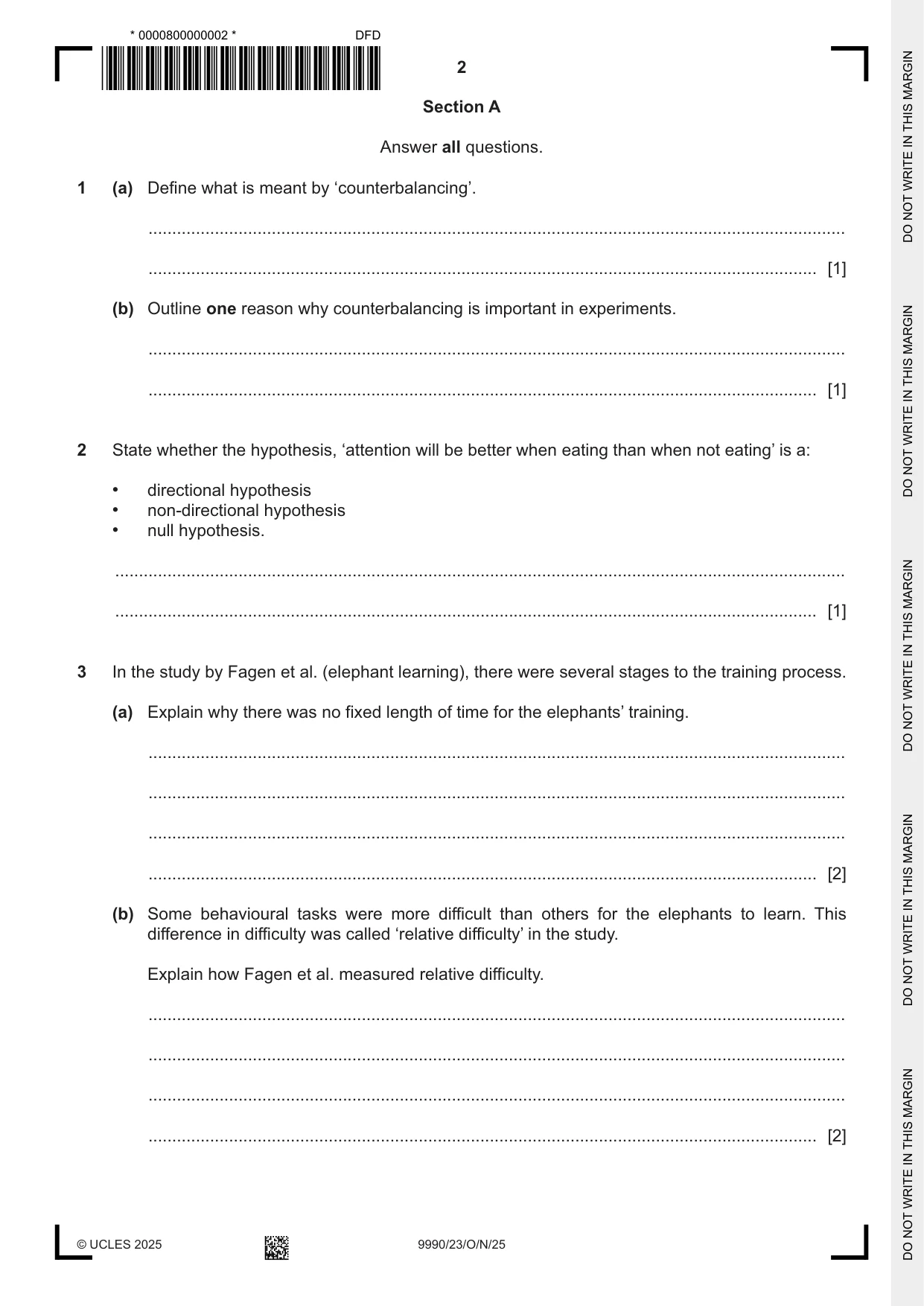
1 (a) Define what is meant by ‘counterbalancing’. ................................................................................................................................................... ............................................................................................................................................. [1] (b) Outline one reason why counterbalancing is important in experiments. ................................................................................................................................................... ............................................................................................................................................. [1]
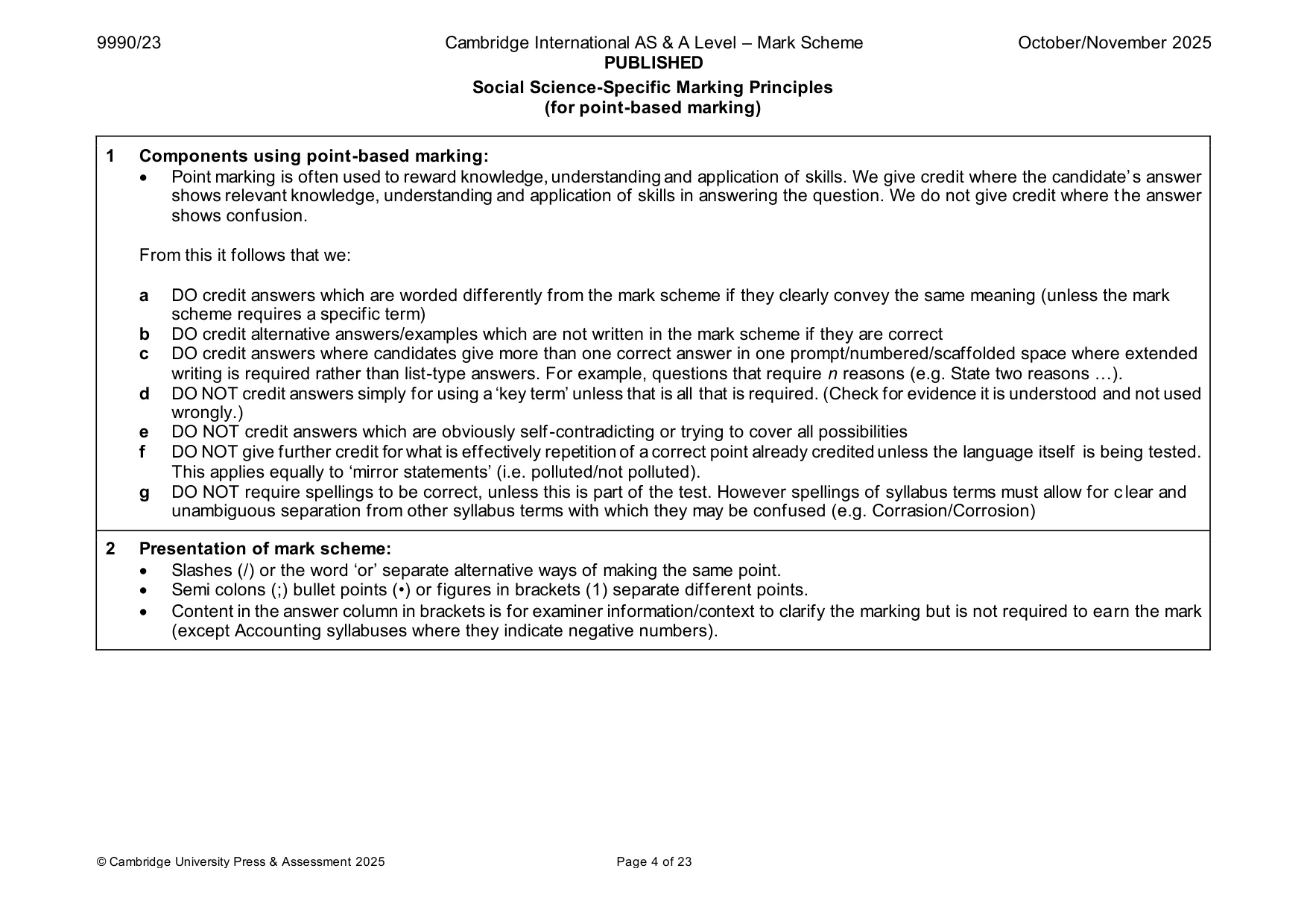
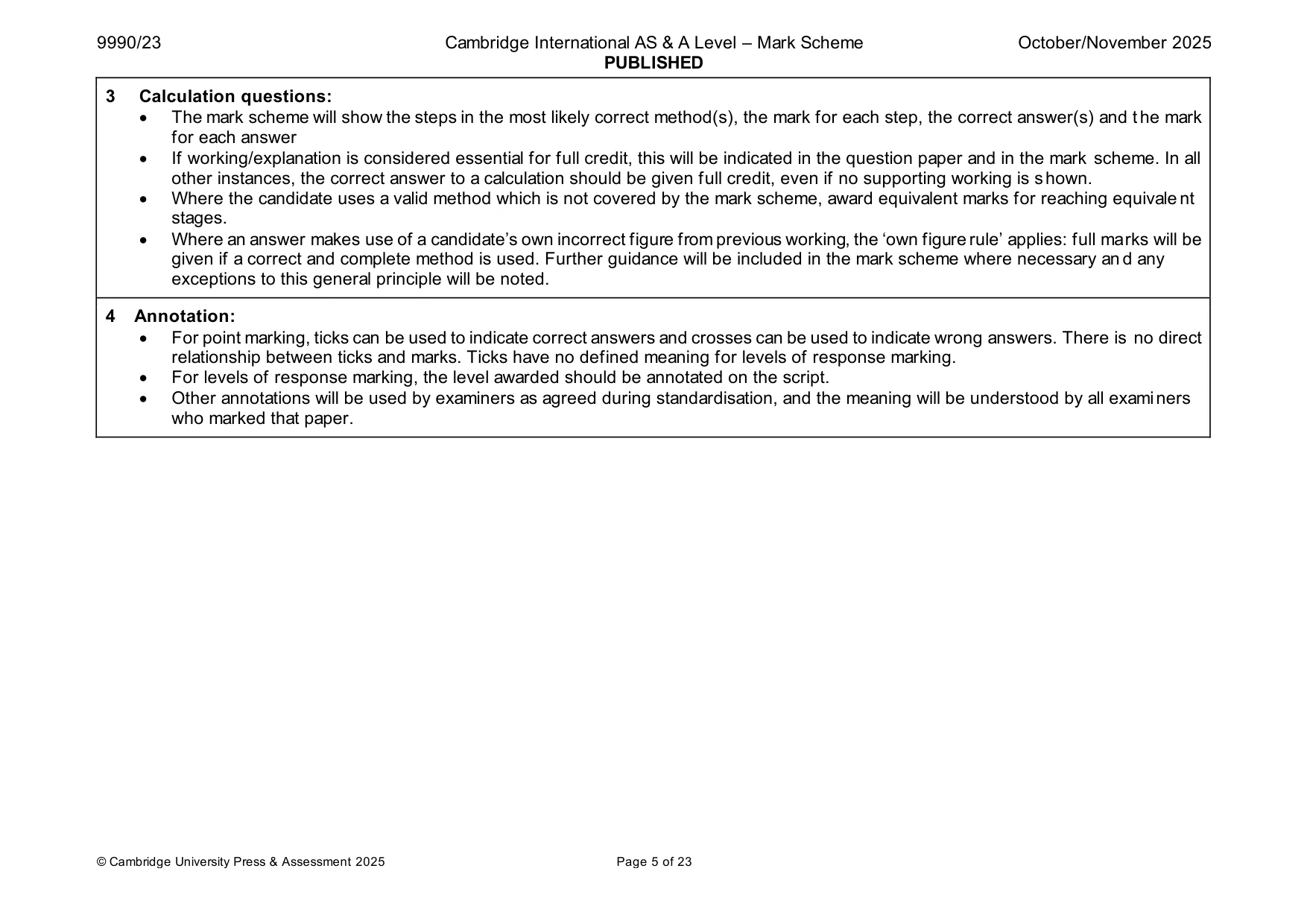
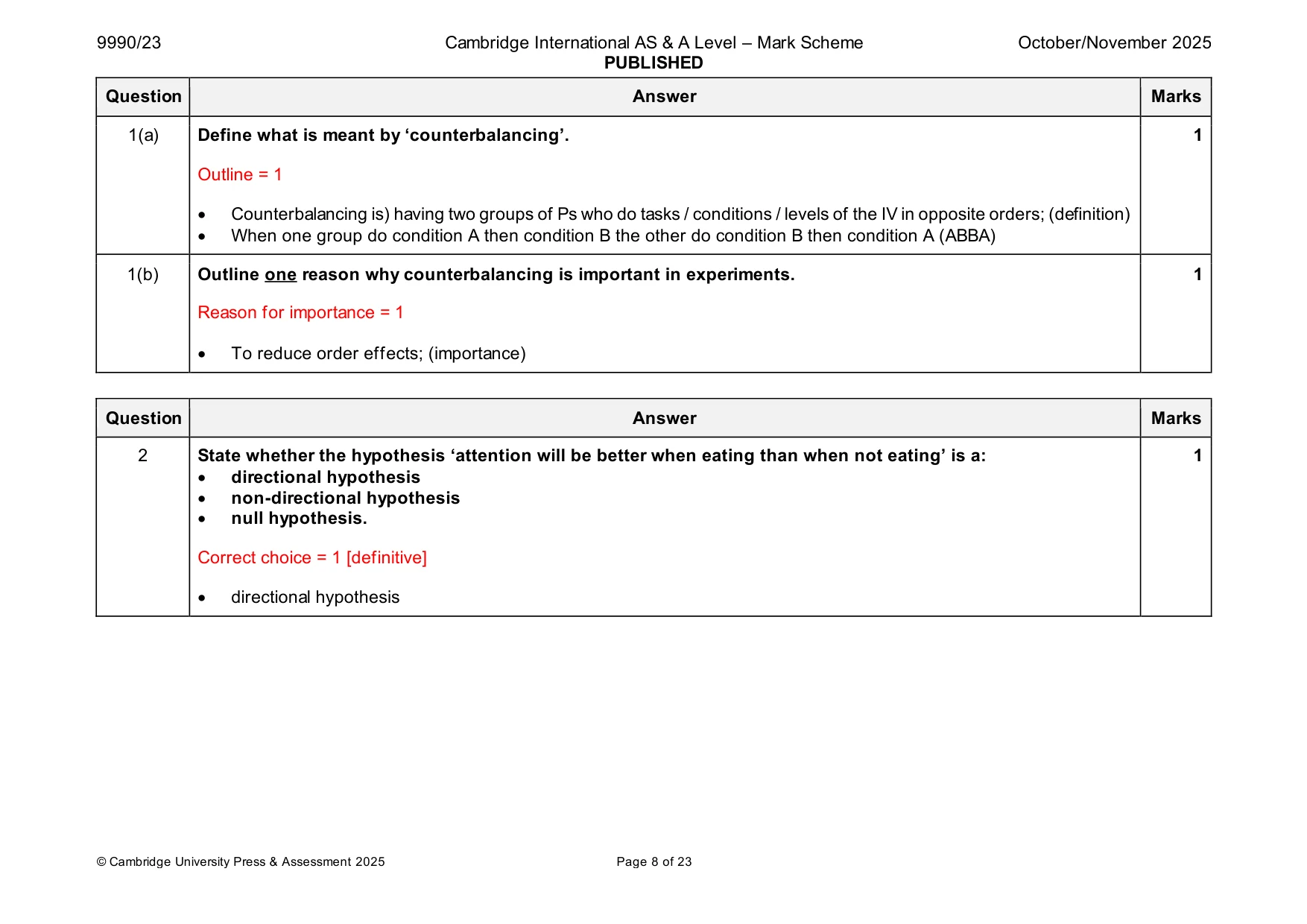
Mark scheme: Question Answer Marks 1(a) Define what is meant by ‘counterbalancing’. 1 Outline = 1 • Counterbalancing is) having two groups of Ps who do tasks / conditions / levels of the IV in opposite orders; (definition) • When one group do condition A then condition B the other do condition B then condition A (ABBA) 1(b) Outline one reason why counterbalancing is important in experiments. 1 Reason for importance = 1 • To reduce order effects; (importance)
Q2 · State whether the hypothesis, ‘attention will be better when eating than when not eating’…
2 State whether the hypothesis, ‘attention will be better when eating than when not eating’ is a: • directional hypothesis • non‑directional hypothesis • null hypothesis. .......................................................................................................................................................... .................................................................................................................................................... [1]
Mark scheme: 2 State whether the hypothesis ‘attention will be better when eating than when not eating’ is a: 1 • directional hypothesis • non-directional hypothesis • null hypothesis. Correct choice = 1 [definitive] • directional hypothesis
Q3 · In the study by Fagen et al
3 In the study by Fagen et al. (elephant learning), there were several stages to the training process. (a) Explain why there was no fixed length of time for the elephants’ training. ................................................................................................................................................... ................................................................................................................................................... ................................................................................................................................................... ............................................................................................................................................. [2] (b) Some behavioural tasks were more difficult than others for the elephants to learn. This difference in difficulty was called ‘relative difficulty’ in the study. Explain how Fagen et al. measured relative difficulty. ................................................................................................................................................... ................................................................................................................................................... ................................................................................................................................................... ............................................................................................................................................. [2]
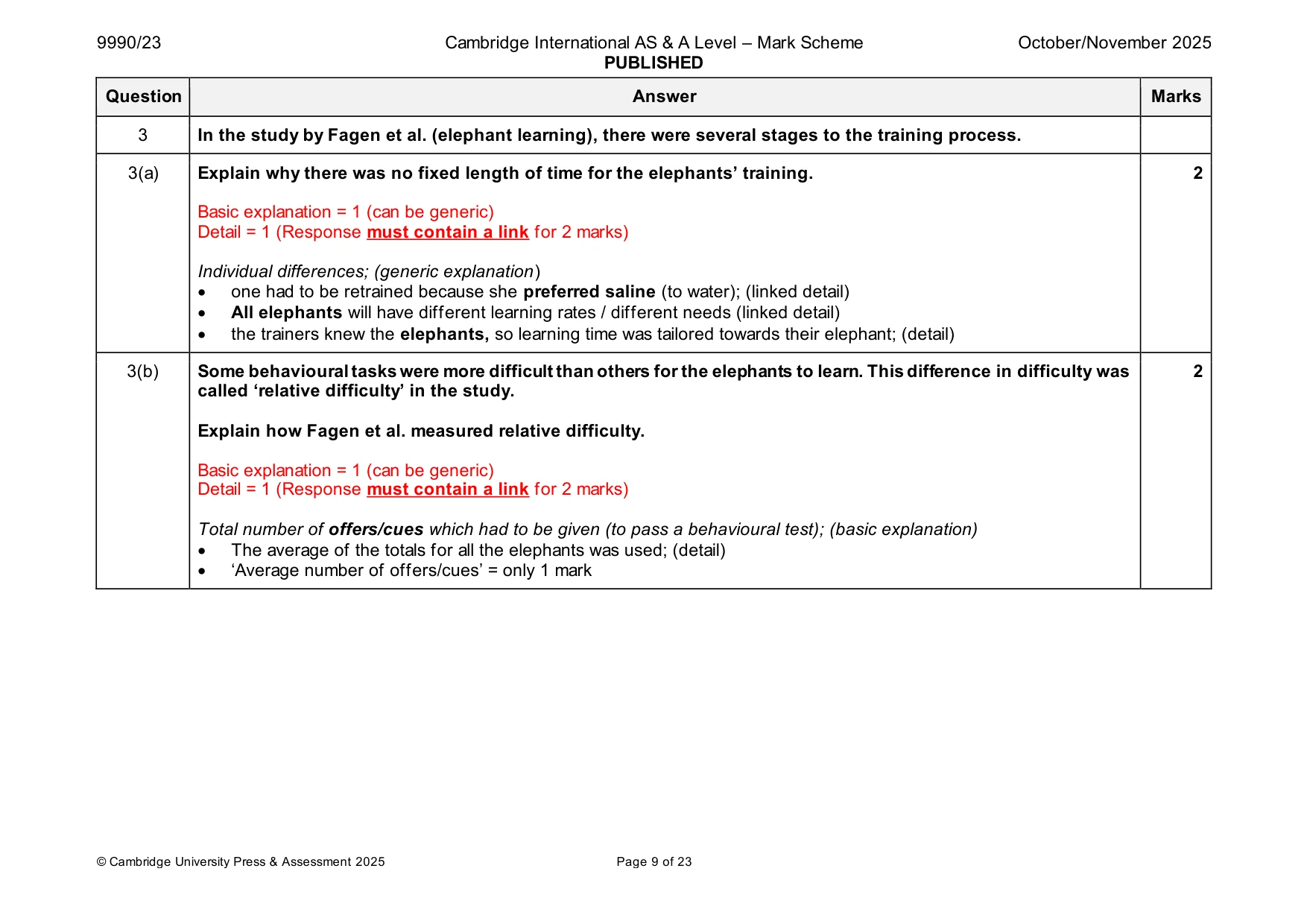
Mark scheme: 3 In the study by Fagen et al. (elephant learning), there were several stages to the training process. 3(a) Explain why there was no fixed length of time for the elephants’ training. 2 Basic explanation = 1 (can be generic) Detail = 1 (Response must contain a link for 2 marks) Individual differences; (generic explanation) • one had to be retrained because she preferred saline (to water); (linked detail) • All elephants will have different learning rates / different needs (linked detail) • the trainers knew the elephants, so learning time was tailored towards their elephant; (detail) 3(b) Some behavioural tasks were more difficult than others for the elephants to learn. This difference in difficulty was 2 called ‘relative difficulty’ in the study. Explain how Fagen et al. measured relative difficulty. Basic explanation = 1 (can be generic) Detail = 1 (Response must contain a link for 2 marks) Total number of offers/cues which had to be given (to pass a behavioural test); (basic explanation) • The average of the totals for all the elephants was used; (detail) • ‘Average number of offers/cues’ = only 1 mark
Question 4
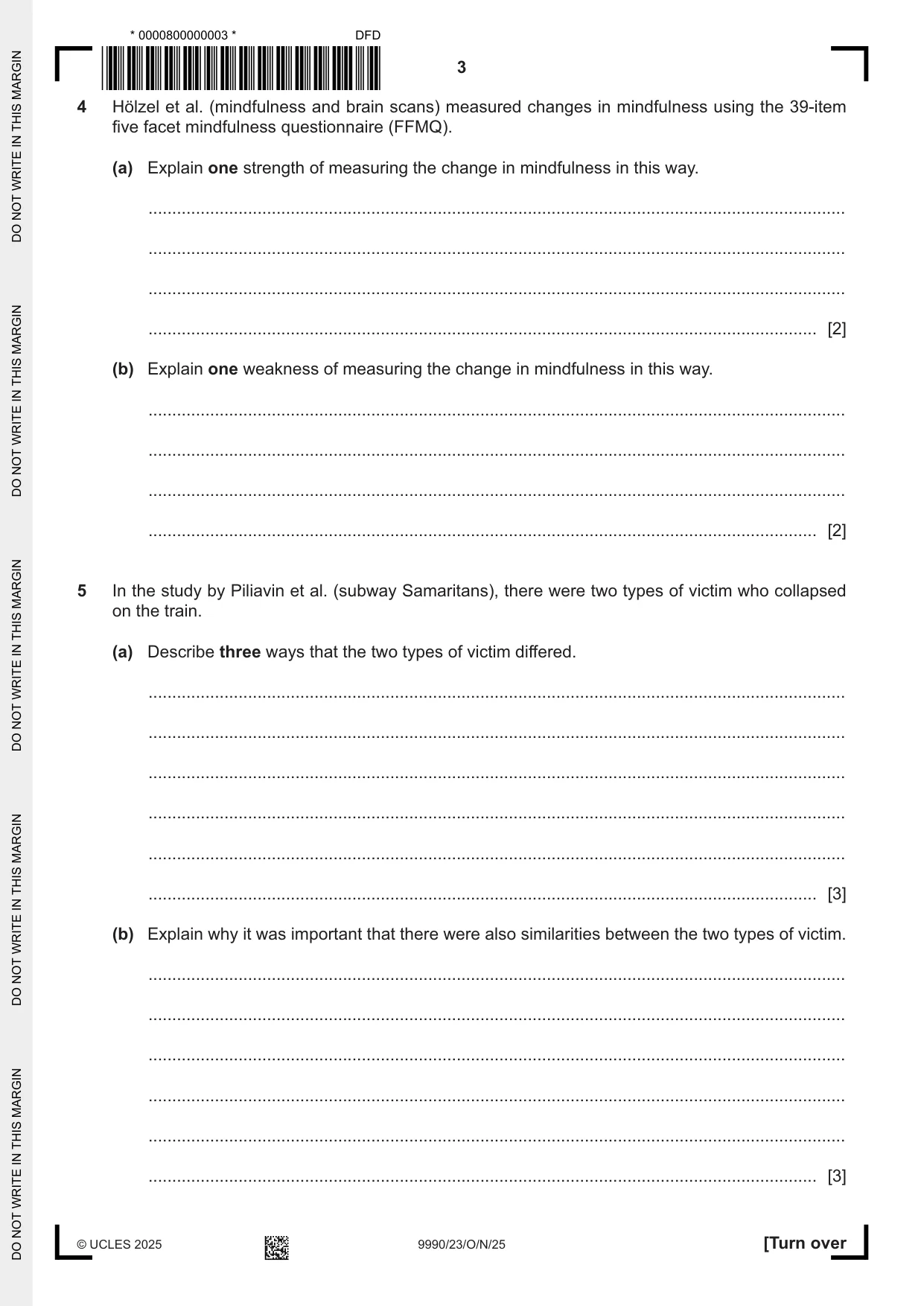
4 Hölzel et al. (mindfulness and brain scans) measured changes in mindfulness using the 39‑item five facet mindfulness questionnaire (FFMQ). (a) Explain one strength of measuring the change in mindfulness in this way. ................................................................................................................................................... ................................................................................................................................................... ................................................................................................................................................... ............................................................................................................................................. [2] (b) Explain one weakness of measuring the change in mindfulness in this way. ................................................................................................................................................... ................................................................................................................................................... ................................................................................................................................................... ............................................................................................................................................. [2]
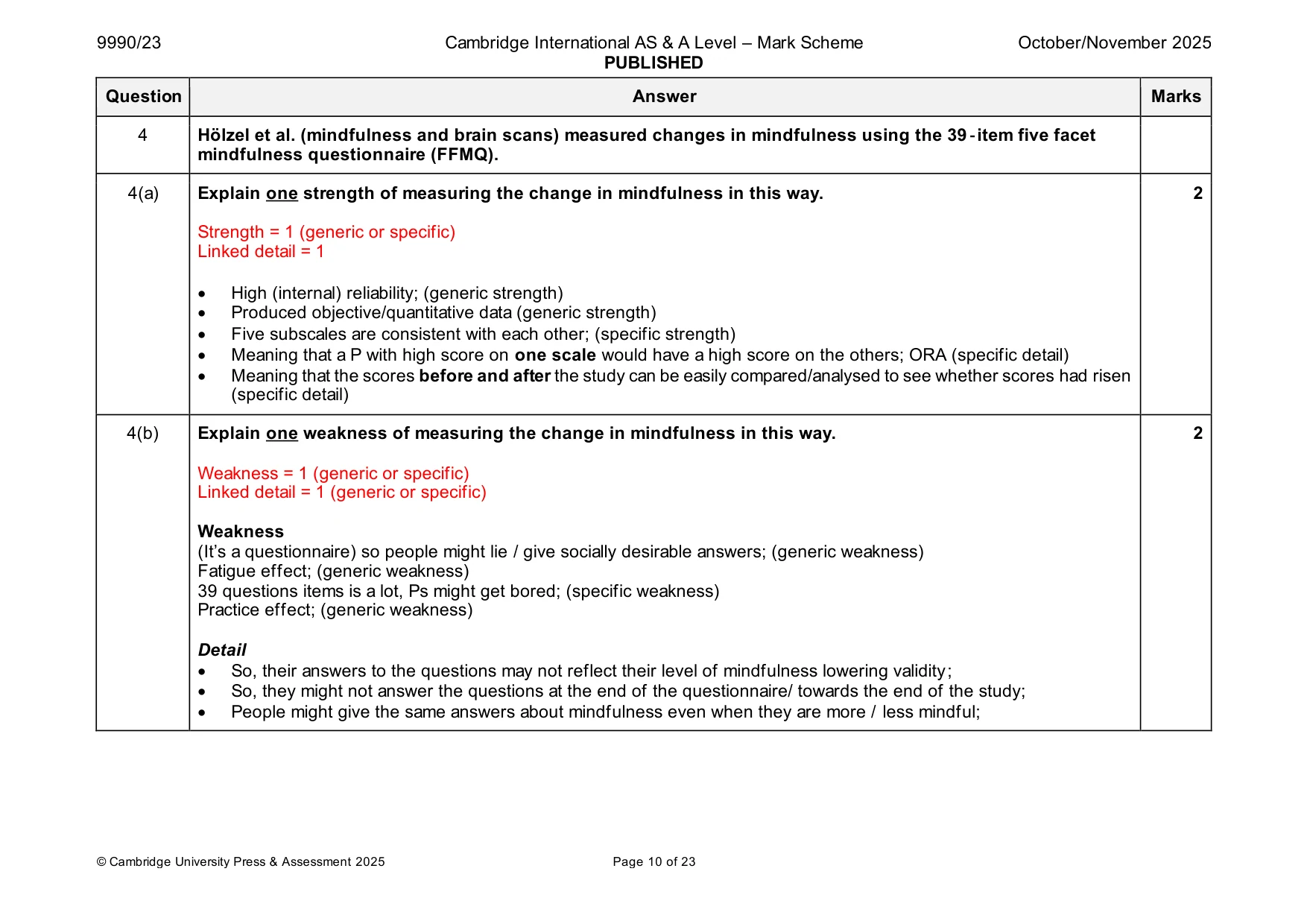
Mark scheme: 4 Hölzel et al. (mindfulness and brain scans) measured changes in mindfulness using the 39 ‑item five facet mindfulness questionnaire (FFMQ). 4(a) Explain one strength of measuring the change in mindfulness in this way. 2 Strength = 1 (generic or specific) Linked detail = 1 • High (internal) reliability; (generic strength) • Produced objective/quantitative data (generic strength) • Five subscales are consistent with each other; (specific strength) • Meaning that a P with high score on one scale would have a high score on the others; ORA (specific detail) • Meaning that the scores before and after the study can be easily compared/analysed to see whether scores had risen (specific detail) 4(b) Explain one weakness of measuring the change in mindfulness in this way. 2 Weakness = 1 (generic or specific) Linked detail = 1 (generic or specific) Weakness (It’s a questionnaire) so people might lie / give socially desirable answers; (generic weakness) Fatigue effect; (generic weakness) 39 questions items is a lot, Ps might get bored; (specific weakness) Practice effect; (generic weakness) Detail • So, their answers to the questions may not reflect their level of mindfulness lowering validity; • So, they might not answer the questions at the end of the questionnaire/ towards the end of the study; • People might give the same answers about mindfulness even when they are more / less mindful;
Q5 · In the study by Piliavin et al
5 In the study by Piliavin et al. (subway Samaritans), there were two types of victim who collapsed on the train. (a) Describe three ways that the two types of victim differed. ................................................................................................................................................... ................................................................................................................................................... ................................................................................................................................................... ................................................................................................................................................... ................................................................................................................................................... ............................................................................................................................................. [3] (b) Explain why it was important that there were also similarities between the two types of victim. ................................................................................................................................................... ................................................................................................................................................... ................................................................................................................................................... ................................................................................................................................................... ................................................................................................................................................... ............................................................................................................................................. [3]
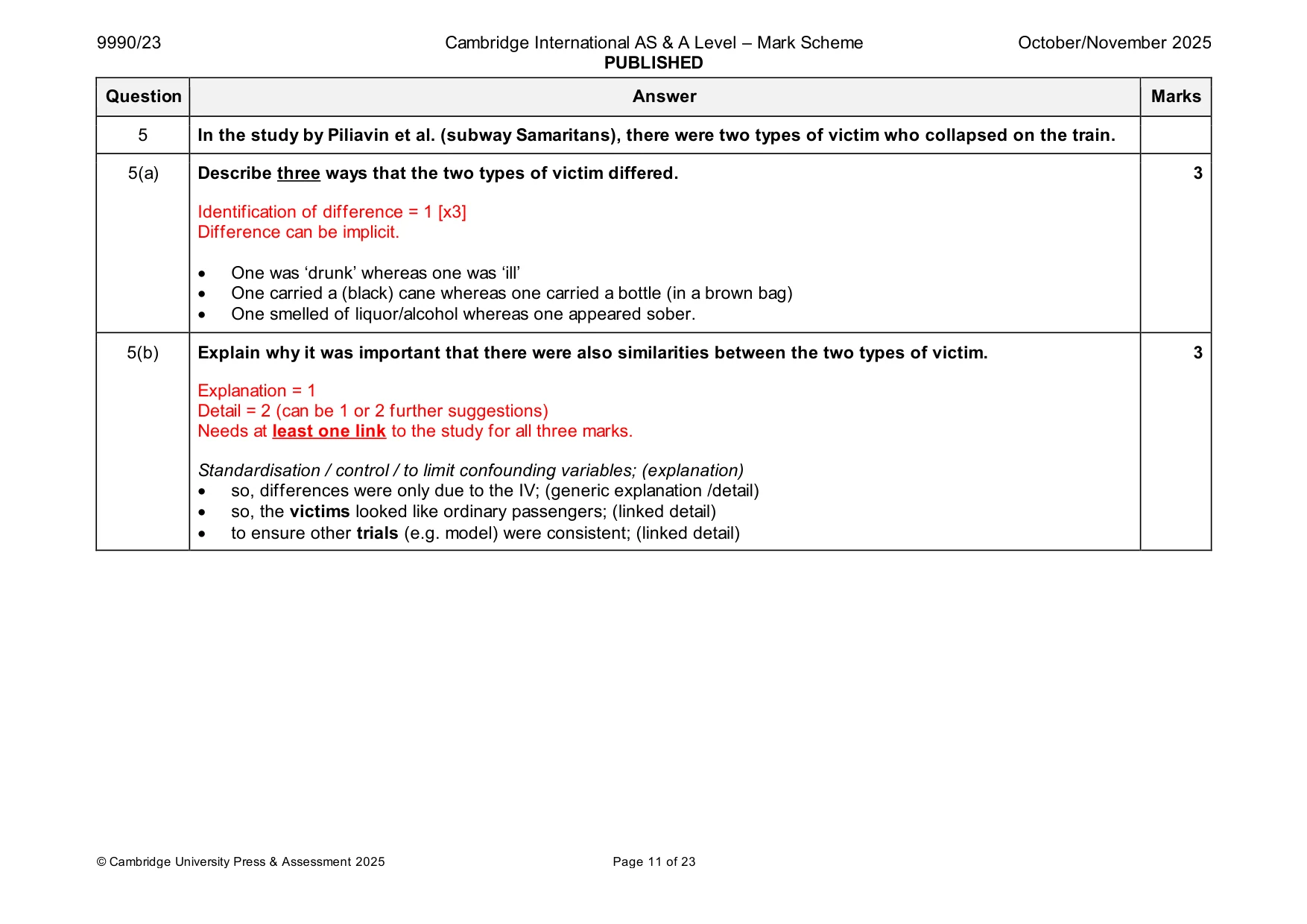
Mark scheme: 5 In the study by Piliavin et al. (subway Samaritans), there were two types of victim who collapsed on the train. 5(a) Describe three ways that the two types of victim differed. 3 Identification of difference = 1 [x3] Difference can be implicit. • One was ‘drunk’ whereas one was ‘ill’ • One carried a (black) cane whereas one carried a bottle (in a brown bag) • One smelled of liquor/alcohol whereas one appeared sober. 5(b) Explain why it was important that there were also similarities between the two types of victim. 3 Explanation = 1 Detail = 2 (can be 1 or 2 further suggestions) Needs at least one link to the study for all three marks. Standardisation / control / to limit confounding variables; (explanation) • so, differences were only due to the IV; (generic explanation /detail) • so, the victims looked like ordinary passengers; (linked detail) • to ensure other trials (e.g. model) were consistent; (linked detail)
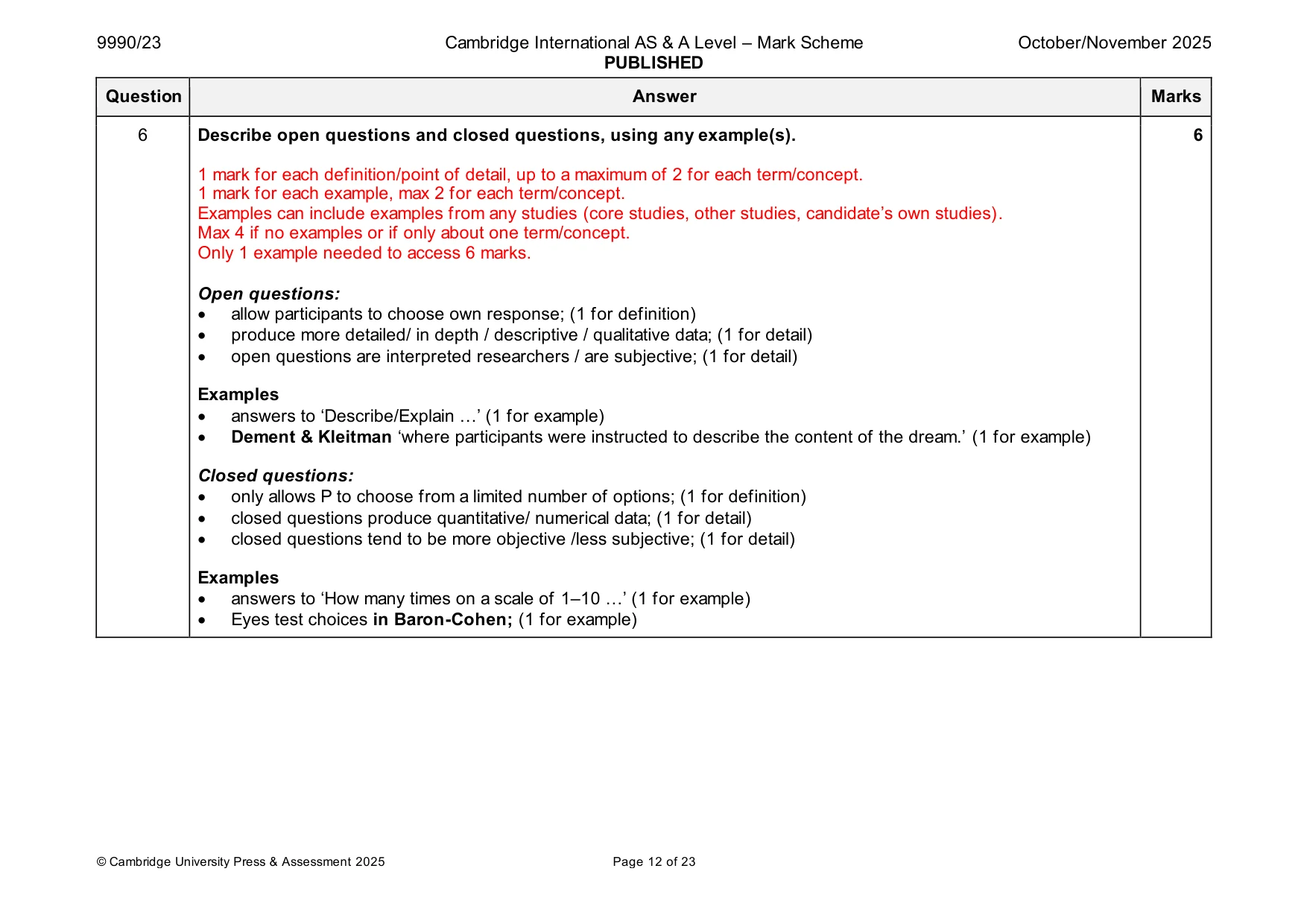
Q6 · Describe open questions and closed questions, using any example(s)
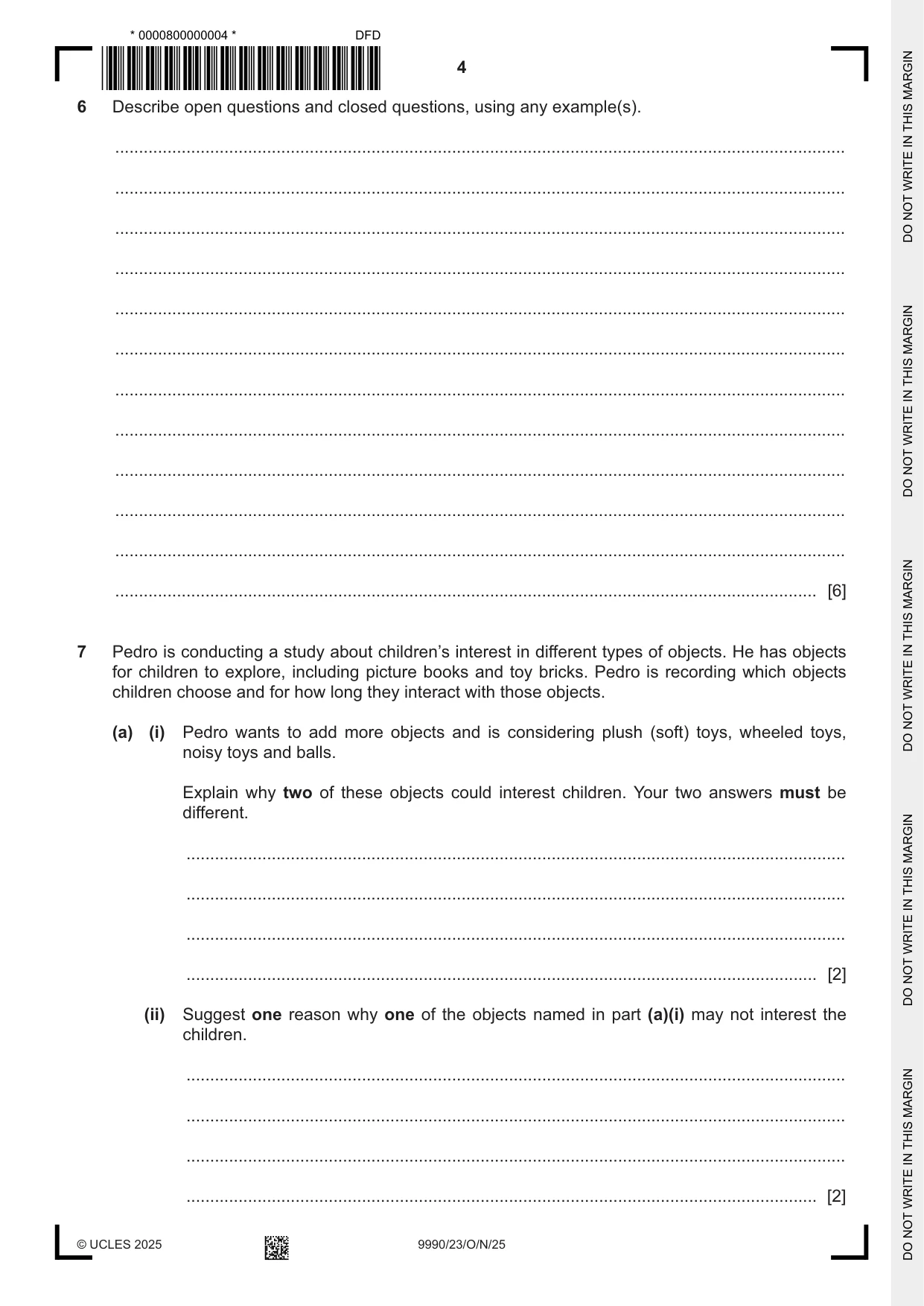
6 Describe open questions and closed questions, using any example(s). .......................................................................................................................................................... .......................................................................................................................................................... .......................................................................................................................................................... .......................................................................................................................................................... .......................................................................................................................................................... .......................................................................................................................................................... .......................................................................................................................................................... .......................................................................................................................................................... .......................................................................................................................................................... .......................................................................................................................................................... .......................................................................................................................................................... .................................................................................................................................................... [6]
Mark scheme: 6 Describe open questions and closed questions, using any example(s). 6 1 mark for each definition/point of detail, up to a maximum of 2 for each term/concept. 1 mark for each example, max 2 for each term/concept. Examples can include examples from any studies (core studies, other studies, candidate’s own studies). Max 4 if no examples or if only about one term/concept. Only 1 example needed to access 6 marks. Open questions: • allow participants to choose own response; (1 for definition) • produce more detailed/ in depth / descriptive / qualitative data; (1 for detail) • open questions are interpreted researchers / are subjective; (1 for detail) Examples • answers to ‘Describe/Explain …’ (1 for example) • Dement & Kleitman ‘where participants were instructed to describe the content of the dream.’ (1 for example) Closed questions: • only allows P to choose from a limited number of options; (1 for definition) • closed questions produce quantitative/ numerical data; (1 for detail) • closed questions tend to be more objective /less subjective; (1 for detail) Examples • answers to ‘How many times on a scale of 1–10 …’ (1 for example) • Eyes test choices in Baron-Cohen; (1 for example)
Q7 · Pedro is conducting a study about children’s interest in different types of objects
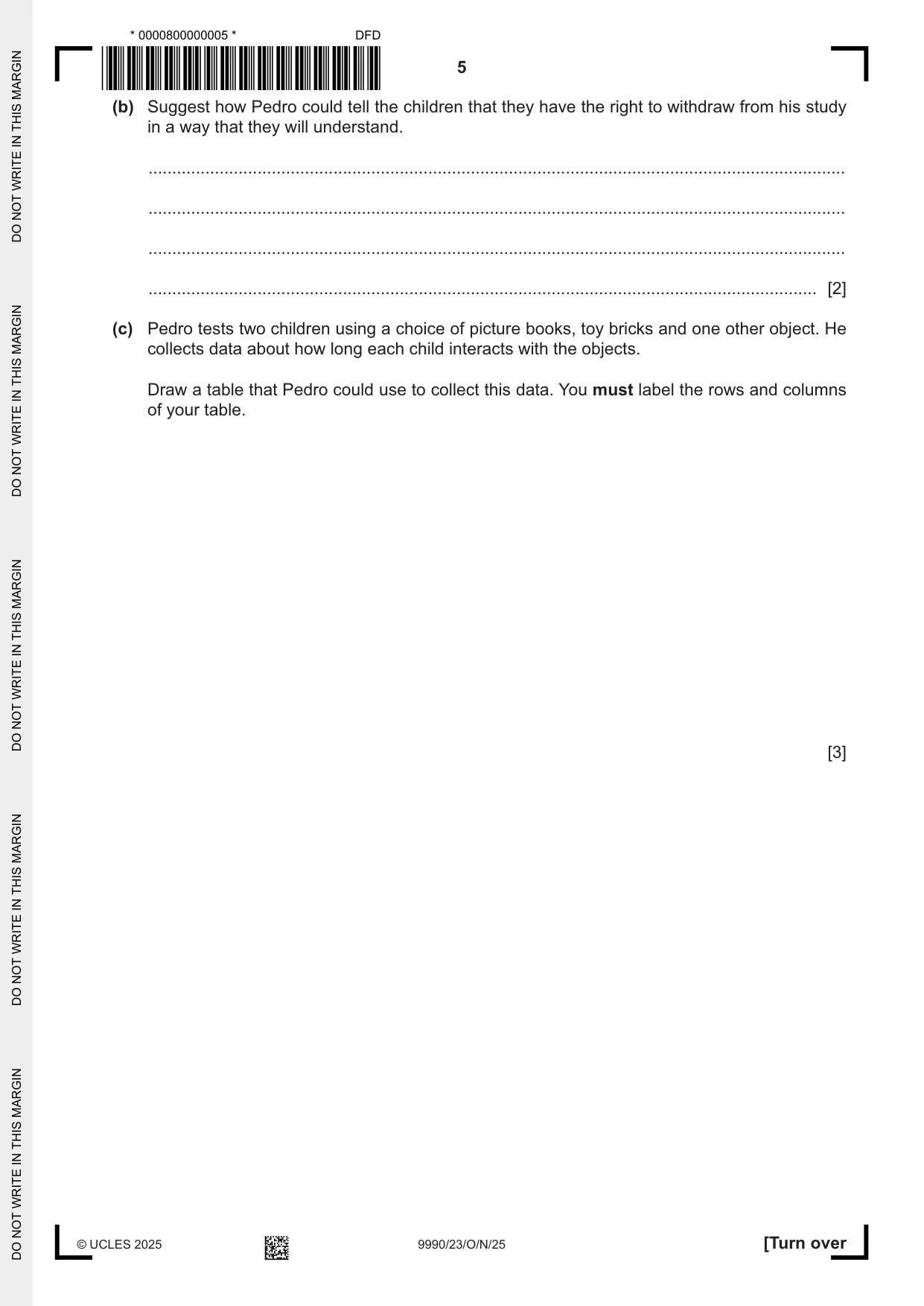
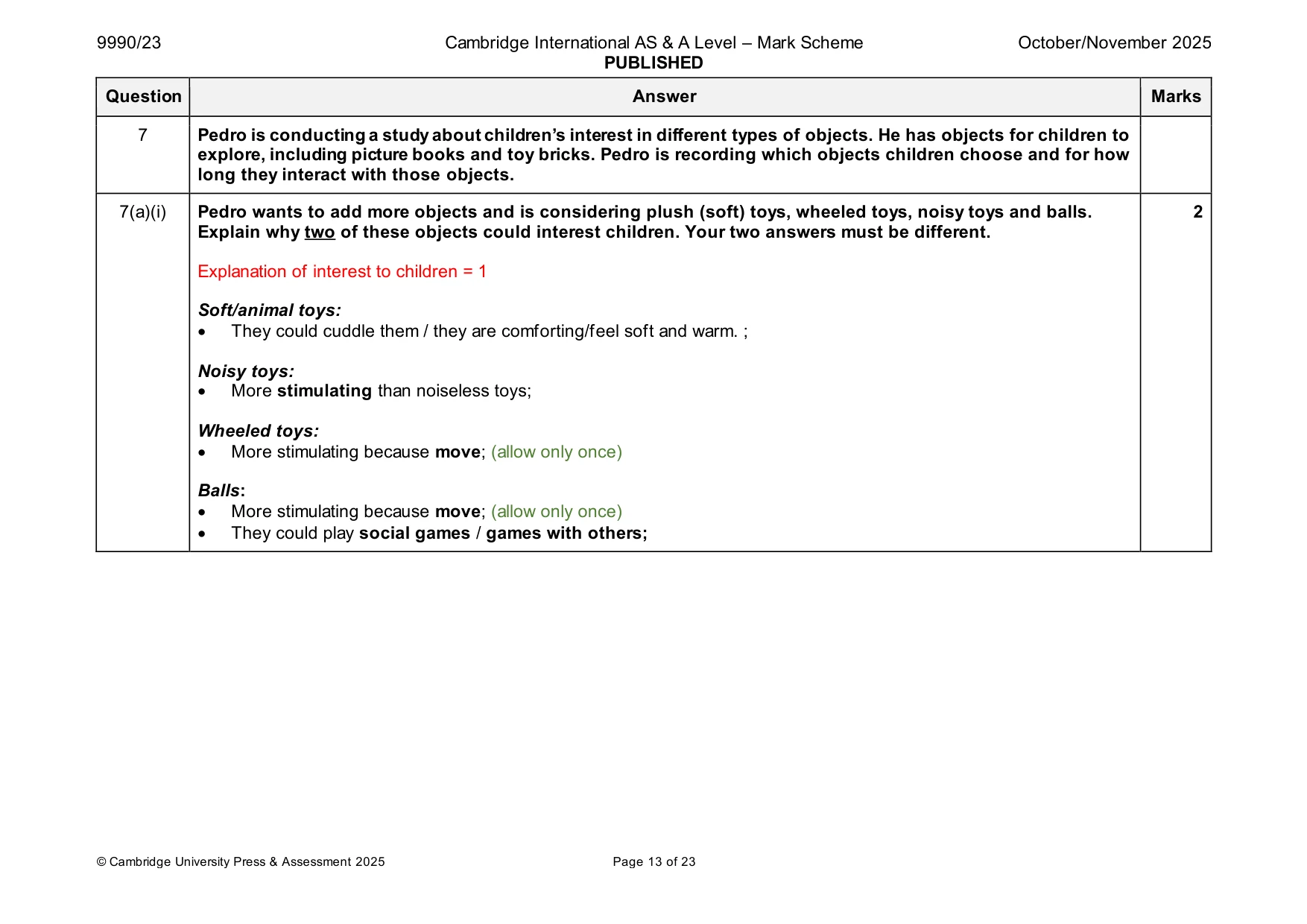
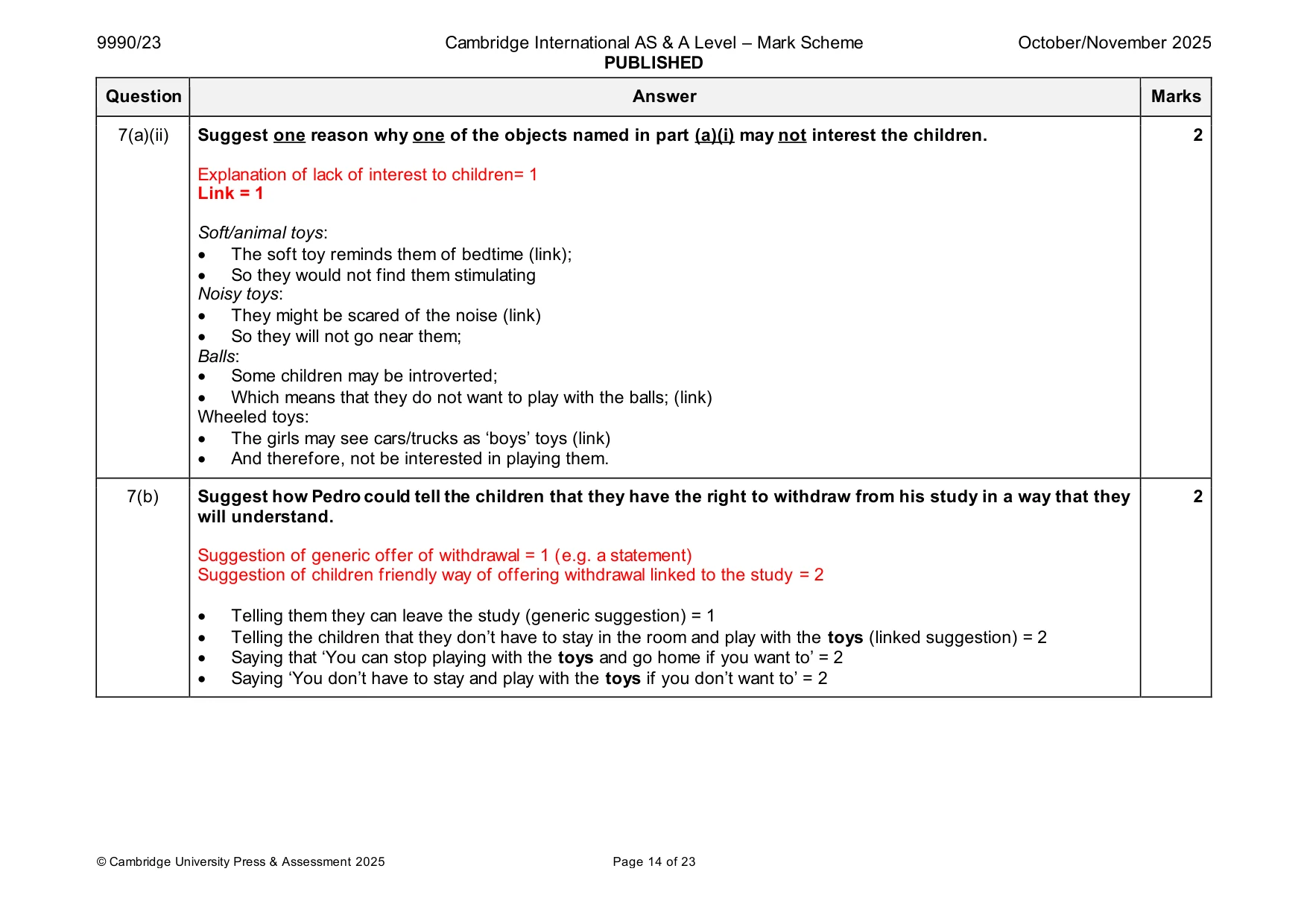
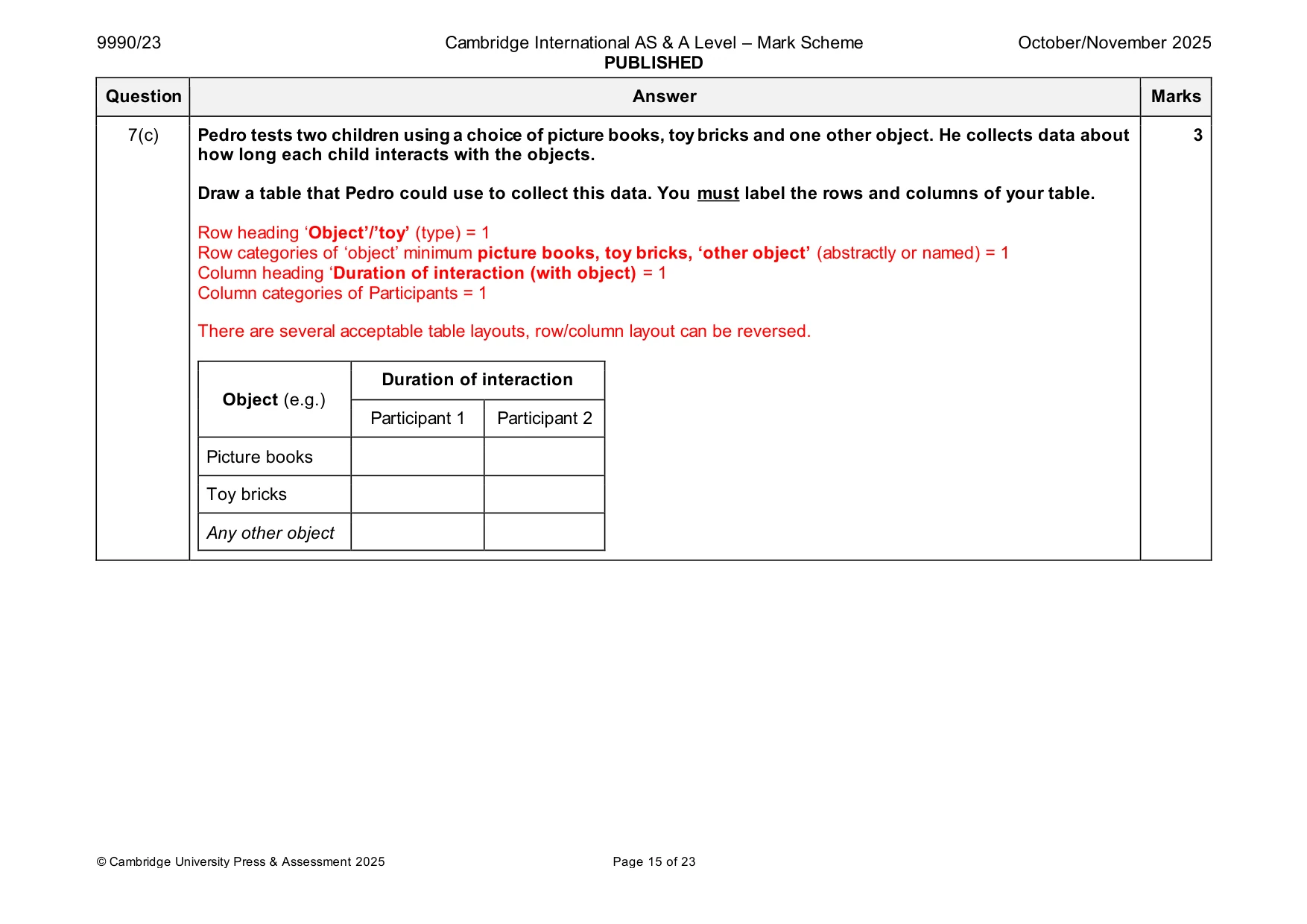
7 Pedro is conducting a study about children’s interest in different types of objects. He has objects for children to explore, including picture books and toy bricks. Pedro is recording which objects children choose and for how long they interact with those objects. (a) (i) Pedro wants to add more objects and is considering plush (soft) toys, wheeled toys, noisy toys and balls. Explain why two of these objects could interest children. Your two answers must be different. ........................................................................................................................................... ........................................................................................................................................... ........................................................................................................................................... ..................................................................................................................................... [2] (ii) Suggest one reason why one of the objects named in part (a)(i) may not interest the children. ........................................................................................................................................... ........................................................................................................................................... ........................................................................................................................................... ..................................................................................................................................... [2] (b) Suggest how Pedro could tell the children that they have the right to withdraw from his study in a way that they will understand. ................................................................................................................................................... ................................................................................................................................................... ................................................................................................................................................... ............................................................................................................................................. [2] (c) Pedro tests two children using a choice of picture books, toy bricks and one other object. He collects data about how long each child interacts with the objects. Draw a table that Pedro could use to collect this data. You must label the rows and columns of your table. [3]
Mark scheme: 7 Pedro is conducting a study about children’s interest in different types of objects. He has objects for children to explore, including picture books and toy bricks. Pedro is recording which objects children choose and for how long they interact with those objects. 7(a)(i) Pedro wants to add more objects and is considering plush (soft) toys, wheeled toys, noisy toys and balls. 2 Explain why two of these objects could interest children. Your two answers must be different. Explanation of interest to children = 1 Soft/animal toys: • They could cuddle them / they are comforting/feel soft and warm. ; Noisy toys: • More stimulating than noiseless toys; Wheeled toys: • More stimulating because move; (allow only once) Balls: • More stimulating because move; (allow only once) • They could play social games / games with others; 7(a)(ii) Suggest one reason why one of the objects named in part (a)(i) may not interest the children. 2 Explanation of lack of interest to children= 1 Link = 1 Soft/animal toys: • The soft toy reminds them of bedtime (link); • So they would not find them stimulating Noisy toys: • They might be scared of the noise (link) • So they will not go near them; Balls: • Some children may be introverted; • Which means that they do not want to play with the balls; (link) Wheeled toys: • The girls may see cars/trucks as ‘boys’ toys (link) • And therefore, not be interested in playing them. 7(b) Suggest how Pedro could tell the children that they have the right to withdraw from his study in a way that they 2 will understand. Suggestion of generic offer of withdrawal = 1 (e.g. a statement) Suggestion of children friendly way of offering withdrawal linked to the study = 2 • Telling them they can leave the study (generic suggestion) = 1 • Telling the children that they don’t have to stay in the room and play with the toys (linked suggestion) = 2 • Saying that ‘You can stop playing with the toys and go home if you want to’ = 2 • Saying ‘You don’t have to stay and play with the toys if you don’t want to’ = 2 7(c) Pedro tests two children using a choice of picture books, toy bricks and one other object. He collects data about 3 how long each child interacts with the objects. Draw a table that Pedro could use to collect this data. You must label the rows and columns of your table. Row heading ‘Object’/’toy’ (type) = 1 Row categories of ‘object’ minimum picture books, toy bricks, ‘other object’ (abstractly or named) = 1 Column heading ‘Duration of interaction (with object) = 1 Column categories of Participants = 1 There are several acceptable table layouts, row/column layout can be reversed. Duration of interaction Object (e.g.) Participant 1 Participant 2 Picture books Toy bricks Any other object
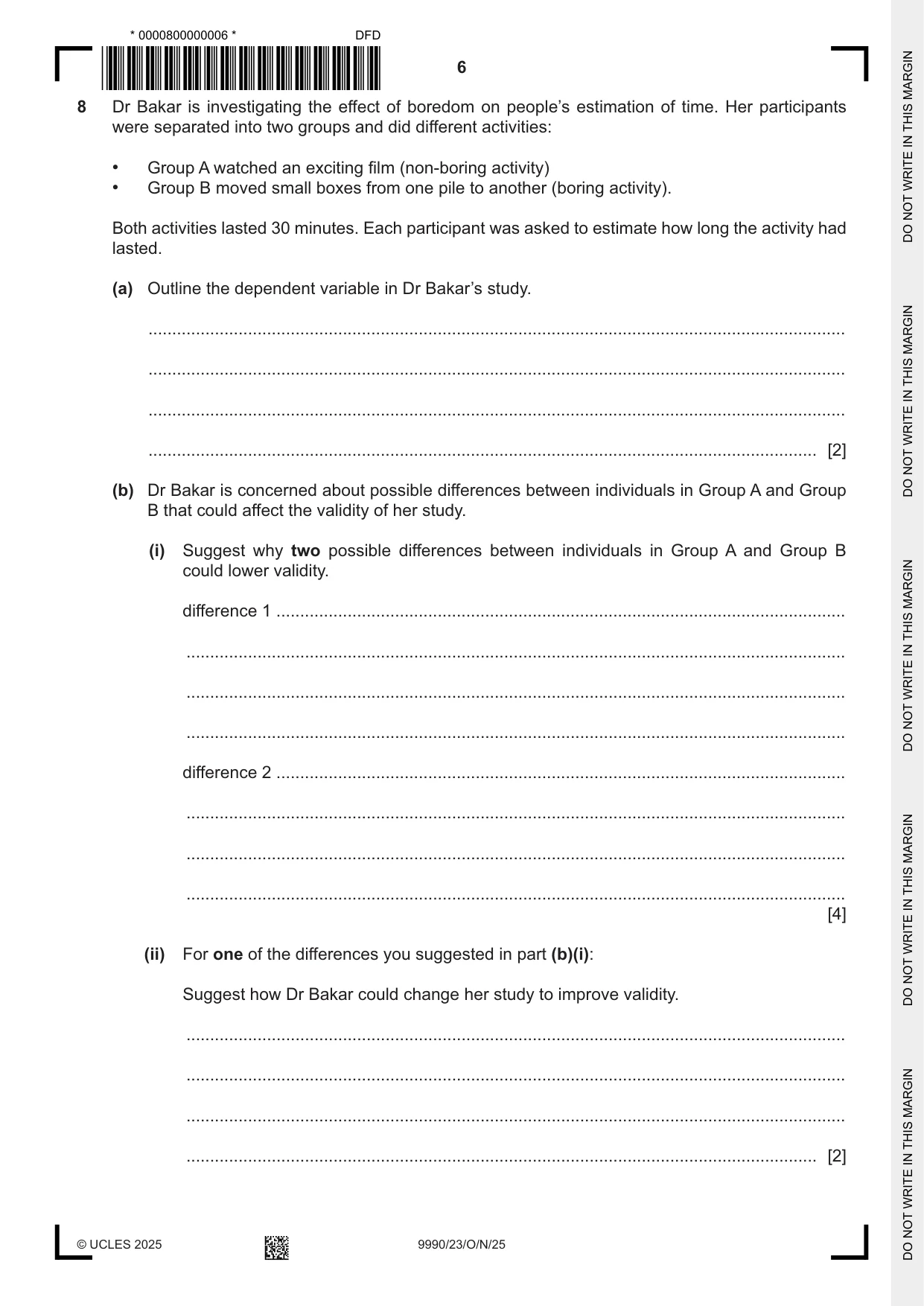
Q8 · Dr Bakar is investigating the effect of boredom on people’s estimation of time
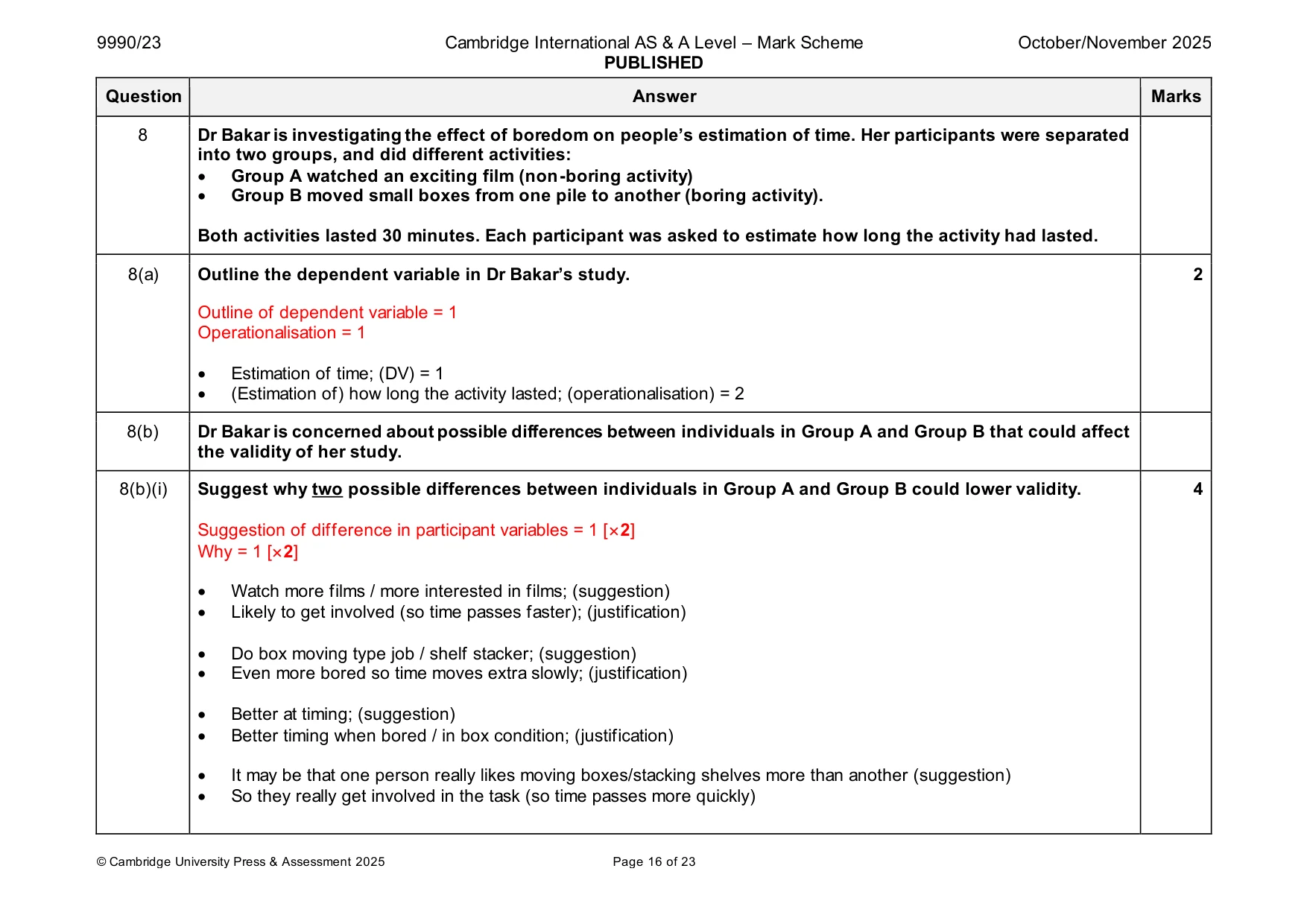
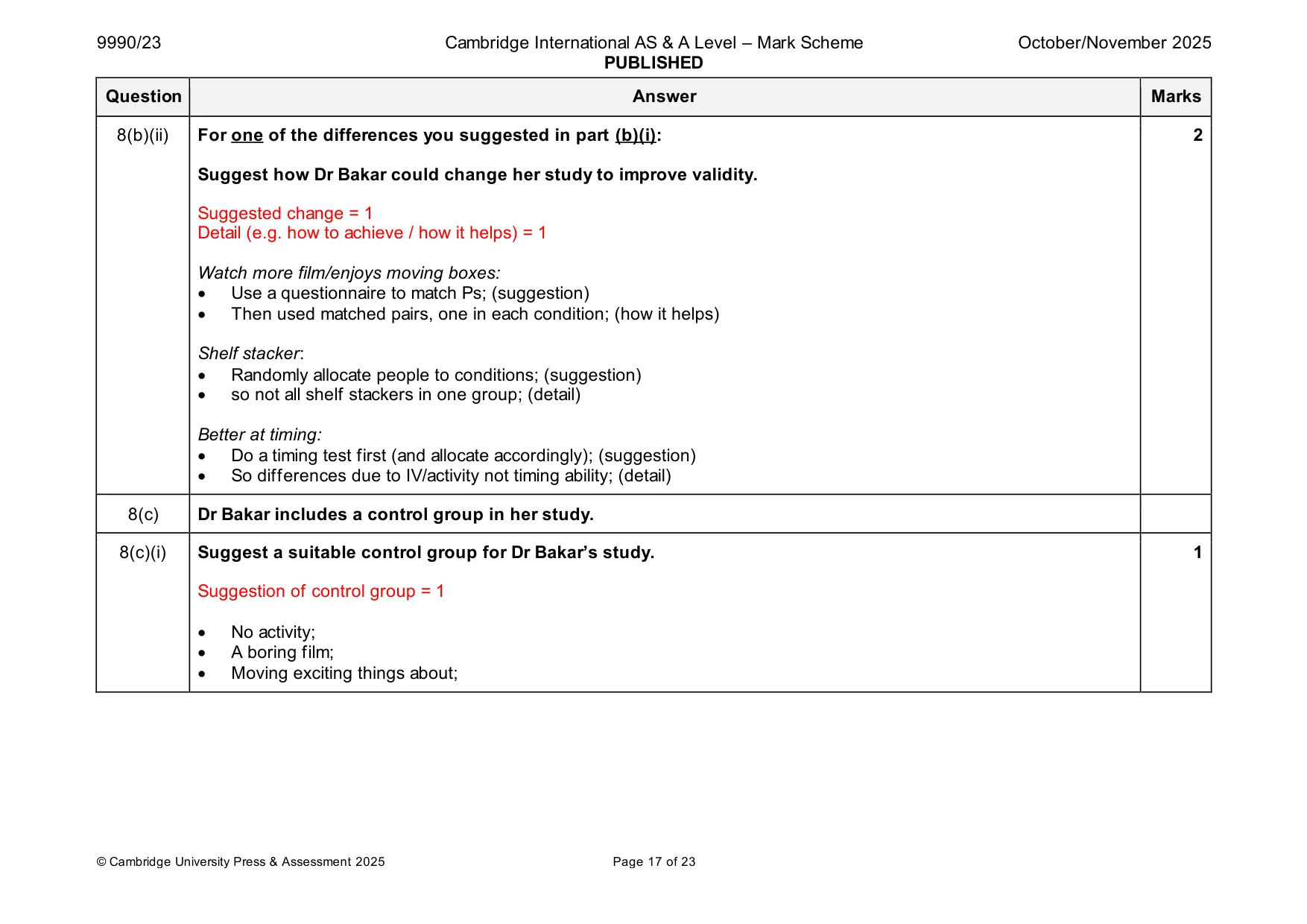
8 Dr Bakar is investigating the effect of boredom on people’s estimation of time. Her participants were separated into two groups and did different activities: • Group A watched an exciting film (non‑boring activity) • Group B moved small boxes from one pile to another (boring activity). Both activities lasted 30 minutes. Each participant was asked to estimate how long the activity had lasted. (a) Outline the dependent variable in Dr Bakar’s study. ................................................................................................................................................... ................................................................................................................................................... ................................................................................................................................................... ............................................................................................................................................. [2] (b) Dr Bakar is concerned about possible differences between individuals in Group A and Group B that could affect the validity of her study. (i) Suggest why two possible differences between individuals in Group A and Group B could lower validity. difference 1 ........................................................................................................................ ........................................................................................................................................... ........................................................................................................................................... ........................................................................................................................................... difference 2 ........................................................................................................................ ........................................................................................................................................... ........................................................................................................................................... ........................................................................................................................................... [4] (ii) For one of the differences you suggested in part (b)(i): Suggest how Dr Bakar could change her study to improve validity. ........................................................................................................................................... ........................................................................................................................................... ........................................................................................................................................... ..................................................................................................................................... [2] (c) Dr Bakar includes a control group in her study. (i) Suggest a suitable control group for Dr Bakar’s study. ........................................................................................................................................... ..................................................................................................................................... [1] (ii) Explain why the control group you suggested in part (c)(i) is suitable. ........................................................................................................................................... ..................................................................................................................................... [1]
Mark scheme: 8 Dr Bakar is investigating the effect of boredom on people’s estimation of time. Her participants were separated into two groups, and did different activities: • Group A watched an exciting film (non-boring activity) • Group B moved small boxes from one pile to another (boring activity). Both activities lasted 30 minutes. Each participant was asked to estimate how long the activity had lasted. 8(a) Outline the dependent variable in Dr Bakar’s study. 2 Outline of dependent variable = 1 Operationalisation = 1 • Estimation of time; (DV) = 1 • (Estimation of) how long the activity lasted; (operationalisation) = 2 8(b) Dr Bakar is concerned about possible differences between individuals in Group A and Group B that could affect the validity of her study. 8(b)(i) Suggest why two possible differences between individuals in Group A and Group B could lower validity. 4 Suggestion of difference in participant variables = 1 [2] Why = 1 [2] • Watch more films / more interested in films; (suggestion) • Likely to get involved (so time passes faster); (justification) • Do box moving type job / shelf stacker; (suggestion) • Even more bored so time moves extra slowly; (justification) • Better at timing; (suggestion) • Better timing when bored / in box condition; (justification) • It may be that one person really likes moving boxes/stacking shelves more than another (suggestion) • So they really get involved in the task (so time passes more quickly) 8(b)(ii) For one of the differences you suggested in part (b)(i): 2 Suggest how Dr Bakar could change her study to improve validity. Suggested change = 1 Detail (e.g. how to achieve / how it helps) = 1 Watch more film/enjoys moving boxes: • Use a questionnaire to match Ps; (suggestion) • Then used matched pairs, one in each condition; (how it helps) Shelf stacker: • Randomly allocate people to conditions; (suggestion) • so not all shelf stackers in one group; (detail) Better at timing: • Do a timing test first (and allocate accordingly); (suggestion) • So differences due to IV/activity not timing ability; (detail) 8(c) Dr Bakar includes a control group in her study. 8(c)(i) Suggest a suitable control group for Dr Bakar’s study. 1 Suggestion of control group = 1 • No activity; • A boring film; • Moving exciting things about; 8(c)(ii) Explain why the control group you suggested in part (c)(i) is suitable. 1 Explanation of control group = 1 No activity: • Time estimation might be the same as for boring; • This will give a baseline to compare to the exciting/boring groups. A boring film: • Any difference might be due to vision/movement not boredom; • Because that would remove the confounding variable of film preference. Moving exciting things about: • Any difference might be due to excitement (not vision or movement);
Q9 · Daniel is investigating the effect of childhood experiences on adult food preferences
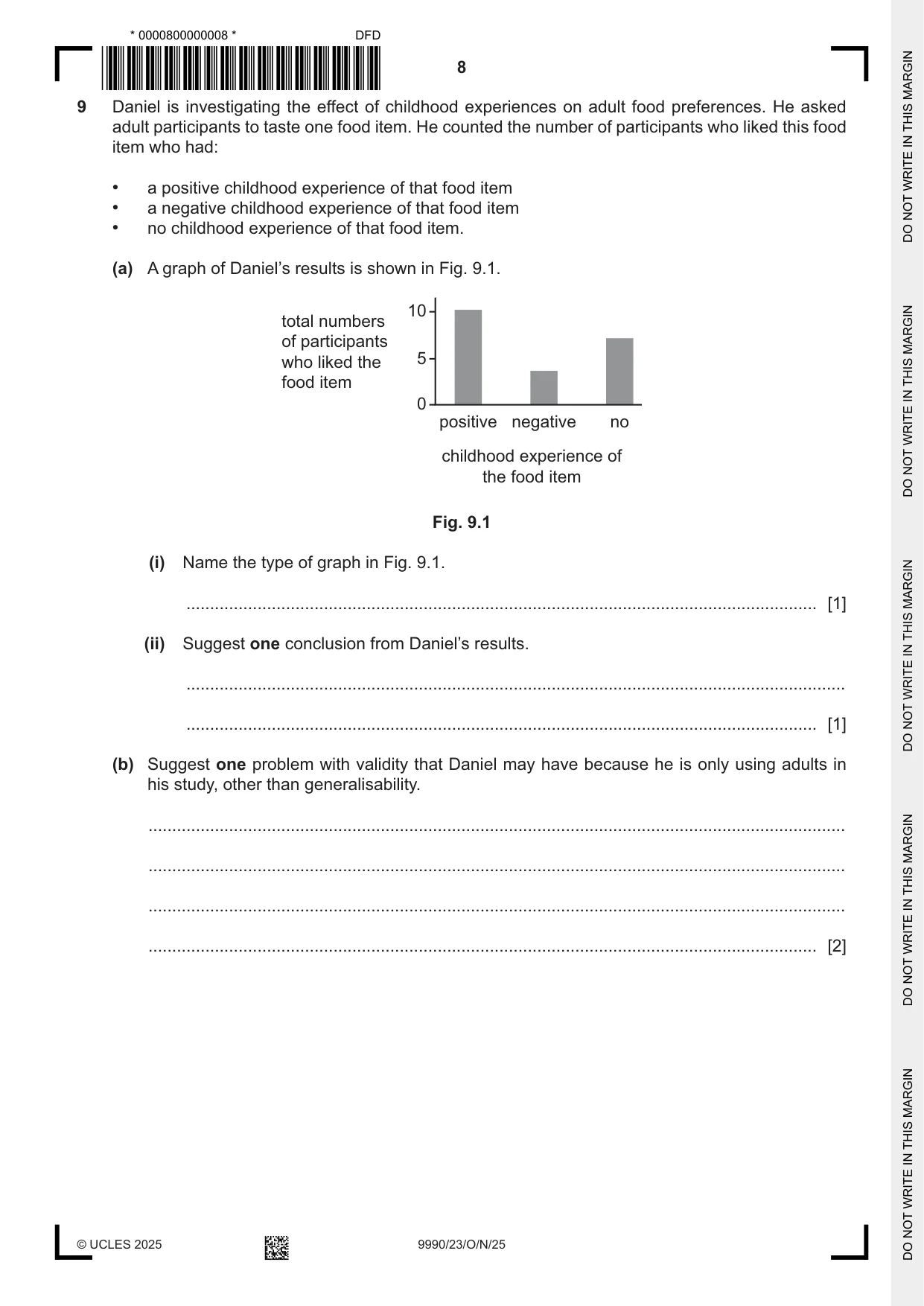
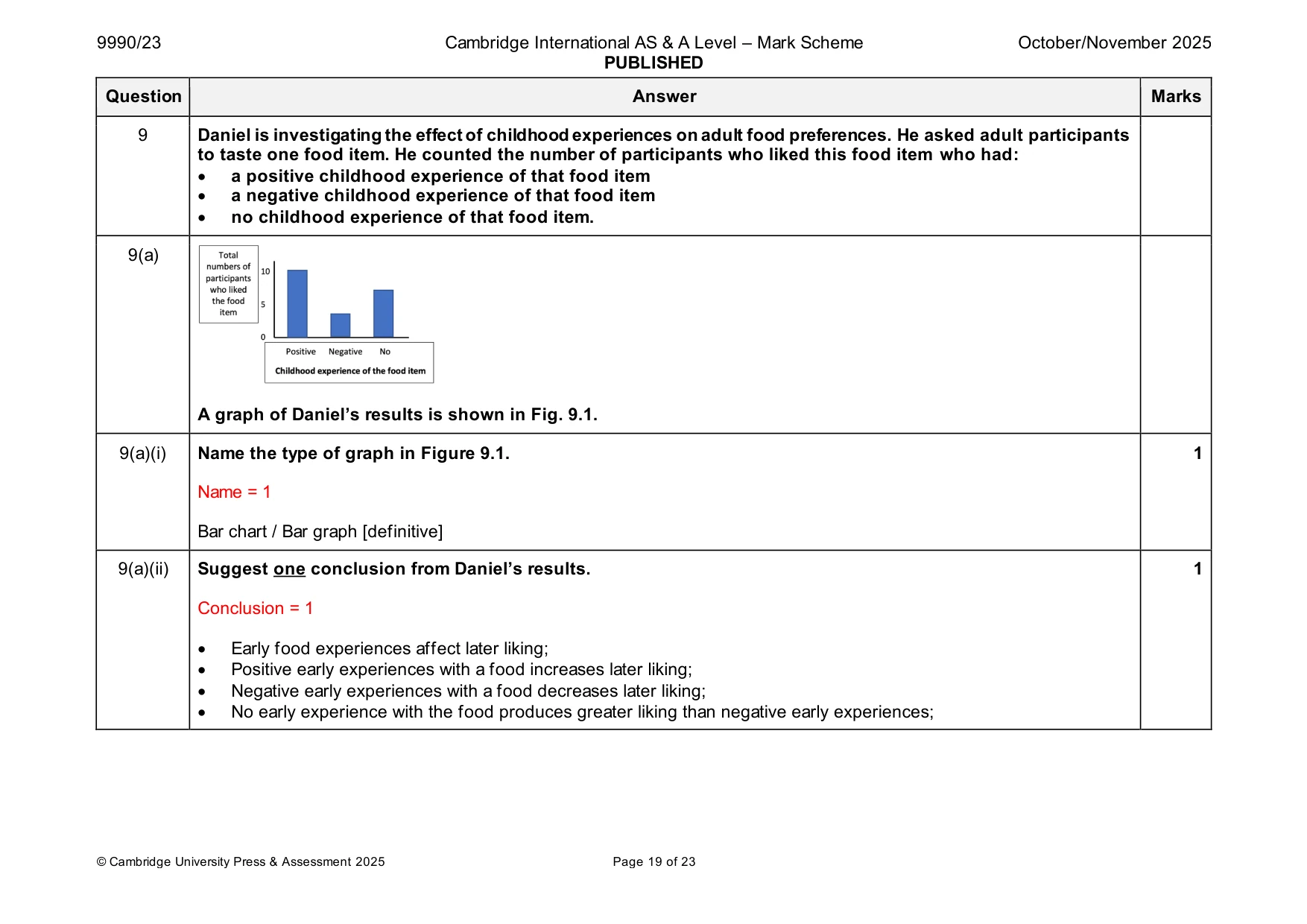
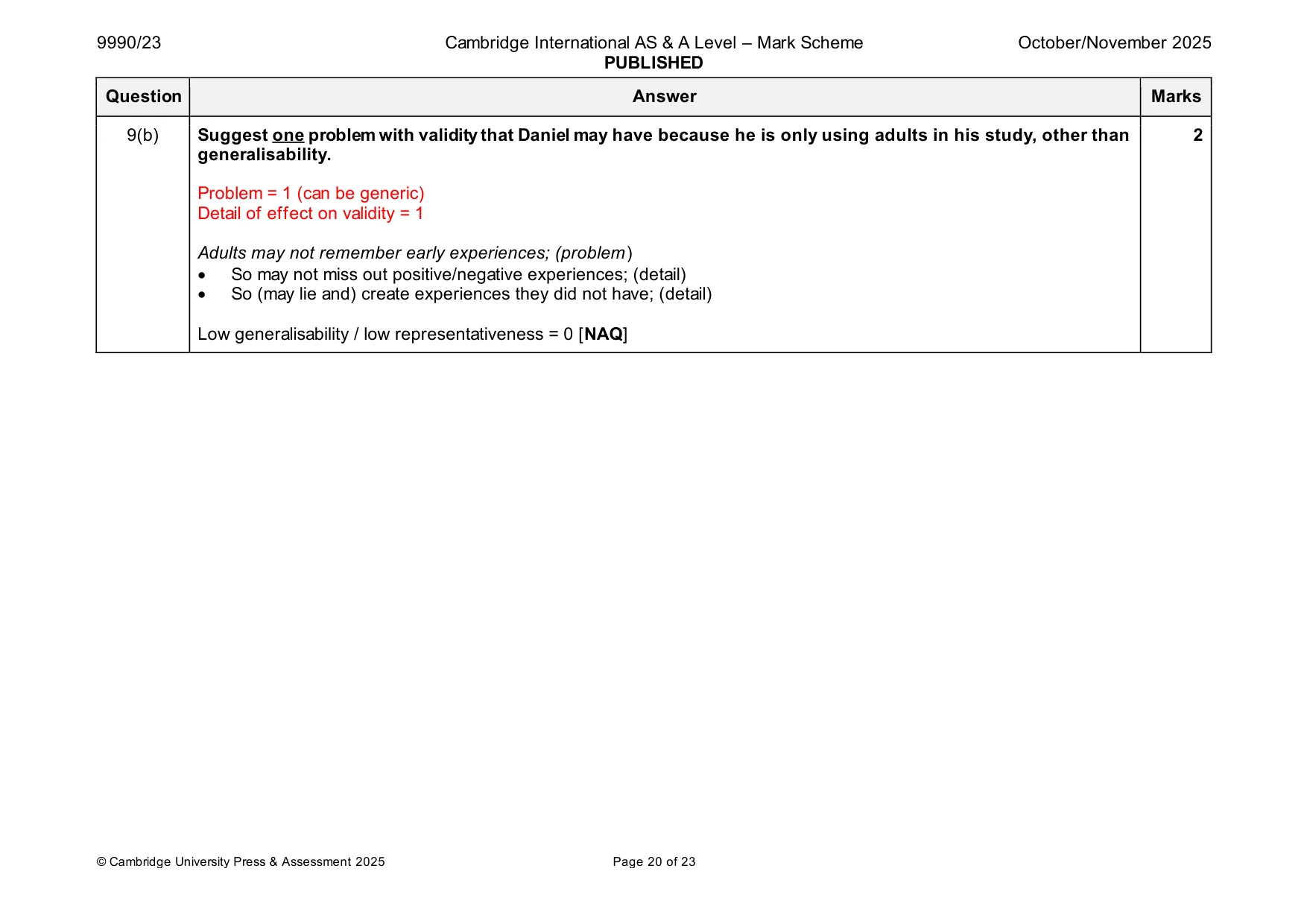
9 Daniel is investigating the effect of childhood experiences on adult food preferences. He asked adult participants to taste one food item. He counted the number of participants who liked this food item who had: • a positive childhood experience of that food item • a negative childhood experience of that food item • no childhood experience of that food item. (a) A graph of Daniel’s results is shown in Fig. 9.1. 10 total numbers of participants who liked the 5 food item 0 positive negative no childhood experience of the food item Fig. 9.1 (i) Name the type of graph in Fig. 9.1. ..................................................................................................................................... [1] (ii) Suggest one conclusion from Daniel’s results. ........................................................................................................................................... ..................................................................................................................................... [1] (b) Suggest one problem with validity that Daniel may have because he is only using adults in his study, other than generalisability. ................................................................................................................................................... ................................................................................................................................................... ................................................................................................................................................... ............................................................................................................................................. [2]
Mark scheme: 9 Daniel is investigating the effect of childhood experiences on adult food preferences. He asked adult participants to taste one food item. He counted the number of participants who liked this food item who had: • a positive childhood experience of that food item • a negative childhood experience of that food item • no childhood experience of that food item. 9(a) A graph of Daniel’s results is shown in Fig. 9.1. 9(a)(i) Name the type of graph in Figure 9.1. 1 Name = 1 Bar chart / Bar graph [definitive] 9(a)(ii) Suggest one conclusion from Daniel’s results. 1 Conclusion = 1 • Early food experiences affect later liking; • Positive early experiences with a food increases later liking; • Negative early experiences with a food decreases later liking; • No early experience with the food produces greater liking than negative early experiences; 9(b) Suggest one problem with validity that Daniel may have because he is only using adults in his study, other than 2 generalisability. Problem = 1 (can be generic) Detail of effect on validity = 1 Adults may not remember early experiences; (problem) • So may not miss out positive/negative experiences; (detail) • So (may lie and) create experiences they did not have; (detail) Low generalisability / low representativeness = 0 [NAQ]
Q10 · Liam is a young man who is unusually good at focussing his attention on many types of…
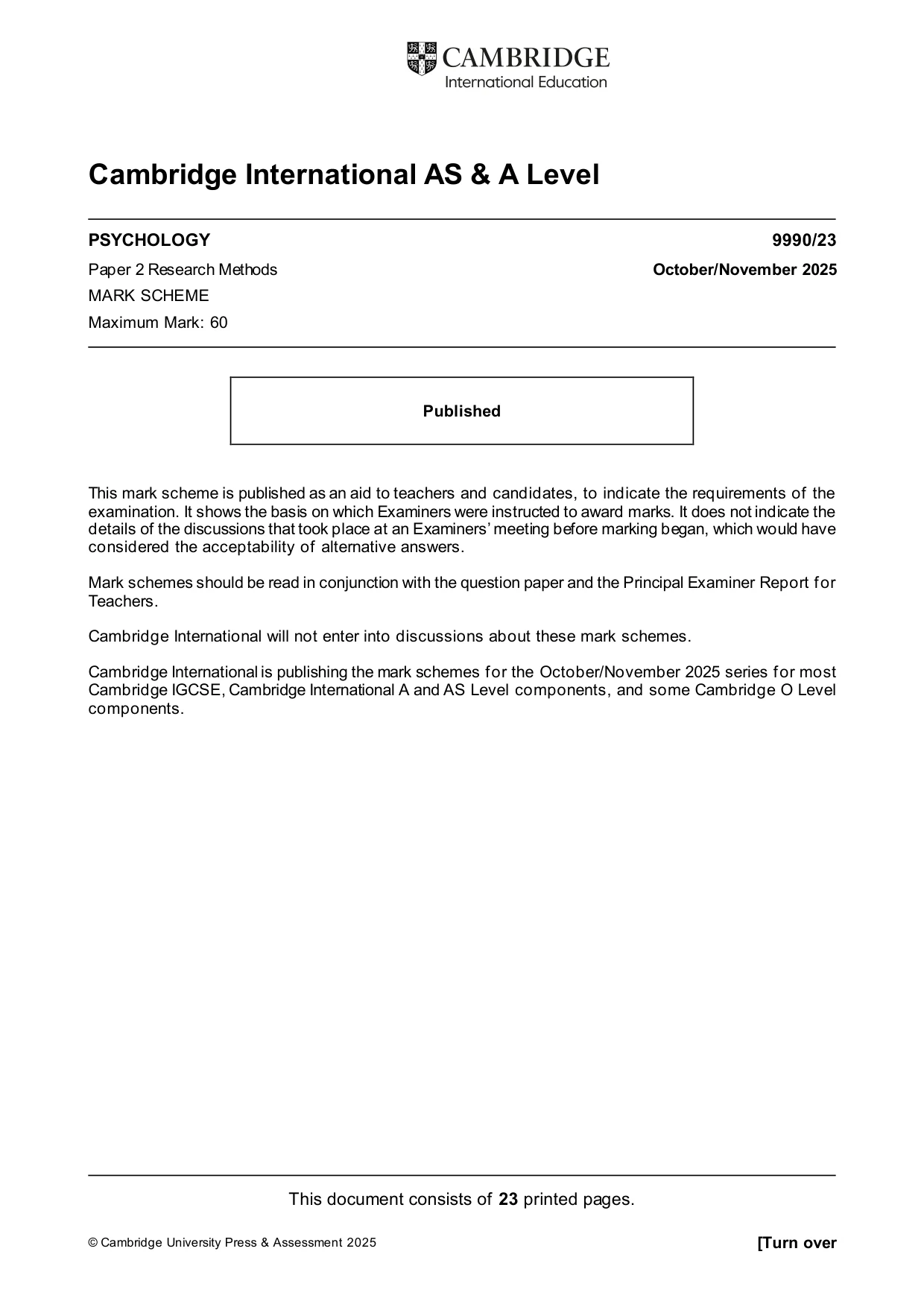
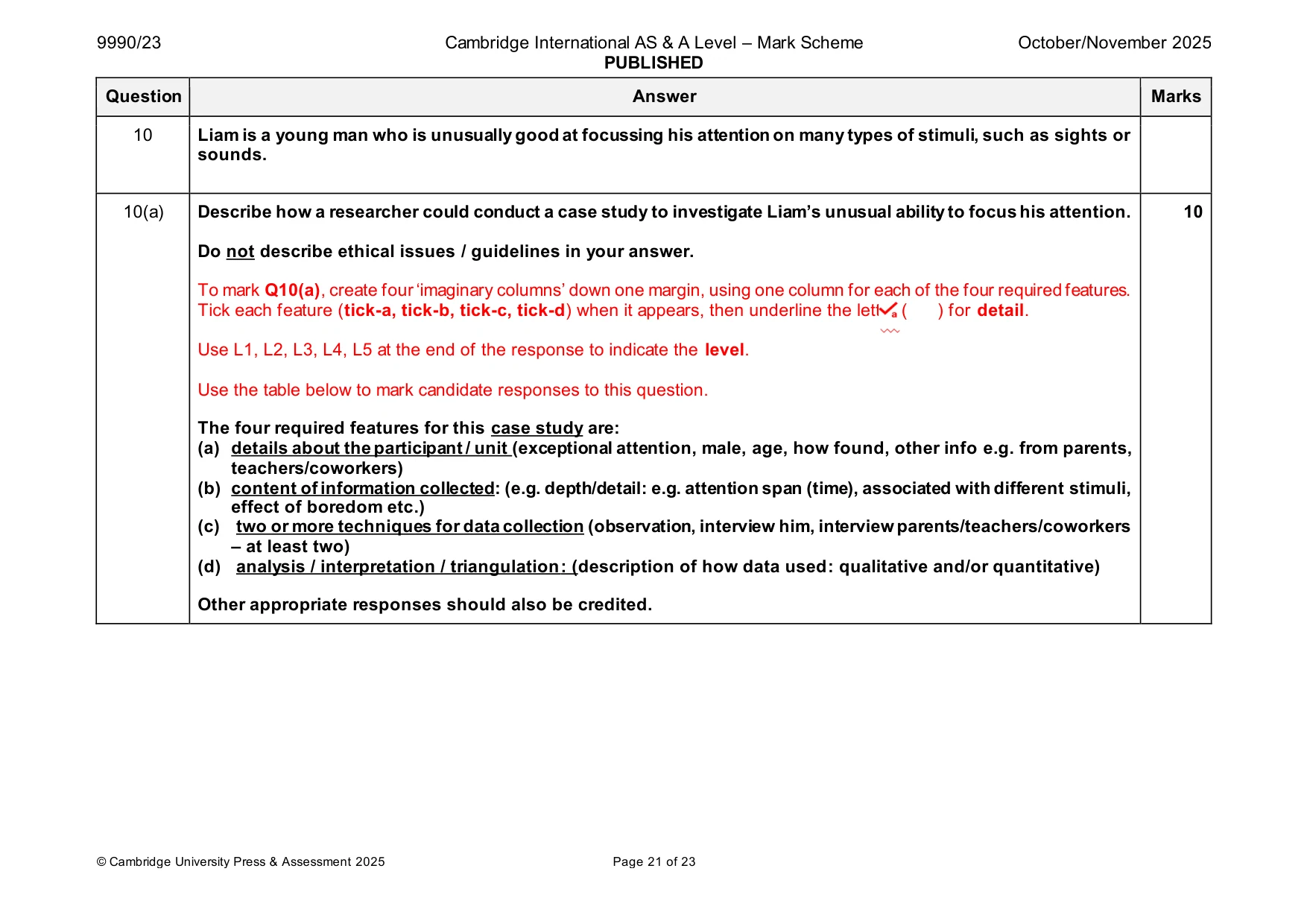
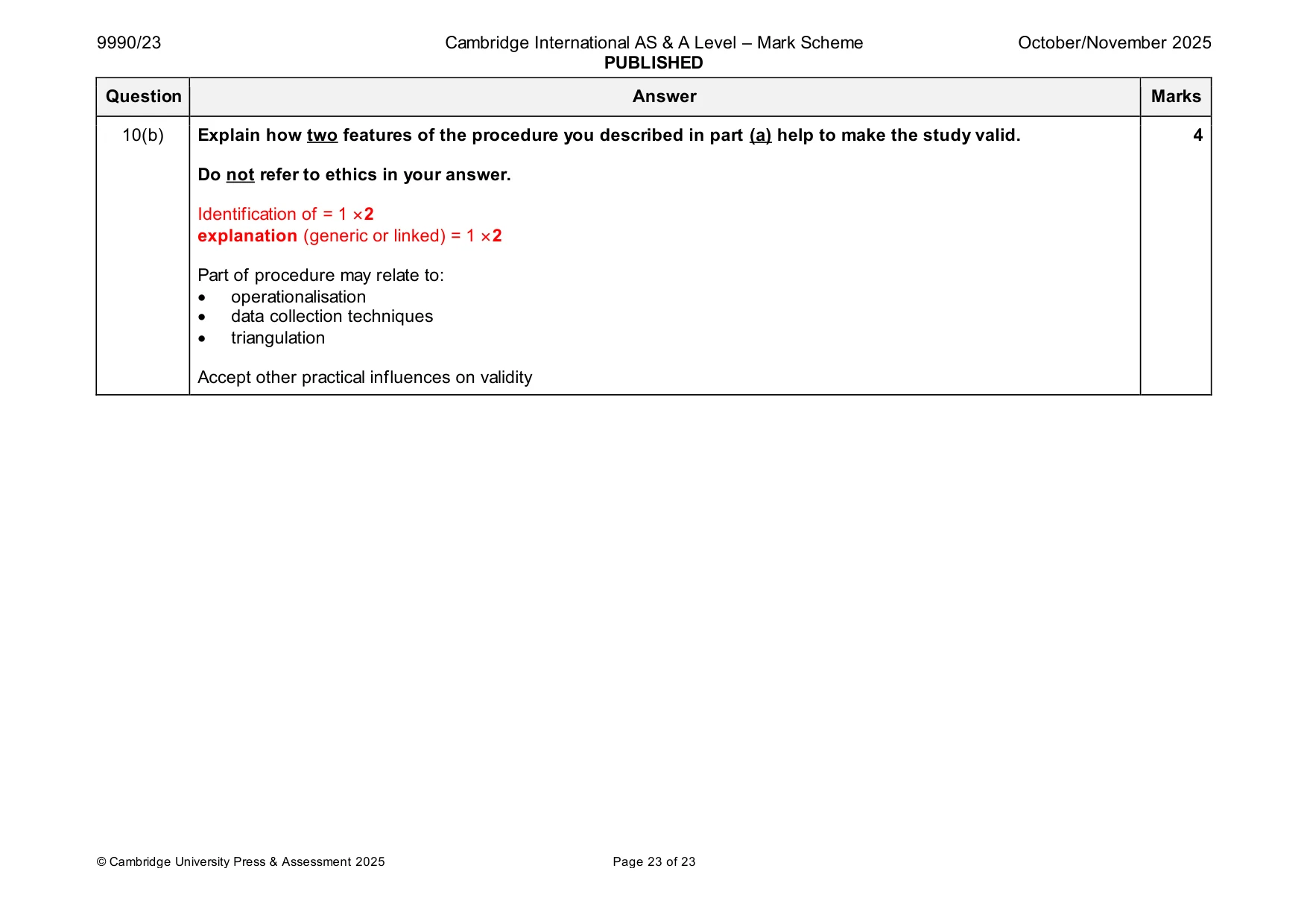
10 Liam is a young man who is unusually good at focussing his attention on many types of stimuli, such as sights or sounds. (a) Describe how a researcher could conduct a case study to investigate Liam’s unusual ability to focus his attention. Do not describe ethical issues / guidelines in your answer. ................................................................................................................................................... ................................................................................................................................................... ................................................................................................................................................... ................................................................................................................................................... ................................................................................................................................................... ................................................................................................................................................... ................................................................................................................................................... ................................................................................................................................................... ................................................................................................................................................... ................................................................................................................................................... ................................................................................................................................................... ................................................................................................................................................... ................................................................................................................................................... ................................................................................................................................................... ................................................................................................................................................... ................................................................................................................................................... ................................................................................................................................................... ................................................................................................................................................... ................................................................................................................................................... ........................................................................................................................................... [10] (b) Explain how two features of the procedure you described in part (a) help to make the study valid. Do not refer to ethics in your answer. ................................................................................................................................................... ................................................................................................................................................... ................................................................................................................................................... ................................................................................................................................................... ................................................................................................................................................... ................................................................................................................................................... ................................................................................................................................................... ............................................................................................................................................. [4]
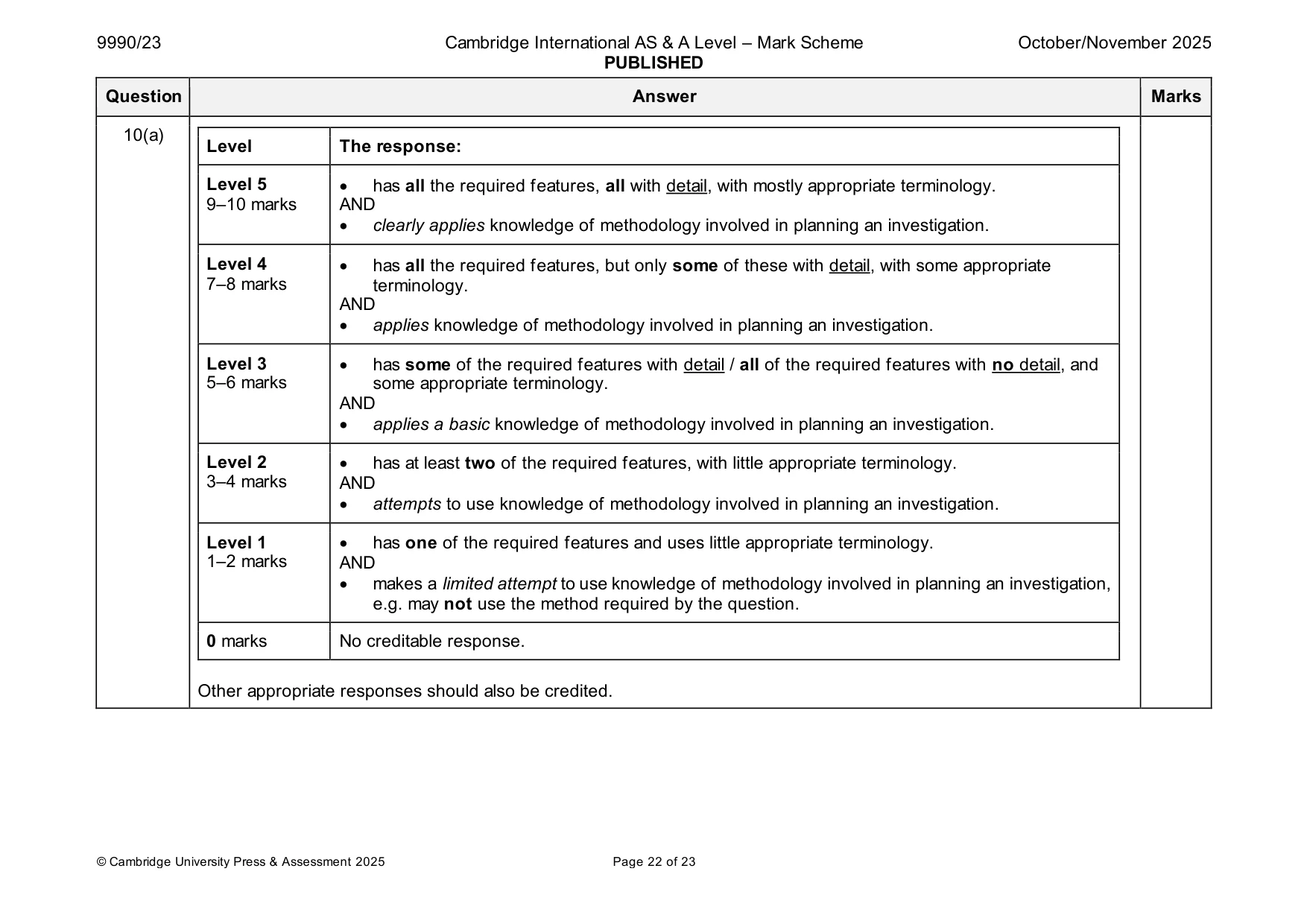
Mark scheme: 10 Liam is a young man who is unusually good at focussing his attention on many types of stimuli, such as sights or sounds. 10(a) Describe how a researcher could conduct a case study to investigate Liam’s unusual ability to focus his attention. 10 Do not describe ethical issues / guidelines in your answer. To mark Q10(a), create four ‘imaginary columns’ down one margin, using one column for each of the four required features. Tick each feature (tick-a, tick-b, tick-c, tick-d) when it appears, then underline the letter ( ) for detail. Use L1, L2, L3, L4, L5 at the end of the response to indicate the level. Use the table below to mark candidate responses to this question. The four required features for this case study are: (a) details about the participant / unit (exceptional attention, male, age, how found, other info e.g. from parents, teachers/coworkers) (b) content of information collected: (e.g. depth/detail: e.g. attention span (time), associated with different stimuli, effect of boredom etc.) (c) two or more techniques for data collection (observation, interview him, interview parents/teachers/coworkers – at least two) (d) analysis / interpretation / triangulation: (description of how data used: qualitative and/or quantitative) Other appropriate responses should also be credited. 10(a) Level The response: Level 5 • has all the required features, all with detail, with mostly appropriate terminology. 9–10 marks AND • clearly applies knowledge of methodology involved in planning an investigation. Level 4 • has all the required features, but only some of these with detail, with some appropriate 7–8 marks terminology. AND • applies knowledge of methodology involved in planning an investigation. Level 3 • has some of the required features with detail / all of the required features with no detail, and 5–6 marks some appropriate terminology. AND • applies a basic knowledge of methodology involved in planning an investigation. Level 2 • has at least two of the required features, with little appropriate terminology. 3–4 marks AND • attempts to use knowledge of methodology involved in planning an investigation. Level 1 • has one of the required features and uses little appropriate terminology. 1–2 marks AND • makes a limited attempt to use knowledge of methodology involved in planning an investigation, e.g. may not use the method required by the question. 0 marks No creditable response. Other appropriate responses should also be credited. 10(b) Explain how two features of the procedure you described in part (a) help to make the study valid. 4 Do not refer to ethics in your answer. Identification of = 1 2 explanation (generic or linked) = 1 2 Part of procedure may relate to: • operationalisation • data collection techniques • triangulation Accept other practical influences on validity
What was in this paper
The subtopics covered by these 10 questions, and how many questions each got. Open one in a new tab to see every Cambridge question on it.