Cambridge A Level Psychology (from 2018) 9990 — 2024 May/June Paper 2 · Variant 3
9990/23/M/J/24 · 10 questions · 60 marks · 90 min
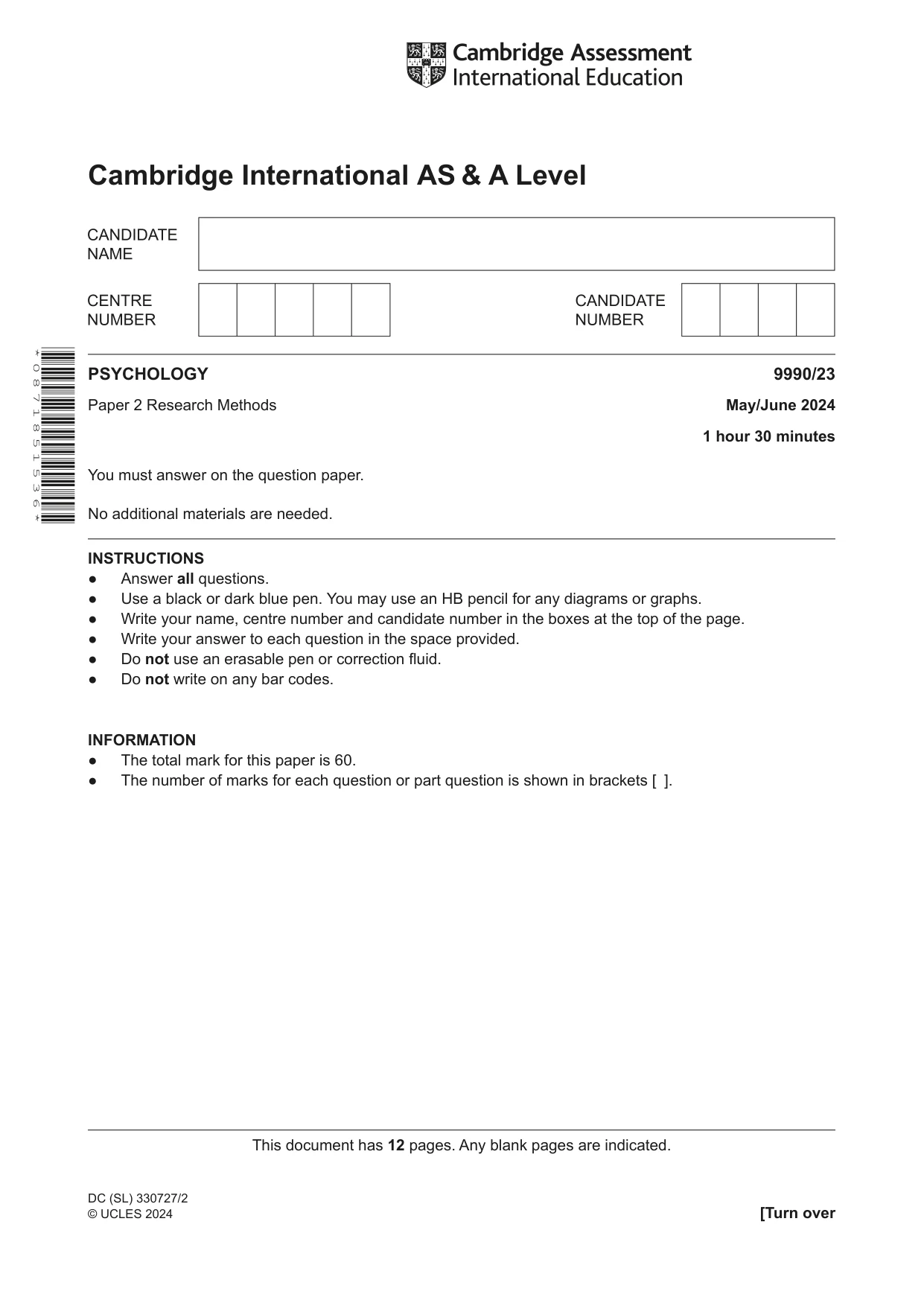
The question paper and its mark scheme, free to read here and free to download. This is Cambridge’s own paper, exactly as it was sat.
Question paper12 pages



Mark scheme20 pages
Answers below. Sit the paper first if you are practising.
Questions as text
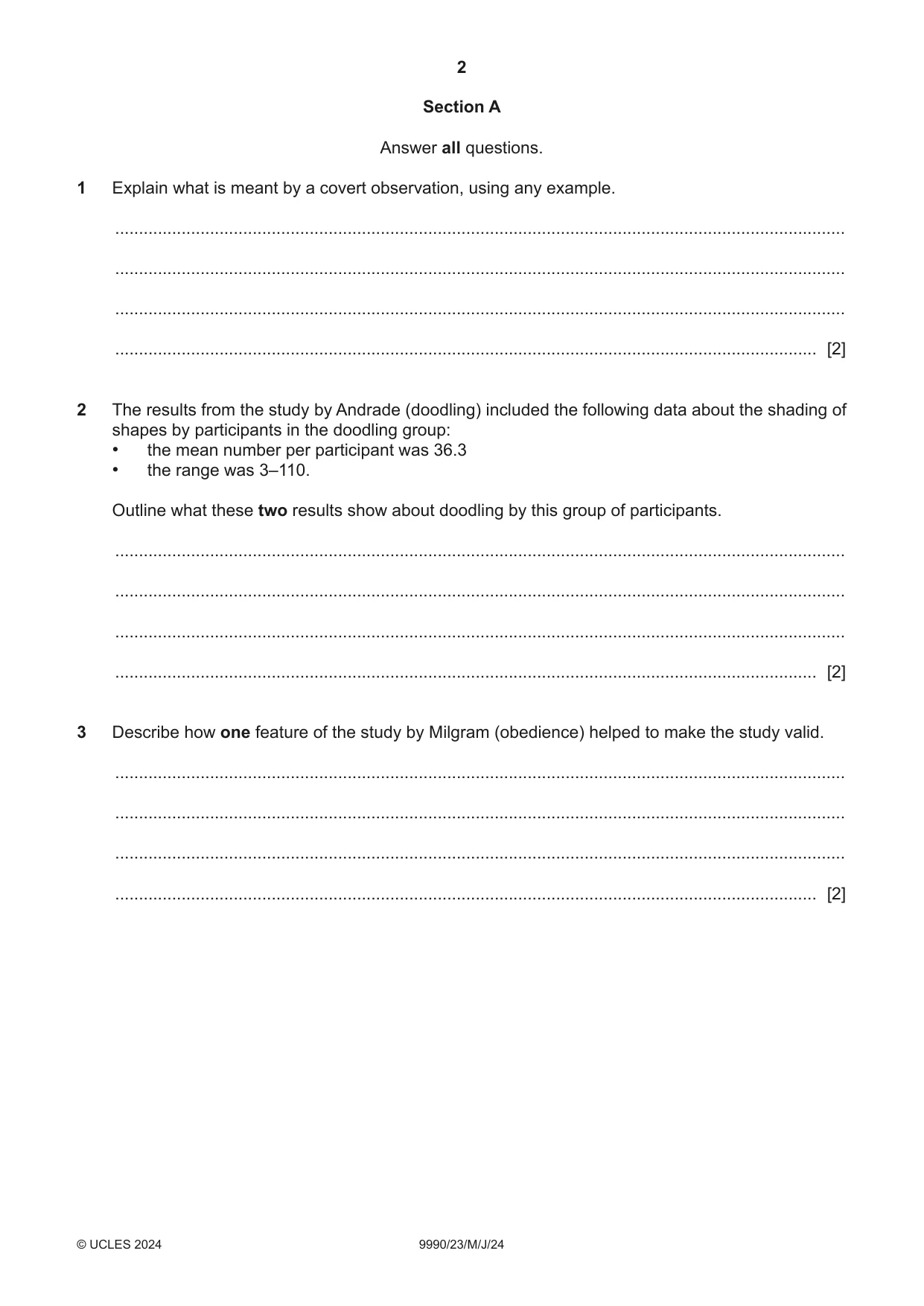
Q1 · Explain what is meant by a covert observation, using any example
1 Explain what is meant by a covert observation, using any example. .......................................................................................................................................................... .......................................................................................................................................................... .......................................................................................................................................................... .................................................................................................................................................... [2]
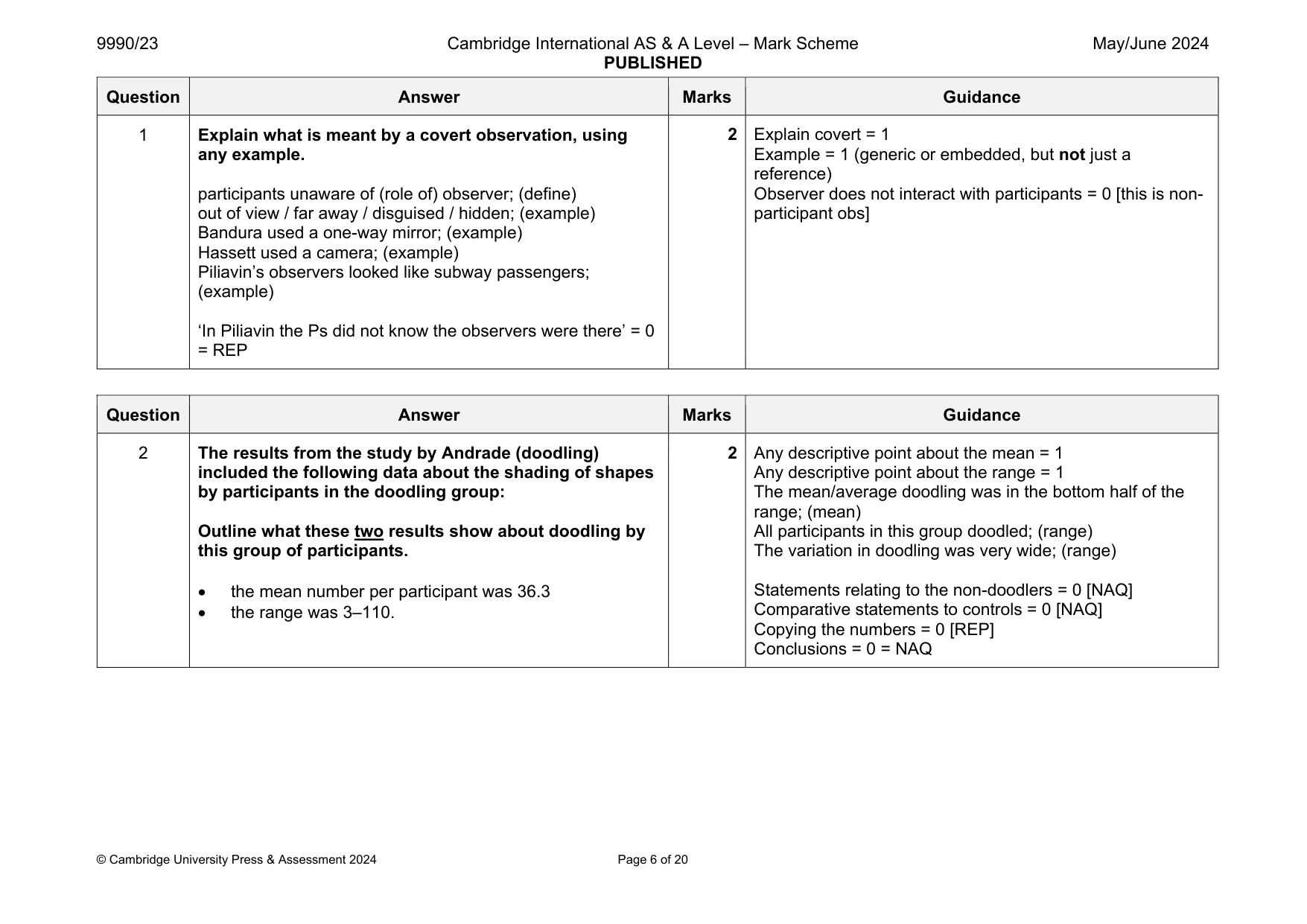
Mark scheme: 1 Explain what is meant by a covert observation, using any example. participants unaware of (role of) observer; (define) out of view / far away / disguised / hidden; (example) Bandura used a one-way mirror; (example) Hassett used a camera; (example) Piliavin’s observers looked like subway passengers; (example) ‘In Piliavin the Ps did not know the observers were there’ = 0 = REP Example = 1 (generic or embedded, but not just a reference) Observer does not interact with participants = 0 [this is non- participant obs]
Q2 · The results from the study by Andrade (doodling) included the following data about the…
2 The results from the study by Andrade (doodling) included the following data about the shading of shapes by participants in the doodling group: • the mean number per participant was 36.3 • the range was 3–110. Outline what these two results show about doodling by this group of participants. .......................................................................................................................................................... .......................................................................................................................................................... .......................................................................................................................................................... .................................................................................................................................................... [2]
Mark scheme: 2 The results from the study by Andrade (doodling) included the following data about the shading of shapes by participants in the doodling group: Outline what these two results show about doodling by this group of participants. the mean number per participant was 36.3 the range was 3–110. 2 Any descriptive point about the mean = 1 Any descriptive point about the range = 1 The mean/average doodling was in the bottom half of the range; (mean) All participants in this group doodled; (range) The variation in doodling was very wide; (range) Statements relating to the non-doodlers = 0 [NAQ] Comparative statements to controls = 0 [NAQ] Copying the numbers = 0 [REP] Conclusions = 0 = NAQ
Q3 · Describe how one feature of the study by Milgram (obedience) helped to make the study…
3 Describe how one feature of the study by Milgram (obedience) helped to make the study valid. .......................................................................................................................................................... .......................................................................................................................................................... .......................................................................................................................................................... .................................................................................................................................................... [2]
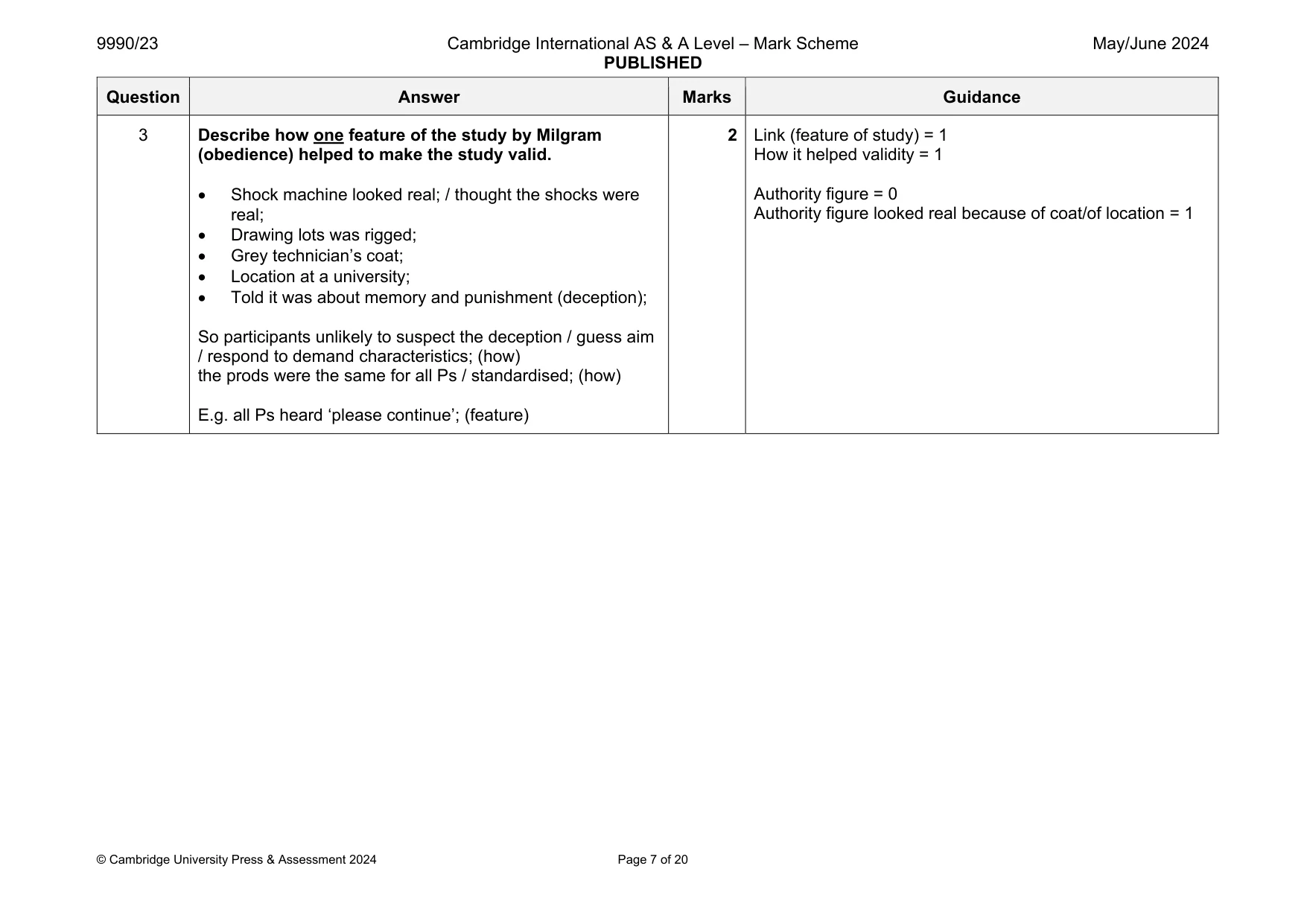
Mark scheme: 3 Describe how one feature of the study by Milgram (obedience) helped to make the study valid. Shock machine looked real; / thought the shocks were real; Drawing lots was rigged; Grey technician’s coat; Location at a university; Told it was about memory and punishment (deception); So participants unlikely to suspect the deception / guess aim / respond to demand characteristics; (how) the prods were the same for all Ps / standardised; (how) E.g. all Ps heard ‘please continue’; (feature) 2 Link (feature of study) = 1 How it helped validity = 1 Authority figure = 0 Authority figure looked real because of coat/of location = 1
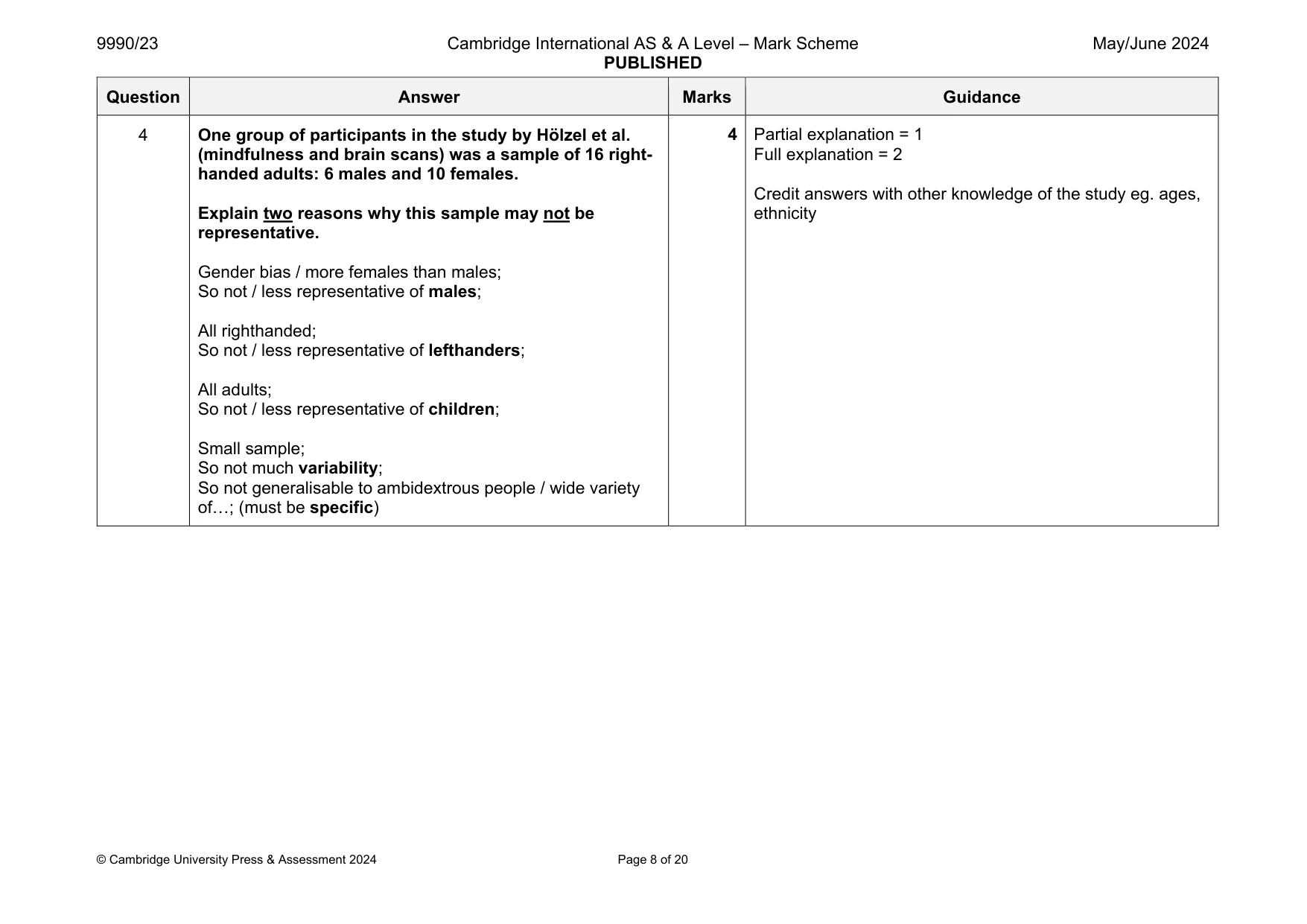
Q4 · One group of participants in the study by Hölzel et al
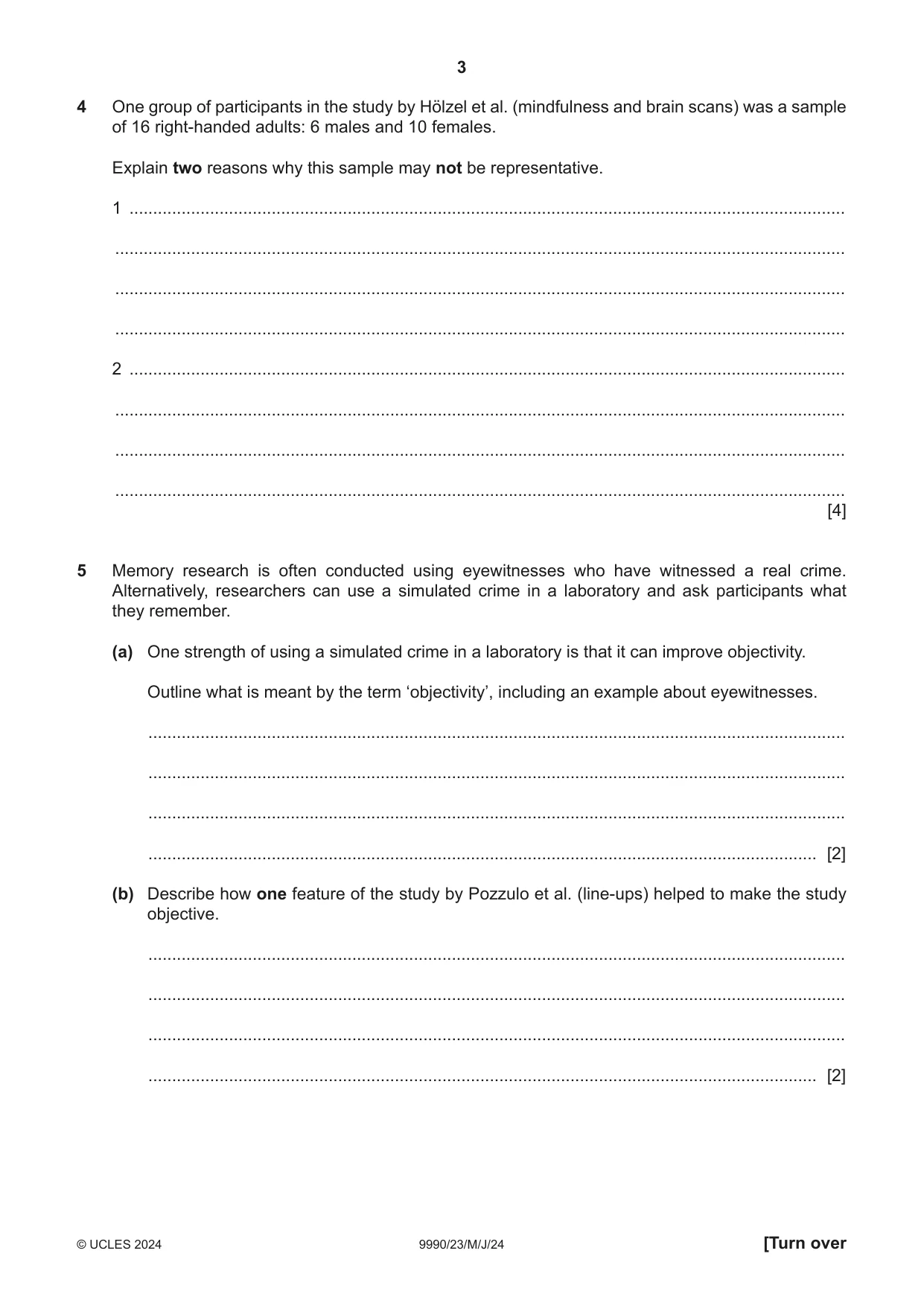
4 One group of participants in the study by Hölzel et al. (mindfulness and brain scans) was a sample of 16 right-handed adults: 6 males and 10 females. Explain two reasons why this sample may not be representative. 1 ....................................................................................................................................................... .......................................................................................................................................................... .......................................................................................................................................................... .......................................................................................................................................................... 2 ....................................................................................................................................................... .......................................................................................................................................................... .......................................................................................................................................................... .......................................................................................................................................................... [4]
Mark scheme: 4 One group of participants in the study by Hölzel et al. (mindfulness and brain scans) was a sample of 16 right- handed adults: 6 males and 10 females. Explain two reasons why this sample may not be representative. Gender bias / more females than males; So not / less representative of males; All righthanded; So not / less representative of lefthanders; All adults; So not / less representative of children; Small sample; So not much variability; So not generalisable to ambidextrous people / wide variety of…; (must be specific) Full explanation = 2 Credit answers with other knowledge of the study eg. ages, ethnicity
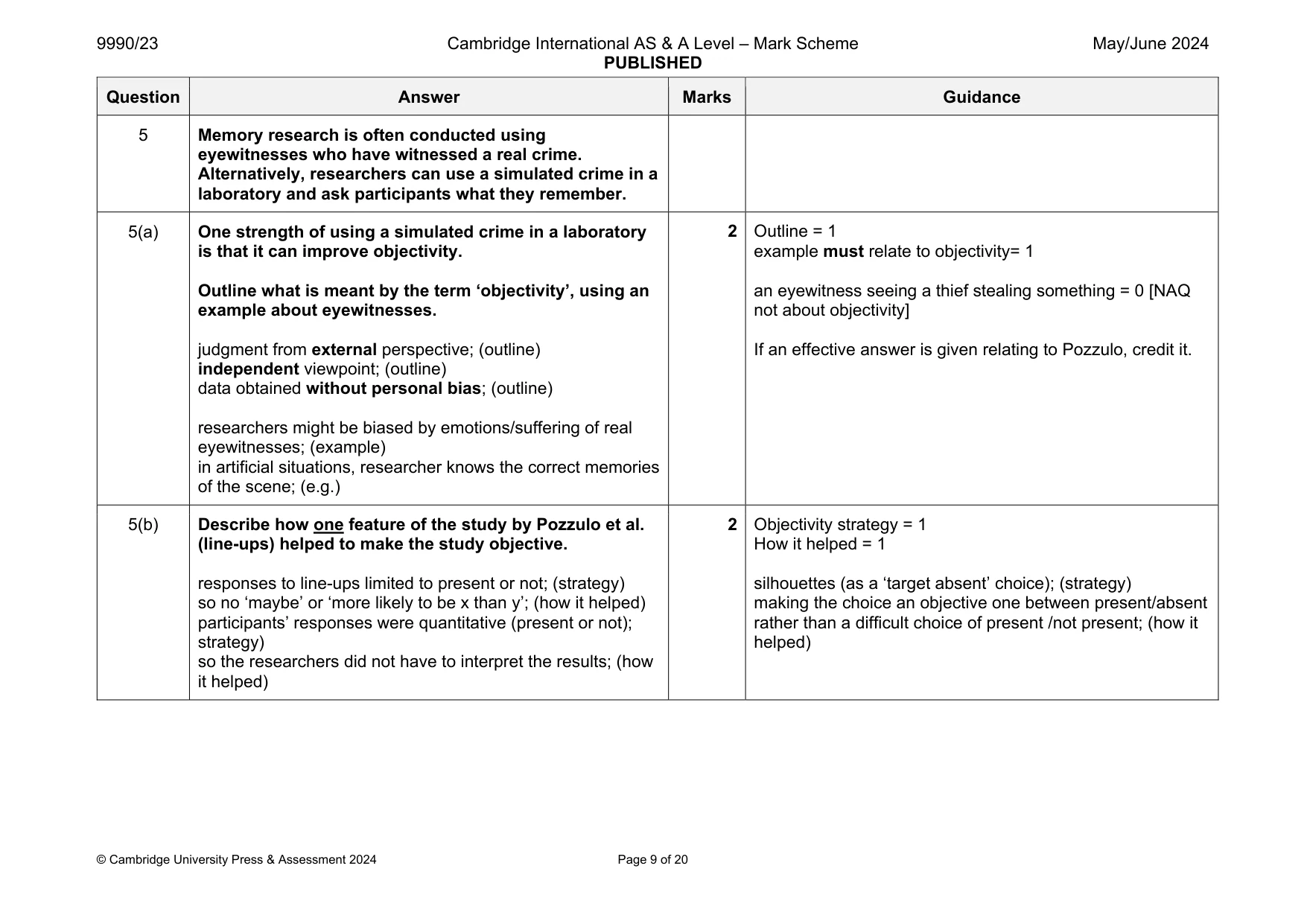
Q5 · Memory research is often conducted using eyewitnesses who have witnessed a real crime
5 Memory research is often conducted using eyewitnesses who have witnessed a real crime. Alternatively, researchers can use a simulated crime in a laboratory and ask participants what they remember. (a) One strength of using a simulated crime in a laboratory is that it can improve objectivity. Outline what is meant by the term ‘objectivity’, including an example about eyewitnesses. ................................................................................................................................................... ................................................................................................................................................... ................................................................................................................................................... ............................................................................................................................................. [2] (b) Describe how one feature of the study by Pozzulo et al. (line-ups) helped to make the study objective. ................................................................................................................................................... ................................................................................................................................................... ................................................................................................................................................... ............................................................................................................................................. [2]
Mark scheme: 5 Memory research is often conducted using eyewitnesses who have witnessed a real crime. Alternatively, researchers can use a simulated crime in a laboratory and ask participants what they remember. 5(a) One strength of using a simulated crime in a laboratory is that it can improve objectivity. Outline what is meant by the term ‘objectivity’, using an example about eyewitnesses. judgment from external perspective; (outline) independent viewpoint; (outline) data obtained without personal bias; (outline) researchers might be biased by emotions/suffering of real eyewitnesses; (example) in artificial situations, researcher knows the correct memories of the scene; (e.g.) 2 Outline = 1 example must relate to objectivity= 1 an eyewitness seeing a thief stealing something = 0 [NAQ not about objectivity] If an effective answer is given relating to Pozzulo, credit it. 5(b) Describe how one feature of the study by Pozzulo et al. (line-ups) helped to make the study objective. responses to line-ups limited to present or not; (strategy) so no ‘maybe’ or ‘more likely to be x than y’; (how it helped) participants’ responses were quantitative (present or not); strategy) so the researchers did not have to interpret the results; (how it helped) 2 Objectivity strategy = 1 How it helped = 1 silhouettes (as a ‘target absent’ choice); (strategy) making the choice an objective one between present/absent rather than a difficult choice of present /not present; (how it helped)
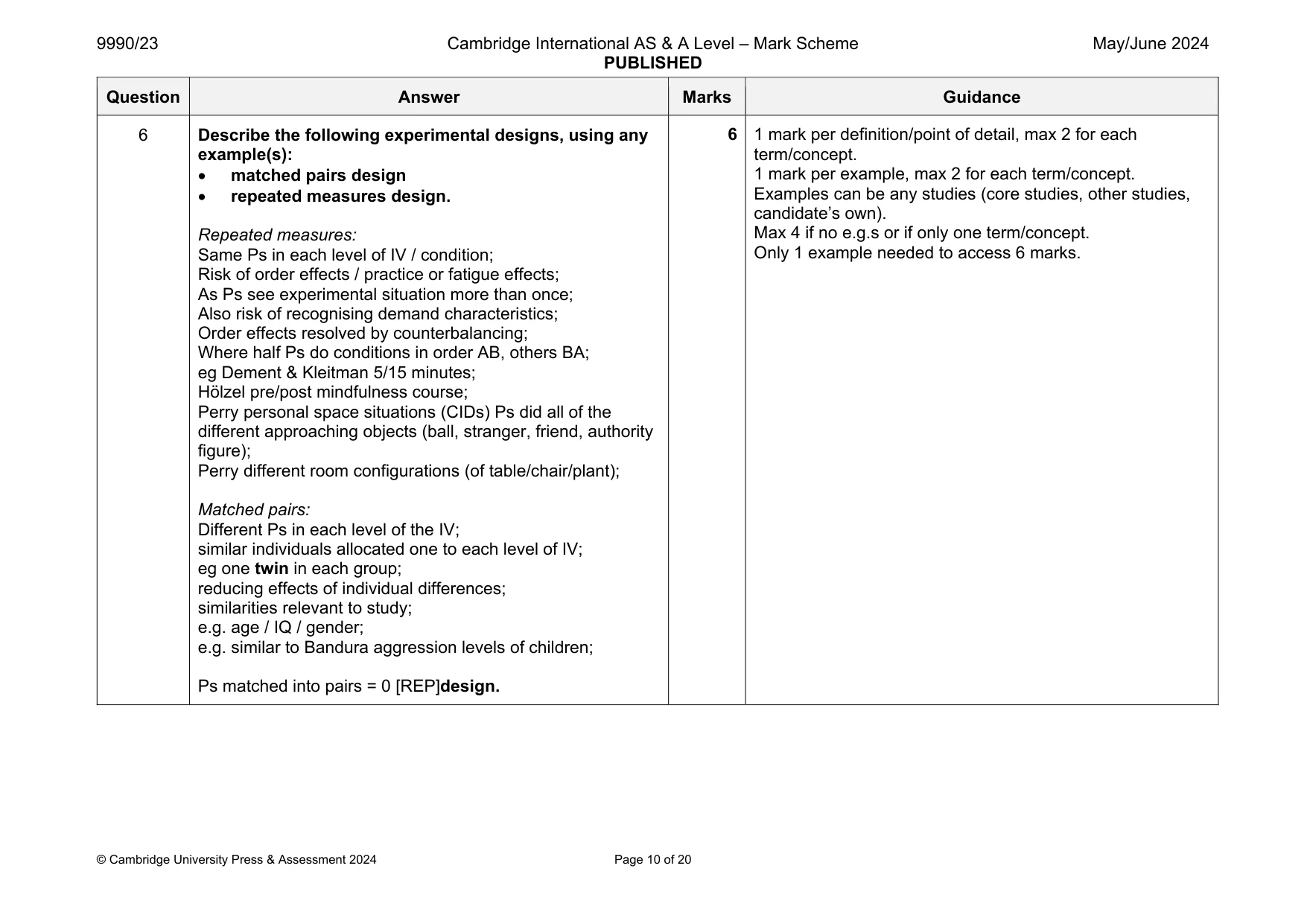
Q6 · Describe the following experimental designs, using any example(s): • matched pairs design…
6 Describe the following experimental designs, using any example(s): • matched pairs design • repeated measures design. .......................................................................................................................................................... .......................................................................................................................................................... .......................................................................................................................................................... .......................................................................................................................................................... .......................................................................................................................................................... .......................................................................................................................................................... .......................................................................................................................................................... .......................................................................................................................................................... .......................................................................................................................................................... .......................................................................................................................................................... .......................................................................................................................................................... .................................................................................................................................................... [6]
Mark scheme: 6 Describe the following experimental designs, using any example(s): matched pairs design repeated measures design. Repeated measures: Same Ps in each level of IV / condition; Risk of order effects / practice or fatigue effects; As Ps see experimental situation more than once; Also risk of recognising demand characteristics; Order effects resolved by counterbalancing; Where half Ps do conditions in order AB, others BA; eg Dement & Kleitman 5/15 minutes; Hölzel pre/post mindfulness course; Perry personal space situations (CIDs) Ps did all of the different approaching objects (ball, stranger, friend, authority figure); Perry different room configurations (of table/chair/plant); Matched pairs: Different Ps in each level of the IV; similar individuals allocated one to each level of IV; eg one twin in each group; reducing effects of individual differences; similarities relevant to study; e.g. age / IQ / gender; e.g. similar to Bandura aggression levels of children; Ps matched into pairs = 0 [REP]design. term/concept. 1 mark per example, max 2 for each term/concept. Examples can be any studies (core studies, other studies, candidate’s own). Max 4 if no e.g.s or if only one term/concept. Only 1 example needed to access 6 marks.
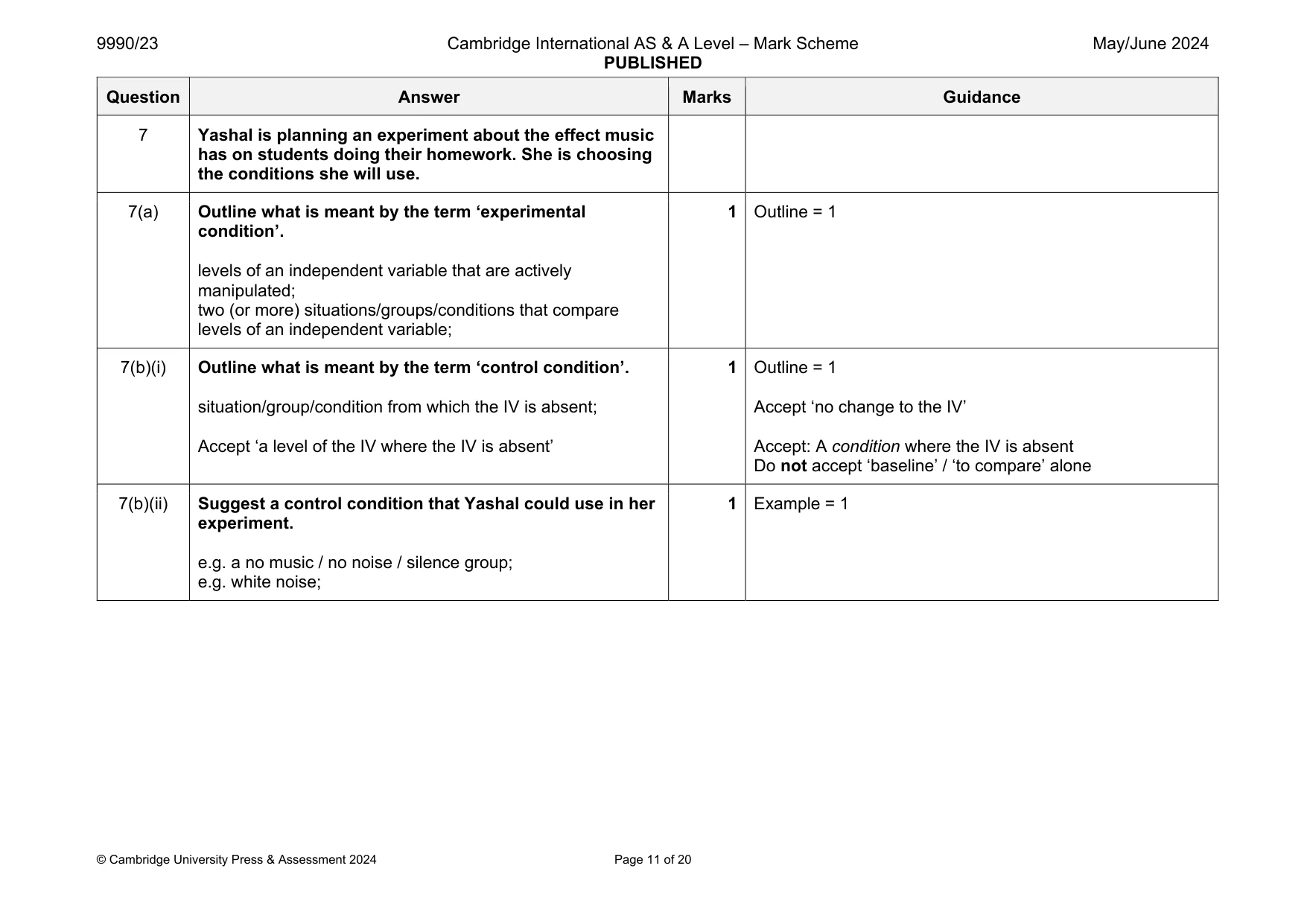
Q7 · Yashal is planning an experiment about the effect music has on students doing their…
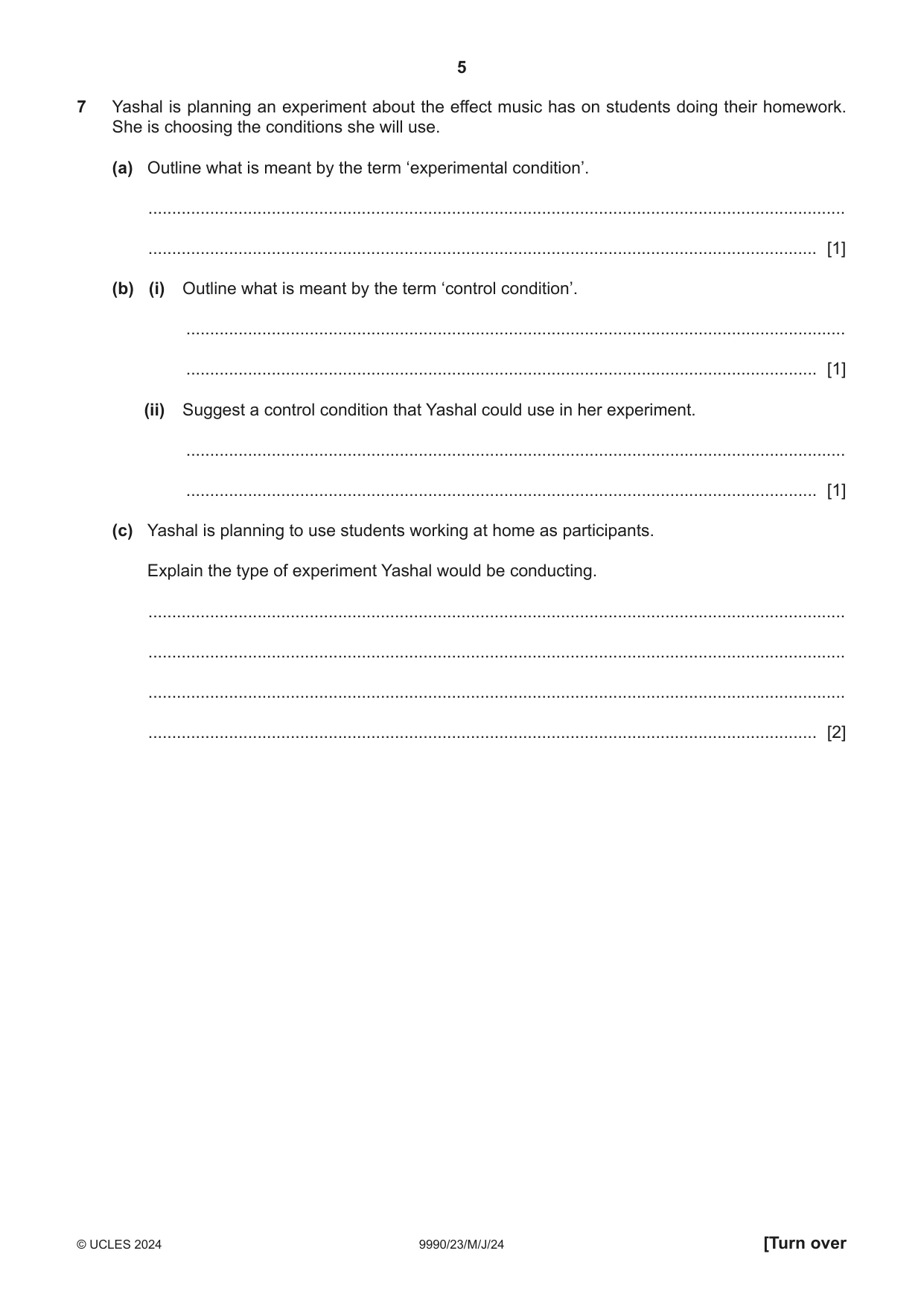
7 Yashal is planning an experiment about the effect music has on students doing their homework. She is choosing the conditions she will use. (a) Outline what is meant by the term ‘experimental condition’. ................................................................................................................................................... ............................................................................................................................................. [1] (b) (i) Outline what is meant by the term ‘control condition’. ........................................................................................................................................... ..................................................................................................................................... [1] (ii) Suggest a control condition that Yashal could use in her experiment. ........................................................................................................................................... ..................................................................................................................................... [1] (c) Yashal is planning to use students working at home as participants. Explain the type of experiment Yashal would be conducting. ................................................................................................................................................... ................................................................................................................................................... ................................................................................................................................................... ............................................................................................................................................. [2]
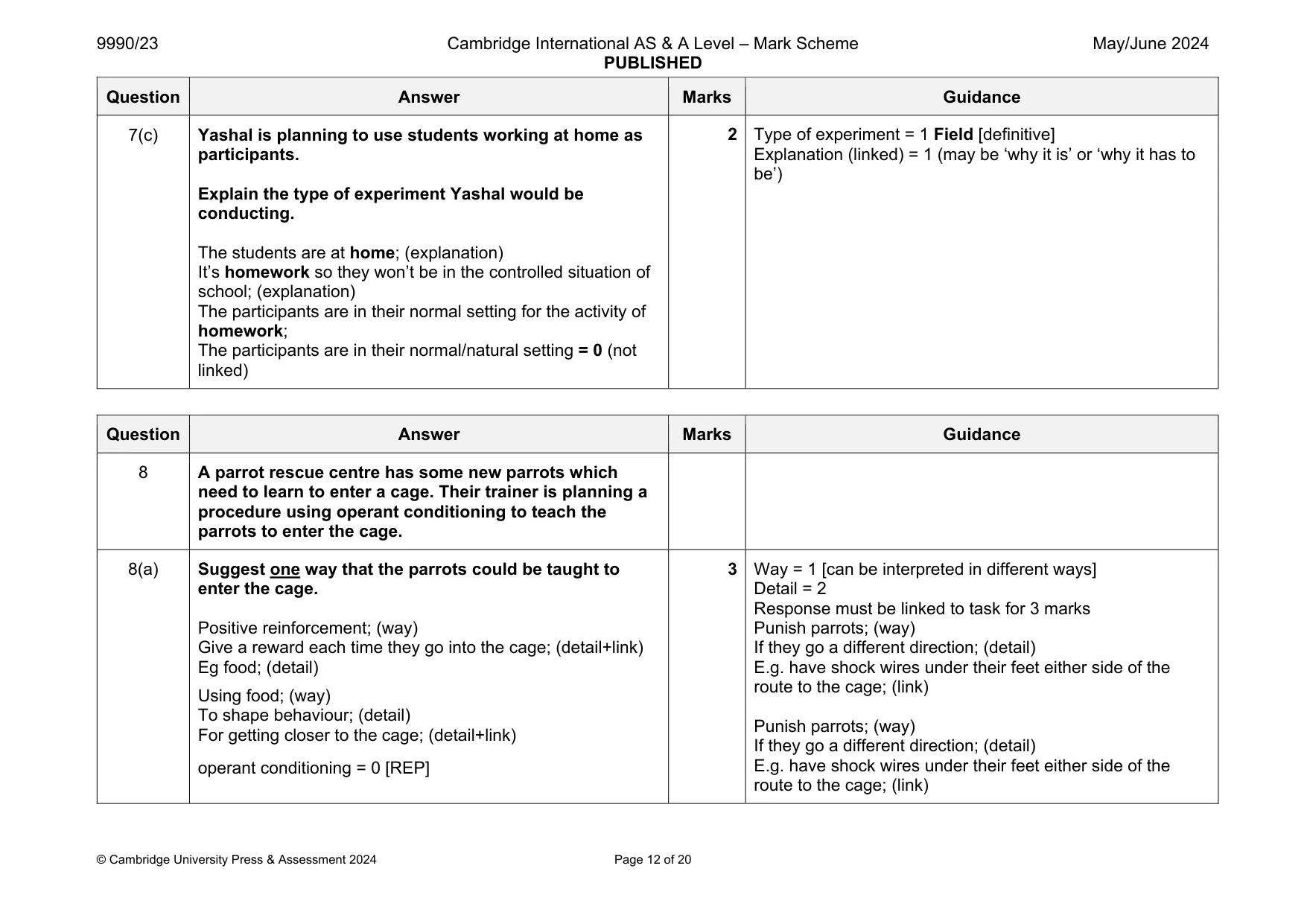
Mark scheme: 7 Yashal is planning an experiment about the effect music has on students doing their homework. She is choosing the conditions she will use. 7(a) Outline what is meant by the term ‘experimental condition’. levels of an independent variable that are actively manipulated; two (or more) situations/groups/conditions that compare levels of an independent variable; 1 Outline = 1 7(b)(i) Outline what is meant by the term ‘control condition’. situation/group/condition from which the IV is absent; Accept ‘a level of the IV where the IV is absent’ 1 Outline = 1 Accept ‘no change to the IV’ Accept: A condition where the IV is absent Do not accept ‘baseline’ / ‘to compare’ alone 7(b)(ii) Suggest a control condition that Yashal could use in her experiment. e.g. a no music / no noise / silence group; e.g. white noise; 1 Example = 1 Question Answer Marks Guidance 7(c) Yashal is planning to use students working at home as participants. Explain the type of experiment Yashal would be conducting. The students are at home; (explanation) It’s homework so they won’t be in the controlled situation of school; (explanation) The participants are in their normal setting for the activity of homework; The participants are in their normal/natural setting = 0 (not linked) 2 Type of experiment = 1 Field [definitive] Explanation (linked) = 1 (may be ‘why it is’ or ‘why it has to be’)
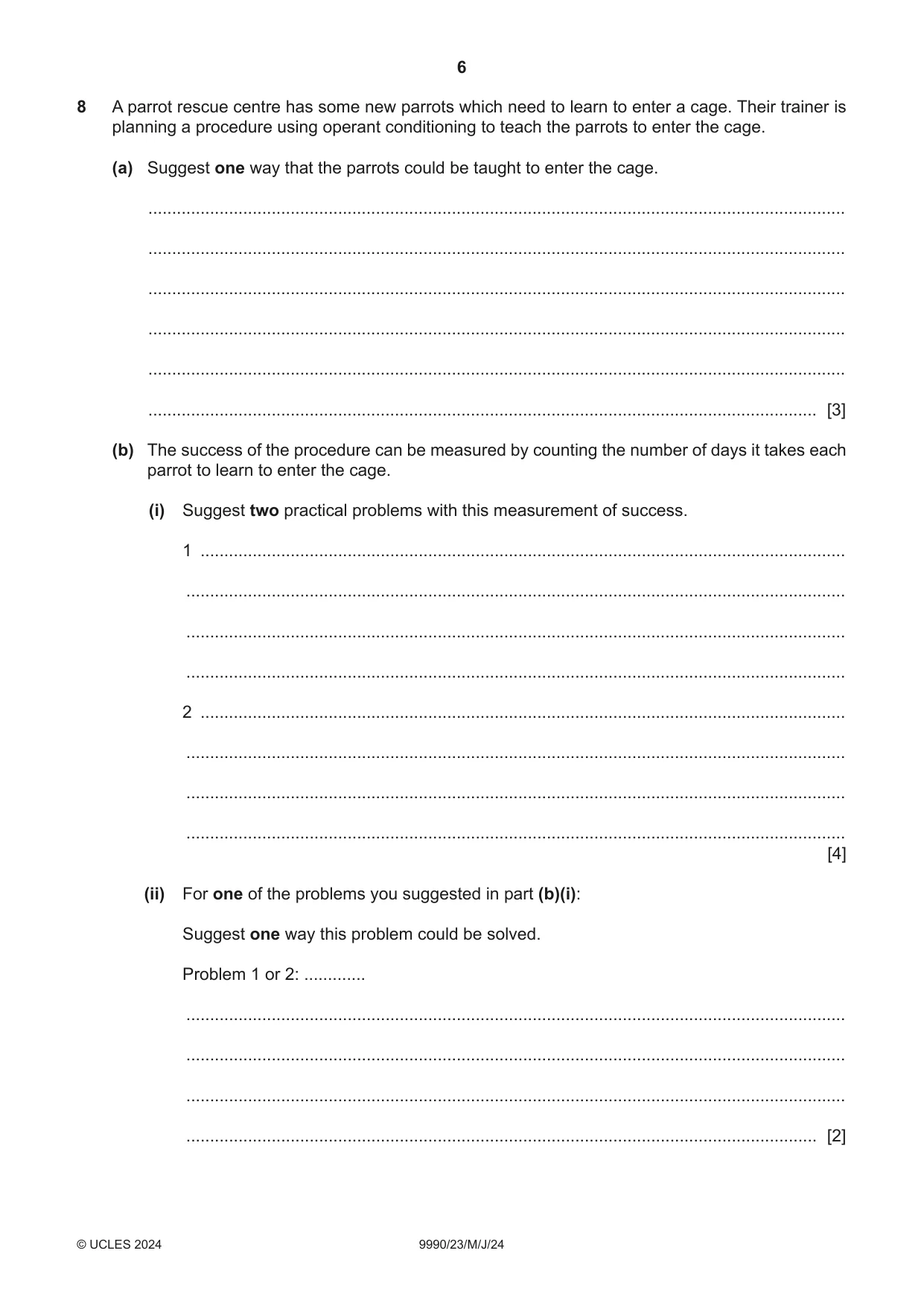
Q8 · A parrot rescue centre has some new parrots which need to learn to enter a cage
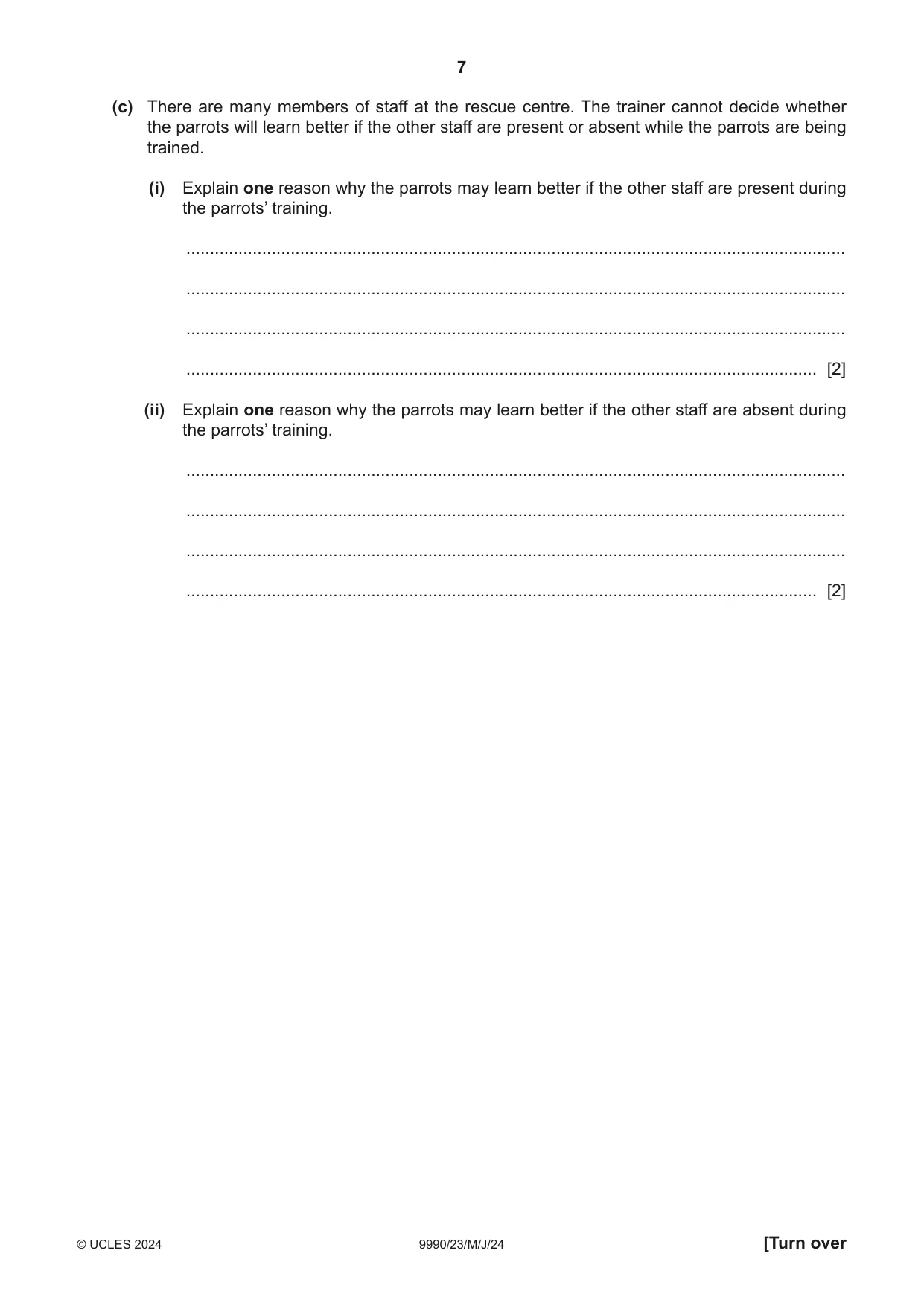
8 A parrot rescue centre has some new parrots which need to learn to enter a cage. Their trainer is planning a procedure using operant conditioning to teach the parrots to enter the cage. (a) Suggest one way that the parrots could be taught to enter the cage. ................................................................................................................................................... ................................................................................................................................................... ................................................................................................................................................... ................................................................................................................................................... ................................................................................................................................................... ............................................................................................................................................. [3] (b) The success of the procedure can be measured by counting the number of days it takes each parrot to learn to enter the cage. (i) Suggest two practical problems with this measurement of success. 1 ........................................................................................................................................ ........................................................................................................................................... ........................................................................................................................................... ........................................................................................................................................... 2 ........................................................................................................................................ ........................................................................................................................................... ........................................................................................................................................... ........................................................................................................................................... [4] (ii) For one of the problems you suggested in part (b)(i): Suggest one way this problem could be solved. Problem 1 or 2: ............. ........................................................................................................................................... ........................................................................................................................................... ........................................................................................................................................... ..................................................................................................................................... [2] (c) There are many members of staff at the rescue centre. The trainer cannot decide whether the parrots will learn better if the other staff are present or absent while the parrots are being trained. (i) Explain one reason why the parrots may learn better if the other staff are present during the parrots’ training. ........................................................................................................................................... ........................................................................................................................................... ........................................................................................................................................... ..................................................................................................................................... [2] (ii) Explain one reason why the parrots may learn better if the other staff are absent during the parrots’ training. ........................................................................................................................................... ........................................................................................................................................... ........................................................................................................................................... ..................................................................................................................................... [2]
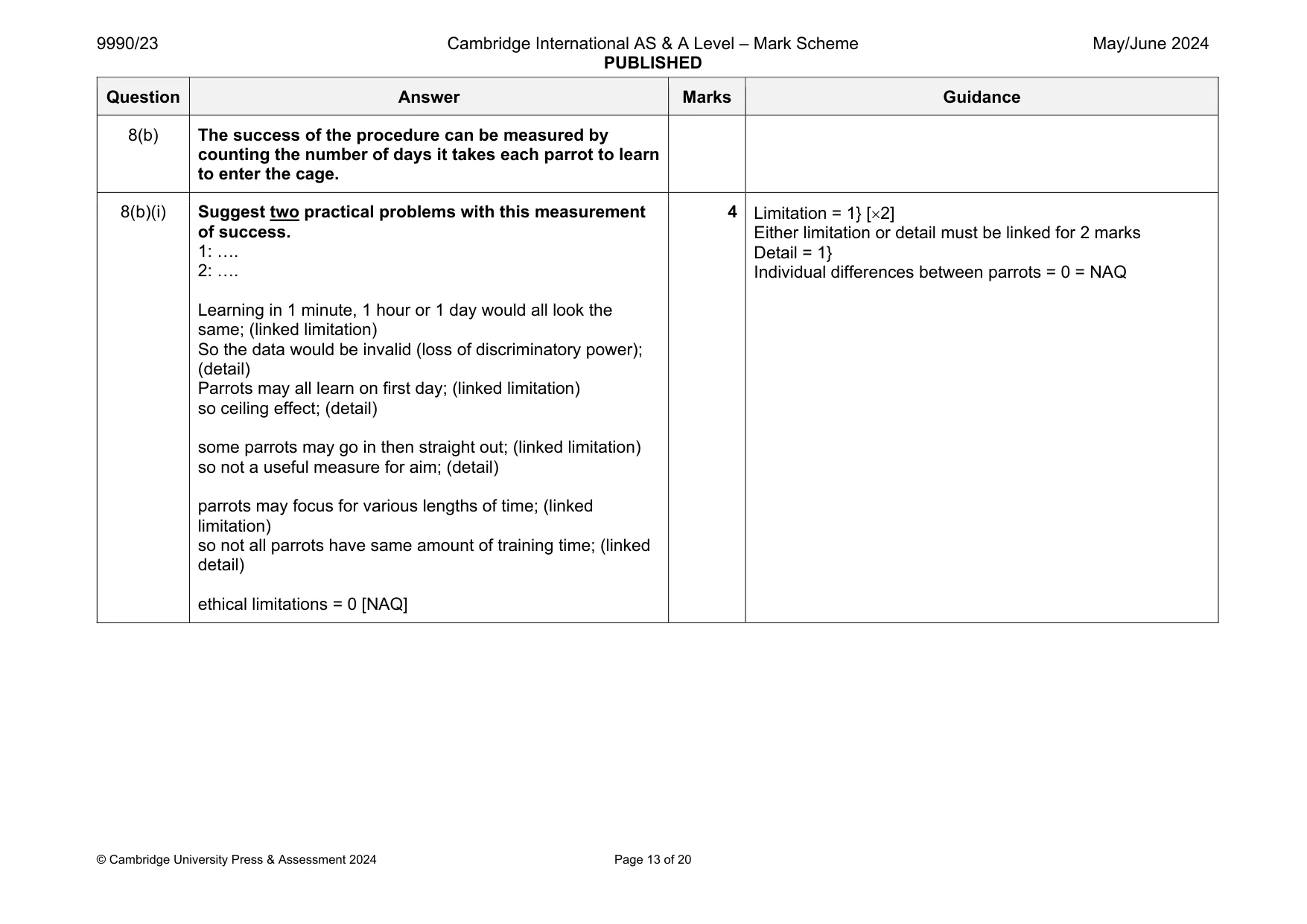
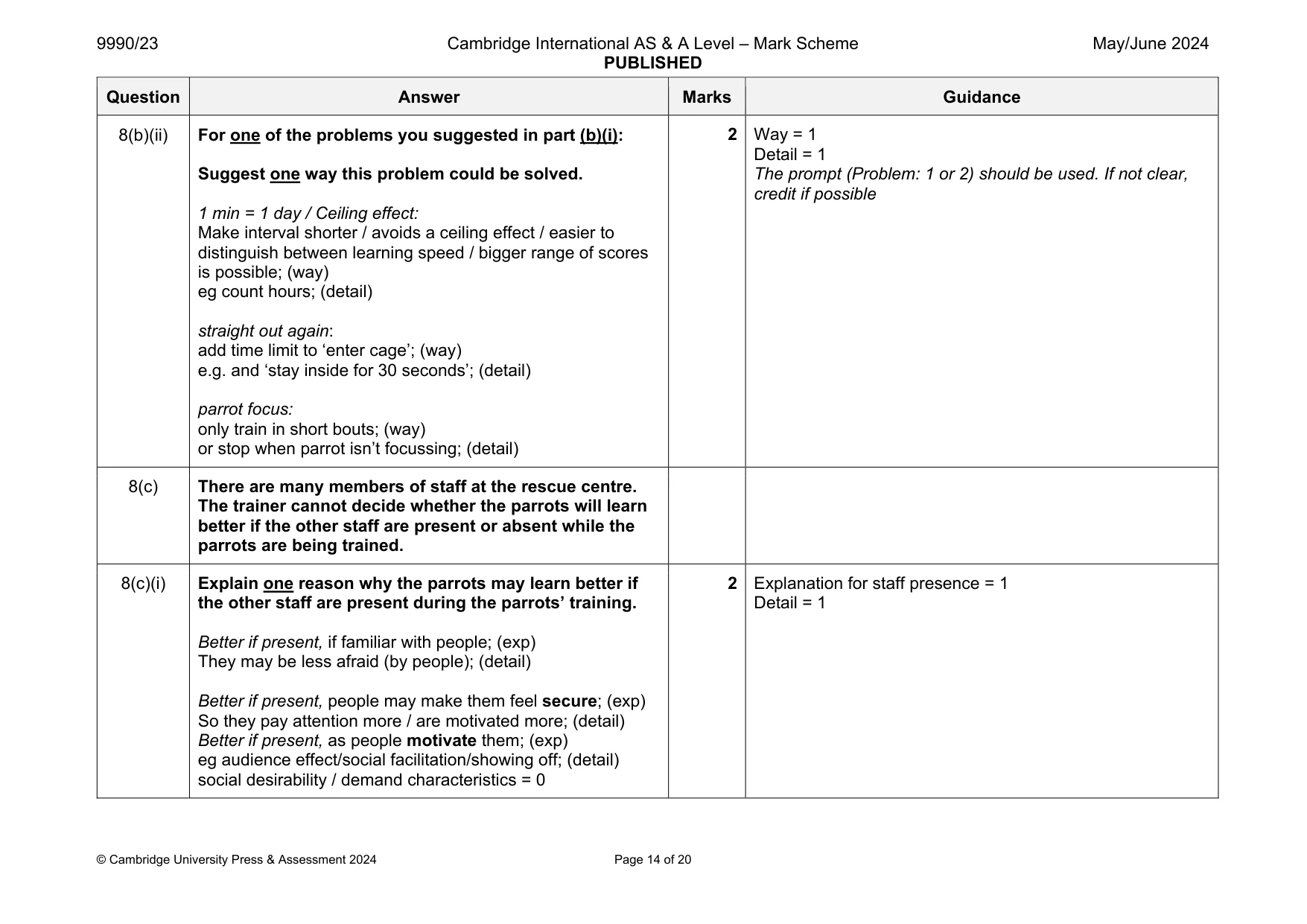
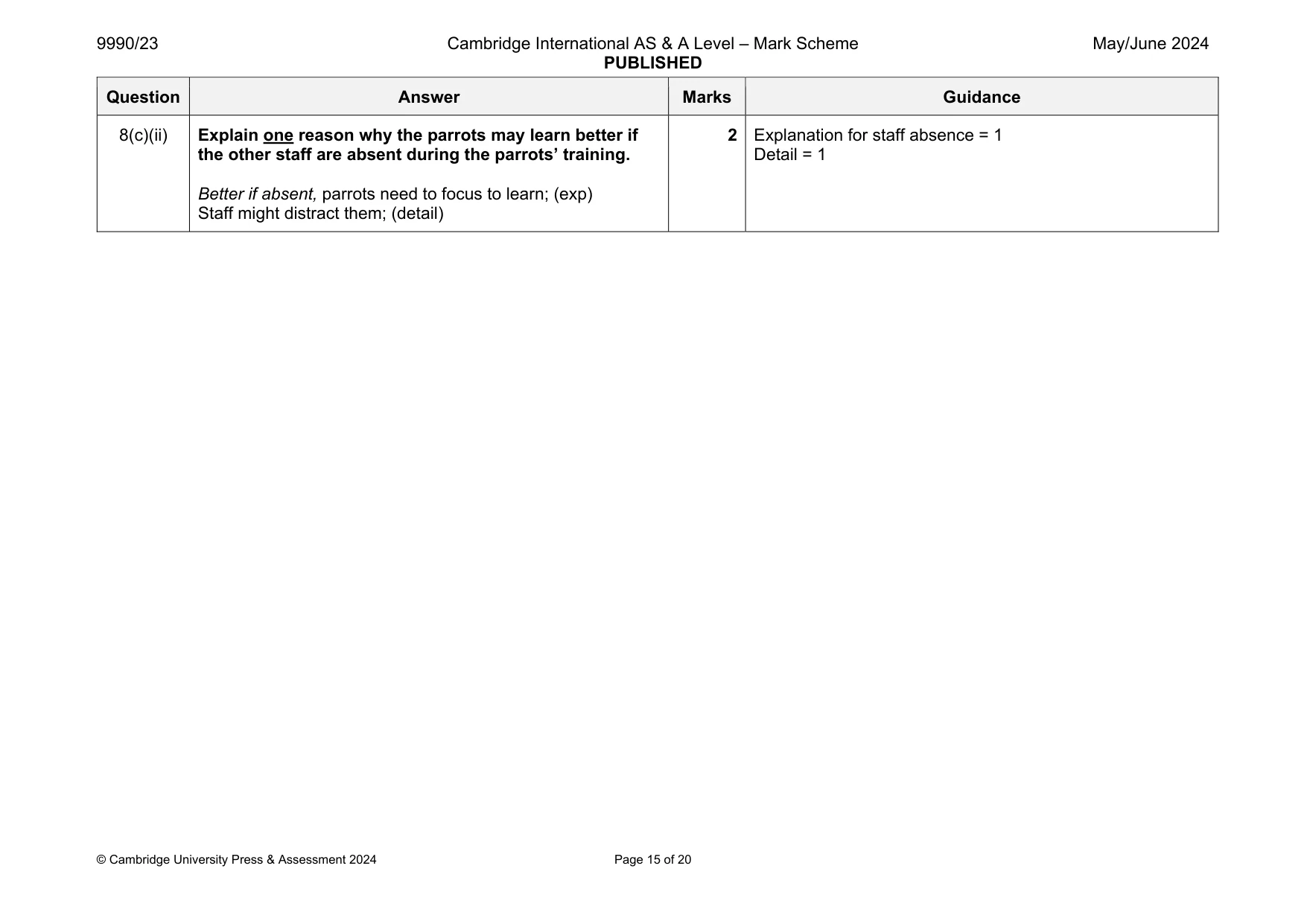
Mark scheme: 8 A parrot rescue centre has some new parrots which need to learn to enter a cage. Their trainer is planning a procedure using operant conditioning to teach the parrots to enter the cage. 8(a) Suggest one way that the parrots could be taught to enter the cage. Positive reinforcement; (way) Give a reward each time they go into the cage; (detail+link) Eg food; (detail) Using food; (way) To shape behaviour; (detail) For getting closer to the cage; (detail+link) operant conditioning = 0 [REP] 3 Way = 1 [can be interpreted in different ways] Detail = 2 Response must be linked to task for 3 marks Punish parrots; (way) If they go a different direction; (detail) E.g. have shock wires under their feet either side of the route to the cage; (link) Punish parrots; (way) If they go a different direction; (detail) E.g. have shock wires under their feet either side of the route to the cage; (link) Question Answer Marks Guidance 8(b) The success of the procedure can be measured by counting the number of days it takes each parrot to learn to enter the cage. 8(b)(i) Suggest two practical problems with this measurement of success. 1: …. 2: …. Learning in 1 minute, 1 hour or 1 day would all look the same; (linked limitation) So the data would be invalid (loss of discriminatory power); (detail) Parrots may all learn on first day; (linked limitation) so ceiling effect; (detail) some parrots may go in then straight out; (linked limitation) so not a useful measure for aim; (detail) parrots may focus for various lengths of time; (linked limitation) so not all parrots have same amount of training time; (linked detail) ethical limitations = 0 [NAQ] 4 Limitation = 1} [2] Either limitation or detail must be linked for 2 marks Detail = 1} Individual differences between parrots = 0 = NAQ Question Answer Marks Guidance 8(b)(ii) For one of the problems you suggested in part (b)(i): Suggest one way this problem could be solved. 1 min = 1 day / Ceiling effect: Make interval shorter / avoids a ceiling effect / easier to distinguish between learning speed / bigger range of scores is possible; (way) eg count hours; (detail) straight out again: add time limit to ‘enter cage’; (way) e.g. and ‘stay inside for 30 seconds’; (detail) parrot focus: only train in short bouts; (way) or stop when parrot isn’t focussing; (detail) 2 Way = 1 Detail = 1 The prompt (Problem: 1 or 2) should be used. If not clear, credit if possible 8(c) There are many members of staff at the rescue centre. The trainer cannot decide whether the parrots will learn better if the other staff are present or absent while the parrots are being trained. 8(c)(i) Explain one reason why the parrots may learn better if the other staff are present during the parrots’ training. Better if present, if familiar with people; (exp) They may be less afraid (by people); (detail) Better if present, people may make them feel secure; (exp) So they pay attention more / are motivated more; (detail) Better if present, as people motivate them; (exp) eg audience effect/social facilitation/showing off; (detail) social desirability / demand characteristics = 0 2 Explanation for staff presence = 1 Detail = 1 Question Answer Marks Guidance 8(c)(ii) Explain one reason why the parrots may learn better if the other staff are absent during the parrots’ training. Better if absent, parrots need to focus to learn; (exp) Staff might distract them; (detail) 2 Explanation for staff absence = 1 Detail = 1
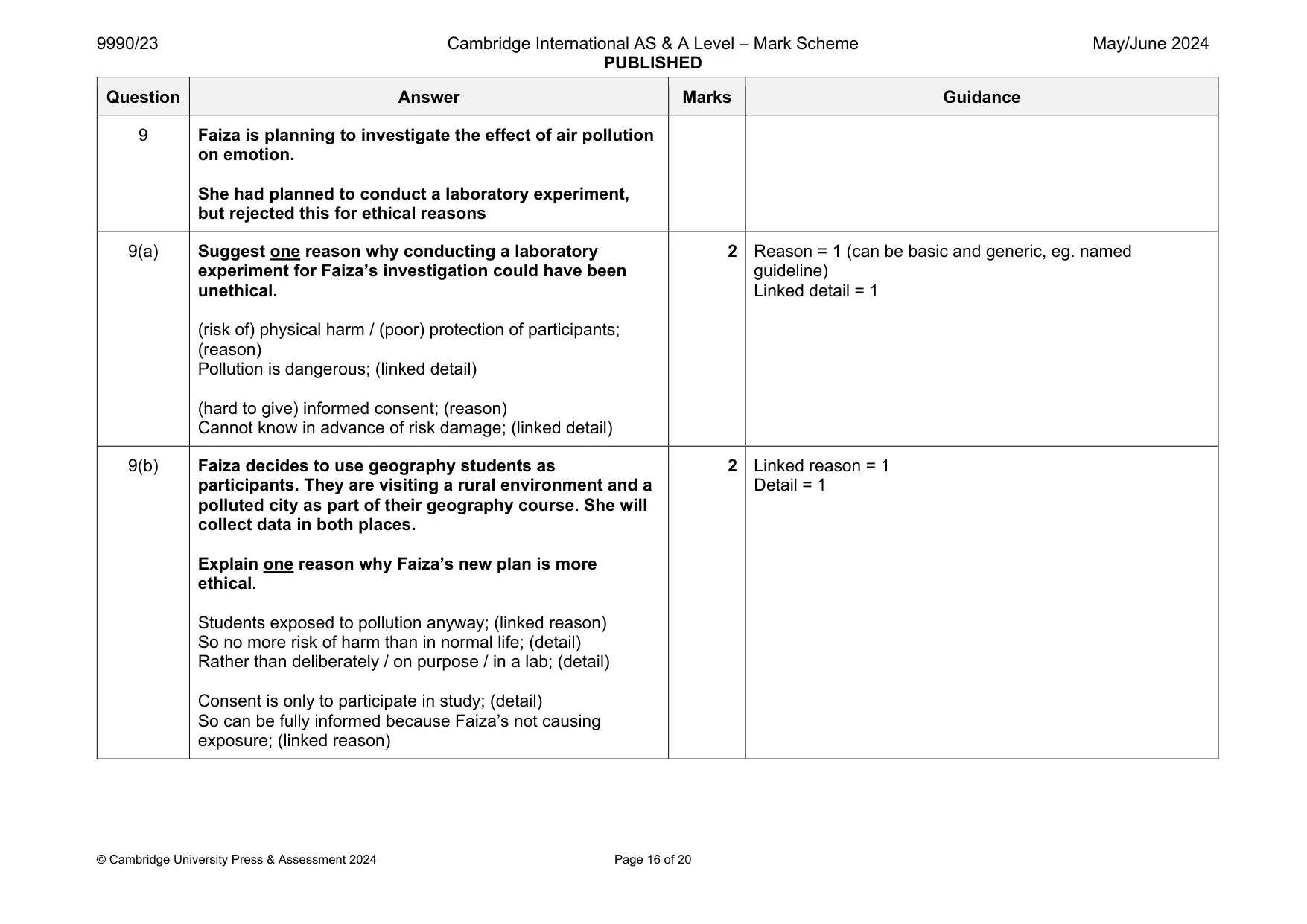
Q9 · Faiza is planning to investigate the effect of air pollution on emotion
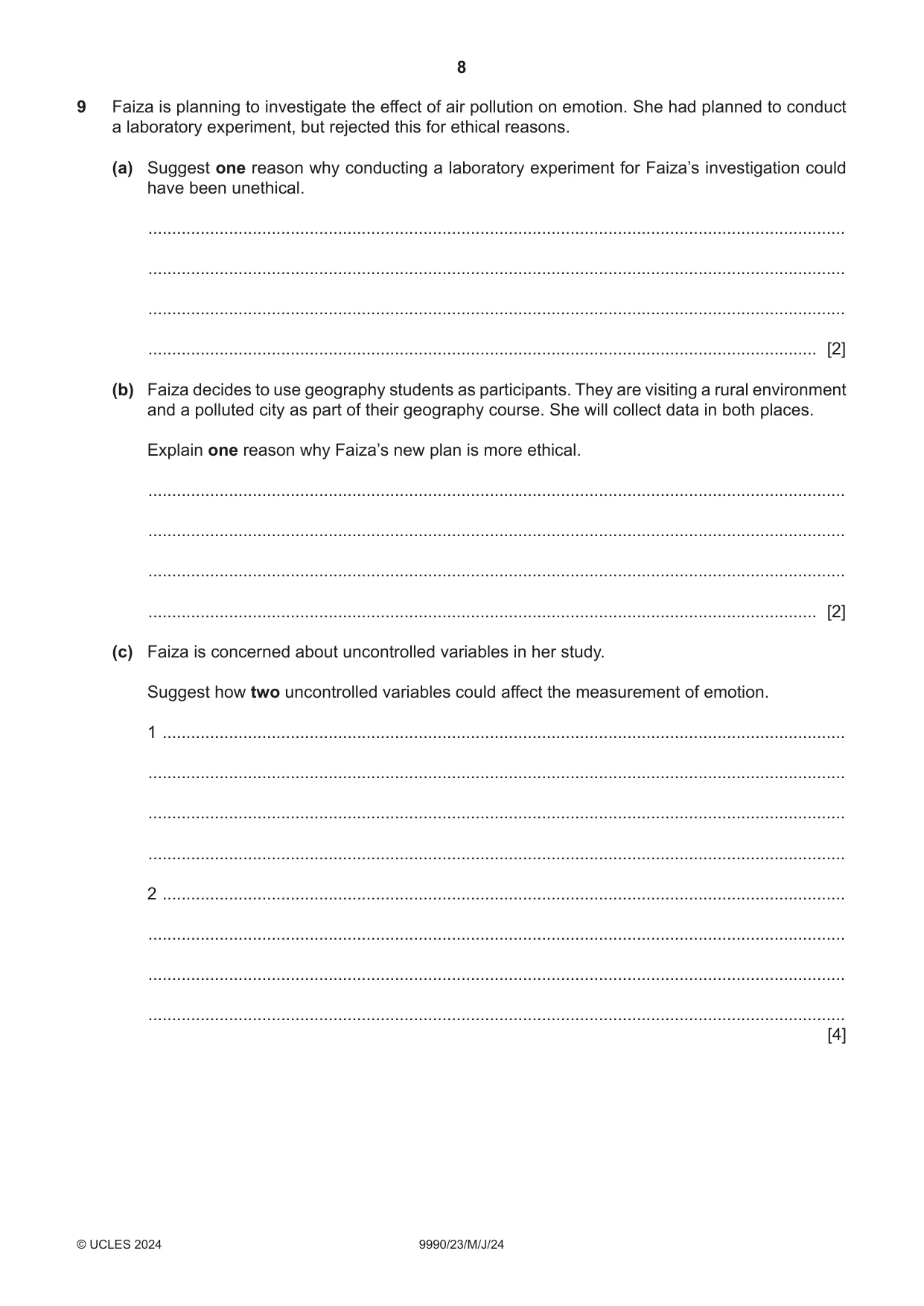
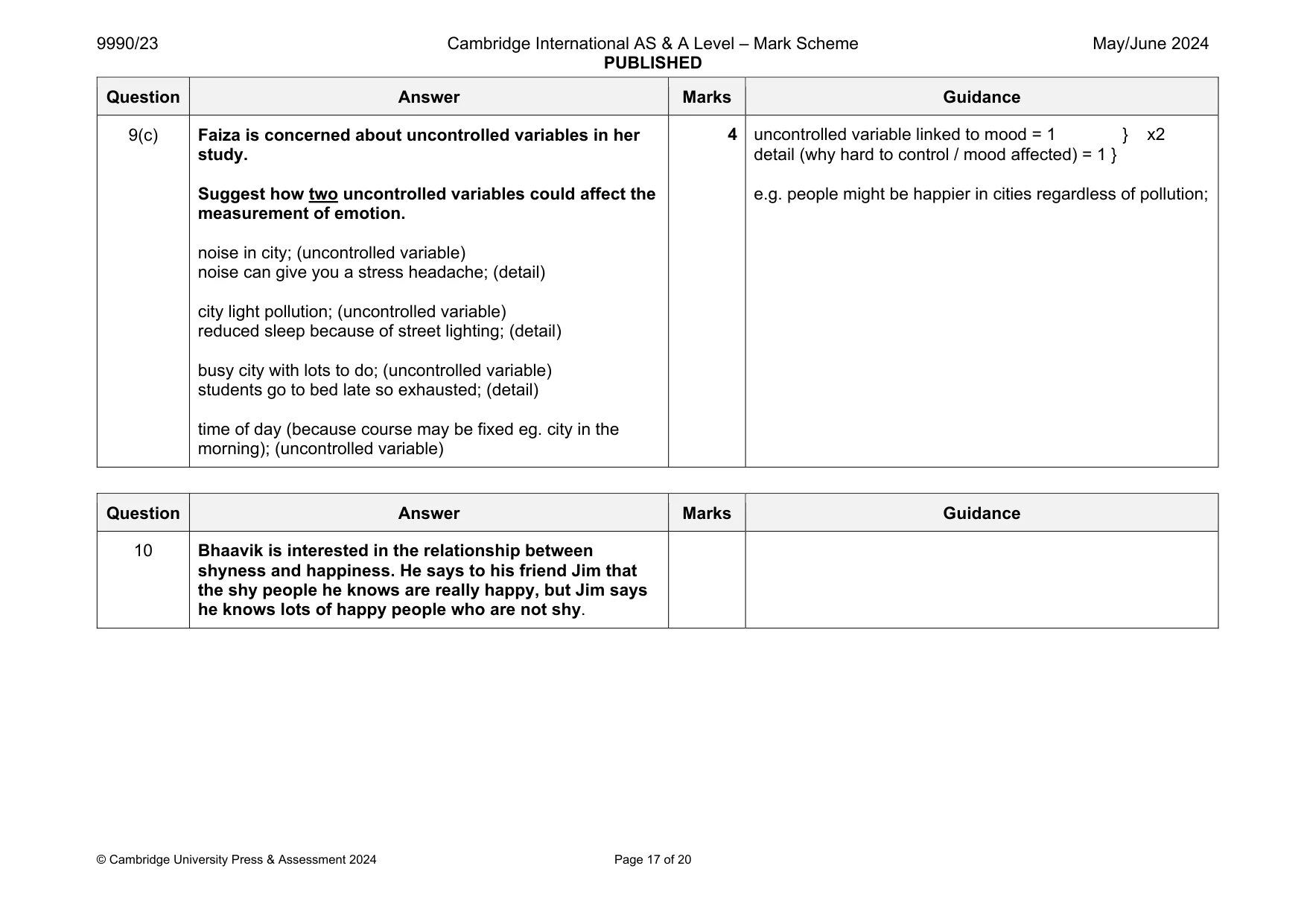
9 Faiza is planning to investigate the effect of air pollution on emotion. She had planned to conduct a laboratory experiment, but rejected this for ethical reasons. (a) Suggest one reason why conducting a laboratory experiment for Faiza’s investigation could have been unethical. ................................................................................................................................................... ................................................................................................................................................... ................................................................................................................................................... ............................................................................................................................................. [2] (b) Faiza decides to use geography students as participants. They are visiting a rural environment and a polluted city as part of their geography course. She will collect data in both places. Explain one reason why Faiza’s new plan is more ethical. ................................................................................................................................................... ................................................................................................................................................... ................................................................................................................................................... ............................................................................................................................................. [2] (c) Faiza is concerned about uncontrolled variables in her study. Suggest how two uncontrolled variables could affect the measurement of emotion. 1 ................................................................................................................................................ ................................................................................................................................................... ................................................................................................................................................... ................................................................................................................................................... 2 ................................................................................................................................................ ................................................................................................................................................... ................................................................................................................................................... ................................................................................................................................................... [4]
Mark scheme: 9 Faiza is planning to investigate the effect of air pollution on emotion. She had planned to conduct a laboratory experiment, but rejected this for ethical reasons 9(a) Suggest one reason why conducting a laboratory experiment for Faiza’s investigation could have been unethical. (risk of) physical harm / (poor) protection of participants; (reason) Pollution is dangerous; (linked detail) (hard to give) informed consent; (reason) Cannot know in advance of risk damage; (linked detail) 2 Reason = 1 (can be basic and generic, eg. named guideline) Linked detail = 1 9(b) Faiza decides to use geography students as participants. They are visiting a rural environment and a polluted city as part of their geography course. She will collect data in both places. Explain one reason why Faiza’s new plan is more ethical. Students exposed to pollution anyway; (linked reason) So no more risk of harm than in normal life; (detail) Rather than deliberately / on purpose / in a lab; (detail) Consent is only to participate in study; (detail) So can be fully informed because Faiza’s not causing exposure; (linked reason) 2 Linked reason = 1 Detail = 1 Question Answer Marks Guidance 9(c) Faiza is concerned about uncontrolled variables in her study. Suggest how two uncontrolled variables could affect the measurement of emotion. noise in city; (uncontrolled variable) noise can give you a stress headache; (detail) city light pollution; (uncontrolled variable) reduced sleep because of street lighting; (detail) busy city with lots to do; (uncontrolled variable) students go to bed late so exhausted; (detail) time of day (because course may be fixed eg. city in the morning); (uncontrolled variable) 4 uncontrolled variable linked to mood = 1 } x2 detail (why hard to control / mood affected) = 1 } e.g. people might be happier in cities regardless of pollution;
Q10 · Bhaavik is interested in the relationship between shyness and happiness
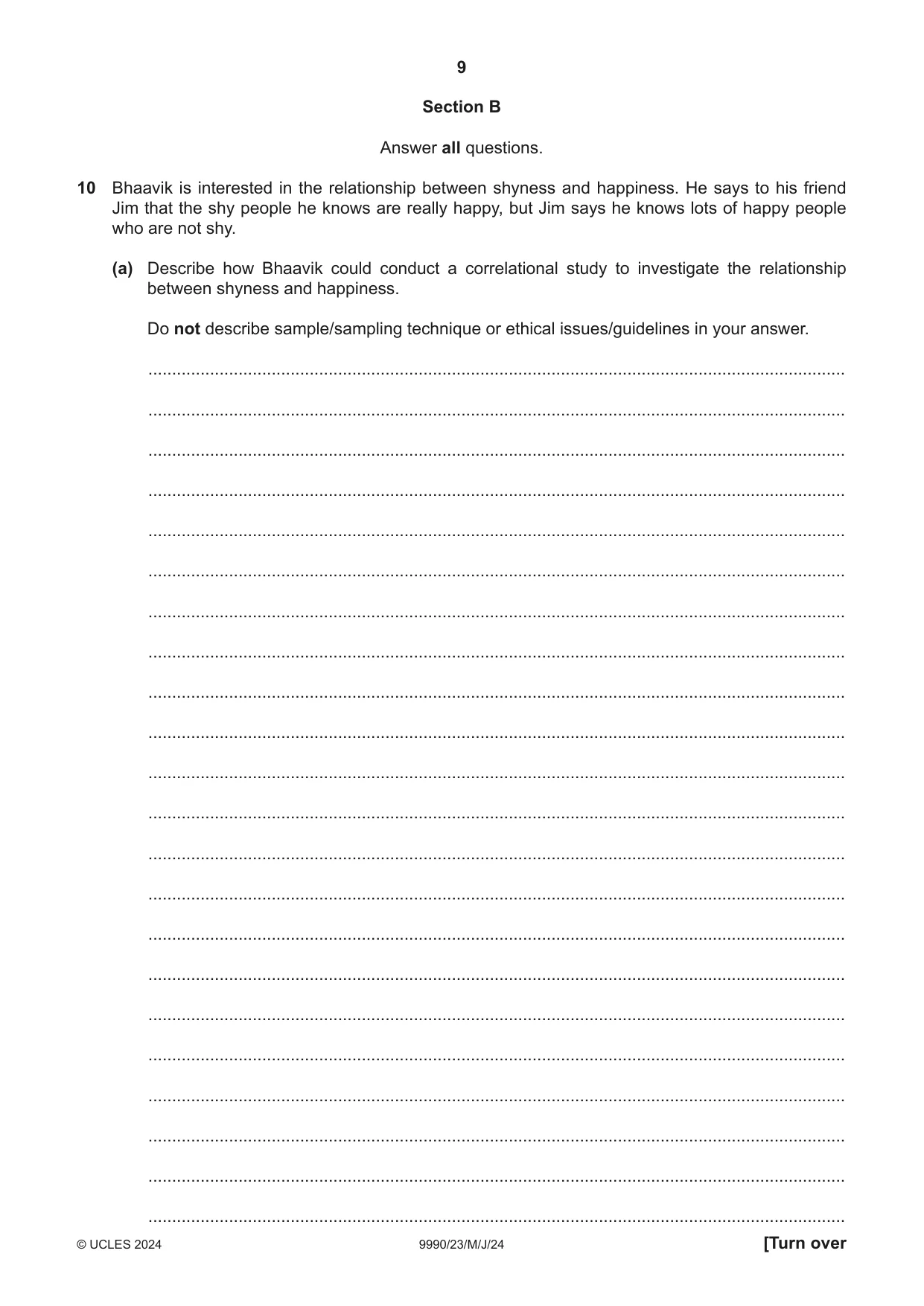
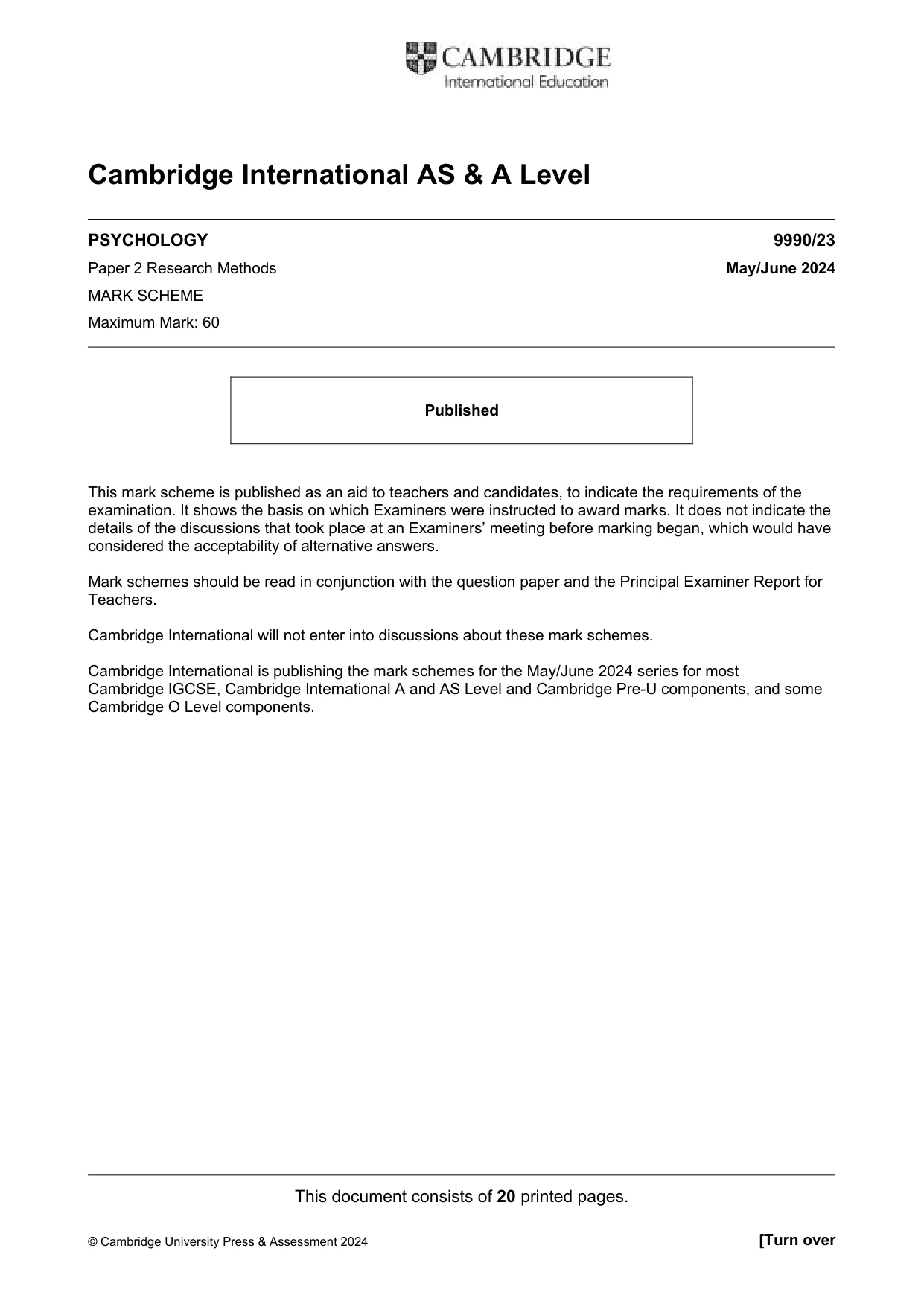
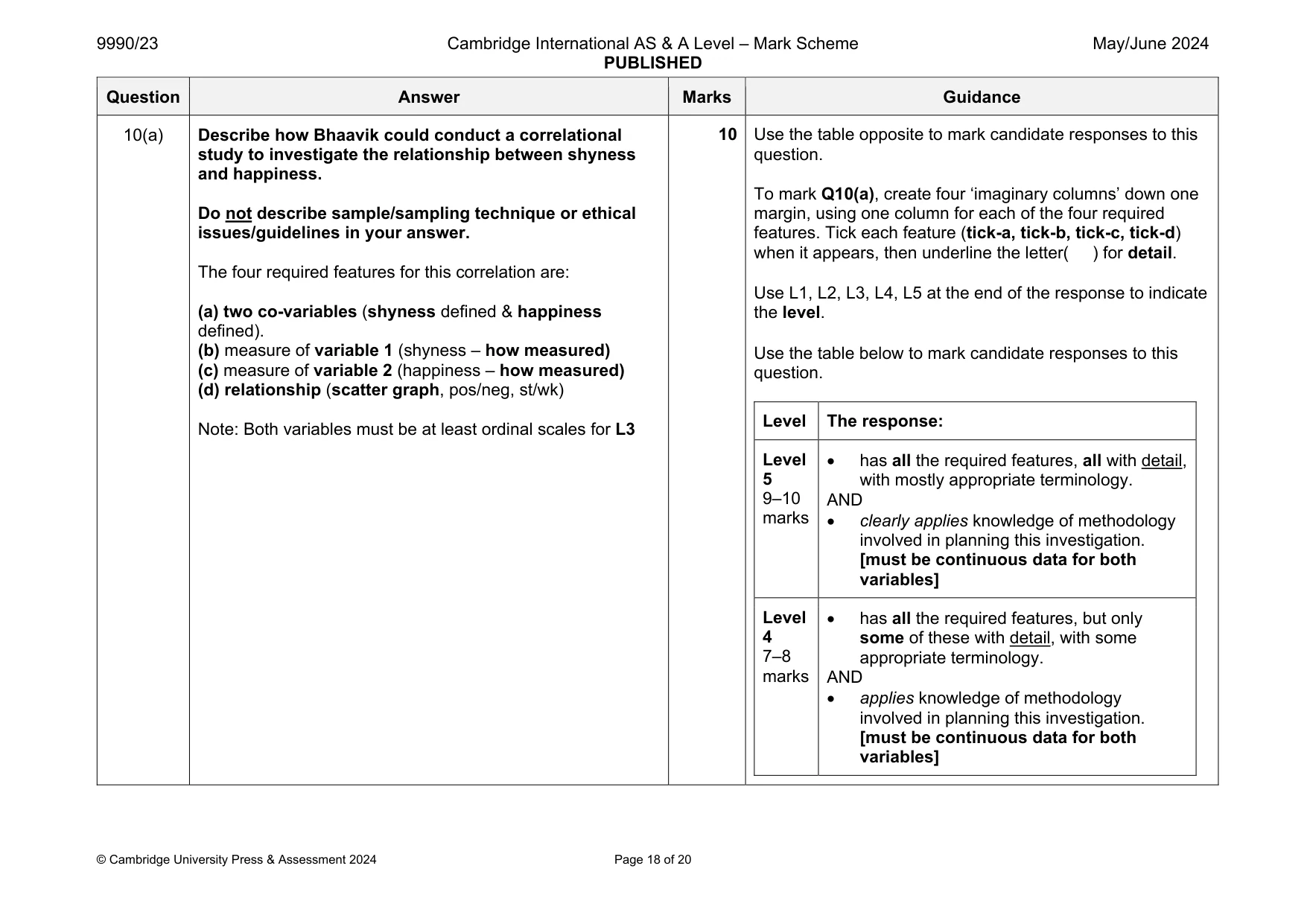
10 Bhaavik is interested in the relationship between shyness and happiness. He says to his friend Jim that the shy people he knows are really happy, but Jim says he knows lots of happy people who are not shy. (a) Describe how Bhaavik could conduct a correlational study to investigate the relationship between shyness and happiness. Do not describe sample/sampling technique or ethical issues/guidelines in your answer. ................................................................................................................................................... ................................................................................................................................................... ................................................................................................................................................... ................................................................................................................................................... ................................................................................................................................................... ................................................................................................................................................... ................................................................................................................................................... ................................................................................................................................................... ................................................................................................................................................... ................................................................................................................................................... ................................................................................................................................................... ................................................................................................................................................... ................................................................................................................................................... ................................................................................................................................................... ................................................................................................................................................... ................................................................................................................................................... ................................................................................................................................................... ................................................................................................................................................... ................................................................................................................................................... ................................................................................................................................................... ................................................................................................................................................... ................................................................................................................................................... ................................................................................................................................................... ................................................................................................................................................... ................................................................................................................................................... ................................................................................................................................................... ................................................................................................................................................... ................................................................................................................................................... ................................................................................................................................................... ........................................................................................................................................... [10] (b) (i) Describe one practical/methodological strength of the procedure you have described in your answer to part (a). Do not refer to sampling or ethics in your answer. ........................................................................................................................................... ........................................................................................................................................... ........................................................................................................................................... ..................................................................................................................................... [2] (ii) Describe one practical/methodological weakness of the procedure you have described in your answer to part (a). Do not refer to sampling or ethics in your answer. ........................................................................................................................................... ........................................................................................................................................... ........................................................................................................................................... ..................................................................................................................................... [2]
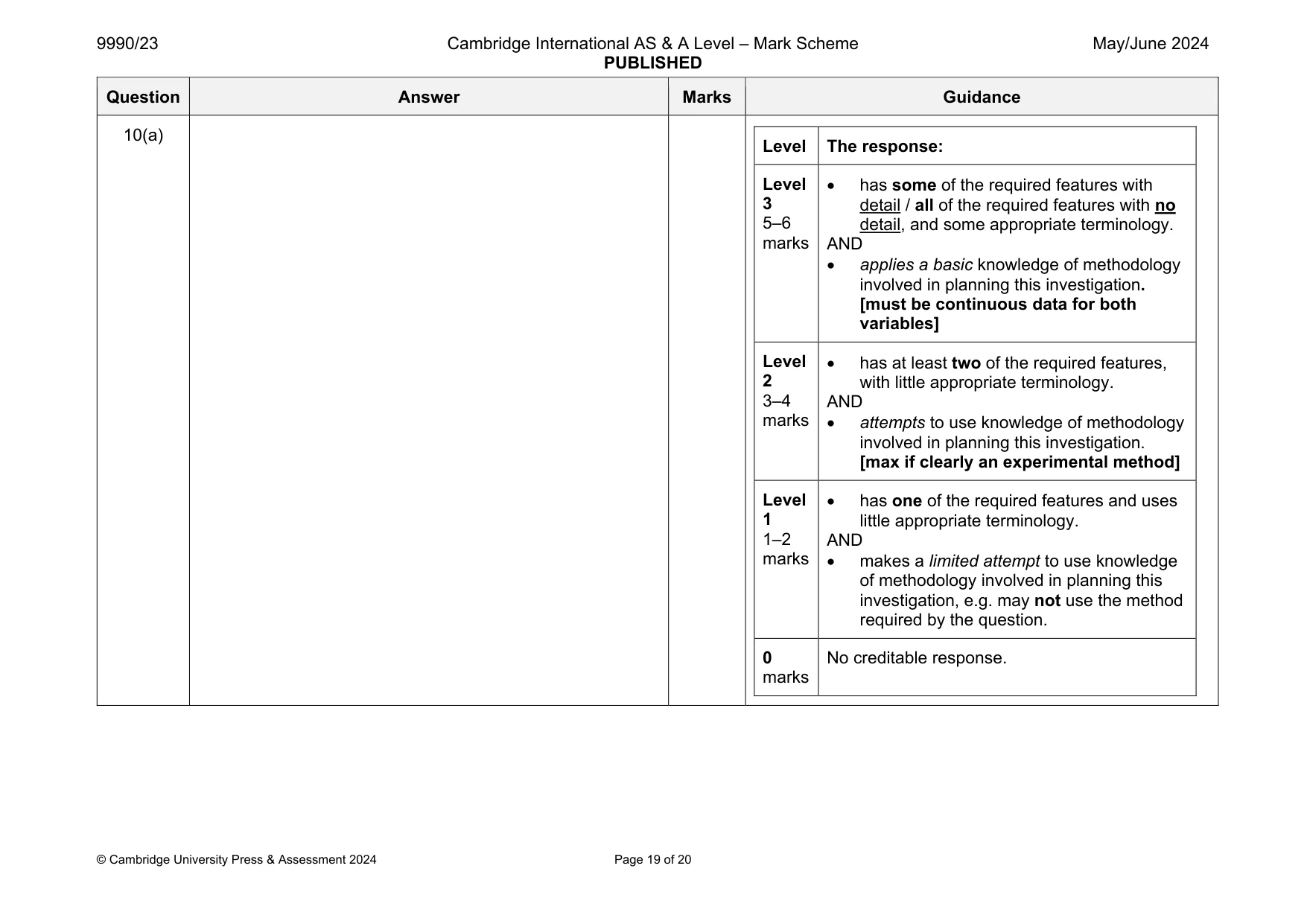
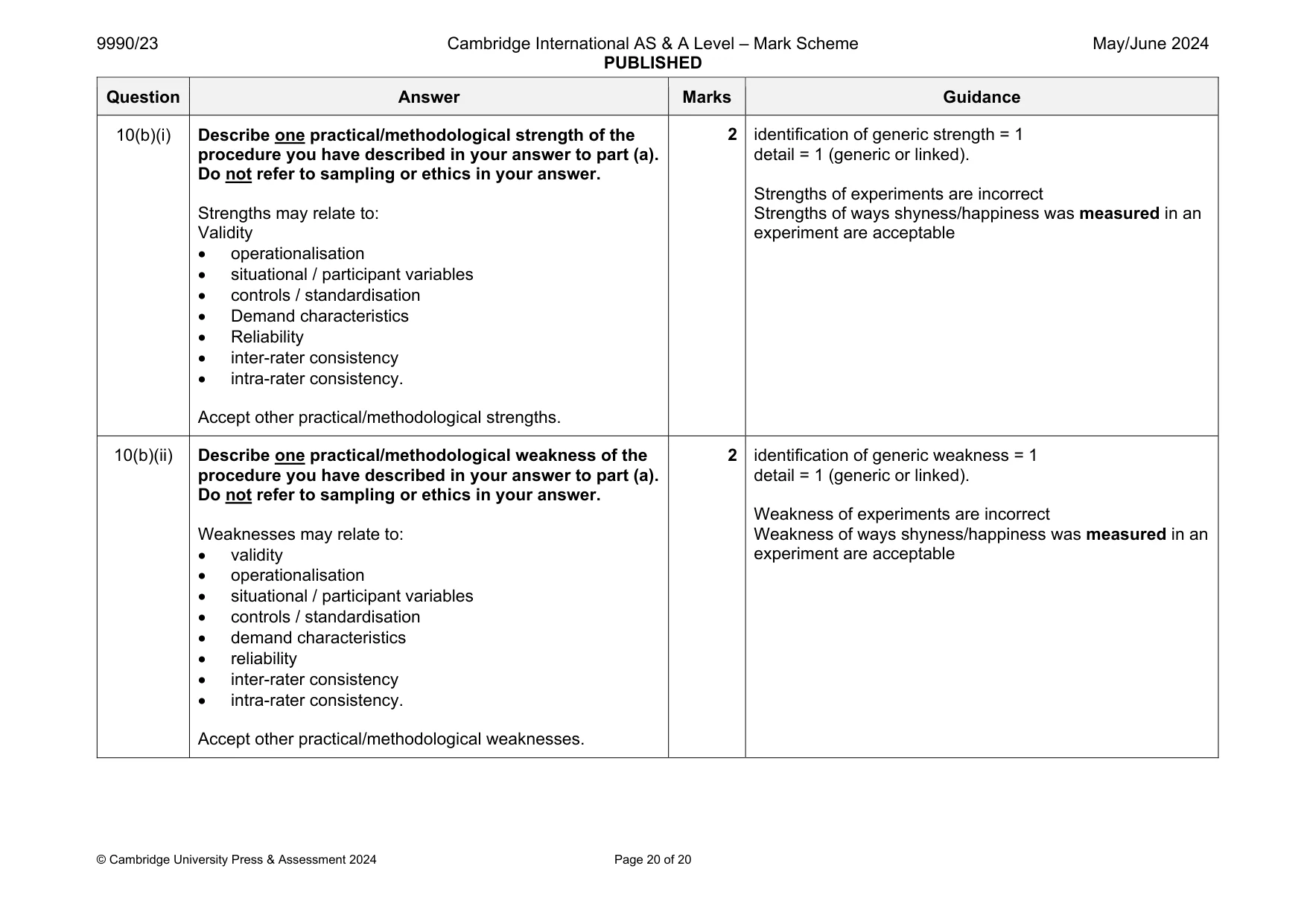
Mark scheme: 10 Bhaavik is interested in the relationship between shyness and happiness. He says to his friend Jim that the shy people he knows are really happy, but Jim says he knows lots of happy people who are not shy. Question Answer Marks Guidance 10(a) Describe how Bhaavik could conduct a correlational study to investigate the relationship between shyness and happiness. Do not describe sample/sampling technique or ethical issues/guidelines in your answer. The four required features for this correlation are: (a) two co-variables (shyness defined & happiness defined). (b) measure of variable 1 (shyness – how measured) (c) measure of variable 2 (happiness – how measured) (d) relationship (scatter graph, pos/neg, st/wk) Note: Both variables must be at least ordinal scales for L3 10 Use the table opposite to mark candidate responses to this question. To mark Q10(a), create four ‘imaginary columns’ down one margin, using one column for each of the four required features. Tick each feature (tick-a, tick-b, tick-c, tick-d) when it appears, then underline the letter( ) for detail. Use L1, L2, L3, L4, L5 at the end of the response to indicate the level. Use the table below to mark candidate responses to this question. Level The response: Level 5 9–10 marks has all the required features, all with detail, with mostly appropriate terminology. AND clearly applies knowledge of methodology involved in planning this investigation. [must be continuous data for both variables] Level 4 7–8 marks has all the required features, but only some of these with detail, with some appropriate terminology. AND applies knowledge of methodology involved in planning this investigation. [must be continuous data for both variables] Question Answer Marks Guidance 10(a) Level The response: Level 3 5–6 marks has some of the required features with detail / all of the required features with no detail, and some appropriate terminology. AND applies a basic knowledge of methodology involved in planning this investigation. [must be continuous data for both variables] Level 2 3–4 marks has at least two of the required features, with little appropriate terminology. AND attempts to use knowledge of methodology involved in planning this investigation. [max if clearly an experimental method] Level 1 1–2 marks has one of the required features and uses little appropriate terminology. AND makes a limited attempt to use knowledge of methodology involved in planning this investigation, e.g. may not use the method required by the question. 0 marks No creditable response. Question Answer Marks Guidance 10(b)(i) Describe one practical/methodological strength of the procedure you have described in your answer to part (a). Do not refer to sampling or ethics in your answer. Strengths may relate to: Validity operationalisation situational / participant variables controls / standardisation Demand characteristics Reliability inter-rater consistency intra-rater consistency. Accept other practical/methodological strengths. 2 identification of generic strength = 1 detail = 1 (generic or linked). Strengths of experiments are incorrect Strengths of ways shyness/happiness was measured in an experiment are acceptable 10(b)(ii) Describe one practical/methodological weakness of the procedure you have described in your answer to part (a). Do not refer to sampling or ethics in your answer. Weaknesses may relate to: validity operationalisation situational / participant variables controls / standardisation demand characteristics reliability inter-rater consistency intra-rater consistency. Accept other practical/methodological weaknesses. 2 identification of generic weakness = 1 detail = 1 (generic or linked). Weakness of experiments are incorrect Weakness of ways shyness/happiness was measured in an experiment are acceptable
What was in this paper
The subtopics covered by these 10 questions, and how many questions each got. Open one in a new tab to see every Cambridge question on it.
What you needed in this session
Cambridge’s own grade thresholds for 2024 May/June, Paper 2 · Variant 3. A higher threshold means an easier paper — the bar moves with how the cohort did.