Cambridge A Level Psychology (from 2018) 9990 — 2025 May/June Paper 2 · Variant 3
9990/23/M/J/25 · 10 questions · 60 marks · 90 min
The question paper and its mark scheme, free to read here and free to download. This is Cambridge’s own paper, exactly as it was sat.
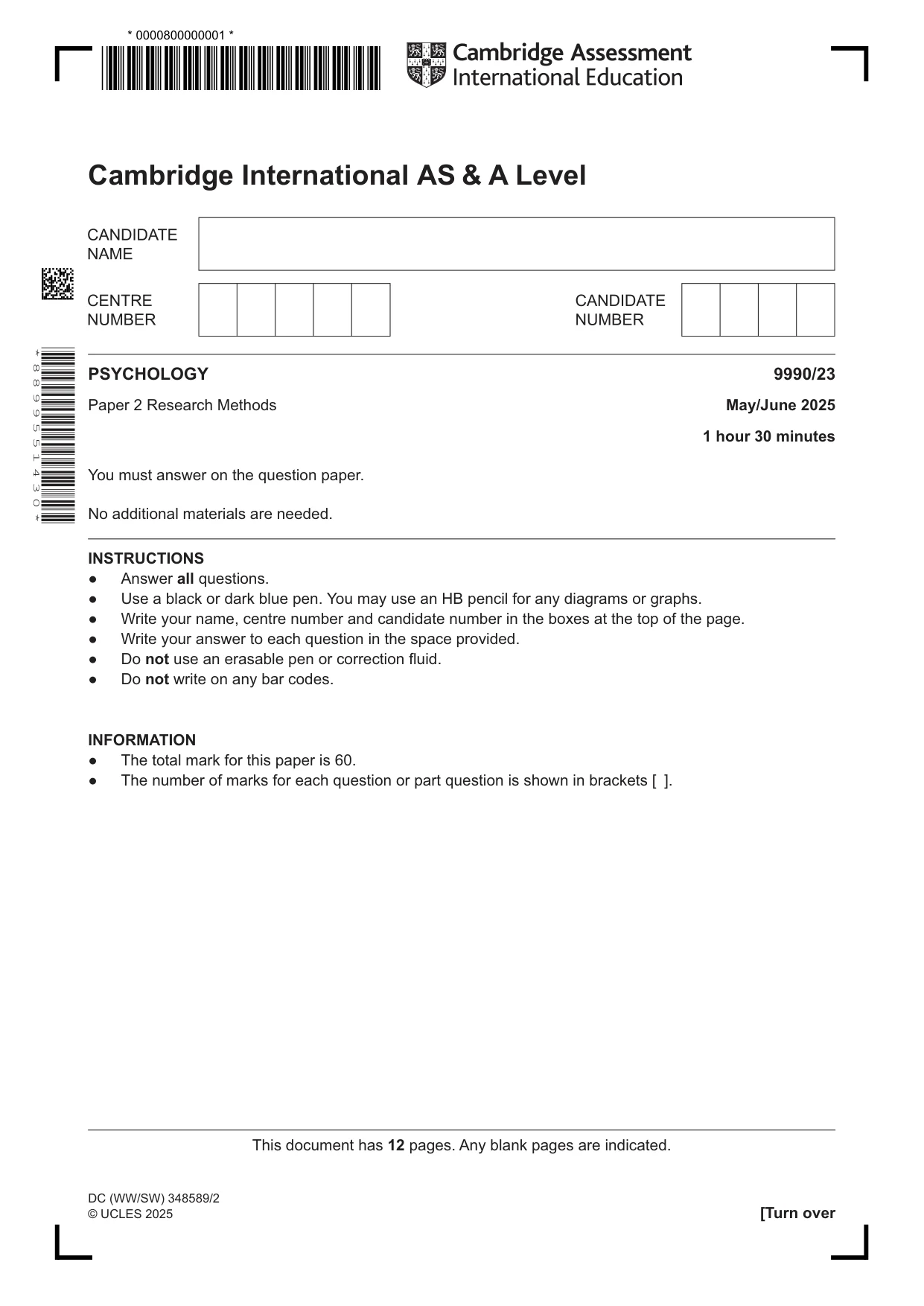
Question paper12 pages
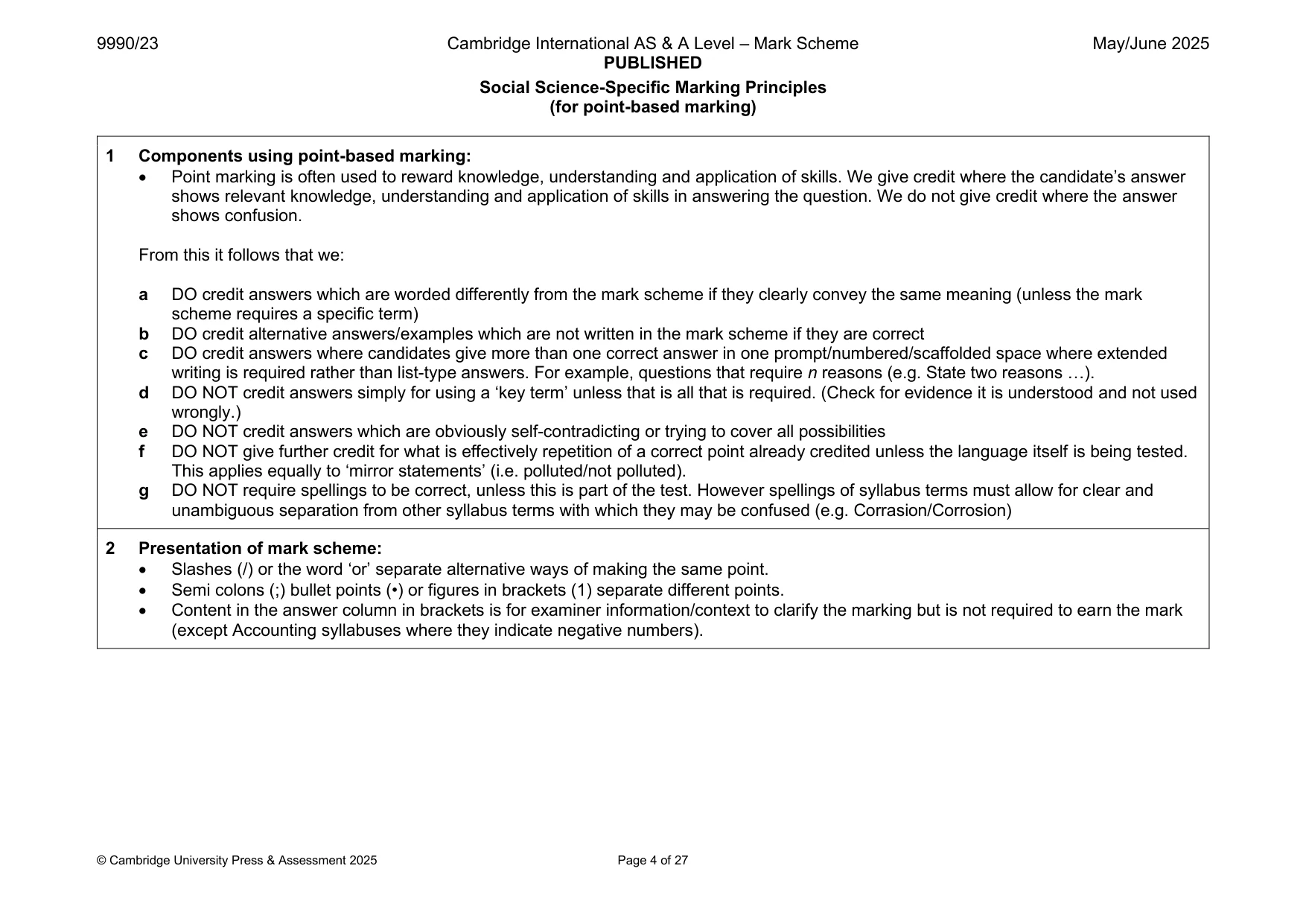
Mark scheme27 pages
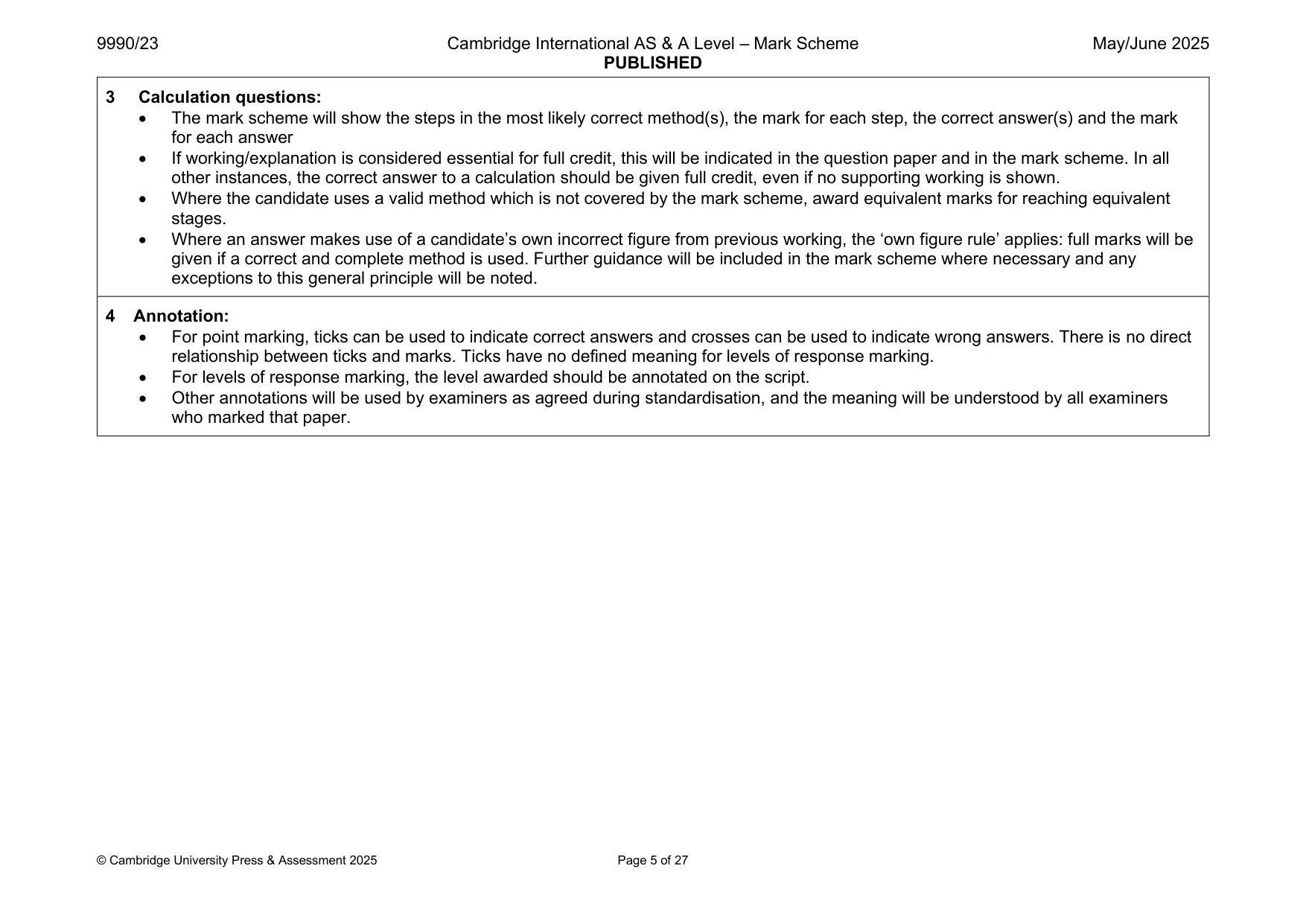
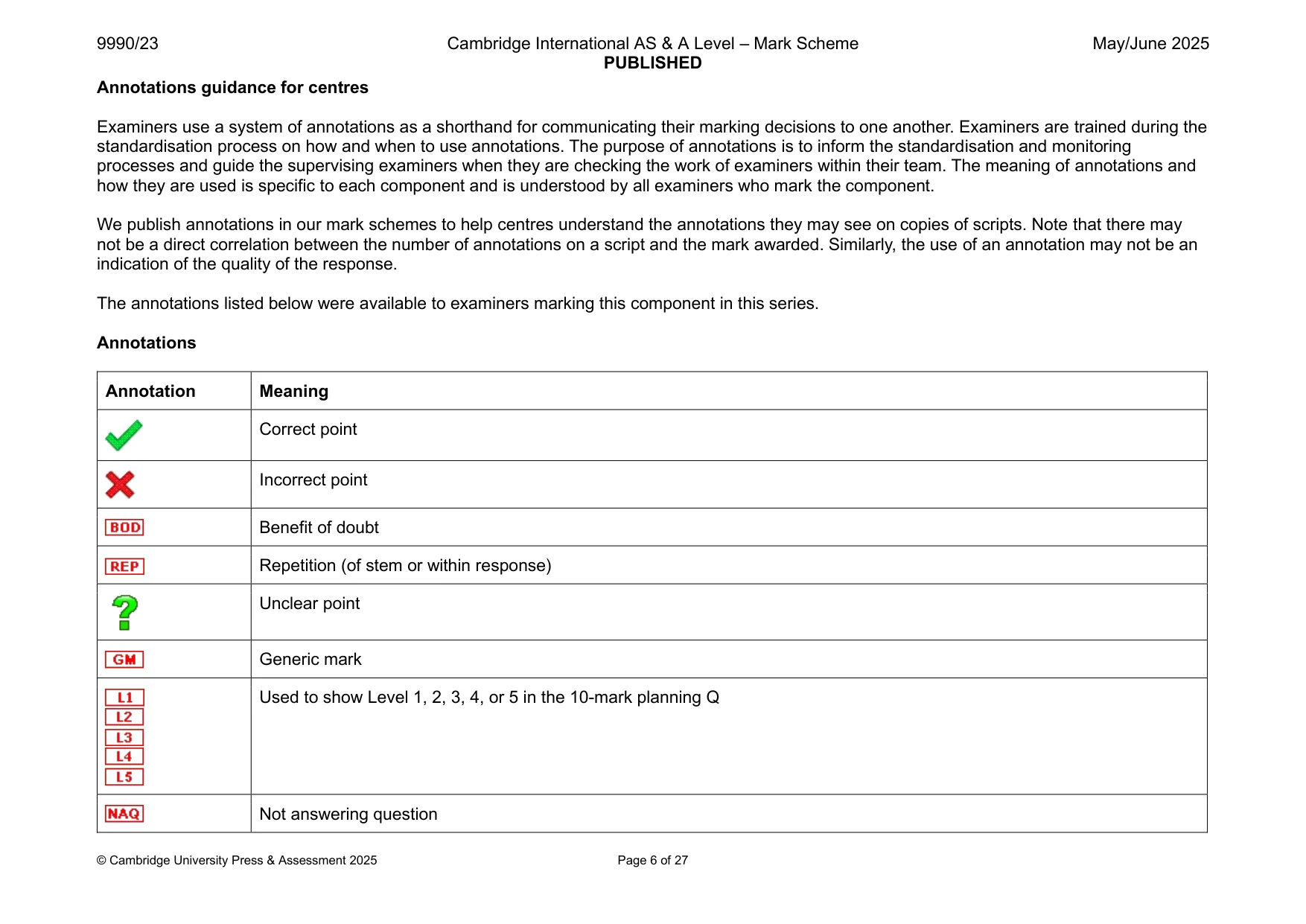
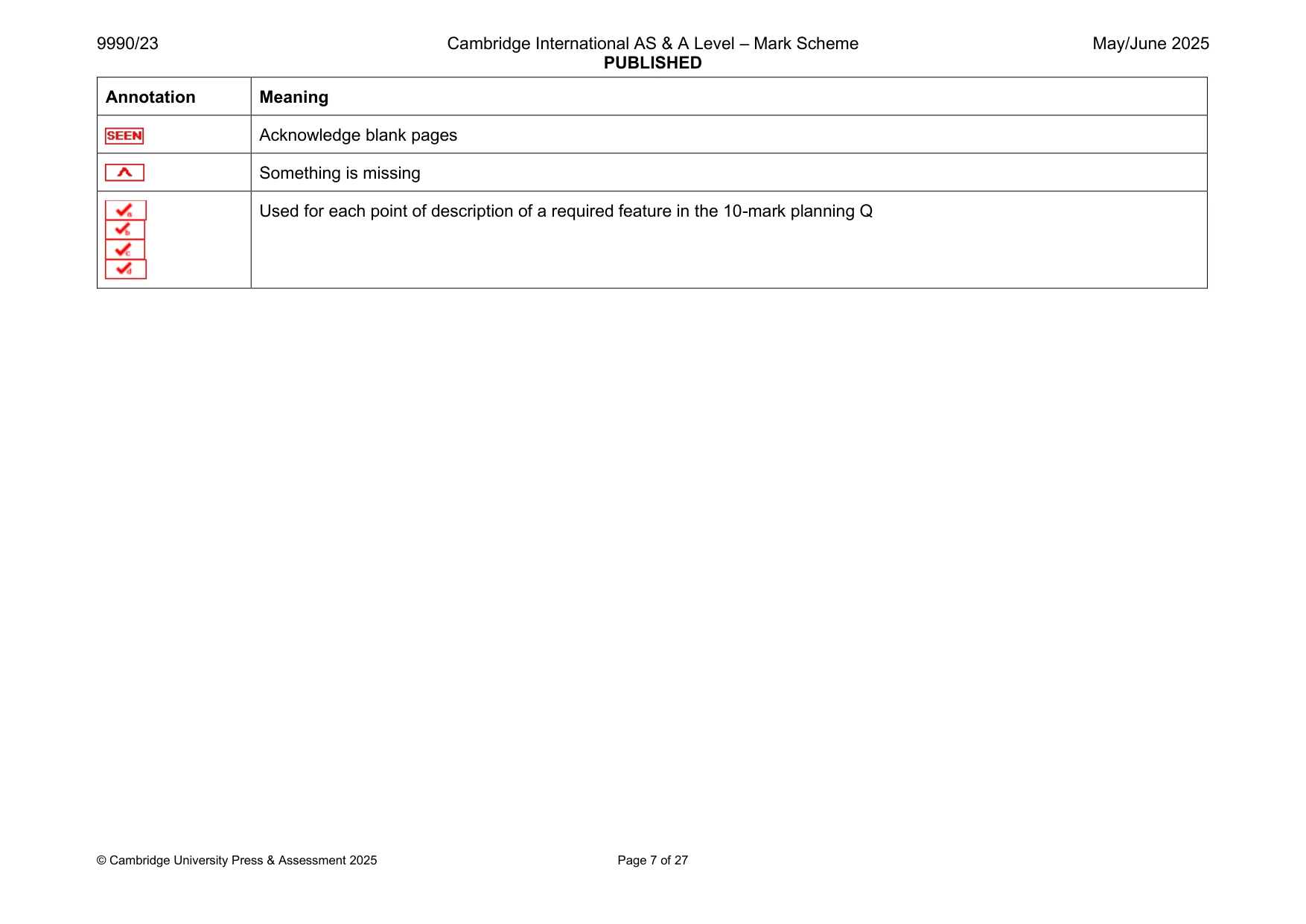
Answers below. Sit the paper first if you are practising.
Questions as text
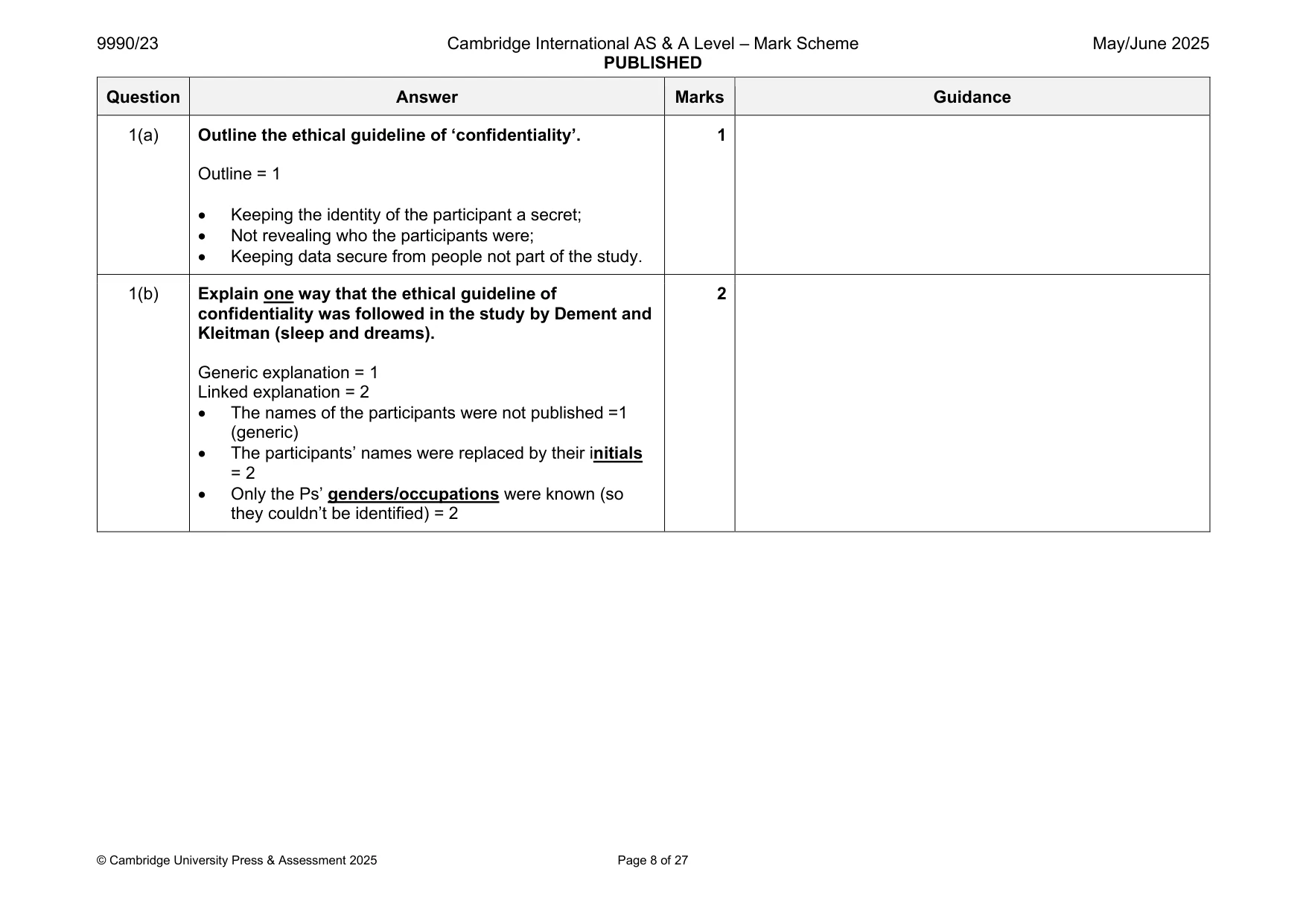
Q1 · Outline the ethical guideline of ‘confidentiality’
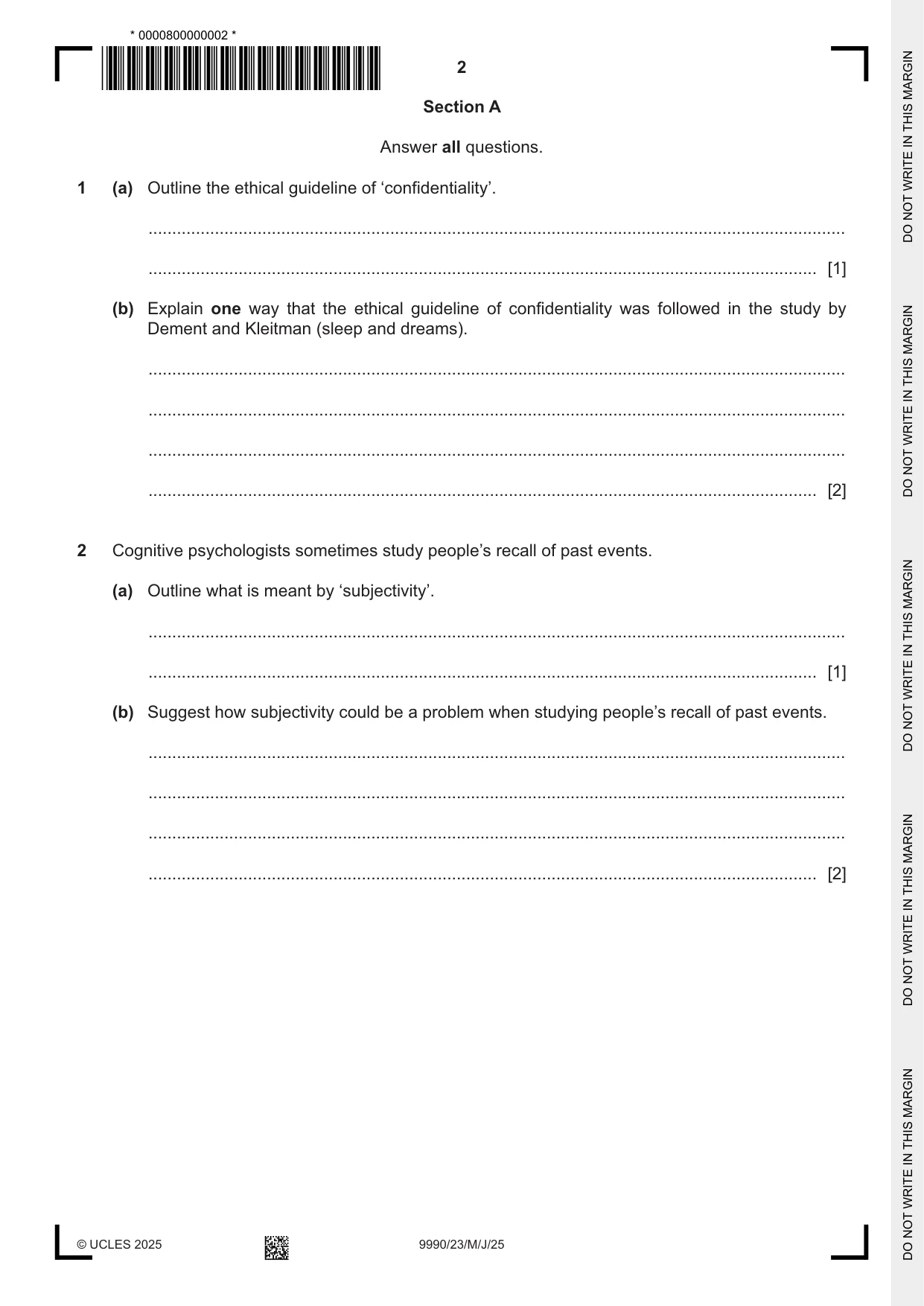
1 (a) Outline the ethical guideline of ‘confidentiality’. ................................................................................................................................................... ............................................................................................................................................. [1] (b) Explain one way that the ethical guideline of confidentiality was followed in the study by Dement and Kleitman (sleep and dreams). ................................................................................................................................................... ................................................................................................................................................... ................................................................................................................................................... ............................................................................................................................................. [2]
Mark scheme: Question Answer Marks Guidance 1(a) Outline the ethical guideline of ‘confidentiality’. 1 Outline = 1 • Keeping the identity of the participant a secret; • Not revealing who the participants were; • Keeping data secure from people not part of the study. 1(b) Explain one way that the ethical guideline of 2 confidentiality was followed in the study by Dement and Kleitman (sleep and dreams). Generic explanation = 1 Linked explanation = 2 • The names of the participants were not published =1 (generic) • The participants’ names were replaced by their initials = 2 • Only the Ps’ genders/occupations were known (so they couldn’t be identified) = 2
Q2 · Cognitive psychologists sometimes study people’s recall of past events
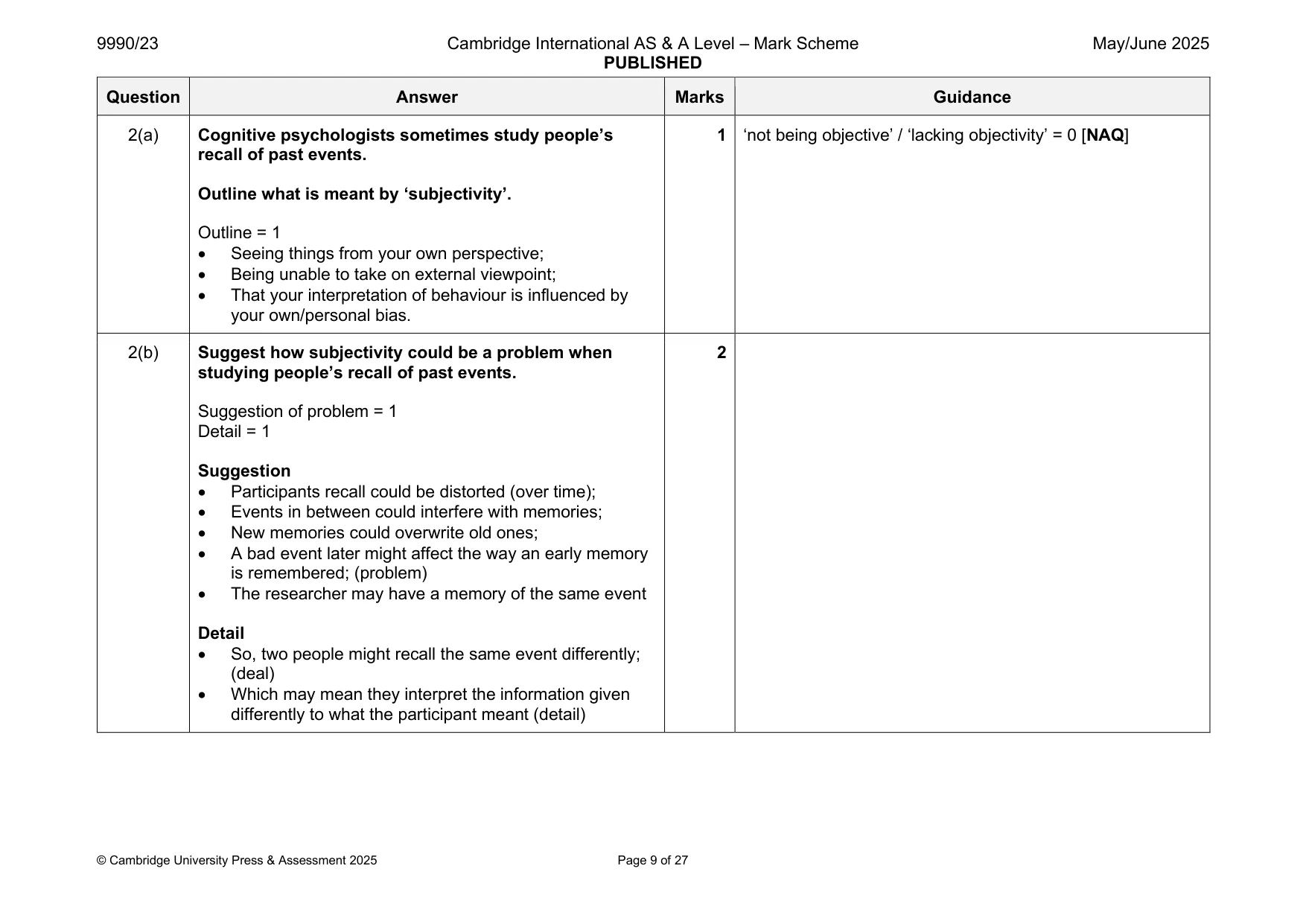
2 Cognitive psychologists sometimes study people’s recall of past events. (a) Outline what is meant by ‘subjectivity’. ................................................................................................................................................... ............................................................................................................................................. [1] (b) Suggest how subjectivity could be a problem when studying people’s recall of past events. ................................................................................................................................................... ................................................................................................................................................... ................................................................................................................................................... ............................................................................................................................................. [2]
Mark scheme: 2(a) Cognitive psychologists sometimes study people’s 1 ‘not being objective’ / ‘lacking objectivity’ = 0 [NAQ] recall of past events. Outline what is meant by ‘subjectivity’. Outline = 1 • Seeing things from your own perspective; • Being unable to take on external viewpoint; • That your interpretation of behaviour is influenced by your own/personal bias. 2(b) Suggest how subjectivity could be a problem when 2 studying people’s recall of past events. Suggestion of problem = 1 Detail = 1 Suggestion • Participants recall could be distorted (over time); • Events in between could interfere with memories; • New memories could overwrite old ones; • A bad event later might affect the way an early memory is remembered; (problem) • The researcher may have a memory of the same event Detail • So, two people might recall the same event differently; (deal) • Which may mean they interpret the information given differently to what the participant meant (detail)
Q3 · A study tested the relationship between average number of hours of sleep per night and…
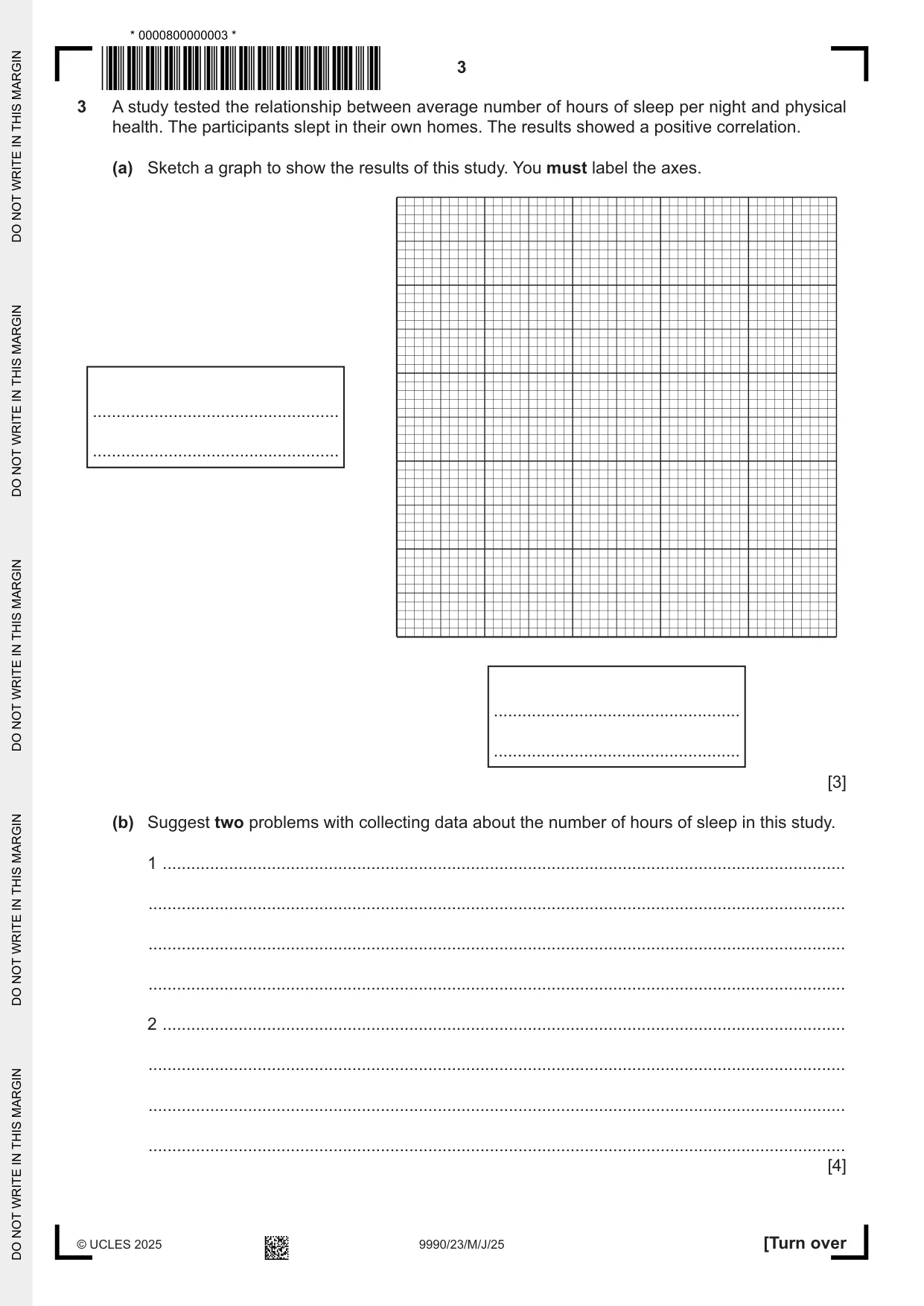
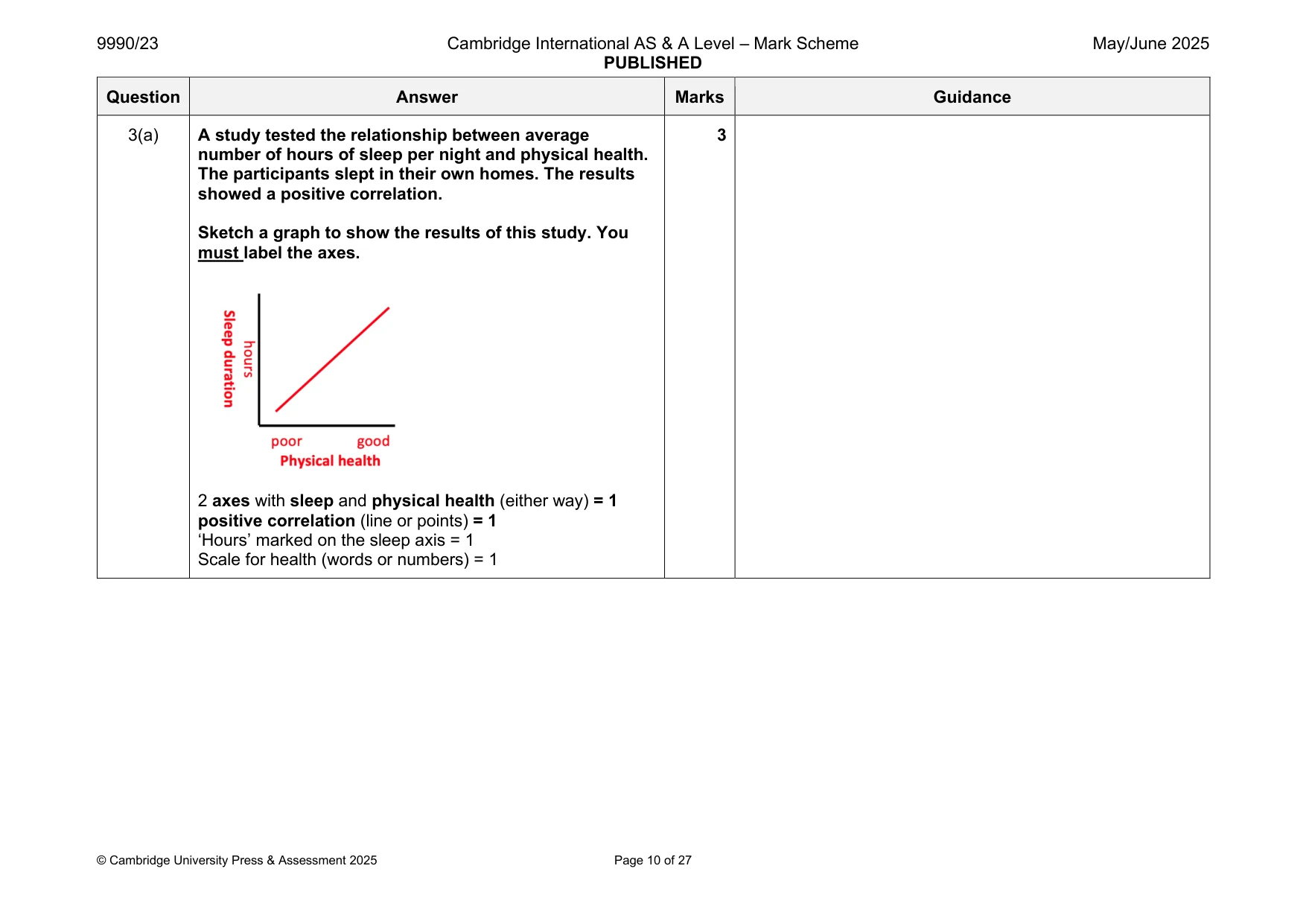
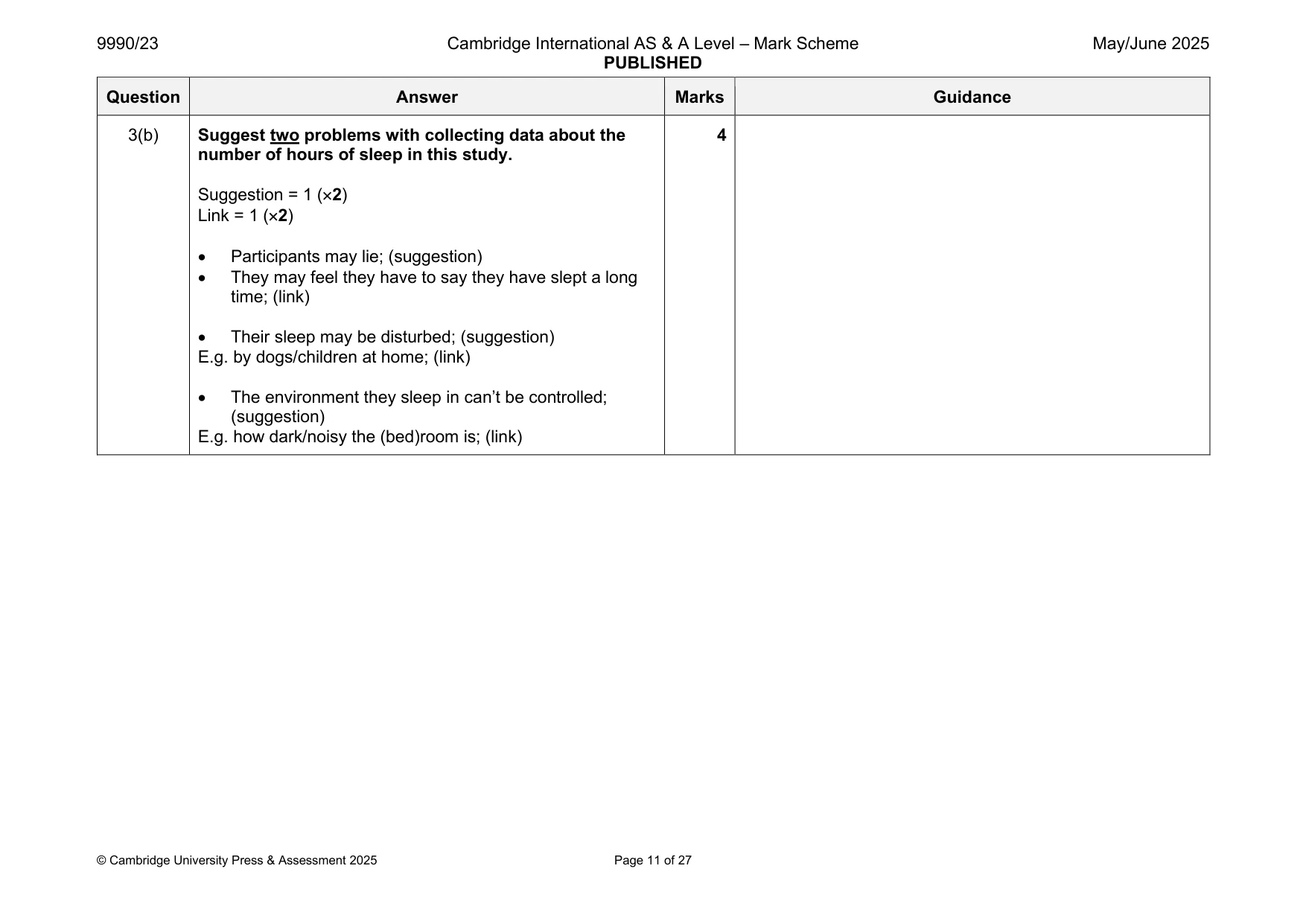
3 A study tested the relationship between average number of hours of sleep per night and physical health. The participants slept in their own homes. The results showed a positive correlation. (a) Sketch a graph to show the results of this study. You must label the axes. .................................................... .................................................... .................................................... .................................................... [3] (b) Suggest two problems with collecting data about the number of hours of sleep in this study. 1 ................................................................................................................................................ ................................................................................................................................................... ................................................................................................................................................... ................................................................................................................................................... 2 ................................................................................................................................................ ................................................................................................................................................... ................................................................................................................................................... ................................................................................................................................................... [4]
Mark scheme: 3(a) A study tested the relationship between average 3 number of hours of sleep per night and physical health. The participants slept in their own homes. The results showed a positive correlation. Sketch a graph to show the results of this study. You must label the axes. 2 axes with sleep and physical health (either way) = 1 positive correlation (line or points) = 1 ‘Hours’ marked on the sleep axis = 1 Scale for health (words or numbers) = 1 3(b) Suggest two problems with collecting data about the 4 number of hours of sleep in this study. Suggestion = 1 (2) Link = 1 (2) • Participants may lie; (suggestion) • They may feel they have to say they have slept a long time; (link) • Their sleep may be disturbed; (suggestion) E.g. by dogs/children at home; (link) • The environment they sleep in can’t be controlled; (suggestion) E.g. how dark/noisy the (bed)room is; (link)
Q4 · An investigation is testing the hypothesis that, ‘intelligence affects obedience’
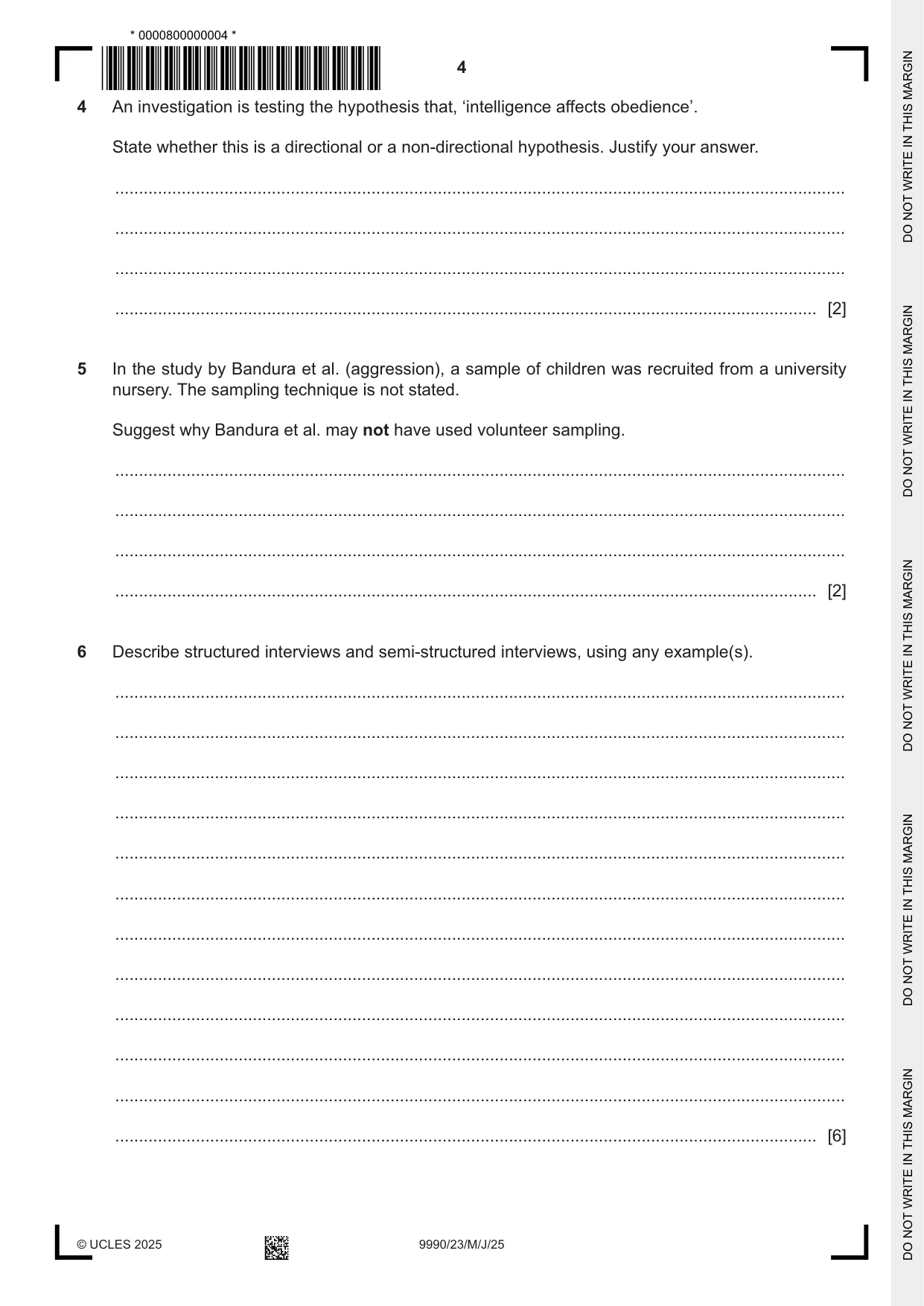
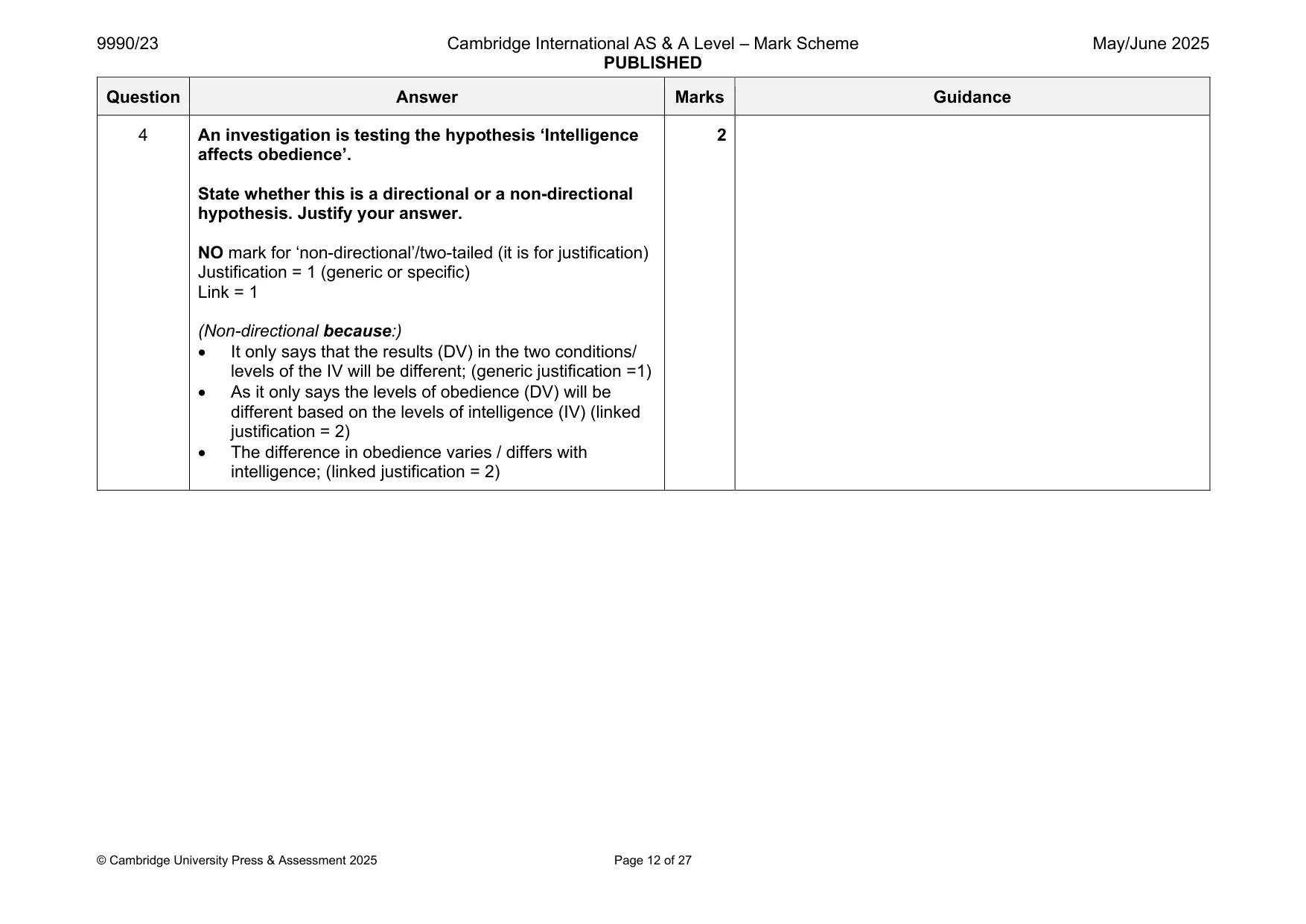
4 An investigation is testing the hypothesis that, ‘intelligence affects obedience’. State whether this is a directional or a non-directional hypothesis. Justify your answer. .......................................................................................................................................................... .......................................................................................................................................................... .......................................................................................................................................................... .................................................................................................................................................... [2]
Mark scheme: 4 An investigation is testing the hypothesis ‘Intelligence 2 affects obedience’. State whether this is a directional or a non-directional hypothesis. Justify your answer. NO mark for ‘non-directional’/two-tailed (it is for justification) Justification = 1 (generic or specific) Link = 1 (Non-directional because:) • It only says that the results (DV) in the two conditions/ levels of the IV will be different; (generic justification =1) • As it only says the levels of obedience (DV) will be different based on the levels of intelligence (IV) (linked justification = 2) • The difference in obedience varies / differs with intelligence; (linked justification = 2)
Q5 · In the study by Bandura et al
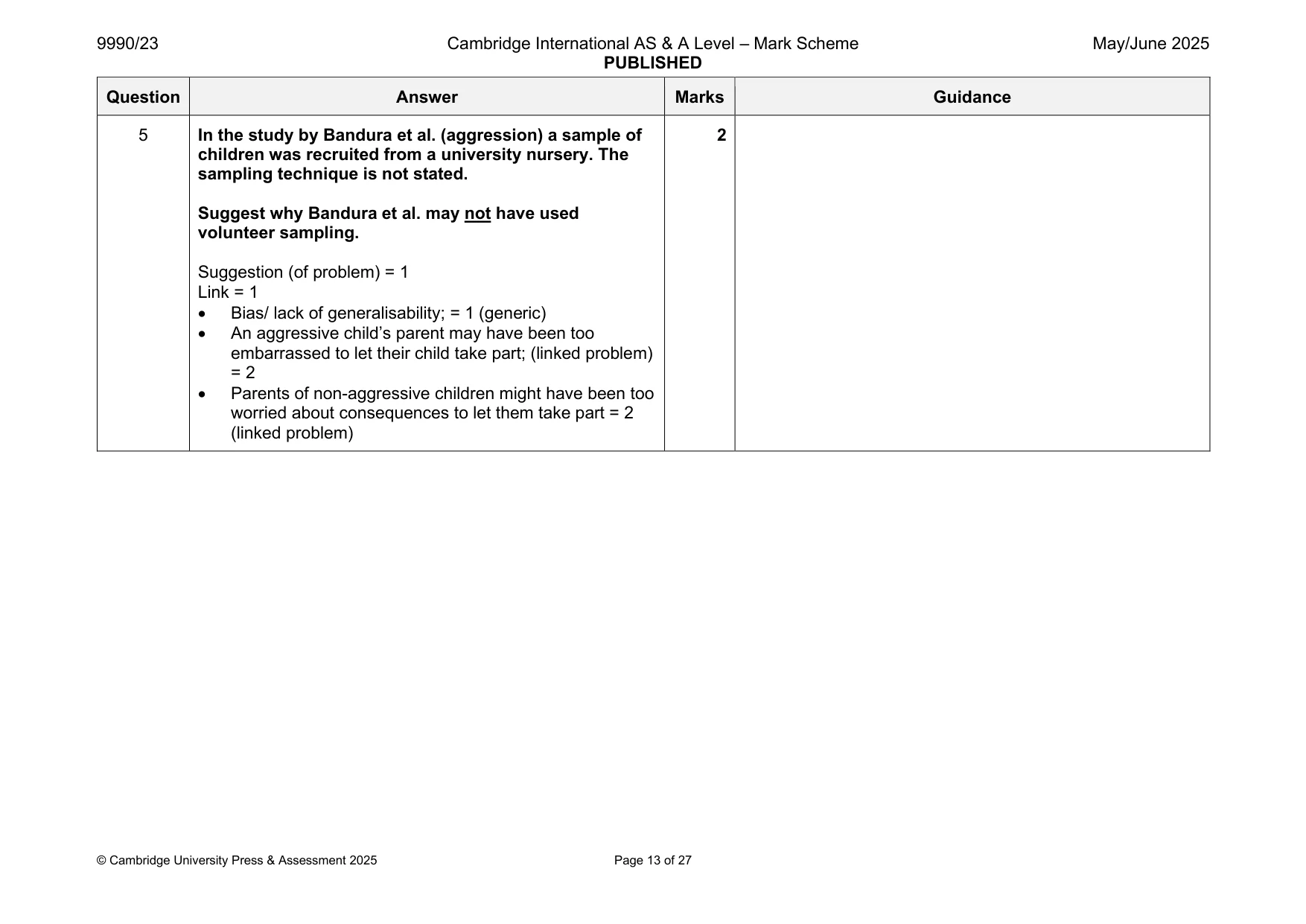
5 In the study by Bandura et al. (aggression), a sample of children was recruited from a university nursery. The sampling technique is not stated. Suggest why Bandura et al. may not have used volunteer sampling. .......................................................................................................................................................... .......................................................................................................................................................... .......................................................................................................................................................... .................................................................................................................................................... [2]
Mark scheme: 5 In the study by Bandura et al. (aggression) a sample of 2 children was recruited from a university nursery. The sampling technique is not stated. Suggest why Bandura et al. may not have used volunteer sampling. Suggestion (of problem) = 1 Link = 1 • Bias/ lack of generalisability; = 1 (generic) • An aggressive child’s parent may have been too embarrassed to let their child take part; (linked problem) = 2 • Parents of non-aggressive children might have been too worried about consequences to let them take part = 2 (linked problem)
Q6 · Describe structured interviews and semi-structured interviews, using any example(s)
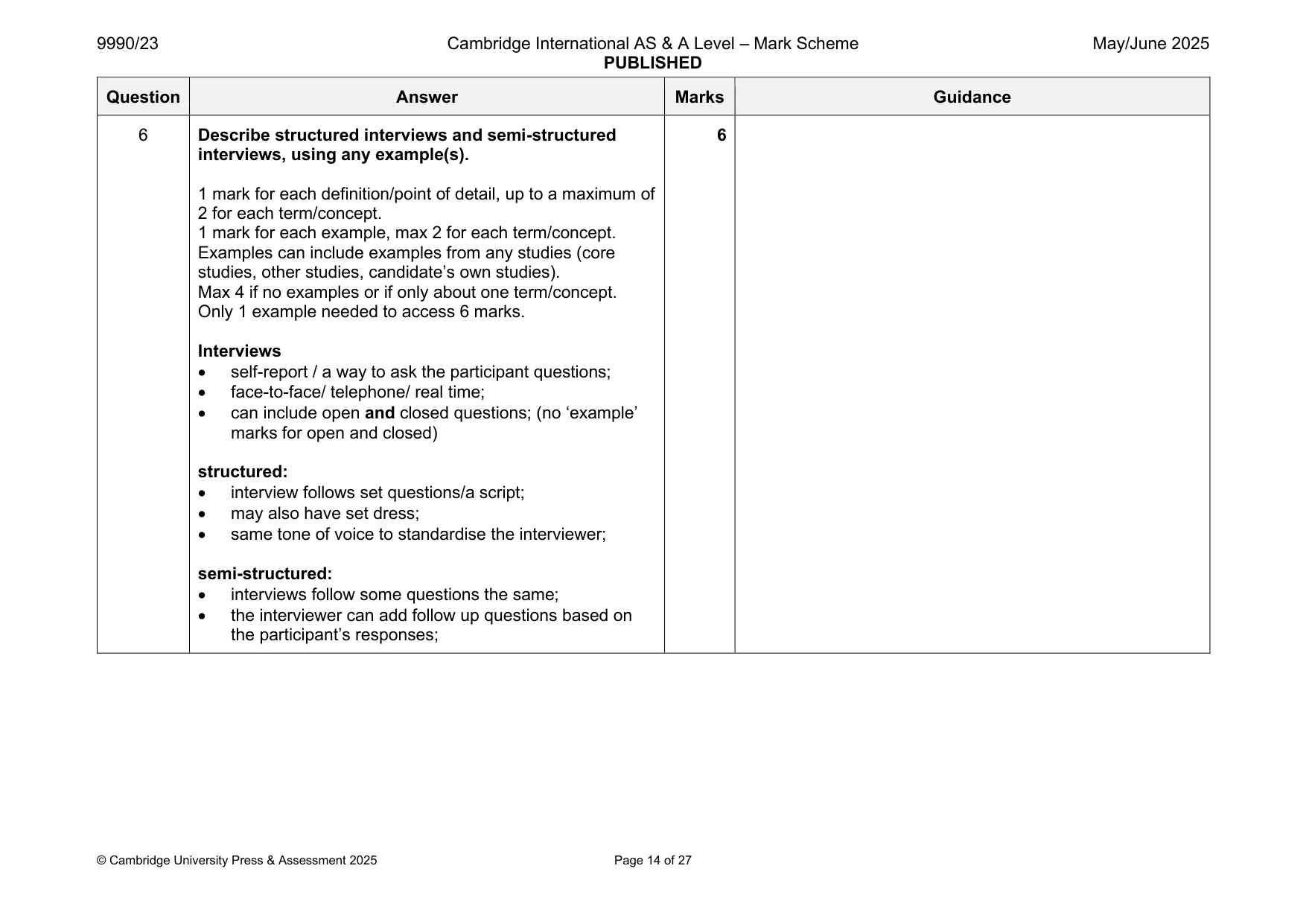
6 Describe structured interviews and semi-structured interviews, using any example(s). .......................................................................................................................................................... .......................................................................................................................................................... .......................................................................................................................................................... .......................................................................................................................................................... .......................................................................................................................................................... .......................................................................................................................................................... .......................................................................................................................................................... .......................................................................................................................................................... .......................................................................................................................................................... .......................................................................................................................................................... .......................................................................................................................................................... .................................................................................................................................................... [6]
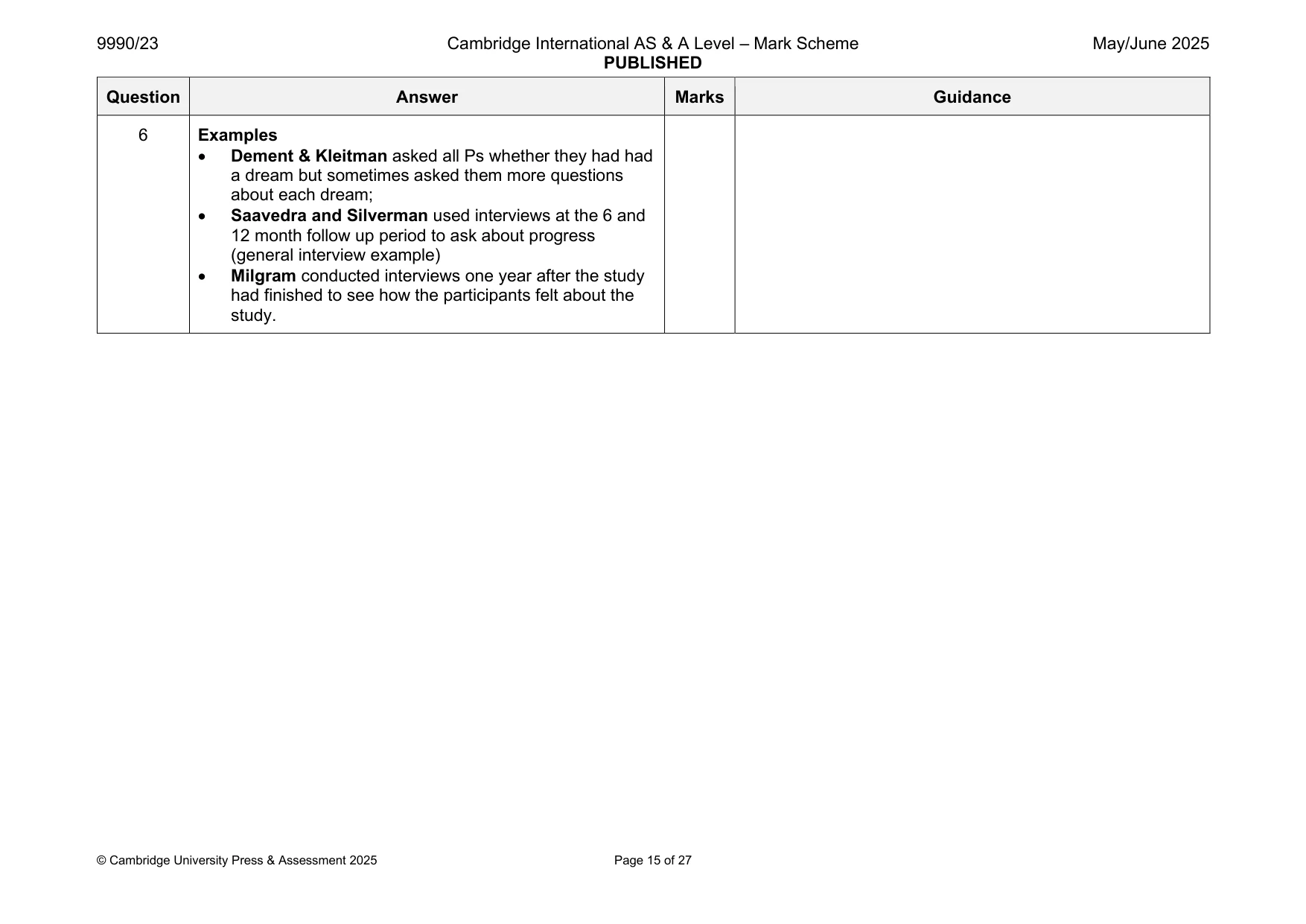
Mark scheme: 6 Describe structured interviews and semi-structured 6 interviews, using any example(s). 1 mark for each definition/point of detail, up to a maximum of 2 for each term/concept. 1 mark for each example, max 2 for each term/concept. Examples can include examples from any studies (core studies, other studies, candidate’s own studies). Max 4 if no examples or if only about one term/concept. Only 1 example needed to access 6 marks. Interviews • self-report / a way to ask the participant questions; • face-to-face/ telephone/ real time; • can include open and closed questions; (no ‘example’ marks for open and closed) structured: • interview follows set questions/a script; • may also have set dress; • same tone of voice to standardise the interviewer; semi-structured: • interviews follow some questions the same; • the interviewer can add follow up questions based on the participant’s responses; 6 Examples • Dement & Kleitman asked all Ps whether they had had a dream but sometimes asked them more questions about each dream; • Saavedra and Silverman used interviews at the 6 and 12 month follow up period to ask about progress (general interview example) • Milgram conducted interviews one year after the study had finished to see how the participants felt about the study.
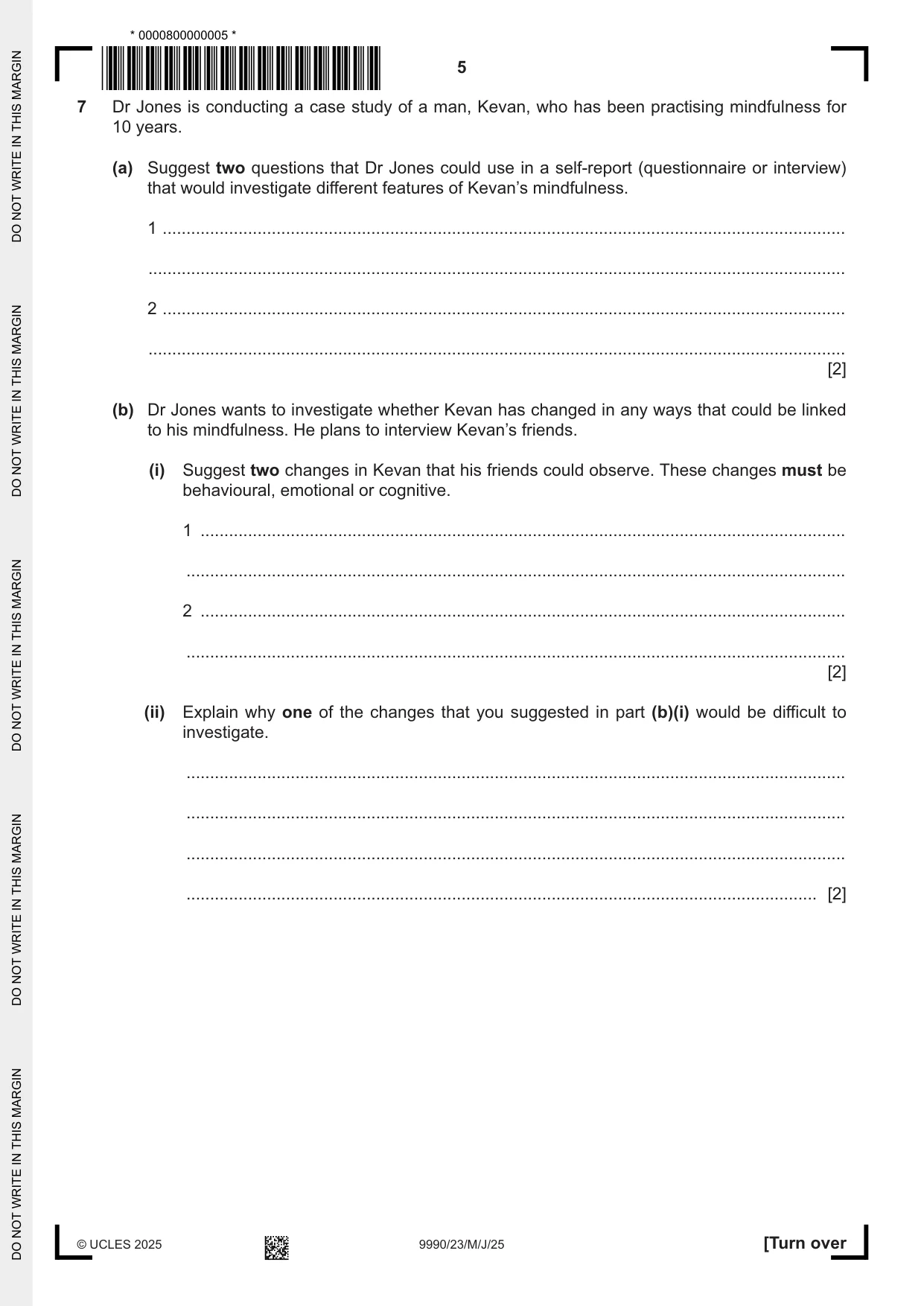
Q7 · Dr Jones is conducting a case study of a man, Kevan, who has been practising mindfulness…
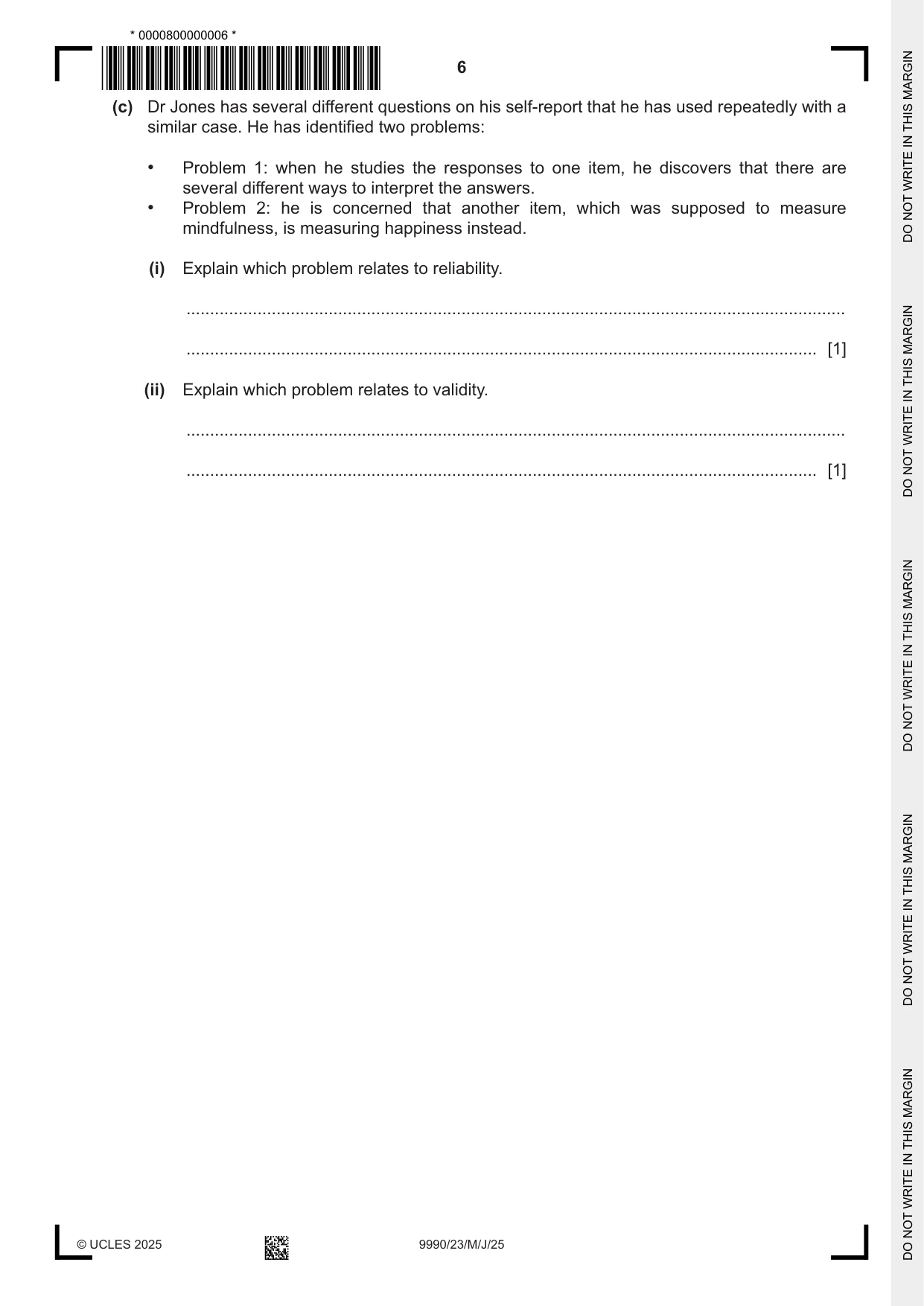
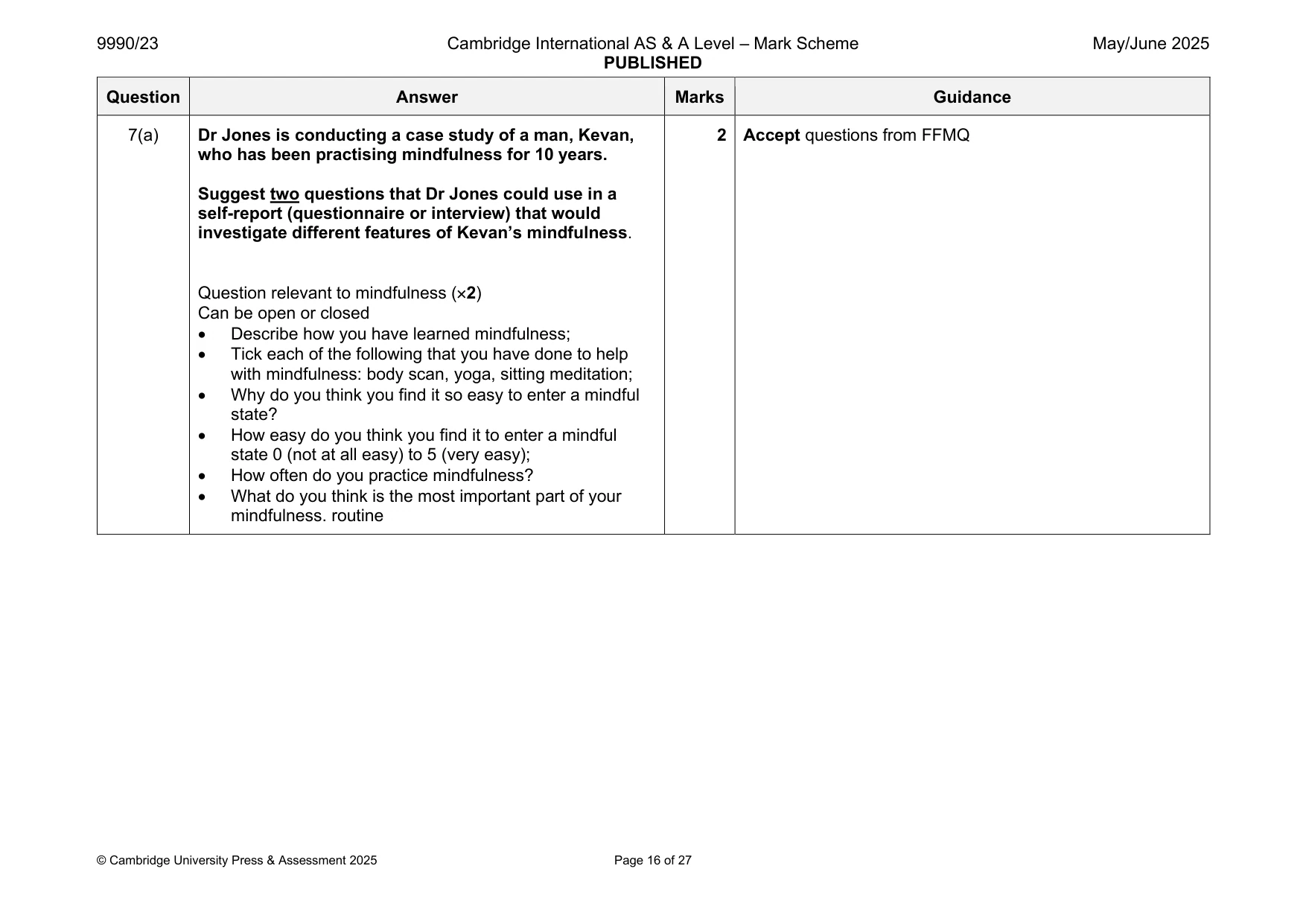
7 Dr Jones is conducting a case study of a man, Kevan, who has been practising mindfulness for 10 years. (a) Suggest two questions that Dr Jones could use in a self-report (questionnaire or interview) that would investigate different features of Kevan’s mindfulness. 1 ................................................................................................................................................ ................................................................................................................................................... 2 ................................................................................................................................................ ................................................................................................................................................... [2] (b) Dr Jones wants to investigate whether Kevan has changed in any ways that could be linked to his mindfulness. He plans to interview Kevan’s friends. (i) Suggest two changes in Kevan that his friends could observe. These changes must be behavioural, emotional or cognitive. 1 ........................................................................................................................................ ........................................................................................................................................... 2 ........................................................................................................................................ ........................................................................................................................................... [2] (ii) Explain why one of the changes that you suggested in part (b)(i) would be difficult to investigate. ........................................................................................................................................... ........................................................................................................................................... ........................................................................................................................................... ..................................................................................................................................... [2] (c) Dr Jones has several different questions on his self-report that he has used repeatedly with a similar case. He has identified two problems: • Problem 1: when he studies the responses to one item, he discovers that there are several different ways to interpret the answers. • Problem 2: he is concerned that another item, which was supposed to measure mindfulness, is measuring happiness instead. (i) Explain which problem relates to reliability. ........................................................................................................................................... ..................................................................................................................................... [1] (ii) Explain which problem relates to validity. ........................................................................................................................................... ..................................................................................................................................... [1]
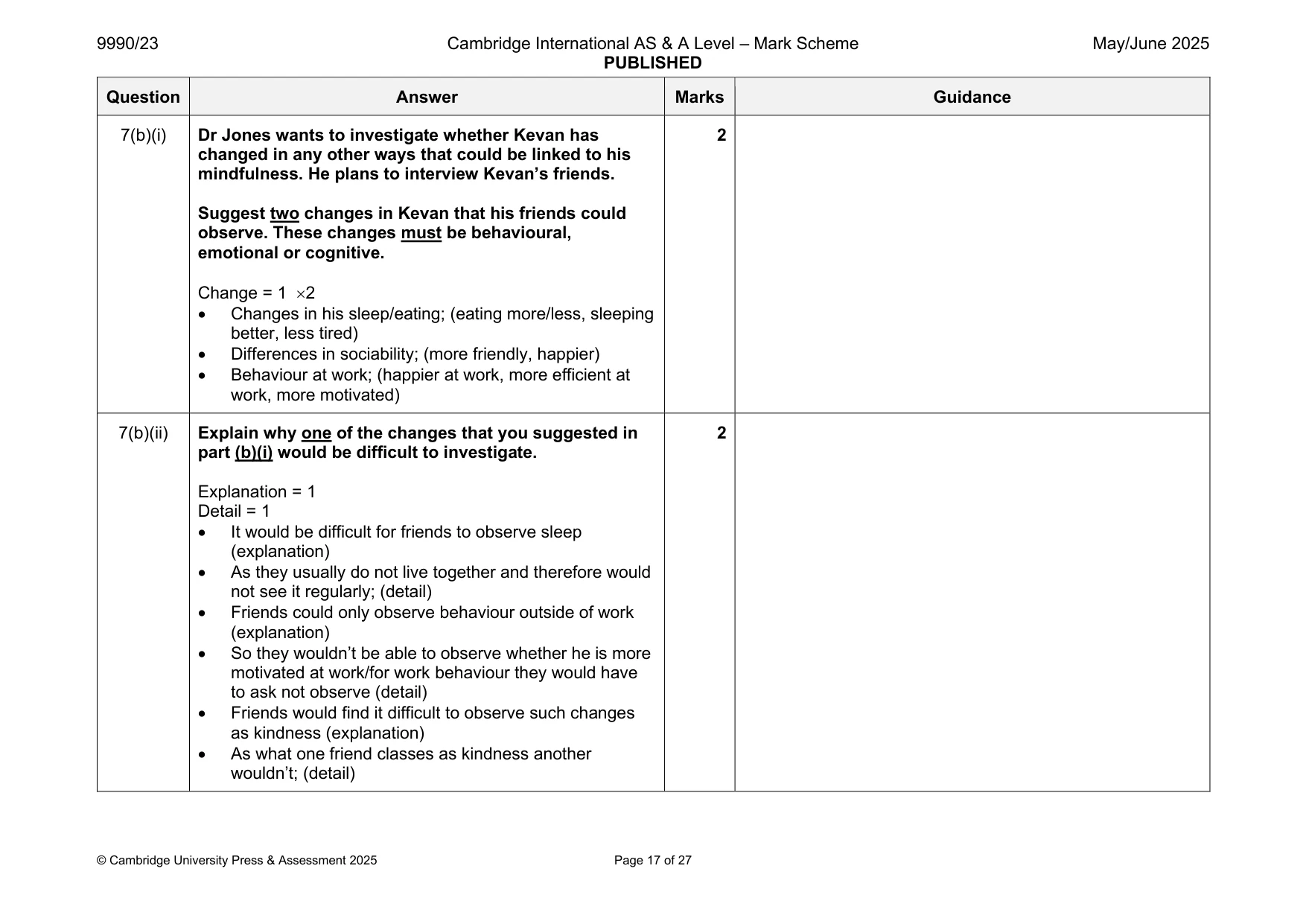
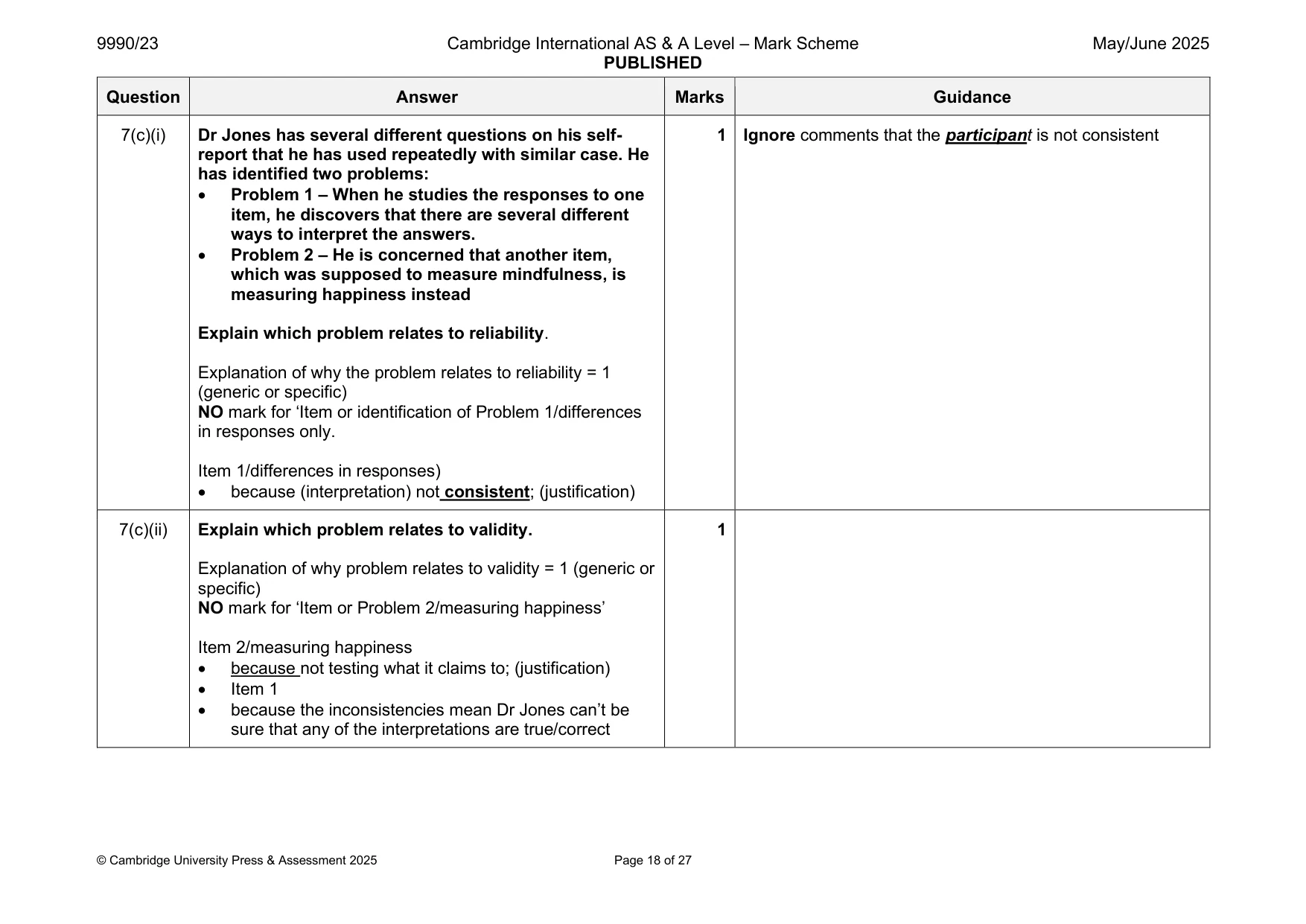
Mark scheme: 7(a) Dr Jones is conducting a case study of a man, Kevan, 2 Accept questions from FFMQ who has been practising mindfulness for 10 years. Suggest two questions that Dr Jones could use in a self-report (questionnaire or interview) that would investigate different features of Kevan’s mindfulness. Question relevant to mindfulness (2) Can be open or closed • Describe how you have learned mindfulness; • Tick each of the following that you have done to help with mindfulness: body scan, yoga, sitting meditation; • Why do you think you find it so easy to enter a mindful state? • How easy do you think you find it to enter a mindful state 0 (not at all easy) to 5 (very easy); • How often do you practice mindfulness? • What do you think is the most important part of your mindfulness. routine 7(b)(i) Dr Jones wants to investigate whether Kevan has 2 changed in any other ways that could be linked to his mindfulness. He plans to interview Kevan’s friends. Suggest two changes in Kevan that his friends could observe. These changes must be behavioural, emotional or cognitive. Change = 1 2 • Changes in his sleep/eating; (eating more/less, sleeping better, less tired) • Differences in sociability; (more friendly, happier) • Behaviour at work; (happier at work, more efficient at work, more motivated) 7(b)(ii) Explain why one of the changes that you suggested in 2 part (b)(i) would be difficult to investigate. Explanation = 1 Detail = 1 • It would be difficult for friends to observe sleep (explanation) • As they usually do not live together and therefore would not see it regularly; (detail) • Friends could only observe behaviour outside of work (explanation) • So they wouldn’t be able to observe whether he is more motivated at work/for work behaviour they would have to ask not observe (detail) • Friends would find it difficult to observe such changes as kindness (explanation) • As what one friend classes as kindness another wouldn’t; (detail) 7(c)(i) Dr Jones has several different questions on his self- 1 Ignore comments that the participant is not consistent report that he has used repeatedly with similar case. He has identified two problems: • Problem 1 – When he studies the responses to one item, he discovers that there are several different ways to interpret the answers. • Problem 2 – He is concerned that another item, which was supposed to measure mindfulness, is measuring happiness instead Explain which problem relates to reliability. Explanation of why the problem relates to reliability = 1 (generic or specific) NO mark for ‘Item or identification of Problem 1/differences in responses only. Item 1/differences in responses) • because (interpretation) not consistent; (justification) 7(c)(ii) Explain which problem relates to validity. 1 Explanation of why problem relates to validity = 1 (generic or specific) NO mark for ‘Item or Problem 2/measuring happiness’ Item 2/measuring happiness • because not testing what it claims to; (justification) • Item 1 • because the inconsistencies mean Dr Jones can’t be sure that any of the interpretations are true/correct
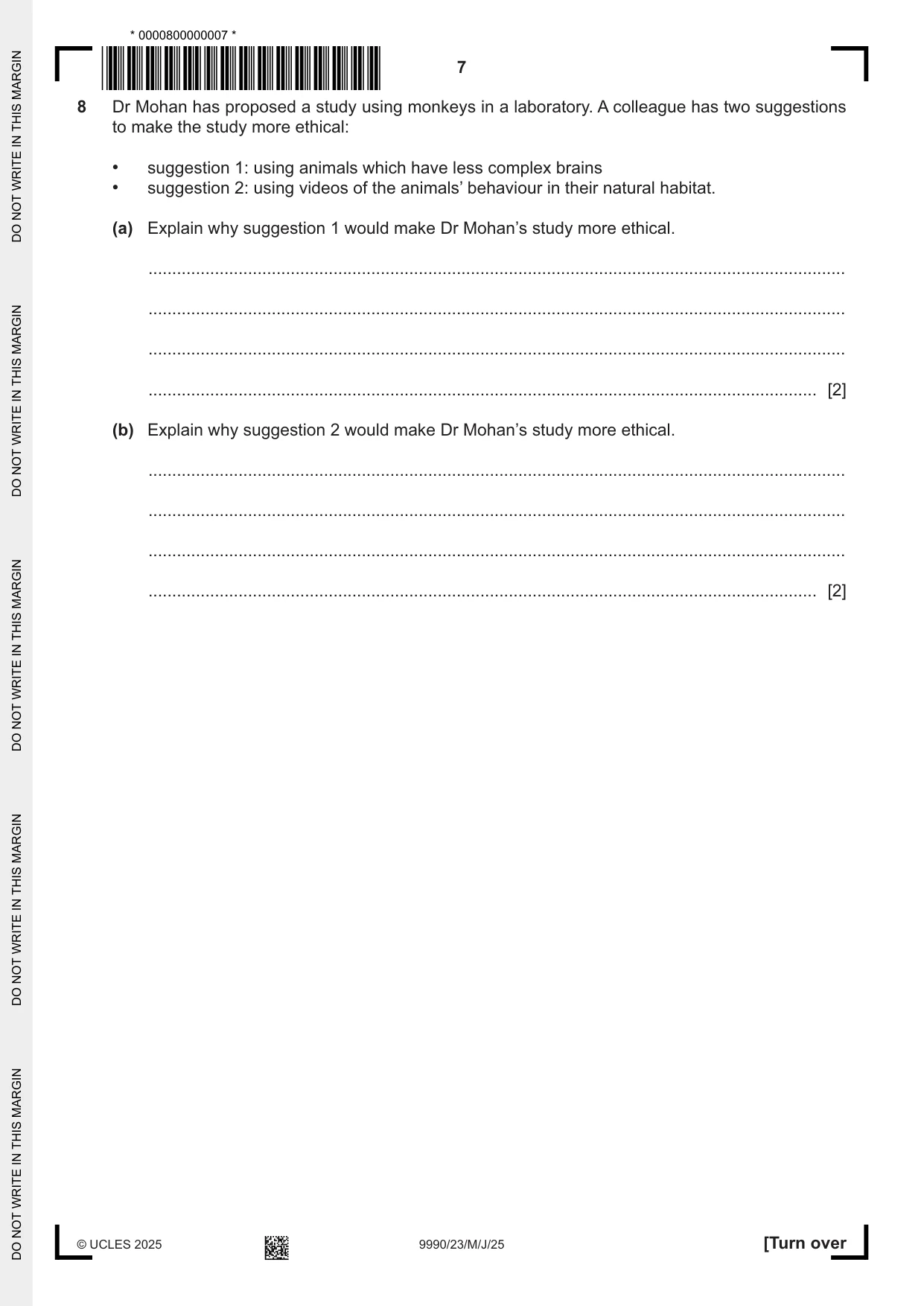
Q8 · Dr Mohan has proposed a study using monkeys in a laboratory
8 Dr Mohan has proposed a study using monkeys in a laboratory. A colleague has two suggestions to make the study more ethical: • suggestion 1: using animals which have less complex brains • suggestion 2: using videos of the animals’ behaviour in their natural habitat. (a) Explain why suggestion 1 would make Dr Mohan’s study more ethical. ................................................................................................................................................... ................................................................................................................................................... ................................................................................................................................................... ............................................................................................................................................. [2] (b) Explain why suggestion 2 would make Dr Mohan’s study more ethical. ................................................................................................................................................... ................................................................................................................................................... ................................................................................................................................................... ............................................................................................................................................. [2]
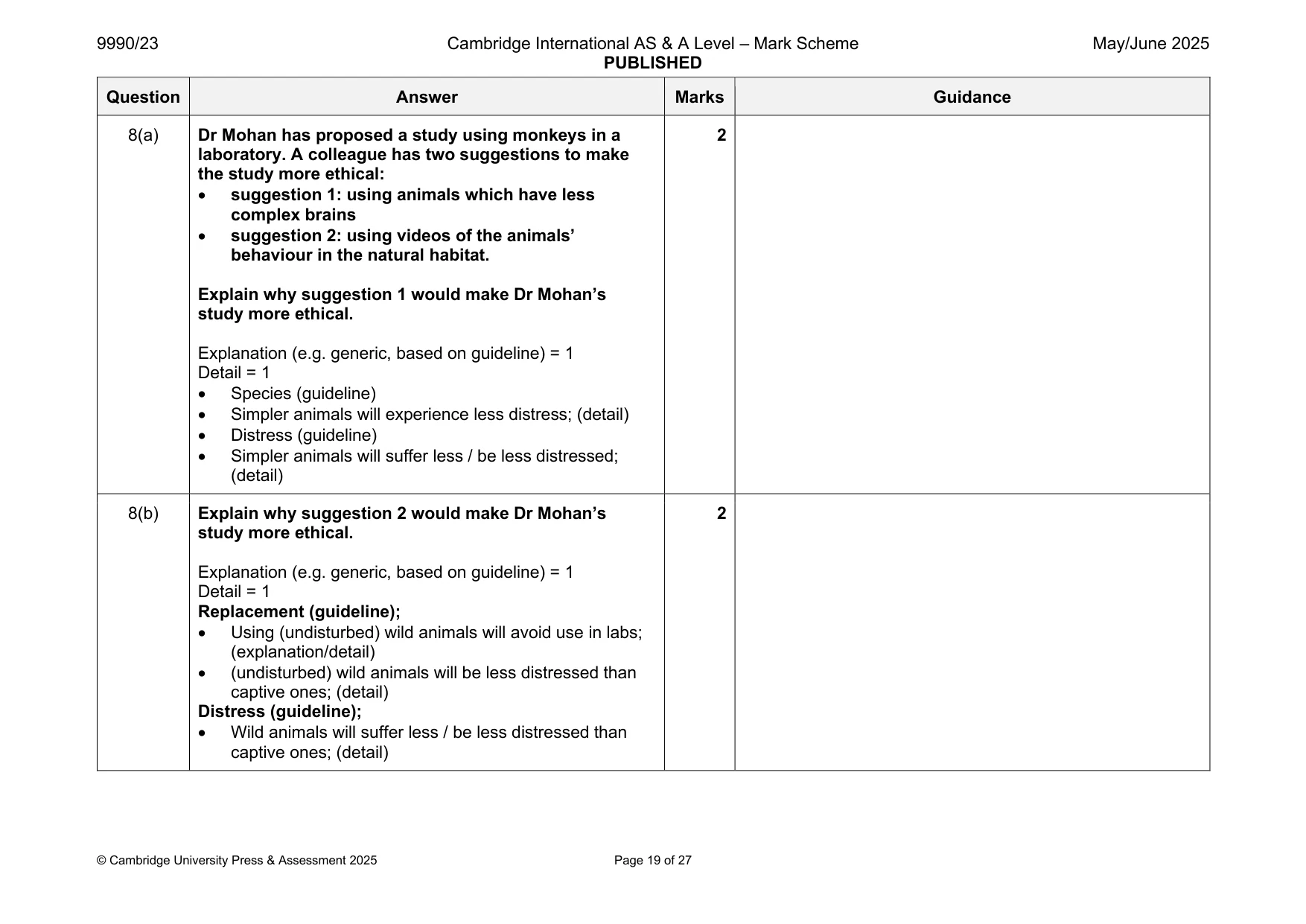
Mark scheme: 8(a) Dr Mohan has proposed a study using monkeys in a 2 laboratory. A colleague has two suggestions to make the study more ethical: • suggestion 1: using animals which have less complex brains • suggestion 2: using videos of the animals’ behaviour in the natural habitat. Explain why suggestion 1 would make Dr Mohan’s study more ethical. Explanation (e.g. generic, based on guideline) = 1 Detail = 1 • Species (guideline) • Simpler animals will experience less distress; (detail) • Distress (guideline) • Simpler animals will suffer less / be less distressed; (detail) 8(b) Explain why suggestion 2 would make Dr Mohan’s 2 study more ethical. Explanation (e.g. generic, based on guideline) = 1 Detail = 1 Replacement (guideline); • Using (undisturbed) wild animals will avoid use in labs; (explanation/detail) • (undisturbed) wild animals will be less distressed than captive ones; (detail) Distress (guideline); • Wild animals will suffer less / be less distressed than captive ones; (detail)
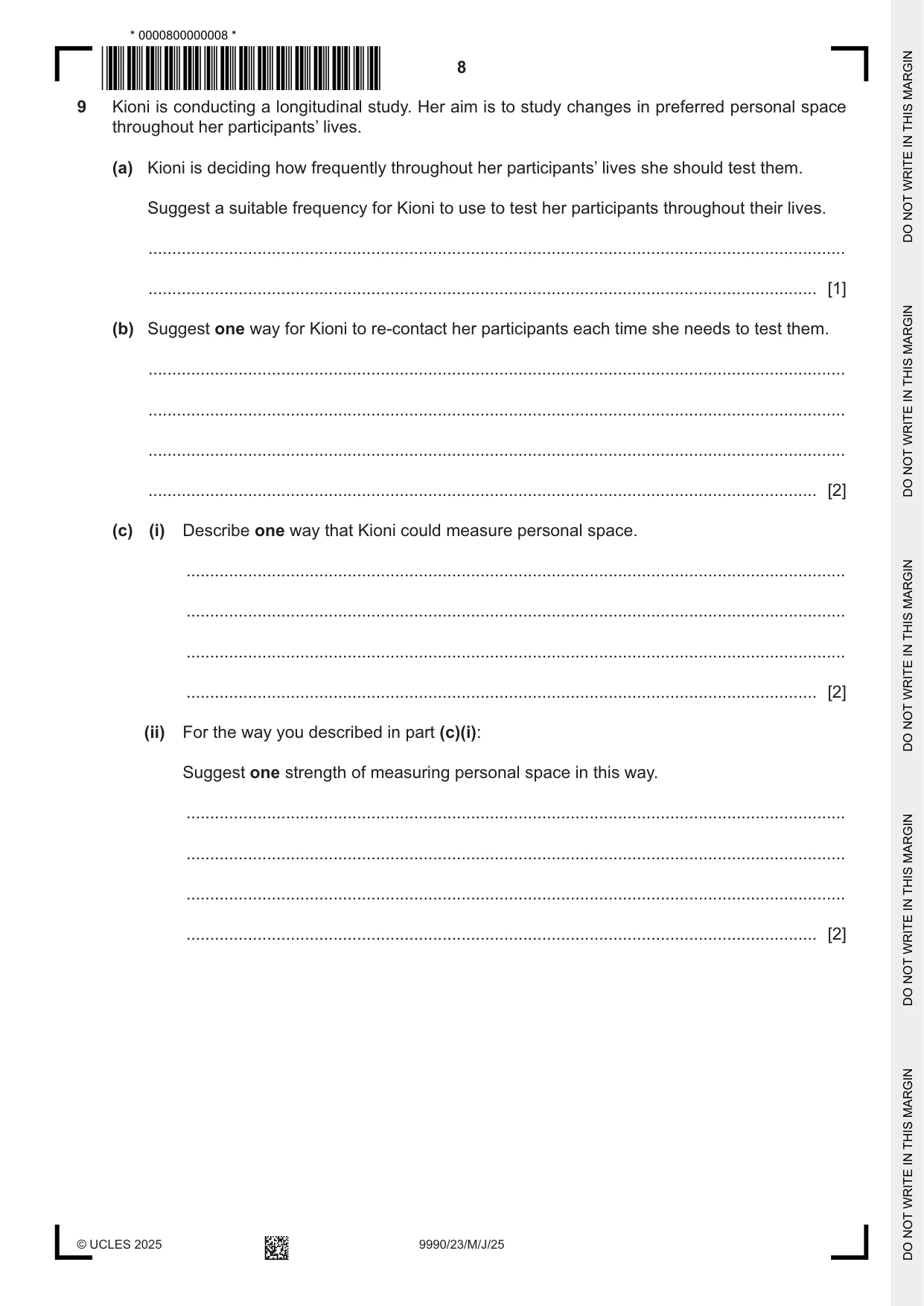
Q9 · Kioni is conducting a longitudinal study
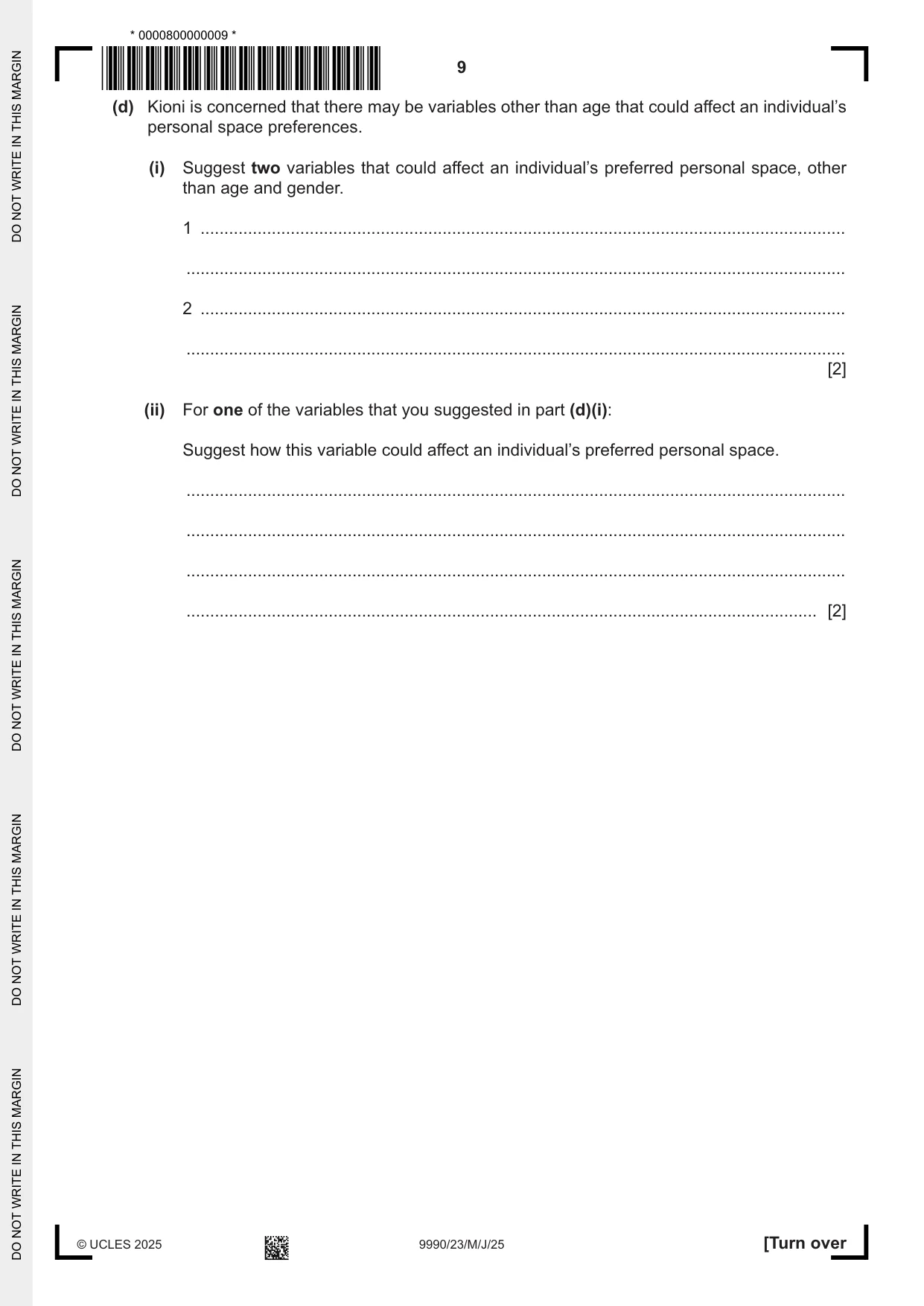
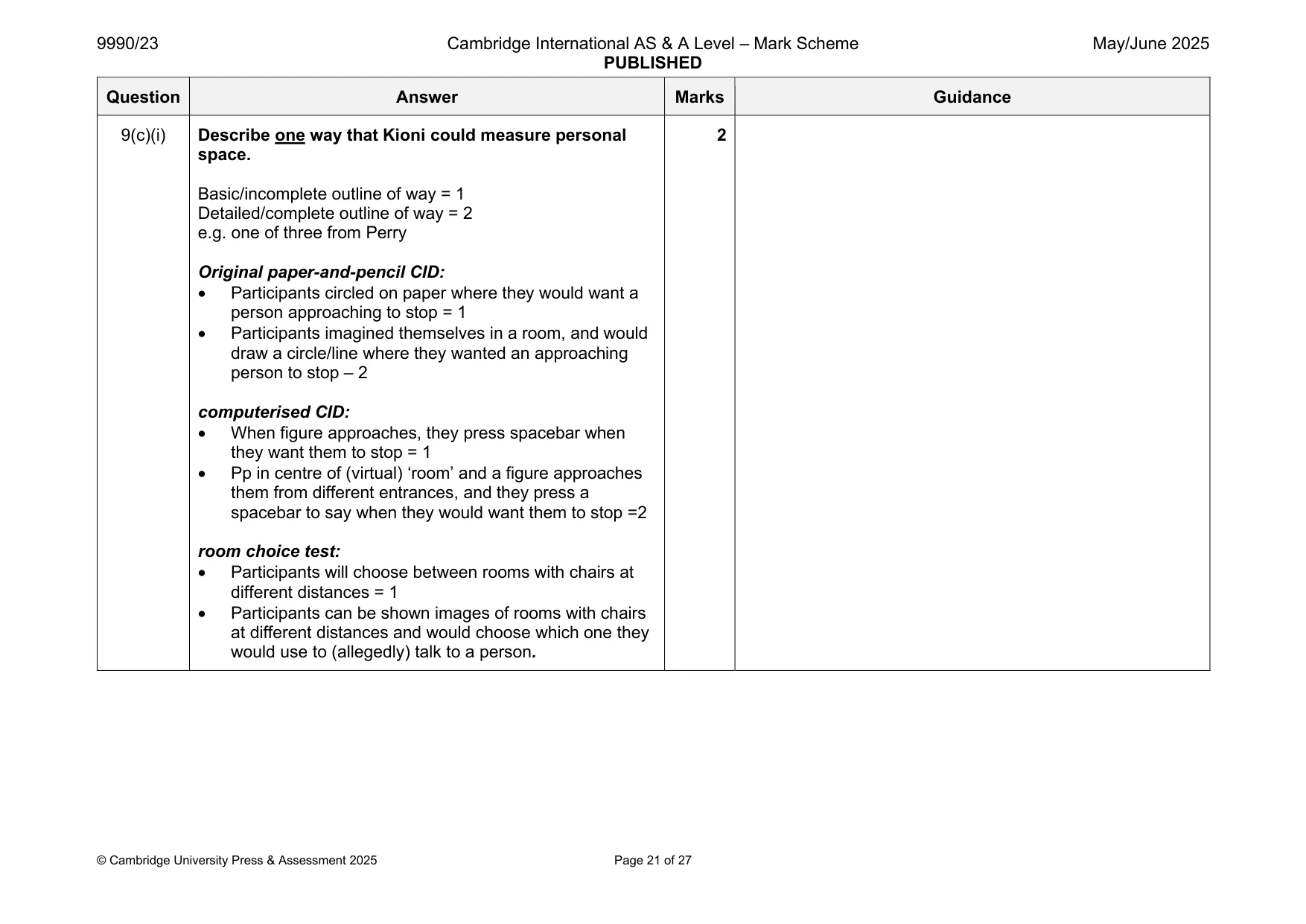
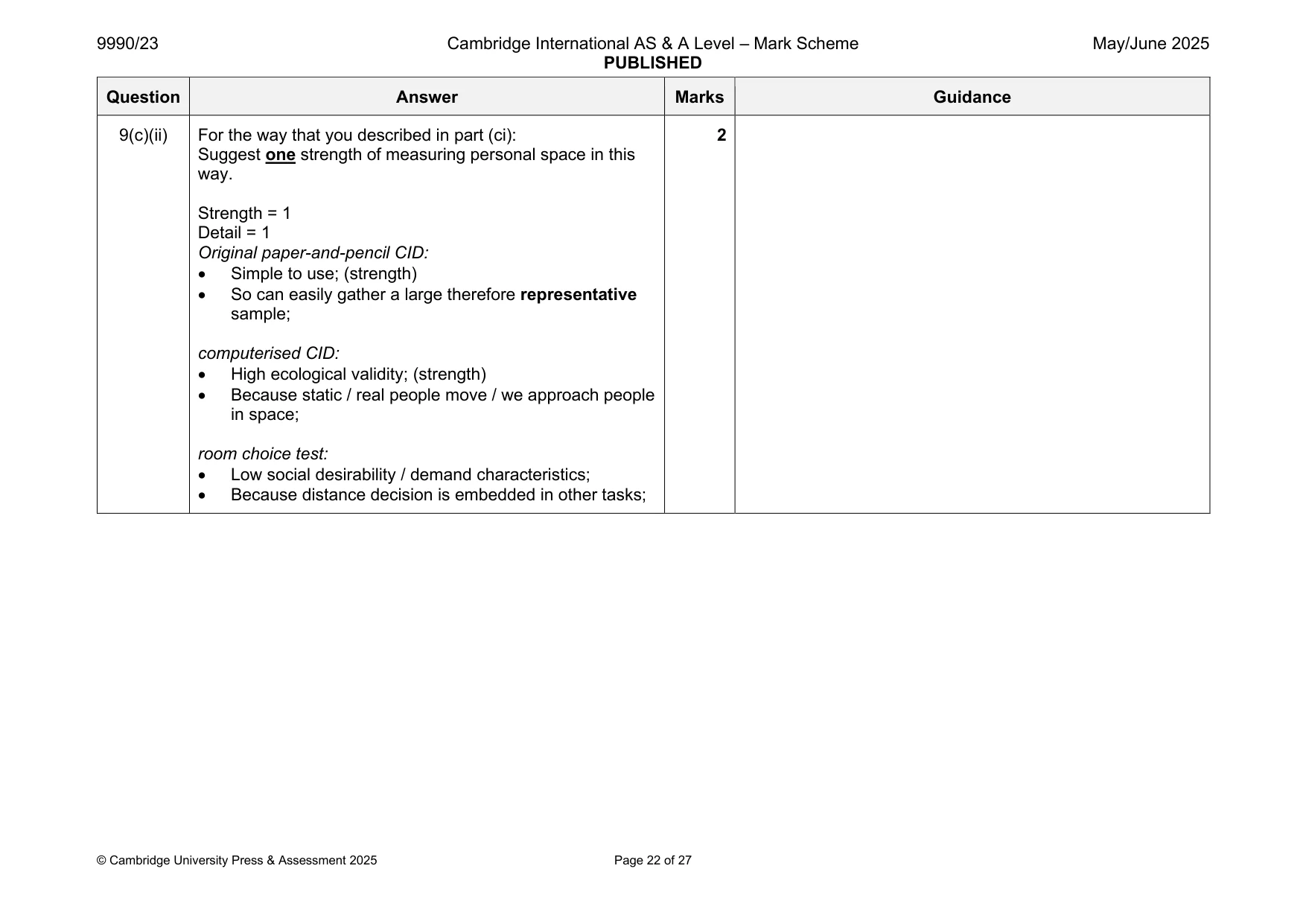
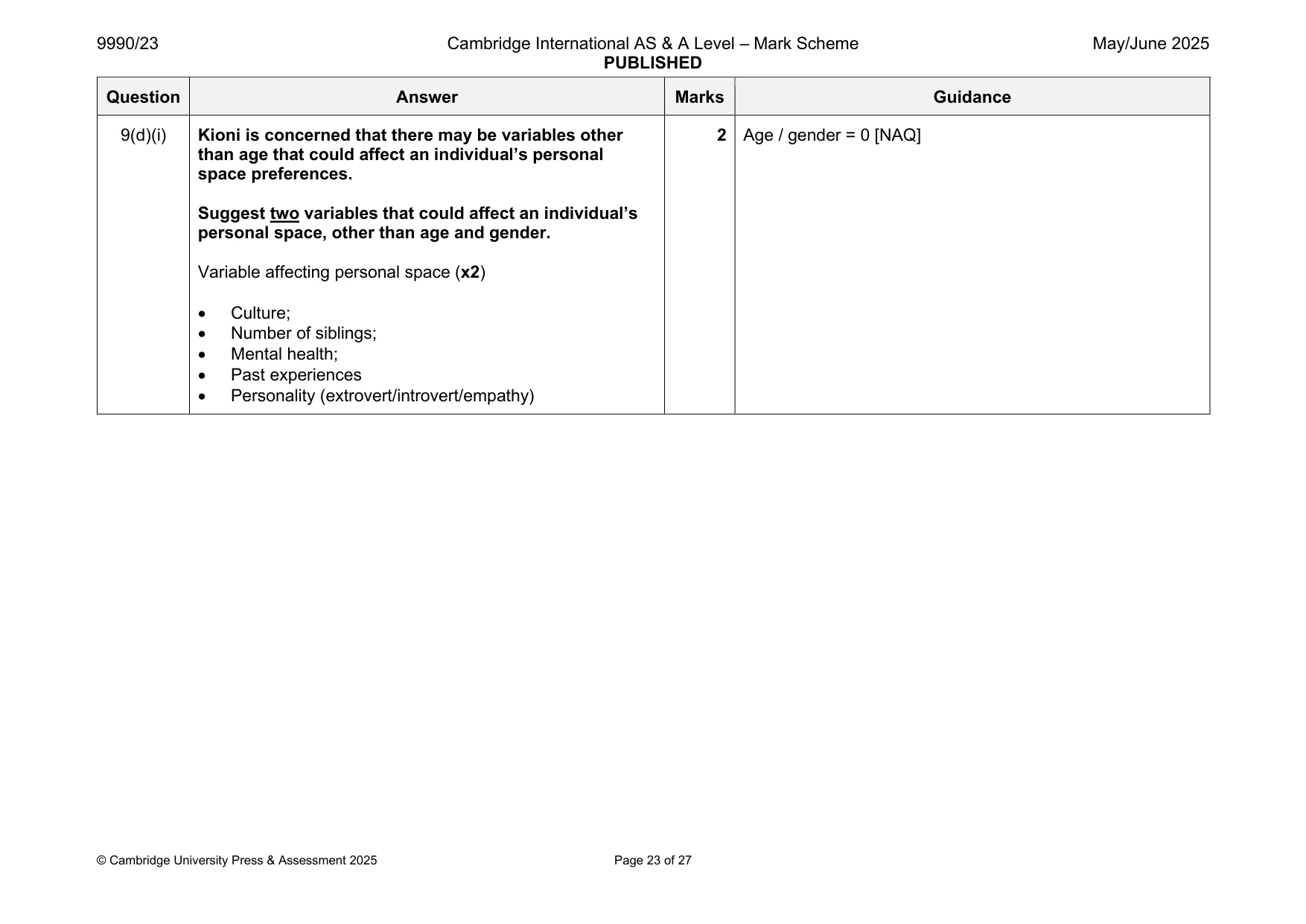
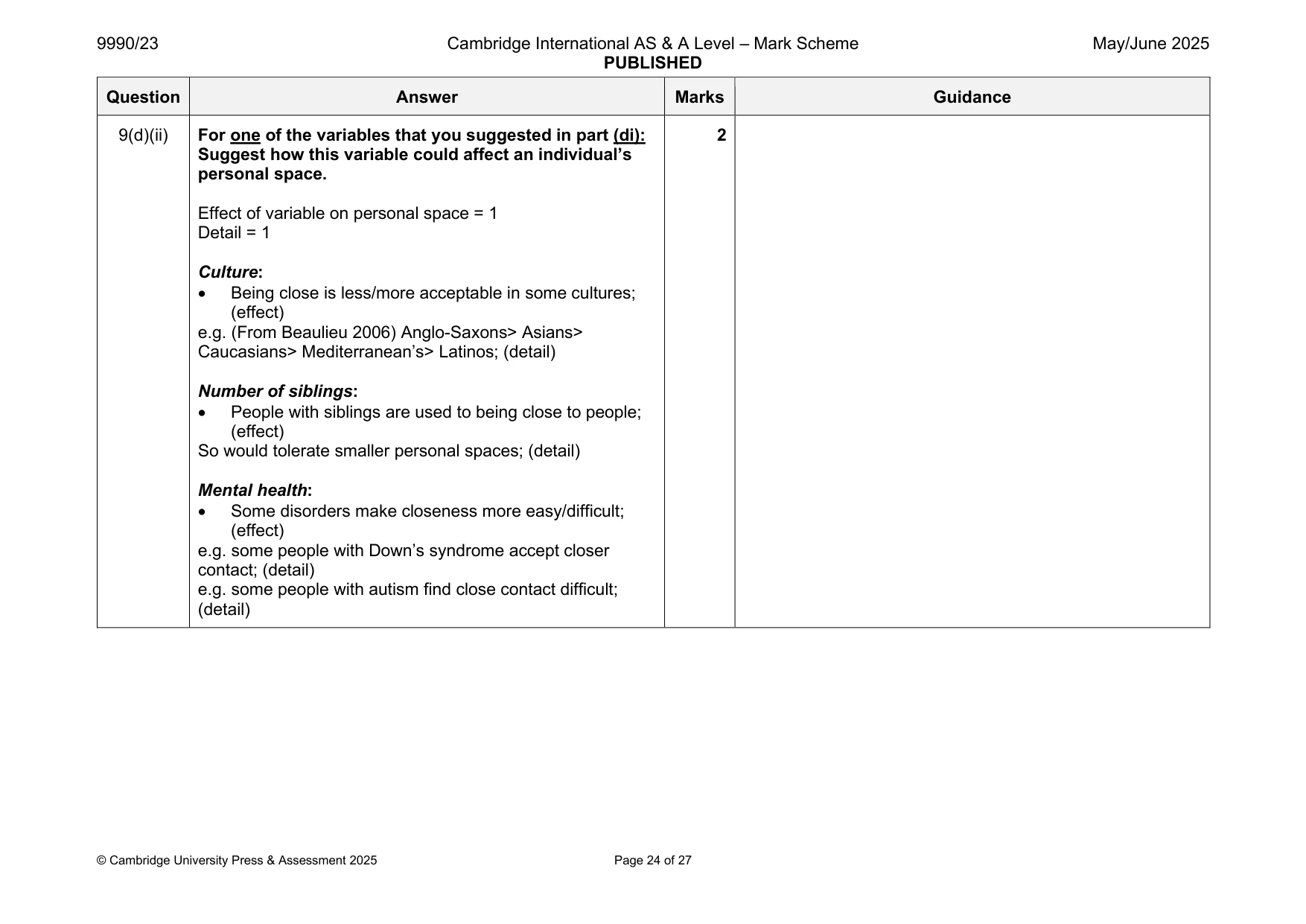
9 Kioni is conducting a longitudinal study. Her aim is to study changes in preferred personal space throughout her participants’ lives. (a) Kioni is deciding how frequently throughout her participants’ lives she should test them. Suggest a suitable frequency for Kioni to use to test her participants throughout their lives. ................................................................................................................................................... ............................................................................................................................................. [1] (b) Suggest one way for Kioni to re-contact her participants each time she needs to test them. ................................................................................................................................................... ................................................................................................................................................... ................................................................................................................................................... ............................................................................................................................................. [2] (c) (i) Describe one way that Kioni could measure personal space. ........................................................................................................................................... ........................................................................................................................................... ........................................................................................................................................... ..................................................................................................................................... [2] (ii) For the way you described in part (c)(i): Suggest one strength of measuring personal space in this way. ........................................................................................................................................... ........................................................................................................................................... ........................................................................................................................................... ..................................................................................................................................... [2] (d) Kioni is concerned that there may be variables other than age that could affect an individual’s personal space preferences. (i) Suggest two variables that could affect an individual’s preferred personal space, other than age and gender. 1 ........................................................................................................................................ ........................................................................................................................................... 2 ........................................................................................................................................ ........................................................................................................................................... [2] (ii) For one of the variables that you suggested in part (d)(i): Suggest how this variable could affect an individual’s preferred personal space. ........................................................................................................................................... ........................................................................................................................................... ........................................................................................................................................... ..................................................................................................................................... [2]
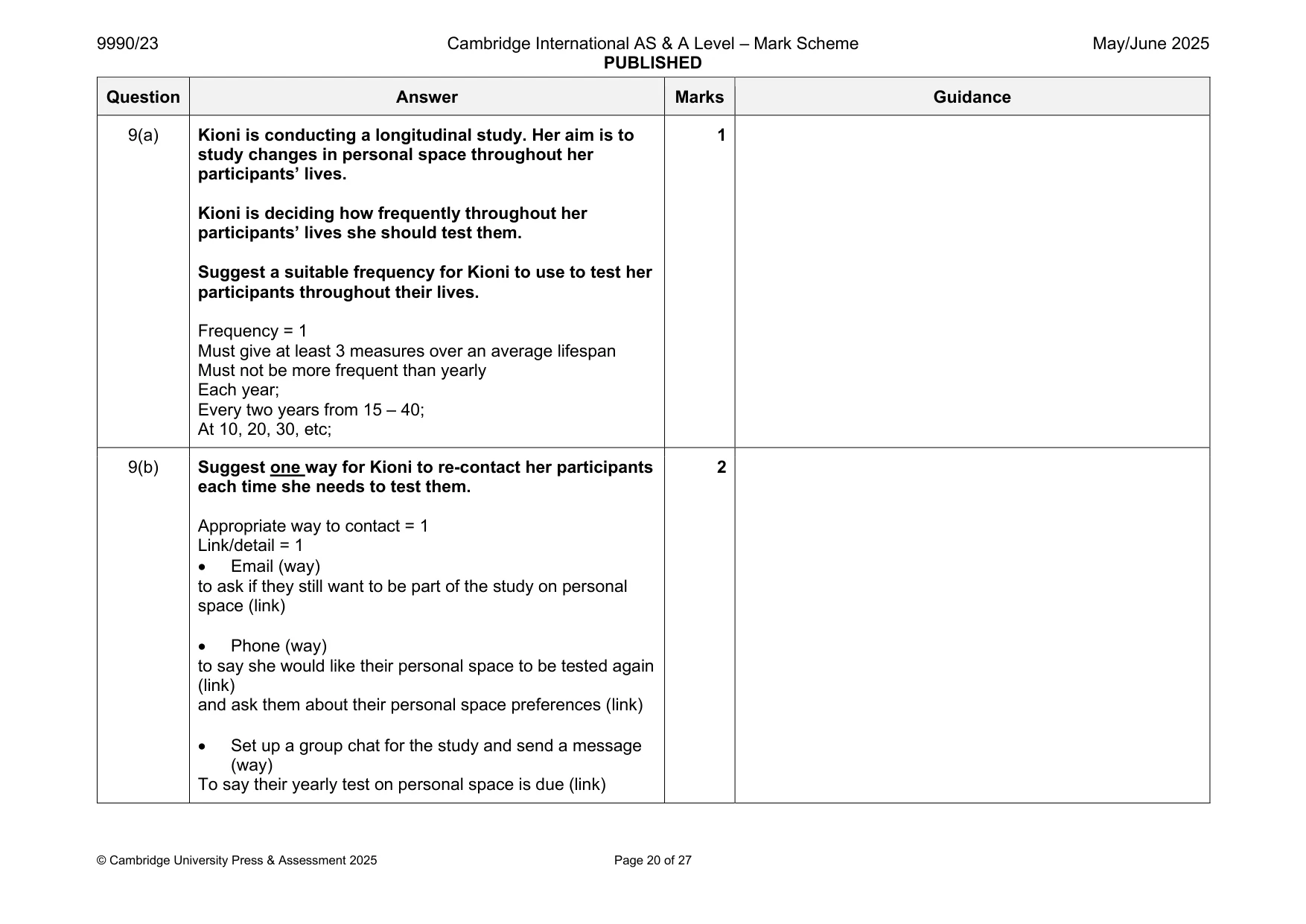
Mark scheme: 9(a) Kioni is conducting a longitudinal study. Her aim is to 1 study changes in personal space throughout her participants’ lives. Kioni is deciding how frequently throughout her participants’ lives she should test them. Suggest a suitable frequency for Kioni to use to test her participants throughout their lives. Frequency = 1 Must give at least 3 measures over an average lifespan Must not be more frequent than yearly Each year; Every two years from 15 – 40; At 10, 20, 30, etc; 9(b) Suggest one way for Kioni to re-contact her participants 2 each time she needs to test them. Appropriate way to contact = 1 Link/detail = 1 • Email (way) to ask if they still want to be part of the study on personal space (link) • Phone (way) to say she would like their personal space to be tested again (link) and ask them about their personal space preferences (link) • Set up a group chat for the study and send a message (way) To say their yearly test on personal space is due (link) 9(c)(i) Describe one way that Kioni could measure personal 2 space. Basic/incomplete outline of way = 1 Detailed/complete outline of way = 2 e.g. one of three from Perry Original paper-and-pencil CID: • Participants circled on paper where they would want a person approaching to stop = 1 • Participants imagined themselves in a room, and would draw a circle/line where they wanted an approaching person to stop – 2 computerised CID: • When figure approaches, they press spacebar when they want them to stop = 1 • Pp in centre of (virtual) ‘room’ and a figure approaches them from different entrances, and they press a spacebar to say when they would want them to stop =2 room choice test: • Participants will choose between rooms with chairs at different distances = 1 • Participants can be shown images of rooms with chairs at different distances and would choose which one they would use to (allegedly) talk to a person. 9(c)(ii) For the way that you described in part (ci): 2 Suggest one strength of measuring personal space in this way. Strength = 1 Detail = 1 Original paper-and-pencil CID: • Simple to use; (strength) • So can easily gather a large therefore representative sample; computerised CID: • High ecological validity; (strength) • Because static / real people move / we approach people in space; room choice test: • Low social desirability / demand characteristics; • Because distance decision is embedded in other tasks; 9(d)(i) Kioni is concerned that there may be variables other 2 Age / gender = 0 [NAQ] than age that could affect an individual’s personal space preferences. Suggest two variables that could affect an individual’s personal space, other than age and gender. Variable affecting personal space (x2) • Culture; • Number of siblings; • Mental health; • Past experiences • Personality (extrovert/introvert/empathy) 9(d)(ii) For one of the variables that you suggested in part (di): 2 Suggest how this variable could affect an individual’s personal space. Effect of variable on personal space = 1 Detail = 1 Culture: • Being close is less/more acceptable in some cultures; (effect) e.g. (From Beaulieu 2006) Anglo-Saxons> Asians> Caucasians> Mediterranean’s> Latinos; (detail) Number of siblings: • People with siblings are used to being close to people; (effect) So would tolerate smaller personal spaces; (detail) Mental health: • Some disorders make closeness more easy/difficult; (effect) e.g. some people with Down’s syndrome accept closer contact; (detail) e.g. some people with autism find close contact difficult; (detail)
Q10 · Isla is a teacher
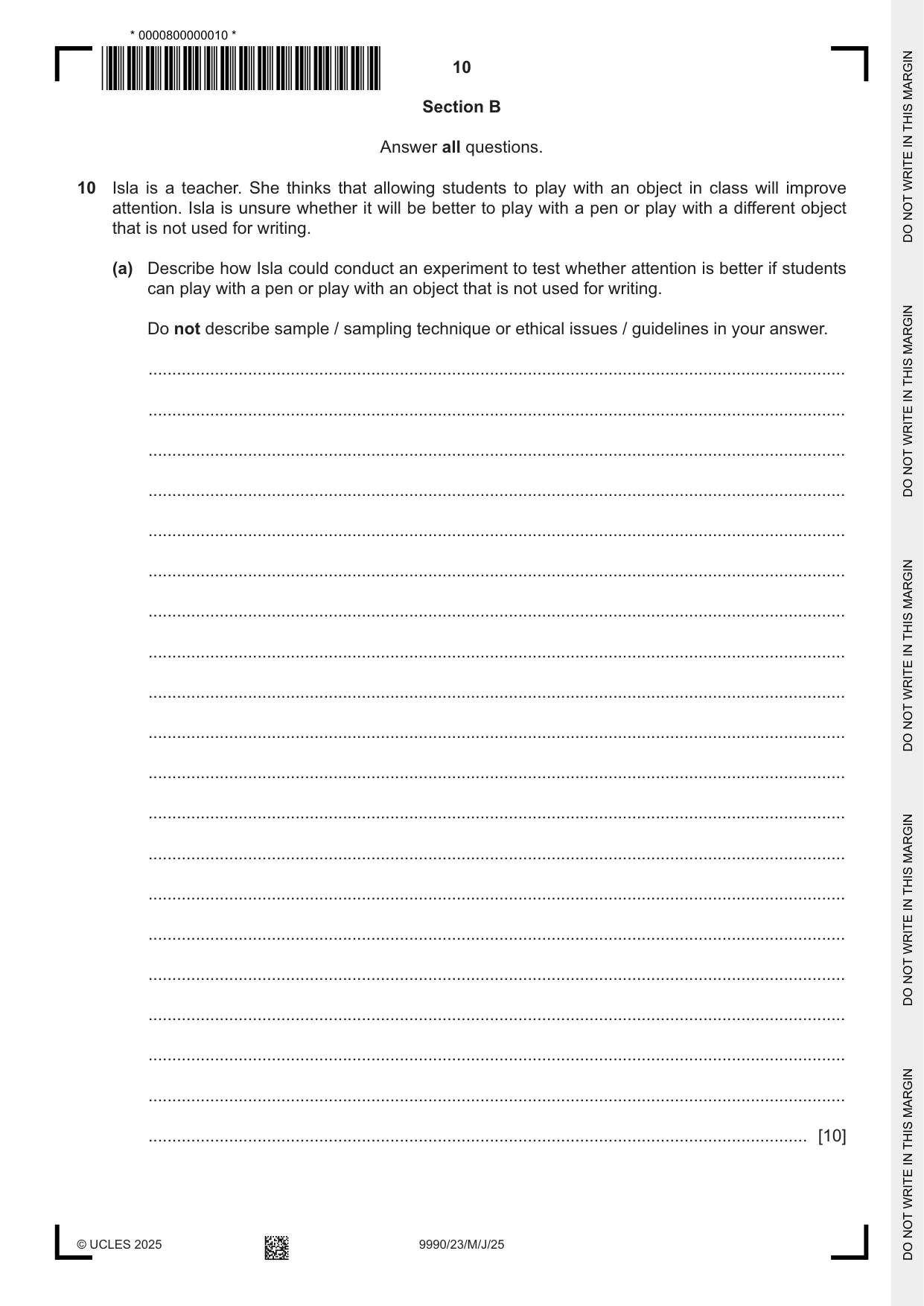
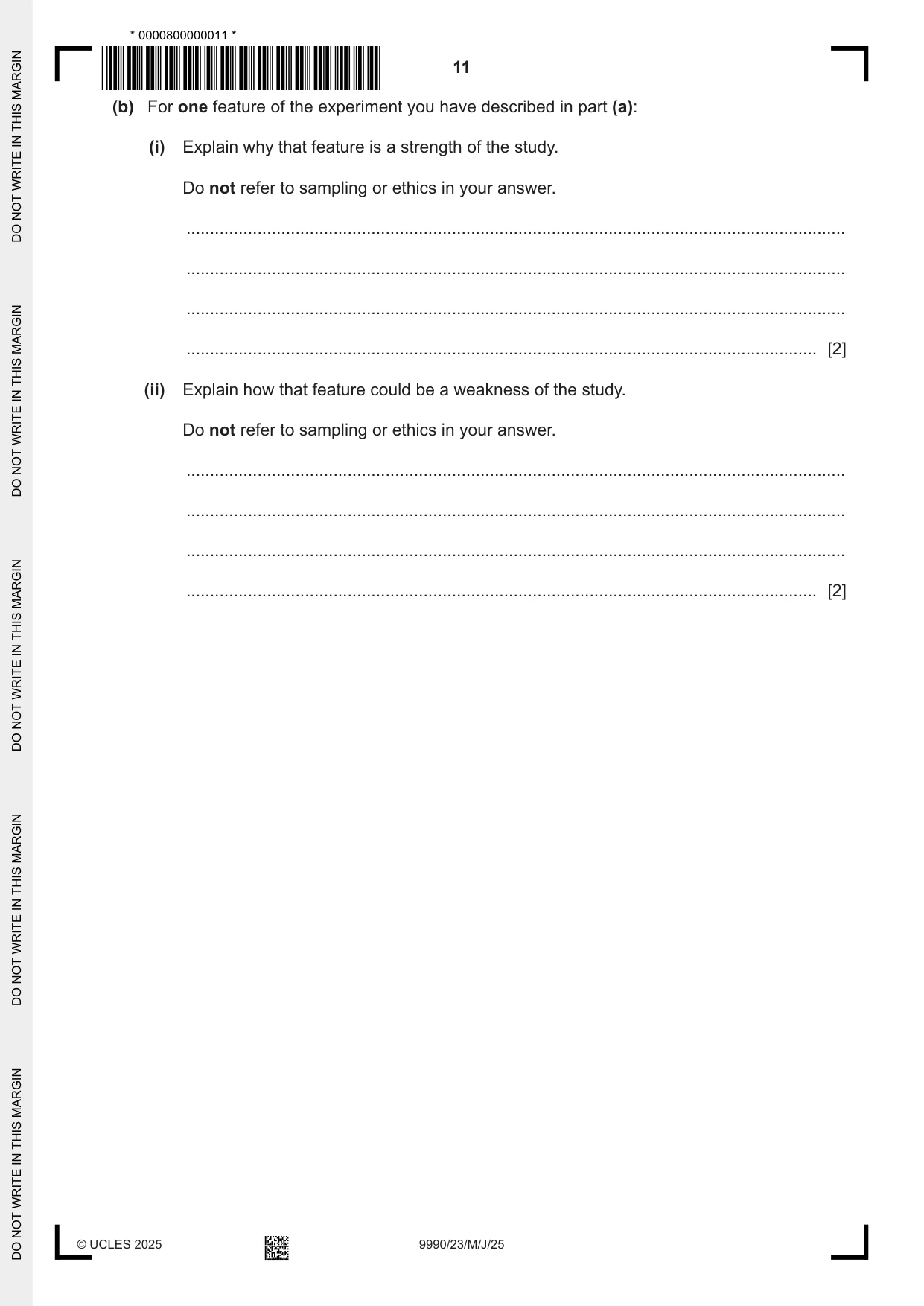
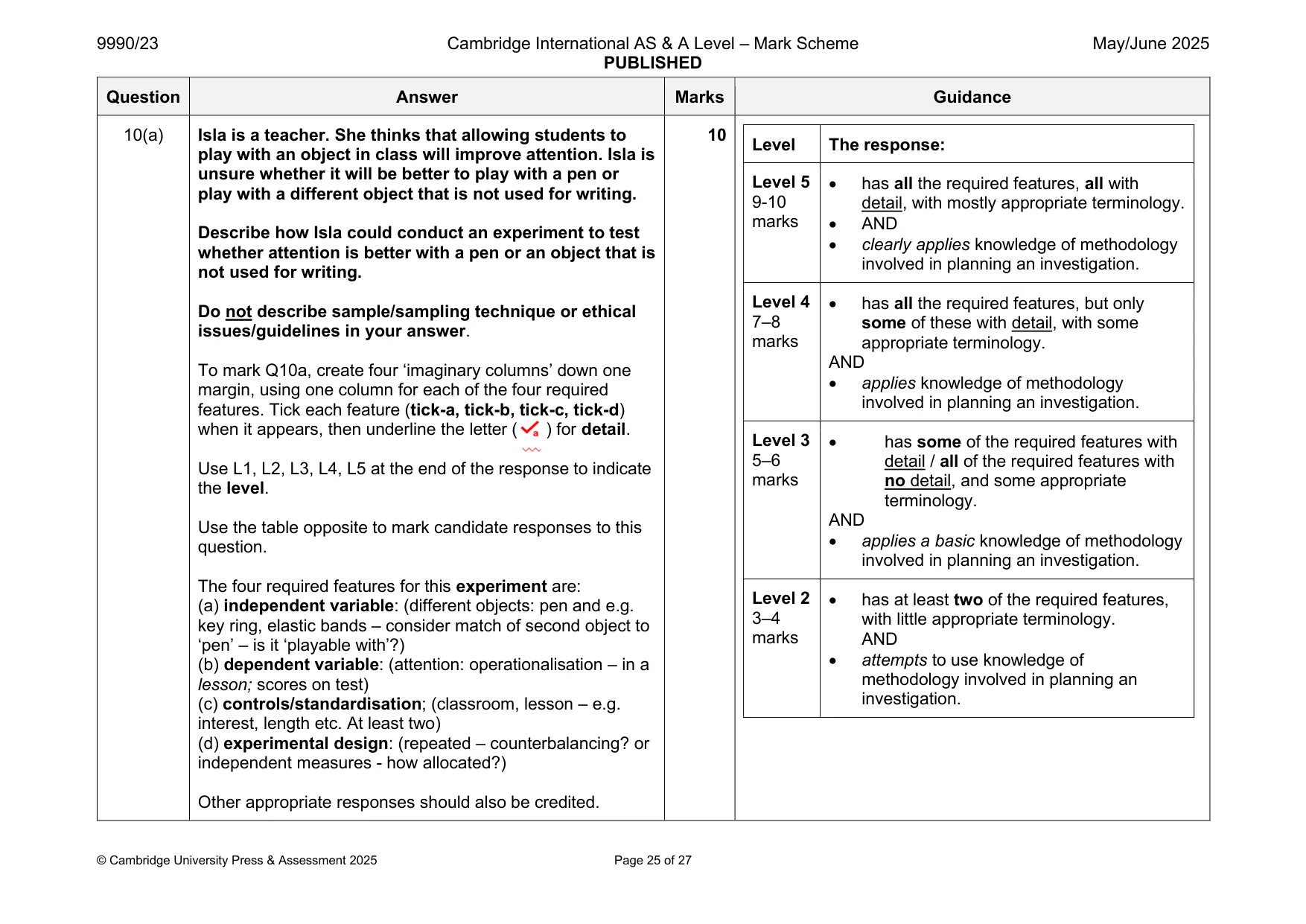
10 Isla is a teacher. She thinks that allowing students to play with an object in class will improve attention. Isla is unsure whether it will be better to play with a pen or play with a different object that is not used for writing. (a) Describe how Isla could conduct an experiment to test whether attention is better if students can play with a pen or play with an object that is not used for writing. Do not describe sample / sampling technique or ethical issues / guidelines in your answer. ................................................................................................................................................... ................................................................................................................................................... ................................................................................................................................................... ................................................................................................................................................... ................................................................................................................................................... ................................................................................................................................................... ................................................................................................................................................... ................................................................................................................................................... ................................................................................................................................................... ................................................................................................................................................... ................................................................................................................................................... ................................................................................................................................................... ................................................................................................................................................... ................................................................................................................................................... ................................................................................................................................................... ................................................................................................................................................... ................................................................................................................................................... ................................................................................................................................................... ................................................................................................................................................... ........................................................................................................................................... [10] (b) For one feature of the experiment you have described in part (a): (i) Explain why that feature is a strength of the study. Do not refer to sampling or ethics in your answer. ........................................................................................................................................... ........................................................................................................................................... ........................................................................................................................................... ..................................................................................................................................... [2] (ii) Explain how that feature could be a weakness of the study. Do not refer to sampling or ethics in your answer. ........................................................................................................................................... ........................................................................................................................................... ........................................................................................................................................... ..................................................................................................................................... [2]
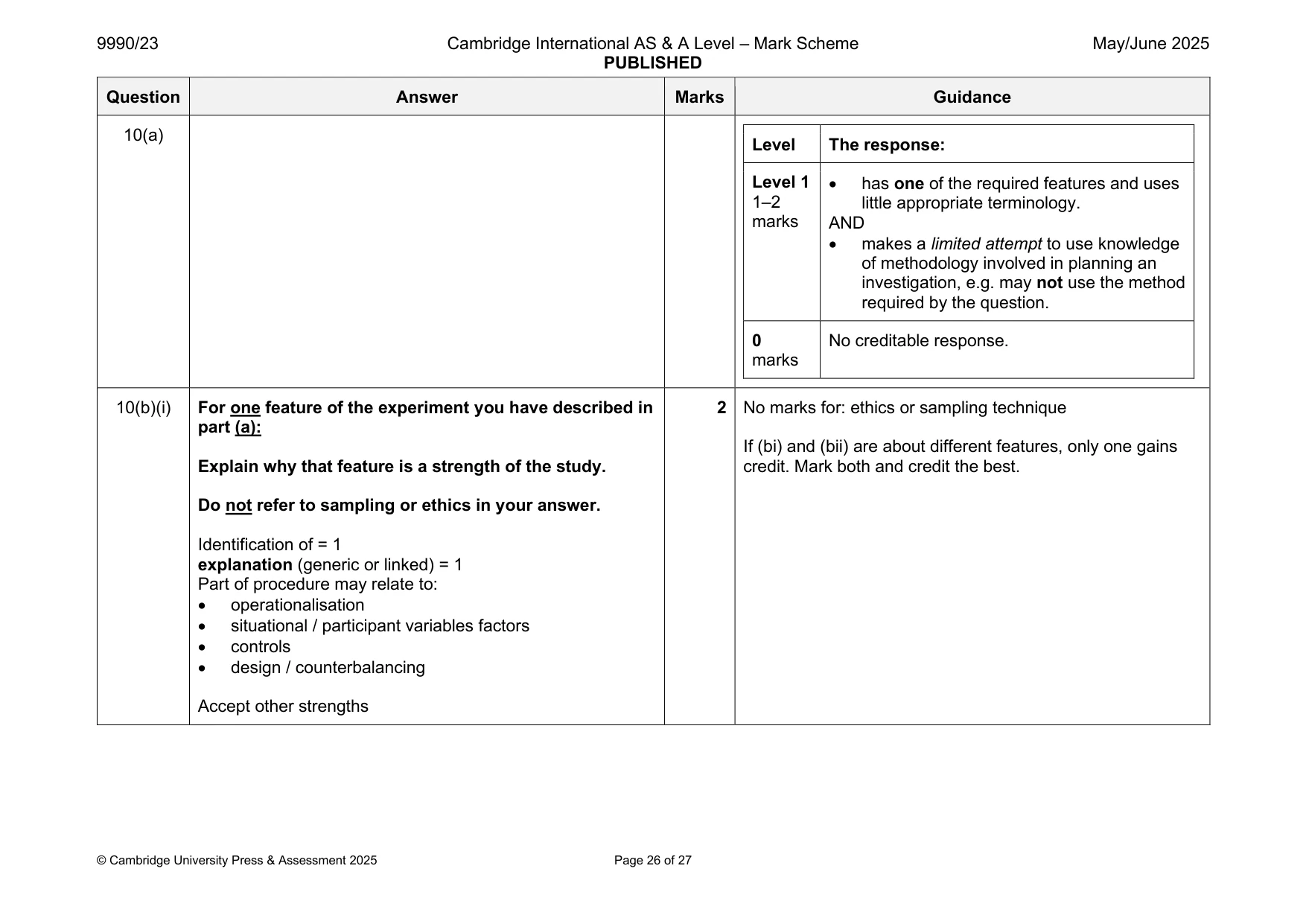
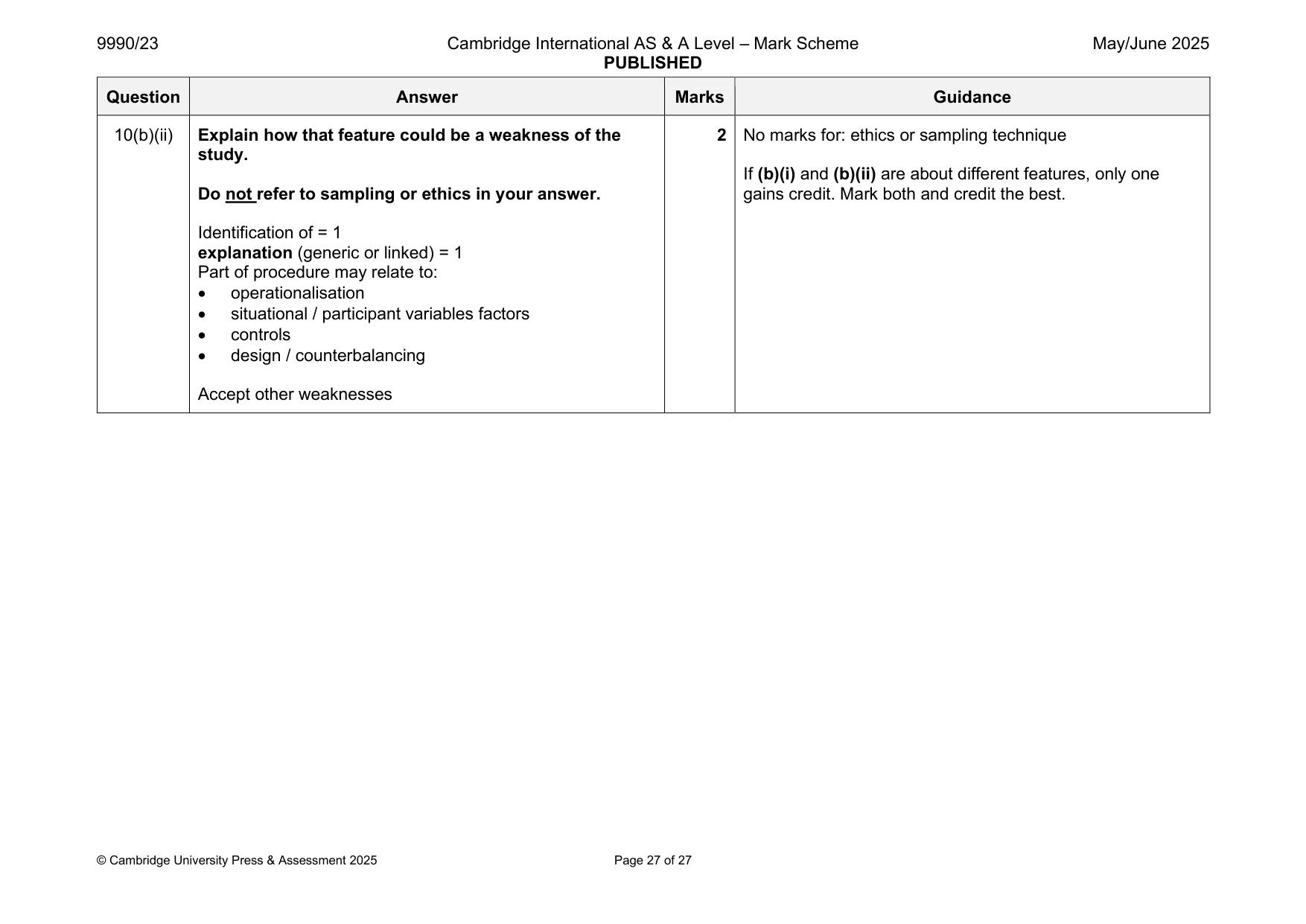
Mark scheme: 10(a) Isla is a teacher. She thinks that allowing students to 10 Level The response: play with an object in class will improve attention. Isla is unsure whether it will be better to play with a pen or Level 5 • has all the required features, all with play with a different object that is not used for writing. 9-10 detail, with mostly appropriate terminology. marks • AND Describe how Isla could conduct an experiment to test • clearly applies knowledge of methodology whether attention is better with a pen or an object that is involved in planning an investigation. not used for writing. Level 4 • has all the required features, but only Do not describe sample/sampling technique or ethical 7–8 some of these with detail, with some issues/guidelines in your answer. marks appropriate terminology. AND To mark Q10a, create four ‘imaginary columns’ down one • applies knowledge of methodology margin, using one column for each of the four required involved in planning an investigation. features. Tick each feature (tick-a, tick-b, tick-c, tick-d) when it appears, then underline the letter ( ) for detail. Level 3 • has some of the required features with 5–6 detail / all of the required features with Use L1, L2, L3, L4, L5 at the end of the response to indicate marks no detail, and some appropriate the level. terminology. AND Use the table opposite to mark candidate responses to this • applies a basic knowledge of methodology question. involved in planning an investigation. The four required features for this experiment are: Level 2 • has at least two of the required features, (a) independent variable: (different objects: pen and e.g. 3–4 with little appropriate terminology. key ring, elastic bands – consider match of second object to marks AND ‘pen’ – is it ‘playable with’?) • attempts to use knowledge of (b) dependent variable: (attention: operationalisation – in a methodology involved in planning an lesson; scores on test) investigation. (c) controls/standardisation; (classroom, lesson – e.g. interest, length etc. At least two) (d) experimental design: (repeated – counterbalancing? or independent measures - how allocated?) Other appropriate responses should also be credited. 10(a) Level The response: Level 1 • has one of the required features and uses 1–2 little appropriate terminology. marks AND • makes a limited attempt to use knowledge of methodology involved in planning an investigation, e.g. may not use the method required by the question. 0 No creditable response. marks 10(b)(i) For one feature of the experiment you have described in 2 No marks for: ethics or sampling technique part (a): If (bi) and (bii) are about different features, only one gains Explain why that feature is a strength of the study. credit. Mark both and credit the best. Do not refer to sampling or ethics in your answer. Identification of = 1 explanation (generic or linked) = 1 Part of procedure may relate to: • operationalisation • situational / participant variables factors • controls • design / counterbalancing Accept other strengths 10(b)(ii) Explain how that feature could be a weakness of the 2 No marks for: ethics or sampling technique study. If (b)(i) and (b)(ii) are about different features, only one Do not refer to sampling or ethics in your answer. gains credit. Mark both and credit the best. Identification of = 1 explanation (generic or linked) = 1 Part of procedure may relate to: • operationalisation • situational / participant variables factors • controls • design / counterbalancing Accept other weaknesses
What was in this paper
The subtopics covered by these 10 questions, and how many questions each got. Open one in a new tab to see every Cambridge question on it.
What you needed in this session
Cambridge’s own grade thresholds for 2025 May/June, Paper 2 · Variant 3. A higher threshold means an easier paper — the bar moves with how the cohort did.