Cambridge A Level Psychology (from 2018) 9990 — 2025 Oct/Nov Paper 2 · Variant 2
9990/22/O/N/25 · 9 questions · 60 marks · 90 min
The question paper and its mark scheme, free to read here and free to download. This is Cambridge’s own paper, exactly as it was sat.
Question paper12 pages


Mark scheme24 pages
Answers below. Sit the paper first if you are practising.
Questions as text
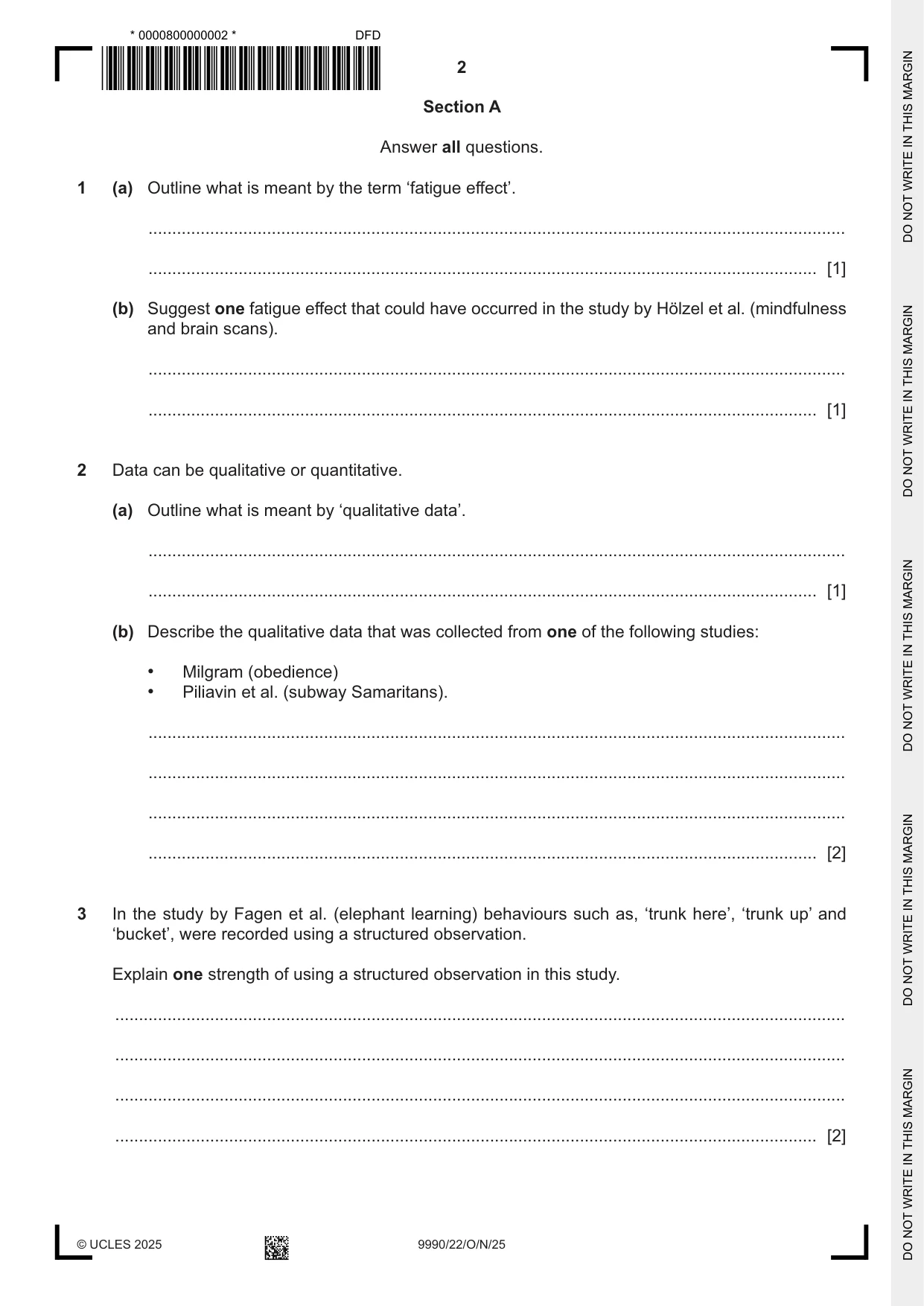
Q1 · Outline what is meant by the term ‘fatigue effect’
1 (a) Outline what is meant by the term ‘fatigue effect’. ................................................................................................................................................... ............................................................................................................................................. [1] (b) Suggest one fatigue effect that could have occurred in the study by Hölzel et al. (mindfulness and brain scans). ................................................................................................................................................... ............................................................................................................................................. [1]
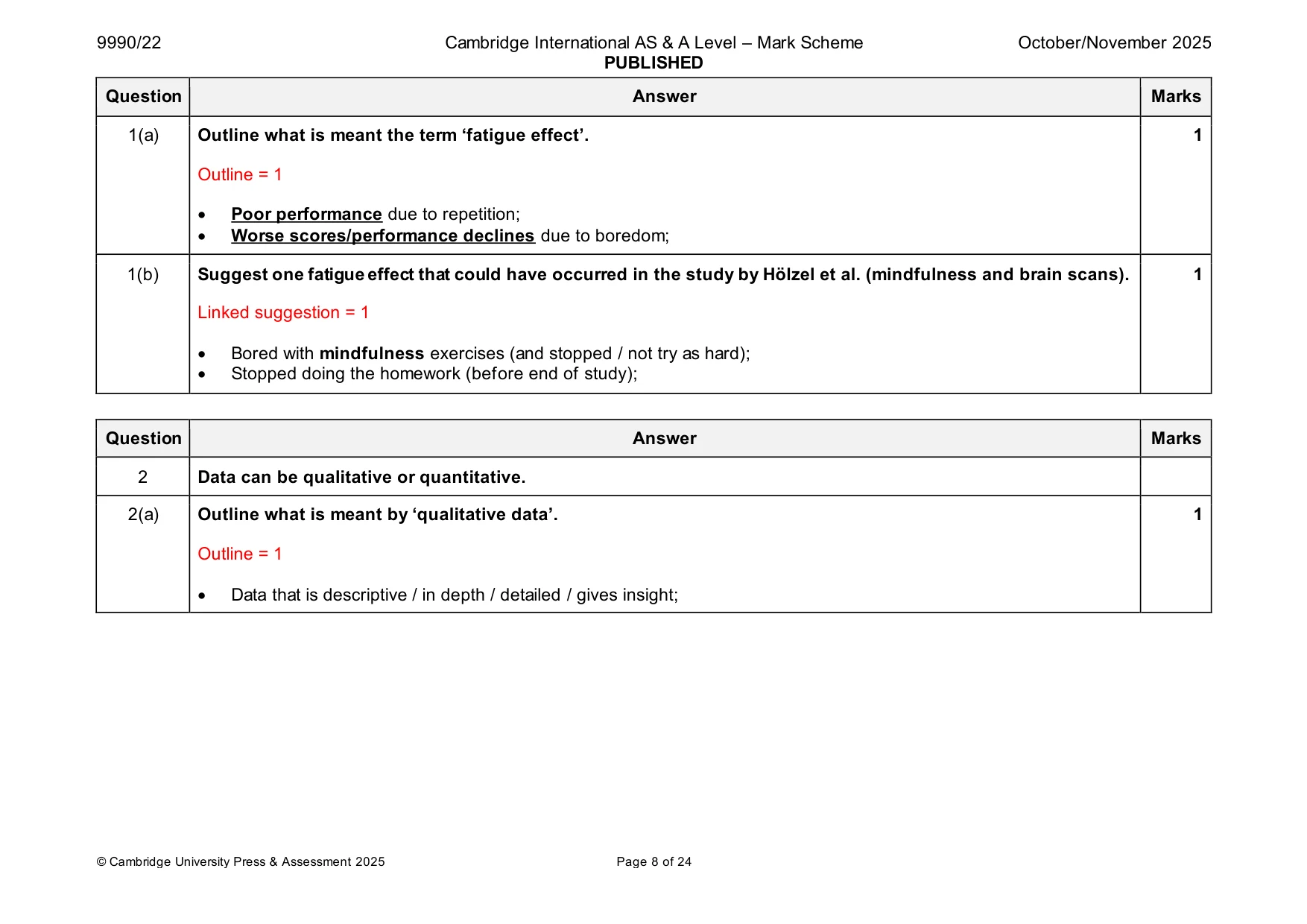
Mark scheme: Question Answer Marks 1(a) Outline what is meant the term ‘fatigue effect’. 1 Outline = 1 • Poor performance due to repetition; • Worse scores/performance declines due to boredom; 1(b) Suggest one fatigue effect that could have occurred in the study by Hölzel et al. (mindfulness and brain scans). 1 Linked suggestion = 1 • Bored with mindfulness exercises (and stopped / not try as hard); • Stopped doing the homework (before end of study);
Q2 · Data can be qualitative or quantitative
2 Data can be qualitative or quantitative. (a) Outline what is meant by ‘qualitative data’. ................................................................................................................................................... ............................................................................................................................................. [1] (b) Describe the qualitative data that was collected from one of the following studies: • Milgram (obedience) • Piliavin et al. (subway Samaritans). ................................................................................................................................................... ................................................................................................................................................... ................................................................................................................................................... ............................................................................................................................................. [2]
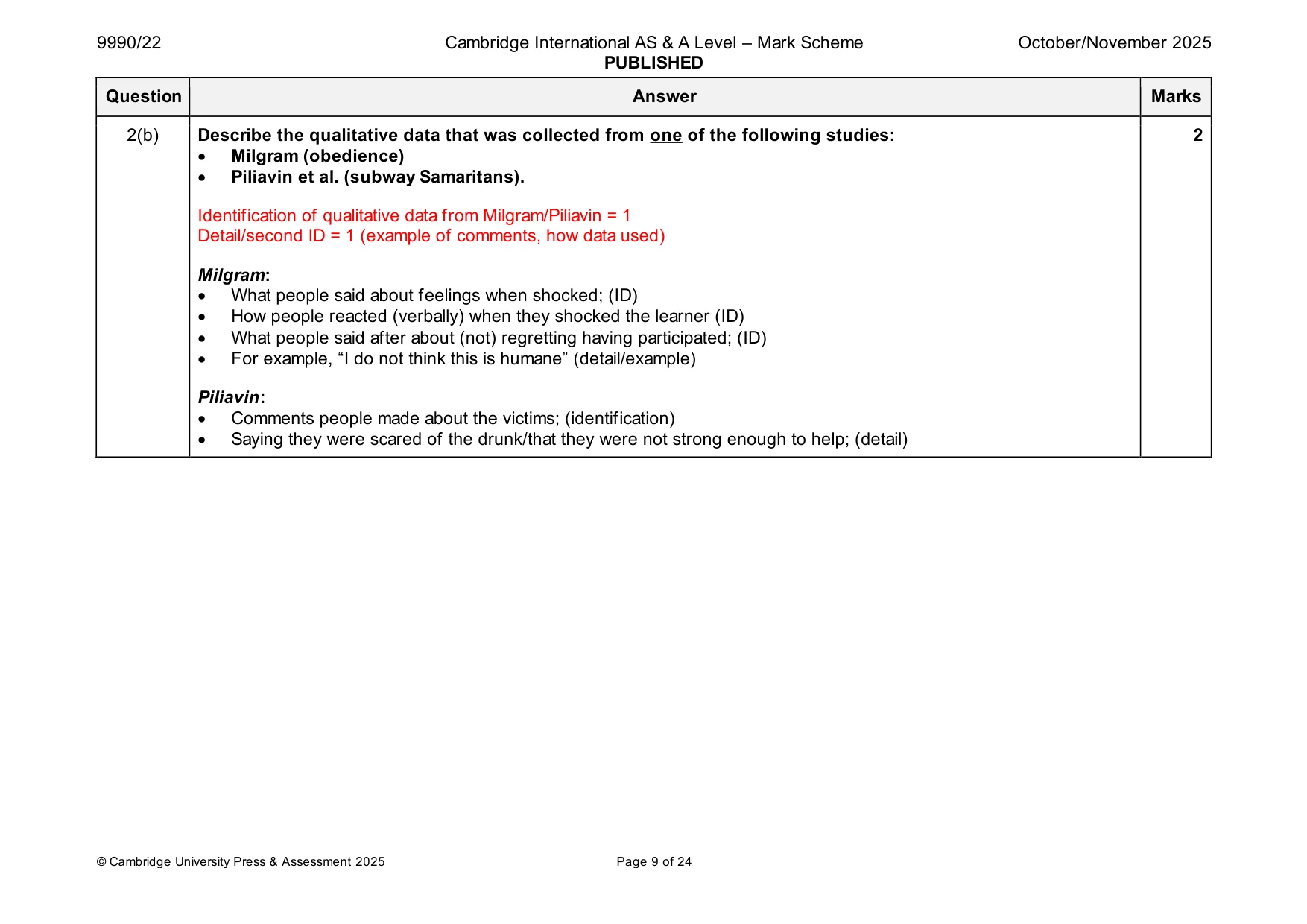
Mark scheme: 2 Data can be qualitative or quantitative. 2(a) Outline what is meant by ‘qualitative data’. 1 Outline = 1 • Data that is descriptive / in depth / detailed / gives insight; 2(b) Describe the qualitative data that was collected from one of the following studies: 2 • Milgram (obedience) • Piliavin et al. (subway Samaritans). Identification of qualitative data from Milgram/Piliavin = 1 Detail/second ID = 1 (example of comments, how data used) Milgram: • What people said about feelings when shocked; (ID) • How people reacted (verbally) when they shocked the learner (ID) • What people said after about (not) regretting having participated; (ID) • For example, “I do not think this is humane” (detail/example) Piliavin: • Comments people made about the victims; (identification) • Saying they were scared of the drunk/that they were not strong enough to help; (detail)
Q3 · In the study by Fagen et al
3 In the study by Fagen et al. (elephant learning) behaviours such as, ‘trunk here’, ‘trunk up’ and ‘bucket’, were recorded using a structured observation. Explain one strength of using a structured observation in this study. .......................................................................................................................................................... .......................................................................................................................................................... .......................................................................................................................................................... .................................................................................................................................................... [2]
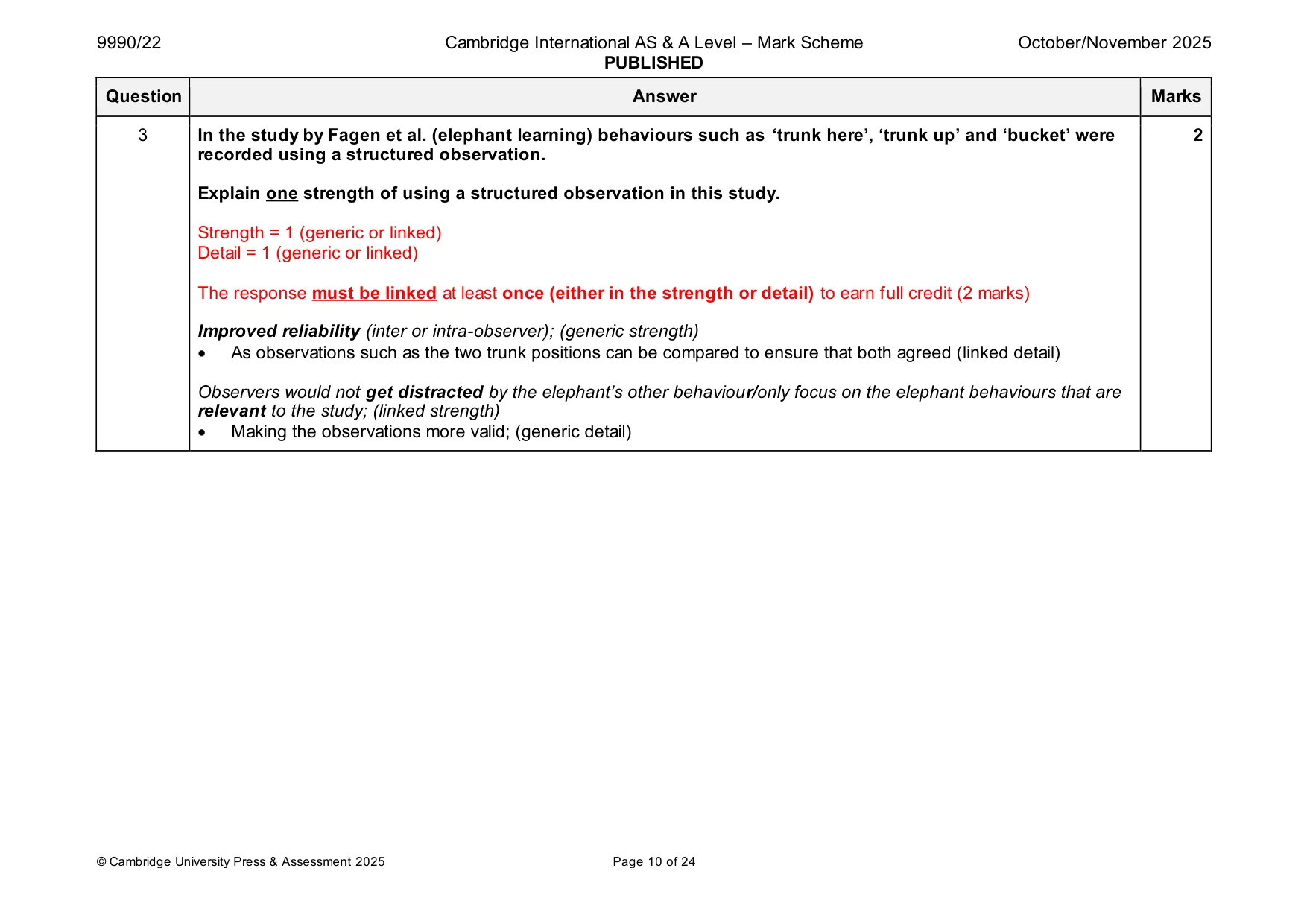
Mark scheme: 3 In the study by Fagen et al. (elephant learning) behaviours such as ‘trunk here’, ‘trunk up’ and ‘bucket’ were 2 recorded using a structured observation. Explain one strength of using a structured observation in this study. Strength = 1 (generic or linked) Detail = 1 (generic or linked) The response must be linked at least once (either in the strength or detail) to earn full credit (2 marks) Improved reliability (inter or intra-observer); (generic strength) • As observations such as the two trunk positions can be compared to ensure that both agreed (linked detail) Observers would not get distracted by the elephant’s other behaviour/only focus on the elephant behaviours that are relevant to the study; (linked strength) • Making the observations more valid; (generic detail)
Q4 · In the study by Pozzulo et al
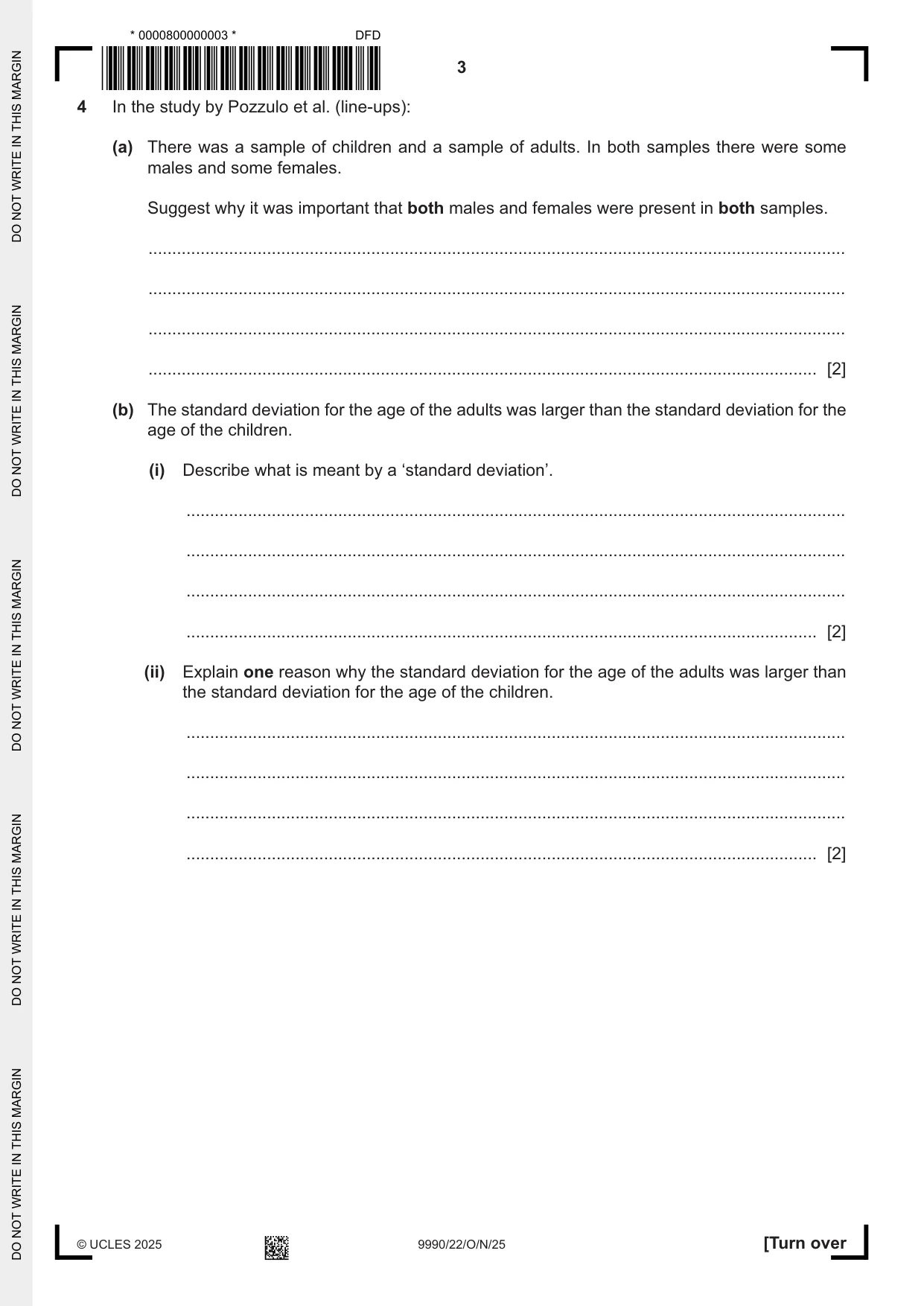
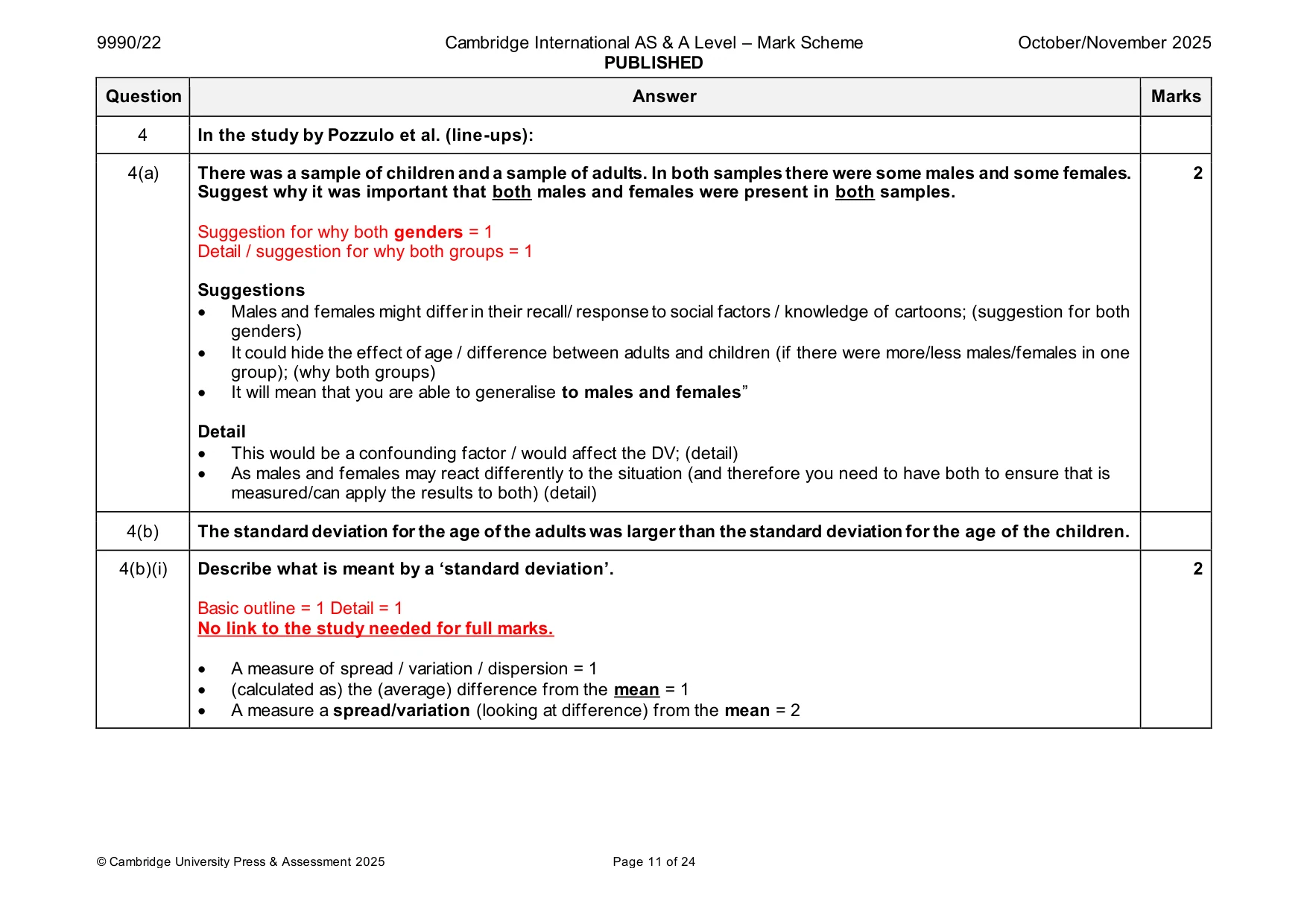
4 In the study by Pozzulo et al. (line-ups): (a) There was a sample of children and a sample of adults. In both samples there were some males and some females. Suggest why it was important that both males and females were present in both samples. ................................................................................................................................................... ................................................................................................................................................... ................................................................................................................................................... ............................................................................................................................................. [2] (b) The standard deviation for the age of the adults was larger than the standard deviation for the age of the children. (i) Describe what is meant by a ‘standard deviation’. ........................................................................................................................................... ........................................................................................................................................... ........................................................................................................................................... ..................................................................................................................................... [2] (ii) Explain one reason why the standard deviation for the age of the adults was larger than the standard deviation for the age of the children. ........................................................................................................................................... ........................................................................................................................................... ........................................................................................................................................... ..................................................................................................................................... [2]
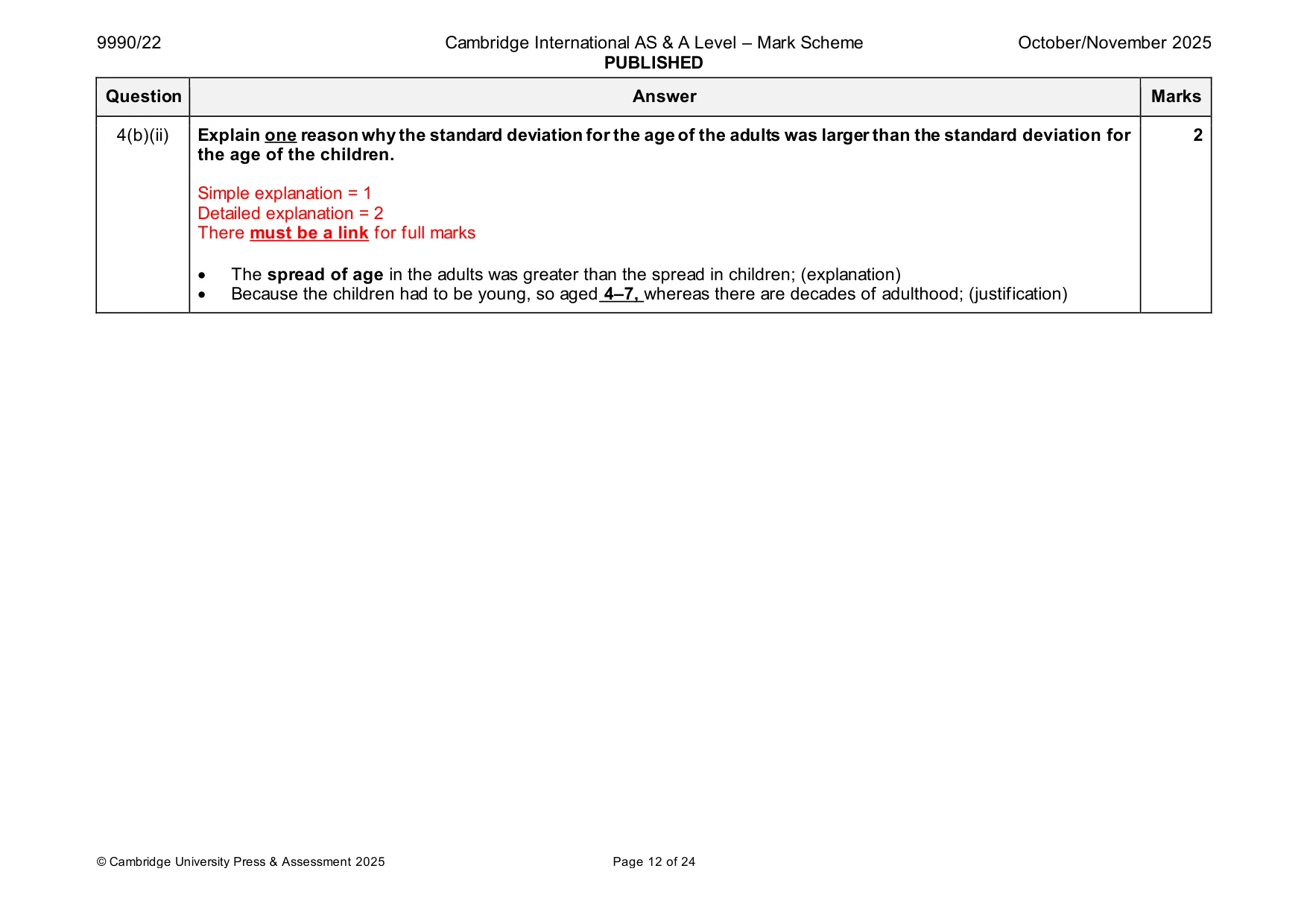
Mark scheme: 4 In the study by Pozzulo et al. (line-ups): 4(a) There was a sample of children and a sample of adults. In both samples there were some males and some females. 2 Suggest why it was important that both males and females were present in both samples. Suggestion for why both genders = 1 Detail / suggestion for why both groups = 1 Suggestions • Males and females might differ in their recall/ response to social factors / knowledge of cartoons; (suggestion for both genders) • It could hide the effect of age / difference between adults and children (if there were more/less males/females in one group); (why both groups) • It will mean that you are able to generalise to males and females” Detail • This would be a confounding factor / would affect the DV; (detail) • As males and females may react differently to the situation (and therefore you need to have both to ensure that is measured/can apply the results to both) (detail) 4(b) The standard deviation for the age of the adults was larger than the standard deviation for the age of the children. 4(b)(i) Describe what is meant by a ‘standard deviation’. 2 Basic outline = 1 Detail = 1 No link to the study needed for full marks. • A measure of spread / variation / dispersion = 1 • (calculated as) the (average) difference from the mean = 1 • A measure a spread/variation (looking at difference) from the mean = 2 4(b)(ii) Explain one reason why the standard deviation for the age of the adults was larger than the standard deviation for 2 the age of the children. Simple explanation = 1 Detailed explanation = 2 There must be a link for full marks • The spread of age in the adults was greater than the spread in children; (explanation) • Because the children had to be young, so aged 4–7, whereas there are decades of adulthood; (justification)
Q5 · Describe semi-structured interviews and unstructured interviews, using any example(s)
5 Describe semi-structured interviews and unstructured interviews, using any example(s). .......................................................................................................................................................... .......................................................................................................................................................... .......................................................................................................................................................... .......................................................................................................................................................... .......................................................................................................................................................... .......................................................................................................................................................... .......................................................................................................................................................... .......................................................................................................................................................... .......................................................................................................................................................... .......................................................................................................................................................... .......................................................................................................................................................... .................................................................................................................................................... [6]
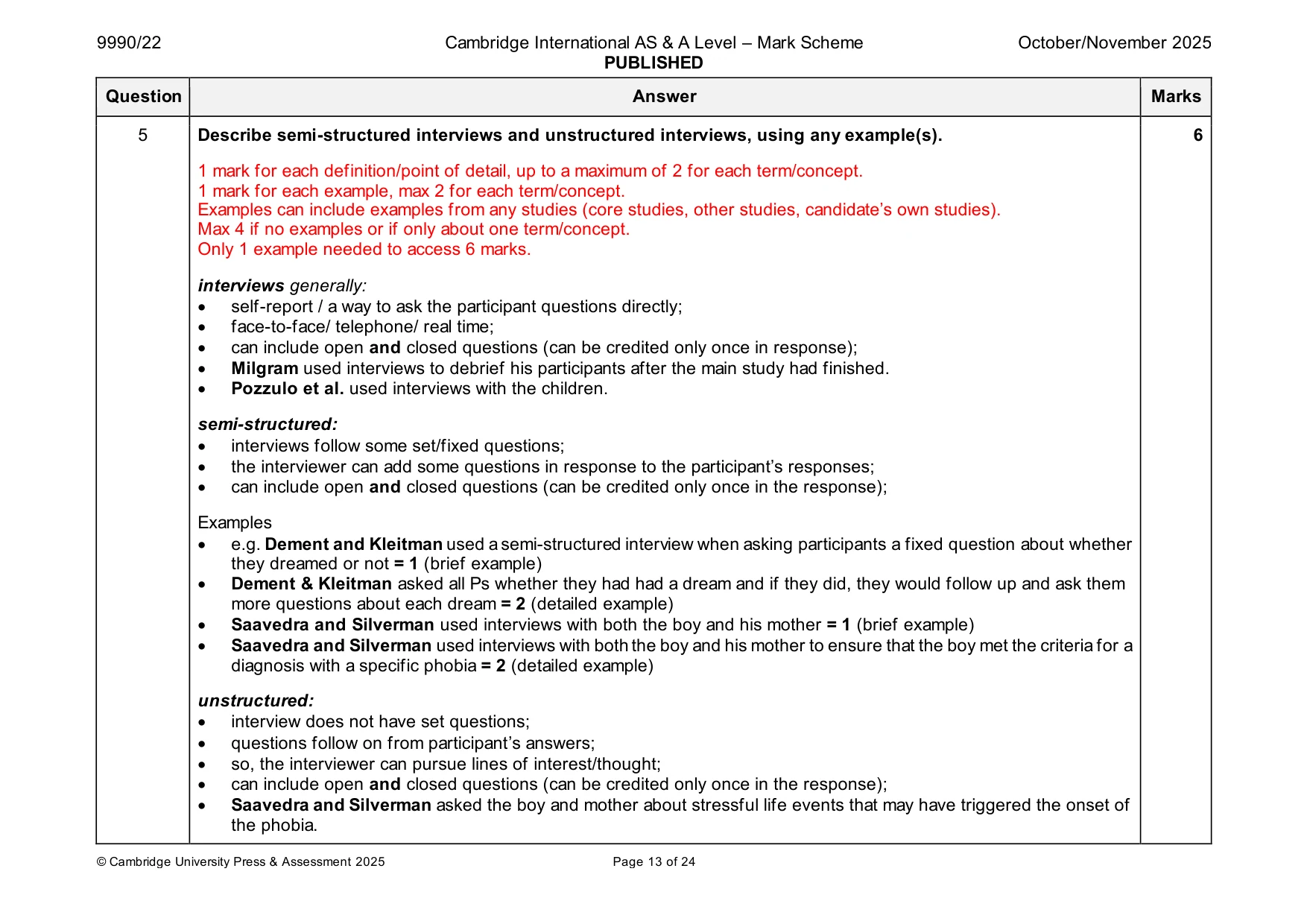
Mark scheme: 5 Describe semi-structured interviews and unstructured interviews, using any example(s). 6 1 mark for each definition/point of detail, up to a maximum of 2 for each term/concept. 1 mark for each example, max 2 for each term/concept. Examples can include examples from any studies (core studies, other studies, candidate’s own studies). Max 4 if no examples or if only about one term/concept. Only 1 example needed to access 6 marks. interviews generally: • self-report / a way to ask the participant questions directly; • face-to-face/ telephone/ real time; • can include open and closed questions (can be credited only once in response); • Milgram used interviews to debrief his participants after the main study had finished. • Pozzulo et al. used interviews with the children. semi-structured: • interviews follow some set/fixed questions; • the interviewer can add some questions in response to the participant’s responses; • can include open and closed questions (can be credited only once in the response); Examples • e.g. Dement and Kleitman used a semi-structured interview when asking participants a fixed question about whether they dreamed or not = 1 (brief example) • Dement & Kleitman asked all Ps whether they had had a dream and if they did, they would follow up and ask them more questions about each dream = 2 (detailed example) • Saavedra and Silverman used interviews with both the boy and his mother = 1 (brief example) • Saavedra and Silverman used interviews with both the boy and his mother to ensure that the boy met the criteria for a diagnosis with a specific phobia = 2 (detailed example) unstructured: • interview does not have set questions; • questions follow on from participant’s answers; • so, the interviewer can pursue lines of interest/thought; • can include open and closed questions (can be credited only once in the response); • Saavedra and Silverman asked the boy and mother about stressful life events that may have triggered the onset of the phobia.
Q6 · Dr Raj is conducting a case study to investigate an elderly man, who he refers to as ‘Mr…
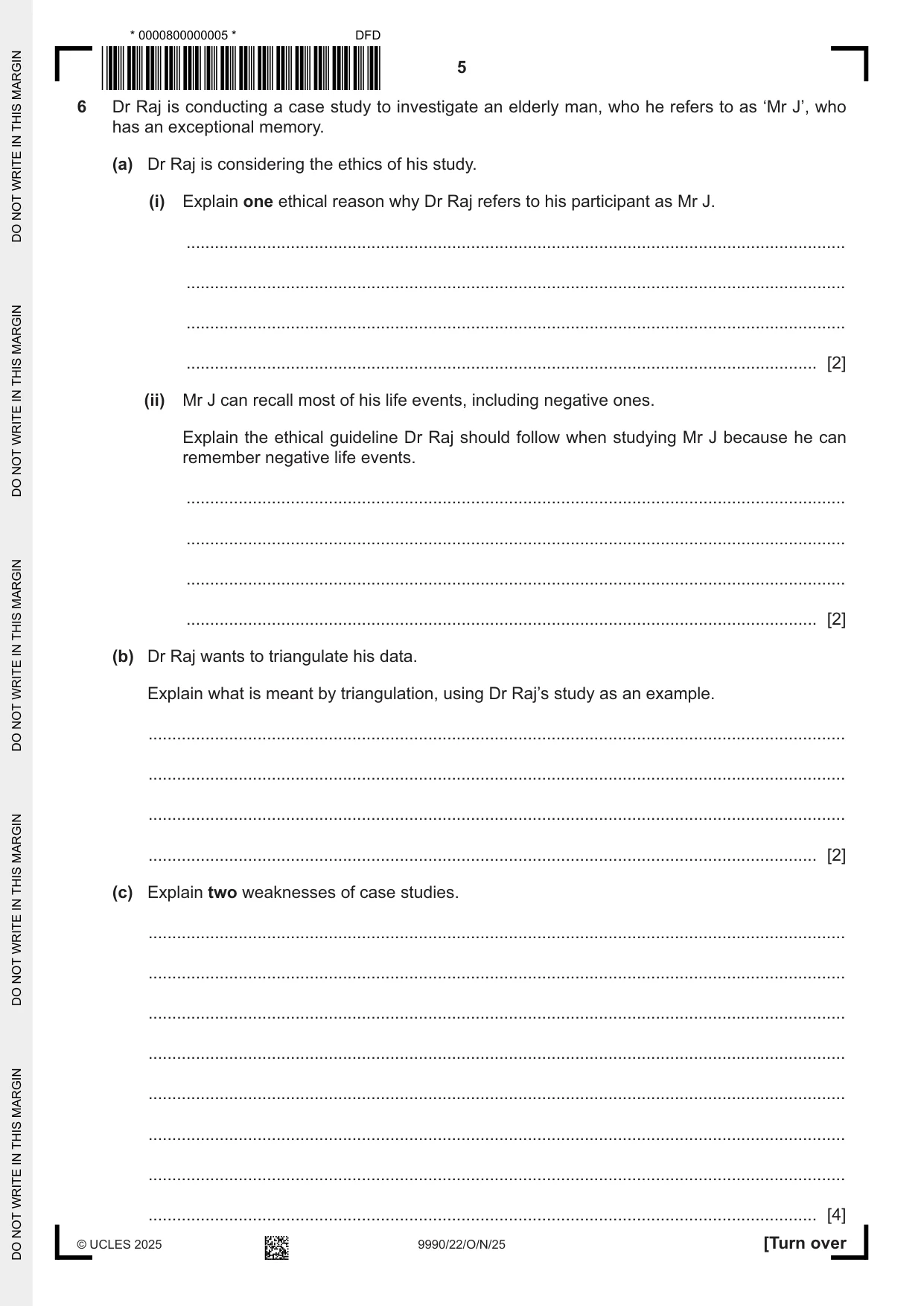
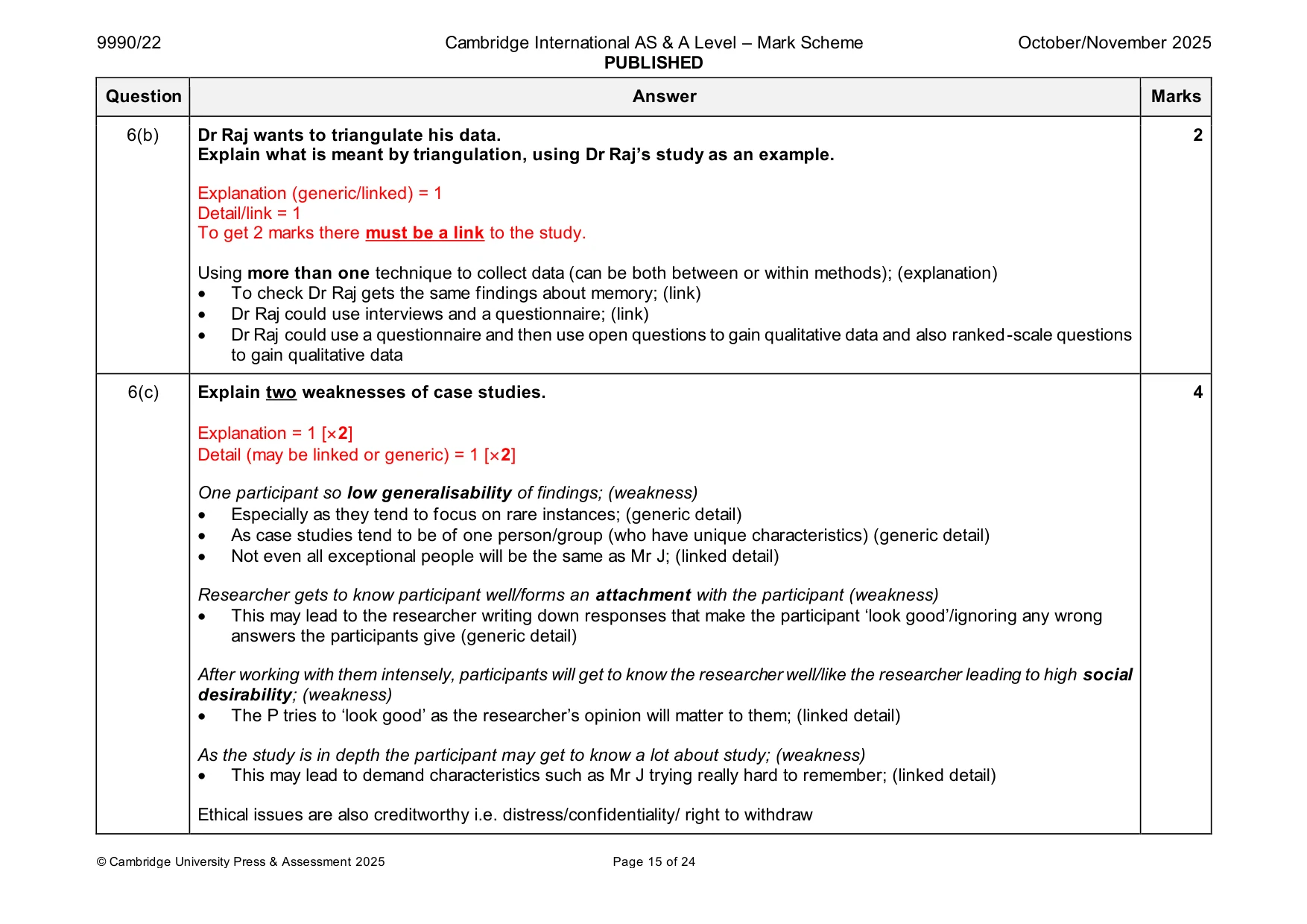
6 Dr Raj is conducting a case study to investigate an elderly man, who he refers to as ‘Mr J’, who has an exceptional memory. (a) Dr Raj is considering the ethics of his study. (i) Explain one ethical reason why Dr Raj refers to his participant as Mr J. ........................................................................................................................................... ........................................................................................................................................... ........................................................................................................................................... ..................................................................................................................................... [2] (ii) Mr J can recall most of his life events, including negative ones. Explain the ethical guideline Dr Raj should follow when studying Mr J because he can remember negative life events. ........................................................................................................................................... ........................................................................................................................................... ........................................................................................................................................... ..................................................................................................................................... [2] (b) Dr Raj wants to triangulate his data. Explain what is meant by triangulation, using Dr Raj’s study as an example. ................................................................................................................................................... ................................................................................................................................................... ................................................................................................................................................... ............................................................................................................................................. [2] (c) Explain two weaknesses of case studies. ................................................................................................................................................... ................................................................................................................................................... ................................................................................................................................................... ................................................................................................................................................... ................................................................................................................................................... ................................................................................................................................................... ................................................................................................................................................... ............................................................................................................................................. [4]
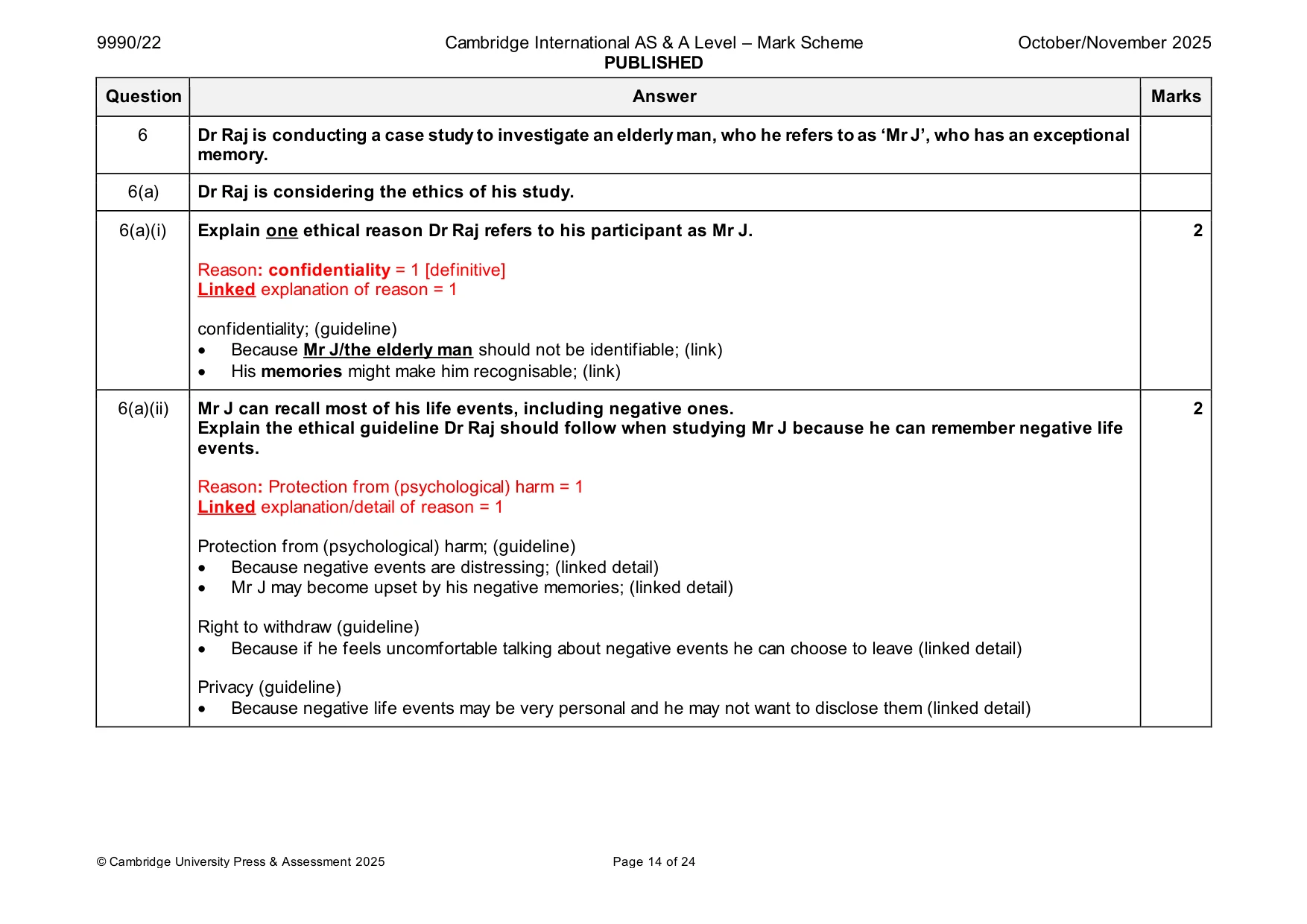
Mark scheme: 6 Dr Raj is conducting a case study to investigate an elderly man, who he refers to as ‘Mr J’, who has an exceptional memory. 6(a) Dr Raj is considering the ethics of his study. 6(a)(i) Explain one ethical reason Dr Raj refers to his participant as Mr J. 2 Reason: confidentiality = 1 [definitive] Linked explanation of reason = 1 confidentiality; (guideline) • Because Mr J/the elderly man should not be identifiable; (link) • His memories might make him recognisable; (link) 6(a)(ii) Mr J can recall most of his life events, including negative ones. 2 Explain the ethical guideline Dr Raj should follow when studying Mr J because he can remember negative life events. Reason: Protection from (psychological) harm = 1 Linked explanation/detail of reason = 1 Protection from (psychological) harm; (guideline) • Because negative events are distressing; (linked detail) • Mr J may become upset by his negative memories; (linked detail) Right to withdraw (guideline) • Because if he feels uncomfortable talking about negative events he can choose to leave (linked detail) Privacy (guideline) • Because negative life events may be very personal and he may not want to disclose them (linked detail) 6(b) Dr Raj wants to triangulate his data. 2 Explain what is meant by triangulation, using Dr Raj’s study as an example. Explanation (generic/linked) = 1 Detail/link = 1 To get 2 marks there must be a link to the study. Using more than one technique to collect data (can be both between or within methods); (explanation) • To check Dr Raj gets the same findings about memory; (link) • Dr Raj could use interviews and a questionnaire; (link) • Dr Raj could use a questionnaire and then use open questions to gain qualitative data and also ranked-scale questions to gain qualitative data 6(c) Explain two weaknesses of case studies. 4 Explanation = 1 [2] Detail (may be linked or generic) = 1 [2] One participant so low generalisability of findings; (weakness) • Especially as they tend to focus on rare instances; (generic detail) • As case studies tend to be of one person/group (who have unique characteristics) (generic detail) • Not even all exceptional people will be the same as Mr J; (linked detail) Researcher gets to know participant well/forms an attachment with the participant (weakness) • This may lead to the researcher writing down responses that make the participant ‘look good’/ignoring any wrong answers the participants give (generic detail) After working with them intensely, participants will get to know the researcher well/like the researcher leading to high social desirability; (weakness) • The P tries to ‘look good’ as the researcher’s opinion will matter to them; (linked detail) As the study is in depth the participant may get to know a lot about study; (weakness) • This may lead to demand characteristics such as Mr J trying really hard to remember; (linked detail) Ethical issues are also creditworthy i.e. distress/confidentiality/ right to withdraw
Q7 · Lorna has noticed that children often talk to their toys
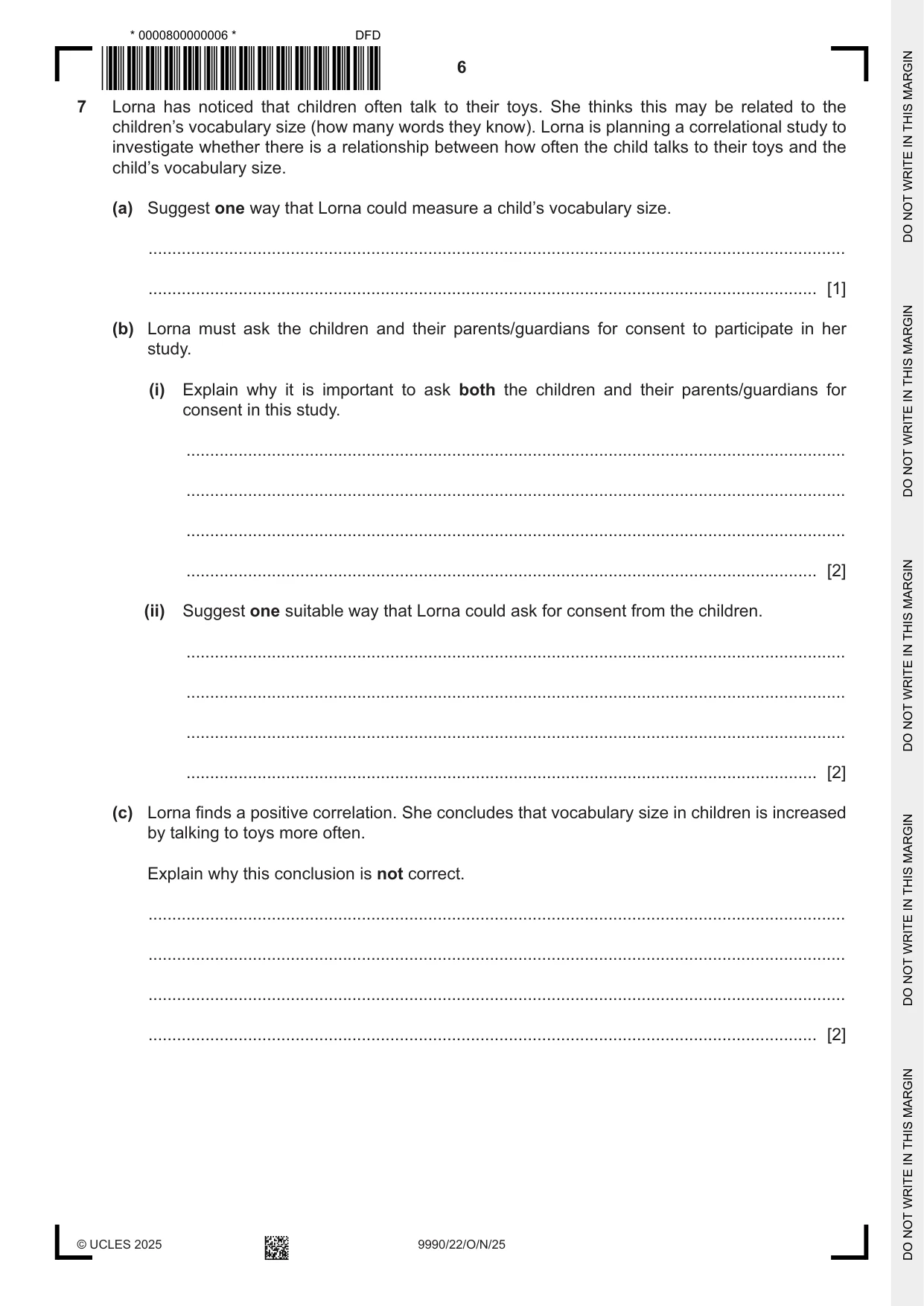
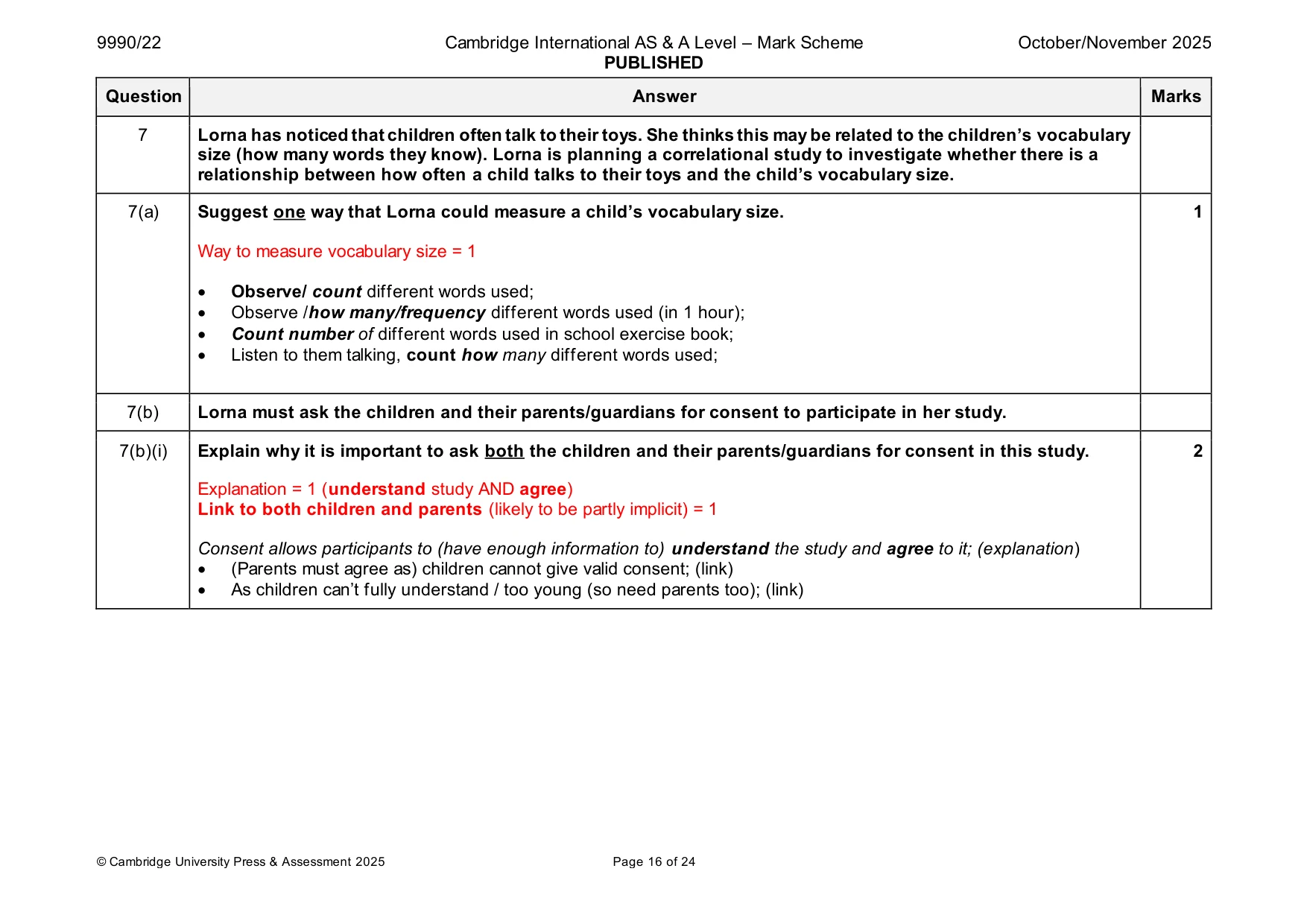
7 Lorna has noticed that children often talk to their toys. She thinks this may be related to the children’s vocabulary size (how many words they know). Lorna is planning a correlational study to investigate whether there is a relationship between how often the child talks to their toys and the child’s vocabulary size. (a) Suggest one way that Lorna could measure a child’s vocabulary size. ................................................................................................................................................... ............................................................................................................................................. [1] (b) Lorna must ask the children and their parents/guardians for consent to participate in her study. (i) Explain why it is important to ask both the children and their parents/guardians for consent in this study. ........................................................................................................................................... ........................................................................................................................................... ........................................................................................................................................... ..................................................................................................................................... [2] (ii) Suggest one suitable way that Lorna could ask for consent from the children. ........................................................................................................................................... ........................................................................................................................................... ........................................................................................................................................... ..................................................................................................................................... [2] (c) Lorna finds a positive correlation. She concludes that vocabulary size in children is increased by talking to toys more often. Explain why this conclusion is not correct. ................................................................................................................................................... ................................................................................................................................................... ................................................................................................................................................... ............................................................................................................................................. [2]
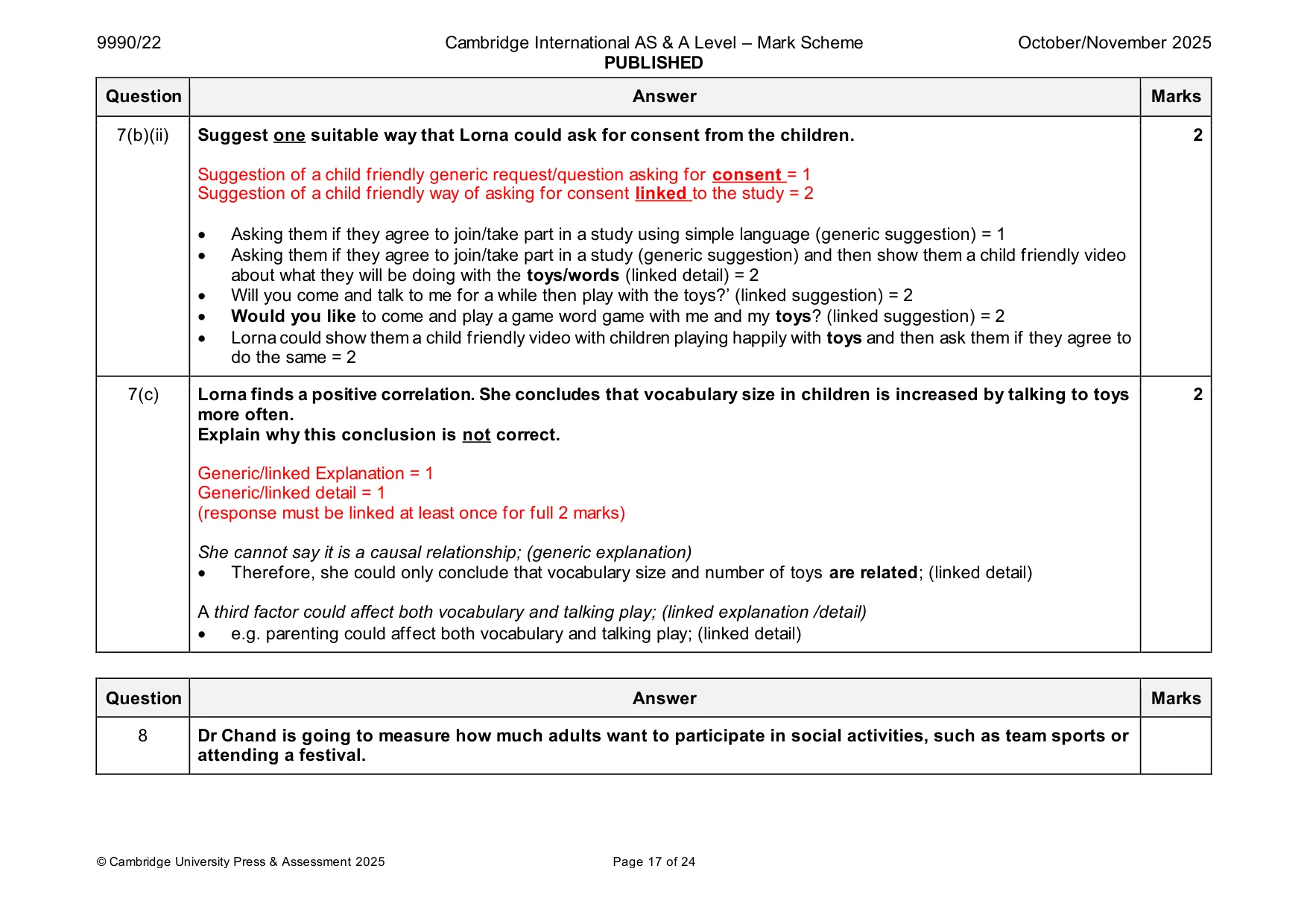
Mark scheme: 7 Lorna has noticed that children often talk to their toys. She thinks this may be related to the children’s vocabulary size (how many words they know). Lorna is planning a correlational study to investigate whether there is a relationship between how often a child talks to their toys and the child’s vocabulary size. 7(a) Suggest one way that Lorna could measure a child’s vocabulary size. 1 Way to measure vocabulary size = 1 • Observe/ count different words used; • Observe /how many/frequency different words used (in 1 hour); • Count number of different words used in school exercise book; • Listen to them talking, count how many different words used; 7(b) Lorna must ask the children and their parents/guardians for consent to participate in her study. 7(b)(i) Explain why it is important to ask both the children and their parents/guardians for consent in this study. 2 Explanation = 1 (understand study AND agree) Link to both children and parents (likely to be partly implicit) = 1 Consent allows participants to (have enough information to) understand the study and agree to it; (explanation) • (Parents must agree as) children cannot give valid consent; (link) • As children can’t fully understand / too young (so need parents too); (link) 7(b)(ii) Suggest one suitable way that Lorna could ask for consent from the children. 2 Suggestion of a child friendly generic request/question asking for consent = 1 Suggestion of a child friendly way of asking for consent linked to the study = 2 • Asking them if they agree to join/take part in a study using simple language (generic suggestion) = 1 • Asking them if they agree to join/take part in a study (generic suggestion) and then show them a child friendly video about what they will be doing with the toys/words (linked detail) = 2 • Will you come and talk to me for a while then play with the toys?’ (linked suggestion) = 2 • Would you like to come and play a game word game with me and my toys? (linked suggestion) = 2 • Lorna could show them a child friendly video with children playing happily with toys and then ask them if they agree to do the same = 2 7(c) Lorna finds a positive correlation. She concludes that vocabulary size in children is increased by talking to toys 2 more often. Explain why this conclusion is not correct. Generic/linked Explanation = 1 Generic/linked detail = 1 (response must be linked at least once for full 2 marks) She cannot say it is a causal relationship; (generic explanation) • Therefore, she could only conclude that vocabulary size and number of toys are related; (linked detail) A third factor could affect both vocabulary and talking play; (linked explanation /detail) • e.g. parenting could affect both vocabulary and talking play; (linked detail)
Q8 · Dr Chand is going to measure how much adults want to participate in social activities…
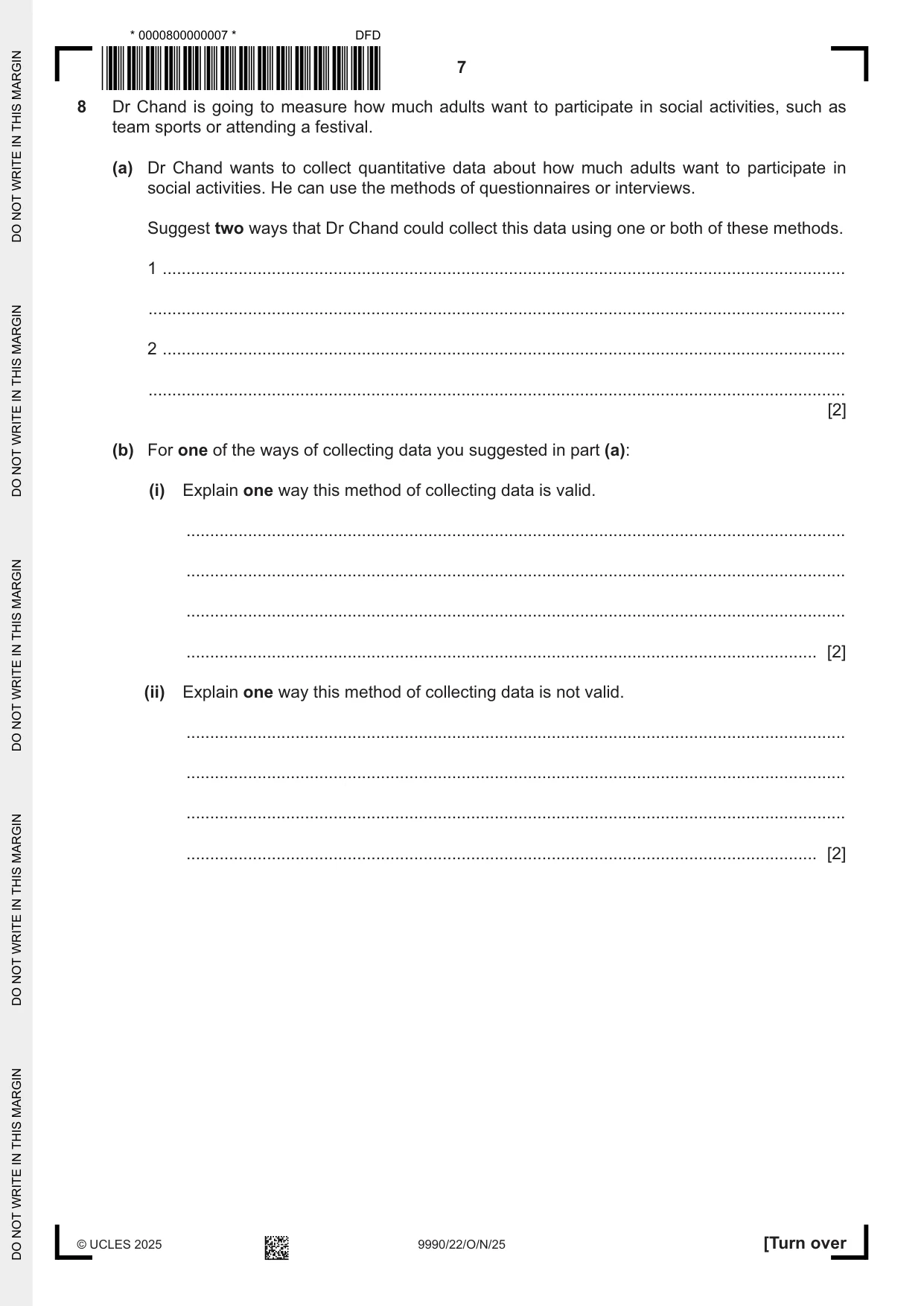
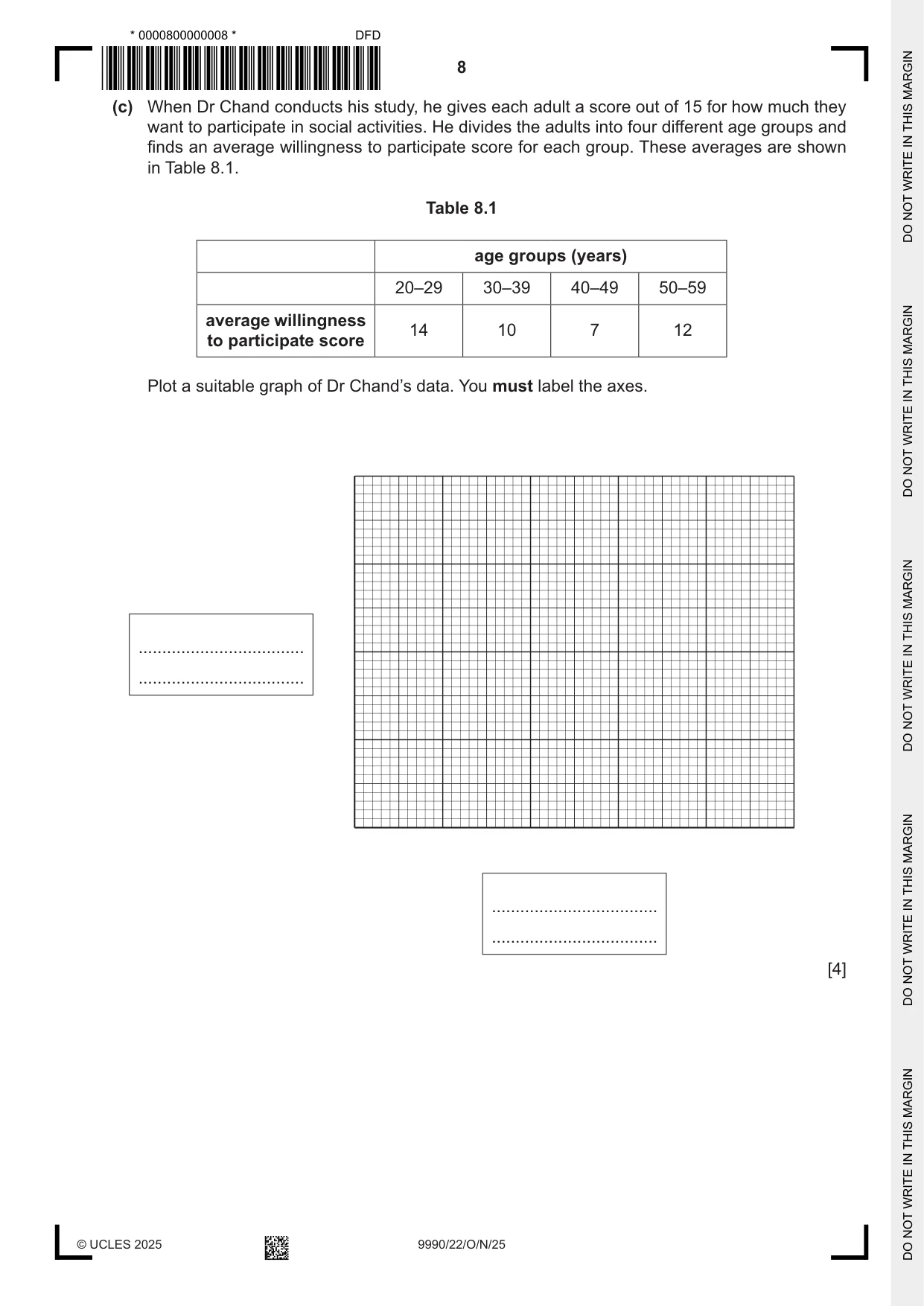
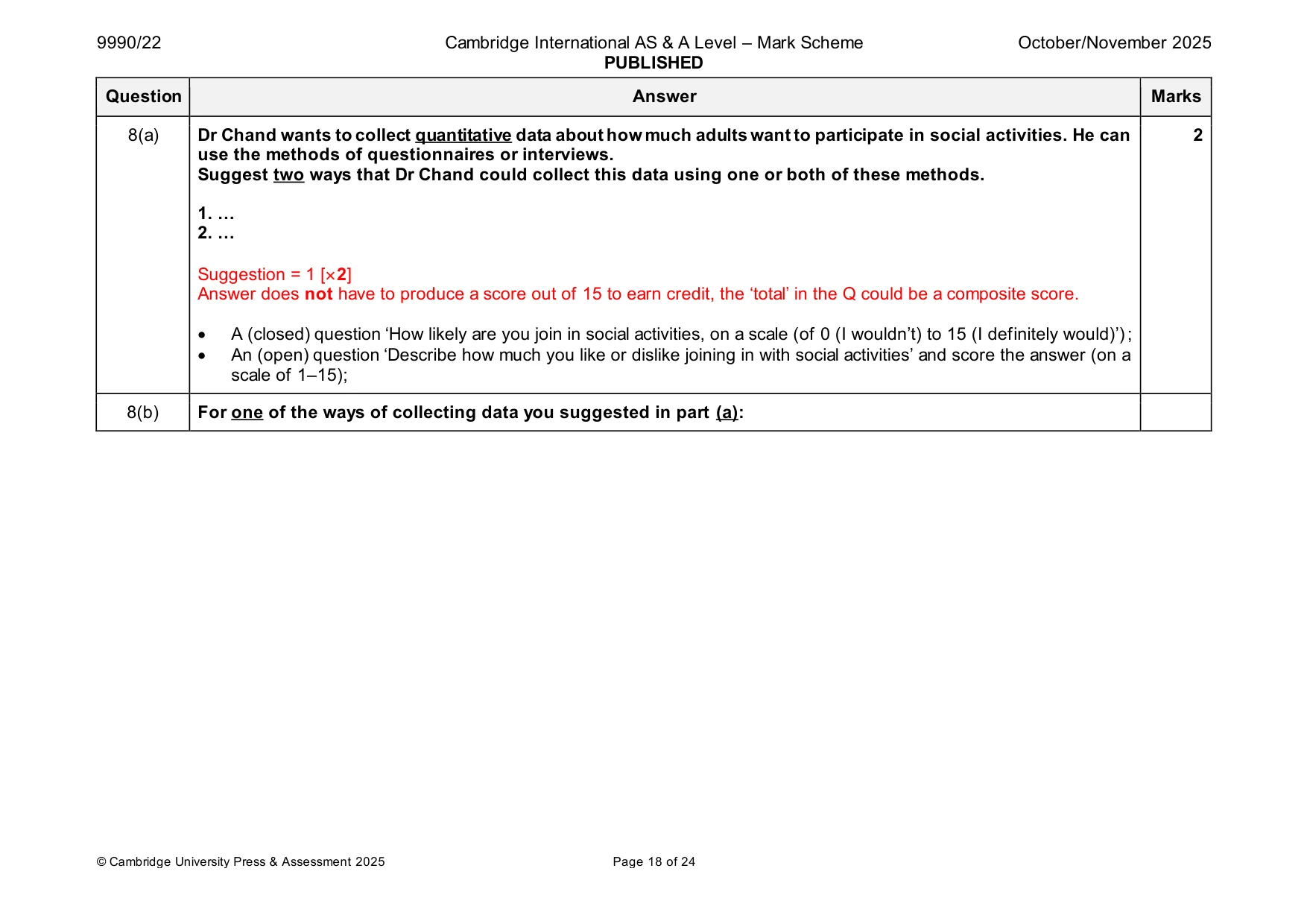
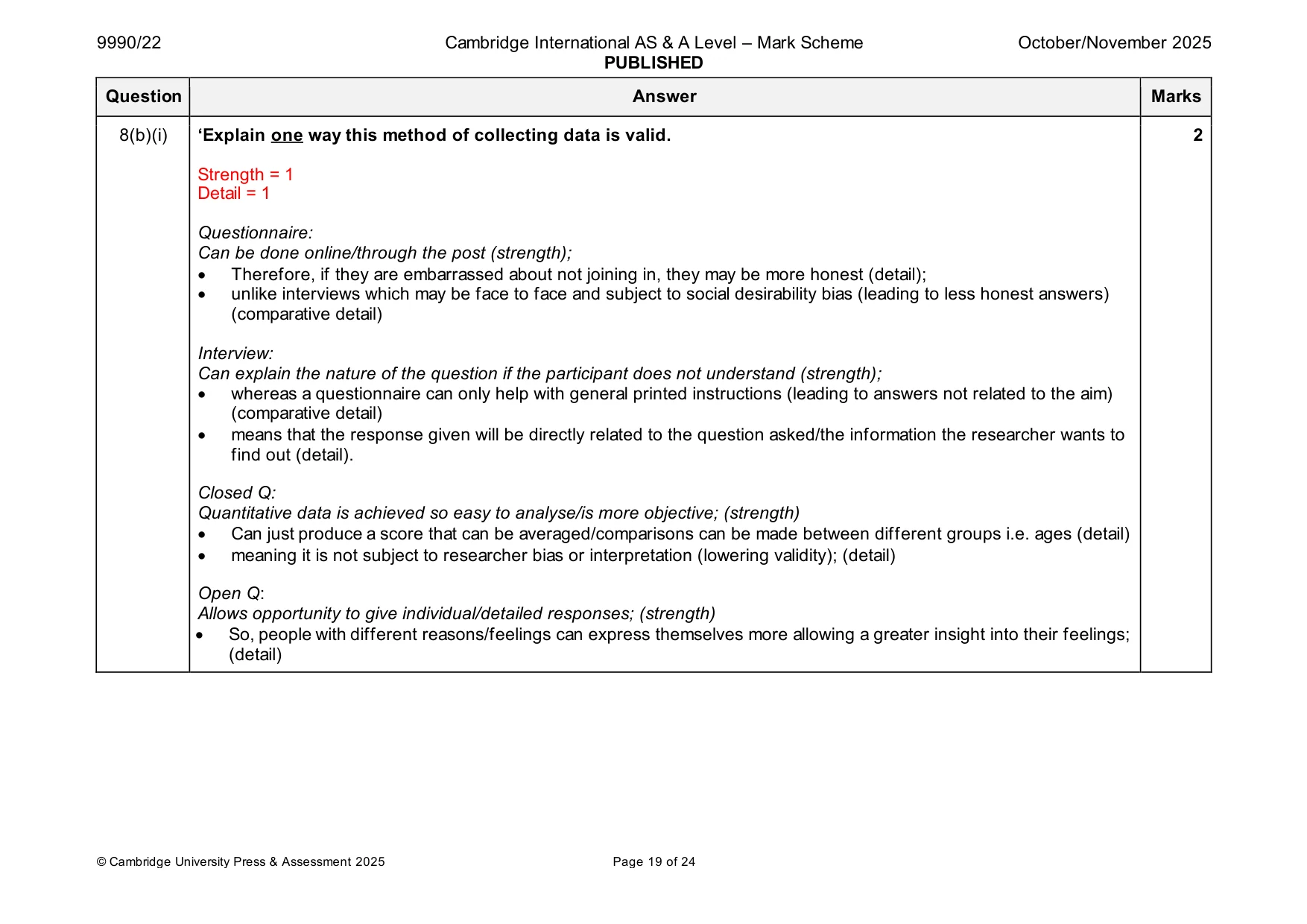
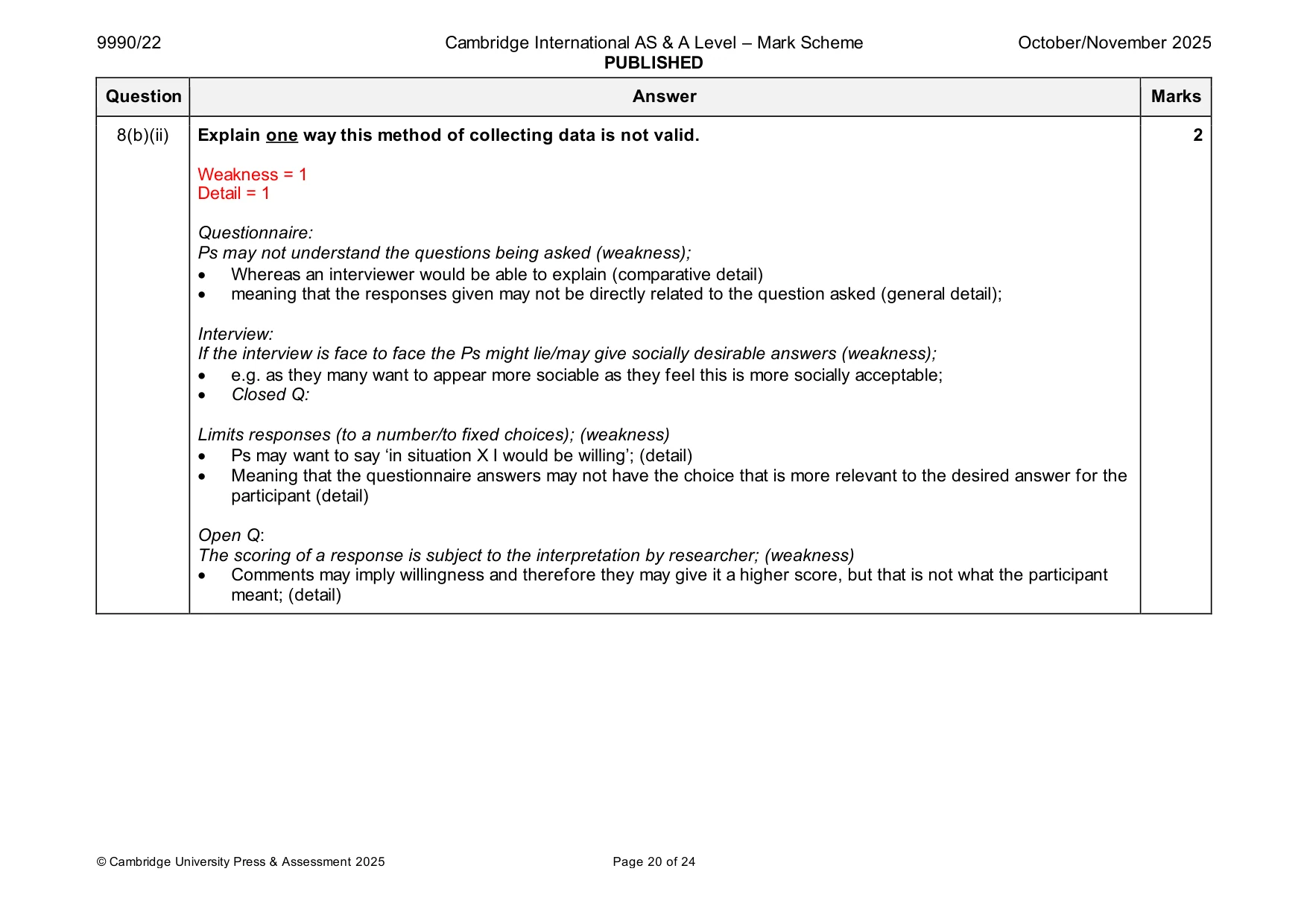
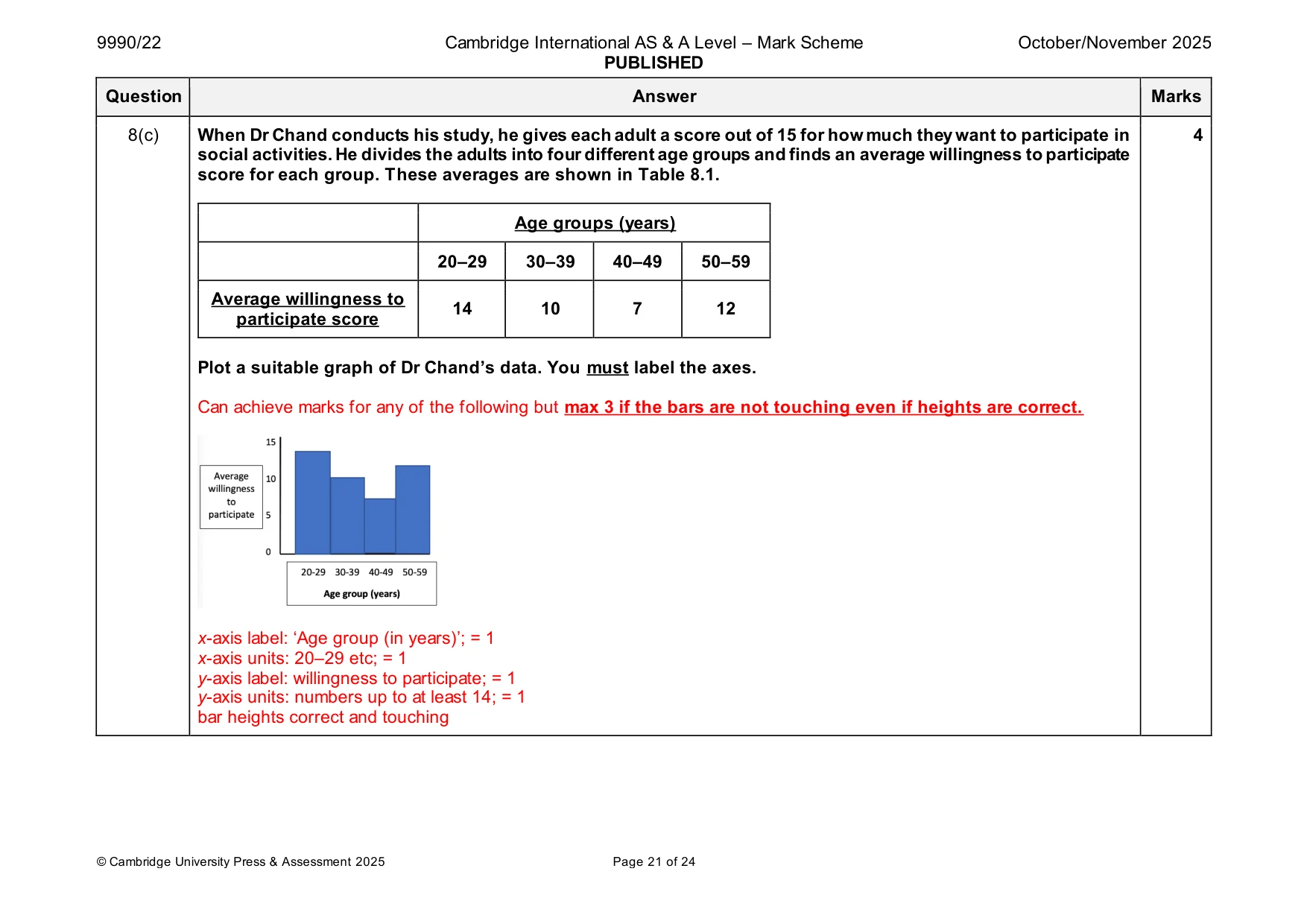
8 Dr Chand is going to measure how much adults want to participate in social activities, such as team sports or attending a festival. (a) Dr Chand wants to collect quantitative data about how much adults want to participate in social activities. He can use the methods of questionnaires or interviews. Suggest two ways that Dr Chand could collect this data using one or both of these methods. 1 ................................................................................................................................................ ................................................................................................................................................... 2 ................................................................................................................................................ ................................................................................................................................................... [2] (b) For one of the ways of collecting data you suggested in part (a): (i) Explain one way this method of collecting data is valid. ........................................................................................................................................... ........................................................................................................................................... ........................................................................................................................................... ..................................................................................................................................... [2] (ii) Explain one way this method of collecting data is not valid. ........................................................................................................................................... ........................................................................................................................................... ........................................................................................................................................... ..................................................................................................................................... [2] (c) When Dr Chand conducts his study, he gives each adult a score out of 15 for how much they want to participate in social activities. He divides the adults into four different age groups and finds an average willingness to participate score for each group. These averages are shown in Table 8.1. Table 8.1 age groups (years) 20–29 30–39 40–49 50–59 average willingness 14 10 7 12 to participate score Plot a suitable graph of Dr Chand’s data. You must label the axes. ................................... ................................... ................................... ................................... [4]
Mark scheme: 8 Dr Chand is going to measure how much adults want to participate in social activities, such as team sports or attending a festival. 8(a) Dr Chand wants to collect quantitative data about how much adults want to participate in social activities. He can 2 use the methods of questionnaires or interviews. Suggest two ways that Dr Chand could collect this data using one or both of these methods. 1. … 2. … Suggestion = 1 [2] Answer does not have to produce a score out of 15 to earn credit, the ‘total’ in the Q could be a composite score. • A (closed) question ‘How likely are you join in social activities, on a scale (of 0 (I wouldn’t) to 15 (I definitely would)’); • An (open) question ‘Describe how much you like or dislike joining in with social activities’ and score the answer (on a scale of 1–15); 8(b) For one of the ways of collecting data you suggested in part (a): 8(b)(i) ‘Explain one way this method of collecting data is valid. 2 Strength = 1 Detail = 1 Questionnaire: Can be done online/through the post (strength); • Therefore, if they are embarrassed about not joining in, they may be more honest (detail); • unlike interviews which may be face to face and subject to social desirability bias (leading to less honest answers) (comparative detail) Interview: Can explain the nature of the question if the participant does not understand (strength); • whereas a questionnaire can only help with general printed instructions (leading to answers not related to the aim) (comparative detail) • means that the response given will be directly related to the question asked/the information the researcher wants to find out (detail). Closed Q: Quantitative data is achieved so easy to analyse/is more objective; (strength) • Can just produce a score that can be averaged/comparisons can be made between different groups i.e. ages (detail) • meaning it is not subject to researcher bias or interpretation (lowering validity); (detail) Open Q: Allows opportunity to give individual/detailed responses; (strength) • So, people with different reasons/feelings can express themselves more allowing a greater insight into their feelings; (detail) 8(b)(ii) Explain one way this method of collecting data is not valid. 2 Weakness = 1 Detail = 1 Questionnaire: Ps may not understand the questions being asked (weakness); • Whereas an interviewer would be able to explain (comparative detail) • meaning that the responses given may not be directly related to the question asked (general detail); Interview: If the interview is face to face the Ps might lie/may give socially desirable answers (weakness); • e.g. as they many want to appear more sociable as they feel this is more socially acceptable; • Closed Q: Limits responses (to a number/to fixed choices); (weakness) • Ps may want to say ‘in situation X I would be willing’; (detail) • Meaning that the questionnaire answers may not have the choice that is more relevant to the desired answer for the participant (detail) Open Q: The scoring of a response is subject to the interpretation by researcher; (weakness) • Comments may imply willingness and therefore they may give it a higher score, but that is not what the participant meant; (detail) 8(c) When Dr Chand conducts his study, he gives each adult a score out of 15 for how much they want to participate in 4 social activities. He divides the adults into four different age groups and finds an average willingness to participate score for each group. These averages are shown in Table 8.1. Age groups (years) 20–29 30–39 40–49 50–59 Average willingness to 14 10 7 12 participate score Plot a suitable graph of Dr Chand’s data. You must label the axes. Can achieve marks for any of the following but max 3 if the bars are not touching even if heights are correct. x-axis label: ‘Age group (in years)’; = 1 x-axis units: 20–29 etc; = 1 y-axis label: willingness to participate; = 1 y-axis units: numbers up to at least 14; = 1 bar heights correct and touching
Q9 · Dr Gul is investigating whether people focus their attention more on brightly coloured…
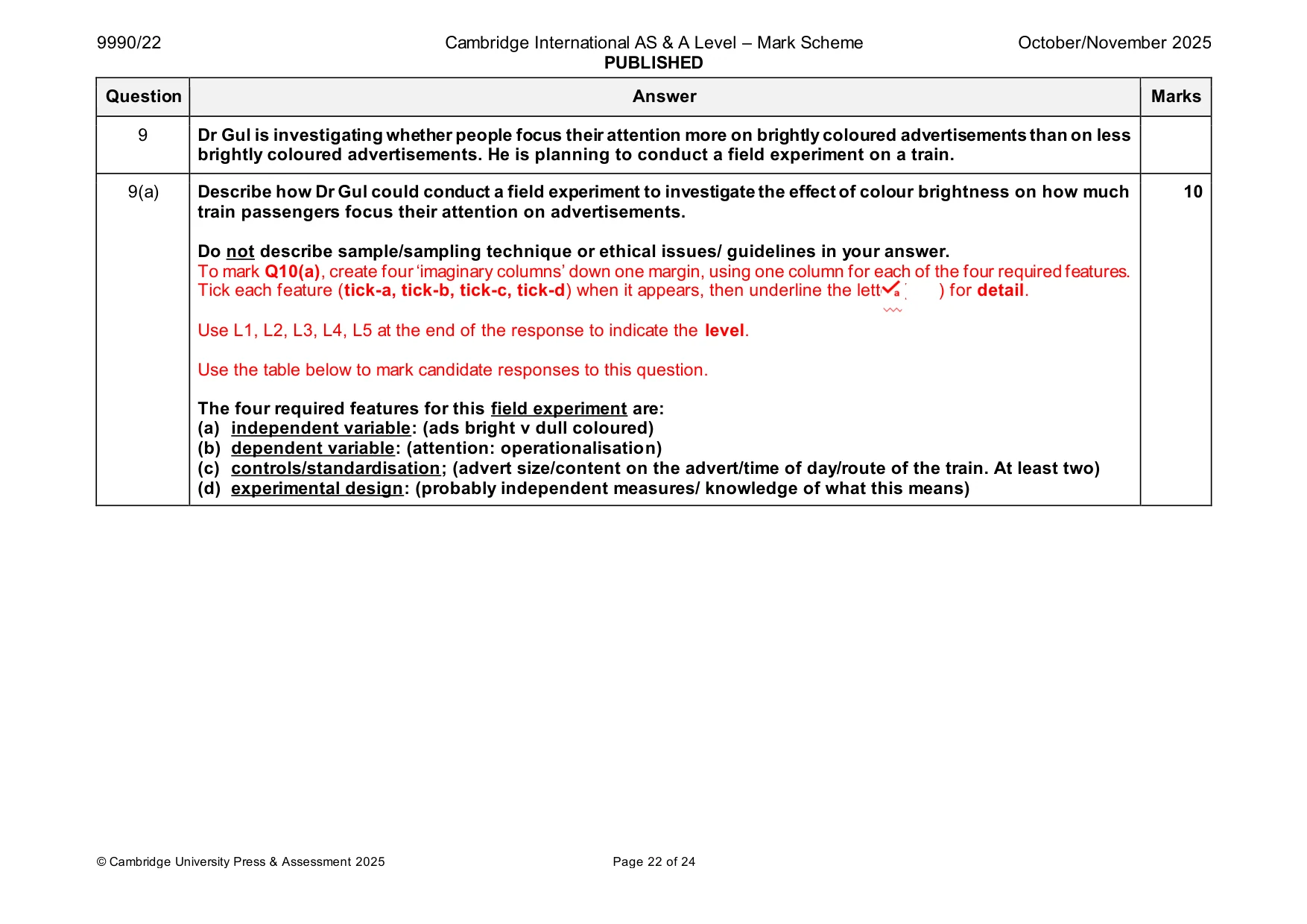
9 Dr Gul is investigating whether people focus their attention more on brightly coloured advertisements than on less brightly coloured advertisements. He is planning to conduct a field experiment on a train. (a) Describe how Dr Gul could conduct a field experiment to investigate the effect of colour brightness on how much train passengers focus their attention on advertisements. Do not describe sample / sampling technique or ethical issues / guidelines in your answer. ................................................................................................................................................... ................................................................................................................................................... ................................................................................................................................................... ................................................................................................................................................... ................................................................................................................................................... ................................................................................................................................................... ................................................................................................................................................... ................................................................................................................................................... ................................................................................................................................................... ................................................................................................................................................... ................................................................................................................................................... ................................................................................................................................................... ................................................................................................................................................... ................................................................................................................................................... ................................................................................................................................................... ................................................................................................................................................... ................................................................................................................................................... ................................................................................................................................................... ................................................................................................................................................... ........................................................................................................................................... [10] (b) Explain two strengths of the study you described in part (a). Do not refer to sampling or ethics in your answer. ................................................................................................................................................... ................................................................................................................................................... ................................................................................................................................................... ................................................................................................................................................... ................................................................................................................................................... ................................................................................................................................................... ................................................................................................................................................... ............................................................................................................................................. [4]
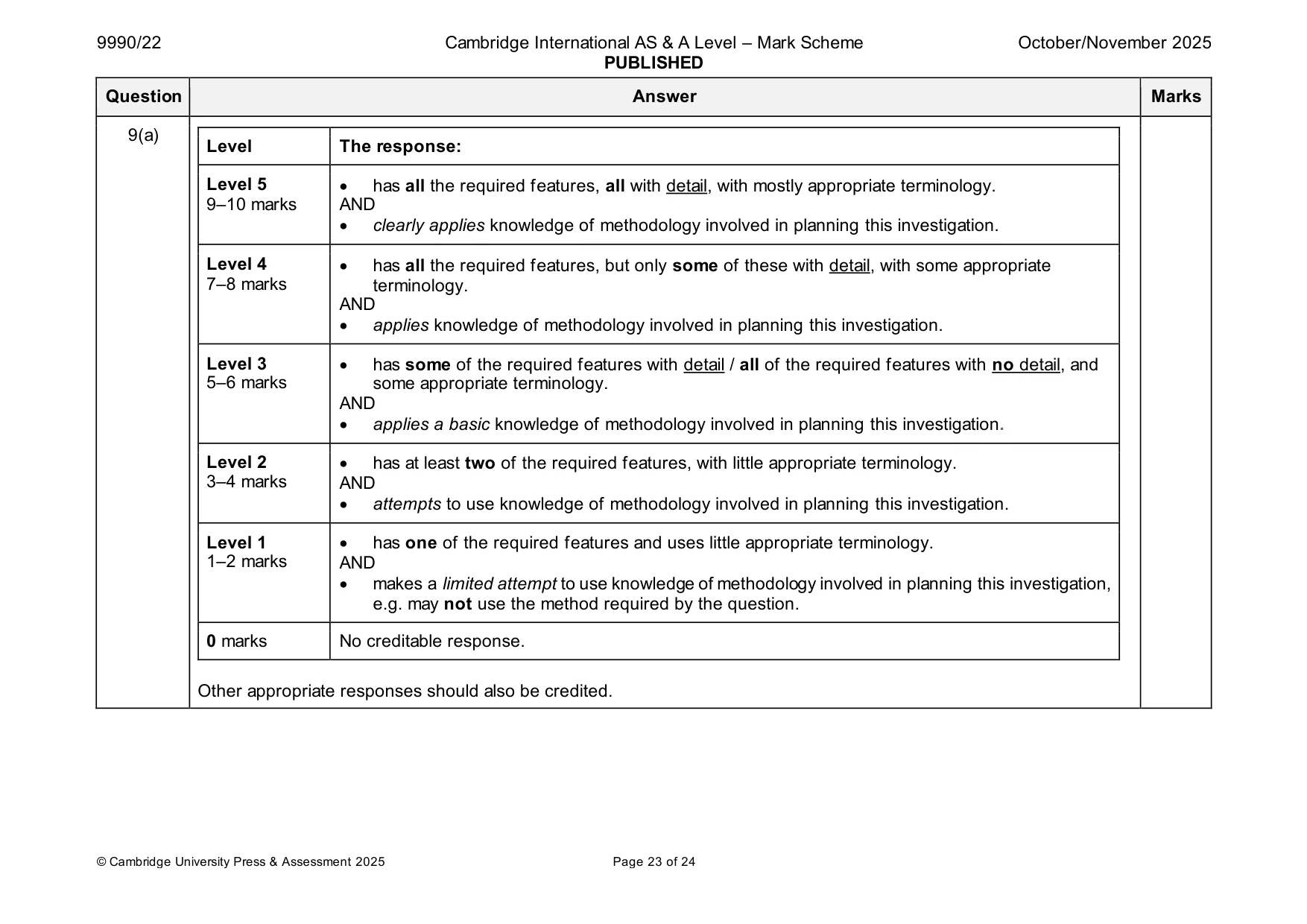
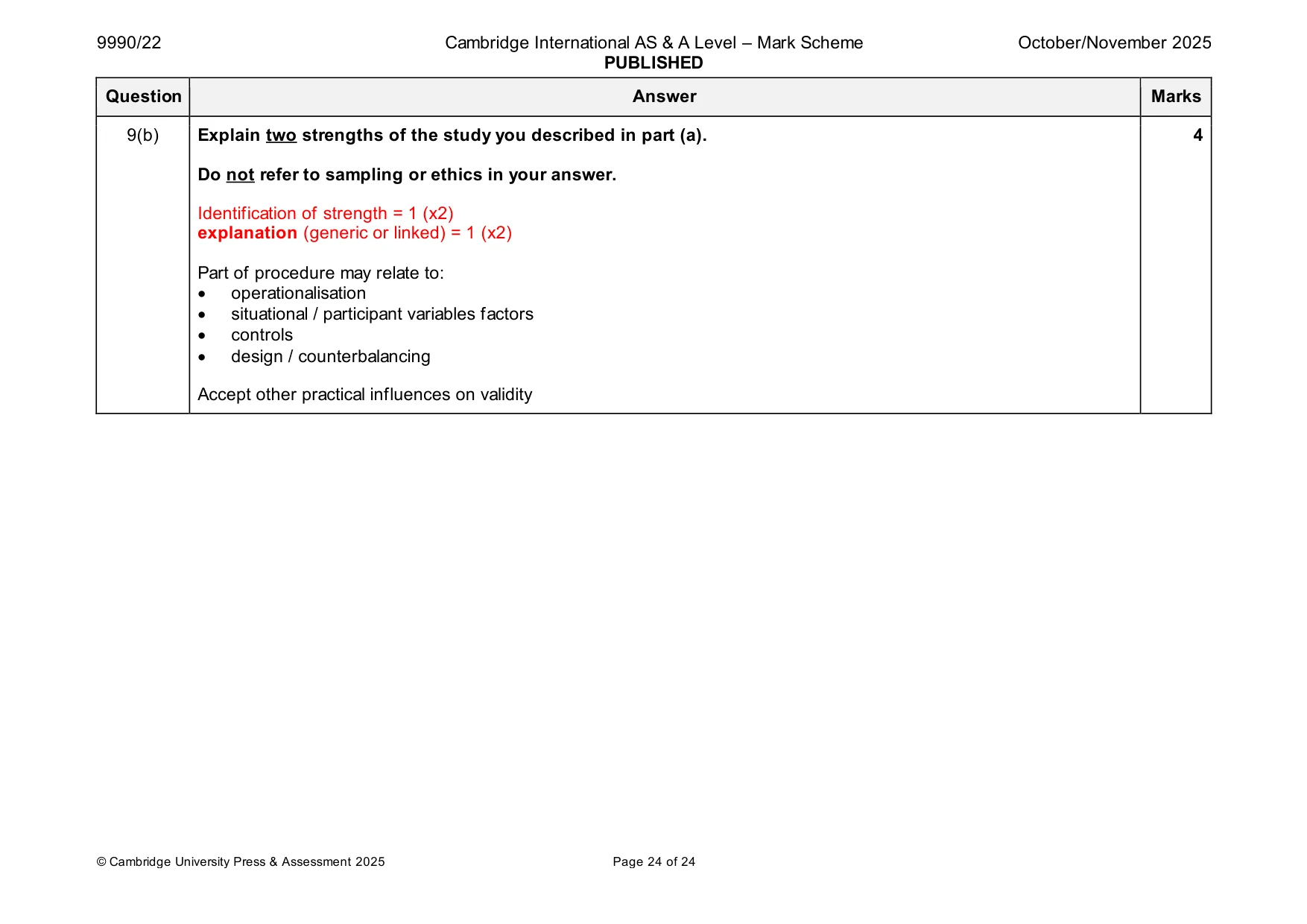
Mark scheme: 9 Dr Gul is investigating whether people focus their attention more on brightly coloured advertisements than on less brightly coloured advertisements. He is planning to conduct a field experiment on a train. 9(a) Describe how Dr Gul could conduct a field experiment to investigate the effect of colour brightness on how much 10 train passengers focus their attention on advertisements. Do not describe sample/sampling technique or ethical issues/ guidelines in your answer. To mark Q10(a), create four ‘imaginary columns’ down one margin, using one column for each of the four required features. Tick each feature (tick-a, tick-b, tick-c, tick-d) when it appears, then underline the letter ( ) for detail. Use L1, L2, L3, L4, L5 at the end of the response to indicate the level. Use the table below to mark candidate responses to this question. The four required features for this field experiment are: (a) independent variable: (ads bright v dull coloured) (b) dependent variable: (attention: operationalisation) (c) controls/standardisation; (advert size/content on the advert/time of day/route of the train. At least two) (d) experimental design: (probably independent measures/ knowledge of what this means) 9(a) Level The response: Level 5 • has all the required features, all with detail, with mostly appropriate terminology. 9–10 marks AND • clearly applies knowledge of methodology involved in planning this investigation. Level 4 • has all the required features, but only some of these with detail, with some appropriate 7–8 marks terminology. AND • applies knowledge of methodology involved in planning this investigation. Level 3 • has some of the required features with detail / all of the required features with no detail, and 5–6 marks some appropriate terminology. AND • applies a basic knowledge of methodology involved in planning this investigation. Level 2 • has at least two of the required features, with little appropriate terminology. 3–4 marks AND • attempts to use knowledge of methodology involved in planning this investigation. Level 1 • has one of the required features and uses little appropriate terminology. 1–2 marks AND • makes a limited attempt to use knowledge of methodology involved in planning this investigation, e.g. may not use the method required by the question. 0 marks No creditable response. Other appropriate responses should also be credited. 9(b) Explain two strengths of the study you described in part (a). 4 Do not refer to sampling or ethics in your answer. Identification of strength = 1 (x2) explanation (generic or linked) = 1 (x2) Part of procedure may relate to: • operationalisation • situational / participant variables factors • controls • design / counterbalancing Accept other practical influences on validity
What was in this paper
The subtopics covered by these 9 questions, and how many questions each got. Open one in a new tab to see every Cambridge question on it.