Cambridge A Level Psychology (from 2018) 9990 — 2024 Oct/Nov Paper 2 · Variant 3
9990/23/O/N/24 · 10 questions · 60 marks · 90 min
The question paper and its mark scheme, free to read here and free to download. This is Cambridge’s own paper, exactly as it was sat.
Question paper12 pages




Mark scheme19 pages
Answers below. Sit the paper first if you are practising.

Questions as text
Q1 · Outline what is meant by the term ‘random sampling’
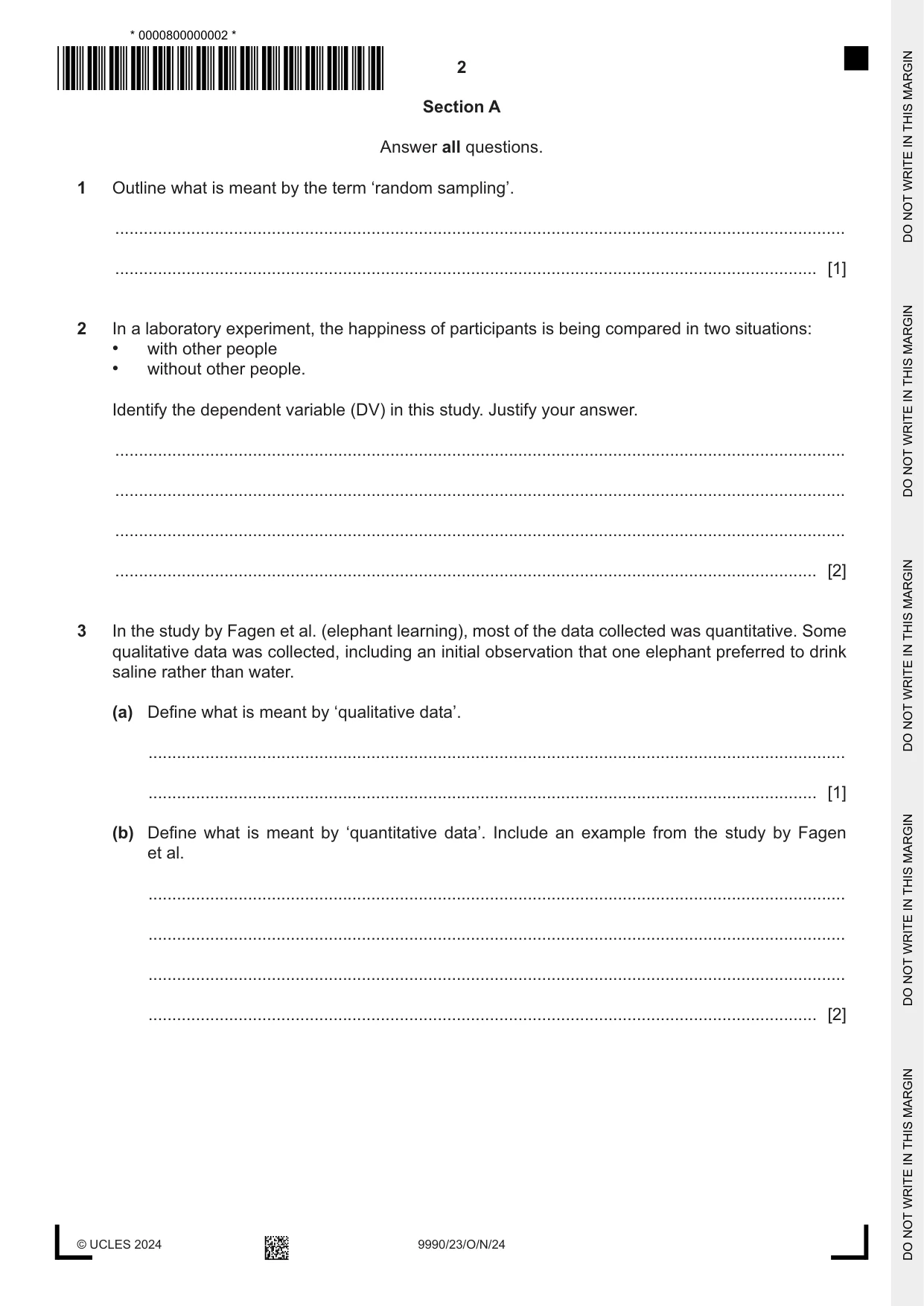
1 Outline what is meant by the term ‘random sampling’. .......................................................................................................................................................... .................................................................................................................................................... [1]
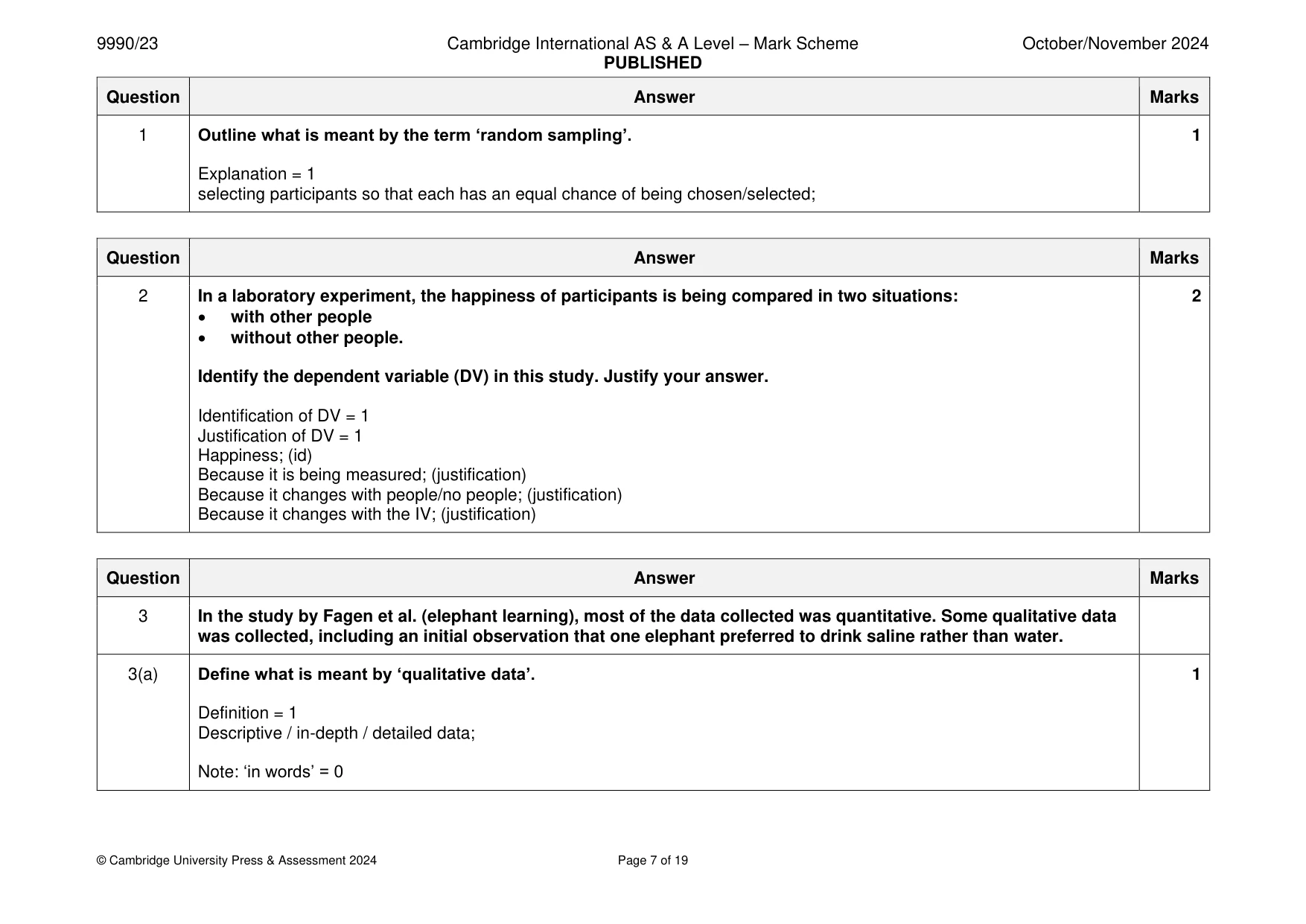
Mark scheme: Question Answer Marks 1 Outline what is meant by the term ‘random sampling’. 1 Explanation = 1 selecting participants so that each has an equal chance of being chosen/selected;
Q2 · In a laboratory experiment, the happiness of participants is being compared in two…
2 In a laboratory experiment, the happiness of participants is being compared in two situations: • with other people • without other people. Identify the dependent variable (DV) in this study. Justify your answer. .......................................................................................................................................................... .......................................................................................................................................................... .......................................................................................................................................................... .................................................................................................................................................... [2]
Mark scheme: 2 In a laboratory experiment, the happiness of participants is being compared in two situations: 2 • with other people • without other people. Identify the dependent variable (DV) in this study. Justify your answer. Identification of DV = 1 Justification of DV = 1 Happiness; (id) Because it is being measured; (justification) Because it changes with people/no people; (justification) Because it changes with the IV; (justification)
Q3 · In the study by Fagen et al
3 In the study by Fagen et al. (elephant learning), most of the data collected was quantitative. Some qualitative data was collected, including an initial observation that one elephant preferred to drink saline rather than water. (a) Define what is meant by ‘qualitative data’. ................................................................................................................................................... ............................................................................................................................................. [1] (b) Define what is meant by ‘quantitative data’. Include an example from the study by Fagen et al. ................................................................................................................................................... ................................................................................................................................................... ................................................................................................................................................... ............................................................................................................................................. [2]
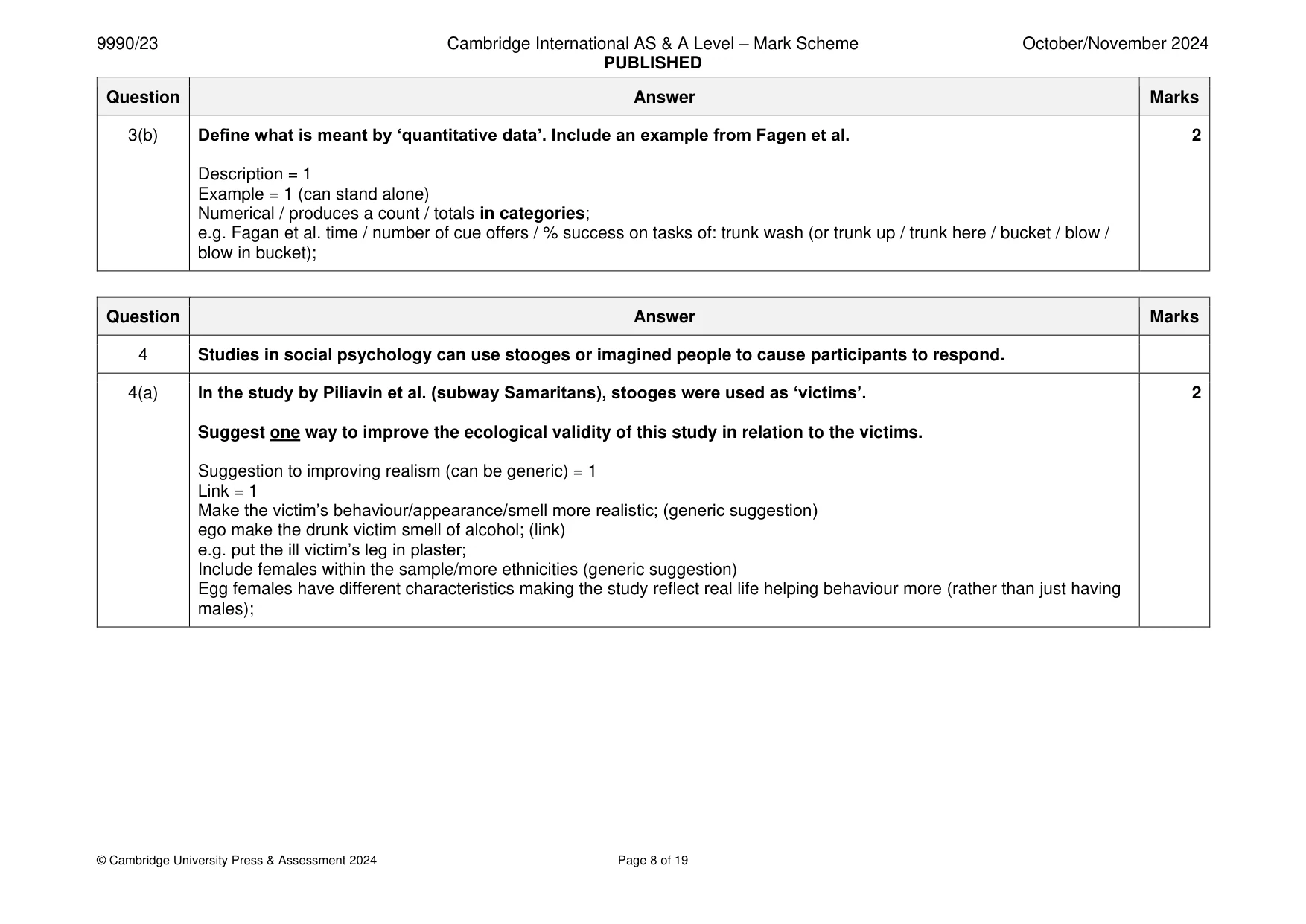
Mark scheme: 3 In the study by Fagen et al. (elephant learning), most of the data collected was quantitative. Some qualitative data was collected, including an initial observation that one elephant preferred to drink saline rather than water. 3(a) Define what is meant by ‘qualitative data’. 1 Definition = 1 Descriptive / in-depth / detailed data; Note: ‘in words’ = 0 3(b) Define what is meant by ‘quantitative data’. Include an example from Fagen et al. 2 Description = 1 Example = 1 (can stand alone) Numerical / produces a count / totals in categories; e.g. Fagan et al. time / number of cue offers / % success on tasks of: trunk wash (or trunk up / trunk here / bucket / blow / blow in bucket);
Q4 · Studies in social psychology can use stooges or imagined people to cause participants to…
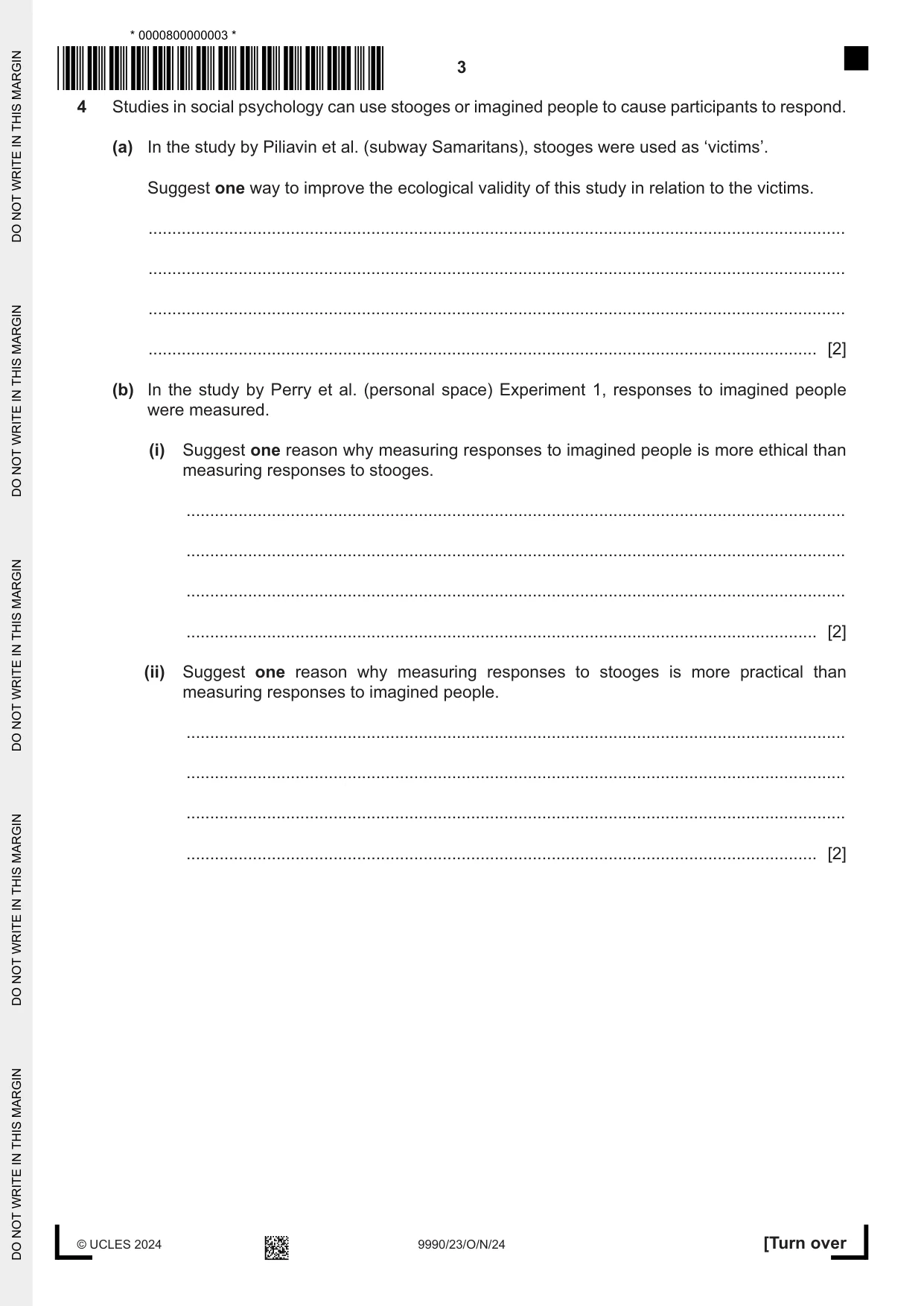
4 Studies in social psychology can use stooges or imagined people to cause participants to respond. (a) In the study by Piliavin et al. (subway Samaritans), stooges were used as ‘victims’. Suggest one way to improve the ecological validity of this study in relation to the victims. ................................................................................................................................................... ................................................................................................................................................... ................................................................................................................................................... ............................................................................................................................................. [2] (b) In the study by Perry et al. (personal space) Experiment 1, responses to imagined people were measured. (i) Suggest one reason why measuring responses to imagined people is more ethical than measuring responses to stooges. ........................................................................................................................................... ........................................................................................................................................... ........................................................................................................................................... ..................................................................................................................................... [2] (ii) Suggest one reason why measuring responses to stooges is more practical than measuring responses to imagined people. ........................................................................................................................................... ........................................................................................................................................... ........................................................................................................................................... ..................................................................................................................................... [2]
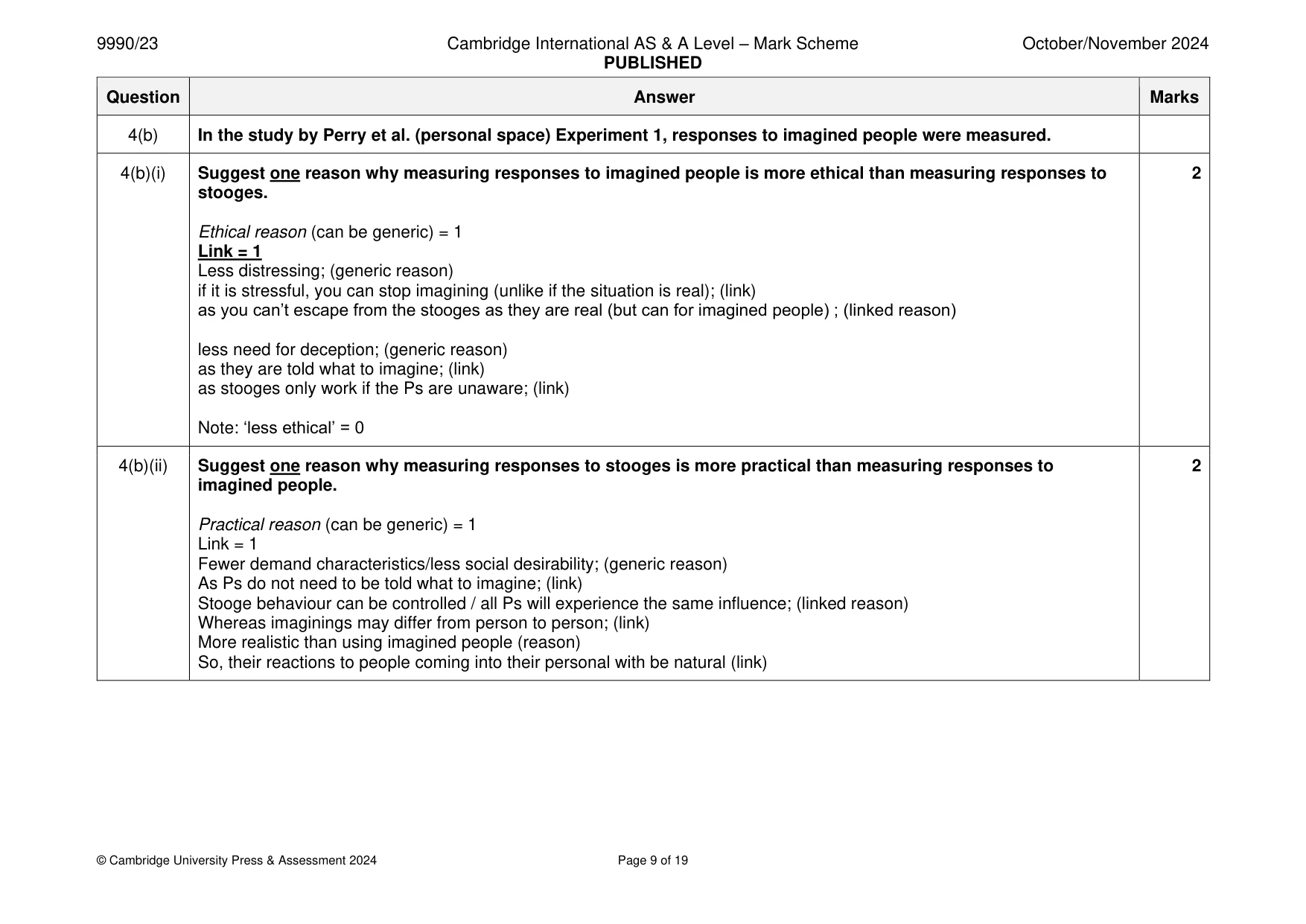
Mark scheme: 4 Studies in social psychology can use stooges or imagined people to cause participants to respond. 4(a) In the study by Piliavin et al. (subway Samaritans), stooges were used as ‘victims’. 2 Suggest one way to improve the ecological validity of this study in relation to the victims. Suggestion to improving realism (can be generic) = 1 Link = 1 Make the victim’s behaviour/appearance/smell more realistic; (generic suggestion) ego make the drunk victim smell of alcohol; (link) e.g. put the ill victim’s leg in plaster; Include females within the sample/more ethnicities (generic suggestion) Egg females have different characteristics making the study reflect real life helping behaviour more (rather than just having males); 4(b) In the study by Perry et al. (personal space) Experiment 1, responses to imagined people were measured. 4(b)(i) Suggest one reason why measuring responses to imagined people is more ethical than measuring responses to 2 stooges. Ethical reason (can be generic) = 1 Link = 1 Less distressing; (generic reason) if it is stressful, you can stop imagining (unlike if the situation is real); (link) as you can’t escape from the stooges as they are real (but can for imagined people) ; (linked reason) less need for deception; (generic reason) as they are told what to imagine; (link) as stooges only work if the Ps are unaware; (link) Note: ‘less ethical’ = 0 4(b)(ii) Suggest one reason why measuring responses to stooges is more practical than measuring responses to 2 imagined people. Practical reason (can be generic) = 1 Link = 1 Fewer demand characteristics/less social desirability; (generic reason) As Ps do not need to be told what to imagine; (link) Stooge behaviour can be controlled / all Ps will experience the same influence; (linked reason) Whereas imaginings may differ from person to person; (link) More realistic than using imagined people (reason) So, their reactions to people coming into their personal with be natural (link)
Question 5
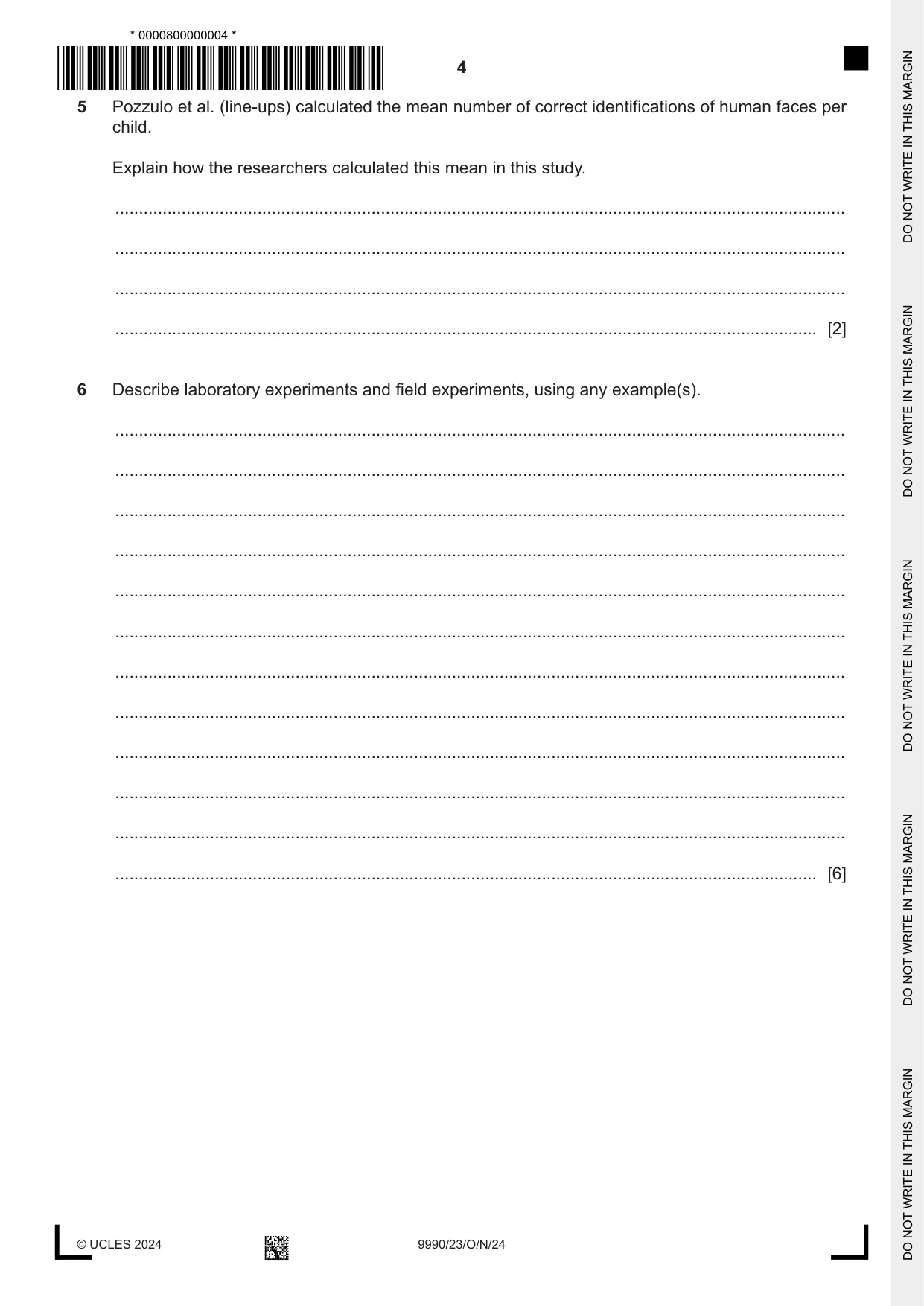
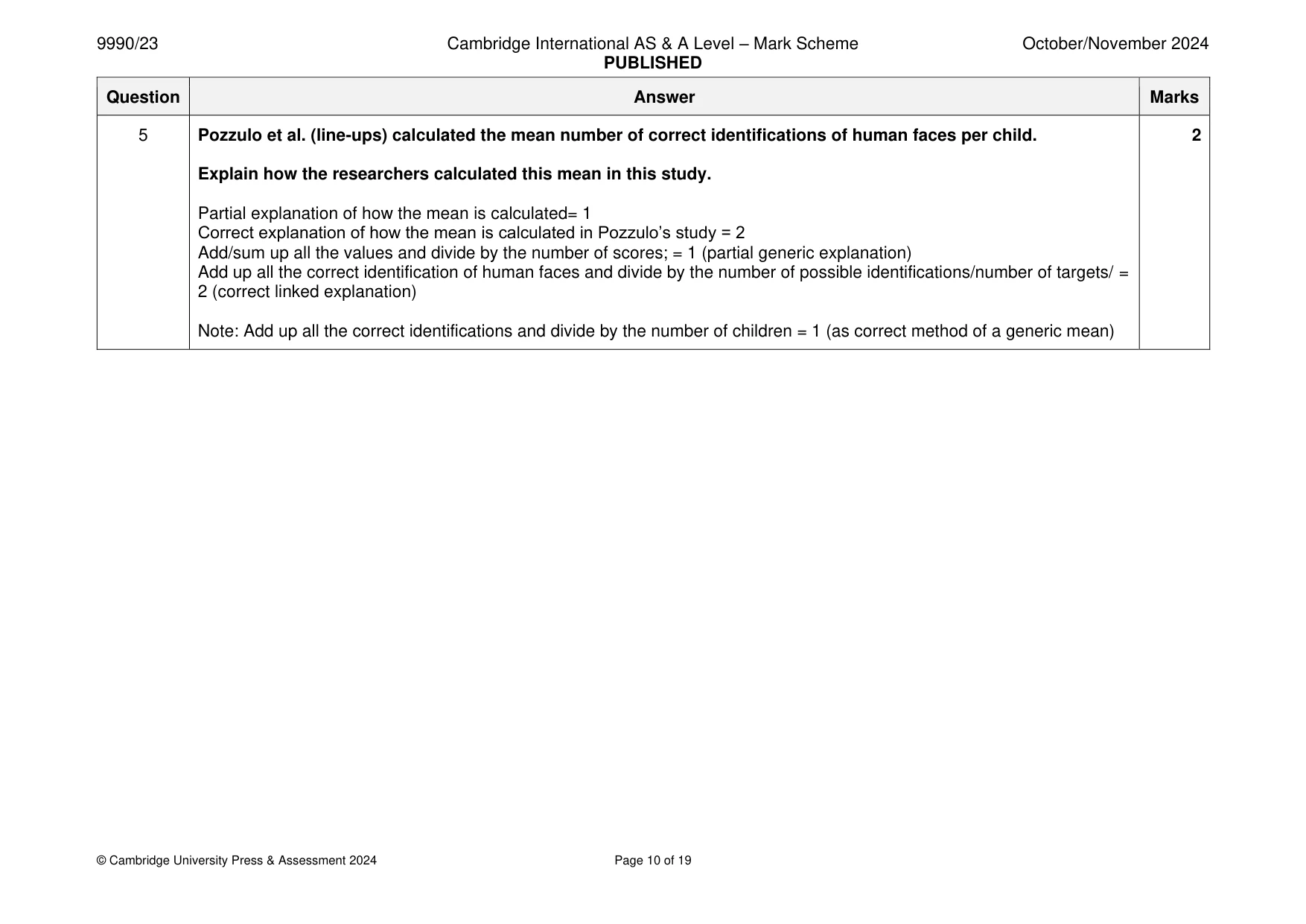
5 Pozzulo et al. (line-ups) calculated the mean number of correct identifications of human faces per child. Explain how the researchers calculated this mean in this study. .......................................................................................................................................................... .......................................................................................................................................................... .......................................................................................................................................................... .................................................................................................................................................... [2]
Mark scheme: 5 Pozzulo et al. (line-ups) calculated the mean number of correct identifications of human faces per child. 2 Explain how the researchers calculated this mean in this study. Partial explanation of how the mean is calculated= 1 Correct explanation of how the mean is calculated in Pozzulo’s study = 2 Add/sum up all the values and divide by the number of scores; = 1 (partial generic explanation) Add up all the correct identification of human faces and divide by the number of possible identifications/number of targets/ = 2 (correct linked explanation) Note: Add up all the correct identifications and divide by the number of children = 1 (as correct method of a generic mean)
Q6 · Describe laboratory experiments and field experiments, using any example(s)
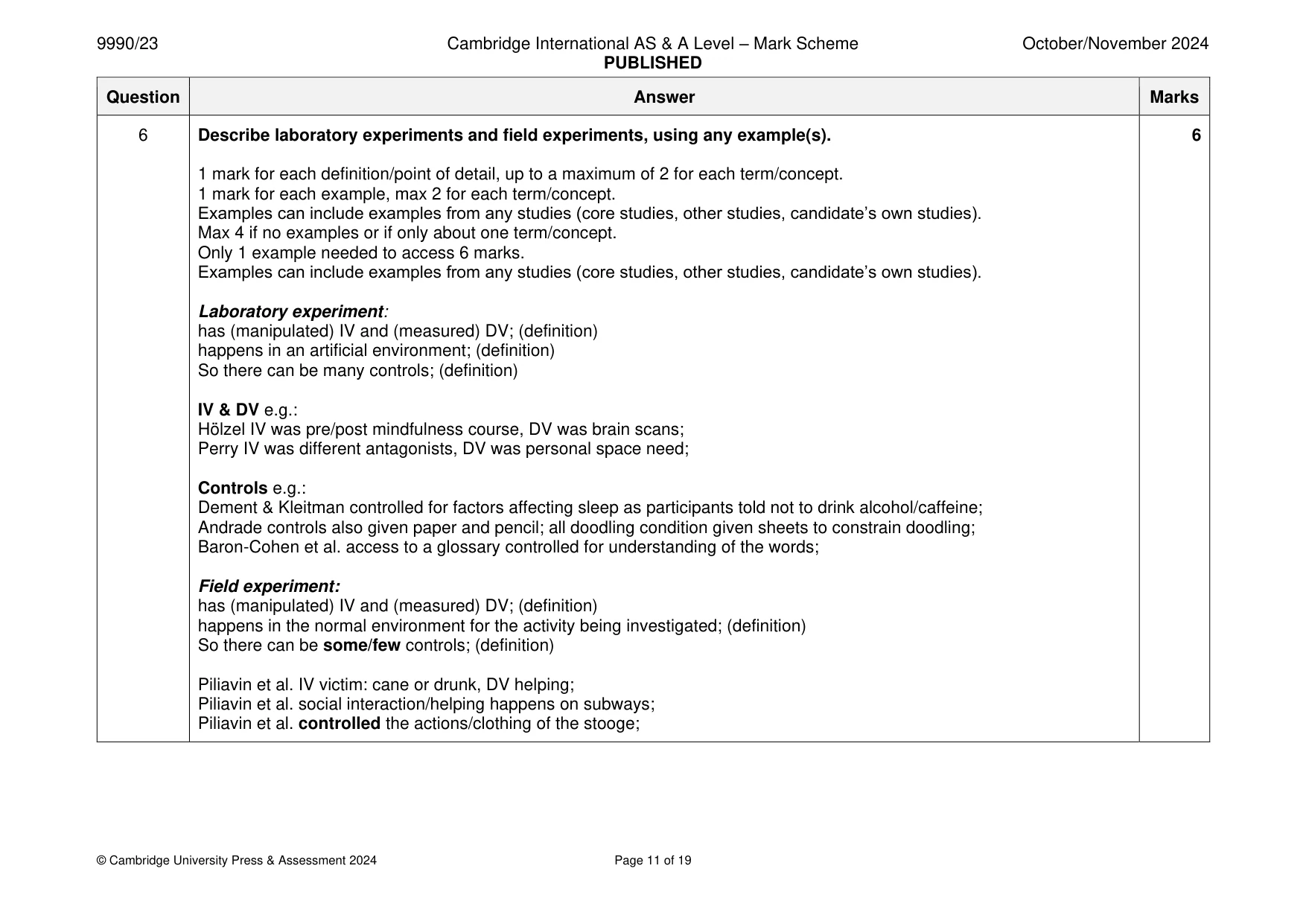
6 Describe laboratory experiments and field experiments, using any example(s). .......................................................................................................................................................... .......................................................................................................................................................... .......................................................................................................................................................... .......................................................................................................................................................... .......................................................................................................................................................... .......................................................................................................................................................... .......................................................................................................................................................... .......................................................................................................................................................... .......................................................................................................................................................... .......................................................................................................................................................... .......................................................................................................................................................... .................................................................................................................................................... [6]
Mark scheme: 6 Describe laboratory experiments and field experiments, using any example(s). 6 1 mark for each definition/point of detail, up to a maximum of 2 for each term/concept. 1 mark for each example, max 2 for each term/concept. Examples can include examples from any studies (core studies, other studies, candidate’s own studies). Max 4 if no examples or if only about one term/concept. Only 1 example needed to access 6 marks. Examples can include examples from any studies (core studies, other studies, candidate’s own studies). Laboratory experiment: has (manipulated) IV and (measured) DV; (definition) happens in an artificial environment; (definition) So there can be many controls; (definition) IV & DV e.g.: Hölzel IV was pre/post mindfulness course, DV was brain scans; Perry IV was different antagonists, DV was personal space need; Controls e.g.: Dement & Kleitman controlled for factors affecting sleep as participants told not to drink alcohol/caffeine; Andrade controls also given paper and pencil; all doodling condition given sheets to constrain doodling; Baron-Cohen et al. access to a glossary controlled for understanding of the words; Field experiment: has (manipulated) IV and (measured) DV; (definition) happens in the normal environment for the activity being investigated; (definition) So there can be some/few controls; (definition) Piliavin et al. IV victim: cane or drunk, DV helping; Piliavin et al. social interaction/helping happens on subways; Piliavin et al. controlled the actions/clothing of the stooge;
Q7 · Daiyu is conducting a case study about a seven-year-old child with autism
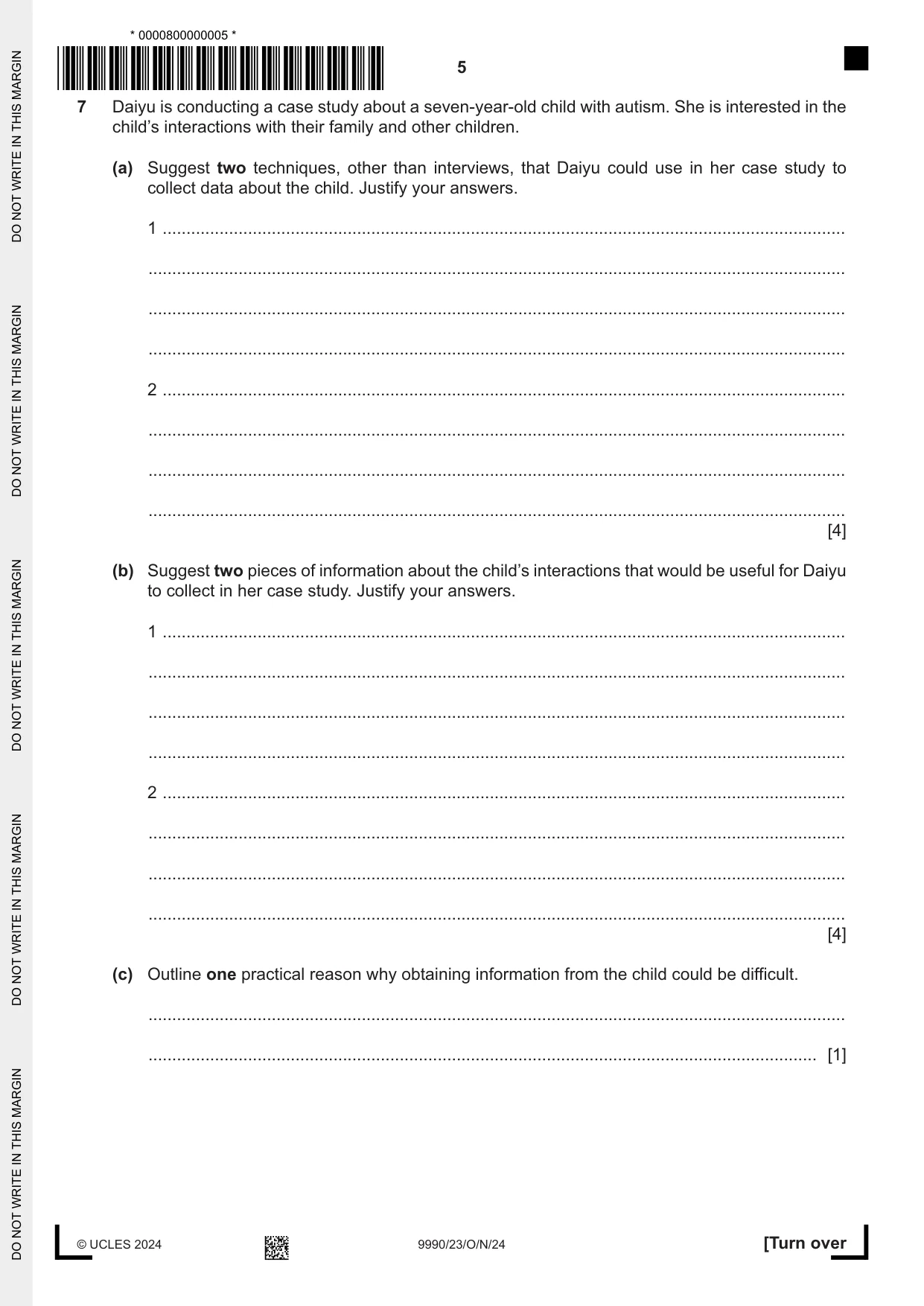
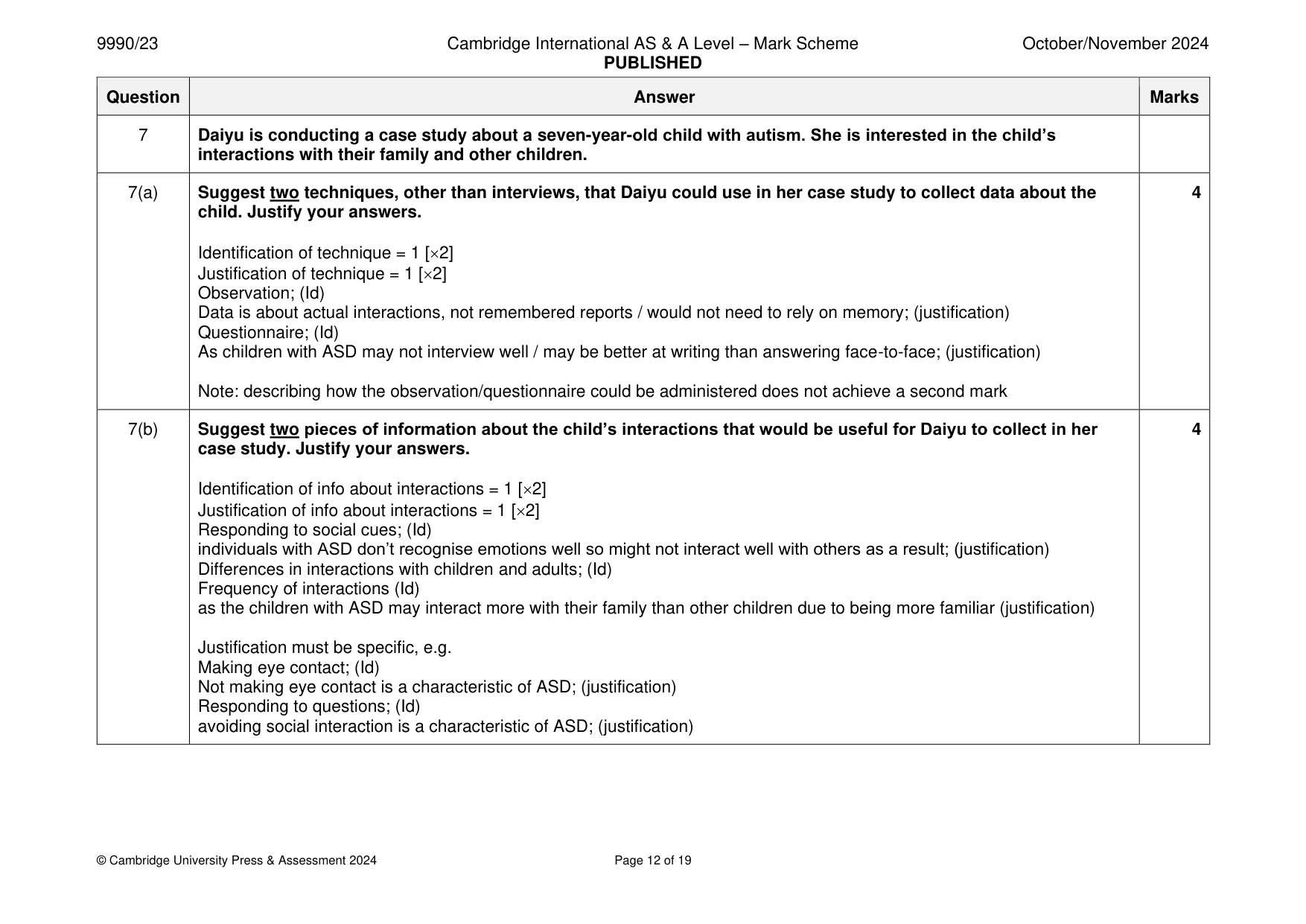
7 Daiyu is conducting a case study about a seven-year-old child with autism. She is interested in the child’s interactions with their family and other children. (a) Suggest two techniques, other than interviews, that Daiyu could use in her case study to collect data about the child. Justify your answers. 1 ................................................................................................................................................ ................................................................................................................................................... ................................................................................................................................................... ................................................................................................................................................... 2 ................................................................................................................................................ ................................................................................................................................................... ................................................................................................................................................... ................................................................................................................................................... [4] (b) Suggest two pieces of information about the child’s interactions that would be useful for Daiyu to collect in her case study. Justify your answers. 1 ................................................................................................................................................ ................................................................................................................................................... ................................................................................................................................................... ................................................................................................................................................... 2 ................................................................................................................................................ ................................................................................................................................................... ................................................................................................................................................... ................................................................................................................................................... [4] (c) Outline one practical reason why obtaining information from the child could be difficult. ................................................................................................................................................... ............................................................................................................................................. [1]
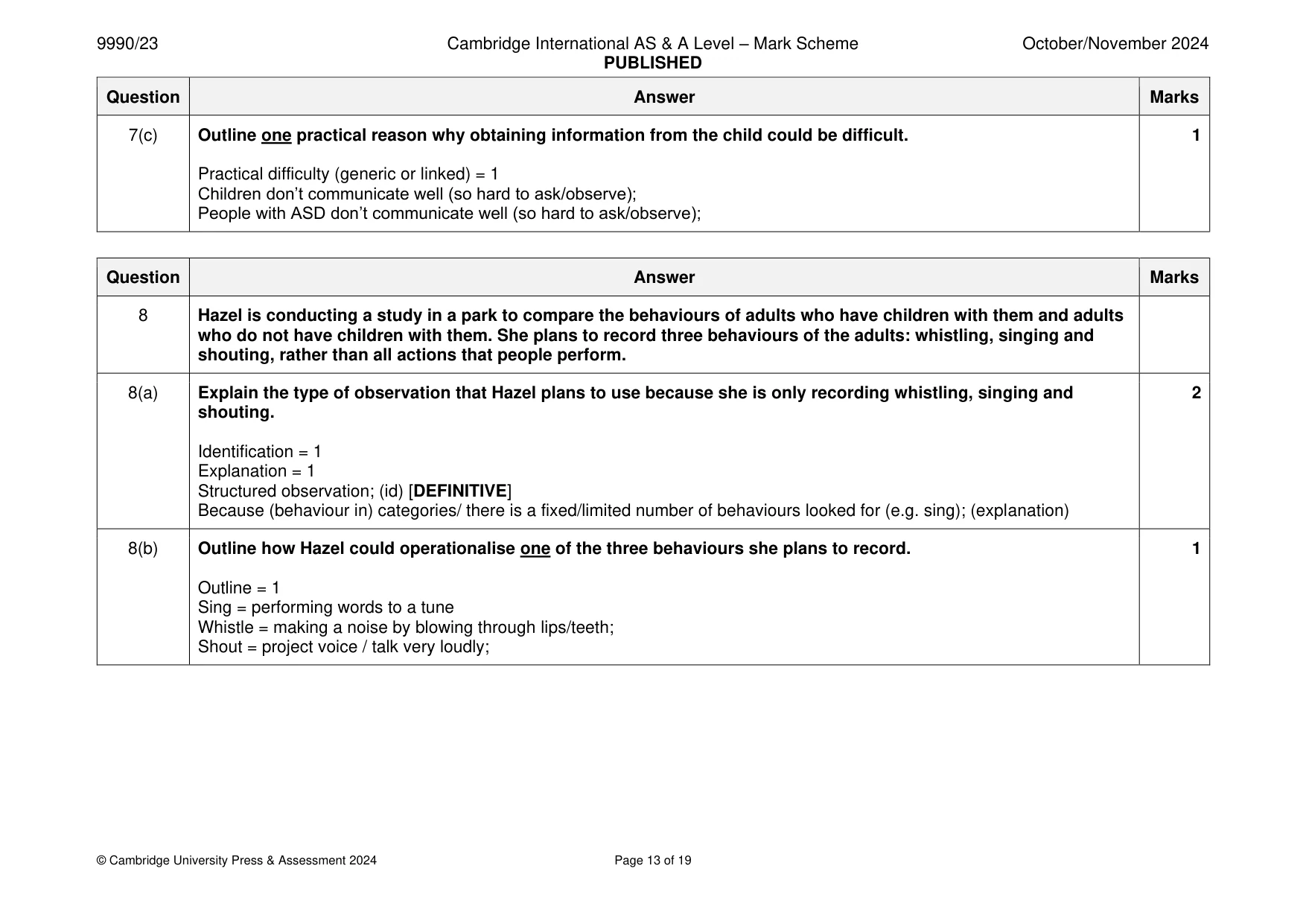
Mark scheme: 7 Daiyu is conducting a case study about a seven-year-old child with autism. She is interested in the child’s interactions with their family and other children. 7(a) Suggest two techniques, other than interviews, that Daiyu could use in her case study to collect data about the 4 child. Justify your answers. Identification of technique = 1 [2] Justification of technique = 1 [2] Observation; (Id) Data is about actual interactions, not remembered reports / would not need to rely on memory; (justification) Questionnaire; (Id) As children with ASD may not interview well / may be better at writing than answering face-to-face; (justification) Note: describing how the observation/questionnaire could be administered does not achieve a second mark 7(b) Suggest two pieces of information about the child’s interactions that would be useful for Daiyu to collect in her 4 case study. Justify your answers. Identification of info about interactions = 1 [2] Justification of info about interactions = 1 [2] Responding to social cues; (Id) individuals with ASD don’t recognise emotions well so might not interact well with others as a result; (justification) Differences in interactions with children and adults; (Id) Frequency of interactions (Id) as the children with ASD may interact more with their family than other children due to being more familiar (justification) Justification must be specific, e.g. Making eye contact; (Id) Not making eye contact is a characteristic of ASD; (justification) Responding to questions; (Id) avoiding social interaction is a characteristic of ASD; (justification) 7(c) Outline one practical reason why obtaining information from the child could be difficult. 1 Practical difficulty (generic or linked) = 1 Children don’t communicate well (so hard to ask/observe); People with ASD don’t communicate well (so hard to ask/observe);
Q8 · Hazel is conducting a study in a park to compare the behaviours of adults who have…
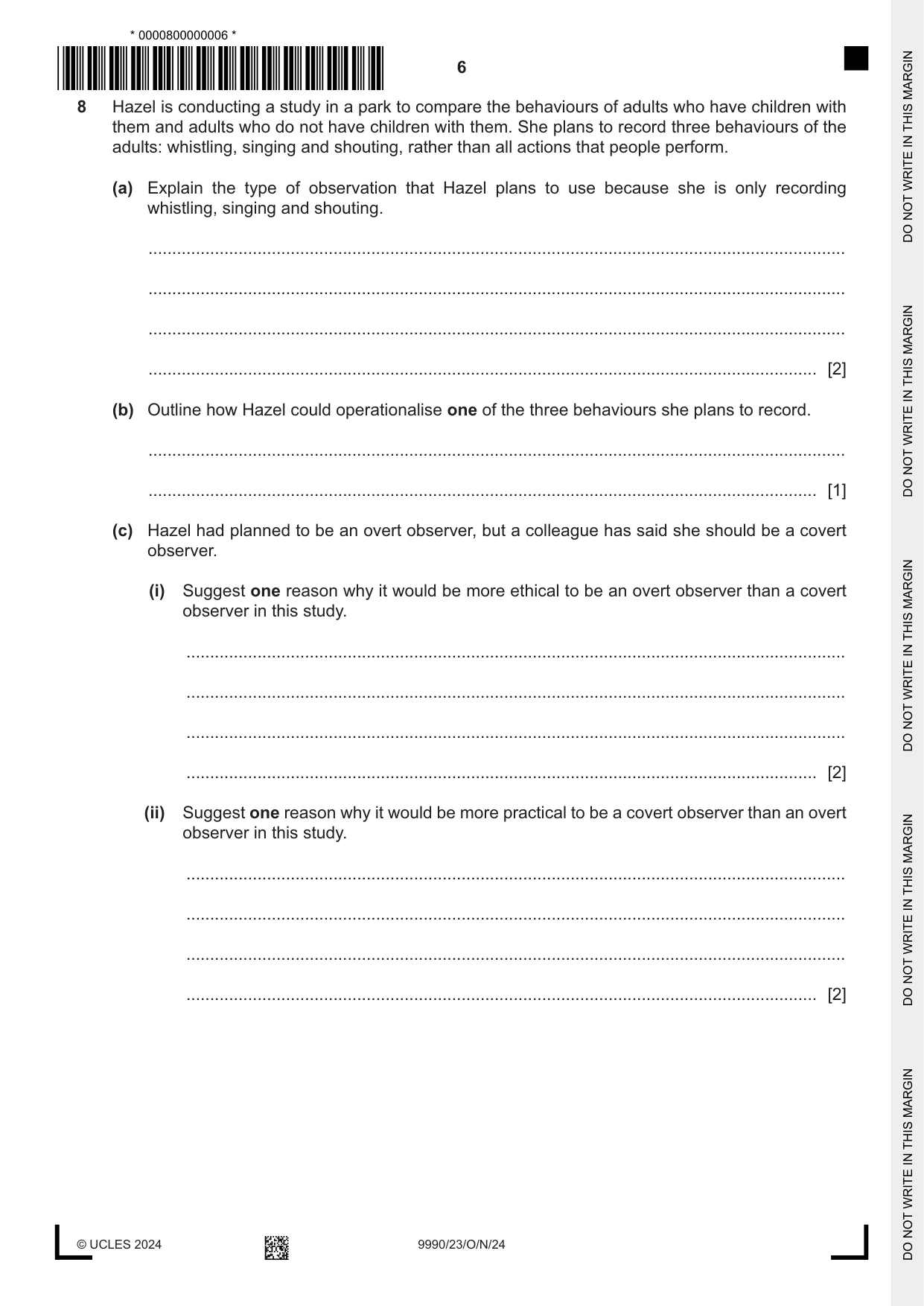
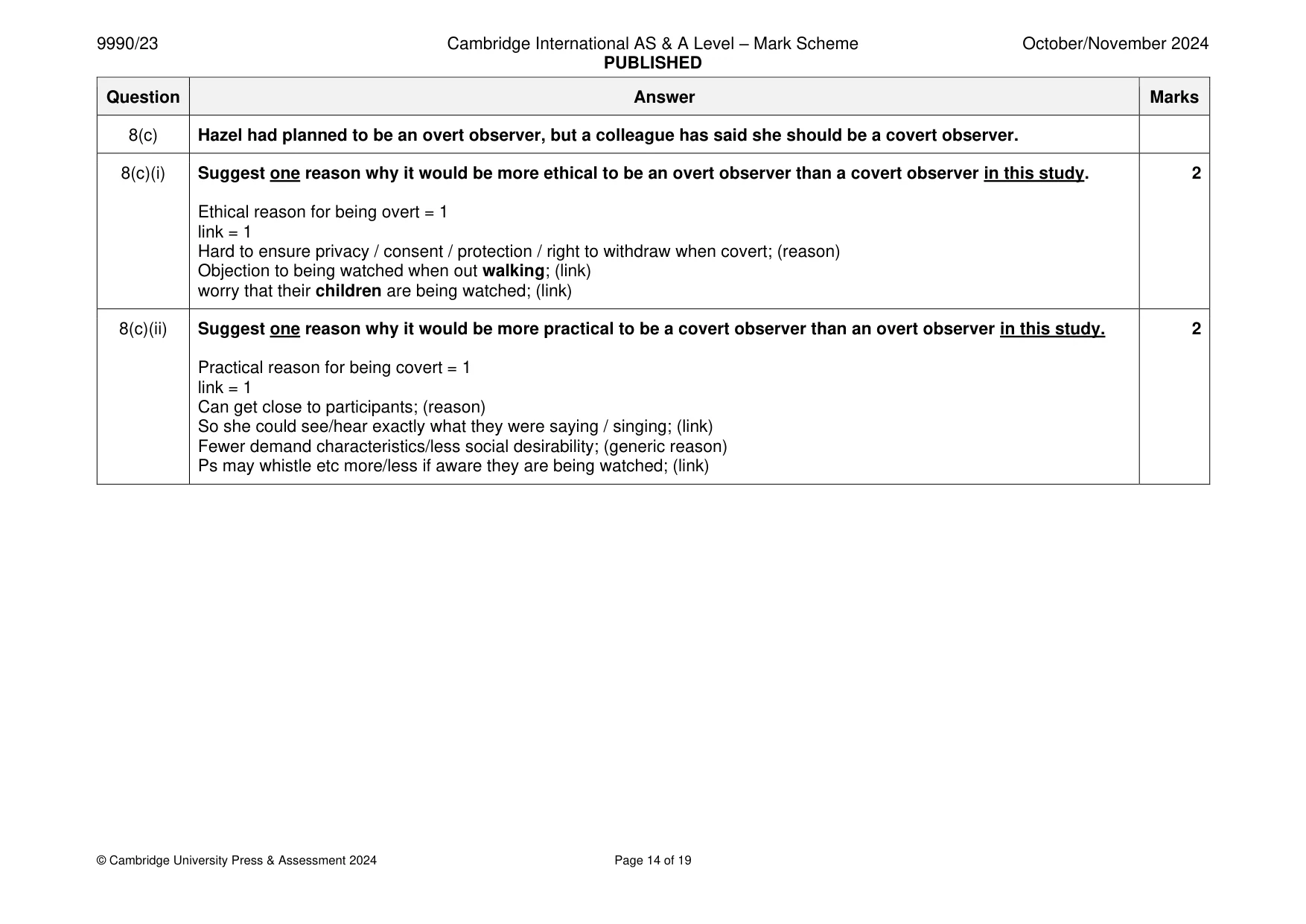
8 Hazel is conducting a study in a park to compare the behaviours of adults who have children with them and adults who do not have children with them. She plans to record three behaviours of the adults: whistling, singing and shouting, rather than all actions that people perform. (a) Explain the type of observation that Hazel plans to use because she is only recording whistling, singing and shouting. ................................................................................................................................................... ................................................................................................................................................... ................................................................................................................................................... ............................................................................................................................................. [2] (b) Outline how Hazel could operationalise one of the three behaviours she plans to record. ................................................................................................................................................... ............................................................................................................................................. [1] (c) Hazel had planned to be an overt observer, but a colleague has said she should be a covert observer. (i) Suggest one reason why it would be more ethical to be an overt observer than a covert observer in this study. ........................................................................................................................................... ........................................................................................................................................... ........................................................................................................................................... ..................................................................................................................................... [2] (ii) Suggest one reason why it would be more practical to be a covert observer than an overt observer in this study. ........................................................................................................................................... ........................................................................................................................................... ........................................................................................................................................... ..................................................................................................................................... [2]
Mark scheme: 8 Hazel is conducting a study in a park to compare the behaviours of adults who have children with them and adults who do not have children with them. She plans to record three behaviours of the adults: whistling, singing and shouting, rather than all actions that people perform. 8(a) Explain the type of observation that Hazel plans to use because she is only recording whistling, singing and 2 shouting. Identification = 1 Explanation = 1 Structured observation; (id) [DEFINITIVE] Because (behaviour in) categories/ there is a fixed/limited number of behaviours looked for (e.g. sing); (explanation) 8(b) Outline how Hazel could operationalise one of the three behaviours she plans to record. 1 Outline = 1 Sing = performing words to a tune Whistle = making a noise by blowing through lips/teeth; Shout = project voice / talk very loudly; 8(c) Hazel had planned to be an overt observer, but a colleague has said she should be a covert observer. 8(c)(i) Suggest one reason why it would be more ethical to be an overt observer than a covert observer in this study. 2 Ethical reason for being overt = 1 link = 1 Hard to ensure privacy / consent / protection / right to withdraw when covert; (reason) Objection to being watched when out walking; (link) worry that their children are being watched; (link) 8(c)(ii) Suggest one reason why it would be more practical to be a covert observer than an overt observer in this study. 2 Practical reason for being covert = 1 link = 1 Can get close to participants; (reason) So she could see/hear exactly what they were saying / singing; (link) Fewer demand characteristics/less social desirability; (generic reason) Ps may whistle etc more/less if aware they are being watched; (link)
Q9 · Hudson is planning to correlate how much a person wants to sleep (sleepiness) and the…
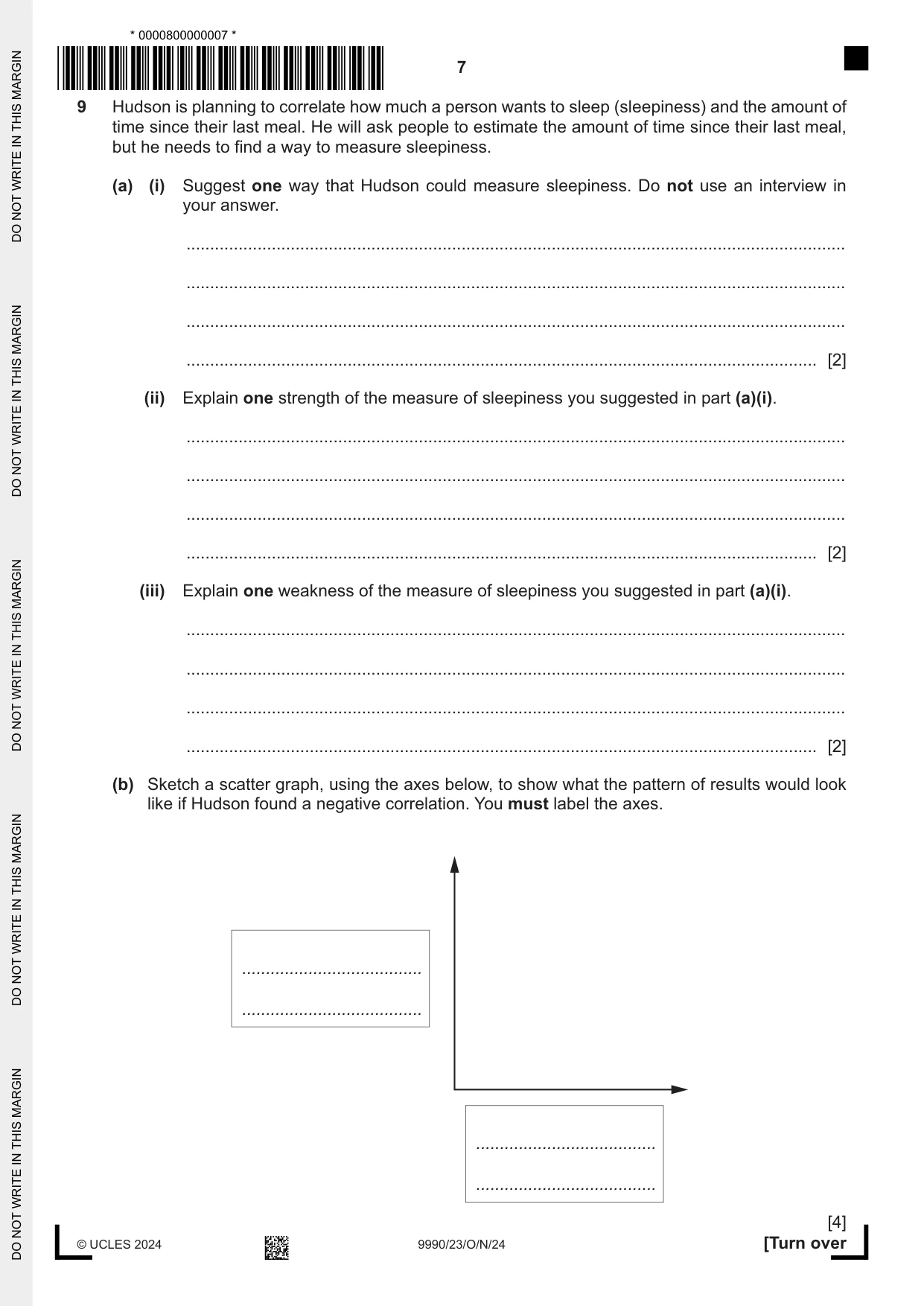
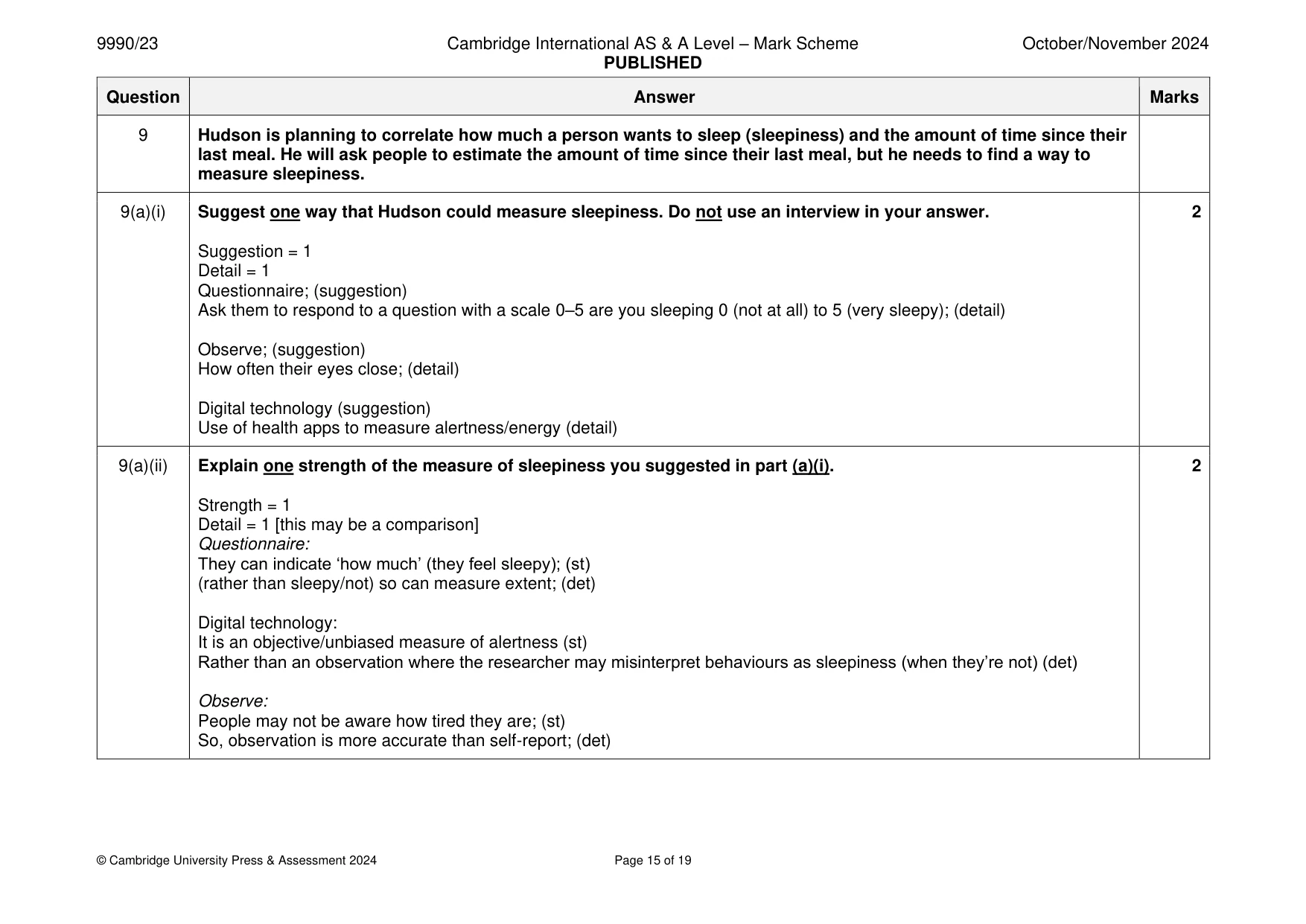
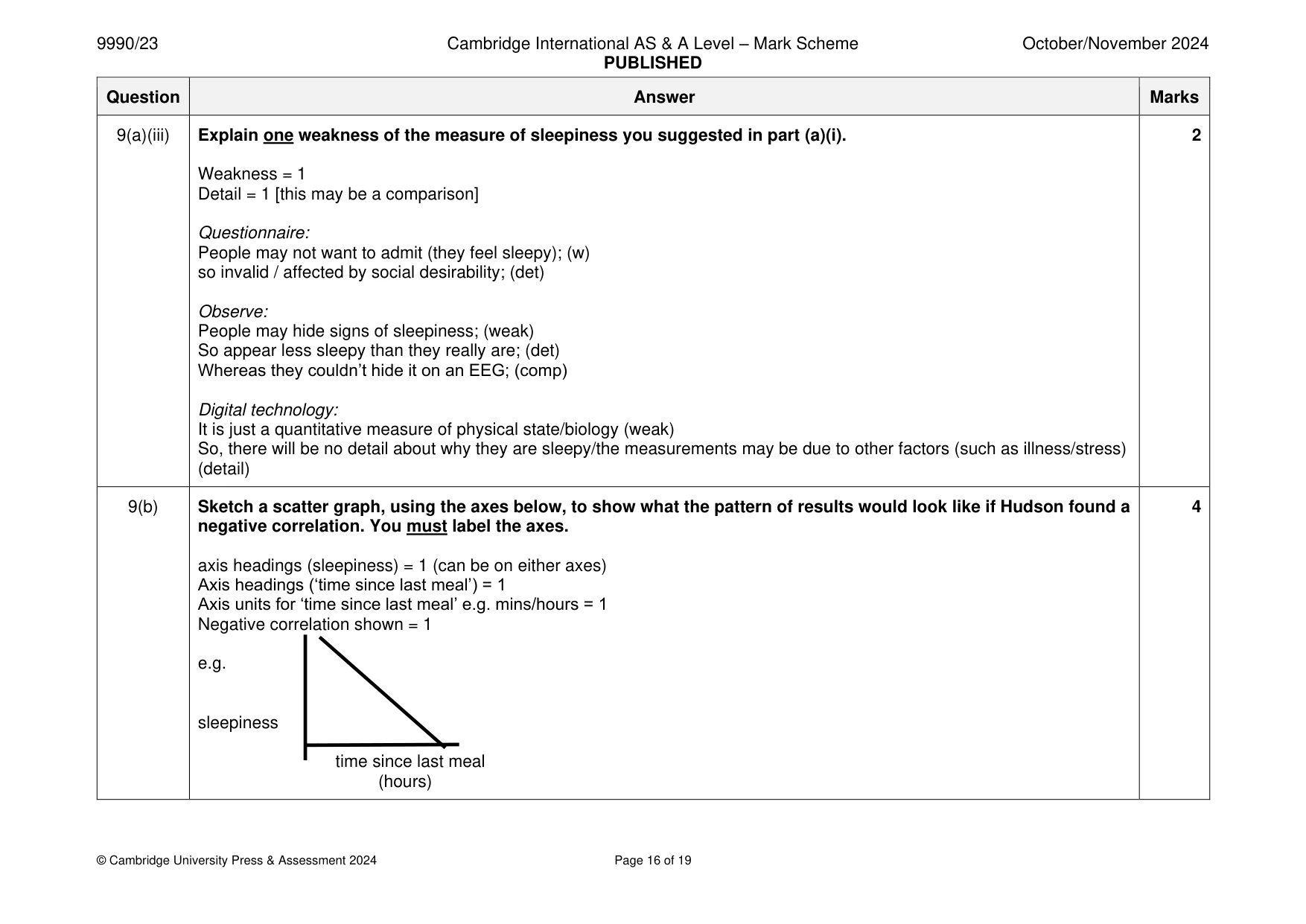
9 Hudson is planning to correlate how much a person wants to sleep (sleepiness) and the amount of time since their last meal. He will ask people to estimate the amount of time since their last meal, but he needs to find a way to measure sleepiness. (a) (i) Suggest one way that Hudson could measure sleepiness. Do not use an interview in your answer. ........................................................................................................................................... ........................................................................................................................................... ........................................................................................................................................... ..................................................................................................................................... [2] (ii) Explain one strength of the measure of sleepiness you suggested in part (a)(i). ........................................................................................................................................... ........................................................................................................................................... ........................................................................................................................................... ..................................................................................................................................... [2] (iii) Explain one weakness of the measure of sleepiness you suggested in part (a)(i). ........................................................................................................................................... ........................................................................................................................................... ........................................................................................................................................... ..................................................................................................................................... [2] (b) Sketch a scatter graph, using the axes below, to show what the pattern of results would look like if Hudson found a negative correlation. You must label the axes. ...................................... ...................................... ...................................... ...................................... [4]
Mark scheme: 9 Hudson is planning to correlate how much a person wants to sleep (sleepiness) and the amount of time since their last meal. He will ask people to estimate the amount of time since their last meal, but he needs to find a way to measure sleepiness. 9(a)(i) Suggest one way that Hudson could measure sleepiness. Do not use an interview in your answer. 2 Suggestion = 1 Detail = 1 Questionnaire; (suggestion) Ask them to respond to a question with a scale 0–5 are you sleeping 0 (not at all) to 5 (very sleepy); (detail) Observe; (suggestion) How often their eyes close; (detail) Digital technology (suggestion) Use of health apps to measure alertness/energy (detail) 9(a)(ii) Explain one strength of the measure of sleepiness you suggested in part (a)(i). 2 Strength = 1 Detail = 1 [this may be a comparison] Questionnaire: They can indicate ‘how much’ (they feel sleepy); (st) (rather than sleepy/not) so can measure extent; (det) Digital technology: It is an objective/unbiased measure of alertness (st) Rather than an observation where the researcher may misinterpret behaviours as sleepiness (when they’re not) (det) Observe: People may not be aware how tired they are; (st) So, observation is more accurate than self-report; (det) 9(a)(iii) Explain one weakness of the measure of sleepiness you suggested in part (a)(i). 2 Weakness = 1 Detail = 1 [this may be a comparison] Questionnaire: People may not want to admit (they feel sleepy); (w) so invalid / affected by social desirability; (det) Observe: People may hide signs of sleepiness; (weak) So appear less sleepy than they really are; (det) Whereas they couldn’t hide it on an EEG; (comp) Digital technology: It is just a quantitative measure of physical state/biology (weak) So, there will be no detail about why they are sleepy/the measurements may be due to other factors (such as illness/stress) (detail) 9(b) Sketch a scatter graph, using the axes below, to show what the pattern of results would look like if Hudson found a 4 negative correlation. You must label the axes. axis headings (sleepiness) = 1 (can be on either axes) Axis headings (‘time since last meal’) = 1 Axis units for ‘time since last meal’ e.g. mins/hours = 1 Negative correlation shown = 1 e.g. sleepiness time since last meal (hours)
Q10 · Zeta notices that people respond in different ways to advertisements for products
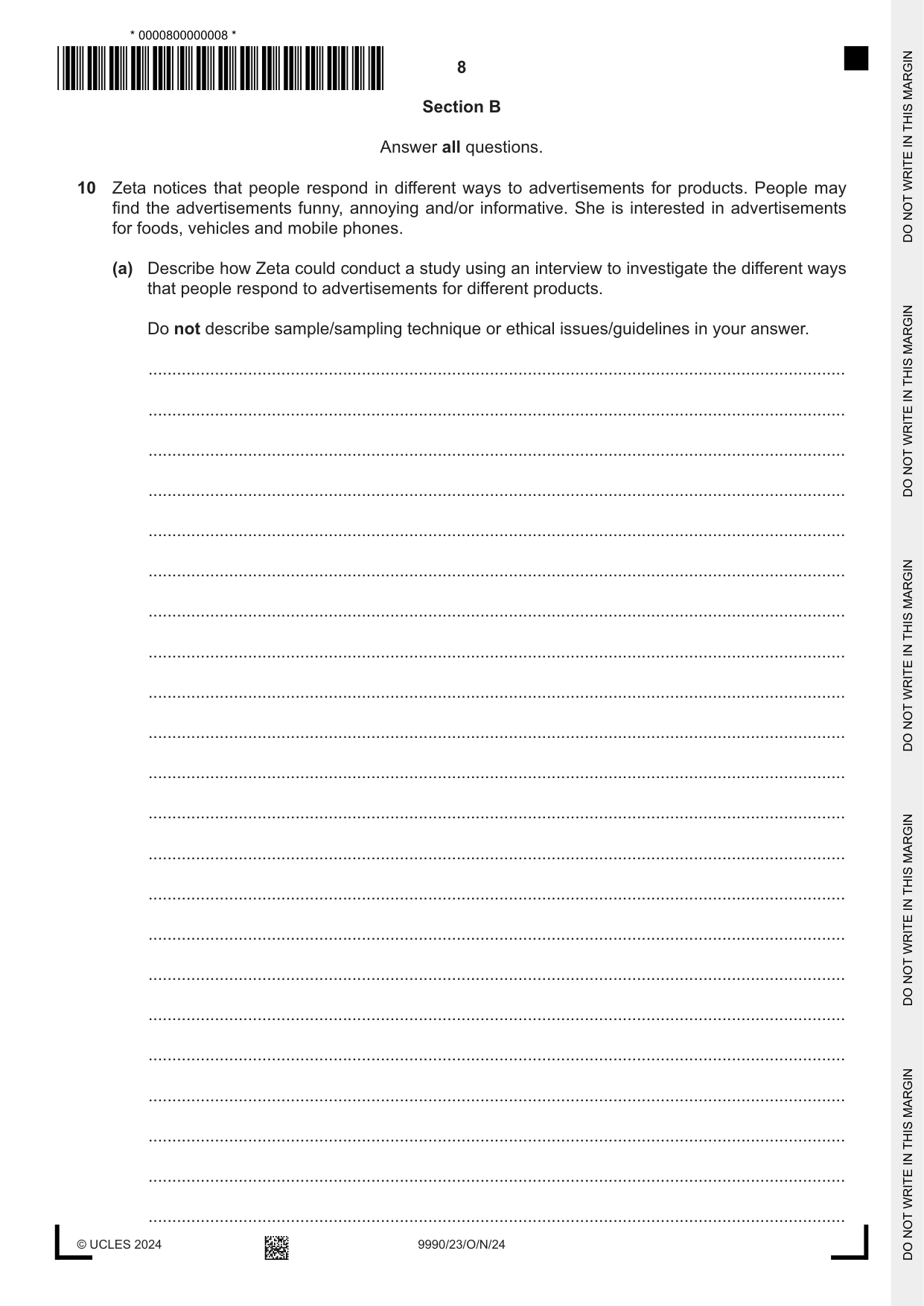
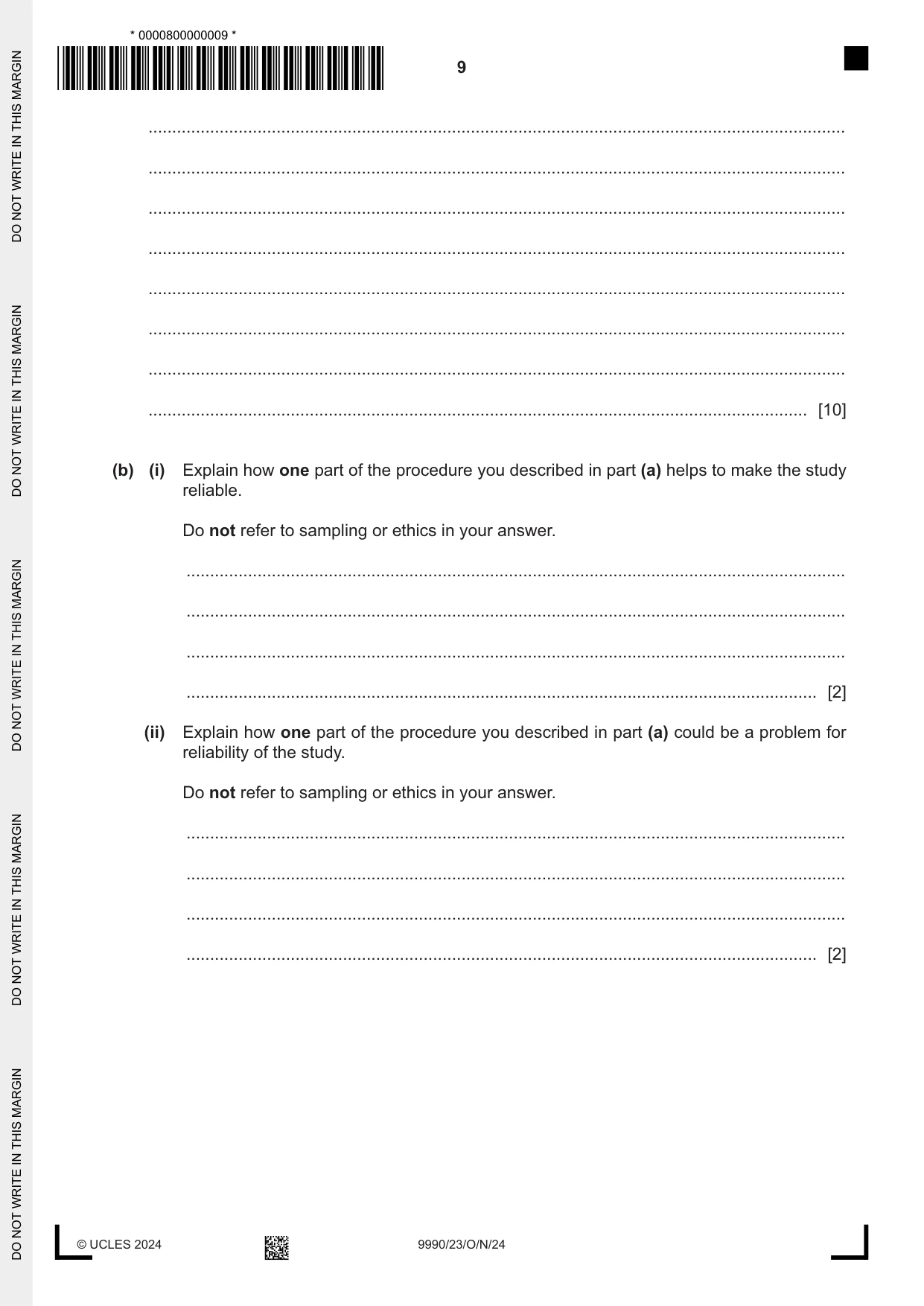
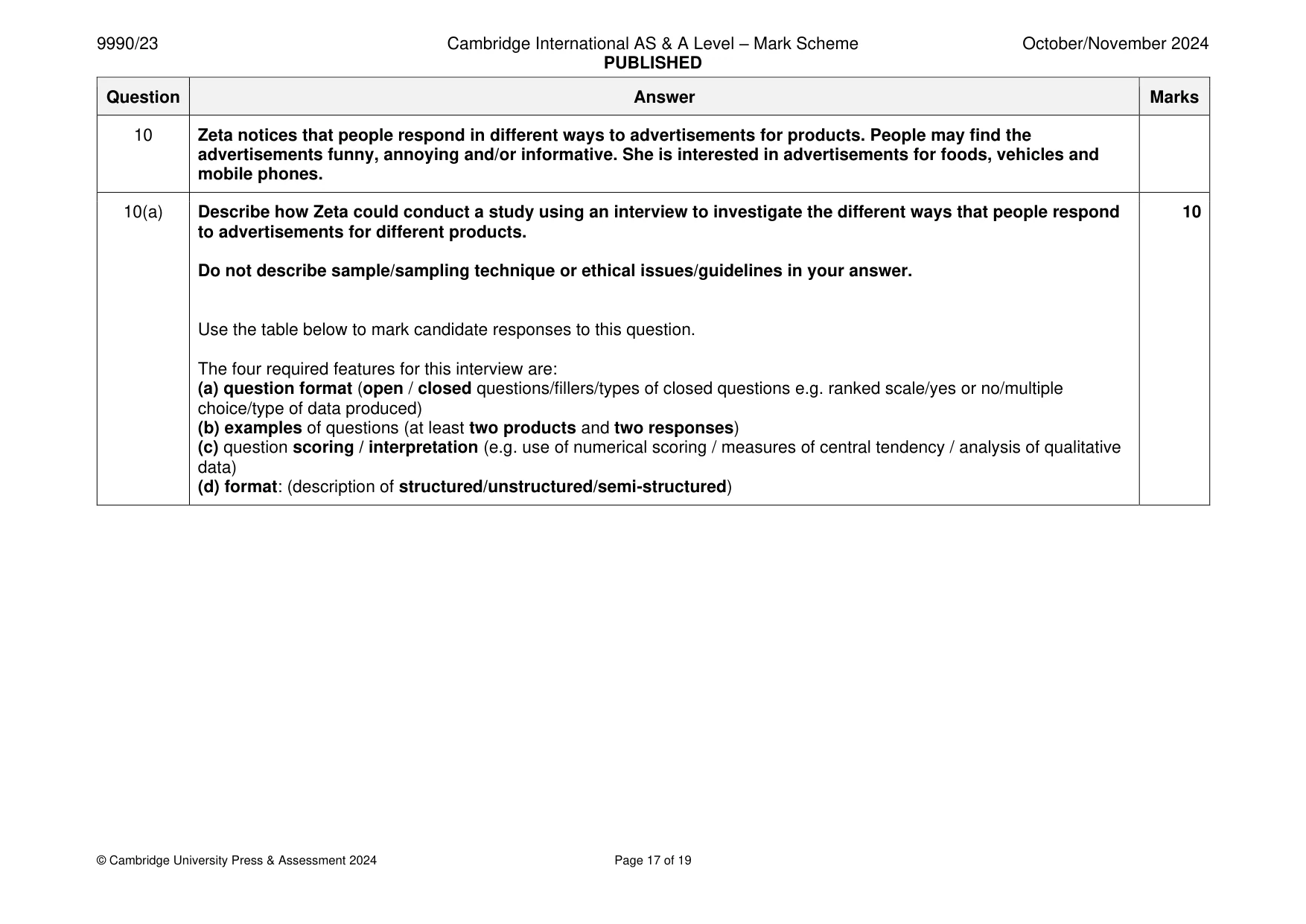
10 Zeta notices that people respond in different ways to advertisements for products. People may find the advertisements funny, annoying and/or informative. She is interested in advertisements for foods, vehicles and mobile phones. (a) Describe how Zeta could conduct a study using an interview to investigate the different ways that people respond to advertisements for different products. Do not describe sample/sampling technique or ethical issues/guidelines in your answer. ................................................................................................................................................... ................................................................................................................................................... ................................................................................................................................................... ................................................................................................................................................... ................................................................................................................................................... ................................................................................................................................................... ................................................................................................................................................... ................................................................................................................................................... ................................................................................................................................................... ................................................................................................................................................... ................................................................................................................................................... ................................................................................................................................................... ................................................................................................................................................... ................................................................................................................................................... ................................................................................................................................................... ................................................................................................................................................... ................................................................................................................................................... ................................................................................................................................................... ................................................................................................................................................... ................................................................................................................................................... ................................................................................................................................................... ................................................................................................................................................... ................................................................................................................................................... ................................................................................................................................................... ................................................................................................................................................... ................................................................................................................................................... ................................................................................................................................................... ................................................................................................................................................... ................................................................................................................................................... ........................................................................................................................................... [10] (b) (i) Explain how one part of the procedure you described in part (a) helps to make the study reliable. Do not refer to sampling or ethics in your answer. ........................................................................................................................................... ........................................................................................................................................... ........................................................................................................................................... ..................................................................................................................................... [2] (ii) Explain how one part of the procedure you described in part (a) could be a problem for reliability of the study. Do not refer to sampling or ethics in your answer. ........................................................................................................................................... ........................................................................................................................................... ........................................................................................................................................... ..................................................................................................................................... [2]
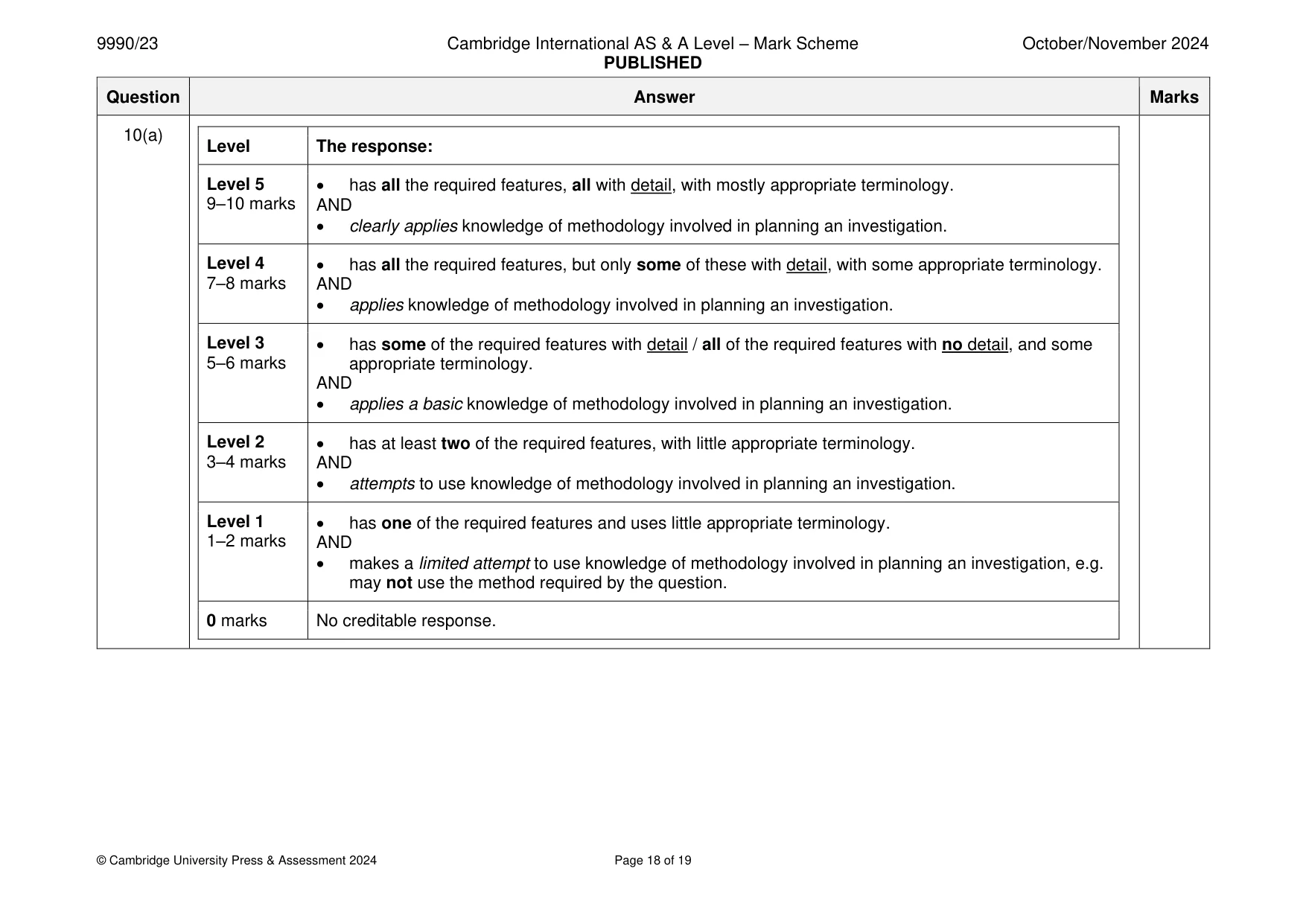
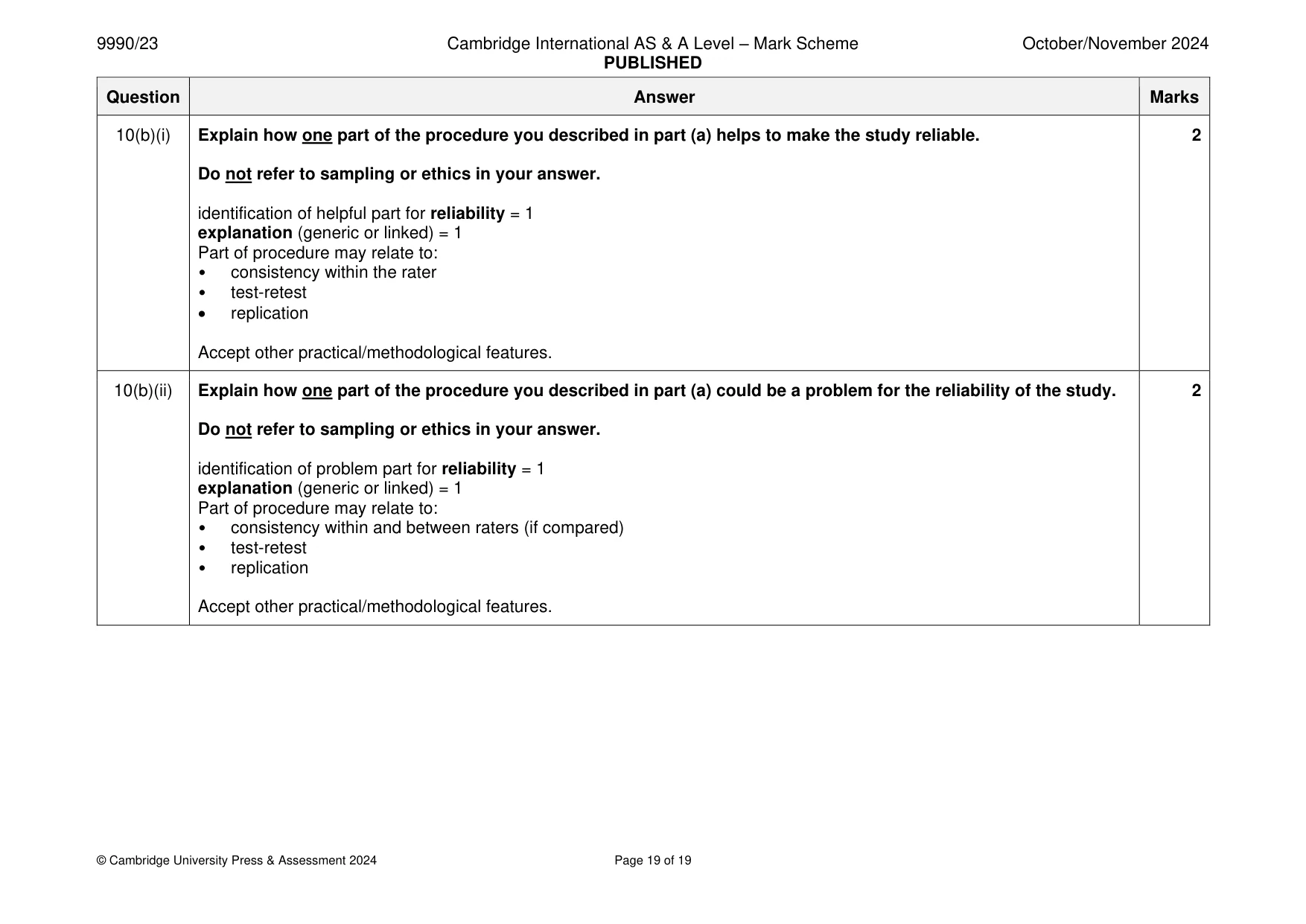
Mark scheme: 10 Zeta notices that people respond in different ways to advertisements for products. People may find the advertisements funny, annoying and/or informative. She is interested in advertisements for foods, vehicles and mobile phones. 10(a) Describe how Zeta could conduct a study using an interview to investigate the different ways that people respond 10 to advertisements for different products. Do not describe sample/sampling technique or ethical issues/guidelines in your answer. Use the table below to mark candidate responses to this question. The four required features for this interview are: (a) question format (open / closed questions/fillers/types of closed questions e.g. ranked scale/yes or no/multiple choice/type of data produced) (b) examples of questions (at least two products and two responses) (c) question scoring / interpretation (e.g. use of numerical scoring / measures of central tendency / analysis of qualitative data) (d) format: (description of structured/unstructured/semi-structured) 10(a) Level The response: Level 5 • has all the required features, all with detail, with mostly appropriate terminology. 9–10 marks AND • clearly applies knowledge of methodology involved in planning an investigation. Level 4 • has all the required features, but only some of these with detail, with some appropriate terminology. 7–8 marks AND • applies knowledge of methodology involved in planning an investigation. Level 3 • has some of the required features with detail / all of the required features with no detail, and some 5–6 marks appropriate terminology. AND • applies a basic knowledge of methodology involved in planning an investigation. Level 2 • has at least two of the required features, with little appropriate terminology. 3–4 marks AND • attempts to use knowledge of methodology involved in planning an investigation. Level 1 • has one of the required features and uses little appropriate terminology. 1–2 marks AND • makes a limited attempt to use knowledge of methodology involved in planning an investigation, e.g. may not use the method required by the question. 0 marks No creditable response. 10(b)(i) Explain how one part of the procedure you described in part (a) helps to make the study reliable. 2 Do not refer to sampling or ethics in your answer. identification of helpful part for reliability = 1 explanation (generic or linked) = 1 Part of procedure may relate to: • consistency within the rater • test-retest • replication Accept other practical/methodological features. 10(b)(ii) Explain how one part of the procedure you described in part (a) could be a problem for the reliability of the study. 2 Do not refer to sampling or ethics in your answer. identification of problem part for reliability = 1 explanation (generic or linked) = 1 Part of procedure may relate to: • consistency within and between raters (if compared) • test-retest • replication Accept other practical/methodological features.
What was in this paper
The subtopics covered by these 10 questions, and how many questions each got. Open one in a new tab to see every Cambridge question on it.
What you needed in this session
Cambridge’s own grade thresholds for 2024 Oct/Nov, Paper 2 · Variant 3. A higher threshold means an easier paper — the bar moves with how the cohort did.