Cambridge A Level Psychology (from 2018) 9990 — 2022 May/June Paper 2 · Variant 3
9990/23/M/J/22 · 10 questions · 60 marks · ≈68 min
The question paper and its mark scheme, free to read here and free to download. This is Cambridge’s own paper, exactly as it was sat.
Question paper12 pages
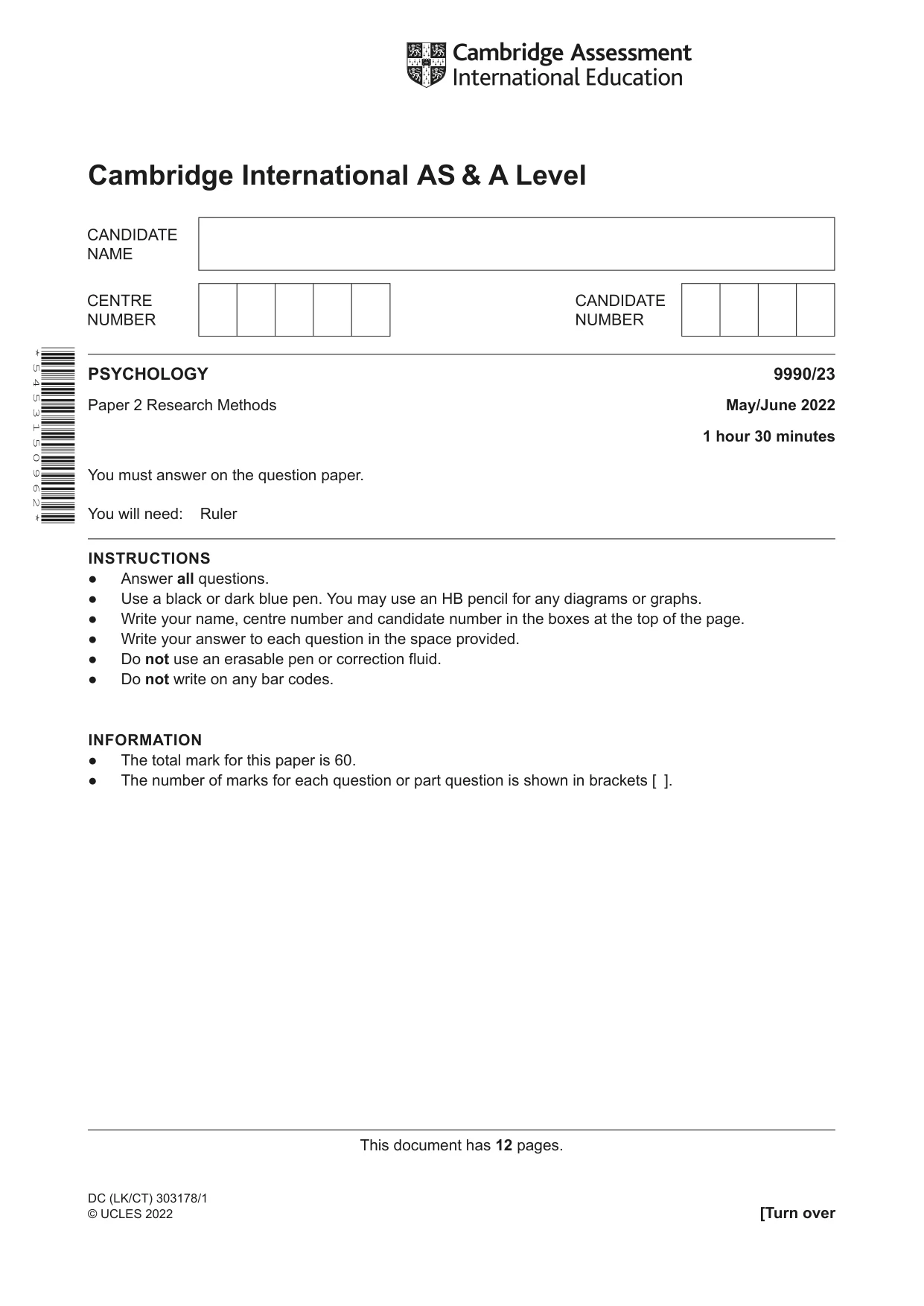

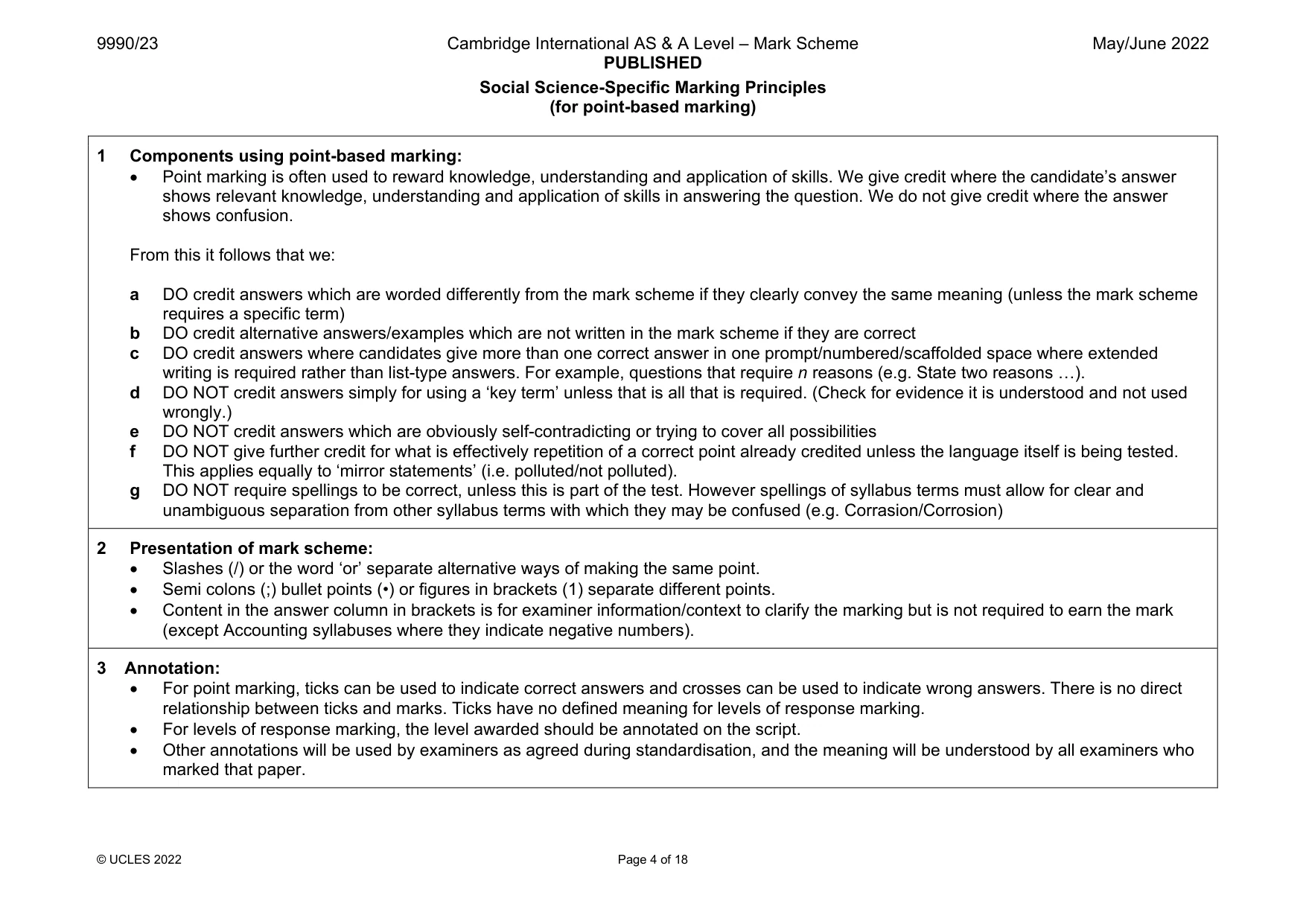
Mark scheme18 pages
Answers below. Sit the paper first if you are practising.
Questions as text
Q1 · In the study by Andrade (doodling), parts of the procedure helped to reduce demand…
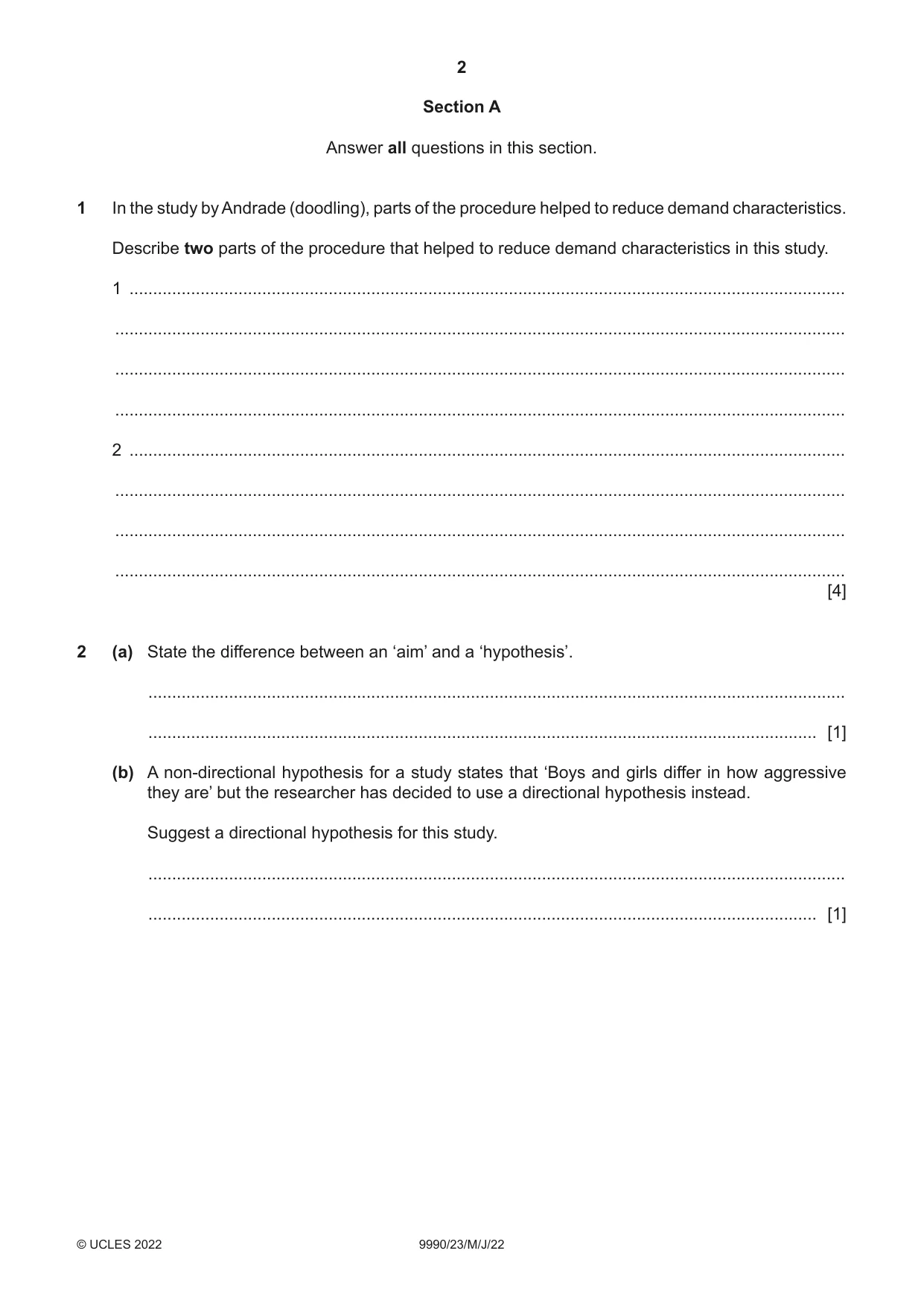
1 In the study by Andrade (doodling), parts of the procedure helped to reduce demand characteristics. Describe two parts of the procedure that helped to reduce demand characteristics in this study. 1 ....................................................................................................................................................... .......................................................................................................................................................... .......................................................................................................................................................... .......................................................................................................................................................... 2 ....................................................................................................................................................... .......................................................................................................................................................... .......................................................................................................................................................... .......................................................................................................................................................... [4]
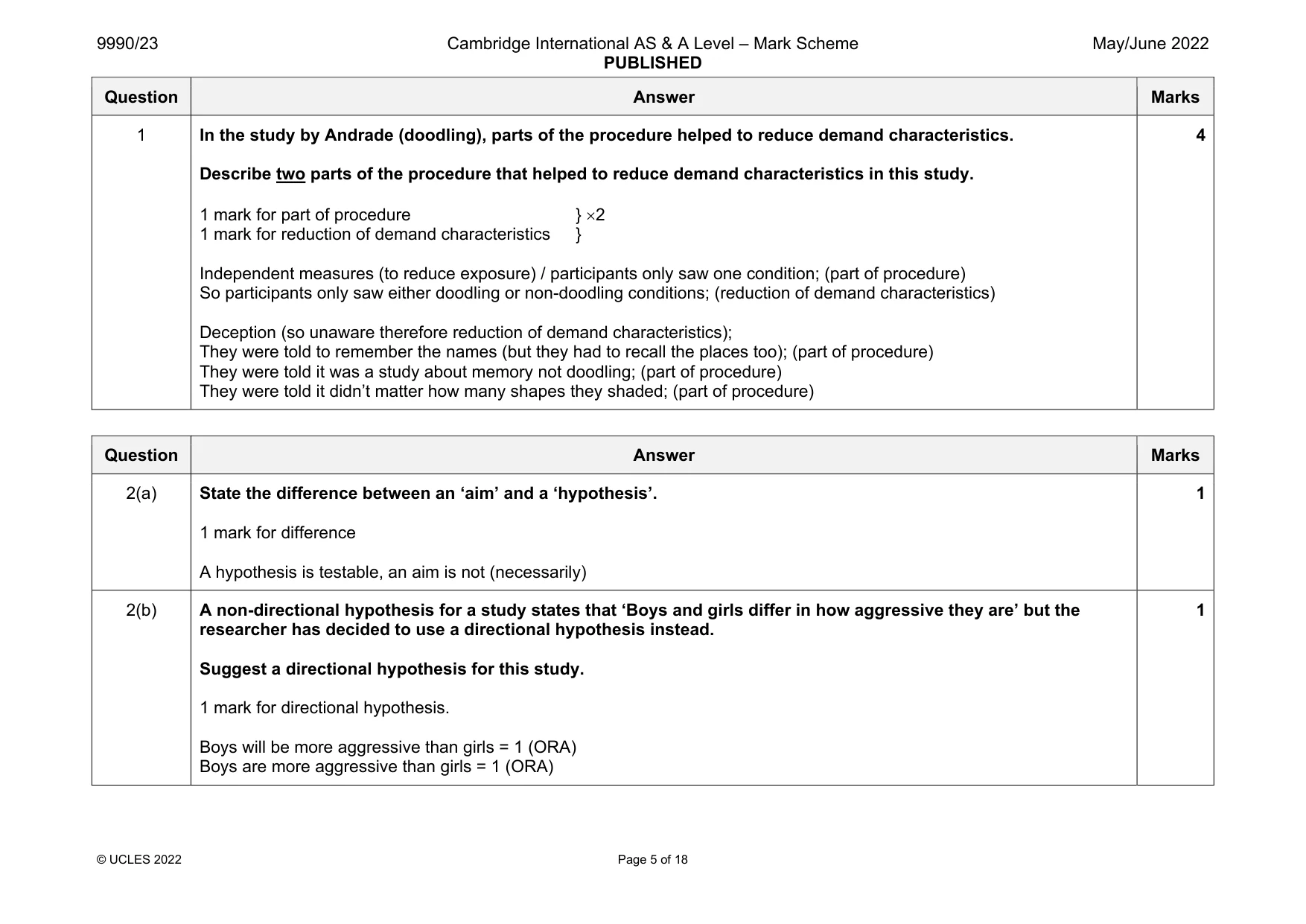
Mark scheme: Question Answer Marks 1 In the study by Andrade (doodling), parts of the procedure helped to reduce demand characteristics. 4 Describe two parts of the procedure that helped to reduce demand characteristics in this study. 1 mark for part of procedure } ×2 1 mark for reduction of demand characteristics } Independent measures (to reduce exposure) / participants only saw one condition; (part of procedure) So participants only saw either doodling or non-doodling conditions; (reduction of demand characteristics) Deception (so unaware therefore reduction of demand characteristics); They were told to remember the names (but they had to recall the places too); (part of procedure) They were told it was a study about memory not doodling; (part of procedure) They were told it didn’t matter how many shapes they shaded; (part of procedure)
Q2 · State the difference between an ‘aim’ and a ‘hypothesis’
2 (a) State the difference between an ‘aim’ and a ‘hypothesis’. ................................................................................................................................................... ............................................................................................................................................. [1] (b) A non-directional hypothesis for a study states that ‘Boys and girls differ in how aggressive they are’ but the researcher has decided to use a directional hypothesis instead. Suggest a directional hypothesis for this study. ................................................................................................................................................... ............................................................................................................................................. [1]
Mark scheme: 2(a) State the difference between an ‘aim’ and a ‘hypothesis’. 1 1 mark for difference A hypothesis is testable, an aim is not (necessarily) 2(b) A non-directional hypothesis for a study states that ‘Boys and girls differ in how aggressive they are’ but the 1 researcher has decided to use a directional hypothesis instead. Suggest a directional hypothesis for this study. 1 mark for directional hypothesis. Boys will be more aggressive than girls = 1 (ORA) Boys are more aggressive than girls = 1 (ORA)
Q3 · The study by Milgram (obedience) was not an experiment because there was no independent…
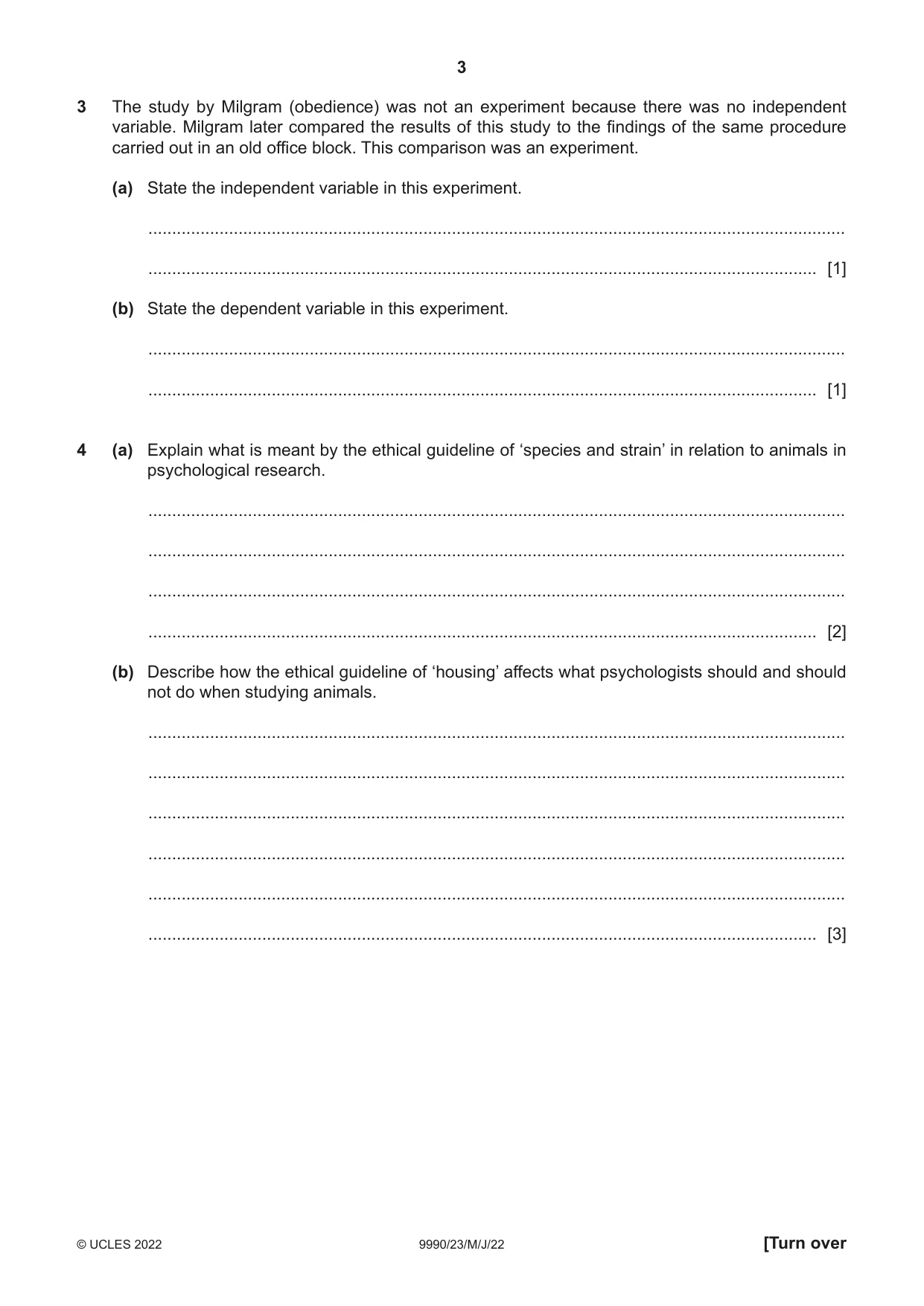
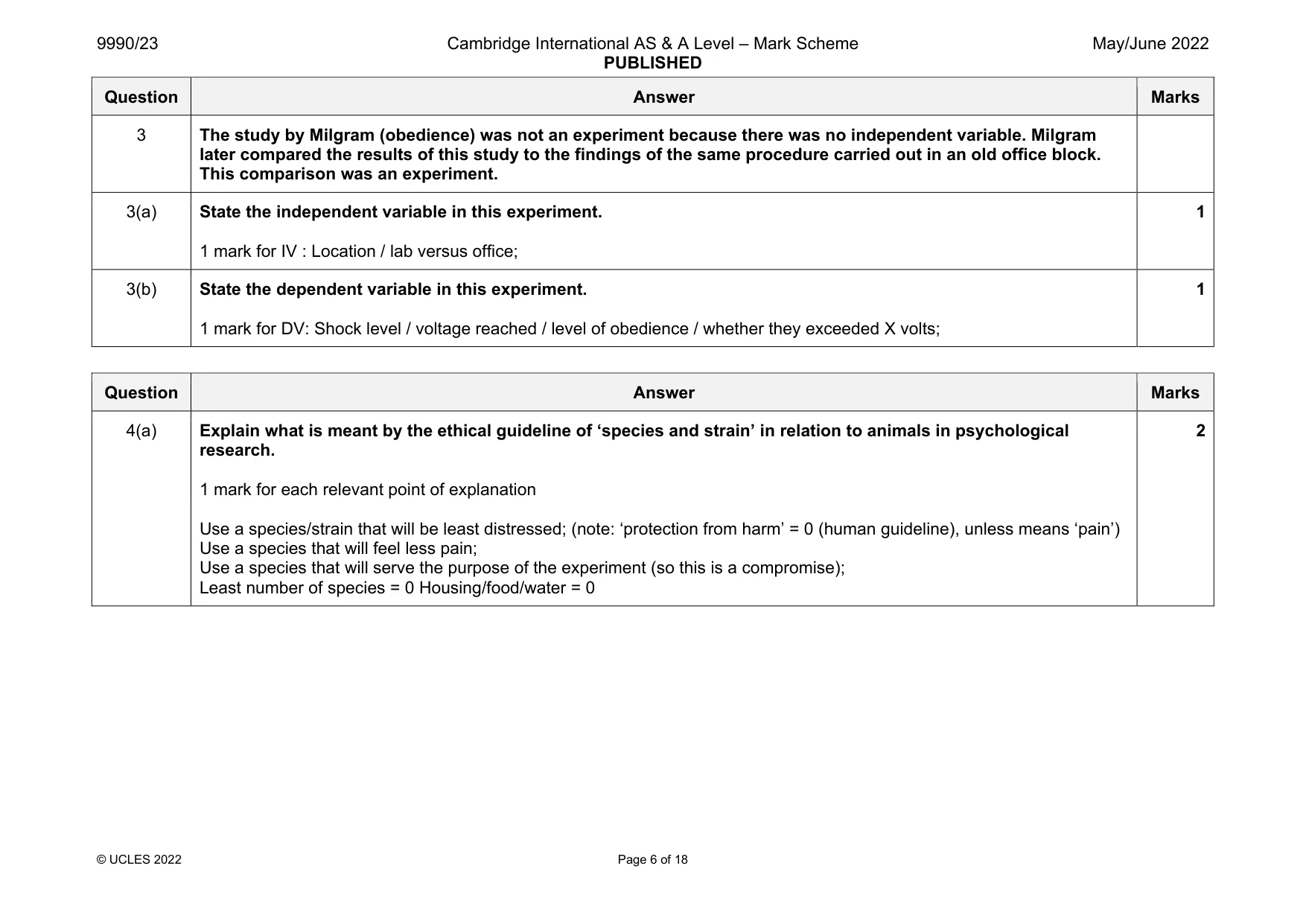
3 The study by Milgram (obedience) was not an experiment because there was no independent variable. Milgram later compared the results of this study to the findings of the same procedure carried out in an old office block. This comparison was an experiment. (a) State the independent variable in this experiment. ................................................................................................................................................... ............................................................................................................................................. [1] (b) State the dependent variable in this experiment. ................................................................................................................................................... ............................................................................................................................................. [1]
Mark scheme: 3 The study by Milgram (obedience) was not an experiment because there was no independent variable. Milgram later compared the results of this study to the findings of the same procedure carried out in an old office block. This comparison was an experiment. 3(a) State the independent variable in this experiment. 1 1 mark for IV : Location / lab versus office; 3(b) State the dependent variable in this experiment. 1 1 mark for DV: Shock level / voltage reached / level of obedience / whether they exceeded X volts;
Q4 · Explain what is meant by the ethical guideline of ‘species and strain’ in relation to…
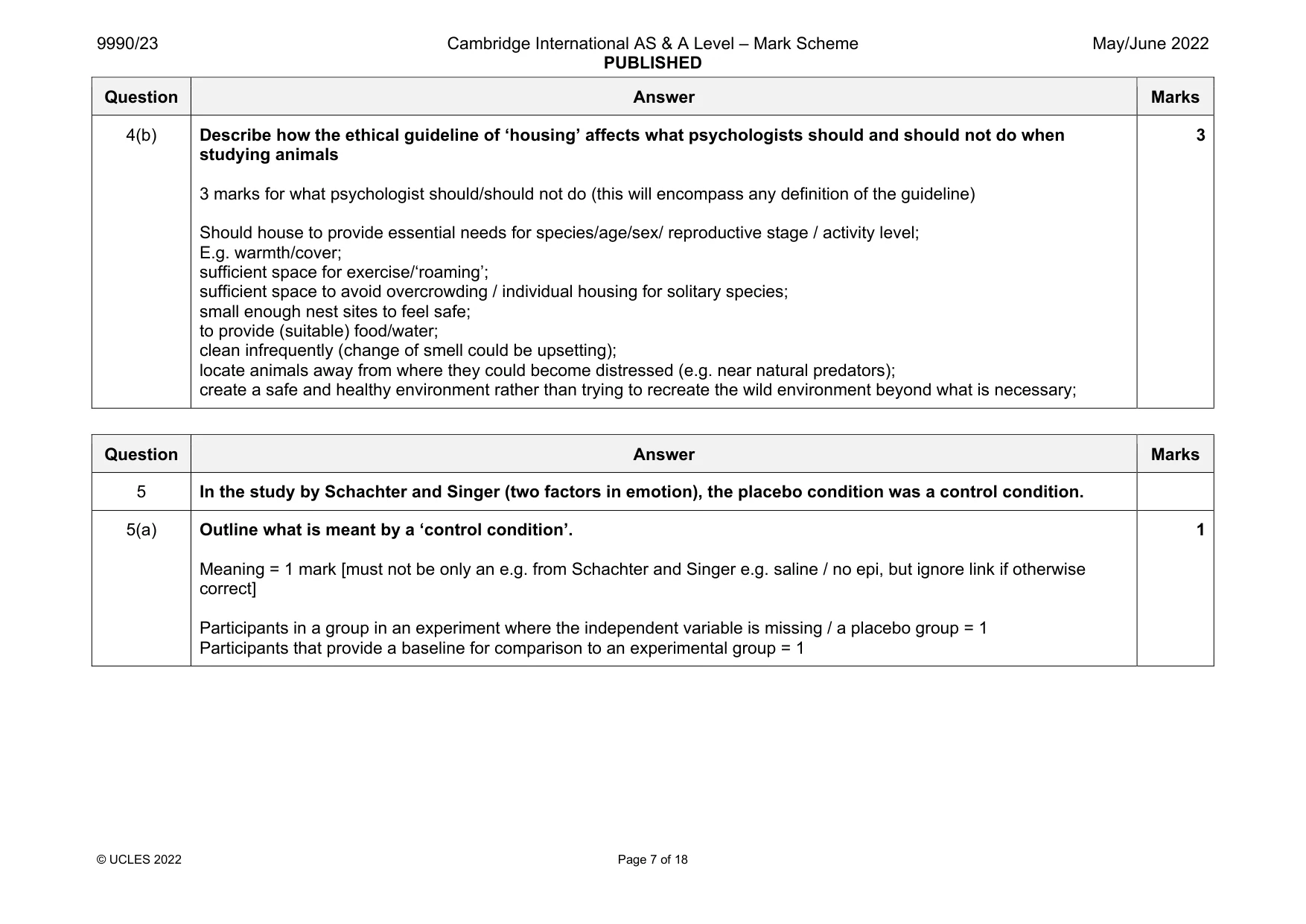
4 (a) Explain what is meant by the ethical guideline of ‘species and strain’ in relation to animals in psychological research. ................................................................................................................................................... ................................................................................................................................................... ................................................................................................................................................... ............................................................................................................................................. [2] (b) Describe how the ethical guideline of ‘housing’ affects what psychologists should and should not do when studying animals. ................................................................................................................................................... ................................................................................................................................................... ................................................................................................................................................... ................................................................................................................................................... ................................................................................................................................................... ............................................................................................................................................. [3]
Mark scheme: 4(a) Explain what is meant by the ethical guideline of ‘species and strain’ in relation to animals in psychological 2 research. 1 mark for each relevant point of explanation Use a species/strain that will be least distressed; (note: ‘protection from harm’ = 0 (human guideline), unless means ‘pain’) Use a species that will feel less pain; Use a species that will serve the purpose of the experiment (so this is a compromise); Least number of species = 0 Housing/food/water = 0 4(b) Describe how the ethical guideline of ‘housing’ affects what psychologists should and should not do when 3 studying animals 3 marks for what psychologist should/should not do (this will encompass any definition of the guideline) Should house to provide essential needs for species/age/sex/ reproductive stage / activity level; E.g. warmth/cover; sufficient space for exercise/‘roaming’; sufficient space to avoid overcrowding / individual housing for solitary species; small enough nest sites to feel safe; to provide (suitable) food/water; clean infrequently (change of smell could be upsetting); locate animals away from where they could become distressed (e.g. near natural predators); create a safe and healthy environment rather than trying to recreate the wild environment beyond what is necessary;
Q5 · In the study by Schachter and Singer (two factors in emotion), the placebo condition was…
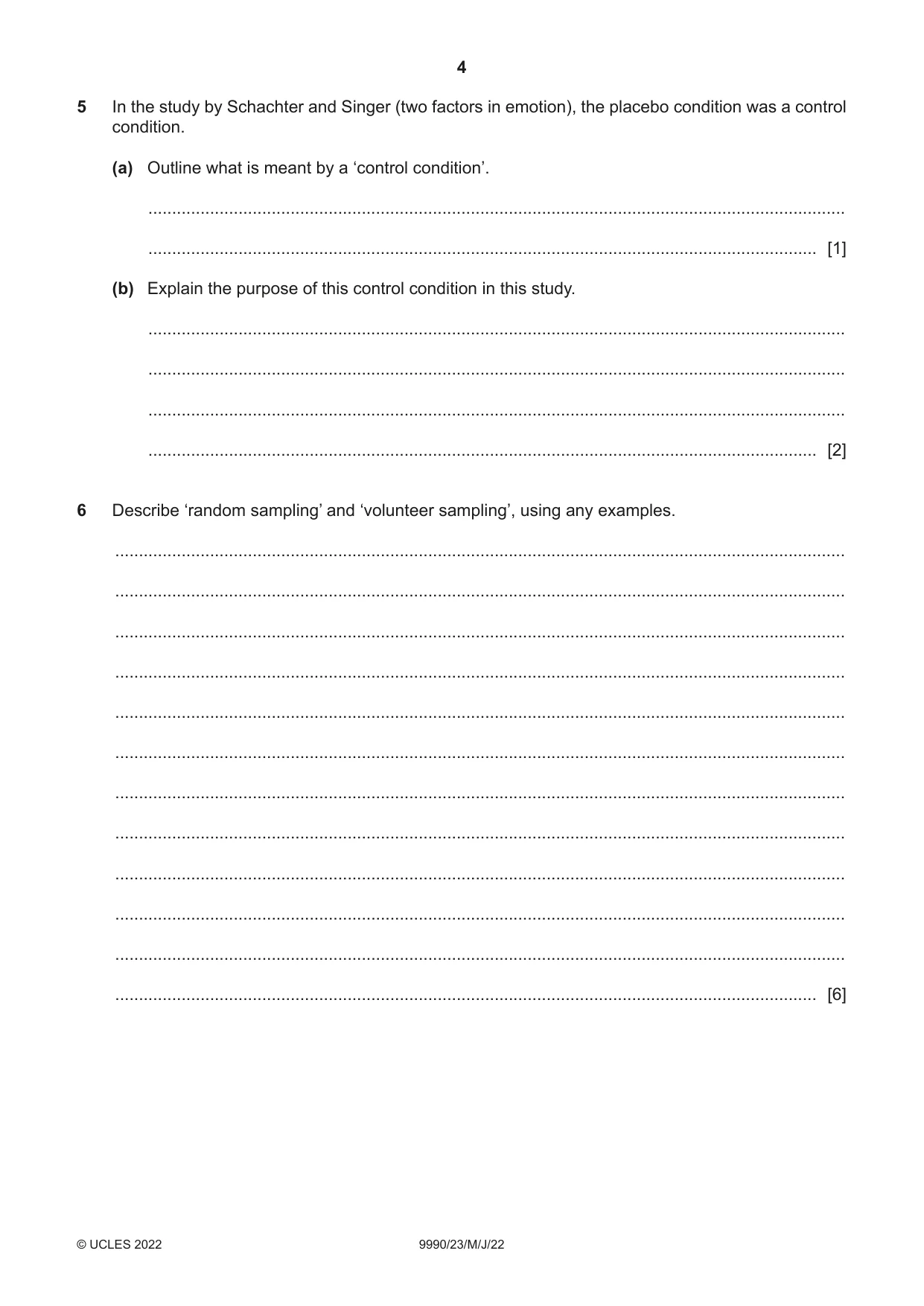
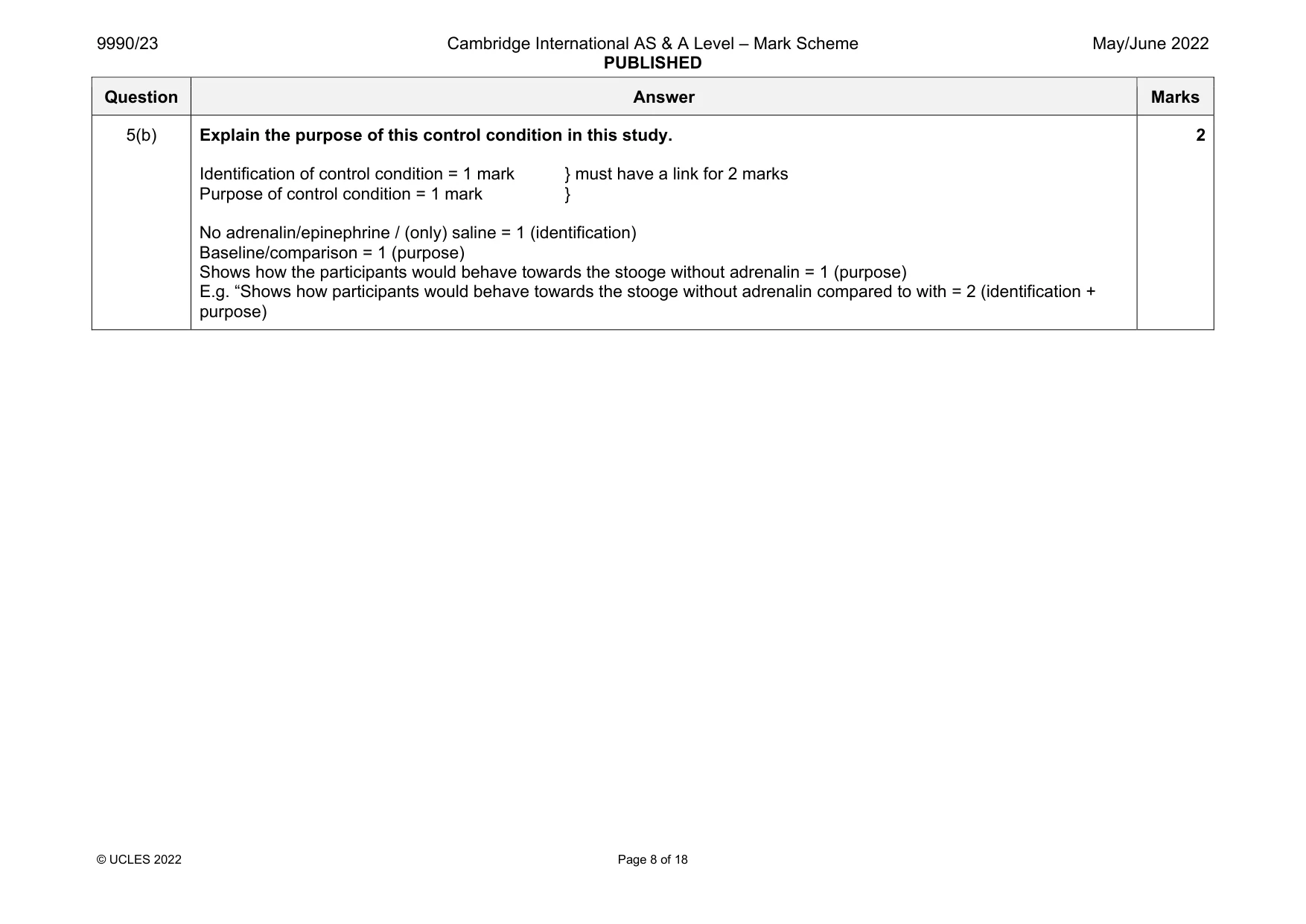
5 In the study by Schachter and Singer (two factors in emotion), the placebo condition was a control condition. (a) Outline what is meant by a ‘control condition’. ................................................................................................................................................... ............................................................................................................................................. [1] (b) Explain the purpose of this control condition in this study. ................................................................................................................................................... ................................................................................................................................................... ................................................................................................................................................... ............................................................................................................................................. [2]
Mark scheme: 5 In the study by Schachter and Singer (two factors in emotion), the placebo condition was a control condition. 5(a) Outline what is meant by a ‘control condition’. 1 Meaning = 1 mark [must not be only an e.g. from Schachter and Singer e.g. saline / no epi, but ignore link if otherwise correct] Participants in a group in an experiment where the independent variable is missing / a placebo group = 1 Participants that provide a baseline for comparison to an experimental group = 1 5(b) Explain the purpose of this control condition in this study. 2 Identification of control condition = 1 mark } must have a link for 2 marks Purpose of control condition = 1 mark } No adrenalin/epinephrine / (only) saline = 1 (identification) Baseline/comparison = 1 (purpose) Shows how the participants would behave towards the stooge without adrenalin = 1 (purpose) E.g. “Shows how participants would behave towards the stooge without adrenalin compared to with = 2 (identification + purpose)
Q6 · Describe ‘random sampling’ and ‘volunteer sampling’, using any examples
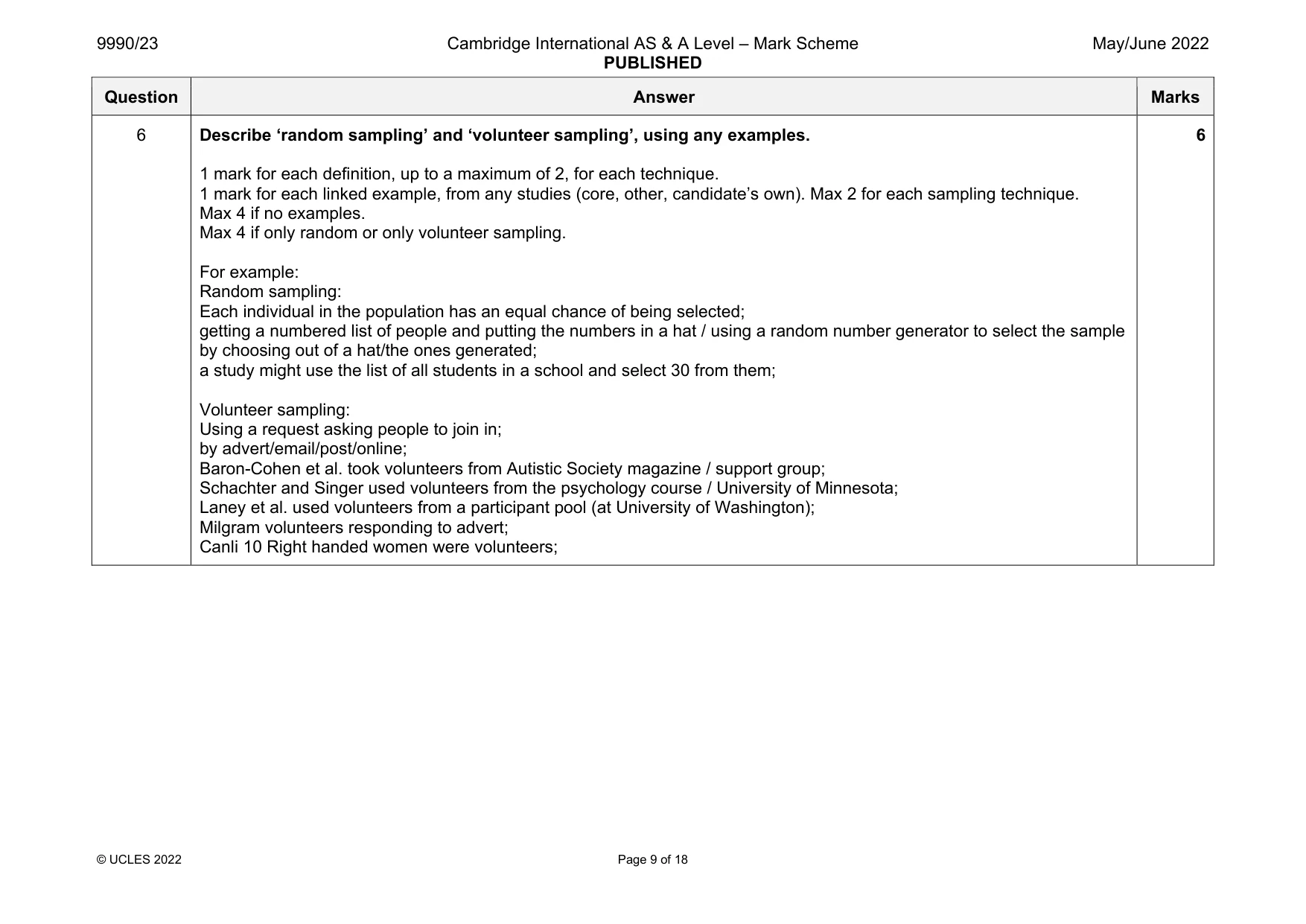
6 Describe ‘random sampling’ and ‘volunteer sampling’, using any examples. .......................................................................................................................................................... .......................................................................................................................................................... .......................................................................................................................................................... .......................................................................................................................................................... .......................................................................................................................................................... .......................................................................................................................................................... .......................................................................................................................................................... .......................................................................................................................................................... .......................................................................................................................................................... .......................................................................................................................................................... .......................................................................................................................................................... .................................................................................................................................................... [6] Question 7 appears on the next page.
Mark scheme: 6 Describe ‘random sampling’ and ‘volunteer sampling’, using any examples. 6 1 mark for each definition, up to a maximum of 2, for each technique. 1 mark for each linked example, from any studies (core, other, candidate’s own). Max 2 for each sampling technique. Max 4 if no examples. Max 4 if only random or only volunteer sampling. For example: Random sampling: Each individual in the population has an equal chance of being selected; getting a numbered list of people and putting the numbers in a hat / using a random number generator to select the sample by choosing out of a hat/the ones generated; a study might use the list of all students in a school and select 30 from them; Volunteer sampling: Using a request asking people to join in; by advert/email/post/online; Baron-Cohen et al. took volunteers from Autistic Society magazine / support group; Schachter and Singer used volunteers from the psychology course / University of Minnesota; Laney et al. used volunteers from a participant pool (at University of Washington); Milgram volunteers responding to advert; Canli 10 Right handed women were volunteers;
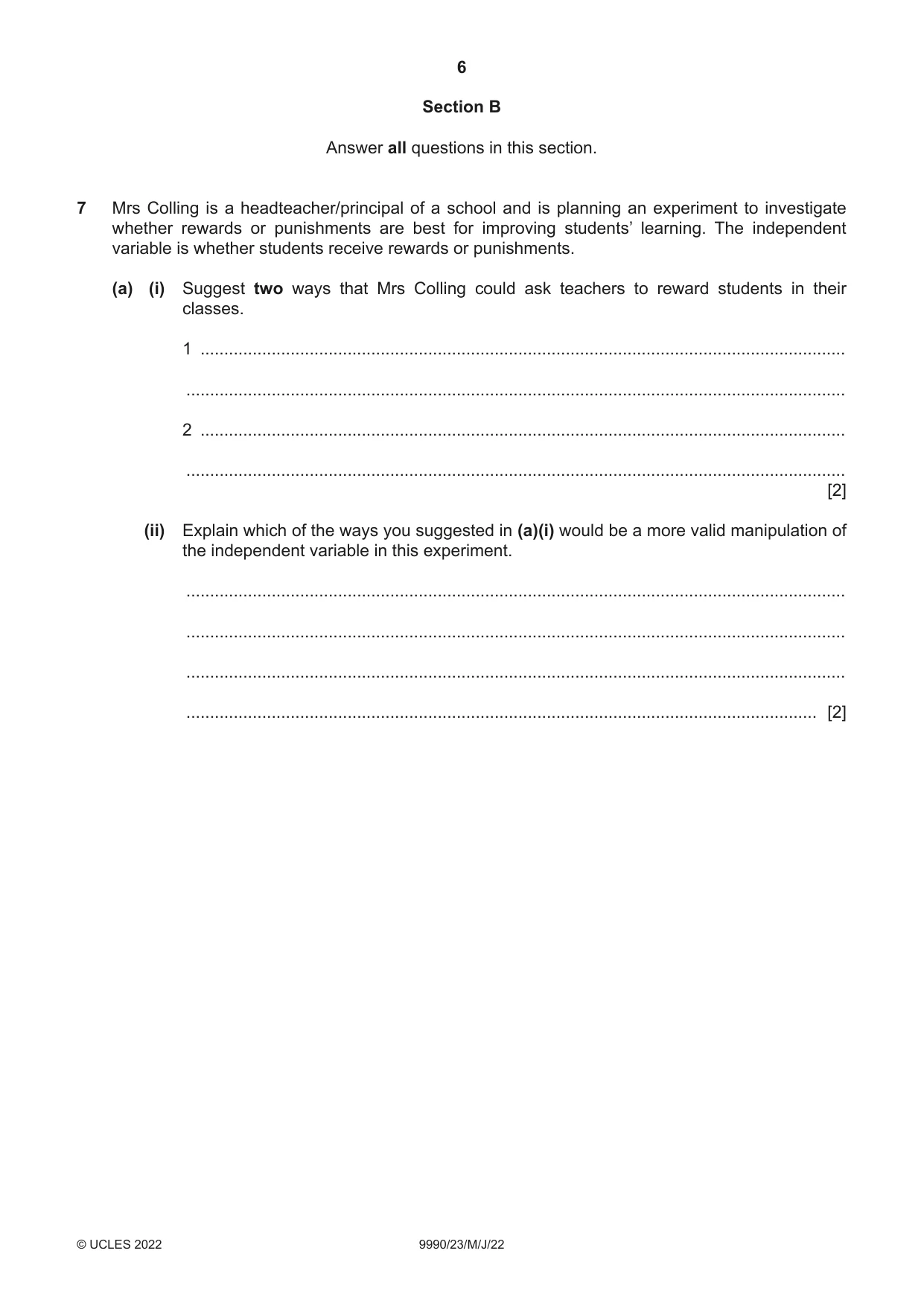
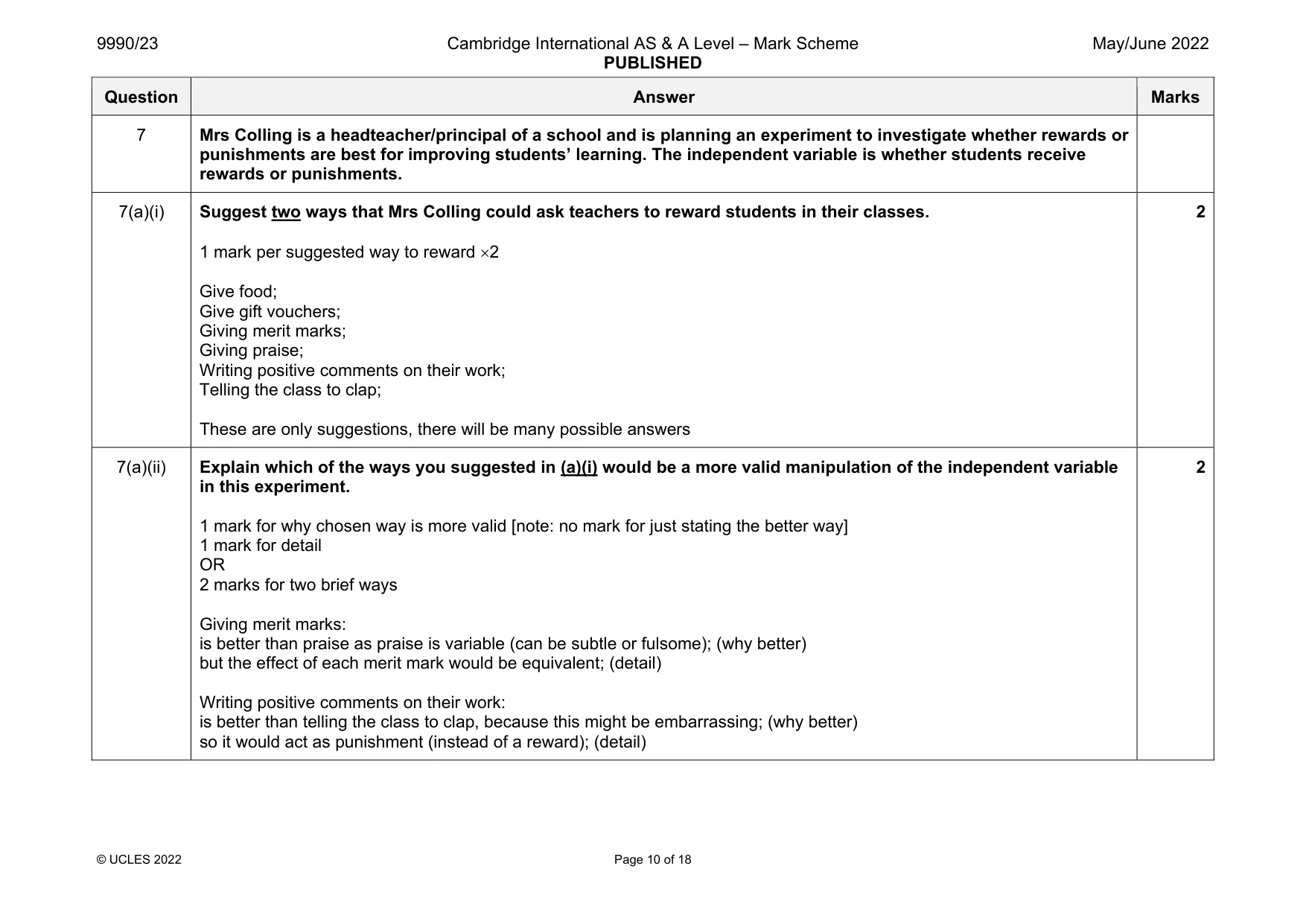
Q7 · Mrs Colling is a headteacher/principal of a school and is planning an experiment to…
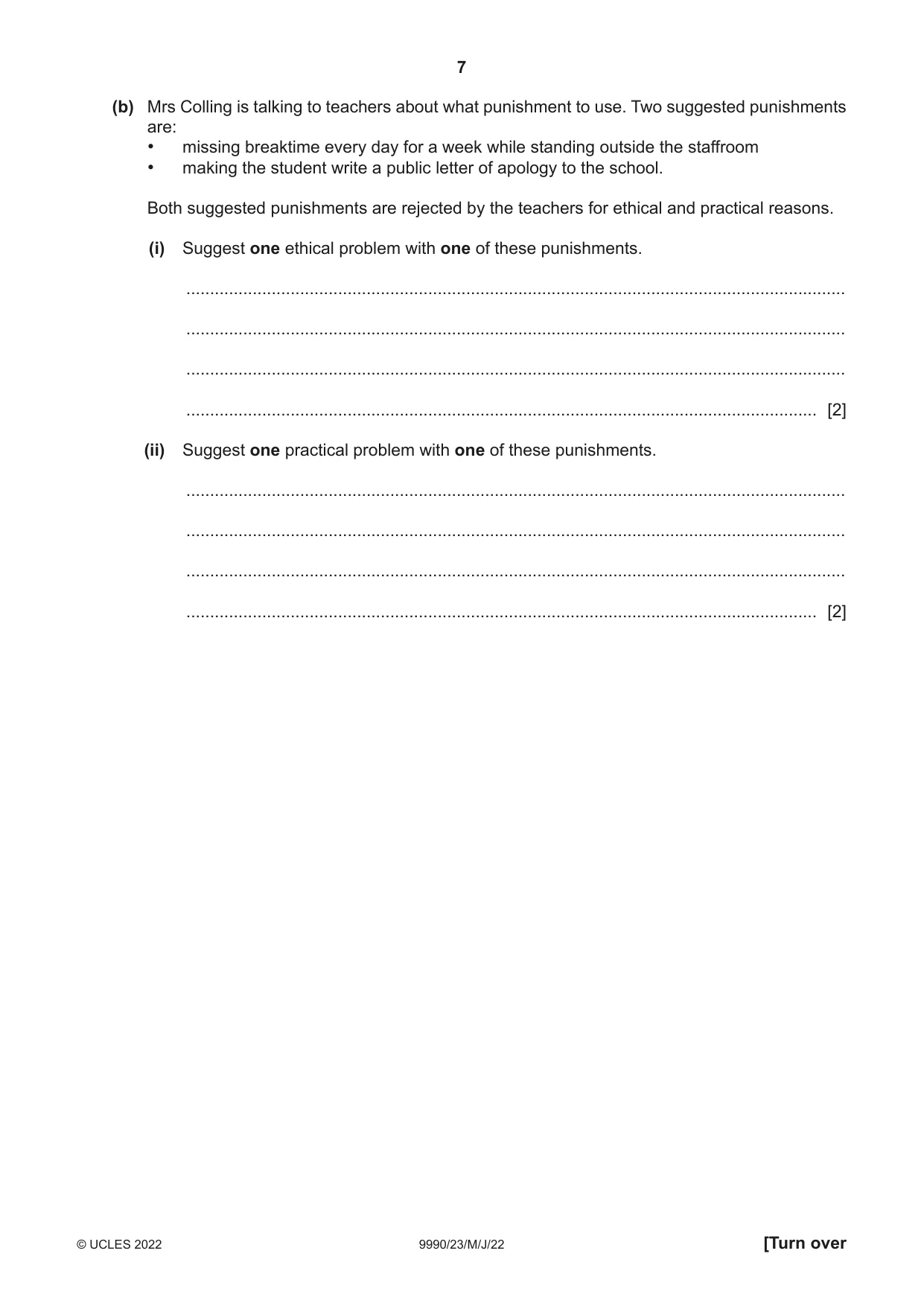
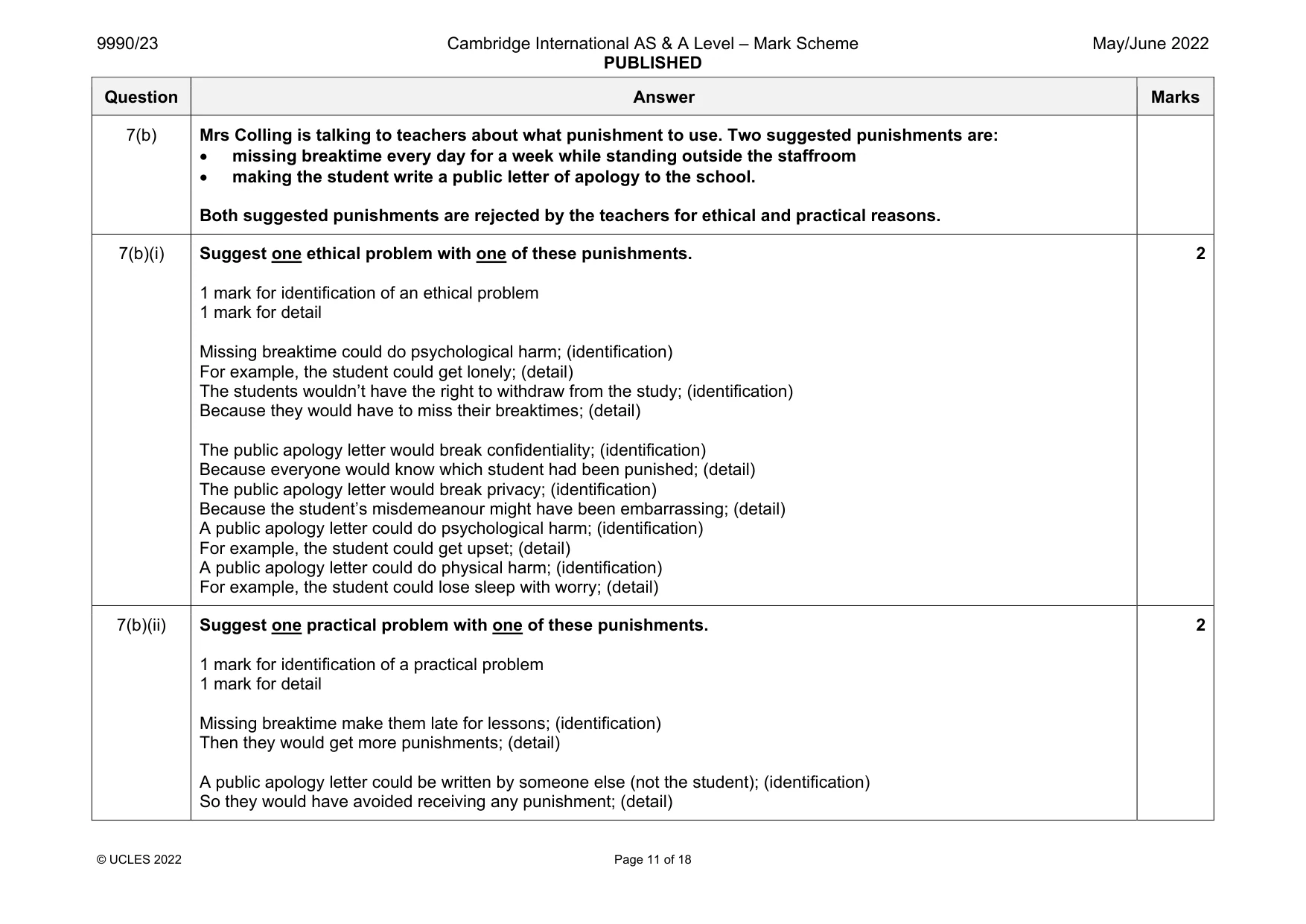
7 Mrs Colling is a headteacher/principal of a school and is planning an experiment to investigate whether rewards or punishments are best for improving students’ learning. The independent variable is whether students receive rewards or punishments. (a) (i) Suggest two ways that Mrs Colling could ask teachers to reward students in their classes. 1 ........................................................................................................................................ ........................................................................................................................................... 2 ........................................................................................................................................ ........................................................................................................................................... [2] (ii) Explain which of the ways you suggested in (a)(i) would be a more valid manipulation of the independent variable in this experiment. ........................................................................................................................................... ........................................................................................................................................... ........................................................................................................................................... ..................................................................................................................................... [2] (b) Mrs Colling is talking to teachers about what punishment to use. Two suggested punishments are: • missing breaktime every day for a week while standing outside the staffroom • making the student write a public letter of apology to the school. Both suggested punishments are rejected by the teachers for ethical and practical reasons. (i) Suggest one ethical problem with one of these punishments. ........................................................................................................................................... ........................................................................................................................................... ........................................................................................................................................... ..................................................................................................................................... [2] (ii) Suggest one practical problem with one of these punishments. ........................................................................................................................................... ........................................................................................................................................... ........................................................................................................................................... ..................................................................................................................................... [2]
Mark scheme: 7 Mrs Colling is a headteacher/principal of a school and is planning an experiment to investigate whether rewards or punishments are best for improving students’ learning. The independent variable is whether students receive rewards or punishments. 7(a)(i) Suggest two ways that Mrs Colling could ask teachers to reward students in their classes. 2 1 mark per suggested way to reward ×2 Give food; Give gift vouchers; Giving merit marks; Giving praise; Writing positive comments on their work; Telling the class to clap; These are only suggestions, there will be many possible answers 7(a)(ii) Explain which of the ways you suggested in (a)(i) would be a more valid manipulation of the independent variable 2 in this experiment. 1 mark for why chosen way is more valid [note: no mark for just stating the better way] 1 mark for detail OR 2 marks for two brief ways Giving merit marks: is better than praise as praise is variable (can be subtle or fulsome); (why better) but the effect of each merit mark would be equivalent; (detail) Writing positive comments on their work: is better than telling the class to clap, because this might be embarrassing; (why better) so it would act as punishment (instead of a reward); (detail) 7(b) Mrs Colling is talking to teachers about what punishment to use. Two suggested punishments are: • missing breaktime every day for a week while standing outside the staffroom • making the student write a public letter of apology to the school. Both suggested punishments are rejected by the teachers for ethical and practical reasons. 7(b)(i) Suggest one ethical problem with one of these punishments. 2 1 mark for identification of an ethical problem 1 mark for detail Missing breaktime could do psychological harm; (identification) For example, the student could get lonely; (detail) The students wouldn’t have the right to withdraw from the study; (identification) Because they would have to miss their breaktimes; (detail) The public apology letter would break confidentiality; (identification) Because everyone would know which student had been punished; (detail) The public apology letter would break privacy; (identification) Because the student’s misdemeanour might have been embarrassing; (detail) A public apology letter could do psychological harm; (identification) For example, the student could get upset; (detail) A public apology letter could do physical harm; (identification) For example, the student could lose sleep with worry; (detail) 7(b)(ii) Suggest one practical problem with one of these punishments. 2 1 mark for identification of a practical problem 1 mark for detail Missing breaktime make them late for lessons; (identification) Then they would get more punishments; (detail) A public apology letter could be written by someone else (not the student); (identification) So they would have avoided receiving any punishment; (detail)
More questions on 2 Health promotion in schools and worksites
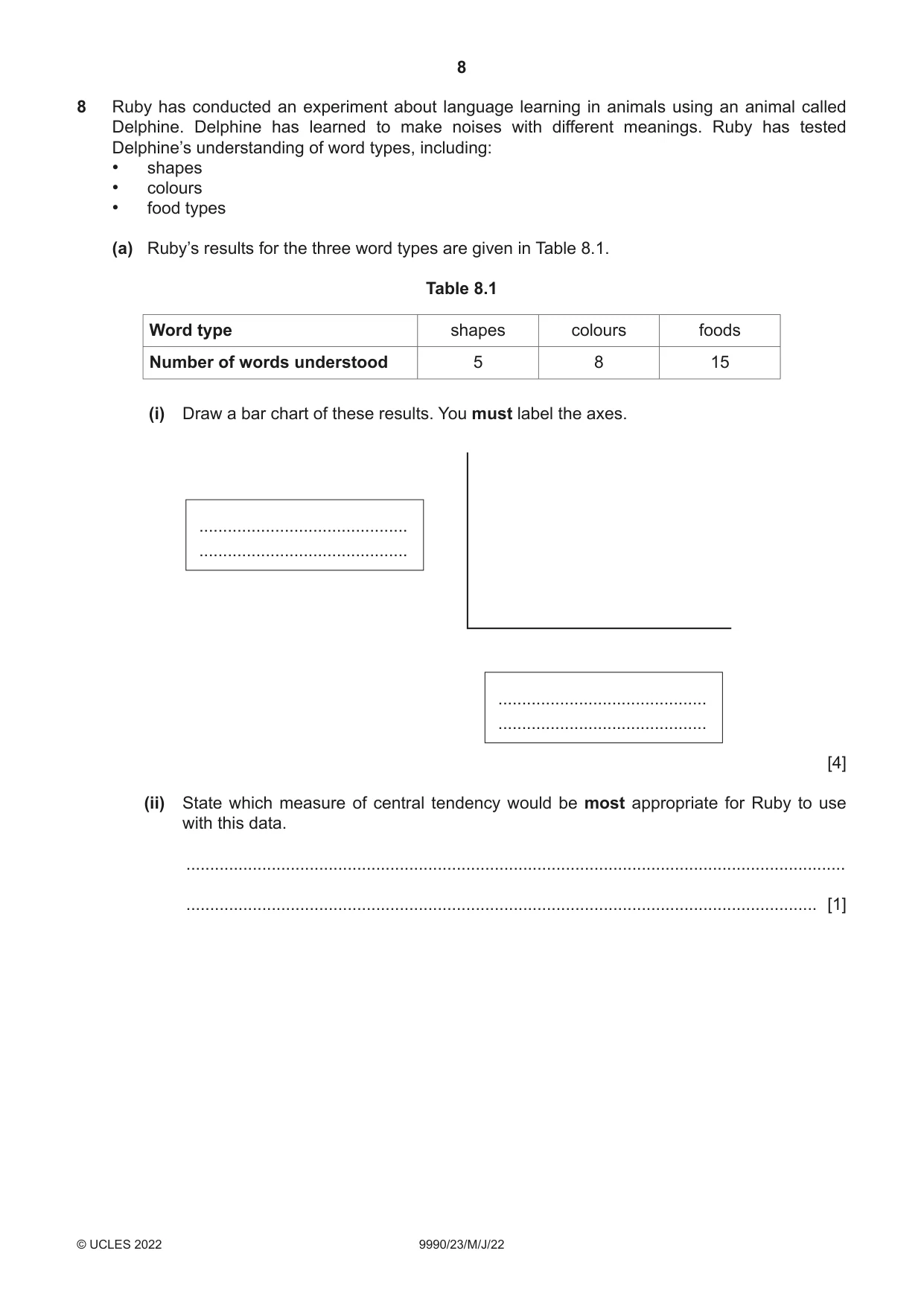
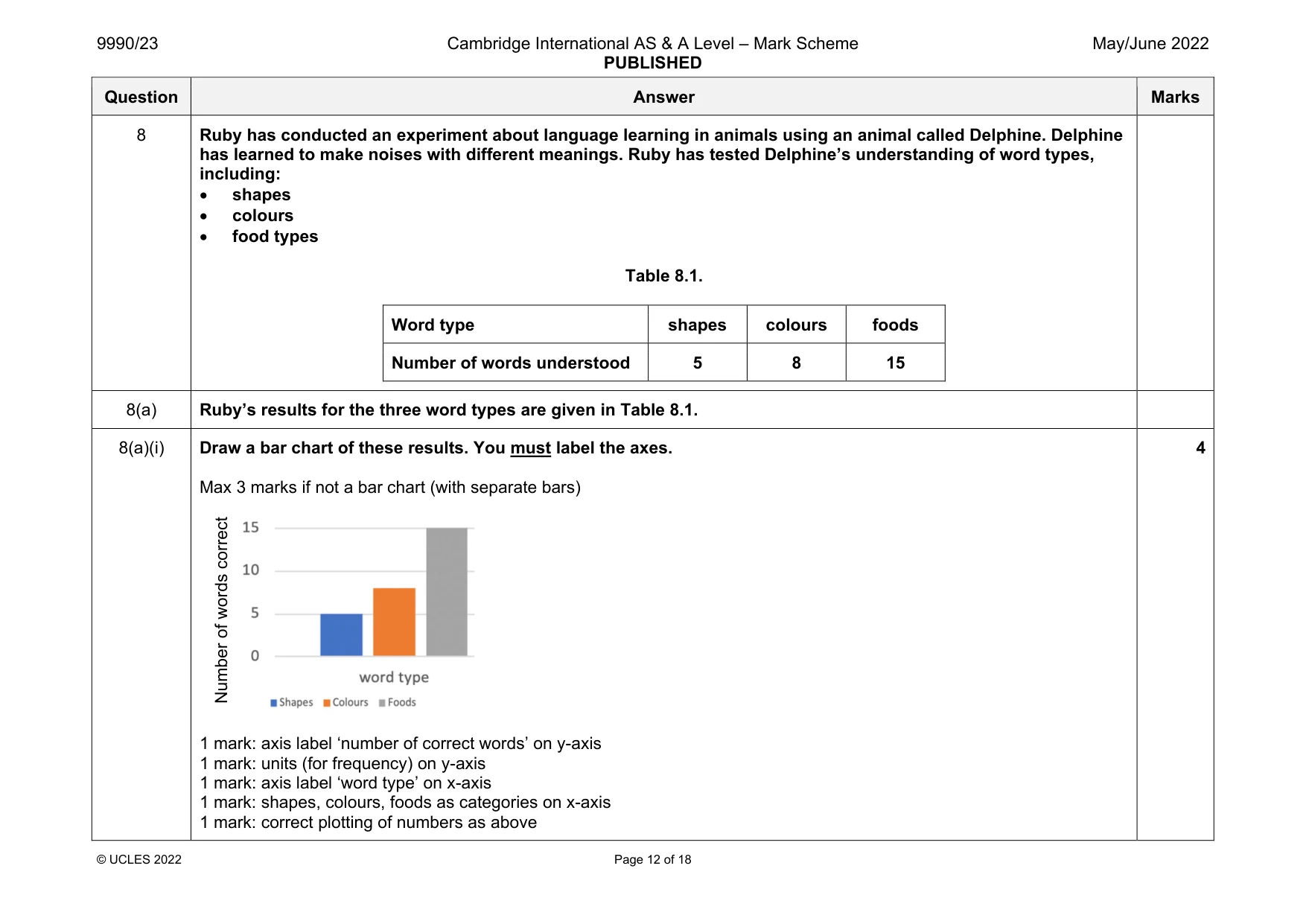
Q8 · Ruby has conducted an experiment about language learning in animals using an animal…
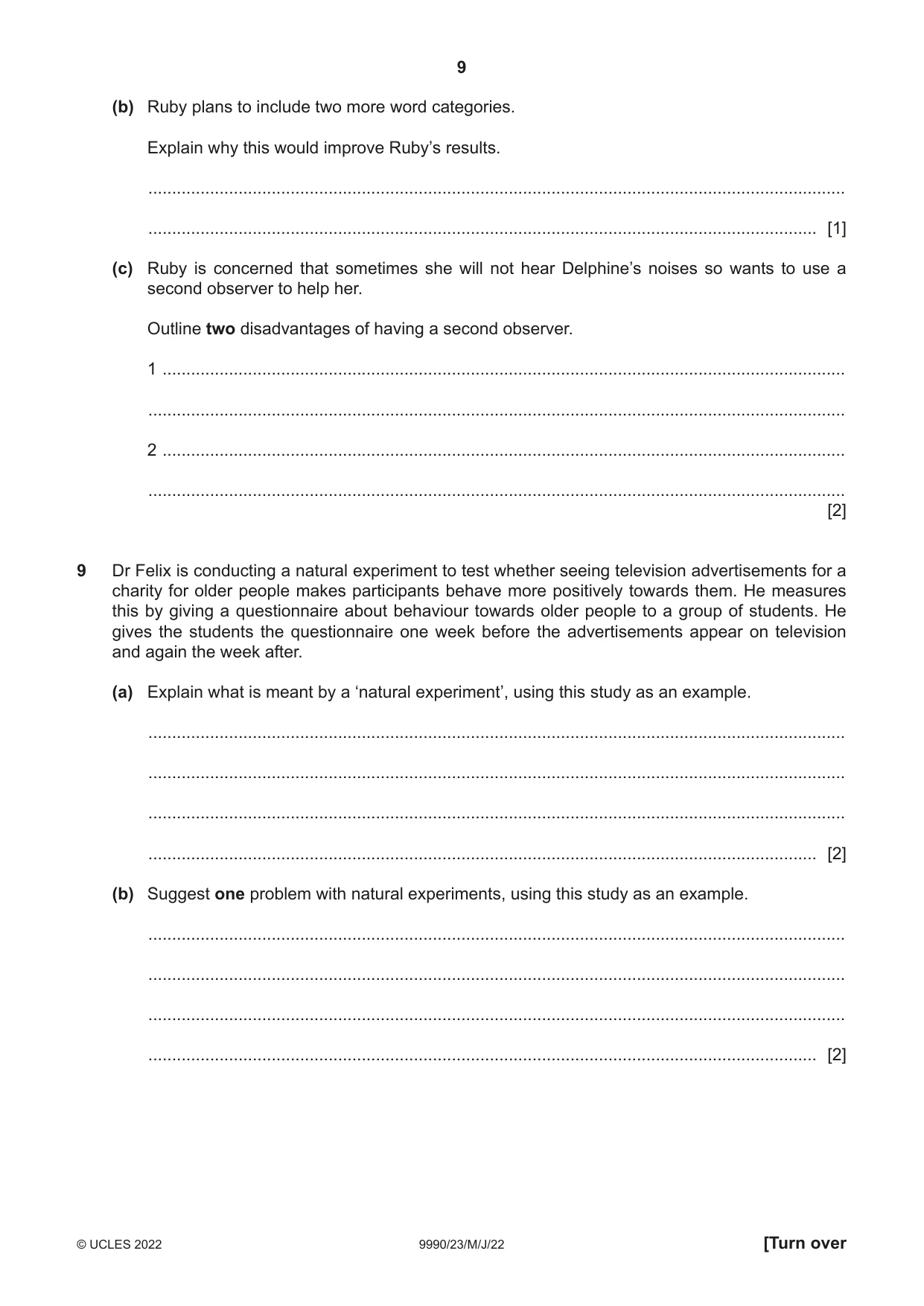
8 Ruby has conducted an experiment about language learning in animals using an animal called Delphine. Delphine has learned to make noises with different meanings. Ruby has tested Delphine’s understanding of word types, including: • shapes • colours • food types (a) Ruby’s results for the three word types are given in Table 8.1. Table 8.1 Word type shapes colours foods Number of words understood 5 8 15 (i) Draw a bar chart of these results. You must label the axes. ............................................ ............................................ ............................................ ............................................ [4] (ii) State which measure of central tendency would be most appropriate for Ruby to use with this data. ........................................................................................................................................... ..................................................................................................................................... [1] (b) Ruby plans to include two more word categories. Explain why this would improve Ruby’s results. ................................................................................................................................................... ............................................................................................................................................. [1] (c) Ruby is concerned that sometimes she will not hear Delphine’s noises so wants to use a second observer to help her. Outline two disadvantages of having a second observer. 1 ................................................................................................................................................ ................................................................................................................................................... 2 ................................................................................................................................................ ................................................................................................................................................... [2]
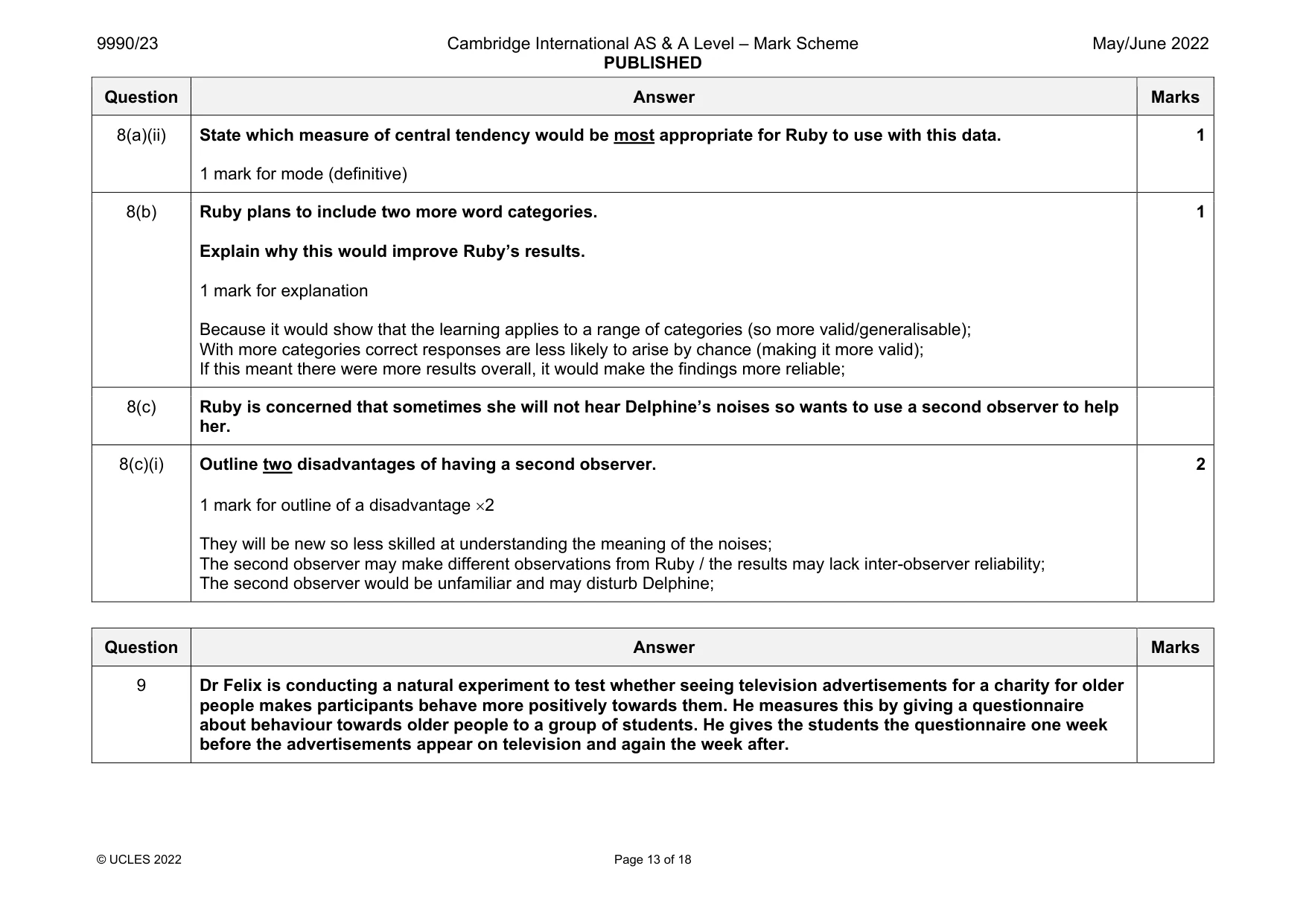
Mark scheme: 8 Ruby has conducted an experiment about language learning in animals using an animal called Delphine. Delphine has learned to make noises with different meanings. Ruby has tested Delphine’s understanding of word types, including: • shapes • colours • food types Table 8.1. Word type shapes colours foods Number of words understood 5 8 15 8(a) Ruby’s results for the three word types are given in Table 8.1. 8(a)(i) Draw a bar chart of these results. You must label the axes. 4 Max 3 marks if not a bar chart (with separate bars) correct words of Number 1 mark: axis label ‘number of correct words’ on y-axis 1 mark: units (for frequency) on y-axis 1 mark: axis label ‘word type’ on x-axis 1 mark: shapes, colours, foods as categories on x-axis 1 mark: correct plotting of numbers as above 8(a)(ii) State which measure of central tendency would be most appropriate for Ruby to use with this data. 1 1 mark for mode (definitive) 8(b) Ruby plans to include two more word categories. 1 Explain why this would improve Ruby’s results. 1 mark for explanation Because it would show that the learning applies to a range of categories (so more valid/generalisable); With more categories correct responses are less likely to arise by chance (making it more valid); If this meant there were more results overall, it would make the findings more reliable; 8(c) Ruby is concerned that sometimes she will not hear Delphine’s noises so wants to use a second observer to help her. 8(c)(i) Outline two disadvantages of having a second observer. 2 1 mark for outline of a disadvantage ×2 They will be new so less skilled at understanding the meaning of the noises; The second observer may make different observations from Ruby / the results may lack inter-observer reliability; The second observer would be unfamiliar and may disturb Delphine;
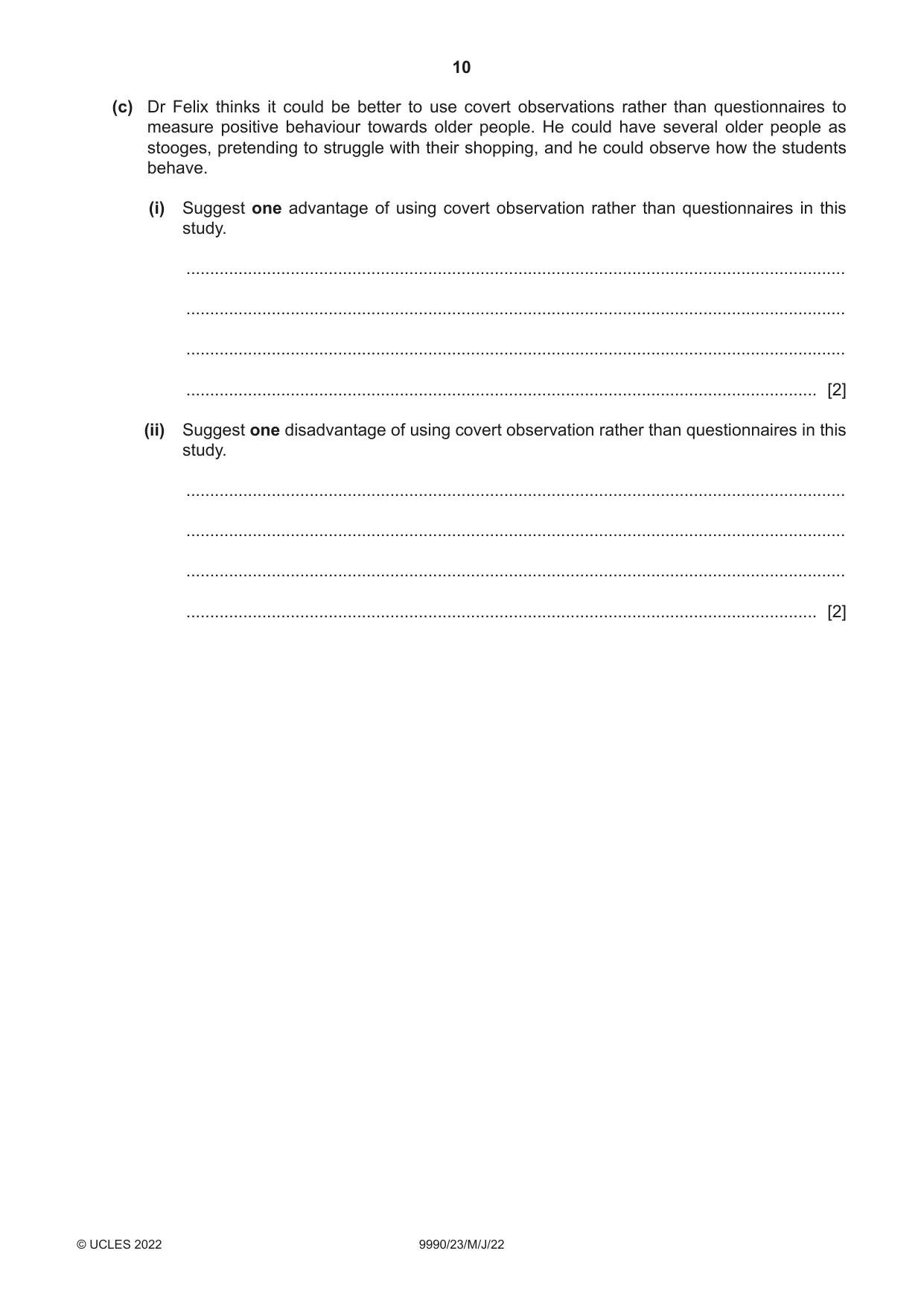
Q9 · Dr Felix is conducting a natural experiment to test whether seeing television…
9 Dr Felix is conducting a natural experiment to test whether seeing television advertisements for a charity for older people makes participants behave more positively towards them. He measures this by giving a questionnaire about behaviour towards older people to a group of students. He gives the students the questionnaire one week before the advertisements appear on television and again the week after. (a) Explain what is meant by a ‘natural experiment’, using this study as an example. ................................................................................................................................................... ................................................................................................................................................... ................................................................................................................................................... ............................................................................................................................................. [2] (b) Suggest one problem with natural experiments, using this study as an example. ................................................................................................................................................... ................................................................................................................................................... ................................................................................................................................................... ............................................................................................................................................. [2] (c) Dr Felix thinks it could be better to use covert observations rather than questionnaires to measure positive behaviour towards older people. He could have several older people as stooges, pretending to struggle with their shopping, and he could observe how the students behave. (i) Suggest one advantage of using covert observation rather than questionnaires in this study. ........................................................................................................................................... ........................................................................................................................................... ........................................................................................................................................... ..................................................................................................................................... [2] (ii) Suggest one disadvantage of using covert observation rather than questionnaires in this study. ........................................................................................................................................... ........................................................................................................................................... ........................................................................................................................................... ..................................................................................................................................... [2] Section C Answer all questions in this section.
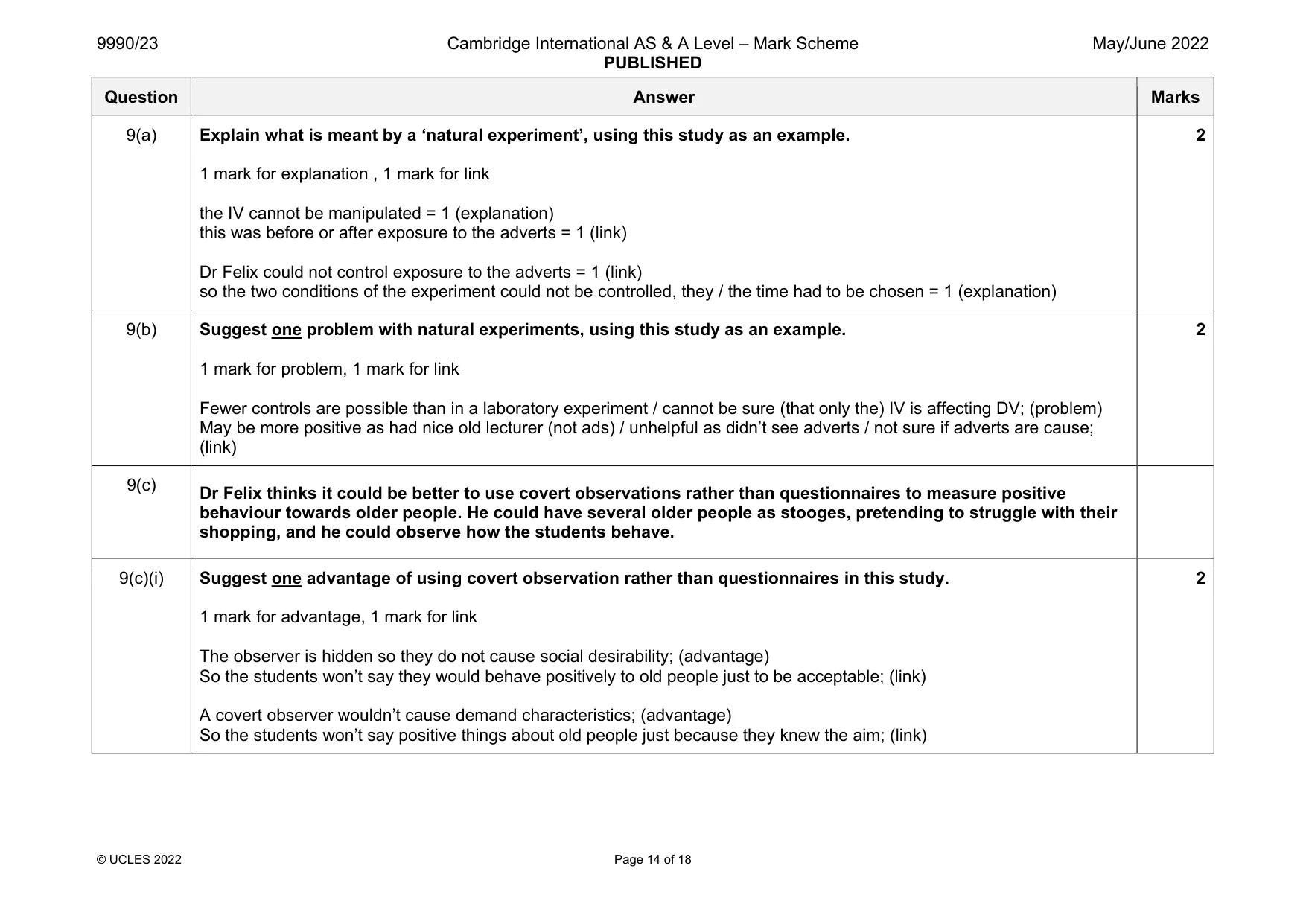
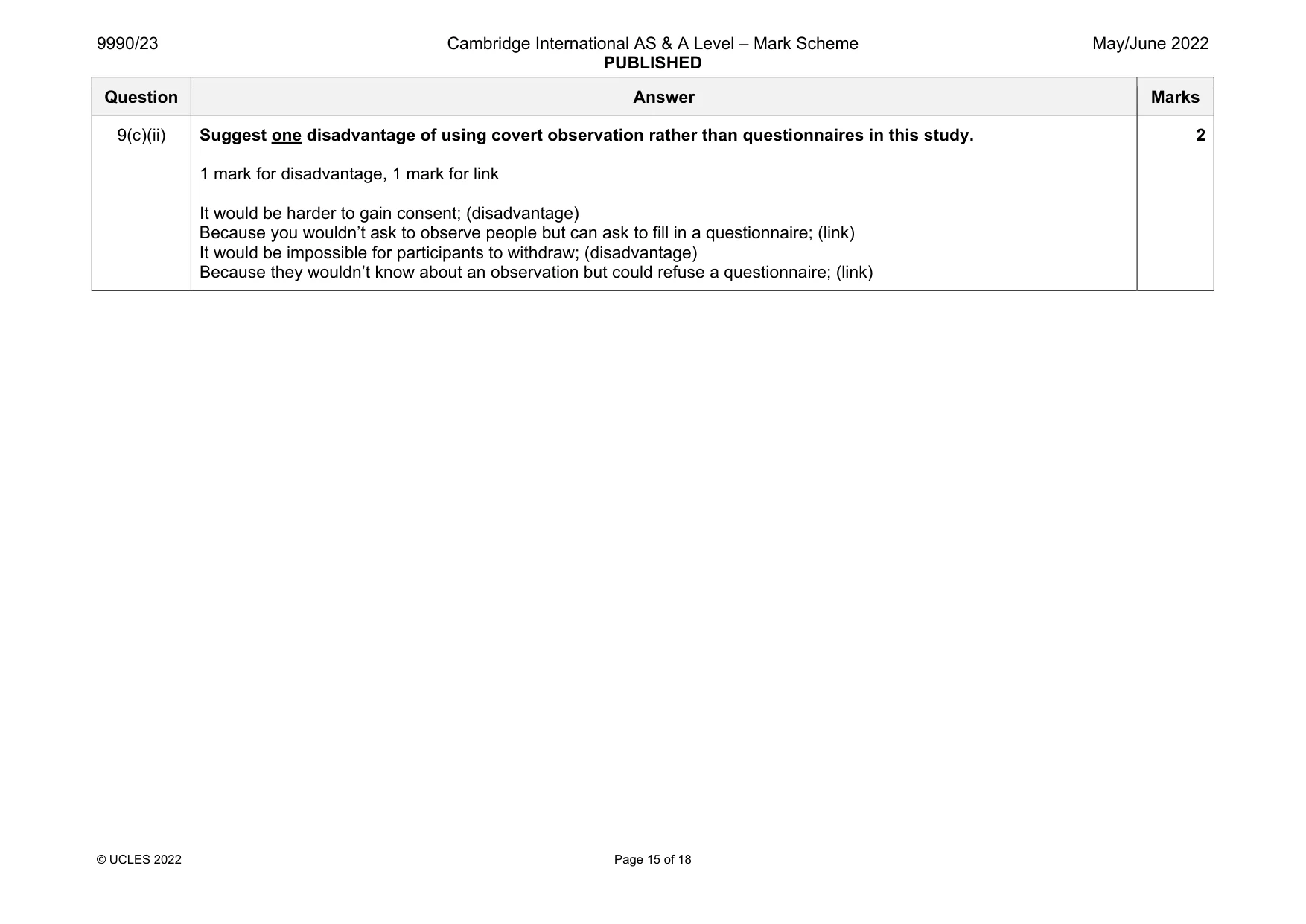
Mark scheme: 9 Dr Felix is conducting a natural experiment to test whether seeing television advertisements for a charity for older people makes participants behave more positively towards them. He measures this by giving a questionnaire about behaviour towards older people to a group of students. He gives the students the questionnaire one week before the advertisements appear on television and again the week after. 9(a) Explain what is meant by a ‘natural experiment’, using this study as an example. 2 1 mark for explanation , 1 mark for link the IV cannot be manipulated = 1 (explanation) this was before or after exposure to the adverts = 1 (link) Dr Felix could not control exposure to the adverts = 1 (link) so the two conditions of the experiment could not be controlled, they / the time had to be chosen = 1 (explanation) 9(b) Suggest one problem with natural experiments, using this study as an example. 2 1 mark for problem, 1 mark for link Fewer controls are possible than in a laboratory experiment / cannot be sure (that only the) IV is affecting DV; (problem) May be more positive as had nice old lecturer (not ads) / unhelpful as didn’t see adverts / not sure if adverts are cause; (link) 9(c) Dr Felix thinks it could be better to use covert observations rather than questionnaires to measure positive behaviour towards older people. He could have several older people as stooges, pretending to struggle with their shopping, and he could observe how the students behave. 9(c)(i) Suggest one advantage of using covert observation rather than questionnaires in this study. 2 1 mark for advantage, 1 mark for link The observer is hidden so they do not cause social desirability; (advantage) So the students won’t say they would behave positively to old people just to be acceptable; (link) A covert observer wouldn’t cause demand characteristics; (advantage) So the students won’t say positive things about old people just because they knew the aim; (link) 9(c)(ii) Suggest one disadvantage of using covert observation rather than questionnaires in this study. 2 1 mark for disadvantage, 1 mark for link It would be harder to gain consent; (disadvantage) Because you wouldn’t ask to observe people but can ask to fill in a questionnaire; (link) It would be impossible for participants to withdraw; (disadvantage) Because they wouldn’t know about an observation but could refuse a questionnaire; (link)
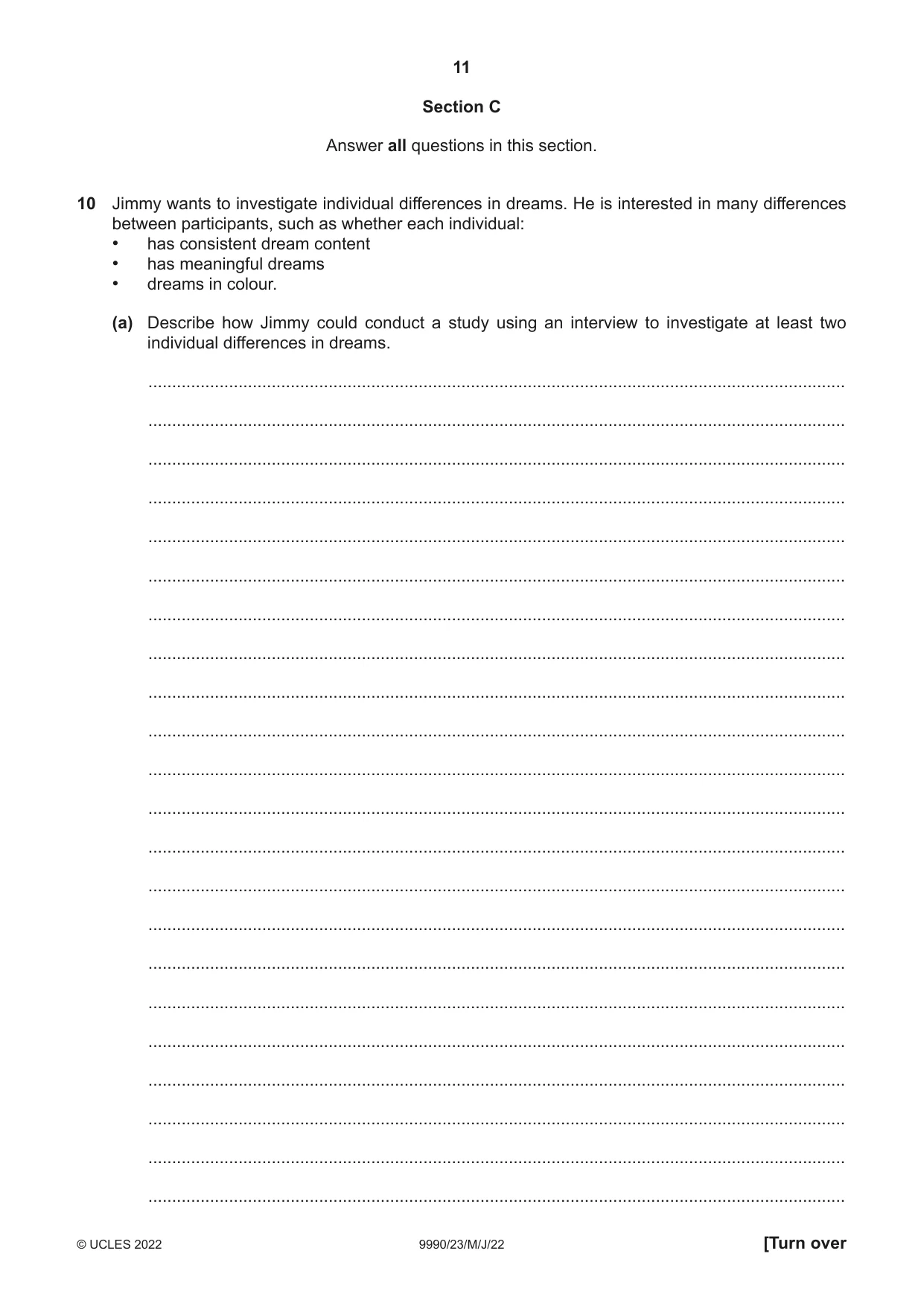
Q10 · Jimmy wants to investigate individual differences in dreams
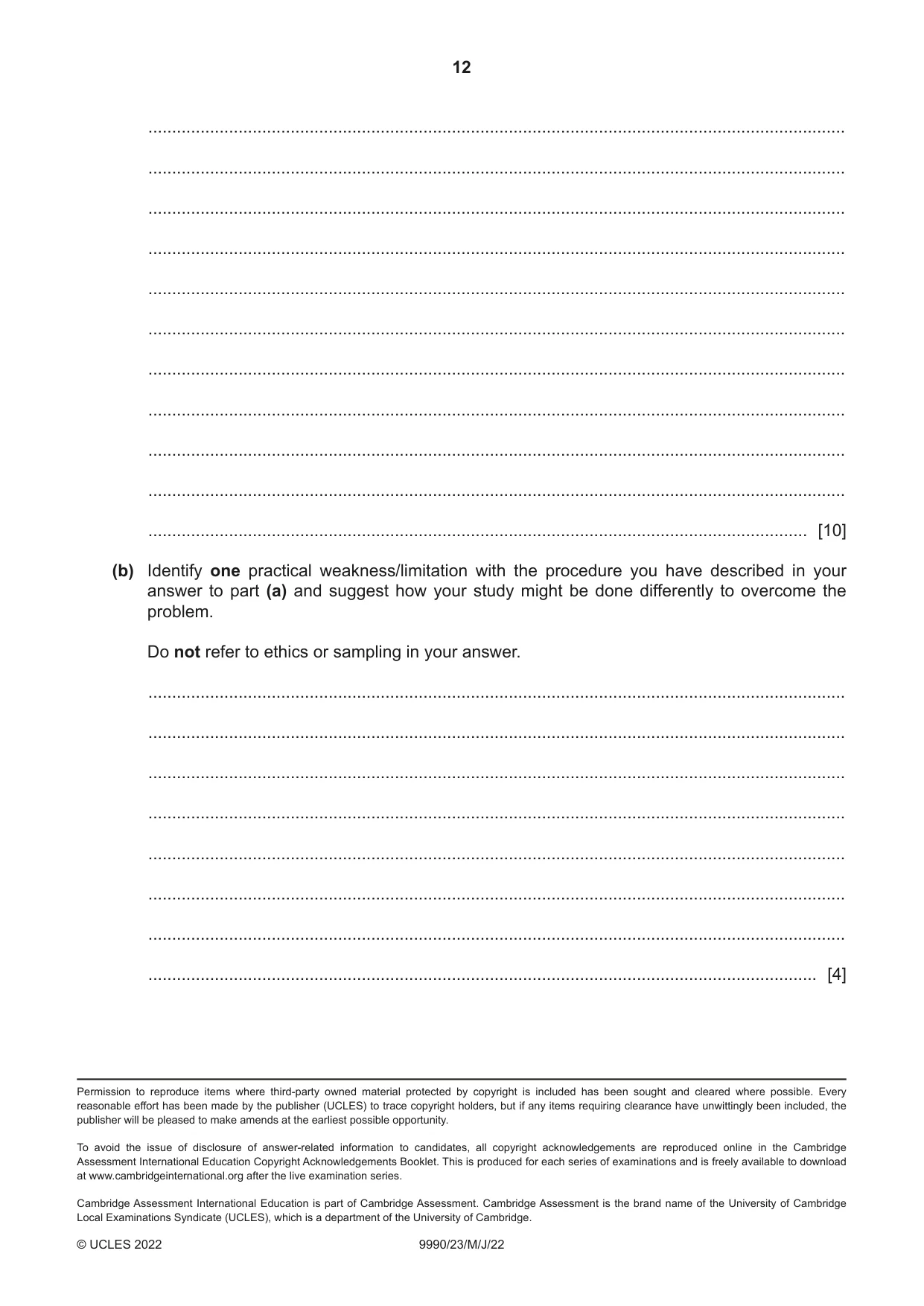
10 Jimmy wants to investigate individual differences in dreams. He is interested in many differences between participants, such as whether each individual: • has consistent dream content • has meaningful dreams • dreams in colour. (a) Describe how Jimmy could conduct a study using an interview to investigate at least two individual differences in dreams. ................................................................................................................................................... ................................................................................................................................................... ................................................................................................................................................... ................................................................................................................................................... ................................................................................................................................................... ................................................................................................................................................... ................................................................................................................................................... ................................................................................................................................................... ................................................................................................................................................... ................................................................................................................................................... ................................................................................................................................................... ................................................................................................................................................... ................................................................................................................................................... ................................................................................................................................................... ................................................................................................................................................... ................................................................................................................................................... ................................................................................................................................................... ................................................................................................................................................... ................................................................................................................................................... ................................................................................................................................................... ................................................................................................................................................... ................................................................................................................................................... ................................................................................................................................................... ................................................................................................................................................... ................................................................................................................................................... ................................................................................................................................................... ................................................................................................................................................... ................................................................................................................................................... ................................................................................................................................................... ................................................................................................................................................... ................................................................................................................................................... ................................................................................................................................................... ........................................................................................................................................... [10] (b) Identify one practical weakness/limitation with the procedure you have described in your answer to part (a) and suggest how your study might be done differently to overcome the problem. Do not refer to ethics or sampling in your answer. ................................................................................................................................................... ................................................................................................................................................... ................................................................................................................................................... ................................................................................................................................................... ................................................................................................................................................... ................................................................................................................................................... ................................................................................................................................................... ............................................................................................................................................. [4]
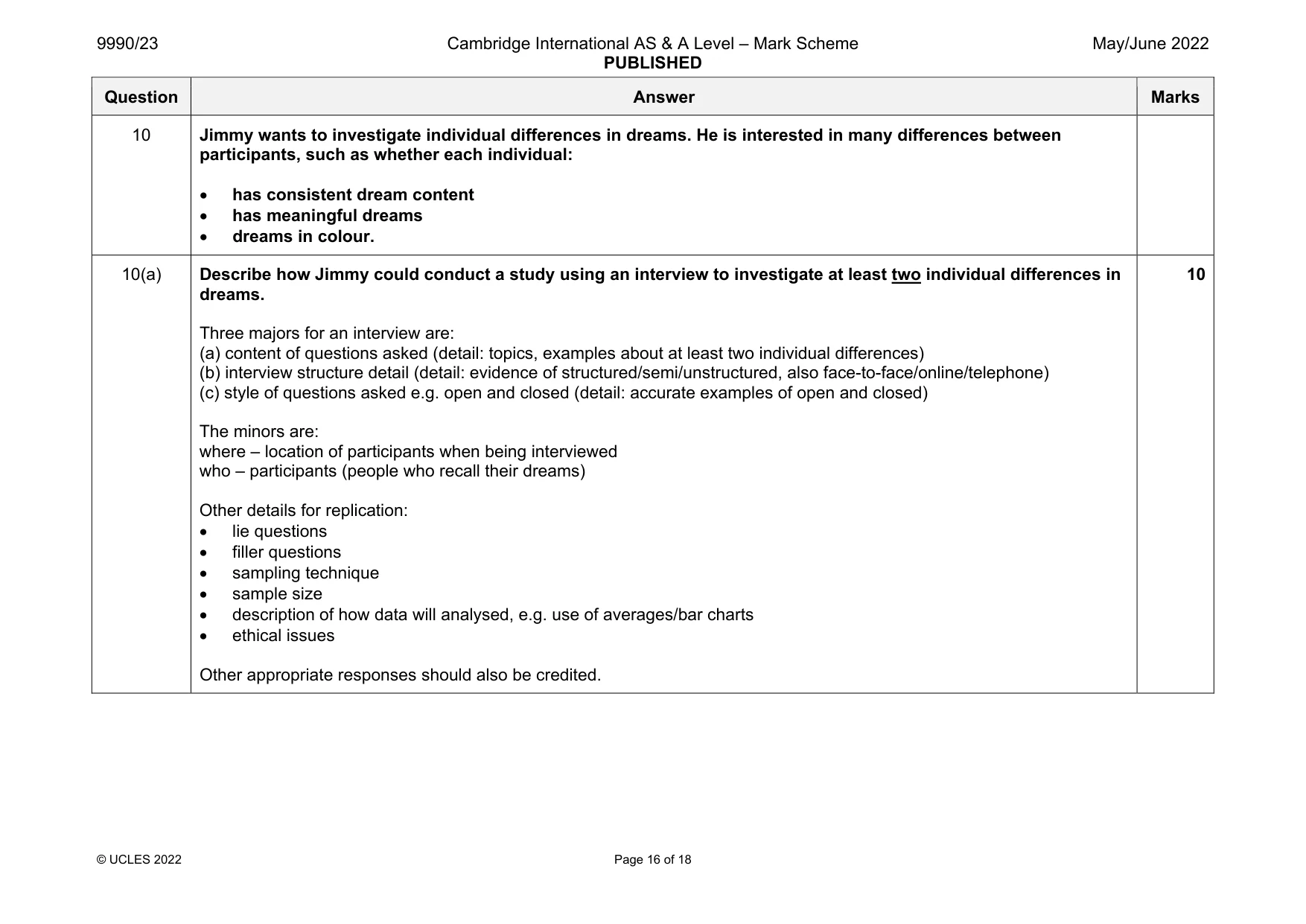
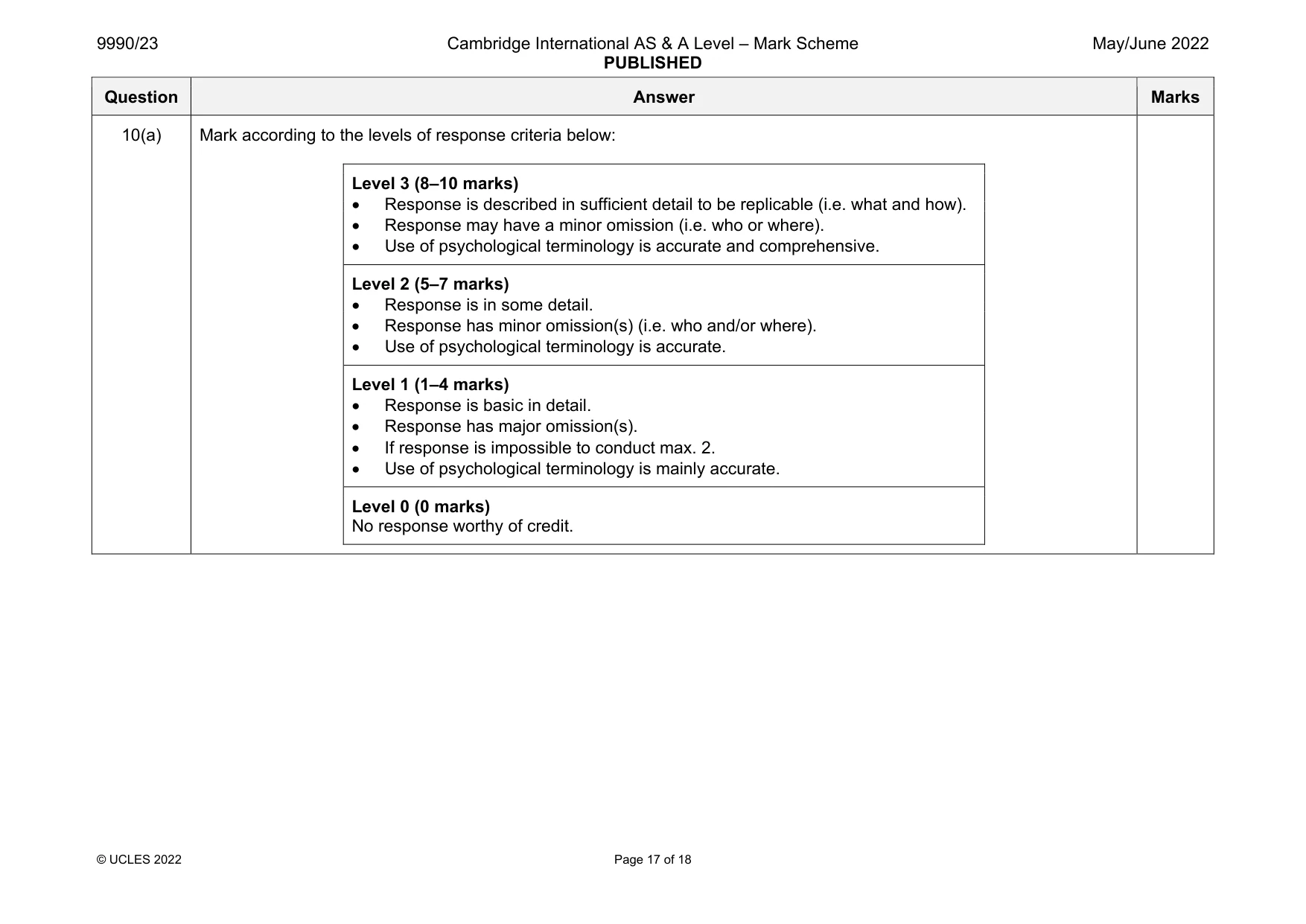
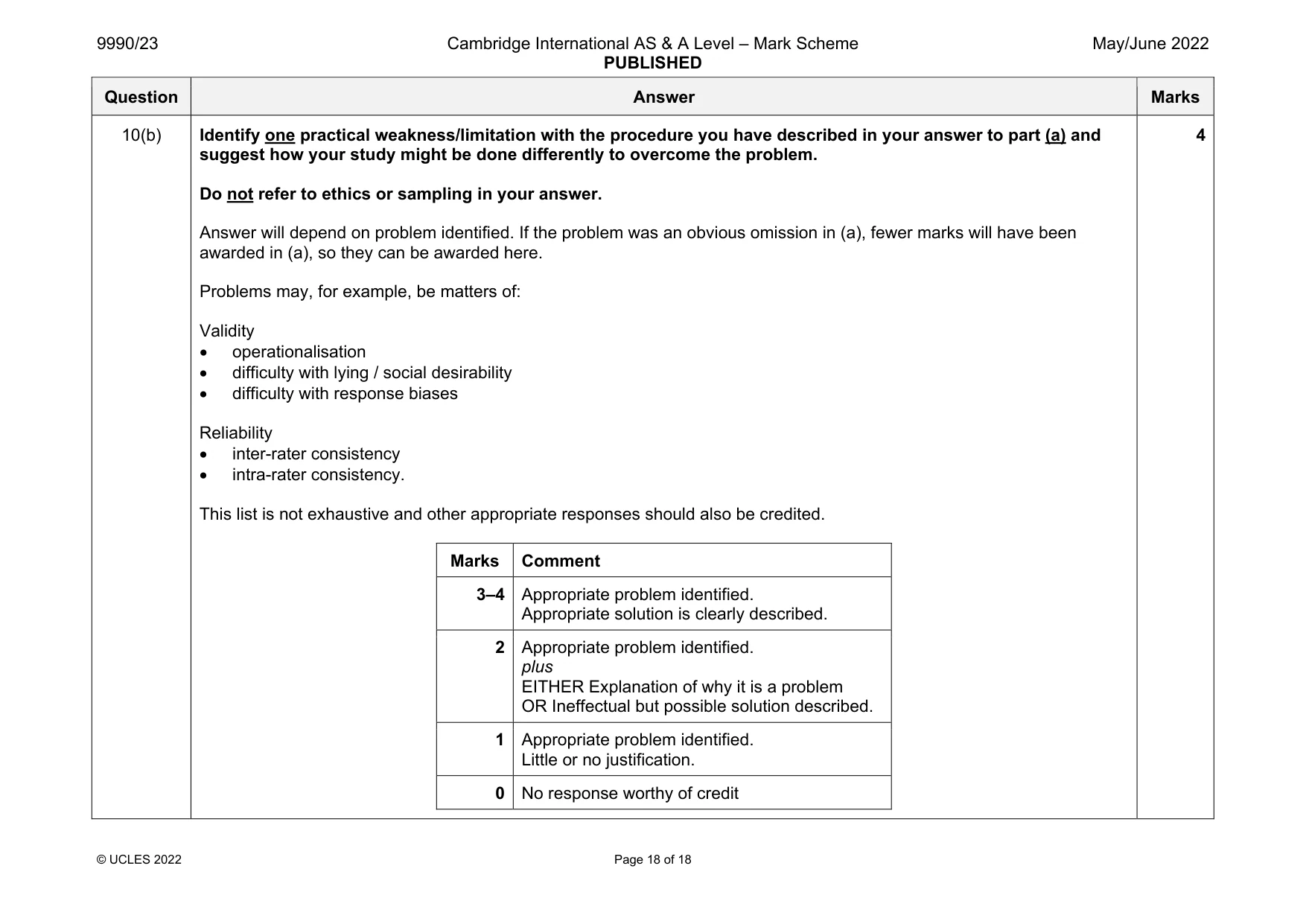
Mark scheme: 10 Jimmy wants to investigate individual differences in dreams. He is interested in many differences between participants, such as whether each individual: • has consistent dream content • has meaningful dreams • dreams in colour. 10(a) Describe how Jimmy could conduct a study using an interview to investigate at least two individual differences in 10 dreams. Three majors for an interview are: (a) content of questions asked (detail: topics, examples about at least two individual differences) (b) interview structure detail (detail: evidence of structured/semi/unstructured, also face-to-face/online/telephone) (c) style of questions asked e.g. open and closed (detail: accurate examples of open and closed) The minors are: where – location of participants when being interviewed who – participants (people who recall their dreams) Other details for replication: • lie questions • filler questions • sampling technique • sample size • description of how data will analysed, e.g. use of averages/bar charts • ethical issues Other appropriate responses should also be credited. 10(a) Mark according to the levels of response criteria below: Level 3 (8–10 marks) • Response is described in sufficient detail to be replicable (i.e. what and how). • Response may have a minor omission (i.e. who or where). • Use of psychological terminology is accurate and comprehensive. Level 2 (5–7 marks) • Response is in some detail. • Response has minor omission(s) (i.e. who and/or where). • Use of psychological terminology is accurate. Level 1 (1–4 marks) • Response is basic in detail. • Response has major omission(s). • If response is impossible to conduct max. 2. • Use of psychological terminology is mainly accurate. Level 0 (0 marks) No response worthy of credit. 10(b) Identify one practical weakness/limitation with the procedure you have described in your answer to part (a) and 4 suggest how your study might be done differently to overcome the problem. Do not refer to ethics or sampling in your answer. Answer will depend on problem identified. If the problem was an obvious omission in (a), fewer marks will have been awarded in (a), so they can be awarded here. Problems may, for example, be matters of: Validity • operationalisation • difficulty with lying / social desirability • difficulty with response biases Reliability • inter-rater consistency • intra-rater consistency. This list is not exhaustive and other appropriate responses should also be credited. Marks Comment 3–4 Appropriate problem identified. Appropriate solution is clearly described. 2 Appropriate problem identified. plus EITHER Explanation of why it is a problem OR Ineffectual but possible solution described. 1 Appropriate problem identified. Little or no justification. 0 No response worthy of credit
What was in this paper
The subtopics covered by these 10 questions, and how many questions each got. Open one in a new tab to see every Cambridge question on it.
What you needed in this session
Cambridge’s own grade thresholds for 2022 May/June, Paper 2 · Variant 3. A higher threshold means an easier paper — the bar moves with how the cohort did.