Cambridge A Level Psychology (from 2018) 9990 — 2025 Feb/March Paper 2 · Variant 2
9990/22/F/M/25 · 10 questions · 60 marks · 90 min
The question paper and its mark scheme, free to read here and free to download. This is Cambridge’s own paper, exactly as it was sat.
Question paper12 pages



Mark scheme14 pages
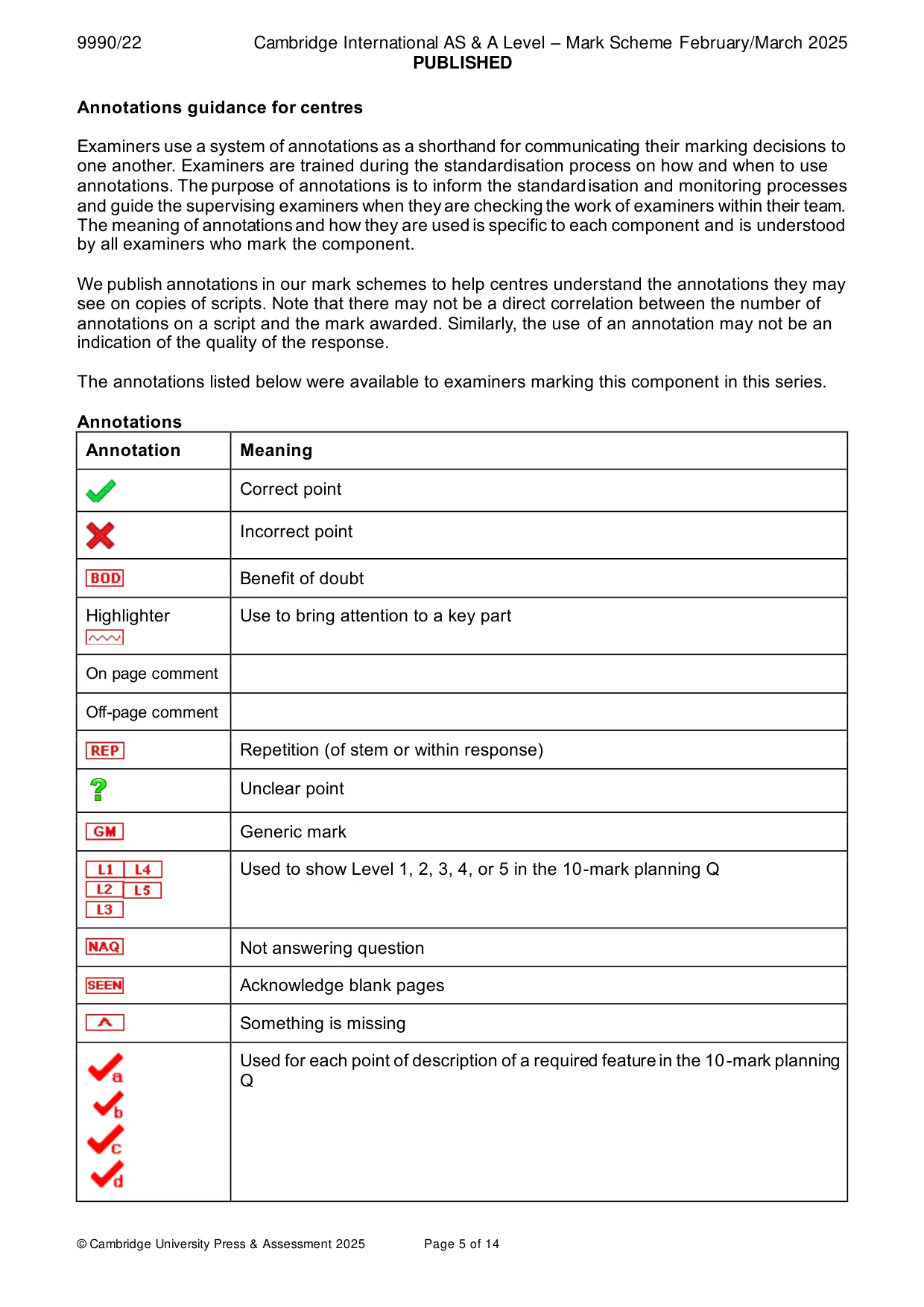
Answers below. Sit the paper first if you are practising.

Questions as text
Q1 · Outline what is meant by an overt observation
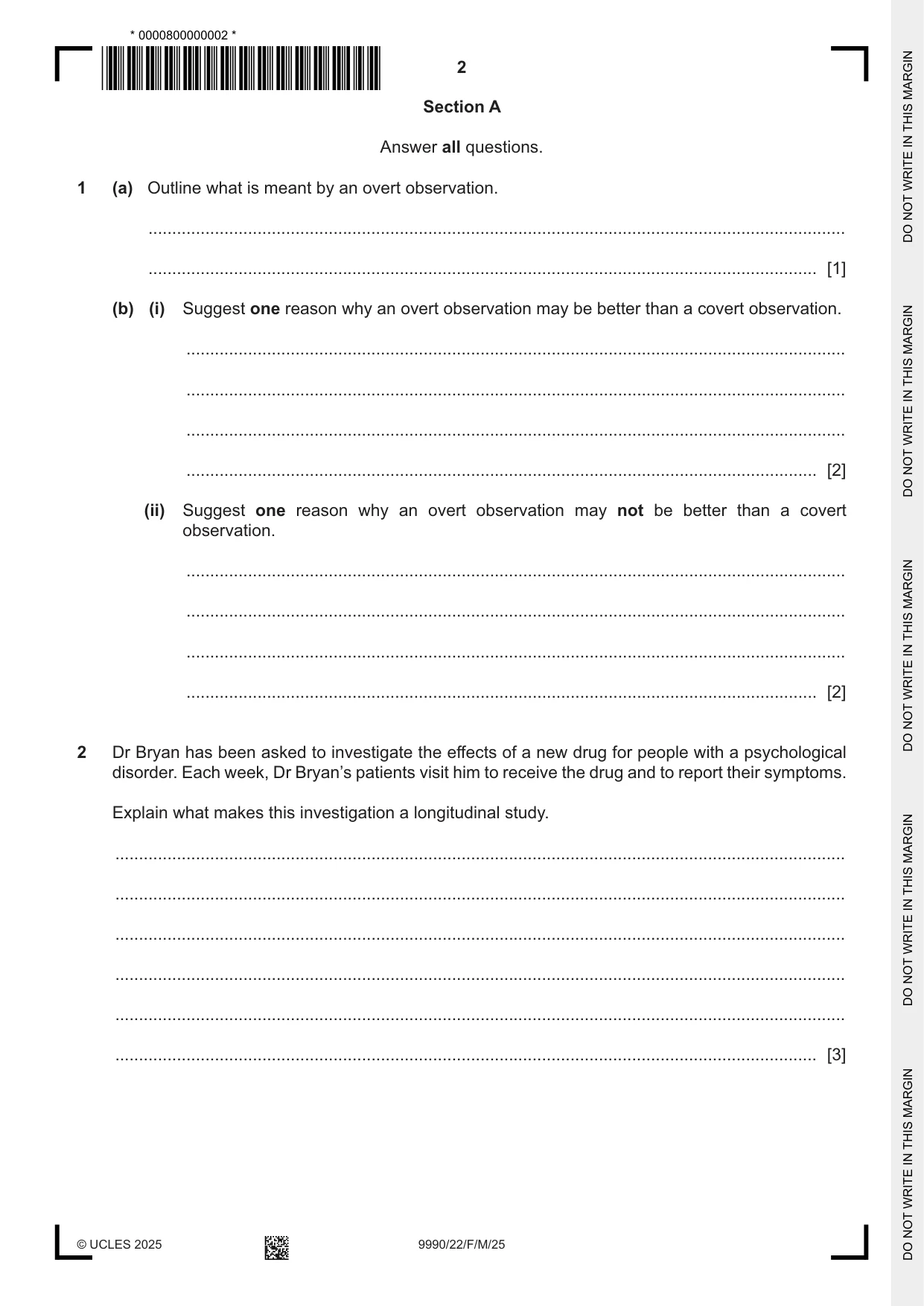
1 (a) Outline what is meant by an overt observation. ................................................................................................................................................... ............................................................................................................................................. [1] (b) (i) Suggest one reason why an overt observation may be better than a covert observation. ........................................................................................................................................... ........................................................................................................................................... ........................................................................................................................................... ..................................................................................................................................... [2] (ii) Suggest one reason why an overt observation may not be better than a covert observation. ........................................................................................................................................... ........................................................................................................................................... ........................................................................................................................................... ..................................................................................................................................... [2]
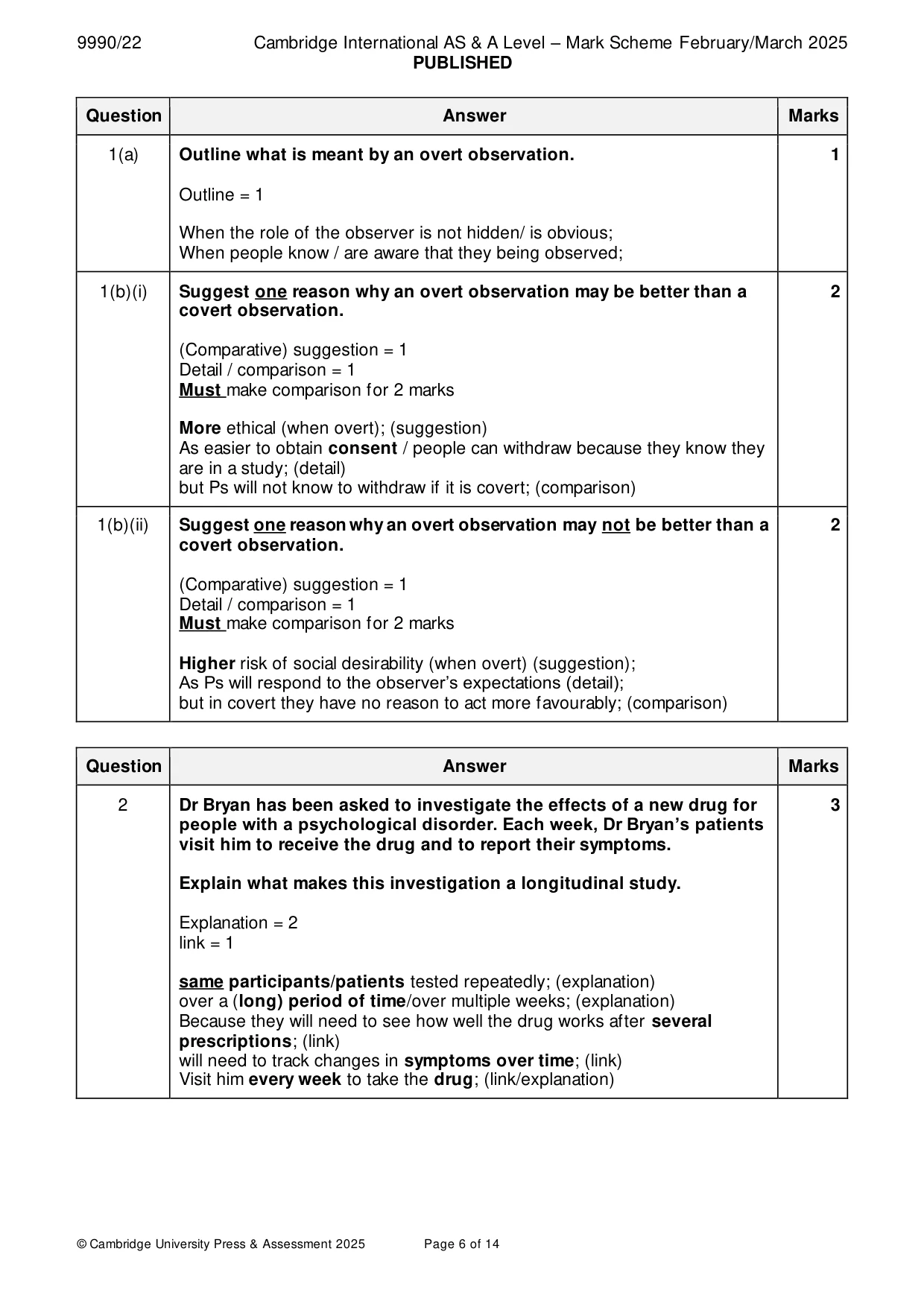
Mark scheme: Question Answer Marks 1(a) Outline what is meant by an overt observation. 1 Outline = 1 When the role of the observer is not hidden/ is obvious; When people know / are aware that they being observed; 1(b)(i) Suggest one reason why an overt observation may be better than a 2 covert observation. (Comparative) suggestion = 1 Detail / comparison = 1 Must make comparison for 2 marks More ethical (when overt); (suggestion) As easier to obtain consent / people can withdraw because they know they are in a study; (detail) but Ps will not know to withdraw if it is covert; (comparison) 1(b)(ii) Suggest one reason why an overt observation may not be better than a 2 covert observation. (Comparative) suggestion = 1 Detail / comparison = 1 Must make comparison for 2 marks Higher risk of social desirability (when overt) (suggestion); As Ps will respond to the observer’s expectations (detail); but in covert they have no reason to act more favourably; (comparison)
Q2 · Dr Bryan has been asked to investigate the effects of a new drug for people with a…
2 Dr Bryan has been asked to investigate the effects of a new drug for people with a psychological disorder. Each week, Dr Bryan’s patients visit him to receive the drug and to report their symptoms. Explain what makes this investigation a longitudinal study. .......................................................................................................................................................... .......................................................................................................................................................... .......................................................................................................................................................... .......................................................................................................................................................... .......................................................................................................................................................... .................................................................................................................................................... [3]
Mark scheme: 2 Dr Bryan has been asked to investigate the effects of a new drug for 3 people with a psychological disorder. Each week, Dr Bryan’s patients visit him to receive the drug and to report their symptoms. Explain what makes this investigation a longitudinal study. Explanation = 2 link = 1 same participants/patients tested repeatedly; (explanation) over a (long) period of time/over multiple weeks; (explanation) Because they will need to see how well the drug works after several prescriptions; (link) will need to track changes in symptoms over time; (link) Visit him every week to take the drug; (link/explanation)
Q3 · In the study by Hölzel et al
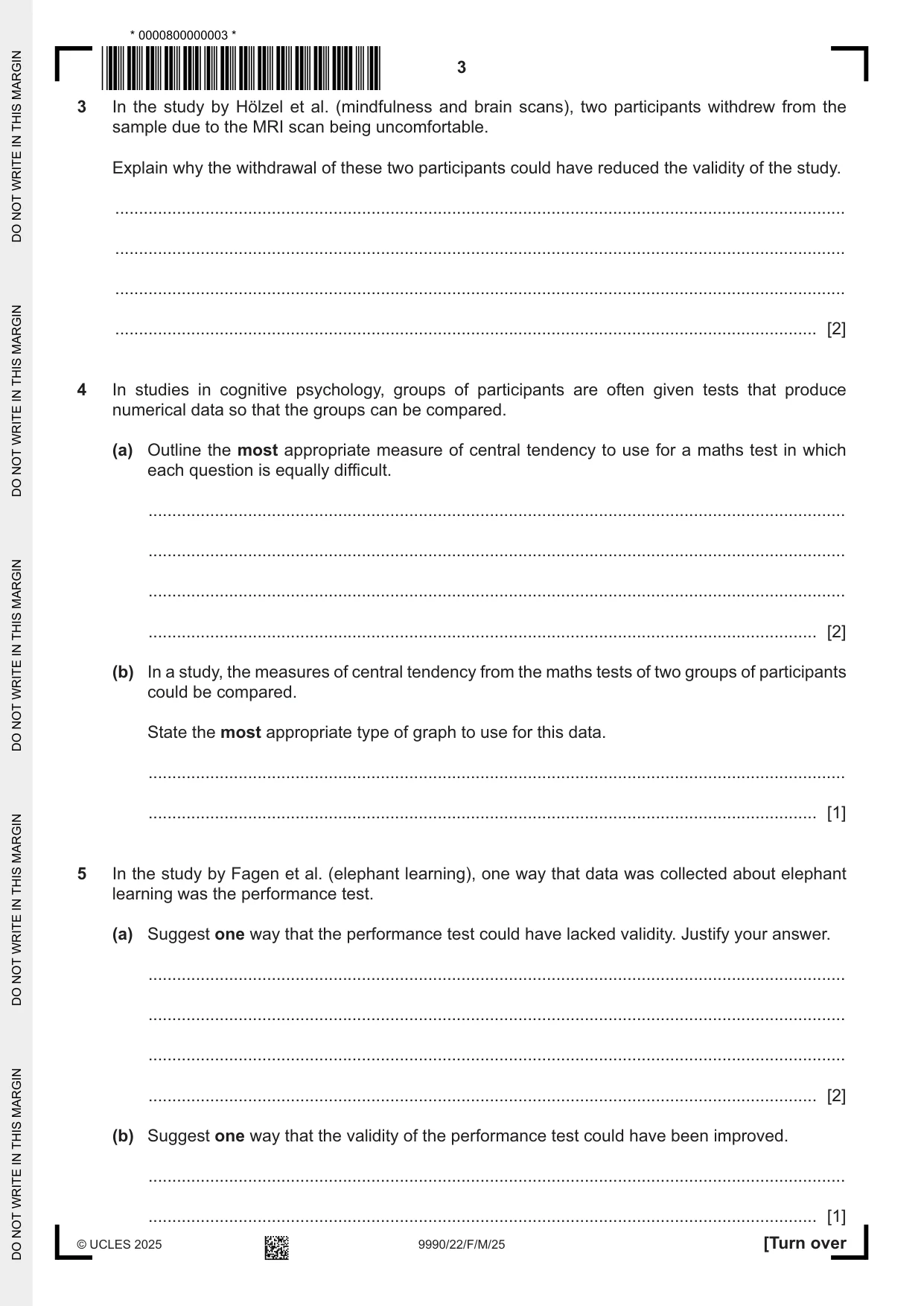
3 In the study by Hölzel et al. (mindfulness and brain scans), two participants withdrew from the sample due to the MRI scan being uncomfortable. Explain why the withdrawal of these two participants could have reduced the validity of the study. .......................................................................................................................................................... .......................................................................................................................................................... .......................................................................................................................................................... .................................................................................................................................................... [2]
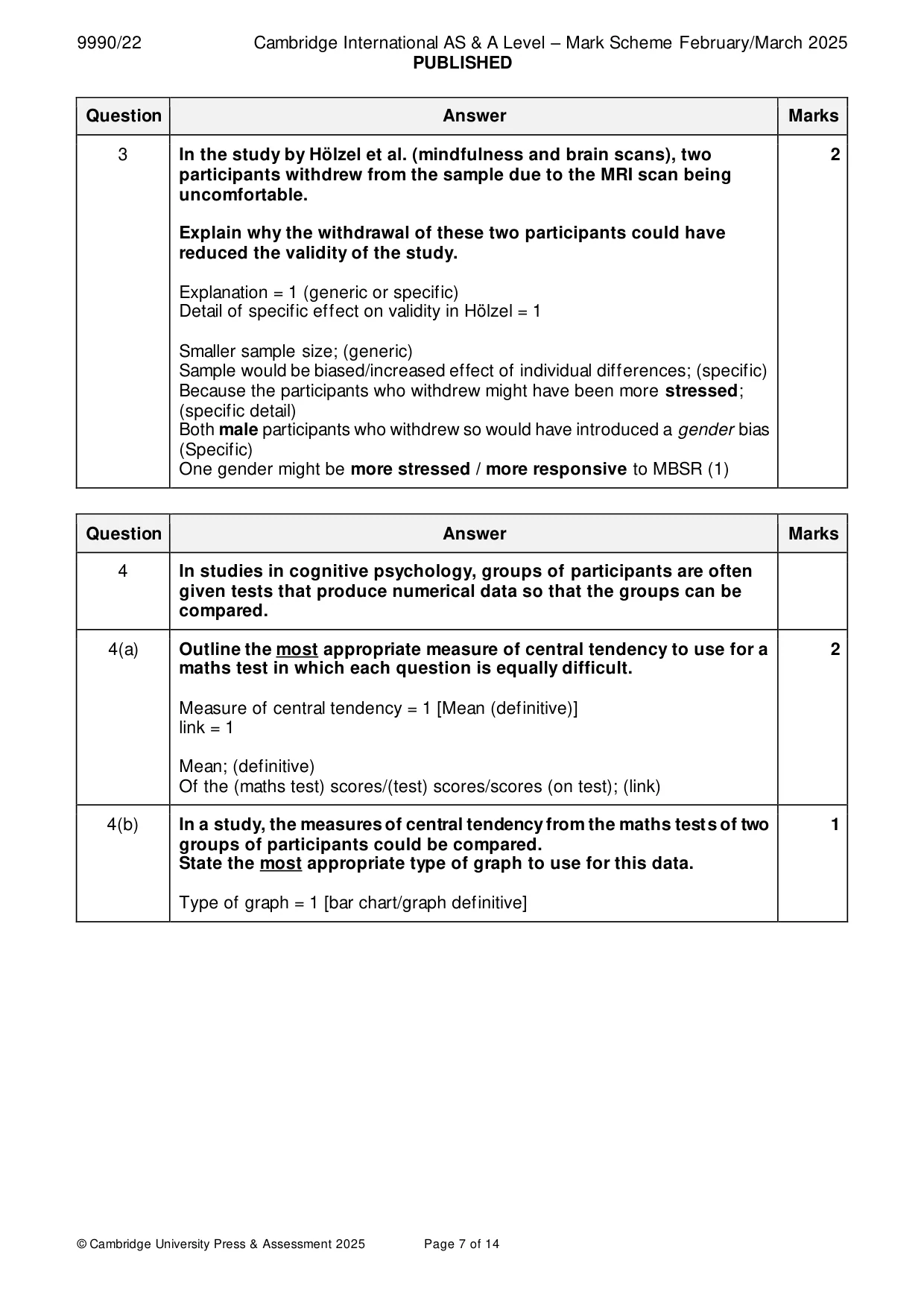
Mark scheme: 3 In the study by Hölzel et al. (mindfulness and brain scans), two 2 participants withdrew from the sample due to the MRI scan being uncomfortable. Explain why the withdrawal of these two participants could have reduced the validity of the study. Explanation = 1 (generic or specific) Detail of specific effect on validity in Hölzel = 1 Smaller sample size; (generic) Sample would be biased/increased effect of individual differences; (specific) Because the participants who withdrew might have been more stressed; (specific detail) Both male participants who withdrew so would have introduced a gender bias (Specific) One gender might be more stressed / more responsive to MBSR (1)
Q4 · In studies in cognitive psychology, groups of participants are often given tests that…
4 In studies in cognitive psychology, groups of participants are often given tests that produce numerical data so that the groups can be compared. (a) Outline the most appropriate measure of central tendency to use for a maths test in which each question is equally difficult. ................................................................................................................................................... ................................................................................................................................................... ................................................................................................................................................... ............................................................................................................................................. [2] (b) In a study, the measures of central tendency from the maths tests of two groups of participants could be compared. State the most appropriate type of graph to use for this data. ................................................................................................................................................... ............................................................................................................................................. [1]
Mark scheme: 4 In studies in cognitive psychology, groups of participants are often given tests that produce numerical data so that the groups can be compared. 4(a) Outline the most appropriate measure of central tendency to use for a 2 maths test in which each question is equally difficult. Measure of central tendency = 1 [Mean (definitive)] link = 1 Mean; (definitive) Of the (maths test) scores/(test) scores/scores (on test); (link) 4(b) In a study, the measures of central tendency from the maths tests of two 1 groups of participants could be compared. State the most appropriate type of graph to use for this data. Type of graph = 1 [bar chart/graph definitive]
Q5 · In the study by Fagen et al
5 In the study by Fagen et al. (elephant learning), one way that data was collected about elephant learning was the performance test. (a) Suggest one way that the performance test could have lacked validity. Justify your answer. ................................................................................................................................................... ................................................................................................................................................... ................................................................................................................................................... ............................................................................................................................................. [2] (b) Suggest one way that the validity of the performance test could have been improved. ................................................................................................................................................... ............................................................................................................................................. [1]
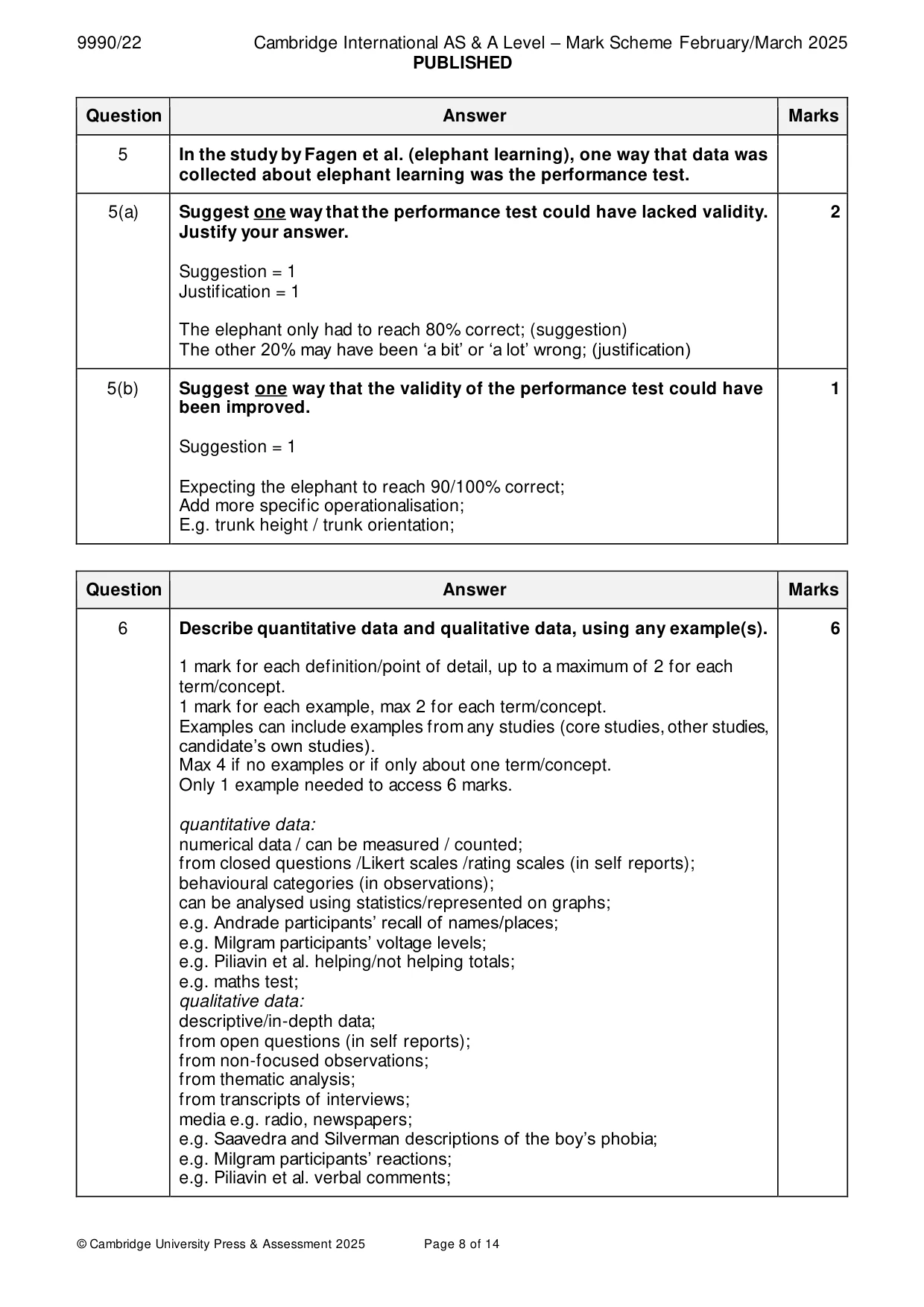
Mark scheme: 5 In the study by Fagen et al. (elephant learning), one way that data was collected about elephant learning was the performance test. 5(a) Suggest one way that the performance test could have lacked validity. 2 Justify your answer. Suggestion = 1 Justification = 1 The elephant only had to reach 80% correct; (suggestion) The other 20% may have been ‘a bit’ or ‘a lot’ wrong; (justification) 5(b) Suggest one way that the validity of the performance test could have 1 been improved. Suggestion = 1 Expecting the elephant to reach 90/100% correct; Add more specific operationalisation; E.g. trunk height / trunk orientation;
Q6 · Describe quantitative data and qualitative data, using any example(s)
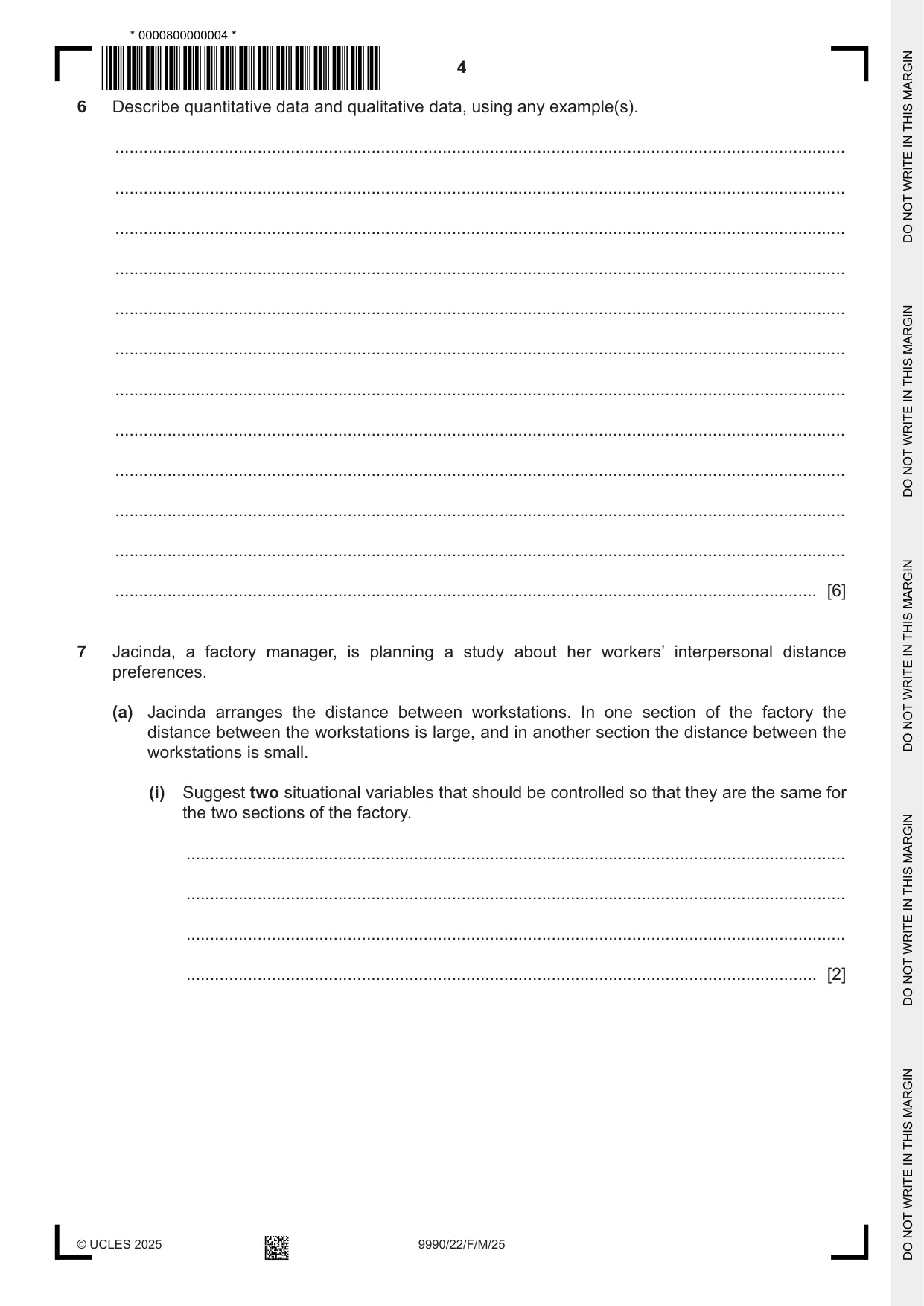
6 Describe quantitative data and qualitative data, using any example(s). .......................................................................................................................................................... .......................................................................................................................................................... .......................................................................................................................................................... .......................................................................................................................................................... .......................................................................................................................................................... .......................................................................................................................................................... .......................................................................................................................................................... .......................................................................................................................................................... .......................................................................................................................................................... .......................................................................................................................................................... .......................................................................................................................................................... .................................................................................................................................................... [6]
Mark scheme: 6 Describe quantitative data and qualitative data, using any example(s). 6 1 mark for each definition/point of detail, up to a maximum of 2 for each term/concept. 1 mark for each example, max 2 for each term/concept. Examples can include examples from any studies (core studies, other studies, candidate’s own studies). Max 4 if no examples or if only about one term/concept. Only 1 example needed to access 6 marks. quantitative data: numerical data / can be measured / counted; from closed questions /Likert scales /rating scales (in self reports); behavioural categories (in observations); can be analysed using statistics/represented on graphs; e.g. Andrade participants’ recall of names/places; e.g. Milgram participants’ voltage levels; e.g. Piliavin et al. helping/not helping totals; e.g. maths test; qualitative data: descriptive/in-depth data; from open questions (in self reports); from non-focused observations; from thematic analysis; from transcripts of interviews; media e.g. radio, newspapers; e.g. Saavedra and Silverman descriptions of the boy’s phobia; e.g. Milgram participants’ reactions; e.g. Piliavin et al. verbal comments;
Q7 · Jacinda, a factory manager, is planning a study about her workers’ interpersonal distance…
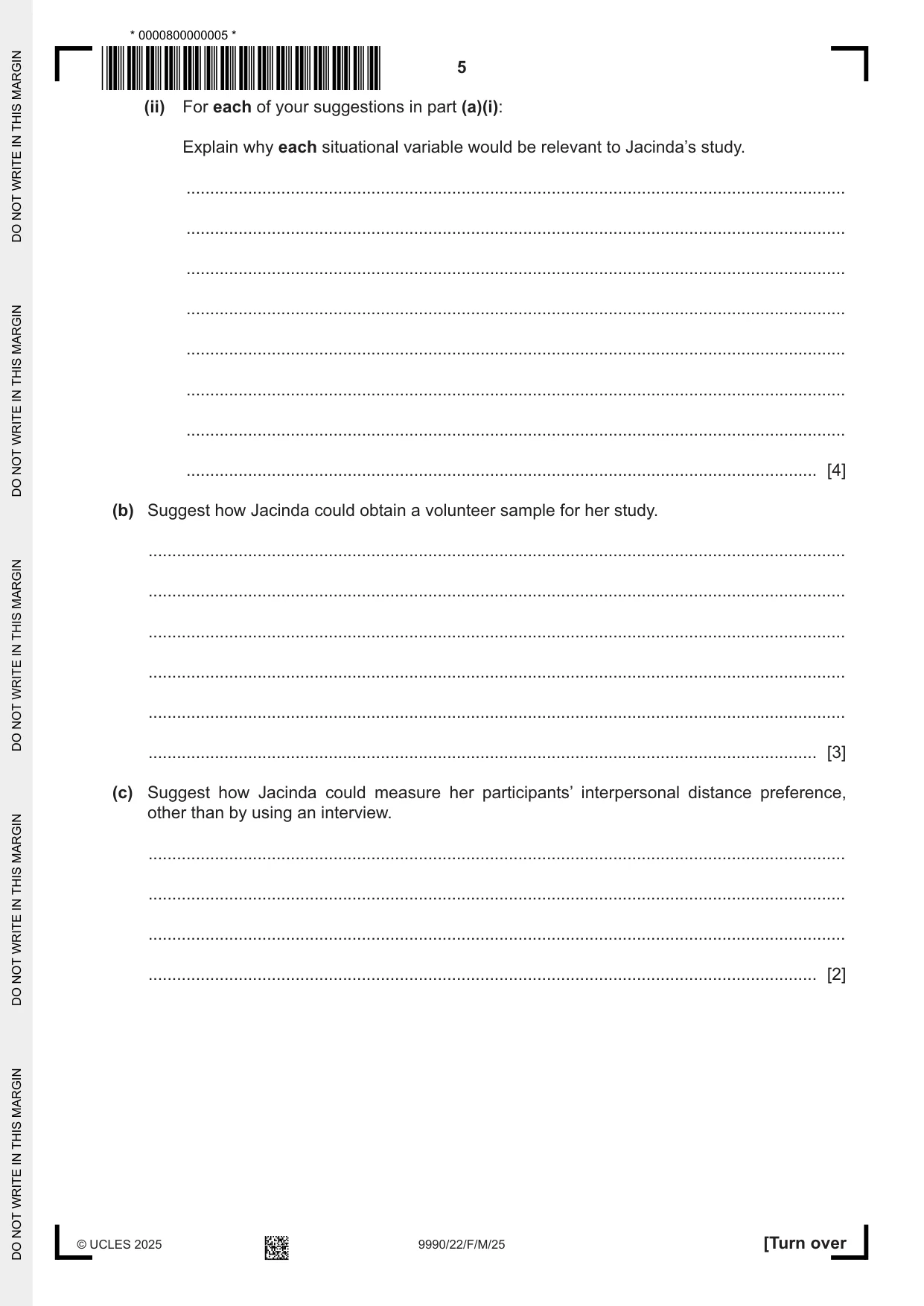
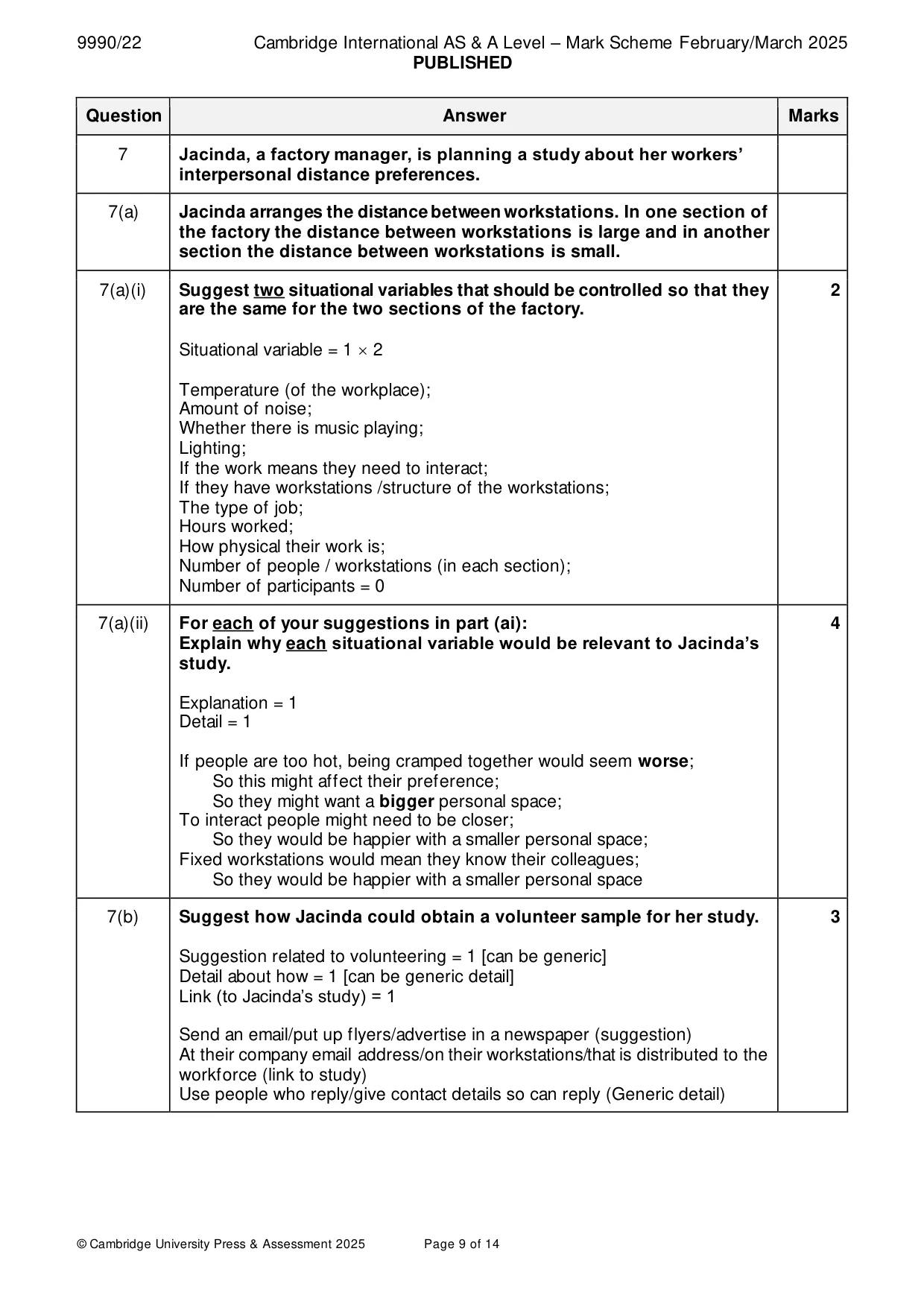
7 Jacinda, a factory manager, is planning a study about her workers’ interpersonal distance preferences. (a) Jacinda arranges the distance between workstations. In one section of the factory the distance between the workstations is large, and in another section the distance between the workstations is small. (i) Suggest two situational variables that should be controlled so that they are the same for the two sections of the factory. ........................................................................................................................................... ........................................................................................................................................... ........................................................................................................................................... ..................................................................................................................................... [2] (ii) For each of your suggestions in part (a)(i): Explain why each situational variable would be relevant to Jacinda’s study. ........................................................................................................................................... ........................................................................................................................................... ........................................................................................................................................... ........................................................................................................................................... ........................................................................................................................................... ........................................................................................................................................... ........................................................................................................................................... ..................................................................................................................................... [4] (b) Suggest how Jacinda could obtain a volunteer sample for her study. ................................................................................................................................................... ................................................................................................................................................... ................................................................................................................................................... ................................................................................................................................................... ................................................................................................................................................... ............................................................................................................................................. [3] (c) Suggest how Jacinda could measure her participants’ interpersonal distance preference, other than by using an interview. ................................................................................................................................................... ................................................................................................................................................... ................................................................................................................................................... ............................................................................................................................................. [2]
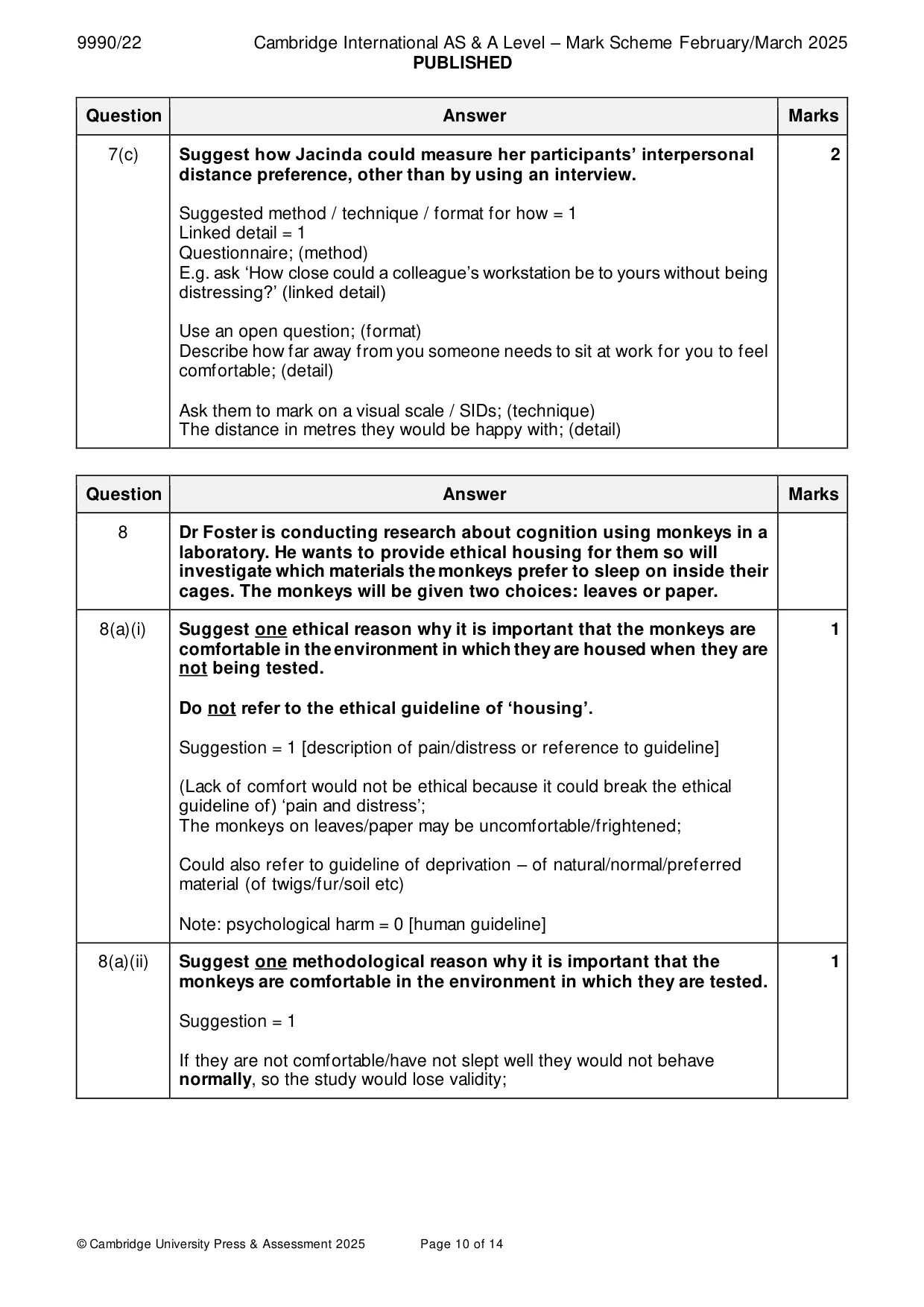
Mark scheme: 7 Jacinda, a factory manager, is planning a study about her workers’ interpersonal distance preferences. 7(a) Jacinda arranges the distance between workstations. In one section of the factory the distance between workstations is large and in another section the distance between workstations is small. 7(a)(i) Suggest two situational variables that should be controlled so that they 2 are the same for the two sections of the factory. Situational variable = 1 2 Temperature (of the workplace); Amount of noise; Whether there is music playing; Lighting; If the work means they need to interact; If they have workstations /structure of the workstations; The type of job; Hours worked; How physical their work is; Number of people / workstations (in each section); Number of participants = 0 7(a)(ii) For each of your suggestions in part (ai): 4 Explain why each situational variable would be relevant to Jacinda’s study. Explanation = 1 Detail = 1 If people are too hot, being cramped together would seem worse; So this might affect their preference; So they might want a bigger personal space; To interact people might need to be closer; So they would be happier with a smaller personal space; Fixed workstations would mean they know their colleagues; So they would be happier with a smaller personal space 7(b) Suggest how Jacinda could obtain a volunteer sample for her study. 3 Suggestion related to volunteering = 1 [can be generic] Detail about how = 1 [can be generic detail] Link (to Jacinda’s study) = 1 Send an email/put up flyers/advertise in a newspaper (suggestion) At their company email address/on their workstations/that is distributed to the workforce (link to study) Use people who reply/give contact details so can reply (Generic detail) 7(c) Suggest how Jacinda could measure her participants’ interpersonal 2 distance preference, other than by using an interview. Suggested method / technique / format for how = 1 Linked detail = 1 Questionnaire; (method) E.g. ask ‘How close could a colleague’s workstation be to yours without being distressing?’ (linked detail) Use an open question; (format) Describe how far away from you someone needs to sit at work for you to feel comfortable; (detail) Ask them to mark on a visual scale / SIDs; (technique) The distance in metres they would be happy with; (detail)
Q8 · Dr Foster is conducting research about cognition using monkeys in a laboratory
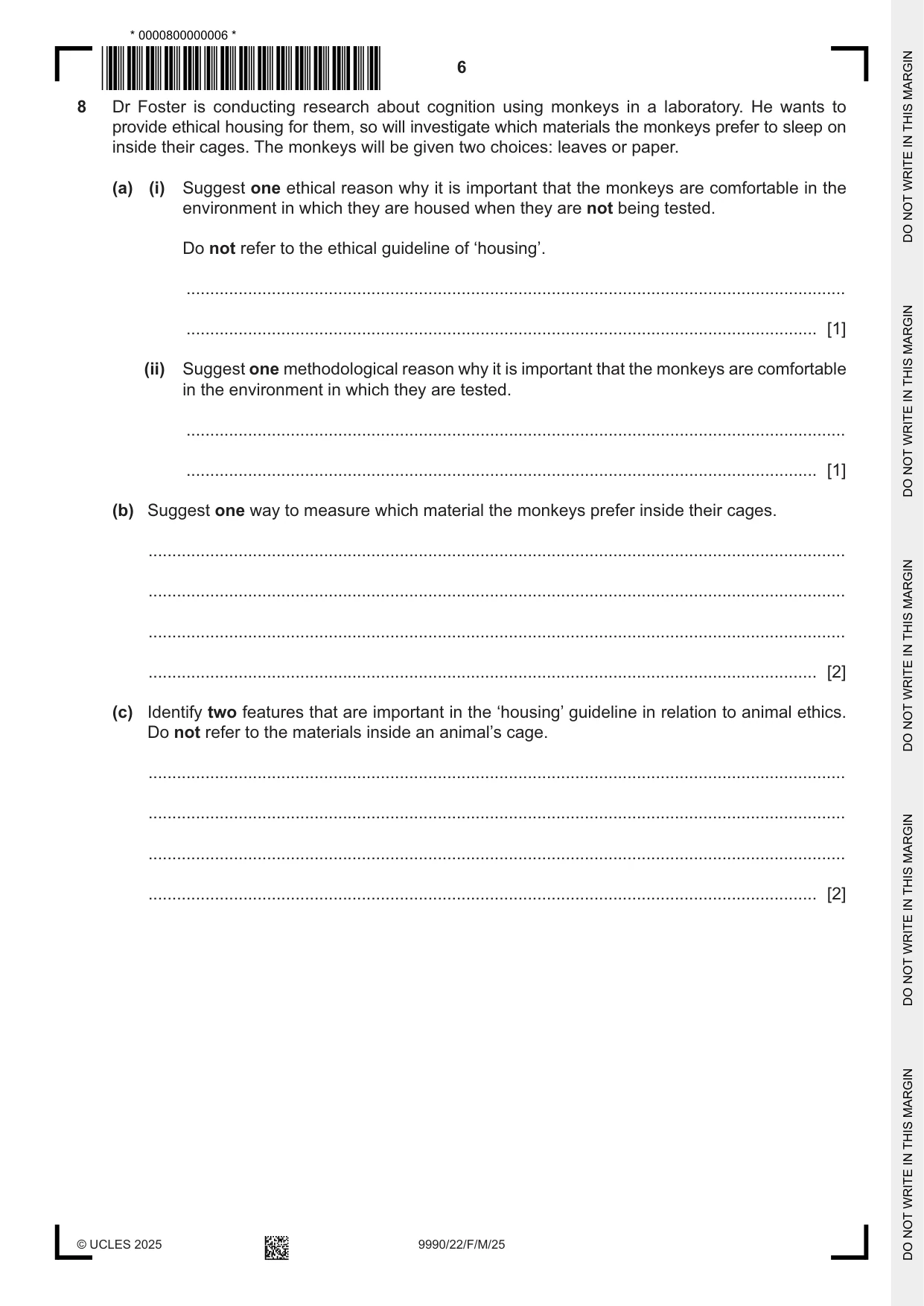
8 Dr Foster is conducting research about cognition using monkeys in a laboratory. He wants to provide ethical housing for them, so will investigate which materials the monkeys prefer to sleep on inside their cages. The monkeys will be given two choices: leaves or paper. (a) (i) Suggest one ethical reason why it is important that the monkeys are comfortable in the environment in which they are housed when they are not being tested. Do not refer to the ethical guideline of ‘housing’. ........................................................................................................................................... ..................................................................................................................................... [1] (ii) Suggest one methodological reason why it is important that the monkeys are comfortable in the environment in which they are tested. ........................................................................................................................................... ..................................................................................................................................... [1] (b) Suggest one way to measure which material the monkeys prefer inside their cages. ................................................................................................................................................... ................................................................................................................................................... ................................................................................................................................................... ............................................................................................................................................. [2] (c) Identify two features that are important in the ‘housing’ guideline in relation to animal ethics. Do not refer to the materials inside an animal’s cage. ................................................................................................................................................... ................................................................................................................................................... ................................................................................................................................................... ............................................................................................................................................. [2]
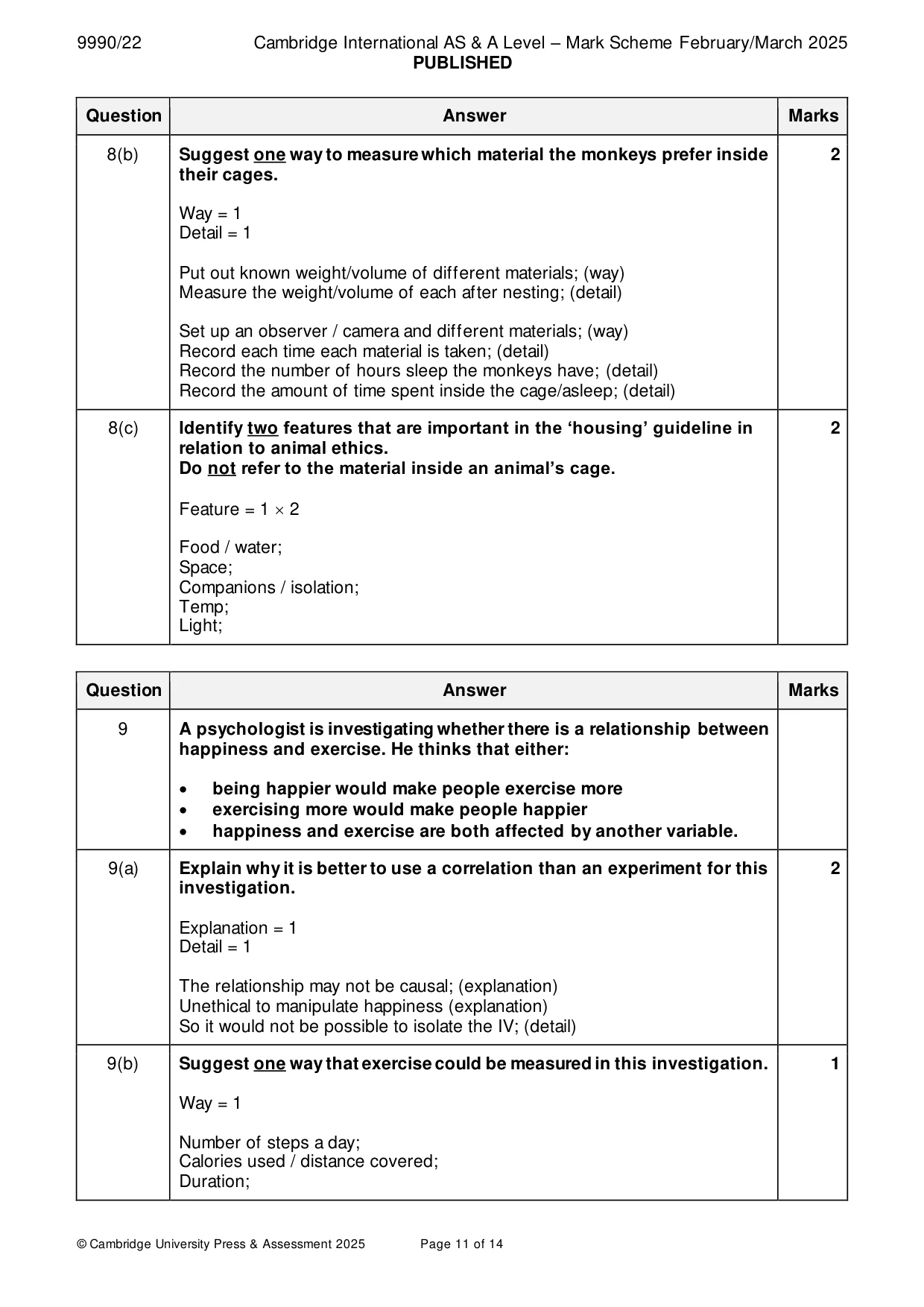
Mark scheme: 8 Dr Foster is conducting research about cognition using monkeys in a laboratory. He wants to provide ethical housing for them so will investigate which materials the monkeys prefer to sleep on inside their cages. The monkeys will be given two choices: leaves or paper. 8(a)(i) Suggest one ethical reason why it is important that the monkeys are 1 comfortable in the environment in which they are housed when they are not being tested. Do not refer to the ethical guideline of ‘housing’. Suggestion = 1 [description of pain/distress or reference to guideline] (Lack of comfort would not be ethical because it could break the ethical guideline of) ‘pain and distress’; The monkeys on leaves/paper may be uncomfortable/frightened; Could also refer to guideline of deprivation – of natural/normal/preferred material (of twigs/fur/soil etc) Note: psychological harm = 0 [human guideline] 8(a)(ii) Suggest one methodological reason why it is important that the 1 monkeys are comfortable in the environment in which they are tested. Suggestion = 1 If they are not comfortable/have not slept well they would not behave normally, so the study would lose validity; 8(b) Suggest one way to measure which material the monkeys prefer inside 2 their cages. Way = 1 Detail = 1 Put out known weight/volume of different materials; (way) Measure the weight/volume of each after nesting; (detail) Set up an observer / camera and different materials; (way) Record each time each material is taken; (detail) Record the number of hours sleep the monkeys have; (detail) Record the amount of time spent inside the cage/asleep; (detail) 8(c) Identify two features that are important in the ‘housing’ guideline in 2 relation to animal ethics. Do not refer to the material inside an animal’s cage. Feature = 1 2 Food / water; Space; Companions / isolation; Temp; Light;
Q9 · A psychologist is investigating whether there is relationship between happiness and…
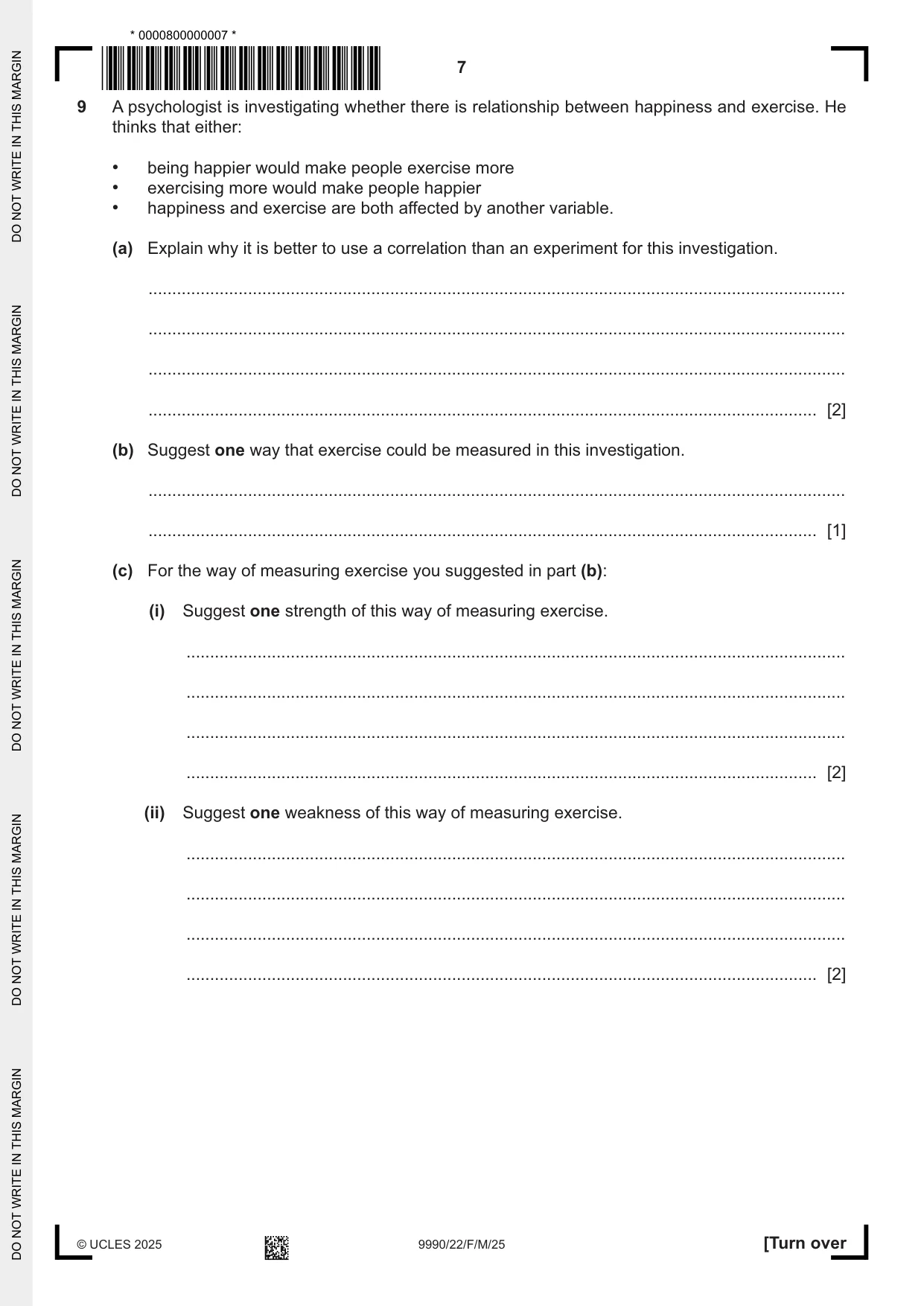
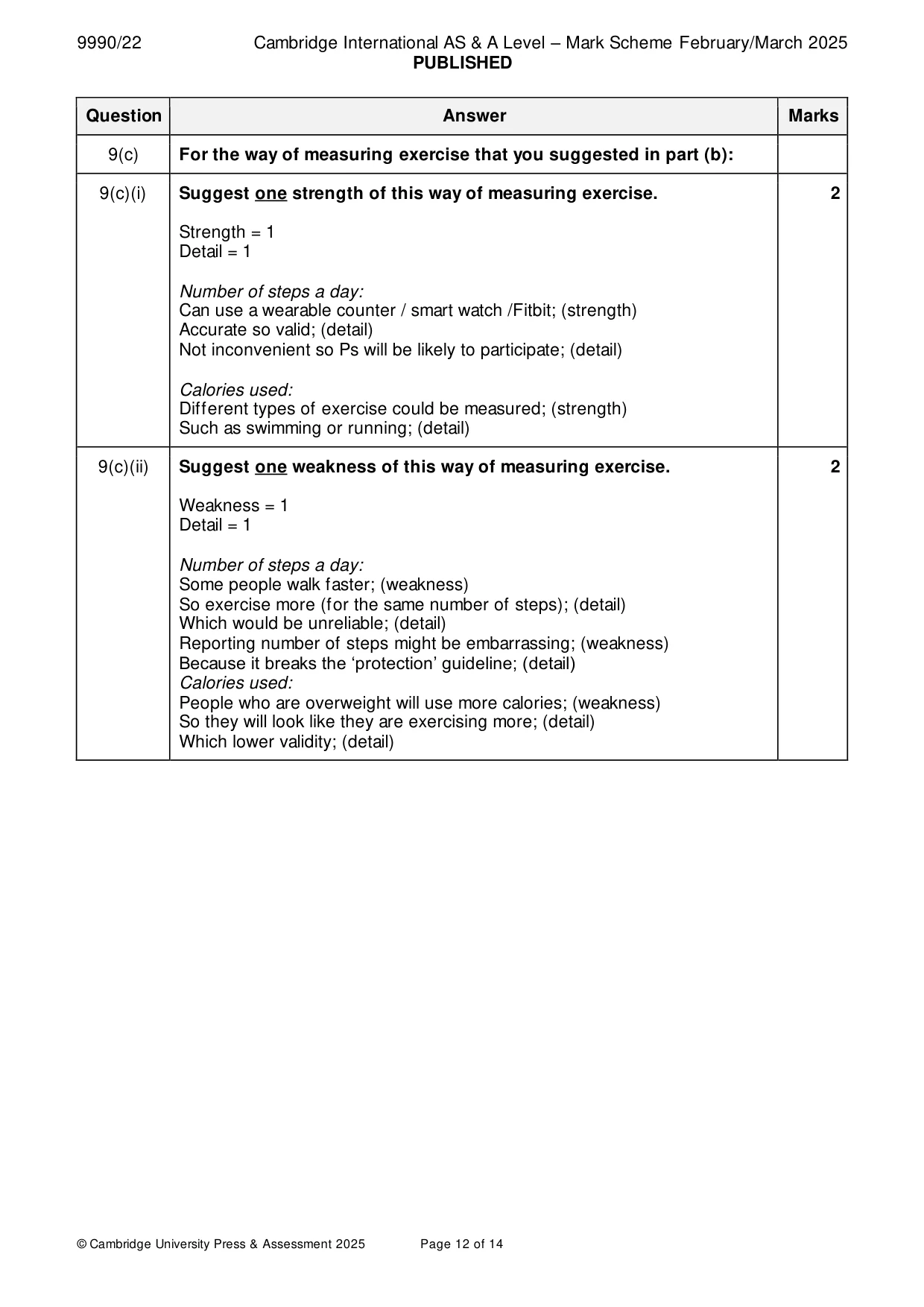
9 A psychologist is investigating whether there is relationship between happiness and exercise. He thinks that either: • being happier would make people exercise more • exercising more would make people happier • happiness and exercise are both affected by another variable. (a) Explain why it is better to use a correlation than an experiment for this investigation. ................................................................................................................................................... ................................................................................................................................................... ................................................................................................................................................... ............................................................................................................................................. [2] (b) Suggest one way that exercise could be measured in this investigation. ................................................................................................................................................... ............................................................................................................................................. [1] (c) For the way of measuring exercise you suggested in part (b): (i) Suggest one strength of this way of measuring exercise. ........................................................................................................................................... ........................................................................................................................................... ........................................................................................................................................... ..................................................................................................................................... [2] (ii) Suggest one weakness of this way of measuring exercise. ........................................................................................................................................... ........................................................................................................................................... ........................................................................................................................................... ..................................................................................................................................... [2]
Mark scheme: 9 A psychologist is investigating whether there is a relationship between happiness and exercise. He thinks that either: • being happier would make people exercise more • exercising more would make people happier • happiness and exercise are both affected by another variable. 9(a) Explain why it is better to use a correlation than an experiment for this 2 investigation. Explanation = 1 Detail = 1 The relationship may not be causal; (explanation) Unethical to manipulate happiness (explanation) So it would not be possible to isolate the IV; (detail) 9(b) Suggest one way that exercise could be measured in this investigation. 1 Way = 1 Number of steps a day; Calories used / distance covered; Duration; 9(c) For the way of measuring exercise that you suggested in part (b): 9(c)(i) Suggest one strength of this way of measuring exercise. 2 Strength = 1 Detail = 1 Number of steps a day: Can use a wearable counter / smart watch /Fitbit; (strength) Accurate so valid; (detail) Not inconvenient so Ps will be likely to participate; (detail) Calories used: Different types of exercise could be measured; (strength) Such as swimming or running; (detail) 9(c)(ii) Suggest one weakness of this way of measuring exercise. 2 Weakness = 1 Detail = 1 Number of steps a day: Some people walk faster; (weakness) So exercise more (for the same number of steps); (detail) Which would be unreliable; (detail) Reporting number of steps might be embarrassing; (weakness) Because it breaks the ‘protection’ guideline; (detail) Calories used: People who are overweight will use more calories; (weakness) So they will look like they are exercising more; (detail) Which lower validity; (detail)
Q10 · Dr Anand is interested in conversations that children aged 8 –10 years old have with…
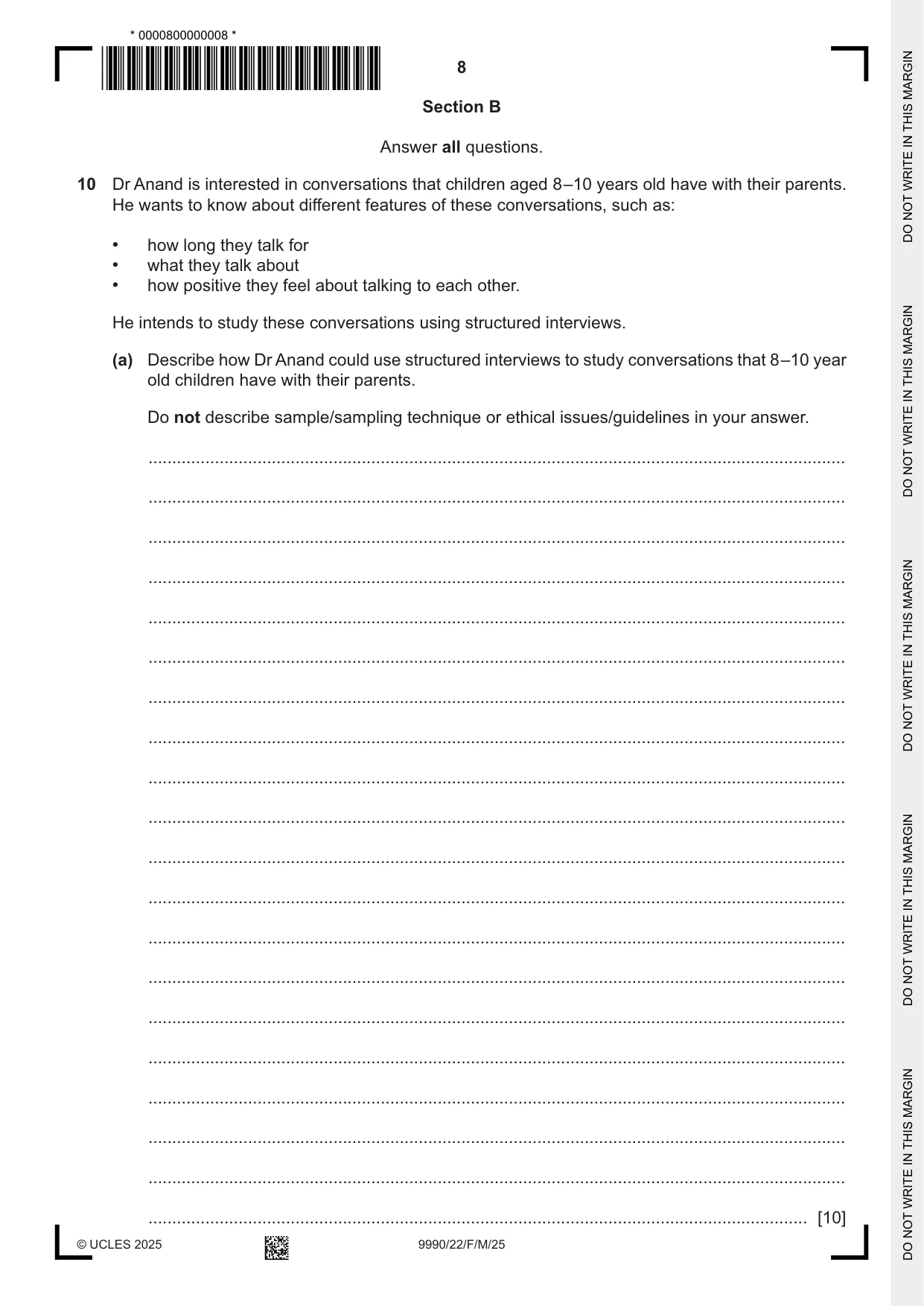
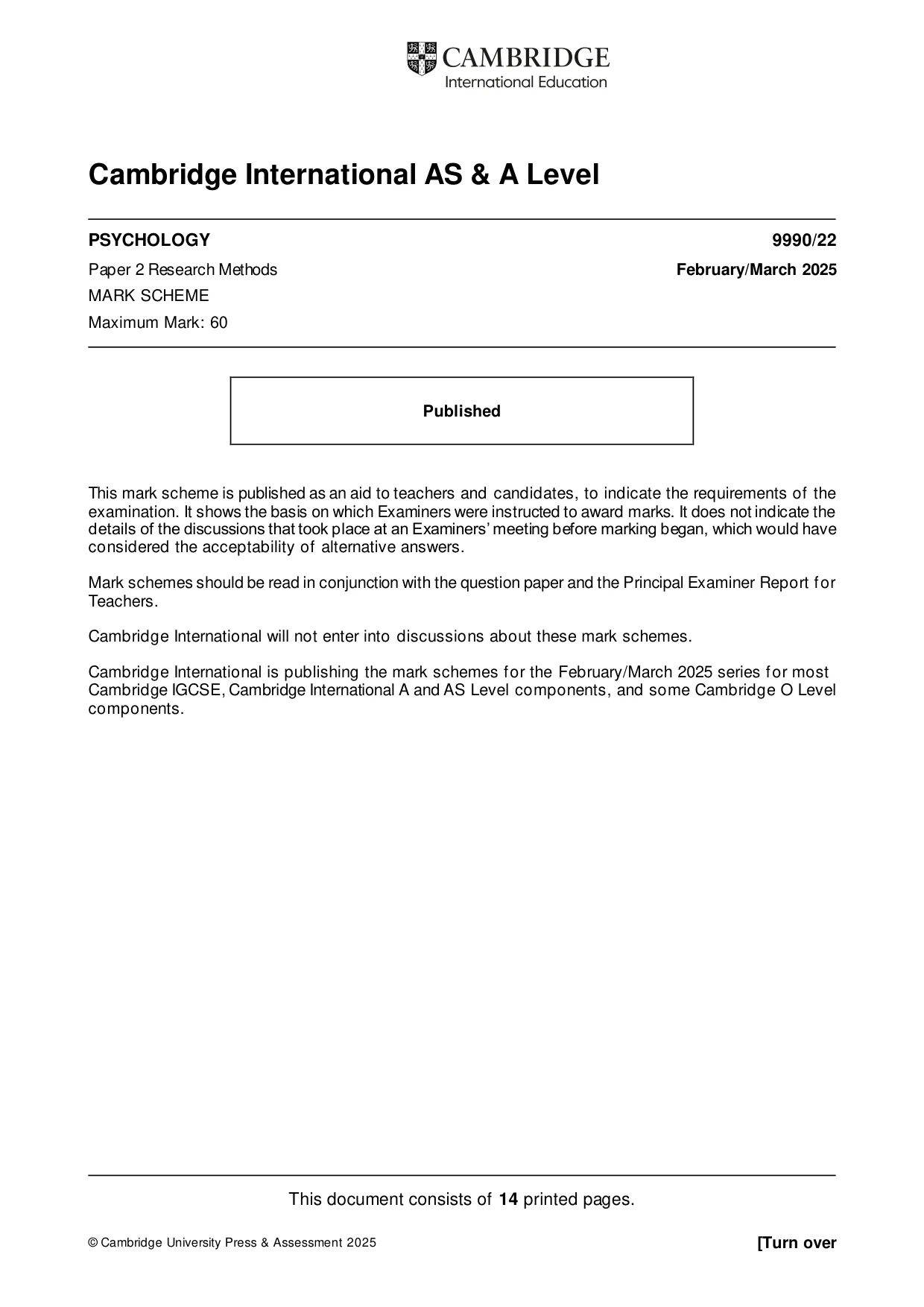
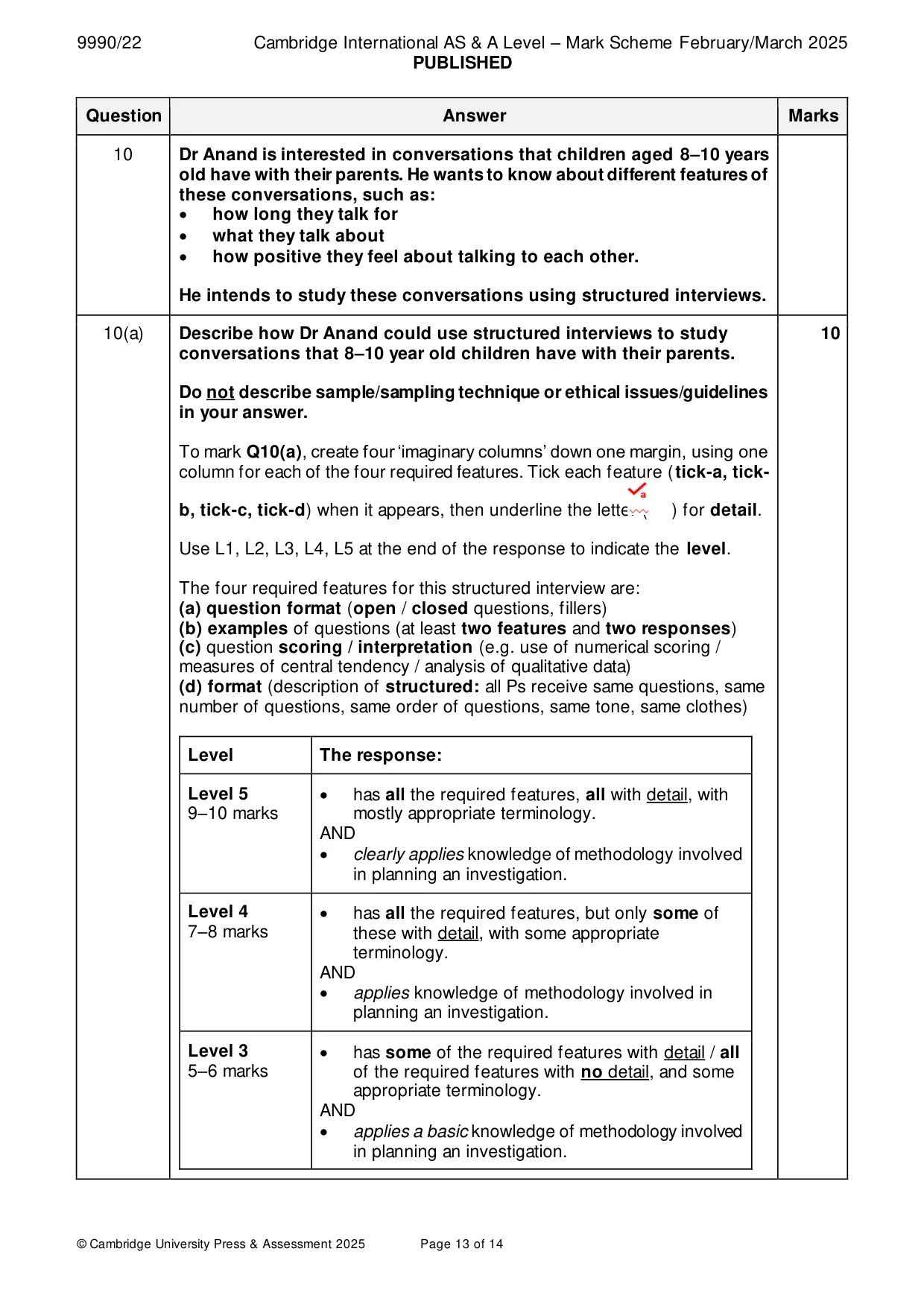
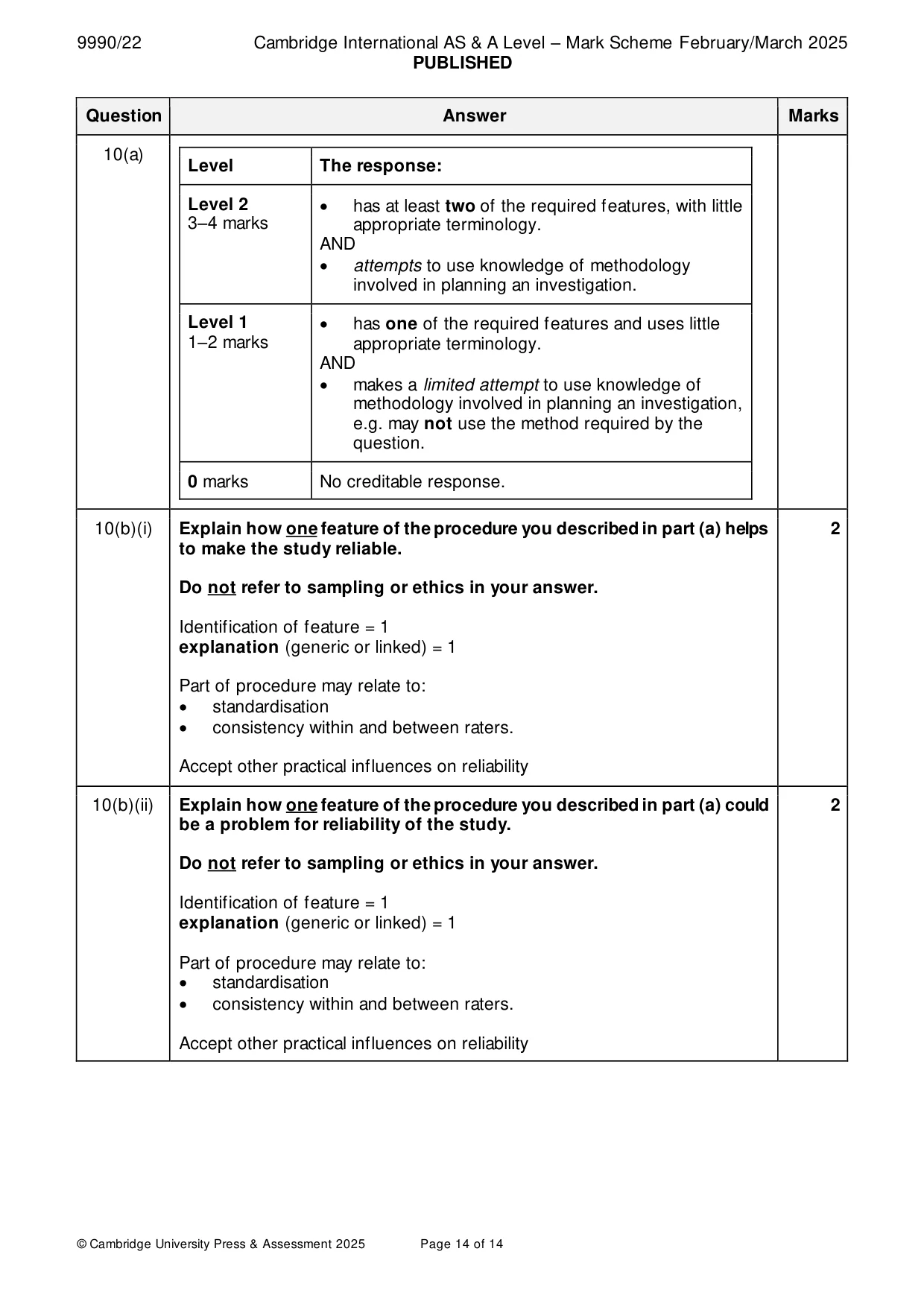
10 Dr Anand is interested in conversations that children aged 8 –10 years old have with their parents. He wants to know about different features of these conversations, such as: • how long they talk for • what they talk about • how positive they feel about talking to each other. He intends to study these conversations using structured interviews. (a) Describe how Dr Anand could use structured interviews to study conversations that 8 –10 year old children have with their parents. Do not describe sample/sampling technique or ethical issues/guidelines in your answer. ................................................................................................................................................... ................................................................................................................................................... ................................................................................................................................................... ................................................................................................................................................... ................................................................................................................................................... ................................................................................................................................................... ................................................................................................................................................... ................................................................................................................................................... ................................................................................................................................................... ................................................................................................................................................... ................................................................................................................................................... ................................................................................................................................................... ................................................................................................................................................... ................................................................................................................................................... ................................................................................................................................................... ................................................................................................................................................... ................................................................................................................................................... ................................................................................................................................................... ................................................................................................................................................... ........................................................................................................................................... [10] (b) (i) Explain how one feature of the procedure you described in part (a) helps to make the study reliable. Do not refer to sampling or ethics in your answer. ........................................................................................................................................... ........................................................................................................................................... ........................................................................................................................................... ..................................................................................................................................... [2] (ii) Explain how one feature of the procedure you described in part (a) could be a problem for reliability of the study. Do not refer to sampling or ethics in your answer. ........................................................................................................................................... ........................................................................................................................................... ........................................................................................................................................... ..................................................................................................................................... [2]
Mark scheme: 10 Dr Anand is interested in conversations that children aged 8–10 years old have with their parents. He wants to know about different features of these conversations, such as: • how long they talk for • what they talk about • how positive they feel about talking to each other. He intends to study these conversations using structured interviews. 10(a) Describe how Dr Anand could use structured interviews to study 10 conversations that 8–10 year old children have with their parents. Do not describe sample/sampling technique or ethical issues/guidelines in your answer. To mark Q10(a), create four ‘imaginary columns’ down one margin, using one column for each of the four required features. Tick each feature (tick-a, tick- b, tick-c, tick-d) when it appears, then underline the letter ( ) for detail. Use L1, L2, L3, L4, L5 at the end of the response to indicate the level. The four required features for this structured interview are: (a) question format (open / closed questions, fillers) (b) examples of questions (at least two features and two responses) (c) question scoring / interpretation (e.g. use of numerical scoring / measures of central tendency / analysis of qualitative data) (d) format (description of structured: all Ps receive same questions, same number of questions, same order of questions, same tone, same clothes) Level The response: Level 5 • has all the required features, all with detail, with 9–10 marks mostly appropriate terminology. AND • clearly applies knowledge of methodology involved in planning an investigation. Level 4 • has all the required features, but only some of 7–8 marks these with detail, with some appropriate terminology. AND • applies knowledge of methodology involved in planning an investigation. Level 3 • has some of the required features with detail / all 5–6 marks of the required features with no detail, and some appropriate terminology. AND • applies a basic knowledge of methodology involved in planning an investigation. 10(a) Level The response: Level 2 • has at least two of the required features, with little 3–4 marks appropriate terminology. AND • attempts to use knowledge of methodology involved in planning an investigation. Level 1 • has one of the required features and uses little 1–2 marks appropriate terminology. AND • makes a limited attempt to use knowledge of methodology involved in planning an investigation, e.g. may not use the method required by the question. 0 marks No creditable response. 10(b)(i) Explain how one feature of the procedure you described in part (a) helps 2 to make the study reliable. Do not refer to sampling or ethics in your answer. Identification of feature = 1 explanation (generic or linked) = 1 Part of procedure may relate to: • standardisation • consistency within and between raters. Accept other practical influences on reliability 10(b)(ii) Explain how one feature of the procedure you described in part (a) could 2 be a problem for reliability of the study. Do not refer to sampling or ethics in your answer. Identification of feature = 1 explanation (generic or linked) = 1 Part of procedure may relate to: • standardisation • consistency within and between raters. Accept other practical influences on reliability
What was in this paper
The subtopics covered by these 10 questions, and how many questions each got. Open one in a new tab to see every Cambridge question on it.
What you needed in this session
Cambridge’s own grade thresholds for 2025 Feb/March, Paper 2 · Variant 2. A higher threshold means an easier paper — the bar moves with how the cohort did.