Cambridge A Level Psychology (from 2018) 9990 — 2024 May/June Paper 2 · Variant 2
9990/22/M/J/24 · 10 questions · 60 marks · 90 min
The question paper and its mark scheme, free to read here and free to download. This is Cambridge’s own paper, exactly as it was sat.
Question paper12 pages

Mark scheme20 pages
Answers below. Sit the paper first if you are practising.
Questions as text
Q1 · State the two main features of a case study
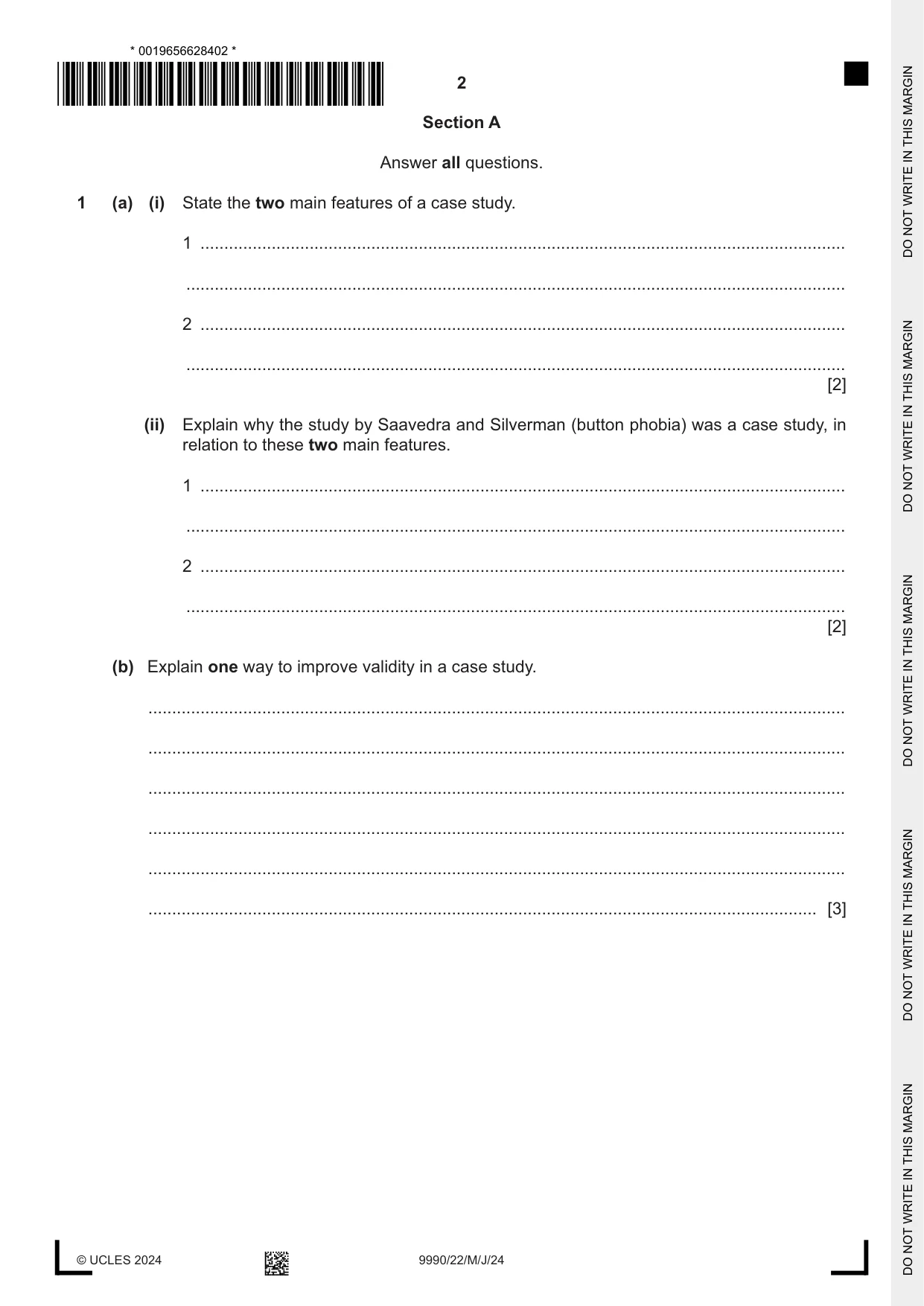
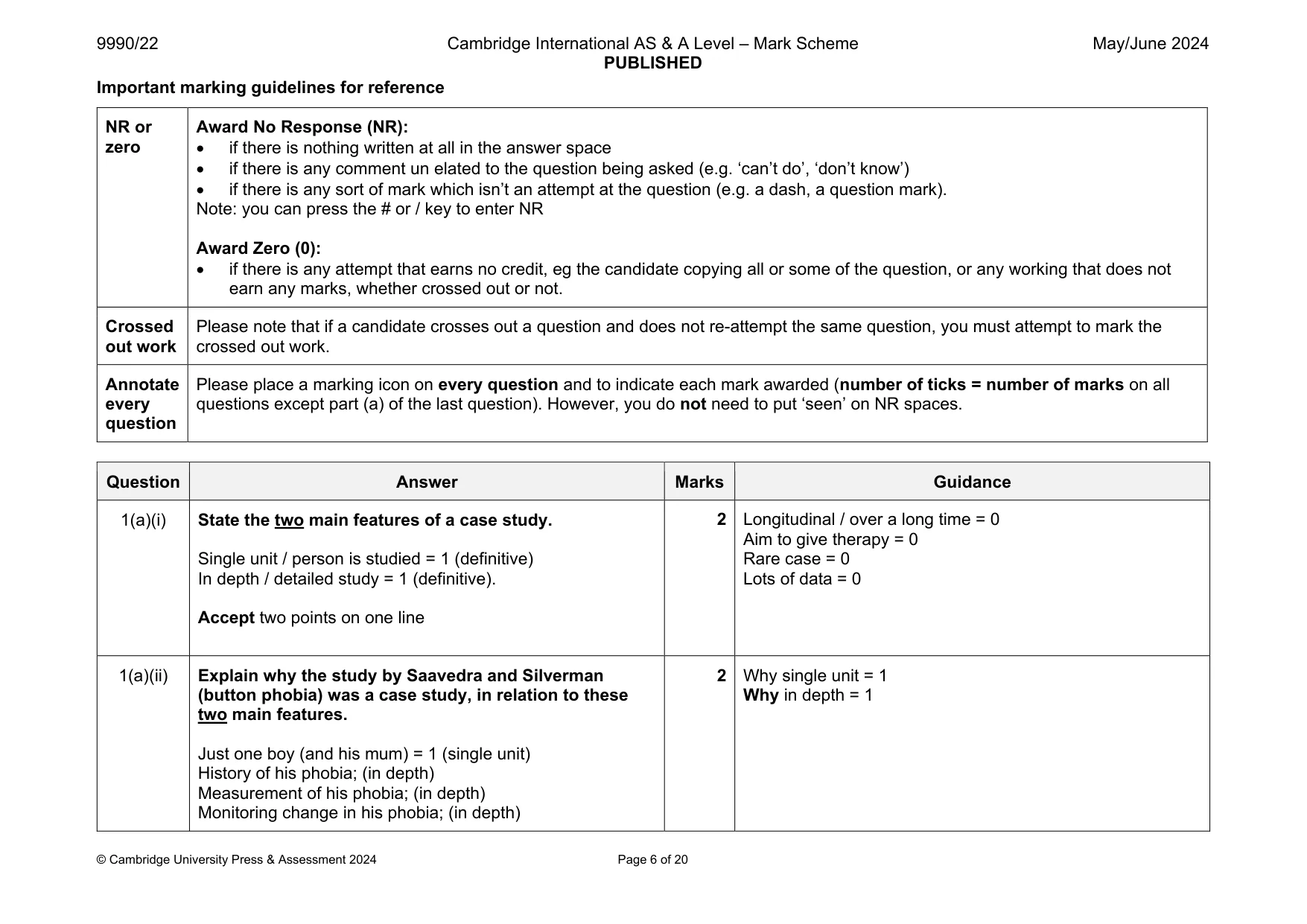
1 (a) (i) State the two main features of a case study. 1 ........................................................................................................................................ ........................................................................................................................................... 2 ........................................................................................................................................ ........................................................................................................................................... [2] (ii) Explain why the study by Saavedra and Silverman (button phobia) was a case study, in relation to these two main features. 1 ........................................................................................................................................ ........................................................................................................................................... 2 ........................................................................................................................................ ........................................................................................................................................... [2] (b) Explain one way to improve validity in a case study. ................................................................................................................................................... ................................................................................................................................................... ................................................................................................................................................... ................................................................................................................................................... ................................................................................................................................................... ............................................................................................................................................. [3]
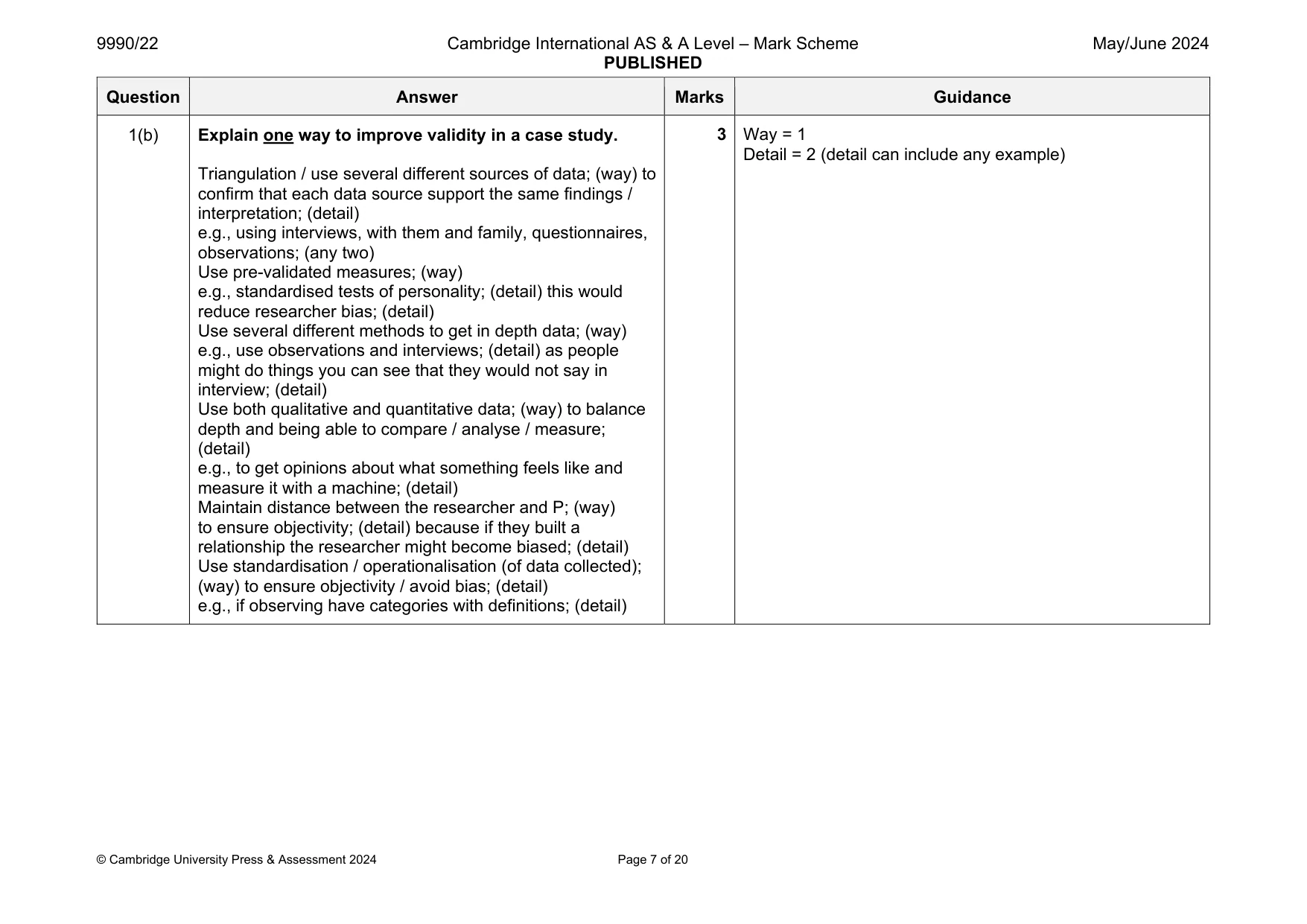
Mark scheme: 1(a)(i) State the two main features of a case study. Single unit / person is studied = 1 (definitive) In depth / detailed study = 1 (definitive). Accept two points on one line Aim to give therapy = 0 Rare case = 0 Lots of data = 0 1(a)(ii) Explain why the study by Saavedra and Silverman (button phobia) was a case study, in relation to these two main features. Just one boy (and his mum) = 1 (single unit) History of his phobia; (in depth) Measurement of his phobia; (in depth) Monitoring change in his phobia; (in depth) 2 Why single unit = 1 Why in depth = 1 Question Answer Marks Guidance 1(b) Explain one way to improve validity in a case study. Triangulation / use several different sources of data; (way) to confirm that each data source support the same findings / interpretation; (detail) e.g., using interviews, with them and family, questionnaires, observations; (any two) Use pre-validated measures; (way) e.g., standardised tests of personality; (detail) this would reduce researcher bias; (detail) Use several different methods to get in depth data; (way) e.g., use observations and interviews; (detail) as people might do things you can see that they would not say in interview; (detail) Use both qualitative and quantitative data; (way) to balance depth and being able to compare / analyse / measure; (detail) e.g., to get opinions about what something feels like and measure it with a machine; (detail) Maintain distance between the researcher and P; (way) to ensure objectivity; (detail) because if they built a relationship the researcher might become biased; (detail) Use standardisation / operationalisation (of data collected); (way) to ensure objectivity / avoid bias; (detail) e.g., if observing have categories with definitions; (detail) 3 Way = 1 Detail = 2 (detail can include any example)
Q2 · Kanav wanted to recruit participants from his town for his study
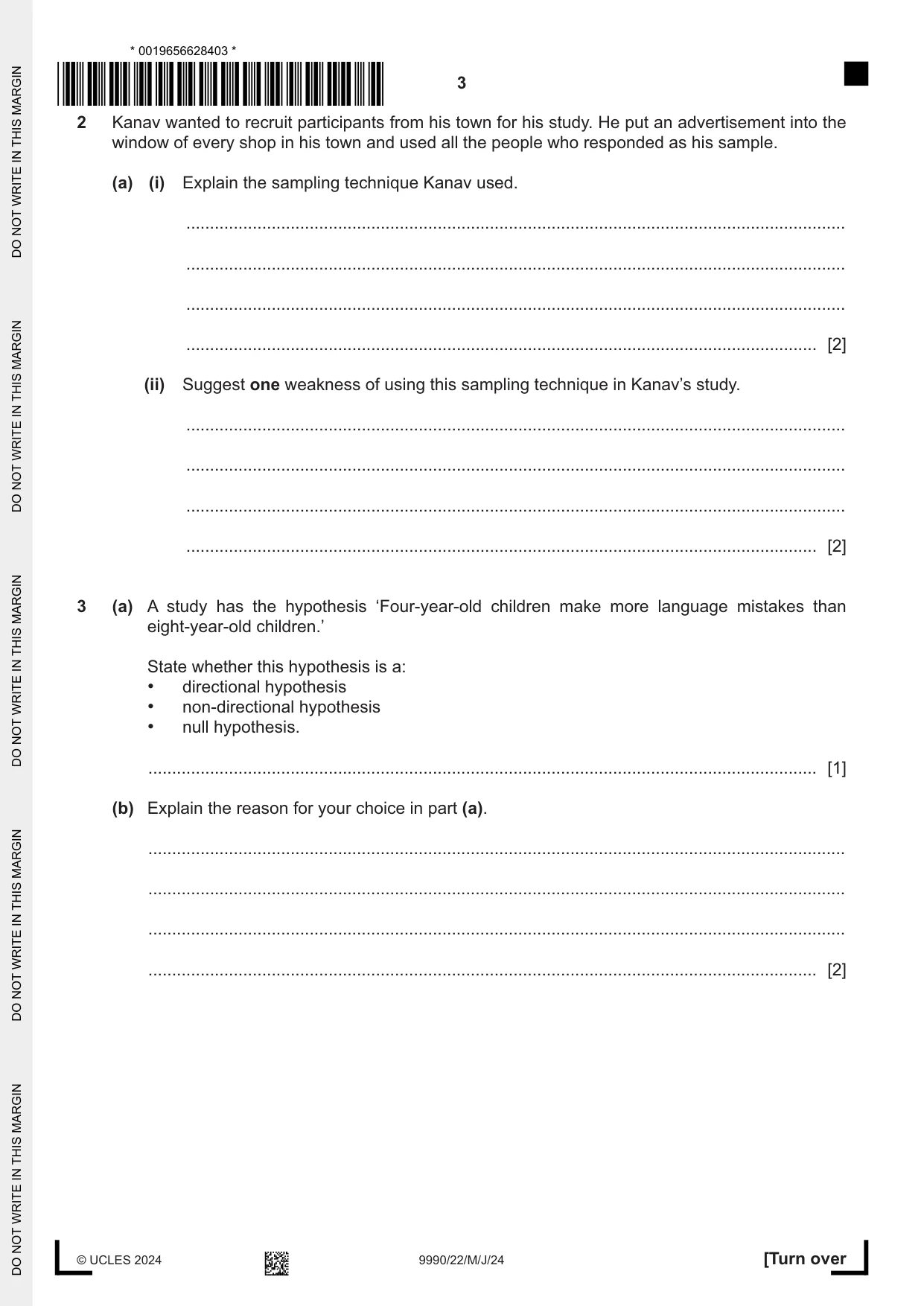
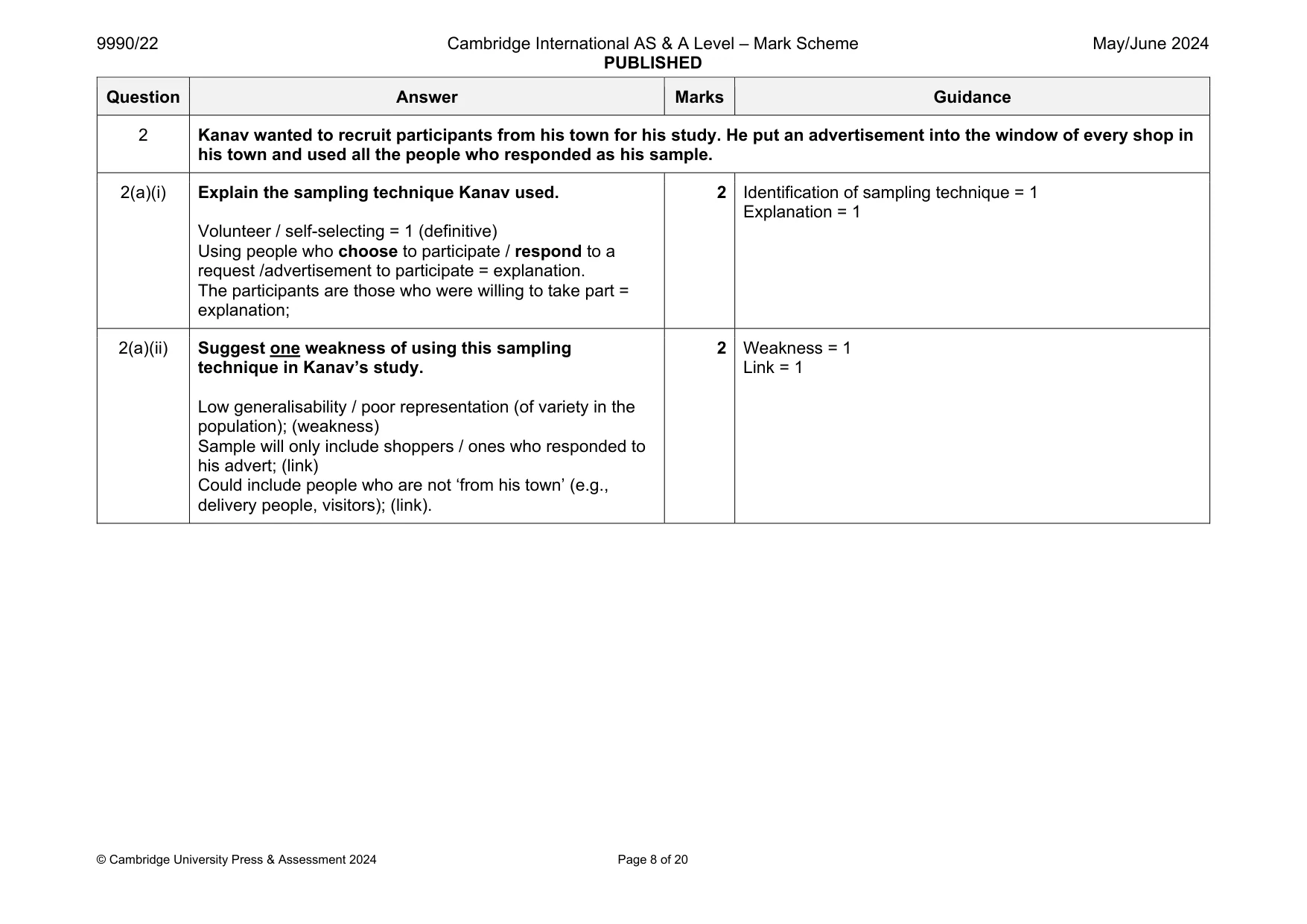
2 Kanav wanted to recruit participants from his town for his study. He put an advertisement into the window of every shop in his town and used all the people who responded as his sample. (a) (i) Explain the sampling technique Kanav used. ........................................................................................................................................... ........................................................................................................................................... ........................................................................................................................................... ..................................................................................................................................... [2] (ii) Suggest one weakness of using this sampling technique in Kanav’s study. ........................................................................................................................................... ........................................................................................................................................... ........................................................................................................................................... ..................................................................................................................................... [2]
Mark scheme: 2(a)(i) Explain the sampling technique Kanav used. Volunteer / self-selecting = 1 (definitive) Using people who choose to participate / respond to a request /advertisement to participate = explanation. The participants are those who were willing to take part = explanation; Explanation = 1 2(a)(ii) Suggest one weakness of using this sampling technique in Kanav’s study. Low generalisability / poor representation (of variety in the population); (weakness) Sample will only include shoppers / ones who responded to his advert; (link) Could include people who are not ‘from his town’ (e.g., delivery people, visitors); (link). 2 Weakness = 1 Link = 1
Q3 · A study has the hypothesis ‘Four-year-old children make more language mistakes than…
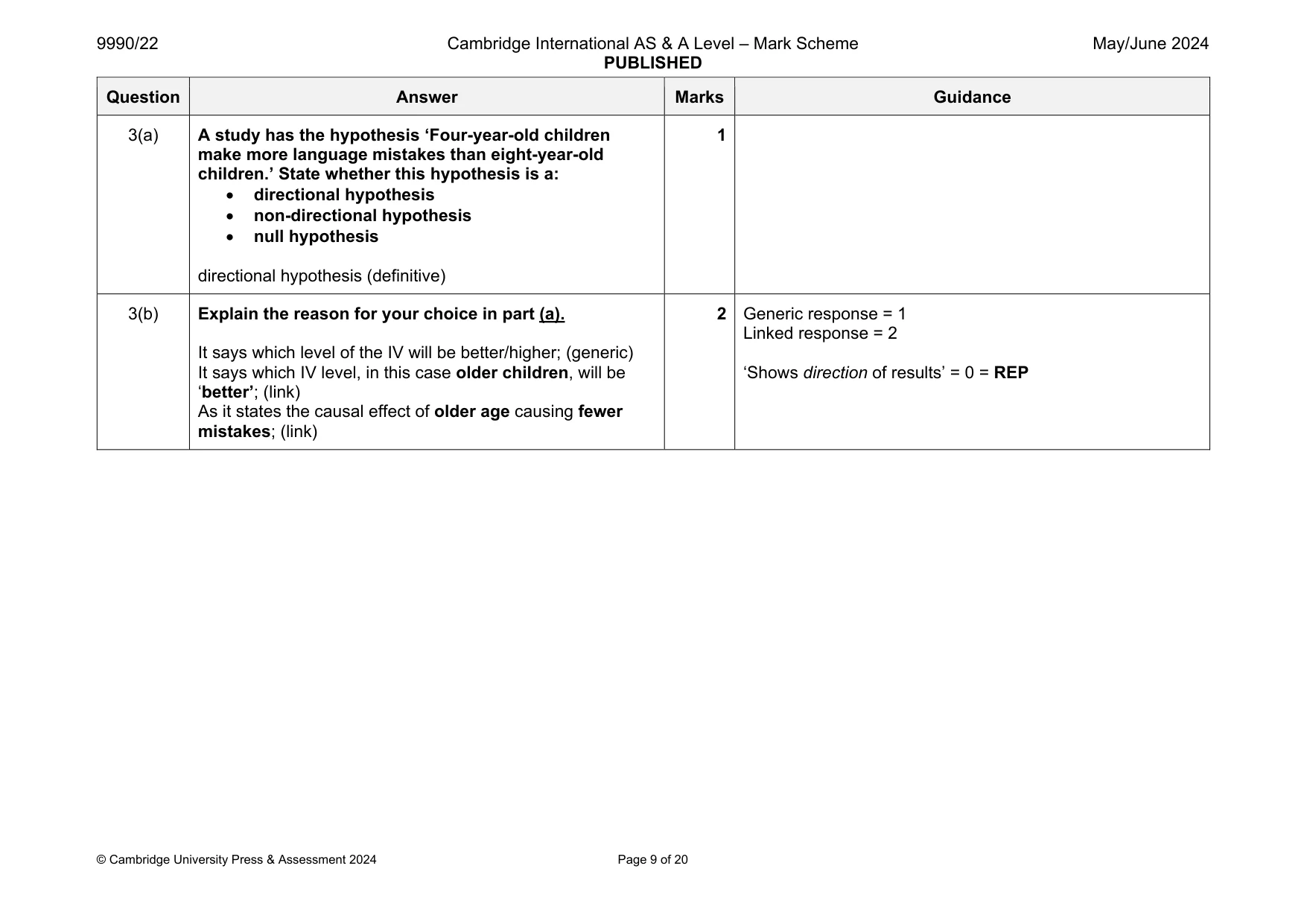
3 (a) A study has the hypothesis ‘Four-year-old children make more language mistakes than eight-year-old children.’ State whether this hypothesis is a: • directional hypothesis • non-directional hypothesis • null hypothesis. ............................................................................................................................................. [1] (b) Explain the reason for your choice in part (a). ................................................................................................................................................... ................................................................................................................................................... ................................................................................................................................................... ............................................................................................................................................. [2]
Mark scheme: 3(a) A study has the hypothesis ‘Four-year-old children make more language mistakes than eight-year-old children.’ State whether this hypothesis is a: directional hypothesis non-directional hypothesis null hypothesis directional hypothesis (definitive) 1 3(b) Explain the reason for your choice in part (a). It says which level of the IV will be better/higher; (generic) It says which IV level, in this case older children, will be ‘better’; (link) As it states the causal effect of older age causing fewer mistakes; (link) 2 Generic response = 1 Linked response = 2 ‘Shows direction of results’ = 0 = REP
Q4 · The study by Hassett et al
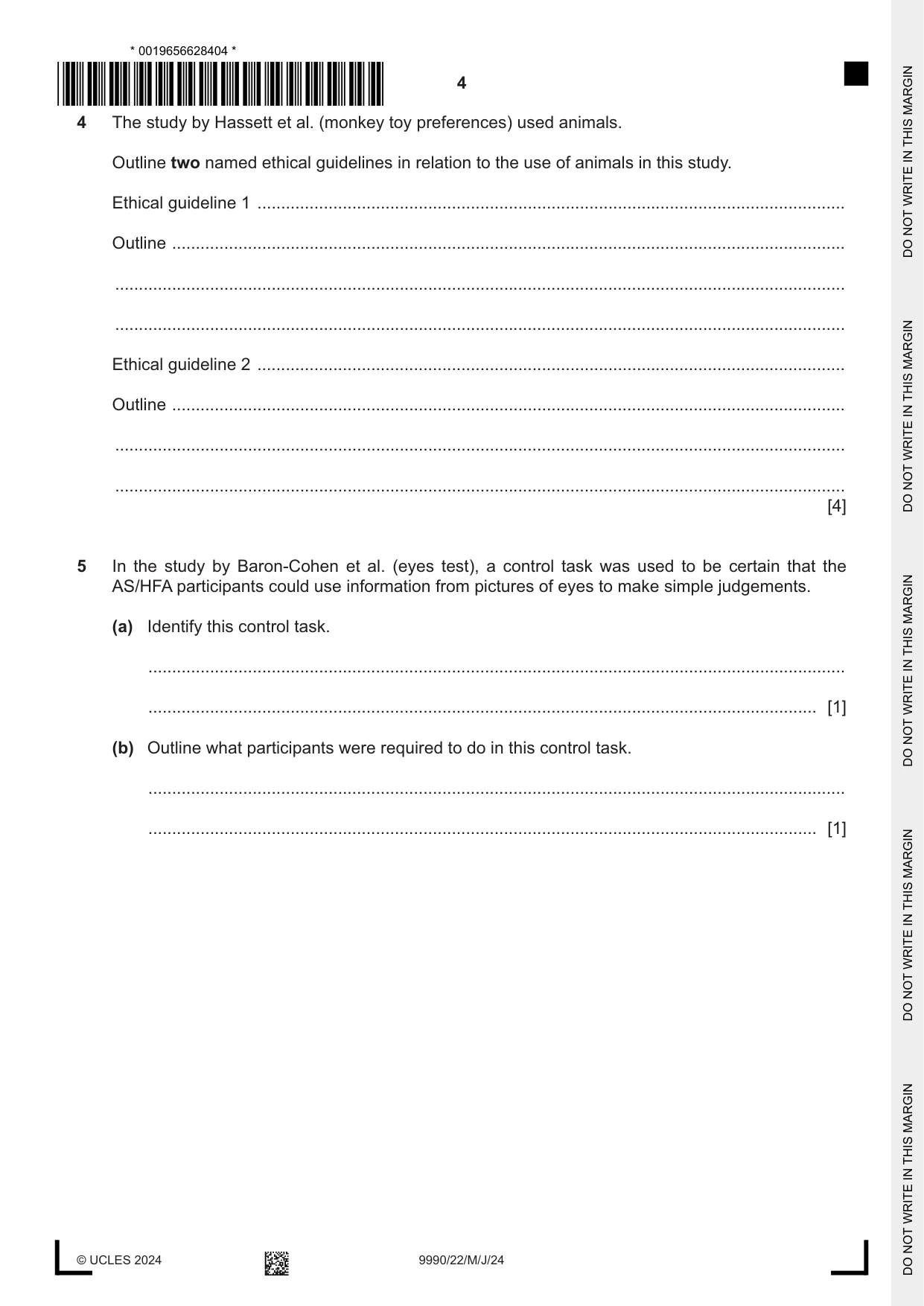
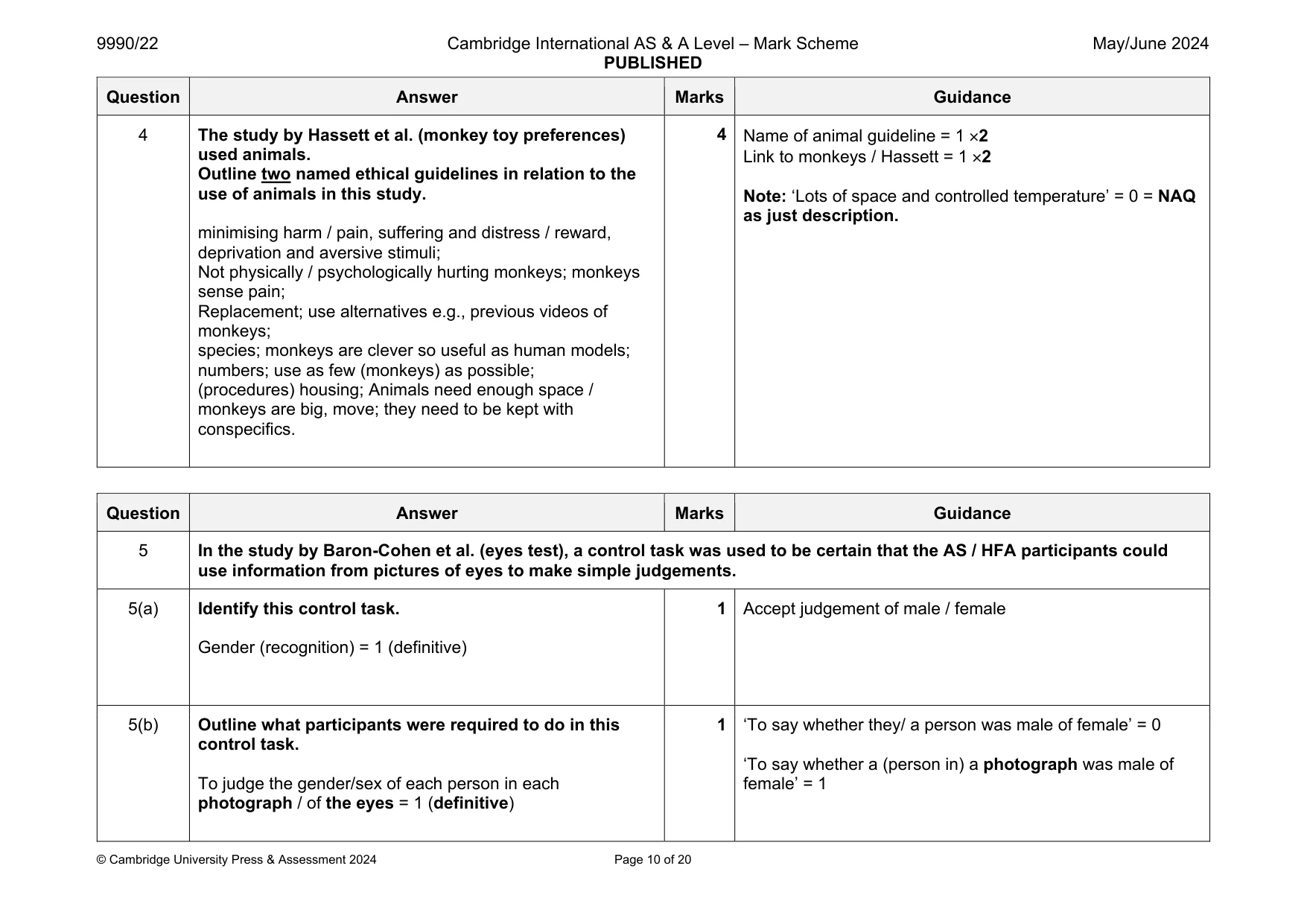
4 The study by Hassett et al. (monkey toy preferences) used animals. Outline two named ethical guidelines in relation to the use of animals in this study. Ethical guideline 1 ............................................................................................................................ Outline .............................................................................................................................................. .......................................................................................................................................................... .......................................................................................................................................................... Ethical guideline 2 ............................................................................................................................ Outline .............................................................................................................................................. .......................................................................................................................................................... .......................................................................................................................................................... [4]
Mark scheme: 4 The study by Hassett et al. (monkey toy preferences) used animals. Outline two named ethical guidelines in relation to the use of animals in this study. minimising harm / pain, suffering and distress / reward, deprivation and aversive stimuli; Not physically / psychologically hurting monkeys; monkeys sense pain; Replacement; use alternatives e.g., previous videos of monkeys; species; monkeys are clever so useful as human models; numbers; use as few (monkeys) as possible; (procedures) housing; Animals need enough space / monkeys are big, move; they need to be kept with conspecifics. Link to monkeys / Hassett = 1 2 Note: ‘Lots of space and controlled temperature’ = 0 = NAQ as just description.
Q5 · In the study by Baron-Cohen et al
5 In the study by Baron-Cohen et al. (eyes test), a control task was used to be certain that the AS/HFA participants could use information from pictures of eyes to make simple judgements. (a) Identify this control task. ................................................................................................................................................... ............................................................................................................................................. [1] (b) Outline what participants were required to do in this control task. ................................................................................................................................................... ............................................................................................................................................. [1]
Mark scheme: 5(a) Identify this control task. Gender (recognition) = 1 (definitive) 5(b) Outline what participants were required to do in this control task. To judge the gender/sex of each person in each photograph / of the eyes = 1 (definitive) 1 ‘To say whether they/ a person was male of female’ = 0 ‘To say whether a (person in) a photograph was male of female’ = 1
Q6 · Describe how variables in correlations can be measured, using any example(s)
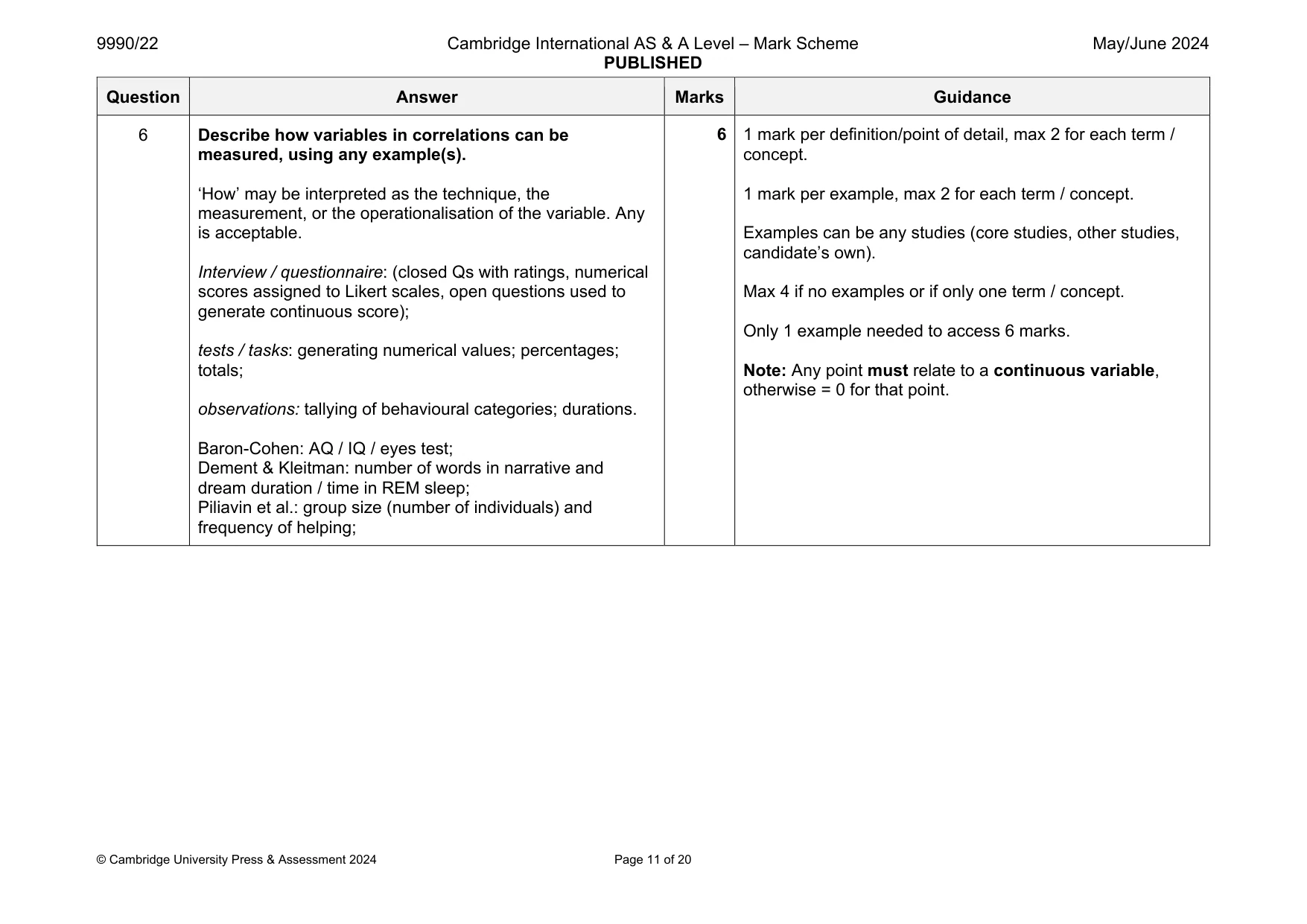
6 Describe how variables in correlations can be measured, using any example(s). .......................................................................................................................................................... .......................................................................................................................................................... .......................................................................................................................................................... .......................................................................................................................................................... .......................................................................................................................................................... .......................................................................................................................................................... .......................................................................................................................................................... .......................................................................................................................................................... .......................................................................................................................................................... .......................................................................................................................................................... .......................................................................................................................................................... .................................................................................................................................................... [6]
Mark scheme: 6 Describe how variables in correlations can be measured, using any example(s). ‘How’ may be interpreted as the technique, the measurement, or the operationalisation of the variable. Any is acceptable. Interview / questionnaire: (closed Qs with ratings, numerical scores assigned to Likert scales, open questions used to generate continuous score); tests / tasks: generating numerical values; percentages; totals; observations: tallying of behavioural categories; durations. Baron-Cohen: AQ / IQ / eyes test; Dement & Kleitman: number of words in narrative and dream duration / time in REM sleep; Piliavin et al.: group size (number of individuals) and frequency of helping; concept. 1 mark per example, max 2 for each term / concept. Examples can be any studies (core studies, other studies, candidate’s own). Max 4 if no examples or if only one term / concept. Only 1 example needed to access 6 marks. Note: Any point must relate to a continuous variable, otherwise = 0 for that point.
Q7 · Chyou is conducting a self-report about students’ subject choices
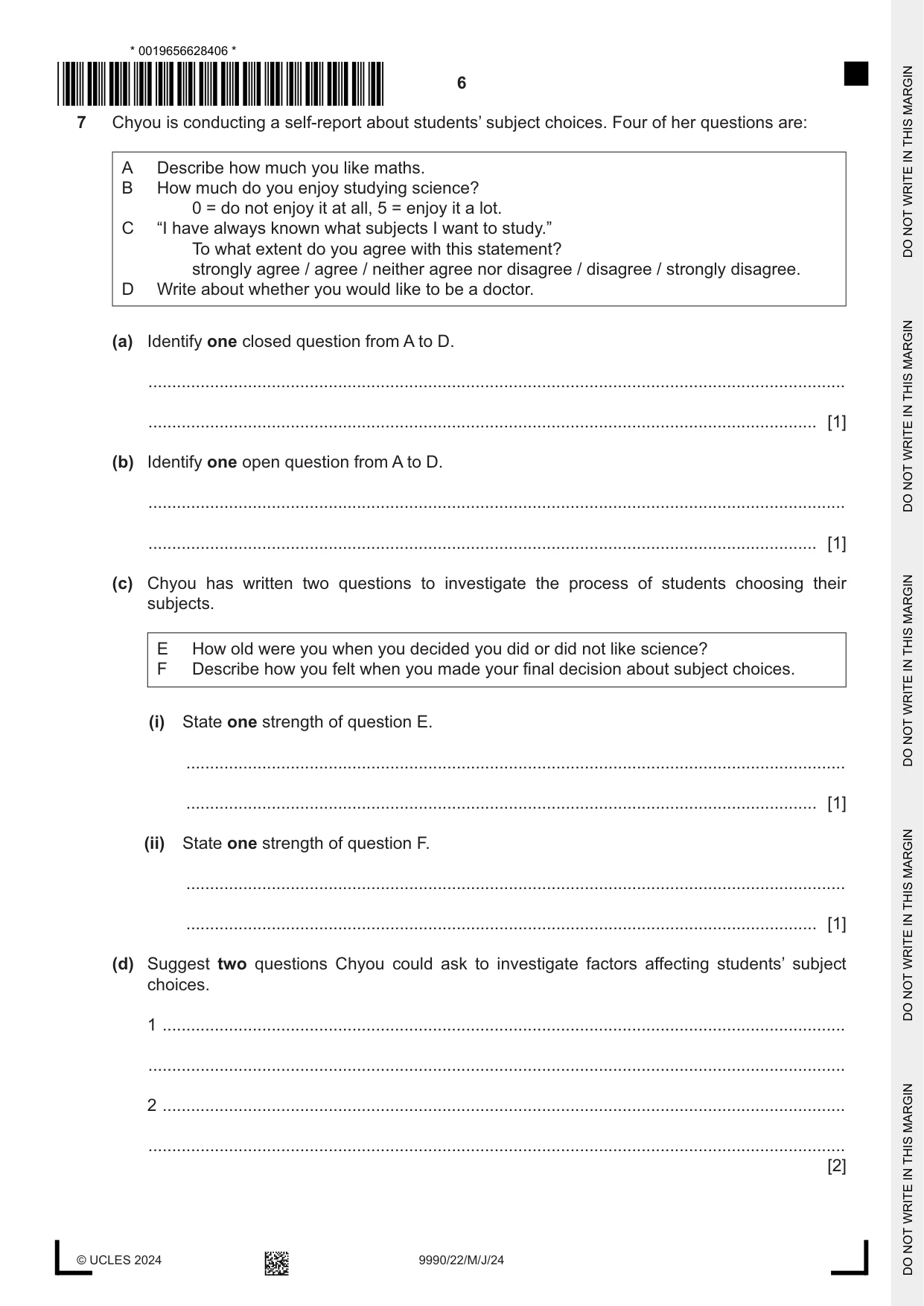
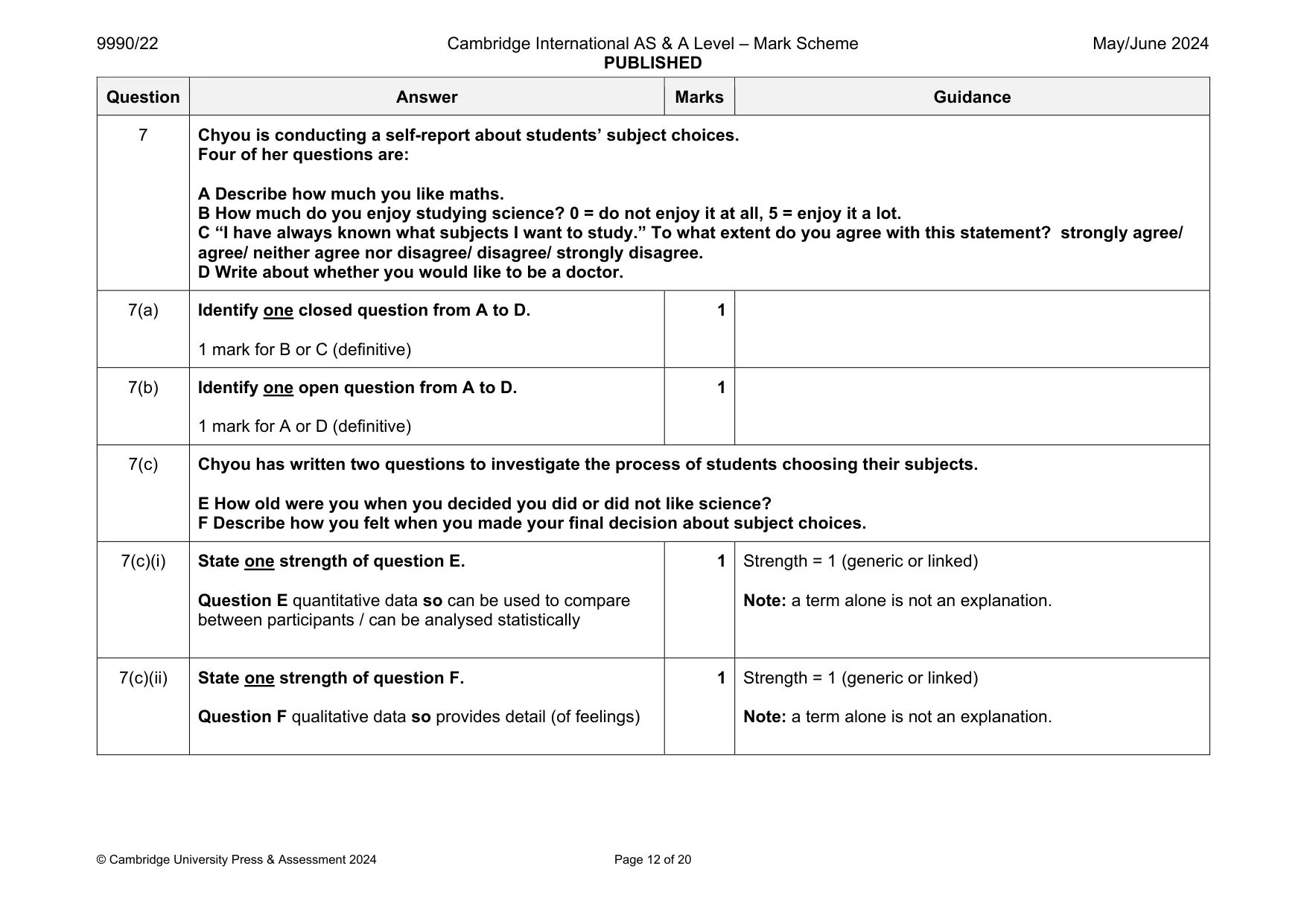
7 Chyou is conducting a self-report about students’ subject choices. Four of her questions are: A Describe how much you like maths. B How much do you enjoy studying science? 0 = do not enjoy it at all, 5 = enjoy it a lot. C “I have always known what subjects I want to study.” To what extent do you agree with this statement? strongly agree / agree / neither agree nor disagree / disagree / strongly disagree. D Write about whether you would like to be a doctor. (a) Identify one closed question from A to D. ................................................................................................................................................... ............................................................................................................................................. [1] (b) Identify one open question from A to D. ................................................................................................................................................... ............................................................................................................................................. [1] (c) Chyou has written two questions to investigate the process of students choosing their subjects. E How old were you when you decided you did or did not like science? F Describe how you felt when you made your final decision about subject choices. (i) State one strength of question E. ........................................................................................................................................... ..................................................................................................................................... [1] (ii) State one strength of question F. ........................................................................................................................................... ..................................................................................................................................... [1] (d) Suggest two questions Chyou could ask to investigate factors affecting students’ subject choices. 1 ................................................................................................................................................ ................................................................................................................................................... 2 ................................................................................................................................................ ................................................................................................................................................... [2]
Mark scheme: 7(a) Identify one closed question from A to D. 1 mark for B or C (definitive) 1 7(b) Identify one open question from A to D. 1 mark for A or D (definitive) 1 7(c) Chyou has written two questions to investigate the process of students choosing their subjects. E How old were you when you decided you did or did not like science? F Describe how you felt when you made your final decision about subject choices. 7(c)(i) State one strength of question E. Question E quantitative data so can be used to compare between participants / can be analysed statistically 1 Strength = 1 (generic or linked) Note: a term alone is not an explanation. 7(c)(ii) State one strength of question F. Question F qualitative data so provides detail (of feelings) 1 Strength = 1 (generic or linked) Note: a term alone is not an explanation. Question Answer Marks Guidance 7(d) Suggest two questions Chyou could ask to investigate factors affecting students’ subject choices. 1 Explain how members of your family / teacher / hobbies / work experience affected your choice of subjects. 2 Do you think being an only child affected your subject choices? 2 1 mark per question about factor affecting subject choices x2 Questions and be open, closed or one of each. Closed questions must have choices. Open questions must generate genuine qualitative data (Describe, explain, tell me…).
Q8 · Daku is observing the obedience of boys and girls to teachers and older pupils when they…
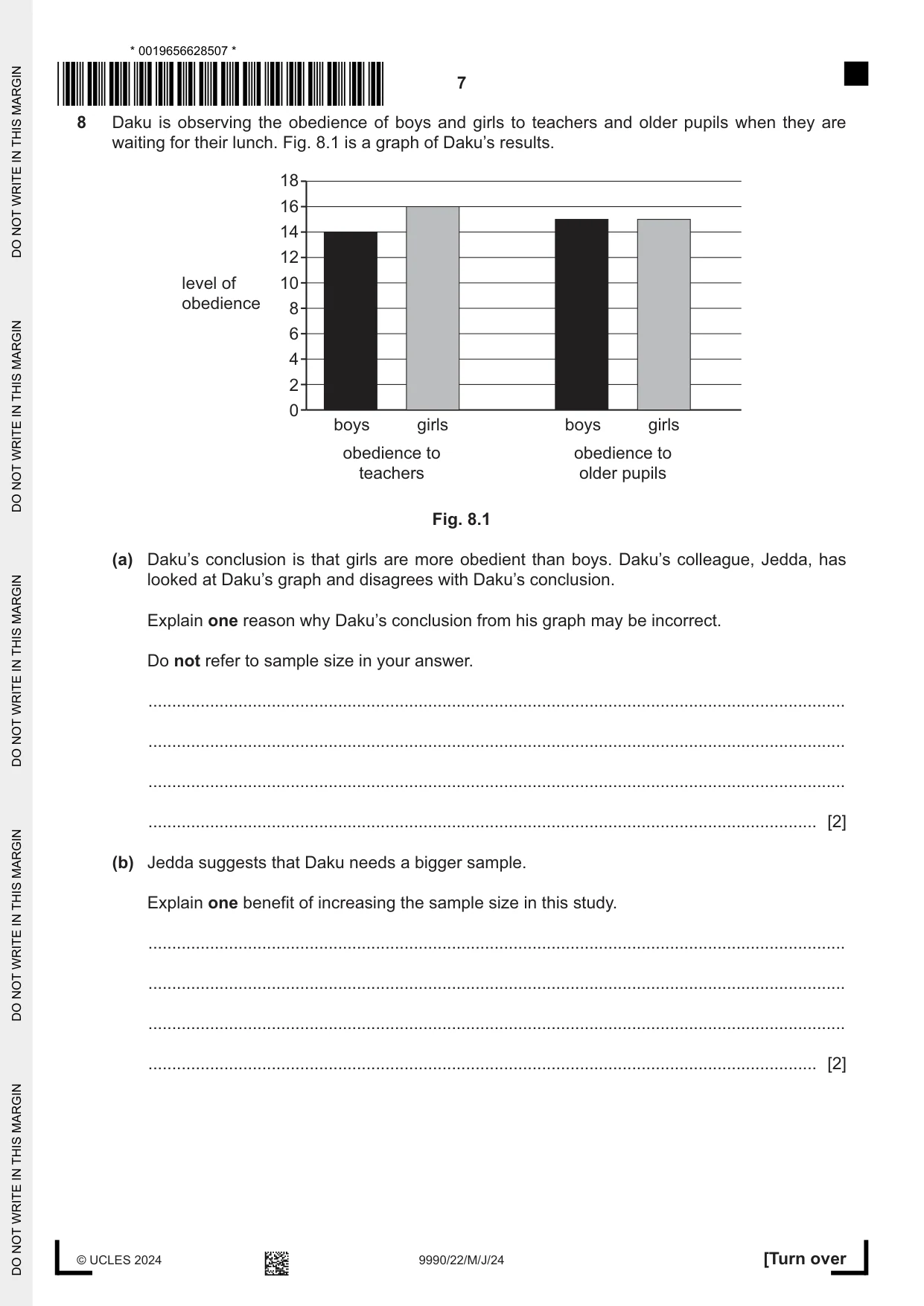
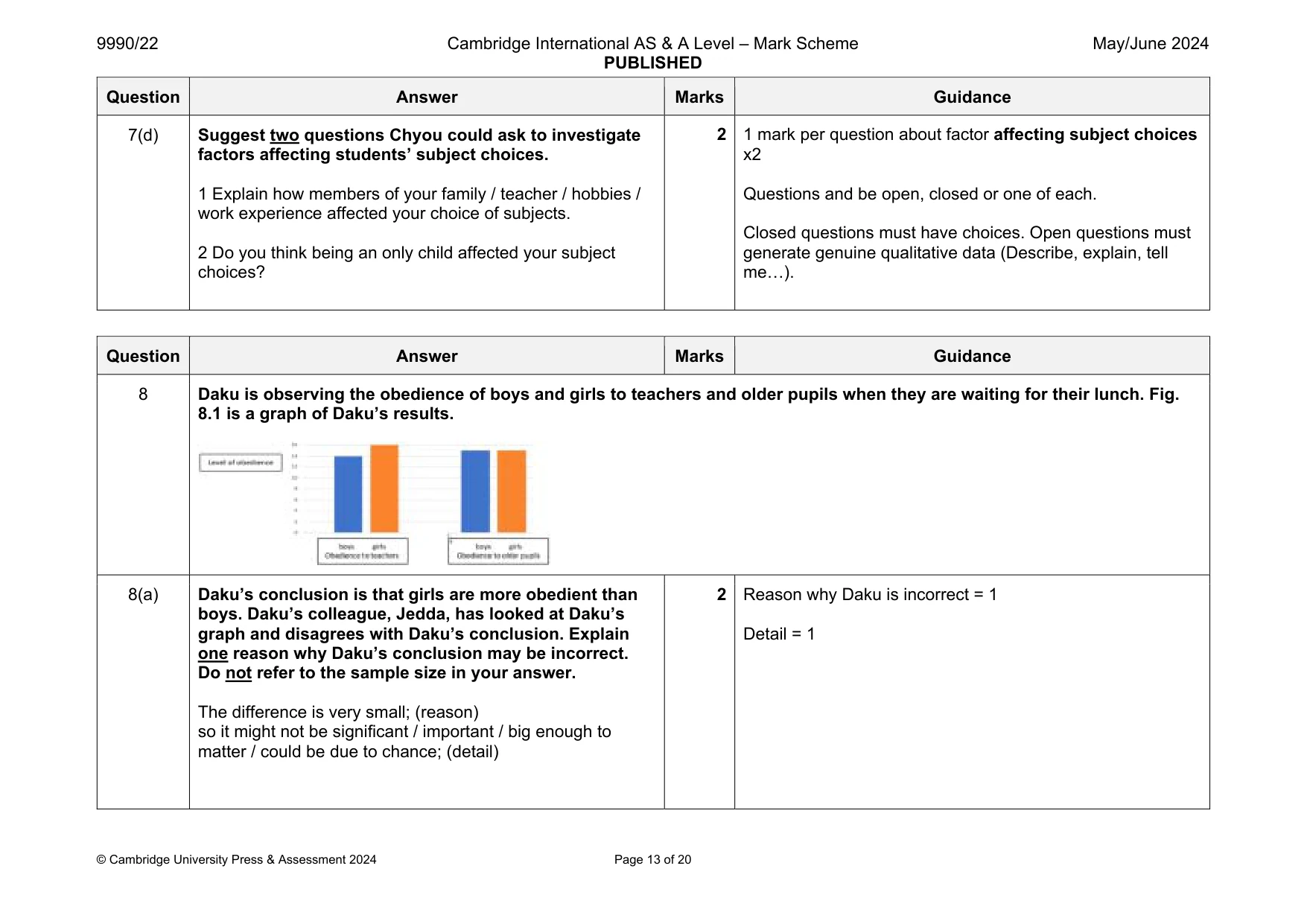
8 Daku is observing the obedience of boys and girls to teachers and older pupils when they are waiting for their lunch. Fig. 8.1 is a graph of Daku’s results. 18 16 14 12 level of 10 obedience 8 6 4 2 0 boys girls boys girls obedience to obedience to teachers older pupils Fig. 8.1 (a) Daku’s conclusion is that girls are more obedient than boys. Daku’s colleague, Jedda, has looked at Daku’s graph and disagrees with Daku’s conclusion. Explain one reason why Daku’s conclusion from his graph may be incorrect. Do not refer to sample size in your answer. ................................................................................................................................................... ................................................................................................................................................... ................................................................................................................................................... ............................................................................................................................................. [2] (b) Jedda suggests that Daku needs a bigger sample. Explain one benefit of increasing the sample size in this study. ................................................................................................................................................... ................................................................................................................................................... ................................................................................................................................................... ............................................................................................................................................. [2] (c) Daku has identified a problem caused by an uncontrolled variable. The boys had to wait longer for their lunch than the girls. (i) Explain whether this problem is caused by a situational variable or a participant variable. ........................................................................................................................................... ..................................................................................................................................... [1] (ii) Explain how this problem would have affected Daku’s results. ........................................................................................................................................... ..................................................................................................................................... [1]
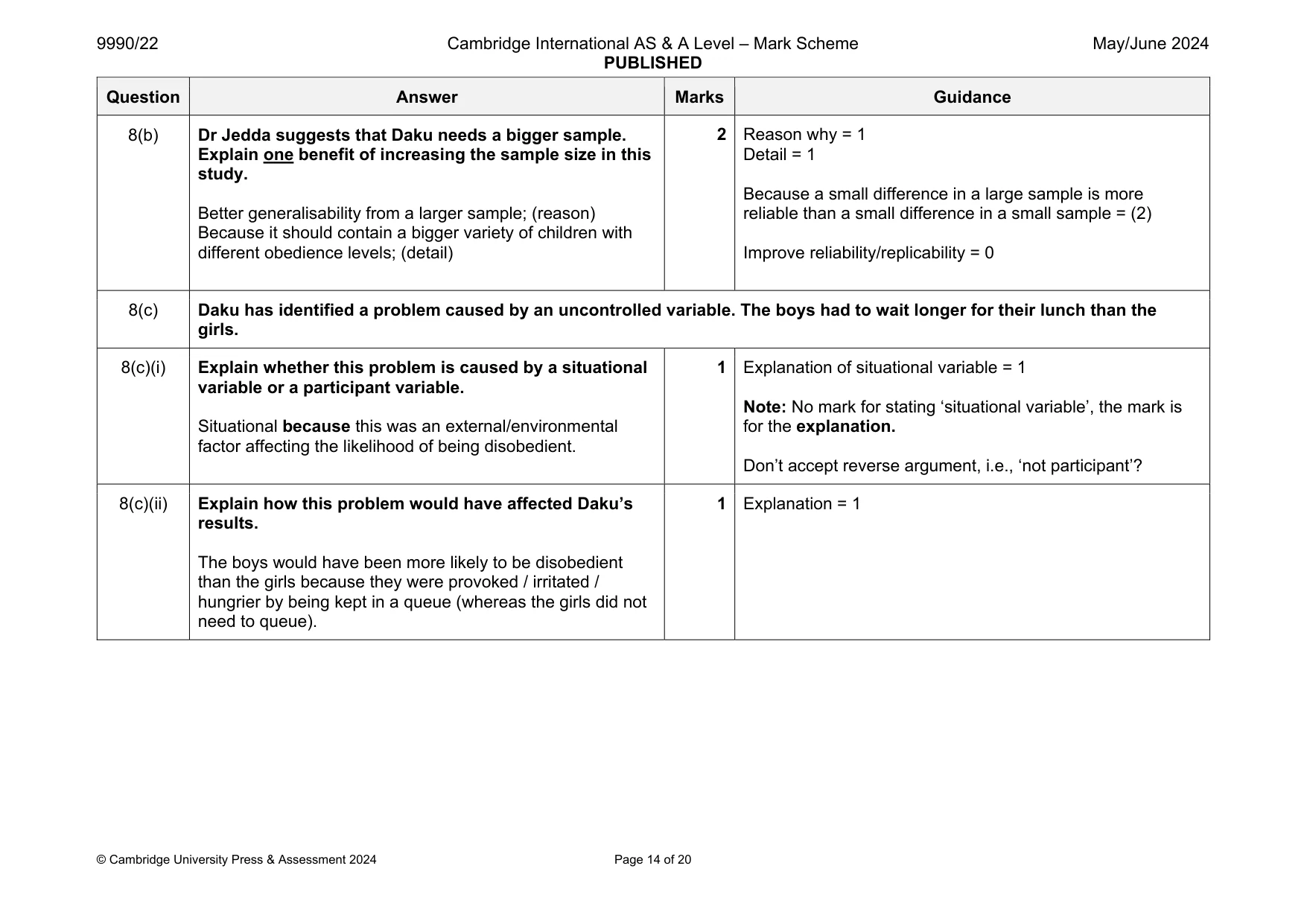
Mark scheme: 8(a) Daku’s conclusion is that girls are more obedient than boys. Daku’s colleague, Jedda, has looked at Daku’s graph and disagrees with Daku’s conclusion. Explain one reason why Daku’s conclusion may be incorrect. Do not refer to the sample size in your answer. The difference is very small; (reason) so it might not be significant / important / big enough to matter / could be due to chance; (detail) Detail = 1 Question Answer Marks Guidance 8(b) Dr Jedda suggests that Daku needs a bigger sample. Explain one benefit of increasing the sample size in this study. Better generalisability from a larger sample; (reason) Because it should contain a bigger variety of children with different obedience levels; (detail) 2 Reason why = 1 Detail = 1 Because a small difference in a large sample is more reliable than a small difference in a small sample = (2) Improve reliability/replicability = 0 8(c) Daku has identified a problem caused by an uncontrolled variable. The boys had to wait longer for their lunch than the girls. 8(c)(i) Explain whether this problem is caused by a situational variable or a participant variable. Situational because this was an external/environmental factor affecting the likelihood of being disobedient. 1 Explanation of situational variable = 1 Note: No mark for stating ‘situational variable’, the mark is for the explanation. Don’t accept reverse argument, i.e., ‘not participant’? 8(c)(ii) Explain how this problem would have affected Daku’s results. The boys would have been more likely to be disobedient than the girls because they were provoked / irritated / hungrier by being kept in a queue (whereas the girls did not need to queue). 1 Explanation = 1
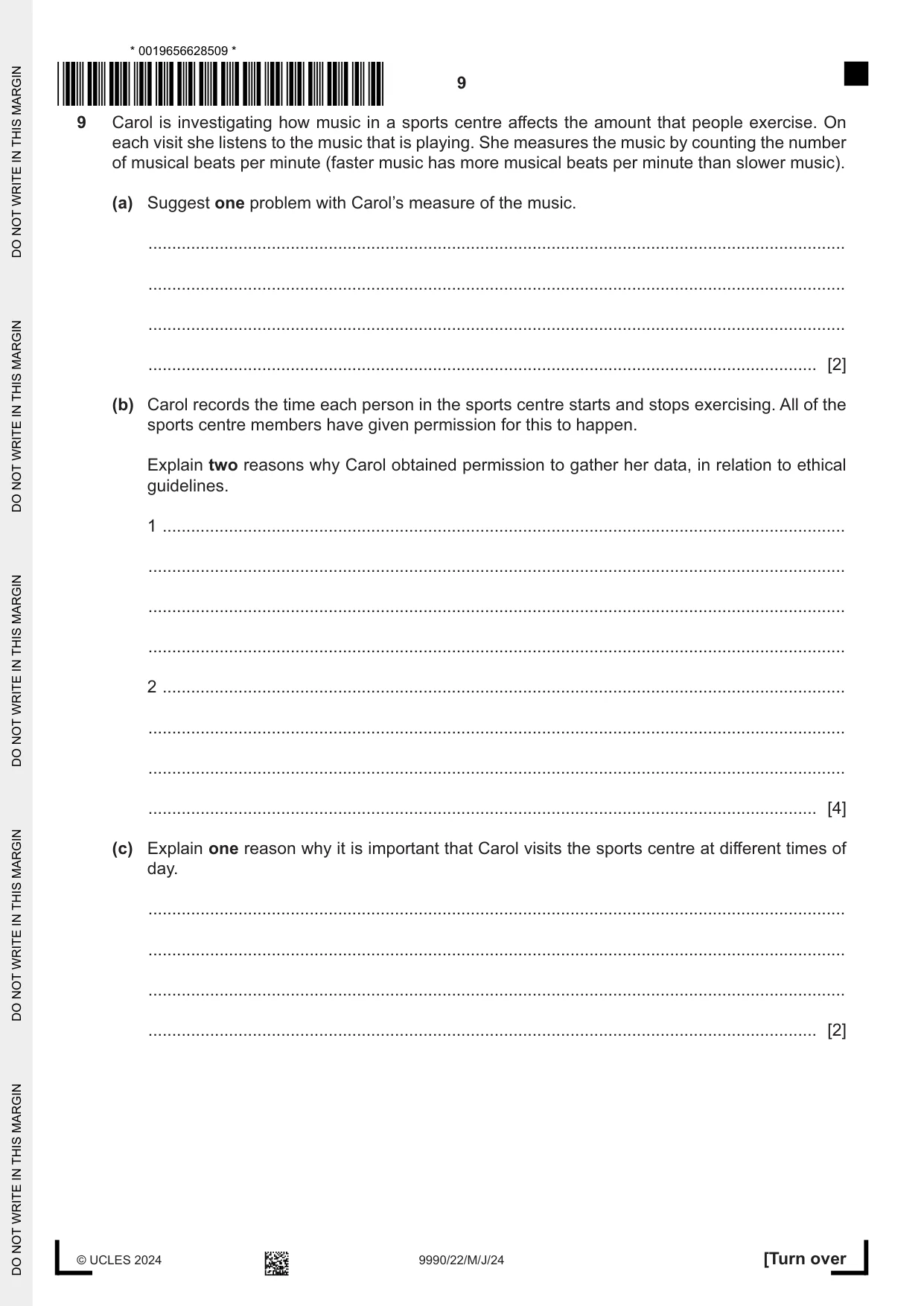
Q9 · Carol is investigating how music in a sports centre affects the amount that people…
9 Carol is investigating how music in a sports centre affects the amount that people exercise. On each visit she listens to the music that is playing. She measures the music by counting the number of musical beats per minute (faster music has more musical beats per minute than slower music). (a) Suggest one problem with Carol’s measure of the music. ................................................................................................................................................... ................................................................................................................................................... ................................................................................................................................................... ............................................................................................................................................. [2] (b) Carol records the time each person in the sports centre starts and stops exercising. All of the sports centre members have given permission for this to happen. Explain two reasons why Carol obtained permission to gather her data, in relation to ethical guidelines. 1 ................................................................................................................................................ ................................................................................................................................................... ................................................................................................................................................... ................................................................................................................................................... 2 ................................................................................................................................................ ................................................................................................................................................... ................................................................................................................................................... ............................................................................................................................................. [4] (c) Explain one reason why it is important that Carol visits the sports centre at different times of day. ................................................................................................................................................... ................................................................................................................................................... ................................................................................................................................................... ............................................................................................................................................. [2]
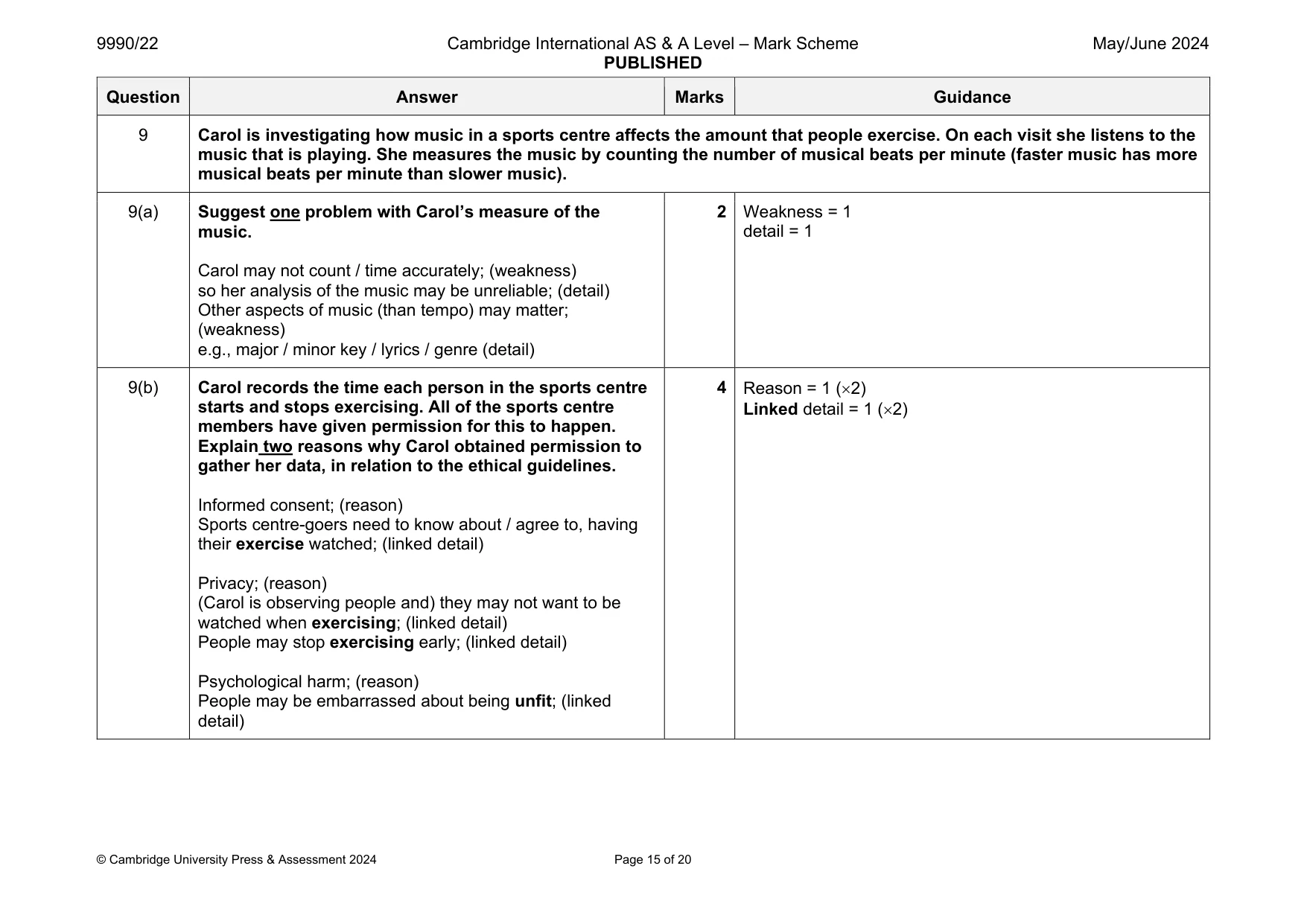
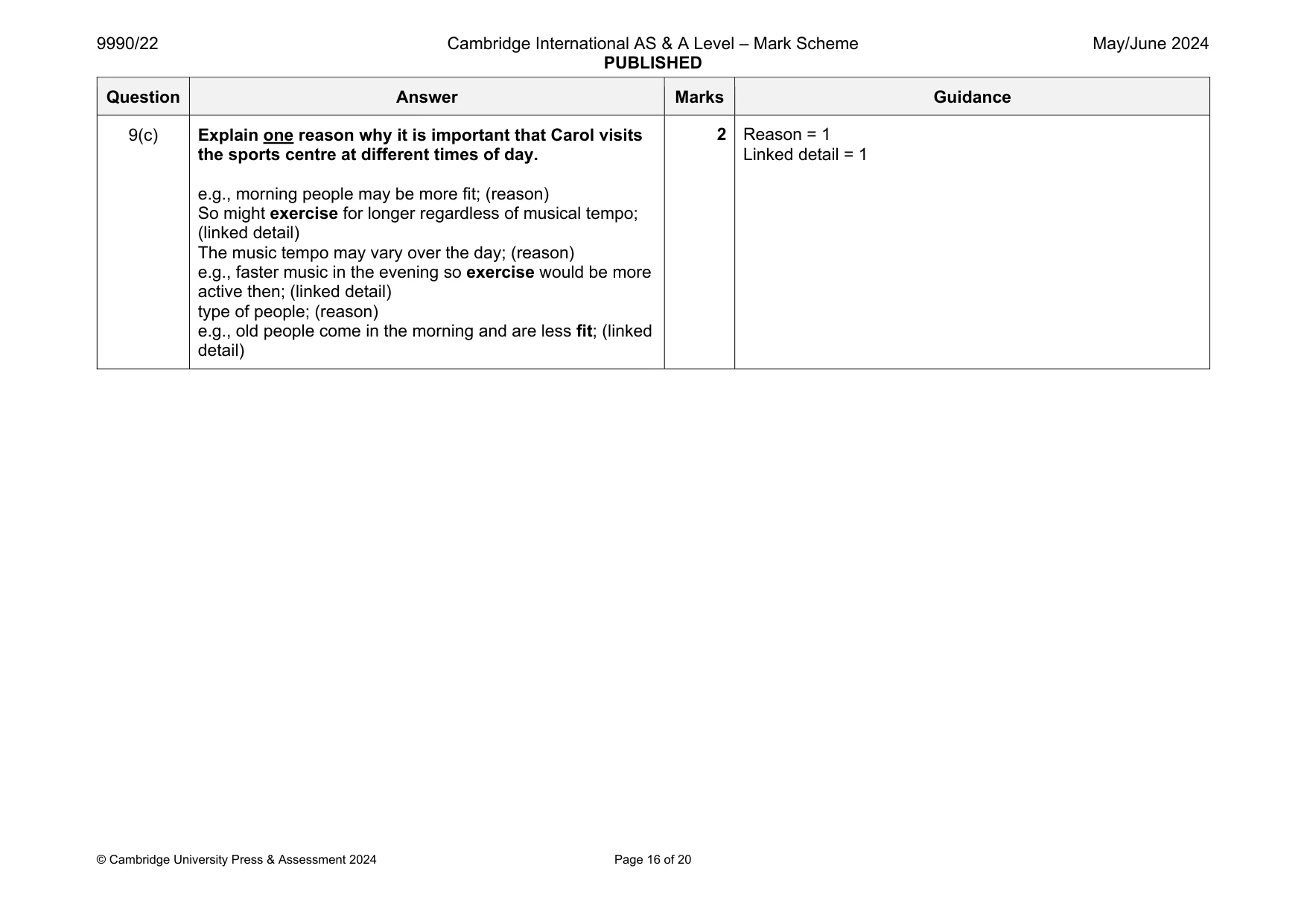
Mark scheme: 9(a) Suggest one problem with Carol’s measure of the music. Carol may not count / time accurately; (weakness) so her analysis of the music may be unreliable; (detail) Other aspects of music (than tempo) may matter; (weakness) e.g., major / minor key / lyrics / genre (detail) 2 Weakness = 1 detail = 1 9(b) Carol records the time each person in the sports centre starts and stops exercising. All of the sports centre members have given permission for this to happen. Explain two reasons why Carol obtained permission to gather her data, in relation to the ethical guidelines. Informed consent; (reason) Sports centre-goers need to know about / agree to, having their exercise watched; (linked detail) Privacy; (reason) (Carol is observing people and) they may not want to be watched when exercising; (linked detail) People may stop exercising early; (linked detail) Psychological harm; (reason) People may be embarrassed about being unfit; (linked detail) 4 Reason = 1 (2) Linked detail = 1 (2) Question Answer Marks Guidance 9(c) Explain one reason why it is important that Carol visits the sports centre at different times of day. e.g., morning people may be more fit; (reason) So might exercise for longer regardless of musical tempo; (linked detail) The music tempo may vary over the day; (reason) e.g., faster music in the evening so exercise would be more active then; (linked detail) type of people; (reason) e.g., old people come in the morning and are less fit; (linked detail) 2 Reason = 1 Linked detail = 1
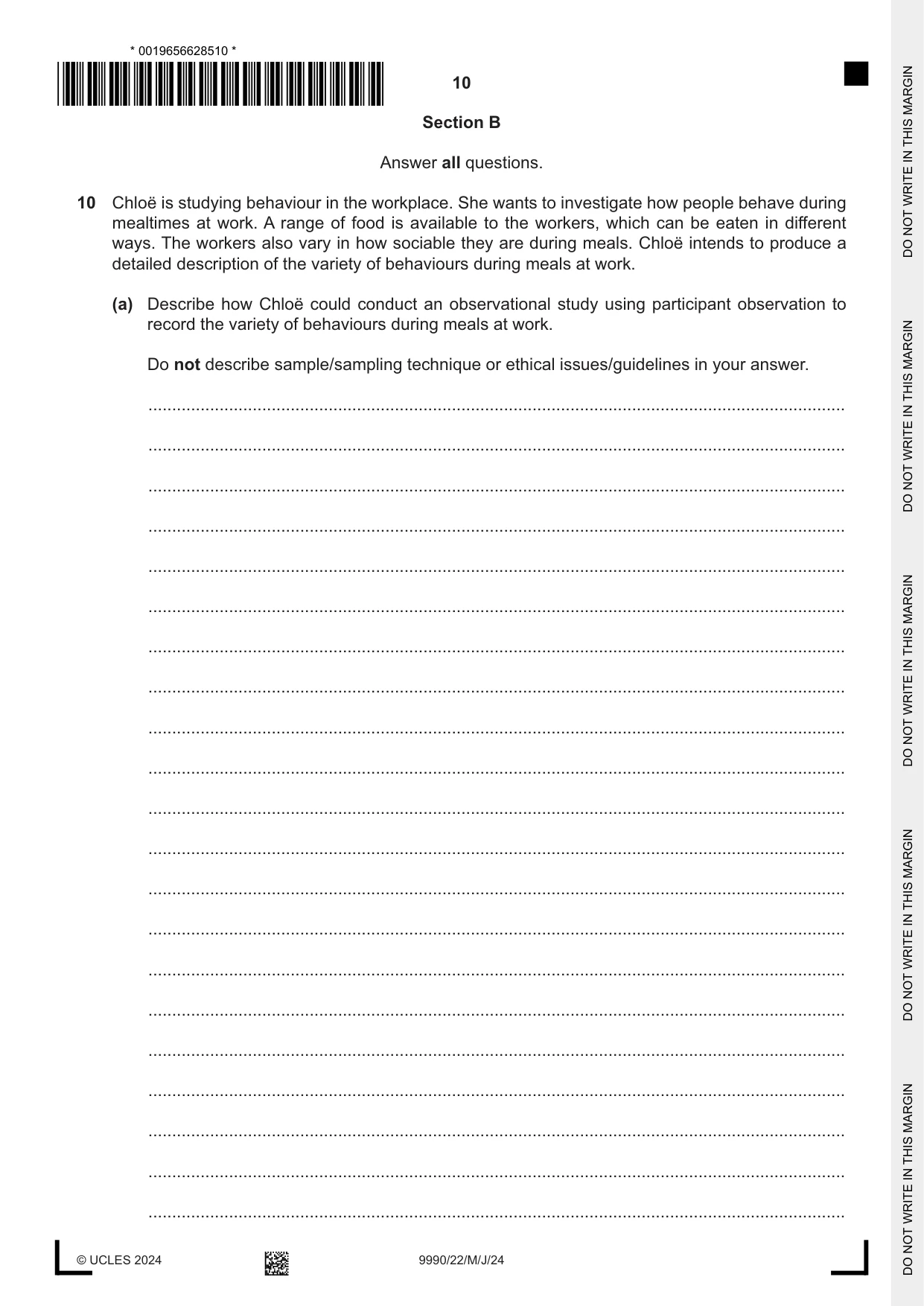
Q10 · Chloë is studying behaviour in the workplace
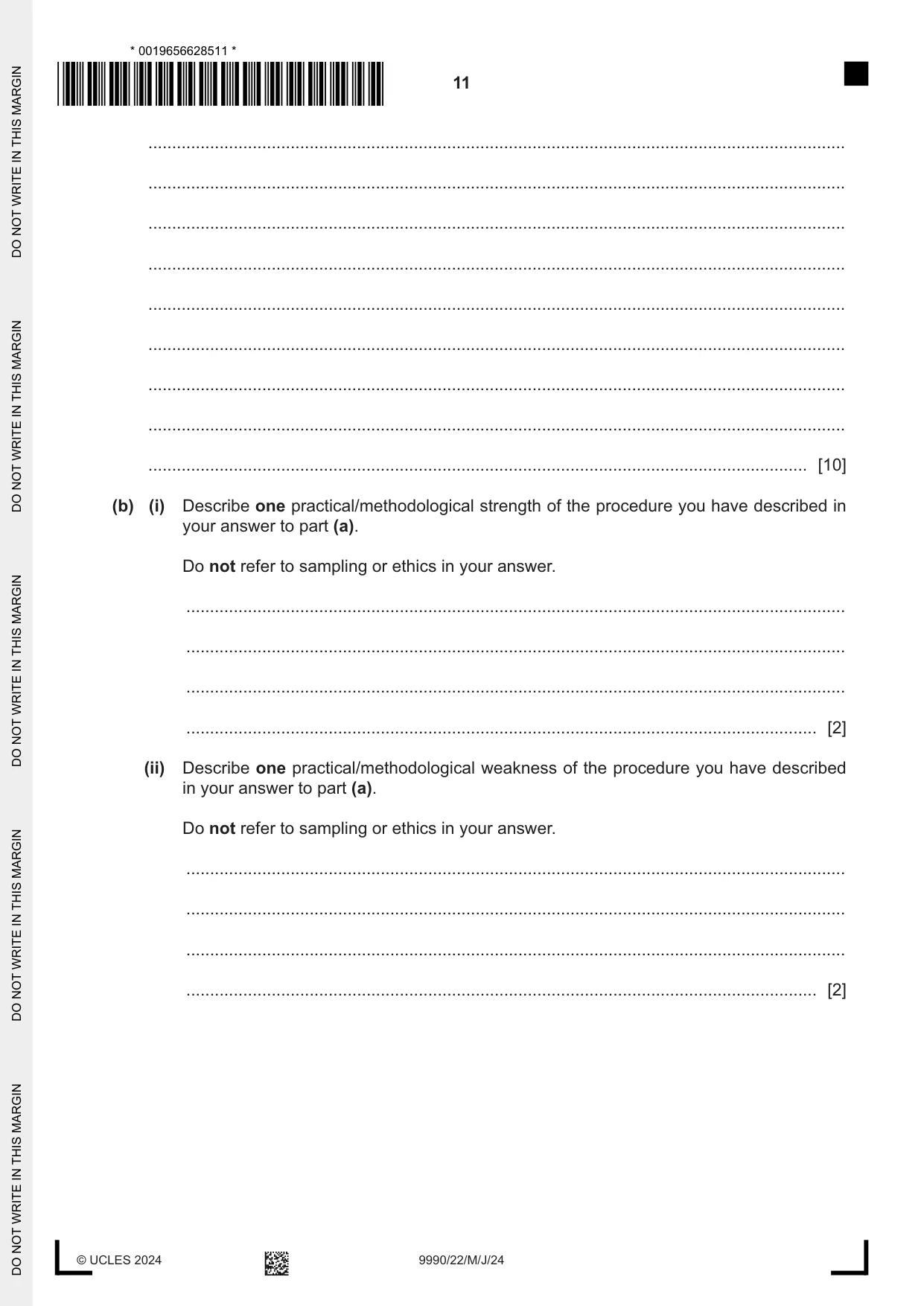
10 Chloë is studying behaviour in the workplace. She wants to investigate how people behave during mealtimes at work. A range of food is available to the workers, which can be eaten in different ways. The workers also vary in how sociable they are during meals. Chloë intends to produce a detailed description of the variety of behaviours during meals at work. (a) Describe how Chloë could conduct an observational study using participant observation to record the variety of behaviours during meals at work. Do not describe sample/sampling technique or ethical issues/guidelines in your answer. ................................................................................................................................................... ................................................................................................................................................... ................................................................................................................................................... ................................................................................................................................................... ................................................................................................................................................... ................................................................................................................................................... ................................................................................................................................................... ................................................................................................................................................... ................................................................................................................................................... ................................................................................................................................................... ................................................................................................................................................... ................................................................................................................................................... ................................................................................................................................................... ................................................................................................................................................... ................................................................................................................................................... ................................................................................................................................................... ................................................................................................................................................... ................................................................................................................................................... ................................................................................................................................................... ................................................................................................................................................... ................................................................................................................................................... ................................................................................................................................................... ................................................................................................................................................... ................................................................................................................................................... ................................................................................................................................................... ................................................................................................................................................... ................................................................................................................................................... ................................................................................................................................................... ................................................................................................................................................... ........................................................................................................................................... [10] (b) (i) Describe one practical/methodological strength of the procedure you have described in your answer to part (a). Do not refer to sampling or ethics in your answer. ........................................................................................................................................... ........................................................................................................................................... ........................................................................................................................................... ..................................................................................................................................... [2] (ii) Describe one practical/methodological weakness of the procedure you have described in your answer to part (a). Do not refer to sampling or ethics in your answer. ........................................................................................................................................... ........................................................................................................................................... ........................................................................................................................................... ..................................................................................................................................... [2]
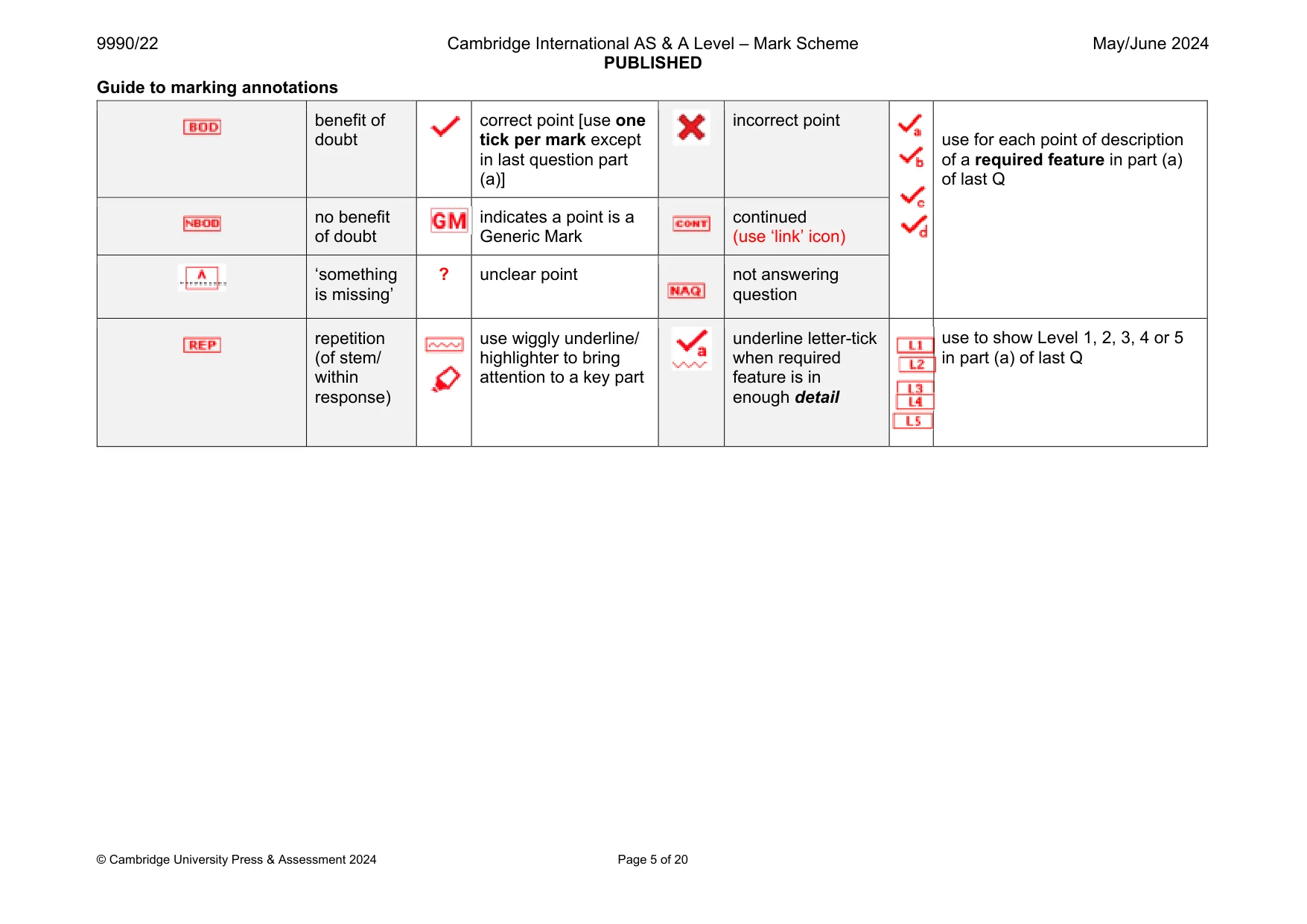
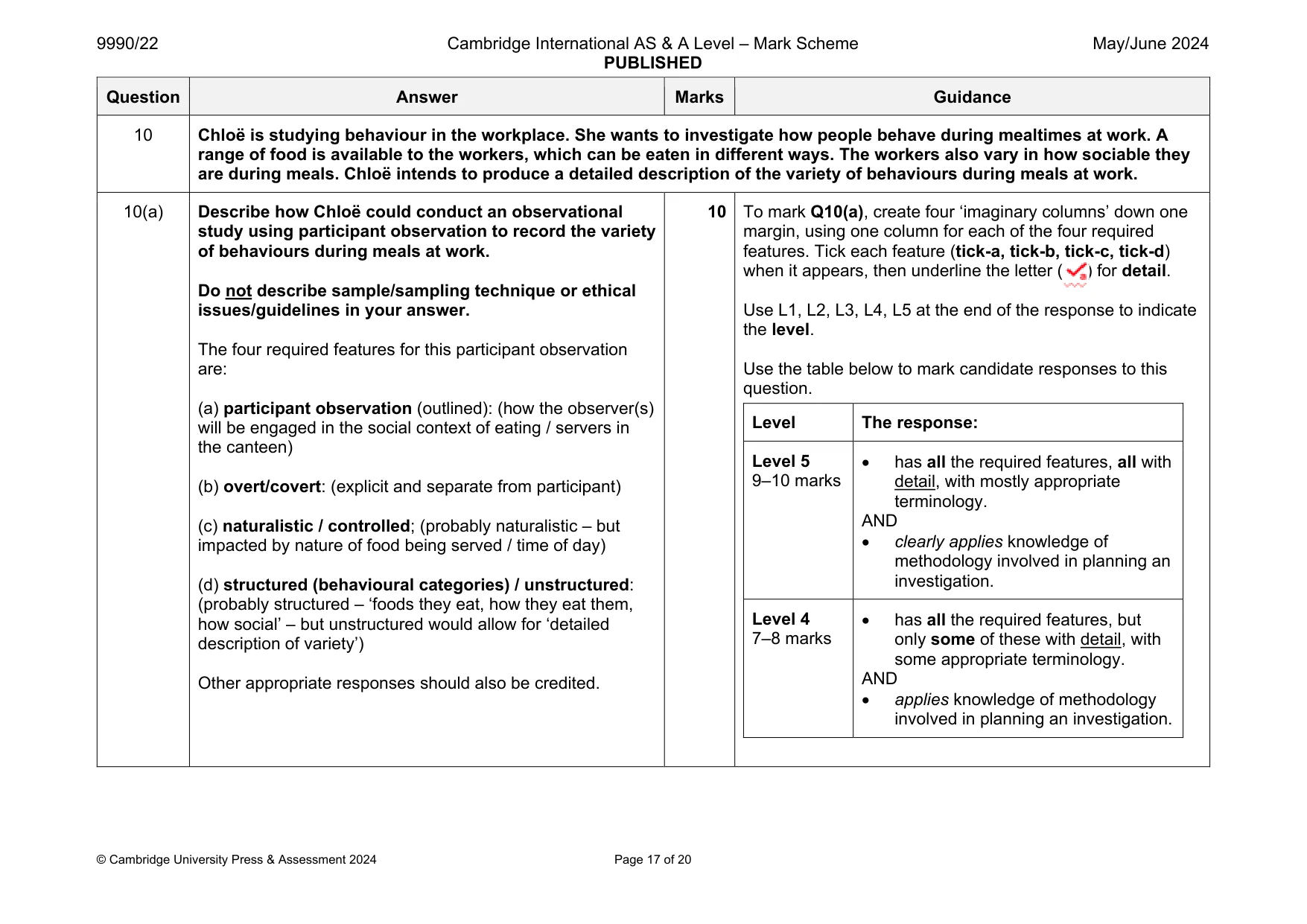
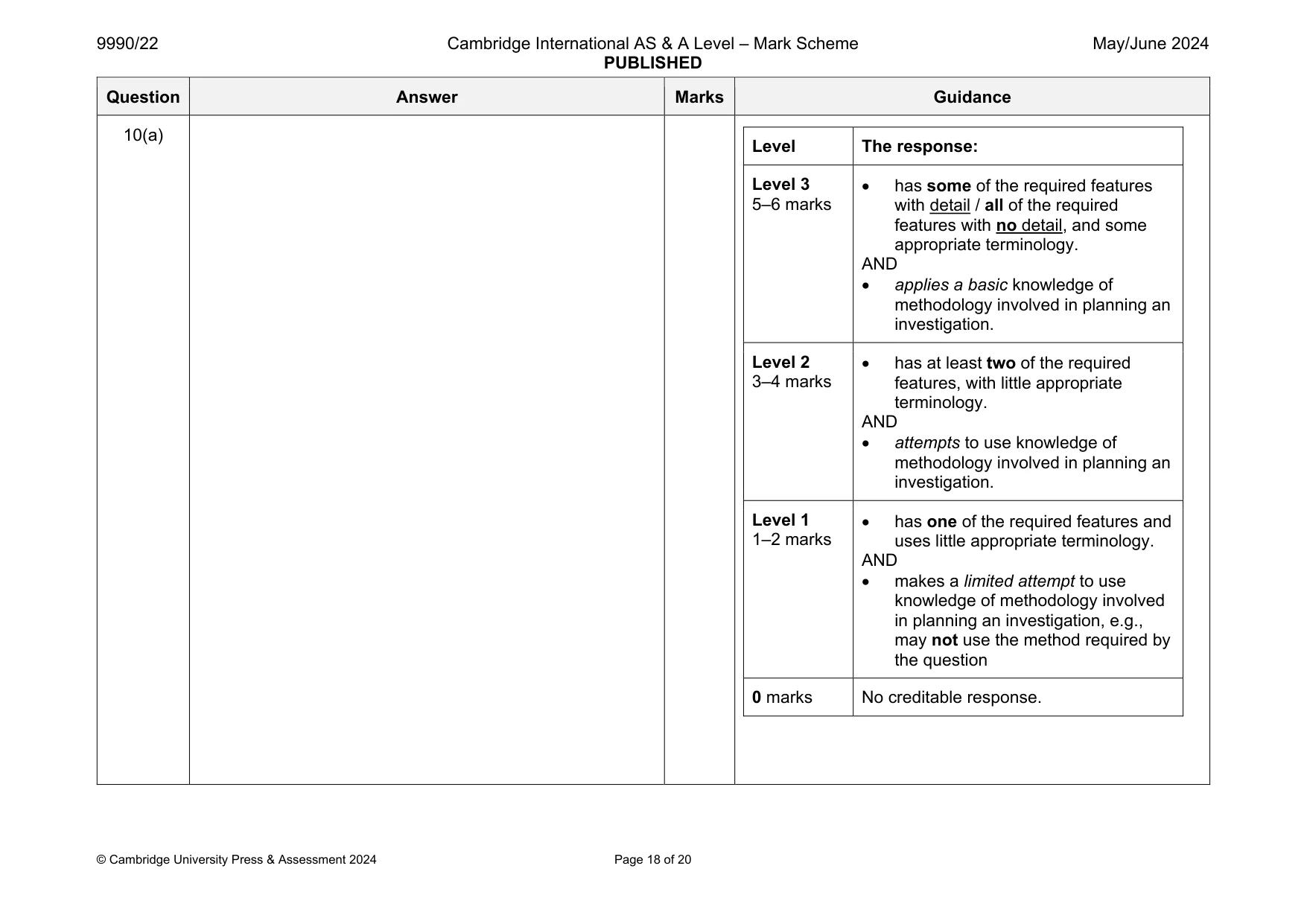
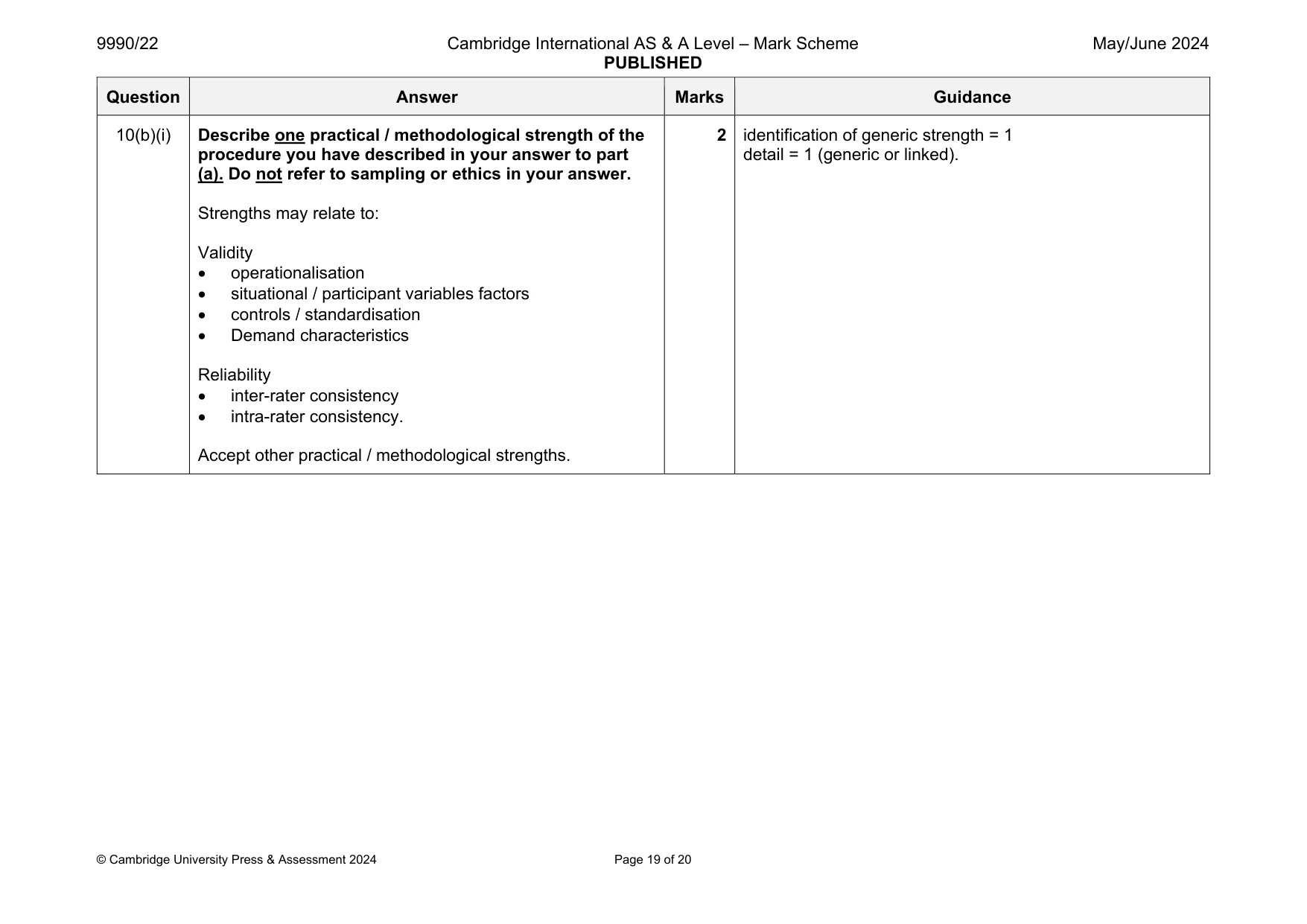
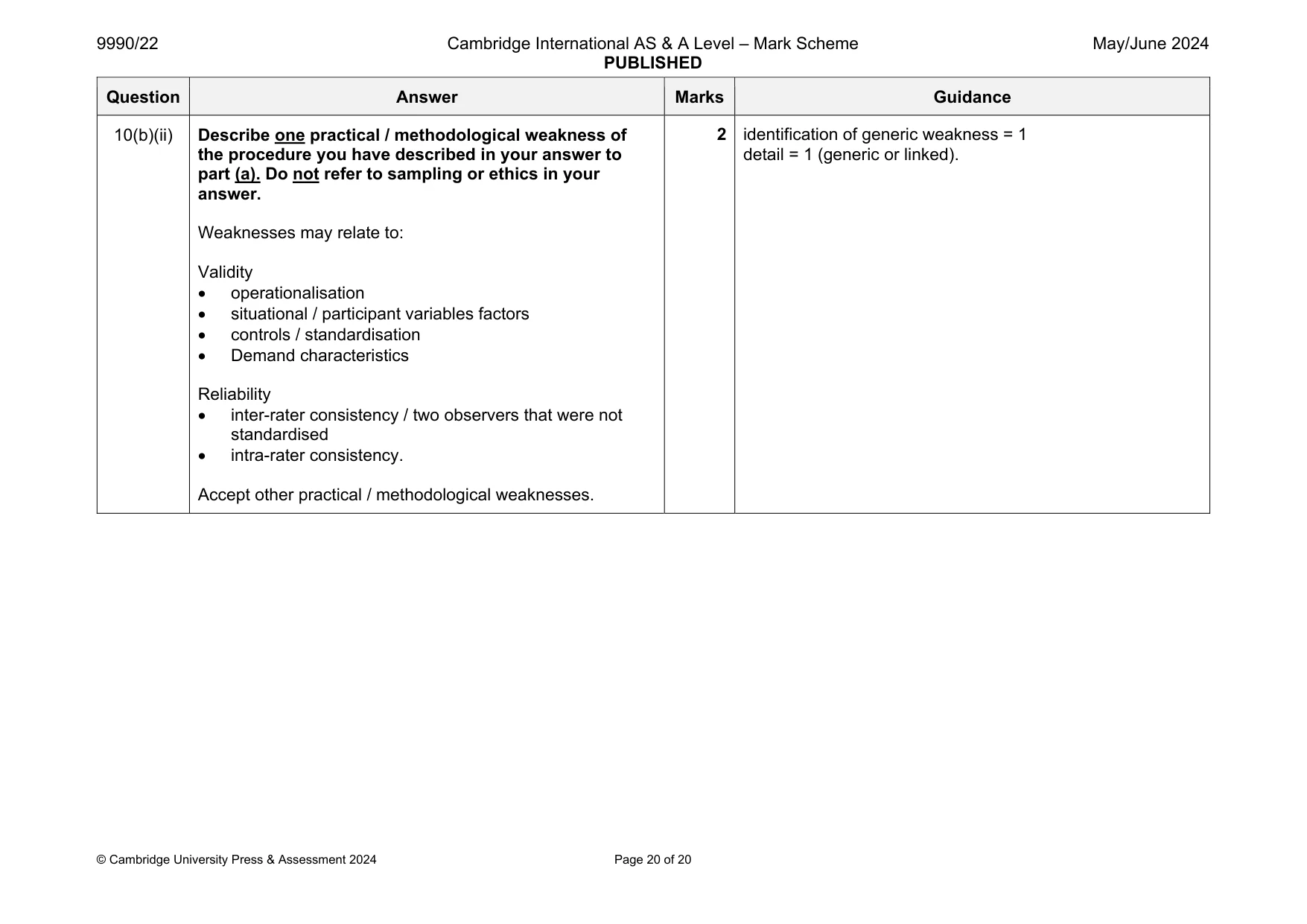
Mark scheme: 10(a) Describe how Chloë could conduct an observational study using participant observation to record the variety of behaviours during meals at work. Do not describe sample/sampling technique or ethical issues/guidelines in your answer. The four required features for this participant observation are: (a) participant observation (outlined): (how the observer(s) will be engaged in the social context of eating / servers in the canteen) (b) overt/covert: (explicit and separate from participant) (c) naturalistic / controlled; (probably naturalistic – but impacted by nature of food being served / time of day) (d) structured (behavioural categories) / unstructured: (probably structured – ‘foods they eat, how they eat them, how social’ – but unstructured would allow for ‘detailed description of variety’) Other appropriate responses should also be credited. margin, using one column for each of the four required features. Tick each feature (tick-a, tick-b, tick-c, tick-d) when it appears, then underline the letter ( ) for detail. Use L1, L2, L3, L4, L5 at the end of the response to indicate the level. Use the table below to mark candidate responses to this question. Level The response: Level 5 9–10 marks has all the required features, all with detail, with mostly appropriate terminology. AND clearly applies knowledge of methodology involved in planning an investigation. Level 4 7–8 marks has all the required features, but only some of these with detail, with some appropriate terminology. AND applies knowledge of methodology involved in planning an investigation. Question Answer Marks Guidance 10(a) Level The response: Level 3 5–6 marks has some of the required features with detail / all of the required features with no detail, and some appropriate terminology. AND applies a basic knowledge of methodology involved in planning an investigation. Level 2 3–4 marks has at least two of the required features, with little appropriate terminology. AND attempts to use knowledge of methodology involved in planning an investigation. Level 1 1–2 marks has one of the required features and uses little appropriate terminology. AND makes a limited attempt to use knowledge of methodology involved in planning an investigation, e.g., may not use the method required by the question 0 marks No creditable response. Question Answer Marks Guidance 10(b)(i) Describe one practical / methodological strength of the procedure you have described in your answer to part (a). Do not refer to sampling or ethics in your answer. Strengths may relate to: Validity operationalisation situational / participant variables factors controls / standardisation Demand characteristics Reliability inter-rater consistency intra-rater consistency. Accept other practical / methodological strengths. 2 identification of generic strength = 1 detail = 1 (generic or linked). Question Answer Marks Guidance 10(b)(ii) Describe one practical / methodological weakness of the procedure you have described in your answer to part (a). Do not refer to sampling or ethics in your answer. Weaknesses may relate to: Validity operationalisation situational / participant variables factors controls / standardisation Demand characteristics Reliability inter-rater consistency / two observers that were not standardised intra-rater consistency. Accept other practical / methodological weaknesses. 2 identification of generic weakness = 1 detail = 1 (generic or linked).
What was in this paper
The subtopics covered by these 10 questions, and how many questions each got. Open one in a new tab to see every Cambridge question on it.
What you needed in this session
Cambridge’s own grade thresholds for 2024 May/June, Paper 2 · Variant 2. A higher threshold means an easier paper — the bar moves with how the cohort did.