Cambridge A Level Psychology (from 2018) 9990 — 2024 Oct/Nov Paper 2 · Variant 2
9990/22/O/N/24 · 9 questions · 60 marks · 90 min
The question paper and its mark scheme, free to read here and free to download. This is Cambridge’s own paper, exactly as it was sat.
Question paper12 pages

Mark scheme20 pages
Answers below. Sit the paper first if you are practising.
Questions as text
Q1 · In the study by Milgram the variable of ‘obedience’ was measured
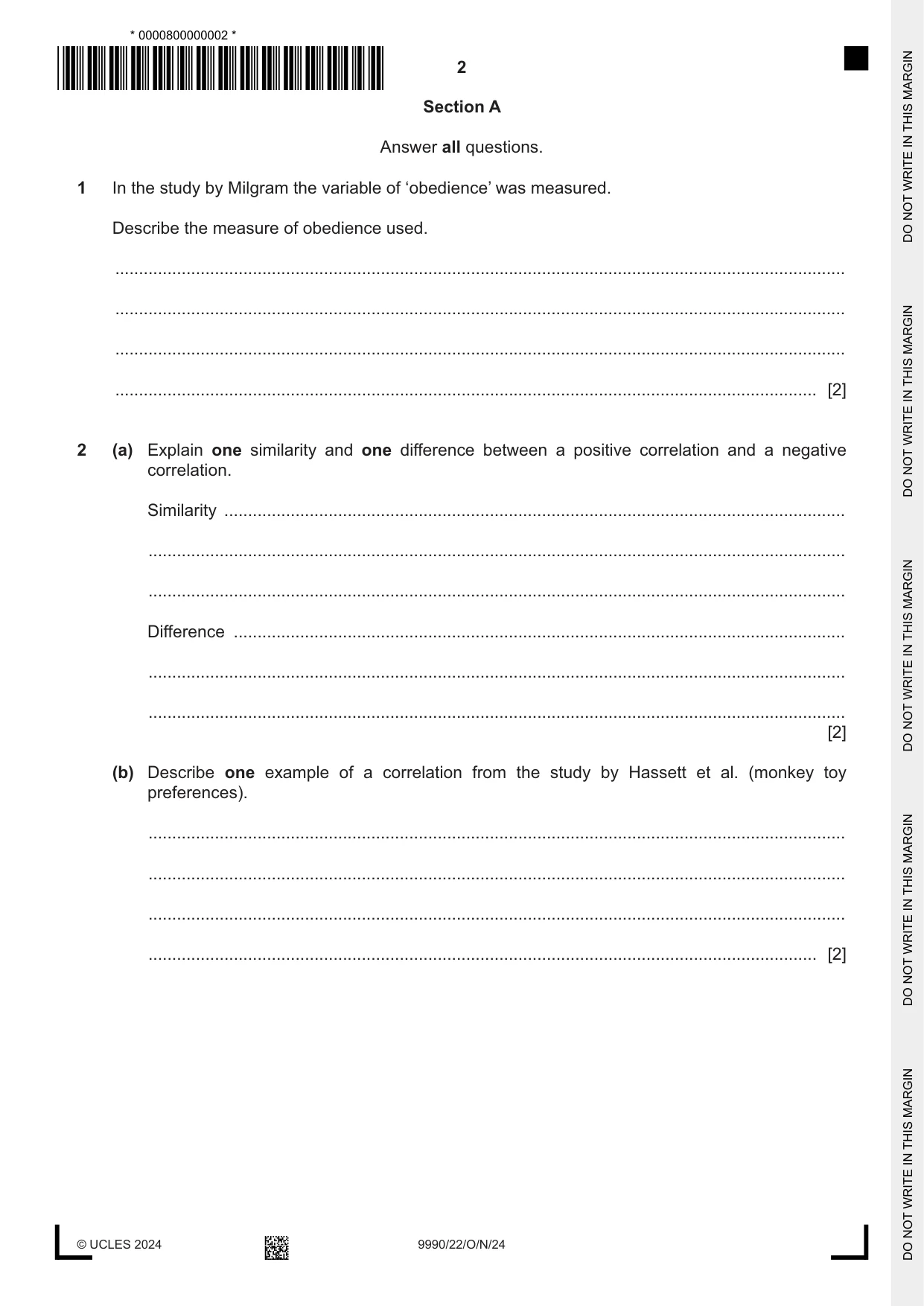
1 In the study by Milgram the variable of ‘obedience’ was measured. Describe the measure of obedience used. .......................................................................................................................................................... .......................................................................................................................................................... .......................................................................................................................................................... .................................................................................................................................................... [2]
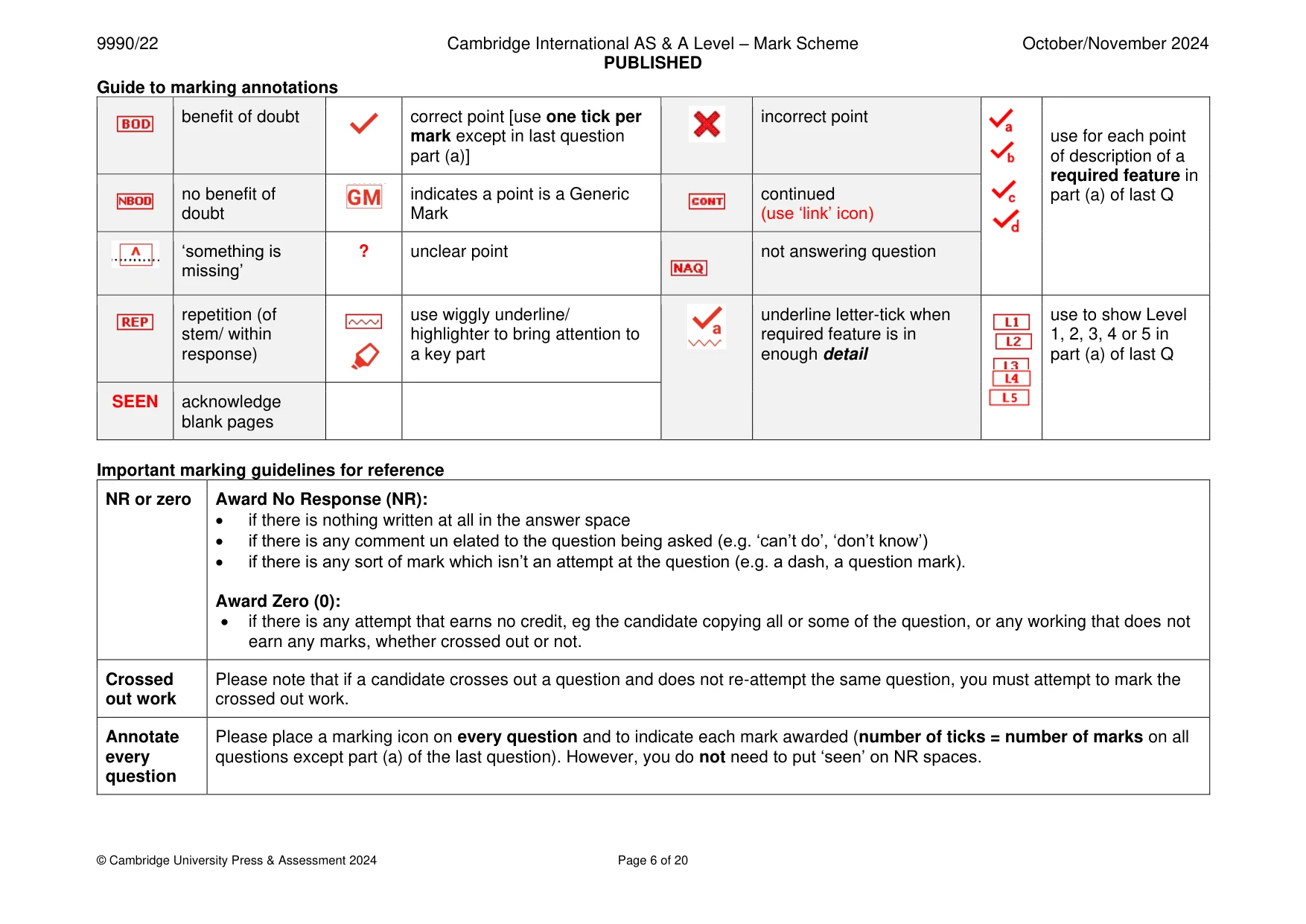
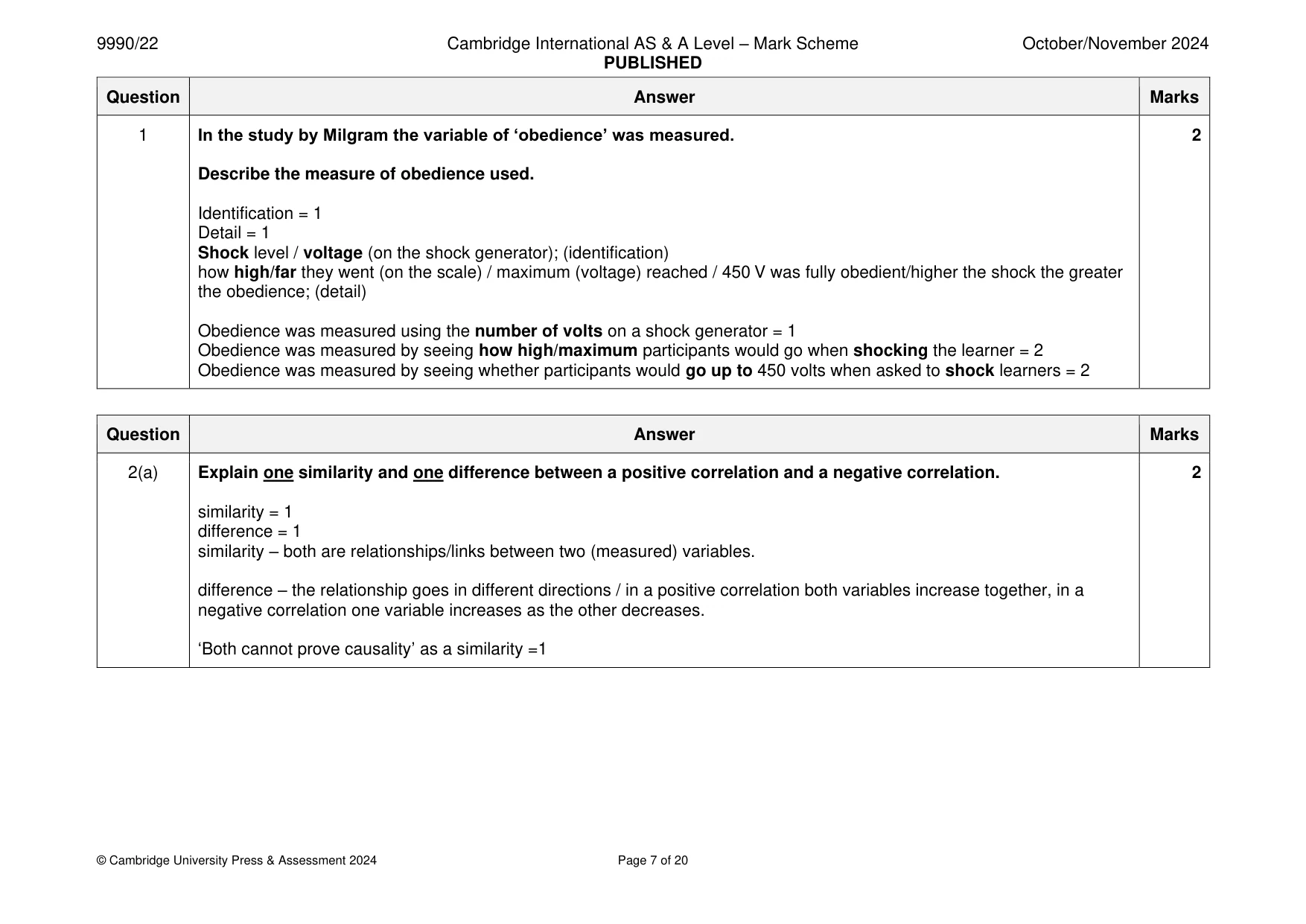
Mark scheme: Question Answer Marks 1 In the study by Milgram the variable of ‘obedience’ was measured. 2 Describe the measure of obedience used. Identification = 1 Detail = 1 Shock level / voltage (on the shock generator); (identification) how high/far they went (on the scale) / maximum (voltage) reached / 450 V was fully obedient/higher the shock the greater the obedience; (detail) Obedience was measured using the number of volts on a shock generator = 1 Obedience was measured by seeing how high/maximum participants would go when shocking the learner = 2 Obedience was measured by seeing whether participants would go up to 450 volts when asked to shock learners = 2
Q2 · Explain one similarity and one difference between a positive correlation and a negative…
2 (a) Explain one similarity and one difference between a positive correlation and a negative correlation. Similarity ................................................................................................................................... ................................................................................................................................................... ................................................................................................................................................... Difference ................................................................................................................................. ................................................................................................................................................... ................................................................................................................................................... [2] (b) Describe one example of a correlation from the study by Hassett et al. (monkey toy preferences). ................................................................................................................................................... ................................................................................................................................................... ................................................................................................................................................... ............................................................................................................................................. [2]
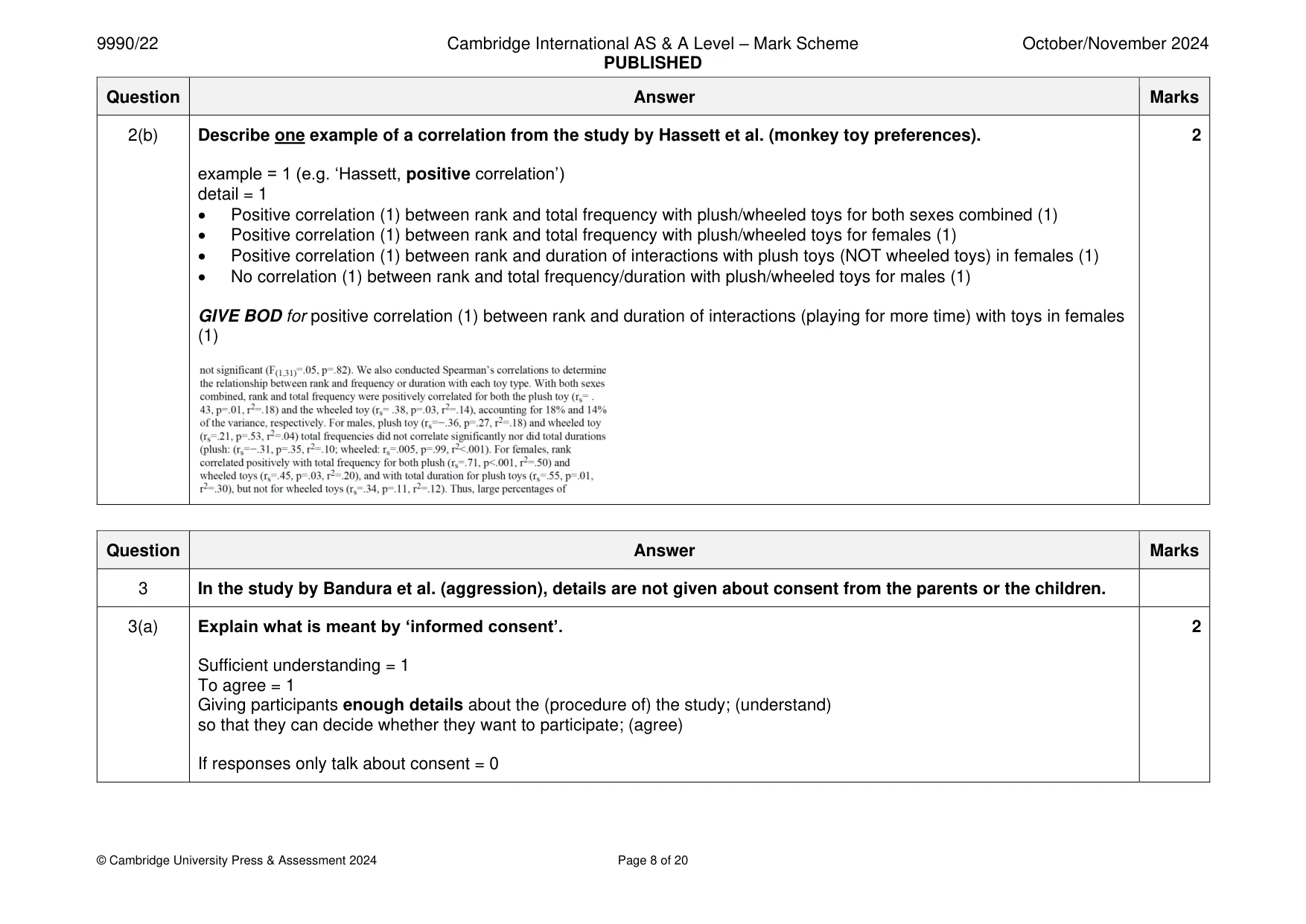
Mark scheme: 2(a) Explain one similarity and one difference between a positive correlation and a negative correlation. 2 similarity = 1 difference = 1 similarity – both are relationships/links between two (measured) variables. difference – the relationship goes in different directions / in a positive correlation both variables increase together, in a negative correlation one variable increases as the other decreases. ‘Both cannot prove causality’ as a similarity =1 2(b) Describe one example of a correlation from the study by Hassett et al. (monkey toy preferences). 2 example = 1 (e.g. ‘Hassett, positive correlation’) detail = 1 • Positive correlation (1) between rank and total frequency with plush/wheeled toys for both sexes combined (1) • Positive correlation (1) between rank and total frequency with plush/wheeled toys for females (1) • Positive correlation (1) between rank and duration of interactions with plush toys (NOT wheeled toys) in females (1) • No correlation (1) between rank and total frequency/duration with plush/wheeled toys for males (1) GIVE BOD for positive correlation (1) between rank and duration of interactions (playing for more time) with toys in females (1)
Q3 · In the study by Bandura et al
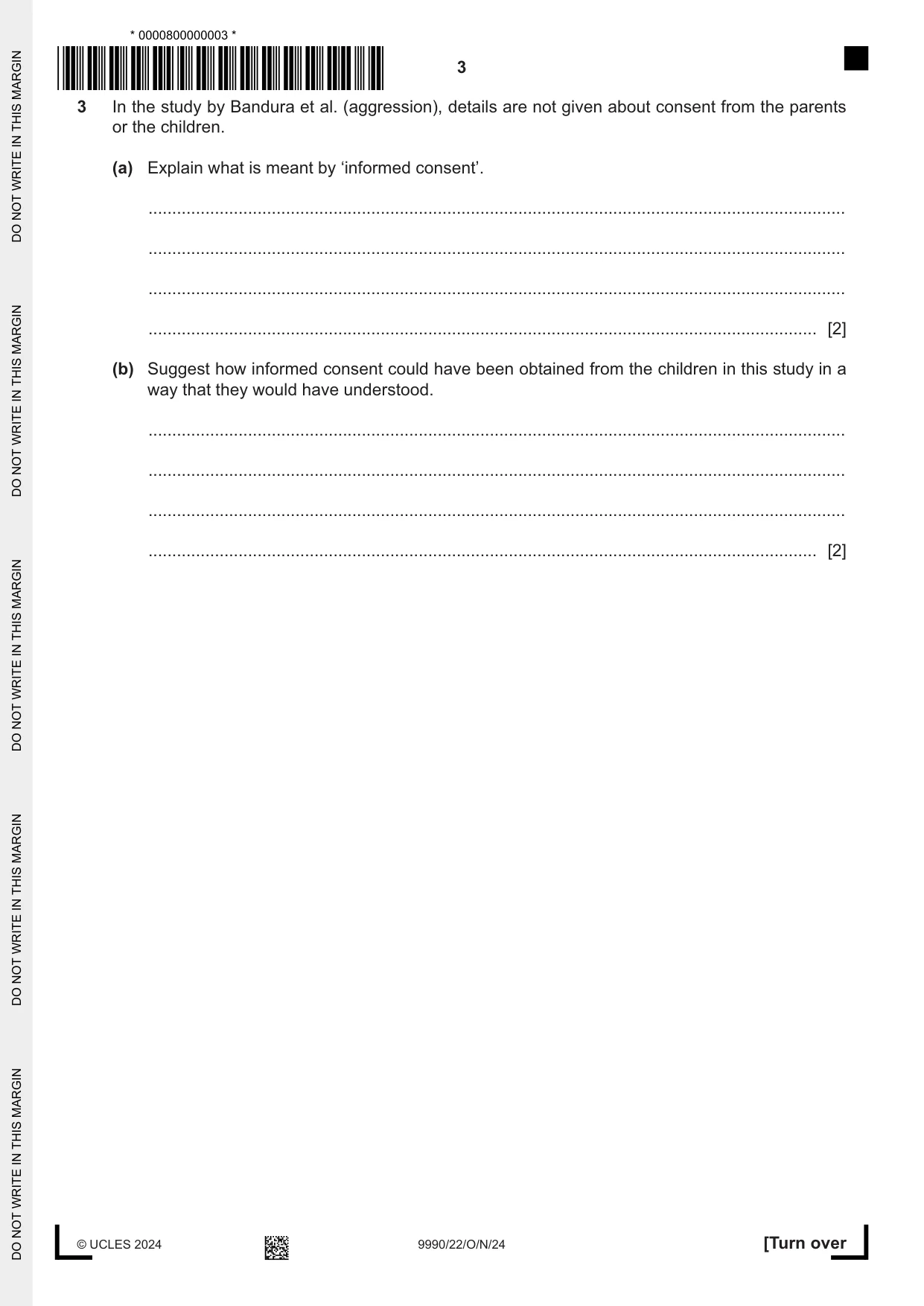
3 In the study by Bandura et al. (aggression), details are not given about consent from the parents or the children. (a) Explain what is meant by ‘informed consent’. ................................................................................................................................................... ................................................................................................................................................... ................................................................................................................................................... ............................................................................................................................................. [2] (b) Suggest how informed consent could have been obtained from the children in this study in a way that they would have understood. ................................................................................................................................................... ................................................................................................................................................... ................................................................................................................................................... ............................................................................................................................................. [2]
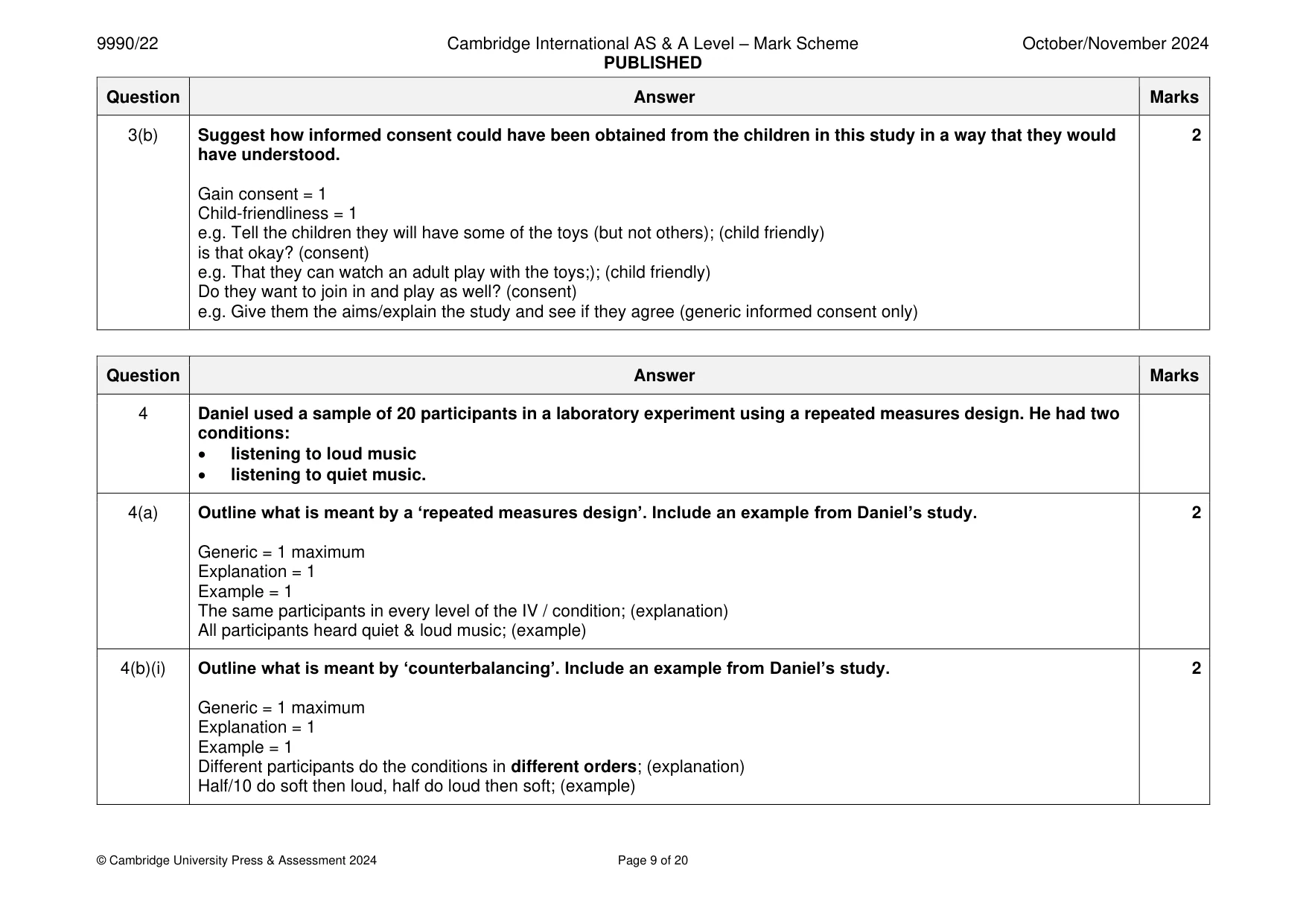
Mark scheme: 3 In the study by Bandura et al. (aggression), details are not given about consent from the parents or the children. 3(a) Explain what is meant by ‘informed consent’. 2 Sufficient understanding = 1 To agree = 1 Giving participants enough details about the (procedure of) the study; (understand) so that they can decide whether they want to participate; (agree) If responses only talk about consent = 0 3(b) Suggest how informed consent could have been obtained from the children in this study in a way that they would 2 have understood. Gain consent = 1 Child-friendliness = 1 e.g. Tell the children they will have some of the toys (but not others); (child friendly) is that okay? (consent) e.g. That they can watch an adult play with the toys;); (child friendly) Do they want to join in and play as well? (consent) e.g. Give them the aims/explain the study and see if they agree (generic informed consent only)
Q4 · Daniel used a sample of 20 participants in a laboratory experiment using a repeated…
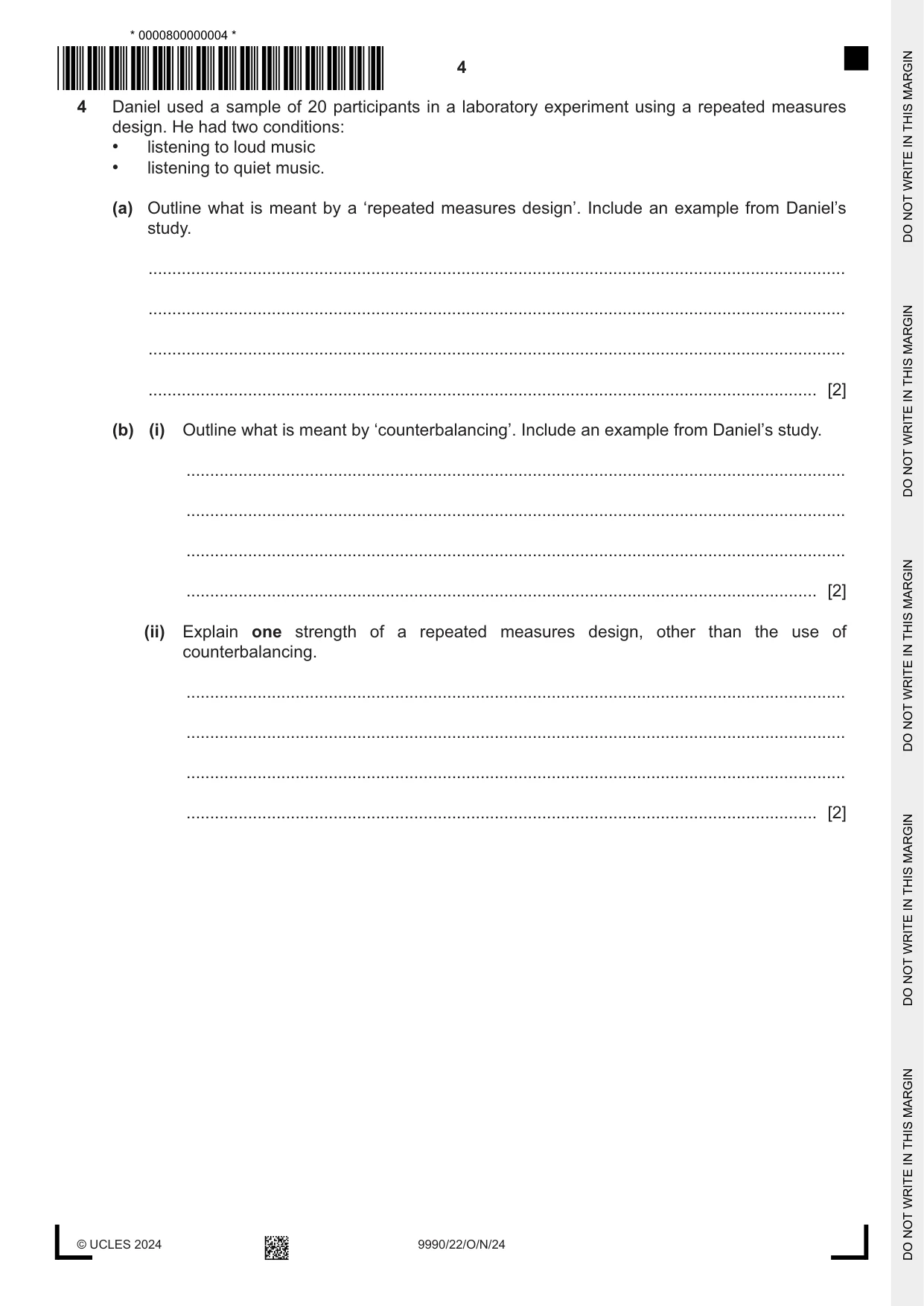
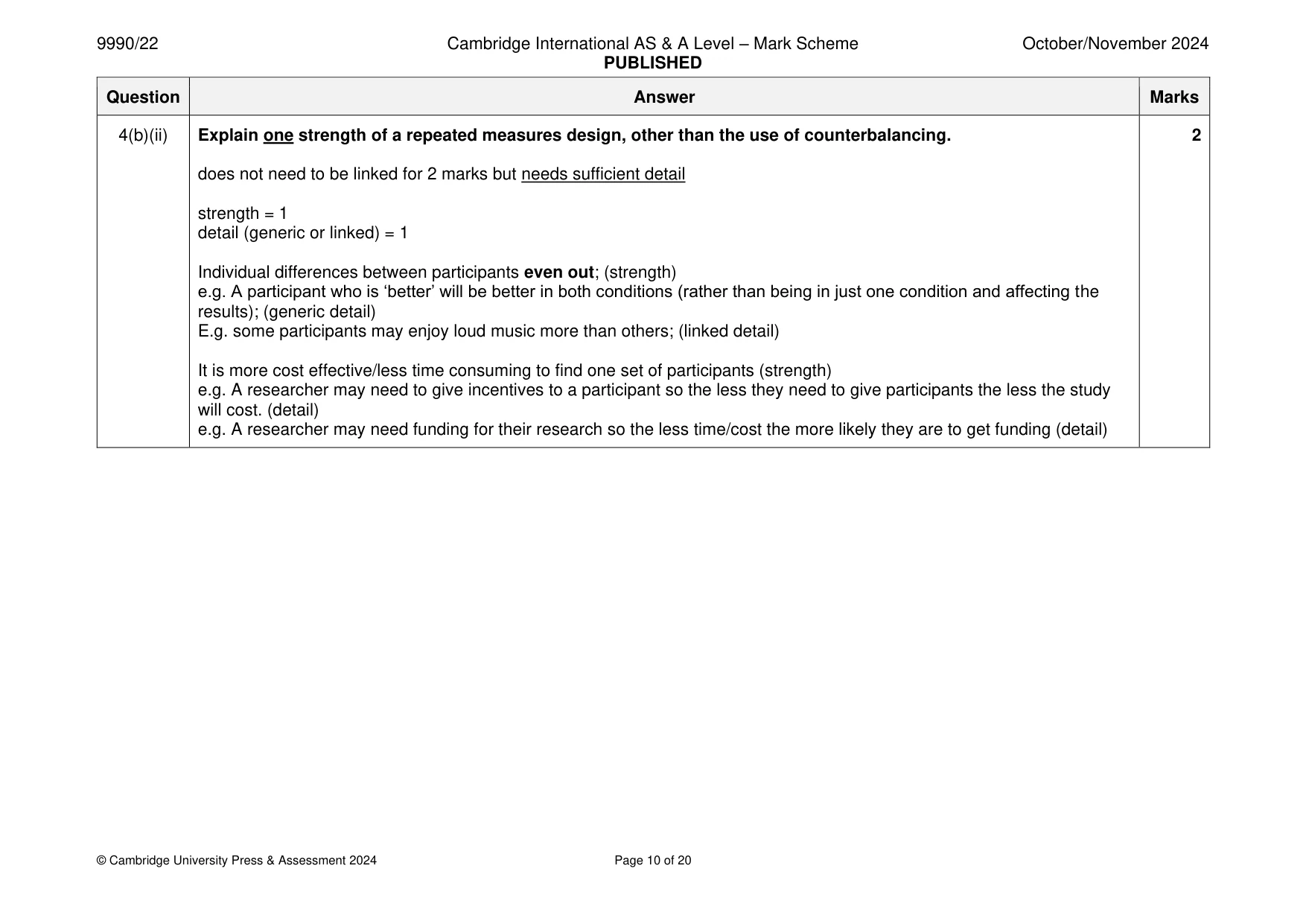
4 Daniel used a sample of 20 participants in a laboratory experiment using a repeated measures design. He had two conditions: • listening to loud music • listening to quiet music. (a) Outline what is meant by a ‘repeated measures design’. Include an example from Daniel’s study. ................................................................................................................................................... ................................................................................................................................................... ................................................................................................................................................... ............................................................................................................................................. [2] (b) (i) Outline what is meant by ‘counterbalancing’. Include an example from Daniel’s study. ........................................................................................................................................... ........................................................................................................................................... ........................................................................................................................................... ..................................................................................................................................... [2] (ii) Explain one strength of a repeated measures design, other than the use of counterbalancing. ........................................................................................................................................... ........................................................................................................................................... ........................................................................................................................................... ..................................................................................................................................... [2]
Mark scheme: 4 Daniel used a sample of 20 participants in a laboratory experiment using a repeated measures design. He had two conditions: • listening to loud music • listening to quiet music. 4(a) Outline what is meant by a ‘repeated measures design’. Include an example from Daniel’s study. 2 Generic = 1 maximum Explanation = 1 Example = 1 The same participants in every level of the IV / condition; (explanation) All participants heard quiet & loud music; (example) 4(b)(i) Outline what is meant by ‘counterbalancing’. Include an example from Daniel’s study. 2 Generic = 1 maximum Explanation = 1 Example = 1 Different participants do the conditions in different orders; (explanation) Half/10 do soft then loud, half do loud then soft; (example) 4(b)(ii) Explain one strength of a repeated measures design, other than the use of counterbalancing. 2 does not need to be linked for 2 marks but needs sufficient detail strength = 1 detail (generic or linked) = 1 Individual differences between participants even out; (strength) e.g. A participant who is ‘better’ will be better in both conditions (rather than being in just one condition and affecting the results); (generic detail) E.g. some participants may enjoy loud music more than others; (linked detail) It is more cost effective/less time consuming to find one set of participants (strength) e.g. A researcher may need to give incentives to a participant so the less they need to give participants the less the study will cost. (detail) e.g. A researcher may need funding for their research so the less time/cost the more likely they are to get funding (detail)
Q5 · Describe the techniques of ‘paper and pencil’ questionnaires and ‘online’ questionnaires…
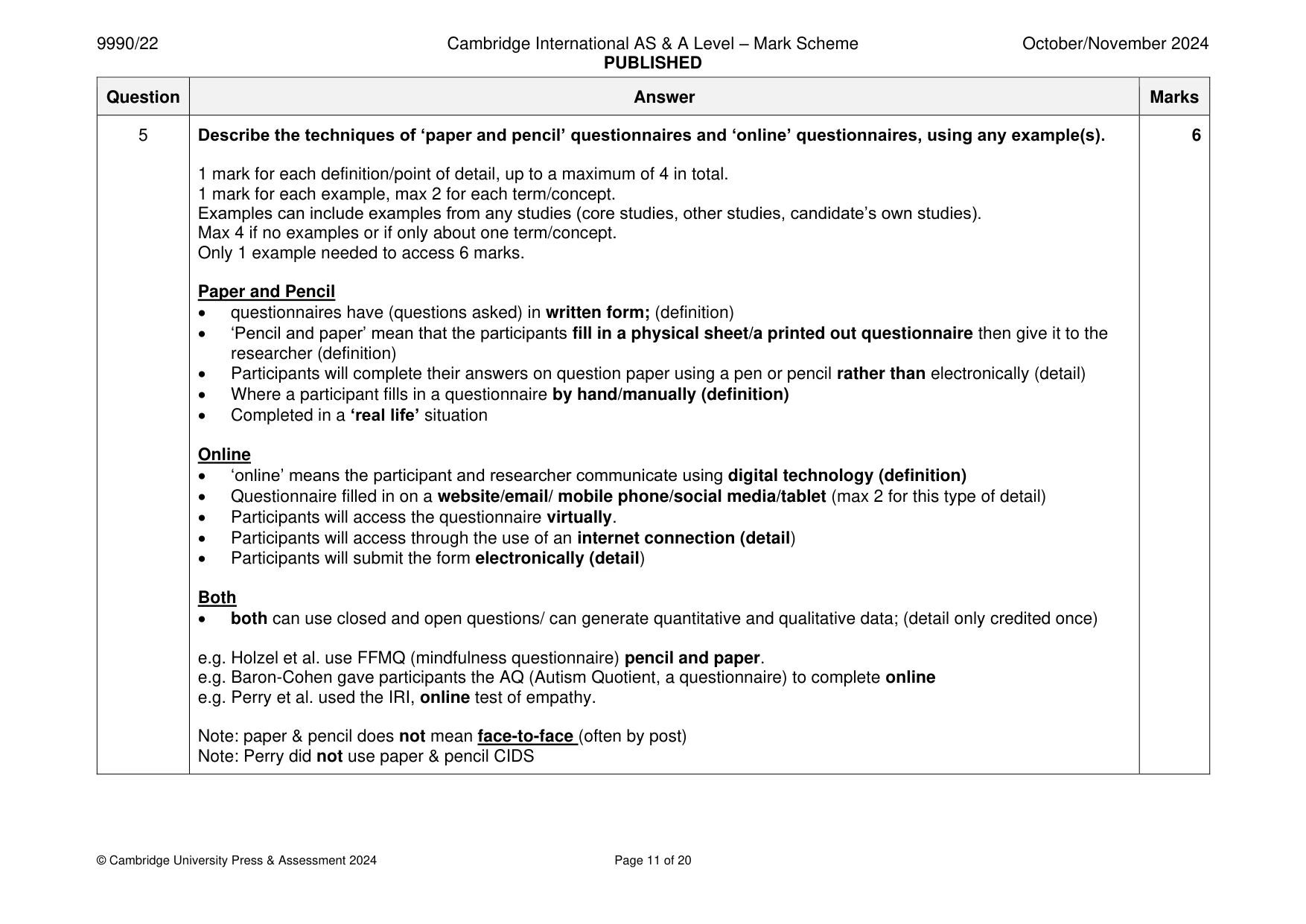
5 Describe the techniques of ‘paper and pencil’ questionnaires and ‘online’ questionnaires, using any example(s). .......................................................................................................................................................... .......................................................................................................................................................... .......................................................................................................................................................... .......................................................................................................................................................... .......................................................................................................................................................... .......................................................................................................................................................... .......................................................................................................................................................... .......................................................................................................................................................... .......................................................................................................................................................... .......................................................................................................................................................... .......................................................................................................................................................... .................................................................................................................................................... [6]
Mark scheme: 5 Describe the techniques of ‘paper and pencil’ questionnaires and ‘online’ questionnaires, using any example(s). 6 1 mark for each definition/point of detail, up to a maximum of 4 in total. 1 mark for each example, max 2 for each term/concept. Examples can include examples from any studies (core studies, other studies, candidate’s own studies). Max 4 if no examples or if only about one term/concept. Only 1 example needed to access 6 marks. Paper and Pencil • questionnaires have (questions asked) in written form; (definition) • ‘Pencil and paper’ mean that the participants fill in a physical sheet/a printed out questionnaire then give it to the researcher (definition) • Participants will complete their answers on question paper using a pen or pencil rather than electronically (detail) • Where a participant fills in a questionnaire by hand/manually (definition) • Completed in a ‘real life’ situation Online • ‘online’ means the participant and researcher communicate using digital technology (definition) • Questionnaire filled in on a website/email/ mobile phone/social media/tablet (max 2 for this type of detail) • Participants will access the questionnaire virtually. • Participants will access through the use of an internet connection (detail) • Participants will submit the form electronically (detail) Both • both can use closed and open questions/ can generate quantitative and qualitative data; (detail only credited once) e.g. Holzel et al. use FFMQ (mindfulness questionnaire) pencil and paper. e.g. Baron-Cohen gave participants the AQ (Autism Quotient, a questionnaire) to complete online e.g. Perry et al. used the IRI, online test of empathy. Note: paper & pencil does not mean face-to-face (often by post) Note: Perry did not use paper & pencil CIDS
Q6 · Mohsin is investigating whether colour affects supermarket shoppers’ food choices
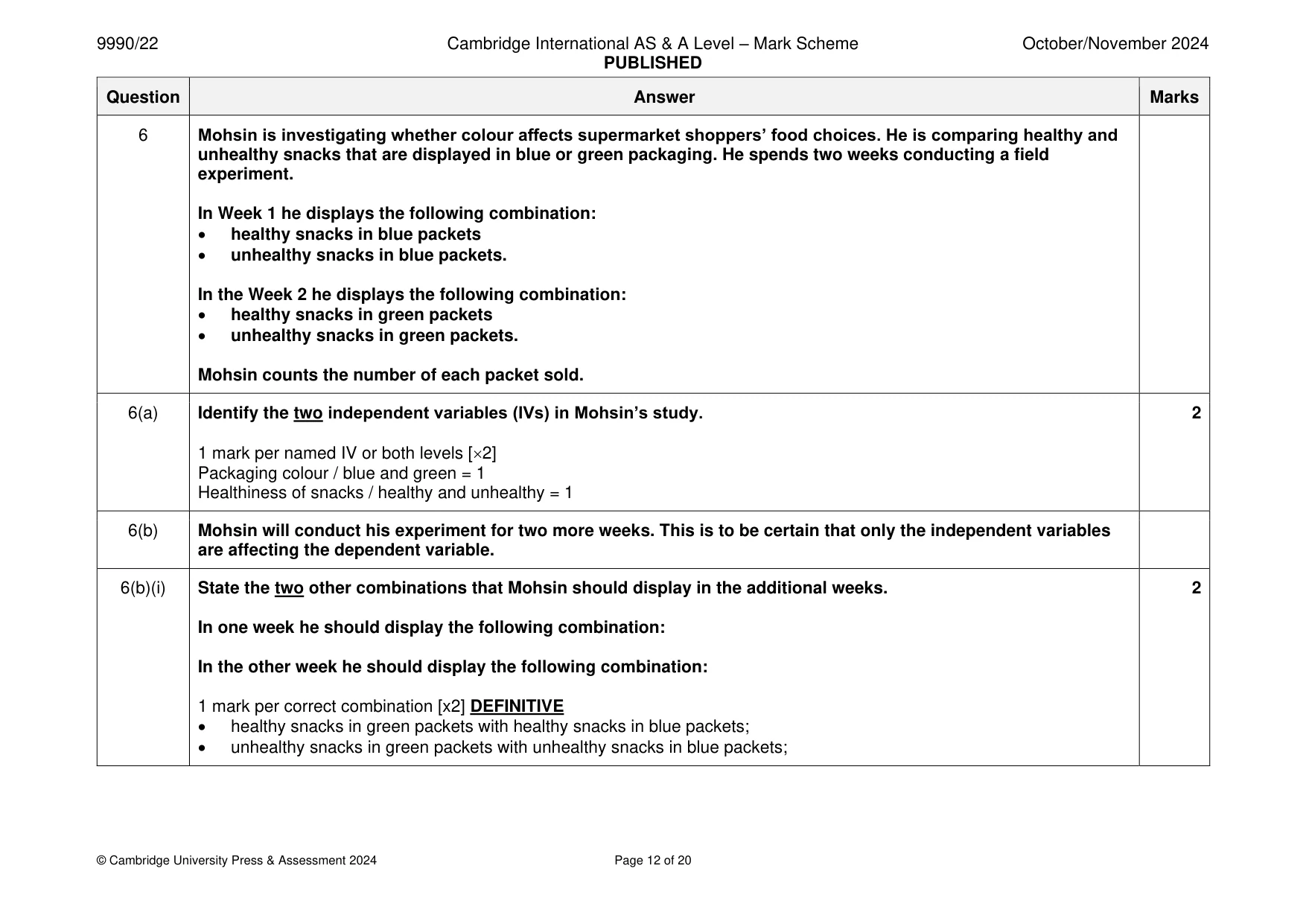
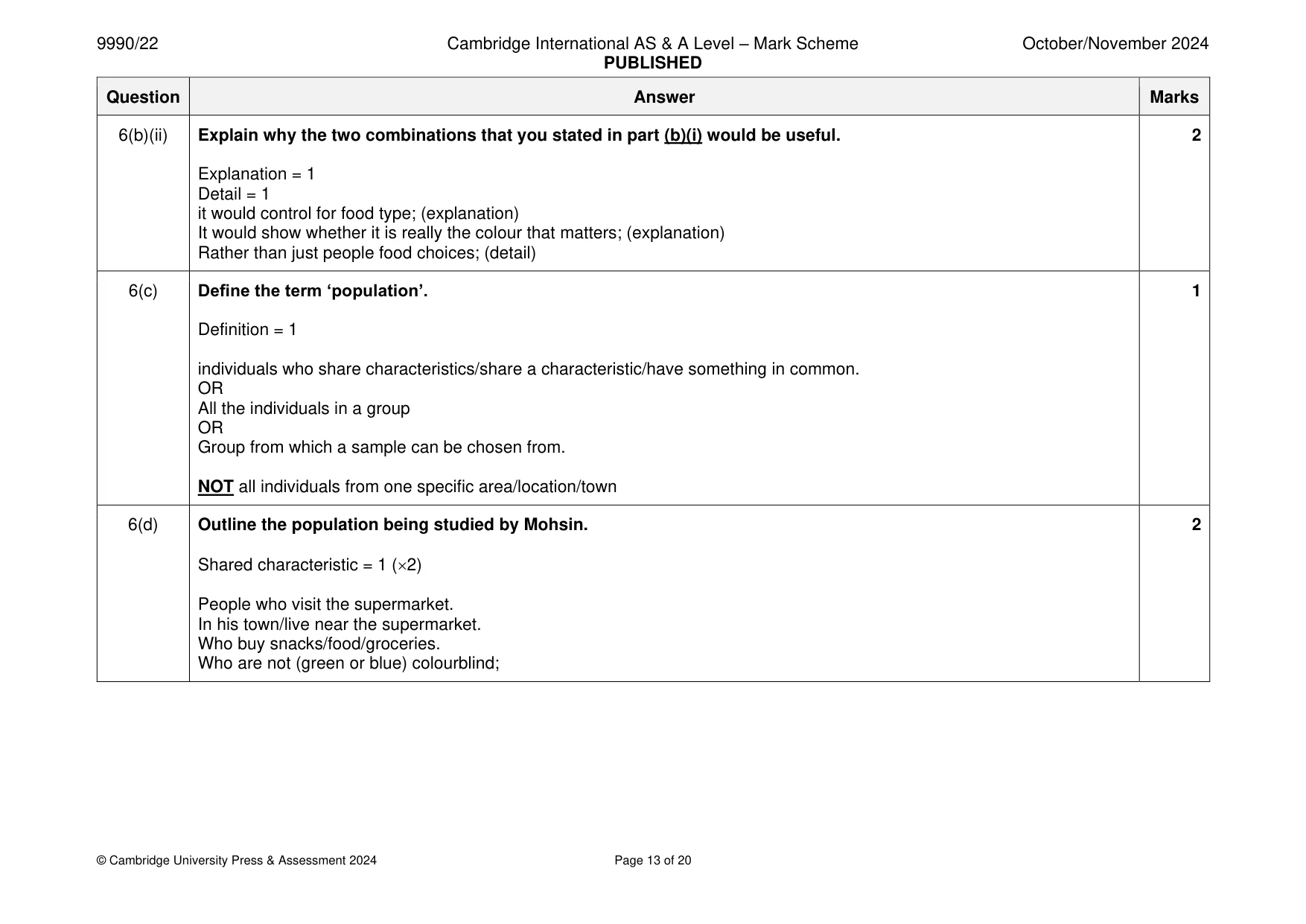
6 Mohsin is investigating whether colour affects supermarket shoppers’ food choices. He is comparing healthy and unhealthy snacks that are displayed in blue or green packaging. He spends two weeks conducting a field experiment. In Week 1 he displays the following combination: • healthy snacks in blue packets • unhealthy snacks in blue packets. In Week 2 he displays the following combination: • healthy snacks in green packets • unhealthy snacks in green packets. Mohsin counts the number of each packet sold. (a) Identify the two independent variables (IVs) in Mohsin’s study. 1 ................................................................................................................................................ ................................................................................................................................................... 2 ................................................................................................................................................ ................................................................................................................................................... [2] (b) Mohsin will continue his experiment for two more weeks. This is to be certain that only the independent variables are affecting the dependent variable. (i) State the two other combinations that Mohsin should display in the additional weeks. In one week he should display the following combination: • ...................................................................................................................................... • .................................................................................................................................... . In the other week he should display the following combination: • ...................................................................................................................................... • .................................................................................................................................... . [2] (ii) Explain why the two combinations that you stated in part (b)(i) would be useful. ........................................................................................................................................... ........................................................................................................................................... ........................................................................................................................................... ..................................................................................................................................... [2] (c) Define the term ‘population’. ................................................................................................................................................... ............................................................................................................................................. [1] (d) Outline the population being studied by Mohsin. ................................................................................................................................................... ................................................................................................................................................... ................................................................................................................................................... ............................................................................................................................................. [2]
Mark scheme: 6 Mohsin is investigating whether colour affects supermarket shoppers’ food choices. He is comparing healthy and unhealthy snacks that are displayed in blue or green packaging. He spends two weeks conducting a field experiment. In Week 1 he displays the following combination: • healthy snacks in blue packets • unhealthy snacks in blue packets. In the Week 2 he displays the following combination: • healthy snacks in green packets • unhealthy snacks in green packets. Mohsin counts the number of each packet sold. 6(a) Identify the two independent variables (IVs) in Mohsin’s study. 2 1 mark per named IV or both levels [2] Packaging colour / blue and green = 1 Healthiness of snacks / healthy and unhealthy = 1 6(b) Mohsin will conduct his experiment for two more weeks. This is to be certain that only the independent variables are affecting the dependent variable. 6(b)(i) State the two other combinations that Mohsin should display in the additional weeks. 2 In one week he should display the following combination: In the other week he should display the following combination: 1 mark per correct combination [x2] DEFINITIVE • healthy snacks in green packets with healthy snacks in blue packets; • unhealthy snacks in green packets with unhealthy snacks in blue packets; 6(b)(ii) Explain why the two combinations that you stated in part (b)(i) would be useful. 2 Explanation = 1 Detail = 1 it would control for food type; (explanation) It would show whether it is really the colour that matters; (explanation) Rather than just people food choices; (detail) 6(c) Define the term ‘population’. 1 Definition = 1 individuals who share characteristics/share a characteristic/have something in common. OR All the individuals in a group OR Group from which a sample can be chosen from. NOT all individuals from one specific area/location/town 6(d) Outline the population being studied by Mohsin. 2 Shared characteristic = 1 (2) People who visit the supermarket. In his town/live near the supermarket. Who buy snacks/food/groceries. Who are not (green or blue) colourblind;
Q7 · Jenny has noticed that some of her school friends doodle and some do not doodle
7 Jenny has noticed that some of her school friends doodle and some do not doodle. This may be because some of her friends are more creative than others. She plans to explore this difference using a questionnaire. (a) (i) Write one closed question that Jenny could use to investigate the creativity of her friends. ........................................................................................................................................... ..................................................................................................................................... [1] (ii) Write one open question that Jenny could use to investigate the creativity of her friends. ........................................................................................................................................... ..................................................................................................................................... [1] (b) Jenny’s friends study different subjects at school. Suggest why differences between the subjects they study could also explain the differences in doodling. ................................................................................................................................................... ................................................................................................................................................... ................................................................................................................................................... ................................................................................................................................................... ................................................................................................................................................... ............................................................................................................................................. [3] (c) Jenny wants to conduct an overt observation of her friends doodling. She wants to do this the day after they complete the questionnaire. Suggest why this may not produce valid results. ................................................................................................................................................... ................................................................................................................................................... ................................................................................................................................................... ............................................................................................................................................. [2]
Mark scheme: 7 Jenny has noticed that some of her school friends doodle and some do not doodle. This may be because some of her friends are more creative than others. She plans to explore this difference using a questionnaire. 7(a)(i) Write one closed question that Jenny could use to investigate the creativity of her friends. 1 Closed question with answer choices = 1 Are you creative? Yes / No How creative are you on a scale of 0 (not at all)–10 (very)? Are you creative or unimaginative? ‘I like to invent things’ Agree/don’t know/disagree. 7(a)(ii) Write one open question that Jenny could use to investigate the creativity of her friends. 1 Open question = 1 Describe how creative you are. Explain why you think you are creative. Tell me about the creative things you do. How do you show your creativity? please explain. 7(b) Jenny’s friends study different subjects at school. 3 Suggest why differences between the subjects they study could also explain the differences in doodling. One Suggestion = 1 Detail = 2 (marks) OR Two (different) suggestions = 2 Detail (of one) = 1 (marks) Some subjects may be more boring/more interesting (suggestion) Boredom may lead the friends to daydream more; (detail) If it was boring, you would doodle more to concentrate on the lesson; (detail) If it was more interesting, they would concentrate on lesson and not doodle (1) (detail) So, it would not be the ‘type’ of friend; (detail). It may be that some subjects require students to show their creativity in lessons anyway (suggestion) e.g. students who take art and design subjects will be more likely to doodle (detail) e.g. Because they are good at drawing/ they are used to doing it in their subjects (detail). e.g. Students who take science subject would doodle less as they’re less used to being creative/doodling. Only some subjects where you can sit and listen and have time to doodle (suggestion) e.g. in English/psychology, you may listen to the teacher more (detail) e.g. If you listen rather than ‘doing something’ you may doodle more (detail) e.g. But Science/art are more practical subjects so won’t have time to doodle as much (as in English). (detail) 7(c) Jenny wants to conduct an overt observation of her friends doodling. She wants to do this the day after they 2 complete the questionnaire. Suggest why this may not produce valid results. Suggestion = 1 Detail (generic or linked) = 1 Demand characteristics; (suggestion) They would know her aim; (suggestion/generic detail) So, doodle more / less /differently; (linked detail) So, they would change their behaviour to please the researcher (generic detail)
Q8 · Parul has conducted a study about happiness
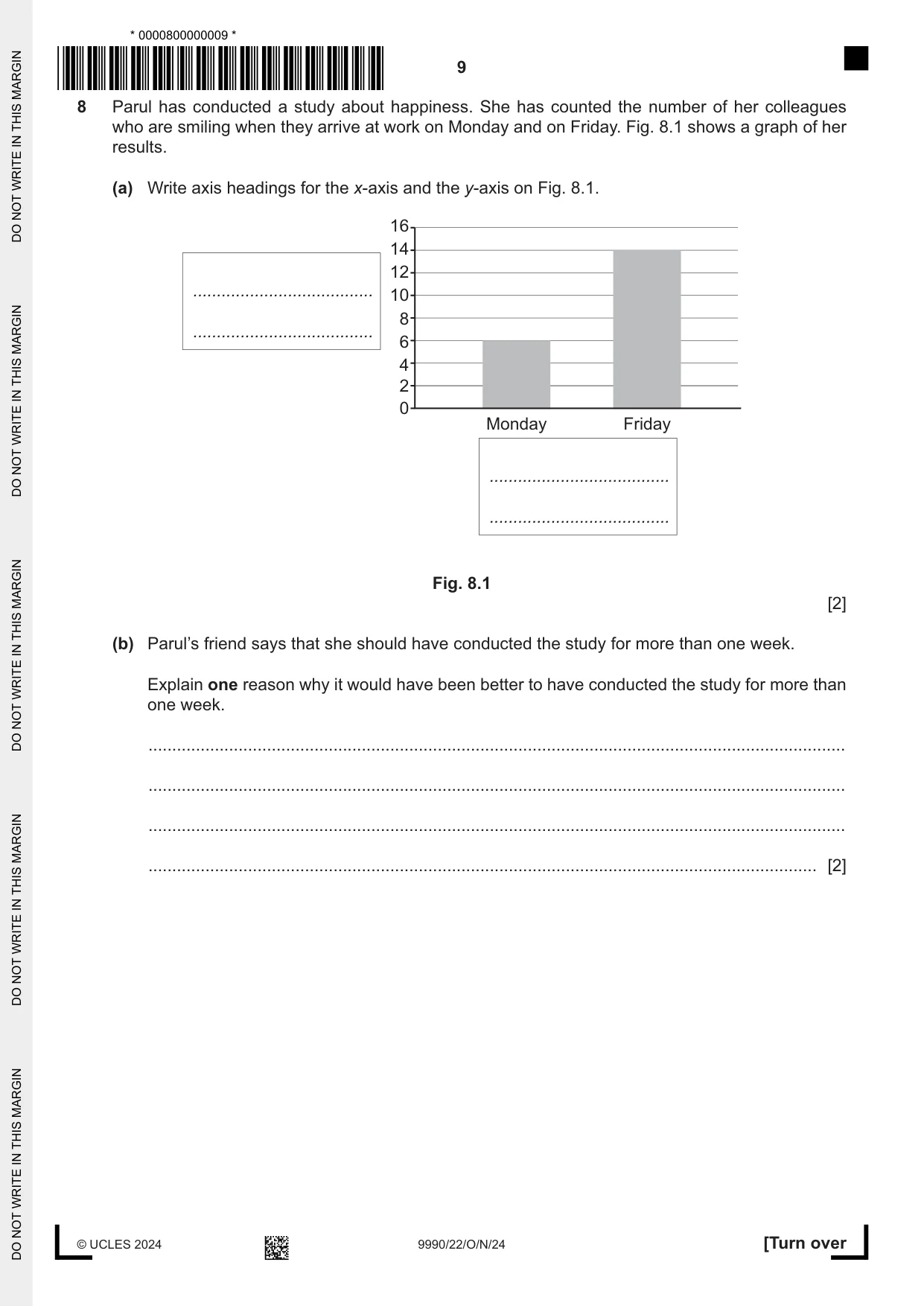
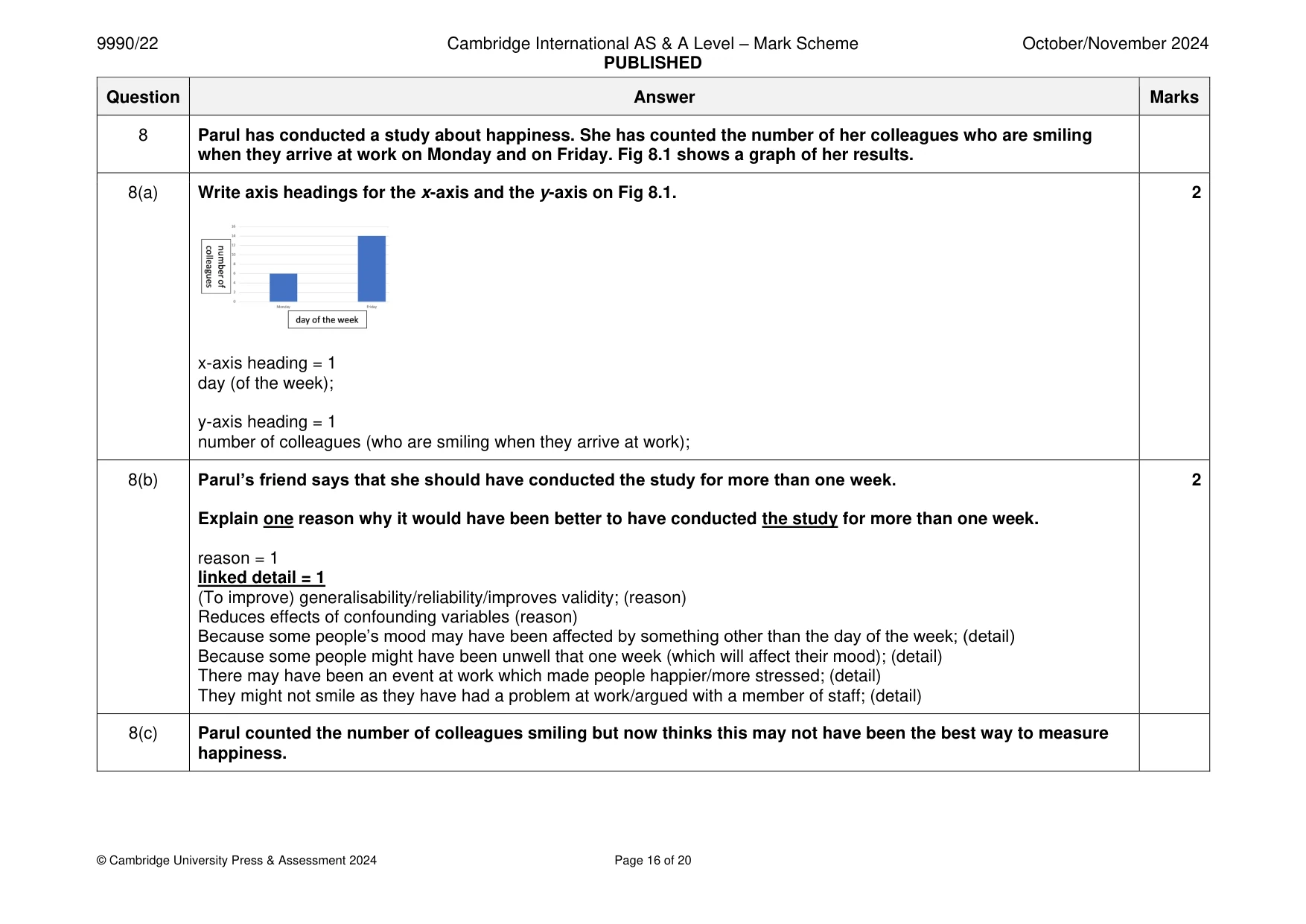
8 Parul has conducted a study about happiness. She has counted the number of her colleagues who are smiling when they arrive at work on Monday and on Friday. Fig. 8.1 shows a graph of her results. (a) Write axis headings for the x-axis and the y-axis on Fig. 8.1. 16 14 12 ...................................... 10 8 ...................................... 6 4 2 0 Monday Friday ...................................... ...................................... Fig. 8.1 [2] (b) Parul’s friend says that she should have conducted the study for more than one week. Explain one reason why it would have been better to have conducted the study for more than one week. ................................................................................................................................................... ................................................................................................................................................... ................................................................................................................................................... ............................................................................................................................................. [2] (c) Parul counted the number of colleagues smiling but now thinks this may not have been the best way to measure happiness. (i) Suggest one other way that Parul could have measured happiness. ........................................................................................................................................... ........................................................................................................................................... ........................................................................................................................................... ..................................................................................................................................... [2] (ii) For the measure of happiness you suggested in part (c)(i): Explain one advantage of this measure of happiness compared with counting the number of colleagues smiling. ........................................................................................................................................... ........................................................................................................................................... ........................................................................................................................................... ..................................................................................................................................... [2]
Mark scheme: 8 Parul has conducted a study about happiness. She has counted the number of her colleagues who are smiling when they arrive at work on Monday and on Friday. Fig 8.1 shows a graph of her results. 8(a) Write axis headings for the x-axis and the y-axis on Fig 8.1. 2 x-axis heading = 1 day (of the week); y-axis heading = 1 number of colleagues (who are smiling when they arrive at work); 8(b) Parul’s friend says that she should have conducted the study for more than one week. 2 Explain one reason why it would have been better to have conducted the study for more than one week. reason = 1 linked detail = 1 (To improve) generalisability/reliability/improves validity; (reason) Reduces effects of confounding variables (reason) Because some people’s mood may have been affected by something other than the day of the week; (detail) Because some people might have been unwell that one week (which will affect their mood); (detail) There may have been an event at work which made people happier/more stressed; (detail) They might not smile as they have had a problem at work/argued with a member of staff; (detail) 8(c) Parul counted the number of colleagues smiling but now thinks this may not have been the best way to measure happiness. 8(c)(i) Suggest one other way that Parul could have measured happiness. 2 way = 1 detail = 1 laughter; (way) time the length of the laughter/how loud the laughter is; (detail) positive body language (way) how many times they high five/hug (detail) a questionnaire/interview; (way) using closed questions like ‘How happy are you on a scale of 0 (not at all) to 5 (very happy); (detail) using open questions and ask them to describe how they feel; (detail) 8(c)(ii) For the measure of happiness, you have suggested in part (c)(i): 2 Explain one advantage of this measure of happiness compared with counting the number of colleagues smiling. explanation = 1 detail = 1 Laughter: Laughter is a more reliable measurement than smiling (reason) as you can hear and see it, so Parul is less likely to miss a person laughing than smiling (detail) Questionnaire/interview (scale/close question): Each person would have a rating of happiness rather than just a score of whether they smile/are not smiling, (reason) so, there will be more detail about how happy they actually are; (detail) Use of rating scales to measure would mean less researcher bias as participants are answering the questions themselves (reason); they will know their own level of happiness rather than Parul assuming smiling means they are happy) (detail) Questionnaire (open question): Open questions about happiness will give more detail than just a score of smiling/not smiling; (reason) so, Parul could know how happy they are/and why; (detail)
Q9 · Lixin is investigating the social behaviour of adults
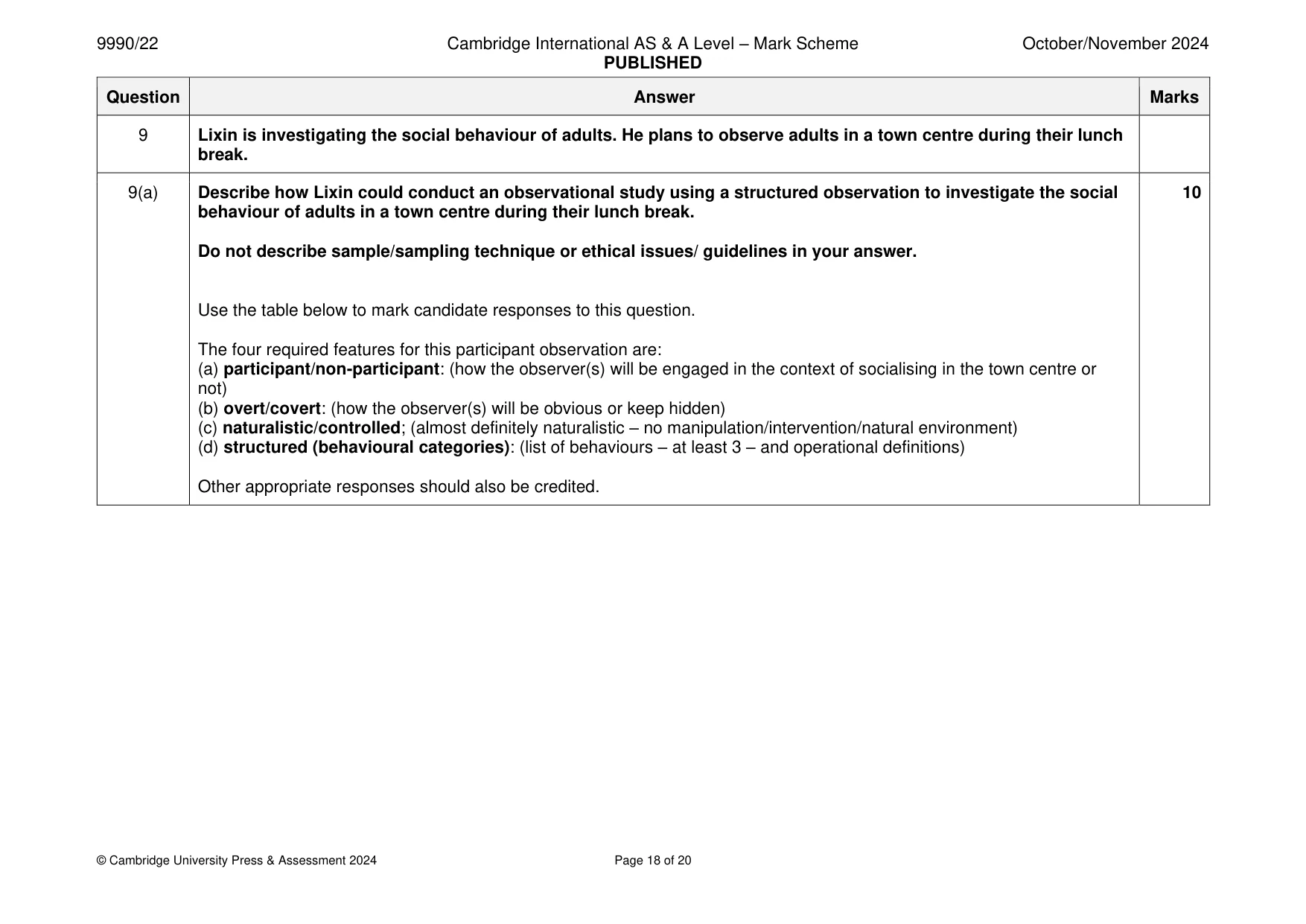
9 Lixin is investigating the social behaviour of adults. He plans to observe adults in a town centre during their lunch break. (a) Describe how Lixin could conduct an observational study using a structured observation to investigate the social behaviour of adults in a town centre during their lunch break. Do not describe sample/sampling technique or ethical issues/guidelines in your answer. ................................................................................................................................................... ................................................................................................................................................... ................................................................................................................................................... ................................................................................................................................................... ................................................................................................................................................... ................................................................................................................................................... ................................................................................................................................................... ................................................................................................................................................... ................................................................................................................................................... ................................................................................................................................................... ................................................................................................................................................... ................................................................................................................................................... ................................................................................................................................................... ................................................................................................................................................... ................................................................................................................................................... ................................................................................................................................................... ................................................................................................................................................... ................................................................................................................................................... ................................................................................................................................................... ................................................................................................................................................... ................................................................................................................................................... ................................................................................................................................................... ................................................................................................................................................... ................................................................................................................................................... ................................................................................................................................................... ................................................................................................................................................... ................................................................................................................................................... ................................................................................................................................................... ................................................................................................................................................... ........................................................................................................................................... [10] (b) (i) Explain how one feature of the procedure you described in part (a) helps to make the study valid. Do not refer to sampling or ethics in your answer. ........................................................................................................................................... ........................................................................................................................................... ........................................................................................................................................... ..................................................................................................................................... [2] (ii) Explain how one feature of the procedure you described in part (a) could be a problem for the validity of the study. Do not refer to sampling or ethics in your answer. ........................................................................................................................................... ........................................................................................................................................... ........................................................................................................................................... ..................................................................................................................................... [2]
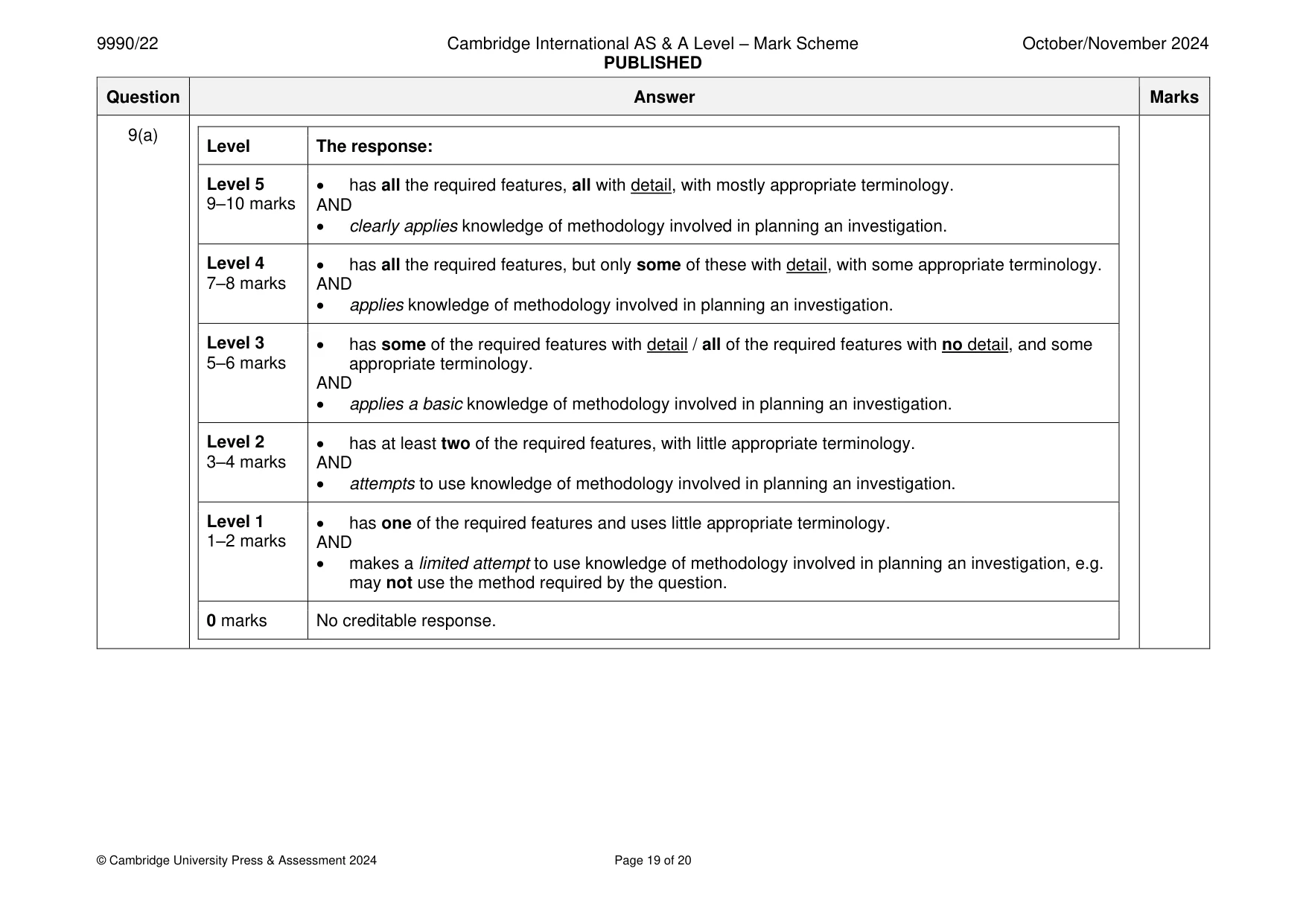
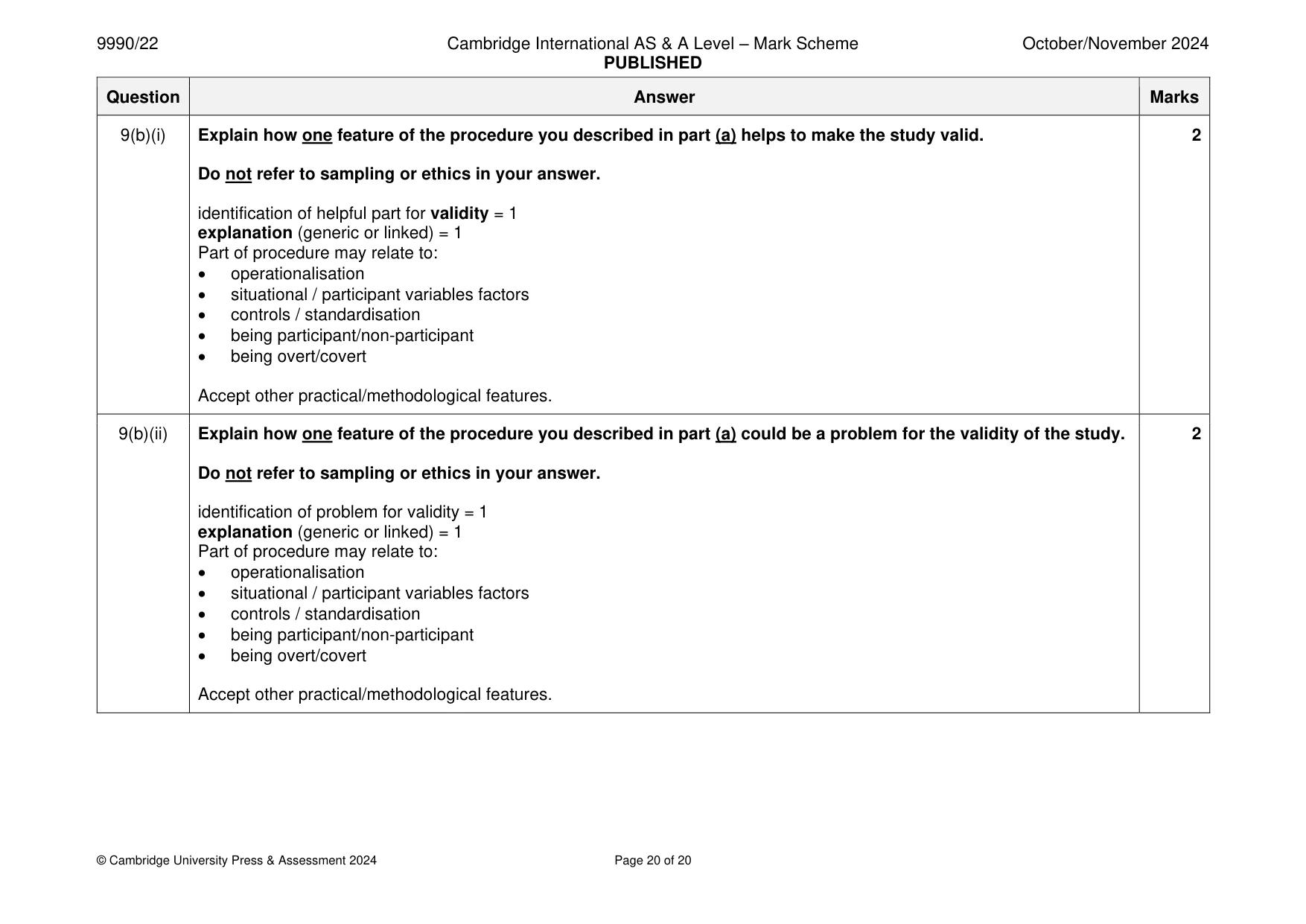
Mark scheme: 9 Lixin is investigating the social behaviour of adults. He plans to observe adults in a town centre during their lunch break. 9(a) Describe how Lixin could conduct an observational study using a structured observation to investigate the social 10 behaviour of adults in a town centre during their lunch break. Do not describe sample/sampling technique or ethical issues/ guidelines in your answer. Use the table below to mark candidate responses to this question. The four required features for this participant observation are: (a) participant/non-participant: (how the observer(s) will be engaged in the context of socialising in the town centre or not) (b) overt/covert: (how the observer(s) will be obvious or keep hidden) (c) naturalistic/controlled; (almost definitely naturalistic – no manipulation/intervention/natural environment) (d) structured (behavioural categories): (list of behaviours – at least 3 – and operational definitions) Other appropriate responses should also be credited. 9(a) Level The response: Level 5 • has all the required features, all with detail, with mostly appropriate terminology. 9–10 marks AND • clearly applies knowledge of methodology involved in planning an investigation. Level 4 • has all the required features, but only some of these with detail, with some appropriate terminology. 7–8 marks AND • applies knowledge of methodology involved in planning an investigation. Level 3 • has some of the required features with detail / all of the required features with no detail, and some 5–6 marks appropriate terminology. AND • applies a basic knowledge of methodology involved in planning an investigation. Level 2 • has at least two of the required features, with little appropriate terminology. 3–4 marks AND • attempts to use knowledge of methodology involved in planning an investigation. Level 1 • has one of the required features and uses little appropriate terminology. 1–2 marks AND • makes a limited attempt to use knowledge of methodology involved in planning an investigation, e.g. may not use the method required by the question. 0 marks No creditable response. 9(b)(i) Explain how one feature of the procedure you described in part (a) helps to make the study valid. 2 Do not refer to sampling or ethics in your answer. identification of helpful part for validity = 1 explanation (generic or linked) = 1 Part of procedure may relate to: • operationalisation • situational / participant variables factors • controls / standardisation • being participant/non-participant • being overt/covert Accept other practical/methodological features. 9(b)(ii) Explain how one feature of the procedure you described in part (a) could be a problem for the validity of the study. 2 Do not refer to sampling or ethics in your answer. identification of problem for validity = 1 explanation (generic or linked) = 1 Part of procedure may relate to: • operationalisation • situational / participant variables factors • controls / standardisation • being participant/non-participant • being overt/covert Accept other practical/methodological features.
What was in this paper
The subtopics covered by these 9 questions, and how many questions each got. Open one in a new tab to see every Cambridge question on it.
What you needed in this session
Cambridge’s own grade thresholds for 2024 Oct/Nov, Paper 2 · Variant 2. A higher threshold means an easier paper — the bar moves with how the cohort did.