Cambridge A Level Psychology (from 2018) 9990 — 2024 Feb/March Paper 2 · Variant 2
9990/22/F/M/24 · 10 questions · 60 marks · 90 min
The question paper and its mark scheme, free to read here and free to download. This is Cambridge’s own paper, exactly as it was sat.
Question paper12 pages

Mark scheme19 pages
Answers below. Sit the paper first if you are practising.
Questions as text
Q1 · Explain what is meant by a ‘negative correlation’
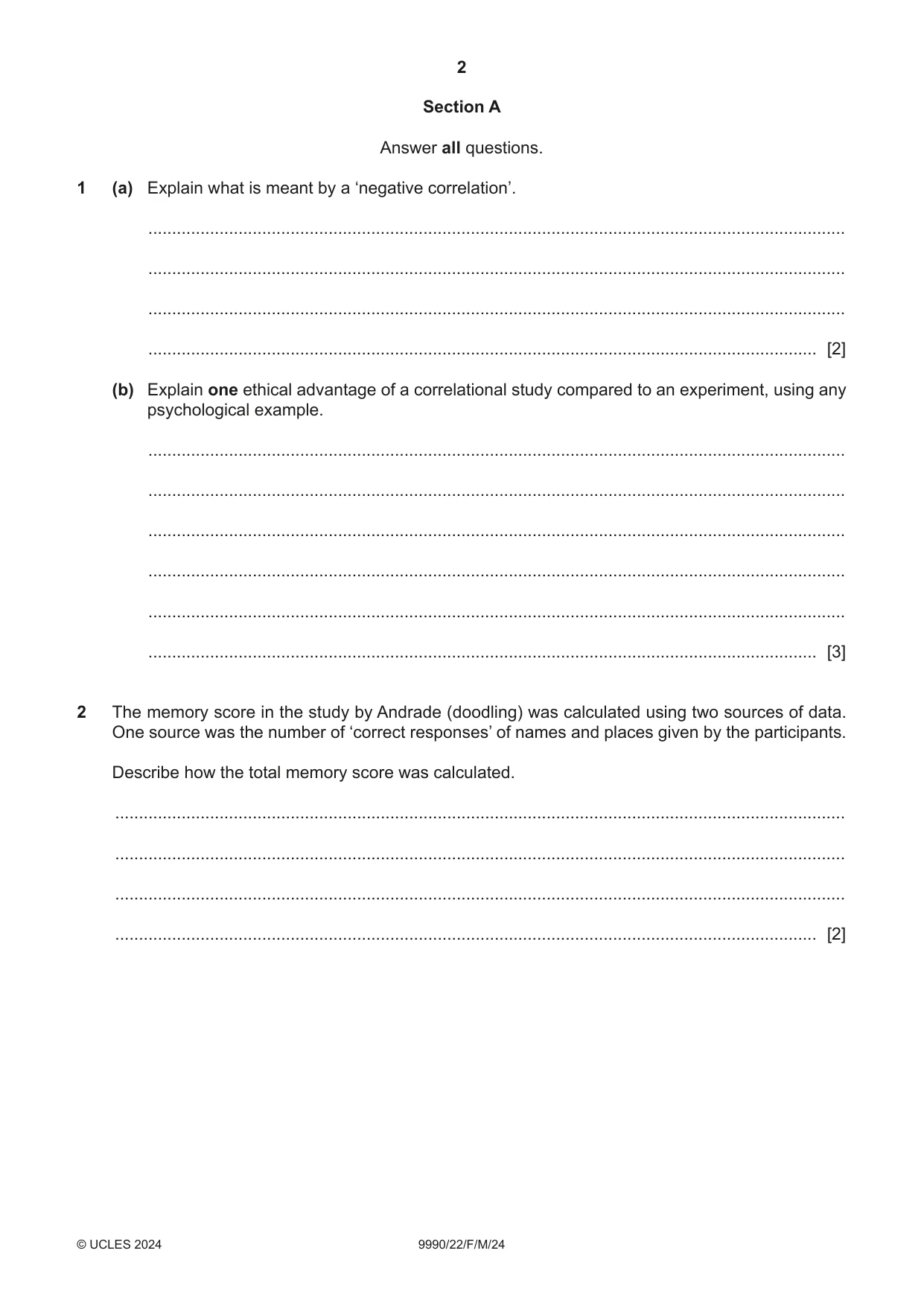
1 (a) Explain what is meant by a ‘negative correlation’. ................................................................................................................................................... ................................................................................................................................................... ................................................................................................................................................... ............................................................................................................................................. [2] (b) Explain one ethical advantage of a correlational study compared to an experiment, using any psychological example. ................................................................................................................................................... ................................................................................................................................................... ................................................................................................................................................... ................................................................................................................................................... ................................................................................................................................................... ............................................................................................................................................. [3]
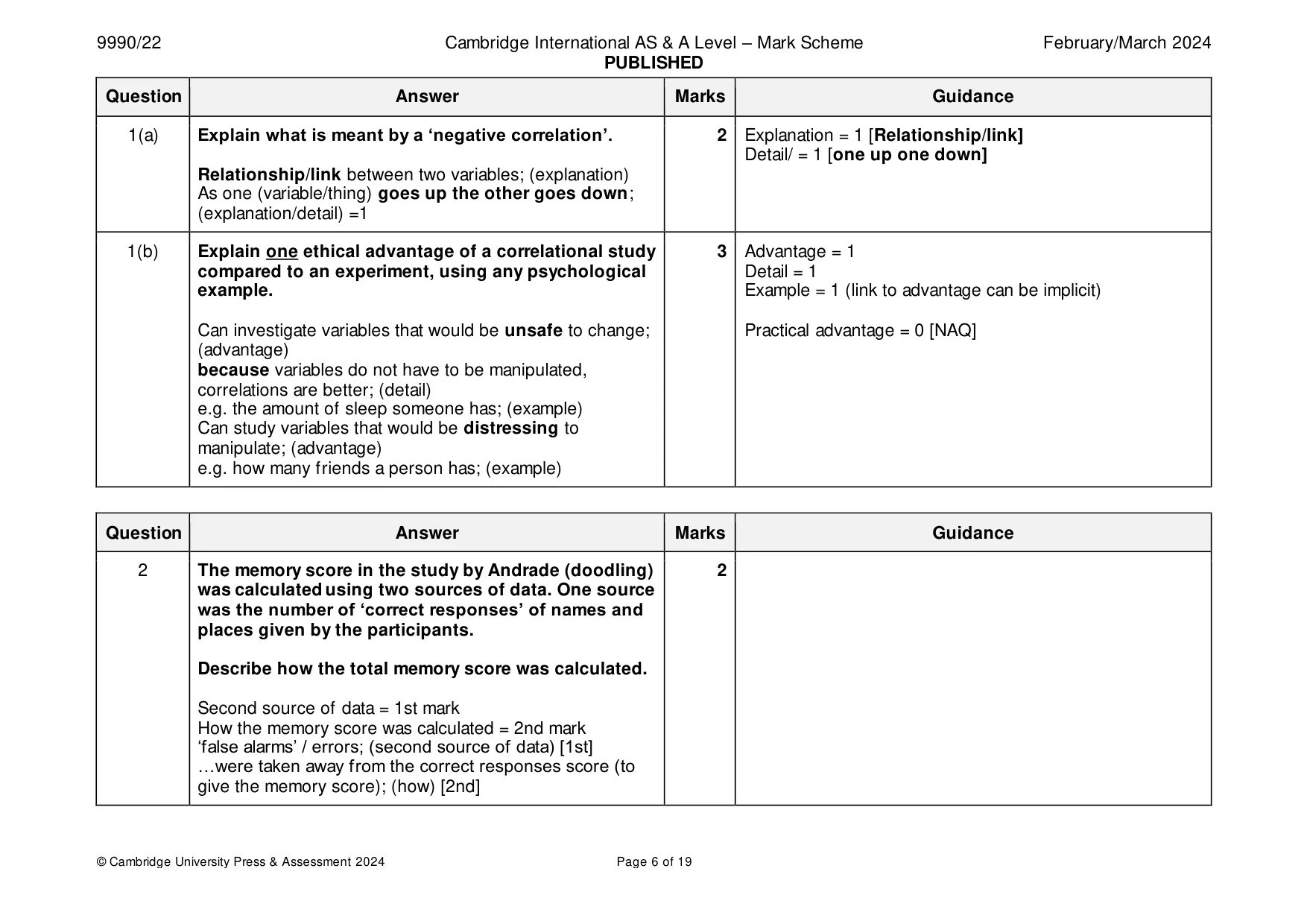
Mark scheme: Question Answer Marks Guidance 1(a) Explain what is meant by a ‘negative correlation’. 2 Explanation = 1 [Relationship/link] Detail/ = 1 [one up one down] Relationship/link between two variables; (explanation) As one (variable/thing) goes up the other goes down; (explanation/detail) =1 1(b) Explain one ethical advantage of a correlational study 3 Advantage = 1 compared to an experiment, using any psychological Detail = 1 example. Example = 1 (link to advantage can be implicit) Can investigate variables that would be unsafe to change; Practical advantage = 0 [NAQ] (advantage) because variables do not have to be manipulated, correlations are better; (detail) e.g. the amount of sleep someone has; (example) Can study variables that would be distressing to manipulate; (advantage) e.g. how many friends a person has; (example)
Q2 · The memory score in the study by Andrade (doodling) was calculated using two sources of…
2 The memory score in the study by Andrade (doodling) was calculated using two sources of data. One source was the number of ‘correct responses’ of names and places given by the participants. Describe how the total memory score was calculated. .......................................................................................................................................................... .......................................................................................................................................................... .......................................................................................................................................................... .................................................................................................................................................... [2]
Mark scheme: 2 The memory score in the study by Andrade (doodling) 2 was calculated using two sources of data. One source was the number of ‘correct responses’ of names and places given by the participants. Describe how the total memory score was calculated. Second source of data = 1st mark How the memory score was calculated = 2nd mark ‘false alarms’ / errors; (second source of data) [1st] …were taken away from the correct responses score (to give the memory score); (how) [2nd]
Q3 · In the study by Dement and Kleitman (sleep and dreams), participants were given…
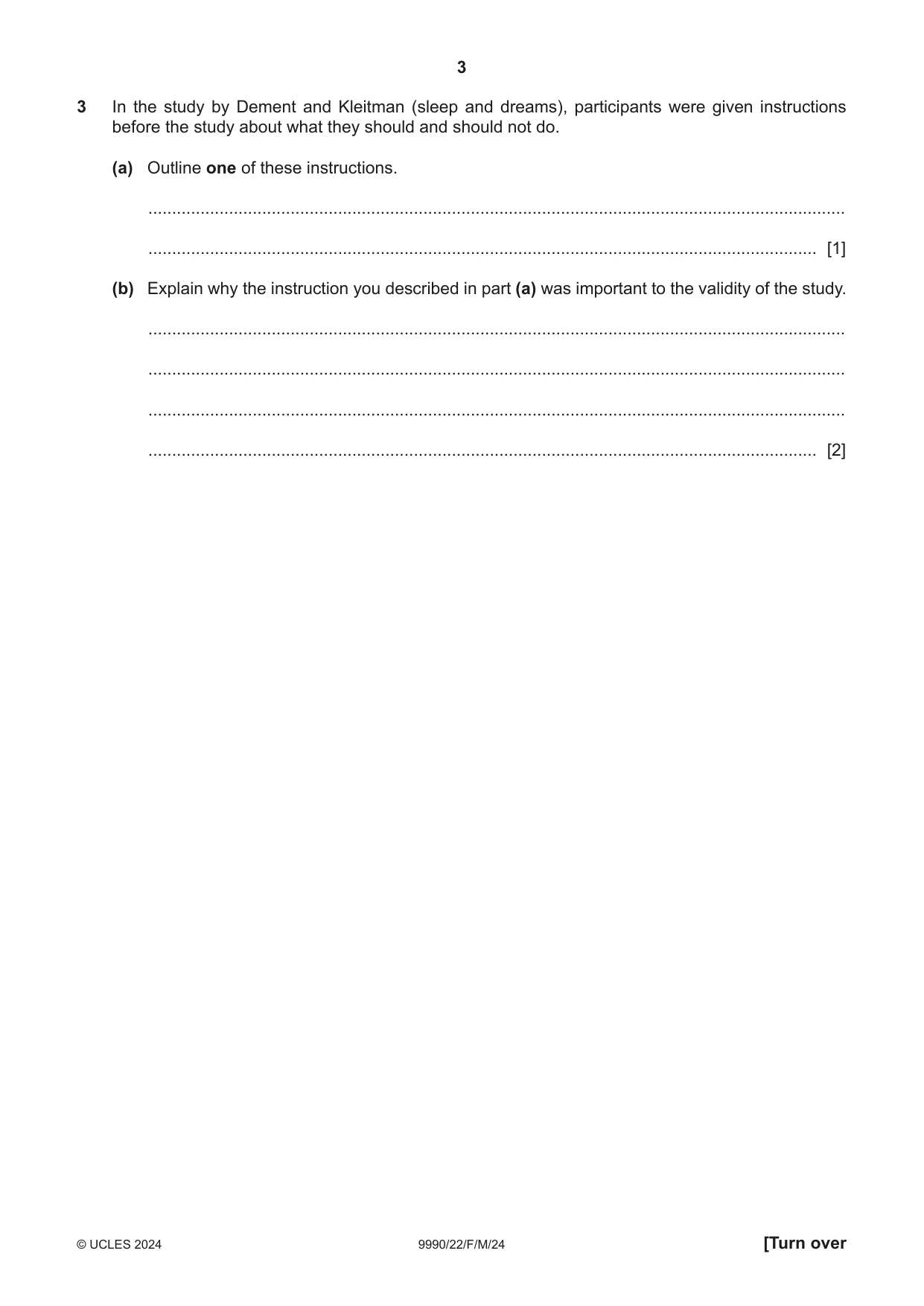
3 In the study by Dement and Kleitman (sleep and dreams), participants were given instructions before the study about what they should and should not do. (a) Outline one of these instructions. ................................................................................................................................................... ............................................................................................................................................. [1] (b) Explain why the instruction you described in part (a) was important to the validity of the study. ................................................................................................................................................... ................................................................................................................................................... ................................................................................................................................................... ............................................................................................................................................. [2]
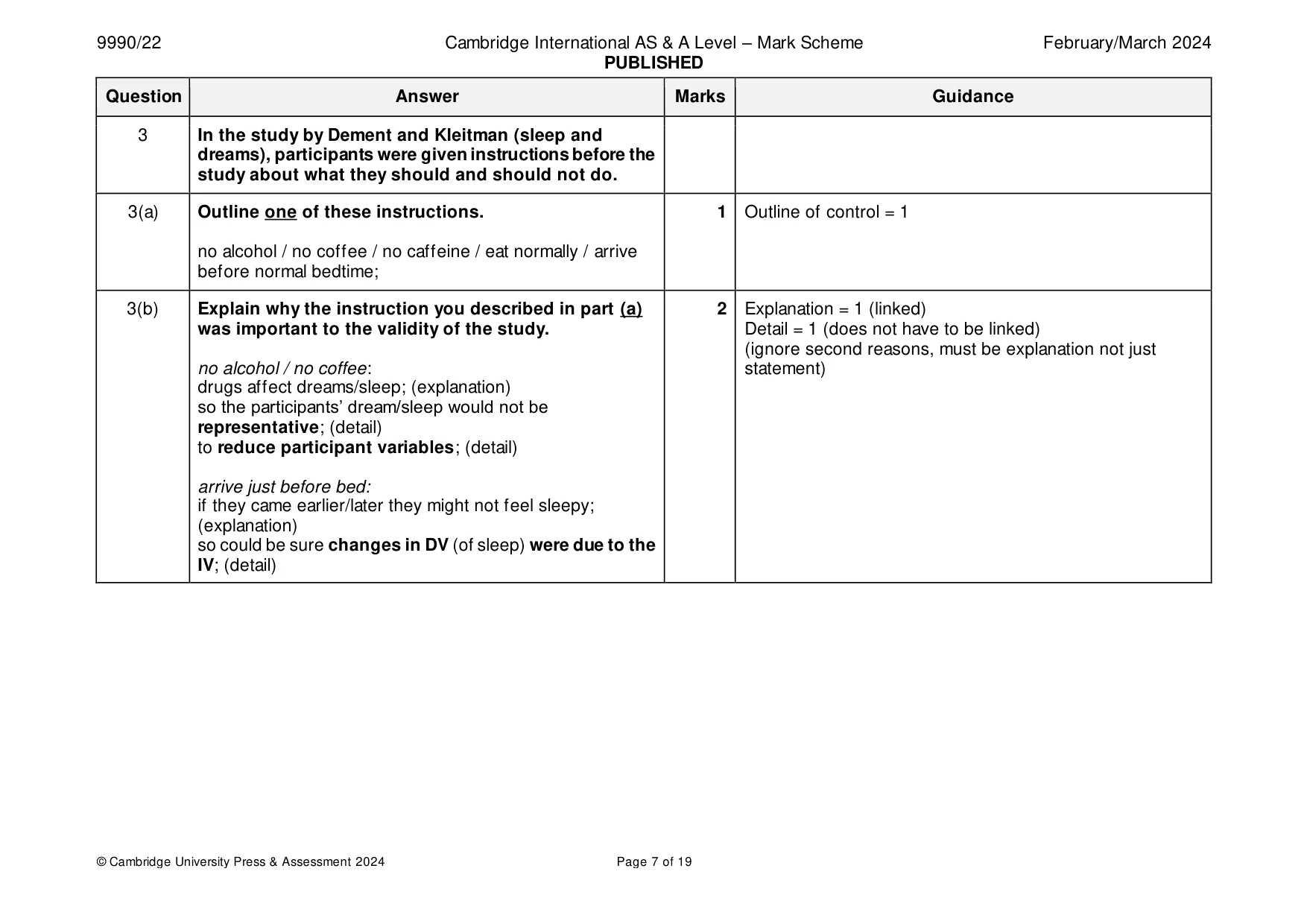
Mark scheme: 3 In the study by Dement and Kleitman (sleep and dreams), participants were given instructions before the study about what they should and should not do. 3(a) Outline one of these instructions. 1 Outline of control = 1 no alcohol / no coffee / no caffeine / eat normally / arrive before normal bedtime; 3(b) Explain why the instruction you described in part (a) 2 Explanation = 1 (linked) was important to the validity of the study. Detail = 1 (does not have to be linked) (ignore second reasons, must be explanation not just no alcohol / no coffee: statement) drugs affect dreams/sleep; (explanation) so the participants’ dream/sleep would not be representative; (detail) to reduce participant variables; (detail) arrive just before bed: if they came earlier/later they might not feel sleepy; (explanation) so could be sure changes in DV (of sleep) were due to the IV; (detail)
Q4 · The study by Perry et al
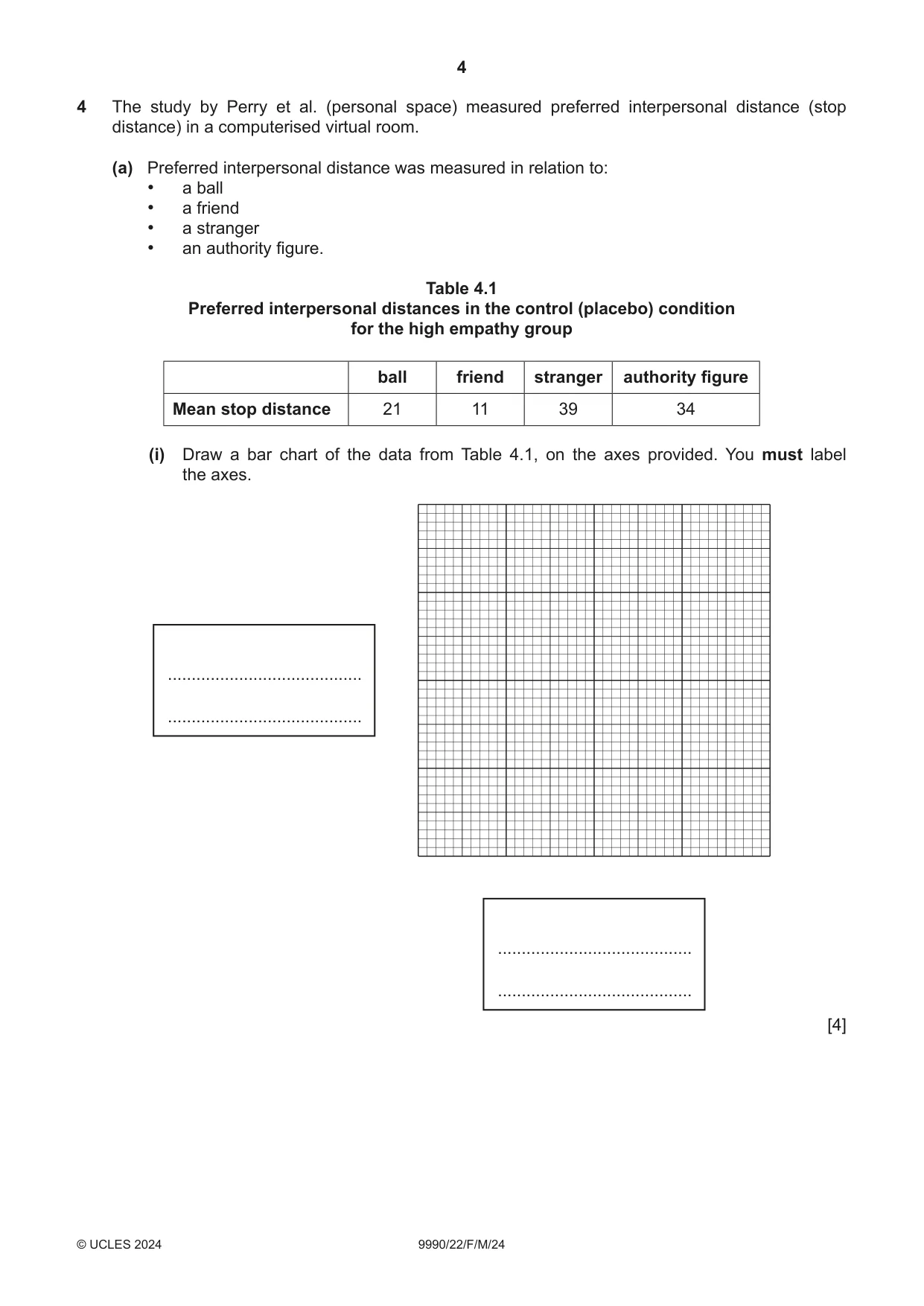
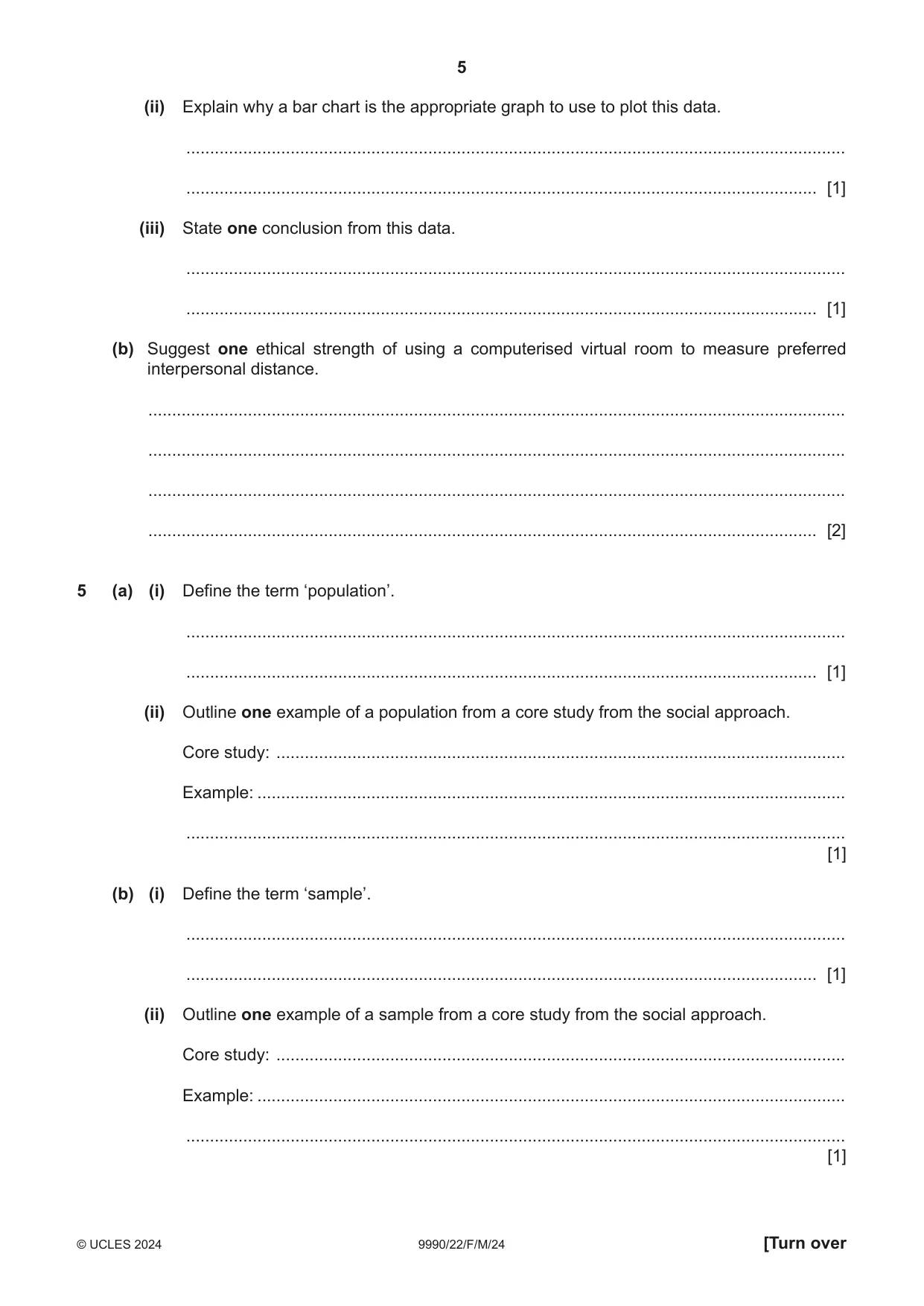
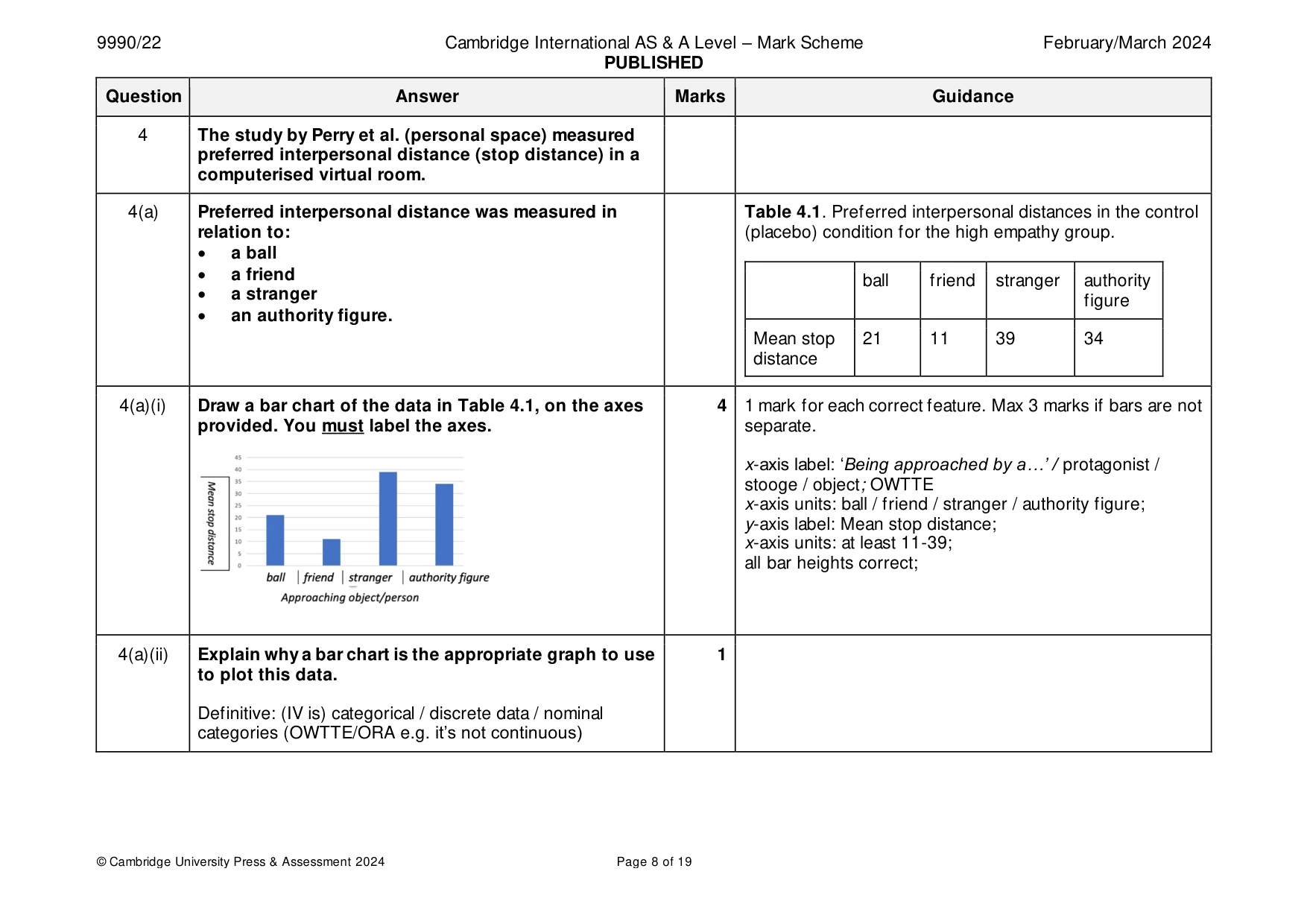
4 The study by Perry et al. (personal space) measured preferred interpersonal distance (stop distance) in a computerised virtual room. (a) Preferred interpersonal distance was measured in relation to: • a ball • a friend • a stranger • an authority figure. Table 4.1 Preferred interpersonal distances in the control (placebo) condition for the high empathy group ball friend stranger authority figure Mean stop distance 21 11 39 34 (i) Draw a bar chart of the data from Table 4.1, on the axes provided. You must label the axes. ......................................... ......................................... ......................................... ......................................... [4] (ii) Explain why a bar chart is the appropriate graph to use to plot this data. ........................................................................................................................................... ..................................................................................................................................... [1] (iii) State one conclusion from this data. ........................................................................................................................................... ..................................................................................................................................... [1] (b) Suggest one ethical strength of using a computerised virtual room to measure preferred interpersonal distance. ................................................................................................................................................... ................................................................................................................................................... ................................................................................................................................................... ............................................................................................................................................. [2]
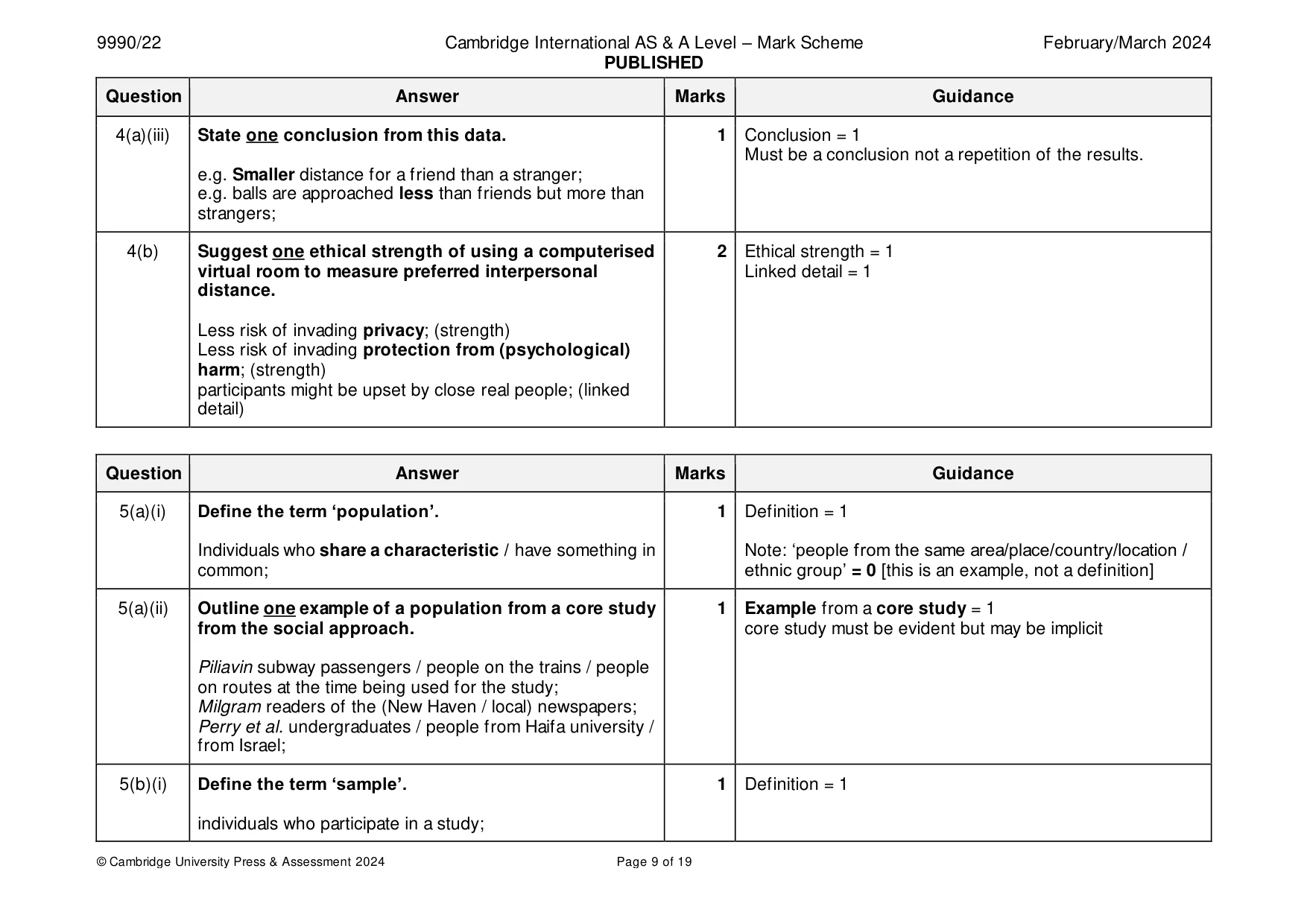
Mark scheme: 4 The study by Perry et al. (personal space) measured preferred interpersonal distance (stop distance) in a computerised virtual room. 4(a) Preferred interpersonal distance was measured in Table 4.1. Preferred interpersonal distances in the control relation to: (placebo) condition for the high empathy group. • a ball • a friend ball friend stranger authority • a stranger figure • an authority figure. Mean stop 21 11 39 34 distance 4(a)(i) Draw a bar chart of the data in Table 4.1, on the axes 4 1 mark for each correct feature. Max 3 marks if bars are not provided. You must label the axes. separate. x-axis label: ‘Being approached by a…’ / protagonist / stooge / object; OWTTE x-axis units: ball / friend / stranger / authority figure; y-axis label: Mean stop distance; x-axis units: at least 11-39; all bar heights correct; 4(a)(ii) Explain why a bar chart is the appropriate graph to use 1 to plot this data. Definitive: (IV is) categorical / discrete data / nominal categories (OWTTE/ORA e.g. it’s not continuous) 4(a)(iii) State one conclusion from this data. 1 Conclusion = 1 Must be a conclusion not a repetition of the results. e.g. Smaller distance for a friend than a stranger; e.g. balls are approached less than friends but more than strangers; 4(b) Suggest one ethical strength of using a computerised 2 Ethical strength = 1 virtual room to measure preferred interpersonal Linked detail = 1 distance. Less risk of invading privacy; (strength) Less risk of invading protection from (psychological) harm; (strength) participants might be upset by close real people; (linked detail)
Q5 · Define the term ‘population’
5 (a) (i) Define the term ‘population’. ........................................................................................................................................... ..................................................................................................................................... [1] (ii) Outline one example of a population from a core study from the social approach. Core study: ........................................................................................................................ Example: ............................................................................................................................ ........................................................................................................................................... [1] (b) (i) Define the term ‘sample’. ........................................................................................................................................... ..................................................................................................................................... [1] (ii) Outline one example of a sample from a core study from the social approach. Core study: ........................................................................................................................ Example: ............................................................................................................................ ........................................................................................................................................... [1]
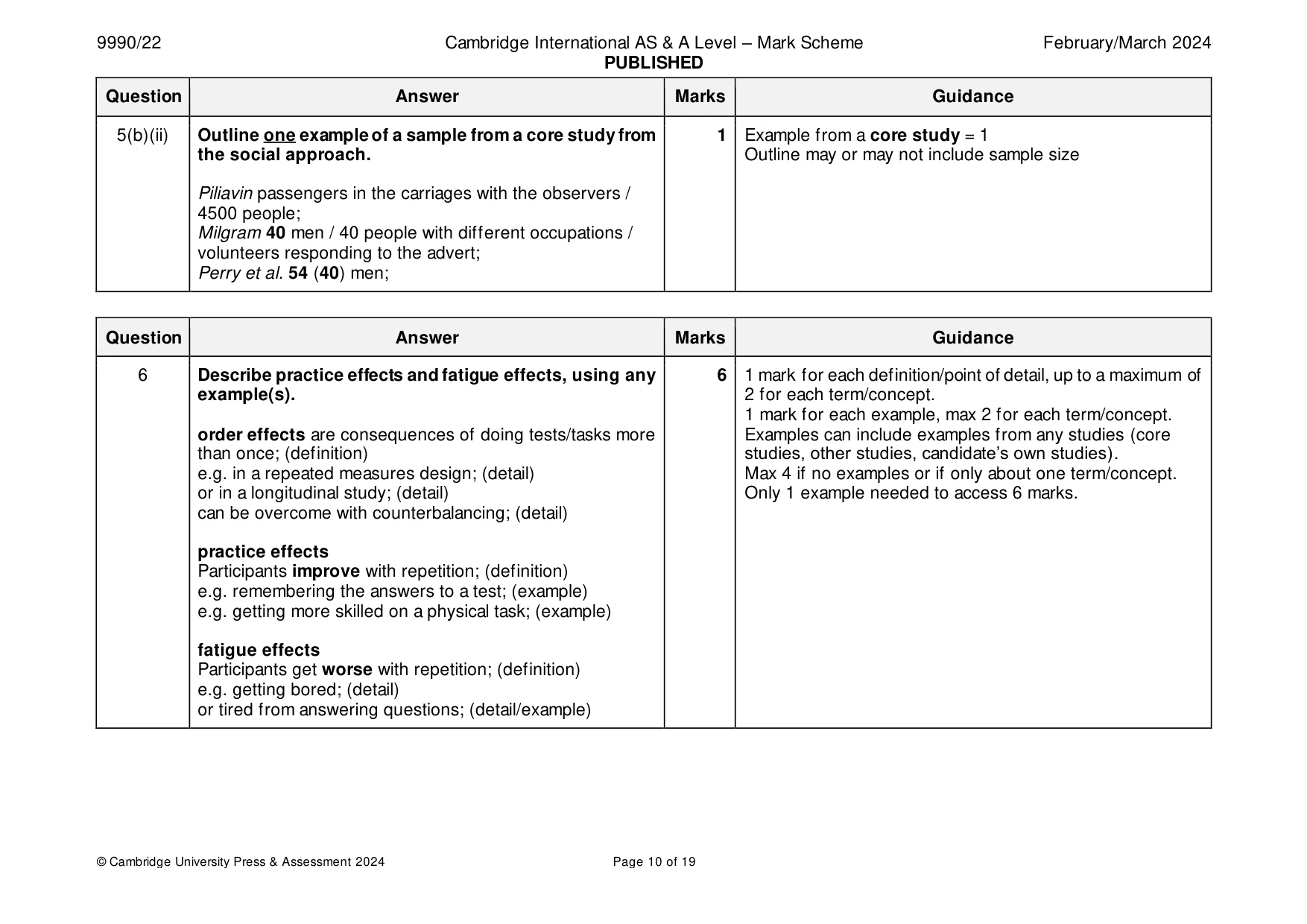
Mark scheme: 5(a)(i) Define the term ‘population’. 1 Definition = 1 Individuals who share a characteristic / have something in Note: ‘people from the same area/place/country/location / common; ethnic group’ = 0 [this is an example, not a definition] 5(a)(ii) Outline one example of a population from a core study 1 Example from a core study = 1 from the social approach. core study must be evident but may be implicit Piliavin subway passengers / people on the trains / people on routes at the time being used for the study; Milgram readers of the (New Haven / local) newspapers; Perry et al. undergraduates / people from Haifa university / from Israel; 5(b)(i) Define the term ‘sample’. 1 Definition = 1 individuals who participate in a study; 5(b)(ii) Outline one example of a sample from a core study from 1 Example from a core study = 1 the social approach. Outline may or may not include sample size Piliavin passengers in the carriages with the observers / 4500 people; Milgram 40 men / 40 people with different occupations / volunteers responding to the advert; Perry et al. 54 (40) men;
Q6 · Describe practice effects and fatigue effects, using any example(s)
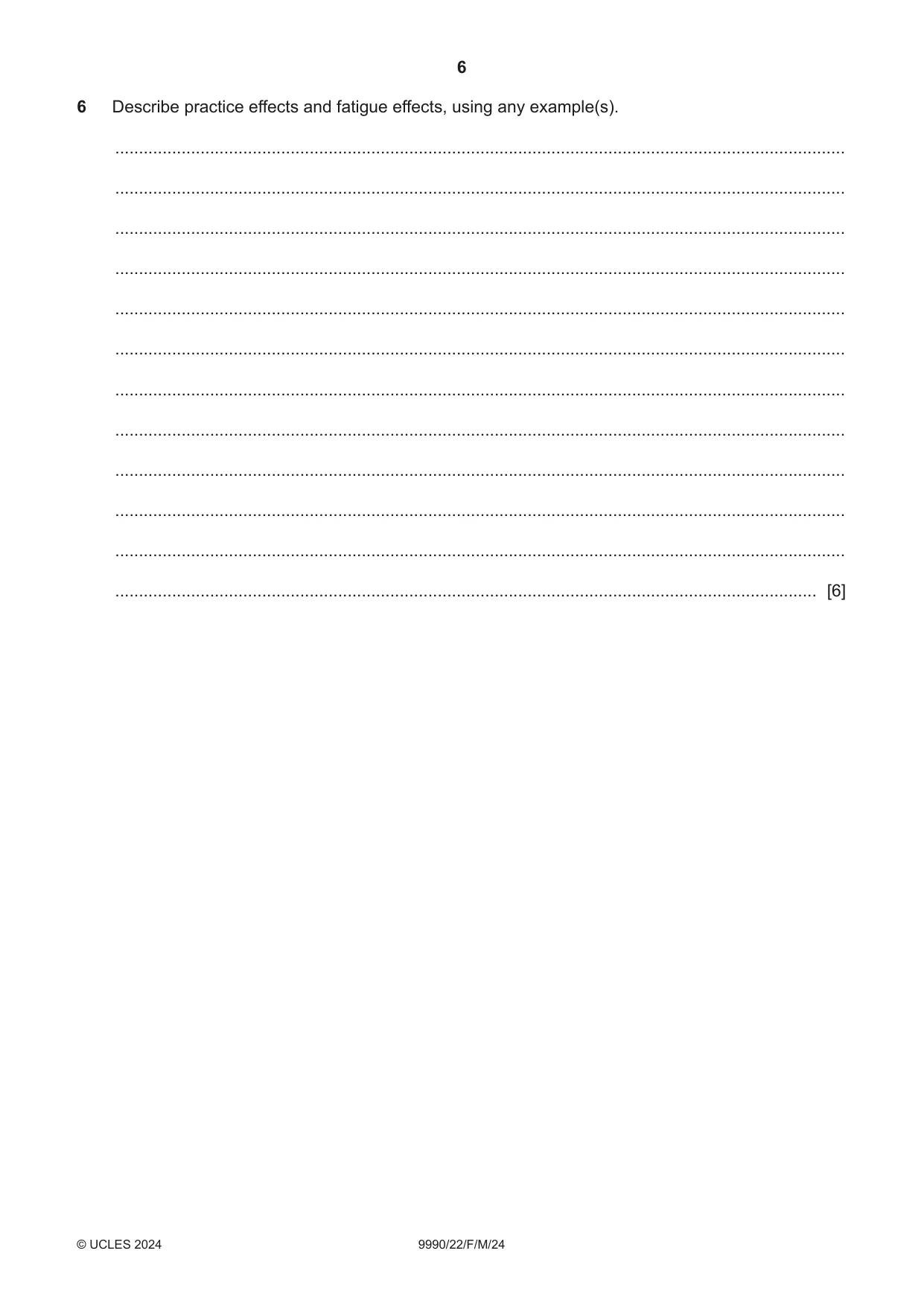
6 Describe practice effects and fatigue effects, using any example(s). .......................................................................................................................................................... .......................................................................................................................................................... .......................................................................................................................................................... .......................................................................................................................................................... .......................................................................................................................................................... .......................................................................................................................................................... .......................................................................................................................................................... .......................................................................................................................................................... .......................................................................................................................................................... .......................................................................................................................................................... .......................................................................................................................................................... .................................................................................................................................................... [6]
Mark scheme: 6 Describe practice effects and fatigue effects, using any 6 1 mark for each definition/point of detail, up to a maximum of example(s). 2 for each term/concept. 1 mark for each example, max 2 for each term/concept. order effects are consequences of doing tests/tasks more Examples can include examples from any studies (core than once; (definition) studies, other studies, candidate’s own studies). e.g. in a repeated measures design; (detail) Max 4 if no examples or if only about one term/concept. or in a longitudinal study; (detail) Only 1 example needed to access 6 marks. can be overcome with counterbalancing; (detail) practice effects Participants improve with repetition; (definition) e.g. remembering the answers to a test; (example) e.g. getting more skilled on a physical task; (example) fatigue effects Participants get worse with repetition; (definition) e.g. getting bored; (detail) or tired from answering questions; (detail/example)
Q7 · Kavi has noticed that when customers leave a takeaway restaurant, they often drop rubbish
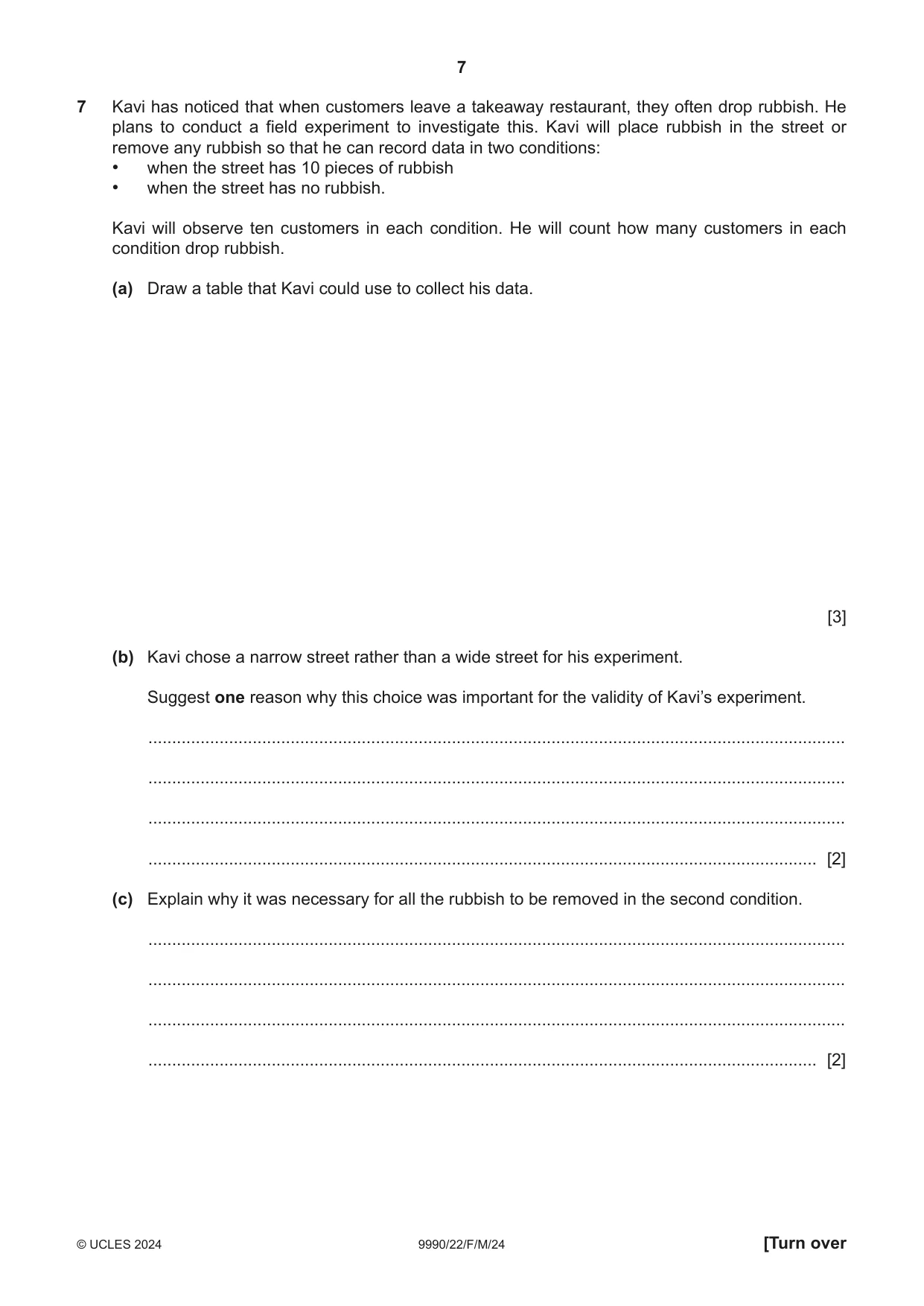
7 Kavi has noticed that when customers leave a takeaway restaurant, they often drop rubbish. He plans to conduct a field experiment to investigate this. Kavi will place rubbish in the street or remove any rubbish so that he can record data in two conditions: • when the street has 10 pieces of rubbish • when the street has no rubbish. Kavi will observe ten customers in each condition. He will count how many customers in each condition drop rubbish. (a) Draw a table that Kavi could use to collect his data. [3] (b) Kavi chose a narrow street rather than a wide street for his experiment. Suggest one reason why this choice was important for the validity of Kavi’s experiment. ................................................................................................................................................... ................................................................................................................................................... ................................................................................................................................................... ............................................................................................................................................. [2] (c) Explain why it was necessary for all the rubbish to be removed in the second condition. ................................................................................................................................................... ................................................................................................................................................... ................................................................................................................................................... ............................................................................................................................................. [2]
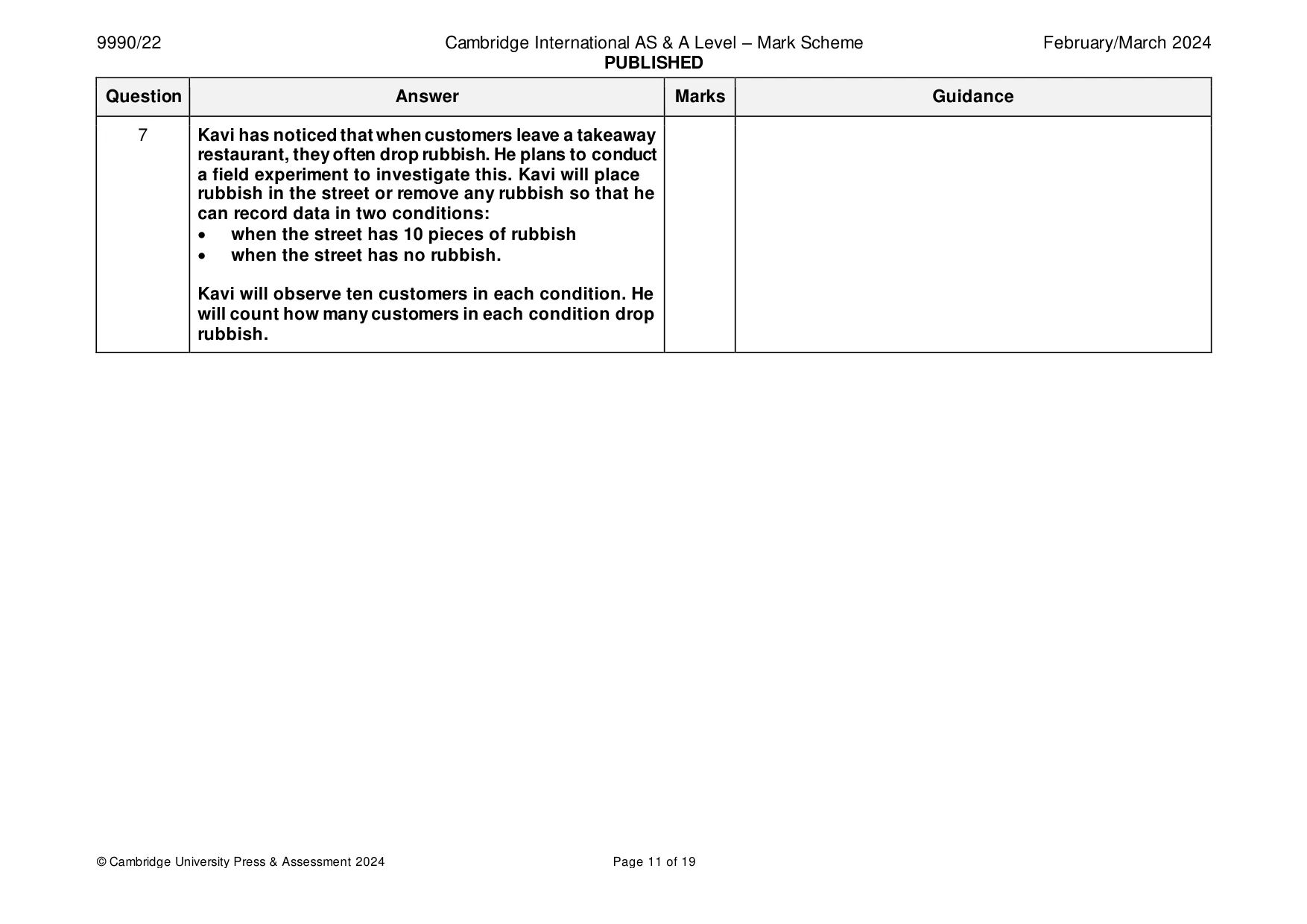
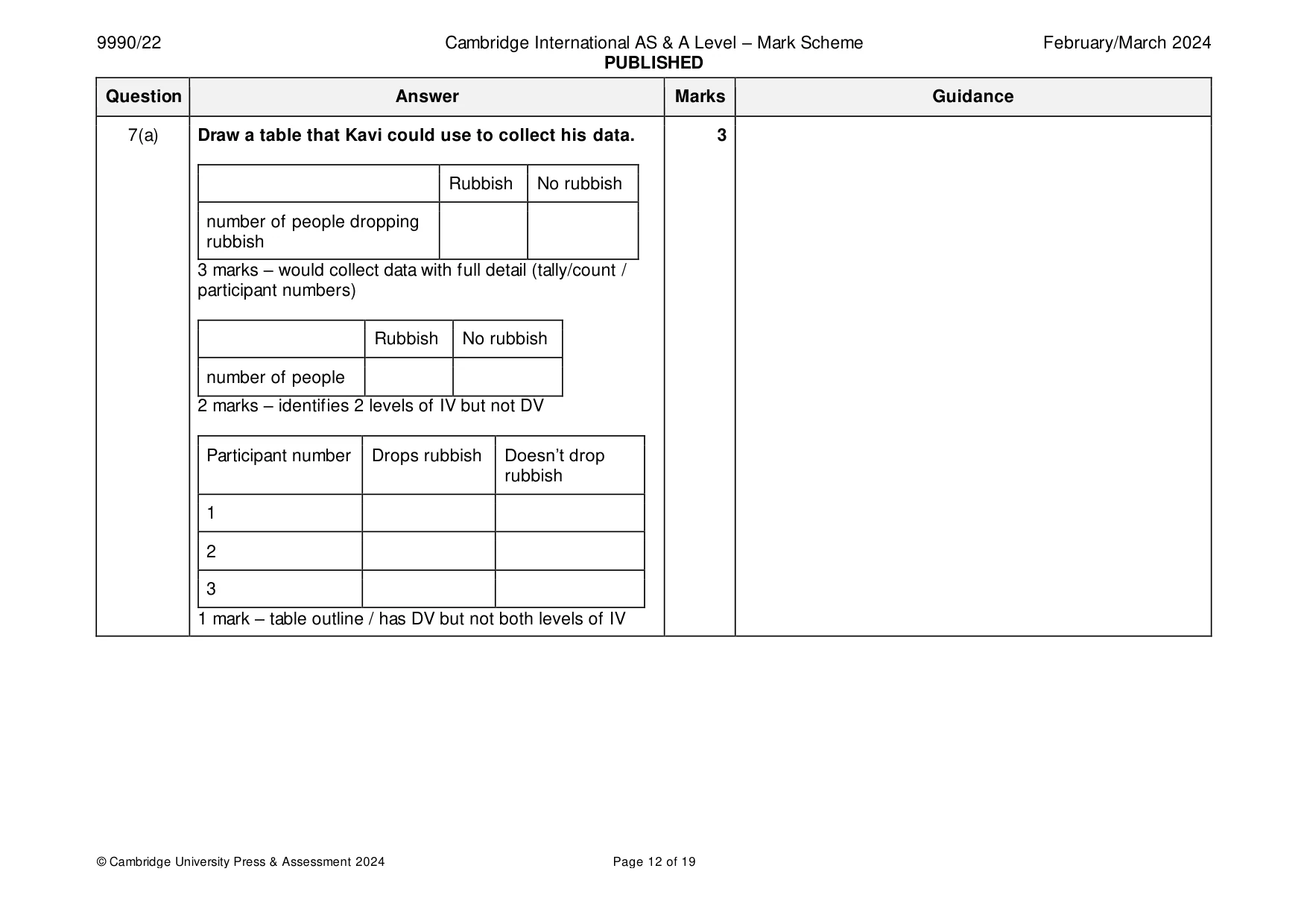
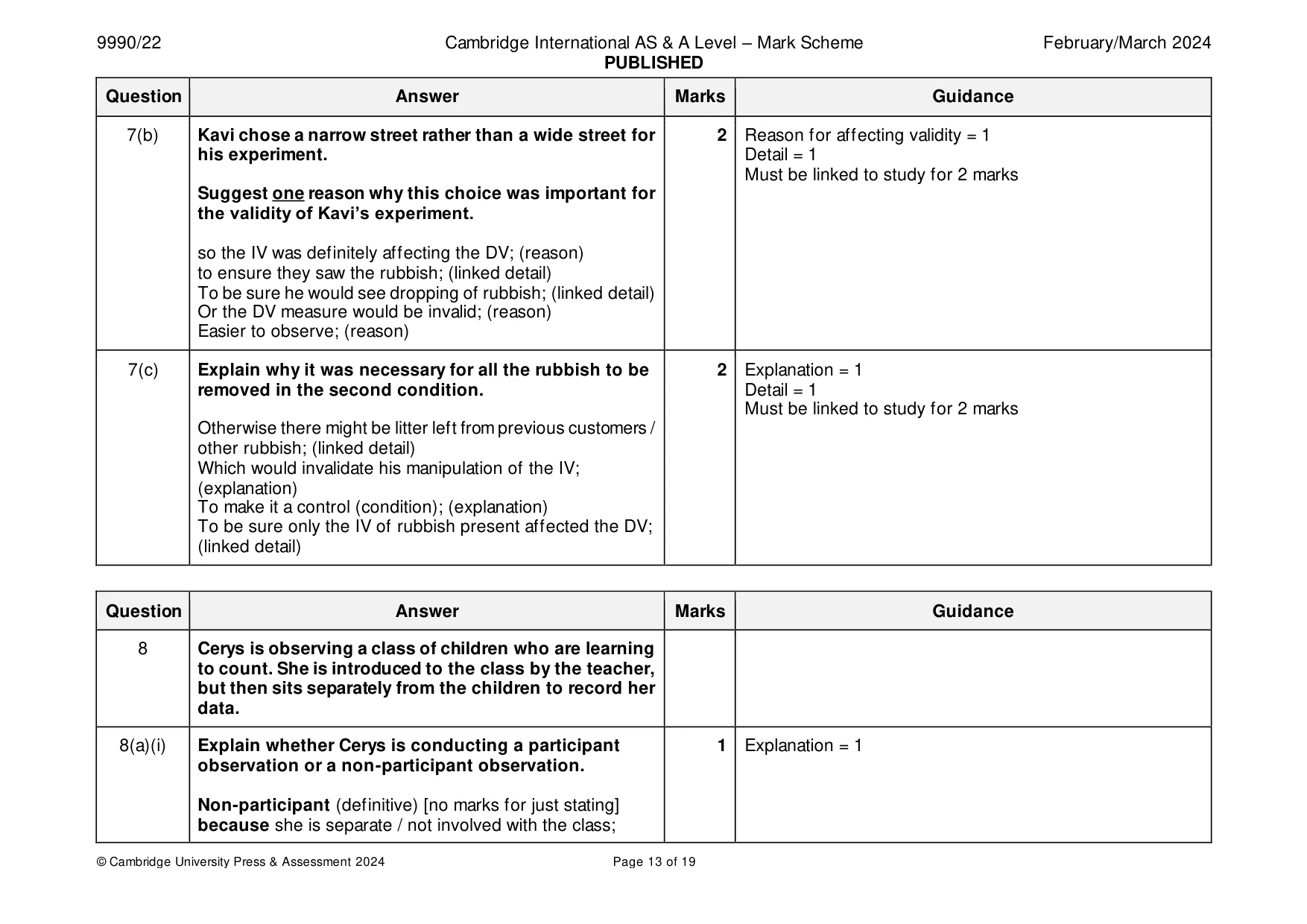
Mark scheme: 7 Kavi has noticed that when customers leave a takeaway restaurant, they often drop rubbish. He plans to conduct a field experiment to investigate this. Kavi will place rubbish in the street or remove any rubbish so that he can record data in two conditions: • when the street has 10 pieces of rubbish • when the street has no rubbish. Kavi will observe ten customers in each condition. He will count how many customers in each condition drop rubbish. 7(a) Draw a table that Kavi could use to collect his data. 3 Rubbish No rubbish number of people dropping rubbish 3 marks – would collect data with full detail (tally/count / participant numbers) Rubbish No rubbish number of people 2 marks – identifies 2 levels of IV but not DV Participant number Drops rubbish Doesn’t drop rubbish 1 2 3 1 mark – table outline / has DV but not both levels of IV 7(b) Kavi chose a narrow street rather than a wide street for 2 Reason for affecting validity = 1 his experiment. Detail = 1 Must be linked to study for 2 marks Suggest one reason why this choice was important for the validity of Kavi’s experiment. so the IV was definitely affecting the DV; (reason) to ensure they saw the rubbish; (linked detail) To be sure he would see dropping of rubbish; (linked detail) Or the DV measure would be invalid; (reason) Easier to observe; (reason) 7(c) Explain why it was necessary for all the rubbish to be 2 Explanation = 1 removed in the second condition. Detail = 1 Must be linked to study for 2 marks Otherwise there might be litter left from previous customers / other rubbish; (linked detail) Which would invalidate his manipulation of the IV; (explanation) To make it a control (condition); (explanation) To be sure only the IV of rubbish present affected the DV; (linked detail)
Q8 · Cerys is observing a class of children who are learning to count
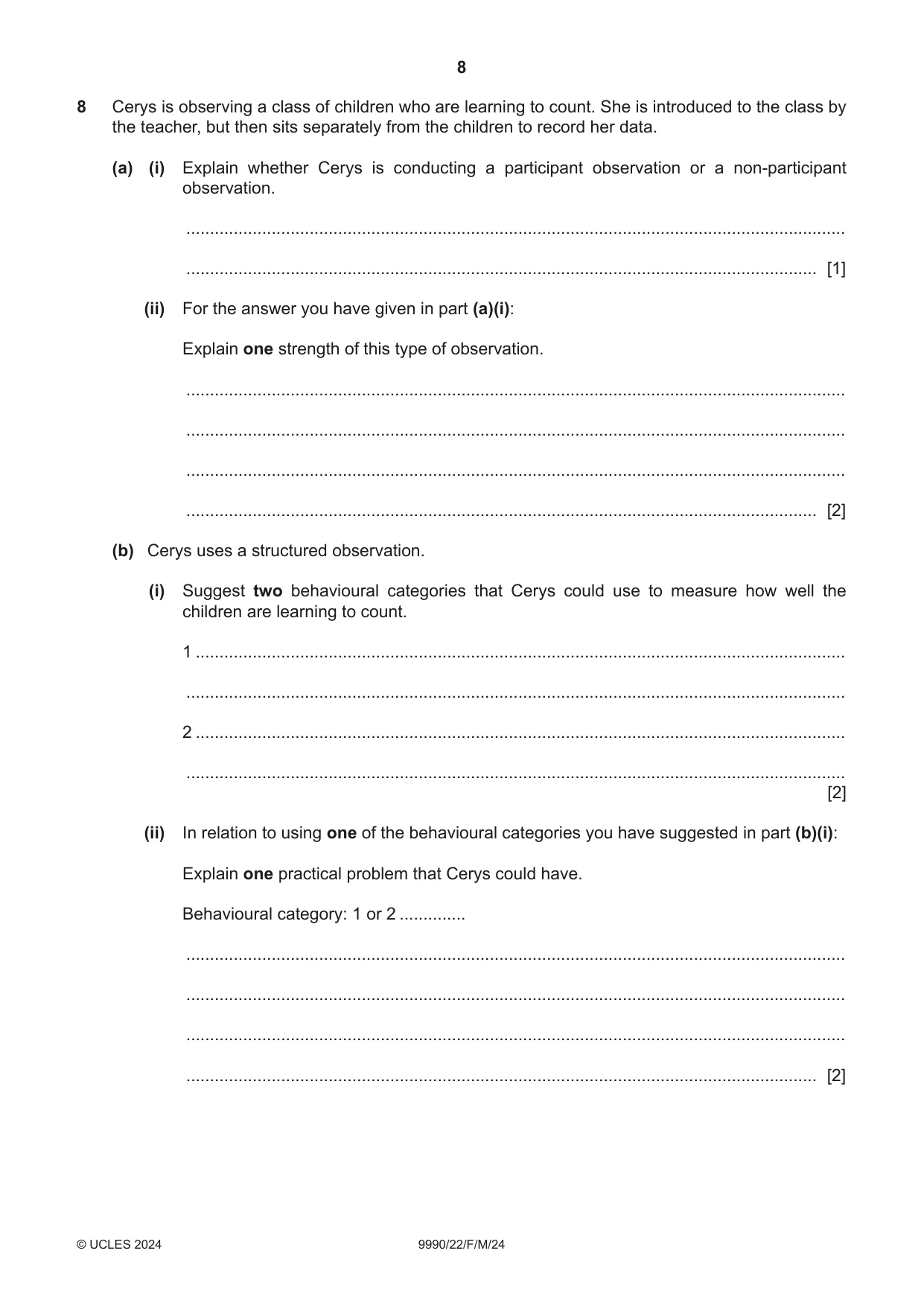
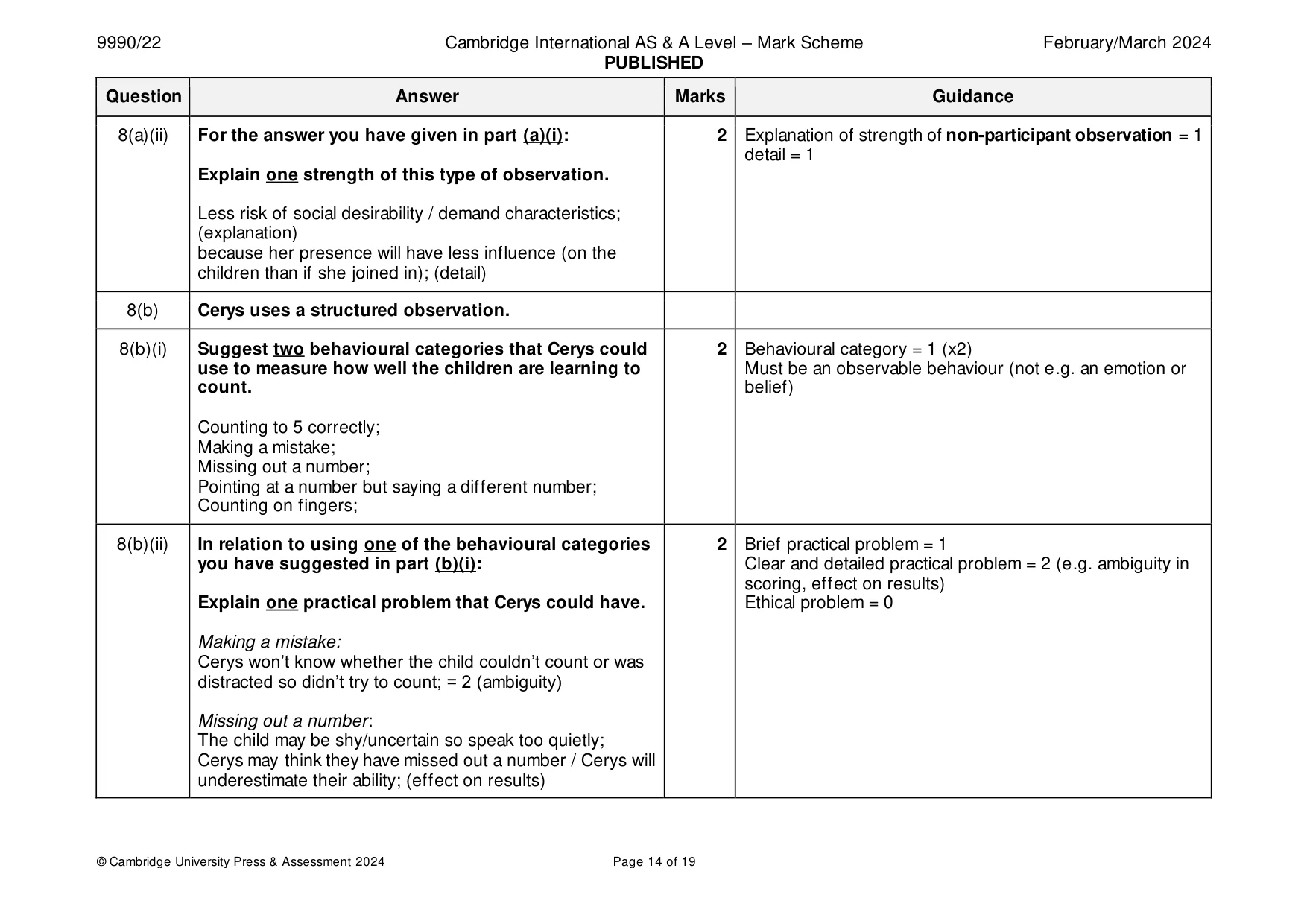
8 Cerys is observing a class of children who are learning to count. She is introduced to the class by the teacher, but then sits separately from the children to record her data. (a) (i) Explain whether Cerys is conducting a participant observation or a non‑participant observation. ........................................................................................................................................... ..................................................................................................................................... [1] (ii) For the answer you have given in part (a)(i): Explain one strength of this type of observation. ........................................................................................................................................... ........................................................................................................................................... ........................................................................................................................................... ..................................................................................................................................... [2] (b) Cerys uses a structured observation. (i) Suggest two behavioural categories that Cerys could use to measure how well the children are learning to count. 1 ......................................................................................................................................... ........................................................................................................................................... 2 ......................................................................................................................................... ........................................................................................................................................... [2] (ii) In relation to using one of the behavioural categories you have suggested in part (b)(i): Explain one practical problem that Cerys could have. Behavioural category: 1 or 2 .............. ........................................................................................................................................... ........................................................................................................................................... ........................................................................................................................................... ..................................................................................................................................... [2]
Mark scheme: 8 Cerys is observing a class of children who are learning to count. She is introduced to the class by the teacher, but then sits separately from the children to record her data. 8(a)(i) Explain whether Cerys is conducting a participant 1 Explanation = 1 observation or a non-participant observation. Non-participant (definitive) [no marks for just stating] because she is separate / not involved with the class; 8(a)(ii) For the answer you have given in part (a)(i): 2 Explanation of strength of non-participant observation = 1 detail = 1 Explain one strength of this type of observation. Less risk of social desirability / demand characteristics; (explanation) because her presence will have less influence (on the children than if she joined in); (detail) 8(b) Cerys uses a structured observation. 8(b)(i) Suggest two behavioural categories that Cerys could 2 Behavioural category = 1 (x2) use to measure how well the children are learning to Must be an observable behaviour (not e.g. an emotion or count. belief) Counting to 5 correctly; Making a mistake; Missing out a number; Pointing at a number but saying a different number; Counting on fingers; 8(b)(ii) In relation to using one of the behavioural categories 2 Brief practical problem = 1 you have suggested in part (b)(i): Clear and detailed practical problem = 2 (e.g. ambiguity in scoring, effect on results) Explain one practical problem that Cerys could have. Ethical problem = 0 Making a mistake: Cerys won’t know whether the child couldn’t count or was distracted so didn’t try to count; = 2 (ambiguity) Missing out a number: The child may be shy/uncertain so speak too quietly; Cerys may think they have missed out a number / Cerys will underestimate their ability; (effect on results)
Q9 · Nila is using a questionnaire to investigate adults’ use and understanding of the internet
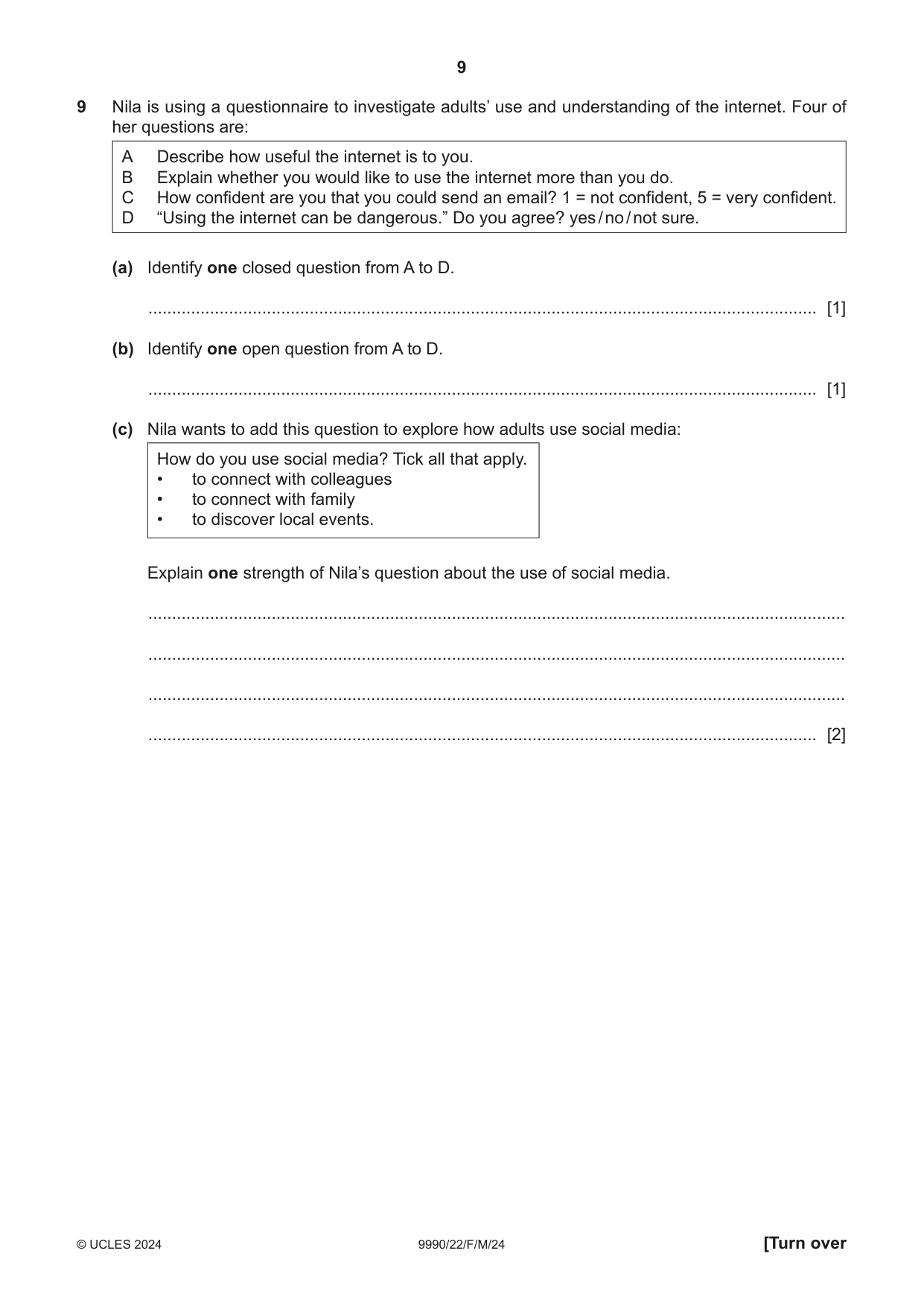
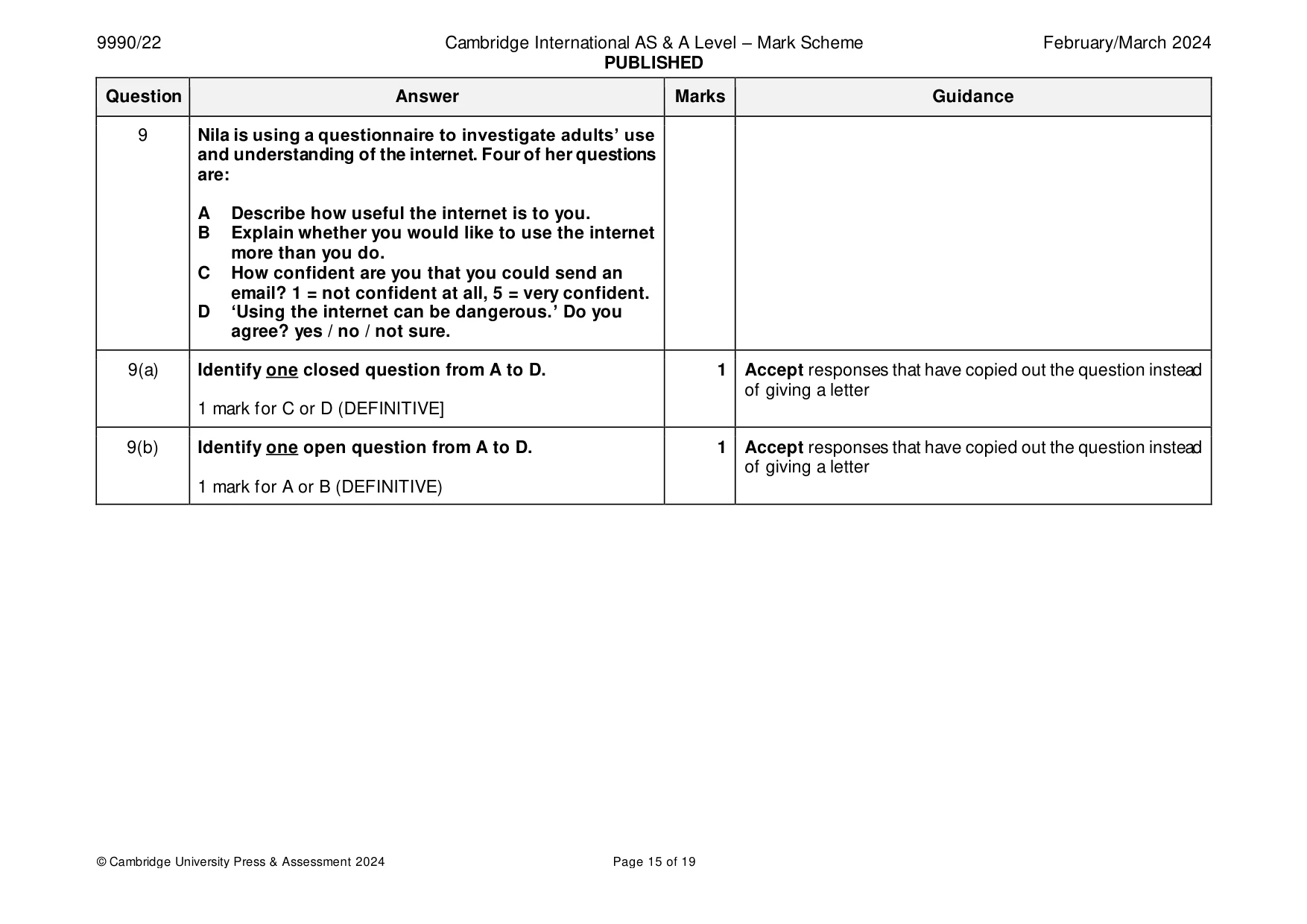
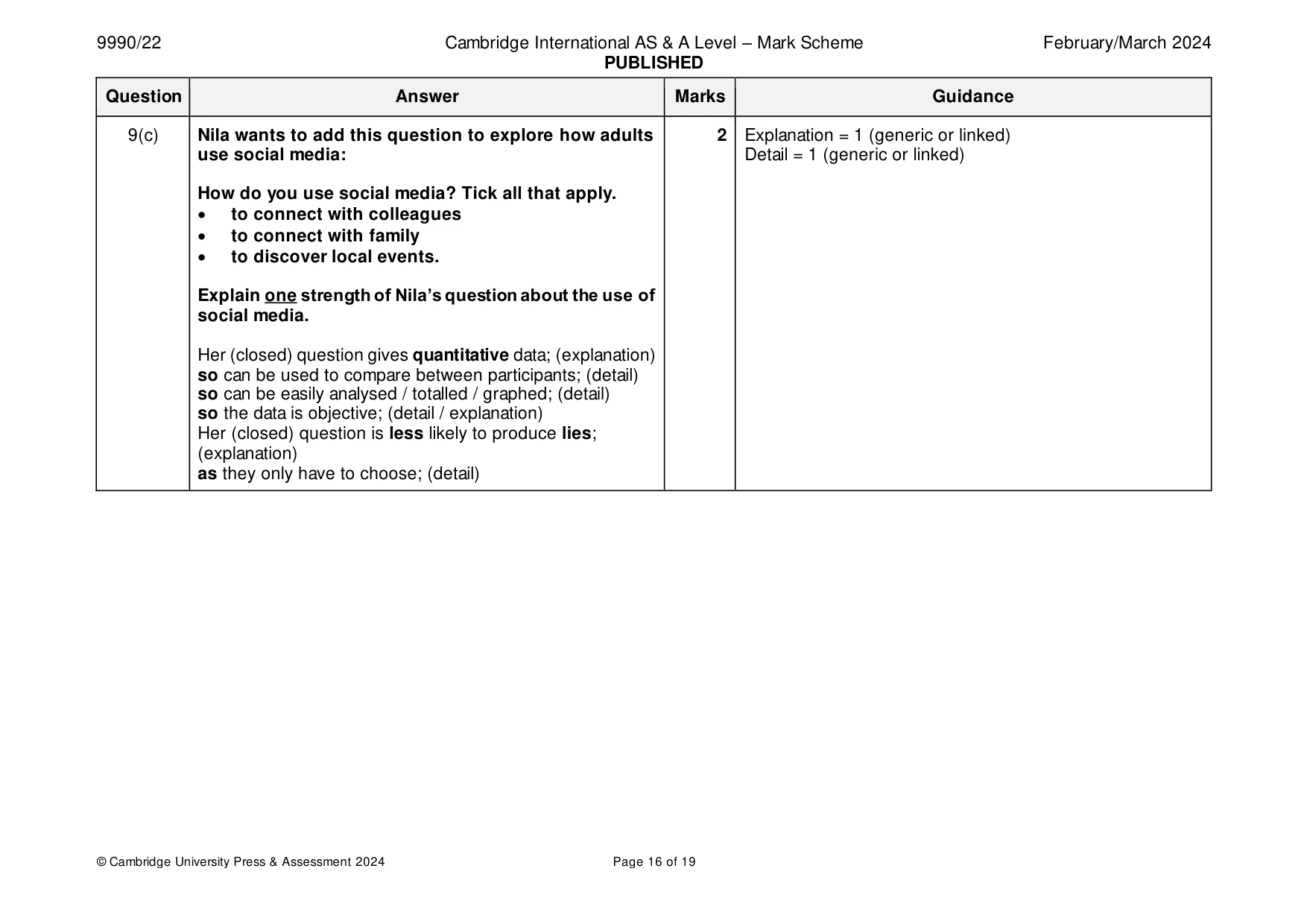
9 Nila is using a questionnaire to investigate adults’ use and understanding of the internet. Four of her questions are: A Describe how useful the internet is to you. B Explain whether you would like to use the internet more than you do. C How confident are you that you could send an email? 1 = not confident, 5 = very confident. D “Using the internet can be dangerous.” Do you agree? yes / no / not sure. (a) Identify one closed question from A to D. ............................................................................................................................................. [1] (b) Identify one open question from A to D. ............................................................................................................................................. [1] (c) Nila wants to add this question to explore how adults use social media: How do you use social media? Tick all that apply. • to connect with colleagues • to connect with family • to discover local events. Explain one strength of Nila’s question about the use of social media. ................................................................................................................................................... ................................................................................................................................................... ................................................................................................................................................... ............................................................................................................................................. [2]
Mark scheme: 9 Nila is using a questionnaire to investigate adults’ use and understanding of the internet. Four of her questions are: A Describe how useful the internet is to you. B Explain whether you would like to use the internet more than you do. C How confident are you that you could send an email? 1 = not confident at all, 5 = very confident. D ‘Using the internet can be dangerous.’ Do you agree? yes / no / not sure. 9(a) Identify one closed question from A to D. 1 Accept responses that have copied out the question instead of giving a letter 1 mark for C or D (DEFINITIVE] 9(b) Identify one open question from A to D. 1 Accept responses that have copied out the question instead of giving a letter 1 mark for A or B (DEFINITIVE) 9(c) Nila wants to add this question to explore how adults 2 Explanation = 1 (generic or linked) use social media: Detail = 1 (generic or linked) How do you use social media? Tick all that apply. • to connect with colleagues • to connect with family • to discover local events. Explain one strength of Nila’s question about the use of social media. Her (closed) question gives quantitative data; (explanation) so can be used to compare between participants; (detail) so can be easily analysed / totalled / graphed; (detail) so the data is objective; (detail / explanation) Her (closed) question is less likely to produce lies; (explanation) as they only have to choose; (detail)
Q10 · Henri feels relaxed when he smells flowers
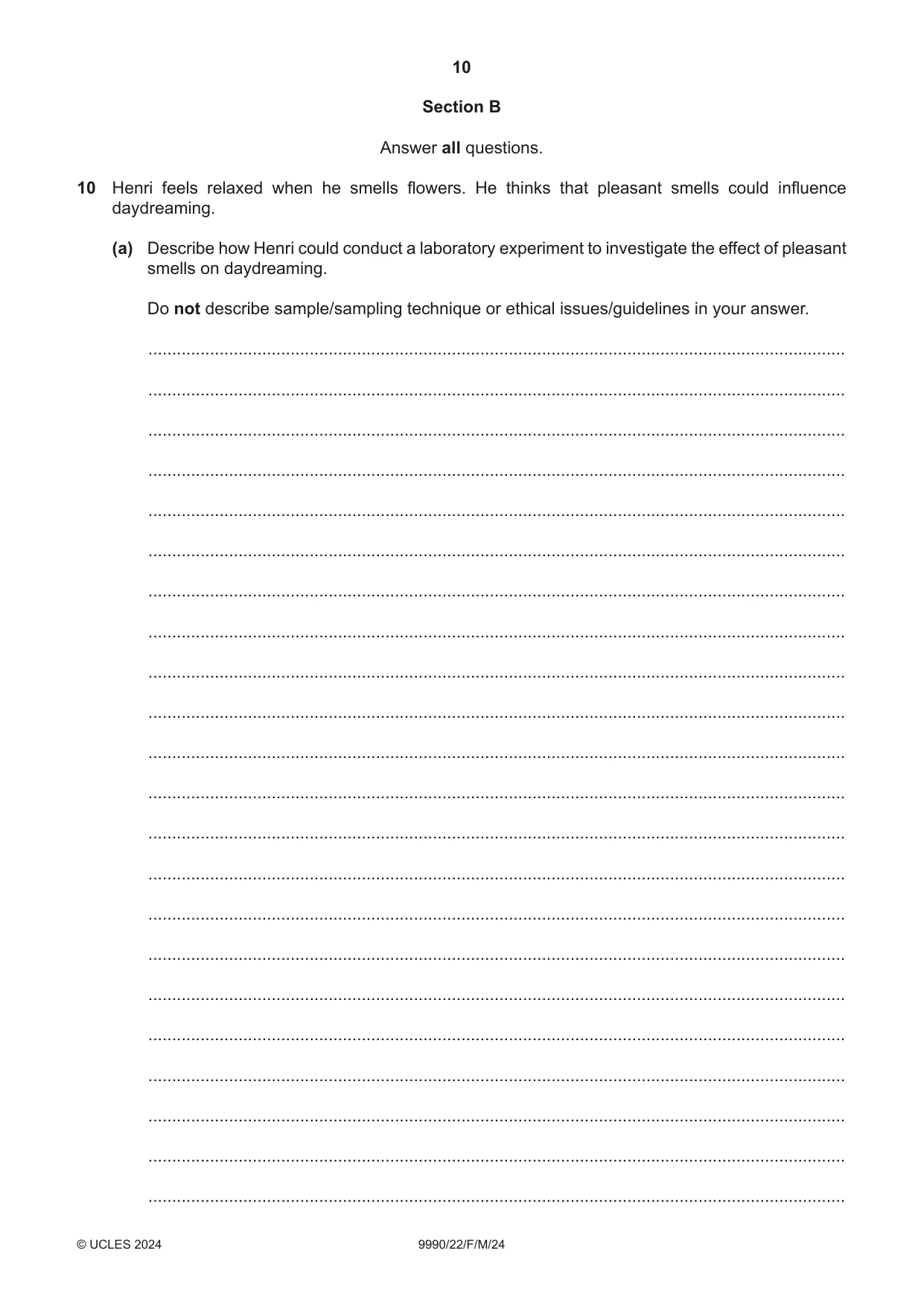
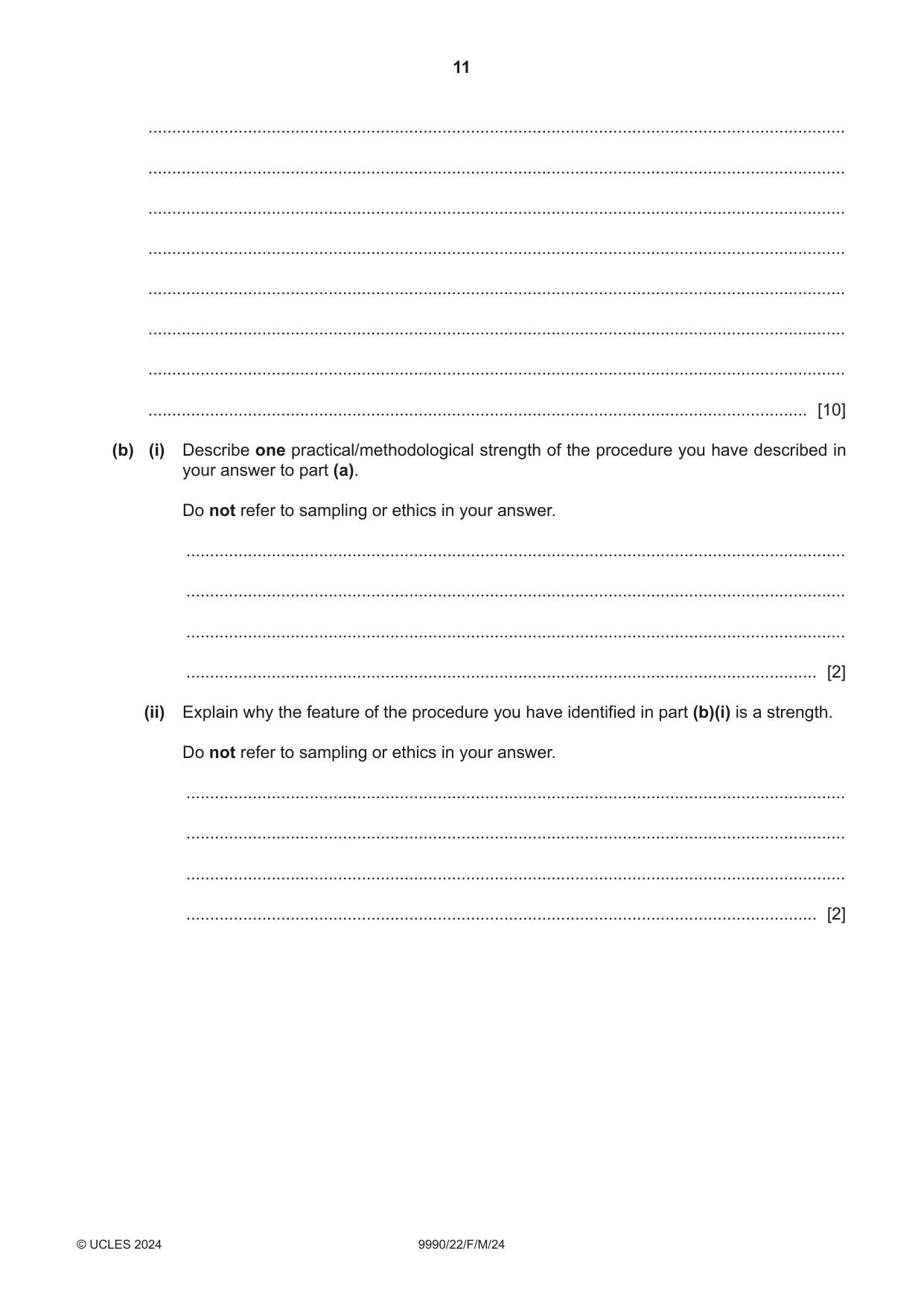
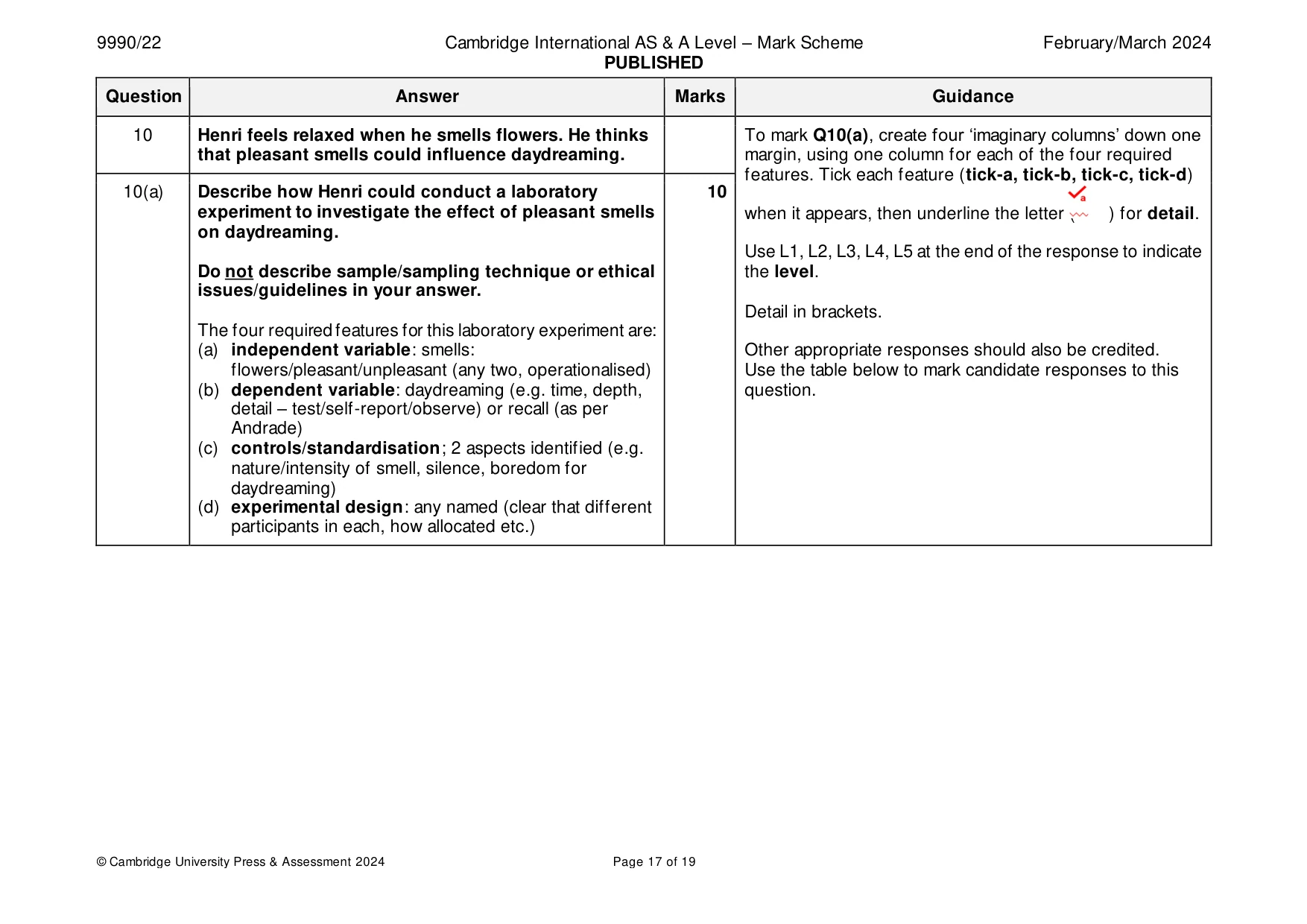
10 Henri feels relaxed when he smells flowers. He thinks that pleasant smells could influence daydreaming. (a) Describe how Henri could conduct a laboratory experiment to investigate the effect of pleasant smells on daydreaming. Do not describe sample/sampling technique or ethical issues/guidelines in your answer. ................................................................................................................................................... ................................................................................................................................................... ................................................................................................................................................... ................................................................................................................................................... ................................................................................................................................................... ................................................................................................................................................... ................................................................................................................................................... ................................................................................................................................................... ................................................................................................................................................... ................................................................................................................................................... ................................................................................................................................................... ................................................................................................................................................... ................................................................................................................................................... ................................................................................................................................................... ................................................................................................................................................... ................................................................................................................................................... ................................................................................................................................................... ................................................................................................................................................... ................................................................................................................................................... ................................................................................................................................................... ................................................................................................................................................... ................................................................................................................................................... ................................................................................................................................................... ................................................................................................................................................... ................................................................................................................................................... ................................................................................................................................................... ................................................................................................................................................... ................................................................................................................................................... ................................................................................................................................................... ........................................................................................................................................... [10] (b) (i) Describe one practical/methodological strength of the procedure you have described in your answer to part (a). Do not refer to sampling or ethics in your answer. ........................................................................................................................................... ........................................................................................................................................... ........................................................................................................................................... ..................................................................................................................................... [2] (ii) Explain why the feature of the procedure you have identified in part (b)(i) is a strength. Do not refer to sampling or ethics in your answer. ........................................................................................................................................... ........................................................................................................................................... ........................................................................................................................................... ..................................................................................................................................... [2]
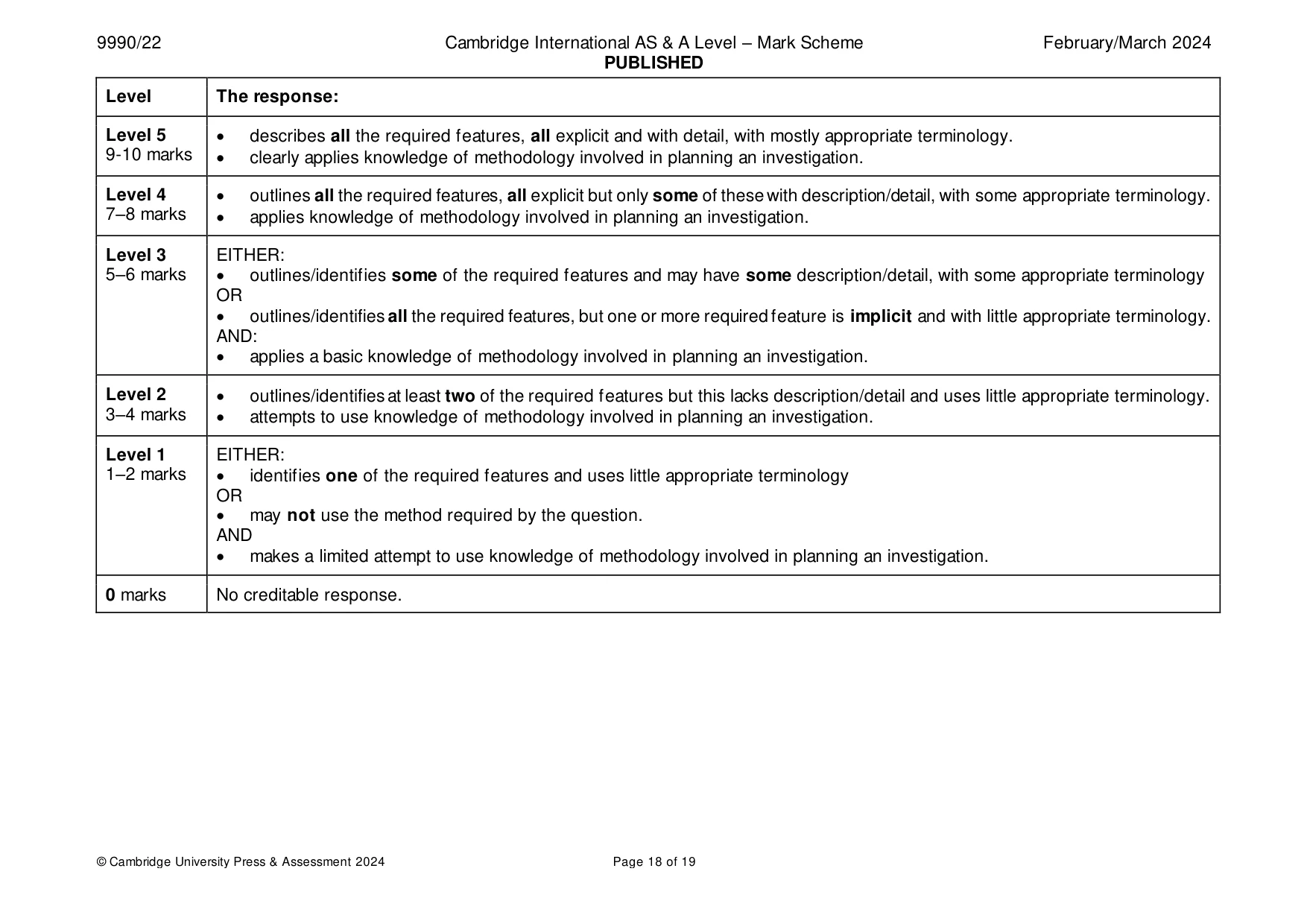
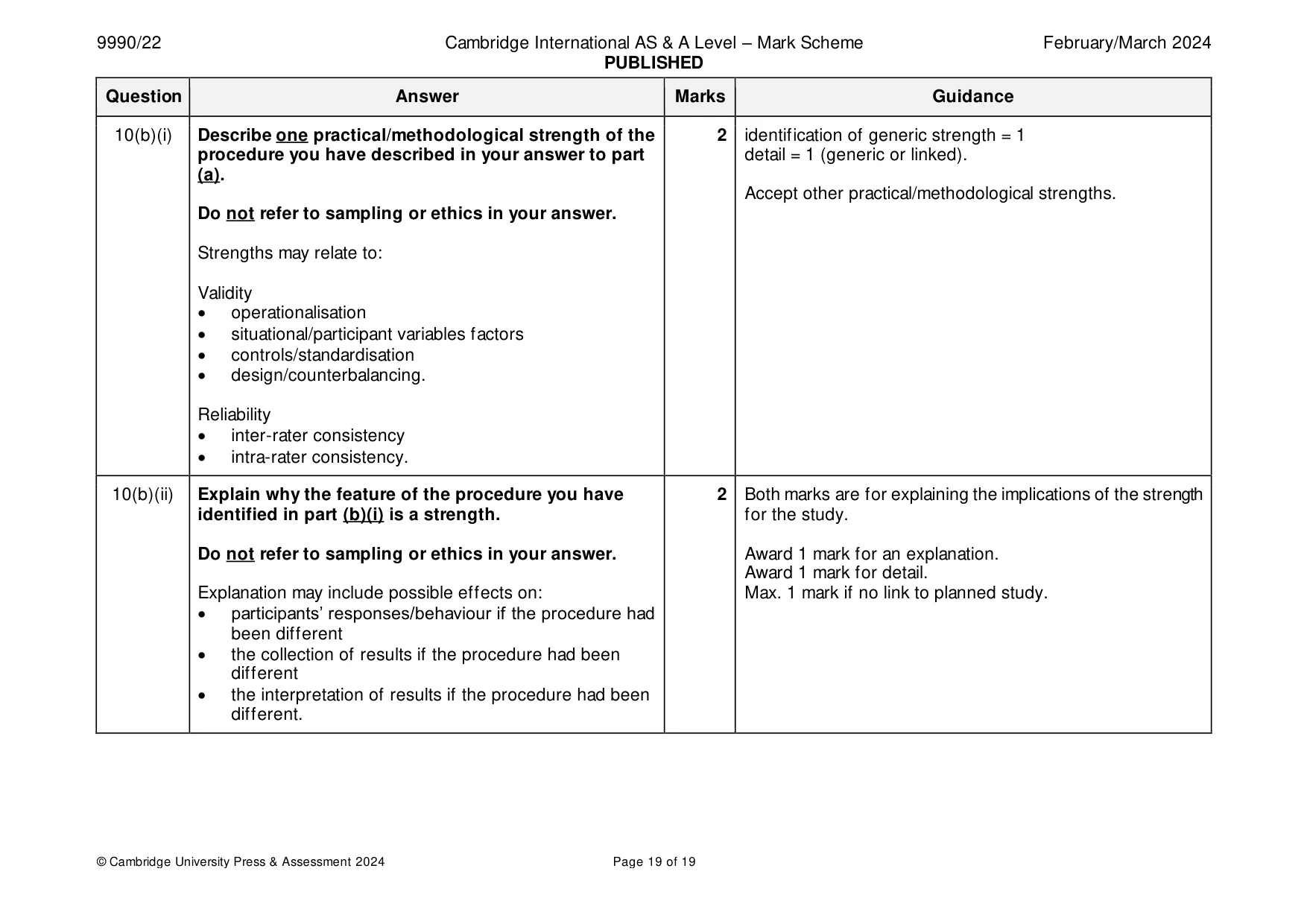
Mark scheme: 10 Henri feels relaxed when he smells flowers. He thinks To mark Q10(a), create four ‘imaginary columns’ down one that pleasant smells could influence daydreaming. margin, using one column for each of the four required features. Tick each feature (tick-a, tick-b, tick-c, tick-d) 10(a) Describe how Henri could conduct a laboratory 10 experiment to investigate the effect of pleasant smells when it appears, then underline the letter ( ) for detail. on daydreaming. Use L1, L2, L3, L4, L5 at the end of the response to indicate Do not describe sample/sampling technique or ethical the level. issues/guidelines in your answer. Detail in brackets. The four required features for this laboratory experiment are: (a) independent variable: smells: Other appropriate responses should also be credited. flowers/pleasant/unpleasant (any two, operationalised) Use the table below to mark candidate responses to this (b) dependent variable: daydreaming (e.g. time, depth, question. detail – test/self-report/observe) or recall (as per Andrade) (c) controls/standardisation; 2 aspects identified (e.g. nature/intensity of smell, silence, boredom for daydreaming) (d) experimental design: any named (clear that different participants in each, how allocated etc.) Level The response: Level 5 • describes all the required features, all explicit and with detail, with mostly appropriate terminology. 9-10 marks • clearly applies knowledge of methodology involved in planning an investigation. Level 4 • outlines all the required features, all explicit but only some of these with description/detail, with some appropriate terminology. 7–8 marks • applies knowledge of methodology involved in planning an investigation. Level 3 EITHER: 5–6 marks • outlines/identifies some of the required features and may have some description/detail, with some appropriate terminology OR • outlines/identifies all the required features, but one or more required feature is implicit and with little appropriate terminology. AND: • applies a basic knowledge of methodology involved in planning an investigation. Level 2 • outlines/identifies at least two of the required features but this lacks description/detail and uses little appropriate terminology. 3–4 marks • attempts to use knowledge of methodology involved in planning an investigation. Level 1 EITHER: 1–2 marks • identifies one of the required features and uses little appropriate terminology OR • may not use the method required by the question. AND • makes a limited attempt to use knowledge of methodology involved in planning an investigation. 0 marks No creditable response. 10(b)(i) Describe one practical/methodological strength of the 2 identification of generic strength = 1 procedure you have described in your answer to part detail = 1 (generic or linked). (a). Accept other practical/methodological strengths. Do not refer to sampling or ethics in your answer. Strengths may relate to: Validity • operationalisation • situational/participant variables factors • controls/standardisation • design/counterbalancing. Reliability • inter-rater consistency • intra-rater consistency. 10(b)(ii) Explain why the feature of the procedure you have 2 Both marks are for explaining the implications of the strength identified in part (b)(i) is a strength. for the study. Do not refer to sampling or ethics in your answer. Award 1 mark for an explanation. Award 1 mark for detail. Explanation may include possible effects on: Max. 1 mark if no link to planned study. • participants’ responses/behaviour if the procedure had been different • the collection of results if the procedure had been different • the interpretation of results if the procedure had been different.
What was in this paper
The subtopics covered by these 10 questions, and how many questions each got. Open one in a new tab to see every Cambridge question on it.
What you needed in this session
Cambridge’s own grade thresholds for 2024 Feb/March, Paper 2 · Variant 2. A higher threshold means an easier paper — the bar moves with how the cohort did.