Cambridge A Level Psychology (from 2018) 9990 — 2023 Oct/Nov Paper 2 · Variant 1
9990/21/O/N/23 · 10 questions · 60 marks · ≈68 min
The question paper and its mark scheme, free to read here and free to download. This is Cambridge’s own paper, exactly as it was sat.
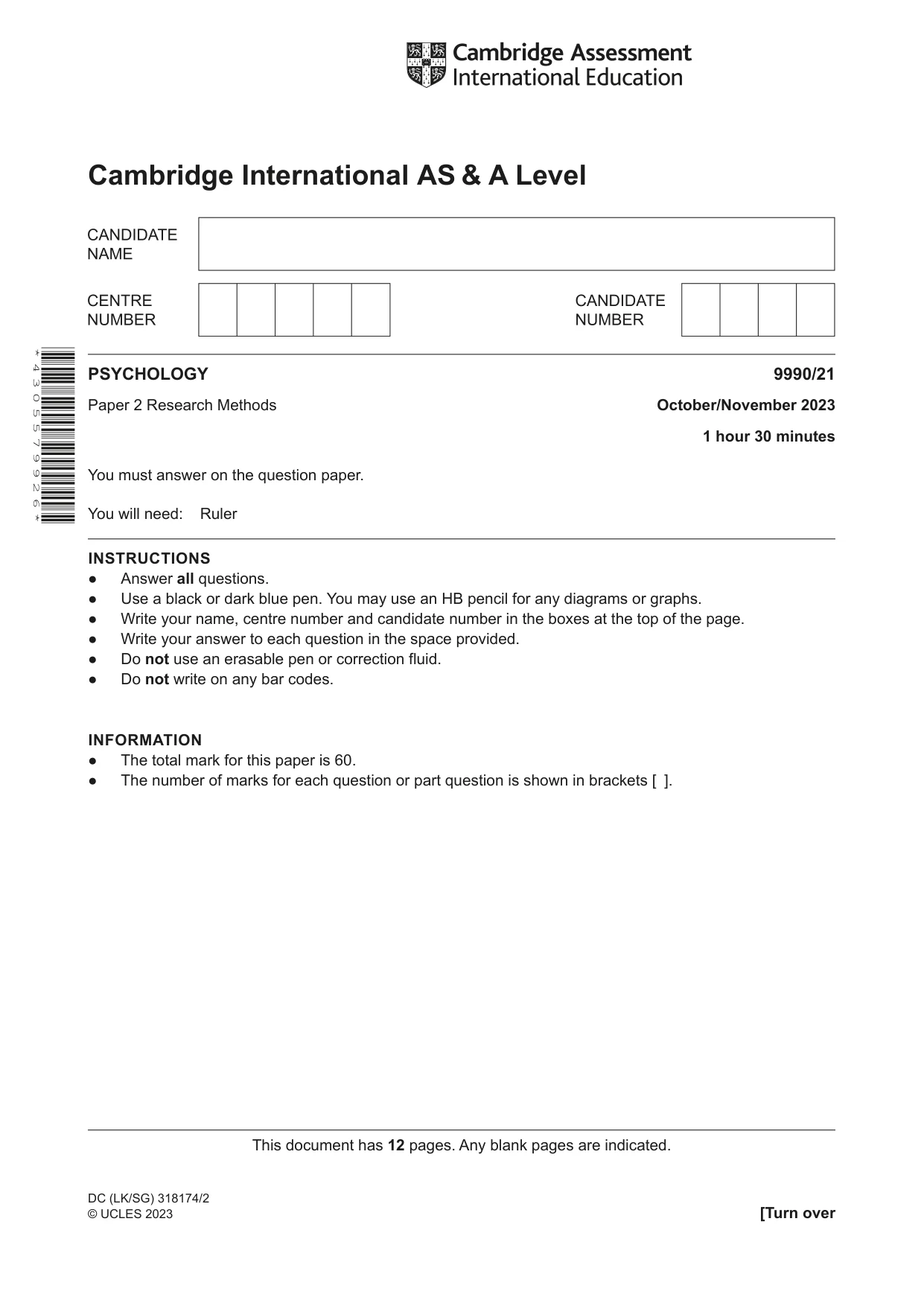
Question paper12 pages



Mark scheme17 pages
Answers below. Sit the paper first if you are practising.
Questions as text
Q1 · Explain what is meant by ‘covert’ observation
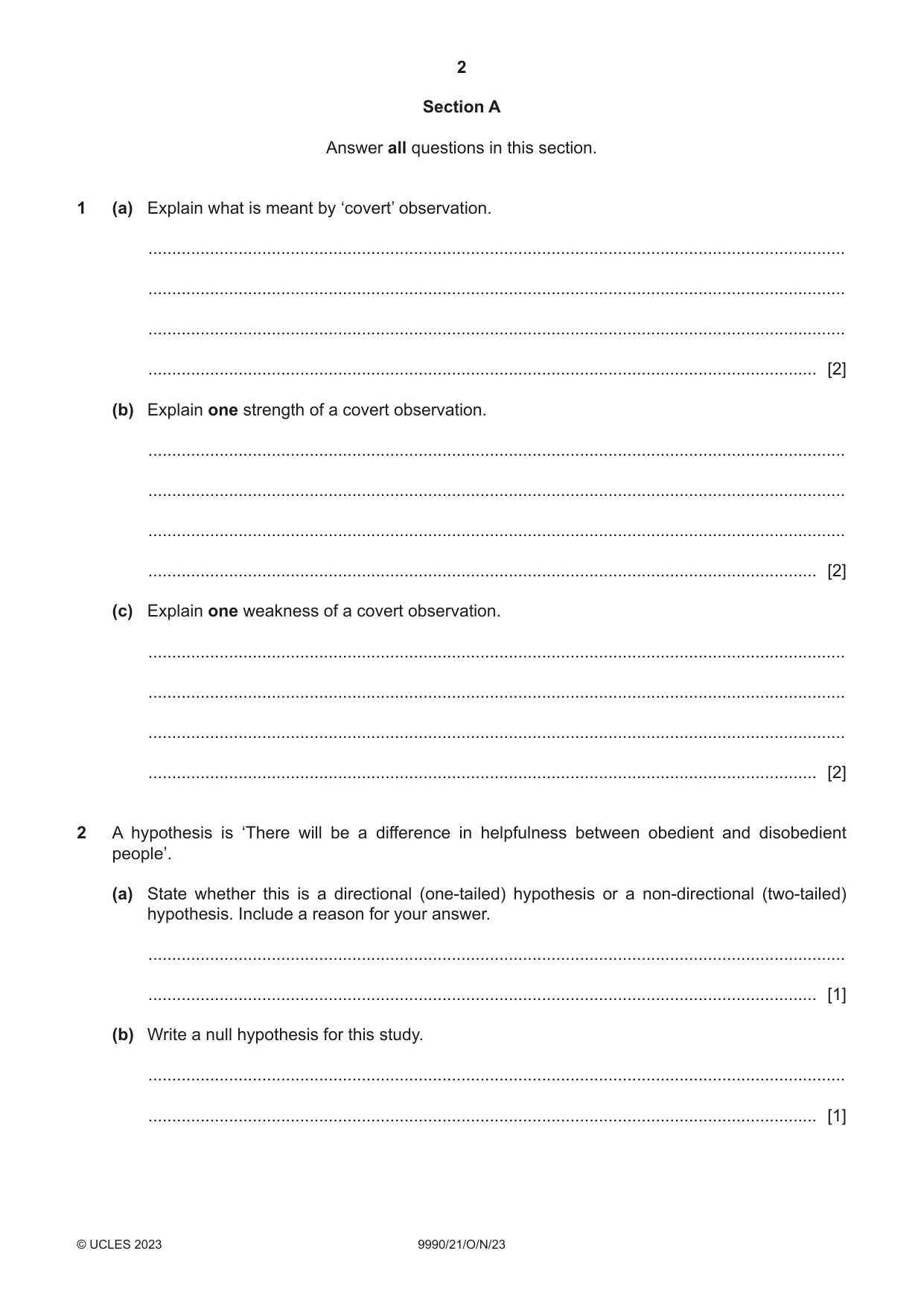
1 (a) Explain what is meant by ‘covert’ observation. ................................................................................................................................................... ................................................................................................................................................... ................................................................................................................................................... ............................................................................................................................................. [2] (b) Explain one strength of a covert observation. ................................................................................................................................................... ................................................................................................................................................... ................................................................................................................................................... ............................................................................................................................................. [2] (c) Explain one weakness of a covert observation. ................................................................................................................................................... ................................................................................................................................................... ................................................................................................................................................... ............................................................................................................................................. [2]
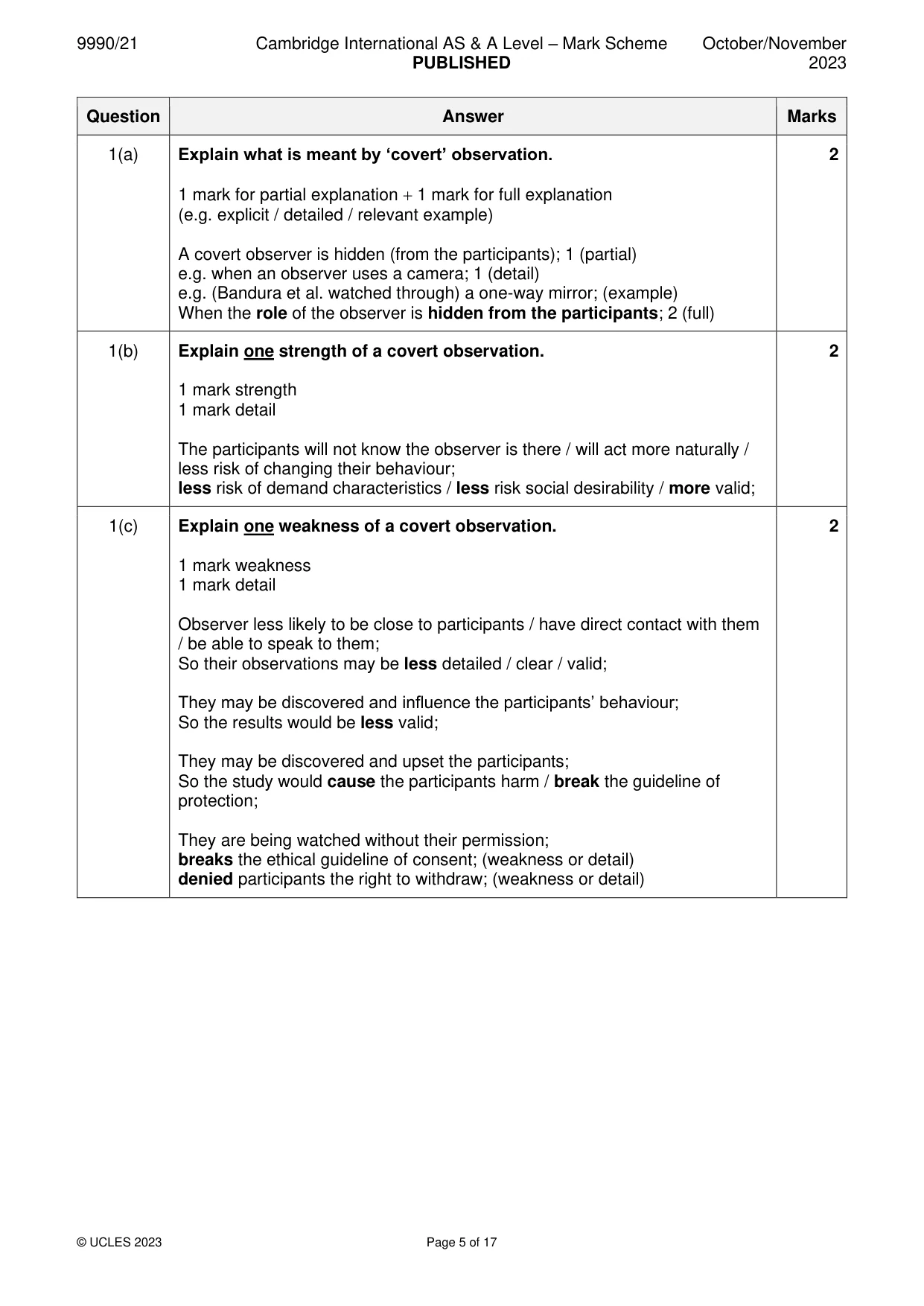
Mark scheme: Question Answer Marks 1(a) Explain what is meant by ‘covert’ observation. 2 1 mark for partial explanation + 1 mark for full explanation (e.g. explicit / detailed / relevant example) A covert observer is hidden (from the participants); 1 (partial) e.g. when an observer uses a camera; 1 (detail) e.g. (Bandura et al. watched through) a one-way mirror; (example) When the role of the observer is hidden from the participants; 2 (full) 1(b) Explain one strength of a covert observation. 2 1 mark strength 1 mark detail The participants will not know the observer is there / will act more naturally / less risk of changing their behaviour; less risk of demand characteristics / less risk social desirability / more valid; 1(c) Explain one weakness of a covert observation. 2 1 mark weakness 1 mark detail Observer less likely to be close to participants / have direct contact with them / be able to speak to them; So their observations may be less detailed / clear / valid; They may be discovered and influence the participants’ behaviour; So the results would be less valid; They may be discovered and upset the participants; So the study would cause the participants harm / break the guideline of protection; They are being watched without their permission; breaks the ethical guideline of consent; (weakness or detail) denied participants the right to withdraw; (weakness or detail)
Q2 · A hypothesis is ‘There will be a difference in helpfulness between obedient and…
2 A hypothesis is ‘There will be a difference in helpfulness between obedient and disobedient people’. (a) State whether this is a directional (one-tailed) hypothesis or a non-directional (two-tailed) hypothesis. Include a reason for your answer. ................................................................................................................................................... ............................................................................................................................................. [1] (b) Write a null hypothesis for this study. ................................................................................................................................................... ............................................................................................................................................. [1]
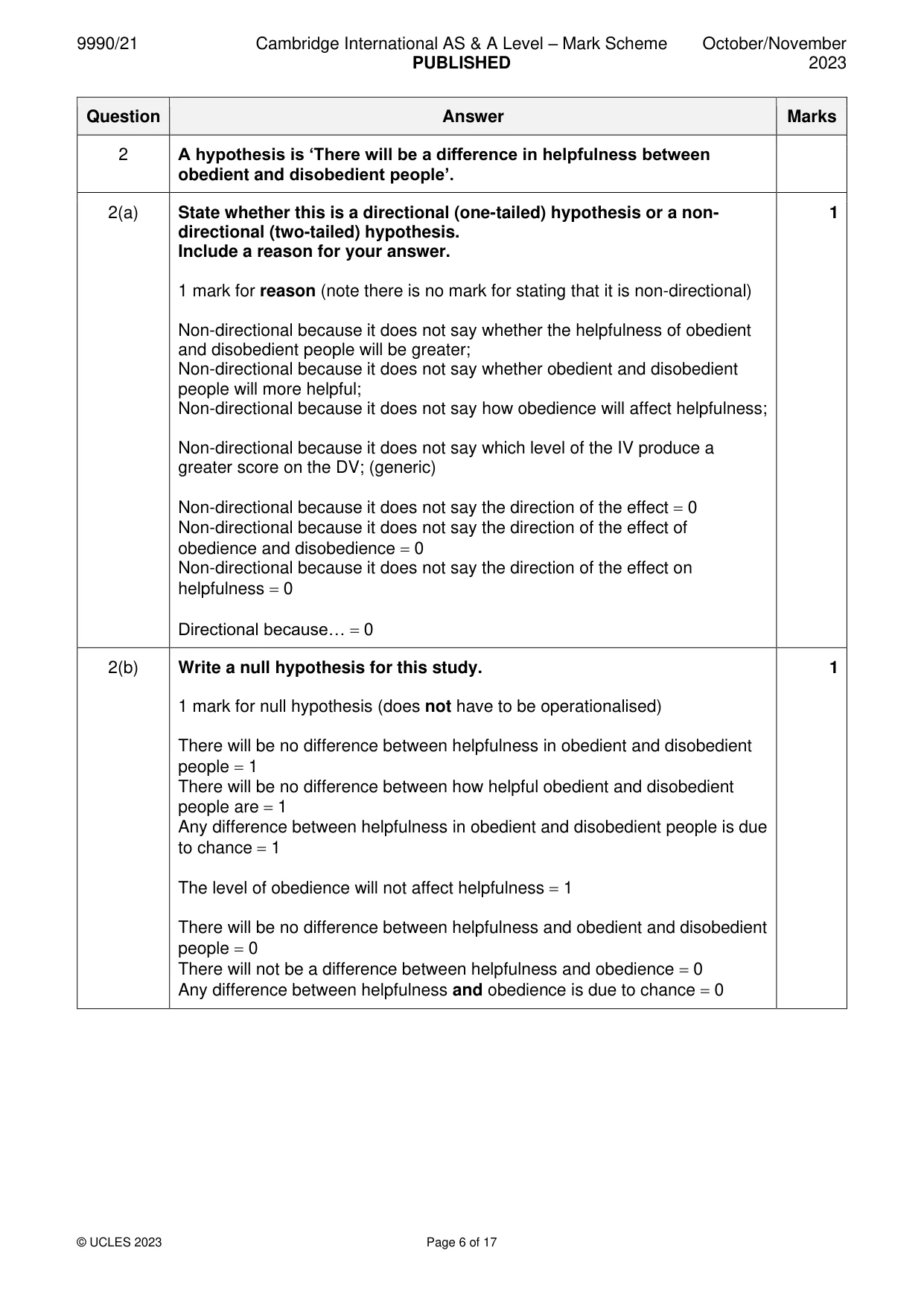
Mark scheme: 2 A hypothesis is ‘There will be a difference in helpfulness between obedient and disobedient people’. 2(a) State whether this is a directional (one-tailed) hypothesis or a non- 1 directional (two-tailed) hypothesis. Include a reason for your answer. 1 mark for reason (note there is no mark for stating that it is non-directional) Non-directional because it does not say whether the helpfulness of obedient and disobedient people will be greater; Non-directional because it does not say whether obedient and disobedient people will more helpful; Non-directional because it does not say how obedience will affect helpfulness; Non-directional because it does not say which level of the IV produce a greater score on the DV; (generic) Non-directional because it does not say the direction of the effect = 0 Non-directional because it does not say the direction of the effect of obedience and disobedience = 0 Non-directional because it does not say the direction of the effect on helpfulness = 0 Directional because… = 0 2(b) Write a null hypothesis for this study. 1 1 mark for null hypothesis (does not have to be operationalised) There will be no difference between helpfulness in obedient and disobedient people = 1 There will be no difference between how helpful obedient and disobedient people are = 1 Any difference between helpfulness in obedient and disobedient people is due to chance = 1 The level of obedience will not affect helpfulness = 1 There will be no difference between helpfulness and obedient and disobedient people = 0 There will not be a difference between helpfulness and obedience = 0 Any difference between helpfulness and obedience is due to chance = 0
Q3 · The study by Pepperberg (parrot learning) tested a parrot’s understanding of the concepts…
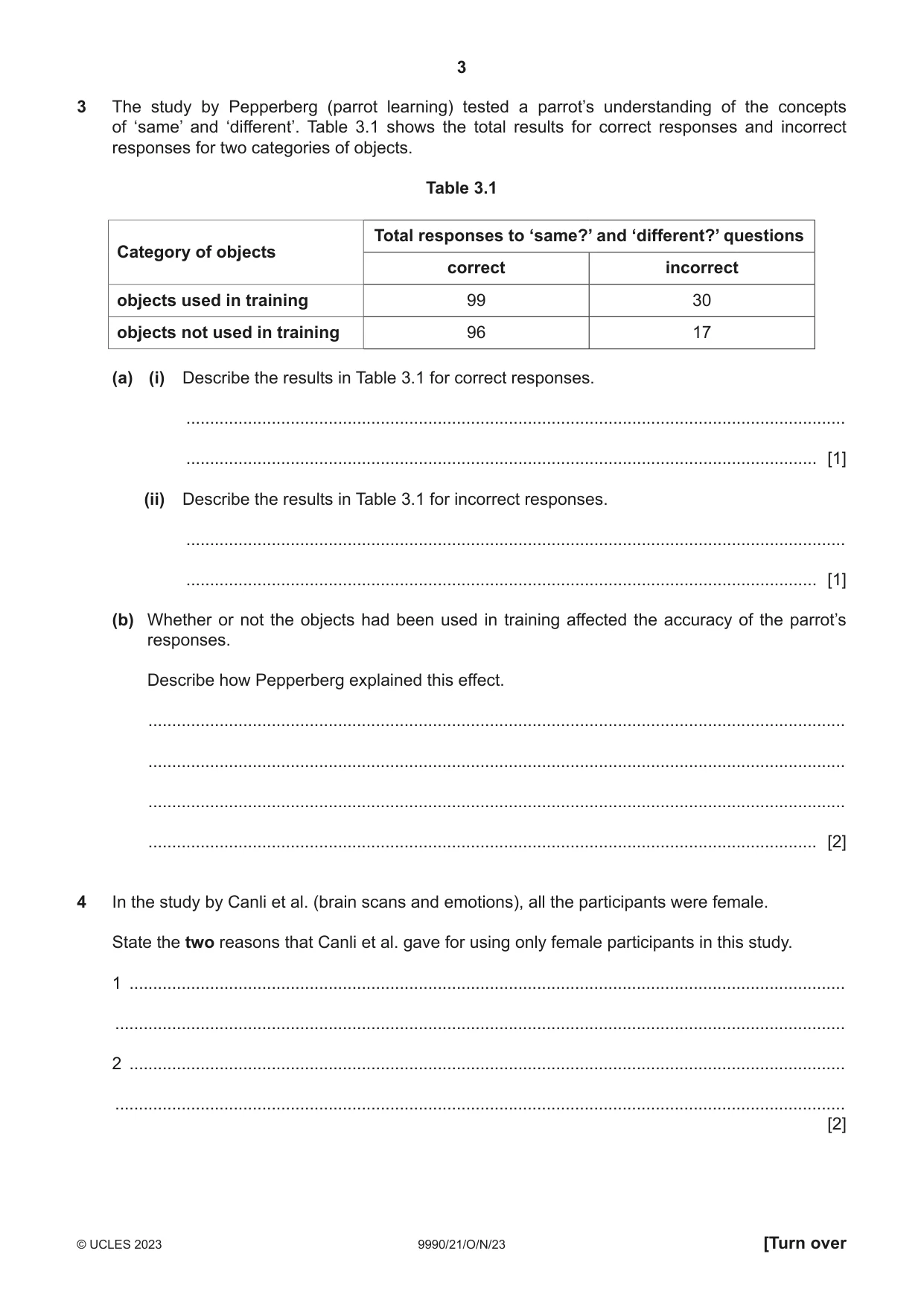
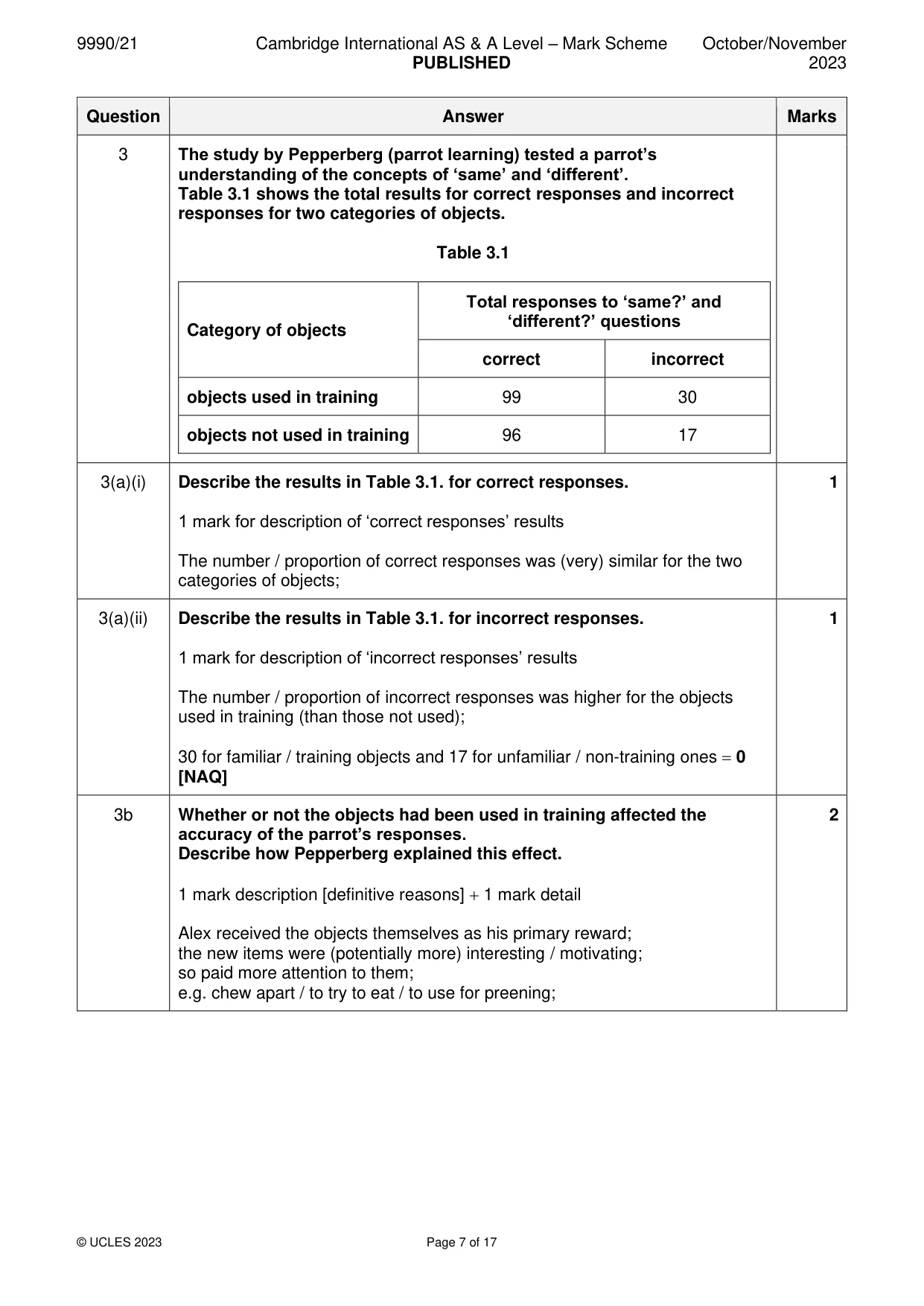
3 The study by Pepperberg (parrot learning) tested a parrot’s understanding of the concepts of ‘same’ and ‘different’. Table 3.1 shows the total results for correct responses and incorrect responses for two categories of objects. Table 3.1 Total responses to ‘same?’ and ‘different?’ questions Category of objects correct incorrect objects used in training 99 30 objects not used in training 96 17 (a) (i) Describe the results in Table 3.1 for correct responses. ........................................................................................................................................... ..................................................................................................................................... [1] (ii) Describe the results in Table 3.1 for incorrect responses. ........................................................................................................................................... ..................................................................................................................................... [1] (b) Whether or not the objects had been used in training affected the accuracy of the parrot’s responses. Describe how Pepperberg explained this effect. ................................................................................................................................................... ................................................................................................................................................... ................................................................................................................................................... ............................................................................................................................................. [2]
Mark scheme: 3 The study by Pepperberg (parrot learning) tested a parrot’s understanding of the concepts of ‘same’ and ‘different’. Table 3.1 shows the total results for correct responses and incorrect responses for two categories of objects. Table 3.1 Total responses to ‘same?’ and ‘different?’ questions Category of objects correct incorrect objects used in training 99 30 objects not used in training 96 17 3(a)(i) Describe the results in Table 3.1. for correct responses. 1 1 mark for description of ‘correct responses’ results The number / proportion of correct responses was (very) similar for the two categories of objects; 3(a)(ii) Describe the results in Table 3.1. for incorrect responses. 1 1 mark for description of ‘incorrect responses’ results The number / proportion of incorrect responses was higher for the objects used in training (than those not used); 30 for familiar / training objects and 17 for unfamiliar / non-training ones = 0 [NAQ] 3b Whether or not the objects had been used in training affected the 2 accuracy of the parrot’s responses. Describe how Pepperberg explained this effect. 1 mark description [definitive reasons] + 1 mark detail Alex received the objects themselves as his primary reward; the new items were (potentially more) interesting / motivating; so paid more attention to them; e.g. chew apart / to try to eat / to use for preening;
Q4 · In the study by Canli et al
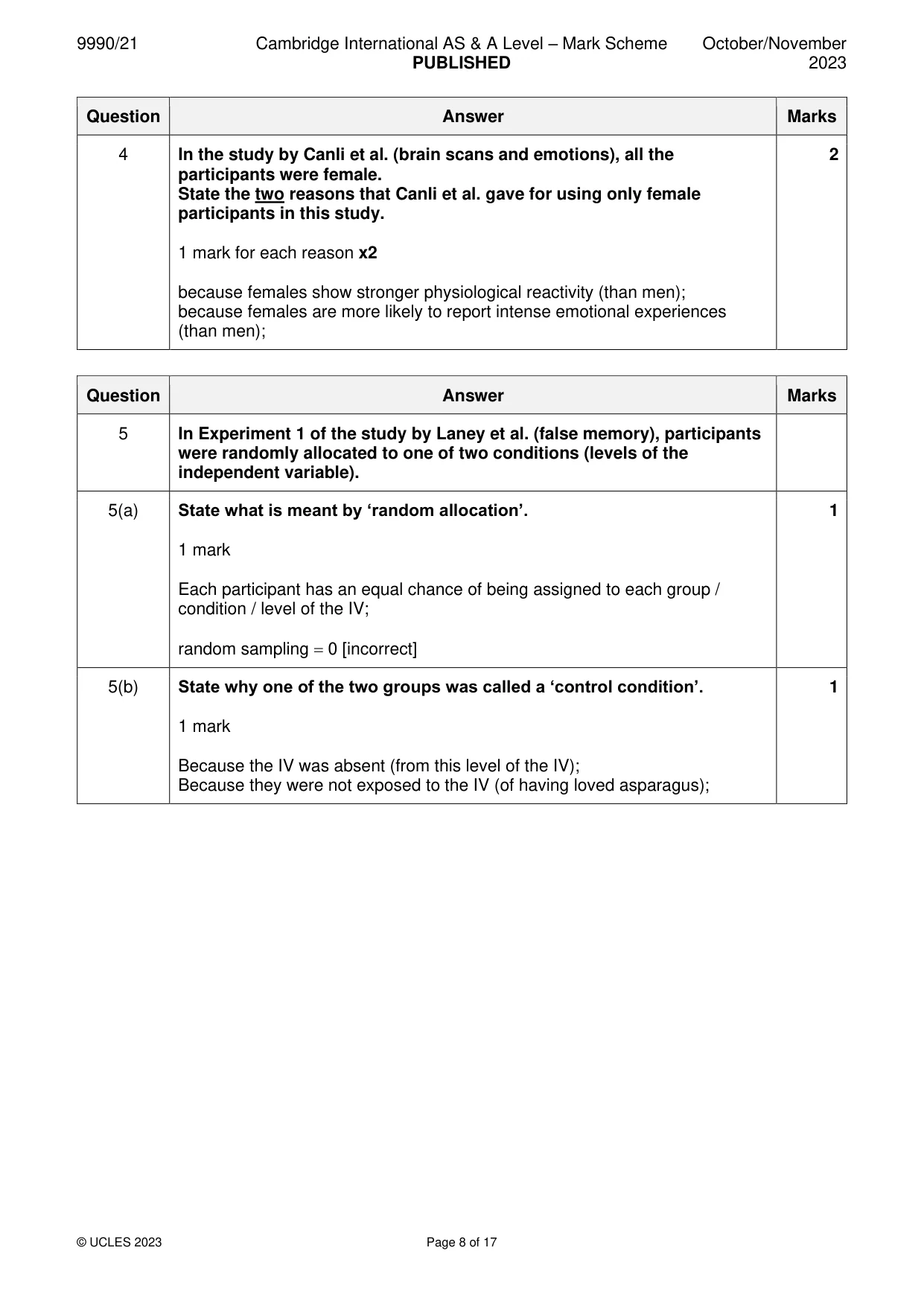
4 In the study by Canli et al. (brain scans and emotions), all the participants were female. State the two reasons that Canli et al. gave for using only female participants in this study. 1 ....................................................................................................................................................... .......................................................................................................................................................... 2 ....................................................................................................................................................... .......................................................................................................................................................... [2]
Mark scheme: 4 In the study by Canli et al. (brain scans and emotions), all the 2 participants were female. State the two reasons that Canli et al. gave for using only female participants in this study. 1 mark for each reason x2 because females show stronger physiological reactivity (than men); because females are more likely to report intense emotional experiences (than men);
Q5 · In Experiment 1 of the study by Laney et al
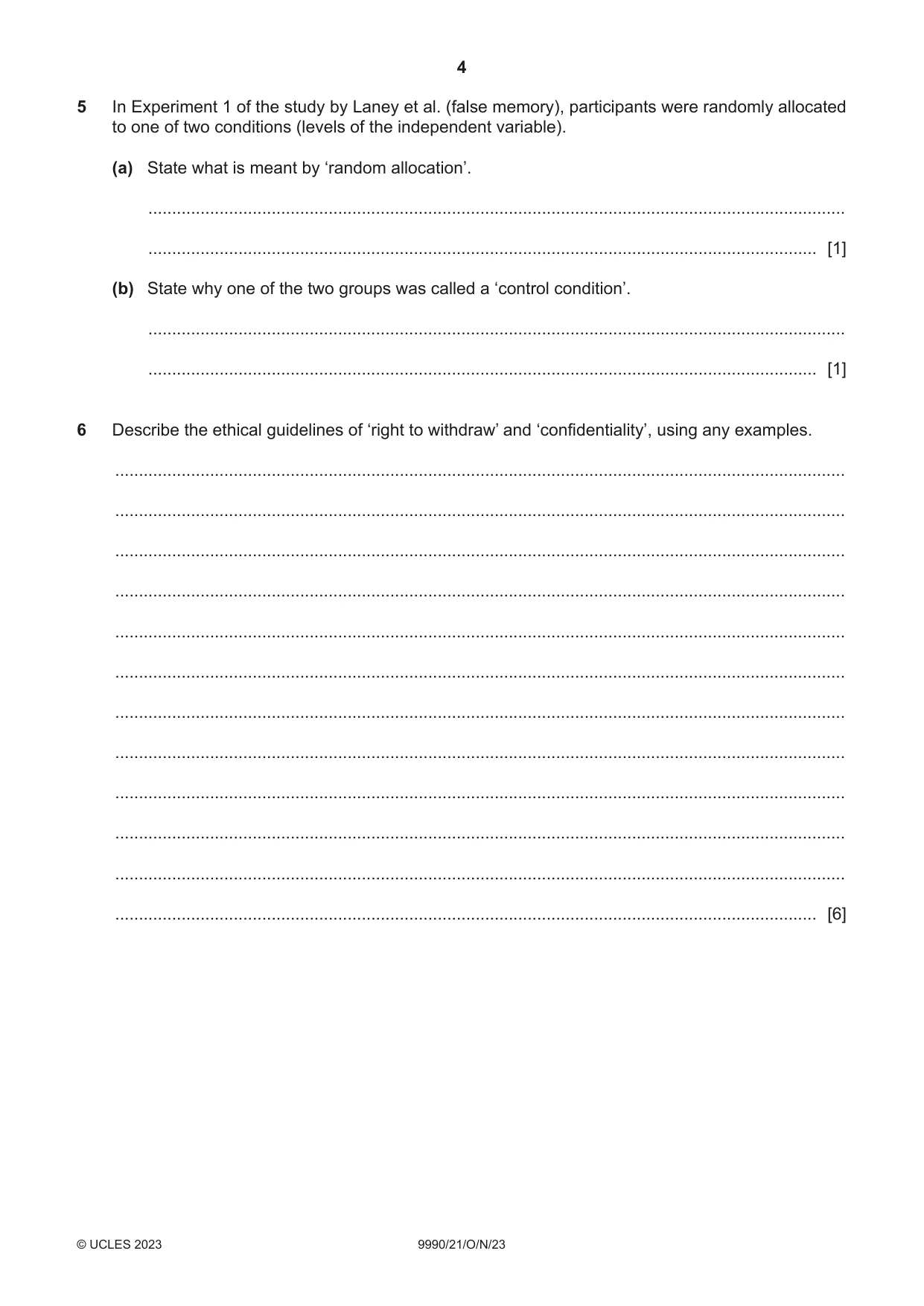
5 In Experiment 1 of the study by Laney et al. (false memory), participants were randomly allocated to one of two conditions (levels of the independent variable). (a) State what is meant by ‘random allocation’. ................................................................................................................................................... ............................................................................................................................................. [1] (b) State why one of the two groups was called a ‘control condition’. ................................................................................................................................................... ............................................................................................................................................. [1]
Mark scheme: 5 In Experiment 1 of the study by Laney et al. (false memory), participants were randomly allocated to one of two conditions (levels of the independent variable). 5(a) State what is meant by ‘random allocation’. 1 1 mark Each participant has an equal chance of being assigned to each group / condition / level of the IV; random sampling = 0 [incorrect] 5(b) State why one of the two groups was called a ‘control condition’. 1 1 mark Because the IV was absent (from this level of the IV); Because they were not exposed to the IV (of having loved asparagus);
Q6 · Describe the ethical guidelines of ‘right to withdraw’ and ‘confidentiality’, using any…
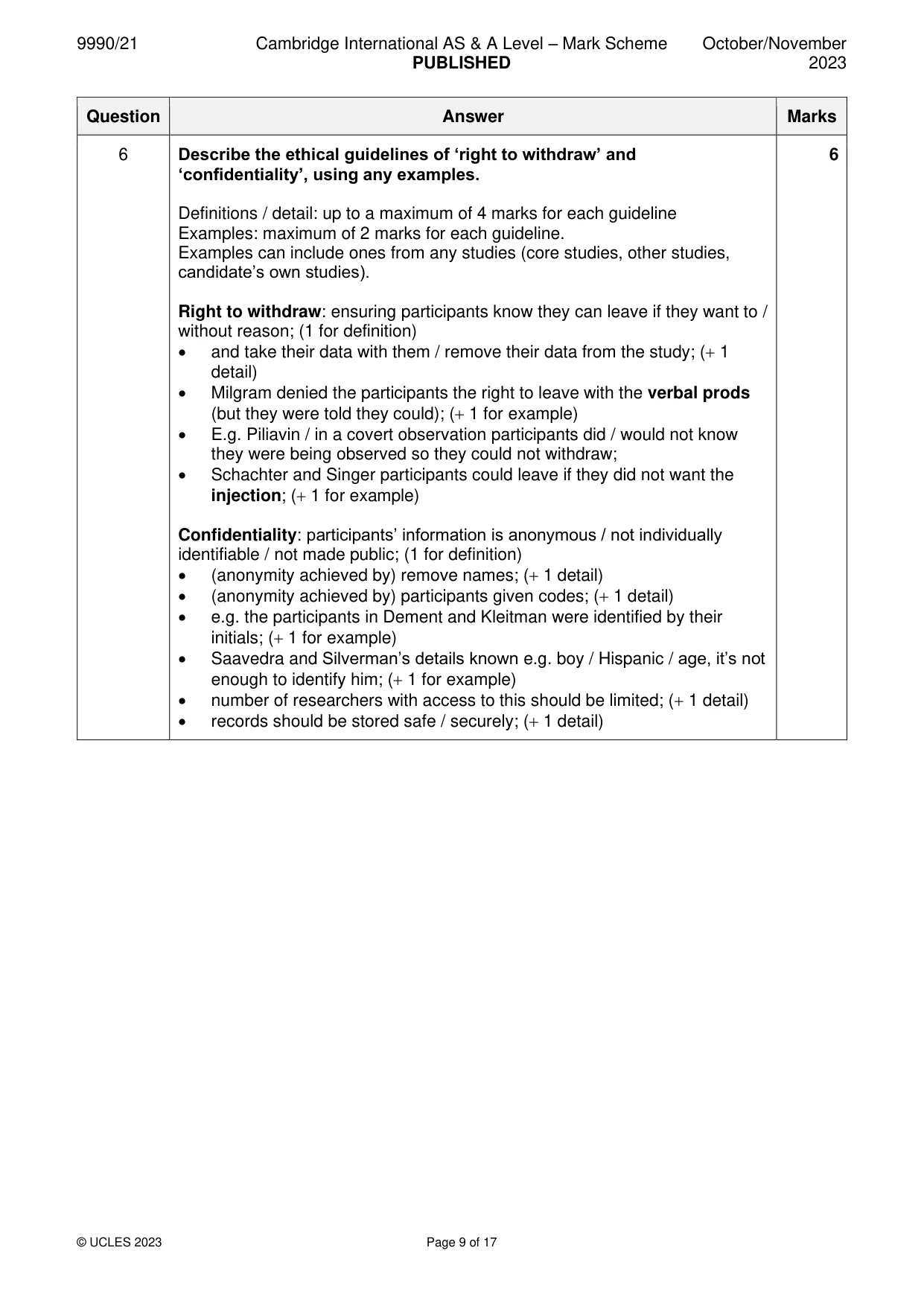
6 Describe the ethical guidelines of ‘right to withdraw’ and ‘confidentiality’, using any examples. .......................................................................................................................................................... .......................................................................................................................................................... .......................................................................................................................................................... .......................................................................................................................................................... .......................................................................................................................................................... .......................................................................................................................................................... .......................................................................................................................................................... .......................................................................................................................................................... .......................................................................................................................................................... .......................................................................................................................................................... .......................................................................................................................................................... .................................................................................................................................................... [6]
Mark scheme: 6 Describe the ethical guidelines of ‘right to withdraw’ and 6 ‘confidentiality’, using any examples. Definitions / detail: up to a maximum of 4 marks for each guideline Examples: maximum of 2 marks for each guideline. Examples can include ones from any studies (core studies, other studies, candidate’s own studies). Right to withdraw: ensuring participants know they can leave if they want to / without reason; (1 for definition) • and take their data with them / remove their data from the study; (+ 1 detail) • Milgram denied the participants the right to leave with the verbal prods (but they were told they could); (+ 1 for example) • E.g. Piliavin / in a covert observation participants did / would not know they were being observed so they could not withdraw; • Schachter and Singer participants could leave if they did not want the injection; (+ 1 for example) Confidentiality: participants’ information is anonymous / not individually identifiable / not made public; (1 for definition) • (anonymity achieved by) remove names; (+ 1 detail) • (anonymity achieved by) participants given codes; (+ 1 detail) • e.g. the participants in Dement and Kleitman were identified by their initials; (+ 1 for example) • Saavedra and Silverman’s details known e.g. boy / Hispanic / age, it’s not enough to identify him; (+ 1 for example) • number of researchers with access to this should be limited; (+ 1 detail) • records should be stored safe / securely; (+ 1 detail)
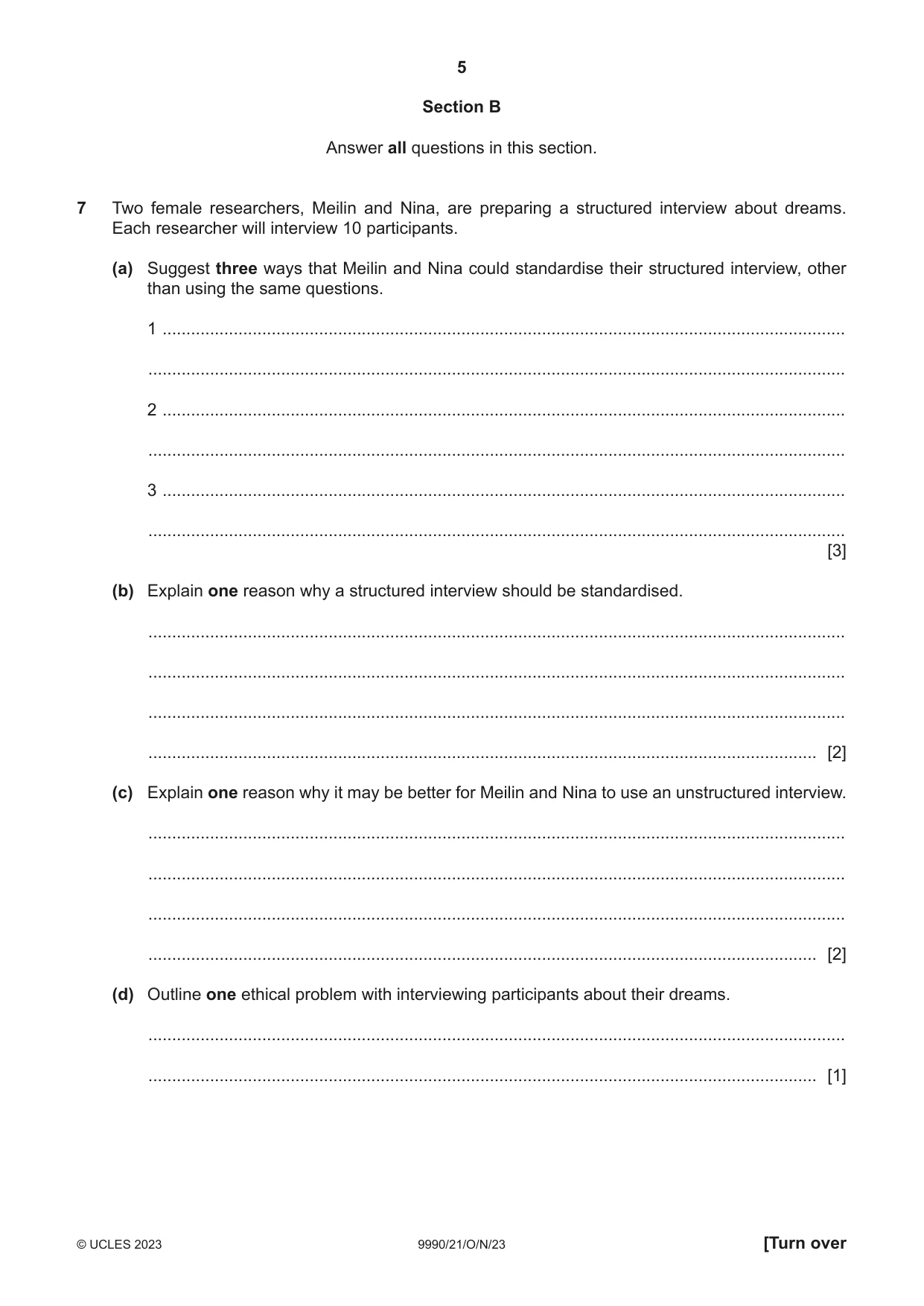
Q7 · Two female researchers, Meilin and Nina, are preparing a structured interview about dreams
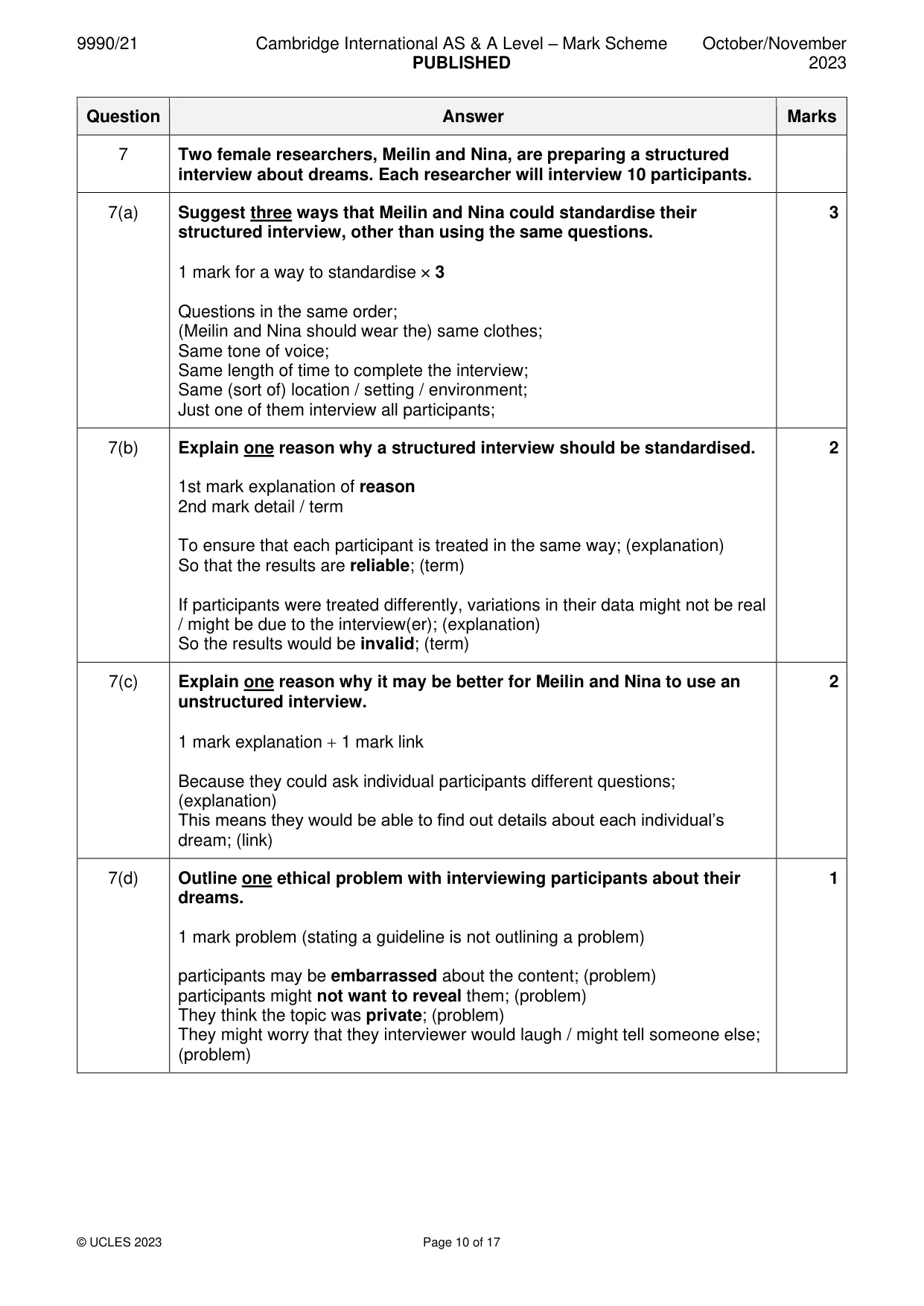
7 Two female researchers, Meilin and Nina, are preparing a structured interview about dreams. Each researcher will interview 10 participants. (a) Suggest three ways that Meilin and Nina could standardise their structured interview, other than using the same questions. 1 ................................................................................................................................................ ................................................................................................................................................... 2 ................................................................................................................................................ ................................................................................................................................................... 3 ................................................................................................................................................ ................................................................................................................................................... [3] (b) Explain one reason why a structured interview should be standardised. ................................................................................................................................................... ................................................................................................................................................... ................................................................................................................................................... ............................................................................................................................................. [2] (c) Explain one reason why it may be better for Meilin and Nina to use an unstructured interview. ................................................................................................................................................... ................................................................................................................................................... ................................................................................................................................................... ............................................................................................................................................. [2] (d) Outline one ethical problem with interviewing participants about their dreams. ................................................................................................................................................... ............................................................................................................................................. [1]
Mark scheme: 7 Two female researchers, Meilin and Nina, are preparing a structured interview about dreams. Each researcher will interview 10 participants. 7(a) Suggest three ways that Meilin and Nina could standardise their 3 structured interview, other than using the same questions. 1 mark for a way to standardise 3 Questions in the same order; (Meilin and Nina should wear the) same clothes; Same tone of voice; Same length of time to complete the interview; Same (sort of) location / setting / environment; Just one of them interview all participants; 7(b) Explain one reason why a structured interview should be standardised. 2 1st mark explanation of reason 2nd mark detail / term To ensure that each participant is treated in the same way; (explanation) So that the results are reliable; (term) If participants were treated differently, variations in their data might not be real / might be due to the interview(er); (explanation) So the results would be invalid; (term) 7(c) Explain one reason why it may be better for Meilin and Nina to use an 2 unstructured interview. 1 mark explanation + 1 mark link Because they could ask individual participants different questions; (explanation) This means they would be able to find out details about each individual’s dream; (link) 7(d) Outline one ethical problem with interviewing participants about their 1 dreams. 1 mark problem (stating a guideline is not outlining a problem) participants may be embarrassed about the content; (problem) participants might not want to reveal them; (problem) They think the topic was private; (problem) They might worry that they interviewer would laugh / might tell someone else; (problem)
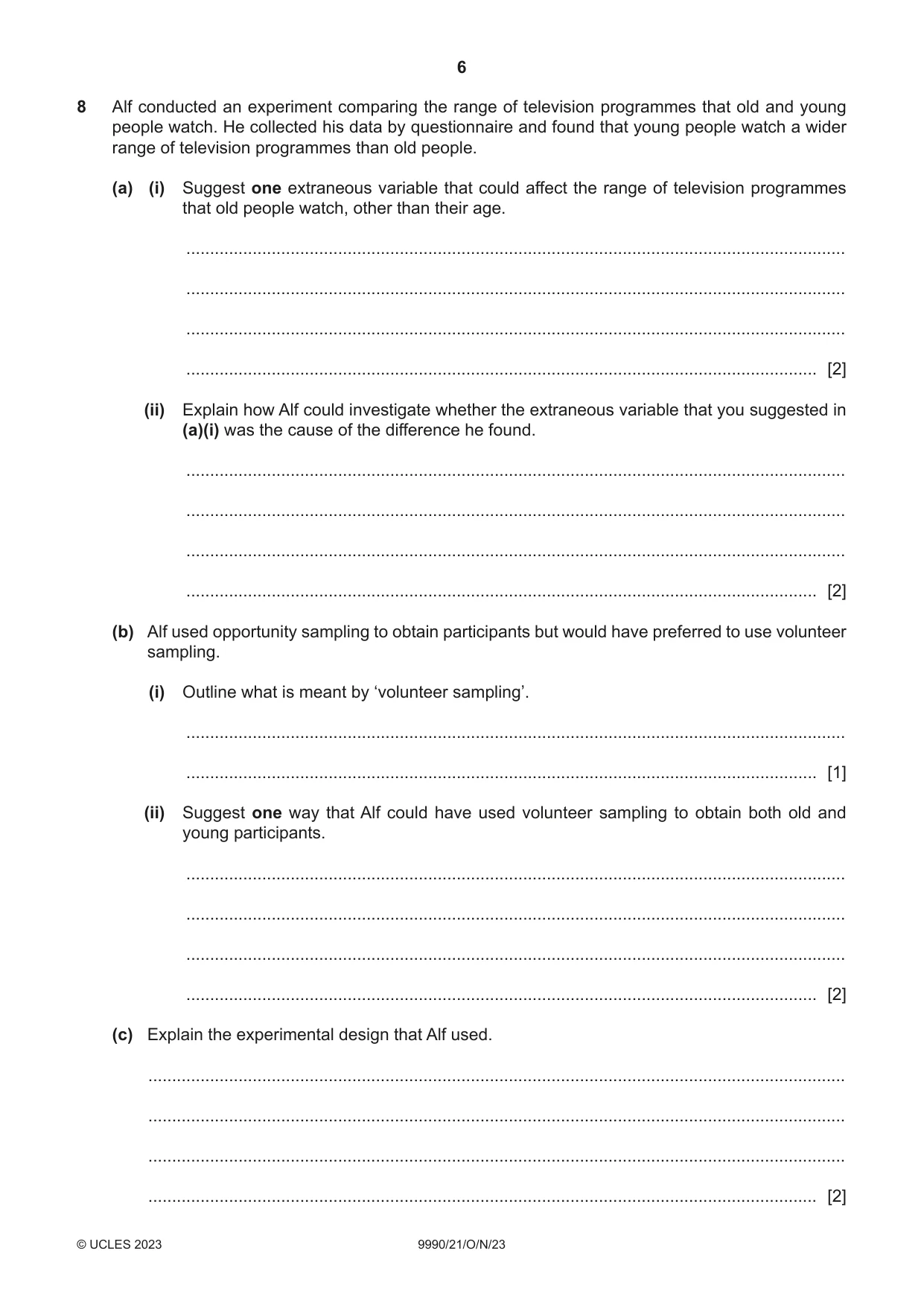
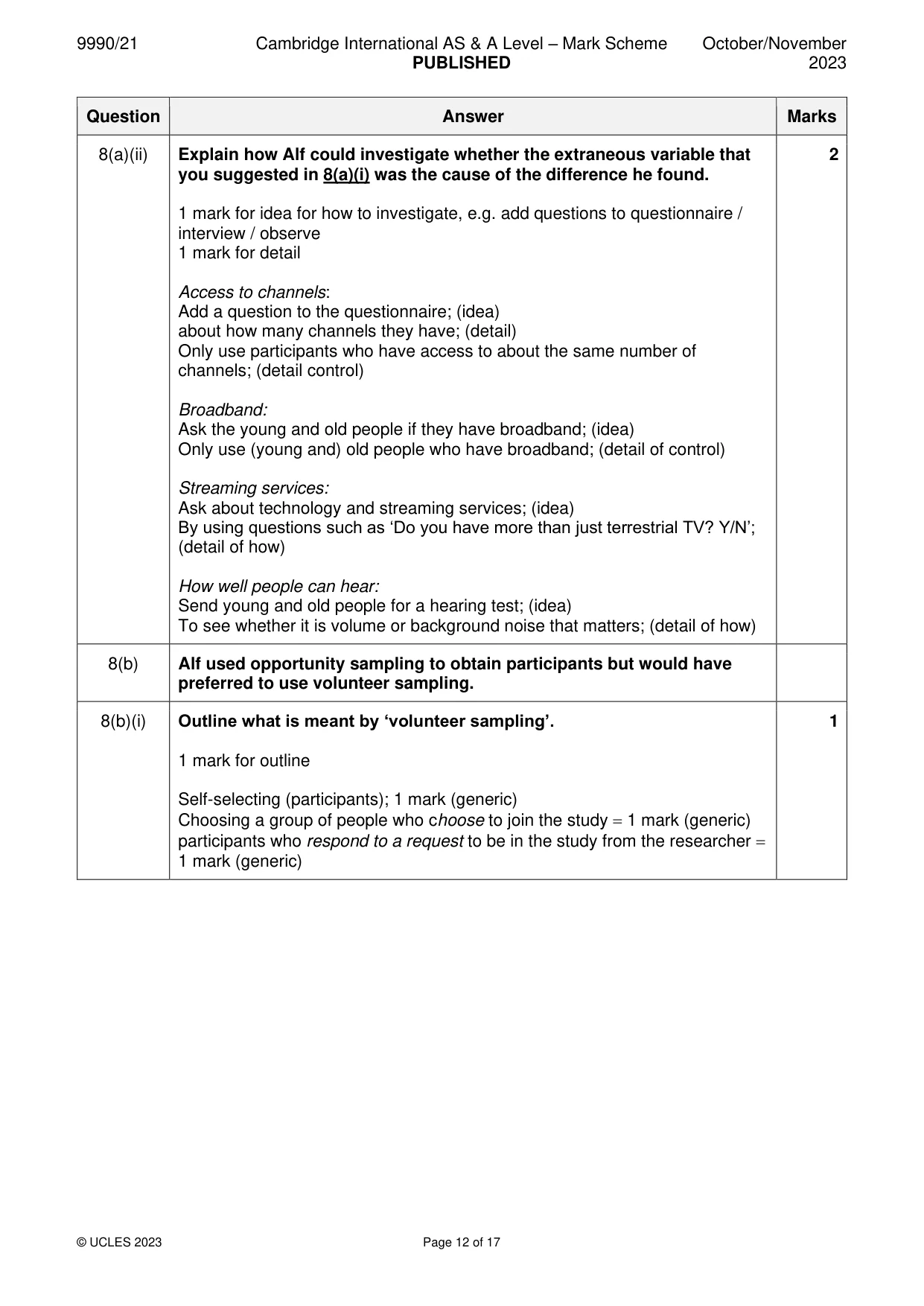
Q8 · Alf conducted an experiment comparing the range of television programmes that old and…
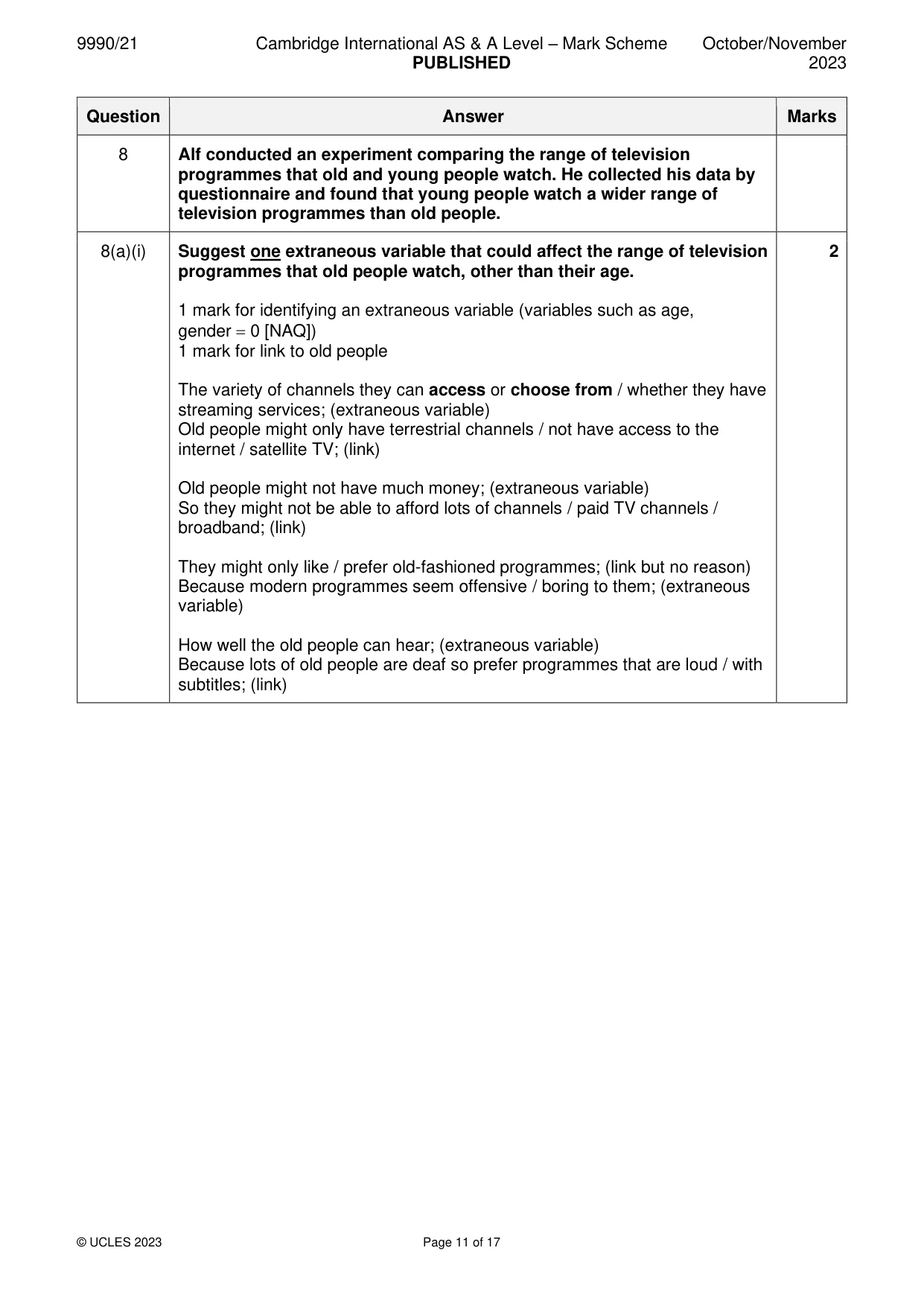
8 Alf conducted an experiment comparing the range of television programmes that old and young people watch. He collected his data by questionnaire and found that young people watch a wider range of television programmes than old people. (a) (i) Suggest one extraneous variable that could affect the range of television programmes that old people watch, other than their age. ........................................................................................................................................... ........................................................................................................................................... ........................................................................................................................................... ..................................................................................................................................... [2] (ii) Explain how Alf could investigate whether the extraneous variable that you suggested in (a)(i) was the cause of the difference he found. ........................................................................................................................................... ........................................................................................................................................... ........................................................................................................................................... ..................................................................................................................................... [2] (b) Alf used opportunity sampling to obtain participants but would have preferred to use volunteer sampling. (i) Outline what is meant by ‘volunteer sampling’. ........................................................................................................................................... ..................................................................................................................................... [1] (ii) Suggest one way that Alf could have used volunteer sampling to obtain both old and young participants. ........................................................................................................................................... ........................................................................................................................................... ........................................................................................................................................... ..................................................................................................................................... [2] (c) Explain the experimental design that Alf used. ................................................................................................................................................... ................................................................................................................................................... ................................................................................................................................................... ............................................................................................................................................. [2]
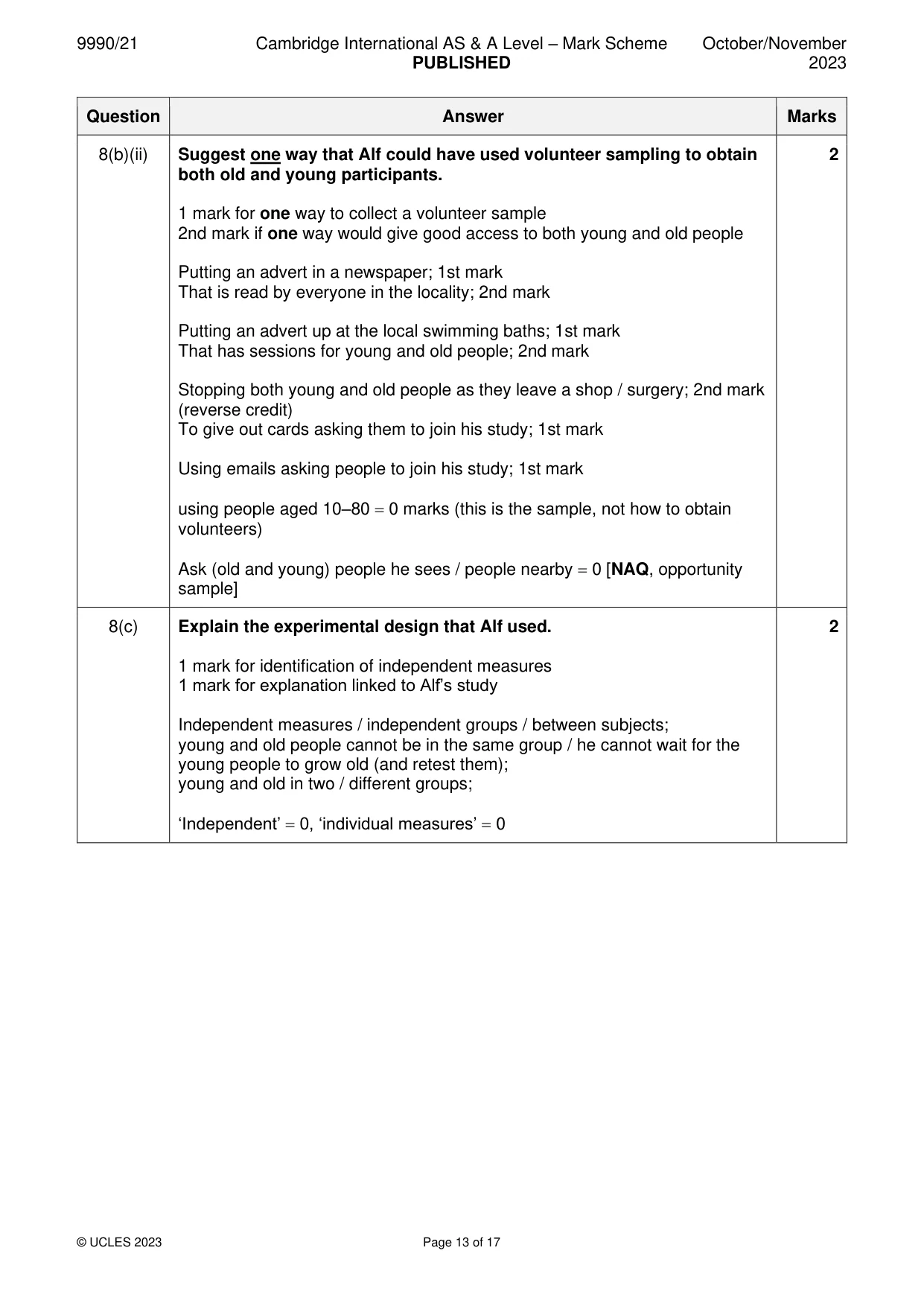
Mark scheme: 8 Alf conducted an experiment comparing the range of television programmes that old and young people watch. He collected his data by questionnaire and found that young people watch a wider range of television programmes than old people. 8(a)(i) Suggest one extraneous variable that could affect the range of television 2 programmes that old people watch, other than their age. 1 mark for identifying an extraneous variable (variables such as age, gender = 0 [NAQ]) 1 mark for link to old people The variety of channels they can access or choose from / whether they have streaming services; (extraneous variable) Old people might only have terrestrial channels / not have access to the internet / satellite TV; (link) Old people might not have much money; (extraneous variable) So they might not be able to afford lots of channels / paid TV channels / broadband; (link) They might only like / prefer old-fashioned programmes; (link but no reason) Because modern programmes seem offensive / boring to them; (extraneous variable) How well the old people can hear; (extraneous variable) Because lots of old people are deaf so prefer programmes that are loud / with subtitles; (link) 8(a)(ii) Explain how Alf could investigate whether the extraneous variable that 2 you suggested in 8(a)(i) was the cause of the difference he found. 1 mark for idea for how to investigate, e.g. add questions to questionnaire / interview / observe 1 mark for detail Access to channels: Add a question to the questionnaire; (idea) about how many channels they have; (detail) Only use participants who have access to about the same number of channels; (detail control) Broadband: Ask the young and old people if they have broadband; (idea) Only use (young and) old people who have broadband; (detail of control) Streaming services: Ask about technology and streaming services; (idea) By using questions such as ‘Do you have more than just terrestrial TV? Y/N’; (detail of how) How well people can hear: Send young and old people for a hearing test; (idea) To see whether it is volume or background noise that matters; (detail of how) 8(b) Alf used opportunity sampling to obtain participants but would have preferred to use volunteer sampling. 8(b)(i) Outline what is meant by ‘volunteer sampling’. 1 1 mark for outline Self-selecting (participants); 1 mark (generic) Choosing a group of people who choose to join the study = 1 mark (generic) participants who respond to a request to be in the study from the researcher = 1 mark (generic) 8(b)(ii) Suggest one way that Alf could have used volunteer sampling to obtain 2 both old and young participants. 1 mark for one way to collect a volunteer sample 2nd mark if one way would give good access to both young and old people Putting an advert in a newspaper; 1st mark That is read by everyone in the locality; 2nd mark Putting an advert up at the local swimming baths; 1st mark That has sessions for young and old people; 2nd mark Stopping both young and old people as they leave a shop / surgery; 2nd mark (reverse credit) To give out cards asking them to join his study; 1st mark Using emails asking people to join his study; 1st mark using people aged 10–80 = 0 marks (this is the sample, not how to obtain volunteers) Ask (old and young) people he sees / people nearby = 0 [NAQ, opportunity sample] 8(c) Explain the experimental design that Alf used. 2 1 mark for identification of independent measures 1 mark for explanation linked to Alf’s study Independent measures / independent groups / between subjects; young and old people cannot be in the same group / he cannot wait for the young people to grow old (and retest them); young and old in two / different groups; ‘Independent’ = 0, ‘individual measures’ = 0
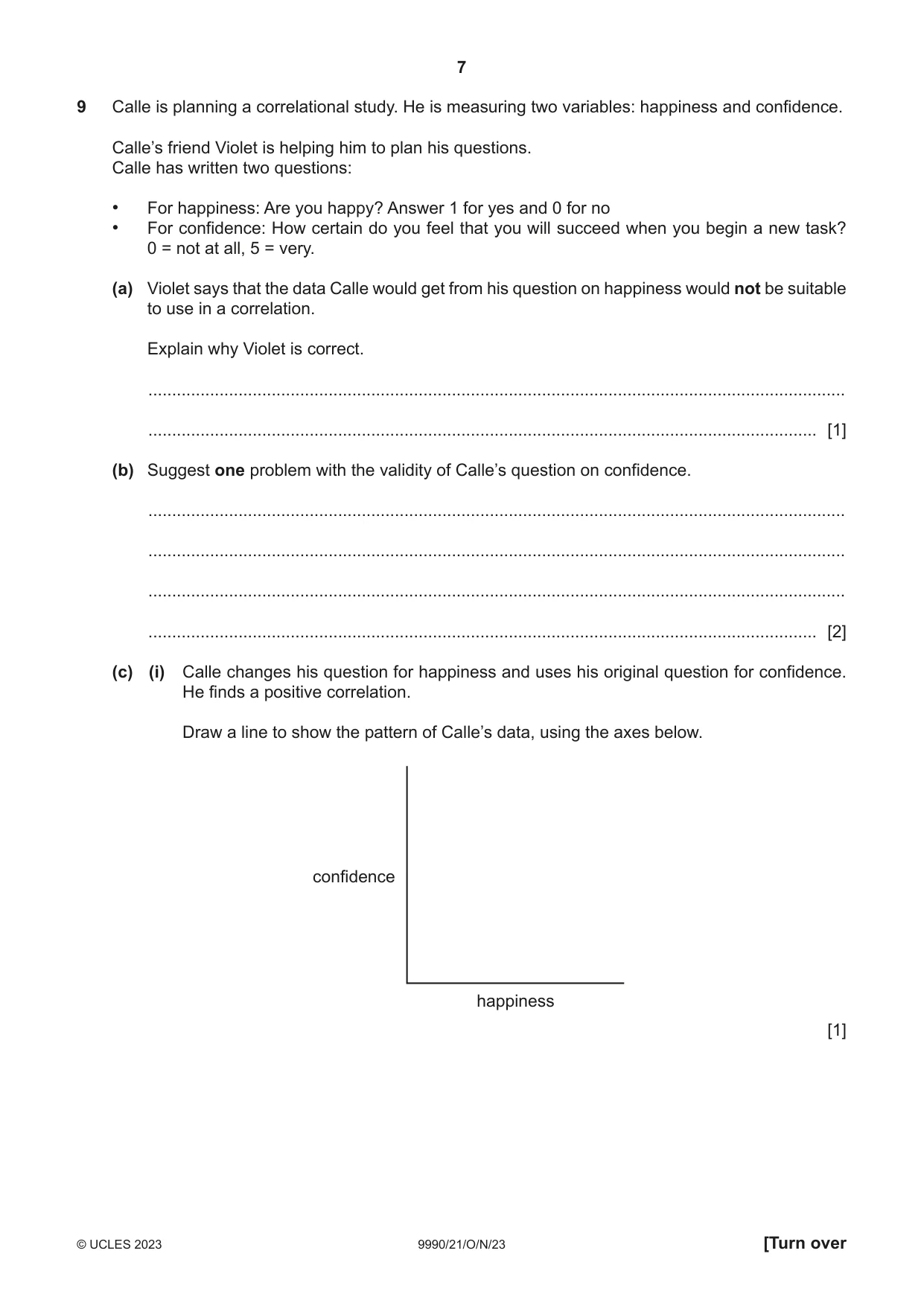
Q9 · Calle is planning a correlational study
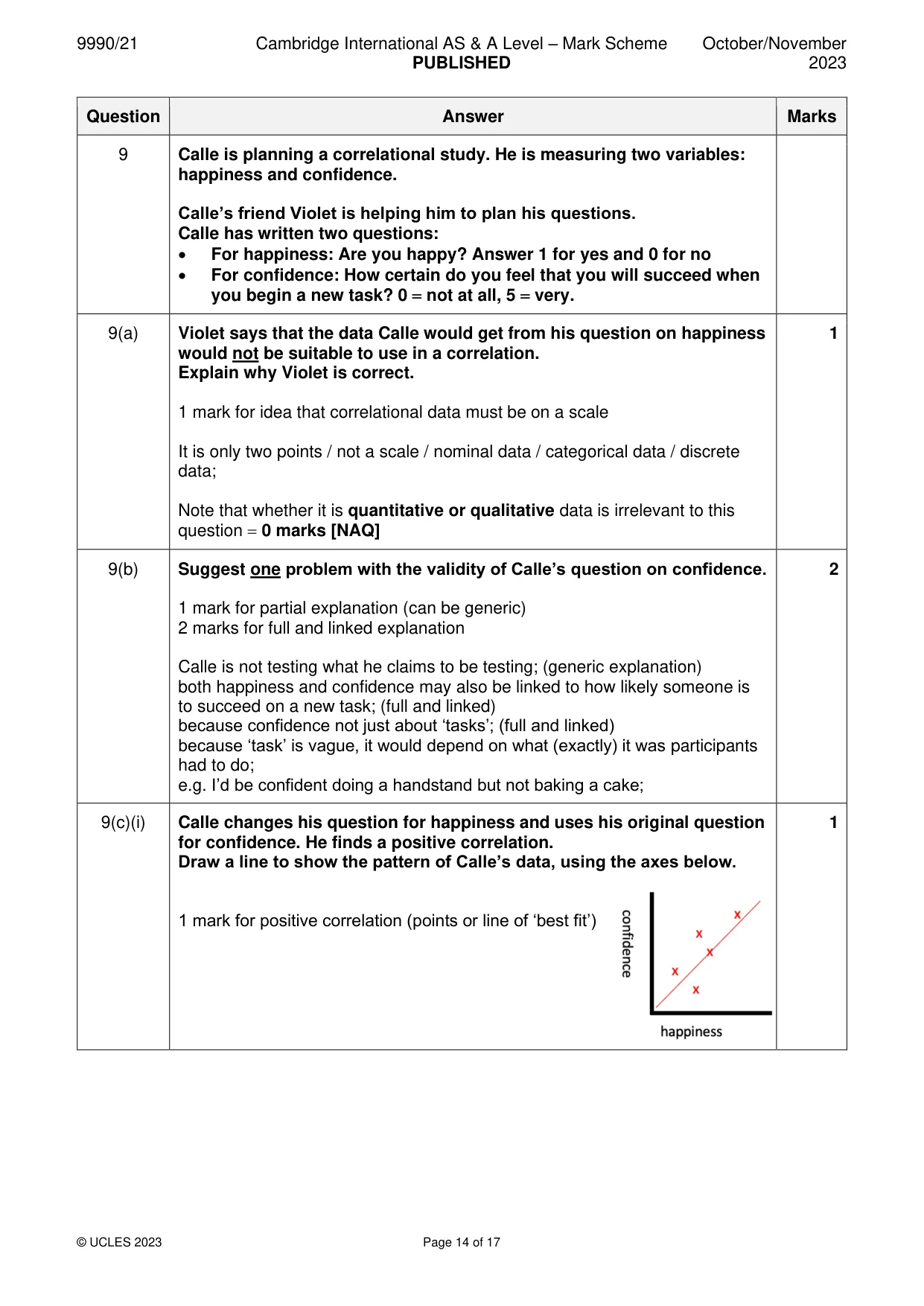
9 Calle is planning a correlational study. He is measuring two variables: happiness and confidence. Calle’s friend Violet is helping him to plan his questions. Calle has written two questions: • For happiness: Are you happy? Answer 1 for yes and 0 for no • For confidence: How certain do you feel that you will succeed when you begin a new task? 0 = not at all, 5 = very. (a) Violet says that the data Calle would get from his question on happiness would not be suitable to use in a correlation. Explain why Violet is correct. ................................................................................................................................................... ............................................................................................................................................. [1] (b) Suggest one problem with the validity of Calle’s question on confidence. ................................................................................................................................................... ................................................................................................................................................... ................................................................................................................................................... ............................................................................................................................................. [2] (c) (i) Calle changes his question for happiness and uses his original question for confidence. He finds a positive correlation. Draw a line to show the pattern of Calle’s data, using the axes below. confidence happiness [1] (ii) Explain why Calle cannot conclude that greater happiness leads to higher confidence. ........................................................................................................................................... ........................................................................................................................................... ........................................................................................................................................... ........................................................................................................................................... ........................................................................................................................................... ..................................................................................................................................... [3] Section C Answer all questions in this section.
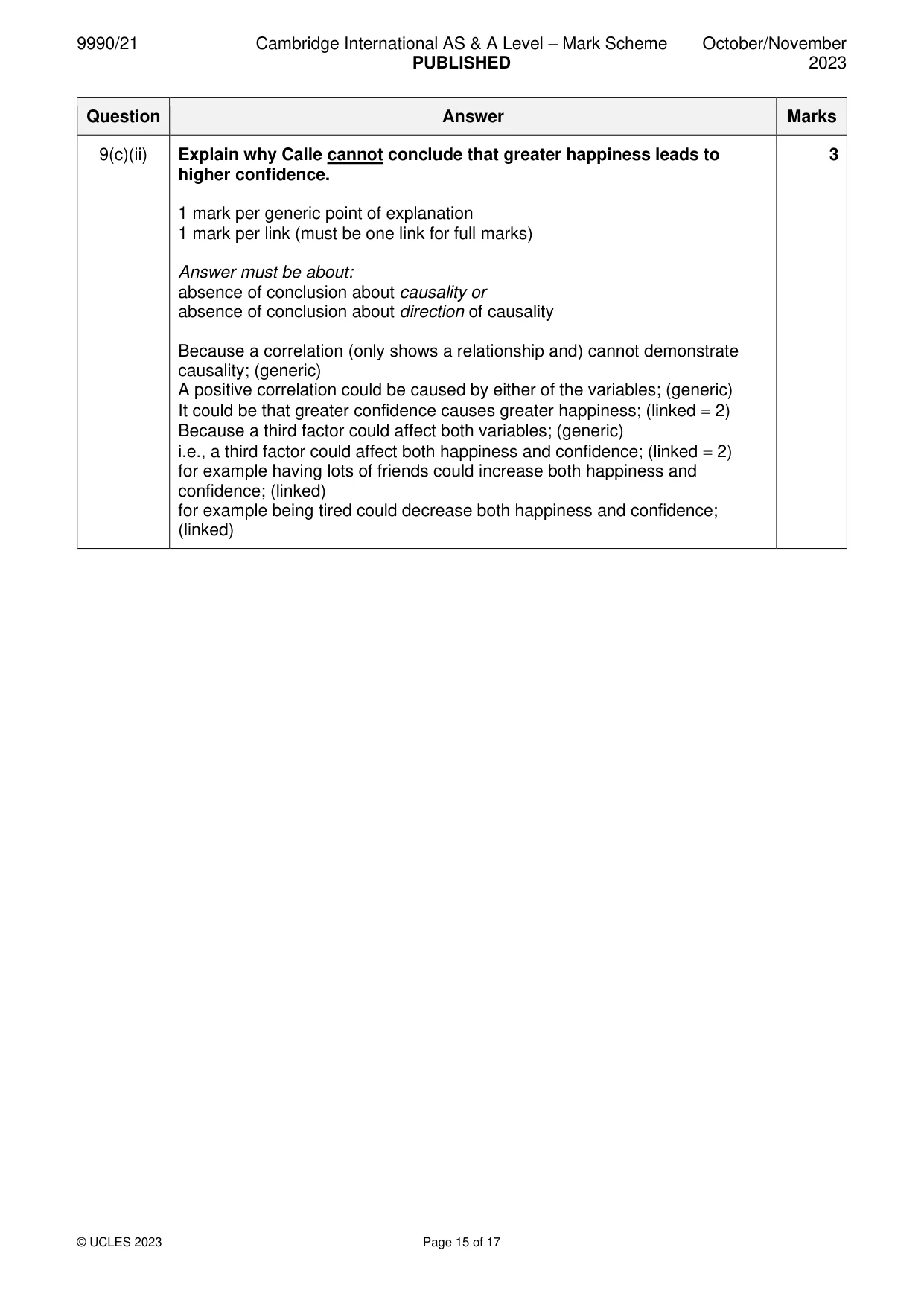
Mark scheme: 9 Calle is planning a correlational study. He is measuring two variables: happiness and confidence. Calle’s friend Violet is helping him to plan his questions. Calle has written two questions: • For happiness: Are you happy? Answer 1 for yes and 0 for no • For confidence: How certain do you feel that you will succeed when you begin a new task? 0 = not at all, 5 = very. 9(a) Violet says that the data Calle would get from his question on happiness 1 would not be suitable to use in a correlation. Explain why Violet is correct. 1 mark for idea that correlational data must be on a scale It is only two points / not a scale / nominal data / categorical data / discrete data; Note that whether it is quantitative or qualitative data is irrelevant to this question = 0 marks [NAQ] 9(b) Suggest one problem with the validity of Calle’s question on confidence. 2 1 mark for partial explanation (can be generic) 2 marks for full and linked explanation Calle is not testing what he claims to be testing; (generic explanation) both happiness and confidence may also be linked to how likely someone is to succeed on a new task; (full and linked) because confidence not just about ‘tasks’; (full and linked) because ‘task’ is vague, it would depend on what (exactly) it was participants had to do; e.g. I’d be confident doing a handstand but not baking a cake; 9(c)(i) Calle changes his question for happiness and uses his original question 1 for confidence. He finds a positive correlation. Draw a line to show the pattern of Calle’s data, using the axes below. 1 mark for positive correlation (points or line of ‘best fit’) 9(c)(ii) Explain why Calle cannot conclude that greater happiness leads to 3 higher confidence. 1 mark per generic point of explanation 1 mark per link (must be one link for full marks) Answer must be about: absence of conclusion about causality or absence of conclusion about direction of causality Because a correlation (only shows a relationship and) cannot demonstrate causality; (generic) A positive correlation could be caused by either of the variables; (generic) It could be that greater confidence causes greater happiness; (linked = 2) Because a third factor could affect both variables; (generic) i.e., a third factor could affect both happiness and confidence; (linked = 2) for example having lots of friends could increase both happiness and confidence; (linked) for example being tired could decrease both happiness and confidence; (linked)
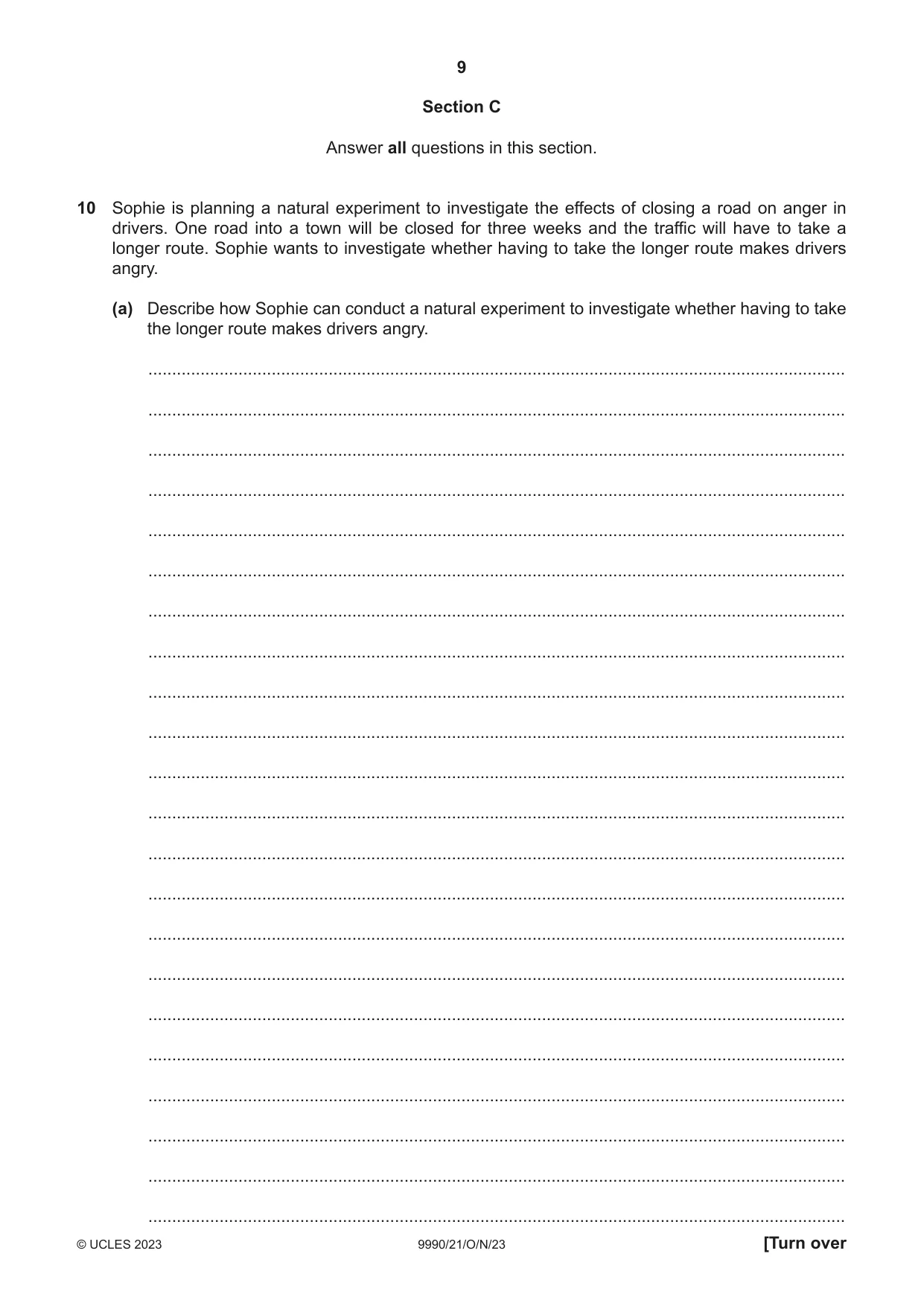
Q10 · Sophie is planning a natural experiment to investigate the effects of closing a road on…
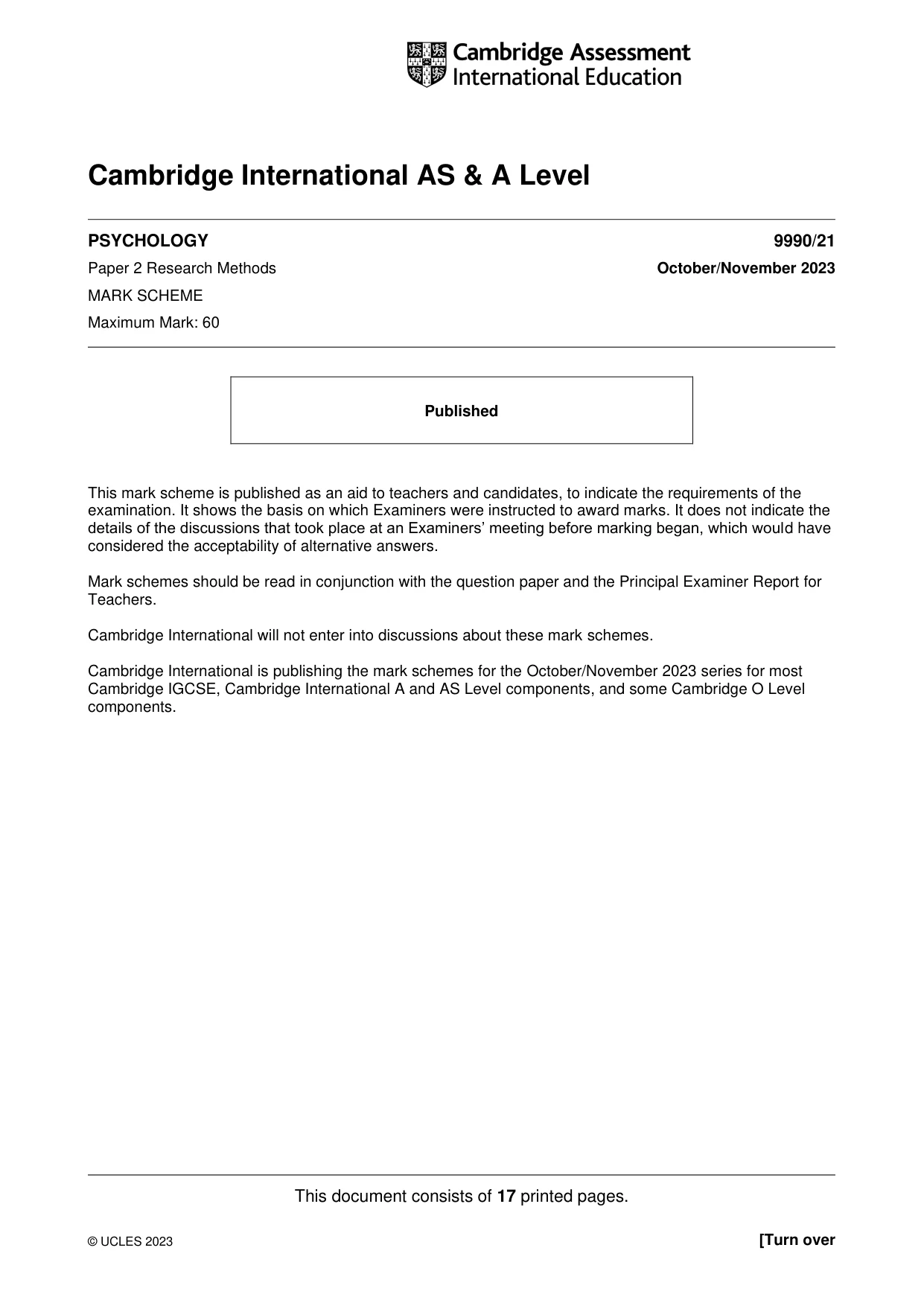
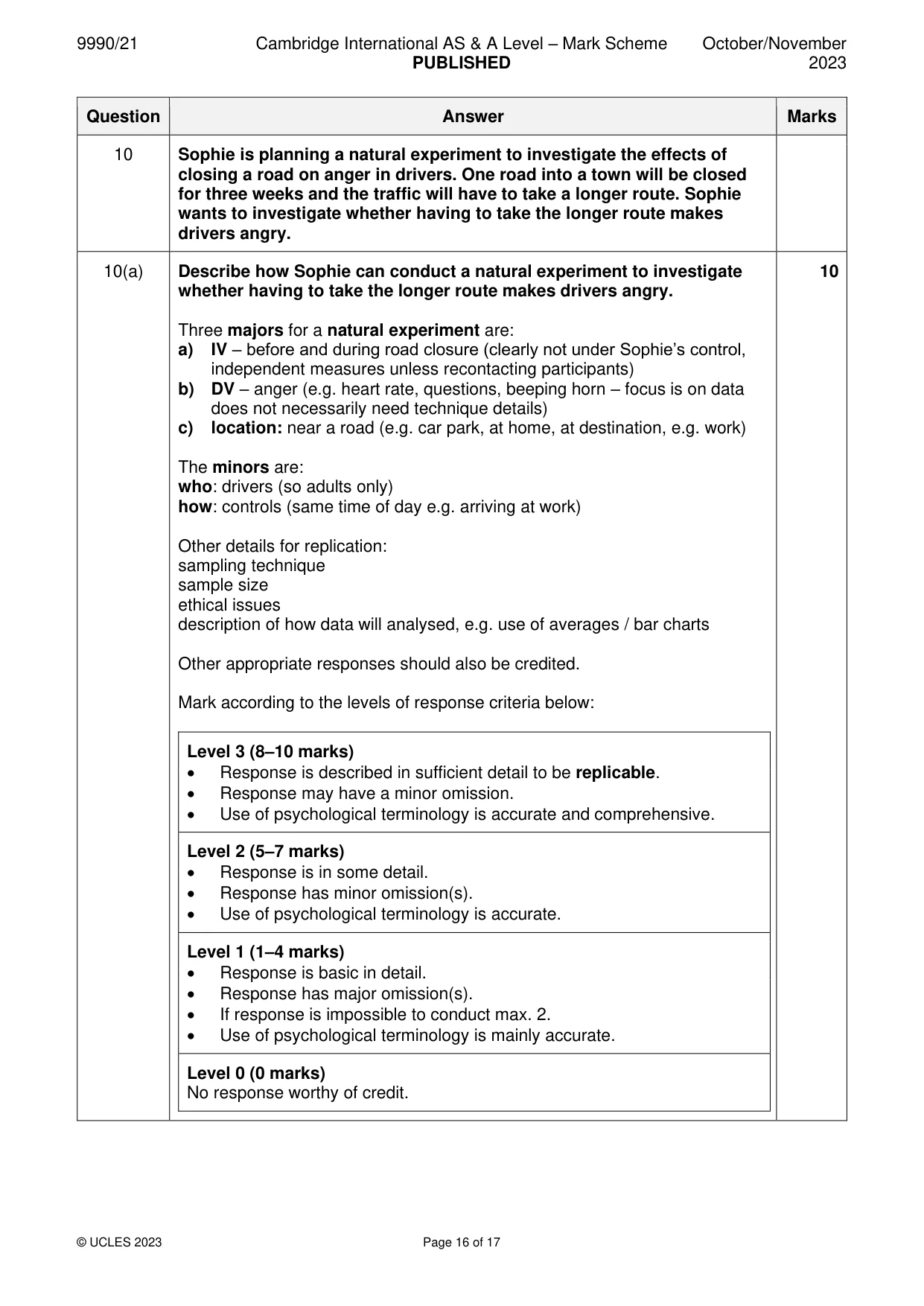
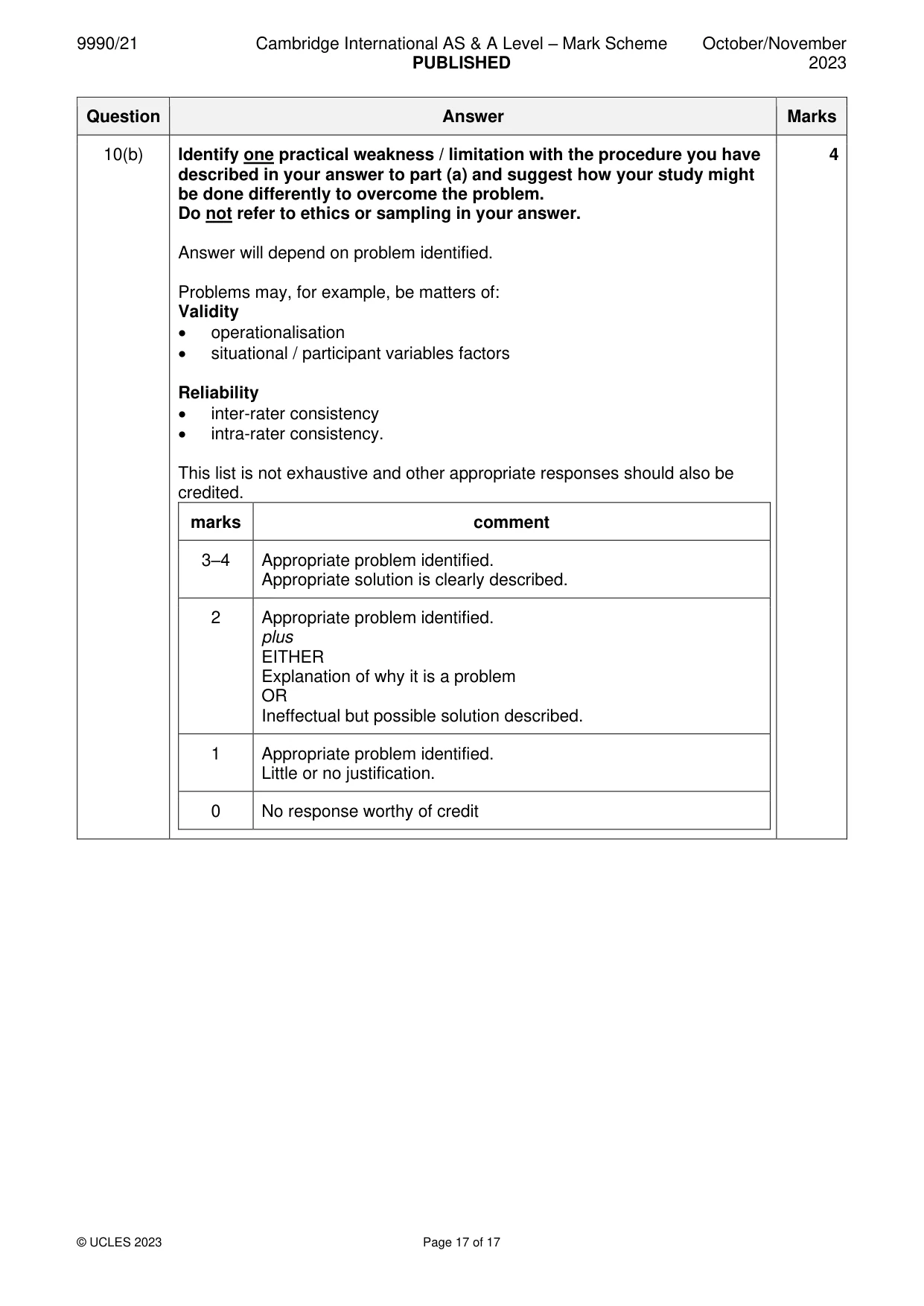
10 Sophie is planning a natural experiment to investigate the effects of closing a road on anger in drivers. One road into a town will be closed for three weeks and the traffic will have to take a longer route. Sophie wants to investigate whether having to take the longer route makes drivers angry. (a) Describe how Sophie can conduct a natural experiment to investigate whether having to take the longer route makes drivers angry. ................................................................................................................................................... ................................................................................................................................................... ................................................................................................................................................... ................................................................................................................................................... ................................................................................................................................................... ................................................................................................................................................... ................................................................................................................................................... ................................................................................................................................................... ................................................................................................................................................... ................................................................................................................................................... ................................................................................................................................................... ................................................................................................................................................... ................................................................................................................................................... ................................................................................................................................................... ................................................................................................................................................... ................................................................................................................................................... ................................................................................................................................................... ................................................................................................................................................... ................................................................................................................................................... ................................................................................................................................................... ................................................................................................................................................... ................................................................................................................................................... ................................................................................................................................................... ................................................................................................................................................... ................................................................................................................................................... ................................................................................................................................................... ................................................................................................................................................... ................................................................................................................................................... ................................................................................................................................................... ................................................................................................................................................... ................................................................................................................................................... ................................................................................................................................................... ................................................................................................................................................... ........................................................................................................................................... [10] (b) Identify one practical weakness/limitation with the procedure you have described in your answer to part (a) and suggest how your study might be done differently to overcome the problem. Do not refer to ethics or sampling in your answer. ................................................................................................................................................... ................................................................................................................................................... ................................................................................................................................................... ................................................................................................................................................... ................................................................................................................................................... ................................................................................................................................................... ................................................................................................................................................... ............................................................................................................................................. [4]
Mark scheme: 10 Sophie is planning a natural experiment to investigate the effects of closing a road on anger in drivers. One road into a town will be closed for three weeks and the traffic will have to take a longer route. Sophie wants to investigate whether having to take the longer route makes drivers angry. 10(a) Describe how Sophie can conduct a natural experiment to investigate 10 whether having to take the longer route makes drivers angry. Three majors for a natural experiment are: a) IV – before and during road closure (clearly not under Sophie’s control, independent measures unless recontacting participants) b) DV – anger (e.g. heart rate, questions, beeping horn – focus is on data does not necessarily need technique details) c) location: near a road (e.g. car park, at home, at destination, e.g. work) The minors are: who: drivers (so adults only) how: controls (same time of day e.g. arriving at work) Other details for replication: sampling technique sample size ethical issues description of how data will analysed, e.g. use of averages / bar charts Other appropriate responses should also be credited. Mark according to the levels of response criteria below: Level 3 (8–10 marks) • Response is described in sufficient detail to be replicable. • Response may have a minor omission. • Use of psychological terminology is accurate and comprehensive. Level 2 (5–7 marks) • Response is in some detail. • Response has minor omission(s). • Use of psychological terminology is accurate. Level 1 (1–4 marks) • Response is basic in detail. • Response has major omission(s). • If response is impossible to conduct max. 2. • Use of psychological terminology is mainly accurate. Level 0 (0 marks) No response worthy of credit. 10(b) Identify one practical weakness / limitation with the procedure you have 4 described in your answer to part (a) and suggest how your study might be done differently to overcome the problem. Do not refer to ethics or sampling in your answer. Answer will depend on problem identified. Problems may, for example, be matters of: Validity • operationalisation • situational / participant variables factors Reliability • inter-rater consistency • intra-rater consistency. This list is not exhaustive and other appropriate responses should also be credited. marks comment 3–4 Appropriate problem identified. Appropriate solution is clearly described. 2 Appropriate problem identified. plus EITHER Explanation of why it is a problem OR Ineffectual but possible solution described. 1 Appropriate problem identified. Little or no justification. 0 No response worthy of credit
What was in this paper
The subtopics covered by these 10 questions, and how many questions each got. Open one in a new tab to see every Cambridge question on it.
What you needed in this session
Cambridge’s own grade thresholds for 2023 Oct/Nov, Paper 2 · Variant 1. A higher threshold means an easier paper — the bar moves with how the cohort did.