Cambridge A Level Psychology (from 2018) 9990 — 2025 May/June Paper 2 · Variant 1
9990/21/M/J/25 · 10 questions · 60 marks · 90 min
The question paper and its mark scheme, free to read here and free to download. This is Cambridge’s own paper, exactly as it was sat.
Question paper12 pages


Mark scheme27 pages
Answers below. Sit the paper first if you are practising.
Questions as text
Q1 · Describe what is meant by a questionnaire
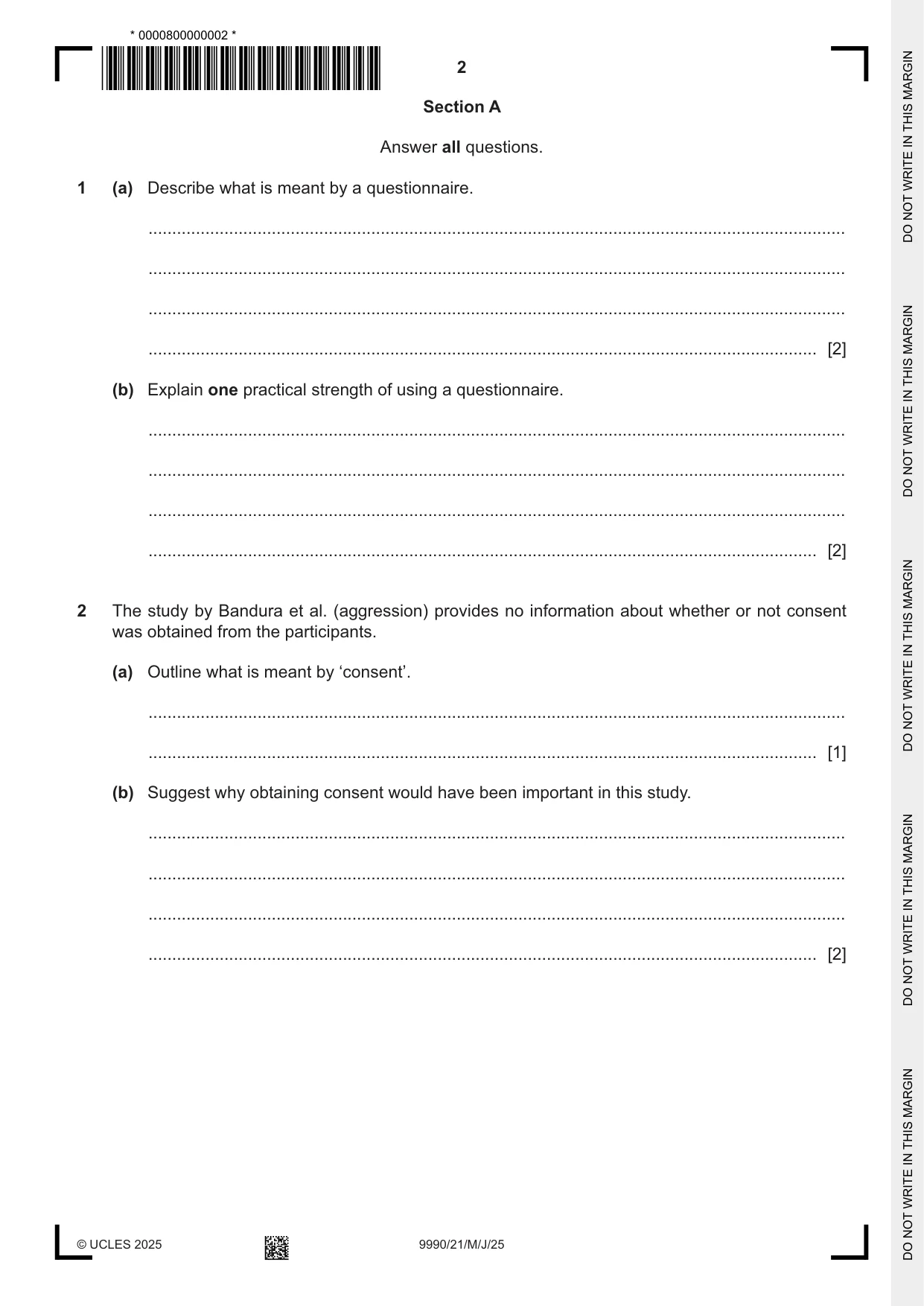
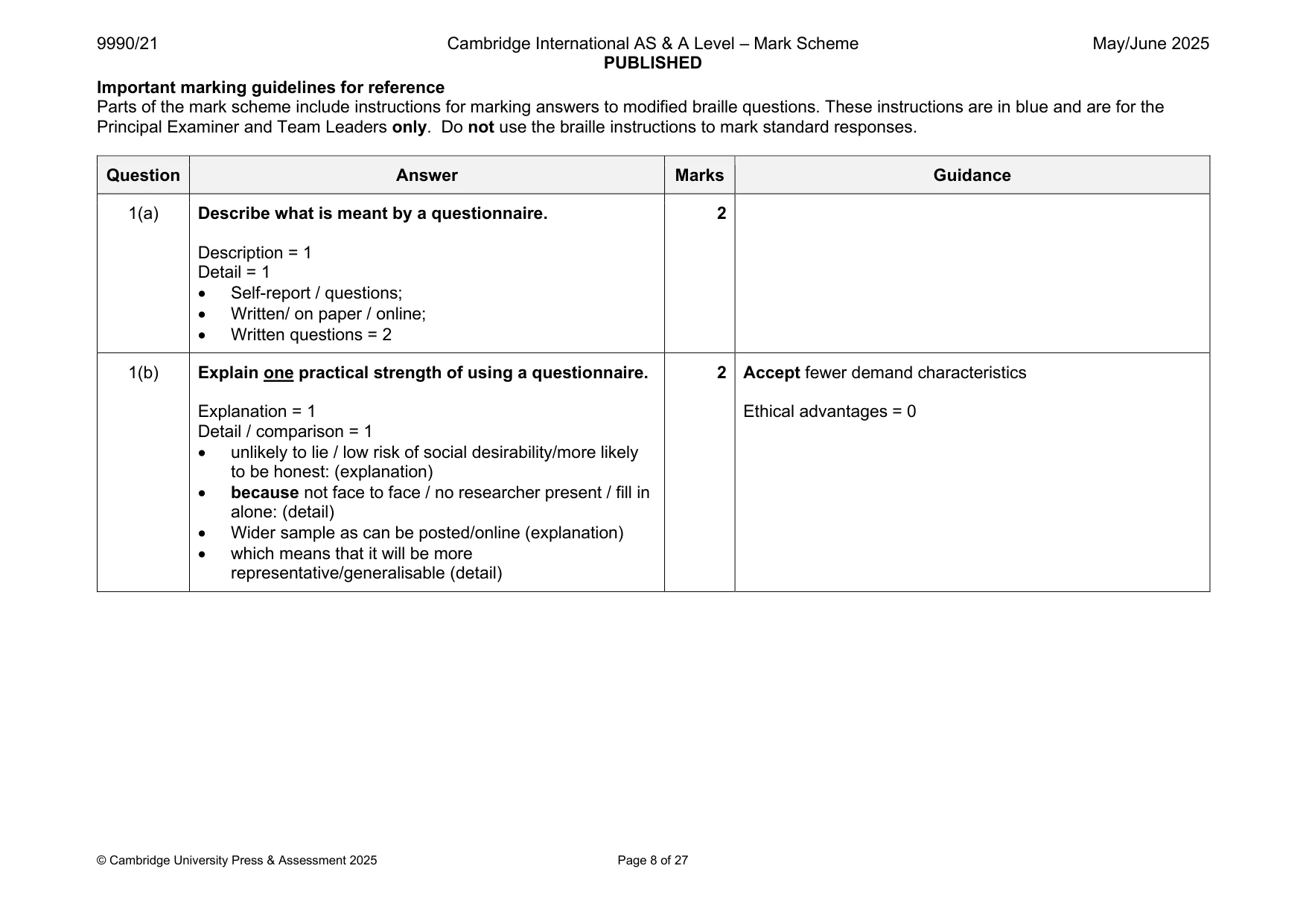
1 (a) Describe what is meant by a questionnaire. ................................................................................................................................................... ................................................................................................................................................... ................................................................................................................................................... ............................................................................................................................................. [2] (b) Explain one practical strength of using a questionnaire. ................................................................................................................................................... ................................................................................................................................................... ................................................................................................................................................... ............................................................................................................................................. [2]
Mark scheme: Question Answer Marks Guidance 1(a) Describe what is meant by a questionnaire. 2 Description = 1 Detail = 1 • Self-report / questions; • Written/ on paper / online; • Written questions = 2 1(b) Explain one practical strength of using a questionnaire. 2 Accept fewer demand characteristics Explanation = 1 Ethical advantages = 0 Detail / comparison = 1 • unlikely to lie / low risk of social desirability/more likely to be honest: (explanation) • because not face to face / no researcher present / fill in alone: (detail) • Wider sample as can be posted/online (explanation) • which means that it will be more representative/generalisable (detail)
Q2 · The study by Bandura et al
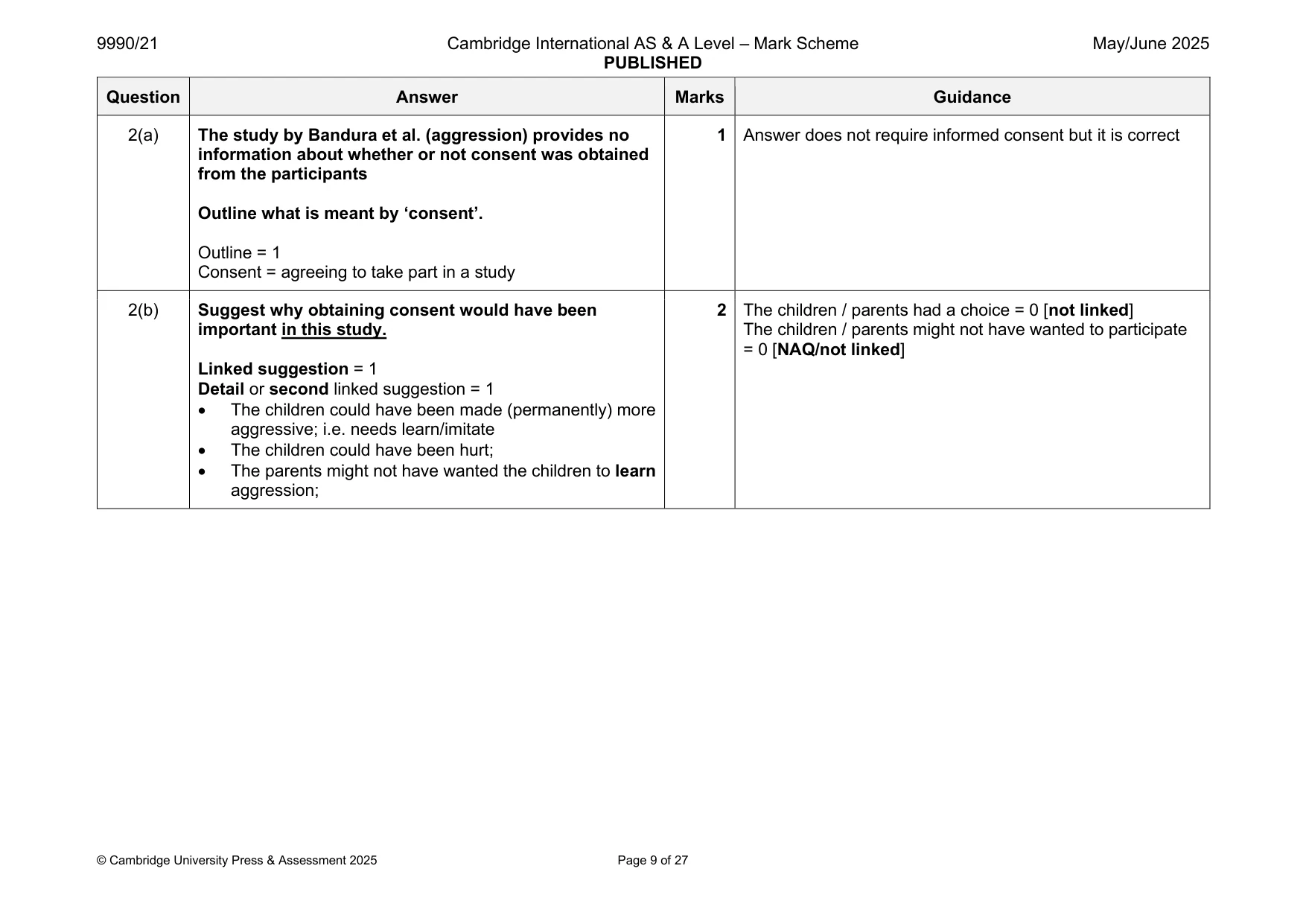
2 The study by Bandura et al. (aggression) provides no information about whether or not consent was obtained from the participants. (a) Outline what is meant by ‘consent’. ................................................................................................................................................... ............................................................................................................................................. [1] (b) Suggest why obtaining consent would have been important in this study. ................................................................................................................................................... ................................................................................................................................................... ................................................................................................................................................... ............................................................................................................................................. [2]
Mark scheme: 2(a) The study by Bandura et al. (aggression) provides no 1 Answer does not require informed consent but it is correct information about whether or not consent was obtained from the participants Outline what is meant by ‘consent’. Outline = 1 Consent = agreeing to take part in a study 2(b) Suggest why obtaining consent would have been 2 The children / parents had a choice = 0 [not linked] important in this study. The children / parents might not have wanted to participate = 0 [NAQ/not linked] Linked suggestion = 1 Detail or second linked suggestion = 1 • The children could have been made (permanently) more aggressive; i.e. needs learn/imitate • The children could have been hurt; • The parents might not have wanted the children to learn aggression;
Q3 · In the study by Milgram, obedience was tested
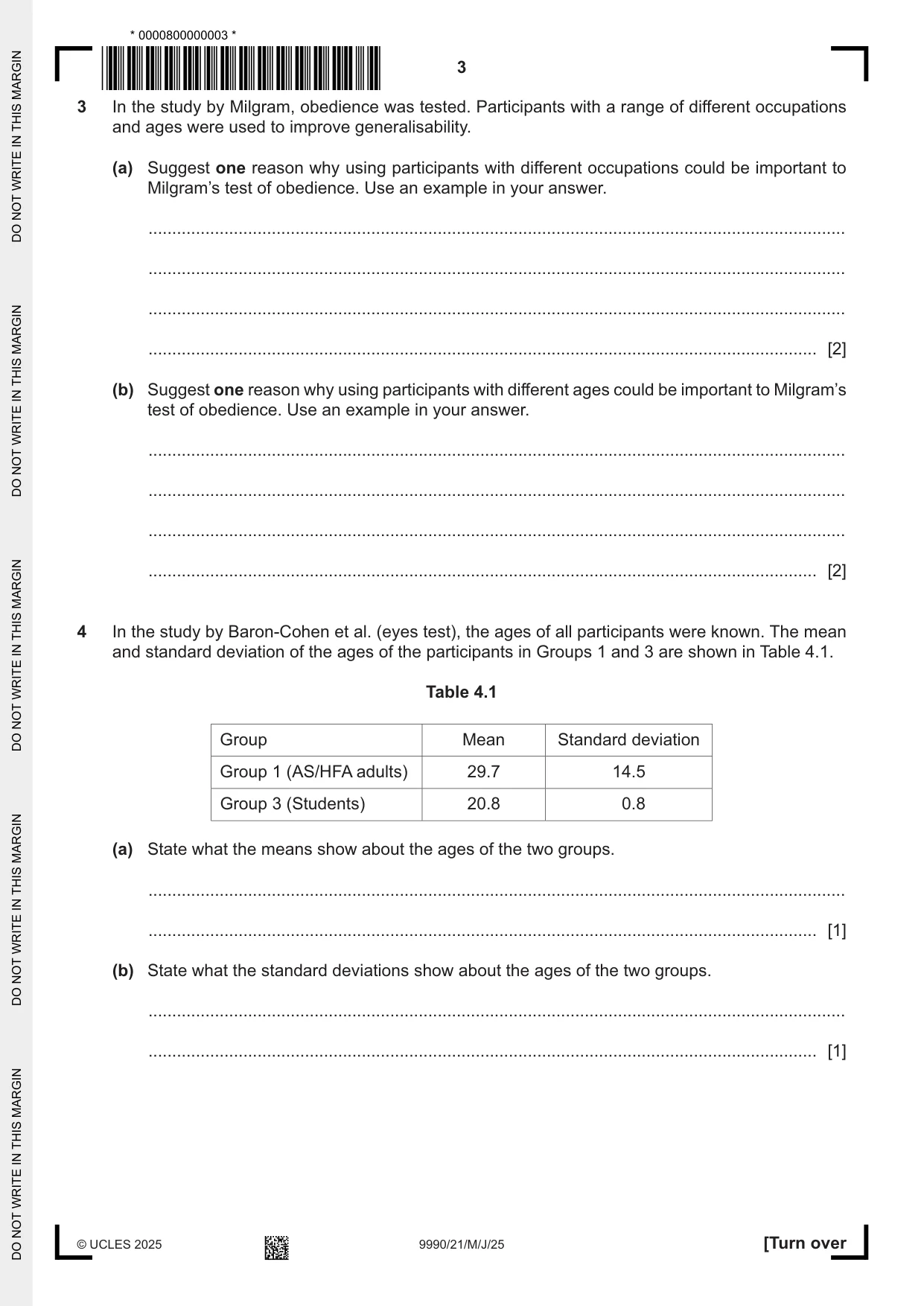
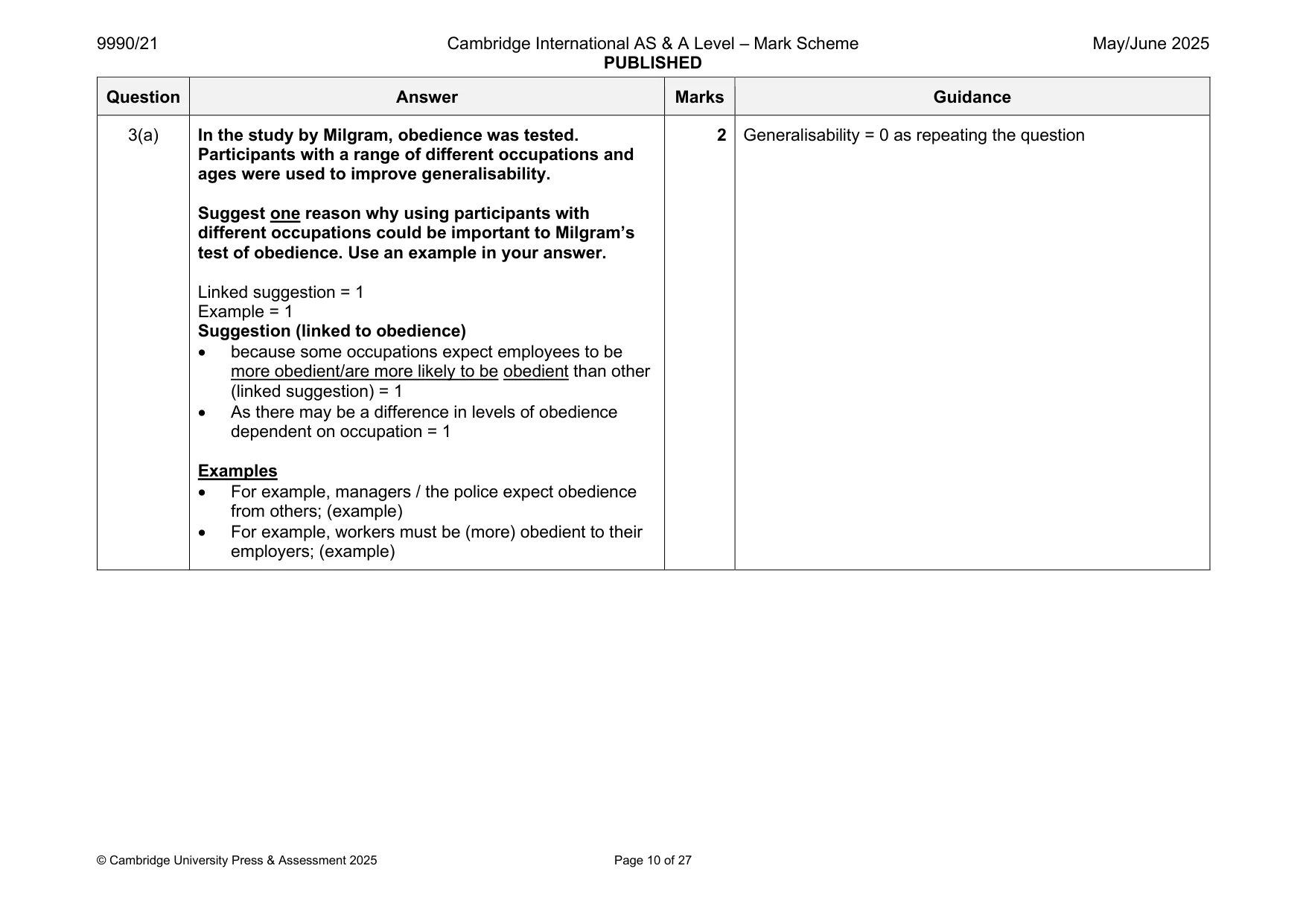
3 In the study by Milgram, obedience was tested. Participants with a range of different occupations and ages were used to improve generalisability. (a) Suggest one reason why using participants with different occupations could be important to Milgram’s test of obedience. Use an example in your answer. ................................................................................................................................................... ................................................................................................................................................... ................................................................................................................................................... ............................................................................................................................................. [2] (b) Suggest one reason why using participants with different ages could be important to Milgram’s test of obedience. Use an example in your answer. ................................................................................................................................................... ................................................................................................................................................... ................................................................................................................................................... ............................................................................................................................................. [2]
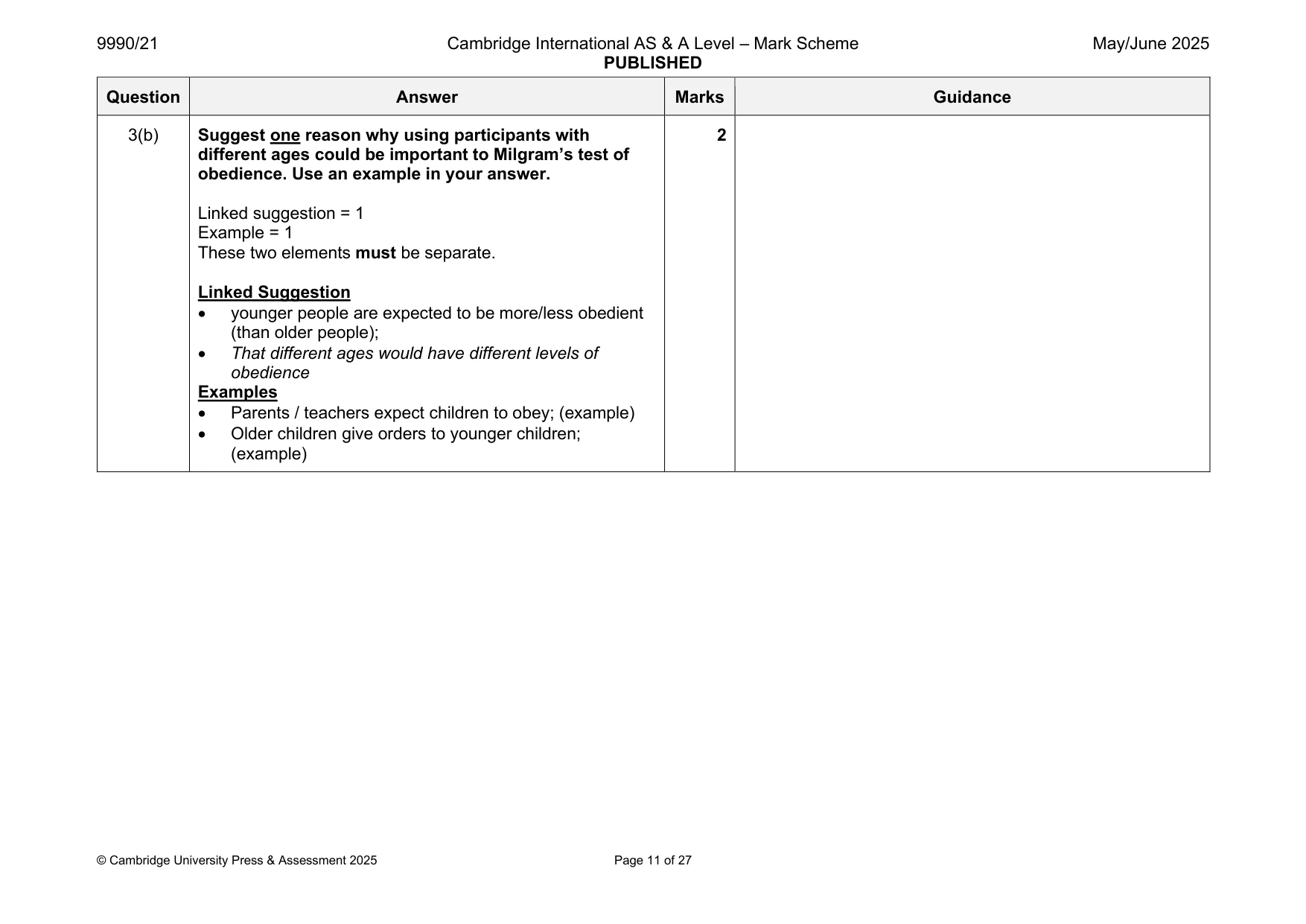
Mark scheme: 3(a) In the study by Milgram, obedience was tested. 2 Generalisability = 0 as repeating the question Participants with a range of different occupations and ages were used to improve generalisability. Suggest one reason why using participants with different occupations could be important to Milgram’s test of obedience. Use an example in your answer. Linked suggestion = 1 Example = 1 Suggestion (linked to obedience) • because some occupations expect employees to be more obedient/are more likely to be obedient than other (linked suggestion) = 1 • As there may be a difference in levels of obedience dependent on occupation = 1 Examples • For example, managers / the police expect obedience from others; (example) • For example, workers must be (more) obedient to their employers; (example) 3(b) Suggest one reason why using participants with 2 different ages could be important to Milgram’s test of obedience. Use an example in your answer. Linked suggestion = 1 Example = 1 These two elements must be separate. Linked Suggestion • younger people are expected to be more/less obedient (than older people); • That different ages would have different levels of obedience Examples • Parents / teachers expect children to obey; (example) • Older children give orders to younger children; (example)
Q4 · In the study by Baron-Cohen et al
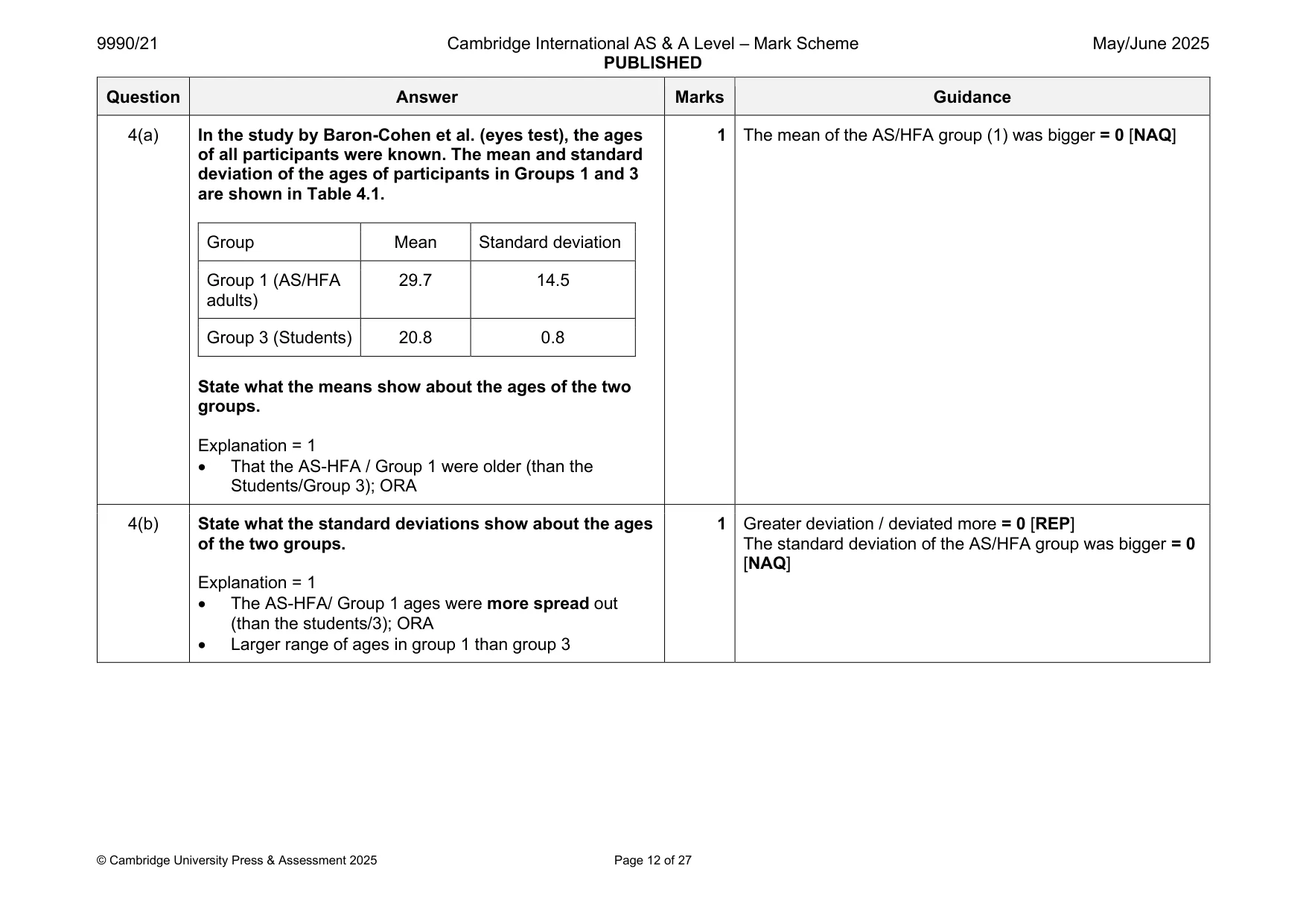
4 In the study by Baron-Cohen et al. (eyes test), the ages of all participants were known. The mean and standard deviation of the ages of the participants in Groups 1 and 3 are shown in Table 4.1. Table 4.1 Group Mean Standard deviation Group 1 (AS/HFA adults) 29.7 14.5 Group 3 (Students) 20.8 0.8 (a) State what the means show about the ages of the two groups. ................................................................................................................................................... ............................................................................................................................................. [1] (b) State what the standard deviations show about the ages of the two groups. ................................................................................................................................................... ............................................................................................................................................. [1]
Mark scheme: 4(a) In the study by Baron-Cohen et al. (eyes test), the ages 1 The mean of the AS/HFA group (1) was bigger = 0 [NAQ] of all participants were known. The mean and standard deviation of the ages of participants in Groups 1 and 3 are shown in Table 4.1. Group Mean Standard deviation Group 1 (AS/HFA 29.7 14.5 adults) Group 3 (Students) 20.8 0.8 State what the means show about the ages of the two groups. Explanation = 1 • That the AS-HFA / Group 1 were older (than the Students/Group 3); ORA 4(b) State what the standard deviations show about the ages 1 Greater deviation / deviated more = 0 [REP] of the two groups. The standard deviation of the AS/HFA group was bigger = 0 [NAQ] Explanation = 1 • The AS-HFA/ Group 1 ages were more spread out (than the students/3); ORA • Larger range of ages in group 1 than group 3
Q5 · Explain one ethical weakness of the case study research method
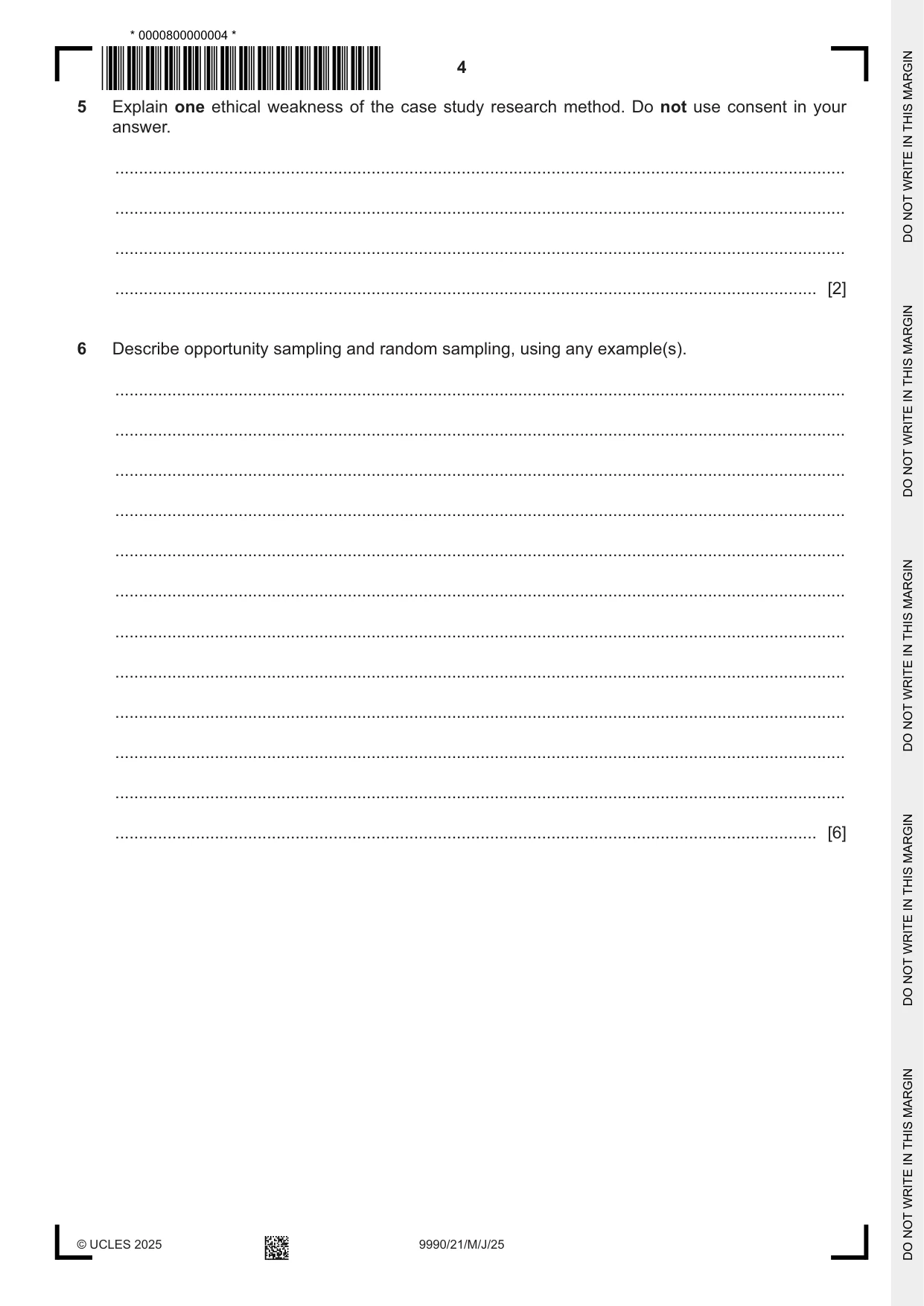
5 Explain one ethical weakness of the case study research method. Do not use consent in your answer. .......................................................................................................................................................... .......................................................................................................................................................... .......................................................................................................................................................... .................................................................................................................................................... [2]
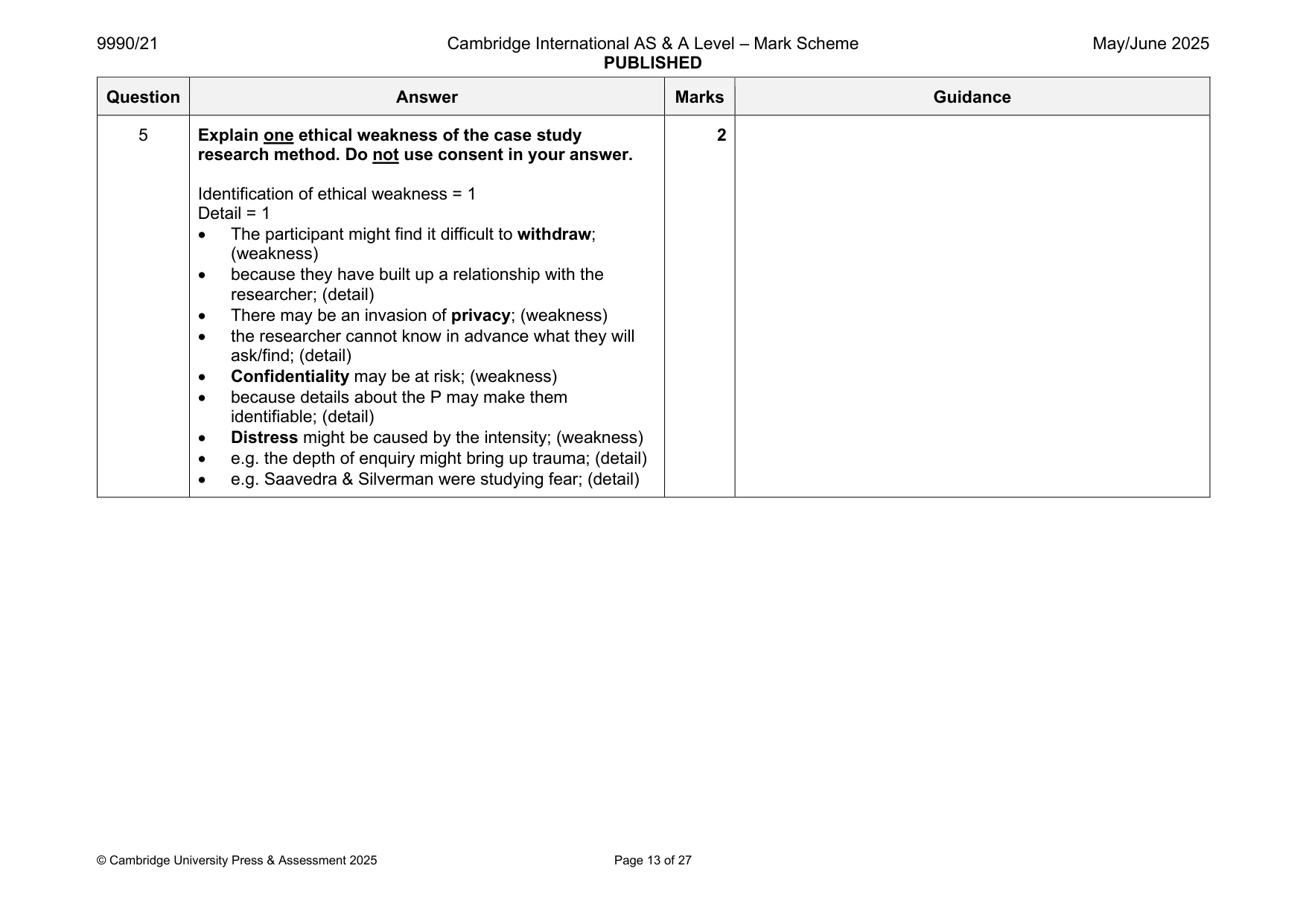
Mark scheme: 5 Explain one ethical weakness of the case study 2 research method. Do not use consent in your answer. Identification of ethical weakness = 1 Detail = 1 • The participant might find it difficult to withdraw; (weakness) • because they have built up a relationship with the researcher; (detail) • There may be an invasion of privacy; (weakness) • the researcher cannot know in advance what they will ask/find; (detail) • Confidentiality may be at risk; (weakness) • because details about the P may make them identifiable; (detail) • Distress might be caused by the intensity; (weakness) • e.g. the depth of enquiry might bring up trauma; (detail) • e.g. Saavedra & Silverman were studying fear; (detail)
Q6 · Describe opportunity sampling and random sampling, using any example(s)
6 Describe opportunity sampling and random sampling, using any example(s). .......................................................................................................................................................... .......................................................................................................................................................... .......................................................................................................................................................... .......................................................................................................................................................... .......................................................................................................................................................... .......................................................................................................................................................... .......................................................................................................................................................... .......................................................................................................................................................... .......................................................................................................................................................... .......................................................................................................................................................... .......................................................................................................................................................... .................................................................................................................................................... [6]
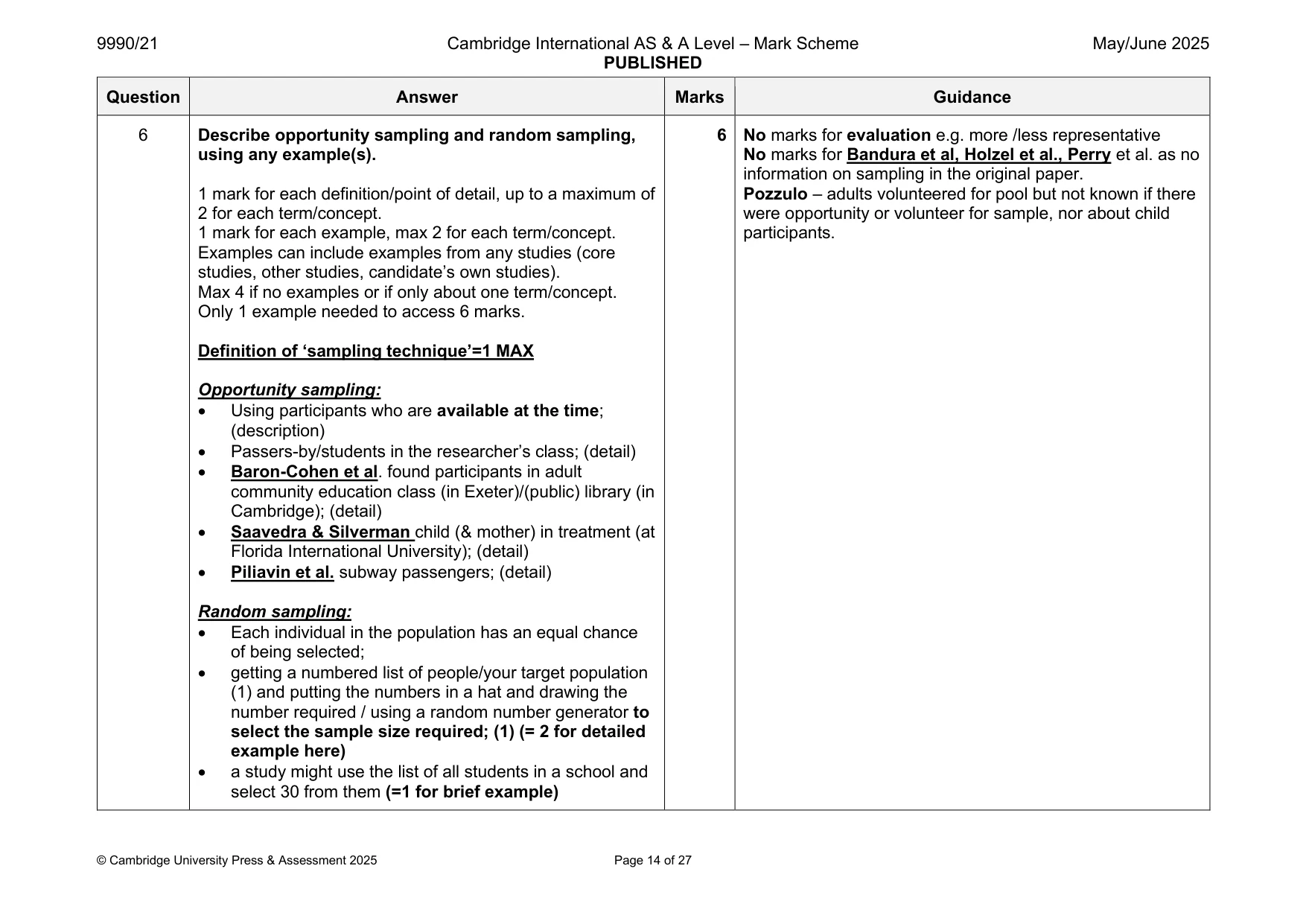
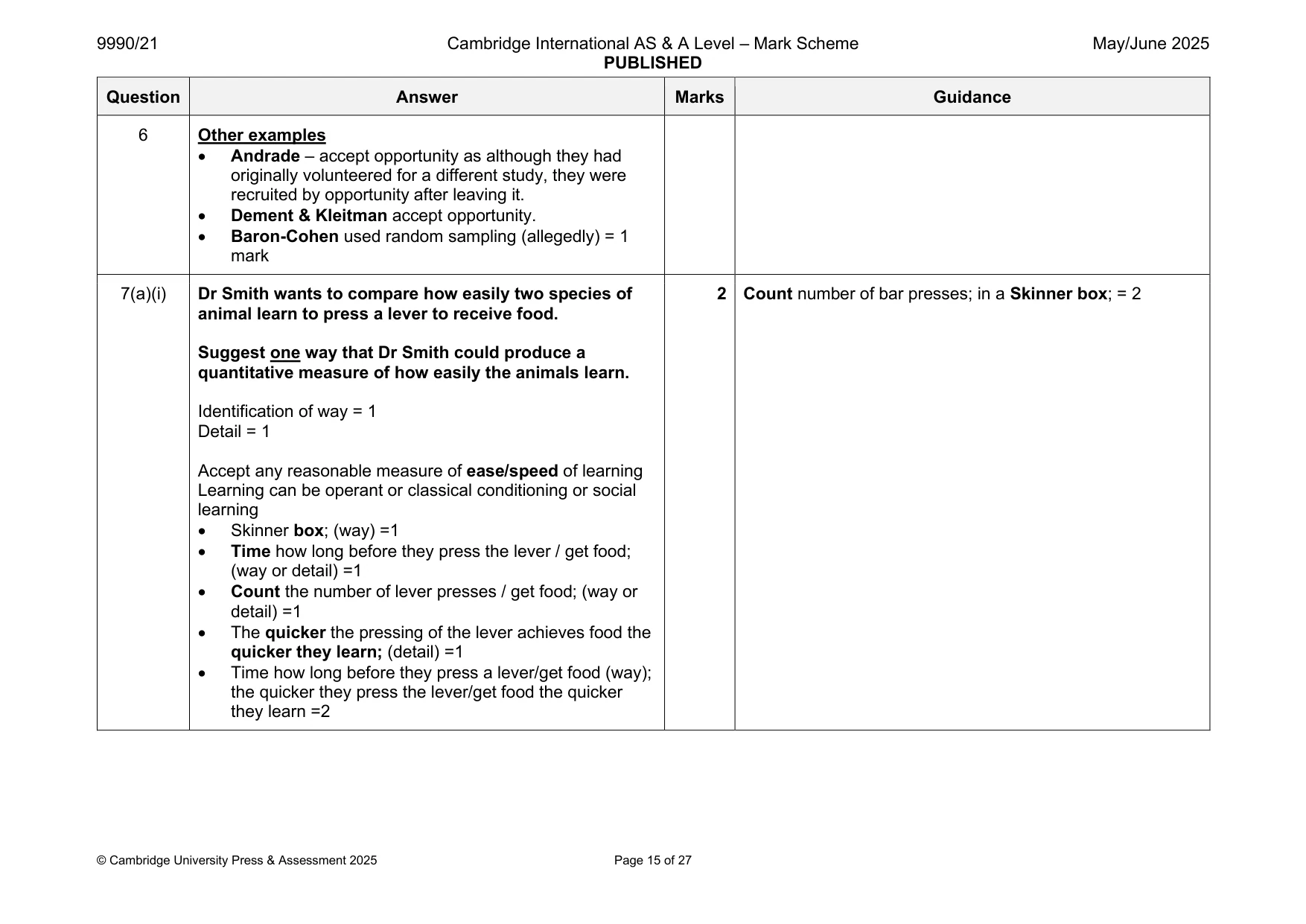
Mark scheme: 6 Describe opportunity sampling and random sampling, 6 No marks for evaluation e.g. more /less representative using any example(s). No marks for Bandura et al, Holzel et al., Perry et al. as no information on sampling in the original paper. 1 mark for each definition/point of detail, up to a maximum of Pozzulo – adults volunteered for pool but not known if there 2 for each term/concept. were opportunity or volunteer for sample, nor about child 1 mark for each example, max 2 for each term/concept. participants. Examples can include examples from any studies (core studies, other studies, candidate’s own studies). Max 4 if no examples or if only about one term/concept. Only 1 example needed to access 6 marks. Definition of ‘sampling technique’=1 MAX Opportunity sampling: • Using participants who are available at the time; (description) • Passers-by/students in the researcher’s class; (detail) • Baron-Cohen et al. found participants in adult community education class (in Exeter)/(public) library (in Cambridge); (detail) • Saavedra & Silverman child (& mother) in treatment (at Florida International University); (detail) • Piliavin et al. subway passengers; (detail) Random sampling: • Each individual in the population has an equal chance of being selected; • getting a numbered list of people/your target population (1) and putting the numbers in a hat and drawing the number required / using a random number generator to select the sample size required; (1) (= 2 for detailed example here) • a study might use the list of all students in a school and select 30 from them (=1 for brief example) 6 Other examples • Andrade – accept opportunity as although they had originally volunteered for a different study, they were recruited by opportunity after leaving it. • Dement & Kleitman accept opportunity. • Baron-Cohen used random sampling (allegedly) = 1 mark
Q7 · Dr Smith wants to compare how easily two species of animal learn to press a lever to…
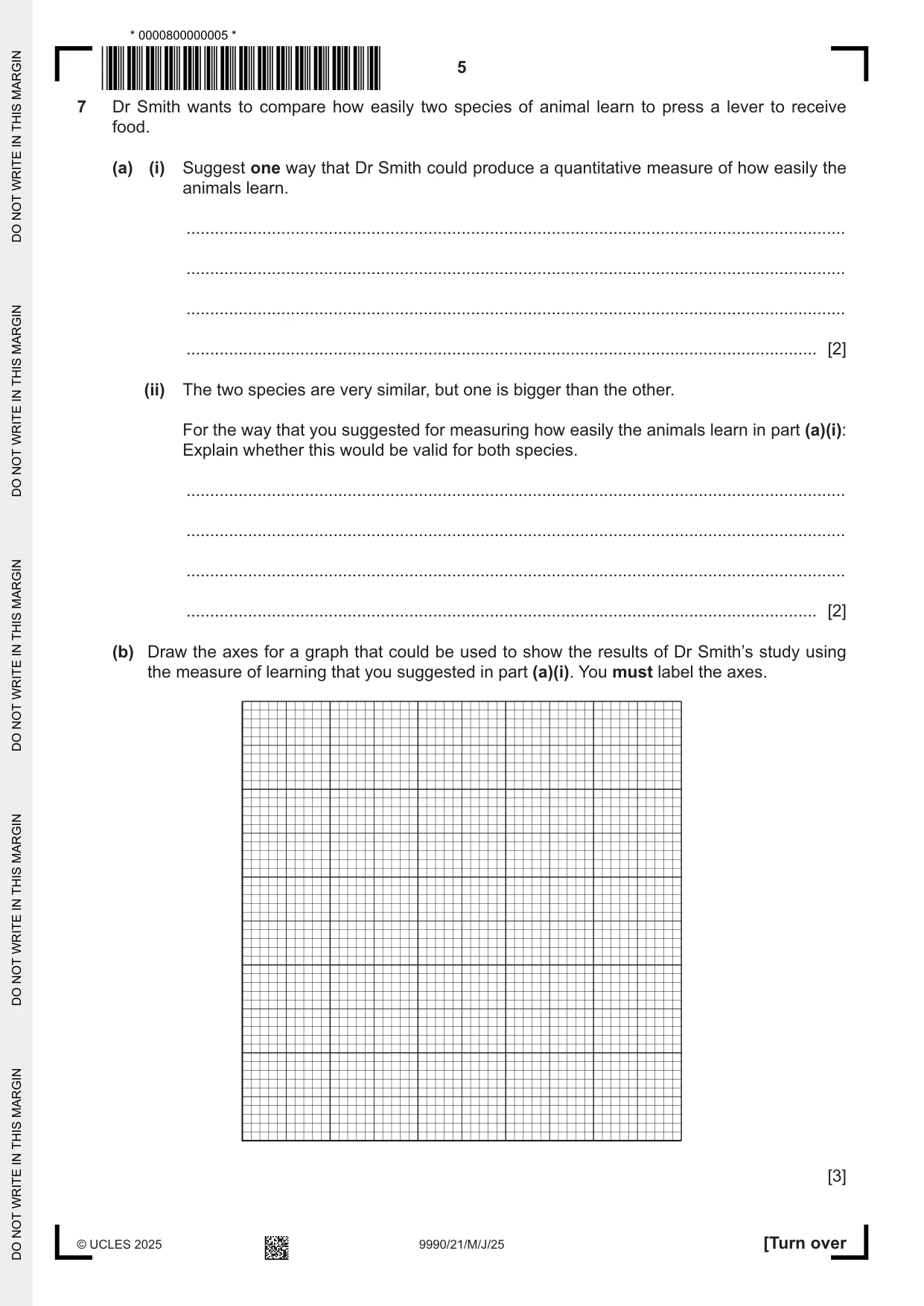
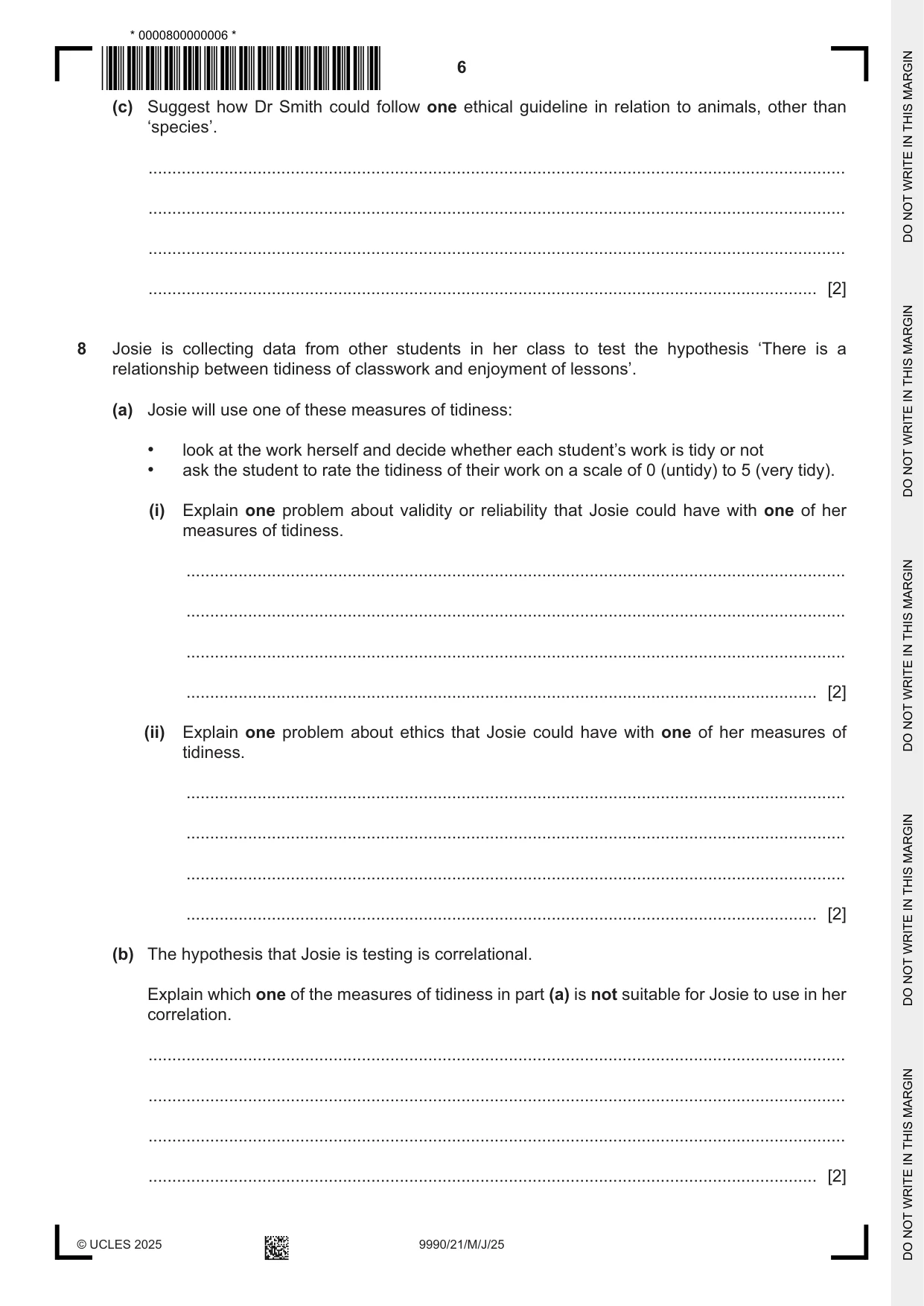
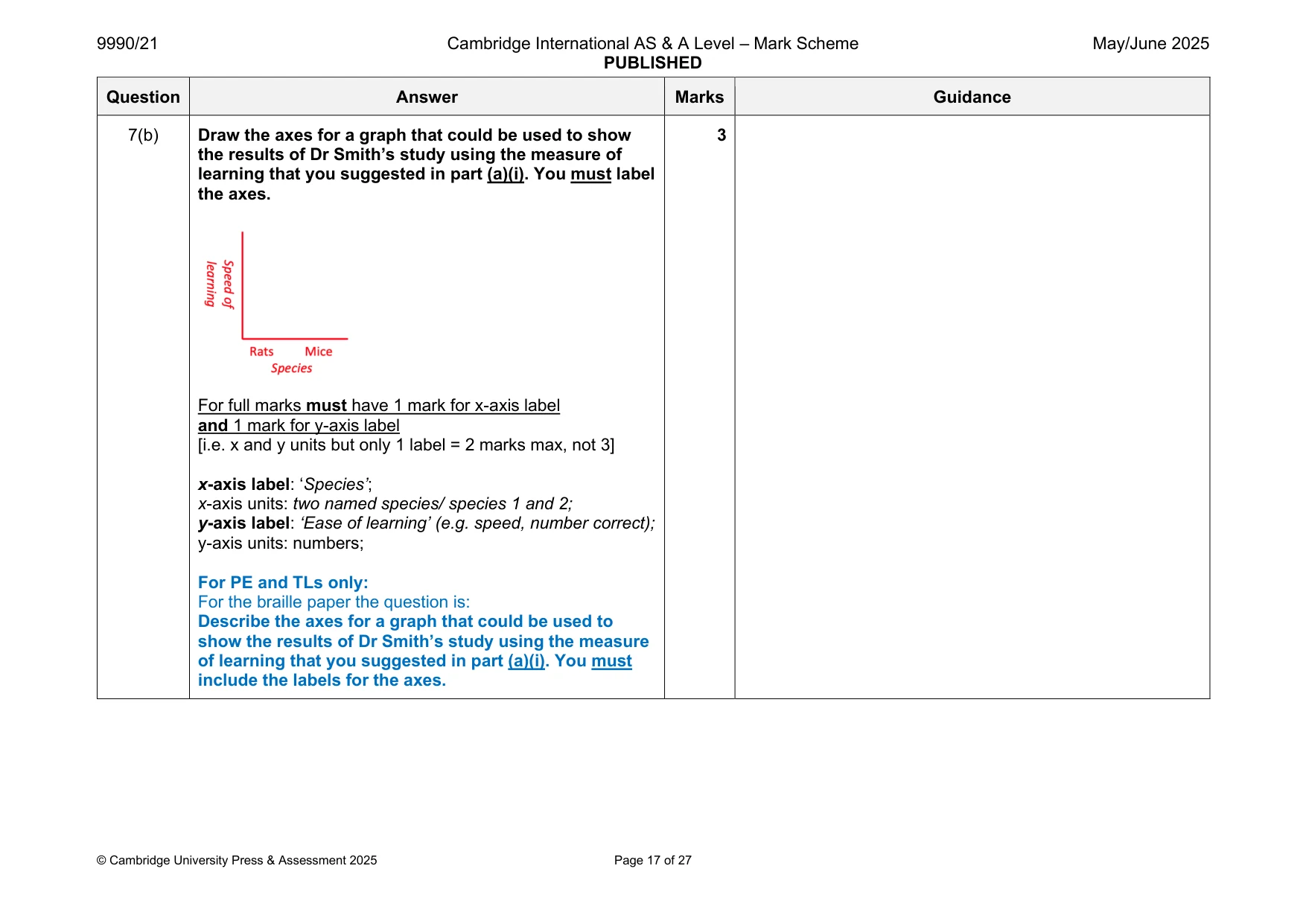
7 Dr Smith wants to compare how easily two species of animal learn to press a lever to receive food. (a) (i) Suggest one way that Dr Smith could produce a quantitative measure of how easily the animals learn. ........................................................................................................................................... ........................................................................................................................................... ........................................................................................................................................... ..................................................................................................................................... [2] (ii) The two species are very similar, but one is bigger than the other. For the way that you suggested for measuring how easily the animals learn in part (a)(i): Explain whether this would be valid for both species. ........................................................................................................................................... ........................................................................................................................................... ........................................................................................................................................... ..................................................................................................................................... [2] (b) Draw the axes for a graph that could be used to show the results of Dr Smith’s study using the measure of learning that you suggested in part (a)(i). You must label the axes. [3] (c) Suggest how Dr Smith could follow one ethical guideline in relation to animals, other than ‘species’. ................................................................................................................................................... ................................................................................................................................................... ................................................................................................................................................... ............................................................................................................................................. [2]
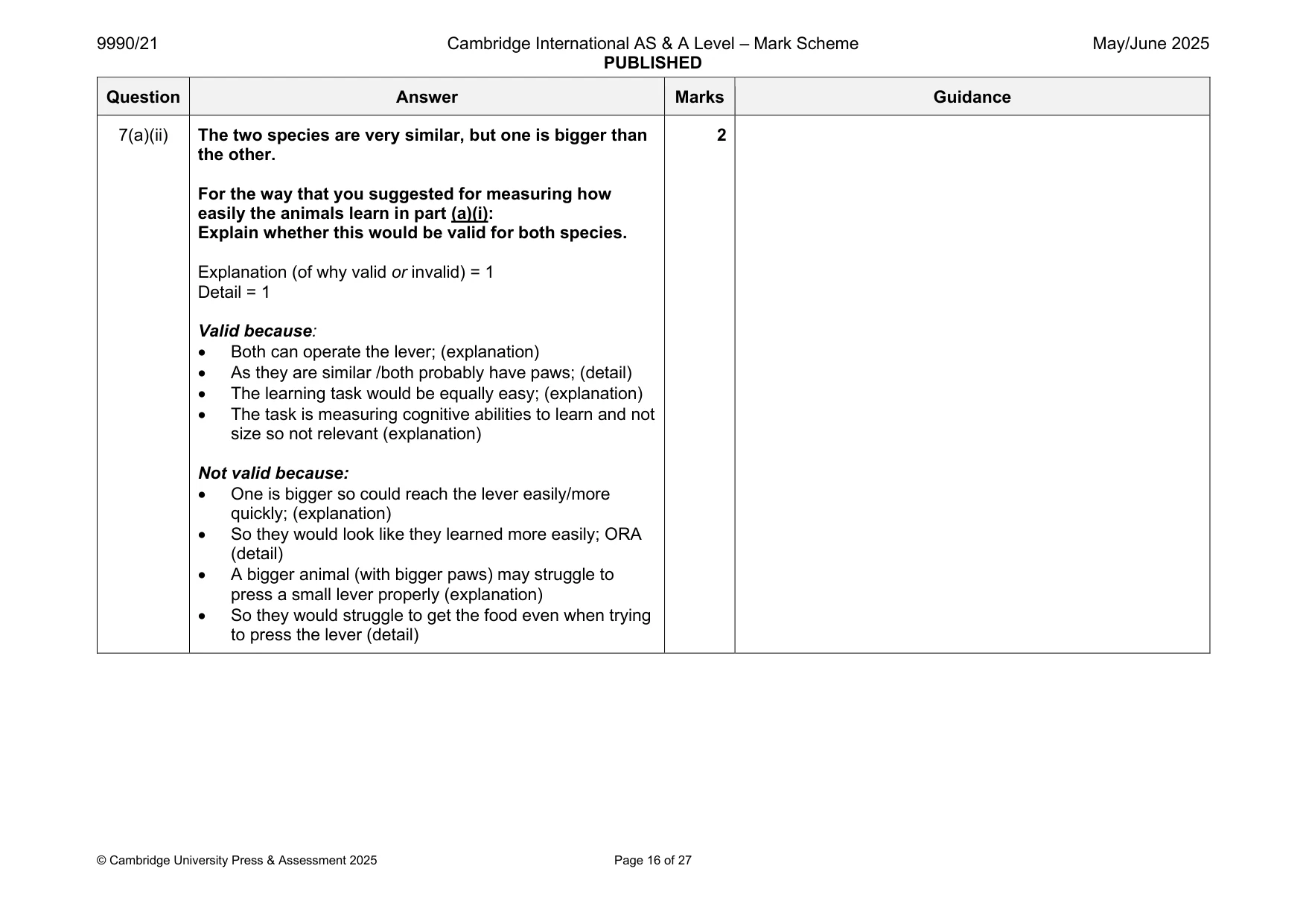
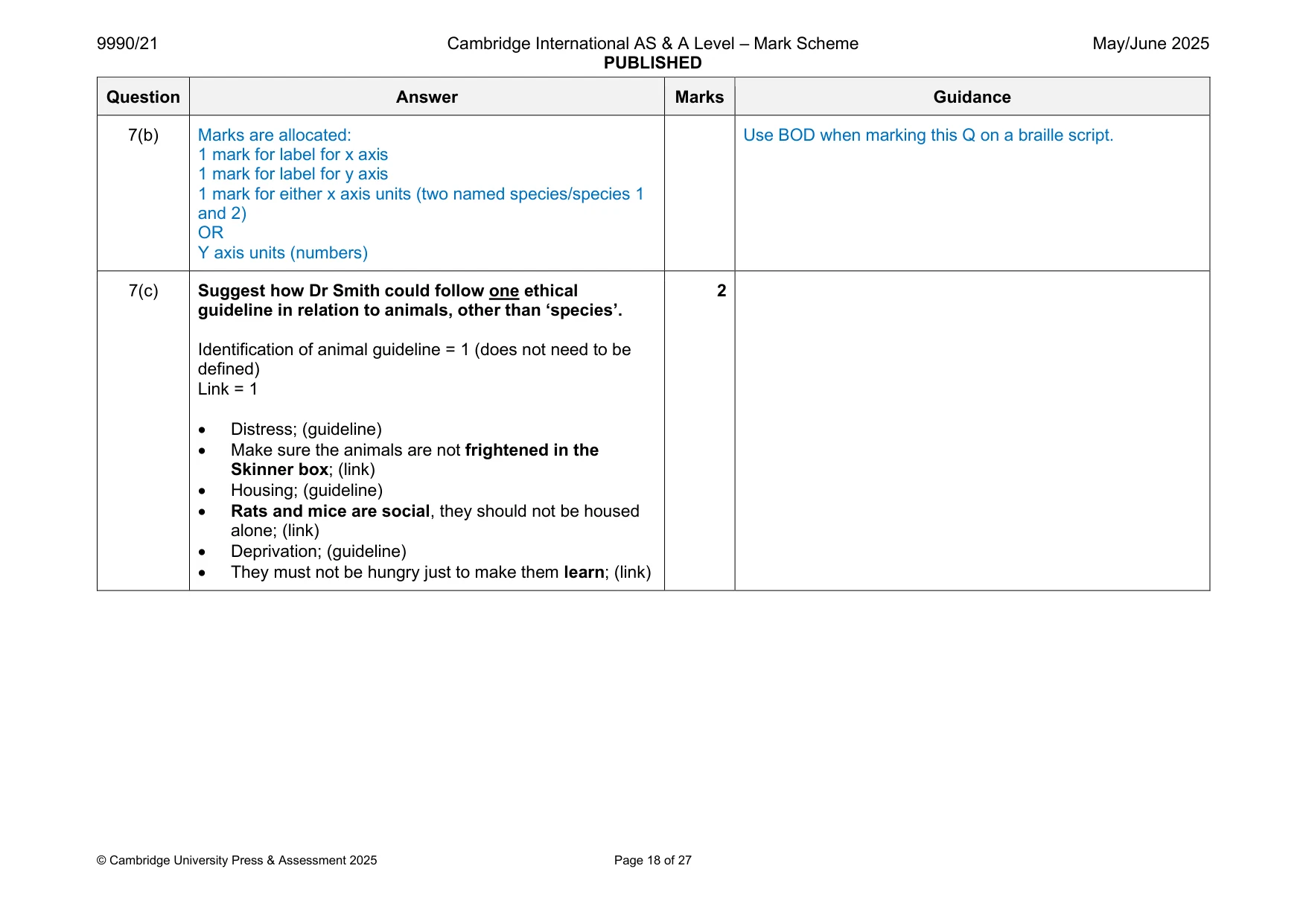
Mark scheme: 7(a)(i) Dr Smith wants to compare how easily two species of 2 Count number of bar presses; in a Skinner box; = 2 animal learn to press a lever to receive food. Suggest one way that Dr Smith could produce a quantitative measure of how easily the animals learn. Identification of way = 1 Detail = 1 Accept any reasonable measure of ease/speed of learning Learning can be operant or classical conditioning or social learning • Skinner box; (way) =1 • Time how long before they press the lever / get food; (way or detail) =1 • Count the number of lever presses / get food; (way or detail) =1 • The quicker the pressing of the lever achieves food the quicker they learn; (detail) =1 • Time how long before they press a lever/get food (way); the quicker they press the lever/get food the quicker they learn =2 7(a)(ii) The two species are very similar, but one is bigger than 2 the other. For the way that you suggested for measuring how easily the animals learn in part (a)(i): Explain whether this would be valid for both species. Explanation (of why valid or invalid) = 1 Detail = 1 Valid because: • Both can operate the lever; (explanation) • As they are similar /both probably have paws; (detail) • The learning task would be equally easy; (explanation) • The task is measuring cognitive abilities to learn and not size so not relevant (explanation) Not valid because: • One is bigger so could reach the lever easily/more quickly; (explanation) • So they would look like they learned more easily; ORA (detail) • A bigger animal (with bigger paws) may struggle to press a small lever properly (explanation) • So they would struggle to get the food even when trying to press the lever (detail) 7(b) Draw the axes for a graph that could be used to show 3 the results of Dr Smith’s study using the measure of learning that you suggested in part (a)(i). You must label the axes. For full marks must have 1 mark for x-axis label and 1 mark for y-axis label [i.e. x and y units but only 1 label = 2 marks max, not 3] x-axis label: ‘Species’; x-axis units: two named species/ species 1 and 2; y-axis label: ‘Ease of learning’ (e.g. speed, number correct); y-axis units: numbers; For PE and TLs only: For the braille paper the question is: Describe the axes for a graph that could be used to show the results of Dr Smith’s study using the measure of learning that you suggested in part (a)(i). You must include the labels for the axes. 7(b) Marks are allocated: Use BOD when marking this Q on a braille script. 1 mark for label for x axis 1 mark for label for y axis 1 mark for either x axis units (two named species/species 1 and 2) OR Y axis units (numbers) 7(c) Suggest how Dr Smith could follow one ethical 2 guideline in relation to animals, other than ‘species’. Identification of animal guideline = 1 (does not need to be defined) Link = 1 • Distress; (guideline) • Make sure the animals are not frightened in the Skinner box; (link) • Housing; (guideline) • Rats and mice are social, they should not be housed alone; (link) • Deprivation; (guideline) • They must not be hungry just to make them learn; (link)
Q8 · Josie is collecting data from other students in her class to test the hypothesis ‘There…
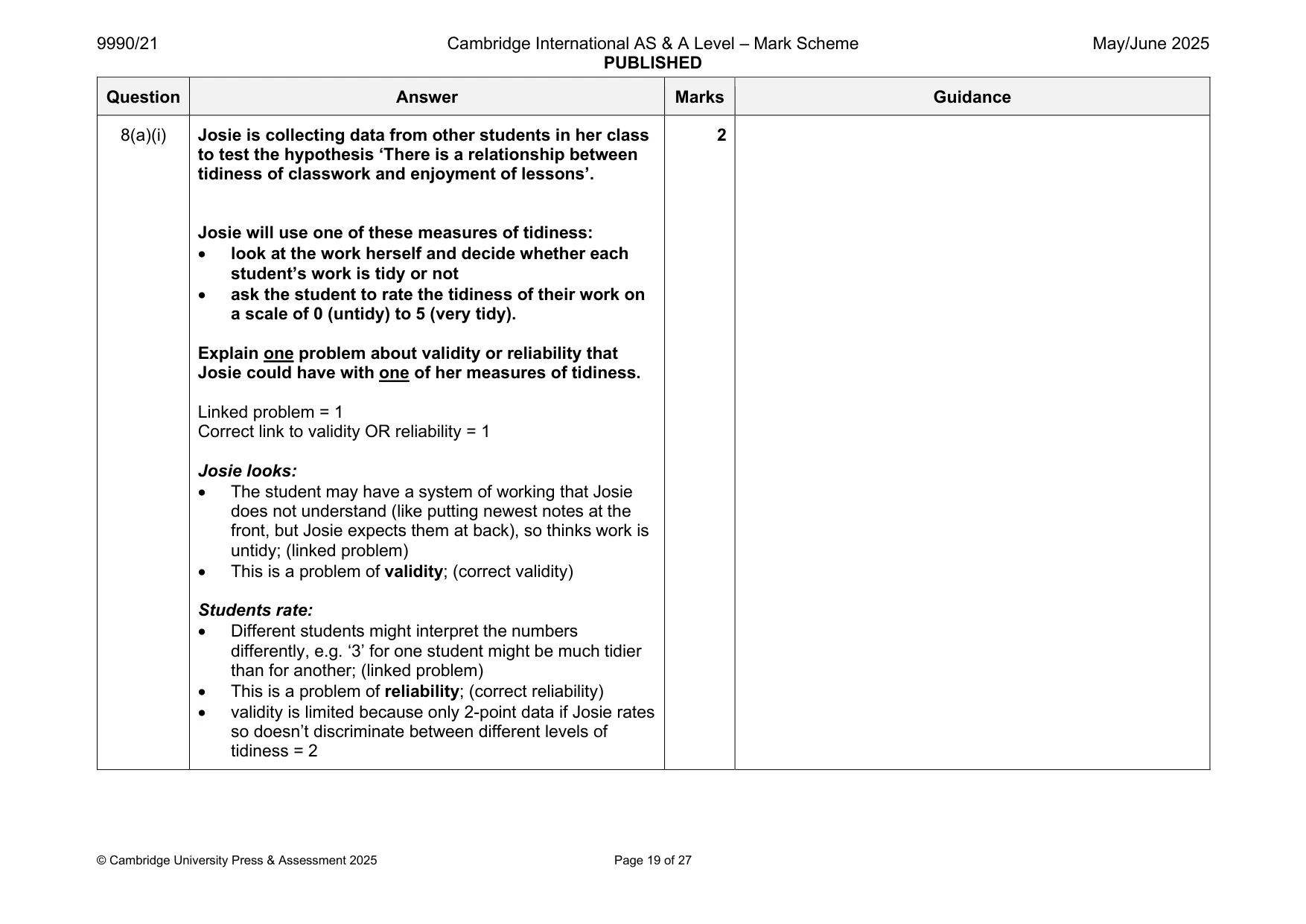
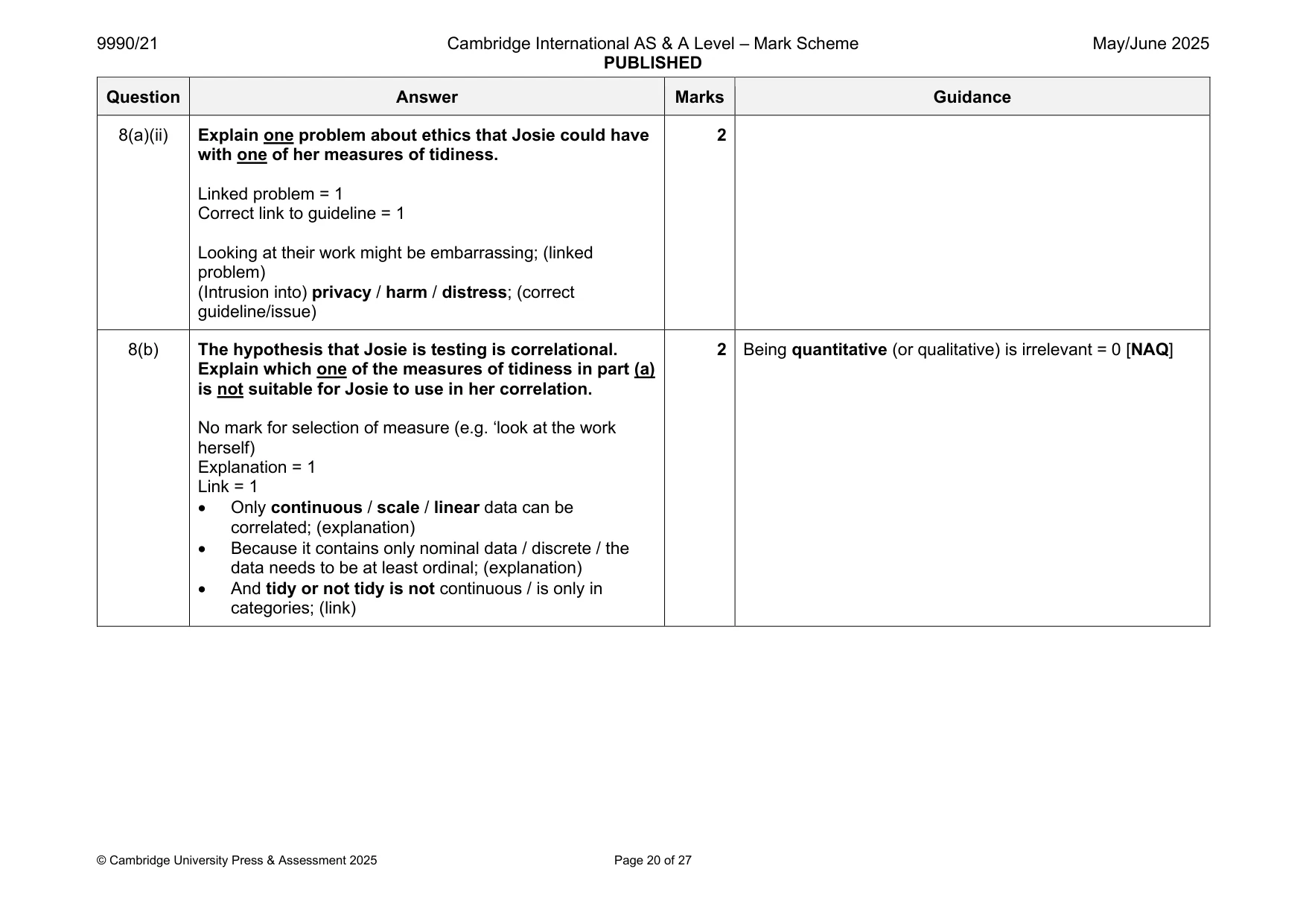
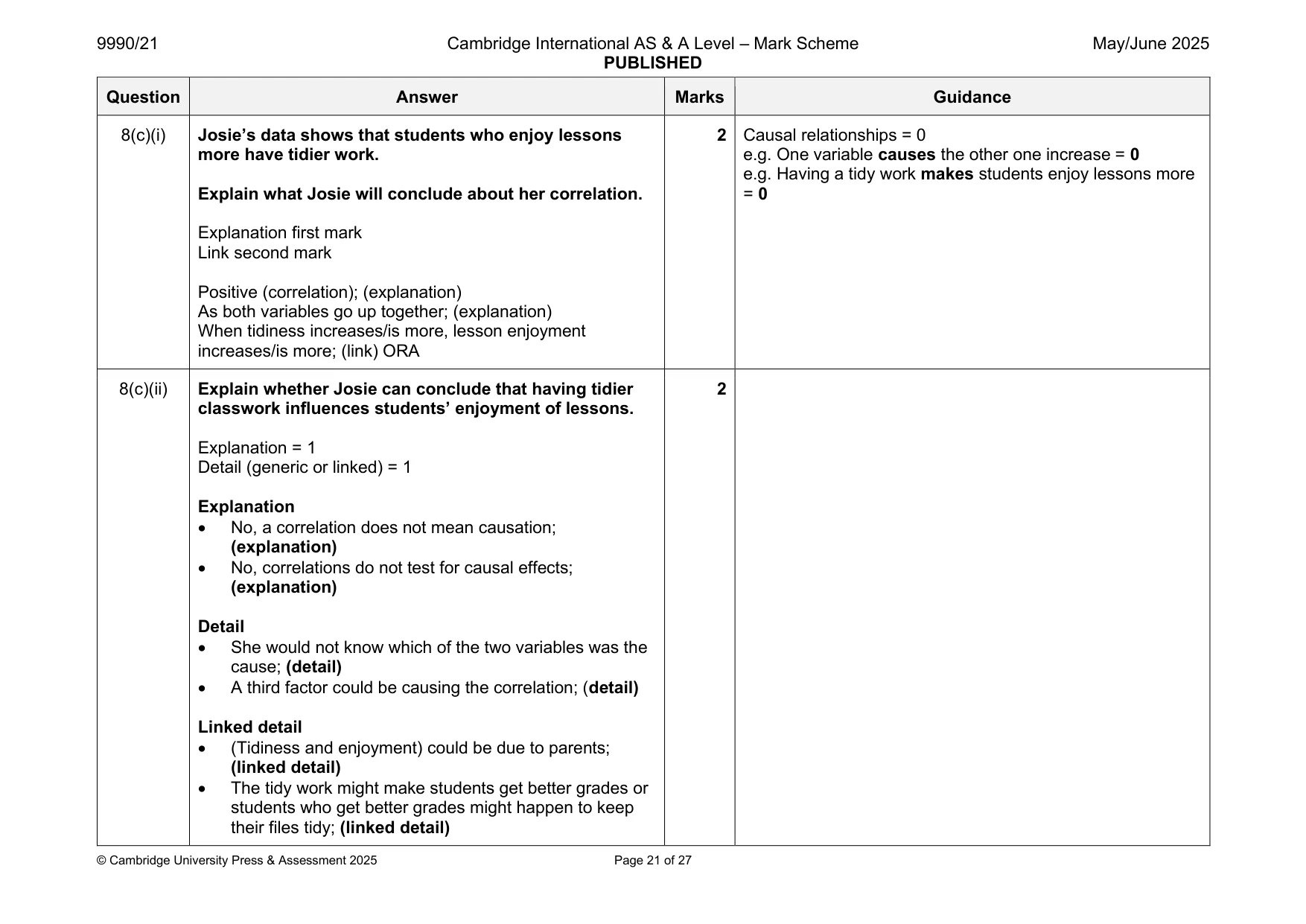
8 Josie is collecting data from other students in her class to test the hypothesis ‘There is a relationship between tidiness of classwork and enjoyment of lessons’. (a) Josie will use one of these measures of tidiness: • look at the work herself and decide whether each student’s work is tidy or not • ask the student to rate the tidiness of their work on a scale of 0 (untidy) to 5 (very tidy). (i) Explain one problem about validity or reliability that Josie could have with one of her measures of tidiness. ........................................................................................................................................... ........................................................................................................................................... ........................................................................................................................................... ..................................................................................................................................... [2] (ii) Explain one problem about ethics that Josie could have with one of her measures of tidiness. ........................................................................................................................................... ........................................................................................................................................... ........................................................................................................................................... ..................................................................................................................................... [2] (b) The hypothesis that Josie is testing is correlational. Explain which one of the measures of tidiness in part (a) is not suitable for Josie to use in her correlation. ................................................................................................................................................... ................................................................................................................................................... ................................................................................................................................................... ............................................................................................................................................. [2] (c) Josie’s data shows that students who enjoy lessons more have tidier work. (i) Explain what Josie will conclude about her correlation. ........................................................................................................................................... ........................................................................................................................................... ........................................................................................................................................... ..................................................................................................................................... [2] (ii) Explain whether Josie can conclude that having tidier classwork influences students’ enjoyment of lessons. ........................................................................................................................................... ........................................................................................................................................... ........................................................................................................................................... ..................................................................................................................................... [2]
Mark scheme: 8(a)(i) Josie is collecting data from other students in her class 2 to test the hypothesis ‘There is a relationship between tidiness of classwork and enjoyment of lessons’. Josie will use one of these measures of tidiness: • look at the work herself and decide whether each student’s work is tidy or not • ask the student to rate the tidiness of their work on a scale of 0 (untidy) to 5 (very tidy). Explain one problem about validity or reliability that Josie could have with one of her measures of tidiness. Linked problem = 1 Correct link to validity OR reliability = 1 Josie looks: • The student may have a system of working that Josie does not understand (like putting newest notes at the front, but Josie expects them at back), so thinks work is untidy; (linked problem) • This is a problem of validity; (correct validity) Students rate: • Different students might interpret the numbers differently, e.g. ‘3’ for one student might be much tidier than for another; (linked problem) • This is a problem of reliability; (correct reliability) • validity is limited because only 2-point data if Josie rates so doesn’t discriminate between different levels of tidiness = 2 8(a)(ii) Explain one problem about ethics that Josie could have 2 with one of her measures of tidiness. Linked problem = 1 Correct link to guideline = 1 Looking at their work might be embarrassing; (linked problem) (Intrusion into) privacy / harm / distress; (correct guideline/issue) 8(b) The hypothesis that Josie is testing is correlational. 2 Being quantitative (or qualitative) is irrelevant = 0 [NAQ] Explain which one of the measures of tidiness in part (a) is not suitable for Josie to use in her correlation. No mark for selection of measure (e.g. ‘look at the work herself) Explanation = 1 Link = 1 • Only continuous / scale / linear data can be correlated; (explanation) • Because it contains only nominal data / discrete / the data needs to be at least ordinal; (explanation) • And tidy or not tidy is not continuous / is only in categories; (link) 8(c)(i) Josie’s data shows that students who enjoy lessons 2 Causal relationships = 0 more have tidier work. e.g. One variable causes the other one increase = 0 e.g. Having a tidy work makes students enjoy lessons more Explain what Josie will conclude about her correlation. = 0 Explanation first mark Link second mark Positive (correlation); (explanation) As both variables go up together; (explanation) When tidiness increases/is more, lesson enjoyment increases/is more; (link) ORA 8(c)(ii) Explain whether Josie can conclude that having tidier 2 classwork influences students’ enjoyment of lessons. Explanation = 1 Detail (generic or linked) = 1 Explanation • No, a correlation does not mean causation; (explanation) • No, correlations do not test for causal effects; (explanation) Detail • She would not know which of the two variables was the cause; (detail) • A third factor could be causing the correlation; (detail) Linked detail • (Tidiness and enjoyment) could be due to parents; (linked detail) • The tidy work might make students get better grades or students who get better grades might happen to keep their files tidy; (linked detail)
Q9 · Dr Gao is planning a longitudinal study about changes in reading habits
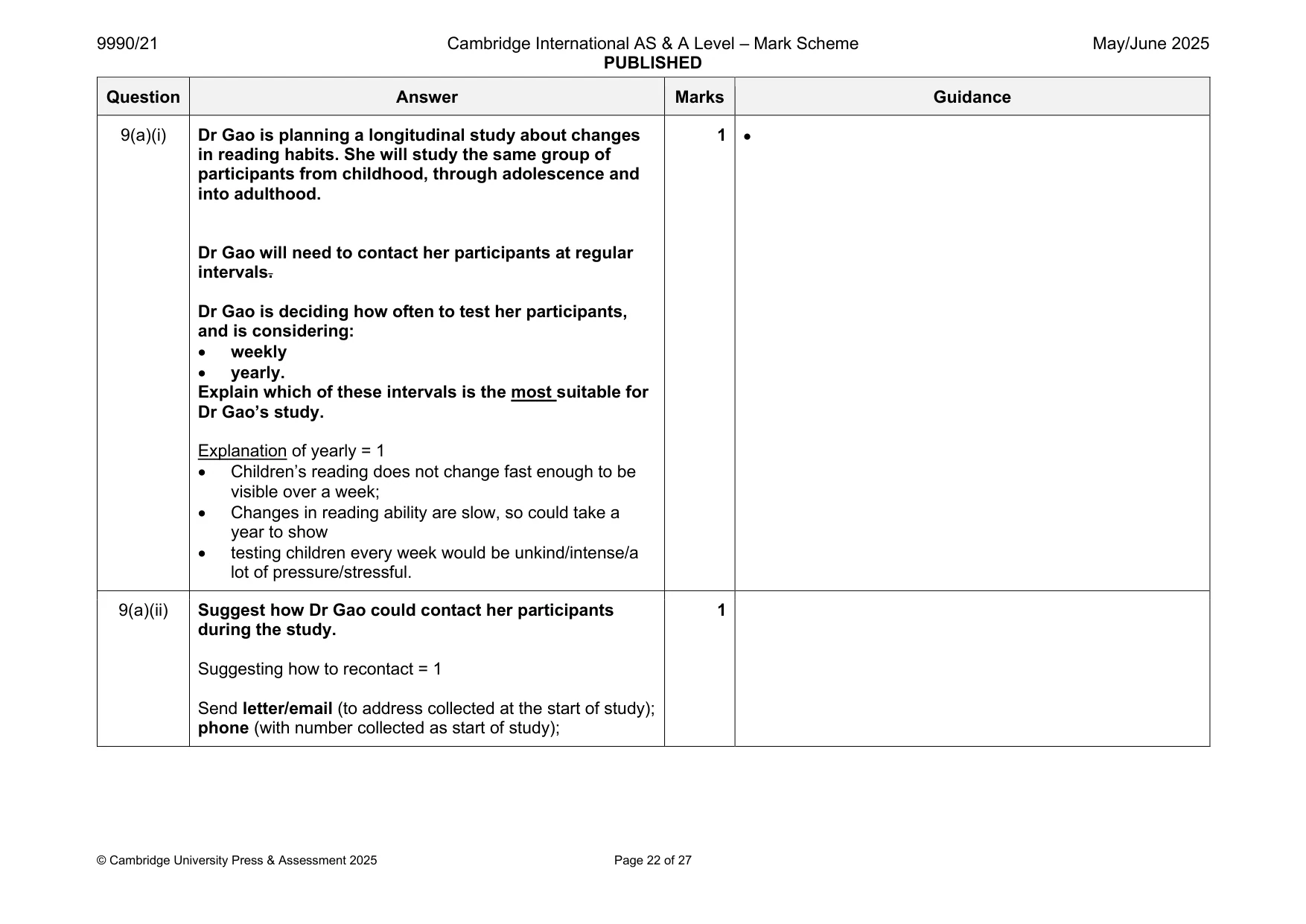
9 Dr Gao is planning a longitudinal study about changes in reading habits. She will study the same group of participants from childhood, through adolescence and into adulthood. (a) Dr Gao will need to contact her participants at regular intervals. (i) Dr Gao is deciding how often to test her participants, and is considering: • weekly • yearly. Explain which of these intervals is the most suitable for Dr Gao’s study. ........................................................................................................................................... ..................................................................................................................................... [1] (ii) Suggest how Dr Gao could contact her participants during the study. ........................................................................................................................................... ..................................................................................................................................... [1] (iii) Suggest two problems that Dr Gao may have when trying to contact her participants at regular intervals. 1 ........................................................................................................................................ ........................................................................................................................................... 2 ........................................................................................................................................ ........................................................................................................................................... [2] (b) A colleague, Dr Roberts, says that the study could be conducted by comparing participants of different ages at one point in time. Suggest one advantage of Dr Roberts’ idea, compared to Dr Gao’s plan for a longitudinal study. Do not refer to contacting participants in your answer. ................................................................................................................................................... ................................................................................................................................................... ................................................................................................................................................... ............................................................................................................................................. [2]
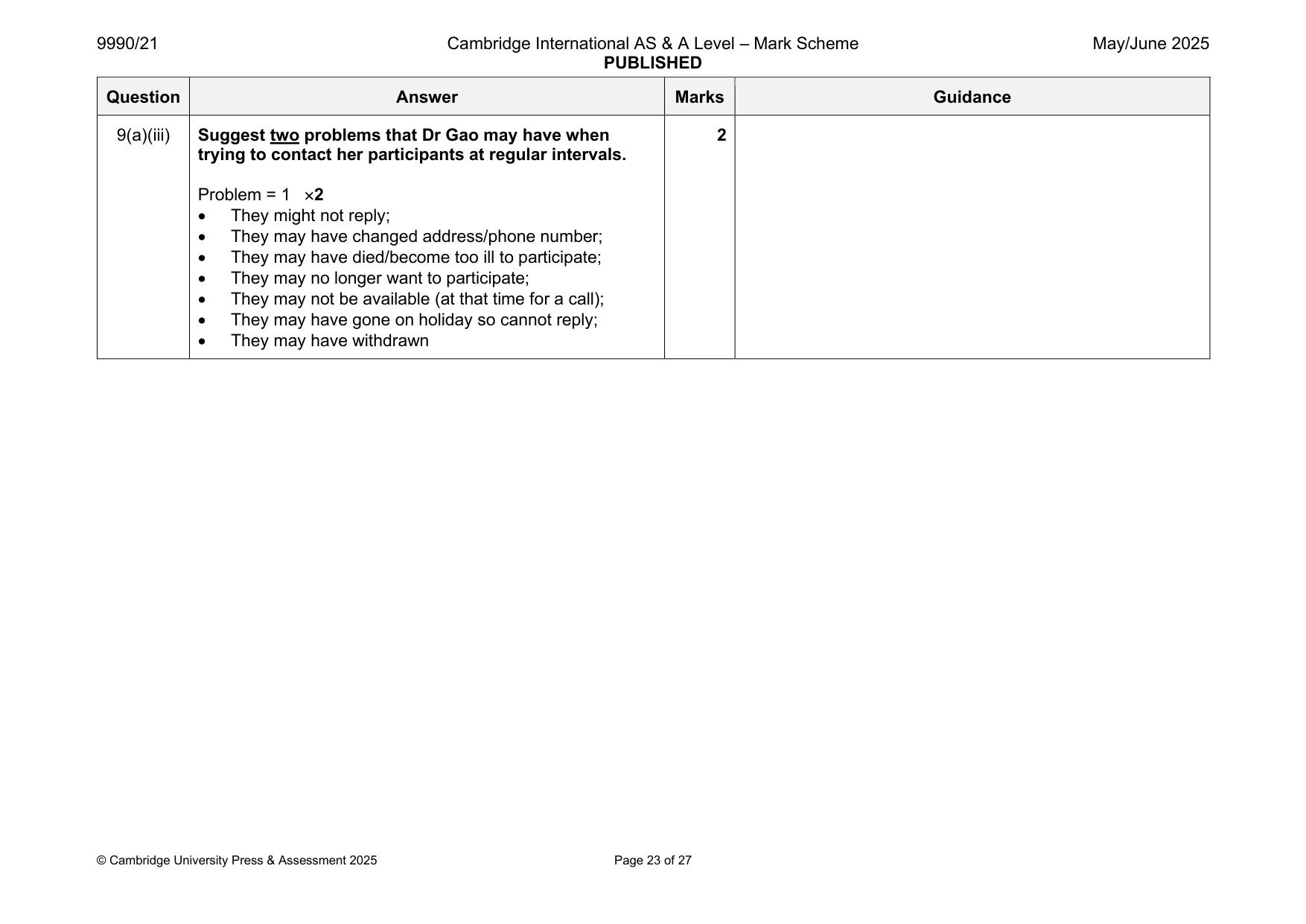
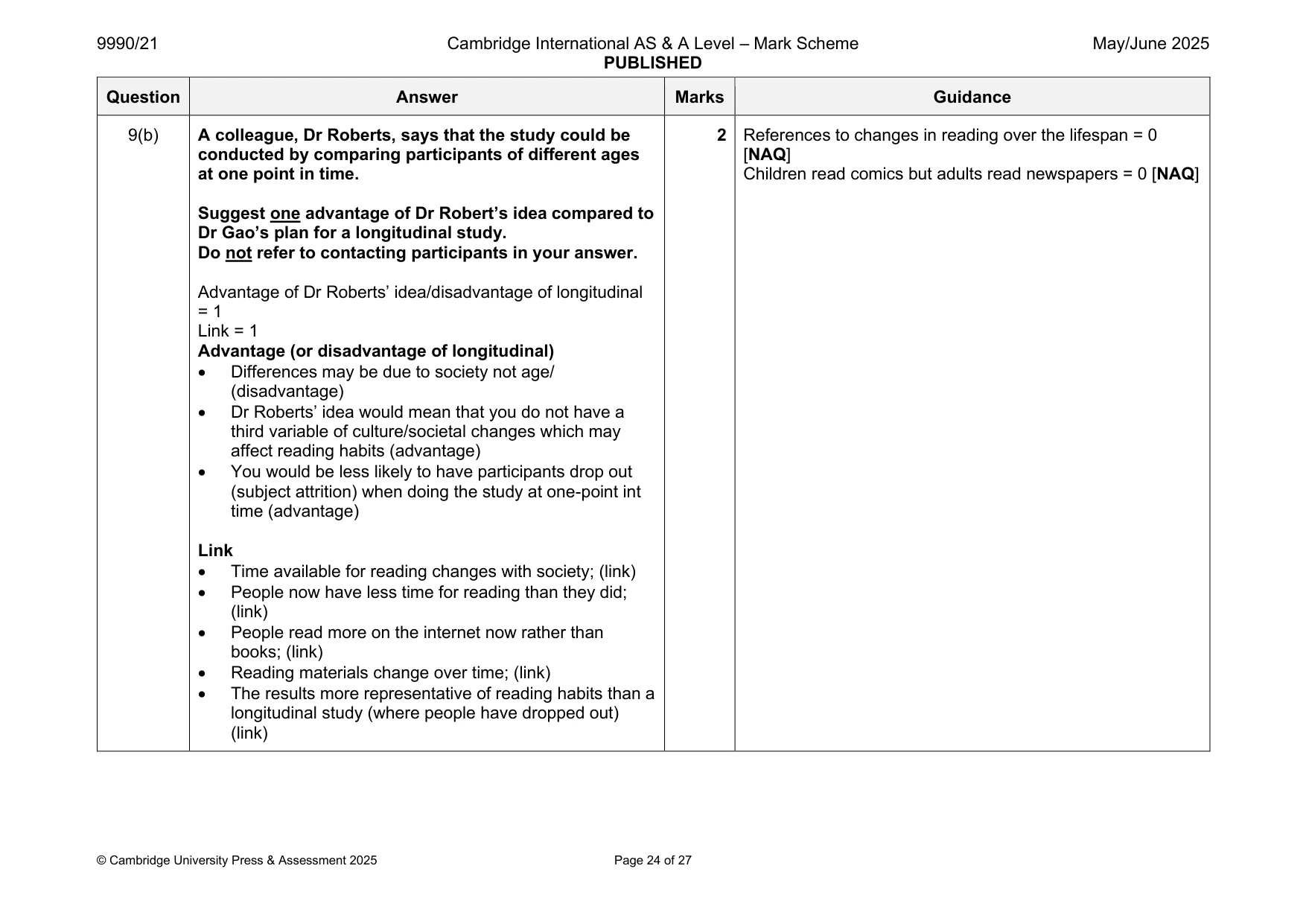
Mark scheme: 9(a)(i) Dr Gao is planning a longitudinal study about changes 1 • in reading habits. She will study the same group of participants from childhood, through adolescence and into adulthood. Dr Gao will need to contact her participants at regular intervals. Dr Gao is deciding how often to test her participants, and is considering: • weekly • yearly. Explain which of these intervals is the most suitable for Dr Gao’s study. Explanation of yearly = 1 • Children’s reading does not change fast enough to be visible over a week; • Changes in reading ability are slow, so could take a year to show • testing children every week would be unkind/intense/a lot of pressure/stressful. 9(a)(ii) Suggest how Dr Gao could contact her participants 1 during the study. Suggesting how to recontact = 1 Send letter/email (to address collected at the start of study); phone (with number collected as start of study); 9(a)(iii) Suggest two problems that Dr Gao may have when 2 trying to contact her participants at regular intervals. Problem = 1 2 • They might not reply; • They may have changed address/phone number; • They may have died/become too ill to participate; • They may no longer want to participate; • They may not be available (at that time for a call); • They may have gone on holiday so cannot reply; • They may have withdrawn 9(b) A colleague, Dr Roberts, says that the study could be 2 References to changes in reading over the lifespan = 0 conducted by comparing participants of different ages [NAQ] at one point in time. Children read comics but adults read newspapers = 0 [NAQ] Suggest one advantage of Dr Robert’s idea compared to Dr Gao’s plan for a longitudinal study. Do not refer to contacting participants in your answer. Advantage of Dr Roberts’ idea/disadvantage of longitudinal = 1 Link = 1 Advantage (or disadvantage of longitudinal) • Differences may be due to society not age/ (disadvantage) • Dr Roberts’ idea would mean that you do not have a third variable of culture/societal changes which may affect reading habits (advantage) • You would be less likely to have participants drop out (subject attrition) when doing the study at one-point int time (advantage) Link • Time available for reading changes with society; (link) • People now have less time for reading than they did; (link) • People read more on the internet now rather than books; (link) • Reading materials change over time; (link) • The results more representative of reading habits than a longitudinal study (where people have dropped out) (link)
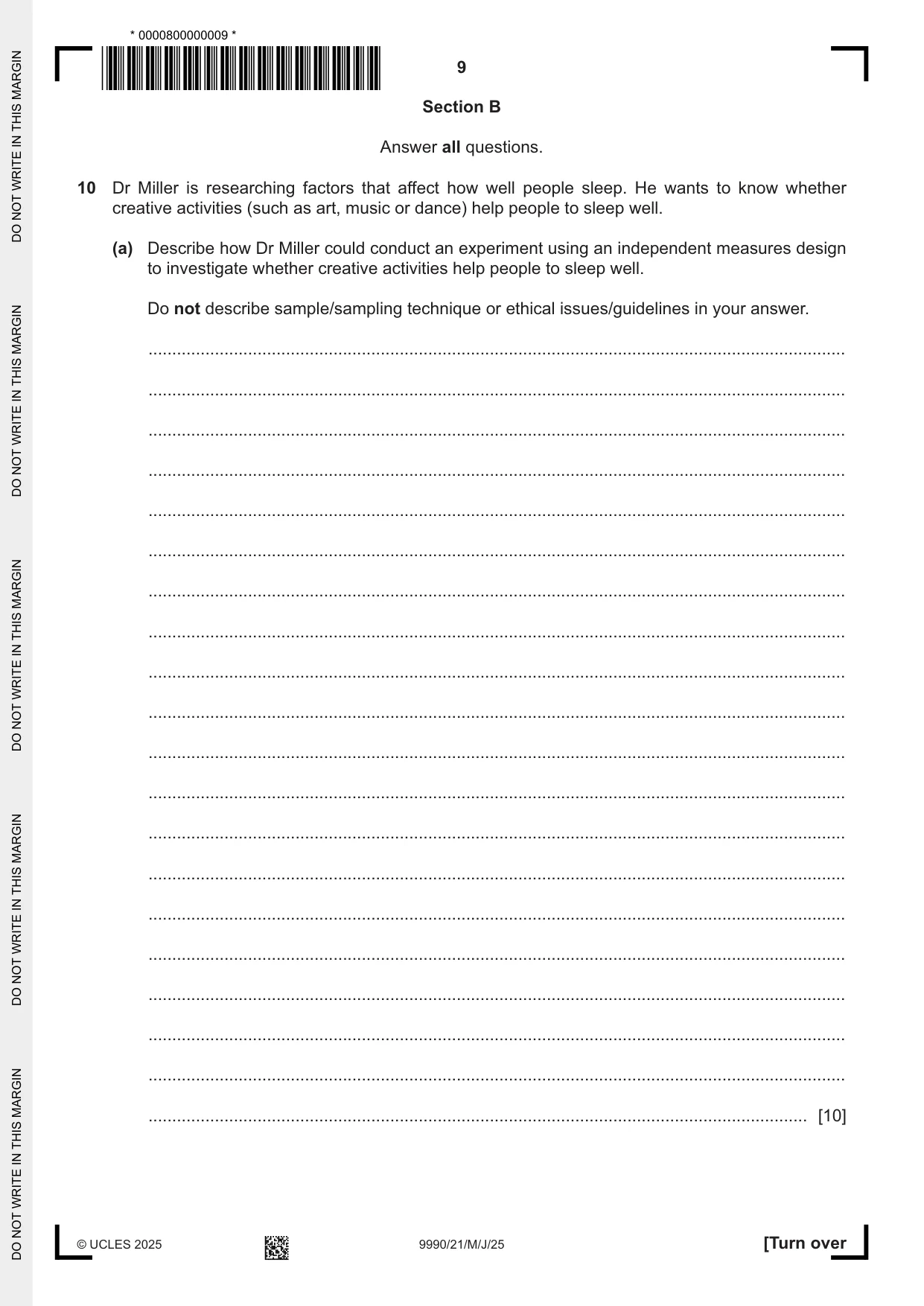
Q10 · Dr Miller is researching factors that affect how well people sleep
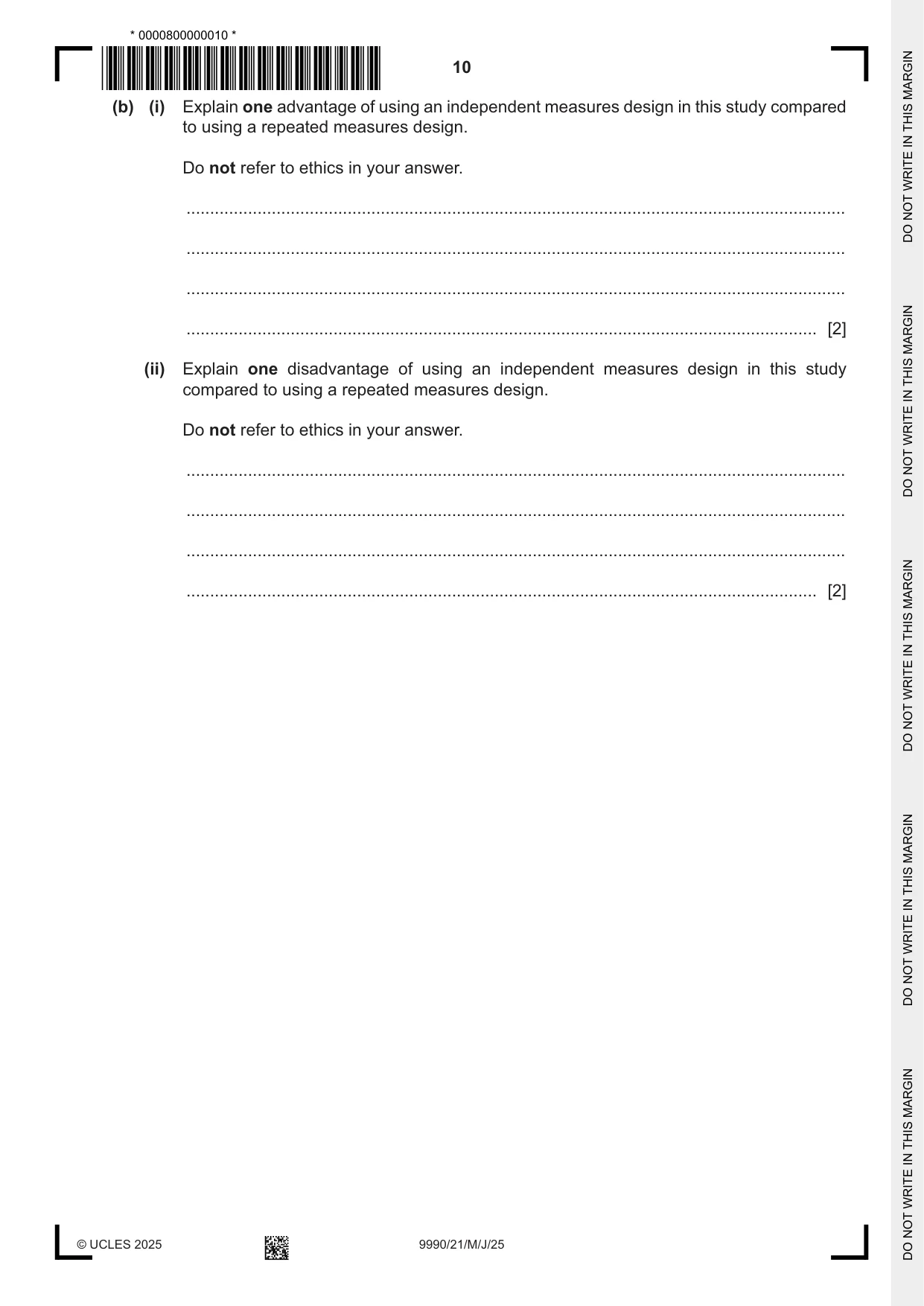
10 Dr Miller is researching factors that affect how well people sleep. He wants to know whether creative activities (such as art, music or dance) help people to sleep well. (a) Describe how Dr Miller could conduct an experiment using an independent measures design to investigate whether creative activities help people to sleep well. Do not describe sample/sampling technique or ethical issues/guidelines in your answer. ................................................................................................................................................... ................................................................................................................................................... ................................................................................................................................................... ................................................................................................................................................... ................................................................................................................................................... ................................................................................................................................................... ................................................................................................................................................... ................................................................................................................................................... ................................................................................................................................................... ................................................................................................................................................... ................................................................................................................................................... ................................................................................................................................................... ................................................................................................................................................... ................................................................................................................................................... ................................................................................................................................................... ................................................................................................................................................... ................................................................................................................................................... ................................................................................................................................................... ................................................................................................................................................... ........................................................................................................................................... [10] (b) (i) Explain one advantage of using an independent measures design in this study compared to using a repeated measures design. Do not refer to ethics in your answer. ........................................................................................................................................... ........................................................................................................................................... ........................................................................................................................................... ..................................................................................................................................... [2] (ii) Explain one disadvantage of using an independent measures design in this study compared to using a repeated measures design. Do not refer to ethics in your answer. ........................................................................................................................................... ........................................................................................................................................... ........................................................................................................................................... ..................................................................................................................................... [2]
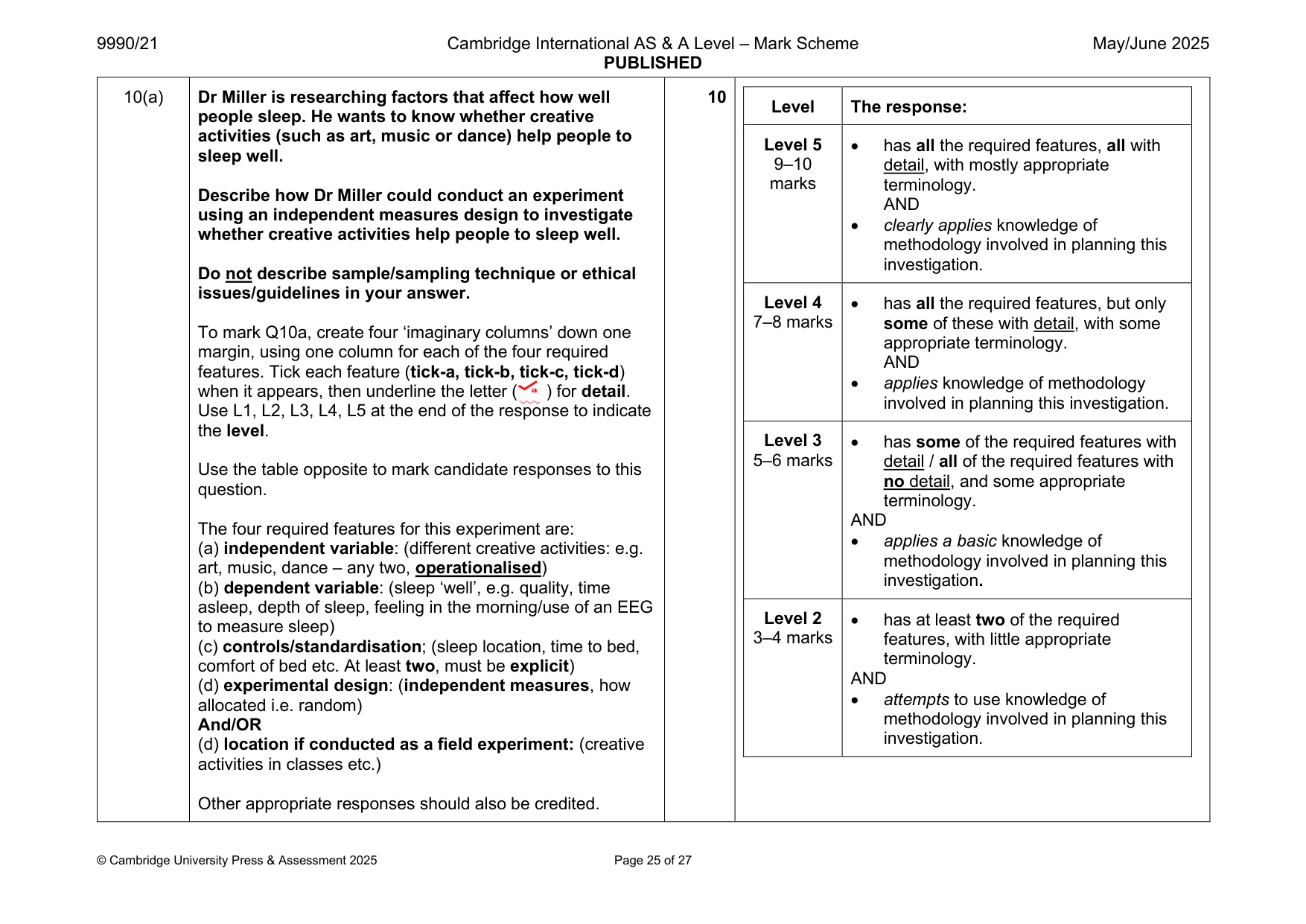
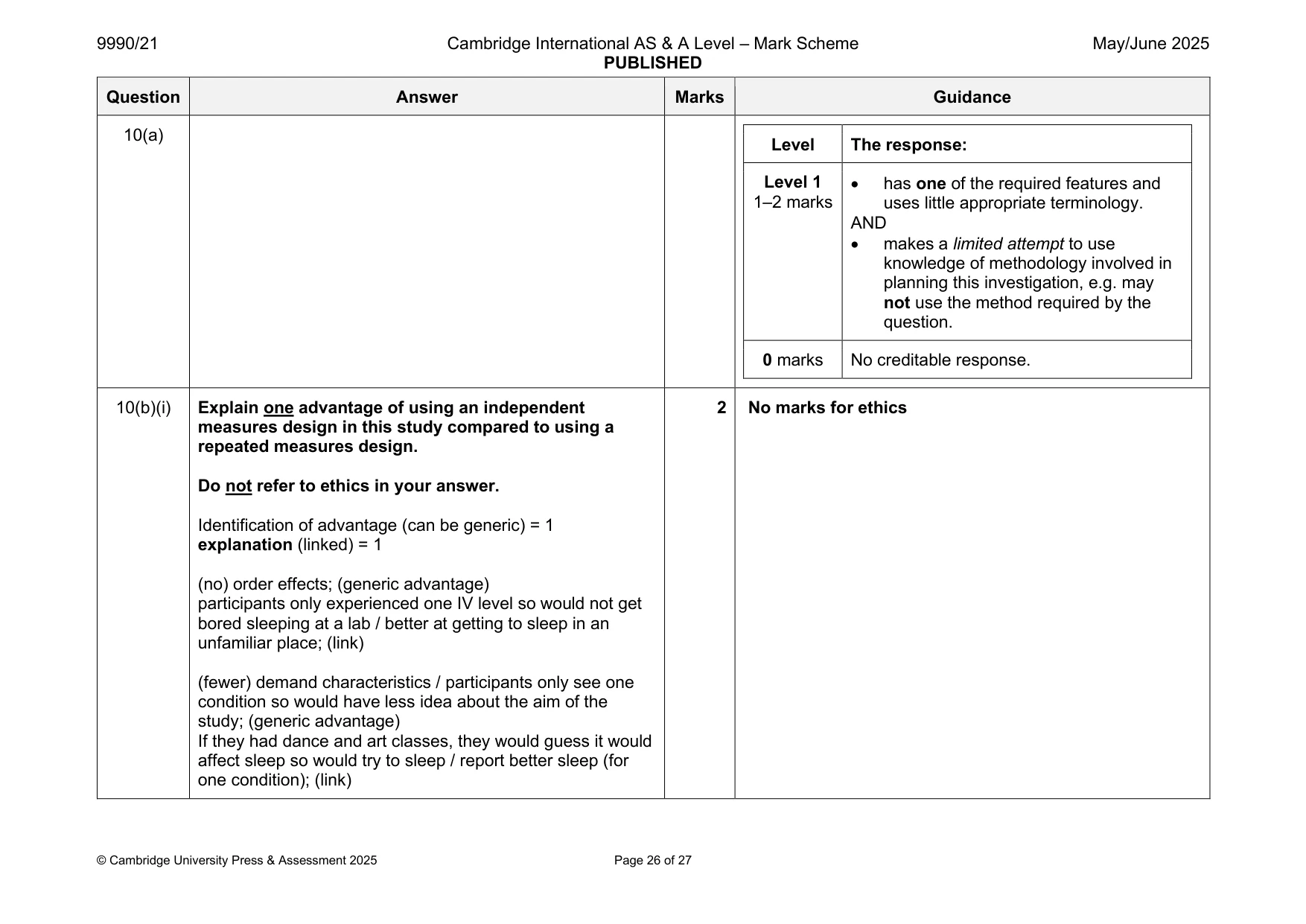
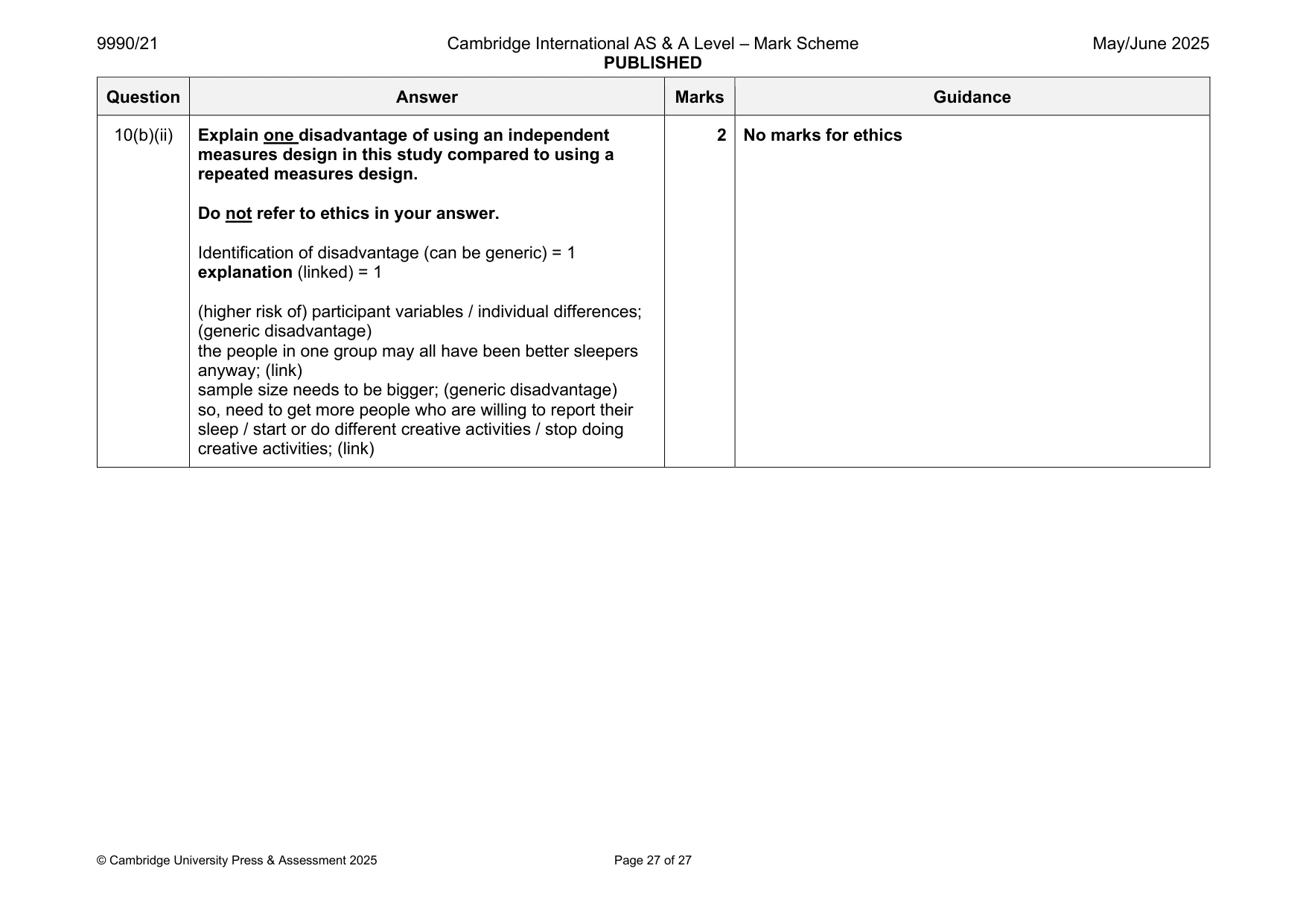
Mark scheme: 10(a) Dr Miller is researching factors that affect how well 10 Level The response: people sleep. He wants to know whether creative activities (such as art, music or dance) help people to Level 5 • has all the required features, all with sleep well. 9–10 detail, with mostly appropriate marks terminology. Describe how Dr Miller could conduct an experiment AND using an independent measures design to investigate • clearly applies knowledge of whether creative activities help people to sleep well. methodology involved in planning this investigation. Do not describe sample/sampling technique or ethical issues/guidelines in your answer. Level 4 • has all the required features, but only 7–8 marks some of these with detail, with some To mark Q10a, create four ‘imaginary columns’ down one appropriate terminology. margin, using one column for each of the four required AND features. Tick each feature (tick-a, tick-b, tick-c, tick-d) • applies knowledge of methodology when it appears, then underline the letter ( ) for detail. involved in planning this investigation. Use L1, L2, L3, L4, L5 at the end of the response to indicate the level. Level 3 • has some of the required features with 5–6 marks detail / all of the required features with Use the table opposite to mark candidate responses to this no detail, and some appropriate question. terminology. AND The four required features for this experiment are: • applies a basic knowledge of (a) independent variable: (different creative activities: e.g. methodology involved in planning this art, music, dance – any two, operationalised) investigation. (b) dependent variable: (sleep ‘well’, e.g. quality, time asleep, depth of sleep, feeling in the morning/use of an EEG Level 2 • has at least two of the required to measure sleep) 3–4 marks features, with little appropriate (c) controls/standardisation; (sleep location, time to bed, terminology. comfort of bed etc. At least two, must be explicit) AND (d) experimental design: (independent measures, how • attempts to use knowledge of allocated i.e. random) methodology involved in planning this And/OR investigation. (d) location if conducted as a field experiment: (creative activities in classes etc.) Other appropriate responses should also be credited. 10(a) Level The response: Level 1 • has one of the required features and 1–2 marks uses little appropriate terminology. AND • makes a limited attempt to use knowledge of methodology involved in planning this investigation, e.g. may not use the method required by the question. 0 marks No creditable response. 10(b)(i) Explain one advantage of using an independent 2 No marks for ethics measures design in this study compared to using a repeated measures design. Do not refer to ethics in your answer. Identification of advantage (can be generic) = 1 explanation (linked) = 1 (no) order effects; (generic advantage) participants only experienced one IV level so would not get bored sleeping at a lab / better at getting to sleep in an unfamiliar place; (link) (fewer) demand characteristics / participants only see one condition so would have less idea about the aim of the study; (generic advantage) If they had dance and art classes, they would guess it would affect sleep so would try to sleep / report better sleep (for one condition); (link) 10(b)(ii) Explain one disadvantage of using an independent 2 No marks for ethics measures design in this study compared to using a repeated measures design. Do not refer to ethics in your answer. Identification of disadvantage (can be generic) = 1 explanation (linked) = 1 (higher risk of) participant variables / individual differences; (generic disadvantage) the people in one group may all have been better sleepers anyway; (link) sample size needs to be bigger; (generic disadvantage) so, need to get more people who are willing to report their sleep / start or do different creative activities / stop doing creative activities; (link)
What was in this paper
The subtopics covered by these 10 questions, and how many questions each got. Open one in a new tab to see every Cambridge question on it.
What you needed in this session
Cambridge’s own grade thresholds for 2025 May/June, Paper 2 · Variant 1. A higher threshold means an easier paper — the bar moves with how the cohort did.