Cambridge A Level Psychology (from 2018) 9990 — 2024 May/June Paper 2 · Variant 1
9990/21/M/J/24 · 10 questions · 60 marks · 90 min
The question paper and its mark scheme, free to read here and free to download. This is Cambridge’s own paper, exactly as it was sat.
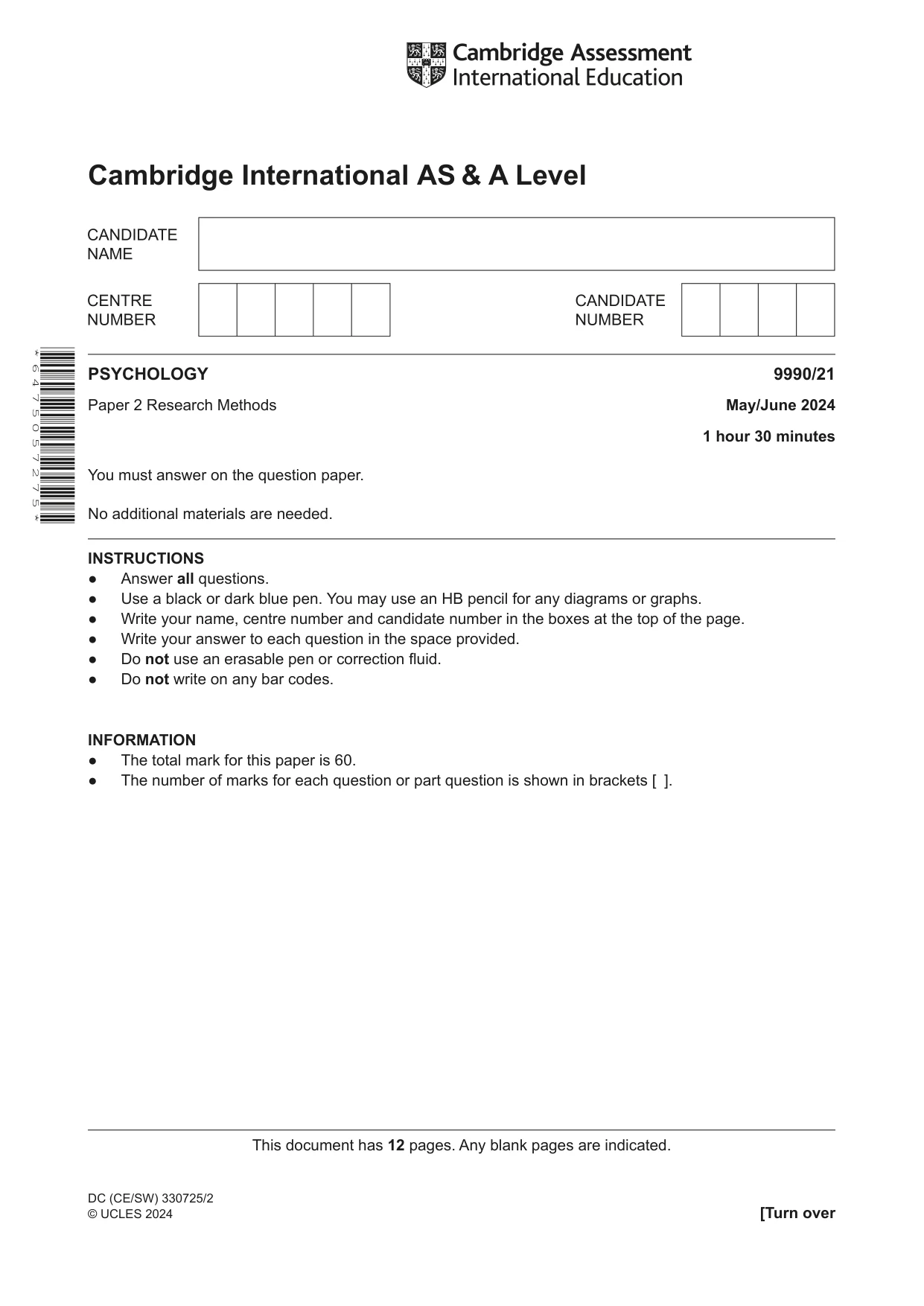
Question paper12 pages

Mark scheme24 pages
Answers below. Sit the paper first if you are practising.
Questions as text
Q1 · Identify the sampling technique used in the study by Milgram (obedience)
1 (a) Identify the sampling technique used in the study by Milgram (obedience). ................................................................................................................................................... ............................................................................................................................................. [1] (b) Outline how the sample was obtained in this study. ................................................................................................................................................... ................................................................................................................................................... ................................................................................................................................................... ............................................................................................................................................. [2]
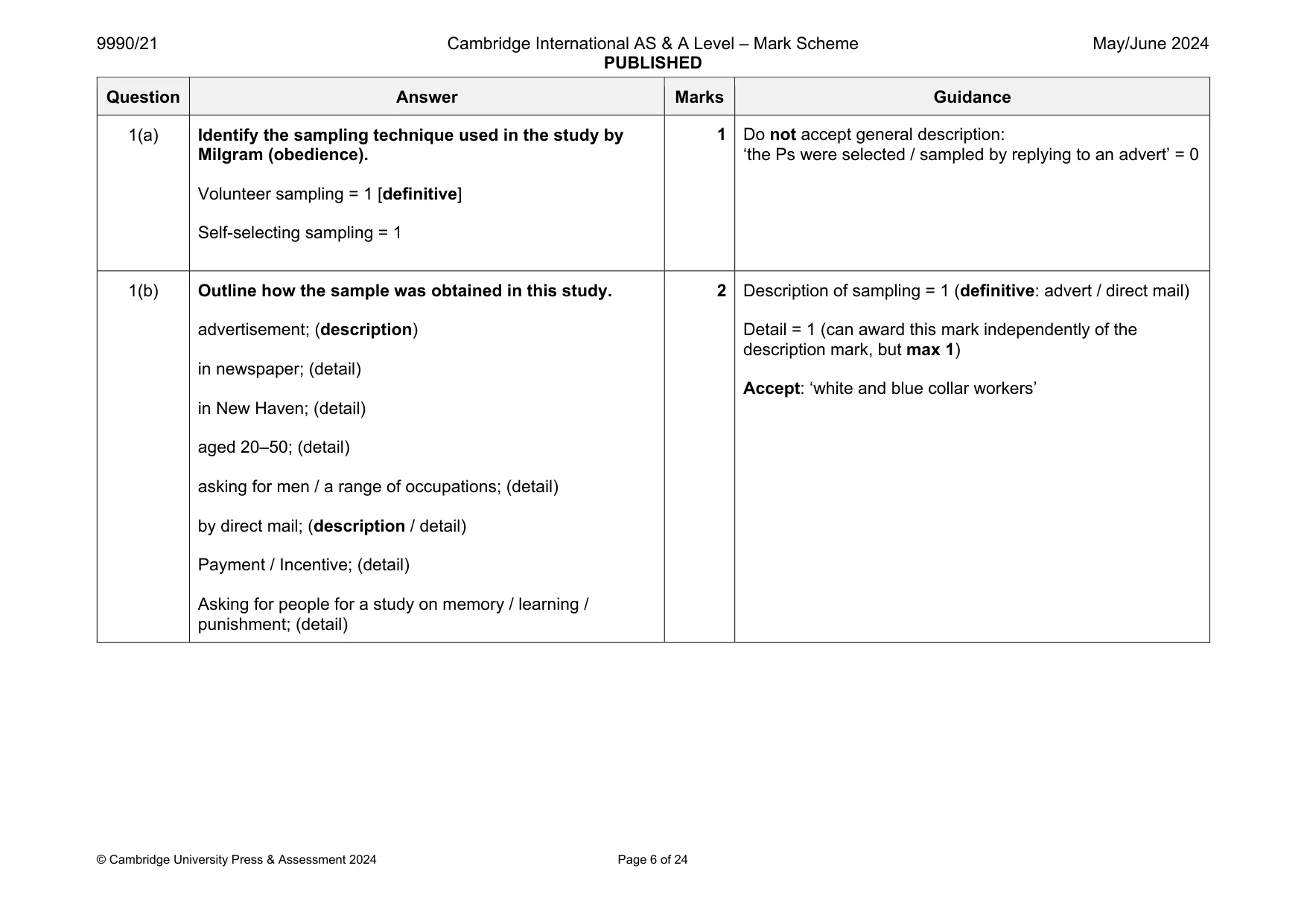
Mark scheme: 1(a) Identify the sampling technique used in the study by Milgram (obedience). Volunteer sampling = 1 [definitive] Self-selecting sampling = 1 ‘the Ps were selected / sampled by replying to an advert’ = 0 1(b) Outline how the sample was obtained in this study. advertisement; (description) in newspaper; (detail) in New Haven; (detail) aged 20–50; (detail) asking for men / a range of occupations; (detail) by direct mail; (description / detail) Payment / Incentive; (detail) Asking for people for a study on memory / learning / punishment; (detail) 2 Description of sampling = 1 (definitive: advert / direct mail) Detail = 1 (can award this mark independently of the description mark, but max 1) Accept: ‘white and blue collar workers’
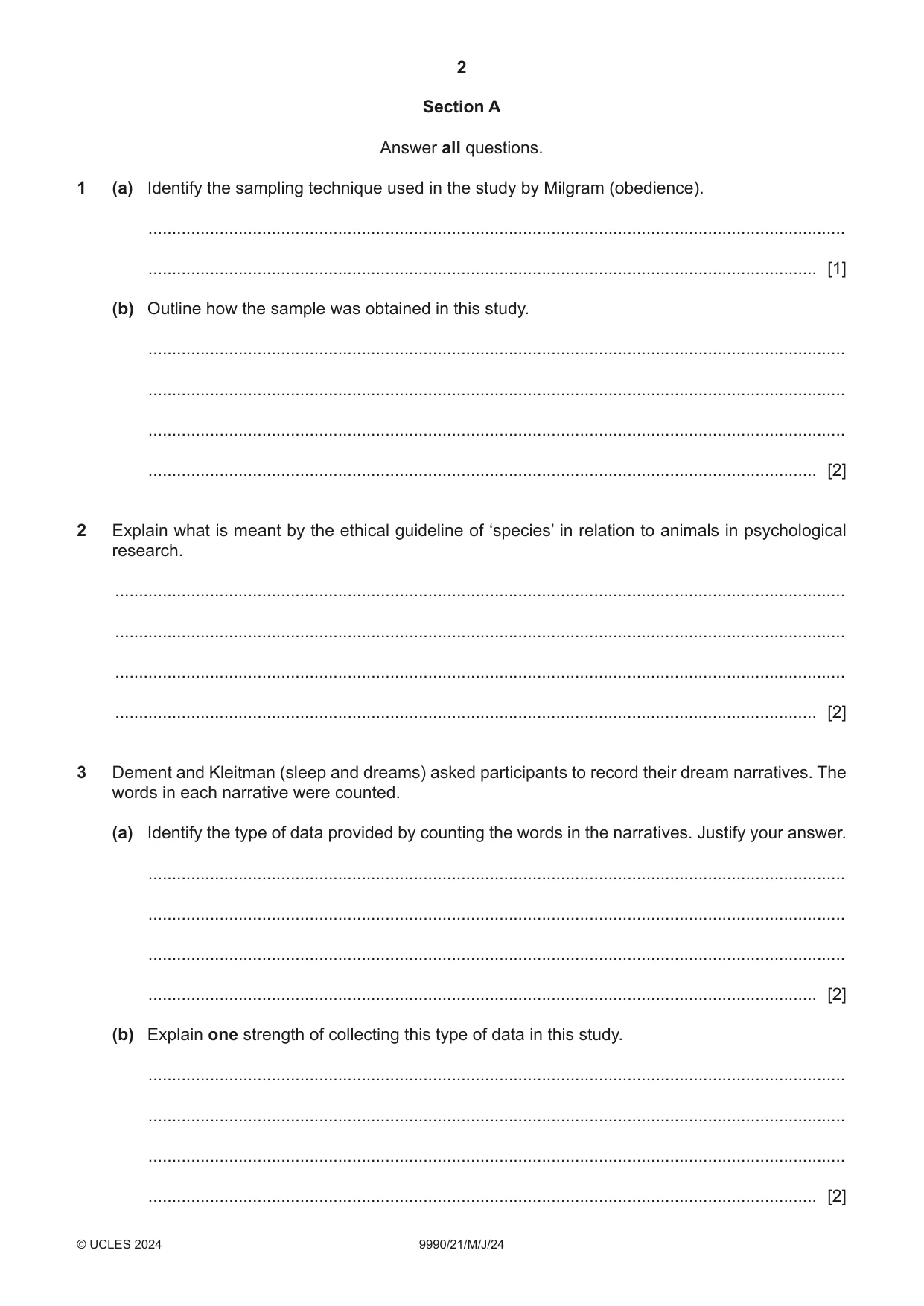
Q2 · Explain what is meant by the ethical guideline of ‘species’ in relation to animals in…
2 Explain what is meant by the ethical guideline of ‘species’ in relation to animals in psychological research. .......................................................................................................................................................... .......................................................................................................................................................... .......................................................................................................................................................... .................................................................................................................................................... [2]
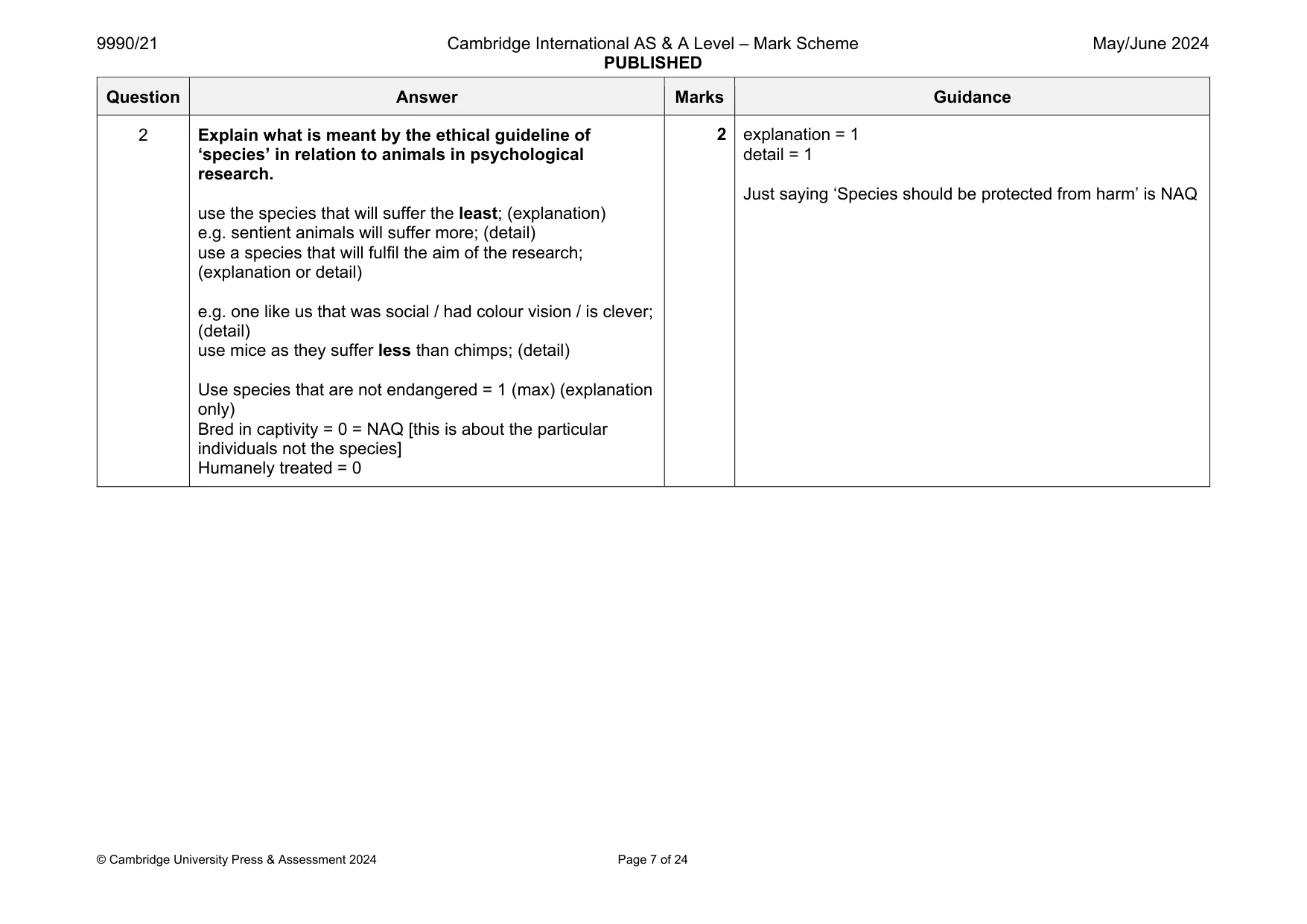
Mark scheme: 2 Explain what is meant by the ethical guideline of ‘species’ in relation to animals in psychological research. use the species that will suffer the least; (explanation) e.g. sentient animals will suffer more; (detail) use a species that will fulfil the aim of the research; (explanation or detail) e.g. one like us that was social / had colour vision / is clever; (detail) use mice as they suffer less than chimps; (detail) Use species that are not endangered = 1 (max) (explanation only) Bred in captivity = 0 = NAQ [this is about the particular individuals not the species] Humanely treated = 0 detail = 1 Just saying ‘Species should be protected from harm’ is NAQ
Q3 · Dement and Kleitman (sleep and dreams) asked participants to record their dream narratives
3 Dement and Kleitman (sleep and dreams) asked participants to record their dream narratives. The words in each narrative were counted. (a) Identify the type of data provided by counting the words in the narratives. Justify your answer. ................................................................................................................................................... ................................................................................................................................................... ................................................................................................................................................... ............................................................................................................................................. [2] (b) Explain one strength of collecting this type of data in this study. ................................................................................................................................................... ................................................................................................................................................... ................................................................................................................................................... ............................................................................................................................................. [2]
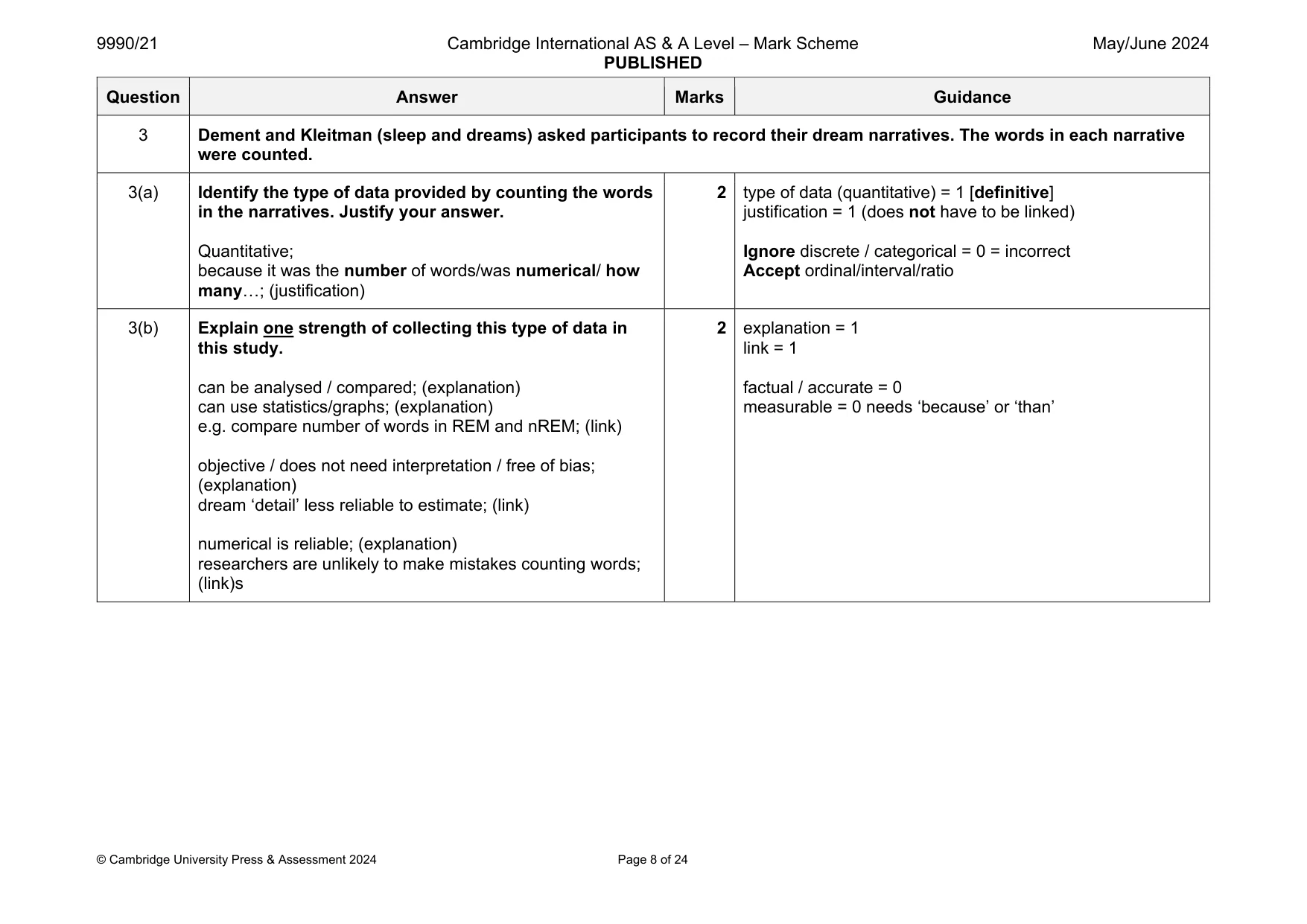
Mark scheme: 3(a) Identify the type of data provided by counting the words in the narratives. Justify your answer. Quantitative; because it was the number of words/was numerical/ how many…; (justification) justification = 1 (does not have to be linked) Ignore discrete / categorical = 0 = incorrect Accept ordinal/interval/ratio 3(b) Explain one strength of collecting this type of data in this study. can be analysed / compared; (explanation) can use statistics/graphs; (explanation) e.g. compare number of words in REM and nREM; (link) objective / does not need interpretation / free of bias; (explanation) dream ‘detail’ less reliable to estimate; (link) numerical is reliable; (explanation) researchers are unlikely to make mistakes counting words; (link)s 2 explanation = 1 link = 1 factual / accurate = 0 measurable = 0 needs ‘because’ or ‘than’
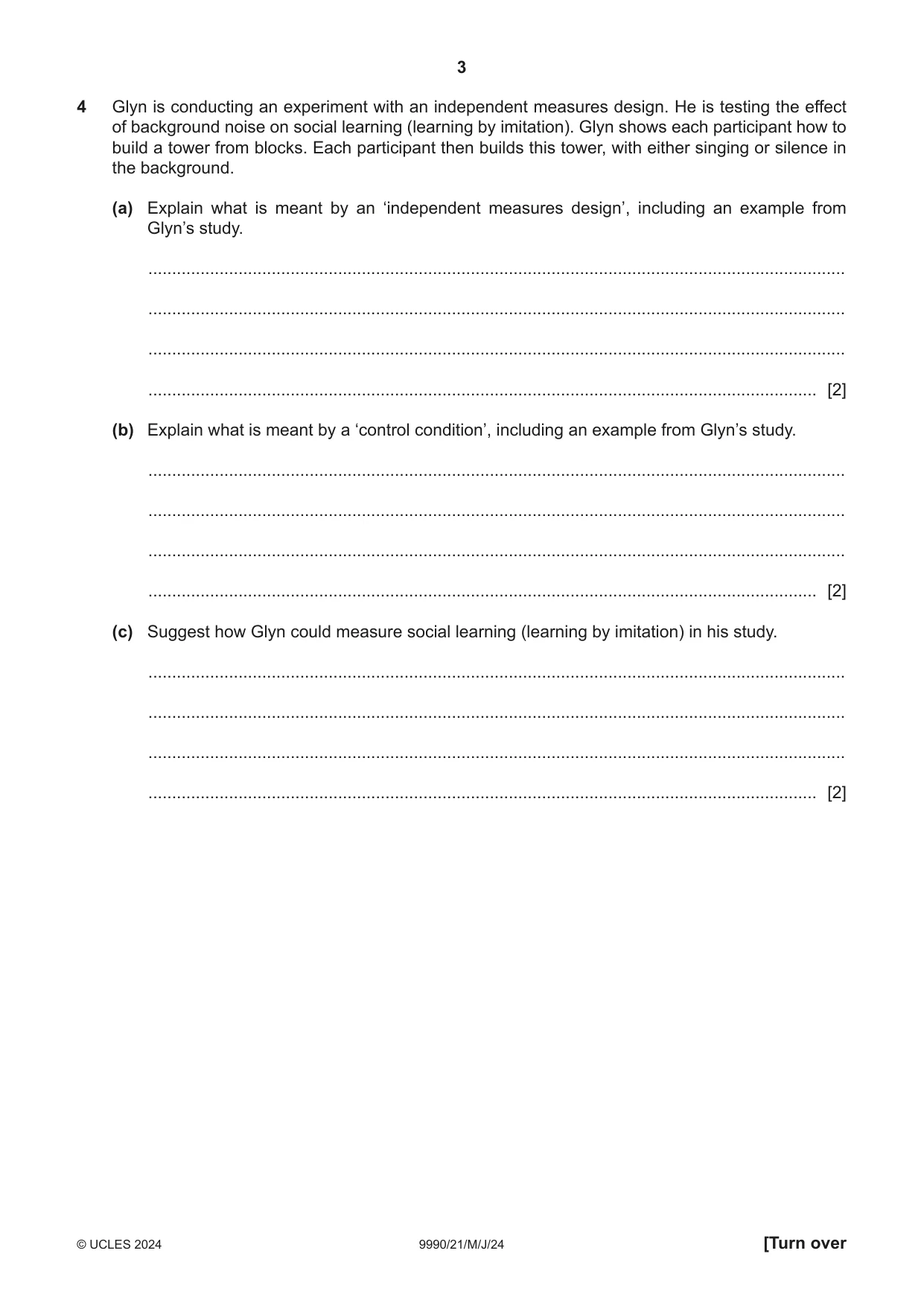
Q4 · Glyn is conducting an experiment with an independent measures design
4 Glyn is conducting an experiment with an independent measures design. He is testing the effect of background noise on social learning (learning by imitation). Glyn shows each participant how to build a tower from blocks. Each participant then builds this tower, with either singing or silence in the background. (a) Explain what is meant by an ‘independent measures design’, including an example from Glyn’s study. ................................................................................................................................................... ................................................................................................................................................... ................................................................................................................................................... ............................................................................................................................................. [2] (b) Explain what is meant by a ‘control condition’, including an example from Glyn’s study. ................................................................................................................................................... ................................................................................................................................................... ................................................................................................................................................... ............................................................................................................................................. [2] (c) Suggest how Glyn could measure social learning (learning by imitation) in his study. ................................................................................................................................................... ................................................................................................................................................... ................................................................................................................................................... ............................................................................................................................................. [2]
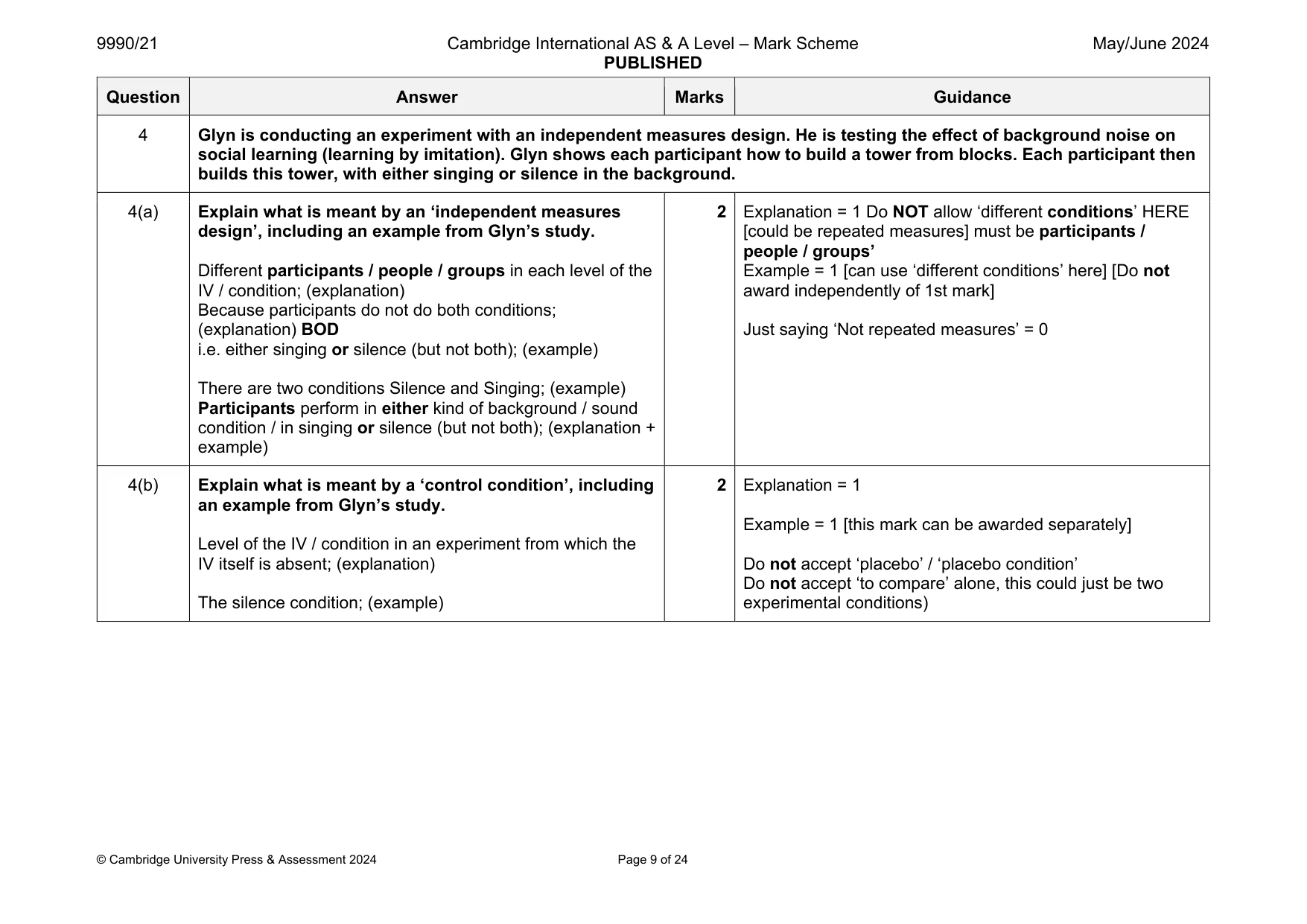
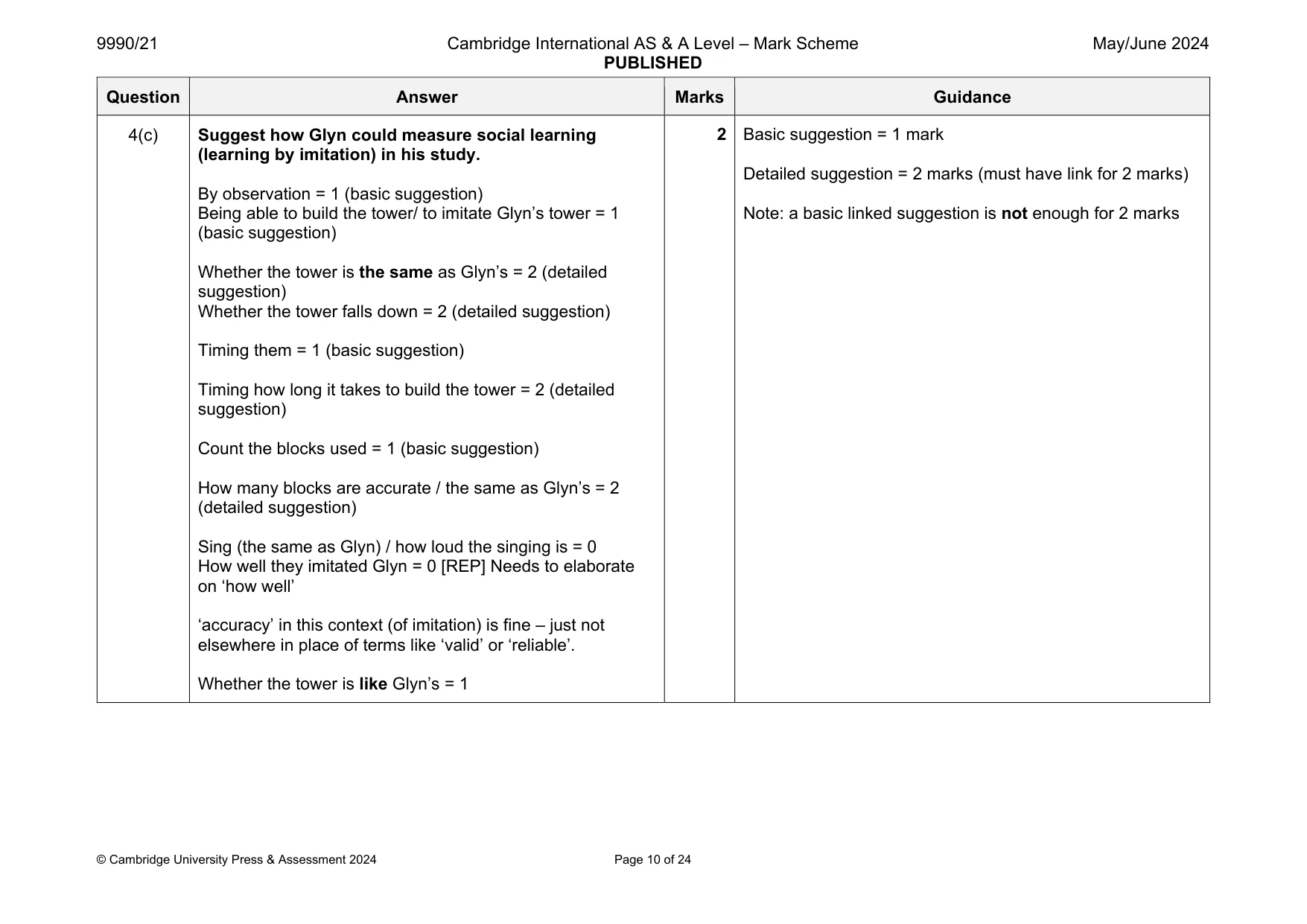
Mark scheme: 4(a) Explain what is meant by an ‘independent measures design’, including an example from Glyn’s study. Different participants / people / groups in each level of the IV / condition; (explanation) Because participants do not do both conditions; (explanation) BOD i.e. either singing or silence (but not both); (example) There are two conditions Silence and Singing; (example) Participants perform in either kind of background / sound condition / in singing or silence (but not both); (explanation + example) [could be repeated measures] must be participants / people / groups’ Example = 1 [can use ‘different conditions’ here] [Do not award independently of 1st mark] Just saying ‘Not repeated measures’ = 0 4(b) Explain what is meant by a ‘control condition’, including an example from Glyn’s study. Level of the IV / condition in an experiment from which the IV itself is absent; (explanation) The silence condition; (example) 2 Explanation = 1 Example = 1 [this mark can be awarded separately] Do not accept ‘placebo’ / ‘placebo condition’ Do not accept ‘to compare’ alone, this could just be two experimental conditions) Question Answer Marks Guidance 4(c) Suggest how Glyn could measure social learning (learning by imitation) in his study. By observation = 1 (basic suggestion) Being able to build the tower/ to imitate Glyn’s tower = 1 (basic suggestion) Whether the tower is the same as Glyn’s = 2 (detailed suggestion) Whether the tower falls down = 2 (detailed suggestion) Timing them = 1 (basic suggestion) Timing how long it takes to build the tower = 2 (detailed suggestion) Count the blocks used = 1 (basic suggestion) How many blocks are accurate / the same as Glyn’s = 2 (detailed suggestion) Sing (the same as Glyn) / how loud the singing is = 0 How well they imitated Glyn = 0 [REP] Needs to elaborate on ‘how well’ ‘accuracy’ in this context (of imitation) is fine – just not elsewhere in place of terms like ‘valid’ or ‘reliable’. Whether the tower is like Glyn’s = 1 2 Basic suggestion = 1 mark Detailed suggestion = 2 marks (must have link for 2 marks) Note: a basic linked suggestion is not enough for 2 marks
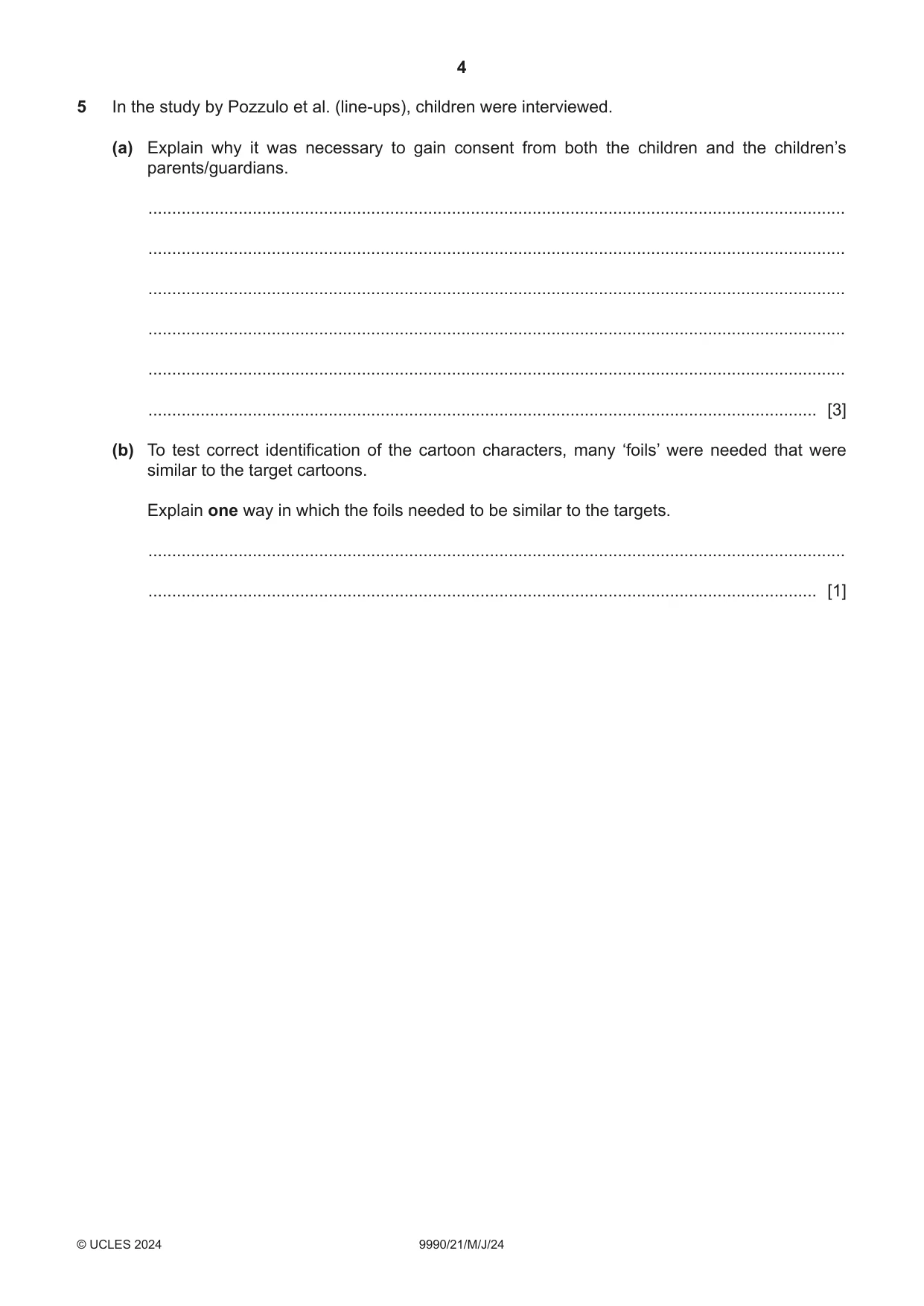
Q5 · In the study by Pozzulo et al
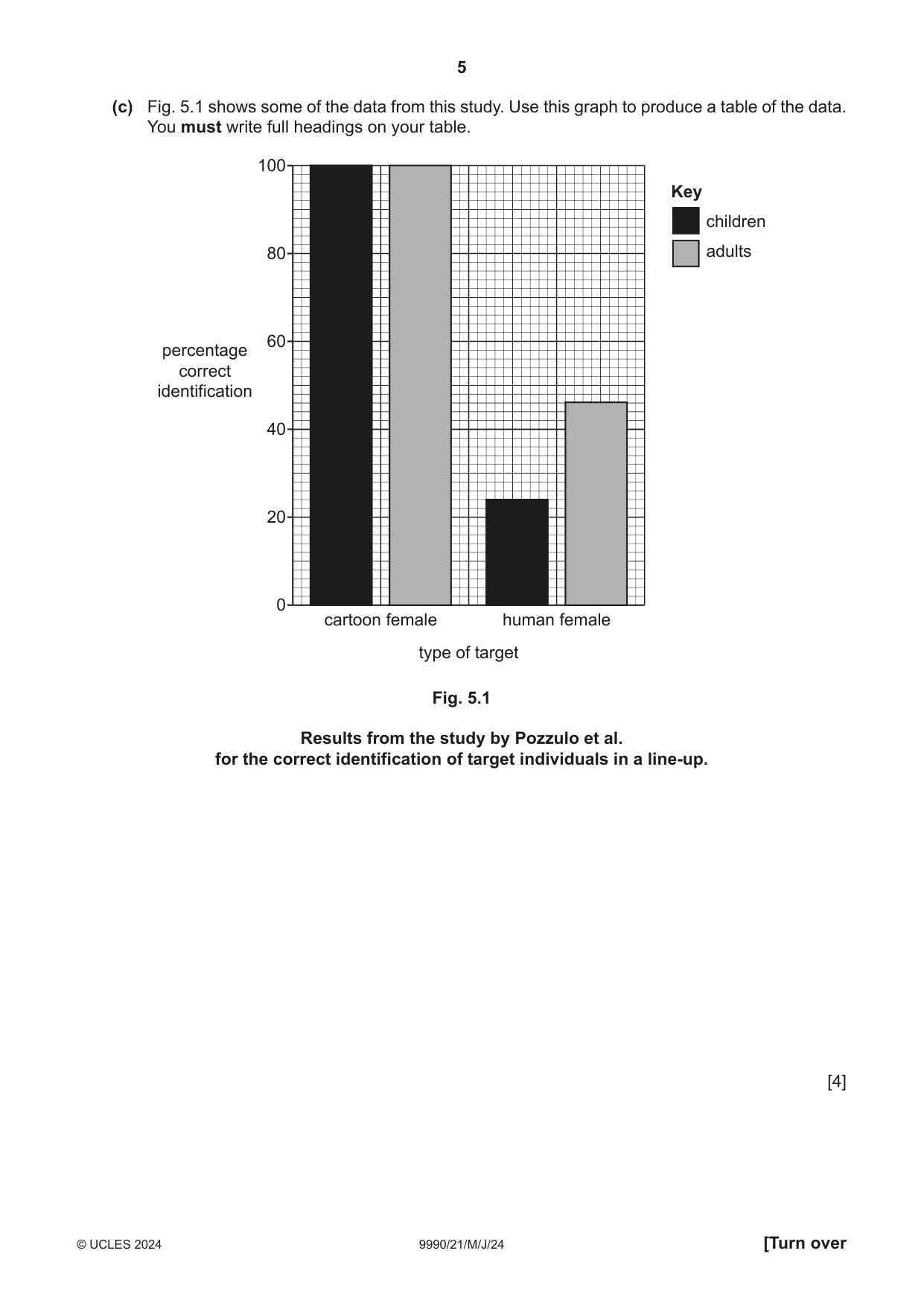
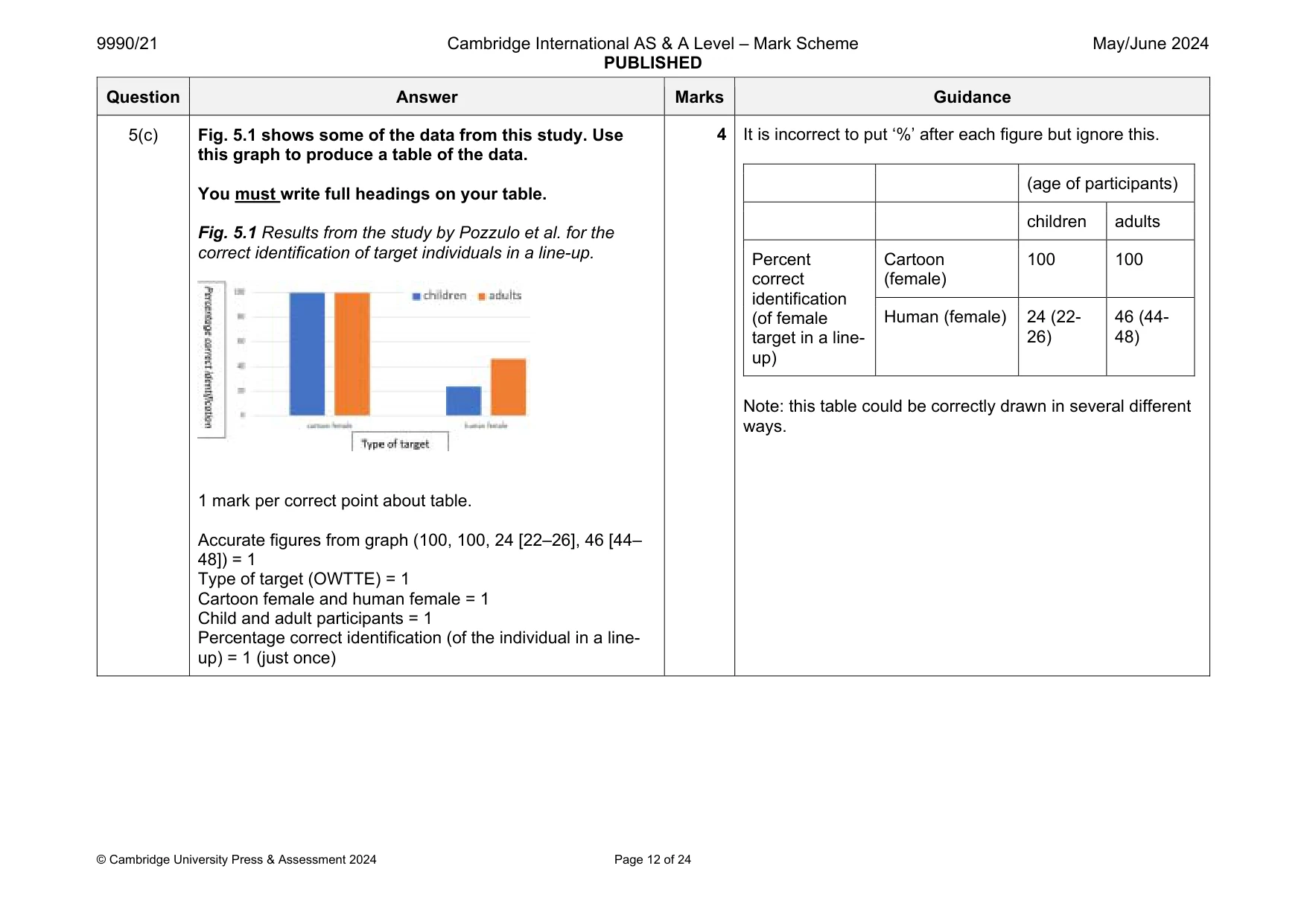
5 In the study by Pozzulo et al. (line-ups), children were interviewed. (a) Explain why it was necessary to gain consent from both the children and the children’s parents/guardians. ................................................................................................................................................... ................................................................................................................................................... ................................................................................................................................................... ................................................................................................................................................... ................................................................................................................................................... ............................................................................................................................................. [3] (b) To test correct identification of the cartoon characters, many ‘foils’ were needed that were similar to the target cartoons. Explain one way in which the foils needed to be similar to the targets. ................................................................................................................................................... ............................................................................................................................................. [1] (c) Fig. 5.1 shows some of the data from this study. Use this graph to produce a table of the data. You must write full headings on your table. 100 Key children 80 adults 60 percentage correct identification 40 20 0 cartoon female human female type of target Fig. 5.1 Results from the study by Pozzulo et al. for the correct identification of target individuals in a line-up. [4]
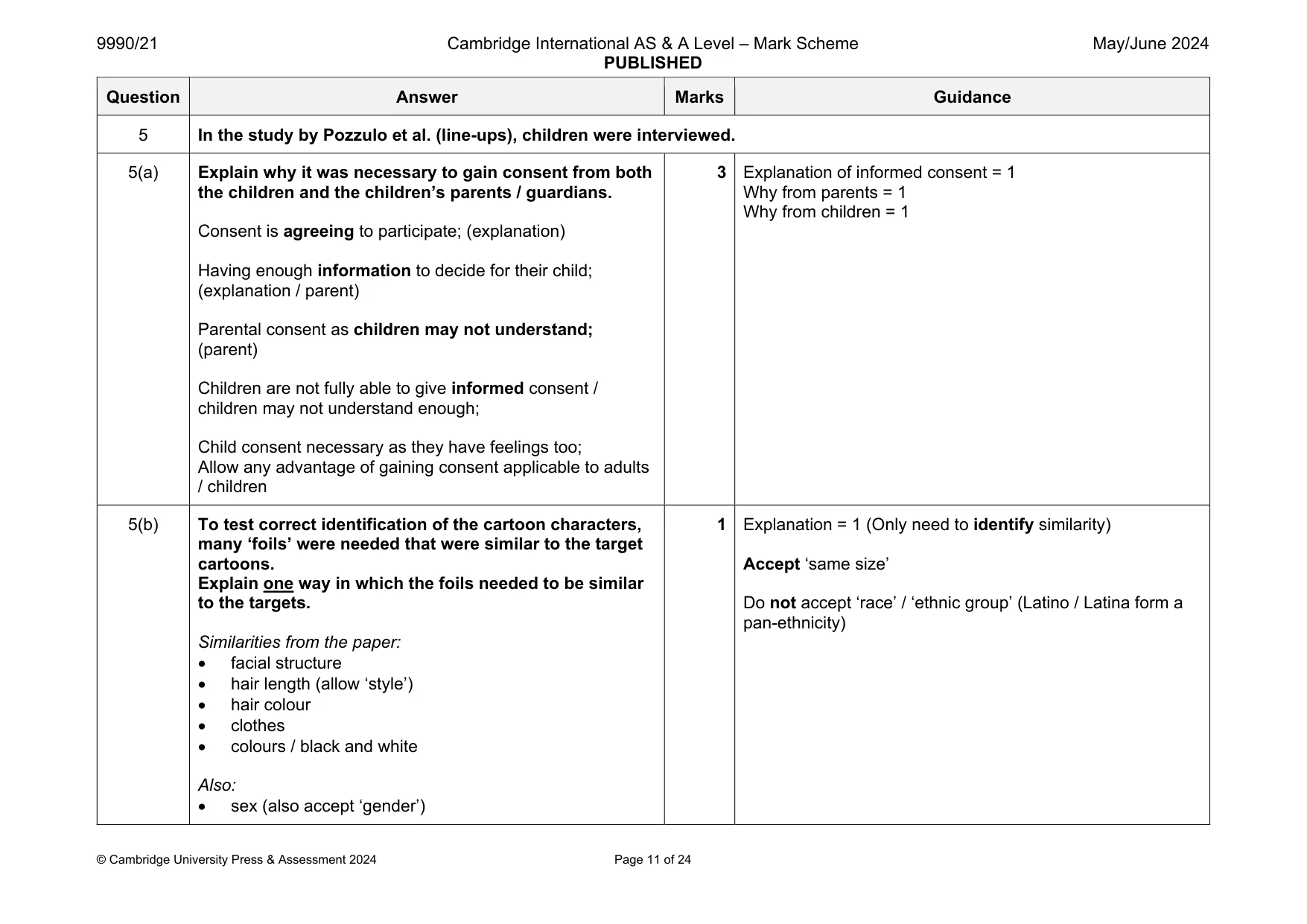
Mark scheme: 5(a) Explain why it was necessary to gain consent from both the children and the children’s parents / guardians. Consent is agreeing to participate; (explanation) Having enough information to decide for their child; (explanation / parent) Parental consent as children may not understand; (parent) Children are not fully able to give informed consent / children may not understand enough; Child consent necessary as they have feelings too; Allow any advantage of gaining consent applicable to adults / children Why from parents = 1 Why from children = 1 5(b) To test correct identification of the cartoon characters, many ‘foils’ were needed that were similar to the target cartoons. Explain one way in which the foils needed to be similar to the targets. Similarities from the paper: facial structure hair length (allow ‘style’) hair colour clothes colours / black and white Also: sex (also accept ‘gender’) 1 Explanation = 1 (Only need to identify similarity) Accept ‘same size’ Do not accept ‘race’ / ‘ethnic group’ (Latino / Latina form a pan-ethnicity) Question Answer Marks Guidance 5(c) Fig. 5.1 shows some of the data from this study. Use this graph to produce a table of the data. You must write full headings on your table. Fig. 5.1 Results from the study by Pozzulo et al. for the correct identification of target individuals in a line-up. 1 mark per correct point about table. Accurate figures from graph (100, 100, 24 [22–26], 46 [44– 48]) = 1 Type of target (OWTTE) = 1 Cartoon female and human female = 1 Child and adult participants = 1 Percentage correct identification (of the individual in a line- up) = 1 (just once) 4 It is incorrect to put ‘%’ after each figure but ignore this. (age of participants) children adults Percent correct identification (of female target in a line- up) Cartoon (female) 100 100 Human (female) 24 (22- 26) 46 (44- 48) Note: this table could be correctly drawn in several different ways.
Q6 · Describe participant observation and non-participant observation, using any example(s)
6 Describe participant observation and non-participant observation, using any example(s). .......................................................................................................................................................... .......................................................................................................................................................... .......................................................................................................................................................... .......................................................................................................................................................... .......................................................................................................................................................... .......................................................................................................................................................... .......................................................................................................................................................... .......................................................................................................................................................... .......................................................................................................................................................... .......................................................................................................................................................... .......................................................................................................................................................... .................................................................................................................................................... [6]
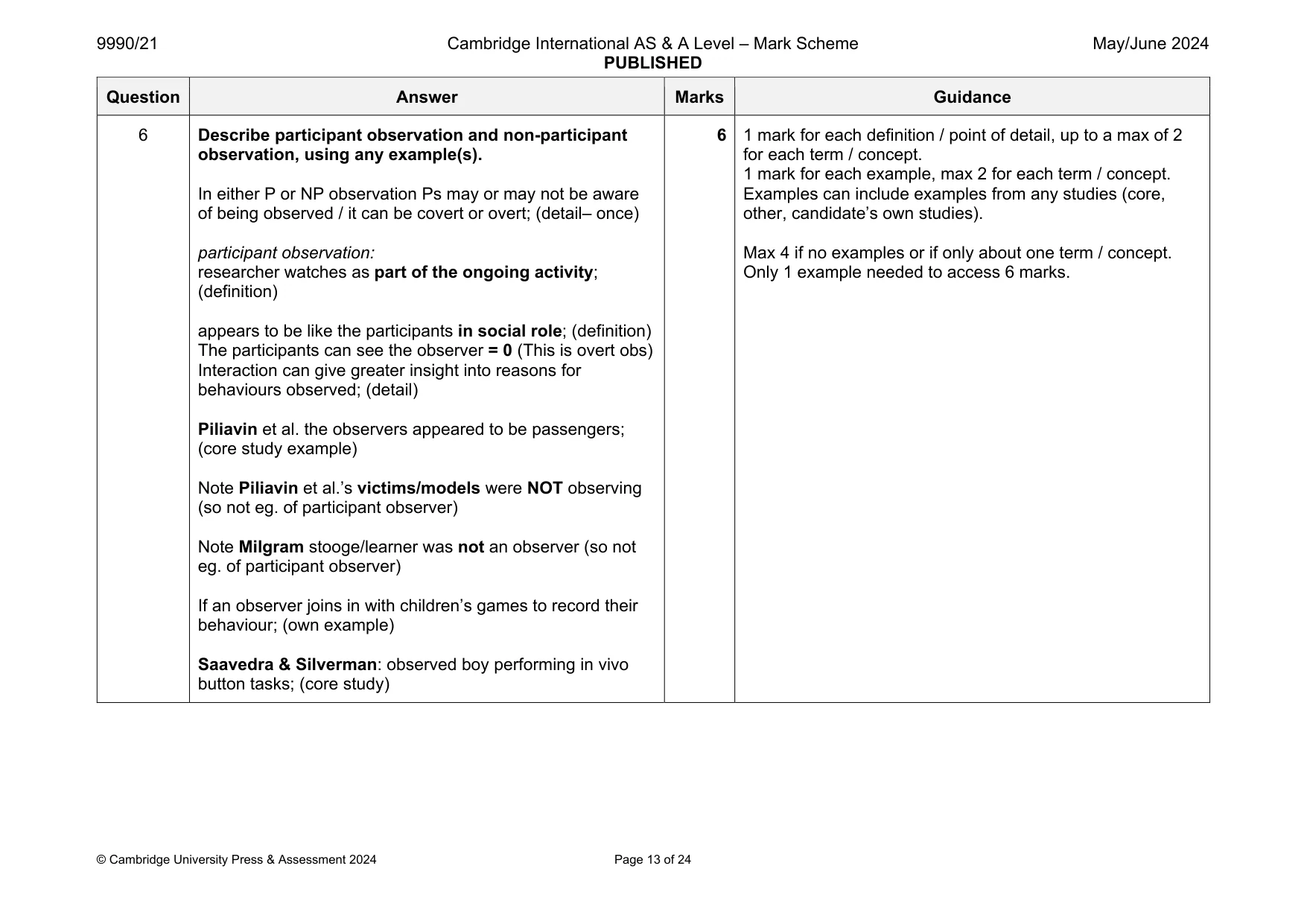
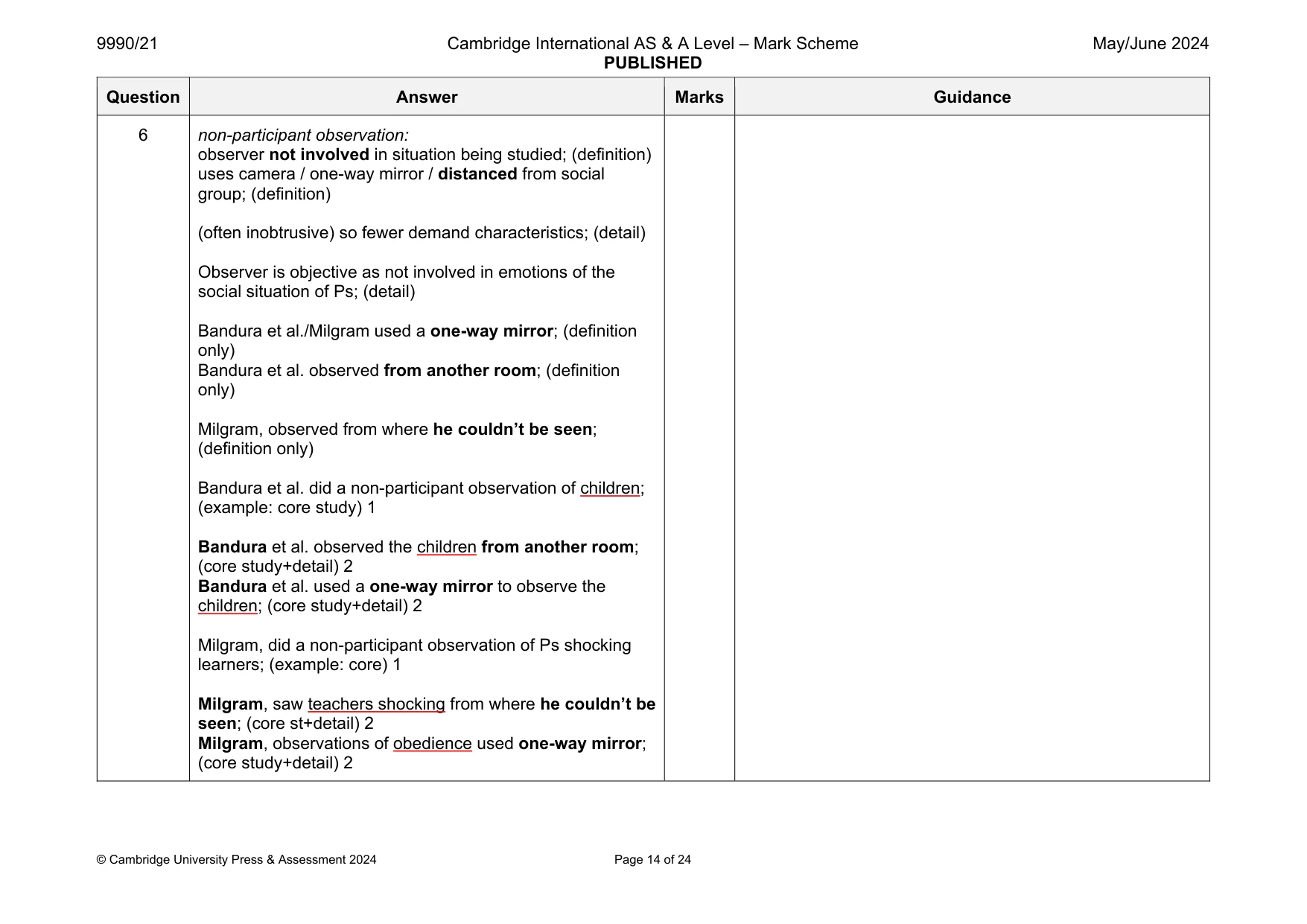
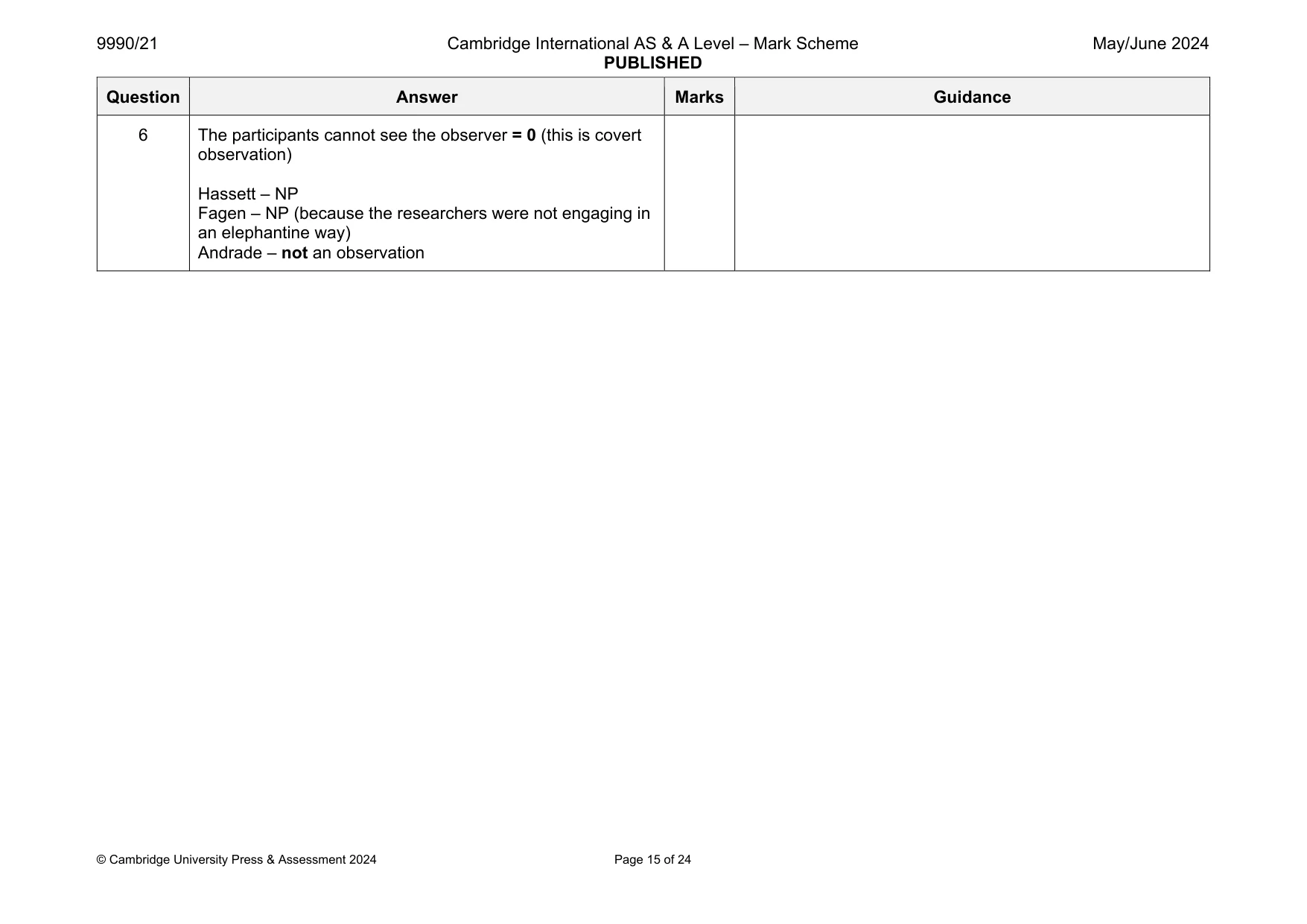
Mark scheme: 6 Describe participant observation and non-participant observation, using any example(s). In either P or NP observation Ps may or may not be aware of being observed / it can be covert or overt; (detail– once) participant observation: researcher watches as part of the ongoing activity; (definition) appears to be like the participants in social role; (definition) The participants can see the observer = 0 (This is overt obs) Interaction can give greater insight into reasons for behaviours observed; (detail) Piliavin et al. the observers appeared to be passengers; (core study example) Note Piliavin et al.’s victims/models were NOT observing (so not eg. of participant observer) Note Milgram stooge/learner was not an observer (so not eg. of participant observer) If an observer joins in with children’s games to record their behaviour; (own example) Saavedra & Silverman: observed boy performing in vivo button tasks; (core study) 6 1 mark for each definition / point of detail, up to a max of 2 for each term / concept. 1 mark for each example, max 2 for each term / concept. Examples can include examples from any studies (core, other, candidate’s own studies). Max 4 if no examples or if only about one term / concept. Only 1 example needed to access 6 marks. Question Answer Marks Guidance 6 non-participant observation: observer not involved in situation being studied; (definition) uses camera / one-way mirror / distanced from social group; (definition) (often inobtrusive) so fewer demand characteristics; (detail) Observer is objective as not involved in emotions of the social situation of Ps; (detail) Bandura et al./Milgram used a one-way mirror; (definition only) Bandura et al. observed from another room; (definition only) Milgram, observed from where he couldn’t be seen; (definition only) Bandura et al. did a non-participant observation of children; (example: core study) 1 Bandura et al. observed the children from another room; (core study+detail) 2 Bandura et al. used a one-way mirror to observe the children; (core study+detail) 2 Milgram, did a non-participant observation of Ps shocking learners; (example: core) 1 Milgram, saw teachers shocking from where he couldn’t be seen; (core st+detail) 2 Milgram, observations of obedience used one-way mirror; (core study+detail) 2 Question Answer Marks Guidance 6 The participants cannot see the observer = 0 (this is covert observation) Hassett – NP Fagen – NP (because the researchers were not engaging in an elephantine way) Andrade – not an observation
Q7 · Ranya is collecting data about study habits after school
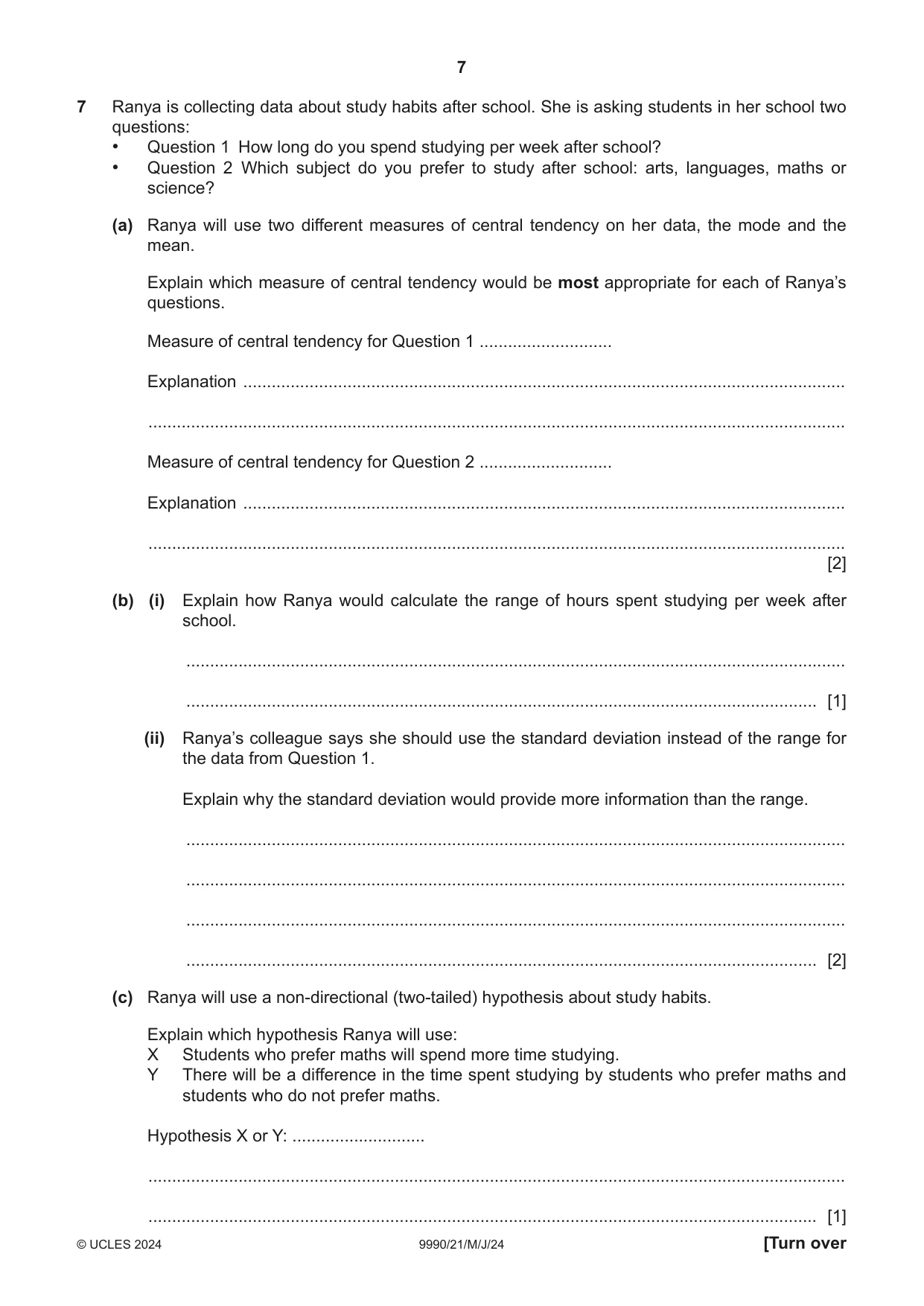
7 Ranya is collecting data about study habits after school. She is asking students in her school two questions: • Question 1 How long do you spend studying per week after school? • Question 2 Which subject do you prefer to study after school: arts, languages, maths or science? (a) Ranya will use two different measures of central tendency on her data, the mode and the mean. Explain which measure of central tendency would be most appropriate for each of Ranya’s questions. Measure of central tendency for Question 1 ............................ Explanation ............................................................................................................................... ................................................................................................................................................... Measure of central tendency for Question 2 ............................ Explanation ............................................................................................................................... ................................................................................................................................................... [2] (b) (i) Explain how Ranya would calculate the range of hours spent studying per week after school. ........................................................................................................................................... ..................................................................................................................................... [1] (ii) Ranya’s colleague says she should use the standard deviation instead of the range for the data from Question 1. Explain why the standard deviation would provide more information than the range. ........................................................................................................................................... ........................................................................................................................................... ........................................................................................................................................... ..................................................................................................................................... [2] (c) Ranya will use a non-directional (two-tailed) hypothesis about study habits. Explain which hypothesis Ranya will use: X Students who prefer maths will spend more time studying. Y There will be a difference in the time spent studying by students who prefer maths and students who do not prefer maths. Hypothesis X or Y: ............................ ................................................................................................................................................... ............................................................................................................................................. [1]
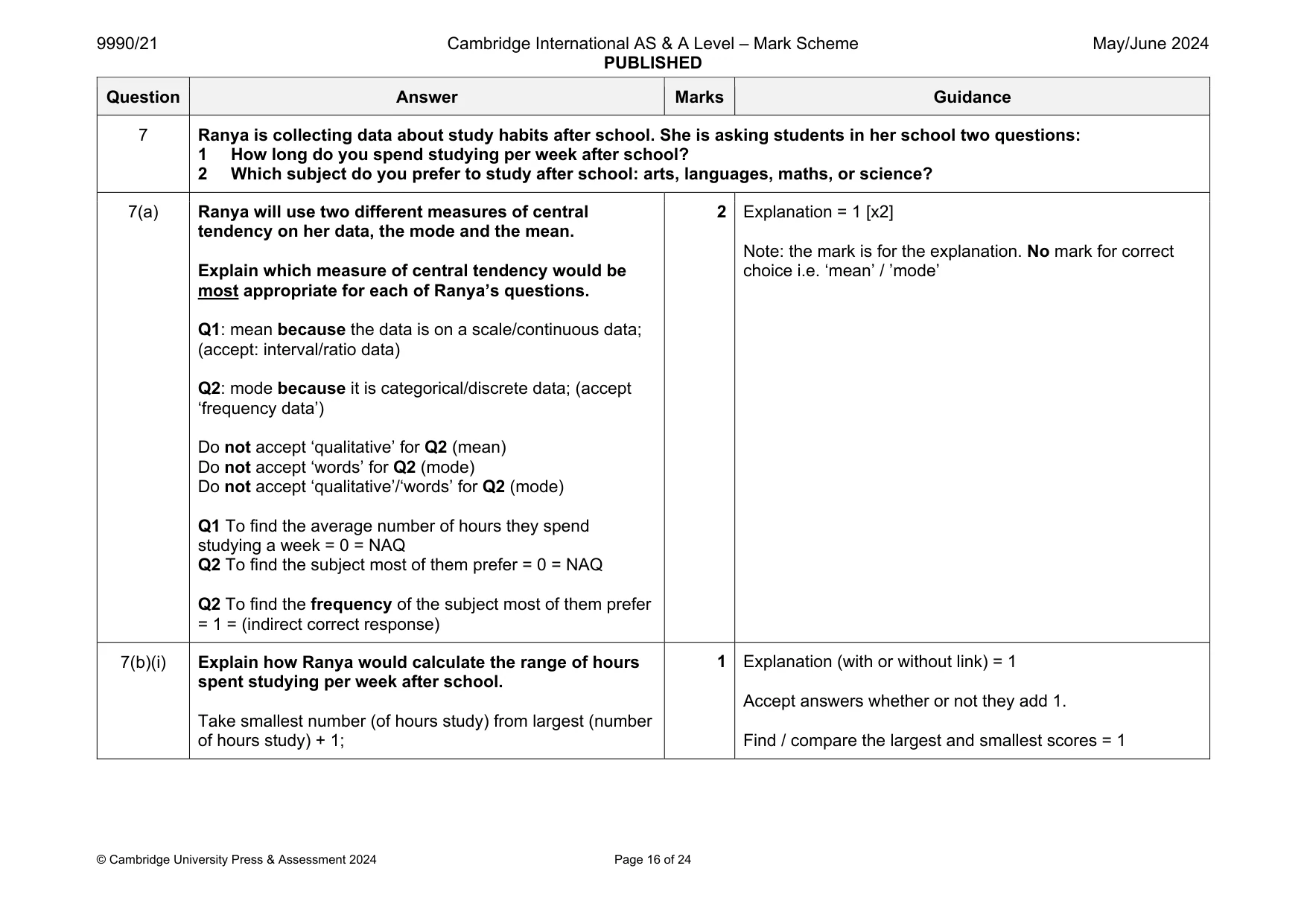
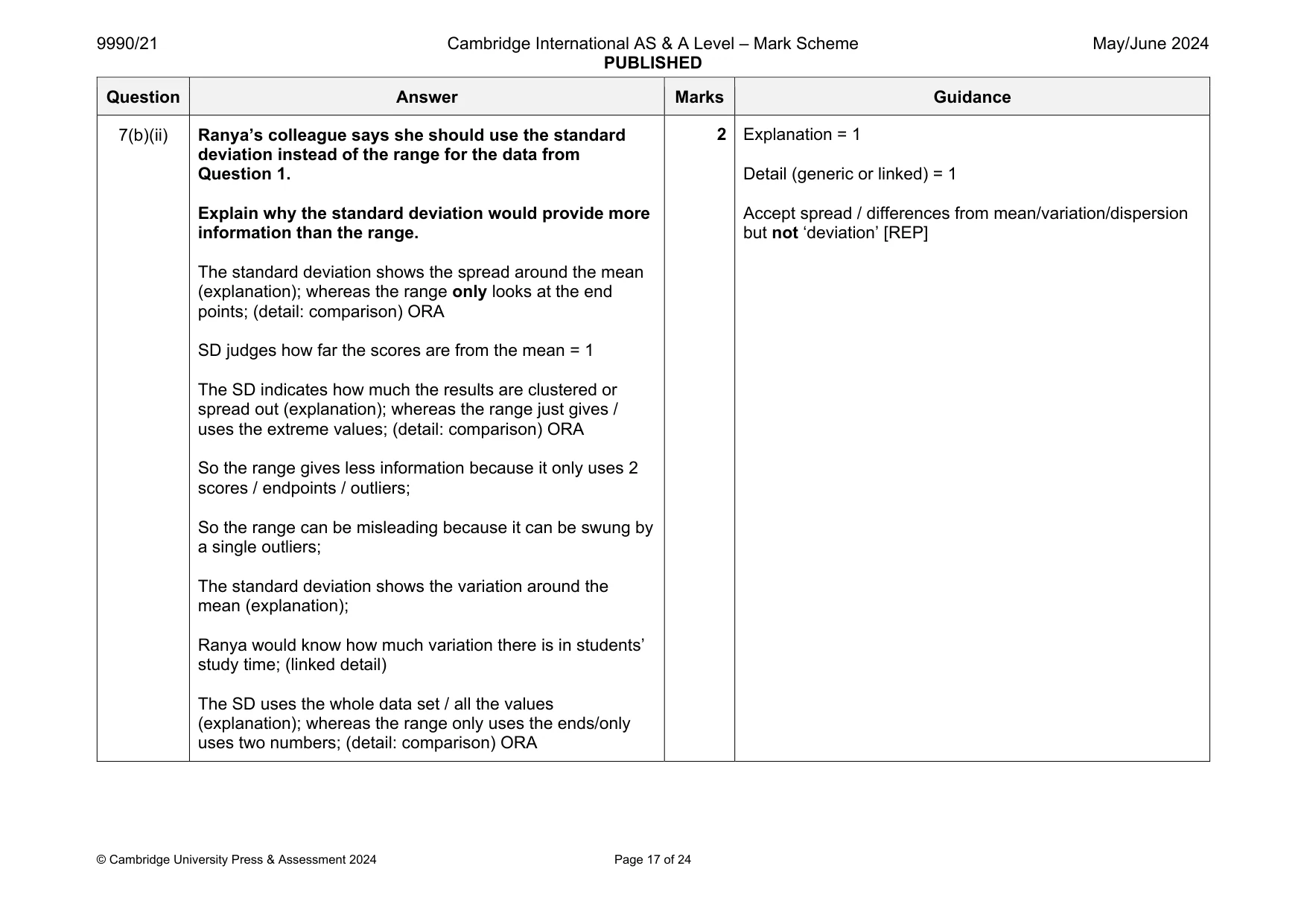
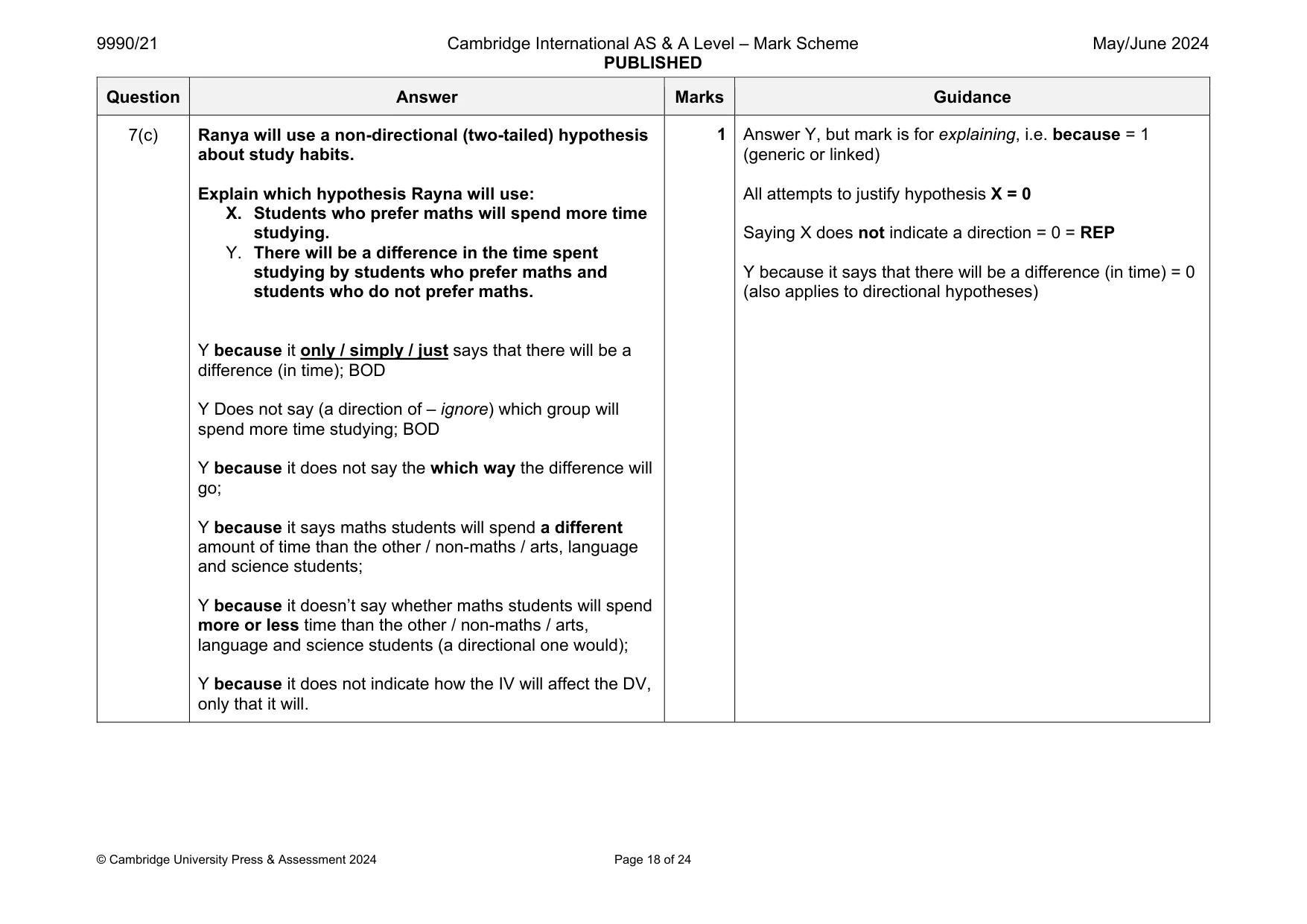
Mark scheme: 7(a) Ranya will use two different measures of central tendency on her data, the mode and the mean. Explain which measure of central tendency would be most appropriate for each of Ranya’s questions. Q1: mean because the data is on a scale/continuous data; (accept: interval/ratio data) Q2: mode because it is categorical/discrete data; (accept ‘frequency data’) Do not accept ‘qualitative’ for Q2 (mean) Do not accept ‘words’ for Q2 (mode) Do not accept ‘qualitative’/‘words’ for Q2 (mode) Q1 To find the average number of hours they spend studying a week = 0 = NAQ Q2 To find the subject most of them prefer = 0 = NAQ Q2 To find the frequency of the subject most of them prefer = 1 = (indirect correct response) Note: the mark is for the explanation. No mark for correct choice i.e. ‘mean’ / ’mode’ 7(b)(i) Explain how Ranya would calculate the range of hours spent studying per week after school. Take smallest number (of hours study) from largest (number of hours study) + 1; 1 Explanation (with or without link) = 1 Accept answers whether or not they add 1. Find / compare the largest and smallest scores = 1 Question Answer Marks Guidance 7(b)(ii) Ranya’s colleague says she should use the standard deviation instead of the range for the data from Question 1. Explain why the standard deviation would provide more information than the range. The standard deviation shows the spread around the mean (explanation); whereas the range only looks at the end points; (detail: comparison) ORA SD judges how far the scores are from the mean = 1 The SD indicates how much the results are clustered or spread out (explanation); whereas the range just gives / uses the extreme values; (detail: comparison) ORA So the range gives less information because it only uses 2 scores / endpoints / outliers; So the range can be misleading because it can be swung by a single outliers; The standard deviation shows the variation around the mean (explanation); Ranya would know how much variation there is in students’ study time; (linked detail) The SD uses the whole data set / all the values (explanation); whereas the range only uses the ends/only uses two numbers; (detail: comparison) ORA 2 Explanation = 1 Detail (generic or linked) = 1 Accept spread / differences from mean/variation/dispersion but not ‘deviation’ [REP] Question Answer Marks Guidance 7(c) Ranya will use a non-directional (two-tailed) hypothesis about study habits. Explain which hypothesis Rayna will use: X. Students who prefer maths will spend more time studying. Y. There will be a difference in the time spent studying by students who prefer maths and students who do not prefer maths. Y because it only / simply / just says that there will be a difference (in time); BOD Y Does not say (a direction of – ignore) which group will spend more time studying; BOD Y because it does not say the which way the difference will go; Y because it says maths students will spend a different amount of time than the other / non-maths / arts, language and science students; Y because it doesn’t say whether maths students will spend more or less time than the other / non-maths / arts, language and science students (a directional one would); Y because it does not indicate how the IV will affect the DV, only that it will. 1 Answer Y, but mark is for explaining, i.e. because = 1 (generic or linked) All attempts to justify hypothesis X = 0 Saying X does not indicate a direction = 0 = REP Y because it says that there will be a difference (in time) = 0 (also applies to directional hypotheses)
Q8 · Simon is conducting a study about children learning to read
8 Simon is conducting a study about children learning to read. He is comparing how well they understand a story when reading from a book which has pages with images that are either: • coloured shapes • pictures that are not related to the text • pictures that are related to the text. (a) Identify the independent variable (IV) in Simon’s study. ................................................................................................................................................... ............................................................................................................................................. [1] (b) Identify the dependent variable (DV) in Simon’s study. ................................................................................................................................................... ............................................................................................................................................. [1] (c) All the pictures and shapes are brightly coloured. Explain one reason why this is important. ................................................................................................................................................... ................................................................................................................................................... ................................................................................................................................................... ................................................................................................................................................... ................................................................................................................................................... ............................................................................................................................................. [3]
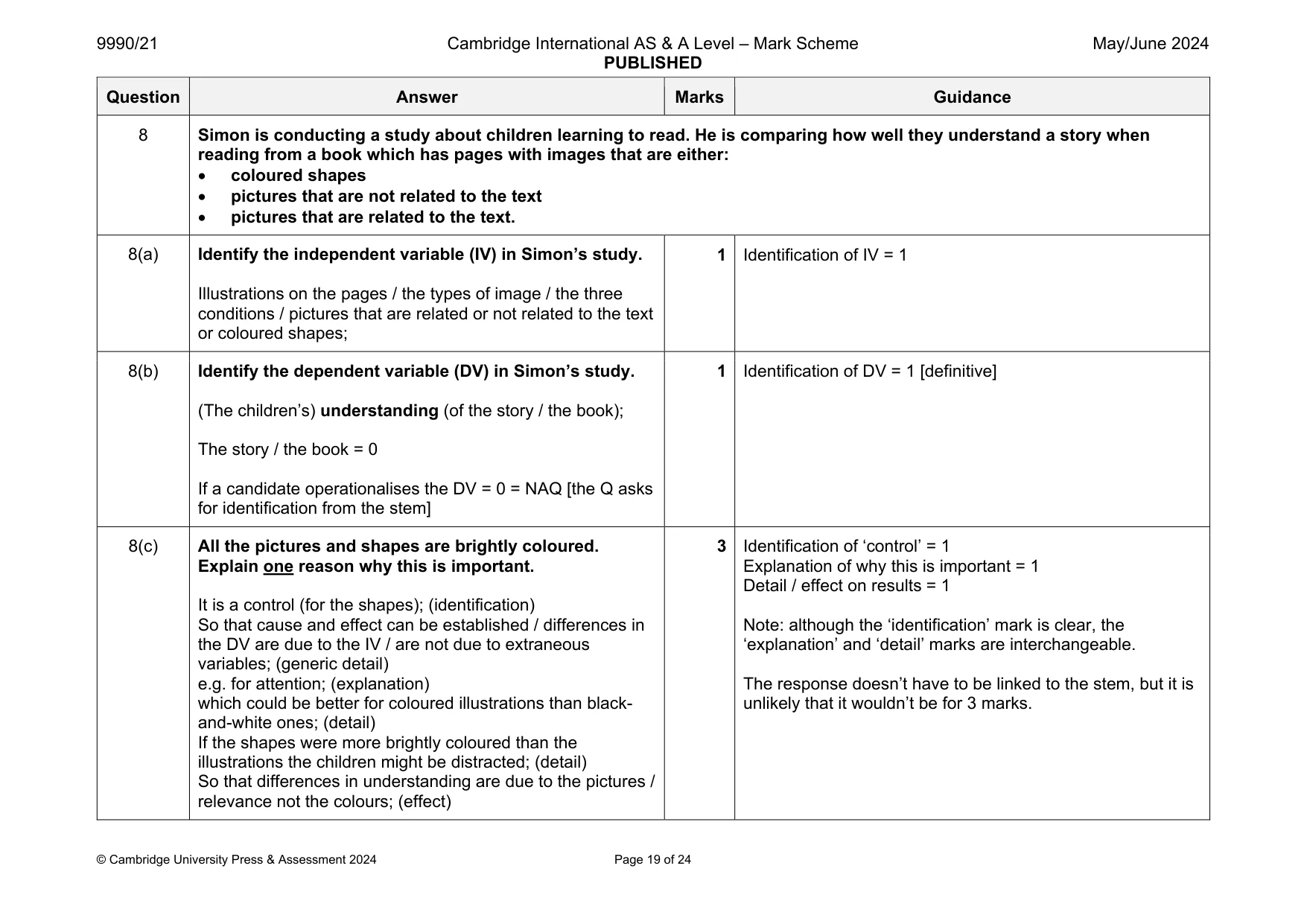
Mark scheme: 8(a) Identify the independent variable (IV) in Simon’s study. Illustrations on the pages / the types of image / the three conditions / pictures that are related or not related to the text or coloured shapes; 1 Identification of IV = 1 8(b) Identify the dependent variable (DV) in Simon’s study. (The children’s) understanding (of the story / the book); The story / the book = 0 If a candidate operationalises the DV = 0 = NAQ [the Q asks for identification from the stem] 1 Identification of DV = 1 [definitive] 8(c) All the pictures and shapes are brightly coloured. Explain one reason why this is important. It is a control (for the shapes); (identification) So that cause and effect can be established / differences in the DV are due to the IV / are not due to extraneous variables; (generic detail) e.g. for attention; (explanation) which could be better for coloured illustrations than black- and-white ones; (detail) If the shapes were more brightly coloured than the illustrations the children might be distracted; (detail) So that differences in understanding are due to the pictures / relevance not the colours; (effect) 3 Identification of ‘control’ = 1 Explanation of why this is important = 1 Detail / effect on results = 1 Note: although the ‘identification’ mark is clear, the ‘explanation’ and ‘detail’ marks are interchangeable. The response doesn’t have to be linked to the stem, but it is unlikely that it wouldn’t be for 3 marks.
Q9 · Heng is conducting a study to investigate the job satisfaction of male and female…
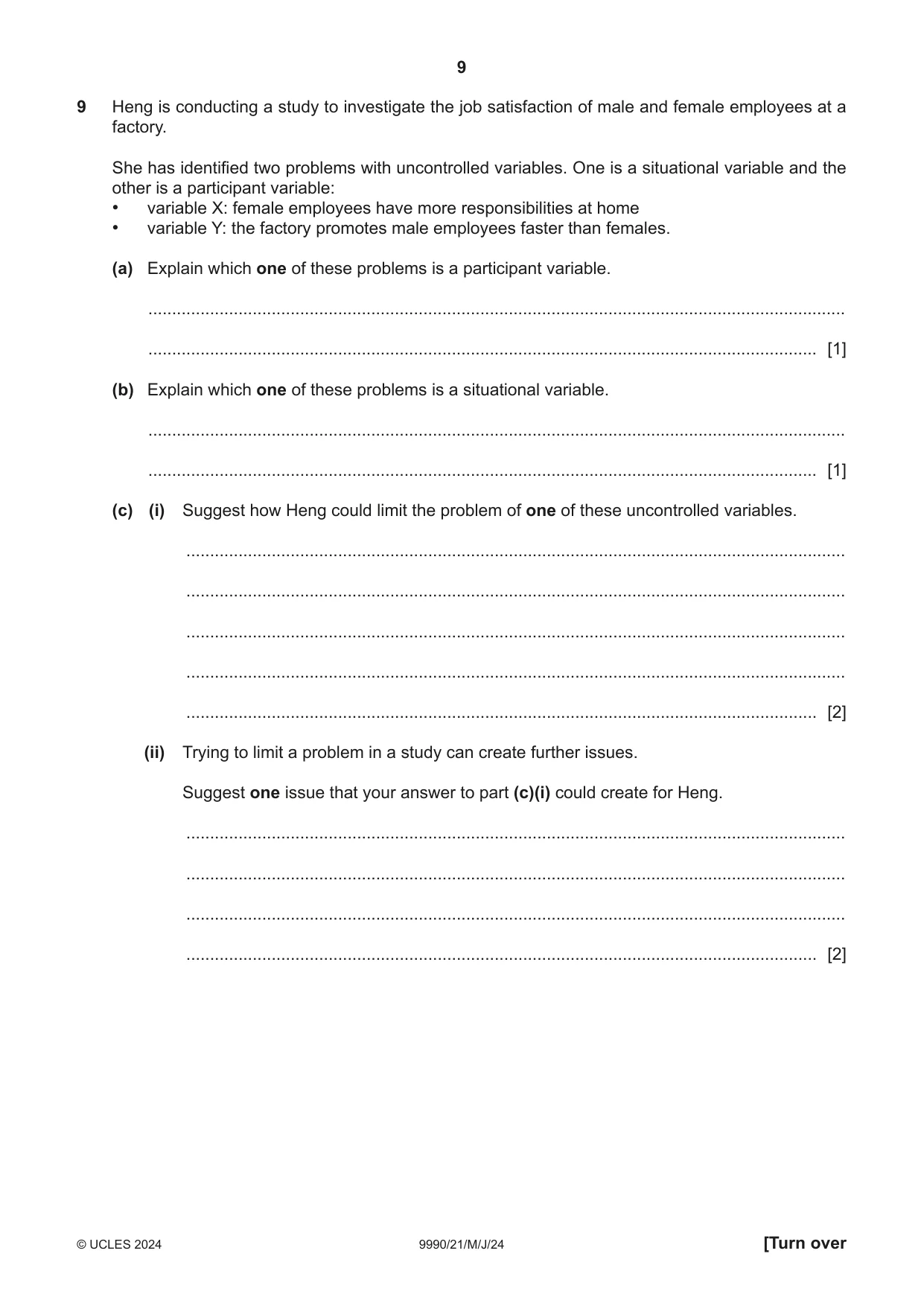
9 Heng is conducting a study to investigate the job satisfaction of male and female employees at a factory. She has identified two problems with uncontrolled variables. One is a situational variable and the other is a participant variable: • variable X: female employees have more responsibilities at home • variable Y: the factory promotes male employees faster than females. (a) Explain which one of these problems is a participant variable. ................................................................................................................................................... ............................................................................................................................................. [1] (b) Explain which one of these problems is a situational variable. ................................................................................................................................................... ............................................................................................................................................. [1] (c) (i) Suggest how Heng could limit the problem of one of these uncontrolled variables. ........................................................................................................................................... ........................................................................................................................................... ........................................................................................................................................... ........................................................................................................................................... ..................................................................................................................................... [2] (ii) Trying to limit a problem in a study can create further issues. Suggest one issue that your answer to part (c)(i) could create for Heng. ........................................................................................................................................... ........................................................................................................................................... ........................................................................................................................................... ..................................................................................................................................... [2]
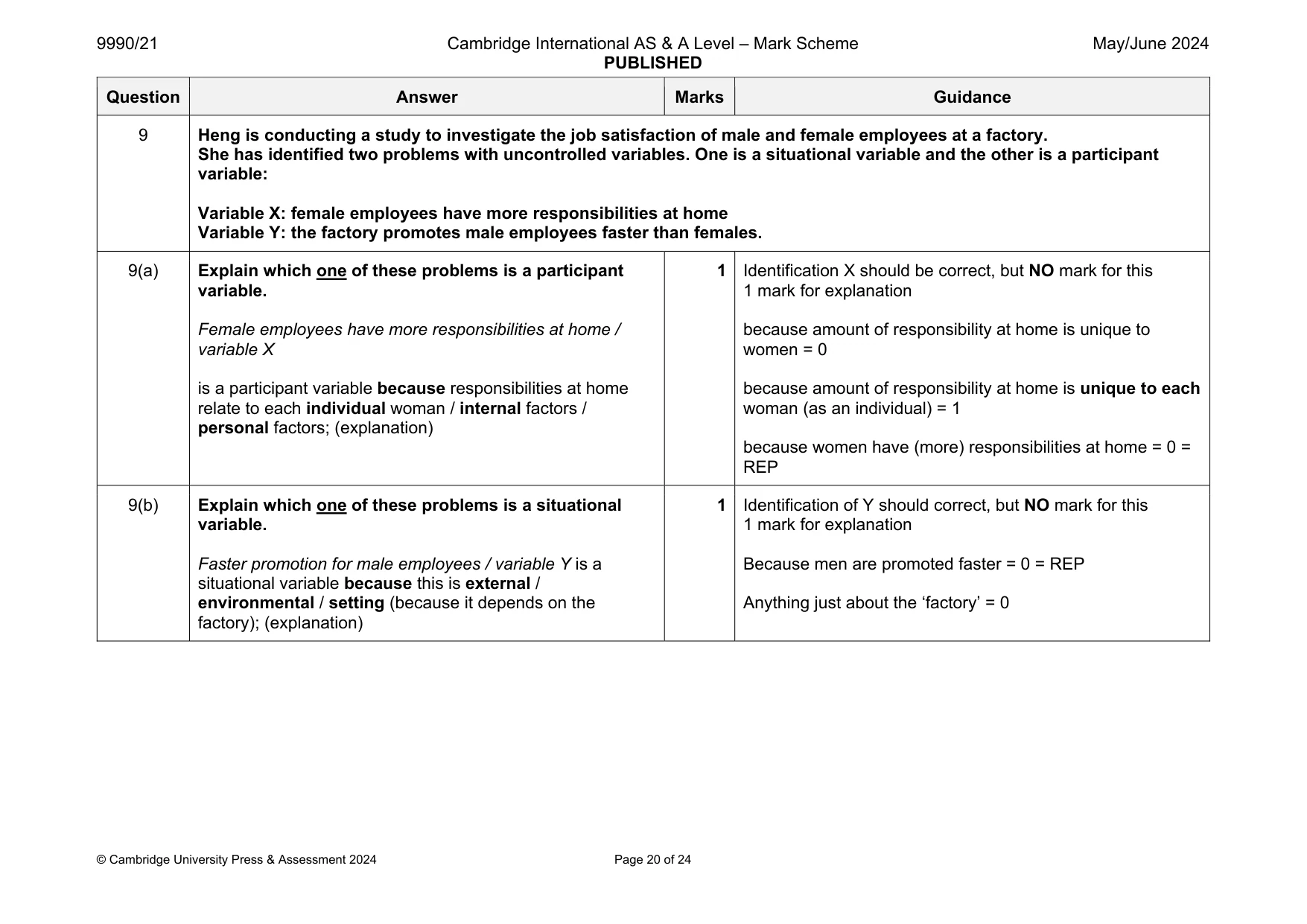
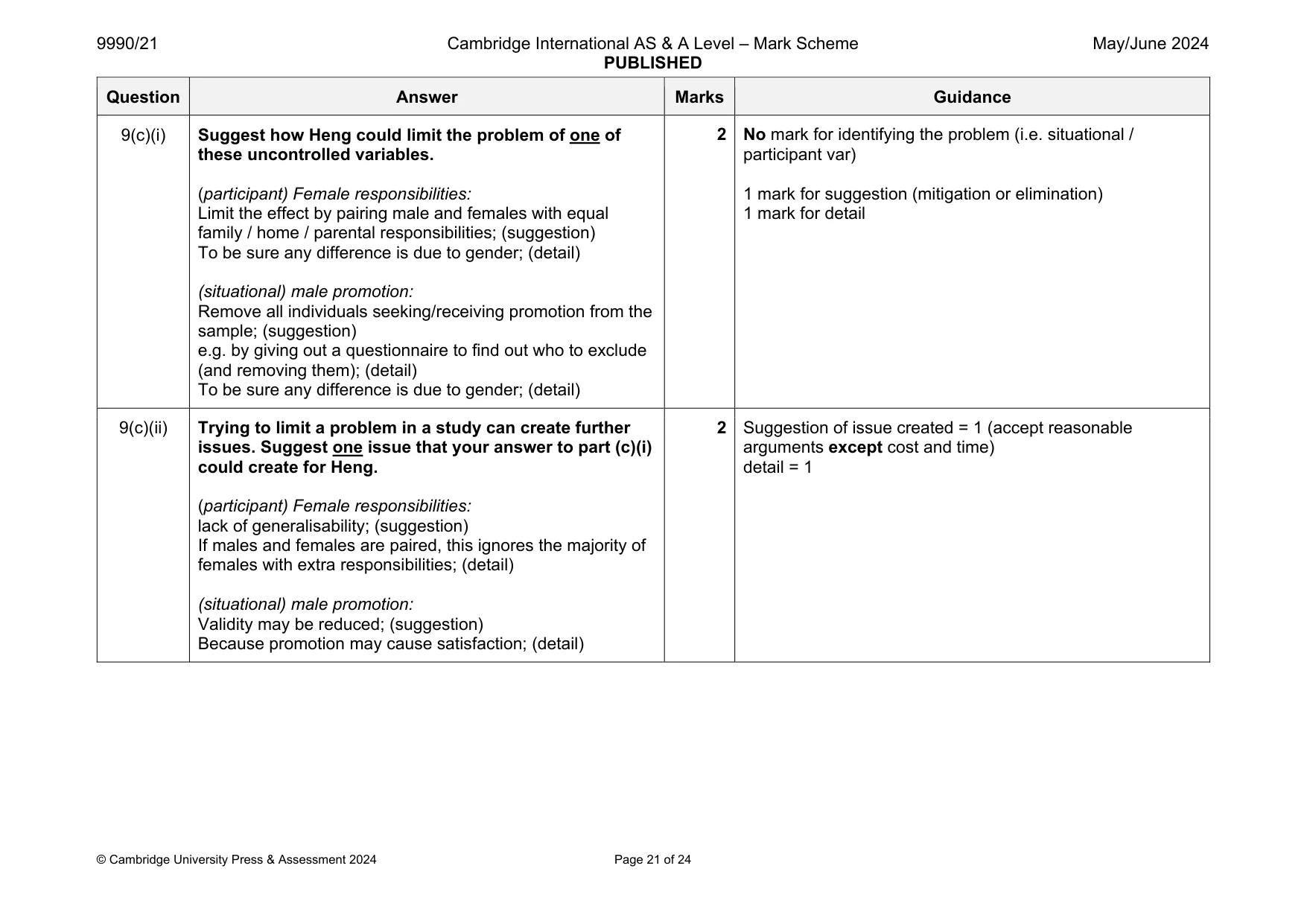
Mark scheme: 9(a) Explain which one of these problems is a participant variable. Female employees have more responsibilities at home / variable X is a participant variable because responsibilities at home relate to each individual woman / internal factors / personal factors; (explanation) 1 mark for explanation because amount of responsibility at home is unique to women = 0 because amount of responsibility at home is unique to each woman (as an individual) = 1 because women have (more) responsibilities at home = 0 = REP 9(b) Explain which one of these problems is a situational variable. Faster promotion for male employees / variable Y is a situational variable because this is external / environmental / setting (because it depends on the factory); (explanation) 1 Identification of Y should correct, but NO mark for this 1 mark for explanation Because men are promoted faster = 0 = REP Anything just about the ‘factory’ = 0 Question Answer Marks Guidance 9(c)(i) Suggest how Heng could limit the problem of one of these uncontrolled variables. (participant) Female responsibilities: Limit the effect by pairing male and females with equal family / home / parental responsibilities; (suggestion) To be sure any difference is due to gender; (detail) (situational) male promotion: Remove all individuals seeking/receiving promotion from the sample; (suggestion) e.g. by giving out a questionnaire to find out who to exclude (and removing them); (detail) To be sure any difference is due to gender; (detail) 2 No mark for identifying the problem (i.e. situational / participant var) 1 mark for suggestion (mitigation or elimination) 1 mark for detail 9(c)(ii) Trying to limit a problem in a study can create further issues. Suggest one issue that your answer to part (c)(i) could create for Heng. (participant) Female responsibilities: lack of generalisability; (suggestion) If males and females are paired, this ignores the majority of females with extra responsibilities; (detail) (situational) male promotion: Validity may be reduced; (suggestion) Because promotion may cause satisfaction; (detail) 2 Suggestion of issue created = 1 (accept reasonable arguments except cost and time) detail = 1
Q10 · Mary is conducting a case study on a boy diagnosed with an autistic spectrum disorder
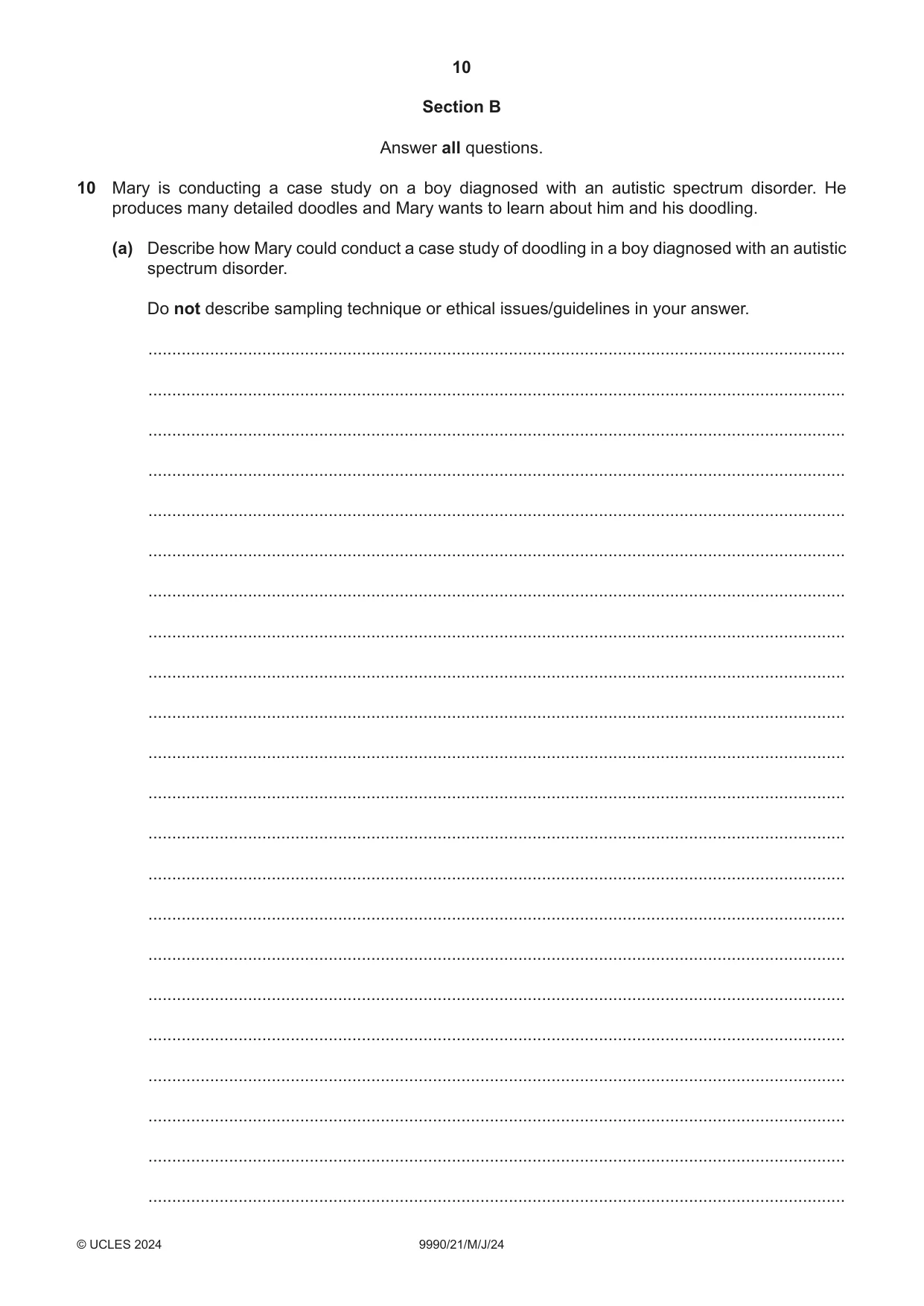
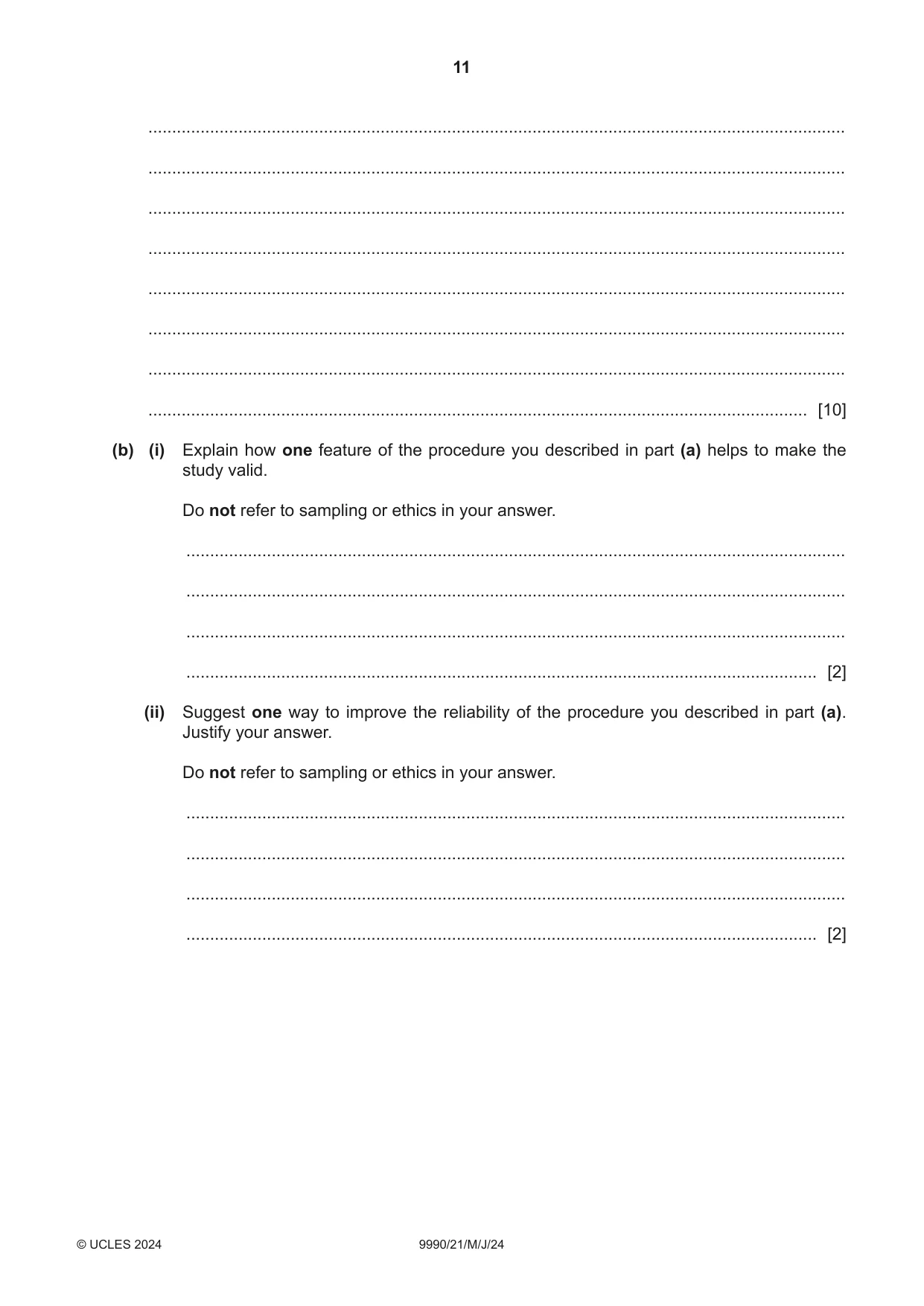
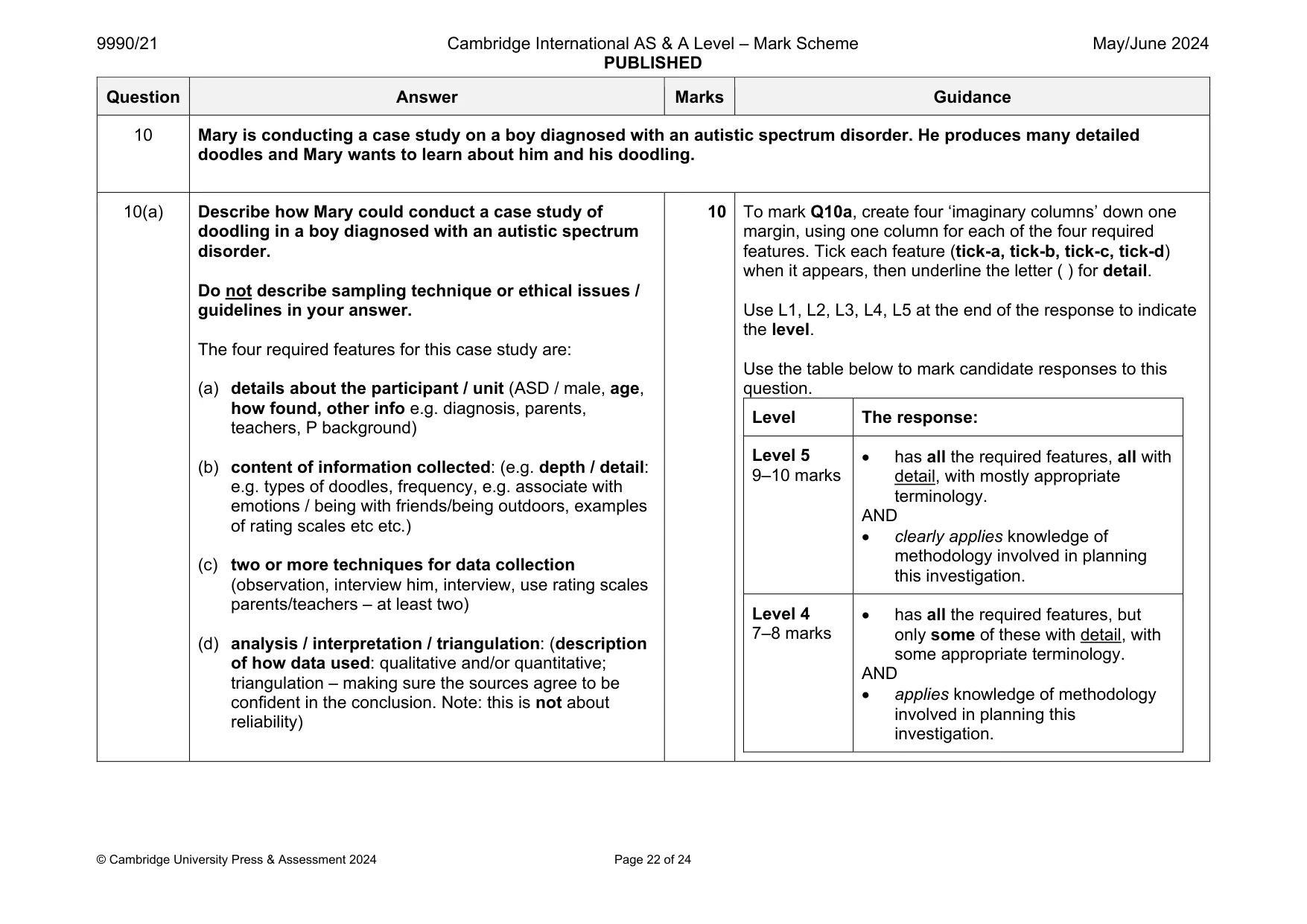
10 Mary is conducting a case study on a boy diagnosed with an autistic spectrum disorder. He produces many detailed doodles and Mary wants to learn about him and his doodling. (a) Describe how Mary could conduct a case study of doodling in a boy diagnosed with an autistic spectrum disorder. Do not describe sampling technique or ethical issues/guidelines in your answer. ................................................................................................................................................... ................................................................................................................................................... ................................................................................................................................................... ................................................................................................................................................... ................................................................................................................................................... ................................................................................................................................................... ................................................................................................................................................... ................................................................................................................................................... ................................................................................................................................................... ................................................................................................................................................... ................................................................................................................................................... ................................................................................................................................................... ................................................................................................................................................... ................................................................................................................................................... ................................................................................................................................................... ................................................................................................................................................... ................................................................................................................................................... ................................................................................................................................................... ................................................................................................................................................... ................................................................................................................................................... ................................................................................................................................................... ................................................................................................................................................... ................................................................................................................................................... ................................................................................................................................................... ................................................................................................................................................... ................................................................................................................................................... ................................................................................................................................................... ................................................................................................................................................... ................................................................................................................................................... ........................................................................................................................................... [10] (b) (i) Explain how one feature of the procedure you described in part (a) helps to make the study valid. Do not refer to sampling or ethics in your answer. ........................................................................................................................................... ........................................................................................................................................... ........................................................................................................................................... ..................................................................................................................................... [2] (ii) Suggest one way to improve the reliability of the procedure you described in part (a). Justify your answer. Do not refer to sampling or ethics in your answer. ........................................................................................................................................... ........................................................................................................................................... ........................................................................................................................................... ..................................................................................................................................... [2]
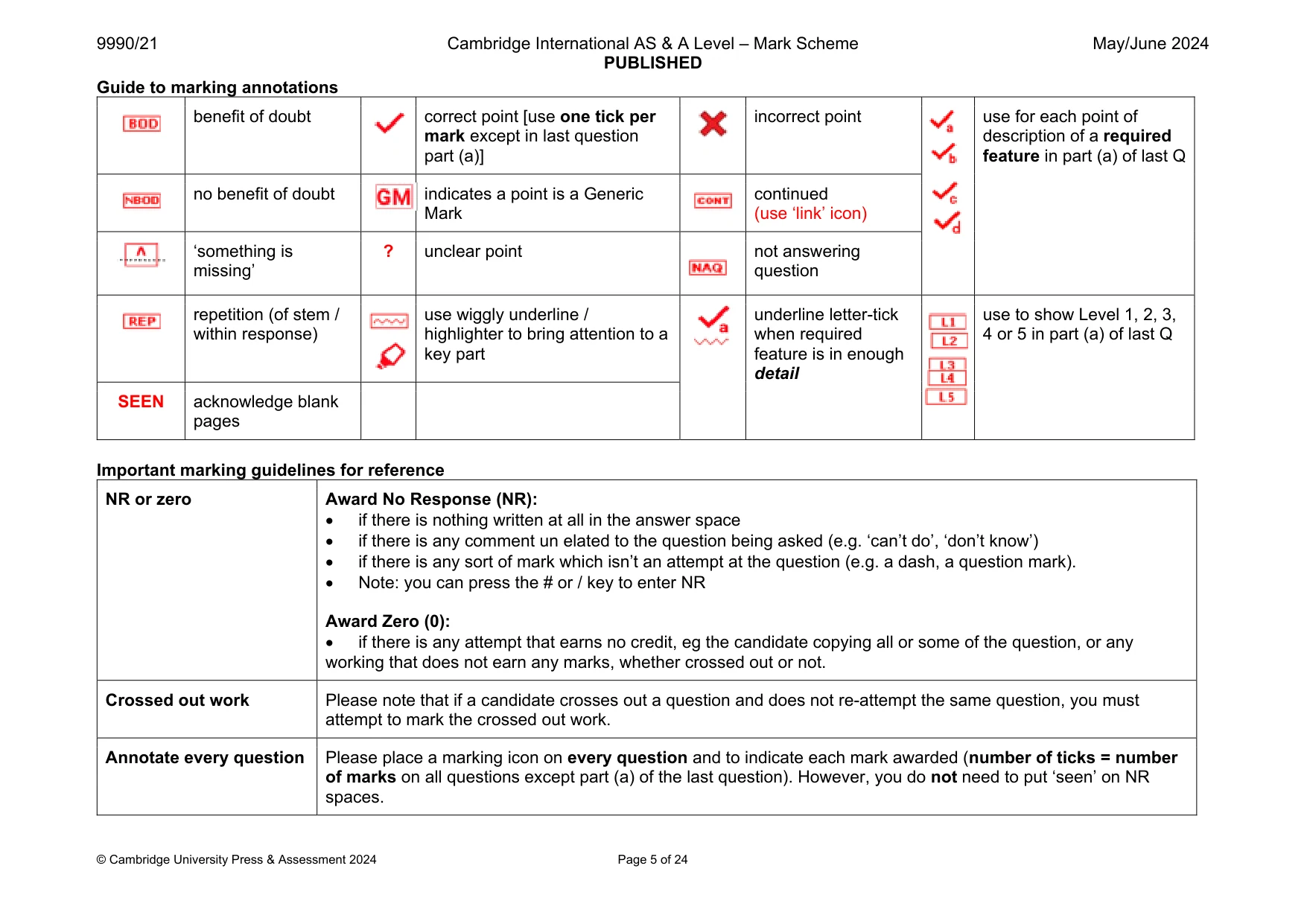
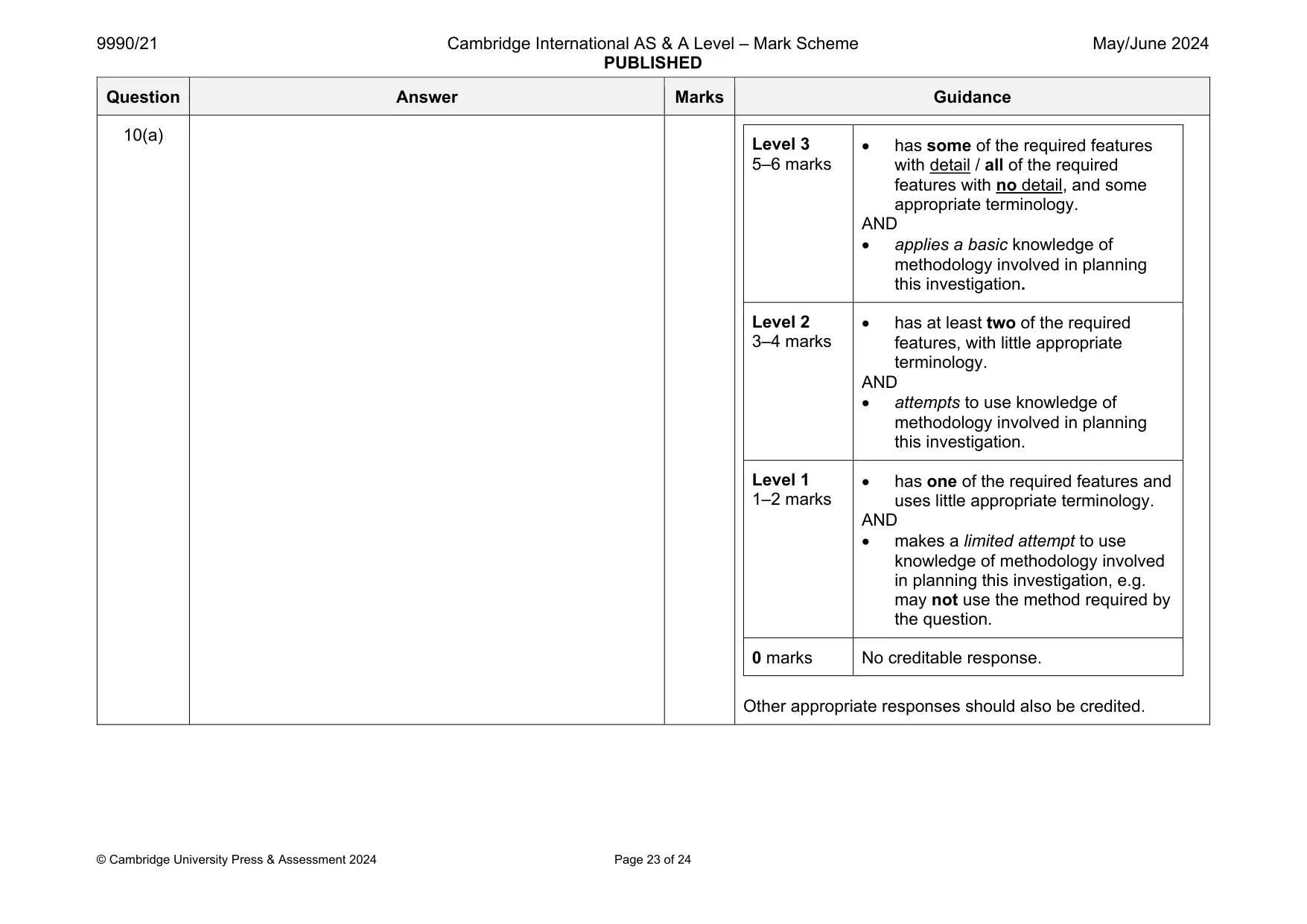
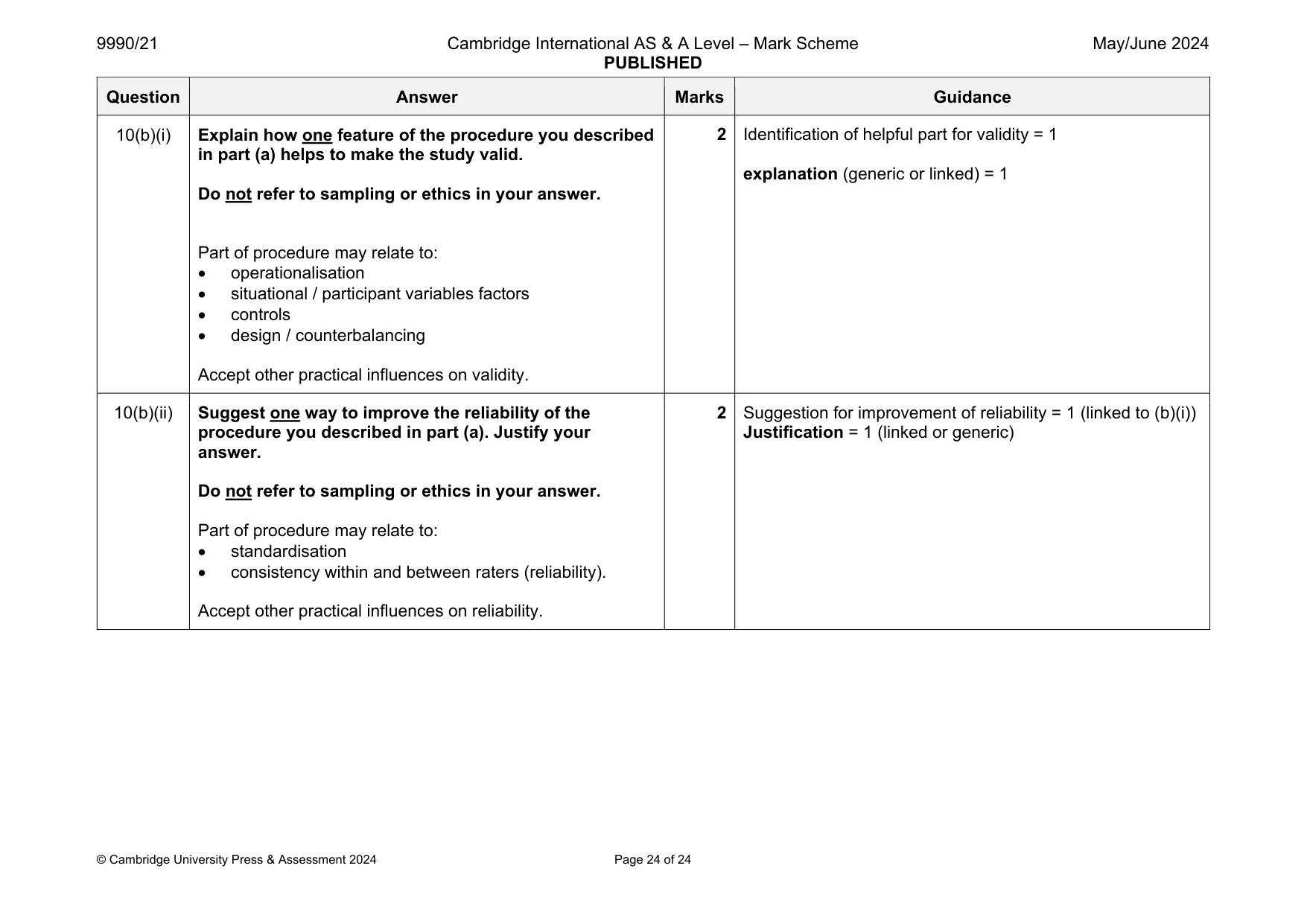
Mark scheme: 10(a) Describe how Mary could conduct a case study of doodling in a boy diagnosed with an autistic spectrum disorder. Do not describe sampling technique or ethical issues / guidelines in your answer. The four required features for this case study are: (a) details about the participant / unit (ASD / male, age, how found, other info e.g. diagnosis, parents, teachers, P background) (b) content of information collected: (e.g. depth / detail: e.g. types of doodles, frequency, e.g. associate with emotions / being with friends/being outdoors, examples of rating scales etc etc.) (c) two or more techniques for data collection (observation, interview him, interview, use rating scales parents/teachers – at least two) (d) analysis / interpretation / triangulation: (description of how data used: qualitative and/or quantitative; triangulation – making sure the sources agree to be confident in the conclusion. Note: this is not about reliability) margin, using one column for each of the four required features. Tick each feature (tick-a, tick-b, tick-c, tick-d) when it appears, then underline the letter ( ) for detail. Use L1, L2, L3, L4, L5 at the end of the response to indicate the level. Use the table below to mark candidate responses to this question. Level The response: Level 5 9–10 marks has all the required features, all with detail, with mostly appropriate terminology. AND clearly applies knowledge of methodology involved in planning this investigation. Level 4 7–8 marks has all the required features, but only some of these with detail, with some appropriate terminology. AND applies knowledge of methodology involved in planning this investigation. Question Answer Marks Guidance 10(a) Level 3 5–6 marks has some of the required features with detail / all of the required features with no detail, and some appropriate terminology. AND applies a basic knowledge of methodology involved in planning this investigation. Level 2 3–4 marks has at least two of the required features, with little appropriate terminology. AND attempts to use knowledge of methodology involved in planning this investigation. Level 1 1–2 marks has one of the required features and uses little appropriate terminology. AND makes a limited attempt to use knowledge of methodology involved in planning this investigation, e.g. may not use the method required by the question. 0 marks No creditable response. Other appropriate responses should also be credited. Question Answer Marks Guidance 10(b)(i) Explain how one feature of the procedure you described in part (a) helps to make the study valid. Do not refer to sampling or ethics in your answer. Part of procedure may relate to: operationalisation situational / participant variables factors controls design / counterbalancing Accept other practical influences on validity. 2 Identification of helpful part for validity = 1 explanation (generic or linked) = 1 10(b)(ii) Suggest one way to improve the reliability of the procedure you described in part (a). Justify your answer. Do not refer to sampling or ethics in your answer. Part of procedure may relate to: standardisation consistency within and between raters (reliability). Accept other practical influences on reliability. 2 Suggestion for improvement of reliability = 1 (linked to (b)(i)) Justification = 1 (linked or generic)
What was in this paper
The subtopics covered by these 10 questions, and how many questions each got. Open one in a new tab to see every Cambridge question on it.
What you needed in this session
Cambridge’s own grade thresholds for 2024 May/June, Paper 2 · Variant 1. A higher threshold means an easier paper — the bar moves with how the cohort did.