Cambridge A Level Psychology (from 2018) 9990 — 2022 May/June Paper 2 · Variant 1
9990/21/M/J/22 · 10 questions · 60 marks · ≈68 min
The question paper and its mark scheme, free to read here and free to download. This is Cambridge’s own paper, exactly as it was sat.
Question paper12 pages


Mark scheme20 pages
Answers below. Sit the paper first if you are practising.
Questions as text
Q1 · From the study by Bandura et al
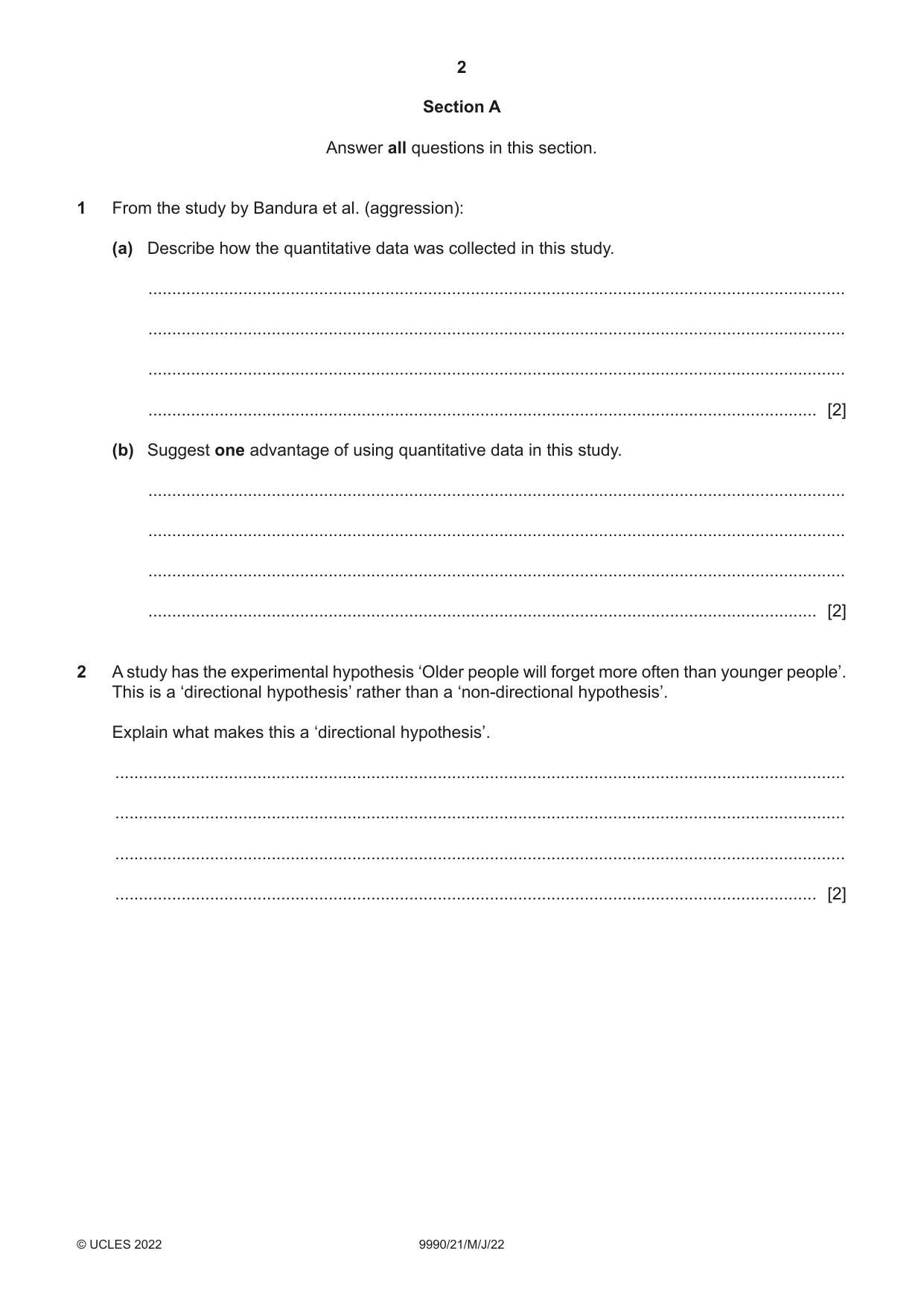
1 From the study by Bandura et al. (aggression): (a) Describe how the quantitative data was collected in this study. ................................................................................................................................................... ................................................................................................................................................... ................................................................................................................................................... ............................................................................................................................................. [2] (b) Suggest one advantage of using quantitative data in this study. ................................................................................................................................................... ................................................................................................................................................... ................................................................................................................................................... ............................................................................................................................................. [2]
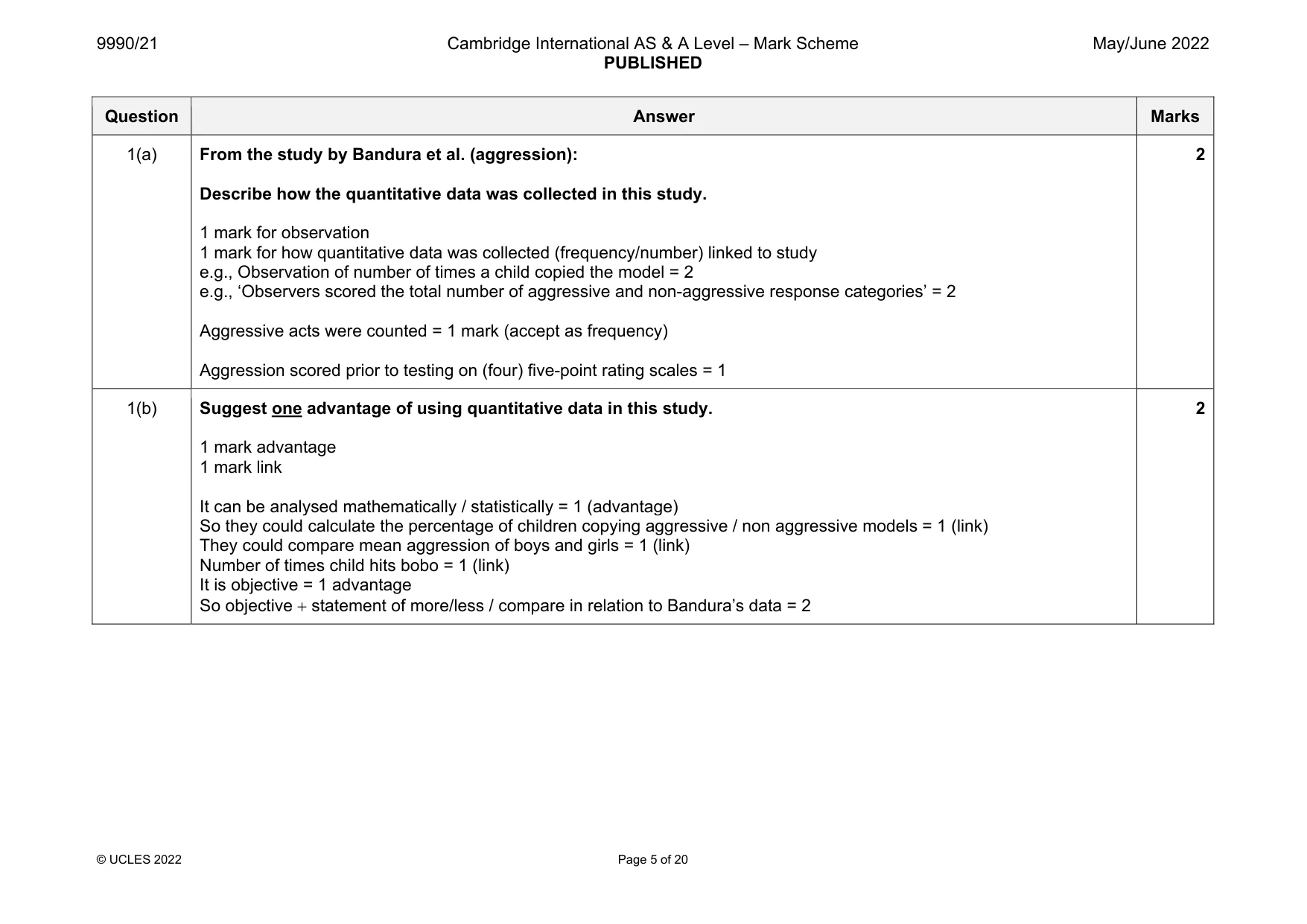
Mark scheme: 1(a) From the study by Bandura et al. (aggression): Describe how the quantitative data was collected in this study. 1 mark for observation 1 mark for how quantitative data was collected (frequency/number) linked to study e.g., Observation of number of times a child copied the model = 2 e.g., ‘Observers scored the total number of aggressive and non-aggressive response categories’ = 2 Aggressive acts were counted = 1 mark (accept as frequency) Aggression scored prior to testing on (four) five-point rating scales = 1 2 1(b) Suggest one advantage of using quantitative data in this study. 1 mark advantage 1 mark link It can be analysed mathematically / statistically = 1 (advantage) So they could calculate the percentage of children copying aggressive / non aggressive models = 1 (link) They could compare mean aggression of boys and girls = 1 (link) Number of times child hits bobo = 1 (link) It is objective = 1 advantage So objective statement of more/less / compare in relation to Bandura’s data = 2 2
Q2 · A study has the experimental hypothesis ‘Older people will forget more often than younger…
2 A study has the experimental hypothesis ‘Older people will forget more often than younger people’. This is a ‘directional hypothesis’ rather than a ‘non-directional hypothesis’. Explain what makes this a ‘directional hypothesis’. .......................................................................................................................................................... .......................................................................................................................................................... .......................................................................................................................................................... .................................................................................................................................................... [2]
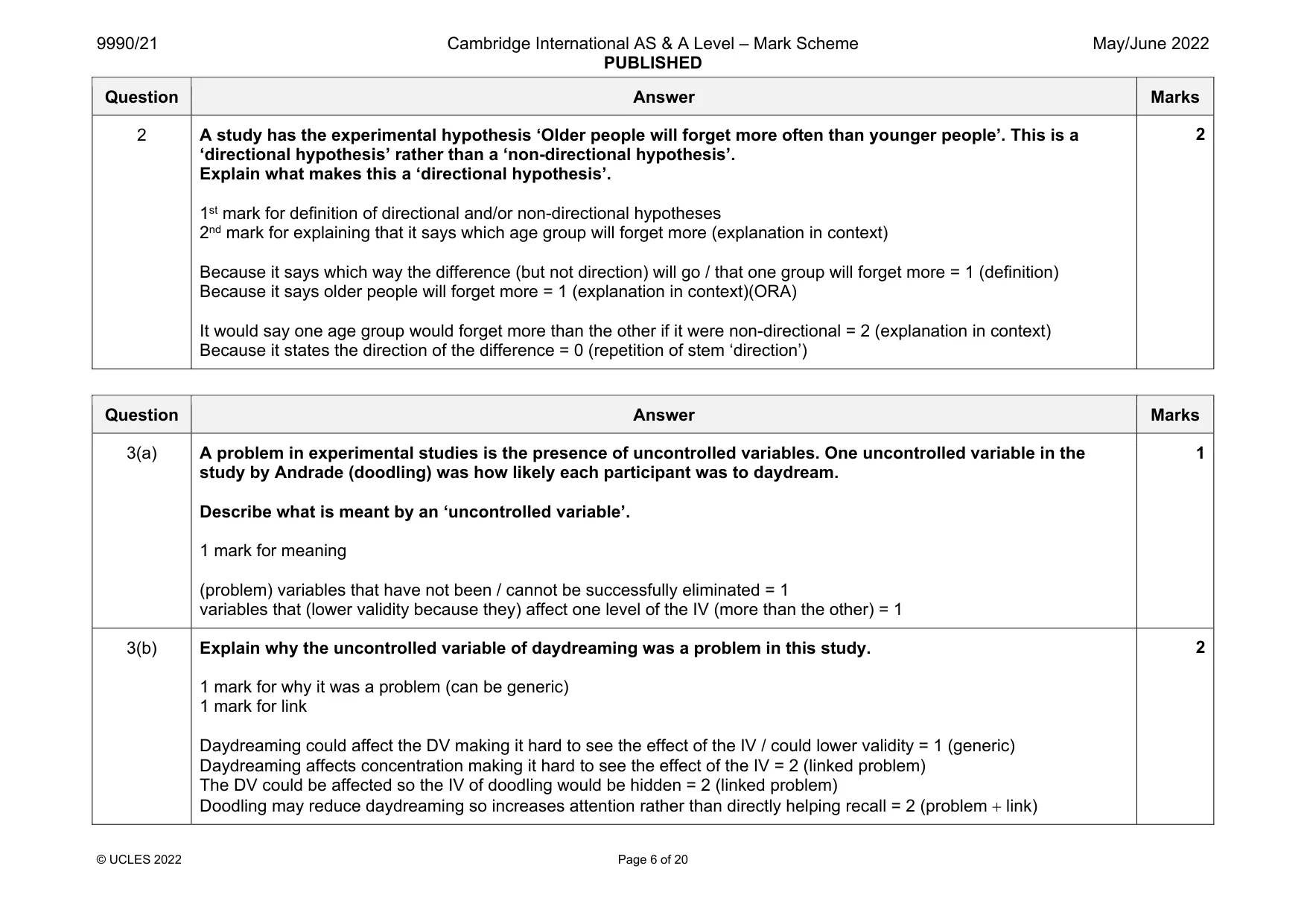
Mark scheme: 2 A study has the experimental hypothesis ‘Older people will forget more often than younger people’. This is a ‘directional hypothesis’ rather than a ‘non-directional hypothesis’. Explain what makes this a ‘directional hypothesis’. 1st mark for definition of directional and/or non-directional hypotheses 2nd mark for explaining that it says which age group will forget more (explanation in context) Because it says which way the difference (but not direction) will go / that one group will forget more = 1 (definition) Because it says older people will forget more = 1 (explanation in context)(ORA) It would say one age group would forget more than the other if it were non-directional = 2 (explanation in context) Because it states the direction of the difference = 0 (repetition of stem ‘direction’)
Q3 · A problem in experimental studies is the presence of uncontrolled variables
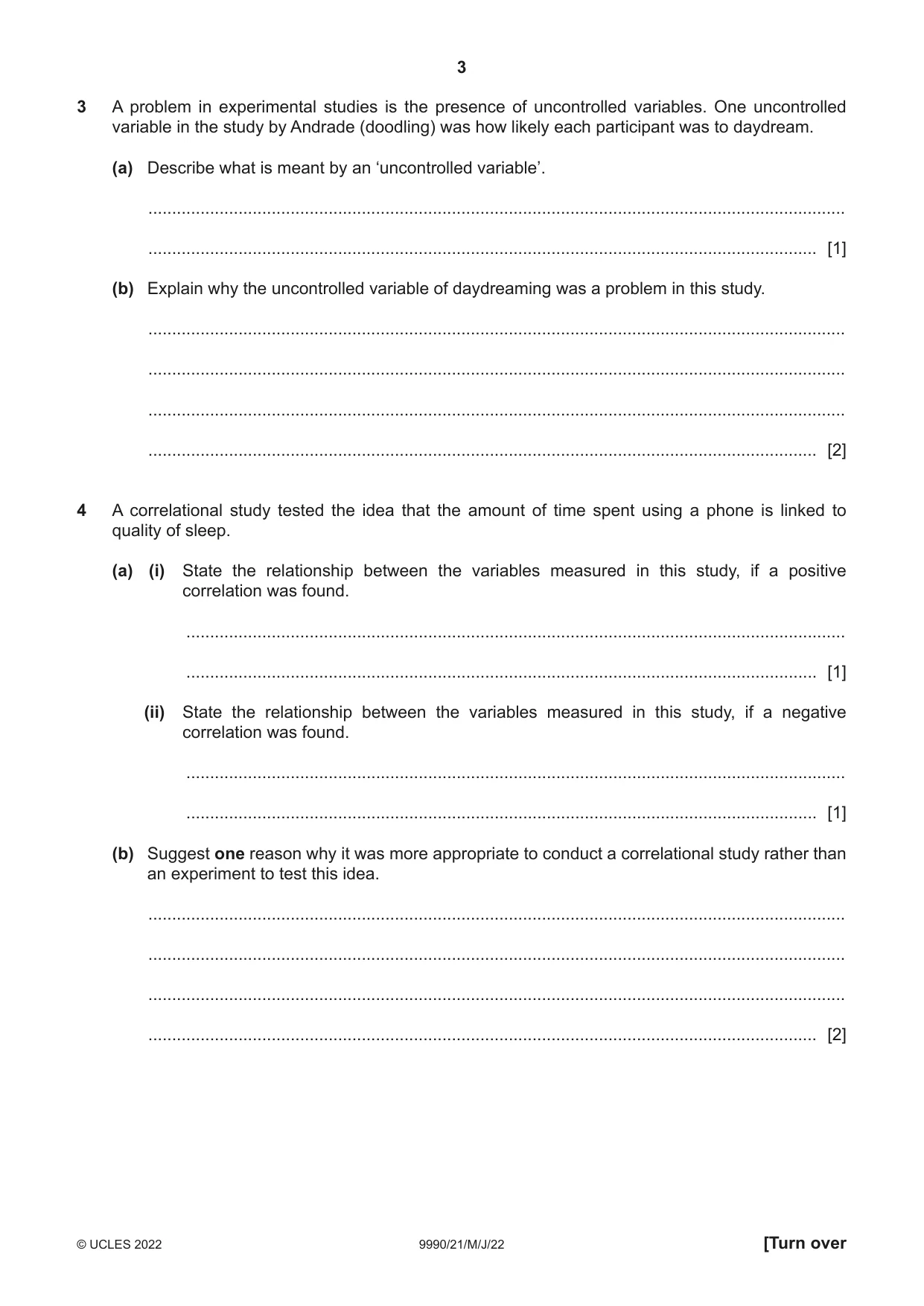
3 A problem in experimental studies is the presence of uncontrolled variables. One uncontrolled variable in the study by Andrade (doodling) was how likely each participant was to daydream. (a) Describe what is meant by an ‘uncontrolled variable’. ................................................................................................................................................... ............................................................................................................................................. [1] (b) Explain why the uncontrolled variable of daydreaming was a problem in this study. ................................................................................................................................................... ................................................................................................................................................... ................................................................................................................................................... ............................................................................................................................................. [2]
Mark scheme: 3(a) A problem in experimental studies is the presence of uncontrolled variables. One uncontrolled variable in the study by Andrade (doodling) was how likely each participant was to daydream. Describe what is meant by an ‘uncontrolled variable’. 1 mark for meaning (problem) variables that have not been / cannot be successfully eliminated = 1 variables that (lower validity because they) affect one level of the IV (more than the other) = 1 3(b) Explain why the uncontrolled variable of daydreaming was a problem in this study. 1 mark for why it was a problem (can be generic) 1 mark for link Daydreaming could affect the DV making it hard to see the effect of the IV / could lower validity = 1 (generic) Daydreaming affects concentration making it hard to see the effect of the IV = 2 (linked problem) The DV could be affected so the IV of doodling would be hidden = 2 (linked problem) Doodling may reduce daydreaming so increases attention rather than directly helping recall = 2 (problem link) 2
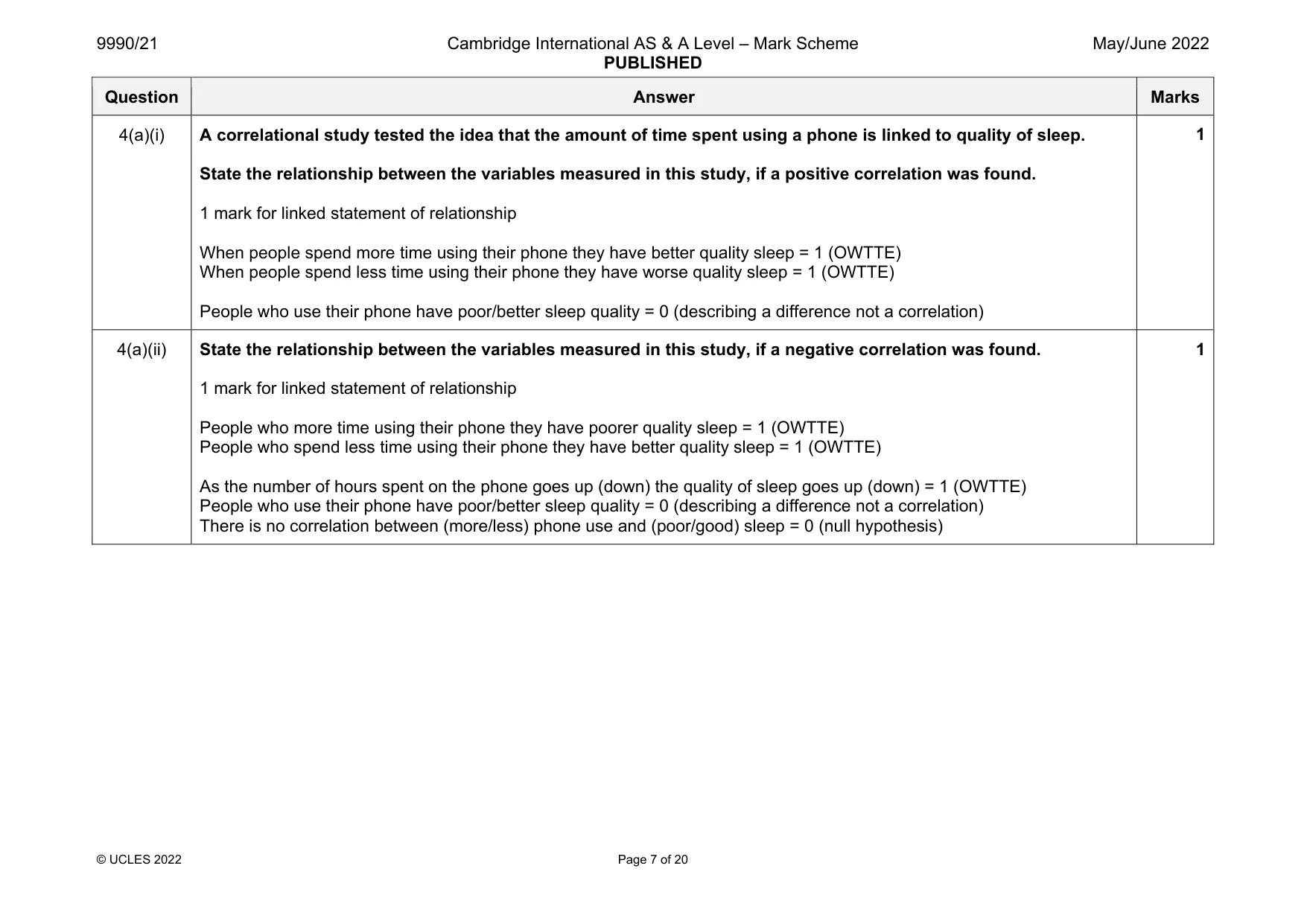
Q4 · A correlational study tested the idea that the amount of time spent using a phone is…
4 A correlational study tested the idea that the amount of time spent using a phone is linked to quality of sleep. (a) (i) State the relationship between the variables measured in this study, if a positive correlation was found. ........................................................................................................................................... ..................................................................................................................................... [1] (ii) State the relationship between the variables measured in this study, if a negative correlation was found. ........................................................................................................................................... ..................................................................................................................................... [1] (b) Suggest one reason why it was more appropriate to conduct a correlational study rather than an experiment to test this idea. ................................................................................................................................................... ................................................................................................................................................... ................................................................................................................................................... ............................................................................................................................................. [2]
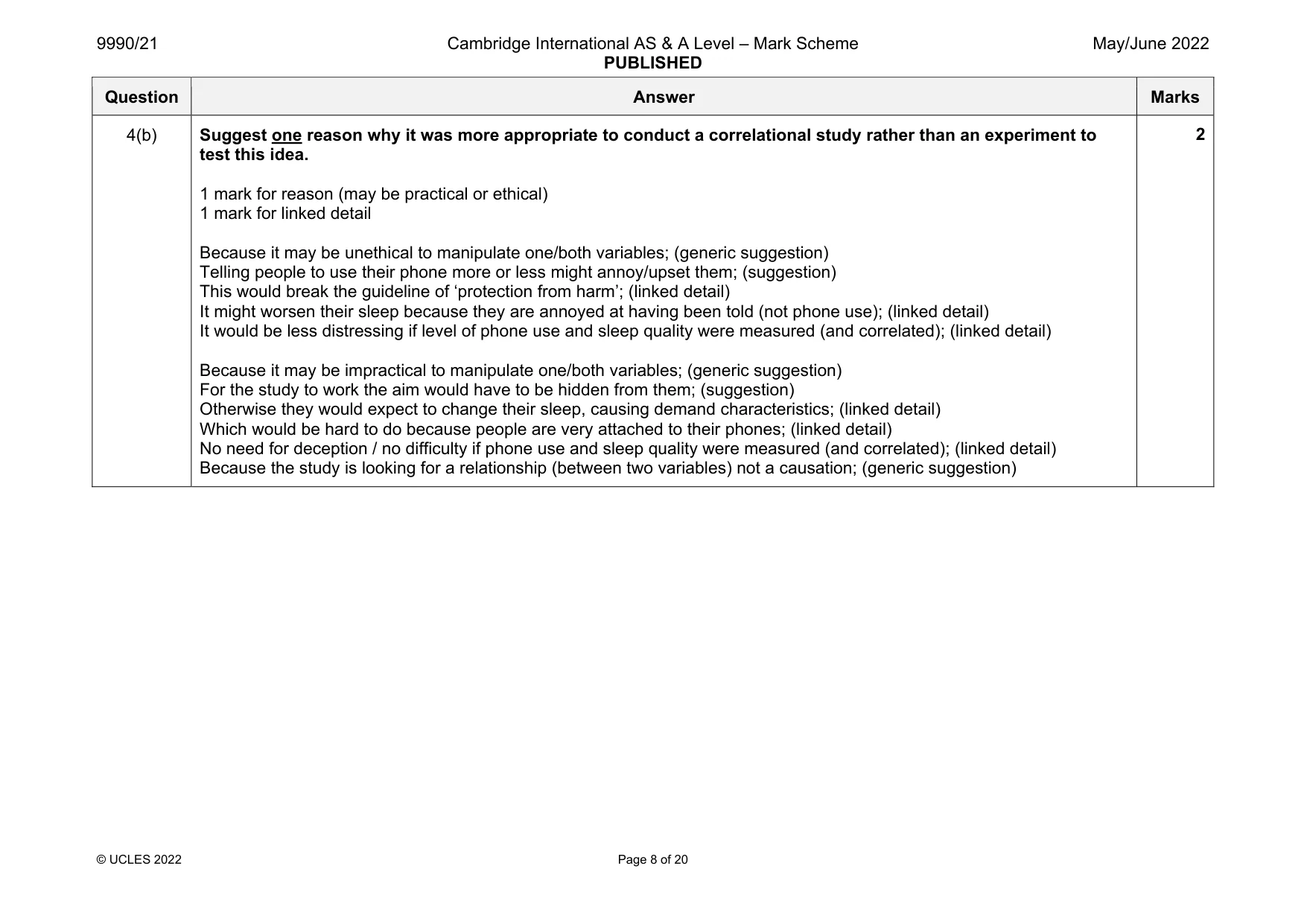
Mark scheme: 4(a)(i) A correlational study tested the idea that the amount of time spent using a phone is linked to quality of sleep. State the relationship between the variables measured in this study, if a positive correlation was found. 1 mark for linked statement of relationship When people spend more time using their phone they have better quality sleep = 1 (OWTTE) When people spend less time using their phone they have worse quality sleep = 1 (OWTTE) People who use their phone have poor/better sleep quality = 0 (describing a difference not a correlation) 4(a)(ii) State the relationship between the variables measured in this study, if a negative correlation was found. 1 mark for linked statement of relationship People who more time using their phone they have poorer quality sleep = 1 (OWTTE) People who spend less time using their phone they have better quality sleep = 1 (OWTTE) As the number of hours spent on the phone goes up (down) the quality of sleep goes up (down) = 1 (OWTTE) People who use their phone have poor/better sleep quality = 0 (describing a difference not a correlation) There is no correlation between (more/less) phone use and (poor/good) sleep = 0 (null hypothesis) 1 Question Answer Marks 4(b) Suggest one reason why it was more appropriate to conduct a correlational study rather than an experiment to test this idea. 1 mark for reason (may be practical or ethical) 1 mark for linked detail Because it may be unethical to manipulate one/both variables; (generic suggestion) Telling people to use their phone more or less might annoy/upset them; (suggestion) This would break the guideline of ‘protection from harm’; (linked detail) It might worsen their sleep because they are annoyed at having been told (not phone use); (linked detail) It would be less distressing if level of phone use and sleep quality were measured (and correlated); (linked detail) Because it may be impractical to manipulate one/both variables; (generic suggestion) For the study to work the aim would have to be hidden from them; (suggestion) Otherwise they would expect to change their sleep, causing demand characteristics; (linked detail) Which would be hard to do because people are very attached to their phones; (linked detail) No need for deception / no difficulty if phone use and sleep quality were measured (and correlated); (linked detail) Because the study is looking for a relationship (between two variables) not a causation; (generic suggestion) 2
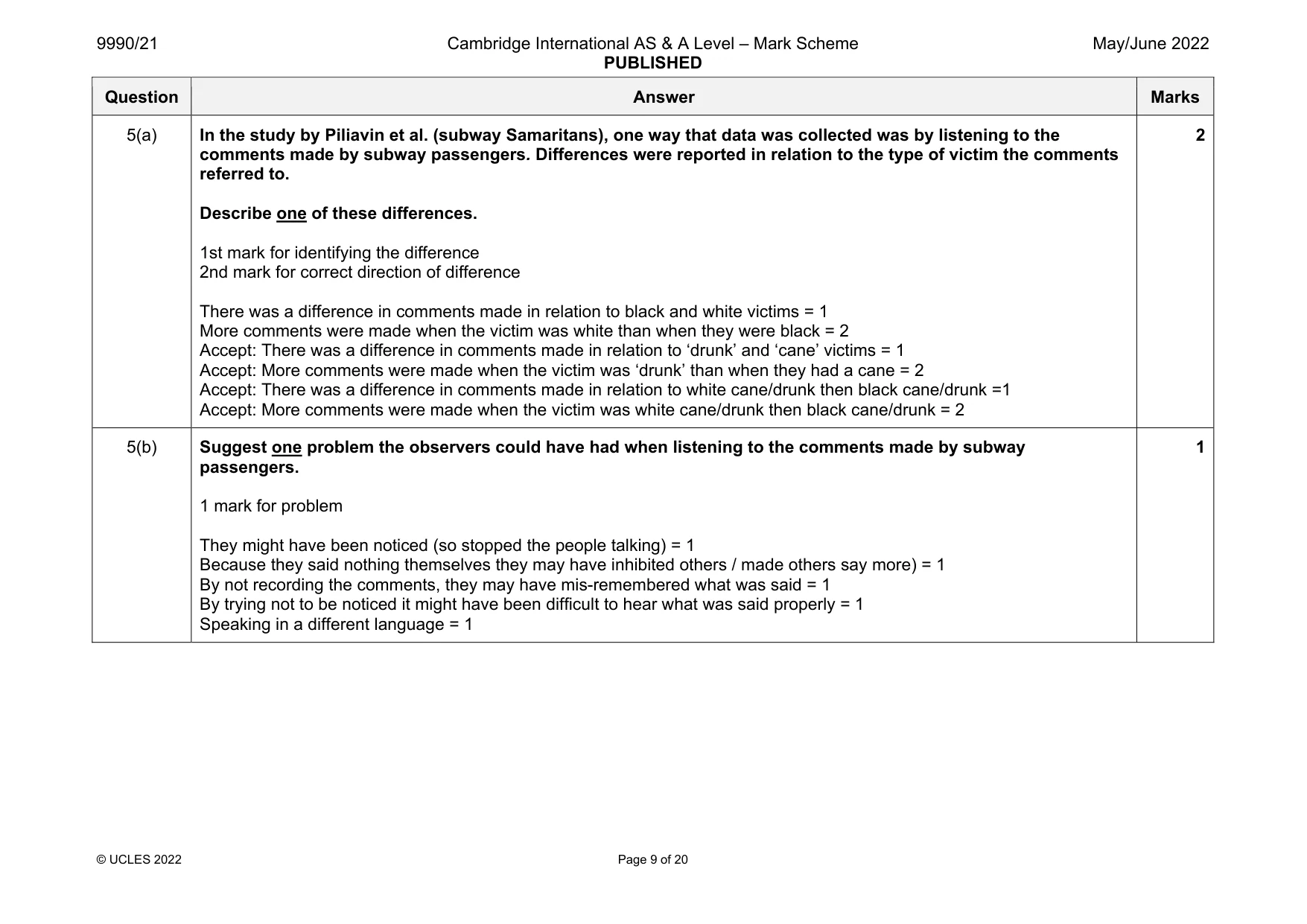
Q5 · In the study by Piliavin et al
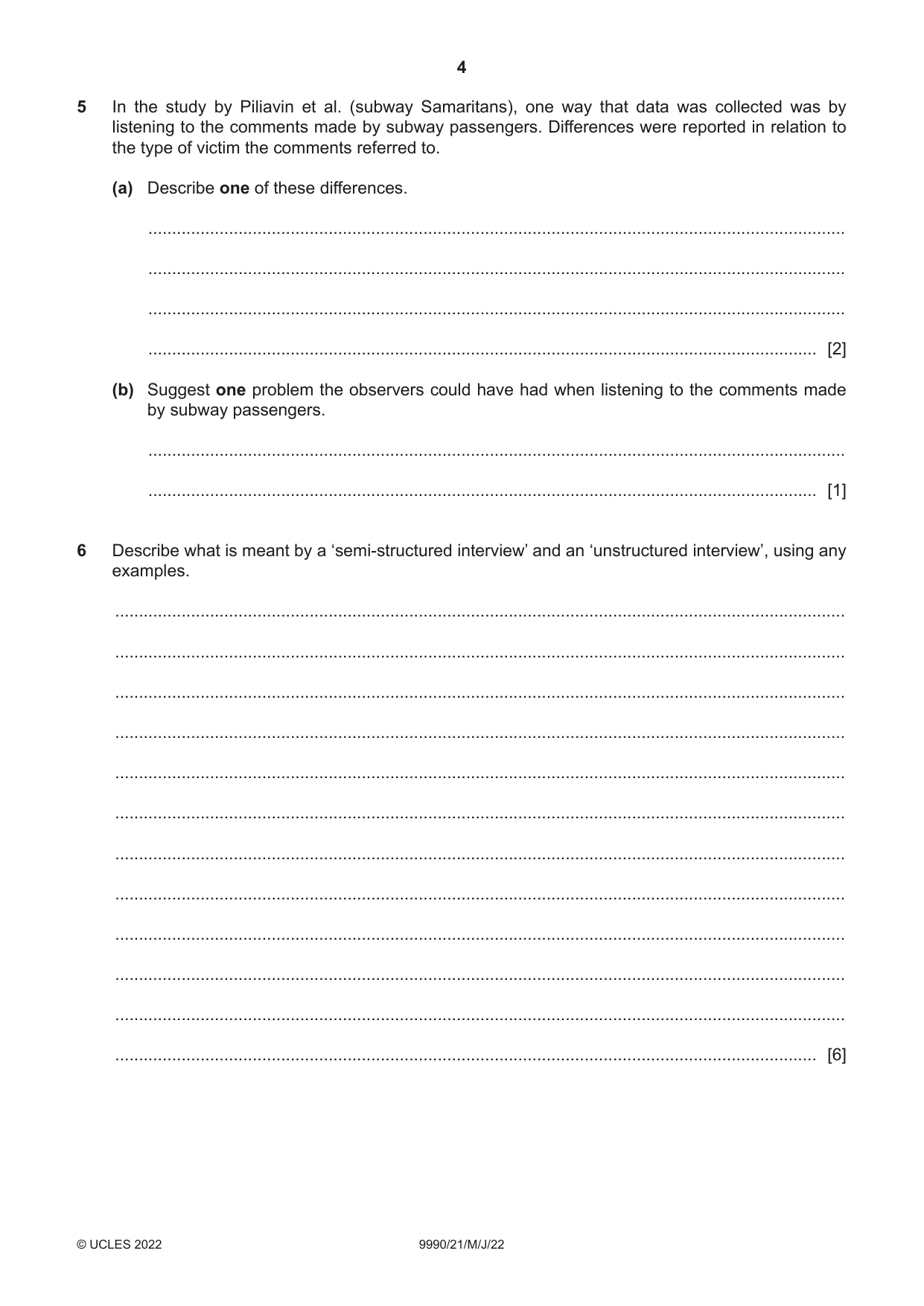
5 In the study by Piliavin et al. (subway Samaritans), one way that data was collected was by listening to the comments made by subway passengers. Differences were reported in relation to the type of victim the comments referred to. (a) Describe one of these differences. ................................................................................................................................................... ................................................................................................................................................... ................................................................................................................................................... ............................................................................................................................................. [2] (b) Suggest one problem the observers could have had when listening to the comments made by subway passengers. ................................................................................................................................................... ............................................................................................................................................. [1]
Mark scheme: 5(a) In the study by Piliavin et al. (subway Samaritans), one way that data was collected was by listening to the comments made by subway passengers. Differences were reported in relation to the type of victim the comments referred to. Describe one of these differences. 1st mark for identifying the difference 2nd mark for correct direction of difference There was a difference in comments made in relation to black and white victims = 1 More comments were made when the victim was white than when they were black = 2 Accept: There was a difference in comments made in relation to ‘drunk’ and ‘cane’ victims = 1 Accept: More comments were made when the victim was ‘drunk’ than when they had a cane = 2 Accept: There was a difference in comments made in relation to white cane/drunk then black cane/drunk =1 Accept: More comments were made when the victim was white cane/drunk then black cane/drunk = 2 2 5(b) Suggest one problem the observers could have had when listening to the comments made by subway passengers. 1 mark for problem They might have been noticed (so stopped the people talking) = 1 Because they said nothing themselves they may have inhibited others / made others say more) = 1 By not recording the comments, they may have mis-remembered what was said = 1 By trying not to be noticed it might have been difficult to hear what was said properly = 1 Speaking in a different language = 1 1
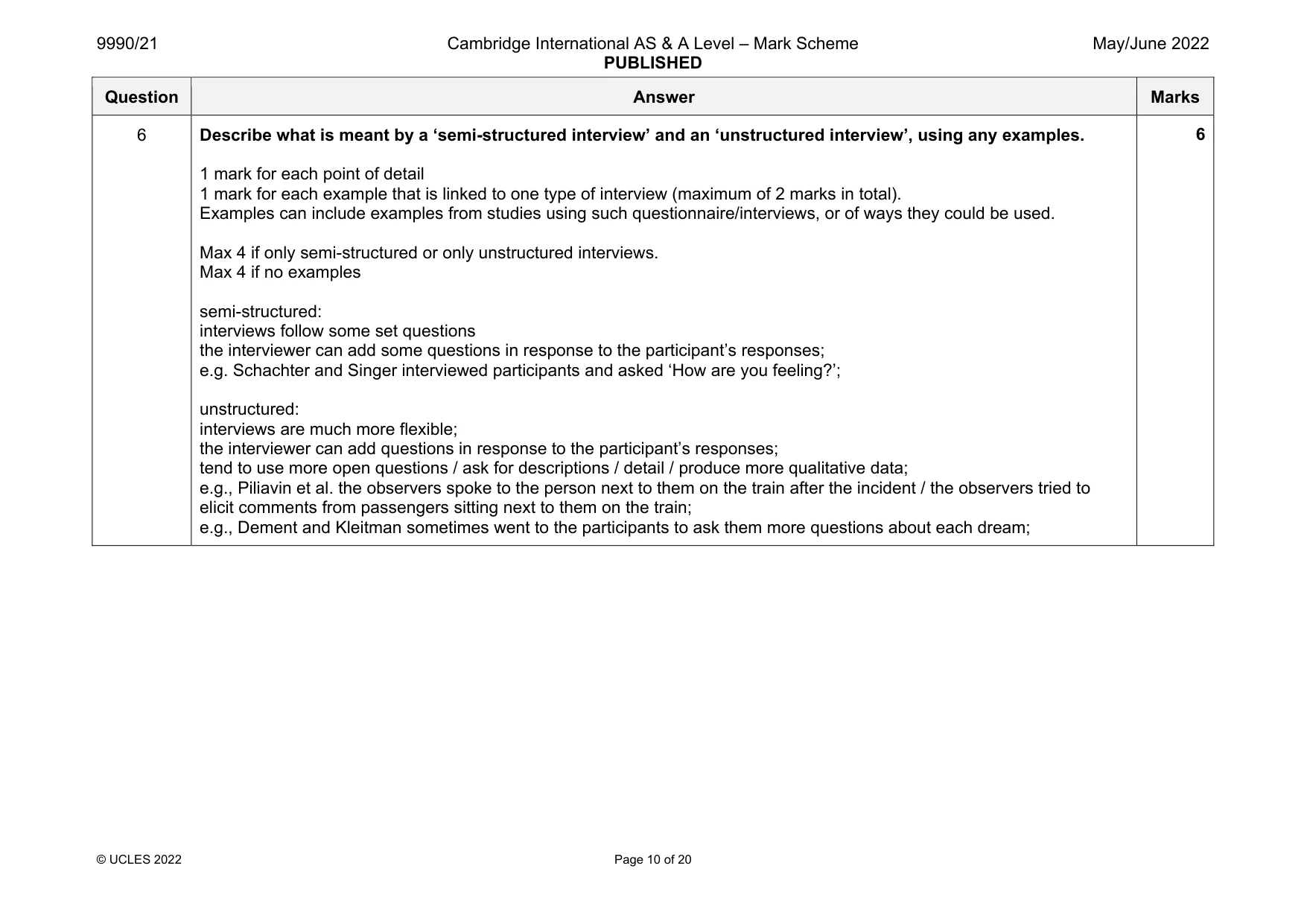
Q6 · Describe what is meant by a ‘semi-structured interview’ and an ‘unstructured interview’…
6 Describe what is meant by a ‘semi-structured interview’ and an ‘unstructured interview’, using any examples. .......................................................................................................................................................... .......................................................................................................................................................... .......................................................................................................................................................... .......................................................................................................................................................... .......................................................................................................................................................... .......................................................................................................................................................... .......................................................................................................................................................... .......................................................................................................................................................... .......................................................................................................................................................... .......................................................................................................................................................... .......................................................................................................................................................... .................................................................................................................................................... [6]
Mark scheme: 6 Describe what is meant by a ‘semi-structured interview’ and an ‘unstructured interview’, using any examples. 1 mark for each point of detail 1 mark for each example that is linked to one type of interview (maximum of 2 marks in total). Examples can include examples from studies using such questionnaire/interviews, or of ways they could be used. Max 4 if only semi-structured or only unstructured interviews. Max 4 if no examples semi-structured: interviews follow some set questions the interviewer can add some questions in response to the participant’s responses; e.g. Schachter and Singer interviewed participants and asked ‘How are you feeling?’; unstructured: interviews are much more flexible; the interviewer can add questions in response to the participant’s responses; tend to use more open questions / ask for descriptions / detail / produce more qualitative data; e.g., Piliavin et al. the observers spoke to the person next to them on the train after the incident / the observers tried to elicit comments from passengers sitting next to them on the train; e.g., Dement and Kleitman sometimes went to the participants to ask them more questions about each dream;
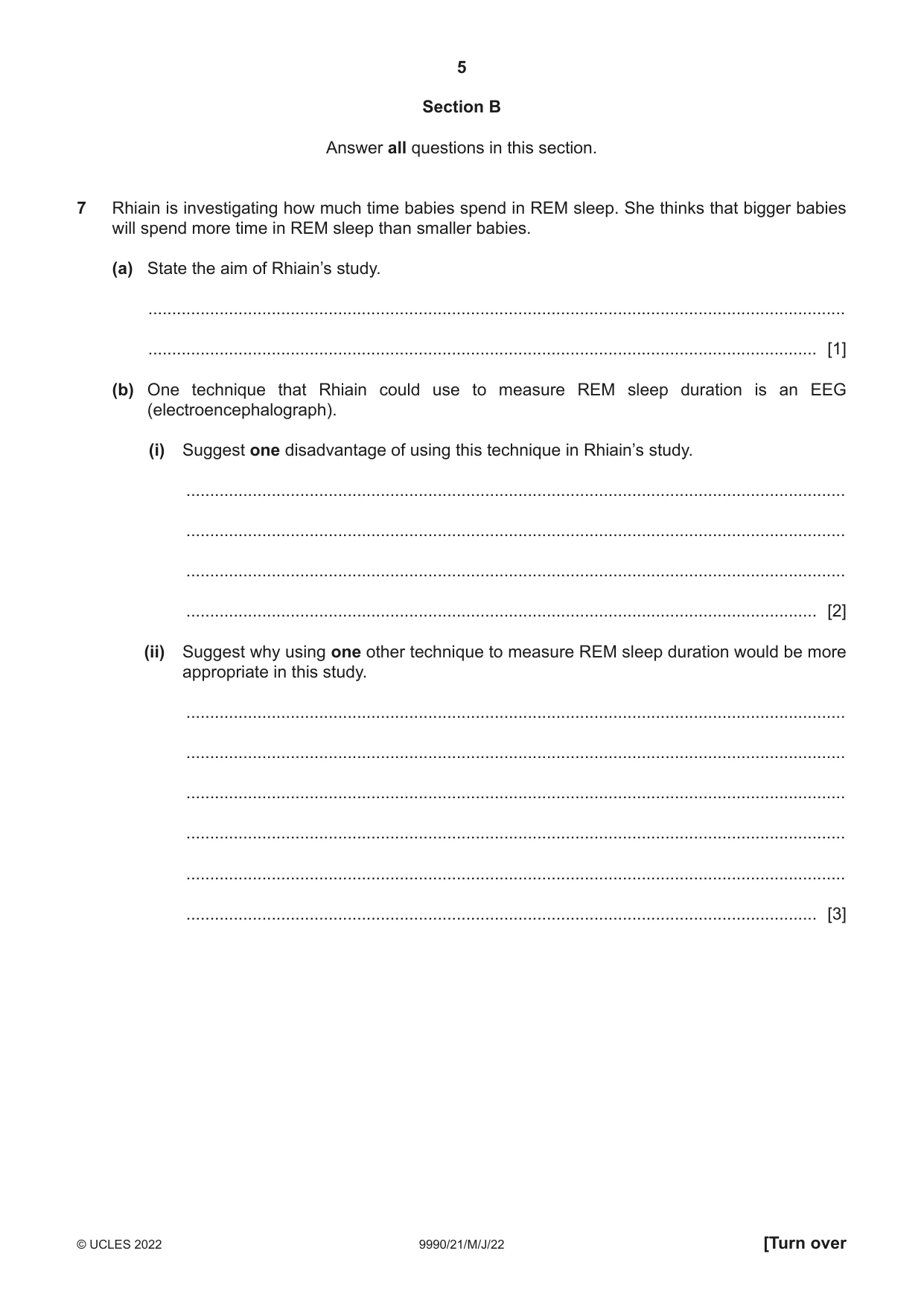
Q7 · Rhiain is investigating how much time babies spend in REM sleep
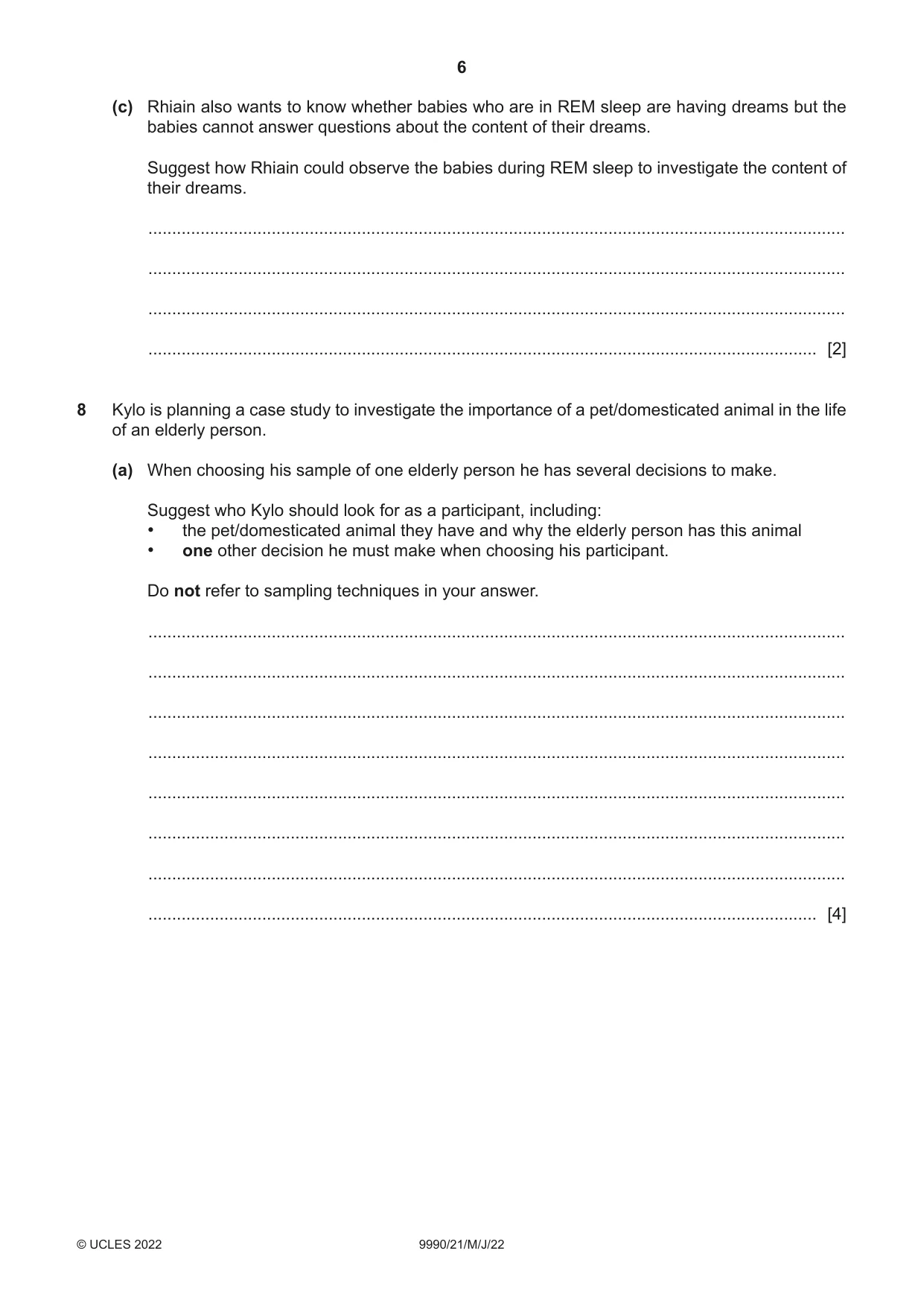
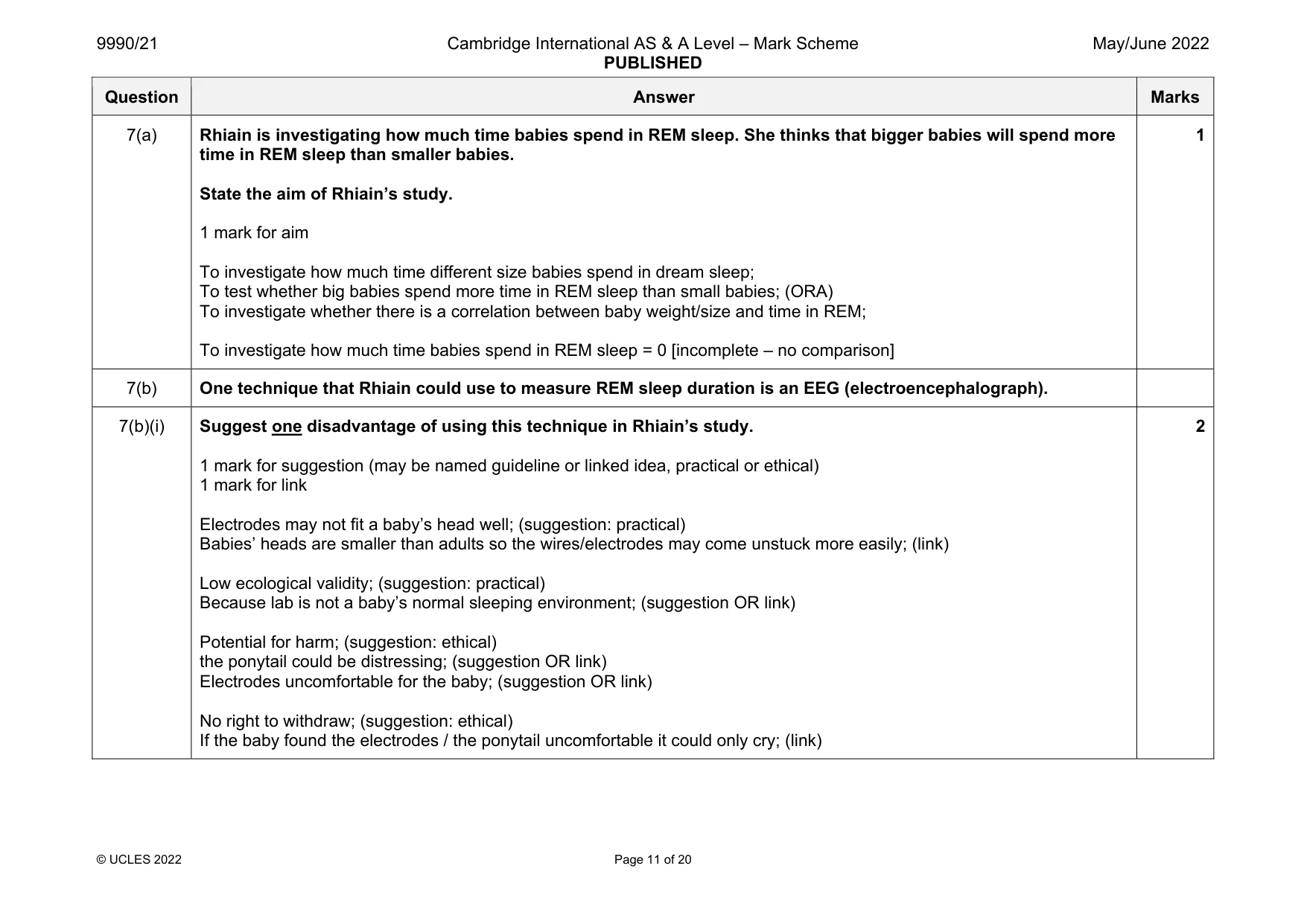
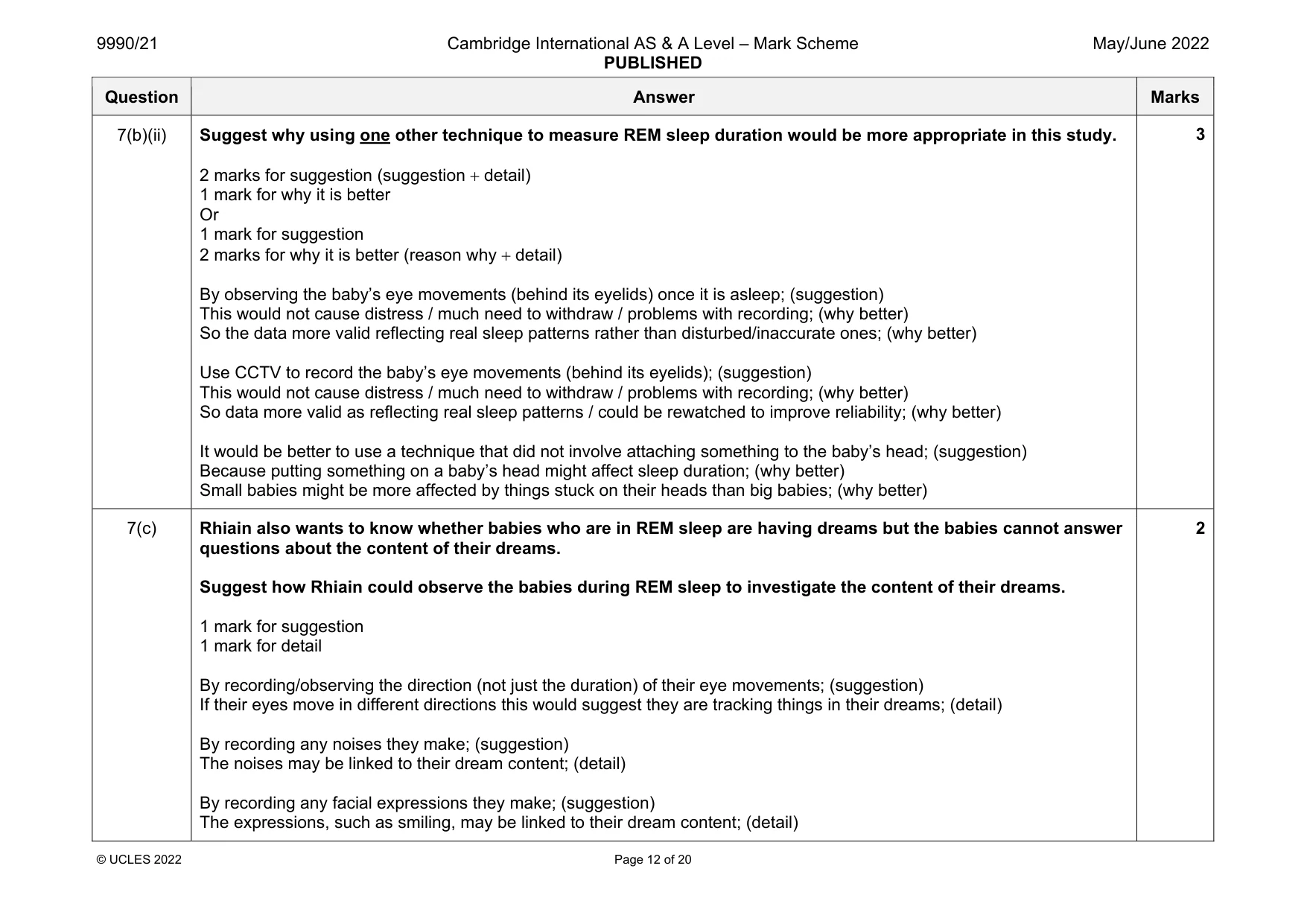
7 Rhiain is investigating how much time babies spend in REM sleep. She thinks that bigger babies will spend more time in REM sleep than smaller babies. (a) State the aim of Rhiain’s study. ................................................................................................................................................... ............................................................................................................................................. [1] (b) One technique that Rhiain could use to measure REM sleep duration is an EEG (electroencephalograph). (i) Suggest one disadvantage of using this technique in Rhiain’s study. ........................................................................................................................................... ........................................................................................................................................... ........................................................................................................................................... ..................................................................................................................................... [2] (ii) Suggest why using one other technique to measure REM sleep duration would be more appropriate in this study. ........................................................................................................................................... ........................................................................................................................................... ........................................................................................................................................... ........................................................................................................................................... ........................................................................................................................................... ..................................................................................................................................... [3] (c) Rhiain also wants to know whether babies who are in REM sleep are having dreams but the babies cannot answer questions about the content of their dreams. Suggest how Rhiain could observe the babies during REM sleep to investigate the content of their dreams. ................................................................................................................................................... ................................................................................................................................................... ................................................................................................................................................... ............................................................................................................................................. [2]
Mark scheme: 7(a) Rhiain is investigating how much time babies spend in REM sleep. She thinks that bigger babies will spend more time in REM sleep than smaller babies. State the aim of Rhiain’s study. 1 mark for aim To investigate how much time different size babies spend in dream sleep; To test whether big babies spend more time in REM sleep than small babies; (ORA) To investigate whether there is a correlation between baby weight/size and time in REM; To investigate how much time babies spend in REM sleep = 0 [incomplete – no comparison] 1 7(b) One technique that Rhiain could use to measure REM sleep duration is an EEG (electroencephalograph). 7(b)(i) Suggest one disadvantage of using this technique in Rhiain’s study. 1 mark for suggestion (may be named guideline or linked idea, practical or ethical) 1 mark for link Electrodes may not fit a baby’s head well; (suggestion: practical) Babies’ heads are smaller than adults so the wires/electrodes may come unstuck more easily; (link) Low ecological validity; (suggestion: practical) Because lab is not a baby’s normal sleeping environment; (suggestion OR link) Potential for harm; (suggestion: ethical) the ponytail could be distressing; (suggestion OR link) Electrodes uncomfortable for the baby; (suggestion OR link) No right to withdraw; (suggestion: ethical) If the baby found the electrodes / the ponytail uncomfortable it could only cry; (link) 2 Question Answer Marks 7(b)(ii) Suggest why using one other technique to measure REM sleep duration would be more appropriate in this study. 2 marks for suggestion (suggestion detail) 1 mark for why it is better Or 1 mark for suggestion 2 marks for why it is better (reason why detail) By observing the baby’s eye movements (behind its eyelids) once it is asleep; (suggestion) This would not cause distress / much need to withdraw / problems with recording; (why better) So the data more valid reflecting real sleep patterns rather than disturbed/inaccurate ones; (why better) Use CCTV to record the baby’s eye movements (behind its eyelids); (suggestion) This would not cause distress / much need to withdraw / problems with recording; (why better) So data more valid as reflecting real sleep patterns / could be rewatched to improve reliability; (why better) It would be better to use a technique that did not involve attaching something to the baby’s head; (suggestion) Because putting something on a baby’s head might affect sleep duration; (why better) Small babies might be more affected by things stuck on their heads than big babies; (why better) 3 7(c) Rhiain also wants to know whether babies who are in REM sleep are having dreams but the babies cannot answer questions about the content of their dreams. Suggest how Rhiain could observe the babies during REM sleep to investigate the content of their dreams. 1 mark for suggestion 1 mark for detail By recording/observing the direction (not just the duration) of their eye movements; (suggestion) If their eyes move in different directions this would suggest they are tracking things in their dreams; (detail) By recording any noises they make; (suggestion) The noises may be linked to their dream content; (detail) By recording any facial expressions they make; (suggestion) The expressions, such as smiling, may be linked to their dream content; (detail) 2
Q8 · Kylo is planning a case study to investigate the importance of a pet/domesticated animal…
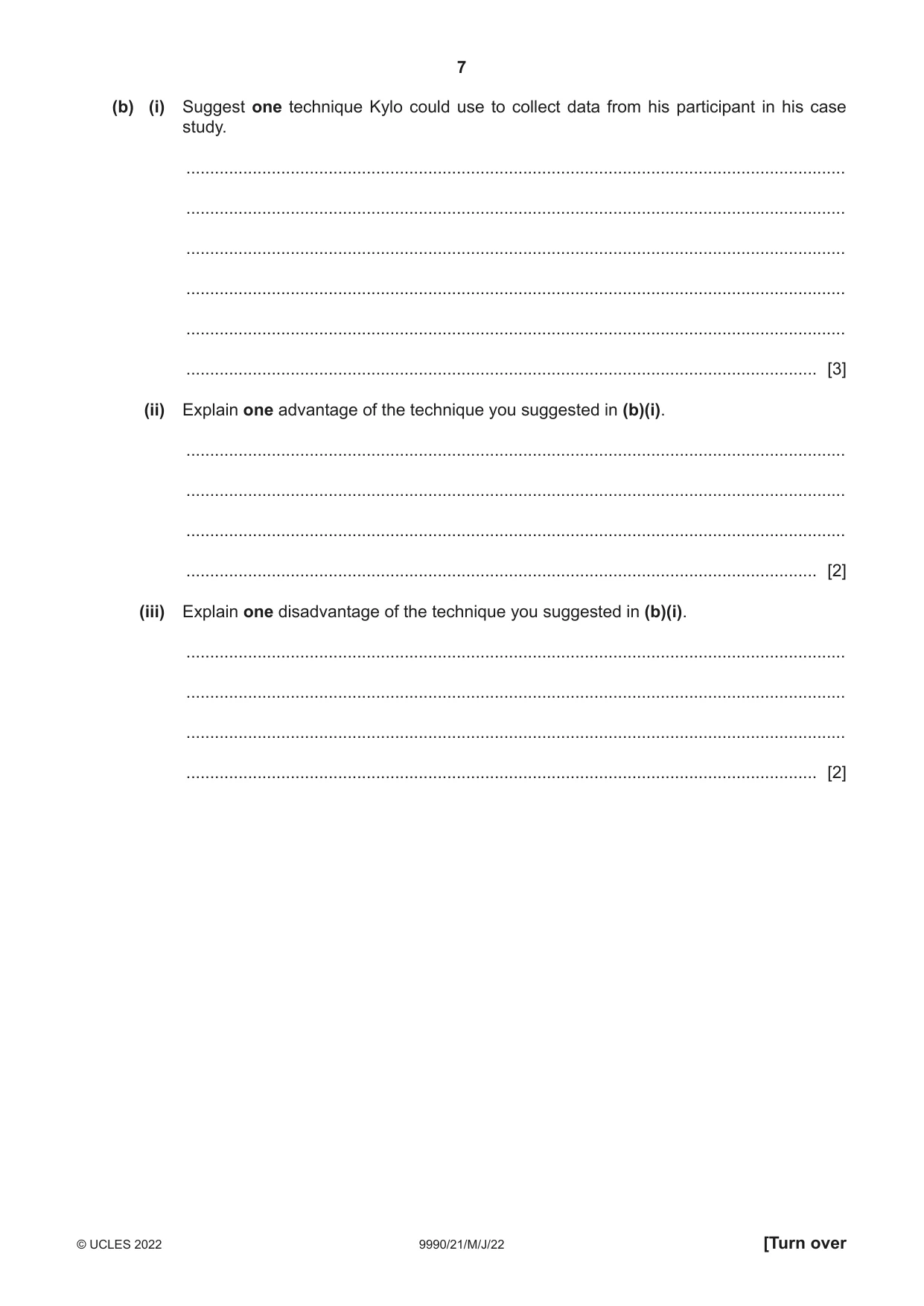
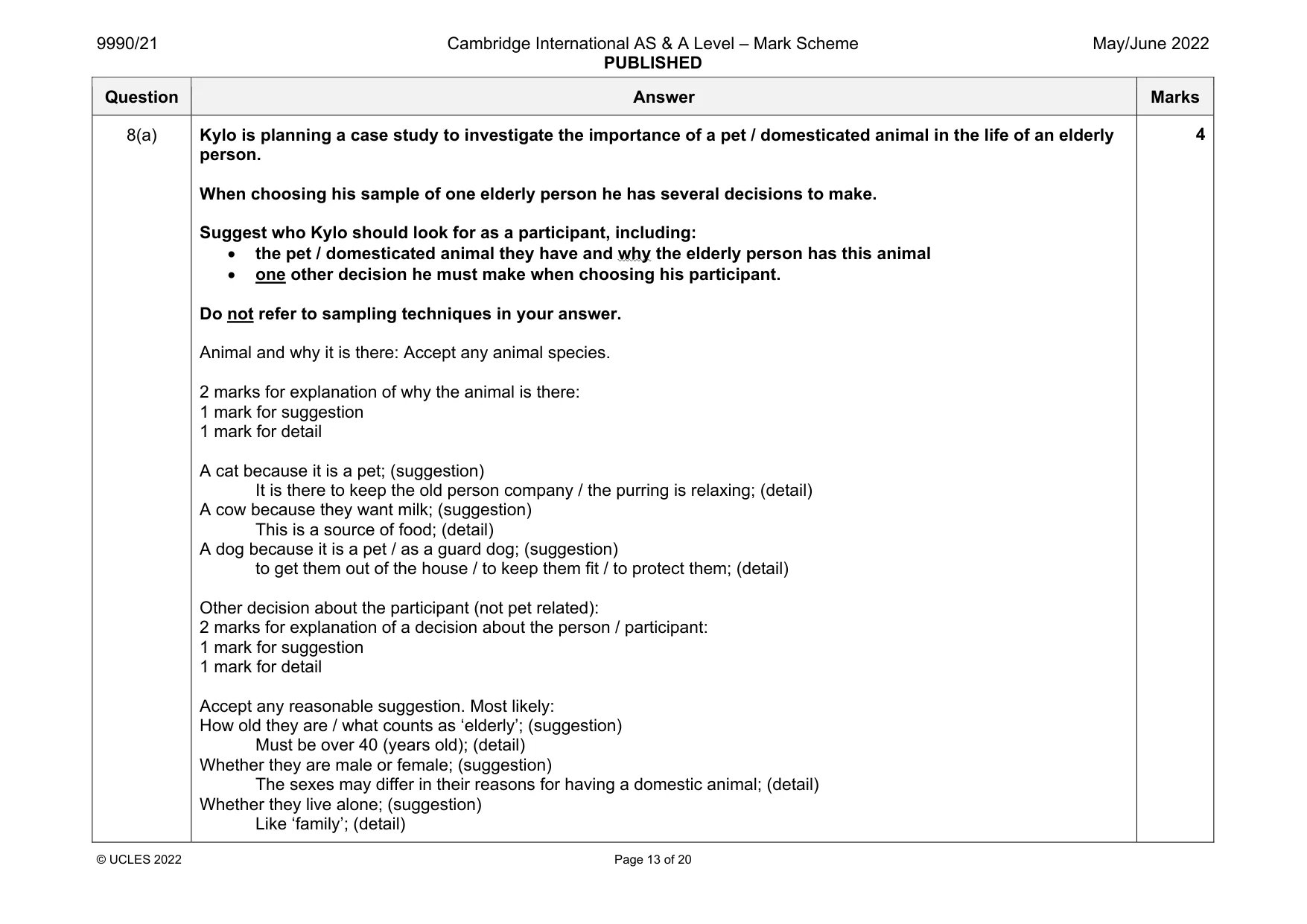
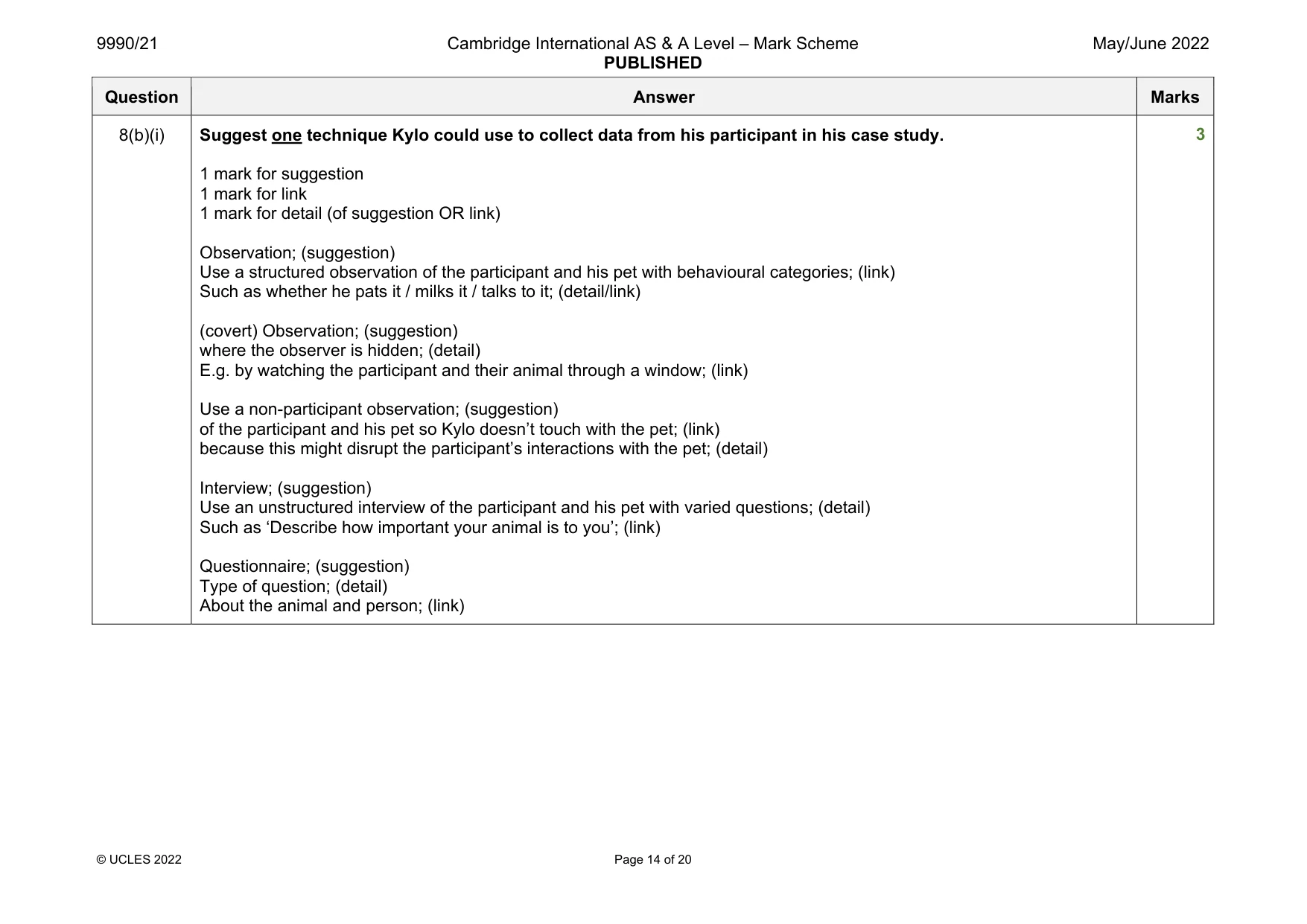
8 Kylo is planning a case study to investigate the importance of a pet/domesticated animal in the life of an elderly person. (a) When choosing his sample of one elderly person he has several decisions to make. Suggest who Kylo should look for as a participant, including: • the pet/domesticated animal they have and why the elderly person has this animal • one other decision he must make when choosing his participant. Do not refer to sampling techniques in your answer. ................................................................................................................................................... ................................................................................................................................................... ................................................................................................................................................... ................................................................................................................................................... ................................................................................................................................................... ................................................................................................................................................... ................................................................................................................................................... ............................................................................................................................................. [4] (b) (i) Suggest one technique Kylo could use to collect data from his participant in his case study. ........................................................................................................................................... ........................................................................................................................................... ........................................................................................................................................... ........................................................................................................................................... ........................................................................................................................................... ..................................................................................................................................... [3] (ii) Explain one advantage of the technique you suggested in (b)(i). ........................................................................................................................................... ........................................................................................................................................... ........................................................................................................................................... ..................................................................................................................................... [2] (iii) Explain one disadvantage of the technique you suggested in (b)(i). ........................................................................................................................................... ........................................................................................................................................... ........................................................................................................................................... ..................................................................................................................................... [2]
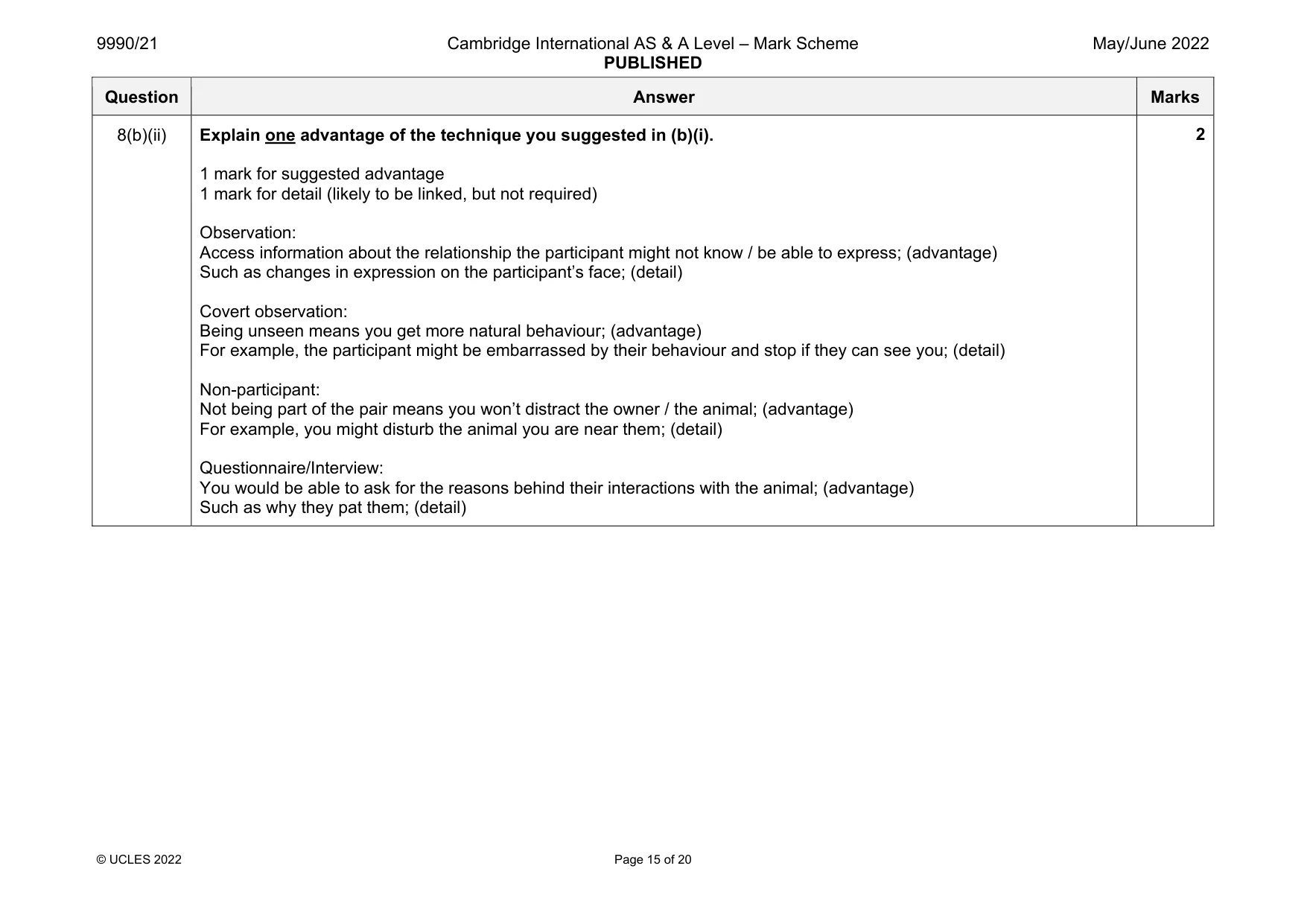
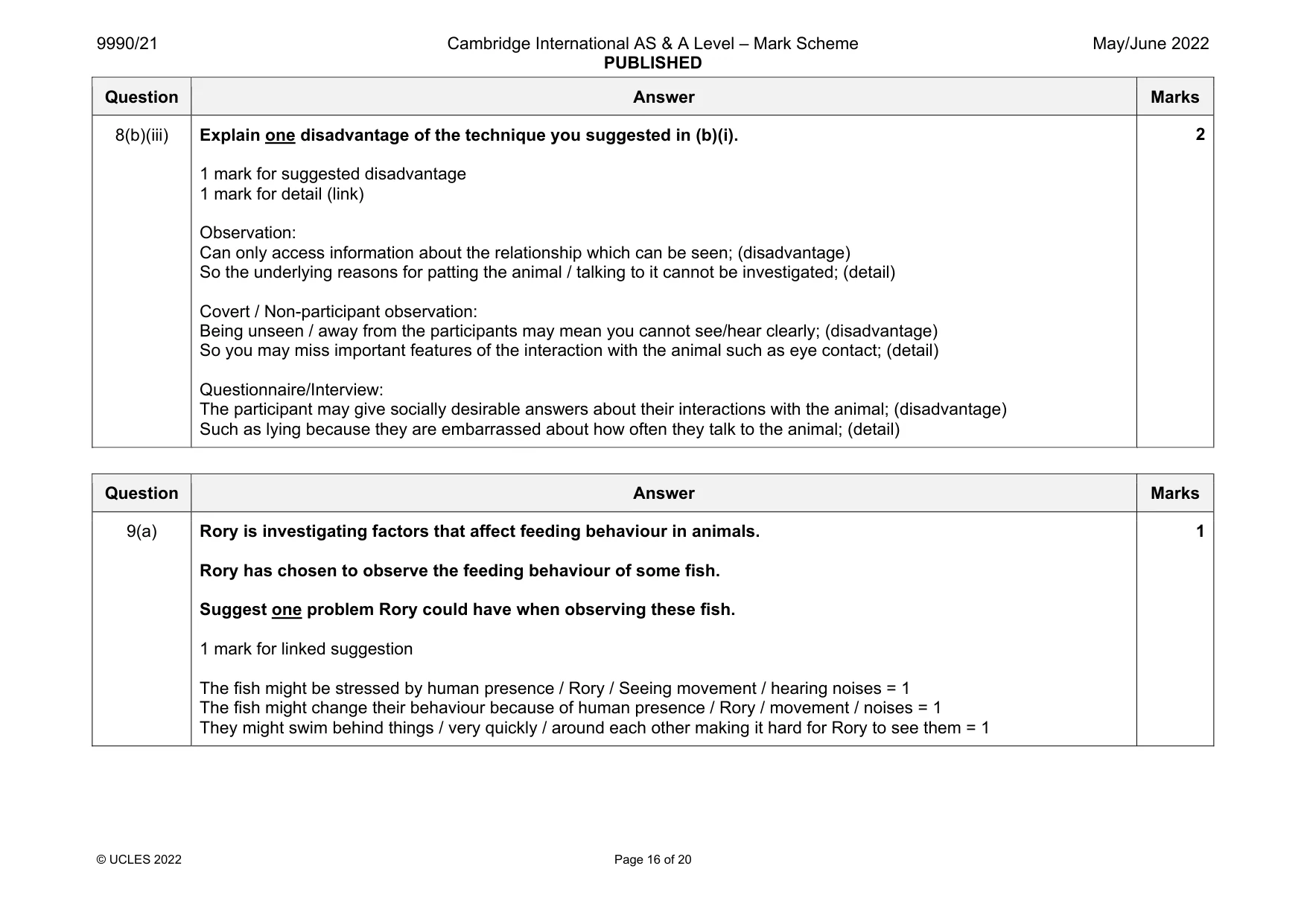
Mark scheme: 8(a) Kylo is planning a case study to investigate the importance of a pet / domesticated animal in the life of an elderly person. When choosing his sample of one elderly person he has several decisions to make. Suggest who Kylo should look for as a participant, including: the pet / domesticated animal they have and why the elderly person has this animal one other decision he must make when choosing his participant. Do not refer to sampling techniques in your answer. Animal and why it is there: Accept any animal species. 2 marks for explanation of why the animal is there: 1 mark for suggestion 1 mark for detail A cat because it is a pet; (suggestion) It is there to keep the old person company / the purring is relaxing; (detail) A cow because they want milk; (suggestion) This is a source of food; (detail) A dog because it is a pet / as a guard dog; (suggestion) to get them out of the house / to keep them fit / to protect them; (detail) Other decision about the participant (not pet related): 2 marks for explanation of a decision about the person / participant: 1 mark for suggestion 1 mark for detail Accept any reasonable suggestion. Most likely: How old they are / what counts as ‘elderly’; (suggestion) Must be over 40 (years old); (detail) Whether they are male or female; (suggestion) The sexes may differ in their reasons for having a domestic animal; (detail) Whether they live alone; (suggestion) Like ‘family’; (detail) Question Answer Marks 8(b)(i) Suggest one technique Kylo could use to collect data from his participant in his case study. 1 mark for suggestion 1 mark for link 1 mark for detail (of suggestion OR link) Observation; (suggestion) Use a structured observation of the participant and his pet with behavioural categories; (link) Such as whether he pats it / milks it / talks to it; (detail/link) (covert) Observation; (suggestion) where the observer is hidden; (detail) E.g. by watching the participant and their animal through a window; (link) Use a non-participant observation; (suggestion) of the participant and his pet so Kylo doesn’t touch with the pet; (link) because this might disrupt the participant’s interactions with the pet; (detail) Interview; (suggestion) Use an unstructured interview of the participant and his pet with varied questions; (detail) Such as ‘Describe how important your animal is to you’; (link) Questionnaire; (suggestion) Type of question; (detail) About the animal and person; (link) 3 Question Answer Marks 8(b)(ii) Explain one advantage of the technique you suggested in (b)(i). 1 mark for suggested advantage 1 mark for detail (likely to be linked, but not required) Observation: Access information about the relationship the participant might not know / be able to express; (advantage) Such as changes in expression on the participant’s face; (detail) Covert observation: Being unseen means you get more natural behaviour; (advantage) For example, the participant might be embarrassed by their behaviour and stop if they can see you; (detail) Non-participant: Not being part of the pair means you won’t distract the owner / the animal; (advantage) For example, you might disturb the animal you are near them; (detail) Questionnaire/Interview: You would be able to ask for the reasons behind their interactions with the animal; (advantage) Such as why they pat them; (detail) 2 Question Answer Marks 8(b)(iii) Explain one disadvantage of the technique you suggested in (b)(i). 1 mark for suggested disadvantage 1 mark for detail (link) Observation: Can only access information about the relationship which can be seen; (disadvantage) So the underlying reasons for patting the animal / talking to it cannot be investigated; (detail) Covert / Non-participant observation: Being unseen / away from the participants may mean you cannot see/hear clearly; (disadvantage) So you may miss important features of the interaction with the animal such as eye contact; (detail) Questionnaire/Interview: The participant may give socially desirable answers about their interactions with the animal; (disadvantage) Such as lying because they are embarrassed about how often they talk to the animal; (detail) 2
Q9 · Rory is investigating factors that affect feeding behaviour in animals
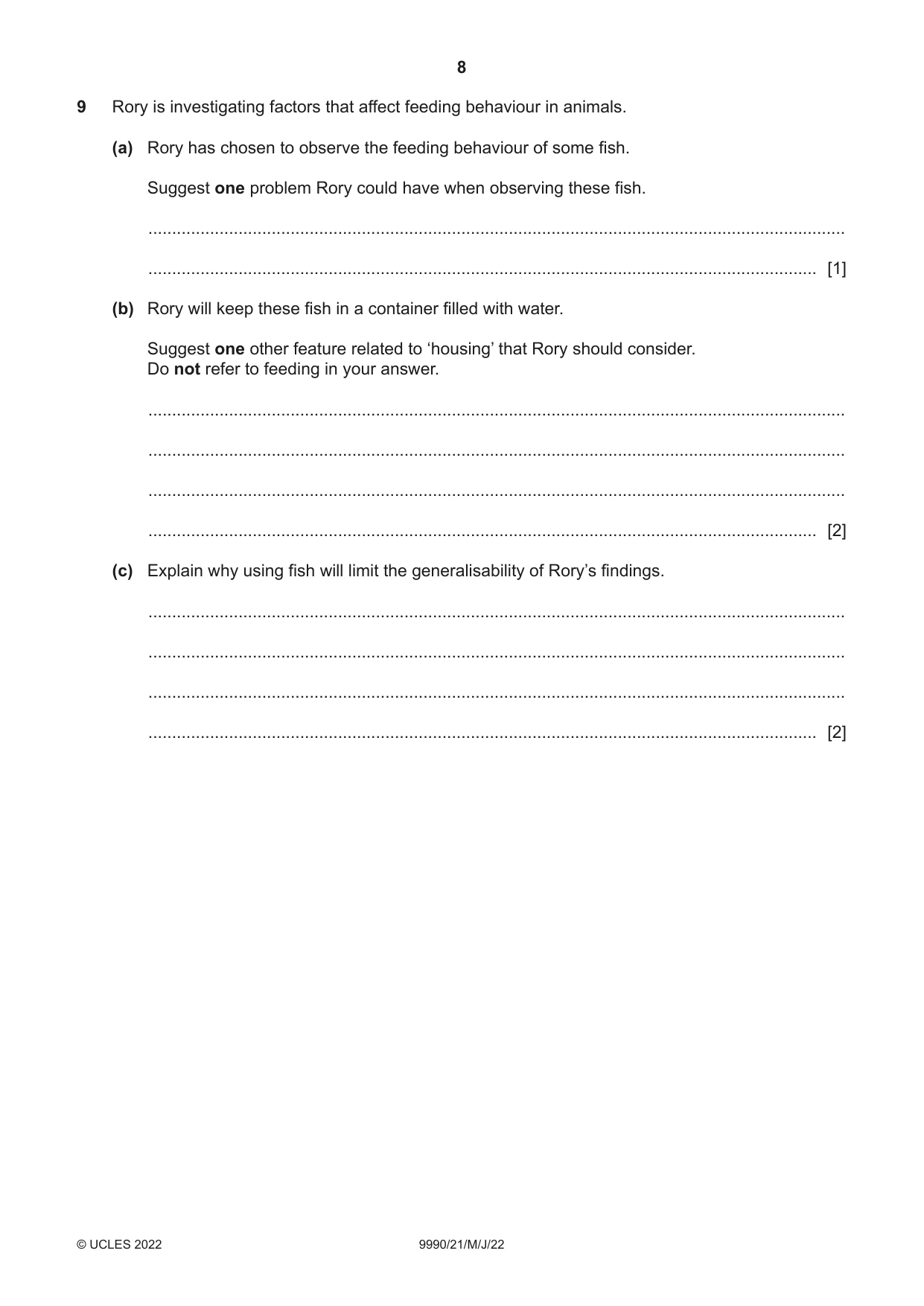
9 Rory is investigating factors that affect feeding behaviour in animals. (a) Rory has chosen to observe the feeding behaviour of some fish. Suggest one problem Rory could have when observing these fish. ................................................................................................................................................... ............................................................................................................................................. [1] (b) Rory will keep these fish in a container filled with water. Suggest one other feature related to ‘housing’ that Rory should consider. Do not refer to feeding in your answer. ................................................................................................................................................... ................................................................................................................................................... ................................................................................................................................................... ............................................................................................................................................. [2] (c) Explain why using fish will limit the generalisability of Rory’s findings. ................................................................................................................................................... ................................................................................................................................................... ................................................................................................................................................... ............................................................................................................................................. [2] Section C Answer all questions in this section.
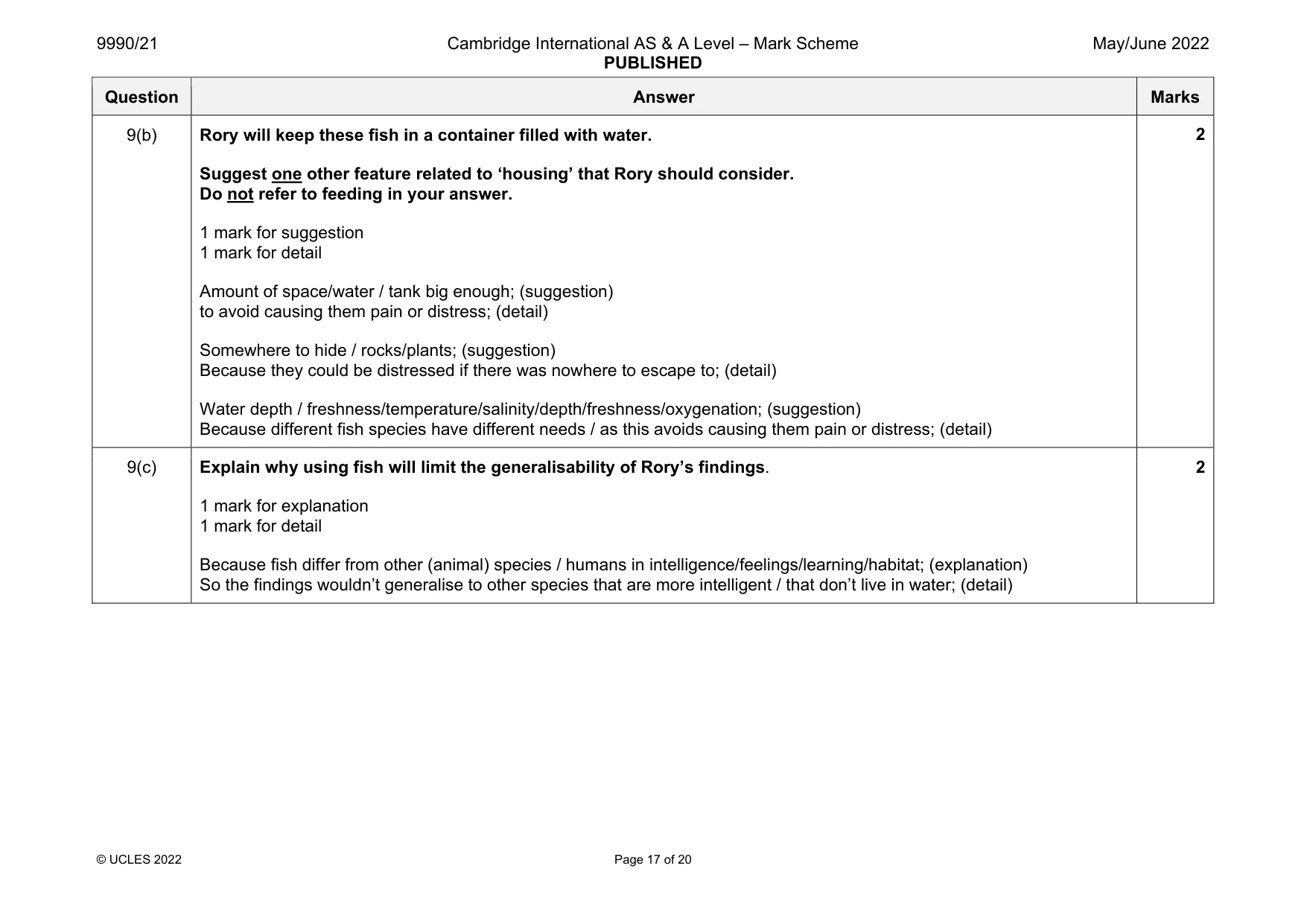
Mark scheme: 9(a) Rory is investigating factors that affect feeding behaviour in animals. Rory has chosen to observe the feeding behaviour of some fish. Suggest one problem Rory could have when observing these fish. 1 mark for linked suggestion The fish might be stressed by human presence / Rory / Seeing movement / hearing noises = 1 The fish might change their behaviour because of human presence / Rory / movement / noises = 1 They might swim behind things / very quickly / around each other making it hard for Rory to see them = 1 Question Answer Marks 9(b) Rory will keep these fish in a container filled with water. Suggest one other feature related to ‘housing’ that Rory should consider. Do not refer to feeding in your answer. 1 mark for suggestion 1 mark for detail Amount of space/water / tank big enough; (suggestion) to avoid causing them pain or distress; (detail) Somewhere to hide / rocks/plants; (suggestion) Because they could be distressed if there was nowhere to escape to; (detail) Water depth / freshness/temperature/salinity/depth/freshness/oxygenation; (suggestion) Because different fish species have different needs / as this avoids causing them pain or distress; (detail) 2 9(c) Explain why using fish will limit the generalisability of Rory’s findings. 1 mark for explanation 1 mark for detail Because fish differ from other (animal) species / humans in intelligence/feelings/learning/habitat; (explanation) So the findings wouldn’t generalise to other species that are more intelligent / that don’t live in water; (detail) 2
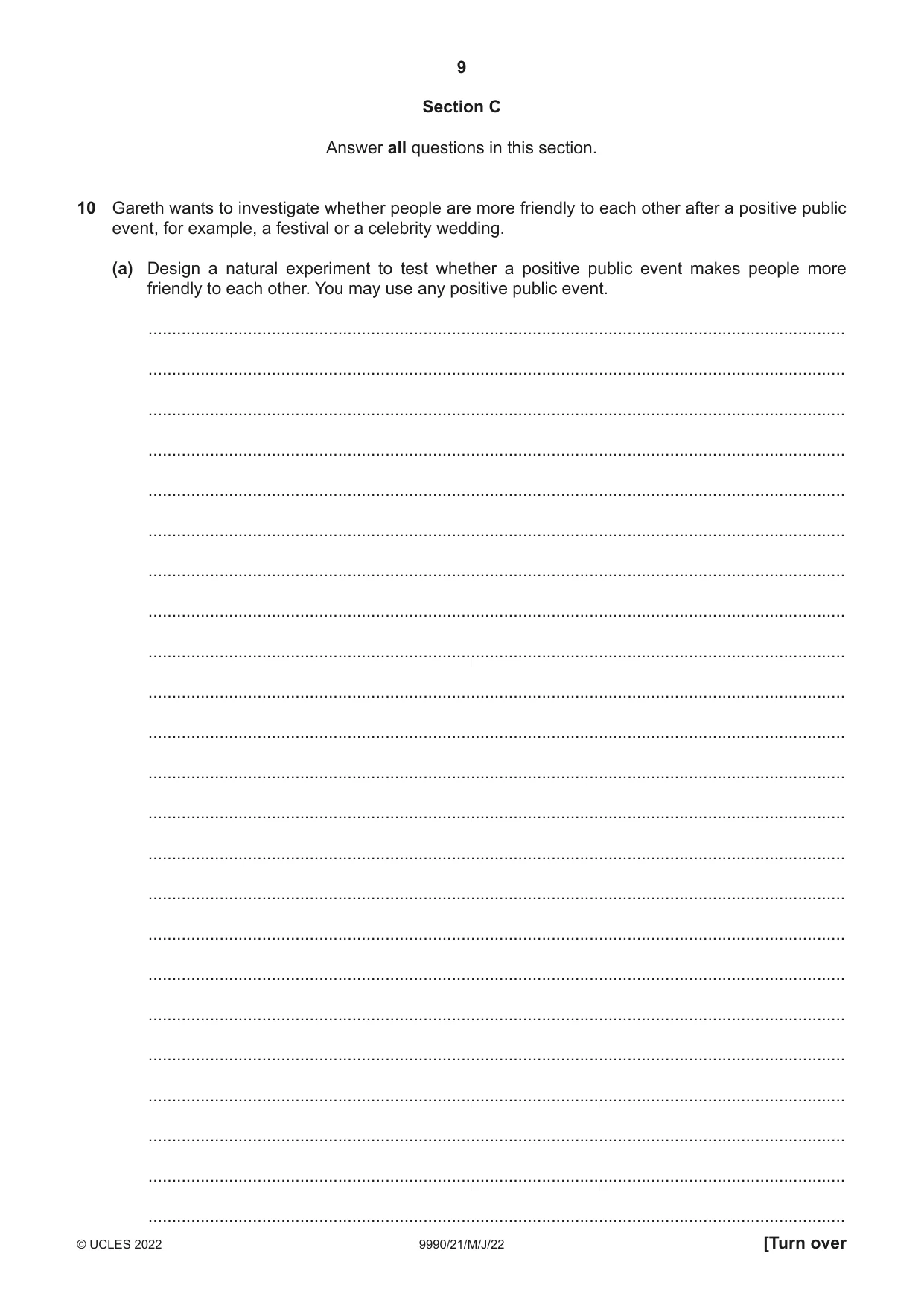
Q10 · Gareth wants to investigate whether people are more friendly to each other after a…
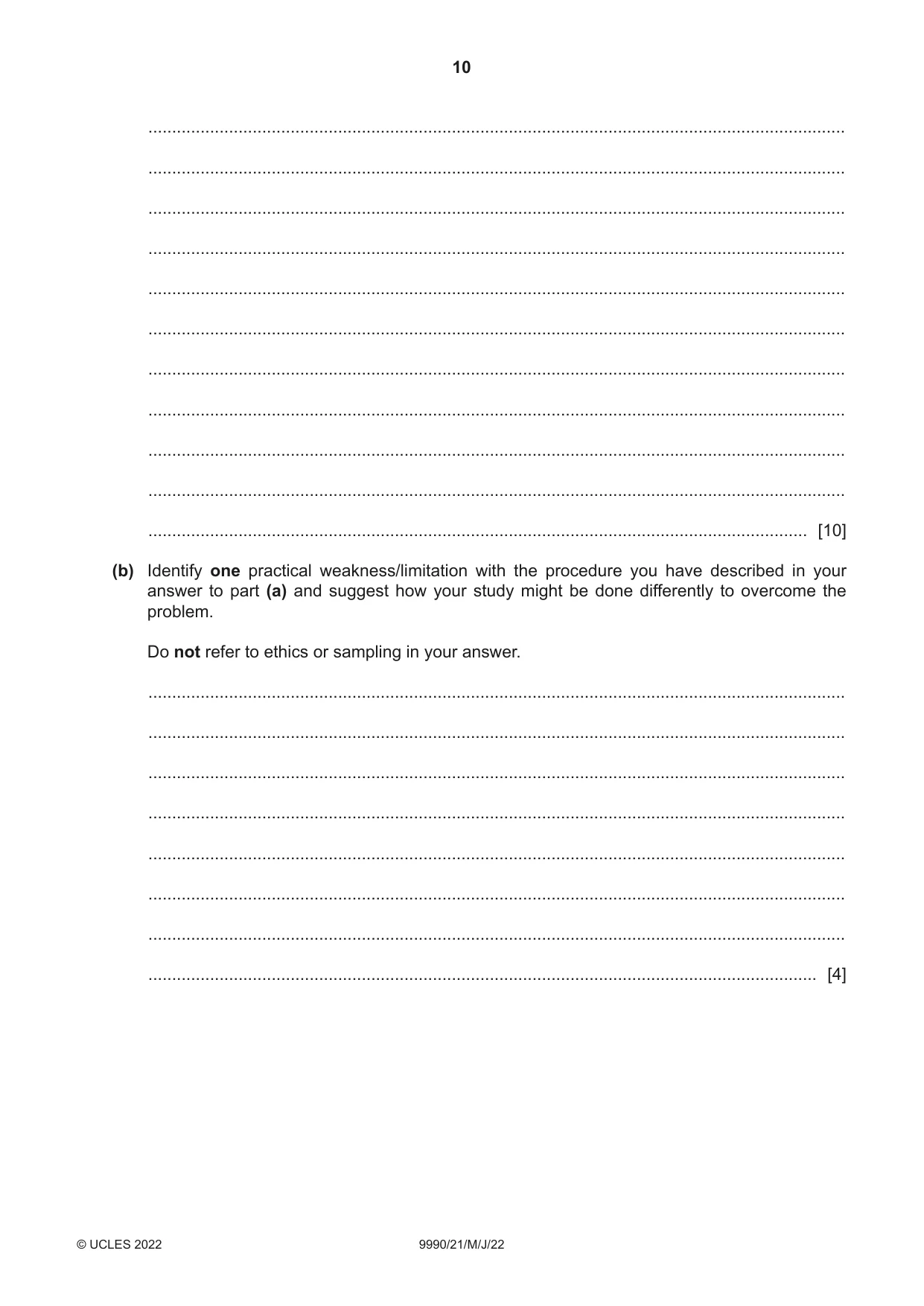
10 Gareth wants to investigate whether people are more friendly to each other after a positive public event, for example, a festival or a celebrity wedding. (a) Design a natural experiment to test whether a positive public event makes people more friendly to each other. You may use any positive public event. ................................................................................................................................................... ................................................................................................................................................... ................................................................................................................................................... ................................................................................................................................................... ................................................................................................................................................... ................................................................................................................................................... ................................................................................................................................................... ................................................................................................................................................... ................................................................................................................................................... ................................................................................................................................................... ................................................................................................................................................... ................................................................................................................................................... ................................................................................................................................................... ................................................................................................................................................... ................................................................................................................................................... ................................................................................................................................................... ................................................................................................................................................... ................................................................................................................................................... ................................................................................................................................................... ................................................................................................................................................... ................................................................................................................................................... ................................................................................................................................................... ................................................................................................................................................... ................................................................................................................................................... ................................................................................................................................................... ................................................................................................................................................... ................................................................................................................................................... ................................................................................................................................................... ................................................................................................................................................... ................................................................................................................................................... ................................................................................................................................................... ................................................................................................................................................... ................................................................................................................................................... ........................................................................................................................................... [10] (b) Identify one practical weakness/limitation with the procedure you have described in your answer to part (a) and suggest how your study might be done differently to overcome the problem. Do not refer to ethics or sampling in your answer. ................................................................................................................................................... ................................................................................................................................................... ................................................................................................................................................... ................................................................................................................................................... ................................................................................................................................................... ................................................................................................................................................... ................................................................................................................................................... ............................................................................................................................................. [4]
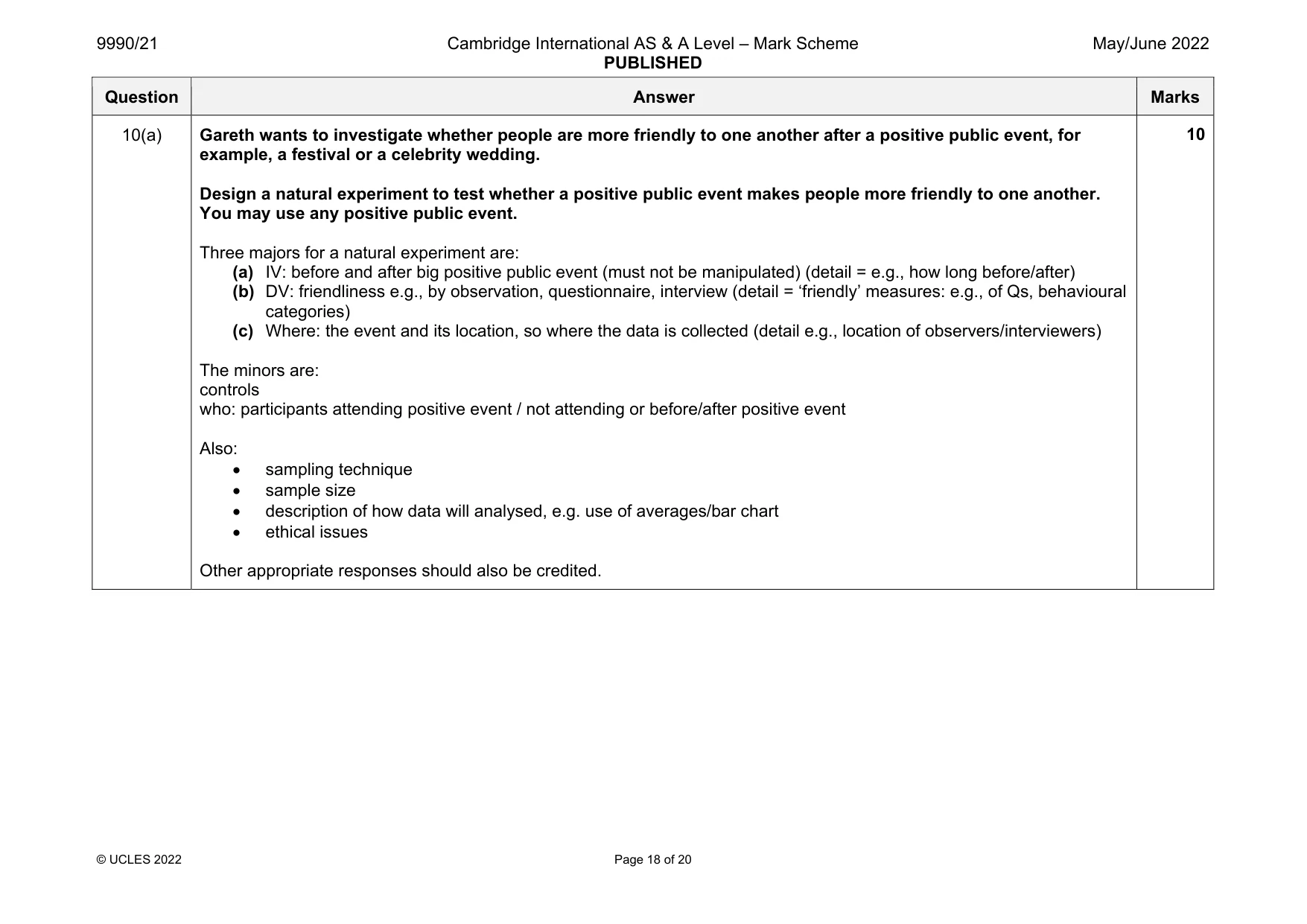
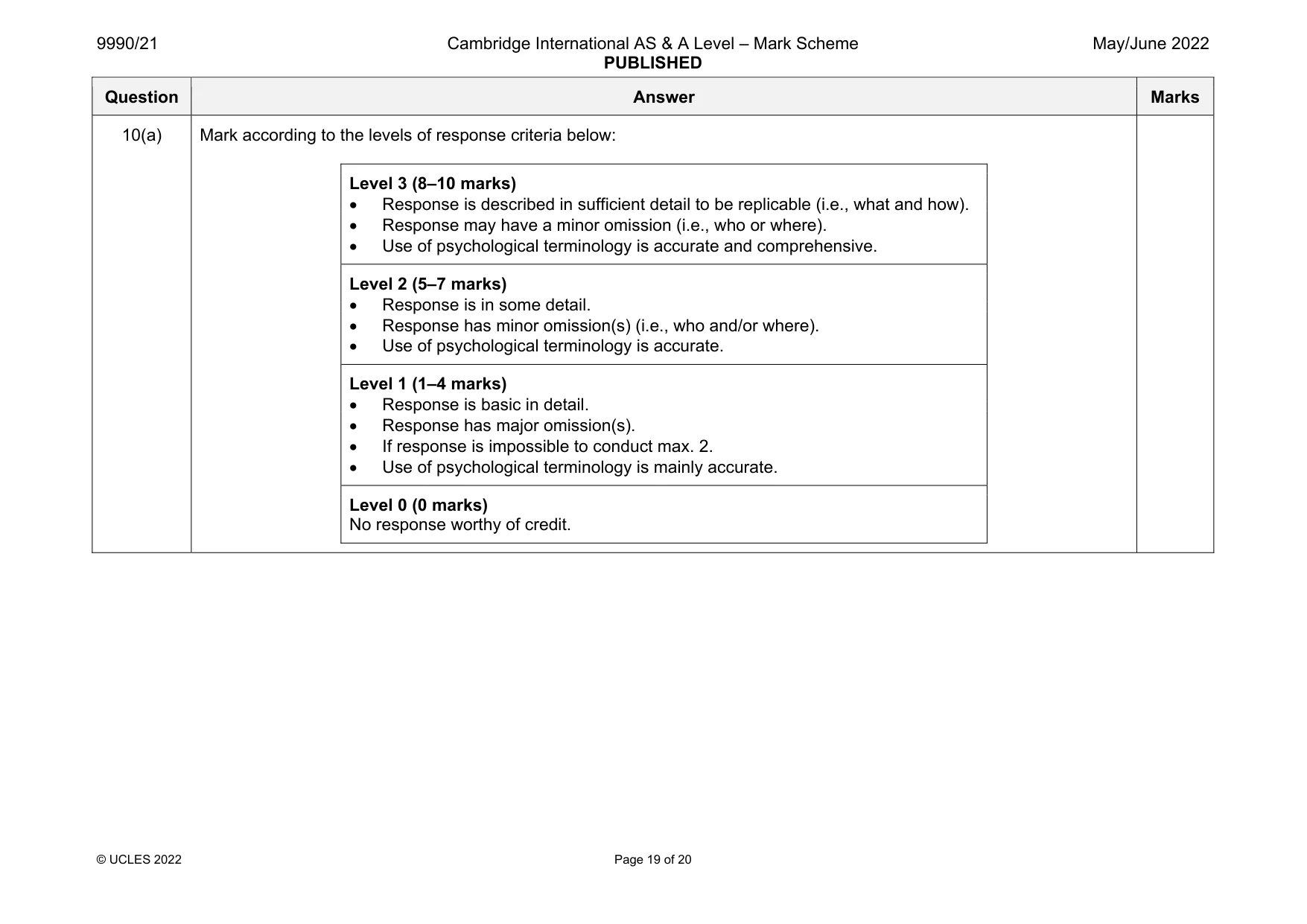
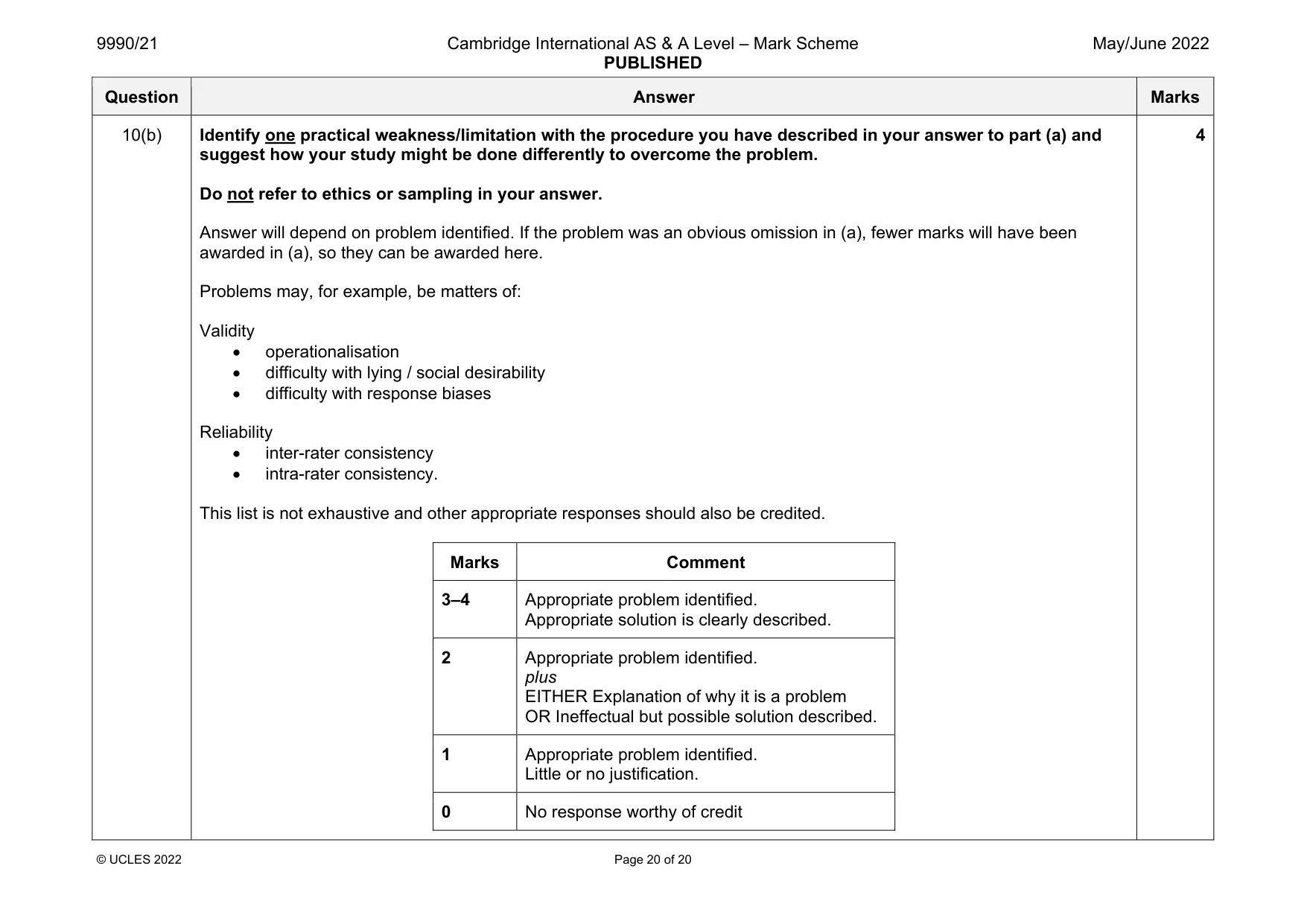
Mark scheme: 10(a) Gareth wants to investigate whether people are more friendly to one another after a positive public event, for example, a festival or a celebrity wedding. Design a natural experiment to test whether a positive public event makes people more friendly to one another. You may use any positive public event. Three majors for a natural experiment are: (a) IV: before and after big positive public event (must not be manipulated) (detail = e.g., how long before/after) (b) DV: friendliness e.g., by observation, questionnaire, interview (detail = ‘friendly’ measures: e.g., of Qs, behavioural categories) (c) Where: the event and its location, so where the data is collected (detail e.g., location of observers/interviewers) The minors are: controls who: participants attending positive event / not attending or before/after positive event Also: sampling technique sample size description of how data will analysed, e.g. use of averages/bar chart ethical issues Other appropriate responses should also be credited. Question Answer Marks 10(a) Mark according to the levels of response criteria below: Level 3 (8–10 marks) Response is described in sufficient detail to be replicable (i.e., what and how). Response may have a minor omission (i.e., who or where). Use of psychological terminology is accurate and comprehensive. Level 2 (5–7 marks) Response is in some detail. Response has minor omission(s) (i.e., who and/or where). Use of psychological terminology is accurate. Level 1 (1–4 marks) Response is basic in detail. Response has major omission(s). If response is impossible to conduct max. 2. Use of psychological terminology is mainly accurate. Level 0 (0 marks) No response worthy of credit. Question Answer Marks 10(b) Identify one practical weakness/limitation with the procedure you have described in your answer to part (a) and suggest how your study might be done differently to overcome the problem. Do not refer to ethics or sampling in your answer. Answer will depend on problem identified. If the problem was an obvious omission in (a), fewer marks will have been awarded in (a), so they can be awarded here. Problems may, for example, be matters of: Validity operationalisation difficulty with lying / social desirability difficulty with response biases Reliability inter-rater consistency intra-rater consistency. This list is not exhaustive and other appropriate responses should also be credited. Marks Comment 3–4 Appropriate problem identified. Appropriate solution is clearly described. 2 Appropriate problem identified. plus EITHER Explanation of why it is a problem OR Ineffectual but possible solution described. 1 Appropriate problem identified. Little or no justification. 0 No response worthy of credit 4
What was in this paper
The subtopics covered by these 10 questions, and how many questions each got. Open one in a new tab to see every Cambridge question on it.
What you needed in this session
Cambridge’s own grade thresholds for 2022 May/June, Paper 2 · Variant 1. A higher threshold means an easier paper — the bar moves with how the cohort did.