Cambridge A Level Psychology (from 2018) 9990 — 2023 May/June Paper 2 · Variant 1
9990/21/M/J/23 · 10 questions · 60 marks · ≈68 min
The question paper and its mark scheme, free to read here and free to download. This is Cambridge’s own paper, exactly as it was sat.
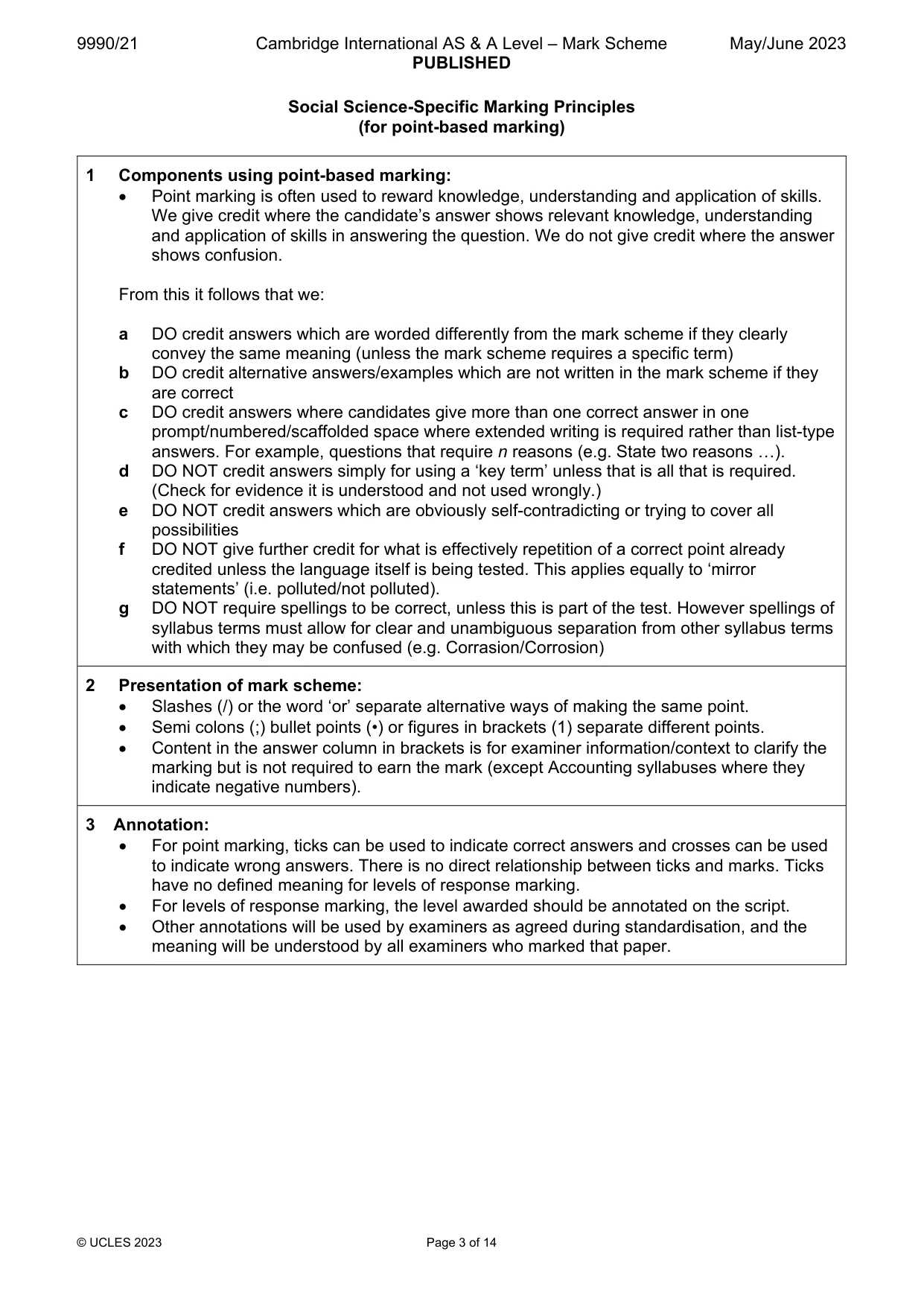
Question paper12 pages


Mark scheme14 pages
Answers below. Sit the paper first if you are practising.
Questions as text
Q1 · Explain what is meant by the term ‘ecological validity’
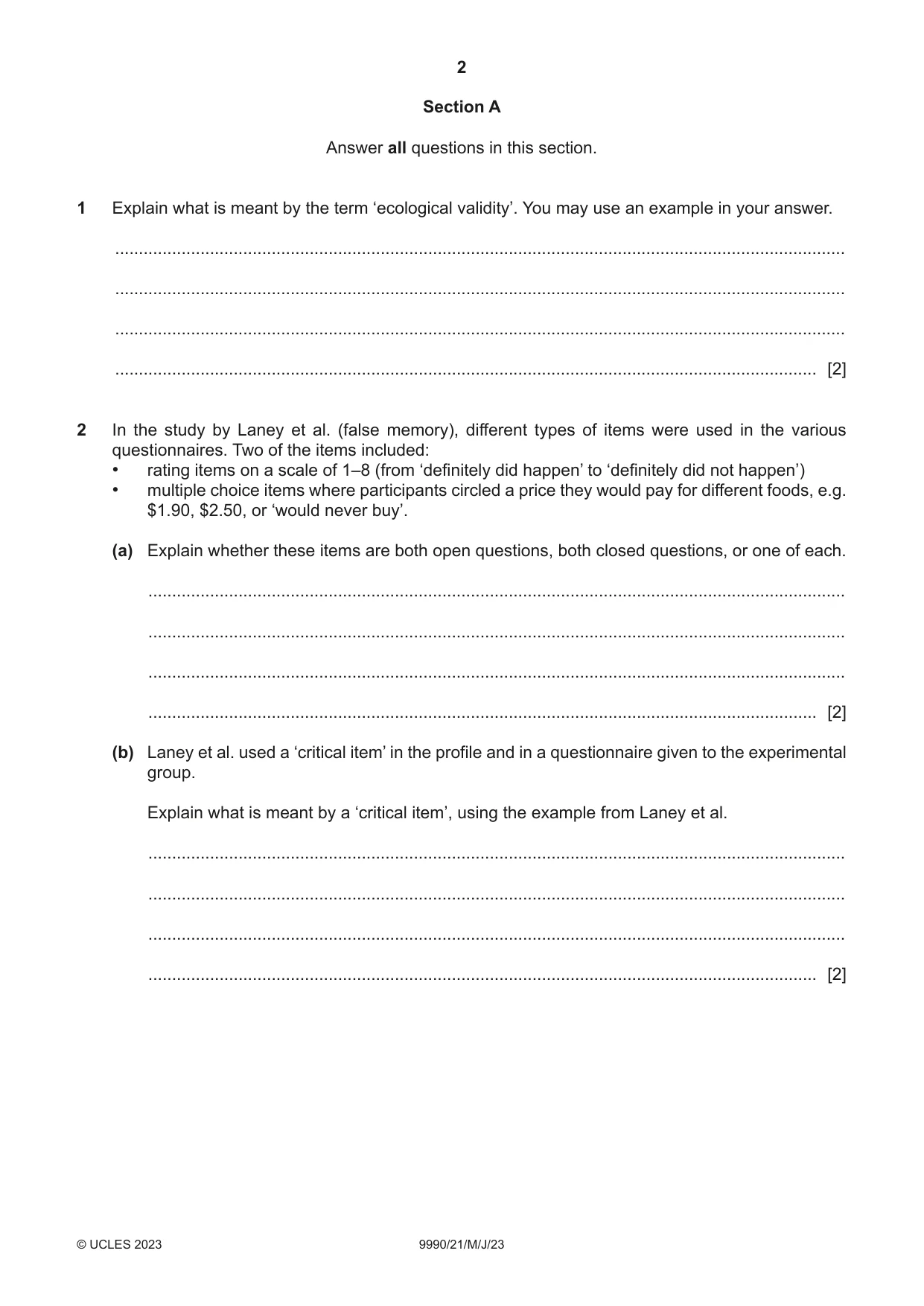
1 Explain what is meant by the term ‘ecological validity’. You may use an example in your answer. .......................................................................................................................................................... .......................................................................................................................................................... .......................................................................................................................................................... .................................................................................................................................................... [2]
Mark scheme: Question Answer Marks 1 Explain what is meant by the term ‘ecological validity’. You may use an 2 example in your answer. 1 mark for explanation. 1 mark for detail (accept examples as detail). The extent to which the findings of a study set in one situation would generalise to other situations (explanation); E.g. whether findings from laboratory studies are relevant to life outside the laboratory (detail); Andrade’s study in a laboratory may not represent attention in the real world where there are distractions (example);
Q2 · In the study by Laney et al
2 In the study by Laney et al. (false memory), different types of items were used in the various questionnaires. Two of the items included: • rating items on a scale of 1–8 (from ‘definitely did happen’ to ‘definitely did not happen’) • multiple choice items where participants circled a price they would pay for different foods, e.g. $1.90, $2.50, or ‘would never buy’. (a) Explain whether these items are both open questions, both closed questions, or one of each. ................................................................................................................................................... ................................................................................................................................................... ................................................................................................................................................... ............................................................................................................................................. [2] (b) Laney et al. used a ‘critical item’ in the profile and in a questionnaire given to the experimental group. Explain what is meant by a ‘critical item’, using the example from Laney et al. ................................................................................................................................................... ................................................................................................................................................... ................................................................................................................................................... ............................................................................................................................................. [2]
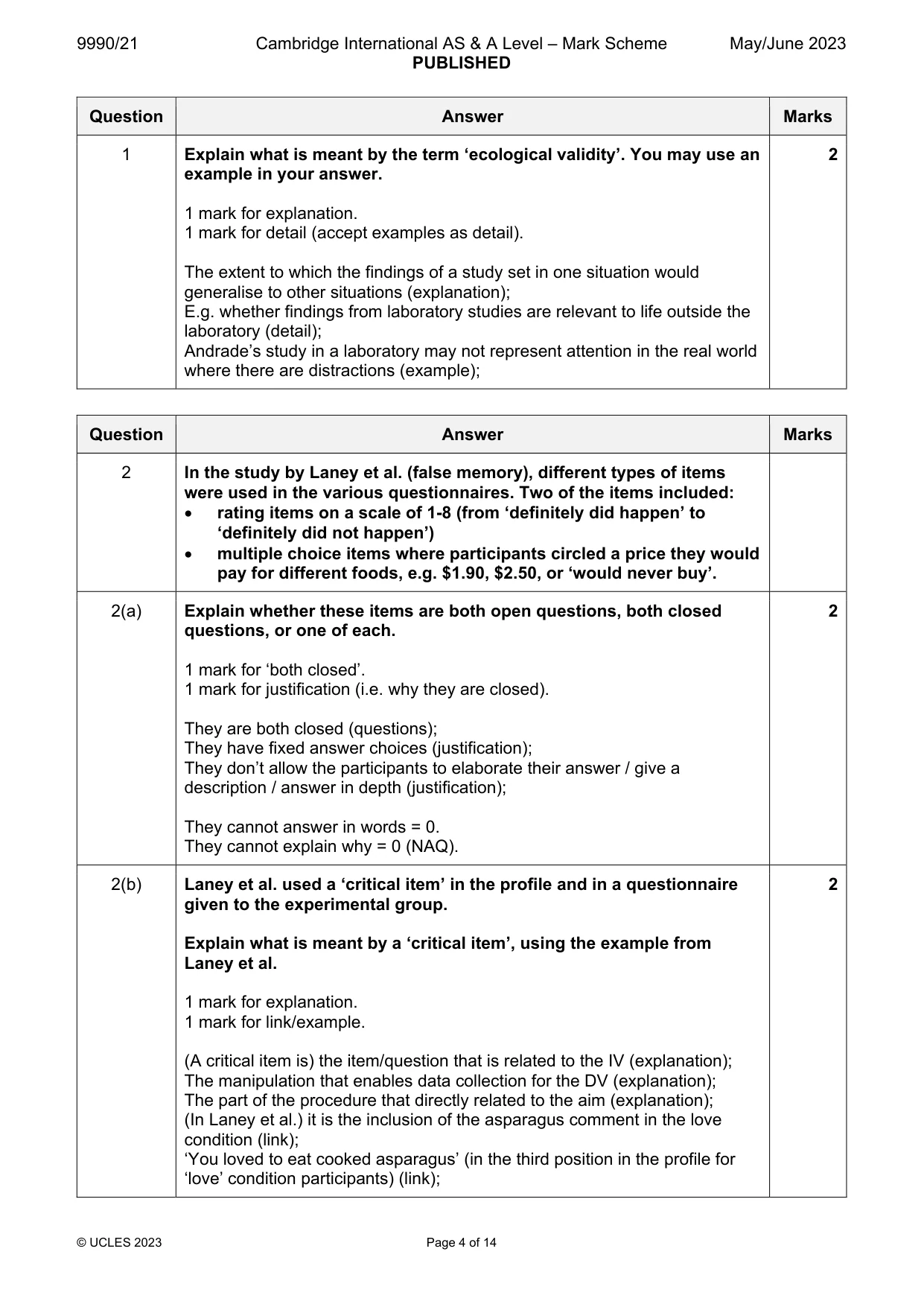
Mark scheme: 2 In the study by Laney et al. (false memory), different types of items were used in the various questionnaires. Two of the items included: rating items on a scale of 1-8 (from ‘definitely did happen’ to ‘definitely did not happen’) multiple choice items where participants circled a price they would pay for different foods, e.g. $1.90, $2.50, or ‘would never buy’. 2(a) Explain whether these items are both open questions, both closed 2 questions, or one of each. 1 mark for ‘both closed’. 1 mark for justification (i.e. why they are closed). They are both closed (questions); They have fixed answer choices (justification); They don’t allow the participants to elaborate their answer / give a description / answer in depth (justification); They cannot answer in words = 0. They cannot explain why = 0 (NAQ). 2(b) Laney et al. used a ‘critical item’ in the profile and in a questionnaire 2 given to the experimental group. Explain what is meant by a ‘critical item’, using the example from Laney et al. 1 mark for explanation. 1 mark for link/example. (A critical item is) the item/question that is related to the IV (explanation); The manipulation that enables data collection for the DV (explanation); The part of the procedure that directly related to the aim (explanation); (In Laney et al.) it is the inclusion of the asparagus comment in the love condition (link); ‘You loved to eat cooked asparagus’ (in the third position in the profile for ‘love’ condition participants) (link);
Q3 · In the study by Canli et al
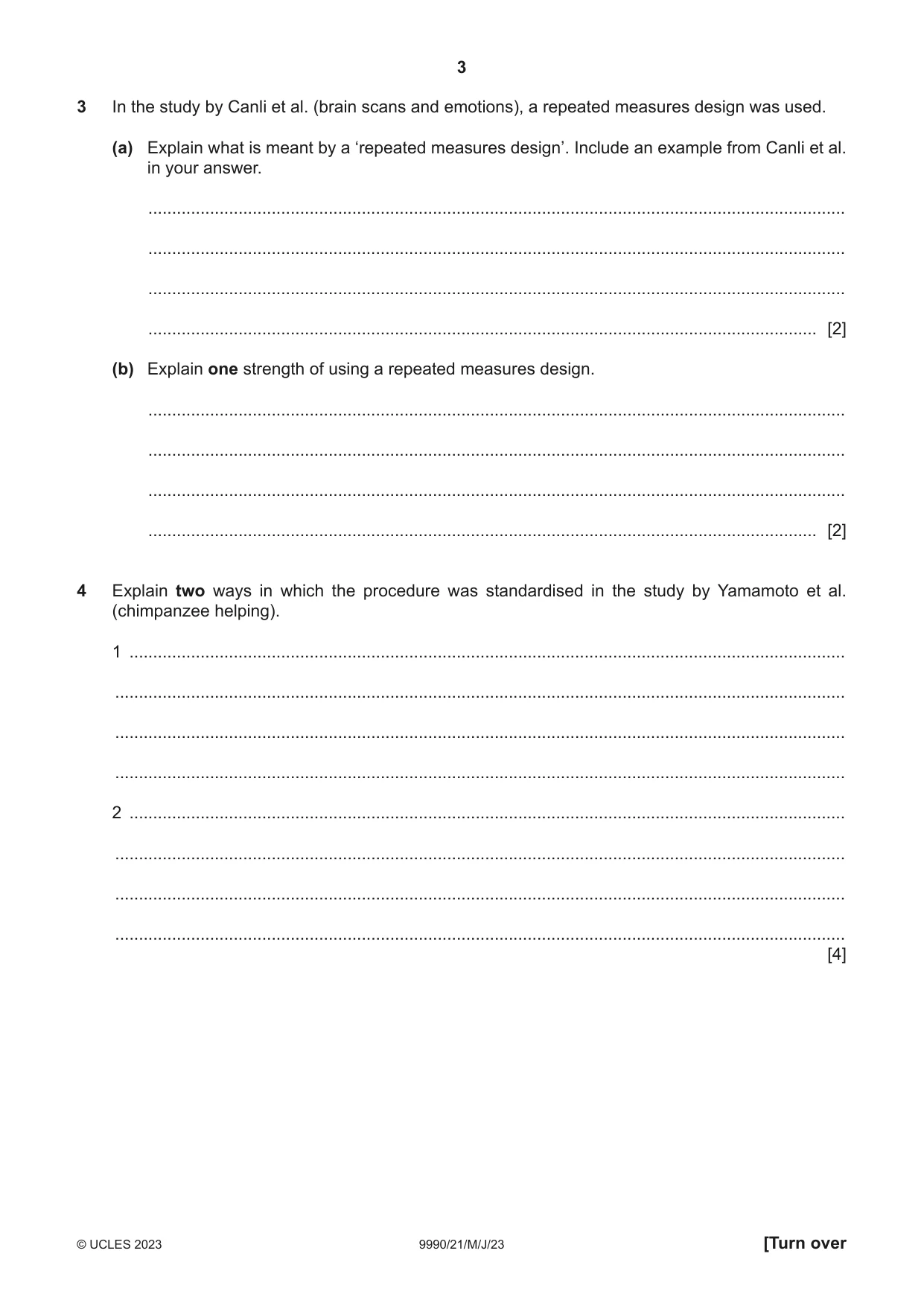
3 In the study by Canli et al. (brain scans and emotions), a repeated measures design was used. (a) Explain what is meant by a ‘repeated measures design’. Include an example from Canli et al. in your answer. ................................................................................................................................................... ................................................................................................................................................... ................................................................................................................................................... ............................................................................................................................................. [2] (b) Explain one strength of using a repeated measures design. ................................................................................................................................................... ................................................................................................................................................... ................................................................................................................................................... ............................................................................................................................................. [2]
Mark scheme: 3 In the study by Canli et al. (brain scans and emotions), a repeated measures design was used. 3(a) Explain what is meant by a ‘repeated measures design’. Include an 2 example from Canli et al. in your answer. 1 mark for explanation of repeated measures. 1 mark for link. Every participant does all/both of the levels of the IV / conditions (emotive/negative and non-emotive/neutral) = 1 mark (explanation); Each participant saw stimuli at each level of (emotional) arousal (IV) (link); 3(b) Explain one strength of using a repeated measures design. 2 1 mark for explanation of strength. 2nd mark for detail (can include an example). It overcomes problems with individual differences (explanation); So if people differ in important ways they will all be their own baseline, so it won’t matter (detail); E.g. Yamamoto, if one chimp was more helpful than another (it would confound an independent measures design) (detail); E.g. if some participants in Canli et al. were just more emotional, it would even out (detail);
Q4 · Explain two ways in which the procedure was standardised in the study by Yamamoto et al
4 Explain two ways in which the procedure was standardised in the study by Yamamoto et al. (chimpanzee helping). 1 ....................................................................................................................................................... .......................................................................................................................................................... .......................................................................................................................................................... .......................................................................................................................................................... 2 ....................................................................................................................................................... .......................................................................................................................................................... .......................................................................................................................................................... .......................................................................................................................................................... [4]
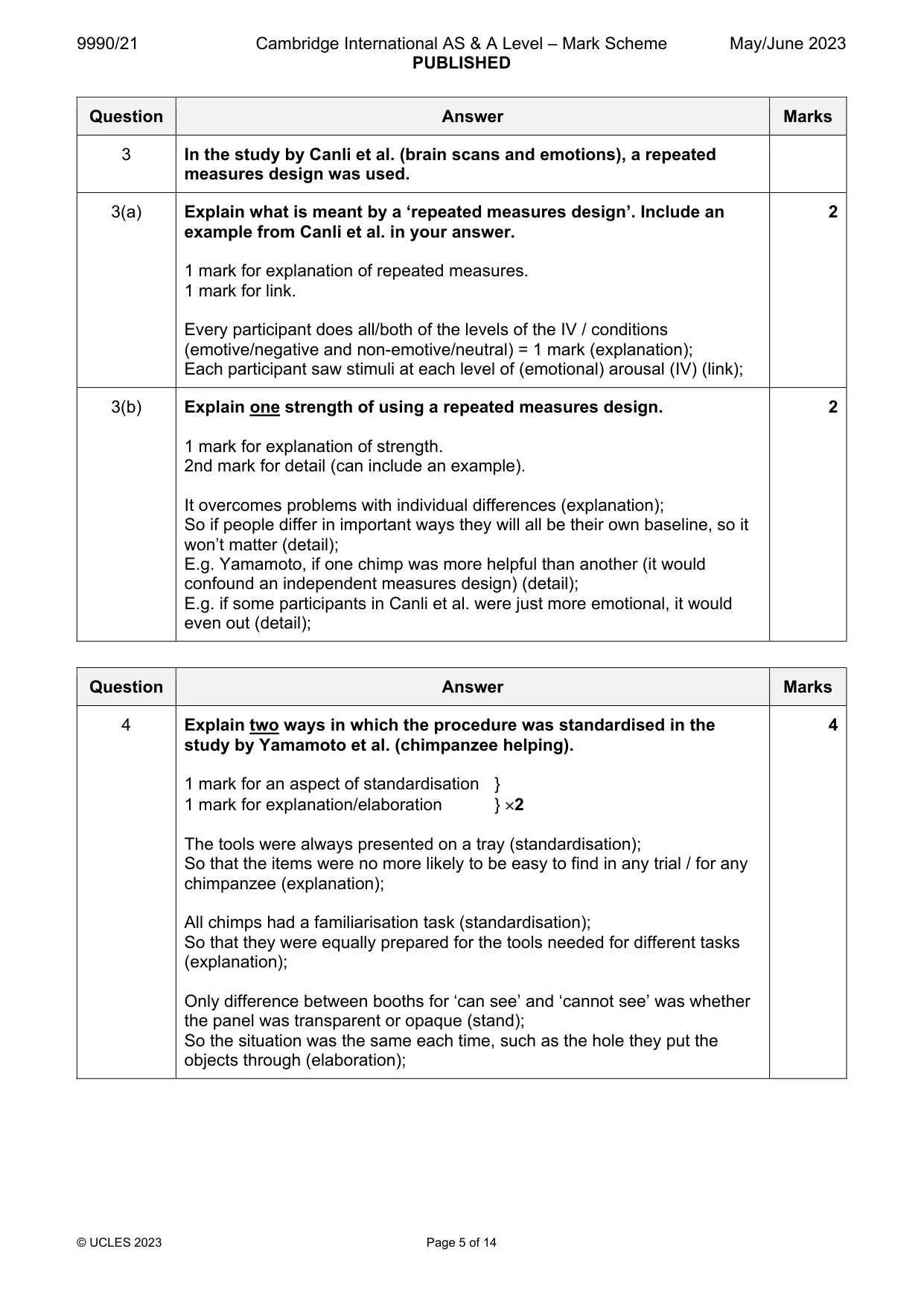
Mark scheme: 4 Explain two ways in which the procedure was standardised in the 4 study by Yamamoto et al. (chimpanzee helping). 1 mark for an aspect of standardisation } 1 mark for explanation/elaboration } 2 The tools were always presented on a tray (standardisation); So that the items were no more likely to be easy to find in any trial / for any chimpanzee (explanation); All chimps had a familiarisation task (standardisation); So that they were equally prepared for the tools needed for different tasks (explanation); Only difference between booths for ‘can see’ and ‘cannot see’ was whether the panel was transparent or opaque (stand); So the situation was the same each time, such as the hole they put the objects through (elaboration);
Q5 · Reliability refers to the consistency of tests, tasks or measures in research
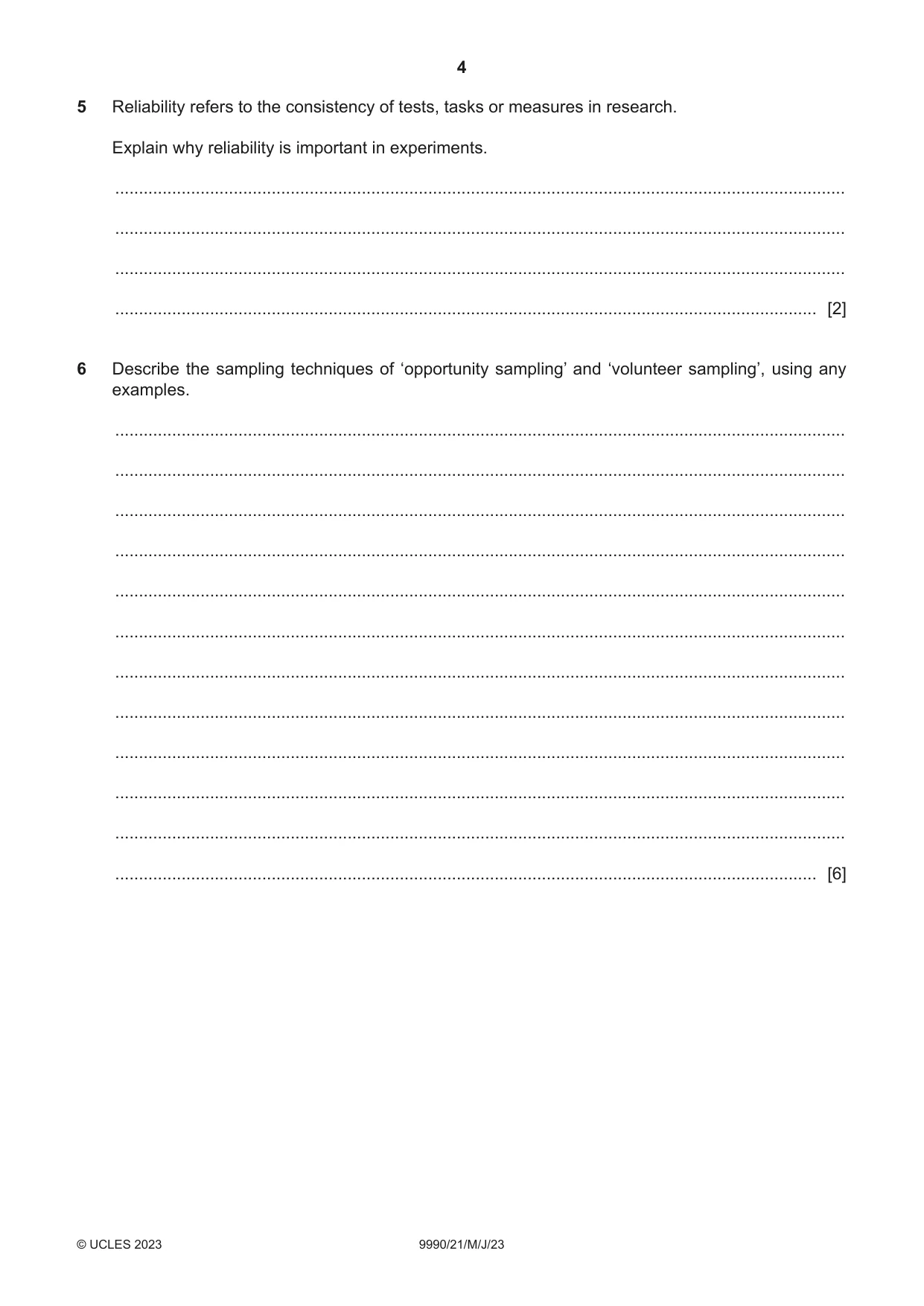
5 Reliability refers to the consistency of tests, tasks or measures in research. Explain why reliability is important in experiments. .......................................................................................................................................................... .......................................................................................................................................................... .......................................................................................................................................................... .................................................................................................................................................... [2]
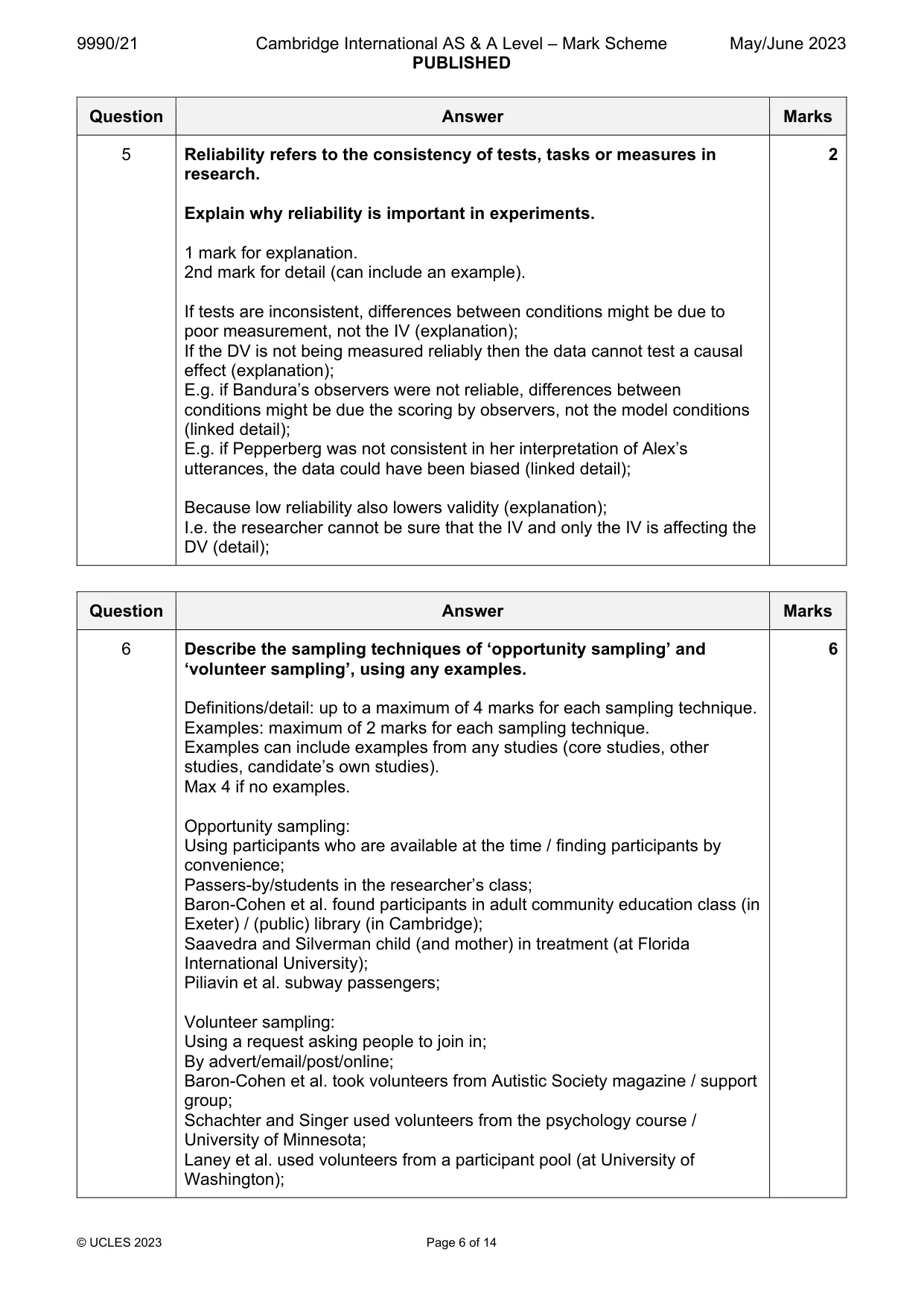
Mark scheme: 5 Reliability refers to the consistency of tests, tasks or measures in 2 research. Explain why reliability is important in experiments. 1 mark for explanation. 2nd mark for detail (can include an example). If tests are inconsistent, differences between conditions might be due to poor measurement, not the IV (explanation); If the DV is not being measured reliably then the data cannot test a causal effect (explanation); E.g. if Bandura’s observers were not reliable, differences between conditions might be due the scoring by observers, not the model conditions (linked detail); E.g. if Pepperberg was not consistent in her interpretation of Alex’s utterances, the data could have been biased (linked detail); Because low reliability also lowers validity (explanation); I.e. the researcher cannot be sure that the IV and only the IV is affecting the DV (detail);
Q6 · Describe the sampling techniques of ‘opportunity sampling’ and ‘volunteer sampling’…
6 Describe the sampling techniques of ‘opportunity sampling’ and ‘volunteer sampling’, using any examples. .......................................................................................................................................................... .......................................................................................................................................................... .......................................................................................................................................................... .......................................................................................................................................................... .......................................................................................................................................................... .......................................................................................................................................................... .......................................................................................................................................................... .......................................................................................................................................................... .......................................................................................................................................................... .......................................................................................................................................................... .......................................................................................................................................................... .................................................................................................................................................... [6]
Mark scheme: 6 Describe the sampling techniques of ‘opportunity sampling’ and 6 ‘volunteer sampling’, using any examples. Definitions/detail: up to a maximum of 4 marks for each sampling technique. Examples: maximum of 2 marks for each sampling technique. Examples can include examples from any studies (core studies, other studies, candidate’s own studies). Max 4 if no examples. Opportunity sampling: Using participants who are available at the time / finding participants by convenience; Passers-by/students in the researcher’s class; Baron-Cohen et al. found participants in adult community education class (in Exeter) / (public) library (in Cambridge); Saavedra and Silverman child (and mother) in treatment (at Florida International University); Piliavin et al. subway passengers; Volunteer sampling: Using a request asking people to join in; By advert/email/post/online; Baron-Cohen et al. took volunteers from Autistic Society magazine / support group; Schachter and Singer used volunteers from the psychology course / University of Minnesota; Laney et al. used volunteers from a participant pool (at University of Washington);
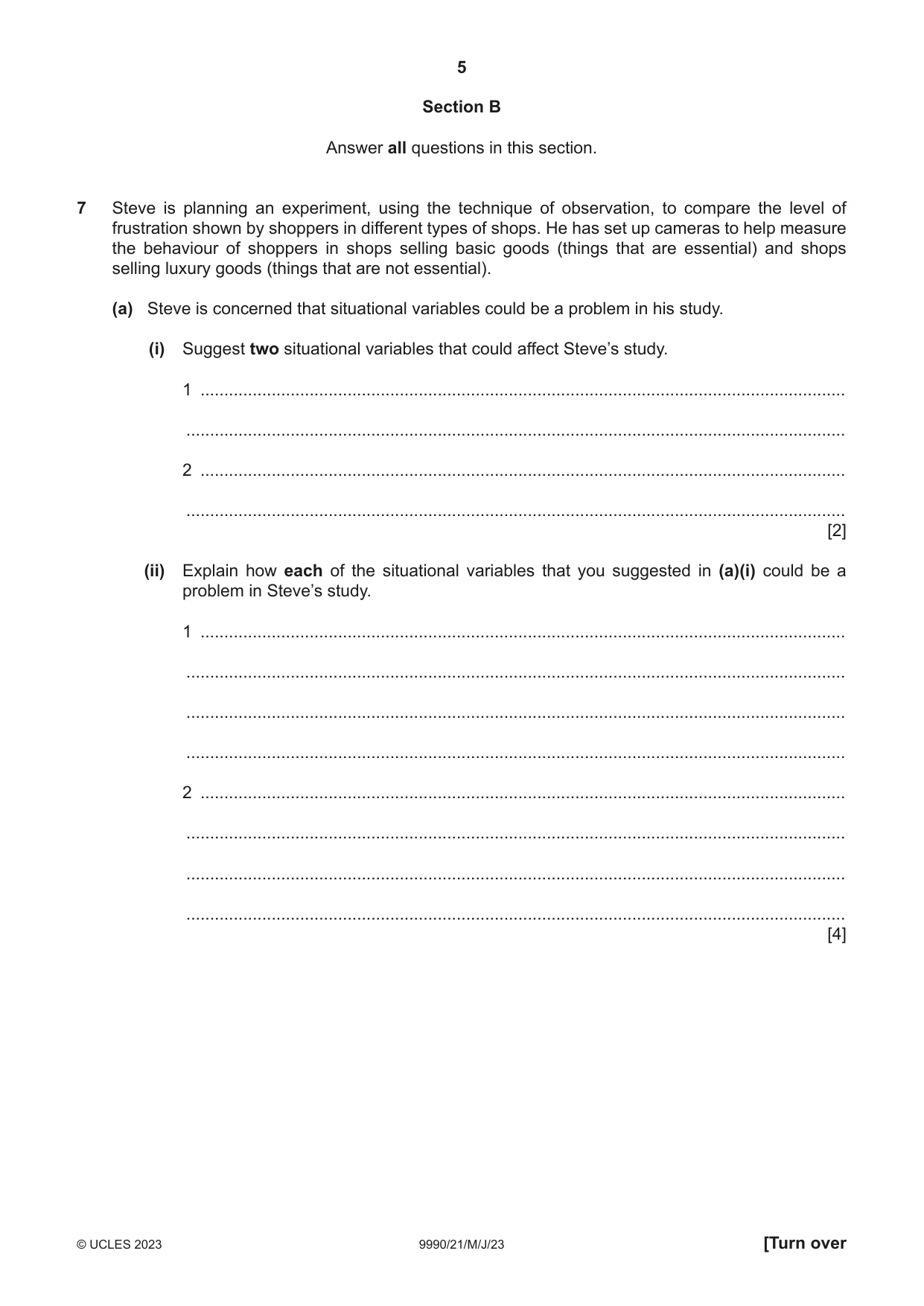
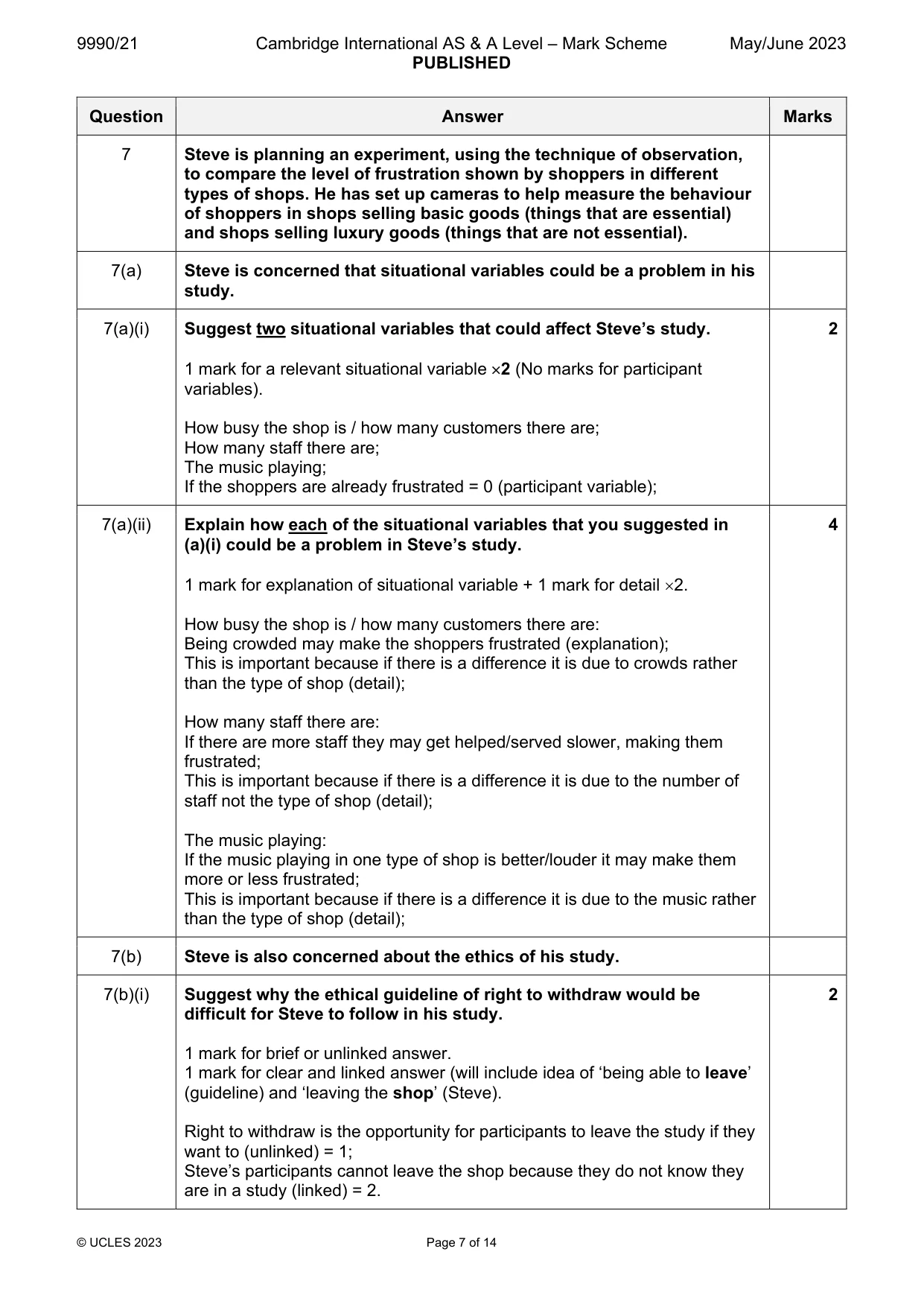
Q7 · Steve is planning an experiment, using the technique of observation, to compare the level…
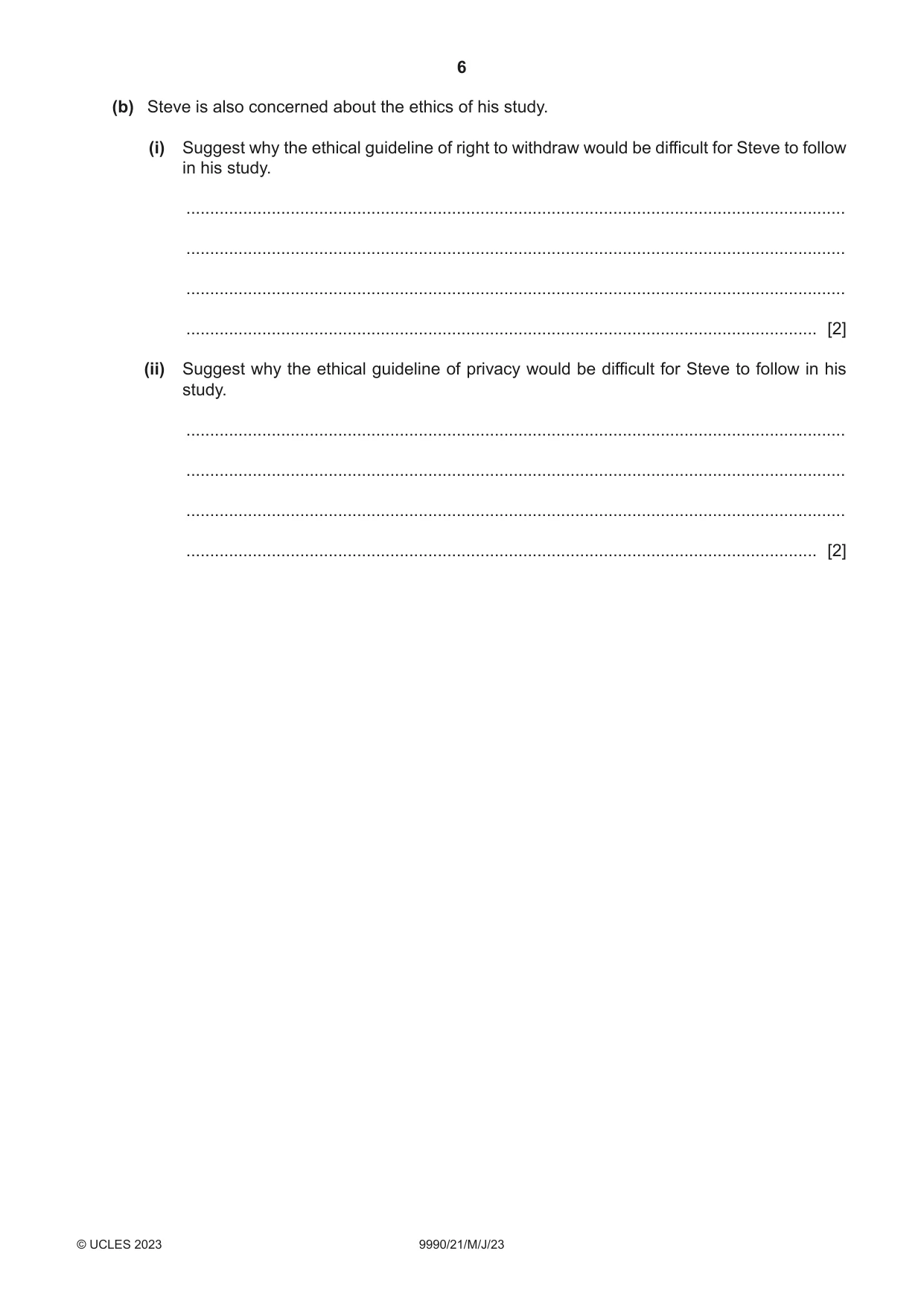
7 Steve is planning an experiment, using the technique of observation, to compare the level of frustration shown by shoppers in different types of shops. He has set up cameras to help measure the behaviour of shoppers in shops selling basic goods (things that are essential) and shops selling luxury goods (things that are not essential). (a) Steve is concerned that situational variables could be a problem in his study. (i) Suggest two situational variables that could affect Steve’s study. 1 ........................................................................................................................................ ........................................................................................................................................... 2 ........................................................................................................................................ ........................................................................................................................................... [2] (ii) Explain how each of the situational variables that you suggested in (a)(i) could be a problem in Steve’s study. 1 ........................................................................................................................................ ........................................................................................................................................... ........................................................................................................................................... ........................................................................................................................................... 2 ........................................................................................................................................ ........................................................................................................................................... ........................................................................................................................................... ........................................................................................................................................... [4] (b) Steve is also concerned about the ethics of his study. (i) Suggest why the ethical guideline of right to withdraw would be difficult for Steve to follow in his study. ........................................................................................................................................... ........................................................................................................................................... ........................................................................................................................................... ..................................................................................................................................... [2] (ii) Suggest why the ethical guideline of privacy would be difficult for Steve to follow in his study. ........................................................................................................................................... ........................................................................................................................................... ........................................................................................................................................... ..................................................................................................................................... [2]
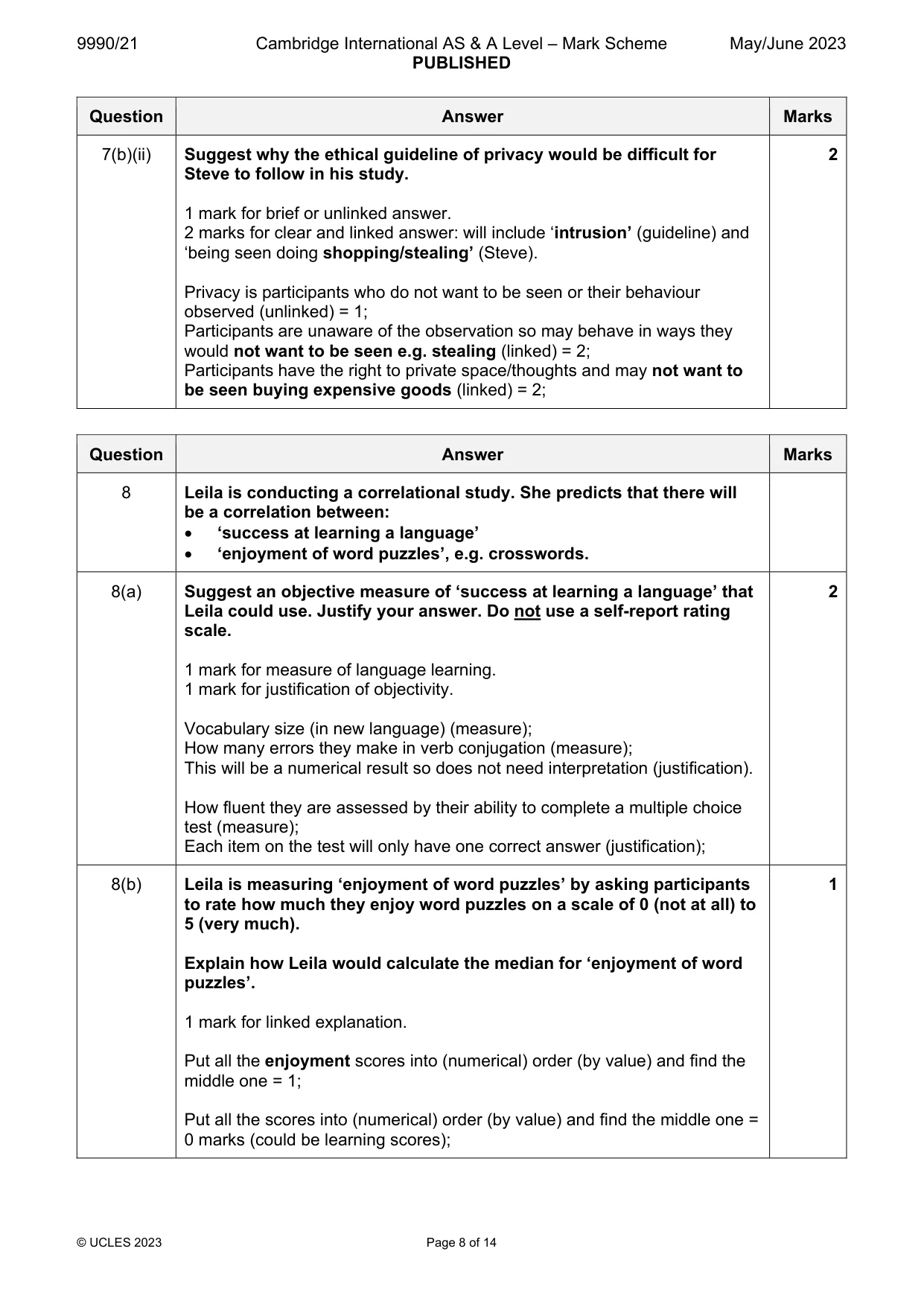
Mark scheme: 7 Steve is planning an experiment, using the technique of observation, to compare the level of frustration shown by shoppers in different types of shops. He has set up cameras to help measure the behaviour of shoppers in shops selling basic goods (things that are essential) and shops selling luxury goods (things that are not essential). 7(a) Steve is concerned that situational variables could be a problem in his study. 7(a)(i) Suggest two situational variables that could affect Steve’s study. 2 1 mark for a relevant situational variable 2 (No marks for participant variables). How busy the shop is / how many customers there are; How many staff there are; The music playing; If the shoppers are already frustrated = 0 (participant variable); 7(a)(ii) Explain how each of the situational variables that you suggested in 4 (a)(i) could be a problem in Steve’s study. 1 mark for explanation of situational variable + 1 mark for detail 2. How busy the shop is / how many customers there are: Being crowded may make the shoppers frustrated (explanation); This is important because if there is a difference it is due to crowds rather than the type of shop (detail); How many staff there are: If there are more staff they may get helped/served slower, making them frustrated; This is important because if there is a difference it is due to the number of staff not the type of shop (detail); The music playing: If the music playing in one type of shop is better/louder it may make them more or less frustrated; This is important because if there is a difference it is due to the music rather than the type of shop (detail); 7(b) Steve is also concerned about the ethics of his study. 7(b)(i) Suggest why the ethical guideline of right to withdraw would be 2 difficult for Steve to follow in his study. 1 mark for brief or unlinked answer. 1 mark for clear and linked answer (will include idea of ‘being able to leave’ (guideline) and ‘leaving the shop’ (Steve). Right to withdraw is the opportunity for participants to leave the study if they want to (unlinked) = 1; Steve’s participants cannot leave the shop because they do not know they are in a study (linked) = 2. 7(b)(ii) Suggest why the ethical guideline of privacy would be difficult for 2 Steve to follow in his study. 1 mark for brief or unlinked answer. 2 marks for clear and linked answer: will include ‘intrusion’ (guideline) and ‘being seen doing shopping/stealing’ (Steve). Privacy is participants who do not want to be seen or their behaviour observed (unlinked) = 1; Participants are unaware of the observation so may behave in ways they would not want to be seen e.g. stealing (linked) = 2; Participants have the right to private space/thoughts and may not want to be seen buying expensive goods (linked) = 2;
Q8 · Leila is conducting a correlational study
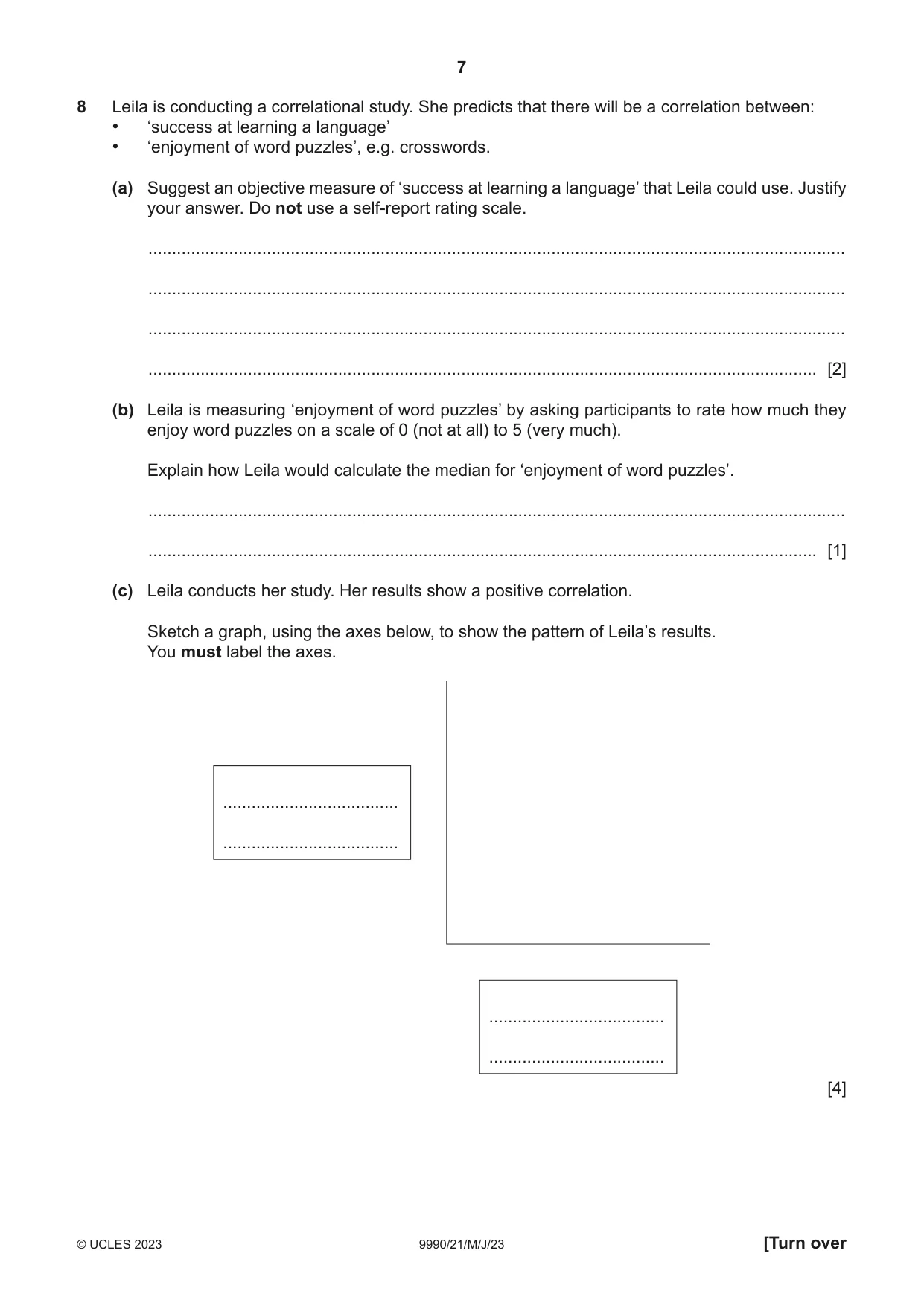
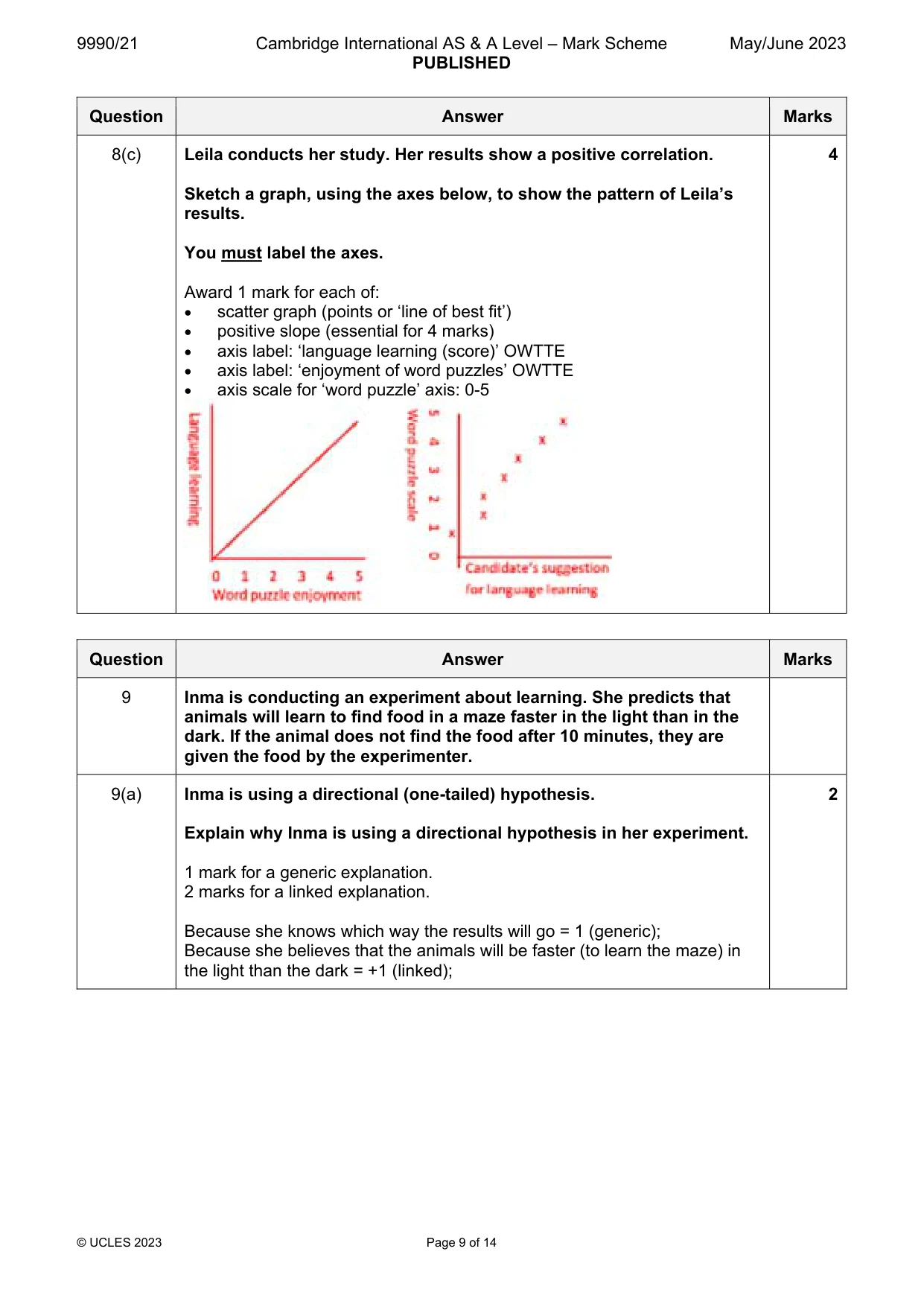
8 Leila is conducting a correlational study. She predicts that there will be a correlation between: • ‘success at learning a language’ • ‘enjoyment of word puzzles’, e.g. crosswords. (a) Suggest an objective measure of ‘success at learning a language’ that Leila could use. Justify your answer. Do not use a self-report rating scale. ................................................................................................................................................... ................................................................................................................................................... ................................................................................................................................................... ............................................................................................................................................. [2] (b) Leila is measuring ‘enjoyment of word puzzles’ by asking participants to rate how much they enjoy word puzzles on a scale of 0 (not at all) to 5 (very much). Explain how Leila would calculate the median for ‘enjoyment of word puzzles’. ................................................................................................................................................... ............................................................................................................................................. [1] (c) Leila conducts her study. Her results show a positive correlation. Sketch a graph, using the axes below, to show the pattern of Leila’s results. You must label the axes. ..................................... ..................................... ..................................... ..................................... [4]
Mark scheme: 8 Leila is conducting a correlational study. She predicts that there will be a correlation between: ‘success at learning a language’ ‘enjoyment of word puzzles’, e.g. crosswords. 8(a) Suggest an objective measure of ‘success at learning a language’ that 2 Leila could use. Justify your answer. Do not use a self-report rating scale. 1 mark for measure of language learning. 1 mark for justification of objectivity. Vocabulary size (in new language) (measure); How many errors they make in verb conjugation (measure); This will be a numerical result so does not need interpretation (justification). How fluent they are assessed by their ability to complete a multiple choice test (measure); Each item on the test will only have one correct answer (justification); 8(b) Leila is measuring ‘enjoyment of word puzzles’ by asking participants 1 to rate how much they enjoy word puzzles on a scale of 0 (not at all) to 5 (very much). Explain how Leila would calculate the median for ‘enjoyment of word puzzles’. 1 mark for linked explanation. Put all the enjoyment scores into (numerical) order (by value) and find the middle one = 1; Put all the scores into (numerical) order (by value) and find the middle one = 0 marks (could be learning scores); 8(c) Leila conducts her study. Her results show a positive correlation. 4 Sketch a graph, using the axes below, to show the pattern of Leila’s results. You must label the axes. Award 1 mark for each of: scatter graph (points or ‘line of best fit’) positive slope (essential for 4 marks) axis label: ‘language learning (score)’ OWTTE axis label: ‘enjoyment of word puzzles’ OWTTE axis scale for ‘word puzzle’ axis: 0-5
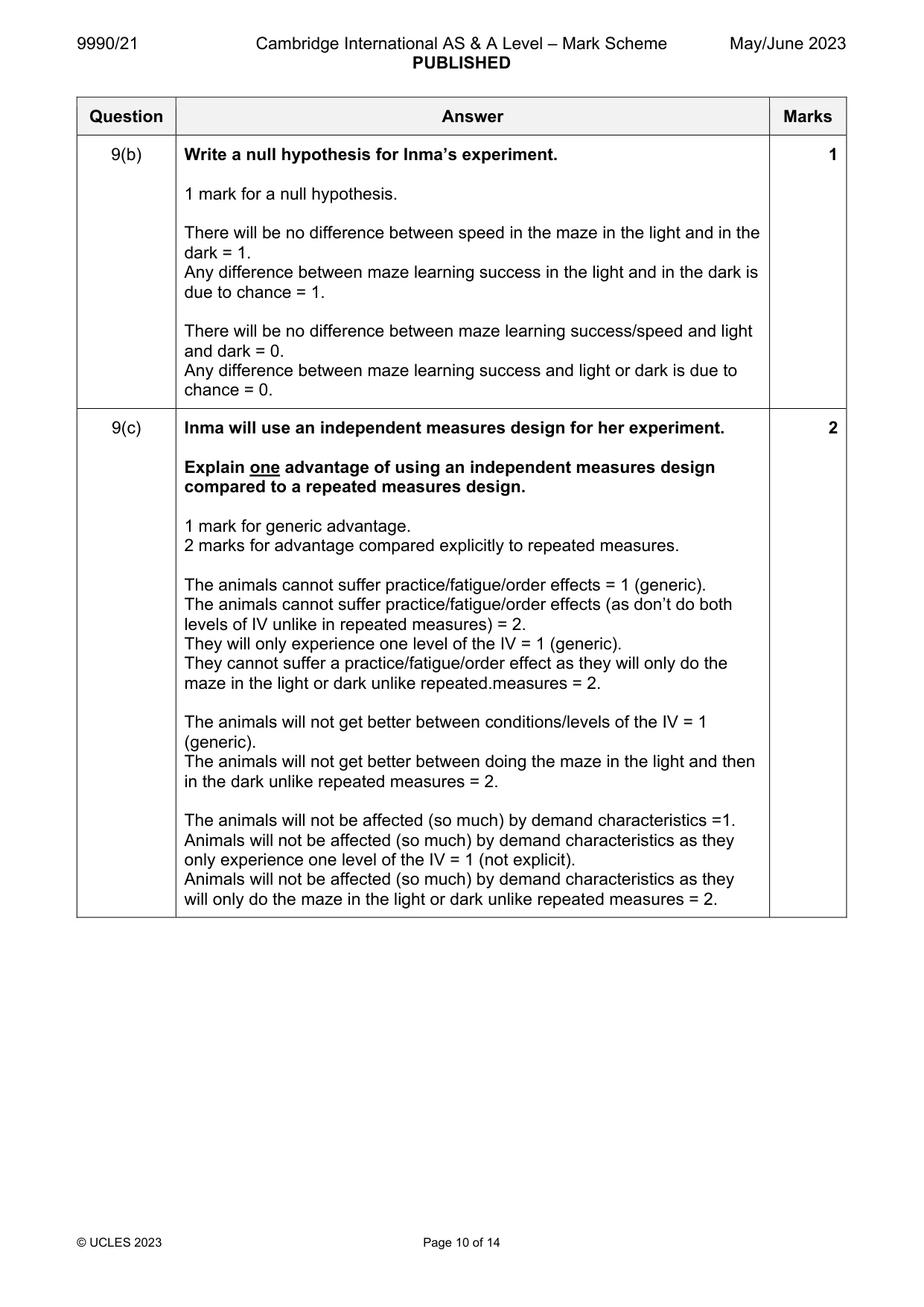
Q9 · Inma is conducting an experiment about learning
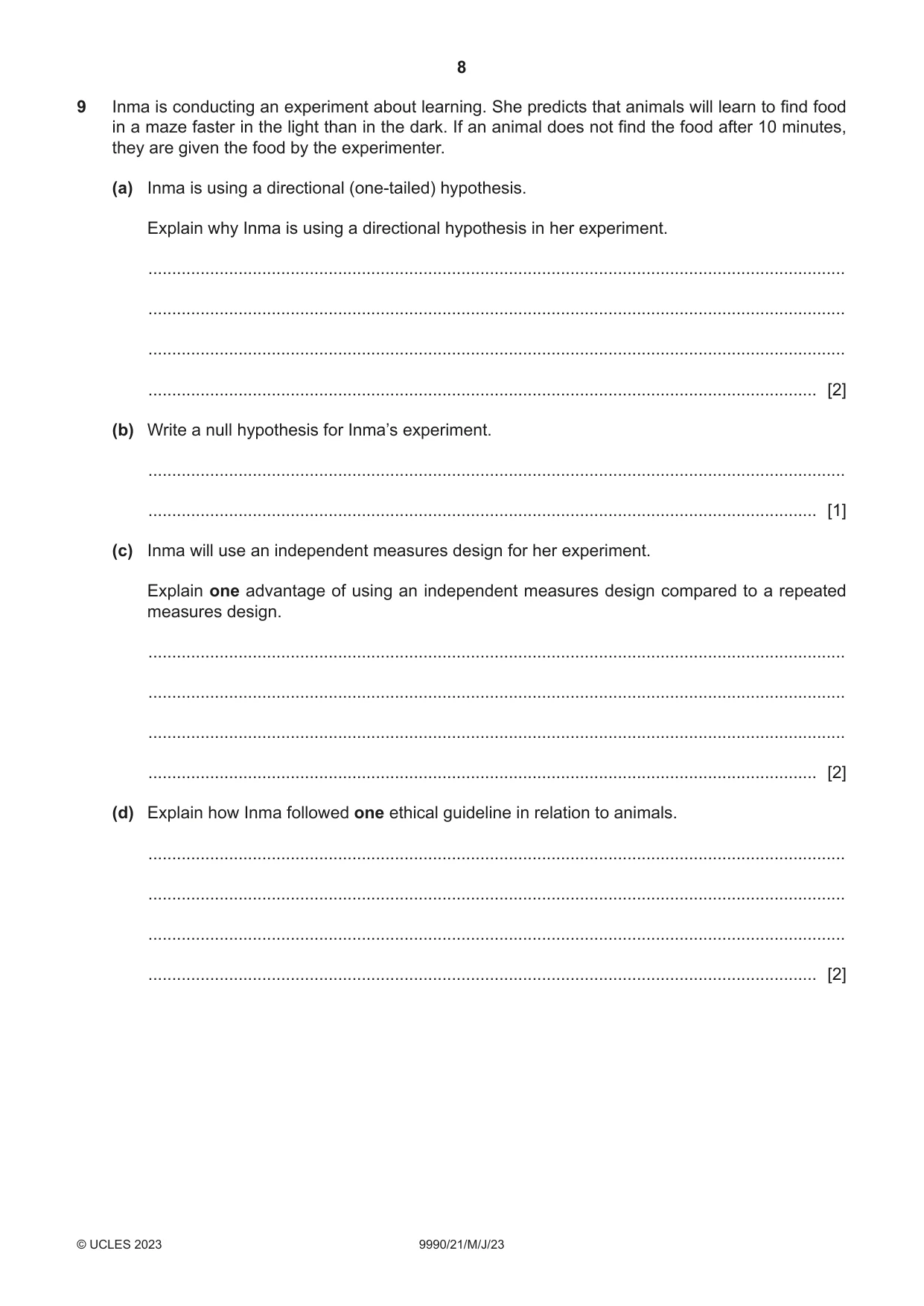
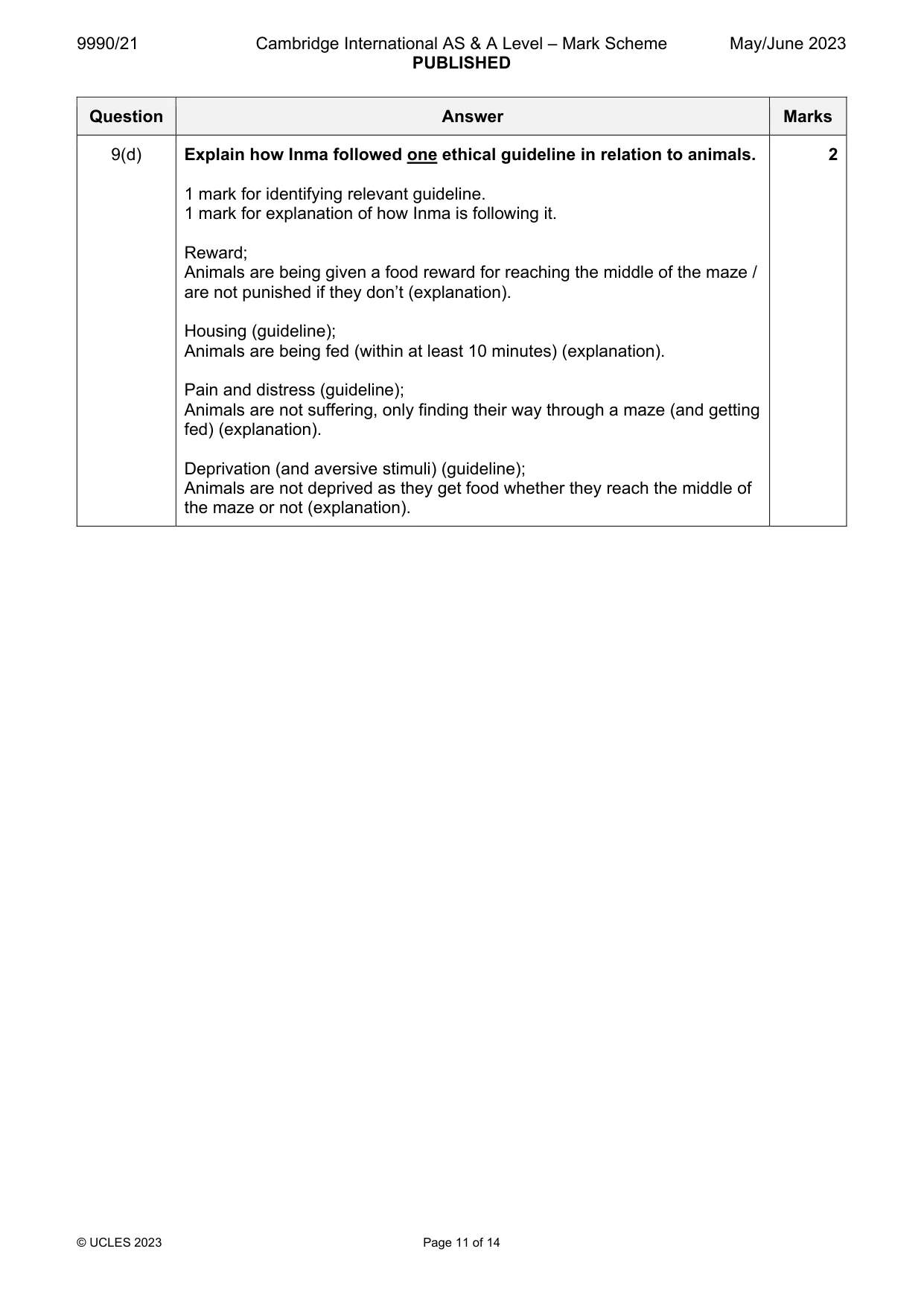
9 Inma is conducting an experiment about learning. She predicts that animals will learn to find food in a maze faster in the light than in the dark. If an animal does not find the food after 10 minutes, they are given the food by the experimenter. (a) Inma is using a directional (one-tailed) hypothesis. Explain why Inma is using a directional hypothesis in her experiment. ................................................................................................................................................... ................................................................................................................................................... ................................................................................................................................................... ............................................................................................................................................. [2] (b) Write a null hypothesis for Inma’s experiment. ................................................................................................................................................... ............................................................................................................................................. [1] (c) Inma will use an independent measures design for her experiment. Explain one advantage of using an independent measures design compared to a repeated measures design. ................................................................................................................................................... ................................................................................................................................................... ................................................................................................................................................... ............................................................................................................................................. [2] (d) Explain how Inma followed one ethical guideline in relation to animals. ................................................................................................................................................... ................................................................................................................................................... ................................................................................................................................................... ............................................................................................................................................. [2] Section C Answer all questions in this section.
Mark scheme: 9 Inma is conducting an experiment about learning. She predicts that animals will learn to find food in a maze faster in the light than in the dark. If the animal does not find the food after 10 minutes, they are given the food by the experimenter. 9(a) Inma is using a directional (one-tailed) hypothesis. 2 Explain why Inma is using a directional hypothesis in her experiment. 1 mark for a generic explanation. 2 marks for a linked explanation. Because she knows which way the results will go = 1 (generic); Because she believes that the animals will be faster (to learn the maze) in the light than the dark = +1 (linked); 9(b) Write a null hypothesis for Inma’s experiment. 1 1 mark for a null hypothesis. There will be no difference between speed in the maze in the light and in the dark = 1. Any difference between maze learning success in the light and in the dark is due to chance = 1. There will be no difference between maze learning success/speed and light and dark = 0. Any difference between maze learning success and light or dark is due to chance = 0. 9(c) Inma will use an independent measures design for her experiment. 2 Explain one advantage of using an independent measures design compared to a repeated measures design. 1 mark for generic advantage. 2 marks for advantage compared explicitly to repeated measures. The animals cannot suffer practice/fatigue/order effects = 1 (generic). The animals cannot suffer practice/fatigue/order effects (as don’t do both levels of IV unlike in repeated measures) = 2. They will only experience one level of the IV = 1 (generic). They cannot suffer a practice/fatigue/order effect as they will only do the maze in the light or dark unlike repeated.measures = 2. The animals will not get better between conditions/levels of the IV = 1 (generic). The animals will not get better between doing the maze in the light and then in the dark unlike repeated measures = 2. The animals will not be affected (so much) by demand characteristics =1. Animals will not be affected (so much) by demand characteristics as they only experience one level of the IV = 1 (not explicit). Animals will not be affected (so much) by demand characteristics as they will only do the maze in the light or dark unlike repeated measures = 2. 9(d) Explain how Inma followed one ethical guideline in relation to animals. 2 1 mark for identifying relevant guideline. 1 mark for explanation of how Inma is following it. Reward; Animals are being given a food reward for reaching the middle of the maze / are not punished if they don’t (explanation). Housing (guideline); Animals are being fed (within at least 10 minutes) (explanation). Pain and distress (guideline); Animals are not suffering, only finding their way through a maze (and getting fed) (explanation). Deprivation (and aversive stimuli) (guideline); Animals are not deprived as they get food whether they reach the middle of the maze or not (explanation).
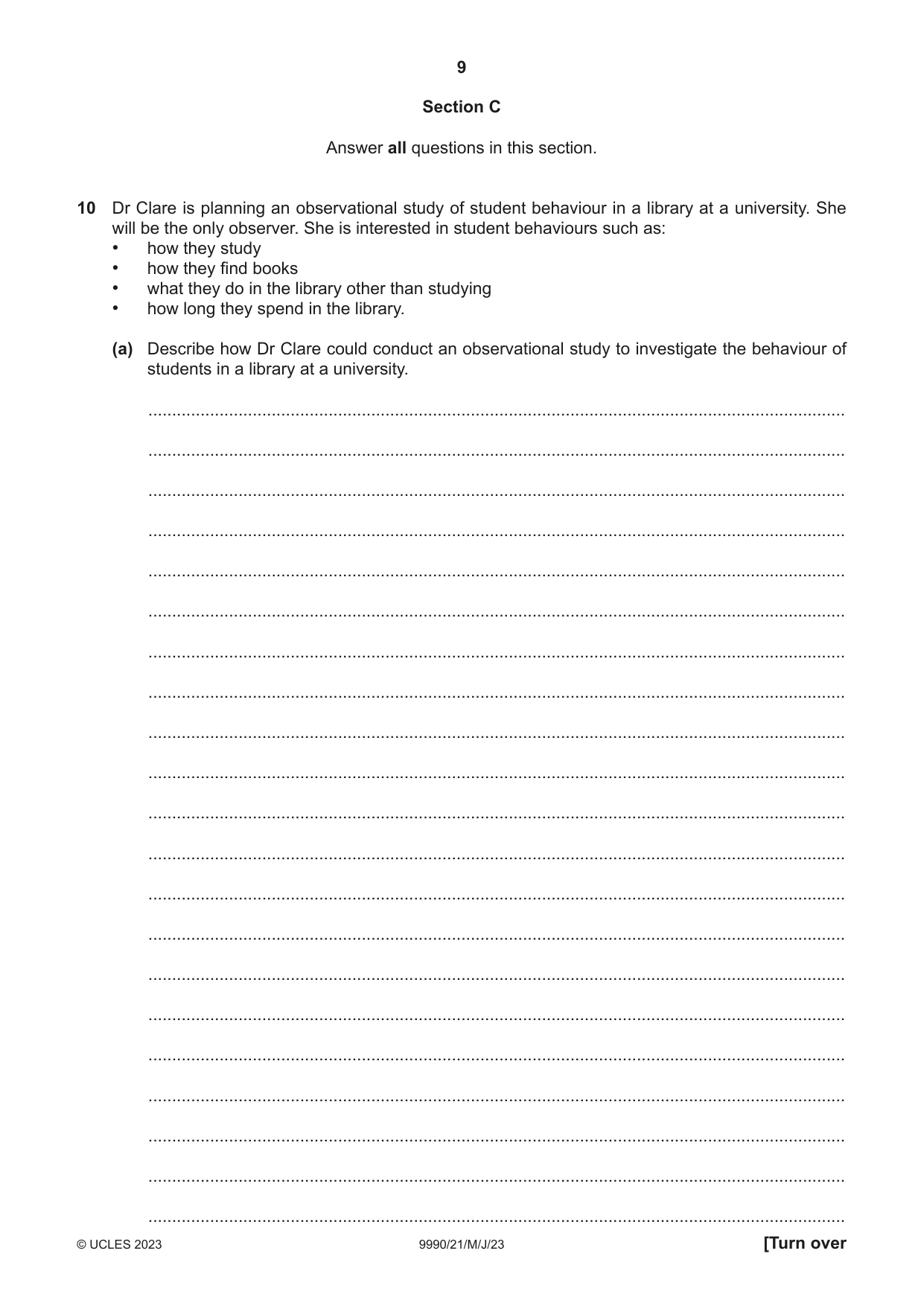
Q10 · Dr Clare is planning an observational study of student behaviour in a library at a…
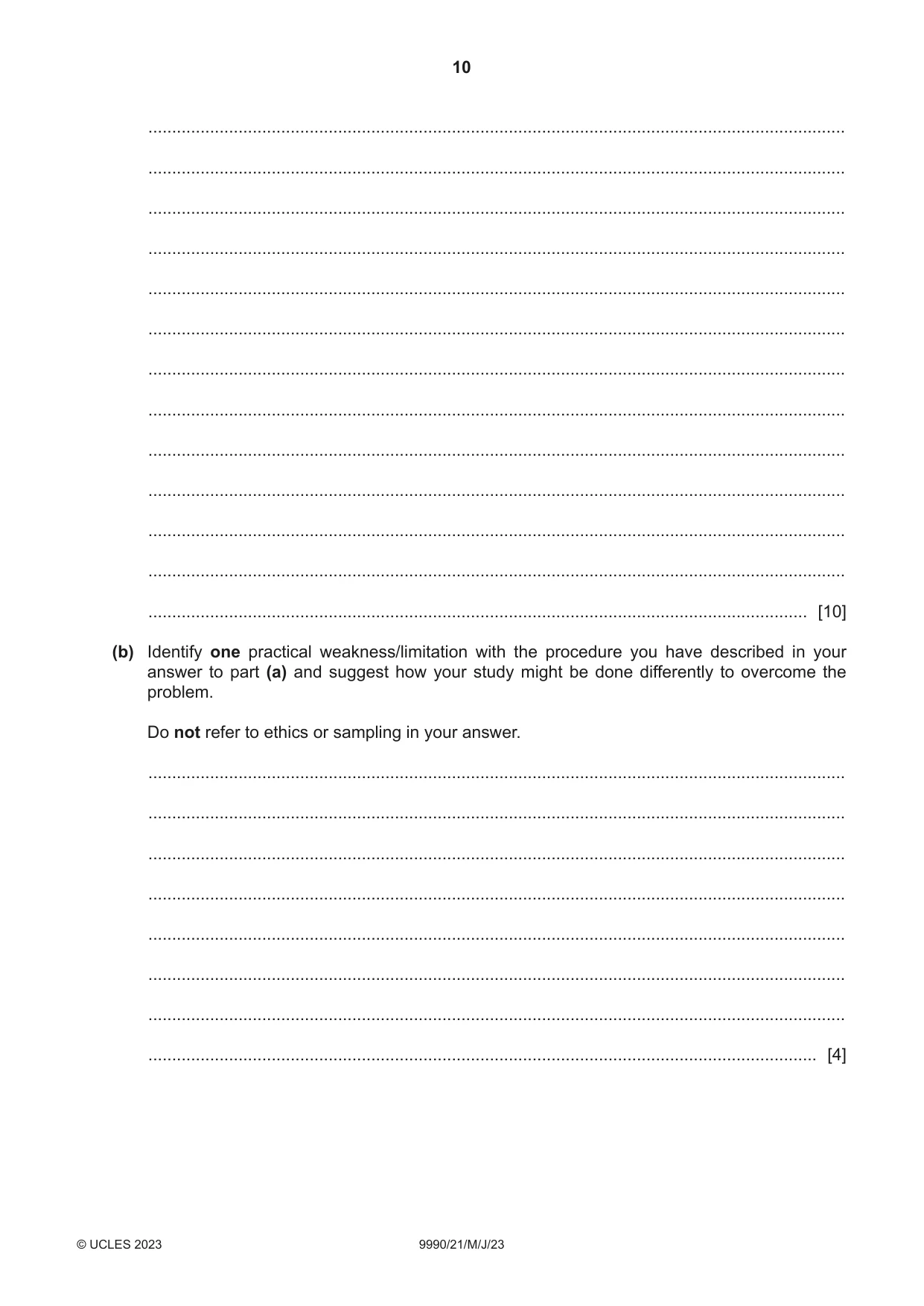
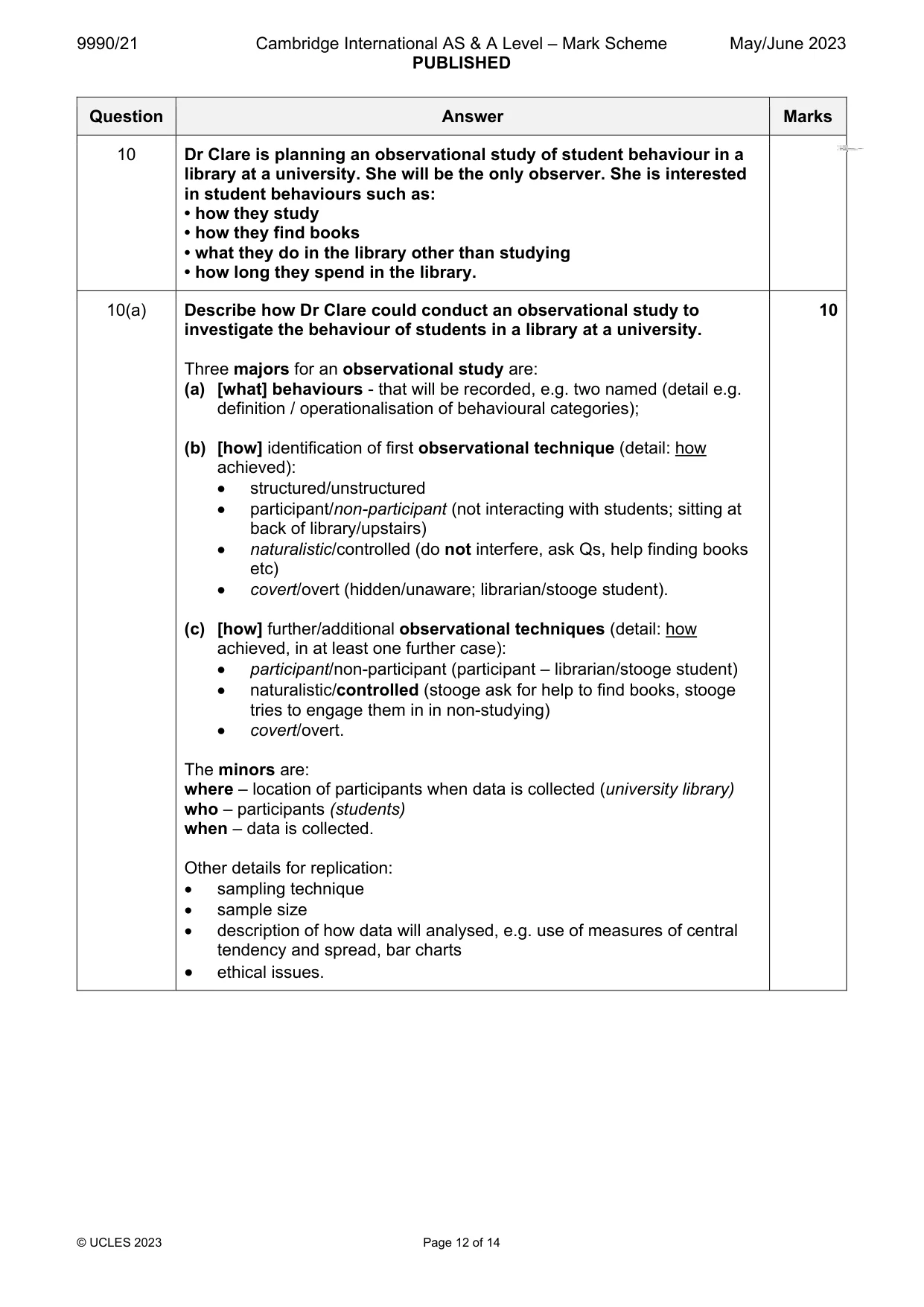
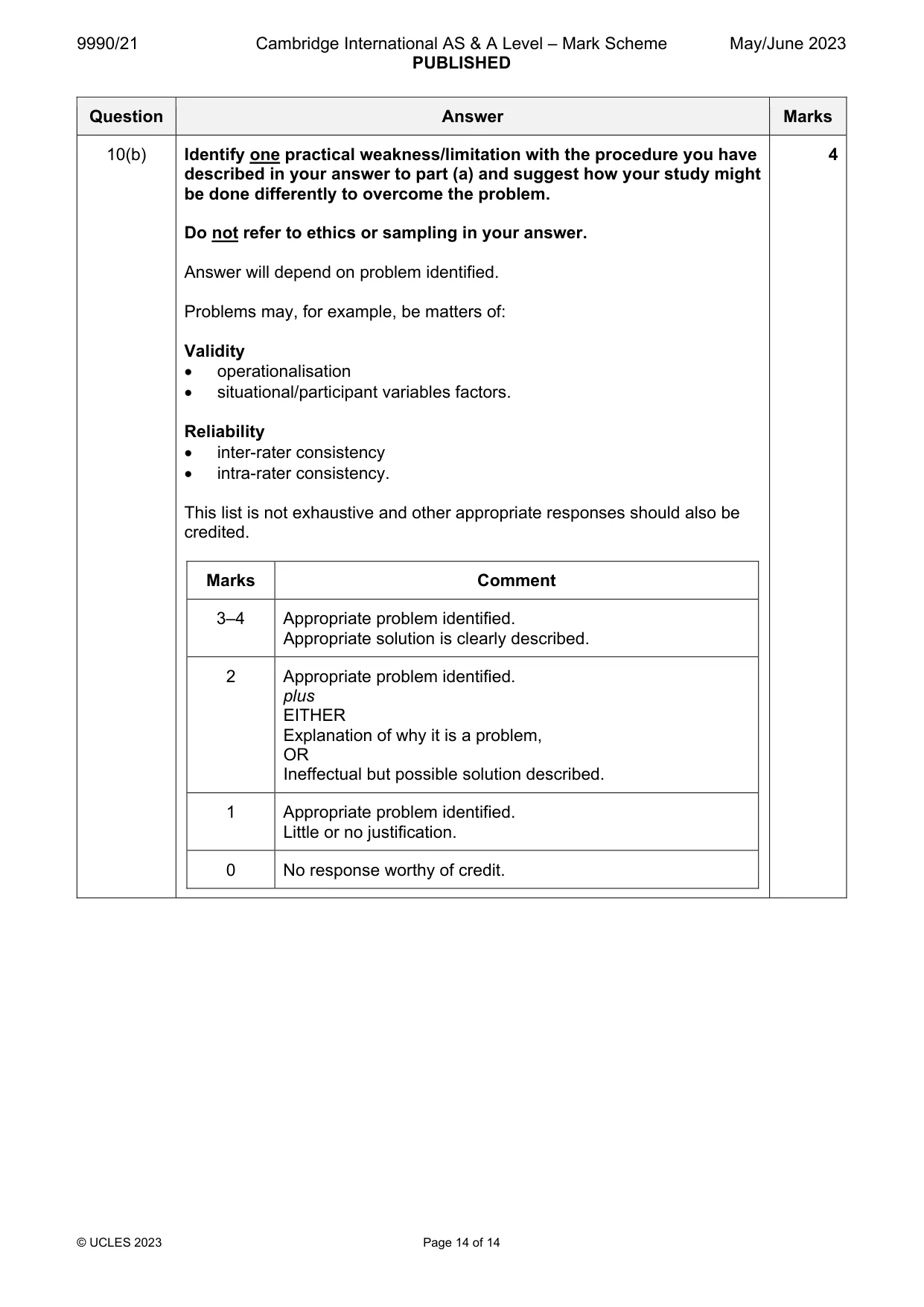
10 Dr Clare is planning an observational study of student behaviour in a library at a university. She will be the only observer. She is interested in student behaviours such as: • how they study • how they find books • what they do in the library other than studying • how long they spend in the library. (a) Describe how Dr Clare could conduct an observational study to investigate the behaviour of students in a library at a university. ................................................................................................................................................... ................................................................................................................................................... ................................................................................................................................................... ................................................................................................................................................... ................................................................................................................................................... ................................................................................................................................................... ................................................................................................................................................... ................................................................................................................................................... ................................................................................................................................................... ................................................................................................................................................... ................................................................................................................................................... ................................................................................................................................................... ................................................................................................................................................... ................................................................................................................................................... ................................................................................................................................................... ................................................................................................................................................... ................................................................................................................................................... ................................................................................................................................................... ................................................................................................................................................... ................................................................................................................................................... ................................................................................................................................................... ................................................................................................................................................... ................................................................................................................................................... ................................................................................................................................................... ................................................................................................................................................... ................................................................................................................................................... ................................................................................................................................................... ................................................................................................................................................... ................................................................................................................................................... ................................................................................................................................................... ................................................................................................................................................... ................................................................................................................................................... ................................................................................................................................................... ........................................................................................................................................... [10] (b) Identify one practical weakness/limitation with the procedure you have described in your answer to part (a) and suggest how your study might be done differently to overcome the problem. Do not refer to ethics or sampling in your answer. ................................................................................................................................................... ................................................................................................................................................... ................................................................................................................................................... ................................................................................................................................................... ................................................................................................................................................... ................................................................................................................................................... ................................................................................................................................................... ............................................................................................................................................. [4]
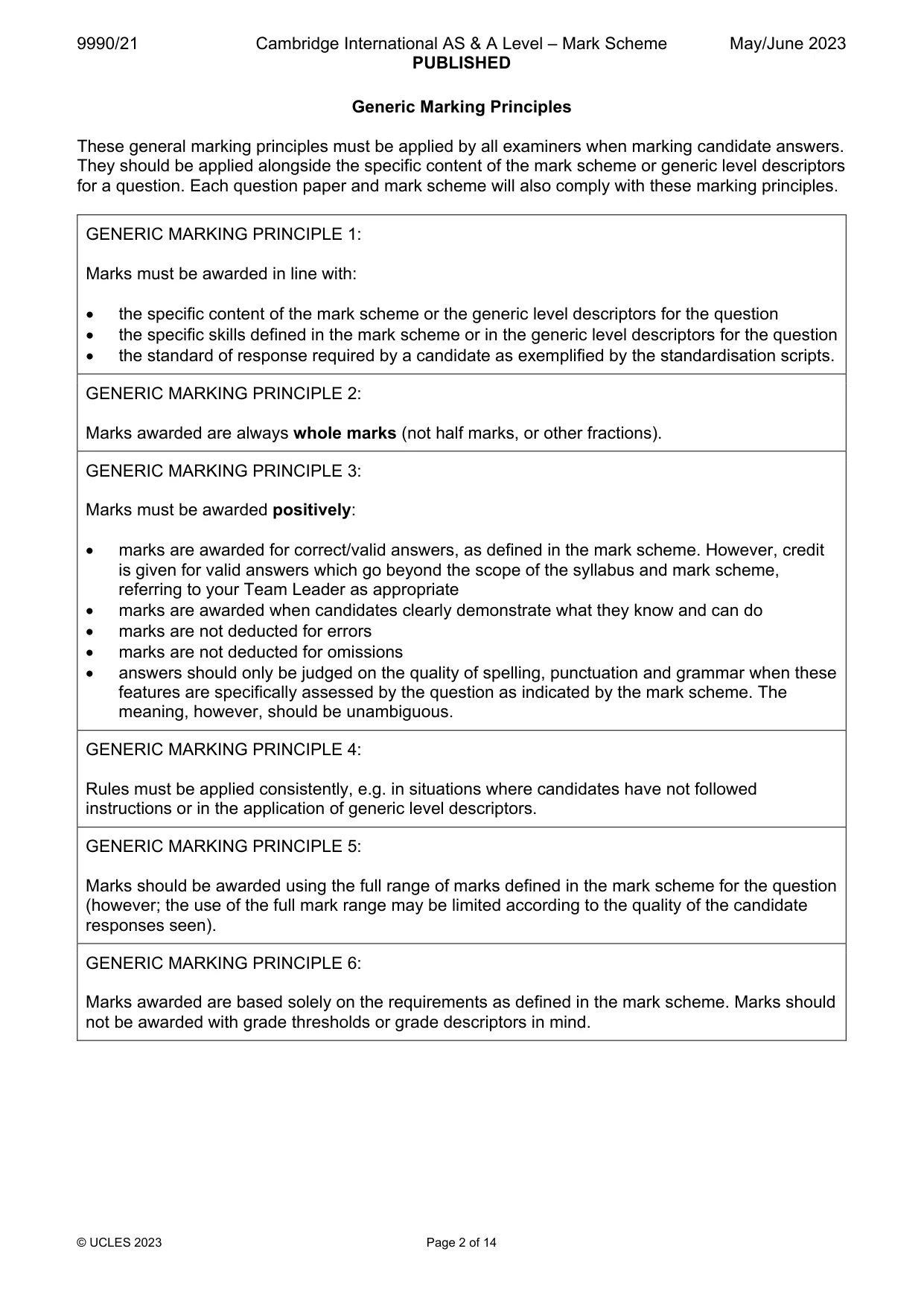
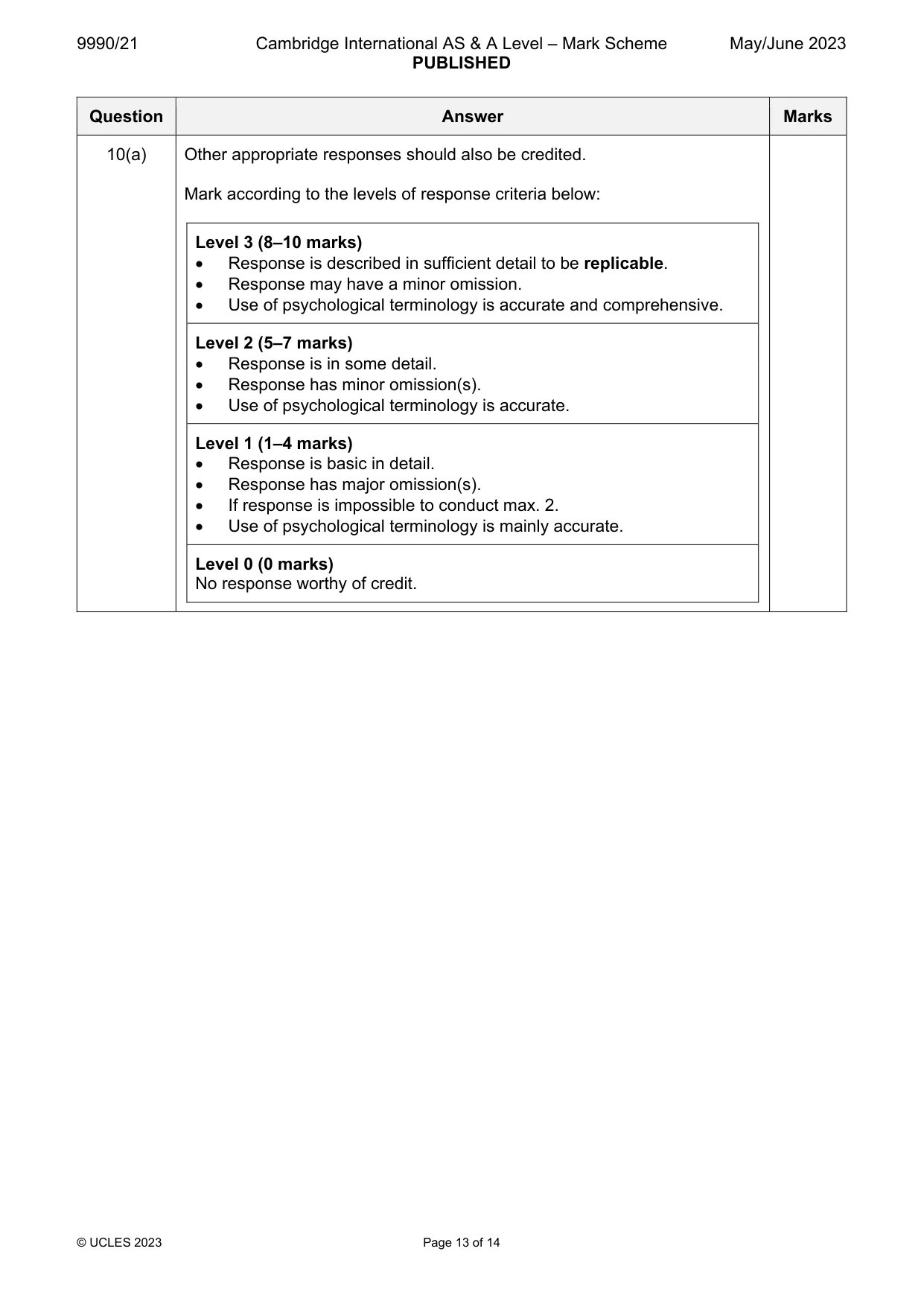
Mark scheme: 10 Dr Clare is planning an observational study of student behaviour in a library at a university. She will be the only observer. She is interested in student behaviours such as: • how they study • how they find books • what they do in the library other than studying • how long they spend in the library. 10(a) Describe how Dr Clare could conduct an observational study to 10 investigate the behaviour of students in a library at a university. Three majors for an observational study are: (a) [what] behaviours - that will be recorded, e.g. two named (detail e.g. definition / operationalisation of behavioural categories); (b) [how] identification of first observational technique (detail: how achieved): structured/unstructured participant/non-participant (not interacting with students; sitting at back of library/upstairs) naturalistic/controlled (do not interfere, ask Qs, help finding books etc) covert/overt (hidden/unaware; librarian/stooge student). (c) [how] further/additional observational techniques (detail: how achieved, in at least one further case): participant/non-participant (participant – librarian/stooge student) naturalistic/controlled (stooge ask for help to find books, stooge tries to engage them in in non-studying) covert/overt. The minors are: where – location of participants when data is collected (university library) who – participants (students) when – data is collected. Other details for replication: sampling technique sample size description of how data will analysed, e.g. use of measures of central tendency and spread, bar charts ethical issues. 10(a) Other appropriate responses should also be credited. Mark according to the levels of response criteria below: Level 3 (8–10 marks) Response is described in sufficient detail to be replicable. Response may have a minor omission. Use of psychological terminology is accurate and comprehensive. Level 2 (5–7 marks) Response is in some detail. Response has minor omission(s). Use of psychological terminology is accurate. Level 1 (1–4 marks) Response is basic in detail. Response has major omission(s). If response is impossible to conduct max. 2. Use of psychological terminology is mainly accurate. Level 0 (0 marks) No response worthy of credit. 10(b) Identify one practical weakness/limitation with the procedure you have 4 described in your answer to part (a) and suggest how your study might be done differently to overcome the problem. Do not refer to ethics or sampling in your answer. Answer will depend on problem identified. Problems may, for example, be matters of: Validity operationalisation situational/participant variables factors. Reliability inter-rater consistency intra-rater consistency. This list is not exhaustive and other appropriate responses should also be credited. Marks Comment 3–4 Appropriate problem identified. Appropriate solution is clearly described. 2 Appropriate problem identified. plus EITHER Explanation of why it is a problem, OR Ineffectual but possible solution described. 1 Appropriate problem identified. Little or no justification. 0 No response worthy of credit.
What was in this paper
The subtopics covered by these 10 questions, and how many questions each got. Open one in a new tab to see every Cambridge question on it.
What you needed in this session
Cambridge’s own grade thresholds for 2023 May/June, Paper 2 · Variant 1. A higher threshold means an easier paper — the bar moves with how the cohort did.