Cambridge A Level Psychology (from 2018) 9990 — 2024 Oct/Nov Paper 2 · Variant 1
9990/21/O/N/24 · 9 questions · 60 marks · 90 min
The question paper and its mark scheme, free to read here and free to download. This is Cambridge’s own paper, exactly as it was sat.
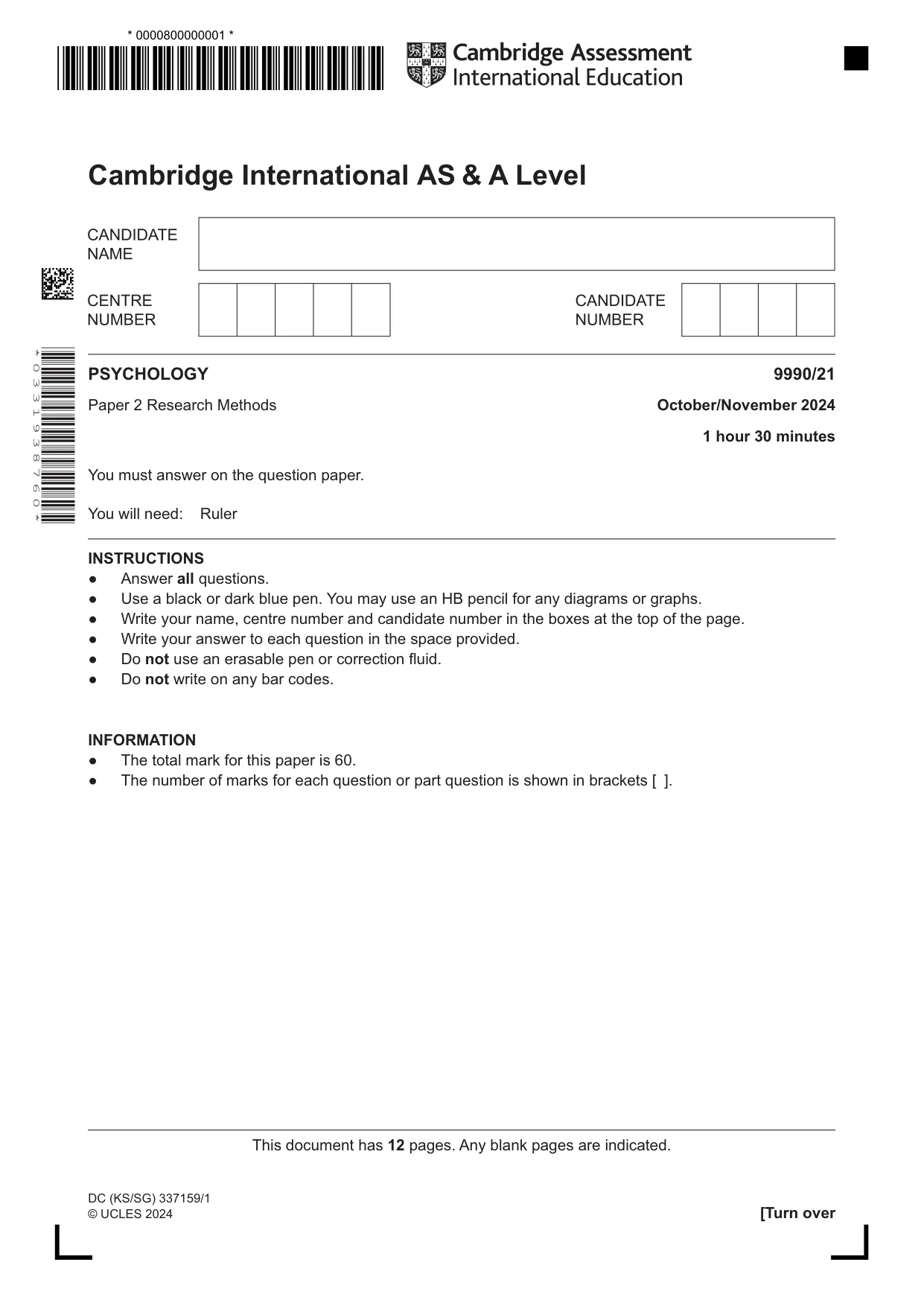
Question paper12 pages

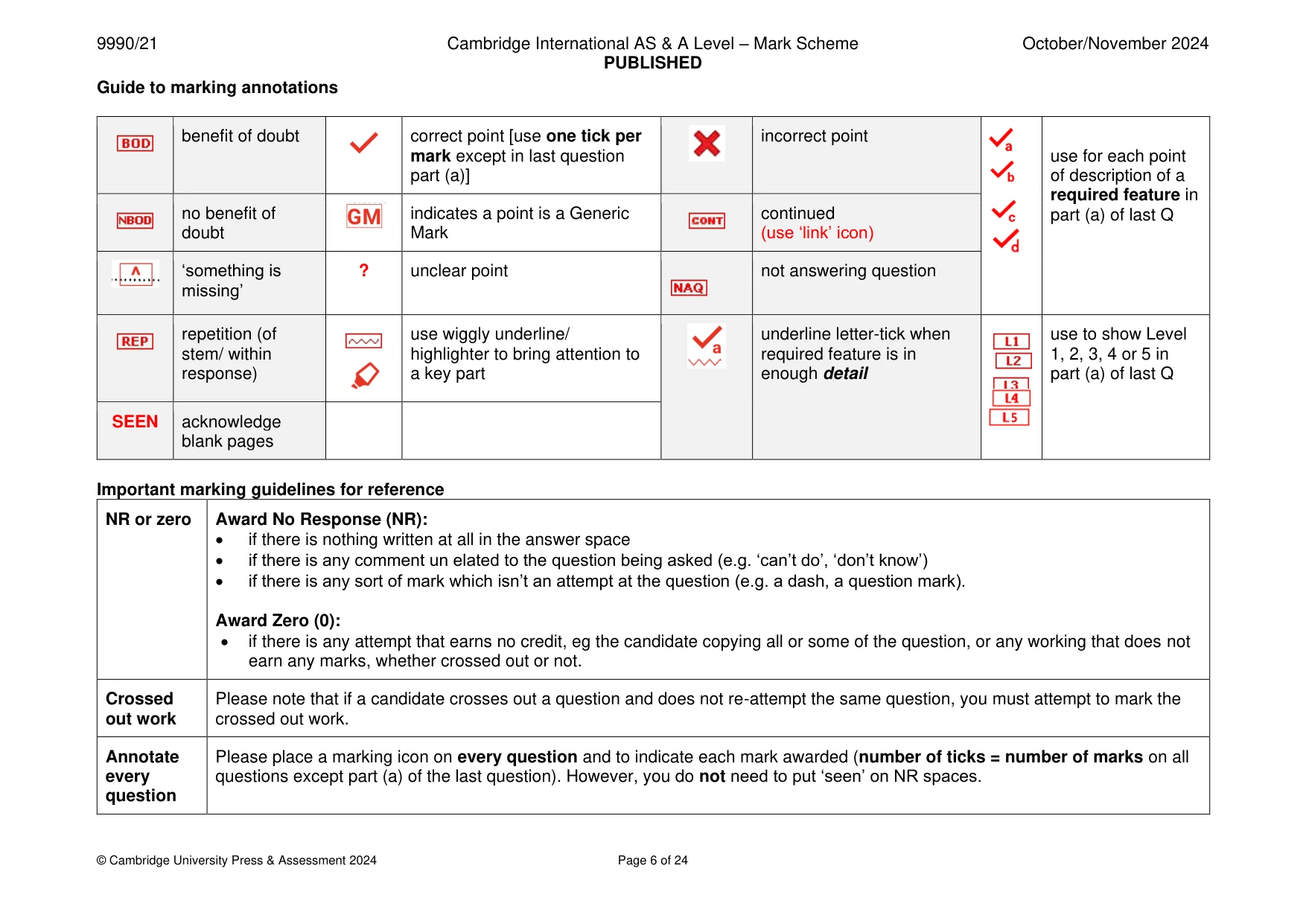
Mark scheme24 pages
Answers below. Sit the paper first if you are practising.
Questions as text
Q1 · Explain what is meant by a ‘matched pairs design’, including any example
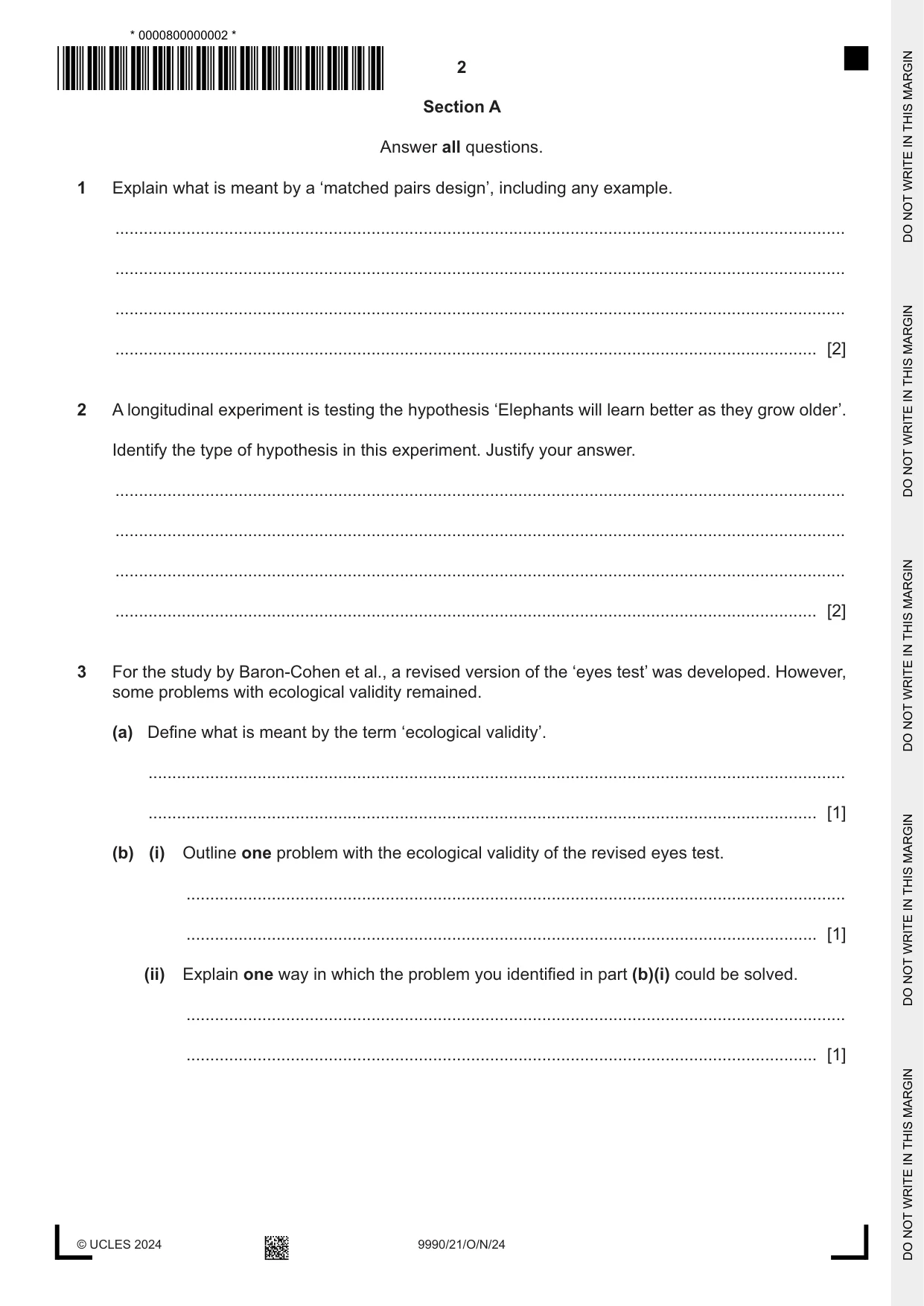
1 Explain what is meant by a ‘matched pairs design’, including any example. .......................................................................................................................................................... .......................................................................................................................................................... .......................................................................................................................................................... .................................................................................................................................................... [2]
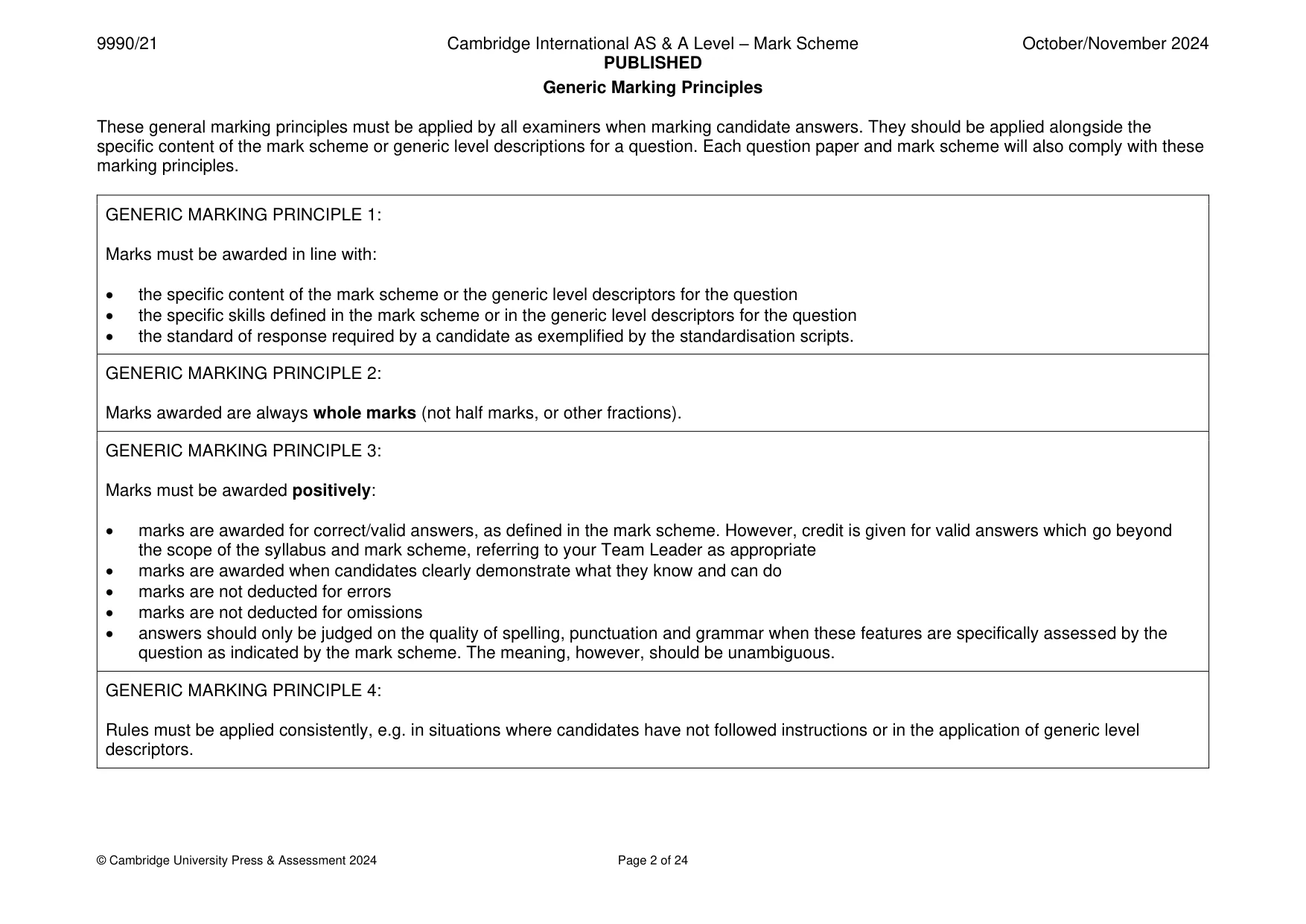
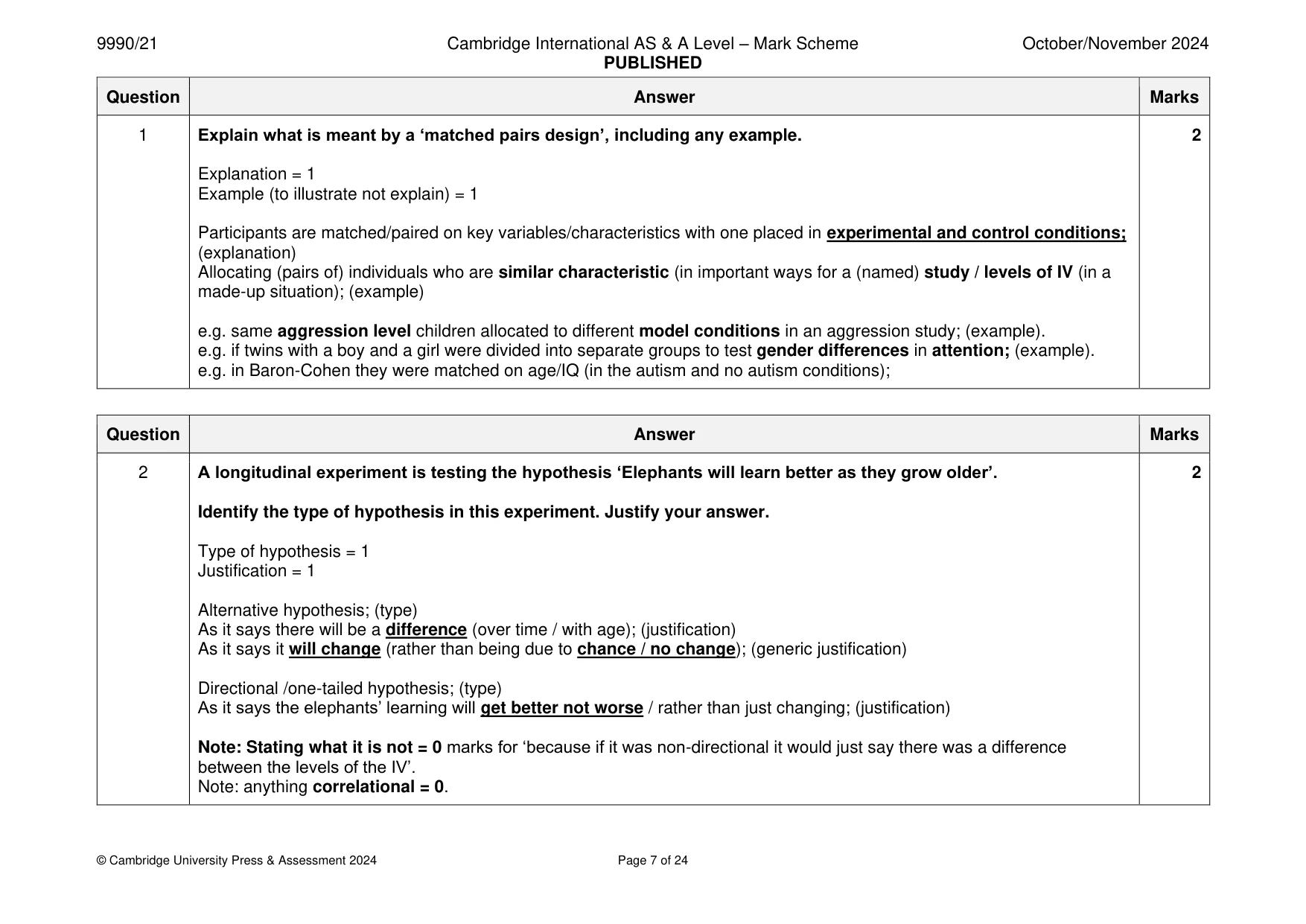
Mark scheme: Question Answer Marks 1 Explain what is meant by a ‘matched pairs design’, including any example. 2 Explanation = 1 Example (to illustrate not explain) = 1 Participants are matched/paired on key variables/characteristics with one placed in experimental and control conditions; (explanation) Allocating (pairs of) individuals who are similar characteristic (in important ways for a (named) study / levels of IV (in a made-up situation); (example) e.g. same aggression level children allocated to different model conditions in an aggression study; (example). e.g. if twins with a boy and a girl were divided into separate groups to test gender differences in attention; (example). e.g. in Baron-Cohen they were matched on age/IQ (in the autism and no autism conditions);
Q2 · A longitudinal experiment is testing the hypothesis ‘Elephants will learn better as they…
2 A longitudinal experiment is testing the hypothesis ‘Elephants will learn better as they grow older’. Identify the type of hypothesis in this experiment. Justify your answer. .......................................................................................................................................................... .......................................................................................................................................................... .......................................................................................................................................................... .................................................................................................................................................... [2]
Mark scheme: 2 A longitudinal experiment is testing the hypothesis ‘Elephants will learn better as they grow older’. 2 Identify the type of hypothesis in this experiment. Justify your answer. Type of hypothesis = 1 Justification = 1 Alternative hypothesis; (type) As it says there will be a difference (over time / with age); (justification) As it says it will change (rather than being due to chance / no change); (generic justification) Directional /one-tailed hypothesis; (type) As it says the elephants’ learning will get better not worse / rather than just changing; (justification) Note: Stating what it is not = 0 marks for ‘because if it was non-directional it would just say there was a difference between the levels of the IV’. Note: anything correlational = 0.
Q3 · For the study by Baron-Cohen et al., a revised version of the ‘eyes test’ was developed
3 For the study by Baron-Cohen et al., a revised version of the ‘eyes test’ was developed. However, some problems with ecological validity remained. (a) Define what is meant by the term ‘ecological validity’. ................................................................................................................................................... ............................................................................................................................................. [1] (b) (i) Outline one problem with the ecological validity of the revised eyes test. ........................................................................................................................................... ..................................................................................................................................... [1] (ii) Explain one way in which the problem you identified in part (b)(i) could be solved. ........................................................................................................................................... ..................................................................................................................................... [1]
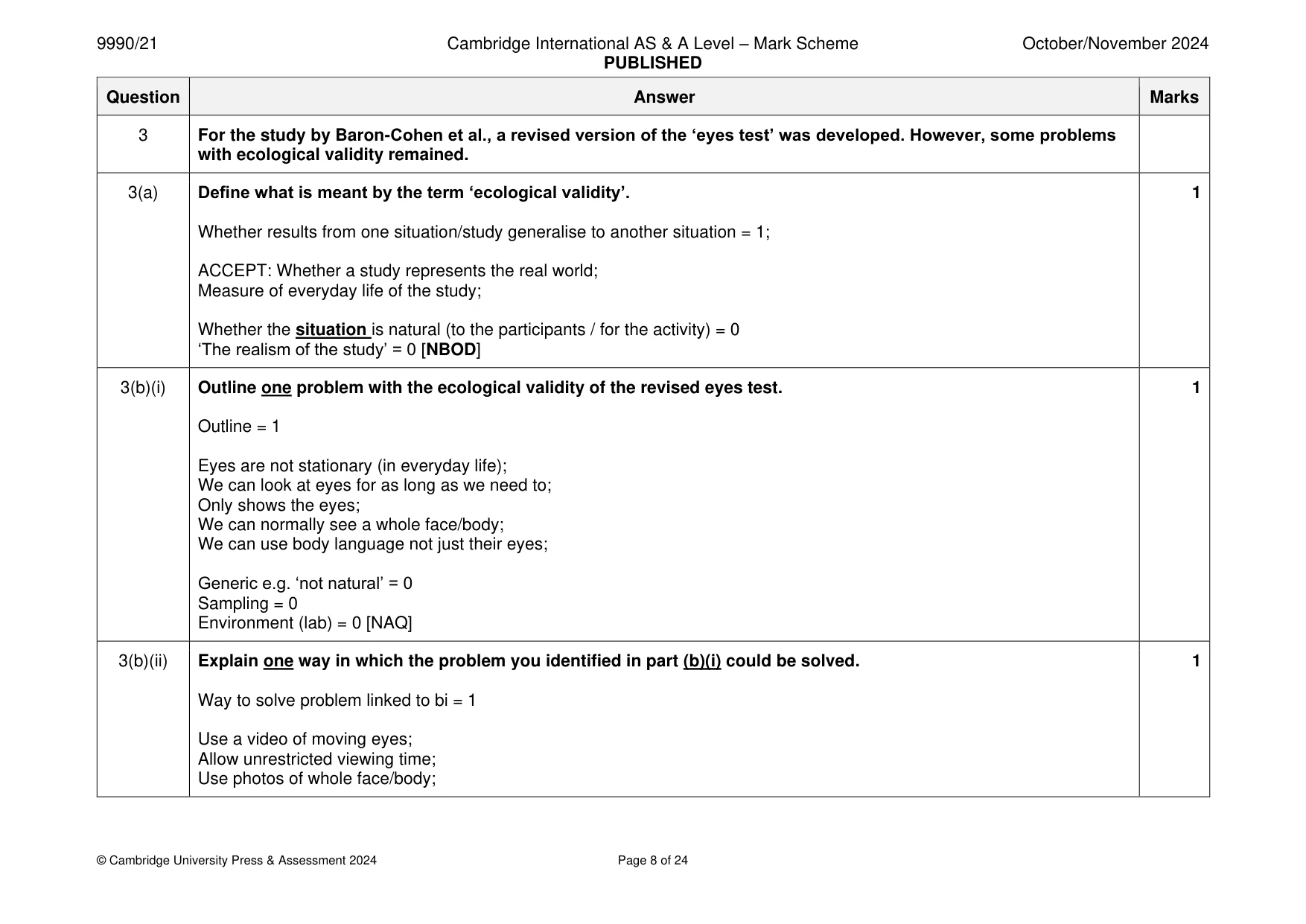
Mark scheme: 3 For the study by Baron-Cohen et al., a revised version of the ‘eyes test’ was developed. However, some problems with ecological validity remained. 3(a) Define what is meant by the term ‘ecological validity’. 1 Whether results from one situation/study generalise to another situation = 1; ACCEPT: Whether a study represents the real world; Measure of everyday life of the study; Whether the situation is natural (to the participants / for the activity) = 0 ‘The realism of the study’ = 0 [NBOD] 3(b)(i) Outline one problem with the ecological validity of the revised eyes test. 1 Outline = 1 Eyes are not stationary (in everyday life); We can look at eyes for as long as we need to; Only shows the eyes; We can normally see a whole face/body; We can use body language not just their eyes; Generic e.g. ‘not natural’ = 0 Sampling = 0 Environment (lab) = 0 [NAQ] 3(b)(ii) Explain one way in which the problem you identified in part (b)(i) could be solved. 1 Way to solve problem linked to bi = 1 Use a video of moving eyes; Allow unrestricted viewing time; Use photos of whole face/body;
Q4 · The study by Hassett et al
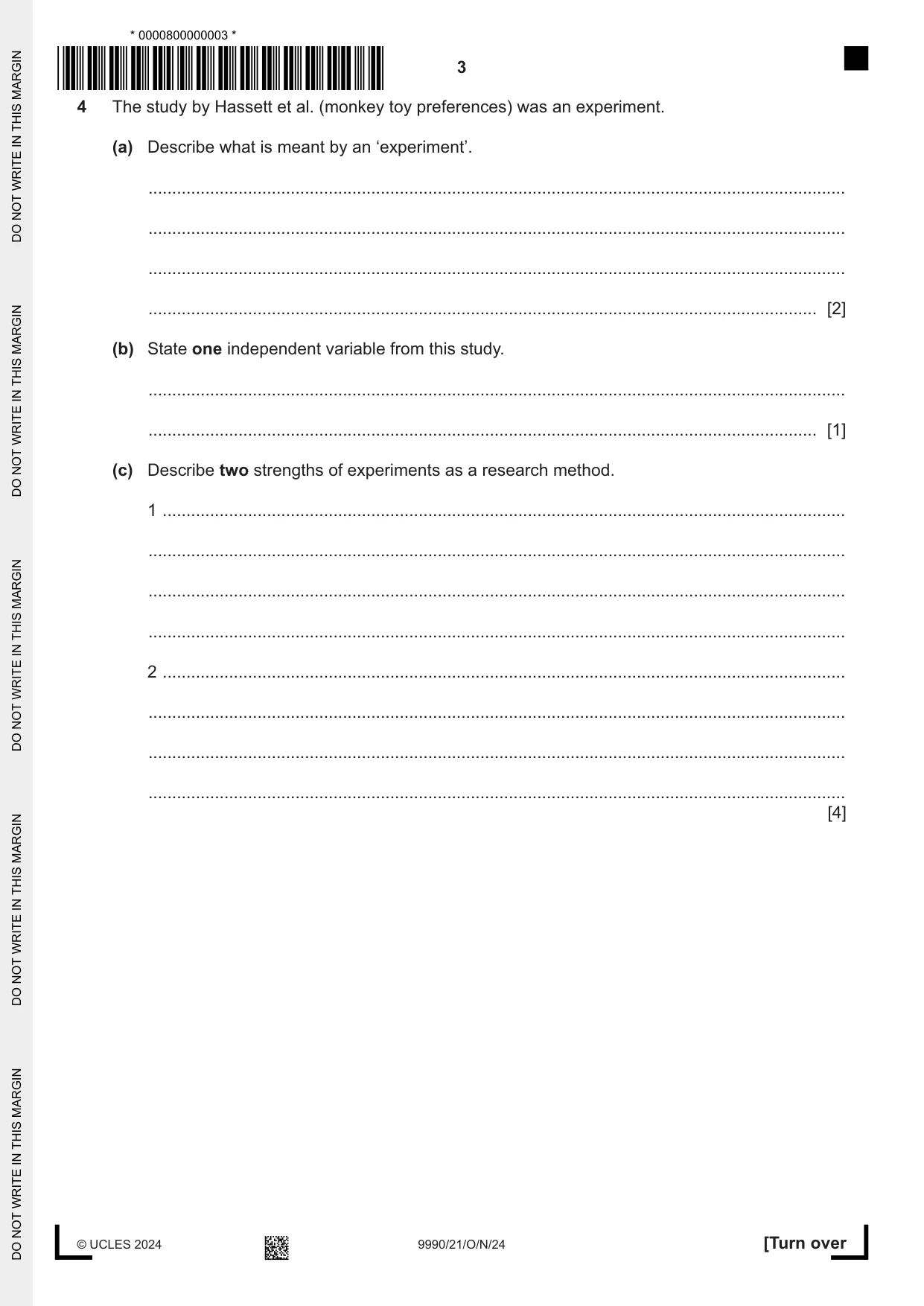
4 The study by Hassett et al. (monkey toy preferences) was an experiment. (a) Describe what is meant by an ‘experiment’. ................................................................................................................................................... ................................................................................................................................................... ................................................................................................................................................... ............................................................................................................................................. [2] (b) State one independent variable from this study. ................................................................................................................................................... ............................................................................................................................................. [1] (c) Describe two strengths of experiments as a research method. 1 ................................................................................................................................................ ................................................................................................................................................... ................................................................................................................................................... ................................................................................................................................................... 2 ................................................................................................................................................ ................................................................................................................................................... ................................................................................................................................................... ................................................................................................................................................... [4]
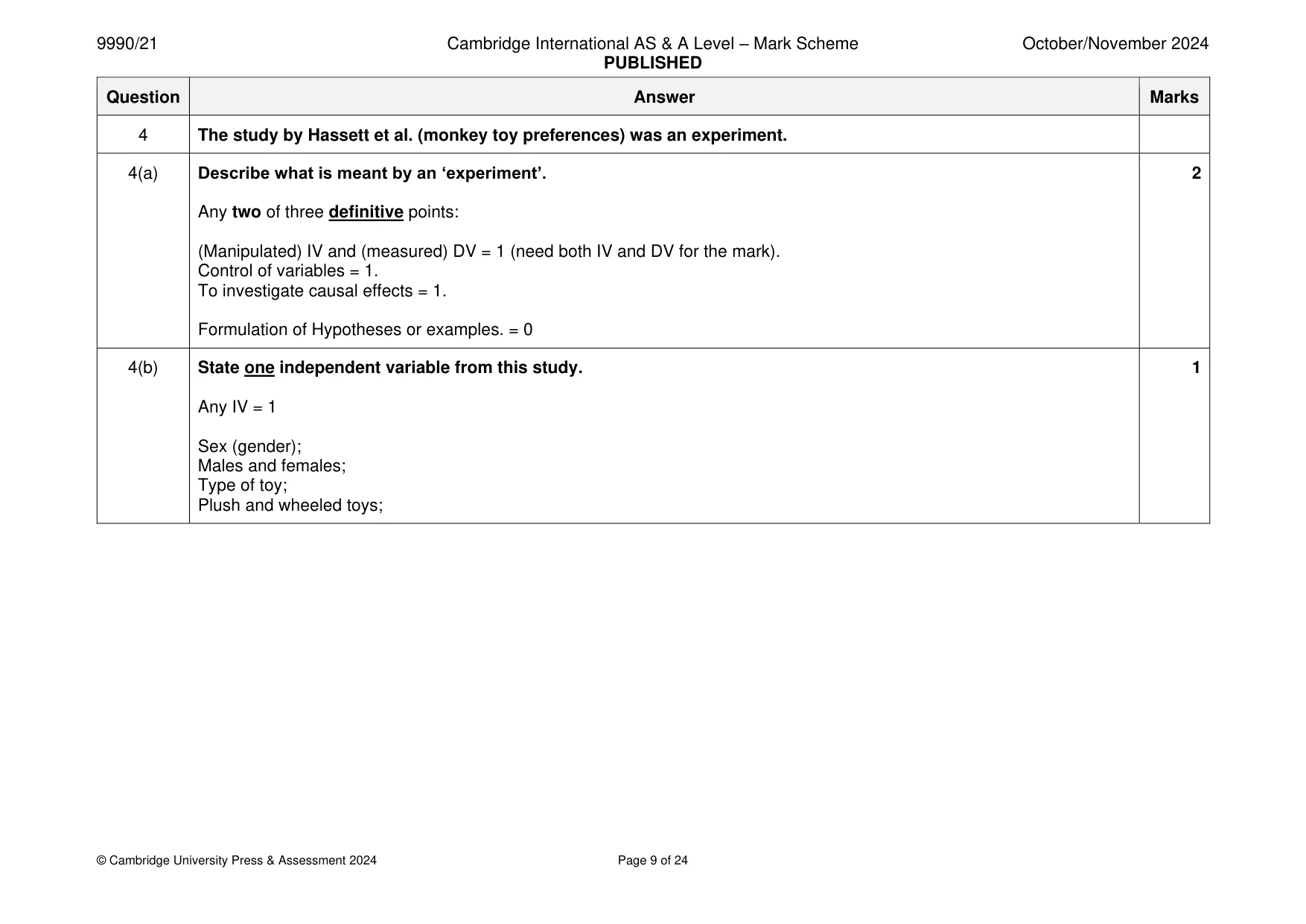
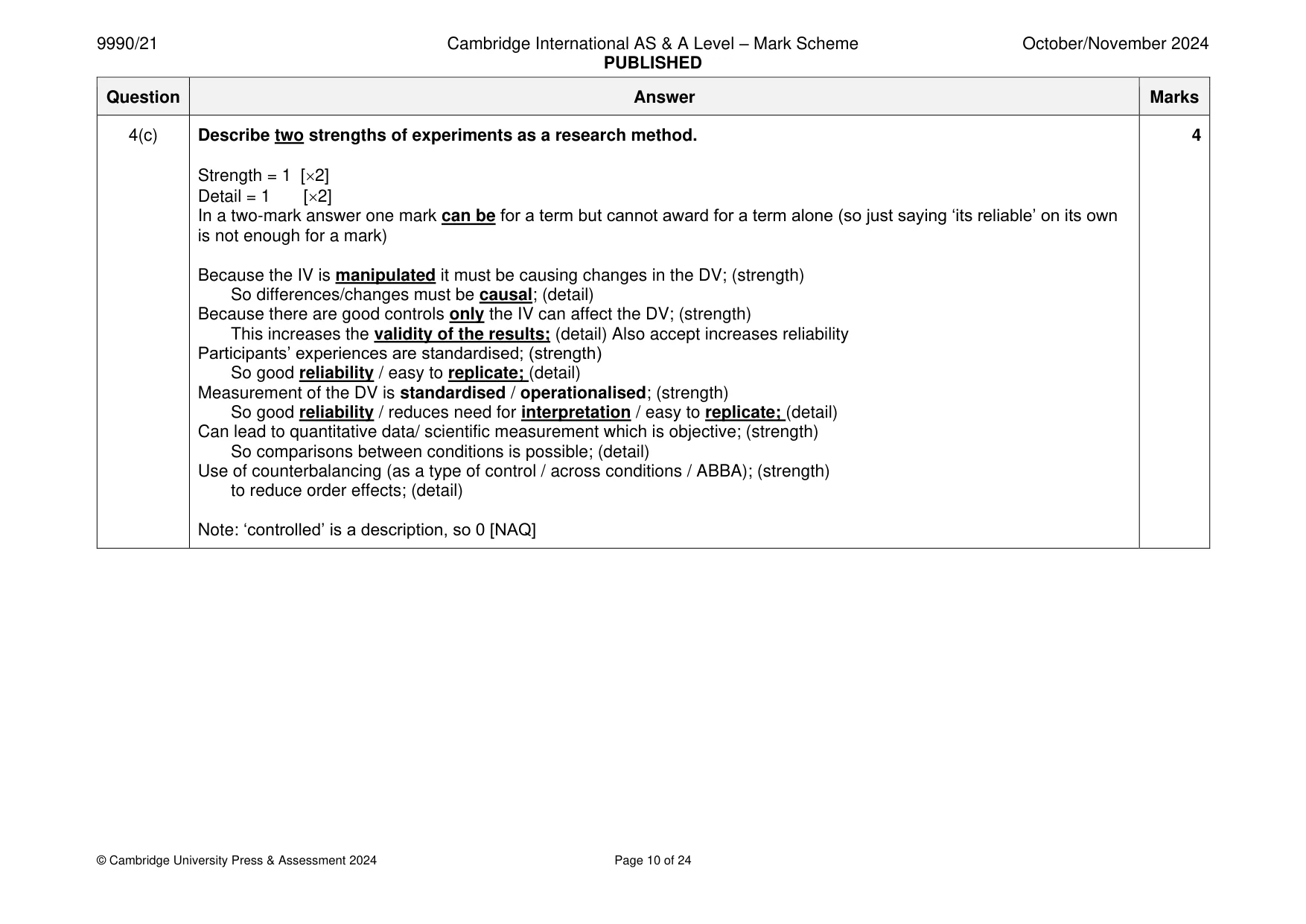
Mark scheme: 4 The study by Hassett et al. (monkey toy preferences) was an experiment. 4(a) Describe what is meant by an ‘experiment’. 2 Any two of three definitive points: (Manipulated) IV and (measured) DV = 1 (need both IV and DV for the mark). Control of variables = 1. To investigate causal effects = 1. Formulation of Hypotheses or examples. = 0 4(b) State one independent variable from this study. 1 Any IV = 1 Sex (gender); Males and females; Type of toy; Plush and wheeled toys; 4(c) Describe two strengths of experiments as a research method. 4 Strength = 1 [2] Detail = 1 [2] In a two-mark answer one mark can be for a term but cannot award for a term alone (so just saying ‘its reliable’ on its own is not enough for a mark) Because the IV is manipulated it must be causing changes in the DV; (strength) So differences/changes must be causal; (detail) Because there are good controls only the IV can affect the DV; (strength) This increases the validity of the results; (detail) Also accept increases reliability Participants’ experiences are standardised; (strength) So good reliability / easy to replicate; (detail) Measurement of the DV is standardised / operationalised; (strength) So good reliability / reduces need for interpretation / easy to replicate; (detail) Can lead to quantitative data/ scientific measurement which is objective; (strength) So comparisons between conditions is possible; (detail) Use of counterbalancing (as a type of control / across conditions / ABBA); (strength) to reduce order effects; (detail) Note: ‘controlled’ is a description, so 0 [NAQ]
Q5 · Describe inter-rater reliability and inter-observer reliability, using any example(s)
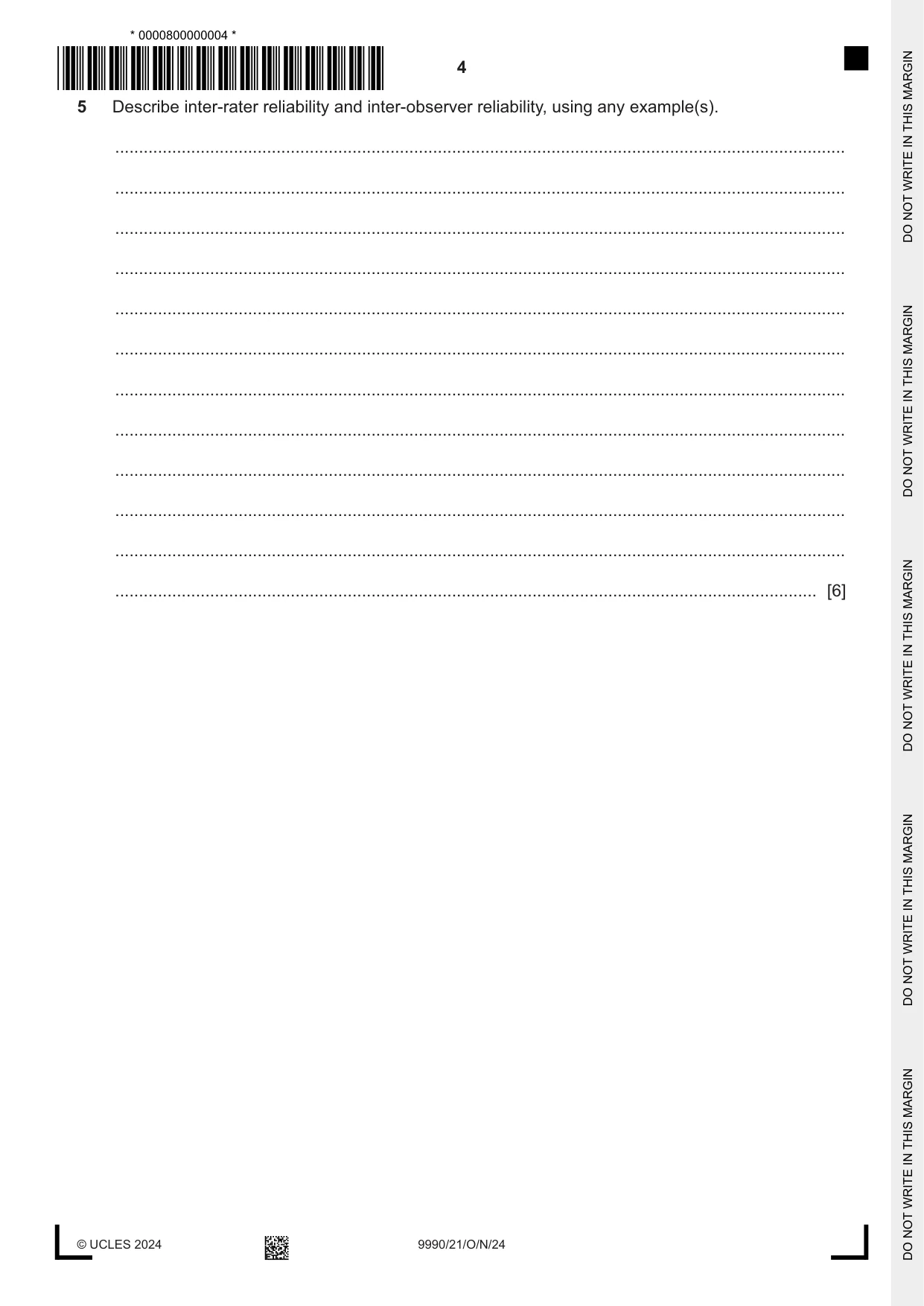
5 Describe inter-rater reliability and inter-observer reliability, using any example(s). .......................................................................................................................................................... .......................................................................................................................................................... .......................................................................................................................................................... .......................................................................................................................................................... .......................................................................................................................................................... .......................................................................................................................................................... .......................................................................................................................................................... .......................................................................................................................................................... .......................................................................................................................................................... .......................................................................................................................................................... .......................................................................................................................................................... .................................................................................................................................................... [6]
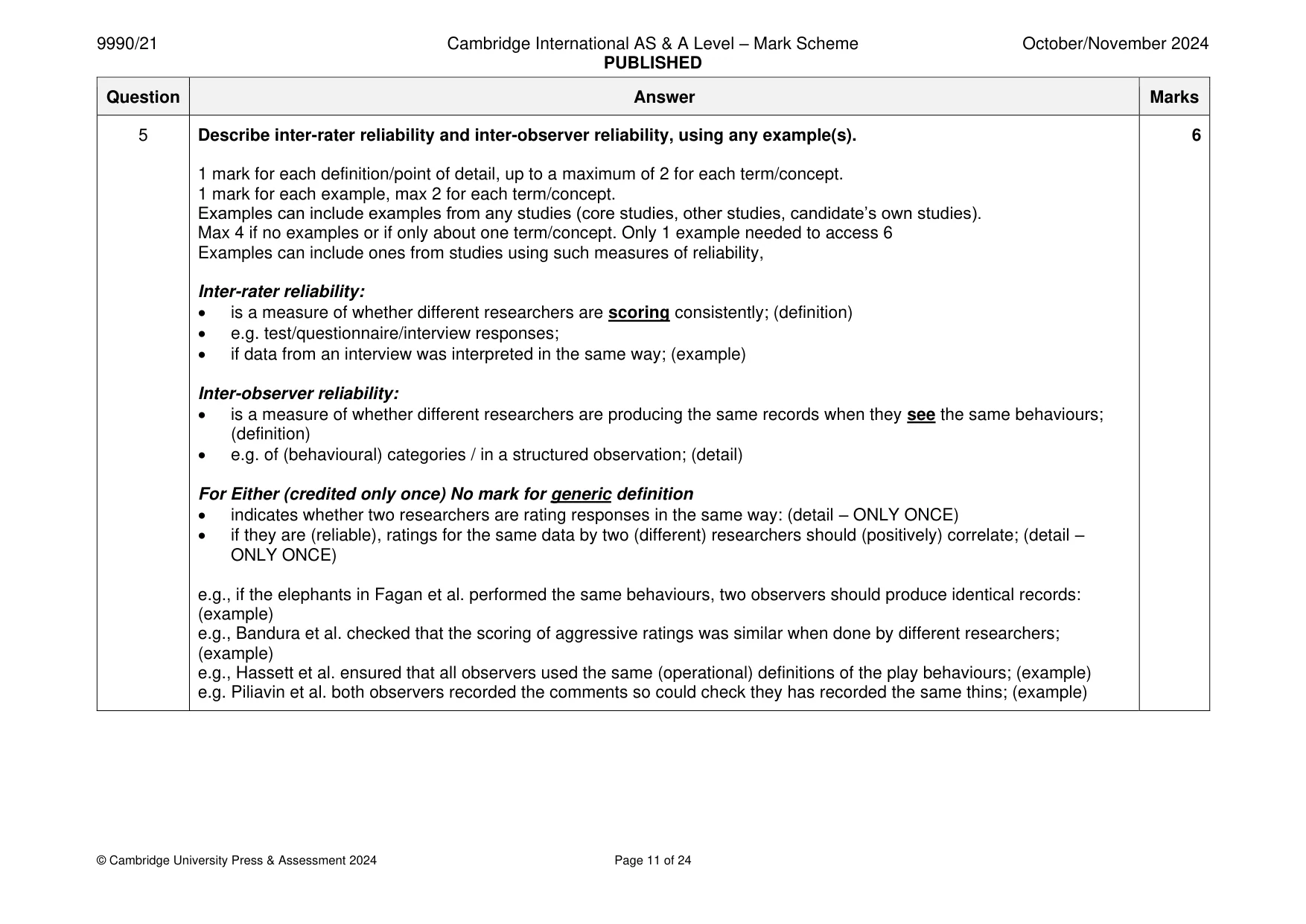
Mark scheme: 5 Describe inter-rater reliability and inter-observer reliability, using any example(s). 6 1 mark for each definition/point of detail, up to a maximum of 2 for each term/concept. 1 mark for each example, max 2 for each term/concept. Examples can include examples from any studies (core studies, other studies, candidate’s own studies). Max 4 if no examples or if only about one term/concept. Only 1 example needed to access 6 Examples can include ones from studies using such measures of reliability, Inter-rater reliability: • is a measure of whether different researchers are scoring consistently; (definition) • e.g. test/questionnaire/interview responses; • if data from an interview was interpreted in the same way; (example) Inter-observer reliability: • is a measure of whether different researchers are producing the same records when they see the same behaviours; (definition) • e.g. of (behavioural) categories / in a structured observation; (detail) For Either (credited only once) No mark for generic definition • indicates whether two researchers are rating responses in the same way: (detail – ONLY ONCE) • if they are (reliable), ratings for the same data by two (different) researchers should (positively) correlate; (detail – ONLY ONCE) e.g., if the elephants in Fagan et al. performed the same behaviours, two observers should produce identical records: (example) e.g., Bandura et al. checked that the scoring of aggressive ratings was similar when done by different researchers; (example) e.g., Hassett et al. ensured that all observers used the same (operational) definitions of the play behaviours; (example) e.g. Piliavin et al. both observers recorded the comments so could check they has recorded the same thins; (example)
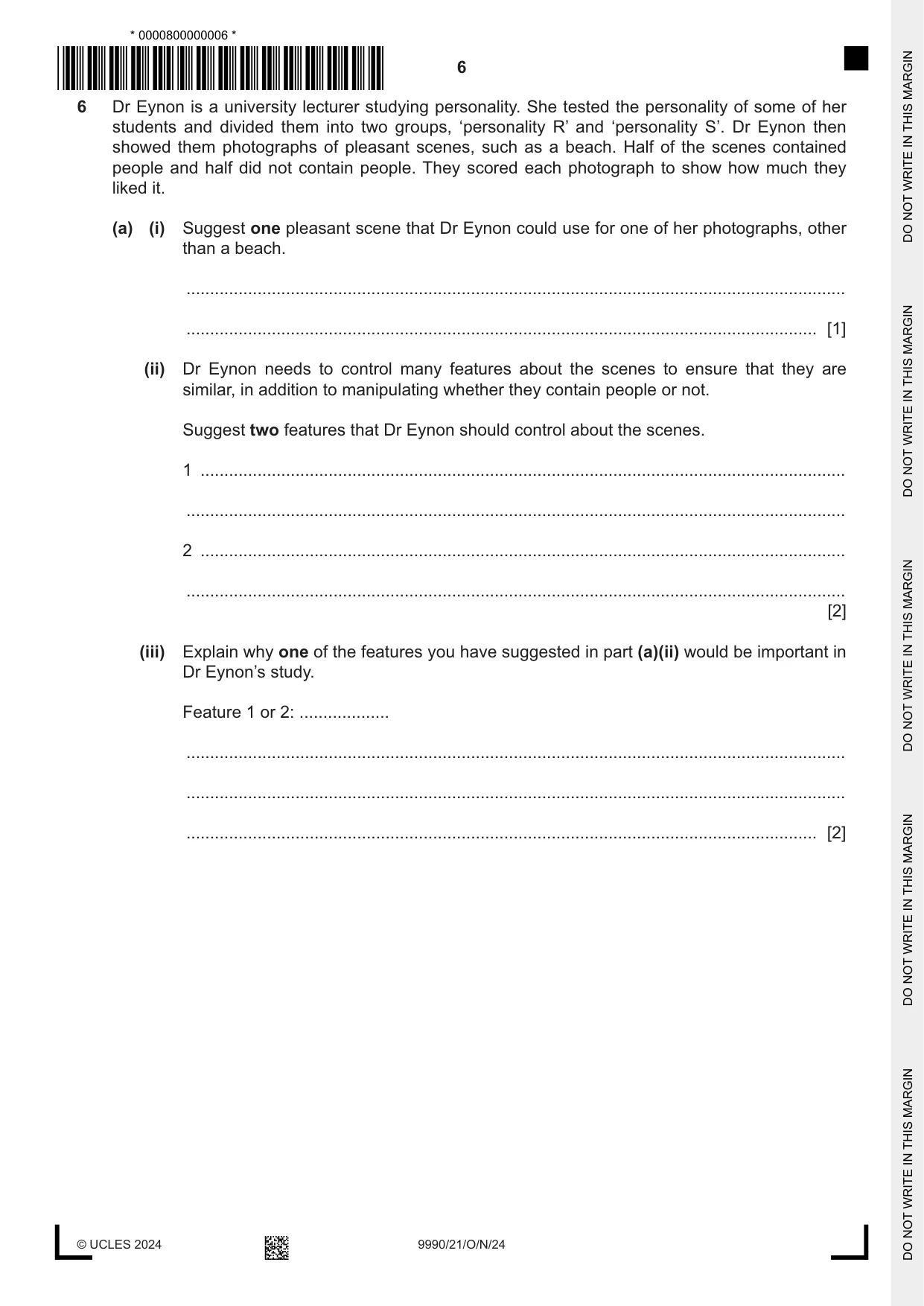
Q6 · Dr Eynon is a university lecturer studying personality
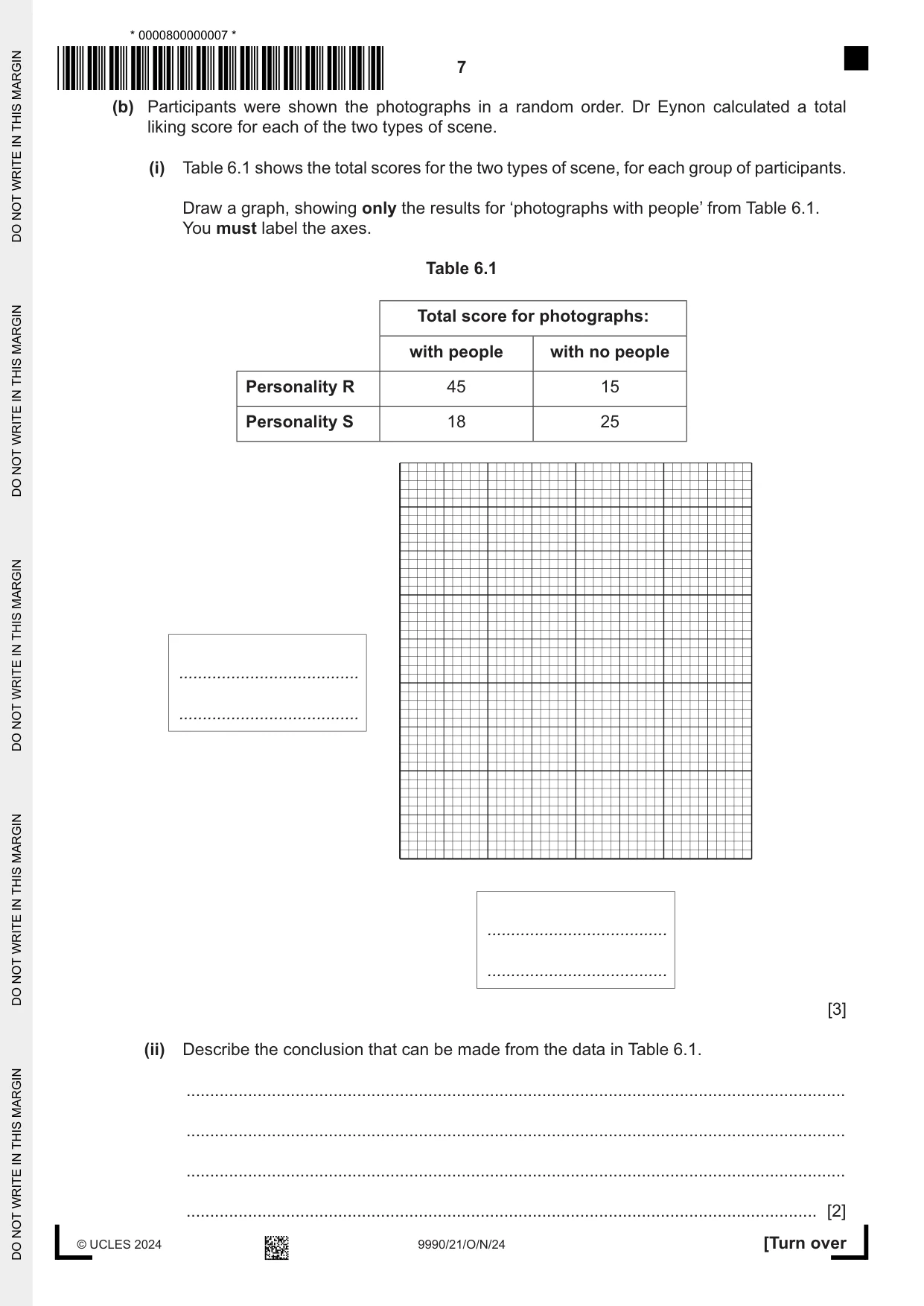
6 Dr Eynon is a university lecturer studying personality. She tested the personality of some of her students and divided them into two groups, ‘personality R’ and ‘personality S’. Dr Eynon then showed them photographs of pleasant scenes, such as a beach. Half of the scenes contained people and half did not contain people. They scored each photograph to show how much they liked it. (a) (i) Suggest one pleasant scene that Dr Eynon could use for one of her photographs, other than a beach. ........................................................................................................................................... ..................................................................................................................................... [1] (ii) Dr Eynon needs to control many features about the scenes to ensure that they are similar, in addition to manipulating whether they contain people or not. Suggest two features that Dr Eynon should control about the scenes. 1 ........................................................................................................................................ ........................................................................................................................................... 2 ........................................................................................................................................ ........................................................................................................................................... [2] (iii) Explain why one of the features you have suggested in part (a)(ii) would be important in Dr Eynon’s study. Feature 1 or 2: ................... ........................................................................................................................................... ........................................................................................................................................... ..................................................................................................................................... [2] (b) Participants were shown the photographs in a random order. Dr Eynon calculated a total liking score for each of the two types of scene. (i) Table 6.1 shows the total scores for the two types of scene, for each group of participants. Draw a graph, showing only the results for ‘photographs with people’ from Table 6.1. You must label the axes. Table 6.1 Total score for photographs: with people with no people Personality R 45 15 Personality S 18 25 ...................................... ...................................... ...................................... ...................................... [3] (ii) Describe the conclusion that can be made from the data in Table 6.1. ........................................................................................................................................... ........................................................................................................................................... ........................................................................................................................................... ..................................................................................................................................... [2]
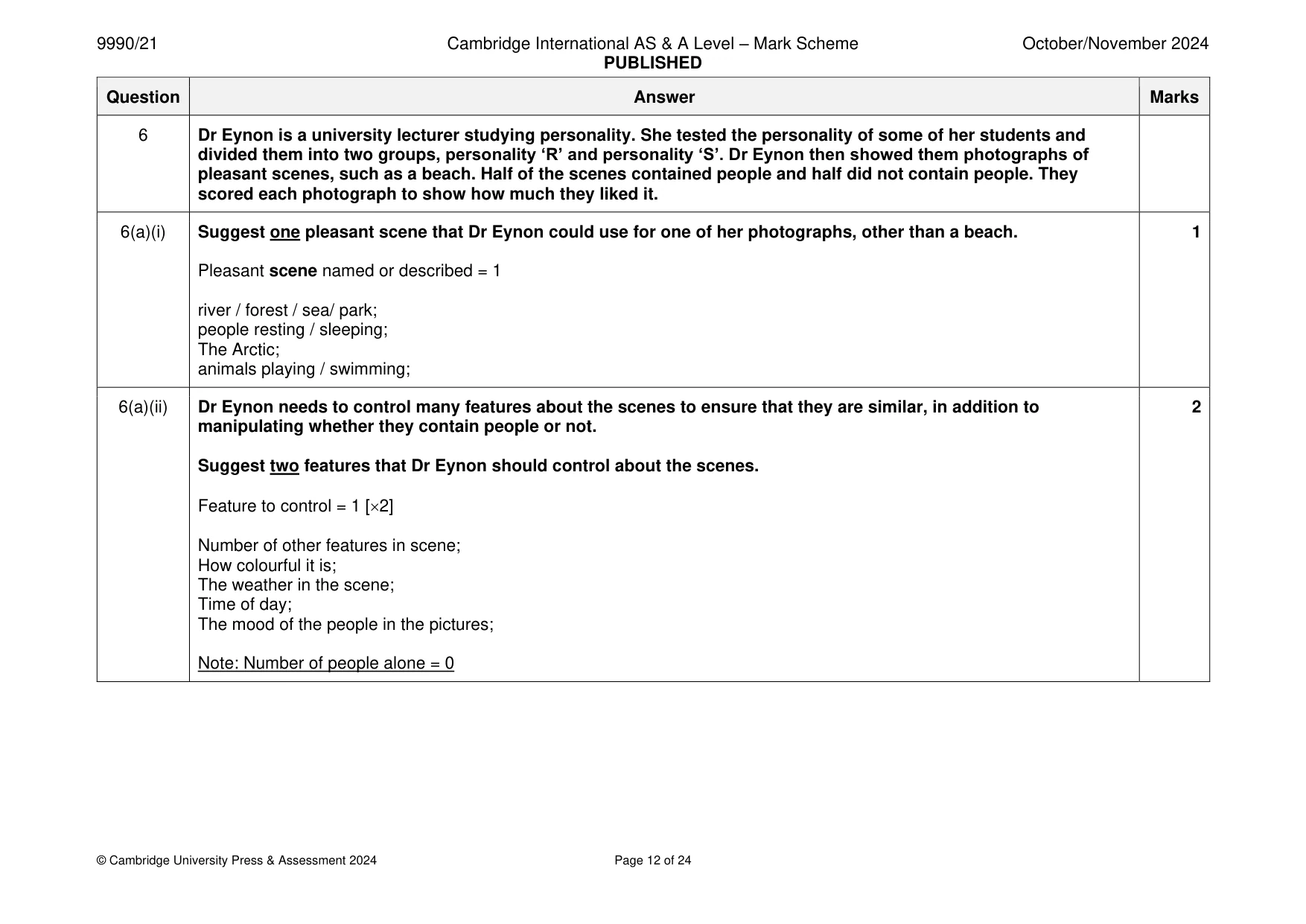
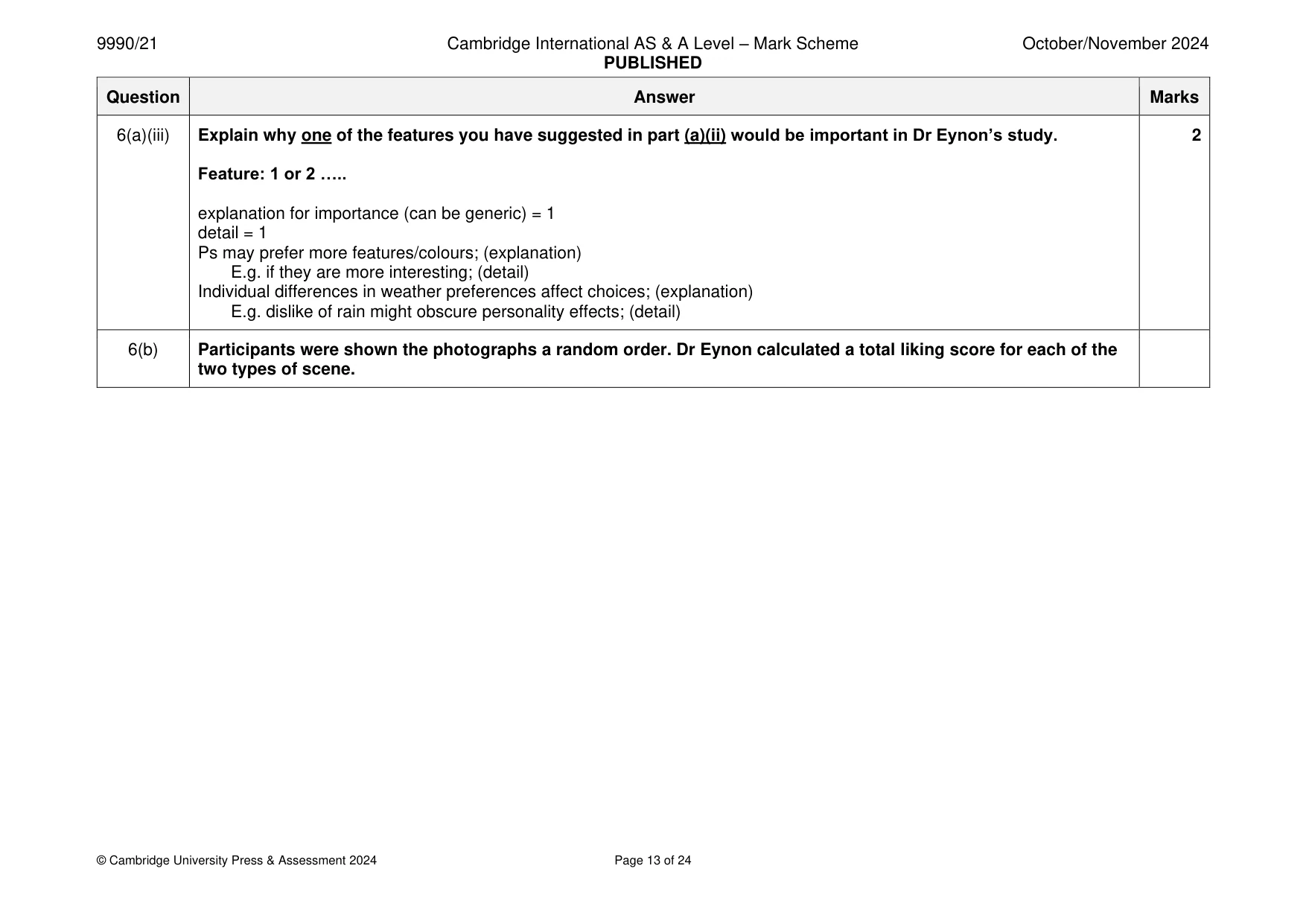
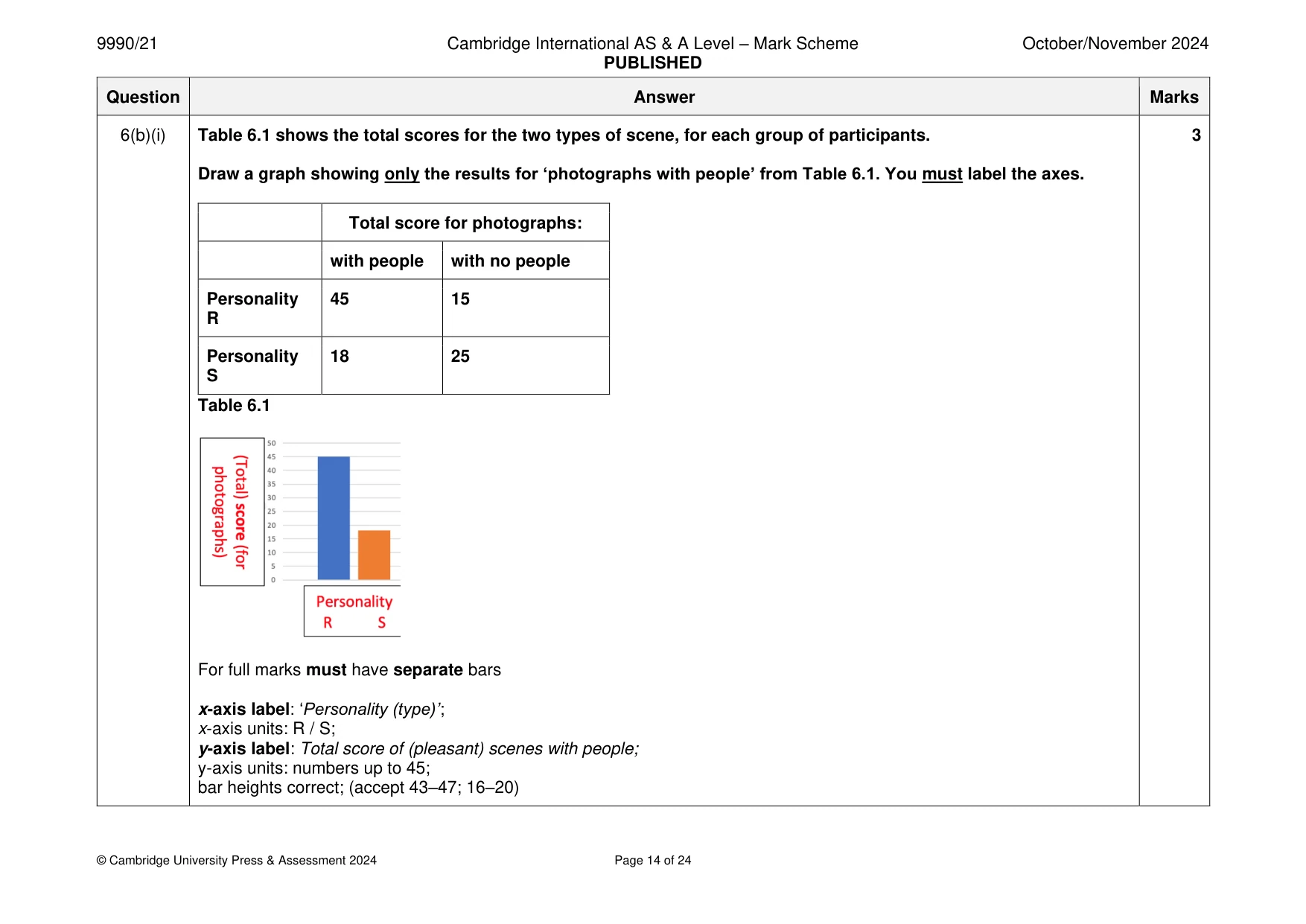
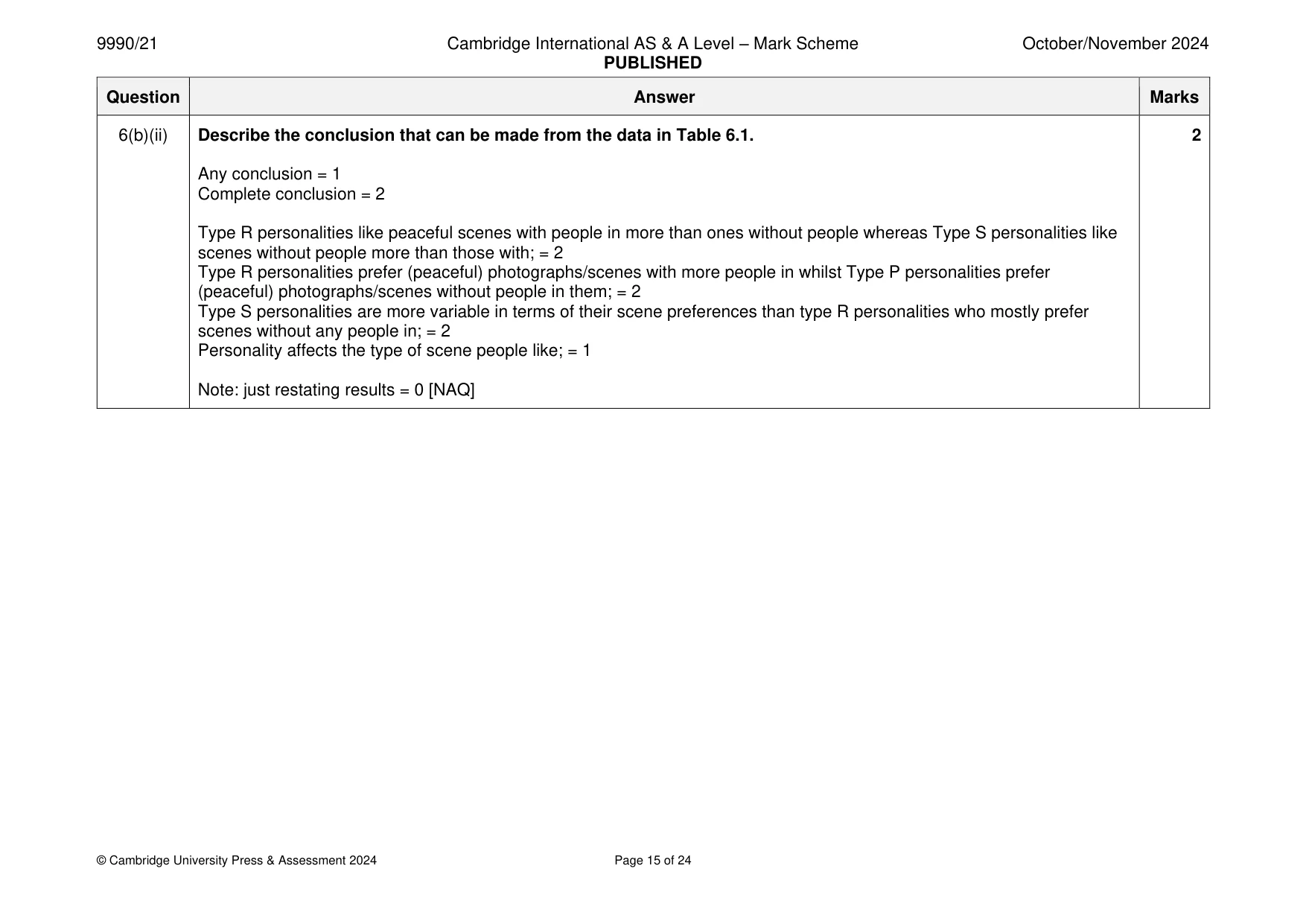
Mark scheme: 6 Dr Eynon is a university lecturer studying personality. She tested the personality of some of her students and divided them into two groups, personality ‘R’ and personality ‘S’. Dr Eynon then showed them photographs of pleasant scenes, such as a beach. Half of the scenes contained people and half did not contain people. They scored each photograph to show how much they liked it. 6(a)(i) Suggest one pleasant scene that Dr Eynon could use for one of her photographs, other than a beach. 1 Pleasant scene named or described = 1 river / forest / sea/ park; people resting / sleeping; The Arctic; animals playing / swimming; 6(a)(ii) Dr Eynon needs to control many features about the scenes to ensure that they are similar, in addition to 2 manipulating whether they contain people or not. Suggest two features that Dr Eynon should control about the scenes. Feature to control = 1 [2] Number of other features in scene; How colourful it is; The weather in the scene; Time of day; The mood of the people in the pictures; Note: Number of people alone = 0 6(a)(iii) Explain why one of the features you have suggested in part (a)(ii) would be important in Dr Eynon’s study. 2 Feature: 1 or 2 ….. explanation for importance (can be generic) = 1 detail = 1 Ps may prefer more features/colours; (explanation) E.g. if they are more interesting; (detail) Individual differences in weather preferences affect choices; (explanation) E.g. dislike of rain might obscure personality effects; (detail) 6(b) Participants were shown the photographs a random order. Dr Eynon calculated a total liking score for each of the two types of scene. 6(b)(i) Table 6.1 shows the total scores for the two types of scene, for each group of participants. 3 Draw a graph showing only the results for ‘photographs with people’ from Table 6.1. You must label the axes. Total score for photographs: with people with no people Personality 45 15 R Personality 18 25 S Table 6.1 For full marks must have separate bars x-axis label: ‘Personality (type)’; x-axis units: R / S; y-axis label: Total score of (pleasant) scenes with people; y-axis units: numbers up to 45; bar heights correct; (accept 43–47; 16–20) 6(b)(ii) Describe the conclusion that can be made from the data in Table 6.1. 2 Any conclusion = 1 Complete conclusion = 2 Type R personalities like peaceful scenes with people in more than ones without people whereas Type S personalities like scenes without people more than those with; = 2 Type R personalities prefer (peaceful) photographs/scenes with more people in whilst Type P personalities prefer (peaceful) photographs/scenes without people in them; = 2 Type S personalities are more variable in terms of their scene preferences than type R personalities who mostly prefer scenes without any people in; = 2 Personality affects the type of scene people like; = 1 Note: just restating results = 0 [NAQ]
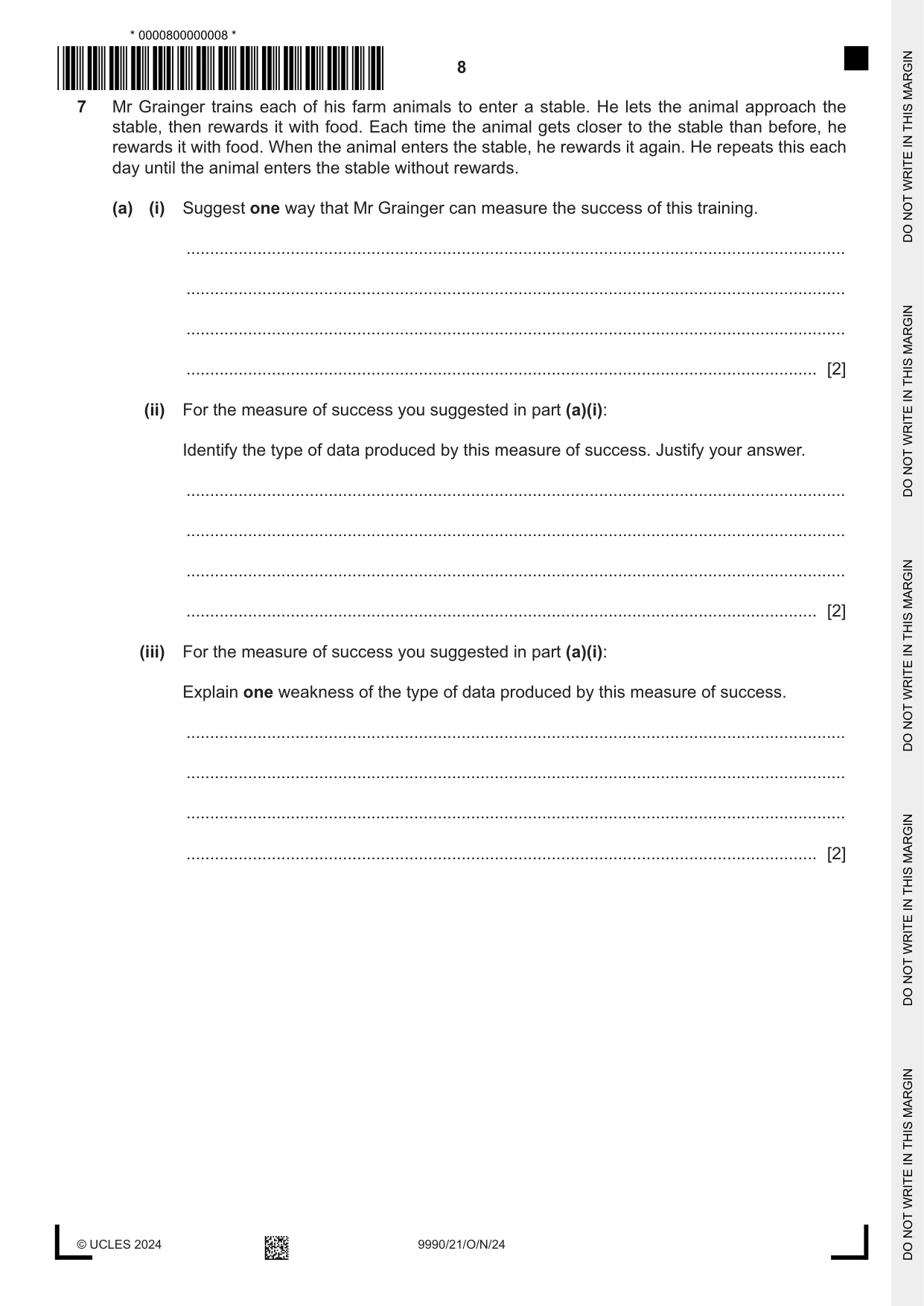
Q7 · Mr Grainger trains each of his farm animals to enter a stable
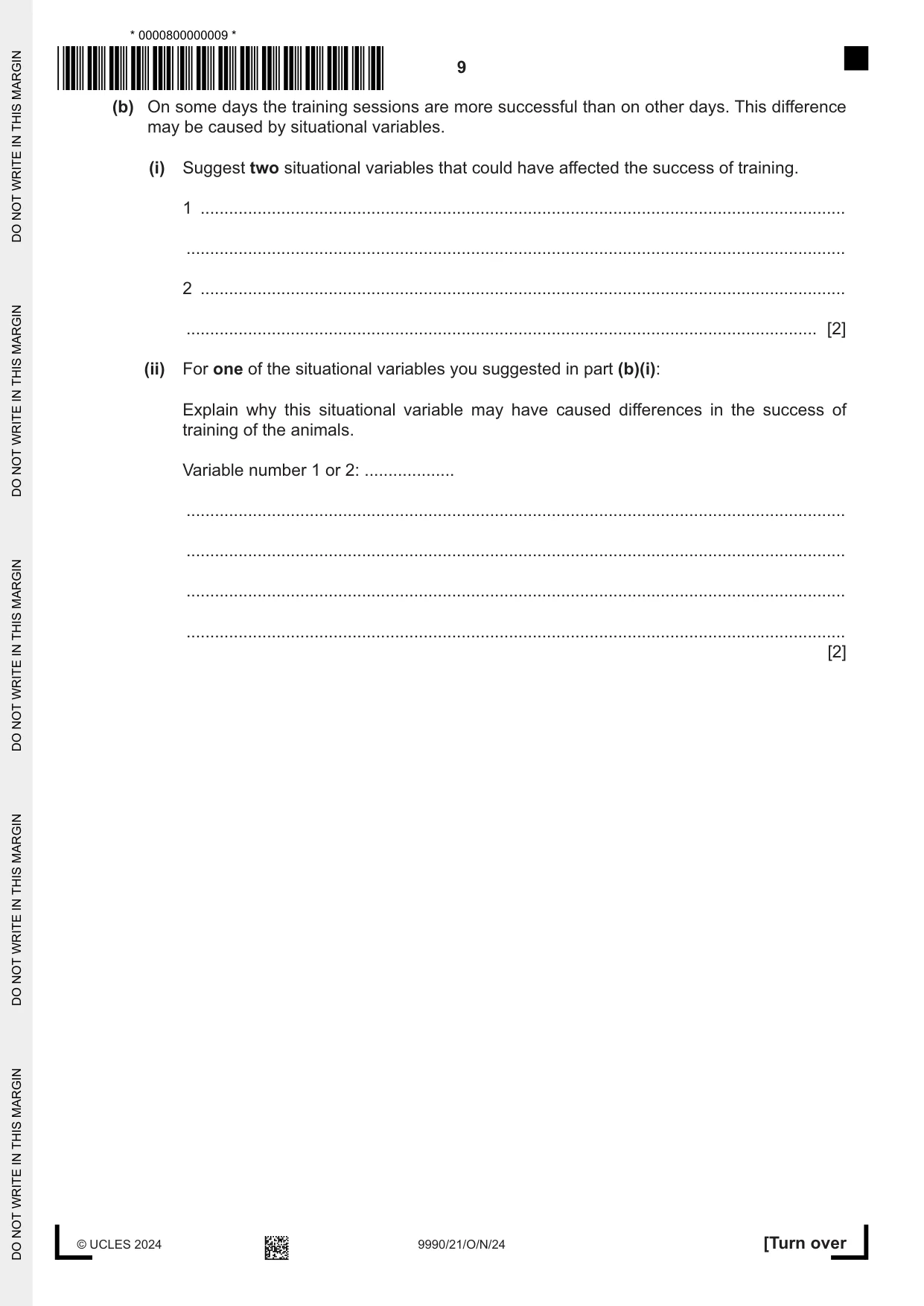
7 Mr Grainger trains each of his farm animals to enter a stable. He lets the animal approach the stable, then rewards it with food. Each time the animal gets closer to the stable than before, he rewards it with food. When the animal enters the stable, he rewards it again. He repeats this each day until the animal enters the stable without rewards. (a) (i) Suggest one way that Mr Grainger can measure the success of this training. ........................................................................................................................................... ........................................................................................................................................... ........................................................................................................................................... ..................................................................................................................................... [2] (ii) For the measure of success you suggested in part (a)(i): Identify the type of data produced by this measure of success. Justify your answer. ........................................................................................................................................... ........................................................................................................................................... ........................................................................................................................................... ..................................................................................................................................... [2] (iii) For the measure of success you suggested in part (a)(i): Explain one weakness of the type of data produced by this measure of success. ........................................................................................................................................... ........................................................................................................................................... ........................................................................................................................................... ..................................................................................................................................... [2] (b) On some days the training sessions are more successful than on other days. This difference may be caused by situational variables. (i) Suggest two situational variables that could have affected the success of training. 1 ........................................................................................................................................ ........................................................................................................................................... 2 ........................................................................................................................................ ..................................................................................................................................... [2] (ii) For one of the situational variables you suggested in part (b)(i): Explain why this situational variable may have caused differences in the success of training of the animals. Variable number 1 or 2: ................... ........................................................................................................................................... ........................................................................................................................................... ........................................................................................................................................... ........................................................................................................................................... [2]
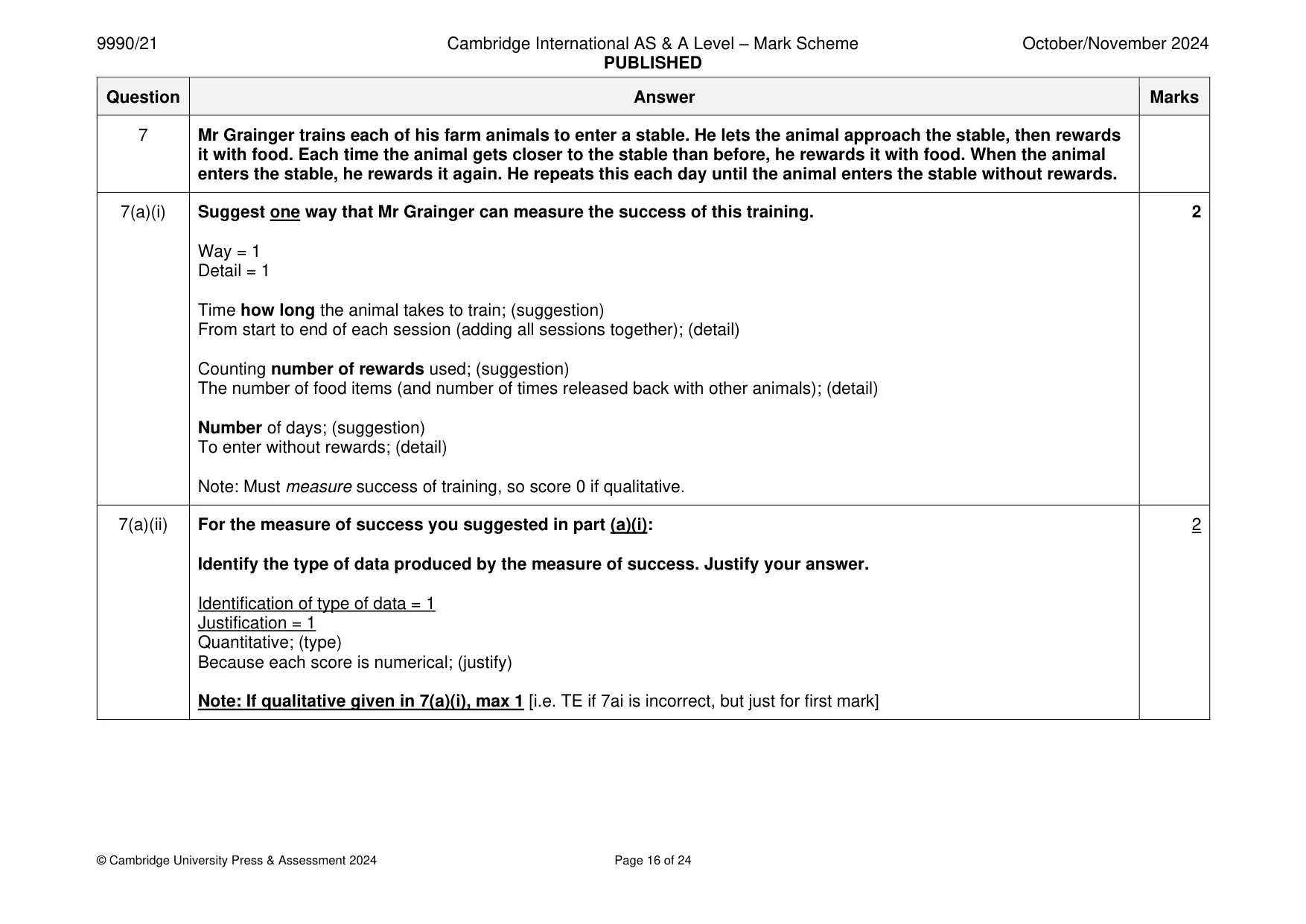
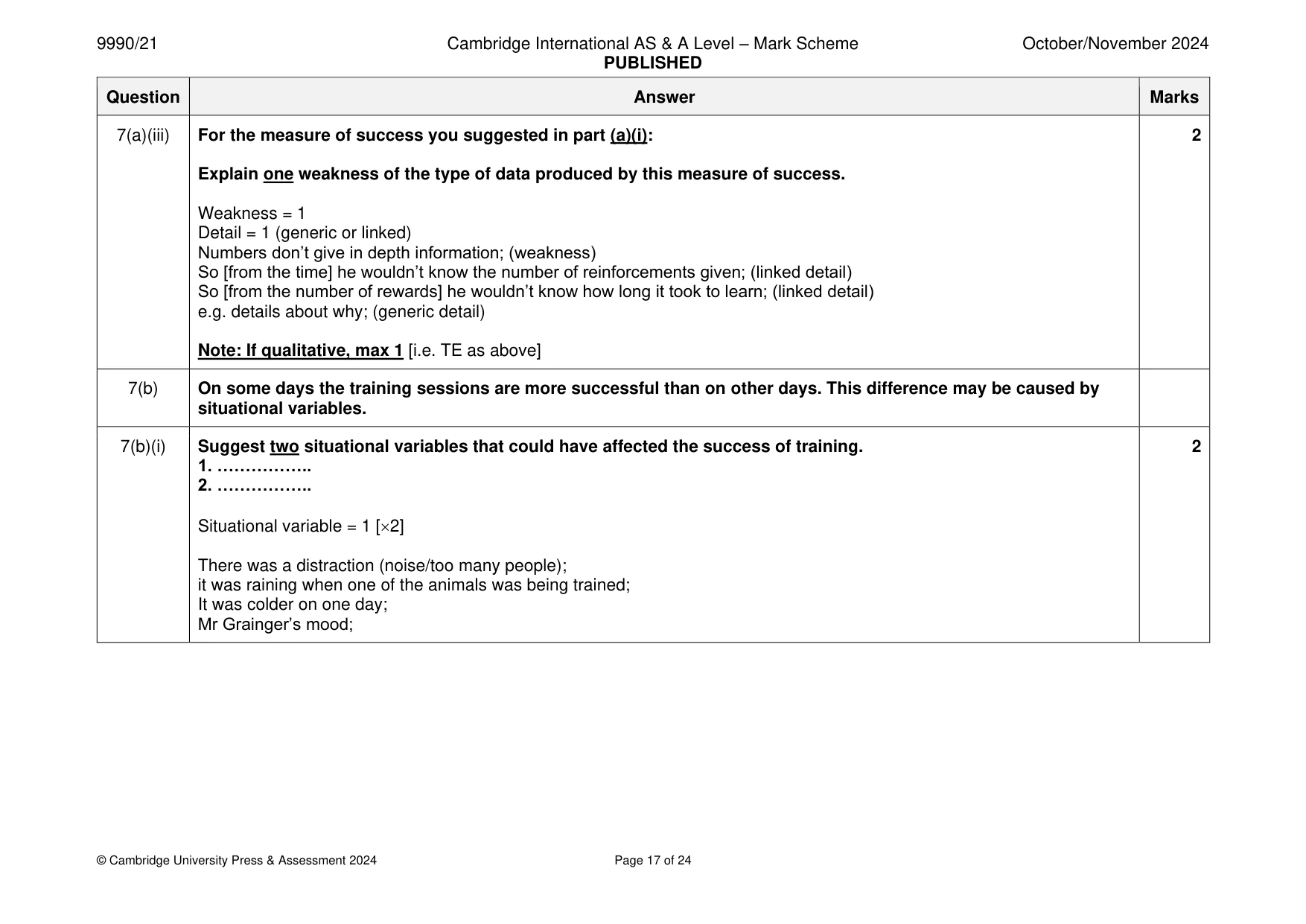
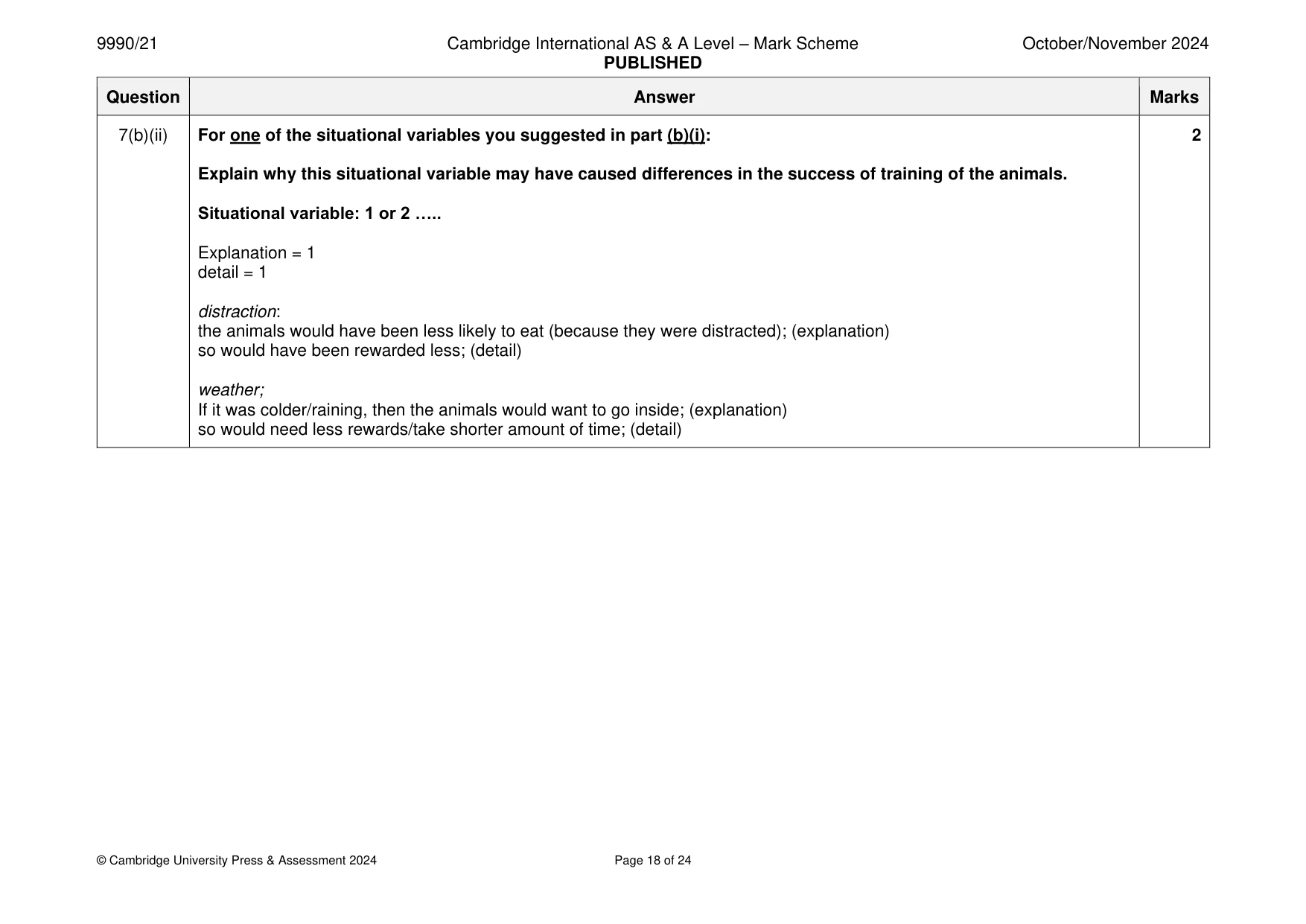
Mark scheme: 7 Mr Grainger trains each of his farm animals to enter a stable. He lets the animal approach the stable, then rewards it with food. Each time the animal gets closer to the stable than before, he rewards it with food. When the animal enters the stable, he rewards it again. He repeats this each day until the animal enters the stable without rewards. 7(a)(i) Suggest one way that Mr Grainger can measure the success of this training. 2 Way = 1 Detail = 1 Time how long the animal takes to train; (suggestion) From start to end of each session (adding all sessions together); (detail) Counting number of rewards used; (suggestion) The number of food items (and number of times released back with other animals); (detail) Number of days; (suggestion) To enter without rewards; (detail) Note: Must measure success of training, so score 0 if qualitative. 7(a)(ii) For the measure of success you suggested in part (a)(i): 2 Identify the type of data produced by the measure of success. Justify your answer. Identification of type of data = 1 Justification = 1 Quantitative; (type) Because each score is numerical; (justify) Note: If qualitative given in 7(a)(i), max 1 [i.e. TE if 7ai is incorrect, but just for first mark] 7(a)(iii) For the measure of success you suggested in part (a)(i): 2 Explain one weakness of the type of data produced by this measure of success. Weakness = 1 Detail = 1 (generic or linked) Numbers don’t give in depth information; (weakness) So [from the time] he wouldn’t know the number of reinforcements given; (linked detail) So [from the number of rewards] he wouldn’t know how long it took to learn; (linked detail) e.g. details about why; (generic detail) Note: If qualitative, max 1 [i.e. TE as above] 7(b) On some days the training sessions are more successful than on other days. This difference may be caused by situational variables. 7(b)(i) Suggest two situational variables that could have affected the success of training. 2 1. …………….. 2. …………….. Situational variable = 1 [2] There was a distraction (noise/too many people); it was raining when one of the animals was being trained; It was colder on one day; Mr Grainger’s mood; 7(b)(ii) For one of the situational variables you suggested in part (b)(i): 2 Explain why this situational variable may have caused differences in the success of training of the animals. Situational variable: 1 or 2 ….. Explanation = 1 detail = 1 distraction: the animals would have been less likely to eat (because they were distracted); (explanation) so would have been rewarded less; (detail) weather; If it was colder/raining, then the animals would want to go inside; (explanation) so would need less rewards/take shorter amount of time; (detail)
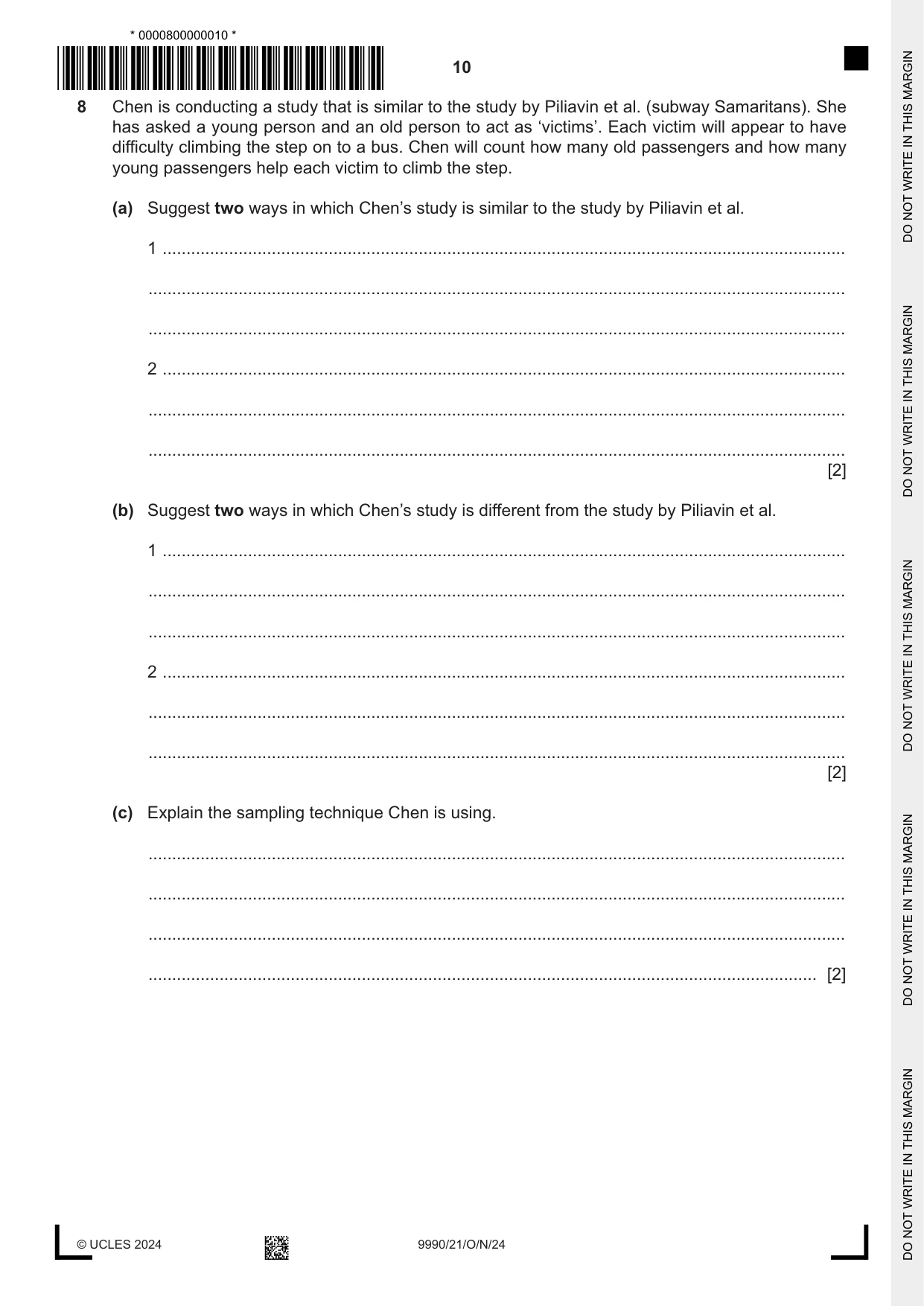
Q8 · Chen is conducting a study that is similar to the study by Piliavin et al
8 Chen is conducting a study that is similar to the study by Piliavin et al. (subway Samaritans). She has asked a young person and an old person to act as ‘victims’. Each victim will appear to have difficulty climbing the step on to a bus. Chen will count how many old passengers and how many young passengers help each victim to climb the step. (a) Suggest two ways in which Chen’s study is similar to the study by Piliavin et al. 1 ................................................................................................................................................ ................................................................................................................................................... ................................................................................................................................................... 2 ................................................................................................................................................ ................................................................................................................................................... ................................................................................................................................................... [2] (b) Suggest two ways in which Chen’s study is different from the study by Piliavin et al. 1 ................................................................................................................................................ ................................................................................................................................................... ................................................................................................................................................... 2 ................................................................................................................................................ ................................................................................................................................................... ................................................................................................................................................... [2] (c) Explain the sampling technique Chen is using. ................................................................................................................................................... ................................................................................................................................................... ................................................................................................................................................... ............................................................................................................................................. [2]
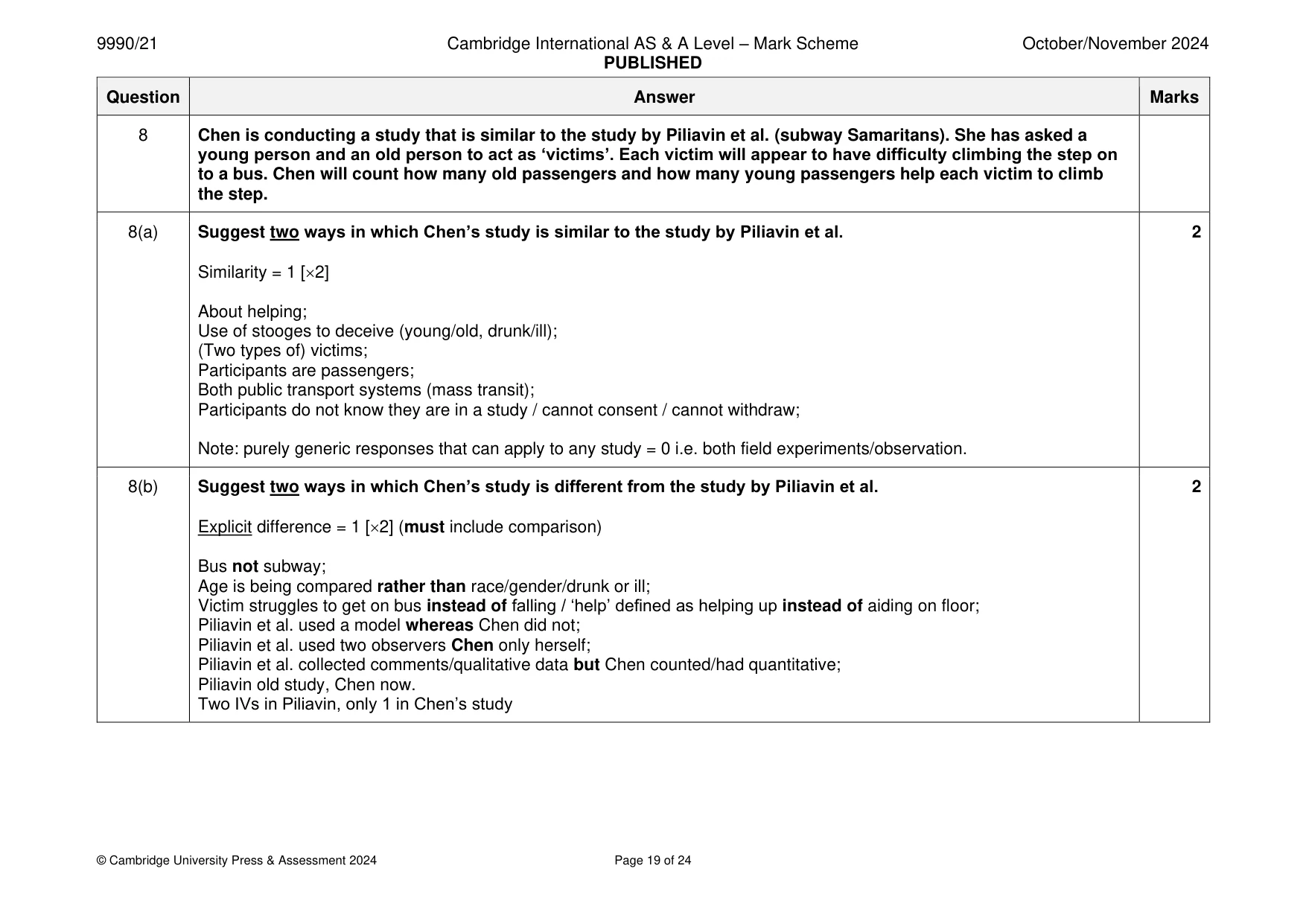
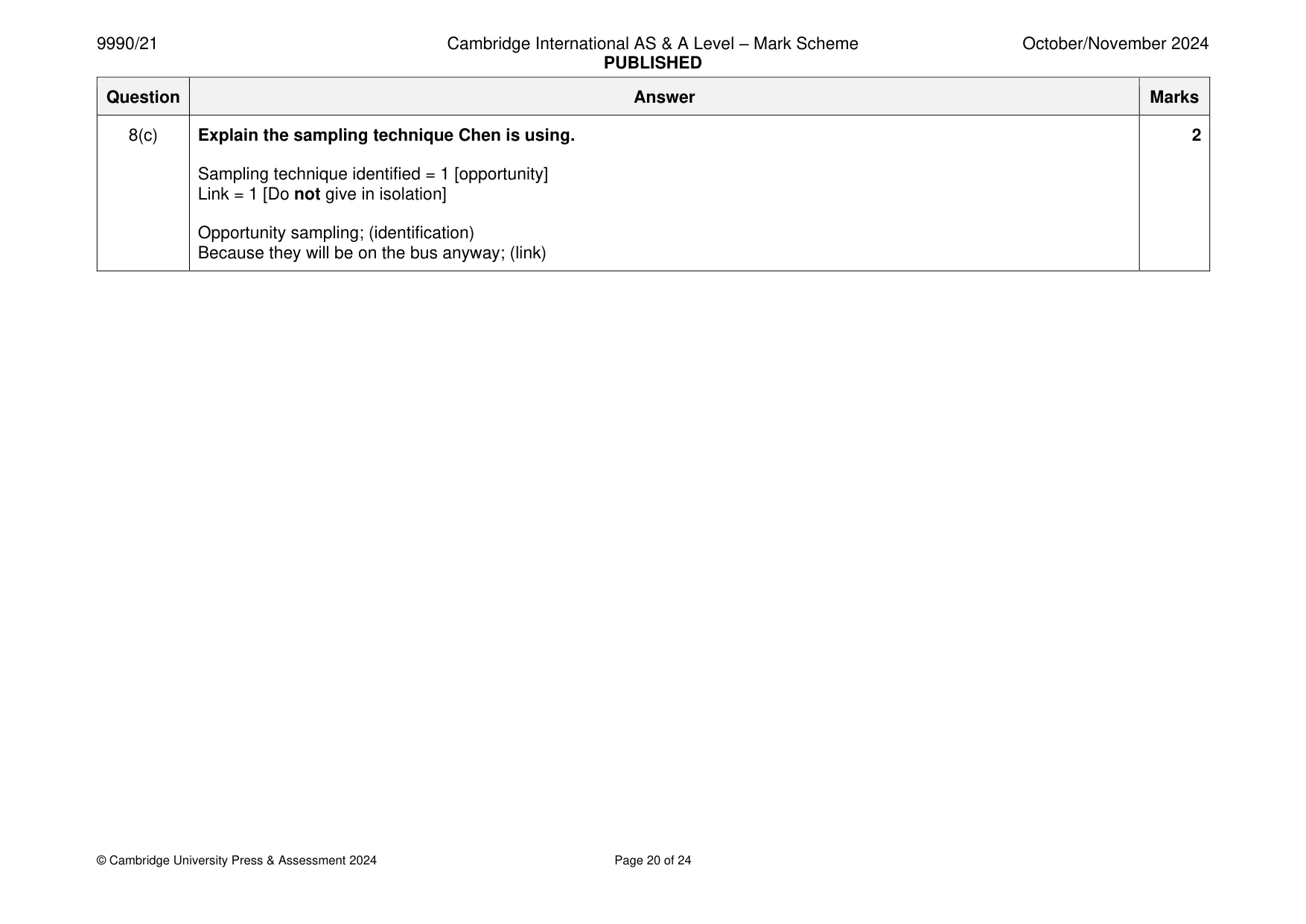
Mark scheme: 8 Chen is conducting a study that is similar to the study by Piliavin et al. (subway Samaritans). She has asked a young person and an old person to act as ‘victims’. Each victim will appear to have difficulty climbing the step on to a bus. Chen will count how many old passengers and how many young passengers help each victim to climb the step. 8(a) Suggest two ways in which Chen’s study is similar to the study by Piliavin et al. 2 Similarity = 1 [2] About helping; Use of stooges to deceive (young/old, drunk/ill); (Two types of) victims; Participants are passengers; Both public transport systems (mass transit); Participants do not know they are in a study / cannot consent / cannot withdraw; Note: purely generic responses that can apply to any study = 0 i.e. both field experiments/observation. 8(b) Suggest two ways in which Chen’s study is different from the study by Piliavin et al. 2 Explicit difference = 1 [2] (must include comparison) Bus not subway; Age is being compared rather than race/gender/drunk or ill; Victim struggles to get on bus instead of falling / ‘help’ defined as helping up instead of aiding on floor; Piliavin et al. used a model whereas Chen did not; Piliavin et al. used two observers Chen only herself; Piliavin et al. collected comments/qualitative data but Chen counted/had quantitative; Piliavin old study, Chen now. Two IVs in Piliavin, only 1 in Chen’s study 8(c) Explain the sampling technique Chen is using. 2 Sampling technique identified = 1 [opportunity] Link = 1 [Do not give in isolation] Opportunity sampling; (identification) Because they will be on the bus anyway; (link)
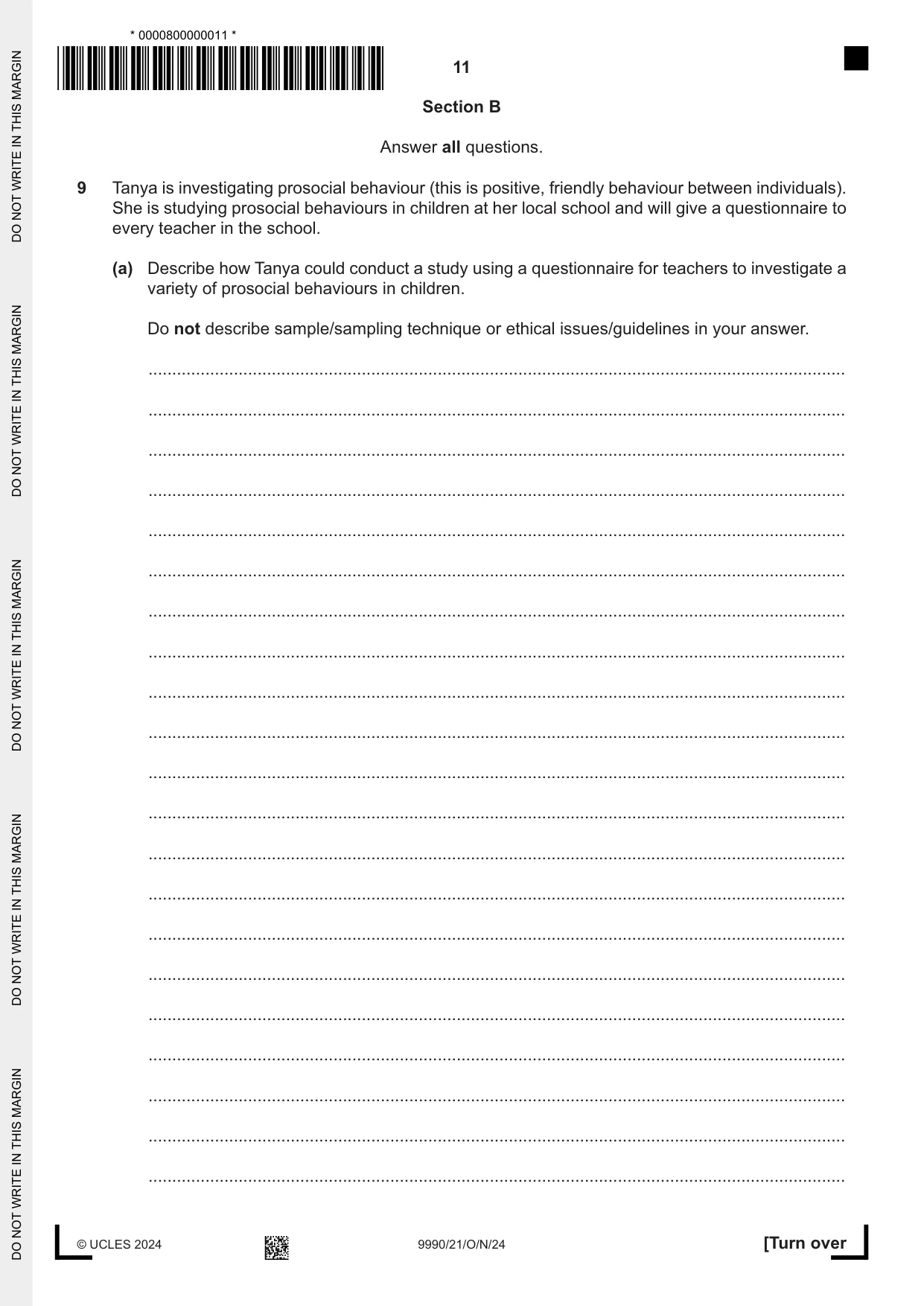
Q9 · Tanya is investigating prosocial behaviour (this is positive, friendly behaviour between…
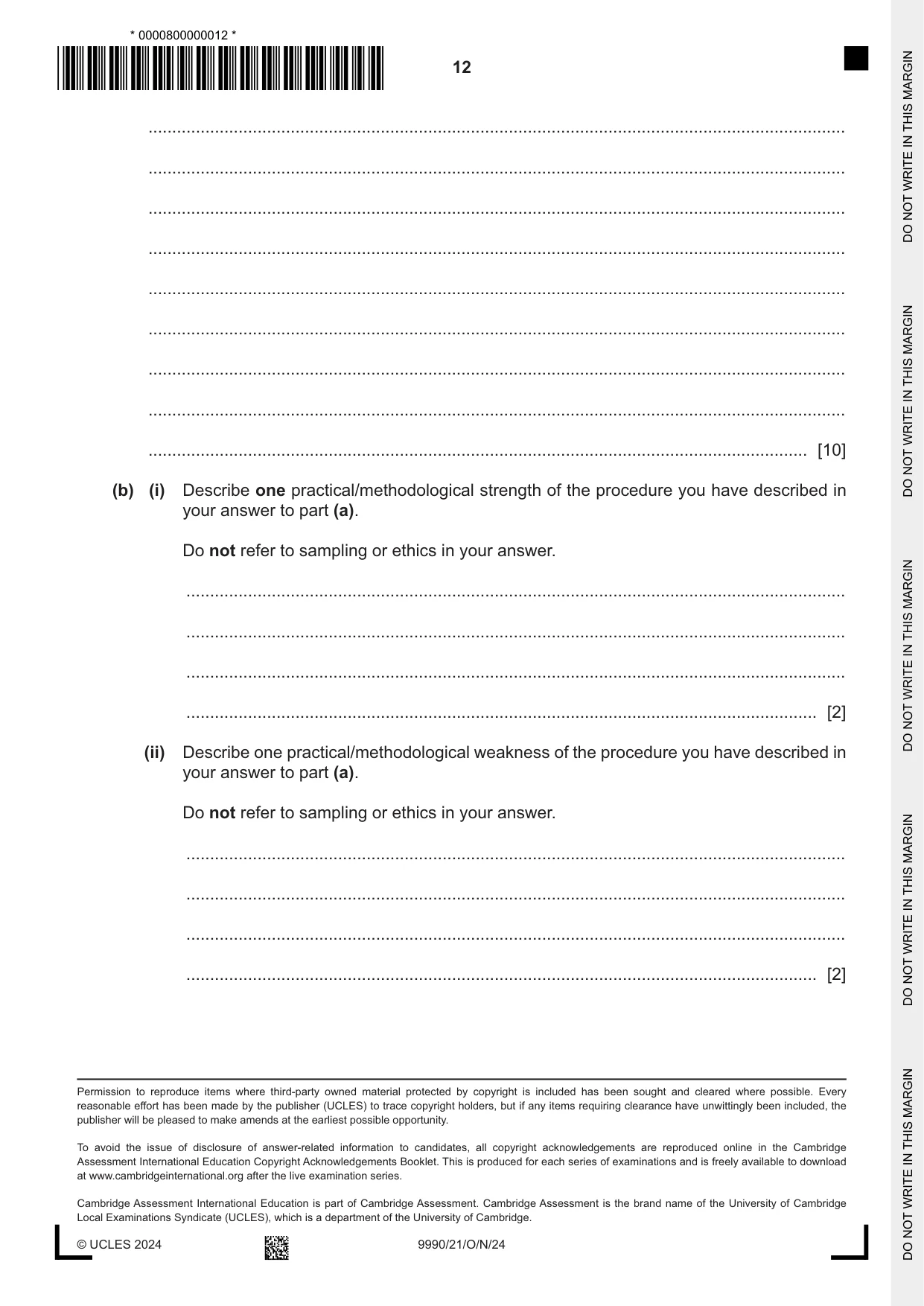
9 Tanya is investigating prosocial behaviour (this is positive, friendly behaviour between individuals). She is studying prosocial behaviours in children at her local school and will give a questionnaire to every teacher in the school. (a) Describe how Tanya could conduct a study using a questionnaire for teachers to investigate a variety of prosocial behaviours in children. Do not describe sample/sampling technique or ethical issues/guidelines in your answer. ................................................................................................................................................... ................................................................................................................................................... ................................................................................................................................................... ................................................................................................................................................... ................................................................................................................................................... ................................................................................................................................................... ................................................................................................................................................... ................................................................................................................................................... ................................................................................................................................................... ................................................................................................................................................... ................................................................................................................................................... ................................................................................................................................................... ................................................................................................................................................... ................................................................................................................................................... ................................................................................................................................................... ................................................................................................................................................... ................................................................................................................................................... ................................................................................................................................................... ................................................................................................................................................... ................................................................................................................................................... ................................................................................................................................................... ................................................................................................................................................... ................................................................................................................................................... ................................................................................................................................................... ................................................................................................................................................... ................................................................................................................................................... ................................................................................................................................................... ................................................................................................................................................... ................................................................................................................................................... ........................................................................................................................................... [10] (b) (i) Describe one practical/methodological strength of the procedure you have described in your answer to part (a). Do not refer to sampling or ethics in your answer. ........................................................................................................................................... ........................................................................................................................................... ........................................................................................................................................... ..................................................................................................................................... [2] (ii) Describe one practical/methodological weakness of the procedure you have described in your answer to part (a). Do not refer to sampling or ethics in your answer. ........................................................................................................................................... ........................................................................................................................................... ........................................................................................................................................... ..................................................................................................................................... [2]
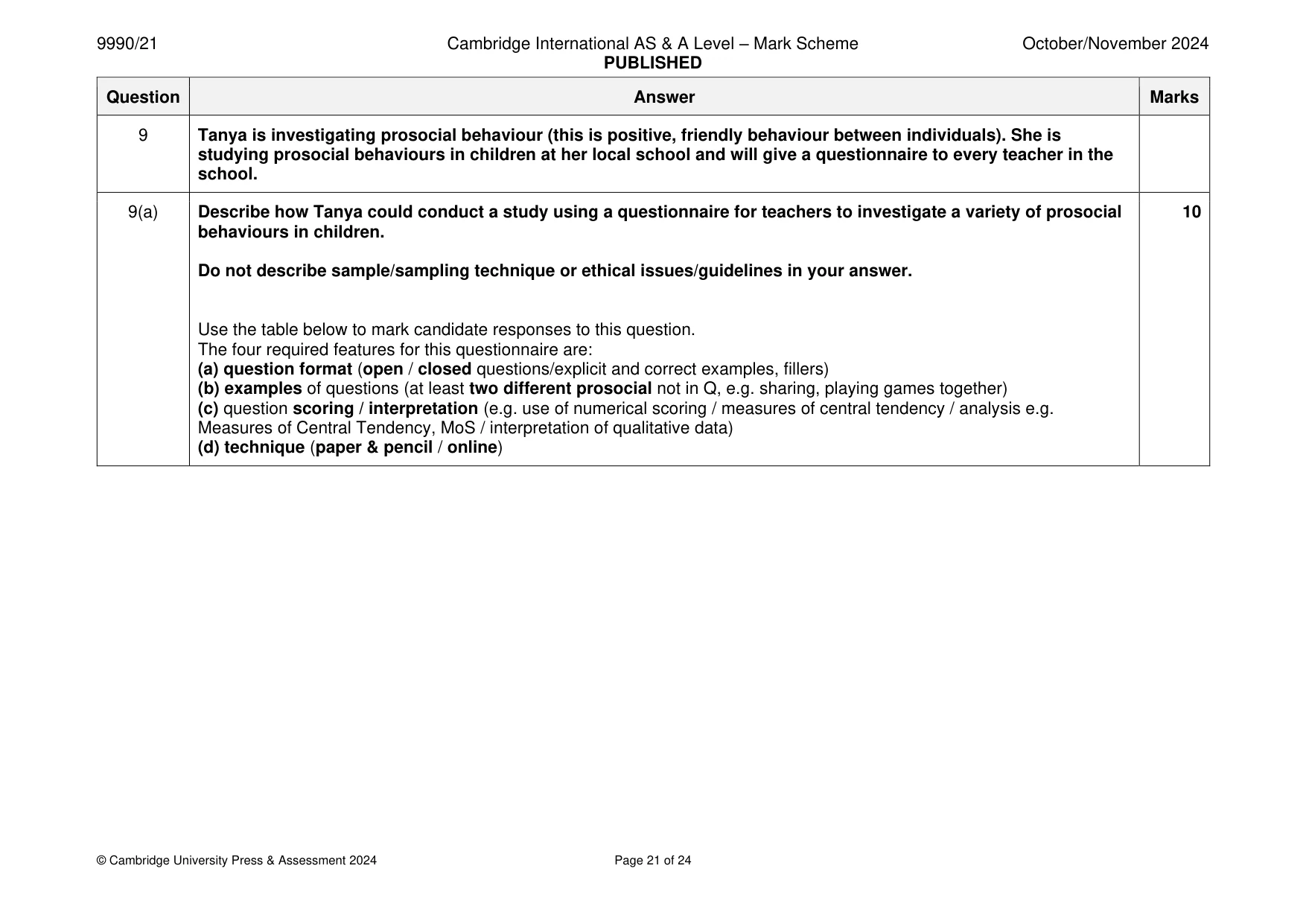
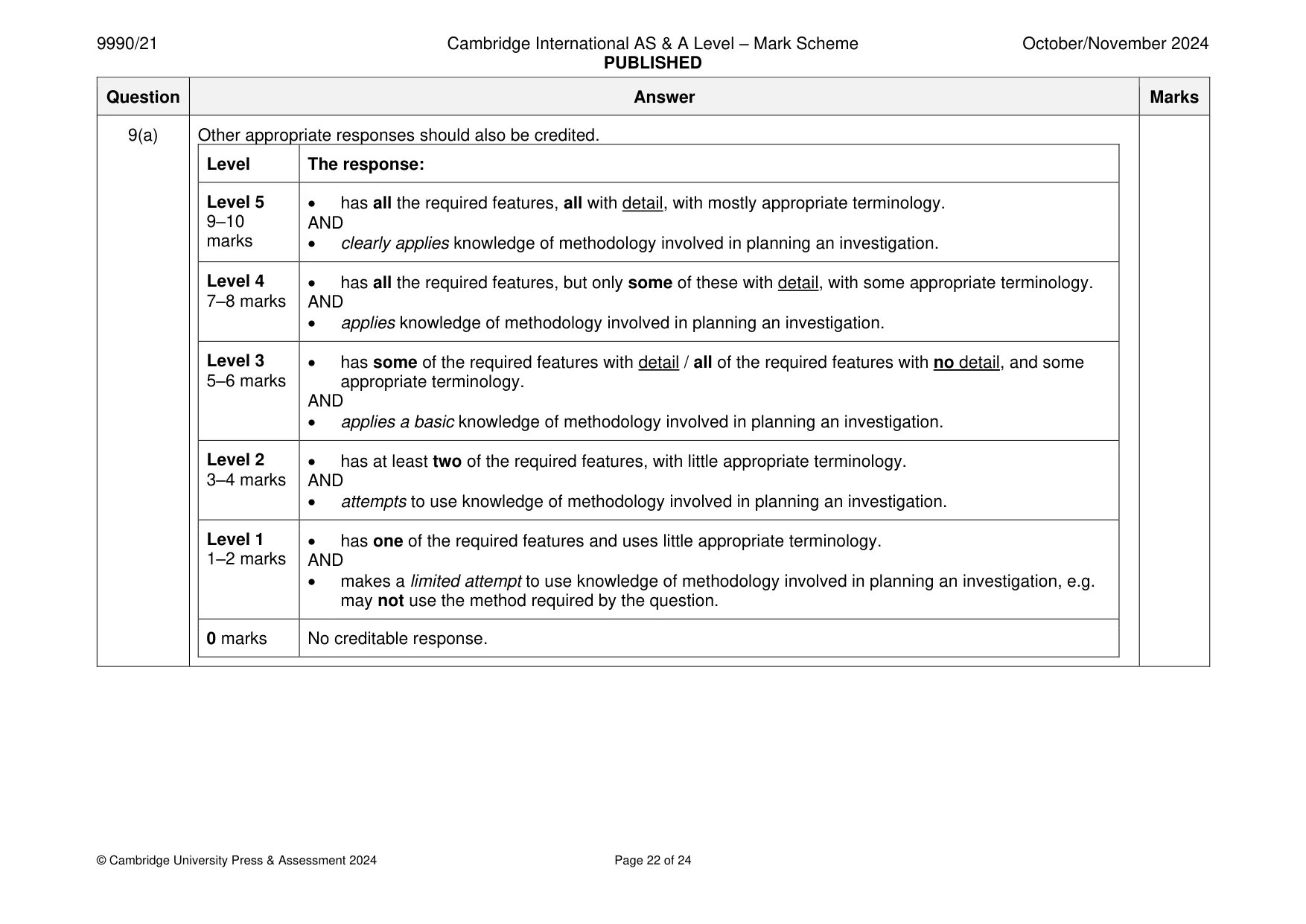
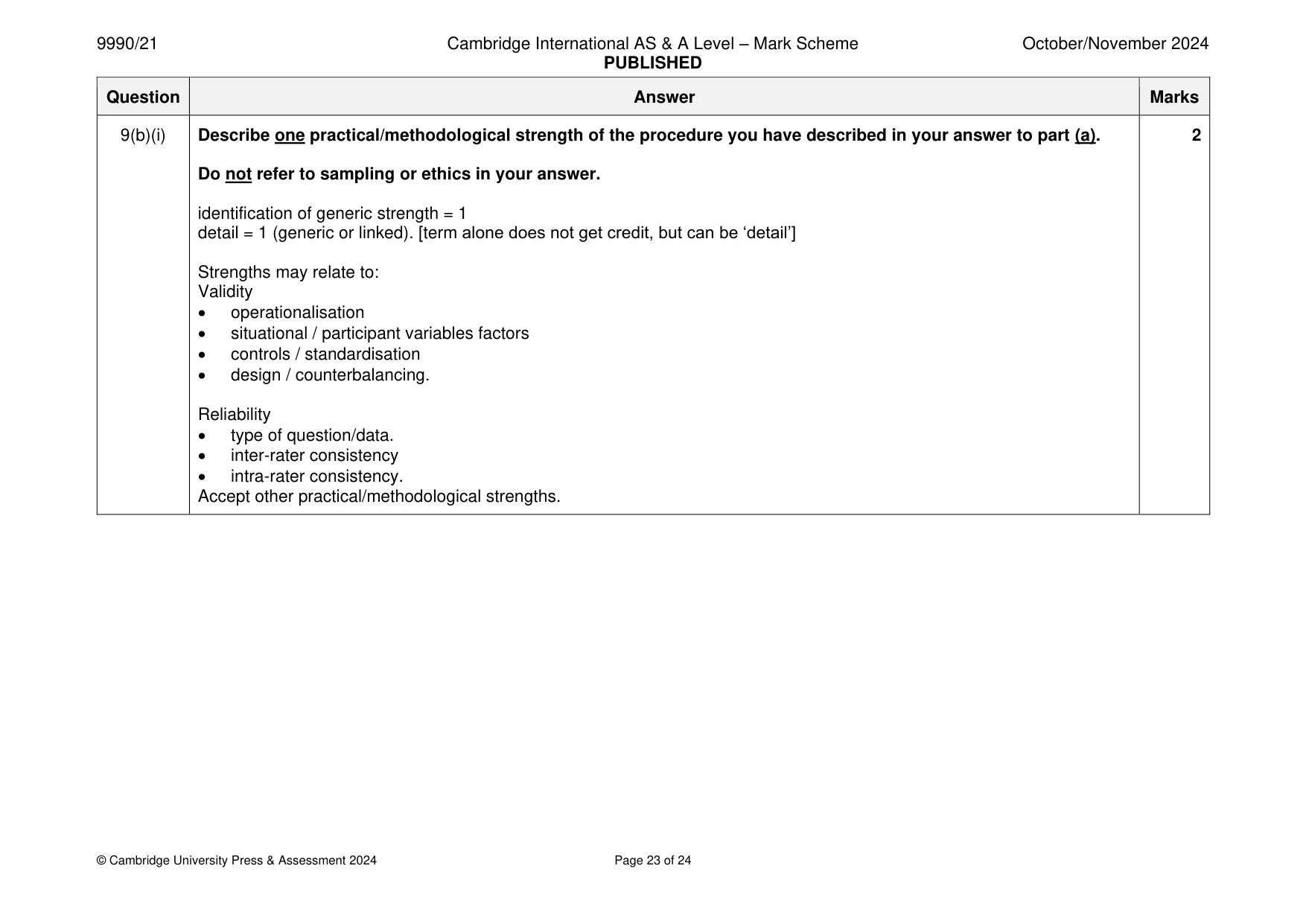
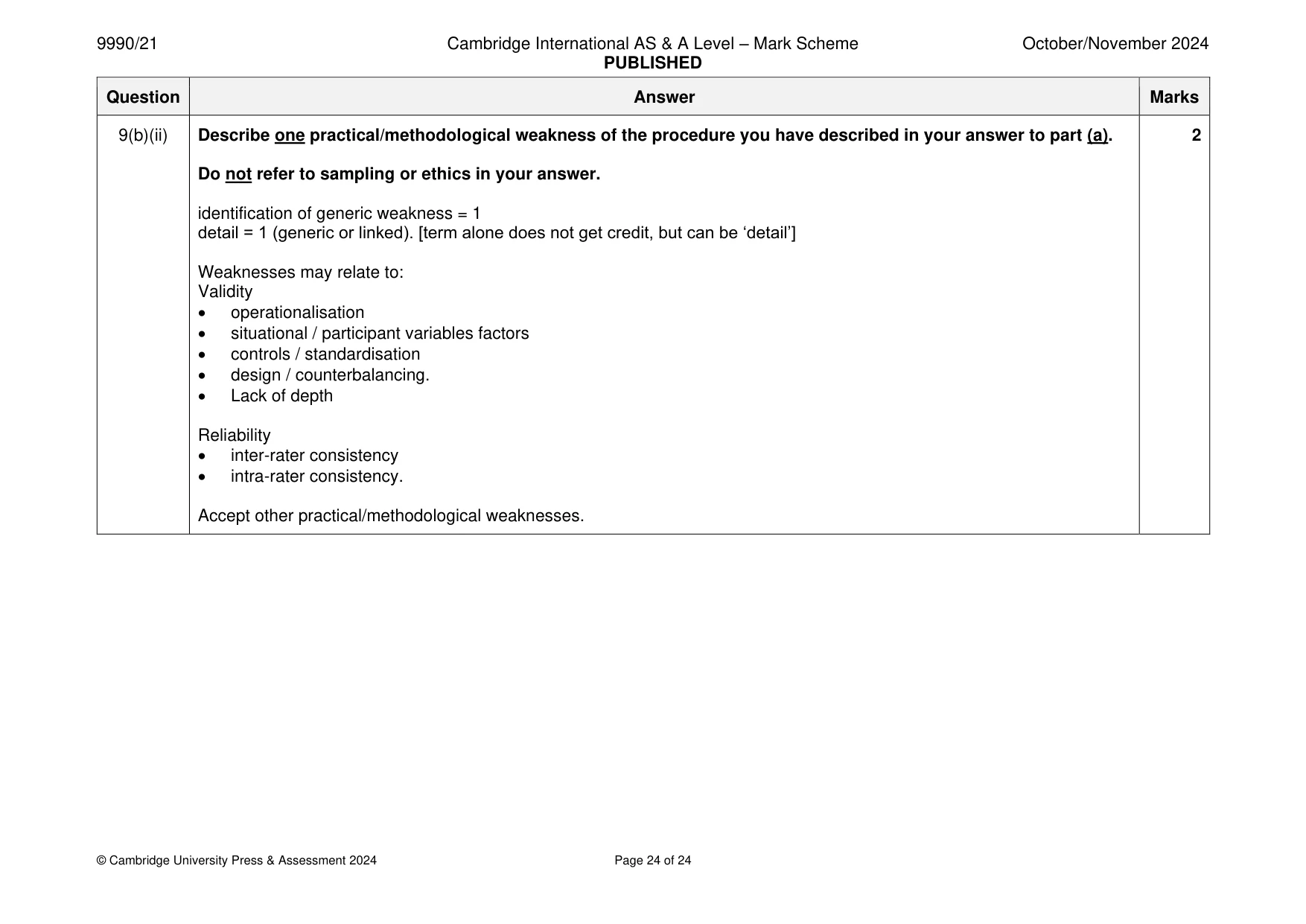
Mark scheme: 9 Tanya is investigating prosocial behaviour (this is positive, friendly behaviour between individuals). She is studying prosocial behaviours in children at her local school and will give a questionnaire to every teacher in the school. 9(a) Describe how Tanya could conduct a study using a questionnaire for teachers to investigate a variety of prosocial 10 behaviours in children. Do not describe sample/sampling technique or ethical issues/guidelines in your answer. Use the table below to mark candidate responses to this question. The four required features for this questionnaire are: (a) question format (open / closed questions/explicit and correct examples, fillers) (b) examples of questions (at least two different prosocial not in Q, e.g. sharing, playing games together) (c) question scoring / interpretation (e.g. use of numerical scoring / measures of central tendency / analysis e.g. Measures of Central Tendency, MoS / interpretation of qualitative data) (d) technique (paper & pencil / online) 9(a) Other appropriate responses should also be credited. Level The response: Level 5 • has all the required features, all with detail, with mostly appropriate terminology. 9–10 AND marks • clearly applies knowledge of methodology involved in planning an investigation. Level 4 • has all the required features, but only some of these with detail, with some appropriate terminology. 7–8 marks AND • applies knowledge of methodology involved in planning an investigation. Level 3 • has some of the required features with detail / all of the required features with no detail, and some 5–6 marks appropriate terminology. AND • applies a basic knowledge of methodology involved in planning an investigation. Level 2 • has at least two of the required features, with little appropriate terminology. 3–4 marks AND • attempts to use knowledge of methodology involved in planning an investigation. Level 1 • has one of the required features and uses little appropriate terminology. 1–2 marks AND • makes a limited attempt to use knowledge of methodology involved in planning an investigation, e.g. may not use the method required by the question. 0 marks No creditable response. 9(b)(i) Describe one practical/methodological strength of the procedure you have described in your answer to part (a). 2 Do not refer to sampling or ethics in your answer. identification of generic strength = 1 detail = 1 (generic or linked). [term alone does not get credit, but can be ‘detail’] Strengths may relate to: Validity • operationalisation • situational / participant variables factors • controls / standardisation • design / counterbalancing. Reliability • type of question/data. • inter-rater consistency • intra-rater consistency. Accept other practical/methodological strengths. 9(b)(ii) Describe one practical/methodological weakness of the procedure you have described in your answer to part (a). 2 Do not refer to sampling or ethics in your answer. identification of generic weakness = 1 detail = 1 (generic or linked). [term alone does not get credit, but can be ‘detail’] Weaknesses may relate to: Validity • operationalisation • situational / participant variables factors • controls / standardisation • design / counterbalancing. • Lack of depth Reliability • inter-rater consistency • intra-rater consistency. Accept other practical/methodological weaknesses.
What was in this paper
The subtopics covered by these 9 questions, and how many questions each got. Open one in a new tab to see every Cambridge question on it.
What you needed in this session
Cambridge’s own grade thresholds for 2024 Oct/Nov, Paper 2 · Variant 1. A higher threshold means an easier paper — the bar moves with how the cohort did.