Cambridge A Level Psychology (from 2018) 9990 — 2023 Oct/Nov Paper 2 · Variant 2
9990/22/O/N/23 · 10 questions · 60 marks · ≈68 min
The question paper and its mark scheme, free to read here and free to download. This is Cambridge’s own paper, exactly as it was sat.
Question paper12 pages
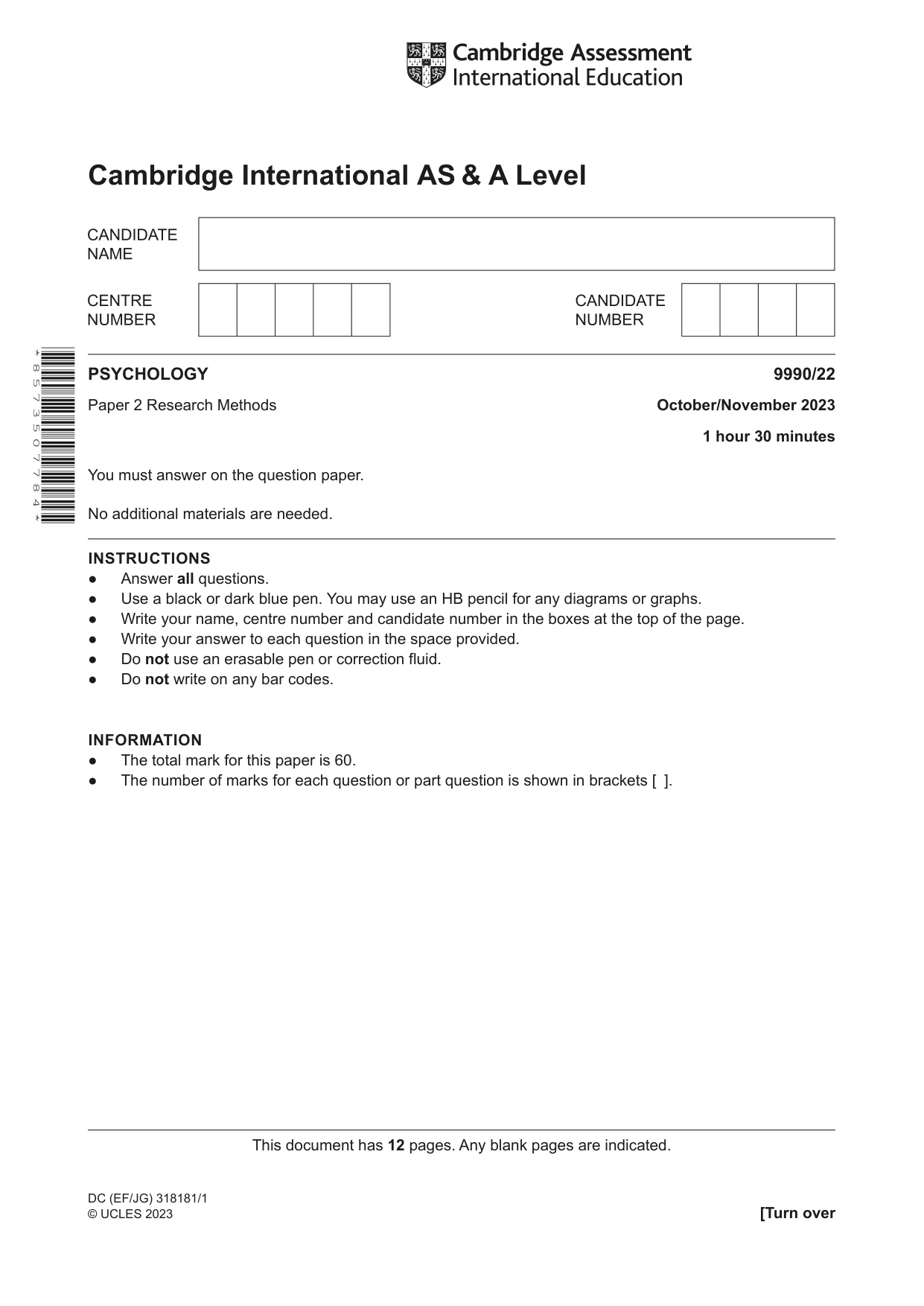

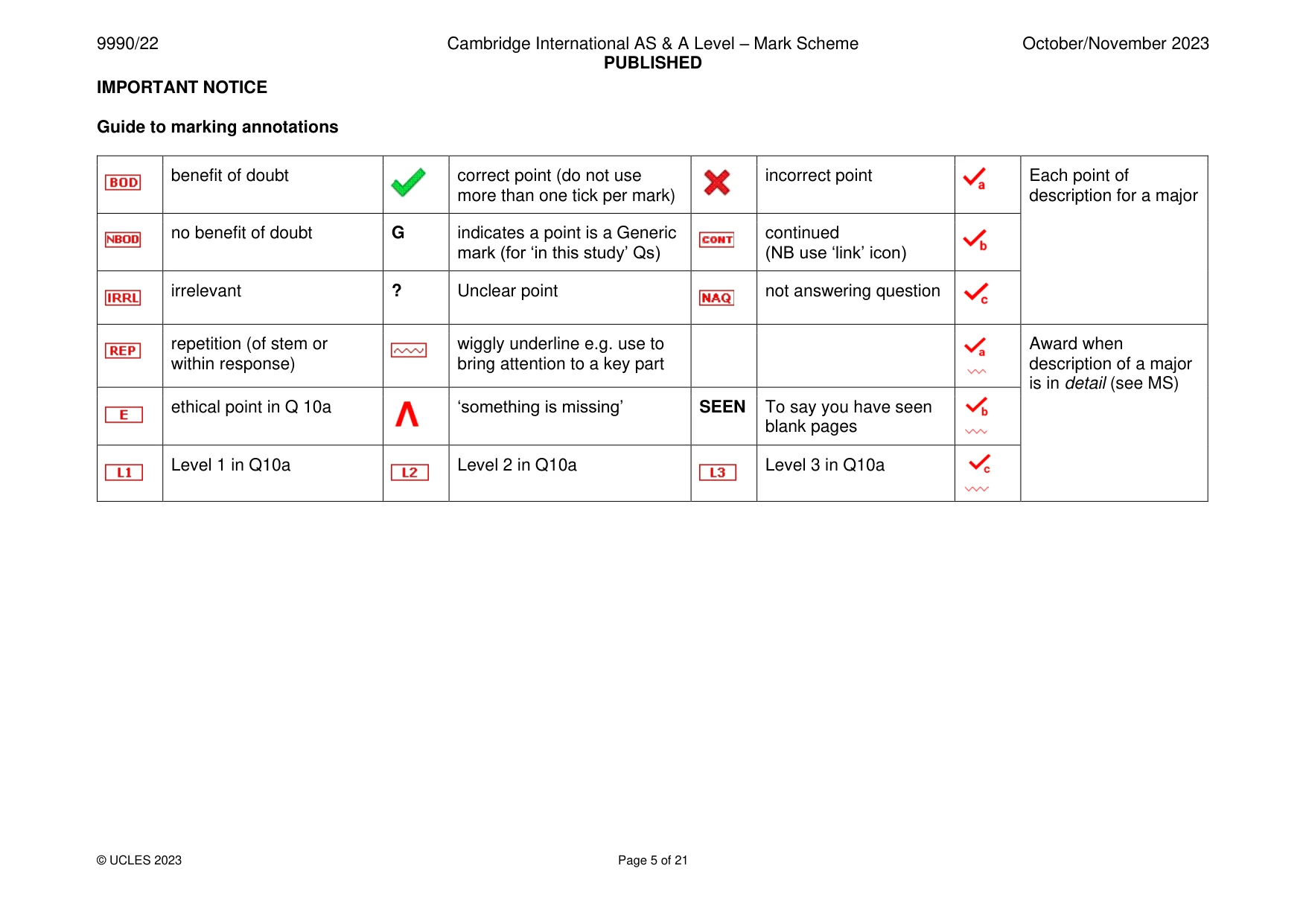
Mark scheme21 pages
Answers below. Sit the paper first if you are practising.
Questions as text
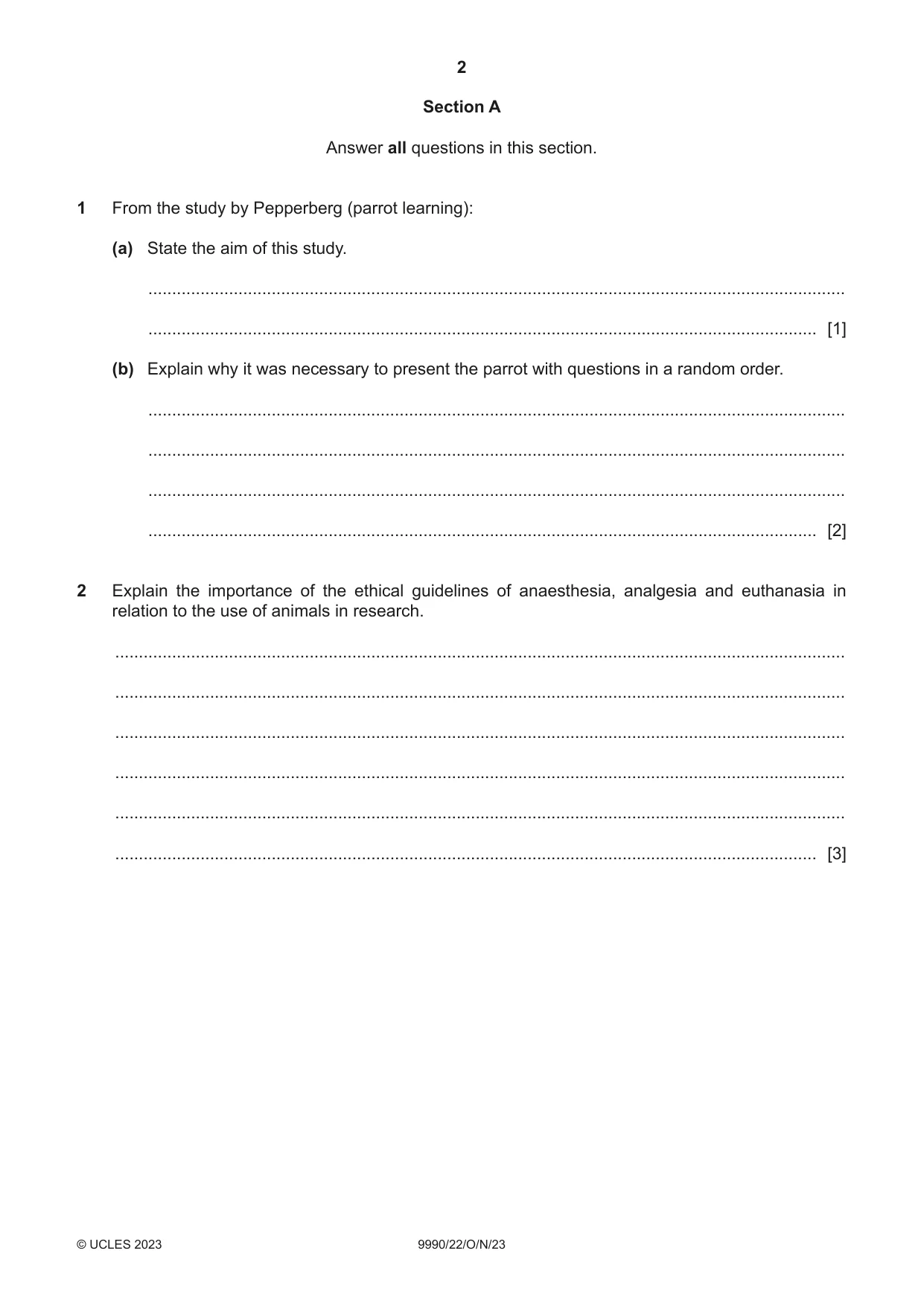
Q1 · From the study by Pepperberg (parrot learning): (a) State the aim of this study
1 From the study by Pepperberg (parrot learning): (a) State the aim of this study. ................................................................................................................................................... ............................................................................................................................................. [1] (b) Explain why it was necessary to present the parrot with questions in a random order. ................................................................................................................................................... ................................................................................................................................................... ................................................................................................................................................... ............................................................................................................................................. [2]
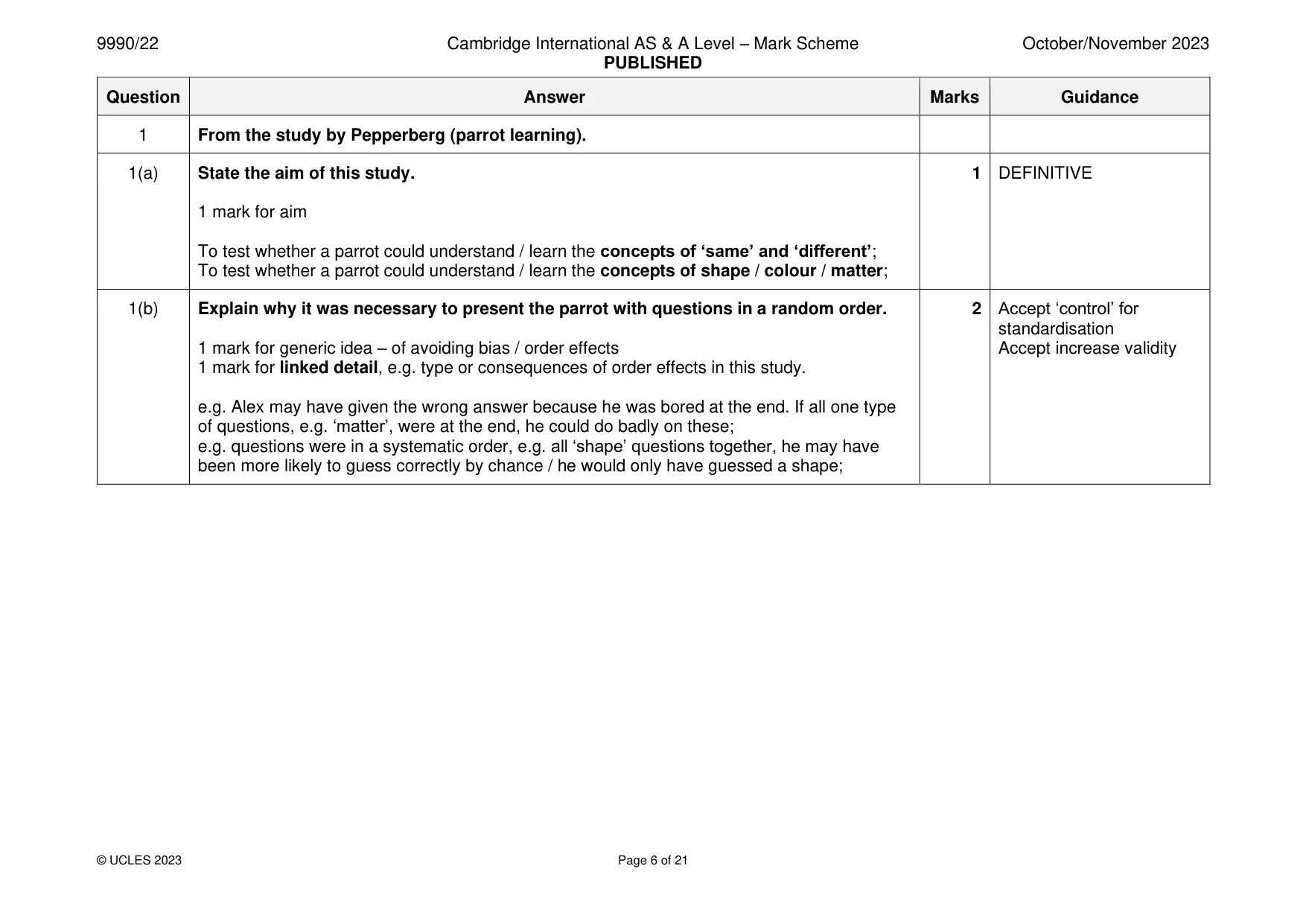
Mark scheme: Question Answer Marks Guidance 1 From the study by Pepperberg (parrot learning). 1(a) State the aim of this study. 1 DEFINITIVE 1 mark for aim To test whether a parrot could understand / learn the concepts of ‘same’ and ‘different’; To test whether a parrot could understand / learn the concepts of shape / colour / matter; 1(b) Explain why it was necessary to present the parrot with questions in a random order. 2 Accept ‘control’ for standardisation 1 mark for generic idea – of avoiding bias / order effects Accept increase validity 1 mark for linked detail, e.g. type or consequences of order effects in this study. e.g. Alex may have given the wrong answer because he was bored at the end. If all one type of questions, e.g. ‘matter’, were at the end, he could do badly on these; e.g. questions were in a systematic order, e.g. all ‘shape’ questions together, he may have been more likely to guess correctly by chance / he would only have guessed a shape;
Q2 · Explain the importance of the ethical guidelines of anaesthesia, analgesia and euthanasia…
2 Explain the importance of the ethical guidelines of anaesthesia, analgesia and euthanasia in relation to the use of animals in research. .......................................................................................................................................................... .......................................................................................................................................................... .......................................................................................................................................................... .......................................................................................................................................................... .......................................................................................................................................................... .................................................................................................................................................... [3]
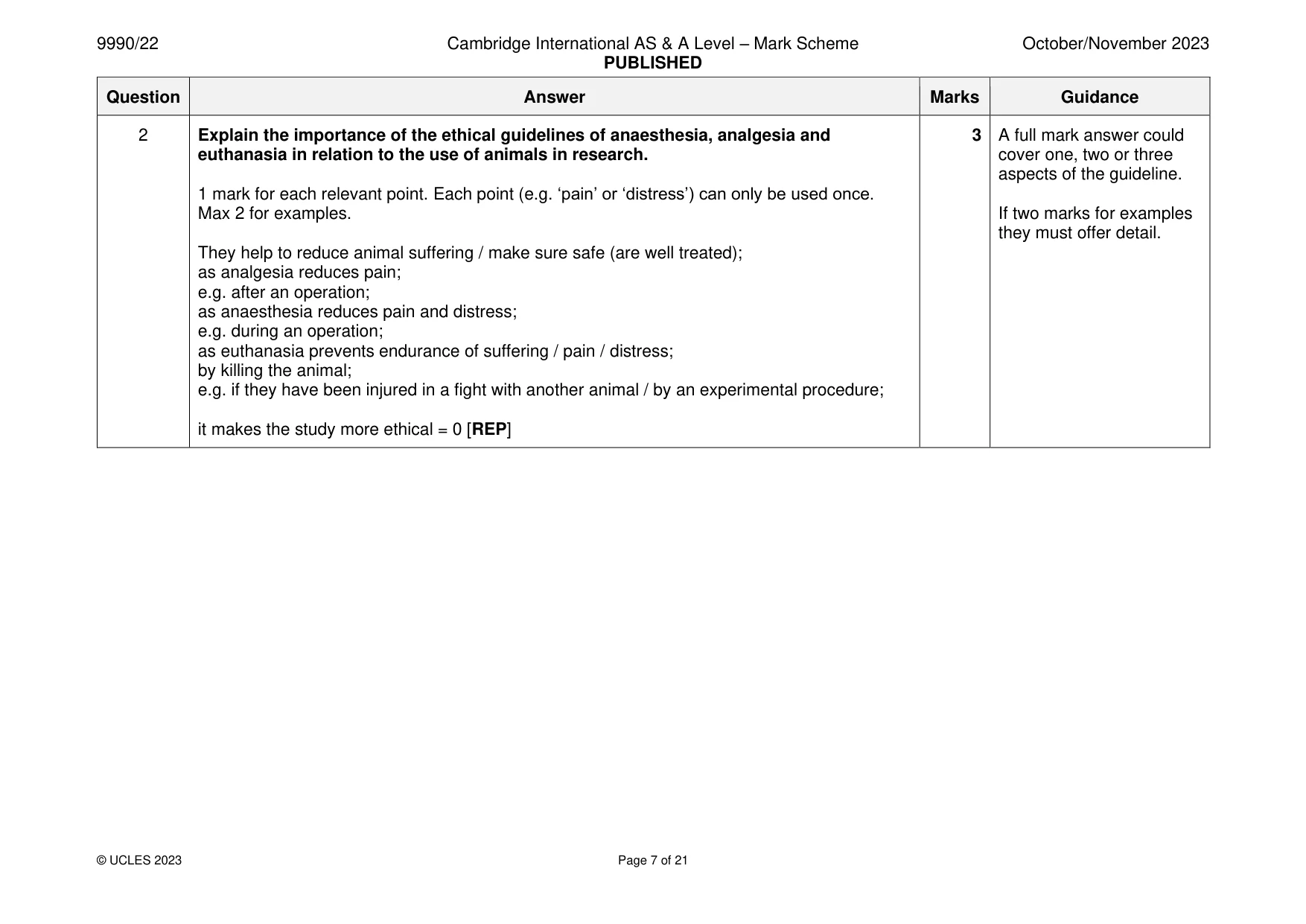
Mark scheme: 2 Explain the importance of the ethical guidelines of anaesthesia, analgesia and 3 A full mark answer could euthanasia in relation to the use of animals in research. cover one, two or three aspects of the guideline. 1 mark for each relevant point. Each point (e.g. ‘pain’ or ‘distress’) can only be used once. Max 2 for examples. If two marks for examples they must offer detail. They help to reduce animal suffering / make sure safe (are well treated); as analgesia reduces pain; e.g. after an operation; as anaesthesia reduces pain and distress; e.g. during an operation; as euthanasia prevents endurance of suffering / pain / distress; by killing the animal; e.g. if they have been injured in a fight with another animal / by an experimental procedure; it makes the study more ethical = 0 [REP]
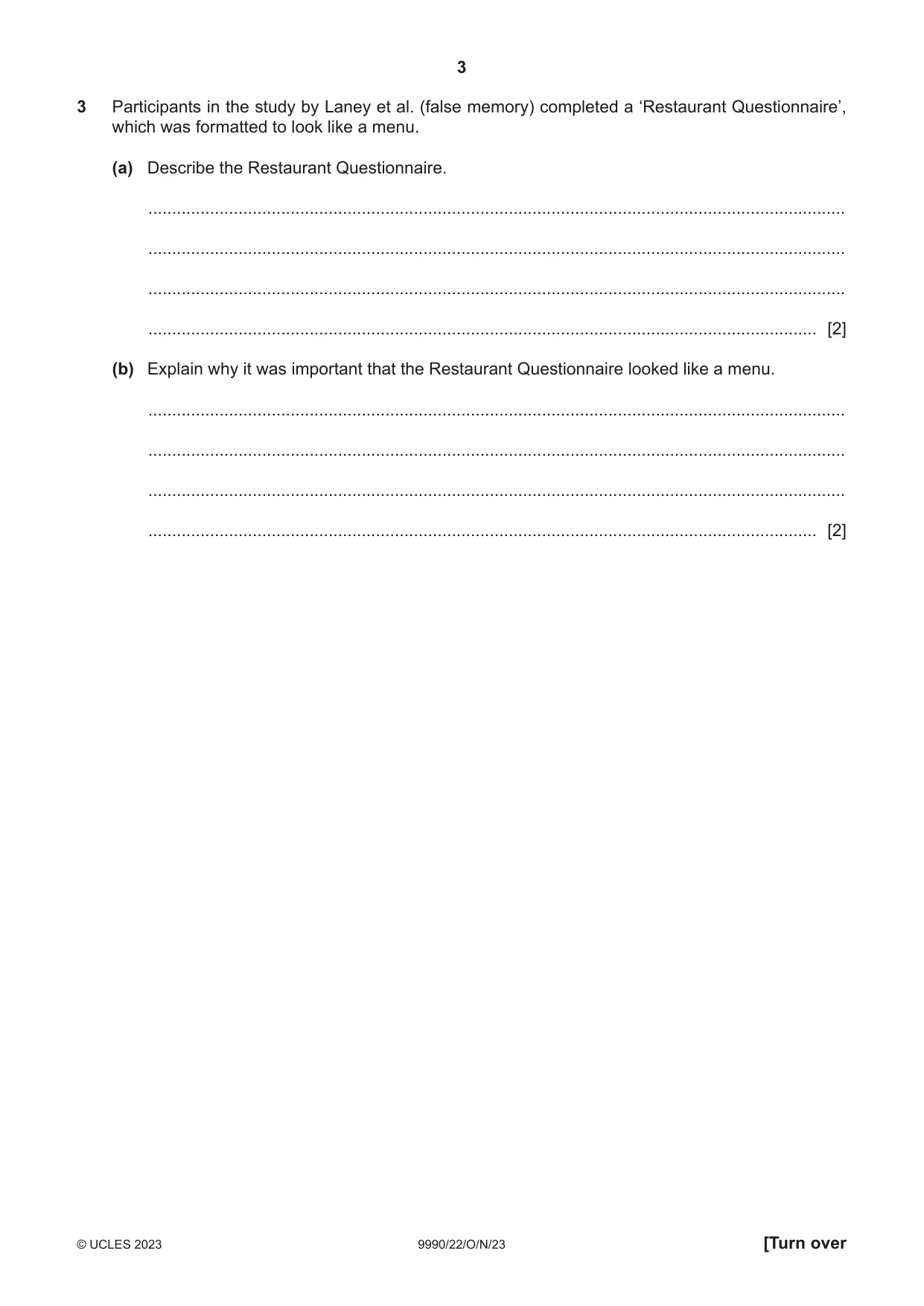
Q3 · Participants in the study by Laney et al
3 Participants in the study by Laney et al. (false memory) completed a ‘Restaurant Questionnaire’, which was formatted to look like a menu. (a) Describe the Restaurant Questionnaire. ................................................................................................................................................... ................................................................................................................................................... ................................................................................................................................................... ............................................................................................................................................. [2] (b) Explain why it was important that the Restaurant Questionnaire looked like a menu. ................................................................................................................................................... ................................................................................................................................................... ................................................................................................................................................... ............................................................................................................................................. [2]
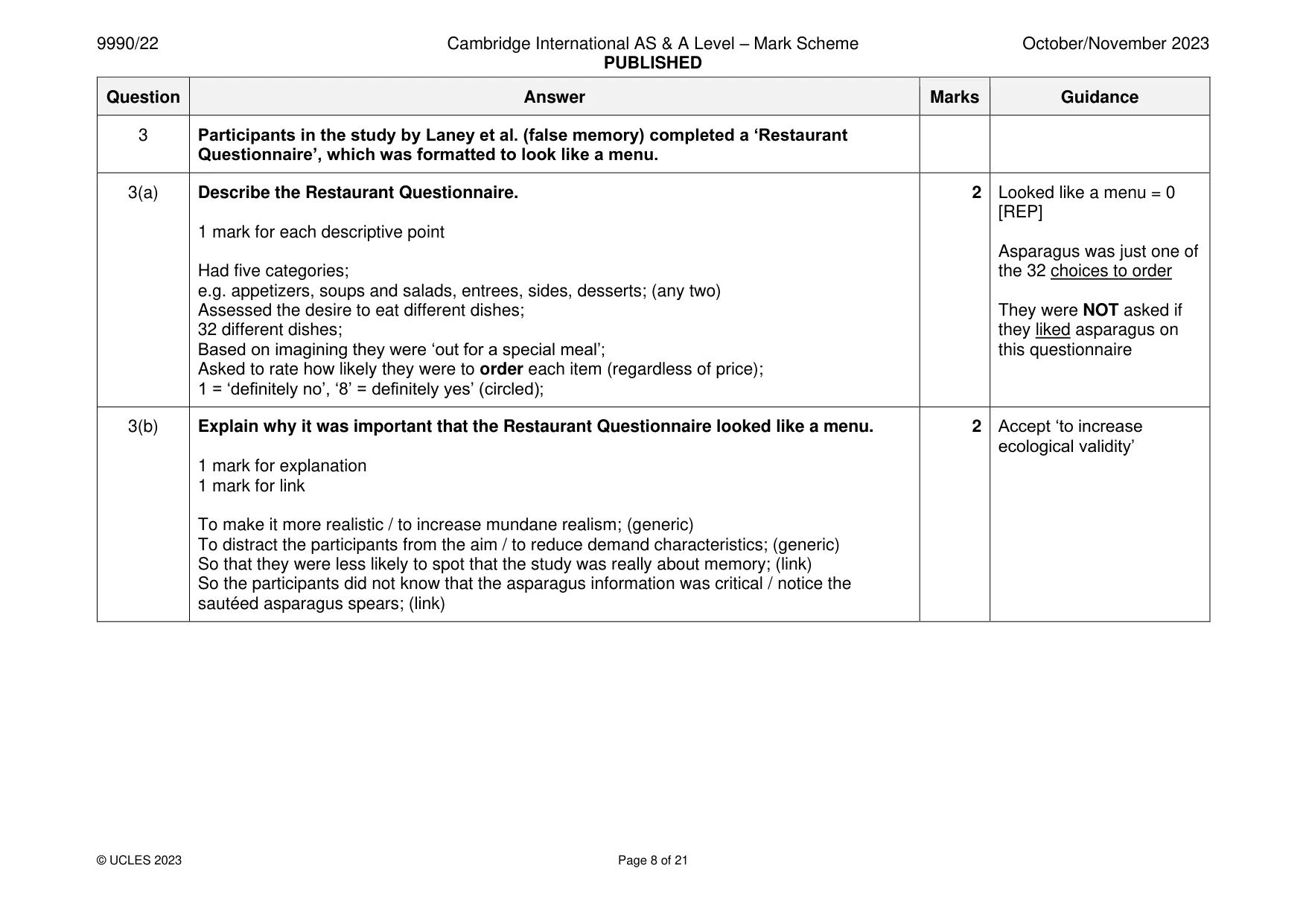
Mark scheme: 3 Participants in the study by Laney et al. (false memory) completed a ‘Restaurant Questionnaire’, which was formatted to look like a menu. 3(a) Describe the Restaurant Questionnaire. 2 Looked like a menu = 0 [REP] 1 mark for each descriptive point Asparagus was just one of Had five categories; the 32 choices to order e.g. appetizers, soups and salads, entrees, sides, desserts; (any two) Assessed the desire to eat different dishes; They were NOT asked if 32 different dishes; they liked asparagus on Based on imagining they were ‘out for a special meal’; this questionnaire Asked to rate how likely they were to order each item (regardless of price); 1 = ‘definitely no’, ‘8’ = definitely yes’ (circled); 3(b) Explain why it was important that the Restaurant Questionnaire looked like a menu. 2 Accept ‘to increase ecological validity’ 1 mark for explanation 1 mark for link To make it more realistic / to increase mundane realism; (generic) To distract the participants from the aim / to reduce demand characteristics; (generic) So that they were less likely to spot that the study was really about memory; (link) So the participants did not know that the asparagus information was critical / notice the sautéed asparagus spears; (link)
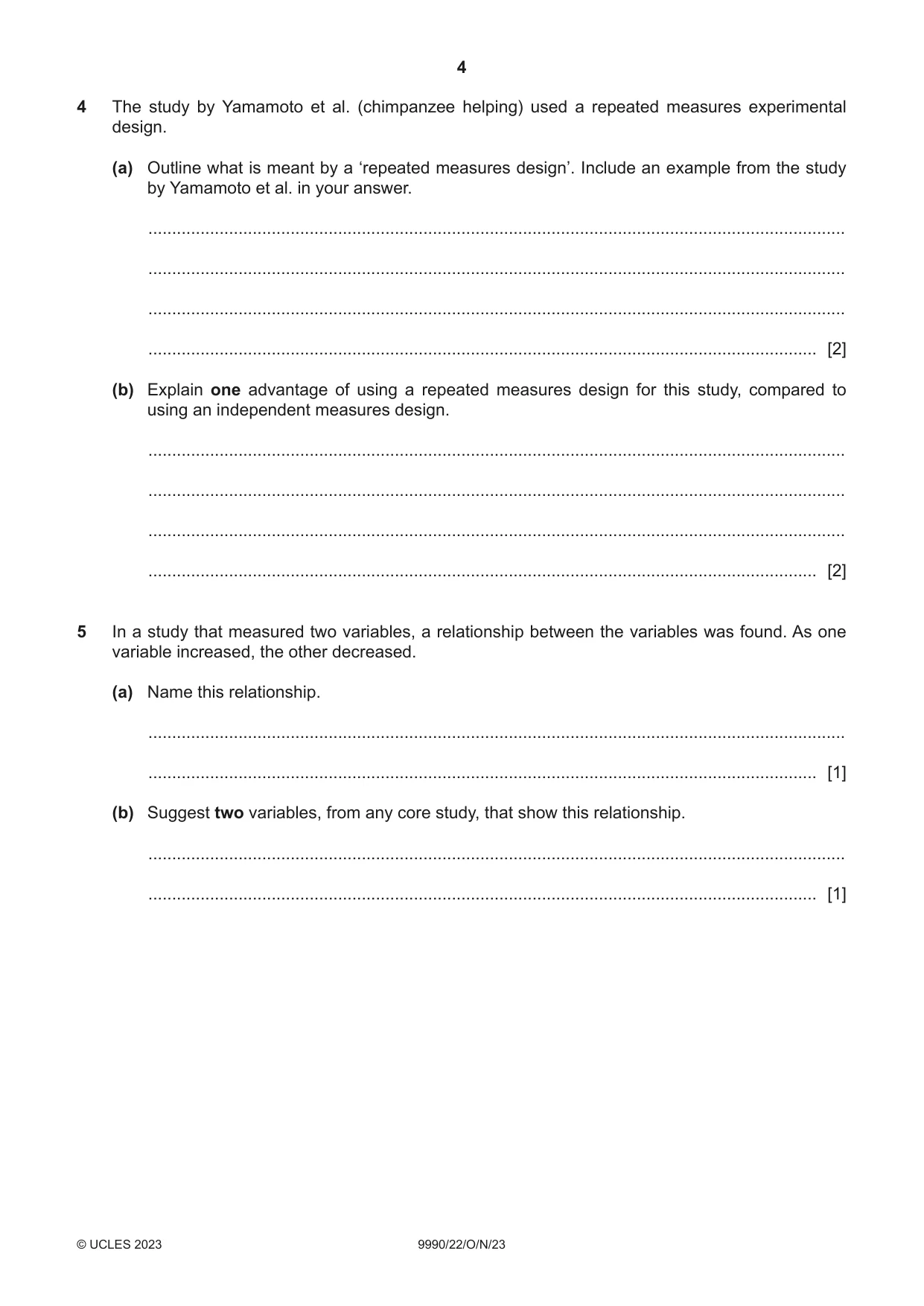
Q4 · The study by Yamamoto et al
4 The study by Yamamoto et al. (chimpanzee helping) used a repeated measures experimental design. (a) Outline what is meant by a ‘repeated measures design’. Include an example from the study by Yamamoto et al. in your answer. ................................................................................................................................................... ................................................................................................................................................... ................................................................................................................................................... ............................................................................................................................................. [2] (b) Explain one advantage of using a repeated measures design for this study, compared to using an independent measures design. ................................................................................................................................................... ................................................................................................................................................... ................................................................................................................................................... ............................................................................................................................................. [2]
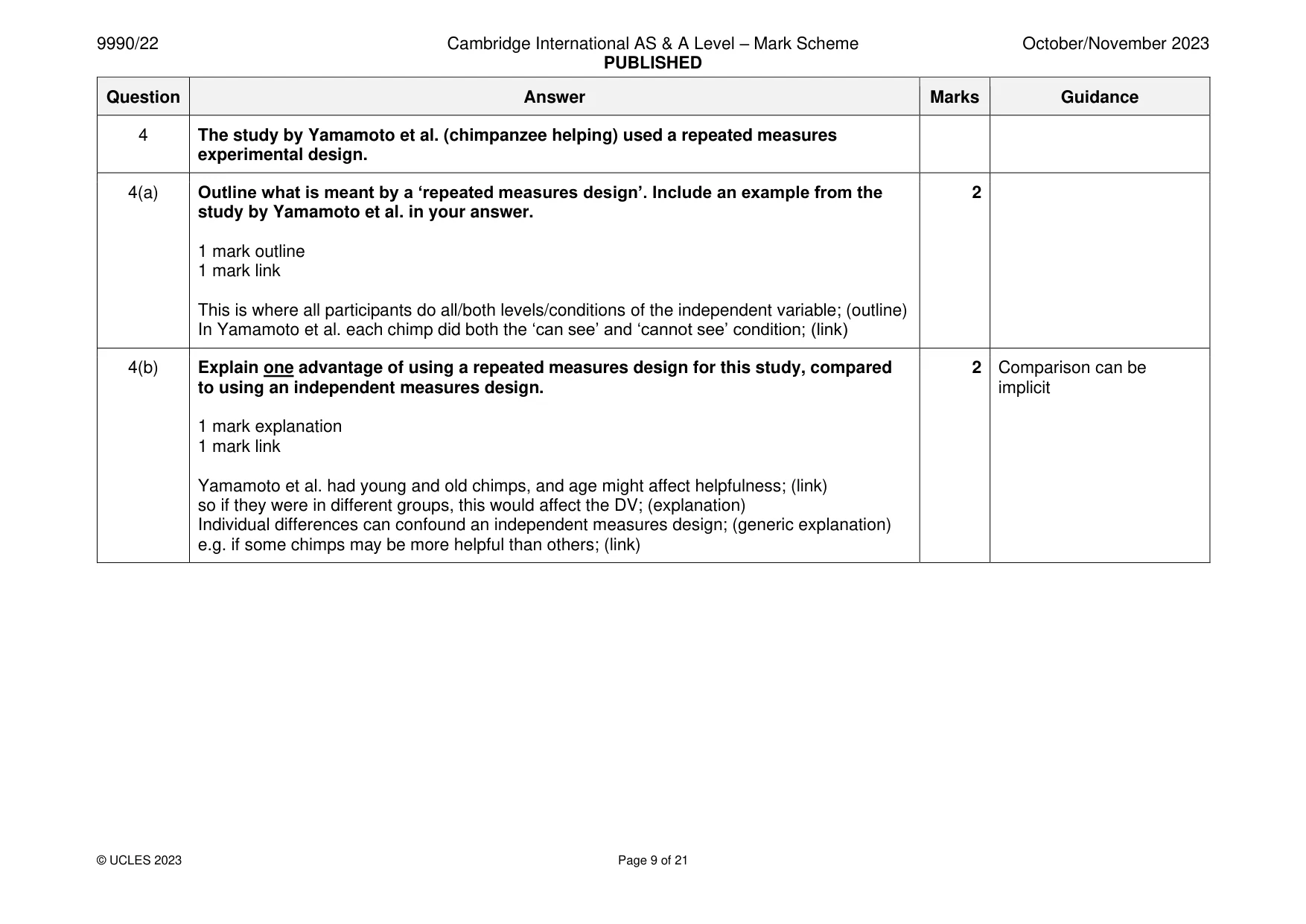
Mark scheme: 4 The study by Yamamoto et al. (chimpanzee helping) used a repeated measures experimental design. 4(a) Outline what is meant by a ‘repeated measures design’. Include an example from the 2 study by Yamamoto et al. in your answer. 1 mark outline 1 mark link This is where all participants do all/both levels/conditions of the independent variable; (outline) In Yamamoto et al. each chimp did both the ‘can see’ and ‘cannot see’ condition; (link) 4(b) Explain one advantage of using a repeated measures design for this study, compared 2 Comparison can be to using an independent measures design. implicit 1 mark explanation 1 mark link Yamamoto et al. had young and old chimps, and age might affect helpfulness; (link) so if they were in different groups, this would affect the DV; (explanation) Individual differences can confound an independent measures design; (generic explanation) e.g. if some chimps may be more helpful than others; (link)
Q5 · In a study that measured two variables, a relationship between the variables was found
5 In a study that measured two variables, a relationship between the variables was found. As one variable increased, the other decreased. (a) Name this relationship. ................................................................................................................................................... ............................................................................................................................................. [1] (b) Suggest two variables, from any core study, that show this relationship. ................................................................................................................................................... ............................................................................................................................................. [1]
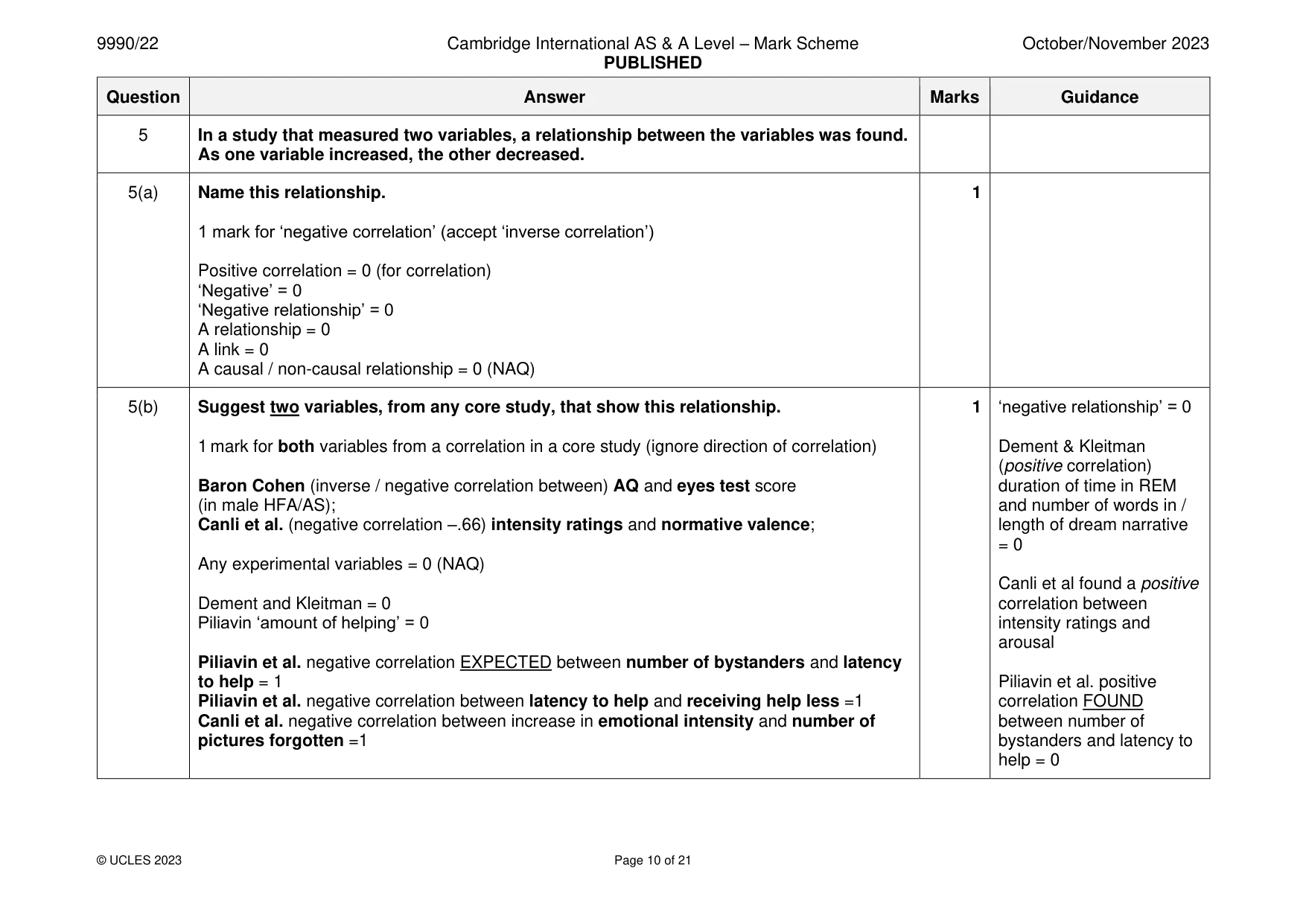
Mark scheme: 5 In a study that measured two variables, a relationship between the variables was found. As one variable increased, the other decreased. 5(a) Name this relationship. 1 1 mark for ‘negative correlation’ (accept ‘inverse correlation’) Positive correlation = 0 (for correlation) ‘Negative’ = 0 ‘Negative relationship’ = 0 A relationship = 0 A link = 0 A causal / non-causal relationship = 0 (NAQ) 5(b) Suggest two variables, from any core study, that show this relationship. 1 ‘negative relationship’ = 0 1 mark for both variables from a correlation in a core study (ignore direction of correlation) Dement & Kleitman (positive correlation) Baron Cohen (inverse / negative correlation between) AQ and eyes test score duration of time in REM (in male HFA/AS); and number of words in / Canli et al. (negative correlation –.66) intensity ratings and normative valence; length of dream narrative = 0 Any experimental variables = 0 (NAQ) Canli et al found a positive Dement and Kleitman = 0 correlation between Piliavin ‘amount of helping’ = 0 intensity ratings and arousal Piliavin et al. negative correlation EXPECTED between number of bystanders and latency to help = 1 Piliavin et al. positive Piliavin et al. negative correlation between latency to help and receiving help less =1 correlation FOUND Canli et al. negative correlation between increase in emotional intensity and number of between number of pictures forgotten =1 bystanders and latency to help = 0
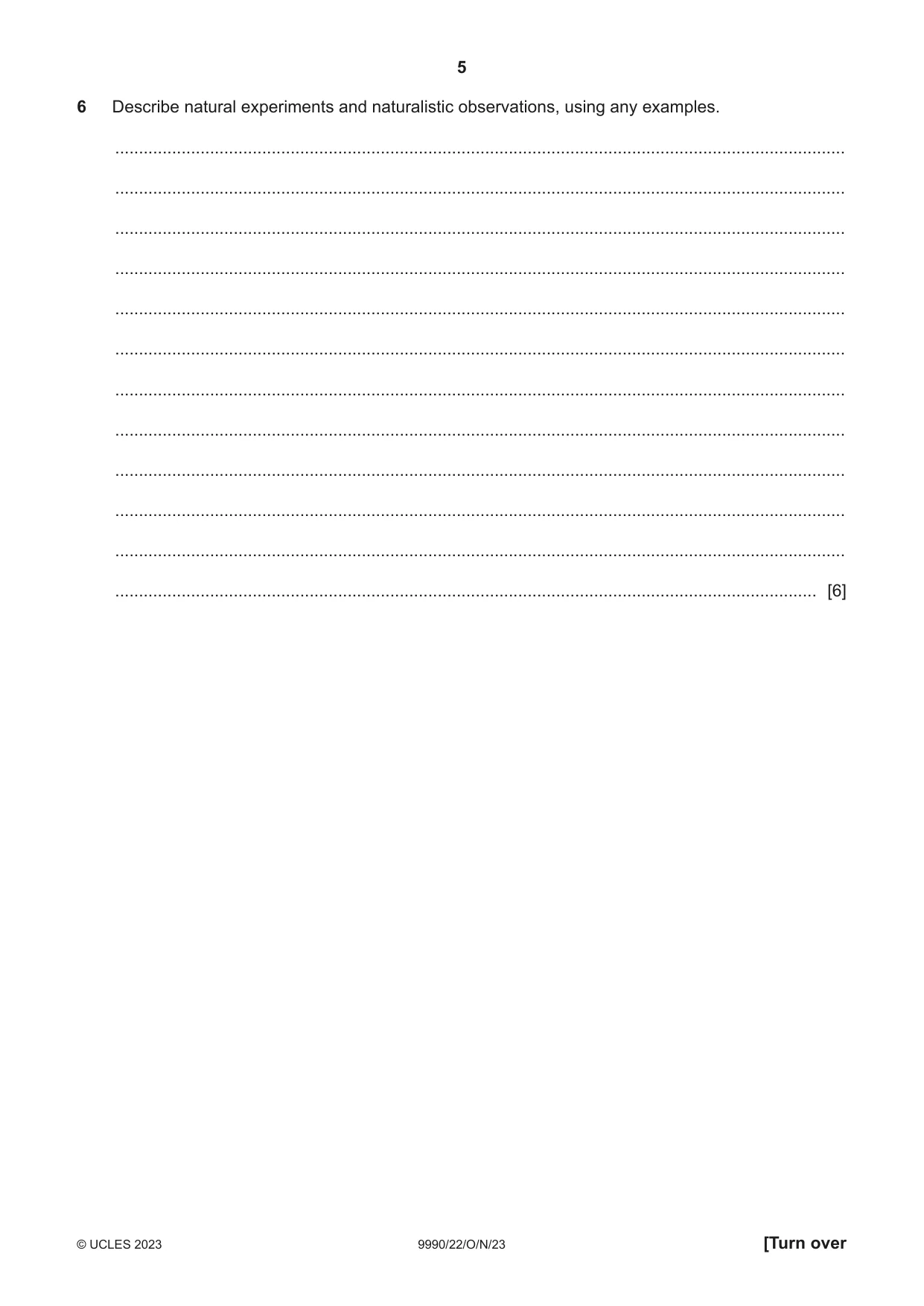
Q6 · Describe natural experiments and naturalistic observations, using any examples
6 Describe natural experiments and naturalistic observations, using any examples. .......................................................................................................................................................... .......................................................................................................................................................... .......................................................................................................................................................... .......................................................................................................................................................... .......................................................................................................................................................... .......................................................................................................................................................... .......................................................................................................................................................... .......................................................................................................................................................... .......................................................................................................................................................... .......................................................................................................................................................... .......................................................................................................................................................... .................................................................................................................................................... [6]
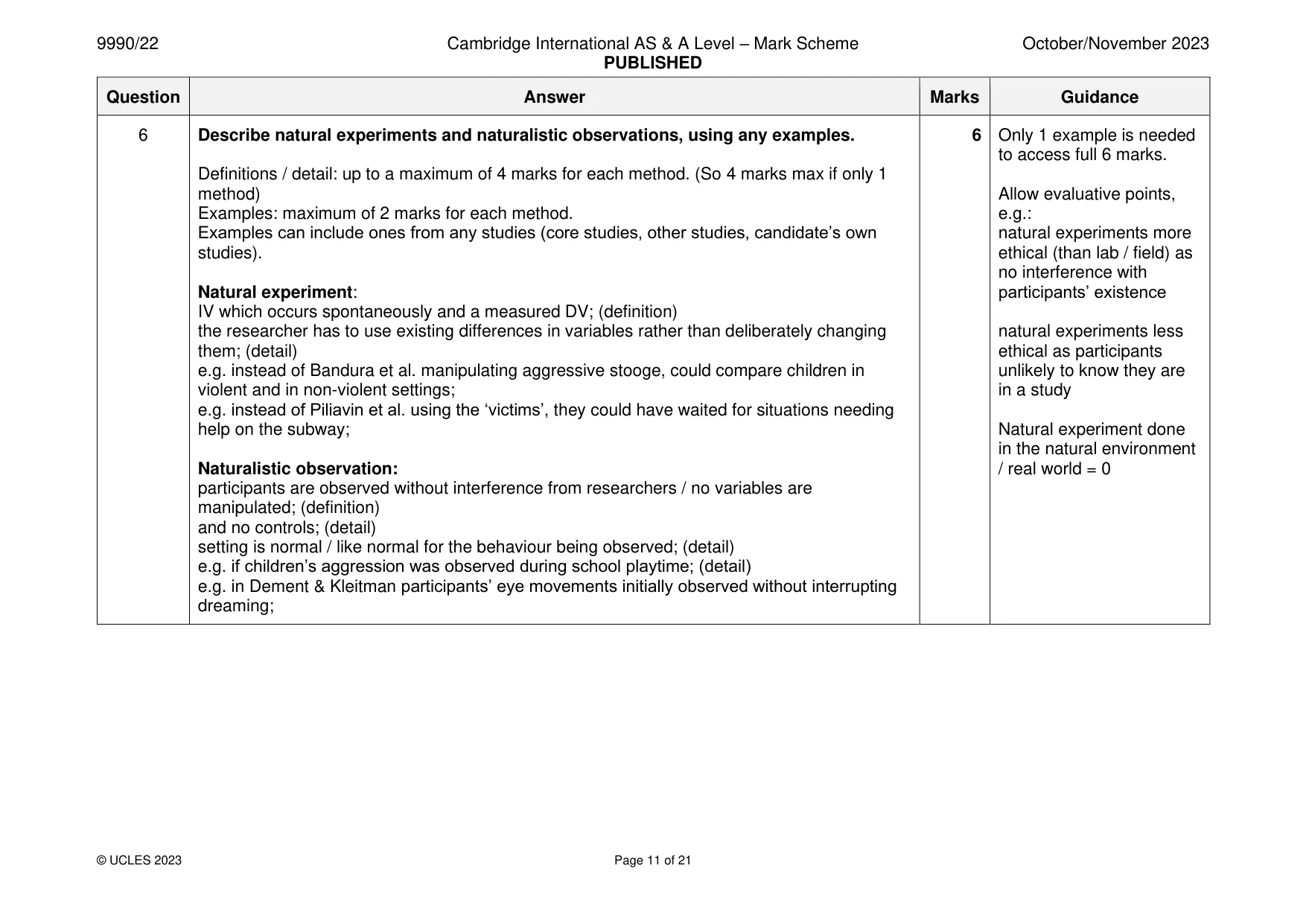
Mark scheme: 6 Describe natural experiments and naturalistic observations, using any examples. 6 Only 1 example is needed to access full 6 marks. Definitions / detail: up to a maximum of 4 marks for each method. (So 4 marks max if only 1 method) Allow evaluative points, Examples: maximum of 2 marks for each method. e.g.: Examples can include ones from any studies (core studies, other studies, candidate’s own natural experiments more studies). ethical (than lab / field) as no interference with Natural experiment: participants’ existence IV which occurs spontaneously and a measured DV; (definition) the researcher has to use existing differences in variables rather than deliberately changing natural experiments less them; (detail) ethical as participants e.g. instead of Bandura et al. manipulating aggressive stooge, could compare children in unlikely to know they are violent and in non-violent settings; in a study e.g. instead of Piliavin et al. using the ‘victims’, they could have waited for situations needing help on the subway; Natural experiment done in the natural environment Naturalistic observation: / real world = 0 participants are observed without interference from researchers / no variables are manipulated; (definition) and no controls; (detail) setting is normal / like normal for the behaviour being observed; (detail) e.g. if children’s aggression was observed during school playtime; (detail) e.g. in Dement & Kleitman participants’ eye movements initially observed without interrupting dreaming;
Q7 · James is conducting an interview to investigate topics that could influence anger and…
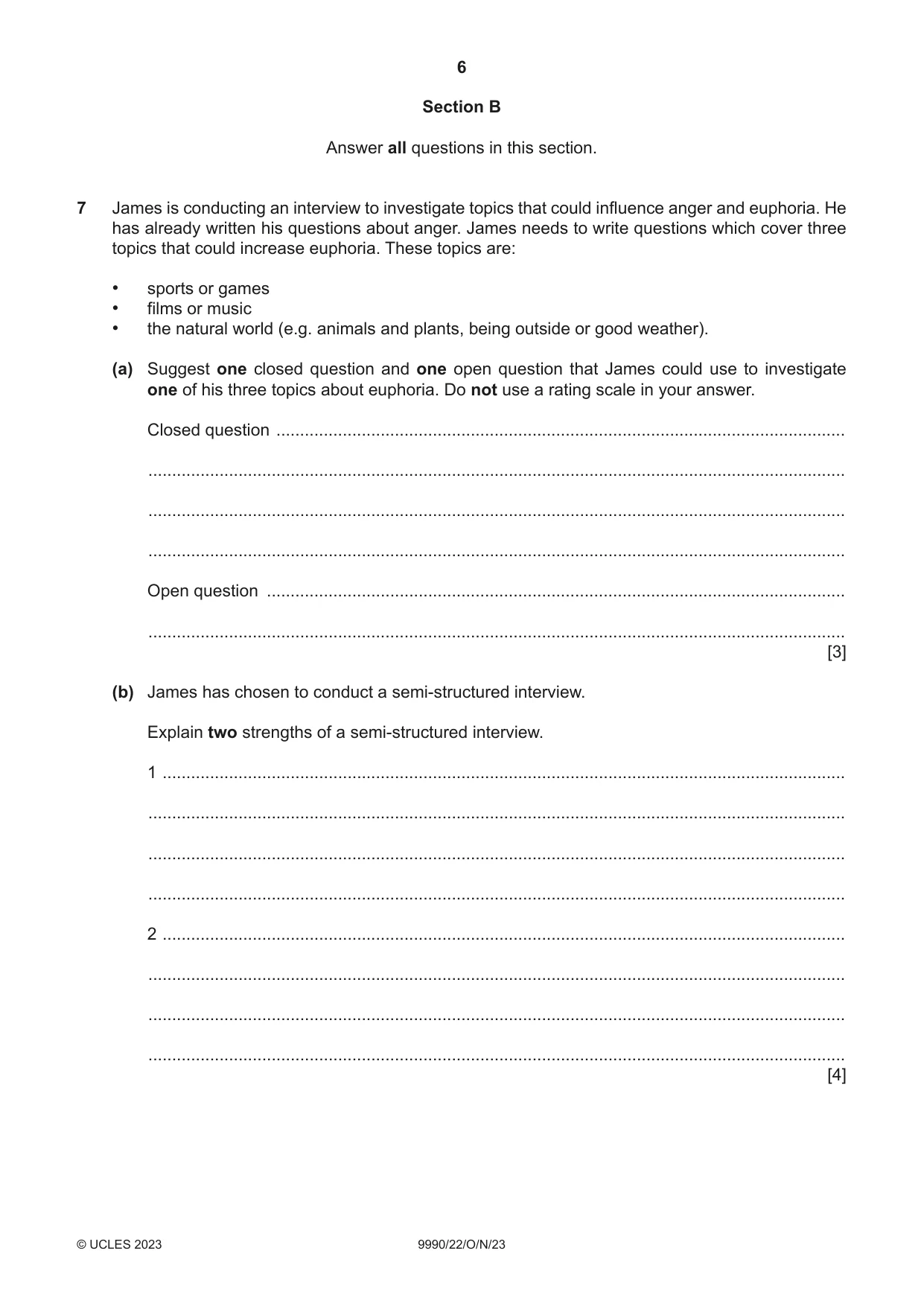
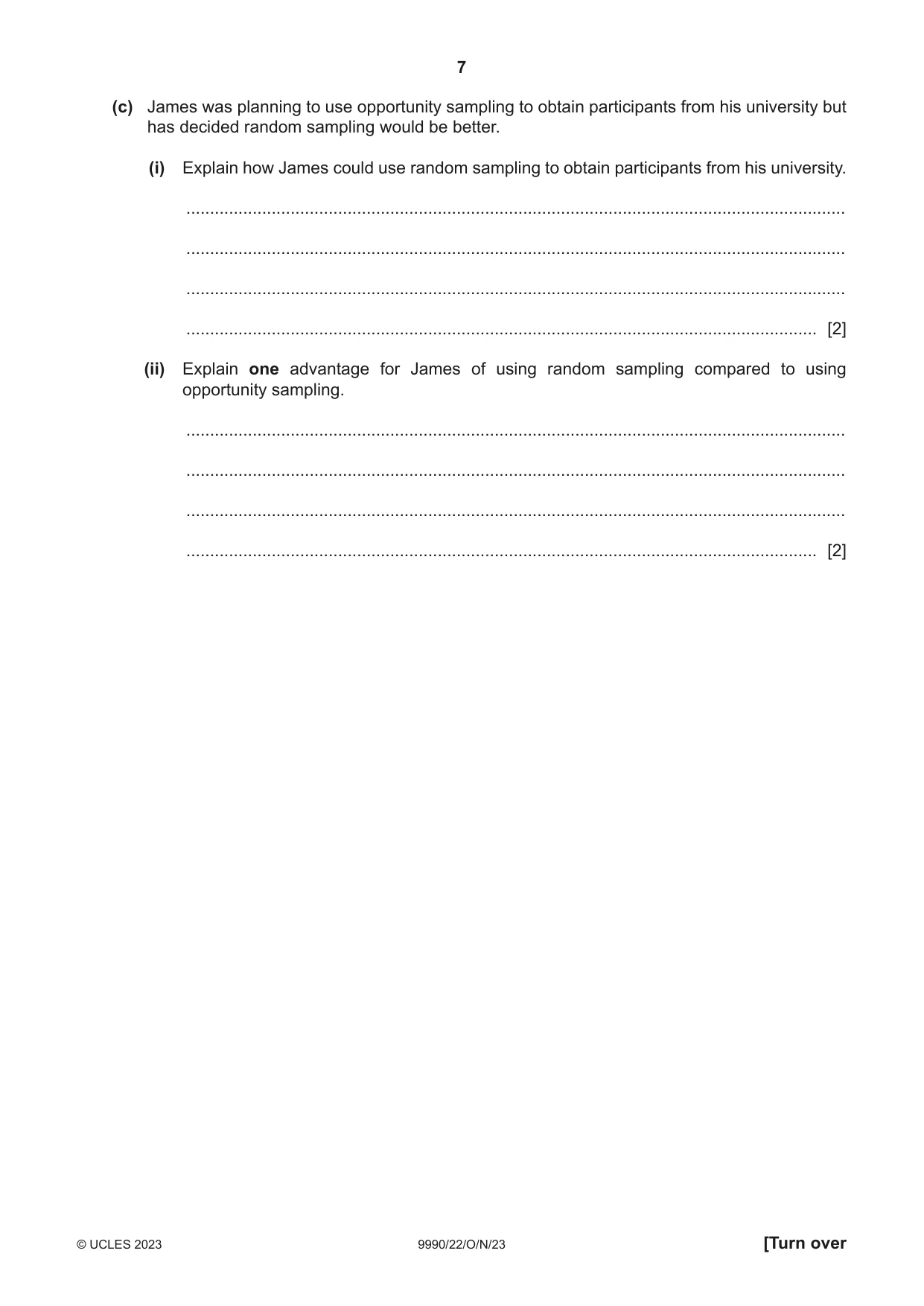
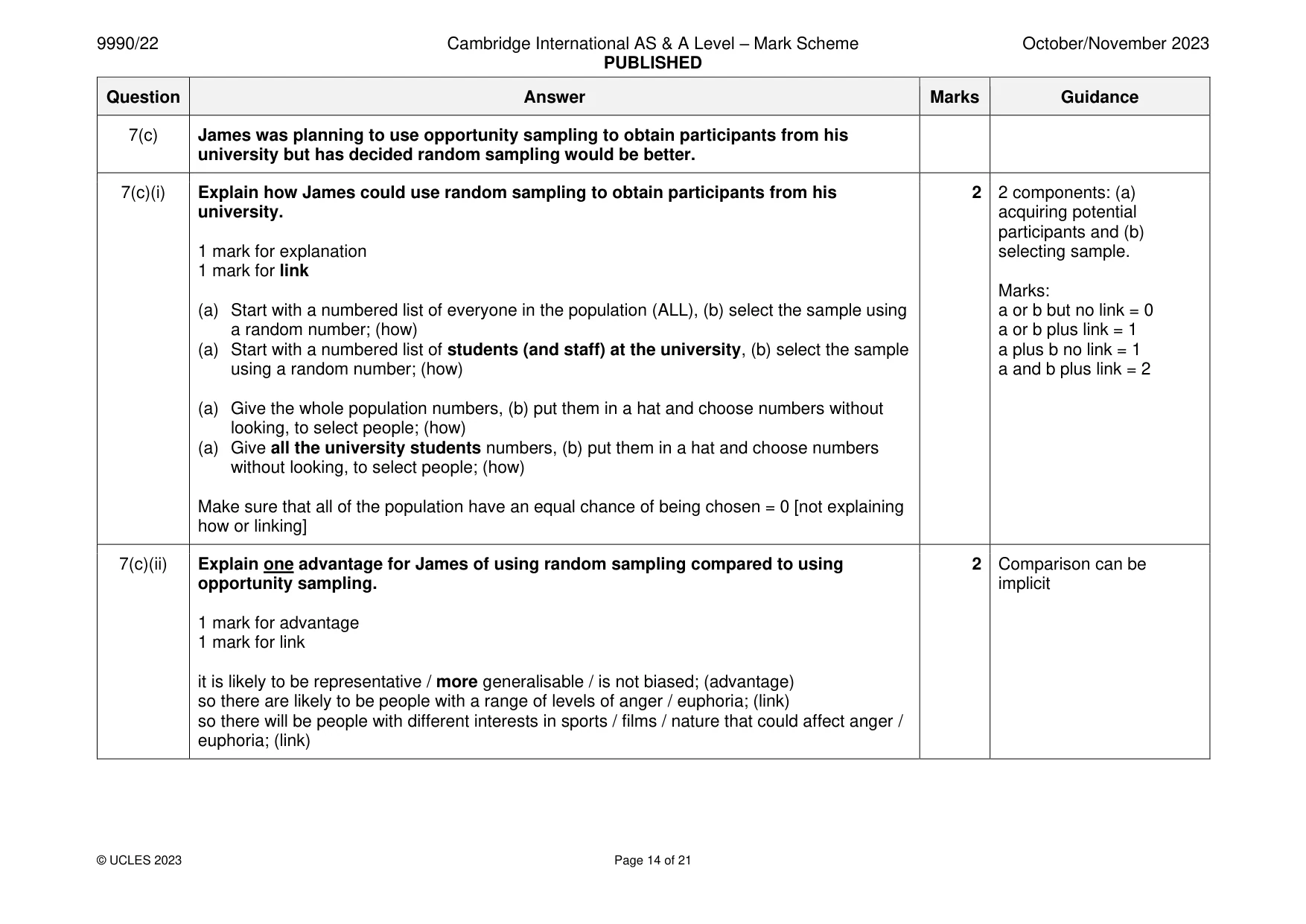
7 James is conducting an interview to investigate topics that could influence anger and euphoria. He has already written his questions about anger. James needs to write questions which cover three topics that could increase euphoria. These topics are: • sports or games • films or music • the natural world (e.g. animals and plants, being outside or good weather). (a) Suggest one closed question and one open question that James could use to investigate one of his three topics about euphoria. Do not use a rating scale in your answer. Closed question ........................................................................................................................ ................................................................................................................................................... ................................................................................................................................................... ................................................................................................................................................... Open question .......................................................................................................................... ................................................................................................................................................... [3] (b) James has chosen to conduct a semi‑structured interview. Explain two strengths of a semi‑structured interview. 1 ................................................................................................................................................ ................................................................................................................................................... ................................................................................................................................................... ................................................................................................................................................... 2 ................................................................................................................................................ ................................................................................................................................................... ................................................................................................................................................... ................................................................................................................................................... [4] (c) James was planning to use opportunity sampling to obtain participants from his university but has decided random sampling would be better. (i) Explain how James could use random sampling to obtain participants from his university. ........................................................................................................................................... ........................................................................................................................................... ........................................................................................................................................... ..................................................................................................................................... [2] (ii) Explain one advantage for James of using random sampling compared to using opportunity sampling. ........................................................................................................................................... ........................................................................................................................................... ........................................................................................................................................... ..................................................................................................................................... [2]
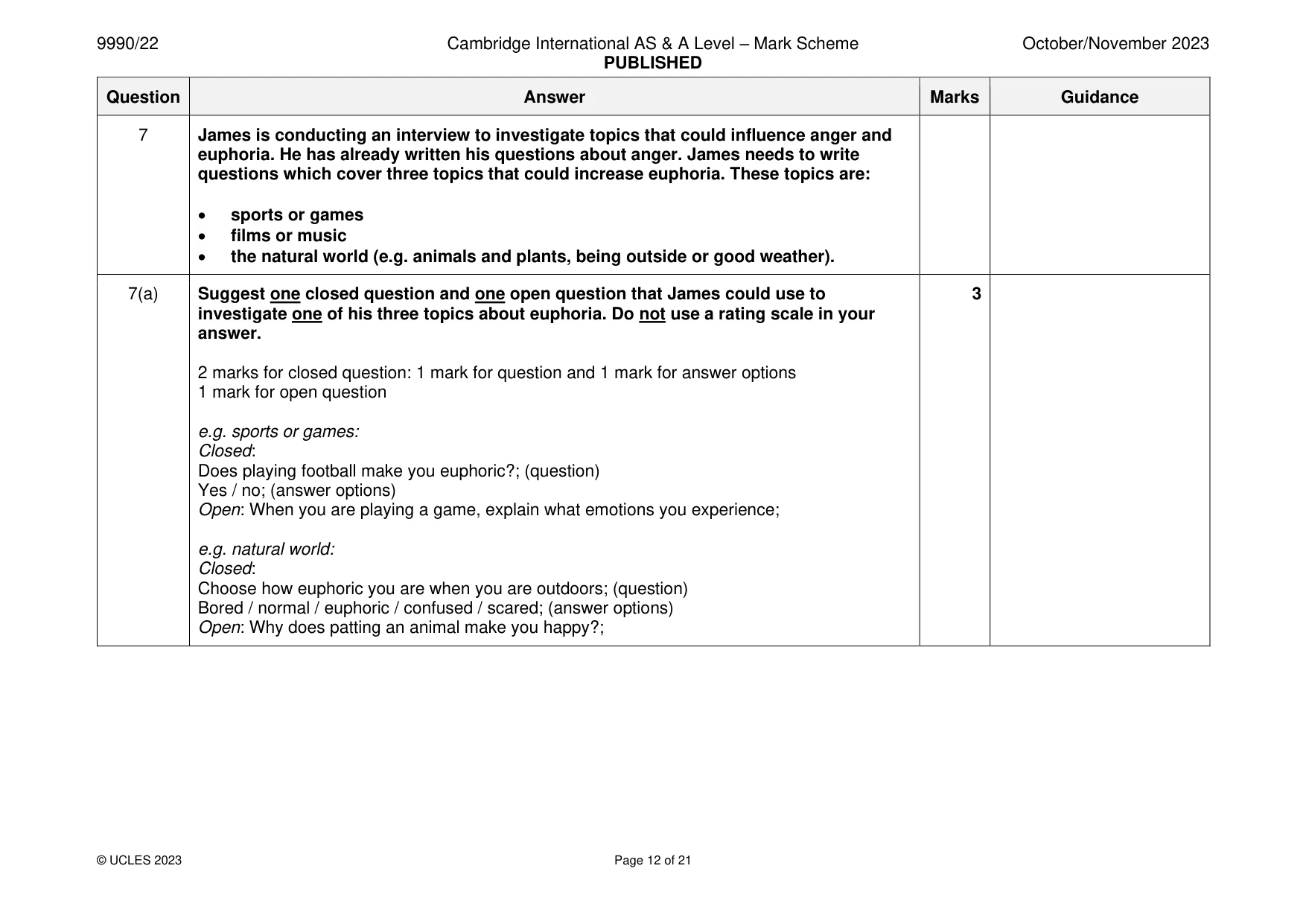
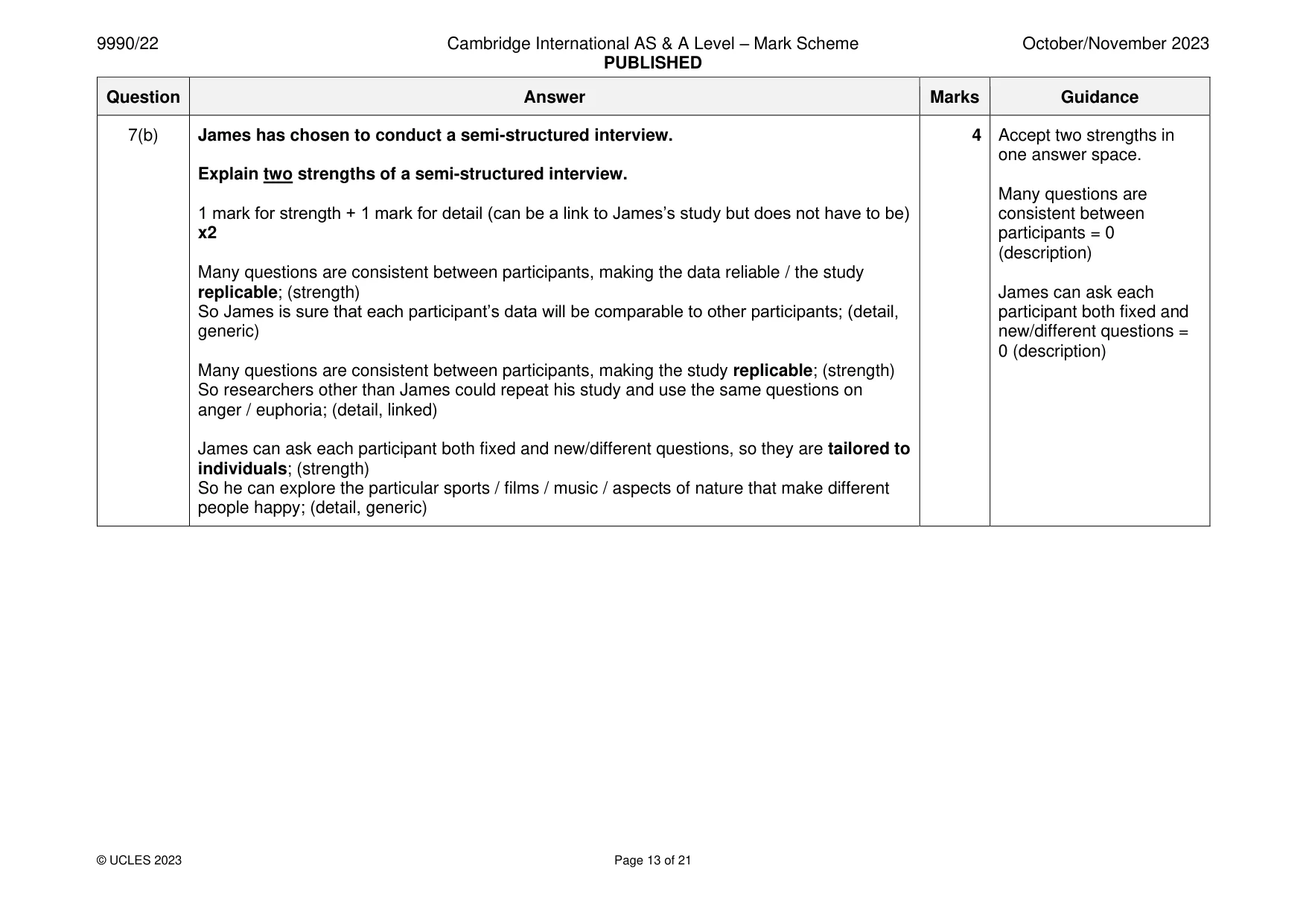
Mark scheme: 7 James is conducting an interview to investigate topics that could influence anger and euphoria. He has already written his questions about anger. James needs to write questions which cover three topics that could increase euphoria. These topics are: • sports or games • films or music • the natural world (e.g. animals and plants, being outside or good weather). 7(a) Suggest one closed question and one open question that James could use to 3 investigate one of his three topics about euphoria. Do not use a rating scale in your answer. 2 marks for closed question: 1 mark for question and 1 mark for answer options 1 mark for open question e.g. sports or games: Closed: Does playing football make you euphoric?; (question) Yes / no; (answer options) Open: When you are playing a game, explain what emotions you experience; e.g. natural world: Closed: Choose how euphoric you are when you are outdoors; (question) Bored / normal / euphoric / confused / scared; (answer options) Open: Why does patting an animal make you happy?; 7(b) James has chosen to conduct a semi-structured interview. 4 Accept two strengths in one answer space. Explain two strengths of a semi-structured interview. Many questions are 1 mark for strength + 1 mark for detail (can be a link to James’s study but does not have to be) consistent between x2 participants = 0 (description) Many questions are consistent between participants, making the data reliable / the study replicable; (strength) James can ask each So James is sure that each participant’s data will be comparable to other participants; (detail, participant both fixed and generic) new/different questions = 0 (description) Many questions are consistent between participants, making the study replicable; (strength) So researchers other than James could repeat his study and use the same questions on anger / euphoria; (detail, linked) James can ask each participant both fixed and new/different questions, so they are tailored to individuals; (strength) So he can explore the particular sports / films / music / aspects of nature that make different people happy; (detail, generic) 7(c) James was planning to use opportunity sampling to obtain participants from his university but has decided random sampling would be better. 7(c)(i) Explain how James could use random sampling to obtain participants from his 2 2 components: (a) university. acquiring potential participants and (b) 1 mark for explanation selecting sample. 1 mark for link Marks: (a) Start with a numbered list of everyone in the population (ALL), (b) select the sample using a or b but no link = 0 a random number; (how) a or b plus link = 1 (a) Start with a numbered list of students (and staff) at the university, (b) select the sample a plus b no link = 1 using a random number; (how) a and b plus link = 2 (a) Give the whole population numbers, (b) put them in a hat and choose numbers without looking, to select people; (how) (a) Give all the university students numbers, (b) put them in a hat and choose numbers without looking, to select people; (how) Make sure that all of the population have an equal chance of being chosen = 0 [not explaining how or linking] 7(c)(ii) Explain one advantage for James of using random sampling compared to using 2 Comparison can be opportunity sampling. implicit 1 mark for advantage 1 mark for link it is likely to be representative / more generalisable / is not biased; (advantage) so there are likely to be people with a range of levels of anger / euphoria; (link) so there will be people with different interests in sports / films / nature that could affect anger / euphoria; (link)
Q8 · Olive and Durnaz are planning a questionnaire to use in their study, which aims to…
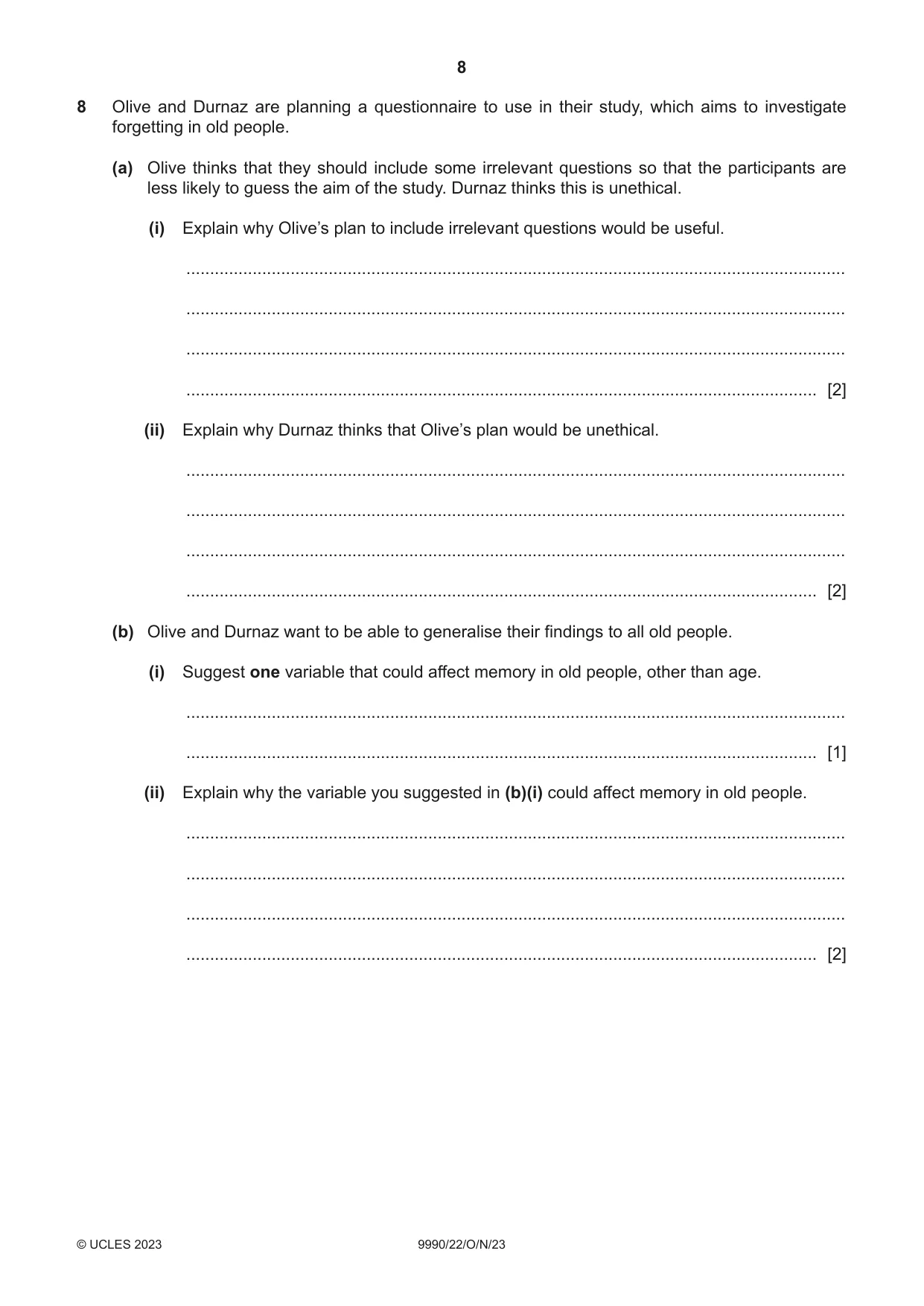
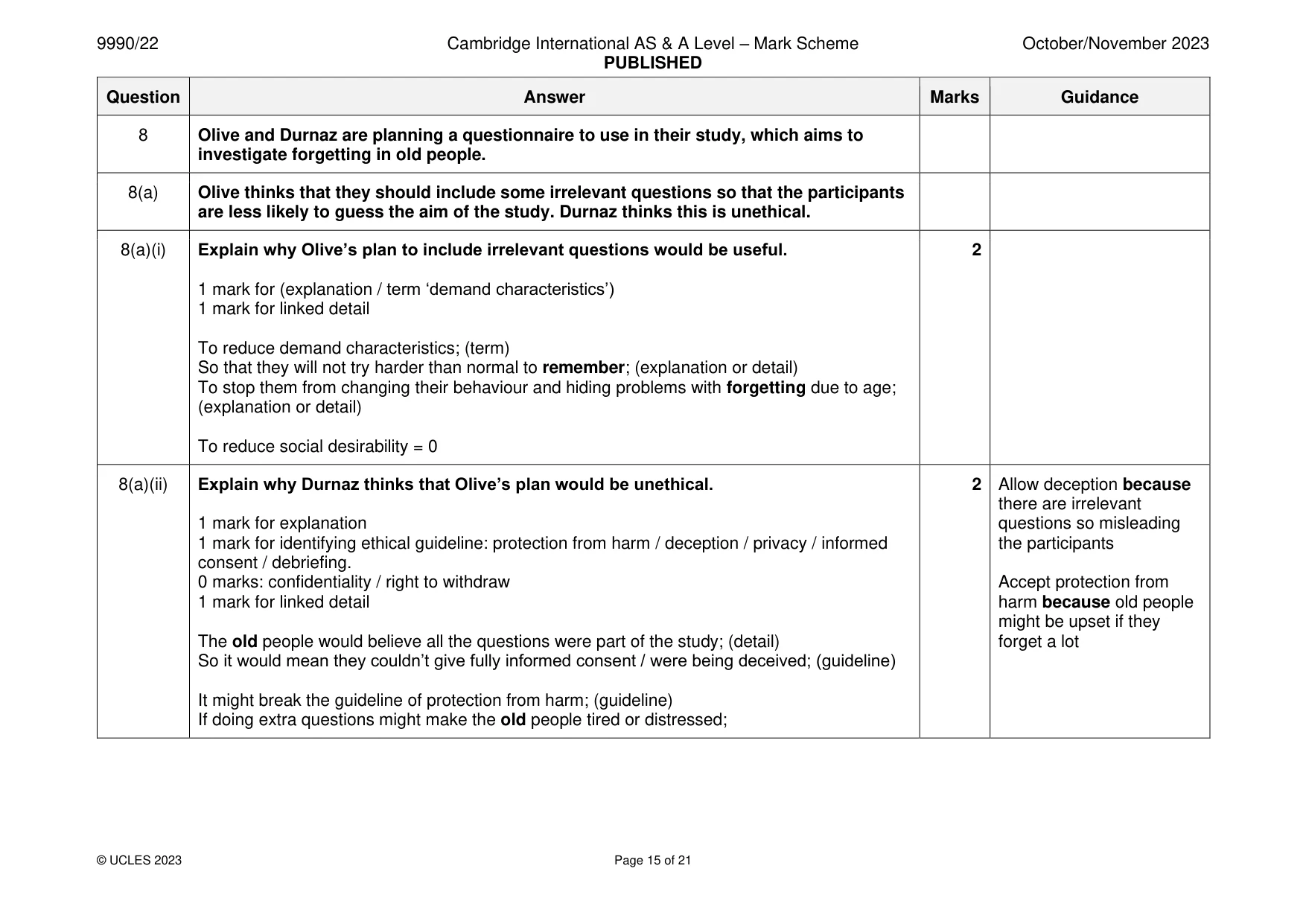
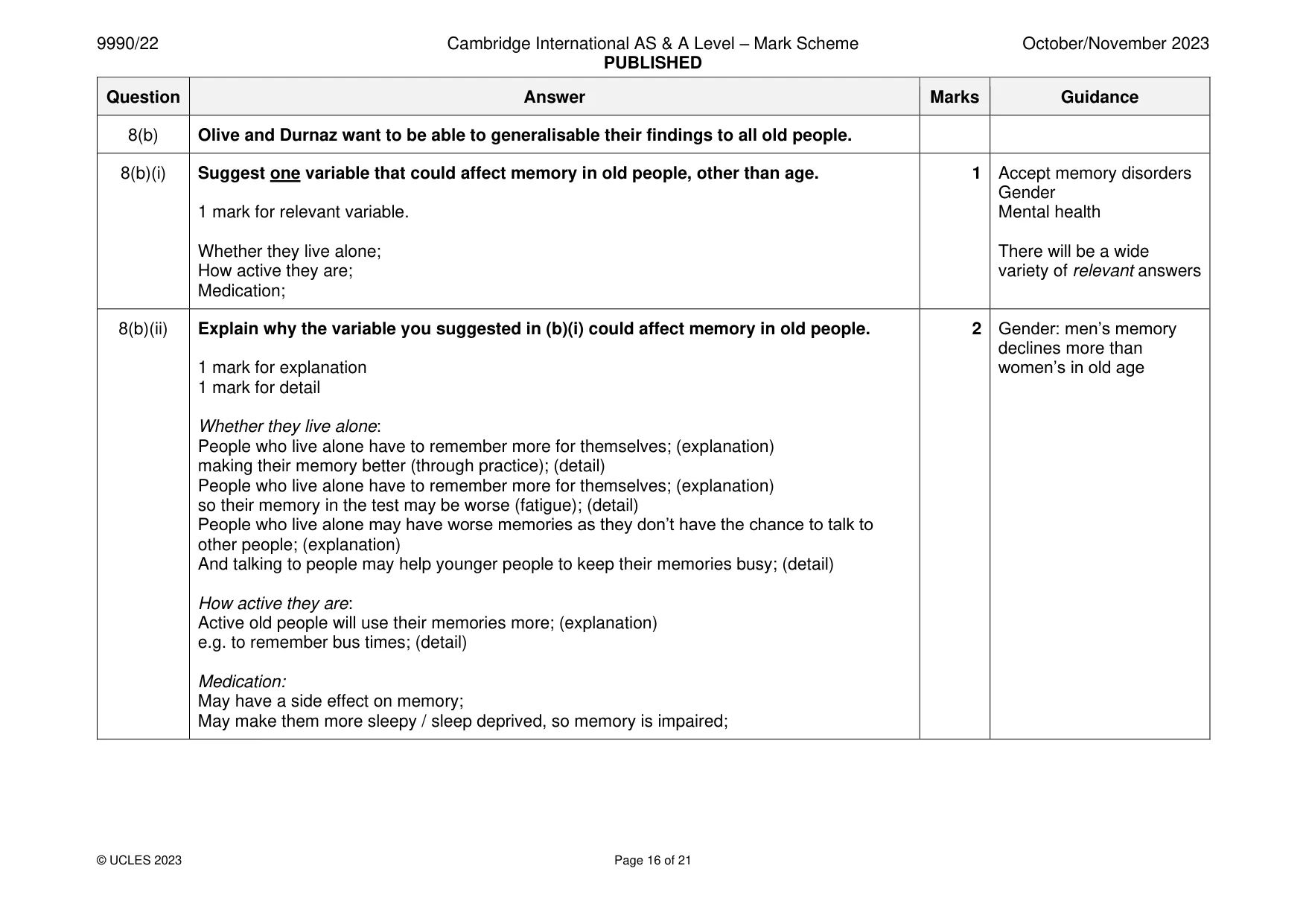
8 Olive and Durnaz are planning a questionnaire to use in their study, which aims to investigate forgetting in old people. (a) Olive thinks that they should include some irrelevant questions so that the participants are less likely to guess the aim of the study. Durnaz thinks this is unethical. (i) Explain why Olive’s plan to include irrelevant questions would be useful. ........................................................................................................................................... ........................................................................................................................................... ........................................................................................................................................... ..................................................................................................................................... [2] (ii) Explain why Durnaz thinks that Olive’s plan would be unethical. ........................................................................................................................................... ........................................................................................................................................... ........................................................................................................................................... ..................................................................................................................................... [2] (b) Olive and Durnaz want to be able to generalise their findings to all old people. (i) Suggest one variable that could affect memory in old people, other than age. ........................................................................................................................................... ..................................................................................................................................... [1] (ii) Explain why the variable you suggested in (b)(i) could affect memory in old people. ........................................................................................................................................... ........................................................................................................................................... ........................................................................................................................................... ..................................................................................................................................... [2]
Mark scheme: 8 Olive and Durnaz are planning a questionnaire to use in their study, which aims to investigate forgetting in old people. 8(a) Olive thinks that they should include some irrelevant questions so that the participants are less likely to guess the aim of the study. Durnaz thinks this is unethical. 8(a)(i) Explain why Olive’s plan to include irrelevant questions would be useful. 2 1 mark for (explanation / term ‘demand characteristics’) 1 mark for linked detail To reduce demand characteristics; (term) So that they will not try harder than normal to remember; (explanation or detail) To stop them from changing their behaviour and hiding problems with forgetting due to age; (explanation or detail) To reduce social desirability = 0 8(a)(ii) Explain why Durnaz thinks that Olive’s plan would be unethical. 2 Allow deception because there are irrelevant 1 mark for explanation questions so misleading 1 mark for identifying ethical guideline: protection from harm / deception / privacy / informed the participants consent / debriefing. 0 marks: confidentiality / right to withdraw Accept protection from 1 mark for linked detail harm because old people might be upset if they The old people would believe all the questions were part of the study; (detail) forget a lot So it would mean they couldn’t give fully informed consent / were being deceived; (guideline) It might break the guideline of protection from harm; (guideline) If doing extra questions might make the old people tired or distressed; 8(b) Olive and Durnaz want to be able to generalisable their findings to all old people. 8(b)(i) Suggest one variable that could affect memory in old people, other than age. 1 Accept memory disorders Gender 1 mark for relevant variable. Mental health Whether they live alone; There will be a wide How active they are; variety of relevant answers Medication; 8(b)(ii) Explain why the variable you suggested in (b)(i) could affect memory in old people. 2 Gender: men’s memory declines more than 1 mark for explanation women’s in old age 1 mark for detail Whether they live alone: People who live alone have to remember more for themselves; (explanation) making their memory better (through practice); (detail) People who live alone have to remember more for themselves; (explanation) so their memory in the test may be worse (fatigue); (detail) People who live alone may have worse memories as they don’t have the chance to talk to other people; (explanation) And talking to people may help younger people to keep their memories busy; (detail) How active they are: Active old people will use their memories more; (explanation) e.g. to remember bus times; (detail) Medication: May have a side effect on memory; May make them more sleepy / sleep deprived, so memory is impaired;
Q9 · Gagan has collected data about personality characteristics
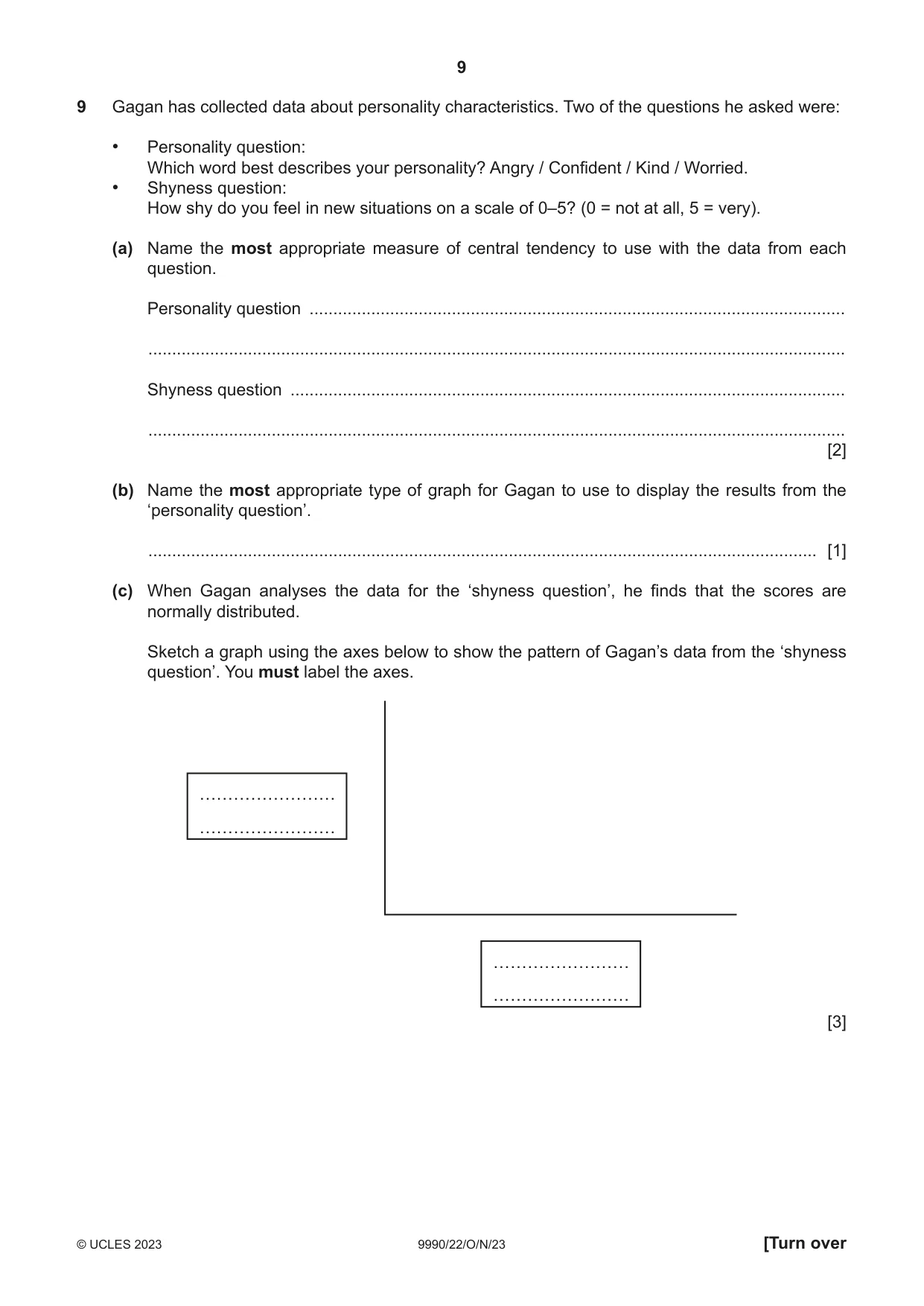
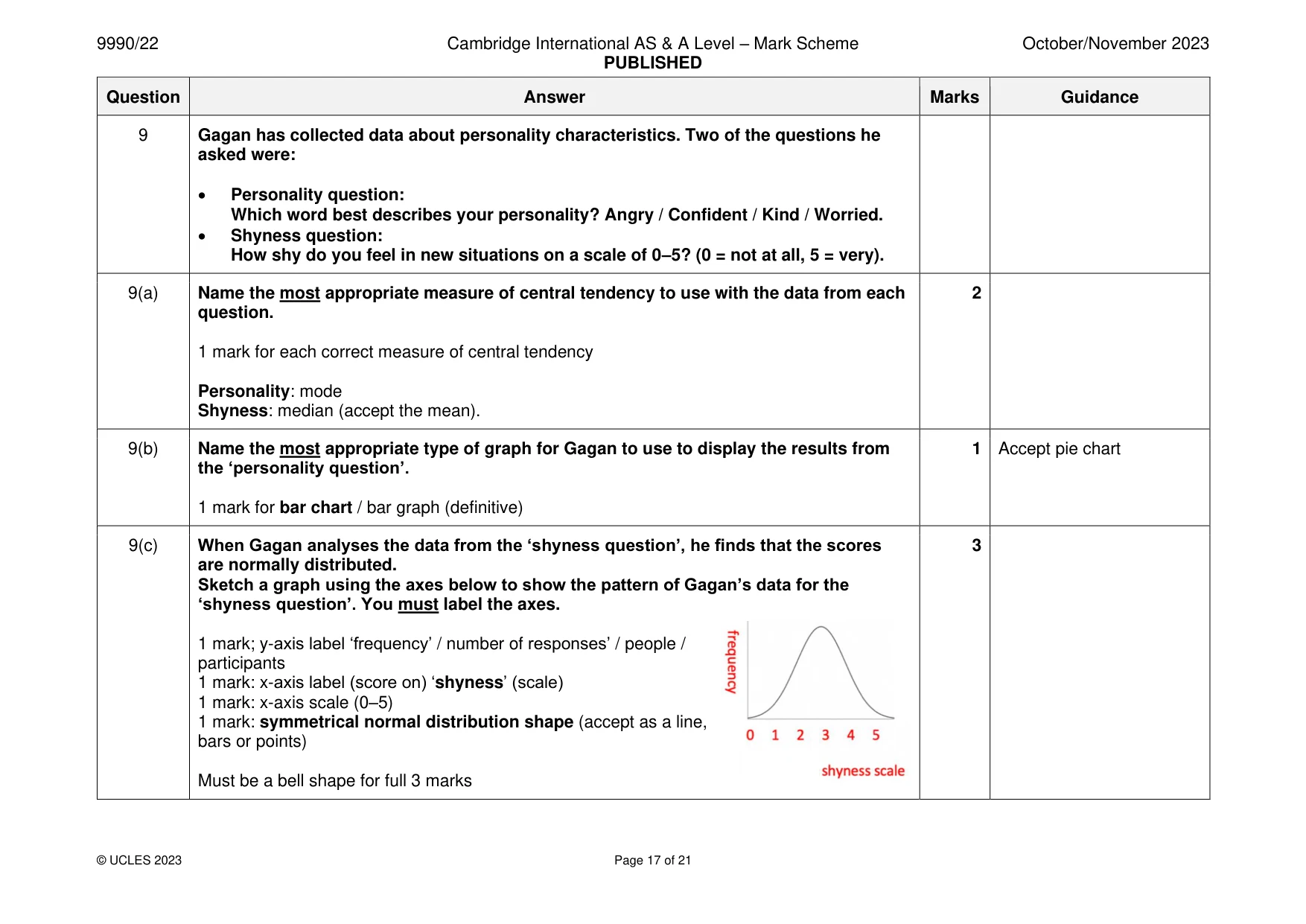
9 Gagan has collected data about personality characteristics. Two of the questions he asked were: • Personality question: Which word best describes your personality? Angry / Confident / Kind / Worried. • Shyness question: How shy do you feel in new situations on a scale of 0–5? (0 = not at all, 5 = very). (a) Name the most appropriate measure of central tendency to use with the data from each question. Personality question ................................................................................................................. ................................................................................................................................................... Shyness question ..................................................................................................................... ................................................................................................................................................... [2] (b) Name the most appropriate type of graph for Gagan to use to display the results from the ‘personality question’. ............................................................................................................................................. [1] (c) When Gagan analyses the data for the ‘shyness question’, he finds that the scores are normally distributed. Sketch a graph using the axes below to show the pattern of Gagan’s data from the ‘shyness question’. You must label the axes. [3] Section C Answer all questions in this section.
Mark scheme: 9 Gagan has collected data about personality characteristics. Two of the questions he asked were: • Personality question: Which word best describes your personality? Angry / Confident / Kind / Worried. • Shyness question: How shy do you feel in new situations on a scale of 0–5? (0 = not at all, 5 = very). 9(a) Name the most appropriate measure of central tendency to use with the data from each 2 question. 1 mark for each correct measure of central tendency Personality: mode Shyness: median (accept the mean). 9(b) Name the most appropriate type of graph for Gagan to use to display the results from 1 Accept pie chart the ‘personality question’. 1 mark for bar chart / bar graph (definitive) 9(c) When Gagan analyses the data from the ‘shyness question’, he finds that the scores 3 are normally distributed. Sketch a graph using the axes below to show the pattern of Gagan’s data for the ‘shyness question’. You must label the axes. 1 mark; y-axis label ‘frequency’ / number of responses’ / people / participants 1 mark: x-axis label (score on) ‘shyness’ (scale) 1 mark: x-axis scale (0–5) 1 mark: symmetrical normal distribution shape (accept as a line, bars or points) Must be a bell shape for full 3 marks
Q10 · Sara wants to test whether people with a higher intelligence quotient (IQ) are better at…
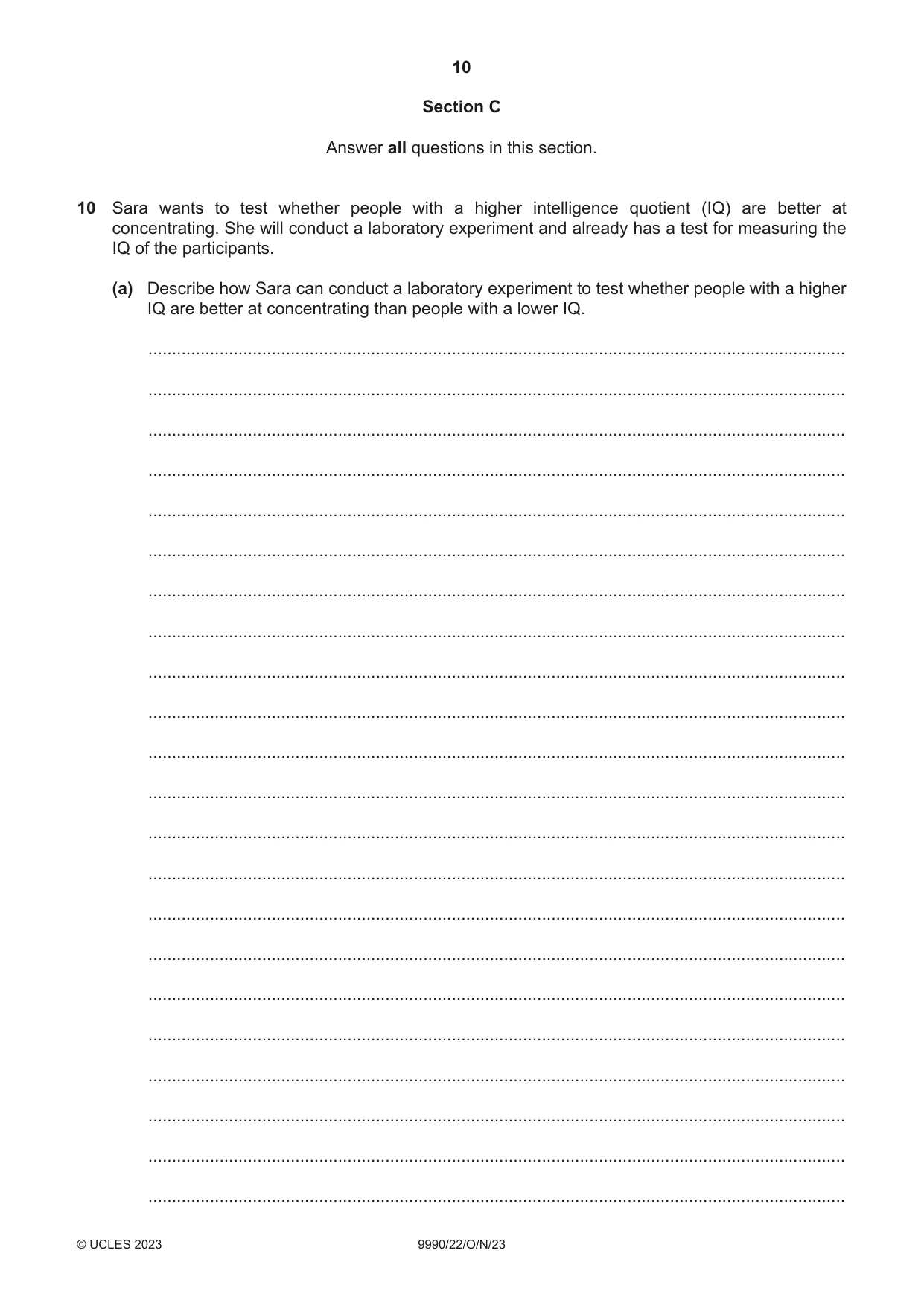
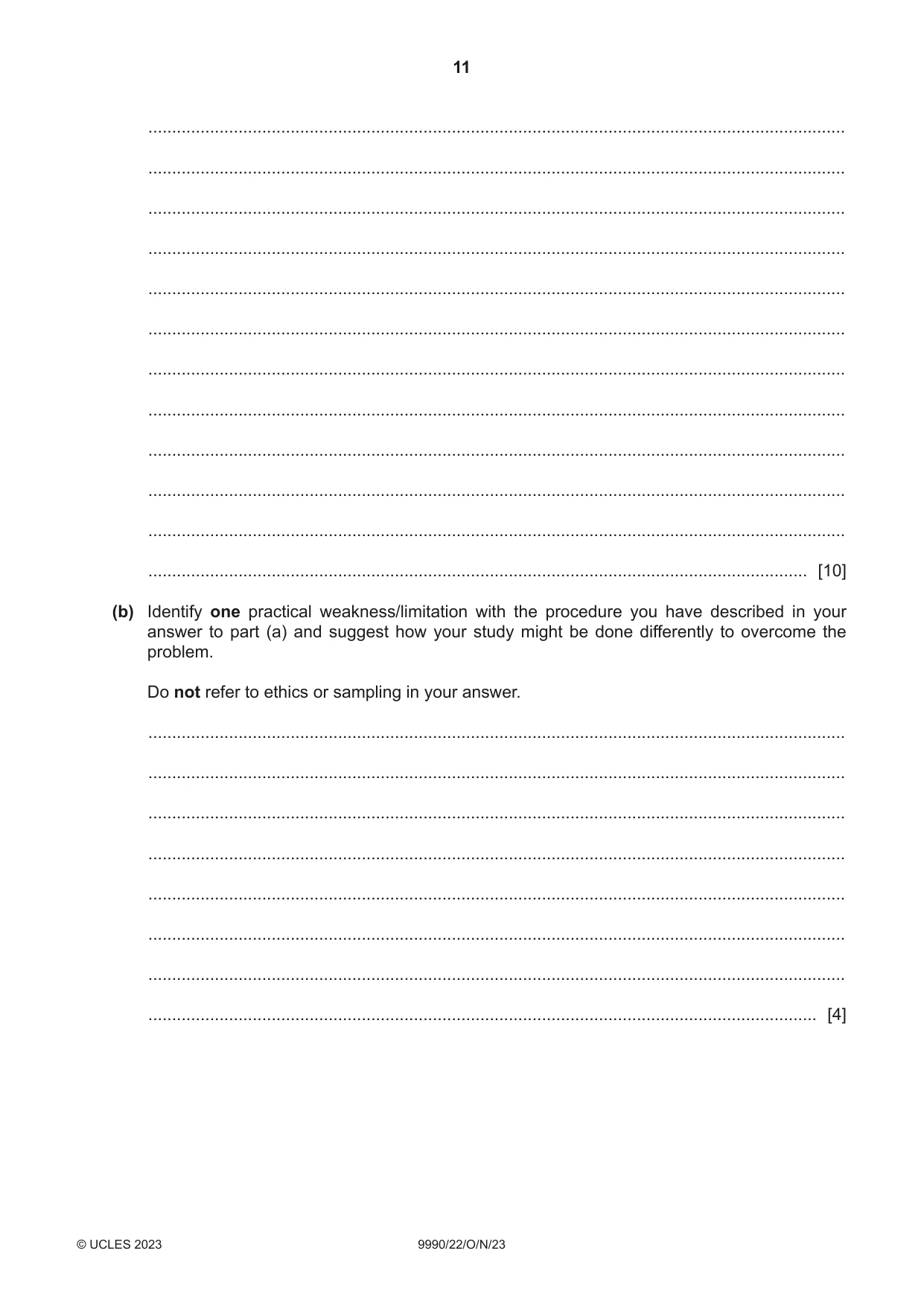
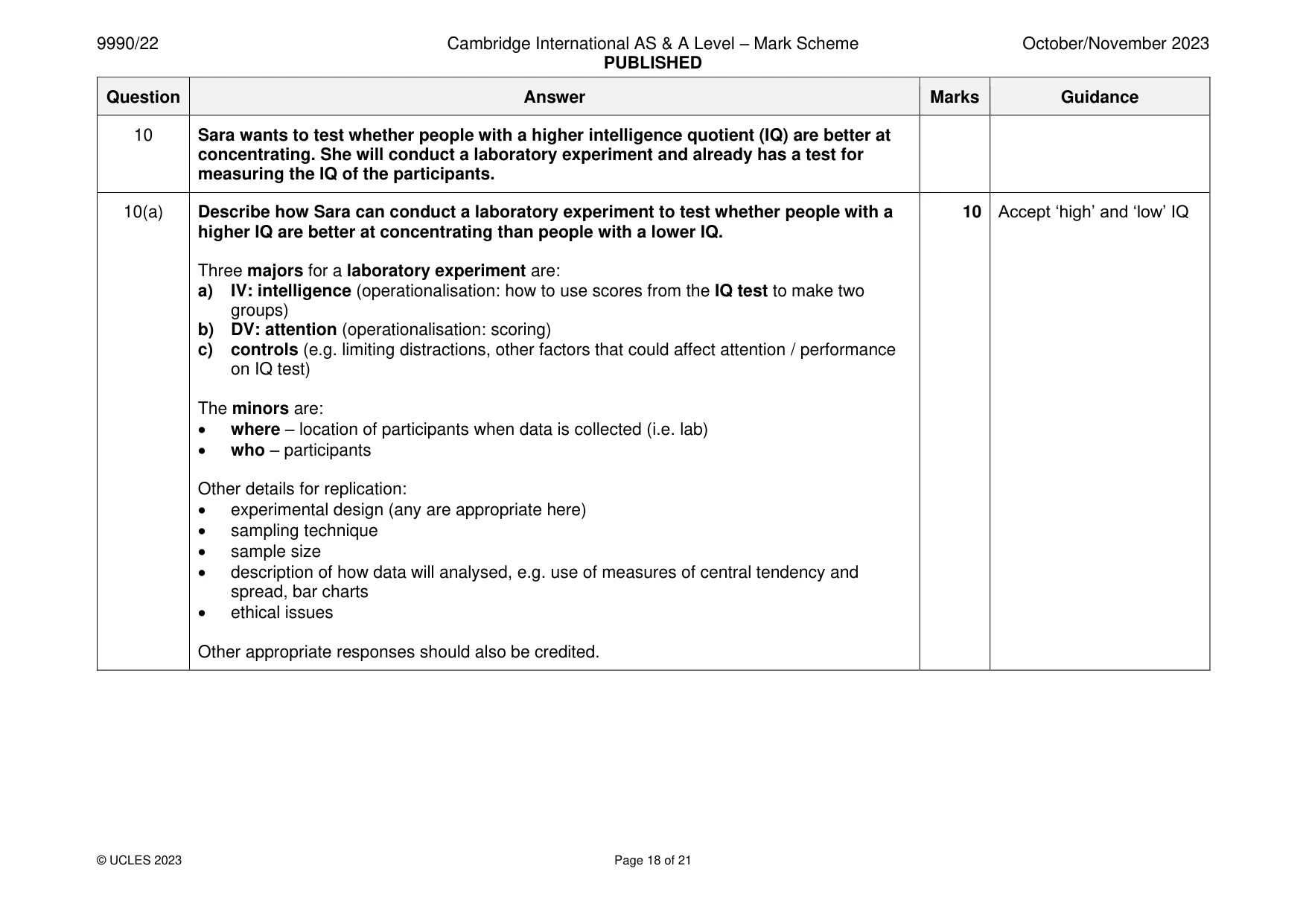
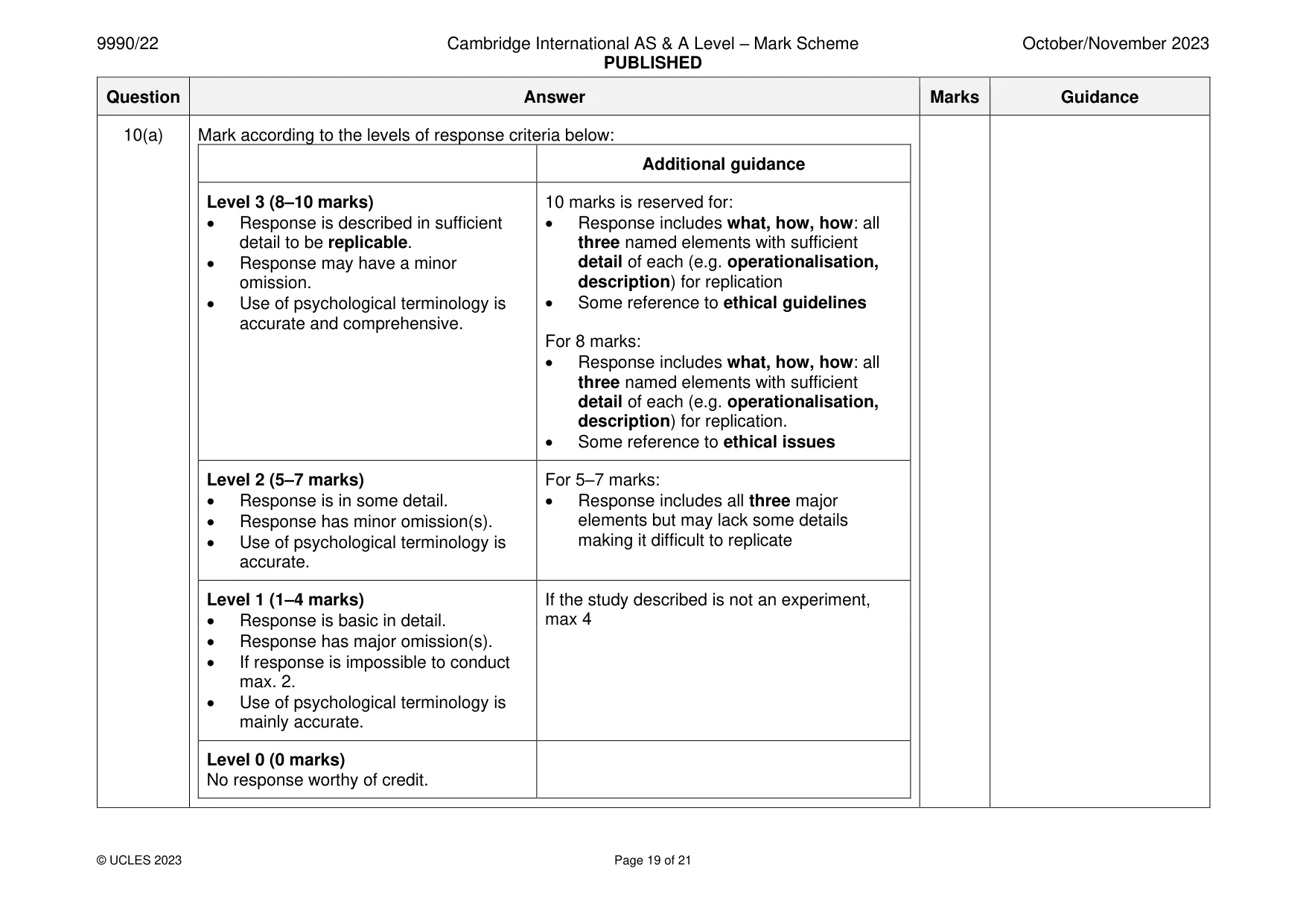
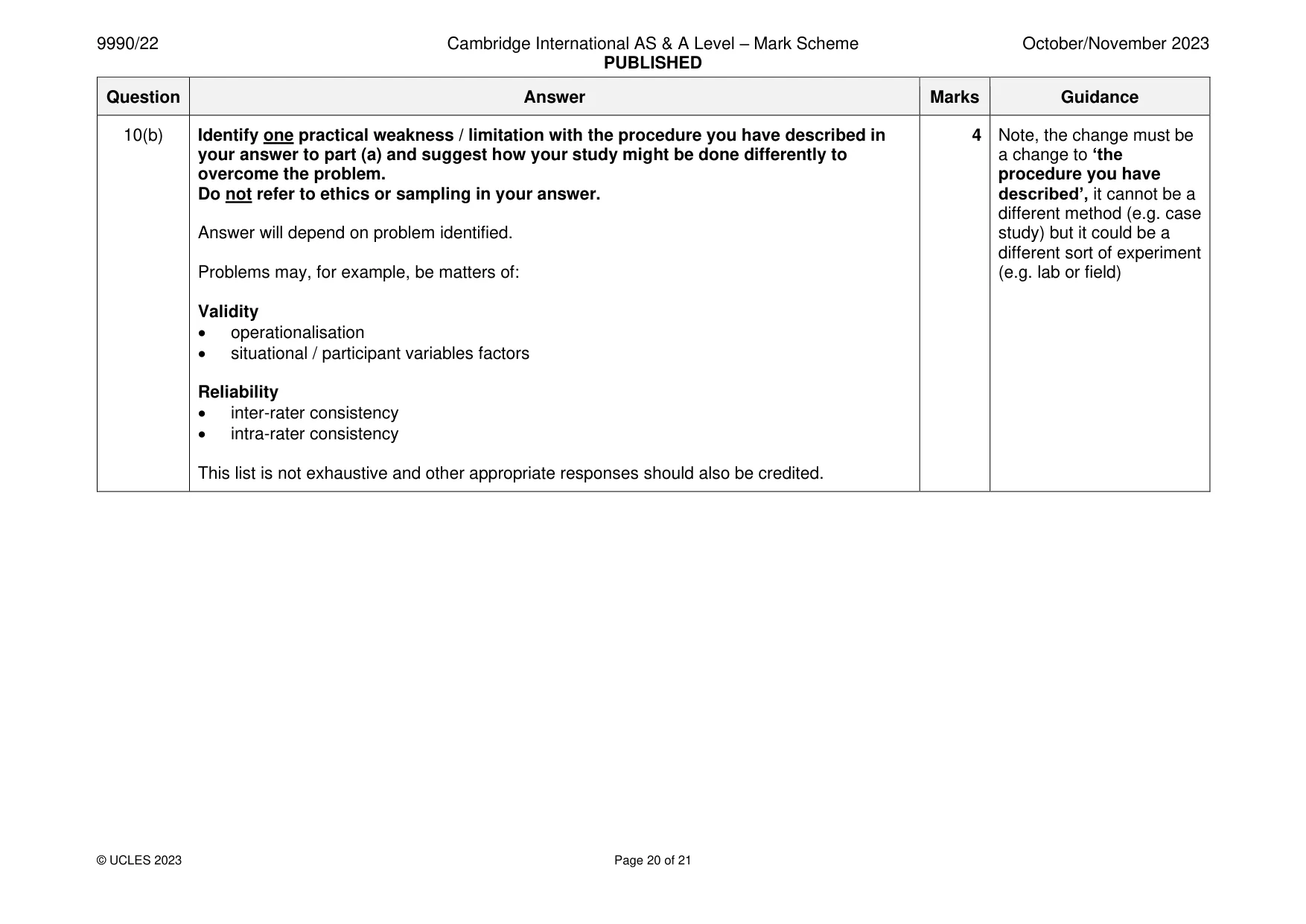
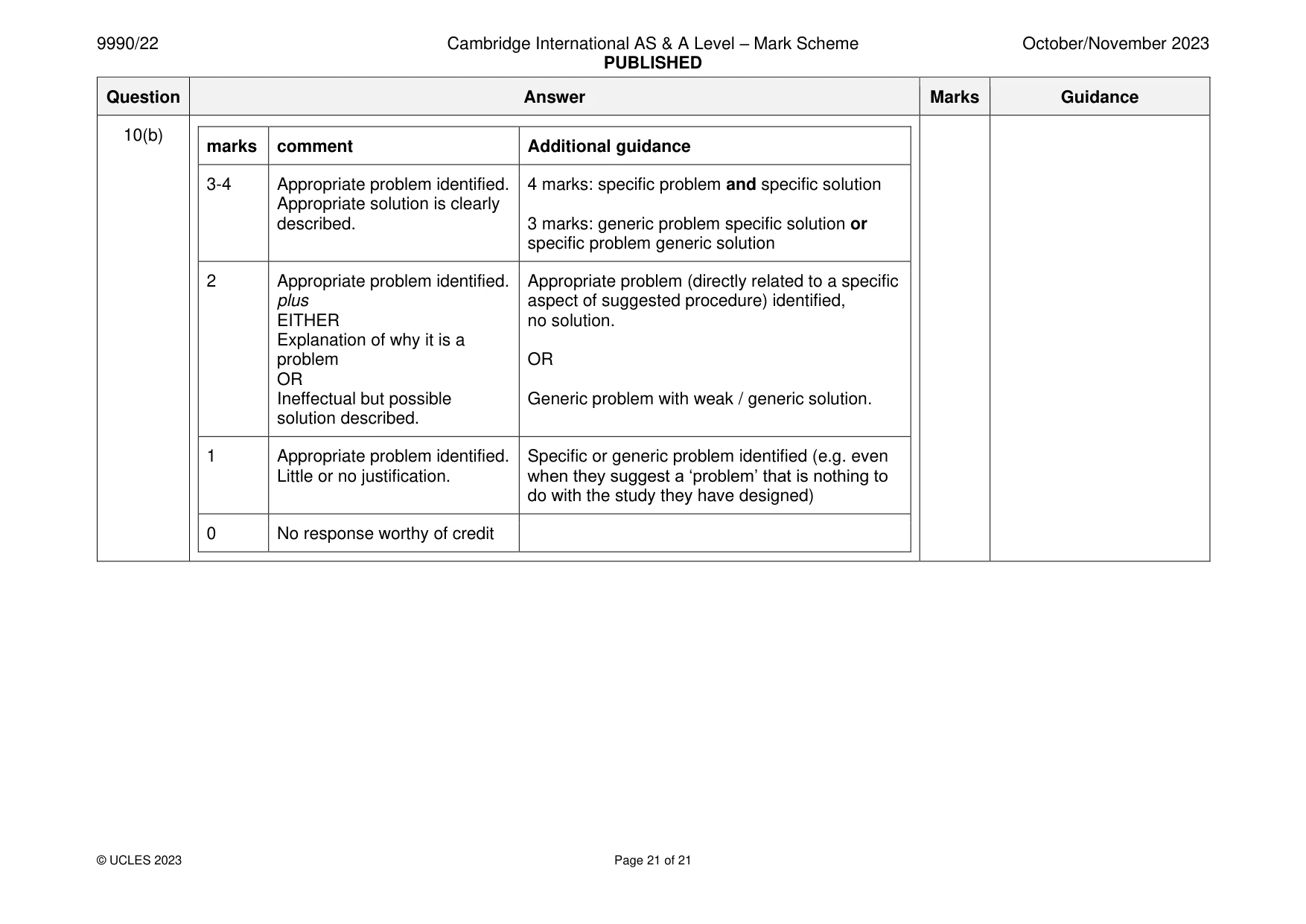
10 Sara wants to test whether people with a higher intelligence quotient (IQ) are better at concentrating. She will conduct a laboratory experiment and already has a test for measuring the IQ of the participants. (a) Describe how Sara can conduct a laboratory experiment to test whether people with a higher IQ are better at concentrating than people with a lower IQ. ................................................................................................................................................... ................................................................................................................................................... ................................................................................................................................................... ................................................................................................................................................... ................................................................................................................................................... ................................................................................................................................................... ................................................................................................................................................... ................................................................................................................................................... ................................................................................................................................................... ................................................................................................................................................... ................................................................................................................................................... ................................................................................................................................................... ................................................................................................................................................... ................................................................................................................................................... ................................................................................................................................................... ................................................................................................................................................... ................................................................................................................................................... ................................................................................................................................................... ................................................................................................................................................... ................................................................................................................................................... ................................................................................................................................................... ................................................................................................................................................... ................................................................................................................................................... ................................................................................................................................................... ................................................................................................................................................... ................................................................................................................................................... ................................................................................................................................................... ................................................................................................................................................... ................................................................................................................................................... ................................................................................................................................................... ................................................................................................................................................... ................................................................................................................................................... ................................................................................................................................................... ........................................................................................................................................... [10] (b) Identify one practical weakness/limitation with the procedure you have described in your answer to part (a) and suggest how your study might be done differently to overcome the problem. Do not refer to ethics or sampling in your answer. ................................................................................................................................................... ................................................................................................................................................... ................................................................................................................................................... ................................................................................................................................................... ................................................................................................................................................... ................................................................................................................................................... ................................................................................................................................................... ............................................................................................................................................. [4]
Mark scheme: 10 Sara wants to test whether people with a higher intelligence quotient (IQ) are better at concentrating. She will conduct a laboratory experiment and already has a test for measuring the IQ of the participants. 10(a) Describe how Sara can conduct a laboratory experiment to test whether people with a 10 Accept ‘high’ and ‘low’ IQ higher IQ are better at concentrating than people with a lower IQ. Three majors for a laboratory experiment are: a) IV: intelligence (operationalisation: how to use scores from the IQ test to make two groups) b) DV: attention (operationalisation: scoring) c) controls (e.g. limiting distractions, other factors that could affect attention / performance on IQ test) The minors are: • where – location of participants when data is collected (i.e. lab) • who – participants Other details for replication: • experimental design (any are appropriate here) • sampling technique • sample size • description of how data will analysed, e.g. use of measures of central tendency and spread, bar charts • ethical issues Other appropriate responses should also be credited. 10(a) Mark according to the levels of response criteria below: Additional guidance Level 3 (8–10 marks) 10 marks is reserved for: • Response is described in sufficient • Response includes what, how, how: all detail to be replicable. three named elements with sufficient • Response may have a minor detail of each (e.g. operationalisation, omission. description) for replication • Use of psychological terminology is • Some reference to ethical guidelines accurate and comprehensive. For 8 marks: • Response includes what, how, how: all three named elements with sufficient detail of each (e.g. operationalisation, description) for replication. • Some reference to ethical issues Level 2 (5–7 marks) For 5–7 marks: • Response is in some detail. • Response includes all three major • Response has minor omission(s). elements but may lack some details • Use of psychological terminology is making it difficult to replicate accurate. Level 1 (1–4 marks) If the study described is not an experiment, • Response is basic in detail. max 4 • Response has major omission(s). • If response is impossible to conduct max. 2. • Use of psychological terminology is mainly accurate. Level 0 (0 marks) No response worthy of credit. 10(b) Identify one practical weakness / limitation with the procedure you have described in 4 Note, the change must be your answer to part (a) and suggest how your study might be done differently to a change to ‘the overcome the problem. procedure you have Do not refer to ethics or sampling in your answer. described’, it cannot be a different method (e.g. case Answer will depend on problem identified. study) but it could be a different sort of experiment Problems may, for example, be matters of: (e.g. lab or field) Validity • operationalisation • situational / participant variables factors Reliability • inter-rater consistency • intra-rater consistency This list is not exhaustive and other appropriate responses should also be credited. 10(b) marks comment Additional guidance 3-4 Appropriate problem identified. 4 marks: specific problem and specific solution Appropriate solution is clearly described. 3 marks: generic problem specific solution or specific problem generic solution 2 Appropriate problem identified. Appropriate problem (directly related to a specific plus aspect of suggested procedure) identified, EITHER no solution. Explanation of why it is a problem OR OR Ineffectual but possible Generic problem with weak / generic solution. solution described. 1 Appropriate problem identified. Specific or generic problem identified (e.g. even Little or no justification. when they suggest a ‘problem’ that is nothing to do with the study they have designed) 0 No response worthy of credit
What was in this paper
The subtopics covered by these 10 questions, and how many questions each got. Open one in a new tab to see every Cambridge question on it.
What you needed in this session
Cambridge’s own grade thresholds for 2023 Oct/Nov, Paper 2 · Variant 2. A higher threshold means an easier paper — the bar moves with how the cohort did.