Cambridge A Level Psychology (from 2018) 9990 — 2023 May/June Paper 2 · Variant 2
9990/22/M/J/23 · 10 questions · 60 marks · ≈68 min
The question paper and its mark scheme, free to read here and free to download. This is Cambridge’s own paper, exactly as it was sat.
Question paper12 pages

Mark scheme15 pages
Answers below. Sit the paper first if you are practising.
Questions as text
Q1 · From the study by Yamamoto et al
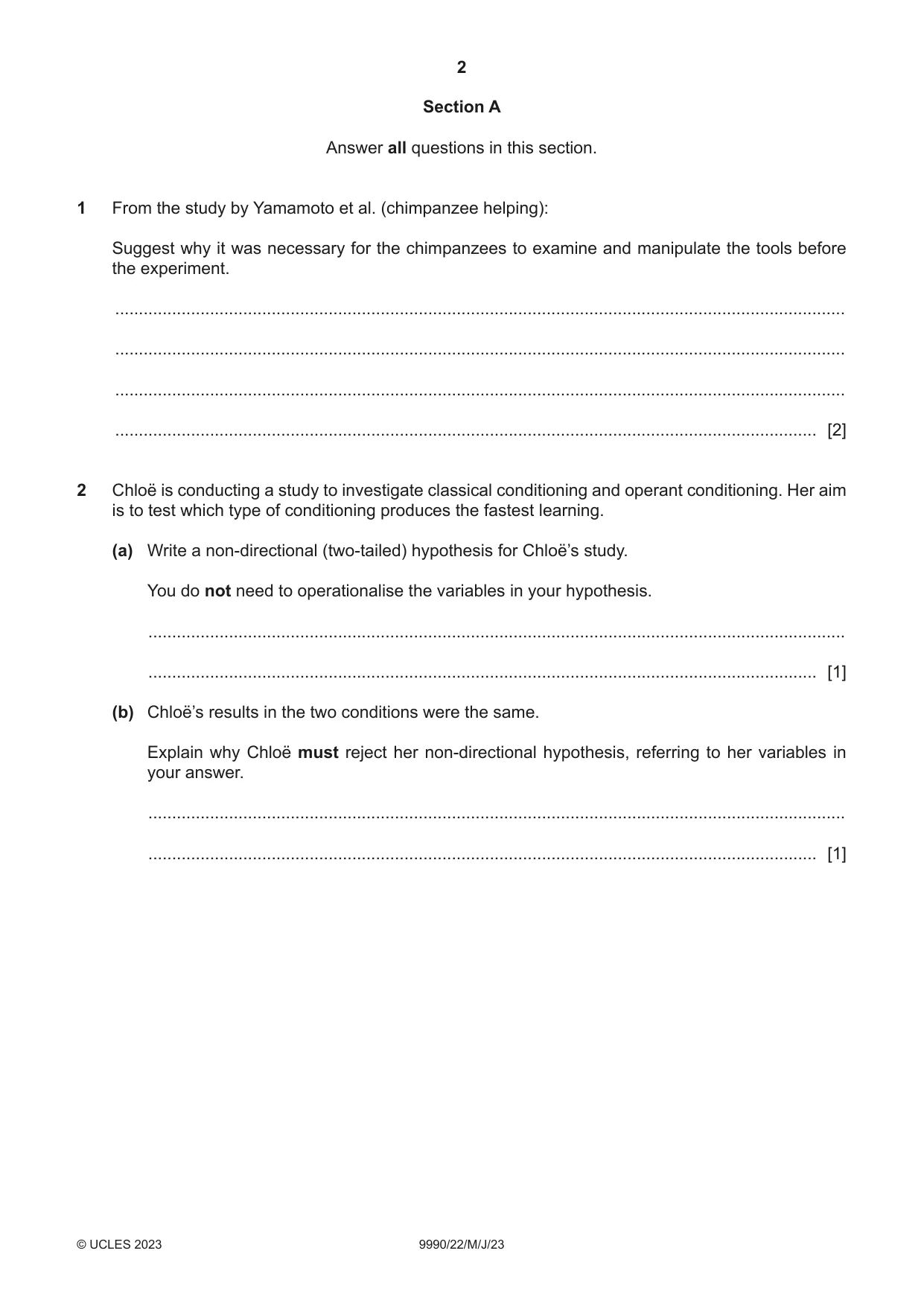
1 From the study by Yamamoto et al. (chimpanzee helping): Suggest why it was necessary for the chimpanzees to examine and manipulate the tools before the experiment. .......................................................................................................................................................... .......................................................................................................................................................... .......................................................................................................................................................... .................................................................................................................................................... [2]
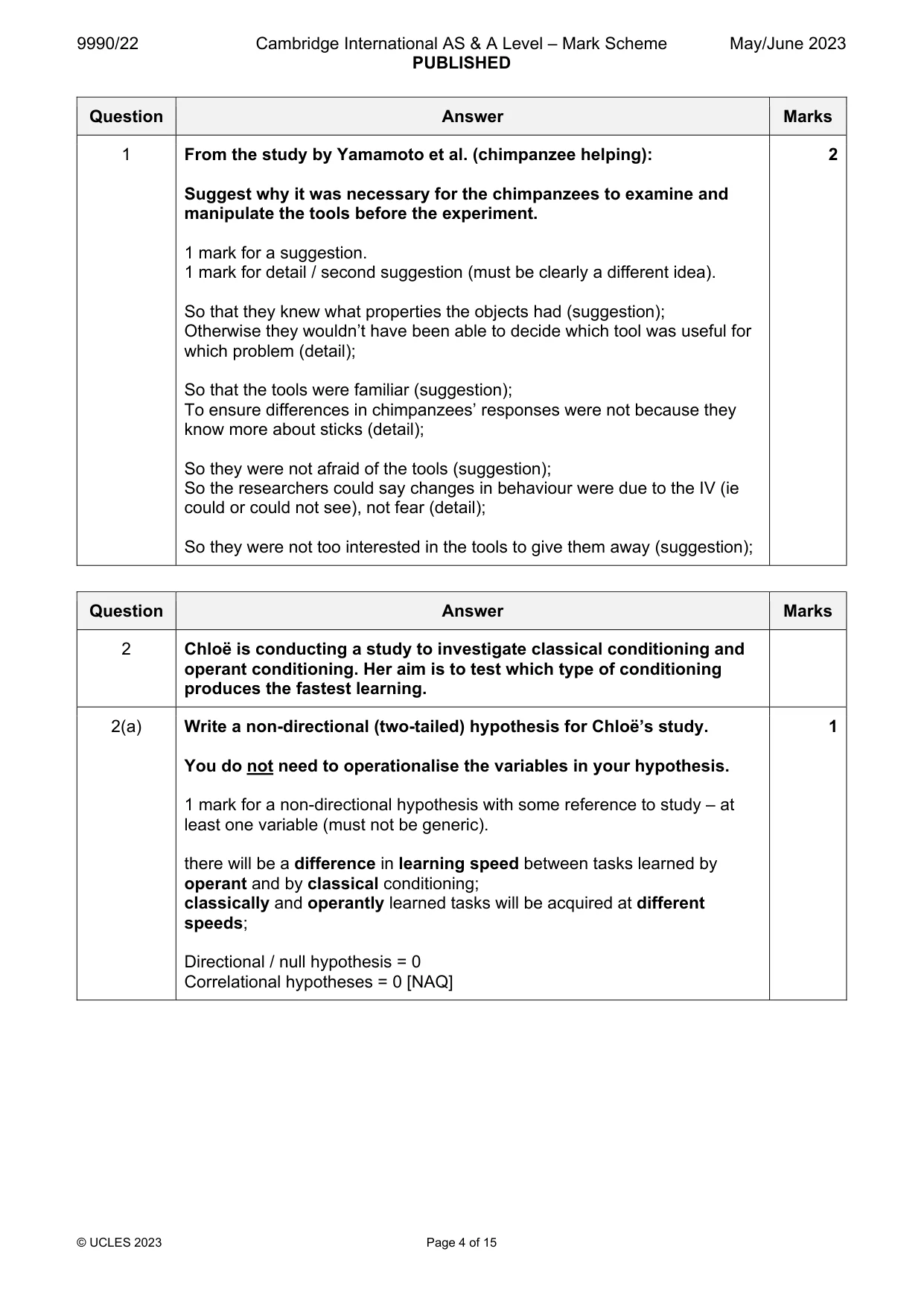
Mark scheme: Question Answer Marks 1 From the study by Yamamoto et al. (chimpanzee helping): 2 Suggest why it was necessary for the chimpanzees to examine and manipulate the tools before the experiment. 1 mark for a suggestion. 1 mark for detail / second suggestion (must be clearly a different idea). So that they knew what properties the objects had (suggestion); Otherwise they wouldn’t have been able to decide which tool was useful for which problem (detail); So that the tools were familiar (suggestion); To ensure differences in chimpanzees’ responses were not because they know more about sticks (detail); So they were not afraid of the tools (suggestion); So the researchers could say changes in behaviour were due to the IV (ie could or could not see), not fear (detail); So they were not too interested in the tools to give them away (suggestion);
Q2 · Chloë is conducting a study to investigate classical conditioning and operant conditioning
2 Chloë is conducting a study to investigate classical conditioning and operant conditioning. Her aim is to test which type of conditioning produces the fastest learning. (a) Write a non‑directional (two‑tailed) hypothesis for Chloë’s study. You do not need to operationalise the variables in your hypothesis. ................................................................................................................................................... ............................................................................................................................................. [1] (b) Chloë’s results in the two conditions were the same. Explain why Chloë must reject her non‑directional hypothesis, referring to her variables in your answer. ................................................................................................................................................... ............................................................................................................................................. [1]
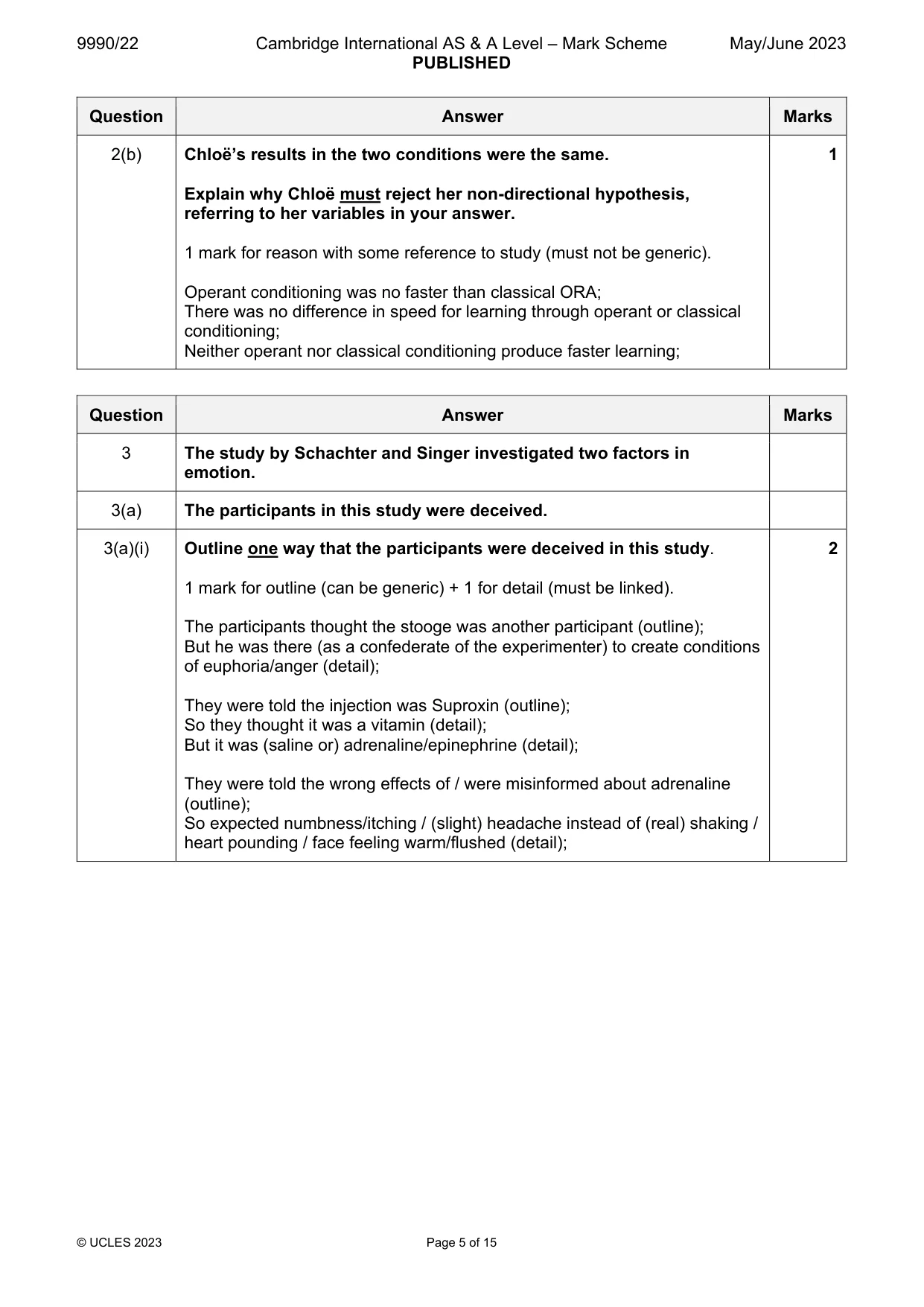
Mark scheme: 2 Chloë is conducting a study to investigate classical conditioning and operant conditioning. Her aim is to test which type of conditioning produces the fastest learning. 2(a) Write a non-directional (two-tailed) hypothesis for Chloë’s study. 1 You do not need to operationalise the variables in your hypothesis. 1 mark for a non-directional hypothesis with some reference to study – at least one variable (must not be generic). there will be a difference in learning speed between tasks learned by operant and by classical conditioning; classically and operantly learned tasks will be acquired at different speeds; Directional / null hypothesis = 0 Correlational hypotheses = 0 [NAQ] 2(b) Chloë’s results in the two conditions were the same. 1 Explain why Chloë must reject her non-directional hypothesis, referring to her variables in your answer. 1 mark for reason with some reference to study (must not be generic). Operant conditioning was no faster than classical ORA; There was no difference in speed for learning through operant or classical conditioning; Neither operant nor classical conditioning produce faster learning;
Q3 · The study by Schachter and Singer investigated two factors in emotion
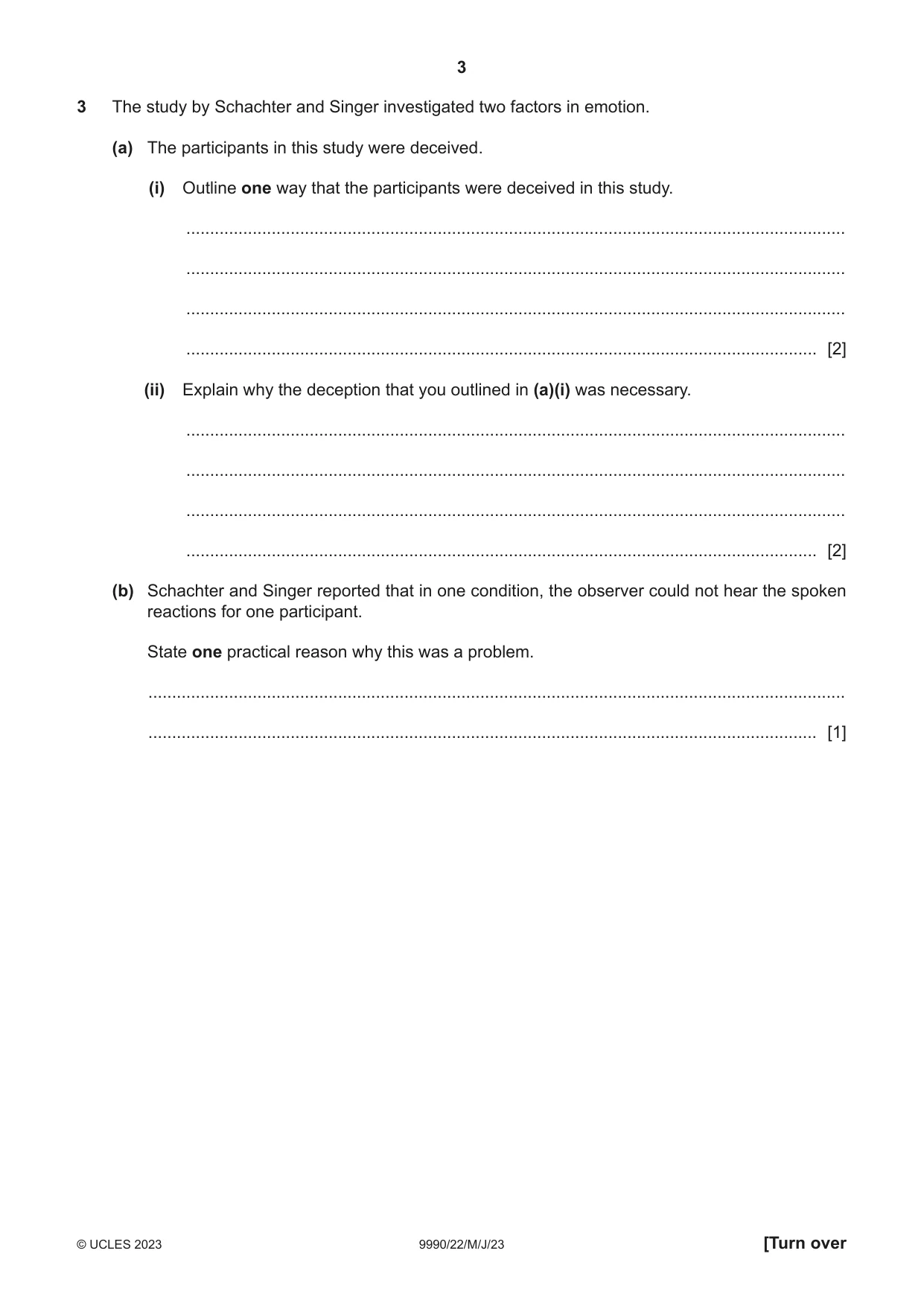
3 The study by Schachter and Singer investigated two factors in emotion. (a) The participants in this study were deceived. (i) Outline one way that the participants were deceived in this study. ........................................................................................................................................... ........................................................................................................................................... ........................................................................................................................................... ..................................................................................................................................... [2] (ii) Explain why the deception that you outlined in (a)(i) was necessary. ........................................................................................................................................... ........................................................................................................................................... ........................................................................................................................................... ..................................................................................................................................... [2] (b) Schachter and Singer reported that in one condition, the observer could not hear the spoken reactions for one participant. State one practical reason why this was a problem. ................................................................................................................................................... ............................................................................................................................................. [1]
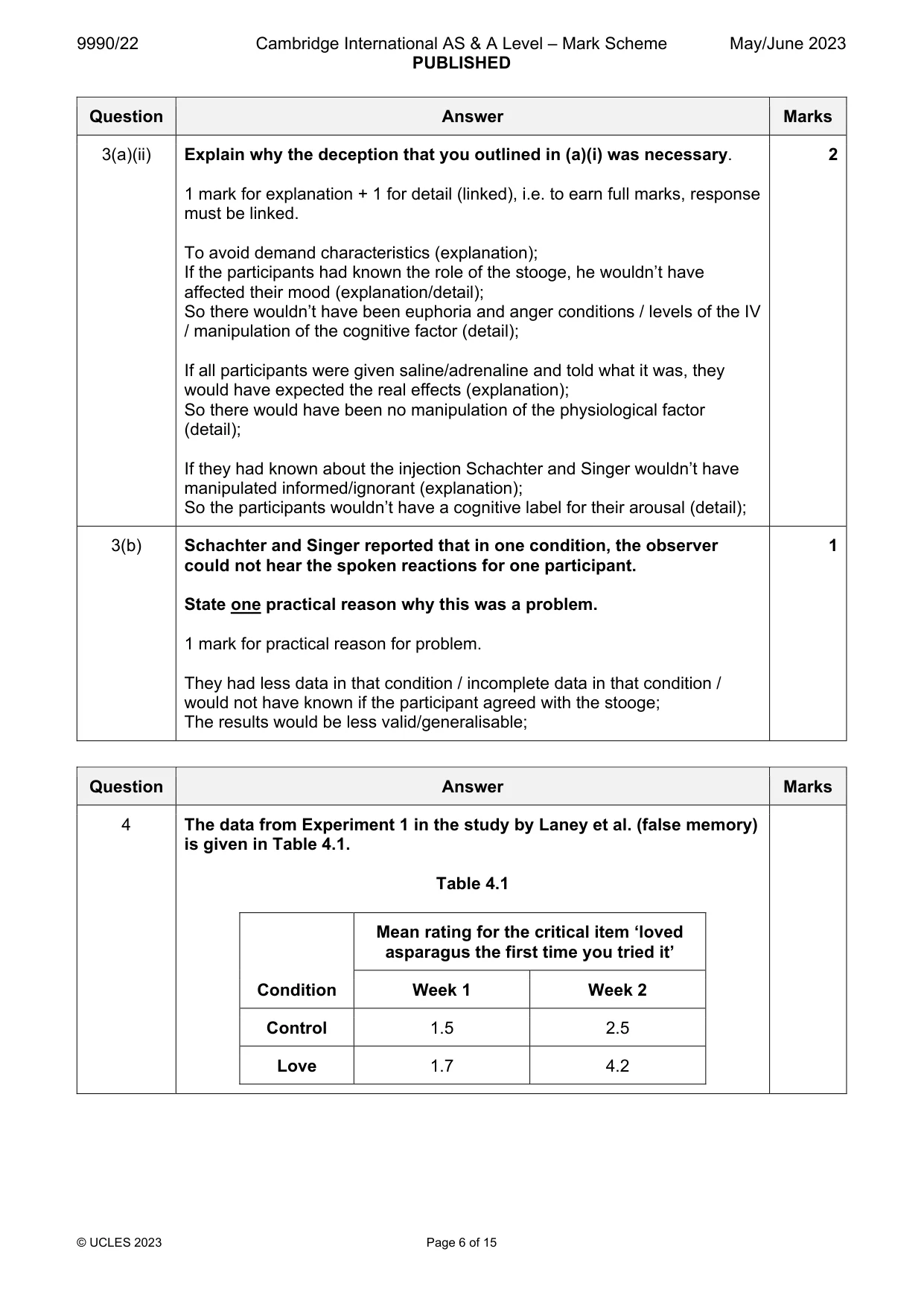
Mark scheme: 3 The study by Schachter and Singer investigated two factors in emotion. 3(a) The participants in this study were deceived. 3(a)(i) Outline one way that the participants were deceived in this study. 2 1 mark for outline (can be generic) + 1 for detail (must be linked). The participants thought the stooge was another participant (outline); But he was there (as a confederate of the experimenter) to create conditions of euphoria/anger (detail); They were told the injection was Suproxin (outline); So they thought it was a vitamin (detail); But it was (saline or) adrenaline/epinephrine (detail); They were told the wrong effects of / were misinformed about adrenaline (outline); So expected numbness/itching / (slight) headache instead of (real) shaking / heart pounding / face feeling warm/flushed (detail); 3(a)(ii) Explain why the deception that you outlined in (a)(i) was necessary. 2 1 mark for explanation + 1 for detail (linked), i.e. to earn full marks, response must be linked. To avoid demand characteristics (explanation); If the participants had known the role of the stooge, he wouldn’t have affected their mood (explanation/detail); So there wouldn’t have been euphoria and anger conditions / levels of the IV / manipulation of the cognitive factor (detail); If all participants were given saline/adrenaline and told what it was, they would have expected the real effects (explanation); So there would have been no manipulation of the physiological factor (detail); If they had known about the injection Schachter and Singer wouldn’t have manipulated informed/ignorant (explanation); So the participants wouldn’t have a cognitive label for their arousal (detail); 3(b) Schachter and Singer reported that in one condition, the observer 1 could not hear the spoken reactions for one participant. State one practical reason why this was a problem. 1 mark for practical reason for problem. They had less data in that condition / incomplete data in that condition / would not have known if the participant agreed with the stooge; The results would be less valid/generalisable;
Q4 · The data from Experiment 1 in the study by Laney et al
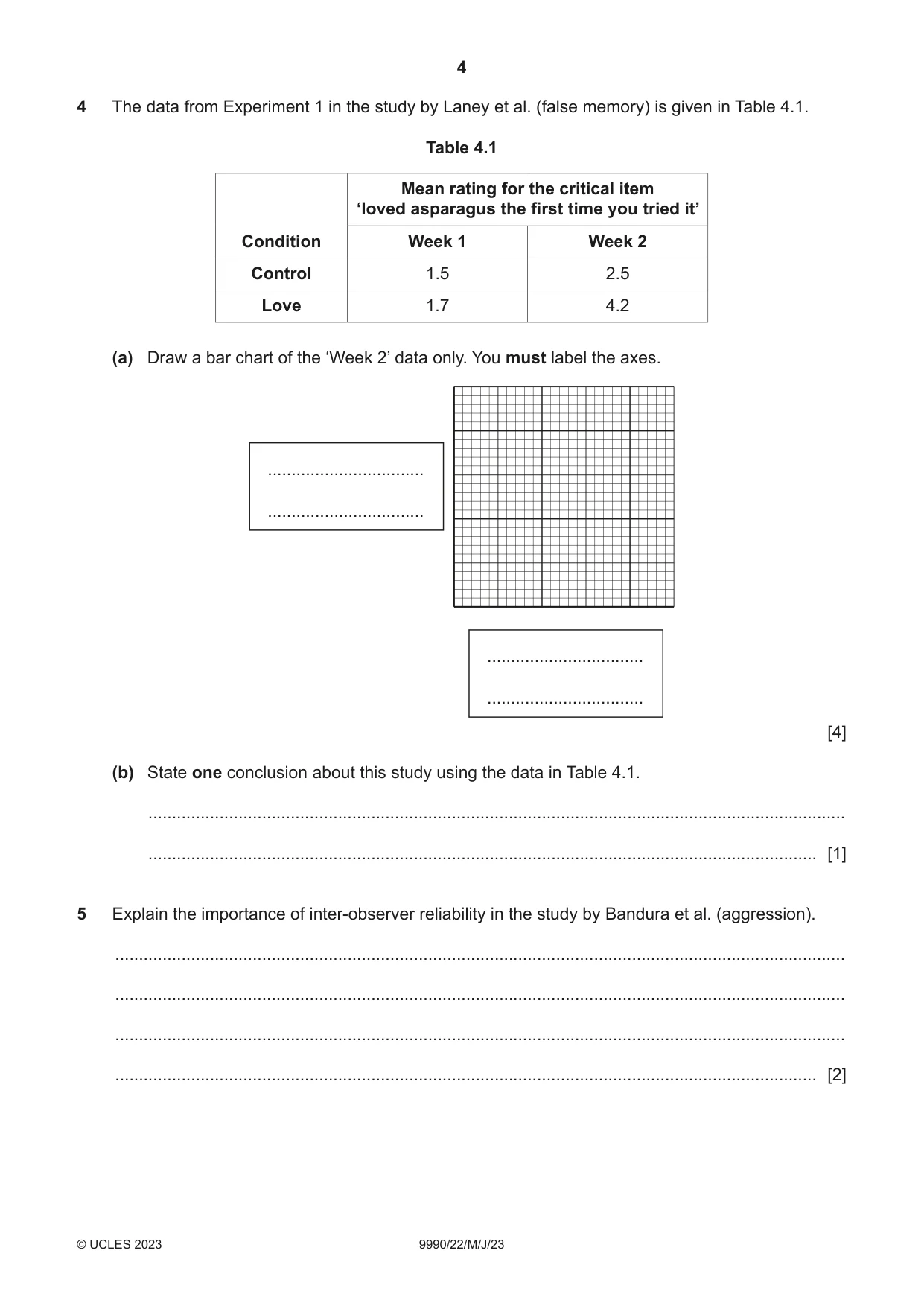
4 The data from Experiment 1 in the study by Laney et al. (false memory) is given in Table 4.1. Table 4.1 Mean rating for the critical item ‘loved asparagus the first time you tried it’ Condition Week 1 Week 2 Control 1.5 2.5 Love 1.7 4.2 (a) Draw a bar chart of the ‘Week 2’ data only. You must label the axes. ................................. ................................. ................................. ................................. [4] (b) State one conclusion about this study using the data in Table 4.1. ................................................................................................................................................... ............................................................................................................................................. [1]
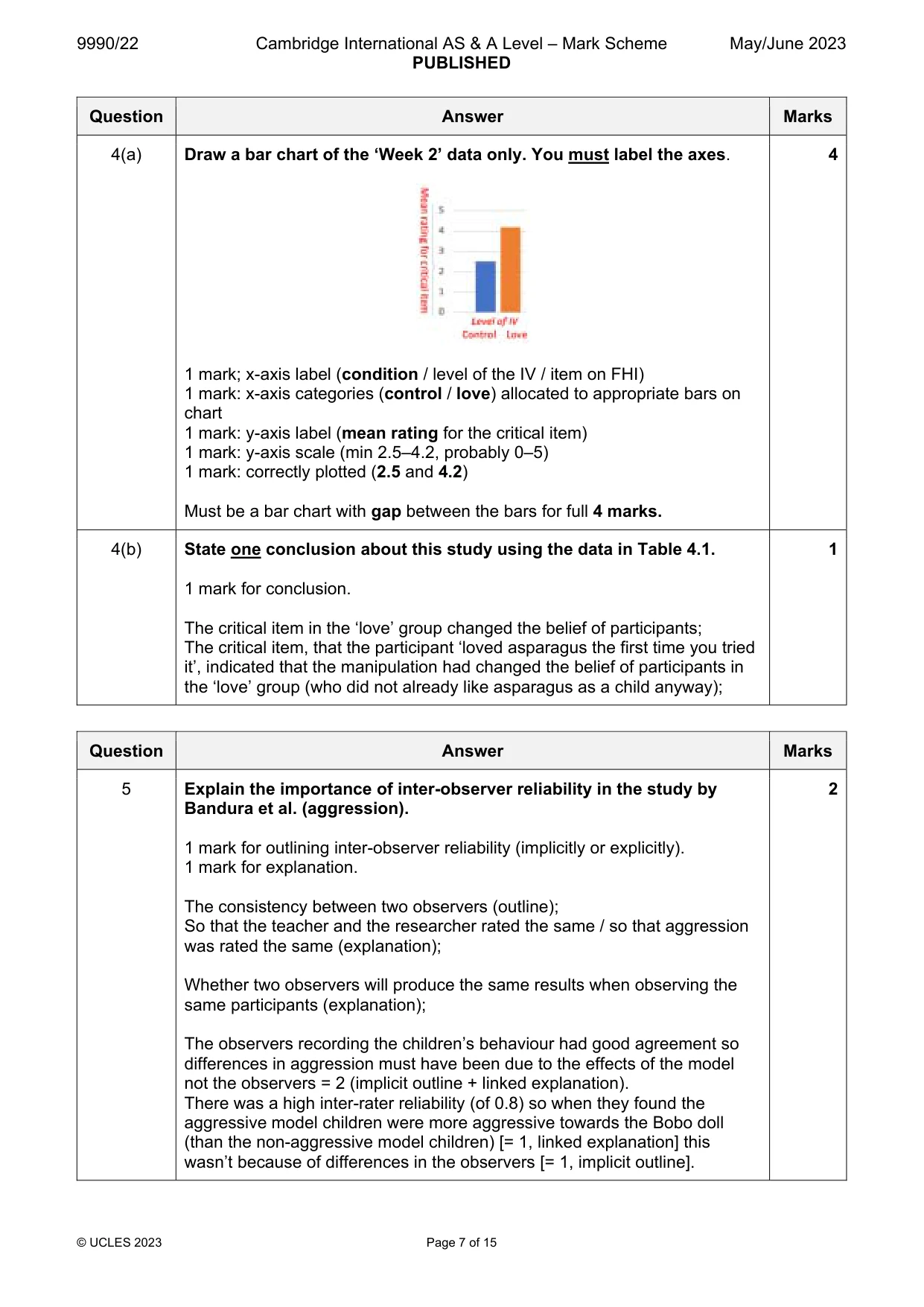
Mark scheme: 4 The data from Experiment 1 in the study by Laney et al. (false memory) is given in Table 4.1. Table 4.1 Mean rating for the critical item ‘loved asparagus the first time you tried it’ Condition Week 1 Week 2 Control 1.5 2.5 Love 1.7 4.2 4(a) Draw a bar chart of the ‘Week 2’ data only. You must label the axes. 4 1 mark; x-axis label (condition / level of the IV / item on FHI) 1 mark: x-axis categories (control / love) allocated to appropriate bars on chart 1 mark: y-axis label (mean rating for the critical item) 1 mark: y-axis scale (min 2.5–4.2, probably 0–5) 1 mark: correctly plotted (2.5 and 4.2) Must be a bar chart with gap between the bars for full 4 marks. 4(b) State one conclusion about this study using the data in Table 4.1. 1 1 mark for conclusion. The critical item in the ‘love’ group changed the belief of participants; The critical item, that the participant ‘loved asparagus the first time you tried it’, indicated that the manipulation had changed the belief of participants in the ‘love’ group (who did not already like asparagus as a child anyway);
Q5 · Explain the importance of inter‑observer reliability in the study by Bandura et al
5 Explain the importance of inter‑observer reliability in the study by Bandura et al. (aggression). .......................................................................................................................................................... .......................................................................................................................................................... .......................................................................................................................................................... .................................................................................................................................................... [2]
Mark scheme: 5 Explain the importance of inter-observer reliability in the study by 2 Bandura et al. (aggression). 1 mark for outlining inter-observer reliability (implicitly or explicitly). 1 mark for explanation. The consistency between two observers (outline); So that the teacher and the researcher rated the same / so that aggression was rated the same (explanation); Whether two observers will produce the same results when observing the same participants (explanation); The observers recording the children’s behaviour had good agreement so differences in aggression must have been due to the effects of the model not the observers = 2 (implicit outline + linked explanation). There was a high inter-rater reliability (of 0.8) so when they found the aggressive model children were more aggressive towards the Bobo doll (than the non-aggressive model children) [= 1, linked explanation] this wasn’t because of differences in the observers [= 1, implicit outline].
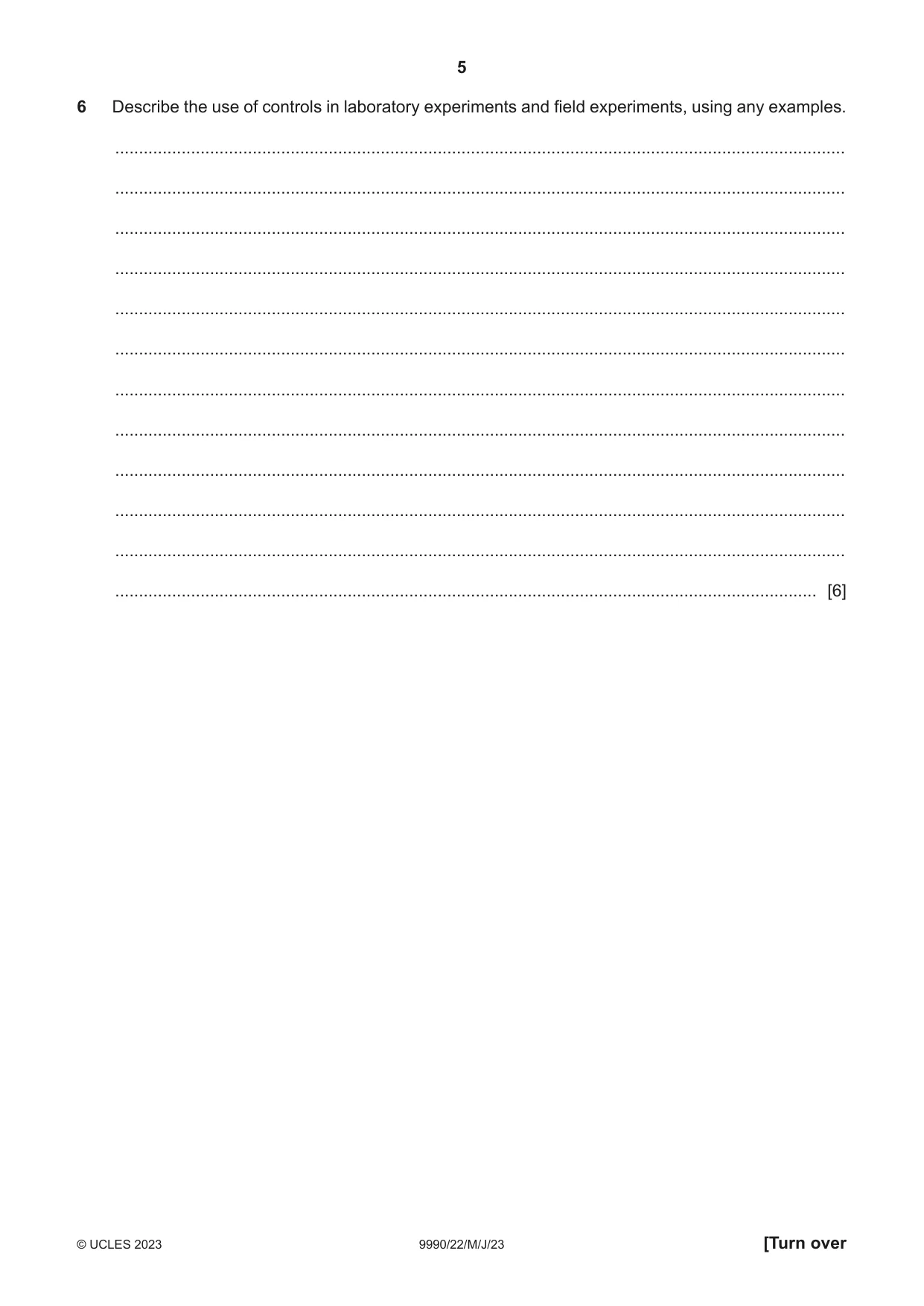
Q6 · Describe the use of controls in laboratory experiments and field experiments, using any…
6 Describe the use of controls in laboratory experiments and field experiments, using any examples. .......................................................................................................................................................... .......................................................................................................................................................... .......................................................................................................................................................... .......................................................................................................................................................... .......................................................................................................................................................... .......................................................................................................................................................... .......................................................................................................................................................... .......................................................................................................................................................... .......................................................................................................................................................... .......................................................................................................................................................... .......................................................................................................................................................... .................................................................................................................................................... [6]
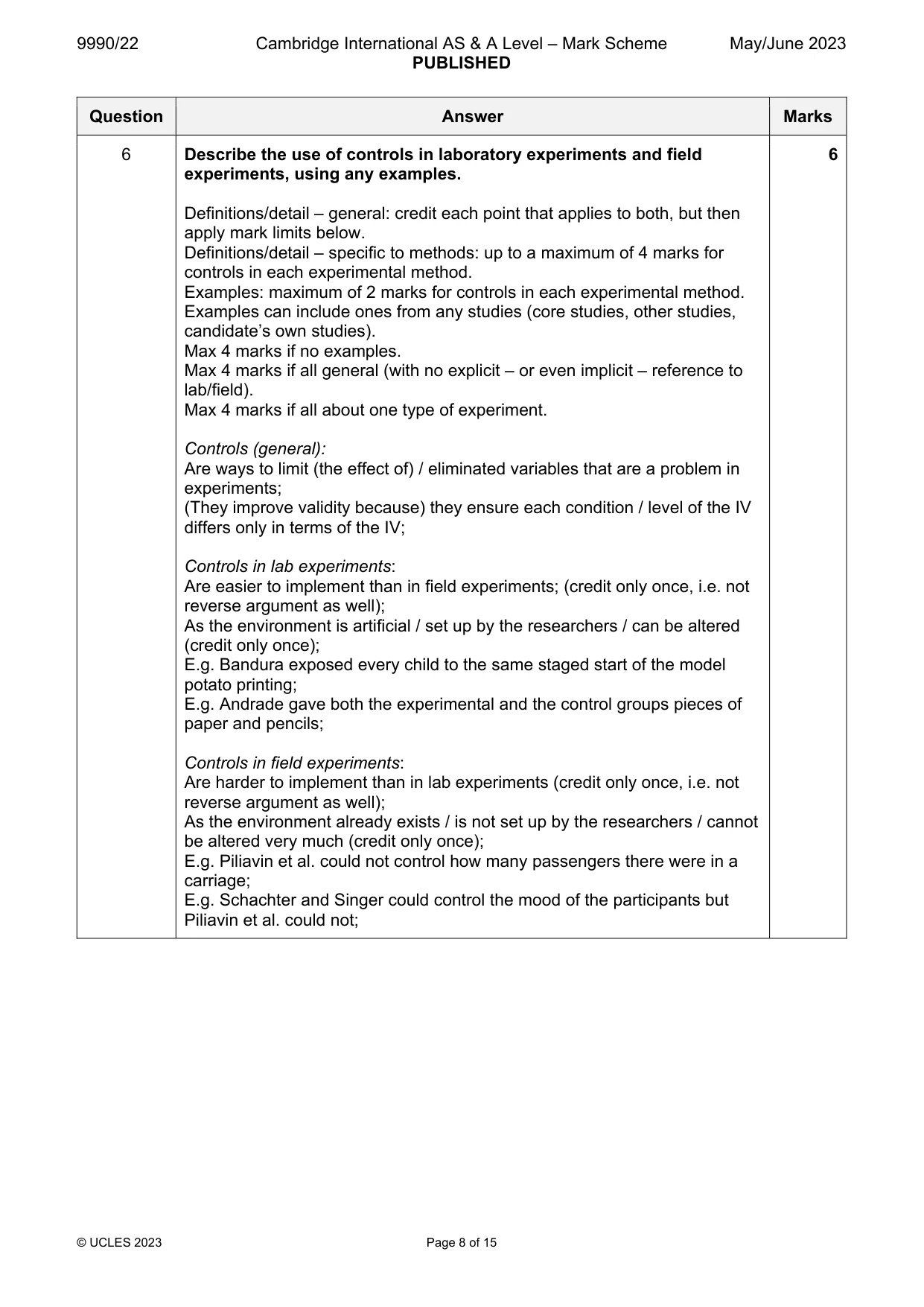
Mark scheme: 6 Describe the use of controls in laboratory experiments and field 6 experiments, using any examples. Definitions/detail – general: credit each point that applies to both, but then apply mark limits below. Definitions/detail – specific to methods: up to a maximum of 4 marks for controls in each experimental method. Examples: maximum of 2 marks for controls in each experimental method. Examples can include ones from any studies (core studies, other studies, candidate’s own studies). Max 4 marks if no examples. Max 4 marks if all general (with no explicit – or even implicit – reference to lab/field). Max 4 marks if all about one type of experiment. Controls (general): Are ways to limit (the effect of) / eliminated variables that are a problem in experiments; (They improve validity because) they ensure each condition / level of the IV differs only in terms of the IV; Controls in lab experiments: Are easier to implement than in field experiments; (credit only once, i.e. not reverse argument as well); As the environment is artificial / set up by the researchers / can be altered (credit only once); E.g. Bandura exposed every child to the same staged start of the model potato printing; E.g. Andrade gave both the experimental and the control groups pieces of paper and pencils; Controls in field experiments: Are harder to implement than in lab experiments (credit only once, i.e. not reverse argument as well); As the environment already exists / is not set up by the researchers / cannot be altered very much (credit only once); E.g. Piliavin et al. could not control how many passengers there were in a carriage; E.g. Schachter and Singer could control the mood of the participants but Piliavin et al. could not;
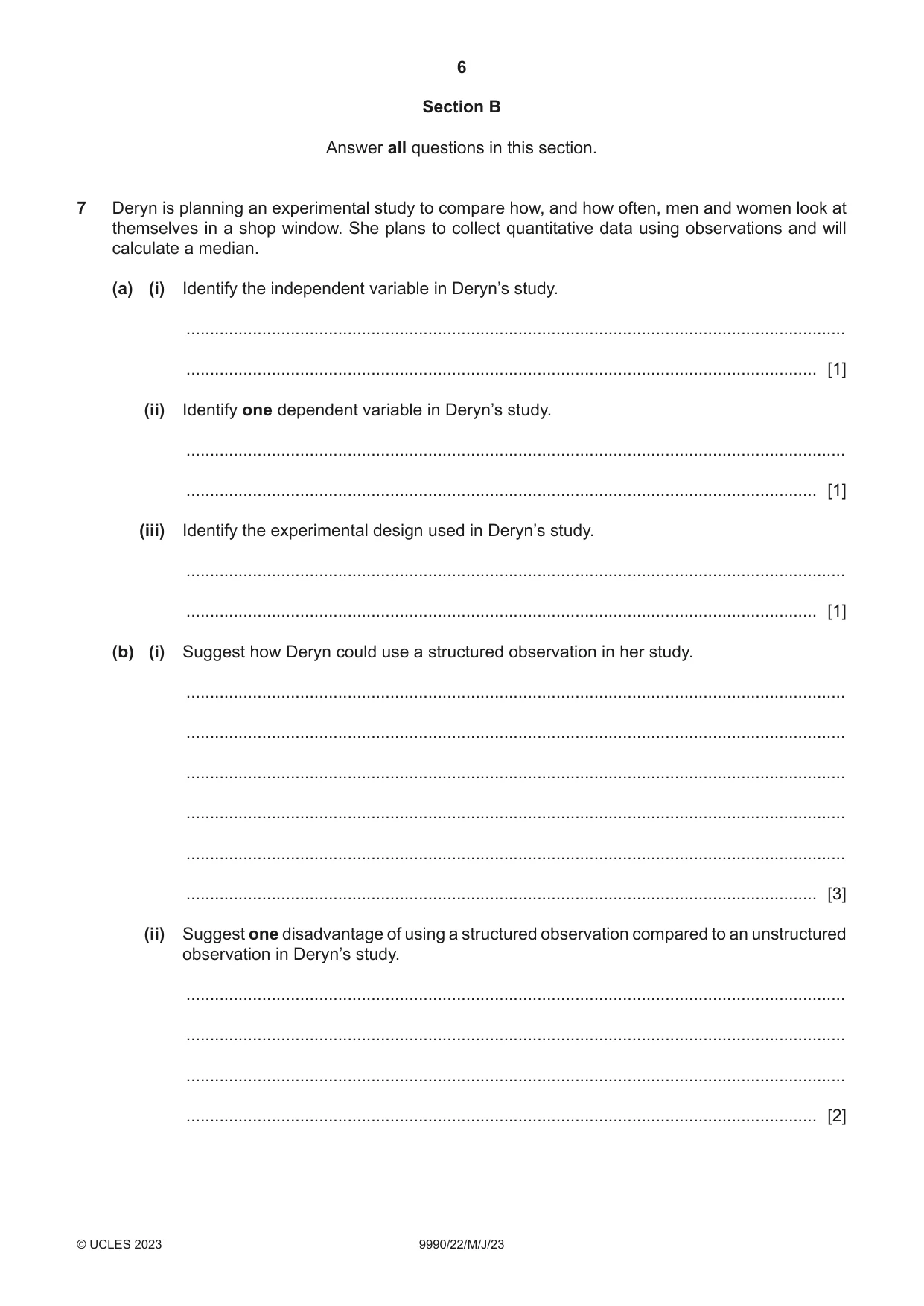
Q7 · Deryn is planning an experimental study to compare how, and how often, men and women look…
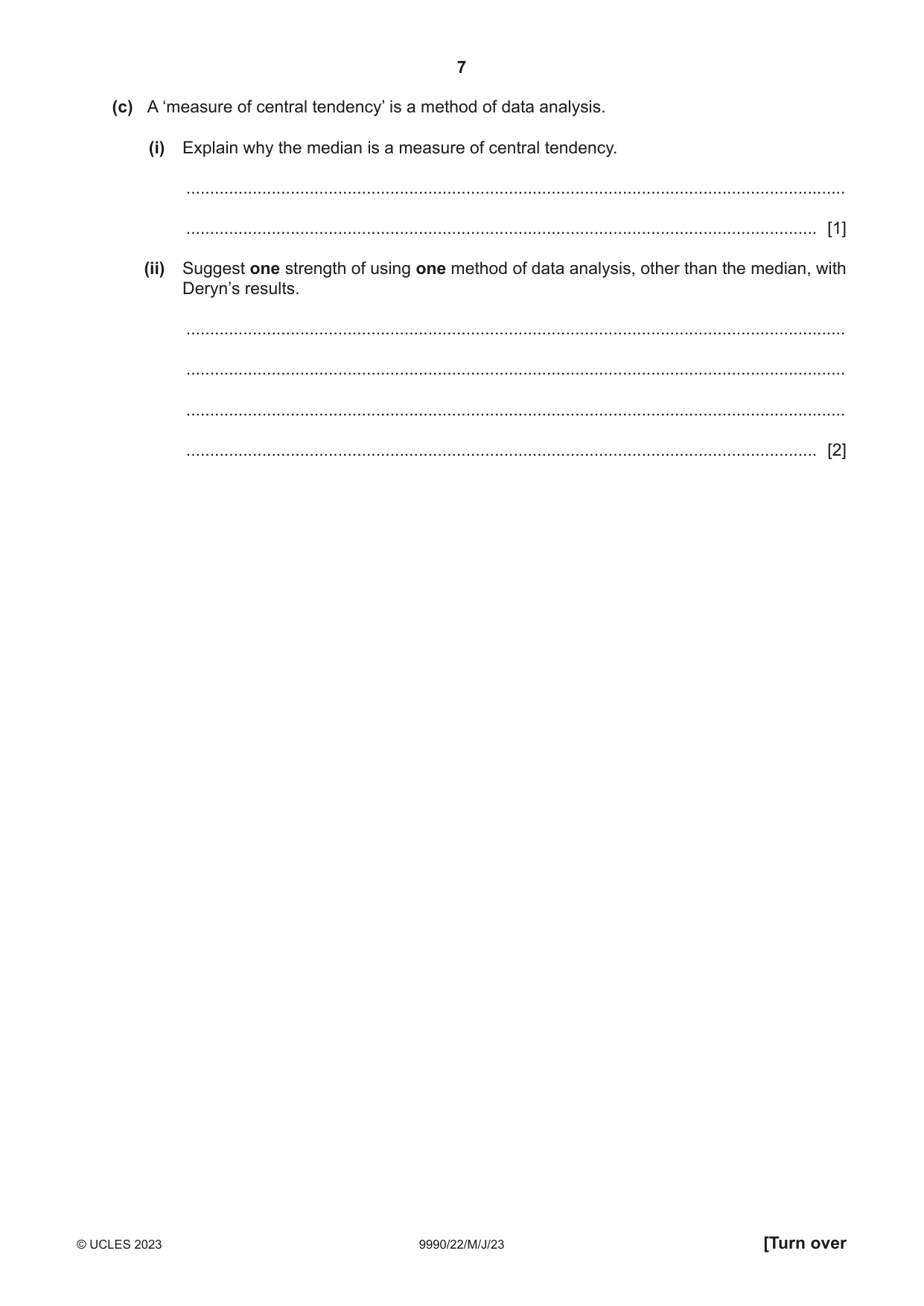
7 Deryn is planning an experimental study to compare how, and how often, men and women look at themselves in a shop window. She plans to collect quantitative data using observations and will calculate a median. (a) (i) Identify the independent variable in Deryn’s study. ........................................................................................................................................... ..................................................................................................................................... [1] (ii) Identify one dependent variable in Deryn’s study. ........................................................................................................................................... ..................................................................................................................................... [1] (iii) Identify the experimental design used in Deryn’s study. ........................................................................................................................................... ..................................................................................................................................... [1] (b) (i) Suggest how Deryn could use a structured observation in her study. ........................................................................................................................................... ........................................................................................................................................... ........................................................................................................................................... ........................................................................................................................................... ........................................................................................................................................... ..................................................................................................................................... [3] (ii) Suggest one disadvantage of using a structured observation compared to an unstructured observation in Deryn’s study. ........................................................................................................................................... ........................................................................................................................................... ........................................................................................................................................... ..................................................................................................................................... [2] (c) A ‘measure of central tendency’ is a method of data analysis. (i) Explain why the median is a measure of central tendency. ........................................................................................................................................... ..................................................................................................................................... [1] (ii) Suggest one strength of using one method of data analysis, other than the median, with Deryn’s results. ........................................................................................................................................... ........................................................................................................................................... ........................................................................................................................................... ..................................................................................................................................... [2]
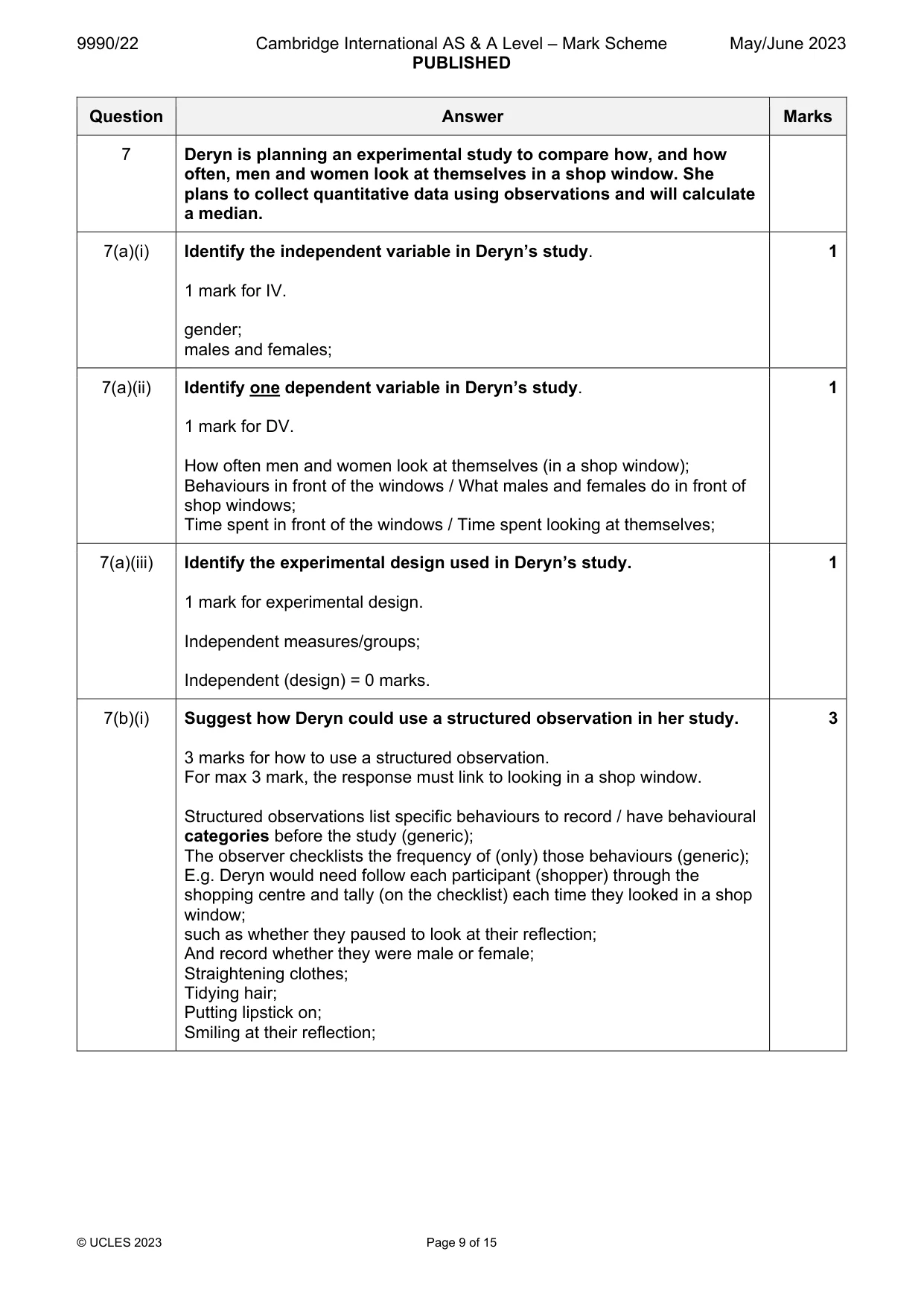
Mark scheme: 7 Deryn is planning an experimental study to compare how, and how often, men and women look at themselves in a shop window. She plans to collect quantitative data using observations and will calculate a median. 7(a)(i) Identify the independent variable in Deryn’s study. 1 1 mark for IV. gender; males and females; 7(a)(ii) Identify one dependent variable in Deryn’s study. 1 1 mark for DV. How often men and women look at themselves (in a shop window); Behaviours in front of the windows / What males and females do in front of shop windows; Time spent in front of the windows / Time spent looking at themselves; 7(a)(iii) Identify the experimental design used in Deryn’s study. 1 1 mark for experimental design. Independent measures/groups; Independent (design) = 0 marks. 7(b)(i) Suggest how Deryn could use a structured observation in her study. 3 3 marks for how to use a structured observation. For max 3 mark, the response must link to looking in a shop window. Structured observations list specific behaviours to record / have behavioural categories before the study (generic); The observer checklists the frequency of (only) those behaviours (generic); E.g. Deryn would need follow each participant (shopper) through the shopping centre and tally (on the checklist) each time they looked in a shop window; such as whether they paused to look at their reflection; And record whether they were male or female; Straightening clothes; Tidying hair; Putting lipstick on; Smiling at their reflection; 7(b)(ii) Suggest one disadvantage of using a structured observation 2 compared to an unstructured observation in Deryn’s study. 1 mark for disadvantage. 1 mark for link. It may be hard to count individual behaviours / to separate the behavioural stream into individual actions to record; E.g. was it one long look or two short glances (link); There is a list so new behaviours / ones not on the list cannot be recorded; E.g. if people use the window to adjust their clothing and that wasn’t on the list / it couldn’t be added (link); 7(c) A ‘measure of central tendency’ is a method of data analysis. 7(c)(i) Explain why the median is a measure of central tendency. 1 1 mark for explanation. The median is a measure of central tendency because it finds a typical score in a data set; It’s a measure of central tendency because it finds the middle of the scores; Central tendency because it finds the centre of the data = 0 [REP]. 7(c)(ii) Suggest one strength of using one method of data analysis, other than 2 the median, with Deryn’s results. 1 mark for identifying an appropriate method of data analysis. 1 mark for a linked strength, include additional uses to that provided by the median as a strength i.e. can be descriptive of a use. The mean; This will take into account the frequency of looking in shop windows for each participant (the values); The range; This will provide (different) information about the spread of frequencies for looking in windows (for men and women); The mode; Shows us the most common behaviour when looking in windows (which the median does not do); Strength that it can be used on categorical/discrete/nominal data such as tidy hair and adjust clothing for men and women; Because it is easy to calculate = 0 [all are easy].
Q8 · Phyllis is planning a correlational study to investigate the relationship between…
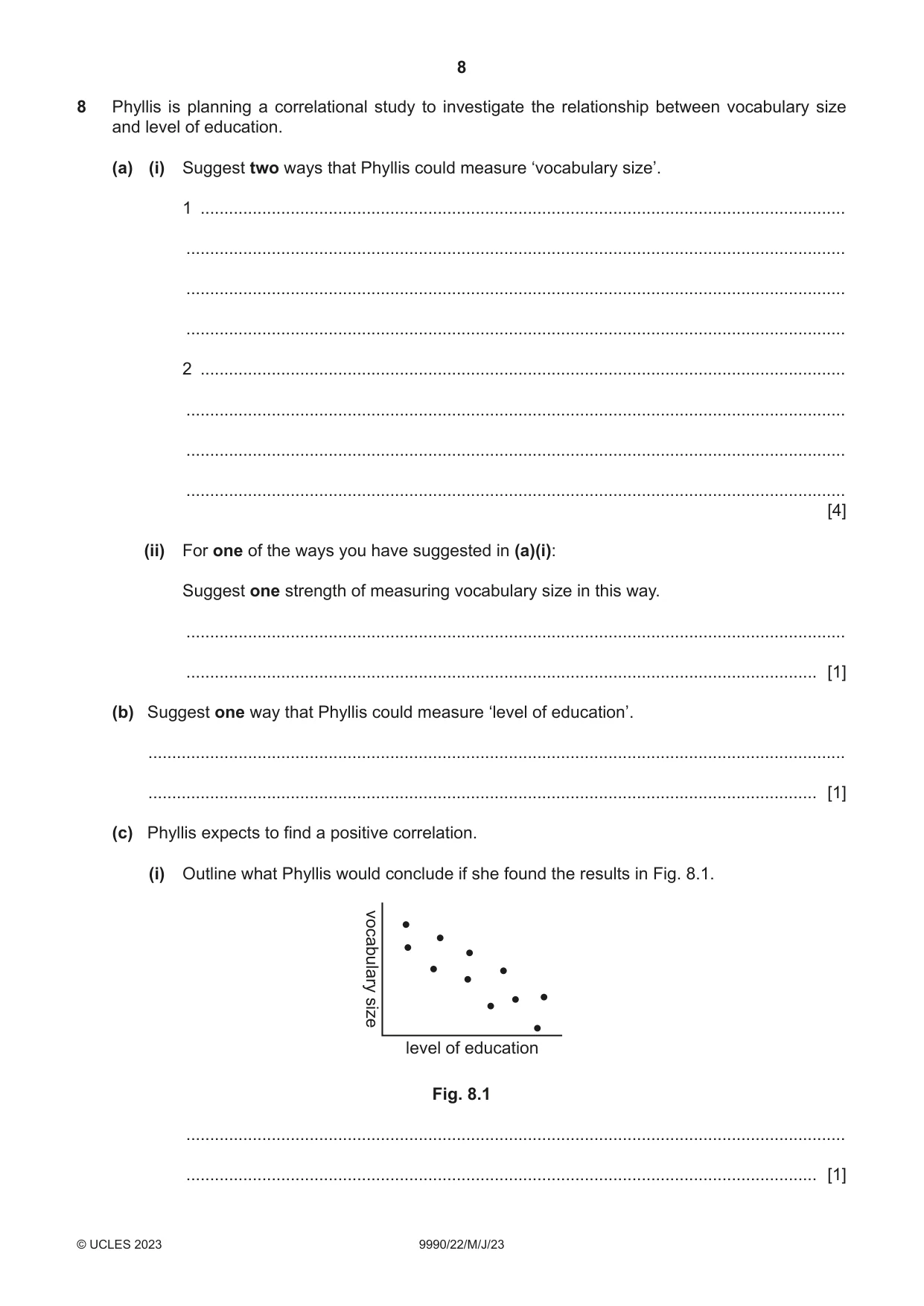
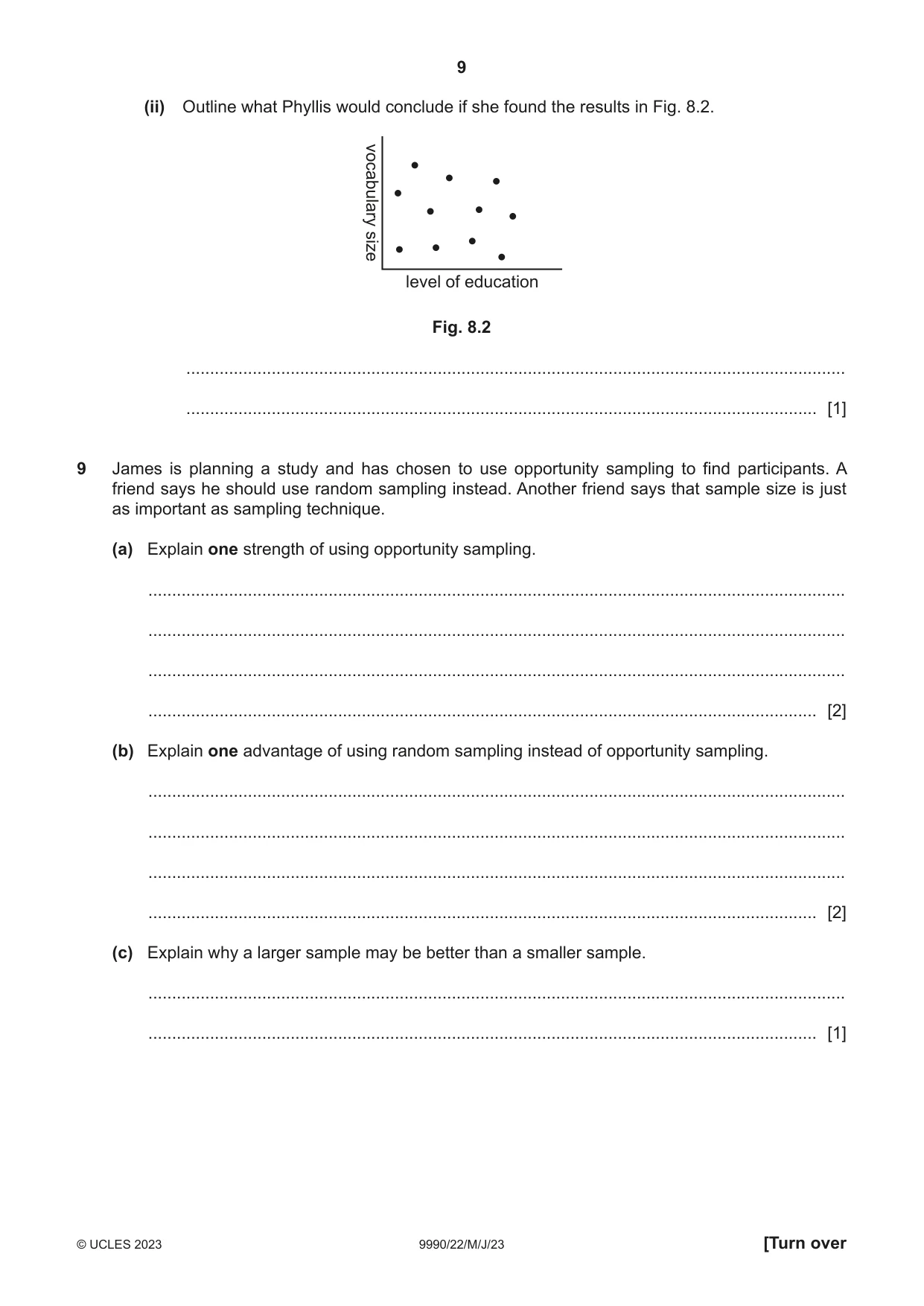
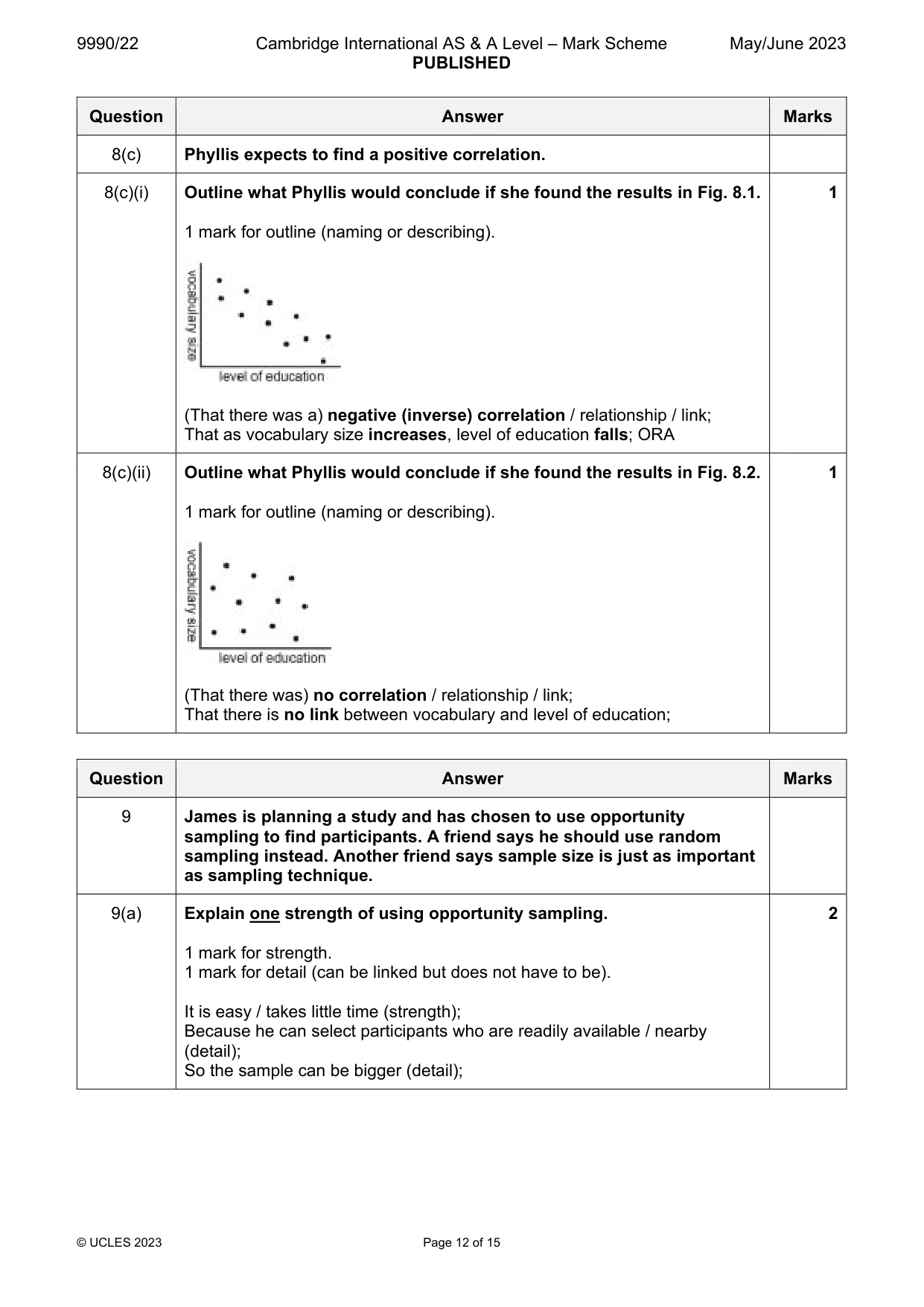
8 Phyllis is planning a correlational study to investigate the relationship between vocabulary size and level of education. (a) (i) Suggest two ways that Phyllis could measure ‘vocabulary size’. 1 ........................................................................................................................................ ........................................................................................................................................... ........................................................................................................................................... ........................................................................................................................................... 2 ........................................................................................................................................ ........................................................................................................................................... ........................................................................................................................................... ........................................................................................................................................... [4] (ii) For one of the ways you have suggested in (a)(i): Suggest one strength of measuring vocabulary size in this way. ........................................................................................................................................... ..................................................................................................................................... [1] (b) Suggest one way that Phyllis could measure ‘level of education’. ................................................................................................................................................... ............................................................................................................................................. [1] (c) Phyllis expects to find a positive correlation. (i) Outline what Phyllis would conclude if she found the results in Fig. 8.1. vocabulary size level of education Fig. 8.1 ........................................................................................................................................... ..................................................................................................................................... [1] (ii) Outline what Phyllis would conclude if she found the results in Fig. 8.2. vocabulary size level of education Fig. 8.2 ........................................................................................................................................... ..................................................................................................................................... [1]
Mark scheme: 8 Phyllis is planning a correlational study to investigate the relationship between vocabulary size and level of education. 8(a)(i) Suggest two ways that Phyllis could measure ‘vocabulary size’. 4 1 mark for suggestion + 1 mark for detail 2. The suggestion must produce quantitative data on a scale (to correlate). Set them a vocabulary test of words to remember (suggestion); Count how many they get right (detail); Give them a passage (which is not familiar) to translate (suggestion); and see how many of the unusual words they know (detail); Listen to them speak (suggestion); Estimate the range of words they are using on a scale of 1–10 (detail); 8(a)(ii) For one of the ways you have suggested in (a)(i): 1 Suggest one strength of measuring vocabulary size in this way. 1 mark for suggestion of strength (can be an advantage compared to one of the other suggestions). A test is more objective than an estimate of range of words used; e.g can’t pretend to know a word they don’t know; Good reliability because no doubt if a word was understood or not; Ethically good as participants can self-report word knowledge which is not invasive / do not have to test them; A test is less subjective than whether words they use are unusual; Standardised because they all get the same list; 8(b) Suggest one way that Phyllis could measure ‘level of education’. 1 1 mark for suggestion. The suggestion must produce quantitative data on a continuous scale of more than two points (to correlate). Number of years in education / Grade in school; whether they have no qualifications / A Levels / a degree; 8(c) Phyllis expects to find a positive correlation. 8(c)(i) Outline what Phyllis would conclude if she found the results in Fig. 8.1. 1 1 mark for outline (naming or describing). (That there was a) negative (inverse) correlation / relationship / link; That as vocabulary size increases, level of education falls; ORA 8(c)(ii) Outline what Phyllis would conclude if she found the results in Fig. 8.2. 1 1 mark for outline (naming or describing). (That there was) no correlation / relationship / link; That there is no link between vocabulary and level of education;
Q9 · James is planning a study and has chosen to use opportunity sampling to find participants
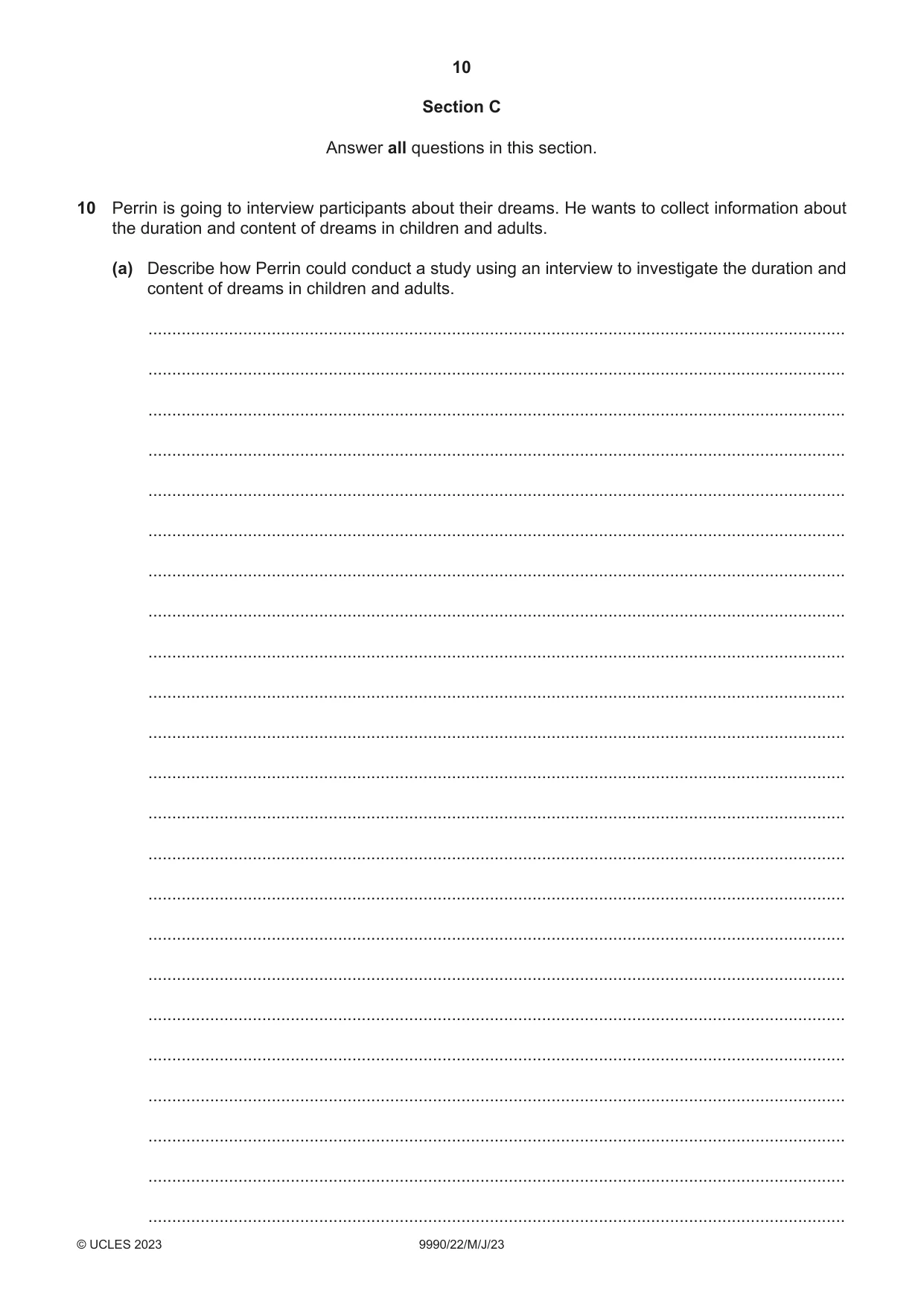
9 James is planning a study and has chosen to use opportunity sampling to find participants. A friend says he should use random sampling instead. Another friend says that sample size is just as important as sampling technique. (a) Explain one strength of using opportunity sampling. ................................................................................................................................................... ................................................................................................................................................... ................................................................................................................................................... ............................................................................................................................................. [2] (b) Explain one advantage of using random sampling instead of opportunity sampling. ................................................................................................................................................... ................................................................................................................................................... ................................................................................................................................................... ............................................................................................................................................. [2] (c) Explain why a larger sample may be better than a smaller sample. ................................................................................................................................................... ............................................................................................................................................. [1] Section C Answer all questions in this section.
Mark scheme: 9 James is planning a study and has chosen to use opportunity sampling to find participants. A friend says he should use random sampling instead. Another friend says sample size is just as important as sampling technique. 9(a) Explain one strength of using opportunity sampling. 2 1 mark for strength. 1 mark for detail (can be linked but does not have to be). It is easy / takes little time (strength); Because he can select participants who are readily available / nearby (detail); So the sample can be bigger (detail); 9(b) Explain one advantage of using random sampling instead of 2 opportunity sampling. 1 mark for explanation of advantage. 1 mark for detail (can be linked but does not have to be). It will be more representative / the findings will be more generalisable (explanation); Because the participants are more likely to have a range of characteristics / are more likely to contain (more of) the features that exist in the population (detail); 9(c) Explain why a large sample may be better than a smaller sample. 1 1 mark for explanation (can be linked but does not have to be). A larger sample is likely to have a greater variety of people / more (individual) differences (between people); Be more representative / generalisable; A small sample is likely to have a smaller variety of people; Be less representative / generalisable;
Q10 · Perrin is going to interview participants about their dreams
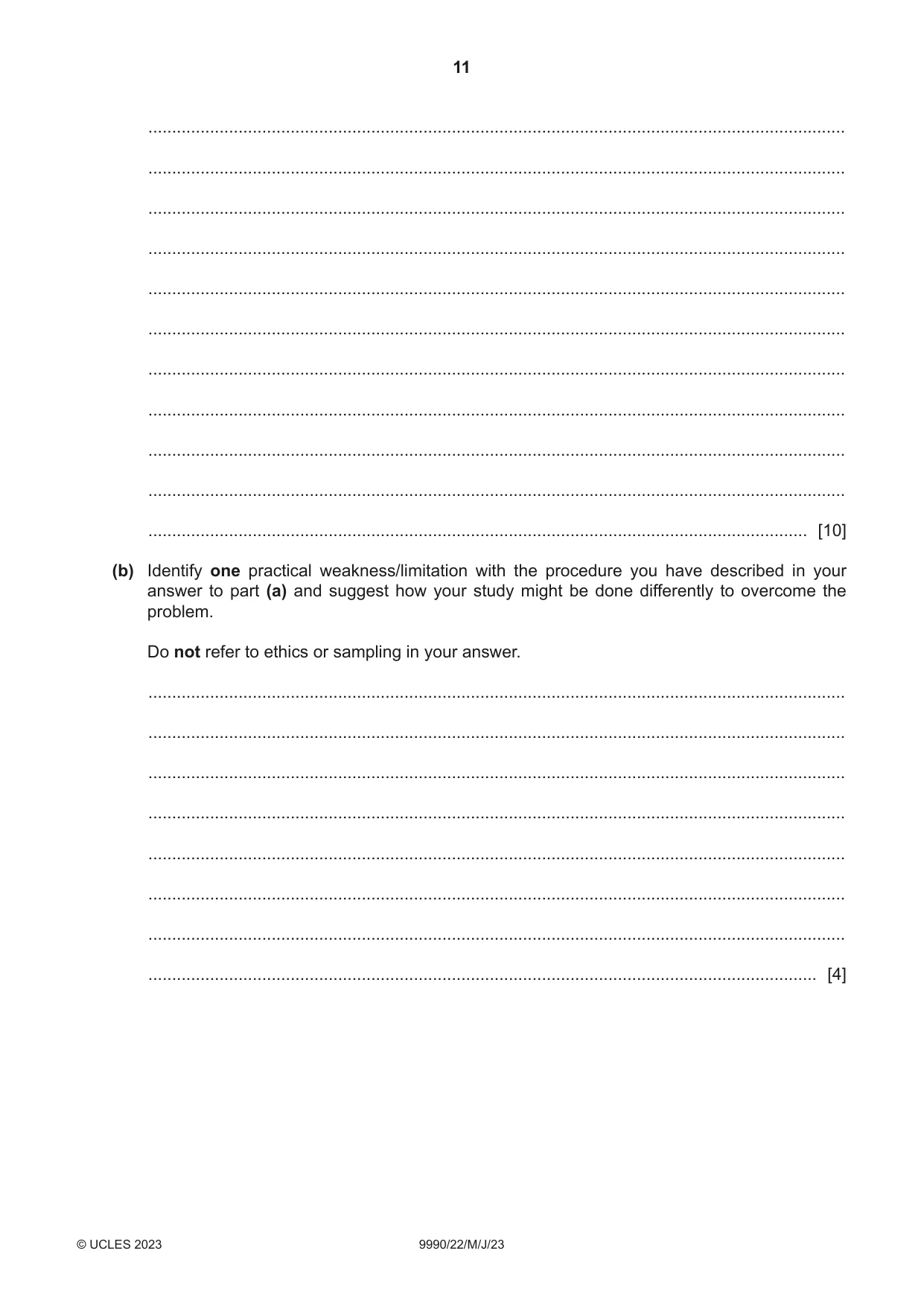
10 Perrin is going to interview participants about their dreams. He wants to collect information about the duration and content of dreams in children and adults. (a) Describe how Perrin could conduct a study using an interview to investigate the duration and content of dreams in children and adults. ................................................................................................................................................... ................................................................................................................................................... ................................................................................................................................................... ................................................................................................................................................... ................................................................................................................................................... ................................................................................................................................................... ................................................................................................................................................... ................................................................................................................................................... ................................................................................................................................................... ................................................................................................................................................... ................................................................................................................................................... ................................................................................................................................................... ................................................................................................................................................... ................................................................................................................................................... ................................................................................................................................................... ................................................................................................................................................... ................................................................................................................................................... ................................................................................................................................................... ................................................................................................................................................... ................................................................................................................................................... ................................................................................................................................................... ................................................................................................................................................... ................................................................................................................................................... ................................................................................................................................................... ................................................................................................................................................... ................................................................................................................................................... ................................................................................................................................................... ................................................................................................................................................... ................................................................................................................................................... ................................................................................................................................................... ................................................................................................................................................... ................................................................................................................................................... ................................................................................................................................................... ........................................................................................................................................... [10] (b) Identify one practical weakness/limitation with the procedure you have described in your answer to part (a) and suggest how your study might be done differently to overcome the problem. Do not refer to ethics or sampling in your answer. ................................................................................................................................................... ................................................................................................................................................... ................................................................................................................................................... ................................................................................................................................................... ................................................................................................................................................... ................................................................................................................................................... ................................................................................................................................................... ............................................................................................................................................. [4]
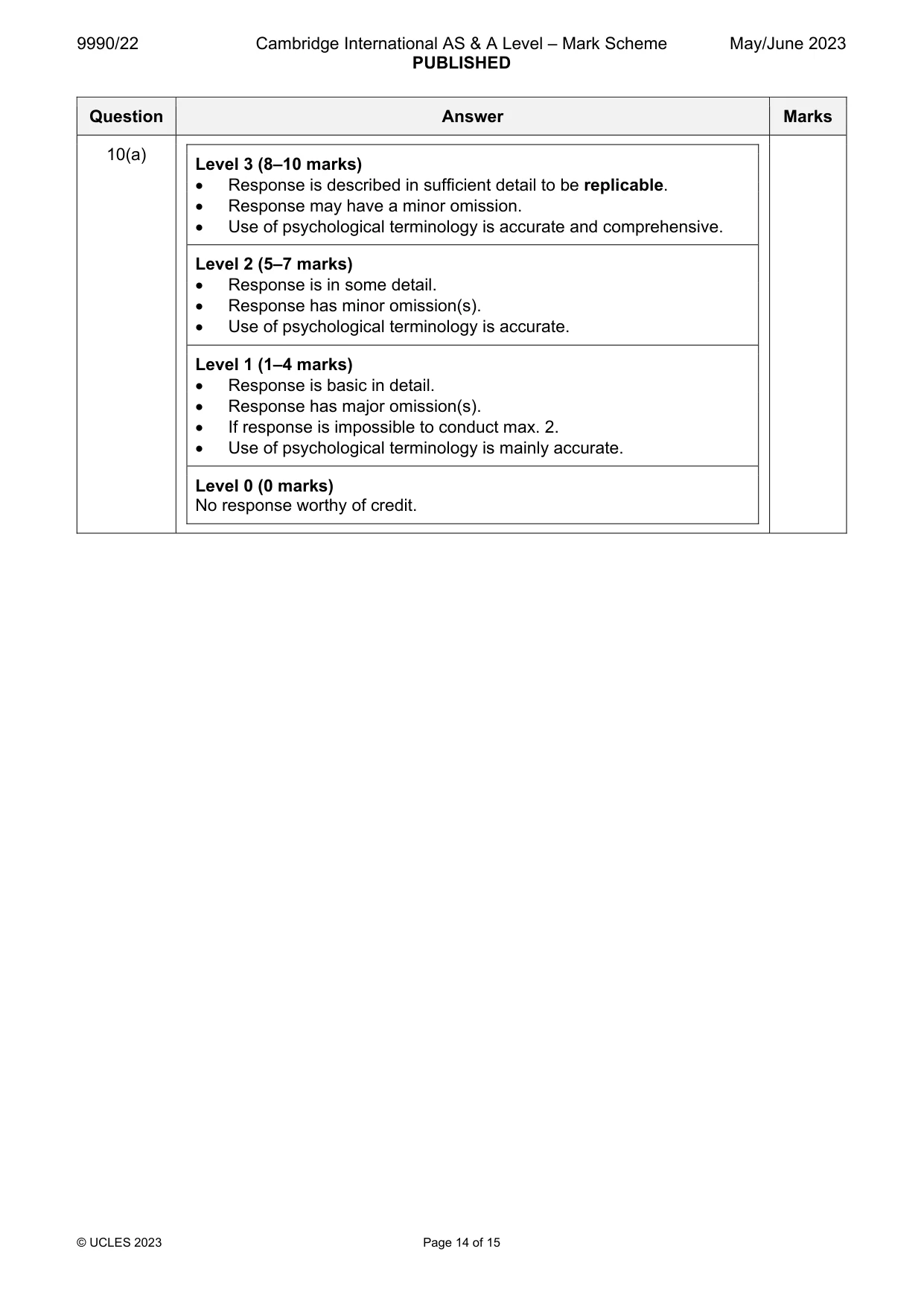
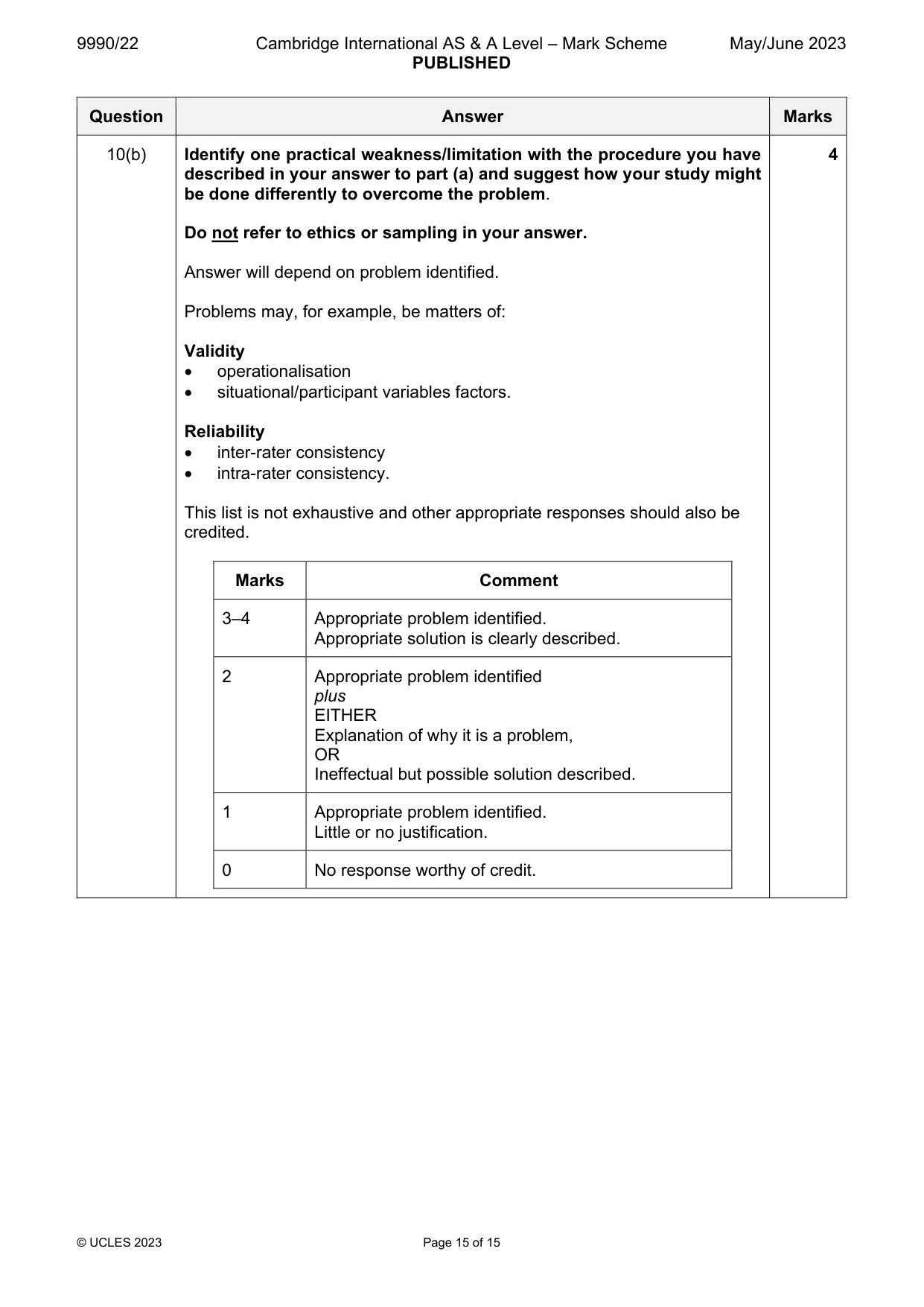
Mark scheme: 10 Perrin is going to interview participants about their dreams. He wants to collect information about the duration and content of dreams in children and adults. 10(a) Describe how Perrin could conduct a study using an interview to 10 investigate the duration and content of dreams in children and adults. Three majors for an interview are: (a) content of questions asked (topics, examples) (b) interview structure detail (i.e. named structured/semi/unstructured plus how – i.e. definition, even if not linked) (c) style of questions asked (open/closed). The minors are: where – location of participants when being interviewed who – participants (adults and children who recall their dreams). Other details for replication: lie questions filler questions sampling technique sample size description of how data will be analysed, e.g. use of averages / bar charts ethical issues. Other appropriate responses should also be credited. Mark according to the levels of response criteria below: 10(a) Level 3 (8–10 marks) Response is described in sufficient detail to be replicable. Response may have a minor omission. Use of psychological terminology is accurate and comprehensive. Level 2 (5–7 marks) Response is in some detail. Response has minor omission(s). Use of psychological terminology is accurate. Level 1 (1–4 marks) Response is basic in detail. Response has major omission(s). If response is impossible to conduct max. 2. Use of psychological terminology is mainly accurate. Level 0 (0 marks) No response worthy of credit. 10(b) Identify one practical weakness/limitation with the procedure you have 4 described in your answer to part (a) and suggest how your study might be done differently to overcome the problem. Do not refer to ethics or sampling in your answer. Answer will depend on problem identified. Problems may, for example, be matters of: Validity operationalisation situational/participant variables factors. Reliability inter-rater consistency intra-rater consistency. This list is not exhaustive and other appropriate responses should also be credited. Marks Comment 3–4 Appropriate problem identified. Appropriate solution is clearly described. 2 Appropriate problem identified plus EITHER Explanation of why it is a problem, OR Ineffectual but possible solution described. 1 Appropriate problem identified. Little or no justification. 0 No response worthy of credit.
What was in this paper
The subtopics covered by these 10 questions, and how many questions each got. Open one in a new tab to see every Cambridge question on it.
What you needed in this session
Cambridge’s own grade thresholds for 2023 May/June, Paper 2 · Variant 2. A higher threshold means an easier paper — the bar moves with how the cohort did.