Cambridge A Level Psychology (from 2018) 9990 — 2022 Oct/Nov Paper 2 · Variant 3
9990/23/O/N/22 · 10 questions · 60 marks · ≈68 min
The question paper and its mark scheme, free to read here and free to download. This is Cambridge’s own paper, exactly as it was sat.
Question paper12 pages


Mark scheme17 pages
Answers below. Sit the paper first if you are practising.
Questions as text
Q1 · Dement and Kleitman (sleep and dreams) investigated a correlation between the length of…
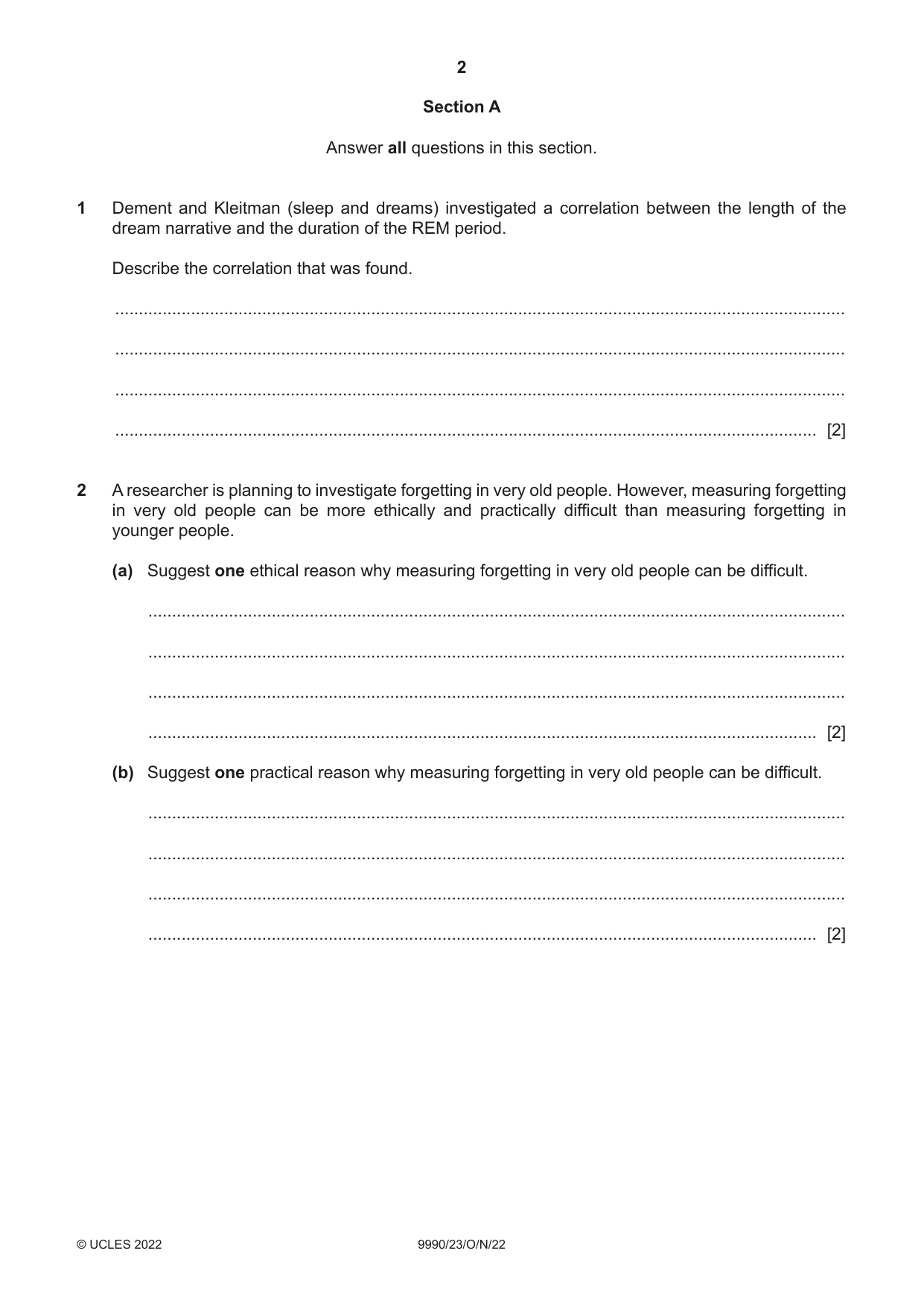
1 Dement and Kleitman (sleep and dreams) investigated a correlation between the length of the dream narrative and the duration of the REM period. Describe the correlation that was found. .......................................................................................................................................................... .......................................................................................................................................................... .......................................................................................................................................................... .................................................................................................................................................... [2]
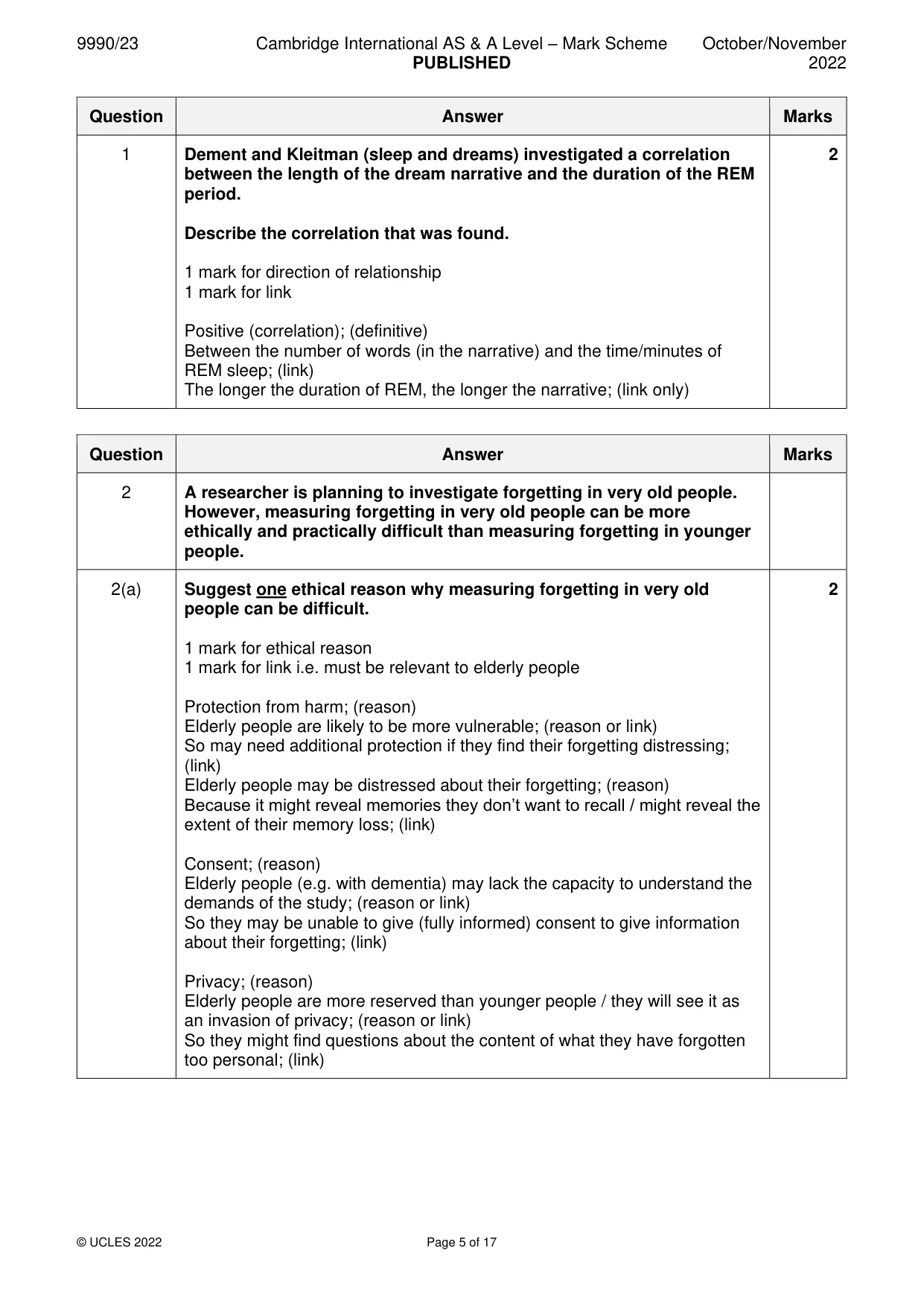
Mark scheme: Question Answer Marks 1 Dement and Kleitman (sleep and dreams) investigated a correlation 2 between the length of the dream narrative and the duration of the REM period. Describe the correlation that was found. 1 mark for direction of relationship 1 mark for link Positive (correlation); (definitive) Between the number of words (in the narrative) and the time/minutes of REM sleep; (link) The longer the duration of REM, the longer the narrative; (link only)
Q2 · A researcher is planning to investigate forgetting in very old people
2 A researcher is planning to investigate forgetting in very old people. However, measuring forgetting in very old people can be more ethically and practically difficult than measuring forgetting in younger people. (a) Suggest one ethical reason why measuring forgetting in very old people can be difficult. ................................................................................................................................................... ................................................................................................................................................... ................................................................................................................................................... ............................................................................................................................................. [2] (b) Suggest one practical reason why measuring forgetting in very old people can be difficult. ................................................................................................................................................... ................................................................................................................................................... ................................................................................................................................................... ............................................................................................................................................. [2]
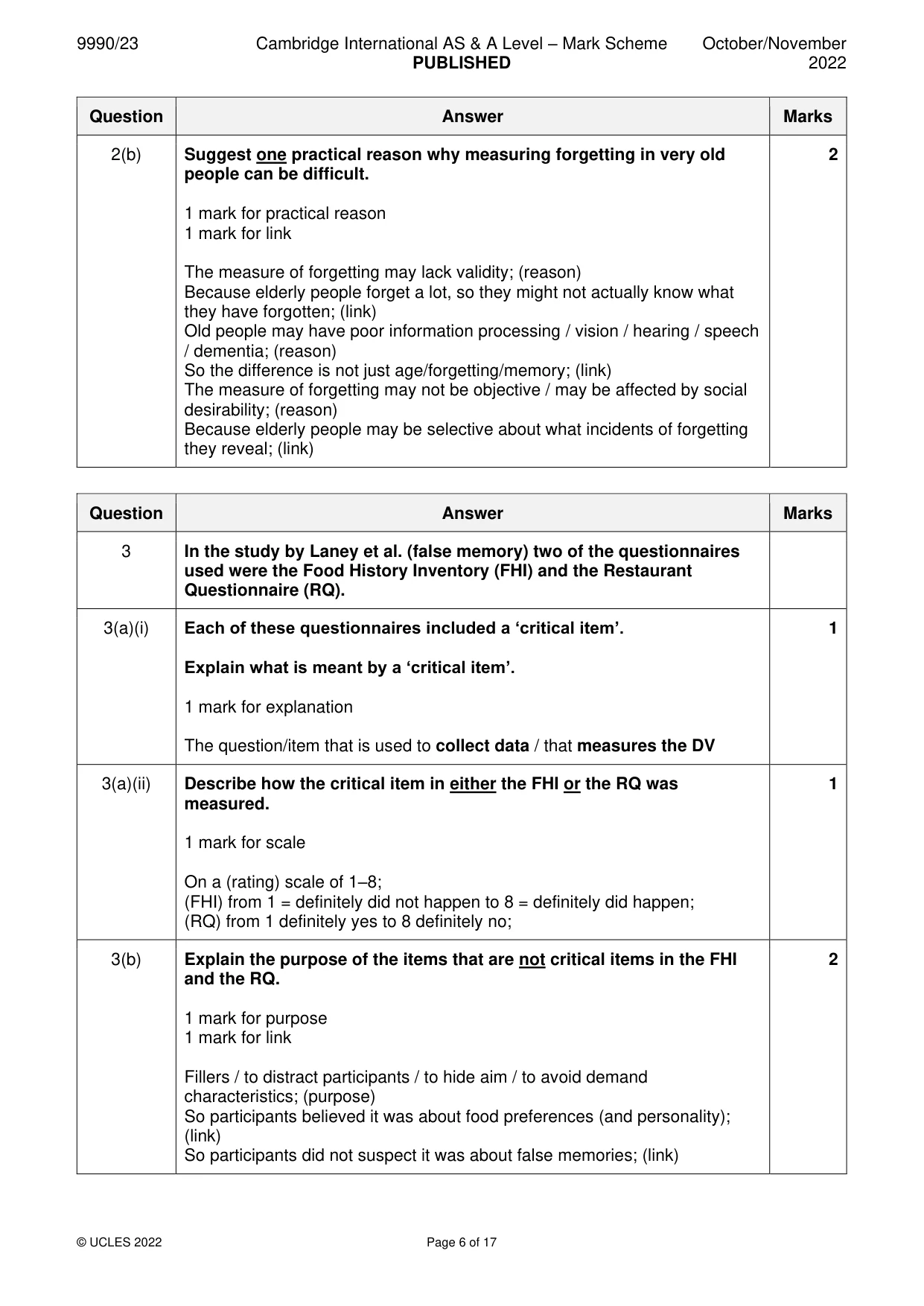
Mark scheme: 2 A researcher is planning to investigate forgetting in very old people. However, measuring forgetting in very old people can be more ethically and practically difficult than measuring forgetting in younger people. 2(a) Suggest one ethical reason why measuring forgetting in very old 2 people can be difficult. 1 mark for ethical reason 1 mark for link i.e. must be relevant to elderly people Protection from harm; (reason) Elderly people are likely to be more vulnerable; (reason or link) So may need additional protection if they find their forgetting distressing; (link) Elderly people may be distressed about their forgetting; (reason) Because it might reveal memories they don’t want to recall / might reveal the extent of their memory loss; (link) Consent; (reason) Elderly people (e.g. with dementia) may lack the capacity to understand the demands of the study; (reason or link) So they may be unable to give (fully informed) consent to give information about their forgetting; (link) Privacy; (reason) Elderly people are more reserved than younger people / they will see it as an invasion of privacy; (reason or link) So they might find questions about the content of what they have forgotten too personal; (link) 2(b) Suggest one practical reason why measuring forgetting in very old 2 people can be difficult. 1 mark for practical reason 1 mark for link The measure of forgetting may lack validity; (reason) Because elderly people forget a lot, so they might not actually know what they have forgotten; (link) Old people may have poor information processing / vision / hearing / speech / dementia; (reason) So the difference is not just age/forgetting/memory; (link) The measure of forgetting may not be objective / may be affected by social desirability; (reason) Because elderly people may be selective about what incidents of forgetting they reveal; (link)
Q3 · In the study by Laney et al
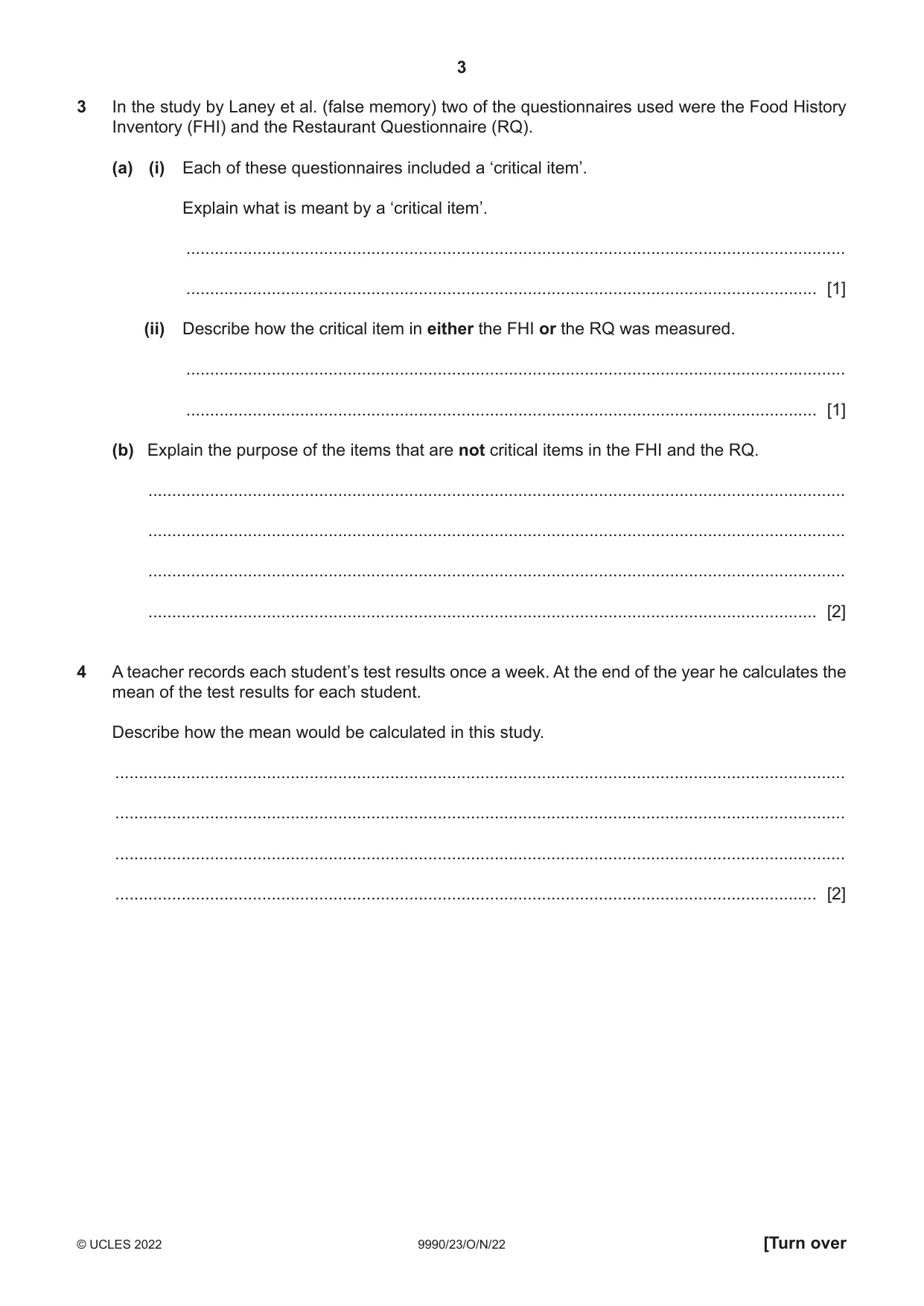
3 In the study by Laney et al. (false memory) two of the questionnaires used were the Food History Inventory (FHI) and the Restaurant Questionnaire (RQ). (a) (i) Each of these questionnaires included a ‘critical item’. Explain what is meant by a ‘critical item’. ........................................................................................................................................... ..................................................................................................................................... [1] (ii) Describe how the critical item in either the FHI or the RQ was measured. ........................................................................................................................................... ..................................................................................................................................... [1] (b) Explain the purpose of the items that are not critical items in the FHI and the RQ. ................................................................................................................................................... ................................................................................................................................................... ................................................................................................................................................... ............................................................................................................................................. [2]
Mark scheme: 3 In the study by Laney et al. (false memory) two of the questionnaires used were the Food History Inventory (FHI) and the Restaurant Questionnaire (RQ). 3(a)(i) Each of these questionnaires included a ‘critical item’. 1 Explain what is meant by a ‘critical item’. 1 mark for explanation The question/item that is used to collect data / that measures the DV 3(a)(ii) Describe how the critical item in either the FHI or the RQ was 1 measured. 1 mark for scale On a (rating) scale of 1–8; (FHI) from 1 = definitely did not happen to 8 = definitely did happen; (RQ) from 1 definitely yes to 8 definitely no; 3(b) Explain the purpose of the items that are not critical items in the FHI 2 and the RQ. 1 mark for purpose 1 mark for link Fillers / to distract participants / to hide aim / to avoid demand characteristics; (purpose) So participants believed it was about food preferences (and personality); (link) So participants did not suspect it was about false memories; (link)
Q4 · A teacher records each student’s test results once a week
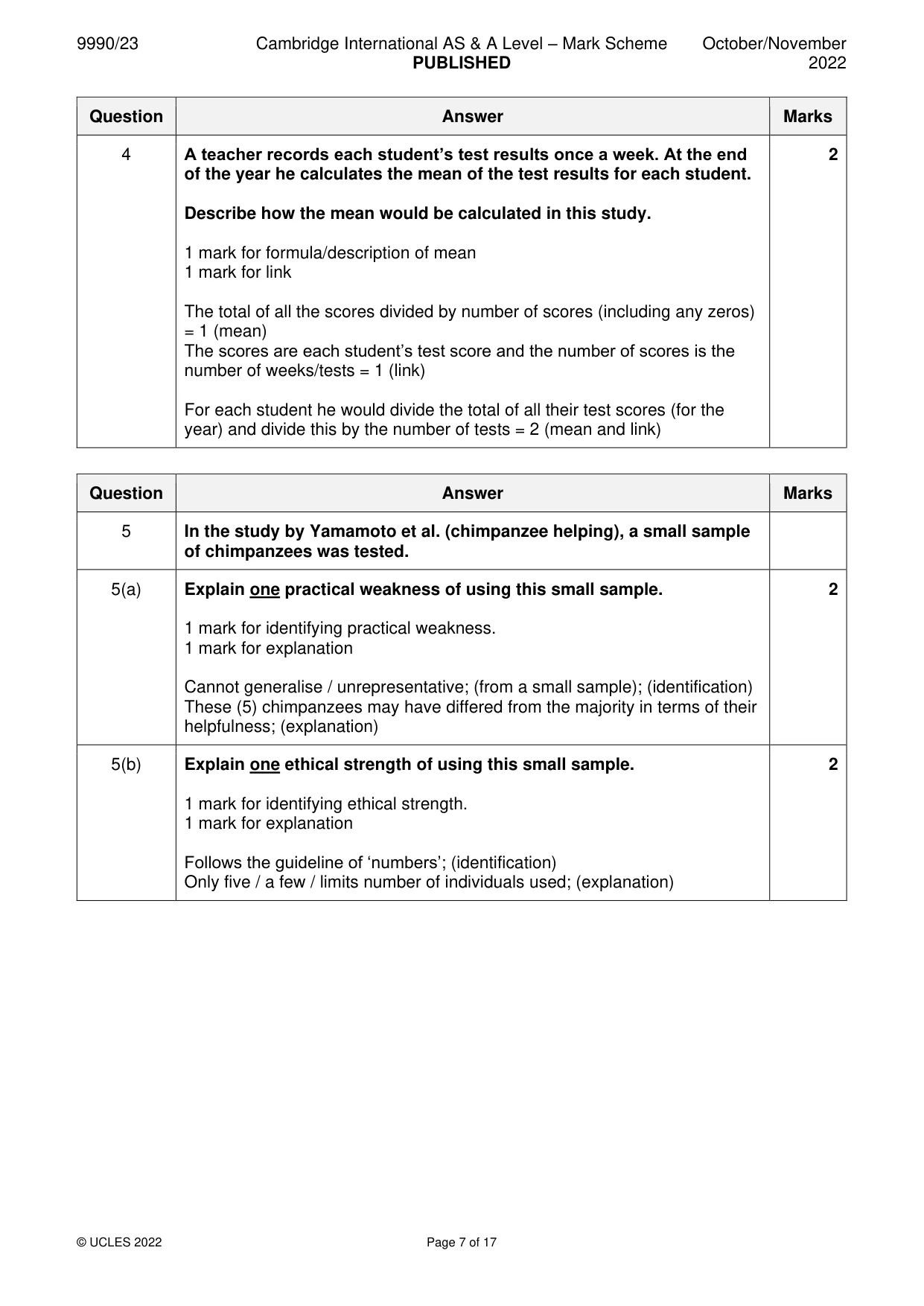
4 A teacher records each student’s test results once a week. At the end of the year he calculates the mean of the test results for each student. Describe how the mean would be calculated in this study. .......................................................................................................................................................... .......................................................................................................................................................... .......................................................................................................................................................... .................................................................................................................................................... [2]
Mark scheme: 4 A teacher records each student’s test results once a week. At the end 2 of the year he calculates the mean of the test results for each student. Describe how the mean would be calculated in this study. 1 mark for formula/description of mean 1 mark for link The total of all the scores divided by number of scores (including any zeros) = 1 (mean) The scores are each student’s test score and the number of scores is the number of weeks/tests = 1 (link) For each student he would divide the total of all their test scores (for the year) and divide this by the number of tests = 2 (mean and link)
Q5 · In the study by Yamamoto et al
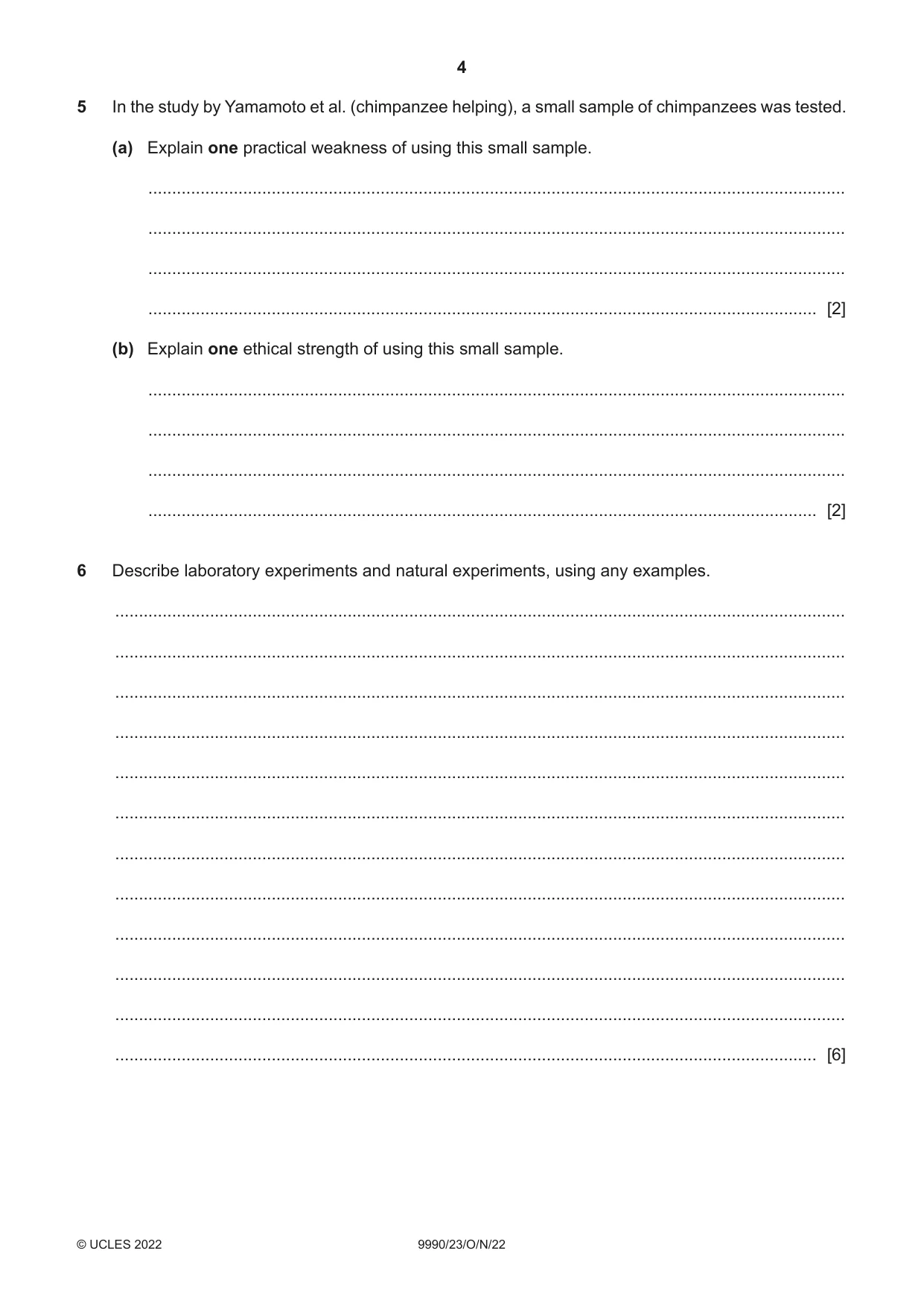
5 In the study by Yamamoto et al. (chimpanzee helping), a small sample of chimpanzees was tested. (a) Explain one practical weakness of using this small sample. ................................................................................................................................................... ................................................................................................................................................... ................................................................................................................................................... ............................................................................................................................................. [2] (b) Explain one ethical strength of using this small sample. ................................................................................................................................................... ................................................................................................................................................... ................................................................................................................................................... ............................................................................................................................................. [2]
Mark scheme: 5 In the study by Yamamoto et al. (chimpanzee helping), a small sample of chimpanzees was tested. 5(a) Explain one practical weakness of using this small sample. 2 1 mark for identifying practical weakness. 1 mark for explanation Cannot generalise / unrepresentative; (from a small sample); (identification) These (5) chimpanzees may have differed from the majority in terms of their helpfulness; (explanation) 5(b) Explain one ethical strength of using this small sample. 2 1 mark for identifying ethical strength. 1 mark for explanation Follows the guideline of ‘numbers’; (identification) Only five / a few / limits number of individuals used; (explanation)
Q6 · Describe laboratory experiments and natural experiments, using any examples
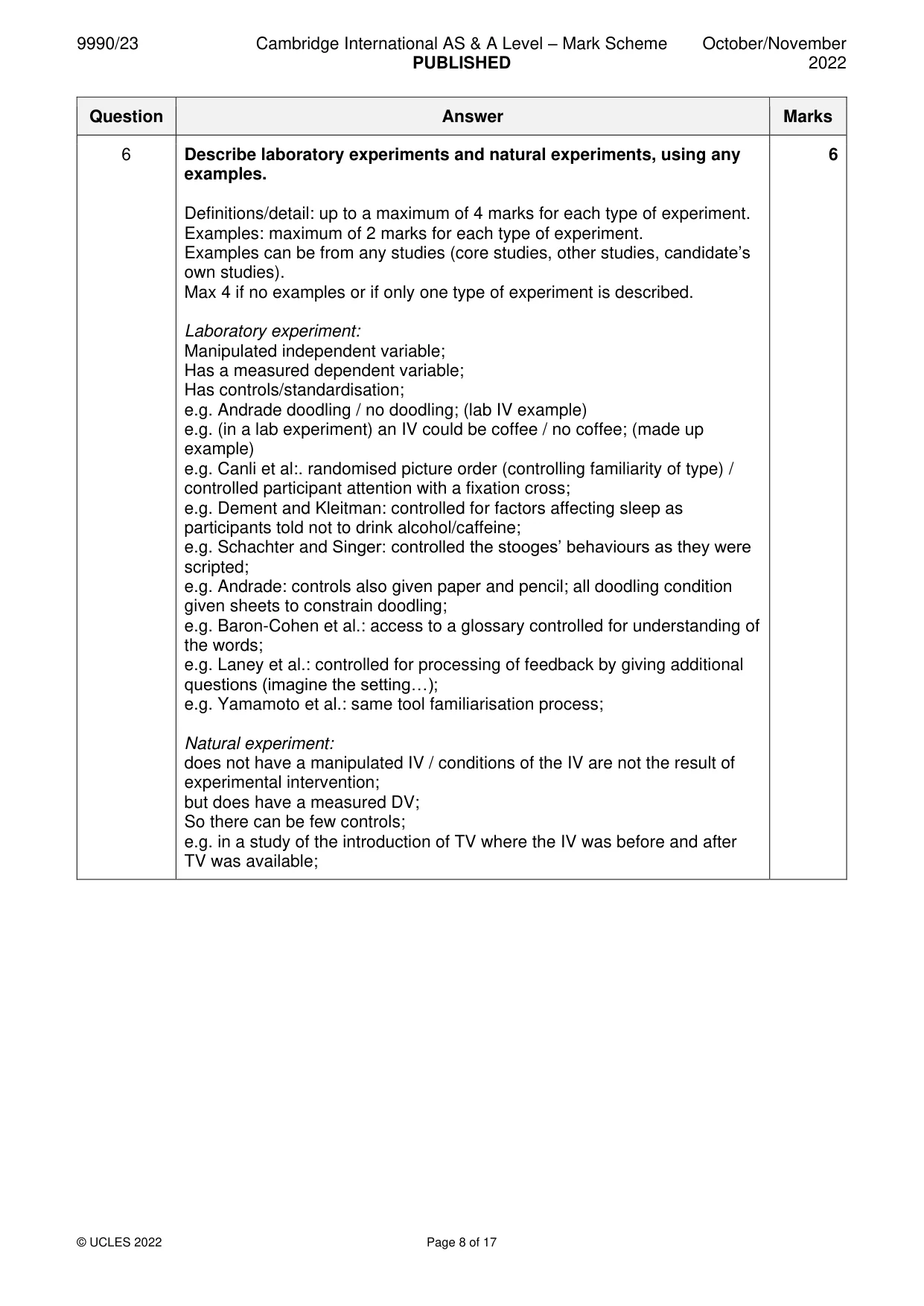
6 Describe laboratory experiments and natural experiments, using any examples. .......................................................................................................................................................... .......................................................................................................................................................... .......................................................................................................................................................... .......................................................................................................................................................... .......................................................................................................................................................... .......................................................................................................................................................... .......................................................................................................................................................... .......................................................................................................................................................... .......................................................................................................................................................... .......................................................................................................................................................... .......................................................................................................................................................... .................................................................................................................................................... [6] Question 7 appears on Page 6.
Mark scheme: 6 Describe laboratory experiments and natural experiments, using any 6 examples. Definitions/detail: up to a maximum of 4 marks for each type of experiment. Examples: maximum of 2 marks for each type of experiment. Examples can be from any studies (core studies, other studies, candidate’s own studies). Max 4 if no examples or if only one type of experiment is described. Laboratory experiment: Manipulated independent variable; Has a measured dependent variable; Has controls/standardisation; e.g. Andrade doodling / no doodling; (lab IV example) e.g. (in a lab experiment) an IV could be coffee / no coffee; (made up example) e.g. Canli et al:. randomised picture order (controlling familiarity of type) / controlled participant attention with a fixation cross; e.g. Dement and Kleitman: controlled for factors affecting sleep as participants told not to drink alcohol/caffeine; e.g. Schachter and Singer: controlled the stooges’ behaviours as they were scripted; e.g. Andrade: controls also given paper and pencil; all doodling condition given sheets to constrain doodling; e.g. Baron-Cohen et al.: access to a glossary controlled for understanding of the words; e.g. Laney et al.: controlled for processing of feedback by giving additional questions (imagine the setting…); e.g. Yamamoto et al.: same tool familiarisation process; Natural experiment: does not have a manipulated IV / conditions of the IV are not the result of experimental intervention; but does have a measured DV; So there can be few controls; e.g. in a study of the introduction of TV where the IV was before and after TV was available;
Q7 · Pranit uses a questionnaire to investigate whether psychology students know more about…
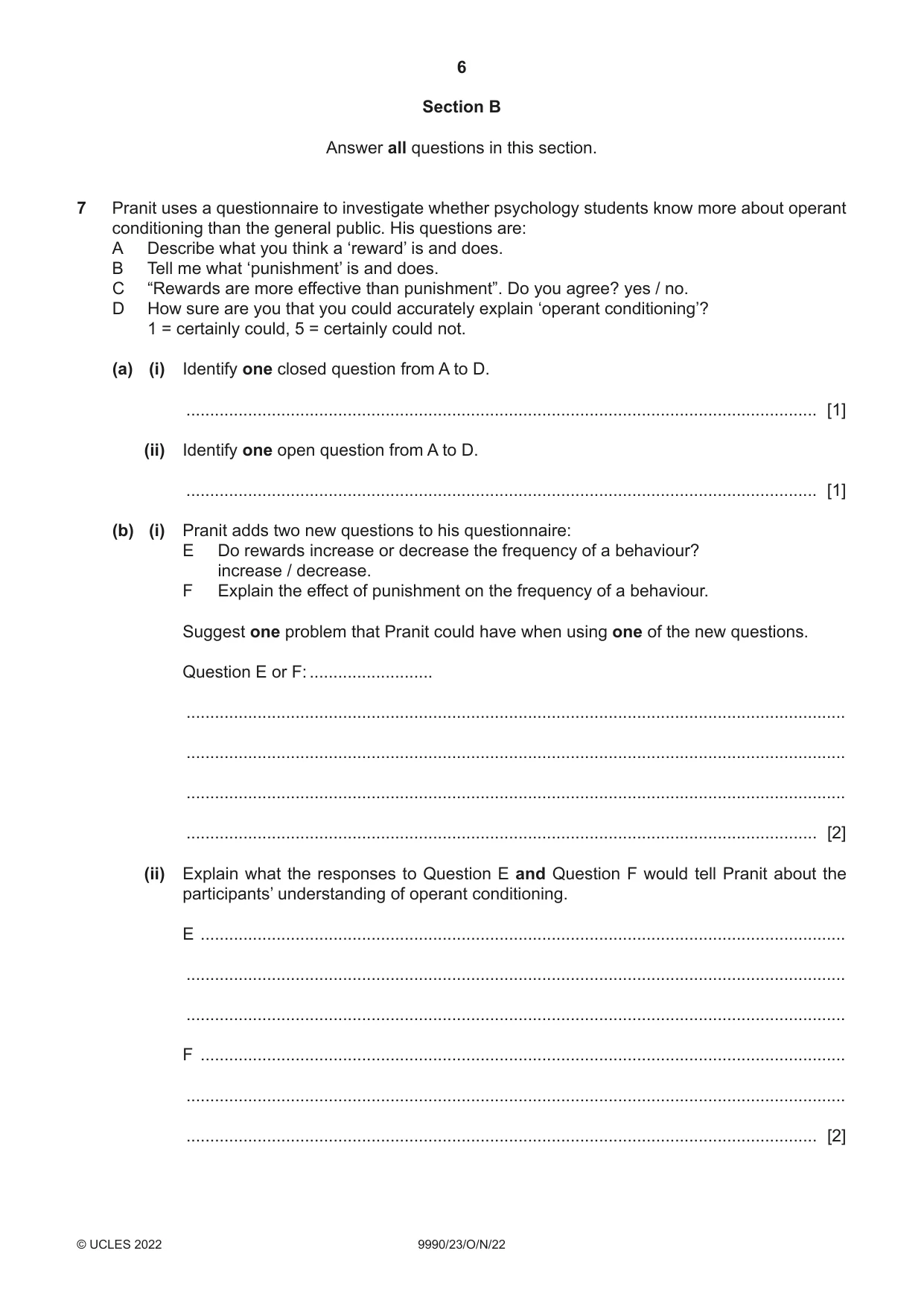
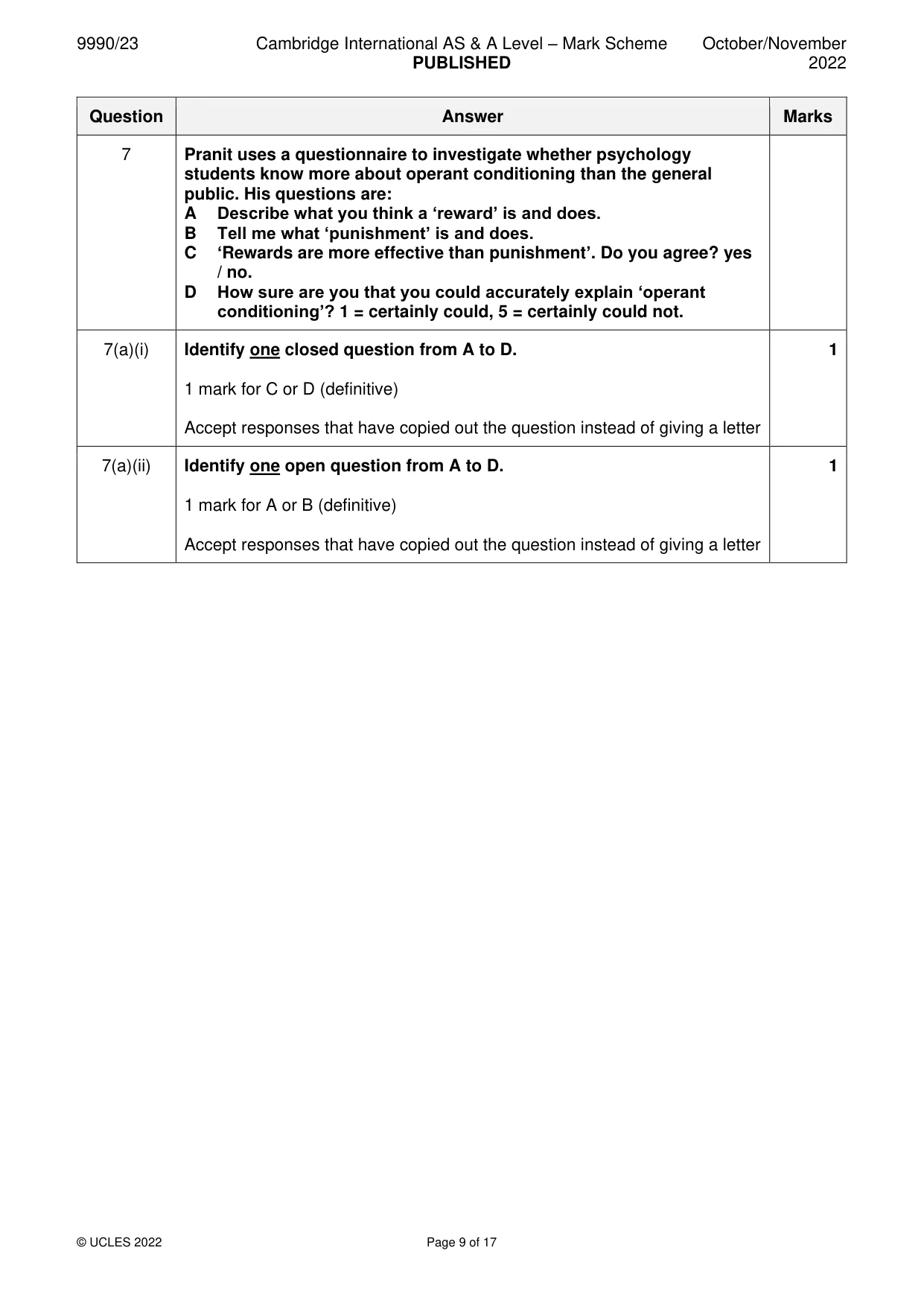
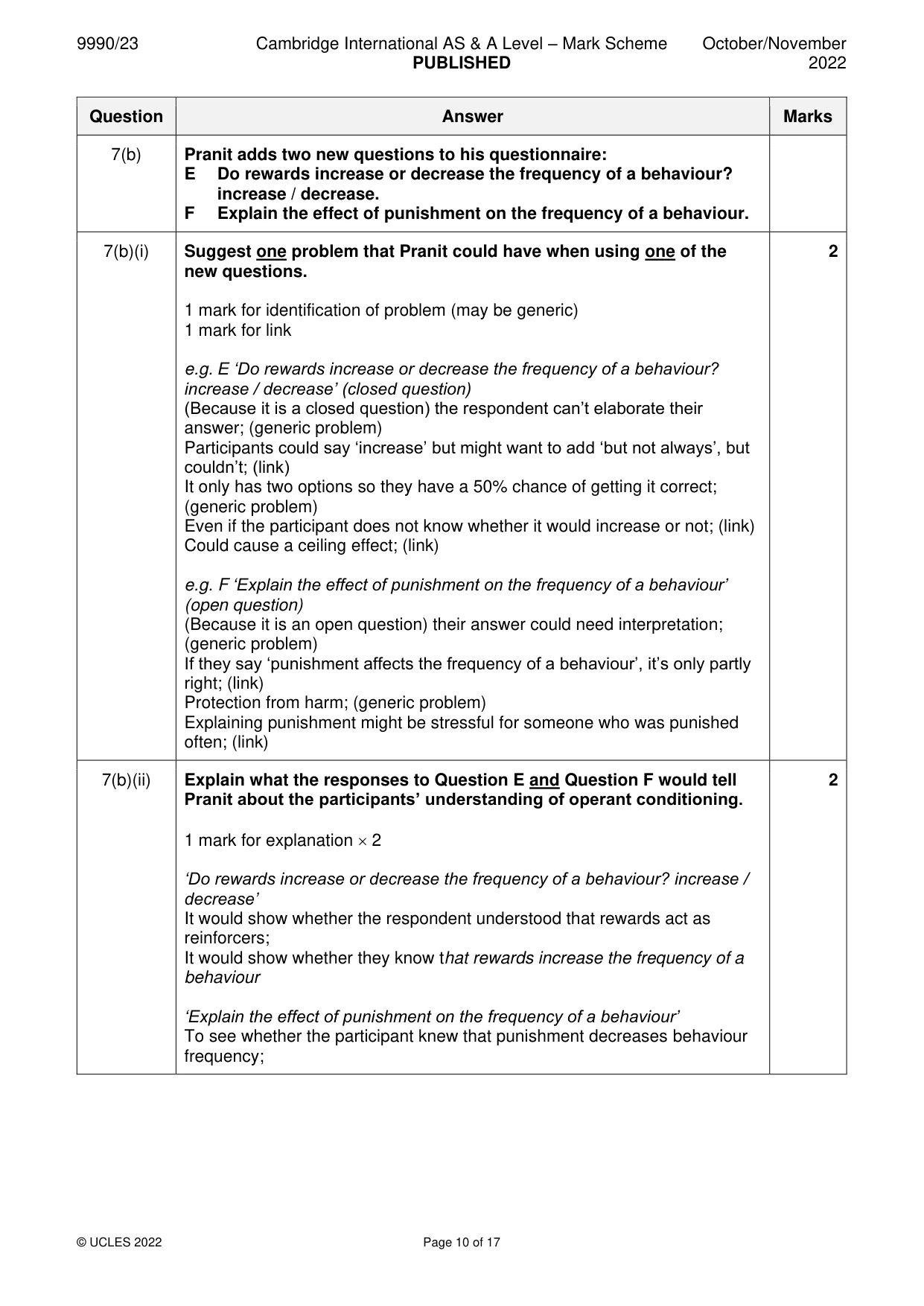
7 Pranit uses a questionnaire to investigate whether psychology students know more about operant conditioning than the general public. His questions are: A Describe what you think a ‘reward’ is and does. B Tell me what ‘punishment’ is and does. C “Rewards are more effective than punishment”. Do you agree? yes / no. D How sure are you that you could accurately explain ‘operant conditioning’? 1 = certainly could, 5 = certainly could not. (a) (i) Identify one closed question from A to D. ..................................................................................................................................... [1] (ii) Identify one open question from A to D. ..................................................................................................................................... [1] (b) (i) Pranit adds two new questions to his questionnaire: E Do rewards increase or decrease the frequency of a behaviour? increase / decrease. F Explain the effect of punishment on the frequency of a behaviour. Suggest one problem that Pranit could have when using one of the new questions. Question E or F: .......................... ........................................................................................................................................... ........................................................................................................................................... ........................................................................................................................................... ..................................................................................................................................... [2] (ii) Explain what the responses to Question E and Question F would tell Pranit about the participants’ understanding of operant conditioning. E ........................................................................................................................................ ........................................................................................................................................... ........................................................................................................................................... F ........................................................................................................................................ ........................................................................................................................................... ..................................................................................................................................... [2]
Mark scheme: 7 Pranit uses a questionnaire to investigate whether psychology students know more about operant conditioning than the general public. His questions are: A Describe what you think a ‘reward’ is and does. B Tell me what ‘punishment’ is and does. C ‘Rewards are more effective than punishment’. Do you agree? yes / no. D How sure are you that you could accurately explain ‘operant conditioning’? 1 = certainly could, 5 = certainly could not. 7(a)(i) Identify one closed question from A to D. 1 1 mark for C or D (definitive) Accept responses that have copied out the question instead of giving a letter 7(a)(ii) Identify one open question from A to D. 1 1 mark for A or B (definitive) Accept responses that have copied out the question instead of giving a letter 7(b) Pranit adds two new questions to his questionnaire: E Do rewards increase or decrease the frequency of a behaviour? increase / decrease. F Explain the effect of punishment on the frequency of a behaviour. 7(b)(i) Suggest one problem that Pranit could have when using one of the 2 new questions. 1 mark for identification of problem (may be generic) 1 mark for link e.g. E ‘Do rewards increase or decrease the frequency of a behaviour? increase / decrease’ (closed question) (Because it is a closed question) the respondent can’t elaborate their answer; (generic problem) Participants could say ‘increase’ but might want to add ‘but not always’, but couldn’t; (link) It only has two options so they have a 50% chance of getting it correct; (generic problem) Even if the participant does not know whether it would increase or not; (link) Could cause a ceiling effect; (link) e.g. F ‘Explain the effect of punishment on the frequency of a behaviour’ (open question) (Because it is an open question) their answer could need interpretation; (generic problem) If they say ‘punishment affects the frequency of a behaviour’, it’s only partly right; (link) Protection from harm; (generic problem) Explaining punishment might be stressful for someone who was punished often; (link) 7(b)(ii) Explain what the responses to Question E and Question F would tell 2 Pranit about the participants’ understanding of operant conditioning. 1 mark for explanation 2 ‘Do rewards increase or decrease the frequency of a behaviour? increase / decrease’ It would show whether the respondent understood that rewards act as reinforcers; It would show whether they know that rewards increase the frequency of a behaviour ‘Explain the effect of punishment on the frequency of a behaviour’ To see whether the participant knew that punishment decreases behaviour frequency;
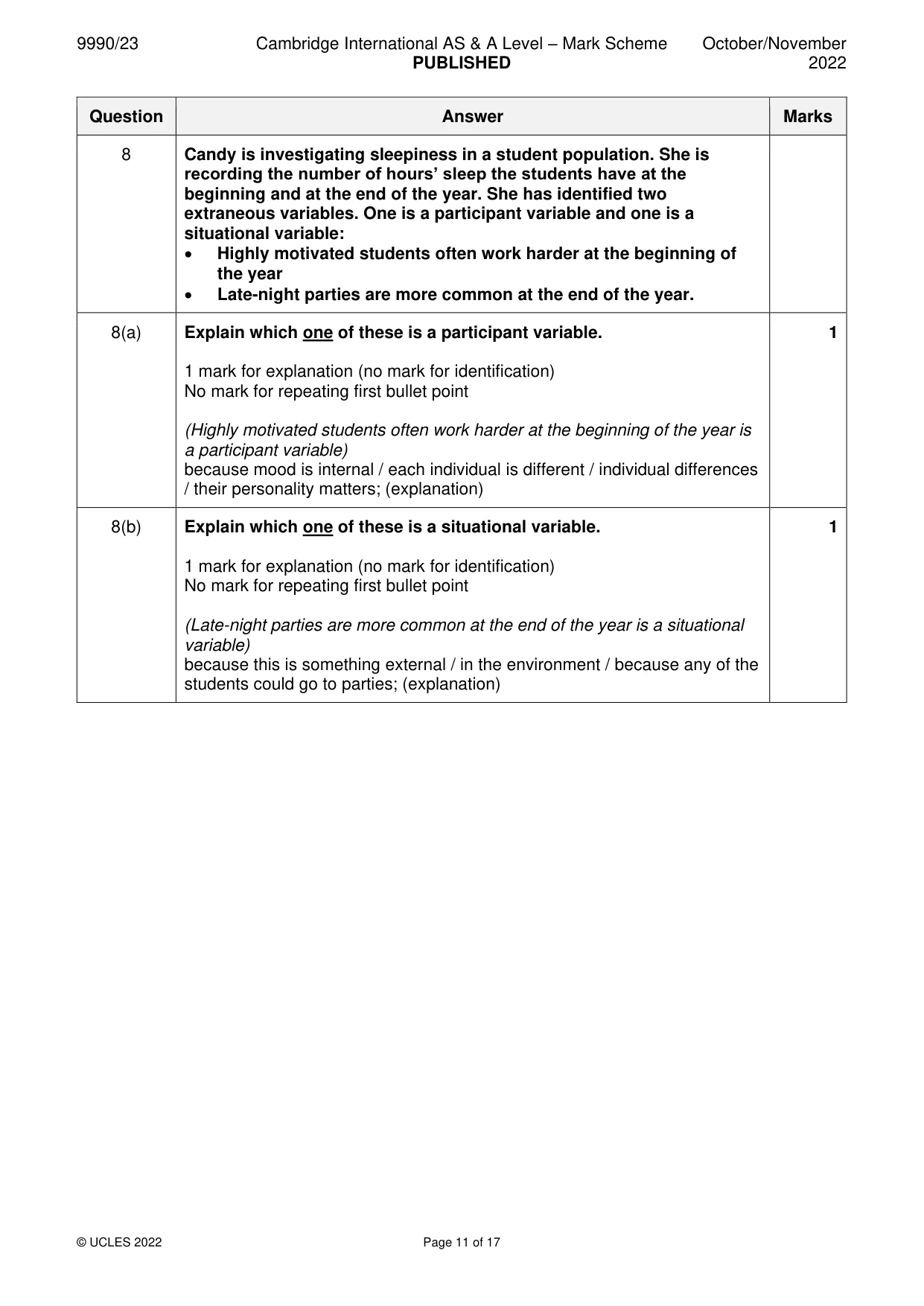
Q8 · Candy is investigating sleepiness in a student population
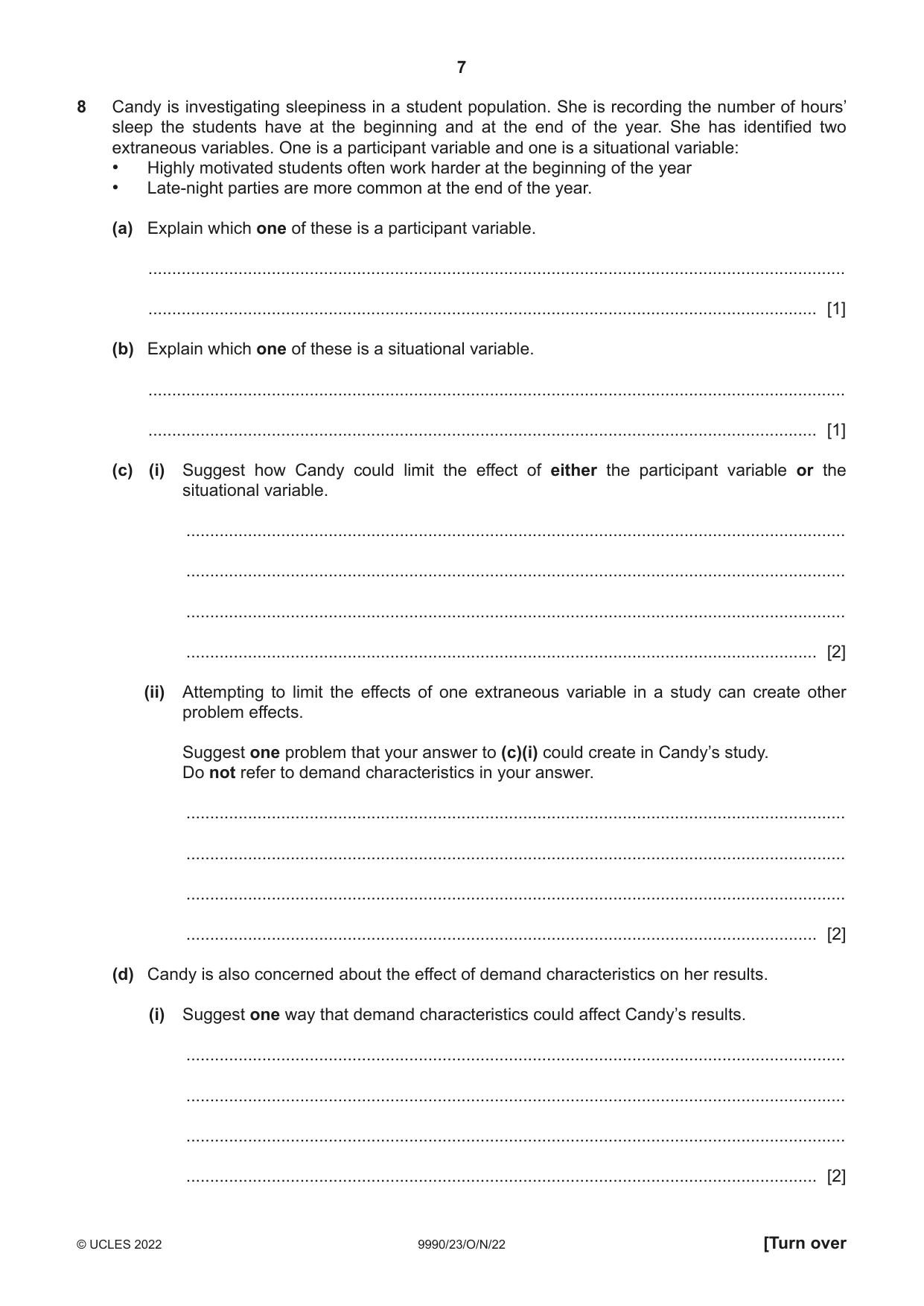
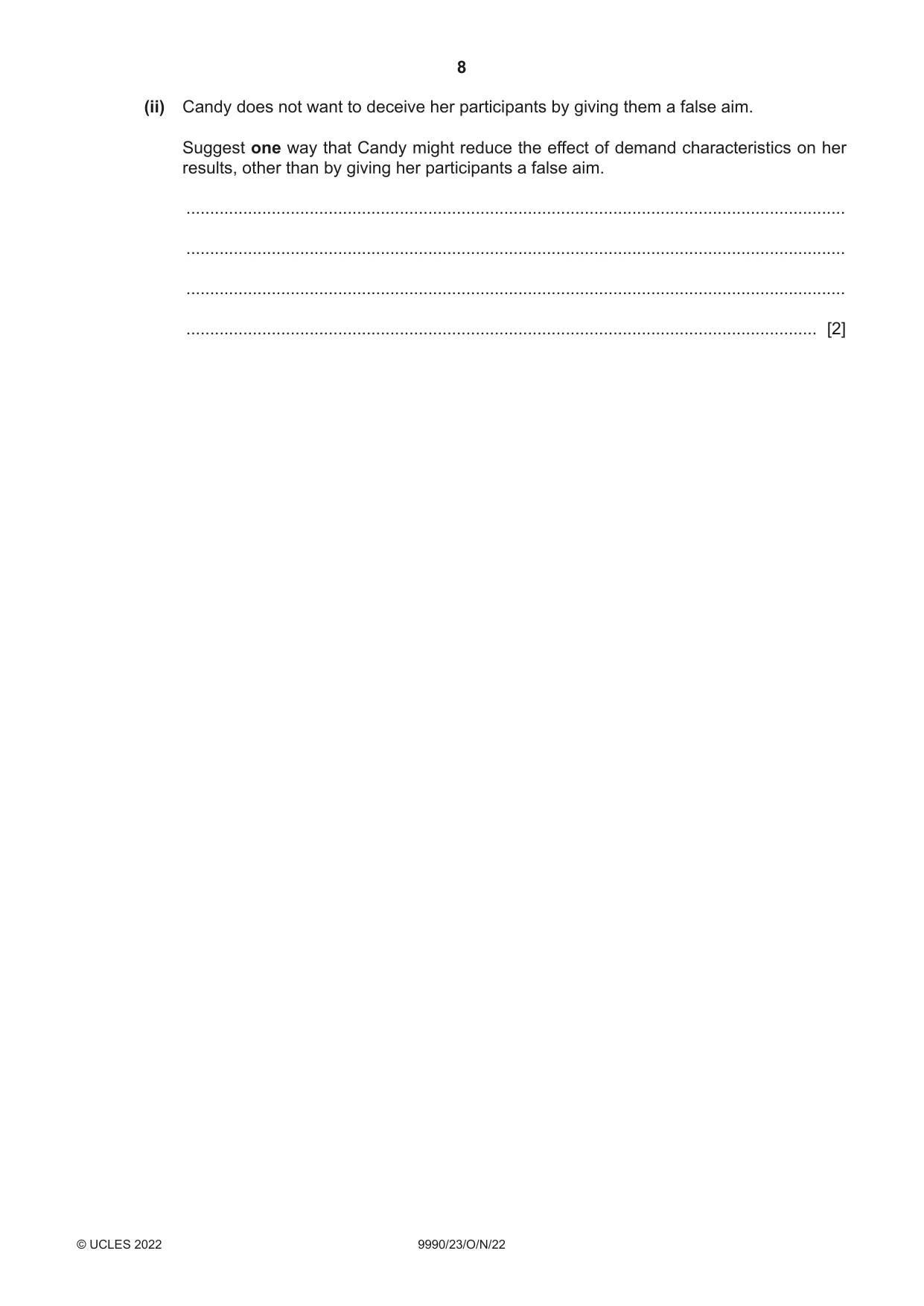
8 Candy is investigating sleepiness in a student population. She is recording the number of hours’ sleep the students have at the beginning and at the end of the year. She has identified two extraneous variables. One is a participant variable and one is a situational variable: • Highly motivated students often work harder at the beginning of the year • Late-night parties are more common at the end of the year. (a) Explain which one of these is a participant variable. ................................................................................................................................................... ............................................................................................................................................. [1] (b) Explain which one of these is a situational variable. ................................................................................................................................................... ............................................................................................................................................. [1] (c) (i) Suggest how Candy could limit the effect of either the participant variable or the situational variable. ........................................................................................................................................... ........................................................................................................................................... ........................................................................................................................................... ..................................................................................................................................... [2] (ii) Attempting to limit the effects of one extraneous variable in a study can create other problem effects. Suggest one problem that your answer to (c)(i) could create in Candy’s study. Do not refer to demand characteristics in your answer. ........................................................................................................................................... ........................................................................................................................................... ........................................................................................................................................... ..................................................................................................................................... [2] (d) Candy is also concerned about the effect of demand characteristics on her results. (i) Suggest one way that demand characteristics could affect Candy’s results. ........................................................................................................................................... ........................................................................................................................................... ........................................................................................................................................... ..................................................................................................................................... [2] (ii) Candy does not want to deceive her participants by giving them a false aim. Suggest one way that Candy might reduce the effect of demand characteristics on her results, other than by giving her participants a false aim. ........................................................................................................................................... ........................................................................................................................................... ........................................................................................................................................... ..................................................................................................................................... [2]
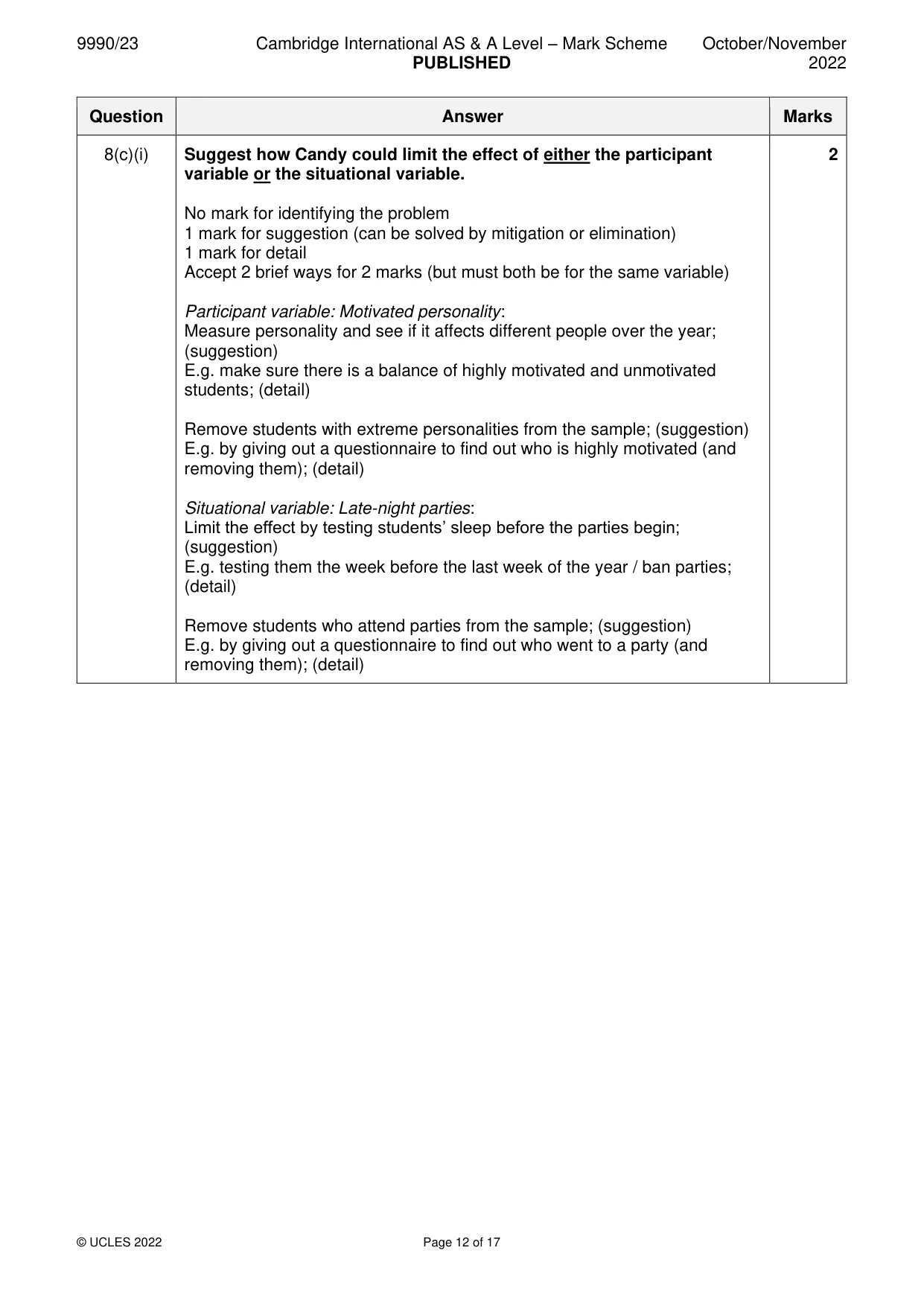
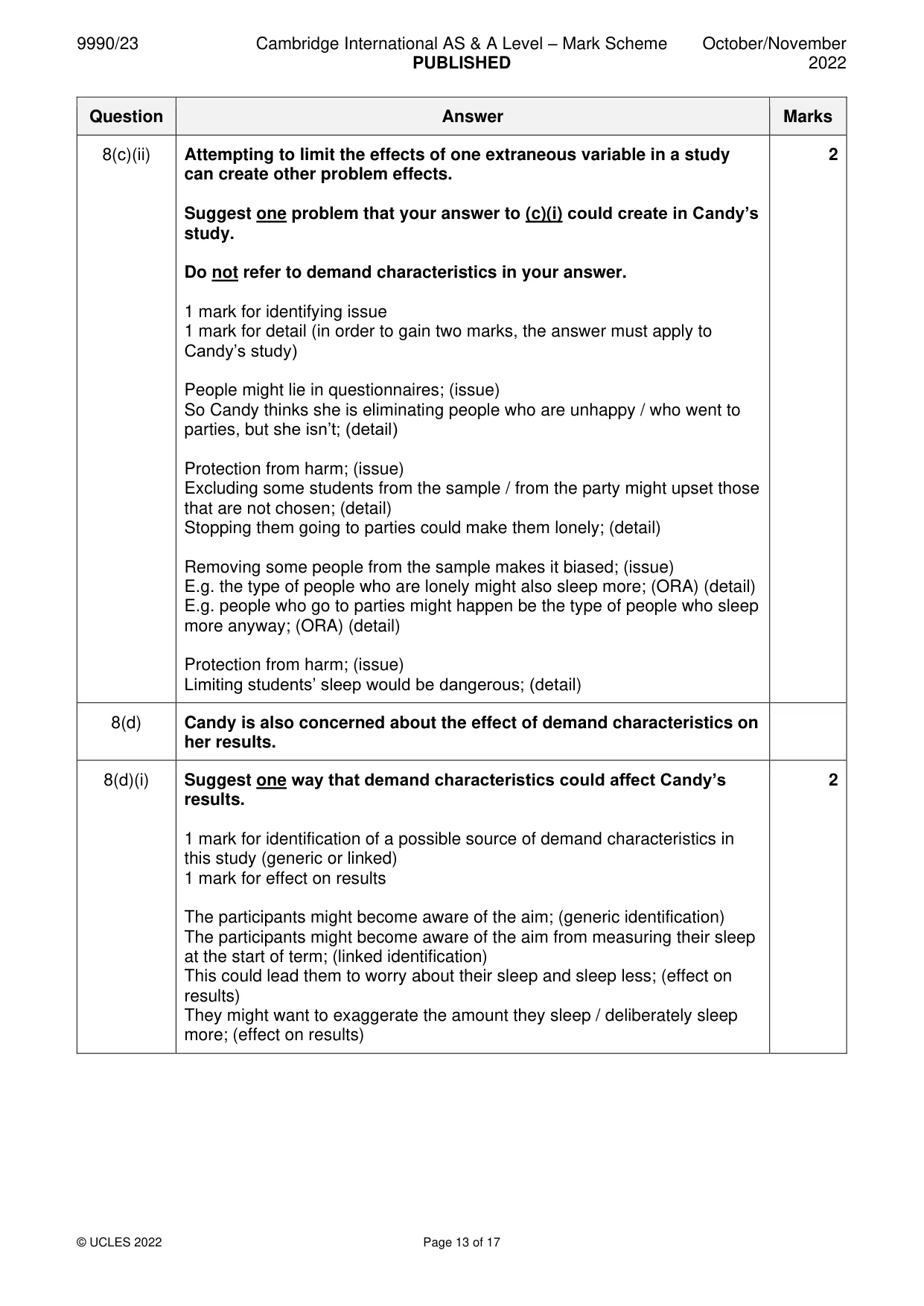
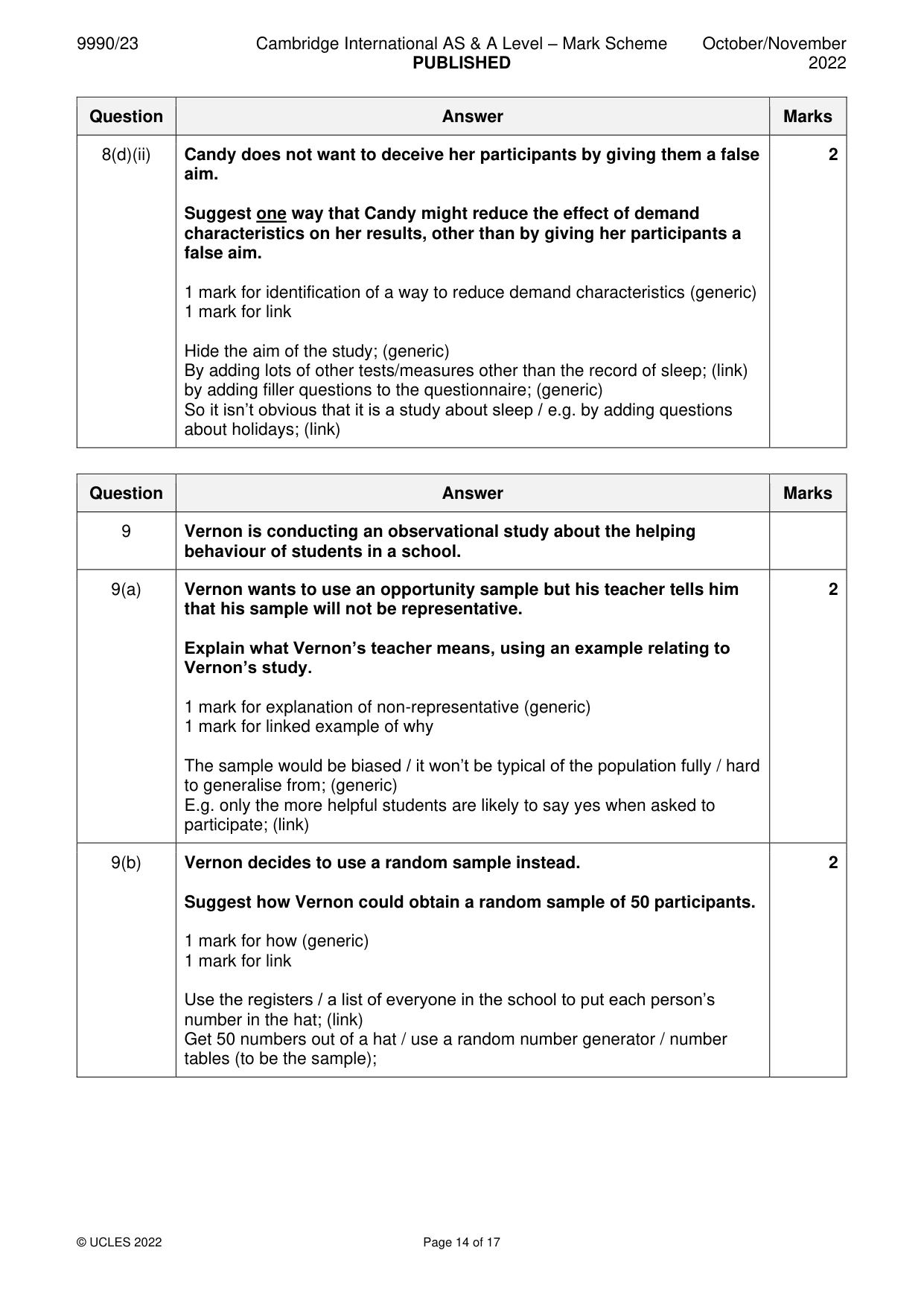
Mark scheme: 8 Candy is investigating sleepiness in a student population. She is recording the number of hours’ sleep the students have at the beginning and at the end of the year. She has identified two extraneous variables. One is a participant variable and one is a situational variable: • Highly motivated students often work harder at the beginning of the year • Late-night parties are more common at the end of the year. 8(a) Explain which one of these is a participant variable. 1 1 mark for explanation (no mark for identification) No mark for repeating first bullet point (Highly motivated students often work harder at the beginning of the year is a participant variable) because mood is internal / each individual is different / individual differences / their personality matters; (explanation) 8(b) Explain which one of these is a situational variable. 1 1 mark for explanation (no mark for identification) No mark for repeating first bullet point (Late-night parties are more common at the end of the year is a situational variable) because this is something external / in the environment / because any of the students could go to parties; (explanation) 8(c)(i) Suggest how Candy could limit the effect of either the participant 2 variable or the situational variable. No mark for identifying the problem 1 mark for suggestion (can be solved by mitigation or elimination) 1 mark for detail Accept 2 brief ways for 2 marks (but must both be for the same variable) Participant variable: Motivated personality: Measure personality and see if it affects different people over the year; (suggestion) E.g. make sure there is a balance of highly motivated and unmotivated students; (detail) Remove students with extreme personalities from the sample; (suggestion) E.g. by giving out a questionnaire to find out who is highly motivated (and removing them); (detail) Situational variable: Late-night parties: Limit the effect by testing students’ sleep before the parties begin; (suggestion) E.g. testing them the week before the last week of the year / ban parties; (detail) Remove students who attend parties from the sample; (suggestion) E.g. by giving out a questionnaire to find out who went to a party (and removing them); (detail) 8(c)(ii) Attempting to limit the effects of one extraneous variable in a study 2 can create other problem effects. Suggest one problem that your answer to (c)(i) could create in Candy’s study. Do not refer to demand characteristics in your answer. 1 mark for identifying issue 1 mark for detail (in order to gain two marks, the answer must apply to Candy’s study) People might lie in questionnaires; (issue) So Candy thinks she is eliminating people who are unhappy / who went to parties, but she isn’t; (detail) Protection from harm; (issue) Excluding some students from the sample / from the party might upset those that are not chosen; (detail) Stopping them going to parties could make them lonely; (detail) Removing some people from the sample makes it biased; (issue) E.g. the type of people who are lonely might also sleep more; (ORA) (detail) E.g. people who go to parties might happen be the type of people who sleep more anyway; (ORA) (detail) Protection from harm; (issue) Limiting students’ sleep would be dangerous; (detail) 8(d) Candy is also concerned about the effect of demand characteristics on her results. 8(d)(i) Suggest one way that demand characteristics could affect Candy’s 2 results. 1 mark for identification of a possible source of demand characteristics in this study (generic or linked) 1 mark for effect on results The participants might become aware of the aim; (generic identification) The participants might become aware of the aim from measuring their sleep at the start of term; (linked identification) This could lead them to worry about their sleep and sleep less; (effect on results) They might want to exaggerate the amount they sleep / deliberately sleep more; (effect on results) 8(d)(ii) Candy does not want to deceive her participants by giving them a false 2 aim. Suggest one way that Candy might reduce the effect of demand characteristics on her results, other than by giving her participants a false aim. 1 mark for identification of a way to reduce demand characteristics (generic) 1 mark for link Hide the aim of the study; (generic) By adding lots of other tests/measures other than the record of sleep; (link) by adding filler questions to the questionnaire; (generic) So it isn’t obvious that it is a study about sleep / e.g. by adding questions about holidays; (link)
Q9 · Vernon is conducting an observational study about the helping behaviour of students in a…
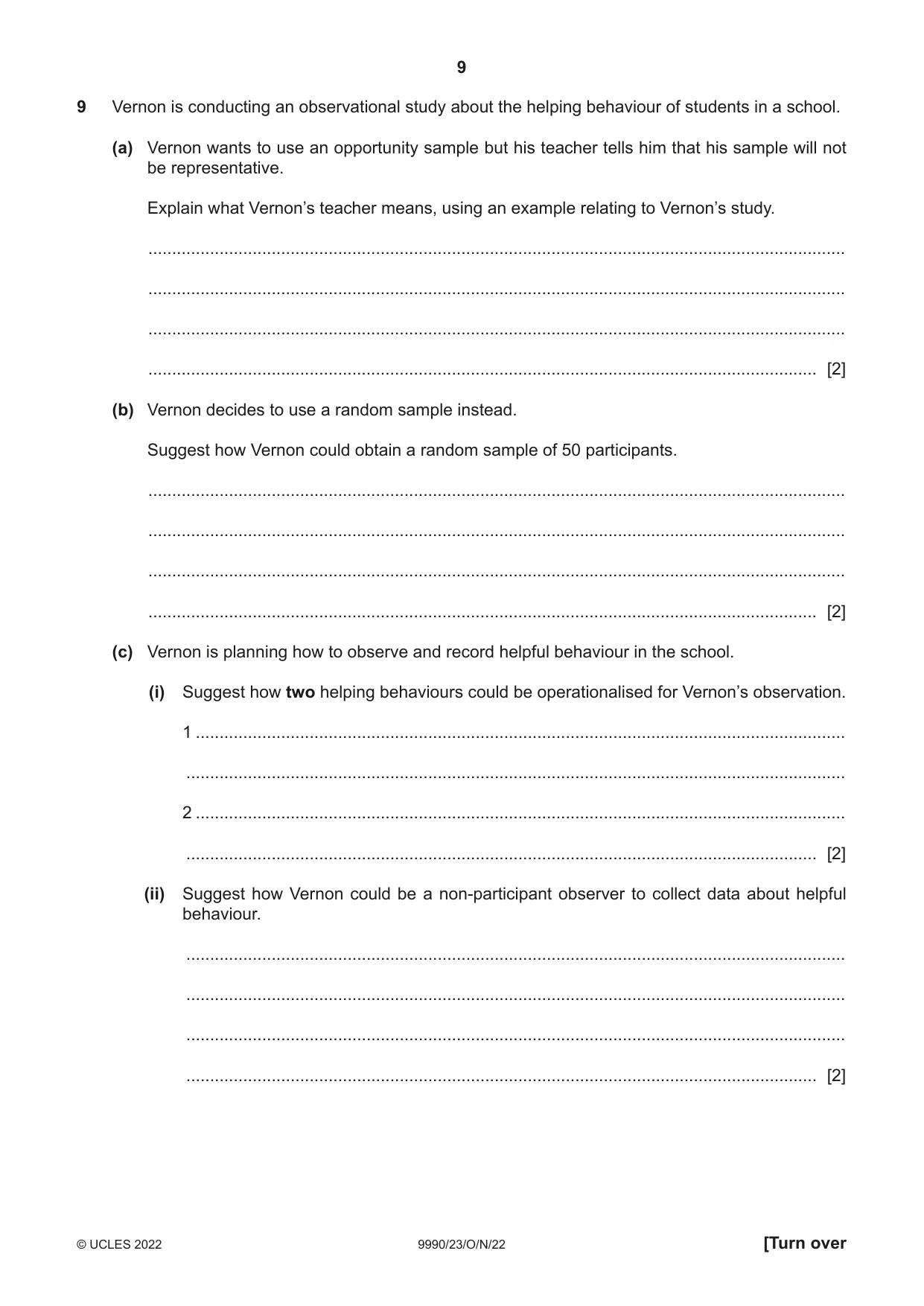
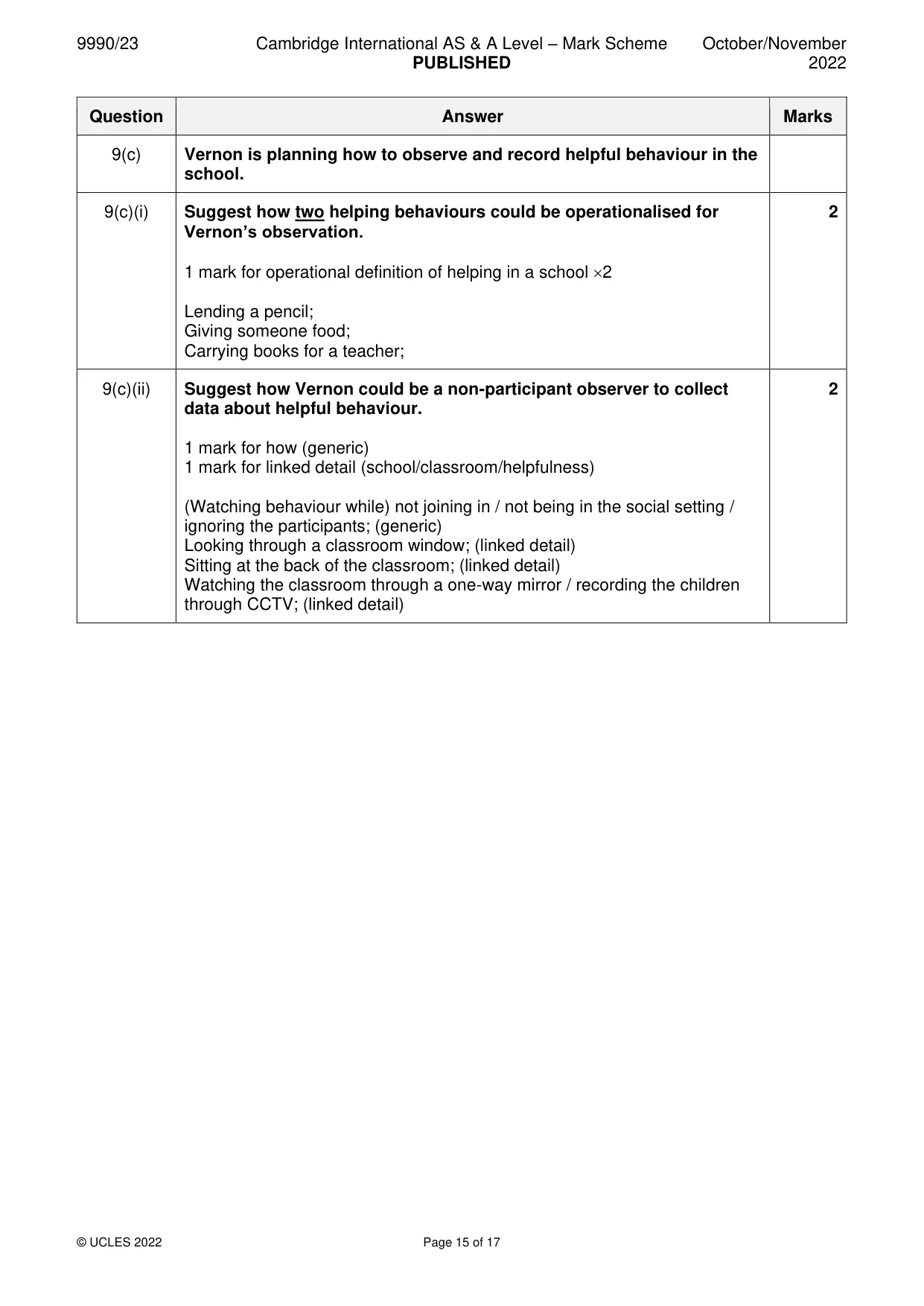
9 Vernon is conducting an observational study about the helping behaviour of students in a school. (a) Vernon wants to use an opportunity sample but his teacher tells him that his sample will not be representative. Explain what Vernon’s teacher means, using an example relating to Vernon’s study. ................................................................................................................................................... ................................................................................................................................................... ................................................................................................................................................... ............................................................................................................................................. [2] (b) Vernon decides to use a random sample instead. Suggest how Vernon could obtain a random sample of 50 participants. ................................................................................................................................................... ................................................................................................................................................... ................................................................................................................................................... ............................................................................................................................................. [2] (c) Vernon is planning how to observe and record helpful behaviour in the school. (i) Suggest how two helping behaviours could be operationalised for Vernon’s observation. 1 ......................................................................................................................................... ........................................................................................................................................... 2 ......................................................................................................................................... ..................................................................................................................................... [2] (ii) Suggest how Vernon could be a non-participant observer to collect data about helpful behaviour. ........................................................................................................................................... ........................................................................................................................................... ........................................................................................................................................... ..................................................................................................................................... [2] Section C Answer all questions in this section.
Mark scheme: 9 Vernon is conducting an observational study about the helping behaviour of students in a school. 9(a) Vernon wants to use an opportunity sample but his teacher tells him 2 that his sample will not be representative. Explain what Vernon’s teacher means, using an example relating to Vernon’s study. 1 mark for explanation of non-representative (generic) 1 mark for linked example of why The sample would be biased / it won’t be typical of the population fully / hard to generalise from; (generic) E.g. only the more helpful students are likely to say yes when asked to participate; (link) 9(b) Vernon decides to use a random sample instead. 2 Suggest how Vernon could obtain a random sample of 50 participants. 1 mark for how (generic) 1 mark for link Use the registers / a list of everyone in the school to put each person’s number in the hat; (link) Get 50 numbers out of a hat / use a random number generator / number tables (to be the sample); 9(c) Vernon is planning how to observe and record helpful behaviour in the school. 9(c)(i) Suggest how two helping behaviours could be operationalised for 2 Vernon’s observation. 1 mark for operational definition of helping in a school 2 Lending a pencil; Giving someone food; Carrying books for a teacher; 9(c)(ii) Suggest how Vernon could be a non-participant observer to collect 2 data about helpful behaviour. 1 mark for how (generic) 1 mark for linked detail (school/classroom/helpfulness) (Watching behaviour while) not joining in / not being in the social setting / ignoring the participants; (generic) Looking through a classroom window; (linked detail) Sitting at the back of the classroom; (linked detail) Watching the classroom through a one-way mirror / recording the children through CCTV; (linked detail)
Q10 · Meena wants to investigate one child in a class who is very resistant to authority and is…
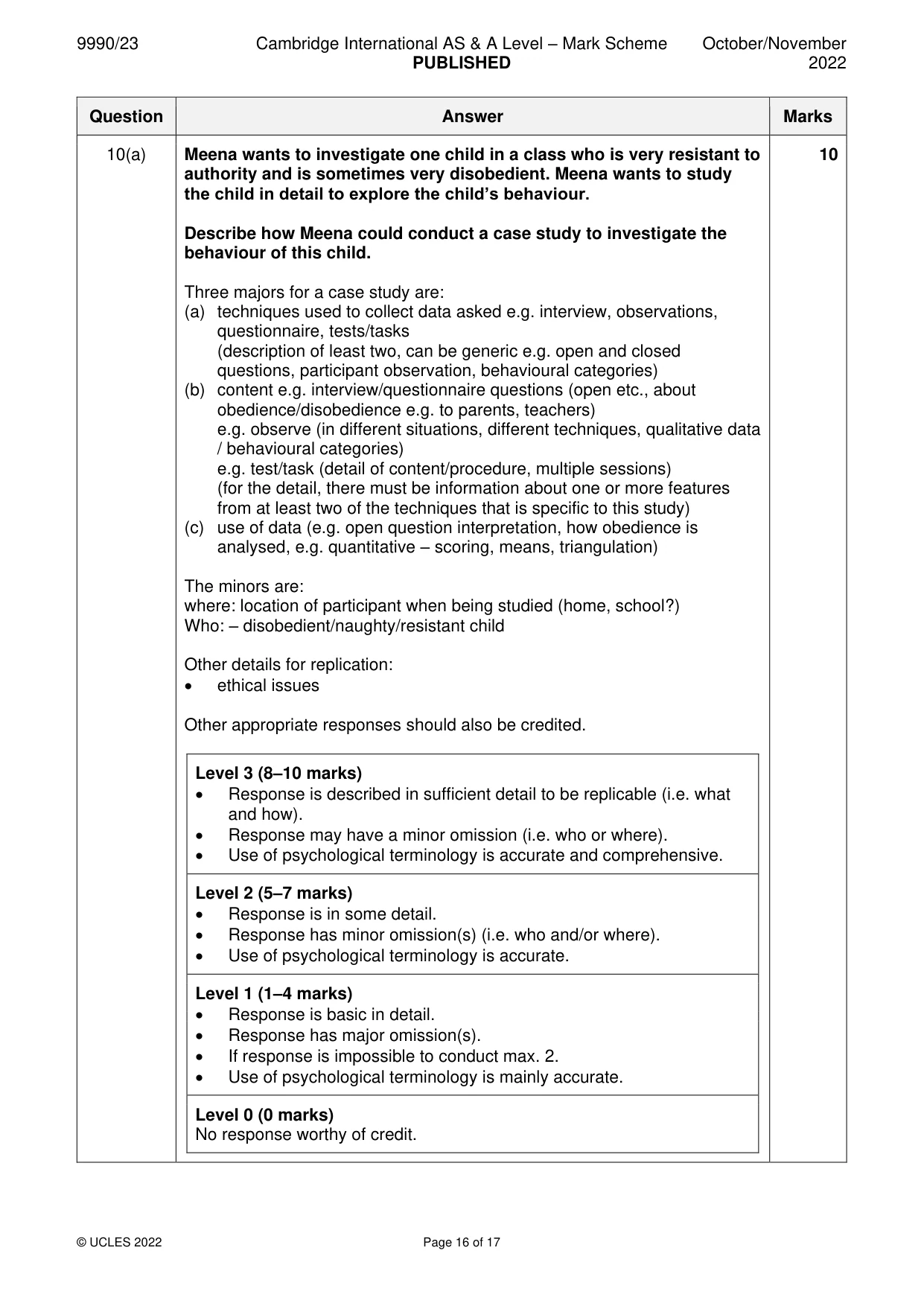
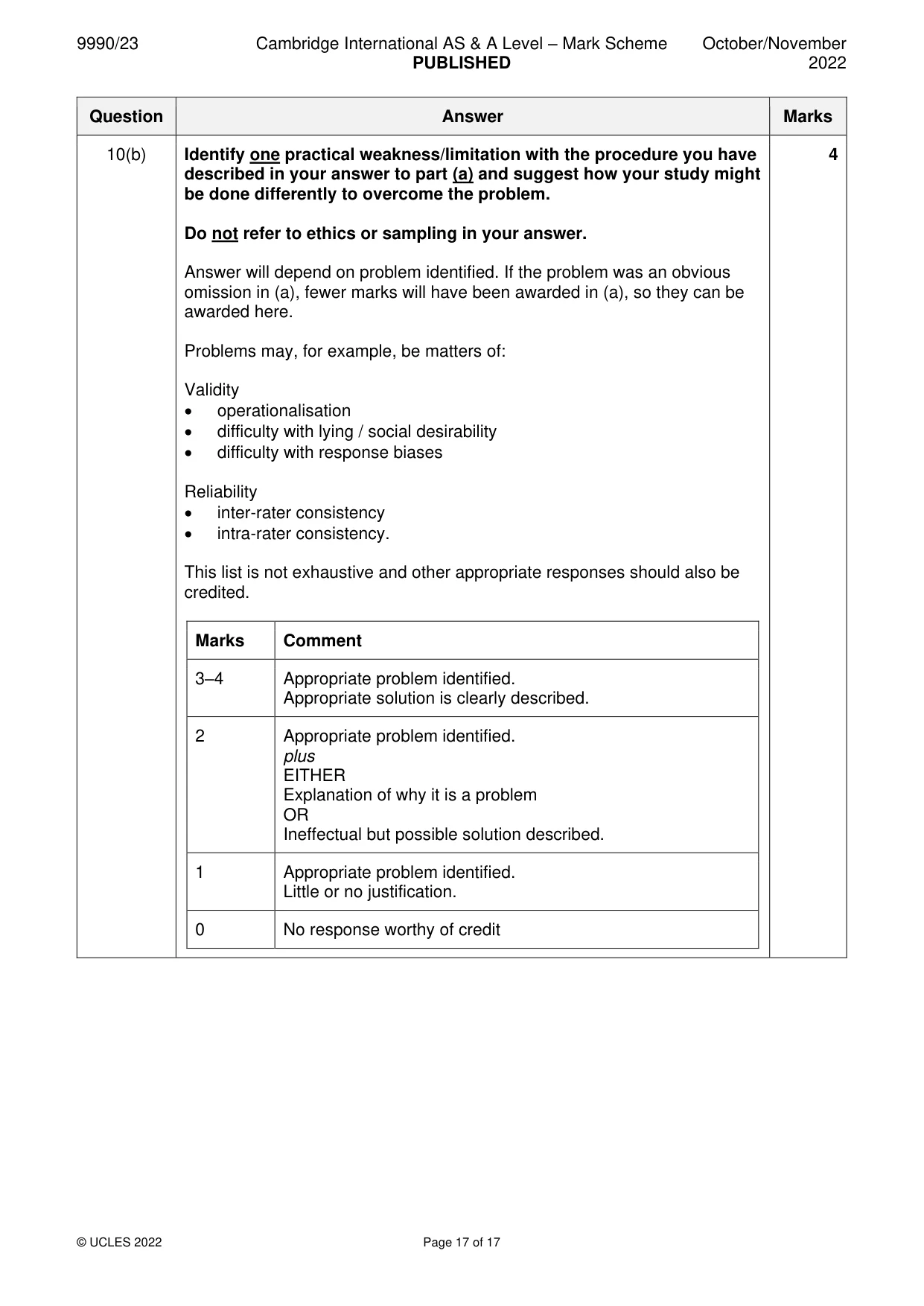
10 Meena wants to investigate one child in a class who is very resistant to authority and is sometimes very disobedient. Meena wants to study the child in detail to explore the child’s behaviour. (a) Describe how Meena could conduct a case study to investigate the behaviour of this child. ................................................................................................................................................... ................................................................................................................................................... ................................................................................................................................................... ................................................................................................................................................... ................................................................................................................................................... ................................................................................................................................................... ................................................................................................................................................... ................................................................................................................................................... ................................................................................................................................................... ................................................................................................................................................... ................................................................................................................................................... ................................................................................................................................................... ................................................................................................................................................... ................................................................................................................................................... ................................................................................................................................................... ................................................................................................................................................... ................................................................................................................................................... ................................................................................................................................................... ................................................................................................................................................... ................................................................................................................................................... ................................................................................................................................................... ................................................................................................................................................... ................................................................................................................................................... ................................................................................................................................................... ................................................................................................................................................... ................................................................................................................................................... ................................................................................................................................................... ................................................................................................................................................... ................................................................................................................................................... ................................................................................................................................................... ................................................................................................................................................... ................................................................................................................................................... ................................................................................................................................................... ........................................................................................................................................... [10] (b) Identify one practical weakness/limitation with the procedure you have described in your answer to part (a) and suggest how your study might be done differently to overcome the problem. Do not refer to ethics or sampling in your answer. ................................................................................................................................................... ................................................................................................................................................... ................................................................................................................................................... ................................................................................................................................................... ................................................................................................................................................... ................................................................................................................................................... ................................................................................................................................................... ............................................................................................................................................. [4]
Mark scheme: 10(a) Meena wants to investigate one child in a class who is very resistant to 10 authority and is sometimes very disobedient. Meena wants to study the child in detail to explore the child’s behaviour. Describe how Meena could conduct a case study to investigate the behaviour of this child. Three majors for a case study are: (a) techniques used to collect data asked e.g. interview, observations, questionnaire, tests/tasks (description of least two, can be generic e.g. open and closed questions, participant observation, behavioural categories) (b) content e.g. interview/questionnaire questions (open etc., about obedience/disobedience e.g. to parents, teachers) e.g. observe (in different situations, different techniques, qualitative data / behavioural categories) e.g. test/task (detail of content/procedure, multiple sessions) (for the detail, there must be information about one or more features from at least two of the techniques that is specific to this study) (c) use of data (e.g. open question interpretation, how obedience is analysed, e.g. quantitative – scoring, means, triangulation) The minors are: where: location of participant when being studied (home, school?) Who: – disobedient/naughty/resistant child Other details for replication: • ethical issues Other appropriate responses should also be credited. Level 3 (8–10 marks) • Response is described in sufficient detail to be replicable (i.e. what and how). • Response may have a minor omission (i.e. who or where). • Use of psychological terminology is accurate and comprehensive. Level 2 (5–7 marks) • Response is in some detail. • Response has minor omission(s) (i.e. who and/or where). • Use of psychological terminology is accurate. Level 1 (1–4 marks) • Response is basic in detail. • Response has major omission(s). • If response is impossible to conduct max. 2. • Use of psychological terminology is mainly accurate. Level 0 (0 marks) No response worthy of credit. 10(b) Identify one practical weakness/limitation with the procedure you have 4 described in your answer to part (a) and suggest how your study might be done differently to overcome the problem. Do not refer to ethics or sampling in your answer. Answer will depend on problem identified. If the problem was an obvious omission in (a), fewer marks will have been awarded in (a), so they can be awarded here. Problems may, for example, be matters of: Validity • operationalisation • difficulty with lying / social desirability • difficulty with response biases Reliability • inter-rater consistency • intra-rater consistency. This list is not exhaustive and other appropriate responses should also be credited. Marks Comment 3–4 Appropriate problem identified. Appropriate solution is clearly described. 2 Appropriate problem identified. plus EITHER Explanation of why it is a problem OR Ineffectual but possible solution described. 1 Appropriate problem identified. Little or no justification. 0 No response worthy of credit
What was in this paper
The subtopics covered by these 10 questions, and how many questions each got. Open one in a new tab to see every Cambridge question on it.
What you needed in this session
Cambridge’s own grade thresholds for 2022 Oct/Nov, Paper 2 · Variant 3. A higher threshold means an easier paper — the bar moves with how the cohort did.