Cambridge A Level Psychology (from 2018) 9990 — 2022 Oct/Nov Paper 2 · Variant 2
9990/22/O/N/22 · 10 questions · 60 marks · ≈68 min
The question paper and its mark scheme, free to read here and free to download. This is Cambridge’s own paper, exactly as it was sat.
Question paper12 pages
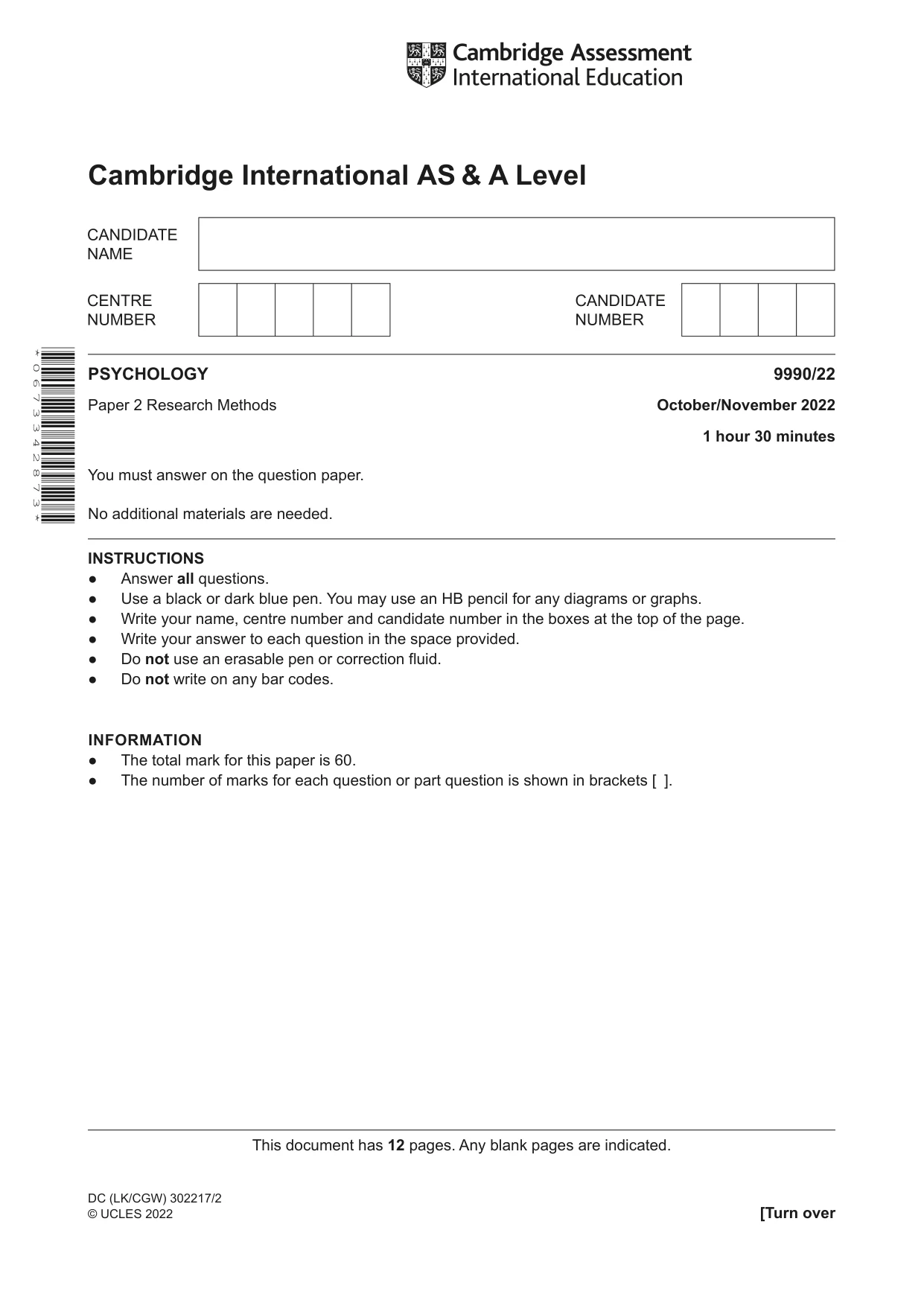

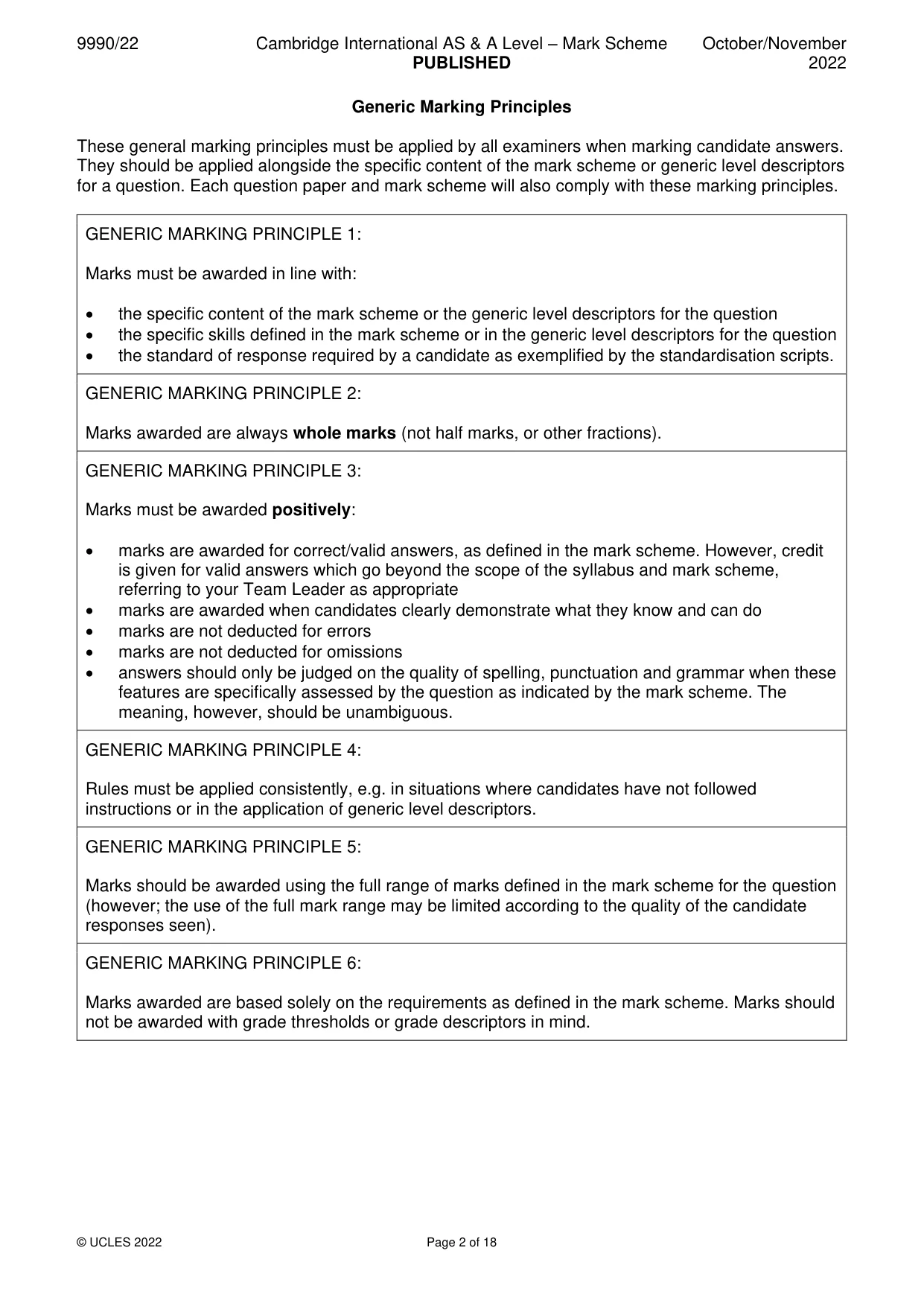
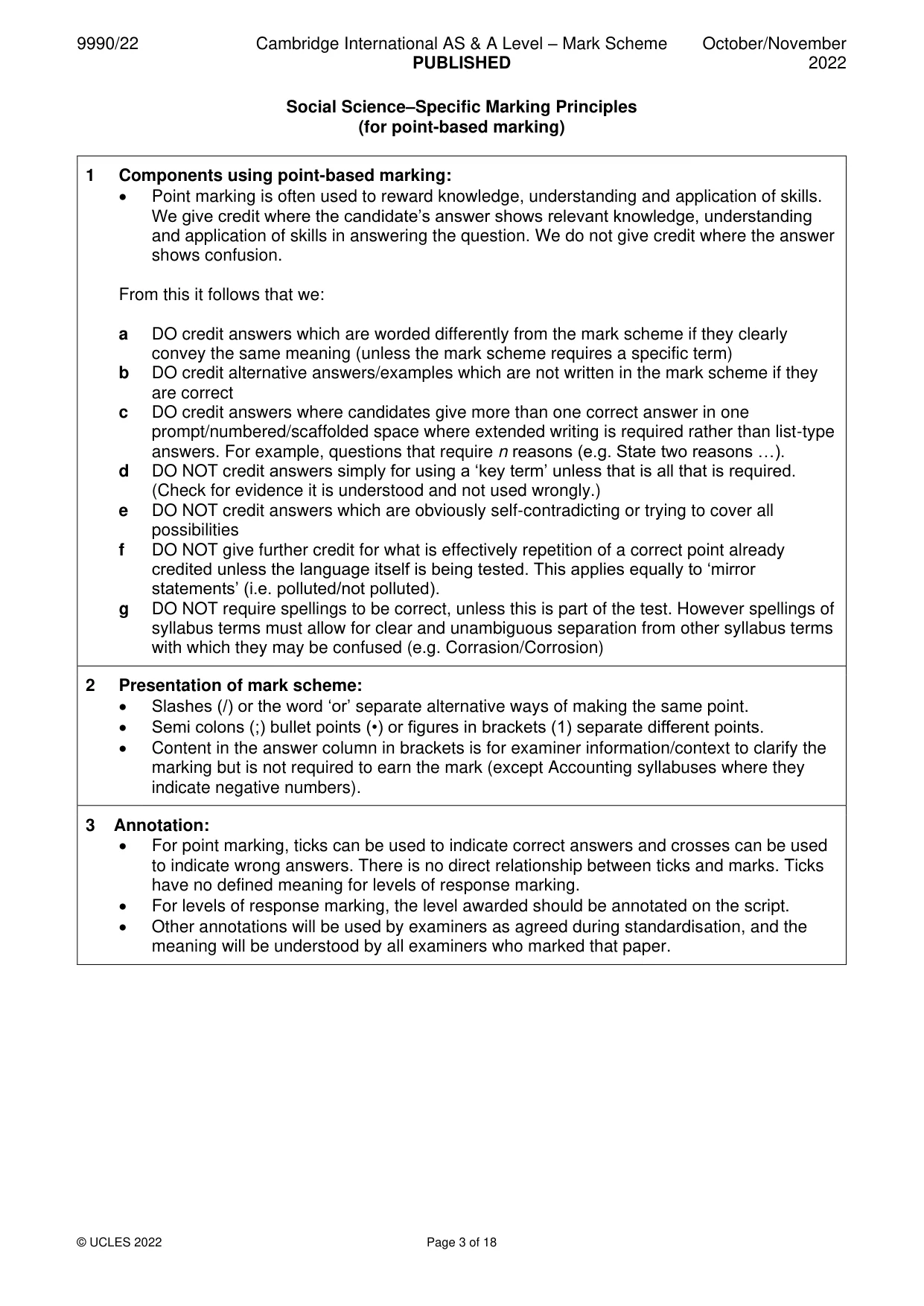
Mark scheme18 pages
Answers below. Sit the paper first if you are practising.
Questions as text
Q1 · The hypothesis for a study is ‘Adults with children worry more than adults without…
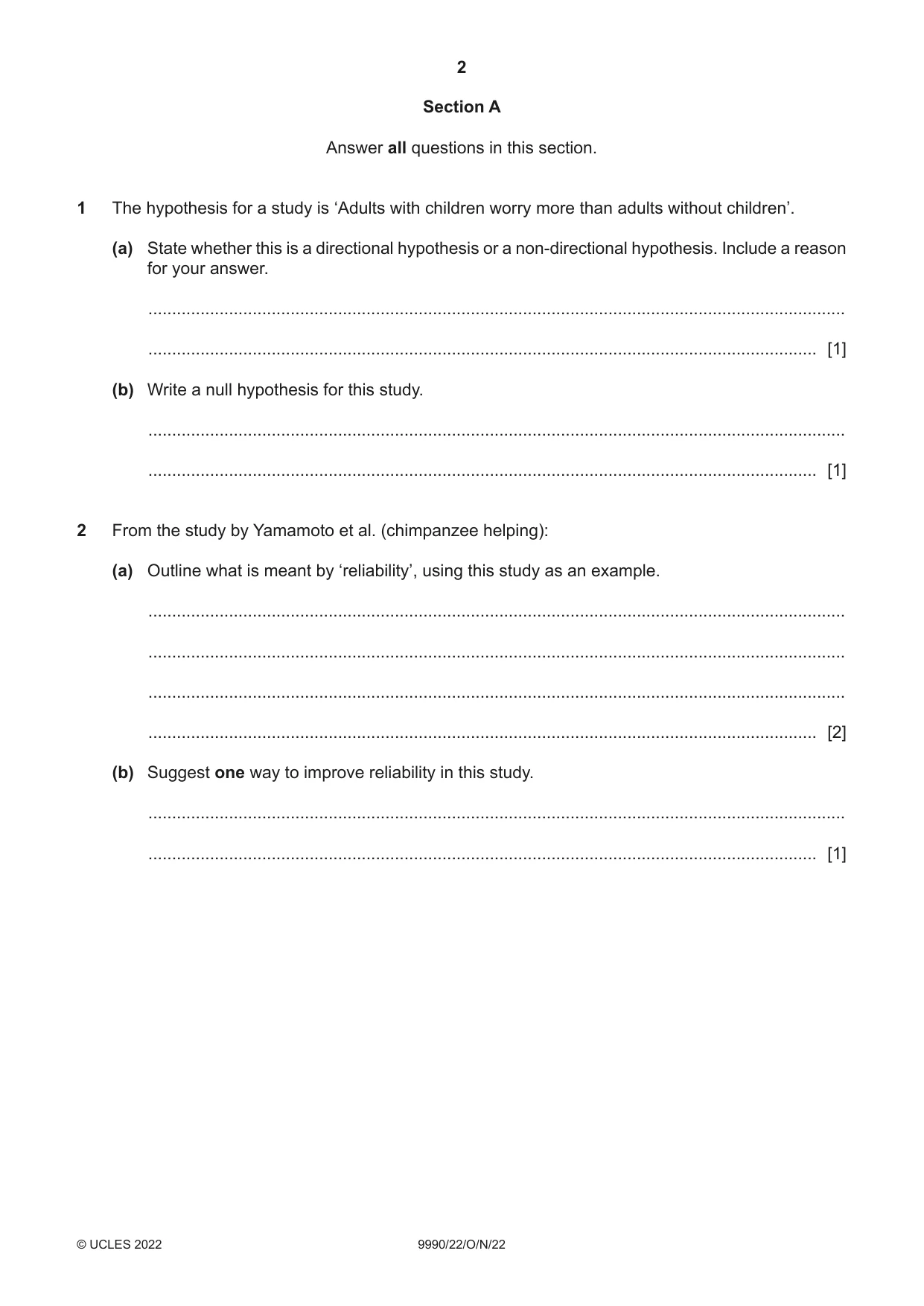
1 The hypothesis for a study is ‘Adults with children worry more than adults without children’. (a) State whether this is a directional hypothesis or a non-directional hypothesis. Include a reason for your answer. ................................................................................................................................................... ............................................................................................................................................. [1] (b) Write a null hypothesis for this study. ................................................................................................................................................... ............................................................................................................................................. [1]
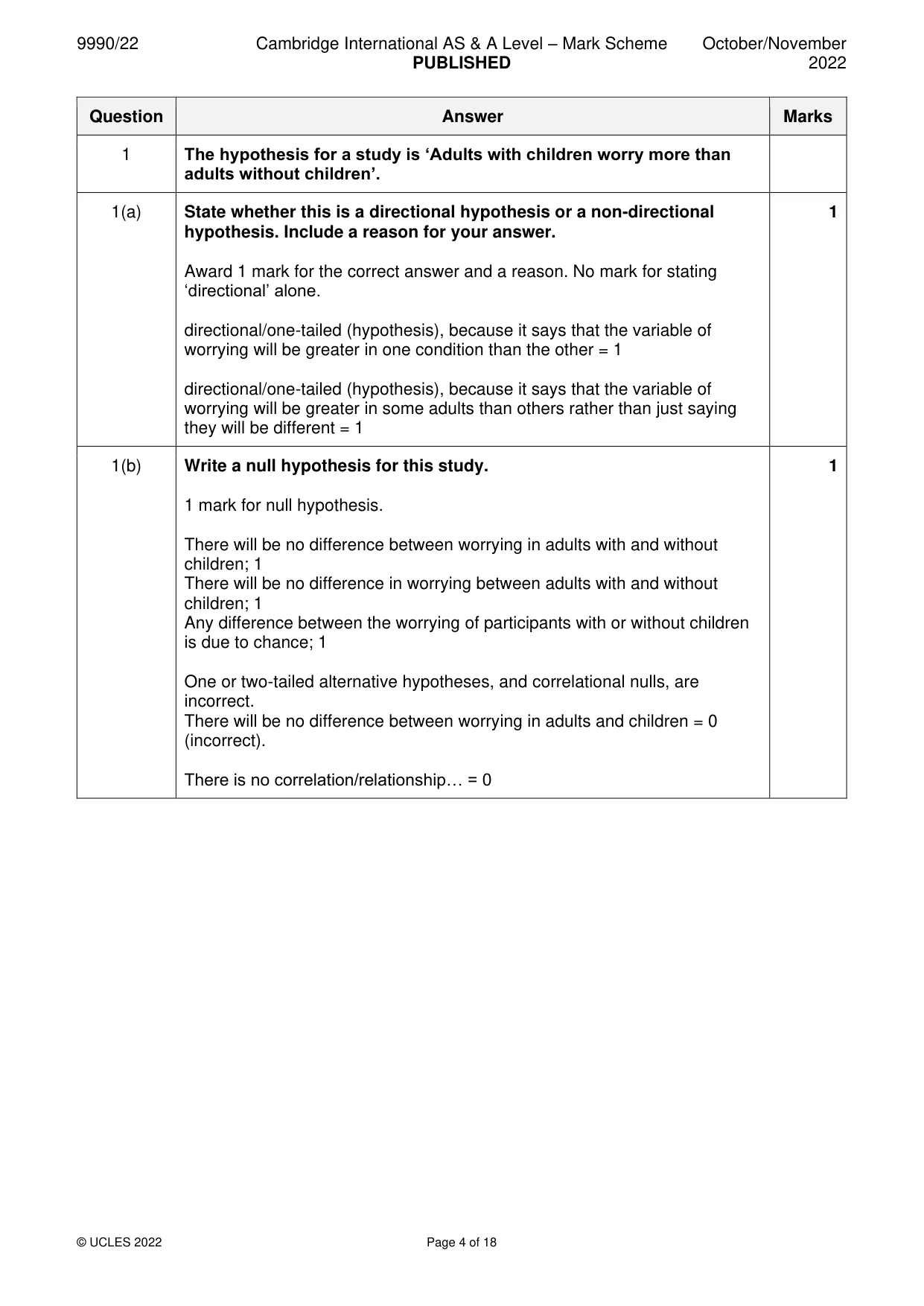
Mark scheme: Question Answer Marks 1 The hypothesis for a study is ‘Adults with children worry more than adults without children’. 1(a) State whether this is a directional hypothesis or a non-directional 1 hypothesis. Include a reason for your answer. Award 1 mark for the correct answer and a reason. No mark for stating ‘directional’ alone. directional/one-tailed (hypothesis), because it says that the variable of worrying will be greater in one condition than the other = 1 directional/one-tailed (hypothesis), because it says that the variable of worrying will be greater in some adults than others rather than just saying they will be different = 1 1(b) Write a null hypothesis for this study. 1 1 mark for null hypothesis. There will be no difference between worrying in adults with and without children; 1 There will be no difference in worrying between adults with and without children; 1 Any difference between the worrying of participants with or without children is due to chance; 1 One or two-tailed alternative hypotheses, and correlational nulls, are incorrect. There will be no difference between worrying in adults and children = 0 (incorrect). There is no correlation/relationship… = 0
Q2 · From the study by Yamamoto et al
2 From the study by Yamamoto et al. (chimpanzee helping): (a) Outline what is meant by ‘reliability’, using this study as an example. ................................................................................................................................................... ................................................................................................................................................... ................................................................................................................................................... ............................................................................................................................................. [2] (b) Suggest one way to improve reliability in this study. ................................................................................................................................................... ............................................................................................................................................. [1]
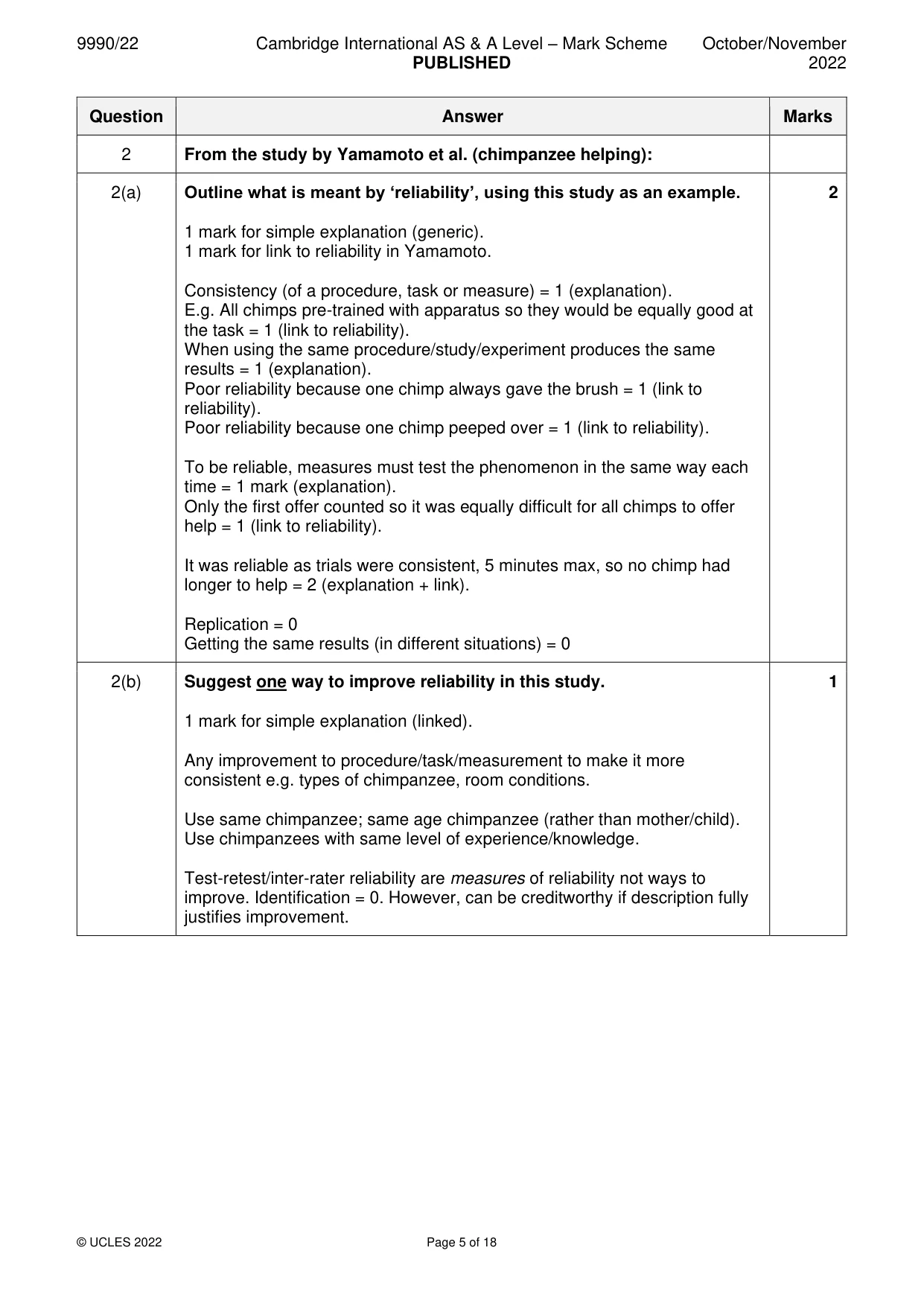
Mark scheme: 2 From the study by Yamamoto et al. (chimpanzee helping): 2(a) Outline what is meant by ‘reliability’, using this study as an example. 2 1 mark for simple explanation (generic). 1 mark for link to reliability in Yamamoto. Consistency (of a procedure, task or measure) = 1 (explanation). E.g. All chimps pre-trained with apparatus so they would be equally good at the task = 1 (link to reliability). When using the same procedure/study/experiment produces the same results = 1 (explanation). Poor reliability because one chimp always gave the brush = 1 (link to reliability). Poor reliability because one chimp peeped over = 1 (link to reliability). To be reliable, measures must test the phenomenon in the same way each time = 1 mark (explanation). Only the first offer counted so it was equally difficult for all chimps to offer help = 1 (link to reliability). It was reliable as trials were consistent, 5 minutes max, so no chimp had longer to help = 2 (explanation + link). Replication = 0 Getting the same results (in different situations) = 0 2(b) Suggest one way to improve reliability in this study. 1 1 mark for simple explanation (linked). Any improvement to procedure/task/measurement to make it more consistent e.g. types of chimpanzee, room conditions. Use same chimpanzee; same age chimpanzee (rather than mother/child). Use chimpanzees with same level of experience/knowledge. Test-retest/inter-rater reliability are measures of reliability not ways to improve. Identification = 0. However, can be creditworthy if description fully justifies improvement.
Q3 · In the study by Pepperberg (parrot learning), quantitative data was collected from the…
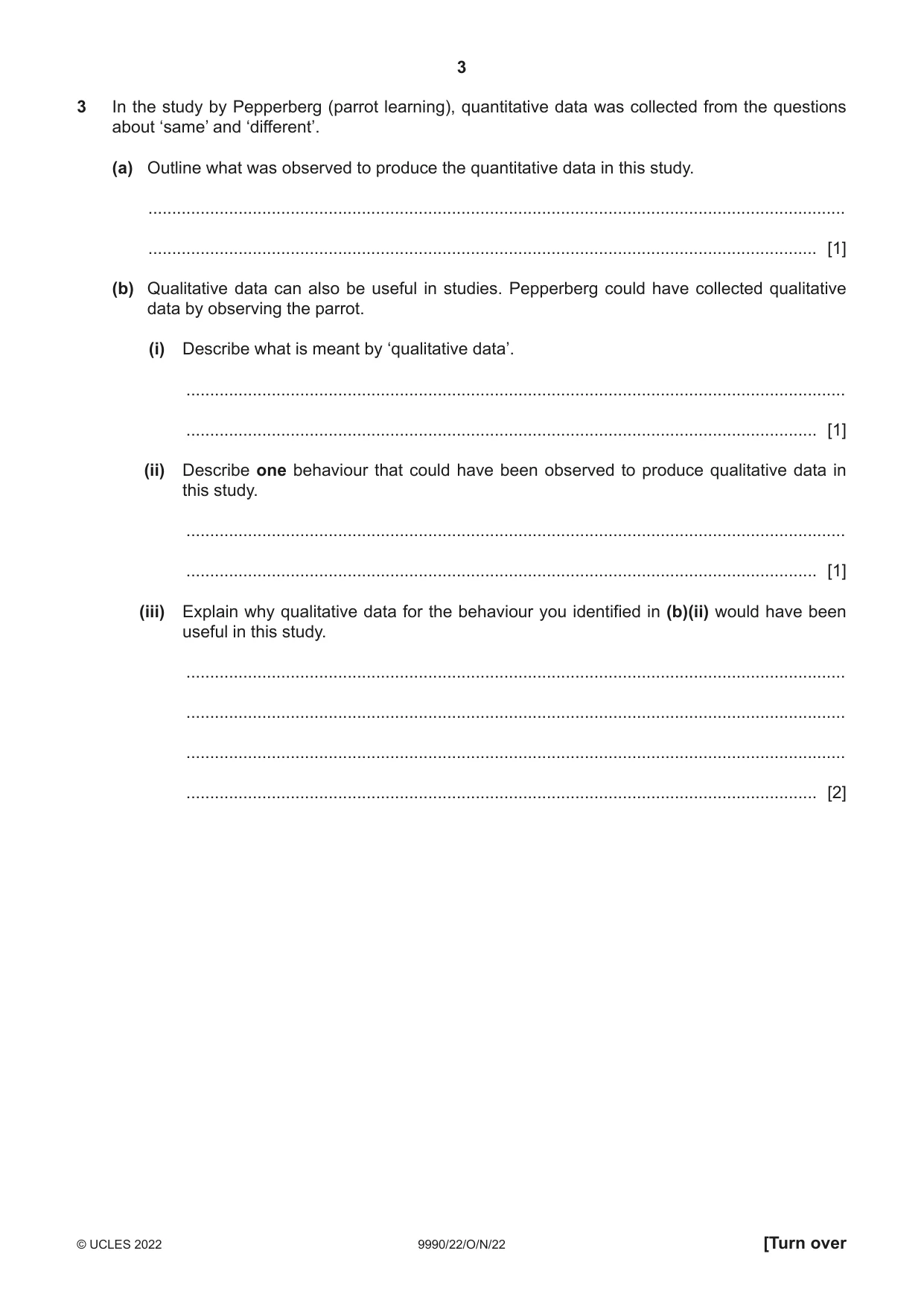
3 In the study by Pepperberg (parrot learning), quantitative data was collected from the questions about ‘same’ and ‘different’. (a) Outline what was observed to produce the quantitative data in this study. ................................................................................................................................................... ............................................................................................................................................. [1] (b) Qualitative data can also be useful in studies. Pepperberg could have collected qualitative data by observing the parrot. (i) Describe what is meant by ‘qualitative data’. ........................................................................................................................................... ..................................................................................................................................... [1] (ii) Describe one behaviour that could have been observed to produce qualitative data in this study. ........................................................................................................................................... ..................................................................................................................................... [1] (iii) Explain why qualitative data for the behaviour you identified in (b)(ii) would have been useful in this study. ........................................................................................................................................... ........................................................................................................................................... ........................................................................................................................................... ..................................................................................................................................... [2]
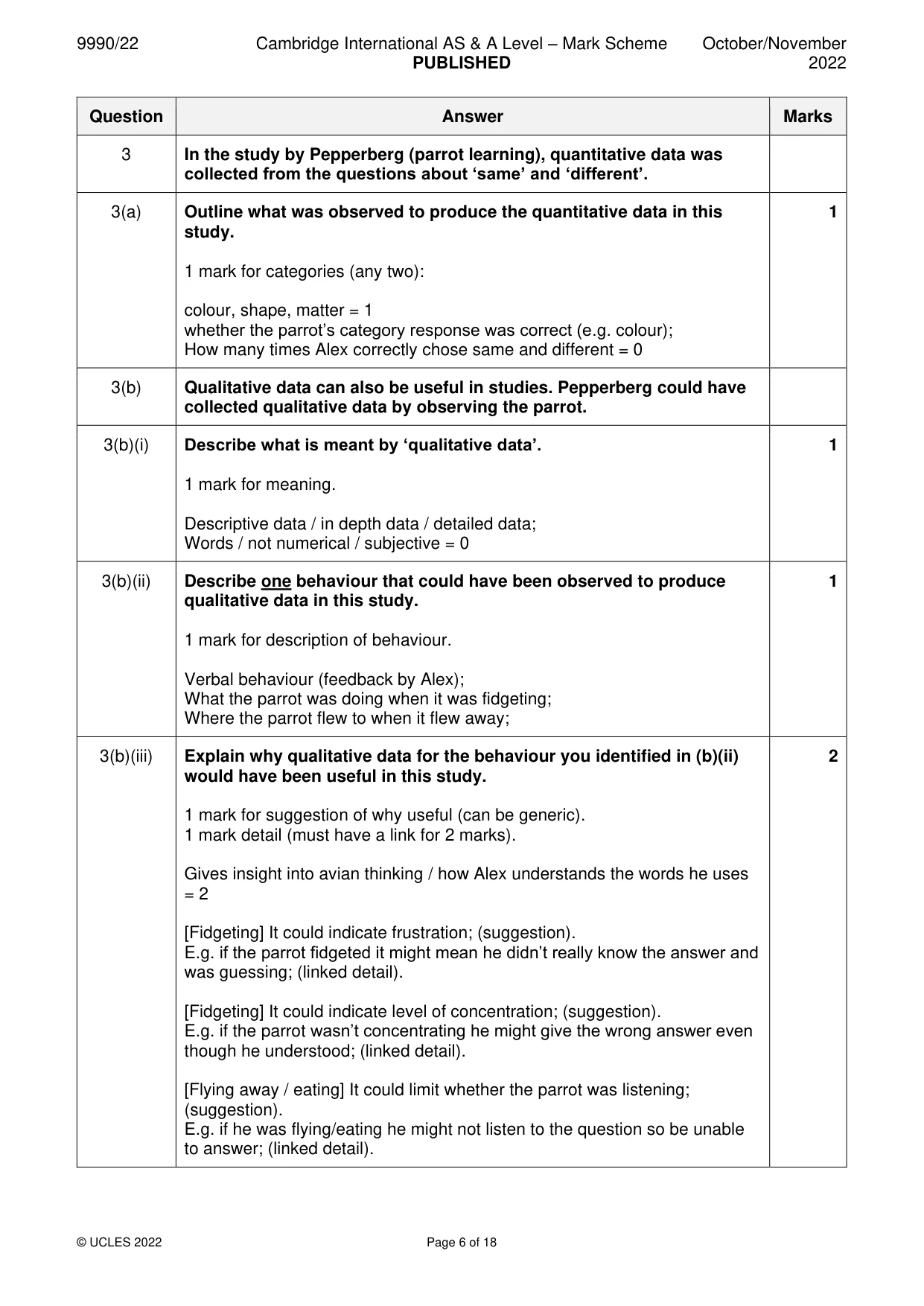
Mark scheme: 3 In the study by Pepperberg (parrot learning), quantitative data was collected from the questions about ‘same’ and ‘different’. 3(a) Outline what was observed to produce the quantitative data in this 1 study. 1 mark for categories (any two): colour, shape, matter = 1 whether the parrot’s category response was correct (e.g. colour); How many times Alex correctly chose same and different = 0 3(b) Qualitative data can also be useful in studies. Pepperberg could have collected qualitative data by observing the parrot. 3(b)(i) Describe what is meant by ‘qualitative data’. 1 1 mark for meaning. Descriptive data / in depth data / detailed data; Words / not numerical / subjective = 0 3(b)(ii) Describe one behaviour that could have been observed to produce 1 qualitative data in this study. 1 mark for description of behaviour. Verbal behaviour (feedback by Alex); What the parrot was doing when it was fidgeting; Where the parrot flew to when it flew away; 3(b)(iii) Explain why qualitative data for the behaviour you identified in (b)(ii) 2 would have been useful in this study. 1 mark for suggestion of why useful (can be generic). 1 mark detail (must have a link for 2 marks). Gives insight into avian thinking / how Alex understands the words he uses = 2 [Fidgeting] It could indicate frustration; (suggestion). E.g. if the parrot fidgeted it might mean he didn’t really know the answer and was guessing; (linked detail). [Fidgeting] It could indicate level of concentration; (suggestion). E.g. if the parrot wasn’t concentrating he might give the wrong answer even though he understood; (linked detail). [Flying away / eating] It could limit whether the parrot was listening; (suggestion). E.g. if he was flying/eating he might not listen to the question so be unable to answer; (linked detail).
Q4 · In the study by Dement and Kleitman (sleep and dreams), brain activity during sleep was…
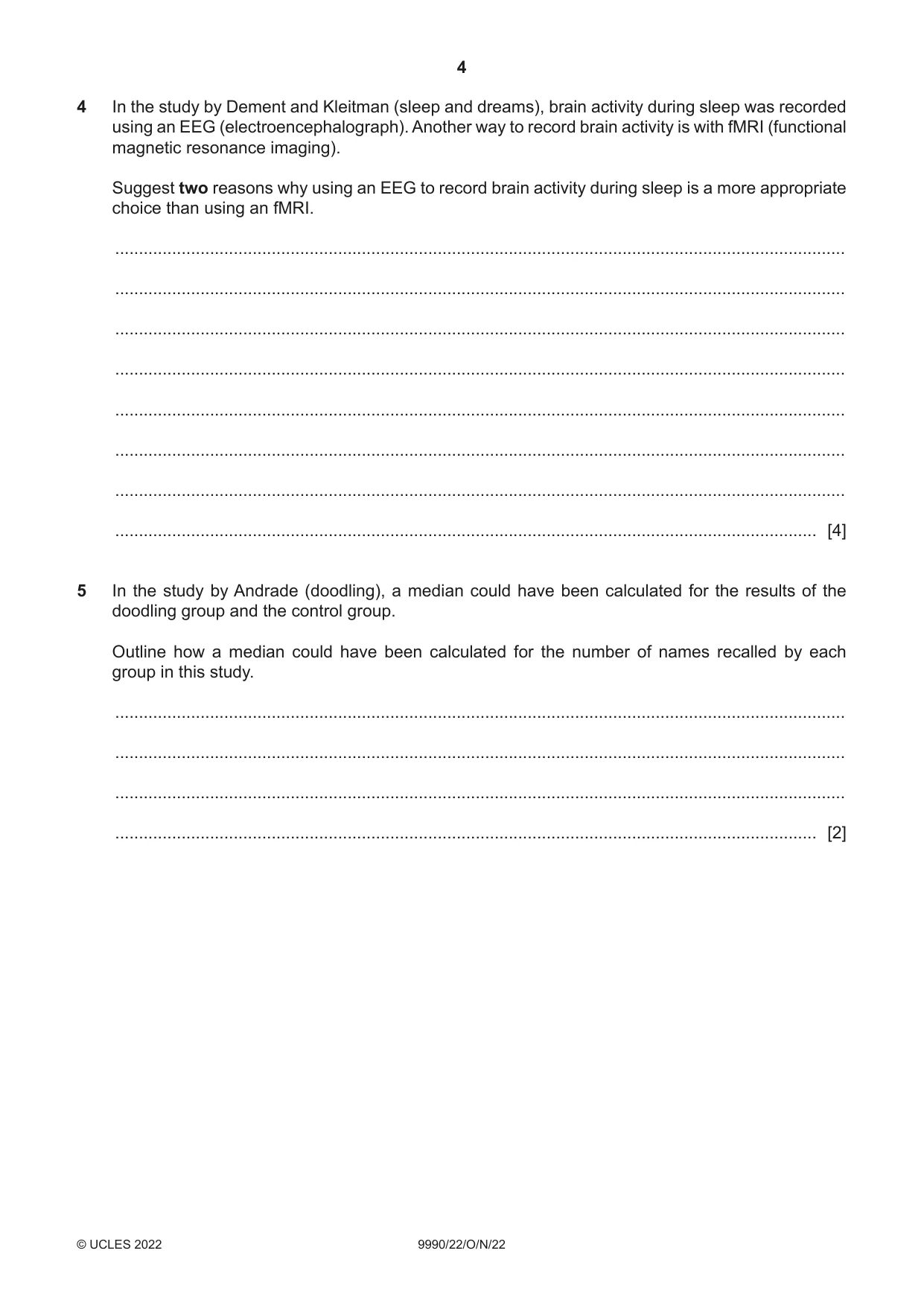
4 In the study by Dement and Kleitman (sleep and dreams), brain activity during sleep was recorded using an EEG (electroencephalograph). Another way to record brain activity is with fMRI (functional magnetic resonance imaging). Suggest two reasons why using an EEG to record brain activity during sleep is a more appropriate choice than using an fMRI. .......................................................................................................................................................... .......................................................................................................................................................... .......................................................................................................................................................... .......................................................................................................................................................... .......................................................................................................................................................... .......................................................................................................................................................... .......................................................................................................................................................... .................................................................................................................................................... [4]
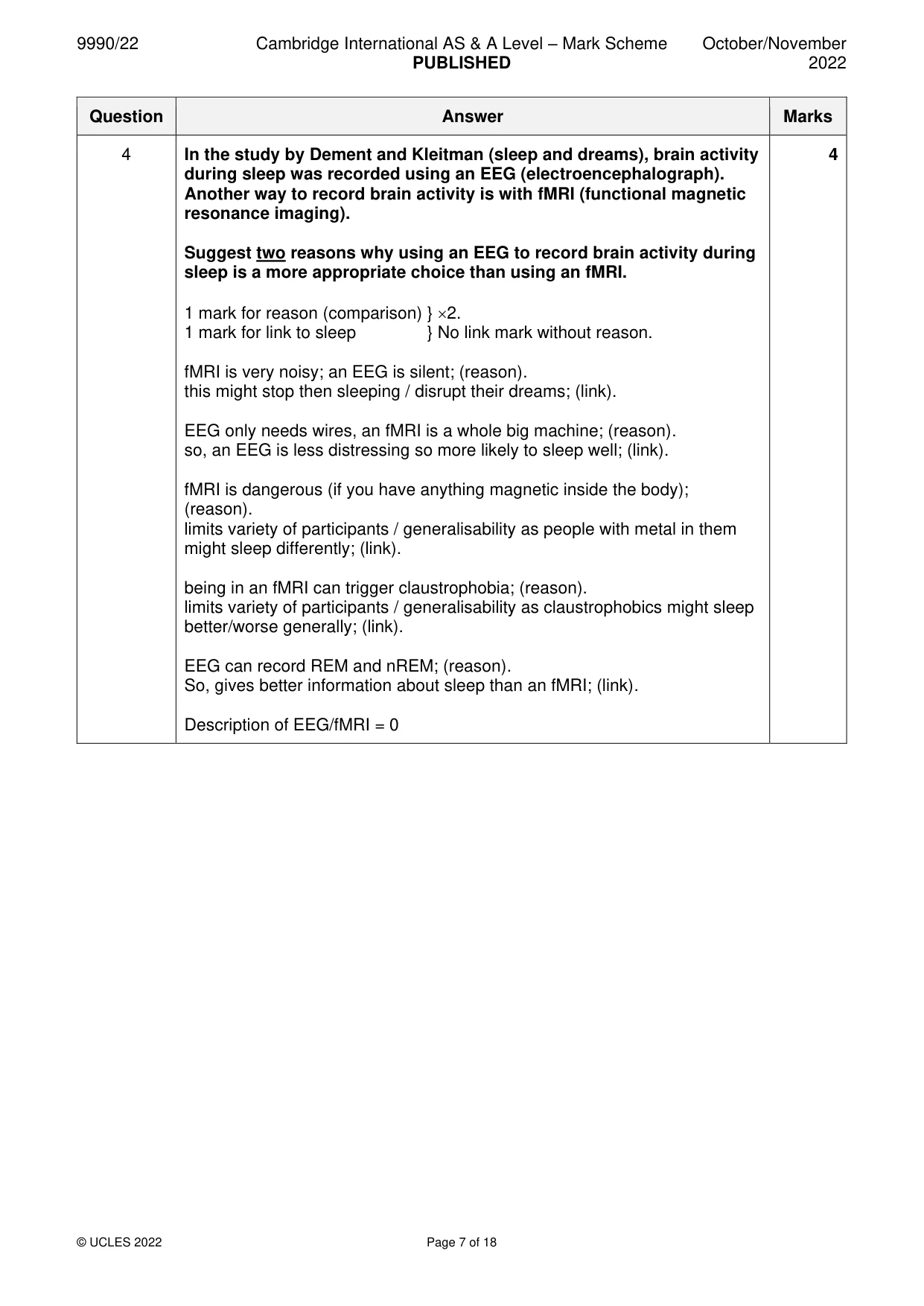
Mark scheme: 4 In the study by Dement and Kleitman (sleep and dreams), brain activity 4 during sleep was recorded using an EEG (electroencephalograph). Another way to record brain activity is with fMRI (functional magnetic resonance imaging). Suggest two reasons why using an EEG to record brain activity during sleep is a more appropriate choice than using an fMRI. 1 mark for reason (comparison) } 2. 1 mark for link to sleep } No link mark without reason. fMRI is very noisy; an EEG is silent; (reason). this might stop then sleeping / disrupt their dreams; (link). EEG only needs wires, an fMRI is a whole big machine; (reason). so, an EEG is less distressing so more likely to sleep well; (link). fMRI is dangerous (if you have anything magnetic inside the body); (reason). limits variety of participants / generalisability as people with metal in them might sleep differently; (link). being in an fMRI can trigger claustrophobia; (reason). limits variety of participants / generalisability as claustrophobics might sleep better/worse generally; (link). EEG can record REM and nREM; (reason). So, gives better information about sleep than an fMRI; (link). Description of EEG/fMRI = 0
Q5 · In the study by Andrade (doodling), a median could have been calculated for the results…
5 In the study by Andrade (doodling), a median could have been calculated for the results of the doodling group and the control group. Outline how a median could have been calculated for the number of names recalled by each group in this study. .......................................................................................................................................................... .......................................................................................................................................................... .......................................................................................................................................................... .................................................................................................................................................... [2]
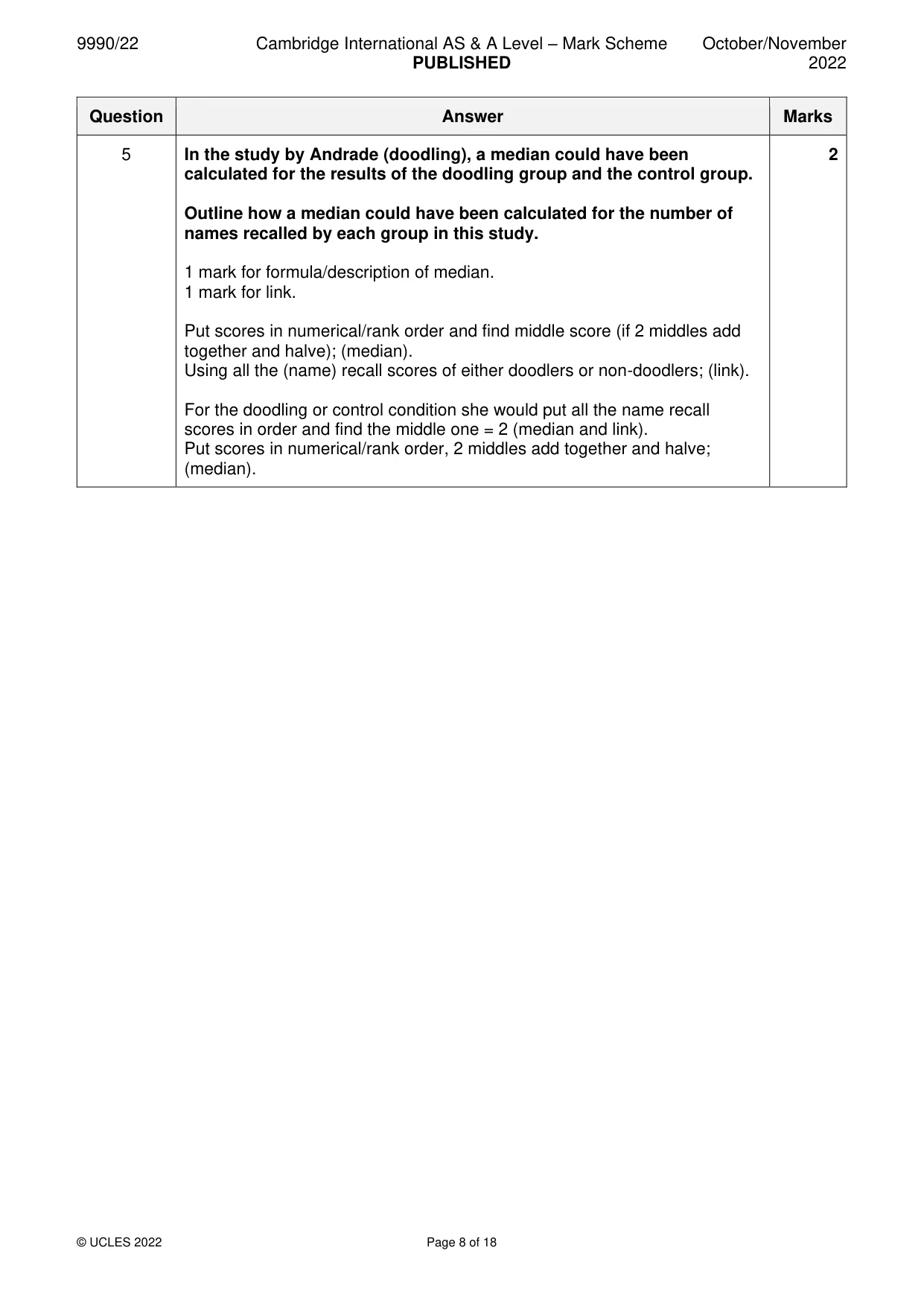
Mark scheme: 5 In the study by Andrade (doodling), a median could have been 2 calculated for the results of the doodling group and the control group. Outline how a median could have been calculated for the number of names recalled by each group in this study. 1 mark for formula/description of median. 1 mark for link. Put scores in numerical/rank order and find middle score (if 2 middles add together and halve); (median). Using all the (name) recall scores of either doodlers or non-doodlers; (link). For the doodling or control condition she would put all the name recall scores in order and find the middle one = 2 (median and link). Put scores in numerical/rank order, 2 middles add together and halve; (median).
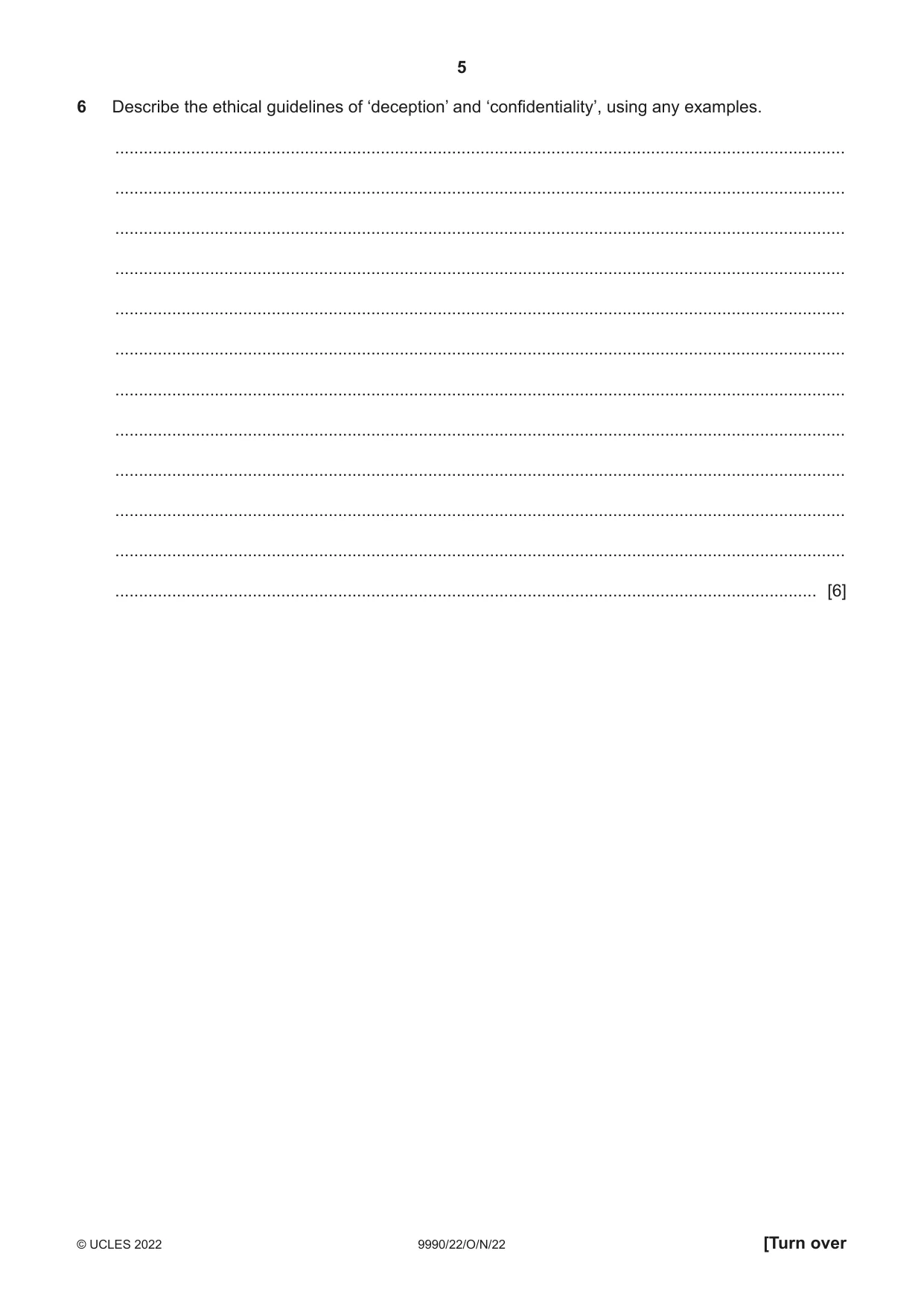
Q6 · Describe the ethical guidelines of ‘deception’ and ‘confidentiality’, using any examples
6 Describe the ethical guidelines of ‘deception’ and ‘confidentiality’, using any examples. .......................................................................................................................................................... .......................................................................................................................................................... .......................................................................................................................................................... .......................................................................................................................................................... .......................................................................................................................................................... .......................................................................................................................................................... .......................................................................................................................................................... .......................................................................................................................................................... .......................................................................................................................................................... .......................................................................................................................................................... .......................................................................................................................................................... .................................................................................................................................................... [6]
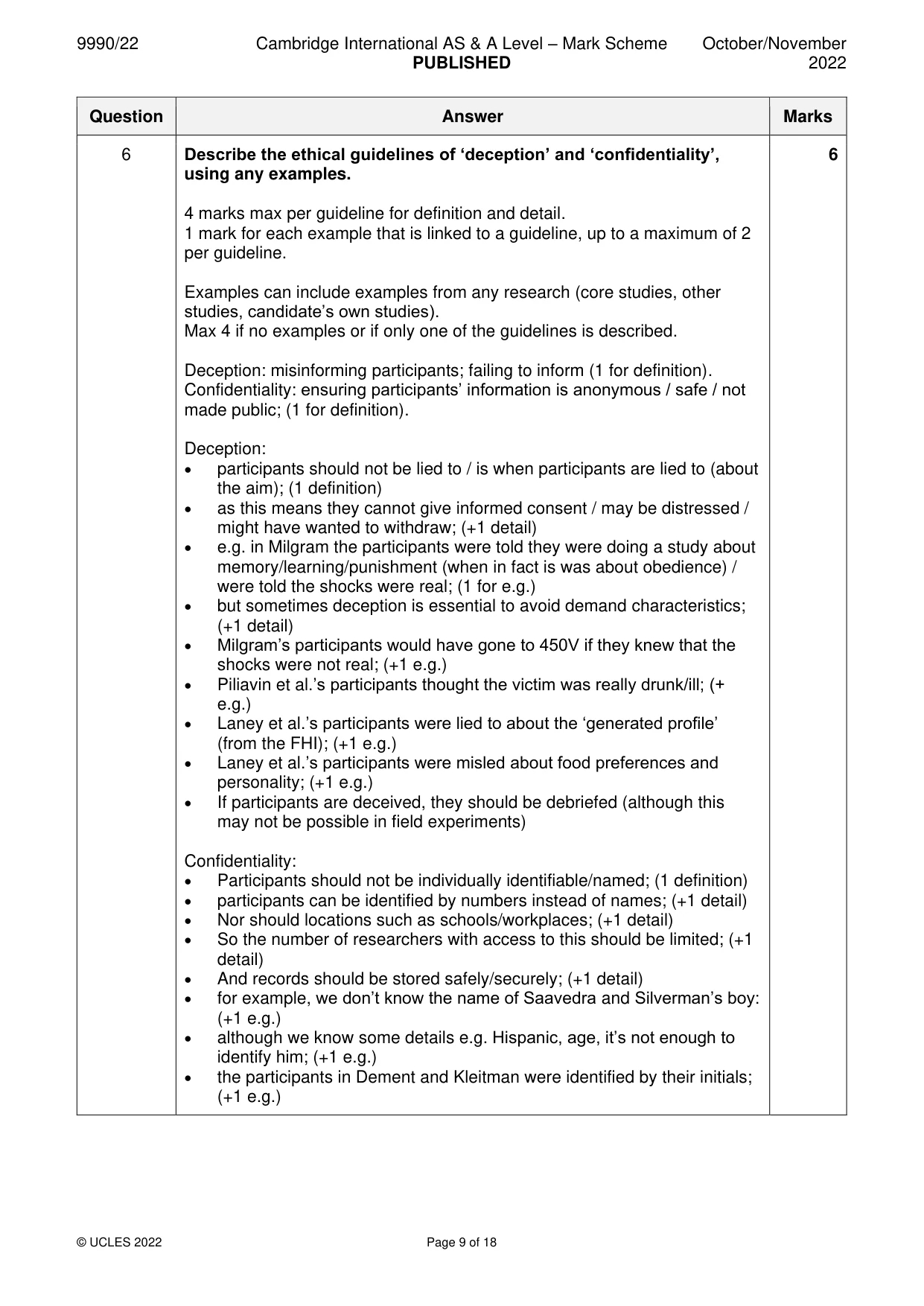
Mark scheme: 6 Describe the ethical guidelines of ‘deception’ and ‘confidentiality’, 6 using any examples. 4 marks max per guideline for definition and detail. 1 mark for each example that is linked to a guideline, up to a maximum of 2 per guideline. Examples can include examples from any research (core studies, other studies, candidate’s own studies). Max 4 if no examples or if only one of the guidelines is described. Deception: misinforming participants; failing to inform (1 for definition). Confidentiality: ensuring participants’ information is anonymous / safe / not made public; (1 for definition). Deception: • participants should not be lied to / is when participants are lied to (about the aim); (1 definition) • as this means they cannot give informed consent / may be distressed / might have wanted to withdraw; (+1 detail) • e.g. in Milgram the participants were told they were doing a study about memory/learning/punishment (when in fact is was about obedience) / were told the shocks were real; (1 for e.g.) • but sometimes deception is essential to avoid demand characteristics; (+1 detail) • Milgram’s participants would have gone to 450V if they knew that the shocks were not real; (+1 e.g.) • Piliavin et al.’s participants thought the victim was really drunk/ill; (+ e.g.) • Laney et al.’s participants were lied to about the ‘generated profile’ (from the FHI); (+1 e.g.) • Laney et al.’s participants were misled about food preferences and personality; (+1 e.g.) • If participants are deceived, they should be debriefed (although this may not be possible in field experiments) Confidentiality: • Participants should not be individually identifiable/named; (1 definition) • participants can be identified by numbers instead of names; (+1 detail) • Nor should locations such as schools/workplaces; (+1 detail) • So the number of researchers with access to this should be limited; (+1 detail) • And records should be stored safely/securely; (+1 detail) • for example, we don’t know the name of Saavedra and Silverman’s boy: (+1 e.g.) • although we know some details e.g. Hispanic, age, it’s not enough to identify him; (+1 e.g.) • the participants in Dement and Kleitman were identified by their initials; (+1 e.g.)
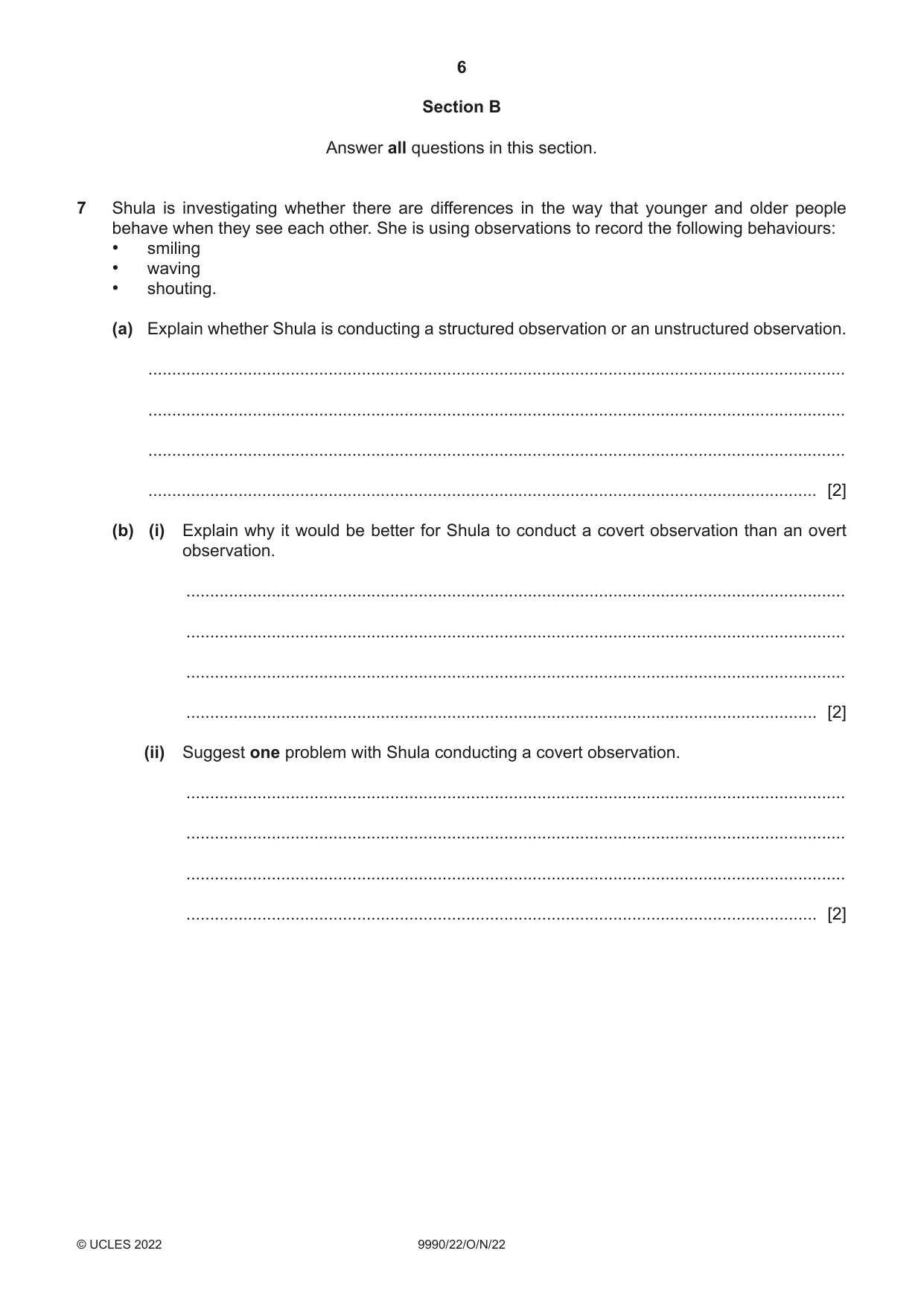
Q7 · Shula is investigating whether there are differences in the way that younger and older…
7 Shula is investigating whether there are differences in the way that younger and older people behave when they see each other. She is using observations to record the following behaviours: • smiling • waving • shouting. (a) Explain whether Shula is conducting a structured observation or an unstructured observation. ................................................................................................................................................... ................................................................................................................................................... ................................................................................................................................................... ............................................................................................................................................. [2] (b) (i) Explain why it would be better for Shula to conduct a covert observation than an overt observation. ........................................................................................................................................... ........................................................................................................................................... ........................................................................................................................................... ..................................................................................................................................... [2] (ii) Suggest one problem with Shula conducting a covert observation. ........................................................................................................................................... ........................................................................................................................................... ........................................................................................................................................... ..................................................................................................................................... [2]
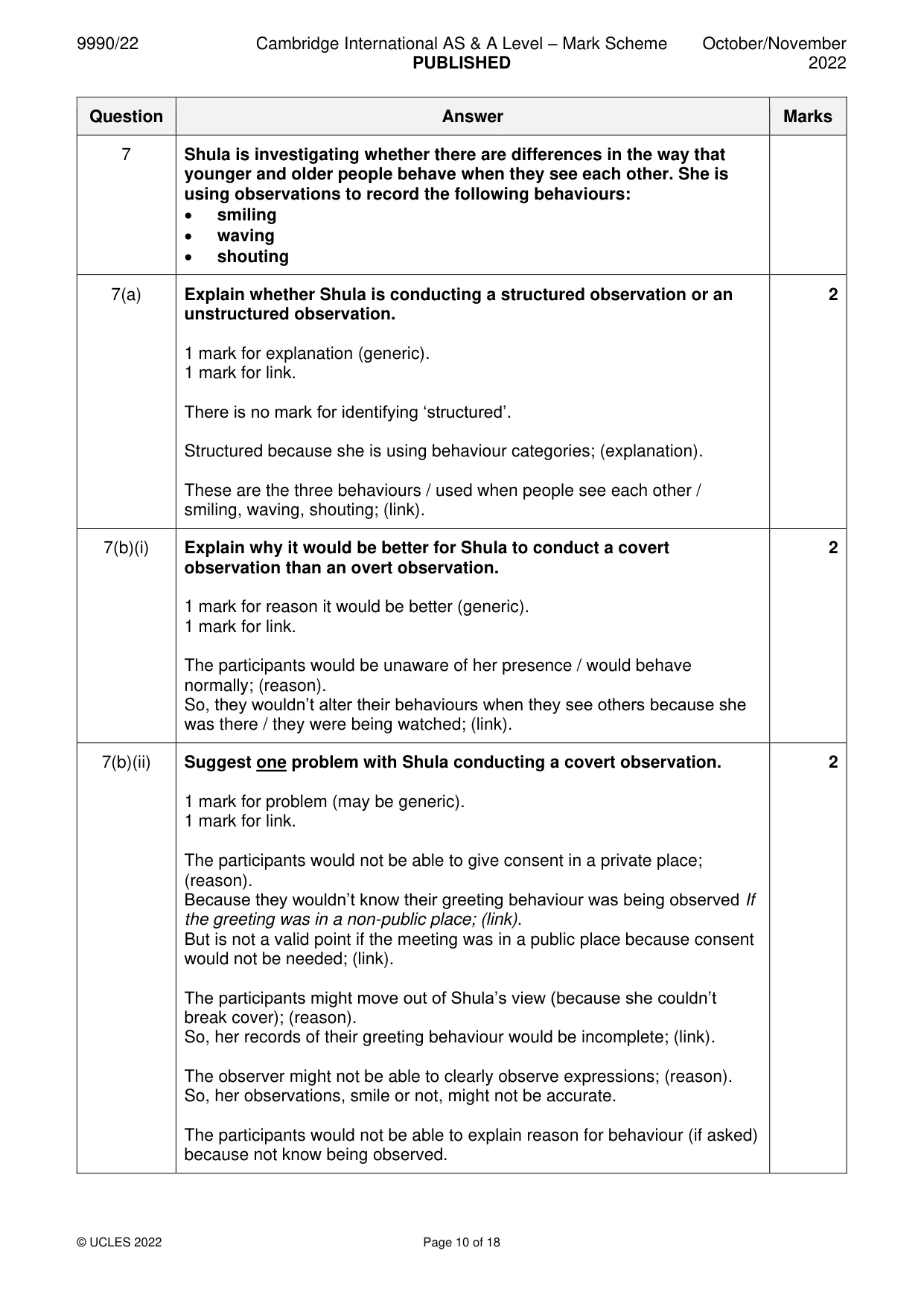
Mark scheme: 7 Shula is investigating whether there are differences in the way that younger and older people behave when they see each other. She is using observations to record the following behaviours: • smiling • waving • shouting 7(a) Explain whether Shula is conducting a structured observation or an 2 unstructured observation. 1 mark for explanation (generic). 1 mark for link. There is no mark for identifying ‘structured’. Structured because she is using behaviour categories; (explanation). These are the three behaviours / used when people see each other / smiling, waving, shouting; (link). 7(b)(i) Explain why it would be better for Shula to conduct a covert 2 observation than an overt observation. 1 mark for reason it would be better (generic). 1 mark for link. The participants would be unaware of her presence / would behave normally; (reason). So, they wouldn’t alter their behaviours when they see others because she was there / they were being watched; (link). 7(b)(ii) Suggest one problem with Shula conducting a covert observation. 2 1 mark for problem (may be generic). 1 mark for link. The participants would not be able to give consent in a private place; (reason). Because they wouldn’t know their greeting behaviour was being observed If the greeting was in a non-public place; (link). But is not a valid point if the meeting was in a public place because consent would not be needed; (link). The participants might move out of Shula’s view (because she couldn’t break cover); (reason). So, her records of their greeting behaviour would be incomplete; (link). The observer might not be able to clearly observe expressions; (reason). So, her observations, smile or not, might not be accurate. The participants would not be able to explain reason for behaviour (if asked) because not know being observed.
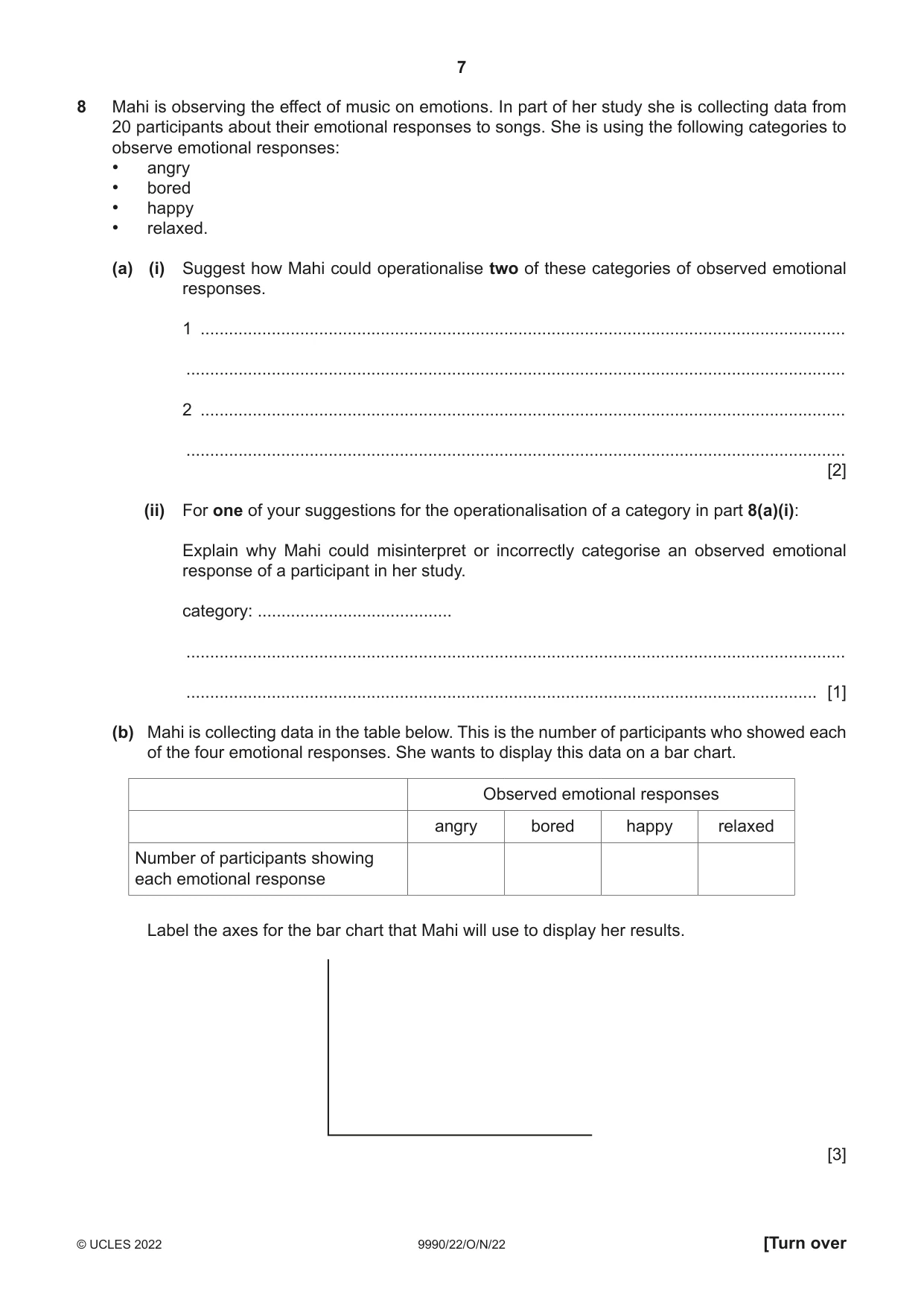
Q8 · Mahi is observing the effect of music on emotions
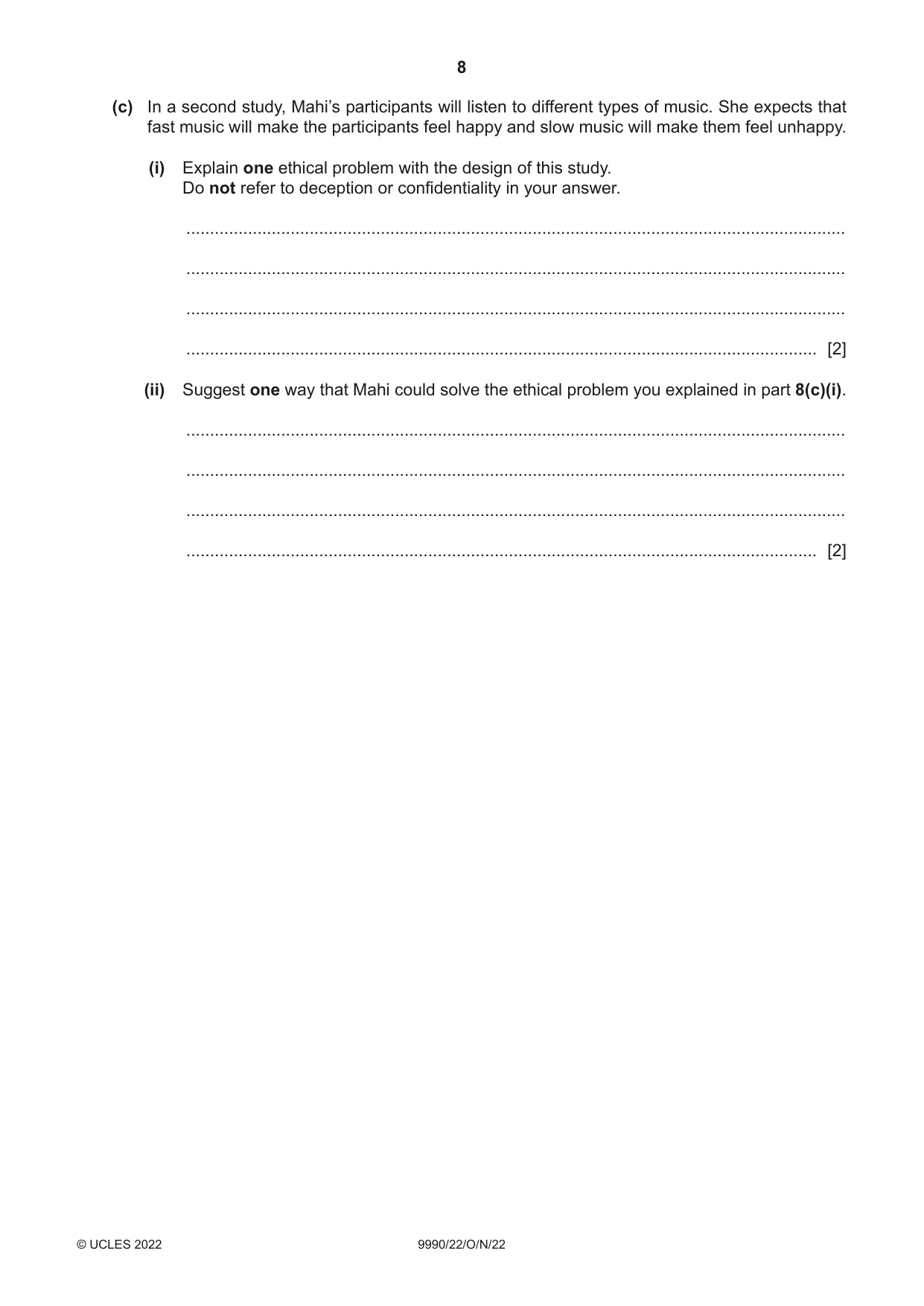
8 Mahi is observing the effect of music on emotions. In part of her study she is collecting data from 20 participants about their emotional responses to songs. She is using the following categories to observe emotional responses: • angry • bored • happy • relaxed. (a) (i) Suggest how Mahi could operationalise two of these categories of observed emotional responses. 1 ........................................................................................................................................ ........................................................................................................................................... 2 ........................................................................................................................................ ........................................................................................................................................... [2] (ii) For one of your suggestions for the operationalisation of a category in part 8(a)(i): Explain why Mahi could misinterpret or incorrectly categorise an observed emotional response of a participant in her study. category: ......................................... ........................................................................................................................................... ..................................................................................................................................... [1] (b) Mahi is collecting data in the table below. This is the number of participants who showed each of the four emotional responses. She wants to display this data on a bar chart. Observed emotional responses angry bored happy relaxed Number of participants showing each emotional response Label the axes for the bar chart that Mahi will use to display her results. [3] (c) In a second study, Mahi’s participants will listen to different types of music. She expects that fast music will make the participants feel happy and slow music will make them feel unhappy. (i) Explain one ethical problem with the design of this study. Do not refer to deception or confidentiality in your answer. ........................................................................................................................................... ........................................................................................................................................... ........................................................................................................................................... ..................................................................................................................................... [2] (ii) Suggest one way that Mahi could solve the ethical problem you explained in part 8(c)(i). ........................................................................................................................................... ........................................................................................................................................... ........................................................................................................................................... ..................................................................................................................................... [2]
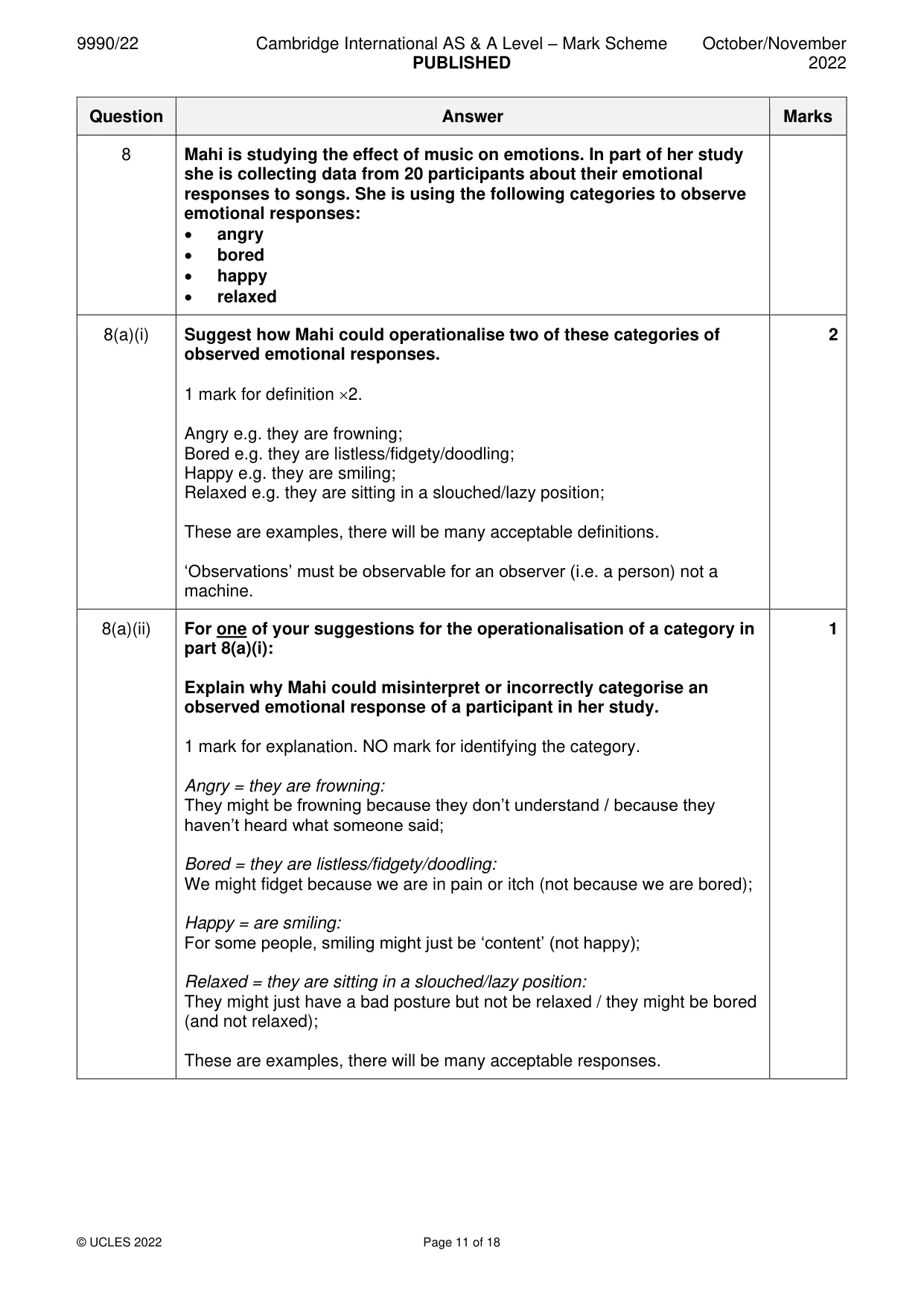
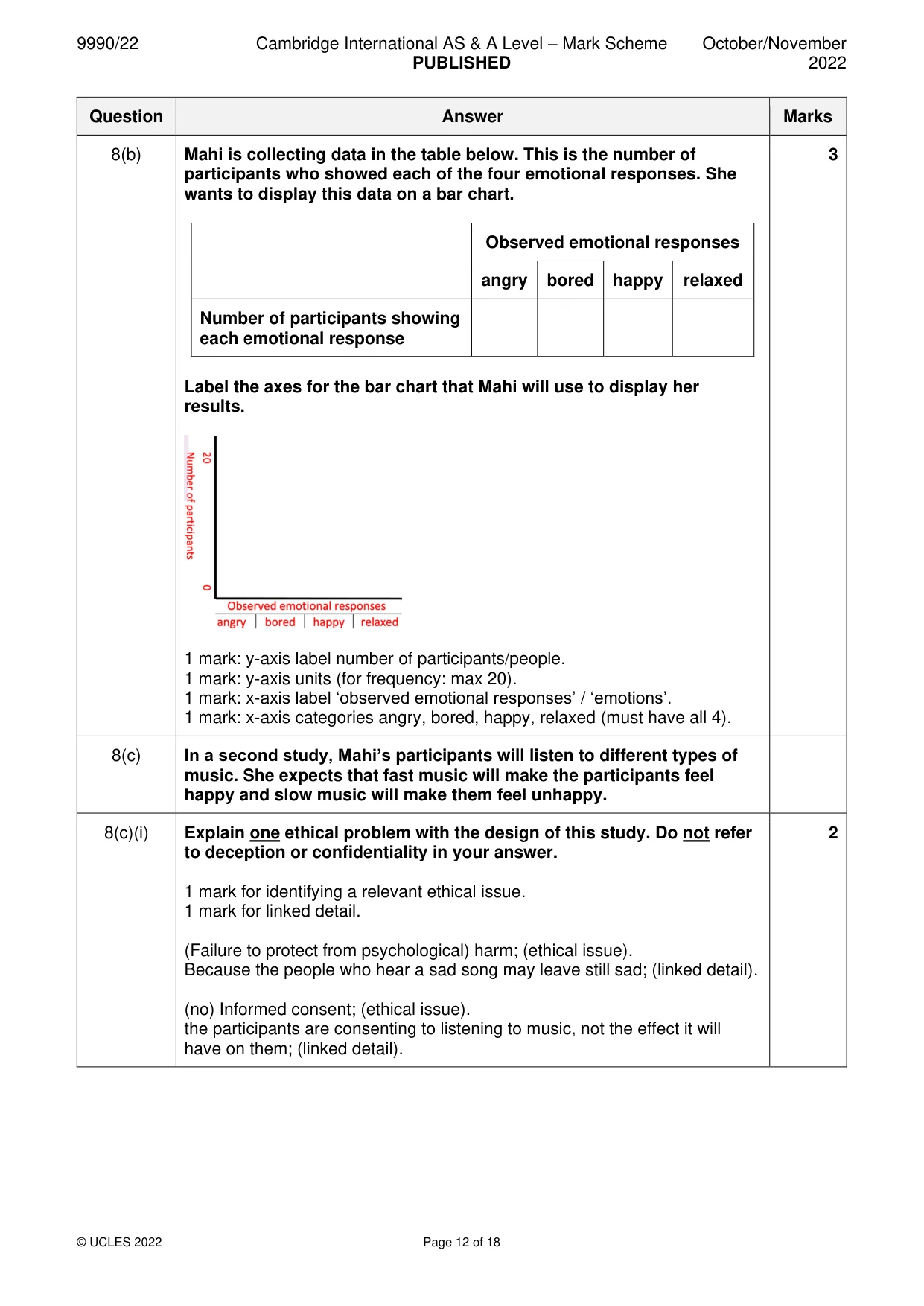
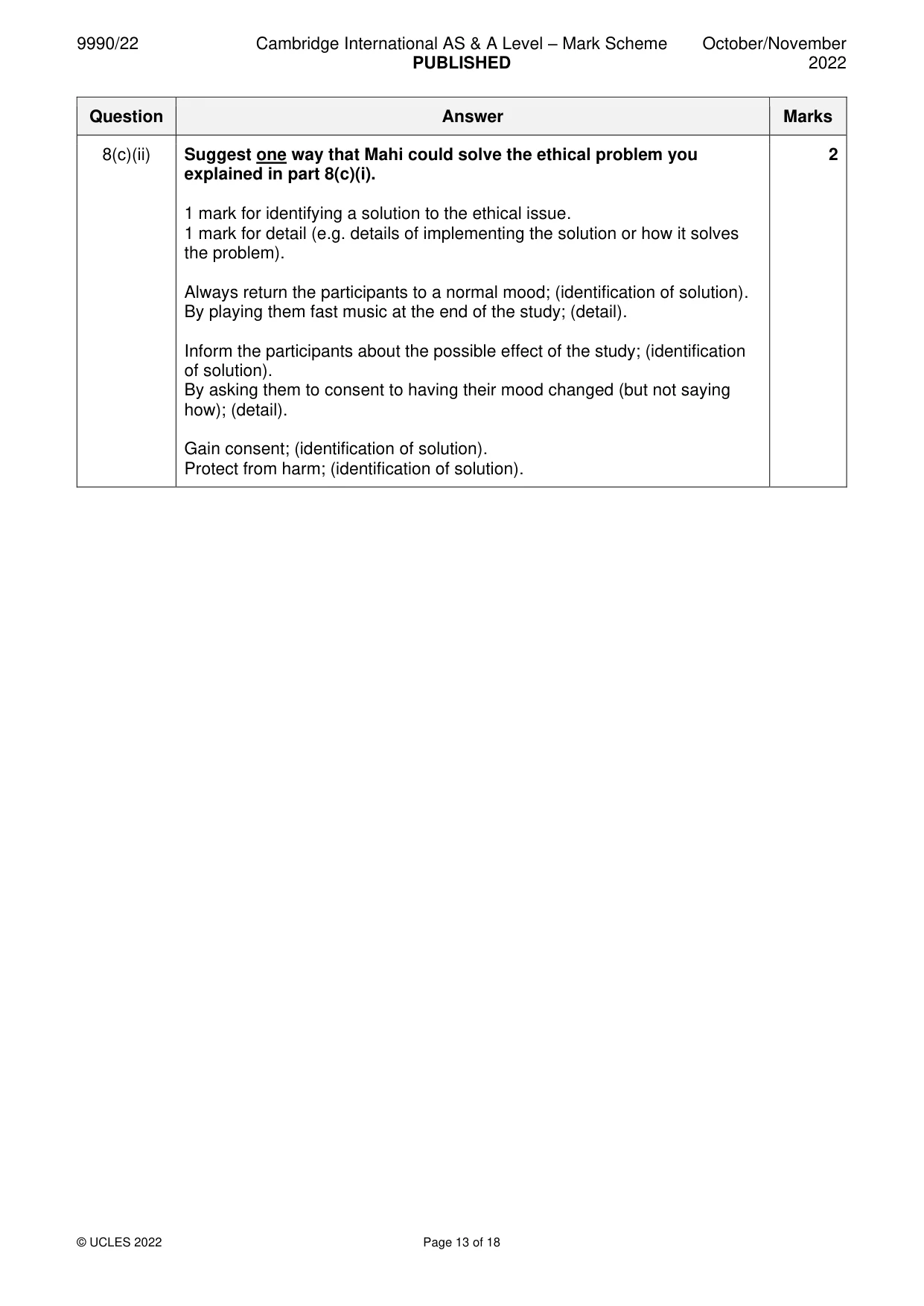
Mark scheme: 8 Mahi is studying the effect of music on emotions. In part of her study she is collecting data from 20 participants about their emotional responses to songs. She is using the following categories to observe emotional responses: • angry • bored • happy • relaxed 8(a)(i) Suggest how Mahi could operationalise two of these categories of 2 observed emotional responses. 1 mark for definition 2. Angry e.g. they are frowning; Bored e.g. they are listless/fidgety/doodling; Happy e.g. they are smiling; Relaxed e.g. they are sitting in a slouched/lazy position; These are examples, there will be many acceptable definitions. ‘Observations’ must be observable for an observer (i.e. a person) not a machine. 8(a)(ii) For one of your suggestions for the operationalisation of a category in 1 part 8(a)(i): Explain why Mahi could misinterpret or incorrectly categorise an observed emotional response of a participant in her study. 1 mark for explanation. NO mark for identifying the category. Angry = they are frowning: They might be frowning because they don’t understand / because they haven’t heard what someone said; Bored = they are listless/fidgety/doodling: We might fidget because we are in pain or itch (not because we are bored); Happy = are smiling: For some people, smiling might just be ‘content’ (not happy); Relaxed = they are sitting in a slouched/lazy position: They might just have a bad posture but not be relaxed / they might be bored (and not relaxed); These are examples, there will be many acceptable responses. 8(b) Mahi is collecting data in the table below. This is the number of 3 participants who showed each of the four emotional responses. She wants to display this data on a bar chart. Observed emotional responses angry bored happy relaxed Number of participants showing each emotional response Label the axes for the bar chart that Mahi will use to display her results. 1 mark: y-axis label number of participants/people. 1 mark: y-axis units (for frequency: max 20). 1 mark: x-axis label ‘observed emotional responses’ / ‘emotions’. 1 mark: x-axis categories angry, bored, happy, relaxed (must have all 4). 8(c) In a second study, Mahi’s participants will listen to different types of music. She expects that fast music will make the participants feel happy and slow music will make them feel unhappy. 8(c)(i) Explain one ethical problem with the design of this study. Do not refer 2 to deception or confidentiality in your answer. 1 mark for identifying a relevant ethical issue. 1 mark for linked detail. (Failure to protect from psychological) harm; (ethical issue). Because the people who hear a sad song may leave still sad; (linked detail). (no) Informed consent; (ethical issue). the participants are consenting to listening to music, not the effect it will have on them; (linked detail). 8(c)(ii) Suggest one way that Mahi could solve the ethical problem you 2 explained in part 8(c)(i). 1 mark for identifying a solution to the ethical issue. 1 mark for detail (e.g. details of implementing the solution or how it solves the problem). Always return the participants to a normal mood; (identification of solution). By playing them fast music at the end of the study; (detail). Inform the participants about the possible effect of the study; (identification of solution). By asking them to consent to having their mood changed (but not saying how); (detail). Gain consent; (identification of solution). Protect from harm; (identification of solution).
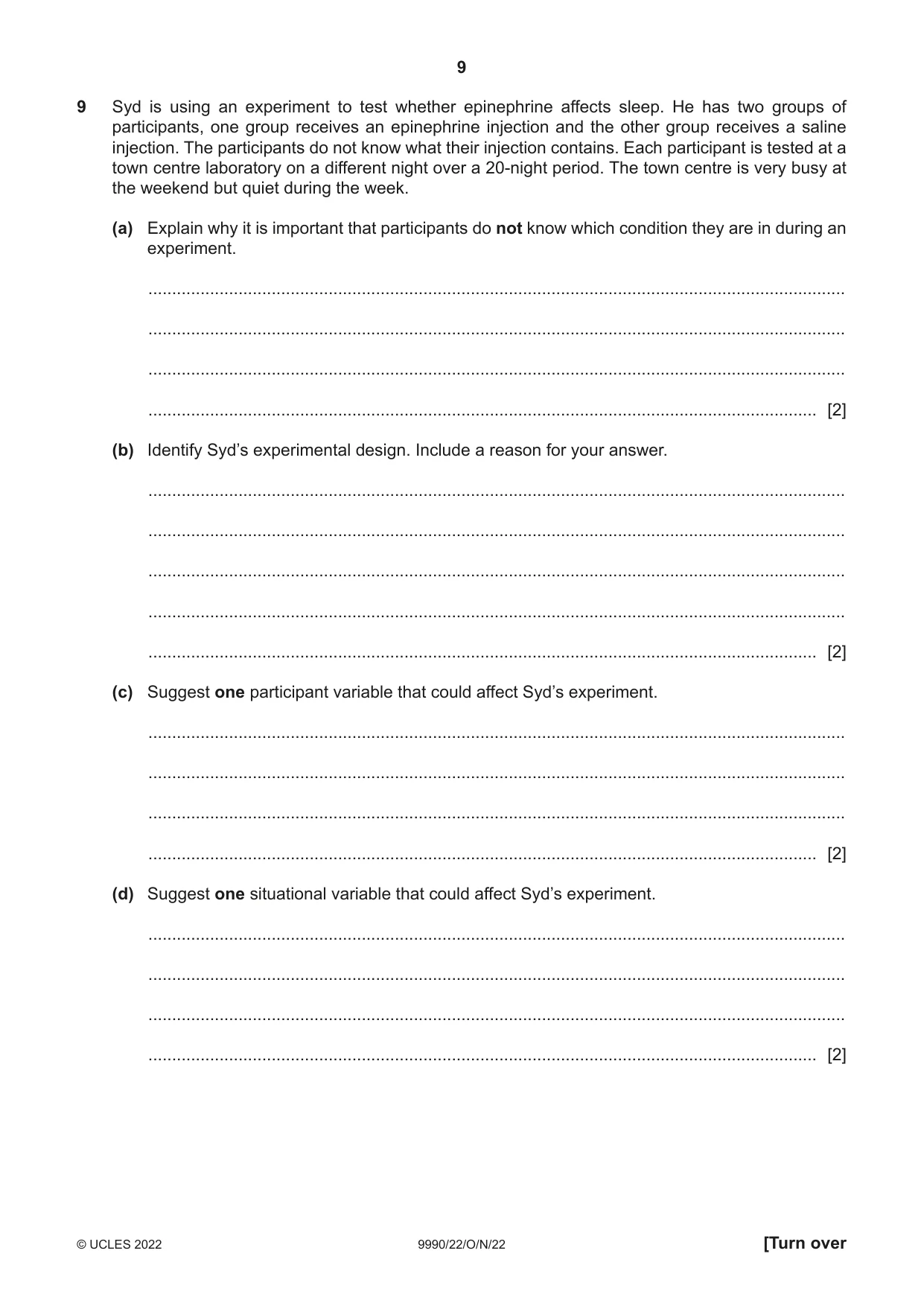
Q9 · Syd is using an experiment to test whether epinephrine affects sleep
9 Syd is using an experiment to test whether epinephrine affects sleep. He has two groups of participants, one group receives an epinephrine injection and the other group receives a saline injection. The participants do not know what their injection contains. Each participant is tested at a town centre laboratory on a different night over a 20-night period. The town centre is very busy at the weekend but quiet during the week. (a) Explain why it is important that participants do not know which condition they are in during an experiment. ................................................................................................................................................... ................................................................................................................................................... ................................................................................................................................................... ............................................................................................................................................. [2] (b) Identify Syd’s experimental design. Include a reason for your answer. ................................................................................................................................................... ................................................................................................................................................... ................................................................................................................................................... ................................................................................................................................................... ............................................................................................................................................. [2] (c) Suggest one participant variable that could affect Syd’s experiment. ................................................................................................................................................... ................................................................................................................................................... ................................................................................................................................................... ............................................................................................................................................. [2] (d) Suggest one situational variable that could affect Syd’s experiment. ................................................................................................................................................... ................................................................................................................................................... ................................................................................................................................................... ............................................................................................................................................. [2] Section C Answer all questions in this section.
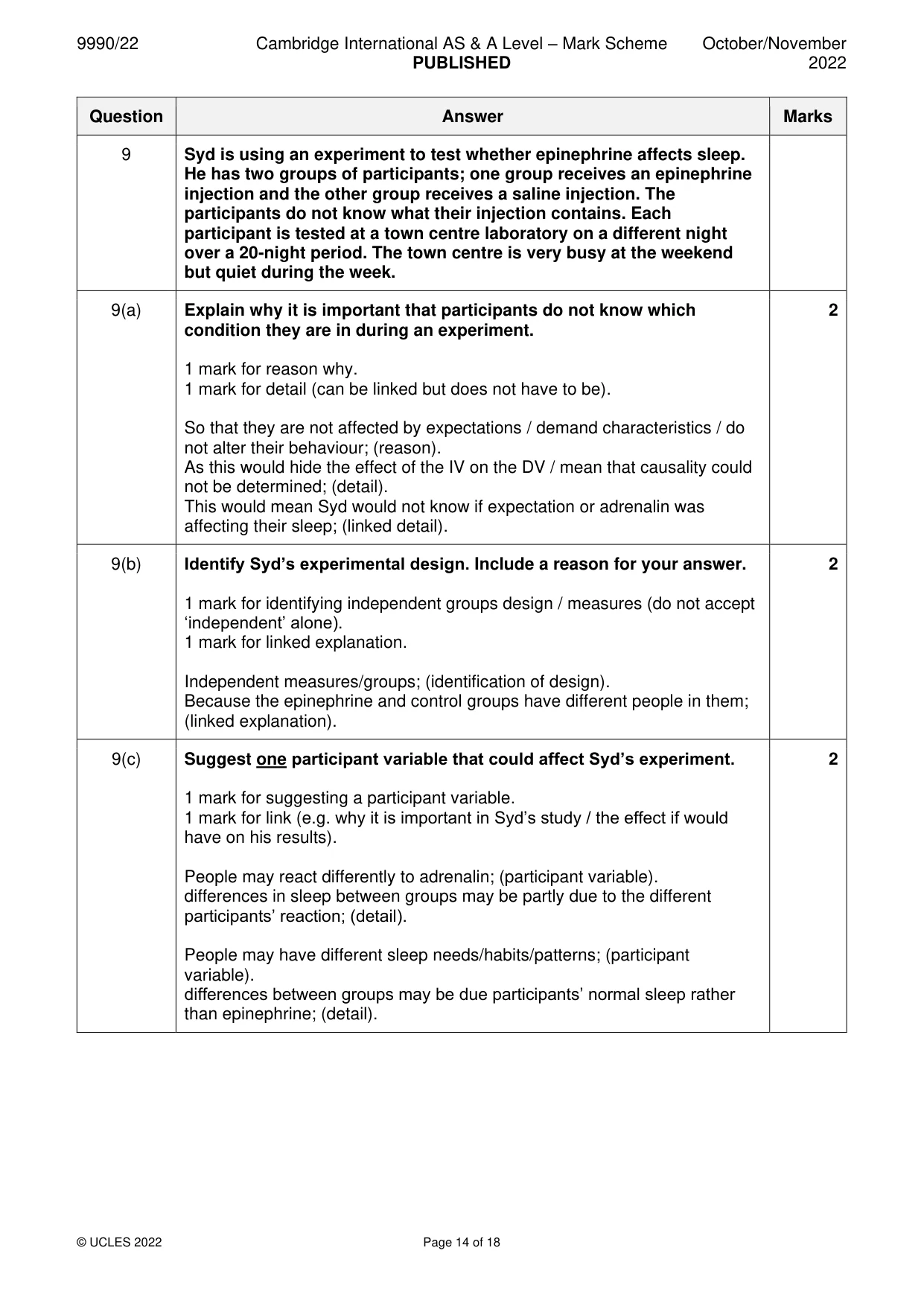
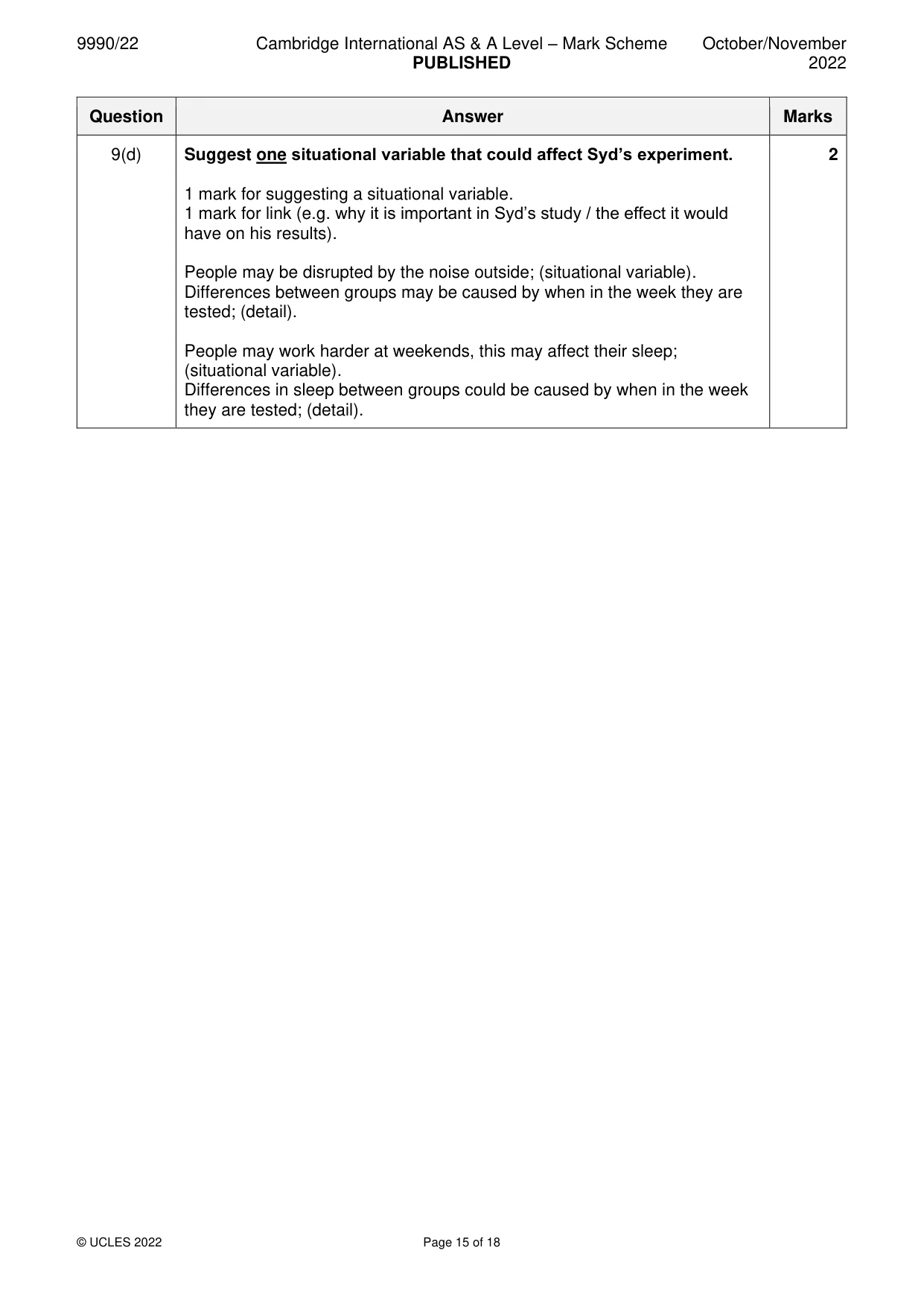
Mark scheme: 9 Syd is using an experiment to test whether epinephrine affects sleep. He has two groups of participants; one group receives an epinephrine injection and the other group receives a saline injection. The participants do not know what their injection contains. Each participant is tested at a town centre laboratory on a different night over a 20-night period. The town centre is very busy at the weekend but quiet during the week. 9(a) Explain why it is important that participants do not know which 2 condition they are in during an experiment. 1 mark for reason why. 1 mark for detail (can be linked but does not have to be). So that they are not affected by expectations / demand characteristics / do not alter their behaviour; (reason). As this would hide the effect of the IV on the DV / mean that causality could not be determined; (detail). This would mean Syd would not know if expectation or adrenalin was affecting their sleep; (linked detail). 9(b) Identify Syd’s experimental design. Include a reason for your answer. 2 1 mark for identifying independent groups design / measures (do not accept ‘independent’ alone). 1 mark for linked explanation. Independent measures/groups; (identification of design). Because the epinephrine and control groups have different people in them; (linked explanation). 9(c) Suggest one participant variable that could affect Syd’s experiment. 2 1 mark for suggesting a participant variable. 1 mark for link (e.g. why it is important in Syd’s study / the effect if would have on his results). People may react differently to adrenalin; (participant variable). differences in sleep between groups may be partly due to the different participants’ reaction; (detail). People may have different sleep needs/habits/patterns; (participant variable). differences between groups may be due participants’ normal sleep rather than epinephrine; (detail). 9(d) Suggest one situational variable that could affect Syd’s experiment. 2 1 mark for suggesting a situational variable. 1 mark for link (e.g. why it is important in Syd’s study / the effect it would have on his results). People may be disrupted by the noise outside; (situational variable). Differences between groups may be caused by when in the week they are tested; (detail). People may work harder at weekends, this may affect their sleep; (situational variable). Differences in sleep between groups could be caused by when in the week they are tested; (detail).
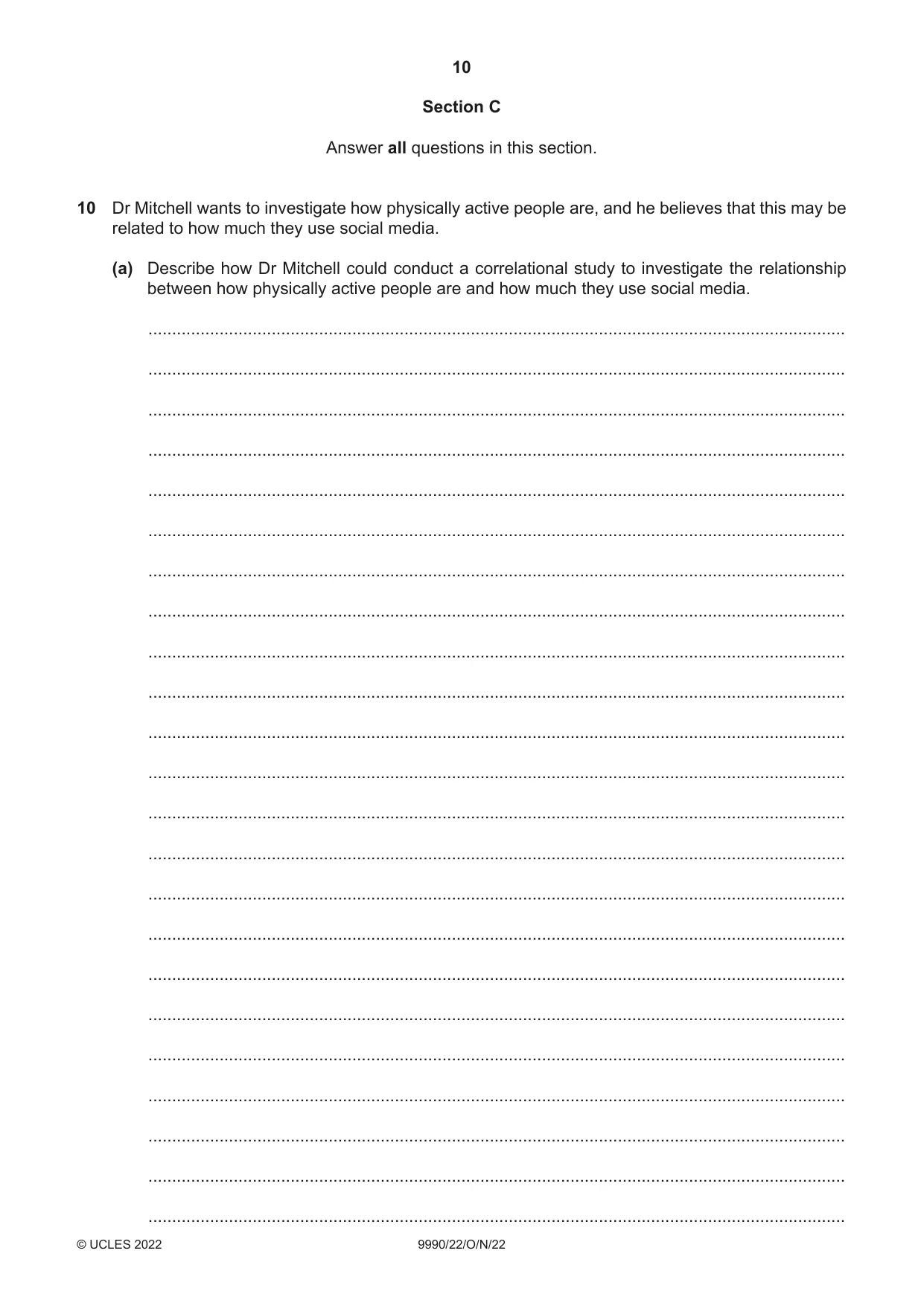
Q10 · Dr Mitchell wants to investigate how physically active people are, and he believes that…
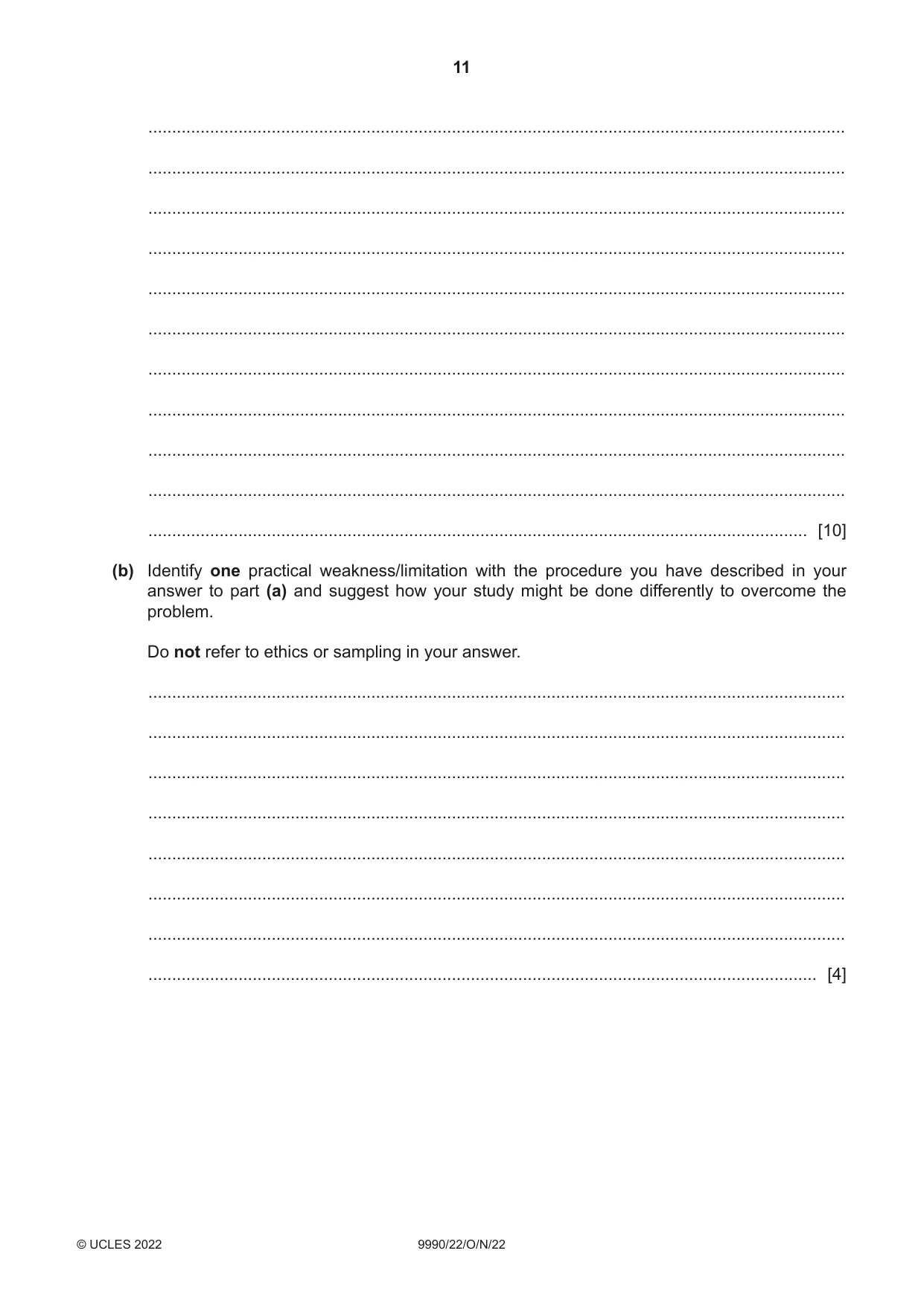
10 Dr Mitchell wants to investigate how physically active people are, and he believes that this may be related to how much they use social media. (a) Describe how Dr Mitchell could conduct a correlational study to investigate the relationship between how physically active people are and how much they use social media. ................................................................................................................................................... ................................................................................................................................................... ................................................................................................................................................... ................................................................................................................................................... ................................................................................................................................................... ................................................................................................................................................... ................................................................................................................................................... ................................................................................................................................................... ................................................................................................................................................... ................................................................................................................................................... ................................................................................................................................................... ................................................................................................................................................... ................................................................................................................................................... ................................................................................................................................................... ................................................................................................................................................... ................................................................................................................................................... ................................................................................................................................................... ................................................................................................................................................... ................................................................................................................................................... ................................................................................................................................................... ................................................................................................................................................... ................................................................................................................................................... ................................................................................................................................................... ................................................................................................................................................... ................................................................................................................................................... ................................................................................................................................................... ................................................................................................................................................... ................................................................................................................................................... ................................................................................................................................................... ................................................................................................................................................... ................................................................................................................................................... ................................................................................................................................................... ................................................................................................................................................... ........................................................................................................................................... [10] (b) Identify one practical weakness/limitation with the procedure you have described in your answer to part (a) and suggest how your study might be done differently to overcome the problem. Do not refer to ethics or sampling in your answer. ................................................................................................................................................... ................................................................................................................................................... ................................................................................................................................................... ................................................................................................................................................... ................................................................................................................................................... ................................................................................................................................................... ................................................................................................................................................... ............................................................................................................................................. [4]
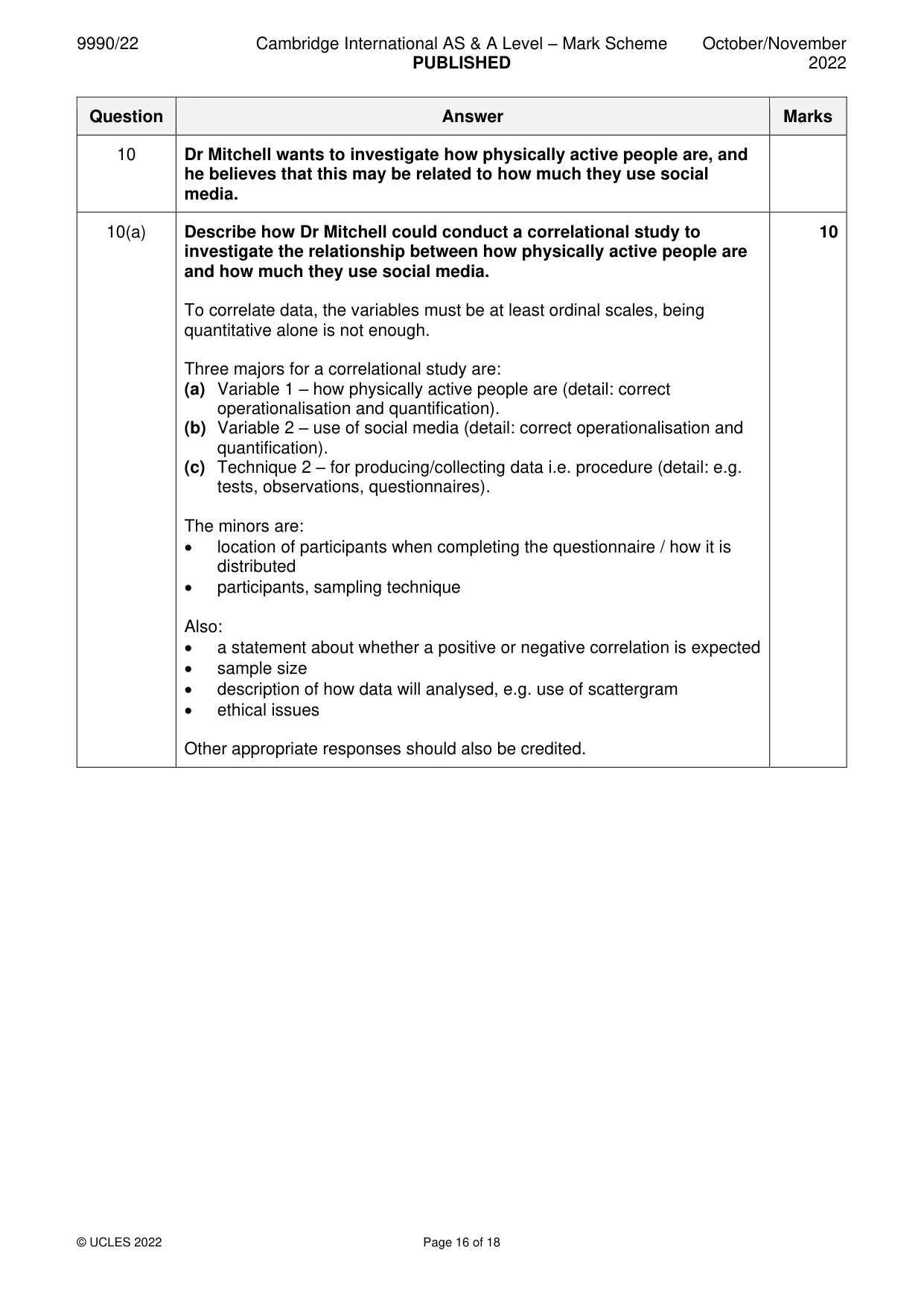
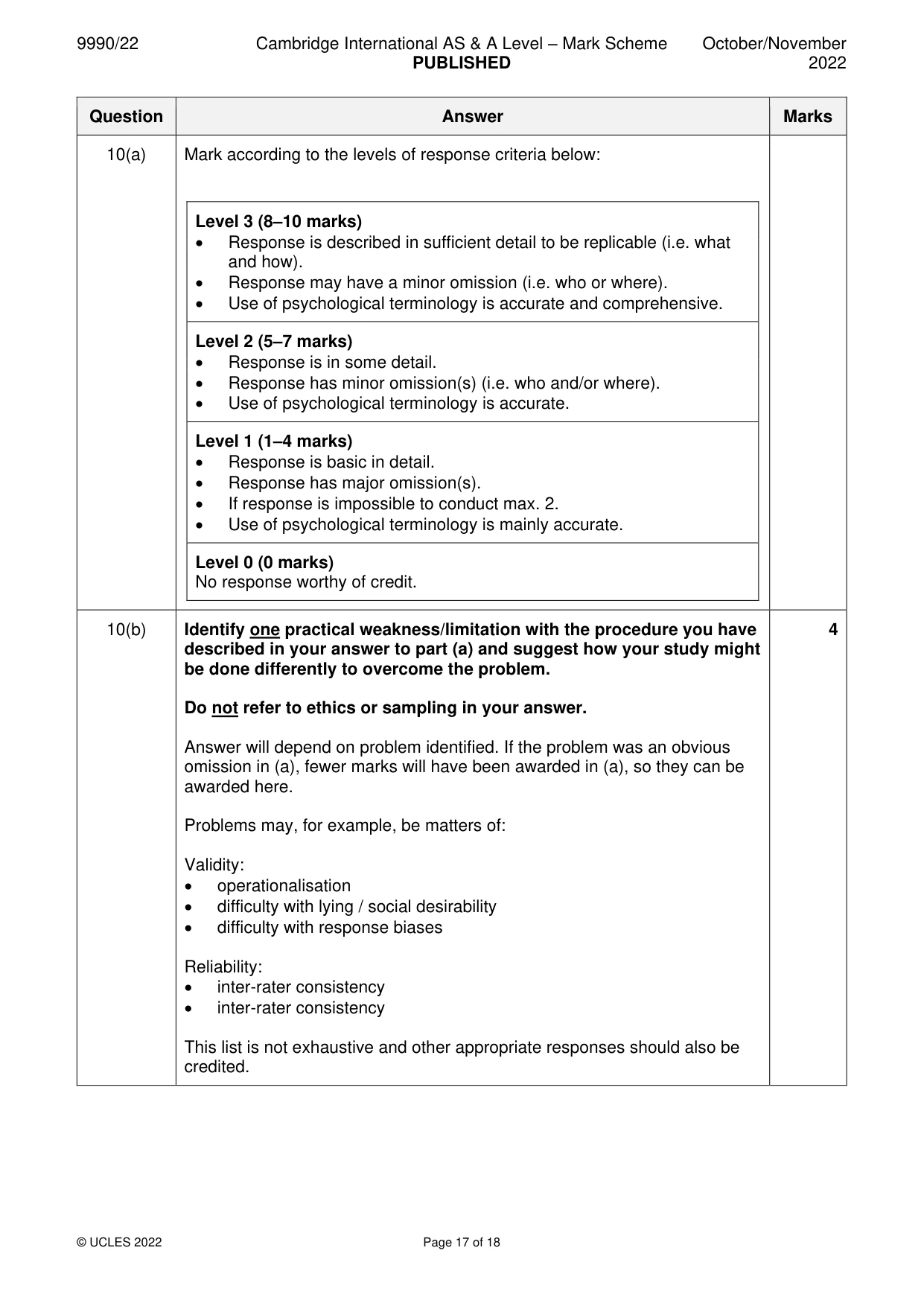
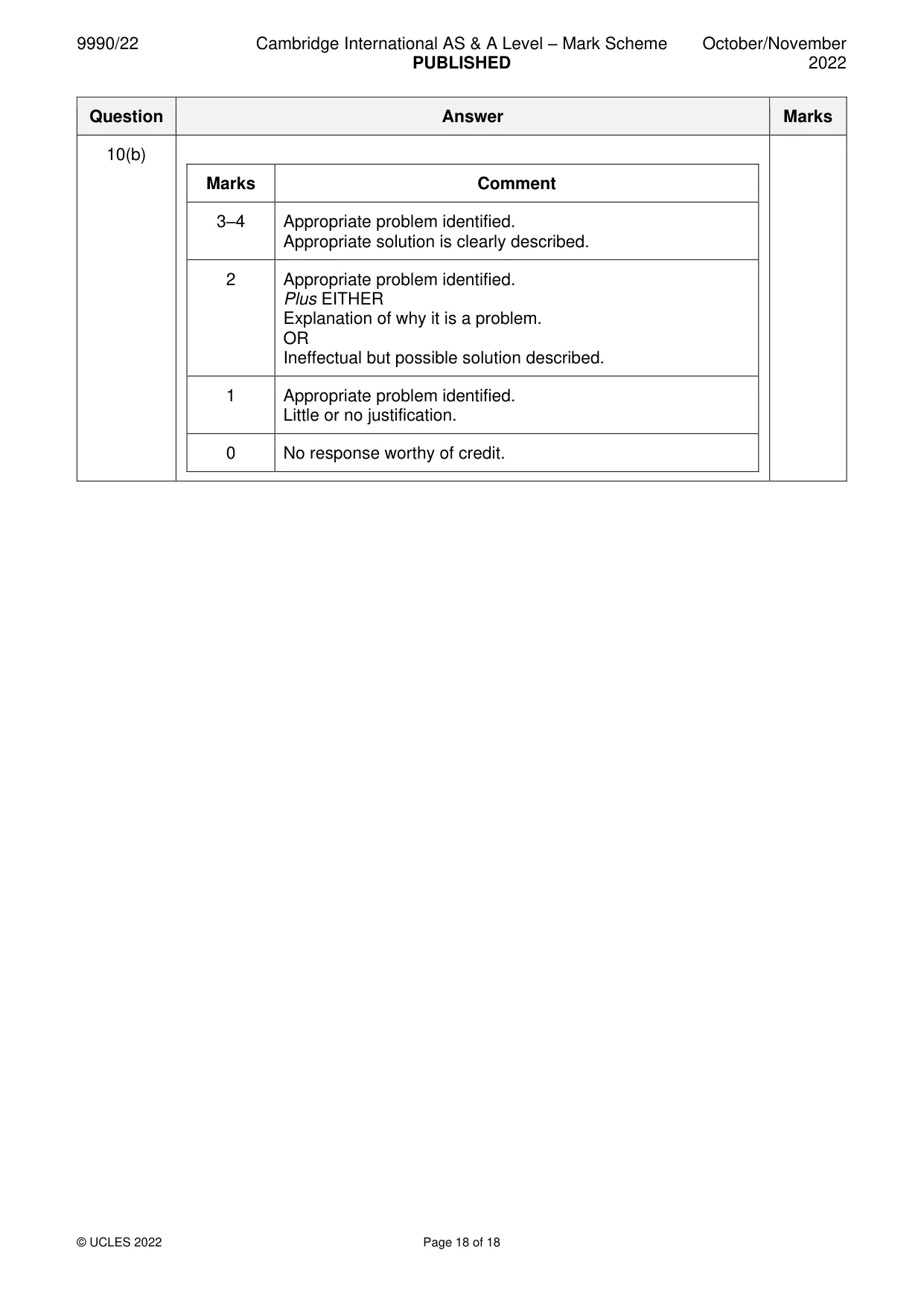
Mark scheme: 10 Dr Mitchell wants to investigate how physically active people are, and he believes that this may be related to how much they use social media. 10(a) Describe how Dr Mitchell could conduct a correlational study to 10 investigate the relationship between how physically active people are and how much they use social media. To correlate data, the variables must be at least ordinal scales, being quantitative alone is not enough. Three majors for a correlational study are: (a) Variable 1 – how physically active people are (detail: correct operationalisation and quantification). (b) Variable 2 – use of social media (detail: correct operationalisation and quantification). (c) Technique 2 – for producing/collecting data i.e. procedure (detail: e.g. tests, observations, questionnaires). The minors are: • location of participants when completing the questionnaire / how it is distributed • participants, sampling technique Also: • a statement about whether a positive or negative correlation is expected • sample size • description of how data will analysed, e.g. use of scattergram • ethical issues Other appropriate responses should also be credited. 10(a) Mark according to the levels of response criteria below: Level 3 (8–10 marks) • Response is described in sufficient detail to be replicable (i.e. what and how). • Response may have a minor omission (i.e. who or where). • Use of psychological terminology is accurate and comprehensive. Level 2 (5–7 marks) • Response is in some detail. • Response has minor omission(s) (i.e. who and/or where). • Use of psychological terminology is accurate. Level 1 (1–4 marks) • Response is basic in detail. • Response has major omission(s). • If response is impossible to conduct max. 2. • Use of psychological terminology is mainly accurate. Level 0 (0 marks) No response worthy of credit. 10(b) Identify one practical weakness/limitation with the procedure you have 4 described in your answer to part (a) and suggest how your study might be done differently to overcome the problem. Do not refer to ethics or sampling in your answer. Answer will depend on problem identified. If the problem was an obvious omission in (a), fewer marks will have been awarded in (a), so they can be awarded here. Problems may, for example, be matters of: Validity: • operationalisation • difficulty with lying / social desirability • difficulty with response biases Reliability: • inter-rater consistency • inter-rater consistency This list is not exhaustive and other appropriate responses should also be credited. 10(b) Marks Comment 3–4 Appropriate problem identified. Appropriate solution is clearly described. 2 Appropriate problem identified. Plus EITHER Explanation of why it is a problem. OR Ineffectual but possible solution described. 1 Appropriate problem identified. Little or no justification. 0 No response worthy of credit.
What was in this paper
The subtopics covered by these 10 questions, and how many questions each got. Open one in a new tab to see every Cambridge question on it.
What you needed in this session
Cambridge’s own grade thresholds for 2022 Oct/Nov, Paper 2 · Variant 2. A higher threshold means an easier paper — the bar moves with how the cohort did.